EP2865559A2 - Motor vehicle charging inlet structure - Google Patents
Motor vehicle charging inlet structure Download PDFInfo
- Publication number
- EP2865559A2 EP2865559A2 EP20140188596 EP14188596A EP2865559A2 EP 2865559 A2 EP2865559 A2 EP 2865559A2 EP 20140188596 EP20140188596 EP 20140188596 EP 14188596 A EP14188596 A EP 14188596A EP 2865559 A2 EP2865559 A2 EP 2865559A2
- Authority
- EP
- European Patent Office
- Prior art keywords
- charging
- lid
- lock pin
- charging socket
- socket
- Prior art date
- Legal status (The legal status is an assumption and is not a legal conclusion. Google has not performed a legal analysis and makes no representation as to the accuracy of the status listed.)
- Granted
Links
Images



Classifications
-
- H—ELECTRICITY
- H02—GENERATION; CONVERSION OR DISTRIBUTION OF ELECTRIC POWER
- H02J—ELECTRIC POWER NETWORKS; CIRCUIT ARRANGEMENTS OR SYSTEMS FOR SUPPLYING OR DISTRIBUTING ELECTRIC POWER; SYSTEMS FOR STORING ELECTRIC ENERGY
- H02J7/00—Circuit arrangements for charging or discharging batteries or for supplying loads from batteries
-
- B—PERFORMING OPERATIONS; TRANSPORTING
- B60—VEHICLES IN GENERAL
- B60K—ARRANGEMENT OR MOUNTING OF PROPULSION UNITS OR OF TRANSMISSIONS IN VEHICLES; ARRANGEMENT OR MOUNTING OF PLURAL DIVERSE PRIME-MOVERS IN VEHICLES; AUXILIARY DRIVES FOR VEHICLES; INSTRUMENTATION OR DASHBOARDS FOR VEHICLES; ARRANGEMENTS IN CONNECTION WITH COOLING, AIR INTAKE, GAS EXHAUST OR FUEL SUPPLY OF PROPULSION UNITS IN VEHICLES
- B60K15/00—Arrangement in connection with fuel supply of combustion engines or other fuel consuming energy converters, e.g. fuel cells; Mounting or construction of fuel tanks
- B60K15/03—Fuel tanks
- B60K15/04—Tank inlets
- B60K15/05—Inlet covers
-
- B—PERFORMING OPERATIONS; TRANSPORTING
- B60—VEHICLES IN GENERAL
- B60L—PROPULSION OF ELECTRICALLY-PROPELLED VEHICLES; SUPPLYING ELECTRIC POWER FOR AUXILIARY EQUIPMENT OF ELECTRICALLY-PROPELLED VEHICLES; ELECTRODYNAMIC BRAKE SYSTEMS FOR VEHICLES IN GENERAL; MAGNETIC SUSPENSION OR LEVITATION FOR VEHICLES; MONITORING OPERATING VARIABLES OF ELECTRICALLY-PROPELLED VEHICLES; ELECTRIC SAFETY DEVICES FOR ELECTRICALLY-PROPELLED VEHICLES
- B60L50/00—Electric propulsion with power supplied within the vehicle
- B60L50/50—Electric propulsion with power supplied within the vehicle using propulsion power supplied by batteries or fuel cells
-
- B—PERFORMING OPERATIONS; TRANSPORTING
- B60—VEHICLES IN GENERAL
- B60L—PROPULSION OF ELECTRICALLY-PROPELLED VEHICLES; SUPPLYING ELECTRIC POWER FOR AUXILIARY EQUIPMENT OF ELECTRICALLY-PROPELLED VEHICLES; ELECTRODYNAMIC BRAKE SYSTEMS FOR VEHICLES IN GENERAL; MAGNETIC SUSPENSION OR LEVITATION FOR VEHICLES; MONITORING OPERATING VARIABLES OF ELECTRICALLY-PROPELLED VEHICLES; ELECTRIC SAFETY DEVICES FOR ELECTRICALLY-PROPELLED VEHICLES
- B60L53/00—Methods of charging batteries, specially adapted for electric vehicles; Charging stations or on-board charging equipment therefor; Exchange of energy storage elements in electric vehicles
- B60L53/10—Methods of charging batteries, specially adapted for electric vehicles; Charging stations or on-board charging equipment therefor; Exchange of energy storage elements in electric vehicles characterised by the energy transfer between the charging station and the vehicle
- B60L53/14—Conductive energy transfer
- B60L53/16—Connectors, e.g. plugs or sockets, specially adapted for charging electric vehicles
-
- E—FIXED CONSTRUCTIONS
- E05—LOCKS; KEYS; WINDOW OR DOOR FITTINGS; SAFES
- E05B—LOCKS; ACCESSORIES THEREFOR; HANDCUFFS
- E05B47/00—Operating or controlling locks or other fastening devices by electric or magnetic means
-
- B—PERFORMING OPERATIONS; TRANSPORTING
- B60—VEHICLES IN GENERAL
- B60K—ARRANGEMENT OR MOUNTING OF PROPULSION UNITS OR OF TRANSMISSIONS IN VEHICLES; ARRANGEMENT OR MOUNTING OF PLURAL DIVERSE PRIME-MOVERS IN VEHICLES; AUXILIARY DRIVES FOR VEHICLES; INSTRUMENTATION OR DASHBOARDS FOR VEHICLES; ARRANGEMENTS IN CONNECTION WITH COOLING, AIR INTAKE, GAS EXHAUST OR FUEL SUPPLY OF PROPULSION UNITS IN VEHICLES
- B60K15/00—Arrangement in connection with fuel supply of combustion engines or other fuel consuming energy converters, e.g. fuel cells; Mounting or construction of fuel tanks
- B60K15/03—Fuel tanks
- B60K15/04—Tank inlets
- B60K15/05—Inlet covers
- B60K2015/0515—Arrangements for closing or opening of inlet cover
- B60K2015/053—Arrangements for closing or opening of inlet cover with hinged connection to the vehicle body
-
- B—PERFORMING OPERATIONS; TRANSPORTING
- B60—VEHICLES IN GENERAL
- B60L—PROPULSION OF ELECTRICALLY-PROPELLED VEHICLES; SUPPLYING ELECTRIC POWER FOR AUXILIARY EQUIPMENT OF ELECTRICALLY-PROPELLED VEHICLES; ELECTRODYNAMIC BRAKE SYSTEMS FOR VEHICLES IN GENERAL; MAGNETIC SUSPENSION OR LEVITATION FOR VEHICLES; MONITORING OPERATING VARIABLES OF ELECTRICALLY-PROPELLED VEHICLES; ELECTRIC SAFETY DEVICES FOR ELECTRICALLY-PROPELLED VEHICLES
- B60L2270/00—Problem solutions or means not otherwise provided for
- B60L2270/30—Preventing theft during charging
- B60L2270/34—Preventing theft during charging of parts
-
- H—ELECTRICITY
- H01—ELECTRIC ELEMENTS
- H01R—ELECTRICALLY-CONDUCTIVE CONNECTIONS; STRUCTURAL ASSOCIATIONS OF A PLURALITY OF MUTUALLY-INSULATED ELECTRICAL CONNECTING ELEMENTS; COUPLING DEVICES; CURRENT COLLECTORS
- H01R13/00—Details of coupling devices of the kinds covered by groups H01R12/70 or H01R24/00 - H01R33/00
- H01R13/62—Means for facilitating engagement or disengagement of coupling parts or for holding them in engagement
- H01R13/639—Additional means for holding or locking coupling parts together, after engagement, e.g. separate keylock, retainer strap
- H01R13/6397—Additional means for holding or locking coupling parts together, after engagement, e.g. separate keylock, retainer strap with means for preventing unauthorised use
-
- H—ELECTRICITY
- H01—ELECTRIC ELEMENTS
- H01R—ELECTRICALLY-CONDUCTIVE CONNECTIONS; STRUCTURAL ASSOCIATIONS OF A PLURALITY OF MUTUALLY-INSULATED ELECTRICAL CONNECTING ELEMENTS; COUPLING DEVICES; CURRENT COLLECTORS
- H01R2201/00—Connectors or connections adapted for particular applications
- H01R2201/26—Connectors or connections adapted for particular applications for vehicles
-
- Y—GENERAL TAGGING OF NEW TECHNOLOGICAL DEVELOPMENTS; GENERAL TAGGING OF CROSS-SECTIONAL TECHNOLOGIES SPANNING OVER SEVERAL SECTIONS OF THE IPC; TECHNICAL SUBJECTS COVERED BY FORMER USPC CROSS-REFERENCE ART COLLECTIONS [XRACs] AND DIGESTS
- Y02—TECHNOLOGIES OR APPLICATIONS FOR MITIGATION OR ADAPTATION AGAINST CLIMATE CHANGE
- Y02T—CLIMATE CHANGE MITIGATION TECHNOLOGIES RELATED TO TRANSPORTATION
- Y02T10/00—Road transport of goods or passengers
- Y02T10/60—Other road transportation technologies with climate change mitigation effect
- Y02T10/70—Energy storage systems for electromobility, e.g. batteries
-
- Y—GENERAL TAGGING OF NEW TECHNOLOGICAL DEVELOPMENTS; GENERAL TAGGING OF CROSS-SECTIONAL TECHNOLOGIES SPANNING OVER SEVERAL SECTIONS OF THE IPC; TECHNICAL SUBJECTS COVERED BY FORMER USPC CROSS-REFERENCE ART COLLECTIONS [XRACs] AND DIGESTS
- Y02—TECHNOLOGIES OR APPLICATIONS FOR MITIGATION OR ADAPTATION AGAINST CLIMATE CHANGE
- Y02T—CLIMATE CHANGE MITIGATION TECHNOLOGIES RELATED TO TRANSPORTATION
- Y02T10/00—Road transport of goods or passengers
- Y02T10/60—Other road transportation technologies with climate change mitigation effect
- Y02T10/7072—Electromobility specific charging systems or methods for batteries, ultracapacitors, supercapacitors or double-layer capacitors
-
- Y—GENERAL TAGGING OF NEW TECHNOLOGICAL DEVELOPMENTS; GENERAL TAGGING OF CROSS-SECTIONAL TECHNOLOGIES SPANNING OVER SEVERAL SECTIONS OF THE IPC; TECHNICAL SUBJECTS COVERED BY FORMER USPC CROSS-REFERENCE ART COLLECTIONS [XRACs] AND DIGESTS
- Y02—TECHNOLOGIES OR APPLICATIONS FOR MITIGATION OR ADAPTATION AGAINST CLIMATE CHANGE
- Y02T—CLIMATE CHANGE MITIGATION TECHNOLOGIES RELATED TO TRANSPORTATION
- Y02T90/00—Enabling technologies or technologies with a potential or indirect contribution to GHG emissions mitigation
- Y02T90/10—Technologies relating to charging of electric vehicles
- Y02T90/14—Plug-in electric vehicles
Definitions
- the present disclosure relates to a motor vehicle charging inlet structure in which a portion provided with a charging plug is opened and closed by a lid.
- An electric vehicle driven by an electric motor and a hybrid vehicle driven by the combined use of an electric motor and an engine have been developed in many different forms.
- An electricity storage unit such as a battery or the like is installed in the electric vehicle or the hybrid vehicle, so that the electric motor is operated by the electric power stored in the electricity storage unit.
- the electricity storage unit mounted to the electric vehicle or the hybrid vehicle is charged by the electric power supplied from a charging facility outside the motor vehicle, for example, a household commercial power supply or a power supply of a dedicated charging facility.
- the charging of the electricity storage unit is implemented by supplying the electric power from a charging connector (charging gun) to the electricity storage unit through a charging socket.
- a charging connector charging gun
- a charging socket is disposed in the opening portion, so that a charging opening portion is formed.
- the charging opening portion is opened or closed by a lid. By virtue of the opening or closing of the lid, the charging inlet is opened or shielded with respect to the outside.
- the lid is fixed (locked) in a closed state by, e.g., activating an electromagnetic actuator and causing a lid lock pin to make a closing operation.
- the lid is unlocked by activating the electromagnetic actuator through an operation in a vehicle room and causing the lid lock pin to make an opening operation. This makes it possible to open the lid.
- the electricity storage unit of the electric vehicle or the hybrid vehicle is charged by connecting a charging gun to the charging socket with the charging opening portion kept opened. Since the charging of the electricity storage unit of the electric vehicle or the hybrid vehicle is more time-consuming than the refueling of a gasoline-powered vehicle, there is a case where the vehicle is left alone in a charging state. Thus, there is a fear that the charging gun is removed from the charging socket and further that the charging gun and the electric power are stolen. Furthermore, there is a possibility that that the charging gun is removed from the charging socket and further that the live part of the charging inlet is exposed.
- a lock device that fixes (locks) the charging gun in a connected state when the charging gun is connected to the charging socket.
- the position of the locking claw is restrained by a lock pin, thereby restraining the movement of the locking claw and inhibiting the removal of the charging gun.
- the lid lock pin for fixing the lid and the lock pin for restraining the position of the locking claw of the charging gun to inhibit the removal of the charging gun are driven by one actuator.
- the locking of the lid and the locking of the charging gun can be performed by one actuator.
- the lid lock pin for locking the lid and the lock pin for locking the charging gun are disposed in a charging inlet (power-feeding charging inlet), it is the current situation that there is a limit in making the charging inlet small.
- Some embodiments of the present disclosure provide a motor vehicle charging inlet structure capable of locking both a lid and a charging connector with one lock member.
- a motor vehicle charging inlet structure including: a first charging socket disposed in a recess portion of a vehicle body and connected to an electricity storage unit of a motor vehicle, the first charging socket being configured to be connected to a charging connector which supplies electric power from an external power supply to the electricity storage unit; a lid configured to open and close the recess portion; and a lock member configured to, when the lid is closed, come into engagement with the lid to fix the lid in a closed state and configured to, when the charging connector is connected to the first charging socket in a state in which the engagement of the lock member with the lid is released, come into press-contact with the charging connector to fix the charging connector in a connected state.
- the lock member includes a lock pin which is axially reciprocated by an actuator, when the lock pin is driven in one direction, one end portion of the lock pin engages with the lid, and when the lock pin is driven in another direction, the other end portion of the lock pin comes into press-contact with the charging connector.
- the lock member includes a lock pin which is driven by an actuator so as to rotate about a rotation center, when one end portion of the lock pin is oriented toward an upper side of the motor vehicle, the lock pin engages with the lid, and when the lock pin is rotated such that the one end portion of the lock pin is oriented toward a lower side of the motor vehicle, the lock pin comes into press-contact with the charging connector.
- the charging inlet structure further includes: a second charging socket disposed in the recess portion of the vehicle body and connected to the electricity storage unit, the second charging socket being larger in diameter than the first charging socket, and wherein the first and second charging sockets are arranged side by side along one direction and the lock member is disposed in a space which adjoins the first charging socket, the space overlapping with the second charging socket in an arrangement direction of the first and second charging sockets.
- an amount of electric power input to the second charging socket is larger than an amount of electric power input to the first charging socket.
- a lock member engaging portion with which the lock member engages is formed in the lid, and the lock member engaging portion includes a part holding portion configured to hold a part of the charging inlet structure when the lid is opened.
- a configuration of a motor vehicle charging inlet structure will be described in detail with reference to FIGS. 1 to 4 .
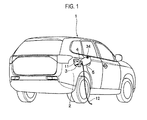
- FIG. 1 shows the overall external appearance of a motor vehicle provided with a motor vehicle charging inlet structure (a power-feeding charging inlet structure) according to one embodiment of the present disclosure.
- FIGS. 2 , 3A and 3B show a specific configuration of a charging inlet.
- FIG. 2 shows a state in which a charging connector is not inserted.
- FIG. 3A shows a state in which an ordinary charging connector connected to a household commercial power supply is inserted into an ordinary charging socket.
- FIG. 3B shows a state in which a rapid charging connector connected to a rapid charging power supply such as a charging stand or the like is inserted into a rapid charging socket.
- FIG. 4 is a front view of the charging inlet, explaining the arrangement of the ordinary charging socket and the rapid charging socket.
- an opening portion 3 is formed in a rear side outer panel (an outer panel) 2 of a motor vehicle 1.
- a recess portion 4 is formed inside the opening portion 3.
- a lid 5 is openably installed in the opening portion 3 of the outer panel 2. By opening the lid 5, the recess portion 4 faces toward the outside.
- the recess portion 4 has a shape of a container which includes a rectangular bottom surface and a wall surface existing around the bottom surface.
- An ordinary charging socket 7 as a first socket and a rapid charging socket 8 as a second socket are installed side by side on the bottom surface.
- the ordinary charging socket 7 and the rapid charging socket 8 are connected to an electricity storage unit of the motor vehicle 1.
- the ordinary charging socket 7 when not in use, the ordinary charging socket 7 is capped with a cap 9.
- the cap 9 is removed and an ordinary charging connector 11 (an ordinary charging gun) is inserted into the ordinary charging socket 7.
- the ordinary charging connector 11 is installed at one end side of a low-voltage cable 12.
- the other end side of the low-voltage cable 12 is connected to a household power supply (a household outlet).
- a household power supply a household outlet
- the ordinary charging connector 11 includes a grip portion 21 and a cylindrical mounting portion 22.
- the mounting portion 22 is inserted into the ordinary charging socket 7 such that connection terminals are connected to each other.
- a locking claw 23 is installed on the outer circumference of the mounting portion 22. When the mounting portion 22 is inserted into the ordinary charging socket 7, the locking claw 23 is locked to a locking portion 6 of the ordinary charging socket 7. Thus, the detachment of the ordinary charging connector 11 is prevented.
- the base end side of the locking claw 23 extends toward the grip portion 21.
- An operation portion 24 is provided at the base end side of the locking claw 23.
- the base end side of the locking claw 23 is rotatably supported on the body of the ordinary charging connector 11.
- the locking claw 23 is rotationally biased toward the mounting portion 22.
- the rapid charging socket 8 when not in use, the rapid charging socket 8 is capped with a cap 10.
- a rapid charging connector 15 (a rapid charging gun) is inserted into the rapid charging socket 8.
- the rapid charging connector 15 is installed at one end of a high-voltage cable 16.
- the other end of the high-voltage cable 16 is connected to a vehicle-dedicated charging device in a dedicated charging facility.
- the vehicle-dedicated charging device is, e.g., a device that converts a three-phase high AC voltage to a DC voltage and outputs the DC voltage.
- high voltage electric power is fed to the rapid charging socket 8 through the rapid charging connector 15.
- the charging inlet structure of the present embodiment includes the rapid charging socket 8 capable of charging a motor vehicle with a large amount of electric power supplied from a dedicated charging facility (the rapid charging socket 8 to which the rapid charging connector 15 extending from a facility capable of rapidly charging a motor vehicle at a high voltage is connected) and the ordinary charging socket 7 capable of charging a motor vehicle with household commercial electric power (the ordinary charging socket 7 to which the ordinary charging connector 11 extending from a low-voltage household outlet is connected).
- a lock mechanism 31 is installed above the ordinary charging socket 7.
- the lock mechanism 31 is provided with a lock pin 33 (a lock member) which is vertically reciprocated by the actuation of an electromagnetic actuator 32.
- a hook portion 34 (a lock member engaging portion) with which the upper end portion (one end side) of the lock pin 33 engages when the lid 5 is closed.
- the lock pin 33 is driven upward to thereby come into engagement with the hook portion 34.
- the lid 5 is locked in the closed state and cannot be opened.
- the ordinary charging connector 11 In a case where charging is performed by inserting the ordinary charging connector 11 into the ordinary charging socket 7, the ordinary charging connector 11 is inserted into the ordinary charging socket 7 with the lid 5 kept opened. Since the ordinary charging connector 11 is connected to, e.g., a household power supply (a household outlet), a long period of time is required in charging a motor vehicle. Therefore, there is a case where the motor vehicle is left alone in a charging state.
- a household power supply a household outlet
- the state of insertion of the ordinary charging connector 11 into the ordinary charging socket 7 is locked by the lock pin 33 of the lock mechanism 31, in which state the ordinary charging connector 11 cannot be removed.
- the ordinary charging connector 11 or the electric power is stolen.
- the live part of the charging inlet is not exposed. This eliminates the possibility that a user or the like inadvertently touches the live part.
- the ordinary charging socket 7 and the rapid charging socket 8 are installed side by side in the front-rear direction of the motor vehicle (in the left-right direction in FIG. 4 : in one direction).
- the rapid charging socket 8 is larger in diameter than the ordinary charging socket 7.
- the lower outer peripheral edges of the ordinary charging socket 7 and the rapid charging socket 8 are aligned with each other along the front-rear direction of the motor vehicle. That is to say, the ordinary charging socket 7 and the rapid charging socket 8 are installed side by side along one direction in such a state that the lower edges thereof are aligned with each other at the same height position (in such a state that the outer peripheral edges thereof are aligned with each other along the arrangement direction).
- the lock mechanism 31 is installed above the ordinary charging socket 7. That is to say, the lock mechanism 31 (the lock pin 33) is installed in a space S overlapping with the diameter r of the rapid charging socket 8 over a range H of the ordinary charging socket 7 extending in the front-rear direction of the motor vehicle (in the left-right direction in FIG. 4 : in the arrangement direction). Therefore, there is no need to have a dedicated space for the arrangement of the lock mechanism 31 (the lock pin 33). This makes it possible to effectively use the available space when the ordinary charging socket 7 and the rapid charging socket 8 (which differ in diameter from each other) are provided.
- the ordinary charging socket 7 and the rapid charging socket 8 are installed side by side in the up-down direction of the motor vehicle rather than in the front-rear direction of the motor vehicle.
- the lock mechanism 31 is installed in a position adjoining one of the left and right side of the ordinary charging socket 7 and in a space overlapping with the diameter r of the rapid charging socket 8 in the up-down direction.
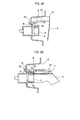
- FIG. 5 shows a cross section with the lid closed.
- FIGS. 6A and 6B show a cross section with the lid opened.
- FIG. 6A illustrates a state in which the ordinary charging connector 11 is not inserted.
- FIG. 6B illustrates a state in which the ordinary charging connector 11 is locked.
- the lock pin 33 is driven upward by the electromagnetic actuator 32, thereby bringing the upper end portion of the lock pin 33 into engagement with the hook portion 34.
- the lid 5 is locked in a closed state. In this state, the lid 5 cannot be opened from the outside.
- the lock pin 33 is driven toward a neutral position by the electromagnetic actuator 32, thereby releasing the upper end portion of the lock pin 33 from the hook portion 34.
- the lid 5 is unlocked and can be opened from the outside.
- the ordinary charging connector 11 is inserted into and connected to the ordinary charging socket 7 in the state shown in FIG. 6A wherein the lock pin 33 is driven into the neutral position.
- the locking claw 23 of the ordinary charging connector 11 is locked to the locking portion 6 of the ordinary charging socket 7.
- the lock pin 33 is driven downward by the electromagnetic actuator 32, thereby pressing the locking claw 23 of the ordinary charging connector 11 with the lower end portion of the lock pin 33.
- the locking of the locking claw 23 to the locking portion 6 is maintained and the state of insertion (connection) of the ordinary charging connector 11 into (to) the ordinary charging socket 7 is locked. In this state, the ordinary charging connector 11 cannot be removed.
- the charging inlet includes a lock mechanism for the lid 5 and the ordinary charging connector 11 can be small in size. This makes it possible to increase the degree of freedom of a vehicle body design.
- FIGS. 7A and 7B Another embodiment of the lock member engaging portion will now be described with reference to FIGS. 7A and 7B .
- FIGS. 7A and 7B show the external appearance of a lid according to another embodiment of the present disclosure.
- FIG. 7A shows a state in which a cap is held in a part holding portion.
- FIG. 7B shows a state in which a charging connector is held in a part holding portion.
- a lock member engaging portion 38 is installed at the rear surface side of the lid 5.
- the lock member engaging portion 38 includes a hook portion 39 with which the upper end portion (one end side) of the lock pin 33 engages when the lid 5 is closed and a part holding portion 40 extending in the width direction.
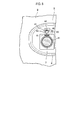
- FIG. 8 is a front view of a lock mechanism according to still another embodiment of the present disclosure.
- the same members as those shown in FIG. 4 will be designated by like reference symbols.
- a lock mechanism 41 is installed above the ordinary charging socket 7.
- the lock mechanism 41 is provided with a rotary actuator 42.
- the rotary actuator 42 includes a rotating portion 43 that rotates about an axis (a rotation center) perpendicular to a drawing sheet.
- a lock pin 44 is fixed to the edge portion of the rotating portion 43.
- the lid 5 When the lid 5 is closed, if the rotating portion 43 is driven by the rotary actuator 42 such that the lock pin 44 is positioned at the upper side, the lock pin 44 comes into engagement with the hook portion 34. Thus, the lid 5 is locked in the closed state. In order to open the lid 5, the rotating portion 43 is driven by the rotary actuator 42 such that the lock pin 44 is positioned at a lateral side. Then, the lock pin 44 is removed from the hook portion 34. Thus, the lid 5 is unlocked.
- the locking claw 23 of the ordinary charging connector 11 is locked to the locking portion 6 of the ordinary charging socket 7. If the rotating portion 43 is driven by the rotary actuator 42 such that the lock pin 44 is positioned at the lower side, the lock pin 44 presses the locking claw 23 of the ordinary charging connector 11. Thus, the locking of the locking claw 23 to the locking portion 6 is maintained and the state of insertion (connection) of the ordinary charging connector 11 into (to) the ordinary charging socket 7 is locked.
- the present disclosure can be used in the industrial field of a motor vehicle charging inlet structure in which a portion provided with a charging plug is opened and closed by a lid.
- the closed state of the lid and the connected state of the charging connector are fixed by one lock member. It is therefore possible to lock both the lid and the charging gun with one lock member.
- the charging inlet provided with the lock mechanism for the lid and the charging connector can be small in size. This makes it possible to increase the degree of freedom of a vehicle body design.
- the closed state of the lid can be locked at one end side of the lock pin and the connected state of the charging connector can be locked at the other end side of the lock pin. Therefore, the charging inlet can be made smaller.
- the lock pin is rotated about a rotation center. Therefore, two mutually different locking operations, namely the locking of the lid and the locking of the connected state of the charging connector, can be performed with one lock pin.
- the first socket and the second socket having a larger diameter are arranged side by side.
- the lock member is disposed in, e.g., a space overlapped with the diameter of the second socket in the arrangement direction over a range adjoining the first socket, namely the upper space of the first socket. Therefore, there is no need to secure a dedicated space for the arrangement of the lock member. This makes it possible to effectively use the available space when first and second sockets which differ in diameter from each other are provided.
- the motor vehicle charging inlet structure includes a second socket capable of charging a motor vehicle with a large amount of electric power supplied from a dedicated charging facility, e.g., a rapid charging socket to which a charging connector extending from a facility capable of rapidly charging a motor vehicle at a high voltage is connected, and a first socket capable of charging a motor vehicle with household commercial electric power, e.g., an ordinary charging socket to which a charging connector extending from a low-voltage household outlet is connected.
- the lock member is installed in a position adjoining the ordinary charging socket. It is therefore possible to lock the connection of an ordinary charging connector which requires a long period of time in charging a motor vehicle, thereby preventing the theft of the charging gun and the electric power.
- the lock member engaging portion is formed as part of a holding portion. Therefore, when the lid is opened, the inner lid of the first socket (the second socket) and the charging connector can be held in the lock member engaging portion.
- the motor vehicle charging inlet structure of the present disclosure can lock both the lid and the charging connector with one lock member.
Landscapes
- Engineering & Computer Science (AREA)
- Transportation (AREA)
- Mechanical Engineering (AREA)
- Power Engineering (AREA)
- Life Sciences & Earth Sciences (AREA)
- Sustainable Development (AREA)
- Sustainable Energy (AREA)
- Chemical & Material Sciences (AREA)
- Combustion & Propulsion (AREA)
- Electric Propulsion And Braking For Vehicles (AREA)
- Arrangement Or Mounting Of Propulsion Units For Vehicles (AREA)
Abstract
Description
- The present disclosure relates to a motor vehicle charging inlet structure in which a portion provided with a charging plug is opened and closed by a lid.
- An electric vehicle driven by an electric motor and a hybrid vehicle driven by the combined use of an electric motor and an engine have been developed in many different forms. An electricity storage unit such as a battery or the like is installed in the electric vehicle or the hybrid vehicle, so that the electric motor is operated by the electric power stored in the electricity storage unit. The electricity storage unit mounted to the electric vehicle or the hybrid vehicle is charged by the electric power supplied from a charging facility outside the motor vehicle, for example, a household commercial power supply or a power supply of a dedicated charging facility.
- The charging of the electricity storage unit is implemented by supplying the electric power from a charging connector (charging gun) to the electricity storage unit through a charging socket. Thus, an opening portion (recess portion) of a charging inlet (power-feeding charging inlet) is formed in the vehicle body and a charging socket is disposed in the opening portion, so that a charging opening portion is formed. The charging opening portion is opened or closed by a lid. By virtue of the opening or closing of the lid, the charging inlet is opened or shielded with respect to the outside.
- The lid is fixed (locked) in a closed state by, e.g., activating an electromagnetic actuator and causing a lid lock pin to make a closing operation. The lid is unlocked by activating the electromagnetic actuator through an operation in a vehicle room and causing the lid lock pin to make an opening operation. This makes it possible to open the lid.
- The electricity storage unit of the electric vehicle or the hybrid vehicle is charged by connecting a charging gun to the charging socket with the charging opening portion kept opened. Since the charging of the electricity storage unit of the electric vehicle or the hybrid vehicle is more time-consuming than the refueling of a gasoline-powered vehicle, there is a case where the vehicle is left alone in a charging state. Thus, there is a fear that the charging gun is removed from the charging socket and further that the charging gun and the electric power are stolen. Furthermore, there is a possibility that that the charging gun is removed from the charging socket and further that the live part of the charging inlet is exposed.
- Under the circumstances, there has been conventionally proposed a lock device that fixes (locks) the charging gun in a connected state when the charging gun is connected to the charging socket. In some techniques, when a charging gun is connected and fixed to a charging socket through the use of a locking claw, the position of the locking claw is restrained by a lock pin, thereby restraining the movement of the locking claw and inhibiting the removal of the charging gun.
- In the above techniques, the lid lock pin for fixing the lid and the lock pin for restraining the position of the locking claw of the charging gun to inhibit the removal of the charging gun are driven by one actuator. Thus, the locking of the lid and the locking of the charging gun can be performed by one actuator.
- However, since the lid lock pin for locking the lid and the lock pin for locking the charging gun are disposed in a charging inlet (power-feeding charging inlet), it is the current situation that there is a limit in making the charging inlet small.
- Some embodiments of the present disclosure provide a motor vehicle charging inlet structure capable of locking both a lid and a charging connector with one lock member.
- According to an aspect of the present disclosure, there is provided a motor vehicle charging inlet structure including: a first charging socket disposed in a recess portion of a vehicle body and connected to an electricity storage unit of a motor vehicle, the first charging socket being configured to be connected to a charging connector which supplies electric power from an external power supply to the electricity storage unit; a lid configured to open and close the recess portion; and a lock member configured to, when the lid is closed, come into engagement with the lid to fix the lid in a closed state and configured to, when the charging connector is connected to the first charging socket in a state in which the engagement of the lock member with the lid is released, come into press-contact with the charging connector to fix the charging connector in a connected state.
- In some embodiments, the lock member includes a lock pin which is axially reciprocated by an actuator, when the lock pin is driven in one direction, one end portion of the lock pin engages with the lid, and when the lock pin is driven in another direction, the other end portion of the lock pin comes into press-contact with the charging connector.
- In other embodiments, the lock member includes a lock pin which is driven by an actuator so as to rotate about a rotation center, when one end portion of the lock pin is oriented toward an upper side of the motor vehicle, the lock pin engages with the lid, and when the lock pin is rotated such that the one end portion of the lock pin is oriented toward a lower side of the motor vehicle, the lock pin comes into press-contact with the charging connector.
- In alternate embodiments, the charging inlet structure further includes: a second charging socket disposed in the recess portion of the vehicle body and connected to the electricity storage unit, the second charging socket being larger in diameter than the first charging socket, and wherein the first and second charging sockets are arranged side by side along one direction and the lock member is disposed in a space which adjoins the first charging socket, the space overlapping with the second charging socket in an arrangement direction of the first and second charging sockets.
- In other embodiments, an amount of electric power input to the second charging socket is larger than an amount of electric power input to the first charging socket.
- In some other embodiments, a lock member engaging portion with which the lock member engages is formed in the lid, and the lock member engaging portion includes a part holding portion configured to hold a part of the charging inlet structure when the lid is opened.
- The accompanying drawings, which are incorporated in and constitute a part of the specification, illustrate embodiments of the present disclosure, and together with the general description given above and the detailed description of the embodiments given below, serve to explain the principles of the present disclosure.
-
FIG. 1 is an external view of a motor vehicle provided with a motor vehicle charging inlet structure according to one embodiment of the present disclosure. -
FIG. 2 is an explanatory view showing a specific configuration of a charging inlet. -
FIGS. 3A and 3B are explanatory views showing the specific configuration of the charging inlet. -
FIG. 4 is a front view of the charging inlet. -
FIG. 5 is an explanatory view illustrating the operation of the motor vehicle charging inlet structure. -
FIGS. 6A and 6B are explanatory views illustrating the operation of the motor vehicle charging inlet structure. -
FIGS. 7A and 7B are external views of a lid according to another embodiment of the present disclosure. -
FIG. 8 is a front view of a lock mechanism according to still another embodiment of the present disclosure. - Reference will now be made in detail to various embodiments, examples of which are illustrated in the accompanying drawings. In the following detailed description, numerous specific details are set forth in order to provide a thorough understanding of the present disclosure. However, it will be apparent to one of ordinary skill in the art that the present disclosure may be practiced without these specific details. In other instances, well-known methods, procedures, systems, and components have not been described in detail so as not to unnecessarily obscure aspects of the various embodiments.
- A configuration of a motor vehicle charging inlet structure will be described in detail with reference to
FIGS. 1 to 4 . -
FIG. 1 shows the overall external appearance of a motor vehicle provided with a motor vehicle charging inlet structure (a power-feeding charging inlet structure) according to one embodiment of the present disclosure.FIGS. 2 ,3A and 3B show a specific configuration of a charging inlet.FIG. 2 shows a state in which a charging connector is not inserted.FIG. 3A shows a state in which an ordinary charging connector connected to a household commercial power supply is inserted into an ordinary charging socket.FIG. 3B shows a state in which a rapid charging connector connected to a rapid charging power supply such as a charging stand or the like is inserted into a rapid charging socket.FIG. 4 is a front view of the charging inlet, explaining the arrangement of the ordinary charging socket and the rapid charging socket. - As shown in
FIG. 1 , anopening portion 3 is formed in a rear side outer panel (an outer panel) 2 of amotor vehicle 1. Arecess portion 4 is formed inside theopening portion 3. Alid 5 is openably installed in theopening portion 3 of theouter panel 2. By opening thelid 5, therecess portion 4 faces toward the outside. - As shown in
FIGS. 2 to 4 , therecess portion 4 has a shape of a container which includes a rectangular bottom surface and a wall surface existing around the bottom surface. Anordinary charging socket 7 as a first socket and arapid charging socket 8 as a second socket are installed side by side on the bottom surface. Theordinary charging socket 7 and therapid charging socket 8 are connected to an electricity storage unit of themotor vehicle 1. - As shown in
FIG. 3B , when not in use, theordinary charging socket 7 is capped with acap 9. During a charging process, as shown inFIG. 3A , thecap 9 is removed and an ordinary charging connector 11 (an ordinary charging gun) is inserted into theordinary charging socket 7. Theordinary charging connector 11 is installed at one end side of a low-voltage cable 12. The other end side of the low-voltage cable 12 is connected to a household power supply (a household outlet). Thus, the electric power of a low voltage is fed to theordinary charging socket 7 through theordinary charging connector 11. - The
ordinary charging connector 11 includes agrip portion 21 and a cylindrical mountingportion 22. The mountingportion 22 is inserted into theordinary charging socket 7 such that connection terminals are connected to each other. A lockingclaw 23 is installed on the outer circumference of the mountingportion 22. When the mountingportion 22 is inserted into theordinary charging socket 7, the lockingclaw 23 is locked to a lockingportion 6 of theordinary charging socket 7. Thus, the detachment of theordinary charging connector 11 is prevented. - The base end side of the locking
claw 23 extends toward thegrip portion 21. Anoperation portion 24 is provided at the base end side of the lockingclaw 23. The base end side of the lockingclaw 23 is rotatably supported on the body of theordinary charging connector 11. The lockingclaw 23 is rotationally biased toward the mountingportion 22. By operating theoperation portion 24 to rotate the lockingclaw 23 against a biasing force toward the opposite side of the mountingportion 22, it is possible to unlock the lockingclaw 23 from the lockingportion 6 of theordinary charging socket 7. - As shown in
FIG. 3A , when not in use, therapid charging socket 8 is capped with acap 10. During a charging process, as shown inFIG. 3B , thecap 10 is removed and a rapid charging connector 15 (a rapid charging gun) is inserted into therapid charging socket 8. Therapid charging connector 15 is installed at one end of a high-voltage cable 16. The other end of the high-voltage cable 16 is connected to a vehicle-dedicated charging device in a dedicated charging facility. The vehicle-dedicated charging device is, e.g., a device that converts a three-phase high AC voltage to a DC voltage and outputs the DC voltage. Thus, high voltage electric power is fed to therapid charging socket 8 through therapid charging connector 15. - The charging inlet structure of the present embodiment includes the
rapid charging socket 8 capable of charging a motor vehicle with a large amount of electric power supplied from a dedicated charging facility (therapid charging socket 8 to which therapid charging connector 15 extending from a facility capable of rapidly charging a motor vehicle at a high voltage is connected) and theordinary charging socket 7 capable of charging a motor vehicle with household commercial electric power (theordinary charging socket 7 to which theordinary charging connector 11 extending from a low-voltage household outlet is connected). - No description will be made on the specific configuration of the
rapid charging connector 15. - As shown in
FIGS. 2 to 4 , alock mechanism 31 is installed above theordinary charging socket 7. Thelock mechanism 31 is provided with a lock pin 33 (a lock member) which is vertically reciprocated by the actuation of anelectromagnetic actuator 32. At the rear surface side of thelid 5, there is installed a hook portion 34 (a lock member engaging portion) with which the upper end portion (one end side) of thelock pin 33 engages when thelid 5 is closed. - As will be described in detail later, when the
lid 5 is closed, thelock pin 33 is driven upward to thereby come into engagement with thehook portion 34. Thus, thelid 5 is locked in the closed state and cannot be opened. - When the
ordinary charging connector 11 is inserted into theordinary charging socket 7 and the lockingclaw 23 is locked to the lockingportion 6 of theordinary charging socket 7, thelock pin 33 is driven downward whereby the lockingclaw 23 is pressed by the lower end (the other end side) of thelock pin 33. That is to say, the other end side of thelock pin 33 comes into press-contact with the locking claw 23 (the charging connector side). Consequently, the locking of the lockingclaw 23 to the lockingportion 6 is maintained and the state of insertion of theordinary charging connector 11 into theordinary charging socket 7 is locked. In this state, theordinary charging connector 11 cannot be removed. - In a case where charging is performed by inserting the
ordinary charging connector 11 into theordinary charging socket 7, theordinary charging connector 11 is inserted into theordinary charging socket 7 with thelid 5 kept opened. Since theordinary charging connector 11 is connected to, e.g., a household power supply (a household outlet), a long period of time is required in charging a motor vehicle. Therefore, there is a case where the motor vehicle is left alone in a charging state. - In the present embodiment, the state of insertion of the
ordinary charging connector 11 into theordinary charging socket 7 is locked by thelock pin 33 of thelock mechanism 31, in which state theordinary charging connector 11 cannot be removed. Thus, there is no possibility that theordinary charging connector 11 or the electric power is stolen. Furthermore, the live part of the charging inlet is not exposed. This eliminates the possibility that a user or the like inadvertently touches the live part. - As shown in
FIG. 4 , theordinary charging socket 7 and therapid charging socket 8 are installed side by side in the front-rear direction of the motor vehicle (in the left-right direction inFIG. 4 : in one direction). Therapid charging socket 8 is larger in diameter than theordinary charging socket 7. The lower outer peripheral edges of theordinary charging socket 7 and therapid charging socket 8 are aligned with each other along the front-rear direction of the motor vehicle. That is to say, theordinary charging socket 7 and therapid charging socket 8 are installed side by side along one direction in such a state that the lower edges thereof are aligned with each other at the same height position (in such a state that the outer peripheral edges thereof are aligned with each other along the arrangement direction). - The
lock mechanism 31 is installed above theordinary charging socket 7. That is to say, the lock mechanism 31 (the lock pin 33) is installed in a space S overlapping with the diameter r of therapid charging socket 8 over a range H of theordinary charging socket 7 extending in the front-rear direction of the motor vehicle (in the left-right direction inFIG. 4 : in the arrangement direction). Therefore, there is no need to have a dedicated space for the arrangement of the lock mechanism 31 (the lock pin 33). This makes it possible to effectively use the available space when theordinary charging socket 7 and the rapid charging socket 8 (which differ in diameter from each other) are provided. - The
ordinary charging socket 7 and therapid charging socket 8 are installed side by side in the up-down direction of the motor vehicle rather than in the front-rear direction of the motor vehicle. In this case, thelock mechanism 31 is installed in a position adjoining one of the left and right side of theordinary charging socket 7 and in a space overlapping with the diameter r of therapid charging socket 8 in the up-down direction. - The operation of the motor vehicle charging inlet structure will be described in detail with reference to
FIGS. 5 ,6A and 6B . -
FIG. 5 shows a cross section with the lid closed.FIGS. 6A and 6B show a cross section with the lid opened.FIG. 6A illustrates a state in which theordinary charging connector 11 is not inserted.FIG. 6B illustrates a state in which theordinary charging connector 11 is locked. - As shown in
FIG. 5 , when thelid 5 is closed, thelock pin 33 is driven upward by theelectromagnetic actuator 32, thereby bringing the upper end portion of thelock pin 33 into engagement with thehook portion 34. Thus, thelid 5 is locked in a closed state. In this state, thelid 5 cannot be opened from the outside. - When opening the
lid 5, as shown inFIG. 6A , thelock pin 33 is driven toward a neutral position by theelectromagnetic actuator 32, thereby releasing the upper end portion of thelock pin 33 from thehook portion 34. Thus, thelid 5 is unlocked and can be opened from the outside. - In a case where the
lid 5 is opened and charging is performed using, e.g., theordinary charging connector 11, theordinary charging connector 11 is inserted into and connected to theordinary charging socket 7 in the state shown inFIG. 6A wherein thelock pin 33 is driven into the neutral position. The lockingclaw 23 of theordinary charging connector 11 is locked to the lockingportion 6 of theordinary charging socket 7. - After the
ordinary charging connector 11 is inserted into theordinary charging socket 7, as shown inFIG. 6B , thelock pin 33 is driven downward by theelectromagnetic actuator 32, thereby pressing the lockingclaw 23 of theordinary charging connector 11 with the lower end portion of thelock pin 33. Thus, the locking of the lockingclaw 23 to the lockingportion 6 is maintained and the state of insertion (connection) of theordinary charging connector 11 into (to) theordinary charging socket 7 is locked. In this state, theordinary charging connector 11 cannot be removed. - Therefore, by axially reciprocating one
lock pin 33, it is possible to lock the closed state of thelid 5 and to lock the connection state of theordinary charging connector 11. Thus, the charging inlet includes a lock mechanism for thelid 5 and theordinary charging connector 11 can be small in size. This makes it possible to increase the degree of freedom of a vehicle body design. - Another embodiment of the lock member engaging portion will now be described with reference to
FIGS. 7A and 7B . -
FIGS. 7A and 7B show the external appearance of a lid according to another embodiment of the present disclosure.FIG. 7A shows a state in which a cap is held in a part holding portion.FIG. 7B shows a state in which a charging connector is held in a part holding portion. - As shown in
FIGS. 7A and 7B , a lockmember engaging portion 38 is installed at the rear surface side of thelid 5. The lockmember engaging portion 38 includes ahook portion 39 with which the upper end portion (one end side) of thelock pin 33 engages when thelid 5 is closed and apart holding portion 40 extending in the width direction. - In a case where charging is performed in the
ordinary charging socket 7, as shown inFIG. 7A , thecap 9 of theordinary charging socket 7 is held in the lockmember engaging portion 38. While not shown in the drawings, in the case where charging is performed in therapid charging socket 8, thecap 10 of therapid charging socket 8 is held in the lockmember engaging portion 38. - When the
cap 9 of theordinary charging socket 7 is being removed by opening thelid 5, as shown inFIG. 7B , theordinary charging connector 11 is held in the lockmember engaging portion 38. While not shown in the drawings, when thecap 10 of therapid charging socket 8 is being removed, therapid charging connector 15 is held in the lockmember engaging portion 38. - Another embodiment of the lock mechanism will now be described with reference to
FIG. 8 . -
FIG. 8 is a front view of a lock mechanism according to still another embodiment of the present disclosure. The same members as those shown inFIG. 4 will be designated by like reference symbols. - A
lock mechanism 41 is installed above theordinary charging socket 7. Thelock mechanism 41 is provided with arotary actuator 42. Therotary actuator 42 includes a rotatingportion 43 that rotates about an axis (a rotation center) perpendicular to a drawing sheet. Alock pin 44 is fixed to the edge portion of the rotatingportion 43. - When the
lid 5 is closed, if the rotatingportion 43 is driven by therotary actuator 42 such that thelock pin 44 is positioned at the upper side, thelock pin 44 comes into engagement with thehook portion 34. Thus, thelid 5 is locked in the closed state. In order to open thelid 5, the rotatingportion 43 is driven by therotary actuator 42 such that thelock pin 44 is positioned at a lateral side. Then, thelock pin 44 is removed from thehook portion 34. Thus, thelid 5 is unlocked. - If the
ordinary charging connector 11 is connected in this state, the lockingclaw 23 of theordinary charging connector 11 is locked to the lockingportion 6 of theordinary charging socket 7. If the rotatingportion 43 is driven by therotary actuator 42 such that thelock pin 44 is positioned at the lower side, thelock pin 44 presses the lockingclaw 23 of theordinary charging connector 11. Thus, the locking of the lockingclaw 23 to the lockingportion 6 is maintained and the state of insertion (connection) of theordinary charging connector 11 into (to) theordinary charging socket 7 is locked. - Therefore, by rotating one
lock pin 44, it is possible to lock the closed state of thelid 5 and to lock the connection state of theordinary charging connector 11. By rotating thelock pin 44 through the use of therotary actuator 42, it is possible to prevent thelock pin 44 from pressing the lockingclaw 23 of theordinary charging connector 11 with an unnecessarily large force. - The present disclosure can be used in the industrial field of a motor vehicle charging inlet structure in which a portion provided with a charging plug is opened and closed by a lid.
- According to the present disclosure, the closed state of the lid and the connected state of the charging connector are fixed by one lock member. It is therefore possible to lock both the lid and the charging gun with one lock member.
- As a result, the charging inlet provided with the lock mechanism for the lid and the charging connector can be small in size. This makes it possible to increase the degree of freedom of a vehicle body design.
- According to the present disclosure, by axially reciprocating the lock pin, the closed state of the lid can be locked at one end side of the lock pin and the connected state of the charging connector can be locked at the other end side of the lock pin. Therefore, the charging inlet can be made smaller.
- According to the present disclosure, the lock pin is rotated about a rotation center. Therefore, two mutually different locking operations, namely the locking of the lid and the locking of the connected state of the charging connector, can be performed with one lock pin.
- According to the present disclosure, the first socket and the second socket having a larger diameter are arranged side by side. The lock member is disposed in, e.g., a space overlapped with the diameter of the second socket in the arrangement direction over a range adjoining the first socket, namely the upper space of the first socket. Therefore, there is no need to secure a dedicated space for the arrangement of the lock member. This makes it possible to effectively use the available space when first and second sockets which differ in diameter from each other are provided.
- According to the present disclosure, the motor vehicle charging inlet structure includes a second socket capable of charging a motor vehicle with a large amount of electric power supplied from a dedicated charging facility, e.g., a rapid charging socket to which a charging connector extending from a facility capable of rapidly charging a motor vehicle at a high voltage is connected, and a first socket capable of charging a motor vehicle with household commercial electric power, e.g., an ordinary charging socket to which a charging connector extending from a low-voltage household outlet is connected. The lock member is installed in a position adjoining the ordinary charging socket. It is therefore possible to lock the connection of an ordinary charging connector which requires a long period of time in charging a motor vehicle, thereby preventing the theft of the charging gun and the electric power.
- According to the present disclosure, the lock member engaging portion is formed as part of a holding portion. Therefore, when the lid is opened, the inner lid of the first socket (the second socket) and the charging connector can be held in the lock member engaging portion.
- The motor vehicle charging inlet structure of the present disclosure can lock both the lid and the charging connector with one lock member.
- While certain embodiments have been described, these embodiments have been presented by way of example only, and are not intended to limit the scope of the disclosures. Indeed, the embodiments described herein may be embodied in a variety of other forms. Furthermore, various omissions, substitutions and changes in the form of the embodiments described herein may be made without departing from the disclosures. The accompanying claims and their equivalents are intended to cover such forms or modifications as would fall within the scope of the disclosures.
Claims (6)
- A motor vehicle charging inlet structure, comprising a first charging socket (7), a lid (5) and a lock member,
the motor vehicle charging inlet structure being characterized in that:the first charging socket is disposed in a recess portion (4) of a vehicle body and connected to an electricity storage unit of a motor vehicle (1) and the first charging socket is configured to be connected to a charging connector (11) which supplies electric power from an external power supply to the electricity storage unit;the lid is configured to open and close the recess portion; andthe lock member is configured to, when the lid is closed, come into engagement with the lid to fix the lid in a closed state and configured to, when the charging connector is connected to the first charging socket in a state in which the engagement of the lock member with the lid is released, come into press-contact with the charging connector to fix the charging connector in a connected state. - The inlet structure of Claim 1, wherein the lock member includes a lock pin (33) which is axially reciprocated by an actuator (32),
when the lock pin is driven in one direction, one end portion of the lock pin engages with the lid, and
when the lock pin is driven in another direction, the other end portion of the lock pin comes into press-contact with the charging connector. - The inlet structure of Claim 1, wherein the lock member includes a lock pin (44) which is driven by an actuator (42) so as to rotate about a rotation center,
when one end portion of the lock pin is oriented toward an upper side of the motor vehicle, the lock pin engages with the lid, and
when the lock pin is rotated such that the one end portion of the lock pin is oriented toward a lower side of the motor vehicle, the lock pin comes into press-contact with the charging connector. - The inlet structure of any one of Claims 1 to 3, further comprising:a second charging socket (8) disposed in the recess portion of the vehicle body and connected to the electricity storage unit, the second charging socket being larger in diameter than the first charging socket, andwherein the first and second charging sockets are arranged side by side along one direction and the lock member is disposed in a space which adjoins the first charging socket, the space overlapping with the second charging socket in an arrangement direction of the first and second charging sockets.
- The inlet structure of Claim 4, wherein an amount of electric power input to the second charging socket is larger than an amount of electric power input to the first charging socket.
- The inlet structure of any one of Claims 1 to 5, wherein a lock member engaging portion (38) with which the lock member engages is formed in the lid, and
the lock member engaging portion includes a part holding portion (50) configured to hold a part of the charging inlet structure when the lid is opened.
Applications Claiming Priority (1)
| Application Number | Priority Date | Filing Date | Title |
|---|---|---|---|
| JP2013215823A JP6299948B2 (en) | 2013-10-16 | 2013-10-16 | Vehicle charging port structure |
Publications (3)
| Publication Number | Publication Date |
|---|---|
| EP2865559A2 true EP2865559A2 (en) | 2015-04-29 |
| EP2865559A3 EP2865559A3 (en) | 2016-01-27 |
| EP2865559B1 EP2865559B1 (en) | 2019-03-20 |
Family
ID=51687953
Family Applications (1)
| Application Number | Title | Priority Date | Filing Date |
|---|---|---|---|
| EP14188596.2A Active EP2865559B1 (en) | 2013-10-16 | 2014-10-13 | Motor vehicle charging inlet structure |
Country Status (5)
| Country | Link |
|---|---|
| US (1) | US9346368B2 (en) |
| EP (1) | EP2865559B1 (en) |
| JP (1) | JP6299948B2 (en) |
| KR (1) | KR101625750B1 (en) |
| CN (1) | CN104577510B (en) |
Cited By (5)
| Publication number | Priority date | Publication date | Assignee | Title |
|---|---|---|---|---|
| GB2546106A (en) * | 2016-01-11 | 2017-07-12 | Ford Global Tech Llc | Improvements in or relating to chargeports |
| WO2020130919A1 (en) * | 2018-12-19 | 2020-06-25 | Scania Cv Ab | Method and arrangement for protection of access to live parts when charging hybrid or electrified vehicles |
| WO2022081004A1 (en) * | 2020-10-13 | 2022-04-21 | Adams Ralf Arnoldus Antonius | Charging port plug for an electric vehicle and method for safeguarding a vehicle against driving away |
| WO2022089962A1 (en) * | 2020-10-27 | 2022-05-05 | Bayerische Motoren Werke Aktiengesellschaft | Charging flap system for electrically propelled vehicles |
| WO2023020663A1 (en) * | 2021-08-19 | 2023-02-23 | Kiekert Ag | Electric charging device for a motor vehicle |
Families Citing this family (28)
| Publication number | Priority date | Publication date | Assignee | Title |
|---|---|---|---|---|
| US20130154402A1 (en) * | 2010-05-28 | 2013-06-20 | Kiekert Ag | Actuating drive for a motor vehicle |
| DE102013005072B3 (en) * | 2013-03-22 | 2014-09-04 | Volkswagen Aktiengesellschaft | Method and device for checking a control pilot line |
| JP6206444B2 (en) * | 2015-05-20 | 2017-10-04 | トヨタ自動車株式会社 | Charging connector connection device |
| DE102016206002A1 (en) * | 2016-04-11 | 2017-10-12 | Bayerische Motoren Werke Aktiengesellschaft | Charging connection module for a vehicle |
| JP6750307B2 (en) * | 2016-05-27 | 2020-09-02 | 三菱自動車工業株式会社 | External power supply device |
| CN106129738A (en) * | 2016-07-27 | 2016-11-16 | 中车大连机车车辆有限公司 | Locomotive external power power supply control box |
| JP6504137B2 (en) * | 2016-09-05 | 2019-04-24 | トヨタ自動車株式会社 | Charging device and control method of charging device |
| EP3627654B1 (en) * | 2016-09-26 | 2021-07-07 | Volvo Car Corporation | A vehicle charging interface unit, a system for charging a vehicle and a vehicle |
| US10998742B2 (en) * | 2017-01-05 | 2021-05-04 | T-Conn Precision Corporation | Fixing connector with charging module |
| US10220712B2 (en) * | 2017-01-18 | 2019-03-05 | Miics & Partners (Shenzhen) Co., Ltd. | Charging pile |
| KR102019425B1 (en) * | 2017-09-07 | 2019-09-06 | 현대자동차주식회사 | Locking apparatus for charging port and controlling method of the same |
| CN110014920B (en) * | 2017-09-30 | 2021-11-12 | 比亚迪股份有限公司 | Charging devices and charging piles |
| CN107776428B (en) * | 2017-10-24 | 2018-07-20 | 河南凯德伦精密工业制造有限公司 | A kind of new-energy automobile charging equipment |
| DE102017129061B3 (en) * | 2017-12-06 | 2019-01-31 | Lisa Dräxlmaier GmbH | DEVICE AND METHOD FOR CHECKING A CHARGING TANK FOR SUPPLYING ELECTRICAL ENERGY TO AN ENERGY STORAGE OF A VEHICLE |
| DE102018102714A1 (en) * | 2018-02-07 | 2019-08-08 | Man Truck & Bus Ag | Device for charging an electrical energy store of an electric motor vehicle, in particular electric utility vehicle |
| USD902866S1 (en) * | 2018-08-01 | 2020-11-24 | Phoenix Contact E-Mobility Gmbh | Cable feed-through for electric vehicles |
| DE102020118122A1 (en) * | 2019-08-08 | 2021-02-11 | Phoenix Contact E-Mobility Gmbh | Connector part with a latching device and a test element arranged thereon |
| KR102668314B1 (en) * | 2019-11-26 | 2024-05-22 | 현대자동차주식회사 | Protective cover for inlet |
| US11303073B2 (en) * | 2020-09-17 | 2022-04-12 | TE Connectivity Services Gmbh | Charging inlet assembly |
| CN112373582B (en) * | 2020-10-19 | 2022-01-04 | 长城汽车股份有限公司 | Automobile charging opening cover control method, device and system and electric automobile |
| DE102020132024A1 (en) * | 2020-12-02 | 2022-06-02 | Kiekert Aktiengesellschaft | Charging device for a motor vehicle |
| CN112757926B (en) * | 2020-12-22 | 2023-03-17 | 云度新能源汽车股份有限公司 | Electronic lock and locking system for automobile charging port and control method of electronic lock and locking system |
| CN112615211A (en) * | 2021-01-09 | 2021-04-06 | 深圳市逸科网络科技有限公司 | Self-locking type new energy automobile charging mechanism |
| DE102021105801B3 (en) * | 2021-03-10 | 2022-06-15 | Dr. Ing. H.C. F. Porsche Aktiengesellschaft | Tailboard assembly for a motor vehicle |
| EP4059767A1 (en) * | 2021-03-17 | 2022-09-21 | ABB Schweiz AG | Charging connector for an electric vehicle |
| EP4501699A1 (en) * | 2022-03-24 | 2025-02-05 | Nissan Motor Co., Ltd. | Structure of charging port of vehicle |
| CN117489217B (en) * | 2022-07-26 | 2026-04-17 | 北京车和家汽车科技有限公司 | Charging port structure, its control method and system, as well as charging port cover, charging gun and vehicle |
| DE102022130949A1 (en) * | 2022-11-23 | 2024-05-23 | Dr. Ing. H.C. F. Porsche Aktiengesellschaft | Charging socket module |
Family Cites Families (21)
| Publication number | Priority date | Publication date | Assignee | Title |
|---|---|---|---|---|
| JPH0637964Y2 (en) * | 1986-12-30 | 1994-10-05 | 三菱自動車工業株式会社 | Temporary placement mechanism for fuel cap |
| JPH078282Y2 (en) * | 1989-09-12 | 1995-03-01 | 本田技研工業株式会社 | Fuel filler lid having a filler cap holding portion |
| DE19642687C2 (en) * | 1996-10-16 | 1999-08-05 | Daimler Chrysler Ag | Locking device for securing a charging socket |
| JP4687015B2 (en) * | 2004-06-23 | 2011-05-25 | トヨタ自動車株式会社 | Power supply |
| DE102007002025A1 (en) * | 2007-01-13 | 2008-07-17 | Daimler Ag | Vehicle for use with modular system that is equipped with combustion engine and electro motor drive, has car body chassis, and chassis opening is accessible from chassis outer side and closed by cover |
| JP4379823B2 (en) * | 2007-09-25 | 2009-12-09 | 株式会社デンソー | Vehicle charging system |
| DE102009016504A1 (en) * | 2009-04-08 | 2011-04-21 | Rwe Ag | Charging cable locking device and method for locking a cable |
| JP5340046B2 (en) * | 2009-06-12 | 2013-11-13 | 富士重工業株式会社 | Charging device and charging structure |
| JP5486398B2 (en) * | 2010-05-12 | 2014-05-07 | 株式会社東海理化電機製作所 | Power supply plug lock device |
| JP5552895B2 (en) * | 2010-05-17 | 2014-07-16 | 三菱自動車工業株式会社 | Vehicle charging unit structure |
| JP5520699B2 (en) * | 2010-06-08 | 2014-06-11 | 株式会社東海理化電機製作所 | Locking device |
| JP5545156B2 (en) * | 2010-10-01 | 2014-07-09 | 日産自動車株式会社 | Charging port cover |
| JP2012212647A (en) * | 2011-03-18 | 2012-11-01 | Tokai Rika Co Ltd | Power supply plug lock device |
| US20130020993A1 (en) * | 2011-07-18 | 2013-01-24 | Green Charge Networks Llc | Multi-Mode Electric Vehicle Charging Station |
| DE102011052078A1 (en) * | 2011-07-22 | 2013-01-24 | Dr. Ing. H.C. F. Porsche Aktiengesellschaft | Charge coupling and charging coupling arrangement for a motor vehicle and motor vehicle |
| US8350526B2 (en) * | 2011-07-25 | 2013-01-08 | Lightening Energy | Station for rapidly charging an electric vehicle battery |
| US8550833B2 (en) * | 2011-10-07 | 2013-10-08 | Ford Global Technologies, Llc | Locking apparatus for electric vehicle charging connector |
| JP5812186B2 (en) * | 2012-03-14 | 2015-11-11 | 日産自動車株式会社 | Electric vehicle charging system and portable remote control key |
| JP5801741B2 (en) * | 2012-03-29 | 2015-10-28 | 株式会社東海理化電機製作所 | Locking device |
| MX344295B (en) * | 2012-09-19 | 2016-12-13 | Nissan Motor | Charge port structure. |
| JP6178071B2 (en) * | 2012-12-13 | 2017-08-09 | 株式会社東海理化電機製作所 | Locking device |
-
2013
- 2013-10-16 JP JP2013215823A patent/JP6299948B2/en active Active
-
2014
- 2014-10-02 KR KR1020140133344A patent/KR101625750B1/en active Active
- 2014-10-13 EP EP14188596.2A patent/EP2865559B1/en active Active
- 2014-10-14 US US14/514,058 patent/US9346368B2/en active Active
- 2014-10-14 CN CN201410542160.9A patent/CN104577510B/en active Active
Non-Patent Citations (1)
| Title |
|---|
| None |
Cited By (15)
| Publication number | Priority date | Publication date | Assignee | Title |
|---|---|---|---|---|
| GB2546106A (en) * | 2016-01-11 | 2017-07-12 | Ford Global Tech Llc | Improvements in or relating to chargeports |
| GB2546136A (en) * | 2016-01-11 | 2017-07-12 | Ford Global Tech Llc | Improvements in or relating to chargeports |
| EP3196064A1 (en) * | 2016-01-11 | 2017-07-26 | Ford Global Technologies, LLC | Two part closure for a combo chargeport |
| US9969279B2 (en) | 2016-01-11 | 2018-05-15 | Ford Global Technologies, Llc | Vehicle chargeport closure |
| GB2546106B (en) * | 2016-01-11 | 2019-11-06 | Ford Global Tech Llc | Improvements in or relating to chargeports |
| US20220048395A1 (en) * | 2018-12-19 | 2022-02-17 | Scania Cv Ab | Method and arrangement for protection of access to live parts when charging hybrid or electrified vehicles |
| WO2020130919A1 (en) * | 2018-12-19 | 2020-06-25 | Scania Cv Ab | Method and arrangement for protection of access to live parts when charging hybrid or electrified vehicles |
| EP3898318A4 (en) * | 2018-12-19 | 2022-09-07 | Scania CV AB | METHOD AND ARRANGEMENT FOR PROTECTING ACCESS TO LIVE PARTS WHEN CHARGING HYBRID OR ELECTRIC VEHICLES |
| US11820235B2 (en) * | 2018-12-19 | 2023-11-21 | Scania Cv Ab | Method and arrangement for protection of access to live parts when charging hybrid or electrified vehicles |
| WO2022081004A1 (en) * | 2020-10-13 | 2022-04-21 | Adams Ralf Arnoldus Antonius | Charging port plug for an electric vehicle and method for safeguarding a vehicle against driving away |
| NL2026665B1 (en) * | 2020-10-13 | 2022-06-08 | Arnoldus Antonius Adams Ralf | Charging port plug for an electric vehicle and method for securing a vehicle against driving away |
| WO2022089962A1 (en) * | 2020-10-27 | 2022-05-05 | Bayerische Motoren Werke Aktiengesellschaft | Charging flap system for electrically propelled vehicles |
| CN116323281A (en) * | 2020-10-27 | 2023-06-23 | 宝马股份公司 | Charging flip system for electric vehicles |
| US12434557B2 (en) | 2020-10-27 | 2025-10-07 | Bayerische Motoren Werke Aktiengesellschaft | Charging flap system for electrically propelled vehicles |
| WO2023020663A1 (en) * | 2021-08-19 | 2023-02-23 | Kiekert Ag | Electric charging device for a motor vehicle |
Also Published As
| Publication number | Publication date |
|---|---|
| JP2015077890A (en) | 2015-04-23 |
| CN104577510A (en) | 2015-04-29 |
| KR20150044381A (en) | 2015-04-24 |
| CN104577510B (en) | 2017-08-29 |
| EP2865559A3 (en) | 2016-01-27 |
| EP2865559B1 (en) | 2019-03-20 |
| KR101625750B1 (en) | 2016-05-30 |
| JP6299948B2 (en) | 2018-03-28 |
| US9346368B2 (en) | 2016-05-24 |
| US20150104961A1 (en) | 2015-04-16 |
Similar Documents
| Publication | Publication Date | Title |
|---|---|---|
| EP2865559B1 (en) | Motor vehicle charging inlet structure | |
| JP4710885B2 (en) | Vehicle charging port structure | |
| US8758039B2 (en) | Lock structure for battery charging connector receptacle | |
| CN103348551B (en) | Vehicle boarded cable and vehicle | |
| CN105673653B (en) | Locking device | |
| JP5268868B2 (en) | Charging connector locking mechanism for rechargeable vehicles | |
| CN102916301B (en) | A kind of electric vehicle alternating-current charging socket locking system | |
| JP6750307B2 (en) | External power supply device | |
| JP2017212134A (en) | Charging cable lock device | |
| JP5387024B2 (en) | Vehicle charging cable | |
| JP5641354B2 (en) | Charging connector | |
| JP6418385B2 (en) | Charging connector lock device | |
| WO2013125573A1 (en) | Cable housing device | |
| KR20180126873A (en) | Charging connector locking apparatus | |
| JP5565366B2 (en) | Vehicle charger connection structure | |
| US9610850B2 (en) | Vehicle charging unit | |
| JP5821007B2 (en) | Electric vehicle charging connector holding device and electric vehicle charging device using the same | |
| JP2012174638A (en) | Cover for protecting outdoor receptacle | |
| KR101754880B1 (en) | socket assembly for vehicle | |
| CN105178744A (en) | Energy Storage Device Service Interlock | |
| JP2017021929A (en) | Charge cable lock device | |
| US12438352B2 (en) | Junction box as a protected charging socket for an electric vehicle | |
| JP6114932B2 (en) | Charging connector holding structure | |
| JP2025034916A (en) | Retaining Structure | |
| JP2014072912A (en) | Charging stand |
Legal Events
| Date | Code | Title | Description |
|---|---|---|---|
| PUAI | Public reference made under article 153(3) epc to a published international application that has entered the european phase |
Free format text: ORIGINAL CODE: 0009012 |
|
| 17P | Request for examination filed |
Effective date: 20141013 |
|
| AK | Designated contracting states |
Kind code of ref document: A2 Designated state(s): AL AT BE BG CH CY CZ DE DK EE ES FI FR GB GR HR HU IE IS IT LI LT LU LV MC MK MT NL NO PL PT RO RS SE SI SK SM TR |
|
| AX | Request for extension of the european patent |
Extension state: BA ME |
|
| PUAL | Search report despatched |
Free format text: ORIGINAL CODE: 0009013 |
|
| AK | Designated contracting states |
Kind code of ref document: A3 Designated state(s): AL AT BE BG CH CY CZ DE DK EE ES FI FR GB GR HR HU IE IS IT LI LT LU LV MC MK MT NL NO PL PT RO RS SE SI SK SM TR |
|
| AX | Request for extension of the european patent |
Extension state: BA ME |
|
| RIC1 | Information provided on ipc code assigned before grant |
Ipc: B60L 11/18 20060101AFI20151223BHEP |
|
| REG | Reference to a national code |
Ref country code: DE Ref legal event code: R079 Ref document number: 602014043173 Country of ref document: DE Free format text: PREVIOUS MAIN CLASS: B60L0011180000 Ipc: E05B0047000000 |
|
| RIC1 | Information provided on ipc code assigned before grant |
Ipc: H01R 13/639 20060101ALI20180607BHEP Ipc: E05B 47/00 20060101AFI20180607BHEP |
|
| GRAP | Despatch of communication of intention to grant a patent |
Free format text: ORIGINAL CODE: EPIDOSNIGR1 |
|
| STAA | Information on the status of an ep patent application or granted ep patent |
Free format text: STATUS: GRANT OF PATENT IS INTENDED |
|
| INTG | Intention to grant announced |
Effective date: 20181009 |
|
| GRAS | Grant fee paid |
Free format text: ORIGINAL CODE: EPIDOSNIGR3 |
|
| GRAA | (expected) grant |
Free format text: ORIGINAL CODE: 0009210 |
|
| STAA | Information on the status of an ep patent application or granted ep patent |
Free format text: STATUS: THE PATENT HAS BEEN GRANTED |
|
| AK | Designated contracting states |
Kind code of ref document: B1 Designated state(s): AL AT BE BG CH CY CZ DE DK EE ES FI FR GB GR HR HU IE IS IT LI LT LU LV MC MK MT NL NO PL PT RO RS SE SI SK SM TR |
|
| REG | Reference to a national code |
Ref country code: GB Ref legal event code: FG4D |
|
| REG | Reference to a national code |
Ref country code: CH Ref legal event code: EP |
|
| REG | Reference to a national code |
Ref country code: DE Ref legal event code: R096 Ref document number: 602014043173 Country of ref document: DE |
|
| REG | Reference to a national code |
Ref country code: AT Ref legal event code: REF Ref document number: 1110682 Country of ref document: AT Kind code of ref document: T Effective date: 20190415 |
|
| REG | Reference to a national code |
Ref country code: IE Ref legal event code: FG4D |
|
| RAP2 | Party data changed (patent owner data changed or rights of a patent transferred) |
Owner name: MITSUBISHI JIDOSHA KOGYO KABUSHIKI KAISHA |
|
| REG | Reference to a national code |
Ref country code: NL Ref legal event code: MP Effective date: 20190320 |
|
| PG25 | Lapsed in a contracting state [announced via postgrant information from national office to epo] |
Ref country code: SE Free format text: LAPSE BECAUSE OF FAILURE TO SUBMIT A TRANSLATION OF THE DESCRIPTION OR TO PAY THE FEE WITHIN THE PRESCRIBED TIME-LIMIT Effective date: 20190320 Ref country code: NO Free format text: LAPSE BECAUSE OF FAILURE TO SUBMIT A TRANSLATION OF THE DESCRIPTION OR TO PAY THE FEE WITHIN THE PRESCRIBED TIME-LIMIT Effective date: 20190620 Ref country code: LT Free format text: LAPSE BECAUSE OF FAILURE TO SUBMIT A TRANSLATION OF THE DESCRIPTION OR TO PAY THE FEE WITHIN THE PRESCRIBED TIME-LIMIT Effective date: 20190320 Ref country code: FI Free format text: LAPSE BECAUSE OF FAILURE TO SUBMIT A TRANSLATION OF THE DESCRIPTION OR TO PAY THE FEE WITHIN THE PRESCRIBED TIME-LIMIT Effective date: 20190320 |
|
| REG | Reference to a national code |
Ref country code: LT Ref legal event code: MG4D |
|
| PG25 | Lapsed in a contracting state [announced via postgrant information from national office to epo] |
Ref country code: GR Free format text: LAPSE BECAUSE OF FAILURE TO SUBMIT A TRANSLATION OF THE DESCRIPTION OR TO PAY THE FEE WITHIN THE PRESCRIBED TIME-LIMIT Effective date: 20190621 Ref country code: BG Free format text: LAPSE BECAUSE OF FAILURE TO SUBMIT A TRANSLATION OF THE DESCRIPTION OR TO PAY THE FEE WITHIN THE PRESCRIBED TIME-LIMIT Effective date: 20190620 Ref country code: NL Free format text: LAPSE BECAUSE OF FAILURE TO SUBMIT A TRANSLATION OF THE DESCRIPTION OR TO PAY THE FEE WITHIN THE PRESCRIBED TIME-LIMIT Effective date: 20190320 Ref country code: RS Free format text: LAPSE BECAUSE OF FAILURE TO SUBMIT A TRANSLATION OF THE DESCRIPTION OR TO PAY THE FEE WITHIN THE PRESCRIBED TIME-LIMIT Effective date: 20190320 Ref country code: HR Free format text: LAPSE BECAUSE OF FAILURE TO SUBMIT A TRANSLATION OF THE DESCRIPTION OR TO PAY THE FEE WITHIN THE PRESCRIBED TIME-LIMIT Effective date: 20190320 Ref country code: LV Free format text: LAPSE BECAUSE OF FAILURE TO SUBMIT A TRANSLATION OF THE DESCRIPTION OR TO PAY THE FEE WITHIN THE PRESCRIBED TIME-LIMIT Effective date: 20190320 |
|
| REG | Reference to a national code |
Ref country code: AT Ref legal event code: MK05 Ref document number: 1110682 Country of ref document: AT Kind code of ref document: T Effective date: 20190320 |
|
| PG25 | Lapsed in a contracting state [announced via postgrant information from national office to epo] |
Ref country code: SK Free format text: LAPSE BECAUSE OF FAILURE TO SUBMIT A TRANSLATION OF THE DESCRIPTION OR TO PAY THE FEE WITHIN THE PRESCRIBED TIME-LIMIT Effective date: 20190320 Ref country code: RO Free format text: LAPSE BECAUSE OF FAILURE TO SUBMIT A TRANSLATION OF THE DESCRIPTION OR TO PAY THE FEE WITHIN THE PRESCRIBED TIME-LIMIT Effective date: 20190320 Ref country code: IT Free format text: LAPSE BECAUSE OF FAILURE TO SUBMIT A TRANSLATION OF THE DESCRIPTION OR TO PAY THE FEE WITHIN THE PRESCRIBED TIME-LIMIT Effective date: 20190320 Ref country code: EE Free format text: LAPSE BECAUSE OF FAILURE TO SUBMIT A TRANSLATION OF THE DESCRIPTION OR TO PAY THE FEE WITHIN THE PRESCRIBED TIME-LIMIT Effective date: 20190320 Ref country code: AL Free format text: LAPSE BECAUSE OF FAILURE TO SUBMIT A TRANSLATION OF THE DESCRIPTION OR TO PAY THE FEE WITHIN THE PRESCRIBED TIME-LIMIT Effective date: 20190320 Ref country code: PT Free format text: LAPSE BECAUSE OF FAILURE TO SUBMIT A TRANSLATION OF THE DESCRIPTION OR TO PAY THE FEE WITHIN THE PRESCRIBED TIME-LIMIT Effective date: 20190720 Ref country code: CZ Free format text: LAPSE BECAUSE OF FAILURE TO SUBMIT A TRANSLATION OF THE DESCRIPTION OR TO PAY THE FEE WITHIN THE PRESCRIBED TIME-LIMIT Effective date: 20190320 Ref country code: ES Free format text: LAPSE BECAUSE OF FAILURE TO SUBMIT A TRANSLATION OF THE DESCRIPTION OR TO PAY THE FEE WITHIN THE PRESCRIBED TIME-LIMIT Effective date: 20190320 |
|
| PG25 | Lapsed in a contracting state [announced via postgrant information from national office to epo] |
Ref country code: SM Free format text: LAPSE BECAUSE OF FAILURE TO SUBMIT A TRANSLATION OF THE DESCRIPTION OR TO PAY THE FEE WITHIN THE PRESCRIBED TIME-LIMIT Effective date: 20190320 Ref country code: PL Free format text: LAPSE BECAUSE OF FAILURE TO SUBMIT A TRANSLATION OF THE DESCRIPTION OR TO PAY THE FEE WITHIN THE PRESCRIBED TIME-LIMIT Effective date: 20190320 |
|
| PG25 | Lapsed in a contracting state [announced via postgrant information from national office to epo] |
Ref country code: IS Free format text: LAPSE BECAUSE OF FAILURE TO SUBMIT A TRANSLATION OF THE DESCRIPTION OR TO PAY THE FEE WITHIN THE PRESCRIBED TIME-LIMIT Effective date: 20190720 Ref country code: AT Free format text: LAPSE BECAUSE OF FAILURE TO SUBMIT A TRANSLATION OF THE DESCRIPTION OR TO PAY THE FEE WITHIN THE PRESCRIBED TIME-LIMIT Effective date: 20190320 |
|
| REG | Reference to a national code |
Ref country code: DE Ref legal event code: R097 Ref document number: 602014043173 Country of ref document: DE |
|
| PLBE | No opposition filed within time limit |
Free format text: ORIGINAL CODE: 0009261 |
|
| STAA | Information on the status of an ep patent application or granted ep patent |
Free format text: STATUS: NO OPPOSITION FILED WITHIN TIME LIMIT |
|
| PG25 | Lapsed in a contracting state [announced via postgrant information from national office to epo] |
Ref country code: DK Free format text: LAPSE BECAUSE OF FAILURE TO SUBMIT A TRANSLATION OF THE DESCRIPTION OR TO PAY THE FEE WITHIN THE PRESCRIBED TIME-LIMIT Effective date: 20190320 |
|
| 26N | No opposition filed |
Effective date: 20200102 |
|
| PG25 | Lapsed in a contracting state [announced via postgrant information from national office to epo] |
Ref country code: SI Free format text: LAPSE BECAUSE OF FAILURE TO SUBMIT A TRANSLATION OF THE DESCRIPTION OR TO PAY THE FEE WITHIN THE PRESCRIBED TIME-LIMIT Effective date: 20190320 |
|
| PG25 | Lapsed in a contracting state [announced via postgrant information from national office to epo] |
Ref country code: TR Free format text: LAPSE BECAUSE OF FAILURE TO SUBMIT A TRANSLATION OF THE DESCRIPTION OR TO PAY THE FEE WITHIN THE PRESCRIBED TIME-LIMIT Effective date: 20190320 |
|
| PG25 | Lapsed in a contracting state [announced via postgrant information from national office to epo] |
Ref country code: MC Free format text: LAPSE BECAUSE OF FAILURE TO SUBMIT A TRANSLATION OF THE DESCRIPTION OR TO PAY THE FEE WITHIN THE PRESCRIBED TIME-LIMIT Effective date: 20190320 |
|
| REG | Reference to a national code |
Ref country code: CH Ref legal event code: PL |
|
| PG25 | Lapsed in a contracting state [announced via postgrant information from national office to epo] |
Ref country code: LI Free format text: LAPSE BECAUSE OF NON-PAYMENT OF DUE FEES Effective date: 20191031 Ref country code: LU Free format text: LAPSE BECAUSE OF NON-PAYMENT OF DUE FEES Effective date: 20191013 Ref country code: CH Free format text: LAPSE BECAUSE OF NON-PAYMENT OF DUE FEES Effective date: 20191031 |
|
| REG | Reference to a national code |
Ref country code: BE Ref legal event code: MM Effective date: 20191031 |
|
| PG25 | Lapsed in a contracting state [announced via postgrant information from national office to epo] |
Ref country code: BE Free format text: LAPSE BECAUSE OF NON-PAYMENT OF DUE FEES Effective date: 20191031 |
|
| GBPC | Gb: european patent ceased through non-payment of renewal fee |
Effective date: 20191013 |
|
| PG25 | Lapsed in a contracting state [announced via postgrant information from national office to epo] |
Ref country code: IE Free format text: LAPSE BECAUSE OF NON-PAYMENT OF DUE FEES Effective date: 20191013 Ref country code: GB Free format text: LAPSE BECAUSE OF NON-PAYMENT OF DUE FEES Effective date: 20191013 |
|
| PG25 | Lapsed in a contracting state [announced via postgrant information from national office to epo] |
Ref country code: CY Free format text: LAPSE BECAUSE OF FAILURE TO SUBMIT A TRANSLATION OF THE DESCRIPTION OR TO PAY THE FEE WITHIN THE PRESCRIBED TIME-LIMIT Effective date: 20190320 |
|
| PG25 | Lapsed in a contracting state [announced via postgrant information from national office to epo] |
Ref country code: HU Free format text: LAPSE BECAUSE OF FAILURE TO SUBMIT A TRANSLATION OF THE DESCRIPTION OR TO PAY THE FEE WITHIN THE PRESCRIBED TIME-LIMIT; INVALID AB INITIO Effective date: 20141013 Ref country code: MT Free format text: LAPSE BECAUSE OF FAILURE TO SUBMIT A TRANSLATION OF THE DESCRIPTION OR TO PAY THE FEE WITHIN THE PRESCRIBED TIME-LIMIT Effective date: 20190320 |
|
| PG25 | Lapsed in a contracting state [announced via postgrant information from national office to epo] |
Ref country code: MK Free format text: LAPSE BECAUSE OF FAILURE TO SUBMIT A TRANSLATION OF THE DESCRIPTION OR TO PAY THE FEE WITHIN THE PRESCRIBED TIME-LIMIT Effective date: 20190320 |
|
| PGFP | Annual fee paid to national office [announced via postgrant information from national office to epo] |
Ref country code: FR Payment date: 20240909 Year of fee payment: 11 |
|
| PGFP | Annual fee paid to national office [announced via postgrant information from national office to epo] |
Ref country code: DE Payment date: 20240828 Year of fee payment: 11 |