EP2861608B1 - Prodrug derivatives of (e)-n-methyl-n-((3-methylbenzofuran-2-yl)methyl)-3-(7-oxo-5,6,7,8-tetrahydro-1,8-naphthyridin-3-yl)acrylamide - Google Patents
Prodrug derivatives of (e)-n-methyl-n-((3-methylbenzofuran-2-yl)methyl)-3-(7-oxo-5,6,7,8-tetrahydro-1,8-naphthyridin-3-yl)acrylamide Download PDFInfo
- Publication number
- EP2861608B1 EP2861608B1 EP13806968.7A EP13806968A EP2861608B1 EP 2861608 B1 EP2861608 B1 EP 2861608B1 EP 13806968 A EP13806968 A EP 13806968A EP 2861608 B1 EP2861608 B1 EP 2861608B1
- Authority
- EP
- European Patent Office
- Prior art keywords
- compound
- methyl
- administration
- group
- alkyl
- Prior art date
- Legal status (The legal status is an assumption and is not a legal conclusion. Google has not performed a legal analysis and makes no representation as to the accuracy of the status listed.)
- Active
Links
- 0 Cc1c(CN(C)C(C=Cc2cc(CCC(N3COP(O*)(O*)=O)=O)c3nc2)=O)[o]c2ccccc12 Chemical compound Cc1c(CN(C)C(C=Cc2cc(CCC(N3COP(O*)(O*)=O)=O)c3nc2)=O)[o]c2ccccc12 0.000 description 4
- HFYMDQMXVPJNTH-VQHVLOKHSA-N Cc1c(CN(C)C(/C=C/c2cc(CCC(N3COP(O)(O)=O)=O)c3nc2)=O)[o]c2c1cccc2 Chemical compound Cc1c(CN(C)C(/C=C/c2cc(CCC(N3COP(O)(O)=O)=O)c3nc2)=O)[o]c2c1cccc2 HFYMDQMXVPJNTH-VQHVLOKHSA-N 0.000 description 2
- BNCHKVDUEKGJDG-FMIVXFBMSA-N CCC/[O]=C(\CC1)/Nc2c1cc(/C=C/C(N(C)Cc1c(C)c3ccccc3[o]1)=O)cn2 Chemical compound CCC/[O]=C(\CC1)/Nc2c1cc(/C=C/C(N(C)Cc1c(C)c3ccccc3[o]1)=O)cn2 BNCHKVDUEKGJDG-FMIVXFBMSA-N 0.000 description 1
- HFYMDQMXVPJNTH-VQHVLOKHSA-M Cc1c(CN(C)C(/C=C/c2cc(CCC(N3COP([O-])(O)=O)=O)c3nc2)=O)[o]c2ccccc12 Chemical compound Cc1c(CN(C)C(/C=C/c2cc(CCC(N3COP([O-])(O)=O)=O)c3nc2)=O)[o]c2ccccc12 HFYMDQMXVPJNTH-VQHVLOKHSA-M 0.000 description 1
- QIHKDESJZZWBSS-UHFFFAOYSA-N Cc1c(CN(C)C(C=C)=O)[o]c2ccccc12 Chemical compound Cc1c(CN(C)C(C=C)=O)[o]c2ccccc12 QIHKDESJZZWBSS-UHFFFAOYSA-N 0.000 description 1
Images


Classifications
-
- C—CHEMISTRY; METALLURGY
- C07—ORGANIC CHEMISTRY
- C07F—ACYCLIC, CARBOCYCLIC OR HETEROCYCLIC COMPOUNDS CONTAINING ELEMENTS OTHER THAN CARBON, HYDROGEN, HALOGEN, OXYGEN, NITROGEN, SULFUR, SELENIUM OR TELLURIUM
- C07F9/00—Compounds containing elements of Groups 5 or 15 of the Periodic Table
- C07F9/02—Phosphorus compounds
- C07F9/547—Heterocyclic compounds, e.g. containing phosphorus as a ring hetero atom
- C07F9/6561—Heterocyclic compounds, e.g. containing phosphorus as a ring hetero atom containing systems of two or more relevant hetero rings condensed among themselves or condensed with a common carbocyclic ring or ring system, with or without other non-condensed hetero rings
-
- A—HUMAN NECESSITIES
- A61—MEDICAL OR VETERINARY SCIENCE; HYGIENE
- A61K—PREPARATIONS FOR MEDICAL, DENTAL OR TOILETRY PURPOSES
- A61K31/00—Medicinal preparations containing organic active ingredients
- A61K31/66—Phosphorus compounds
- A61K31/675—Phosphorus compounds having nitrogen as a ring hetero atom, e.g. pyridoxal phosphate
-
- A—HUMAN NECESSITIES
- A61—MEDICAL OR VETERINARY SCIENCE; HYGIENE
- A61K—PREPARATIONS FOR MEDICAL, DENTAL OR TOILETRY PURPOSES
- A61K45/00—Medicinal preparations containing active ingredients not provided for in groups A61K31/00 - A61K41/00
- A61K45/06—Mixtures of active ingredients without chemical characterisation, e.g. antiphlogistics and cardiaca
-
- A—HUMAN NECESSITIES
- A61—MEDICAL OR VETERINARY SCIENCE; HYGIENE
- A61P—SPECIFIC THERAPEUTIC ACTIVITY OF CHEMICAL COMPOUNDS OR MEDICINAL PREPARATIONS
- A61P11/00—Drugs for disorders of the respiratory system
-
- A—HUMAN NECESSITIES
- A61—MEDICAL OR VETERINARY SCIENCE; HYGIENE
- A61P—SPECIFIC THERAPEUTIC ACTIVITY OF CHEMICAL COMPOUNDS OR MEDICINAL PREPARATIONS
- A61P3/00—Drugs for disorders of the metabolism
- A61P3/04—Anorexiants; Antiobesity agents
-
- A—HUMAN NECESSITIES
- A61—MEDICAL OR VETERINARY SCIENCE; HYGIENE
- A61P—SPECIFIC THERAPEUTIC ACTIVITY OF CHEMICAL COMPOUNDS OR MEDICINAL PREPARATIONS
- A61P31/00—Antiinfectives, i.e. antibiotics, antiseptics, chemotherapeutics
-
- A—HUMAN NECESSITIES
- A61—MEDICAL OR VETERINARY SCIENCE; HYGIENE
- A61P—SPECIFIC THERAPEUTIC ACTIVITY OF CHEMICAL COMPOUNDS OR MEDICINAL PREPARATIONS
- A61P31/00—Antiinfectives, i.e. antibiotics, antiseptics, chemotherapeutics
- A61P31/04—Antibacterial agents
-
- A—HUMAN NECESSITIES
- A61—MEDICAL OR VETERINARY SCIENCE; HYGIENE
- A61P—SPECIFIC THERAPEUTIC ACTIVITY OF CHEMICAL COMPOUNDS OR MEDICINAL PREPARATIONS
- A61P43/00—Drugs for specific purposes, not provided for in groups A61P1/00-A61P41/00
-
- C—CHEMISTRY; METALLURGY
- C07—ORGANIC CHEMISTRY
- C07F—ACYCLIC, CARBOCYCLIC OR HETEROCYCLIC COMPOUNDS CONTAINING ELEMENTS OTHER THAN CARBON, HYDROGEN, HALOGEN, OXYGEN, NITROGEN, SULFUR, SELENIUM OR TELLURIUM
- C07F9/00—Compounds containing elements of Groups 5 or 15 of the Periodic Table
- C07F9/02—Phosphorus compounds
- C07F9/547—Heterocyclic compounds, e.g. containing phosphorus as a ring hetero atom
- C07F9/553—Heterocyclic compounds, e.g. containing phosphorus as a ring hetero atom having one nitrogen atom as the only ring hetero atom
- C07F9/576—Six-membered rings
- C07F9/58—Pyridine rings
-
- C—CHEMISTRY; METALLURGY
- C07—ORGANIC CHEMISTRY
- C07F—ACYCLIC, CARBOCYCLIC OR HETEROCYCLIC COMPOUNDS CONTAINING ELEMENTS OTHER THAN CARBON, HYDROGEN, HALOGEN, OXYGEN, NITROGEN, SULFUR, SELENIUM OR TELLURIUM
- C07F9/00—Compounds containing elements of Groups 5 or 15 of the Periodic Table
- C07F9/02—Phosphorus compounds
- C07F9/547—Heterocyclic compounds, e.g. containing phosphorus as a ring hetero atom
- C07F9/553—Heterocyclic compounds, e.g. containing phosphorus as a ring hetero atom having one nitrogen atom as the only ring hetero atom
- C07F9/576—Six-membered rings
- C07F9/60—Quinoline or hydrogenated quinoline ring systems
-
- A—HUMAN NECESSITIES
- A61—MEDICAL OR VETERINARY SCIENCE; HYGIENE
- A61K—PREPARATIONS FOR MEDICAL, DENTAL OR TOILETRY PURPOSES
- A61K31/00—Medicinal preparations containing organic active ingredients
- A61K31/66—Phosphorus compounds
- A61K31/662—Phosphorus acids or esters thereof having P—C bonds, e.g. foscarnet, trichlorfon
Definitions
- Infections caused by or related to bacteria are a major cause of human illness worldwide.
- the frequency of resistance to standard antibacterials has risen dramatically over the last decade, especially in relation to Staphylococcus aureus.
- S. aureus includes MRSA, resistant to methicillin, vancomycin, linezolid and many other classes of antibiotics, or the newly discovered New Delhi metallo-beta-lactamase-1 (NDM-1) type resistance that has shown to afford bacterial resistant to most known antibacterials, including penicillins, cephalosporins, carbapenems, quinolones and fluoroquinolones, macrolides, etc.
- NDM-1 New Delhi metallo-beta-lactamase-1
- inhibitors of FabI a bacterial target involved in bacterial fatty acid synthesis
- many have been promising in regard to their potency and tolerability in humans including a very promising FabI inhibitor, (E)-N-methyl-N-((3-methylbenzofuran-2-yl)methyl)-3-(7-oxo-5,6, ,8-tetrahydro-1,8-naphthyridin-3-yl)acrylamide.
- This compound has been found to be difficult or impracticable to formulate into acceptable oral and parenteral (e.g., intravenous or subcutaneous) formulations, and has marked insolubility, poor solution stability, and oral bioavailability.
- the present disclosure is directed to specific prodrugs of the active compound (E)-N-methyl-N-((3-methylbenzofuran-2-yl)methyl)-3-(7-oxo-5,6,7,8-tetrahydro-1,8-naphthyridin-3-yl)acrylamide (compound IV), a potent inhibitor of bacterial fatty acid metabolism (via inhibition of FabI).
- Disclosed prodrug compounds can be administered by oral, intravenous, and/or intramuscular routes and once administered, undergo in vivo a biotransformation in one or more stages to liberate the active compound.
- the disclosed prodrugs are surprisingly stable in the solid state while also having high aqueous solubility and bioavailability properties.
- one or more disclosed compounds have also been found to be surprisingly stable to sterilization by gamma radiation, and thus well suited to the production of a sterile formulation for use in the treatment of illnesses caused by bacterial infections.
- a compound represented by: that is both surprisingly stable in crystalline form, and very soluble in aqueous solutions at room temperature. (e.g. 25 °C).
- the disclosure is generally directed to compounds that are in part e.g., soluble and stable in water and/or in other solvents at e.g., room temperature at an acceptable pH such as a pH between about 4 and about 8, e.g. at a pH of about 6, or about 7.
- an element means one element or more than one element.
- FabI is art-recognized and refers to the bacterial enzyme believed to function as an enoyl-acyl carrier protein (ACP) reductase in the final step of the four reactions involved in each cycle of bacterial fatty acid biosynthesis. This enzyme is believed to be widely distributed in bacteria and plants.
- ACP enoyl-acyl carrier protein
- enzyme inhibitor refers to any compound that prevents an enzyme from effectively carrying out its respective biochemical roles. Therefore a “FabI inhibitor” is any compound that inhibits FabI from carrying out its biochemical role. The amount of inhibition of the enzyme by any such compound will vary and is described herein and elsewhere.
- antibiotic agent or “antibacterial agent” shall mean any drug that is useful in treating, preventing, or otherwise reducing the severity of any bacterial disorder, or any complications thereof, including any of the conditions, disease, or complications arising therefrom and/or described herein.
- Antibiotic agents include, for example, cephalosporins, quinolones and fluoroquinolones, penicillins and beta lactamase inhibitors, carbapenems, monobactams, macrolides and lincosamides, glycopeptides, rifampin, oxazolidinones, tetracyclines, aminoglycosides, streptogramins, sulfonamides, and the like.
- antibiotic agent does not include an agent that is a FabI inhibitor, so that the combinations of the present invention in certain instances will include one agent that is a FabI inhibitor and another agent that is not.
- illness refers to any illness caused by or related to infection by an organism.
- bacteria illness refers to any illness caused by or related to infection by bacteria.
- Cis configurations are often labeled as ( Z ) configurations.
- Trans is art-recognized and refers to the arrangement of two atoms or groups around a double bond such that the atoms or groups are on the opposite sides of a double bond.
- Trans configurations are often labeled as ( E ) configurations.
- therapeutic agent refers to any chemical moiety that is a biologically, physiologically, or pharmacologically active substance that acts locally or systemically in a subject.
- therapeutic agents also referred to as "drugs”
- drug are described in well-known literature references such as the Merck Index, the Physicians Desk Reference, and The Pharmacological Basis of Therapeutics, and they include, without limitation, medicaments; vitamins; mineral supplements; substances used for the treatment, prevention, diagnosis, cure or mitigation of a disease or illness; substances which affect the structure or function of the body; or pro-drugs, which become biologically active or more active after they have been placed in a physiological environment.
- Antibiotic and antibacterial agents and Fab I inhibitors are examples of therapeutic agents.
- therapeutic effect is art-recognized and refers to a local or systemic effect in animals, particularly mammals, and more particularly humans caused by a pharmacologically active substance.
- the term thus means any substance intended for use in the diagnosis, cure, mitigation, treatment or prevention of disease or in the enhancement of desirable physical or mental development and/or conditions in an animal or human.
- therapeutically-effective amount means that amount of such a substance that produces some desired local or systemic effect at a reasonable benefit/risk ratio applicable to any treatment.
- the therapeutically effective amount of such substance will vary depending upon the subject and disease condition being treated, the weight and age of the subject, the severity of the disease condition, the manner of administration and the like, which can readily be determined by one of ordinary skill in the art.
- certain compositions of the present invention may be administered in a sufficient amount to produce a at a reasonable benefit/risk ratio applicable to such treatment.
- chiral is art-recognized and refers to molecules which have the property of non-superimposability of the mirror image partner, while the term “achiral” refers to molecules which are superimposable on their mirror image partner.
- a "prochiral molecule” is a molecule which has the potential to be converted to a chiral molecule in a particular process.
- the compounds of the disclosure may contain one or more chiral centers and/or double bonds and, therefore, exist as geometric isomers, enantiomers or diastereomers.
- the enantiomer and diastereomers may be designated by the symbols "(+),” "(-).” “R” or “S,” depending on the configuration of substituents around the stereogenic carbon atom, but the skilled artisan will recognize that a structure may denote one or more chiral centers implicitly.
- Mixtures of enantiomers or diastereomers may be designated "( ⁇ )" in nomenclature, but the skilled artisan will recognize that a structure may denote a chiral center implicitly.
- Geometric isomers resulting from the arrangement of substituents around a carbon-carbon double bond or arrangement of substituents around a cycloalkyl or heterocyclic ring, can also exist in the compounds of the present invention.
- the symbol denotes a bond that may be a single, double or triple bond as described herein.
- Substituents around a carbon-carbon double bond are designated as being in the "Z” or "E” configuration wherein the terms “Z” and “E” are used in accordance with IUPAC standards. Unless otherwise specified, structures depicting double bonds encompass both the "E” and "Z” isomers.
- Substituents around a carbon-carbon double bond alternatively can be referred to as “cis” or “trans,” where “cis” represents substituents on the same side of the double bond and “trans” represents substituents on opposite sides of the double bond.
- the arrangement of substituents around a carbocyclic ring can also be designated as “cis” or “trans.”
- the term “cis” represents substituents on the same side of the plane of the ring and the term “trans” represents substituents on opposite sides of the plane of the ring.
- Mixtures of compounds wherein the substituents are disposed on both the same and opposite sides of plane of the ring are designated “cis/trans” or "Z/E.”
- stereoisomers when used herein consist of all geometric isomers, enantiomers or diastereomers.
- the present invention encompasses various stereoisomers of these compounds and mixtures thereof. Conformational isomers and rotamcrs of disclosed compounds are also contemplated.
- Individual enantiomers and diastereomers of compounds of the present invention can be prepared synthetically from commercially available starting materials that contain asymmetric or stereogenic centers, or by preparation of racemic mixtures followed by resolution methods well known to those of ordinary skill in the art. These methods of resolution are exemplified by (1) attachment of a mixture of enantiomers to a chiral auxiliary, separation of the resulting mixture of diastereomers by recrystallization or chromatography and liberation of the optically pure product from the auxiliary, (2) salt formation employing an optically active resolving agent, (3) direct separation of the mixture of optical enantiomers on chiral liquid chromatographic columns or (4) kinetic resolution using stereoselective chemical or enzymatic reagents.
- Racemic mixtures can also be resolved into their component enantiomers by well known methods, such as chiral-phase gas chromatography or crystallizing the compound in a chiral solvent.
- Stereoselective syntheses a chemical or enzymatic reaction in which a single reactant forms an unequal mixture of stereoisomers during the creation of a new stereocenter or during the transformation of a pre-existing one, are well known in the art.
- Stereoselective syntheses encompass both enantio- and diastereoselective transformations. For examples, see Carreira and Kvaerno, Classics in Stereoselective Synthesis, Wiley-VCH: Weinheim, 2009 .
- the compounds disclosed herein can exist in solvated as well as unsolvated forms with pharmaceutically acceptable solvents such as water, ethanol, and the like, and it is intended that the invention embrace both solvated and unsolvated forms.
- the compounds disclosed here may exist in single or multiple crystalline forms or polymorphs.
- the compound is amorphous.
- the compound is a single polymorph.
- the compound is a mixture of polymorphs.
- the compound is in a crystalline form.
- the invention also embraces isotopically labeled compounds of the invention which are identical to those recited herein, except that one or more atoms are replaced by an atom having an atomic mass or mass number different from the atomic mass or mass number usually found in nature.
- isotopes that can be incorporated into compounds of the invention include isotopes of hydrogen, carbon, nitrogen, oxygen, phosphorus, fluorine and chlorine, such as 2 H, 3 H, 13 C, 14 C, 15 N, 18 O, 17 O, 31 P, 32 P, 35 S, 18 F, and 36 Cl, respectively.
- a compound of the invention may have one or more H atom replaced with deuterium.
- Certain isotopically-labeled disclosed compounds are useful in compound and/or substrate tissue distribution assays. Tritiated (i.e., 3 H) and carbon-14 ( i . e ., 14 C) isotopes are particularly preferred for their ease of preparation and detectability. Further, substitution with heavier isotopes such as deuterium ( i.e., 2 H) may afford certain therapeutic advantages resulting from greater metabolic stability ( e.g., increased in vivo half-life or reduced dosage requirements) and hence may be preferred in some circumstances.
- Isotopically labeled compounds of the invention can generally be prepared by following procedures analogous to those disclosed in the e.g., Examples herein by substituting an isotopically labeled reagent for a non-isotopically labeled reagent.
- ED 50 is art-recognized. In certain embodiments, ED 50 means the effective dose of a drug which produces 50% of its maximum response or effect, or alternatively, the dose which produces a pre-determined response in 50% of test subjects or preparations.
- LD 50 is art-recognized. In certain embodiments, LD 50 means the dose of a drug which is lethal in 50% of test subjects.
- therapeutic index is an art-recognized term that refers to the therapeutic index of a drug, defined as ED 50 /LD 50 .
- K i is art-rccognizcd and refers to the dissociation constant of the enzyme-inhibitor complex.
- antimicrobial is art-recognized and refers to the ability of the compounds disclosed herein to prevent, inhibit or destroy the growth of microbes such as bacteria, fungi, protozoa and viruses.
- antibacterial is art-recognized and refers to the ability of the compounds disclosed herein to prevent, inhibit or destroy the growth of microbes of bacteria.
- microbe is art-recognized and refers to a microscopic organism. In certain embodiments the term microbe is applied to bacteria. In other embodiments the term refers to pathogenic forms of a microscopic organism.
- alkyl refers to a saturated straight or branched hydrocarbon, such as a straight or branched group of 1-6, 1-4, or 1-3 carbon atoms, referred to herein as C 1 -C 6 alkyl, C 1 -C 4 alkyl, and C 1 -C 3 alkyl, respectively.
- Exemplary alkyl groups include, but are not limited to, methyl, ethyl, propyl, isopropyl, 2-methyl-1-propyl, 2-methyl-2-propyl, 2-methyl-1-butyl, 3-methyl-1-butyl, 3-methyl-2-butyl, 2,2-dimethyl-1-propyl, 2-methyl-1-pentyl, 3-methyl-1-pentyl, 4-methyl-1-pentyl, 2-methyl-2-pentyl, 3-methyl-2-pentyl, 4-methyl-2-pentyl, 2,2-dimethyl-1-butyl, 3,3-dimethyl-1-butyl, 2-ethyl-1-butyl, butyl, isobutyl, t-butyl, pentyl, isopentyl, neopentyl, hexyl, etc.
- alkyl includes "substituted alkyls", which refers to alkyl moieties having substituents replacing a hydrogen on one or more carbons of the hydrocarbon backbone.
- substituents may include, for example, a hydroxyl, a carbonyl (such as a carboxyl, an alkoxycarbonyl, a formyl, or an acyl), a thiocarbonyl (such as a thioester, a thioacetate, or a thioformate), an alkoxyl, a phosphoryl, a phosphonate, a phosphinate, a phosphate, an amino, an amido, an amidine, an imine, a cyano, a nitro, an azido, a sulfhydryl, an alkylthio, a sulfate, a sulfonate, a sulfamoy
- the moieties substituted on the hydrocarbon chain may themselves be substituted, if appropriate.
- the substituents of a substituted alkyl may include substituted and unsubstituted forms of amino, azido, imino, amido, phosphoryl (including phosphonate, phosphinate and phosphate), sulfonyl (including sulfate, sulfonamido, sulfamoyl and sulfonate), and silyl groups, as well as ethers, alkylthios, carbonyls (including ketones, aldehydes, carboxylates, and esters),nitrile and isonitrile, and the like.
- aryl is art-recognized and refers to 5-, 6- and 7-membered single-ring aromatic groups that may include from zero to four heteroatoms, for example, benzene, pyrrole, furan, thiophene, imidazole, oxazole, thiazole, triazole, pyrazole, pyridine, pyrazine, pyridazine and pyrimidine, and the like.
- aryl groups having heteroatoms in the ring structure may also be referred to as "heteroaryl” or “heteroaromatics.”
- the aromatic ring may be substituted at one or more ring positions with such substituents as described above, for example, halogen, azide, alkyl, aralkyl, alkenyl, alkynyl, cycloalkyl, hydroxyl, alkoxyl, amino, nitro, sulfhydryl, imino, amido, phosphonate, phosphinate, phosphate, carbonyl, carboxyl, silyl, ether, alkylthio, sulfonyl, sulfonamido, ketone, aldehyde, ester, heterocyclyl, aromatic or heteroaromatic moieties, -CF 3 , -CN, or the like.
- aryl also includes polycyclic ring systems having two or more cyclic rings in which two or more carbons are common to two adjoining rings (the rings are "fused rings") wherein at least one of the rings is aromatic, e.g., the other cyclic rings may be cycloalkyls, cycloalkenyls, cycloalkynyls, aryls and/or heterocyclyls.
- aralkyl or "arylalkyl” is art-recognized and refers to an alkyl group substituted with an aryl group (e.g., an aromatic or heteroaromatic group).
- carrier is art-recognized and refers to an aromatic or non-aromatic ring in which each atom of the ring is carbon.
- cycloalkyl refers to a monocyclic saturated hydrocarbon group of for example 3-6, or 4-6 carbons, referred to herein, e.g., as “C 3-6 cycloalkyl” or “C 4-6 cycloalkyl,” and derived from a cycloalkane.
- exemplary cycloalkyl groups include, but are not limited to, cyclohexane, cyclopentane, cyclobutane, or cyclopropane.
- halo or halogen as used herein refer to F, Cl, Br, or I.
- heteroaryl refers to a monocyclic aromatic 4-6 membered ring system containing one or more heteroatoms, for example one to three heteroatoms, such as nitrogen, oxygen, and sulfur. Where possible, said heteroaryl ring may be linked to the adjacent radical though carbon or nitrogen. Examples of heteroaryl rings include but are not limited to furan, benzofuran, thiophene, pyrrole, thiazole, oxazole, isothiazole, isoxazole, imidazole, pyrazole, triazole, pyridine, and pyrimidine.
- hydroxy and "hydroxyl” as used herein refers to the radical -OH.
- nitro is art-recognized and refers to -NO 2 ;
- halogen is art-recognized and refers to -F, -Cl, -Br or -I;
- sulfhydryl is art-recognized and refers to - SH;
- hydroxyl means -OH;
- sulfonyl is art-recognized and refers to - SO 2 - .
- Halide designates the corresponding anion of the halogens, and "pseudohalide” has the definition set forth on page 560 of "Advanced Inorganic Chemistry” by Cotton and Wilkinson, Interscience Publishers, 1966 .
- each expression e.g. alkyl, m, n, and the like, when it occurs more than once in any structure, is intended to be independent of its definition elsewhere in the same structure.
- triflyl, tosyl, mesyl, and nonaflyl are art-recognized and refer to trifluoromethanesulfonyl, p -toluenesulfonyl, methanesulfonyl, and nonafluorobutanesulfonyl groups, respectively.
- triflate, tosylate, mesylate, and nonaflate are art-recognized and refer to trifluoromethanesulfonate, p -toluenesulfonate, methanesulfonate, and nonafluorobutanesulfonate functional groups and molecules that contain said groups, respectively.
- Me, Et, Ph, Tf, Nf, Ts, and Ms represent methyl, ethyl, phenyl, trifluoromethanesulfonyl, nonafluorobutanesulfonyl, p -toluenesulfonyl and methanesulfonyl, respectively.
- a more comprehensive list of the abbreviations utilized by organic chemists of ordinary skill in the art appears in the first issue of each volume of the Journal of Organic Chemistry ; this list is typically presented in a table entitled Standard List of Abbreviations.
- compositions disclosed herein may exist in particular geometric or stereoisomeric forms.
- polymers of the present invention may also be optically active.
- the present disclosure contemplates all such compounds, including cis- and trans-isomers, R- and S-enantiomers, diastereomers, (D)-isomers, (L)-isomers, the racemic mixtures thereof, and other mixtures thereof, as falling within the scope of the invention.
- Additional asymmetric carbon atoms may be present in a substituent such as an alkyl group. All such isomers, as well as mixtures thereof, are intended to be included in this invention.
- a particular enantiomer of a compound disclosed herein may be prepared by asymmetric synthesis, or by derivation with a chiral auxiliary, where the resulting diastereomeric mixture is separated and the auxiliary group cleaved to provide the pure desired cnantiomcrs.
- the molecule contains a basic functional group, such as amino, or an acidic functional group, such as carboxyl, diastereomeric salts are formed with an appropriate optically-active acid or base, followed by resolution of the diastereomers thus formed by fractional crystallization or chromatographic means well known in the art, and subsequent recovery of the pure enantiomers.
- prodrug refers to a derivative of an active compound (drug) that undergoes a transformation under the conditions of use, such as within the body, to release the active drug. Prodrugs are frequently, but not necessarily, pharmacologically inactive until converted into the active drug.
- substitution or “substituted with” includes the implicit proviso that such substitution is in accordance with permitted valence of the substituted atom and the substituent, and that the substitution results in a stable compound, e.g., which does not spontaneously undergo transformation such as by rearrangement, cyclization, elimination, or other reaction.
- substituted is also contemplated to include all permissible substituents of organic compounds.
- the permissible substituents include acyclic and cyclic, branched and unbranched, carbocyclic and heterocyclic, aromatic and nonaromatic substituents of organic compounds.
- Illustrative substituents include, for example, those described herein above.
- the permissible substituents may be one or more and the same or different for appropriate organic compounds.
- the heteroatoms such as nitrogen may have hydrogen substituents and/or any permissible substituents of organic compounds described herein which satisfy the valences of the heteroatoms. This disclosure is not intended to be limited in any manner by the permissible substituents of organic compounds.
- hydrocarbon is contemplated to include all permissible compounds having at least one hydrogen and one carbon atom.
- permissible hydrocarbons include acyclic and cyclic, branched and unbranched, carbocyclic and heterocyclic, aromatic and nonaromatic organic compounds that may be substituted or unsubstituted.
- each expression e.g. lower alkyl, m, n, p and the like, when it occurs more than once in any structure, is intended to be independent of its definition elsewhere in the same structure.
- pharmaceutically-acceptable salts refers to the relatively non-toxic, inorganic and organic acid addition salts, or inorganic or organic base addition salts of compounds, including, for example, those contained in compositions of the present invention.
- treating includes any effect, e.g., lessening, reducing, modulating, or eliminating, that results in the improvement of the condition, disease, disorder and the like.
- prophylactic or therapeutic treatment refers to administration to the host of one or more of the subject compositions. If it is administered prior to clinical manifestation of the unwanted condition (e.g., disease or other unwanted state of the host animal) then the treatment is prophylactic, i.e., it protects the host against developing the unwanted condition, whereas if administered after manifestation of the unwanted condition, the treatment is therapeutic (i.e., it is intended to diminish, ameliorate or maintain the existing unwanted condition or side effects therefrom).
- a "patient,” “subject” or “host” to be treated by the subject method may mean either a human or non-human animal.
- Non human animals include companion animals (e.g. cats, dogs) and animals raised for consumption (i.e. food animals), such as cows, pigs, chickens)
- mammals include humans, primates, bovines, porcines, canines, felines, and rodents (e.g., mice and rats).
- bioavailable is art-recognized and refers to a form of the subject disclosure that allows for it, or a portion of the amount administered, to be absorbed by, incorporated to, or otherwise physiologically available to a subject or patient to whom it is administered.
- pharmaceutically acceptable carrier refers to a pharmaceutically-acceptable material, composition or vehicle, such as a liquid or solid filler, diluent, excipient, solvent or encapsulating material, involved in carrying or transporting any subject composition or component thereof from one organ, or portion of the body, to another organ, or portion of the body.
- a pharmaceutically-acceptable material such as a liquid or solid filler, diluent, excipient, solvent or encapsulating material, involved in carrying or transporting any subject composition or component thereof from one organ, or portion of the body, to another organ, or portion of the body.
- Each carrier must be “acceptable” in the sense of being compatible with the subject composition and its components and not injurious to the patient.
- materials which may serve as pharmaceutically acceptable carriers include: (1) sugars, such as dextrose, lactosc, glucose and sucrosc; (2) starchcs, such as corn starch and potato starch; (3) cellulose, and its derivatives, such as microcrystalline cellulose, sodium carboxymethyl cellulose, methyl cellulose, ethyl cellulose, hydroxypropylmethyl cellulose (HPMC), and cellulose acetate; (4) powdered tragacanth; (5) malt; (6) gelatin; (7) talc; (8) excipients, such as cocoa butter and suppository waxes; (9) oils, such as peanut oil, cottonseed oil, safflower oil, sesame oil, olive oil, corn oil and soybean oil; (10) glycols, such as propylene glycol; (11) polyols, such as glycerin, sorbitol, mannitol and polyethylene glycol; (12) esters, such as ethyl oleate, g
- compositions described herein include compositions which otherwise correspond thereto, and which have the same general properties thereof, wherein one or more simple variations of substituents or components are made which do not adversely affect the characteristics of the compositions of interest.
- the components of the compositions of the disclosure may be prepared by the methods illustrated in the general reaction schema and written procedures as, for example, described below, or by modifications thereof, using readily available starting materials, reagents and conventional synthesis procedures. In these reactions, it is also possible to make use of variants which are in themselves known, but are not mentioned here.
- the disclosed compounds can be characterized by X-ray powder diffractometry (XRPD).
- XRPD X-ray powder diffractometry
- An XRPD spectrum may be obtained with a measurement error depending on measurement conditions.
- intensities in a XRPD may fluctuate depending on measurement conditions. Therefore, it should be understood that the compounds providing any XRPD spectra substantially the same as the disclosed spectra fall within the scope of the disclosure. Those skilled in the art can readily judge the substantial identity of XRPD spectra.
- a measurement error of diffraction angle for a X-ray powder diffraction is about 5% or less, and such degree of a measurement error should be taken into account as to diffraction angles.
- the diffraction angles may be reported with a measurement error of ⁇ 1°, ⁇ 2°, ⁇ 3°, or ⁇ 5° 2 ⁇ .
- R 1 and R 2 are each independently selected from the group consisting of hydrogen, an alkali metal, NH 4 + , NH + -(R 3 ) 3 , NH 2 + -(R 3 ) 2 , and NH 3 + -(R 3 ), or R 1 and R 2 taken together are an alkaline earth metal; and R 3 is independently selected for each occurrence from the group consisting of hydrogen, C 1-6 alkyl-, hydroxyC 1-6 alkyl-, aryl (e.g., phenyl) and arylC 1-6 alkyl (e.g. benzyl).
- R 1 and R 2 are each NH 3 + -(R 3 ); or R 1 and R 2 is H; and one of R 1 and R 2 is NH 4 + or NH 3 + -(R 3 ).
- R 3 for example, may be -CH 2 CH 2 OH.
- R 1 and R 2 are an alkali metal.
- Alkali metals are found in Group 1 of the periodic table and have only one electron in their outer shell. Examples of alkali metals are lithium, sodium, and potassium. In certain embodiments, for example, the alkali metal is sodium or potassium.
- R 1 and R 2 taken together are an alkaline earth metal.
- Alkaline earth metals are found in Group 2 of the periodic table and have an oxidation number of + 2. Examples of alkaline earth metals are beryllium, magnesium, and calcium. In certain embodiments, for example, the alkaline earth metal is calcium or magnesium.
- R 1 and R 2 taken together are a metal from Groups 8-12 of the periodic table that has an oxidation number of + 2, such as iron, nickel, copper and zinc, or + 3, such as iron In certain embodiments, for example, the metal is iron or zinc.
- R 1 and R 2 are each independently selected from hydrogen and an ammonium moiety represented by NH 3 + -(R 3 ).
- one of R 1 or R 2 is H; if R 1 is H, R 2 is an ammonium moiety represented by N(R 3 ) 4 + (e.g., NH 3 + -(R 3 ),) or if R 2 is H, R 1 is ammonium moiety represented by N(R 3 ) 4 + (e.g., NH 3 + -(R 3 ),).
- both R 1 and R 2 may each be NH 3 + -(R 3 ).
- the ammonium moiety is selected from the group consisting of ammonium, methylammonium, dimethylammonium, ethylammonium, diethylammonium, ethanolammonium, diethanolammomium and triethanolammonium.
- a provided compound is represented by: ((E)-6-[(N-methyl-((3-methylbenzofuran-2-yl)methyl)amino)-3-oxoprop-1-en-1-yl)-2-oxo-3,4-dihydro-1,8-naphthyridin-1(2H)-yl]methylphosphate bis-ethanolammonium salt; compound 10)
- a provided compound is represented by: ((E)-6-[(N-methyl-((3-methylbenzofuran-2-yl)methyl)amino)-3-oxoprop-1-en-1-yl)-2-oxo-3,4-dihydro-1,8-naphthyridin-1(2H)-yl]methylphosphate disodium salt; compound 9) or the compound: ((E)-6-[(N-methyl-((3-methylbenzofuran-2-yl)methyl)amino)-3-oxoprop-1-en-1-yl)-2-oxo-3,4-dihydro-1,8-naphthyridin-1(2H)-yl]methylphosphate dipotassium salt; compound 11)
- a representative compound is ((E)-6-[(N-methyl-((3-methylbenzofuran-2-yl)methyl)amino)-3-oxoprop-1-en-1-yl)-2-oxo-3,4-dihydro-1,8-naphthyridin-1(2H)-yl]methylphosphate bis-ammonium salt; compound 14).
- Exemplary compounds provided herein may be represented by: ((E)-6-[(N-methyl-((3-methylbenzofuran-2-yl)methyl)amino)-3-oxoprop-1-en-1-yl)-2-oxo-3,4-dihydro-1,8-naphthyridin-1(2H)-yl]methylphosphate monoethanolammonium salt); ((E)-6-[(N-methyl-((3-methylbenzofuran-2-yl)methyl)amino)-3-oxoprop-1-en-1-yl)-2-oxo-3,4-dihydro-1,8-naphthyridin-1(2H)-yl]methylphosphate monoammonium salt); ((E)-6-[(N-methyl-((3-methylbenzofuran-2-yl)methyl)amino)-3-oxoprop-1-en-1-yl)-2-oxo-3,4-dihydro-1,8-n
- the compounds disclosed herein once administered, possess improved bioavailability profiles when compared to (E)-N-methyl-N-((3-methylbenzofuran-2-yl)methyl)-3-(7-oxo-5,6,7,8-tetrahydro-1,8-naphthyridin-3-yl)acrylamide (compound IV) or salts thereof.
- the compounds disclosed herein may possess at least 2-fold, at least 3-fold, at least 4- fold, at least 5-fold, at least 7-fold, at least 8-fold, at least 9-fold, at least 10-fold or at least 20-fold greater bioavailability as compared to (E)-N-methyl-N-((3-methylbenzofuran-2-yl)methyl)-3-(7-oxo-5,6,,8-tetrahydro-1,8-naphthyridin-3-yl)acrylamide or salts thereof.
- the compounds disclosed, once administered, herein possess improved bioavailability profiles when compared to the p-toluenesulfonic salt of (E)-N-methyl-N-((3-methylbenzofuran-2-yl)methyl)-3-(7-oxo-5,6,7,8-tetrahydro-1,8-naphthyridin-3-yl)acrylamide.
- the compounds disclosed herein may possess at least 2-fold, at least 3-fold, at least 4, fold, at least 5-fold, at least 7-fold, at least 8-fold, at least 9-fold, at least 10-fold or at least 20-fold greater bioavailability (e.g.
- compositions comprising the compounds disclosed herein and a pharmaceutically acceptable excipient.
- the composition is formulated for one of: intravenous administration, injectable administration, topical administration, systemic administration, aerosol administration to the respiratory epithelium, or oral administration.
- a composition comprising a disclosed compound and pharmaceutically acceptable excipient or carrier suitable for oral administration, intravenous administration, subcutaneous administration, intranasal administration or a composition suitable for inhalation.
- a method of treating a bacterial infection comprising administering to a patient in need thereof a pharmaceutical composition that includes a disclosed compound, where when the compound is administered to said patient, provides a mean plasma level at least 2 times, at least 3 times, at least 4 times, at least 5 times, at least 7 times, at least 8 times, at least 9 times, at least 10 times or at least 20 times higher than that obtained by administering the same amount of (E)-N-methyl-N-((3-methylbenzofuran-2-yl)methyl)-3-(7-oxo-5,6,7,8-tetrahydro-1,8-naphthyridin-3-yl)acrylamide or salts thereof, on a molar basis, at about 4 hours after administration.
- a method of treating a bacterial infection comprising administering to a patient in need thereof a pharmaceutical composition that includes a disclosed compound, wherein when the disclosed compound is administered to said patient, provides a mean plasma level of (E)-N-methyl-N-((3-methylbenzofuran-2-yl)methyl)-3-(7-oxo-5,6,7,8-tetrahydro-1,8-naphthyridin-3-yl)acrylamide at least 2 times, at least 3 times, at least 4 times, at least 5 times, at least 7 times, at least 8 times, at least 9 times, at least 10 times or at least 20 times higher than that obtained by administering the same amount, on a molar basis, of p-toluenesulfonic acid salt of (E)-N-methyl-N-((3-methylbenzofuran-2-yl)methyl)-3-(7-oxo-5,6,7,8-tetrahydro-1,8-nap
- Also provided herein is a method for treating cystic fibrosis in a patient in need thereof, comprising administering a disclosed compound.
- a method of treating cystic fibrosis in a patient in need thereof comprising administering by inhalation a pharmaceutically effective amount of a composition comprising a disclosed compound.
- a method of treating cystic fibrosis in a patient in need thereof comprising orally, rectally or parenterally administering a disclosed compound.
- Other contemplated methods include treating H. influenza and/or P. aeruginosa infection in a patient in need thereof (e.g., a patient suffering from cystic fibrosis comprising administering an pharmaceutically effective amount of a disclosed compound.
- a method of treating a bacterial infection in a patient in need thereof comprising enterally (e.g., orally) administering a composition comprising a disclosed compound, e.g. compound 10. Such methods may further comprising administering, in a separate dosage form, an additional antibacterial or antibiotic agent as disclosed herein.
- a method of treating a bacterial infection in a patient in need thereof comprising parenterally (e.g., intravenously, intramuscularly, or subcutaneously) administering a composition comprising a disclosed compound, e.g. compound 10.
- parenterally e.g., intravenously, intramuscularly, or subcutaneously
- methods of treating a bacterial infection by systemically administrating a pharmaceutically effective amount of a disclosed compound are contemplated.
- systemic administration refers to the administration of a subject composition, therapeutic or other material other than directly into the central nervous system, such that it enters the patient's system and, thus, is subject to metabolism and other like processes, for example, subcutaneous administration.
- parenteral administration and “administered parenterally” are art-recognized and refer to modes of administration other than enteral and topical administration, usually by injection, and includes, without limitation, intravenous, intramuscular, intraarterial, intrathecal, intracapsular, intraorbital, intracardiac, intradermal, intraperitoneal, transtracheal, subcutaneous, subcuticular, intra-articular, subcapsular, subarachnoid, intraspinal, and intrasternal injection and infusion.
- Topical administration is also contemplated, for example a method of treating an ophthalmic bacterial infection comprising topically an effective amount of a disclosed compound.
- contemplated methods may include administration by inhalation or intratracheal instillation of a composition (e.g. an aerosolized, pH buffered composition) comprising a disclosed compound.
- a composition e.g. an aerosolized, pH buffered composition
- the "term” inhaled administration” includes administration of a substantially uniform distribution of appropriately sized particles to the respiratory epithelium of the nose, central airways, the peripheral aspect of the lung and/or the alveolar region of the lung. Such particles may be introduced to the patient and/or produced using an appropriate device.
- Disclosed methods may also include administration of one or more additional agents, e.g. further comprising administering one or more further antibiotic agent(s).
- additional agents e.g. further comprising administering one or more further antibiotic agent(s).
- disclosed herein is method of treating a bacterial infection in a patient in need thereof, comprising administering an effective amount of a disclosed compound, and further administering (simultaneously or sequentially) one or more antibiotic agents or antibacterial agents selected from the group consisting of: vancomycin, clindamycin, macrolides, linezolid, sulfamethoxazole (and/or other sulfa agents), cephalosporins, carbapenems, tetracyclines, glycylcyclines, tobramicin, arbekacin, gentamicin, quinolones (e.g.
- fluoroquinolones such as ciprofloxin, levofloxin) or pleuromutilins and combinations thereof.
- a method of treating an ophthalmic bacterial infection comprising topically administering an effective amount of a disclosed compound, and optionally further administering a fluoroquinolone and/or an aminoglycoside.
- disclosed herein is method of treating or ameliorating cystic fibrosis in a patient in need thereof, comprising administering an effective amount of a disclosed compound, and further administering (simultaneously or sequentially) one or more therapeutic agents selected from the group consisting of: aztreonam, levofloxin, vancomycin, linezolid, sulfamethoxazole (and/or other sulfa agents), tobramicin, gentamicin, quinolone (e.g. fluoroquinolone) and combinations thereof.
- one or more therapeutic agents selected from the group consisting of: aztreonam, levofloxin, vancomycin, linezolid, sulfamethoxazole (and/or other sulfa agents), tobramicin, gentamicin, quinolone (e.g. fluoroquinolone) and combinations thereof.
- kits comprising the pharmaceutical composition comprising the disclosed compounds and instructions for use thereof.
- Scheme 1 depicts an exemplary synthetic route and proposed mechanism for the in vivo processing of the disclosed compounds to the biologically active form, compound IV.
- Disclosed compounds can be administered in a water-solubilized chemical form. Once administered, the water-solubilized compound is metabolized in-vivo in systemic circulation and other extracellular fluid compartments to the active antibacterial of compound IV, for example as depicted in scheme 1:
- the disclosure relates to a method of preparing the compounds disclosed herein.
- the disclosure relates to a method of preparing a compound of formula II, comprising contacting the phosphate compound of formula III with a compound of formula IV, wherein formula II is represented by:
- Formula III is represented by: wherein: X represents a leaving group; Pg represents a protecting group as specified in the 3appended claims.
- Formula IV is represented by:
- X is a halogen, wherein R 4 is alkyl, aryl, aralkyl, or haloalkyl. In other embodiments, X is halogen. In certain other embodiments, X is chloride.
- Pg is C 1-6 alkyl-Si(R 5 ) 3 , wherein R 5 is C 1-6 alkyl. In other embodiments, Pg is-(CH 2 ) 2 -Si(CH 3 ) 3 .
- contacting the phosphate compound of formula III with a compound of formula IV may be conducted in the presence of a solvent, e.g, dimethylformamide (DMF) and/or tetrahydrofuran (THF).
- a solvent e.g, dimethylformamide (DMF) and/or tetrahydrofuran (THF).
- Contacting the phosphate compound of formula III with a compound of formula IV may further comprise adding a base such as potassium t-butoxide (KOtBu) and/or NaH.
- a base such as potassium t-butoxide (KOtBu) and/or NaH.
- the method further comprises contacting a Bronsted acid (for example, trifluoroacetic acid) and a compound of e.g., formula II to provide a compound of formula: wherein R 1 and R 2 are described above.
- a Bronsted acid for example, trifluoroacetic acid
- a compound of e.g., formula II to provide a compound of formula: wherein R 1 and R 2 are described above.
- Acute toxicity can be assessed using increasing doses in mice and rodents. Exploratory acute toxicity in mice and/or rats after single dose may be undertaken to begin estimation of the therapeutic window of inhibitors and to identify the potential target organism of toxicity. As candidate selection nears, these studies may provide guidance for the selection of proper doses in multi-dose studies, as well as establish any species-specific differences in toxicities. These studies may be combined with routine pharmacokinetic (PK) measurements to assure proper dosages were achieved. Generally 3-4 doses will be chosen that are estimated to span a range having no effect through to higher doses that cause major toxic, but non-lethal, effects. Animals will be observed for effects on body weight, behavior and food consumption, and after euthanasia, hematology, blood chemistry, urinalysis, organ weight, gross pathology and histopathology will be undertaken.
- Cytotoxicity of the new compounds may be evaluated by the Alamar Blue assay according the manufacturer's instructions. Human cell lines (e.g. Jurkat) grown in 96 well plates may be exposed to serial dilutions of the tested compounds. After adding Alamar Blue, cell viability may be determined by measuring the absorbance of the reduced and oxidized forms of Alamar Blue at 570 nm and 600 nm. Cytotoxicity may be reported as LD 50 , the concentration that causes a 50% reduction in cell viability.
- any disclosed compositions will vary depending on the symptoms, age and body weight of the patient, the nature and severity of the disorder to be treated or prevented, the route of administration, and the form of the subject composition. Any of the subject formulations may be administered in a single dose or in divided doses. Dosages for the compositions may be readily determined by techniques known to those of skill in the art or as taught herein.
- the dosage of the subject compounds will generally be in the range of about 0.01 ng to about 10 g per kg body weight, specifically in the range of about 1 ng to about 0.1 g per kg, and more specifically in the range of about 100 ng to about 10 mg per kg.
- An effective dose or amount, and any possible effects on the timing of administration of the formulation may need to be identified for any particular composition of the disclosure. This may be accomplished by routine experiment as described herein, using one or more groups of animals (preferably at least 5 animals per group), or in human trials if appropriate.
- the effectiveness of any subject composition and method of treatment or prevention may be assessed by administering the composition and assessing the effect of the administration by measuring one or more applicable indices, and comparing the post-treatment values of these indices to the values of the same indices prior to treatment.
- the precise time of administration and amount of any particular subject composition that will yield the most effective treatment in a given patient will depend upon the activity, pharmacokinetics, and bioavailability of a subject composition, physiological condition of the patient (including age, sex, disease type and stage, general physical condition, responsiveness to a given dosage and type of medication), route of administration, and the like.
- the guidelines presented herein may be used to optimize the treatment, e.g., determining the optimum time and/or amount of administration, which will require no more than routine experimentation consisting of monitoring the subject and adjusting the dosage and/or timing.
- the health of the patient may be monitored by measuring one or more of the relevant indices at predetermined times during the treatment period.
- Treatment including composition, amounts, times of administration and formulation, may be optimized according to the results of such monitoring.
- the patient may be periodically reevaluated to determine the extent of improvement by measuring the same parameters. Adjustments to the amount(s) of subject composition administered and possibly to the time of administration may be made based on these reevaluations.
- Treatment may be initiated with smaller dosages which are less than the optimum dose of the compound. Thereafter, the dosage may be increased by small increments until the optimum therapeutic effect is attained.
- compositions may reduce the required dosage for any individual agent contained in the compositions because the onset and duration of effect of the different agents may be complimentary.
- Toxicity and therapeutic efficacy of subject compositions may be determined by standard pharmaceutical procedures in cell cultures or experimental animals, e.g., for determining the LD 50 and the ED 50 .
- the data obtained from the cell culture assays and animal studies may be used in formulating a range of dosage for use in humans.
- the dosage of any subject composition lies preferably within a range of circulating concentrations that include the ED 50 with little or no toxicity.
- the dosage may vary within this range depending upon the dosage form employed and the route of administration utilized.
- the therapeutically effective dose may be estimated initially from cell culture assays.
- compositions are also contemplated herein that include one or more of the disclosed compounds with a second component.
- Second components in such compositions of the present disclosure are usually an antibiotic agent other than a disclosed compound.
- Additional components may also be present, including FabI inhibitors or antibiotic agents.
- the contemplated methods of treatment disclosed herein may further comprise administering another agent such as one described below.
- a method of treating a bacterial infection comprises administering a disclosed compound and further comprises administering an antibiotic agent or antibacterial agent described below.
- antibiotic agents that may be used in the antibacterial compositions of the disclosure include cephalosporins, quinolones and fluoroquinolones, penicillins, penicillins and beta lactamase inhibitors, carbepenems, monobactams, macrolides and lincosamines, glycopeptides, rifampin, oxazolidonones, tetracyclines, aminoglycosides, streptogramins, sulfonamides, and others. Each family comprises many members.
- Cephalosporins can be further categorized by generation.
- cephalosporins by generation include the following.
- Examples of cephalosporins - First generation compounds include Cefadroxil, Cefazolin, Cephalexin, Cephalothin, Cephapirin, and Cephradine.
- Second generation compounds include Cefaclor, Cefamandol, Cefonicid, Cefotetan, Cefoxitin, Cefprozil, Ceftmetazole, Cefuroxime, Cefuroxime axetil, and Loracarbef.
- -Third generation include Cefdinir, Ceftibuten, Cefditoren, Cefetamet, Cefpodoxime, Cefprozil, Cefuroxime (axetil), Cefuroxime (sodium), Cefoperazone, Cefixime, Cefotaxime, Cefpodoxime proxetil, Ceftazidime, Ceftizoxime, and Ceftriaxone.
- Fourth generation compounds include Cefepime.
- Non-limiting examples of quinolones and fluoroquinolones include Cinoxacin, Ciprofloxacin, Enoxacin, Gatifloxacin, Grepafloxacin, Levofloxacin, Lomefloxacin, Moxifloxacin, Nalidixic acid, Norfloxacin, Ofloxacin, Sparfloxacin, Trovafloxacin, Oxolinic acid, Gemifloxacin, and Perfloxacin.
- Non-limiting examples of penicillins include Amoxicillin, Ampicillin, Bacampicillin, Carbenicillin Indanyl, Mezlocillin, Piperacillin, and Ticarcillin.
- Non-limiting examples of penicillins and beta lactamase inhibitors include Amoxicillin-Clavulanic Acid, Ampicillin-Sulbactam, Benzylpenicillin, Cloxacillin, Dicloxacillin, Methicillin, Oxacillin, Penicillin G (Benzathine, Potassium, Procaine), Penicillin V, Piperacillin+Tazobactam, Ticarcillin+Clavulanic Acid, and Nafcillin.
- Non-limiting examples of carbepenems include Imipenem-Cilastatin and Meropenem.
- a non-limiting example of a monobactam includes Aztreonam.
- Non-limiting examples of macrolides and lincosamines include Azithromycin, Clarithromycin, Clindamycin, Dirithromycin, Erythromycin, Lincomycin, and Troleandomycin.
- Non-limiting examples of glycopeptides include Teicoplanin and Vancomycin.
- Non-limiting examples of rifampins include Rifabutin, Rifampin, and Rifapentine.
- a non-limiting example of oxazolidonones includes Linezolid.
- Non-limiting examples of tetracyclines include Demeclocycline, Doxycycline, Methacycline, Minocycline, Oxytetracycline, Tetracycline, and Chlortetracycline.
- Non-limiting examples of aminoglycosides include Amikacin, Arbakacin, Gentamicin, Kanamycin, Sisomicin, Arbekacin, Neomycin, Netilmicin, Streptomycin, Tobramycin, and Paromomycin.
- streptogramins includes Quinopristin+Dalfopristin.
- Non-limiting examples of sulfonamides include Mafenide, Silver Sulfadiazine, Sulfacetamide, Sulfadiazine, Sulfamethoxazole, Sulfasalazine, Sulfisoxazole, Trimethoprim-Sulfamethoxazole, and Sulfamethizole.
- Non-limiting examples of other antibiotic agents include Bacitracin, Chloramphenicol, Colistimethate, Fosfomycin, Isoniazid, Methenamine, Metronidazole, Mupirocin, Nitrofurantoin, Nitrofurazone, Novobiocin, Polymyxin B, Spectinomycin, Tobramycin, Tigecycline, Trimethoprim, Colistin, Cycloserine, Capreomycin, Pyrazinamide, para-Aminosalicyclic acid, and Erythromycin ethylsuccinate + sulfisoxazole.
- compositions of the disclosure may be administered by various means, depending on their intended use, as is well known in the art.
- compositions of the disclosure may be formulated as tablets, capsules, granules, powders or syrups.
- formulations disclosed herein may be administered parenterally as injections (intravenous, intramuscular or subcutaneous), drop infusion preparations or suppositories.
- injections intravenous, intramuscular or subcutaneous
- drop infusion preparations or suppositories for application by the ophthalmic mucous membrane route, the compositions disclosed herein may be formulated as eye drops or eye ointments.
- compositions may be prepared by conventional means, and, if desired, the compositions may be mixed with any conventional additive, such as an excipient, a binder, a disintegrating agent, a lubricant, a corrigent, a solubilizing agent, a suspension aid, an emulsifying agent or a coating agent.
- excipients may serve more than one function.
- fillers or binders may also be disintegrants, glidants, anti-adherents, lubricants, sweeteners and the like.
- wetting agents such as sodium lauryl sulfate and magnesium stearate, as well as coloring agents, release agents, coating agents, sweetening, flavoring and perfuming agents, preservatives and antioxidants may be present in the formulated agents.
- compositions may be suitable for oral, nasal (e.g., by inhalation using a dry powder formulation or a nebulized formulation), topical (including buccal and sublingual), pulmonary (including aerosol administration), rectal, vaginal, aerosol and/or parenteral (e.g., by injection, for example, intravenous or subcutaneous injection) administration.
- the formulations may conveniently be presented in unit dosage form and may be prepared by any methods well known in the art of pharmacy.
- the amount of a composition that may be combined with a carrier material to produce a single dose vary depending upon the subject being treated, and the particular mode of administration.
- Methods of preparing these formulations include the step of bringing into association compositions of the disclosure with the carrier and, optionally, one or more accessory ingredients.
- the formulations are prepared by uniformly and intimately bringing into association agents with liquid carriers, or finely divided solid carriers, or both, and then, if necessary, shaping the product.
- Formulations suitable for oral administration may be in the form of capsules, cachets, pills, tablets, lozenges (using a flavored basis, usually sucrose and acacia or tragacanth), powders, granules, or as a solution or a suspension in an aqueous or non-aqueous liquid, or as an oil-in-water or water-in-oil liquid emulsion, or as an elixir or syrup, or as pastilles (using an inert base, such as gelatin and glycerin, or sucrose and acacia), each containing a predetermined amount of a subject composition thereof as an active ingredient.
- Compositions of the disclosure may also be administered as a bolus, electuary, or paste.
- the subject composition is mixed with one or more pharmaceutically acceptable carriers, such as sodium citrate or dicalcium phosphate, and/or any of the following: (1) fillers or extenders, such as starches, dextrose, lactose, sucrose, glucose, mannitol, and/or silicic acid; (2) binders, such as, for example, celluloses (e.g., microcrystalline cellulose, methyl cellulose, hydroxypropylmethyl cellulose (HPMC) and carboxymethylcellulose), alginates, gelatin, polyvinyl pyrrolidone, sucrose and/or acacia; (3) humectants, such as glycerol; (4) disintegrating agents, such as agar-agar, calcium carbonate, potato or tapioca starch, alginic acid, certain silicates, and sodium carbonate; (5) solution retarding agents, such as par
- compositions may also comprise buffering agents.
- Solid compositions of a similar type may also be employed as fillers in soft and hard-filled gelatin capsules using such excipients as lactose or milk sugars, as well as high molecular weight polyethylene glycols and the like.
- the disclosed excipients may serve more than one function.
- fillers or binders may also be disintegrants, glidants, anti-adherents, lubricants, sweeteners and the like.
- Formulations and compositions may include micronized crystals of the disclosed compounds. Micronization may be performed on crystals of the compounds alone, or on a mixture of crystals and a part or whole of pharmaceutical excipients or carriers. Mean particle size of micronized crystals of a disclosed compound may be for example about 5 to about 200 microns, or about 10 to about 110 microns.
- a tablet may be made by compression or molding, optionally with one or more accessory ingredients.
- Compressed tablets may be prepared using binder (for example, gelatin, microcrystalline cellulose, or hydroxypropylmethyl cellulose), lubricant, inert diluent, preservative, disintegrant (for example, sodium starch glycolate or cross-linked sodium carboxymethyl cellulose), surface-active or dispersing agent.
- Molded tablets may be made by molding in a suitable machine a mixture of the subject composition moistened with an inert liquid diluent.
- Tablets, and other solid dosage forms may optionally be scored or prepared with coatings and shells, such as enteric coatings and other coatings well known in the pharmaceutical-formulating art.
- the disclosed excipients may serve more than one function.
- fillers or binders may also be disintegrants, glidants, anti-adherents, lubricants, sweeteners and the like.
- a disclosed composition may include lyophilized or freeze dried compounds disclosed herein.
- disclosed herein are compositions that disclosed compounds crystalline and/or amorphous powder forms. Such forms may be reconstituted for use as e.g., an aqueous composition.
- Liquid dosage forms for oral administration include pharmaceutically acceptable emulsions, microemulsions, solutions, suspensions, syrups and elixirs.
- the liquid dosage forms may contain inert diluents commonly used in the art, such as, for example, water or other solvents, solubilizing agents and emulsifiers, such as ethyl alcohol, isopropyl alcohol, ethyl carbonate, ethyl acetate, benzyl alcohol, benzyl benzoate, propylene glycol, 1,3-butylene glycol, oils (in particular, cottonseed, groundnut, corn, germ, olive, castor and sesame oils), glycerol, tetrahydrofuryl alcohol, polyethylene glycols and fatty acid esters of sorbitan, cyclodextrins and mixtures thereof.
- inert diluents commonly used in the art, such as, for example, water or other solvents, solubilizing
- Suspensions in addition to the subject composition, may contain suspending agents as, for example, ethoxylated isostearyl alcohols, polyoxyethylene sorbitol and sorbitan esters, microcrystalline cellulose, aluminum metahydroxide, bentonite, agar-agar and tragacanth, and mixtures thereof.
- suspending agents as, for example, ethoxylated isostearyl alcohols, polyoxyethylene sorbitol and sorbitan esters, microcrystalline cellulose, aluminum metahydroxide, bentonite, agar-agar and tragacanth, and mixtures thereof.
- Formulations for rectal or vaginal administration may be presented as a suppository, which may be prepared by mixing a subject composition with one or more suitable nonirritating excipients or carriers comprising, for example, cocoa butter, polyethylene glycol, a suppository wax or a salicylate, and which is solid at room temperature, but liquid at body temperature and, therefore, will melt in the body cavity and release the active agent.
- suitable nonirritating excipients or carriers comprising, for example, cocoa butter, polyethylene glycol, a suppository wax or a salicylate, and which is solid at room temperature, but liquid at body temperature and, therefore, will melt in the body cavity and release the active agent.
- Formulations which are suitable for vaginal administration also include pessaries, tampons, creams, gels, pastes, foams or spray formulations containing such carriers as are known in the art to be appropriate.
- Dosage forms for transdermal administration of a subject composition includes powders, sprays, ointments, pastes, creams, lotions, gels, solutions, and patches.
- the active component may be mixed under sterile conditions with a pharmaceutically acceptable carrier, and with any preservatives, buffers, or propellants that may be required.
- the ointments, pastes, creams and gels may contain, in addition to a subject composition, excipients, such as animal and vegetable fats, oils, waxes, paraffins, starch, tragacanth, cellulose derivatives, polyethylene glycols, silicones, bentonites, silicic acid, talc and zinc oxide, or mixtures thereof.
- excipients such as animal and vegetable fats, oils, waxes, paraffins, starch, tragacanth, cellulose derivatives, polyethylene glycols, silicones, bentonites, silicic acid, talc and zinc oxide, or mixtures thereof.
- Powders and sprays may contain, in addition to a subject composition, excipients such as lactose, talc, silicic acid, aluminum hydroxide, calcium silicates and polyamide powder, or mixtures of these substances.
- Sprays may additionally contain customary propellants, such as chlorofluorohydrocarbons and volatile unsubstituted hydrocarbons, such as butane and propane.
- compositions and compounds of the disclosure may alternatively be administered by aerosol. This is accomplished by preparing an aqueous aerosol, liposomal preparation or solid particles containing the compound.
- a non-aqueous (e.g., fluorocarbon propellant) suspension could be used.
- Sonic nebulizers may be used because they minimize exposing the agent to shear, which may result in degradation of the compounds contained in the subject compositions.
- an aqueous aerosol is made by formulating an aqueous solution or suspension of a subject composition together with conventional pharmaceutically acceptable carriers and stabilizers.
- the carriers and stabilizers vary with the requirements of the particular subject composition, but typically include non-ionic surfactants (Tweens, pluronics, or polyethylene glycol), innocuous proteins like serum albumin, sorbitan esters, oleic acid, lecithin, amino acids such as glycine, buffers, salts, sugars or sugar alcohols.
- Aerosols generally are prepared from isotonic solutions.
- excipients given as examples may have more than one function.
- fillers or binders can also be disintegrants, glidants, anti-adherents, lubricants, sweeteners and the like.
- compositions of this disclosure suitable for parenteral administration comprise a subject composition in combination with one or more pharmaceutically-acceptable sterile isotonic aqueous or non-aqueous solutions, dispersions, suspensions or emulsions, or sterile powders which may be reconstituted into sterile injectable solutions or dispersions just prior to use, which may contain antioxidants, buffers, bacteriostats, solutes which render the formulation isotonic with the blood of the intended recipient or suspending or thickening agents.
- an aqueous composition that includes a disclosed compound, and may further include for example, dextrose (e.g., about 1 to about 10 weight percent dextrose, or about 5 weight percent dextrose in water (D5W).
- dextrose e.g., about 1 to about 10 weight percent dextrose, or about 5 weight percent dextrose in water (D5W).
- aqueous and non-aqueous carriers examples include water, ethanol, polyols (such as glycerol, propylene glycol, polyethylene glycol, and the like), and suitable mixtures thereof, vegetable oils, such as olive oil, and injectable organic esters, such as ethyl oleate and cyclodextrins.
- polyols such as glycerol, propylene glycol, polyethylene glycol, and the like
- vegetable oils such as olive oil
- injectable organic esters such as ethyl oleate and cyclodextrins.
- Proper fluidity may be maintained, for example, by the use of coating materials, such as lecithin, by the maintenance of the required particle size in the case of dispersions, and by the use of surfactants.
- contemplated formulations such as oral formulations (e.g. a pill or tablet), may be formulated as controlled release formulation, e.g., an immediate release formulation, a delayed release formulation, or a combination thereof.
- the subject compounds may be formulated as a tablet, pill, capsule or other appropriate ingestible formulation (collectively hereinafter “tablet”).
- a therapeutic dose may be provided in 10 tablets or fewer. In another example, a therapeutic dose is provided in 50, 40, 30, 20, 15, 10, 5 or 3 tablets.
- a disclosed compound is formulated for oral administration as a tablet, capsule,or an aqueous solution or suspension.
- the tablets are formulated such that the resulting amount of antibacterial agent (or antibacterial agents) provided in 20 tablets, if taken together (e.g., over time) once administered, would provide a dose of at least the median effective dose (ED 50 ), e.g., the dose at which at least 50% of individuals exhibited the quantal effect of inhibition of bacterial cell growth or protection (e.g., a statistically significant reduction in infection).
- ED 50 median effective dose
- tablets may be formulated such that the total amount of antibacterial agent (or antibacterial agents) provided upon administration in 10, 5, 2 or 1 tablets would provide at least an ED 50 dose to a patient (human or non-human mammal).
- the amount of antibacterial agent (or antibacterial agents) provided, upon administration, in 20, 10, 5 or 2 tablets taken in a 24 hour time period would provide a dosage regimen providing, on average, a mean plasma level of the antibacterial agent(s) of at least the ED 50 concentration (the concentration for 50% of maximal effect of, e.g., inhibiting bacterial cell growth). In other embodiments less than 100 times, 10 times, or 5 times the ED 50 is provided.
- a single dose of tablets (1-20 tablets) provides about 0.25 mg to 1250 mg of compound(s).
- the antibacterial agent can be provided in a sterile solution or suspension (collectively hereinafter "injectable solution").
- injectable solution may be, in some embodiments, formulated such that the amount of antibacterial agent (or antibacterial agents) provided in, for example, in about 0.1 to about 200cc bolus injection, or a dose administered intravenously, would provide a dose of at least the median effective dose, or less than 100 times the ED 50 , or less than 10 or 5 times the ED 50 .
- the injectable solution may be formulated such that the total amount of antibacterial agent (or antibacterial agents) provided (upon administration) in 100, 50, 25, 10, 5, 2.5, or 1 cc injections would provide an ED 50 dose to a patient, or less than 100 times the ED 50 , or less than 10 or 5 times the ED 50 .
- the amount of antibacterial agent (or antibacterial agents) provided, upon administration, in a total volume of 100cc, 50, 25, 5 or 2cc to be injected at least twice in a 24 hour time period would provide a dosage regimen providing, on average, a mean plasma level of the antibacterial agent(s) of at least the ED 50 concentration, or less than 100 times the ED 50 , or less than 10 or 5 times the ED 50 .
- a single dose injection provides about 0.25 mg to 1250 mg, or about 0.25mg to about 2500 mg of antibacterial agent.
- kits for conveniently and effectively implementing the methods disclosed herein comprise any subject composition, and a means for facilitating compliance with methods disclosed herein. Such kits provide a convenient and effective means for assuring that the subject to be treated takes the appropriate active in the correct dosage in the correct manner.
- the compliance means of such kits includes any means which facilitates administering the actives according to a method disclosed herein. Such compliance means include instructions, packaging, and dispensing means, and combinations thereof. Kit components may be packaged for either manual or partially or wholly automated practice of the foregoing methods. In other embodiments involving kits, the disclosure contemplates a kit including compositions disclosed herein, and optionally instructions for their use.
- Example 1 Synthesis of various salt forms of (E)-(6-[N-(methyl-((3-methylbenzofuran-2-yl)methyl)amino)-3-oxoprop-1-en-1-yl)-2-oxo-3,4-dihydro-1,8-naphthyridin-1(2H)-yl]methyl phosphate - Compound V.
- Phosphorus trichloride (49.2 mL, 564 mmol) was added dropwise to a 0°C solution of trimethylsilylethanol, compound 1, (200 g, 1.69 mol, 3 eq.) and triethylamine (160 mL, 1.15 mol, 2 eq.) in 3.5 L dichloromethane. An exotherm was observed so the addition had to be slow enough to maintain the temperature below 10°C. Upon complete addition, triethylamine hydrochloride precipitated and the thick slurry was stirred for 30 minutes at 0°C, then 30 minutes at room temperature. Water (1 L) was added to clarify the solution, and the clear two-phase solution was stirred for one hour at room temperature.
- Phosphinic acid compound 2 (110 g in 2.5L of water, 390 mmol) was added to 2.5 L of water and potassium bicarbonate (22 g, 220 mmol, 0.56 eq.). The solution was placed in a 25°C water bath and potassium permanganate (80 g, 506 mmol, 1.3 eq.) was added in four 20 g portions every twenty minutes so as not to allow the temperature of the solution to exceed 40°C. The slurry was then heated to 50°C for 30 minutes and then filtered hot using a Buchner funnel and filter paper.
- Analogs of compound 7 may be prepared using different analogs of compound 5, (as represented by Formula III, above) together with a solvent and a base, as described above.
- the table below indicates the significance of compound 5.
- Different Pg's used in compound III to produce compound II are shown below.
- Pg Base Solvent Comments CH 2 CH 2 TMS KOtBu DMF 50% (large scale) to 70% (small scale) conversion
- Ethyl KOtBu DMF No detectable product tert -butyl KOtBu DMF
- Benzyl KOtBu DMF No detectable product NaH THF No detectable product
- Compound 9 is ((E)-6-[(N-methyl-((3-methylbenzofuran-2-yl)methyl)amino)-3-oxoprop-1-en-1-yl)-2-oxo-3,4-dihydro-1,8-naphthyridin-1(2H)-yl]methylphosphate disodium salt) .
- the solid was isolated by filtration, rinsed with isopropyl alcohol and air dried.
- the solid was suspended in water (200 mL) and heated at 50°C until the entire solid dissolved.
- the solution was then filtered to remove all insoluble solid impurities.
- the resulting filtrate was diluted with isopropyl alcohol (2.4 L) until the solid began to precipitate and the slurry was stirred overnight to effect crystallization.
- the suspension was filtered and the solid was washed with isopropyl alcohol (200 mL) and dried to give the desired product as a white solid.
- the compound was pure (>98%) by HPLC and 1 H NMR.
- Compound 12 is (E)-6-[(N-methyl-((3-methylbenzofuran-2-yl)methyl)amino)-3-oxoprop-1-en-1-yl)-2-oxo-3,4-dihydro-1,8-naphthyridin-1(2H)-yl]methylphosphate magnesium salt.
- Compound 14 ((E)-6-[(N-methyl-((3-methylbenzofuran-2-yl)methyl)amino)-3-oxoprop-1-en-1-yl)-2-oxo-3,4-dihydro-1,8-naphthyridin-1(2H)-yl]methylphosphate diammonium salt) is a more water-soluble amorphous form compared to less water soluble compound 8.
- Oxalyl chloride (193 ⁇ L, 2.21 mmol, 2.0 eq.) was added dropwise, at room temperature to a solution of commercially available compound 19 (300 mg, 1.07 mmol) and DMF (one drop) in dichloromethane (17 mL).
- the reaction mixture was stirred at room temperature for 4 hours.
- Water (30 mL) was added to the reaction and the two phases were separated.
- the aqueous layer was extracted twice with dichloromethane.
- the combined organic layers were washed with saturated brine solution, dried over anhydrous sodium sulfate, filtered and concentrated in vacuo to yield 300 mg (90% yield) of the desired acid chloride 20. This material was used without further purification.
- Methylamine (0% in water, 189 ⁇ L, 5.39 mmol, 3.5 eq.) was added dropwise at 0°C to a solution of compound 20 (300 mg, 1.54 mmol) in dichloromethane (15 mL). The reaction mixture was warmed to room temperature and stirred for 2 hours. Water (50 mL) was added to the reaction and the two phases were separated. The aqueous layer was extracted twice with dichloromethane. The combined organic layers were washed with saturated brine solution, dried over anhydrous sodium sulfate, filtered and the filtrate concentrated in vacuo to yield 291 mg (100% yield) of the desired amide 21. This material was used without further purification.
- the bis-ethanolammonium compound (compound A, 10 ) possessed markedly improved solid-state stability over the bis-sodium and bis-potassium compounds (see Table B1).
- Table B1 Solid-state Stability of Salts (4-Weeks) Salt Control* % Area # 30°C/65% RH % Area 40°C/75% RH % Area 50°C/AMB + % Area 60°C/AMB % Area Bis-Sodium (amorphous) (Compound B) compound 9 96.4 96.3 84.4 86.8 85.9 Bis-Potassium (crystalline) ( 11 ) 95.4 87.8 64.3 72.5 50.7 Bis-Ethanolammonium (crystalline) (Compound A) compound 10 98.9 98.5 98.2 99.3 98.7 *Control sample stored at ambient lab conditions protected from light.
- the bis-ethanolammonium compound, Compound A (10) also showed dramatically improved photostability compared to the bis-sodium compound 9 (Table C).
- # % Area Relative % area of Compound IV(conjugate base) to the total assay peak area by HPLC analysis.
- the crystalline bis-ethanolammonium compound 10, (Compound A ) was proven to be stable to gamma irradiation in a range of 25 to 31 kGy.
- the XRPD results are shown in Figures 3 , 4 , 5 and 6 . There was no change in crystal form of compound 10 after 3 months at all conditions. Compound 9 is amorphous and exhibits no change over 4 weeks at all storage conditions. The XRPD for compound 11 shows some changes at 4 weeks, particularly for the 40°C/70% RH condition, where sharper peaks appear particularly above 20°2 ⁇ , and underwent significant degradation at 4 weeks at 40/75 (content ⁇ 65%), with many peaks present in its chromatogram.
- compound 10 is a crystalline salt that is physically and chemically stable over 3 months at 30°C/65% RH and 50°C when stored in closed vials and light protected. There was no change in appearance and crystal form over 3 months at all storage conditions, and is also stable to gamma irradiation exposure of 28.6-30.9 kGy; compound 9 is an amorphous salt that is chemically stable over 1 month at 30°C/65% RH when stored in closed vials and light protected, with no change in appearance and it remained amorphous over 1 month at all storage conditions; compound 11 is a partially crystalline salt that is not chemically stable over 1 month at 30°C/65% RH, at 40°C/75% RH and at 50°C when stored in closed vials and light protected. There was no change in appearance and it remained partially crystalline over 1 month at all storage conditions.
- the bis-ethanolammonium compound 10 was solubilized at 25 and 1 mg/mL in water for injection (WFI) and 5% dextrose in water (DW5) and tested for stability in solution at various temperatures.
- Solution stability data in WFI is shown in Table D.
- Solution stability data in D5W is shown in Table E.
- Table D Solution stability of Compound A ( 10 ) in water for injection (WFI) at 25°C.
- Compound IV, Y or Z were administered orally as a suspension using 80% PEG400, 0.5% carboxymethylcellulose or OraPlus as vehicles.
- a solution of 40% 2-HP- ⁇ -cyclodextrin in PBS was used as the vehicle, in order to achieve a composition for intravenous administration.
- a cyclodextrin formulation would be toxic and unacceptable for treatment.
- Bis-ammonium, bis-sodium and bis-ethanolammonium compounds (Compounds 14, 9 and 10 ) were administered both orally and intravenously as a solution in 5% dextrose in water, normal saline or phosphate buffered saline.
- oral administration was by gavage and intravenous administration by bolus injection or infusion.
- Figure 1 shows mean time-concentration plots for compound IV after administration of bis-ammonium, bis-sodium and bis-ethanolammonium compounds (Compounds 14, 9 and 10) at a dose level of 5 mg/kg (compound IV equivalents) in male dogs and female rats.
- the rapid appearance of compound IV (free base) indicates efficient conversion of Compounds 14, 9 and 10 to Compound IV in plasma. This was confirmed by simultaneous analysis of compound IV and Compound 10 in dog plasma after intravenous dosing with compound 10 as shown in Figure 2 . Similar results were obtained after intravenous dosing Compound 10 in rats.
- Table G summarizes mean pharmacokinetic parameters of compound IV after administration of bis-ammonium (amorphous compound 14 ), bis- sodium (compound 9 ) and bis-ethanolammonium (compound 10 ) in female rats (5mg/kg, Compound IV equivalents). The data indicate that all compounds are rapidly converted to Compound IV and show comparable pharmacokinetics and oral bioavailability within biological and experimental variation rates.
- Table H summarizes mean pharmacokinetic parameters of compound IV after administration of bis-ammonium (amorphous compound 14 ), bis- sodium (compound 9 ) and bis-ethanolammonium ( compound 10 ) in male dogs (5mg/kg, Compound IV equivalents). The data indicate that all compounds are rapidly converted to compound IV and show comparable pharmacokinetics and oral bioavailability within biological and experimental variation rates.
- Table I summarizes mean pharmacokinetic parameters of compound IV in both dog and rat following intravenous administration of amorphous compound 14, compound 9 and compound 10 with comparative data for Compound Z at a dose level of 5mg/kg (Compound IV (free base) equivalents).
- the data indicate that compounds 14, 9 and 10 possessed a longer half-life than Compound Z.
- compounds 9 and 10 had the longest half-lives, approximately 60% and 25% longer than Compound Z in rat and dog, respectively.
- compound 10 showed the highest exposures (approximately 16% and 11% higher in rat and dog, respectively than Compound Z).
- Table J shows a comparison of the pharmacokinetics of Compound IV following intravenous administration of Compound Z and Compound 10 in dogs.
- Compound 10 showed significantly longer half -lives than Compound Z at doses of 5 and 25 mg/kg.
- Table J Pharmacokinetic parameters of compound IV after intravenous administration of compound 10 and Z Route Dose level (Compound IV molar equivalents, mg/kg) Species Compound Tmax (hr) Cmax (ng/ml) Half life (hr) AUC 0-24 (hr*ng/ml) intravenous 1 Dog Compound Z 0.017 2129 3.5 8972 Compound 10 1.08 a 1262 3.5 6261 5 Compound Z 0.017 6911 3.6 43551 Compound 10 0.083 10973 4.6 48540 25 Compound Z 0.017 31642 2.5 87438 Compound 10 2.92 b 9482 4.3 68402 a 1 hour infusion; b 4 hour infusion
- Figures 3A and 3B show the results of a comparison of the oral bioavailability of the active compound IV in dog and rat after administration of the bis-ethanolammonium compound 10, Compound IV, and Compound Z. As indicated in the Figures, the bis-ethanolammonium compound showed significantly higher oral bioavailability than both compound IV and Compound Z.
- Tables K and L show comparative Compound IV oral bioavailability data after administration of compound 10 or Compound Z.
- compound 10 possessed improved bioavailability (of compound IV) in both dog and rat models when compared to Compound Z.
- the bis-ethanolammonium compound 10 provided a 3- to 7fold higher bioavailability of Compound IV in the dog and 7- to 9- fold higher bioavailability of Compound IV in the rat than Compound Z.
- the bioavailability of Compound IV after administration of compound 10 was up to 38-fold higher than after administration of Compound IV in the dog and up to 144 fold higher in the rat.
- prodrug compound 10 bis-ethanolamine salt prodrug of compound Z/ compound IV
- compound Z itself
- other comparators were evaluated in a broth microdilution assay against methicillin-resistant and methicillin-sensitive Staphylococcus aureus, Enterococcus faecalis, Streptococcus pneumoniae, Streptococcus pyogenes and Escherichia coli.
- Organisms tested in this study are listed in Table P.
- Clinical isolates consisted of 5 Staphylococcus aureus (MSSA), 3 Staphylococcus aureus (HA-MRSA), 2 Staphylococcus aureus (CA-MRSA), 2 Enterococcus faecalis (VSE), 2 Streptococcus pyogenes, and 2 Escherichia coli (susceptible to most antibiotics).
- MSSA Staphylococcus aureus
- H-MRSA Staphylococcus aureus
- CA-MRSA Staphylococcus aureus
- VSE Enterococcus faecalis
- S. aureus ATCC 29213, E. faecalis ATCC 29212, S. pneumoniae ATCC 49619, and E. coli ATCC 25922 were tested for the purposes of quality control.
- MIC Minimal Inhibitory Concentrations
- the MIC was read and recorded as the lowest concentration of drug that inhibited visible growth of the organism.
- Table P In vitro antibacterial activity of Compound 10, Compound Z and comparator antibiotics Organism MIC ( ⁇ g/ml) Compound 10 Compound Z Vancomycin Linezolid Ciprofloxacin S. aureus ATCC 29213 4 0.004 0.5 4 0.5 S. aureus 3104; MSSA >16 0.015 0.5 2 0.25 S. aureus 3107; MSSA 8 0.004 0.5 2 0.5 S. aureus 3245; MSSA 16 0.015 0.5 2 0.5 S. aureus 3250; MSSA 8 0.004 0.5 4 2 S. aureus 3856; MSSA 16 0.004 1 2 >64 S.
- compound 10 a prodrug of compound Z showed 500 - 4000 times less activity than Compound Z against a panel of 11 S. aureus strains. (This negligible activity is probably due to traces of Compound IV ( ⁇ 0.1%) in compound 10 API.) In part by virtue of the prodrug nature, compound 10 shows no inhibition of S. aureus FabI; no inhibition of non-staphylococcal species, as does compound Z. The control antibiotics show the expected activity against all bacterial species tested.
Landscapes
- Health & Medical Sciences (AREA)
- Chemical & Material Sciences (AREA)
- Organic Chemistry (AREA)
- General Health & Medical Sciences (AREA)
- Life Sciences & Earth Sciences (AREA)
- Medicinal Chemistry (AREA)
- Public Health (AREA)
- Veterinary Medicine (AREA)
- Pharmacology & Pharmacy (AREA)
- Animal Behavior & Ethology (AREA)
- Biochemistry (AREA)
- Molecular Biology (AREA)
- Epidemiology (AREA)
- Nuclear Medicine, Radiotherapy & Molecular Imaging (AREA)
- General Chemical & Material Sciences (AREA)
- Chemical Kinetics & Catalysis (AREA)
- Engineering & Computer Science (AREA)
- Bioinformatics & Cheminformatics (AREA)
- Communicable Diseases (AREA)
- Oncology (AREA)
- Child & Adolescent Psychology (AREA)
- Pulmonology (AREA)
- Obesity (AREA)
- Hematology (AREA)
- Diabetes (AREA)
- Pharmaceuticals Containing Other Organic And Inorganic Compounds (AREA)
- Medicinal Preparation (AREA)
- Medicines That Contain Protein Lipid Enzymes And Other Medicines (AREA)
Description
- This application claims priority to United States Provisional Patent Application.
61/661,559, filed June 19, 2012 - Infections caused by or related to bacteria are a major cause of human illness worldwide. Unfortunately, the frequency of resistance to standard antibacterials has risen dramatically over the last decade, especially in relation to Staphylococcus aureus. For example, such resistant S. aureus includes MRSA, resistant to methicillin, vancomycin, linezolid and many other classes of antibiotics, or the newly discovered New Delhi metallo-beta-lactamase-1 (NDM-1) type resistance that has shown to afford bacterial resistant to most known antibacterials, including penicillins, cephalosporins, carbapenems, quinolones and fluoroquinolones, macrolides, etc. Hence, there exists an urgent, unmet, medical need for new agents acting against bacterial targets..
- In recent years, inhibitors of FabI, a bacterial target involved in bacterial fatty acid synthesis, have been developed and many have been promising in regard to their potency and tolerability in humans, including a very promising FabI inhibitor, (E)-N-methyl-N-((3-methylbenzofuran-2-yl)methyl)-3-(7-oxo-5,6, ,8-tetrahydro-1,8-naphthyridin-3-yl)acrylamide. This compound, however, has been found to be difficult or impracticable to formulate into acceptable oral and parenteral (e.g., intravenous or subcutaneous) formulations, and has marked insolubility, poor solution stability, and oral bioavailability. Much effort, over a decade or more, has been expended to design and synthesize an alternative compound that retains the significant inhibition of FabI upon administration, but has improved physical and chemical characteristics that finally allow for practical oral and parenteral formulations. Such efforts are disclosed, for instance, in
WO 2008/098374 A1 . Up to now, no such compound has been identified that has adequate stability in the solid state, in aqueous solutions, together with excellent oral bioavailability that is necessary for oral and/or a parenteral administration, and is capable of being formulated into an oral and/or intravenous or intramuscular drug product using practical and commonly utilized methods of sterile formulation manufacture. - The present disclosure is directed to specific prodrugs of the active compound (E)-N-methyl-N-((3-methylbenzofuran-2-yl)methyl)-3-(7-oxo-5,6,7,8-tetrahydro-1,8-naphthyridin-3-yl)acrylamide (compound IV), a potent inhibitor of bacterial fatty acid metabolism (via inhibition of FabI). Disclosed prodrug compounds can be administered by oral, intravenous, and/or intramuscular routes and once administered, undergo in vivo a biotransformation in one or more stages to liberate the active compound. The disclosed prodrugs are surprisingly stable in the solid state while also having high aqueous solubility and bioavailability properties. For example, one or more disclosed compounds have also been found to be surprisingly stable to sterilization by gamma radiation, and thus well suited to the production of a sterile formulation for use in the treatment of illnesses caused by bacterial infections.
- Provided herein for example, are compounds represented by:

- For example, provided herein is a compound represented by:

-
-
Figure 1 depicts mean plasma time-concentration profiles of disclosed compounds at a dose level of 5 mg/kg in male dogs and female rats. -
Figure 2 depicts comparative pharmacokinetics of disclosed compounds in dogs after administration via intravenous infusion. -
Figure 3 depicts the correlation of exposure (AUC) with oral dose levels of disclosed compounds in A) dog and B) rat. -
Figures 4-7 depict XRPD spectra of various disclosed compounds. - The disclosure is generally directed to compounds that are in part e.g., soluble and stable in water and/or in other solvents at e.g., room temperature at an acceptable pH such as a pH between about 4 and about 8, e.g. at a pH of about 6, or about 7.
- For convenience, before further description of the present invention, certain terms employed in the specification, examples and appended claims are collected here. These definitions should be read in light of the remainder of the disclosure and understood as by a person of skill in the art. Unless defined otherwise, all technical and scientific terms used herein have the same meaning as commonly understood by a person of ordinary skill in the art.
- The articles "a" and "an" are used herein to refer to one or to more than one (i.e., to at least one) of the grammatical object of the article. By way of example, "an element" means one element or more than one element.
- The term "including" is used to mean "including but not limited to". "Including" and "including but not limited to" are used interchangeably.
- The term "FabI" is art-recognized and refers to the bacterial enzyme believed to function as an enoyl-acyl carrier protein (ACP) reductase in the final step of the four reactions involved in each cycle of bacterial fatty acid biosynthesis. This enzyme is believed to be widely distributed in bacteria and plants.
- The term "enzyme inhibitor" refers to any compound that prevents an enzyme from effectively carrying out its respective biochemical roles. Therefore a "FabI inhibitor" is any compound that inhibits FabI from carrying out its biochemical role. The amount of inhibition of the enzyme by any such compound will vary and is described herein and elsewhere.
- The term "antibiotic agent" or "antibacterial agent" shall mean any drug that is useful in treating, preventing, or otherwise reducing the severity of any bacterial disorder, or any complications thereof, including any of the conditions, disease, or complications arising therefrom and/or described herein. Antibiotic agents include, for example, cephalosporins, quinolones and fluoroquinolones, penicillins and beta lactamase inhibitors, carbapenems, monobactams, macrolides and lincosamides, glycopeptides, rifampin, oxazolidinones, tetracyclines, aminoglycosides, streptogramins, sulfonamides, and the like. Other general categories of antibiotic or antibacterial agents which may be part of a subject composition include those agents known to those of skill in the art as antibiotics and that qualify as (with defined terms being in quotation marks): "drug articles" recognized in the official United States Pharmacopoeia or official National Formulary (or any supplement thereto); "new drug" and "new animal drug" approved by the FDA of the U.S. as those terms are used in Title 21 of the United States Code; any drug that requires approval of a government entity, in the U.S. or abroad ("approved drug"); any drug that it is necessary to obtain regulatory approval so as to comply with 21 U.S.C. §355(a) ("regulatory approved drug"); any agent that is or was subject to a human drug application under 21 U.S.C. §379(g) ("human drug"). (All references to statutory code for this definition refer to such code as of the original filing date of the provisional application of which this application claims priority). Other antibiotic or antibacterial agents are disclosed herein, and are known to those of skill in the art. In certain embodiments, the term "antibiotic agent" does not include an agent that is a FabI inhibitor, so that the combinations of the present invention in certain instances will include one agent that is a FabI inhibitor and another agent that is not.
- The term "illness" as used herein refers to any illness caused by or related to infection by an organism.
- The term "bacterial illness" as used herein refers to any illness caused by or related to infection by bacteria.
- The term "cis" is art-recognized and refers to the arrangement of two atoms or groups around a double bond such that the atoms or groups are on the same side of the double bond. Cis configurations are often labeled as (Z) configurations.
- The term "substantially the same" when used to describe X-ray powder diffraction patterns, is meant to include patterns in which peaks are within a standard deviation of ±0.2 2θ.
- The term "trans" is art-recognized and refers to the arrangement of two atoms or groups around a double bond such that the atoms or groups are on the opposite sides of a double bond. Trans configurations are often labeled as (E) configurations.
- The term "therapeutic agent" is art-recognized and refers to any chemical moiety that is a biologically, physiologically, or pharmacologically active substance that acts locally or systemically in a subject. Examples of therapeutic agents, also referred to as "drugs", are described in well-known literature references such as the Merck Index, the Physicians Desk Reference, and The Pharmacological Basis of Therapeutics, and they include, without limitation, medicaments; vitamins; mineral supplements; substances used for the treatment, prevention, diagnosis, cure or mitigation of a disease or illness; substances which affect the structure or function of the body; or pro-drugs, which become biologically active or more active after they have been placed in a physiological environment. Antibiotic and antibacterial agents and Fab I inhibitors are examples of therapeutic agents.
- The term "therapeutic effect" is art-recognized and refers to a local or systemic effect in animals, particularly mammals, and more particularly humans caused by a pharmacologically active substance. The term thus means any substance intended for use in the diagnosis, cure, mitigation, treatment or prevention of disease or in the enhancement of desirable physical or mental development and/or conditions in an animal or human. The phrase "therapeutically-effective amount" means that amount of such a substance that produces some desired local or systemic effect at a reasonable benefit/risk ratio applicable to any treatment. The therapeutically effective amount of such substance will vary depending upon the subject and disease condition being treated, the weight and age of the subject, the severity of the disease condition, the manner of administration and the like, which can readily be determined by one of ordinary skill in the art. For example, certain compositions of the present invention may be administered in a sufficient amount to produce a at a reasonable benefit/risk ratio applicable to such treatment.
- The term "chiral" is art-recognized and refers to molecules which have the property of non-superimposability of the mirror image partner, while the term "achiral" refers to molecules which are superimposable on their mirror image partner. A "prochiral molecule" is a molecule which has the potential to be converted to a chiral molecule in a particular process.
- The compounds of the disclosure may contain one or more chiral centers and/or double bonds and, therefore, exist as geometric isomers, enantiomers or diastereomers. The enantiomer and diastereomers may be designated by the symbols "(+)," "(-)." "R" or "S," depending on the configuration of substituents around the stereogenic carbon atom, but the skilled artisan will recognize that a structure may denote one or more chiral centers implicitly. Mixtures of enantiomers or diastereomers may be designated "(±)" in nomenclature, but the skilled artisan will recognize that a structure may denote a chiral center implicitly. Geometric isomers, resulting from the arrangement of substituents around a carbon-carbon double bond or arrangement of substituents around a cycloalkyl or heterocyclic ring, can also exist in the compounds of the present invention. The symboldenotes a bond that may be a single, double or triple bond as described herein. Substituents around a carbon-carbon double bond are designated as being in the "Z" or "E" configuration wherein the terms "Z" and "E" are used in accordance with IUPAC standards. Unless otherwise specified, structures depicting double bonds encompass both the "E" and "Z" isomers. Substituents around a carbon-carbon double bond alternatively can be referred to as "cis" or "trans," where "cis" represents substituents on the same side of the double bond and "trans" represents substituents on opposite sides of the double bond. The arrangement of substituents around a carbocyclic ring can also be designated as "cis" or "trans." The term "cis" represents substituents on the same side of the plane of the ring and the term "trans" represents substituents on opposite sides of the plane of the ring. Mixtures of compounds wherein the substituents are disposed on both the same and opposite sides of plane of the ring are designated "cis/trans" or "Z/E."

- The term "stereoisomers" when used herein consist of all geometric isomers, enantiomers or diastereomers. The present invention encompasses various stereoisomers of these compounds and mixtures thereof. Conformational isomers and rotamcrs of disclosed compounds are also contemplated.
- Individual enantiomers and diastereomers of compounds of the present invention can be prepared synthetically from commercially available starting materials that contain asymmetric or stereogenic centers, or by preparation of racemic mixtures followed by resolution methods well known to those of ordinary skill in the art. These methods of resolution are exemplified by (1) attachment of a mixture of enantiomers to a chiral auxiliary, separation of the resulting mixture of diastereomers by recrystallization or chromatography and liberation of the optically pure product from the auxiliary, (2) salt formation employing an optically active resolving agent, (3) direct separation of the mixture of optical enantiomers on chiral liquid chromatographic columns or (4) kinetic resolution using stereoselective chemical or enzymatic reagents. Racemic mixtures can also be resolved into their component enantiomers by well known methods, such as chiral-phase gas chromatography or crystallizing the compound in a chiral solvent. Stereoselective syntheses, a chemical or enzymatic reaction in which a single reactant forms an unequal mixture of stereoisomers during the creation of a new stereocenter or during the transformation of a pre-existing one, are well known in the art. Stereoselective syntheses encompass both enantio- and diastereoselective transformations. For examples, see Carreira and Kvaerno, Classics in Stereoselective Synthesis, Wiley-VCH: Weinheim, 2009.
- The compounds disclosed herein can exist in solvated as well as unsolvated forms with pharmaceutically acceptable solvents such as water, ethanol, and the like, and it is intended that the invention embrace both solvated and unsolvated forms. The compounds disclosed here may exist in single or multiple crystalline forms or polymorphs. In one embodiment, the compound is amorphous. In one embodiment, the compound is a single polymorph. In another embodiment, the compound is a mixture of polymorphs. In another embodiment, the compound is in a crystalline form.
- The invention also embraces isotopically labeled compounds of the invention which are identical to those recited herein, except that one or more atoms are replaced by an atom having an atomic mass or mass number different from the atomic mass or mass number usually found in nature. Examples of isotopes that can be incorporated into compounds of the invention include isotopes of hydrogen, carbon, nitrogen, oxygen, phosphorus, fluorine and chlorine, such as 2H, 3H, 13C, 14C, 15N, 18O, 17O, 31P, 32P, 35S, 18F, and 36Cl, respectively. For example, a compound of the invention may have one or more H atom replaced with deuterium.
- Certain isotopically-labeled disclosed compounds (e.g., those labeled with 3H and 14C) are useful in compound and/or substrate tissue distribution assays. Tritiated (i.e., 3H) and carbon-14 (i.e., 14C) isotopes are particularly preferred for their ease of preparation and detectability. Further, substitution with heavier isotopes such as deuterium (i.e., 2H) may afford certain therapeutic advantages resulting from greater metabolic stability (e.g., increased in vivo half-life or reduced dosage requirements) and hence may be preferred in some circumstances. Isotopically labeled compounds of the invention can generally be prepared by following procedures analogous to those disclosed in the e.g., Examples herein by substituting an isotopically labeled reagent for a non-isotopically labeled reagent.
- The term "ED50" is art-recognized. In certain embodiments, ED50 means the effective dose of a drug which produces 50% of its maximum response or effect, or alternatively, the dose which produces a pre-determined response in 50% of test subjects or preparations. The term "LD50" is art-recognized. In certain embodiments, LD50 means the dose of a drug which is lethal in 50% of test subjects. The term "therapeutic index" is an art-recognized term that refers to the therapeutic index of a drug, defined as ED50/LD50.
- The term "Ki" is art-rccognizcd and refers to the dissociation constant of the enzyme-inhibitor complex.
- The term "antimicrobial" is art-recognized and refers to the ability of the compounds disclosed herein to prevent, inhibit or destroy the growth of microbes such as bacteria, fungi, protozoa and viruses.
- The term "antibacterial" is art-recognized and refers to the ability of the compounds disclosed herein to prevent, inhibit or destroy the growth of microbes of bacteria.
- The term "microbe" is art-recognized and refers to a microscopic organism. In certain embodiments the term microbe is applied to bacteria. In other embodiments the term refers to pathogenic forms of a microscopic organism.
- The term "alkyl" as used herein refers to a saturated straight or branched hydrocarbon, such as a straight or branched group of 1-6, 1-4, or 1-3 carbon atoms, referred to herein as C1-C6alkyl, C1-C4alkyl, and C1-C3alkyl, respectively. Exemplary alkyl groups include, but are not limited to, methyl, ethyl, propyl, isopropyl, 2-methyl-1-propyl, 2-methyl-2-propyl, 2-methyl-1-butyl, 3-methyl-1-butyl, 3-methyl-2-butyl, 2,2-dimethyl-1-propyl, 2-methyl-1-pentyl, 3-methyl-1-pentyl, 4-methyl-1-pentyl, 2-methyl-2-pentyl, 3-methyl-2-pentyl, 4-methyl-2-pentyl, 2,2-dimethyl-1-butyl, 3,3-dimethyl-1-butyl, 2-ethyl-1-butyl, butyl, isobutyl, t-butyl, pentyl, isopentyl, neopentyl, hexyl, etc.
- Moreover, the term "alkyl" (or "lower alkyl") includes "substituted alkyls", which refers to alkyl moieties having substituents replacing a hydrogen on one or more carbons of the hydrocarbon backbone. Such substituents may include, for example, a hydroxyl, a carbonyl (such as a carboxyl, an alkoxycarbonyl, a formyl, or an acyl), a thiocarbonyl (such as a thioester, a thioacetate, or a thioformate), an alkoxyl, a phosphoryl, a phosphonate, a phosphinate, a phosphate, an amino, an amido, an amidine, an imine, a cyano, a nitro, an azido, a sulfhydryl, an alkylthio, a sulfate, a sulfonate, a sulfamoyl, a sulfonamido, a sulfonyl, a heterocyclyl, an aralkyl, or an aromatic or heteroaromatic moiety. It will be understood by those skilled in the art that the moieties substituted on the hydrocarbon chain may themselves be substituted, if appropriate. For instance, the substituents of a substituted alkyl may include substituted and unsubstituted forms of amino, azido, imino, amido, phosphoryl (including phosphonate, phosphinate and phosphate), sulfonyl (including sulfate, sulfonamido, sulfamoyl and sulfonate), and silyl groups, as well as ethers, alkylthios, carbonyls (including ketones, aldehydes, carboxylates, and esters),nitrile and isonitrile, and the like.
- The term "aryl" is art-recognized and refers to 5-, 6- and 7-membered single-ring aromatic groups that may include from zero to four heteroatoms, for example, benzene, pyrrole, furan, thiophene, imidazole, oxazole, thiazole, triazole, pyrazole, pyridine, pyrazine, pyridazine and pyrimidine, and the like. Those aryl groups having heteroatoms in the ring structure may also be referred to as "heteroaryl" or "heteroaromatics." The aromatic ring may be substituted at one or more ring positions with such substituents as described above, for example, halogen, azide, alkyl, aralkyl, alkenyl, alkynyl, cycloalkyl, hydroxyl, alkoxyl, amino, nitro, sulfhydryl, imino, amido, phosphonate, phosphinate, phosphate, carbonyl, carboxyl, silyl, ether, alkylthio, sulfonyl, sulfonamido, ketone, aldehyde, ester, heterocyclyl, aromatic or heteroaromatic moieties, -CF3, -CN, or the like. The term "aryl" also includes polycyclic ring systems having two or more cyclic rings in which two or more carbons are common to two adjoining rings (the rings are "fused rings") wherein at least one of the rings is aromatic, e.g., the other cyclic rings may be cycloalkyls, cycloalkenyls, cycloalkynyls, aryls and/or heterocyclyls.
- The term "aralkyl" or "arylalkyl" is art-recognized and refers to an alkyl group substituted with an aryl group (e.g., an aromatic or heteroaromatic group).
- The term "carbocycle" is art-recognized and refers to an aromatic or non-aromatic ring in which each atom of the ring is carbon.
- The term "cycloalkyl" as used herein refers to a monocyclic saturated hydrocarbon group of for example 3-6, or 4-6 carbons, referred to herein, e.g., as "C3-6cycloalkyl" or "C4-6cycloalkyl," and derived from a cycloalkane. Exemplary cycloalkyl groups include, but are not limited to, cyclohexane, cyclopentane, cyclobutane, or cyclopropane.
- The terms "halo" or "halogen" as used herein refer to F, Cl, Br, or I.
- The terms "heteroaryl" as used herein refers to a monocyclic aromatic 4-6 membered ring system containing one or more heteroatoms, for example one to three heteroatoms, such as nitrogen, oxygen, and sulfur. Where possible, said heteroaryl ring may be linked to the adjacent radical though carbon or nitrogen. Examples of heteroaryl rings include but are not limited to furan, benzofuran, thiophene, pyrrole, thiazole, oxazole, isothiazole, isoxazole, imidazole, pyrazole, triazole, pyridine, and pyrimidine.
- The terms "hydroxy" and "hydroxyl" as used herein refers to the radical -OH.
- The term "nitro" is art-recognized and refers to -NO2; the term "halogen" is art-recognized and refers to -F, -Cl, -Br or -I; the term "sulfhydryl" is art-recognized and refers to - SH; the term "hydroxyl" means -OH; and the term "sulfonyl" is art-recognized and refers to - SO2 -. "Halide" designates the corresponding anion of the halogens, and "pseudohalide" has the definition set forth on page 560 of "Advanced Inorganic Chemistry" by Cotton and Wilkinson, Interscience Publishers, 1966.
- The definition of each expression, e.g. alkyl, m, n, and the like, when it occurs more than once in any structure, is intended to be independent of its definition elsewhere in the same structure.
- The terms triflyl, tosyl, mesyl, and nonaflyl are art-recognized and refer to trifluoromethanesulfonyl, p-toluenesulfonyl, methanesulfonyl, and nonafluorobutanesulfonyl groups, respectively. The terms triflate, tosylate, mesylate, and nonaflate are art-recognized and refer to trifluoromethanesulfonate, p-toluenesulfonate, methanesulfonate, and nonafluorobutanesulfonate functional groups and molecules that contain said groups, respectively.
- The abbreviations Me, Et, Ph, Tf, Nf, Ts, and Ms represent methyl, ethyl, phenyl, trifluoromethanesulfonyl, nonafluorobutanesulfonyl, p-toluenesulfonyl and methanesulfonyl, respectively. A more comprehensive list of the abbreviations utilized by organic chemists of ordinary skill in the art appears in the first issue of each volume of the Journal of Organic Chemistry; this list is typically presented in a table entitled Standard List of Abbreviations.
- Certain compounds contained in the compositions disclosed herein may exist in particular geometric or stereoisomeric forms. In addition, polymers of the present invention may also be optically active. The present disclosure contemplates all such compounds, including cis- and trans-isomers, R- and S-enantiomers, diastereomers, (D)-isomers, (L)-isomers, the racemic mixtures thereof, and other mixtures thereof, as falling within the scope of the invention. Additional asymmetric carbon atoms may be present in a substituent such as an alkyl group. All such isomers, as well as mixtures thereof, are intended to be included in this invention.
- If, for instance, a particular enantiomer of a compound disclosed herein is desired, it may be prepared by asymmetric synthesis, or by derivation with a chiral auxiliary, where the resulting diastereomeric mixture is separated and the auxiliary group cleaved to provide the pure desired cnantiomcrs. Alternatively, where the molecule contains a basic functional group, such as amino, or an acidic functional group, such as carboxyl, diastereomeric salts are formed with an appropriate optically-active acid or base, followed by resolution of the diastereomers thus formed by fractional crystallization or chromatographic means well known in the art, and subsequent recovery of the pure enantiomers.
- The term "prodrug" refers to a derivative of an active compound (drug) that undergoes a transformation under the conditions of use, such as within the body, to release the active drug. Prodrugs are frequently, but not necessarily, pharmacologically inactive until converted into the active drug.
- It will be understood that "substitution" or "substituted with" includes the implicit proviso that such substitution is in accordance with permitted valence of the substituted atom and the substituent, and that the substitution results in a stable compound, e.g., which does not spontaneously undergo transformation such as by rearrangement, cyclization, elimination, or other reaction.
- The term "substituted" is also contemplated to include all permissible substituents of organic compounds. In a broad aspect, the permissible substituents include acyclic and cyclic, branched and unbranched, carbocyclic and heterocyclic, aromatic and nonaromatic substituents of organic compounds. Illustrative substituents include, for example, those described herein above. The permissible substituents may be one or more and the same or different for appropriate organic compounds. For purposes of this disclosure, the heteroatoms such as nitrogen may have hydrogen substituents and/or any permissible substituents of organic compounds described herein which satisfy the valences of the heteroatoms. This disclosure is not intended to be limited in any manner by the permissible substituents of organic compounds.
- For purposes of this invention, the chemical elements are identified in accordance with the Periodic Table of the Elements, CAS version, Handbook of Chemistry and Physics, 67th Ed., 1986-87, inside cover. Also for purposes of the disclosure, the term "hydrocarbon" is contemplated to include all permissible compounds having at least one hydrogen and one carbon atom. In a broad aspect, the permissible hydrocarbons include acyclic and cyclic, branched and unbranched, carbocyclic and heterocyclic, aromatic and nonaromatic organic compounds that may be substituted or unsubstituted.
- The definition of each expression, e.g. lower alkyl, m, n, p and the like, when it occurs more than once in any structure, is intended to be independent of its definition elsewhere in the same structure.
- The term "pharmaceutically-acceptable salts" is art-recognized and refers to the relatively non-toxic, inorganic and organic acid addition salts, or inorganic or organic base addition salts of compounds, including, for example, those contained in compositions of the present invention.
- The term "treating" includes any effect, e.g., lessening, reducing, modulating, or eliminating, that results in the improvement of the condition, disease, disorder and the like.
- The term "prophylactic" or "therapeutic" treatment is art-recognized and refers to administration to the host of one or more of the subject compositions. If it is administered prior to clinical manifestation of the unwanted condition (e.g., disease or other unwanted state of the host animal) then the treatment is prophylactic, i.e., it protects the host against developing the unwanted condition, whereas if administered after manifestation of the unwanted condition, the treatment is therapeutic (i.e., it is intended to diminish, ameliorate or maintain the existing unwanted condition or side effects therefrom).
- A "patient," "subject" or "host" to be treated by the subject method may mean either a human or non-human animal. Non human animals include companion animals (e.g. cats, dogs) and animals raised for consumption (i.e. food animals), such as cows, pigs, chickens)
- The term "mammal" is known in the art, and exemplary mammals include humans, primates, bovines, porcines, canines, felines, and rodents (e.g., mice and rats).
- The term "bioavailable" is art-recognized and refers to a form of the subject disclosure that allows for it, or a portion of the amount administered, to be absorbed by, incorporated to, or otherwise physiologically available to a subject or patient to whom it is administered.
- The term "pharmaceutically acceptable carrier" is art-recognized and refers to a pharmaceutically-acceptable material, composition or vehicle, such as a liquid or solid filler, diluent, excipient, solvent or encapsulating material, involved in carrying or transporting any subject composition or component thereof from one organ, or portion of the body, to another organ, or portion of the body. Each carrier must be "acceptable" in the sense of being compatible with the subject composition and its components and not injurious to the patient. Some examples of materials which may serve as pharmaceutically acceptable carriers include: (1) sugars, such as dextrose, lactosc, glucose and sucrosc; (2) starchcs, such as corn starch and potato starch; (3) cellulose, and its derivatives, such as microcrystalline cellulose, sodium carboxymethyl cellulose, methyl cellulose, ethyl cellulose, hydroxypropylmethyl cellulose (HPMC), and cellulose acetate; (4) powdered tragacanth; (5) malt; (6) gelatin; (7) talc; (8) excipients, such as cocoa butter and suppository waxes; (9) oils, such as peanut oil, cottonseed oil, safflower oil, sesame oil, olive oil, corn oil and soybean oil; (10) glycols, such as propylene glycol; (11) polyols, such as glycerin, sorbitol, mannitol and polyethylene glycol; (12) esters, such as ethyl oleate, glyceryl behenate and ethyl laurate; (13) agar; (14) buffering agents, such as magnesium hydroxide and aluminum hydroxide; (15) alginic acid; (16) pyrogen-free water; (17) isotonic saline; (18) Ringer's solution; (19) ethyl alcohol; (20) phosphate buffer solutions; and (21) other non-toxic compatible substances employed in pharmaceutical formulations. The disclosed excipients may serve more than one function. For example, fillers or binders may also be disintegrants, glidants, anti-adherents, lubricants, sweeteners and the like.
- Contemplated equivalents of the compositions described herein include compositions which otherwise correspond thereto, and which have the same general properties thereof, wherein one or more simple variations of substituents or components are made which do not adversely affect the characteristics of the compositions of interest. In general, the components of the compositions of the disclosure may be prepared by the methods illustrated in the general reaction schema and written procedures as, for example, described below, or by modifications thereof, using readily available starting materials, reagents and conventional synthesis procedures. In these reactions, it is also possible to make use of variants which are in themselves known, but are not mentioned here.
- The disclosed compounds can be characterized by X-ray powder diffractometry (XRPD). An XRPD spectrum may be obtained with a measurement error depending on measurement conditions. In particular, intensities in a XRPD may fluctuate depending on measurement conditions. Therefore, it should be understood that the compounds providing any XRPD spectra substantially the same as the disclosed spectra fall within the scope of the disclosure. Those skilled in the art can readily judge the substantial identity of XRPD spectra.
- Generally, a measurement error of diffraction angle for a X-ray powder diffraction is about 5% or less, and such degree of a measurement error should be taken into account as to diffraction angles. For example, the diffraction angles may be reported with a measurement error of ±1°, ±2°, ±3°, or ±5° 2θ.
- Disclosed herein, for example, are compounds represented by formula I:

- In certain embodiments, R1 and R2 are each NH3 +-(R3); or R1 and R2 is H; and one of R1 and R2 is NH4 + or NH3 +-(R3). R3 for example, may be -CH2CH2OH.
- In certain embodiments, R1 and R2 are an alkali metal. Alkali metals are found in Group 1 of the periodic table and have only one electron in their outer shell. Examples of alkali metals are lithium, sodium, and potassium. In certain embodiments, for example, the alkali metal is sodium or potassium.
- In other embodiments, R1 and R2 taken together are an alkaline earth metal. Alkaline earth metals are found in
Group 2 of the periodic table and have an oxidation number of +2. Examples of alkaline earth metals are beryllium, magnesium, and calcium. In certain embodiments, for example, the alkaline earth metal is calcium or magnesium. - In some embodiments, R1 and R2 taken together are a metal from Groups 8-12 of the periodic table that has an oxidation number of +2, such as iron, nickel, copper and zinc, or +3, such as iron In certain embodiments, for example, the metal is iron or zinc.
- In yet another embodiment, R1 and R2 are each independently selected from hydrogen and an ammonium moiety represented by NH3 +-(R3). In certain other embodiments one of R1 or R2 is H; if R1 is H, R2 is an ammonium moiety represented by N(R3)4 + (e.g., NH3 +-(R3),) or if R2 is H, R1 is ammonium moiety represented by N(R3)4 + (e.g., NH3 +-(R3),). Alternatively, both R1 and R2 may each be NH3 +-(R3). In certain embodiments, the ammonium moiety is selected from the group consisting of ammonium, methylammonium, dimethylammonium, ethylammonium, diethylammonium, ethanolammonium, diethanolammomium and triethanolammonium.
- In some embodiments, for example, a provided compound is represented by:

- In other embodiments, a provided compound is represented by:


- In yet another embodiment, a representative compound is

- Exemplary compounds provided herein may be represented by:

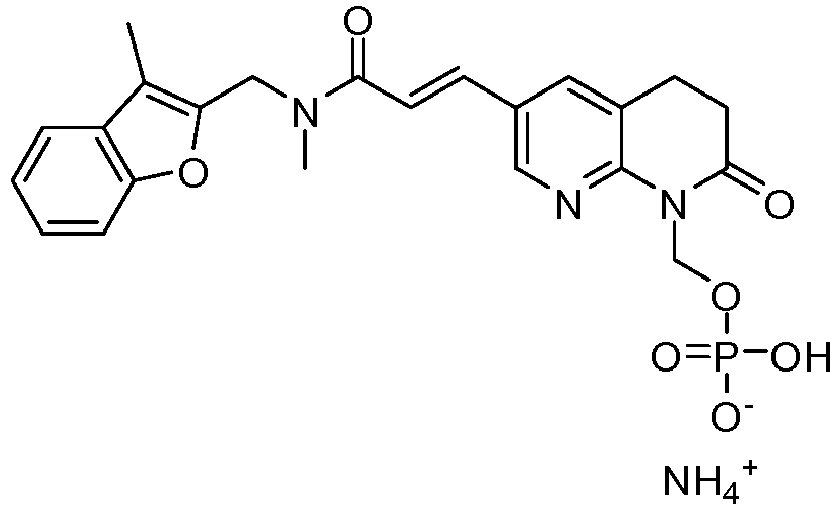


- In certain embodiments, for example, the compounds disclosed herein, once administered, possess improved bioavailability profiles when compared to (E)-N-methyl-N-((3-methylbenzofuran-2-yl)methyl)-3-(7-oxo-5,6,7,8-tetrahydro-1,8-naphthyridin-3-yl)acrylamide (compound IV) or salts thereof. For example, the compounds disclosed herein may possess at least 2-fold, at least 3-fold, at least 4- fold, at least 5-fold, at least 7-fold, at least 8-fold, at least 9-fold, at least 10-fold or at least 20-fold greater bioavailability as compared to (E)-N-methyl-N-((3-methylbenzofuran-2-yl)methyl)-3-(7-oxo-5,6,,8-tetrahydro-1,8-naphthyridin-3-yl)acrylamide or salts thereof.
- In certain embodiments, for example, the compounds disclosed, once administered, herein possess improved bioavailability profiles when compared to the p-toluenesulfonic salt of (E)-N-methyl-N-((3-methylbenzofuran-2-yl)methyl)-3-(7-oxo-5,6,7,8-tetrahydro-1,8-naphthyridin-3-yl)acrylamide. For example, the compounds disclosed herein may possess at least 2-fold, at least 3-fold, at least 4, fold, at least 5-fold, at least 7-fold, at least 8-fold, at least 9-fold, at least 10-fold or at least 20-fold greater bioavailability (e.g. oral bioavailability) as compared to the p-toluenesulfonic salt of (E)-N-methyl-N-((3-methylbenzofuran-2-yl)methyl)-3-(7-oxo-5,6,7,8-tetrahydro-1,8-naphthyridin-3-yl)acrylamide or salts thereof.
- In another aspect, disclosed herein are pharmaceutical compositions comprising the compounds disclosed herein and a pharmaceutically acceptable excipient.
- In certain embodiments, the composition is formulated for one of: intravenous administration, injectable administration, topical administration, systemic administration, aerosol administration to the respiratory epithelium, or oral administration. For example, provided here is a composition comprising a disclosed compound and pharmaceutically acceptable excipient or carrier suitable for oral administration, intravenous administration, subcutaneous administration, intranasal administration or a composition suitable for inhalation.
- Disclosed herein are methods of treating a bacterial infection, comprising administering to a patient in need thereof the pharmaceutical composition comprising a disclosed compound.
- Disclosed herein is a method of treating a bacterial infection, comprising administering to a patient in need thereof a pharmaceutical composition that includes a disclosed compound, where when the compound is administered to said patient, provides a mean plasma level at least 2 times, at least 3 times, at least 4 times, at least 5 times, at least 7 times, at least 8 times, at least 9 times, at least 10 times or at least 20 times higher than that obtained by administering the same amount of (E)-N-methyl-N-((3-methylbenzofuran-2-yl)methyl)-3-(7-oxo-5,6,7,8-tetrahydro-1,8-naphthyridin-3-yl)acrylamide or salts thereof, on a molar basis, at about 4 hours after administration.
- Disclosed herein is a method of treating a bacterial infection, comprising administering to a patient in need thereof a pharmaceutical composition that includes a disclosed compound, wherein when the disclosed compound is administered to said patient, provides a mean plasma level of (E)-N-methyl-N-((3-methylbenzofuran-2-yl)methyl)-3-(7-oxo-5,6,7,8-tetrahydro-1,8-naphthyridin-3-yl)acrylamide at least 2 times, at least 3 times, at least 4 times, at least 5 times, at least 7 times, at least 8 times, at least 9 times, at least 10 times or at least 20 times higher than that obtained by administering the same amount, on a molar basis, of p-toluenesulfonic acid salt of (E)-N-methyl-N-((3-methylbenzofuran-2-yl)methyl)-3-(7-oxo-5,6,7,8-tetrahydro-1,8-naphthyridin-3-yl)acrylamide, at about 4 hours after administration. In certain embodiments, the patient is a human.
- Also provided herein is a method for treating cystic fibrosis in a patient in need thereof, comprising administering a disclosed compound. For example, provided here is a method of treating cystic fibrosis in a patient in need thereof comprising administering by inhalation a pharmaceutically effective amount of a composition comprising a disclosed compound. Alternatively, a method of treating cystic fibrosis in a patient in need thereof is provided, comprising orally, rectally or parenterally administering a disclosed compound.
- Disclosed herein are methods of treating a S. aureus infection (e.g., a methicillin-resistant S. aureus infection) in a patient in need thereof, comprising administering a disclosed compound. Other contemplated methods include treating H. influenza and/or P. aeruginosa infection in a patient in need thereof (e.g., a patient suffering from cystic fibrosis comprising administering an pharmaceutically effective amount of a disclosed compound.
- For example, disclosed here is a method of treating a bacterial infection in a patient in need thereof comprising enterally (e.g., orally) administering a composition comprising a disclosed compound,
e.g. compound 10. Such methods may further comprising administering, in a separate dosage form, an additional antibacterial or antibiotic agent as disclosed herein. Also disclosed here is a method of treating a bacterial infection in a patient in need thereof comprising parenterally (e.g., intravenously, intramuscularly, or subcutaneously) administering a composition comprising a disclosed compound,e.g. compound 10. In some embodiments, methods of treating a bacterial infection by systemically administrating a pharmaceutically effective amount of a disclosed compound are contemplated. - The terms "systemic administration," "administered systemically," "peripheral administration" and "administered peripherally" are art-recognized and refer to the administration of a subject composition, therapeutic or other material other than directly into the central nervous system, such that it enters the patient's system and, thus, is subject to metabolism and other like processes, for example, subcutaneous administration.
- The terms "parenteral administration" and "administered parenterally" are art-recognized and refer to modes of administration other than enteral and topical administration, usually by injection, and includes, without limitation, intravenous, intramuscular, intraarterial, intrathecal, intracapsular, intraorbital, intracardiac, intradermal, intraperitoneal, transtracheal, subcutaneous, subcuticular, intra-articular, subcapsular, subarachnoid, intraspinal, and intrasternal injection and infusion.
- Topical administration is also contemplated, for example a method of treating an ophthalmic bacterial infection comprising topically an effective amount of a disclosed compound.
- It will be appreciated that in certain embodiments, contemplated methods may include administration by inhalation or intratracheal instillation of a composition (e.g. an aerosolized, pH buffered composition) comprising a disclosed compound. The "term" inhaled administration" includes administration of a substantially uniform distribution of appropriately sized particles to the respiratory epithelium of the nose, central airways, the peripheral aspect of the lung and/or the alveolar region of the lung. Such particles may be introduced to the patient and/or produced using an appropriate device.
- Disclosed methods may also include administration of one or more additional agents, e.g. further comprising administering one or more further antibiotic agent(s). For example, disclosed herein is method of treating a bacterial infection in a patient in need thereof, comprising administering an effective amount of a disclosed compound, and further administering (simultaneously or sequentially) one or more antibiotic agents or antibacterial agents selected from the group consisting of: vancomycin, clindamycin, macrolides, linezolid, sulfamethoxazole (and/or other sulfa agents), cephalosporins, carbapenems, tetracyclines, glycylcyclines, tobramicin, arbekacin, gentamicin, quinolones (e.g. fluoroquinolones, such as ciprofloxin, levofloxin) or pleuromutilins and combinations thereof. For example, provided herein is a method of treating an ophthalmic bacterial infection comprising topically administering an effective amount of a disclosed compound, and optionally further administering a fluoroquinolone and/or an aminoglycoside. In another embodiments, disclosed herein is method of treating or ameliorating cystic fibrosis in a patient in need thereof, comprising administering an effective amount of a disclosed compound, and further administering (simultaneously or sequentially) one or more therapeutic agents selected from the group consisting of: aztreonam, levofloxin, vancomycin, linezolid, sulfamethoxazole (and/or other sulfa agents), tobramicin, gentamicin, quinolone (e.g. fluoroquinolone) and combinations thereof.
- Another aspect of the disclosure relates to a kit comprising the pharmaceutical composition comprising the disclosed compounds and instructions for use thereof.
- Scheme 1 depicts an exemplary synthetic route and proposed mechanism for the in vivo processing of the disclosed compounds to the biologically active form, compound IV. Disclosed compounds can be administered in a water-solubilized chemical form. Once administered, the water-solubilized compound is metabolized in-vivo in systemic circulation and other extracellular fluid compartments to the active antibacterial of compound IV, for example as depicted in scheme 1:

- Yet another aspect of the disclosure relates to a method of preparing the compounds disclosed herein. In certain embodiment, the disclosure relates to a method of preparing a compound of formula II, comprising contacting the phosphate compound of formula III with a compound of formula IV, wherein formula II is represented by:


X represents a leaving group; Pg represents a protecting group as specified in the 3appended claims. Formula IV is represented by:
- In certain embodiments, X is a halogen,

- Pg is C1-6alkyl-Si(R5)3, wherein R5 is C1-6alkyl. In other embodiments, Pg is-(CH2)2-Si(CH3)3.
- It will be appreciated that contacting the phosphate compound of formula III with a compound of formula IV may be conducted in the presence of a solvent, e.g, dimethylformamide (DMF) and/or tetrahydrofuran (THF). Contacting the phosphate compound of formula III with a compound of formula IV may further comprise adding a base such as potassium t-butoxide (KOtBu) and/or NaH.
- In certain embodiments, the method further comprises contacting a Bronsted acid ( for example, trifluoroacetic acid) and a compound of e.g., formula II to provide a compound of formula:

- Acute toxicity can be assessed using increasing doses in mice and rodents. Exploratory acute toxicity in mice and/or rats after single dose may be undertaken to begin estimation of the therapeutic window of inhibitors and to identify the potential target organism of toxicity. As candidate selection nears, these studies may provide guidance for the selection of proper doses in multi-dose studies, as well as establish any species-specific differences in toxicities. These studies may be combined with routine pharmacokinetic (PK) measurements to assure proper dosages were achieved. Generally 3-4 doses will be chosen that are estimated to span a range having no effect through to higher doses that cause major toxic, but non-lethal, effects. Animals will be observed for effects on body weight, behavior and food consumption, and after euthanasia, hematology, blood chemistry, urinalysis, organ weight, gross pathology and histopathology will be undertaken.
- Cytotoxicity of the new compounds may be evaluated by the Alamar Blue assay according the manufacturer's instructions. Human cell lines (e.g. Jurkat) grown in 96 well plates may be exposed to serial dilutions of the tested compounds. After adding Alamar Blue, cell viability may be determined by measuring the absorbance of the reduced and oxidized forms of Alamar Blue at 570 nm and 600 nm. Cytotoxicity may be reported as LD50, the concentration that causes a 50% reduction in cell viability.
- The dosage of any disclosed compositions will vary depending on the symptoms, age and body weight of the patient, the nature and severity of the disorder to be treated or prevented, the route of administration, and the form of the subject composition. Any of the subject formulations may be administered in a single dose or in divided doses. Dosages for the compositions may be readily determined by techniques known to those of skill in the art or as taught herein.
- In certain embodiments, the dosage of the subject compounds will generally be in the range of about 0.01 ng to about 10 g per kg body weight, specifically in the range of about 1 ng to about 0.1 g per kg, and more specifically in the range of about 100 ng to about 10 mg per kg.
- An effective dose or amount, and any possible effects on the timing of administration of the formulation, may need to be identified for any particular composition of the disclosure. This may be accomplished by routine experiment as described herein, using one or more groups of animals (preferably at least 5 animals per group), or in human trials if appropriate. The effectiveness of any subject composition and method of treatment or prevention may be assessed by administering the composition and assessing the effect of the administration by measuring one or more applicable indices, and comparing the post-treatment values of these indices to the values of the same indices prior to treatment.
- The precise time of administration and amount of any particular subject composition that will yield the most effective treatment in a given patient will depend upon the activity, pharmacokinetics, and bioavailability of a subject composition, physiological condition of the patient (including age, sex, disease type and stage, general physical condition, responsiveness to a given dosage and type of medication), route of administration, and the like. The guidelines presented herein may be used to optimize the treatment, e.g., determining the optimum time and/or amount of administration, which will require no more than routine experimentation consisting of monitoring the subject and adjusting the dosage and/or timing.
- While the subject is being treated, the health of the patient may be monitored by measuring one or more of the relevant indices at predetermined times during the treatment period. Treatment, including composition, amounts, times of administration and formulation, may be optimized according to the results of such monitoring. The patient may be periodically reevaluated to determine the extent of improvement by measuring the same parameters. Adjustments to the amount(s) of subject composition administered and possibly to the time of administration may be made based on these reevaluations.
- Treatment may be initiated with smaller dosages which are less than the optimum dose of the compound. Thereafter, the dosage may be increased by small increments until the optimum therapeutic effect is attained.
- The use of the subject compositions may reduce the required dosage for any individual agent contained in the compositions because the onset and duration of effect of the different agents may be complimentary.
- Toxicity and therapeutic efficacy of subject compositions may be determined by standard pharmaceutical procedures in cell cultures or experimental animals, e.g., for determining the LD50 and the ED50.
- The data obtained from the cell culture assays and animal studies may be used in formulating a range of dosage for use in humans. The dosage of any subject composition lies preferably within a range of circulating concentrations that include the ED50 with little or no toxicity. The dosage may vary within this range depending upon the dosage form employed and the route of administration utilized. For compositions of the disclosure, the therapeutically effective dose may be estimated initially from cell culture assays.
- Compositions are also contemplated herein that include one or more of the disclosed compounds with a second component. Second components in such compositions of the present disclosure are usually an antibiotic agent other than a disclosed compound.. Additional components may also be present, including FabI inhibitors or antibiotic agents. The contemplated methods of treatment disclosed herein, in some embodiments, may further comprise administering another agent such as one described below. For example, a method of treating a bacterial infection is provided that comprises administering a disclosed compound and further comprises administering an antibiotic agent or antibacterial agent described below.
- Non-limiting examples of antibiotic agents that may be used in the antibacterial compositions of the disclosure include cephalosporins, quinolones and fluoroquinolones, penicillins, penicillins and beta lactamase inhibitors, carbepenems, monobactams, macrolides and lincosamines, glycopeptides, rifampin, oxazolidonones, tetracyclines, aminoglycosides, streptogramins, sulfonamides, and others. Each family comprises many members.
- Cephalosporins can be further categorized by generation. Non-limiting examples of cephalosporins by generation include the following. Examples of cephalosporins - First generation compounds include Cefadroxil, Cefazolin, Cephalexin, Cephalothin, Cephapirin, and Cephradine. Second generation compounds include Cefaclor, Cefamandol, Cefonicid, Cefotetan, Cefoxitin, Cefprozil, Ceftmetazole, Cefuroxime, Cefuroxime axetil, and Loracarbef. -Third generation include Cefdinir, Ceftibuten, Cefditoren, Cefetamet, Cefpodoxime, Cefprozil, Cefuroxime (axetil), Cefuroxime (sodium), Cefoperazone, Cefixime, Cefotaxime, Cefpodoxime proxetil, Ceftazidime, Ceftizoxime, and Ceftriaxone. Fourth generation compounds include Cefepime.
- Non-limiting examples of quinolones and fluoroquinolones include Cinoxacin, Ciprofloxacin, Enoxacin, Gatifloxacin, Grepafloxacin, Levofloxacin, Lomefloxacin, Moxifloxacin, Nalidixic acid, Norfloxacin, Ofloxacin, Sparfloxacin, Trovafloxacin, Oxolinic acid, Gemifloxacin, and Perfloxacin.
- Non-limiting examples of penicillins include Amoxicillin, Ampicillin, Bacampicillin, Carbenicillin Indanyl, Mezlocillin, Piperacillin, and Ticarcillin.
- Non-limiting examples of penicillins and beta lactamase inhibitors include Amoxicillin-Clavulanic Acid, Ampicillin-Sulbactam, Benzylpenicillin, Cloxacillin, Dicloxacillin, Methicillin, Oxacillin, Penicillin G (Benzathine, Potassium, Procaine), Penicillin V, Piperacillin+Tazobactam, Ticarcillin+Clavulanic Acid, and Nafcillin. Non-limiting examples of carbepenems include Imipenem-Cilastatin and Meropenem.
- A non-limiting example of a monobactam includes Aztreonam. Non-limiting examples of macrolides and lincosamines include Azithromycin, Clarithromycin, Clindamycin, Dirithromycin, Erythromycin, Lincomycin, and Troleandomycin. Non-limiting examples of glycopeptides include Teicoplanin and Vancomycin. Non-limiting examples of rifampins include Rifabutin, Rifampin, and Rifapentine. A non-limiting example of oxazolidonones includes Linezolid. Non-limiting examples of tetracyclines include Demeclocycline, Doxycycline, Methacycline, Minocycline, Oxytetracycline, Tetracycline, and Chlortetracycline.
- Non-limiting examples of aminoglycosides include Amikacin, Arbakacin, Gentamicin, Kanamycin, Sisomicin, Arbekacin, Neomycin, Netilmicin, Streptomycin, Tobramycin, and Paromomycin. A non-limiting example of streptogramins includes Quinopristin+Dalfopristin.
- Non-limiting examples of sulfonamides include Mafenide, Silver Sulfadiazine, Sulfacetamide, Sulfadiazine, Sulfamethoxazole, Sulfasalazine, Sulfisoxazole, Trimethoprim-Sulfamethoxazole, and Sulfamethizole.
- Non-limiting examples of other antibiotic agents include Bacitracin, Chloramphenicol, Colistimethate, Fosfomycin, Isoniazid, Methenamine, Metronidazole, Mupirocin, Nitrofurantoin, Nitrofurazone, Novobiocin, Polymyxin B, Spectinomycin, Tobramycin, Tigecycline, Trimethoprim, Colistin, Cycloserine, Capreomycin, Pyrazinamide, para-Aminosalicyclic acid, and Erythromycin ethylsuccinate + sulfisoxazole.
- Pharmaceutical compositions of the disclosure may be administered by various means, depending on their intended use, as is well known in the art. For example, if compositions of the disclosure are to be administered orally, they may be formulated as tablets, capsules, granules, powders or syrups. Alternatively, formulations disclosed herein may be administered parenterally as injections (intravenous, intramuscular or subcutaneous), drop infusion preparations or suppositories. For application by the ophthalmic mucous membrane route, the compositions disclosed herein may be formulated as eye drops or eye ointments. These formulations may be prepared by conventional means, and, if desired, the compositions may be mixed with any conventional additive, such as an excipient, a binder, a disintegrating agent, a lubricant, a corrigent, a solubilizing agent, a suspension aid, an emulsifying agent or a coating agent. The disclosed excipients may serve more than one function. For example, fillers or binders may also be disintegrants, glidants, anti-adherents, lubricants, sweeteners and the like.
- In formulations of the disclosure, wetting agents, emulsifiers and lubricants, such as sodium lauryl sulfate and magnesium stearate, as well as coloring agents, release agents, coating agents, sweetening, flavoring and perfuming agents, preservatives and antioxidants may be present in the formulated agents.
- Subject compositions may be suitable for oral, nasal (e.g., by inhalation using a dry powder formulation or a nebulized formulation), topical (including buccal and sublingual), pulmonary (including aerosol administration), rectal, vaginal, aerosol and/or parenteral (e.g., by injection, for example, intravenous or subcutaneous injection) administration. The formulations may conveniently be presented in unit dosage form and may be prepared by any methods well known in the art of pharmacy. The amount of a composition that may be combined with a carrier material to produce a single dose vary depending upon the subject being treated, and the particular mode of administration.
- Methods of preparing these formulations include the step of bringing into association compositions of the disclosure with the carrier and, optionally, one or more accessory ingredients. In general, the formulations are prepared by uniformly and intimately bringing into association agents with liquid carriers, or finely divided solid carriers, or both, and then, if necessary, shaping the product.
- Formulations suitable for oral administration may be in the form of capsules, cachets, pills, tablets, lozenges (using a flavored basis, usually sucrose and acacia or tragacanth), powders, granules, or as a solution or a suspension in an aqueous or non-aqueous liquid, or as an oil-in-water or water-in-oil liquid emulsion, or as an elixir or syrup, or as pastilles (using an inert base, such as gelatin and glycerin, or sucrose and acacia), each containing a predetermined amount of a subject composition thereof as an active ingredient. Compositions of the disclosure may also be administered as a bolus, electuary, or paste.
- In solid dosage forms for oral administration (capsules, tablets, pills, dragees, powders, granules and the like), the subject composition is mixed with one or more pharmaceutically acceptable carriers, such as sodium citrate or dicalcium phosphate, and/or any of the following: (1) fillers or extenders, such as starches, dextrose, lactose, sucrose, glucose, mannitol, and/or silicic acid; (2) binders, such as, for example, celluloses (e.g., microcrystalline cellulose, methyl cellulose, hydroxypropylmethyl cellulose (HPMC) and carboxymethylcellulose), alginates, gelatin, polyvinyl pyrrolidone, sucrose and/or acacia; (3) humectants, such as glycerol; (4) disintegrating agents, such as agar-agar, calcium carbonate, potato or tapioca starch, alginic acid, certain silicates, and sodium carbonate; (5) solution retarding agents, such as paraffin; (6) absorption accelerators, such as quaternary ammonium compounds; (7) wetting agents, such as, for example, cetyl alcohol and glycerol monostearate; (8) absorbents, such as kaolin and bentonite clay; (9) lubricants, such as talc, calcium stearate, magnesium stearate, solid polyethylene glycols, sodium lauryl sulfate, and mixtures thereof; and (10) coloring agents. In the case of capsules, tablets and pills, the compositions may also comprise buffering agents. Solid compositions of a similar type may also be employed as fillers in soft and hard-filled gelatin capsules using such excipients as lactose or milk sugars, as well as high molecular weight polyethylene glycols and the like. The disclosed excipients may serve more than one function. For example, fillers or binders may also be disintegrants, glidants, anti-adherents, lubricants, sweeteners and the like.
- Formulations and compositions may include micronized crystals of the disclosed compounds. Micronization may be performed on crystals of the compounds alone, or on a mixture of crystals and a part or whole of pharmaceutical excipients or carriers. Mean particle size of micronized crystals of a disclosed compound may be for example about 5 to about 200 microns, or about 10 to about 110 microns.
- A tablet may be made by compression or molding, optionally with one or more accessory ingredients. Compressed tablets may be prepared using binder (for example, gelatin, microcrystalline cellulose, or hydroxypropylmethyl cellulose), lubricant, inert diluent, preservative, disintegrant (for example, sodium starch glycolate or cross-linked sodium carboxymethyl cellulose), surface-active or dispersing agent. Molded tablets may be made by molding in a suitable machine a mixture of the subject composition moistened with an inert liquid diluent. Tablets, and other solid dosage forms, such as dragees, capsules, pills and granules, may optionally be scored or prepared with coatings and shells, such as enteric coatings and other coatings well known in the pharmaceutical-formulating art. The disclosed excipients may serve more than one function. For example, fillers or binders may also be disintegrants, glidants, anti-adherents, lubricants, sweeteners and the like.
- It will be appreciated that a disclosed composition may include lyophilized or freeze dried compounds disclosed herein. For example, disclosed herein are compositions that disclosed compounds crystalline and/or amorphous powder forms. Such forms may be reconstituted for use as e.g., an aqueous composition.
- Liquid dosage forms for oral administration include pharmaceutically acceptable emulsions, microemulsions, solutions, suspensions, syrups and elixirs. In addition to the subject composition, the liquid dosage forms may contain inert diluents commonly used in the art, such as, for example, water or other solvents, solubilizing agents and emulsifiers, such as ethyl alcohol, isopropyl alcohol, ethyl carbonate, ethyl acetate, benzyl alcohol, benzyl benzoate, propylene glycol, 1,3-butylene glycol, oils (in particular, cottonseed, groundnut, corn, germ, olive, castor and sesame oils), glycerol, tetrahydrofuryl alcohol, polyethylene glycols and fatty acid esters of sorbitan, cyclodextrins and mixtures thereof.
- Suspensions, in addition to the subject composition, may contain suspending agents as, for example, ethoxylated isostearyl alcohols, polyoxyethylene sorbitol and sorbitan esters, microcrystalline cellulose, aluminum metahydroxide, bentonite, agar-agar and tragacanth, and mixtures thereof.
- Formulations for rectal or vaginal administration may be presented as a suppository, which may be prepared by mixing a subject composition with one or more suitable nonirritating excipients or carriers comprising, for example, cocoa butter, polyethylene glycol, a suppository wax or a salicylate, and which is solid at room temperature, but liquid at body temperature and, therefore, will melt in the body cavity and release the active agent. Formulations which are suitable for vaginal administration also include pessaries, tampons, creams, gels, pastes, foams or spray formulations containing such carriers as are known in the art to be appropriate.
- Dosage forms for transdermal administration of a subject composition includes powders, sprays, ointments, pastes, creams, lotions, gels, solutions, and patches. The active component may be mixed under sterile conditions with a pharmaceutically acceptable carrier, and with any preservatives, buffers, or propellants that may be required.
- The ointments, pastes, creams and gels may contain, in addition to a subject composition, excipients, such as animal and vegetable fats, oils, waxes, paraffins, starch, tragacanth, cellulose derivatives, polyethylene glycols, silicones, bentonites, silicic acid, talc and zinc oxide, or mixtures thereof.
- Powders and sprays may contain, in addition to a subject composition, excipients such as lactose, talc, silicic acid, aluminum hydroxide, calcium silicates and polyamide powder, or mixtures of these substances. Sprays may additionally contain customary propellants, such as chlorofluorohydrocarbons and volatile unsubstituted hydrocarbons, such as butane and propane.
- Compositions and compounds of the disclosure may alternatively be administered by aerosol. This is accomplished by preparing an aqueous aerosol, liposomal preparation or solid particles containing the compound. A non-aqueous (e.g., fluorocarbon propellant) suspension could be used. Sonic nebulizers may be used because they minimize exposing the agent to shear, which may result in degradation of the compounds contained in the subject compositions.
- Ordinarily, an aqueous aerosol is made by formulating an aqueous solution or suspension of a subject composition together with conventional pharmaceutically acceptable carriers and stabilizers. The carriers and stabilizers vary with the requirements of the particular subject composition, but typically include non-ionic surfactants (Tweens, pluronics, or polyethylene glycol), innocuous proteins like serum albumin, sorbitan esters, oleic acid, lecithin, amino acids such as glycine, buffers, salts, sugars or sugar alcohols. Aerosols generally are prepared from isotonic solutions.
- It should be noted that excipients given as examples may have more than one function. For example, fillers or binders can also be disintegrants, glidants, anti-adherents, lubricants, sweeteners and the like.
- Pharmaceutical compositions of this disclosure suitable for parenteral administration comprise a subject composition in combination with one or more pharmaceutically-acceptable sterile isotonic aqueous or non-aqueous solutions, dispersions, suspensions or emulsions, or sterile powders which may be reconstituted into sterile injectable solutions or dispersions just prior to use, which may contain antioxidants, buffers, bacteriostats, solutes which render the formulation isotonic with the blood of the intended recipient or suspending or thickening agents. For example, provided herein is an aqueous composition that includes a disclosed compound, and may further include for example, dextrose (e.g., about 1 to about 10 weight percent dextrose, or about 5 weight percent dextrose in water (D5W).
- Examples of suitable aqueous and non-aqueous carriers which may be employed in the pharmaceutical compositions of the disclosure include water, ethanol, polyols (such as glycerol, propylene glycol, polyethylene glycol, and the like), and suitable mixtures thereof, vegetable oils, such as olive oil, and injectable organic esters, such as ethyl oleate and cyclodextrins. Proper fluidity may be maintained, for example, by the use of coating materials, such as lecithin, by the maintenance of the required particle size in the case of dispersions, and by the use of surfactants.
- It will be appreciated that contemplated formulations, such as oral formulations (e.g. a pill or tablet), may be formulated as controlled release formulation, e.g., an immediate release formulation, a delayed release formulation, or a combination thereof.
- In certain embodiments, the subject compounds may be formulated as a tablet, pill, capsule or other appropriate ingestible formulation (collectively hereinafter "tablet"). In certain embodiments, a therapeutic dose may be provided in 10 tablets or fewer. In another example, a therapeutic dose is provided in 50, 40, 30, 20, 15, 10, 5 or 3 tablets.
- In a certain embodiment, a disclosed compound is formulated for oral administration as a tablet, capsule,or an aqueous solution or suspension. In another embodiment of a tablet form the tablets are formulated such that the resulting amount of antibacterial agent (or antibacterial agents) provided in 20 tablets, if taken together (e.g., over time) once administered, would provide a dose of at least the median effective dose (ED50), e.g., the dose at which at least 50% of individuals exhibited the quantal effect of inhibition of bacterial cell growth or protection (e.g., a statistically significant reduction in infection). In a further embodiment, tablets may be formulated such that the total amount of antibacterial agent (or antibacterial agents) provided upon administration in 10, 5, 2 or 1 tablets would provide at least an ED50 dose to a patient (human or non-human mammal). In other embodiments, the amount of antibacterial agent (or antibacterial agents) provided, upon administration, in 20, 10, 5 or 2 tablets taken in a 24 hour time period would provide a dosage regimen providing, on average, a mean plasma level of the antibacterial agent(s) of at least the ED50 concentration (the concentration for 50% of maximal effect of, e.g., inhibiting bacterial cell growth). In other embodiments less than 100 times, 10 times, or 5 times the ED50 is provided. In other embodiments, a single dose of tablets (1-20 tablets) provides about 0.25 mg to 1250 mg of compound(s).
- Likewise, compounds disclosed herein can be formulated for parenteral administration, as for example, for subcutaneous, intramuscular or intravenous injection, e.g., the antibacterial agent can be provided in a sterile solution or suspension (collectively hereinafter "injectable solution"). The injectable solution may be, in some embodiments, formulated such that the amount of antibacterial agent (or antibacterial agents) provided in, for example, in about 0.1 to about 200cc bolus injection, or a dose administered intravenously, would provide a dose of at least the median effective dose, or less than 100 times the ED50, or less than 10 or 5 times the ED50. The injectable solution may be formulated such that the total amount of antibacterial agent (or antibacterial agents) provided (upon administration) in 100, 50, 25, 10, 5, 2.5, or 1 cc injections would provide an ED50 dose to a patient, or less than 100 times the ED50, or less than 10 or 5 times the ED50. In other embodiments, the amount of antibacterial agent (or antibacterial agents) provided, upon administration, in a total volume of 100cc, 50, 25, 5 or 2cc to be injected at least twice in a 24 hour time period would provide a dosage regimen providing, on average, a mean plasma level of the antibacterial agent(s) of at least the ED50 concentration, or less than 100 times the ED50, or less than 10 or 5 times the ED50. In other embodiments, a single dose injection provides about 0.25 mg to 1250 mg, or about 0.25mg to about 2500 mg of antibacterial agent.
- This disclosure also provides kits for conveniently and effectively implementing the methods disclosed herein. Such kits comprise any subject composition, and a means for facilitating compliance with methods disclosed herein. Such kits provide a convenient and effective means for assuring that the subject to be treated takes the appropriate active in the correct dosage in the correct manner. The compliance means of such kits includes any means which facilitates administering the actives according to a method disclosed herein. Such compliance means include instructions, packaging, and dispensing means, and combinations thereof. Kit components may be packaged for either manual or partially or wholly automated practice of the foregoing methods. In other embodiments involving kits, the disclosure contemplates a kit including compositions disclosed herein, and optionally instructions for their use.
- The examples which follow are intended in no way to limit the scope of the disclosure but are provided to illustrate how to prepare and use compounds disclosed herein. Many other embodiments of this disclosure will be apparent to one skilled in the art.
- The compounds were prepared according to the procedures described below and as shown in
Scheme 2.
- Phosphorus trichloride (49.2 mL, 564 mmol) was added dropwise to a 0°C solution of trimethylsilylethanol, compound 1, (200 g, 1.69 mol, 3 eq.) and triethylamine (160 mL, 1.15 mol, 2 eq.) in 3.5 L dichloromethane. An exotherm was observed so the addition had to be slow enough to maintain the temperature below 10°C. Upon complete addition, triethylamine hydrochloride precipitated and the thick slurry was stirred for 30 minutes at 0°C, then 30 minutes at room temperature. Water (1 L) was added to clarify the solution, and the clear two-phase solution was stirred for one hour at room temperature. The organic layer was separated, washed with water, dried over anhydrous sodium sulfate, filtered and the filtrate concentrated under vacuum at 25-50°C to remove residual volatiles. The reaction afforded 150 g (99%) of
compound 2. 1H NMR of the material indicated >95% purity.
Compound 2 1H NMR (400 MHz, CDCl3): δ 7.68 and 5.95 (2s, 1H), 4.19 (m, 4H), 1.10 (m, 4H), 0.05 (s, 18H). - Phosphinic acid compound 2 (110 g in 2.5L of water, 390 mmol) was added to 2.5 L of water and potassium bicarbonate (22 g, 220 mmol, 0.56 eq.). The solution was placed in a 25°C water bath and potassium permanganate (80 g, 506 mmol, 1.3 eq.) was added in four 20 g portions every twenty minutes so as not to allow the temperature of the solution to exceed 40°C. The slurry was then heated to 50°C for 30 minutes and then filtered hot using a Buchner funnel and filter paper. To the clear aqueous filtrate solution was added sodium bicarbonate (115 g, 1365 mmol, 3.5 eq.) followed by tetrabutylammonium hydrogensulfate (13.3 g, 39 mmol, 0.1 eq.). Dichloromethane (1.5 L) was added and the solution was cooled to 0°C to which 47 mL (468 mmol, 1.2 eq.) of chloromethyl chlorosulfate, 4 was added slowly. The slurry was stirred for 12 hours as it warmed to room temperature. The organic layer was separated and the aqueous layer was extracted once more with dichloromethane (0.5 L). The combined organic layers were dried over anhydrous sodium sulfate and concentrated in vacuo to yield the crude product which was purified by flash chromatography (25% EtOAc/hexanes with 3% NEt3) to yield 75 g (55% yield) of
compound 5 as a colorless oil which was >95% pure as indicated by 1H NMR.
Compound 5: 1H NMR (400 MHz, CDCl3): δ 5.68 (d, 2H), 4.20 (m, 4H), 1.13 (m, 4H), 0.05 (s, 18H). - Compound IV as the tosylate monohydrate salt (100 g, 183 mmol) was placed in methanol (3 L) and ethyl acetate (500 mL) and heated to 65°C over a 2-hour period. To the hot suspension was added sodium hydroxide (150 mL of a 2N solution, 300 mmol) and the resultant slurry was stirred for 30 minutes. The reaction was cooled to room temperature and the solid was filtered. The solid was washed with water (2
X 500 mL) followed by ether (500 mL). The white cake was dried under vacuum overnight to yield 61.7g (90% yield) of pure compound IV free base as an off-white solid.
Compound IV (free base): 1H NMR (400 MHz, DMSO d6): δ 10.65 (s, 1H), 8.36 (m, 1H), 8.08 (m, 1H), 7.58-7.18 (m, 6H), 5.00, 4.80 (2s, 2H), 3.18 (s, 2H), 2.92 (m, 3H), 2.50 (m, 2H), 2.25 (s, 3H). - Compound IV free base (37.5 g, 100 mmol) was placed in DMF (1000 mL), cooled to -40°C and KOtBu (12.3 g, 110 mmol, 1.1 eq.) was added in portions. The solution was stirred for 90 minutes upon which compound 5 (64 g, 184 mmol, 1.84 eq., dissolved in 50 mL of DMF), was added over 15 minutes. The yellow orange solution was stirred for an additional two hours as it warmed to -28°C. The dark orange solution was stirred for 1.5 hours as it warmed to -10°C and then a further 1.5 hours as it warmed to -5°C. The reaction was quenched with dilute aqueous ammonium chloride (1 L) followed by water (2 L) and the organic layer was extracted twice with ethyl acetate (EtOAc, 2 L). The organic phases were back-extracted with water (1 L), dried over anhydrous sodium sulfate, filtered and concentrated in vacuo, to give the crude product which was purified by flash chromatography (1 kg of silica gel using 50-100% EtOAc/hexanes) to yield 41 g (60% yield) of pure 7 as a viscous bright yellow oil.
Compound 7 1H NMR (400 MHz, DMSO d6): δ 8.52 (d, 1H), 8.20(d, 1H), 7.55-7.21 (m, 6H), 5.93(s, 2H), 5.00-4.80 (2s from rotamers, 2H), 4.00 (m, 4H), 3.18-2.92 (2s from rotamers, 3H), 2.92 (m, 2H), 2.25 (s, 3H), 0.97 (t, 4H), 0.00 (s, 18H). - Analogs of compound 7 (as represented by Formula II, above) may be prepared using different analogs of
compound 5, (as represented by Formula III, above) together with a solvent and a base, as described above. The table below indicates the significance ofcompound 5.
Different Pg's used in compound III to produce compound II are shown below.Pg Base Solvent Comments CH2CH2 TMS KOtBu DMF 50% (large scale) to 70% (small scale) conversion Ethyl KOtBu DMF No detectable product tert-butyl KOtBu DMF No detectable product Benzyl KOtBu DMF No detectable product NaH THF No detectable product - Compound 7 (96 g, 140 mmol) was dissolved in dichloromethane (560 mL), cooled to -25°C and trifluoroacetic acid (187 mL, 2520 mmol, 18 eq.) in 85 mL of dichloromethane was added slowly over 15 minutes while maintaining the temperature below -15°C. The solution was stirred for 45 minutes as it warmed to -5°C, then re-cooled to -35°C and 300 mL of 10M NH4OH in 350 mL of water was added slowly over 20 minutes while maintaining the temperature below 0°C. The solution was warmed to room temperature, the volatile dichloromethane solvent was removed in vacuo and the resulting milky aqueous solution was filtered to remove insoluble reaction by-products. The filtrate was concentrated in vacuo using added toluene (2 X 1L) to remove residual water, yielding a pale yellow sticky solid. This solid was suspended in 95% ethanol (3.5 L) and stirred for 3 hours at 60°C, followed by stirring at room temperature for overnight. The solid was then filtered, air dried, suspended in 95% ethanol (3.5 L) and isolated by filtration to produce a pale yellow brittle solid powder. The solid was ground to a fine off-white powder with a mortar and pestle to provide 43 g (88.6 mmol, 63% yield) of Compound 8 ((E)-6-[(N-methyl-((3-methylbenzofuran-2-yl)methyl)amino)-3-oxoprop-1-en-1-yl)-2-oxo-3,4-dihydro-1,8-naphthyridin-1(2H)-yl]methylphosphate ammonium salt) at >98% purity by HPLC. Note: the number of ammonium cations in 8 was unknown.
Compound 8: 1H NMR (400 MHz, DMSO d6): δ 8.49 (d, 1H), 8.10(d, 1H), 7.55-7.10 (m, 6H), 5.70(s, 2H), 4.98-4.77 (2s from rotamers, 2H), 3.18-2.90 (2s from rotamers, 3H), 2.88 (m, 2H), 2.63 (m, 2H), 2.25 (s, 3H). - Compound 8 (23.7 g, 45.6 mmol) was placed in water (300 mL) and sodium hydroxide (880 mL of a 0.1N solution, 88 mmol, 96% of theoretical for each acid unit) was added slowly over 5 minutes. The resulting solution was filtered to remove particulates. The aqueous solution was then freeze dried in vacuo over 3 days to yield compound 9 (23.6 g, 99%) as an off-white fluffy powder which was pure (>98%) by HPLC and 1H NMR.
Compound 9 is ((E)-6-[(N-methyl-((3-methylbenzofuran-2-yl)methyl)amino)-3-oxoprop-1-en-1-yl)-2-oxo-3,4-dihydro-1,8-naphthyridin-1(2H)-yl]methylphosphate disodium salt) .
Compound 9 1H NMR (400 MHz D2O): δ 8.03 (s, 1H), 7.50-6.60(m, 7H), 5.32 (m, 2H), 4.48-4.42(2s from rotamers, 2H), 2.88-2.80 (2s from rotamers, 3H), 2.70-2.21 (m, 4H), 1.85 (2s from rotamers, 3H). - Compound 9 (1.2g, 2.27 mmol) was added to water (16 mL) and lowered into a 70°C oil bath. The compound dissolved in less than 2 minutes. Then isopropyl alcohol (40mL) was added, the heating and stirring were stopped and the mixture was left to stand overnight to induce precipitation. The next day a white suspension was obtained. The suspension was stirred for 15 minutes, filtered, and the solid was washed with isopropyl alcohol, air dried, then pumped under high vacuum giving 0.790g of 9 as a white crystalline solid compound 9 (>98%) by HPLC and 1H NMR.
- Compound 8 (2g, 3.85 mmol) was placed in a round bottom flask and 0.5N NaOH (14.6mL, 7.3mmol) was added. The mixture was heated at 75°C in an oil bath for approximately 2 minutes. The resulting solution was filtered on a Buchner filter. The filter was and rinsed with water and isopropyl alcohol. The filtrate and washings was stirred at room temperature and some seed crystals were added to the solution. The
crude compound 9 oiled out on the surface of the round bottom flask. Upon stirring, the oil solidified into a white solid. This white suspension was stirred for 2 hours, and then filtered. The isolated solid was washed with isopropyl alcohol (2x), air dried, then pumped under high vacuum overnight, giving 1.76 g (3.33 mmol) ofcompound 9 as a white powder which was pure (>98%) by HPLC and 1H NMR. - Compound 7 (38.4 g, 55.9 mmol) was dissolved in dichloromethane (233 mL) and cooled to -20°C (bath temperature). Trifluoroacetic acid (74.7 mL, 18 eq., 1 mol) in dichloromethane (50 mL) was slowly added to the mixture. The mixture was stirred at -2 to 0°C for 15 minutes then cooled to < -30°C (bath temperature) and ethanolamine (70.9 mL, 1.17 mol) in dichloromethane (150 mL) was slowly added. The cold bath was then removed and the mixture left to warm to room temperature for 1 hour. The mixture solidified as a crystalline mass and was diluted with dichloromethane (500 mL) and filtered. The isolated solid was washed with dichloromethane (200 mL) and air dried. The solid was stirred overnight in isopropyl alcohol (700 mL), filtered, washed with isopropyl alcohol and air dried. The resultant solid was again stirred overnight in isopropyl alcohol (700 mL), filtered, washed with isopropyl alcohol and air dried. Separately, the above sequence was performed again with a separate batch of Compound 7 (38.4 g, 55.9 mmol) and the combined solids were then stirred overnight in isopropyl alcohol (700 mL), filtered, washed with isopropyl alcohol and air dried. The combined solid from the two batches was then placed in a 65°C water bath and stirred in 95% ethanol (1 L) overnight as it cooled to room temperature to effect crystallization. The solid was isolated by filtration, washed with isopropyl alcohol and air dried. The solid was then again placed in a 65°C water bath and stirred in 95% ethanol (1 L) overnight as it cooled to room temperature to effect crystallization. The solid was isolated by filtration, rinsed with isopropyl alcohol and air dried. The solid was suspended in water (200 mL) and heated at 50°C until the entire solid dissolved. The solution was then filtered to remove all insoluble solid impurities. The resulting filtrate was diluted with isopropyl alcohol (2.4 L) until the solid began to precipitate and the slurry was stirred overnight to effect crystallization. Finally, the suspension was filtered and the solid was washed with isopropyl alcohol (200 mL) and dried to give the desired product as a white solid. The compound was pure (>98%) by HPLC and 1H NMR. 19F NMR against an internal standard (CF3CH2OH) indicated <500ppm of residual trifluoroacctatc salts. The purified solid was then ground to a fine powder and placed under vacuum overnight to give 46.1 g (68% yield) of white crystalline solid compound 10 ((E)-6-[(N-methyl-((3-methylbenzofuran-2-yl)methyl)amino)-3-oxoprop-1-en-1-yl)-2-oxo-3,4-dihydro-1,8-naphthyridin-1(2H)-yl]methylphosphate bis-ethanolammonium salt). The compound was pure (>98%) by HPLC and 1H NMR. 19F NMR against an internal standard (CF3CH2OH) indicated <1000ppm of residual trifluoroacetate salts.
- Compound 10 1H NMR (400 MHz, DMSO d6 at 80 °C): δ 8.42 (s, 1H), 8.00 (s, 1H), 7.55 (d, 1H), 7.50 (s, 1H), 7.45 (s, 1H), 5.65 (s, 2H), 4.45 (bs, 2H), 3.60-3.40(m, 8H), 3.10 (bs, 2H), 2.90 (t, 2H), 2.60 (t, 2H), 2.45 (s, 3H), 2.20 (s, 3H). Compound 10 13C NMR (500 MHz, D2O): δ When a chemical shift has the sign "(d)" it denotes rotamers causing doubling of the carbon signals: 173(d), 166(d), 153, 151, 148, 146(d), 139, 134(d), 129(d), 126, 124(d), 122(d), 121(d), 119(d), 117(d), 113(d), 110(d), 65, 57, 43(d), 41, 35(d), 30, 22, 7.0. Melting Point: 183°C decomposes at 220°C.
- Compound 10 (490 mg, 0.81 mmol) was placed in a round bottom flask, to which was added 0.5N sodium hydroxide (3.05 mL, 1.53 mmol) and the flask lowered into a 75°C bath. Water (2.53 mL) was then added to the solution, followed by isopropyl alcohol (25.2 mL). The homogeneous mixture was stirred at room temperature overnight and some seed crystals were added. After standing overnight, the compound oiled out on the surface of the round bottom flask. More seed solids were added to the flask, and the flask was cooled over dry ice. After a white solid started to form, the mixture was stirred for 3 hours at room temperature. The solids were filtered, washed with isopropyl alcohol (2 x 20mL), air dried, and then pumped under high vacuum affording 329 mg of a
white powder compound 9 which was pure by 1H NMR. -

- Compound 8 (1.11 g, 2.29 mmol) was placed in water (100 mL) and potassium hydroxide (43.5 mL of a 0.1N solution, 4.35 mmol) was added slowly over 5 minutes. All the solids went into solution and the clear solution was filtered through filter paper to remove particulates. The aqueous solution was then freeze dried in vacuo over 2 days to yield Compound 11 (E)-6-[(N-methyl-((3-methylbenzofuran-2-yl)methyl)amino)-3-oxoprop-1-en-1-yl)-2-oxo-3,4-dihydro-1,8-naphthyridin-1(2H)-yl]methylphosphate dipotassium salt) (1.11 grams) as a white fluffy powder was pure (>98%) by HPLC and 1H NMR.
Compound 11 1H NMR (400 MHz, D2O): δ 8.00 (s, 1H), 7.47-6.58 (m, 7H), 5.50 (m, 2H), 4.47-4.42(2s from rotamers, 2H), 2.85-2.78 (2s from rotamers, 3H), 2.68-2.40 (m, 4H), 1.92-1.90 (2s from rotamers, 3H). -

- Compound 9 (200 mg, 0.38 mmol) was placed in water (12 mL) and magnesium chloride hexahydrate (85 mg, 0.42 mmol in 4 mL water) was added slowly. A white solid began to appear almost immediately, the mixture was stirred overnight, the solid filtered, washed with water, air dried and then pumped under high vacuum to yield 12 (120 mg) as a white powder which could not be fully analyzed by HPLC or 1H NMR spectra due to insolubility.
Compound 12 is (E)-6-[(N-methyl-((3-methylbenzofuran-2-yl)methyl)amino)-3-oxoprop-1-en-1-yl)-2-oxo-3,4-dihydro-1,8-naphthyridin-1(2H)-yl]methylphosphate magnesium salt. -

- Compound 9 (200 mg, 0.38 mmol) was placed in water (12 mL) and calcium chloride dihydrate (61 mg, 0.41 mmol in 4 mL water) was added slowly. A white solid was formed and the mixture was stirred overnight. The resulting white solid was filtered, washed with water, air dried and then pumped under high vacuum to yield 13 ((E)-6-[(N-methyl-((3-methylbenzofuran-2-yl)methyl)amino)-3-oxoprop-1-en-1-yl)-2-oxo-3,4-dihydro-1,8-naphthyridin-1(2H)-yl]methylphosphate calcium salt) as a white powder (100mg) which could not be fully analyzed by HPLC or 1H NMR due to its insolubility.
-

- Compound 8 (1.11 g, 2.29 mmol) was placed in water (100 mL) and ammonium hydroxide 0.1M (23 mL, 2.3 mmol) was added slowly. All the solids went into solution and the clear solution was filtered through filter paper to remove particulates. The aqueous solution was then freeze dried over 2 days to yield 14 (1.1 grams) as a white fluffy amorphous powder which was analytically pure (>98%) by HPLC and 1H NMR. Compound 14 ((E)-6-[(N-methyl-((3-methylbenzofuran-2-yl)methyl)amino)-3-oxoprop-1-en-1-yl)-2-oxo-3,4-dihydro-1,8-naphthyridin-1(2H)-yl]methylphosphate diammonium salt) is a more water-soluble amorphous form compared to less water
soluble compound 8.
Compound 14: 1H NMR (400 MHz, D2O): δ 8.10 (d, 1H), 7.63-6.75(m, 7H), 5.62 (m, 2H), 4.52(s, 2H), 2.95-2.87 (2s from rotamers, 3H), 2.77-2.50 (m, 4H), 2.05-2.03 (2s from rotamers, 3H). -

- Compound 7 (1 g, 1.46 mmol) was dissolved in dichloromethane (6 mL) and cooled to -10°C (bath temperature), to this was slowly added trifluoroacetic acid (1.95 mL, 26.2 mmol) in dichloromethane (0.9 mL). The mixture was stirred at -10°C for 15 minutes then cooled to < -30°C (bath temperature) and methylamine (40% in water/3.88 mL) was slowly added. The cold bath was then removed and the mixture left to warm to room temperature. The mixture was concentrated, suspended in toluene and concentrated (repeated 4x) to remove water and the residue pumped under high vacuum to dryness. The residue was stirred overnight in 5% isopropanol /diethyl ether, the solid filtered, stirred in (5% isopropanol /diethylether) and the solid filtered. The solid obtained was then suspended and stirred in 30 mL of isopropyl alcohol (60°C 1 hr, then 3 days at room temperature) filtered and the solid stirred in 30 mL of isopropyl alcohol (60°
C 4 hr, then room temperature overnight) and filtered. This solid was then washed with isopropanol, air dried and vacuum dried yielding 330 mg ofcompound 15 as a white powder which was analytically pure (>97%) by HPLC and 1H NMR. ((E)-6-[(N-methyl-((3-methylbenzofuran-2-yl)methyl)amino)-3-oxoprop-1-en-1-yl)-2-oxo-3,4-dihydro-1,8-naphthyridin-1(2H)-yl]methylphosphate monobasic methylammonium salt.)
Compound 15 1H NMR (400 MHz, D2O): δ 7.87 (d, 1H), 7.22-6.35(m, 7H), 5.45 (br s, 2H), 4.30-4.22 (2s from rotamers, 2H), 2.64-2.62 (2s from rotamers, 3H), 2.50-2.27 (m, 7H), 1.75-1.70 (2s from rotamers, 3H). -

- Compound 7 (2.1 g, 3.06 mmol) was dissolved in dichloromethane (12 mL) and cooled to - 10°C (bath temperature), to this was slowly added trifluoroacetic acid (4.09 mL, 55 mmol) in dichloromethane (2 mL). The mixture was stirred at -10°C for 15 minutes then cooled to < - 30°C (bath temperature) and dimethylamine (40% in water, 1.9 mL) was slowly added. The cold bath was then removed and the mixture left to warm to room temperature. The mixture was concentrated, diluted with toluene and concentrated (repeated 4x) to remove water, and the residue pumped under high vacuum to dryness. The residue was stirred overnight in 5 mL isopropanol / 50 mL diethylether, and the solid filtered. The solid residue obtained was then suspended in 60 mL of isopropyl alcohol (65°C for 2 hours followed by room temperature overnight), filtered, washed with isopropyl alcohol, air dried, and this purification process was repeated a second time. The solid was pumped under high vacuum overnight giving 732 mg of
Compound 16 as a white powder. ((E)-6-[(N-methyl-((3-methylbenzofuran-2-yl)methyl)amino)-3-oxoprop-1-en-1-yl)-2-oxo-3,4-dihydro-1,8-naphthyridin-1(2H)-yl]methylphosphate monobasic dimethylammonium salt).
Compound 16: 1H NMR (400 MHz, D2O): δ 7.92 (s, 1H), 7.33-6.43(m, 7H), 5.50 (s, 2H), 4.35-4.30 (2s from rotamers, 2H), 2.75-2.73 (2s from rotamers, 3H), 2.58-2.27 (m, 10H), 1.82 (s, 3H). -

- Compound 7 (1.95 g, 2.84 mmol) was dissolved in dichloromethane (12 mL) and cooled to -10°C (bath temperature). Trifluoroacetic acid (3.8 mL, 51 mmol) in dichloromethane (3 mL) was slowly added to the cooled solution. The mixture was stirred at -10°C for 15 minutes then cooled to < -30°C (bath temperature) and triethanolamine (7.9 mL, 60 mmol) in dichloromethane (3 mL) was slowly added. The cold bath was then removed and the mixture left to warm to room temperature. The mixture was suspended in 10% isopropyl alcohol /diethyl ether (20 mL), stirred overnight and filtered, to yield a solid which consisted of product and undesired salts. The filtrates were evaporated to dryness and the residue was triturated with 10% isopropyl alcohol /diethyl ether. After the 2 washes in 10% isopropanol/diethylether, the desired compound crystallized and was washed with isopropyl alcohol (
2x 20 mL), filtered and air dried. The desired compound 17 was pure by 1H NMR. ((E)-6-[(N-methyl-((3-methylbenzofuran-2-yl)methyl)amino)-3-oxoprop-1-en-1-yl)-2-oxo-3,4-dihydro-1,8-naphthyridin- 1 (2H)-yl]methylphosphate monobasic triethanolammonium salt).
Compound 17: 1H NMR (400 MHz D2O): δ 8.05 (m, 1H), 7.58-6.70 (m, 7H), 5.60 (br s, 2H), 4.58-4.54 (2s from rotamers, 2H), 3.78 (br s, 6H), 3.30 (br s, 6H), 3.08, 1.97 (m, 10H). -

- Compound 7 (2.2 g, 3.2 mmol) was dissolved in dichloromethane (13 mL) and cooled to -10°C (bath temperature), to this was slowly added trifluoroacetic acid (4.3 mL, 58 mmol) in dichloromethane (3 mL). The mixture was stirred at -10°C for 15 minutes, then cooled to < -30°C (bath temperature) and diethylamine (6.95 mL) in dichloromethane (3 mL) was slowly added. The cold bath was then removed and the mixture left to warm to room temperature. The mixture was concentrated on the evaporator. The residue crystallized on stirring in ethyl acetate. The solid was filtered then washed 3 times in isopropyl alcohol (iPrOH), filtered, and air dried to afford 1.1 g of the desired Compound 18 ((E)-6-[(N-methyl-((3-methylbenzofuran-2-yl)methyl)amino)-3-oxoprop-1-en-1-yl)-2-oxo-3,4-dihydro-1,8-naphthyridin-1(2H)-yl]methylphosphate monobasic diethylammonium salt).
Compound 18: 1H NMR (400 MHz, DMSO d6): δ 8.45 (d, 1H), 8.13 (d, 1H), 7.55-7.12(m, 6H), 6.70 (s, 2H), 4.97, 4.77 (2s, 2H), 3.85 (q, 4H), 3.18-2.25 (m, 10H), 1.15 (t, 6H). - An alternate synthetic route to key intermediate compound 7 is described below in
Scheme 3. Key intermediate, compound 7 is then converted to targetcompound 10 as described inScheme 2.
- Oxalyl chloride (193 µL, 2.21 mmol, 2.0 eq.) was added dropwise, at room temperature to a solution of commercially available compound 19 (300 mg, 1.07 mmol) and DMF (one drop) in dichloromethane (17 mL). The reaction mixture was stirred at room temperature for 4 hours. Water (30 mL) was added to the reaction and the two phases were separated. The aqueous layer was extracted twice with dichloromethane. The combined organic layers were washed with saturated brine solution, dried over anhydrous sodium sulfate, filtered and concentrated in vacuo to yield 300 mg (90% yield) of the desired
acid chloride 20. This material was used without further purification. - Methylamine (40% in water, 189 µL, 5.39 mmol, 3.5 eq.) was added dropwise at 0°C to a solution of compound 20 (300 mg, 1.54 mmol) in dichloromethane (15 mL). The reaction mixture was warmed to room temperature and stirred for 2 hours. Water (50 mL) was added to the reaction and the two phases were separated. The aqueous layer was extracted twice with dichloromethane. The combined organic layers were washed with saturated brine solution, dried over anhydrous sodium sulfate, filtered and the filtrate concentrated in vacuo to yield 291 mg (100% yield) of the desired amide 21. This material was used without further purification.
- To a stirred solution of compound 21 (286 mg, 1.51 mmol) in THF (12 mL) was added LiAlH4 (75 mg, 1.96 mmol, 1.3 eq.) portionwise at room temperature. The reaction mixture was stirred and heated to reflux for 5 hours and then cooled to 0°C. Water (68 µL) was added and the mixture was stirred for 10 minutes.
Sodium hydroxide 15% aqueous solution (75 µL) was added and the mixture was stirred for a further 15 minutes. Finally water (227 µL) was added and the solution was filtered through a pad of Celite and rinsed with EtOAc. The two layers were separated and the aqueous layer was extracted twice with EtOAc. The organic layers were combined and washed with saturated brine solution, dried over anhydrous sodium sulfate, filtered and the concentrated in vacuo to yield 235 mg (89% yield) of the desiredamine product 22. This material was used without further purification. - To a stirred solution of compound 22 (117 mg, 0.671 mmol) in dichloromethane (6.7 mL) at room temperature was added dropwise triethylamine (140 µL, 1.00 mmol, 1.49 eq.) followed by acryloyl chloride (109 µL, 1.34 mmol, 2.0 eq.). The reaction mixture was stirred at room temperature for 4 hours and the solvent and reactants were removed in vacuo. The crude product was purified by flash chromatography (gradient, 0% to 40% EtOAc in hexanes) to yield 77 mg (50% yield) of the desired acrylamide 23.
Compound 23: 1H NMR (200 MHz, CDCl3): δ 7.50 (m, 2H), 7.25 (m, 2H), 6.80-6.60 (m, 1H), 6.35-6.40 (m, 1H), 5.75 (t, 1H), 4.80-4.50 (2s from rotamers, 2H), 3.20-3.00 (2s from rotamers, 3H), 2.30 (s, 3H). - Commercially available compound 24 (300 mg, 1.32 mmol) was placed in DMF (13 mL), cooled to -40°C and KOtBu (162 mg, 1.45 mmol, 1.1 eq.) was added in portions. The solution was stirred for 90 minutes upon which compound 5 (1150 mg, 3.33 mmol dissolved in 3 mL of DMF, 2.3 eq.), was added over 15 minutes. The yellow orange solution was stirred for an additional two hours as it warmed to -28°C. The dark orange solution was stirred for 1.5 hours as it warmed to -10°C and then a further 1.5 hours as it warmed to -5°C. The reaction was quenched with dilute ammonium chloride (60 mL) followed by water (20 mL). The organic and aqueous layers were separated. The aqueous layer was extracted twice with ethyl acetate (80 mL). The combined organic layers were back extracted with water (100 mL) to removed DMF, and were dried over anhydrous sodium sulfate. The dried organic layers were filtered and concentrated in vacuo to give a solid residue. Thee crude solid was purified by flash chromatography (24 g of silica gel using 50-100% EtOAc/hex) to yield 150 mg (22% yield) of
pure compound 25 as a viscous bright yellow oil.
Compound 25: 1H NMR (400 MHz, CDCl3): δ 8.25 (s, 1H), 7.60(s, 1H), 6.00 (d, 2H), 4.10 (m, 4H), 2.92 (t, 2H), 2.70 (t, 2H), 1.05 (m, 4H), 0.00 (s, 18H). - Compound 23 (77 mg, 0,336 mmol) and compound 25 (150 mg, 0.279 mmol) were dissolved in dry DMF (2.8 mL) under a nitrogen atmosphere. To this solution was added in this order: palladium (II) acetate (1.56 mg, 0.007 mmol), tri(o-tolyl)phosphine (4.24 mg, 0.014 mmol) and N,N-diisopropylethylamine (74 µL, 0.418 mmol) under a nitrogen atmosphere. The reaction mixture was stirred at 80°C for 4 hours then cooled to room temperature. Ethyl acetate (20 mL) and a saturated aqueous solution of ammonium chloride (20 mL) were added and the two phases were separated. The aqueous layer was extracted two more times with ethyl acetate. The organic layers were combined and washed with saturated brine solution, dried over anhydrous sodium sulfate, filtered and the solid concentrated in vacuo. The crude product was purified by flash chromatography (gradient, 50% to 100% EtOAc in hexanes) to yield 26.5 mg (14% yield) of the desired compound 7; identical to key intermediate 7 by 1H-NMR, MS and HPLC.
- Compounds disclosed herein were tested for aqueous solubility at 25°C. The results are summarized below in Table A. The bis-sodium and bis-ammonium compounds formed unwieldy gels during the solubility experiments. Thus their solubilities were not measured. It is also noteworthy that the bis-sodium salt, originally amorphous, crystallized within 7 days in aqueous buffer, resulting in a solubility of<5 mg/mL (pH 6.6-7.1).
Table A. Solubility of Certain Salts in Water at 25°C (mg free acid equivalent/mL). Salt Water (mg/mL) Comments Bis-Sodium (amorphous) (Compound B) Compound 9---- Forms gels Bis-Ammonium (amorphous) (Compound C) Compound 14---- Forms gels Bis-Potassium (amorphous) (Compound 11) >100 Bis-Potassium (crystalline) (Compound 11) 30-35 Calcium (Compound 13) <0.1 Magnesium (Compound 12) <1 Monobasic Monomethylammonium (15) <20 Forms gels Monobasic Dimethylammonium (16) 20-30 Forms gels Monobasic Diethylammonium (18) 50-60 Forms gels Monobasic Triethanolammonium (17) 5-15 Forms gels Bis-Ethanolammonium (crystalline) (Compound A) Compound 10>300 Compound IV <0.001 - Various compounds disclosed herein have been placed on long-term solid-state stability protocol. The compounds were stored in glass vials closed with PTFE lined caps at 30°C/65% RH, 40°C/75% RH, 50°C and 60°C (ambient humidity). The results of the study after 4 weeks are shown in Table B1 and after 3 months in Table B2. Appearance and purity analysis were conducted using HPLC and XPRD. The HPLC analyses were conducted using standard equipment such as a Agilent HP1100 HPLC (Station ID: LZPES HPLC 04) with YMC-Pack ODS-
AQ sub 3 µm, 150 x 4.6 mm - The bis-ethanolammonium compound (compound A, 10) possessed markedly improved solid-state stability over the bis-sodium and bis-potassium compounds (see Table B1).
Table B1. Solid-state Stability of Salts (4-Weeks) Salt Control* % Area #30°C/65% RH % Area 40°C/75% RH % Area 50°C/AMB+ % Area 60°C/AMB % Area Bis-Sodium (amorphous) ( Compound B) compound 996.4 96.3 84.4 86.8 85.9 Bis-Potassium (crystalline) (11) 95.4 87.8 64.3 72.5 50.7 Bis-Ethanolammonium (crystalline) (Compound A) compound 1098.9 98.5 98.2 99.3 98.7 *Control sample stored at ambient lab conditions protected from light.
#% Area= Relative % area of Compound IV (conjugate base) to the total assay peak area by HPLC analysis.
+AMB = ambient humidity.Table B2. Solid-state Stability of Salts (After 3 Months) Salt Control* % Area #30°C/65% RH % Area 40°C/75% RH % Area 50°C/AMB+ % Area Compound 10 98.9 98.61 92.75 99.04 *Control sample stored at ambient lab conditions protected from light.
#% Area= Relative % area of Compound IV (conjugate base) to the total assay peak area by HPLC analysis.
+AMB = ambient humidity. - The bis-ethanolammonium compound, Compound A (10) also showed dramatically improved photostability compared to the bis-sodium compound 9 (Table C).
Table C Salt Control* % Area# Photo-stability % Area Bis-Sodium (amorphous) ( Compound B) compound 996.4 55.9 Bis-Ethanolammonium (crystalline) (Compound A) compound 1098.9 97.7 +Exposed to 60% of ICH minimum.
*Control sample stored at ambient lab conditions protected from light.
#% Area = Relative % area of Compound IV(conjugate base) to the total assay peak area by HPLC analysis. - Additionally, the crystalline bis-
ethanolammonium compound 10, (Compound A) was proven to be stable to gamma irradiation in a range of 25 to 31 kGy. - Samples were prepared for XRPD by sprinkling ∼20 mg onto a Si wafer zero background plate and pressing the material flat to ensure the surface is smooth and level. The samples were analyzed according the equipment parameters below.
Bruker D8-Advance XRPD S/N: 202298 Configuration Theta/theta Bragg Brentano Incident Beam Optics Soller slit = 2° Divergence slit = 0.2 mm Antiscatter screen = 21 mm Detector Beam Optics Soller slit = 2.5° Ni filter Antiscatter slit = 3 mm Detector PSD: Lynx Eye with 1° window Tube CuKα λ = 1.5418 Å Voltage = 40 kV, Current = 40 mA Scan Parameters 2 - 50° 2θ Step size 0.049° 2θ Time per step 1 s Total Scan Time = 16.5 minutes - The XRPD results are shown in
Figures 3 ,4 ,5 and6 . There was no change in crystal form ofcompound 10 after 3 months at all conditions.Compound 9 is amorphous and exhibits no change over 4 weeks at all storage conditions. The XRPD for compound 11 shows some changes at 4 weeks, particularly for the 40°C/70% RH condition, where sharper peaks appear particularly above 20°2θ, and underwent significant degradation at 4 weeks at 40/75 (content ∼65%), with many peaks present in its chromatogram. - These studies confirm that:
compound 10 is a crystalline salt that is physically and chemically stable over 3 months at 30°C/65% RH and 50°C when stored in closed vials and light protected. There was no change in appearance and crystal form over 3 months at all storage conditions, and is also stable to gamma irradiation exposure of 28.6-30.9 kGy;compound 9 is an amorphous salt that is chemically stable over 1 month at 30°C/65% RH when stored in closed vials and light protected, with no change in appearance and it remained amorphous over 1 month at all storage conditions; compound 11 is a partially crystalline salt that is not chemically stable over 1 month at 30°C/65% RH, at 40°C/75% RH and at 50°C when stored in closed vials and light protected. There was no change in appearance and it remained partially crystalline over 1 month at all storage conditions. - The bis-
ethanolammonium compound 10 was solubilized at 25 and 1 mg/mL in water for injection (WFI) and 5% dextrose in water (DW5) and tested for stability in solution at various temperatures. Solution stability data in WFI is shown in Table D. Solution stability data in D5W is shown in Table E.Table D. Solution stability of Compound A (10) in water for injection (WFI) at 25°C. Initial 4hours 24 hours 48 hours Condition mg/mL % Area# mg/mL % Area mg/mL % Area mg/mL % Area RT 24.05 99.5 23.9 98.8 22.5 95.2 22.8 91.5 5°C 25.0 99.3 24.4 98.6 23.1 98.0 -20°C -- -- -- -- 24.4 99.2 RT 0.97 99.4 0.94 99.0 0.92 95.5 0.64 92.1 5°C 0.96 99.4 0.94 98.1 0.96 98.1 -20°C -- -- -- -- 0.96 99.3 # % Area = Relative % area of Compound IV (conjugate base) to the total assay peak area by HPLC analysis Table E. Solution stability of Compound A (10) in 5% dextrose in water (D5W) at 25°C. Initial 4hours 24 hours 48 hours Condition mg/mL % Area # mg/mL % Area mg/mL % Area mg/mL % Area RT 24.4 99.6 24 98.9 23.8 95.6 23 92.1 5°C 24.9 99.3 24.5 98.7 24.5 98.1 -20°C 24.6 99.3 RT 1.00 99.5 0.99 99 0.96 96.1 0.95 93.1 5°C 0.99 99.4 0.99 98.8 1.00 98.1 -20°C 0.99 99.3 # % Area = Relative % area of Compound IV(conjugate base) to the total assay peak area by HPLC analysis. - Compounds were tested in both rats and dogs for pharmacokinetic parameters and oral bioavailability against the free base (compound IV), tosylate anhydrate salt (Compound Y) and tosylate monohydrate salt (compound Z) of (E)-N-methyl-N-((3-methylbenzofuran-2-yl)methyl)-3-(7-oxo-5,6,7,8-tetrahydro-1,8-naphthyridin-3-yl)acrylamide designated as compounds IV, Y, and Z respectively, using the conditions described below. The structures of the compounds are shown in Table F.
Table F Compound Structure Bis-ammonium (C) Amorphous Compound 14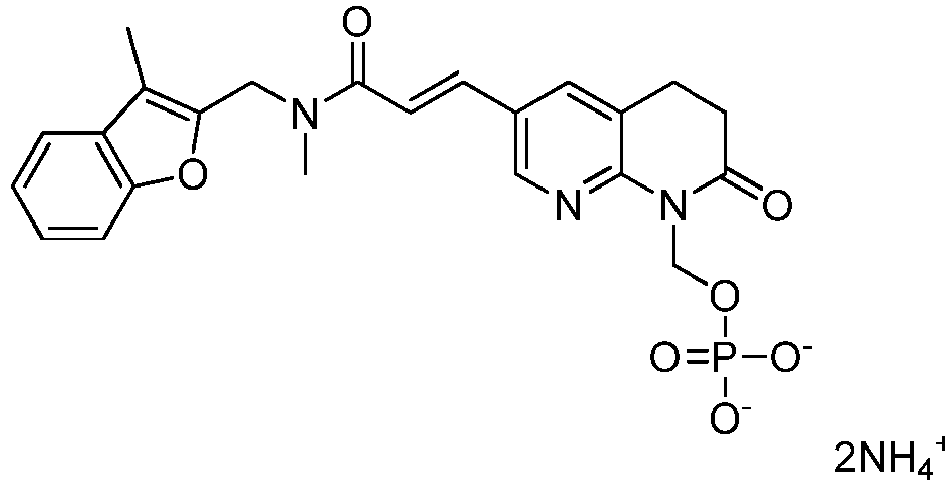
Bis-sodium (B) Compound 9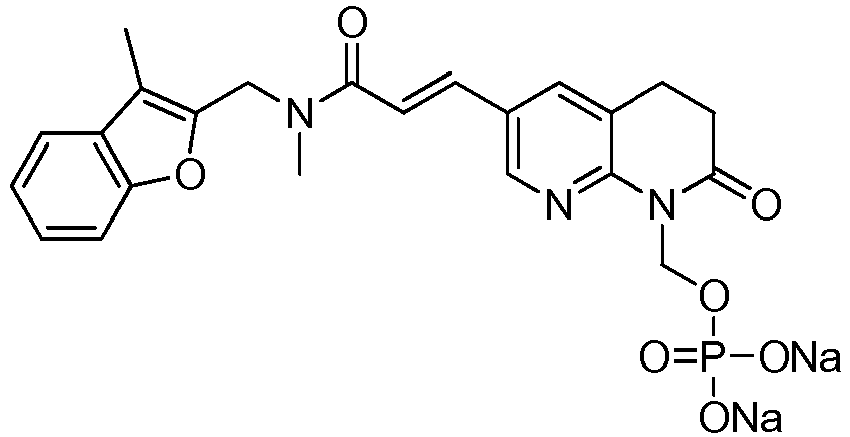
Bis-ethanolammonium (A) Compound 10
Compound IV (free base) 
Compound Y (tosylate anhydrate) 
Compound Z (tosylate monohydrate) 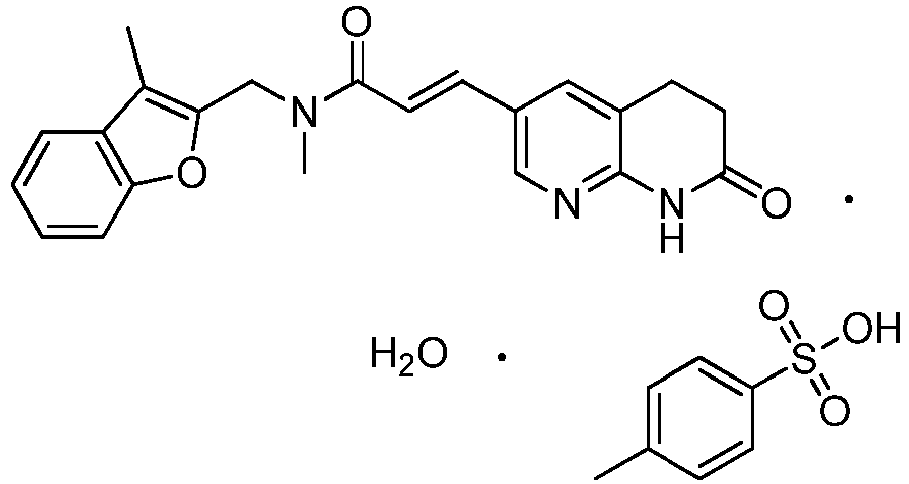
- Compound IV, Y or Z were administered orally as a suspension using 80% PEG400, 0.5% carboxymethylcellulose or OraPlus as vehicles. When compound IV, Y or Z were administered intravenously, a solution of 40% 2-HP-β-cyclodextrin in PBS was used as the vehicle, in order to achieve a composition for intravenous administration. For human use however it is noted that such a cyclodextrin formulation would be toxic and unacceptable for treatment.
- Bis-ammonium, bis-sodium and bis-ethanolammonium compounds (
Compounds - All dose levels and plasma concentrations are calculated as Compound IV equivalents. There is no gender effect in dogs on the PK of these compounds. However, male rats were not a good model for this study because of high clearance rates and low exposures when compared to female rats. Therefore, male rats were typically not tested in these PK models or excluded from the analyses.
Figure 1 shows mean time-concentration plots for compound IV after administration of bis-ammonium, bis-sodium and bis-ethanolammonium compounds (Compounds Compounds Compound 10 in dog plasma after intravenous dosing withcompound 10 as shown inFigure 2 . Similar results were obtained afterintravenous dosing Compound 10 in rats. - Table G below summarizes mean pharmacokinetic parameters of compound IV after administration of bis-ammonium (amorphous compound 14), bis- sodium (compound 9) and bis-ethanolammonium (compound 10) in female rats (5mg/kg, Compound IV equivalents). The data indicate that all compounds are rapidly converted to Compound IV and show comparable pharmacokinetics and oral bioavailability within biological and experimental variation rates.
Table G Pharmacokinetic parameters of compound IV after oral and intravenous administration of compounds Route Compound Tmax (hr) Cmax (ng/ml) Half life (hr) AUC0-24 (hr*ng/ml) Oral bioavailability Intravenous Compound 14 0.08 5,137 3.31 12,579 Compound 90.08 7,583 3.79 11,961 Compound 100.14 8,070 3.65 16,092 Oral Compound 14 1.00 1,333 2.78 12,065 96 % Compound 9 3.33 1,907 3.14 16,179 135 % Compound 10 3.00 2,040 2.20 11,376 71% - Table H below summarizes mean pharmacokinetic parameters of compound IV after administration of bis-ammonium (amorphous compound 14), bis- sodium (compound 9) and bis-ethanolammonium (compound 10) in male dogs (5mg/kg, Compound IV equivalents). The data indicate that all compounds are rapidly converted to compound IV and show comparable pharmacokinetics and oral bioavailability within biological and experimental variation rates.
Table H Pharmacokinetic parameters of compound IV after intravenous and oral administration of compound Route Compound Tmax (hr) Cmax (ng/ml) Half life (hr) AUC0-24 (hr*ng/ml) Oral bioavailability Intravenous Compound 14 0.58 4,049 3.9 26,659 Compound 90.08 6,216 4.8 35,993 Compound 100.09 8,331 4.6 36,083 Oral Compound 14 1.25 2,632 3.8 20,821 78 % Compound 9 0.9 3,123 4.6 23,585 66 % Compound 10 1.33 2,684 4.6 19,765 54% - Table I below summarizes mean pharmacokinetic parameters of compound IV in both dog and rat following intravenous administration of
amorphous compound 14,compound 9 andcompound 10 with comparative data for Compound Z at a dose level of 5mg/kg (Compound IV (free base) equivalents). The data indicate thatcompounds compound 10 showed the highest exposures (approximately 16% and 11% higher in rat and dog, respectively than Compound Z).Table I Pharmacokinetic parameters of compound IV after intravenous administration of compound Route Dose level* Species Compound Tmax (hr) Cmax (ng/ml) Half life (hr) AUC0-24 (hr*ng/ml) Intravenous 5 Rat Compound Z 0.02 10364 2.3 13837 Compound 140.08 5137 3.3 12579 Compound 90.08 7583 3.8 11961 Compound 100.14 8070 3.6 16092 Dog Compound Z 0.02 6911 3.6 43551 Compound 140.58 4049 3.9 26659 Compound 90.08 6216 4.8 35993 Compound 100.08 10973 4.6 48540 *(Compound IV molar equivalents, mg/kg) - Table J shows a comparison of the pharmacokinetics of Compound IV following intravenous administration of Compound Z and
Compound 10 in dogs.Compound 10 showed significantly longer half -lives than Compound Z at doses of 5 and 25 mg/kg.Table J Pharmacokinetic parameters of compound IV after intravenous administration of compound 10 and ZRoute Dose level (Compound IV molar equivalents, mg/kg) Species Compound Tmax (hr) Cmax (ng/ml) Half life (hr) AUC0-24 (hr*ng/ml) intravenous 1 Dog Compound Z 0.017 2129 3.5 8972 Compound 101.08a 1262 3.5 6261 5 Compound Z 0.017 6911 3.6 43551 Compound 100.083 10973 4.6 48540 25 Compound Z 0.017 31642 2.5 87438 Compound 102.92b 9482 4.3 68402 a 1 hour infusion; b4 hour infusion -
Figures 3A and 3B show the results of a comparison of the oral bioavailability of the active compound IV in dog and rat after administration of the bis-ethanolammonium compound 10, Compound IV, and Compound Z. As indicated in the Figures, the bis-ethanolammonium compound showed significantly higher oral bioavailability than both compound IV and Compound Z. - Tables K and L show comparative Compound IV oral bioavailability data after administration of
compound 10 or Compound Z. Notably,compound 10 possessed improved bioavailability (of compound IV) in both dog and rat models when compared to Compound Z. Specifically, the bis-ethanolammonium compound 10 provided a 3- to 7fold higher bioavailability of Compound IV in the dog and 7- to 9- fold higher bioavailability of Compound IV in the rat than Compound Z. Remarkably, as shown in Tables M and N, the bioavailability of Compound IV after administration ofcompound 10 was up to 38-fold higher than after administration of Compound IV in the dog and up to 144 fold higher in the rat. Most significantly, the bioavailability of Compound IV after administration ofCompound 10 was much less dose-dependent than after administration of compound IV and Z as indicated by the increasing relative bioavailabilities with increasing doses.Table K Dog Oral Bioavailability: Compound IV exposures after Compound 10 and Compound Z administration Dose level (compound IV molar equivalents, mg/kg) AUC0-24 (hr*ng/ml) Relative Oral Bioavailability Compound Z Compound 10 Compound 10 / Compound Z 3 3,859 10,727 2.8 10 11,289 34,002 3.0 30 25,710 92,408 3.6 100 45,931 226,468 4.9 300 59,269 387,188 6.5 Table L: Rat Oral Bioavailability: Compound IV exposures after Compound 10 and Compound Z administration Dose level (compound IV molar equivalents, mg/kg) AUC0-24 (hr*ng/ml) Relative Oral Bioavailability Compound Z Compound 10 Compound 10 / Compound Z 3 1,632 14,642 9.0 10 5,320 47,360 8.9 30 15,578 135,673 8.7 100 46,437 379,650 8.2 300 107,186 782,022 7.3 Table M Dog Oral Bioavailability: Compound IV exposures after Compound 10 and Compound IV administration Dose level (compound IV molar equivalents, mg/kg) AUC0-24 (hr*ng/ml) Relative Oral Bioavailability Compound IV Compound 10 Compound 10 / Compound IV 3 9,460 10,727 1.1 10 9,917 34,002 3.4 30 10,059 92,408 9.2 100 10,109 226,468 22 300 10,123 387,188 38 Table N: Rat Oral Bioavailability: Compound IV exposures after Compound 10 and Compound IV administration Dose level (compound IV molar equivalents, mg/kg) AUC0-24 (hr*ng/ml) Relative Oral Bioavailability Compound IV Compound 10 Compound 10 / Compound IV 3 537 14,642 27 10 1,469 47,360 32 30 2,973 135,673 46 100 4,596 379,650 83 300 5,446 782,022 144 - The in vitro antibacterial activity of
prodrug compound 10 bis-ethanolamine salt (prodrug of compound Z/ compound IV), compound Z itself, and other comparators were evaluated in a broth microdilution assay against methicillin-resistant and methicillin-sensitive Staphylococcus aureus, Enterococcus faecalis, Streptococcus pneumoniae, Streptococcus pyogenes and Escherichia coli. - Bacterial Isolates. Organisms tested in this study are listed in Table P. Clinical isolates consisted of 5 Staphylococcus aureus (MSSA), 3 Staphylococcus aureus (HA-MRSA), 2 Staphylococcus aureus (CA-MRSA), 2 Enterococcus faecalis (VSE), 2 Streptococcus pyogenes, and 2 Escherichia coli (susceptible to most antibiotics). S. aureus ATCC 29213, E. faecalis ATCC 29212, S. pneumoniae ATCC 49619, and E. coli ATCC 25922 were tested for the purposes of quality control.
- MIC Methodology. Minimal Inhibitory Concentrations (MIC) values against the selected isolates were determined using the reference broth microdilution method according to the Clinical Laboratory Standards Institute (CLSI) guidelines.
- The MIC was read and recorded as the lowest concentration of drug that inhibited visible growth of the organism.
Table P: In vitro antibacterial activity of Compound 10, Compound Z and comparator antibiotics Organism MIC (µg/ml) Compound 10 Compound Z Vancomycin Linezolid Ciprofloxacin S. aureus ATCC 29213 4 0.004 0.5 4 0.5 S. aureus 3104; MSSA >16 0.015 0.5 2 0.25 S. aureus 3107; MSSA 8 0.004 0.5 2 0.5 S. aureus 3245; MSSA 16 0.015 0.5 2 0.5 S. aureus 3250; MSSA 8 0.004 0.5 4 2 S. aureus 3856; MSSA 16 0.004 1 2 >64 S. aureus 3083; HA-MRSA 4 0.004 0.5 2 32 S. aureus 3086; HA-MRSA 16 0.03 1 2 >64 S. aureus 3265; HA-MRSA 16 0.004 0.5 2 >64 S. aureus 2168; CAMRSA 4 0.004 1 2 16 S. aureus 2294; CAMRSA 16 0.03 1 2 >64 E. faecalis ATCC 29212 >16 >2 1 1 0.5 E. faecalis 4158; VSE >16 >2 >64 1 64 E. faecalis 4212; VSE >16 >2 16 1 32 S. pneumoniae ATCC 49619 >16 >2 0.12 1 0.5 S. pyogenes 6179 >16 >2 0.25 1 0.5 S. pyogenes 6528 >16 >2 0.25 1 0.5 E. coli ATCC 25922 >16 >2 >64 64 0.008 E. coli 2214 >16 >2 >64 >64 0.015 E. coli 5255 >16 >2 >64 64 0.008 - As shown in Table P,
compound 10, a prodrug of compound Z showed 500 - 4000 times less activity than Compound Z against a panel of 11 S. aureus strains. (This negligible activity is probably due to traces of Compound IV (∼0.1%) incompound 10 API.) In part by virtue of the prodrug nature,compound 10 shows no inhibition of S. aureus FabI; no inhibition of non-staphylococcal species, as does compound Z. The control antibiotics show the expected activity against all bacterial species tested. - While specific embodiments of the subject invention have been discussed, the above specification is illustrative and not restrictive. Many variations of the invention will become apparent to those skilled in the art upon review of this specification. The full scope of the invention is determined by the claims, which are to be interpreted using the description and drawings.
- Unless otherwise indicated, all numbers expressing quantities of ingredients, reaction conditions, and so forth used in the specification and claims are to be understood as being modified in all instances by the term "about." Accordingly, unless indicated to the contrary, the numerical parameters set forth in this specification and attached claims are approximations that may vary depending upon the desired properties sought to be obtained by the present invention.
Claims (19)
- A compound represented by:

- A compound according to claim 1, which is represented by formula I:
 R1 and R2 are each independently selected from the group consisting of hydrogen, an alkali metal, NH4 +, NH3 +-(R3), NH2 +-(R3)2, and NH+-(R3)3, or R1 and R2 taken together are an alkaline earth metal; andR3 is independently selected from the group consisting of C1-6 alkyl-, hydroxyl C1-6 alkyl-, phenyl and benzyl; and wherein R1 and R2 are preferably each NH3 +-CH2CH2OH,and wherein the term alkyl includes alkyl moieties having substituents replacing a hydrogen on one or more carbons of the hydrocarbon backbone, wherein such substituents are selected from the group consisting of a hydroxyl, a carbonyl, including a carboxyl, an alkoxycarbonyl, a formyl, or an acyl, a thiocarbonyl, including a thioester, a thioacetate, or a thioformate, an alkoxyl, a phosphoryl, a phosphonate, a phosphinate, a phosphate, an amino, an amido, an amidine, an imine, a cyano, a nitro, an azido, a sulfhydryl, an alkylthio, a sulfate, a sulfonate, a sulfamoyl, a sulfonamido, a sulfonyl, a heterocyclyl, an aralkyl, or an aromatic or heteroaromatic moiety.
 - The compound of claim 2, wherein the compound is characterized by one or more of the following features:(i) R1 and R2 are each NH3 +-(R3),(ii) one of R1 and R2 is H; and one of R1 and R2 is NH4 + or NH3 +-(R3),(iii) R3 is -CH2CH2OH,(iv) R1 and R2 are an alkali metal,
wherein the alkali metal is preferably selected from the group consisting of lithium, sodium and potassium,(v) R1 and R2 taken together are an alkaline earth metal,
wherein the alkaline earth metal is preferably calcium or magnesium. - The compound of claim 2, wherein the compound is selected from the group consisting of(i) a compound represented by:
 (ii) a compound represented by:
 (iii) a compound represented by:
 (iv) a compound represented by:
- The compound of any one of claims 1-4, wherein the compound has at least 2-fold greater oral bioavailability on a molar basis as compared to (E)-N-methyl-N-((3-methylbenzofuran-2-yl)methyl)-3-(7-oxo-5,6,7,8-tetrahydro-1,8-naphthyridin-3-yl)acrylamide or salts thereof or wherein the compound has at least 2-fold greater bioavailability on a molar basis as compared to the p-toluenesulfonic salt of (E)-N-methyl-N-((3-methylbenzofuran-2-yl)methyl)-3-(7-oxo-5,6,7,8-tetrahydro-1,8-naphthyridin-3-yl)acrylamide.
- A pharmaceutical composition comprising a compound of any one of claims 1-5 and a pharmaceutically acceptable excipient, wherein the pharmaceutical composition is preferably further characterized by one or more of the following features:(i) the composition is formulated for one of: intravenous administration, injectable administration, topical administration, systemic administration, inhalation administration, or oral administration;(ii) the composition is a powder, tablet, pill, or capsule;(iii) the composition is a pharmaceutically-acceptable sterile isotonic aqueous or nonaqueous solution, dispersion, suspension or emulsion, or a sterile powder which may be reconstituted into sterile injectable solutions or dispersions.
- The compound of any one of claims 1 to 5 or the pharmaceutical composition of claim 6 for use in (a) treating a bacterial infection in a patient or (b) treating or ameliorating cystic fibrosis in a patient.
- The compound or pharmaceutical composition for use of claim 7, embodiment (a), wherein the treatment provides a mean plasma level of the compound that is at least 2 times higher than that obtained by use of the same amount, on a molar basis, of (E)-N-methyl-N-((3-methylbenzofuran-2-yl)methyl)-3-(7-oxo-5,6,7,8-tetrahydro-1,8-naphthyridin-3-yl)acrylamide or salts thereof, at 4 hours after the use or
wherein the treatment provides a mean plasma level of the compound that is at least 2 times higher than that obtained by use of the same amount, on a molar basis, of p-toluenesulfonic salt of (E)-N-methyl-N-((3-methylbenzofuran-2-yl)methyl)-3-(7-oxo-5,6,7,8-tetrahydro-1,8-naphthyridin-3-yl)acrylamide, at 4 hours after the use. - The compound or pharmaceutical composition for use of any one of claims 7-8, wherein the patient is a human or a companion animal or food animal.
- The pharmaceutical composition for use of any one of claims 7-9, wherein said treatment is by a route of administration selected from the group consisting of oral administration, intravenous administration, subcutaneous administration, topical administration, and inhalation; and preferably
by oral administration; or
by injection. - The pharmaceutical composition for use of any one of claims 7-10, said use further comprising use of a compound selected from the group consisting of an oxazolidinone, a lipoglycopeptide, vancomycin, teicoplanin, a glycopeptide, a penicillin, a cephalosporin, a pleuromutilin, a fusidane, a lincosamide, rifamycin, arbekacin, linezolid, daptomycin, teicoplanin, telavancin, sulfamethoxazole, gentamicin, ciprofloxin, levofloxin, aztreonam, tobramicin, amoxicillin, nafcillin, rifabutin, rifampin, rifapentine, quinolones, fluoroquinolones, carbapenems, aminoglycosides, aminocyclitols, diaminopyrimidines, tetracyclines, glycyclines, streptogramins, macrolides, and /or sulfonamides.
- A kit comprising the pharmaceutical composition of claim 6 and instructions for use thereof.
- A method of preparing a compound represented by formula II:

contacting a compound of formula III with a compound of formula IV or salt thereof; wherein:formula III is represented by: formula IV is represented by:
 X represents a leaving group; andPg represents a protecting group,wherein X is preferably selected from the group consisting of: halogen,

wherein Pg is preferably -(CH2)2-Si(CH3)3. - The method of claim 13, wherein formula IV is the free base.
- The method of any one of claims 13-14, wherein the method further comprises contacting formula IV with a base, wherein contacting a compound of formula III with a compound of formula IV preferably occurs in a solvent.
- A compound represented by:
 Pg is -C1-6alkyl-Si(R5)3; andR5 for each occurrence is C1-6alkyl, wherein Pg is preferably -(CH2)2-Si(CH3)3 and wherein the term alkyl includes alkyl moieties having substituents replacing a hydrogen on one or more carbons of the hydrocarbon backbone, wherein such substituents are selected from the group consisting of a hydroxyl, a carbonyl, including a carboxyl, an alkoxycarbonyl, a formyl, or an acyl, a thiocarbonyl, including a thioester, a thioacetate, or a thioformate, an alkoxyl, a phosphoryl, a phosphonate, a phosphinate, a phosphate, an amino, an amido, an amidine, an imine, a cyano, a nitro, an azido, a sulfhydryl, an alkylthio, a sulfate, a sulfonate, a sulfamoyl, a sulfonamido, a sulfonyl, a heterocyclyl, an aralkyl, or an aromatic or heteroaromatic moiety.
 - A method of preparing the compound represented by formula II of claim 16, comprising:
contacting a compound

- A method of preparing a compound represented by:
 R1 and R2 are each independently selected from the group consisting of hydrogen, an alkali metal, NH4 +, NH3 +-(R3), NH2 +-(R3)2, and NH+-(R3)3, or R1 and R2 taken together are an alkaline earth metal;R3 is independently selected for each occurence from the group consisting of C1-6alkyl-, hydroxyC1-6alkyl-, phenyl and benzyl,and wherein the term alkyl includes alkyl moieties having substituents replacing a hydrogen on one or more carbons of the hydrocarbon backbone, wherein such substituents are selected from the group consisting of a hydroxyl, a carbonyl, including a carboxyl, an alkoxycarbonyl, a formyl, or an acyl, a thiocarbonyl, including a thioester, a thioacetate, or a thioformate, an alkoxyl, a phosphoryl, a phosphonate, a phosphinate, a phosphate, an amino, an amido, an amidine, an imine, a cyano, a nitro, an azido, a sulfhydryl, an alkylthio, a sulfate, a sulfonate, a sulfamoyl, a sulfonamido, a sulfonyl, a heterocyclyl, an aralkyl, or an aromatic or heteroaromatic moiety;
comprising contacting a Bronsted acid, preferably trifluoroacetic acid, and a compound of formula II prepared as in claim 13 or 17. - The compound represented by:

Priority Applications (6)
| Application Number | Priority Date | Filing Date | Title |
|---|---|---|---|
| PL13806968T PL2861608T3 (en) | 2012-06-19 | 2013-06-19 | Prodrug derivatives of (e)-n-methyl-n-((3-methylbenzofuran-2-yl)methyl)-3-(7-oxo-5,6,7,8-tetrahydro-1,8-naphthyridin-3-yl)acrylamide |
| SI201331494T SI2861608T1 (en) | 2012-06-19 | 2013-06-19 | Prodrug derivatives of (e)-n-methyl-n-((3-methylbenzofuran-2-yl)methyl)-3-(7-oxo-5,6,7,8-tetrahydro-1,8-naphthyridin-3-yl)acrylamide |
| SM20190411T SMT201900411T1 (en) | 2012-06-19 | 2013-06-19 | Prodrug derivatives of (e)-n-methyl-n-((3-methylbenzofuran-2-yl)methyl)-3-(7-oxo-5,6,7,8-tetrahydro-1,8-naphthyridin-3-yl)acrylamide |
| RS20190770A RS58898B1 (en) | 2012-06-19 | 2013-06-19 | Prodrug derivatives of (e)-n-methyl-n-((3-methylbenzofuran-2-yl)methyl)-3-(7-oxo-5,6,7,8-tetrahydro-1,8-naphthyridin-3-yl)acrylamide |
| HRP20190980TT HRP20190980T1 (en) | 2012-06-19 | 2013-06-19 | (E) -N-METHYL-N ((3-METHYLBENZOFURAN-2 IL) METHYL) -3- (7-OXO-5,6,7,8-TETRAHYDRO-1,8-NAFTYRIDIN-3-IL) DERIVATIVES acrylamide |
| MEP-2019-159A ME03392B (en) | 2012-06-19 | 2013-06-19 | PROLEK DERIVATIVES (E) -N-METHYL-N- (3-METHYLBENZOFURAN-2-YL) METHYL) -3- (7-OXO-5,6,7,8-TETRANIDRO-1,8-NAFTYRIDIN-3 -IL) ACRYLAMIDE |
Applications Claiming Priority (2)
| Application Number | Priority Date | Filing Date | Title |
|---|---|---|---|
| US201261661559P | 2012-06-19 | 2012-06-19 | |
| PCT/IB2013/001780 WO2013190384A1 (en) | 2012-06-19 | 2013-06-19 | Prodrug derivatives of (e)-n-methyl-n-((3-methylbenzofuran-2-yl)methyl)-3-(7-oxo-5,6,7,8-tetrahydro-1,8-naphthyridin-3-yl)acrylamide |
Publications (4)
| Publication Number | Publication Date |
|---|---|
| EP2861608A1 EP2861608A1 (en) | 2015-04-22 |
| EP2861608A4 EP2861608A4 (en) | 2016-01-20 |
| EP2861608B1 true EP2861608B1 (en) | 2019-04-24 |
| EP2861608B8 EP2861608B8 (en) | 2019-06-19 |
Family
ID=49768192
Family Applications (1)
| Application Number | Title | Priority Date | Filing Date |
|---|---|---|---|
| EP13806968.7A Active EP2861608B8 (en) | 2012-06-19 | 2013-06-19 | Prodrug derivatives of (e)-n-methyl-n-((3-methylbenzofuran-2-yl)methyl)-3-(7-oxo-5,6,7,8-tetrahydro-1,8-naphthyridin-3-yl)acrylamide |
Country Status (34)
| Country | Link |
|---|---|
| US (2) | US8901105B2 (en) |
| EP (1) | EP2861608B8 (en) |
| JP (2) | JP6085026B2 (en) |
| KR (1) | KR101720885B1 (en) |
| CN (1) | CN104684922B (en) |
| AU (1) | AU2013279021C1 (en) |
| BR (2) | BR112014031635B1 (en) |
| CA (1) | CA2875916C (en) |
| CL (1) | CL2014003472A1 (en) |
| CY (1) | CY1122006T1 (en) |
| DK (1) | DK2861608T3 (en) |
| EA (1) | EA028136B1 (en) |
| ES (1) | ES2731474T3 (en) |
| HR (1) | HRP20190980T1 (en) |
| HU (1) | HUE043836T2 (en) |
| IL (1) | IL236066A (en) |
| IN (1) | IN2014KN02915A (en) |
| LT (1) | LT2861608T (en) |
| MA (1) | MA37625B1 (en) |
| ME (1) | ME03392B (en) |
| MX (1) | MX356695B (en) |
| MY (1) | MY170437A (en) |
| NZ (1) | NZ702695A (en) |
| PH (1) | PH12014502823A1 (en) |
| PL (1) | PL2861608T3 (en) |
| PT (1) | PT2861608T (en) |
| RS (1) | RS58898B1 (en) |
| SG (1) | SG11201408100YA (en) |
| SI (1) | SI2861608T1 (en) |
| SM (1) | SMT201900411T1 (en) |
| TN (1) | TN2014000506A1 (en) |
| TR (1) | TR201909016T4 (en) |
| UA (1) | UA113215C2 (en) |
| WO (1) | WO2013190384A1 (en) |
Families Citing this family (14)
| Publication number | Priority date | Publication date | Assignee | Title |
|---|---|---|---|---|
| EP2687533B1 (en) | 2006-07-20 | 2017-07-19 | Debiopharm International SA | Acrylamide derivatives as FAB I inhibitors |
| SMT201900411T1 (en) | 2012-06-19 | 2019-09-09 | Debiopharm Int Sa | Prodrug derivatives of (e)-n-methyl-n-((3-methylbenzofuran-2-yl)methyl)-3-(7-oxo-5,6,7,8-tetrahydro-1,8-naphthyridin-3-yl)acrylamide |
| BR122023021456A2 (en) | 2016-02-26 | 2024-02-20 | Debiopharm International S.A. | USE OF {6- [(E)-3-{METHYL[(3-METHYL-1-BENFOFURAN-2- IOL)METHYL]AMINO)-3- OXOPRO-1-EN-1-IL] DIHYDROGEN PHOSPHATE -2-OXO-3,4-DI-HYDRO-1,8-NAFTYRIDIN-1(2H)- IL}METHYL FOR TREATMENT OF OSTEOMYELITIS OF THE DIABETIC FOOT AND PHARMACEUTICAL COMPOSITION |
| US11857352B2 (en) | 2016-09-06 | 2024-01-02 | The Research Foundation For The State University Of New York | Positron imaging tomography imaging agent composition and method for bacterial infection |
| HUE066356T2 (en) | 2017-08-24 | 2024-07-28 | Novo Nordisk As | GLP-1 preparations and their applications |
| US11691967B2 (en) | 2018-03-12 | 2023-07-04 | The Board Of Trustees Of The University Of Illinois | Antibiotics effective for gram-negative pathogens |
| FI3880675T3 (en) | 2018-11-12 | 2024-12-09 | Debiopharm Int Sa | ANTIBIOTIC COMPOUNDS, METHODS FOR PREPARING THEM, PHARMACEUTICAL COMPOSITIONS CONTAINING THEM AND USES THEREOF |
| CN113507929A (en) | 2018-12-21 | 2021-10-15 | 阿科利斯制药有限责任公司 | DNA polymerase IIIC inhibitor and application thereof |
| FI3923914T3 (en) | 2019-02-14 | 2023-04-27 | Debiopharm Int Sa | Afabicin formulation, method for its preparation |
| MA56184A (en) | 2019-06-14 | 2022-04-20 | Debiopharm Int Sa | AFABICIN FOR USE IN THE TREATMENT OF BACTERIAL INFECTIONS INVOLVING BIOFILM |
| JP7669372B2 (en) | 2019-12-19 | 2025-04-28 | デバイオファーム インターナショナル エス.エー. | Novel compounds and their uses |
| PE20221575A1 (en) | 2020-02-18 | 2022-10-06 | Novo Nordisk As | PHARMACEUTICAL FORMULATIONS |
| US20240317740A1 (en) | 2021-06-23 | 2024-09-26 | Debiopharm International S.A. | Novel compounds and their use |
| CN121925258A (en) | 2023-10-09 | 2026-04-24 | 德彪药业国际股份公司 | Antibiotic compounds for the treatment of bacterial infections |
Family Cites Families (144)
| Publication number | Priority date | Publication date | Assignee | Title |
|---|---|---|---|---|
| US3828068A (en) | 1971-05-10 | 1974-08-06 | Tenneco Chem | ((substituted indazolyl)-n1-methyl)carbamates |
| US4154943A (en) | 1977-12-29 | 1979-05-15 | University Of Vermont | Preparation of vincadifformine |
| FR2619111B1 (en) | 1987-08-07 | 1991-01-11 | Synthelabo | (PIPERIDINYL-4) METHYL-2 TETRAHYDRO-1,2,3,4 9H-PYRIDO (3,4-B) INDOLE DERIVATIVES, THEIR PREPARATION AND THEIR THERAPEUTIC APPLICATION |
| CA2020437A1 (en) | 1989-07-05 | 1991-01-06 | Yoshihide Fuse | Cinnamamide derivative |
| DE4126662A1 (en) | 1991-08-13 | 1993-02-18 | Boehringer Mannheim Gmbh | NEW 3,5-DI-TERT.BUTYL-4-HYDROXYPHENYL DERIVATIVES, METHOD FOR THEIR PRODUCTION AND MEDICINAL PRODUCTS |
| HU210679B (en) | 1991-11-21 | 1995-06-28 | Richter Gedeon Vegyeszet | Process for producing new tetrahydro-pyrido/3,4-b/indol derivatives and pharmaceutical compositions containing the same |
| FR2692575B1 (en) | 1992-06-23 | 1995-06-30 | Sanofi Elf | NOVEL PYRAZOLE DERIVATIVES, PROCESS FOR THEIR PREPARATION AND PHARMACEUTICAL COMPOSITIONS CONTAINING THEM. |
| US5416193A (en) | 1993-04-30 | 1995-05-16 | Pfizer Inc. | Coupling reagent and method |
| MA23420A1 (en) | 1994-01-07 | 1995-10-01 | Smithkline Beecham Corp | BICYCLIC FIBRINOGEN ANTAGONISTS. |
| US5614551A (en) | 1994-01-24 | 1997-03-25 | The Johns Hopkins University | Inhibitors of fatty acid synthesis as antimicrobial agents |
| AU702661B2 (en) | 1994-06-29 | 1999-02-25 | Smithkline Beecham Corporation | Vitronectin receptor antagonists |
| US6176842B1 (en) | 1995-03-08 | 2001-01-23 | Ekos Corporation | Ultrasound assembly for use with light activated drugs |
| US5989832A (en) | 1995-04-21 | 1999-11-23 | Microcide Pharmaceuticals, Inc. | Method for screening for non-tetracycline efflux pump inhibitors |
| RU2183212C2 (en) | 1995-05-11 | 2002-06-10 | Биохеми Гезельшафт Мбх | Antibacterial cephalosporins, pharmaceutical composition based on thereof and method of treatment |
| US6057291A (en) | 1995-06-02 | 2000-05-02 | University Of British Columbia | Antimicrobial cationic peptides |
| ATE216887T1 (en) | 1996-02-29 | 2002-05-15 | Fujisawa Pharmaceutical Co | TABLETS CONTAINING BETA-LACTAM ANTIBIOTIC AND METHOD FOR THE PRODUCTION THEREOF |
| US6239154B1 (en) | 1996-03-08 | 2001-05-29 | Adolor Corporation | Kappa agonist compounds pharmaceutical formulations and method of prevention and treatment of pruritus therewith |
| US6367985B1 (en) | 1996-03-12 | 2002-04-09 | Intellectual Property Company | Optical connector using large diameter alignment features |
| US6451816B1 (en) | 1997-06-20 | 2002-09-17 | Klinge Pharma Gmbh | Use of pyridyl alkane, pyridyl alkene and/or pyridyl alkine acid amides in the treatment of tumors or for immunosuppression |
| DE19624659A1 (en) | 1996-06-20 | 1998-01-08 | Klinge Co Chem Pharm Fab | New pyridylalkene and pyridylalkanoic acid amides |
| US6503881B2 (en) | 1996-08-21 | 2003-01-07 | Micrologix Biotech Inc. | Compositions and methods for treating infections using cationic peptides alone or in combination with antibiotics |
| US6995254B1 (en) | 1996-08-28 | 2006-02-07 | Affinium Pharmaceuticals, Inc. | Polynucleotide encoding the enoyl-acyl carrier protein reductase of Staphylococcus aureus, FAB I |
| HU224196B1 (en) | 1996-09-20 | 2005-06-28 | Meiji Seika Kaisha Ltd. | A crystalline form of cefditoren pivoxyl and process for the production of the same |
| US6521408B1 (en) | 1997-09-25 | 2003-02-18 | National Institute Of Agrobiological Sciences | Method for assessing a function of a gene |
| DE19641437A1 (en) | 1996-10-08 | 1998-04-09 | Basf Ag | 1,3-bis (N-lactamyl) propanes and their pharmaceutical and cosmetic use |
| DE19652239A1 (en) | 1996-12-16 | 1998-06-18 | Bayer Ag | Use of 7- (2-oxa-5,8-diazabicyclo [4.3.0] non-8-yl) -quinolone and naphthyridonecarboxylic acid derivatives for the therapy of Helicobacter pylori infections and the associated gastroduodenal diseases |
| SI9600371B (en) | 1996-12-18 | 2005-04-30 | LEK, tovarna farmacevtskih in kemi�nih izdelkov, d.d. | Ethylidene derivatives of tricyclic carbapenemes |
| AU6870098A (en) | 1997-03-31 | 1998-10-22 | Du Pont Merck Pharmaceutical Company, The | Indazoles of cyclic ureas useful as hiv protease inhibitors |
| SI0971735T1 (en) | 1997-04-01 | 2008-08-31 | Borody Thomas J | Methods and compositions for treating inflammatory bowel disease |
| US6406880B1 (en) | 1997-05-02 | 2002-06-18 | Integrated Research Technology, Llc | Betaines as adjuvants to susceptibility testing and antimicrobial therapy |
| US6184363B1 (en) | 1997-06-13 | 2001-02-06 | Northwestern University | Inhibitors of β-lactamases and uses therefor |
| US6207679B1 (en) | 1997-06-19 | 2001-03-27 | Sepracor, Inc. | Antimicrobial agents uses and compositions related thereto |
| CA2294453A1 (en) | 1997-06-23 | 1998-12-30 | Fumihiro Hirayama | Prophylactic or therapeutic agent for diseases attributable to infection with helicobacters |
| AUPO758297A0 (en) | 1997-06-27 | 1997-07-24 | Rowe, James Baber | Control of acidic gut syndrome |
| US6198000B1 (en) | 1997-07-07 | 2001-03-06 | Pfizer Inc. | Intermediates useful in the synthesis of quinoline antibiotics |
| EP1000935A4 (en) | 1997-07-25 | 2001-03-21 | Tsumura & Co | PYRIDYLACRYLAMIDE DERIVATIVES, NEPHRITIS REMEDIES, AND TGF-BETA INHIBITORS CONTAINING THE SAME |
| HN1998000106A (en) | 1997-08-01 | 1999-01-08 | Pfizer Prod Inc | PARENTERAL COMPOSITIONS OF ALATROFLAXACINO |
| US5932743A (en) | 1997-08-21 | 1999-08-03 | American Home Products Corporation | Methods for the solid phase synthesis of substituted indole compounds |
| GB9717804D0 (en) | 1997-08-22 | 1997-10-29 | Zeneca Ltd | Chemical compounds |
| JP2001503280A (en) | 1997-10-31 | 2001-03-13 | ノバルティス アクチエンゲゼルシャフト | Glyphosate resistant transgenic plants |
| US6432444B1 (en) | 1997-10-31 | 2002-08-13 | New Horizons Diagnostics Corp | Use of bacterial phage associated lysing enzymes for treating dermatological infections |
| EP1028948B1 (en) | 1997-11-07 | 2003-01-29 | Schering Corporation | Phenyl-alkyl-imidazoles as h3 receptor antagonists |
| SE9704404D0 (en) | 1997-11-28 | 1997-11-28 | Astra Ab | New compounds |
| GB9725244D0 (en) | 1997-11-29 | 1998-01-28 | Zeneca Ltd | Chemical compounds |
| DE19753298A1 (en) | 1997-12-01 | 1999-06-02 | Basf Ag | Process for the preparation of solid dosage forms |
| PT1051978E (en) | 1998-01-07 | 2012-11-20 | Meiji Seika Pharma Co Ltd | Crystallographically stable amorphous cephalosporin compositions and process for producing the same |
| US6184380B1 (en) | 1999-01-25 | 2001-02-06 | Pfizer Inc. | Process for preparing naphthyridones and intermediates |
| US6248343B1 (en) | 1998-01-20 | 2001-06-19 | Ethicon, Inc. | Therapeutic antimicrobial compositions |
| PA8466701A1 (en) | 1998-01-21 | 2000-09-29 | Pfizer Prod Inc | TROVAFLOXACINO MESYLATE TABLET |
| US6204279B1 (en) | 1998-06-03 | 2001-03-20 | Microcide Pharmaceuticals, Inc. | Peptidomimetic efflux pump inhibitors |
| RU2241489C2 (en) | 1998-02-27 | 2004-12-10 | Биора Биоэкс Аб | Matrix protein compositions for healing wound |
| US6350738B1 (en) | 1998-03-06 | 2002-02-26 | Brigham Young University | Steroid derived antibiotics |
| US6369049B1 (en) | 1998-04-30 | 2002-04-09 | Eli Lilly And Company | Treatment of mastitis |
| DE19820801A1 (en) | 1998-05-09 | 1999-11-25 | Gruenenthal Gmbh | Oral dosage form for gatifloxacin, providing reproducible decomposition time and drug release |
| DE19821039A1 (en) | 1998-05-11 | 1999-11-18 | Bayer Ag | Production of (S,S)-8-benzyl-2,8-diazabicyclo(4.3.0)nonane useful as intermediate for antibiotic moxifloxacin |
| US6399629B1 (en) | 1998-06-01 | 2002-06-04 | Microcide Pharmaceuticals, Inc. | Efflux pump inhibitors |
| US6428579B1 (en) | 1998-07-01 | 2002-08-06 | Brown University Research Foundation | Implantable prosthetic devices coated with bioactive molecules |
| US6423741B1 (en) | 1998-07-10 | 2002-07-23 | Council Of Scientific And Industrial Research | Anti-microbial composition and method for producing the same |
| GB9815567D0 (en) | 1998-07-18 | 1998-09-16 | Glaxo Group Ltd | Antiviral compound |
| CN1149102C (en) | 1998-08-04 | 2004-05-12 | 武田雪林格.布郎动物保健株式会社 | Stabilized formulations of β-lactam antibiotics |
| DK1025846T3 (en) | 1998-08-21 | 2006-11-06 | Kyorin Seiyaku Kk | Aqueous liquid preparations |
| US6461607B1 (en) | 1998-08-24 | 2002-10-08 | Ganeden Biotech, Inc. | Probiotic, lactic acid-producing bacteria and uses thereof |
| US6518487B1 (en) | 1998-09-23 | 2003-02-11 | Pioneer Hi-Bred International, Inc. | Cyclin D polynucleotides, polypeptides and uses thereof |
| US6509327B1 (en) | 1998-09-30 | 2003-01-21 | Alcon Manufacturing, Ltd. | Compositions and methods for treating otic, ophthalmic and nasal infections |
| US6395746B1 (en) | 1998-09-30 | 2002-05-28 | Alcon Manufacturing, Ltd. | Methods of treating ophthalmic, otic and nasal infections and attendant inflammation |
| DE19851104C2 (en) | 1998-11-06 | 2003-04-03 | Huhtamaki Forchheim | Process for producing a multilayer composite |
| TW526202B (en) | 1998-11-27 | 2003-04-01 | Shionogi & Amp Co | Broad spectrum cephem having benzo[4,5-b]pyridium methyl group of antibiotic activity |
| WO2000048990A1 (en) | 1999-02-18 | 2000-08-24 | The Regents Of The University Of California | Phthalamide-lanthanide complexes for use as luminescent markers |
| US6235728B1 (en) | 1999-02-19 | 2001-05-22 | Bristol-Myers Squibb Company | Water-soluble prodrugs of azole compounds |
| US6267985B1 (en) | 1999-06-30 | 2001-07-31 | Lipocine Inc. | Clear oil-containing pharmaceutical compositions |
| US6294192B1 (en) | 1999-02-26 | 2001-09-25 | Lipocine, Inc. | Triglyceride-free compositions and methods for improved delivery of hydrophobic therapeutic agents |
| US6248363B1 (en) | 1999-11-23 | 2001-06-19 | Lipocine, Inc. | Solid carriers for improved delivery of active ingredients in pharmaceutical compositions |
| US6461829B1 (en) | 1999-03-03 | 2002-10-08 | The Trustees Of Princeton University | Bacterial transglycosylases: assays for monitoring the activity using Lipid II substrates analogs and methods for discovering new antibiotics |
| US6495161B1 (en) | 1999-03-09 | 2002-12-17 | Vivorx, Inc. | Cytoprotective biocompatible containment systems for biologically active materials and methods of making same |
| US6239113B1 (en) | 1999-03-31 | 2001-05-29 | Insite Vision, Incorporated | Topical treatment or prevention of ocular infections |
| US6224579B1 (en) | 1999-03-31 | 2001-05-01 | The Trustees Of Columbia University In The City Of New York | Triclosan and silver compound containing medical devices |
| AU4230900A (en) | 1999-04-08 | 2000-10-23 | General Hospital Corporation, The | Purposeful movement of human migratory cells away from an agent source |
| CO5180550A1 (en) | 1999-04-19 | 2002-07-30 | Smithkline Beecham Corp | FAB I INHIBITORS |
| US6290946B1 (en) | 1999-05-13 | 2001-09-18 | Geltex Pharmaceuticals, Inc. | Anionic polymers as toxin binders and antibacterial agents |
| US6514535B2 (en) | 1999-05-21 | 2003-02-04 | Noveon Ip Holdings Corp. | Bioadhesive hydrogels with functionalized degradable crosslinks |
| AR024077A1 (en) | 1999-05-25 | 2002-09-04 | Smithkline Beecham Corp | ANTIBACTERIAL COMPOUNDS |
| CO5370679A1 (en) | 1999-06-01 | 2004-02-27 | Smithkline Beecham Corp | FAB INHIBITORS 1 |
| US6239141B1 (en) | 1999-06-04 | 2001-05-29 | Pfizer Inc. | Trovafloxacin oral suspensions |
| CO5180605A1 (en) | 1999-06-23 | 2002-07-30 | Smithkline Beecham Corp | INDOL COMPOUNDS |
| CA2282066C (en) | 1999-06-29 | 2010-09-07 | Smithkline Beecham Corporation | Methods of use of quinolone compounds against atypical upper respiratory pathogenic bacteria |
| US6309663B1 (en) | 1999-08-17 | 2001-10-30 | Lipocine Inc. | Triglyceride-free compositions and methods for enhanced absorption of hydrophilic therapeutic agents |
| US6500459B1 (en) | 1999-07-21 | 2002-12-31 | Harinderpal Chhabra | Controlled onset and sustained release dosage forms and the preparation thereof |
| US6346391B1 (en) | 1999-07-22 | 2002-02-12 | Trustees Of Tufts College | Methods of reducing microbial resistance to drugs |
| DE60012026T2 (en) | 1999-08-26 | 2004-12-30 | Ganeden Biotech, Inc., San Diego | USE OF EMU OIL AS A CARRIER FOR FUNGICIDES, ANTIBACTERIAL AND ANTIVIRAL MEDICINES |
| US6221859B1 (en) | 1999-08-27 | 2001-04-24 | Merck & Co., Inc. | Carbapenem antibacterial compositions and methods of the treatment |
| US6174878B1 (en) | 1999-08-31 | 2001-01-16 | Alcon Laboratories, Inc. | Topical use of kappa opioid agonists to treat otic pain |
| CA2383570C (en) | 1999-09-11 | 2008-08-12 | The Procter & Gamble Company | Pourable liquid vehicles |
| DE60025503T2 (en) | 1999-09-17 | 2006-09-07 | Daiichi Asubio Pharma Co., Ltd. | Pharmaceutical compositions containing faropenem sodium and a diamine acetate compound for improving gastrointestinal absorption |
| US6500463B1 (en) | 1999-10-01 | 2002-12-31 | General Mills, Inc. | Encapsulation of sensitive components into a matrix to obtain discrete shelf-stable particles |
| US6730684B1 (en) | 1999-10-08 | 2004-05-04 | Affinium Pharmaceuticals, Inc. | Fab I inhibitors |
| EP1225894B1 (en) | 1999-10-08 | 2006-07-05 | Affinium Pharmaceuticals, Inc. | Fab i inhibitors |
| AR025976A1 (en) | 1999-10-08 | 2002-12-26 | Affinium Pharm Inc | FAB INHIBITORS I. |
| US6762201B1 (en) | 1999-10-08 | 2004-07-13 | Affinium Pharmaceuticals, Inc. | Fab I inhibitors |
| WO2001026654A1 (en) | 1999-10-08 | 2001-04-19 | Smithkline Beecham Corporation | Fab i inhibitors |
| US6503908B1 (en) | 1999-10-11 | 2003-01-07 | Pfizer Inc | Pharmaceutically active compounds |
| ATE277042T1 (en) | 1999-10-19 | 2004-10-15 | Sato Pharma | ANTIMICROBIAL 4-OXOCHINOLIZINE WITH 2-PYRIDONE FRAMEWORKS AS PARTIAL STRUCTURE |
| US6951729B1 (en) | 1999-10-27 | 2005-10-04 | Affinium Pharmaceuticals, Inc. | High throughput screening method for biological agents affecting fatty acid biosynthesis |
| MXPA02004193A (en) | 1999-10-29 | 2002-12-13 | Inhale Therapeutic Syst | Dry powder compositions having improved dispersivity. |
| US6531291B1 (en) | 1999-11-10 | 2003-03-11 | The Trustees Of Columbia University In The City Of New York | Antimicrobial activity of gemfibrozil and related compounds and derivatives and metabolites thereof |
| US6514986B2 (en) | 2000-11-22 | 2003-02-04 | Wockhardt Limited | Chiral fluoroquinolone arginine salt forms |
| US6656703B1 (en) | 1999-12-29 | 2003-12-02 | Millennium Pharamaceuticals, Inc. | High throughput screen for inhibitors of fatty acid biosynthesis in bacteria |
| US6372752B1 (en) | 2000-02-07 | 2002-04-16 | Genzyme Corporation | Inha inhibitors and methods of use thereof |
| ES2179729B1 (en) | 2000-03-23 | 2003-12-16 | Dreiman Lab Farmaceuticos S A | SOLID PHARMACEUTICAL FORM OF ORAL DISPERSABLE ADMINISTRATION IN WATER, WHICH INCLUDES RIFAMPICINE, ISONIAZIDE AND HYDROCHLORIDE PYRIDOXINE, PROCEDURE FOR OBTAINING AND FORM OF PRESENTATION OF SUCH PHARMACEUTICAL FORM. |
| US6514541B2 (en) | 2000-03-28 | 2003-02-04 | Council Of Scientific And Industrial Research | Formulation comprising thymol useful in the treatment of drug resistant bacterial infections |
| WO2001081286A1 (en) | 2000-04-21 | 2001-11-01 | Rhodia/Chirex, Inc. | Process for preparation of r-1-(aryloxy)propan-2-ol |
| WO2002007682A1 (en) | 2000-07-26 | 2002-01-31 | Vyden John K | Methods for treating atopic disorders |
| DE10037029A1 (en) | 2000-07-27 | 2002-02-28 | Kugelstrahlzentrum Aachen Gmbh | Method and device for reshaping structural components |
| US6288239B1 (en) | 2000-09-19 | 2001-09-11 | Board Of Trustees Operating Michigan State University | 5-trityloxymethyl-oxazolidinones and process for the preparation thereof |
| CN1233041C (en) | 2000-09-21 | 2005-12-21 | 剑桥半导体有限公司 | Semiconductor device and method of forming a semiconductor device |
| US7048926B2 (en) | 2000-10-06 | 2006-05-23 | Affinium Pharmaceuticals, Inc. | Methods of agonizing and antagonizing FabK |
| US6821746B2 (en) | 2000-10-06 | 2004-11-23 | Affinium Pharmaceuticals, Inc. | Methods of screening for FabK antagonists and agonists |
| CA2428191A1 (en) | 2000-11-07 | 2002-05-30 | Bristol-Myers Squibb Company | Acid derivatives useful as serine protease inhibitors |
| AU2002232558A1 (en) | 2000-12-12 | 2002-06-24 | Corvas International, Inc. | Compounds, compositions and methods for treatment of parasitic infections |
| US6388070B1 (en) | 2001-01-05 | 2002-05-14 | Orchid Chemicals & Pharmaceuticals Ltd. | Thioester derivatives of thiazolyl acetic acid and their use in the preparation of cephalosporin compounds |
| US6495158B1 (en) | 2001-01-19 | 2002-12-17 | Lec Tec Corporation | Acne patch |
| PA8539401A1 (en) | 2001-02-14 | 2002-10-28 | Warner Lambert Co | QUINAZOLINAS AS INHIBITORS OF MMP-13 |
| CA2444597A1 (en) | 2001-04-06 | 2002-10-06 | Affinium Pharmaceuticals, Inc. | Fab i inhibitors |
| US6503906B1 (en) | 2002-02-21 | 2003-01-07 | Ren-Jin Lee | Method for optimizing ciprofloxacin treatment of anthrax-exposed patients according to the patient's characteristics |
| RU2004131879A (en) | 2002-04-02 | 2005-04-20 | Цумура Энд Ко (Jp) | PHOSPHODYESTERASE IV INHIBITOR CONTAINING A Pyridylacrylamide Derivative |
| AU2003250475A1 (en) | 2002-08-13 | 2004-02-25 | Warner-Lambert Company Llc | 5,6-fused 3,4-dihydropyrimidine-2-one derivatives as matrix metalloproteinase inhibitors |
| CA2508792C (en) | 2002-12-06 | 2013-02-05 | Affinium Pharmaceuticals, Inc. | Heterocyclic compounds, methods of making them and their use in therapy |
| WO2004082586A2 (en) | 2003-03-17 | 2004-09-30 | Affinium Pharmaceuticals, Inc. | Phamaceutical compositions comprising inhibitors of fab i and further antibiotics |
| US7745625B2 (en) | 2004-03-15 | 2010-06-29 | Bristol-Myers Squibb Company | Prodrugs of piperazine and substituted piperidine antiviral agents |
| CA2568914C (en) | 2004-06-04 | 2013-09-24 | Affinium Pharmaceuticals, Inc. | Therapeutic agents, and methods of making and using the same |
| JP4801096B2 (en) | 2005-01-19 | 2011-10-26 | ライジェル ファーマシューティカルズ, インコーポレイテッド | Prodrugs of 2,4-pyrimidinediamine compounds and their use |
| EP1973902A2 (en) | 2005-12-05 | 2008-10-01 | Affinium Pharmaceuticals, Inc. | 3-heterocyclylacrylamide compounds as fabi inhibitors and antibacterial agents |
| CN101415701A (en) * | 2005-12-05 | 2009-04-22 | Affinium医药公司 | Heterocyclylacrylamide compounds as FABI inhibitors and antibacterial agents |
| EP2687533B1 (en) | 2006-07-20 | 2017-07-19 | Debiopharm International SA | Acrylamide derivatives as FAB I inhibitors |
| ES2380551T3 (en) | 2006-11-21 | 2012-05-16 | Rigel Pharmaceuticals, Inc. | Prodrug salts of 2,4-pyrimidinediamine compounds and their uses |
| US8263613B2 (en) | 2007-02-16 | 2012-09-11 | Affinium Pharmaceuticals, Inc. | Salts, prodrugs and polymorphs of fab I inhibitors |
| WO2009003136A1 (en) | 2007-06-26 | 2008-12-31 | Rigel Pharmaceuticals, Inc. | Substituted pyrimidine-2, 4 -diamines for treating cell proliferative disorders |
| CA2937222C (en) * | 2009-06-25 | 2019-06-04 | Alkermes Pharma Ireland Limited | Prodrugs of nh-acidic compounds |
| ES3031438T3 (en) * | 2009-06-25 | 2025-07-08 | Alkermes Pharma Ireland Ltd | Heterocyclic compounds for the treatment of neurological and psychological disorders |
| UA108077C2 (en) | 2009-07-02 | 2015-03-25 | SYNTHESIS OF DINODIUM SALT N4- (2,2-DIMETHYL-4 - $ (DYHYDROPHOPHONOXY) METHYL] -3-OXO-5-PYRIDO $ 1,4] OXAZIN-6-YL) -2-FLUORINE 5-TRIMETHOXYPHENYL) -2,4-PYRIMIDINDIAMINE | |
| JP5816629B2 (en) | 2009-11-18 | 2015-11-18 | ファブ ファーマ エスエーエス | Novel heterocyclic acrylamide and its use as a medicament |
| US20130281442A1 (en) | 2010-06-11 | 2013-10-24 | Barry Hafkin | Compounds for Treatment of Bovine Mastitis |
| CN102675311A (en) | 2011-06-14 | 2012-09-19 | 苏春华 | Fluoro-acrylamide derivative |
| WO2013080222A1 (en) | 2011-12-02 | 2013-06-06 | Aurigene Discovery Technologies Limited | Substituted pyridine derivatives as fabi inhibitors |
| SMT201900411T1 (en) | 2012-06-19 | 2019-09-09 | Debiopharm Int Sa | Prodrug derivatives of (e)-n-methyl-n-((3-methylbenzofuran-2-yl)methyl)-3-(7-oxo-5,6,7,8-tetrahydro-1,8-naphthyridin-3-yl)acrylamide |
-
2013
- 2013-06-19 SM SM20190411T patent/SMT201900411T1/en unknown
- 2013-06-19 ME MEP-2019-159A patent/ME03392B/en unknown
- 2013-06-19 EA EA201492127A patent/EA028136B1/en unknown
- 2013-06-19 EP EP13806968.7A patent/EP2861608B8/en active Active
- 2013-06-19 SG SG11201408100YA patent/SG11201408100YA/en unknown
- 2013-06-19 HR HRP20190980TT patent/HRP20190980T1/en unknown
- 2013-06-19 PT PT13806968T patent/PT2861608T/en unknown
- 2013-06-19 RS RS20190770A patent/RS58898B1/en unknown
- 2013-06-19 ES ES13806968T patent/ES2731474T3/en active Active
- 2013-06-19 BR BR112014031635-0A patent/BR112014031635B1/en active IP Right Grant
- 2013-06-19 DK DK13806968.7T patent/DK2861608T3/en active
- 2013-06-19 JP JP2015517872A patent/JP6085026B2/en active Active
- 2013-06-19 CN CN201380043718.2A patent/CN104684922B/en active Active
- 2013-06-19 HU HUE13806968A patent/HUE043836T2/en unknown
- 2013-06-19 SI SI201331494T patent/SI2861608T1/en unknown
- 2013-06-19 KR KR1020157001113A patent/KR101720885B1/en active Active
- 2013-06-19 LT LTEP13806968.7T patent/LT2861608T/en unknown
- 2013-06-19 UA UAA201500343A patent/UA113215C2/en unknown
- 2013-06-19 BR BR122021020778-0A patent/BR122021020778B1/en active IP Right Grant
- 2013-06-19 MX MX2014015855A patent/MX356695B/en active IP Right Grant
- 2013-06-19 WO PCT/IB2013/001780 patent/WO2013190384A1/en not_active Ceased
- 2013-06-19 MA MA37625A patent/MA37625B1/en unknown
- 2013-06-19 AU AU2013279021A patent/AU2013279021C1/en active Active
- 2013-06-19 CA CA2875916A patent/CA2875916C/en active Active
- 2013-06-19 NZ NZ702695A patent/NZ702695A/en unknown
- 2013-06-19 IN IN2915KON2014 patent/IN2014KN02915A/en unknown
- 2013-06-19 MY MYPI2014003497A patent/MY170437A/en unknown
- 2013-06-19 TR TR2019/09016T patent/TR201909016T4/en unknown
- 2013-06-19 PL PL13806968T patent/PL2861608T3/en unknown
- 2013-08-26 US US14/010,166 patent/US8901105B2/en active Active
-
2014
- 2014-11-06 US US14/534,573 patent/US10035813B2/en active Active
- 2014-12-04 TN TN2014000506A patent/TN2014000506A1/en unknown
- 2014-12-04 IL IL236066A patent/IL236066A/en active IP Right Grant
- 2014-12-18 PH PH12014502823A patent/PH12014502823A1/en unknown
- 2014-12-19 CL CL2014003472A patent/CL2014003472A1/en unknown
-
2016
- 2016-11-22 JP JP2016226856A patent/JP2017105758A/en active Pending
-
2019
- 2019-06-19 CY CY20191100629T patent/CY1122006T1/en unknown
Non-Patent Citations (1)
| Title |
|---|
| None * |
Also Published As
Similar Documents
| Publication | Publication Date | Title |
|---|---|---|
| US10035813B2 (en) | Prodrug derivatives of (E)-N-methyl-N-((3-methylbenzofuran-2-yl)methyl)-3-(7-oxo-5,6,7,8-tetrahydro-1,8-naphthyridin-3-yl)acrylamide | |
| US8263613B2 (en) | Salts, prodrugs and polymorphs of fab I inhibitors | |
| JP2022506957A (en) | Antibiotic compounds, methods of producing them, pharmaceutical compositions containing them and their use | |
| JPH0438756B2 (en) | ||
| EP4603484A2 (en) | Compounds for the treatment of bacterial infections and potentiation of antibiotics | |
| RU2489422C1 (en) | Fluorine-substituted (3r,4r,5s)-5-guanidino-4-acylamino-3-(pentan-3-yloxy)cyclohexene-1-carboxylic acids, esters thereof and method of application | |
| SG11202108905UA (en) | Crystalline form of an avibactam derivative | |
| HK1208226B (en) | Prodrug derivatives of (e)-n-methyl-n-((3-methylbenzofuran-2-yl)methyl)-3-(7-oxo-5,6,7,8-tetrahydro-1,8-naphthyridin-3-yl)acrylamide | |
| US8067441B2 (en) | Use of collismycin and derivatives thereof as oxidative stress inhibitors | |
| WO2010025906A2 (en) | Hybrid antimicrobial compounds and their use | |
| CN106084068B (en) | A Group of Enterobactin-Antibiotic Derivatives and Their Applications | |
| US7538221B2 (en) | Polymorphs of racemic, dextrorotatory, and levorotatory enantioners of 1-cyclopropyl-6-fluoro-8-methoxy-7-(4-amino-3,3-dimethylpiperidin-1-yl)-1,4-dihydro-4-oxo-quinoline-3-carboxylic acid hydrochloride and mesylate salts | |
| CN121925258A (en) | Antibiotic compounds for the treatment of bacterial infections | |
| RU2520836C1 (en) | (3r,4r,5s)-4-amino-5-(2,2-difluoroacetylamino)-3-(1-ethylpropoxy)-cyclohex-1-enecarboxylic acid and its ethers, method of obtaining and applying thereof | |
| WO2021097159A1 (en) | Method for preparing heteroleptic triarylbismuthanes and compounds produced by the same |
Legal Events
| Date | Code | Title | Description |
|---|---|---|---|
| PUAI | Public reference made under article 153(3) epc to a published international application that has entered the european phase |
Free format text: ORIGINAL CODE: 0009012 |
|
| 17P | Request for examination filed |
Effective date: 20150109 |
|
| AK | Designated contracting states |
Kind code of ref document: A1 Designated state(s): AL AT BE BG CH CY CZ DE DK EE ES FI FR GB GR HR HU IE IS IT LI LT LU LV MC MK MT NL NO PL PT RO RS SE SI SK SM TR |
|
| AX | Request for extension of the european patent |
Extension state: BA ME |
|
| RIN1 | Information on inventor provided before grant (corrected) |
Inventor name: HAFKIN, BARRY Inventor name: PARTRIDGE, JOHN, J. Inventor name: THERIEN, MICHEL Inventor name: COLUCCI, JOHN Inventor name: GAREAU, YVES Inventor name: ZAGHDANE, HELMI Inventor name: MARFAT, ANTHONY Inventor name: ZAMBONI, ROBERT |
|
| RA4 | Supplementary search report drawn up and despatched (corrected) |
Effective date: 20151217 |
|
| RIC1 | Information provided on ipc code assigned before grant |
Ipc: C07F 9/60 20060101ALI20151211BHEP Ipc: C07F 9/6561 20060101AFI20151211BHEP Ipc: A61K 31/675 20060101ALI20151211BHEP Ipc: A61P 31/04 20060101ALI20151211BHEP |
|
| REG | Reference to a national code |
Ref country code: HK Ref legal event code: DE Ref document number: 1208226 Country of ref document: HK |
|
| GRAP | Despatch of communication of intention to grant a patent |
Free format text: ORIGINAL CODE: EPIDOSNIGR1 |
|
| INTG | Intention to grant announced |
Effective date: 20180129 |
|
| GRAJ | Information related to disapproval of communication of intention to grant by the applicant or resumption of examination proceedings by the epo deleted |
Free format text: ORIGINAL CODE: EPIDOSDIGR1 |
|
| GRAP | Despatch of communication of intention to grant a patent |
Free format text: ORIGINAL CODE: EPIDOSNIGR1 |
|
| INTC | Intention to grant announced (deleted) | ||
| INTG | Intention to grant announced |
Effective date: 20180621 |
|
| GRAJ | Information related to disapproval of communication of intention to grant by the applicant or resumption of examination proceedings by the epo deleted |
Free format text: ORIGINAL CODE: EPIDOSDIGR1 |
|
| GRAP | Despatch of communication of intention to grant a patent |
Free format text: ORIGINAL CODE: EPIDOSNIGR1 |
|
| INTC | Intention to grant announced (deleted) | ||
| INTG | Intention to grant announced |
Effective date: 20181112 |
|
| GRAS | Grant fee paid |
Free format text: ORIGINAL CODE: EPIDOSNIGR3 |
|
| GRAA | (expected) grant |
Free format text: ORIGINAL CODE: 0009210 |
|
| GRAT | Correction requested after decision to grant or after decision to maintain patent in amended form |
Free format text: ORIGINAL CODE: EPIDOSNCDEC |
|
| AK | Designated contracting states |
Kind code of ref document: B1 Designated state(s): AL AT BE BG CH CY CZ DE DK EE ES FI FR GB GR HR HU IE IS IT LI LT LU LV MC MK MT NL NO PL PT RO RS SE SI SK SM TR |
|
| AX | Request for extension of the european patent |
Extension state: BA ME |
|
| REG | Reference to a national code |
Ref country code: GB Ref legal event code: FG4D |
|
| REG | Reference to a national code |
Ref country code: CH Ref legal event code: EP |
|
| RAP2 | Party data changed (patent owner data changed or rights of a patent transferred) |
Owner name: DEBIOPHARM INTERNATIONAL SA |
|
| REG | Reference to a national code |
Ref country code: AT Ref legal event code: REF Ref document number: 1124016 Country of ref document: AT Kind code of ref document: T Effective date: 20190515 Ref country code: IE Ref legal event code: FG4D |
|
| REG | Reference to a national code |
Ref country code: DE Ref legal event code: R096 Ref document number: 602013054389 Country of ref document: DE |
|
| REG | Reference to a national code |
Ref country code: HR Ref legal event code: TUEP Ref document number: P20190980 Country of ref document: HR |
|
| REG | Reference to a national code |
Ref country code: CH Ref legal event code: PK Free format text: BERICHTIGUNG B8 |
|
| REG | Reference to a national code |
Ref country code: RO Ref legal event code: EPE |
|
| REG | Reference to a national code |
Ref country code: DK Ref legal event code: T3 Effective date: 20190621 |
|
| REG | Reference to a national code |
Ref country code: PT Ref legal event code: SC4A Ref document number: 2861608 Country of ref document: PT Date of ref document: 20190628 Kind code of ref document: T Free format text: AVAILABILITY OF NATIONAL TRANSLATION Effective date: 20190619 Ref country code: CH Ref legal event code: NV Representative=s name: VALIPAT S.A. C/O BOVARD SA NEUCHATEL, CH |
|
| REG | Reference to a national code |
Ref country code: SE Ref legal event code: TRGR |
|
| REG | Reference to a national code |
Ref country code: NL Ref legal event code: FP |
|
| REG | Reference to a national code |
Ref country code: HR Ref legal event code: ODRP Ref document number: P20190980 Country of ref document: HR Payment date: 20190618 Year of fee payment: 7 |
|
| REG | Reference to a national code |
Ref country code: EE Ref legal event code: FG4A Ref document number: E017627 Country of ref document: EE Effective date: 20190618 |
|
| REG | Reference to a national code |
Ref country code: HR Ref legal event code: T1PR Ref document number: P20190980 Country of ref document: HR |
|
| REG | Reference to a national code |
Ref country code: NO Ref legal event code: T2 Effective date: 20190424 |
|
| REG | Reference to a national code |
Ref country code: GR Ref legal event code: EP Ref document number: 20190401793 Country of ref document: GR Effective date: 20190906 |
|
| REG | Reference to a national code |
Ref country code: HU Ref legal event code: AG4A Ref document number: E043836 Country of ref document: HU |
|
| REG | Reference to a national code |
Ref country code: SK Ref legal event code: T3 Ref document number: E 31610 Country of ref document: SK |
|
| REG | Reference to a national code |
Ref country code: DE Ref legal event code: R097 Ref document number: 602013054389 Country of ref document: DE |
|
| PLBE | No opposition filed within time limit |
Free format text: ORIGINAL CODE: 0009261 |
|
| STAA | Information on the status of an ep patent application or granted ep patent |
Free format text: STATUS: NO OPPOSITION FILED WITHIN TIME LIMIT |
|
| 26N | No opposition filed |
Effective date: 20200127 |
|
| REG | Reference to a national code |
Ref country code: HR Ref legal event code: ODRP Ref document number: P20190980 Country of ref document: HR Payment date: 20200617 Year of fee payment: 8 |
|
| REG | Reference to a national code |
Ref country code: HR Ref legal event code: ODRP Ref document number: P20190980 Country of ref document: HR Payment date: 20210607 Year of fee payment: 9 |
|
| REG | Reference to a national code |
Ref country code: HR Ref legal event code: ODRP Ref document number: P20190980 Country of ref document: HR Payment date: 20220606 Year of fee payment: 10 |
|
| P01 | Opt-out of the competence of the unified patent court (upc) registered |
Effective date: 20230420 |
|
| REG | Reference to a national code |
Ref country code: HR Ref legal event code: ODRP Ref document number: P20190980 Country of ref document: HR Payment date: 20230601 Year of fee payment: 11 |
|
| REG | Reference to a national code |
Ref country code: HR Ref legal event code: ODRP Ref document number: P20190980 Country of ref document: HR Payment date: 20240606 Year of fee payment: 12 |
|
| PGFP | Annual fee paid to national office [announced via postgrant information from national office to epo] |
Ref country code: SM Payment date: 20250611 Year of fee payment: 13 |
|
| PGFP | Annual fee paid to national office [announced via postgrant information from national office to epo] |
Ref country code: MC Payment date: 20250604 Year of fee payment: 13 |
|
| PGFP | Annual fee paid to national office [announced via postgrant information from national office to epo] |
Ref country code: FI Payment date: 20250625 Year of fee payment: 13 |
|
| PGFP | Annual fee paid to national office [announced via postgrant information from national office to epo] |
Ref country code: DE Payment date: 20250627 Year of fee payment: 13 Ref country code: PL Payment date: 20250603 Year of fee payment: 13 |
|
| PGFP | Annual fee paid to national office [announced via postgrant information from national office to epo] |
Ref country code: GB Payment date: 20250627 Year of fee payment: 13 Ref country code: DK Payment date: 20250625 Year of fee payment: 13 |
|
| PGFP | Annual fee paid to national office [announced via postgrant information from national office to epo] |
Ref country code: LT Payment date: 20250602 Year of fee payment: 13 |
|
| PGFP | Annual fee paid to national office [announced via postgrant information from national office to epo] |
Ref country code: IS Payment date: 20250612 Year of fee payment: 13 Ref country code: RS Payment date: 20250602 Year of fee payment: 13 Ref country code: NO Payment date: 20250627 Year of fee payment: 13 |
|
| PGFP | Annual fee paid to national office [announced via postgrant information from national office to epo] |
Ref country code: AL Payment date: 20250622 Year of fee payment: 13 Ref country code: LU Payment date: 20250627 Year of fee payment: 13 Ref country code: NL Payment date: 20250626 Year of fee payment: 13 Ref country code: BE Payment date: 20250627 Year of fee payment: 13 |
|
| PGFP | Annual fee paid to national office [announced via postgrant information from national office to epo] |
Ref country code: HR Payment date: 20250617 Year of fee payment: 13 |
|
| PGFP | Annual fee paid to national office [announced via postgrant information from national office to epo] |
Ref country code: PT Payment date: 20250603 Year of fee payment: 13 Ref country code: LV Payment date: 20250602 Year of fee payment: 13 |
|
| PGFP | Annual fee paid to national office [announced via postgrant information from national office to epo] |
Ref country code: HU Payment date: 20250612 Year of fee payment: 13 Ref country code: EE Payment date: 20250625 Year of fee payment: 13 Ref country code: FR Payment date: 20250625 Year of fee payment: 13 |
|
| REG | Reference to a national code |
Ref country code: HR Ref legal event code: ODRP Ref document number: P20190980 Country of ref document: HR Payment date: 20250617 Year of fee payment: 13 |
|
| PGFP | Annual fee paid to national office [announced via postgrant information from national office to epo] |
Ref country code: MT Payment date: 20250603 Year of fee payment: 13 Ref country code: BG Payment date: 20250610 Year of fee payment: 13 Ref country code: GR Payment date: 20250626 Year of fee payment: 13 |
|
| PGFP | Annual fee paid to national office [announced via postgrant information from national office to epo] |
Ref country code: AT Payment date: 20250603 Year of fee payment: 13 Ref country code: RO Payment date: 20250605 Year of fee payment: 13 |
|
| PGFP | Annual fee paid to national office [announced via postgrant information from national office to epo] |
Ref country code: TR Payment date: 20250619 Year of fee payment: 13 Ref country code: SK Payment date: 20250602 Year of fee payment: 13 |
|
| PGFP | Annual fee paid to national office [announced via postgrant information from national office to epo] |
Ref country code: CZ Payment date: 20250605 Year of fee payment: 13 |
|
| PGFP | Annual fee paid to national office [announced via postgrant information from national office to epo] |
Ref country code: IE Payment date: 20250627 Year of fee payment: 13 |
|
| PGFP | Annual fee paid to national office [announced via postgrant information from national office to epo] |
Ref country code: SI Payment date: 20250530 Year of fee payment: 13 Ref country code: SE Payment date: 20250627 Year of fee payment: 13 |
|
| PGFP | Annual fee paid to national office [announced via postgrant information from national office to epo] |
Ref country code: ES Payment date: 20250701 Year of fee payment: 13 |
|
| PGFP | Annual fee paid to national office [announced via postgrant information from national office to epo] |
Ref country code: IT Payment date: 20250619 Year of fee payment: 13 |
|
| PGFP | Annual fee paid to national office [announced via postgrant information from national office to epo] |
Ref country code: CH Payment date: 20250701 Year of fee payment: 13 |
|
| PGFP | Annual fee paid to national office [announced via postgrant information from national office to epo] |
Ref country code: MK Payment date: 20250603 Year of fee payment: 13 |
|
| PGFP | Annual fee paid to national office [announced via postgrant information from national office to epo] |
Ref country code: CY Payment date: 20250604 Year of fee payment: 13 |