EP2860658B1 - Klassifizierung von Malware auf Anordnung von Netzwerkverhaltensartefakten - Google Patents
Klassifizierung von Malware auf Anordnung von Netzwerkverhaltensartefakten Download PDFInfo
- Publication number
- EP2860658B1 EP2860658B1 EP14188553.3A EP14188553A EP2860658B1 EP 2860658 B1 EP2860658 B1 EP 2860658B1 EP 14188553 A EP14188553 A EP 14188553A EP 2860658 B1 EP2860658 B1 EP 2860658B1
- Authority
- EP
- European Patent Office
- Prior art keywords
- executable file
- artifact
- malware
- unknown
- network
- Prior art date
- Legal status (The legal status is an assumption and is not a legal conclusion. Google has not performed a legal analysis and makes no representation as to the accuracy of the status listed.)
- Active
Links
Images


Classifications
-
- G—PHYSICS
- G06—COMPUTING OR CALCULATING; COUNTING
- G06F—ELECTRIC DIGITAL DATA PROCESSING
- G06F21/00—Security arrangements for protecting computers, components thereof, programs or data against unauthorised activity
- G06F21/50—Monitoring users, programs or devices to maintain the integrity of platforms, e.g. of processors, firmware or operating systems
- G06F21/55—Detecting local intrusion or implementing counter-measures
- G06F21/56—Computer malware detection or handling, e.g. anti-virus arrangements
- G06F21/562—Static detection
-
- G—PHYSICS
- G06—COMPUTING OR CALCULATING; COUNTING
- G06N—COMPUTING ARRANGEMENTS BASED ON SPECIFIC COMPUTATIONAL MODELS
- G06N20/00—Machine learning
-
- H—ELECTRICITY
- H04—ELECTRIC COMMUNICATION TECHNIQUE
- H04L—TRANSMISSION OF DIGITAL INFORMATION, e.g. TELEGRAPHIC COMMUNICATION
- H04L63/00—Network architectures or network communication protocols for network security
- H04L63/14—Network architectures or network communication protocols for network security for detecting or protecting against malicious traffic
- H04L63/1408—Network architectures or network communication protocols for network security for detecting or protecting against malicious traffic by monitoring network traffic
-
- H—ELECTRICITY
- H04—ELECTRIC COMMUNICATION TECHNIQUE
- H04L—TRANSMISSION OF DIGITAL INFORMATION, e.g. TELEGRAPHIC COMMUNICATION
- H04L63/00—Network architectures or network communication protocols for network security
- H04L63/14—Network architectures or network communication protocols for network security for detecting or protecting against malicious traffic
- H04L63/1441—Countermeasures against malicious traffic
- H04L63/145—Countermeasures against malicious traffic the attack involving the propagation of malware through the network, e.g. viruses, trojans or worms
-
- G—PHYSICS
- G06—COMPUTING OR CALCULATING; COUNTING
- G06F—ELECTRIC DIGITAL DATA PROCESSING
- G06F2221/00—Indexing scheme relating to security arrangements for protecting computers, components thereof, programs or data against unauthorised activity
- G06F2221/03—Indexing scheme relating to G06F21/50, monitoring users, programs or devices to maintain the integrity of platforms
- G06F2221/034—Test or assess a computer or a system
Definitions
- This invention relates generally to identifying whether computer code is malware.
- US 8,401982 discloses a method using sequencing and timing information of behavior events in machine learning to detect malware.
- a method of determining whether an executable file is malware by using network behavioral artifacts includes identifying a training corpus comprising plurality of benign executable files and a plurality of malware executable files; associating, by an electronic hardware processor, each of a plurality of network behavioral artifacts with a respective character set; assigning, by an electronic hardware processor, each executable file from the training corpus a respective string of character sets, where each string of character sets represents temporally ordered network behavior artifacts of a respective executable file from the training corpus, such that a plurality of strings of character sets is obtained; obtaining, by an electronic hardware processor, for each of the plurality of strings of character sets and for a fixed n>1, a respective set of contiguous substrings of length n; ordering, by an electronic hardware processor, a union of the respective sets of contiguous substrings of length n, such that an ordered universe of contiguous substrings of length n is obtained; forming, for
- the plurality of network behavioral artifacts can include artifacts of the following types: traffic direction type, protocol type, port number type, size type, domain name system (DNS) record type, and hypertext transfer protocol (HTTP) method type.
- the traffic direction type can include an inbound traffic artifact and an outbound traffic artifact;
- the protocol type can include a user datagram protocol (UDP) artifact and a transmission control protocol (TCP) artifact;
- the port number type can include a port 53 artifact, a port 80 artifact, a port 442 artifact, a port 8080 artifact, and a port 8000 artifact;
- the size type can include a first quartile artifact, a second quartile artifact, a third quartile artifact and a fourth quartile artifact;
- the DNS record type can include an A record artifact, an MX record artifact, and an SDA record artifact; and the HTTP method type a GET method artifact, a POST record artifact, and a HEAD record artifact.
- the assigning can include executing a respective executable file from the training corpus in a virtualized environment.
- the assigning can include observing network traffic.
- the machine learning system can include at least one of: a support vector machine, a decision tree, and a k-nearest-neighbor classifier.
- the outputting can include at least one of: displaying, storing in persistent storage, and providing to a software module.
- the generating the feature vector for the unknown executable file can include executing the unknown executable file in a virtualized environment.
- the generating the feature vector for the unknown executable file can include observing network traffic of the unknown executable file.
- the obtaining a classification of the unknown executable file as one of likely benign and likely malware can include obtaining a classification of the unknown executable file as likely malware, and the method can further include blocking network traffic from an entity associated with the unknown executable file.
- a system for determining whether an executable file is malware by using network behavioral artifacts includes at least one hardware electronic processor configured to: identify a training corpus comprising plurality of benign executable files and a plurality of malware executable files; associate each of a plurality of network behavioral artifacts with a respective character set; assign each executable file from the training corpus a respective string of character sets, where each string of character sets represents temporally ordered network behavior artifacts of a respective executable file from the training corpus, such that a plurality of strings of character sets is obtained; obtain for each of the plurality of strings of character sets and for a fixed n>1, a respective set of contiguous substrings of length n; order a union of the respective sets of contiguous substrings of length n, such that an ordered universe of contiguous substrings of length n is obtained; form, for each executable file from the training corpus, a respective feature vector, where each respective feature vector comprises a
- the plurality of network behavioral artifacts can include artifacts of the following types: traffic direction type, protocol type, port number type, size type, domain name system (DNS) record type, and hypertext transfer protocol (HTTP) method type.
- the traffic direction type can include an inbound traffic artifact and an outbound traffic artifact;
- the protocol type can include a user datagram protocol (UDP) artifact and a transmission control protocol (TCP) artifact;
- the port number type can include a port 53 artifact, a port 80 artifact, a port 442 artifact, a port 8080 artifact, and a port 8000 artifact;
- the size type can include a first quartile artifact, a second quartile artifact, a third quartile artifact and a fourth quartile artifact;
- the DNS record type can include an A record artifact, an MX record artifact, and an SDA record artifact; and the HTTP method type a GET method artifact, a POST record artifact, and a HEAD record artifact.
- the at least one hardware electronic processor can be further configured to assign each executable file from the training corpus a respective string of character sets by executing a respective executable file from the training corpus in a virtualized environment.
- the at least one hardware electronic processor can be further configured to assign each executable file from the training corpus a respective string of character sets by observing network traffic.
- the machine learning system can include at least one of: a support vector machine, a decision tree, and a k-nearest-neighbor classifier.
- the at least one processor configured to output can be further configured to at least one of: display, storing in persistent storage, and provide to a software module.
- the at least one processor configured to generate the feature vector for the unknown executable file can be further configured to execute the unknown executable file in a virtualized environment.
- the at least one processor configured to generate the feature vector for the unknown executable file can be further configured to observe network traffic of the unknown executable file.
- the at least one processor configured to obtain a classification of the unknown executable file as one of likely benign and likely malware can be further configured to block network traffic from an entity associated with the unknown executable file upon a classification as likely malware.
- Some embodiments detect malware by considering the order in which high-level network behavior events take place. Individual events are mapped onto an alphabet of character sets, and execution traces are captured via terse concatenations of those letters. Leveraging a corpus of malware, classification techniques are applied to produce a classifier capable of predicting whether an executable file is malware or benign.
- Fig. 1 is a flowchart illustrating a method of generating feature vectors for each of a set of executable files according to some embodiments.
- the method of Fig. 1 may be included as part of the methods of Figs. 2 and 3 , and may be implemented using the system described in reference to Fig. 4 .
- the method associates each of a set of network behavior artifacts with respective character sets.
- a "character set” is a collection of one or more characters. For example, the following items within quotes are character sets: “A”, “AA”, “AB”, “A1”, “AB2”, “outbound_traffic”, “DNS record of type A”, etc.
- a character set need not be a set of ASCII characters; other data types are embraced.
- Table below depicts example behavior artifacts, together with example associated character sets.
- Table Behavior Artifact Character Set outbound traffic A0 inbound traffic A1 UDP B0 TCP B1 other protocols B2 port 53 C0 port 80 C1 port 442 C2 port 8080 C3 port 8000 C4 other ports C5 outbound size in quartile 1 D0 outbound size in quartile 2 D1 outbound size in quartile 3 D2 outbound size in quartile 4 D3 inbound size in quartile 1 D4 inbound size in quartile 2 D5 inbound size in quartile 3 D6 inbound size in quartile 4 D7 DNS record of type A E0 DNS record of type MX E1 DNS record of type SDA E2 DNS record of type CNAME E3 DNS record of type others E4 HTTP GET E5 HTTP POST E6 HTTP HEAD E7 Note that the behavior artifacts are grouped into subsets of similar types.
- Example groups include: traffic direction type, protocol type, port number type, size type, domain name system (DNS) record type, and hypertext transfer protocol (HTTP) method type.
- DNS domain name system
- HTTP hypertext transfer protocol
- Network artifact examples in the Table where the associated character set begins with the character "D" reflect the size of the associated payloads. More particularly, the quartiles are determined relative to the totality of payloads sent (respectively, received) by the same executable over the duration of its execution in a sandbox, as described below in reference to block 106.
- the method identifies a set of executable files.
- the identification may be accomplished in any of several ways. As one example, the identification may be accomplished by acquiring and electronically storing copies of the executable files. As another example, the identification may be accomplished by identifying the executable files by name, e.g., the names of the respective files. In the latter such embodiments, the operator of the method need not acquire copies of the executable files; rather, it may be sufficient to observe network traffic generated by the executable files upon execution.
- the above examples may be combined. That is, some embodiments may identify executables both by acquisition and by observing network traffic associated with a file name, for example.
- block 104 may be sufficiently accomplished by acquiring via file transfer protocol (FTP) a collection of three executable files, including one named "money.exe", and storing the files in persistent memory.
- FTP file transfer protocol
- the method obtains temporally-ordered network behavior artifacts for the respective executable files in the set of executable files identified at block 104.
- the method may obtain such artifacts over a suitable test time interval, e.g., by way of non-limiting example, one hour.
- the executables may be executed in a controlled environment, or "sandbox".
- a sandbox may include a virtualized environment that appears to the executable to be an ordinary operating system.
- the sandbox may restrict or prevent communications originating from within the sandbox from leaving the sandbox, and restrict or prevent communications origination from outside the sandbox from entering the sandbox.
- the sandbox simulates communications that would otherwise originate from outside the sandbox. Moreover, the sandbox may automatically record network behavior event details in which the respective executables are involved. In some embodiments, the sandbox records a timestamp for every network behavior event, as well as the size of any payload.
- the file "money.exe” may be executed in a sandbox environment.
- the sandbox may, for example, record that the executable produces two network behavior events over the duration of the test interval, namely, a DNS query for a mailserver (MX) on port 53 followed by an incoming UDP communication on port 80.
- the first network behavior event includes three network artifacts, namely, "outbound traffic", "port 53", and "DNS record of type MX". (For ease of exposition, network artifacts from the above Table whose associated character sets begin with "D", i . e ., those network behavior artifacts that indicate payload size, are omitted in the ongoing description of the present example.)
- a single network behavior event may give rise to multiple network behavior artifacts.
- the order of the artifacts may be set lexicographically according to the associated character sets, for example.
- the method associates a temporally-ordered string of character sets with the observed network behavior artifacts.
- This process may include substitution of character sets for conduitive descriptions.
- an associated ordered string of character sets for money.exe in light of the Table may be (A0, C0, E1, A2, B0).
- the method determines whether there are additional executable files from the set of executable files identified at block 104 for which temporally-ordered network behavior artifacts have not yet been determined. If so, then the process returns to block 106, and blocks 106 and 108 are performed for an additional respective executable file. Otherwise, the process branches to block 112.
- Fig. 1 appears to depict performing the actions of blocks 106 and 108 sequentially, one executable at a time, embodiments are not so limited. Embodiments may perform these operations in parallel, for multiple executables at once. Some embodiments may perform the operations of blocks 106 and 108 partially in parallel, and partially sequentially, e.g., in batches.
- the method obtains an ordered universe of contiguous substrings of length n for some fixed n.
- the actions of block 112 may be performed once blocks 102-108 are performed for all executable files under consideration. In some implementations, for example, block 112 may be performed once blocks 102-110 are performed for each executable in a training corpus of executable files, discussed further below in reference to Fig. 2 .
- the ordered universe of contiguous substrings of length n may be obtained as follows. To start, a value for n is fixed. Suitable values for n include, by way of non-limiting example, 2, 3, 4, 5 or 6. Next, each temporally-ordered string of character sets associated with an executable identified at block 104 is parsed to obtain its full set of contiguous substrings of length n. Non-contiguous substrings, i.e ., substrings that omit internal character sets, are not considered. The contiguous substrings are merged and duplicates are removed, i . e ., a union is formed. Finally, the resulting set is ordered in a coherent fashion, e . g ., lexicographically. The product of these operations is an example of an ordered universe of contiguous substrings of length n.
- Each triple in the preceding list occurs in a contiguous fashion in at least one of the temporally-ordered strings of character sets associated with the three executable under consideration in this example.
- ordering the universe of contiguous substrings of length 3 lexicographically yields ⁇ (A0, C0, E0), (A0, C0, E1), (C0, E1, A2), (E1, A2, B0) ⁇ ; thus, the order is unchanged.
- the corresponding universe of contiguous substrings of length 2 is as follows: ⁇ (A0, C0), (C0, E0), (C0, A1), (C0, E1), (E1, A2), (A2, B0) ⁇ . Ordering this list lexicographically yields the following ordered universe of contiguous substrings of length 2: ⁇ (A0, C0), (A2, B0), (C0, A1), (C0, E0), (C0, E1), (E1, A2) ⁇ .
- the method forms feature vectors for the respective executable files identified at block 104 based on the ordered universe of contiguous substrings of length n, keeping n fixed. For an individual executable file, this may be accomplished by tallying the number of contiguous substrings of length n that appear in the associated ordered string of character sets. More particularly, for a fixed n and an individual executable file, an associated feature vector may be formed, starting with the ordered universe of contiguous substrings of length n, and replacing each entry with a tally of the number of times the respective substring appears in the ordered string of character sets for the executable file.
- the ordered universe of contiguous substrings of length 3 is, as described above, ⁇ (A0, C0, E0), (A0, C0, E1), (C0, E1, A2), (E1, A2, B0) ⁇ , and the ordered string of character sets associated with the executable file money.exe is (A0, C0, E1, A2, B0).
- the ordered universe of contiguous substrings of length 2 is ⁇ (A0, C0), (A2, B0), (C0, A1), (C0, E0), (C0, E1), (E1, A2) ⁇ .
- the ordered string of character sets associated with money.exe namely (A0, C0, E1, A2, B0)
- the corresponding feature vector is ⁇ 1, 1, 0, 0, 1, 1 ⁇ . This is because neither (C0, A1) nor (C0, E0) appear in the ordered string of character sets for money.exe, but the other pairs in the ordered universe of contiguous substrings of length 2 each appear once.
- the feature vectors formed according to the process of Fig. 1 may be output to persistent memory to be used in either of the processes described in reference to Figs. 2 and 3 .
- Fig. 2 is a flowchart depicting a method of training a machine learning system according to some embodiments.
- the method of Fig. 2 may incorporate the method described in reference to Fig. 1 above, and may be performed using the system described in reference to Fig. 4 below.
- the method identifies a training corpus of executable files.
- the files may be identified in the manner described above in reference to block 104 of Fig. 1 .
- the executable files are classified as either malware or benign.
- the classification may be obtained at the time the files are obtained, or at a later time.
- the classification may be performed by one or more analysts trained in the detection and identification of malware.
- the method associates each executable file from those identified at block 202 above with a feature vector. This may be accomplished as described above in reference to Fig. 1 , with the training corpus of executable files used as the "set of executable files" referred to at block 104.
- the resulting setoff feature vectors may be stored in persistent and/or volatile memory.
- each feature vector classifies as associated with either a benign or a malware executable file.
- the actions of this block may be performed by grouping each feature vector into one of two sets, each representing malware of benign executables.
- each feature vector may be modified by adding a classification field configured to retain a bit value, with, for example, 1 representing malware and 0 representing benign.
- the method trains a machine learning system with the classified feature vectors.
- Various machine learning techniques may be used, including, by way of non-limiting example, support vector machines, decision trees, and k-nearest-neighbor classifiers.
- the exact techniques for training vary, depending on the machine learning technique used. Nevertheless, conventional techniques may be used.
- a result of block 208 is a properly trained machine learning technique that is ready to classify unknown executables.
- Fig. 3 is a flowchart depicting a method of classifying an executable file according to some embodiments.
- the method of Fig. 3 may incorporate the techniques described above in reference to Fig. 1 , and may utilize a trained machine learning technique as described above in reference to Fig. 2 . Further, the method of Fig. 3 may be performed using the system described below in reference to Fig. 4 .
- the method identifies an unknown executable file.
- the identification may be performed in the manner described above in reference to block 104 of Fig. 1 .
- the method generates a feature vector for the unknown executable file.
- the actions of this block may be performed as discussed above in reference to Fig. 1 . More particularly, the actions of this block may use the ordered universe of contiguous substrings of length n of Fig. 2 to form the feature vector.
- the method submits the feature vector to a trained machine learning technique, e . g ., the trained learning machine described above in reference to Fig. 2 .
- the trained machine learning technique processes the feature vector in a manner specific to the particular trained machine learning technique.
- the method obtains a classification of the unknown executable file from the trained machine learning technique. Recognizing that such techniques may not be unfailingly accurate, the classification may be as one of "likely malware” and “likely benign". The classification may include an electronic datum produced by the trained machine learning technique.
- the technique outputs the classification.
- the output may be in the form of a display by a computer monitor, for example.
- the output is to a software module or persistent storage.
- the output to a software module initiates the software module to block at least some network traffic associated with copies of the executable.
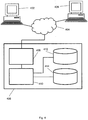
- Fig. 4 is a schematic diagram of a system according to some embodiments.
- Fig. 4 illustrates various hardware, software, and other resources that can be used in implementations of the disclosed embodiments.
- training and classifying computer 406 can include a processor 410 coupled to a random access memory operating under control of or in conjunction with an operating system.
- the processor 410 in embodiments can be incorporated in one or more servers, clusters, or other computers or hardware resources, or can be implemented using cloud-based resources.
- Processor 410 can, in general, be programmed or configured to execute control logic and control training and classification operations.
- Processor 410 can communicate with persistent memory, which may store program instructions that configure processor 410 to execute any of the various method disclosed herein.
- Processor 410 can also communicate with persistent memory 412, such as a database stored on a local hard drive or drive array, to access or store executable files to be or that have been classified, feature vectors, ordered universes of contiguous substrings, or other data.
- Processor 410 can further communicate with a network interface 408, such as an Ethernet or wireless data connection, which in turn communicates with one or more networks 404, such as the Internet or other public or private networks.
- the network interface may be able to monitor network traffic between computers 402 and 406.
- training and classification computer 406, associated network connections, and other hardware, software, and service resources are possible.
- Certain embodiments can be performed as a computer program or set of programs.
- the computer programs can exist in a variety of forms both active and inactive.
- the computer programs can exist as software program(s) comprised of program instructions in source code, object code, executable code or other formats; firmware program(s), or hardware description language (HDL) files.
- Any of the above can be embodied on a transitory or non-transitory computer readable medium, which include storage devices and signals, in compressed or uncompressed form.
- Exemplary computer readable storage devices include conventional computer system RAM (random access memory), ROM (read-only memory), EPROM (erasable, programmable ROM), EEPROM (electrically erasable, programmable ROM), and magnetic or optical disks or tapes.
Landscapes
- Engineering & Computer Science (AREA)
- Computer Security & Cryptography (AREA)
- General Engineering & Computer Science (AREA)
- Computer Hardware Design (AREA)
- Software Systems (AREA)
- Theoretical Computer Science (AREA)
- Computing Systems (AREA)
- Health & Medical Sciences (AREA)
- General Health & Medical Sciences (AREA)
- Virology (AREA)
- Computer Networks & Wireless Communication (AREA)
- Physics & Mathematics (AREA)
- General Physics & Mathematics (AREA)
- Signal Processing (AREA)
- Artificial Intelligence (AREA)
- Computer Vision & Pattern Recognition (AREA)
- Data Mining & Analysis (AREA)
- Evolutionary Computation (AREA)
- Medical Informatics (AREA)
- Mathematical Physics (AREA)
- Information Retrieval, Db Structures And Fs Structures Therefor (AREA)
- Data Exchanges In Wide-Area Networks (AREA)
- Debugging And Monitoring (AREA)
Claims (15)
- Verfahren zum Bestimmen, ob eine ausführbare Datei Malware ist, unter Verwendung von Netzverhaltensartefakten, bei denen es sich um Netzverhaltensartefakte handelt, die als ein Netzverhalten interpretiert werden, das sich aus dem Ausführungsverfahren der Datei ergibt, wobei das Verfahren umfasst:Identifizieren (202) eines Trainingskorpus, der eine Vielzahl von gutartigen ausführbaren Dateien und eine Vielzahl von ausführbaren Malware-Dateien umfasst,Zuordnen (102) von jedem aus einer Vielzahl von Netzverhaltensartefakten zu einem jeweiligen Zeichensatz mittels eines elektronischen Hardwareprozessors,Zuweisen (108) durch einen elektronischen Hardwareprozessor jeder ausführbaren Datei aus dem Trainingskorpus einer entsprechenden Zeichenkette von Zeichensätzen, wobei jede Zeichenkette von Zeichensätzen temporär geordnete Netzverhaltensartefakte einer entsprechenden ausführbaren Datei aus dem Trainingskorpus darstellt, wodurch eine Vielzahl von Zeichenketten von Zeichensätzen erhalten wird,Erhalten (112) mittels eines elektronischen Hardwareprozessors eines entsprechenden Satzes von zusammenhängenden Teilzeichenketten der Länge n für jede der Vielzahl von Zeichenketten von Zeichensätzen und für ein festes n > 1Ordnen durch einen elektronischen Hardwareprozessor einer Vereinigung der jeweiligen Sätze von zusammenhängenden Teilzeichenketten der Länge n, wodurch eine geordnete Grundgesamtheit von zusammenhängenden Teilzeichenketten der Länge n erhalten wird,Bilden (114) für jede ausführbare Datei aus dem Trainingskorpus und durch einen elektronischen Hardwareprozessor einen entsprechenden Merkmalsvektor, wobei jeder entsprechende Merkmalsvektor eine Strichliste von zusammenhängenden Teilzeichenketten der Länge n in dem jeweiligen Satz von zusammenhängenden n-Grammen für die jeweilige ausführbare Datei aus dem Trainingskorpus umfasst, wodurch eine Vielzahl von Merkmalsvektoren erhalten wird,Klassifizieren (206) durch einen elektronischen Hardwareprozessor jedes entsprechenden Merkmalsvektors der Vielzahl von Merkmalsvektoren als entweder einer gutartigen ausführbaren Datei oder einer ausführbaren Malware-Datei aus dem Trainingskorpus zugeordnet, wodurch ein Satz von klassifizierten Merkmalsvektoren erhalten wird,Trainieren (208) eines maschinellen Lernsystems mit dem Satz von klassifizierten Merkmalsvektoren, wobei das maschinelle Lernsystem einen elektronischen Hardwareprozessor umfasst,Identifizieren (302) einer unbekannten ausführbaren Datei,Erzeugen (304) eines Merkmalsvektors für die unbekannte ausführbare Datei durch einen elektronischen Hardwareprozessor,Übermitteln (306) des Merkmalsvektors für die unbekannte ausführbare Datei an das maschinelle Lernsystem,Erhalten (308) einer Klassifizierung der unbekannten ausführbaren Datei als eine von wahrscheinlich gutartig und wahrscheinlich Malware durch einen elektronischen Hardwareprozessor undAusgeben (310) der Klassifizierung der unbekannten ausführbaren Datei durch einen elektronischen Hardwareprozessor.
- Verfahren nach Anspruch 1, wobei die Vielzahl von Netzverhaltensartefakten Artefakte der folgenden Typen umfassen: Art der Datenverkehrsrichtung, Protokolltyp, Typ der Portnummern, Größentyp, Domainnamensystem-(DNS)-Datensatzart und Hypertext-Transferprotokoll (HTTP)-Methodentyp.
- Verfahren nach Anspruch 2, wobei
die Art der Datenverkehrsrichtung ein Artefakt des ankommenden Datenverkehrs und ein Artefakt des abgehenden Datenverkehrs umfasst,
der Protokolltyp ein UDP-(User-Datagram-Protocol-)Artefakt und ein TCP-(Transmission-Control-Protocol-)Artefakt umfasst,
der Typ der Portnummern ein Port-53-Artefakt, ein Port-80-Artefakt, ein Port-442-Artefakt, ein Port-8080-Artefakt und ein Port-8000-Artefakt umfasst,
wobei der Größentyp ein erstes Quartil-Artefakt, ein zweites Quartil-Artefakt, ein drittes Quartil-Artefakt und ein viertes Quartil-Artefakt umfasst,
der DNS-Datensatz-Typ ein A-Datensatz-Artefakt, ein MX-Datensatz-Artefakt und ein SDA-Datensatz-Artefakt umfasst, und
der HTTP-Methodentyp ein GET-Methoden-Artefakt, ein POST-Datensatz-Artefakt und ein HEAD-Datensatz-Artefakt umfasst. - Verfahren nach Anspruch 1, wobei das Zuweisen das Ausführen einer entsprechenden ausführbaren Datei aus dem Trainingskorpus in einer virtualisierten Umgebung umfasst.
- Verfahren nach Anspruch 1, wobei die Zuordnung das Beobachten des Netzdatenverkehrs umfasst.
- Verfahren nach Anspruch 1, wobei das maschinelle Lernsystem mindestens eines umfasst von: einer Support-Vektor-Maschine, einem Entscheidungsbaum und einem k-Nächste-Nachbarn-Klassifikator.
- Verfahren nach Anspruch 1, wobei das Ausgeben mindestens eines umfasst von: Anzeigen, Speichern in einem persistenten Speicher und Bereitstellen für ein Softwaremodul.
- Verfahren nach Anspruch 1, wobei das Erzeugen des Merkmalsvektors für die unbekannte ausführbare Datei das Ausführen der unbekannten ausführbaren Datei in einer virtualisierten Umgebung umfasst.
- Verfahren nach Anspruch 1, wobei das Erzeugen des Merkmalsvektors für die unbekannte ausführbare Datei das Beobachten des Netzdatenverkehrs der unbekannten ausführbaren Datei umfasst.
- Verfahren nach Anspruch 1, wobei das Erhalten einer Klassifizierung der unbekannten ausführbaren Datei als eine von wahrscheinlich gutartig und wahrscheinlich Malware das Erhalten einer Klassifizierung der unbekannten ausführbaren Datei als wahrscheinliche Malware umfasst, wobei das Verfahren ferner das Blockieren des Netzdatenverkehrs von einer Einheit umfasst, die mit der unbekannten ausführbaren Datei assoziiert ist.
- System (406) zum Bestimmen, ob eine ausführbare Datei Malware ist, unter Verwendung von Netzverhaltensartefakten, bei denen es sich um Netzverhaltensartefakte handelt, die als ein Netzverhalten interpretiert werden, das sich aus dem Ausführungsverfahren der Datei ergibt,
wobei das System mindestens einen elektronischen Hardwareprozessor (410) umfasst, der konfiguriert ist, um ein Verfahren nach einem der Ansprüche 1 bis 10 durchzuführen. - System nach Anspruch 11, wobei der mindestens eine elektronische Hardwareprozessor ferner konfiguriert ist, um jeder ausführbaren Datei aus dem Trainingskorpus eine entsprechende Zeichenkette von Zeichensätzen zuzuweisen, indem eine entsprechende ausführbare Datei aus dem Trainingskorpus in einer virtualisierten Umgebung ausgeführt wird.
- System nach Anspruch 11,wobei der mindestens eine elektronische Hardwareprozessor ferner konfiguriert ist, um jeder ausführbaren Datei aus dem Trainingskorpus eine entsprechende Zeichenkette von Zeichensätzen durch Beobachtung des Netzdatenverkehrs zuzuweisen.
- System nach Anspruch 11, wobei das maschinelle Lernsystem mindestens eines umfasst von: einer Support-Vektor-Maschine, einem Entscheidungsbaum und einem k-Nächste-Nachbarn-Klassifikator.
- System nach Anspruch 11, wobei der mindestens eine Prozessor, der konfiguriert ist, um eine Klassifizierung der unbekannten ausführbaren Datei als eine von wahrscheinlich gutartig und wahrscheinlich Malware zu erhalten, ferner konfiguriert, ist, um den Netzdatenverkehr von einer Einheit zu blockieren, die mit der unbekannten ausführbaren Datei bei einer Klassifizierung als wahrscheinliche Malware assoziiert ist.
Applications Claiming Priority (2)
| Application Number | Priority Date | Filing Date | Title |
|---|---|---|---|
| US201361889889P | 2013-10-11 | 2013-10-11 | |
| US14/507,330 US9489514B2 (en) | 2013-10-11 | 2014-10-06 | Classifying malware by order of network behavior artifacts |
Publications (2)
| Publication Number | Publication Date |
|---|---|
| EP2860658A1 EP2860658A1 (de) | 2015-04-15 |
| EP2860658B1 true EP2860658B1 (de) | 2018-12-05 |
Family
ID=51690904
Family Applications (1)
| Application Number | Title | Priority Date | Filing Date |
|---|---|---|---|
| EP14188553.3A Active EP2860658B1 (de) | 2013-10-11 | 2014-10-10 | Klassifizierung von Malware auf Anordnung von Netzwerkverhaltensartefakten |
Country Status (4)
| Country | Link |
|---|---|
| US (2) | US9489514B2 (de) |
| EP (1) | EP2860658B1 (de) |
| JP (1) | JP6410547B2 (de) |
| IL (1) | IL235119B (de) |
Families Citing this family (37)
| Publication number | Priority date | Publication date | Assignee | Title |
|---|---|---|---|---|
| GB0513375D0 (en) | 2005-06-30 | 2005-08-03 | Retento Ltd | Computer security |
| US10210162B1 (en) | 2010-03-29 | 2019-02-19 | Carbonite, Inc. | Log file management |
| US9715325B1 (en) | 2012-06-21 | 2017-07-25 | Open Text Corporation | Activity stream based interaction |
| US10686759B2 (en) | 2014-06-22 | 2020-06-16 | Webroot, Inc. | Network threat prediction and blocking |
| US9571517B2 (en) * | 2014-11-11 | 2017-02-14 | Goldman, Sachs & Co. | Synthetic cyber-risk model for vulnerability determination |
| US10977571B2 (en) * | 2015-03-02 | 2021-04-13 | Bluvector, Inc. | System and method for training machine learning applications |
| US10395133B1 (en) | 2015-05-08 | 2019-08-27 | Open Text Corporation | Image box filtering for optical character recognition |
| US10599844B2 (en) | 2015-05-12 | 2020-03-24 | Webroot, Inc. | Automatic threat detection of executable files based on static data analysis |
| US10289686B1 (en) | 2015-06-30 | 2019-05-14 | Open Text Corporation | Method and system for using dynamic content types |
| EP3329412B1 (de) | 2015-07-31 | 2026-02-11 | BluVector, Inc. | System und verfahren zur in-situ-klassifikator-umschulung zur malware-identifizierung und modellheterogenität |
| US11070592B2 (en) * | 2015-10-28 | 2021-07-20 | Qomplx, Inc. | System and method for self-adjusting cybersecurity analysis and score generation |
| WO2017074368A1 (en) * | 2015-10-28 | 2017-05-04 | Hewlett-Packard Development Company, L.P. | Machine learning classifiers |
| WO2017127850A1 (en) * | 2016-01-24 | 2017-07-27 | Hasan Syed Kamran | Computer security based on artificial intelligence |
| CN106997367B (zh) * | 2016-01-26 | 2020-05-08 | 华为技术有限公司 | 程序文件的分类方法、分类装置和分类系统 |
| US10505970B2 (en) | 2016-10-05 | 2019-12-10 | Cisco Technology, Inc. | Identifying and using DNS contextual flows |
| JP2018109910A (ja) | 2017-01-05 | 2018-07-12 | 富士通株式会社 | 類似度判定プログラム、類似度判定方法および情報処理装置 |
| JP6866645B2 (ja) | 2017-01-05 | 2021-04-28 | 富士通株式会社 | 類似度判定プログラム、類似度判定方法および情報処理装置 |
| US9864956B1 (en) * | 2017-05-01 | 2018-01-09 | SparkCognition, Inc. | Generation and use of trained file classifiers for malware detection |
| US11194909B2 (en) | 2017-06-21 | 2021-12-07 | Palo Alto Networks, Inc. | Logical identification of malicious threats across a plurality of end-point devices |
| US10616252B2 (en) | 2017-06-30 | 2020-04-07 | SparkCognition, Inc. | Automated detection of malware using trained neural network-based file classifiers and machine learning |
| US10305923B2 (en) | 2017-06-30 | 2019-05-28 | SparkCognition, Inc. | Server-supported malware detection and protection |
| US10726128B2 (en) * | 2017-07-24 | 2020-07-28 | Crowdstrike, Inc. | Malware detection using local computational models |
| CN109840417B (zh) * | 2017-11-28 | 2020-12-01 | 清华大学 | 一种恶意软件检测方法及装置 |
| US10855698B2 (en) | 2017-12-22 | 2020-12-01 | Cisco Technology, Inc. | Leveraging endpoint and network environment inferences for malware traffic classification |
| US10728034B2 (en) | 2018-02-23 | 2020-07-28 | Webroot Inc. | Security privilege escalation exploit detection and mitigation |
| US11159553B2 (en) | 2018-04-13 | 2021-10-26 | Webroot Inc. | Determining exploit prevention using machine learning |
| US11244050B2 (en) | 2018-12-03 | 2022-02-08 | Mayachitra, Inc. | Malware classification and detection using audio descriptors |
| US11314863B2 (en) | 2019-03-27 | 2022-04-26 | Webroot, Inc. | Behavioral threat detection definition and compilation |
| US11392689B2 (en) * | 2019-03-28 | 2022-07-19 | Crowdstrike, Inc. | Computer-security violation detection using coordinate vectors |
| US11258805B2 (en) * | 2019-03-28 | 2022-02-22 | Crowdstrike, Inc. | Computer-security event clustering and violation detection |
| US11113397B2 (en) * | 2019-05-16 | 2021-09-07 | Cisco Technology, Inc. | Detection of malicious executable files using hierarchical models |
| US12596787B1 (en) | 2019-07-03 | 2026-04-07 | Trend Micro Incorporated | Prediction of execution behaviors in sandbox |
| US11847214B2 (en) | 2020-04-21 | 2023-12-19 | Bitdefender IPR Management Ltd. | Machine learning systems and methods for reducing the false positive malware detection rate |
| EP3940564A1 (de) * | 2020-07-14 | 2022-01-19 | Siemens Aktiengesellschaft | Verfahren und computerimplementiertes werkzeug zur validierung von software-artefakten von anwendungen <apps>, die für plattformökosysteme bestimmt sind, und plattformökosystem |
| US11616798B2 (en) * | 2020-08-21 | 2023-03-28 | Palo Alto Networks, Inc. | Malicious traffic detection with anomaly detection modeling |
| US20220067146A1 (en) * | 2020-09-01 | 2022-03-03 | Fortinet, Inc. | Adaptive filtering of malware using machine-learning based classification and sandboxing |
| KR102586635B1 (ko) * | 2021-10-29 | 2023-10-10 | 한국전자기술연구원 | 비정상 네트워크 트래픽 탐지를 위한 네트워크 QoS 자율제어 방법 및 시스템 |
Family Cites Families (26)
| Publication number | Priority date | Publication date | Assignee | Title |
|---|---|---|---|---|
| US8161548B1 (en) | 2005-08-15 | 2012-04-17 | Trend Micro, Inc. | Malware detection using pattern classification |
| US7809670B2 (en) * | 2005-12-09 | 2010-10-05 | Microsoft Corporation | Classification of malware using clustering that orders events in accordance with the time of occurance |
| IL181041A0 (en) | 2007-01-29 | 2007-07-04 | Deutsche Telekom Ag | Improved method and system for detecting malicious behavioral patterns in a computer, using machine learning |
| US8490194B2 (en) | 2006-01-31 | 2013-07-16 | Robert Moskovitch | Method and system for detecting malicious behavioral patterns in a computer, using machine learning |
| US8201244B2 (en) * | 2006-09-19 | 2012-06-12 | Microsoft Corporation | Automated malware signature generation |
| IL183390A0 (en) | 2007-05-24 | 2007-09-20 | Deutsche Telekom Ag | Distributed system for the detection |
| US20090013405A1 (en) | 2007-07-06 | 2009-01-08 | Messagelabs Limited | Heuristic detection of malicious code |
| US8087061B2 (en) | 2007-08-07 | 2011-12-27 | Microsoft Corporation | Resource-reordered remediation of malware threats |
| US20110041179A1 (en) | 2009-08-11 | 2011-02-17 | F-Secure Oyj | Malware detection |
| US8161552B1 (en) | 2009-09-23 | 2012-04-17 | Trend Micro, Inc. | White list creation in behavior monitoring system |
| US8566317B1 (en) * | 2010-01-06 | 2013-10-22 | Trend Micro Incorporated | Apparatus and methods for scalable object clustering |
| US8401982B1 (en) * | 2010-01-14 | 2013-03-19 | Symantec Corporation | Using sequencing and timing information of behavior events in machine learning to detect malware |
| US8561193B1 (en) * | 2010-05-17 | 2013-10-15 | Symantec Corporation | Systems and methods for analyzing malware |
| WO2012075336A1 (en) * | 2010-12-01 | 2012-06-07 | Sourcefire, Inc. | Detecting malicious software through contextual convictions, generic signatures and machine learning techniques |
| US8214365B1 (en) * | 2011-02-28 | 2012-07-03 | Symantec Corporation | Measuring confidence of file clustering and clustering based file classification |
| US20130247192A1 (en) | 2011-03-01 | 2013-09-19 | Sven Krasser | System and method for botnet detection by comprehensive email behavioral analysis |
| US8756693B2 (en) | 2011-04-05 | 2014-06-17 | The United States Of America As Represented By The Secretary Of The Air Force | Malware target recognition |
| US9323928B2 (en) | 2011-06-01 | 2016-04-26 | Mcafee, Inc. | System and method for non-signature based detection of malicious processes |
| US8955133B2 (en) | 2011-06-09 | 2015-02-10 | Microsoft Corporation | Applying antimalware logic without revealing the antimalware logic to adversaries |
| ES2755780T3 (es) | 2011-09-16 | 2020-04-23 | Veracode Inc | Análisis estático y de comportamiento automatizado mediante la utilización de un espacio aislado instrumentado y clasificación de aprendizaje automático para seguridad móvil |
| WO2013063474A1 (en) | 2011-10-28 | 2013-05-02 | Scargo, Inc. | Security policy deployment and enforcement system for the detection and control of polymorphic and targeted malware |
| US8745760B2 (en) * | 2012-01-30 | 2014-06-03 | Cisco Technology, Inc. | Malware classification for unknown executable files |
| TWI498738B (zh) | 2012-05-18 | 2015-09-01 | Phison Electronics Corp | 檔案保護方法與系統及其記憶體控制器與記憶體儲存裝置 |
| US9411955B2 (en) | 2012-08-09 | 2016-08-09 | Qualcomm Incorporated | Server-side malware detection and classification |
| US9292688B2 (en) | 2012-09-26 | 2016-03-22 | Northrop Grumman Systems Corporation | System and method for automated machine-learning, zero-day malware detection |
| US9686023B2 (en) | 2013-01-02 | 2017-06-20 | Qualcomm Incorporated | Methods and systems of dynamically generating and using device-specific and device-state-specific classifier models for the efficient classification of mobile device behaviors |
-
2014
- 2014-10-06 US US14/507,330 patent/US9489514B2/en active Active
- 2014-10-09 JP JP2014208026A patent/JP6410547B2/ja active Active
- 2014-10-10 EP EP14188553.3A patent/EP2860658B1/de active Active
- 2014-10-19 IL IL235119A patent/IL235119B/en active IP Right Grant
-
2016
- 2016-11-08 US US15/346,694 patent/US9779238B2/en active Active
Non-Patent Citations (1)
| Title |
|---|
| None * |
Also Published As
| Publication number | Publication date |
|---|---|
| US9779238B2 (en) | 2017-10-03 |
| IL235119A0 (en) | 2015-01-29 |
| US9489514B2 (en) | 2016-11-08 |
| EP2860658A1 (de) | 2015-04-15 |
| IL235119B (en) | 2018-01-31 |
| US20150106931A1 (en) | 2015-04-16 |
| US20170053119A1 (en) | 2017-02-23 |
| JP6410547B2 (ja) | 2018-10-24 |
| JP2015079504A (ja) | 2015-04-23 |
Similar Documents
| Publication | Publication Date | Title |
|---|---|---|
| EP2860658B1 (de) | Klassifizierung von Malware auf Anordnung von Netzwerkverhaltensartefakten | |
| US20250148283A1 (en) | System for simplified generation of systems for broad area geospatial object detection | |
| EP3651043B1 (de) | Verfahren und vorrichtung zur erkennung von url-attacken und elektronische vorrichtung | |
| TWI673625B (zh) | 統一資源定位符(url)攻擊檢測方法、裝置以及電子設備 | |
| US10476904B2 (en) | Non-transitory recording medium recording cyber-attack analysis supporting program, cyber-attack analysis supporting method, and cyber-attack analysis supporting apparatus | |
| US8078556B2 (en) | Generating complex event processing rules utilizing machine learning from multiple events | |
| CN109802953B (zh) | 一种工控资产的识别方法及装置 | |
| US11038913B2 (en) | Providing context associated with a potential security issue for an analyst | |
| US20210014247A1 (en) | Methods, systems, articles of manufacture and apparatus for producing generic ip reputation through cross-protocol analysis | |
| CN112242984A (zh) | 检测异常网络请求的方法、电子设备和计算机程序产品 | |
| CN111460446A (zh) | 基于模型的恶意文件检测方法及装置 | |
| EP3336739A1 (de) | Verfahren zur klassifizierung von angriffsquellen in cyber-attack-sensorsystemen | |
| WO2019180868A1 (ja) | 画像生成装置、画像生成方法および画像生成プログラム | |
| CN118984246A (zh) | 恶意加密流量检测方法、装置、计算机设备和介质 | |
| JP2018055551A (ja) | データ変換プログラム、データ変換方法、およびデータ変換装置 | |
| KR101893029B1 (ko) | 머신 러닝 기반의 취약점 정보를 분류하는 방법 및 장치 | |
| US20230032143A1 (en) | Log generation apparatus, log generation method, and computer readable recording medium | |
| CN113569879A (zh) | 异常识别模型的训练方法、异常账号识别方法及相关装置 | |
| US20180034838A1 (en) | Network Security Classification | |
| CN104516970B (zh) | 一种进行日志分析的方法和装置 | |
| US10445080B2 (en) | Methods for adaptive placement of applications and devices thereof | |
| Bui et al. | A clustering-based shrink autoencoder for detecting anomalies in intrusion detection systems | |
| KR102690827B1 (ko) | 플로우 중심의 통합 분석을 위한 실시간 누적 데이터 처리 방법 및 장치 | |
| EP3895083A1 (de) | Artefaktklassifizierung mittels xenoraum-zentroiden | |
| CN115567289A (zh) | 加密dns协议下基于联邦图模型的恶意域名检测方法及系统 |
Legal Events
| Date | Code | Title | Description |
|---|---|---|---|
| PUAI | Public reference made under article 153(3) epc to a published international application that has entered the european phase |
Free format text: ORIGINAL CODE: 0009012 |
|
| 17P | Request for examination filed |
Effective date: 20141010 |
|
| AK | Designated contracting states |
Kind code of ref document: A1 Designated state(s): AL AT BE BG CH CY CZ DE DK EE ES FI FR GB GR HR HU IE IS IT LI LT LU LV MC MK MT NL NO PL PT RO RS SE SI SK SM TR |
|
| AX | Request for extension of the european patent |
Extension state: BA ME |
|
| R17P | Request for examination filed (corrected) |
Effective date: 20151014 |
|
| RBV | Designated contracting states (corrected) |
Designated state(s): AL AT BE BG CH CY CZ DE DK EE ES FI FR GB GR HR HU IE IS IT LI LT LU LV MC MK MT NL NO PL PT RO RS SE SI SK SM TR |
|
| REG | Reference to a national code |
Ref country code: DE Ref legal event code: R079 Ref document number: 602014037321 Country of ref document: DE Free format text: PREVIOUS MAIN CLASS: G06F0021560000 Ipc: G06N0099000000 |
|
| GRAP | Despatch of communication of intention to grant a patent |
Free format text: ORIGINAL CODE: EPIDOSNIGR1 |
|
| STAA | Information on the status of an ep patent application or granted ep patent |
Free format text: STATUS: GRANT OF PATENT IS INTENDED |
|
| RIC1 | Information provided on ipc code assigned before grant |
Ipc: G06F 21/56 20130101ALI20180507BHEP Ipc: H04L 29/06 20060101ALI20180507BHEP Ipc: G06N 99/00 20100101AFI20180507BHEP |
|
| INTG | Intention to grant announced |
Effective date: 20180524 |
|
| GRAS | Grant fee paid |
Free format text: ORIGINAL CODE: EPIDOSNIGR3 |
|
| GRAA | (expected) grant |
Free format text: ORIGINAL CODE: 0009210 |
|
| STAA | Information on the status of an ep patent application or granted ep patent |
Free format text: STATUS: THE PATENT HAS BEEN GRANTED |
|
| AK | Designated contracting states |
Kind code of ref document: B1 Designated state(s): AL AT BE BG CH CY CZ DE DK EE ES FI FR GB GR HR HU IE IS IT LI LT LU LV MC MK MT NL NO PL PT RO RS SE SI SK SM TR |
|
| REG | Reference to a national code |
Ref country code: GB Ref legal event code: FG4D |
|
| REG | Reference to a national code |
Ref country code: CH Ref legal event code: EP |
|
| REG | Reference to a national code |
Ref country code: AT Ref legal event code: REF Ref document number: 1073997 Country of ref document: AT Kind code of ref document: T Effective date: 20181215 |
|
| REG | Reference to a national code |
Ref country code: IE Ref legal event code: FG4D |
|
| REG | Reference to a national code |
Ref country code: DE Ref legal event code: R096 Ref document number: 602014037321 Country of ref document: DE |
|
| REG | Reference to a national code |
Ref country code: NL Ref legal event code: MP Effective date: 20181205 |
|
| REG | Reference to a national code |
Ref country code: AT Ref legal event code: MK05 Ref document number: 1073997 Country of ref document: AT Kind code of ref document: T Effective date: 20181205 |
|
| REG | Reference to a national code |
Ref country code: LT Ref legal event code: MG4D |
|
| PG25 | Lapsed in a contracting state [announced via postgrant information from national office to epo] |
Ref country code: AT Free format text: LAPSE BECAUSE OF FAILURE TO SUBMIT A TRANSLATION OF THE DESCRIPTION OR TO PAY THE FEE WITHIN THE PRESCRIBED TIME-LIMIT Effective date: 20181205 Ref country code: LV Free format text: LAPSE BECAUSE OF FAILURE TO SUBMIT A TRANSLATION OF THE DESCRIPTION OR TO PAY THE FEE WITHIN THE PRESCRIBED TIME-LIMIT Effective date: 20181205 Ref country code: NO Free format text: LAPSE BECAUSE OF FAILURE TO SUBMIT A TRANSLATION OF THE DESCRIPTION OR TO PAY THE FEE WITHIN THE PRESCRIBED TIME-LIMIT Effective date: 20190305 Ref country code: FI Free format text: LAPSE BECAUSE OF FAILURE TO SUBMIT A TRANSLATION OF THE DESCRIPTION OR TO PAY THE FEE WITHIN THE PRESCRIBED TIME-LIMIT Effective date: 20181205 Ref country code: BG Free format text: LAPSE BECAUSE OF FAILURE TO SUBMIT A TRANSLATION OF THE DESCRIPTION OR TO PAY THE FEE WITHIN THE PRESCRIBED TIME-LIMIT Effective date: 20190305 Ref country code: HR Free format text: LAPSE BECAUSE OF FAILURE TO SUBMIT A TRANSLATION OF THE DESCRIPTION OR TO PAY THE FEE WITHIN THE PRESCRIBED TIME-LIMIT Effective date: 20181205 Ref country code: LT Free format text: LAPSE BECAUSE OF FAILURE TO SUBMIT A TRANSLATION OF THE DESCRIPTION OR TO PAY THE FEE WITHIN THE PRESCRIBED TIME-LIMIT Effective date: 20181205 Ref country code: ES Free format text: LAPSE BECAUSE OF FAILURE TO SUBMIT A TRANSLATION OF THE DESCRIPTION OR TO PAY THE FEE WITHIN THE PRESCRIBED TIME-LIMIT Effective date: 20181205 |
|
| PG25 | Lapsed in a contracting state [announced via postgrant information from national office to epo] |
Ref country code: GR Free format text: LAPSE BECAUSE OF FAILURE TO SUBMIT A TRANSLATION OF THE DESCRIPTION OR TO PAY THE FEE WITHIN THE PRESCRIBED TIME-LIMIT Effective date: 20190306 Ref country code: AL Free format text: LAPSE BECAUSE OF FAILURE TO SUBMIT A TRANSLATION OF THE DESCRIPTION OR TO PAY THE FEE WITHIN THE PRESCRIBED TIME-LIMIT Effective date: 20181205 Ref country code: SE Free format text: LAPSE BECAUSE OF FAILURE TO SUBMIT A TRANSLATION OF THE DESCRIPTION OR TO PAY THE FEE WITHIN THE PRESCRIBED TIME-LIMIT Effective date: 20181205 Ref country code: RS Free format text: LAPSE BECAUSE OF FAILURE TO SUBMIT A TRANSLATION OF THE DESCRIPTION OR TO PAY THE FEE WITHIN THE PRESCRIBED TIME-LIMIT Effective date: 20181205 |
|
| PG25 | Lapsed in a contracting state [announced via postgrant information from national office to epo] |
Ref country code: NL Free format text: LAPSE BECAUSE OF FAILURE TO SUBMIT A TRANSLATION OF THE DESCRIPTION OR TO PAY THE FEE WITHIN THE PRESCRIBED TIME-LIMIT Effective date: 20181205 |
|
| PG25 | Lapsed in a contracting state [announced via postgrant information from national office to epo] |
Ref country code: PL Free format text: LAPSE BECAUSE OF FAILURE TO SUBMIT A TRANSLATION OF THE DESCRIPTION OR TO PAY THE FEE WITHIN THE PRESCRIBED TIME-LIMIT Effective date: 20181205 Ref country code: CZ Free format text: LAPSE BECAUSE OF FAILURE TO SUBMIT A TRANSLATION OF THE DESCRIPTION OR TO PAY THE FEE WITHIN THE PRESCRIBED TIME-LIMIT Effective date: 20181205 Ref country code: PT Free format text: LAPSE BECAUSE OF FAILURE TO SUBMIT A TRANSLATION OF THE DESCRIPTION OR TO PAY THE FEE WITHIN THE PRESCRIBED TIME-LIMIT Effective date: 20190405 Ref country code: IT Free format text: LAPSE BECAUSE OF FAILURE TO SUBMIT A TRANSLATION OF THE DESCRIPTION OR TO PAY THE FEE WITHIN THE PRESCRIBED TIME-LIMIT Effective date: 20181205 |
|
| PG25 | Lapsed in a contracting state [announced via postgrant information from national office to epo] |
Ref country code: RO Free format text: LAPSE BECAUSE OF FAILURE TO SUBMIT A TRANSLATION OF THE DESCRIPTION OR TO PAY THE FEE WITHIN THE PRESCRIBED TIME-LIMIT Effective date: 20181205 Ref country code: IS Free format text: LAPSE BECAUSE OF FAILURE TO SUBMIT A TRANSLATION OF THE DESCRIPTION OR TO PAY THE FEE WITHIN THE PRESCRIBED TIME-LIMIT Effective date: 20190405 Ref country code: SM Free format text: LAPSE BECAUSE OF FAILURE TO SUBMIT A TRANSLATION OF THE DESCRIPTION OR TO PAY THE FEE WITHIN THE PRESCRIBED TIME-LIMIT Effective date: 20181205 Ref country code: EE Free format text: LAPSE BECAUSE OF FAILURE TO SUBMIT A TRANSLATION OF THE DESCRIPTION OR TO PAY THE FEE WITHIN THE PRESCRIBED TIME-LIMIT Effective date: 20181205 Ref country code: SK Free format text: LAPSE BECAUSE OF FAILURE TO SUBMIT A TRANSLATION OF THE DESCRIPTION OR TO PAY THE FEE WITHIN THE PRESCRIBED TIME-LIMIT Effective date: 20181205 |
|
| REG | Reference to a national code |
Ref country code: DE Ref legal event code: R097 Ref document number: 602014037321 Country of ref document: DE |
|
| PLBE | No opposition filed within time limit |
Free format text: ORIGINAL CODE: 0009261 |
|
| STAA | Information on the status of an ep patent application or granted ep patent |
Free format text: STATUS: NO OPPOSITION FILED WITHIN TIME LIMIT |
|
| PG25 | Lapsed in a contracting state [announced via postgrant information from national office to epo] |
Ref country code: SI Free format text: LAPSE BECAUSE OF FAILURE TO SUBMIT A TRANSLATION OF THE DESCRIPTION OR TO PAY THE FEE WITHIN THE PRESCRIBED TIME-LIMIT Effective date: 20181205 Ref country code: DK Free format text: LAPSE BECAUSE OF FAILURE TO SUBMIT A TRANSLATION OF THE DESCRIPTION OR TO PAY THE FEE WITHIN THE PRESCRIBED TIME-LIMIT Effective date: 20181205 |
|
| 26N | No opposition filed |
Effective date: 20190906 |
|
| PG25 | Lapsed in a contracting state [announced via postgrant information from national office to epo] |
Ref country code: TR Free format text: LAPSE BECAUSE OF FAILURE TO SUBMIT A TRANSLATION OF THE DESCRIPTION OR TO PAY THE FEE WITHIN THE PRESCRIBED TIME-LIMIT Effective date: 20181205 |
|
| PG25 | Lapsed in a contracting state [announced via postgrant information from national office to epo] |
Ref country code: MC Free format text: LAPSE BECAUSE OF FAILURE TO SUBMIT A TRANSLATION OF THE DESCRIPTION OR TO PAY THE FEE WITHIN THE PRESCRIBED TIME-LIMIT Effective date: 20181205 |
|
| REG | Reference to a national code |
Ref country code: CH Ref legal event code: PL |
|
| PG25 | Lapsed in a contracting state [announced via postgrant information from national office to epo] |
Ref country code: LU Free format text: LAPSE BECAUSE OF NON-PAYMENT OF DUE FEES Effective date: 20191010 Ref country code: LI Free format text: LAPSE BECAUSE OF NON-PAYMENT OF DUE FEES Effective date: 20191031 Ref country code: CH Free format text: LAPSE BECAUSE OF NON-PAYMENT OF DUE FEES Effective date: 20191031 |
|
| REG | Reference to a national code |
Ref country code: BE Ref legal event code: MM Effective date: 20191031 |
|
| PG25 | Lapsed in a contracting state [announced via postgrant information from national office to epo] |
Ref country code: BE Free format text: LAPSE BECAUSE OF NON-PAYMENT OF DUE FEES Effective date: 20191031 |
|
| GBPC | Gb: european patent ceased through non-payment of renewal fee |
Effective date: 20191010 |
|
| PG25 | Lapsed in a contracting state [announced via postgrant information from national office to epo] |
Ref country code: IE Free format text: LAPSE BECAUSE OF NON-PAYMENT OF DUE FEES Effective date: 20191010 Ref country code: FR Free format text: LAPSE BECAUSE OF NON-PAYMENT OF DUE FEES Effective date: 20191031 Ref country code: GB Free format text: LAPSE BECAUSE OF NON-PAYMENT OF DUE FEES Effective date: 20191010 |
|
| PG25 | Lapsed in a contracting state [announced via postgrant information from national office to epo] |
Ref country code: CY Free format text: LAPSE BECAUSE OF FAILURE TO SUBMIT A TRANSLATION OF THE DESCRIPTION OR TO PAY THE FEE WITHIN THE PRESCRIBED TIME-LIMIT Effective date: 20181205 |
|
| PG25 | Lapsed in a contracting state [announced via postgrant information from national office to epo] |
Ref country code: MT Free format text: LAPSE BECAUSE OF FAILURE TO SUBMIT A TRANSLATION OF THE DESCRIPTION OR TO PAY THE FEE WITHIN THE PRESCRIBED TIME-LIMIT Effective date: 20181205 Ref country code: HU Free format text: LAPSE BECAUSE OF FAILURE TO SUBMIT A TRANSLATION OF THE DESCRIPTION OR TO PAY THE FEE WITHIN THE PRESCRIBED TIME-LIMIT; INVALID AB INITIO Effective date: 20141010 |
|
| PG25 | Lapsed in a contracting state [announced via postgrant information from national office to epo] |
Ref country code: MK Free format text: LAPSE BECAUSE OF FAILURE TO SUBMIT A TRANSLATION OF THE DESCRIPTION OR TO PAY THE FEE WITHIN THE PRESCRIBED TIME-LIMIT Effective date: 20181205 |
|
| REG | Reference to a national code |
Ref country code: DE Ref legal event code: R082 Ref document number: 602014037321 Country of ref document: DE Representative=s name: CBDL PATENTANWAELTE GBR, DE Ref country code: DE Ref legal event code: R082 Ref document number: 602014037321 Country of ref document: DE Representative=s name: CBDL PATENTANWAELTE EGBR, DE |
|
| P01 | Opt-out of the competence of the unified patent court (upc) registered |
Effective date: 20230530 |
|
| PGFP | Annual fee paid to national office [announced via postgrant information from national office to epo] |
Ref country code: DE Payment date: 20251029 Year of fee payment: 12 |