EP2860486B1 - Nebelerzeugungsvorrichtung mit einer beweglichen Wand in einem Behälter - Google Patents
Nebelerzeugungsvorrichtung mit einer beweglichen Wand in einem Behälter Download PDFInfo
- Publication number
- EP2860486B1 EP2860486B1 EP14163988.0A EP14163988A EP2860486B1 EP 2860486 B1 EP2860486 B1 EP 2860486B1 EP 14163988 A EP14163988 A EP 14163988A EP 2860486 B1 EP2860486 B1 EP 2860486B1
- Authority
- EP
- European Patent Office
- Prior art keywords
- fog
- reservoir
- generating
- heat exchanger
- propellant gas
- Prior art date
- Legal status (The legal status is an assumption and is not a legal conclusion. Google has not performed a legal analysis and makes no representation as to the accuracy of the status listed.)
- Active
Links
Images



Classifications
-
- F—MECHANICAL ENGINEERING; LIGHTING; HEATING; WEAPONS; BLASTING
- F41—WEAPONS
- F41H—ARMOUR; ARMOURED TURRETS; ARMOURED OR ARMED VEHICLES; MEANS OF ATTACK OR DEFENCE, e.g. CAMOUFLAGE, IN GENERAL
- F41H9/00—Equipment for attack or defence by spreading flame, gas or smoke or leurres; Chemical warfare equipment
- F41H9/06—Apparatus for generating artificial fog or smoke screens
Definitions
- the present invention relates to a fog-generating device comprising: a propellant gas; a reservoir comprising a movable wall and a fog-generating material; and a heat exchanger; wherein said propellant gas drives said movable wall to expel the fog-generating material from the reservoir to the heat exchanger.
- the present invention also provides a removable housing for such a device.
- Fog-generating devices are used in several applications. They are used in entertainment for creating a specific mood or enhancing visual lighting effects. During the training of emergency and military personnel, they are used to simulate fire. In addition, they are used in security systems to disorient intruders and to hide valuables from them.
- a fog-generating device creates fog by driving a fog-generating substance through a heat exchanger; upon which the fog-generating substance is converted into the vapour phase that is ejected at the exit [end] of the heat exchanger.
- the vapour may condense upon expansion into tiny liquid droplets suspended in the air as an aerosol, with the formation of a fog.
- the capacity at which fog can be generated is of crucial importance when the device is used as a security device.
- the fog-generating device should fill the room with fog within a few seconds.
- valuables are immediately obscured from the sight of the intruder, and he will quickly try to escape by leaving the room.
- the thief may use the additional seconds to quickly grasp valuables before leaving.
- a pump is used to drive fog-generating liquid from a reservoir to a heat exchanger.
- the time needed to convert all the fog-generating liquid to fog is dependent on the capacity of the pump, i.e. its ability to deliver a given flow within a given time at given pressure.
- Fog-generating device are often powered by standard voltage batteries, further restricting the capacity of such pumps.
- high-capacity liquid pumps would lead to too high product prices. Therefore, utilization of pumps to drive fog-generating liquids from the reservoir to the heat-exchanger seriously restricts the fog output of those fog-generating devices.
- WO03001140 addresses this problem by dissolving a liquefied propellant gas (partly fluorinated hydrocarbons) in the fog-generating liquid in a reservoir.
- a normally closed valve switch
- the liquefied propellant gas expands to its gas phase and drives the fog-generating liquid from the reservoir to the heat exchanger, thereby improving the capacity at which fog can be expelled from the device.
- remaining fog-generating liquid in the heat exchanger is partly removed due to the expansion of propellant gas dissolved in the fog-generating liquid.
- WO2008132113 provides another fog-generating device, wherein this time compressed gas is used as a propellant to drive fog-generating liquid from a reservoir to a heat exchanger. Due to the pressure in the vessel, the fog-generating liquid itself also contains dissolved compressed gas. In the heat exchanger, the gas that is dissolved in the liquid expands, which leads to turbulence and improves fog generation.
- a drawback of prior art fog-generating devices is the limited degree of freedom for orienting the device. Although orientation of the exit from where the fog is blown is often crucial, e.g. for concealing particular parts of the room in first instance, prior art devices don't allow much freedom as in certain positions the fog-generating device will simply not work, or fog-generating liquid will spill out of the reservoir, thereby damaging the device or leaving insufficient liquid in the reservoir for proper functioning.
- fog-generating devices that allow to fill a room more quickly with fog, as well as by leading to a quicker start of fog generation as by expelling higher volumes of fog per second.
- devices that allow a larger degree of freedom for orienting the devices during transport and installation.
- fog-generating devices that can be easily set-up and does not require a skilled technician to come on-site or sending the device to a facility for refilling the device with fog-generating material after the device has been initiated.
- an often-encountered problem with fog-generating devices is that, upon switching off the fog generating fluid flow, the heat exchanger is cut off from pump pressure or propellant gas pressure. The pressure in the heat exchanger drops to atmospheric ambient pressure. Consequently, an amount of fog generating fluid is not driven out and remains in the heat exchanger.
- the high temperature in the heat exchanger and incoming oxygen causes decomposition of the fog generating fluid remaining inside the heat exchanger. Some components resulting from this decomposition are very corrosive and damage the inside of the heat exchanger.
- WO2008132112 addresses this issue and provides means for purging the heat exchanger after the fog-generating fluid flow has been switched off. Purging is realised either by addition of a separate gas purging unit (such as a pump or separate gas vessel), or by addition of means to divert propellant gas from the top of the reservoir through a separate channel and valves to the heat exchanger. However, in both instances, a complicated construction, involving additional valves and/or tubing, is required.
- the present invention provides a fog-generating device comprising:
- expansion will drive the movable wall, which presses the fog-generating material out of the reservoir to the heat exchanger.
- the fog-generating device of the invention may further comprise depressurizing means. These allow residual propellant gas to escape, thereby reducing the pressure inside the fog-generating device, preferably to atmospheric pressure.
- the depressurizing means also allow the purging of the heat exchanger.
- the reservoir is present in a removable housing that that can be removed from the remainder of the fog-generating device that comprises the heat exchanger, and the propellant gas.
- the propellant gas is present in a removable housing that that can be removed from the remainder of the fog-generating device that comprises the heat exchanger, and the reservoir.
- the reservoir and the propellant gas are each independently present in a removable housing that can be removed from the remainder of the fog-generating device that comprises the heat exchanger.
- the reservoir and propellant gas are present in a (common) removable housing that can be removed from the remainder of the fog-generating device that comprises the heat exchanger.
- the propellant gas is a liquefied gas, such as partly halogenated hydrocarbons, or a compressed gas, such as compressed CO 2 .
- the propellant gas is kept at a pressure of at least 6 bar.
- expelling fog or similar terms by a fog-generating device, generally refers to the process wherein a fog-generating substance (hereinafter also referred to as a fog-generating material) is driven through a heat-exchanger, with the conversion of said fog-generating substance into the vapour phase that is ejected at the exit [end] of said heat exchanger.
- a fog-generating substance hereinafter also referred to as a fog-generating material
- fog refers to liquid droplets suspended in the air.
- fog as used herein reduces visibility to less than 5 meter, more in particular less than 2 meter.
- Such fog can be used to obscure e.g. valuables from intruders.
- oil-based smoke generators are unsuitable for indoor purposes, as they impact the health of residents and intruders and leave trace residues after the floating smoke has been cleared. Therefore, the fog (and hence the fog-generating material) as used herein, does not correspond to the smoke generated using oil-based smoke generators.
- a fog generating material or "a fog generating substance” generally refers to any material or combinations of materials, that can be vaporized when fed through a heat exchanger.
- the fog-generating material is a fluid, such as a gel or a liquid, in particular a liquid, more in particular a polyol-containing liquid or gel.
- Suitable water-based polyol-containing liquids are well-known to the skilled person. For example, they may be an aqueous solution comprising a glycol and/or a glycerol.
- the present invention provides a fog-generating device comprising a reservoir comprising a movable wall and a fog-generating material.
- a propellant gas drives the movable wall. Therefore, independent of the orientation, the movable wall will be driven by propellant gas to expel the fog-generating material from the reservoir since the fog-generating material will always be in contact with and flow to the exit of the reservoir. This allows for a complete degree of freedom when positioning the fog-generating device, which is often crucial to direct generated fog towards valuables or the expected entry of intruders. More in particular, the movable wall may slidably move to drive the fog-generating material from the reservoir to the heat exchanger.
- the movable wall may be a movable, slidable wall within the reservoir, such as a piston.
- the movable wall can move elastically.
- the fog-generating material may be present in or around a compressible packaging, such as an elastic bag.
- the compressible packaging is compressed or expanded, thereby moving the wall of the packaging and expelling the fog-generating material from the reservoir. It is thus an object of the present invention to provide the use of such a reservoir or housing comprising a movable wall in a fog-generating device, in particular in a fog-generating device comprising a heat exchanger.
- the fog-generating device further comprises a flow controller.
- the flow controller prevents that fog-generating material is expelled from the reservoir.
- a valve can be used to block outflow of fog-generating material from the exit of the reservoir, such as the closing means as described herein.
- a valve may be a valve which can be switched between an on-off position, or it may be a valve that can be activated non-reversibly (such as a bursting disc that is at least partially destroyed when activated).
- said valve is activated mechanically, thermally or chemically, such as by intermetallic and/or pyrotechnic reactions.
- the propellant gas may be present in a separate vessel or it may be present in the same reservoir containing the fog-generating material. If the propellant gas is not located in the reservoir containing the fog-generating material, the flow controller can be located between a vessel comprising the propellant gas and said reservoir. For example, a valve may be used to block outflow of a propellant gas from a vessel to the reservoir. Once the valve is activated, propellant gas enters the reservoir and drives the movable wall, thereby expelling the fog-generating material from the reservoir to the heat exchanger. Said flow controller may also be connected to the movable wall. Such a flow controller blocks movement of the movable wall. Upon activation of the flow controller, e.g.
- the movable wall is driven by means to drive the movable wall, e.g. a compressed gas located outside or inside the reservoir.
- the flow controller is located at the exit of the reservoir, preventing outflow of the fog-generating material. This is especially preferred if the reservoir comprising the fog-generating material also comprises at least part of the propellant gas.
- the skilled person is well aware on how to select propellant gases for the fog-generating device of the present invention.
- the movable wall in the reservoir provides a barrier between the fog-generating material and the propellant gas.
- the present invention allows for the construction of a fog-generating device comprising propellant gases that would otherwise have a negative impact on the fog-generating material, the fog-generating device, and the environment. Indeed, if no depressurizing means are present, after expansion the propellant gas can be kept sealed on one side of the movable wall, preventing contact with e.g. the heat exchanger and preventing its escape in the surroundings. Nonetheless, preferably, non-toxic propellant gases are used.
- Suitable propellant gases include liquefied propellant gases, such as partly halogenated hydrocarbons, or compressed propellant gases, such as an inert gas (e.g. nitrogen), noble gas (e.g. helium, neon or argon), compressed air or CO 2 , or mixtures thereof.
- liquefied propellant gases such as partly halogenated hydrocarbons
- compressed propellant gases such as an inert gas (e.g. nitrogen), noble gas (e.g. helium, neon or argon), compressed air or CO 2 , or mixtures thereof.
- gas purges the heat exchanger after the fog-generated material has been converted to fog. It has been found that purging the heat exchanger prevents negative effects of residues of fog-generating material that remain in het heat exchanger. These residues that remain in the hot heat exchanger may lead to bad smells, corrosion and dry matter build-up.
- sufficient propellant gas is used, so that a higher gas volume is available than is strictly necessary for driving the fog-generating material from the reservoir to the heat exchanger. After the fog-generating material has been driven through the heat exchanger, propellant gas keeps flowing through the heat-exchanger, thereby purging it.
- the fog-generating device of the invention may comprise any known heat-exchanger to heat the fog-generating material.
- the fog-generating device and the removable housing of the present invention act synergistically with the heat exchanger as described in Belgian patent application BE2014/0194 .
- the device of the invention comprising the movable wall allows for a higher output compared to prior art devices.
- the flow controller allows the flow of fog-generating material, said material is nearly instantaneously expelled from the reservoir.
- Prior art heat exchangers have a difficulty to cope with such a high flow of fog-generating material, causing "spitting" of material that has not been transformed to its gas phase.
- the fog-generating device may construct to limit the outflow, e.g. by adapting the resistance at the exit of the reservoir, in the liquid connection means, or at the entrance of the heat exchanger.
- this also limits the fog outflow.
- the heat exchanger described in BE2014/0194 allows for converting a high flow of fog-generating material to its gas phase without the formation of cold channels that cause "spitting". Therefore, in a preferred embodiment, the device and housing of the present invention is combined with the heat exchanger of BE2014/0194 .
- the fog-generating device of the present invention or the removable housing therefore further comprises depressurizing means.
- Depressurizing means allow the escape of gas from the device so that the pressure inside the device is reduced and becomes closer to atmospheric pressure.
- Depressurizing means allow for the safer handling and recycling of the device and especially removable housings of the present invention.
- Depressurizing means may be constructed so that they will function automatically and/or they may be constructed to be initiated manually.
- Depressurizing means can e.g. be a valve that is to be switched manually.
- depressurizing means are constructed in such a manner that the pressure in the device is released automatically during or after the fog-generating process.
- the fog-generating device of the present invention is constructed to activate said depressurizing means after a predetermined amount of fog-generating material has been expelled.
- the pressure is released upon removal of the removable housing from the fog-generating device.
- the depressurizing means comprise a valve that is automatically opened when the removable housing is disconnected from the fog-generating device.
- the depressurizing means are constructed in such a manner that pressure in the device is released when substantially all fog-generating material has been expelled from the reservoir.
- the depressurizing means can be constructed in such a manner that gas that is released from the device during such depressurizing can be used for purging the heat exchanger.
- the propellant gas can be expelled from the housing to the heat exchanger, thereby purging the heat exchanger.
- the reservoir may contain depressurizing means (present as a groove in the wall of the reservoir) which are located in close proximity to the exit of the reservoir.
- the movable wall is located at the groove.
- Propellant gas is present at a high pressure and can escape from the housing through the groove. Thereby, the pressure inside the housing is reduced towards the atmospheric pressure. Escaped gas enters the liquid connection means towards the heat exchanger, thereby purging the heat exchanger, providing the benefits described above.
- the depressurizing means comprise a pressure-sensitive seal.
- the movable wall will push the fog-generating material out of the reservoir upon propellant gas expansion. Once the movable wall contacts the end of the reservoir (and the depressurizing means are located in close proximity to the exit of the reservoir), the pressure inside the emptied reservoir will rupture the pressure-sensitive depressurizing means or a certain position of the movable wall invokes a mechanical puncture of the movable wall as depressurizing means. From that moment, gas from inside the reservoir can escape through the depressurizing means towards the heat exchanger, thereby purging said heat exchanger.
- the present invention provides the use of such reservoir or removable housing comprising depressurizing means in a fog-generating device, in particular in a fog-generating device comprising a heat exchanger.
- the fog-generating device of the present invention may comprise liquid connection means to allow a liquid connection between the reservoir containing fog-generating material to the inlet of the heat exchanger.
- the liquid connection means may take a variety of forms, to suit the present applications.
- it may comprise a conduit in the form of a tube or a hollow needle, an aperture, or a slit in a membrane.
- the conduit may be arranged such that no appreciable flow can occur under gravity alone. In this way, controlled delivery of the fog-generating material can be achieved.
- the conduit may, for example, comprise a small aperture, or a tubular portion with a small bore, such that surface tension of the material inhibits flow.
- the conduit may comprise two-way valve means, arranged to prevent fluid flow unless the pressure difference across it exceeds a certain value.
- the liquid connection means ensure a liquid-tight connection through which the fog generating material can run, from the reservoir to the heat exchanger.
- the removable housing of the present invention allows the housing to be removed from and reconnected to the remainder of the fog-generating device that comprises the heat exchanger. Therefore, in particular, the removable housing of the present invention does not comprise a heat exchanger.
- the removable housing of the present invention comprises fixation means, which connect the removable housing to the remainder of the fog-generating device. Such fixation means allow the removable housing to remain connected to the remainder of the device, despite the high pressures in the housing.
- the fixation means are present in close proximity to exit where through the fog-generating material is expelled from the reservoir.
- the fixation means are located close to the liquid connection means.
- the fixation means are part of the liquid connection means.
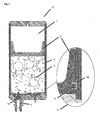
- the movable wall (2) is in particular situated between the fog-generating material (3) and the propellant gas (1), such as shown in figure 1 , in a liquid-tight manner.
- said wall operates as a plunger in a shaft (in the present instance the outer perimeter of the reservoir (4) comprising the fog-generating fluid) and drives the fog-generating material (3) from the reservoir (4) towards the heat exchanger (9).
- said movable wall (2) further comprises sealing means (11) to prevent fluid leakage between said plunger and the shaft.
- Said sealing means can be any suitable sealant, including a sealing gel, one or more sealing rings or a sealing plunger head.
- Such sealing rings and sealing plunger head can be made from any suitable material known in the art, such as for example, but not limited to plastic, metal or elastomer.
- the fog-generating device will work as efficiently.
- the separation means allow the fog-generating material to be always in contact with the exit of the reservoir (7), which can be connected to the liquid connection means (8) towards the heat exchanger (9), even when tilted. Thanks to the construction of the device or removable housing (6) in this manner, the fog-generating device can also be oriented in any direction. This allows for a much larger degree of freedom when positioning the fog-generating device, which is often crucial to direct generated fog towards valuables or the expected entry of intruders.
- excess propellant gas (1) is used and said excess gas can be used, either directly or indirectly, to purge the heat exchanger and remove non-ejected vapour out of the heat exchanger into the ambient air.
- the movable wall optionally comprises depressurizing means (5).
- depressurizing means may be present as a groove (5a) in the reservoir.
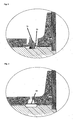
- the depressurizing means comprise a puncture region (5b), such as shown in figure 2 .
- the puncture region is preferably located in the movable wall.
- a puncturing part (5c) is present in the fog-generating device, preferably in the reservoir itself, to puncture the puncture region.
- the puncturing part may e.g. be a sharp point or a plug that can puncture the puncture region.
- the puncture region contacts the puncturing part and is punctured by it when the movable wall continues to move towards the exit. The puncture allows for propellant gas to be expelled from the reservoir to the heat exchanger.
- the depressurizing means comprise a puncturing part (5c) present in the fog-generating device are particularly suitable in case the movable wall can move elastically, such as for example when the fog-generating material is present in or around a compressible packaging, such as an elastic bag.
- said depressurizing means may comprise a pressure sensitive sealing (5d).
- the pressure-sensitive sealing is preferably located in the movable wall.
- the pressure on both sides of the movable wall is substantially identical and the pressure-sensitive sealing prevents the flow of propellant gas or fog-generating material through the movable wall.
- the pressure at the exit side of the movable wall will drop to atmospheric pressure, while the pressure from the propellant gas will remain high. Due to the high pressure difference between both sides of the pressure-sensitive sealing, the sealing will rupture. This allows for the propellant gas to be expelled through the depressurizing means, towards the heat exchanger.
- the propellant gas may or may not be located in the reservoir comprising the fog-generating material and the movable wall.
- the propellant gas is at least partially comprised in the reservoir, such as shown in figure 1 .
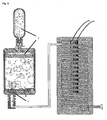
- the propellant gas may also be present in a separate vessel, such as shown in figures 4 to 7 .
- the vessel is removable from the remainder of the device.
- the vessel comprising the propellant gas e.g. compressed CO 2 , N 2 O, nitrogen, ...)
- a flow controller (7) controls, directly or indirectly, the flow of the fog-generating material from the reservoir to the heat exchanger.
- the flow controller may control the flow of the propellant gas to the movable wall, such as shown in figure 4 .
- the flow controller prevents the outflow of the propellant gas from the vessel, outflow of fog-generating material (3) from the reservoir (4) is prevented as well, e.g. by a pressure-sensitive sealing at the exit of the reservoir, as shown in figure 4 .
- the flow controller allows outflow of the propellant from the vessel, the pressure in the reservoir increases and ruptures the pressure-sensitive sealing at the exit of the reservoir (e.g. if the pressure in the reservoir reaches 8 bar or higher).
- the propellant gas now drives the movable wall to expel the fog-generating material from the reservoir to the heat exchanger (9).
- flow controllers include a valve, such as a normally closed valve (NC valve) or a one-shot valve.
- a valve such as a normally closed valve (NC valve) or a one-shot valve.
- the flow controller used in the device and housing of the invention is a one-shot valve which is activated or ruptured due to the melting of part of the valve.
- the flow controller (7) may also be located at the exit of the reservoir, such as shown in figures 5 and 6 .
- the propellant may exercise pressure on the movable wall as soon as it is connected to the fog-generating device.
- the flow controller comprises a plug that blocks the exit of the reservoir. As soon as the plug is released, the pressure on the movable wall drives said wall to expel the fog-generating material from the reservoir to the heat exchanger.
- the flow controller is a one-shot valve.
- the flow controller is the one-shot valve described in Belgian patent application BE2014/0193 , which is hereby incorporated by reference.
- the flow controller may also comprise a reservoir exit puncturing part, which can puncture a puncture region at the exit of the reservoir to allow outflow of fog-generating material.
- the flow controller may also be located in the liquid connection means (8) to prevent the flow of fog-generating material from the reservoir to the heat exchanger (9), as shown in figure 7 .
- the description of the flow controller and its location are exemplary and are not to be read as limiting to the invention.
- the skilled person is well aware about different flow controllers and valves that can be used to block and allow the flow of fog-generating material at a specific timing.
- a combination of flow controllers, such as described herein, can be used, e.g. redundantly.
- the present invention also provides the use of a fog-generating machine or removable housing as described herein for generating fog.
- the present invention provides the use of a fog-generating machine or removable housing as described herein for protecting against burglars and intruders.
- the present invention provides a method for generating fog, said method comprising:
- the fog-generating material will be transformed to its gas phase in the heat exchanger, which will condense when it is expelled at the exit (12) of the device, thereby forming a thick mist, e.g. to obscure valuables and/or disorient an intruder.
- liquid connection means are present between the reservoir exit and the inlet of the heat exchanger the forgoing method can be used.
- the liquid connection means may take a variety of forms, to suit the present applications, such as for example a rigid or flexible tubular connection.
Landscapes
- Engineering & Computer Science (AREA)
- General Engineering & Computer Science (AREA)
- Filling Or Discharging Of Gas Storage Vessels (AREA)
Claims (12)
- Ein nebelerzeugendes Gerät, das die folgende Elemente umfasst:• einem Treibgas (1), wobei das besagte Treibgas ein verflüssigtes oder verdichtetes Treibgas enthält;• einem Vorratsbehälter (4) mit einer beweglichen Wand (2) und einem nebelerzeugenden Material (3); und• einem Wärmetauscher (9);wobei das besagte Treibgas die besagte bewegliche Wand treibt, um das nebelerzeugende Material von dem Vorratsbehälter in den Wärmetauscher auszustoßen.
- Das nebelerzeugende Gerät von Anspruch 1, wobei sich wenigstens ein Teil des Treibgases (1) in dem Vorratsbehälter (4) befindet.
- Das nebelerzeugende Gerät gemäß einem der vorstehenden Ansprüche, wobei das betreffende Gerät zusätzlich über ein Mittel zur Druckentlastung verfügt (5).
- Das nebelerzeugende Gerät gemäß Anspruch 3, wobei das betreffende Gerät so konstruiert ist, dass das besagte Mittel zur Druckentlastung (5) aktiviert wird, wenn eine im voraus bestimmte Menge des nebelerzeugenden Materials aus dem besagten Vorratsbehälter ausgestoßen worden ist.
- Das nebelerzeugende Gerät gemäß den Ansprüchen 3 oder 4, wobei das besagte Mittel zur Druckentlastung (5) in einer Wand des besagten Vorratsbehälters (4) untergebracht ist.
- Das nebelerzeugende Gerät gemäß einem der Ansprüche 3 bis 5, wobei das betreffende Gerät so konstruiert ist, dass das Treibgas (1) durch das Mittel zur Druckentlastung (5) in den Wärmetauscher (9) ausgestoßen wird, was die Reinigung des Wärmetauschers bewirkt.
- Das nebelerzeugende Gerät gemäß einem der vorstehenden Ansprüche, wobei der besagte Vorratsbehälter (4) und / oder das besagte Treibgas (1) in einem abnehmbaren Gehäuse (6) untergebracht sind, das von dem verbleibenden, den Wärmetauscher (9) umfassenden nebelerzeugenden Gerät entfernt werden kann.
- Ein abnehmbares Gehäuse (6) für ein nebelerzeugendes Gerät gemäß einem der Ansprüche 1 bis 7, wobei das besagte abnehmbare Gehäuse eine bewegliche Wand (2), ein auf der einen Seite der besagten beweglichen Wand angebrachtes Treibgas (1) und ein nebelerzeugendes Material (3) auf der anderen Seite der besagten beweglichen Wand umfasst; und wobei das besagte Treibgas ein verflüssigtes oder verdichtetes Treibgas enthält.
- Das nebelerzeugende Gerät gemäß einem der Ansprüche 1 bis 7, oder das abnehmbare Gehäuse gemäß Anspruch 8, wobei es sich bei dem besagten Treibgas (1) um teilweise halogenierten Kohlenwasserstoff oder ein verdichtetes Gas aus der folgenden Gruppe handelt: Schutzgase wie z.B. Stickstoff; Edelgase wie z.B. Helium, Neon und Argon; Luft; oder CO2.
- Das nebelerzeugende Gerät gemäß einem der Ansprüche 1 bis 7, oder das abnehmbare Gehäuse gemäß Anspruch 8, wobei das Treibgas (1) unter einem Druck von mindestens 6 bar gehalten wird.
- Das nebelerzeugende Gerät gemäß einem der Ansprüche 1 bis 7, oder das abnehmbare Gehäuse gemäß Anspruch 8, wobei es sich bei dem besagten nebelerzeugenden Material (3) um eine Polyol-haltige Flüssigkeit handelt.
- Eine Methode zur Erzeugung von Nebel, die folgende Elemente umfasst:a) einen Vorratsbehälter (4) mit einer beweglichen Wand (2) und einem nebelerzeugenden Material (3), wobei der besagte Vorratsbehälter mit einem Wärmetauscher (9) verbunden ist;b) einer Verwendung der Kraft des sich ausdehnenden Treibgases (1) zur Verschiebung der beweglichen Wand, um das nebelerzeugende Material aus dem Vorratsbehälter zum Wärmetauscher auszustoßen; undc) die Erzeugung von Nebel durch Erwärmung des besagten nebelerzeugenden Materials in dem besagten Wärmetauscher;wobei das besagte Treibgas ein verflüssigtes oder verdichtetes Treibgas enthält.
Priority Applications (1)
| Application Number | Priority Date | Filing Date | Title |
|---|---|---|---|
| EP14163988.0A EP2860486B1 (de) | 2013-10-11 | 2014-04-09 | Nebelerzeugungsvorrichtung mit einer beweglichen Wand in einem Behälter |
Applications Claiming Priority (5)
| Application Number | Priority Date | Filing Date | Title |
|---|---|---|---|
| EP13188319.1A EP2719432A1 (de) | 2012-10-11 | 2013-10-11 | Nebelerzeugungsvorrichtung und abnehmbares Gehäuse dafür |
| EP13194330 | 2013-11-25 | ||
| PCT/EP2013/078112 WO2014102365A1 (en) | 2012-12-31 | 2013-12-30 | Fog-generating device comprising a reagent and ignition means |
| BE2014/0193A BE1022605B1 (nl) | 2014-03-21 | 2014-03-21 | Ventiel voor vloeistofreservoir mistgenerator |
| EP14163988.0A EP2860486B1 (de) | 2013-10-11 | 2014-04-09 | Nebelerzeugungsvorrichtung mit einer beweglichen Wand in einem Behälter |
Publications (2)
| Publication Number | Publication Date |
|---|---|
| EP2860486A1 EP2860486A1 (de) | 2015-04-15 |
| EP2860486B1 true EP2860486B1 (de) | 2015-12-09 |
Family
ID=50442401
Family Applications (1)
| Application Number | Title | Priority Date | Filing Date |
|---|---|---|---|
| EP14163988.0A Active EP2860486B1 (de) | 2013-10-11 | 2014-04-09 | Nebelerzeugungsvorrichtung mit einer beweglichen Wand in einem Behälter |
Country Status (3)
| Country | Link |
|---|---|
| EP (1) | EP2860486B1 (de) |
| DK (1) | DK2860486T3 (de) |
| ES (1) | ES2564495T3 (de) |
Cited By (1)
| Publication number | Priority date | Publication date | Assignee | Title |
|---|---|---|---|---|
| US11060825B2 (en) | 2017-09-21 | 2021-07-13 | Ur Fog S.R.L. | Fog-generating device |
Families Citing this family (3)
| Publication number | Priority date | Publication date | Assignee | Title |
|---|---|---|---|---|
| BE1022546B1 (nl) | 2014-03-21 | 2016-05-26 | Bandit Nv | Warmtewisselaar voor mistgenerator. |
| CN111193922B (zh) * | 2018-11-14 | 2021-10-01 | 杭州海康威视数字技术股份有限公司 | 一种摄像机的透雾能力测试系统及环境模拟装置 |
| BE1032874A1 (nl) | 2024-08-20 | 2026-03-18 | Bandit Nv | Mistgenererend fluïdum voor een mistgenererend apparaat |
Family Cites Families (7)
| Publication number | Priority date | Publication date | Assignee | Title |
|---|---|---|---|---|
| FR2573858B1 (fr) * | 1982-06-03 | 1989-06-16 | Lacroix E Tous Artifices | Procede et dispositif de masquage par materiau fumigene d'une cible telle qu'un char |
| ES2234859T3 (es) | 2001-06-22 | 2005-07-01 | Bandit | Dispositivo generador de niebla. |
| DE102006032504A1 (de) * | 2006-07-12 | 2008-01-17 | Fogtec Brandschutz Gmbh & Co. Kg | Löschfluidbehältnis mit automatischer Entleerung |
| ES2352786T3 (es) | 2007-04-27 | 2011-02-23 | Bandit Nv | Generador de niebla. |
| DK1985962T3 (da) | 2007-04-27 | 2010-10-18 | Bandit Nv | Tågegenerator |
| EP2719432A1 (de) * | 2012-10-11 | 2014-04-16 | Bandit NV | Nebelerzeugungsvorrichtung und abnehmbares Gehäuse dafür |
| PT2938959T (pt) * | 2012-12-31 | 2017-06-15 | Bandit Nv | Dispositivo de geração de névoa que compreende um reagente e meios de ignição |
-
2014
- 2014-04-09 EP EP14163988.0A patent/EP2860486B1/de active Active
- 2014-04-09 DK DK14163988.0T patent/DK2860486T3/en active
- 2014-04-09 ES ES14163988.0T patent/ES2564495T3/es active Active
Cited By (1)
| Publication number | Priority date | Publication date | Assignee | Title |
|---|---|---|---|---|
| US11060825B2 (en) | 2017-09-21 | 2021-07-13 | Ur Fog S.R.L. | Fog-generating device |
Also Published As
| Publication number | Publication date |
|---|---|
| DK2860486T3 (en) | 2016-03-07 |
| EP2860486A1 (de) | 2015-04-15 |
| ES2564495T3 (es) | 2016-03-23 |
Similar Documents
| Publication | Publication Date | Title |
|---|---|---|
| US8235249B2 (en) | Heat actuated puncturing mechanism for a compressed gas cartridge | |
| RU2564612C2 (ru) | Способы и устройство для пассивного, неэлектрического двухступенчатого подавления огня | |
| EP2938959B1 (de) | Nebelerzeugungsvorrichtung und abnehmbares gehäuse dafür | |
| EP2860486B1 (de) | Nebelerzeugungsvorrichtung mit einer beweglichen Wand in einem Behälter | |
| ES2557403T3 (es) | Métodos y aparatos para control de riesgos | |
| CN101711320A (zh) | 单动排出阀 | |
| JP6522605B2 (ja) | 破裂ディスクをカスケードするためのシステム及び方法 | |
| US20180221695A1 (en) | Silent fire suppression system | |
| EP2719432A1 (de) | Nebelerzeugungsvorrichtung und abnehmbares Gehäuse dafür | |
| US8459369B2 (en) | Methods and apparatus for hazard control and signaling | |
| US8616132B2 (en) | Apparatus and method for distributing irritants or warfare agents | |
| KR20190076481A (ko) | 화재진압 기동시스템 | |
| WO2005039893A3 (en) | Pressurized gas release mechanism | |
| WO2003043700A1 (en) | Automatic fire extinguisher | |
| CN214318949U (zh) | 灭火装置 | |
| AU2011280137B2 (en) | Methods and apparatus for passive non-electrical dual stage fire suppresion | |
| EP3177489A1 (de) | Abfeuerungsmechanismus | |
| ITNA990058A1 (it) | Estintore automatico di incendio per autoveicoli e barche, vani e apparecchiature tecniche. | |
| KR20060081822A (ko) | 미세물분무 자동 가스분사 소화장치 | |
| HK1142562B (en) | Hazard detection and suppression apparatus | |
| HK1142562A1 (en) | Hazard detection and suppression apparatus |
Legal Events
| Date | Code | Title | Description |
|---|---|---|---|
| PUAI | Public reference made under article 153(3) epc to a published international application that has entered the european phase |
Free format text: ORIGINAL CODE: 0009012 |
|
| 17P | Request for examination filed |
Effective date: 20141023 |
|
| AK | Designated contracting states |
Kind code of ref document: A1 Designated state(s): AL AT BE BG CH CY CZ DE DK EE ES FI FR GB GR HR HU IE IS IT LI LT LU LV MC MK MT NL NO PL PT RO RS SE SI SK SM TR |
|
| AX | Request for extension of the european patent |
Extension state: BA ME |
|
| GRAP | Despatch of communication of intention to grant a patent |
Free format text: ORIGINAL CODE: EPIDOSNIGR1 |
|
| INTG | Intention to grant announced |
Effective date: 20150904 |
|
| GRAR | Information related to intention to grant a patent recorded |
Free format text: ORIGINAL CODE: EPIDOSNIGR71 |
|
| GRAS | Grant fee paid |
Free format text: ORIGINAL CODE: EPIDOSNIGR3 |
|
| GRAA | (expected) grant |
Free format text: ORIGINAL CODE: 0009210 |
|
| INTG | Intention to grant announced |
Effective date: 20151016 |
|
| AK | Designated contracting states |
Kind code of ref document: B1 Designated state(s): AL AT BE BG CH CY CZ DE DK EE ES FI FR GB GR HR HU IE IS IT LI LT LU LV MC MK MT NL NO PL PT RO RS SE SI SK SM TR |
|
| REG | Reference to a national code |
Ref country code: GB Ref legal event code: FG4D |
|
| REG | Reference to a national code |
Ref country code: AT Ref legal event code: REF Ref document number: 764783 Country of ref document: AT Kind code of ref document: T Effective date: 20151215 Ref country code: CH Ref legal event code: EP |
|
| REG | Reference to a national code |
Ref country code: IE Ref legal event code: FG4D |
|
| REG | Reference to a national code |
Ref country code: DE Ref legal event code: R096 Ref document number: 602014000548 Country of ref document: DE |
|
| REG | Reference to a national code |
Ref country code: DK Ref legal event code: T3 Effective date: 20160303 |
|
| REG | Reference to a national code |
Ref country code: SE Ref legal event code: TRGR |
|
| REG | Reference to a national code |
Ref country code: ES Ref legal event code: FG2A Ref document number: 2564495 Country of ref document: ES Kind code of ref document: T3 Effective date: 20160323 |
|
| REG | Reference to a national code |
Ref country code: NL Ref legal event code: FP |
|
| REG | Reference to a national code |
Ref country code: PT Ref legal event code: SC4A Free format text: AVAILABILITY OF NATIONAL TRANSLATION Effective date: 20160303 |
|
| REG | Reference to a national code |
Ref country code: LT Ref legal event code: MG4D |
|
| REG | Reference to a national code |
Ref country code: NO Ref legal event code: T2 Effective date: 20151209 |
|
| REG | Reference to a national code |
Ref country code: FR Ref legal event code: PLFP Year of fee payment: 3 |
|
| PG25 | Lapsed in a contracting state [announced via postgrant information from national office to epo] |
Ref country code: LT Free format text: LAPSE BECAUSE OF FAILURE TO SUBMIT A TRANSLATION OF THE DESCRIPTION OR TO PAY THE FEE WITHIN THE PRESCRIBED TIME-LIMIT Effective date: 20151209 |
|
| PG25 | Lapsed in a contracting state [announced via postgrant information from national office to epo] |
Ref country code: FI Free format text: LAPSE BECAUSE OF FAILURE TO SUBMIT A TRANSLATION OF THE DESCRIPTION OR TO PAY THE FEE WITHIN THE PRESCRIBED TIME-LIMIT Effective date: 20151209 Ref country code: LV Free format text: LAPSE BECAUSE OF FAILURE TO SUBMIT A TRANSLATION OF THE DESCRIPTION OR TO PAY THE FEE WITHIN THE PRESCRIBED TIME-LIMIT Effective date: 20151209 Ref country code: RS Free format text: LAPSE BECAUSE OF FAILURE TO SUBMIT A TRANSLATION OF THE DESCRIPTION OR TO PAY THE FEE WITHIN THE PRESCRIBED TIME-LIMIT Effective date: 20151209 |
|
| PG25 | Lapsed in a contracting state [announced via postgrant information from national office to epo] |
Ref country code: IS Free format text: LAPSE BECAUSE OF FAILURE TO SUBMIT A TRANSLATION OF THE DESCRIPTION OR TO PAY THE FEE WITHIN THE PRESCRIBED TIME-LIMIT Effective date: 20151209 |
|
| REG | Reference to a national code |
Ref country code: GR Ref legal event code: EP Ref document number: 20160400422 Country of ref document: GR Effective date: 20160505 |
|
| PG25 | Lapsed in a contracting state [announced via postgrant information from national office to epo] |
Ref country code: CZ Free format text: LAPSE BECAUSE OF FAILURE TO SUBMIT A TRANSLATION OF THE DESCRIPTION OR TO PAY THE FEE WITHIN THE PRESCRIBED TIME-LIMIT Effective date: 20151209 |
|
| PG25 | Lapsed in a contracting state [announced via postgrant information from national office to epo] |
Ref country code: RO Free format text: LAPSE BECAUSE OF FAILURE TO SUBMIT A TRANSLATION OF THE DESCRIPTION OR TO PAY THE FEE WITHIN THE PRESCRIBED TIME-LIMIT Effective date: 20151209 Ref country code: SM Free format text: LAPSE BECAUSE OF FAILURE TO SUBMIT A TRANSLATION OF THE DESCRIPTION OR TO PAY THE FEE WITHIN THE PRESCRIBED TIME-LIMIT Effective date: 20151209 Ref country code: SK Free format text: LAPSE BECAUSE OF FAILURE TO SUBMIT A TRANSLATION OF THE DESCRIPTION OR TO PAY THE FEE WITHIN THE PRESCRIBED TIME-LIMIT Effective date: 20151209 Ref country code: IS Free format text: LAPSE BECAUSE OF FAILURE TO SUBMIT A TRANSLATION OF THE DESCRIPTION OR TO PAY THE FEE WITHIN THE PRESCRIBED TIME-LIMIT Effective date: 20160409 Ref country code: EE Free format text: LAPSE BECAUSE OF FAILURE TO SUBMIT A TRANSLATION OF THE DESCRIPTION OR TO PAY THE FEE WITHIN THE PRESCRIBED TIME-LIMIT Effective date: 20151209 |
|
| REG | Reference to a national code |
Ref country code: DE Ref legal event code: R097 Ref document number: 602014000548 Country of ref document: DE |
|
| PLBE | No opposition filed within time limit |
Free format text: ORIGINAL CODE: 0009261 |
|
| STAA | Information on the status of an ep patent application or granted ep patent |
Free format text: STATUS: NO OPPOSITION FILED WITHIN TIME LIMIT |
|
| PG25 | Lapsed in a contracting state [announced via postgrant information from national office to epo] |
Ref country code: PL Free format text: LAPSE BECAUSE OF FAILURE TO SUBMIT A TRANSLATION OF THE DESCRIPTION OR TO PAY THE FEE WITHIN THE PRESCRIBED TIME-LIMIT Effective date: 20151209 |
|
| 26N | No opposition filed |
Effective date: 20160912 |
|
| PG25 | Lapsed in a contracting state [announced via postgrant information from national office to epo] |
Ref country code: SI Free format text: LAPSE BECAUSE OF FAILURE TO SUBMIT A TRANSLATION OF THE DESCRIPTION OR TO PAY THE FEE WITHIN THE PRESCRIBED TIME-LIMIT Effective date: 20151209 |
|
| REG | Reference to a national code |
Ref country code: FR Ref legal event code: PLFP Year of fee payment: 4 |
|
| REG | Reference to a national code |
Ref country code: AT Ref legal event code: UEP Ref document number: 764783 Country of ref document: AT Kind code of ref document: T Effective date: 20151209 |
|
| REG | Reference to a national code |
Ref country code: FR Ref legal event code: PLFP Year of fee payment: 5 |
|
| PG25 | Lapsed in a contracting state [announced via postgrant information from national office to epo] |
Ref country code: HU Free format text: LAPSE BECAUSE OF FAILURE TO SUBMIT A TRANSLATION OF THE DESCRIPTION OR TO PAY THE FEE WITHIN THE PRESCRIBED TIME-LIMIT; INVALID AB INITIO Effective date: 20140409 |
|
| PG25 | Lapsed in a contracting state [announced via postgrant information from national office to epo] |
Ref country code: MC Free format text: LAPSE BECAUSE OF FAILURE TO SUBMIT A TRANSLATION OF THE DESCRIPTION OR TO PAY THE FEE WITHIN THE PRESCRIBED TIME-LIMIT Effective date: 20151209 Ref country code: MT Free format text: LAPSE BECAUSE OF NON-PAYMENT OF DUE FEES Effective date: 20160430 Ref country code: HR Free format text: LAPSE BECAUSE OF FAILURE TO SUBMIT A TRANSLATION OF THE DESCRIPTION OR TO PAY THE FEE WITHIN THE PRESCRIBED TIME-LIMIT Effective date: 20151209 Ref country code: CY Free format text: LAPSE BECAUSE OF FAILURE TO SUBMIT A TRANSLATION OF THE DESCRIPTION OR TO PAY THE FEE WITHIN THE PRESCRIBED TIME-LIMIT Effective date: 20151209 Ref country code: MK Free format text: LAPSE BECAUSE OF FAILURE TO SUBMIT A TRANSLATION OF THE DESCRIPTION OR TO PAY THE FEE WITHIN THE PRESCRIBED TIME-LIMIT Effective date: 20151209 |
|
| PG25 | Lapsed in a contracting state [announced via postgrant information from national office to epo] |
Ref country code: BG Free format text: LAPSE BECAUSE OF FAILURE TO SUBMIT A TRANSLATION OF THE DESCRIPTION OR TO PAY THE FEE WITHIN THE PRESCRIBED TIME-LIMIT Effective date: 20151209 |
|
| PG25 | Lapsed in a contracting state [announced via postgrant information from national office to epo] |
Ref country code: AL Free format text: LAPSE BECAUSE OF FAILURE TO SUBMIT A TRANSLATION OF THE DESCRIPTION OR TO PAY THE FEE WITHIN THE PRESCRIBED TIME-LIMIT Effective date: 20151209 |
|
| PGFP | Annual fee paid to national office [announced via postgrant information from national office to epo] |
Ref country code: TR Payment date: 20200408 Year of fee payment: 7 |
|
| PGFP | Annual fee paid to national office [announced via postgrant information from national office to epo] |
Ref country code: PT Payment date: 20250327 Year of fee payment: 12 |
|
| PGFP | Annual fee paid to national office [announced via postgrant information from national office to epo] |
Ref country code: NL Payment date: 20250418 Year of fee payment: 12 |
|
| PGFP | Annual fee paid to national office [announced via postgrant information from national office to epo] |
Ref country code: LU Payment date: 20250418 Year of fee payment: 12 |
|
| PGFP | Annual fee paid to national office [announced via postgrant information from national office to epo] |
Ref country code: DE Payment date: 20250422 Year of fee payment: 12 |
|
| PGFP | Annual fee paid to national office [announced via postgrant information from national office to epo] |
Ref country code: GB Payment date: 20250423 Year of fee payment: 12 Ref country code: ES Payment date: 20250529 Year of fee payment: 12 Ref country code: DK Payment date: 20250429 Year of fee payment: 12 |
|
| PGFP | Annual fee paid to national office [announced via postgrant information from national office to epo] |
Ref country code: NO Payment date: 20250424 Year of fee payment: 12 |
|
| PGFP | Annual fee paid to national office [announced via postgrant information from national office to epo] |
Ref country code: BE Payment date: 20250418 Year of fee payment: 12 Ref country code: IT Payment date: 20250424 Year of fee payment: 12 |
|
| PGFP | Annual fee paid to national office [announced via postgrant information from national office to epo] |
Ref country code: FR Payment date: 20250425 Year of fee payment: 12 |
|
| PGFP | Annual fee paid to national office [announced via postgrant information from national office to epo] |
Ref country code: GR Payment date: 20250423 Year of fee payment: 12 |
|
| PGFP | Annual fee paid to national office [announced via postgrant information from national office to epo] |
Ref country code: CH Payment date: 20250501 Year of fee payment: 12 |
|
| PGFP | Annual fee paid to national office [announced via postgrant information from national office to epo] |
Ref country code: AT Payment date: 20250423 Year of fee payment: 12 |
|
| PGFP | Annual fee paid to national office [announced via postgrant information from national office to epo] |
Ref country code: IE Payment date: 20250422 Year of fee payment: 12 |
|
| PGFP | Annual fee paid to national office [announced via postgrant information from national office to epo] |
Ref country code: SE Payment date: 20250429 Year of fee payment: 12 |