EP2859844B1 - Übungsvorrichtung, Übungsverfahren und Programm - Google Patents
Übungsvorrichtung, Übungsverfahren und Programm Download PDFInfo
- Publication number
- EP2859844B1 EP2859844B1 EP14188244.9A EP14188244A EP2859844B1 EP 2859844 B1 EP2859844 B1 EP 2859844B1 EP 14188244 A EP14188244 A EP 14188244A EP 2859844 B1 EP2859844 B1 EP 2859844B1
- Authority
- EP
- European Patent Office
- Prior art keywords
- feature quantity
- matrix
- sci
- subject
- behavior
- Prior art date
- Legal status (The legal status is an assumption and is not a legal conclusion. Google has not performed a legal analysis and makes no representation as to the accuracy of the status listed.)
- Not-in-force
Links
Images

Classifications
-
- A—HUMAN NECESSITIES
- A61—MEDICAL OR VETERINARY SCIENCE; HYGIENE
- A61B—DIAGNOSIS; SURGERY; IDENTIFICATION
- A61B5/00—Measuring for diagnostic purposes; Identification of persons
- A61B5/24—Detecting, measuring or recording bioelectric or biomagnetic signals of the body or parts thereof
- A61B5/316—Modalities, i.e. specific diagnostic methods
- A61B5/389—Electromyography [EMG]
-
- A—HUMAN NECESSITIES
- A61—MEDICAL OR VETERINARY SCIENCE; HYGIENE
- A61B—DIAGNOSIS; SURGERY; IDENTIFICATION
- A61B5/00—Measuring for diagnostic purposes; Identification of persons
- A61B5/45—For evaluating or diagnosing the musculoskeletal system or teeth
- A61B5/4519—Muscles
-
- A—HUMAN NECESSITIES
- A61—MEDICAL OR VETERINARY SCIENCE; HYGIENE
- A61B—DIAGNOSIS; SURGERY; IDENTIFICATION
- A61B5/00—Measuring for diagnostic purposes; Identification of persons
- A61B5/72—Signal processing specially adapted for physiological signals or for diagnostic purposes
- A61B5/7235—Details of waveform analysis
- A61B5/7246—Details of waveform analysis using correlation, e.g. template matching or determination of similarity
-
- G—PHYSICS
- G16—INFORMATION AND COMMUNICATION TECHNOLOGY [ICT] SPECIALLY ADAPTED FOR SPECIFIC APPLICATION FIELDS
- G16H—HEALTHCARE INFORMATICS, i.e. INFORMATION AND COMMUNICATION TECHNOLOGY [ICT] SPECIALLY ADAPTED FOR THE HANDLING OR PROCESSING OF MEDICAL OR HEALTHCARE DATA
- G16H10/00—ICT specially adapted for the handling or processing of patient-related medical or healthcare data
- G16H10/60—ICT specially adapted for the handling or processing of patient-related medical or healthcare data for patient-specific data, e.g. for electronic patient records
-
- G—PHYSICS
- G16—INFORMATION AND COMMUNICATION TECHNOLOGY [ICT] SPECIALLY ADAPTED FOR SPECIFIC APPLICATION FIELDS
- G16H—HEALTHCARE INFORMATICS, i.e. INFORMATION AND COMMUNICATION TECHNOLOGY [ICT] SPECIALLY ADAPTED FOR THE HANDLING OR PROCESSING OF MEDICAL OR HEALTHCARE DATA
- G16H20/00—ICT specially adapted for therapies or health-improving plans, e.g. for handling prescriptions, for steering therapy or for monitoring patient compliance
-
- G—PHYSICS
- G16—INFORMATION AND COMMUNICATION TECHNOLOGY [ICT] SPECIALLY ADAPTED FOR SPECIFIC APPLICATION FIELDS
- G16H—HEALTHCARE INFORMATICS, i.e. INFORMATION AND COMMUNICATION TECHNOLOGY [ICT] SPECIALLY ADAPTED FOR THE HANDLING OR PROCESSING OF MEDICAL OR HEALTHCARE DATA
- G16H20/00—ICT specially adapted for therapies or health-improving plans, e.g. for handling prescriptions, for steering therapy or for monitoring patient compliance
- G16H20/30—ICT specially adapted for therapies or health-improving plans, e.g. for handling prescriptions, for steering therapy or for monitoring patient compliance relating to physical therapies or activities, e.g. physiotherapy, acupressure or exercising
-
- A—HUMAN NECESSITIES
- A61—MEDICAL OR VETERINARY SCIENCE; HYGIENE
- A61B—DIAGNOSIS; SURGERY; IDENTIFICATION
- A61B2505/00—Evaluating, monitoring or diagnosing in the context of a particular type of medical care
- A61B2505/09—Rehabilitation or training
-
- A—HUMAN NECESSITIES
- A61—MEDICAL OR VETERINARY SCIENCE; HYGIENE
- A61B—DIAGNOSIS; SURGERY; IDENTIFICATION
- A61B5/00—Measuring for diagnostic purposes; Identification of persons
- A61B5/72—Signal processing specially adapted for physiological signals or for diagnostic purposes
- A61B5/7271—Specific aspects of physiological measurement analysis
- A61B5/7275—Determining trends in physiological measurement data; Predicting development of a medical condition based on physiological measurements, e.g. determining a risk factor
-
- A—HUMAN NECESSITIES
- A61—MEDICAL OR VETERINARY SCIENCE; HYGIENE
- A61H—PHYSICAL THERAPY APPARATUS, e.g. DEVICES FOR LOCATING OR STIMULATING REFLEX POINTS IN THE BODY; ARTIFICIAL RESPIRATION; MASSAGE; BATHING DEVICES FOR SPECIAL THERAPEUTIC OR HYGIENIC PURPOSES OR SPECIFIC PARTS OF THE BODY
- A61H1/00—Apparatus for passive exercising; Vibrating apparatus; Chiropractic devices, e.g. body impacting devices, external devices for briefly extending or aligning unbroken bones
- A61H1/02—Stretching or bending or torsioning apparatus for exercising
-
- A—HUMAN NECESSITIES
- A61—MEDICAL OR VETERINARY SCIENCE; HYGIENE
- A61H—PHYSICAL THERAPY APPARATUS, e.g. DEVICES FOR LOCATING OR STIMULATING REFLEX POINTS IN THE BODY; ARTIFICIAL RESPIRATION; MASSAGE; BATHING DEVICES FOR SPECIAL THERAPEUTIC OR HYGIENIC PURPOSES OR SPECIFIC PARTS OF THE BODY
- A61H2230/00—Measuring physical parameters of the user
- A61H2230/60—Muscle strain, i.e. measured on the user, e.g. Electromyography [EMG]
Definitions
- the invention relates to a training apparatus and training method suitable for determining a proficiency level of a subject in a behavior or a task consisting of one or more behaviors on the basis of time-series myoelectric potentials that are acquired while the subject is performing the behavior or the task consisting of one or more behaviors, and a corresponding computer program product for causing a computer to execute functions of the training apparatus.
- a feature quantity is obtained.
- the feature quantity is used to objectively determine how much a patient who requires rehabilitation because of an injury or a disease is able to perform a behavior or a task with which the patient is charged.
- it is required to consider the phenomenon called muscle synergy in the central nervous system of a human.
- Document WO 98/46129 A1 discloses a computerized EMG diagnostic system.
- a generally flat, rectangular rubber pad support discrete, non-invasive electrodes in a 7 by 9 array and a ground electrode to collect surface electromyographic (EMG) signals from an underlying muscle group of a patient.
- EMG surface electromyographic
- Electronic apparatus conditions the EMG signals and is programmed to survey the electrode array simultaneously to provide a description of the activity of individual muscles in the muscle group at that point in time. The description is displayed on a video monitor or the like, juxtaposed over a display of normal muscle anatomy, with differences being emphasized by color enhancement.
- a training apparatus and training method suitable for determining a proficiency level of a subject in a behavior or a task consisting of one or more behaviors on the basis of time-series myoelectric potentials that are acquired while the subject is performing the behavior or the task consisting of one or more behaviors, and a computer program product for causing a computer to execute functions according to that of the training apparatus.
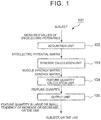
- FIG. 1 is a view that illustrates the schematic configuration of a training apparatus according to the present embodiment. Hereinafter, description will be made with reference to FIG. 1 .
- the training apparatus 101 includes an acquisition unit 102, a synergy calculation unit 103, a feature quantity calculation unit 104, and an output unit 105.
- the training apparatus 101 may be implemented by executing a predetermined program on a computer. Instead, the training apparatus 101 may be implemented by an exclusive electronic circuit or may be implemented by configuring software to hardware like a field programmable gate array (FPGA).
- FPGA field programmable gate array
- the subject may receive training for repeatedly bending and stretching his or her right wrist.
- single bending and stretching of the right wrist corresponds to a single behavior.
- the first bending and stretching, the second bending and stretching, ..., the p-th bending and stretching respectively correspond to behavior 1, behavior 2, ..., behavior p.
- Each behavior in a task should be typically the same; however, different behaviors may be included in a task.
- FIG. 2 is a view that illustrates a flowchart of control of a training process that is executed by the training apparatus according to the present embodiment. Hereinafter, description will be made with reference to FIG. 2 .
- the acquisition unit 102 acquires time-series myoelectric potentials of each of the muscles 1, 2, ..., m while the subject is performing a behavior (step S201).
- myoelectric potentials at m points of a body of the subject are measured. Points at which a myoelectric potential should be measured are muscles associated with the behavior (for example, bending and stretching of right hand) of a portion (for example, right hand) for training.
- a value of myoelectric potential of the i-th muscle at the j-th timing is stored in the i-th row and j-th column element M[i,j] of a myoelectric potential matrix M. That is, the myoelectric potential matrix M is configured such that a row vector M(1) consisting of time-series myoelectric potentials of the muscle 1, a row vector M(2) consisting of time-series myoelectric potentials of the muscle 2, ..., and a row vector M(m) consisting of time-series myoelectric potentials of the muscle m are arranged in rows.
- the number of rows of the myoelectric potential matrix M is m.
- the number of columns of the myoelectric potential matrix M changes with the time length of measurement, that is, the time length of a behavior, and the frequency or interval of measurement during the behavior.
- n is a numeric value that indicates the number of synergies. Generally, when n is increased, L also increases. An appropriate value of n may also be determined as follows by using non-negative matrix factorization as needed.
- FIG. 3 is a graph that shows the similarity L calculated for the number of synergies n for a behavior. Hereinafter, description will be made with reference to FIG. 3 .
- the abscissa axis Number of synergies n represents the number of synergies n
- the ordinate axis Similarity L (%) represents the similarity L.
- the degree of increase in similarity L is saturated at the number of synergies n of about 5, and the similarity L is higher than or equal to 70%.
- a numeric value before or after the beginning of saturation for example, 4, 5 or 6, may be employed as the number of synergies n for the following calculation.
- the number of synergies n may be a value different for each individual subject.
- the number of synergies n may be a value common to all the subjects because it is presumable that there is no large difference in the number of synergies when a human performs a behavior. In the latter case, some subjects are caused to perform a behavior experimentally in advance, an adequate value of n is determined by non-negative matrix factorization, and, thereafter, the determined value of n is directly used for the other subjects as well.
- the feature quantity calculation unit 104 calculates a feature quantity associated with the workings of the central nerve and the proficiency level on the basis of the control matrix C and the muscle synergy matrix W (step S203).
- the fact that the unit column vectors W (1) , W (2) , ..., W (n) do not vary from one another and are consistent with one another means that an expanse of space expressed by the unit column vectors W (1) , W (2) , ..., W (n) is narrow. That is, an n-dimensional volume of an n-dimensional parallel polyhedron is small. In the n-dimensional parallel polyhedron, the length of each side is 1, and the direction of each side is any one of W (1) , W (2) , ..., and W (n) .
- the unit column vectors W (1), W(2), ..., W(n) do not vary from one another and are consistent with one another.
- Various quantities may be employed as a feature quantity that indicates that the unit column vectors W (1) , W (2) , ..., W (n) included in the muscle synergy matrix W for a behavior do not vary from one another and are consistent with one another.
- An inner product p(x,y) of two vectors x, y may be defined as follows where elements of the vector x are denoted by x[1], x[2], ..., x[u] and elements of the vector y are denoted by y[1], y[2], ..., y[u].
- the feature quantity SCI is a numeric value that increases as a proficiency level in a behavior increases.
- the output unit 105 outputs the thus calculated feature quantity (step S204), after which the process ends.
- the feature quantity such as the calculated SCI, may be output to a subject who performs rehabilitation, or the like, or may be output to a medical doctor, supervisor, trainer, or the like, of the subject.
- the feature quantity SCI is a numeric value that increases as the proficiency level in a behavior increases. According to the researches of the inventors, it is found that the feature quantity SCI becomes a numeric value larger than or equal to a certain threshold for a healthy person.
- a method of feedback for example, a method of displaying a graph of the feature quantity SCI on a screen and changing the color of the graph when the feature quantity SCI becomes larger than or equal to the threshold, a method of applying electrical stimulation to a portion of a body in rehabilitation when the feature quantity SCI becomes larger than or equal to the threshold, a method of, when the feature quantity SCI becomes larger than or equal to the threshold, informing the fact by voice, and the like, may be employed.
- voice, an image, or the like, that causes a subject to actively undergo rehabilitation may be output.
- an SCI may be calculated by collectively interpreting the overall task consisting of a plurality of behaviors or an overall training menu consisting of a plurality of tasks as a single behavior. For example, the "SCI of overall rehabilitation in a certain day", or the like, may be calculated.
- a change in SCI is accumulated day by day for a single subject, and it is presumable that a task or training menu that is currently carried out by the subject is appropriate when the SCI tends to increase.
- the task or training menu ends, and a new task or training menu is started.
- an SCI is calculated as the feature quantity for a single behavior.
- an SSI or an SSI c is calculated.
- the myoelectric potential matrix M 1 consists of time-series myoelectric potentials of each of the muscles 1, 2, ..., m while the subject is performing behavior 1.
- the myoelectric potential matrix M 2 consists of time-series myoelectric potentials of each of the muscles 1, 2, ..., m while the subject is performing behavior 2.
- the myoelectric potential matrix M p consists of time-series myoelectric potentials of each of the muscles 1, 2, ..., m while the subject is performing behavior p.
- the number of rows of each of the myoelectric potential matrices M 1 , M 2 , ..., M p acquired here all are m; however, the number of columns of each of the myoelectric potential matrices M 1 , M 2 , ..., M p may be different depending on the time length of each of the behaviors.
- the unit column vectors respectively included in the same positions of the muscle synergy matrices W 1 , W 2 , ..., W p gradually become consistent and do not vary.
- An SSI is a feature quantity that indicates the degree of consistency among the unit column vectors respectively included in the same positions of the muscle synergy matrices W 1 , W 2 , ..., W p .
- control signals that are respectively applied to the synergies do not gradually become consistent but may significantly vary in response to the change.
- An SSI c is a feature quantity that indicates the degree of consistency among the row vectors that are respectively included in the same positions of the control matrices C 1 , C 2 , ..., C p .
- the average e(x) of the elements included in the vector x, the variance v(x) of the elements included in the vector x, the standard deviation s(x) of the elements included in the vector x and computation of correlation coefficient r(x,y) of the two vectors x, y may be defined as follows where the elements of the vector x are denoted by x[1], x[2], ..., x[u] and the elements of the vector y are denoted by y[1], y[2], ..., y[u].
- s x v x 1 / 2 r x
- the feature quantity calculation unit 104 calculates the feature quantity SSI or the feature quantity SSI c as follows.
- the output unit 105 outputs the feature quantity calculated as in the case of the above (step S204), after which the process ends.
- the SSI and the SSI c may be calculated for the behaviors 1, 2, ..., p and then these may be output in graph, or the like, or, when the SSI is larger than or equal to a certain threshold or tends to increase and/or the SCI k is smaller than or equal to a certain threshold or tends to decrease, the subject may be informed of that fact by electrical stimulation, voice, or the like.
- the SCI k may be output in graph, or the like, or, when the SCI k is larger than or equal to a certain threshold or tends to increase, the subject may be informed of that fact by electrical stimulation, voice, or the like.
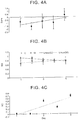
- FIG. 4A, FIG. 4B and FIG. 4C are graphs that show changes in score, SSI, SSI c , SCI to a task when a subject performs the task every other day.
- description will be made with reference to FIG. 4A, FIG. 4B and FIG. 4C .
- FIG. 4A is a graph in which the ordinate axis represents score and the abscissa axis represents elapsed days.
- the score is configured to increase when the subject has performed a predetermined action for a task with which the subject is charged and to decrease when the subject has failed to perform the predetermined action. It appears that the score tends to increase with the progress of rehabilitation.
- FIG. 4B is a graph in which the ordinate axis represents SSI and SSI c and the abscissa axis represents elapsed days. It appears that the SSI(W) tends to increase and the SSI c (C) tends to decrease with the progress of rehabilitation.
- FIG. 4C is a graph in which the ordinate axis represents SCI and the abscissa axis represents elapsed days. It appears that the SCI tends to increase with the progress of rehabilitation.
- the SSI, the SSI c , the SCI and the SCI k do not change so much.
- electrical stimulation or voice is output on the basis of the result of comparison between the feature quantity, calculated at the time when a behavior or a task is performed, and the predetermined threshold or the tendency of increase or decrease in the feature quantity.
- output is performed by utilizing the fact that the body of a human is laterally symmetrical.
- the subject is caused to try performing the same behavior or task on the right side and left side of the body at the same time.
- a right feature quantity for myoelectric potentials of the right side of the body and a left feature quantity for myoelectric potentials of the left side of the body are calculated through the method of calculating the feature quantity according to the above-described embodiment or example.
- the subject when the subject has a paralysis at the right hand, the subject is caused to bend and stretch the right wrist and the left wrist at the same time.
- Measurement points are laterally symmetrically provided at the muscle of the right hand and the muscle of the left hand, the corresponding myoelectric potentials are measured, and then a feature quantity for the right hand and a feature quantity for the left hand are calculated.
- the right feature quantity and the left feature quantity are displayed in graph at the same time or the subject is provided with feedback by electrical stimulation, an image or voice on success of a behavior or task when the similarity between the right feature quantity and the left feature quantity is higher than or equal to a set value (when the difference between the right feature quantity and the left feature quantity is smaller than or equal to a set value).
- rehabilitation is sufficiently achieved.
- a training apparatus and training method suitable for determining a proficiency level of a subject in a behavior or a task consisting of a plurality of behaviors on the basis of time-series myoelectric potentials that are acquired while the subject is performing the behavior or the task consisting of the plurality of behaviors, and a program for causing a computer to execute functions of the training apparatus.
- a training apparatus (101) includes an acquisition unit (102), a synergy calculation unit (103), a feature quantity calculation unit (104), and an output unit (105).
- the acquisition unit (102) while a subject is performing a behavior, acquires time-series myoelectric potentials of each of muscles 1, 2, ..., m of the subject.
- N unit column vectors W (1) , W (2) , ..., W (n) are arranged in columns in the muscle synergy matrix W.
- N row vectors C (1) , C (2) , ..., C (n) are arranged in rows in the control matrix C.
- the feature quantity calculation unit (104) calculates a feature quantity indicating consistency among the unit column vectors W (1) , W (2) , ..., W (n) included in the calculated muscle synergy matrix W.
- the output unit (105) outputs the calculated feature quantity.
Landscapes
- Health & Medical Sciences (AREA)
- Life Sciences & Earth Sciences (AREA)
- Engineering & Computer Science (AREA)
- General Health & Medical Sciences (AREA)
- Medical Informatics (AREA)
- Public Health (AREA)
- Biophysics (AREA)
- Veterinary Medicine (AREA)
- Heart & Thoracic Surgery (AREA)
- Animal Behavior & Ethology (AREA)
- Surgery (AREA)
- Physics & Mathematics (AREA)
- Molecular Biology (AREA)
- Pathology (AREA)
- Biomedical Technology (AREA)
- Epidemiology (AREA)
- Primary Health Care (AREA)
- Artificial Intelligence (AREA)
- Computer Vision & Pattern Recognition (AREA)
- Signal Processing (AREA)
- Psychiatry (AREA)
- Physiology (AREA)
- Dentistry (AREA)
- Oral & Maxillofacial Surgery (AREA)
- Orthopedic Medicine & Surgery (AREA)
- Rheumatology (AREA)
- Physical Education & Sports Medicine (AREA)
- Measurement And Recording Of Electrical Phenomena And Electrical Characteristics Of The Living Body (AREA)
- Rehabilitation Tools (AREA)
- Measurement Of The Respiration, Hearing Ability, Form, And Blood Characteristics Of Living Organisms (AREA)
Claims (4)
- Übungsvorrichtung (101) mit:einer Beschaffungseinheit (102), die, während eine Testperson eine Handlungsweise ausführt, konfiguriert ist, myoelektrische Potentiale in Zeitfolge jedes Muskels 1, 2,..., m der Testperson zu beschaffen;einer Synergieberechnungseinheit (103), die konfiguriert ist, eine Muskelsynergiematrix W, eine Steuerungsmatrix C und eine Fehlermatrix E aus einer Myoelektrisches-Potential-Matrix zu berechnen, sodass die Beziehung M = WC + E erfüllt ist, wobei Zeilenvektoren, die jeweils die beschafften myoelektrischen Potentiale in Zeitfolge eines entsprechenden der Muskel 1, 2,..., m ausdrücken, in Zeilen in der Myoelektrisches-Potential-Matrix M angeordnet sind, wobei n Einheitsspaltenvektoren W(1), W(2),..., W(n) in Spalten in der Muskelsynergiematrix W angeordnet sind, wobei n Zeilenvektoren C(1), C(2),..., C(n) in Zeilen der Steuerungsmatrix C angeordnet sind;einer Merkmalsquantitätsberechnungseinheit (104), die konfiguriert ist, eine erste Merkmalsquantität (SCI) zu berechnen, die eine Übereinstimmung zwischen den Einheitsspaltenvektoren W(1), W(2),...,W(n) angibt, die in der berechneten Muskelsynergiematrix W beinhaltet sind; undeiner Ausgabeeinheit (105), die konfiguriert ist, die berechnete erste Merkmalsquantität (SCI) auszugeben,dadurch gekennzeichnet, dassdie Synergieberechnungseinheit (103) konfiguriert ist, eine nichtnegative Matrix-Faktorisierung anzuwenden,die erste Merkmalsquantität durch eine Berechnung eines inneren Produkts P (x, y) von Zeilenvektoren x, y berechnet wird unddie erste Merkmalsquantität (SCI) als eine Merkmalsquantität gemäß 2/[n(n+2)]×∑i=1 n∑j=1 n,j≠ip(W(i),W(j)) ausgedrückt wird, wobeidie erste Merkmalsquantität (SCI) ein nummerischer Wert ist, der zunimmt, wenn ein Leistungspegel der Testperson in der Handlungsweise zunimmt, unddie erste Merkmalsquantität (SCI) für eine gesunde Person größer oder gleich einem ersten vorbestimmten Schwellenwert wird.
- Übungsvorrichtung nach Anspruch 1, wobeidie Ausgabeeinheit (105) konfiguriert ist, an die Testperson die Tatsache auszugeben, dass die erste Merkmalsquantität (SCI) größer oder gleich dem ersten vorbestimmten Schwellenwert ist.
- Übungsverfahren mit:einem Beschaffen, während eine Testperson eine Handlungsweise ausführt, von myoelektrischen Potentialen in Zeitfolge von jedem von Muskeln 1,2,..., m der Testperson;einem Berechnen einer Muskelsynergiematrix W, einer Steuerungsmatrix C und einer Fehlermatrix E aus einer Myoelektrisches-Potential-Matrix, sodass die Beziehung M = WC + E erfüllt ist, wobei Zeilenvektoren, die jeweils die beschafften myoelektrischen Potentiale in Zeitfolge eines entsprechenden der Muskel 1, 2,..., m ausdrücken, in Zeilen in der Myoelektrisches-Potential-Matrix M angeordnet sind, wobei n Einheitsspaltenvektoren W(1), W(2),..., W(n) in Spalten in der Muskelsynergiematrix W angeordnet sind, wobei n Zeilenvektoren C(1), C(2),..., C(n) in Zeilen der Steuerungsmatrix C angeordnet sind;einem Berechnen einer ersten Merkmalsquantität (SCI), die eine Übereinstimmung zwischen den Einheitsspaltenvektoren W(1), W(2),...,W(n) angibt, die in der berechneten Muskelsynergiematrix W beinhaltet sind; undeinem Ausgeben der berechneten ersten Merkmalsquantität (SCI),gekennzeichnet durcheinem Anwenden einer nicht-negativen Matrix-Faktorisierung für ein Berechnen der Muskelsynergiematrix, wobeidie erste Merkmalsquantität durch eine Berechnung eines inneren Produkts P (x, y) von Zeilenvektoren x, y berechnet wird unddie erste Merkmalsquantität (SCI) als eine Merkmalsquantität gemäß 2/[n(n+2)]×∑i=1 n∑j=1 n,j≠ip(W((i),W(j)) ausgedrückt wird, wobeidie erste Merkmalsquantität (SCI) ein nummerischer Wert ist, der zunimmt, wenn ein Leistungspegel der Testperson in der Handlungsweise zunimmt, unddie erste Merkmalsquantität (SCI) für eine gesunde Person größer oder gleich einem ersten vorbestimmten Schwellenwert wird.
- Computerprogrammprodukt für einen Computer mit Softwarecodeabschnitten für ein Ausführen der Schritte gemäß Anspruch 3, wenn das Produkt auf dem Computer laufen gelassen wird.
Applications Claiming Priority (1)
| Application Number | Priority Date | Filing Date | Title |
|---|---|---|---|
| JP2013213327A JP6011807B2 (ja) | 2013-10-11 | 2013-10-11 | 訓練装置、訓練方法、ならびに、プログラム |
Publications (2)
| Publication Number | Publication Date |
|---|---|
| EP2859844A1 EP2859844A1 (de) | 2015-04-15 |
| EP2859844B1 true EP2859844B1 (de) | 2017-12-27 |
Family
ID=51753000
Family Applications (1)
| Application Number | Title | Priority Date | Filing Date |
|---|---|---|---|
| EP14188244.9A Not-in-force EP2859844B1 (de) | 2013-10-11 | 2014-10-09 | Übungsvorrichtung, Übungsverfahren und Programm |
Country Status (3)
| Country | Link |
|---|---|
| US (1) | US10653356B2 (de) |
| EP (1) | EP2859844B1 (de) |
| JP (1) | JP6011807B2 (de) |
Families Citing this family (7)
| Publication number | Priority date | Publication date | Assignee | Title |
|---|---|---|---|---|
| JP6515069B2 (ja) * | 2016-07-29 | 2019-05-15 | 日本電信電話株式会社 | 筋活動解析装置、方法およびプログラム |
| JP6515070B2 (ja) * | 2016-07-29 | 2019-05-15 | 日本電信電話株式会社 | 筋活動推定装置、方法およびプログラム |
| US11382533B2 (en) | 2016-09-06 | 2022-07-12 | Osaka University | Motion analyzing device |
| JP6440210B2 (ja) * | 2016-09-06 | 2018-12-19 | トヨタ自動車株式会社 | リハビリ評価装置、リハビリ評価方法及びプログラム |
| JP6590416B2 (ja) | 2017-07-10 | 2019-10-16 | トヨタ自動車株式会社 | リハビリ評価装置、リハビリ評価装置の作動方法およびリハビリ評価プログラム |
| SG10201800971RA (en) * | 2018-02-05 | 2019-09-27 | Nec Asia Pacific Pte Ltd | Method and system for motor function rehabilitation and monitoring a patient’s recovery |
| KR102826085B1 (ko) | 2021-10-29 | 2025-06-27 | 한국과학기술원 | 비정상 근육 시너지 교정 훈련 장치 및 이를 이용한 피험자의 근육 시너지 교정 훈련 방법 |
Family Cites Families (2)
| Publication number | Priority date | Publication date | Assignee | Title |
|---|---|---|---|---|
| US6004312A (en) * | 1997-04-15 | 1999-12-21 | Paraspinal Diagnostic Corporation | Computerized EMG diagnostic system |
| US9078585B2 (en) * | 2009-09-14 | 2015-07-14 | Osaka University | Muscle synergy analysis method, muscle synergy analyzer, and muscle synergy interface |
-
2013
- 2013-10-11 JP JP2013213327A patent/JP6011807B2/ja active Active
-
2014
- 2014-10-09 EP EP14188244.9A patent/EP2859844B1/de not_active Not-in-force
- 2014-10-10 US US14/511,542 patent/US10653356B2/en active Active
Non-Patent Citations (1)
| Title |
|---|
| None * |
Also Published As
| Publication number | Publication date |
|---|---|
| JP2015073805A (ja) | 2015-04-20 |
| JP6011807B2 (ja) | 2016-10-19 |
| US10653356B2 (en) | 2020-05-19 |
| EP2859844A1 (de) | 2015-04-15 |
| US20150106023A1 (en) | 2015-04-16 |
Similar Documents
| Publication | Publication Date | Title |
|---|---|---|
| EP2859844B1 (de) | Übungsvorrichtung, Übungsverfahren und Programm | |
| EP3565462B1 (de) | Dueling-bandits-algorithmus für die neuromodulationstherapie | |
| DE102020210676B4 (de) | Closed-loop computer-gehirn-schnittstellenvorrichtung | |
| EP3644322B1 (de) | Verfahren und system zur interpretation neuronaler wechselwirkungen bei propriozeptiver anpassung während eines doppelaufgaben-paradigmas | |
| EP3215007B1 (de) | Vorrichtung zur kalibrierung einer nicht-invasiven mechanisch taktilen und/oder thermischen neurostimulation | |
| JP2009297059A (ja) | 脳訓練支援装置 | |
| US20240261572A1 (en) | Systems and methods for transcutaneous auricular vagal nerve stimulation to enhance motor learning, rehabilitation, and bci applications | |
| Umeda et al. | Decoding of muscle activity from the sensorimotor cortex in freely behaving monkeys | |
| Gurchiek et al. | A gaussian process model of muscle synergy functions for estimating unmeasured muscle excitations using a measured subset | |
| JP2009285294A (ja) | 脳訓練支援装置 | |
| CN119405986A (zh) | 一种用于电疗设备的脉冲信号自适应控制方法及系统 | |
| EP3695879A1 (de) | System zur bereitstellung von neuromodulation, insbesondere neurostimulation | |
| CN112807632A (zh) | 训练仪的参数优化方法、系统、肌肉训练设备以及装置 | |
| Kha et al. | Systems analysis of human visuo-myoelectric control facilitated by anodal transcranial direct current stimulation in healthy humans | |
| KR20200008784A (ko) | 동물 용 운동기구 및 그것의 제어 방법 | |
| Aljuaid | A neuroergonomics study of brain EEG's activity during manual lifting tasks | |
| EP0748640A1 (de) | Verfahren und Vorrichtung für Körperübungen mit musikalischem Feedback | |
| US11207491B2 (en) | Device and method for the learning of the deliberate control of a specified body part by a test subject | |
| EP3934533A1 (de) | Verfahren und vorrichtung zur erkennung eines bewegungsmusters einer person | |
| JP2000172406A (ja) | 力触覚呈示装置の制御方法 | |
| Bingham | Applications of normalised mutual information in high density surface electromyography | |
| Floessel et al. | Use of Vibrotactile Feedback to Improve Execution Quality of Core Stability Exercises | |
| Kiryu | Handling Risk Homeostasis in Biofunctions | |
| US20230285836A1 (en) | Position sense correction device, method, and program | |
| Brunner | The Effect of Mental Practice on Skill Acquisition and Learning: A Threshold Hunting Study |
Legal Events
| Date | Code | Title | Description |
|---|---|---|---|
| PUAI | Public reference made under article 153(3) epc to a published international application that has entered the european phase |
Free format text: ORIGINAL CODE: 0009012 |
|
| 17P | Request for examination filed |
Effective date: 20141009 |
|
| AK | Designated contracting states |
Kind code of ref document: A1 Designated state(s): AL AT BE BG CH CY CZ DE DK EE ES FI FR GB GR HR HU IE IS IT LI LT LU LV MC MK MT NL NO PL PT RO RS SE SI SK SM TR |
|
| AX | Request for extension of the european patent |
Extension state: BA ME |
|
| 17Q | First examination report despatched |
Effective date: 20170124 |
|
| GRAJ | Information related to disapproval of communication of intention to grant by the applicant or resumption of examination proceedings by the epo deleted |
Free format text: ORIGINAL CODE: EPIDOSDIGR1 |
|
| GRAP | Despatch of communication of intention to grant a patent |
Free format text: ORIGINAL CODE: EPIDOSNIGR1 |
|
| RIC1 | Information provided on ipc code assigned before grant |
Ipc: A61B 5/22 20060101ALI20170623BHEP Ipc: A61B 5/00 20060101ALI20170623BHEP Ipc: A63B 21/00 20060101ALI20170623BHEP Ipc: A61B 5/0488 20060101AFI20170623BHEP Ipc: G06F 19/00 20110101ALI20170623BHEP Ipc: A61H 1/02 20060101ALI20170623BHEP Ipc: A61H 3/00 20060101ALI20170623BHEP Ipc: A61B 5/11 20060101ALI20170623BHEP |
|
| INTG | Intention to grant announced |
Effective date: 20170711 |
|
| GRAS | Grant fee paid |
Free format text: ORIGINAL CODE: EPIDOSNIGR3 |
|
| GRAA | (expected) grant |
Free format text: ORIGINAL CODE: 0009210 |
|
| AK | Designated contracting states |
Kind code of ref document: B1 Designated state(s): AL AT BE BG CH CY CZ DE DK EE ES FI FR GB GR HR HU IE IS IT LI LT LU LV MC MK MT NL NO PL PT RO RS SE SI SK SM TR |
|
| REG | Reference to a national code |
Ref country code: GB Ref legal event code: FG4D |
|
| REG | Reference to a national code |
Ref country code: CH Ref legal event code: EP |
|
| REG | Reference to a national code |
Ref country code: AT Ref legal event code: REF Ref document number: 957599 Country of ref document: AT Kind code of ref document: T Effective date: 20180115 |
|
| REG | Reference to a national code |
Ref country code: IE Ref legal event code: FG4D |
|
| REG | Reference to a national code |
Ref country code: DE Ref legal event code: R096 Ref document number: 602014019025 Country of ref document: DE |
|
| PG25 | Lapsed in a contracting state [announced via postgrant information from national office to epo] |
Ref country code: LT Free format text: LAPSE BECAUSE OF FAILURE TO SUBMIT A TRANSLATION OF THE DESCRIPTION OR TO PAY THE FEE WITHIN THE PRESCRIBED TIME-LIMIT Effective date: 20171227 |
|
| REG | Reference to a national code |
Ref country code: NL Ref legal event code: MP Effective date: 20171227 |
|
| REG | Reference to a national code |
Ref country code: LT Ref legal event code: MG4D |
|
| REG | Reference to a national code |
Ref country code: AT Ref legal event code: MK05 Ref document number: 957599 Country of ref document: AT Kind code of ref document: T Effective date: 20171227 |
|
| PG25 | Lapsed in a contracting state [announced via postgrant information from national office to epo] |
Ref country code: RS Free format text: LAPSE BECAUSE OF FAILURE TO SUBMIT A TRANSLATION OF THE DESCRIPTION OR TO PAY THE FEE WITHIN THE PRESCRIBED TIME-LIMIT Effective date: 20171227 Ref country code: HR Free format text: LAPSE BECAUSE OF FAILURE TO SUBMIT A TRANSLATION OF THE DESCRIPTION OR TO PAY THE FEE WITHIN THE PRESCRIBED TIME-LIMIT Effective date: 20171227 Ref country code: LV Free format text: LAPSE BECAUSE OF FAILURE TO SUBMIT A TRANSLATION OF THE DESCRIPTION OR TO PAY THE FEE WITHIN THE PRESCRIBED TIME-LIMIT Effective date: 20171227 Ref country code: BG Free format text: LAPSE BECAUSE OF FAILURE TO SUBMIT A TRANSLATION OF THE DESCRIPTION OR TO PAY THE FEE WITHIN THE PRESCRIBED TIME-LIMIT Effective date: 20180327 Ref country code: GR Free format text: LAPSE BECAUSE OF FAILURE TO SUBMIT A TRANSLATION OF THE DESCRIPTION OR TO PAY THE FEE WITHIN THE PRESCRIBED TIME-LIMIT Effective date: 20180328 |
|
| REG | Reference to a national code |
Ref country code: NO Ref legal event code: T2 Effective date: 20171227 |
|
| PG25 | Lapsed in a contracting state [announced via postgrant information from national office to epo] |
Ref country code: NL Free format text: LAPSE BECAUSE OF FAILURE TO SUBMIT A TRANSLATION OF THE DESCRIPTION OR TO PAY THE FEE WITHIN THE PRESCRIBED TIME-LIMIT Effective date: 20171227 |
|
| REG | Reference to a national code |
Ref country code: DE Ref legal event code: R084 Ref document number: 602014019025 Country of ref document: DE |
|
| PG25 | Lapsed in a contracting state [announced via postgrant information from national office to epo] |
Ref country code: EE Free format text: LAPSE BECAUSE OF FAILURE TO SUBMIT A TRANSLATION OF THE DESCRIPTION OR TO PAY THE FEE WITHIN THE PRESCRIBED TIME-LIMIT Effective date: 20171227 Ref country code: CY Free format text: LAPSE BECAUSE OF FAILURE TO SUBMIT A TRANSLATION OF THE DESCRIPTION OR TO PAY THE FEE WITHIN THE PRESCRIBED TIME-LIMIT Effective date: 20171227 Ref country code: CZ Free format text: LAPSE BECAUSE OF FAILURE TO SUBMIT A TRANSLATION OF THE DESCRIPTION OR TO PAY THE FEE WITHIN THE PRESCRIBED TIME-LIMIT Effective date: 20171227 Ref country code: ES Free format text: LAPSE BECAUSE OF FAILURE TO SUBMIT A TRANSLATION OF THE DESCRIPTION OR TO PAY THE FEE WITHIN THE PRESCRIBED TIME-LIMIT Effective date: 20171227 Ref country code: SK Free format text: LAPSE BECAUSE OF FAILURE TO SUBMIT A TRANSLATION OF THE DESCRIPTION OR TO PAY THE FEE WITHIN THE PRESCRIBED TIME-LIMIT Effective date: 20171227 |
|
| PG25 | Lapsed in a contracting state [announced via postgrant information from national office to epo] |
Ref country code: PL Free format text: LAPSE BECAUSE OF FAILURE TO SUBMIT A TRANSLATION OF THE DESCRIPTION OR TO PAY THE FEE WITHIN THE PRESCRIBED TIME-LIMIT Effective date: 20171227 Ref country code: AT Free format text: LAPSE BECAUSE OF FAILURE TO SUBMIT A TRANSLATION OF THE DESCRIPTION OR TO PAY THE FEE WITHIN THE PRESCRIBED TIME-LIMIT Effective date: 20171227 Ref country code: SM Free format text: LAPSE BECAUSE OF FAILURE TO SUBMIT A TRANSLATION OF THE DESCRIPTION OR TO PAY THE FEE WITHIN THE PRESCRIBED TIME-LIMIT Effective date: 20171227 Ref country code: RO Free format text: LAPSE BECAUSE OF FAILURE TO SUBMIT A TRANSLATION OF THE DESCRIPTION OR TO PAY THE FEE WITHIN THE PRESCRIBED TIME-LIMIT Effective date: 20171227 Ref country code: IS Free format text: LAPSE BECAUSE OF FAILURE TO SUBMIT A TRANSLATION OF THE DESCRIPTION OR TO PAY THE FEE WITHIN THE PRESCRIBED TIME-LIMIT Effective date: 20180427 Ref country code: IT Free format text: LAPSE BECAUSE OF FAILURE TO SUBMIT A TRANSLATION OF THE DESCRIPTION OR TO PAY THE FEE WITHIN THE PRESCRIBED TIME-LIMIT Effective date: 20171227 |
|
| REG | Reference to a national code |
Ref country code: DE Ref legal event code: R097 Ref document number: 602014019025 Country of ref document: DE |
|
| PLBE | No opposition filed within time limit |
Free format text: ORIGINAL CODE: 0009261 |
|
| STAA | Information on the status of an ep patent application or granted ep patent |
Free format text: STATUS: NO OPPOSITION FILED WITHIN TIME LIMIT |
|
| PG25 | Lapsed in a contracting state [announced via postgrant information from national office to epo] |
Ref country code: DK Free format text: LAPSE BECAUSE OF FAILURE TO SUBMIT A TRANSLATION OF THE DESCRIPTION OR TO PAY THE FEE WITHIN THE PRESCRIBED TIME-LIMIT Effective date: 20171227 |
|
| 26N | No opposition filed |
Effective date: 20180928 |
|
| PG25 | Lapsed in a contracting state [announced via postgrant information from national office to epo] |
Ref country code: SI Free format text: LAPSE BECAUSE OF FAILURE TO SUBMIT A TRANSLATION OF THE DESCRIPTION OR TO PAY THE FEE WITHIN THE PRESCRIBED TIME-LIMIT Effective date: 20171227 |
|
| REG | Reference to a national code |
Ref country code: CH Ref legal event code: PL |
|
| GBPC | Gb: european patent ceased through non-payment of renewal fee |
Effective date: 20181009 |
|
| PG25 | Lapsed in a contracting state [announced via postgrant information from national office to epo] |
Ref country code: MC Free format text: LAPSE BECAUSE OF FAILURE TO SUBMIT A TRANSLATION OF THE DESCRIPTION OR TO PAY THE FEE WITHIN THE PRESCRIBED TIME-LIMIT Effective date: 20171227 Ref country code: LU Free format text: LAPSE BECAUSE OF NON-PAYMENT OF DUE FEES Effective date: 20181009 |
|
| REG | Reference to a national code |
Ref country code: IE Ref legal event code: MM4A |
|
| PG25 | Lapsed in a contracting state [announced via postgrant information from national office to epo] |
Ref country code: FR Free format text: LAPSE BECAUSE OF NON-PAYMENT OF DUE FEES Effective date: 20181031 Ref country code: LI Free format text: LAPSE BECAUSE OF NON-PAYMENT OF DUE FEES Effective date: 20181031 Ref country code: CH Free format text: LAPSE BECAUSE OF NON-PAYMENT OF DUE FEES Effective date: 20181031 |
|
| PG25 | Lapsed in a contracting state [announced via postgrant information from national office to epo] |
Ref country code: IE Free format text: LAPSE BECAUSE OF NON-PAYMENT OF DUE FEES Effective date: 20181009 Ref country code: GB Free format text: LAPSE BECAUSE OF NON-PAYMENT OF DUE FEES Effective date: 20181009 |
|
| PG25 | Lapsed in a contracting state [announced via postgrant information from national office to epo] |
Ref country code: MT Free format text: LAPSE BECAUSE OF NON-PAYMENT OF DUE FEES Effective date: 20181009 |
|
| PG25 | Lapsed in a contracting state [announced via postgrant information from national office to epo] |
Ref country code: TR Free format text: LAPSE BECAUSE OF FAILURE TO SUBMIT A TRANSLATION OF THE DESCRIPTION OR TO PAY THE FEE WITHIN THE PRESCRIBED TIME-LIMIT Effective date: 20171227 |
|
| PG25 | Lapsed in a contracting state [announced via postgrant information from national office to epo] |
Ref country code: PT Free format text: LAPSE BECAUSE OF FAILURE TO SUBMIT A TRANSLATION OF THE DESCRIPTION OR TO PAY THE FEE WITHIN THE PRESCRIBED TIME-LIMIT Effective date: 20171227 |
|
| PG25 | Lapsed in a contracting state [announced via postgrant information from national office to epo] |
Ref country code: MK Free format text: LAPSE BECAUSE OF NON-PAYMENT OF DUE FEES Effective date: 20171227 Ref country code: SE Free format text: LAPSE BECAUSE OF FAILURE TO SUBMIT A TRANSLATION OF THE DESCRIPTION OR TO PAY THE FEE WITHIN THE PRESCRIBED TIME-LIMIT Effective date: 20171227 Ref country code: HU Free format text: LAPSE BECAUSE OF FAILURE TO SUBMIT A TRANSLATION OF THE DESCRIPTION OR TO PAY THE FEE WITHIN THE PRESCRIBED TIME-LIMIT; INVALID AB INITIO Effective date: 20141009 |
|
| PG25 | Lapsed in a contracting state [announced via postgrant information from national office to epo] |
Ref country code: AL Free format text: LAPSE BECAUSE OF FAILURE TO SUBMIT A TRANSLATION OF THE DESCRIPTION OR TO PAY THE FEE WITHIN THE PRESCRIBED TIME-LIMIT Effective date: 20171227 |
|
| REG | Reference to a national code |
Ref country code: DE Ref legal event code: R079 Ref document number: 602014019025 Country of ref document: DE Free format text: PREVIOUS MAIN CLASS: A61B0005048800 Ipc: A61B0005389000 |
|
| PGFP | Annual fee paid to national office [announced via postgrant information from national office to epo] |
Ref country code: BE Payment date: 20220916 Year of fee payment: 9 |
|
| PGFP | Annual fee paid to national office [announced via postgrant information from national office to epo] |
Ref country code: NO Payment date: 20221011 Year of fee payment: 9 Ref country code: FI Payment date: 20221011 Year of fee payment: 9 Ref country code: DE Payment date: 20220831 Year of fee payment: 9 |
|
| P01 | Opt-out of the competence of the unified patent court (upc) registered |
Effective date: 20230427 |
|
| REG | Reference to a national code |
Ref country code: DE Ref legal event code: R119 Ref document number: 602014019025 Country of ref document: DE |
|
| REG | Reference to a national code |
Ref country code: BE Ref legal event code: MM Effective date: 20231031 |
|
| PG25 | Lapsed in a contracting state [announced via postgrant information from national office to epo] |
Ref country code: NO Free format text: LAPSE BECAUSE OF NON-PAYMENT OF DUE FEES Effective date: 20231031 Ref country code: FI Free format text: LAPSE BECAUSE OF NON-PAYMENT OF DUE FEES Effective date: 20231009 Ref country code: DE Free format text: LAPSE BECAUSE OF NON-PAYMENT OF DUE FEES Effective date: 20240501 |
|
| PG25 | Lapsed in a contracting state [announced via postgrant information from national office to epo] |
Ref country code: BE Free format text: LAPSE BECAUSE OF NON-PAYMENT OF DUE FEES Effective date: 20231031 |