EP2858983B1 - Tnf-alpha modulating benzimidazoles - Google Patents
Tnf-alpha modulating benzimidazoles Download PDFInfo
- Publication number
- EP2858983B1 EP2858983B1 EP13727932.9A EP13727932A EP2858983B1 EP 2858983 B1 EP2858983 B1 EP 2858983B1 EP 13727932 A EP13727932 A EP 13727932A EP 2858983 B1 EP2858983 B1 EP 2858983B1
- Authority
- EP
- European Patent Office
- Prior art keywords
- alkyl
- mmol
- hydroxy
- compound
- methyl
- Prior art date
- Legal status (The legal status is an assumption and is not a legal conclusion. Google has not performed a legal analysis and makes no representation as to the accuracy of the status listed.)
- Active
Links
- 150000001556 benzimidazoles Chemical class 0.000 title 1
- -1 methoxyphenyl Chemical group 0.000 claims description 551
- 150000001875 compounds Chemical class 0.000 claims description 363
- 125000004169 (C1-C6) alkyl group Chemical group 0.000 claims description 169
- 125000004890 (C1-C6) alkylamino group Chemical group 0.000 claims description 80
- 229910052739 hydrogen Inorganic materials 0.000 claims description 78
- 239000001257 hydrogen Substances 0.000 claims description 78
- 125000002887 hydroxy group Chemical group [H]O* 0.000 claims description 72
- 125000004435 hydrogen atom Chemical class [H]* 0.000 claims description 56
- 125000002924 primary amino group Chemical group [H]N([H])* 0.000 claims description 54
- 125000004191 (C1-C6) alkoxy group Chemical group 0.000 claims description 44
- 229910052736 halogen Inorganic materials 0.000 claims description 44
- 150000002367 halogens Chemical class 0.000 claims description 44
- 238000011282 treatment Methods 0.000 claims description 43
- 125000001424 substituent group Chemical group 0.000 claims description 42
- 125000002023 trifluoromethyl group Chemical group FC(F)(F)* 0.000 claims description 37
- 125000003178 carboxy group Chemical group [H]OC(*)=O 0.000 claims description 35
- 125000002496 methyl group Chemical group [H]C([H])([H])* 0.000 claims description 31
- 125000004453 alkoxycarbonyl group Chemical group 0.000 claims description 30
- 125000000592 heterocycloalkyl group Chemical group 0.000 claims description 30
- 150000003839 salts Chemical class 0.000 claims description 29
- 125000004390 alkyl sulfonyl group Chemical group 0.000 claims description 26
- UFHFLCQGNIYNRP-UHFFFAOYSA-N Hydrogen Chemical compound [H][H] UFHFLCQGNIYNRP-UHFFFAOYSA-N 0.000 claims description 25
- 125000003917 carbamoyl group Chemical group [H]N([H])C(*)=O 0.000 claims description 25
- 125000004457 alkyl amino carbonyl group Chemical group 0.000 claims description 24
- 125000001153 fluoro group Chemical group F* 0.000 claims description 22
- 239000013078 crystal Substances 0.000 claims description 21
- 125000001072 heteroaryl group Chemical group 0.000 claims description 19
- 239000012453 solvate Substances 0.000 claims description 19
- 125000004448 alkyl carbonyl group Chemical group 0.000 claims description 18
- 125000004093 cyano group Chemical group *C#N 0.000 claims description 18
- 125000001997 phenyl group Chemical group [H]C1=C([H])C([H])=C(*)C([H])=C1[H] 0.000 claims description 18
- 125000001309 chloro group Chemical group Cl* 0.000 claims description 16
- 125000000753 cycloalkyl group Chemical group 0.000 claims description 15
- 208000037265 diseases, disorders, signs and symptoms Diseases 0.000 claims description 15
- 208000035475 disorder Diseases 0.000 claims description 15
- 125000001495 ethyl group Chemical group [H]C([H])([H])C([H])([H])* 0.000 claims description 14
- 150000001204 N-oxides Chemical class 0.000 claims description 13
- 208000023275 Autoimmune disease Diseases 0.000 claims description 11
- 125000004786 difluoromethoxy group Chemical group [H]C(F)(F)O* 0.000 claims description 11
- 229930182480 glucuronide Natural products 0.000 claims description 11
- 150000008134 glucuronides Chemical class 0.000 claims description 11
- 125000004366 heterocycloalkenyl group Chemical group 0.000 claims description 11
- 125000006001 difluoroethyl group Chemical group 0.000 claims description 10
- 125000000714 pyrimidinyl group Chemical group 0.000 claims description 10
- 125000004205 trifluoroethyl group Chemical group [H]C([H])(*)C(F)(F)F 0.000 claims description 10
- 125000006700 (C1-C6) alkylthio group Chemical group 0.000 claims description 9
- 125000000882 C2-C6 alkenyl group Chemical group 0.000 claims description 9
- 125000003806 alkyl carbonyl amino group Chemical group 0.000 claims description 9
- 125000000392 cycloalkenyl group Chemical group 0.000 claims description 9
- 125000002485 formyl group Chemical group [H]C(*)=O 0.000 claims description 8
- 125000000876 trifluoromethoxy group Chemical group FC(F)(F)O* 0.000 claims description 8
- 125000003601 C2-C6 alkynyl group Chemical group 0.000 claims description 7
- 208000027866 inflammatory disease Diseases 0.000 claims description 7
- 230000002757 inflammatory effect Effects 0.000 claims description 7
- 125000002757 morpholinyl group Chemical group 0.000 claims description 7
- 125000003386 piperidinyl group Chemical group 0.000 claims description 7
- 125000004076 pyridyl group Chemical group 0.000 claims description 7
- 125000000719 pyrrolidinyl group Chemical group 0.000 claims description 7
- 125000000999 tert-butyl group Chemical group [H]C([H])([H])C(*)(C([H])([H])[H])C([H])([H])[H] 0.000 claims description 7
- 125000004750 (C1-C6) alkylaminosulfonyl group Chemical group 0.000 claims description 6
- 208000024172 Cardiovascular disease Diseases 0.000 claims description 6
- 208000012902 Nervous system disease Diseases 0.000 claims description 6
- 208000022873 Ocular disease Diseases 0.000 claims description 6
- 125000005213 alkyl heteroaryl group Chemical group 0.000 claims description 6
- 150000001602 bicycloalkyls Chemical group 0.000 claims description 6
- 125000001511 cyclopentyl group Chemical group [H]C1([H])C([H])([H])C([H])([H])C([H])(*)C1([H])[H] 0.000 claims description 6
- 125000001559 cyclopropyl group Chemical group [H]C1([H])C([H])([H])C1([H])* 0.000 claims description 6
- 125000001449 isopropyl group Chemical group [H]C([H])([H])C([H])(*)C([H])([H])[H] 0.000 claims description 6
- 208000030159 metabolic disease Diseases 0.000 claims description 6
- 208000015122 neurodegenerative disease Diseases 0.000 claims description 6
- 230000000926 neurological effect Effects 0.000 claims description 6
- 230000000771 oncological effect Effects 0.000 claims description 6
- 229910052760 oxygen Inorganic materials 0.000 claims description 6
- 239000008194 pharmaceutical composition Substances 0.000 claims description 6
- 230000002265 prevention Effects 0.000 claims description 6
- 125000003718 tetrahydrofuranyl group Chemical group 0.000 claims description 6
- 125000001412 tetrahydropyranyl group Chemical group 0.000 claims description 6
- 208000002193 Pain Diseases 0.000 claims description 5
- 229910020008 S(O) Inorganic materials 0.000 claims description 5
- 125000004466 alkoxycarbonylamino group Chemical group 0.000 claims description 5
- 125000004656 alkyl sulfonylamino group Chemical group 0.000 claims description 5
- 125000000113 cyclohexyl group Chemical group [H]C1([H])C([H])([H])C([H])([H])C([H])(*)C([H])([H])C1([H])[H] 0.000 claims description 5
- 239000003937 drug carrier Substances 0.000 claims description 5
- 125000000959 isobutyl group Chemical group [H]C([H])([H])C([H])(C([H])([H])[H])C([H])([H])* 0.000 claims description 5
- 230000003040 nociceptive effect Effects 0.000 claims description 5
- 125000003373 pyrazinyl group Chemical group 0.000 claims description 5
- 125000002943 quinolinyl group Chemical group N1=C(C=CC2=CC=CC=C12)* 0.000 claims description 5
- 125000004605 1,2,3,4-tetrahydroisoquinolinyl group Chemical group C1(NCCC2=CC=CC=C12)* 0.000 claims description 4
- 125000005090 alkenylcarbonyl group Chemical group 0.000 claims description 4
- 125000004414 alkyl thio group Chemical group 0.000 claims description 4
- 125000004397 aminosulfonyl group Chemical group NS(=O)(=O)* 0.000 claims description 4
- 125000001164 benzothiazolyl group Chemical group S1C(=NC2=C1C=CC=C2)* 0.000 claims description 4
- 125000004541 benzoxazolyl group Chemical group O1C(=NC2=C1C=CC=C2)* 0.000 claims description 4
- 125000004799 bromophenyl group Chemical group 0.000 claims description 4
- 125000006310 cycloalkyl amino group Chemical group 0.000 claims description 4
- 125000002541 furyl group Chemical group 0.000 claims description 4
- 125000002883 imidazolyl group Chemical group 0.000 claims description 4
- 125000003387 indolinyl group Chemical group N1(CCC2=CC=CC=C12)* 0.000 claims description 4
- 125000002183 isoquinolinyl group Chemical group C1(=NC=CC2=CC=CC=C12)* 0.000 claims description 4
- 125000004123 n-propyl group Chemical group [H]C([H])([H])C([H])([H])C([H])([H])* 0.000 claims description 4
- 125000005476 oxopyrrolidinyl group Chemical group 0.000 claims description 4
- 125000002098 pyridazinyl group Chemical group 0.000 claims description 4
- 229910052717 sulfur Inorganic materials 0.000 claims description 4
- 125000001544 thienyl group Chemical group 0.000 claims description 4
- 125000004738 (C1-C6) alkyl sulfinyl group Chemical group 0.000 claims description 3
- 125000004739 (C1-C6) alkylsulfonyl group Chemical group 0.000 claims description 3
- 125000004845 (C1-C6) alkylsulfonylamino group Chemical group 0.000 claims description 3
- 239000004480 active ingredient Substances 0.000 claims description 3
- 125000001769 aryl amino group Chemical group 0.000 claims description 3
- 125000000068 chlorophenyl group Chemical group 0.000 claims description 3
- 125000004802 cyanophenyl group Chemical group 0.000 claims description 3
- 125000006254 cycloalkyl carbonyl group Chemical group 0.000 claims description 3
- 125000001028 difluoromethyl group Chemical group [H]C(F)(F)* 0.000 claims description 3
- 125000004212 difluorophenyl group Chemical group 0.000 claims description 3
- 125000005805 dimethoxy phenyl group Chemical group 0.000 claims description 3
- 125000000449 nitro group Chemical group [O-][N+](*)=O 0.000 claims description 3
- 125000006501 nitrophenyl group Chemical group 0.000 claims description 3
- 125000003944 tolyl group Chemical group 0.000 claims description 3
- XEKOWRVHYACXOJ-UHFFFAOYSA-N Ethyl acetate Chemical compound CCOC(C)=O XEKOWRVHYACXOJ-UHFFFAOYSA-N 0.000 description 429
- 239000000543 intermediate Substances 0.000 description 322
- YMWUJEATGCHHMB-UHFFFAOYSA-N Dichloromethane Chemical compound ClCCl YMWUJEATGCHHMB-UHFFFAOYSA-N 0.000 description 186
- 235000019439 ethyl acetate Nutrition 0.000 description 175
- 239000011541 reaction mixture Substances 0.000 description 170
- IAZDPXIOMUYVGZ-WFGJKAKNSA-N Dimethyl sulfoxide Chemical compound [2H]C([2H])([2H])S(=O)C([2H])([2H])[2H] IAZDPXIOMUYVGZ-WFGJKAKNSA-N 0.000 description 126
- 239000000203 mixture Substances 0.000 description 126
- 239000000243 solution Substances 0.000 description 126
- VYPSYNLAJGMNEJ-UHFFFAOYSA-N Silicium dioxide Chemical compound O=[Si]=O VYPSYNLAJGMNEJ-UHFFFAOYSA-N 0.000 description 121
- 238000004895 liquid chromatography mass spectrometry Methods 0.000 description 109
- XLYOFNOQVPJJNP-UHFFFAOYSA-N water Substances O XLYOFNOQVPJJNP-UHFFFAOYSA-N 0.000 description 106
- OKKJLVBELUTLKV-UHFFFAOYSA-N Methanol Chemical compound OC OKKJLVBELUTLKV-UHFFFAOYSA-N 0.000 description 104
- 239000007787 solid Substances 0.000 description 103
- 238000000034 method Methods 0.000 description 97
- VLKZOEOYAKHREP-UHFFFAOYSA-N n-Hexane Chemical compound CCCCCC VLKZOEOYAKHREP-UHFFFAOYSA-N 0.000 description 80
- IMNFDUFMRHMDMM-UHFFFAOYSA-N N-Heptane Chemical compound CCCCCCC IMNFDUFMRHMDMM-UHFFFAOYSA-N 0.000 description 76
- RTZKZFJDLAIYFH-UHFFFAOYSA-N Diethyl ether Chemical compound CCOCC RTZKZFJDLAIYFH-UHFFFAOYSA-N 0.000 description 73
- HEDRZPFGACZZDS-MICDWDOJSA-N Trichloro(2H)methane Chemical compound [2H]C(Cl)(Cl)Cl HEDRZPFGACZZDS-MICDWDOJSA-N 0.000 description 66
- LFQSCWFLJHTTHZ-UHFFFAOYSA-N Ethanol Chemical compound CCO LFQSCWFLJHTTHZ-UHFFFAOYSA-N 0.000 description 64
- ZMXDDKWLCZADIW-UHFFFAOYSA-N N,N-Dimethylformamide Chemical compound CN(C)C=O ZMXDDKWLCZADIW-UHFFFAOYSA-N 0.000 description 60
- PMZURENOXWZQFD-UHFFFAOYSA-L Sodium Sulfate Chemical compound [Na+].[Na+].[O-]S([O-])(=O)=O PMZURENOXWZQFD-UHFFFAOYSA-L 0.000 description 59
- IJGRMHOSHXDMSA-UHFFFAOYSA-N Atomic nitrogen Chemical group N#N IJGRMHOSHXDMSA-UHFFFAOYSA-N 0.000 description 58
- 239000003921 oil Substances 0.000 description 54
- 235000019198 oils Nutrition 0.000 description 54
- 239000012044 organic layer Substances 0.000 description 53
- YXFVVABEGXRONW-UHFFFAOYSA-N Toluene Chemical compound CC1=CC=CC=C1 YXFVVABEGXRONW-UHFFFAOYSA-N 0.000 description 51
- WYURNTSHIVDZCO-UHFFFAOYSA-N Tetrahydrofuran Chemical compound C1CCOC1 WYURNTSHIVDZCO-UHFFFAOYSA-N 0.000 description 50
- 238000006243 chemical reaction Methods 0.000 description 50
- 239000002904 solvent Substances 0.000 description 49
- 229910052938 sodium sulfate Inorganic materials 0.000 description 47
- HPALAKNZSZLMCH-UHFFFAOYSA-M sodium;chloride;hydrate Chemical compound O.[Na+].[Cl-] HPALAKNZSZLMCH-UHFFFAOYSA-M 0.000 description 46
- ZMANZCXQSJIPKH-UHFFFAOYSA-N Triethylamine Chemical compound CCN(CC)CC ZMANZCXQSJIPKH-UHFFFAOYSA-N 0.000 description 45
- KDLHZDBZIXYQEI-UHFFFAOYSA-N Palladium Chemical compound [Pd] KDLHZDBZIXYQEI-UHFFFAOYSA-N 0.000 description 44
- 239000012267 brine Substances 0.000 description 42
- 239000000377 silicon dioxide Substances 0.000 description 39
- CDBYLPFSWZWCQE-UHFFFAOYSA-L Sodium Carbonate Chemical compound [Na+].[Na+].[O-]C([O-])=O CDBYLPFSWZWCQE-UHFFFAOYSA-L 0.000 description 38
- UIIMBOGNXHQVGW-UHFFFAOYSA-M Sodium bicarbonate Chemical compound [Na+].OC([O-])=O UIIMBOGNXHQVGW-UHFFFAOYSA-M 0.000 description 38
- 238000004440 column chromatography Methods 0.000 description 37
- CSNNHWWHGAXBCP-UHFFFAOYSA-L Magnesium sulfate Chemical compound [Mg+2].[O-][S+2]([O-])([O-])[O-] CSNNHWWHGAXBCP-UHFFFAOYSA-L 0.000 description 36
- 229910052757 nitrogen Inorganic materials 0.000 description 36
- WEVYAHXRMPXWCK-UHFFFAOYSA-N Acetonitrile Chemical compound CC#N WEVYAHXRMPXWCK-UHFFFAOYSA-N 0.000 description 35
- BWHMMNNQKKPAPP-UHFFFAOYSA-L potassium carbonate Chemical compound [K+].[K+].[O-]C([O-])=O BWHMMNNQKKPAPP-UHFFFAOYSA-L 0.000 description 34
- 239000002585 base Substances 0.000 description 33
- QTBSBXVTEAMEQO-UHFFFAOYSA-N Acetic acid Chemical compound CC(O)=O QTBSBXVTEAMEQO-UHFFFAOYSA-N 0.000 description 32
- 235000011152 sodium sulphate Nutrition 0.000 description 28
- VEXZGXHMUGYJMC-UHFFFAOYSA-N Hydrochloric acid Chemical compound Cl VEXZGXHMUGYJMC-UHFFFAOYSA-N 0.000 description 27
- RYHBNJHYFVUHQT-UHFFFAOYSA-N 1,4-Dioxane Chemical compound C1COCCO1 RYHBNJHYFVUHQT-UHFFFAOYSA-N 0.000 description 26
- 239000000706 filtrate Substances 0.000 description 24
- RAXXELZNTBOGNW-UHFFFAOYSA-N imidazole Natural products C1=CNC=N1 RAXXELZNTBOGNW-UHFFFAOYSA-N 0.000 description 24
- KZPYGQFFRCFCPP-UHFFFAOYSA-N 1,1'-bis(diphenylphosphino)ferrocene Chemical compound [Fe+2].C1=CC=C[C-]1P(C=1C=CC=CC=1)C1=CC=CC=C1.C1=CC=C[C-]1P(C=1C=CC=CC=1)C1=CC=CC=C1 KZPYGQFFRCFCPP-UHFFFAOYSA-N 0.000 description 23
- 229910052681 coesite Inorganic materials 0.000 description 23
- 229910052906 cristobalite Inorganic materials 0.000 description 23
- 239000010410 layer Substances 0.000 description 23
- 229910052682 stishovite Inorganic materials 0.000 description 23
- 229910052905 tridymite Inorganic materials 0.000 description 23
- JGFZNNIVVJXRND-UHFFFAOYSA-N N,N-Diisopropylethylamine (DIPEA) Chemical compound CCN(C(C)C)C(C)C JGFZNNIVVJXRND-UHFFFAOYSA-N 0.000 description 22
- 229920006395 saturated elastomer Polymers 0.000 description 21
- NLXLAEXVIDQMFP-UHFFFAOYSA-N Ammonia chloride Chemical compound [NH4+].[Cl-] NLXLAEXVIDQMFP-UHFFFAOYSA-N 0.000 description 20
- IAZDPXIOMUYVGZ-UHFFFAOYSA-N Dimethylsulphoxide Chemical compound CS(C)=O IAZDPXIOMUYVGZ-UHFFFAOYSA-N 0.000 description 20
- 238000003756 stirring Methods 0.000 description 20
- 239000007832 Na2SO4 Substances 0.000 description 19
- 229910000029 sodium carbonate Inorganic materials 0.000 description 19
- AFABGHUZZDYHJO-UHFFFAOYSA-N 2-Methylpentane Chemical compound CCCC(C)C AFABGHUZZDYHJO-UHFFFAOYSA-N 0.000 description 18
- XKRFYHLGVUSROY-UHFFFAOYSA-N Argon Chemical compound [Ar] XKRFYHLGVUSROY-UHFFFAOYSA-N 0.000 description 18
- 229960004132 diethyl ether Drugs 0.000 description 18
- 229910052943 magnesium sulfate Inorganic materials 0.000 description 18
- NFHFRUOZVGFOOS-UHFFFAOYSA-N palladium;triphenylphosphane Chemical compound [Pd].C1=CC=CC=C1P(C=1C=CC=CC=1)C1=CC=CC=C1.C1=CC=CC=C1P(C=1C=CC=CC=1)C1=CC=CC=C1.C1=CC=CC=C1P(C=1C=CC=CC=1)C1=CC=CC=C1.C1=CC=CC=C1P(C=1C=CC=CC=1)C1=CC=CC=C1 NFHFRUOZVGFOOS-UHFFFAOYSA-N 0.000 description 18
- KZBUYRJDOAKODT-UHFFFAOYSA-N Chlorine Chemical compound ClCl KZBUYRJDOAKODT-UHFFFAOYSA-N 0.000 description 17
- MZRVEZGGRBJDDB-UHFFFAOYSA-N N-Butyllithium Chemical compound [Li]CCCC MZRVEZGGRBJDDB-UHFFFAOYSA-N 0.000 description 17
- 229910000027 potassium carbonate Inorganic materials 0.000 description 17
- 229910000030 sodium bicarbonate Inorganic materials 0.000 description 17
- 108060008682 Tumor Necrosis Factor Proteins 0.000 description 16
- 102000000852 Tumor Necrosis Factor-alpha Human genes 0.000 description 16
- PXBRQCKWGAHEHS-UHFFFAOYSA-N dichlorodifluoromethane Chemical compound FC(F)(Cl)Cl PXBRQCKWGAHEHS-UHFFFAOYSA-N 0.000 description 16
- 239000000463 material Substances 0.000 description 16
- BDAGIHXWWSANSR-UHFFFAOYSA-N methanoic acid Natural products OC=O BDAGIHXWWSANSR-UHFFFAOYSA-N 0.000 description 16
- SCVFZCLFOSHCOH-UHFFFAOYSA-M potassium acetate Chemical compound [K+].CC([O-])=O SCVFZCLFOSHCOH-UHFFFAOYSA-M 0.000 description 16
- 230000002829 reductive effect Effects 0.000 description 16
- HEMHJVSKTPXQMS-UHFFFAOYSA-M Sodium hydroxide Chemical compound [OH-].[Na+] HEMHJVSKTPXQMS-UHFFFAOYSA-M 0.000 description 15
- 239000002253 acid Substances 0.000 description 15
- 125000003118 aryl group Chemical group 0.000 description 15
- 239000000284 extract Substances 0.000 description 15
- 239000002244 precipitate Substances 0.000 description 15
- 239000000725 suspension Substances 0.000 description 15
- 239000012071 phase Substances 0.000 description 14
- 230000008569 process Effects 0.000 description 14
- 239000000741 silica gel Substances 0.000 description 14
- 229910002027 silica gel Inorganic materials 0.000 description 14
- 229960001866 silicon dioxide Drugs 0.000 description 14
- FYSNRJHAOHDILO-UHFFFAOYSA-N thionyl chloride Chemical compound ClS(Cl)=O FYSNRJHAOHDILO-UHFFFAOYSA-N 0.000 description 14
- 125000002947 alkylene group Chemical group 0.000 description 13
- 239000003054 catalyst Substances 0.000 description 13
- 238000001914 filtration Methods 0.000 description 13
- IXCSERBJSXMMFS-UHFFFAOYSA-N hydrogen chloride Substances Cl.Cl IXCSERBJSXMMFS-UHFFFAOYSA-N 0.000 description 13
- 229910000041 hydrogen chloride Inorganic materials 0.000 description 13
- 150000007529 inorganic bases Chemical class 0.000 description 13
- 239000000047 product Substances 0.000 description 13
- 229910015853 MSO4 Inorganic materials 0.000 description 12
- SECXISVLQFMRJM-UHFFFAOYSA-N N-Methylpyrrolidone Chemical compound CN1CCCC1=O SECXISVLQFMRJM-UHFFFAOYSA-N 0.000 description 12
- 229960000583 acetic acid Drugs 0.000 description 12
- ZCSHNCUQKCANBX-UHFFFAOYSA-N lithium diisopropylamide Chemical compound [Li+].CC(C)[N-]C(C)C ZCSHNCUQKCANBX-UHFFFAOYSA-N 0.000 description 12
- 239000012074 organic phase Substances 0.000 description 12
- 239000008346 aqueous phase Substances 0.000 description 11
- 239000012298 atmosphere Substances 0.000 description 11
- 238000004587 chromatography analysis Methods 0.000 description 11
- 235000019341 magnesium sulphate Nutrition 0.000 description 11
- 150000007530 organic bases Chemical class 0.000 description 11
- 235000017557 sodium bicarbonate Nutrition 0.000 description 11
- 125000006272 (C3-C7) cycloalkyl group Chemical group 0.000 description 10
- AEMRFAOFKBGASW-UHFFFAOYSA-N Glycolic acid Chemical compound OCC(O)=O AEMRFAOFKBGASW-UHFFFAOYSA-N 0.000 description 10
- IPWKHHSGDUIRAH-UHFFFAOYSA-N bis(pinacolato)diboron Chemical compound O1C(C)(C)C(C)(C)OB1B1OC(C)(C)C(C)(C)O1 IPWKHHSGDUIRAH-UHFFFAOYSA-N 0.000 description 10
- 210000004027 cell Anatomy 0.000 description 10
- NXQGGXCHGDYOHB-UHFFFAOYSA-L cyclopenta-1,4-dien-1-yl(diphenyl)phosphane;dichloropalladium;iron(2+) Chemical compound [Fe+2].Cl[Pd]Cl.[CH-]1C=CC(P(C=2C=CC=CC=2)C=2C=CC=CC=2)=C1.[CH-]1C=CC(P(C=2C=CC=CC=2)C=2C=CC=CC=2)=C1 NXQGGXCHGDYOHB-UHFFFAOYSA-L 0.000 description 10
- CSJLBAMHHLJAAS-UHFFFAOYSA-N diethylaminosulfur trifluoride Chemical compound CCN(CC)S(F)(F)F CSJLBAMHHLJAAS-UHFFFAOYSA-N 0.000 description 10
- 238000002360 preparation method Methods 0.000 description 10
- 229910052723 transition metal Inorganic materials 0.000 description 10
- 238000005406 washing Methods 0.000 description 10
- YTCIHPTZKKWKKC-UHFFFAOYSA-N (2-chloropyrimidin-5-yl)boronic acid Chemical compound OB(O)C1=CN=C(Cl)N=C1 YTCIHPTZKKWKKC-UHFFFAOYSA-N 0.000 description 9
- 229910052786 argon Inorganic materials 0.000 description 9
- FJDQFPXHSGXQBY-UHFFFAOYSA-L caesium carbonate Chemical compound [Cs+].[Cs+].[O-]C([O-])=O FJDQFPXHSGXQBY-UHFFFAOYSA-L 0.000 description 9
- IJOOHPMOJXWVHK-UHFFFAOYSA-N chlorotrimethylsilane Chemical compound C[Si](C)(C)Cl IJOOHPMOJXWVHK-UHFFFAOYSA-N 0.000 description 9
- KRKNYBCHXYNGOX-UHFFFAOYSA-N citric acid Chemical compound OC(=O)CC(O)(C(O)=O)CC(O)=O KRKNYBCHXYNGOX-UHFFFAOYSA-N 0.000 description 9
- 239000013058 crude material Substances 0.000 description 9
- 229910000104 sodium hydride Inorganic materials 0.000 description 9
- 150000003624 transition metals Chemical class 0.000 description 9
- 239000003643 water by type Substances 0.000 description 9
- CYPYTURSJDMMMP-WVCUSYJESA-N (1e,4e)-1,5-diphenylpenta-1,4-dien-3-one;palladium Chemical compound [Pd].[Pd].C=1C=CC=CC=1\C=C\C(=O)\C=C\C1=CC=CC=C1.C=1C=CC=CC=1\C=C\C(=O)\C=C\C1=CC=CC=C1.C=1C=CC=CC=1\C=C\C(=O)\C=C\C1=CC=CC=C1 CYPYTURSJDMMMP-WVCUSYJESA-N 0.000 description 8
- GQHTUMJGOHRCHB-UHFFFAOYSA-N 2,3,4,6,7,8,9,10-octahydropyrimido[1,2-a]azepine Chemical compound C1CCCCN2CCCN=C21 GQHTUMJGOHRCHB-UHFFFAOYSA-N 0.000 description 8
- OSWFIVFLDKOXQC-UHFFFAOYSA-N 4-(3-methoxyphenyl)aniline Chemical compound COC1=CC=CC(C=2C=CC(N)=CC=2)=C1 OSWFIVFLDKOXQC-UHFFFAOYSA-N 0.000 description 8
- VQCWSOYHHXXWSP-UHFFFAOYSA-N 4-bromo-2-fluoro-1-nitrobenzene Chemical compound [O-][N+](=O)C1=CC=C(Br)C=C1F VQCWSOYHHXXWSP-UHFFFAOYSA-N 0.000 description 8
- ZAFNJMIOTHYJRJ-UHFFFAOYSA-N Diisopropyl ether Chemical compound CC(C)OC(C)C ZAFNJMIOTHYJRJ-UHFFFAOYSA-N 0.000 description 8
- XTHFKEDIFFGKHM-UHFFFAOYSA-N Dimethoxyethane Chemical compound COCCOC XTHFKEDIFFGKHM-UHFFFAOYSA-N 0.000 description 8
- KEAYESYHFKHZAL-UHFFFAOYSA-N Sodium Chemical compound [Na] KEAYESYHFKHZAL-UHFFFAOYSA-N 0.000 description 8
- DTQVDTLACAAQTR-UHFFFAOYSA-N Trifluoroacetic acid Chemical compound OC(=O)C(F)(F)F DTQVDTLACAAQTR-UHFFFAOYSA-N 0.000 description 8
- 235000011054 acetic acid Nutrition 0.000 description 8
- 235000019270 ammonium chloride Nutrition 0.000 description 8
- 125000001246 bromo group Chemical group Br* 0.000 description 8
- 229910000024 caesium carbonate Inorganic materials 0.000 description 8
- NKLCNNUWBJBICK-UHFFFAOYSA-N dess–martin periodinane Chemical compound C1=CC=C2I(OC(=O)C)(OC(C)=O)(OC(C)=O)OC(=O)C2=C1 NKLCNNUWBJBICK-UHFFFAOYSA-N 0.000 description 8
- 239000003480 eluent Substances 0.000 description 8
- 235000019253 formic acid Nutrition 0.000 description 8
- 235000011056 potassium acetate Nutrition 0.000 description 8
- 239000012312 sodium hydride Substances 0.000 description 8
- YLQBMQCUIZJEEH-UHFFFAOYSA-N tetrahydrofuran Natural products C=1C=COC=1 YLQBMQCUIZJEEH-UHFFFAOYSA-N 0.000 description 8
- GJFYMYJYPARISZ-UHFFFAOYSA-N 1-bromo-2,5-difluoro-4-nitrobenzene Chemical compound [O-][N+](=O)C1=CC(F)=C(Br)C=C1F GJFYMYJYPARISZ-UHFFFAOYSA-N 0.000 description 7
- XEEYBQQBJWHFJM-UHFFFAOYSA-N Iron Chemical compound [Fe] XEEYBQQBJWHFJM-UHFFFAOYSA-N 0.000 description 7
- 208000032839 leukemia Diseases 0.000 description 7
- 238000010992 reflux Methods 0.000 description 7
- QGZKDVFQNNGYKY-UHFFFAOYSA-N Ammonia Chemical compound N QGZKDVFQNNGYKY-UHFFFAOYSA-N 0.000 description 6
- PXIPVTKHYLBLMZ-UHFFFAOYSA-N Sodium azide Chemical compound [Na+].[N-]=[N+]=[N-] PXIPVTKHYLBLMZ-UHFFFAOYSA-N 0.000 description 6
- 102000018594 Tumour necrosis factor Human genes 0.000 description 6
- 108050007852 Tumour necrosis factor Proteins 0.000 description 6
- HCHKCACWOHOZIP-UHFFFAOYSA-N Zinc Chemical compound [Zn] HCHKCACWOHOZIP-UHFFFAOYSA-N 0.000 description 6
- VZTDIZULWFCMLS-UHFFFAOYSA-N ammonium formate Chemical compound [NH4+].[O-]C=O VZTDIZULWFCMLS-UHFFFAOYSA-N 0.000 description 6
- 230000001363 autoimmune Effects 0.000 description 6
- 239000012043 crude product Substances 0.000 description 6
- 230000000694 effects Effects 0.000 description 6
- 239000007788 liquid Substances 0.000 description 6
- NUJOXMJBOLGQSY-UHFFFAOYSA-N manganese dioxide Chemical compound O=[Mn]=O NUJOXMJBOLGQSY-UHFFFAOYSA-N 0.000 description 6
- 125000004433 nitrogen atom Chemical group N* 0.000 description 6
- YJVFFLUZDVXJQI-UHFFFAOYSA-L palladium(ii) acetate Chemical compound [Pd+2].CC([O-])=O.CC([O-])=O YJVFFLUZDVXJQI-UHFFFAOYSA-L 0.000 description 6
- 238000002953 preparative HPLC Methods 0.000 description 6
- 238000000746 purification Methods 0.000 description 6
- LWIHDJKSTIGBAC-UHFFFAOYSA-K tripotassium phosphate Chemical compound [K+].[K+].[K+].[O-]P([O-])([O-])=O LWIHDJKSTIGBAC-UHFFFAOYSA-K 0.000 description 6
- UGOMMVLRQDMAQQ-UHFFFAOYSA-N xphos Chemical group CC(C)C1=CC(C(C)C)=CC(C(C)C)=C1C1=CC=CC=C1P(C1CCCCC1)C1CCCCC1 UGOMMVLRQDMAQQ-UHFFFAOYSA-N 0.000 description 6
- AKGJLIXNRPNPCH-UHFFFAOYSA-N (2,5-dichlorophenyl)methanamine Chemical compound NCC1=CC(Cl)=CC=C1Cl AKGJLIXNRPNPCH-UHFFFAOYSA-N 0.000 description 5
- OZXCOGPRBUSXLE-UHFFFAOYSA-N 3-fluoro-4-nitrobenzonitrile Chemical compound [O-][N+](=O)C1=CC=C(C#N)C=C1F OZXCOGPRBUSXLE-UHFFFAOYSA-N 0.000 description 5
- ZEZKXPQIDURFKA-UHFFFAOYSA-N 5-bromo-2-iodopyrimidine Chemical compound BrC1=CN=C(I)N=C1 ZEZKXPQIDURFKA-UHFFFAOYSA-N 0.000 description 5
- HBAQYPYDRFILMT-UHFFFAOYSA-N 8-[3-(1-cyclopropylpyrazol-4-yl)-1H-pyrazolo[4,3-d]pyrimidin-5-yl]-3-methyl-3,8-diazabicyclo[3.2.1]octan-2-one Chemical class C1(CC1)N1N=CC(=C1)C1=NNC2=C1N=C(N=C2)N1C2C(N(CC1CC2)C)=O HBAQYPYDRFILMT-UHFFFAOYSA-N 0.000 description 5
- WMFOQBRAJBCJND-UHFFFAOYSA-M Lithium hydroxide Chemical compound [Li+].[OH-] WMFOQBRAJBCJND-UHFFFAOYSA-M 0.000 description 5
- 206010028980 Neoplasm Diseases 0.000 description 5
- FAPWRFPIFSIZLT-UHFFFAOYSA-M Sodium chloride Chemical compound [Na+].[Cl-] FAPWRFPIFSIZLT-UHFFFAOYSA-M 0.000 description 5
- GGXXUJUQXAOYPK-UHFFFAOYSA-N [2-(difluoromethoxy)phenyl]methanamine Chemical compound NCC1=CC=CC=C1OC(F)F GGXXUJUQXAOYPK-UHFFFAOYSA-N 0.000 description 5
- 238000010936 aqueous wash Methods 0.000 description 5
- 239000012300 argon atmosphere Substances 0.000 description 5
- 238000003556 assay Methods 0.000 description 5
- GKIRPKYJQBWNGO-OCEACIFDSA-N clomifene Chemical compound C1=CC(OCCN(CC)CC)=CC=C1C(\C=1C=CC=CC=1)=C(\Cl)C1=CC=CC=C1 GKIRPKYJQBWNGO-OCEACIFDSA-N 0.000 description 5
- 238000003818 flash chromatography Methods 0.000 description 5
- 239000006260 foam Substances 0.000 description 5
- 230000006870 function Effects 0.000 description 5
- 238000002347 injection Methods 0.000 description 5
- 239000007924 injection Substances 0.000 description 5
- 229910052500 inorganic mineral Inorganic materials 0.000 description 5
- 235000010755 mineral Nutrition 0.000 description 5
- 239000011707 mineral Substances 0.000 description 5
- 239000012299 nitrogen atmosphere Substances 0.000 description 5
- LXNAVEXFUKBNMK-UHFFFAOYSA-N palladium(II) acetate Substances [Pd].CC(O)=O.CC(O)=O LXNAVEXFUKBNMK-UHFFFAOYSA-N 0.000 description 5
- PIBWKRNGBLPSSY-UHFFFAOYSA-L palladium(II) chloride Chemical compound Cl[Pd]Cl PIBWKRNGBLPSSY-UHFFFAOYSA-L 0.000 description 5
- 102000005962 receptors Human genes 0.000 description 5
- 108020003175 receptors Proteins 0.000 description 5
- COIOYMYWGDAQPM-UHFFFAOYSA-N tris(2-methylphenyl)phosphane Chemical compound CC1=CC=CC=C1P(C=1C(=CC=CC=1)C)C1=CC=CC=C1C COIOYMYWGDAQPM-UHFFFAOYSA-N 0.000 description 5
- 125000000391 vinyl group Chemical group [H]C([*])=C([H])[H] 0.000 description 5
- HYZJCKYKOHLVJF-UHFFFAOYSA-N 1H-benzimidazole Chemical class C1=CC=C2NC=NC2=C1 HYZJCKYKOHLVJF-UHFFFAOYSA-N 0.000 description 4
- DHJPEGRMZQBUMM-UHFFFAOYSA-N 2-(bromomethyl)-1,4-dimethylbenzene Chemical compound CC1=CC=C(C)C(CBr)=C1 DHJPEGRMZQBUMM-UHFFFAOYSA-N 0.000 description 4
- WKJRYVOTVRPAFN-UHFFFAOYSA-N 2-pyridin-1-ium-4-ylacetic acid;chloride Chemical compound Cl.OC(=O)CC1=CC=NC=C1 WKJRYVOTVRPAFN-UHFFFAOYSA-N 0.000 description 4
- NHQDETIJWKXCTC-UHFFFAOYSA-N 3-chloroperbenzoic acid Chemical compound OOC(=O)C1=CC=CC(Cl)=C1 NHQDETIJWKXCTC-UHFFFAOYSA-N 0.000 description 4
- ATRRKUHOCOJYRX-UHFFFAOYSA-N Ammonium bicarbonate Chemical compound [NH4+].OC([O-])=O ATRRKUHOCOJYRX-UHFFFAOYSA-N 0.000 description 4
- 229910000013 Ammonium bicarbonate Inorganic materials 0.000 description 4
- 206010025323 Lymphomas Diseases 0.000 description 4
- KWYHDKDOAIKMQN-UHFFFAOYSA-N N,N,N',N'-tetramethylethylenediamine Chemical compound CN(C)CCN(C)C KWYHDKDOAIKMQN-UHFFFAOYSA-N 0.000 description 4
- 208000025966 Neurological disease Diseases 0.000 description 4
- 229910002666 PdCl2 Inorganic materials 0.000 description 4
- 229910021626 Tin(II) chloride Inorganic materials 0.000 description 4
- 125000002777 acetyl group Chemical group [H]C([H])([H])C(*)=O 0.000 description 4
- 150000001299 aldehydes Chemical class 0.000 description 4
- 229910052783 alkali metal Inorganic materials 0.000 description 4
- 235000012538 ammonium bicarbonate Nutrition 0.000 description 4
- 239000001099 ammonium carbonate Substances 0.000 description 4
- MUALRAIOVNYAIW-UHFFFAOYSA-N binap Chemical compound C1=CC=CC=C1P(C=1C(=C2C=CC=CC2=CC=1)C=1C2=CC=CC=C2C=CC=1P(C=1C=CC=CC=1)C=1C=CC=CC=1)C1=CC=CC=C1 MUALRAIOVNYAIW-UHFFFAOYSA-N 0.000 description 4
- 230000015572 biosynthetic process Effects 0.000 description 4
- 201000011510 cancer Diseases 0.000 description 4
- 125000004432 carbon atom Chemical group C* 0.000 description 4
- 238000009903 catalytic hydrogenation reaction Methods 0.000 description 4
- 239000003153 chemical reaction reagent Substances 0.000 description 4
- 239000000460 chlorine Substances 0.000 description 4
- 238000001035 drying Methods 0.000 description 4
- 239000007789 gas Substances 0.000 description 4
- 239000012362 glacial acetic acid Substances 0.000 description 4
- 125000005843 halogen group Chemical group 0.000 description 4
- 125000000956 methoxy group Chemical group [H]C([H])([H])O* 0.000 description 4
- 239000002480 mineral oil Substances 0.000 description 4
- 235000010446 mineral oil Nutrition 0.000 description 4
- 125000004193 piperazinyl group Chemical group 0.000 description 4
- NROKBHXJSPEDAR-UHFFFAOYSA-M potassium fluoride Chemical compound [F-].[K+] NROKBHXJSPEDAR-UHFFFAOYSA-M 0.000 description 4
- AOJFQRQNPXYVLM-UHFFFAOYSA-N pyridin-1-ium;chloride Chemical compound [Cl-].C1=CC=[NH+]C=C1 AOJFQRQNPXYVLM-UHFFFAOYSA-N 0.000 description 4
- 238000003786 synthesis reaction Methods 0.000 description 4
- FPGGTKZVZWFYPV-UHFFFAOYSA-M tetrabutylammonium fluoride Chemical compound [F-].CCCC[N+](CCCC)(CCCC)CCCC FPGGTKZVZWFYPV-UHFFFAOYSA-M 0.000 description 4
- 125000004568 thiomorpholinyl group Chemical group 0.000 description 4
- AXZWODMDQAVCJE-UHFFFAOYSA-L tin(II) chloride (anhydrous) Chemical compound [Cl-].[Cl-].[Sn+2] AXZWODMDQAVCJE-UHFFFAOYSA-L 0.000 description 4
- RIOQSEWOXXDEQQ-UHFFFAOYSA-N triphenylphosphine Chemical compound C1=CC=CC=C1P(C=1C=CC=CC=1)C1=CC=CC=C1 RIOQSEWOXXDEQQ-UHFFFAOYSA-N 0.000 description 4
- 229910000404 tripotassium phosphate Inorganic materials 0.000 description 4
- 239000011701 zinc Substances 0.000 description 4
- 229910052725 zinc Inorganic materials 0.000 description 4
- RQEUFEKYXDPUSK-SSDOTTSWSA-N (1R)-1-phenylethanamine Chemical compound C[C@@H](N)C1=CC=CC=C1 RQEUFEKYXDPUSK-SSDOTTSWSA-N 0.000 description 3
- LUJNPFWZXIGIPS-UHFFFAOYSA-N (2,5-dimethylphenyl)methanamine Chemical compound CC1=CC=C(C)C(CN)=C1 LUJNPFWZXIGIPS-UHFFFAOYSA-N 0.000 description 3
- HDPNBNXLBDFELL-UHFFFAOYSA-N 1,1,1-trimethoxyethane Chemical compound COC(C)(OC)OC HDPNBNXLBDFELL-UHFFFAOYSA-N 0.000 description 3
- 125000001731 2-cyanoethyl group Chemical group [H]C([H])(*)C([H])([H])C#N 0.000 description 3
- CSCPPACGZOOCGX-UHFFFAOYSA-N Acetone Chemical compound CC(C)=O CSCPPACGZOOCGX-UHFFFAOYSA-N 0.000 description 3
- 208000030760 Anaemia of chronic disease Diseases 0.000 description 3
- UHOVQNZJYSORNB-UHFFFAOYSA-N Benzene Chemical compound C1=CC=CC=C1 UHOVQNZJYSORNB-UHFFFAOYSA-N 0.000 description 3
- GAWIXWVDTYZWAW-UHFFFAOYSA-N C[CH]O Chemical group C[CH]O GAWIXWVDTYZWAW-UHFFFAOYSA-N 0.000 description 3
- 206010018364 Glomerulonephritis Diseases 0.000 description 3
- 206010066476 Haematological malignancy Diseases 0.000 description 3
- DGAQECJNVWCQMB-PUAWFVPOSA-M Ilexoside XXIX Chemical compound C[C@@H]1CC[C@@]2(CC[C@@]3(C(=CC[C@H]4[C@]3(CC[C@@H]5[C@@]4(CC[C@@H](C5(C)C)OS(=O)(=O)[O-])C)C)[C@@H]2[C@]1(C)O)C)C(=O)O[C@H]6[C@@H]([C@H]([C@@H]([C@H](O6)CO)O)O)O.[Na+] DGAQECJNVWCQMB-PUAWFVPOSA-M 0.000 description 3
- 102000003945 NF-kappa B Human genes 0.000 description 3
- 108010057466 NF-kappa B Proteins 0.000 description 3
- ZLMJMSJWJFRBEC-UHFFFAOYSA-N Potassium Chemical compound [K] ZLMJMSJWJFRBEC-UHFFFAOYSA-N 0.000 description 3
- DNIAPMSPPWPWGF-UHFFFAOYSA-N Propylene glycol Chemical compound CC(O)CO DNIAPMSPPWPWGF-UHFFFAOYSA-N 0.000 description 3
- JUJWROOIHBZHMG-UHFFFAOYSA-N Pyridine Chemical compound C1=CC=NC=C1 JUJWROOIHBZHMG-UHFFFAOYSA-N 0.000 description 3
- 201000011040 acute kidney failure Diseases 0.000 description 3
- 229910021529 ammonia Inorganic materials 0.000 description 3
- 230000009286 beneficial effect Effects 0.000 description 3
- 125000003785 benzimidazolyl group Chemical class N1=C(NC2=C1C=CC=C2)* 0.000 description 3
- 229910052799 carbon Inorganic materials 0.000 description 3
- 229910002092 carbon dioxide Inorganic materials 0.000 description 3
- 125000002057 carboxymethyl group Chemical group [H]OC(=O)C([H])([H])[*] 0.000 description 3
- 235000015165 citric acid Nutrition 0.000 description 3
- 238000001816 cooling Methods 0.000 description 3
- 150000004292 cyclic ethers Chemical class 0.000 description 3
- 125000001995 cyclobutyl group Chemical group [H]C1([H])C([H])([H])C([H])(*)C1([H])[H] 0.000 description 3
- UAOMVDZJSHZZME-UHFFFAOYSA-N diisopropylamine Chemical compound CC(C)NC(C)C UAOMVDZJSHZZME-UHFFFAOYSA-N 0.000 description 3
- 125000002147 dimethylamino group Chemical group [H]C([H])([H])N(*)C([H])([H])[H] 0.000 description 3
- 239000006185 dispersion Substances 0.000 description 3
- 125000003754 ethoxycarbonyl group Chemical group C(=O)(OCC)* 0.000 description 3
- OAYLNYINCPYISS-UHFFFAOYSA-N ethyl acetate;hexane Chemical compound CCCCCC.CCOC(C)=O OAYLNYINCPYISS-UHFFFAOYSA-N 0.000 description 3
- 238000009472 formulation Methods 0.000 description 3
- 125000005842 heteroatom Chemical group 0.000 description 3
- 238000005984 hydrogenation reaction Methods 0.000 description 3
- 230000005764 inhibitory process Effects 0.000 description 3
- 210000000056 organ Anatomy 0.000 description 3
- 239000007800 oxidant agent Substances 0.000 description 3
- 229910052700 potassium Inorganic materials 0.000 description 3
- 239000011591 potassium Substances 0.000 description 3
- 239000003755 preservative agent Substances 0.000 description 3
- 238000002390 rotary evaporation Methods 0.000 description 3
- 239000012047 saturated solution Substances 0.000 description 3
- 239000011734 sodium Substances 0.000 description 3
- 229910052708 sodium Inorganic materials 0.000 description 3
- 239000011780 sodium chloride Substances 0.000 description 3
- 235000011150 stannous chloride Nutrition 0.000 description 3
- 125000003107 substituted aryl group Chemical group 0.000 description 3
- 239000006188 syrup Substances 0.000 description 3
- 235000020357 syrup Nutrition 0.000 description 3
- 239000003826 tablet Substances 0.000 description 3
- 125000005931 tert-butyloxycarbonyl group Chemical group [H]C([H])([H])C(OC(*)=O)(C([H])([H])[H])C([H])([H])[H] 0.000 description 3
- RQEUFEKYXDPUSK-ZETCQYMHSA-N (1S)-1-phenylethanamine Chemical compound C[C@H](N)C1=CC=CC=C1 RQEUFEKYXDPUSK-ZETCQYMHSA-N 0.000 description 2
- HMDMMWUUIMJRAQ-UHFFFAOYSA-N (6-chloro-4-methylpyridin-3-yl)boronic acid Chemical compound CC1=CC(Cl)=NC=C1B(O)O HMDMMWUUIMJRAQ-UHFFFAOYSA-N 0.000 description 2
- WPAPNCXMYWRTTL-UHFFFAOYSA-N (6-chloropyridin-3-yl)boronic acid Chemical compound OB(O)C1=CC=C(Cl)N=C1 WPAPNCXMYWRTTL-UHFFFAOYSA-N 0.000 description 2
- DHADXDMPEUWEAS-UHFFFAOYSA-N (6-methoxypyridin-3-yl)boronic acid Chemical compound COC1=CC=C(B(O)O)C=N1 DHADXDMPEUWEAS-UHFFFAOYSA-N 0.000 description 2
- GEYOCULIXLDCMW-UHFFFAOYSA-N 1,2-phenylenediamine Chemical compound NC1=CC=CC=C1N GEYOCULIXLDCMW-UHFFFAOYSA-N 0.000 description 2
- WNRMPNKNYDWTEN-UHFFFAOYSA-N 1-[[2-(difluoromethoxy)phenyl]methyl]-6-(6-methoxypyridin-3-yl)benzimidazole-2-carbaldehyde Chemical compound FC(OC1=C(C=CC=C1)CN1C(=NC2=C1C=C(C=C2)C=2C=NC(=CC2)OC)C=O)F WNRMPNKNYDWTEN-UHFFFAOYSA-N 0.000 description 2
- HUUPVABNAQUEJW-UHFFFAOYSA-N 1-methylpiperidin-4-one Chemical compound CN1CCC(=O)CC1 HUUPVABNAQUEJW-UHFFFAOYSA-N 0.000 description 2
- ZZAKLGGGMWORRT-UHFFFAOYSA-N 1-methylsulfonylpiperazine Chemical compound CS(=O)(=O)N1CCNCC1 ZZAKLGGGMWORRT-UHFFFAOYSA-N 0.000 description 2
- RQEUFEKYXDPUSK-UHFFFAOYSA-N 1-phenylethylamine Chemical compound CC(N)C1=CC=CC=C1 RQEUFEKYXDPUSK-UHFFFAOYSA-N 0.000 description 2
- ZHXUWDPHUQHFOV-UHFFFAOYSA-N 2,5-dibromopyridine Chemical compound BrC1=CC=C(Br)N=C1 ZHXUWDPHUQHFOV-UHFFFAOYSA-N 0.000 description 2
- FPQQSJJWHUJYPU-UHFFFAOYSA-N 3-(dimethylamino)propyliminomethylidene-ethylazanium;chloride Chemical compound Cl.CCN=C=NCCCN(C)C FPQQSJJWHUJYPU-UHFFFAOYSA-N 0.000 description 2
- KFEXVFOAWFAPPR-UHFFFAOYSA-N 4-bromo-2-N-[(2,5-dimethylphenyl)methyl]benzene-1,2-diamine Chemical compound BrC=1C=C(C(=CC1)N)NCC1=C(C=CC(=C1)C)C KFEXVFOAWFAPPR-UHFFFAOYSA-N 0.000 description 2
- FJRNSBISIOPCNE-UHFFFAOYSA-N 5-bromo-n-[(2,5-dimethylphenyl)methyl]-2-nitroaniline Chemical compound CC1=CC=C(C)C(CNC=2C(=CC=C(Br)C=2)[N+]([O-])=O)=C1 FJRNSBISIOPCNE-UHFFFAOYSA-N 0.000 description 2
- GXIMKQJILLWRFC-UHFFFAOYSA-N 6-bromo-1-[(2,5-dimethylphenyl)methyl]-2-(pyridin-4-ylmethyl)benzimidazole Chemical compound CC1=CC=C(C)C(CN2C3=CC(Br)=CC=C3N=C2CC=2C=CN=CC=2)=C1 GXIMKQJILLWRFC-UHFFFAOYSA-N 0.000 description 2
- HVUDMWMXQNOPQP-UHFFFAOYSA-N 6-bromo-1-[(2,5-dimethylphenyl)methyl]benzimidazole Chemical compound CC1=CC=C(C)C(CN2C3=CC(Br)=CC=C3N=C2)=C1 HVUDMWMXQNOPQP-UHFFFAOYSA-N 0.000 description 2
- AYNXHFRDABNHRX-UHFFFAOYSA-N 7-bromobicyclo[4.2.0]octa-1,3,5-triene Chemical compound C1=CC=C2C(Br)CC2=C1 AYNXHFRDABNHRX-UHFFFAOYSA-N 0.000 description 2
- USVZHTBPMMSRHY-UHFFFAOYSA-N 8-[(6-bromo-1,3-benzodioxol-5-yl)sulfanyl]-9-[2-(2-chlorophenyl)ethyl]purin-6-amine Chemical compound C=1C=2OCOC=2C=C(Br)C=1SC1=NC=2C(N)=NC=NC=2N1CCC1=CC=CC=C1Cl USVZHTBPMMSRHY-UHFFFAOYSA-N 0.000 description 2
- 208000024893 Acute lymphoblastic leukemia Diseases 0.000 description 2
- 208000014697 Acute lymphocytic leukaemia Diseases 0.000 description 2
- 208000031261 Acute myeloid leukaemia Diseases 0.000 description 2
- 108020004774 Alkaline Phosphatase Proteins 0.000 description 2
- 102000002260 Alkaline Phosphatase Human genes 0.000 description 2
- VHUUQVKOLVNVRT-UHFFFAOYSA-N Ammonium hydroxide Chemical compound [NH4+].[OH-] VHUUQVKOLVNVRT-UHFFFAOYSA-N 0.000 description 2
- PAYRUJLWNCNPSJ-UHFFFAOYSA-N Aniline Chemical compound NC1=CC=CC=C1 PAYRUJLWNCNPSJ-UHFFFAOYSA-N 0.000 description 2
- CIWBSHSKHKDKBQ-JLAZNSOCSA-N Ascorbic acid Chemical compound OC[C@H](O)[C@H]1OC(=O)C(O)=C1O CIWBSHSKHKDKBQ-JLAZNSOCSA-N 0.000 description 2
- WKBOTKDWSSQWDR-UHFFFAOYSA-N Bromine atom Chemical compound [Br] WKBOTKDWSSQWDR-UHFFFAOYSA-N 0.000 description 2
- 108010029697 CD40 Ligand Proteins 0.000 description 2
- 102100032937 CD40 ligand Human genes 0.000 description 2
- CURLTUGMZLYLDI-UHFFFAOYSA-N Carbon dioxide Chemical compound O=C=O CURLTUGMZLYLDI-UHFFFAOYSA-N 0.000 description 2
- ZAMOUSCENKQFHK-UHFFFAOYSA-N Chlorine atom Chemical compound [Cl] ZAMOUSCENKQFHK-UHFFFAOYSA-N 0.000 description 2
- HEDRZPFGACZZDS-UHFFFAOYSA-N Chloroform Chemical compound ClC(Cl)Cl HEDRZPFGACZZDS-UHFFFAOYSA-N 0.000 description 2
- 208000010833 Chronic myeloid leukaemia Diseases 0.000 description 2
- 208000011231 Crohn disease Diseases 0.000 description 2
- 208000007342 Diabetic Nephropathies Diseases 0.000 description 2
- GUUVPOWQJOLRAS-UHFFFAOYSA-N Diphenyl disulfide Chemical compound C=1C=CC=CC=1SSC1=CC=CC=C1 GUUVPOWQJOLRAS-UHFFFAOYSA-N 0.000 description 2
- 208000017701 Endocrine disease Diseases 0.000 description 2
- 108010008165 Etanercept Proteins 0.000 description 2
- PXGOKWXKJXAPGV-UHFFFAOYSA-N Fluorine Chemical compound FF PXGOKWXKJXAPGV-UHFFFAOYSA-N 0.000 description 2
- VZCYOOQTPOCHFL-OWOJBTEDSA-N Fumaric acid Chemical compound OC(=O)\C=C\C(O)=O VZCYOOQTPOCHFL-OWOJBTEDSA-N 0.000 description 2
- 101000611183 Homo sapiens Tumor necrosis factor Proteins 0.000 description 2
- KFZMGEQAYNKOFK-UHFFFAOYSA-N Isopropanol Chemical compound CC(C)O KFZMGEQAYNKOFK-UHFFFAOYSA-N 0.000 description 2
- HETCEOQFVDFGSY-UHFFFAOYSA-N Isopropenyl acetate Chemical compound CC(=C)OC(C)=O HETCEOQFVDFGSY-UHFFFAOYSA-N 0.000 description 2
- 206010059176 Juvenile idiopathic arthritis Diseases 0.000 description 2
- WHXSMMKQMYFTQS-UHFFFAOYSA-N Lithium Chemical compound [Li] WHXSMMKQMYFTQS-UHFFFAOYSA-N 0.000 description 2
- 208000005777 Lupus Nephritis Diseases 0.000 description 2
- BAPJBEWLBFYGME-UHFFFAOYSA-N Methyl acrylate Chemical compound COC(=O)C=C BAPJBEWLBFYGME-UHFFFAOYSA-N 0.000 description 2
- ZSXGLVDWWRXATF-UHFFFAOYSA-N N,N-dimethylformamide dimethyl acetal Chemical compound COC(OC)N(C)C ZSXGLVDWWRXATF-UHFFFAOYSA-N 0.000 description 2
- DFPAKSUCGFBDDF-UHFFFAOYSA-N Nicotinamide Chemical compound NC(=O)C1=CC=CN=C1 DFPAKSUCGFBDDF-UHFFFAOYSA-N 0.000 description 2
- 208000036576 Obstructive uropathy Diseases 0.000 description 2
- 235000019502 Orange oil Nutrition 0.000 description 2
- NBIIXXVUZAFLBC-UHFFFAOYSA-N Phosphoric acid Chemical compound OP(O)(O)=O NBIIXXVUZAFLBC-UHFFFAOYSA-N 0.000 description 2
- GLUUGHFHXGJENI-UHFFFAOYSA-N Piperazine Chemical compound C1CNCCN1 GLUUGHFHXGJENI-UHFFFAOYSA-N 0.000 description 2
- 206010038934 Retinopathy proliferative Diseases 0.000 description 2
- WQDUMFSSJAZKTM-UHFFFAOYSA-N Sodium methoxide Chemical compound [Na+].[O-]C WQDUMFSSJAZKTM-UHFFFAOYSA-N 0.000 description 2
- NINIDFKCEFEMDL-UHFFFAOYSA-N Sulfur Chemical group [S] NINIDFKCEFEMDL-UHFFFAOYSA-N 0.000 description 2
- 239000005864 Sulphur Chemical group 0.000 description 2
- 210000001744 T-lymphocyte Anatomy 0.000 description 2
- YTPLMLYBLZKORZ-UHFFFAOYSA-N Thiophene Chemical compound C=1C=CSC=1 YTPLMLYBLZKORZ-UHFFFAOYSA-N 0.000 description 2
- OKJPEAGHQZHRQV-UHFFFAOYSA-N Triiodomethane Natural products IC(I)I OKJPEAGHQZHRQV-UHFFFAOYSA-N 0.000 description 2
- 206010067584 Type 1 diabetes mellitus Diseases 0.000 description 2
- XSQUKJJJFZCRTK-UHFFFAOYSA-N Urea Chemical compound NC(N)=O XSQUKJJJFZCRTK-UHFFFAOYSA-N 0.000 description 2
- 230000004913 activation Effects 0.000 description 2
- 239000008186 active pharmaceutical agent Substances 0.000 description 2
- 230000001154 acute effect Effects 0.000 description 2
- 208000020700 acute megakaryocytic leukemia Diseases 0.000 description 2
- 206010064930 age-related macular degeneration Diseases 0.000 description 2
- 150000001340 alkali metals Chemical class 0.000 description 2
- 125000000217 alkyl group Chemical group 0.000 description 2
- 150000001350 alkyl halides Chemical class 0.000 description 2
- 150000001408 amides Chemical class 0.000 description 2
- 235000011114 ammonium hydroxide Nutrition 0.000 description 2
- 230000003110 anti-inflammatory effect Effects 0.000 description 2
- 239000007864 aqueous solution Substances 0.000 description 2
- 206010003246 arthritis Diseases 0.000 description 2
- 125000004429 atom Chemical group 0.000 description 2
- QVGXLLKOCUKJST-UHFFFAOYSA-N atomic oxygen Chemical group [O] QVGXLLKOCUKJST-UHFFFAOYSA-N 0.000 description 2
- CBHOOMGKXCMKIR-UHFFFAOYSA-N azane;methanol Chemical compound N.OC CBHOOMGKXCMKIR-UHFFFAOYSA-N 0.000 description 2
- 125000002393 azetidinyl group Chemical group 0.000 description 2
- WPYMKLBDIGXBTP-UHFFFAOYSA-N benzoic acid Chemical compound OC(=O)C1=CC=CC=C1 WPYMKLBDIGXBTP-UHFFFAOYSA-N 0.000 description 2
- YNHIGQDRGKUECZ-UHFFFAOYSA-L bis(triphenylphosphine)palladium(ii) dichloride Chemical compound [Cl-].[Cl-].[Pd+2].C1=CC=CC=C1P(C=1C=CC=CC=1)C1=CC=CC=C1.C1=CC=CC=C1P(C=1C=CC=CC=1)C1=CC=CC=C1 YNHIGQDRGKUECZ-UHFFFAOYSA-L 0.000 description 2
- 230000037396 body weight Effects 0.000 description 2
- ILAHWRKJUDSMFH-UHFFFAOYSA-N boron tribromide Chemical compound BrB(Br)Br ILAHWRKJUDSMFH-UHFFFAOYSA-N 0.000 description 2
- GDTBXPJZTBHREO-UHFFFAOYSA-N bromine Substances BrBr GDTBXPJZTBHREO-UHFFFAOYSA-N 0.000 description 2
- 229910052794 bromium Inorganic materials 0.000 description 2
- XJHCXCQVJFPJIK-UHFFFAOYSA-M caesium fluoride Chemical compound [F-].[Cs+] XJHCXCQVJFPJIK-UHFFFAOYSA-M 0.000 description 2
- 239000000969 carrier Substances 0.000 description 2
- 239000003638 chemical reducing agent Substances 0.000 description 2
- 229910052801 chlorine Inorganic materials 0.000 description 2
- 230000001684 chronic effect Effects 0.000 description 2
- DQLATGHUWYMOKM-UHFFFAOYSA-L cisplatin Chemical compound N[Pt](N)(Cl)Cl DQLATGHUWYMOKM-UHFFFAOYSA-L 0.000 description 2
- 229960004316 cisplatin Drugs 0.000 description 2
- 238000007796 conventional method Methods 0.000 description 2
- OPQARKPSCNTWTJ-UHFFFAOYSA-L copper(ii) acetate Chemical compound [Cu+2].CC([O-])=O.CC([O-])=O OPQARKPSCNTWTJ-UHFFFAOYSA-L 0.000 description 2
- 230000008878 coupling Effects 0.000 description 2
- 238000010168 coupling process Methods 0.000 description 2
- 238000005859 coupling reaction Methods 0.000 description 2
- 239000006071 cream Substances 0.000 description 2
- 238000002425 crystallisation Methods 0.000 description 2
- 125000001047 cyclobutenyl group Chemical group C1(=CCC1)* 0.000 description 2
- 125000001162 cycloheptenyl group Chemical group C1(=CCCCCC1)* 0.000 description 2
- 125000000582 cycloheptyl group Chemical group [H]C1([H])C([H])([H])C([H])([H])C([H])([H])C([H])(*)C([H])([H])C1([H])[H] 0.000 description 2
- 125000000596 cyclohexenyl group Chemical group C1(=CCCCC1)* 0.000 description 2
- 125000002433 cyclopentenyl group Chemical group C1(=CCCC1)* 0.000 description 2
- 125000004186 cyclopropylmethyl group Chemical group [H]C([H])(*)C1([H])C([H])([H])C1([H])[H] 0.000 description 2
- 238000004807 desolvation Methods 0.000 description 2
- 238000001514 detection method Methods 0.000 description 2
- 208000033679 diabetic kidney disease Diseases 0.000 description 2
- 125000005959 diazepanyl group Chemical group 0.000 description 2
- 125000000118 dimethyl group Chemical group [H]C([H])([H])* 0.000 description 2
- 239000002552 dosage form Substances 0.000 description 2
- 239000003814 drug Substances 0.000 description 2
- 238000010828 elution Methods 0.000 description 2
- 150000002148 esters Chemical group 0.000 description 2
- 238000001704 evaporation Methods 0.000 description 2
- 230000008020 evaporation Effects 0.000 description 2
- 239000011737 fluorine Substances 0.000 description 2
- 229910052731 fluorine Inorganic materials 0.000 description 2
- 102000037865 fusion proteins Human genes 0.000 description 2
- 108020001507 fusion proteins Proteins 0.000 description 2
- 230000014509 gene expression Effects 0.000 description 2
- 239000011521 glass Substances 0.000 description 2
- 238000010438 heat treatment Methods 0.000 description 2
- 238000004128 high performance liquid chromatography Methods 0.000 description 2
- 102000057041 human TNF Human genes 0.000 description 2
- 125000002632 imidazolidinyl group Chemical group 0.000 description 2
- UEXQBEVWFZKHNB-UHFFFAOYSA-N intermediate 29 Natural products C1=CC(N)=CC=C1NC1=NC=CC=N1 UEXQBEVWFZKHNB-UHFFFAOYSA-N 0.000 description 2
- INQOMBQAUSQDDS-UHFFFAOYSA-N iodomethane Chemical compound IC INQOMBQAUSQDDS-UHFFFAOYSA-N 0.000 description 2
- AWJUIBRHMBBTKR-UHFFFAOYSA-N isoquinoline Chemical group C1=NC=CC2=CC=CC=C21 AWJUIBRHMBBTKR-UHFFFAOYSA-N 0.000 description 2
- 125000004628 isothiazolidinyl group Chemical group S1N(CCC1)* 0.000 description 2
- 230000000366 juvenile effect Effects 0.000 description 2
- 201000002215 juvenile rheumatoid arthritis Diseases 0.000 description 2
- 210000003734 kidney Anatomy 0.000 description 2
- 239000003446 ligand Substances 0.000 description 2
- 229910052744 lithium Inorganic materials 0.000 description 2
- KWGKDLIKAYFUFQ-UHFFFAOYSA-M lithium chloride Chemical compound [Li+].[Cl-] KWGKDLIKAYFUFQ-UHFFFAOYSA-M 0.000 description 2
- 239000007937 lozenge Substances 0.000 description 2
- IVSZLXZYQVIEFR-UHFFFAOYSA-N m-xylene Chemical group CC1=CC=CC(C)=C1 IVSZLXZYQVIEFR-UHFFFAOYSA-N 0.000 description 2
- 208000002780 macular degeneration Diseases 0.000 description 2
- HQKMJHAJHXVSDF-UHFFFAOYSA-L magnesium stearate Chemical compound [Mg+2].CCCCCCCCCCCCCCCCCC([O-])=O.CCCCCCCCCCCCCCCCCC([O-])=O HQKMJHAJHXVSDF-UHFFFAOYSA-L 0.000 description 2
- KJGLZJQPMKQFIK-UHFFFAOYSA-N methanolate;tributylstannanylium Chemical compound CCCC[Sn](CCCC)(CCCC)OC KJGLZJQPMKQFIK-UHFFFAOYSA-N 0.000 description 2
- FKMZNQQOPCCUTD-UHFFFAOYSA-N methyl 3-fluoro-4-nitrobenzoate Chemical compound COC(=O)C1=CC=C([N+]([O-])=O)C(F)=C1 FKMZNQQOPCCUTD-UHFFFAOYSA-N 0.000 description 2
- 125000004458 methylaminocarbonyl group Chemical group [H]N(C(*)=O)C([H])([H])[H] 0.000 description 2
- 238000002156 mixing Methods 0.000 description 2
- 125000002950 monocyclic group Chemical group 0.000 description 2
- 239000002674 ointment Substances 0.000 description 2
- 239000010502 orange oil Substances 0.000 description 2
- 150000007524 organic acids Chemical class 0.000 description 2
- 239000003960 organic solvent Substances 0.000 description 2
- XSXHWVKGUXMUQE-UHFFFAOYSA-N osmium dioxide Inorganic materials O=[Os]=O XSXHWVKGUXMUQE-UHFFFAOYSA-N 0.000 description 2
- 125000003566 oxetanyl group Chemical group 0.000 description 2
- 230000003647 oxidation Effects 0.000 description 2
- 238000007254 oxidation reaction Methods 0.000 description 2
- 125000004043 oxo group Chemical group O=* 0.000 description 2
- 239000001301 oxygen Substances 0.000 description 2
- 238000007911 parenteral administration Methods 0.000 description 2
- 239000000546 pharmaceutical excipient Substances 0.000 description 2
- IVDFJHOHABJVEH-UHFFFAOYSA-N pinacol Chemical compound CC(C)(O)C(C)(C)O IVDFJHOHABJVEH-UHFFFAOYSA-N 0.000 description 2
- IWELDVXSEVIIGI-UHFFFAOYSA-N piperazin-2-one Chemical compound O=C1CNCCN1 IWELDVXSEVIIGI-UHFFFAOYSA-N 0.000 description 2
- 230000034190 positive regulation of NF-kappaB transcription factor activity Effects 0.000 description 2
- 239000011698 potassium fluoride Substances 0.000 description 2
- 235000003270 potassium fluoride Nutrition 0.000 description 2
- 230000003389 potentiating effect Effects 0.000 description 2
- 239000000843 powder Substances 0.000 description 2
- 125000006239 protecting group Chemical group 0.000 description 2
- UMJSCPRVCHMLSP-UHFFFAOYSA-N pyridine Natural products COC1=CC=CN=C1 UMJSCPRVCHMLSP-UHFFFAOYSA-N 0.000 description 2
- 125000000246 pyrimidin-2-yl group Chemical group [H]C1=NC(*)=NC([H])=C1[H] 0.000 description 2
- HNJBEVLQSNELDL-UHFFFAOYSA-N pyrrolidin-2-one Chemical compound O=C1CCCN1 HNJBEVLQSNELDL-UHFFFAOYSA-N 0.000 description 2
- 125000004621 quinuclidinyl group Chemical group N12C(CC(CC1)CC2)* 0.000 description 2
- 210000000664 rectum Anatomy 0.000 description 2
- 230000009467 reduction Effects 0.000 description 2
- 206010039073 rheumatoid arthritis Diseases 0.000 description 2
- 230000028327 secretion Effects 0.000 description 2
- NDVLTYZPCACLMA-UHFFFAOYSA-N silver oxide Chemical compound [O-2].[Ag+].[Ag+] NDVLTYZPCACLMA-UHFFFAOYSA-N 0.000 description 2
- QDRKDTQENPPHOJ-UHFFFAOYSA-N sodium ethoxide Chemical compound [Na+].CC[O-] QDRKDTQENPPHOJ-UHFFFAOYSA-N 0.000 description 2
- MFRIHAYPQRLWNB-UHFFFAOYSA-N sodium tert-butoxide Chemical compound [Na+].CC(C)(C)[O-] MFRIHAYPQRLWNB-UHFFFAOYSA-N 0.000 description 2
- 239000000375 suspending agent Substances 0.000 description 2
- 230000009885 systemic effect Effects 0.000 description 2
- 201000000596 systemic lupus erythematosus Diseases 0.000 description 2
- 238000012360 testing method Methods 0.000 description 2
- JOXIMZWYDAKGHI-UHFFFAOYSA-N toluene-4-sulfonic acid Chemical compound CC1=CC=C(S(O)(=O)=O)C=C1 JOXIMZWYDAKGHI-UHFFFAOYSA-N 0.000 description 2
- VZCYOOQTPOCHFL-UHFFFAOYSA-N trans-butenedioic acid Natural products OC(=O)C=CC(O)=O VZCYOOQTPOCHFL-UHFFFAOYSA-N 0.000 description 2
- 230000009466 transformation Effects 0.000 description 2
- WJKHJLXJJJATHN-UHFFFAOYSA-N triflic anhydride Chemical compound FC(F)(F)S(=O)(=O)OS(=O)(=O)C(F)(F)F WJKHJLXJJJATHN-UHFFFAOYSA-N 0.000 description 2
- 235000019798 tripotassium phosphate Nutrition 0.000 description 2
- 229940046728 tumor necrosis factor alpha inhibitor Drugs 0.000 description 2
- 239000002452 tumor necrosis factor alpha inhibitor Substances 0.000 description 2
- 201000002327 urinary tract obstruction Diseases 0.000 description 2
- 229910052720 vanadium Inorganic materials 0.000 description 2
- 239000003981 vehicle Substances 0.000 description 2
- 229920002554 vinyl polymer Polymers 0.000 description 2
- 239000003039 volatile agent Substances 0.000 description 2
- VNDYJBBGRKZCSX-UHFFFAOYSA-L zinc bromide Chemical compound Br[Zn]Br VNDYJBBGRKZCSX-UHFFFAOYSA-L 0.000 description 2
- DNIAPMSPPWPWGF-VKHMYHEASA-N (+)-propylene glycol Chemical compound C[C@H](O)CO DNIAPMSPPWPWGF-VKHMYHEASA-N 0.000 description 1
- YTWCODZNNZBQFV-KBXCAEBGSA-N (1R,2R)-2-[[4-(2-fluoro-5-propan-2-yloxyphenyl)phenoxy]methyl]cyclopropane-1-carboxylic acid Chemical compound FC1=C(C=C(C=C1)OC(C)C)C1=CC=C(C=C1)OC[C@H]1[C@@H](C1)C(=O)O YTWCODZNNZBQFV-KBXCAEBGSA-N 0.000 description 1
- JRHPOFJADXHYBR-HTQZYQBOSA-N (1r,2r)-1-n,2-n-dimethylcyclohexane-1,2-diamine Chemical compound CN[C@@H]1CCCC[C@H]1NC JRHPOFJADXHYBR-HTQZYQBOSA-N 0.000 description 1
- QGCLEUGNYRXBMZ-LURJTMIESA-N (1s)-1-(4-fluorophenyl)ethanamine Chemical compound C[C@H](N)C1=CC=C(F)C=C1 QGCLEUGNYRXBMZ-LURJTMIESA-N 0.000 description 1
- BTAJUHXJOOODNT-UHFFFAOYSA-N (2-ethoxy-2-oxoethylidene)-iminoazanium Chemical compound CCOC(=O)C=[N+]=N BTAJUHXJOOODNT-UHFFFAOYSA-N 0.000 description 1
- VLKUZCAXLHIWGE-UHFFFAOYSA-N (5-chloro-2-methyl-1,3-thiazol-4-yl)methanamine Chemical compound CC1=NC(CN)=C(Cl)S1 VLKUZCAXLHIWGE-UHFFFAOYSA-N 0.000 description 1
- 125000004178 (C1-C4) alkyl group Chemical group 0.000 description 1
- 125000003161 (C1-C6) alkylene group Chemical group 0.000 description 1
- NPAPVDHTKBFQMP-QGOAFFKASA-N (Z)-3-[3-[[2-(difluoromethoxy)phenyl]methyl]-2-methylbenzimidazol-5-yl]-4-(dimethylamino)but-3-en-2-one Chemical compound FC(OC1=C(C=CC=C1)CN1C(=NC2=C1C=C(C=C2)/C(/C(C)=O)=C/N(C)C)C)F NPAPVDHTKBFQMP-QGOAFFKASA-N 0.000 description 1
- 125000004607 1,2,3,4-tetrahydroquinolinyl group Chemical group N1(CCCC2=CC=CC=C12)* 0.000 description 1
- DDMOUSALMHHKOS-UHFFFAOYSA-N 1,2-dichloro-1,1,2,2-tetrafluoroethane Chemical compound FC(F)(Cl)C(F)(F)Cl DDMOUSALMHHKOS-UHFFFAOYSA-N 0.000 description 1
- ZXSQEZNORDWBGZ-UHFFFAOYSA-N 1,3-dihydropyrrolo[2,3-b]pyridin-2-one Chemical compound C1=CN=C2NC(=O)CC2=C1 ZXSQEZNORDWBGZ-UHFFFAOYSA-N 0.000 description 1
- YPFDHNVEDLHUCE-UHFFFAOYSA-N 1,3-propanediol Substances OCCCO YPFDHNVEDLHUCE-UHFFFAOYSA-N 0.000 description 1
- QPPLBCQXWDBQFS-UHFFFAOYSA-N 1,4-diazepan-5-one Chemical compound O=C1CCNCCN1 QPPLBCQXWDBQFS-UHFFFAOYSA-N 0.000 description 1
- AYYHFRJNEMYJKT-UHFFFAOYSA-N 1-(1-phenylethyl)benzimidazole Chemical compound C1=NC2=CC=CC=C2N1C(C)C1=CC=CC=C1 AYYHFRJNEMYJKT-UHFFFAOYSA-N 0.000 description 1
- YREOFCIMUOGSQJ-UHFFFAOYSA-N 1-(5-boronopyrimidin-2-yl)-4-[(2-methylpropan-2-yl)oxycarbonylamino]piperidine-4-carboxylic acid Chemical compound C1CC(NC(=O)OC(C)(C)C)(C(O)=O)CCN1C1=NC=C(B(O)O)C=N1 YREOFCIMUOGSQJ-UHFFFAOYSA-N 0.000 description 1
- NLJNBURIPPYBEY-UHFFFAOYSA-N 1-(5-bromopyrimidin-2-yl)cyclobutan-1-ol Chemical compound N=1C=C(Br)C=NC=1C1(O)CCC1 NLJNBURIPPYBEY-UHFFFAOYSA-N 0.000 description 1
- DIOLFHYCPQTVSJ-UHFFFAOYSA-N 1-[(2,5-dichlorophenyl)methyl]-2-methylbenzimidazol-5-ol Chemical compound ClC1=C(C=C(C=C1)Cl)CN1C(=NC2=C1C=CC(=C2)O)C DIOLFHYCPQTVSJ-UHFFFAOYSA-N 0.000 description 1
- XXPKUTLRBMARFR-UHFFFAOYSA-N 1-[(2,5-dichlorophenyl)methyl]-5-pyridin-4-ylcyclohexa-3,5-diene-1,2-diamine Chemical compound ClC1=C(CC2(C(C=CC(=C2)C2=CC=NC=C2)N)N)C=C(C=C1)Cl XXPKUTLRBMARFR-UHFFFAOYSA-N 0.000 description 1
- BGLMDCYMTYTRPF-UHFFFAOYSA-N 1-[(2,5-dimethylphenyl)methyl]-2-phenylsulfanylbenzimidazole Chemical compound CC1=CC=C(C)C(CN2C3=CC=CC=C3N=C2SC=2C=CC=CC=2)=C1 BGLMDCYMTYTRPF-UHFFFAOYSA-N 0.000 description 1
- KAUYGLBHEVVUBY-UHFFFAOYSA-N 1-[(2,5-dimethylphenyl)methyl]benzimidazole Chemical compound CC1=CC=C(C)C(CN2C3=CC=CC=C3N=C2)=C1 KAUYGLBHEVVUBY-UHFFFAOYSA-N 0.000 description 1
- QTZCOMDIIWGYKJ-UHFFFAOYSA-N 1-[(2,5-dimethylphenyl)methyl]cyclohexa-3,5-diene-1,2-diamine Chemical compound CC1=C(CC2(C(C=CC=C2)N)N)C=C(C=C1)C QTZCOMDIIWGYKJ-UHFFFAOYSA-N 0.000 description 1
- IIIKCEKPMUWIPM-UHFFFAOYSA-N 1-[1-[(2,5-dimethylphenyl)methyl]benzimidazol-2-yl]ethanol Chemical compound CC(O)C1=NC2=CC=CC=C2N1CC1=CC(C)=CC=C1C IIIKCEKPMUWIPM-UHFFFAOYSA-N 0.000 description 1
- KOJNHXLVCJUSGF-UHFFFAOYSA-N 1-[3-[[2-(difluoromethoxy)phenyl]methyl]-2-methylbenzimidazol-5-yl]propan-2-one Chemical compound FC(OC1=C(C=CC=C1)CN1C(=NC2=C1C=C(C=C2)CC(C)=O)C)F KOJNHXLVCJUSGF-UHFFFAOYSA-N 0.000 description 1
- YICKRABLPJIDIP-UHFFFAOYSA-N 1-[[2-(difluoromethoxy)phenyl]methyl]-2-methyl-6-(4,4,5,5-tetramethyl-1,3,2-dioxaborolan-2-yl)benzimidazole Chemical compound FC(OC1=C(CN2C(=NC3=C2C=C(C=C3)B3OC(C(O3)(C)C)(C)C)C)C=CC=C1)F YICKRABLPJIDIP-UHFFFAOYSA-N 0.000 description 1
- NHWVXZZAPGQHEC-UHFFFAOYSA-N 1-[[2-(difluoromethoxy)phenyl]methyl]-2-methyl-6-piperidin-4-ylbenzimidazole Chemical compound FC(OC1=C(C=CC=C1)CN1C(=NC2=C1C=C(C=C2)C2CCNCC2)C)F NHWVXZZAPGQHEC-UHFFFAOYSA-N 0.000 description 1
- UTYNPGVJBFGEIF-UHFFFAOYSA-N 1-[[2-(difluoromethoxy)phenyl]methyl]-5-(6-methoxypyridin-3-yl)cyclohexa-3,5-diene-1,2-diamine Chemical compound FC(OC1=C(CC2(C(C=CC(=C2)C=2C=NC(=CC2)OC)N)N)C=CC=C1)F UTYNPGVJBFGEIF-UHFFFAOYSA-N 0.000 description 1
- DSVCHOYRGKXOHK-UHFFFAOYSA-N 1-[[2-(difluoromethoxy)phenyl]methyl]-5-fluoro-2-methyl-6-(4,4,5,5-tetramethyl-1,3,2-dioxaborolan-2-yl)benzimidazole Chemical compound FC(OC1=C(C=CC=C1)CN1C(=NC2=C1C=C(C(=C2)F)B2OC(C(O2)(C)C)(C)C)C)F DSVCHOYRGKXOHK-UHFFFAOYSA-N 0.000 description 1
- DIPJMSNYGIUYII-UHFFFAOYSA-N 1-bromo-2-chloro-5-fluoro-4-nitrobenzene Chemical compound [O-][N+](=O)C1=CC(Cl)=C(Br)C=C1F DIPJMSNYGIUYII-UHFFFAOYSA-N 0.000 description 1
- CRRUGYDDEMGVDY-UHFFFAOYSA-N 1-bromoethylbenzene Chemical compound CC(Br)C1=CC=CC=C1 CRRUGYDDEMGVDY-UHFFFAOYSA-N 0.000 description 1
- HORIWLYGDAZMKL-UHFFFAOYSA-N 1-chloro-2-(chloromethyl)-4-nitrobenzene Chemical compound [O-][N+](=O)C1=CC=C(Cl)C(CCl)=C1 HORIWLYGDAZMKL-UHFFFAOYSA-N 0.000 description 1
- PWKNBLFSJAVFAB-UHFFFAOYSA-N 1-fluoro-2-nitrobenzene Chemical compound [O-][N+](=O)C1=CC=CC=C1F PWKNBLFSJAVFAB-UHFFFAOYSA-N 0.000 description 1
- ZRIKJXDEJYMBEJ-UHFFFAOYSA-N 1-fluoro-4-methoxy-2-nitrobenzene Chemical compound COC1=CC=C(F)C([N+]([O-])=O)=C1 ZRIKJXDEJYMBEJ-UHFFFAOYSA-N 0.000 description 1
- RTBFRGCFXZNCOE-UHFFFAOYSA-N 1-methylsulfonylpiperidin-4-one Chemical compound CS(=O)(=O)N1CCC(=O)CC1 RTBFRGCFXZNCOE-UHFFFAOYSA-N 0.000 description 1
- ZQZVWDXMUCTNRI-UHFFFAOYSA-N 1-o-tert-butyl 4-o-ethyl 4-methylpiperidine-1,4-dicarboxylate Chemical compound CCOC(=O)C1(C)CCN(C(=O)OC(C)(C)C)CC1 ZQZVWDXMUCTNRI-UHFFFAOYSA-N 0.000 description 1
- DNDJHEWLYGJJCY-UHFFFAOYSA-N 1-pyridin-3-ylpiperazine Chemical compound C1CNCCN1C1=CC=CN=C1 DNDJHEWLYGJJCY-UHFFFAOYSA-N 0.000 description 1
- 125000004214 1-pyrrolidinyl group Chemical group [H]C1([H])N(*)C([H])([H])C([H])([H])C1([H])[H] 0.000 description 1
- 238000005160 1H NMR spectroscopy Methods 0.000 description 1
- IAJLTMBBAVVMQO-UHFFFAOYSA-N 1h-benzimidazol-2-ylmethanol Chemical compound C1=CC=C2NC(CO)=NC2=C1 IAJLTMBBAVVMQO-UHFFFAOYSA-N 0.000 description 1
- RBZRMBCLZMEYEH-UHFFFAOYSA-N 1h-pyrazol-1-ium-1-carboximidamide;chloride Chemical compound Cl.NC(=N)N1C=CC=N1 RBZRMBCLZMEYEH-UHFFFAOYSA-N 0.000 description 1
- YUMIHNLHMOBXSE-UHFFFAOYSA-N 2-(2-chloropyridin-4-yl)oxy-N-[4-cyano-2-[[2-(difluoromethoxy)phenyl]methylamino]phenyl]acetamide Chemical compound ClC1=NC=CC(=C1)OCC(=O)NC1=C(C=C(C#N)C=C1)NCC1=C(C=CC=C1)OC(F)F YUMIHNLHMOBXSE-UHFFFAOYSA-N 0.000 description 1
- KBGVYNWBHRLJEF-UHFFFAOYSA-N 2-(2-chloropyridin-4-yl)oxyacetic acid 2,2,2-trifluoroacetic acid Chemical compound OC(=O)C(F)(F)F.OC(=O)COc1ccnc(Cl)c1 KBGVYNWBHRLJEF-UHFFFAOYSA-N 0.000 description 1
- FUKPHJNVITWAOX-UHFFFAOYSA-N 2-(4-carbamoylphenoxy)acetic acid Chemical compound NC(=O)C1=CC=C(OCC(O)=O)C=C1 FUKPHJNVITWAOX-UHFFFAOYSA-N 0.000 description 1
- RDQCATQYMZDJLU-UHFFFAOYSA-N 2-(5-bromopyridin-2-yl)propan-2-ol Chemical compound CC(C)(O)C1=CC=C(Br)C=N1 RDQCATQYMZDJLU-UHFFFAOYSA-N 0.000 description 1
- RVKAVRUDVLCSPT-UHFFFAOYSA-N 2-(5-bromopyridin-2-yl)propan-2-yloxy-trimethylsilane Chemical compound C[Si](C)(C)OC(C)(C)C1=CC=C(Br)C=N1 RVKAVRUDVLCSPT-UHFFFAOYSA-N 0.000 description 1
- WMWWFYQKKHHHEX-UHFFFAOYSA-N 2-(6-chloropyridin-3-yl)-N-[5-fluoro-2-[1-(4-fluorophenyl)ethylamino]-4-(6-methoxypyridin-3-yl)phenyl]acetamide Chemical compound ClC1=CC=C(C=N1)CC(=O)NC1=C(C=C(C(=C1)F)C=1C=NC(=CC1)OC)NC(C)C1=CC=C(C=C1)F WMWWFYQKKHHHEX-UHFFFAOYSA-N 0.000 description 1
- XWVPSJPQWOVRHJ-UHFFFAOYSA-N 2-(6-chloropyridin-3-yl)acetic acid Chemical compound OC(=O)CC1=CC=C(Cl)N=C1 XWVPSJPQWOVRHJ-UHFFFAOYSA-N 0.000 description 1
- GBQMXUHBVDHPMB-UHFFFAOYSA-N 2-(azidomethyl)-1-[(2,5-dimethylphenyl)methyl]benzimidazole Chemical compound CC1=CC=C(C)C(CN2C3=CC=CC=C3N=C2CN=[N+]=[N-])=C1 GBQMXUHBVDHPMB-UHFFFAOYSA-N 0.000 description 1
- USOXZVIWQBEFIT-UHFFFAOYSA-N 2-(chloromethyl)-1-[(2,5-dimethylphenyl)methyl]benzimidazole Chemical compound CC1=CC=C(C)C(CN2C3=CC=CC=C3N=C2CCl)=C1 USOXZVIWQBEFIT-UHFFFAOYSA-N 0.000 description 1
- ZUZJZUFMXLLABC-UHFFFAOYSA-N 2-(chloromethyl)-1-methyl-4-(trifluoromethyl)benzene Chemical compound CC1=CC=C(C(F)(F)F)C=C1CCl ZUZJZUFMXLLABC-UHFFFAOYSA-N 0.000 description 1
- SPMLMLQATWNZEE-UHFFFAOYSA-N 2-(chloromethyl)-1h-benzimidazole Chemical compound C1=CC=C2NC(CCl)=NC2=C1 SPMLMLQATWNZEE-UHFFFAOYSA-N 0.000 description 1
- NSALRXRQNUPTSU-UHFFFAOYSA-N 2-(chloromethyl)-3-[[2-(difluoromethoxy)phenyl]methyl]benzimidazole-5-carbonitrile Chemical compound ClCC1=NC2=C(N1CC1=C(C=CC=C1)OC(F)F)C=C(C=C2)C#N NSALRXRQNUPTSU-UHFFFAOYSA-N 0.000 description 1
- QPBNHDFPMRENBC-UHFFFAOYSA-N 2-(difluoromethoxy)benzaldehyde Chemical compound FC(F)OC1=CC=CC=C1C=O QPBNHDFPMRENBC-UHFFFAOYSA-N 0.000 description 1
- KUZZQNHNDBQAJO-UHFFFAOYSA-N 2-(pyridin-4-ylmethyl)-1h-benzimidazole Chemical compound N=1C2=CC=CC=C2NC=1CC1=CC=NC=C1 KUZZQNHNDBQAJO-UHFFFAOYSA-N 0.000 description 1
- IZXIZTKNFFYFOF-UHFFFAOYSA-N 2-Oxazolidone Chemical compound O=C1NCCO1 IZXIZTKNFFYFOF-UHFFFAOYSA-N 0.000 description 1
- CQMLSNDMDDNJIC-UHFFFAOYSA-N 2-[(2-chloropyridin-4-yl)oxymethyl]-3-[[2-(difluoromethoxy)phenyl]methyl]benzimidazole-5-carbonitrile Chemical compound ClC1=NC=CC(=C1)OCC1=NC2=C(N1CC1=C(C=CC=C1)OC(F)F)C=C(C=C2)C#N CQMLSNDMDDNJIC-UHFFFAOYSA-N 0.000 description 1
- FTCDWZBEJTTZSY-UHFFFAOYSA-N 2-[(3-bromophenyl)sulfanylmethyl]-3-[[2-(difluoromethoxy)phenyl]methyl]benzimidazole-5-carbonitrile Chemical compound BrC=1C=C(C=CC1)SCC1=NC2=C(N1CC1=C(C=CC=C1)OC(F)F)C=C(C=C2)C#N FTCDWZBEJTTZSY-UHFFFAOYSA-N 0.000 description 1
- PMUYUVIEVOMXAW-INIZCTEOSA-N 2-[(6-chloropyridin-3-yl)methyl]-5-fluoro-1-[(1S)-1-(4-fluorophenyl)ethyl]-6-(6-methoxypyridin-3-yl)benzimidazole Chemical compound ClC1=CC=C(C=N1)CC1=NC2=C(N1[C@@H](C)C1=CC=C(C=C1)F)C=C(C(=C2)F)C=2C=NC(=CC2)OC PMUYUVIEVOMXAW-INIZCTEOSA-N 0.000 description 1
- IQRQHAXNAFOZQO-UHFFFAOYSA-N 2-[5-[3-[[2-(difluoromethoxy)phenyl]methyl]-6-fluoro-2-methylbenzimidazol-5-yl]pyridin-2-yl]propan-2-yloxy-trimethylsilane Chemical compound FC(OC1=C(C=CC=C1)CN1C(=NC2=C1C=C(C(=C2)F)C=2C=CC(=NC2)C(C)(O[Si](C)(C)C)C)C)F IQRQHAXNAFOZQO-UHFFFAOYSA-N 0.000 description 1
- QXISTPDUYKNPLU-UHFFFAOYSA-N 2-bromo-1,4-dimethylbenzene Chemical compound CC1=CC=C(C)C(Br)=C1 QXISTPDUYKNPLU-UHFFFAOYSA-N 0.000 description 1
- VBEHFOMFHUQAOW-UHFFFAOYSA-N 2-chloro-1h-pyridin-4-one Chemical compound OC1=CC=NC(Cl)=C1 VBEHFOMFHUQAOW-UHFFFAOYSA-N 0.000 description 1
- ASUDFOJKTJLAIK-UHFFFAOYSA-N 2-methoxyethanamine Chemical compound COCCN ASUDFOJKTJLAIK-UHFFFAOYSA-N 0.000 description 1
- CESUXLKAADQNTB-SSDOTTSWSA-N 2-methylpropane-2-sulfinamide Chemical compound CC(C)(C)[S@](N)=O CESUXLKAADQNTB-SSDOTTSWSA-N 0.000 description 1
- CESUXLKAADQNTB-ZETCQYMHSA-N 2-methylpropane-2-sulfinamide Chemical compound CC(C)(C)[S@@](N)=O CESUXLKAADQNTB-ZETCQYMHSA-N 0.000 description 1
- MQWPQVBEANBHRS-UHFFFAOYSA-N 2-n-(1-phenylethyl)benzene-1,2-diamine Chemical compound C=1C=CC=CC=1C(C)NC1=CC=CC=C1N MQWPQVBEANBHRS-UHFFFAOYSA-N 0.000 description 1
- ZXWZAJHMLLPWEU-UHFFFAOYSA-N 2-nitro-n-(1-phenylethyl)aniline Chemical compound C=1C=CC=CC=1C(C)NC1=CC=CC=C1[N+]([O-])=O ZXWZAJHMLLPWEU-UHFFFAOYSA-N 0.000 description 1
- DPJCXCZTLWNFOH-UHFFFAOYSA-N 2-nitroaniline Chemical compound NC1=CC=CC=C1[N+]([O-])=O DPJCXCZTLWNFOH-UHFFFAOYSA-N 0.000 description 1
- LEACJMVNYZDSKR-UHFFFAOYSA-N 2-octyldodecan-1-ol Chemical compound CCCCCCCCCCC(CO)CCCCCCCC LEACJMVNYZDSKR-UHFFFAOYSA-N 0.000 description 1
- 125000003903 2-propenyl group Chemical group [H]C([*])([H])C([H])=C([H])[H] 0.000 description 1
- 125000001494 2-propynyl group Chemical group [H]C#CC([H])([H])* 0.000 description 1
- PPVYAYSGXYSLSS-UHFFFAOYSA-N 3-(5-bromopyrimidin-2-yl)oxetan-3-ol Chemical compound N=1C=C(Br)C=NC=1C1(O)COC1 PPVYAYSGXYSLSS-UHFFFAOYSA-N 0.000 description 1
- DVMGNHQMODZHSL-UHFFFAOYSA-N 3-[(2,5-dichlorophenyl)methyl]-2-methylbenzimidazol-5-ol Chemical compound ClC1=C(C=C(C=C1)Cl)CN1C(=NC2=C1C=C(C=C2)O)C DVMGNHQMODZHSL-UHFFFAOYSA-N 0.000 description 1
- DXHFVVGTOURHGM-UHFFFAOYSA-N 3-[(2,5-dichlorophenyl)methyl]-2-methylbenzimidazole-5-carboxylic acid Chemical compound CC1=NC2=CC=C(C(O)=O)C=C2N1CC1=CC(Cl)=CC=C1Cl DXHFVVGTOURHGM-UHFFFAOYSA-N 0.000 description 1
- STOAZUJYFXFMKV-UHFFFAOYSA-N 3-[(2,5-dichlorophenyl)methylamino]-4-nitrobenzonitrile Chemical compound [O-][N+](=O)C1=CC=C(C#N)C=C1NCC1=CC(Cl)=CC=C1Cl STOAZUJYFXFMKV-UHFFFAOYSA-N 0.000 description 1
- AFMRHLWWWQZQCB-UHFFFAOYSA-N 3-[(2,5-dimethylphenyl)methyl]-2-(hydroxymethyl)benzimidazole-5-carboxylic acid Chemical compound CC1=CC=C(C)C(CN2C3=CC(=CC=C3N=C2CO)C(O)=O)=C1 AFMRHLWWWQZQCB-UHFFFAOYSA-N 0.000 description 1
- RVIQNRJTVBHLRV-UHFFFAOYSA-N 3-[(2,5-dimethylphenyl)methyl]benzimidazole-5-carbonitrile Chemical compound CC1=CC=C(C)C(CN2C3=CC(=CC=C3N=C2)C#N)=C1 RVIQNRJTVBHLRV-UHFFFAOYSA-N 0.000 description 1
- TYIQGLGKJWHRFR-UHFFFAOYSA-N 3-[5-(4,4,5,5-tetramethyl-1,3,2-dioxaborolan-2-yl)pyrimidin-2-yl]oxetan-3-ol Chemical compound CC1(OB(OC1(C)C)C=1C=NC(=NC1)C1(COC1)O)C TYIQGLGKJWHRFR-UHFFFAOYSA-N 0.000 description 1
- KLDLRDSRCMJKGM-UHFFFAOYSA-N 3-[chloro-(2-oxo-1,3-oxazolidin-3-yl)phosphoryl]-1,3-oxazolidin-2-one Chemical compound C1COC(=O)N1P(=O)(Cl)N1CCOC1=O KLDLRDSRCMJKGM-UHFFFAOYSA-N 0.000 description 1
- HNGQQUDFJDROPY-UHFFFAOYSA-N 3-bromobenzenethiol Chemical compound SC1=CC=CC(Br)=C1 HNGQQUDFJDROPY-UHFFFAOYSA-N 0.000 description 1
- ROADCYAOHVSOLQ-UHFFFAOYSA-N 3-oxetanone Chemical compound O=C1COC1 ROADCYAOHVSOLQ-UHFFFAOYSA-N 0.000 description 1
- YLDUFEWPGPGTFU-UHFFFAOYSA-N 3-oxopiperazine-1-carboximidamide hydrochloride Chemical compound [Cl-].NC(=[NH2+])N1CCNC(=O)C1 YLDUFEWPGPGTFU-UHFFFAOYSA-N 0.000 description 1
- CYDQOEWLBCCFJZ-UHFFFAOYSA-N 4-(4-fluorophenyl)oxane-4-carboxylic acid Chemical compound C=1C=C(F)C=CC=1C1(C(=O)O)CCOCC1 CYDQOEWLBCCFJZ-UHFFFAOYSA-N 0.000 description 1
- GFPZJWRAYFSLCT-UHFFFAOYSA-N 4-(5-bromopyridin-2-yl)-1-methylpiperidin-4-ol Chemical compound C1CN(C)CCC1(O)C1=CC=C(Br)C=N1 GFPZJWRAYFSLCT-UHFFFAOYSA-N 0.000 description 1
- BISNEIIUPNJIMH-UHFFFAOYSA-N 4-(5-bromopyrimidin-2-yl)-1-methylpiperidin-4-ol Chemical compound C1CN(C)CCC1(O)C1=NC=C(Br)C=N1 BISNEIIUPNJIMH-UHFFFAOYSA-N 0.000 description 1
- NSLPCFLNUCGIJO-UHFFFAOYSA-N 4-(5-bromopyrimidin-2-yl)oxan-4-ol Chemical compound N=1C=C(Br)C=NC=1C1(O)CCOCC1 NSLPCFLNUCGIJO-UHFFFAOYSA-N 0.000 description 1
- RAENIWWUAIMXSI-UHFFFAOYSA-N 4-[(2-methylpropan-2-yl)oxycarbonylamino]piperidine-4-carboxylic acid Chemical compound CC(C)(C)OC(=O)NC1(C(O)=O)CCNCC1 RAENIWWUAIMXSI-UHFFFAOYSA-N 0.000 description 1
- RTXOYSQNSGFZDN-UHFFFAOYSA-N 4-[(6-bromo-1h-benzimidazol-2-yl)methoxy]benzamide Chemical compound C1=CC(C(=O)N)=CC=C1OCC1=NC2=CC=C(Br)C=C2N1 RTXOYSQNSGFZDN-UHFFFAOYSA-N 0.000 description 1
- CJXQYTAQHKDKDC-UHFFFAOYSA-N 4-[(6-bromo-2-methylbenzimidazol-1-yl)methyl]-2-methyl-5-(trifluoromethyl)-1,3-thiazole Chemical compound S1C(C)=NC(CN2C3=CC(Br)=CC=C3N=C2C)=C1C(F)(F)F CJXQYTAQHKDKDC-UHFFFAOYSA-N 0.000 description 1
- BWZIKONDJQPKQJ-UHFFFAOYSA-N 4-amino-3-[(2,5-dichlorophenyl)methylamino]benzonitrile Chemical compound NC1=CC=C(C#N)C=C1NCC1=CC(Cl)=CC=C1Cl BWZIKONDJQPKQJ-UHFFFAOYSA-N 0.000 description 1
- HBNIBJROTGPVNT-NSHDSACASA-N 4-amino-3-[[(1S)-1-phenylethyl]amino]benzonitrile Chemical compound NC1=C(C=C(C#N)C=C1)N[C@@H](C)C1=CC=CC=C1 HBNIBJROTGPVNT-NSHDSACASA-N 0.000 description 1
- HBNIBJROTGPVNT-LLVKDONJSA-N 4-amino-3-[[(1r)-1-phenylethyl]amino]benzonitrile Chemical compound N([C@H](C)C=1C=CC=CC=1)C1=CC(C#N)=CC=C1N HBNIBJROTGPVNT-LLVKDONJSA-N 0.000 description 1
- ZSWAERDJJGBISS-UHFFFAOYSA-N 4-amino-3-[[2-(difluoromethoxy)phenyl]methylamino]benzonitrile Chemical compound NC1=C(C=C(C#N)C=C1)NCC1=C(C=CC=C1)OC(F)F ZSWAERDJJGBISS-UHFFFAOYSA-N 0.000 description 1
- GAMYYCRTACQSBR-UHFFFAOYSA-N 4-azabenzimidazole Chemical group C1=CC=C2NC=NC2=N1 GAMYYCRTACQSBR-UHFFFAOYSA-N 0.000 description 1
- YFWWXNXHFUHLSZ-UHFFFAOYSA-N 4-bromo-2-N-[1-[2-(difluoromethoxy)phenyl]ethyl]benzene-1,2-diamine Chemical compound BrC1=CC=C(C(=C1)NC(C)C1=C(C=CC=C1)OC(F)F)N YFWWXNXHFUHLSZ-UHFFFAOYSA-N 0.000 description 1
- YLLAAOOVFSZTDS-UHFFFAOYSA-N 4-bromo-2-N-[[5-chloro-2-(difluoromethoxy)phenyl]methyl]-5-fluorobenzene-1,2-diamine Chemical compound BrC1=C(C=C(C(=C1)NCC1=C(C=CC(=C1)Cl)OC(F)F)N)F YLLAAOOVFSZTDS-UHFFFAOYSA-N 0.000 description 1
- LZEUMOOFGXDTTG-UHFFFAOYSA-N 4-bromo-2-n-(1-phenylethyl)benzene-1,2-diamine Chemical compound C=1C=CC=CC=1C(C)NC1=CC(Br)=CC=C1N LZEUMOOFGXDTTG-UHFFFAOYSA-N 0.000 description 1
- IOKDHDSDOHSMJE-UHFFFAOYSA-N 4-bromo-2-n-[[2-(difluoromethoxy)phenyl]methyl]benzene-1,2-diamine Chemical compound NC1=CC=C(Br)C=C1NCC1=CC=CC=C1OC(F)F IOKDHDSDOHSMJE-UHFFFAOYSA-N 0.000 description 1
- WIHHVKUARKTSBU-UHFFFAOYSA-N 4-bromobenzene-1,2-diamine Chemical compound NC1=CC=C(Br)C=C1N WIHHVKUARKTSBU-UHFFFAOYSA-N 0.000 description 1
- JOMSDFFQFHBRRK-LBPRGKRZSA-N 4-fluoro-1-N-[(1S)-1-(4-fluorophenyl)ethyl]-5-(6-methoxypyridin-3-yl)benzene-1,2-diamine Chemical compound FC=1C=C(C(=CC=1C=1C=NC(=CC=1)OC)N[C@@H](C)C1=CC=C(C=C1)F)N JOMSDFFQFHBRRK-LBPRGKRZSA-N 0.000 description 1
- KJEDQQJBRNLHKB-LBPRGKRZSA-N 4-fluoro-N-[(1S)-1-(4-fluorophenyl)ethyl]-5-(6-methoxypyridin-3-yl)-2-nitroaniline Chemical compound FC1=CC(=C(N[C@@H](C)C2=CC=C(C=C2)F)C=C1C=1C=NC(=CC1)OC)[N+](=O)[O-] KJEDQQJBRNLHKB-LBPRGKRZSA-N 0.000 description 1
- BOPYKHVWFUYRTM-LLVKDONJSA-N 4-nitro-3-[[(1R)-1-phenylethyl]amino]benzonitrile Chemical compound [N+](=O)([O-])C1=C(C=C(C#N)C=C1)N[C@H](C)C1=CC=CC=C1 BOPYKHVWFUYRTM-LLVKDONJSA-N 0.000 description 1
- BOPYKHVWFUYRTM-NSHDSACASA-N 4-nitro-3-[[(1S)-1-phenylethyl]amino]benzonitrile Chemical compound [N+](=O)([O-])C1=C(C=C(C#N)C=C1)N[C@@H](C)C1=CC=CC=C1 BOPYKHVWFUYRTM-NSHDSACASA-N 0.000 description 1
- 125000000339 4-pyridyl group Chemical group N1=C([H])C([H])=C([*])C([H])=C1[H] 0.000 description 1
- WEFQXGAJIRGZPM-UHFFFAOYSA-N 5-(2,5-difluoro-4-nitrophenyl)-2-methoxypyridine Chemical compound C1=NC(OC)=CC=C1C1=CC(F)=C([N+]([O-])=O)C=C1F WEFQXGAJIRGZPM-UHFFFAOYSA-N 0.000 description 1
- MPCDGPBPSKWLFN-UHFFFAOYSA-N 5-(3-fluoro-4-nitrophenyl)-2-methoxypyridine Chemical compound C1=NC(OC)=CC=C1C1=CC=C([N+]([O-])=O)C(F)=C1 MPCDGPBPSKWLFN-UHFFFAOYSA-N 0.000 description 1
- LQYUISXLQUVPOV-UHFFFAOYSA-N 5-(chloromethyl)-1-[[2-(difluoromethoxy)phenyl]methyl]-2-methylbenzimidazole Chemical compound ClCC1=CC2=C(N(C(=N2)C)CC2=C(C=CC=C2)OC(F)F)C=C1 LQYUISXLQUVPOV-UHFFFAOYSA-N 0.000 description 1
- FDJIIARXLIEBOC-UHFFFAOYSA-N 5-[4-amino-3-[(5-chloro-2-methyl-1,3-thiazol-4-yl)methylamino]phenyl]-1H-pyridin-2-one Chemical compound NC1=C(C=C(C=C1)C=1C=CC(NC1)=O)NCC=1N=C(SC1Cl)C FDJIIARXLIEBOC-UHFFFAOYSA-N 0.000 description 1
- VMGFVDGXUMEFBL-UHFFFAOYSA-N 5-[4-amino-3-[[2-(difluoromethoxy)phenyl]methylamino]phenyl]-1H-pyridin-2-one Chemical compound NC1=C(C=C(C=C1)C=1C=CC(NC1)=O)NCC1=C(C=CC=C1)OC(F)F VMGFVDGXUMEFBL-UHFFFAOYSA-N 0.000 description 1
- RMIFLIVHJLREFJ-UHFFFAOYSA-N 5-bromo-2-nitroaniline Chemical compound NC1=CC(Br)=CC=C1[N+]([O-])=O RMIFLIVHJLREFJ-UHFFFAOYSA-N 0.000 description 1
- ATPKMAKGVUIKLJ-UHFFFAOYSA-N 5-bromo-N-[[2-(difluoromethoxy)-5-fluorophenyl]methyl]-4-fluoro-2-nitroaniline Chemical compound BrC=1C(=CC(=C(NCC2=C(C=CC(=C2)F)OC(F)F)C1)[N+](=O)[O-])F ATPKMAKGVUIKLJ-UHFFFAOYSA-N 0.000 description 1
- DPHNCFGSXCBPGZ-UHFFFAOYSA-N 5-bromo-n-[(2,5-dichlorophenyl)methyl]-2-nitroaniline Chemical compound [O-][N+](=O)C1=CC=C(Br)C=C1NCC1=CC(Cl)=CC=C1Cl DPHNCFGSXCBPGZ-UHFFFAOYSA-N 0.000 description 1
- RUJXBAIWMKGAOV-UHFFFAOYSA-N 5-bromo-n-[[2-(difluoromethoxy)phenyl]methyl]-2-nitroaniline Chemical compound [O-][N+](=O)C1=CC=C(Br)C=C1NCC1=CC=CC=C1OC(F)F RUJXBAIWMKGAOV-UHFFFAOYSA-N 0.000 description 1
- BUHSUJZJXMGLNE-UHFFFAOYSA-N 5-bromo-n-[[5-chloro-2-(difluoromethoxy)phenyl]methyl]-4-fluoro-2-nitroaniline Chemical compound [O-][N+](=O)C1=CC(F)=C(Br)C=C1NCC1=CC(Cl)=CC=C1OC(F)F BUHSUJZJXMGLNE-UHFFFAOYSA-N 0.000 description 1
- FEVMYRKIKJEBDL-UHFFFAOYSA-N 5-chloro-6-(2-chloropyrimidin-5-yl)-1-[[2-(difluoromethoxy)phenyl]methyl]-2-methylbenzimidazole Chemical compound ClC1=CC2=C(N(C(=N2)C)CC2=C(C=CC=C2)OC(F)F)C=C1C=1C=NC(=NC1)Cl FEVMYRKIKJEBDL-UHFFFAOYSA-N 0.000 description 1
- DJPIGOXMQXYEQK-UHFFFAOYSA-N 6-(2-chloropyrimidin-5-yl)-1-[[2-(difluoromethoxy)phenyl]methyl]-2-methylbenzimidazole Chemical compound CC1=NC2=CC=C(C=3C=NC(Cl)=NC=3)C=C2N1CC1=CC=CC=C1OC(F)F DJPIGOXMQXYEQK-UHFFFAOYSA-N 0.000 description 1
- IODYEQYWDNHCBM-UHFFFAOYSA-N 6-(2-chloropyrimidin-5-yl)-1-[[2-(difluoromethoxy)phenyl]methyl]-5-fluoro-2-methylbenzimidazole Chemical compound ClC1=NC=C(C=N1)C=1C(=CC2=C(N(C(=N2)C)CC2=C(C=CC=C2)OC(F)F)C1)F IODYEQYWDNHCBM-UHFFFAOYSA-N 0.000 description 1
- IYBQHCCFENFDHY-UHFFFAOYSA-N 6-(6-chloro-4-methylpyridin-3-yl)-1-[[2-(difluoromethoxy)phenyl]methyl]-2-methylbenzimidazole Chemical compound ClC1=CC(=C(C=N1)C=1C=CC2=C(N(C(=N2)C)CC2=C(C=CC=C2)OC(F)F)C1)C IYBQHCCFENFDHY-UHFFFAOYSA-N 0.000 description 1
- MKEMVFAGXCPXRW-UHFFFAOYSA-N 6-(6-chloropyridin-3-yl)-1-[[2-(difluoromethoxy)phenyl]methyl]-2-(methoxymethyl)benzimidazole Chemical compound ClC1=CC=C(C=N1)C=1C=CC2=C(N(C(=N2)COC)CC2=C(C=CC=C2)OC(F)F)C1 MKEMVFAGXCPXRW-UHFFFAOYSA-N 0.000 description 1
- WZSUQLXPNRCGTB-UHFFFAOYSA-N 6-(6-chloropyridin-3-yl)-1-[[2-(difluoromethoxy)phenyl]methyl]-2-methylbenzimidazole Chemical compound ClC1=CC=C(C=N1)C=1C=CC2=C(N(C(=N2)C)CC2=C(C=CC=C2)OC(F)F)C=1 WZSUQLXPNRCGTB-UHFFFAOYSA-N 0.000 description 1
- VBPPJFWMQBVLOY-UHFFFAOYSA-N 6-(chloromethyl)-1-[[2-(difluoromethoxy)phenyl]methyl]-2-methylbenzimidazole Chemical compound ClCC=1C=CC2=C(N(C(=N2)C)CC2=C(C=CC=C2)OC(F)F)C1 VBPPJFWMQBVLOY-UHFFFAOYSA-N 0.000 description 1
- DRRURYDXVGETLT-UHFFFAOYSA-N 6-bromo-1-(1-phenylethyl)-2-(pyridin-4-ylmethyl)benzimidazole Chemical compound C=1C=NC=CC=1CC1=NC2=CC=C(Br)C=C2N1C(C)C1=CC=CC=C1 DRRURYDXVGETLT-UHFFFAOYSA-N 0.000 description 1
- RNQJCSINEZASRY-UHFFFAOYSA-N 6-bromo-1-[(2,5-dichlorophenyl)methyl]-2-methylbenzimidazole Chemical compound CC1=NC2=CC=C(Br)C=C2N1CC1=CC(Cl)=CC=C1Cl RNQJCSINEZASRY-UHFFFAOYSA-N 0.000 description 1
- UDXXQQRUGYCFAJ-UHFFFAOYSA-N 6-bromo-1-[(2,5-dichlorophenyl)methyl]-5-fluoro-2-methylbenzimidazole Chemical compound CC1=NC2=CC(F)=C(Br)C=C2N1CC1=CC(Cl)=CC=C1Cl UDXXQQRUGYCFAJ-UHFFFAOYSA-N 0.000 description 1
- UIKWKLFSFRTZCV-UHFFFAOYSA-N 6-bromo-1-[[2-(difluoromethoxy)-5-fluorophenyl]methyl]-5-fluoro-2-methylbenzimidazole Chemical compound BrC=1C(=CC2=C(N(C(=N2)C)CC2=C(C=CC(=C2)F)OC(F)F)C1)F UIKWKLFSFRTZCV-UHFFFAOYSA-N 0.000 description 1
- SIOZJFSFIJKYOG-UHFFFAOYSA-N 6-bromo-1-[[2-(difluoromethoxy)phenyl]methyl]-2-methylbenzimidazole Chemical compound CC1=NC2=CC=C(Br)C=C2N1CC1=CC=CC=C1OC(F)F SIOZJFSFIJKYOG-UHFFFAOYSA-N 0.000 description 1
- FZVMMDLVILFSFO-UHFFFAOYSA-N 6-bromo-1-[[2-(difluoromethoxy)phenyl]methyl]-5-fluoro-2-methylbenzimidazole Chemical compound BrC=1C(=CC2=C(N(C(=N2)C)CC2=C(C=CC=C2)OC(F)F)C1)F FZVMMDLVILFSFO-UHFFFAOYSA-N 0.000 description 1
- RLFIGAZMMKZQGL-UHFFFAOYSA-N 6-bromo-1-[[2-chloro-6-(difluoromethoxy)phenyl]methyl]-2-methylbenzimidazole Chemical compound BrC=1C=CC2=C(N(C(=N2)C)CC2=C(C=CC=C2OC(F)F)Cl)C1 RLFIGAZMMKZQGL-UHFFFAOYSA-N 0.000 description 1
- WAWNAULEZWFMKL-UHFFFAOYSA-N 6-bromo-1-[[5-chloro-2-(difluoromethoxy)phenyl]methyl]-2-methylbenzimidazole Chemical compound BrC=1C=CC2=C(N(C(=N2)C)CC2=C(C=CC(=C2)Cl)OC(F)F)C1 WAWNAULEZWFMKL-UHFFFAOYSA-N 0.000 description 1
- ROOQDLDZBZLFGS-UHFFFAOYSA-N 6-bromo-1-[[5-chloro-2-(difluoromethoxy)phenyl]methyl]-5-fluoro-2-methylbenzimidazole Chemical compound BrC=1C(=CC2=C(N(C(=N2)C)CC2=C(C=CC(=C2)Cl)OC(F)F)C1)F ROOQDLDZBZLFGS-UHFFFAOYSA-N 0.000 description 1
- HGLMIQVRFSLZQM-UHFFFAOYSA-N 6-bromo-5-chloro-1-[[2-(difluoromethoxy)phenyl]methyl]-2-methylbenzimidazole Chemical compound BrC=1C(=CC2=C(N(C(=N2)C)CC2=C(C=CC=C2)OC(F)F)C1)Cl HGLMIQVRFSLZQM-UHFFFAOYSA-N 0.000 description 1
- ZCYVEMRRCGMTRW-UHFFFAOYSA-N 7553-56-2 Chemical group [I] ZCYVEMRRCGMTRW-UHFFFAOYSA-N 0.000 description 1
- 208000009304 Acute Kidney Injury Diseases 0.000 description 1
- 208000036762 Acute promyelocytic leukaemia Diseases 0.000 description 1
- 206010001052 Acute respiratory distress syndrome Diseases 0.000 description 1
- 208000026872 Addison Disease Diseases 0.000 description 1
- 208000024827 Alzheimer disease Diseases 0.000 description 1
- 102000005862 Angiotensin II Human genes 0.000 description 1
- 101800000733 Angiotensin-2 Proteins 0.000 description 1
- 206010002556 Ankylosing Spondylitis Diseases 0.000 description 1
- 206010003827 Autoimmune hepatitis Diseases 0.000 description 1
- 229910015845 BBr3 Inorganic materials 0.000 description 1
- 208000023328 Basedow disease Diseases 0.000 description 1
- 208000027496 Behcet disease Diseases 0.000 description 1
- 239000005711 Benzoic acid Substances 0.000 description 1
- 208000008439 Biliary Liver Cirrhosis Diseases 0.000 description 1
- 208000033222 Biliary cirrhosis primary Diseases 0.000 description 1
- 208000020084 Bone disease Diseases 0.000 description 1
- 208000011691 Burkitt lymphomas Diseases 0.000 description 1
- 206010006895 Cachexia Diseases 0.000 description 1
- OYPRJOBELJOOCE-UHFFFAOYSA-N Calcium Chemical compound [Ca] OYPRJOBELJOOCE-UHFFFAOYSA-N 0.000 description 1
- 239000004215 Carbon black (E152) Substances 0.000 description 1
- 206010007572 Cardiac hypertrophy Diseases 0.000 description 1
- 208000006029 Cardiomegaly Diseases 0.000 description 1
- 206010062746 Carditis Diseases 0.000 description 1
- VEXZGXHMUGYJMC-UHFFFAOYSA-M Chloride anion Chemical compound [Cl-] VEXZGXHMUGYJMC-UHFFFAOYSA-M 0.000 description 1
- 206010008685 Chondritis Diseases 0.000 description 1
- 208000006545 Chronic Obstructive Pulmonary Disease Diseases 0.000 description 1
- OEOPOGSZEDUGNB-UHFFFAOYSA-N Cl.ClC1=C(N=C(S1)C)CC1(C(C=CC(=C1)C=1C=NC(=CC1)OC)N)N Chemical compound Cl.ClC1=C(N=C(S1)C)CC1(C(C=CC(=C1)C=1C=NC(=CC1)OC)N)N OEOPOGSZEDUGNB-UHFFFAOYSA-N 0.000 description 1
- 206010009900 Colitis ulcerative Diseases 0.000 description 1
- 206010010904 Convulsion Diseases 0.000 description 1
- 229910021595 Copper(I) iodide Inorganic materials 0.000 description 1
- 229920002261 Corn starch Polymers 0.000 description 1
- 206010012438 Dermatitis atopic Diseases 0.000 description 1
- YZCKVEUIGOORGS-OUBTZVSYSA-N Deuterium Chemical compound [2H] YZCKVEUIGOORGS-OUBTZVSYSA-N 0.000 description 1
- FEWJPZIEWOKRBE-JCYAYHJZSA-N Dextrotartaric acid Chemical compound OC(=O)[C@H](O)[C@@H](O)C(O)=O FEWJPZIEWOKRBE-JCYAYHJZSA-N 0.000 description 1
- 206010012688 Diabetic retinal oedema Diseases 0.000 description 1
- 206010012689 Diabetic retinopathy Diseases 0.000 description 1
- 239000004338 Dichlorodifluoromethane Substances 0.000 description 1
- 206010013801 Duchenne Muscular Dystrophy Diseases 0.000 description 1
- 208000032928 Dyslipidaemia Diseases 0.000 description 1
- 239000004150 EU approved colour Substances 0.000 description 1
- 208000010228 Erectile Dysfunction Diseases 0.000 description 1
- 208000036566 Erythroleukaemia Diseases 0.000 description 1
- 108090000371 Esterases Proteins 0.000 description 1
- 241000400611 Eucalyptus deanei Species 0.000 description 1
- 208000009386 Experimental Arthritis Diseases 0.000 description 1
- 206010057671 Female sexual dysfunction Diseases 0.000 description 1
- 201000010915 Glioblastoma multiforme Diseases 0.000 description 1
- 206010018374 Glomerulonephritis minimal lesion Diseases 0.000 description 1
- 102000019058 Glycogen Synthase Kinase 3 beta Human genes 0.000 description 1
- 108010051975 Glycogen Synthase Kinase 3 beta Proteins 0.000 description 1
- 208000024869 Goodpasture syndrome Diseases 0.000 description 1
- 208000015023 Graves' disease Diseases 0.000 description 1
- 239000007818 Grignard reagent Substances 0.000 description 1
- 206010019196 Head injury Diseases 0.000 description 1
- 206010019280 Heart failures Diseases 0.000 description 1
- 206010019668 Hepatic fibrosis Diseases 0.000 description 1
- 208000017604 Hodgkin disease Diseases 0.000 description 1
- 208000021519 Hodgkin lymphoma Diseases 0.000 description 1
- 208000010747 Hodgkins lymphoma Diseases 0.000 description 1
- 208000023105 Huntington disease Diseases 0.000 description 1
- 206010020772 Hypertension Diseases 0.000 description 1
- 206010021245 Idiopathic thrombocytopenic purpura Diseases 0.000 description 1
- CZGUSIXMZVURDU-JZXHSEFVSA-N Ile(5)-angiotensin II Chemical compound C([C@@H](C(=O)N[C@@H]([C@@H](C)CC)C(=O)N[C@@H](CC=1NC=NC=1)C(=O)N1[C@@H](CCC1)C(=O)N[C@@H](CC=1C=CC=CC=1)C([O-])=O)NC(=O)[C@@H](NC(=O)[C@H](CCCNC(N)=[NH2+])NC(=O)[C@@H]([NH3+])CC([O-])=O)C(C)C)C1=CC=C(O)C=C1 CZGUSIXMZVURDU-JZXHSEFVSA-N 0.000 description 1
- 208000022559 Inflammatory bowel disease Diseases 0.000 description 1
- 208000003456 Juvenile Arthritis Diseases 0.000 description 1
- 229930194542 Keto Natural products 0.000 description 1
- 239000002211 L-ascorbic acid Substances 0.000 description 1
- 235000000069 L-ascorbic acid Nutrition 0.000 description 1
- FBOZXECLQNJBKD-ZDUSSCGKSA-N L-methotrexate Chemical compound C=1N=C2N=C(N)N=C(N)C2=NC=1CN(C)C1=CC=C(C(=O)N[C@@H](CCC(O)=O)C(O)=O)C=C1 FBOZXECLQNJBKD-ZDUSSCGKSA-N 0.000 description 1
- GUBGYTABKSRVRQ-QKKXKWKRSA-N Lactose Natural products OC[C@H]1O[C@@H](O[C@H]2[C@H](O)[C@@H](O)C(O)O[C@@H]2CO)[C@H](O)[C@@H](O)[C@H]1O GUBGYTABKSRVRQ-QKKXKWKRSA-N 0.000 description 1
- 208000017170 Lipid metabolism disease Diseases 0.000 description 1
- 208000004883 Lipoid Nephrosis Diseases 0.000 description 1
- 208000028018 Lymphocytic leukaemia Diseases 0.000 description 1
- 101150113681 MALT1 gene Proteins 0.000 description 1
- 206010025415 Macular oedema Diseases 0.000 description 1
- 235000019759 Maize starch Nutrition 0.000 description 1
- 208000001145 Metabolic Syndrome Diseases 0.000 description 1
- 208000029725 Metabolic bone disease Diseases 0.000 description 1
- AFVFQIVMOAPDHO-UHFFFAOYSA-N Methanesulfonic acid Chemical compound CS(O)(=O)=O AFVFQIVMOAPDHO-UHFFFAOYSA-N 0.000 description 1
- 229920000168 Microcrystalline cellulose Polymers 0.000 description 1
- 102000057613 Mucosa-Associated Lymphoid Tissue Lymphoma Translocation 1 Human genes 0.000 description 1
- 108700026676 Mucosa-Associated Lymphoid Tissue Lymphoma Translocation 1 Proteins 0.000 description 1
- 208000034578 Multiple myelomas Diseases 0.000 description 1
- 201000003793 Myelodysplastic syndrome Diseases 0.000 description 1
- 208000009525 Myocarditis Diseases 0.000 description 1
- HSHXDCVZWHOWCS-UHFFFAOYSA-N N'-hexadecylthiophene-2-carbohydrazide Chemical compound CCCCCCCCCCCCCCCCNNC(=O)c1cccs1 HSHXDCVZWHOWCS-UHFFFAOYSA-N 0.000 description 1
- XTHMNCSCEIEKJI-UHFFFAOYSA-N N-[4-bromo-2-(1-phenylethylamino)phenyl]-2-pyridin-4-ylacetamide Chemical compound BrC1=CC(=C(C=C1)NC(CC1=CC=NC=C1)=O)NC(C)C1=CC=CC=C1 XTHMNCSCEIEKJI-UHFFFAOYSA-N 0.000 description 1
- KQWJJMQJDYLACA-UHFFFAOYSA-N N-[4-bromo-2-[(2,5-dimethylphenyl)methylamino]phenyl]-2-pyridin-4-ylacetamide Chemical compound BrC1=CC(=C(C=C1)NC(CC1=CC=NC=C1)=O)NCC1=C(C=CC(=C1)C)C KQWJJMQJDYLACA-UHFFFAOYSA-N 0.000 description 1
- XRGKBKTYKHUHBH-UHFFFAOYSA-N N-[4-bromo-2-[(2,5-dimethylphenyl)methylamino]phenyl]-3-pyridin-4-ylpropanamide Chemical compound BrC1=CC(=C(C=C1)NC(CCC1=CC=NC=C1)=O)NCC1=C(C=CC(=C1)C)C XRGKBKTYKHUHBH-UHFFFAOYSA-N 0.000 description 1
- 238000005481 NMR spectroscopy Methods 0.000 description 1
- 206010029113 Neovascularisation Diseases 0.000 description 1
- 206010029260 Neuroblastoma Diseases 0.000 description 1
- 208000015914 Non-Hodgkin lymphomas Diseases 0.000 description 1
- 244000018764 Nyssa sylvatica Species 0.000 description 1
- 235000003339 Nyssa sylvatica Nutrition 0.000 description 1
- 206010049088 Osteopenia Diseases 0.000 description 1
- 208000001132 Osteoporosis Diseases 0.000 description 1
- 208000018737 Parkinson disease Diseases 0.000 description 1
- 241000721454 Pemphigus Species 0.000 description 1
- 208000031845 Pernicious anaemia Diseases 0.000 description 1
- 239000004264 Petrolatum Substances 0.000 description 1
- 206010035226 Plasma cell myeloma Diseases 0.000 description 1
- 208000007452 Plasmacytoma Diseases 0.000 description 1
- 206010035664 Pneumonia Diseases 0.000 description 1
- 206010035742 Pneumonitis Diseases 0.000 description 1
- 229920003171 Poly (ethylene oxide) Polymers 0.000 description 1
- 229920001214 Polysorbate 60 Polymers 0.000 description 1
- 208000002389 Pouchitis Diseases 0.000 description 1
- 208000012654 Primary biliary cholangitis Diseases 0.000 description 1
- OFOBLEOULBTSOW-UHFFFAOYSA-N Propanedioic acid Natural products OC(=O)CC(O)=O OFOBLEOULBTSOW-UHFFFAOYSA-N 0.000 description 1
- 208000000236 Prostatic Neoplasms Diseases 0.000 description 1
- 201000004681 Psoriasis Diseases 0.000 description 1
- 208000036824 Psoriatic arthropathy Diseases 0.000 description 1
- 206010037660 Pyrexia Diseases 0.000 description 1
- 208000006265 Renal cell carcinoma Diseases 0.000 description 1
- 208000033626 Renal failure acute Diseases 0.000 description 1
- 208000013616 Respiratory Distress Syndrome Diseases 0.000 description 1
- 208000017442 Retinal disease Diseases 0.000 description 1
- 206010038923 Retinopathy Diseases 0.000 description 1
- 206010038933 Retinopathy of prematurity Diseases 0.000 description 1
- 229910005948 SO2Cl Inorganic materials 0.000 description 1
- 229910006124 SOCl2 Inorganic materials 0.000 description 1
- 102000013968 STAT6 Transcription Factor Human genes 0.000 description 1
- 108010011005 STAT6 Transcription Factor Proteins 0.000 description 1
- 206010039491 Sarcoma Diseases 0.000 description 1
- 206010039710 Scleroderma Diseases 0.000 description 1
- 206010040047 Sepsis Diseases 0.000 description 1
- 208000021386 Sjogren Syndrome Diseases 0.000 description 1
- UIIMBOGNXHQVGW-DEQYMQKBSA-M Sodium bicarbonate-14C Chemical compound [Na+].O[14C]([O-])=O UIIMBOGNXHQVGW-DEQYMQKBSA-M 0.000 description 1
- DBMJMQXJHONAFJ-UHFFFAOYSA-M Sodium laurylsulphate Chemical compound [Na+].CCCCCCCCCCCCOS([O-])(=O)=O DBMJMQXJHONAFJ-UHFFFAOYSA-M 0.000 description 1
- 239000004141 Sodium laurylsulphate Substances 0.000 description 1
- HVUMOYIDDBPOLL-XWVZOOPGSA-N Sorbitan monostearate Chemical compound CCCCCCCCCCCCCCCCCC(=O)OC[C@@H](O)[C@H]1OC[C@H](O)[C@H]1O HVUMOYIDDBPOLL-XWVZOOPGSA-N 0.000 description 1
- 208000006011 Stroke Diseases 0.000 description 1
- KDYFGRWQOYBRFD-UHFFFAOYSA-N Succinic acid Natural products OC(=O)CCC(O)=O KDYFGRWQOYBRFD-UHFFFAOYSA-N 0.000 description 1
- QAOWNCQODCNURD-UHFFFAOYSA-N Sulfuric acid Chemical compound OS(O)(=O)=O QAOWNCQODCNURD-UHFFFAOYSA-N 0.000 description 1
- 201000009594 Systemic Scleroderma Diseases 0.000 description 1
- 206010042953 Systemic sclerosis Diseases 0.000 description 1
- 206010042971 T-cell lymphoma Diseases 0.000 description 1
- 208000027585 T-cell non-Hodgkin lymphoma Diseases 0.000 description 1
- 108700012920 TNF Proteins 0.000 description 1
- FEWJPZIEWOKRBE-UHFFFAOYSA-N Tartaric acid Natural products [H+].[H+].[O-]C(=O)C(O)C(O)C([O-])=O FEWJPZIEWOKRBE-UHFFFAOYSA-N 0.000 description 1
- FZWLAAWBMGSTSO-UHFFFAOYSA-N Thiazole Chemical compound C1=CSC=N1 FZWLAAWBMGSTSO-UHFFFAOYSA-N 0.000 description 1
- 208000031981 Thrombocytopenic Idiopathic Purpura Diseases 0.000 description 1
- 208000007536 Thrombosis Diseases 0.000 description 1
- 206010052779 Transplant rejections Diseases 0.000 description 1
- YZCKVEUIGOORGS-NJFSPNSNSA-N Tritium Chemical group [3H] YZCKVEUIGOORGS-NJFSPNSNSA-N 0.000 description 1
- 101710187743 Tumor necrosis factor receptor superfamily member 1A Proteins 0.000 description 1
- 102100033732 Tumor necrosis factor receptor superfamily member 1A Human genes 0.000 description 1
- 101710187830 Tumor necrosis factor receptor superfamily member 1B Proteins 0.000 description 1
- 102100033733 Tumor necrosis factor receptor superfamily member 1B Human genes 0.000 description 1
- 201000006704 Ulcerative Colitis Diseases 0.000 description 1
- 206010046851 Uveitis Diseases 0.000 description 1
- 206010047115 Vasculitis Diseases 0.000 description 1
- UDIBNRJJAHPZIR-UHFFFAOYSA-N [1-(1-phenylethyl)benzimidazol-2-yl]methanol Chemical compound OCC1=NC2=CC=CC=C2N1C(C)C1=CC=CC=C1 UDIBNRJJAHPZIR-UHFFFAOYSA-N 0.000 description 1
- UDIBNRJJAHPZIR-GFCCVEGCSA-N [1-[(1r)-1-phenylethyl]benzimidazol-2-yl]methanol Chemical compound C1([C@@H](C)N2C3=CC=CC=C3N=C2CO)=CC=CC=C1 UDIBNRJJAHPZIR-GFCCVEGCSA-N 0.000 description 1
- FKUDHLNLPOFLDU-UHFFFAOYSA-N [1-[(2-chloro-5-nitrophenyl)methyl]benzimidazol-2-yl]methanol Chemical compound ClC1=C(CN2C(=NC3=C2C=CC=C3)CO)C=C(C=C1)[N+](=O)[O-] FKUDHLNLPOFLDU-UHFFFAOYSA-N 0.000 description 1
- KRGIIEINHWQTTL-UHFFFAOYSA-N [1-[(5-amino-2-chlorophenyl)methyl]benzimidazol-2-yl]methanol Chemical compound NC1=CC=C(Cl)C(CN2C3=CC=CC=C3N=C2CO)=C1 KRGIIEINHWQTTL-UHFFFAOYSA-N 0.000 description 1
- SDYVXKOAAAYKQG-UHFFFAOYSA-N [1-[[2-methyl-5-(trifluoromethyl)phenyl]methyl]benzimidazol-2-yl]methanol Chemical compound CC1=CC=C(C(F)(F)F)C=C1CN1C2=CC=CC=C2N=C1CO SDYVXKOAAAYKQG-UHFFFAOYSA-N 0.000 description 1
- JPFSFPPCUFPQNO-UHFFFAOYSA-N [2-(4-ethoxycarbonyl-4-methylpiperidin-1-yl)pyrimidin-5-yl]boronic acid Chemical compound C1CC(C(=O)OCC)(C)CCN1C1=NC=C(B(O)O)C=N1 JPFSFPPCUFPQNO-UHFFFAOYSA-N 0.000 description 1
- NGDTWMDYZWVAPD-UHFFFAOYSA-N [2-(4-methylsulfonylpiperazin-1-yl)pyrimidin-5-yl]boronic acid Chemical compound CS(=O)(=O)N1CCN(CC1)c1ncc(cn1)B(O)O NGDTWMDYZWVAPD-UHFFFAOYSA-N 0.000 description 1
- NSOLVUZUGXWAFX-UHFFFAOYSA-N [2-(6-ethoxycarbonyl-4-azabicyclo[4.1.0]heptan-4-yl)pyrimidin-5-yl]boronic acid Chemical compound C1C2(C(=O)OCC)CC2CCN1C1=NC=C(B(O)O)C=N1 NSOLVUZUGXWAFX-UHFFFAOYSA-N 0.000 description 1
- KZGCNFCITFWOCH-UHFFFAOYSA-N [2-(difluoromethoxy)-5-fluorophenyl]methanamine Chemical compound NCC1=CC(F)=CC=C1OC(F)F KZGCNFCITFWOCH-UHFFFAOYSA-N 0.000 description 1
- VDGSSNZLWMVYIX-UHFFFAOYSA-N [2-chloro-6-(difluoromethoxy)phenyl]methanamine Chemical compound NCC1=C(Cl)C=CC=C1OC(F)F VDGSSNZLWMVYIX-UHFFFAOYSA-N 0.000 description 1
- UKSCFALICMQMNG-UHFFFAOYSA-N [2-methyl-5-(trifluoromethyl)-1,3-thiazol-4-yl]methanamine Chemical compound CC1=NC(CN)=C(C(F)(F)F)S1 UKSCFALICMQMNG-UHFFFAOYSA-N 0.000 description 1
- LABMTWSKWSYKPA-UHFFFAOYSA-N [3-[[2-(difluoromethoxy)phenyl]methyl]-2-methylbenzimidazol-5-yl]methanol Chemical compound FC(OC1=C(C=CC=C1)CN1C(=NC2=C1C=C(C=C2)CO)C)F LABMTWSKWSYKPA-UHFFFAOYSA-N 0.000 description 1
- SJSQTCFOWWVXQA-UHFFFAOYSA-N [4-(5-bromopyrimidin-2-yl)-1-methylpiperidin-4-yl]oxy-trimethylsilane Chemical compound C1CN(C)CCC1(O[Si](C)(C)C)C1=NC=C(Br)C=N1 SJSQTCFOWWVXQA-UHFFFAOYSA-N 0.000 description 1
- KSZFFAZTQATJCU-UHFFFAOYSA-N [4-(5-bromopyrimidin-2-yl)oxan-4-yl]oxy-trimethylsilane Chemical compound BrC=1C=NC(=NC1)C1(CCOCC1)O[Si](C)(C)C KSZFFAZTQATJCU-UHFFFAOYSA-N 0.000 description 1
- TUCKCIJXTOOLEL-UHFFFAOYSA-N [5-chloro-2-(difluoromethoxy)phenyl]methanamine Chemical compound NCC1=CC(Cl)=CC=C1OC(F)F TUCKCIJXTOOLEL-UHFFFAOYSA-N 0.000 description 1
- BRIMRDRSAFSBSQ-UHFFFAOYSA-N [5-chloro-2-(difluoromethoxy)phenyl]methanamine;hydrochloride Chemical compound Cl.NCC1=CC(Cl)=CC=C1OC(F)F BRIMRDRSAFSBSQ-UHFFFAOYSA-N 0.000 description 1
- KUJCQKCIPAZYPU-UHFFFAOYSA-N [6-bromo-1-(1-phenylethyl)benzimidazol-2-yl]methanol Chemical compound BrC=1C=CC2=C(N(C(=N2)CO)C(C)C2=CC=CC=C2)C1 KUJCQKCIPAZYPU-UHFFFAOYSA-N 0.000 description 1
- OZZCRTQZHDGURV-UHFFFAOYSA-N [6-bromo-1-[(2,5-dimethylphenyl)methyl]benzimidazol-2-yl]-pyridin-4-ylmethanol Chemical compound CC1=CC=C(C)C(CN2C3=CC(Br)=CC=C3N=C2C(O)C=2C=CN=CC=2)=C1 OZZCRTQZHDGURV-UHFFFAOYSA-N 0.000 description 1
- QCTZVJTUJRLFQH-UHFFFAOYSA-N [6-bromo-1-[(2,5-dimethylphenyl)methyl]benzimidazol-2-yl]methanol Chemical compound CC1=CC=C(C)C(CN2C3=CC(Br)=CC=C3N=C2CO)=C1 QCTZVJTUJRLFQH-UHFFFAOYSA-N 0.000 description 1
- GOPYZMJAIPBUGX-UHFFFAOYSA-N [O-2].[O-2].[Mn+4] Chemical class [O-2].[O-2].[Mn+4] GOPYZMJAIPBUGX-UHFFFAOYSA-N 0.000 description 1
- 201000000690 abdominal obesity-metabolic syndrome Diseases 0.000 description 1
- WGZCUXZFISUUPR-UHFFFAOYSA-N acetonitrile;oxolane Chemical compound CC#N.C1CCOC1 WGZCUXZFISUUPR-UHFFFAOYSA-N 0.000 description 1
- 125000001539 acetonyl group Chemical group [H]C([H])([H])C(=O)C([H])([H])* 0.000 description 1
- 230000002378 acidificating effect Effects 0.000 description 1
- 239000013543 active substance Substances 0.000 description 1
- 208000013593 acute megakaryoblastic leukemia Diseases 0.000 description 1
- 229960002964 adalimumab Drugs 0.000 description 1
- YKIOKAURTKXMSB-UHFFFAOYSA-N adams's catalyst Chemical compound O=[Pt]=O YKIOKAURTKXMSB-UHFFFAOYSA-N 0.000 description 1
- 239000000654 additive Substances 0.000 description 1
- 230000002411 adverse Effects 0.000 description 1
- 239000000443 aerosol Substances 0.000 description 1
- 230000001476 alcoholic effect Effects 0.000 description 1
- 229910000288 alkali metal carbonate Inorganic materials 0.000 description 1
- 150000008041 alkali metal carbonates Chemical class 0.000 description 1
- 150000008044 alkali metal hydroxides Chemical class 0.000 description 1
- 229910052784 alkaline earth metal Inorganic materials 0.000 description 1
- 125000003342 alkenyl group Chemical group 0.000 description 1
- 125000002877 alkyl aryl group Chemical group 0.000 description 1
- 230000000172 allergic effect Effects 0.000 description 1
- HSFWRNGVRCDJHI-UHFFFAOYSA-N alpha-acetylene Natural products C#C HSFWRNGVRCDJHI-UHFFFAOYSA-N 0.000 description 1
- PNEYBMLMFCGWSK-UHFFFAOYSA-N aluminium oxide Inorganic materials [O-2].[O-2].[O-2].[Al+3].[Al+3] PNEYBMLMFCGWSK-UHFFFAOYSA-N 0.000 description 1
- 229910000147 aluminium phosphate Inorganic materials 0.000 description 1
- 150000001409 amidines Chemical class 0.000 description 1
- 238000005576 amination reaction Methods 0.000 description 1
- 150000001412 amines Chemical class 0.000 description 1
- 150000003863 ammonium salts Chemical class 0.000 description 1
- 206010002026 amyotrophic lateral sclerosis Diseases 0.000 description 1
- 208000007502 anemia Diseases 0.000 description 1
- 229950006323 angiotensin ii Drugs 0.000 description 1
- JFCQEDHGNNZCLN-UHFFFAOYSA-N anhydrous glutaric acid Natural products OC(=O)CCCC(O)=O JFCQEDHGNNZCLN-UHFFFAOYSA-N 0.000 description 1
- SMWDFEZZVXVKRB-UHFFFAOYSA-N anhydrous quinoline Natural products N1=CC=CC2=CC=CC=C21 SMWDFEZZVXVKRB-UHFFFAOYSA-N 0.000 description 1
- 230000003042 antagnostic effect Effects 0.000 description 1
- 230000000844 anti-bacterial effect Effects 0.000 description 1
- 230000001093 anti-cancer Effects 0.000 description 1
- 239000000010 aprotic solvent Substances 0.000 description 1
- 239000008135 aqueous vehicle Substances 0.000 description 1
- 229960005070 ascorbic acid Drugs 0.000 description 1
- 208000006673 asthma Diseases 0.000 description 1
- 201000008937 atopic dermatitis Diseases 0.000 description 1
- 208000010668 atopic eczema Diseases 0.000 description 1
- 201000003710 autoimmune thrombocytopenic purpura Diseases 0.000 description 1
- 125000004566 azetidin-1-yl group Chemical group N1(CCC1)* 0.000 description 1
- 239000003899 bactericide agent Substances 0.000 description 1
- 235000013871 bee wax Nutrition 0.000 description 1
- 239000012166 beeswax Substances 0.000 description 1
- 230000008901 benefit Effects 0.000 description 1
- HXYXDTAROKJMBO-UHFFFAOYSA-N benzimidazol-1-amine Chemical compound C1=CC=C2N(N)C=NC2=C1 HXYXDTAROKJMBO-UHFFFAOYSA-N 0.000 description 1
- FHXXWAWFWPVOAX-UHFFFAOYSA-N benzimidazole-2-thione Chemical class C1=CC=CC2=NC(=S)N=C21 FHXXWAWFWPVOAX-UHFFFAOYSA-N 0.000 description 1
- 125000004618 benzofuryl group Chemical group O1C(=CC2=C1C=CC=C2)* 0.000 description 1
- 235000010233 benzoic acid Nutrition 0.000 description 1
- 125000004196 benzothienyl group Chemical group S1C(=CC2=C1C=CC=C2)* 0.000 description 1
- 125000003354 benzotriazolyl group Chemical group N1N=NC2=C1C=CC=C2* 0.000 description 1
- 125000004622 benzoxazinyl group Chemical group O1NC(=CC2=C1C=CC=C2)* 0.000 description 1
- 125000001797 benzyl group Chemical group [H]C1=C([H])C([H])=C(C([H])=C1[H])C([H])([H])* 0.000 description 1
- 239000011230 binding agent Substances 0.000 description 1
- 238000004166 bioassay Methods 0.000 description 1
- 230000004071 biological effect Effects 0.000 description 1
- 230000036983 biotransformation Effects 0.000 description 1
- 238000009835 boiling Methods 0.000 description 1
- 210000000988 bone and bone Anatomy 0.000 description 1
- 210000004556 brain Anatomy 0.000 description 1
- 210000000481 breast Anatomy 0.000 description 1
- 239000000337 buffer salt Substances 0.000 description 1
- IAQRGUVFOMOMEM-UHFFFAOYSA-N but-2-ene Chemical group CC=CC IAQRGUVFOMOMEM-UHFFFAOYSA-N 0.000 description 1
- QNRMTGGDHLBXQZ-UHFFFAOYSA-N buta-1,2-diene Chemical group CC=C=C QNRMTGGDHLBXQZ-UHFFFAOYSA-N 0.000 description 1
- CALQKRVFTWDYDG-UHFFFAOYSA-N butan-1-amine;hydroiodide Chemical compound [I-].CCCC[NH3+] CALQKRVFTWDYDG-UHFFFAOYSA-N 0.000 description 1
- KDYFGRWQOYBRFD-NUQCWPJISA-N butanedioic acid Chemical compound O[14C](=O)CC[14C](O)=O KDYFGRWQOYBRFD-NUQCWPJISA-N 0.000 description 1
- 125000000484 butyl group Chemical group [H]C([*])([H])C([H])([H])C([H])([H])C([H])([H])[H] 0.000 description 1
- 239000011575 calcium Substances 0.000 description 1
- 229910052791 calcium Inorganic materials 0.000 description 1
- FUFJGUQYACFECW-UHFFFAOYSA-L calcium hydrogenphosphate Chemical compound [Ca+2].OP([O-])([O-])=O FUFJGUQYACFECW-UHFFFAOYSA-L 0.000 description 1
- 239000002775 capsule Substances 0.000 description 1
- 239000004202 carbamide Substances 0.000 description 1
- 239000001569 carbon dioxide Substances 0.000 description 1
- 150000005323 carbonate salts Chemical class 0.000 description 1
- 125000002915 carbonyl group Chemical group [*:2]C([*:1])=O 0.000 description 1
- 210000000845 cartilage Anatomy 0.000 description 1
- 230000030833 cell death Effects 0.000 description 1
- 210000003679 cervix uteri Anatomy 0.000 description 1
- 229940081733 cetearyl alcohol Drugs 0.000 description 1
- 239000003795 chemical substances by application Substances 0.000 description 1
- 238000004296 chiral HPLC Methods 0.000 description 1
- 229960002152 chlorhexidine acetate Drugs 0.000 description 1
- 125000003016 chromanyl group Chemical group O1C(CCC2=CC=CC=C12)* 0.000 description 1
- 125000004230 chromenyl group Chemical group O1C(C=CC2=CC=CC=C12)* 0.000 description 1
- 208000024207 chronic leukemia Diseases 0.000 description 1
- 208000032852 chronic lymphocytic leukemia Diseases 0.000 description 1
- 208000025302 chronic primary adrenal insufficiency Diseases 0.000 description 1
- 229940090100 cimzia Drugs 0.000 description 1
- 125000000259 cinnolinyl group Chemical group N1=NC(=CC2=CC=CC=C12)* 0.000 description 1
- 238000010549 co-Evaporation Methods 0.000 description 1
- 229940110456 cocoa butter Drugs 0.000 description 1
- 235000019868 cocoa butter Nutrition 0.000 description 1
- 210000001072 colon Anatomy 0.000 description 1
- 238000013270 controlled release Methods 0.000 description 1
- JZCCFEFSEZPSOG-UHFFFAOYSA-L copper(II) sulfate pentahydrate Chemical compound O.O.O.O.O.[Cu+2].[O-]S([O-])(=O)=O JZCCFEFSEZPSOG-UHFFFAOYSA-L 0.000 description 1
- LSXDOTMGLUJQCM-UHFFFAOYSA-M copper(i) iodide Chemical compound I[Cu] LSXDOTMGLUJQCM-UHFFFAOYSA-M 0.000 description 1
- 239000010779 crude oil Substances 0.000 description 1
- 230000008025 crystallization Effects 0.000 description 1
- 125000005215 cycloalkylheteroaryl group Chemical group 0.000 description 1
- SHQSVMDWKBRBGB-UHFFFAOYSA-N cyclobutanone Chemical compound O=C1CCC1 SHQSVMDWKBRBGB-UHFFFAOYSA-N 0.000 description 1
- 125000004850 cyclobutylmethyl group Chemical group C1(CCC1)C* 0.000 description 1
- 125000004210 cyclohexylmethyl group Chemical group [H]C([H])(*)C1([H])C([H])([H])C([H])([H])C([H])([H])C([H])([H])C1([H])[H] 0.000 description 1
- WEIMJSIRDZDHAH-UHFFFAOYSA-N cyclopent-3-en-1-ol Chemical compound OC1CC=CC1 WEIMJSIRDZDHAH-UHFFFAOYSA-N 0.000 description 1
- 125000004851 cyclopentylmethyl group Chemical group C1(CCCC1)C* 0.000 description 1
- 125000006255 cyclopropyl carbonyl group Chemical group [H]C1([H])C([H])([H])C1([H])C(*)=O 0.000 description 1
- 230000001086 cytosolic effect Effects 0.000 description 1
- 230000006378 damage Effects 0.000 description 1
- 230000007850 degeneration Effects 0.000 description 1
- 239000003405 delayed action preparation Substances 0.000 description 1
- 230000001419 dependent effect Effects 0.000 description 1
- 229910052805 deuterium Inorganic materials 0.000 description 1
- 238000011161 development Methods 0.000 description 1
- 206010012601 diabetes mellitus Diseases 0.000 description 1
- 125000004987 dibenzofuryl group Chemical group C1(=CC=CC=2OC3=C(C21)C=CC=C3)* 0.000 description 1
- 125000004988 dibenzothienyl group Chemical group C1(=CC=CC=2SC3=C(C21)C=CC=C3)* 0.000 description 1
- 235000019700 dicalcium phosphate Nutrition 0.000 description 1
- 235000019404 dichlorodifluoromethane Nutrition 0.000 description 1
- WBKFWQBXFREOFH-UHFFFAOYSA-N dichloromethane;ethyl acetate Chemical compound ClCCl.CCOC(C)=O WBKFWQBXFREOFH-UHFFFAOYSA-N 0.000 description 1
- NRNFKRFWZQQDMD-UHFFFAOYSA-M dichloromethylidene(dimethyl)azanium;chloride Chemical compound [Cl-].C[N+](C)=C(Cl)Cl NRNFKRFWZQQDMD-UHFFFAOYSA-M 0.000 description 1
- 229940087091 dichlorotetrafluoroethane Drugs 0.000 description 1
- 125000000723 dihydrobenzofuranyl group Chemical group O1C(CC2=C1C=CC=C2)* 0.000 description 1
- 125000004582 dihydrobenzothienyl group Chemical group S1C(CC2=C1C=CC=C2)* 0.000 description 1
- 125000005043 dihydropyranyl group Chemical group O1C(CCC=C1)* 0.000 description 1
- 125000005072 dihydrothiopyranyl group Chemical group S1C(CCC=C1)* 0.000 description 1
- 229940043279 diisopropylamine Drugs 0.000 description 1
- 238000010790 dilution Methods 0.000 description 1
- 239000012895 dilution Substances 0.000 description 1
- 125000006263 dimethyl aminosulfonyl group Chemical group [H]C([H])([H])N(C([H])([H])[H])S(*)(=O)=O 0.000 description 1
- IPZJQDSFZGZEOY-UHFFFAOYSA-N dimethylmethylene Chemical group C[C]C IPZJQDSFZGZEOY-UHFFFAOYSA-N 0.000 description 1
- 150000002009 diols Chemical class 0.000 description 1
- 239000007884 disintegrant Substances 0.000 description 1
- 239000002270 dispersing agent Substances 0.000 description 1
- 231100000673 dose–response relationship Toxicity 0.000 description 1
- 229940079593 drug Drugs 0.000 description 1
- 238000007876 drug discovery Methods 0.000 description 1
- 239000003995 emulsifying agent Substances 0.000 description 1
- 239000008387 emulsifying waxe Substances 0.000 description 1
- 239000000839 emulsion Substances 0.000 description 1
- 229940073621 enbrel Drugs 0.000 description 1
- 150000002085 enols Chemical class 0.000 description 1
- 230000002255 enzymatic effect Effects 0.000 description 1
- 206010015037 epilepsy Diseases 0.000 description 1
- 230000003628 erosive effect Effects 0.000 description 1
- 239000003759 ester based solvent Substances 0.000 description 1
- 238000010931 ester hydrolysis Methods 0.000 description 1
- 229960000403 etanercept Drugs 0.000 description 1
- PSLIMVZEAPALCD-UHFFFAOYSA-N ethanol;ethoxyethane Chemical compound CCO.CCOCC PSLIMVZEAPALCD-UHFFFAOYSA-N 0.000 description 1
- KFFBBUHJDASHFJ-WOPDTQHZSA-N ethyl (1S,5S,6R)-3-(4,4,5,5-tetramethyl-1,3,2-dioxaborolan-2-yl)bicyclo[3.1.0]hex-2-ene-6-carboxylate Chemical compound CCOC(=O)[C@@H]1[C@H]2CC(=C[C@@H]12)B1OC(C)(C)C(C)(C)O1 KFFBBUHJDASHFJ-WOPDTQHZSA-N 0.000 description 1
- DNIQERSCHGVOCM-CSMHCCOUSA-N ethyl (1s,5s,6r)-3-(trifluoromethylsulfonyloxy)bicyclo[3.1.0]hex-2-ene-6-carboxylate Chemical compound C1C(OS(=O)(=O)C(F)(F)F)=C[C@H]2[C@H](C(=O)OCC)[C@H]21 DNIQERSCHGVOCM-CSMHCCOUSA-N 0.000 description 1
- VFRSADQPWYCXDG-LEUCUCNGSA-N ethyl (2s,5s)-5-methylpyrrolidine-2-carboxylate;2,2,2-trifluoroacetic acid Chemical compound OC(=O)C(F)(F)F.CCOC(=O)[C@@H]1CC[C@H](C)N1 VFRSADQPWYCXDG-LEUCUCNGSA-N 0.000 description 1
- QVLJLWHOILVHJJ-UHFFFAOYSA-N ethyl 2-pyridin-4-ylacetate Chemical compound CCOC(=O)CC1=CC=NC=C1 QVLJLWHOILVHJJ-UHFFFAOYSA-N 0.000 description 1
- AILXLHFYUYKBML-UHFFFAOYSA-N ethyl 2-pyridin-4-ylpropanoate Chemical compound CCOC(=O)C(C)C1=CC=NC=C1 AILXLHFYUYKBML-UHFFFAOYSA-N 0.000 description 1
- MNVOOBQIFAMTTQ-UHFFFAOYSA-N ethyl 3-[5-[3-[[2-(difluoromethoxy)phenyl]methyl]-2-methylbenzimidazol-5-yl]pyrimidin-2-yl]-3-azabicyclo[4.1.0]heptane-1-carboxylate Chemical compound CCOC(=O)C12CC1CCN(C2)c1ncc(cn1)-c1ccc2nc(C)n(Cc3ccccc3OC(F)F)c2c1 MNVOOBQIFAMTTQ-UHFFFAOYSA-N 0.000 description 1
- YOQMYMWXPMPWQF-UHFFFAOYSA-N ethyl 3-[5-[3-[[2-(difluoromethoxy)phenyl]methyl]-6-fluoro-2-methylbenzimidazol-5-yl]pyrimidin-2-yl]bicyclo[3.1.0]hex-2-ene-6-carboxylate Chemical compound CCOC(=O)C1C2CC(=CC12)c1ncc(cn1)-c1cc2n(Cc3ccccc3OC(F)F)c(C)nc2cc1F YOQMYMWXPMPWQF-UHFFFAOYSA-N 0.000 description 1
- MFEHZHCWUBXWLU-UHFFFAOYSA-N ethyl 3-[5-[3-[[2-(difluoromethoxy)phenyl]methyl]-6-fluoro-2-methylbenzimidazol-5-yl]pyrimidin-2-yl]bicyclo[3.1.0]hexane-6-carboxylate Chemical compound CCOC(=O)C1C2CC(CC12)c1ncc(cn1)-c1cc2n(Cc3ccccc3OC(F)F)c(C)nc2cc1F MFEHZHCWUBXWLU-UHFFFAOYSA-N 0.000 description 1
- WSTFGTBEGTVECT-UHFFFAOYSA-N ethyl 3-[tert-butyl(dimethyl)silyl]oxybicyclo[3.1.0]hexane-6-carboxylate Chemical compound C1C(O[Si](C)(C)C(C)(C)C)CC2C(C(=O)OCC)C21 WSTFGTBEGTVECT-UHFFFAOYSA-N 0.000 description 1
- ZYTVADYSUMZMDX-UHFFFAOYSA-N ethyl 4-[5-[3-[[2-(difluoromethoxy)phenyl]methyl]-6-fluoro-2-methylbenzimidazol-5-yl]pyrimidin-2-yl]cyclohex-3-ene-1-carboxylate Chemical compound CCOC(=O)C1CCC(=CC1)c1ncc(cn1)-c1cc2n(Cc3ccccc3OC(F)F)c(C)nc2cc1F ZYTVADYSUMZMDX-UHFFFAOYSA-N 0.000 description 1
- PFUSVXSKMFSGDV-UHFFFAOYSA-N ethyl 4-[5-[3-[[2-(difluoromethoxy)phenyl]methyl]-6-fluoro-2-methylbenzimidazol-5-yl]pyrimidin-2-yl]cyclohexane-1-carboxylate Chemical compound CCOC(=O)C1CCC(CC1)c1ncc(cn1)-c1cc2n(Cc3ccccc3OC(F)F)c(C)nc2cc1F PFUSVXSKMFSGDV-UHFFFAOYSA-N 0.000 description 1
- AFGRIAUONUGWCL-UHFFFAOYSA-N ethyl 4-[5-[3-[[5-chloro-2-(difluoromethoxy)phenyl]methyl]-2-methylbenzimidazol-5-yl]pyrimidin-2-yl]cyclohex-3-ene-1-carboxylate Chemical compound CCOC(=O)C1CCC(=CC1)c1ncc(cn1)-c1ccc2nc(C)n(Cc3cc(Cl)ccc3OC(F)F)c2c1 AFGRIAUONUGWCL-UHFFFAOYSA-N 0.000 description 1
- LWMZAXMPTVNIOY-UHFFFAOYSA-N ethyl 4-[5-[3-[[5-chloro-2-(difluoromethoxy)phenyl]methyl]-6-fluoro-2-methylbenzimidazol-5-yl]pyrimidin-2-yl]cyclohex-3-ene-1-carboxylate Chemical compound CCOC(=O)C1CCC(=CC1)c1ncc(cn1)-c1cc2n(Cc3cc(Cl)ccc3OC(F)F)c(C)nc2cc1F LWMZAXMPTVNIOY-UHFFFAOYSA-N 0.000 description 1
- YWXSWDQLJWHKMW-UHFFFAOYSA-N ethyl 4-methylpiperidine-4-carboxylate Chemical compound CCOC(=O)C1(C)CCNCC1 YWXSWDQLJWHKMW-UHFFFAOYSA-N 0.000 description 1
- UREBWPXBXRYXRJ-UHFFFAOYSA-N ethyl acetate;methanol Chemical compound OC.CCOC(C)=O UREBWPXBXRYXRJ-UHFFFAOYSA-N 0.000 description 1
- PQVSTLUFSYVLTO-UHFFFAOYSA-N ethyl n-ethoxycarbonylcarbamate Chemical compound CCOC(=O)NC(=O)OCC PQVSTLUFSYVLTO-UHFFFAOYSA-N 0.000 description 1
- 125000002534 ethynyl group Chemical group [H]C#C* 0.000 description 1
- 238000002474 experimental method Methods 0.000 description 1
- 239000000945 filler Substances 0.000 description 1
- 239000012065 filter cake Substances 0.000 description 1
- 239000000796 flavoring agent Substances 0.000 description 1
- 238000002875 fluorescence polarization Methods 0.000 description 1
- 201000003444 follicular lymphoma Diseases 0.000 description 1
- 235000013355 food flavoring agent Nutrition 0.000 description 1
- 235000003599 food sweetener Nutrition 0.000 description 1
- 239000012634 fragment Substances 0.000 description 1
- 239000001530 fumaric acid Substances 0.000 description 1
- 239000000417 fungicide Substances 0.000 description 1
- ZZUFCTLCJUWOSV-UHFFFAOYSA-N furosemide Chemical compound C1=C(Cl)C(S(=O)(=O)N)=CC(C(O)=O)=C1NCC1=CC=CO1 ZZUFCTLCJUWOSV-UHFFFAOYSA-N 0.000 description 1
- 206010017758 gastric cancer Diseases 0.000 description 1
- 208000010749 gastric carcinoma Diseases 0.000 description 1
- 208000005017 glioblastoma Diseases 0.000 description 1
- 229960001743 golimumab Drugs 0.000 description 1
- 150000004795 grignard reagents Chemical class 0.000 description 1
- 201000009277 hairy cell leukemia Diseases 0.000 description 1
- 208000007475 hemolytic anemia Diseases 0.000 description 1
- 230000002949 hemolytic effect Effects 0.000 description 1
- 230000002440 hepatic effect Effects 0.000 description 1
- 150000002391 heterocyclic compounds Chemical class 0.000 description 1
- UBHWBODXJBSFLH-UHFFFAOYSA-N hexadecan-1-ol;octadecan-1-ol Chemical compound CCCCCCCCCCCCCCCCO.CCCCCCCCCCCCCCCCCCO UBHWBODXJBSFLH-UHFFFAOYSA-N 0.000 description 1
- 238000000589 high-performance liquid chromatography-mass spectrometry Methods 0.000 description 1
- 229940048921 humira Drugs 0.000 description 1
- 150000004677 hydrates Chemical class 0.000 description 1
- 229930195733 hydrocarbon Natural products 0.000 description 1
- 150000002430 hydrocarbons Chemical class 0.000 description 1
- 125000004029 hydroxymethyl group Chemical group [H]OC([H])([H])* 0.000 description 1
- 239000001866 hydroxypropyl methyl cellulose Substances 0.000 description 1
- 235000010979 hydroxypropyl methyl cellulose Nutrition 0.000 description 1
- 229920003088 hydroxypropyl methyl cellulose Polymers 0.000 description 1
- 125000002962 imidazol-1-yl group Chemical group [*]N1C([H])=NC([H])=C1[H] 0.000 description 1
- 150000002460 imidazoles Chemical class 0.000 description 1
- 125000002636 imidazolinyl group Chemical group 0.000 description 1
- 208000026278 immune system disease Diseases 0.000 description 1
- 239000003018 immunosuppressive agent Substances 0.000 description 1
- 229940125721 immunosuppressive agent Drugs 0.000 description 1
- 238000002513 implantation Methods 0.000 description 1
- 201000001881 impotence Diseases 0.000 description 1
- 125000003392 indanyl group Chemical group C1(CCC2=CC=CC=C12)* 0.000 description 1
- 125000003453 indazolyl group Chemical group N1N=C(C2=C1C=CC=C2)* 0.000 description 1
- 208000027138 indeterminate colitis Diseases 0.000 description 1
- 125000001041 indolyl group Chemical group 0.000 description 1
- 208000000509 infertility Diseases 0.000 description 1
- 230000036512 infertility Effects 0.000 description 1
- 231100000535 infertility Toxicity 0.000 description 1
- 208000021646 inflammation of heart layer Diseases 0.000 description 1
- 230000004968 inflammatory condition Effects 0.000 description 1
- 229960000598 infliximab Drugs 0.000 description 1
- 238000001802 infusion Methods 0.000 description 1
- 239000003112 inhibitor Substances 0.000 description 1
- 230000002401 inhibitory effect Effects 0.000 description 1
- 238000010255 intramuscular injection Methods 0.000 description 1
- 239000007927 intramuscular injection Substances 0.000 description 1
- 229910052742 iron Inorganic materials 0.000 description 1
- 230000001788 irregular Effects 0.000 description 1
- 208000028867 ischemia Diseases 0.000 description 1
- NNPPMTNAJDCUHE-UHFFFAOYSA-N isobutane Chemical compound CC(C)C NNPPMTNAJDCUHE-UHFFFAOYSA-N 0.000 description 1
- 125000004594 isoindolinyl group Chemical group C1(NCC2=CC=CC=C12)* 0.000 description 1
- 125000001972 isopentyl group Chemical group [H]C([H])([H])C([H])(C([H])([H])[H])C([H])([H])C([H])([H])* 0.000 description 1
- 125000001786 isothiazolyl group Chemical group 0.000 description 1
- 125000000842 isoxazolyl group Chemical group 0.000 description 1
- 206010023332 keratitis Diseases 0.000 description 1
- 125000000468 ketone group Chemical group 0.000 description 1
- 239000008101 lactose Substances 0.000 description 1
- HXQCQIRVFGZIDD-UHFFFAOYSA-M lithium 2-(2-chloropyridin-4-yl)oxyacetate Chemical compound [Li+].[O-]C(=O)COc1ccnc(Cl)c1 HXQCQIRVFGZIDD-UHFFFAOYSA-M 0.000 description 1
- 239000012280 lithium aluminium hydride Substances 0.000 description 1
- DLEDOFVPSDKWEF-UHFFFAOYSA-N lithium butane Chemical compound [Li+].CCC[CH2-] DLEDOFVPSDKWEF-UHFFFAOYSA-N 0.000 description 1
- 229940040692 lithium hydroxide monohydrate Drugs 0.000 description 1
- GLXDVVHUTZTUQK-UHFFFAOYSA-M lithium hydroxide monohydrate Substances [Li+].O.[OH-] GLXDVVHUTZTUQK-UHFFFAOYSA-M 0.000 description 1
- 210000004185 liver Anatomy 0.000 description 1
- 239000006210 lotion Substances 0.000 description 1
- 239000000314 lubricant Substances 0.000 description 1
- 210000004072 lung Anatomy 0.000 description 1
- 210000001165 lymph node Anatomy 0.000 description 1
- 201000010230 macular retinal edema Diseases 0.000 description 1
- 159000000003 magnesium salts Chemical class 0.000 description 1
- 235000019359 magnesium stearate Nutrition 0.000 description 1
- NXPHGHWWQRMDIA-UHFFFAOYSA-M magnesium;carbanide;bromide Chemical compound [CH3-].[Mg+2].[Br-] NXPHGHWWQRMDIA-UHFFFAOYSA-M 0.000 description 1
- 230000014759 maintenance of location Effects 0.000 description 1
- VZCYOOQTPOCHFL-UPHRSURJSA-N maleic acid Chemical compound OC(=O)\C=C/C(O)=O VZCYOOQTPOCHFL-UPHRSURJSA-N 0.000 description 1
- 239000011976 maleic acid Substances 0.000 description 1
- 201000007924 marginal zone B-cell lymphoma Diseases 0.000 description 1
- 208000021937 marginal zone lymphoma Diseases 0.000 description 1
- 230000001404 mediated effect Effects 0.000 description 1
- 201000001441 melanoma Diseases 0.000 description 1
- 206010027191 meningioma Diseases 0.000 description 1
- QARBMVPHQWIHKH-UHFFFAOYSA-N methanesulfonyl chloride Chemical compound CS(Cl)(=O)=O QARBMVPHQWIHKH-UHFFFAOYSA-N 0.000 description 1
- BUTPBERGMJVRBM-UHFFFAOYSA-N methanol;methylsulfinylmethane Chemical compound OC.CS(C)=O BUTPBERGMJVRBM-UHFFFAOYSA-N 0.000 description 1
- 229960000485 methotrexate Drugs 0.000 description 1
- 125000001160 methoxycarbonyl group Chemical group [H]C([H])([H])OC(*)=O 0.000 description 1
- 125000004184 methoxymethyl group Chemical group [H]C([H])([H])OC([H])([H])* 0.000 description 1
- DPYIXYDWHDAEDZ-OHMHCFLMSA-N methyl (1R)-3-[5-[3-[[2-(difluoromethoxy)phenyl]methyl]-2-methylbenzimidazol-5-yl]pyrimidin-2-yl]-3-azabicyclo[3.1.0]hexane-1-carboxylate Chemical compound COC(=O)[C@]12CC1CN(C2)c1ncc(cn1)-c1ccc2nc(C)n(Cc3ccccc3OC(F)F)c2c1 DPYIXYDWHDAEDZ-OHMHCFLMSA-N 0.000 description 1
- IZYNHGVKCYWCAW-CRSWKAPQSA-N methyl (1R)-3-azabicyclo[3.1.0]hexane-1-carboxylate hydrochloride Chemical compound Cl.COC(=O)[C@]12CC1CNC2 IZYNHGVKCYWCAW-CRSWKAPQSA-N 0.000 description 1
- NMDITODLMQIOHP-XRFYEMKBSA-N methyl (2S,3S,4S,5R,6S)-3,4,5-triacetyloxy-6-[5-[3-[[2-(difluoromethoxy)phenyl]methyl]-2-methylbenzimidazol-5-yl]pyridin-2-yl]oxyoxane-2-carboxylate Chemical compound COC(=O)[C@H]1O[C@@H](Oc2ccc(cn2)-c2ccc3nc(C)n(Cc4ccccc4OC(F)F)c3c2)[C@H](OC(C)=O)[C@@H](OC(C)=O)[C@@H]1OC(C)=O NMDITODLMQIOHP-XRFYEMKBSA-N 0.000 description 1
- GWTNLHGTLIBHHZ-SVNGYHJRSA-N methyl (2s,3s,4s,5r,6r)-3,4,5-triacetyloxy-6-bromooxane-2-carboxylate Chemical compound COC(=O)[C@H]1O[C@H](Br)[C@H](OC(C)=O)[C@@H](OC(C)=O)[C@@H]1OC(C)=O GWTNLHGTLIBHHZ-SVNGYHJRSA-N 0.000 description 1
- FTBUCMAEQOBNIZ-UHFFFAOYSA-N methyl 2-(2-chloropyridin-4-yl)oxyacetate Chemical compound COC(=O)COC1=CC=NC(Cl)=C1 FTBUCMAEQOBNIZ-UHFFFAOYSA-N 0.000 description 1
- GSEIZUBJKIXLIL-UHFFFAOYSA-N methyl 3-[(2,5-dimethylphenyl)methylamino]-4-nitrobenzoate Chemical compound COC(=O)C1=CC=C([N+]([O-])=O)C(NCC=2C(=CC=C(C)C=2)C)=C1 GSEIZUBJKIXLIL-UHFFFAOYSA-N 0.000 description 1
- DPXGPKYIPLDRSS-UHFFFAOYSA-N methyl 3-[[2-(difluoromethoxy)phenyl]methyl]-2-methylbenzimidazole-5-carboxylate Chemical compound COC(=O)c1ccc2nc(C)n(Cc3ccccc3OC(F)F)c2c1 DPXGPKYIPLDRSS-UHFFFAOYSA-N 0.000 description 1
- HJCNRAUZQJSUCP-UHFFFAOYSA-N methyl 4-[5-[3-[[2-(difluoromethoxy)phenyl]methyl]-2-methylbenzimidazol-5-yl]pyrimidin-2-yl]cyclohex-3-ene-1-carboxylate Chemical compound COC(=O)C1CCC(=CC1)c1ncc(cn1)-c1ccc2nc(C)n(Cc3ccccc3OC(F)F)c2c1 HJCNRAUZQJSUCP-UHFFFAOYSA-N 0.000 description 1
- QGFBTTALCUWURF-UHFFFAOYSA-N methyl 4-[5-[3-[[2-(difluoromethoxy)phenyl]methyl]-2-methylbenzimidazol-5-yl]pyrimidin-2-yl]cyclohexane-1-carboxylate Chemical compound COC(=O)C1CCC(CC1)c1ncc(cn1)-c1ccc2nc(C)n(Cc3ccccc3OC(F)F)c2c1 QGFBTTALCUWURF-UHFFFAOYSA-N 0.000 description 1
- PJYNELXZNXNJLM-UHFFFAOYSA-N methyl 4-amino-3-[(2,5-dimethylphenyl)methylamino]benzoate Chemical compound COC(=O)C1=CC=C(N)C(NCC=2C(=CC=C(C)C=2)C)=C1 PJYNELXZNXNJLM-UHFFFAOYSA-N 0.000 description 1
- CNJJSTPBUHAEFH-UHFFFAOYSA-N methyl 4-fluoro-3-nitrobenzoate Chemical compound COC(=O)C1=CC=C(F)C([N+]([O-])=O)=C1 CNJJSTPBUHAEFH-UHFFFAOYSA-N 0.000 description 1
- 125000006261 methyl amino sulfonyl group Chemical group [H]N(C([H])([H])[H])S(*)(=O)=O 0.000 description 1
- 125000000325 methylidene group Chemical group [H]C([H])=* 0.000 description 1
- 125000004170 methylsulfonyl group Chemical group [H]C([H])([H])S(*)(=O)=O 0.000 description 1
- 229940016286 microcrystalline cellulose Drugs 0.000 description 1
- 235000019813 microcrystalline cellulose Nutrition 0.000 description 1
- 239000008108 microcrystalline cellulose Substances 0.000 description 1
- 229940042472 mineral oil Drugs 0.000 description 1
- 230000004048 modification Effects 0.000 description 1
- 238000012986 modification Methods 0.000 description 1
- 125000004573 morpholin-4-yl group Chemical group N1(CCOCC1)* 0.000 description 1
- 201000006417 multiple sclerosis Diseases 0.000 description 1
- 210000003205 muscle Anatomy 0.000 description 1
- 201000006938 muscular dystrophy Diseases 0.000 description 1
- 206010028417 myasthenia gravis Diseases 0.000 description 1
- 208000010125 myocardial infarction Diseases 0.000 description 1
- XGZVNVFLUGNOJQ-UHFFFAOYSA-N n,n-dimethylformamide;ethyl acetate Chemical compound CN(C)C=O.CCOC(C)=O XGZVNVFLUGNOJQ-UHFFFAOYSA-N 0.000 description 1
- AQFMFPTYJOAWAH-UHFFFAOYSA-N n-(2,5-dimethylphenyl)benzimidazol-1-amine Chemical compound CC1=CC=C(C)C(NN2C3=CC=CC=C3N=C2)=C1 AQFMFPTYJOAWAH-UHFFFAOYSA-N 0.000 description 1
- ZGBISGFCZJXGKY-UHFFFAOYSA-N n-[(2,5-dichlorophenyl)methyl]-2-nitro-5-pyridin-4-ylaniline Chemical compound [O-][N+](=O)C1=CC=C(C=2C=CN=CC=2)C=C1NCC1=CC(Cl)=CC=C1Cl ZGBISGFCZJXGKY-UHFFFAOYSA-N 0.000 description 1
- CSXLVUPLTLJUKS-UHFFFAOYSA-N n-[(2,5-dimethylphenyl)methyl]-2-nitroaniline Chemical compound CC1=CC=C(C)C(CNC=2C(=CC=CC=2)[N+]([O-])=O)=C1 CSXLVUPLTLJUKS-UHFFFAOYSA-N 0.000 description 1
- HDCFHPDYCYKQGQ-UHFFFAOYSA-N n-[(5-chloro-2-methyl-1,3-thiazol-4-yl)methyl]-5-(6-methoxypyridin-3-yl)-2-nitroaniline Chemical compound C1=NC(OC)=CC=C1C1=CC=C([N+]([O-])=O)C(NCC2=C(SC(C)=N2)Cl)=C1 HDCFHPDYCYKQGQ-UHFFFAOYSA-N 0.000 description 1
- SYSQUGFVNFXIIT-UHFFFAOYSA-N n-[4-(1,3-benzoxazol-2-yl)phenyl]-4-nitrobenzenesulfonamide Chemical class C1=CC([N+](=O)[O-])=CC=C1S(=O)(=O)NC1=CC=C(C=2OC3=CC=CC=C3N=2)C=C1 SYSQUGFVNFXIIT-UHFFFAOYSA-N 0.000 description 1
- LRPRNMXVQJYHMV-UHFFFAOYSA-N n-[[2-(difluoromethoxy)phenyl]methyl]-5-(6-methoxypyridin-3-yl)-2-nitroaniline Chemical compound C1=NC(OC)=CC=C1C1=CC=C([N+]([O-])=O)C(NCC=2C(=CC=CC=2)OC(F)F)=C1 LRPRNMXVQJYHMV-UHFFFAOYSA-N 0.000 description 1
- 125000004108 n-butyl group Chemical group [H]C([H])([H])C([H])([H])C([H])([H])C([H])([H])* 0.000 description 1
- 125000001624 naphthyl group Chemical group 0.000 description 1
- 125000004923 naphthylmethyl group Chemical group C1(=CC=CC2=CC=CC=C12)C* 0.000 description 1
- 125000004593 naphthyridinyl group Chemical group N1=C(C=CC2=CC=CN=C12)* 0.000 description 1
- SLCVBVWXLSEKPL-UHFFFAOYSA-N neopentyl glycol Chemical compound OCC(C)(C)CO SLCVBVWXLSEKPL-UHFFFAOYSA-N 0.000 description 1
- 125000001971 neopentyl group Chemical group [H]C([*])([H])C(C([H])([H])[H])(C([H])([H])[H])C([H])([H])[H] 0.000 description 1
- 230000007935 neutral effect Effects 0.000 description 1
- 230000003448 neutrophilic effect Effects 0.000 description 1
- 229960003966 nicotinamide Drugs 0.000 description 1
- 235000005152 nicotinamide Nutrition 0.000 description 1
- 239000011570 nicotinamide Substances 0.000 description 1
- 231100000344 non-irritating Toxicity 0.000 description 1
- 239000002687 nonaqueous vehicle Substances 0.000 description 1
- 229940006093 opthalmologic coloring agent diagnostic Drugs 0.000 description 1
- 239000013110 organic ligand Substances 0.000 description 1
- 210000001672 ovary Anatomy 0.000 description 1
- 125000001715 oxadiazolyl group Chemical group 0.000 description 1
- JMJRYTGVHCAYCT-UHFFFAOYSA-N oxan-4-one Chemical compound O=C1CCOCC1 JMJRYTGVHCAYCT-UHFFFAOYSA-N 0.000 description 1
- 125000000160 oxazolidinyl group Chemical group 0.000 description 1
- 125000002971 oxazolyl group Chemical group 0.000 description 1
- 210000000496 pancreas Anatomy 0.000 description 1
- 230000001575 pathological effect Effects 0.000 description 1
- 230000037361 pathway Effects 0.000 description 1
- 125000001147 pentyl group Chemical group C(CCCC)* 0.000 description 1
- 239000012026 peptide coupling reagents Substances 0.000 description 1
- 229940066842 petrolatum Drugs 0.000 description 1
- 235000019271 petrolatum Nutrition 0.000 description 1
- 239000003208 petroleum Substances 0.000 description 1
- 239000008177 pharmaceutical agent Substances 0.000 description 1
- 239000002831 pharmacologic agent Substances 0.000 description 1
- 230000000144 pharmacologic effect Effects 0.000 description 1
- WVDDGKGOMKODPV-ZQBYOMGUSA-N phenyl(114C)methanol Chemical compound O[14CH2]C1=CC=CC=C1 WVDDGKGOMKODPV-ZQBYOMGUSA-N 0.000 description 1
- 125000000286 phenylethyl group Chemical group [H]C1=C([H])C([H])=C(C([H])=C1[H])C([H])([H])C([H])([H])* 0.000 description 1
- PDTFCHSETJBPTR-UHFFFAOYSA-N phenylmercuric nitrate Chemical compound [O-][N+](=O)O[Hg]C1=CC=CC=C1 PDTFCHSETJBPTR-UHFFFAOYSA-N 0.000 description 1
- 125000004344 phenylpropyl group Chemical group 0.000 description 1
- 235000011007 phosphoric acid Nutrition 0.000 description 1
- 125000004592 phthalazinyl group Chemical group C1(=NN=CC2=CC=CC=C12)* 0.000 description 1
- 125000004194 piperazin-1-yl group Chemical group [H]N1C([H])([H])C([H])([H])N(*)C([H])([H])C1([H])[H] 0.000 description 1
- 125000000587 piperidin-1-yl group Chemical group [H]C1([H])N(*)C([H])([H])C([H])([H])C([H])([H])C1([H])[H] 0.000 description 1
- 125000004482 piperidin-4-yl group Chemical group N1CCC(CC1)* 0.000 description 1
- 229920001223 polyethylene glycol Polymers 0.000 description 1
- 208000005987 polymyositis Diseases 0.000 description 1
- 239000001818 polyoxyethylene sorbitan monostearate Substances 0.000 description 1
- 235000010989 polyoxyethylene sorbitan monostearate Nutrition 0.000 description 1
- 229920001451 polypropylene glycol Polymers 0.000 description 1
- 229940113124 polysorbate 60 Drugs 0.000 description 1
- 229920000166 polytrimethylene carbonate Polymers 0.000 description 1
- 239000001267 polyvinylpyrrolidone Substances 0.000 description 1
- 229920000036 polyvinylpyrrolidone Polymers 0.000 description 1
- 235000013855 polyvinylpyrrolidone Nutrition 0.000 description 1
- TYJJADVDDVDEDZ-UHFFFAOYSA-M potassium hydrogencarbonate Chemical compound [K+].OC([O-])=O TYJJADVDDVDEDZ-UHFFFAOYSA-M 0.000 description 1
- 159000000001 potassium salts Chemical class 0.000 description 1
- LPNYRYFBWFDTMA-UHFFFAOYSA-N potassium tert-butoxide Chemical compound [K+].CC(C)(C)[O-] LPNYRYFBWFDTMA-UHFFFAOYSA-N 0.000 description 1
- 229920001592 potato starch Polymers 0.000 description 1
- OIGNJSKKLXVSLS-VWUMJDOOSA-N prednisolone Chemical compound O=C1C=C[C@]2(C)[C@H]3[C@@H](O)C[C@](C)([C@@](CC4)(O)C(=O)CO)[C@@H]4[C@@H]3CCC2=C1 OIGNJSKKLXVSLS-VWUMJDOOSA-N 0.000 description 1
- 229960005205 prednisolone Drugs 0.000 description 1
- 230000002335 preservative effect Effects 0.000 description 1
- 239000000651 prodrug Substances 0.000 description 1
- 229940002612 prodrug Drugs 0.000 description 1
- 239000000186 progesterone Substances 0.000 description 1
- 102000003998 progesterone receptors Human genes 0.000 description 1
- 108090000468 progesterone receptors Proteins 0.000 description 1
- 230000002062 proliferating effect Effects 0.000 description 1
- 239000003380 propellant Substances 0.000 description 1
- 238000011321 prophylaxis Methods 0.000 description 1
- 125000001436 propyl group Chemical group [H]C([*])([H])C([H])([H])C([H])([H])[H] 0.000 description 1
- MCSINKKTEDDPNK-UHFFFAOYSA-N propyl propionate Chemical compound CCCOC(=O)CC MCSINKKTEDDPNK-UHFFFAOYSA-N 0.000 description 1
- 201000001514 prostate carcinoma Diseases 0.000 description 1
- 102000004169 proteins and genes Human genes 0.000 description 1
- 108090000623 proteins and genes Proteins 0.000 description 1
- 125000001042 pteridinyl group Chemical group N1=C(N=CC2=NC=CN=C12)* 0.000 description 1
- 208000005069 pulmonary fibrosis Diseases 0.000 description 1
- 125000000561 purinyl group Chemical group N1=C(N=C2N=CNC2=C1)* 0.000 description 1
- 125000003226 pyrazolyl group Chemical group 0.000 description 1
- QLULGIRFKAWHOJ-UHFFFAOYSA-N pyridin-4-ylboronic acid Chemical compound OB(O)C1=CC=NC=C1 QLULGIRFKAWHOJ-UHFFFAOYSA-N 0.000 description 1
- BGUWFUQJCDRPTL-UHFFFAOYSA-N pyridine-4-carbaldehyde Chemical compound O=CC1=CC=NC=C1 BGUWFUQJCDRPTL-UHFFFAOYSA-N 0.000 description 1
- 125000004528 pyrimidin-5-yl group Chemical group N1=CN=CC(=C1)* 0.000 description 1
- JHHZLHWJQPUNKB-UHFFFAOYSA-N pyrrolidin-3-ol Chemical compound OC1CCNC1 JHHZLHWJQPUNKB-UHFFFAOYSA-N 0.000 description 1
- 125000000168 pyrrolyl group Chemical group 0.000 description 1
- 150000003242 quaternary ammonium salts Chemical class 0.000 description 1
- JWVCLYRUEFBMGU-UHFFFAOYSA-N quinazoline Chemical group N1=CN=CC2=CC=CC=C21 JWVCLYRUEFBMGU-UHFFFAOYSA-N 0.000 description 1
- 125000002294 quinazolinyl group Chemical group N1=C(N=CC2=CC=CC=C12)* 0.000 description 1
- 125000001567 quinoxalinyl group Chemical group N1=C(C=NC2=CC=CC=C12)* 0.000 description 1
- 150000003254 radicals Chemical class 0.000 description 1
- 239000002287 radioligand Substances 0.000 description 1
- 238000001953 recrystallisation Methods 0.000 description 1
- 230000001105 regulatory effect Effects 0.000 description 1
- 229940116176 remicade Drugs 0.000 description 1
- 208000004644 retinal vein occlusion Diseases 0.000 description 1
- 230000002441 reversible effect Effects 0.000 description 1
- 206010039083 rhinitis Diseases 0.000 description 1
- ITDJKCJYYAQMRO-UHFFFAOYSA-L rhodium(2+);diacetate Chemical compound [Rh+2].CC([O-])=O.CC([O-])=O ITDJKCJYYAQMRO-UHFFFAOYSA-L 0.000 description 1
- 238000012216 screening Methods 0.000 description 1
- 125000002914 sec-butyl group Chemical group [H]C([H])([H])C([H])([H])C([H])(*)C([H])([H])[H] 0.000 description 1
- 238000000926 separation method Methods 0.000 description 1
- 238000013207 serial dilution Methods 0.000 description 1
- 208000012201 sexual and gender identity disease Diseases 0.000 description 1
- 208000015891 sexual disease Diseases 0.000 description 1
- 230000001568 sexual effect Effects 0.000 description 1
- 230000011664 signaling Effects 0.000 description 1
- 238000010898 silica gel chromatography Methods 0.000 description 1
- LKZMBDSASOBTPN-UHFFFAOYSA-L silver carbonate Substances [Ag].[O-]C([O-])=O LKZMBDSASOBTPN-UHFFFAOYSA-L 0.000 description 1
- 229910001958 silver carbonate Inorganic materials 0.000 description 1
- 229910001923 silver oxide Inorganic materials 0.000 description 1
- 229940068638 simponi Drugs 0.000 description 1
- 210000003491 skin Anatomy 0.000 description 1
- PPASLZSBLFJQEF-RKJRWTFHSA-M sodium ascorbate Substances [Na+].OC[C@@H](O)[C@H]1OC(=O)C(O)=C1[O-] PPASLZSBLFJQEF-RKJRWTFHSA-M 0.000 description 1
- 235000010378 sodium ascorbate Nutrition 0.000 description 1
- 229960005055 sodium ascorbate Drugs 0.000 description 1
- 239000012279 sodium borohydride Substances 0.000 description 1
- 229910000033 sodium borohydride Inorganic materials 0.000 description 1
- VILMUCRZVVVJCA-UHFFFAOYSA-M sodium glycolate Chemical compound [Na+].OCC([O-])=O VILMUCRZVVVJCA-UHFFFAOYSA-M 0.000 description 1
- 239000001540 sodium lactate Substances 0.000 description 1
- 235000011088 sodium lactate Nutrition 0.000 description 1
- 229940005581 sodium lactate Drugs 0.000 description 1
- 235000019333 sodium laurylsulphate Nutrition 0.000 description 1
- 239000012321 sodium triacetoxyborohydride Substances 0.000 description 1
- PPASLZSBLFJQEF-RXSVEWSESA-M sodium-L-ascorbate Chemical compound [Na+].OC[C@H](O)[C@H]1OC(=O)C(O)=C1[O-] PPASLZSBLFJQEF-RXSVEWSESA-M 0.000 description 1
- 239000001587 sorbitan monostearate Substances 0.000 description 1
- 235000011076 sorbitan monostearate Nutrition 0.000 description 1
- 229940035048 sorbitan monostearate Drugs 0.000 description 1
- 208000020431 spinal cord injury Diseases 0.000 description 1
- 230000002269 spontaneous effect Effects 0.000 description 1
- 239000007921 spray Substances 0.000 description 1
- 230000003019 stabilising effect Effects 0.000 description 1
- 239000003381 stabilizer Substances 0.000 description 1
- 238000010561 standard procedure Methods 0.000 description 1
- 239000007858 starting material Substances 0.000 description 1
- 150000003431 steroids Chemical class 0.000 description 1
- 230000004936 stimulating effect Effects 0.000 description 1
- 230000000638 stimulation Effects 0.000 description 1
- 239000012258 stirred mixture Substances 0.000 description 1
- 210000002784 stomach Anatomy 0.000 description 1
- 201000000498 stomach carcinoma Diseases 0.000 description 1
- 238000005556 structure-activity relationship Methods 0.000 description 1
- 239000000758 substrate Substances 0.000 description 1
- 150000003456 sulfonamides Chemical class 0.000 description 1
- YBBRCQOCSYXUOC-UHFFFAOYSA-N sulfuryl dichloride Chemical compound ClS(Cl)(=O)=O YBBRCQOCSYXUOC-UHFFFAOYSA-N 0.000 description 1
- 239000001117 sulphuric acid Substances 0.000 description 1
- 235000011149 sulphuric acid Nutrition 0.000 description 1
- 239000006228 supernatant Substances 0.000 description 1
- 239000000829 suppository Substances 0.000 description 1
- 230000004083 survival effect Effects 0.000 description 1
- 239000003765 sweetening agent Substances 0.000 description 1
- 239000000454 talc Substances 0.000 description 1
- 229910052623 talc Inorganic materials 0.000 description 1
- 239000011975 tartaric acid Substances 0.000 description 1
- 235000002906 tartaric acid Nutrition 0.000 description 1
- DXFBNHORVYDCNR-UHFFFAOYSA-N tert-butyl 2-(2-chloropyridin-4-yl)oxyacetate Chemical compound CC(C)(C)OC(=O)COC1=CC=NC(Cl)=C1 DXFBNHORVYDCNR-UHFFFAOYSA-N 0.000 description 1
- BNWCETAHAJSBFG-UHFFFAOYSA-N tert-butyl 2-bromoacetate Chemical compound CC(C)(C)OC(=O)CBr BNWCETAHAJSBFG-UHFFFAOYSA-N 0.000 description 1
- GNTOWSDEWIETFY-UHFFFAOYSA-N tert-butyl 3-(5-bromopyrimidin-2-yl)-3-hydroxyazetidine-1-carboxylate Chemical compound CC(C)(C)OC(=O)N1CC(O)(C1)c1ncc(Br)cn1 GNTOWSDEWIETFY-UHFFFAOYSA-N 0.000 description 1
- AJZMZFCRUWPGJZ-UHFFFAOYSA-N tert-butyl 3-(5-bromopyrimidin-2-yl)-3-trimethylsilyloxyazetidine-1-carboxylate Chemical compound CC(C)(C)OC(=O)N1CC(C1)(O[Si](C)(C)C)c1ncc(Br)cn1 AJZMZFCRUWPGJZ-UHFFFAOYSA-N 0.000 description 1
- VJMUNLYTFFRBFA-UHFFFAOYSA-N tert-butyl 3-[3-[(2,5-dichlorophenyl)methyl]-2-methylbenzimidazol-5-yl]oxyazetidine-1-carboxylate Chemical compound Cc1nc2ccc(OC3CN(C3)C(=O)OC(C)(C)C)cc2n1Cc1cc(Cl)ccc1Cl VJMUNLYTFFRBFA-UHFFFAOYSA-N 0.000 description 1
- RKLZDSQTOUWWQJ-UHFFFAOYSA-N tert-butyl 3-[5-(4,4,5,5-tetramethyl-1,3,2-dioxaborolan-2-yl)pyrimidin-2-yl]-3-trimethylsilyloxyazetidine-1-carboxylate Chemical compound CC(C)(C)OC(=O)N1CC(C1)(O[Si](C)(C)C)c1ncc(cn1)B1OC(C)(C)C(C)(C)O1 RKLZDSQTOUWWQJ-UHFFFAOYSA-N 0.000 description 1
- XPDIKRMPZNLBAC-UHFFFAOYSA-N tert-butyl 3-iodoazetidine-1-carboxylate Chemical compound CC(C)(C)OC(=O)N1CC(I)C1 XPDIKRMPZNLBAC-UHFFFAOYSA-N 0.000 description 1
- VMKIXWAFFVLJCK-UHFFFAOYSA-N tert-butyl 3-oxoazetidine-1-carboxylate Chemical compound CC(C)(C)OC(=O)N1CC(=O)C1 VMKIXWAFFVLJCK-UHFFFAOYSA-N 0.000 description 1
- VVDCRJGWILREQH-UHFFFAOYSA-N tert-butyl 4-(4,4,5,5-tetramethyl-1,3,2-dioxaborolan-2-yl)-3,6-dihydro-2h-pyridine-1-carboxylate Chemical compound C1N(C(=O)OC(C)(C)C)CCC(B2OC(C)(C)C(C)(C)O2)=C1 VVDCRJGWILREQH-UHFFFAOYSA-N 0.000 description 1
- DGFLHSKQGWGFTC-UHFFFAOYSA-N tert-butyl 4-[1-[[2-(difluoromethoxy)phenyl]methyl]-2-methylbenzimidazol-5-yl]piperidine-1-carboxylate Chemical compound Cc1nc2cc(ccc2n1Cc1ccccc1OC(F)F)C1CCN(CC1)C(=O)OC(C)(C)C DGFLHSKQGWGFTC-UHFFFAOYSA-N 0.000 description 1
- JWUBVPJWWYYRLJ-UHFFFAOYSA-N tert-butyl 4-[5-(4,4,5,5-tetramethyl-1,3,2-dioxaborolan-2-yl)pyridin-2-yl]piperazine-1-carboxylate Chemical compound C1CN(C(=O)OC(C)(C)C)CCN1C1=CC=C(B2OC(C)(C)C(C)(C)O2)C=N1 JWUBVPJWWYYRLJ-UHFFFAOYSA-N 0.000 description 1
- QNNAKKANBBUXQN-UHFFFAOYSA-N tert-butyl 4-[5-[3-[[2-(difluoromethoxy)phenyl]methyl]-2-methylbenzimidazol-5-yl]-4-methylpyrimidin-2-yl]piperidine-1-carboxylate Chemical compound Cc1nc2ccc(cc2n1Cc1ccccc1OC(F)F)-c1cnc(nc1C)C1CCN(CC1)C(=O)OC(C)(C)C QNNAKKANBBUXQN-UHFFFAOYSA-N 0.000 description 1
- AAEYFMAHSYKHGD-UHFFFAOYSA-N tert-butyl 4-[[4-(4,4,5,5-tetramethyl-1,3,2-dioxaborolan-2-yl)phenyl]methyl]piperazine-1-carboxylate Chemical compound C1CN(C(=O)OC(C)(C)C)CCN1CC1=CC=C(B2OC(C)(C)C(C)(C)O2)C=C1 AAEYFMAHSYKHGD-UHFFFAOYSA-N 0.000 description 1
- FDCWXYIGUQWYEX-UHFFFAOYSA-N tert-butyl 4-[[4-[3-[(2,5-dimethylphenyl)methyl]-2-(pyridin-4-ylmethyl)benzimidazol-5-yl]phenyl]methyl]piperazine-1-carboxylate Chemical compound CC1=C(CN2C(=NC3=C2C=C(C=C3)C3=CC=C(C=C3)CN3CCN(CC3)C(=O)OC(C)(C)C)CC3=CC=NC=C3)C=C(C=C1)C FDCWXYIGUQWYEX-UHFFFAOYSA-N 0.000 description 1
- ZDZXZKQTFNUKKG-UHFFFAOYSA-N tert-butyl 4-carbamimidoylpiperidine-1-carboxylate Chemical compound CC(C)(C)OC(=O)N1CCC(C(N)=N)CC1 ZDZXZKQTFNUKKG-UHFFFAOYSA-N 0.000 description 1
- YHFUWPUJUMZXBD-UHFFFAOYSA-N tert-butyl 4-carbamoylpiperidine-1-carboxylate Chemical compound CC(C)(C)OC(=O)N1CCC(C(N)=O)CC1 YHFUWPUJUMZXBD-UHFFFAOYSA-N 0.000 description 1
- GVFHPKSGXMBWKM-UHFFFAOYSA-N tert-butyl-cyclopent-3-en-1-yloxy-dimethylsilane Chemical compound CC(C)(C)[Si](C)(C)OC1CC=CC1 GVFHPKSGXMBWKM-UHFFFAOYSA-N 0.000 description 1
- BCNZYOJHNLTNEZ-UHFFFAOYSA-N tert-butyldimethylsilyl chloride Chemical compound CC(C)(C)[Si](C)(C)Cl BCNZYOJHNLTNEZ-UHFFFAOYSA-N 0.000 description 1
- MHXBHWLGRWOABW-UHFFFAOYSA-N tetradecyl octadecanoate Chemical compound CCCCCCCCCCCCCCCCCC(=O)OCCCCCCCCCCCCCC MHXBHWLGRWOABW-UHFFFAOYSA-N 0.000 description 1
- 125000004632 tetrahydrothiopyranyl group Chemical group S1C(CCCC1)* 0.000 description 1
- 125000003831 tetrazolyl group Chemical group 0.000 description 1
- 238000002560 therapeutic procedure Methods 0.000 description 1
- 125000001113 thiadiazolyl group Chemical group 0.000 description 1
- 125000001984 thiazolidinyl group Chemical group 0.000 description 1
- 125000002769 thiazolinyl group Chemical group 0.000 description 1
- 125000000335 thiazolyl group Chemical group 0.000 description 1
- 125000004571 thiomorpholin-4-yl group Chemical group N1(CCSCC1)* 0.000 description 1
- BRNULMACUQOKMR-UHFFFAOYSA-N thiomorpholine Chemical compound C1CSCCN1 BRNULMACUQOKMR-UHFFFAOYSA-N 0.000 description 1
- 229930192474 thiophene Natural products 0.000 description 1
- 206010043778 thyroiditis Diseases 0.000 description 1
- JMXKSZRRTHPKDL-UHFFFAOYSA-N titanium ethoxide Chemical compound [Ti+4].CC[O-].CC[O-].CC[O-].CC[O-] JMXKSZRRTHPKDL-UHFFFAOYSA-N 0.000 description 1
- 238000011200 topical administration Methods 0.000 description 1
- 230000000699 topical effect Effects 0.000 description 1
- 125000004306 triazinyl group Chemical group 0.000 description 1
- 125000001425 triazolyl group Chemical group 0.000 description 1
- CYRMSUTZVYGINF-UHFFFAOYSA-N trichlorofluoromethane Chemical compound FC(Cl)(Cl)Cl CYRMSUTZVYGINF-UHFFFAOYSA-N 0.000 description 1
- PBIMIGNDTBRRPI-UHFFFAOYSA-N trifluoro borate Chemical compound FOB(OF)OF PBIMIGNDTBRRPI-UHFFFAOYSA-N 0.000 description 1
- MWKJTNBSKNUMFN-UHFFFAOYSA-N trifluoromethyltrimethylsilane Chemical compound C[Si](C)(C)C(F)(F)F MWKJTNBSKNUMFN-UHFFFAOYSA-N 0.000 description 1
- WSYRGKVECOCXND-UHFFFAOYSA-N trimethyl-[1-methyl-4-[5-(4,4,5,5-tetramethyl-1,3,2-dioxaborolan-2-yl)pyridin-2-yl]piperidin-4-yl]oxysilane Chemical compound CN1CCC(CC1)(O[Si](C)(C)C)C1=NC=C(C=C1)B1OC(C(O1)(C)C)(C)C WSYRGKVECOCXND-UHFFFAOYSA-N 0.000 description 1
- VZJMKXGKJLPUHA-UHFFFAOYSA-N trimethyl-[1-methyl-4-[5-(4,4,5,5-tetramethyl-1,3,2-dioxaborolan-2-yl)pyrimidin-2-yl]piperidin-4-yl]oxysilane Chemical compound CN1CCC(CC1)(O[Si](C)(C)C)C1=NC=C(C=N1)B1OC(C(O1)(C)C)(C)C VZJMKXGKJLPUHA-UHFFFAOYSA-N 0.000 description 1
- GQSLZAFZAPLKEY-UHFFFAOYSA-N trimethyl-[2-[5-(4,4,5,5-tetramethyl-1,3,2-dioxaborolan-2-yl)pyridin-2-yl]propan-2-yloxy]silane Chemical compound C1=NC(C(C)(O[Si](C)(C)C)C)=CC=C1B1OC(C)(C)C(C)(C)O1 GQSLZAFZAPLKEY-UHFFFAOYSA-N 0.000 description 1
- UJNBSVLAMGRTIG-UHFFFAOYSA-N trimethyl-[4-[5-(4,4,5,5-tetramethyl-1,3,2-dioxaborolan-2-yl)pyrimidin-2-yl]oxan-4-yl]oxysilane Chemical compound CC1(OB(OC1(C)C)C=1C=NC(=NC1)C1(CCOCC1)O[Si](C)(C)C)C UJNBSVLAMGRTIG-UHFFFAOYSA-N 0.000 description 1
- PQDJYEQOELDLCP-UHFFFAOYSA-N trimethylsilane Chemical compound C[SiH](C)C PQDJYEQOELDLCP-UHFFFAOYSA-N 0.000 description 1
- 238000001665 trituration Methods 0.000 description 1
- 208000035408 type 1 diabetes mellitus 1 Diseases 0.000 description 1
- 238000004704 ultra performance liquid chromatography Methods 0.000 description 1
- 210000003932 urinary bladder Anatomy 0.000 description 1
- 210000004291 uterus Anatomy 0.000 description 1
- 238000010792 warming Methods 0.000 description 1
- 239000000080 wetting agent Substances 0.000 description 1
- 238000010626 work up procedure Methods 0.000 description 1
- 229940102001 zinc bromide Drugs 0.000 description 1
Classifications
-
- C—CHEMISTRY; METALLURGY
- C07—ORGANIC CHEMISTRY
- C07D—HETEROCYCLIC COMPOUNDS
- C07D235/00—Heterocyclic compounds containing 1,3-diazole or hydrogenated 1,3-diazole rings, condensed with other rings
- C07D235/02—Heterocyclic compounds containing 1,3-diazole or hydrogenated 1,3-diazole rings, condensed with other rings condensed with carbocyclic rings or ring systems
- C07D235/04—Benzimidazoles; Hydrogenated benzimidazoles
- C07D235/06—Benzimidazoles; Hydrogenated benzimidazoles with only hydrogen atoms, hydrocarbon or substituted hydrocarbon radicals, directly attached in position 2
- C07D235/12—Radicals substituted by oxygen atoms
-
- A—HUMAN NECESSITIES
- A61—MEDICAL OR VETERINARY SCIENCE; HYGIENE
- A61K—PREPARATIONS FOR MEDICAL, DENTAL OR TOILETRY PURPOSES
- A61K31/00—Medicinal preparations containing organic active ingredients
- A61K31/33—Heterocyclic compounds
- A61K31/395—Heterocyclic compounds having nitrogen as a ring hetero atom, e.g. guanethidine or rifamycins
- A61K31/41—Heterocyclic compounds having nitrogen as a ring hetero atom, e.g. guanethidine or rifamycins having five-membered rings with two or more ring hetero atoms, at least one of which being nitrogen, e.g. tetrazole
- A61K31/4164—1,3-Diazoles
- A61K31/4184—1,3-Diazoles condensed with carbocyclic rings, e.g. benzimidazoles
-
- A—HUMAN NECESSITIES
- A61—MEDICAL OR VETERINARY SCIENCE; HYGIENE
- A61K—PREPARATIONS FOR MEDICAL, DENTAL OR TOILETRY PURPOSES
- A61K31/00—Medicinal preparations containing organic active ingredients
- A61K31/33—Heterocyclic compounds
- A61K31/395—Heterocyclic compounds having nitrogen as a ring hetero atom, e.g. guanethidine or rifamycins
- A61K31/41—Heterocyclic compounds having nitrogen as a ring hetero atom, e.g. guanethidine or rifamycins having five-membered rings with two or more ring hetero atoms, at least one of which being nitrogen, e.g. tetrazole
- A61K31/4192—1,2,3-Triazoles
-
- A—HUMAN NECESSITIES
- A61—MEDICAL OR VETERINARY SCIENCE; HYGIENE
- A61K—PREPARATIONS FOR MEDICAL, DENTAL OR TOILETRY PURPOSES
- A61K31/00—Medicinal preparations containing organic active ingredients
- A61K31/33—Heterocyclic compounds
- A61K31/395—Heterocyclic compounds having nitrogen as a ring hetero atom, e.g. guanethidine or rifamycins
- A61K31/435—Heterocyclic compounds having nitrogen as a ring hetero atom, e.g. guanethidine or rifamycins having six-membered rings with one nitrogen as the only ring hetero atom
- A61K31/44—Non condensed pyridines; Hydrogenated derivatives thereof
- A61K31/4427—Non condensed pyridines; Hydrogenated derivatives thereof containing further heterocyclic ring systems
- A61K31/4439—Non condensed pyridines; Hydrogenated derivatives thereof containing further heterocyclic ring systems containing a five-membered ring with nitrogen as a ring hetero atom, e.g. omeprazole
-
- A—HUMAN NECESSITIES
- A61—MEDICAL OR VETERINARY SCIENCE; HYGIENE
- A61K—PREPARATIONS FOR MEDICAL, DENTAL OR TOILETRY PURPOSES
- A61K31/00—Medicinal preparations containing organic active ingredients
- A61K31/33—Heterocyclic compounds
- A61K31/395—Heterocyclic compounds having nitrogen as a ring hetero atom, e.g. guanethidine or rifamycins
- A61K31/435—Heterocyclic compounds having nitrogen as a ring hetero atom, e.g. guanethidine or rifamycins having six-membered rings with one nitrogen as the only ring hetero atom
- A61K31/44—Non condensed pyridines; Hydrogenated derivatives thereof
- A61K31/4427—Non condensed pyridines; Hydrogenated derivatives thereof containing further heterocyclic ring systems
- A61K31/444—Non condensed pyridines; Hydrogenated derivatives thereof containing further heterocyclic ring systems containing a six-membered ring with nitrogen as a ring heteroatom, e.g. amrinone
-
- A—HUMAN NECESSITIES
- A61—MEDICAL OR VETERINARY SCIENCE; HYGIENE
- A61K—PREPARATIONS FOR MEDICAL, DENTAL OR TOILETRY PURPOSES
- A61K31/00—Medicinal preparations containing organic active ingredients
- A61K31/33—Heterocyclic compounds
- A61K31/395—Heterocyclic compounds having nitrogen as a ring hetero atom, e.g. guanethidine or rifamycins
- A61K31/435—Heterocyclic compounds having nitrogen as a ring hetero atom, e.g. guanethidine or rifamycins having six-membered rings with one nitrogen as the only ring hetero atom
- A61K31/44—Non condensed pyridines; Hydrogenated derivatives thereof
- A61K31/445—Non condensed piperidines, e.g. piperocaine
- A61K31/4523—Non condensed piperidines, e.g. piperocaine containing further heterocyclic ring systems
- A61K31/454—Non condensed piperidines, e.g. piperocaine containing further heterocyclic ring systems containing a five-membered ring with nitrogen as a ring hetero atom, e.g. pimozide, domperidone
-
- A—HUMAN NECESSITIES
- A61—MEDICAL OR VETERINARY SCIENCE; HYGIENE
- A61K—PREPARATIONS FOR MEDICAL, DENTAL OR TOILETRY PURPOSES
- A61K31/00—Medicinal preparations containing organic active ingredients
- A61K31/33—Heterocyclic compounds
- A61K31/395—Heterocyclic compounds having nitrogen as a ring hetero atom, e.g. guanethidine or rifamycins
- A61K31/435—Heterocyclic compounds having nitrogen as a ring hetero atom, e.g. guanethidine or rifamycins having six-membered rings with one nitrogen as the only ring hetero atom
- A61K31/47—Quinolines; Isoquinolines
- A61K31/4709—Non-condensed quinolines and containing further heterocyclic rings
-
- A—HUMAN NECESSITIES
- A61—MEDICAL OR VETERINARY SCIENCE; HYGIENE
- A61K—PREPARATIONS FOR MEDICAL, DENTAL OR TOILETRY PURPOSES
- A61K31/00—Medicinal preparations containing organic active ingredients
- A61K31/33—Heterocyclic compounds
- A61K31/395—Heterocyclic compounds having nitrogen as a ring hetero atom, e.g. guanethidine or rifamycins
- A61K31/435—Heterocyclic compounds having nitrogen as a ring hetero atom, e.g. guanethidine or rifamycins having six-membered rings with one nitrogen as the only ring hetero atom
- A61K31/47—Quinolines; Isoquinolines
- A61K31/472—Non-condensed isoquinolines, e.g. papaverine
- A61K31/4725—Non-condensed isoquinolines, e.g. papaverine containing further heterocyclic rings
-
- A—HUMAN NECESSITIES
- A61—MEDICAL OR VETERINARY SCIENCE; HYGIENE
- A61K—PREPARATIONS FOR MEDICAL, DENTAL OR TOILETRY PURPOSES
- A61K31/00—Medicinal preparations containing organic active ingredients
- A61K31/33—Heterocyclic compounds
- A61K31/395—Heterocyclic compounds having nitrogen as a ring hetero atom, e.g. guanethidine or rifamycins
- A61K31/495—Heterocyclic compounds having nitrogen as a ring hetero atom, e.g. guanethidine or rifamycins having six-membered rings with two or more nitrogen atoms as the only ring heteroatoms, e.g. piperazine or tetrazines
- A61K31/505—Pyrimidines; Hydrogenated pyrimidines, e.g. trimethoprim
- A61K31/506—Pyrimidines; Hydrogenated pyrimidines, e.g. trimethoprim not condensed and containing further heterocyclic rings
-
- A—HUMAN NECESSITIES
- A61—MEDICAL OR VETERINARY SCIENCE; HYGIENE
- A61K—PREPARATIONS FOR MEDICAL, DENTAL OR TOILETRY PURPOSES
- A61K31/00—Medicinal preparations containing organic active ingredients
- A61K31/33—Heterocyclic compounds
- A61K31/395—Heterocyclic compounds having nitrogen as a ring hetero atom, e.g. guanethidine or rifamycins
- A61K31/535—Heterocyclic compounds having nitrogen as a ring hetero atom, e.g. guanethidine or rifamycins having six-membered rings with at least one nitrogen and one oxygen as the ring hetero atoms, e.g. 1,2-oxazines
- A61K31/5375—1,4-Oxazines, e.g. morpholine
- A61K31/5377—1,4-Oxazines, e.g. morpholine not condensed and containing further heterocyclic rings, e.g. timolol
-
- A—HUMAN NECESSITIES
- A61—MEDICAL OR VETERINARY SCIENCE; HYGIENE
- A61K—PREPARATIONS FOR MEDICAL, DENTAL OR TOILETRY PURPOSES
- A61K31/00—Medicinal preparations containing organic active ingredients
- A61K31/33—Heterocyclic compounds
- A61K31/395—Heterocyclic compounds having nitrogen as a ring hetero atom, e.g. guanethidine or rifamycins
- A61K31/54—Heterocyclic compounds having nitrogen as a ring hetero atom, e.g. guanethidine or rifamycins having six-membered rings with at least one nitrogen and one sulfur as the ring hetero atoms, e.g. sulthiame
- A61K31/541—Non-condensed thiazines containing further heterocyclic rings
-
- A—HUMAN NECESSITIES
- A61—MEDICAL OR VETERINARY SCIENCE; HYGIENE
- A61K—PREPARATIONS FOR MEDICAL, DENTAL OR TOILETRY PURPOSES
- A61K31/00—Medicinal preparations containing organic active ingredients
- A61K31/33—Heterocyclic compounds
- A61K31/395—Heterocyclic compounds having nitrogen as a ring hetero atom, e.g. guanethidine or rifamycins
- A61K31/55—Heterocyclic compounds having nitrogen as a ring hetero atom, e.g. guanethidine or rifamycins having seven-membered rings, e.g. azelastine, pentylenetetrazole
- A61K31/551—Heterocyclic compounds having nitrogen as a ring hetero atom, e.g. guanethidine or rifamycins having seven-membered rings, e.g. azelastine, pentylenetetrazole having two nitrogen atoms, e.g. dilazep
-
- A—HUMAN NECESSITIES
- A61—MEDICAL OR VETERINARY SCIENCE; HYGIENE
- A61P—SPECIFIC THERAPEUTIC ACTIVITY OF CHEMICAL COMPOUNDS OR MEDICINAL PREPARATIONS
- A61P25/00—Drugs for disorders of the nervous system
- A61P25/20—Hypnotics; Sedatives
-
- A—HUMAN NECESSITIES
- A61—MEDICAL OR VETERINARY SCIENCE; HYGIENE
- A61P—SPECIFIC THERAPEUTIC ACTIVITY OF CHEMICAL COMPOUNDS OR MEDICINAL PREPARATIONS
- A61P25/00—Drugs for disorders of the nervous system
- A61P25/28—Drugs for disorders of the nervous system for treating neurodegenerative disorders of the central nervous system, e.g. nootropic agents, cognition enhancers, drugs for treating Alzheimer's disease or other forms of dementia
-
- A—HUMAN NECESSITIES
- A61—MEDICAL OR VETERINARY SCIENCE; HYGIENE
- A61P—SPECIFIC THERAPEUTIC ACTIVITY OF CHEMICAL COMPOUNDS OR MEDICINAL PREPARATIONS
- A61P27/00—Drugs for disorders of the senses
-
- A—HUMAN NECESSITIES
- A61—MEDICAL OR VETERINARY SCIENCE; HYGIENE
- A61P—SPECIFIC THERAPEUTIC ACTIVITY OF CHEMICAL COMPOUNDS OR MEDICINAL PREPARATIONS
- A61P29/00—Non-central analgesic, antipyretic or antiinflammatory agents, e.g. antirheumatic agents; Non-steroidal antiinflammatory drugs [NSAID]
-
- A—HUMAN NECESSITIES
- A61—MEDICAL OR VETERINARY SCIENCE; HYGIENE
- A61P—SPECIFIC THERAPEUTIC ACTIVITY OF CHEMICAL COMPOUNDS OR MEDICINAL PREPARATIONS
- A61P3/00—Drugs for disorders of the metabolism
-
- A—HUMAN NECESSITIES
- A61—MEDICAL OR VETERINARY SCIENCE; HYGIENE
- A61P—SPECIFIC THERAPEUTIC ACTIVITY OF CHEMICAL COMPOUNDS OR MEDICINAL PREPARATIONS
- A61P35/00—Antineoplastic agents
-
- A—HUMAN NECESSITIES
- A61—MEDICAL OR VETERINARY SCIENCE; HYGIENE
- A61P—SPECIFIC THERAPEUTIC ACTIVITY OF CHEMICAL COMPOUNDS OR MEDICINAL PREPARATIONS
- A61P37/00—Drugs for immunological or allergic disorders
- A61P37/02—Immunomodulators
- A61P37/06—Immunosuppressants, e.g. drugs for graft rejection
-
- A—HUMAN NECESSITIES
- A61—MEDICAL OR VETERINARY SCIENCE; HYGIENE
- A61P—SPECIFIC THERAPEUTIC ACTIVITY OF CHEMICAL COMPOUNDS OR MEDICINAL PREPARATIONS
- A61P9/00—Drugs for disorders of the cardiovascular system
-
- C—CHEMISTRY; METALLURGY
- C07—ORGANIC CHEMISTRY
- C07D—HETEROCYCLIC COMPOUNDS
- C07D401/00—Heterocyclic compounds containing two or more hetero rings, having nitrogen atoms as the only ring hetero atoms, at least one ring being a six-membered ring with only one nitrogen atom
- C07D401/02—Heterocyclic compounds containing two or more hetero rings, having nitrogen atoms as the only ring hetero atoms, at least one ring being a six-membered ring with only one nitrogen atom containing two hetero rings
- C07D401/04—Heterocyclic compounds containing two or more hetero rings, having nitrogen atoms as the only ring hetero atoms, at least one ring being a six-membered ring with only one nitrogen atom containing two hetero rings directly linked by a ring-member-to-ring-member bond
-
- C—CHEMISTRY; METALLURGY
- C07—ORGANIC CHEMISTRY
- C07D—HETEROCYCLIC COMPOUNDS
- C07D401/00—Heterocyclic compounds containing two or more hetero rings, having nitrogen atoms as the only ring hetero atoms, at least one ring being a six-membered ring with only one nitrogen atom
- C07D401/14—Heterocyclic compounds containing two or more hetero rings, having nitrogen atoms as the only ring hetero atoms, at least one ring being a six-membered ring with only one nitrogen atom containing three or more hetero rings
-
- C—CHEMISTRY; METALLURGY
- C07—ORGANIC CHEMISTRY
- C07D—HETEROCYCLIC COMPOUNDS
- C07D403/00—Heterocyclic compounds containing two or more hetero rings, having nitrogen atoms as the only ring hetero atoms, not provided for by group C07D401/00
- C07D403/02—Heterocyclic compounds containing two or more hetero rings, having nitrogen atoms as the only ring hetero atoms, not provided for by group C07D401/00 containing two hetero rings
- C07D403/04—Heterocyclic compounds containing two or more hetero rings, having nitrogen atoms as the only ring hetero atoms, not provided for by group C07D401/00 containing two hetero rings directly linked by a ring-member-to-ring-member bond
-
- C—CHEMISTRY; METALLURGY
- C07—ORGANIC CHEMISTRY
- C07D—HETEROCYCLIC COMPOUNDS
- C07D405/00—Heterocyclic compounds containing both one or more hetero rings having oxygen atoms as the only ring hetero atoms, and one or more rings having nitrogen as the only ring hetero atom
- C07D405/02—Heterocyclic compounds containing both one or more hetero rings having oxygen atoms as the only ring hetero atoms, and one or more rings having nitrogen as the only ring hetero atom containing two hetero rings
- C07D405/06—Heterocyclic compounds containing both one or more hetero rings having oxygen atoms as the only ring hetero atoms, and one or more rings having nitrogen as the only ring hetero atom containing two hetero rings linked by a carbon chain containing only aliphatic carbon atoms
-
- C—CHEMISTRY; METALLURGY
- C07—ORGANIC CHEMISTRY
- C07D—HETEROCYCLIC COMPOUNDS
- C07D491/00—Heterocyclic compounds containing in the condensed ring system both one or more rings having oxygen atoms as the only ring hetero atoms and one or more rings having nitrogen atoms as the only ring hetero atoms, not provided for by groups C07D451/00 - C07D459/00, C07D463/00, C07D477/00 or C07D489/00
- C07D491/02—Heterocyclic compounds containing in the condensed ring system both one or more rings having oxygen atoms as the only ring hetero atoms and one or more rings having nitrogen atoms as the only ring hetero atoms, not provided for by groups C07D451/00 - C07D459/00, C07D463/00, C07D477/00 or C07D489/00 in which the condensed system contains two hetero rings
- C07D491/10—Spiro-condensed systems
- C07D491/107—Spiro-condensed systems with only one oxygen atom as ring hetero atom in the oxygen-containing ring
Definitions
- the present invention relates to a class of benzimidazole derivatives, and to their use in therapy. These compounds are modulators of the signalling of TNF ⁇ , and are accordingly of benefit as pharmaceutical agents, especially in the treatment of adverse inflammatory and autoimmune disorders, neurological and neurodegenerative disorders, pain and nociceptive disorders, cardiovascular disorders, metabolic disorders, ocular disorders, and oncological disorders.
- TNF ⁇ is the prototypical member of the Tumour Necrosis Factor (TNF) superfamily of proteins that share a primary function of regulating cell survival and cell death.
- TNF Tumour Necrosis Factor
- One structural feature common to all known members of the TNF superfamily is the formation of trimeric complexes that bind to, and activate, specific TNF superfamily receptors.
- TNF ⁇ exists in soluble and transmembrane forms and signals through two receptors, known as TNFR1 and TNFR2, with distinct functional endpoints.
- TNF ⁇ inhibitors include anti-TNF ⁇ antibodies; and soluble TNF ⁇ receptor fusion proteins.
- anti-TNF ⁇ antibodies examples include fully human antibodies such as adalimumab (Humira®) and golimumab (Simponi®), chimeric antibodies such as infliximab (Remicade®), and pegylated Fab' fragments such as certulizumab pegol (Cimzia®).
- An example of a commercially available soluble TNF ⁇ receptor fusion protein is etanercept (Enbrel®).
- US 7 074 801 B1 describes compounds and compositions of the following formula: having activity on activation of STAT6, wherein X represents quinoline, isoquinoline, quinazoline or imidazopyridine; Y represents phenyl, piperazine, pyridine, thiophene, thiazole, oxathiozole or oxathiadioazole; and variables Z, n, R 1 , R 2 and R 3 are selected from a variety of substituents.
- EP 1 262 180 A1 relates to TNF- ⁇ inhibitors containing a heterocyclic compound having angiotensin II antagonistic activity.
- WO 2007/112093 A2 relates to compounds of the following formula: or a pharmaceutically acceptable salt, solvate, clathrate or prodrug thereof wherein Y 2 , Z, L 1 , R 9 and R 10 are selected from a range of substituents. These compounds are said to be useful as immunosuppressive agents and for treating and preventing inflammatory conditions, immune disorders, and allergic disorders.
- TNF superfamily members including TNF ⁇ itself, are implicated in a variety of physiological and pathological functions that are believed to play a part in a range of conditions of significant medical importance (see, for example, M.G. Tansey & D.E. Szymkowski, Drug Discovery Today, 2009, 14, 1082-1088 ; and F.S. Carneiro et al., J. sexual Medicine, 2010, 7, 3823-3834 ).
- the compounds in accordance with the present invention being potent modulators of human TNF ⁇ activity, are therefore beneficial in the treatment and/or prevention of various human ailments. These include autoimmune and inflammatory disorders; neurological and neurodegenerative disorders; pain and nociceptive disorders; cardiovascular disorders; metabolic disorders; ocular disorders; and oncological disorders.
- the compounds in accordance with the present invention may be beneficial as pharmacological standards for use in the development of new biological tests and in the search for new pharmacological agents.
- the compounds of this invention may be useful as radioligands in assays for detecting pharmacologically active compounds.
- certain compounds of this invention may be useful for coupling to a fluorophore to provide fluorescent conjugates that can be utilised in assays (e.g. a fluorescence polarisation assay) for detecting pharmacologically active compounds.
- the compounds in accordance with the present invention potently neutralise the activity of TNF ⁇ in a commercially available HEK-293 derived reporter cell line known as HEK-BlueTM CD40L.
- This cell line is a stable transfectant expressing SEAP (secreted alkaline phosphatase) under the control of the IFN ⁇ minimal promoter fused to five NF- ⁇ B binding sites. Secretion of SEAP by these cells is stimulated in a concentration-dependent manner by TNF ⁇ .
- the compounds of the present invention When tested in the HEK-293 bioassay, the compounds of the present invention exhibit an IC 50 value of 50 ⁇ M or less, generally of 20 ⁇ M or less, usually of 5 ⁇ M or less, typically of 1 ⁇ M or less, suitably of 500 nM or less, ideally of 100 nM or less, and preferably of 20 nM or less (the skilled person will appreciate that a lower IC 50 figure denotes a more active compound).
- the present invention provides a compound of formula (IIB) or an N -oxide thereof, or a pharmaceutically acceptable salt or solvate thereof, or a glucuronide derivative thereof, or a co-crystal thereof: wherein
- the compounds of formula (IIB) are useful in the treatment and/or prevention of disorders for which the administration of a modulator of TNF ⁇ function is indicated.
- the present invention provides a compound of formula (IIB) as defined above or an N -oxide thereof, or a pharmaceutically acceptable salt or solvate thereof, or a glucuronide derivative thereof, or a co-crystal thereof, for use in the treatment and/or prevention of an inflammatory or autoimmune disorder, a neurological or neurodegenerative disorder, pain or a nociceptive disorder, a cardiovascular disorder, a metabolic disorder, an ocular disorder, or an oncological disorder.
- an inflammatory or autoimmune disorder a neurological or neurodegenerative disorder, pain or a nociceptive disorder, a cardiovascular disorder, a metabolic disorder, an ocular disorder, or an oncological disorder.
- the present invention provides a pharmaceutical composition
- a pharmaceutical composition comprising a compound of formula (IIB) as defined above or a pharmaceutically acceptable salt or solvate thereof, or a glucuronide derivative thereof, or a co-crystal thereof, in association with a pharmaceutically acceptable carrier.
- any of the groups in the compounds of formula (IIB) above is stated to be optionally substituted, this group may be unsubstituted, or substituted by one or more substituents. Typically, such groups will be unsubstituted, or substituted by one or two substituents.
- the salts of the compounds of formula (IIB) will be pharmaceutically acceptable salts.
- Other salts may, however, be useful in the preparation of the compounds of use in the invention or of their pharmaceutically acceptable salts.
- Suitable pharmaceutically acceptable salts of the compounds of use in this invention include acid addition salts which may, for example, be formed by mixing a solution of the compound of use in the invention with a solution of a pharmaceutically acceptable acid such as hydrochloric acid, sulphuric acid, methanesulphonic acid, fumaric acid, maleic acid, succinic acid, acetic acid, benzoic acid, citric acid, tartaric acid or phosphoric acid.
- a pharmaceutically acceptable acid such as hydrochloric acid, sulphuric acid, methanesulphonic acid, fumaric acid, maleic acid, succinic acid, acetic acid, benzoic acid, citric acid, tartaric acid or phosphoric acid.
- the compounds of use in the invention carry an acidic moiety, e
- suitable pharmaceutically acceptable salts thereof may include alkali metal salts, e.g. sodium or potassium salts; alkaline earth metal salts, e.g. calcium or magnesium salts; ammonium salts; and salts formed with suitable organic ligands, e.g. quaternary ammonium salts.
- solvates of the compounds of formula (IIB) above include within its scope solvates of the compounds of formula (IIB) above.
- Such solvates may be formed with common organic solvents, e.g. hydrocarbon solvents such as benzene or toluene; chlorinated solvents such as chloroform or dichloromethane; alcoholic solvents such as methanol, ethanol or isopropanol; ethereal solvents such as diethyl ether or tetrahydrofuran; or ester solvents such as ethyl acetate.
- the solvates of the compounds of formula (IIB) may be formed with water, in which case they will be hydrates.
- the present invention also includes co-crystals within its scope.
- co-crystal is used to describe the situation where neutral molecular components are present within a crystalline compound in a definite stoichiometric ratio.
- the preparation of pharmaceutical co-crystals enables modifications to be made to the crystalline form of an active pharmaceutical ingredient, which in turn can alter its physicochemical properties without compromising its intended biological activity (see Pharmaceutical Salts and Co-crystals., ed. J. Wouters & L. Quere, RSC Publishing, 2012 ).
- co-crystal formers which may be present in the co-crystal alongside the active pharmaceutical ingredient, include L -ascorbic acid, citric acid, glutaric acid, urea and nicotinamide.
- Suitable alkyl groups which may be present on the compounds of use in the invention include straight-chained and branched C 1-6 alkyl groups, for example C 1-4 alkyl groups. Typical examples include methyl and ethyl groups, and straight-chained or branched propyl, butyl and pentyl groups. Particular alkyl groups include methyl, ethyl, n-propyl, isopropyl, n -butyl, sec-butyl, isobutyl, tert -butyl, 2,2-dimethylpropyl and 3-methylbutyl. Derived expressions such as "C 1-6 alkoxy", “C 1-6 alkylthio", "C 1-6 alkylsulphonyl” and "C 1-6 alkylamino" are to be construed accordingly.
- C 1-4 alkylene chain refers to a divalent straight or branched alkylene chain containing 1 to 4 carbon atoms. Typical examples include methylene, ethylene, methylmethylene, ethylmethylene and dimethylmethylene.
- Suitable C 2-6 alkenyl groups include vinyl and allyl.
- Suitable C 2-6 alkynyl groups include ethynyl and propargyl.
- Suitable C 3-7 cycloalkyl groups which may comprise benzo-fused analogues thereof, include cyclopropyl, cyclobutyl, benzocyclobutenyl, cyclopentyl, indanyl, cyclohexyl and cycloheptyl.
- Suitable C 4-7 cycloalkenyl groups include cyclobutenyl, cyclopentenyl, cyclohexenyl and cycloheptenyl.
- Typical bicycloalkyl groups include bicyclo[3.1.0]hexanyl.
- Suitable aryl groups include phenyl and naphthyl, preferably phenyl.
- Suitable aryl(C 1-6 )alkyl groups include benzyl, phenylethyl, phenylpropyl and naphthylmethyl.
- C 3-7 heterocycloalkyl refers to saturated monocyclic rings containing 3 to 7 carbon atoms and at least one heteroatom selected from oxygen, sulphur and nitrogen, and may comprise benzo-fused analogues thereof.
- Suitable heterocycloalkyl groups include oxetanyl, azetidinyl, tetrahydrofuranyl, dihydrobenzofuranyl, dihydrobenzothienyl, pyrrolidinyl, indolinyl, isoindolinyl, oxazolidinyl, thiazolidinyl, isothiazolidinyl, imidazolidinyl, tetrahydropyranyl, chromanyl, tetrahydrothiopyranyl, piperidinyl, 1,2,3,4-tetrahydroquinolinyl, 1,2,3,4-tetrahydroisoquinolinyl, piperazinyl, 1,2,3,4-tetrahydroquinoxalinyl, homopiperazinyl, morpholinyl, benzoxazinyl, thiomorpholinyl, diazepanyl and azocanyl.
- C 3-7 heterocycloalkenyl refers to monounsaturated or polyunsaturated monocyclic rings containing 3 to 7 carbon atoms and at least one heteroatom selected from oxygen, sulphur and nitrogen, and may comprise benzo-fused analogues thereof.
- Suitable heterocycloalkenyl groups include thiazolinyl, imidazolinyl, dihydropyranyl, dihydrothiopyranyl and 1,2,3,6-tetrahydropyridinyl.
- Typical heterobicycloalkyl groups include quinuclidinyl, 3-azabicyclo[3.1.0]-hexanyl, 5-aza-2-oxabicyclo[2.2.1]heptanyl, 6-azabicyclo[3.2.0]heptanyl, 3-azabicyclo-[4.1.0]heptanyl, 5-aza-2-oxabicyclo[2.2.2]octanyl, 3-azabicyclo[3.2.1]octanyl, 8-azabicyclo[3.2.1]octanyl, 3,8-diazabicyclo[3.2.1]octanyl and 3,9-diazabicyclo[4.2.1]-nonanyl.
- Suitable spiroheterocycloalkyl groups include 5-azaspiro[2.4]heptanyl, 2-oxa-6-azaspiro[3.3]heptanyl, 2-oxa-6-azaspiro[3.4]octanyl, 2-oxa-6-azaspiro[3.5]nonanyl, 2-oxa-7-azaspiro[3.5]nonanyl and 7-oxa-2-azaspiro[3.5]nonanyl.
- Suitable heteroaryl groups include furyl, benzofuryl, dibenzofuryl, thienyl, thieno[2,3- c ]pyrazolyl, thieno[3,4- b ][1,4]dioxinyl, benzothienyl, dibenzothienyl, pyrrolyl, indolyl, pyrrolo[2,3- b ]pyridinyl, pyrrolo[3,4- b ]pyridinyl, pyrrolo[3,2-c]pyridinyl, pyrazolyl, pyrazolo[1,5- a ]pyridinyl, pyrazolo[3,4-d]pyrimidinyl, indazolyl, 4,5,6,7-tetrahydroindazolyl, oxazolyl, benzoxazolyl, isoxazolyl, thiazolyl, benzothiazolyl, isothiazolyl, imid
- halogen as used herein is intended to include fluorine, chlorine, bromine and iodine atoms, typically fluorine, chlorine or bromine.
- Formula (I), formula (IIB) and the formulae depicted hereinafter are intended to represent all individual tautomers and all possible mixtures thereof, unless stated or shown otherwise.
- each individual atom present in formula (I), formula (IIB), or in the formulae depicted hereinafter may in fact be present in the form of any of its naturally occurring isotopes, with the most abundant isotope(s) being preferred.
- each individual hydrogen atom present in formula (I), formula (IIB), or in the formulae depicted hereinafter may be present as a 1 H, 2 H (deuterium) or 3 H (tritium) atom, preferably 1 H.
- each individual carbon atom present in formula (I), formula (IIB), or in the formulae depicted hereinafter may be present as a 12 C, 13 C or 14 C atom, preferably 12 C.
- the compounds in accordance with the invention comprise an optionally substituted straight or branched alkylene chain
- typical values thereof include methylene (-CH 2 -), (methyl)methylene, ethylene (-CH 2 CH 2 -), (ethyl)methylene, (dimethyl)-methylene, (methyl)ethylene, propylene (-CH 2 CH 2 CH 2 -), (propyl)methylene and (dimethyl)ethylene, any of which chains may be optionally substituted by one or more substituents.
- such chains are unsubstituted, monosubstituted or disubstituted.
- such chains are unsubstituted or monosubstituted.
- such chains are unsubstituted.
- such chains are monosubstituted.
- such chains are disubstituted.
- Examples of typical substituents on the alkylene chain which may be present in a compound in accordance with the invention include halogen, trifluoromethyl, oxo, hydroxy, C 1-6 alkoxy, trifluoromethoxy, amino, C 1-6 alkylamino, di(C 1-6 )alkylamino, aminocarbonyl, C 1-6 alkylaminocarbonyl and di(C 1-6 )alkylaminocarbonyl.
- Suitable substituents on the alkylene chain which may be present in a compound in accordance with the invention include halogen, trifluoromethyl, hydroxy, C 1-6 alkoxy and amino.
- substituents on the alkylene chain which may be present in a compound in accordance with the invention include fluoro, trifluoromethyl, hydroxy, methoxy and amino.
- Suitable values of E include -N(R 4 )-, -CH 2 -, -CH(CH 3 )- and -CH(CH 2 CH 3 )-; In a first embodiment, E represents -N(R 4 )-.
- E represents -CH 2 -.
- E represents -CH(CH 3 )-.
- the -CH(CH 3 )- linkage represented by E is in the ( S ) stereochemical configuration.
- E represents -CH(CH 2 CH 3 )-.
- Q represents -CH 2 -, -CH 2 O-, -CH 2 S-, and -CH 2 OCH 2 -.
- Q represents -CH 2 -.
- Q represents -CH 2 O-.
- Q represents -CH 2 S-.
- Q represents -CH 2 OCH 2 -.
- Z represents hydrogen
- Z is other than hydrogen
- Typical values of Z include hydrogen, fluoro, trifluoromethyl, methyl, ethyl, n-propyl, isopropyl, isobutyl, tert -butyl, cyclopropyl, cyclopentyl, cyclohexyl, oxocyclohexyl, phenyl, bromophenyl, cyanophenyl, nitrophenyl, methoxyphenyl, difluoromethoxyphenyl, trifluoromethoxyphenyl, methylenedioxyphenyl, methylsulfonylphenyl, dimethylaminophenyl, acetylaminophenyl, methylsulfonylaminophenyl, carboxyphenyl, aminocarbonylphenyl, methylaminocarbonylphenyl, dimethylaminocarbonylphenyl, aminocarbonylaminophenyl, tetrahydrofuranyl,
- Additional values include difluoromethyl, aminocarbonylaminomethyl, difluorophenyl, chlorophenyl, methylphenyl, dimethylphenyl, dimethoxyphenyl, (methylthio)phenyl, methylsulfinylphenyl, (bromo)(methylsulfonyl)phenyl, (methyl)(methylsulfonyl)phenyl, cyanomethylaminocarbonylphenyl, trioxodihydrobenzothienyl, pyrrolidinyl, methylpyrrolidinyl, oxodihydroisoindolinyl, oxopiperidinyl, 1,2,3,4-tetrahydroisoquinolinyl, aminosulfonylpyrazolyl, cyclopropylureidothiazolyl, [1,2,4]triazolo[1,5- ⁇ ]pyrimidinyl, hydroxypyridinyl, dimethyl
- Z include hydrogen, methyl, methylsulfonylphenyl, pyridinyl, oxopyrrolidinylphenyl, (hydroxy)(oxo)pyrrolidinylphenyl and (oxo)oxazolidinylphenyl.
- Z represents hydrogen.
- Z represents methyl.
- Z represents methylsulfonylphenyl.
- Z represents 3-(methylsulfonyl)phenyl.
- Z represents pyridinyl.
- Z represents pyridin-4-yl.
- Z represents oxopyrrolidinylphenyl. In one aspect of that embodiment, Z represents 3-(2-oxopyrrolidin-1-yl)phenyl. In a sixth embodiment, Z represents (hydroxy)(oxo)pyrrolidinylphenyl. In one aspect of that embodiment, Z represents 3-(3-hydroxy-2-oxopyrrolidin-1-yl)phenyl. In another aspect of that embodiment, Z represents 3-(4-hydroxy-2-oxopyrrolidin-1-yl)phenyl. In a seventh embodiment, Z represents (oxo)oxazolidinylphenyl. In one aspect of that embodiment, Z represents 3-(2-oxo-oxazolidinyl-3-yl)phenyl.
- R 4 represents hydrogen or methyl.
- R 4 represents hydrogen. In a second embodiment, R 4 represents C 1-6 alkyl, especially methyl.
- R 12 represents hydrogen, fluoro, chloro, trifluoromethyl or methyl;
- R 15 and R 16 independently represent hydrogen, halogen, cyano, nitro, C 1-6 alkyl, trifluoromethyl, hydroxy, C 1-6 alkoxy, difluoromethoxy, trifluoromethoxy, C 1-6 alkylthio, C 1-6 alkylsulfinyl, C 1-6 alkylsulfonyl, amino, C 1-6 alkylamino, di(C 1-6 )alkylamino, arylamino, C 2-6 alkylcarbonylamino, C 1-6 alkylsulfonylamino, formyl, C 2-6 alkylcarbonyl, C 3-6 cycloalkylcarbonyl, C 3-6 heterocycloalkylcarbonyl, carboxy, C 2-6 alkoxycarbonyl, aminocarbonyl, C 1-6 alkylaminocarbonyl, di(C 1-6 )alkylamino
- R 12 represents hydrogen. In a second embodiment, R 12 represents fluoro or chloro. In one aspect of that embodiment, R 12 represents fluoro. In another aspect of that embodiment, R 12 represents chloro. In a third embodiment, R 12 represents trifluoromethyl. In a fourth embodiment, R 12 represents unsubstituted methyl. Suitable values of R 12 include hydrogen, fluoro, chloro, trifluoromethyl and methyl.
- R 15 and R 16 may independently represent hydrogen, fluoro, chloro, bromo, cyano, nitro, methyl, isopropyl, trifluoromethyl, hydroxy, methoxy, difluoromethoxy, trifluoromethoxy, methylthio, methylsulfinyl, methylsulfonyl, amino, methylamino, tert -butylamino, dimethylamino, phenylamino, acetylamino, methylsulfonylamino, formyl, acetyl, cyclopropylcarbonyl, azetidinylcarbonyl, pyrrolidinylcarbonyl, piperidinylcarbonyl, piperazinylcarbonyl, morpholinylcarbonyl, carboxy, methoxycarbonyl, aminocarbonyl, methylaminocarbonyl, dimethylaminocarbonyl, aminosulfonyl, methylami
- Typical values of R 15 include hydrogen, halogen, C 1-6 alkyl, trifluoromethyl, C 1-6 alkoxy, difluoromethoxy and trifluoromethoxy.
- R 15 represents hydrogen. In a second embodiment, R 15 represents halogen. In a first aspect of that embodiment, R 15 represents fluoro. In a second aspect of that embodiment, R 15 represents chloro. In a third embodiment, R 15 represents C 1-6 alkyl. In one aspect of that embodiment, R 15 represents methyl. In a fourth embodiment, R 15 represents trifluoromethyl. In a fifth embodiment, R 15 represents C 1-6 alkoxy. In one aspect of that embodiment, R 15 represents methoxy. In a sixth embodiment, R 15 represents difluoromethoxy. In a seventh embodiment, R 15 represents trifluoromethoxy.
- Selected values of R 15 include hydrogen, fluoro, chloro, methyl, trifluoromethyl, methoxy, difluoromethoxy and trifluoromethoxy.
- Typical values of R 16 include hydrogen, halogen, C 1-6 alkyl, trifluoromethyl, difluoromethoxy and amino.
- R 16 represents hydrogen. In a second embodiment, R 16 represents halogen. In a first aspect of that embodiment, R 16 represents fluoro. In a second aspect of that embodiment, R 16 represents chloro. In a third embodiment, R 16 represents C 1-6 alkyl. In one aspect of that embodiment, R 16 represents methyl. In a fourth embodiment, R 16 represents trifluoromethyl. In a fifth embodiment, R 16 represents difluoromethoxy. In a seventh embodiment, R 16 represents amino.
- Selected values of R 16 include hydrogen, fluoro, chloro, methyl, trifluoromethyl, difluoromethoxy and amino.
- R 16 is attached at the para -position of the phenyl ring relative to the integer R 15 .
- the compounds of the invention are represented by formula (IIB) and N -oxides thereof, and pharmaceutically acceptable salts and solvates thereof, and glucuronide derivatives thereof, and co-crystals thereof: wherein
- the present invention also provides a compound of formula (IIB) as depicted above or an N -oxide thereof, or a pharmaceutically acceptable salt or solvate thereof, or a co-crystal thereof, wherein R 21 represents hydrogen, halogen, cyano, C 1-6 alkyl, trifluoromethyl, C 2-6 alkenyl, C 2-6 alkynyl, hydroxy, hydro xy(C 1-6 )alkyl, C 1-6 alkoxy, difluoromethoxy, trifluoromethoxy, trifluoroethoxy, C 1-6 alkylthio, C 1-6 alkylsulphonyl, amino, C 1-6 alkylamino, di(C 1-6 )alkylamino, (C 1-6 )alkoxy(C 1-6 )alkylamino, N -[(C 1-6 )alkyl]- N -[hydroxy(C 1-6 )alkyl]-amino, C 2-6 alkylcarbonylamin
- the present invention also provides a compound of formula (IIB) as depicted above or an N -oxide thereof, or a pharmaceutically acceptable salt or solvate thereof, wherein V represents CH or N; R 21 represents hydrogen, halogen, cyano, C 1-6 alkyl, trifluoromethyl, C 2-6 alkenyl, C 2-6 alkynyl, hydroxy, C 1-6 alkoxy, difluoromethoxy, trifluoromethoxy, trifluoroethoxy, C 1-6 alkylthio, C 1-6 alkylsulphonyl, amino, C 1-6 alkylamino, di(C 1-6 )alkylamino, (C 1-6 )alkoxy(C 1-6 )alkylamino, N -[(C 1-6 )alkyl]- N -[hydroxy(C 1-6 )alkyl]amino, C 2-6 alkylcarbonylamino, C 2-6 alkoxycarbonylamino, C 1-6 alky
- V represents C-R 22 . In another embodiment, V represents N.
- R 21 represents hydrogen, halogen, cyano, C 1-6 alkyl, trifluoromethyl, C 2-6 alkenyl, hydroxy, hydroxy(C 1-6 )alkyl, C 1-6 alkoxy, trifluoroethoxy, amino, di(C 1-6 )alkylamino, (C 1-6 )alkoxy(C 1-6 )alkylamino, N -[(C 1-6 )alkyl]- N -[hydroxy(C 1-6 )alkyl]-amino, carboxy or aminocarbonyl(C 1-6 )alkyl; or R 21 represents (C 3-7 )cycloalkyl, (C 3-7 )cycloalkyl(C 1-6 )alkyl, (C 3-7 )heterocycloalkyl or (C 4-9 )spiroheterocycloalkyl, any of which groups may be optionally substituted by one or more substituents.
- R 21 may represent C 1-6 alkoxy(C 1-6 )alkyl, C 1-6 alkylsulphonyl, C 1-6 alkylamino, hydroxy(C 1-6 )-alkylamino, [(C 1-6 )alkoxy](hydroxy)(C 1-6 )alkylamino, [(C 1-6 )alkylthio](hydroxy)(C 1-6 )-alkylamino, di(C 1-6 )alkylamino(C 1-6 )alkylamino, N -[di(C 1-6 )alkylamino(C 1-6 )alkyl]- N- [hydroxy(C 1-6 )alkyl]amino, hydroxy(C 1-6 )alkyl(C 3-7 )cycloalkylamino, (hydroxy)[(C 3-7 )-cycloalkyl(C 1-6 )alkyl]amino, (C 3-7 )heterocycloalkyl(C 1-6
- R 21 represents hydrogen, halogen, cyano, C 1-6 alkyl, trifluoromethyl, C 2-6 alkenyl, hydroxy, C 1-6 alkoxy, trifluoroethoxy, amino, di(C 1-6 )alkylamino, (C 1-6 )-alkoxy(C 1-6 )alkylamino, N -[(C 1-6 )alkyl]- N -[hydroxy(C 1-6 )alkyl]amino or carboxy; or R 21 represents (C 3-7 )heterocycloalkyl or (C 4-9 )spiroheterocycloalkyl, either of which groups may be optionally substituted by one or more substituents.
- R 21 represents an optionally substituted (C 3-7 )cycloalkyl group
- typical values include cyclopropyl, cyclobutyl, cyclopentyl, cyclohexyl and cycloheptyl, any of which groups may be optionally substituted by one or more substituents.
- R 21 represents an optionally substituted (C 3-7 )cycloalkyl(C 1-6 )alkyl group
- typical values include cyclopropylmethyl, cyclobutylmethyl, cyclopentylmethyl and cyclohexylmethyl, any of which groups may be optionally substituted by one or more substituents.
- R 21 represents an optionally substituted (C 4-7 )cycloalkenyl group
- typical values include cyclobutenyl, cyclopentenyl, cyclohexenyl and cycloheptenyl, any of which groups may be optionally substituted by one or more substituents.
- R 21 represents an optionally substituted (C 4-9 )bicycloalkyl group
- a typical value is bicyclo[3.1.0]hexanyl, which group may be optionally substituted by one or more substituents.
- R 21 represents an optionally substituted (C 3-7 )heterocycloalkyl group
- typical values include oxetanyl, azetidinyl, tetrahydrofuranyl, pyrrolidinyl, isothiazolidinyl, imidazolidinyl, tetrahydropyranyl, piperidinyl, piperazinyl, morpholinyl, thiomorpholinyl and diazepanyl, any of which groups may be optionally substituted by one or more substituents.
- R 21 represents an optionally substituted (C 3-7 )heterocycloalkyl(C 1-6 )alkyl group
- typical values include azetidinylmethyl, piperazinylmethyl, morpholinylmethyl and thiomorpholinylmethyl, any of which groups may be optionally substituted by one or more substituents.
- R 21 represents an optionally substituted (C 3-7 )heterocycloalkenyl group
- a typical value is optionally substituted 1,2,3,6-tetrahydropyridinyl.
- R 21 represents an optionally substituted (C 4-9 )heterobicycloalkyl group
- typical values include quinuclidinyl, 5-aza-2-oxabicyclo[2.2.1]heptanyl, 3-azabicyclo-[3.1.0]hexanyl, 3-azabicyclo[4.1.0]heptanyl, 5-aza-2-oxabicyclo[2.2.2]octanyl, 3-azabicyclo[3.2.1]octanyl, 8-azabicyclo[3.2.1]octanyl, 3,8-diazabicyclo[3.2.1]octanyl and 3,9-diazabicyclo[4.2.1]nonanyl, any of which groups may be optionally substituted by one or more substituents.
- R 21 represents an optionally substituted (C 4-9 )spiroheterocycloalkyl group
- typical values include 5-azaspiro[2.4]heptanyl, 2-oxa-6-azaspiro[3.3]heptanyl, 2-oxa-6-azaspiro[3.4]octanyl, 2-oxa-6-azaspiro[3.5]nonanyl, 2-oxa-7-azaspiro[3.5]nonanyl and 7-oxa-2-azaspiro[3.5]nonanyl, any of which groups may be optionally substituted by one or more substituents.
- R 21 Selected examples of optional substituents on R 21 include one, two or three substituents independently selected from cyano(C 1-6 )alkyl, trifluoroethyl, hydroxy, C 1-6 alkylsulphonyl, (C 1-6 )alkylsulphonyl(C 1-6 )alkyl, oxo, C 2-6 alkylcarbonyl, carboxy-(C 1-6 )alkyl, C 2-6 alkoxycarbonyl and C 2-6 alkoxycarbonyl(C 1-6 )alkyl.
- Additional examples include halogen, C 1-6 alkyl, difluoroethyl, hydroxy(C 1-6 )alkyl, C 1-6 alkoxy, C 1-6 alkoxy-(C 1-6 )alkyl, amino, di(C 1-6 )alkylamino, carboxy and aminocarbonyl.
- R 21 examples include cyanoethyl, trifluoroethyl, hydroxy, methylsulphonyl, methylsulphonylethyl, oxo, acetyl, carboxymethyl, carboxyethyl, tert -butoxycarbonyl, ethoxycarbonylmethyl and ethoxycarbonylethyl. Additional examples include fluoro, methyl, difluoroethyl, hydroxymethyl, hydroxyethyl, methoxy, methoxymethyl, amino, dimethylamino, carboxy, methoxycarbonyl and aminocarbonyl.
- R 21 represents hydrogen, fluoro, cyano, methyl, ethyl, trifluoromethyl, ethenyl, hydroxy, hydroxyethyl, hydroxyisopropyl, methoxy, isopropoxy, trifluoroethoxy, amino, dimethylamino, methoxyethylamino, N -(hydroxyethyl)- N -(methyl)amino, carboxy, aminocarbonylmethyl, cyclobutyl, cyclopropylmethyl, pyrrolidinyl, hydroxypyrrolidinyl, tetrahydropyranyl, piperidinyl, acetylpiperidinyl, methylsulphonylpiperidinyl, piperazinyl, cyanoethylpiperazinyl, trifluoroethylpiperazinyl, methylsulphonylpiperazinyl, methylsulphonylethylpiperazinyl
- R 21 may represent isopropyl, isobutyl, methoxymethyl, methoxyethyl, methylsulphonyl, ethylamino, hydroxyethylamino, hydroxypropylamino, (hydroxy)(methyl)propylamino, (hydroxy)(methoxy)(methyl)propylamino, (hydroxy)(methylthio)butylamino, dimethylaminoethylamino, (dimethylamino)(methyl)-propylamino, N -(dimethylaminoethyl)- N -(hydroxyethyl)amino, hydroxymethylcyclopentylamino, hydroxycyclobutylmethylamino, (cyclopropyl)(hydroxy)propylamino, morpholinylethylamino, oxopyrrolidinylmethylamino, ethyloxadiazolylamino, methylthiadiazolylamino,
- R 21 represents hydrogen, fluoro, cyano, methyl, trifluoromethyl, ethenyl, hydroxy, methoxy, isopropoxy, trifluoroethoxy, amino, dimethylamino, methoxyethylamino, N -(hydroxyethyl)- N -(methyl)amino, carboxy, pyrrolidinyl, hydroxypyrrolidinyl, piperidinyl, acetylpiperidinyl, piperazinyl, cyanoethylpiperazinyl, trifluoroethylpiperazinyl, methylsulphonylpiperazinyl, methylsulphonylethylpiperazinyl, oxopiperazinyl, acetylpiperazinyl, tert -butoxycarbonylpiperazinyl, carboxymethylpiperazinyl, carboxyethylpiperazinyl, ethoxycarbonyl
- R 21 represents hydroxy(C 1-6 )alkyl. In one aspect of that embodiment, R 21 represents hydroxyisopropyl, especially 2-hydroxyprop-2-yl.
- R 22 represents hydrogen or C 1-6 alkyl.
- R 22 represents hydrogen, chloro or methyl.
- R 22 represents hydrogen or methyl.
- R 22 represents hydrogen. In another embodiment, R 22 represents C 1-6 alkyl, especially methyl. In a further embodiment, R 22 represents halogen, especially chloro.
- R 23 represents hydrogen or methyl.
- R 23 represents hydrogen. In another embodiment, R 23 represents C 1-6 alkyl, especially methyl.
- T represents -CH 2 -. In a second embodiment, T represents -CH 2 CH 2 -.
- W represents O, S, S(O), S(O) 2 , N(R 31 ) or CF 2 ; Suitably, W represents O, S, S(O), S(O) 2 or N(R 31 ).
- W represents O.
- W represents S.
- W represents S(O).
- W represents S(O) 2 .
- W represents N(R 31 ).
- W represents C(R 32 )(R 33 ).
- W represents CF 2 .
- R 31 represents hydrogen, cyano(C 1-6 )alkyl, trifluoroethyl, C 1-6 alkylsulphonyl, (C 1-6 )alkylsulphonyl(C 1-6 )alkyl, C 2-6 alkylcarbonyl, carboxy(C 1-6 )alkyl, C 2-6 alkoxycarbonyl or C 2-6 alkoxycarbonyl(C 1-6 )alkyl. Additionally, R 31 may represent hydroxy(C 1-6 )alkyl or difluoroethyl.
- R 31 Particular values of R 31 include hydrogen, cyanoethyl, trifluoroethyl, methylsulphonyl, methylsulphonylethyl, acetyl, carboxymethyl, carboxyethyl, ethoxycarbonyl, tert -butoxy-carbonyl, ethoxycarbonylmethyl, ethoxycarbonylethyl. Additional values include hydroxyethyl and difluoroethyl.
- Selected values of R 31 include hydrogen, cyanoethyl, trifluoroethyl, methylsulphonyl, methylsulphonylethyl, acetyl, carboxymethyl, carboxyethyl, tert -butoxycarbonyl, ethoxycarbonylmethyl and ethoxycarbonylethyl. Additional values include hydroxyethyl and difluoroethyl.
- R 32 represents carboxy or C 2-6 alkoxycarbonyl. Additionally, R 32 may represent C 1-6 alkoxy or aminocarbonyl.
- R 32 includes carboxy and ethoxycarbonyl. Additional values include methoxy and aminocarbonyl.
- R 32 represents carboxy
- R 33 represents hydrogen, halogen or C 1-6 alkyl.
- R 33 represents hydrogen or C 1-6 alkyl.
- R 33 represents hydrogen. In a second embodiment, R 33 represents halogen. In one aspect of that embodiment, R 33 represents fluoro. In a third embodiment, R 33 represents C 1-6 alkyl. In one aspect of that embodiment, R 33 represents methyl. In a fourth embodiment, R 33 represents amino.
- R 34 represents hydrogen. In a second embodiment, R 34 represents halogen. In one aspect of that embodiment, R 34 represents fluoro. In a third embodiment, R 34 represents hydroxy. In a fourth embodiment, R 34 represents C 1-6 alkoxy, especially methoxy. In a fifth embodiment, R 34 represents C 1-6 alkylsulphonyl, especially methylsulphonyl. In a sixth embodiment, R 34 represents amino. In a seventh embodiment, R 34 represents di(C 1-6 )alkylamino, especially dimethylamino.
- Selected values of R 34 include hydrogen, fluoro, hydroxy, methoxy, methylsulphonyl, amino and dimethylamino.
- R 34 represents hydrogen or hydroxy.
- -M- represents -CH 2 -. In another embodiment, -M- represents -CH 2 CH 2 -.
- Specific novel compounds in accordance with the present invention include each of the compounds whose preparation is described in accompanying Examples 25, 27, 28, 33, 37, 38, 54, 56, 57, 59 to 62, 64 to 72, 74, 78, 81, 83, 85 to 98, 100, 102, 104, 106, 109 to 112, 222, 224 to 226, 228 to 236, 238 to 241, 324, 326, 345, 364, 365, 367, 381, 389, 390, 392, 401, 403 to 405, 412, 414, 415, 417, 418, 420, 424, 432, 437 to 439, 443, 445, 447, 449, 450, 452, 455 to 459, 461, 462, 464, 465, 467, 468, 471, 474, 475, 478, 479, 480, 482 to 485, 490 to 498, 500 to 518, 524, 525, 528, 532 to 557, 561
- the compounds in accordance with the present invention are beneficial in the treatment and/or prevention of various human ailments. These include autoimmune and inflammatory disorders; neurological and neurodegenerative disorders; pain and nociceptive disorders; cardiovascular disorders; metabolic disorders; ocular disorders; and oncological disorders.
- Inflammatory and autoimmune disorders include systemic autoimmune disorders, autoimmune endocrine disorders and organ-specific autoimmune disorders.
- Systemic autoimmune disorders include systemic lupus erythematosus (SLE), psoriasis, psoriatic arthropathy, vasculitis, polymyositis, scleroderma, multiple sclerosis, systemic sclerosis, ankylosing spondylitis, rheumatoid arthritis, non-specific inflammatory arthritis, juvenile inflammatory arthritis, juvenile idiopathic arthritis (including oligoarticular and polyarticular forms thereof), anaemia of chronic disease (ACD), Still's disease (juvenile and/or adult onset), Behçet's disease and Sjögren's syndrome.
- SLE systemic lupus erythematosus
- psoriasis psoriatic arthropathy
- vasculitis polymyositis
- scleroderma multiple
- Autoimmune endocrine disorders include thyroiditis.
- Organ-specific autoimmune disorders include Addison's disease, haemolytic or pernicious anaemia, acute kidney injury (AKI; including cisplatin-induced AKI), diabetic nephropathy (DN), obstructive uropathy (including cisplatin-induced obstructive uropathy), glomerulonephritis (including Goodpasture's syndrome, immune complex-mediated glomerulonephritis and antineutrophil cytoplasmic antibodies (ANCA)-associated glomerulonephritis), lupus nephritis (LN), minimal change disease, Graves' disease, idiopathic thrombocytopenic purpura, inflammatory bowel disease (including Crohn's disease, ulcerative colitis, indeterminate colitis and pouchitis), pemphigus, atopic dermatitis, autoimmune hepatitis, primary biliary cirrhosis, autoimmune
- Neurological and neurodegenerative disorders include Alzheimer's disease, Parkinson's disease, Huntington's disease, ischaemia, stroke, amyotrophic lateral sclerosis, spinal cord injury, head trauma, seizures and epilepsy.
- Cardiovascular disorders include thrombosis, cardiac hypertrophy, hypertension, irregular contractility of the heart (e.g. during heart failure), and sexual disorders (including erectile dysfunction and female sexual dysfunction).
- Modulators of TNF ⁇ function may also be of use in the treatment and/or prevention of myocardial infarction (see J.J. Wu et al., JAMA, 2013, 309, 2043-2044 ).
- Metabolic disorders include diabetes (including insulin-dependent diabetes mellitus and juvenile diabetes), dyslipidemia and metabolic syndrome.
- Ocular disorders include retinopathy (including diabetic retinopathy, proliferative retinopathy, non-proliferative retinopathy and retinopathy of prematurity), macular oedema (including diabetic macular oedema), age-related macular degeneration (ARMD), vascularisation (including corneal vascularisation and neovascularisation), retinal vein occlusion, and various forms of uveitis and keratitis.
- retinopathy including diabetic retinopathy, proliferative retinopathy, non-proliferative retinopathy and retinopathy of prematurity
- macular oedema including diabetic macular oedema
- vascularisation including corneal vascularisation and neovascularisation
- retinal vein occlusion and various forms of uveitis and keratitis.
- Oncological disorders which may be acute or chronic, include proliferative disorders, especially cancer, and cancer-associated complications (including skeletal complications, cachexia and anaemia).
- cancer include haematological malignancy (including leukaemia and lymphoma) and non-haematological malignancy (including solid tumour cancer, sarcoma, meningioma, glioblastoma multiforme, neuroblastoma, melanoma, gastric carcinoma and renal cell carcinoma).
- Chronic leukaemia may be myeloid or lymphoid.
- leukaemia include lymphoblastic T cell leukaemia, chronic myelogenous leukaemia (CML), chronic lymphocytic/lymphoid leukaemia (CLL), hairy-cell leukaemia, acute lymphoblastic leukaemia (ALL), acute myelogenous leukaemia (AML), myelodysplastic syndrome, chronic neutrophilic leukaemia, acute lymphoblastic T cell leukaemia, plasmacytoma, immunoblastic large cell leukaemia, mantle cell leukaemia, multiple myeloma, acute megakaryoblastic leukaemia, acute megakaryocytic leukaemia, promyelocytic leukaemia and erythroleukaemia.
- CML chronic myelogenous leukaemia
- CLL chronic lymphocytic/lymphoid leukaemia
- ALL acute lymphoblastic leukaemia
- AML acute myelogenous leukaemia
- lymphoma include malignant lymphoma, Hodgkin's lymphoma, non-Hodgkin's lymphoma, lymphoblastic T cell lymphoma, Burkitt's lymphoma, follicular lymphoma, MALT1 lymphoma and marginal zone lymphoma.
- non-haematological malignancy include cancer of the prostate, lung, breast, rectum, colon, lymph node, bladder, kidney, pancreas, liver, ovary, uterus, cervix, brain, skin, bone, stomach and muscle.
- Modulators of TNF ⁇ function may also be used to increase the safety of the potent anticancer effect of TNF (see F.V. Hauwermeiren et al., J. Clin. Invest., 2013, 123, 2590-2603 ).
- the present invention also provides a pharmaceutical composition which comprises a compound in accordance with the invention as described above, or a pharmaceutically acceptable salt or solvate thereof, in association with one or more pharmaceutically acceptable carriers.
- compositions according to the invention may take a form suitable for oral, buccal, parenteral, nasal, topical, ophthalmic or rectal administration, or a form suitable for administration by inhalation or insufflation.
- the pharmaceutical compositions may take the form of, for example, tablets, lozenges or capsules prepared by conventional means with pharmaceutically acceptable excipients such as binding agents (e.g. pregelatinised maize starch, polyvinylpyrrolidone or hydroxypropyl methyl cellulose); fillers (e.g. lactose, microcrystalline cellulose or calcium hydrogenphosphate); lubricants (e.g. magnesium stearate, talc or silica); disintegrants (e.g. potato starch or sodium glycollate); or wetting agents (e.g. sodium lauryl sulphate).
- binding agents e.g. pregelatinised maize starch, polyvinylpyrrolidone or hydroxypropyl methyl cellulose
- fillers e.g. lactose, microcrystalline cellulose or calcium hydrogenphosphate
- lubricants e.g. magnesium stearate, talc or silica
- disintegrants e.g. potato starch or sodium glycollate
- Liquid preparations for oral administration may take the form of, for example, solutions, syrups or suspensions, or they may be presented as a dry product for constitution with water or other suitable vehicle before use.
- Such liquid preparations may be prepared by conventional means with pharmaceutically acceptable additives such as suspending agents, emulsifying agents, non-aqueous vehicles or preservatives.
- the preparations may also contain buffer salts, flavouring agents, colouring agents or sweetening agents, as appropriate.
- Preparations for oral administration may be suitably formulated to give controlled release of the active compound.
- compositions may take the form of tablets or lozenges formulated in conventional manner.
- the compounds of formula (I) may be formulated for parenteral administration by injection, e.g. by bolus injection or infusion.
- Formulations for injection may be presented in unit dosage form, e.g. in glass ampoules or multi-dose containers, e.g. glass vials.
- the compositions for injection may take such forms as suspensions, solutions or emulsions in oily or aqueous vehicles, and may contain formulatory agents such as suspending, stabilising, preserving and/or dispersing agents.
- the active ingredient may be in powder form for constitution with a suitable vehicle, e.g. sterile pyrogen-free water, before use.
- the compounds of formula (I) may also be formulated as a depot preparation. Such long-acting formulations may be administered by implantation or by intramuscular injection.
- the compounds according to the present invention may be conveniently delivered in the form of an aerosol spray presentation for pressurised packs or a nebuliser, with the use of a suitable propellant, e.g. dichlorodifluoromethane, fluorotrichloromethane, dichlorotetrafluoroethane, carbon dioxide or other suitable gas or mixture of gases.
- a suitable propellant e.g. dichlorodifluoromethane, fluorotrichloromethane, dichlorotetrafluoroethane, carbon dioxide or other suitable gas or mixture of gases.
- compositions may, if desired, be presented in a pack or dispenser device which may contain one or more unit dosage forms containing the active ingredient.
- the pack or dispensing device may be accompanied by instructions for administration.
- the compounds of use in the present invention may be conveniently formulated in a suitable ointment containing the active component suspended or dissolved in one or more pharmaceutically acceptable carriers.
- Particular carriers include, for example, mineral oil, liquid petroleum, propylene glycol, polyoxyethylene, polyoxypropylene, emulsifying wax and water.
- the compounds of use in the present invention may be formulated in a suitable lotion containing the active component suspended or dissolved in one or more pharmaceutically acceptable carriers.
- Particular carriers include, for example, mineral oil, sorbitan monostearate, polysorbate 60, cetyl esters wax, cetearyl alcohol, benzyl alcohol, 2-octyldodecanol and water.
- the compounds of use in the present invention may be conveniently formulated as micronized suspensions in isotonic, pH-adjusted sterile saline, either with or without a preservative such as a bactericidal or fungicidal agent, for example phenylmercuric nitrate, benzylalkonium chloride or chlorhexidine acetate.
- a preservative such as a bactericidal or fungicidal agent, for example phenylmercuric nitrate, benzylalkonium chloride or chlorhexidine acetate.
- compounds may be formulated in an ointment such as petrolatum.
- the compounds of use in the present invention may be conveniently formulated as suppositories. These can be prepared by mixing the active component with a suitable non-irritating excipient which is solid at room temperature but liquid at rectal temperature and so will melt in the rectum to release the active component.
- suitable non-irritating excipient include, for example, cocoa butter, beeswax and polyethylene glycols.
- daily dosages may range from around 10 ng/kg to 1000 mg/kg, typically from 100 ng/kg to 100 mg/kg, e.g. around 0.01 mg/kg to 40 mg/kg body weight, for oral or buccal administration, from around 10 ng/kg to 50 mg/kg body weight for parenteral administration, and from around 0.05 mg to around 1000 mg, e.g. from around 0.5 mg to around 1000 mg, for nasal administration or administration by inhalation or insufflation.
- a compound in accordance with the present invention may be co-administered with another pharmaceutically active agent, e.g. an anti-inflammatory molecule such as methotrexate or prednisolone.
- another pharmaceutically active agent e.g. an anti-inflammatory molecule such as methotrexate or prednisolone.
- the compounds of formula (I) including compounds of formula (IIB) above may be prepared by a process which comprises reacting a compound of formula Z-Q-CO 2 H or a carboxylate salt thereof (e.g. a carboxylate salt with an alkali metal such as lithium, sodium or potassium) with a compound of formula (III): wherein E, Q, Y, Z, R 1 , R 2 and R 3 are as defined above.
- a carboxylate salt thereof e.g. a carboxylate salt with an alkali metal such as lithium, sodium or potassium
- the reaction may advantageously be performed in the presence of a peptide coupling reagent such as O -(7-azabenzotriazol-1-yl)- N,N,N',N' -tetramethyluronium hexafluorophosphate (HATU), optionally in the presence of a suitable base, e.g. an organic base such as N,N -diisopropylethylamine.
- a suitable solvent e.g. N,N- dimethylformamide or a chlorinated solvent such as dichloromethane.
- the product thereby obtained is suitably treated with an acid, ideally an organic acid such as acetic acid, or a mineral acid such as hydrochloric acid, typically at an elevated temperature.
- reaction may conveniently be effected in the presence of a coupling reagent such as 1-(3-dimethylaminopropyl)-3-ethylcarbodiimide hydrochloride (EDC), typically at ambient temperature in a suitable solvent, e.g. a chlorinated solvent such as dichloromethane, in the presence of a suitable base, e.g. an organic base such as triethylamine.
- a coupling reagent such as 1-(3-dimethylaminopropyl)-3-ethylcarbodiimide hydrochloride (EDC)
- EDC 1-(3-dimethylaminopropyl)-3-ethylcarbodiimide hydrochloride
- a suitable solvent e.g. a chlorinated solvent such as dichloromethane
- a suitable base e.g. an organic base such as triethylamine.
- reaction may conveniently be effected at an elevated temperature in the presence of a mineral acid, e.g. hydrochloric acid.
- a mineral acid e.g. hydrochloric acid.
- reaction may conveniently be effected at an elevated temperature in the presence of a lower alkanol, e.g. a C 1-4 alkanol such as methanol.
- a lower alkanol e.g. a C 1-4 alkanol such as methanol.
- the compounds of formula (I) above wherein E represents a covalent bond or an optionally substituted straight or branched C 1-4 alkylene chain may be prepared by a process which comprises reacting a compound of formula L 1 -E 1 -Y with a compound of formula (IV): wherein Q, Y, Z, R 1 , R 2 and R 3 are as defined above, E 1 represents a covalent bond or an optionally substituted straight or branched C 1-4 alkylene chain, and L 1 represents a suitable leaving group.
- the leaving group L 1 is typically a halogen atom, e.g. chloro or bromo.
- the reaction is conveniently effected at ambient or elevated temperature in a suitable solvent, e.g. N,N -dimethylformamide or a chlorinated solvent such as dichloromethane.
- a suitable solvent e.g. N,N -dimethylformamide or a chlorinated solvent such as dichloromethane.
- the reaction may be performed in the presence of a suitable base, e.g. an inorganic base such as potassium carbonate, cesium carbonate or sodium hydride.
- the intermediates of formula (IV) above may be prepared by reacting a compound of formula Z-Q-CO 2 H or a carboxylate salt thereof (e.g. a carboxylate salt with an alkali metal such as lithium, sodium or potassium) with a compound of formula (V): wherein Q, Z, R 1 , R 2 and R 3 are as defined above; under conditions analogous to those described above for the reaction between compound (III) and a compound of formula Z-Q-CO 2 H or a carboxylate salt thereof.
- a compound of formula Z-Q-CO 2 H or a carboxylate salt thereof e.g. a carboxylate salt with an alkali metal such as lithium, sodium or potassium
- the intermediates of formula (III) above may be prepared by reducing a compound of formula (VI): wherein E, Y, R 1 , R 2 and R 3 are as defined above.
- the transformation is conveniently effected by catalytic hydrogenation of compound (VI), which typically comprises treating compound (VI) with gaseous hydrogen in the presence of a hydrogenation catalyst such as palladium on carbon.
- a hydrogenation catalyst such as palladium on carbon.
- the reduction of compound (VI) may be effected by treatment with elemental iron or zinc, typically at an elevated temperature in the presence of ammonium chloride.
- the reduction of compound (VI) may be effected by treatment with tin(II) chloride, typically at an elevated temperature in the presence of a mineral acid such as hydrochloric acid.
- the intermediates of formula (VI) wherein E represents a covalent bond or an optionally substituted straight or branched C 1-4 alkylene chain may be prepared by reacting a compound of formula L 1 -E 1 -Y with a compound of formula (VII): wherein E 1 , Y, R 1 , R 2 , R 3 and L 1 are as defined above; under conditions analogous to those described above for the reaction between compound (IV) and a compound of formula L 1 -E 1 -Y.
- the intermediates of formula (VI) wherein E represents a covalent bond or an optionally substituted straight or branched C 1-4 alkylene chain may be prepared by reacting a compound of formula Y-E 1 -NH 2 with a compound of formula (VIII): wherein E 1 , Y, R 1 , R 2 and R 3 are as defined above.
- the reaction is conveniently effected at ambient or elevated temperature in a suitable solvent, e.g. 1-methyl-2-pyrrolidinone (NMP), a cyclic ether such as tetrahydrofuran, or a dipolar aprotic solvent such as N , N -dimethylformamide.
- a suitable solvent e.g. 1-methyl-2-pyrrolidinone (NMP), a cyclic ether such as tetrahydrofuran, or a dipolar aprotic solvent such as N , N -dimethylformamide.
- NMP 1-methyl-2-pyrrolidinone
- a cyclic ether such as tetrahydrofuran
- a dipolar aprotic solvent such as N , N -dimethylformamide.
- the reaction may be performed in the presence of a suitable base, e.g. an inorganic base such as potassium carbonate.
- the compounds of formula (I) above, wherein Q corresponds to a group of formula -CH(OH)-Q 1 - may be prepared by a process which comprises reacting an aldehyde of formula OHC-Q 1 -Z with a compound of formula (IX): wherein E, Y, Z, R 1 , R 2 and R 3 are as defined above.
- the reaction is conveniently effected in the presence of a strong base, e.g. n- butyllithium or lithium diisopropylamide (LDA).
- a strong base e.g. n- butyllithium or lithium diisopropylamide (LDA).
- LDA lithium diisopropylamide
- the reaction is carried out in a suitable solvent, e.g. a cyclic ether such as tetrahydrofuran.
- the intermediates of formula (IX) above wherein E represents a covalent bond or an optionally substituted straight or branched C 1-4 alkylene chain may be prepared by reacting a compound of formula L 1 -E 1 -Y with a compound of formula (X): wherein E 1 , Y, R 1 , R 2 , R 3 and L 1 are as defined above; under conditions analogous to those described above for the reaction between compound (IV) and a compound of formula L 1 -E 1 -Y.
- the intermediates of formula (IX) above may be prepared by reacting a compound of formula (III) as defined above with formic acid, ideally at ambient temperature.
- the intermediates of formula (IX) above wherein E represents -N(H)- may be prepared by reacting a compound of formula L 2 -Y with a compound of formula (XI): wherein Y, R 1 , R 2 and R 3 are as defined above, and L 2 represents a suitable leaving group; in the presence of a transition metal catalyst.
- the leaving group L 2 is typically a halogen atom, e.g. bromo.
- a suitable transition metal catalyst for use in the above reaction is tris(dibenzylideneacetone)dipalladium(0), in which case the reaction is conveniently performed in the presence of 2-dicyclohexylphosphino-2',4',6'-triisopropylbiphenyl.
- the reaction is suitably carried out at an elevated temperature in a suitable solvent, e.g. N , N- dimethylformamide, typically in the presence of a base, e.g. an inorganic base such as cesium carbonate.
- the compounds of formula (I) above wherein Z represents a 1 H [1,2,3]triazol-1-yl moiety, optionally substituted in the 4-position may be prepared by a process which comprises reacting a compound of formula H-C ⁇ C-R z with a compound of formula (XII): wherein E, Q, Y, R 1 , R 2 and R 3 are as defined above, and R z represents an optional substituent on Z.
- the reaction is conveniently performed in the presence of copper sulfate pentahydrate and sodium ascorbate.
- the reaction is carried out at ambient temperature in a suitable solvent, e.g. a cyclic ether solvent such as tetrahydrofuran, typically in admixture with water.
- the intermediates of formula (XII) above wherein E represents a covalent bond or an optionally substituted straight or branched C 1-4 alkylene chain may be prepared by reacting a compound of formula (XIII): wherein Q, R 1 , R 2 and R 3 are as defined above, and L 3 represents a suitable leaving group; with sodium azide; followed by reaction of the resulting compound with a compound of formula L 1 -E 1 -Y under conditions analogous to those described above for the reaction between compound (IV) and a compound of formula L 1 -E 1 -Y.
- the leaving group L 3 is typically a halogen atom, e.g. chloro.
- reaction between compound (XIII) and sodium azide is conveniently effected at ambient temperature in a suitable solvent, e.g. N , N -dimethylformamide.
- a suitable solvent e.g. N , N -dimethylformamide.
- the compounds of formula (I) above wherein Q represents -S- may be prepared by a process which comprises reacting a compound of formula Z-S-Z with a compound of formula (IX) as defined above.
- the reaction is conveniently effected at ambient temperature in a suitable solvent, e.g. N,N- dimethylformamide.
- a suitable solvent e.g. N,N- dimethylformamide.
- the reaction may be performed in the presence of a suitable base, e.g. an inorganic base such as potassium carbonate.
- the compounds of formula (I) above may be prepared by a process which comprises cyclising a compound of formula (XIV): wherein E, Q, Y, Z, R 1 , R 2 and R 3 are as defined above.
- the cyclication reaction is conveniently effected by heating compound (XIV) in acetic acid.
- the intermediates of formula (XIV) above may be prepared by a process which comprises reacting an aldehyde derivative of formula Y-E 2 -CHO with a compound of formula (XV): wherein Q, Y, Z, R 1 , R 2 and R 3 are as defined above, and -E 2 -CH 2 - corresponds to a group E as defined above; in the presence of a reducing agent.
- the reducing agent for use in the above reaction is suitably sodium triacetoxyborohydride or sodium borohydride.
- the compounds of formula (I) above wherein -Q-Z represents dimethylamino may be prepared by a process which comprises reacting a compound of formula (III) as defined above with (dichloromethylene)dimethylammonium chloride.
- reaction is conveniently effected in a suitable solvent, e.g. a chlorinated solvent such as dichloromethane, typically in the presence of a base, e.g. an organic base such as N , N -diisopropylethylamine.
- a suitable solvent e.g. a chlorinated solvent such as dichloromethane
- a base e.g. an organic base such as N , N -diisopropylethylamine.
- the starting materials of formula (V), (VII), (VIII), (X), (XI), (XIII) and (XV) may be prepared by methods analogous to those described in the accompanying Examples, or by standard methods well known from the art.
- any compound of formula (I) initially obtained from any of the above processes may, where appropriate, subsequently be elaborated into a further compound of formula (I) by techniques known from the art.
- a compound of formula (I) which contains a hydroxy group may be alkylated by treatment with the appropriate alkyl halide in the presence of a base, e.g. sodium hydride or cesium carbonate, or silver oxide.
- a compound of formula (I) wherein -Q-Z represents -CH 2 OH may be arylated in a two-step procedure which comprises: (i) treatment with thionyl chloride; and (ii) treatment of the chloro derivative thereby obtained with the appropriate aryl or heteroaryl hydroxide.
- a compound of formula (I) wherein -Q-Z represents -CH 2 OH may be converted into the corresponding compound of formula (I) wherein Q represents -CH 2 S- via a two-step procedure which comprises: (i) treatment with thionyl chloride; and (ii) treatment of the chloro derivative thereby obtained with a compound of formula Z-SH, typically in the presence of a base, e.g. an inorganic base such as potassium carbonate.
- a compound of formula (I) which contains hydroxy may be converted into the corresponding fluoro-substituted compound by treatment with diethylaminosulfur trifluoride (DAST).
- a compound of formula (I) which contains hydroxy may be converted into the corresponding difluoro-substituted compound via a two-step procedure which comprises: (i) treatment with an oxidising agent, e.g. manganese dioxide; and (ii) treatment of the carbonyl-containing compound thereby obtained with DAST.
- an oxidising agent e.g. manganese dioxide
- a compound of formula (I) wherein -Q-Z represents -CH 2 OH may be converted into the corresponding compound wherein -Q-Z represents -CH(OH)Z in a two-step procedure which comprises: (i) oxidation with a suitable oxidising agent, e.g. Dess-Martin periodinane or manganese(IV) oxide; and (ii) treatment of the aldehyde derivative thereby obtained with a Grignard reagent, e.g. a compound of formula Z-MgBr or Z-MgCl.
- a suitable oxidising agent e.g. Dess-Martin periodinane or manganese(IV) oxide
- a Grignard reagent e.g. a compound of formula Z-MgBr or Z-MgCl.
- a compound of formula (I) wherein -Q-Z represents -CH 2 OH may be converted into the corresponding compound wherein -Q-Z represents -CH(OH)CF 3 in a two-step procedure which comprises: (i) oxidation with a suitable oxidising agent, e.g. Dess-Martin periodinane or manganese(IV) oxide; and (ii) treatment of the aldehyde derivative thereby obtained with (trifluoromethyl)trimethylsilane and cesium fluoride.
- a suitable oxidising agent e.g. Dess-Martin periodinane or manganese(IV) oxide
- a compound of formula (I) which contains an N-H moiety may be alkylated by treatment with the appropriate alkyl halide, typically at an elevated temperature in an organic solvent such as acetonitrile, optionally in the presence of a base, e.g. an inorganic base such as sodium hydride.
- a compound of formula (I) which contains an N-H moiety may be alkylated by treatment with the appropriate alkyl tosylate, optionally in the presence of a base, e.g. an inorganic base such as sodium hydride, or an organic base such as 1,8-diazabicyclo[5.4.0]undec-7-ene (DBU).
- DBU 1,8-diazabicyclo[5.4.0]undec-7-ene
- a compound of formula (I) which contains an N-H moiety may be converted into the corresponding compound wherein the nitrogen atom is substituted by C 1-6 alkylsulphonyl, e.g. methylsulphonyl, by treatment with the appropriate C 1-6 alkylsulphonyl halide, e.g. a C 1-6 alkylsulphonyl chloride such as methanesulphonyl chloride, typically at ambient temperature in the presence of a base, e.g. an organic base such as triethylamine.
- C 1-6 alkylsulphonyl e.g. methylsulphonyl
- the appropriate C 1-6 alkylsulphonyl halide e.g. a C 1-6 alkylsulphonyl chloride such as methanesulphonyl chloride
- a base e.g. an organic base such as triethylamine.
- a compound of formula (I) which contains an -OH moiety may be converted into the corresponding compound containing an -OSO 2 R a moiety by treatment with the appropriate sulphonyl halide, e.g. a sulphonyl chloride of formula R a SO 2 Cl, typically in the presence of a base, e.g. an organic base such as triethylamine.
- a base e.g. an organic base such as triethylamine.
- a compound of formula (I) containing the moiety -S- may be converted into the corresponding compound containing the moiety -S(O)- by treatment with 3-chloroperoxybenzoic acid.
- a compound of formula (I) containing the moiety -S(O)- may be converted into the corresponding compound containing the moiety -S(O) 2 - by treatment with 3-chloroperoxybenzoic acid.
- a compound of formula (I) containing an aromatic nitrogen atom may be converted into the corresponding N -oxide derivative by treatment with 3-chloroperoxybenzoic acid.
- a bromophenyl derivative of formula (I) may be converted into the corresponding optionally substituted 2-oxopyrrolidin-1-ylphenyl or 2-oxooxazolidin-3-ylphenyl derivative by treatment with pyrrolidin-2-one or oxazolidin-2-one, or an appropriately substituted analogue thereof.
- the reaction is conveniently effected at an elevated temperature in the presence of copper(I) iodide, trans-N,N' -dimethylcyclohexane-1,2-diamine and an inorganic base such as potassium carbonate.
- a compound of formula (I) wherein R 1 represents halogen, e.g. bromo, may be converted into the corresponding compound wherein R 1 represents an optionally substituted aryl or heteroaryl moiety by treatment with the appropriately substituted aryl or heteroaryl boronic acid or a cyclic ester thereof formed with an organic diol, e.g. pinacol, 1,3-propanediol or neopentyl glycol.
- the reaction is typically effected in the presence of a transition metal catalyst, e.g.
- a base e.g. an inorganic base such as sodium carbonate or potassium carbonate.
- a compound of formula (I) wherein R 1 represents halogen, e.g. bromo, may be converted into the corresponding compound wherein R 1 represents an optionally substituted aryl or heteroaryl moiety via a two-step procedure which comprises: (i) reaction with bis(pinacolato)diboron; and (ii) reaction of the compound thereby obtained with an appropriately substituted bromoaryl or bromoheteroaryl derivative.
- Step (i) is conveniently effected in the presence of a transition metal catalyst such as [1,1'-bis-(diphenylphosphino)ferrocene]dichloropalladium(II).
- Step (ii) is conveniently effected in the presence of a transition metal catalyst such as tetrakis(triphenylphosphine)-palladium(0) and a base, e.g. an inorganic base such as sodium carbonate.
- a compound of formula (I) wherein R 1 represents halogen, e.g. bromo, may be converted into the corresponding compound wherein R 1 represents an optionally substituted imidazol-1-yl moiety by treatment with the appropriately substituted imidazole derivative, typically in the presence of copper(II) acetate and an organic base such as N,N,N',N'-tetramethylethylenediamine (TMEDA).
- R 1 represents halogen, e.g. bromo
- TEDA N,N,N',N'-tetramethylethylenediamine
- a compound of formula (I) wherein R 1 represents halogen, e.g. bromo, may be converted into the corresponding compound wherein R 1 represents 2-(methoxycarbonyl)-ethyl via a two-step procedure which comprises: (i) reaction with methyl acrylate; and (ii) catalytic hydrogenation of the alkenyl derivative thereby obtained, typically by treatment with a hydrogenation catalyst, e.g. palladium on charcoal, under an atmosphere of hydrogen gas.
- Step (i) is typically effected in the presence of a transition metal catalyst, e.g. palladium(II) acetate, and a reagent such as tri( ortho -tolyl)phosphine.
- a compound of formula (I) wherein R 1 represents 6-methoxypyridin-3-yl may be converted into the corresponding compound wherein R 1 represents 2-oxo-1,2-dihydro-pyridin-5-yl by treatment with pyridine hydrochloride.
- a compound of formula (I) wherein R 1 represents 2-oxo-1,2-dihydropyridin-5-yl may be converted into the corresponding compound wherein R 1 represents 2-oxopiperidin-5-yl by catalytic hydrogenation, typically by treatment with gaseous hydrogen in the presence of a hydrogenation catalyst such as platinum(IV) oxide.
- a compound of formula (I) containing an ester moiety e.g. a C 2-6 alkoxycarbonyl group such as methoxycarbonyl or ethoxycarbonyl
- an acid e.g. a mineral acid such as hydrochloric acid
- the transformation may be effected by treatment with a base, typically an inorganic base such as an alkali metal hydroxide, e.g. sodium hydroxide or lithium hydroxide; or an organic base such as sodium methoxide.
- a compound of formula (I) containing an N- ( tert -butoxycarbonyl) moiety may be converted into the corresponding compound containing an N-H moiety by treatment with an acid, e.g. a mineral acid such as hydrochloric acid, or an organic acid such as trifluoroacetic acid.
- an acid e.g. a mineral acid such as hydrochloric acid, or an organic acid such as trifluoroacetic acid.
- a compound of formula (I) wherein R 1 represents a substituent containing at least one nitrogen atom, which substituent is linked to the remainder of the molecule via a nitrogen atom may be prepared by reacting a compound of formula (I) wherein R 1 represents halogen, e.g. bromo, with the appropriate compound of formula R 1 -H [e.g. 1-(pyridin-3-yl)piperazine].
- the reaction is conveniently effected with the assistance of a transition metal catalyst, e.g.
- a compound of formula (IIA) wherein R 11 represents halogen, e.g. bromo, may be converted into the corresponding compound of formula (IIB) wherein V is N and R 23 represents methyl via a four-step procedure which comprises: (i) reaction with isopropenyl acetate; (ii) treatment with potassium fluoride; (iii) treatment of the 2-oxopropyl derivative thereby obtained with N , N -dimethylformamide dimethyl acetal, ideally at an elevated temperature; and (iv) reaction of the material thereby obtained with the appropriate amidine derivative of formula R 21 -C(NH)NH 2 .
- Step (i) is conveniently accomplished with the assistance of a transition metal catalyst, e.g.
- Step (iv) is typically effected at an elevated temperature in a suitable solvent, e.g. a C 1-4 alkanol such as methanol or ethanol, in the presence of a base, e.g. an alkali metal alkoxide such as sodium ethoxide or potassium tert -butoxide, or an alkali metal carbonate such as potassium carbonate.
- a suitable solvent e.g. a C 1-4 alkanol such as methanol or ethanol
- a base e.g. an alkali metal alkoxide such as sodium ethoxide or potassium tert -butoxide, or an alkali metal carbonate such as potassium carbonate.
- a compound of formula (IIB) wherein R 21 represents ethenyl may be prepared by reacting a compound of formula (IIB) wherein R 21 represents halogen, e.g. chloro, with potassium vinyl trifluoroborate.
- the reaction is typically effected in the presence of a transition metal catalyst, e.g. [1,1'-bis(diphenylphosphino)ferrocene]dichloropalladium(II), and a base, e.g. an organic base such as triethylamine.
- a compound of formula (IIB) wherein R 21 represents a substituent containing at least one nitrogen atom, which substituent is linked to the remainder of the molecule via a nitrogen atom may be prepared by reacting a compound of formula (IIB) wherein R 21 represents halogen, e.g. chloro, with the appropriate compound of formula R 21 -H [e.g. 2-methoxyethylamine, pyrrolidin-3-ol, 1-(methylsulfonyl)piperazine, piperazin-2-one, thiomorpholine, 1,4-diazepan-5-one or an appropriately substituted azaspiroalkane] in the presence of a base, e.g. an organic base such as triethylamine.
- a base e.g. an organic base such as triethylamine.
- a compound of formula (I) containing a halogen atom, e.g. chloro, may be converted into the corresponding compound containing a -N-C(O)- or -N-S(O) 2 - moiety by treatment with the appropriate amide or sulphonamide derivative containing a -NH-C(O)- or -NH-S(O) 2 - functionality at an elevated temperature in the presence of a transition metal salt, e.g. palladium(II) acetate, 2,2'-bis(diphenylphosphino)-1,1'-binaphthalene (BINAP), and a base, typically an inorganic base, e.g. a carbonate salt such as cesium carbonate.
- a transition metal salt e.g. palladium(II) acetate, 2,2'-bis(diphenylphosphino)-1,1'-binaphthalene (BINAP
- a base typically an inorganic base,
- a compound of formula (I) containing a carboxy (-CO 2 H) moiety may be converted into the corresponding compound containing a -CONR b R c moiety by treatment with the appropriate amine of formula H-NR b R c in the presence of O -(7-azabenzotriazol-1-yl)- N , N,N ', N '-tetramethyluronium hexafluorophosphate (HATU), and a base, typically an organic base such as N , N -diisopropylethylamine.
- HATU O -(7-azabenzotriazol-1-yl)- N , N,N ', N '-tetramethyluronium hexafluorophosphate
- the desired product can be separated therefrom at an appropriate stage by conventional methods such as preparative HPLC; or column chromatography utilising, for example, silica and/or alumina in conjunction with an appropriate solvent system.
- the diastereomers may then be separated by any convenient means, for example by crystallisation, and the desired enantiomer recovered, e.g. by treatment with an acid in the instance where the diastereomer is a salt.
- a racemate of formula (I) may be separated using chiral HPLC.
- a particular enantiomer may be obtained by using an appropriate chiral intermediate in one of the processes described above.
- a particular enantiomer may be obtained by performing an enantiomer-specific enzymatic biotransformation, e.g. an ester hydrolysis using an esterase, and then purifying only the enantiomerically pure hydrolysed acid from the unreacted ester antipode. Chromatography, recrystallisation and other conventional separation procedures may also be used with intermediates or final products where it is desired to obtain a particular geometric isomer of the invention.
- any of the above synthetic sequences it may be necessary and/or desirable to protect sensitive or reactive groups on any of the molecules concerned. This may be achieved by means of conventional protecting groups, such as those described in Projective Groups in Organic Chemistry, ed. J.F.W. McOmie, Plenum Press, 1973 ; and T.W. Greene & P.G.M. Wuts, Projective Groups in Organic Synthesis, John Wiley & Sons, 3rd edition, 1999 .
- the protecting groups may be removed at any convenient subsequent stage utilising methods known from the art.
- the compounds in accordance with this invention potently inhibit TNF ⁇ -induced NF- ⁇ B activation in the following assay.
- HEK-293 cells Stimulation of HEK-293 cells by TNF ⁇ leads to activation of the NF- ⁇ B pathway.
- the reporter cell line used to determine TNF ⁇ activity was purchased from InvivoGen.
- HEK-BlueTM CD40L is a stable transfectant expressing SEAP (secreted alkaline phosphatase) under the control of the IFN ⁇ minimal promoter fused to five NF- ⁇ B binding sites. Secretion of SEAP by these cells is stimulated in a dose-dependent manner by TNF ⁇ (0.5 ng/mL).
- Compounds were diluted from 10 mM DMSO stocks (final assay concentration 0.3%) to generate a 10-point 3-fold serial dilution curve (30,000 nM to 2 nM final concentration).
- Analytical LCMS data for Examples / Reference Examples 56-403, 410-443, 446-488, 500-507, 512, 519-523 and 525-528 were obtained using Method 6 below.
- Analytical LCMS data for Examples / Reference Examples 404-409, 444, 445, 489-499, 508-511, 513-518 and 524 were obtained using Method 7 below.
- Method 1 Waters X-Bridge, C18, 2.1 x 20 mm, 2.5 ⁇ m column.
- Mobile phase A 10 mM ammonium formate in water + 0.1% formic acid
- Mobile phase B acetonitrile + 5% mobile phase
- Gradient program (flow rate 1.0 mL/min, column temperature 40°C): Time A% B% 0.00 95.0 5.0 4.00 5.0 95.0 5.00 5.0 95.0 5.10 95.0 5.0
- Method 2 Waters XBridge, C18, 2.1 x 20 mm, 2.5 ⁇ m column.
- Mobile phase A 10 mM ammonium formate in water + 0.1% ammonia solution
- Mobile phase B acetonitrile + 5% solvent A2 + 0.1% ammonia solution
- Gradient program (flow rate 1.0 mL/min, column temperature 40°C): Time A% B% 0.00 95.0 5.0 4.00 5.0 95.0 5.00 5.0 95.0 5.10 95.0 5.0
- Method 3 Luna C18, 21.2 mm, 5 mm column, pH 2.5.
- Triethylamine (20 mL, 141.0 mmol) was added to stirred solution of 1-fluoro-2-nitrobenzene (10.0 g, 70 mmol) and ⁇ -methylbenzylamine (17.1 g, 141.0 mmol) in ethanol (50 mL) at 0°C.
- the reaction mixture was heated to 80°C for 6 h and concentrated in vacuo, and the residue was extracted with ethyl acetate (3 x 50 mL).
- the organic layer was washed with saturated brine (2 x 20 mL), extracted, dried (MSO 4 ) and concentrated in vacuo to give the title compound (12.0 g, 70%) as a yellow solid.
- Triethylamine (37.9 mL, 272.0 mmol) was added to a stirred solution of 4-bromo-2-fluoro-1-nitrobenzene (30.0 g, 136.0 mmol) and ⁇ -methylbenzylamine (32.9 g, 272.0 mmol) in ethanol (200 mL) at 0°C.
- the reaction mixture was heated to 80°C for 6 h, then cooled and concentrated in vacuo.
- the residue was dissolved in EtOAc (90 mL) and washed with saturated brine (2 x 30 mL). The combined organics were extracted and dried over anhydrous sodium sulfate and concentrated in vacuo to give a yellow solid.
- Benzimidazol-1-ylamine (0.55 g, 4.1 mmol), 2-bromo-1,4-dimethylbenzene (0.84 g, 4.5 mmol), cesium carbonate (2.67 g, 8.3 mmol), tris(dibenzylideneacetone)-dipalladium(0) (0.19 g, 0.21 mmol) and 2-dicyclohexylphosphino-2',4',6'-triisopropyl-biphenyl (0.39 g, 0.83 mmol) were dissolved in anhydrous DMF (40 mL). The reaction mixture was degassed and then heated at 100°C for 4 h.
- reaction mixture was concentrated in vacuo and partitioned between water (50 mL) and ethyl acetate (50 mL). The organic layer was extracted, dried with sodium sulfate and concentrated in vacuo. The residue was purified by column chromatography (SiO 2 , 5% MeOH/DCM), yielding the title compound (0.54 g, 55%) as a white solid.
- 6-Methoxypyridin-3-ylboronic acid (40.0 g, 262 mmol), 4-bromo-2-fluoro-1-nitrobenzene (52.3 g, 238 mmol) and Na 2 CO 3 (76 g, 713 mmol) were mixed in 1,2-dimethoxyethane (1200 mL) and water (300 mL).
- the reaction mixture was purged with argon.
- Pd(PPh 3 ) 2 Cl 2 (8.34 g, 11.89 mmol) was added and the mixture was heated to 90°C for 1.5 h.
- EtOAc and water were added.
- the organic phase was separated and the aqueous phase was extracted twice with EtOAc.
- the title compound can be synthesized from Intermediate 37 by the method of Intermediate 35.
- Example 488 (2.5 g, 7.2 mmol) was treated with thionyl chloride (6 mL) and stirred at room temperature for 30 minutes. After this time, the reaction mixture was concentrated in vacuo and the residue was partitioned between DCM and saturated aqueous Na 2 CO 3 solution. The aqueous phase was extracted with further DCM and the combined organic fractions were dried by passing through a phase separator cartridge, then evaporated in vacuo, to afford the title compound (2.7 g, 98%) as an off white solid.
- the reaction mixture was heated to 71°C for 1 h, then allowed to cool to ambient temperature.
- the mixture was diluted with ethyl acetate (100 mL) and water (200 mL) and the layers were separated.
- the aqueous phase was extracted with further ethyl acetate (100 mL) and the combined organic layers were washed with water (100 mL) and brine (100 mL) and dried over MSO 4 . Removal of solvent in vacuo gave a crude yellow solid which was purified by column chromatography on SiO 2 , eluting with dichloromethane:ethyl acetate (1:1 by volume), to give a yellow solid (1 g).
- Zinc powder (5.8 g, 89.2 mmol) was added to a stirred suspension of Intermediate 60 (10 g, 29.9 mmol) and a saturated solution of ammonium chloride (60 mL) in ethanol (180 mL) and the mixture was stirred at 50°C. After 1.5 h, LCMS showed 50% conversion. Consequently, additional zinc dust (5 g) was added and stirring was continued at the same temperature until LCMS indicated completion of the reaction (a further 1 h). The reaction mixture was filtered through celite and the solid was thoroughly washed with DCM. The combined filtrate was then washed with 2M aqueous sodium hydroxide solution and dried (MSO 4 ).
- the reaction was worked up by the addition of water (50 mL).
- the aqueous phase was extracted with ethyl acetate (2 x 100 mL) and the combined organic layers were concentrated in vacuo to a black oil.
- the crude residue was purified by silica flash column chromatography (10-50% ethyl acetate/DCM) to give the title compound (460 mg, 42%) as a pink solid.
- Triethylamine (9.90 mL, 70.5 mmol) was added and the reaction mixture was heated at 80°C for 5 h. The reaction mixture was allowed to cool to r.t. and then water was added (30 mL). The reaction mixture was concentrated to around one third volume, then more water (100 mL) was added. An off-white solid precipitated out, which was filtered and washed with water (2 x 30 mL), to afford the title compound (8.9 g, 86%) as an off-white powder.
- the title compound can be prepared by reaction of 4-( tert -butoxycarbonylamino)-piperidine-4-carboxylic acid with (2-chloropyrimidin-5-yl)boronic acid in accordance with the procedure described for Intermediate 89.
- the title compound can be synthesised from 4-cyano-2-fluoronitrobenzene and 2,5-dimethylbenzylamine according to the procedure described for Intermediates 41 and 42 , followed by cyclisation with formic acid according to Method J.
- Example 1013 To a stirred solution of Example 1013 (3 g, 0.009 mol) in DCM (20 mL) cooled to -78°C was added BBr 3 (2.65 mL, 0.028 mol) and the reaction mixture was stirred at -78°C for 10 minutes, then 25-28°C for 3 h. The reaction mixture was quenched with saturated sodium bicarbonate solution and extracted with DCM (3 x 30 mL). The combined organic layer was dried over Na 2 SO 4 and concentrated. The crude residue was purified by column chromatography, using 100-200 mesh silica gel and 3% methanol in DCM as an eluent, to obtain the title compound (2.5 g, 87%) as a pink solid.
- the title compound can be synthesized from Example 238 by treatment with Dess-Martin periodinane in dichloromethane.
- the title compound can be synthesized from Intermediate 17 and formic acid in accordance with Method J.
- Example 405 100 mg, 0.26 mmol and silver carbonate (290 mg, 1.04 mmol) were suspended in toluene (10 mL) and stirred at room temperature for 15 minutes, after which time acetobromo- ⁇ -D-glucuronic acid methyl ester (110 mg, 0.28 mmol) in toluene (5 mL) was added portionwise. The reaction mixture was heated under reflux for 4 h. The reaction mixture was then cooled to room temperature. The suspension was vacuum filtered to remove solids, and the filter cake was washed with EtOAc (3 x 25 mL).
- 2,5-Dibromopyridine (2 g, 8.44 mmol) was stirred under nitrogen in toluene (40 mL) at -78°C and 2.5M butyllithium in hexane (3.38 mL) was added dropwise over 10 minutes. The mixture was stirred for 45 minutes at -78°C, then 1-methylpiperidin-4-one (1.46 g, 0.013 mol) was added dropwise over 10 minutes. The reaction mixture was stirred for 45 minutes at -78°C then allowed to warm to room temperature. Aqueous ammonium chloride solution (5%, 75 mL) was added to the reaction mixture, and the product was extracted into ethyl acetate (2 x 75 mL).
- the combined organic extracts were washed with water (75 mL) and brine (75 mL), dried over magnesium sulfate and concentrated under reduced pressure.
- the crude product was purified by using a Biotage isolera 4, SNAP HP 50g column, eluting with 0-10% 7N methanolic ammonia in DCM, to yield the title compound (1.24 g, 54%) as a pale yellow solid.
- 2,5-Dibromopyridine (5 g, 0.021 mol) was dissolved in toluene (100 mL). The mixture was cooled to -78°C. A 2.5 M solution of n -butyllithium in hexane (8.44 mL, 0.021 mol) was added dropwise. The mixture was stirred 30 minutes, followed by the addition of anhydrous acetone (10 mL). The mixture was stirred 45 minutes and then allowed to warm to room temperature for 1 h. The mixture was washed with aqueous ammonium chloride solution (5%, 100 mL) and water (100 mL), then brine (100 mL).
- the reaction mixture was quenched with a saturated aqueous ammonium chloride solution (20 mL) and further diluted with water (20 mL).
- the crude material was extracted into ethyl acetate (2 x 30 mL).
- the combined organic phases were dried over sodium sulfate and concentrated under vacuum to give a brown oil (2.66 g), which was loaded onto a 50g KP-silica cartridge and eluted from a 0-90% ethyl acetate in heptane gradient, using the biotage isolera 4, to afford the title compound (1.083 g, 46.7%) as a yellow solid.
- Trimethylsilyl chloride (277 mg, 2.55 mmol) was added to a stirred solution of Intermediate 152 (85%, 740 mg, 2.43 mmol) and imidazole (198 mg, 2.91 mmol) in DCM (15 mL) and the reaction mixture was stirred for 1 h. Additional trimethylsilyl chloride (0.25 eq) and imidazole were added and stirring was continued for 1 h. The reaction mixture was washed with water (2 x 15 mL) and the aqueous phase was re-extracted with DCM (20 mL). The combined organic extracts were dried over magnesium sulphate, filtered and concentrated under reduced pressure.
- the reaction mixture was diluted with DCM (100 mL), then washed with water (50 mL), saturated sodium hydrogencarbonate solution (80 mL) and brine (10 mL). Each aqueous wash was re-extracted with DCM (20 mL). The combined organic extracts were dried over sodium sulfate and concentrated under vacuum. The resulting green/brown solid was triturated with ethyl acetate/heptanes. The resulting green solid was dissolved in ethyl acetate (10 mL) and heptanes (30 mL) and sonicated to afford a fine brown suspension, which was collected by filtration, to afford the title compound (1.4 g, 36%) as a light brown solid.
- the resulting orange-coloured oil (2.3 g) was loaded onto a 25 g KP-silica cartridge and eluted from a 0-30% ethyl acetate in heptanes gradient, using the biotage isolera 4, to afford the title compound (1.20 g, 86%) as an orange-coloured oil.
- the resulting orange-coloured oil (3.60 g) was loaded onto a 50 g KP-silica cartridge and eluted from a 0-30% ethyl acetate in heptanes gradient, using the biotage isolera 4, to afford the title compound (3.1 g, 85.6%) as an orange-coloured oil.
- Example 238 (2.80 g, 9.25 mmol) was suspended in 1,4-dioxane (100 mL) and dichloromethane (30 mL). The mixture was degassed and activated manganese(IV) oxide (8.05 g, 92.5 mmol) was added. The mixture was stirred and warmed at 30°C for 6 h under nitrogen. Whilst still warm, the reaction mixture was filtered through a celite pad and washed well with 1,4-dioxane. The organic layers were concentrated in vacuo to give the title compound (2.05 g, 74%) as a pale purple solid.
- the aqueous washes were extracted with ethyl acetate (200 mL) and washed with sat. sodium bicarbonate (2 x 100 mL). The aqueous washes were extracted (100 mL), then the organic extracts were combined, washed with brine (50 mL), dried over sodium sulfate and concentrated. The crude product was purified by chromatography, eluting with 0-20% ethyl acetate in heptane to afford the title compound (2.73 g, 51%).
- the reaction mixture was diluted with ethyl acetate (200 mL) and washed with a saturated aqueous solution of sodium bicarbonate (2 x 100 mL). The aqueous washes were re-extracted with ethyl acetate (50 mL). The organic extracts were combined, washed with brine, dried over sodium sulfate and concentrated. The crude residue was purified by chromatography, eluting with 0-40% ethyl acetate in heptane, to afford the title compound (2.0 g, 59%) containing bis(pinacolato)diborane impurity.
- the title compound was prepared by a method analogous to Method K, starting with 1-bromo-2,5-difluoro-4-nitrobenzene and 2-(difluoromethoxy)benzylamine, and effecting benzimidazole formation using methoxyacetic acid.
- LCMS (pH 10) m / z 417.6 [M+H] + , RT 2.46 minutes.
- the title compound can be prepared by a method analogous to that used to prepare Intermediate 101, starting from 2-fluoro-4-methoxy-1-nitrobenzene and 1-phenyl-ethanamine, according to the method of Intermediate 47, followed demethylation according to the method of Intermediate 101.
- the title compound can be synthesised from 1-fluoro-2-nitro-4-(trifluoromethyl)-benzene and (2,5-dimethylphenyl)methanamine in accordance with the first two steps of Method K and subsequent cyclisation with formic acid.
- Lithium hexamethyldisilazide in THF/ethylbenzene (1M, 5.55 mL) was added dropwise to a stirred solution of ethyl 4-oxocyclohexanecarboxylate (900 mg, 5.29 mmol) in anhydrous THF (5 mL) under an inert atmosphere at -78°C and the mixture was stirred for 1 h.
- 1,1,1-Trifluoro- N -phenyl- N -[(trifluoromethyl)sulfonyl]methanesulfonamide (1.98 g, 5.55 mmol) in THF (5 mL) was added over 5 minutes and the mixture was stirred for 30 minutes.
- the reaction mixture was then warmed to room temperature and stirred for 12 h.
- the mixture was quenched with NaHSO 4 and diluted with ethyl acetate (250 mL), then washed with 0.5M aqueous NaOH solution (2 x 20 mL), saturated aqueous NH 4 Cl solution (20 mL) and brine (20 mL).
- the organic fraction was then dried over MgSO 4 and concentrated under reduced pressure.
- the resulting material (1.9 g, 83%) was dissolved in 1,4-dioxane (30 mL), 4,4,5,5-tetramethyl-2-(4,4,5,5-tetramethyl-1,3,2-dioxaborolan-2-yl)-1,3,2-dioxaborolane (1.68 g, 6.6 mmol) and 1,1'-bis(diphenyl-phosphanyl)ferrocene (73 mg, 0.13 mmol) were added and the mixture was degassed with N 2 for 5 minutes.
- Bis[3-(diphenylphosphanyl)cyclopenta-2,4-dien-1-yl]iron dichloro-palladium dichloromethane complex (108 mg, 0.13 mmol) was added and the mixture was heated at 90°C for 18 h. The mixture was diluted with water (100 mL) and extracted with ethyl acetate (2 x 100 mL). The combined organic layers were washed with brine (50 mL), dried over MgSO 4 and concentrated under reduced pressure.
- the following Examples are of formula (I) and are not all compounds of formula (IIB).
- the compounds of formula (IIB) include the compounds of Examples 25, 27, 28, 33, 37, 38, 54, 56, 57, 59 to 62, 64 to 72, 74, 78, 81, 83, 85 to 98, 100, 102, 104, 106, 109 to 112, 222, 224 to 226, 228 to 236, 238 to 241, 324, 326, 345, 364, 365, 367, 381, 389, 390, 392, 401, 403 to 405, 412, 414, 415, 417, 418, 420, 424, 432, 437 to 439, 443, 445, 447, 449, 450, 452, 455 to 459, 461, 462, 464, 465, 467, 468, 471, 474, 475, 478, 479, 480, 482 to 485, 490 to 498, 500 to 518, 524, 5
- Example 1 Sodium hydride (60% dispersion in oil, 0.022 g, 0.56 mmol) was added to a stirred solution of Example 1 (0.05 g, 0.19 mmol) and 4-(bromomethyl)pyridine hydrobromide (0.06 g, 0.23 mmol) in DMF (1.5 mL) at 0°C, and the reaction mixture was stirred at r.t. for 1 h. The reaction mixture was poured into ethyl acetate/water. The organic layer was separated, dried (MgSO 4 ) and concentrated in vacuo. The residue was purified by column chromatography (SiO 2 , 0-40% EtOAc/DCM), yielding the title compound (0.05 g, 83%) as a white solid.
- Example 1 A mixture of Example 1 (0.20 g, 0.75 mmol), 2-nitrobenzyl bromide (0.16 g, 0.75 mmol) and silver oxide (0.52 g, 2.25 mmol) were stirred at r.t. in DCM for 18 h in the dark. The reaction mixture was filtered through a celite pad and concentrated in vacuo to give a residue which was purified by preparative HPLC to give the title compound. LCMS (ES + ) 402 (M+H) + .
- the reaction mixture was concentrated in vacuo and the residue was dissolved in glacial acetic acid (20 mL) and heated at 90°C for a further 3 h.
- the reaction mixture was concentrated in vacuo and the remaining oil was partitioned between DCM (50 mL) and aqueous NaHCO 3 solution (50 mL).
- the organic layer was separated and dried with sodium sulphate, and the resulting solution was concentrated in vacuo to afford a clear oil.
- the residue was purified by column chromatography (SiO 2 , 5% MeOH/DCM), yielding the title compound (0.08 g, 12%) as a clear oil.
Landscapes
- Health & Medical Sciences (AREA)
- Chemical & Material Sciences (AREA)
- Organic Chemistry (AREA)
- Medicinal Chemistry (AREA)
- Pharmacology & Pharmacy (AREA)
- Life Sciences & Earth Sciences (AREA)
- Animal Behavior & Ethology (AREA)
- General Health & Medical Sciences (AREA)
- Public Health (AREA)
- Veterinary Medicine (AREA)
- Epidemiology (AREA)
- Engineering & Computer Science (AREA)
- Bioinformatics & Cheminformatics (AREA)
- General Chemical & Material Sciences (AREA)
- Nuclear Medicine, Radiotherapy & Molecular Imaging (AREA)
- Chemical Kinetics & Catalysis (AREA)
- Biomedical Technology (AREA)
- Neurology (AREA)
- Immunology (AREA)
- Neurosurgery (AREA)
- Hospice & Palliative Care (AREA)
- Diabetes (AREA)
- Rheumatology (AREA)
- Obesity (AREA)
- Hematology (AREA)
- Pain & Pain Management (AREA)
- Psychiatry (AREA)
- Anesthesiology (AREA)
- Transplantation (AREA)
- Cardiology (AREA)
- Heart & Thoracic Surgery (AREA)
- Pharmaceuticals Containing Other Organic And Inorganic Compounds (AREA)
- Plural Heterocyclic Compounds (AREA)
- Nitrogen Condensed Heterocyclic Rings (AREA)
Description
- The present invention relates to a class of benzimidazole derivatives, and to their use in therapy. These compounds are modulators of the signalling of TNFα, and are accordingly of benefit as pharmaceutical agents, especially in the treatment of adverse inflammatory and autoimmune disorders, neurological and neurodegenerative disorders, pain and nociceptive disorders, cardiovascular disorders, metabolic disorders, ocular disorders, and oncological disorders.
- TNFα is the prototypical member of the Tumour Necrosis Factor (TNF) superfamily of proteins that share a primary function of regulating cell survival and cell death. One structural feature common to all known members of the TNF superfamily is the formation of trimeric complexes that bind to, and activate, specific TNF superfamily receptors. By way of example, TNFα exists in soluble and transmembrane forms and signals through two receptors, known as TNFR1 and TNFR2, with distinct functional endpoints.
- Various products capable of modulating TNFα activity are already commercially available. All are approved for the treatment of inflammatory and autoimmune disorders such as rheumatoid arthritis and Crohn's disease. All currently approved products are macromolecular and act by inhibiting the binding of human TNFα to its receptor. Typical macromolecular TNFα inhibitors include anti-TNFα antibodies; and soluble TNFα receptor fusion proteins. Examples of commercially available anti-TNFα antibodies include fully human antibodies such as adalimumab (Humira®) and golimumab (Simponi®), chimeric antibodies such as infliximab (Remicade®), and pegylated Fab' fragments such as certulizumab pegol (Cimzia®). An example of a commercially available soluble TNFα receptor fusion protein is etanercept (Enbrel®).
- The paper "Characterizatin of a new class of selective nonsteroidal progesterone receptor agonists" by Dong et al, Steroids, vol. 69, 2004, pp 201-217 describes structure-activity relationship studies performed on a series of benzimidazole-2-thione analogs and their binding to progesterone receptor.
- The paper "Synthesis of a group of 1H-benzimidazoles and their screening for anti-inflammatory activity" by Evans et al., Eur. J. Med. Chem., vol 31, 1996, pp 635-642 describes the synthesis and testing in the rat adjuvant arthritis screen of a number of substituted benzimidazoles.
-
US 7 074 801 B1 describes compounds and compositions of the following formula:
-
US 2010/0069381 A1 describes a GSK-3β inhibitor containing a compound represented by the following formula:
-
EP 1 262 180 A1 relates to TNF-α inhibitors containing a heterocyclic compound having angiotensin II antagonistic activity. -
WO 2007/112093 A2 relates to compounds of the following formula:
- TNF superfamily members, including TNFα itself, are implicated in a variety of physiological and pathological functions that are believed to play a part in a range of conditions of significant medical importance (see, for example, M.G. Tansey & D.E. Szymkowski, Drug Discovery Today, 2009, 14, 1082-1088; and F.S. Carneiro et al., J. Sexual Medicine, 2010, 7, 3823-3834).
- The compounds in accordance with the present invention, being potent modulators of human TNFα activity, are therefore beneficial in the treatment and/or prevention of various human ailments. These include autoimmune and inflammatory disorders; neurological and neurodegenerative disorders; pain and nociceptive disorders; cardiovascular disorders; metabolic disorders; ocular disorders; and oncological disorders.
- In addition, the compounds in accordance with the present invention may be beneficial as pharmacological standards for use in the development of new biological tests and in the search for new pharmacological agents. Thus, in one embodiment, the compounds of this invention may be useful as radioligands in assays for detecting pharmacologically active compounds. In an alternative embodiment, certain compounds of this invention may be useful for coupling to a fluorophore to provide fluorescent conjugates that can be utilised in assays (e.g. a fluorescence polarisation assay) for detecting pharmacologically active compounds.
- The compounds in accordance with the present invention potently neutralise the activity of TNFα in a commercially available HEK-293 derived reporter cell line known as HEK-Blue™ CD40L. This cell line is a stable transfectant expressing SEAP (secreted alkaline phosphatase) under the control of the IFNβ minimal promoter fused to five NF-κB binding sites. Secretion of SEAP by these cells is stimulated in a concentration-dependent manner by TNFα. When tested in the HEK-293 bioassay, the compounds of the present invention exhibit an IC50 value of 50 µM or less, generally of 20 µM or less, usually of 5 µM or less, typically of 1 µM or less, suitably of 500 nM or less, ideally of 100 nM or less, and preferably of 20 nM or less (the skilled person will appreciate that a lower IC50 figure denotes a more active compound).
- The present invention provides a compound of formula (IIB) or an N-oxide thereof, or a pharmaceutically acceptable salt or solvate thereof, or a glucuronide derivative thereof, or a co-crystal thereof:
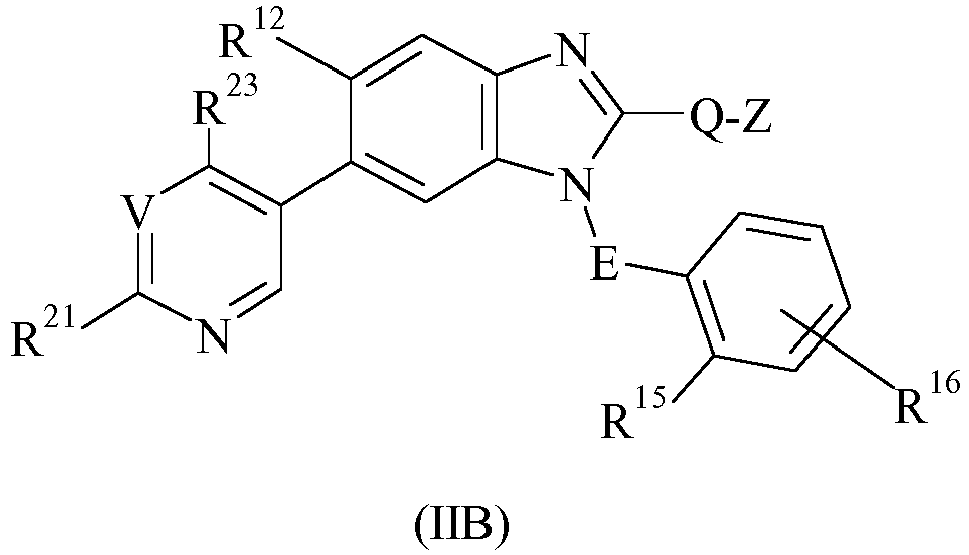
- E represents -N(R4)-, -CH2-, -CH(CH3)- or -CH(CH2CH3)-;
- Q represents -CH2-, -CH2O-, -CH2S- or -CH2OCH2-;
- Z represents hydrogen, fluoro, trifluoromethyl, methyl, ethyl, n-propyl, isopropyl, isobutyl, tert-butyl, cyclopropyl, cyclopentyl, cyclohexyl, oxocyclohexyl, phenyl, bromophenyl, cyanophenyl, nitrophenyl, methoxyphenyl, difluoromethoxyphenyl, trifluoromethoxyphenyl, methylenedioxyphenyl, methylsulfonylphenyl, dimethylaminophenyl, acetylaminophenyl, methylsulfonylaminophenyl, carboxyphenyl, aminocarbonylphenyl, methylaminocarbonylphenyl, dimethylaminocarbonylphenyl, aminocarbonylaminophenyl, tetrahydrofuranyl, oxopyrrolidinyl, dimethylaminopyrrolidinyl, tert-butoxycarbonylpyrrolidinyl, indolinyl, tetrahydropyranyl, piperidinyl, ethylpiperidinyl, tert-butoxycarbonylpiperidinyl, aminocarbonylpiperidinyl, 2-oxo-3,4-dihydroquinolinyl, morpholinyl, azocanyl, oxothiazolinyl, furyl, hydroxymethylfuryl, thienyl, methylpyrazolyl, dimethylpyrazolyl, 4,5,6,7-tetrahydroindazolyl, benzoxazolyl, methylisoxazolyl, dimethylisoxazolyl, methylthiazolyl, aminothiazolyl, benzothiazolyl, methylbenzothiazolyl, aminobenzothiazolyl, imidazolyl, methylimidazolyl, methyl-benzimidazolyl, dimethyl[1,2,4]triazolo[1,5-α]pyrimidinyl, dimethylaminoethyltetrazolyl, pyridinyl, fluoropyridinyl, chloropyridinyl, cyanopyridinyl, methylpyridinyl, (cyano)-(methyl)pyridinyl, trifluoromethylpyridinyl, oxopyridinyl, methoxypyridinyl, dimethylaminomethylpyridinyl, acetylaminopyridinyl, carboxypyridinyl, methoxycarbonylpyridinyl, aminocarbonylpyridinyl, (aminocarbonyl)(fluoro)pyridinyl, methylaminocarbonylpyridinyl, dimethylaminocarbonylpyridinyl, hydrazinocarbonylpyridinyl, quinolinyl, isoquinolinyl, (methyl)(oxo)phthalazinyl, pyrimidinyl, pyrazinyl, oxopyrrolidinylphenyl, dioxopyrrolidinylphenyl, (hydroxy)(oxo)pyrrolidinylphenyl, (amino)(oxo)pyrrolidinylphenyl, (oxo)oxazolidinylphenyl, oxoimidazolidinylphenyl, imidazolinylphenyl, methylthiazolylphenyl, formylthiazolylphenyl, imidazolylphenyl, tetrazolylphenyl, phenylpyrrolidinyl, hydroxyphenylpiperazinyl, (methyl)(phenyl)-pyrazolyl, oxoimidazolidinylthiazolyl, hydroxyphenyltriazolyl, morpholinyltetrazolyl, oxopyrrolidinylpyridinyl, (oxo)oxazolidinylpyridinyl, oxoimidazolidinylpyridinyl, pyridinylthiazolyl, pyridinyltetrazolyl, morpholinylcarbonylphenyl, difluoromethyl, aminocarbonylaminomethyl, difluorophenyl, chlorophenyl, methylphenyl, dimethylphenyl, dimethoxyphenyl, (methylthio)phenyl, methylsulfinylphenyl, (bromo)(methylsulfonyl)phenyl, (methyl)(methylsulfonyl)phenyl, cyanomethylaminocarbonylphenyl, trioxodihydrobenzothienyl, pyrrolidinyl, methylpyrrolidinyl, oxodihydroisoindolinyl, oxopiperidinyl, 1,2,3,4-tetrahydroisoquinolinyl, aminosulfonylpyrazolyl, cyclopropylureidothiazolyl, [1,2,4]triazolo[1,5-α]pyrimidinyl, hydroxypyridinyl, dimethylaminopyridinyl, N-acetyl-N-methylaminopyridinyl, N-methyl-N-(methylsulfonyl)aminopyridinyl, pyridazinyl, oxopyrimidinyl, (amino)(dimethyl)pyrimidinyl, (oxo)(thioxo)-triazinyl, pyridinylpiperazinyl, pyrimidinylpiperazinyl, oxopyrrolidinylthiazolyl, oxoazetidinylpyridinyl, (methyl)(oxo)pyrrolidinylpyridinyl, (hydroxy)(oxo)pyrrolidinylpyridinyl, (hydroxymethyl)(oxo)pyrrolidinylpyridinyl, (amino)(oxo)pyrrolidinylpyridinyl, dioxoisothiazolidinylpyridinyl, oxopiperidinylpyridinyl, (methyl)(oxo)piperazinylpyridinyl, oxomorpholinylpyridinyl, oxo-6-azabicyclo[3.2.0]heptanylpyridinyl, oxo-2-oxa-6-azaspiro[3.4]octanylpyridinyl or ethoxytriazolylpyridinyl;
- V represents C-R22 or N;
- R4 represents hydrogen or C1-6 alkyl;
- R12 represents hydrogen, fluoro, chloro, trifluoromethyl or methyl;
- R15 and R16 independently represent hydrogen, halogen, cyano, nitro, C1-6 alkyl, trifluoromethyl, hydroxy, C1-6 alkoxy, difluoromethoxy, trifluoromethoxy, C1-6 alkylthio, C1-6 alkylsulfinyl, C1-6 alkylsulfonyl, amino, C1-6 alkylamino, di(C1-6)alkylamino, arylamino, C2-6 alkylcarbonylamino, C1-6 alkylsulfonylamino, formyl, C2-6 alkylcarbonyl, C3-6 cycloalkylcarbonyl, C3-6 heterocycloalkylcarbonyl, carboxy, C2-6 alkoxycarbonyl, aminocarbonyl, C1-6 alkylaminocarbonyl, di(C1-6)alkylaminocarbonyl, aminosulfonyl, C1-6 alkylaminosulfonyl or di(C1-6)alkylaminosulfonyl;
- R21 represents hydrogen, halogen, cyano, C1-6 alkyl, trifluoromethyl, C2-6 alkenyl, C2-6 alkynyl, hydroxy, hydroxy(C1-6)alkyl, C1-6 alkoxy, difluoromethoxy, trifluoromethoxy, trifluoroethoxy, C1-6 alkoxy(C1-6)alkyl, C1-6 alkylthio, C1-6 alkylsulphonyl, amino, C1-6 alkylamino, di(C1-6)alkylamino, hydroxy(C1-6)alkylamino, (C1-6)alkoxy(C1-6)-alkylamino, [(C1-6)alkoxy](hydroxy)(C1-6)alkylamino, N-[(C1-6)alkyl]-N-[hydroxy(C1-6)-alkyl]amino, [(C1-6)alkylthio](hydroxy)(C1-6)alkylamino, di(C1-6)alkylamino(C1-6)alkylamino, N-[di(C1-6)alkylamino(C1-6)alkyl]-N-[hydroxy(C1-6)alkyl]amino, hydroxy(C1-6)-alkyl(C3-7)cycloalkylamino, (hydroxy)[(C3-7)cycloalkyl(C1-6)alkyl]amino, (C3-7)-heterocycloalkyl(C1-6)alkylamino, oxo(C3-7)heterocycloalkyl(C1-6)alkylamino, (C1-6)alkylheteroarylamino, heteroaryl(C1-6)alkylamino, (C1-6)alkylheteroaryl(C1-6)alkylamino, C2-6 alkylcarbonylamino, N-[(C1-6)alkyl]-N-[(C2-6)alkylcarbonyl]amino, bis[(C3-6)alkenylcarbonyl]amino, N-[carboxy(C1-6)alkyl]-N-[(C1-6)alkyl]amino, C2-6 alkoxycarbonylamino, C2-6 alkoxycarbonyl(C1-6)alkylamino, C1-6 alkylsulphonylamino, N-[(C1-6)alkyl]-N-[(C1-6)-alkylsulphonyl]amino, formyl, C2-6 alkylcarbonyl, carboxy, C2-6 alkoxycarbonyl, aminocarbonyl, C1-6 alkylaminocarbonyl, hydroxy(C1-6)alkylaminocarbonyl, di(C1-6)alkylaminocarbonyl, aminocarbonyl(C1-6)alkyl, aminosulphonyl, C1-6 alkylaminosulphonyl or di(C1-6)alkylaminosulphonyl; or R21 represents (C3-7)cycloalkyl, (C3-7)cycloalkyl(C1-6)-alkyl, (C4-7)cycloalkenyl, (C4-9)bicycloalkyl, (C3-7)heterocycloalkyl, (C3-7)-heterocycloalkyl(C1-6)alkyl, (C3-7)heterocycloalkenyl, (C4-9)heterobicycloalkyl or (C4-9)spiroheterocycloalkyl, any of which groups may be optionally substituted by one, two or three substituents independently selected from cyano(C1-6)alkyl, trifluoroethyl, hydroxy, C1-6 alkylsulphonyl, (C1-6)alkylsulphonyl(C1-6)alkyl, oxo, C2-6 alkylcarbonyl, carboxy(C1-6)alkyl, C2-6 alkoxycarbonyl, C2-6 alkoxycarbonyl(C1-6)alkyl, halogen, C1-6 alkyl, difluoroethyl, hydroxy(C1-6)alkyl, C1-6 alkoxy, C1-6 alkoxy(C1-6)alkyl, amino, di(C1-6)alkylamino, carboxy and aminocarbonyl;
- R22 represents hydrogen, halogen or C1-6 alkyl; and
- R23 represents hydrogen or C1-6 alkyl.
- E represents a covalent bond; or E represents -S(O)2- or -N(R4)-; or E represents an optionally substituted straight or branched C1-4 alkylene chain;
- Q represents a covalent bond; or Q represents -O-, -S-, -S(O)-, -S(O)2-, -N(R5)-, -C(O)N(R5)-, -N(R5)C(O)-, -S(O)2N(R5)- or -N(R5)S(O)2-; or Q represents an optionally substituted straight or branched C1-6 alkylene chain optionally comprising one, two or three heteroatom-containing linkages independently selected from -O-, -S-, -S(O)-, -S(O)2-, -N(R5)-, -C(O)N(R5)-, -N(R5)C(O)-, -S(O)2N(R5)- and -N(R5)S(O)2-;
- Y represents C3-7 cycloalkyl, aryl, C3-7 heterocycloalkyl or heteroaryl, any of which groups may be optionally substituted by one or more substituents;
- Z represents hydrogen, halogen or trifluoromethyl; or Z represents C1-6 alkyl, C3-7 cycloalkyl, aryl, C3-7 heterocycloalkyl, C3-7 heterocycloalkenyl or heteroaryl, any of which groups may be optionally substituted by one or more substituents; or Z represents -Z1-Z2 or -Z1-C(O)-Z2, either of which moieties may be optionally substituted by one or more substituents;
- Z1 represents a divalent radical derived from an aryl, C3-7 heterocycloalkyl or heteroaryl group;
- Z2 represents aryl, C3-7 heterocycloalkyl, C3-7 heterocycloalkenyl, (C4-9)heterobicycloalkyl, (C4-9)spiroheterocycloalkyl or heteroaryl;
- R1, R2 and R3 independently represent hydrogen, halogen, cyano, nitro, hydroxy, trifluoromethyl, trifluoromethoxy, -ORa, -SRa, -SORa, -SO2Ra, -OSO2Ra, -SF5, -NRbRc, -NRcCORd, -NRcCO2Rd, -NHCONRbRc, -NRcSO2Re, -N(SO2Re)2, -NHSO2NRbRc, -CORd, -CO2Rd, -CONRbRc, -CON(ORa)Rb or -SO2NRbRc; or C1-6 alkyl, C2-6 alkenyl, C2-6 alkynyl, C3-7 cycloalkyl, C4-7 cycloalkenyl, C3-7 cycloalkyl(C1-6)alkyl, aryl, aryl(C1-6)alkyl, C3-7 heterocycloalkyl, C3-7 heterocycloalkyl(C1-6)alkyl, C3-7 heterocycloalkenyl, C4-9 heterobicycloalkyl, heteroaryl, heteroaryl(C1-6)alkyl, (C3-7)heterocycloalkyl-aryl-, (C3-7)heterocycloalkyl(C1-6)alkyl-aryl-, heteroaryl-(C3-7)heterocycloalkyl-, (C3-7)cycloalkyl-heteroaryl-, (C3-7)cycloalkyl-(C1-6)alkylheteroaryl-, (C4-7)cycloalkenyl-heteroaryl-, (C4-9)bicycloalkyl-heteroaryl-, (C3-7)heterocycloalkyl-heteroaryl-, (C3-7)heterocycloalkyl(C1-6)alkyl-heteroaryl-, (C3-7)heterocycloalkenyl-heteroaryl-, (C4-9)heterobicycloalkyl-heteroaryl-, (C4-9)spiroheterocycloalkyl-heteroaryl- or (C3-7)heterocycloalkyl-heteroaryl(C1-6)alkyl-, any of which groups may be optionally substituted by one or more substituents;
- R4 and R5 independently represent hydrogen or C1-6 alkyl;
- Ra represents trifluoromethyl; or C1-6 alkyl, C3-7 cycloalkyl, C3-7 cycloalkyl(C1-6)-alkyl, aryl, aryl(C1-6)alkyl, C3-7 heterocycloalkyl, C3-7 heterocycloalkyl(C1-6)alkyl, heteroaryl or heteroaryl(C1-6)alkyl, any of which groups may be optionally substituted by one or more substituents;
- Rb and Rc independently represent hydrogen or trifluoromethyl; or C1-6 alkyl, C3-7 cycloalkyl, C3-7 cycloalkyl(C1-6)alkyl, aryl, aryl(C1-6)alkyl, C3-7 heterocycloalkyl, C3-7 heterocycloalkyl(C1-6)alkyl, heteroaryl or heteroaryl(C1-6)alkyl, any of which groups may be optionally substituted by one or more substituents; or
- Rb and Rc, when taken together with the nitrogen atom to which they are both attached, represent azetidin-1-yl, pyrrolidin-1-yl, oxazolidin-3-yl, isoxazolidin-2-yl, thiazolidin-3-yl, isothiazolidin-2-yl, piperidin-1-yl, morpholin-4-yl, thiomorpholin-4-yl, piperazin-1-yl, homopiperidin-1-yl, homomorpholin-4-yl or homopiperazin-1-yl, any of which groups may be optionally substituted by one or more substituents;
- Rd represents hydrogen; or C1-6 alkyl, C3-7 cycloalkyl, aryl, C3-7 heterocycloalkyl or heteroaryl, any of which groups may be optionally substituted by one or more substituents; and
- Re represents C1-6 alkyl, aryl or heteroaryl, any of which groups may be optionally substituted by one or more substituents.
- The compounds of formula (IIB) are useful in the treatment and/or prevention of disorders for which the administration of a modulator of TNFα function is indicated.
- In another aspect, the present invention provides a compound of formula (IIB) as defined above or an N-oxide thereof, or a pharmaceutically acceptable salt or solvate thereof, or a glucuronide derivative thereof, or a co-crystal thereof, for use in the treatment and/or prevention of an inflammatory or autoimmune disorder, a neurological or neurodegenerative disorder, pain or a nociceptive disorder, a cardiovascular disorder, a metabolic disorder, an ocular disorder, or an oncological disorder.
- In another aspect, the present invention provides a pharmaceutical composition comprising a compound of formula (IIB) as defined above or a pharmaceutically acceptable salt or solvate thereof, or a glucuronide derivative thereof, or a co-crystal thereof, in association with a pharmaceutically acceptable carrier.
- Where any of the groups in the compounds of formula (IIB) above is stated to be optionally substituted, this group may be unsubstituted, or substituted by one or more substituents. Typically, such groups will be unsubstituted, or substituted by one or two substituents.
- For use in medicine, the salts of the compounds of formula (IIB) will be pharmaceutically acceptable salts. Other salts may, however, be useful in the preparation of the compounds of use in the invention or of their pharmaceutically acceptable salts. Suitable pharmaceutically acceptable salts of the compounds of use in this invention include acid addition salts which may, for example, be formed by mixing a solution of the compound of use in the invention with a solution of a pharmaceutically acceptable acid such as hydrochloric acid, sulphuric acid, methanesulphonic acid, fumaric acid, maleic acid, succinic acid, acetic acid, benzoic acid, citric acid, tartaric acid or phosphoric acid. Furthermore, where the compounds of use in the invention carry an acidic moiety, e.g. carboxy, suitable pharmaceutically acceptable salts thereof may include alkali metal salts, e.g. sodium or potassium salts; alkaline earth metal salts, e.g. calcium or magnesium salts; ammonium salts; and salts formed with suitable organic ligands, e.g. quaternary ammonium salts.
- The present invention includes within its scope solvates of the compounds of formula (IIB) above. Such solvates may be formed with common organic solvents, e.g. hydrocarbon solvents such as benzene or toluene; chlorinated solvents such as chloroform or dichloromethane; alcoholic solvents such as methanol, ethanol or isopropanol; ethereal solvents such as diethyl ether or tetrahydrofuran; or ester solvents such as ethyl acetate. Alternatively, the solvates of the compounds of formula (IIB) may be formed with water, in which case they will be hydrates.
- The present invention also includes co-crystals within its scope. The technical term "co-crystal" is used to describe the situation where neutral molecular components are present within a crystalline compound in a definite stoichiometric ratio. The preparation of pharmaceutical co-crystals enables modifications to be made to the crystalline form of an active pharmaceutical ingredient, which in turn can alter its physicochemical properties without compromising its intended biological activity (see Pharmaceutical Salts and Co-crystals., ed. J. Wouters & L. Quere, RSC Publishing, 2012). Typical examples of co-crystal formers, which may be present in the co-crystal alongside the active pharmaceutical ingredient, include L-ascorbic acid, citric acid, glutaric acid, urea and nicotinamide.
- Suitable alkyl groups which may be present on the compounds of use in the invention include straight-chained and branched C1-6 alkyl groups, for example C1-4 alkyl groups. Typical examples include methyl and ethyl groups, and straight-chained or branched propyl, butyl and pentyl groups. Particular alkyl groups include methyl, ethyl, n-propyl, isopropyl, n-butyl, sec-butyl, isobutyl, tert-butyl, 2,2-dimethylpropyl and 3-methylbutyl. Derived expressions such as "C1-6 alkoxy", "C1-6 alkylthio", "C1-6 alkylsulphonyl" and "C1-6 alkylamino" are to be construed accordingly.
- The expression "C1-4 alkylene chain" refers to a divalent straight or branched alkylene chain containing 1 to 4 carbon atoms. Typical examples include methylene, ethylene, methylmethylene, ethylmethylene and dimethylmethylene.
- Suitable C2-6 alkenyl groups include vinyl and allyl.
- Suitable C2-6 alkynyl groups include ethynyl and propargyl.
- Suitable C3-7 cycloalkyl groups, which may comprise benzo-fused analogues thereof, include cyclopropyl, cyclobutyl, benzocyclobutenyl, cyclopentyl, indanyl, cyclohexyl and cycloheptyl.
- Suitable C4-7 cycloalkenyl groups include cyclobutenyl, cyclopentenyl, cyclohexenyl and cycloheptenyl.
- Typical bicycloalkyl groups include bicyclo[3.1.0]hexanyl.
- Suitable aryl groups include phenyl and naphthyl, preferably phenyl.
- Suitable aryl(C1-6)alkyl groups include benzyl, phenylethyl, phenylpropyl and naphthylmethyl.
- The term "C3-7 heterocycloalkyl" as used herein refers to saturated monocyclic rings containing 3 to 7 carbon atoms and at least one heteroatom selected from oxygen, sulphur and nitrogen, and may comprise benzo-fused analogues thereof. Suitable heterocycloalkyl groups include oxetanyl, azetidinyl, tetrahydrofuranyl, dihydrobenzofuranyl, dihydrobenzothienyl, pyrrolidinyl, indolinyl, isoindolinyl, oxazolidinyl, thiazolidinyl, isothiazolidinyl, imidazolidinyl, tetrahydropyranyl, chromanyl, tetrahydrothiopyranyl, piperidinyl, 1,2,3,4-tetrahydroquinolinyl, 1,2,3,4-tetrahydroisoquinolinyl, piperazinyl, 1,2,3,4-tetrahydroquinoxalinyl, homopiperazinyl, morpholinyl, benzoxazinyl, thiomorpholinyl, diazepanyl and azocanyl.
- The term "C3-7 heterocycloalkenyl" as used herein refers to monounsaturated or polyunsaturated monocyclic rings containing 3 to 7 carbon atoms and at least one heteroatom selected from oxygen, sulphur and nitrogen, and may comprise benzo-fused analogues thereof. Suitable heterocycloalkenyl groups include thiazolinyl, imidazolinyl, dihydropyranyl, dihydrothiopyranyl and 1,2,3,6-tetrahydropyridinyl.
- Typical heterobicycloalkyl groups include quinuclidinyl, 3-azabicyclo[3.1.0]-hexanyl, 5-aza-2-oxabicyclo[2.2.1]heptanyl, 6-azabicyclo[3.2.0]heptanyl, 3-azabicyclo-[4.1.0]heptanyl, 5-aza-2-oxabicyclo[2.2.2]octanyl, 3-azabicyclo[3.2.1]octanyl, 8-azabicyclo[3.2.1]octanyl, 3,8-diazabicyclo[3.2.1]octanyl and 3,9-diazabicyclo[4.2.1]-nonanyl.
- Suitable spiroheterocycloalkyl groups include 5-azaspiro[2.4]heptanyl, 2-oxa-6-azaspiro[3.3]heptanyl, 2-oxa-6-azaspiro[3.4]octanyl, 2-oxa-6-azaspiro[3.5]nonanyl, 2-oxa-7-azaspiro[3.5]nonanyl and 7-oxa-2-azaspiro[3.5]nonanyl.
- Suitable heteroaryl groups include furyl, benzofuryl, dibenzofuryl, thienyl, thieno[2,3-c]pyrazolyl, thieno[3,4-b][1,4]dioxinyl, benzothienyl, dibenzothienyl, pyrrolyl, indolyl, pyrrolo[2,3-b]pyridinyl, pyrrolo[3,4-b]pyridinyl, pyrrolo[3,2-c]pyridinyl, pyrazolyl, pyrazolo[1,5-a]pyridinyl, pyrazolo[3,4-d]pyrimidinyl, indazolyl, 4,5,6,7-tetrahydroindazolyl, oxazolyl, benzoxazolyl, isoxazolyl, thiazolyl, benzothiazolyl, isothiazolyl, imidazolyl, benzimidazolyl, imidazo[2,1-b]thiazolyl, imidazo[1,2-α]pyridinyl, imidazo[4,5-b]pyridinyl, purinyl, imidazo[1,2-α]pyrimidinyl, imidazo[1,2-α]pyrazinyl, oxadiazolyl, thiadiazolyl, triazolyl, [1,2,4]triazolo[1,5-α]pyrimidinyl, benzotriazolyl, tetrazolyl, pyridinyl, quinolinyl, isoquinolinyl, naphthyridinyl, pyridazinyl, cinnolinyl, phthalazinyl, pyrimidinyl, quinazolinyl, pyrazinyl, quinoxalinyl, pteridinyl, triazinyl and chromenyl groups.
- The term "halogen" as used herein is intended to include fluorine, chlorine, bromine and iodine atoms, typically fluorine, chlorine or bromine.
- Where the compounds of formula (I) including formula (IIB) have one or more asymmetric centres, they may accordingly exist as enantiomers. Where the compounds of use in the invention possess two or more asymmetric centres, they may additionally exist as diastereomers. The invention is to be understood to extend to the use of all such enantiomers and diastereomers, and to mixtures thereof in any proportion, including racemates. Formula (I), formula (IIB) and the formulae depicted hereinafter are intended to represent all individual stereoisomers and all possible mixtures thereof, unless stated or shown otherwise. In addition, compounds of formula (I) including formula (IIB) may exist as tautomers, for example keto (CH2C=O)↔enol (CH=CHOH) tautomers or amide (NHC=O)↔hydroxyimine (N=COH) tautomers. Formula (I), formula (IIB) and the formulae depicted hereinafter are intended to represent all individual tautomers and all possible mixtures thereof, unless stated or shown otherwise.
- It is to be understood that each individual atom present in formula (I), formula (IIB), or in the formulae depicted hereinafter, may in fact be present in the form of any of its naturally occurring isotopes, with the most abundant isotope(s) being preferred. Thus, by way of example, each individual hydrogen atom present in formula (I), formula (IIB), or in the formulae depicted hereinafter, may be present as a 1H, 2H (deuterium) or 3H (tritium) atom, preferably 1H. Similarly, by way of example, each individual carbon atom present in formula (I), formula (IIB), or in the formulae depicted hereinafter, may be present as a 12C, 13C or 14C atom, preferably 12C.
- Where the compounds in accordance with the invention comprise an optionally substituted straight or branched alkylene chain, typical values thereof include methylene (-CH2-), (methyl)methylene, ethylene (-CH2CH2-), (ethyl)methylene, (dimethyl)-methylene, (methyl)ethylene, propylene (-CH2CH2CH2-), (propyl)methylene and (dimethyl)ethylene, any of which chains may be optionally substituted by one or more substituents. Suitably, such chains are unsubstituted, monosubstituted or disubstituted. Typically, such chains are unsubstituted or monosubstituted. In one embodiment, such chains are unsubstituted. In another embodiment, such chains are monosubstituted. In a further embodiment, such chains are disubstituted.
- Examples of typical substituents on the alkylene chain which may be present in a compound in accordance with the invention include halogen, trifluoromethyl, oxo, hydroxy, C1-6 alkoxy, trifluoromethoxy, amino, C1-6 alkylamino, di(C1-6)alkylamino, aminocarbonyl, C1-6 alkylaminocarbonyl and di(C1-6)alkylaminocarbonyl.
- Examples of suitable substituents on the alkylene chain which may be present in a compound in accordance with the invention include halogen, trifluoromethyl, hydroxy, C1-6 alkoxy and amino.
- Specific examples of suitable substituents on the alkylene chain which may be present in a compound in accordance with the invention include fluoro, trifluoromethyl, hydroxy, methoxy and amino.
- Suitable values of E include -N(R4)-, -CH2-, -CH(CH3)- and -CH(CH2CH3)-;
In a first embodiment, E represents -N(R4)-. - In a second embodiment, E represents -CH2-.
- In a third embodiment, E represents -CH(CH3)-. In a particular aspect of that embodiment, the -CH(CH3)- linkage represented by E is in the (S) stereochemical configuration.
- In a fourth embodiment, E represents -CH(CH2CH3)-.
- Particular values of Q include -CH2-, -CH2O-, -CH2S-, and -CH2OCH2-. In a first embodiment, Q represents -CH2-. In a second embodiment, Q represents -CH2O-. In a third embodiment, Q represents -CH2S-. In a fourth embodiment, Q represents -CH2OCH2-.
- In one embodiment, Z represents hydrogen.
- In another embodiment, Z is other than hydrogen.
- Typical values of Z include hydrogen, fluoro, trifluoromethyl, methyl, ethyl, n-propyl, isopropyl, isobutyl, tert-butyl, cyclopropyl, cyclopentyl, cyclohexyl, oxocyclohexyl, phenyl, bromophenyl, cyanophenyl, nitrophenyl, methoxyphenyl, difluoromethoxyphenyl, trifluoromethoxyphenyl, methylenedioxyphenyl, methylsulfonylphenyl, dimethylaminophenyl, acetylaminophenyl, methylsulfonylaminophenyl, carboxyphenyl, aminocarbonylphenyl, methylaminocarbonylphenyl, dimethylaminocarbonylphenyl, aminocarbonylaminophenyl, tetrahydrofuranyl, oxopyrrolidinyl, dimethylaminopyrrolidinyl, tert-butoxycarbonylpyrrolidinyl, indolinyl, tetrahydropyranyl, piperidinyl, ethylpiperidinyl, tert-butoxycarbonylpiperidinyl, aminocarbonylpiperidinyl, 2-oxo-3,4-dihydroquinolinyl, morpholinyl, azocanyl, oxothiazolinyl, furyl, hydroxymethylfuryl, thienyl, methylpyrazolyl, dimethylpyrazolyl, 4,5,6,7-tetrahydroindazolyl, benzoxazolyl, methylisoxazolyl, dimethylisoxazolyl, methylthiazolyl, aminothiazolyl, benzothiazolyl, methylbenzothiazolyl, aminobenzothiazolyl, imidazolyl, methylimidazolyl, methylbenzimidazolyl, dimethyl[1,2,4]triazolo[1,5-α]pyrimidinyl, dimethylaminoethyltetrazolyl, pyridinyl, fluoropyridinyl, chloropyridinyl, cyanopyridinyl, methylpyridinyl, (cyano)-(methyl)pyridinyl, trifluoromethylpyridinyl, oxopyridinyl, methoxypyridinyl, dimethylaminomethylpyridinyl, acetylaminopyridinyl, carboxypyridinyl, methoxycarbonylpyridinyl, aminocarbonylpyridinyl, (aminocarbonyl)(fluoro)pyridinyl, methylaminocarbonylpyridinyl, dimethylaminocarbonylpyridinyl, hydrazinocarbonylpyridinyl, quinolinyl, isoquinolinyl, (methyl)(oxo)phthalazinyl, pyrimidinyl, pyrazinyl, oxopyrrolidinylphenyl, dioxopyrrolidinylphenyl, (hydroxy)(oxo)pyrrolidinylphenyl, (amino)(oxo)pyrrolidinylphenyl, (oxo)oxazolidinylphenyl, oxoimidazolidinylphenyl, imidazolinylphenyl, methylthiazolylphenyl, formylthiazolylphenyl, imidazolylphenyl, tetrazolylphenyl, phenylpyrrolidinyl, hydroxyphenylpiperazinyl, (methyl)(phenyl)-pyrazolyl, oxoimidazolidinylthiazolyl, hydroxyphenyltriazolyl, morpholinyltetrazolyl, oxopyrrolidinylpyridinyl, (oxo)oxazolidinylpyridinyl, oxoimidazolidinylpyridinyl, pyridinylthiazolyl, pyridinyltetrazolyl and morpholinylcarbonylphenyl. Additional values include difluoromethyl, aminocarbonylaminomethyl, difluorophenyl, chlorophenyl, methylphenyl, dimethylphenyl, dimethoxyphenyl, (methylthio)phenyl, methylsulfinylphenyl, (bromo)(methylsulfonyl)phenyl, (methyl)(methylsulfonyl)phenyl, cyanomethylaminocarbonylphenyl, trioxodihydrobenzothienyl, pyrrolidinyl, methylpyrrolidinyl, oxodihydroisoindolinyl, oxopiperidinyl, 1,2,3,4-tetrahydroisoquinolinyl, aminosulfonylpyrazolyl, cyclopropylureidothiazolyl, [1,2,4]triazolo[1,5-α]pyrimidinyl, hydroxypyridinyl, dimethylaminopyridinyl, N-acetyl-N-methylaminopyridinyl, N-methyl-N-(methylsulfonyl)aminopyridinyl, pyridazinyl, oxopyrimidinyl, (amino)(dimethyl)-pyrimidinyl, (oxo)(thioxo)triazinyl, pyridinylpiperazinyl, pyrimidinylpiperazinyl, oxopyrrolidinylthiazolyl, oxoazetidinylpyridinyl, (methyl)(oxo)pyrrolidinylpyridinyl, (hydroxy)(oxo)pyrrolidinylpyridinyl, (hydroxymethyl)(oxo)pyrrolidinylpyridinyl, (amino)(oxo)pyrrolidinylpyridinyl, dioxoisothiazolidinylpyridinyl, oxopiperidinylpyridinyl, (methyl)(oxo)piperazinylpyridinyl, oxomorpholinylpyridinyl, oxo-6-azabicyclo[3.2.0]heptanylpyridinyl, oxo-2-oxa-6-azaspiro[3.4]octanylpyridinyl and ethoxytriazolylpyridinyl.
- Particular values of Z include hydrogen, methyl, methylsulfonylphenyl, pyridinyl, oxopyrrolidinylphenyl, (hydroxy)(oxo)pyrrolidinylphenyl and (oxo)oxazolidinylphenyl. In a first embodiment, Z represents hydrogen. In a second embodiment, Z represents methyl. In a third embodiment, Z represents methylsulfonylphenyl. In one aspect of that embodiment, Z represents 3-(methylsulfonyl)phenyl. In a fourth embodiment, Z represents pyridinyl. In one aspect of that embodiment, Z represents pyridin-4-yl. In a fifth embodiment, Z represents oxopyrrolidinylphenyl. In one aspect of that embodiment, Z represents 3-(2-oxopyrrolidin-1-yl)phenyl. In a sixth embodiment, Z represents (hydroxy)(oxo)pyrrolidinylphenyl. In one aspect of that embodiment, Z represents 3-(3-hydroxy-2-oxopyrrolidin-1-yl)phenyl. In another aspect of that embodiment, Z represents 3-(4-hydroxy-2-oxopyrrolidin-1-yl)phenyl. In a seventh embodiment, Z represents (oxo)oxazolidinylphenyl. In one aspect of that embodiment, Z represents 3-(2-oxo-oxazolidinyl-3-yl)phenyl.
- Suitably, R4 represents hydrogen or methyl.
- In a first embodiment, R4 represents hydrogen. In a second embodiment, R4 represents C1-6 alkyl, especially methyl.
- R12 represents hydrogen, fluoro, chloro, trifluoromethyl or methyl;
R15 and R16 independently represent hydrogen, halogen, cyano, nitro, C1-6 alkyl, trifluoromethyl, hydroxy, C1-6 alkoxy, difluoromethoxy, trifluoromethoxy, C1-6 alkylthio, C1-6 alkylsulfinyl, C1-6 alkylsulfonyl, amino, C1-6 alkylamino, di(C1-6)alkylamino, arylamino, C2-6 alkylcarbonylamino, C1-6 alkylsulfonylamino, formyl, C2-6 alkylcarbonyl, C3-6 cycloalkylcarbonyl, C3-6 heterocycloalkylcarbonyl, carboxy, C2-6 alkoxycarbonyl, aminocarbonyl, C1-6 alkylaminocarbonyl, di(C1-6)alkylaminocarbonyl, aminosulfonyl, C1-6 alkylaminosulfonyl or di(C1-6)alkylaminosulfonyl. - In a first embodiment, R12 represents hydrogen. In a second embodiment, R12 represents fluoro or chloro. In one aspect of that embodiment, R12 represents fluoro. In another aspect of that embodiment, R12 represents chloro. In a third embodiment, R12 represents trifluoromethyl. In a fourth embodiment, R12 represents unsubstituted methyl. Suitable values of R12 include hydrogen, fluoro, chloro, trifluoromethyl and methyl.
- Typically, R15 and R16 may independently represent hydrogen, fluoro, chloro, bromo, cyano, nitro, methyl, isopropyl, trifluoromethyl, hydroxy, methoxy, difluoromethoxy, trifluoromethoxy, methylthio, methylsulfinyl, methylsulfonyl, amino, methylamino, tert-butylamino, dimethylamino, phenylamino, acetylamino, methylsulfonylamino, formyl, acetyl, cyclopropylcarbonyl, azetidinylcarbonyl, pyrrolidinylcarbonyl, piperidinylcarbonyl, piperazinylcarbonyl, morpholinylcarbonyl, carboxy, methoxycarbonyl, aminocarbonyl, methylaminocarbonyl, dimethylaminocarbonyl, aminosulfonyl, methylaminosulfonyl and dimethylaminosulfonyl.
- Typical values of R15 include hydrogen, halogen, C1-6 alkyl, trifluoromethyl, C1-6 alkoxy, difluoromethoxy and trifluoromethoxy.
- In a first embodiment, R15 represents hydrogen. In a second embodiment, R15 represents halogen. In a first aspect of that embodiment, R15 represents fluoro. In a second aspect of that embodiment, R15 represents chloro. In a third embodiment, R15 represents C1-6 alkyl. In one aspect of that embodiment, R15 represents methyl. In a fourth embodiment, R15 represents trifluoromethyl. In a fifth embodiment, R15 represents C1-6 alkoxy. In one aspect of that embodiment, R15 represents methoxy. In a sixth embodiment, R15 represents difluoromethoxy. In a seventh embodiment, R15 represents trifluoromethoxy.
- Selected values of R15 include hydrogen, fluoro, chloro, methyl, trifluoromethyl, methoxy, difluoromethoxy and trifluoromethoxy.
- Typical values of R16 include hydrogen, halogen, C1-6 alkyl, trifluoromethyl, difluoromethoxy and amino.
- In a first embodiment, R16 represents hydrogen. In a second embodiment, R16 represents halogen. In a first aspect of that embodiment, R16 represents fluoro. In a second aspect of that embodiment, R16 represents chloro. In a third embodiment, R16 represents C1-6 alkyl. In one aspect of that embodiment, R16 represents methyl. In a fourth embodiment, R16 represents trifluoromethyl. In a fifth embodiment, R16 represents difluoromethoxy. In a seventh embodiment, R16 represents amino.
- Selected values of R16 include hydrogen, fluoro, chloro, methyl, trifluoromethyl, difluoromethoxy and amino.
- In a particular embodiment, R16 is attached at the para-position of the phenyl ring relative to the integer R15.
- The compounds of the invention are represented by formula (IIB) and N-oxides thereof, and pharmaceutically acceptable salts and solvates thereof, and glucuronide derivatives thereof, and co-crystals thereof:

- V represents C-R22 or N;
- R21 represents hydrogen, halogen, cyano, C1-6 alkyl, trifluoromethyl, C2-6 alkenyl, C2-6 alkynyl, hydroxy, hydroxy(C1-6)alkyl, C1-6 alkoxy, difluoromethoxy, trifluoromethoxy, trifluoroethoxy, C1-6 alkoxy(C1-6)alkyl, C1-6 alkylthio, C1-6 alkylsulphonyl, amino, C1-6 alkylamino, di(C1-6)alkylamino, hydroxy(C1-6)alkylamino, (C1-6)alkoxy(C1-6)-alkylamino, [(C1-6)alkoxy](hydroxy)(C1-6)alkylamino, N-[(C1-6)alkyl]-N-[hydroxy(C1-6)-alkyl]amino, [(C1-6)alkylthio](hydroxy)(C1-6)alkylamino, di(C1-6)alkylamino(C1-6)alkylamino, N-[di(C1-6)alkylamino(C1-6)alkyl]-N-[hydroxy(C1-6)alkyl]amino, hydroxy(C1-6)-alkyl(C3-7)cycloalkylamino, (hydroxy)[(C3-7)cycloalkyl(C1-6)alkyl]amino, (C3-7)-heterocycloalkyl(C1-6)alkylamino, oxo(C3-7)heterocycloalkyl(C1-6)alkylamino, (C1-6)alkylheteroarylamino, heteroaryl(C1-6)alkylamino, (C1-6)alkylheteroaryl(C1-6)alkylamino, C2-6 alkylcarbonylamino, N-[(C1-6)alkyl]-N-[(C2-6)alkylcarbonyl]amino, bis[(C3-6)alkenylcarbonyl]amino, N-[carboxy(C1-6)alkyl]-N-[(C1-6)alkyl]amino, C2-6 alkoxycarbonylamino, C2-6 alkoxycarbonyl(C1-6)alkylamino, C1-6 alkylsulphonylamino, N-[(C1-6)alkyl]-N-[(C1-6)-alkylsulphonyl]amino, formyl, C2-6 alkylcarbonyl, carboxy, C2-6 alkoxycarbonyl, aminocarbonyl, C1-6 alkylaminocarbonyl, hydroxy(C1-6)alkylaminocarbonyl, di(C1-6)alkylaminocarbonyl, aminocarbonyl(C1-6)alkyl, aminosulphonyl, C1-6 alkylaminosulphonyl or di(C1-6)alkylaminosulphonyl; or R21 represents (C3-7)cycloalkyl, (C3-7)cycloalkyl(C1-6)-alkyl, (C4-7)cycloalkenyl, (C4-9)bicycloalkyl, (C3-7)heterocycloalkyl, (C3-7)-heterocycloalkyl(C1-6)alkyl, (C3-7)heterocycloalkenyl, (C4-9)heterobicycloalkyl or (C4-9)spiroheterocycloalkyl, any of which groups may be optionally substituted byone, two or three substituents independently selected from cyano(C1-6)alkyl, trifluoroethyl, hydroxy, C1-6 alkylsulphonyl, (C1-6)alkylsulphonyl(C1-6)alkyl, oxo, C2-6 alkylcarbonyl, carboxy(C1-6)alkyl, C2-6 alkoxycarbonyl, C2-6 alkoxycarbonyl(C1-6)alkyl, halogen, C1-6 alkyl, difluoroethyl, hydroxy(C1-6)alkyl, C1-6 alkoxy, C1-6 alkoxy(C1-6)alkyl, amino, di(C1-6)alkylamino, carboxy and aminocarbonyl;
- R22 represents hydrogen, halogen or C1-6 alkyl;
- R23 represents hydrogen or C1-6 alkyl; and
- E, Q, Z, R12 , R15 and R16 are as defined above.
- The present invention also provides a compound of formula (IIB) as depicted above or an N-oxide thereof, or a pharmaceutically acceptable salt or solvate thereof, or a co-crystal thereof, wherein
R21 represents hydrogen, halogen, cyano, C1-6 alkyl, trifluoromethyl, C2-6 alkenyl, C2-6 alkynyl, hydroxy, hydro xy(C1-6)alkyl, C1-6 alkoxy, difluoromethoxy, trifluoromethoxy, trifluoroethoxy, C1-6 alkylthio, C1-6 alkylsulphonyl, amino, C1-6 alkylamino, di(C1-6)alkylamino, (C1-6)alkoxy(C1-6)alkylamino, N-[(C1-6)alkyl]-N-[hydroxy(C1-6)alkyl]-amino, C2-6 alkylcarbonylamino, C2-6 alkoxycarbonylamino, C1-6 alkylsulphonylamino, formyl, C2-6 alkylcarbonyl, carboxy, C2-6 alkoxycarbonyl, aminocarbonyl, C1-6 alkylaminocarbonyl, di(C1-6)alkylaminocarbonyl, aminocarbonyl(C1-6)alkyl, aminosulphonyl, C1-6 alkylaminosulphonyl or di(C1-6)alkylaminosulphonyl; or R21 represents (C3-7)cycloalkyl, (C3-7)cycloalkyl(C1-6)alkyl, (C4-7)cycloalkenyl, (C3-7)heterocycloalkyl, (C3-7)heterocycloalkenyl, (C4-9)heterobicycloalkyl or (C4-9)spiroheterocycloalkyl, any of which groups may be optionally substituted by one or more substituents;
R12 represents hydrogen; and
E, Q, Z, V, R15, R16 and R23 are as defined above. - The present invention also provides a compound of formula (IIB) as depicted above or an N-oxide thereof, or a pharmaceutically acceptable salt or solvate thereof, wherein
V represents CH or N;
R21 represents hydrogen, halogen, cyano, C1-6 alkyl, trifluoromethyl, C2-6 alkenyl, C2-6 alkynyl, hydroxy, C1-6 alkoxy, difluoromethoxy, trifluoromethoxy, trifluoroethoxy, C1-6 alkylthio, C1-6 alkylsulphonyl, amino, C1-6 alkylamino, di(C1-6)alkylamino, (C1-6)alkoxy(C1-6)alkylamino, N-[(C1-6)alkyl]-N-[hydroxy(C1-6)alkyl]amino, C2-6 alkylcarbonylamino, C2-6 alkoxycarbonylamino, C1-6 alkylsulphonylamino, formyl, C2-6 alkylcarbonyl, carboxy, C2-6 alkoxycarbonyl, aminocarbonyl, C1-6 alkylaminocarbonyl, di(C1-6)alkylaminocarbonyl, aminosulphonyl, C1-6 alkylaminosulphonyl or di(C1-6)alkylaminosulphonyl; or R21 represents (C4-7)cycloalkenyl, (C3-7)heterocycloalkyl, (C3-7)heterocycloalkenyl, (C4-9)heterobicycloalkyl or (C4-9)spiroheterocycloalkyl, any of which groups may be optionally substituted by one or more substituents;
R12 and R23 each represents hydrogen; and
E, Q, Z, R15 and R16 are as defined above. - In one embodiment, V represents C-R22. In another embodiment, V represents N.
- Suitably, R21 represents hydrogen, halogen, cyano, C1-6 alkyl, trifluoromethyl,
C2-6 alkenyl, hydroxy, hydroxy(C1-6)alkyl, C1-6 alkoxy, trifluoroethoxy, amino, di(C1-6)alkylamino, (C1-6)alkoxy(C1-6)alkylamino, N-[(C1-6)alkyl]-N-[hydroxy(C1-6)alkyl]-amino, carboxy or aminocarbonyl(C1-6)alkyl; or R21 represents (C3-7)cycloalkyl, (C3-7)cycloalkyl(C1-6)alkyl, (C3-7)heterocycloalkyl or (C4-9)spiroheterocycloalkyl, any of which groups may be optionally substituted by one or more substituents. Additionally, R21 may represent C1-6 alkoxy(C1-6)alkyl, C1-6 alkylsulphonyl, C1-6 alkylamino, hydroxy(C1-6)-alkylamino, [(C1-6)alkoxy](hydroxy)(C1-6)alkylamino, [(C1-6)alkylthio](hydroxy)(C1-6)-alkylamino, di(C1-6)alkylamino(C1-6)alkylamino, N-[di(C1-6)alkylamino(C1-6)alkyl]-N-[hydroxy(C1-6)alkyl]amino, hydroxy(C1-6)alkyl(C3-7)cycloalkylamino, (hydroxy)[(C3-7)-cycloalkyl(C1-6)alkyl]amino, (C3-7)heterocycloalkyl(C1-6)alkylamino, oxo(C3-7)-heterocycloalkyl(C1-6)alkylamino, (C1-6)alkylheteroarylamino, heteroaryl(C1-6)alkylamino, (C1-6)alkylheteroaryl(C1-6)alkylamino, C2-6 alkylcarbonylamino, N-[(C1-6)alkyl]-N-[(C2-6)-alkylcarbonyl]amino, bis[(C3-6)alkenylcarbonyl]amino, N-[carboxy(C1-6)alkyl]-N-[(C1-6)-alkyl]amino, C2-6 alkoxycarbonyl(C1-6)alkylamino, N-[(C1-6)alkyl]-N-[(C1-6)alkylsulphonyl]amino, aminocarbonyl, C1-6 alkylaminocarbonyl, hydroxy(C1-6)alkylaminocarbonyl or di(C1-6)alkylaminocarbonyl; or R21 may represent (C4-7)cycloalkenyl, (C4-9)bicycloalkyl, (C4-9)heterobicycloalkyl or (C3-7)heterocycloalkyl(C1-6)alkyl, any of which groups may be optionally substituted by one or more substituents. - Typically, R21 represents hydrogen, halogen, cyano, C1-6 alkyl, trifluoromethyl, C2-6 alkenyl, hydroxy, C1-6 alkoxy, trifluoroethoxy, amino, di(C1-6)alkylamino, (C1-6)-alkoxy(C1-6)alkylamino, N-[(C1-6)alkyl]-N-[hydroxy(C1-6)alkyl]amino or carboxy; or R21 represents (C3-7)heterocycloalkyl or (C4-9)spiroheterocycloalkyl, either of which groups may be optionally substituted by one or more substituents.
- Where R21 represents an optionally substituted (C3-7)cycloalkyl group, typical values include cyclopropyl, cyclobutyl, cyclopentyl, cyclohexyl and cycloheptyl, any of which groups may be optionally substituted by one or more substituents.
- Where R21 represents an optionally substituted (C3-7)cycloalkyl(C1-6)alkyl group, typical values include cyclopropylmethyl, cyclobutylmethyl, cyclopentylmethyl and cyclohexylmethyl, any of which groups may be optionally substituted by one or more substituents.
- Where R21 represents an optionally substituted (C4-7)cycloalkenyl group, typical values include cyclobutenyl, cyclopentenyl, cyclohexenyl and cycloheptenyl, any of which groups may be optionally substituted by one or more substituents.
- Where R21 represents an optionally substituted (C4-9)bicycloalkyl group, a typical value is bicyclo[3.1.0]hexanyl, which group may be optionally substituted by one or more substituents.
- Where R21 represents an optionally substituted (C3-7)heterocycloalkyl group, typical values include oxetanyl, azetidinyl, tetrahydrofuranyl, pyrrolidinyl, isothiazolidinyl, imidazolidinyl, tetrahydropyranyl, piperidinyl, piperazinyl, morpholinyl, thiomorpholinyl and diazepanyl, any of which groups may be optionally substituted by one or more substituents.
- Where R21 represents an optionally substituted (C3-7)heterocycloalkyl(C1-6)alkyl group, typical values include azetidinylmethyl, piperazinylmethyl, morpholinylmethyl and thiomorpholinylmethyl, any of which groups may be optionally substituted by one or more substituents.
- Where R21 represents an optionally substituted (C3-7)heterocycloalkenyl group, a typical value is optionally substituted 1,2,3,6-tetrahydropyridinyl.
- Where R21 represents an optionally substituted (C4-9)heterobicycloalkyl group, typical values include quinuclidinyl, 5-aza-2-oxabicyclo[2.2.1]heptanyl, 3-azabicyclo-[3.1.0]hexanyl, 3-azabicyclo[4.1.0]heptanyl, 5-aza-2-oxabicyclo[2.2.2]octanyl, 3-azabicyclo[3.2.1]octanyl, 8-azabicyclo[3.2.1]octanyl, 3,8-diazabicyclo[3.2.1]octanyl and 3,9-diazabicyclo[4.2.1]nonanyl, any of which groups may be optionally substituted by one or more substituents.
- Where R21 represents an optionally substituted (C4-9)spiroheterocycloalkyl group, typical values include 5-azaspiro[2.4]heptanyl, 2-oxa-6-azaspiro[3.3]heptanyl, 2-oxa-6-azaspiro[3.4]octanyl, 2-oxa-6-azaspiro[3.5]nonanyl, 2-oxa-7-azaspiro[3.5]nonanyl and 7-oxa-2-azaspiro[3.5]nonanyl, any of which groups may be optionally substituted by one or more substituents.
- Selected examples of optional substituents on R21 include one, two or three substituents independently selected from cyano(C1-6)alkyl, trifluoroethyl, hydroxy, C1-6 alkylsulphonyl, (C1-6)alkylsulphonyl(C1-6)alkyl, oxo, C2-6 alkylcarbonyl, carboxy-(C1-6)alkyl, C2-6 alkoxycarbonyl and C2-6 alkoxycarbonyl(C1-6)alkyl. Additional examples include halogen, C1-6 alkyl, difluoroethyl, hydroxy(C1-6)alkyl, C1-6 alkoxy, C1-6 alkoxy-(C1-6)alkyl, amino, di(C1-6)alkylamino, carboxy and aminocarbonyl.
- Examples of particular substituents on R21 include cyanoethyl, trifluoroethyl, hydroxy, methylsulphonyl, methylsulphonylethyl, oxo, acetyl, carboxymethyl, carboxyethyl, tert-butoxycarbonyl, ethoxycarbonylmethyl and ethoxycarbonylethyl. Additional examples include fluoro, methyl, difluoroethyl, hydroxymethyl, hydroxyethyl, methoxy, methoxymethyl, amino, dimethylamino, carboxy, methoxycarbonyl and aminocarbonyl.
- Suitably, R21 represents hydrogen, fluoro, cyano, methyl, ethyl, trifluoromethyl, ethenyl, hydroxy, hydroxyethyl, hydroxyisopropyl, methoxy, isopropoxy, trifluoroethoxy, amino, dimethylamino, methoxyethylamino, N-(hydroxyethyl)-N-(methyl)amino, carboxy, aminocarbonylmethyl, cyclobutyl, cyclopropylmethyl, pyrrolidinyl, hydroxypyrrolidinyl, tetrahydropyranyl, piperidinyl, acetylpiperidinyl, methylsulphonylpiperidinyl, piperazinyl, cyanoethylpiperazinyl, trifluoroethylpiperazinyl, methylsulphonylpiperazinyl, methylsulphonylethylpiperazinyl, oxopiperazinyl, acetylpiperazinyl, tert-butoxycarbonylpiperazinyl, carboxymethylpiperazinyl, carboxyethylpiperazinyl, ethoxycarbonylmethylpiperazinyl, ethoxycarbonylethylpiperazinyl, morpholinyl, thiomorpholinyl, oxothiomorpholinyl, dioxothiomorpholinyl, oxodiazepanyl, 2-oxa-6-azaspiro[3.3]-heptanyl, 2-oxa-6-azaspiro[3.4]octanyl, 2-oxa-6-azaspiro[3.5]nonanyl or 2-oxa-7-azaspiro[3.5]nonanyl. Additionally, R21 may represent isopropyl, isobutyl, methoxymethyl, methoxyethyl, methylsulphonyl, ethylamino, hydroxyethylamino, hydroxypropylamino, (hydroxy)(methyl)propylamino, (hydroxy)(methoxy)(methyl)propylamino, (hydroxy)(methylthio)butylamino, dimethylaminoethylamino, (dimethylamino)(methyl)-propylamino, N-(dimethylaminoethyl)-N-(hydroxyethyl)amino, hydroxymethylcyclopentylamino, hydroxycyclobutylmethylamino, (cyclopropyl)(hydroxy)propylamino, morpholinylethylamino, oxopyrrolidinylmethylamino, ethyloxadiazolylamino, methylthiadiazolylamino, thiazolylmethylamino, thiazolylethylamino, pyrimidinylmethylamino, methylpyrazolylmethylamino, acetylamino, N-acetyl-N-methylamino, bis(ethenylcarbonyl)amino, N-(carboxymethyl)-N-methylamino, N-(carboxyethyl)-N-methylamino, methoxycarbonylethylamino, N-methyl-N-(methylsulphonyl)amino, aminocarbonyl, methylaminocarbonyl, hydroxyethylaminocarbonyl, dimethylaminocarbonyl, cyclopropyl, hydroxycyclobutyl, cyclopentyl, carboxycyclohexyl, carboxycyclohexenyl, carboxybicyclo[3.1.0]hexanyl, hydroxyoxetanyl, hydroxyazetidinyl, hydroxymethylazetidinyl, (tert-butoxycarbonyl)(hydroxy)azetidinyl, tetrahydrofuranyl, hydroxymethylpyrrolidinyl, methoxymethylpyrrolidinyl, oxopyrrolidinyl, (methyl)(oxo)pyrrolidinyl, dimethylaminopyrrolidinyl, dioxoisothiazolidinyl, oxoimidazolidinyl, hydroxytetrahydropyranyl, hydroxypiperidinyl, hydroxymethylpiperidinyl, methoxypiperidinyl, oxopiperidinyl, carboxypiperidinyl, (carboxy)(methyl)piperidinyl, (amino)(carboxy)piperidinyl, (ethoxycarbonyl)(methyl)piperidinyl, aminocarbonylpiperidinyl, difluoroethylpiperazinyl, hydroxyethylpiperazinyl, (methyl)(oxo)piperazinyl, methylmorpholinyl, oxomorpholinyl, hydroxymethylazetidinylcarbonyl, piperazinylcarbonyl, methylpiperazinylcarbonyl, morpholinylmethyl, morpholinylcarbonyl, thiomorpholinylcarbonyl, dioxothiomorpholinylcarbonyl, carboxy-3-azabicyclo[3.1.0]hexanyl, methoxycarbonyl-3-azabicyclo[3.1.0]hexanyl, carboxy-3-azabicyclo[4.1.0]heptanyl, carboxy-3-azabicyclo-[3.2.1]octanyl, difluoro-5-azaspiro[2.4]heptanyl, 2-oxa-6-azaspiro[3.4]octanyl or 7-oxa-2-azaspiro[3.5]nonanyl.
- Typically, R21 represents hydrogen, fluoro, cyano, methyl, trifluoromethyl, ethenyl, hydroxy, methoxy, isopropoxy, trifluoroethoxy, amino, dimethylamino, methoxyethylamino, N-(hydroxyethyl)-N-(methyl)amino, carboxy, pyrrolidinyl, hydroxypyrrolidinyl, piperidinyl, acetylpiperidinyl, piperazinyl, cyanoethylpiperazinyl, trifluoroethylpiperazinyl, methylsulphonylpiperazinyl, methylsulphonylethylpiperazinyl, oxopiperazinyl, acetylpiperazinyl, tert-butoxycarbonylpiperazinyl, carboxymethylpiperazinyl, carboxyethylpiperazinyl, ethoxycarbonylmethylpiperazinyl, ethoxycarbonylethylpiperazinyl, morpholinyl, thiomorpholinyl, oxothiomorpholinyl, dioxothiomorpholinyl, oxodiazepanyl, 2-oxa-6-azaspiro[3.3]heptanyl, 2-oxa-6-azaspiro[3.4]octanyl, 2-oxa-6-azaspiro[3.5]nonanyl or 2-oxa-7-azaspiro[3.5]nonanyl.
- In a particular embodiment, R21 represents hydroxy(C1-6)alkyl. In one aspect of that embodiment, R21 represents hydroxyisopropyl, especially 2-hydroxyprop-2-yl.
- Generally, R22 represents hydrogen or C1-6 alkyl.
- Suitably, R22 represents hydrogen, chloro or methyl.
- Typically, R22 represents hydrogen or methyl.
- In one embodiment, R22 represents hydrogen. In another embodiment, R22 represents C1-6 alkyl, especially methyl. In a further embodiment, R22 represents halogen, especially chloro.
- Typically, R23 represents hydrogen or methyl.
- In one embodiment, R23 represents hydrogen. In another embodiment, R23 represents C1-6 alkyl, especially methyl.
- Particular sub-groups of the compounds of formula (IIB) above are represented by the compounds of formula (IIC), (IID) and (IIE) and N-oxides thereof, and pharmaceutically acceptable salts and solvates thereof, and glucuronide derivatives thereof, and co-crystals thereof:


- T represents -CH2- or -CH2CH2-;
- W represents O, S, S(O), S(O)2, N(R31) or C(R32)(R33);
- R31 represents hydrogen, hydroxy(C1-6)alkyl, cyano(C1-6)alkyl, difluoroethyl, trifluoroethyl, C1-6 alkylsulphonyl, (C1-6)alkylsulphonyl(C1-6)alkyl, C2-6 alkylcarbonyl, carboxy(C1-6)alkyl, C2-6 alkoxycarbonyl, or C2-6 alkoxycarbonyl(C1-6)alkyl;
- R32 represents C1-6 alkoxy, carboxy, C2-6 alkoxycarbonyl, or aminocarbonyl;
- R33 represents hydrogen, halogen, C1-6 alkyl or amino; and
- V, E, Q, Z, R12, R15, R16, and R23 are as defined above.
- In a first embodiment, T represents -CH2-. In a second embodiment, T represents -CH2CH2-.
- Typically, W represents O, S, S(O), S(O)2, N(R31) or CF2;
Suitably, W represents O, S, S(O), S(O)2 or N(R31).
In a first embodiment, W represents O. In a second embodiment, W represents S. In a third embodiment, W represents S(O). In a fourth embodiment, W represents S(O)2. In a fifth embodiment, W represents N(R31). In a sixth embodiment, W represents C(R32)(R33). In one aspect of the sixth embodiment, W represents CF2. - Suitably, R31 represents hydrogen, cyano(C1-6)alkyl, trifluoroethyl, C1-6 alkylsulphonyl, (C1-6)alkylsulphonyl(C1-6)alkyl, C2-6 alkylcarbonyl, carboxy(C1-6)alkyl, C2-6 alkoxycarbonyl or C2-6 alkoxycarbonyl(C1-6)alkyl. Additionally, R31 may represent hydroxy(C1-6)alkyl or difluoroethyl.
- Particular values of R31 include hydrogen, cyanoethyl, trifluoroethyl, methylsulphonyl, methylsulphonylethyl, acetyl, carboxymethyl, carboxyethyl, ethoxycarbonyl, tert-butoxy-carbonyl, ethoxycarbonylmethyl, ethoxycarbonylethyl. Additional values include hydroxyethyl and difluoroethyl.
- Selected values of R31 include hydrogen, cyanoethyl, trifluoroethyl, methylsulphonyl, methylsulphonylethyl, acetyl, carboxymethyl, carboxyethyl, tert-butoxycarbonyl, ethoxycarbonylmethyl and ethoxycarbonylethyl. Additional values include hydroxyethyl and difluoroethyl.
- Typically, R32 represents carboxy or C2-6 alkoxycarbonyl. Additionally, R32 may represent C1-6 alkoxy or aminocarbonyl.
- Particular values of R32 include carboxy and ethoxycarbonyl. Additional values include methoxy and aminocarbonyl.
- In a selected embodiment, R32 represents carboxy.
- Generally, R33 represents hydrogen, halogen or C1-6 alkyl.
- Suitably, R33 represents hydrogen or C1-6 alkyl.
- In a first embodiment, R33 represents hydrogen. In a second embodiment, R33 represents halogen. In one aspect of that embodiment, R33 represents fluoro. In a third embodiment, R33 represents C1-6 alkyl. In one aspect of that embodiment, R33 represents methyl. In a fourth embodiment, R33 represents amino.
- Another sub-group of the compounds of formula (IIB) above is represented by the compounds of formula (IIF) and N-oxides thereof, and pharmaceutically acceptable salts and solvates thereof, and glucuronide derivatives thereof, and co-crystals thereof:
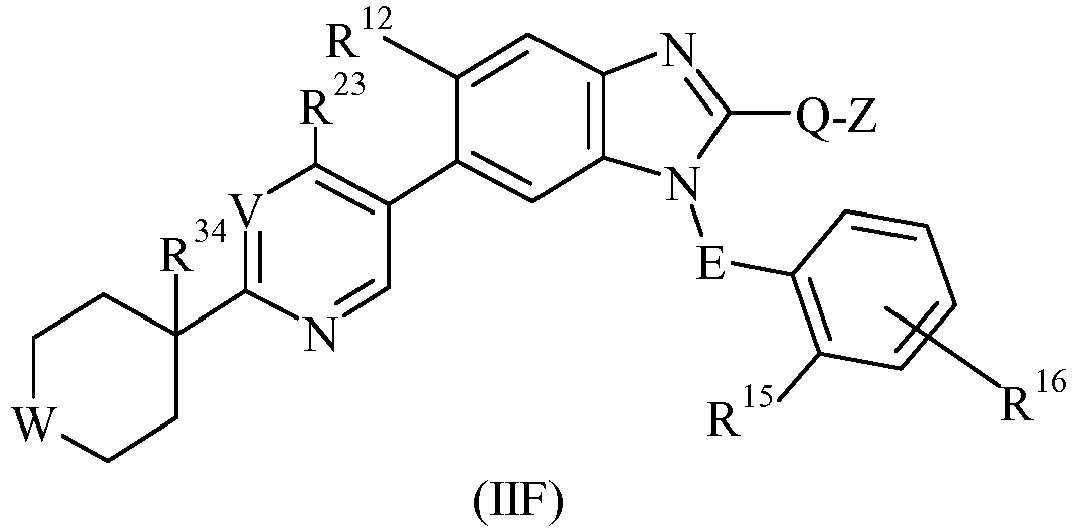
- R34 represents hydrogen, halogen, hydroxy, C1-6 alkoxy, C1-6 alkylsulphonyl, amino or di(C1-6)alkylamino; and
- E, Q, Z, V, W, R12, R15, R16 and R23 are as defined above.
- In a first embodiment, R34 represents hydrogen. In a second embodiment, R34 represents halogen. In one aspect of that embodiment, R34 represents fluoro. In a third embodiment, R34 represents hydroxy. In a fourth embodiment, R34 represents C1-6 alkoxy, especially methoxy. In a fifth embodiment, R34 represents C1-6 alkylsulphonyl, especially methylsulphonyl. In a sixth embodiment, R34 represents amino. In a seventh embodiment, R34 represents di(C1-6)alkylamino, especially dimethylamino.
- Selected values of R34 include hydrogen, fluoro, hydroxy, methoxy, methylsulphonyl, amino and dimethylamino.
- Suitably, R34 represents hydrogen or hydroxy.
- Further sub-groups of the compounds of formula (IIB) above are represented by the compounds of formula (IIG), (IIH), (IIJ), (IIK) and (IIL) and N-oxides thereof, and pharmaceutically acceptable salts and solvates thereof, and glucuronide derivatives thereof, and co-crystals thereof:


- -M- represents -CH2- or -CH2CH2-; and
- E, Q, Z, V, W, R12, R15, R16, R23 and R34 are as defined above.
- In one embodiment, -M- represents -CH2-. In another embodiment, -M- represents -CH2CH2-.
- Specific novel compounds in accordance with the present invention include each of the compounds whose preparation is described in accompanying Examples 25, 27, 28, 33, 37, 38, 54, 56, 57, 59 to 62, 64 to 72, 74, 78, 81, 83, 85 to 98, 100, 102, 104, 106, 109 to 112, 222, 224 to 226, 228 to 236, 238 to 241, 324, 326, 345, 364, 365, 367, 381, 389, 390, 392, 401, 403 to 405, 412, 414, 415, 417, 418, 420, 424, 432, 437 to 439, 443, 445, 447, 449, 450, 452, 455 to 459, 461, 462, 464, 465, 467, 468, 471, 474, 475, 478, 479, 480, 482 to 485, 490 to 498, 500 to 518, 524, 525, 528, 532 to 557, 561 to 565, 567 to 570, 573 to 576, 580, 582, 589, 591, 592, 595, 596, 599 to 601, 603, 608, 610, 612, 620, 622, 623, 627, 630 to 636, 638, 641, 642, 645, 647, 648, 675, 715 to 741, 758, 779, 780, 783 to 787, 789, 790, 795, 797, 799, 801 to 826, 834 to 840, 843, 845 to 847, 849 to 852, 854 to 856, 858 to 867, 883 to 920, 997, 1007 to 1010, 1028, 1029, 1032, 1033, 1035, 1036, 1051, 1052, 1056, 1059 to 1072, 1074, 1083, 1084, 1100 and 1101, and pharmaceutically acceptable salts and solvates thereof, and co-crystals thereof.
- The compounds in accordance with the present invention are beneficial in the treatment and/or prevention of various human ailments. These include autoimmune and inflammatory disorders; neurological and neurodegenerative disorders; pain and nociceptive disorders; cardiovascular disorders; metabolic disorders; ocular disorders; and oncological disorders.
- Inflammatory and autoimmune disorders include systemic autoimmune disorders, autoimmune endocrine disorders and organ-specific autoimmune disorders. Systemic autoimmune disorders include systemic lupus erythematosus (SLE), psoriasis, psoriatic arthropathy, vasculitis, polymyositis, scleroderma, multiple sclerosis, systemic sclerosis, ankylosing spondylitis, rheumatoid arthritis, non-specific inflammatory arthritis, juvenile inflammatory arthritis, juvenile idiopathic arthritis (including oligoarticular and polyarticular forms thereof), anaemia of chronic disease (ACD), Still's disease (juvenile and/or adult onset), Behçet's disease and Sjögren's syndrome. Autoimmune endocrine disorders include thyroiditis. Organ-specific autoimmune disorders include Addison's disease, haemolytic or pernicious anaemia, acute kidney injury (AKI; including cisplatin-induced AKI), diabetic nephropathy (DN), obstructive uropathy (including cisplatin-induced obstructive uropathy), glomerulonephritis (including Goodpasture's syndrome, immune complex-mediated glomerulonephritis and antineutrophil cytoplasmic antibodies (ANCA)-associated glomerulonephritis), lupus nephritis (LN), minimal change disease, Graves' disease, idiopathic thrombocytopenic purpura, inflammatory bowel disease (including Crohn's disease, ulcerative colitis, indeterminate colitis and pouchitis), pemphigus, atopic dermatitis, autoimmune hepatitis, primary biliary cirrhosis, autoimmune pneumonitis, autoimmune carditis, myasthenia gravis, spontaneous infertility, osteoporosis, osteopenia, erosive bone disease, chondritis, cartilage degeneration and/or destruction, fibrosing disorders (including various forms of hepatic and pulmonary fibrosis), asthma, rhinitis, chronic obstructive pulmonary disease (COPD), respiratory distress syndrome, sepsis, fever, muscular dystrophy (including Duchenne muscular dystrophy) and organ transplant rejection (including kidney allograft rejection).
- Neurological and neurodegenerative disorders include Alzheimer's disease, Parkinson's disease, Huntington's disease, ischaemia, stroke, amyotrophic lateral sclerosis, spinal cord injury, head trauma, seizures and epilepsy.
- Cardiovascular disorders include thrombosis, cardiac hypertrophy, hypertension, irregular contractility of the heart (e.g. during heart failure), and sexual disorders (including erectile dysfunction and female sexual dysfunction). Modulators of TNFα function may also be of use in the treatment and/or prevention of myocardial infarction (see J.J. Wu et al., JAMA, 2013, 309, 2043-2044).
- Metabolic disorders include diabetes (including insulin-dependent diabetes mellitus and juvenile diabetes), dyslipidemia and metabolic syndrome.
- Ocular disorders include retinopathy (including diabetic retinopathy, proliferative retinopathy, non-proliferative retinopathy and retinopathy of prematurity), macular oedema (including diabetic macular oedema), age-related macular degeneration (ARMD), vascularisation (including corneal vascularisation and neovascularisation), retinal vein occlusion, and various forms of uveitis and keratitis.
- Oncological disorders, which may be acute or chronic, include proliferative disorders, especially cancer, and cancer-associated complications (including skeletal complications, cachexia and anaemia). Particular categories of cancer include haematological malignancy (including leukaemia and lymphoma) and non-haematological malignancy (including solid tumour cancer, sarcoma, meningioma, glioblastoma multiforme, neuroblastoma, melanoma, gastric carcinoma and renal cell carcinoma). Chronic leukaemia may be myeloid or lymphoid. Varieties of leukaemia include lymphoblastic T cell leukaemia, chronic myelogenous leukaemia (CML), chronic lymphocytic/lymphoid leukaemia (CLL), hairy-cell leukaemia, acute lymphoblastic leukaemia (ALL), acute myelogenous leukaemia (AML), myelodysplastic syndrome, chronic neutrophilic leukaemia, acute lymphoblastic T cell leukaemia, plasmacytoma, immunoblastic large cell leukaemia, mantle cell leukaemia, multiple myeloma, acute megakaryoblastic leukaemia, acute megakaryocytic leukaemia, promyelocytic leukaemia and erythroleukaemia. Varieties of lymphoma include malignant lymphoma, Hodgkin's lymphoma, non-Hodgkin's lymphoma, lymphoblastic T cell lymphoma, Burkitt's lymphoma, follicular lymphoma, MALT1 lymphoma and marginal zone lymphoma. Varieties of non-haematological malignancy include cancer of the prostate, lung, breast, rectum, colon, lymph node, bladder, kidney, pancreas, liver, ovary, uterus, cervix, brain, skin, bone, stomach and muscle. Modulators of TNFα function may also be used to increase the safety of the potent anticancer effect of TNF (see F.V. Hauwermeiren et al., J. Clin. Invest., 2013, 123, 2590-2603).
- The present invention also provides a pharmaceutical composition which comprises a compound in accordance with the invention as described above, or a pharmaceutically acceptable salt or solvate thereof, in association with one or more pharmaceutically acceptable carriers.
- Pharmaceutical compositions according to the invention may take a form suitable for oral, buccal, parenteral, nasal, topical, ophthalmic or rectal administration, or a form suitable for administration by inhalation or insufflation.
- For oral administration, the pharmaceutical compositions may take the form of, for example, tablets, lozenges or capsules prepared by conventional means with pharmaceutically acceptable excipients such as binding agents (e.g. pregelatinised maize starch, polyvinylpyrrolidone or hydroxypropyl methyl cellulose); fillers (e.g. lactose, microcrystalline cellulose or calcium hydrogenphosphate); lubricants (e.g. magnesium stearate, talc or silica); disintegrants (e.g. potato starch or sodium glycollate); or wetting agents (e.g. sodium lauryl sulphate). The tablets may be coated by methods well known in the art. Liquid preparations for oral administration may take the form of, for example, solutions, syrups or suspensions, or they may be presented as a dry product for constitution with water or other suitable vehicle before use. Such liquid preparations may be prepared by conventional means with pharmaceutically acceptable additives such as suspending agents, emulsifying agents, non-aqueous vehicles or preservatives. The preparations may also contain buffer salts, flavouring agents, colouring agents or sweetening agents, as appropriate.
- Preparations for oral administration may be suitably formulated to give controlled release of the active compound.
- For buccal administration, the compositions may take the form of tablets or lozenges formulated in conventional manner.
- The compounds of formula (I) may be formulated for parenteral administration by injection, e.g. by bolus injection or infusion. Formulations for injection may be presented in unit dosage form, e.g. in glass ampoules or multi-dose containers, e.g. glass vials. The compositions for injection may take such forms as suspensions, solutions or emulsions in oily or aqueous vehicles, and may contain formulatory agents such as suspending, stabilising, preserving and/or dispersing agents. Alternatively, the active ingredient may be in powder form for constitution with a suitable vehicle, e.g. sterile pyrogen-free water, before use.
- In addition to the formulations described above, the compounds of formula (I) may also be formulated as a depot preparation. Such long-acting formulations may be administered by implantation or by intramuscular injection.
- For nasal administration or administration by inhalation, the compounds according to the present invention may be conveniently delivered in the form of an aerosol spray presentation for pressurised packs or a nebuliser, with the use of a suitable propellant, e.g. dichlorodifluoromethane, fluorotrichloromethane, dichlorotetrafluoroethane, carbon dioxide or other suitable gas or mixture of gases.
- The compositions may, if desired, be presented in a pack or dispenser device which may contain one or more unit dosage forms containing the active ingredient. The pack or dispensing device may be accompanied by instructions for administration.
- For topical administration the compounds of use in the present invention may be conveniently formulated in a suitable ointment containing the active component suspended or dissolved in one or more pharmaceutically acceptable carriers. Particular carriers include, for example, mineral oil, liquid petroleum, propylene glycol, polyoxyethylene, polyoxypropylene, emulsifying wax and water. Alternatively, the compounds of use in the present invention may be formulated in a suitable lotion containing the active component suspended or dissolved in one or more pharmaceutically acceptable carriers. Particular carriers include, for example, mineral oil, sorbitan monostearate, polysorbate 60, cetyl esters wax, cetearyl alcohol, benzyl alcohol, 2-octyldodecanol and water.
- For ophthalmic administration the compounds of use in the present invention may be conveniently formulated as micronized suspensions in isotonic, pH-adjusted sterile saline, either with or without a preservative such as a bactericidal or fungicidal agent, for example phenylmercuric nitrate, benzylalkonium chloride or chlorhexidine acetate. Alternatively, for ophthalmic administration compounds may be formulated in an ointment such as petrolatum.
- For rectal administration the compounds of use in the present invention may be conveniently formulated as suppositories. These can be prepared by mixing the active component with a suitable non-irritating excipient which is solid at room temperature but liquid at rectal temperature and so will melt in the rectum to release the active component. Such materials include, for example, cocoa butter, beeswax and polyethylene glycols.
- The quantity of a compound of use in the invention required for the prophylaxis or treatment of a particular condition will vary depending on the compound chosen and the condition of the patient to be treated. In general, however, daily dosages may range from around 10 ng/kg to 1000 mg/kg, typically from 100 ng/kg to 100 mg/kg, e.g. around 0.01 mg/kg to 40 mg/kg body weight, for oral or buccal administration, from around 10 ng/kg to 50 mg/kg body weight for parenteral administration, and from around 0.05 mg to around 1000 mg, e.g. from around 0.5 mg to around 1000 mg, for nasal administration or administration by inhalation or insufflation.
- If desired, a compound in accordance with the present invention may be co-administered with another pharmaceutically active agent, e.g. an anti-inflammatory molecule such as methotrexate or prednisolone.
- The compounds of formula (I) including compounds of formula (IIB) above may be prepared by a process which comprises reacting a compound of formula Z-Q-CO2H or a carboxylate salt thereof (e.g. a carboxylate salt with an alkali metal such as lithium, sodium or potassium) with a compound of formula (III):

- The reaction may advantageously be performed in the presence of a peptide coupling reagent such as O-(7-azabenzotriazol-1-yl)-N,N,N',N'-tetramethyluronium hexafluorophosphate (HATU), optionally in the presence of a suitable base, e.g. an organic base such as N,N-diisopropylethylamine. The reaction is conveniently effected at ambient or elevated temperature in a suitable solvent, e.g. N,N-dimethylformamide or a chlorinated solvent such as dichloromethane. The product thereby obtained is suitably treated with an acid, ideally an organic acid such as acetic acid, or a mineral acid such as hydrochloric acid, typically at an elevated temperature.
- Alternatively, the reaction may conveniently be effected in the presence of a coupling reagent such as 1-(3-dimethylaminopropyl)-3-ethylcarbodiimide hydrochloride (EDC), typically at ambient temperature in a suitable solvent, e.g. a chlorinated solvent such as dichloromethane, in the presence of a suitable base, e.g. an organic base such as triethylamine.
- Alternatively, the reaction may conveniently be effected at an elevated temperature in the presence of a mineral acid, e.g. hydrochloric acid.
- Alternatively, the reaction may conveniently be effected at an elevated temperature in the presence of a lower alkanol, e.g. a C1-4 alkanol such as methanol.
- In an alternative procedure, the compounds of formula (I) above wherein E represents a covalent bond or an optionally substituted straight or branched C1-4 alkylene chain may be prepared by a process which comprises reacting a compound of formula L1-E1-Y with a compound of formula (IV):

- The leaving group L1 is typically a halogen atom, e.g. chloro or bromo.
- The reaction is conveniently effected at ambient or elevated temperature in a suitable solvent, e.g. N,N-dimethylformamide or a chlorinated solvent such as dichloromethane. The reaction may be performed in the presence of a suitable base, e.g. an inorganic base such as potassium carbonate, cesium carbonate or sodium hydride.
- The intermediates of formula (IV) above may be prepared by reacting a compound of formula Z-Q-CO2H or a carboxylate salt thereof (e.g. a carboxylate salt with an alkali metal such as lithium, sodium or potassium) with a compound of formula (V):

- The intermediates of formula (III) above may be prepared by reducing a compound of formula (VI):

- The transformation is conveniently effected by catalytic hydrogenation of compound (VI), which typically comprises treating compound (VI) with gaseous hydrogen in the presence of a hydrogenation catalyst such as palladium on carbon.
- Alternatively, the reduction of compound (VI) may be effected by treatment with elemental iron or zinc, typically at an elevated temperature in the presence of ammonium chloride.
- Alternatively, the reduction of compound (VI) may be effected by treatment with tin(II) chloride, typically at an elevated temperature in the presence of a mineral acid such as hydrochloric acid.
- The intermediates of formula (VI) wherein E represents a covalent bond or an optionally substituted straight or branched C1-4 alkylene chain may be prepared by reacting a compound of formula L1-E1-Y with a compound of formula (VII):

- Alternatively, the intermediates of formula (VI) wherein E represents a covalent bond or an optionally substituted straight or branched C1-4 alkylene chain may be prepared by reacting a compound of formula Y-E1-NH2 with a compound of formula (VIII):

- The reaction is conveniently effected at ambient or elevated temperature in a suitable solvent, e.g. 1-methyl-2-pyrrolidinone (NMP), a cyclic ether such as tetrahydrofuran, or a dipolar aprotic solvent such as N,N-dimethylformamide. The reaction may be performed in the presence of a suitable base, e.g. an inorganic base such as potassium carbonate.
- In another procedure, the compounds of formula (I) above, wherein Q corresponds to a group of formula -CH(OH)-Q1-, may be prepared by a process which comprises reacting an aldehyde of formula OHC-Q1-Z with a compound of formula (IX):

- The reaction is conveniently effected in the presence of a strong base, e.g. n-butyllithium or lithium diisopropylamide (LDA). The reaction is carried out in a suitable solvent, e.g. a cyclic ether such as tetrahydrofuran.
- The intermediates of formula (IX) above wherein E represents a covalent bond or an optionally substituted straight or branched C1-4 alkylene chain may be prepared by reacting a compound of formula L1-E1-Y with a compound of formula (X):

- Alternatively, the intermediates of formula (IX) above may be prepared by reacting a compound of formula (III) as defined above with formic acid, ideally at ambient temperature.
- The intermediates of formula (IX) above wherein E represents -N(H)- may be prepared by reacting a compound of formula L2-Y with a compound of formula (XI):

- The leaving group L2 is typically a halogen atom, e.g. bromo.
- A suitable transition metal catalyst for use in the above reaction is tris(dibenzylideneacetone)dipalladium(0), in which case the reaction is conveniently performed in the presence of 2-dicyclohexylphosphino-2',4',6'-triisopropylbiphenyl. The reaction is suitably carried out at an elevated temperature in a suitable solvent, e.g. N,N-dimethylformamide, typically in the presence of a base, e.g. an inorganic base such as cesium carbonate.
- In a further procedure, the compounds of formula (I) above wherein Z represents a 1H[1,2,3]triazol-1-yl moiety, optionally substituted in the 4-position, may be prepared by a process which comprises reacting a compound of formula H-C≡C-Rz with a compound of formula (XII):

- The reaction is conveniently performed in the presence of copper sulfate pentahydrate and sodium ascorbate. Suitably, the reaction is carried out at ambient temperature in a suitable solvent, e.g. a cyclic ether solvent such as tetrahydrofuran, typically in admixture with water.
- The intermediates of formula (XII) above wherein E represents a covalent bond or an optionally substituted straight or branched C1-4 alkylene chain may be prepared by reacting a compound of formula (XIII):
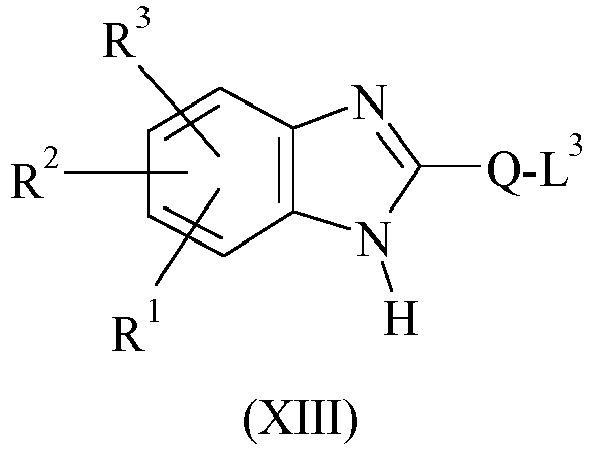
- The leaving group L3 is typically a halogen atom, e.g. chloro.
- The reaction between compound (XIII) and sodium azide is conveniently effected at ambient temperature in a suitable solvent, e.g. N,N-dimethylformamide.
- The compounds of formula (I) above wherein Q represents -S- may be prepared by a process which comprises reacting a compound of formula Z-S-Z with a compound of formula (IX) as defined above.
- The reaction is conveniently effected at ambient temperature in a suitable solvent, e.g. N,N-dimethylformamide. The reaction may be performed in the presence of a suitable base, e.g. an inorganic base such as potassium carbonate.
- In a further procedure, the compounds of formula (I) above may be prepared by a process which comprises cyclising a compound of formula (XIV):

- The cyclication reaction is conveniently effected by heating compound (XIV) in acetic acid.
- The intermediates of formula (XIV) above may be prepared by a process which comprises reacting an aldehyde derivative of formula Y-E2-CHO with a compound of formula (XV):

- The reducing agent for use in the above reaction is suitably sodium triacetoxyborohydride or sodium borohydride.
- In a further procedure, the compounds of formula (I) above wherein -Q-Z represents dimethylamino may be prepared by a process which comprises reacting a compound of formula (III) as defined above with (dichloromethylene)dimethylammonium chloride.
- The reaction is conveniently effected in a suitable solvent, e.g. a chlorinated solvent such as dichloromethane, typically in the presence of a base, e.g. an organic base such as N,N-diisopropylethylamine.
- As will be appreciated, the compounds of formula (IX) above correspond to compounds of formula (I) wherein Q represents a covalent bond and Z is hydrogen.
- Where they are not commercially available, the starting materials of formula (V), (VII), (VIII), (X), (XI), (XIII) and (XV) may be prepared by methods analogous to those described in the accompanying Examples, or by standard methods well known from the art.
- It will be understood that any compound of formula (I) initially obtained from any of the above processes may, where appropriate, subsequently be elaborated into a further compound of formula (I) by techniques known from the art. By way of example, a compound of formula (I) which contains a hydroxy group may be alkylated by treatment with the appropriate alkyl halide in the presence of a base, e.g. sodium hydride or cesium carbonate, or silver oxide. A compound of formula (I) wherein -Q-Z represents -CH2OH may be arylated in a two-step procedure which comprises: (i) treatment with thionyl chloride; and (ii) treatment of the chloro derivative thereby obtained with the appropriate aryl or heteroaryl hydroxide. A compound of formula (I) wherein -Q-Z represents -CH2OH may be converted into the corresponding compound of formula (I) wherein Q represents -CH2S- via a two-step procedure which comprises: (i) treatment with thionyl chloride; and (ii) treatment of the chloro derivative thereby obtained with a compound of formula Z-SH, typically in the presence of a base, e.g. an inorganic base such as potassium carbonate. A compound of formula (I) which contains hydroxy may be converted into the corresponding fluoro-substituted compound by treatment with diethylaminosulfur trifluoride (DAST). A compound of formula (I) which contains hydroxy may be converted into the corresponding difluoro-substituted compound via a two-step procedure which comprises: (i) treatment with an oxidising agent, e.g. manganese dioxide; and (ii) treatment of the carbonyl-containing compound thereby obtained with DAST.
- A compound of formula (I) wherein -Q-Z represents -CH2OH may be converted into the corresponding compound wherein -Q-Z represents -CH(OH)Z in a two-step procedure which comprises: (i) oxidation with a suitable oxidising agent, e.g. Dess-Martin periodinane or manganese(IV) oxide; and (ii) treatment of the aldehyde derivative thereby obtained with a Grignard reagent, e.g. a compound of formula Z-MgBr or Z-MgCl.
- A compound of formula (I) wherein -Q-Z represents -CH2OH may be converted into the corresponding compound wherein -Q-Z represents -CH(OH)CF3 in a two-step procedure which comprises: (i) oxidation with a suitable oxidising agent, e.g. Dess-Martin periodinane or manganese(IV) oxide; and (ii) treatment of the aldehyde derivative thereby obtained with (trifluoromethyl)trimethylsilane and cesium fluoride.
- A compound of formula (I) which contains an N-H moiety may be alkylated by treatment with the appropriate alkyl halide, typically at an elevated temperature in an organic solvent such as acetonitrile, optionally in the presence of a base, e.g. an inorganic base such as sodium hydride. Alternatively, a compound of formula (I) which contains an N-H moiety may be alkylated by treatment with the appropriate alkyl tosylate, optionally in the presence of a base, e.g. an inorganic base such as sodium hydride, or an organic base such as 1,8-diazabicyclo[5.4.0]undec-7-ene (DBU).
- A compound of formula (I) which contains an N-H moiety may be converted into the corresponding compound wherein the nitrogen atom is substituted by C1-6 alkylsulphonyl, e.g. methylsulphonyl, by treatment with the appropriate C1-6 alkylsulphonyl halide, e.g. a C1-6 alkylsulphonyl chloride such as methanesulphonyl chloride, typically at ambient temperature in the presence of a base, e.g. an organic base such as triethylamine.
- A compound of formula (I) which contains an -OH moiety may be converted into the corresponding compound containing an -OSO2Ra moiety by treatment with the appropriate sulphonyl halide, e.g. a sulphonyl chloride of formula RaSO2Cl, typically in the presence of a base, e.g. an organic base such as triethylamine.
- A compound of formula (I) containing the moiety -S- may be converted into the corresponding compound containing the moiety -S(O)- by treatment with 3-chloroperoxybenzoic acid. Likewise, a compound of formula (I) containing the moiety -S(O)- may be converted into the corresponding compound containing the moiety -S(O)2- by treatment with 3-chloroperoxybenzoic acid.
- A compound of formula (I) containing an aromatic nitrogen atom may be converted into the corresponding N-oxide derivative by treatment with 3-chloroperoxybenzoic acid.
- A bromophenyl derivative of formula (I) may be converted into the corresponding optionally substituted 2-oxopyrrolidin-1-ylphenyl or 2-oxooxazolidin-3-ylphenyl derivative by treatment with pyrrolidin-2-one or oxazolidin-2-one, or an appropriately substituted analogue thereof. The reaction is conveniently effected at an elevated temperature in the presence of copper(I) iodide, trans-N,N'-dimethylcyclohexane-1,2-diamine and an inorganic base such as potassium carbonate.
- A compound of formula (I) wherein R1 represents halogen, e.g. bromo, may be converted into the corresponding compound wherein R1 represents an optionally substituted aryl or heteroaryl moiety by treatment with the appropriately substituted aryl or heteroaryl boronic acid or a cyclic ester thereof formed with an organic diol, e.g. pinacol, 1,3-propanediol or neopentyl glycol. The reaction is typically effected in the presence of a transition metal catalyst, e.g. [1,1'-bis(diphenylphosphino)ferrocene]dichloropalladium(II) or tetrakis(triphenylphosphine)palladium(0), and a base, e.g. an inorganic base such as sodium carbonate or potassium carbonate.
- A compound of formula (I) wherein R1 represents halogen, e.g. bromo, may be converted into the corresponding compound wherein R1 represents an optionally substituted aryl or heteroaryl moiety via a two-step procedure which comprises: (i) reaction with bis(pinacolato)diboron; and (ii) reaction of the compound thereby obtained with an appropriately substituted bromoaryl or bromoheteroaryl derivative. Step (i) is conveniently effected in the presence of a transition metal catalyst such as [1,1'-bis-(diphenylphosphino)ferrocene]dichloropalladium(II). Step (ii) is conveniently effected in the presence of a transition metal catalyst such as tetrakis(triphenylphosphine)-palladium(0) and a base, e.g. an inorganic base such as sodium carbonate.
- A compound of formula (I) wherein R1 represents halogen, e.g. bromo, may be converted into the corresponding compound wherein R1 represents an optionally substituted imidazol-1-yl moiety by treatment with the appropriately substituted imidazole derivative, typically in the presence of copper(II) acetate and an organic base such as N,N,N',N'-tetramethylethylenediamine (TMEDA).
- A compound of formula (I) wherein R1 represents halogen, e.g. bromo, may be converted into the corresponding compound wherein R1 represents 2-(methoxycarbonyl)-ethyl via a two-step procedure which comprises: (i) reaction with methyl acrylate; and (ii) catalytic hydrogenation of the alkenyl derivative thereby obtained, typically by treatment with a hydrogenation catalyst, e.g. palladium on charcoal, under an atmosphere of hydrogen gas. Step (i) is typically effected in the presence of a transition metal catalyst, e.g. palladium(II) acetate, and a reagent such as tri(ortho-tolyl)phosphine.
- A compound of formula (I) wherein R1 represents 6-methoxypyridin-3-yl may be converted into the corresponding compound wherein R1 represents 2-oxo-1,2-dihydro-pyridin-5-yl by treatment with pyridine hydrochloride.
- A compound of formula (I) wherein R1 represents 2-oxo-1,2-dihydropyridin-5-yl may be converted into the corresponding compound wherein R1 represents 2-oxopiperidin-5-yl by catalytic hydrogenation, typically by treatment with gaseous hydrogen in the presence of a hydrogenation catalyst such as platinum(IV) oxide.
- A compound of formula (I) containing an ester moiety, e.g. a C2-6 alkoxycarbonyl group such as methoxycarbonyl or ethoxycarbonyl, may be converted into the corresponding compound containing a carboxy (-CO2H) moiety by treatment with an acid, e.g. a mineral acid such as hydrochloric acid. Alternatively, the transformation may be effected by treatment with a base, typically an inorganic base such as an alkali metal hydroxide, e.g. sodium hydroxide or lithium hydroxide; or an organic base such as sodium methoxide.
- A compound of formula (I) containing an N-(tert-butoxycarbonyl) moiety may be converted into the corresponding compound containing an N-H moiety by treatment with an acid, e.g. a mineral acid such as hydrochloric acid, or an organic acid such as trifluoroacetic acid.
- A compound of formula (I) wherein R1 represents a substituent containing at least one nitrogen atom, which substituent is linked to the remainder of the molecule via a nitrogen atom, may be prepared by reacting a compound of formula (I) wherein R1 represents halogen, e.g. bromo, with the appropriate compound of formula R1-H [e.g. 1-(pyridin-3-yl)piperazine]. The reaction is conveniently effected with the assistance of a transition metal catalyst, e.g. tris(dibenzylideneacetone)dipalladium(0), in the presence of an amination ligand such as 2-dicyclohexylphosphino-2',4',6'-triisopropylbiphenyl (XPhos) and a base, e.g. an inorganic base such as sodium tert-butoxide.
- A compound of formula (IIA) wherein R11 represents halogen, e.g. bromo, may be converted into the corresponding compound of formula (IIB) wherein V is N and R23 represents methyl via a four-step procedure which comprises: (i) reaction with isopropenyl acetate; (ii) treatment with potassium fluoride; (iii) treatment of the 2-oxopropyl derivative thereby obtained with N,N-dimethylformamide dimethyl acetal, ideally at an elevated temperature; and (iv) reaction of the material thereby obtained with the appropriate amidine derivative of formula R21-C(NH)NH2. Step (i) is conveniently accomplished with the assistance of a transition metal catalyst, e.g. palladium(II) acetate, typically in the presence of tri-n-butyltin methoxide and a reagent such as tri(ortho-tolyl)phosphine. Step (iv) is typically effected at an elevated temperature in a suitable solvent, e.g. a C1-4 alkanol such as methanol or ethanol, in the presence of a base, e.g. an alkali metal alkoxide such as sodium ethoxide or potassium tert-butoxide, or an alkali metal carbonate such as potassium carbonate.
- A compound of formula (IIB) wherein R21 represents ethenyl may be prepared by reacting a compound of formula (IIB) wherein R21 represents halogen, e.g. chloro, with potassium vinyl trifluoroborate. The reaction is typically effected in the presence of a transition metal catalyst, e.g. [1,1'-bis(diphenylphosphino)ferrocene]dichloropalladium(II), and a base, e.g. an organic base such as triethylamine.
- A compound of formula (IIB) wherein R21 represents a substituent containing at least one nitrogen atom, which substituent is linked to the remainder of the molecule via a nitrogen atom, may be prepared by reacting a compound of formula (IIB) wherein R21 represents halogen, e.g. chloro, with the appropriate compound of formula R21-H [e.g. 2-methoxyethylamine, pyrrolidin-3-ol, 1-(methylsulfonyl)piperazine, piperazin-2-one, thiomorpholine, 1,4-diazepan-5-one or an appropriately substituted azaspiroalkane] in the presence of a base, e.g. an organic base such as triethylamine.
- A compound of formula (I) containing a halogen atom, e.g. chloro, may be converted into the corresponding compound containing a -N-C(O)- or -N-S(O)2- moiety by treatment with the appropriate amide or sulphonamide derivative containing a -NH-C(O)- or -NH-S(O)2- functionality at an elevated temperature in the presence of a transition metal salt, e.g. palladium(II) acetate, 2,2'-bis(diphenylphosphino)-1,1'-binaphthalene (BINAP), and a base, typically an inorganic base, e.g. a carbonate salt such as cesium carbonate.
- A compound of formula (I) containing a carboxy (-CO2H) moiety may be converted into the corresponding compound containing a -CONRbRc moiety by treatment with the appropriate amine of formula H-NRbRc in the presence of O-(7-azabenzotriazol-1-yl)-N,N,N',N'-tetramethyluronium hexafluorophosphate (HATU), and a base, typically an organic base such as N,N-diisopropylethylamine.
- Where a mixture of products is obtained from any of the processes described above for the preparation of compounds according to the invention, the desired product can be separated therefrom at an appropriate stage by conventional methods such as preparative HPLC; or column chromatography utilising, for example, silica and/or alumina in conjunction with an appropriate solvent system.
- Where the above-described processes for the preparation of the compounds according to the invention give rise to mixtures of stereoisomers, these isomers may be separated by conventional techniques. In particular, where it is desired to obtain a particular enantiomer of a compound of formula (I) this may be produced from a corresponding mixture of enantiomers using any suitable conventional procedure for resolving enantiomers. Thus, for example, diastereomeric derivatives, e.g. salts, may be produced by reaction of a mixture of enantiomers of formula (I), e.g. a racemate, and an appropriate chiral compound, e.g. a chiral base. The diastereomers may then be separated by any convenient means, for example by crystallisation, and the desired enantiomer recovered, e.g. by treatment with an acid in the instance where the diastereomer is a salt. In another resolution process a racemate of formula (I) may be separated using chiral HPLC. Moreover, if desired, a particular enantiomer may be obtained by using an appropriate chiral intermediate in one of the processes described above. Alternatively, a particular enantiomer may be obtained by performing an enantiomer-specific enzymatic biotransformation, e.g. an ester hydrolysis using an esterase, and then purifying only the enantiomerically pure hydrolysed acid from the unreacted ester antipode. Chromatography, recrystallisation and other conventional separation procedures may also be used with intermediates or final products where it is desired to obtain a particular geometric isomer of the invention.
- During any of the above synthetic sequences it may be necessary and/or desirable to protect sensitive or reactive groups on any of the molecules concerned. This may be achieved by means of conventional protecting groups, such as those described in Projective Groups in Organic Chemistry, ed. J.F.W. McOmie, Plenum Press, 1973; and T.W. Greene & P.G.M. Wuts, Projective Groups in Organic Synthesis, John Wiley & Sons, 3rd edition, 1999. The protecting groups may be removed at any convenient subsequent stage utilising methods known from the art.
- The following Examples illustrate the preparation of compounds according to the invention.
- The compounds in accordance with this invention potently inhibit TNFα-induced NF-κB activation in the following assay.
- Stimulation of HEK-293 cells by TNFα leads to activation of the NF-κB pathway. The reporter cell line used to determine TNFα activity was purchased from InvivoGen. HEK-Blue™ CD40L is a stable transfectant expressing SEAP (secreted alkaline phosphatase) under the control of the IFNβ minimal promoter fused to five NF-κB binding sites. Secretion of SEAP by these cells is stimulated in a dose-dependent manner by TNFα (0.5 ng/mL). Compounds were diluted from 10 mM DMSO stocks (final assay concentration 0.3%) to generate a 10-point 3-fold serial dilution curve (30,000 nM to 2 nM final concentration). They were mixed with cells and stimulating ligand in a 384-well microtitre plate and incubated for 18 h. SEAP activity was determined in the supernatant using the colorimetric substrate QUANTI-Blue™ (InvivoGen). Percentage inhibitions for compound dilutions were calculated between a DMSO control and maximum inhibition (by excess control compound) and an IC50 calculated using XLfit™ (4 parameter logistic model) in ActivityBase.
- When tested in the above assay, the compounds of the accompanying Examples and Reference Examples were all found to exhibit IC50 values of 50 µM or better.
-
Abbreviations DCM: dichloromethane EtOAc: ethyl acetate DMF: N,N-dimethylformamide MeOH: methanol DMSO: dimethylsulfoxide EtOH: ethanol Et2O: diethyl ether MeCN: acetonitrile THF: tetrahydrofuran DIPEA: N,N-diisopropylethylamine DAST: diethylaminosulfur trifluoride LDA: lithium diisopropylamide mCPBA: 3-chloroperoxybenzoic acid Pd(OAc)2: palladium(II) acetate NMP: 1-methyl-2-pyrrolidinone DBU: 1,8-diazabicyclo[5.4.0]undec-7-ene TFA: trifluoroacetic acid DME: 1,2-dimethoxyethane pTSA: p-toluenesulfonic acid TBAF: tetra-n-butylammonium fluoride SiO2: silica h: hour r.t.: room temperature RT: retention time br: broad M: mass HPLC: High Performance Liquid Chromatography LCMS: Liquid Chromatography Mass Spectrometry ES+: Electrospray Positive Ionisation brine: aqueous sodium chloride solution EDC: 1-(3-dimethylaminopropyl)-3-ethylcarbodiimide hydrochloride HATU: O-(7-azabenzotriazol-1-yl)-N,N,N',N'-tetramethyluronium hexafluorophosphate TMEDA: N,N,N',N'-tetramethylethylenediamine Pd(PPh3)4: tetrakis(triphenylphosphine)palladium(0) Pd(PPh3)2Cl2: bis(triphenylphosphine)dichloropalladium(II) PdCl2(dppf): [1,1'-bis(diphenylphosphino)ferrocene]dichloropalladium(II) Pd2(dba)3: tris(dibenzylideneacetone)dipalladium(0) XPhos: 2-dicyclohexylphosphino-2',4',6'-triisopropylbiphenyl BINAP: 2,2'-bis(diphenylphosphino)-1,1'-binaphthalene - Compounds were named with the aid of ACD/Name Batch (Network) version 11.01 and/or Accelrys Draw 4.0.
- All NMRs were obtained either at 300 MHz or at 400 MHz.
- All reactions involving air- or moisture-sensitive reagents were performed under a nitrogen atmosphere using dried solvents and glassware.
- Except where otherwise stated, analytical LCMS data were obtained by using Method 1 or 2 below.
- Preparative HPLC for all compounds of Intermediates 1-31 and Examples/Reference Examples 1-55 that required it was performed using Method 3 below. Preparative HPLC for all library compounds was performed using Method 4 below.
- Preparative LCMS for compounds synthesized in accordance with Method J was performed using Method 5 below.
- Analytical LCMS data for Examples/Reference Examples 56-403, 410-443, 446-488, 500-507, 512, 519-523 and 525-528 were obtained using Method 6 below. Analytical LCMS data for Examples/Reference Examples 404-409, 444, 445, 489-499, 508-511, 513-518 and 524 were obtained using Method 7 below.
- All quoted LCMS RT and QC RT values are in minutes.
Method 1: Waters X-Bridge, C18, 2.1 x 20 mm, 2.5 µm column.
Mobile phase A: 10 mM ammonium formate in water + 0.1% formic acid
Mobile phase B: acetonitrile + 5% mobile phase A + 0.1% formic acid
Gradient program (flow rate 1.0 mL/min, column temperature 40°C):Time A% B% 0.00 95.0 5.0 4.00 5.0 95.0 5.00 5.0 95.0 5.10 95.0 5.0
Method 2: Waters XBridge, C18, 2.1 x 20 mm, 2.5 µm column.
Mobile phase A: 10 mM ammonium formate in water + 0.1% ammonia solution
Mobile phase B: acetonitrile + 5% solvent A2 + 0.1% ammonia solution
Gradient program (flow rate 1.0 mL/min, column temperature 40°C):Time A% B% 0.00 95.0 5.0 4.00 5.0 95.0 5.00 5.0 95.0 5.10 95.0 5.0
Method 3: Luna C18, 21.2 mm, 5 mm column, pH 2.5. - Mobile phase A: 99.92% water and 0.08% formic acid.
- Mobile phase B: 99.92% acetonitrile and 0.08% formic acid.
- Gradient program (flow rate 25 mL/min, column temperature ambient): variable gradient.
- Column: Waters X-Select C-18, 150 x 19 mm, 5 µm ODB in combination with Waters X-Select guard C-18, 10 x 19 mm, 5 µm
- Eluent A: 99% acetonitrile + 1% 10 mM ammonium bicarbonate (pH 9.5) in MilliQ water
- Eluent B: 10 mM ammonium bicarbonate (pH 9.5) in MilliQ water
- Flow: 25 mL/min
- Collection: Mass and UV
- Gradient: 0 min 70% B, 3.0 min 70% B, 10.0 min 30% B, 10.01 min 0% B, 17.5 min 0% B, 17.51 min 70% B, 19.5 min 70% B
- Column: X-Select (50 x 2.1 mm, 3.5 µm)
- Flow: 0.8 mL/min
- Column temp: 25°C
- Eluent A: 95% acetonitrile + 5% 10 mM ammonium bicarbonate
- Eluent B: 10 mM ammonium bicarbonate in water
- Lin. Gradient: 0 min 5% A, 3.5 min 98% A, 6 min 98% A
- Detection: DAD (220-320 nm)
- Detection: MSD (ESI pos/neg) mass range 100-800
- To a mixture of benzene-1,2-diamine (5.0 g, 46.3 mmol) and glycolic acid (10.5 g, 138.0 mmol) was added 4N HCl (30 mL). The reaction mixture was heated under reflux at 95°C for 2 h, then cooled to 0°C and neutralized with saturated aqueous NaOH. The precipitated solid was isolated by filtration and dried in vacuo to afford the title compound (5 g, 73%) as an off-white solid. δH (d6-DMSO) 12.20 (br s, 1H), 7.49-7.47 (dd, J 5.8, 3.2 Hz, 2H), 7.13-7.11 (dd, J 5.8, 3.2 Hz, 2H), 4.68 (s, 2H). LCMS (ES+) 149 (M+H)+.
- Cesium carbonate (22.0 g, 100.0 mmol) and n-butylammonium iodide (12.5 g, 34.0 mmol) were added to a solution of benzimidazole (4.0 g, 34.0 mmol) in DMF (60 mL) at 0°C. The reaction mixture was stirred for 10 minutes at 0°C and then 2,5-dimethylbenzyl bromide (6.7 g, 34.0 mmol) was added. The reaction mixture was allowed to warm to r.t. and stirred for 3 h. The mixture was quenched with ice-cold water (50 mL) and extracted with ethyl acetate (3 x 40 mL). The organic layers were dried over anhydrous sodium sulphate and the solvent was removed in vacuo to afford the title compound (8.0 g, 75%) as an off-white solid. δH (d6-DMSO) 8.23 (s, 1H), 7.68-7.66 (m, 1H), 7.43-7.41 (m, 1H), 7.21-7.19 (m, 2H), 7.10 (d, J 7.6 Hz, 1H), 7.01 (d, J 7.6 Hz, 1H), 6.67 (s, 1H), 5.45 (s, 2H), 2.25 (s, 3H), 2.14 (s, 3H). LCMS (ES+) 237 (M+H)+.
- Sodium azide (0.22 g, 3.30 mmol) was added to a solution of 2-(chloromethyl)-1H-benzimidazole (0.50 g, 3.00 mmol) in DMF (3 mL) and stirred at r.t. for 3 h. 2,5-Dimethylbenzyl bromide (0.72 g, 3.60 mmol) was added to the reaction mixture, followed by potassium carbonate (1.04 g, 7.50 mmol), and the reaction mixture was stirred at r.t. for 18 h. Water (10 mL) was added and the mixture was poured into ethyl acetate/water. The organic layer was separated, dried (MSO4) and concentrated in vacuo to afford the title compound (824 mg, 94%) as a yellow solid. δH (d6-DMSO) 7.73 (m, 1H), 7.37 (m, 1H), 7.24 (m, 2H), 7.13 (d, J 7.6 Hz, 1H), 6.98 (m, 1H), 6.15 (s, 1H), 5.50 (s, 2H), 4.70 (s, 2H), 2.32 (s, 3H), 2.06 (s, 3H). LCMS (ES+) 292 (M+H)+.
- Benzene-1,2-diamine (0.67 g, 6.18 mmol) and pyridin-4-ylacetic acid hydrochloride (1.61 g, 9.25 mmol) were stirred at 110°C in 5M HCl (5 mL) for 18 h. The reaction mixture was neutralised with saturated aqueous sodium carbonate solution and partitioned with ethyl acetate. The organic layer was separated, dried (MSO4) and concentrated in vacuo to give a brown oil. The oil was redissolved in the minimum quantity of hot ethyl acetate and the solution left to cool to provide the desired product as pale crystals. The precipitate was filtered off and dried in vacuo to afford the title compound (285 mg, 22%) as pale yellow crystals. δH (d6-DMSO) 12.34 (s, 1H), 8.51 (m, 2H), 7.48 (m, 2H), 7.34 (d, J 5.8 Hz, 2H), 7.15 (dd, J 6.0, 2.5 Hz, 2H), 4.22 (s, 2H). LCMS (ES+) 210 (M+H)+.
- Sodium hydride (60% dispersion in mineral oil, 7.81 g, 195.0 mmol) was added to a stirred solution of 2-nitroaniline (30.0 g, 217.0 mmol) in DMF (20 mL) at 0°C. After 10 minutes, 2,5-dimethylbenzyl bromide (43.28 g, 217.0 mmol) was added and the reaction mixture was stirred at r.t. for 18 h, quenched with water and extracted with ethyl acetate (3 x 50 mL). The organic layer was separated, dried (MSO4) and concentrated in vacuo and the residue was purified by column chromatography (SiO2, 5% EtOAc/hexane), yielding the title compound (30.0 g, 54%) as a yellow solid. δH (d6-DMSO) 8.40 (t, J5.2 Hz, 1H), 8.09 (dd, J 8.4, 1.2 Hz, 1H), 7.48 (t, J 7.6 Hz, 1H), 7.09 (d, J 8.4 Hz, 1H), 7.03 (s, 1H), 6.99 (d, J 7.6 Hz, 1H), 6.89 (d, J 8.4 Hz, 1H), 6.69 (td, J 7.6, 1.2 Hz, 1H), 4.53 (d, J 5.6 Hz, 2H), 2.28 (s, 3H), 2.20 (s, 3H).
- Pd-C (20% w/w, 0.176 g) was added to a stirred solution of Intermediate 5 (8.8 g, 34.0 mmol) in ethyl acetate (100 mL) and the mixture was stirred at r.t. for 18 h under an atmosphere of H2. The reaction mixture was filtered through a celite pad and concentrated in vacuo to give a residue which was purified by column chromatography (SiO2, 15% EtOAc/hexane), yielding the title compound (10.8 g, 90%) as a brown solid. δH (d6-DMSO) 7.10 (s, 1H), 7.05 (d, J 7.6 Hz, 1H), 6.95 (d, J 7.6 Hz, 1H), 6.55 (dd, J 7.2, 1.6 Hz, 1H), 6.46-6.3 (m, 2H), 6.32 (dd, J 7.2, 1.6 Hz, 1H), 4.77 (d, J 5.2 Hz, 1H), 4.56 (s, 2H), 4.16 (d, J5.6 Hz, 1H), 2.28 (s, 3H), 2.21 (s, 3H). LCMS (ES+) 357 (M+H)+.
- To Intermediate 6 (0.25 g, 1.11 mol), dissolved in 5M HCl (5 mL), was added sodium lactate (1.24 g, 11.1 mmol) and the reaction mixture was heated at 110°C for 4.5 h. The reaction mixture was neutralised with saturated aqueous sodium carbonate solution (10 mL) and partitioned with ethyl acetate (20 mL). The organic layer was separated, dried (MSO4) and concentrated in vacuo. The residue was purified by column chromatography (SiO2, 1:1 EtOAc/hexane), yielding the title compound (0.17 g, 55%) as a brown solid. δH (d6-DMSO) 7.66 (d, J 7.1 Hz, 1H), 7.24 (m, 1H), 7.15 (m, 3H), 6.95 (d, J 7.6 Hz, 1H), 6.15 (s, 1H), 5.60 (d, J 6.3 Hz, 1H), 5.55 (s, 2H), 4.91 (quint, J 6.5 Hz, 1H), 2.35 (s, 3H), 2.03 (s, 3H), 1.53 (d, J 6.5 Hz, 3H). LCMS (ES+) 281 (M+H)+.
- Triethylamine (20 mL, 141.0 mmol) was added to stirred solution of 1-fluoro-2-nitrobenzene (10.0 g, 70 mmol) and α-methylbenzylamine (17.1 g, 141.0 mmol) in ethanol (50 mL) at 0°C. The reaction mixture was heated to 80°C for 6 h and concentrated in vacuo, and the residue was extracted with ethyl acetate (3 x 50 mL). The organic layer was washed with saturated brine (2 x 20 mL), extracted, dried (MSO4) and concentrated in vacuo to give the title compound (12.0 g, 70%) as a yellow solid. δH (CDCl3) 8.42 (br s, 1H), 8.17 (dd, J 8.4, 0.8 Hz, 1H), 7.34-7.23 (m, 6H), 6.64-6.58 (m, 2H), 4.72-4.65 (m, 1H), 1.64 (d, J 6.8 Hz, 3H).
- Zinc (61.56 g, 941.0 mmol) and ammonium formate (49.2 g, 780.0 mol) were added to a stirred solution of Intermediate 8 (38.0 g, 156.0 mmol) in methanol (300 mL) at 0°C. The reaction mixture was warmed to r.t and stirred for 5 h. The reaction mixture was filtered through a celite pad and concentrated in vacuo to give a residue which was purified by column chromatography (SiO2, 10% EtOAc/hexane), yielding the title compound (25 g, 75%) as a brown solid. δH (d6-DMSO) 7.35 (d, J 8.4 Hz, 1H), 7.27 (t, J 7.6 Hz, 2H), 7.16 (t, J 7.6 Hz, 2H), 6.50 (d, J 7.2 Hz, 1H), 6.33-6.26 (m, 2H), 6.15 (d, J 8.4 Hz, 1H), 4.83 (d, J 6.4 Hz, 1H), 4.63 (s, 2H), 4.46 (t, J 6.8 Hz, 1H), 1.44 (d, J 7.2 Hz, 3H). LCMS (ES+) 213 (M+H)+.
- A mixture of Intermediate 9 (20.0 g, 94.0 mmol) and glycolic acid (21.5 g, 282.0 mol) in methanol (20 mL) was heated to 80°C for 18 h. The reaction mixture was concentrated in vacuo and the residue triturated with diethyl ether to afford the title compound (15.0 g, 63%) as an off-white solid. δH (d6-DMSO) 7.58 (d, J 7.6 Hz, 1H), 7.36-7.28 (m, 4H), 7.11-6.97 (m, 4H), 6.14-6.08 (m, 1H), 5.76 (t, J 5.6 Hz, 1H), 4.82 (d, J 5.6 Hz, 2H), 1.93 (d, J 6.8 Hz, 3H). LCMS (ES+) 253 (M+H)+.
- Sodium hydride (4.40 g, 110.0 mmol) was added to a solution of benzimidazole (11.8 g, 100.0 mmol) in DMF (20 mL) at 0°C. The reaction mixture was stirred for 10 minutes at 0°C, then α-methylbenzyl bromide (100.0 mmol, 18.5 g) was added and the reaction mixture was allowed to warm to r.t. and heated to 60°C for 1 h. The reaction mixture was quenched with saturated aqueous sodium bicarbonate solution (50 mL) and extracted with ethyl acetate (3 x 40 mL). The organic layers were dried over anhydrous sodium sulphate and concentrated in vacuo. The residue was purified by column chromatography (SiO2, 20-100% EtOAc/isohexane), yielding the title compound (0.85 g, 7%) as a white solid. δH (d6-DMSO) 8.54 (s, 1H), 7.67-7.63 (m, 1H), 7.43-7.40 (m, 1H), 7.33-7.25 (m, 5H), 7.17-7.12 (m, 2H), 5.48 (q, J 7.1 Hz, 1H), 1.96 (d, J 7.1 Hz, 3H).
- Triethylamine (37.9 mL, 272.0 mmol) was added to a stirred solution of 4-bromo-2-fluoro-1-nitrobenzene (30.0 g, 136.0 mmol) and α-methylbenzylamine (32.9 g, 272.0 mmol) in ethanol (200 mL) at 0°C. The reaction mixture was heated to 80°C for 6 h, then cooled and concentrated in vacuo. The residue was dissolved in EtOAc (90 mL) and washed with saturated brine (2 x 30 mL). The combined organics were extracted and dried over anhydrous sodium sulfate and concentrated in vacuo to give a yellow solid. The residue was triturated with isohexane, yielding the title compound (32.0 g, 74%) as a yellow solid. δH (CDCl3) 8.43 (br s, 1H), 8.01 (d, J 8.0 Hz, 1H), 7.48-7.26 (m, 5H), 6.83 (s, 1H), 6.70 (d, J 8.8 Hz, 1H), 4.68-4.61 (m, 1H), 1.64 (d, J 6.8 Hz, 3H).
- Zinc (13.4 g, 205.0 mmol) and ammonium formate (10.79 g, 171.0 mmol) were added to a stirred solution of Intermediate 12 (11.0 g, 34.2 mol) in MeOH (150 mL) at 0°C. The reaction mixture was stirred at r.t. for 5 h. The reaction mixture was filtered through a celite pad and concentrated in vacuo to give a residue which was purified by column chromatography (SiO2, 10% EtOAc/isohexane), yielding the title compound (9.0 g, 90%) as a yellow solid. δH (d6-DMSO) 7.35-7.16 (m, 5H), 6.42 (s, 2H), 6.20 (s, 1H), 5.13 (d, J 6.4 Hz, 1H), 4.86 (br s, 2H), 4.46-4.43 (m, 1H), 1.43 (d, J 6.4 Hz, 3H). LCMS (ES+) 291 (M+H)+.
- The title compound was prepared from Intermediate 13 and glycolic acid in accordance with Method A. δH(d6-DMSO) 7.69 (m, 1H), 7.53 (dd, J 8.6,1.7 Hz, 1H), 7.41 (m, 6H), 6.18 (q, J 7.1 Hz, 1H), 4.96 (m, 2H), 1.97 (d, J 7.1 Hz, 3H). LCMS (ES+) 333 (M+H)+.
- 2-Fluoro-4-bromo-1-nitrobenzene (0.5 g, 2.2 mmol) was added to methanolic ammonia (10 mL) and stirred at r.t. for 18 h. The reaction mixture was then concentrated in vacuo and the residue was triturated with isohexane, yielding the title compound (0.48 g, 97%) as a yellow solid. δH (d6-DMSO) 7.88 (d, J 8.8 Hz, 1H), 7.53 (br s, 2H), 7.25 (d, J 3.0 Hz, 1H), 6.75 (dd, J 9.2, 2.0 Hz, 1H).
- Sodium hydride (60% dispersion in oil, 0.82 g, 20.7 mmol) was added to a stirred solution of Intermediate 15 (5.0 g, 23.0 mmol) in DMF (50 mL) at 0°C. 2,5-Dimethylbenzyl bromide (4.56 g, 23.0 mmol) was added and the reaction mixture was warmed to r.t. and stirred for 5 h. The reaction mixture was quenched with saturated aqueous ammonium chloride solution, extracted with ethyl acetate (3 x 50 mL), washed with water (2 x 30 mL), dried over anhydrous sodium sulfate and concentrated in vacuo. The residue was purified by column chromatography (SiO2, 5% EtOAc/isohexane), yielding the title compound (4.89 g, 63%) as a yellow solid. δH (d6-DMSO) 8.42 (br s, 1H), 8.01 (d, J 8.8 Hz, 1H), 7.12-6.86 (m, 4H), 6.85 (d, J 7.2, 1.6 Hz, 1H), 4.54 (d, J 5.6 Hz, 2H), 2.28 (s, 3H), 2.21 (s, 3H).
- SnCl2 (20.2 g, 89.4 mmol) was added to a stirred solution of Intermediate 16 (10.0 g, 29.8 mmol) in EtOH (200 mL) and the reaction mixture was heated to 80°C for 5 h. The reaction mixture was then concentrated in vacuo and the residue neutralized with saturated aqueous sodium bicarbonate solution and extracted with DCM (3 x 100 mL). The combined organics were washed with water (2 x 50 mL), extracted, dried over anhydrous sodium sulfate and concentrated in vacuo. The residue was purified by column chromatography (SiO2, 5% MeOH/DCM), yielding the title compound (5.4 g, 69%) as a dark brown oil. δH (d6-DMSO) 7.08 (s, 1H), 7.06 (d, J 7.6 Hz, 2H), 6.97 (d, J 7.6 Hz, 1H), 6.53 (dd, J 8.4, 2.0 Hz, 1H), 6.47 (d, J 8.0 Hz, 1H), 6.45 (d, J 2.0 Hz, 1H), 5.06 (t, J 5.4 Hz, 1H), 4.77 (br s, 2H), 4.15 (d, J 5.2 Hz, 1H), 2.27 (s, 3H), 2.22 (s, 3H). LCMS (ES+) 305 (M+H)+.
- The title compound was prepared from Intermediate 17 and glycolic acid in accordance with Method A. δH (d6-DMSO) 7.60 (m, 2H), 7.33 (dd, J 7.2, 1.2 Hz, 1H), 7.12 (d, J 7.6 Hz, 1H), 6.97 (d, J 7.6 Hz, 1H), 6.09 (s, 1H), 5.66 (t, J 5.6 Hz, 1H), 5.52 (s, 2H), 4.60 (d, J 6.0 Hz, 2H), 2.32 (s, 3H), 2.04 (s, 3H). LCMS (ES+) 347 (M+H)+.
- Thionyl chloride (33.3 g, 281.0 mmol) was added to a stirred solution of Example 1 (25.0 g, 93.0 mmol) in DCM (500 mL) at 0°C. The reaction mixture was warmed to r.t. and stirred for 2 h. The reaction mixture was concentrated in vacuo and the residue triturated with ether, yielding the title compound (16.0 g, 71%) as an off-white solid. δH (d6-DMSO) 7.79 (d, J 7.6 Hz, 1H), 7.42-7.35 (m, 3H), 7.14 (d, J 8.0 Hz, 1H), 7.00 (d, J 7.2 Hz, 1H), 6.30 (s, 1H), 5.64 (s, 2H), 5.15 (s, 2H), 2.33 (s, 3H), 2.06 (s, 3H). LCMS (ES+) 285 (M+H)+.
- 4-Pyridylacetic acid hydrochloride (14.8 g, 108.0 mol) was added to a stirred solution of Intermediate 17 (22.0 g, 72.0 mmol) in DCM (400 mL) at 0°C, followed by the addition of HATU (41.1 g, 108.0 mmol) and DIPEA (24.8 mL, 144.0 mmol). The reaction mixture was stirred at r.t. for 18 h. Water (100 mL) was added and the organic layer was washed with saturated aqueous sodium bicarbonate solution. The organics were extracted, dried over sodium sulphate, and concentrated in vacuo. The residue was purified by column chromatography (SiO2, 7% MeOH/DCM), yielding the title compound (31.0 g, 85%) as a yellow solid. δH (d6-DMSO) 9.56 (br s, 1H), 8.67 (d, J 6.0 Hz, 2H), 7.68 (d, J 6.0 Hz, 2H), 7.09-7.07 (m, 3H), 6.98 (d, J 7.6 Hz, 1H), 6.71 (dd, J 7.2, 2.0 Hz, 1H), 6.64 (d, J 2.0 Hz, 1H), 5.68 (br s, 1H), 4.22 (s, 2H), 3.90 (s, 2H), 2.26 (s, 3H), 2.20 (s, 3H). LCMS (ES+) 424 (M+H)+.
- 4N HCl (45 mL) was added to Intermediate 20 (30.0 g, 70.0 mmol) and the mixture was heated to 80°C for 5 h, then cooled to 0°C and neutralized with saturated aqueous sodium bicarbonate solution. The mixture was extracted with ethyl acetate (2 x 200 mL), dried over anhydrous sodium sulfate and concentrated in vacuo. The residue was purified by column chromatography (SiO2, 4% MeOH/DCM), yielding the title compound (22.0 g, 89%) as a white solid. δH (d6-DMSO) 8.38 (dd, J6.4, 1.2 Hz, 2H), 7.65 (d, J 1.2 Hz, 1H), 7.64 (dd, J 13.6, 3.6 Hz, 1H), 7.34-7.31 (m, 2H), 7.18 (d, J 4.8 Hz, 1H), 7.07 (d, J 7.6 Hz, 1H), 6.90 (d, J 7.6 Hz, 1H), 5.78 (s, 1H), 5.47 (s, 2H), 4.23 (s, 2H), 2.29 (s, 3H), 1.92 (s, 3H). LCMS (ES+) 408 (M+H)+.
- The title compound was prepared from Intermediate 13 and 4-pyridylacetic acid hydrochloride in accordance with Method G. δH (d6-DMSO) 9.60 (br s, 1H), 8.53 (d, J 4.8 Hz, 2H), 7.40-7.19 (m, 7H), 7.07 (d, J 8.8 Hz, 1H), 6.65 (dd, J 8.4, 1.6 Hz, 1H), 6.47 (d, J 1.6 Hz, 1H), 5.38 (d, J 6.4 Hz, 1H), 4.55-4.52 (m, 1H), 3.77 (s, 2H), 1.39 (d, J 6.8 Hz, 3H). LCMS (ES+) 410 (M+H)+.
- The title compound was prepared from Intermediate 22 in accordance with Method H. δH (d6-DMSO) 8.47 (d, J 5.2 Hz, 2H), 7.55 (d, J 8.4 Hz, 2H), 7.34-7.14 (m, 8H), 6.01-5.96 (m, 1H), 4.41 (s, 2H), 1.76 (d, J 6.8 Hz, 3H). LCMS (ES+) 394 (M+H)+.
- Benzimidazol-1-ylamine (0.55 g, 4.1 mmol), 2-bromo-1,4-dimethylbenzene (0.84 g, 4.5 mmol), cesium carbonate (2.67 g, 8.3 mmol), tris(dibenzylideneacetone)-dipalladium(0) (0.19 g, 0.21 mmol) and 2-dicyclohexylphosphino-2',4',6'-triisopropyl-biphenyl (0.39 g, 0.83 mmol) were dissolved in anhydrous DMF (40 mL). The reaction mixture was degassed and then heated at 100°C for 4 h. The reaction mixture was concentrated in vacuo and partitioned between water (50 mL) and ethyl acetate (50 mL). The organic layer was extracted, dried with sodium sulfate and concentrated in vacuo. The residue was purified by column chromatography (SiO2, 5% MeOH/DCM), yielding the title compound (0.54 g, 55%) as a white solid. δH (d6-DMSO) 8.95 (s, 1H), 8.34 (s, 1H), 7.77-7.70 (m, 1H), 7.29-7.22 (m, 3H), 7.03 (d, J 7.5 Hz, 1H), 6.62-6.58 (m, 1H), 5.67 (s, 1H), 2.28 (s, 3H), 1.99 (s, 3H). LCMS (ES+) 238 (M+H)+.
- Iodomethane (0.39 mL, 6.4 mmol) and sodium hydride (60% dispersion in mineral oil, 0.23 g, 6.4 mmol) were added to a solution of ethyl 4-pyridylacetate (1.0 g, 6.1 mmol) in anhydrous THF (60 mL). The reaction mixture was stirred at room temperature for 48 h and then concentrated in vacuo. The remaining oil was partitioned between DCM (100 mL) and aqueous NaHCO3 solution (100 mL). The organic layer was separated, dried with sodium sulphate and concentrated in vacuo. The residue was purified by column chromatography (SiO2, 5% MeOH/DCM), yielding the title compound (0.34 g, 31%) as a clear oil. δH (d6-DMSO) 8.54-8.50 (m, 2H), 7.32-7.29 (m, 2H), 4.08 (qd, J 7.1, 1.2 Hz, 2H), 3.84 (q, J 7.1 Hz, 1H), 1.40 (d, J 7.1 Hz, 3H), 1.14 (t, J 7.1 Hz, 3H). LCMS (ES+) 180 (M+H)+.
- The title compound was prepared from Intermediate 1 and 2-methyl-5-(trifluoromethyl)benzyl chloride in DCM, in accordance with Method B. LCMS (ES+) 321 (M+H)+.
- The title compound was prepared from Intermediate 1 and 2-chloro-5-nitrobenzyl chloride in DCM, in accordance with Method B. LCMS (ES+) 318 (M+H)+.
- To Intermediate 27 (0.10 g, 0.32 mmol) dissolved in ethanol (10 mL) under an atmosphere of hydrogen gas was added Pd/C (0.01 g) and the reaction mixture was stirred at r.t. for 18 h. The catalyst was filtered off, and the reaction mixture was concentrated in vacuo. The residue was purified by reverse phase preparative HPLC, yielding the title compound (0.04 g, 49%) as a white solid. δH (d6-DMSO) 7.65 (m, 1H), 7.31 (m, 1H), 7.20 (m, 2H), 7.11 (d, J 8.5 Hz, 1H), 6.46 (dd, J 8.5, 2.3 Hz, 1H), 5.80 (d, J 2.0 Hz, 1H), 5.64 (t, J 4.8 Hz, 1H), 5.50 (s, 2H), 5.13 (s, 2H), 4.68 (d, J 4.6 Hz, 2H). LCMS (ES+) 288 (M+H)+.
- A mixture of Intermediate 17 (0.40 g, 1.31 mmol) and formic acid (10 mL) was stirred at r.t. for 18 h. The reaction mixture was concentrated in vacuo and the residue partitioned between ethyl acetate and saturated aqueous sodium bicarbonate solution. The organic layer was dried over anhydrous sodium sulphate and concentrated in vacuo. The crude residue was purified by column chromatography (SiO2, 20-75% EtOAc/ isohexane), yielding the title compound (0.20 g, 48%) as a white solid. δH (d6-DMSO) 8.24 (s, 1H), 7.74 (d, J 1.7 Hz, 1H), 7.64 (d, J 8.6 Hz, 1H), 7.34 (dd, J 8.6, 1.9 Hz, 1H), 7.12 (d, J 7.7 Hz, 1H), 7.02 (d, J 7.8 Hz, 1H), 6.61 (s, 1H), 5.47 (s, 2H), 2.24 (s, 3H), 2.15 (s, 3H). LCMS (ES+) 316 (M+H)+.
- To diisopropylamine (2.8 mL) in THF (10 mL), cooled to 0°C, was added n-BuLi (12.5 mL, 1.6M in hexanes) and the resulting mixture was stirred at 0°C for 10 minutes. An aliquot of this freshly prepared LDA (1.8 mL, 1.62 mmol) was added to a solution of Intermediate 29 (0.25 g, 0.81 mmol) in THF (5 mL) at -78°C. The reaction mixture was stirred for 2 h at -78°C, then pyridine-4-carboxaldehyde (0.15 mL, 1.62 mmol) was added and the reaction mixture was stirred at -78°C for 10 minutes. The mixture was quenched with saturated aqueous sodium chloride solution and allowed to warm to r.t. The mixture was extracted with ethyl acetate (3 x 40 mL). The organic layers were dried over anhydrous sodium sulphate and concentrated in vacuo. The residue was purified by column chromatography (SiO2, 0-10% MeOH/DCM), yielding the title compound (0.18 g, 51%) as a white solid. LCMS (ES+) 423 (M+H)+.
- The title compound was prepared from Intermediate 2 and diphenyl disulfide in THF, in accordance with Method B. δH (d6-DMSO) 7.69-7.65 (m, 1H), 7.46-7.44 (m, 2H), 7.39-7.31 (m, 4H), 7.26-7.20 (m, 2H), 7.10 (d, J 7.6 Hz, 1H), 6.94 (d, J 7.6 Hz, 1H), 6.10 (s, 1H), 5.50 (s, 2H), 2.33 (s, 3H), 1.99 (s, 3H). LCMS (ES+) 345 (M+H)+.
- 6-Methoxypyridin-3-ylboronic acid (40.0 g, 262 mmol), 4-bromo-2-fluoro-1-nitrobenzene (52.3 g, 238 mmol) and Na2CO3 (76 g, 713 mmol) were mixed in 1,2-dimethoxyethane (1200 mL) and water (300 mL). The reaction mixture was purged with argon. Pd(PPh3)2Cl2 (8.34 g, 11.89 mmol) was added and the mixture was heated to 90°C for 1.5 h. EtOAc and water were added. The organic phase was separated and the aqueous phase was extracted twice with EtOAc. The combined organic layers were dried over Na2SO4, after which the solvent was removed in vacuo. The residue was recrystallised from toluene, affording the title compound (42.00 g, 169.2 mmol, 71%). MS [ESI+] m/z: 249 [M+H]+.
- 2-(Difluoromethoxy)benzylamine (2.093 g, 12.09 mmol) was dissolved in NMP (20 mL). Intermediate 32 (2 g, 8.06 mmol) and K2CO3 (1.336 g, 9.67 mmol) were added. This mixture was heated under microwave irradiation at 150°C for 30 minutes. EtOAc and water were added. The organic phase was separated and the aqueous phase was extracted twice with EtOAc. The combined organic layers were washed three times with water and twice with brine. After drying over Na2SO4, the solvent was removed in vacuo. The residue was recrystallised from heptane/EtOAc (100/25 mL), to afford the title compound (2.513 g, 6.26 mmol, 78%). MS [ESI+] m/z: 402 [M+H]+.
- Palladium on carbon (1.10 g, 10 wt %) was added to a solution of Intermediate 33 (2.512 g, 6.26 mmol) in EtOAc (150 mL), flushed with argon. The atmosphere was replaced with a H2 atmosphere and the reaction mixture was stirred under 1 bar of H2 for 1 h. The mixture was filtered through a layer of Kieselguhr. The filtrate was concentrated in vacuo. Purification using flash column chromatography with 7-60% EtOAc in heptane afforded the title compound (2.07 g, 5.57 mmol, 89%). MS [ESI+] m/z: 372 [M+H]+.
- Pyridine hydrochloride (10.64 g, 92 mmol) was added to Intermediate 34 (6.84 g, 18.42 mmol). The reaction mixture was heated to 165°C in an open vessel for 3 minutes. Water was added and the mixture was sonicated. The precipitate was filtered off and then triturated in boiling acetonitrile. Filtration of the precipitate afforded the title compound (3.822 g, 9.95 mmol, 54%). MS [ESI+] m/z: 358 [M+H]+.
- To a stirred mixture of (5-chloro-2-methylthiazol-4-yl)methanamine (14.2 g, 77 mmol) and K2CO3 (15.93 g, 115 mmol) in NMP (250 mL) was added Intermediate 32 (19.07 g, 77 mmol). The resulting mixture was stirred at 60°C for 16 h. The reaction mixture was poured into water (1.5 L) under stirring, then isopropyl ether (200 mL) and EtOAc (20 mL) were added and stirring was continued. After 2 h the resulting precipitate was collected by filtration. Trituration with isopropyl ether (200 mL) afforded the title compound (31.07 g, 71.5 mmol, 93%). δH (DMSO-d6, 300 MHz) 2.62 (s, 3H); 3.92 (s, 3H); 4.71 (d, 2H, J 5.4 Hz); 6.97 (d, 1H, J 8.7 Hz); 7.05 (dd, 1H, J 1.8, 9.0 Hz); 7.32 (d, 1H, J 1.8 Hz); 8.18 (m, 2H); 8.58 (d, 1H, J 2.4 Hz); 8.68 (m, 1H). MS [ESI+] m/z: 392 [M+H]+.
- To a stirred solution of NH4Cl (16.97 g, 317 mmol) in water (400 mL) was added iron powder (17.72 g, 317 mmol). A solution of Intermediate 36 (31.0 g, 79 mmol) in methanol/THF (1:1, 400 mL) was added. The resulting mixture was stirred at 70°C. Water (1 L), methanol (1 L) and EtOAc (1 L) were added under stirring. The mixture was subsequently filtered over Kieselguhr. The layers were separated and the water layer was extracted with EtOAc. The combined organic layers were washed with brine, dried with Na2SO4 and concentrated in vacuo. The residue was stirred in DCM (100 mL) and then filtered to remove salts. Hydrochloric acid (80 mL, 1M in Et2O) was added with stirring. The precipitate was filtered off and then triturated overnight with water (150 mL). Filtration of the precipitate afforded the title compound (9.85 g, 23.55 mmol, 30%). δH (DMSO-d6, 300 MHz) 2.62 (s, 3H); 4.40 (s, 2H); 6.92 (d, 1H, J8.7 Hz); 6.98 (d, 1H, J 1.8 Hz); 7.14 (d, 1H, J 1.8 Hz); 7.30 (d, 1H, J 8.1 Hz); 7.97 (dd, 1H, J 2.4, 8.7 Hz); 8.45 (d, 1H, J 2.3 Hz); 9.71 (br s, 2H). 3H OMe signal obscured by DMSO. MS [ESI+] m/z: 362 [M+H]+.
- The title compound can be synthesized from Intermediate 37 by the method of Intermediate 35.
- 3-Fluoro-4-nitrobenzonitrile (19.19 g, 116 mmol) was added to a mixture of [2-(difluoromethoxy)phenyl]methanamine (20 g, 116 mmol) and K2CO3 (19.16 g, 139 mmol) in THF (200 mL). After 16 h the reaction mixture was diluted with DCM to a total volume of 1 L and then filtered over Kieselguhr. The filtrate was concentrated in vacuo and stripped with isopropyl ether to yield the title compound (36.8 g, 115 mmol, 100%). MS [ESI+] m/z: 320 [M+H]+.
- Palladium on carbon (1 g, 10 wt %) was added to a solution of Intermediate 39 (36.8 g, 115 mmol) in EtOAc (800 mL), flushed with argon. The argon atmosphere was replaced with a H2 atmosphere and the reaction mixture was stirred under 1 bar of H2 for 16 h. The mixture was filtered over Kieselguhr and the filtrate was concentrated in vacuo. The residue was subsequently triturated with isopropyl ether (200 mL). Filtration of the precipitate afforded the title compound (25.4 g, 88 mmol, 76%). δH (DMSO-d6, 300 MHz) 4.33 (d, 2H, J 5.7 Hz); 5.44 (t, 1H, J 5.7 Hz); 5.64 (s, 2H); 6.49 (d, 1H, J 1.5 Hz); 6.60 (d, 1H, J 8.3 Hz); 6.86 (dd, 1H, J 1.8, 8.1 Hz); 7.23 (m, 2H); 7.26 (t, 1H, J 74.3 Hz); 7.35 (m, 2H). MS [ESI+] m/z: 290 [M+H]+.
- K2CO3 (9.42 g, 68.2 mmol) was added to a mixture of (2,5-dichlorophenyl)-methanamine (10.00 g, 56.8 mmol) and 3-fluoro-4-nitrobenzonitrile (9.44 g, 56.8 mmol) in THF (200 mL). After 16 h Et2O and water were added. The organic phase was separated and the aqueous phase was extracted twice with Et2O. The combined organic layers were dried over Na2SO4, after which the solvent was removed in vacuo. The aqueous layer was extracted twice with EtOAc and the combined organic extracts were dried over Na2SO4, after which the solvent was added to the residue of the first evaporation. The solvent was then removed in vacuo, yielding the title compound (17.94 g, 52.3 mmol, 92%). δH (DMSO-d6, 300 MHz) 4.72 (d, 2H, J 6.6 Hz); 7.09 (dd, 1H, J 1.8, 8.7 Hz); 7.41 (m, 3H); 7.54 (dd, 1H, J 4.2, 5.1 Hz); 8.24 (d, 1H, J 8.7 Hz); 8.64 (t, 1H, J 6.3 Hz). MS [ESI+] m/z: 323 [M+H]+.
- Palladium on carbon (0.2 g, 10 wt %) was added to a solution of Intermediate 41 (10 g, 31.0 mmol) and zinc bromide (6.88 g, 31.0 mmol) in EtOAc (200 mL), flushed with argon. The argon atmosphere was replaced with a H2 atmosphere and the reaction mixture was stirred under 1 bar of H2 for for 5 h. The H2 atmosphere was then replaced with an argon atmosphere, palladium on carbon (0.4 g, 10 wt %) was added, and the reaction was continued under a H2 atmosphere for 5 h. The reaction mixture was filtered over Kieselguhr and the filtrate was subsequently washed with water and brine. After drying over Na2SO4, the solvent was concentrated in vacuo. The residue was triturated with isopropyl ether (150 mL). The precipitate was collected by filtration, to afford the title compound (6.98 g, 23.9 mmol, 77%). δH (DMSO-d6, 300 MHz) 4.38 (d, 2H, J 5.7 Hz); 5.56 (t, 1H, J 5.7 Hz); 6.49 (d, 1H, J 1.5 Hz); 6.63 (d, 1H, J 8.1 Hz); 6.89 (dd, 1H, J 1.5, 8.1 Hz); 7.39 (m, 2H); 7.53 (m, 1H). MS [ESI+] m/z: 293 [M+H]+.
- 3-Fluoro-4-nitrobenzonitrile (15.00 g, 90 mmol) was added to a solution of (R)-1-phenylethanamine (10.94 g, 90 mmol) in THF (300 mL). K2CO3 (14.98 g, 108 mmol) was added. After 16 h, (R)-1-phenylethanamine (2.189 g, 18.06 mmol) was added. After 1 h, EtOAc and water were added. The organic phase was separated and the aqueous phase was extracted twice with EtOAc. The combined organic layers were dried over Na2SO4, after which the solvent was removed in vacuo. The residue was triturated with Et2O. The precipitate was filtered off, affording the title compound (14.86 g, 55.6 mmol, 62%).
- Palladium on carbon (8.23 g, 10 wt %) was added to a solution of Intermediate 43 (13.78 g, 51.6 mmol) in EtOAc (1000 mL), flushed with argon. The argon atmosphere was replaced with a H2 atmosphere and the reaction mixture was stirred under 1 bar of H2 for 3 h. The mixture was filtered over Kieselguhr and the filtrate was concentrated in vacuo, affording the title compound (11.98 g, 50.5 mmol, 98%). δH (CDCl3, 300 MHz) 1.55 (d, 3H, J 6.9 Hz); 3.63 (s, 1H); 3.83 (s, 2H); 4.45 (m, 1H); 6.62 (d, 1H, J 1.5 Hz); 6.66 (d, 1H, J 7.8 Hz); 6.94 (dd, 1H, J 1.8, 7.8 Hz); 7.28 (m, 5H). MS [ESI+] m/z: 238 [M+H]+.
- 3-Fluoro-4-nitrobenzonitrile (15 g, 90 mmol) was added to a solution of (S)-1-phenylethanamine (11.49 ml, 90 mmol) in THF (150 mL). K2CO3 (18.72 g, 135 mmol) was added. After 2 h, (S)-1-phenylethanamine (3 ml, 23.57 mmol) was added. After 16 h the reaction mixture was diluted with DCM to a total volume of 1 L under stirring. After 15 minutes the precipitated salts were removed by filtration over Kieselguhr. The filtrate was concentrated in vacuo to afford the title compound (24.14 g, 90 mmol, 100%).
- Palladium on carbon (1 g, 10 wt %) was added to a solution of Intermediate 45 (24.06 g, 90 mmol) in EtOAc (500 mL), flushed with argon. The argon atmosphere was replaced with a H2 atmosphere and the reaction mixture was stirred under 1 bar of H2 for 5 h. The mixture was filtered over Kieselguhr and the filtrate was concentrated in vacuo. The residue was triturated with isopropyl ether (100 mL). Filtration of the precipitate afforded the title compound (19.2 g, 81 mmol, 90%). δH (DMSO-d6, 300 MHz) 1.46 (d, 3H, J 6.6 Hz); 4.54 (q, 1H, J 6.6 Hz); 5.32 (d, 1H, J 6.3 Hz); 5.74 (s, 2H); 6.34 (d, 1H, J 1.5 Hz); 6.55 (d, 1H, J 7.8 Hz); 6.76 (dd, 1H, J 1.7, 8.0 Hz); 7.19 (m, 1H); 7.32 (m, 4H). MS [ESI+] m/z: 238 [M+H]+.
-
- Step 1: To a solution of 2-(difluoromethoxy)benzylamine (5.00 g, 28.9 mmol) in DMF (50 mL) were added 4-bromo-2-fluoronitrobenzene (6.68 g, 30.3 mmol) and potassium carbonate (4.80 g, 34.68 mmol). The mixture was stirred at 100°C overnight. After this time the mixture was diluted with water (100 mL) and cooled to room temperature. The resultant solid precipitate was filtered off, washed with water and dried under vacuum, to give 5-bromo-N-[2-(difluoromethoxy)benzyl]-2-nitroaniline (10.00 g, 93%) as a yellow solid. δH (DMSO-d6, 400 MHz) 8.64 (t, J6.1 Hz, 1H), 8.02 (d, J9.1 Hz, 1H), 7.35-7.41 (m, 2H), 7.32 (t, J 74.0 Hz, 1H), 7.21-7.28 (m, 2H), 7.09 (d, J 1.8 Hz, 1H), 6.86 (dd, J 9.1, 1.9 Hz, 1H), 4.66 (d, J 6.2 Hz, 2H).
- Step 2: To a solution of the foregoing material (3.00 g, 8.04 mmol) in ethanol (30 mL) and 10% HCl (15 mL) was added tin(II) chloride (4.57 g, 24.12 mmol). The mixture was stirred at 80°C overnight. After this time the mixture was basified with 10% aqueous NaOH solution (25 mL) and the mixture was cooled to room temperature. The mixture was then extracted with EtOAc (4 x 100 mL), and the combined organic layers were dried (Na2SO4), filtered and concentrated in vacuo. The crude product was purified by chromatography (SiO2; 5-30% EtOAc/hexane) to obtain 5-bromo-N1-[2-(difluoro-methoxy)benzyl]benzene-1,2-diamine (1.74 g, 63%) as a yellow oil. δH (DMSO-d6, 400 MHz) 7.32-7.39 (m, 2H), 7.27 (t, J 74.2 Hz, 1H), 7.20-7.25 (m, 2H), 6.48-6.56 (m, 2H), 6.34 (d, J 2.0 Hz, 1H), 5.33 (t, J 5.8 Hz, 1H), 4.76 (s, 2H), 4.30 (d, J 5.8 Hz, 2H). LCMS (ES+) 344 (M+H)+, RT 2.44 minutes.
- Step 3: A solution of the foregoing material (545 mg, 1.59 mmol) in acetic acid (10 mL) was heated at 80°C for 18 h. The reaction mixture was allowed to cool to ambient temperature, the volatiles were removed in vacuo, and the crude product was purified by chromatography (SiO2; 20-60% EtOAc/hexane), to obtain the title compound (479 mg, 82%) as a brown solid. δH (DMSO-d6, 400 MHz) 7.68 (d, J 1.8 Hz, 1H), 7.52 (d, J 8.7 Hz, 1H), 7.37-7.47 (m, 1H), 7.32 (t, J 74.2 Hz, 1H), 7.25-7.33 (m, 2H), 7.17 (td, J 7.68, 0.9 Hz, 1H), 6.75 (dd, J 7.6, 1.2 Hz, 1H), 5.49 (s, 2H), 2.48 (s, 3H). LCMS (ES+) 368 (M+H)+, RT 2.67 minutes.
- From 2,5-dichlorobenzylamine in accordance with Method K.
- From 5-chloro-2-(difluoromethoxy)-benzylamine in accordance with Method K.
- From 4-bromo-2,5-difluoronitrobenzene and 2-(difluoromethoxy)benzylamine in accordance with Method K.
- From 4-bromo-2,5-difluoronitrobenzene and 2,5-dichlorobenzylamine in accordance with Method K.
- Example 488 (2.5 g, 7.2 mmol) was treated with thionyl chloride (6 mL) and stirred at room temperature for 30 minutes. After this time, the reaction mixture was concentrated in vacuo and the residue was partitioned between DCM and saturated aqueous Na2CO3 solution. The aqueous phase was extracted with further DCM and the combined organic fractions were dried by passing through a phase separator cartridge, then evaporated in vacuo, to afford the title compound (2.7 g, 98%) as an off white solid. δH (300 MHz, DMSO) 8.08 (d, 1H, J 0.9 Hz), 7.88 (d, 1H, J 8.4 Hz), 7.65 (dd, 1H, J 8.4, 1.5 Hz), 7.41 (m, 1H), 7.10 (t, 1H, J 73.8 Hz), 7.25 (m, 1H), 7.17 (m, 1H,), 6.84 (m, 1H), 5.70 (s, 2H), 5.08 (s, 2H). LCMS (ES+) 348 (M+H)+, RT 3.5 minutes.
- A solution of Intermediate 52 (500 mg, 1.44 mmol) in DMF (10 mL) was treated with K2CO3 (397 mg, 2.88 mmol) and 3-bromobenzenethiol (550 mg, 2.88 mmol) and stirred at room temperature for 24 h. After this time, the reaction mixture was concentrated in vacuo and the residue was partitioned between EtOAc and water. The aqueous phase was extracted with further EtOAc and the combined organic fractions were washed with brine. After drying by passing through a phase separator cartridge, the organic layer was evaporated in vacuo and the residue was purified by column chromatography (SiO2, 0-50% EtOAc in DCM) to give the title compound (256 mg, 36%) as a waxy solid. δH (300 MHz, DMSO) 8.00 (d, 1H, J 0.9 Hz), 7.75 (d, 1H, J 8.4 Hz), 7.60 (m, 2H), 7.30 (m, 6H), 7.12 (m, 1H), 6.70 (dd, 1H, J 7.6, 1.2 Hz), 5.67 (s, 2H), 4.62 (s, 2H). LCMS (ES+) 501 (M+H)+, RT 2.80 minutes.
- From 4-bromo-2-fluoronitrobenzene and 2,5-dichlorobenzylamine in accordance with the procedure described for Intermediate 47, Step 1.
- Intermediate 54 (12.5 g, 33.6 mmol), pyridin-4-ylboronic acid (5.0 g, 40.3 mmol) and tetrakis(triphenylphosphine)palladium(0) (1.95 g, 1.3 mmol) were dissolved in a mixture of saturated aqueous Na2CO3 solution (50 mL) and 1,4-dioxane (250 mL). The solution was degassed with nitrogen and then heated at 120°C for 5 h. The 1,4-dioxane was removed under vacuum and then the resultant oil was partitioned between EtOAc (200 mL) and water (200 mL). The organic layer was separated, dried and concentrated in vacuo to afford the title compound (9.95 g) as a crude oil which was used without chromatography.
- Intermediate 55 (9.95 g, 26.6 mmol) was dissolved in ethanol (100 mL). Tin(II) chloride (15.1 g, 80 mmol) and HCl (10% solution, 49 mL) were added sequentially to the reaction mixture, which was then heated to 100°C. After 5 hours, 2M aqueous NaOH solution (50 mL) was added and the reaction mixture was allowed to cool to room temperature. This solution was extracted with EtOAc (3 x 200 mL), the organic layers were combined and dried, and the solvent was removed under reduced pressure. The resulting oil was triturated with MeCN to afford the title compound (5.1 g, 55%) as a pale solid. δH (DMSO-d6, 300 MHz) 8.44 (m, 2H), 7.52 (m, 2H), 7.43 (m, 2H), 7.36 (dd, 1H, J8.5, 2.7 Hz), 6.98 (dd, 1H, J 8.0, 2.0 Hz), 6.68 (m, 2H), 5.44 (m, 1H), 5.09 (s, 2H), 4.48 (d, 2H, J 5.9 Hz). LCMS (ES+) 346.2 (M+H)+, RT 1.39 minutes (pH 10).
- Intermediate 47 (4.00 g, 10.9 mmol), bis(pinacolato)diboron (3.87 g, 15.3 mmol), potassium acetate (3.23 g, 32.8 mmol) and PdCl2(dppf) (400 mg, 5 mol %) were dissolved in DMSO (25 mL) and heated to 100°C for 30 minutes. The mixture was diluted with water (200 mL) and extracted with ethyl acetate (250 mL). The organic layer was washed with saturated brine (100 mL), dried (Na2SO4) and concentrated in vacuo. The residue was purified by chromatography (silica, 50% EtOAc, 50% isohexane gradient to 100% EtOAc) to afford the title compound (2.50 g, 55%) as an off-white solid. δH (d6-DMSO) 7.69 (s, 1H), 7.57 (d, 1H, J 8.0 Hz), 7.51 (m, 1H), 7.37 (m, 1H), 7.34 (t, 1H, J H-F 73.9 Hz), 7.28 (d, 1H, J 7.6 Hz), 7.13 (dt, 1H, J 7.6, 1.0 Hz), 6.53 (dd, 1H, J 7.7, 1.1 Hz), 5.53 (s, 2H), 2.49 (s, 3H under d6-DMSO signal), 1.28 (s, 12H). LCMS (ES+) 415 (M+H)+.
- The following experiment was performed three times in parallel and the crude reaction mixtures combined for work-up and purification.
- A mixture of tert-butyl 4-[5-(4,4,5,5-tetramethyl-1,3,2-dioxaborolan-2-yl)pyridin-2-yl]piperazin-1-ylcarboxylate (20 g, 54.5 mmol), Intermediate 47 (24.5 g, 63.14 mmol), PdCl2(dppf) (0.8 g, 1.1 mmol) and 2M aqueous sodium carbonate solution (25 mL) in 1,4-dioxane (200 mL) was degassed and heated under reflux in a nitrogen atmosphere overnight. The cooled reaction mixtures were combined, diluted with EtOAc and washed twice with brine. The organic layer was dried (MSO4) and the solvent was removed by rotary evaporation. The crude residue was purified by column chromatography using a VersaFlash column eluting with EtOAc-hexane (3:2, then 1:1, then 2:1), then 100% EtOAc. The resulting material was triturated from ether, filtered, washed with more ether and dried to give the title compound (50.5 g, 56%) as a cream solid. δH (DMSO-d6) 8.44 (d, J 2.3 Hz, 1H), 7.85 (dd, J 1 8.9 Hz, J 2 2.6 Hz, 1H), 7.66 (d, J 1.3 Hz, 1H), 7.60 (d, J 8.4 Hz, 1H), 7.41 (m, 2H), 7.35 (t, JH,F 76 Hz, 1H), 7.27 (m, 1H), 7.16 (m, 1H), 6.92 (m, 1H), 6.79 (m, 1H), 5.54 (s, 2H), 3.52 (m, 4H), 3.44 (m, 4H), 2.50 (s, 3H), 1.43 (s, 9H). LCMS (ES+) 550 (M+H)+, RT 1.61 minutes.
- A suspension of 6-chloropyridin-3-ylboronic acid (2.3 g, 18 mmol), Example 444 (3.5 g, 8.8 mmol) and a 2N aqueous solution of K3PO4 (25 mL) in DMF (5 0 mL) was treated with tetrakis(triphenylphosphine)palladium(0) (61 mg, 0.53 mmol) and heated to 65°C under N2. Further DMF (20 mL) was added, giving an orange/yellow solution. The mixture was heated for 2 h at 65°C. The reaction mixture was treated with further tetrakis(triphenylphosphine)palladium(0) (200 mg, 1.72 mmol). The reaction mixture was heated to 71°C for 1 h, then allowed to cool to ambient temperature. The mixture was diluted with ethyl acetate (100 mL) and water (200 mL) and the layers were separated. The aqueous phase was extracted with further ethyl acetate (100 mL) and the combined organic layers were washed with water (100 mL) and brine (100 mL) and dried over MSO4. Removal of solvent in vacuo gave a crude yellow solid which was purified by column chromatography on SiO2, eluting with dichloromethane:ethyl acetate (1:1 by volume), to give a yellow solid (1 g). Further purification by column chromatography on SiO2, eluting with dichloromethane:ethyl acetate (1:1 by volume), gave the title compound (0.65 g, 17%) as a yellow solid. δH (300 MHz, DMSO-d6) 8.71 (d, 1H), 8.14 (dd, 1H), 7.86 (s, 1H), 7.78 (d, 1H), 7.56-7.65 (m, 3H), 7.33-7.38 (m, 1H), 7.25 (d, 1H), 7.12 (t, 1H), 6.74 (d, 1H), 5.64 (s, 2H), 4.66 (s, 2H), 3.25 (s, 3H). LCMS (6120B, 3 minutes method, pH 10) m/z 430.2, RT 1.15 minutes.
- From 4-bromo-2-fluoronitrobenzene and 2,5-dimethylbenzylamine in accordance with the procedure described for Intermediate 47, Step 1.
- Zinc powder (5.8 g, 89.2 mmol) was added to a stirred suspension of Intermediate 60 (10 g, 29.9 mmol) and a saturated solution of ammonium chloride (60 mL) in ethanol (180 mL) and the mixture was stirred at 50°C. After 1.5 h, LCMS showed 50% conversion. Consequently, additional zinc dust (5 g) was added and stirring was continued at the same temperature until LCMS indicated completion of the reaction (a further 1 h). The reaction mixture was filtered through celite and the solid was thoroughly washed with DCM. The combined filtrate was then washed with 2M aqueous sodium hydroxide solution and dried (MSO4). The solvent was removed by rotary evaporation to give the title compound (5.2 g, 100%) as a brown syrup which was used without further purification. δH (CDCl3) 7.15 (m, 2H), 7.13 (m, 1H), 7.07 (m, 1H), 6.84 (m, 1H), 6.81 (m, 1H), 6.62 (d, J 8.0 Hz, 1H), 4.19 (s, 2H), 3.53 (br s, 1H), 3.28 (br s, 1H), 2.36 (s, 3H), 2.34 (s, 3H). LCMS (ES+) 306 and 307 (M+H)+, RT 162 minutes.
- A mixture of 2-(pyridin-4-yl)acetic acid hydrochloride salt (4.0 g, 23.1 mmol) and HATU (11.6 g, 30.5 mmol) in DCM (75 mL) was stirred in ice bath. DIPEA (15.5 mL, 89.9 mmol) was added and the mixture was stirred for 10 minutes, then a solution of Intermediate 61 (6.2 g, 20.3 mmol) in DCM (40 mL) was gradually added and stirred overnight. The reaction mixture was diluted with DCM and washed with a saturated solution of sodium bicarbonate, then dried (MSO4) and concentrated by rotary evaporation. The crude residue was purified by column chromatography on silica gel, eluting with EtOAc-hexane (1:1 then 2:1), followed by crystallization from diethylether to give the title compound (2.64 g, 31%) as off-white solid. δH (DMSO-d6) 9.51 (s, 1H), 8.48 (m, 2H), 7.33 (d, J 5.9 Hz, 2H), 7.10 (m, 3H), 7.00 (m, 1H), 6.72 (dd, J 1 8.3 Hz, J 2 2.1 Hz, 1H), 6.69 (m, 1H), 5.56 (t, J 5.4 Hz, 1H), 4.22 (d, J 5.4 Hz, 2H), 3.72 (s, 2H), 2.27 (s, 3H), 2.23 (s, 3H). LCMS (ES+) 424 and 426 (M+H)+, RT 1.51 minutes.
- A suspension of Intermediate 62 (2.64 g, 6.23 mmol) in glacial acetic acid (50 mL) was stirred at 100°C for 1 h until LCMS analysis showed completion of reaction. The reaction mixture was concentrated and the residue was dissolved in DCM, then washed twice with a saturated solution of sodium bicarbonate. The organic phase was dried (MSO4) and concentrated. Diethyl ether was added and the resultant crystalline product was filtered, washed with more diethyl ether and dried, to give the title compound (2.3 g, 91%) as off-white solid. δH (DMSO-d6) 8.39 (m, 2H), 7.64 (m, 2H), 7.34 (dd, J 1 8.5 Hz, J 2 1.9 Hz, 1H), 7.20 (m, 2H), 7.08 (d, J 7.6 Hz, 1H), 6.92 (d, J 7.6 Hz, 1H), 5.81 (s, 1H), 5.48 (s, 2H), 4.24 (s, 2H), 2.31 (s, 3H), 1.95 (s, 3H). LCMS (ES+) 407 and 408 (M+H)+, RT 1.49 minutes.
- A mixture of Intermediate 63 (230 mg, 0.57 mmol), tert-butyl 4-{[4-(4,4,5,5-tetramethyl-1,3,2-dioxaborolan-2-yl)phenyl]methyl}piperazine-1-carboxylate (320 mg, 0.79 mmol), tetrakis(triphenylphosphine)palladium(0) (33 mg, 0.028 mmol) and 2M aqueous sodium carbonate solution (1 mL) in 1,4-dioxane (4 mL) was degassed and heated at reflux temperature under nitrogen overnight. LCMS showed completion of reaction. The cooled reaction mixture was diluted with EtOAc and washed with brine. The organic extract was dried (MgSO4) and concentrated. The crude residue was purified by column chromatography on silica gel, eluting with EtOAc-MeOH (30:1, then 20:1), to give the title compound (300 mg, 88%) as a pale yellow syrup. δH (DMSO-d6) 8.39 (m, 2H), 7.72 (d, J 8.4 Hz, 1H), 7.66 (d, J 1.2 Hz, 1H), 7.60 (d, J 8.2 Hz, 2H), 7.52 (dd, J 1 8.4 Hz, J 2 1.6 Hz, 1H), 7.35 (d, J 8.1 Hz, 2H), 7.22 (d, J 5.9 Hz, 2H), 7.08 (m, 1H), 6.90 (dd, J 1 7.4 Hz, J 2 0.2 Hz, 1H), 5.92 (s, 1H), 5.53 (m, 2H), 4.26 (s, 2H), 3.50 (m, 2H), 3.32 (m, 4H), 2.33 (m, 7H), 1.94 (s, 3H), 1.39 (s, 9H). LCMS (ES+) 602 (M+H)+, RT 1.61 minutes.
- To Intermediate 47 (1.0 g, 2.72 mmol) under a nitrogen atmosphere were added 2-chloropyrimidin-5-ylboronic acid (533 mg, 3.27 mmol), Pd(PPh3)4 (158 mg, 0.136 mmol), 2M aqueous sodium carbonate solution (13 mL) and 1,4-dioxan (60 mL). The reaction was stirred at 105°C under nitrogen for 18 h. After this time, PdCl2(dppf) (100 mg, 5 mol %) and a further quantity of 2-chloropyrimidin-5-ylboronic acid (266 mg, 0.5 equiv.) were added. Heating was continued at 105°C for 5 h. The reaction was worked up by the addition of water (50 mL). The aqueous phase was extracted with ethyl acetate (2 x 100 mL) and the combined organic layers were concentrated in vacuo to a black oil. The crude residue was purified by silica flash column chromatography (10-50% ethyl acetate/DCM) to give the title compound (460 mg, 42%) as a pink solid. δH (d6-DMSO, 400 MHz) 9.12 (2H, s), 8.01 (1H, d, J 1.3 Hz), 7.72 (1H, d, J 8.4 Hz), 7.66-7.53 (2H, m), 7.40-7.35 (1H, m), 7.27 (1H, d, J7.5 Hz), 7.19-7.13 (1H, m), 6.73-6.71 (1H, m), 5.58 (2H, s), 3H not observed (CH3) under d6-DMSO peak at 2.50 ppm. LCMS (pH 3) 401.6, MH+, RT 1.67 minutes, 100% UV. LCMS (pH 10) 401.6, MH+, RT 2.09 minutes, 94.9% UV.
- From Intermediate 1 and 1-bromobenzocyclobutene in accordance with Method B to give the title compound. δH (300 MHz, DMSO-d6) 7.60 (d, 1H, J8.0 Hz), 7.47 (m, 1H), 7.35 (m, 2H), 7.19 (d, 1H, J 7.2 Hz), 7.12 (m, 1H), 6.98 (m, 1H), 6.58 (d, 1H, J 8.2 Hz), 6.38 (dd, 1H, J 4.8, 2.4 Hz), 5.67 (t, 1H, J 5.8 Hz), 4.82 (m, 2H), 3.89 (dd, 1H, J 14.4, 5.2 Hz), 3.59 (m, 1H). LCMS (ES+) 251 (M+H)+, RT 1.87 minutes (Method 2).
- From benzimidazole and 1-bromobenzocyclobutene in accordance with Method B to give the title compound which was subsequently utilised without further purification.
- Intermediate 47 (1.1 g, 3.0 mmol), tri-n-butyltin methoxide (2.8 g, 8.6 mmol), isopropenyl acetate (0.86 g, 8.6 mmol), palladium(II) acetate (0.065 g, 0.29 mmol) and tri-o-tolylphosphine (0.91 g, 3.0 mmol) in toluene (7.5 mL) were heated under microwave irradiation at 100°C for 2 h. The reaction mixture was then diluted with EtOAc (10 mL) and 4M aqueous potassium fluoride solution (5 mL) was added. The reaction mixture was stirred for 10 minutes. The reaction mixture was filtered through celite, then washed three times with EtOAc. The combined organic layers were separated and dried (Na2SO4), then filtered and concentrated in vacuo. The resulting dark oil was purified by chromatography (SiO2; 50-100% EtOAc/hexane gradient elution) to give the title compound (0.60 g, 58%) as a brown oil. δH (DMSO-d6, 300 MHz) 7.49 (d, 1H, J 8.2 Hz), 7.34-7.41 (m, 1H), 7.34 (t, 1H, J 73.8 Hz), 7.23-7.29 (m, 1H), 7.21 (d, 1H, J 0.8 Hz), 7.14 (td, 1H, J 7.6, 1.0 Hz), 6.97 (dd, 1H, J 8.2, 1.5 Hz), 6.65 (dd, 1H, J7.6, 1.2 Hz), 5.44 (s, 2H), 3.76 (s, 2H), 2.47 (s, 3H), 2.06 (s, 3H). LCMS (ES+) 345 (M+H)+, RT 1.68 minutes (pH 10); and (ES+) 345 (M+H)+, RT 1.32 minutes (pH 3).
- Intermediate 68 (0.56 g, 1.7 mmol) and N,N-dimethylformamide dimethyl acetal (3 mL) were heated at 60°C for 4 h. The reaction mixture was allowed to cool to room temperature, then concentrated in vacuo. The resulting material was purified by triturating with Et2O (5 mL), then filtered and dried under vacuum, to give the title compound (0.426 g, 62%) as a pale yellow solid. δH (DMSO-d6, 300 MHz) 7.45 (d, 1H, J 10.3 Hz), 7.45 (s, 1H), 7.33-7.40 (m, 1H), 7.31 (t, 1H, J98.4 Hz), 7.22-7.27 (m, 1H), 7.13 (td, 1H, J 10.2, 1.4 Hz), 7.05 (d, 1H, J 1.2 Hz), 6.89 (dd, 1H, J 10.7, 2.0 Hz), 6.72 (dd, 1H, J 10.2, 1.7 Hz), 5.44 (s, 2H), 2.47-2.54 (m, 9H), 1.84 (s, 3H). LCMS (ES+) 400 (M+H)+, RT 1.75 minutes (pH 10); and (ES+) 400 (M+H)+, RT 1.29 minutes (pH 3).
- To a solution of tert-butyl 4-carbamoylpiperidine-1-carboxylate (1.0 g, 4.4 mmol) in anhydrous DCM (10 mL) cooled to 0°C was added trimethyloxonium tetrafluoroborate (0.65 g, 4.4 mmol) and the reaction mixture was stirred for 3 h. Ammonia in methanol (7M; 11 mL) was then added, and the reaction mixture was stirred at room temperature for 18 h. The reaction mixture was then concentrated in vacuo to give the title compound (1.4 g, quantitative yield) as a yellow foam. δH (DMSO-d6, 400 MHz) 8.25-8.56 (m, 3H), 4.02-4.14 (m, 2H), 2.63-2.79 (m, 2H), 2.58 (tt, J 12.4, 3.4 Hz, 1H), 1.73-1.80 (m, 2H), 1.52-1.64 (m, 2H), 1.41 (s, 9H). LCMS (ES+) 228 (M+H)+, RT 1.06 minutes (pH 10); and (ES+) 228 (M+H)+, RT 0.87 minutes (pH 3).
- Intermediate 70 (0.22 g, 0.56 mmol), Intermediate 69 (0.27 g, 1.2 mmol) and sodium ethoxide (0.058 g, 0.84 mmol) in ethanol (4 mL) were heated under microwave irradiation at 80°C for 6 h, then for 2 h at 100°C, then for 11 h at 130°C. The reaction mixture was concentrated in vacuo. The residue was then dissolved in DCM (20 mL) and washed with water (20 mL). The layers were separated and the aqueous layer was then back-extracted with DCM (3 x 20 mL). The organic layers were combined, passed through a phase separator and concentrated in vacuo. The resulting brown oil was then purified by chromatography (SiO2; 50-100% EtOAc/hexane, then 0-20% MeOH/EtOAc gradient elution) to give the title compound (0.13 g, 43%) as an off-white solid. δH (DMSO-d6, 300 MHz) 8.51 (s, 1H), 7.66 (d, 1H, J 8.2 Hz), 7.52 (d 1H, J 1.2 Hz), 7.35-7.41 (m, 1H), 7.31 (t, 1H, J 73.7 Hz), 7.21-7.27 (m, 2H), 7.14-7.19 (m, 1H), 6.82-6.89 (m, 1H), 5.51 (s, 2H), 2.64-3.06 (m, 4H), 2.53 (s, 3H), 2.37 (s, 3H), 2.18-2.30 (m, 1H), 1.89-1.98 (m, 2H), 1.60-1.73 (m, 2H), 1.42 (s, 9H). LCMS (ES+) 564 (M+H)+, RT 2.68 minutes (pH 10); and (ES+) 508 (M+H-tBu)+, RT 2.43 minutes (pH 3).
- A mixture of Intermediate 50 (0.5 g, 1 mmol), (2-chloropyrimidin-5-yl)boronic acid (0.3 g, 2 mmol), Pd(dppf)Cl2 (0.03 g, 0.04 mmol) and 2M aqueous sodium carbonate solution (2 mL) in 1,4-dioxane (8 mL) was degassed and stirred at 110°C. After 6 h, further (2-chloropyrimidin-5-yl)boronic acid (60 mg) and Pd(dppf)Cl2 (10 mg) were added, and the reaction mixture was degassed and stirred at the same temperature for 4 h. The cooled reaction mixture was partitioned between EtOAc and brine, then the organic layer was dried (MSO4) and concentrated. The crude residue was purified by column chromatography (hexanes:EtOAc, 3:2 to 1:1) to afford the title compound (200 mg, 40%) as a white crystalline solid. δH (400 MHz, DMSO-d6) 8.98 (d, J 1.5 Hz, 2H), 7.86 (d, J 6.8 Hz, 1H), 7.61 (m, 1H), 7.39 (m, 1H), 7.34 (t, J 72, 76 Hz, 1H), 7.26 (d, J 7.7 Hz, 1H), 7.16 (m, 1H), 6.76 (dd, J7.7, 1.3 Hz, 1H), 5.56 (s, 1H), 2.50 (s, 3H). LCMS (pH 10) MH+ 419, RT 1.53 minutes.
- A mixture of Intermediate 72 (0.2 g, 0.5 mmol), Intermediate 172 (0.2 g, 0.7 mmol), Pd(dppf)Cl2 (20 mg, 24.5 µM) and 2M aqueous sodium carbonate solution (2 mL) in 1,4-dioxane (8 mL) was degassed and stirred at 110°C for 1.5 h. The cooled reaction mixture was diluted with EtOAc and washed with brine, then the organic layer was dried (MSO4) and concentrated. The crude residue was purified using column chromatography (EtOAc:hexanes, 2:1) to give the title compound (150 mg, 60%) as a colourless gum. δH (400 MHz, DMSO-d6) 8.96 (d, J 1.6 Hz, 2H), 7.83 (d, J 6.8 Hz, 1H), 7.63 (m, 1H), 7.38 (t, J 72, 76 Hz, 1H), 7.44 (m, 1H), 7.32 (m, 1H), 7.23 (m, 1H), 7.17 (d, J 1.8 Hz, 1H), 6.89 (dd, J 7.5, 0.9 Hz, 1H), 5.60 (s, 2H), 4.12 (m, 2H), 3.19 (m, 1H), 3.05 (m, 1H), 2.62 (m, 1H), 2.50 (s, 3H), 2.39 (m, 1H), 1.33 (m, 1H), 1.26 (m, 4H). LCMS (pH 10) MH+ 535, RT 1.61 minutes.
- 10% Palladium on charcoal (20 mg) was added to a solution/suspension of Intermediate 73 (150 mg, 0.28 mmol) and triethylamine (40 µL, 0.287 mmol) in ethanol (4 mL). The reaction mixture was flushed with hydrogen and hydrogenated at normal pressure overnight. The reaction mixture was filtered through celite, concentrated and purified by column chromatography (EtOAc:hexanes, 3:2) to give the title compound (0.14 g, 93%) as a clear gum. δH (400 MHz, DMSO-d6) 8.94 (m, 2H), 7.83 (m, 1H), 7.58 (m, 1H), 7.38 (m, 1H), 7.33 (t, J 72, 76 Hz, 1H), 7.27 (m, 1H), 7.16 (m, 1H), 6.79 (m, 1H), 5.56 (s, 2H), 4.01 (m, 2H), 3.74 (m, 1H), 2.50 (s, 3H), 2.42 (m, 3H), 1.88 (m, 2H), 1.42 (m, 1H), 1.14 (m, 4H). LCMS (pH 10) MH+ 537, RT 1.61 minutes.
-
- Step 1: To a stirred solution of 1-bromo-2,5-difluoro-4-nitrobenzene (9.8 g, 0.04 mol) and [5-chloro-2-(difluoromethoxy) phenyl]methanamine hydrochloride (10 g, 0.04 mol) in ethanol (100 mL) was added triethylamine (12.47 g, 0.123 mol) at 0°C. The reaction mass was heated at 80°C for 16 h. The reaction mixture was concentrated under vacuum. The crude mass was purified by hexane wash (2 x 100 mL) to obtain 5-bromo-N-[5-chloro-2-(difluoromethoxy)benzyl]-4-fluoro-2-nitroaniline (15 g, 88%) as a yellow solid. δH (400 MHz, CDCl3) 8.22 (br s, 1H), 7.99 (d, J 6.4 Hz, 1H), 7.33-7.31 (m, 2H), 7.15 (d, J 7.6 Hz, 1H), 6.99 (d, J 6.0 Hz, 1H), 6.60 (t, J 72.8 Hz, 1H), 4.54 (d, J 6.4 Hz, 2H).
- Step 2: To a stirred solution of the foregoing material (15 g, 0.035 mol) in MeOH (100 mL) at 0°C were added zinc (13.76 g, 0.211 mol) and ammonium formate (13.34 g, 0.211 mol). The reaction mixture was stirred at 25-28°C for 1 h. The reaction mixture was filtered through a celite bed and washed with methanol (200 mL). The filtrate was concentrated under vacuum. The residue was purified by column chromatography, using 100-200 mesh silica gel and 10% ethyl acetate in hexane as an eluent, to afford 5-bromo-N1-[5-chloro-2-(difluoromethoxy)benzyl]-4-fluorobenzene-1,2-diamine (12.1 g) as a brown gum. δH (400 MHz,CDCl3) 7.39 (d, J 2.4 Hz, 1H), 7.29-7.27 (m, 1H), 7.11 (d, J 8.4 Hz, 1H), 6.69 (d, J 6.4 Hz, 2H), 6.56 (t, J 73.2 Hz, 1H), 4.25 (s, 2H), 3.55 (br s, 3H). LCMS M+ 397, RT 3.24 minutes.
- Step 3: A solution of the foregoing material (12.10 g, 0.0306 mol) in acetic acid (150 mL) was heated under reflux at 100°C for 16 h. The reaction mixture was concentrated under vacuum. The residue was basified with aqueous sodium bicarbonate solution (50 mL) and extracted with ethyl acetate (2 x 500 mL). The organic layer was dried over anhydrous Na2SO4, filtered and concentrated under vacuum. The residue thus obtained was purified by column chromatography, using 100-200 mesh silica gel and 60% ethyl acetate in hexane as an eluent, to afford the title compound (6 g, 50%) as a brown solid. δH (400 MHz,CDCl3) 7.48 (d, J 8.4 Hz, 1H), 7.33-7.29 (m, 2H), 7.16 (d, J 8.4 Hz, 1H), 6.63 (t, J 72.8 Hz, -OCHF2, 1H), 6.53 (d, J 2.8 Hz, 1H), 2.54 (s, 3H), 2.04 (s, 2H). LCMS M+ 421.0, RT 2.73 minutes.
- A mixture of Intermediate 75 (1 g, 2.383 mmol), Intermediate 178 (1.195 g, 3.336 mmol), Pd(dppf)Cl2 (0.0496 g, 0.0595 mmol) and 2M aqueous sodium carbonate solution (2.5 mL) in 1,4-dioxane (15 mL) was degassed and stirred at 110°C for 2 h. The reaction mixture was partitioned between EtOAc/brine, then the aqueous layer was extracted using EtOAc. The combined organic extracts were washed with brine, dried (MgSO4) and concentrated. The crude material was purified by column chromatography (EtOAc: hexanes, 1:1 to 3:2) giving a crystalline residue which was triturated in diethyl ether, filtered, washed with diethyl ether/hexanes and dried, to give the title compound (1.1 g, 81%) as a pale yellow solid. δH (400 MHz, DMSO-d6) 8.95 (d, J 1.6 Hz, 2H), 7.83 (d, J 6.8 Hz, 1H), 7.58 (m, 1H), 7.49 (m, 1H), 7.33 (t, J 72, 76 Hz, 1H), 7.31 (m, 2H), 6.87 (d, J 2.6 Hz, 1H), 5.55 (s, 2H), 4.12 (m, 2H), 2.79 (m, 1H), 2.65 (m, 1H), 2.50 (s, 3H), 2.55 (m, 3H), 2.12 (m, 1H), 1.73 (m, 1H), 1.21 (m, 3H). LCMS (pH 10) MH+ 571, RT 1.68 minutes.
- A mixture of Intermediate 49 (1 g, 2.490 mmol), Intermediate 178 (1.249 g, 3.487 mmol), Pd(dppf)Cl2 (0.0519 g, 0.0623 mmol) and 2M aqueous sodium carbonate solution in 1,4-dioxane (15 mL) was degassed and stirred at 110°C for 5 h. The reaction mixture was partitioned between EtOAc/brine, then the aqueous layer was extracted using EtOAc. The combined organic extracts were washed with brine, dried (MgSO4), concentrated and columned (EtOAc:hexanes, 2:1 to 3:1). The resulting material was crystallised from diethyl ether, stored in a refrigerator overnight, filtered, then washed with diethyl ether/ hexanes and dried, to give the title compound (1.16 g, 84%) as an off-white solid. δH (400 MHz, DMSO-d6) 9.09 (s, 2H), 7.96 (d, J 1.1 Hz, 1H), 7.70 (m, 1H), 7.63 (m, 1H), 7.48 (dd, J 8.8, 2.6 Hz, 1H), 7.36 (t, J 72, 76 Hz, 1H), 7.33 (m, 1H), 7.27 (m, 1H), 6.83 (d, J 2.5 Hz, 1H), 5.57 (s, 2H), 4.12 (m, 2H), 2.78 (m, 1H), 2.67 (m, 1H), 2.50 (s, 3H), 2.49 (m, 3H), 2.12 (m, 1H), 1.74 (m, 1H), 1.22 (t, J7.1 Hz, 3H). LCMS (pH 10) MH+ 553, RT 1.63 minutes.
- A mixture of Intermediate 50 (0.35 g, 0.91 mmol), Intermediate 178 (0.46 g, 1.3 mmol), Pd(dppf)Cl2 (19 mg, 0.023 mmol) and 2M aqueous sodium carbonate solution (4 mL) in 1,4-dioxane (10 mL) was degassed and stirred at 110°C for 1.5 h. The cooled reaction mixture was diluted with EtOAc and washed with brine, then the organic layer was dried (MgSO4) and concentrated. The crude material was purified by column chromatography (EtOAc:hexanes, 1:1 to 3:2). The resulting material was crystallised from diethyl ether, filtered, washed with diethyl ether/hexanes and dried, to give the title compound (0.245 g, 50%) as a cream solid. δH (400 MHz, DMSO-d6) 8.93 (d, J 1.5 Hz, 2H), 7.79 (d, J 6.8 Hz, 1H), 7.57 (m, 1H), 7.40 (m, 1H), 7.33 (t, J 72, 76 Hz, 1H), 7.27 (m, 2H), 7.17 (m, 1H), 6.82 (m, 1H), 5.56 (s, 2H), 4.11 (m, 2H), 2.76 (m, 1H), 2.66 (m, 1H), 2.50 (m, 3H), 2.49 (m, 3H), 2.12 (m, 1H), 1.74 (m, 1H), 1.21 (t, J 7.1 Hz, 3H). LCMS (pH 10) MH+ 537, RT 1.62 minutes.
- Intermediate 78 (245 mg, 0.47 mmol) and 10% palladium on charcoal (50 mg) in MeOH (12 mL) was degassed and hydrogenated at normal pressure for 40 h. The reaction mixture was filtered through celite and was washed with MeOH. The combined filtrate and washings were concentrated and purified by column chromatography (EtOAc: hexanes, 1:1 to 3:2), to give the title compound (0.24 g, 98%) as a colourless gum. 1H NMR showed two isomers in a ratio of 2.5:1. δH (400 MHz, DMSO-d6) 8.90 (m, 2H), 7.79 (m, 1H), 7.57 (m, 1H), 7.39 (m, 1H), 7.32 (t, J 72, 76 Hz, 1H), 7.26 (m, 1H), 7.18 (m, 1H), 6.79 (m, 1H), 5.55 (s, 2H), 4.09 (m, 2H), 2.99 (m, 1H), 2.66 (m, 1H), 2.50 (s, 3H), 1.99 (m, 4H), 1.84 (m, 2H), 1.69 (m, 2H), 1.20 (m, 3H). LCMS (pH 10) MH+ 539, RT 1.62 minutes.
- A mixture of Intermediate 65 (0.15 g, 0.37 mmol), Intermediate 177 (0.15 g, 0.56 mmol), Pd(dppf)Cl2 (8 mg, 0.001 mmol) and 2M aqueous sodium carbonate solution (2 mL) in 1,4-dioxane (8 mL) was degassed and stirred at 110°C for 1.5 h. The reaction mixture was partitioned between EtOAc/brine, then the organic extract was dried (MgSO4). The material crystallised out on evaporation of the solvent and was triturated in diethyl ether, filtered, washed with diethyl ether and dried to give the title compound (0.164 g, 87%) as an off-white solid. δH (400 MHz, DMSO-d6) 9.08 (s, 2H), 7.93 (d, J 1.2 Hz, 1H), 7.70 (m, 1H), 7.62 (m, 1H), 7.38 (m, 1H), 7.27 (d, J 7.6 Hz, 2H), 7.16 (m, 1H), 7.35 (t, J 72, 76 Hz, 1H), 6.80 (m, 1H), 5.57 (s, 2H), 3.65 (s, 3H), 2.70 (m, 2H), 2.59 (s, 3H), 2.49 (m, 3H), 2.11 (m, 1H), 1.73 (m, 1H). LCMS (pH 10) MH+ 505, RT 1.50 minutes.
- Intermediate 80 (0.164 g, 0.325 mmol) and 10% palladium on charcoal (20 mg) in MeOH (8 mL) was degassed and hydrogenated at normal pressure overnight. Further 10% palladium on charcoal (30 mg) was added, and the reaction mixture was degassed and hydrogenated at 50°C for 6 h. The reaction mixture was filtered through celite, concentrated and columned, using first 4:1 EtOAc-hexane, then EtOAc, to give the title compound (130 mg, 79%) as a colourless gum. δH (400 MHz, DMSO-d6) 9.03 (m, 2H), 7.90 (d, J 1.2 Hz, 1H), 7.69 (m, 1H), 7.58 (m, 1H), 7.39 (m, 1H), 7.35 (t, J 72, 76 Hz, 1H), 7.26 (m, 1H), 7.16 (m, 1H), 6.78 (d, J 7.6 Hz, 1H), 5.56 (s, 2H), 3.61 (s, 3H), 2.98 (m, 1H), 2.68 (m, 1H), 2.50 (s, 3H), 1.98 (m, 4H), 1.82 (m, 2H), 1.68 (m, 2H). LCMS (pH 10) MH+ 507, RT 1.48 minutes.
- A mixture of Intermediate 47 (0.16 g, 0.44 mmol), [2-(1-ethoxycarbonyl-3-azabicyclo[4.1.0]heptan-3-yl)pyrimidin-5-yl]boronic acid (0.19 g, 0.65 mmol), Pd(dppf)Cl2 (0.0091 g, 0.011 mmol) and 2M aqueous sodium carbonate solution (2 mL) in 1,4-dioxane (8 mL) was degassed and stirred at 110°C for 1.5 h. The reaction mixture was partitioned between EtOAc/brine. The organic layer was dried (MgSO4) and concentrated. The crude residue was purified by column chromatography (EtOAc: hexanes, 2:1 to 4:1) and the material was crystallised from diethyl ether, filtered, washed with diethyl ether/hexanes and dried, to give the title compound (0.14 g, 60%) as a white crystalline solid. δH (400 MHz, DMSO-d6) 8.68 (m, 2H), 7.69 (d, J 1.2 Hz, 1H), 7.61 (m, 1H), 7.43 (dd, J 8.3, 1.6 Hz, 1H), 7.39 (m, 1H), 7.35 (t, J 72, 76 Hz, 1H), 7.27 (m, 1H), 7.17 (m, 1H), 6.79 (m, 1H), 5.54 (m, 2H), 4.35 (m, 1H), 4.27 (m, 1H), 4.09 (m, 2H), 3.70 (m, 1H), 3.41 (m, 1H), 2.50 (s, 3H), 2.11 (m, 1H), 1.81 (m, 1H), 1.72 (m, 1H), 1.27 (m, 1H), 1.19 (t, J 7.1 Hz, 3H), 0.83 (dd, J 6.4, 4.5 Hz, 1H). LCMS (pH 10) MH+ 534, RT 1.58 and 1.55 minutes.
- A mixture of Intermediate 65 (0.2 g, 0.5 mmol), methyl (1R)-3-azabicyclo[3.1.0]-hexane-1-carboxylate hydrochloride (0.1 g, 0.6 mmol) and triethylamine (0.1 g, 1 mmol) in ethanol (6 mL) was stirred at 80°C for 5 h. Further triethylamine (0.1 mL) was added and the reaction mixture was stirred at the same temperature for a further 8 h. The reaction mixture was concentrated and the residue was partitioned between EtOAc/brine. The organic layer was washed once more with brine, then dried (MgSO4), to give the title compound (0.23 g, 90%) as a white foam. δH (400 MHz, DMSO-d6) 8.66 (s, 2H), 7.68 (s, 1H), 7.61 (d, J 8.3 Hz, 1H), 7.39 (m, 2H), 7.35 (t, J 78 Hz, 1H), 7.27 (d, J 8.1 Hz, 1H), 7.16 (m, 1H), 6.80 (d, J 7.6 Hz, 1H), 5.53 (s, 2H), 3.96 (m, 1H), 3.86 (m, 2H), 3.67 (s, 3H), 3.59 (m, 1H), 2.50 (s, 3H), 2.25 (m, 1H), 1.55 (dd, J 8.3, 4.5 Hz, 1H), 0.96 (t, J 5.0 Hz, 1H). LCMS (pH 10) MH+ 506, RT 1.51 minutes.
- Methyl (1R,5S,8r)-3-(tert-butoxycarbonyl)-3-azabicyclo[3.2.1]octane-8-carboxylate (9.0 g, 35.3 mmol) was suspended in HCl solution (2.25M in MeOH) and the reaction mixture was heated to reflux for 4 h. The reaction mixture was allowed to cool to r.t. and then concentrated in vacuo to give a white solid. (2-Chloropyrimidin-5-yl)boronic acid (5.58 g, 35.2 mmol) was added and the mixture was suspended in EtOH (130 mL). Triethylamine (9.90 mL, 70.5 mmol) was added and the reaction mixture was heated at 80°C for 5 h. The reaction mixture was allowed to cool to r.t. and then water was added (30 mL). The reaction mixture was concentrated to around one third volume, then more water (100 mL) was added. An off-white solid precipitated out, which was filtered and washed with water (2 x 30 mL), to afford the title compound (8.9 g, 86%) as an off-white powder. δH (300 MHz, d6-DMSO) 8.59 (2H, s), 8.02 (2H, s), 4.45 (2H, dd, J 13.1, 3.4 Hz), 3.62 (3H, s), 2.98 (2H, br d, J 12.4 Hz), 2.77 (1H, s), 2.59 (2H, br s), 1.66-1.63 (2H, m), 1.38-1.33 (2H, m). HPLC-MS (pH10): MH+ m/z 292, RT 0.97 minutes.
- Intermediate 50 (500 mg, 1.17 mmol), Intermediate 85 (510 mg, 1.75 mmol) and 2M aqueous K3PO4 solution (2.0 mL) were suspended in 1,4-dioxane (12 mL). The mixture was degassed (evacuated and re-filled with nitrogen 3 times). Bis[3-(diphenylphosphanyl)cyclopenta-2,4-dien-1-yl]iron dichloropalladium dichloromethane complex (48 mg, 0.06 mmol) was added and the mixture was again degassed, then heated at 90°C for 36 h. The mixture was cooled to r.t., diluted with water (50 mL) and extracted with EtOAc (3 x 50 mL). The combined organic layers were washed with water (20 mL), dried over Na2SO4 and purified by silica gel chromatography, eluting with 35-100% ethyl acetate in isohexane, to afford the title compound (325 mg, 50%) as an off-white solid. δH (400 MHz, d6-DMSO) 8.50 (2H, d, J 1.7 Hz), 7.60 (1H, d, J 7.0 Hz), 7.48 (1H, d, J 11.4 Hz), 7.40-7.34 (1H, m), 7.32 (1H, t, J 73.8 Hz), 7.25 (1H, dd, J 8.2, 0.7 Hz), 7.16 (1H, td, J 7.6, 1.1 Hz), 6.80 (1 H, dd, J 8.0, 1.9 Hz), 5.51 (2H, s), 4.46-4.40 (2H, m), 3.63 (3H, s), 3.28 (3H, s), 3.03 (2H, br d, J 12.7 Hz), 2.79 (1H, br s), 2.62 (2H, br s), 1.70-1.65 (2H, m), 1.43-1.38 (2H, m). LCMS (pH 10): MH+ m/z 552, RT 2.35 minutes.
- To tert-butyl-4-ethyl piperidine-1,4-dicarboxylate (10.03 g, 39.0 mmol), dissolved in THF (50 mL) and cooled to 0°C in an ice bath under nitrogen, was added dropwise LDA (2M solution in THF; 25.0 mL, 50 mmol). The mixture was stirred at 0°C for 40 minutes. Iodomethane (3.2 mL, 51 mmol) was then added, and the mixture was stirred at 0°C for 3 h before warming to r.t. The reaction mixture was left to stand at r.t. for 2 h. EtOAc (150 mL) was added and the mixture was washed with brine (2 x 100 mL). The organic layer was separated, dried (Na2SO4), and filtered under reduced pressure. The solvent was removed in vacuo to yield a brown oil which was purified by flash column chromatography on silica, using 100% isohexane to 100% EtOAc, followed by concentration in vacuo, to afford the title compound (7.92 g, 75%) as an orange oil. δH (300 MHz, DMSO-d6) 4.10 (q, J 7.1 Hz, 2H), 3.60 (dt, J 13.6, 4.4 Hz, 2H), 2.94 (br t, J 11.7 Hz, 2H), 1.95-1.84 (m, 2H), 1.39 (s, 9H), 1.30 (ddd, J 14.0, 10.2, 4.1 Hz, 2H), 1.18 (t, J7.1 Hz, 3H), 1.14 (s, 3H).
- To Intermediate 87 (7.92 g, 29.2 mmol) dissolved in DCM (50 mL) was added 2M HCl in diethyl ether (31.0 mL). The mixture was stirred at r.t. overnight. The solvent was removed in vacuo to afford the title compound (6.16 g, 102%) as an orange/brown solid. δH (300 MHz, DMSO-d6) 8.70 (br s, 2H), 4.13 (t, J 7.1 Hz, 2H), 3.24-3.11 (m, 2H), 2.93-2.75 (m, 2H), 2.13-2.02 (m, 2H), 1.61 (ddd, J 14.5, 10.6, 4.1, 2H), 1.20 (t, J 7.1 Hz, 3H), 1.19 (s, 3H).
- To (2-chloropyrimidin-5-yl)boronic acid (4.00 g, 25.3 mmol) were added Intermediate 88 (4.09 g, 23.9 mmol) and ethanol (40 mL). Triethylamine (9.0 mL, 64 mmol) was added and the mixture was heated at 80°C for 3 h before concentrating in vacuo. The mixture was partitioned between water (100 mL) and EtOAc (100 mL). The aqueous layer was separated and re-extracted with EtOAc (2 x 100 mL). The organic layers were combined and washed with brine (100 mL) before separating, drying (Na2SO4), filtering under reduced pressure and removing the solvent in vacuo. The resulting brown foam was purified by column chromatography on silica, using 100% DCM to 30% MeOH/DCM, to afford the title compound (4.00 g, 74% purity) as a brown oil. LCMS (pH 10): MH+ m/z 294, RT 0.65 minutes (74%).
- The title compound was synthesized according to the procedure described for Intermediate 47 commencing with 6-chloro-2-(difluoromethoxy)benzylamine. LCMS (pH 10): (M+H)+ m/z 403 and 401, RT 3.58 minutes.
- The title compound was synthesized according to the procedure described for Intermediate 47 commencing with [2-methyl-5-(trifluoromethyl)thiazol-4-yl]-methanamine. LCMS (pH 10): (M+H)+ m/z 390 and 391, RT 2.65 minutes.
- Intermediate 75 (501 mg, 1.19 mmol), Intermediate 85 (523 mg, 1.80 mmol) and 1,1'-bis(diphenylphosphino)ferrocene palladium(II) dichloride dichloromethane complex (50 mg, 0.061 mmol) were suspended in 1,4-dioxane (10 mL) and 2M aqueous potassium phosphate tribasic solution (2 mL). The reaction mixture was degassed (vacuum/ nitrogen) and then heated under nitrogen at 100°C for 3 h. The reaction mixture was cooled to r.t. overnight. The reaction mixture was then diluted with EtOAc (50 mL) and washed with water (2 x 50 mL). The aqueous layer was back-extracted with EtOAc (2 x 50 mL). The combined organic layer was washed with brine (50 mL), dried (Na2SO4), filtered and concentrated in vacuo to a brown foam. The crude material was purified by column chromatography (SiO2, 25-75% EtOAc in hexanes) and the resulting material was freeze-dried from acetonitrile/water to give the title compound (488 mg, 69%) as an off-white solid. δH (DMSO-d6) 8.52 (d, 2H, J 1.7 Hz), 7.64 (d, 1H, J 7.0 Hz), 7.44-7.53 (m, 2H), 7.32 (t, 1H, J 73.4 Hz), 7.27-7.32 (m, 1H), 6.83 (d, 1H, J 2.5 Hz), 5.51 (s, 2H), 4.44 (dd, 2H, J 13.0, 3.5 Hz), 3.63 (s, 3H), 3.27-3.33 (m, 3H) (CH3 group under water peak, confirmed by D2O shake), 3.00-3.07 (m, 2H), 2.79-2.81 (s, 1H), 2.59-2.66 (m, 2H), 1.63-1.72 (m, 2H),1.36-1.46 (m, 2H). LCMS (ES+) 587 (M+H)+, RT 2.81 minutes.
- Intermediate 47 (2.01 g, 5.47 mmol) and (6-chloro-4-methylpyridin-3-yl)boronic acid (1.12 g, 6.53 mmol) were dissolved in 1,4-dioxane (20 mL). Tripotassium phosphate (1 mL, 2.0 mmol) was added and the mixture was degassed with three cycles of vacuum and nitrogen. After addition of tetrakis(triphenylphosphine)palladium(0) (3 mol %), the reaction mixture was heated to 80°C for 3 h. Further (6-chloro-4-methylpyridin-3-yl)-boronic acid (935 mg, 5.45 mmol) was added and the reaction mixture was heated for 2 h. After cooling to room temperature the reaction mixture was filtered through celite, washing with ethyl acetate. Water was added and the aqueous layer was extracted with ethyl acetate. The combined organic phase was dried over sodium sulphate, filtered and concentrated in vacuo. Purification by flash column chromatography (Biotage SNAP 100g, Isolera), eluting with 5-10% EtOH/DCM, yielded the title compound (1.57 g, 69%). δH (300 MHz, d6-DMSO) 8.19 (s, 1H), 7.64 (d, J 8.3 Hz, 1H), 7.49 (s, 1H), 7.45 (d, J 1.1 Hz, 1H), 7.37 (m, 1H), 7.32 (t, J 73.8 Hz, 1H), 7.24 (dd, J 8.1, 0.6 Hz, 1H), 7.17 (dd, J 8.3, 1.6 Hz, 2H), 6.83 (dd, J 7.6, 1.4 Hz, 1H), 5.51 (s, 2H), 2.52 (s, 3H), 2.21 (s, 3H). LC-MS (pH 3) MH+ mlz 414.2, RT 1.40 minutes. LC-MS (pH10) MH+ mlz 414.2, RT 1.52 minutes.
- The title compound can be prepared by reaction of 4-(tert-butoxycarbonylamino)-piperidine-4-carboxylic acid with (2-chloropyrimidin-5-yl)boronic acid in accordance with the procedure described for Intermediate 89.
- The title compound can be synthesised from 4-cyano-2-fluoronitrobenzene and 2,5-dimethylbenzylamine according to the procedure described for Intermediates 41 and 42, followed by cyclisation with formic acid according to Method J.
- Prepared from methyl 3-fluoro-4-nitrobenzoate and 2,5-dimethylbenzylamine by the method described for Intermediate 16. The title compound (2 g, 63%) was obtained as a yellow solid. δH (300 MHz, DMSO-d6) 8.45 (br s, 1H), 8.19 (d, J 8.8 Hz, 1H), 7.44 (d, J 1.6 Hz, 1H), 7.15 (dd, J 8.8, 1.6 Hz, 1H), 7.11 (s, 1H), 7.09 (d, J 6.0 Hz, 1H), 6.99 (d, J7.2 Hz, 1H), 4.57 (d, J 6.0 Hz, 2H), 3.83 (s, 3H), 2.32 (s, 3H), 2.21 (s, 3H).
- Prepared from Intermediate 96 by the method described for Intermediate 17, giving the title compound (1 g, 56%) as an off white solid. δH (300 MHz, DMSO-d6) 7.14 (d, J 8.0 Hz,1H), 7.11 (s, 1H), 7.07 (d, J 7.6 Hz, 1H), 6.97 (d, J 7.6 Hz, 1H), 6.94 (s, 1H), 6.55 (d, J 7.6 Hz, 1H), 5.51 (br s, 2H), 5.00 (t, J 5.2 Hz, 1H), 4.19 (d, J 4.8 Hz, 2H), 3.69 (s, 3H), 2.29 (s, 3H), 2.22 (s, 3H). LCMS [M+H]+ m/z 285, RT 3.45 minutes.
- Prepared by cyclisation of Intermediate 97 with glycolic acid in accordance with Method J, giving the title compound (0.7 g, 70%) as a brown solid. δH (300 MHz, DMSO-d6) 7.95 (s, 1H), 7.84 (dd, J 8.6, 1.2 Hz, 1H), 7.75 (d, J 8.4 Hz, 1H), 7.13 (d, J 7.2 Hz, 1H), 6.97 (d, J 6.8 Hz, 1H), 6.12 (s, 1H), 5.68 (br s, 1H), 5.61 (s, 2H), 4.66 (d, J 6.0 Hz, 2H), 3.81 (s, 3H), 2.34 (s, 3H), 2.63 (s, 3H). LCMS m/z 325, RT 2.95 minutes.
- To a stirred solution of Intermediate 98 (0.72 g, 0.002 mmol) in THF (10 mL) was added LiOH (0.281 g, 0.007 mmol) in water (5mL), followed by stirring at 25-31°C for 18 h. The reaction mixture was concentrated in vacuo. The residue was taken up in water (15 mL) and washed with ethyl acetate (three portions of 20 mL). The aqueous layer was acidified by the addition of aqueous HCl solution. The resulting solid precipitate was collected by filtration and dried in vacuo, to afford the title compound (0.51 g, 73%) as a pink solid. δH (300 MHz, DMSO-d6) 7.92 (s, 1H), 7.82 (d, J 8.8 Hz, 1H), 7.71 (d, J 8.0 Hz, 1H), 7.13 (d, J 7.2 Hz, 1H), 6.96 (d, J 7.6 Hz, 1H), 6.11 (s, 1H), 5.59 (s, 2H), 4.68 (s, 2H), 2.35 (s, 3H), 2.02 (s, 3H). LCMS mlz 311, RT 2.39 minutes.
- The title compound can be synthesized by analogous procedures to those described for the synthesis of Intermediate 99, starting from 2,5-dichlorobenzylamine.
- To a stirred solution of Example 1013 (3 g, 0.009 mol) in DCM (20 mL) cooled to -78°C was added BBr3 (2.65 mL, 0.028 mol) and the reaction mixture was stirred at -78°C for 10 minutes, then 25-28°C for 3 h. The reaction mixture was quenched with saturated sodium bicarbonate solution and extracted with DCM (3 x 30 mL). The combined organic layer was dried over Na2SO4 and concentrated. The crude residue was purified by column chromatography, using 100-200 mesh silica gel and 3% methanol in DCM as an eluent, to obtain the title compound (2.5 g, 87%) as a pink solid. δH (DMSO-d6) 10.05 (br s, 1H), 7.66-7.63 (m, 2H), 7.52 (dd, J 6.4, 2.0 Hz, 1H), 7.29 (s, 1H), 7.04 (dd, J 6.8, 2.0 Hz, 1H), 6.82 (d, J 2.0 Hz, 1H), 5.69 (s, 2H), 2.82 (s, 3H). LCMS m/z 307, RT 2.43 minutes.
- To a solution of Intermediate 101 (0.2 g, 0.65 mmol) in DMF (4 mL) was added Cs2CO3 (0.635 g, 1.95 mmol) and the resulting mixture was stirred for 10 minutes followed by addition of tert-butyl 3-iodoazetidine-1-carboxylate (0.174 g, 0.781 mmol). The reaction mixture was heated at 100°C for 16 h. The reaction mixture was diluted with water (5 mL) and extracted with ethyl acetate (3 x 10 mL). The combined organic layer was washed with brine (2 x 20 mL), dried over Na2SO4, filtered and concentrated. The crude residue was purified by column chromatography, using 100-200 mesh size silica gel and 5% MeOH in DCM as eluent.
- The title compound was prepared from 1-fluoro-4-methoxy-2-nitrobenzene following the method described for Intermediate 101. LCMS [M+H]+ mlz 307, RT 1.92 minutes.
- 2-Chloropyridin-4-ol (12 g, 93 mmol) was dissolved in DMF (450 mL) and cooled to 0°C. NaH (4.45 g, 111 mmol) was added and the mixture was stirred for 30 minutes. tert-Butyl 2-bromoacetate (19.51 g, 100 mmol) was added dropwise and the resulting solution was stirred at 0°C for 2 h. The reaction mixture was diluted with water and extracted with 3 portions of EtOAc. The combined organic layers were washed with brine (3 times), dried over sodium sulfate and concentrated in vacuo. The crude material was purified over silica gel (0-10% MeOH in DCM) to obtain the title compound (17.1 g, 70% yield, 92% purity) as a yellowish oil. LCMS (acid): [M+H]+ 244, RT 1.97 minutes.
- Intermediate 104 (9.6 g, 39.4 mmol) was dissolved in DCM (100 mL). TFA (65.1 g, 571 mmol, 44 mL) was added and the solution was stirred for 48 h. The mixture was concentrated in vacuo and co-evaporated with toluene to obtain the title compound (19.0 g, 61%) as a yellow oil. LCMS (base): [M+H]+ 188, RT 0.49 minutes. δH (400 MHz, DMSO-d6) 15.00-12.00 (br s, 4H), 8.22 (d, J 5.8 Hz, 1H), 7.13 (d, J 2.2 Hz, 1H), 7.01 (dd, J 2.2, 5.8 Hz, 1H), 3.88 (s, 2H).
- Intermediate 105 (6.84 g, 22.68 mmol) was dissolved in anhydrous toluene (200 mL), anhydrous MeCN (200 mL) and DMF (0.094 mg, 1.286 µmol, 0.1 mL). Thionyl chloride (113 g, 950 mmol) was added and the solution was heated at 80°C for 18 h. After concentration in vacuo and co-evaporation with toluene the resulting material was dissolved in dry MeCN (150 mL). This solution was added to an ice-cold solution of methanol (158 g, 4931 mmol) and triethylamine (48.0 g, 474 mmol). After stirring for 20 minutes the mixture was concentrated in vacuo. EtOAc (250 mL) was added and the solution was washed with saturated aqueous NaHCO3 (100 mL) and brine (100 mL). The organic layer was separated, coated on hydromatrix and purified over silica gel (80 g, 5-35% EtOAc in heptane) to obtain the title compound (3.4 g, 74% yield, >95% purity) as an orange solid. LCMS (base): [M+H]+ 202, RT 1.84 minutes.
- Intermediate 106 (3.40 g, 16.86 mmol) was dissolved in THF (40 mL), water (20 mL) and methanol (20 mL). Lithium hydroxide monohydrate (0.849 g, 20.24 mmol) was added and the solution was stirred at r.t. for 36 h. The mixture was concentrated in vacuo and co-evaporated with toluene to obtain the title compound (3.3 g) as a yellow solid. LCMS (base): [M+H]+ 188, RT 0.3 minutes.
- Intermediate 40 (4.60 g, 15.9 mmol) was dissolved in dry DMF (100 mL) and Intermediate 107 (3.30 g, 17.05 mmol) was added. After addition of HATU (13.30 g, 35.0 mmol) the mixture was stirred at r.t. under a nitrogen atmosphere for 18 h. The mixture was concentrated, dissolved in EtOAc (250 mL) and washed with water (100 mL). The layers were separated and the aqueous layer was extracted with EtOAc (100 mL). The organic layers were combined, washed with water (100 mL) and brine (100 mL), dried over sodium sulfate and coated onto hydromatrix. The coated material was purified over silica gel (80 g, 10-60% EtOAc in heptane) to afford the title compound (6.2 g, 85% yield, >95% purity) as a brownish foam. LCMS (base): [M+H]+ 459, RT 2.27 minutes.
- Intermediate 108 (0.7 g, 1.21 mmol) was dissolved in acetic acid (20 mL) and stirred under a nitrogen atmosphere at 80°C for 2 h. The mixture was concentrated and the residue was dissolved in EtOAc (100 mL). The solution was washed with saturated aqueous NaHCO3 solution (50 mL), diluted aqueous NaHCO3 solution (1:1 saturated aqueous NaHCO3 solution/water, 50 mL) and brine (100 mL). The organic phase was separated, dried over sodium sulfate and evaporated to dryness. The crude material was purified over silica gel (12 g, 10-70% EtOAc in heptane) to afford the title compound (100 mg, 19% yield, >95% purity) as a beige solid. LCMS (base): [M-H]- 439, RT 2.24 minutes.
- Intermediate 47 (400 mg, 1.089 mmol) and (6-chloropyridin-3-yl)boronic acid (171 mg, 1.089 mmol) were dissolved DME (15 mL). A solution of cesium carbonate (1065 mg, 3.27 mmol) in water (5 mL) was added, and the mixture was degassed with argon before [1,1'-bis(diphenylphosphino)ferrocene]palladium(II) dichloride (89 mg, 0.109 mmol) was added. The reaction mixture was heated at 100°C for 0.5 h under microwave irradiation. After cooling, the reaction mixture was diluted with water (20 mL) and extracted with EtOAc (2 x 50 mL). The combined organic layers were dried over sodium sulfate, evaporated in vacuo and purified over silica gel (100 g, 0-10% MeOH in DCM) to obtain the title compound as an off-white solid. δH (400 MHz, DMSO-d6) 8.56 (d, J 2.5 Hz, 1H), 7.82 (d, J 8.3 Hz, 1H), 7.81 (d, J 8.3 Hz, 1H), 7.43 (dd, J 1.6, 8.3 Hz), 7.36 (d, J 8.4 Hz), 7.37-7.29 (m, 2H), 7.19 (d, J 7.9 Hz, 1H), 7.09 (t, J 7.7 Hz), 6.84-6.48 (t, J 73.2 Hz, 1H), 6.67 (d, J ∼6.3 Hz, 1H), 5.44 (s, 2H), 2.61 (s, 3H). LCMS (acid): [M+H]+ 400, RT 1.85 minutes.
- A suspension of 1-bromo-2,5-difluoro-4-nitrobenzene (25 g, 105 mmol), (6-methoxypyridin-3-yl)boronic acid (19.28 g, 126 mmol) and sodium carbonate (33.4 g, 315 mmol) in DME (800 mL) and water (200 mL) was degassed with argon. Bis(triphenylphosphine)palladium(II) chloride (3.69 g, 5.25 mmol) was added and the mixture was heated at 80°C for 1 h. After cooling, EtOAc and water were added, the layers were separated and the aqueous phase was extracted twice with EtOAc. The combined organic layers were washed with brine, dried over sodium sulfate and evaporated in vacuo, to obtain the title compound (29.3 g, 92% yield, 88% purity). LCMS (acid): [M+H]+ 267, RT 2.19 minutes.
- Intermediate 111 (5 g, 18.78 mmol) and (S)-1-(4-fluorophenyl)ethylamine (4.44 g, 31.9 mmol, 4.3 mL) were dissolved in dry THF (80 mL). Potassium carbonate (3.12 g, 22.54 mmol) was added and the reaction mixture was heated under reflux for 8 days. The reaction mixture was diluted with water (100 mL) and extracted with EtOAc (3 x 100 mL). The combined organic layers were dried over sodium sulfate and evaporated in vacuo, to obtain the title compound (7.8 g, 89% yield, 82% purity) as an orange solid. LCMS (base): [M+H]+ 386, RT 2.59 minutes.
- Intermediate 112 (5 g, 12.97 mmol) was suspended in methanol (50 mL). Ammonium chloride (3.47 g, 64.9 mmol) in water (150 mL) was added, followed by the addition of iron powder (3.62 g, 64.9 mmol). The reaction mixture was vigorously stirred at 80°C for 16 h, then filtered over kieselguhr. The filtrate was concentrated in vacuo. The residue was dissolved in water (20 mL) and washed with EtOAc (3 x 50 mL). The organic layers were combined, dried over sodium sulfate and evaporated in vacuo. The crude material was purified over silica gel (120 g, 0-50% EtOAc in heptane) to afford the title compound (3.15 g, 68% yield, 98% purity) as a brown oil. LCMS (base): [M+H]+ 356, RT 2.38 minutes.
- Intermediate 113 (5 g, 14.07 mmol), 6-chloro-3-pyridineacetic acid (4.83 g, 28.1 mmol) and DIPEA (5.46 g, 42.2 mmol, 7.23 mL) were dissolved in DME (100 mL). Bis(2-oxo-3-oxazolidinyl)phosphinic chloride (3.58 g, 14.07 mmol) was added and the reaction mixture was stirred at 60°C for 2 h. The mixture was cooled, diluted with EtOAc (50 mL) and washed with saturated aqueous NaHCO3 solution (50 mL). The layers were separated and the aqueous phase was washed with EtOAc (2 x 100 mL). The combined organic layers were evaporated in vacuo to afford the title compound (8.7 g) as a brown oil. LCMS (base): [M+H]+ 509, RT 2.40 minutes.
- Intermediate 114 (8.7 g, 17.09 mmol) was dissolved in acetic acid (200 mL) and heated at 110°C for 3 h. The acetic acid was evaporated and the crude material was coated onto hydromatrix, then purified over silica gel (40 g, 0-100% EtOAc in heptane), to afford the title compound (4.36 g, 52% yield, 98% purity) as a white solid. δH (400 MHz, DMSO-d6) 8.31 (d, J 2.3 Hz, 1H), 8.11 (d, J 1.7 Hz, 1H), 7.66-7.63 (dt, J 2.2, 8.6 Hz, 1H), 7.60-7.57 (dd, J 2.5, 5.8 Hz, 1H), 7.53 (d, J 10.7 Hz, 1H), 7.27 (d, J 8.0 Hz, 1H), 7.08-6.96 (m, 4H), 6.89 (d, J 6.6 Hz, 1H), 6.78 (d, J 8.6 Hz, 1H), 5.68 (d, J 7.0 Hz, 1H), 4.35-4.25 (dd, J 16.2, 5.2 Hz, 2H), 3.96 (s, 3H), 1.81 (d, J 7.1 Hz, 3H). LCMS (base): [M+H]+ 491, RT 2.40 minutes.
- The title compound can be synthesized from Example 238 by treatment with Dess-Martin periodinane in dichloromethane.
- The title compound was synthesized from (2-chloropyrimidin-5-yl)boronic acid and 1-(methylsulfonyl)piperazine by the method described for Intermediate 89.
- The title compound can be synthesized from Intermediate 17 and formic acid in accordance with Method J.
- The title compound was synthesised in accordance with the procedure described for Intermediate 10 starting from (R)-1-phenylethylamine.
- Prepared from 4-bromo-1,2-phenylenediamine and 2-(4-carbamoylphenoxy)acetic acid in accordance with Method J to give the title compound (2.80 g, 72%) as a pale brown solid. δH (d6-DMSO) 7.87-7.76 (m, 4H), 7.53 (d, 1H, J 8.5 Hz), 7.34 (dd, 1H, J 8.5, 1.7 Hz), 7.22-7.13 (m, 3H), 5.39 (s, 2H).
- The title compound was prepared from Intermediate 47 and tert-butyl 4-(4,4,5,5-tetramethyl-1,3,2-dioxaborolan-2-yl)-3,6-dihydro-2H-pyridine-1-carboxylate by Method L, followed by catalytic hydrogenation with 5 mol % palladium on carbon in ethanol.
- Can be prepared from Intermediate 121 by dissolving the compound in a mixture of dichloromethane and trifluoroacetic acid (5:1 v:v) and stirring at ambient temperature for 16 h. The volatiles can be removed in vacuo to yield the title compound as the trifluoroacetate salt.
- Example 405 (100 mg, 0.26 mmol) and silver carbonate (290 mg, 1.04 mmol) were suspended in toluene (10 mL) and stirred at room temperature for 15 minutes, after which time acetobromo-α-D-glucuronic acid methyl ester (110 mg, 0.28 mmol) in toluene (5 mL) was added portionwise. The reaction mixture was heated under reflux for 4 h. The reaction mixture was then cooled to room temperature. The suspension was vacuum filtered to remove solids, and the filter cake was washed with EtOAc (3 x 25 mL). The filtrate was concentrated in vacuo, then the residue was purified by preparative HPLC and freeze-dried from acetonitrile/water, to give the title compound (49 mg, 26%) as a white solid. δH (DMSO-d6) 8.48-8.51 (m, 1H), 8.07 (dd, 1H, J 8.6, 2.5 Hz), 7.77 (d, 1H, J 1.3 Hz), 7.64 (d, 1H, J 8.4 Hz), 7.48 (dd, 1H, J 8.4, 1.6 Hz), 7.33-7.40 (m, 1H), 7.35 (t, 1H, J 73.8 Hz), 7.23-7.29 (m, 1H), 7.14 (td, 1H, J7.6, 1.1 Hz), 6.96 (d, 1H, J 8.6 Hz), 6.75 (dd, 1H, J 7.7, 1.3 Hz), 6.47 (d, 1H, J 8.2 Hz), 5.61 (t, 1H, J 9.5 Hz), 5.54 (s, 2H), 5.14 (dd, 1H, J 9.5, 8.1 Hz), 5.06 (t, 1H, J 9.7 Hz), 4.71 (d, 1H, J 9.8 Hz), 3.61 (s, 3H), 2.48-2.52 (m, 3H), 2.01 (s, 3H), 1.99 (s, 3H), 1.96 (s, 3H). LCMS (ES+) 698 (M+H)+, RT 2.33 minutes.
- Piperazin-2-one (200 mg, 2.00 mmol) and 1H-pyrazole-1-carboxamidine hydrochloride (293 mg, 2.00 mmol) were dissolved in ethanol (5 mL) and heated at 80°C for 4.5 h. The reaction mixture was cooled to 40°C and filtered to give the title compound (213 mg, 60%) as a pale yellow solid. δH (DMSO-d6) 8.31 (s, 1H), 7.56 (s, 4H), 3.94 (s, 2H), 3.53-3.59 (m, 2H), 3.25-3.32 (m, 2H).
- (R)-2-Methylpropane-2-sulfinamide (40.6 g, 335 mmol) and 2-(difluoromethoxy)-benzaldehyde (160 g, 279 mmol) were dissolved in tetrahydrofuran (300 mL) under nitrogen. Titanium ethoxide (126 mL, 613 mmol) was added and the mixture was stirred overnight. The mixture was quenched with water and filtered over kieselguhr. The filtrate was diluted with EtOAc and water and the layers were separated. The water layer was extracted thrice with EtOAc. The organic layers were combined and washed with water and brine, dried with Na2SO4, concentrated in vacuo and co-evaporated with dichloromethane, to give the title compound (74.7 g) as a yellow oil. LCMS (pH 3): (M+H)+ mlz 276, RT 2.09 minutes.
- To a solution of methylmagnesium bromide in Et2O (127 mL, 381 mmol) in anhydrous tetrahydrofuran (300 mL), under argon at -30°C, was added Intermediate 125 (35 g, 127 mmol) in anhydrous tetrahydrofuran (100 mL) dropwise (temperature maintained below -20°C). The mixture was stirred at -30°C for 30 minutes. The mixture was poured onto saturated aqueous NH4Cl solution. The mixture was diluted with EtOAc and water, and the layers were separated. The aqueous layer was extracted 3 times with EtOAc. The organic layers were combined and washed with water and brine, dried with Na2SO4 and concentrated, to give a yellow oil (40.13 g). The batch was purified by sequential column chromatography (50-80% EtOAc in heptane, followed by 30-70% EtOAc in heptane) to give the major diastereomer (Isomer A) as a yellow oil (29 g).
- 4N HCl in methanol was prepared by dropwise addition of SOCl2 (17.60 mL, 241 mmol) into methanol (118 mL) at 0°C. The solution was added to Intermediate 126 (17.5 g, 60.3 mmol) in methanol (100 mL) and the mixture was stirred for 1 h. The mixture was concentrated, then co-evaporated 3 times with ethanol and DCM, to give a yellow oil. The batch was crystallized using diisopropyl ether and the batch was triturated overnight. The mixture was filtered off and rinsed with diisopropyl ether. The residue was air-dried and the title compound (11.8 g) was isolated as a white solid. LCMS: mlz 188 (M+H)+.
- The title compound was prepared from (S)-2-methylpropane-2-sulfinamide in accordance with the method described for Intermediate 125. LCMS (pH 3) m/z 276 (M+H)+, RT 2.09 minutes.
- Prepared from Intermediate 128 in accordance with the method described for Intermediate 126, to give the title compound as a yellow oil.
- Prepared from Intermediate 129 in accordance with the method described for Intermediate 127, to give the title compound (11 g) as a white solid. LCMS: mlz 188 (M+H)+.
- Intermediate 130 was reacted with 4-bromo-2-fluoro-1-nitrobenzene according to the first two steps of Method K to give the title compound. LCMS (pH 10): 357.0 (M+H)+, RT 1.17 minutes.
- Intermediate 127 was reacted with 4-bromo-2-fluoro-1-nitrobenzene in accordance with the first two steps of Method K to give the title compound. LCMS (pH 10): 357.0 (M+H)+, RT 1.17 minutes.
- The title compound was prepared from 4-bromo-5-chloro-2-fluoronitrobenzene and 2-(difluoromethoxy)benzylamine in accordance with the procedure described for Intermediate 47. LCMS (pH 10): RT 1.57 minutes, mlz 401.0, 402.0 and 403.0.
- The title compound was prepared from Intermediate 133 and (2-chloropyrimidin-5-yl)boronic acid in accordance with Method L. LCMS (pH 10): RT 1.51 minutes, poor ionisation.
- 2,5-Dibromopyridine (2 g, 8.44 mmol) was stirred under nitrogen in toluene (40 mL) at -78°C and 2.5M butyllithium in hexane (3.38 mL) was added dropwise over 10 minutes. The mixture was stirred for 45 minutes at -78°C, then 1-methylpiperidin-4-one (1.46 g, 0.013 mol) was added dropwise over 10 minutes. The reaction mixture was stirred for 45 minutes at -78°C then allowed to warm to room temperature. Aqueous ammonium chloride solution (5%, 75 mL) was added to the reaction mixture, and the product was extracted into ethyl acetate (2 x 75 mL). The combined organic extracts were washed with water (75 mL) and brine (75 mL), dried over magnesium sulfate and concentrated under reduced pressure. The crude product was purified by using a Biotage isolera 4, SNAP HP 50g column, eluting with 0-10% 7N methanolic ammonia in DCM, to yield the title compound (1.24 g, 54%) as a pale yellow solid. δH (250 MHz, CDCl3) 8.57 (d, J 2.2 Hz, 1H), 7.83 (dd, J 8.5, 2.3 Hz, 1H), 7.30 (d, J 8.5 Hz, 1H), 4.82 (s, 1H), 2.91-2.73 (m, 2H), 2.54 (td, J 12.2, 2.5 Hz, 2H), 2.39 (s, 3H), 2.11 (td, J 13.0, 4.6 Hz, 2H), 1.64 (dd, J 13.6, 2.3 Hz, 2H).
- Intermediate 135 (0.5 g, 1.84 mmol) and imidazole (251 mg, 3.69 mmol) were stirred in DCM (10 mL) and the yellow solution was cooled in an ice brine bath. Trimethylsilyl chloride (0.26 mL, 2.03 mmol) was added portionwise, the ice bath was removed and the reaction mixture was stirred at 20°C for 35 minutes. Further trimethylsilyl chloride (0.05 mL, 0.37 mmol) was added to the reaction mixture, and stirring was continued at 20°C for 1 h. The reaction mixture was washed with water (2 x 10 mL), dried over magnesium sulfate, filtered and concentrated under reduced pressure, to afford the title compound (644 mg, 101.7%) as a white solid. δH (250 MHz, CDCl3) 8.59 (d, J 2.3 Hz, 1H), 7.79 (dd, J 8.5, 2.4 Hz, 1H), 7.40 (d, J 8.5 Hz, 1H), 2.67 (d, J 11.1 Hz, 2H), 2.48 (td, J 11.1, 2.4 Hz, 2H), 2.33 (s, 3H), 2.17 (td, J 12.5, 11.3, 4.2 Hz, 2H), 1.98 (d, J 12.5 Hz, 2H), -0.08 (s, 9H).
- Intermediate 136 (594 mg, 1.73 mmol), diboron pinacol ester (527 mg, 2.1 mmol) and potassium acetate (509 mg, 5.2 mmol) were stirred in 1,4-dioxane (5 mL) and degassed with a stream of nitrogen for 10 minutes. Pd(dppf)Cl2 complex with DCM (71 mg, 0.09 mmol) was added and the mixture was heated in a sealed tube at 80°C for 30 minutes. The reaction mixture was cooled and filtered through Celite, washing with ethyl acetate (10 mL). The residue was concentrated under vacuum to give a black oil, azeotroping with 2:1 heptane/tert-butyl methyl ether. The residue was then sonicated in 2:1 heptane/ tert-butyl methyl ether (5 mL) for 5 minutes. The resulting dark grey precipitate was filtered and washed with heptane (5 mL) to afford the title compound (170 mg, 16.4%) as a grey solid. δH (250 MHz, CDCl3) 8.87 (dd, J 1.7, 0.9 Hz, 1H), 8.02 (dd, J 7.9, 1.8 Hz, 1H), 7.46 (dd, J 7.9, 0.9 Hz, 1H), 2.67 (d, J 10.8 Hz, 2H), 2.58-2.39 (m, 2H), 2.29 (m, 5H), 1.99 (d, J 12.6 Hz, 2H), 1.34 (s, 12H), -0.10 (s, 9H).
- Intermediate 137 (50.68 mg, 0.13 mmol), Intermediate 50 (50 mg, 0.13 mmol) and 2M sodium carbonate in water (0.2 mL) were stirred in 1,4-dioxane (1 mL) and degassed under a stream of nitrogen for 10 minutes. Pd(dppf)Cl2 complex with DCM (6 mg, 6.49 µmol) was added and reaction mixture was heated at 80°C for 1.5 h. The reaction mixture was filtered through Celite, concentrated under reduced pressure and purified by preparative HPLC (method D), to afford the title compound (48 mg, 62%) as a yellow oil. δH (500 MHz, CDCl3) 8.64 (s, 1H), 7.85 (dt, J 8.3, 2.0 Hz, 1H), 7.57-7.48 (m, 2H), 7.35-7.29 (m, 1H), 7.18 (d, J 6.4 Hz, 2H), 7.09 (t, J 7.6 Hz, 1H), 6.81-6.47 (m, 2H), 5.40 (s, 2H), 2.68 (d, J 23.3 Hz, 2H), 2.58 (s, 3H), 2.48 (t, J 10.6 Hz, 2H), 2.32 (s, 3H), 2.27-2.16 (m, 2H), 2.04 (d, J 12.6 Hz, 2H), -0.07 (s, 9H). Method D 7min uPLC-MS: MH+ m/z 569, RT 2.20 minutes (92%).
- 5-Bromo-2-iodopyrimidine (2 g, 7.02 mmol) was dissolved in dry toluene (30 mL) and cooled to -78°C under nitrogen. 2.5M n-butyllithium in hexanes (2.95 mL) was added dropwise and the reaction mixture was stirred for 30 minutes before dropwise addition of 1-methylpiperidin-4-one (0.9 mL, 0.01 mol). The reaction mixture was stirred at -78°C for 1 h. The reaction mixture was allowed to warm to room temperature and diluted with aqueous ammonium chloride solution (5%, 50 mL), then extracted with ethyl acetate (3 x 50 mL). The combined organic extracts were washed with brine (50 mL) and dried over magnesium sulphate, then the solvent was removed under reduced pressure. The crude residue (1.55 g) was sonicated in ethyl acetate (10 mL) and DCM (1 mL), then heptane was added. The resulting solid was filtered to afford the title compound (580 mg (29.4%) as a brown solid. LCMS Method E: MH+ m/z 272/274, RT 1.20 minutes (100%).
- Intermediate 139 (97%, 570 mg, 2.03 mmol) and imidazole (280 mg, 4.06 mmol) were stirred in 4:1 DCM/DMF (12.5 mL) and the solution was cooled in an ice/brine bath. Trimethylsilyl chloride (0.28 mL, 2.23 mmol) was added dropwise. The reaction mixture was allowed to warm to room temperature and stirred for 3.5 h. The reaction mixture was washed with water (2x10 mL) and brine (5 mL), dried over magnesium sulfate, filtered and concentrated. The resulting sticky residue was sonicated in ethyl acetate, adding heptane. The resulting solid was filtered off and dried in vacuo at 40°C overnight to afford the title compound (316 mg, 45.2%) as a brown solid. δH (250 MHz, CDCl3) 8.80 (s, 2H), 3.47 (d, J 13.4 Hz, 2H), 3.32-3.10 (m, 2H), 2.81 (d, J 4.9 Hz, 3H), 2.77-2.63 (m, 2H), 2.45 (d, J 13.7 Hz, 2H), -0.09 (d, J 1.7 Hz, 9H).
- Intermediate 140 (316 mg, 0.92 mmol), diboron pinacol ester (280 mg, 1.1 mmol) and potassium acetate (270 mg, 2.75 mmol) were stirred in 1,4-dioxane (3 mL) and degassed for 5 minutes with nitrogen. Pd(dppf)Cl2 complex with DCM (37 mg, 0.05 mmol) was added. The tube was sealed under nitrogen and heated at 80°C for 5.5 h. The reaction mixture was filtered through Celite, washing with ethyl acetate (10 mL), and concentrated to give a black oil. The residue was then sonicated in 2:1 heptane/tert-butyl methyl ether (5 mL) for 5 minutes. The resulting dark grey precipitate was filtered and the filtrate was concentrated to give crude product. This process was repeated twice to afford the title compound (232 mg, 26%) as a grey solid. δH (500 MHz, CDCl3) 9.00 (s, 2H), 2.60 (s, 4H), 2.35 (m, 5H), 2.13 (d, J 12.2 Hz, 2H), 1.36 (s, 12H), -0.07 (s, 9H).
- To a stirring solution of Intermediate 50 (86%, 760 mg, 1.7 mmol) in 1,4-dioxane (35 mL) were added bis(pinacolato)diboron (1.21 g, 4.75 mmol) and potassium acetate (500 mg, 5.01 mmol). The stirring mixture was degassed with nitrogen for 10 minutes, then Pd(dppf)Cl2 complex with DCM (70 mg, 0.086 mmol) was added and the mixture was stirred at 110°C for 5 h. The reaction mixture was allowed to cool to room temperature, then diluted with dichloromethane (50 mL) and filtered through celite, washing through with further dichloromethane (30 mL). The filtrate was concentrated under vacuum to give a dark oily solid (2.47 g), which was suspended in a 1:2 mixture of diethyl ether/heptane (15 mL) and sonicated for 5 minutes. The resulting fine suspension was collected by filtration and dried by vacuum oven to afford the title compound (573 mg, 70%) as a dark brown solid. δH (500 MHz, CDCl3) 7.58 (d, J4.5 Hz, 1H), 7.39 (d, J 9.8 Hz, 1H), 7.34-7.29 (m, 1H), 7.19 (d, J 8.0 Hz, 1H), 7.07 (t, J 7.5 Hz, 1H), 6.67 (t, J 73.2 Hz, 1H), 6.55 (d, J7.6 Hz, 1H), 5.39 (s, 2H), 2.52 (s, 3H), 1.35 (s, 12H).
- 5-Bromo-2-iodopyrimidine (2 g, 7.02 mmol) was dissolved in dry toluene (30 mL) and cooled to -78°C under N2. n-Butyllithium in hexanes (2.5M, 2.95 mL) was added dropwise and the reaction mixture was stirred for 30 minutes, prior to dropwise addition of oxetan-3-one (0.452 mL, 7.72 mmol). The reaction mixture was stirred at -78°C for 30 minutes, then allowed to warm to room temperature for 1 h. The reaction mixture was diluted with water (100 mL) and extracted with ethyl acetate (3 x 100 mL). The combined organic extracts were successively washed with water and brine, then dried over magnesium sulphate, The solvent was removed under reduced pressure to afford a brown oily solid. The crude material was absorbed onto 25g KP-Sil biotage column with minimal DCM, and the product was eluted using a Biotage Isolera 4 with 10-100% ethyl acetate in heptanes, to afford the title compound (687 mg, 42%) as a crystalline yellow solid. δH (500 MHz, DMSO-d6) 9.07 (s, 2H), 6.43 (s, 1H), 4.94 (d, J 6.5 Hz, 2H), 4.67 (d, J 6.5 Hz, 2H).
- 5-Bromo-2-iodopyrimidine (1 g, 3.51 mmol) was suspended in dry toluene (15 mL) and cooled to -78°C under nitrogen. m-Xylene (6 mL) was added until the reaction mixture was in solution. n-Butyllithium in hexanes (2.5M, 1.5 mL) was added dropwise and the reaction mixture was stirred for 20 minutes, prior to dropwise addition of cyclobutanone (300 mg, 4.28 mmol). The reaction mixture was stirred at -78°C for 45 minutes and then allowed to warm to room temperature. The reaction mixture was diluted with water (50 mL) and extracted with ethyl acetate (3 x 40 mL). The combined organic extracts were dried over magnesium sulfate and the solvent was removed in vacuo. The resulting brown oil was dissolved in a minimum of DCM and loaded onto a 25g silica cartridge. This was eluted on a Biotage Isolera 4, with a gradient of 0-100% ethyl acetate in heptanes, to afford the title compound (396 mg, 49%) as a bright yellow solid. δH (500 MHz, CD3OD) 8.90 (s, 2H), 2.71-2.63 (m, 2H), 2.37 (ddd, J 12.7, 9.8, 8.2 Hz, 2H), 2.04-1.86 (m, 2H).
- 2,5-Dibromopyridine (5 g, 0.021 mol) was dissolved in toluene (100 mL). The mixture was cooled to -78°C. A 2.5 M solution of n-butyllithium in hexane (8.44 mL, 0.021 mol) was added dropwise. The mixture was stirred 30 minutes, followed by the addition of anhydrous acetone (10 mL). The mixture was stirred 45 minutes and then allowed to warm to room temperature for 1 h. The mixture was washed with aqueous ammonium chloride solution (5%, 100 mL) and water (100 mL), then brine (100 mL). The organic layer was dried over sodium sulfate, filtered and concentrated in vacuo. The residue was purified by column chromatography on silica gel (eluting with 0 to 10% ethyl acetate in heptanes) to afford the title compound (2.21 g, 48%) as a yellow oil. δH (500 MHz, CDCl3) 8.57 (d, J 2.1 Hz, 1H), 7.81 (dd, J 8.4, 2.3 Hz, 1H), 7.31 (d, J 8.4 Hz, 1H), 4.41 (s, 1H), 1.53 (s, 6H).
- Intermediate 145 (1 g, 4.63 mmol) and imidazole (630 mg, 9.26 mmol) were dissolved in DCM (20 mL) and the solution was cooled in an ice bath prior to addition of trimethylsilyl chloride (553 mg, 5.09 mmol). The ice bath was removed and the reaction mixture was stirred at room temperature for 0.75 h. Additional trimethylsilyl chloride (1.65 eq) was added and the reaction mixture was stirred for 45 minutes. The reaction mixture was washed with water (2 x 20 mL) and dried over magnesium sulfate. The solvent was removed under reduced pressure to afford the title compound (1.142 g, 82%) as a colourless oil. δH (500 MHz, CDCl3) 8.54 (d, J2.3 Hz, 1H), 7.76 (dd, J 8.5, 2.4 Hz, 1H), 7.56 (d, J8.5 Hz, 1H), 1.58 (s, 6H), 0.15 (s, 9H).
- In a pressure tube, a stirring solution of Intermediate 146 (200 mg, 0.69 mmol) in 1,4-dioxane (8 mL) was treated with bis(pinacolato)diboron (211 mg, 0.83 mmol) and potassium acetate (205 mg, 2.09 mmol). The stirring mixture was degassed with nitrogen for 10 minutes, then Pd(dppf)Cl2 complex with DCM (29 mg, 0.04 mmol) was added. The pressure tube was sealed and the contents were stirred at 80°C for 1 h, then at 100°C for 1 h. The reaction mixture was allowed to cool and then filtered through celite, washing with ethyl acetate (30 mL). The filtrate was concentrated under vacuum to give a dark brown oil, which was triturated in 2:1 ether:heptane (10 mL). The suspension was filtered and the filtrate concentrated in vacuo to give a brown oil which was loaded onto a 10g HP-silica cartridge and eluted on a Biotage Isolera 4, from a 0-100% ethyl acetate in heptanes gradient, to afford the title compound (185 mg, 80%) as a light brown solid. δH (500 MHz, CDCl3) 8.85 (s, 1H), 8.03 (d, J 7.8 Hz, 1H), 7.64 (d, J 7.9 Hz, 1H), 1.61 (s, 6H), 1.34 (s, 12H), 0.14 (s, 9H).
- Intermediate 147 (185 mg, 0.55 mmol) and Intermediate 50 (175 mg, 0.45 mmol) were dissolved in anhydrous 1,4-dioxane (8 mL) and 2M aqueous potassium carbonate solution (0.7 mL) was added. The mixture was degassed under nitrogen for 5 minutes. Pd(dppf)Cl2 complex with DCM (20 mg, 0.024 mmol) was added. The mixture was stirred at 100°C under nitrogen for 7 h. The reaction mixture was allowed to cool, dried over sodium sulfate and concentrated under vacuum to give crude product as a dark oil (318 mg). This material was loaded onto a 10g HP-silica cartridge and eluted on a Biotage Isolera 4, from a 0-70% ethyl acetate in heptane gradient, to afford the title compound (166 mg, 71%) as a colourless oil. δH (500 MHz, CDCl3) 8.61 (s, 1H), 7.85 (d, J 8.0 Hz, 1H), 7.72 (d, J 8.2 Hz, 1H), 7.53 (d, J 10.8 Hz, 1H), 7.37-7.29 (m, 1H), 7.21-7.14 (m, 2H), 7.13-7.06 (m, 1H), 6.80-6.45 (m, 2H), 5.43-5.37 (m, 2H), 2.61 (s, 3H), 1.65 (s, 6H), 0.17 (s, 9H).
- A solution of 5-bromo-2-iodopyrimidine (2 g, 7.02 mmol) in anhydrous toluene (25 mL) was cooled to -78°C with stirring under nitrogen, forming a thick paste. A solution of n-butyllithium in hexanes (2.5M, 2.83 mL) was then added dropwise over 10 minutes. The reaction mixture was stirred at -78°C for 30 minutes, then solid tert-butyl 3-oxoazetidine-1-carboxylate (1.33 g, 7.74 mmol) was added portionwise. The reaction mixture was allowed to warm to ambient temperature and stirred for 1 h. The reaction mixture was quenched with a saturated aqueous ammonium chloride solution (20 mL) and further diluted with water (20 mL). The crude material was extracted into ethyl acetate (2 x 30 mL). The combined organic phases were dried over sodium sulfate and concentrated under vacuum to give a brown oil (2.66 g), which was loaded onto a 50g KP-silica cartridge and eluted from a 0-90% ethyl acetate in heptane gradient, using the biotage isolera 4, to afford the title compound (1.083 g, 46.7%) as a yellow solid. δH (500 MHz, CDCl3) 8.84 (s, 2H), 4.91 (s, 1H), 4.35 (d, J9.0 Hz, 2H), 4.22 (d, J9.1 Hz, 2H), 1.48 (s, 9H).
- A solution of Intermediate 149 (1.07 g, 3.24 mmol) and imidazole (265 mg, 3.89 mmol) in dichloromethane (20 mL) was treated with trimethylsilyl chloride (0.44 mL, 3.41 mmol) at room temperature and stirred for 1 h under nitrogen. Further imidazole (100 mg) and trimethylsilyl chloride (0.15 mL) were added and stirring was continued at room temperature for another hour. The reaction mixture was washed with water (2 x 20 mL). The aqueous washes were extracted with dichloromethane (20 mL). The combined organic extracts were dried over sodium sulfate and concentrated in vacuo. The resulting crude brown oil (1.19 g) was loaded onto a 25 g KP-silica cartridge and eluted from a 0-30% ethyl acetate in heptane gradient, using the biotage isolera 4, to afford the title compound (814 mg, 62%) as a pale yellow solid. δH (500 MHz, CDCl3) 8.82 (s, 2H), 4.48 (d, J 9.5 Hz, 2H), 4.17 (d, J 9.5 Hz, 2H), 1.45 (s, 9H), 0.05 (s, 9H).
- To a stirring solution of Intermediate 150 (810 mg, 2.01 mmol) in 1,4-dioxane (20 mL) were added bis(pinacolato)diboron (610 mg, 2.40 mmol) and potassium acetate (600 mg, 6.11 mmol). The stirring mixture was degassed with nitrogen for 5 minutes, then Pd(dppf)Cl2 complex with DCM (80 mg, 0.098 mmol) was added and the mixture was stirred at 100°C for 3 h. The reaction mixture was allowed to cool and then filtered through celite, washing through with ethyl acetate (30 mL). The filtrate was concentrated in vacuo to give a dark oil which was loaded onto a 25g KP-silica cartridge and eluted from a 0-80% ethyl acetate in heptane gradient, using the biotage isolera 4 system, to afford the title compound (578 mg, 64%) as a brown solid. δH (500 MHz, CDCl3) 9.04 (s, 2H), 4.52 (d, J 9.2 Hz, 2H), 4.17 (d, J 9.2 Hz, 2H), 1.45 (s, 9H), 1.36 (s, 12H), 0.02 (s, 9H).
- 5-Bromo-2-iodopyrimidine (2 g, 7.02 mmol) was dissolved in dry toluene (30 mL) and cooled to -78°C under N2. n-Butyllithium in hexanes (2.5M, 2.95 mL) was added dropwise and the reaction was stirred for 15 minutes, prior to dropwise addition of tetrahydro-4H-pyran-4-one (0.77 g, 7.72 mmol). The reaction mixture was stirred at -78°C for 30 minutes and then allowed to warm to room temperature. The reaction mixture was diluted with water (50 mL) and extracted with ethyl acetate (2 x 50 mL). The combined organic extracts were dried over magnesium sulphate and filtered, then the solvent was removed under reduced pressure. The resulting orange oil (1.91 g) was absorbed onto a 50g KP-Sil column and the products were eluted with 10-100% ethyl acetate in heptanes, on a Biotage Isolera 4, to afford the title compound (762 mg, 42%) as a yellow oil. δH (500 MHz, CDCl3) 8.79 (s, 2H), 4.24 (s, 1H), 3.99-3.89 (m, 4H), 2.37 (td, J 12.3, 11.6, 6.3 Hz, 2H), 1.54 (dd, J 13.6, 2.0 Hz, 2H).
- Trimethylsilyl chloride (277 mg, 2.55 mmol) was added to a stirred solution of Intermediate 152 (85%, 740 mg, 2.43 mmol) and imidazole (198 mg, 2.91 mmol) in DCM (15 mL) and the reaction mixture was stirred for 1 h. Additional trimethylsilyl chloride (0.25 eq) and imidazole were added and stirring was continued for 1 h. The reaction mixture was washed with water (2 x 15 mL) and the aqueous phase was re-extracted with DCM (20 mL). The combined organic extracts were dried over magnesium sulphate, filtered and concentrated under reduced pressure. The resulting yellow oil was purified on Biotage Isolera Snap 25g KP-Sil column, eluting with 0-15% ethyl acetate in heptanes, to afford the title compound (623 mg, 77%) as a yellow oil, which crystallised upon standing. δH (500 MHz, CDCl3) 8.80 (s, 2H), 3.90 (td, J 11.0, 2.5 Hz, 2H), 3.74 (dt, J 11.4, 4.1 Hz, 2H), 2.26 (ddd, J 14.1, 10.4, 4.4 Hz, 2H), 1.99 (dt, J 11.6, 2.1 Hz, 2H), -0.05 (s, 9H).
- A solution of Intermediate 153 (623 mg, 1.88 mmol) in anhydrous 1,4-dioxane (25 mL) was treated with bis(pinacolato)diboron (573 mg, 2.26 mmol) and potassium acetate (0.35 mL, 5.64 mmol). The mixture was degassed with N2 for 10 minutes prior to addition of Pd(dppf)Cl2 complex with DCM (77 mg, 0.09 mmol). The reaction mixture was stirred at 80°C for 1 h. The reaction mixture was concentrated in vacuo and redissolved in ethyl acetate (30 mL), then washed with 10% w/v citric acid solution (30 mL). The organic phase was dried (magnesium sulfate) and the solvent was removed under reduced pressure. The resulting crude brown oil was purified on Biotage Isolera (Snap 25g KP-sil), eluting with 10-40% ethyl acetate in heptanes. However, good chromatography was not observed. Product-containing fractions were combined to afford the title compound (228 mg, 25%) as a yellow oil that crystallised upon standing. δH (500 MHz, CDCl3) 9.01 (s, 2H), 3.91 (t, J 9.9 Hz, 2H), 3.79-3.69 (m, 2H), 2.38-2.23 (m, 2H), 1.98 (d, J 13.2 Hz, 2H), 1.36 (s, 12H), -0.06 (s, 9H).
- 1-Bromo-2,5-difluoro-4-nitrobenzene (2.3 g, 9.66 mmol), [2-(difluoromethoxy)-5-fluorophenyl]methanamine (2 g, 0.01 mol) and triethylamine (1.48 mL, 0.01 mol) were stirred in DMF (10 mL) at room temperature overnight. Water (20 mL) was added and the mixture was extracted with ethyl acetate (2 x 50 mL). The organic phase was dried over sodium sulfate and concentrated under vacuum. The resulting yellow liquid was purified on a Biotage Isolera 4, eluting with 0-50% ethyl acetate in heptanes, to afford the title compound (3.96 g, 100%) as a yellow-orange solid. δH (500 MHz, CDCl3) 8.29-8.13 (m, 1H), 7.99 (d, J 8.6 Hz, 1H), 7.18-7.07 (m, 3H), 7.04 (d, J 5.7 Hz, 1H), 6.45 (t, J 73.3 Hz, 1H), 4.56 (d, J 5.7 Hz, 2H).
- Intermediate 155 (3.96 g, 9.68 mmol) was dissolved in EtOH (50 mL) and glacial acetic acid (4 mL). Iron powder (2.69 g, 48.2 mmol) was added and the reaction mixture was heated at 70°C for 45 minutes. The reaction mixture was allowed to cool to room temperature and filtered through Kieselguhr, washing through with ethyl acetate. The brown filtrate was concentrated under vacuum to give a black gum. Trimethyl orthoacetate (14 mL, 116.31 mmol) was added, followed by conc. HCl (0.3 mL), and the reaction mixture was stirred at room temperature for 45 minutes. The reaction mixture was diluted with DCM (100 mL), then washed with water (50 mL), saturated sodium hydrogencarbonate solution (80 mL) and brine (10 mL). Each aqueous wash was re-extracted with DCM (20 mL). The combined organic extracts were dried over sodium sulfate and concentrated under vacuum. The resulting green/brown solid was triturated with ethyl acetate/heptanes. The resulting green solid was dissolved in ethyl acetate (10 mL) and heptanes (30 mL) and sonicated to afford a fine brown suspension, which was collected by filtration, to afford the title compound (1.4 g, 36%) as a light brown solid. δH (500 MHz, CDCl3) 7.54-7.37 (m, 2H), 7.18-7.08 (m, 2H), 6.54 (s, 1H), 6.36 (t, J 73.0 Hz, 1H), 5.33 (s, 2H), 2.64 (s, 3H).
- A mixture of 1-bromo-2,5-difluoro-4-nitrobenzene (800 mg, 3.36 mmol), Intermediate 130 (800 mg, 3.58 mmol) and DIPEA (1.2 mL, 7.24 mmol) in DMF (10 mL) was stirred at 55°C for 7 h, then allowed to stand at room temperature overnight. The reaction mixture was diluted with ethyl acetate (50 mL) and washed with water (3 x 50 mL). The aqueous layer was separated and further extracted with ethyl acetate (40 mL). The combined organic phases were dried over sodium sulfate and concentrated in vacuo. The resulting orange-coloured oil (2.3 g) was loaded onto a 25 g KP-silica cartridge and eluted from a 0-30% ethyl acetate in heptanes gradient, using the biotage isolera 4, to afford the title compound (1.20 g, 86%) as an orange-coloured oil. δH (500 MHz, CDCl3) 8.26 (d, J 6.0 Hz, 1H), 7.93 (d, J 8.7 Hz, 1H), 7.36-7.28 (m, 2H), 7.22-7.15 (m, 2H), 6.88 (d, J 5.8 Hz, 1H), 6.69 (t, J 73.3 Hz, 1H), 5.03 (dq, J 6.6 Hz, 1H), 1.63 (d, J 6.7 Hz, 3H).
- A solution of Intermediate 157 (1.2 g, 2.90 mmol) in a mixture of ethanol (20 mL) and glacial acetic acid (2 mL) was treated with iron powder (810 mg, 14.5 mmol) and the mixture was stirred at 70°C for 45 minutes. The reaction mixture was allowed to cool and then filtered through celite, washing through with ethyl acetate (100 mL). The filtrate was concentrated under vacuum. The resulting dark oil was dissolved in trimethyl orthoacetate (4.5 mL), treated with conc. HCl (0.1 mL) and stirred at room temperature for 45 minutes. The reaction mixture was diluted with DCM (50 mL) and washed with saturated sodium bicarbonate solution (40 mL). The organic layer/suspension was separated and filtered through celite. The filtrate was dried over sodium sulfate and concentrated under vacuum. The resulting brown oil was loaded onto a 10g HP-silica cartridge and eluted from a 0-90% ethyl acetate in heptane gradient, using the biotage isolera 4, to afford the title compound (249 mg, 19%) as a brown solid. LCMS pH 10: MH+: m/z 399/401, RT 1.93 minutes (89%).
- A mixture of 1-bromo-2,5-difluoro-4-nitrobenzene (2.0 g, 8.40 mmol), Intermediate 127 (2 g, 8.94 mmol) and DIPEA (3 mL, 18.11 mmol) in N,N-dimethylformamide (25 mL) was stirred at room temperature for 20 h, followed by stirring at 50°C for 5 h. The reaction mixture was diluted with ethyl acetate (80 mL) and washed with water (3 x 50 mL). The combined aqueous layers were further extracted with ethyl acetate (40 mL). The combined organic phases were dried over sodium sulfate and concentrated under vacuum. The resulting orange-coloured oil (3.60 g) was loaded onto a 50 g KP-silica cartridge and eluted from a 0-30% ethyl acetate in heptanes gradient, using the biotage isolera 4, to afford the title compound (3.1 g, 85.6%) as an orange-coloured oil. δH (500 MHz, CDCl3) 8.26 (d, J 6.0 Hz, 1H), 7.93 (d, J 8.7 Hz, 1H), 7.35-7.28 (m, 2H), 7.22-7.16 (m, 2H), 6.88 (d, J 5.8 Hz, 1H), 6.69 (t, J 73.4 Hz, 1H), 5.03 (dq, J 6.6 Hz, 1H), 1.62 (d, J 6.7 Hz, 3H).
- A solution of Intermediate 159 (3.1 g, 7.65 mmol) in a mixture of ethanol (50 mL) and glacial acetic acid (4 mL) was treated with iron powder (2 g, 35.81 mmol) and the mixture was stirred at 70°C for 45 minutes. The reaction mixture was allowed to cool and then filtered through celite, washing through with ethyl acetate (100 mL). The filtrate was concentrated under vacuum to give a dark oil, which was dissolved in trimethyl orthoacetate (11 mL), treated with conc. HCl (0.3 mL) and stirred at room temperature for 45 minutes. The reaction mixture was diluted with dichloromethane (100 mL) and washed with water (50 mL) followed by saturated sodium bicarbonate solution (80 mL). The organic layer/suspension was separated and filtered through celite. The filtrate was dried over sodium sulfate and concentrated under vacuum to give a brown solid, which was suspended in hot ethyl acetate (10 mL). The suspension was diluted with heptanes (30 mL) and allowed to cool. The resulting precipitate was collected by filtration and dried by vacuum oven to afford the title compound (2.26 g, 77.9%) as a pale beige-coloured solid. LCMS Method B: MH+: m/z 399/401, RT 1.83 minutes (99%).
- The title compound was prepared from Intermediate 143 and bis(pinacolato)-diboron in accordance with the method described for Intermediate 154.
- Example 238 (2.80 g, 9.25 mmol) was suspended in 1,4-dioxane (100 mL) and dichloromethane (30 mL). The mixture was degassed and activated manganese(IV) oxide (8.05 g, 92.5 mmol) was added. The mixture was stirred and warmed at 30°C for 6 h under nitrogen. Whilst still warm, the reaction mixture was filtered through a celite pad and washed well with 1,4-dioxane. The organic layers were concentrated in vacuo to give the title compound (2.05 g, 74%) as a pale purple solid. δH (400 MHz, DMSO-d6) 10.02 (s, 1H), 8.54 (m, 1H), 8.03 (m, 3H), 7.67 (m, 1H), 7.25 (m, 4H), 6.92 (m, 1H), 6.72 (m, 1H), 5.97 (s, 2H), 3.89 (s, 3H). LCMS (pH10): MH+ 410.6, RT 2.48 minutes, 97% purity by UV.
- Prepared by a method analogous to that used to prepare Intermediate 47, starting from methyl 3-fluoro-4-nitrobenzoate, to give the title compound (12.7 g, 83%) as a brown solid. LCMS (pH 10) m/z 347 [M+H]+, RT 2.32 minutes.
- To a stirred solution of lithium aluminium hydride (2.55 g 0.067 mol) in THF (20 mL) at 0°C was added dropwise Intermediate 163 (11.7 g, 0.033 mol) dissolved in THF (10 mL) and the resulting mixture was stirred at room temperature for 2 h. The mixture was cooled to 0°C and quenched by the addition of ethyl acetate and water. The residue was filtered, then the filtrate was dried over anhydrous sodium sulfate and concentrated in vacuo, to obtain the title compound (6.8 g, 63%) as a yellow solid. LCMS (pH 10) m/z 319 [M+H]+, RT 1.72 minutes.
- To a stirred solution of Intermediate 164 (7.5 g, 0.02 mol) in DCM (40 mL), cooled at 0°C, was added thionyl chloride (8.3 g, 0.07 mol) and reaction mass was stirred at room temperature for 3 h. The reaction mixture was concentrated in vacuo to obtain a crude solid, which was washed with ether, to obtain the title compound (7.8 g, 98%) as an off white solid compound. LCMS (pH 10) m/z 337 [M+H]+, RT 2.45 minutes.
- The title compound was prepared by methods analogous to those used to prepare Intermediate 165, starting from methyl 4-fluoro-3-nitrobenzoate.
- Cyclopent-3-en-1-ol (10 g, 118.9 mmol) was dissolved in DMF (100 mL) at 0°C, then 1H-imidazole (17.29 mL, 261.5 mmol) was added, followed by (tert-butyl)(chloro)-dimethylsilane (21.5 g, 142.7 mmol). The reaction mixture was allowed to warm, then stirred at room temperature for 14 h. The mixture was diluted with ethyl acetate (300 mL) and washed with 5% aqueous LiCl solution (2 x 100 mL) and brine (50 mL), then dried over sodium sulfate, filtered and concentrated in vacuo. The crude residue was purified by chromatography, eluting with 0-10% EtOAc in hexane, to afford the title compound (17.2 g, 73%) as a colourless clear liquid. δH (250 MHz, CDCl3) 5.66 (s, 2H), 4.53 (tt, J7.0, 3.6 Hz, 1H), 2.57 (dd, J 15.2, 6.8 Hz, 2H), 2.27 (dd, J 15.3, 3.6 Hz, 2H), 0.89 (s, 9H), 0.06 (s, 6H).
- 1-(2-Ethoxy-2-oxoethylidene)diazenium (6.07 mL, 48.4 mmol) in DCM (4 mL) was added slowly via syringe pump over 6 h to a stirred solution of Intermediate 167 (8 g, 40.3 mmol) and rhodium(II) acetate (178.24 mg, 0.4 mmol) in DCM (150 mL) under nitrogen at room temperature. The mixture was stirred for 14 h, then filtered through celite and concentrated under reduced pressure. The resulting crude light brown oil was purified by column chromatography, eluting with 5-30% ethyl acetate in heptane, to afford the title compound (7.15 g, 59%) as a mixture of isomers (exo:endo; 2.5:1) as a colourless clear oil. δH (500 MHz, CDCl3) 4.12-4.03 (m, 2H), 2.13 (dd, J 13.0, 7.2 Hz, 1H), 2.05 (ddd, J 13.2, 5.8, 3.4 Hz, 1H), 1.88-1.69 (m, 4H), 1.51 (d, J 14.7 Hz, 1H), 1.28-1.19 (m, 4H), 0.88-0.82 (m, 9H), 0.04-0.03 (m, 6H).
- TBAF (1M, 68.13 mL) was added dropwise to a stirred solution of Intermediate 168 (95% pure, 10.2 g, 34.06 mmol) in THF (100 mL) at room temperature, then the mixture was heated at 50°C for 1 h. The mixture was cooled to room temperature and concentrated under reduced pressure. The resulting light brownish oil was diluted with ethyl acetate (300 mL) and washed with water (2 x 100 mL) and brine (50 mL), then dried over magnesium sulfate and concentrated under reduced pressure, to provide the title compound (9.4 g crude, assumed 100% conversion) as a light reddish oil. δH (500 MHz, CDCl3) 4.15-4.05 (m, 2H), 2.26 (dd, J 13.1, 7.1 Hz, 1H), 2.20-2.11 (m, 1H), 1.99-1.93 (m, 1H), 1.92-1.84 (m, 4H), 1.84-1.75 (m, 1H), 1.64-1.53 (m, 1H), 1.30-1.20 (m, 3H).
- Intermediate 169 (60% pure, 9.4 g, 33.14 mmol) was dissolved in DCM (100 mL), then Dess-Martin Periodinane (28.11 g, 0.07 mol) was added in one portion and the mixture was stirred at room temperature for 15 h. The mixture was diluted with DCM (200 mL) and washed with saturated aqueous sodium bicarbonate solution (2 x 100 mL), water (100 mL) and brine (50 mL), then dried over sodium sulfate and concentrated under reduced pressure. The resulting crude sticky off-white solid was purified by flash chromatography, eluting with 30-100% ethyl acetate in heptane, to afford the title compound (3.15 g, 56%) as a light brown oil. δH (500 MHz, CDCl3) 4.15 (q, J7.1 Hz, 2H), 2.66 (ddt, J 18.5, 3.9, 1.6 Hz, 2H), 2.31 (d, J 1.8 Hz, 1H), 2.27 (d, J 1.7 Hz, 2H), 2.18 (td, J 3.4, 1.6 Hz, 2H), 1.31-1.23 (m, 4H).
- Intermediate 170 (3 g, 17.84 mmol) was dissolved in dry toluene (60 mL), DIPEA (12.5 mL, 71.35 mmol) was added and the reaction mixture was heated to 45°C. Triflic anhydride (12 mL, 71.35 mmol) was added, and the temperature rose to 70°C. The reaction mixture was cooled using an ice bath. The mixture was stirred for 1.5 h at 45°C. The reaction mixture was diluted with ethyl acetate (200 mL) and washed with saturated aqueous sodium bicarbonate solution (2 x 100 mL). The aqueous washes were extracted with ethyl acetate (200 mL) and washed with sat. sodium bicarbonate (2 x 100 mL). The aqueous washes were extracted (100 mL), then the organic extracts were combined, washed with brine (50 mL), dried over sodium sulfate and concentrated. The crude product was purified by chromatography, eluting with 0-20% ethyl acetate in heptane to afford the title compound (2.73 g, 51%). δH (250 MHz, CDCl3) 5.87 (d, J 1.9 Hz, 1H), 4.14 (q, J 7.1 Hz, 2H), 3.00 (dd, J 17.2, 6.2 Hz, 1H), 2.75-2.60 (m, 1H), 2.46-2.31 (m, 1H), 2.23-2.11 (m, 1H), 1.39-1.32 (m, 1H), 1.32-1.16 (m, 3H).
- Intermediate 171 (2.73 g, 9.09 mmol) was dissolved in 1,4-dioxane (60 mL) and degassed using nitrogen for 5 minutes. Bis(pinacolato)diborane (3.46 g, 13.64 mmol), potassium acetate (2.68 g, 27.28 mmol), 1,1'-bis(diphenylphosphanyl)ferrocene (0.15 g, 0.27 mmol) and Pd(dppf)Cl2 complex with dichloromethane (0.22 g, 0.27 mmol) were added and the reaction mixture was heated under nitrogen at 90°C for 18 h. The reaction mixture was diluted with ethyl acetate (200 mL) and washed with a saturated aqueous solution of sodium bicarbonate (2 x 100 mL). The aqueous washes were re-extracted with ethyl acetate (50 mL). The organic extracts were combined, washed with brine, dried over sodium sulfate and concentrated. The crude residue was purified by chromatography, eluting with 0-40% ethyl acetate in heptane, to afford the title compound (2.0 g, 59%) containing bis(pinacolato)diborane impurity. δH (250 MHz, CDCl3) 6.66 (d, J 1.9 Hz, 1H), 4.11 (q, J 7.1 Hz, 2H), 2.88-2.73 (m, 1H), 2.66-2.44 (m, 2H), 2.33-2.22 (m, 1H), 1.34-1.18 (m, 16H).
- The title compound was prepared by a method analogous to Method K, starting with 1-bromo-2,5-difluoro-4-nitrobenzene and 2-(difluoromethoxy)benzylamine, and effecting benzimidazole formation using methoxyacetic acid. LCMS (pH 10) m/z 417.6 [M+H]+, RT 2.46 minutes.
- The title compound can be prepared by a method analogous to that used to prepare Intermediate 101, starting from 2-fluoro-4-methoxy-1-nitrobenzene and 1-phenyl-ethanamine, according to the method of Intermediate 47, followed demethylation according to the method of Intermediate 101. QC LCMS m/z 253 (M+H)+, RT 1.65 minutes.
- The title compound was synthesised from benzaldehyde by the method described for Intermediate 30.
- The title compound can be synthesised from 1-fluoro-2-nitro-4-(trifluoromethyl)-benzene and (2,5-dimethylphenyl)methanamine in accordance with the first two steps of Method K and subsequent cyclisation with formic acid.
- Lithium hexamethyldisilazide in THF/ethylbenzene (1M, 5.55 mL) was added dropwise to a stirred solution of ethyl 4-oxocyclohexanecarboxylate (900 mg, 5.29 mmol) in anhydrous THF (5 mL) under an inert atmosphere at -78°C and the mixture was stirred for 1 h. 1,1,1-Trifluoro-N-phenyl-N-[(trifluoromethyl)sulfonyl]methanesulfonamide (1.98 g, 5.55 mmol) in THF (5 mL) was added over 5 minutes and the mixture was stirred for 30 minutes. The reaction mixture was then warmed to room temperature and stirred for 12 h. The mixture was quenched with NaHSO4 and diluted with ethyl acetate (250 mL), then washed with 0.5M aqueous NaOH solution (2 x 20 mL), saturated aqueous NH4Cl solution (20 mL) and brine (20 mL). The organic fraction was then dried over MgSO4 and concentrated under reduced pressure. The resulting material (1.9 g, 83%) was dissolved in 1,4-dioxane (30 mL), 4,4,5,5-tetramethyl-2-(4,4,5,5-tetramethyl-1,3,2-dioxaborolan-2-yl)-1,3,2-dioxaborolane (1.68 g, 6.6 mmol) and 1,1'-bis(diphenyl-phosphanyl)ferrocene (73 mg, 0.13 mmol) were added and the mixture was degassed with N2 for 5 minutes. Bis[3-(diphenylphosphanyl)cyclopenta-2,4-dien-1-yl]iron dichloro-palladium dichloromethane complex (108 mg, 0.13 mmol) was added and the mixture was heated at 90°C for 18 h. The mixture was diluted with water (100 mL) and extracted with ethyl acetate (2 x 100 mL). The combined organic layers were washed with brine (50 mL), dried over MgSO4 and concentrated under reduced pressure. The residue was purified by silica gel chromatography, eluting with 10-20% ethyl acetate in heptane, to afford the title compound in two batches (440 mg, 26%, 73% purity; and 362 mg, 12%, 42% purity) as a colourless oil. Method B HPLC-MS: MH+ m/z 281, RT 2.37 minutes (73%).
- A stirred mixture of Intermediate 177 (13.6 g, 48.5 mmol), 5-bromo-2-iodo-pyrimidine (13.83 g, 48.5 mmol) and sodium carbonate (15.43 g, 146 mmol) in 1,2-dimethoxyethane (300 mL) and water (100 mL) was flushed with argon (three vacuum-argon cycles). 1,1'-Bis(diphenylphosphino)ferrocenepalladium(II) dichloride (1.189 g, 1.456 mmol) was added and the resulting mixture was stirred at 90°C for 5 h. The reaction mixture was cooled to room temperature and quenched in water (500 mL). Brine (200 mL) and EtOAc (200 mL) were added under stirring. The layers were separated and the aqueous layer was extracted three times with EtOAc. The combined extracts were washed with brine, dried with Na2SO4 and concentrated in vacuo. The resulting brown oily solid (20.8 g) was used directly without further purification. A stirred mixture of the foregoing material (12.9 g, 20.73 mmol, 50%), bis(pinacolato)diboron (12.9 g, 22.86 mmol, 45%) and potassium acetate (6.10 g, 62.2 mmol) in anhydrous 1,4-dioxane (120 mL) was flushed with argon (three vacuum-argon cycles) for 5 minutes. 1,1'-Bis-(diphenylphosphino)ferrocenepalladium(II) dichloride (0.508 g, 0.622 mmol) was added and the resulting mixture was stirred at 90°C for 1 h to give a dark brown-black suspension. The reaction mixture was cooled to room temperature and filtered over a pad of kieselguhr, which was rinsed with EtOAc. The filtrate was concentrated in vacuo to yield a crude solid, which was was triturated in boiling heptane/diisopropyl ether (1:1, 100 mL). The whole was filtered over kieselguhr and rinsed with hot heptane/diisopropyl ether (3 x 100 mL). The filtrate was concentrated in vacuo, yielding the title compound (11.0 g) as a pale beige solid. LCMS (pH 10): m/z 277 (mass ion for the boronic acid derivative), RT 1.76 minutes.
The following Examples are of formula (I) and are not all compounds of formula (IIB). The compounds of formula (IIB) include the compounds of Examples 25, 27, 28, 33, 37, 38, 54, 56, 57, 59 to 62, 64 to 72, 74, 78, 81, 83, 85 to 98, 100, 102, 104, 106, 109 to 112, 222, 224 to 226, 228 to 236, 238 to 241, 324, 326, 345, 364, 365, 367, 381, 389, 390, 392, 401, 403 to 405, 412, 414, 415, 417, 418, 420, 424, 432, 437 to 439, 443, 445, 447, 449, 450, 452, 455 to 459, 461, 462, 464, 465, 467, 468, 471, 474, 475, 478, 479, 480, 482 to 485, 490 to 498, 500 to 518, 524, 525, 528, 532 to 557, 561 to 565, 567 to 570, 573 to 576, 580, 582, 589, 591, 592, 595, 596, 599 to 601, 603, 608, 610, 612, 620, 622, 623, 627, 630 to 636, 638, 641, 642, 645, 647, 648, 675, 715 to 741, 758, 779, 780, 783 to 787, 789, 790, 795, 797, 799, 801 to 826, 834 to 840, 843, 845 to 847, 849 to 852, 854 to 856, 858 to 867, 883 to 920, 997, 1007 to 1010, 1028, 1029, 1032, 1033, 1035, 1036, 1051, 1052, 1056, 1059 to 1072, 1074, 1083, 1084, 1100 and 1101. The remaining Examples are Reference Examples. - To a solution of Intermediate 1 (20.0 g, 135.0 mmol) in DMF (60 mL) were added 2,5-dimethylbenzyl chloride (20.9 g, 135.0 mmol) and potassium carbonate (37.3 g, 270.0 mmol). The mixture was stirred at r.t. for 18 h. Water (50 mL) was added and the mixture was poured into ethyl acetate/water. The organic layer was separated, dried (MgSO4) and concentrated in vacuo to afford the title compound (21.6 g, 60%) as an off-white solid. δH (d6-DMSO) 7.64 (d, J 7.2 Hz, 1H), 7.26 (d, J 7.2 Hz, 1H), 7.20-7.13 (m, 2H), 7.11 (d, J 7.2 Hz, 1H), 6.96 (d, J 7.2 Hz, 1H), 6.19 (s, 1H), 5.61 (t, J 5.6 Hz, 1H), 5.50 (s, 2H), 4.63 (d, J 6.0 Hz, 2H), 2.32 (s, 3H), 2.03 (s, 3H). LCMS (ES+) 267 (M+H)+.
- To a solution of Intermediate 2 (0.25 g, 1.06 mmol) in THF (10 mL) at -78°C was added 1.6M n-butyllithium (0.79 mL, 1.27 mmol) slowly dropwise and the reaction mixture was stirred for 20 minutes. Isonicotinaldehyde (0.17 g, 1.59 mmol) in THF (1 mL) was added slowly dropwise. After a further 10 minutes the reaction mixture was quenched with water (1 mL) and allowed to warm to r.t. The reaction mixture was poured into ethyl acetate/water. The organic layer was separated, dried (MgSO4) and concentrated in vacuo. The residue was purified by column chromatography (SiO2, 0-30% MeOH/DCM), yielding the title compound (0.2 g, 55%) as an off-white solid. δH (CDCl3) 8.31 (d, J 5.9 Hz, 2H), 7.69 (d, J 8.0 Hz, 1H), 7.28-7.16 (m, 4H), 7.00-6.95 (m, 2H), 6.87-6.85 (m, 1H), 6.16 (s, 1H), 5.84 (s, 1H), 5.35-5.09 (dd, J AB 17.0 Hz, 2H), 2.25 (s, 3H), 1.89 (s, 3H). LCMS (ES+) 344 (M+H)+.
- Prepared from Intermediate 2 and benzaldehyde in accordance with Method C. δH (CDCl3) 7.77 (d, J8.1 Hz, 1H), 7.26-7.13 (m, 7H), 6.99-6.95 (m, 2H), 6.86-6.84 (m, 1H), 5.93 (s, 2H), 5.06 (dd, J AB 11.5 Hz, 2H), 2.12 (s, 3H), 1.93 (s, 3H). LCMS (ES+) 342 (M+H)+. The two enantiomers were separated by chiral preparative chromatography (Chiralpak AD, 100*500, 300 mL/min, heptane/isopropanol 95:5), RT 7.91 minutes and 10.75 minutes.
- The title compound was acquired from Specs & Biospecs BV, Delft, Netherlands. LCMS (ES+) 295 (M+H)+.
- The following compounds were synthesised from Intermediate 2 and the appropriate substituted aldehyde in accordance with Method C.
Example No. Compound Name LCMS 5 tert-Butyl 4-{[1-(2,5-dimethylbenzyl)-1H-benzimidazol-2-yl](hydroxy)methyl}piperidine-1-carboxylate LCMS (ES+) 450 (M+H)+. 6 [4-(Dimethylamino)phenyl][1-(2,5-dimethylbenzyl)-1H-benzimidazol-2-yl]methanol LCMS (ES+) 386 (M+H)+. 7 (1,3-Benzodioxol-5-yl)[1-(2,5-dimethylbenzyl)-1H-benzimidazol-2-yl]methanol LCMS (ES+) 387 (M+H)+. 8 [1-(2,5-Dimethylbenzyl)-1H-benzimidazol-2-yl][6-(trifluoromethyl)pyridin-3-yl]methanol LCMS (ES+) 412 (M+H)+. 9 1-[1-(2,5-Dimethylbenzyl)-1H-benzimidazol-2-yl]-3-phenylpropan-1-ol LCMS (ES+) 371 (M+H)+. 10 [1-(2,5-Dimethylbenzyl)-1H-benzimidazol-2-yl]-(furan-2-yl)methanol LCMS (ES+) 333 (M+H)+. - 3-Ethynylphenol (0.07 mL, 0.7 mmol) and CuSO4.5H2O (0.02 g, 0.7 mmol) were added to a solution of Intermediate 3 (0.2 g, 0.7 mmol) in THF/water (1:1, 4 mL). A catalytic amount of sodium ascorbate was added and the mixture stirred at r.t. for 5 minutes. The reaction mixture was then poured into DCM/water. The organic layer was separated, dried (MgSO4) and concentrated in vacuo. The residue was purified by column chromatography (SiO2, 0-40% EtOAc/DCM), yielding the title compound (0.06 g, 21 %) as a pale brown solid. δH (d6-DMSO) 9.47 (s, 1H), 8.48 (s, 1H), 7.68 (d, J 3.5 Hz, 1H), 7.35 (d, J 5.5 Hz, 1H), 7.26-7.17 (m, 4H), 7.17 (d, J 7.9 Hz, 1H), 6.88 (d, J 7.3 Hz, 1H), 6.71 (d, J 7.2 Hz, 1H), 5.95 (s, 3H), 5.59 (s, 2H), 2.35 (s, 3H), 1.94 (s, 3H). LCMS (ES+) 410 (M+H)+.
- Sodium hydride (60% dispersion in oil, 0.022 g, 0.56 mmol) was added to a stirred solution of Example 1 (0.05 g, 0.19 mmol) and 4-(bromomethyl)pyridine hydrobromide (0.06 g, 0.23 mmol) in DMF (1.5 mL) at 0°C, and the reaction mixture was stirred at r.t. for 1 h. The reaction mixture was poured into ethyl acetate/water. The organic layer was separated, dried (MgSO4) and concentrated in vacuo. The residue was purified by column chromatography (SiO2, 0-40% EtOAc/DCM), yielding the title compound (0.05 g, 83%) as a white solid. δH (d6-DMSO) 8.43 (d, J 5.6 Hz, 2H), 7.71 (m, 1H), 7.33 (m, 1H), 7.23 (m, 2H), 7.11 (m, 2H), 6.94 (d, J 7.6 Hz, 1H), 6.17 (s, 1H), 5.52 (s, 2H), 4.83 (s, 2H), 4.57 (s, 2H), 2.32 (s, 3H), 1.96 (s, 3H). LCMS (ES+) 358 (M+H)+.
- Synthesised from Example 1 and 3-(bromomethyl)pyridine hydrobromide in accordance with Method D. LCMS (ES+) 358 (M+H)+.
- The title compound was prepared from Intermediate 4 and 2,5-dichlorobenzyl bromide in accordance with Method B and was isolated as a yellow solid. δH (d6-DMSO) 8.36 (d, J 5.9 Hz, 2H), 7.69 (m, 1H), 7.50 (d, J 8.5 Hz, 1H), 7.37 (m, 1H), 7.31 (dd, J 8.5, 2.4 Hz, 1H), 7.22 (m, 4H), 6.15 (d, J 2.4 Hz, 1H), 5.58 (s, 2H), 4.35 (s, 2H). LCMS (ES+) 368 (M+H)+.
- The title compound was prepared from Intermediate 4 and 2,5-dimethylbenzyl bromide in accordance with Method B and was isolated as a yellow solid. δH (d6-DMSO) 8.39 (m, 2H), 7.65 (m, 1H), 7.32 (m, 1H), 7.19 (m, 4H), 7.08 (d, J 7.6 Hz, 1H), 6.91 (d, J 7.6 Hz, 1H), 5.89 (s, 1H), 5.46 (s, 2H), 4.27 (s, 2H), 2.31 (s, 3H), 1.93 (s, 3H). LCMS (ES+) 328 (M+H)+.
- The title compound was prepared from Intermediate 7 and 4-(bromomethyl)-pyridine hydrobromide in accordance with Method D. LCMS (ES+) 372 (M+H)+.
- A mixture of Example 1 (0.20 g, 0.75 mmol), 2-nitrobenzyl bromide (0.16 g, 0.75 mmol) and silver oxide (0.52 g, 2.25 mmol) were stirred at r.t. in DCM for 18 h in the dark. The reaction mixture was filtered through a celite pad and concentrated in vacuo to give a residue which was purified by preparative HPLC to give the title compound. LCMS (ES+) 402 (M+H)+.
- The title compound was prepared from Intermediate 10 and 4-(bromomethyl)-pyridine hydrobromide in DMF, in accordance with Method E. LCMS (ES+) 344 (M+H)+.
- MnO2 (1.3 g, 14.6 mmol) was added to a solution of Example 2 (0.25 g, 0.73 mmol) in DCM (10 mL) and the mixture was stirred at r.t. for 15 minutes. The reaction mixture was filtered through a celite pad, washing several times with DCM, and then concentrated in vacuo. The residue was dissolved in DCM (10 mL), DAST (0.2 mL, 1.46 mmol) was added, and the mixture was stirred at r.t. for 18 h. The reaction mixture was poured onto a 2M aqueous solution of NaOH (15 mL)/DCM, then the organic layer was separated, dried (MgSO4) and concentrated in vacuo. The residue was purified by column chromatography (SiO2, 0-30% EtOAc/DCM), yielding the title compound (0.04 g, 14%) as a pale brown solid. δH (CDCl3) 8.64 (d, J 5.6 Hz, 2H), 7.77 (d, J 6.1 Hz, 1H), 7.44 (d, J 5.9 Hz, 2H), 7.27-7.20 (m, 2H), 7.07 (d, J 6.9 Hz, 1H), 7.02 (d, J 7.7 Hz, 1H), 6.89 (d, J 7.6 Hz, 1H), 6.01 (s, 1H), 5.48 (s, 2H), 2.29 (s, 3H), 1.97 (s, 3H). LCMS (ES+) 364 (M+H)+.
- The title compound was prepared from Intermediate 11 and isonicotinaldehyde in accordance with Method C. LCMS (ES+) 330 (M+H)+.
- DIPEA (0.20 mL, 1.0 mmol), HATU (0.4 g, 1.0 mmol) and (S)-2-(tert-butoxycarbonylamino)-2-phenylacetic acid (0.25 g, 1.0 mmol) were added to a solution of Intermediate 6 (0.22 g, 1.0 mmol) in DCM (5 mL), and the reaction mixture was stirred at r.t. for 4 h. The reaction mixture was partitioned between DCM and 5% aqueous HCl solution and the organics washed with saturated aqueous sodium bicarbonate solution. The organic layer was extracted, dried (MgSO4) and concentrated in vacuo. The residue was dissolved in acetic acid (5 mL) and heated to 60°C for 18 h. The reaction mixture was concentrated in vacuo and the residue purified by column chromatography (SiO2, 0-50% EtOAc/isohexane). The recovered material was dissolved in DCM (2 mL) and 4N HCl in 1,4-dioxane (2 mL) and stirred at r.t. for 18 h. The reaction mixture was concentrated in vacuo and the residue was purified by preparative HPLC, yielding the title compound (0.05 g, 7%) as a white solid. δH (d6-DMSO) 7.69 (d, J 7.9 Hz, 1H), 7.32 (m, 2H), 7.19 (m, 5H), 7.07 (d, J 7.6 Hz, 1H), 6.89 (d, J 7.6 Hz, 1H), 5.83 (s, 1H), 5.42 (m, 2H), 5.29 (s, 1H), 2.30 (s, 3H), 1.91 (s, 3H). LCMS (ES+) 342 (M+H)+.
- The title compound was prepared from Intermediate 14 and 4-(bromomethyl)-pyridine hydrobromide in DMF, in accordance with Method E. δH (d6-DMSO) 8.82 (d, J 6.6 Hz, 2H), 7.86 (d, J 6.4 Hz, 2H), 7.66 (d, J 8.5 Hz, 1H), 7.34 (m, 7H), 6.14 (m, 1H), 5.07 (s, 2H), 4.93 (s, 2H), 1.95 (d, J 7.1 Hz, 3H). LCMS (ES+) 424 (M+H)+.
- 4-Acetylphenylboronic acid (0.05 g, 0.31 mmol), and a 2M aqueous solution of sodium carbonate (1 mL) were added to a solution of Intermediate 18 (0.10 g, 0.29 mmol) in 1,4-dioxane:water (4:1, 5 mL) and the reaction mixture was degassed for 10 minutes. PdCl2(dppf) (0.01 mg, 0.05 mmol) was added and the reaction mixture was degassed for 10 minutes, then heated to 100°C for 60 minutes in a Biotage microwave reactor. Ethyl acetate was added and the mixture filtered through a Celite pad. The organic layer was separated, dried over anhydrous sodium sulphate, and concentrated in vacuo. The residue was purified by preparative HPLC, yielding the title compound as a white solid. LCMS (ES+) 385 (M+H)+.
- The following compounds were synthesised from Intermediate 18 and the appropriate boronic acid in accordance with Method F.
Example No. Compound Name LCMS 24 [1-(2,5-Dimethylbenzyl)-6-(pyridin-4-yl)-1H-benzimidazol-2-yl]methanol LCMS (ES+) 344 (M+H)+. 25 [1-(2,5-Dimethylbenzyl)-6-(6-fluoropyridin-3-yl)-1H-benzimidazol-2-yl]methanol LCMS (ES+) 362 (M+H)+. 26 [1-(2,5-Dimethylbenzyl)-6-(quinolin-6-yl)-1H-benzimidazol-2-yl]methanol LCMS (ES+) 394 (M+H)+. 27 {6-[6-(Dimethylamino)pyridin-3-yl]-1-(2,5-dimethylbenzyl)-1H-benzimidazol-2-yl}methanol LCMS (ES+) 387 (M+H)+. 28 [6-(6-Aminopyridin-3-yl)-1-(2,5-dimethylbenzyl)-1H-benzimidazol-2-yl]methanol LCMS (ES+) 359 (M+H)+. - The title compound was prepared from Intermediate 19 and 7-hydroxy-isoquinoline in accordance with Method D. LCMS (ES+) 394 (M+H)+.
- The title compound was prepared from Intermediate 19 and 2-methylpyridin-3-ol in accordance with Method D. LCMS (ES+) 358 (M+H)+.
- To a stirred solution of 2-mercaptobenzothiazole (0.12 g, 0.7 mmol) in DMF (6 mL) was added potassium carbonate (0.19 g, 1.40 mmol) followed by Intermediate 19 (0.20 g, 0.7 mmol) and the reaction mixture was stirred for 3-4 h at r.t. The reaction mixture was concentrated in vacuo and the residue was diluted with ethyl acetate (10 mL). The organic layer was washed with water (10 mL), dried over anhydrous sodium sulphate and concentrated in vacuo. The residue was purified by preparative HPLC, yielding the title compound. LCMS (ES+) 416 (M+H)+.
- 2-[4-(Dimethylamino)phenyl]acetic acid (0.18 mg, 1.0 mmol) was added to a stirred solution of Intermediate 6 (0.20 g, 0.88 mmol) in DCM (6 mL), EDC (0.19 g, 0.97 mmol) and triethylamine (0.37 mL, 2.65 mmol) at 0°C, and stirred at r.t. for 18 h. The reaction was diluted with water (60 mL) and extracted with ethyl acetate (3 x 10 mL). The organic layer was separated, dried over anhydrous sodium sulfate and concentrated in vacuo. The residue was purified by preparative HPLC, yielding the title compound. LCMS (ES+) 370 (M+H)+.
- The following compounds were synthesised from Intermediate 21 and the appropriate boronic acid in accordance with Method F.
Example No. Compound Name LCMS 33 1-(2,5-Dimethylbenzyl)-6-(6-fluoropyridin-3-yl)-2-(pyridin-4-ylmethyl)-1H-benzimidazole LCMS (ES+) 423 (M+H)+. 34 1-(2,5-Dimethylbenzyl)-6-(pyridin-4-yl)-2-(pyridin-4-ylmethyl)-1H-benzimidazole LCMS (ES+) 405 (M+H)+. 35 1-(2,5-Dimethylbenzyl)-6-(3,5-dimethylisoxazol-4-yl)-2-(pyridin-4-ylmethyl)-1H-benzimidazole LCMS (ES+) 423 (M+H)+. - The following compounds were synthesised from Intermediate 23 and the appropriate boronic acid in accordance with Method F.
Example No. Compound Name LCMS 36 1-{4-[1-(1-Phenylethyl)-2-(pyridin-4-ylmethyl)-1H-benzimidazol-6-yl]phenyl}ethanone LCMS (ES+) 432 (M+H)+. 37 5-[1-(1-Phenylethyl)-2-(pyridin-4-ylmethyl)-1H-benzimidazol-6-yl]pyridin-2-amine LCMS (ES+) 406 (M+H)+. 38 N,N-Dimethyl-5-[1-(1-phenylethyl)-2-(pyridin-4-ylmethyl)-1H-benzimidazol-6-yl]pyridin-2-amine LCMS (ES+) 434 (M+H)+. 39 4-[1-(1-Phenylethyl)-2-(pyridin-4-ylmethyl)-1H-benzimidazol-6-yl]benzamide LCMS (ES+) 433 (M+H)+. - The title compound was prepared from Intermediate 24 and isonicotinaldehyde in accordance with Method C. δH (d6-DMSO) 8.84 (s, 1H), 8.48-8.42 (m, 2H), 7.70-7.66 (m, 1H), 7.40-7.35 (m, 2H), 7.27-7.17 (m, 2H), 7.14-7.08 (m, 1H), 7.01 (d, J 7.6 Hz, 1H), 7.58-7.53 (m, 1H), 6.44 (d, J 6.0 Hz, 1H), 5.97 (d, J 6.0 Hz, 1H), 5.51 (s, 1H), 2.32 (s, 3H), 1.91 (s, 1H). LCMS (ES+) 345 (M+H)+.
- Intermediate 25 (0.34 g, 1.91 mmol) was dissolved in THF (5 mL), and a solution of lithium hydroxide (0.09 g, 2.10 mmol) in water (5 mL) was added. The resulting solution was stirred at r.t. for 18 h and then concentrated in vacuo to afford the crude carboxylate salt. This material was then added to a solution of Intermediate 6 (0.47 g, 2.11 mmol) and HATU (0.88 g, 2.30 mmol) in DMF (20 mL). The reaction mixture was warmed to 50°C and stirred for 1 h. The reaction mixture was concentrated in vacuo and the residue was dissolved in glacial acetic acid (20 mL) and heated at 90°C for a further 3 h. The reaction mixture was concentrated in vacuo and the remaining oil was partitioned between DCM (50 mL) and aqueous NaHCO3 solution (50 mL). The organic layer was separated and dried with sodium sulphate, and the resulting solution was concentrated in vacuo to afford a clear oil. The residue was purified by column chromatography (SiO2, 5% MeOH/DCM), yielding the title compound (0.08 g, 12%) as a clear oil. δH (d6-DMSO) 8.35-8.32 (m, 2H), 7.73 (dd, J 7.0, 1.1 Hz, 1H), 7.30-7.26 (m, 1H), 7.24-7.12 (m, 4H), 7.06-7.00 (m, 1H), 6.88-6.83 (m, 1H), 5.68 (s, 1H), 5.46 (d, J 17.5 Hz, 1H), 5.30 (d, J 17.5 Hz, 1H), 4.48 (q, J 6.9 Hz, 1H), 2.28 (s, 3H), 1.84 (s, 3H), 1.67 (d, J 6.9 Hz, 3H). LCMS (ES+) 342 (M+H)+.
- The title compound was prepared from Intermediate 26 and 4-(bromomethyl)-pyridine hydrobromide in accordance with Method D. LCMS (ES+) 412 (M+H)+.
- The title compound was prepared from Intermediate 28 and 4-(bromomethyl)-pyridine hydrobromide in accordance with Method D. LCMS (ES+) 379 (M+H)+.
- The title compound was prepared from Intermediate 30 and 1-methyl-4-(4,4,5,5-tetramethyl-[1,3,2]dioxaborolan-2-yl)-1H-pyrazole in accordance with Method F. δH (d6-DMSO) 8.39 (dd, J 4.5, 1.6 Hz, 2H), 8.03 (s, 1H), 7.76 (s, 1H), 7.64 (d, J 8.8 Hz, 1H), 7.44-7.41 (m, 2H), 7.28 (d, J 5.6 Hz, 2H), 7.06 (d, J 7.7 Hz, 1H), 6.87 (d, J 6.8 Hz, 1H), 6.70 (d, J 5.5 Hz, 1H), 6.01 (d, J 5.5 Hz, 1H), 5.83 (s, 1H), 5.63-5.43 (m, 2H), 3.82 (s, 3H), 2.33 (s, 3H), 1.92 (s, 3H). LCMS (ES+) 424 (M+H)+.
- The title compound was prepared from Intermediate 30 and 4-{2-[4-(4,4,5,5-tetramethyl-[1,3,2]dioxaborolan-2-yl)-1H-pyrazol-1-yl]ethyl}morpholine in accordance with Method F. δH (d6-DMSO) 8.40 (dd, J 4.5, 1.6 Hz, 2H), 8.08 (s, 1H), 7.77 (s, 1H), 7.64 (d, J 8.9 Hz, 1H), 7.43 (m, 2H), 7.28 (d, J 5.8 Hz, 2H), 7.06 (d, J 7.7 Hz, 1H), 6.87 (d, J 7.5 Hz, 1H), 6.70 (d, J 5.5 Hz, 1H), 6.02 (d, J 5.5 Hz, 1H), 5.84 (s, 1H), 5.63-5.43 (m, 2H), 4.20 (t, J 6.6 Hz, 2H), 3.53 (t, J 4.6 Hz, 4H), 2.70 (t, J 6.4 Hz, 2H), 2.39 (t, J 4.6 Hz, 4H), 2.34 (s, 3H), 1.92 (s, 3H). LCMS (ES+) 523 (M+H)+.
- 2-(Methylsulfanyl)acetic acid (0.11 g, 1.06 mmol) was added to a stirred solution of Intermediate 6 (0.20 g, 0.88 mmol) in DCM (6 mL), EDC (0.19 g, 0.97 mmol) and triethylamine (0.37 mL, 2.65 mmol) at 0°C and stirred at r.t. for 18 h. The reaction mixture was diluted with water (60 mL) and extracted with ethyl acetate (3 x 10 mL). The organic layer was separated, dried over anhydrous sodium sulfate and concentrated in vacuo to give a crude product that was purified by preparative HPLC, yielding the title compound. LCMS (ES+) 297 (M+H)+.
- The title compound was prepared from Intermediate 6 and 3-(1H-imidazol-4-yl)propanoic acid in accordance with Method I. LCMS (ES+) 331 (M+H)+.
- To a solution of Example 2 (0.15 g, 0.44 mmol) in chloroform (10 mL) was added DAST (0.11 mL, 0.88 mmol). The mixture was heated to 50°C for 30 minutes, and then the reaction mixture was poured into a 2M aqueous solution of NaOH (15 mL)/DCM. The organic layer was separated, dried over anhydrous sodium sulfate and concentrated in vacuo. The residue was purified by column chromatography (SiO2, 0-30% EtOAc/ DCM), yielding the title compound (0.05 g, 33%) as a white solid. δH (CDCl3) 8.55 (d, J 5.8 Hz, 2H), 7.90 (d, J 7.9 Hz, 1H), 7.38-7.25 (m, 4H), 7.16 (d, J 8.0 Hz, 1H), 7.06 (d, J 8.0 Hz, 1H), 6.95 (d, J 7.6 Hz, 1H), 6.87 (d, J HF 46 Hz, 1H), 6.07 (s, 1H), 5.33 (dd, J AB 17.0 Hz, 2H), 2.30 (s, 3H), 2.03 (s, 3H). LCMS (ES+) 346 (M+H)+.
- To a solution of Intermediate 31 (0.20 g, 0.58 mmol) in DCM (10 mL) at 0°C was added mCPBA (0.210 g, 1.2 mmol). The reaction mixture was stirred for 1 h at 0°C. The reaction mixture was then quenched with saturated aqueous sodium thiosulfate solution (10 mL) and allowed to warm to ambient temperature. The reaction mixture was poured into DCM/saturated aqueous sodium carbonate solution. The organic layer was separated, dried over anhydrous sodium sulfate and concentrated in vacuo. The residue was purified by column chromatography (SiO2, 0-20% EtOAc/DCM), yielding the title compound (0.20 g, 96%) as a white solid. δH (d6-DMSO) 7.92 (d, J 8.2 Hz, 1H), 7.60-7.57 (m, 2H), 7.37-7.24 (m, 5H), 7.04 (t, J 8.5 Hz, 2H), 6.86 (d, J 7.7 Hz, 1H), 5.70 (d, J AB 16.9 Hz, 2H), 5.65 (s, 1H), 2.33 (s, 3H), 1.86 (s, 3H). LCMS (ES+) 361 (M+H)+.
- To a solution of Example 49 (0.10 g, 0.28 mmol) in DCM (10 mL) at 0°C was added mCPBA (0.50 g, 2.8 mmol). The reaction mixture was stirred for 1 h at 0°C. The reaction mixture was then quenched with saturated aqueous sodium thiosulfate solution (10 mL) and allowed to warm to ambient temperature. The reaction mixture was poured into DCM/saturated aqueous sodium carbonate solution. The organic layer was separated, dried over anhydrous sodium sulfate and concentrated in vacuo. The residue was purified by column chromatography (SiO2, 0-20% EtOAc/DCM), yielding the title compound (0.04 g, 38%) as a white solid. δH (CDCl3) 7.98-7.96 (m, 1H), 7.83 (d, J 8.2 Hz, 2H), 7.54-7.51 (m, 1H), 7.40-7.33 (m, 4H), 7.21-7.19 (m, 1H), 7.12 (d, J 7.7 Hz, 1H), 6.92 (d, J7.6 Hz, 1H), 5.81 (s, 2H), 5.72 (s, 1H), 2.44 (s, 3H), 1.85 (s, 3H). LCMS (ES+) 377 (M+H)+.
- To a solution of 5-bromobenzimidazole (10.0 g, 50.8 mmol) in DMF (60 mL) were added 2,5-dimethylbenzyl chloride (7.9 g, 50.8 mmol) and potassium carbonate (14.0 g, 102.0 mmol). The mixture was stirred at r.t. for 18 h. Water (50 mL) was added and the mixture was poured into ethyl acetate/water. The organic layer was separated, dried (MgSO4) and concentrated in vacuo and the residue was purified by column chromatography (SiO2, 0-20% EtOAc/DCM), yielding a pale brown solid (6.7 g, 42%). To a solution of the resulting material (2.0 g, 6.3 mmol) in THF (20 mL) at -78°C was added freshly prepared LDA (0.9M in THF, 14.0 mL, 12.6 mmol) over 1 minute. The reaction mixture was stirred for 1 h and then a solution of isonicotinaldehyde (1.35 g, 12.6 mmol) in THF (2 mL) was added over 1 minute. After a further 10 minutes the reaction was quenched with water (1 mL) and allowed to warm to r.t. The reaction mixture was poured into ethyl acetate/water; and the organic layer was separated, dried over anhydrous sodium sulfate and concentrated in vacuo. The residue was purified by column chromatography (SiO2, 0-20% MeOH/DCM), yielding a pale brown solid (1.9 g, 70%). To a solution of the resulting material (0.20 g, 0.48 mmol) in DMF (5 mL) were added methyl acrylate (0.08 mL, 0.96 mmol), Pd(OAc)2 (0.006 g, 0.024 mmol), P(o-tolyl)3 (0.020 g, 0.048 mmol) and triethylamine (4 mL). The mixture was degassed under nitrogen and heated under reflux for 1 h. The reaction mixture was poured into ethyl acetate/water, and the organic layer was separated, dried over anhydrous sodium sulfate and concentrated in vacuo. The residue was purified by column chromatography (SiO2, 0-20% EtOAc/DCM), yielding a yellow oil. The resulting material was dissolved in EtOH/EtOAc (10 mL/5 mL) and Pd/C (Degussa, 5 wt %, ∼300 mg) was added. The suspension was degassed and stirred under a H2 atmosphere (balloon) at r.t. for 18 h. The mixture was filtered on celite and the filtrate concentrated under vacuo. The residue was purified by preparative HPLC, yielding the title compound. δH (CDCl3) 8.28 (d, J 4.5 Hz, 2H), 7.59 (d, J 8.3 Hz, 1H), 7.12 (d, J 6.0 Hz, 2H), 7.05 (dd, J 8.3, 1.4 Hz, 1H), 6.93 (d, J 7.7 Hz, 1H), 6.79-6.82 (m, 2H), 5.94 (s, 1H), 5.78 (s, 1H), 5.09 (dd, J AB 17.2 Hz, 2H), 3.51 (s, 3H), 2.91 (t, J 7.6 Hz, 2H), 2.51 (t, J 7.6 Hz, 2H), 2.16 (s, 3H), 1.86 (s, 3H). LCMS (ES+) 430 (M+H)+.
- The title compound was obtained as a separated regioisomer from the reaction described in Example 51. δH (CDCl3) 8.31 (d, J 4.5 Hz, 2H), 7.49 (s, 1H), 7.13 (d, J 5.9 Hz, 2H), 6.81-6.99 (m, 4H), 5.94 (s, 1H), 5.85 (s, 1H), 5.10 (dd, J AB 17.1 Hz, 2H), 3.60 (s, 3H), 2.99 (t, J 7.6 Hz, 2H), 2.60 (t, J 7.6 Hz, 2H), 2.15 (s, 3H), 1.87 (s, 3H). LCMS (ES+) 430 (M+H)+.
- The title compound was prepared from Intermediate 30 and 1H-pyrazol-4-ylboronic acid in accordance with Method F. δH (d6-DMSO) 12.85 (s, NH, 1H), 8.40 (dd, J 4.5, 1.5 Hz, 2H), 8.10 (s, 1H), 7.82 (s, 1H), 7.64 (d, J 8.8 Hz, 1H), 7.47-7.49 (m, 2H), 7.28 (d, J 5.8 Hz, 1H), 7.16 (d, J 8.0 Hz, 1H), 7.07 (d, J 7.7 Hz, 1H), 6.85 (m, 1H), 6.70 (d, J 5.5 Hz, 1H), 6.01 (d, J 5.4 Hz, 1H), 5.85 (s, 1H), 5.54 (dd, J AB 36.0 Hz, 2H), 2.34 (s, 3H), 1.92 (s, 3H). LCMS (ES+) 410 (M+H)+.
- The title compound was prepared from Intermediate 30 and 1-[5-(4,4,5,5-tetramethyl-[1,3,2]dioxaborolan-2-yl)pyridin-2-yl]piperazine in accordance with Method F. δH (CDCl3) 8.30 (dd, J 1.5, 4.6 Hz, 2H), 8.23 (d, J 2.4 Hz, 1H), 7.70 (d, J 8.4 Hz, 1H), 7.48 (dd, J 2.6, 8.8 Hz, 1H), 7.35 (dd, J 1.6, 8.4 Hz, 1H), 7.19-7.16 (m, 2H), 6.96 (s, 1H), 6.91 (d, J 7.7 Hz, 1H), 6.80-6.78 (m, 1H), 6.53 (d, J 8.9 Hz, 1H), 6.03 (s, 1H), 5.82 (s, 1H), 5.15 (d, J AB 17.1 Hz, 2H), 3.44-3.40 (m, 4H), 2.90-2.88 (m, 4H), 2.17 (s, 3H), 1.84 (s, 3H). LCMS (ES+) 505 (M+H)+.
- To a solution of 5-bromobenzimidazole (10.0 g, 50.8 mmol) in DMF (60 mL) were added 2,5-dimethylbenzyl chloride (7.9 g, 50.8 mmol) and potassium carbonate (14.0 g, 102.0 mmol). The mixture was stirred at r.t. for 18 h. Water (50 mL) was added and the mixture was poured into ethyl acetate/water. The organic layer was separated, dried (MgSO4) and concentrated in vacuo and the residue was purified by column chromatography (SiO2, 0-20% EtOAc/DCM), yielding a pale brown solid (6.7 g, 42%). To a solution of the resulting material (2.0 g, 6.3 mmol) in THF (20 mL) at -78°C was added freshly prepared LDA (0.9M in THF, 14 mL, 12.6 mmol) over 1 minute. The reaction mixture was stirred for 1 h and then a solution of isonicotinaldehyde (1.35 g, 12.6 mmol) in THF (2 mL) was added over 1 minute. After a further 10 minutes the reaction was quenched with water (1 mL) and allowed to warm to r.t. The reaction mixture was poured into ethyl acetate/water, and the organic layer was separated, dried over anhydrous sodium sulfate and concentrated in vacuo. The residue was purified by column chromatography (SiO2, 0-20% MeOH/DCM), yielding a pale brown solid (1.87 g, 70%). To a solution of the resulting material (0.20 g, 0.47 mmol) in 1,4-dioxane (5 mL) were added 4-[4-(tert-butoxycarbonyl)piperazinyl]phenylboronic acid pinacol ester (0.36 g, 0.95 mmol) and Pd(PPh3)4 (0.03 g, 0.026 mmol), followed by a 2M aqueous solution of Na2CO3 (2 mL). The mixture was degassed under nitrogen and heated under reflux for 2 h. The reaction mixture was poured into ethyl acetate/water. The organic layer was separated, dried over anhydrous sodium sulfate and concentrated in vacuo. The residue was purified by column chromatography (SiO2, 0-60% EtOAc/DCM). The resulting solid was dissolved in DCM (5 mL) and a 4N solution of HCl in 1,4-dioxane (1 mL) was added. The mixture was stirred at r.t. for 2 h, then concentrated in vacuo. The residue was purified by preparative HPLC, yielding the title compound (0.04 g, 15%) as an off-white solid. δH (d6-DMSO) 8.41 (dd, J 4.6, 1.5 Hz, 2H), 7.85 (s, 1H), 7.56-7.53 (m, 2H), 7.43 (d, J 8.3 Hz, 1H), 7.32 (d, J 5.4 Hz, 2H), 7.20 (d, J 8.7 Hz, 1H), 7.06 (d, J 7.7 Hz, 1H), 6.96 (d, J 8.9 Hz, 1H), 6.87 (d, J 7.6 Hz, 1H), 6.75 (d, J 5.0 Hz, 1H), 6.11 (d, J 4.3 Hz, 1H), 5.90 (s, 1H), 5.51 (dd, J AB 11.6 Hz, 2H), 3.08-3.03 (m, 4H), 2.86-2.84 (m, 4H), 2.31 (s, 3H), 1.92 (s, 3H). LCMS (ES+) 504 (M+H)+.
- The appropriate carboxylic acid (2 equivalents) is added to a solution of HATU (2 equivalents) in DMF (2 mL). The mixture is stirred for 30 minutes. Where HCl salts are utilised, DIPEA (3 equivalents) is added. A solution of the appropriate Intermediate (1 equivalent) in DMF (2 mL) is added and the mixture is stirred at room temperature for 24 h. The temperature is then raised to 50°C and stirring is continued for 24 h. The solvent is evaporated and the residue dissolved in acetic acid (4 mL) and heated to 80°C for 5 h. The acetic acid is removed by evaporation. The residue is partitioned between water/ chloroform (1:1, 6 mL) at 50°C. The layers are separated by using a phase separator. The aqueous layer is washed with chloroform (4 mL) and the organic layer is evaporated to dryness. The residue is taken up in DMSO (1 mL) and purified by preparative LCMS to yield the desired product.
- The following compounds were synthesized from Intermediate 35 and the appropriate carboxylic acid in accordance with the foregoing procedure.
Example Compound Name QC RT Mass Ion 56 5-{1-[2-(Difluoromethoxy)benzyl]-2-[(difluoromethoxy)-methyl]-1H-benzimidazol-6-yl}pyridin-2(1H)-one 1.33 448 57 5-({1-[2-(Difluoromethoxy)benzyl]-6-(6-oxo-1,6-dihydro-pyridin-3-yl)-1H-benzimidazol-2-yl}methoxy)-3-methylpyridine-2-carbonitrile 1.36 514 58 5-{1-[2-(Difluoromethoxy)benzyl]-2-(2-methoxypropan-2-yl)-1H-benzimidazol-6-yl}pyridin-2(1H)-one 1.38 440 59 5-{2-[(Cyclohexyloxy)methyl]-1-[2-(difluoromethoxy)-benzyl]-1H-benzimidazol-6-yl}pyridin-2(1H)-one 1.51 481 60 5-{1-[2-(Difluoromethoxy)benzyl]-2-[(propan-2-yloxy)-methyl]-1H-benzimidazol-6-yl}pyridin-2(1H)-one 1.39 440 61 5-{1-[2-(Difluoromethoxy)benzyl]-2-[(tetrahydrofuran-3-ylmethoxy)methyl]-1H-benzimidazol-6-yl}pyridin-2(1H)-one 1.29 482 62 5-(1-[2-(Difluoromethoxy)benzyl]-2-{[(2S)-5-oxopyrrolidin-2-yl]methyl}-1H-benzimidazol-6-yl)pyridin-2(1H)-one 1.17 465 63 5-{1-[2-(Difluoromethoxy)benzyl]-2-(2-methoxyethyl)-1H-benzimidazol-6-yl}pyridin-2(1H)-one 1.28 426 64 5-{2-[(Cyclopentyloxy)methyl]-1-[2-(difluoromethoxy)-benzyl]-1H-benzimidazol-6-yl}pyridin-2(1H)-one 1.46 466 65 5-{1-[2-(Difluoromethoxy)benzyl]-2-[(3,5-dimethyl-isoxazol-4-yl)methyl]-1H-benzimidazol-6-yl}pyridin-2(1H)-one 1.31 477 66 5-{1-[2-(Difluoromethoxy)benzyl]-2-(pyrazin-2-yl-methyl)-1H-benzimidazol-6-yl}pyridin-2(1H)-one 1.21 460 67 5-(1-[2-(Difluoromethoxy)benzyl]-2-{[(5-methylisoxazol-3-yl)oxy]methyl}-1H-benzimidazol-6-yl)pyridin-2(1H)-one 1.34 479 68 N-[5-({1-[2-(Difluoromethoxy)benzyl]-6-(6-oxo-1,6-dihydropyridin-3-yl)-1H-benzimidazol-2-yl}methoxy)-pyridin-2-yl] acetamide 1.24 533 69 5-{1-[2-(Difluoromethoxy)benzyl]-2-[(2-methyl-1,3-thiazol-4-yl)methyl]-1H-benzimidazol-6-yl}pyridin-2(1H)-one 1.32 480 70 5-{1-[2-(Difluoromethoxy)benzyl]-2-(ethoxymethyl)-1H-benzimidazol-6-yl}pyridin-2(1H)-one 1.32 426 71 5-{1-[2-(Difluoromethoxy)benzyl]-2-(morpholin-4-yl-methyl)-1H-benzimidazol-6-yl}pyridin-2(1H)-one 1.27 467 72 5-{1-[2-(Difluoromethoxy)benzyl]-2-(piperidin-1-yl-methyl)-1H-benzimidazol-6-yl}pyridin-2(1H)-one 1.48 466 73 5-{1-[2-(Difluoromethoxy)benzyl]-2-[(1S)-1-methoxyethyl]-1H-benzimidazol-6-yl}pyridin-2(1H)-one 1.30 426 74 5-{1-[2-(Difluoromethoxy)benzyl]-2-(tetrahydro-2H-pyran-4-ylmethyl)-1H-benzimidazol-6-yl}pyridin-2(1H)-one 1.29 466 75 5-{1-[2-(Difluoromethoxy)benzyl]-2-[(1R)-1-methoxyethyl]-1H-benzimidazol-6-yl}pyridin-2(1H)-one 1.30 426 76 5-{1-[2-(Difluoromethoxy)benzyl]-2-(1-methoxypropyl)-1H-benzimidazol-6-yl}pyridin-2(1H)-one 1.36 440 77 5-{1-[2-(Difluoromethoxy)benzyl]-2-[(2-methoxy-ethoxy)methyl]-1H-benzimidazol-6-yl}pyridin-2(1H)-one 1.26 456 78 5-{2-(tert-Butoxymethyl)-1-[2-(difluoromethoxy)benzyl]-1H-benzimidazol-6-yl}pyridin-2(1H)-one 1.43 454 79 5-{1-[2-(Difluoromethoxy)benzyl]-2-(tetrahydrofuran-2-yl)-1H-benzimidazol-6-yl}pyridin-2(1H)-one 1.33 438 80 5-{1-[2-(Difluoromethoxy)benzyl]-2-(tetrahydrofuran-3-yl)-1H-benzimidazol-6-yl}pyridin-2(1H)-one 1.25 438 81 5-(1-[2-(Difluoromethoxy)benzyl]-2-{[5-(pyridin-4-yl)-2H-tetrazol-2-yl]methyl}-1H-benzimidazol-6-yl)pyridin-2(1H)-one 1.25 527 82 N-(2-{1-[2-(Difluoromethoxy)benzyl]-6-(6-oxo-1,6-dihydropyridin-3-yl)-1H-benzimidazol-2-yl}ethyl)furan-3-carboxamide 1.24 505 83 5-(1-[2-(Difluoromethoxy)benzyl]-2-{[4-(trifluoro-methoxy)phenoxy]methyl}-1H-benzimidazol-6-yl)-pyridin-2(1H)-one 1.55 558 84 5-{1-[2-(Difluoromethoxy)benzyl]-2-(1-hydroxypropyl)-1H-benzimidazol-6-yl}pyridin-2(1H)-one 1.24 426 85 5-(1-[2-(Difluoromethoxy)benzyl]-2-{[4-(1H-tetrazol-1-yl)phenoxy]methyl}-1H-benzimidazol-6-yl)pyridin-2(1H)-one 1.30 543 86 5-{1-[2-(Difluoromethoxy)benzyl]-2-[(2-methylpropoxy)-methyl]-1H-benzimidazol-6-yl}pyridin-2(1H)-one 1.45 454 87 5-(1-[2-(Difluoromethoxy)benzyl]-2-{[5-(morpholin-4-yl)-2H-tetrazol-2-yl]methyl}-1H-benzimidazol-6-yl)-pyridin-2(1H)-one 1.25 536 88 5-{2-[(Cyclopropylmethoxy)methyl]-1-[2-(difluoro-methoxy)benzyl]-1H-benzimidazol-6-yl}pyridin-2(1H)-one 1.38 452 89 5-(1-[2-(Difluoromethoxy)benzyl]-2-{[3-(2-oxopyrrolidin-1-yl)phenoxy]methyl}-1H-benzimidazol-6-yl)-pyridin-2(1H)-one 1.34 558 90 5-(1-[2-(Difluoromethoxy)benzyl]-2-{[3-(methylsulfonyl)phenoxy]methyl}-1H-benzimidazol-6-yl)pyridin-2(1H)-one 1.30 553 91 5-{1-[2-(Difluoromethoxy)benzyl]-2-[4-(trifluoro-methoxy)benzyl]-1H-benzimidazol-6-yl}pyridin-2(1H)-one 1.53 542 92 5-{1-[2-(Difluoromethoxy)benzyl]-2-[4-(methylsulfonyl)-benzyl]-1H-benzimidazol-6-yl}pyridin-2(1H)-one 1.26 537 93 5-{1-[2-(Difluoromethoxy)benzyl]-2-[3-(methylsulfonyl)-benzyl]-1H-benzimidazol-6-yl}pyridin-2(1H)-one 1.27 537 94 5-{1-[2-(Difluoromethoxy)benzyl]-2-[4-(difluoro-methoxy)benzyl]-1H-benzimidazol-6-yl}pyridin-2(1H)-one 1.44 524 95 5-{1-[2-(Difluoromethoxy)benzyl]-2-[4-(2-methyl-1,3-thiazol-4-yl)benzyl]-1H-benzimidazol-6-yl}pyridin-2(1H)-one 1.46 556 96 5-(1-[2-(Difluoromethoxy)benzyl]-2-{[(4-oxo-cyclohexyl)oxy]methyl}-1H-benzimidazol-6-yl)pyridin-2(1H)-one 1.26 495 97 5-{1-[2-(Difluoromethoxy)benzyl]-2-[(5,7-dimethyl-[1,2,4]triazolo[1,5-a]pyrimidin-2-yl)methyl]-1H-benzimidazol-6-yl}pyridin-2(1H)-one 1.20 529 98 5-({1-[2-(Difluoromethoxy)benzyl]-6-(6-oxo-1,6-dihydro-pyridin-3-yl)-1H-benzimidazol-2-yl}methoxy)-3-fluoro-pyridine-2-carboxamide 1.18 536 99 5-(1-[2-(Difluoromethoxy)benzyl]-2-{2-[(4-oxo-4,5-dihydro-1,3-thiazol-2-yl)amino]ethyl}-1H-benzimidazol-6-yl)pyridin-2(1H)-one 1.14 511 Example Compound Name LCMS RT Mass Ion 100 5-{1-[2-(Difluoromethoxy)benzyl]-2-[(methyl-sulfanyl)methyl]-1H-benzimidazol-6-yl}pyridin-2(1H)-one 1.31 428 101 5-{1-[2-(Difluoromethoxy)benzyl]-2-(trifluoromethyl)-1H-benzimidazol-6-yl}pyridin-2(1H)-one 1.42 436 102 5-{1-[2-(Difluoromethoxy)benzyl]-2-(hydroxymethyl)-1H-benzimidazol-6-yl}pyridin-2(1H)-one 1.14 398 103 5-{1-[2-(Difluoromethoxy)benzyl]-2-(2,2,2-trifluoro-1-hydroxyethyl)-1H-benzimidazol-6-yl}pyridin-2(1H)-one 1.28 466 104 5-{1-[2-(Difluoromethoxy)benzyl]-2-(pyridin-4-yl-methyl)-1H-benzimidazol-6-yl}pyridin-2(1H)-one 1.21 459 105 5-{1-[2-(Difluoromethoxy)benzyl]-2-(difluoromethyl)-1H-benzimidazol-6-yl}pyridin-2(1H)-one 1.33 418 106 5-{1-[2-(Difluoromethoxy)benzyl]-2-propyl-1H-benzimidazol-6-yl}pyridin-2(1H)-one 1.35 410 - The following compounds were synthesized from Intermediate 38 and the appropriate carboxylic acid in accordance with Method J.
Example Compound Name LCMS RT Mass Ion 107 5-{1-[(5-Chloro-2-methyl-1,3-thiazol-4-yl)methyl]-2-(pyridin-4-ylmethyl)-1H-benzimidazol-6-yl}-pyridin-2(1H)-one 1.18 448 108 5-{1-[(5-Chloro-2-methyl-1,3-thiazol-4-yl)methyl]-2-(methoxymethyl)-1H-benzimidazol-6-yl}pyridin-2(1H)-one 1.21 401 - These compounds can be synthesized by a sequence of steps corresponding to the preparation of Intermediates 33, 34 and 35, followed by Method J, utilising the appropriate amine and carboxylic acid. The following compounds were prepared.
Example Compound Name LCMS RT Mass Ion 109 5-{1-[5-Chloro-2-(difluoromethoxy)benzyl]-2-[(difluoromethoxy)methyl]-1H-benzimidazol-6-yl}pyridin-2(1H)-one 1.42 482 110 5-{1-[5-Chloro-2-(difluoromethoxy)benzyl]-2-(methoxymethyl)-1H-benzimidazol-6-yl}pyridin-2(1H)-one 1.31 446 111 5-{[1-(2,5-Dichlorobenzyl)-6-(6-oxo-1,6-dihydro-pyridin-3-yl)-1H-benzimidazol-2-yl]methoxy}-pyridine-2-carboxamide 1.25 521 112 5-[1-(2,5-Dichlorobenzyl)-2-(methoxymethyl)-1H-benzimidazol-6-yl]pyridin-2(1H)-one 1.28 415 - These compounds can be synthesized from Intermediate 40, 42, 44 or 46 and the appropriate carboxylic acid in accordance with Method J. The following compounds were prepared.
Example Compound Name LCMS RT Mass Ion 113 N-[3-({6-Cyano-1-[2-(difluoromethoxy)benzyl]-1H-benzimidazol-2-yl}methoxy)phenyl]methane-sulfonamide 1.40 500 114 N-[3-({6-Cyano-1-[2-(difluoromethoxy)benzyl]-1H-benzimidazol-2-yl}methoxy)phenyl]acetamide 1.45 463 115 1-(2,5-Dichlorobenzyl)-2-[(difluoromethoxy)-methyl]-1H-benzimidazole-6-carbonitrile 1.57 383 116 1-[2-(Difluoromethoxy)benzyl]-2-[(3,5-dimethyl-1H-pyrazol-4-yl)methyl]-1H-benzimidazole-6-carbonitrile 1.37 408 117 N-[5-({6-Cyano-1-[2-(difluoromethoxy)benzyl]-1H-benzimidazol-2-yl}methoxy)pyridin-2-yl]acetamide 1.40 464 118 1-[2-(Difluoromethoxy)benzyl]-2-[(tetrahydrofuran-3-ylmethoxy)methyl]-1H-benzimidazole-6-carbonitrile 1.46 414 119 1-(2,5-Dichlorobenzyl)-2-[(2-methyl-1H-benzimidazol-5-yl)methyl]-1H-benzimidazole-6-carbonitrile 1.38 447 120 2-{[6-Cyano-1-(2,5-dichlorobenzyl)-1H-benzimidazol-2-yl]methoxy}acetamide 1.34 390 121 1-[2-(Difluoromethoxy)benzyl]-2-[(difluoro-methoxy)methyl]-1H-benzimidazole-6-carbonitrile 1.50 380 122 2-[(Cyclopentyloxy)methyl]-1-(2,5-dichlorobenzyl)-1H-benzimidazole-6-carbonitrile 1.76 401 123 2-{[3-(3-Amino-2-oxopyrrolidin-1-yl)phenoxy]-methyl}-1-[2-(difluoromethoxy)benzyl]-1H-benzimidazole-6-carbonitrile 1.41 505 124 1-[2-(Difluoromethoxy)benzyl]-2-({[3-(2-oxopyrrolidin-1-yl)phenyl]amino}methyl)-1H-benzimidazole-6-carbonitrile 1.49 489 125 Methyl 4-({6-cyano-1-[2-(difluoromethoxy)benzyl]-1H-benzimidazol-2-yl}methoxy)pyridine-2-carboxylate 1.43 465 126 1-[2-(Difluoromethoxy)benzyl]-2-({[2-(2-oxopyrrolidin-1-yl)pyridin-4-yl]oxy}methyl)-1H-benzimidazole-6-carbonitrile 1.49 490 127 2-{[(2-Chloropyridin-4-yl)oxy]methyl}-1-[2-(difluoromethoxy)benzyl]-1H-benzimidazole-6-carbonitrile 1.53 442 128 1-[2-(Difluoromethoxy)benzyl]-2-{[3-(2-formyl-1,3-thiazol-4-yl)phenoxy]methyl}-1H-benzimidazole-6-carbonitrile 2.71 518 129 1-[2-(Difluoromethoxy)benzyl]-2-({[2-(2-oxo-imidazolidin-1-yl)pyridin-4-yl]oxy}methyl)-1H-benzimidazole-6-carbonitrile 1.42 491 130 1-[2-(Difluoromethoxy)benzyl]-2-{[3-(2,5-dioxo-pyrrolidin-1-yl)phenoxy]methyl}-1H-benzimidazole-6-carbonitrile 1.48 503 131 1-[2-(Difluoromethoxy)benzyl]-2-({[2-(2-oxo-1,3-oxazolidin-3-yl)pyridin-4-yl]oxy}methyl)-1H-benzimidazole-6-carbonitrile 1.47 492 132 2-[4-(2-Methyl-1,3-thiazol-4-yl)benzyl]-1-[(1S)-1-phenylethyl]-1H-benzimidazole-6-carbonitrile 1.64 436 133 N-(5-{[6-Cyano-1-(2,5-dichlorobenzyl)-1H-benzimidazol-2-yl]methoxy}pyridine-2-yl)acetamide 1.43 467 134 2-{[(6-Cyano-5-methylpyridin-3-yl)oxy]methyl}-1-(2,5-dichlorobenzyl)-1H-benzimidazole-6-carbonitrile 1.57 449 135 1-[(1R)-1-Phenylethyl]-2-{[2-(pyridin-3-yl)-1,3-thiazol-4-yl]methyl}-1H-benzimidazole-6-carbonitrile 1.47 423 136 2-{[(6-Oxo-1,6-dihydropyridin-3-yl)oxy]methyl}-1-[(1S)-1-phenylethyl]-1H-benzimidazole-6-carbonitrile 1.28 371 137 2-[(Difluoromethoxy)methyl]-1-[(1S)-1-phenylethyl]-1H-benzimidazole-6-carbonitrile 1.49 328 138 2-[(Cyclopentyloxy)methyl]-1-[(1S)-1-phenylethyl]-1H-benzimidazole-6-carbonitrile 1.68 346 139 5-({6-Cyano-1-[(1S)-1-phenylethyl]-1H-benzimidazol-2-yl}methoxy)-3-fluoropyridine-2-carboxamide 1.33 416 140 1-[2-(Difluoromethoxy)benzyl]-2-{[5-(morpholin-4-yl)-2H-tetrazol-2-yl]methyl}-1H-benzimidazole-6-carbonitrile 1.43 467 141 2-{[3-(2-Oxopyrrolidin-1-yl)phenoxy]methyl}-1-[(1R)-1-phenylethyl]-1H-benzimidazole-6-carbonitrile 1.52 438 142 2-[(2-Methylpropoxy)methyl]-1-[(1S)-1-phenylethyl]-1H-benzimidazole-6-carbonitrile 1.65 334 143 2-{[(6-Cyano-5-methylpyridin-3-yl)oxy]methyl}-1-[2-(difluoromethoxy)benzyl]-1H-benzimidazole-6-carbonitrile 1.51 446 144 1-[(1S)-1-Phenylethyl]-2-[(propan-2-yloxy)methyl]-1H-benzimidazole-6-carbonitrile 1.54 320 145 2-[(5,7-Dimethyl[1,2,4]triazolo[1,5-a]pyrimidin-2-yl)methyl]-1-[(1S)-1-phenylethyl]-1H-benzimidazole-6-carbonitrile 1.36 408 146 1-[(1S)-1-Phenylethyl]-2-[4-(trifluoromethoxy)-benzyl]-1H-benzimidazole-6-carbonitrile 1.71 422 147 2-[(2-Methoxyethoxy)methyl]-1-[(1S)-1-phenylethyl]-1H-benzimidazole-6-carbonitrile 1.41 336 148 2-{[(5-Methylisoxazol-3-yl)oxy]methyl}-1-[(1S)-1-phenylethyl]-1H-benzimidazole-6-carbonitrile 1.49 359 149 1-[(1S)-1-Phenylethyl]-2-{[2-(pyridin-3-yl)-1,3-thiazol-4-yl]methyl}-1H-benzimidazole-6-carbonitrile 1.47 423 150 2-[(2-Methyl-1,3-thiazol-4-yl)methyl]-1-[(1S)-1-phenylethyl]-1H-benzimidazole-6-carbonitrile 1.48 359 151 2-[(3,5-Dimethylisoxazol-4-yl)methyl]-1-[(1S)-1-phenylethyl]-1H-benzimidazole-6-carbonitrile 1.46 357 152 2-(Ethoxymethyl)-1-[(1S)-1-phenylethyl]-1H-benzimidazole-6-carbonitrile 1.51 306 153 1-(2,5-Dichlorobenzyl)-2-{[(6-oxo-1,6-dihydro-pyridin-3-yl)oxy]methyl}-1H-benzimidazole-6-carbonitrile 1.32 426 154 2-{[2-(2-Oxoimidazolidin-1-yl)-1,3-thiazol-4-yl]-methyl}-1-[(1S)-1-phenylethyl]-1H-benzimidazole-6-carbonitrile 1.36 430 155 2-{[3-(Methylsulfonyl)phenoxy]methyl}-1-[(1S)-1-phenylethyl]-1H-benzimidazole-6-carbonitrile 1.48 433 156 2-{[3-(2-Oxopyrrolidin-1-yl)phenoxy]methyl}-1-[(1S)-1-phenylethyl]-1H-benzimidazole-6-carbonitrile 1.52 438 157 2-(2-Methoxyethyl)-1-[(1S)-1-phenylethyl]-1H-benzimidazole-6-carbonitrile 1.41 306 158 2-[(3,5-Dimethyl-1H-pyrazol-4-yl)methyl]-1-[(1S)-1-phenylethyl]-1H-benzimidazole-6-carbonitrile 1.35 356 159 2-{[5-(Morpholin-4-yl)-2H-tetrazol-2-yl]methyl}-1-[(1S)-1-phenylethyl]-1H-benzimidazole-6-carbonitrile 1.43 415 160 2-[(1R)-1-Methoxyethyl]-1-[(1S)-1-phenylethyl]-1H-benzimidazole-6-carbonitrile 1.48 306 161 1-(2,5-Dichlorobenzyl)-2-(pyridin-4-ylmethyl)-1H-benzimidazole-6-carbonitrile 2.02 394 162 1-(1-Phenylethyl)-2-(pyridin-4-yhnethyl)-1H-benzimidazole-6-carbonitrile 1.89 339 163 1-(2,5-Dichlorobenzyl)-2-(4,5,6,7-tetrahydro-1H-indazol-5-ylmethyl)-1H-benzimidazole-6-carbonitrile 1.47 437 164 5-(1-{6-Cyano-1-[2-(difluoromethoxy)benzyl]-1H-benzimidazol-2-yl}ethoxy)pyridine-2-carboxamide 1.39 464 165 2-[(3-Bromophenoxy)methyl]-1-[2-(difluoro-methoxy)benzyl]-1H-benzimidazole-6-carbonitrile 1.70 485 166 1-{[6-Cyano-1-(2,5-dichlorobenzyl)-1H-benzimidazol-2-yl]methyl}piperidine-4-carboxamide 2.85 442 167 1-[2-(Difluoromethoxy)benzyl]-2-[(2-methyl-1,3-thiazol-4-yl)methyl]-1H-benzimidazole-6-carbonitrile 3.02 411 168 1-(2,5-Dichlorobenzyl)-2-[(propan-2-yloxy)methyl]-1H-benzimidazole-6-carbonitrile 3.47 374 169 1-(2,5-Dichlorobenzyl)-2-[(2-methyl-1,3-thiazol-4-yl)methyl]-1H-benzimidazole-6-carbonitrile 3.12 413 170 1-[2-(Difluoromethoxy)benzyl]-2-{[3-(methylsulfonyl)phenoxy]methyl}-1H-benzimidazole-6-carbonitrile 3.05 484 171 1-[2-(Difluoromethoxy)benzyl]-2-{[3-(2-oxopyrrolidin-1-yl)phenoxy]methyl}-1H-benzimidazole-6-carbonitrile 3.10 489 172 1-(2,5-Dichlorobenzyl)-2-[(tetrahydrofuran-3-yl-methoxy)methyl]-1H-benzimidazole-6-carbonitrile 3.16 416 173 1-(4-{[6-Cyano-1-(2,5-dichlorobenzyl)-1H-benzimidazol-2-yl]methyl}phenyl)urea 2.88 450 174 1-(2,5-Dichlorobenzyl)-2-[4-(2-methyl-1,3-thiazol-4-yl)benzyl]-1H-benzimidazole-6-carbonitrile 3.54 489 175 1-(2,5-Dichlorobenzyl)-2-(ethoxymethyl)-1H-benzimidazole-6-carbonitrile 3.33 361 176 1-(2,5-Dichlorobenzyl)-2-{[2-(pyridin-3-yl)-1,3-thiazol-4-yl]methyl}-1H-benzimidazole-6-carbonitrile 3.14 477 177 1-[4-({6-Cyano-1-[2-(difluoromethoxy)benzyl]-1H-benzimidazol-2-yl}methyl)phenyl]urea 2.78 448 178 1-[2-(Difluoromethoxy)benzyl]-2-{[2-(2-oxo-imidazolidin-1-yl)-1,3-thiazol-4-yl]methyl}-1H-benzimidazole-6-carbonitrile 2.80 481 179 1-(2,5-Dichlorobenzyl)-2-(pyrazin-2-ylmethyl)-1H-benzimidazole-6-carbonitrile 2.94 394 180 1-[2-(Difluoromethoxy)benzyl]-2-{[2-(pyridin-3-yl)-1,3-thiazol-4-yl]methy}-1H-benzimidazole-6-carbonitrile 3.01 474 181 1-(2,5-Dichlorobenzyl)-2-[4-(difluoromethoxy)-benzyl]-1H-benzimidazole-6-carbonitrile 3.52 458 182 1-[2-(Difluoromethoxy)benzyl]-2-[(2-methyl-1H-benzimidazol-5-yl)methyl]-1H-benzimidazole-6-carbonitrile 2.82 444 183 1-[2-(Difluoromethoxy)benzyl]-2-[4-(2-methyl-1,3-thiazol-4-yl)benzyl]-1H-benzimidazole-6-carbonitrile 3.41 488 184 1-[2-(Difluoromethoxy)benzyl]-2-[(2-methyl-propoxy)methyl]-1H-benzimidazole-6-carbonitrile 3.42 386 185 1-[2-(Difluoromethoxy)benzyl]-2-[4-(1H-tetrazol-1-yl)benzyl]-1H-benzimidazole-6-carbonitrile 3.00 458 186 1-[2-(Difluoromethoxy)benzyl]-2-[4-(trifluoro-methoxy)benzyl]-1H-benzimidazole-6-carbonitrile 3.58 474 187 1-[2-(Difluoromethoxy)benzyl]-2-[4-(methyl-sulfonyl)benzyl]-1H-benzimidazole-6-carbonitrile 2.96 468 188 2-[(Cyclopropyhnethoxy)methyl]-1-[2-(difluoro-methoxy)benzyl]-1H-benzimidazole-6-carbonitrile 3.24 384 189 2-[(Cyclopropyhnethoxy)methyl]-1-(2,5-dichlorobenzyl)-1H-benzimidazole-6-carbonitrile 3.49 386 190 1-[2-(Difluoromethoxy)benzyl]-2- {[(5-methyl-isoxazol-3-yl)oxy]methyl}-1H-benzimidazole-6-carbonitrile 3.13 411 191 1-[2-(Difluoromethoxy)benzyl]-2-[(2-methyl-1H-imidazol-1-yl)methyl]-1H-benzimidazole-6-carbonitrile 2.73 394 192 1-(2,5-Dichlorobenzyl)-2-{[2-(2-oxoimidazolidin-1-yl)-1,3-thiazol-4-yl]methyl}-1H-benzimidazole-6-carbonitrile 2.89 483 193 1-(2,5-Dichlorobenzyl)-2-[(2-methyl-1H-imidazol-1-yl)methyl]-1H-benzimidazole-6-carbonitrile 2.86 396 194 2-[(Cyclohexyloxy)methyl]-1-[2-(difluoromethoxy)-benzyl]-1H-benzimidazole-6-carbonitrile 3.55 412 195 1-(2,5-Dichlorobenzyl)-2-[(2-methoxyethoxy)-methyl]-1H-benzimidazole-6-carbonitrile 3.15 390 196 2-[(2-Amino-1,3-benzothiazol-6-yl)methyl]-1-(2,5-dichlorobenzyl)-1H-benzimidazole-6-carbonitrile 2.99 464 197 1-[2-(Difluoromethoxy)benzyl]-2-[4-(difluoro-methoxy)benzyl]-1H-benzimidazole-6-carbonitrile 3.36 456 198 1-[2-(Difluoromethoxy)benzyl]-2-(ethoxymethyl)-1H-benzimidazole-6-carbonitrile 3.09 358 199 1-(2,5-Dichlorobenzyl)-2-[(2-methylpropoxy)-methyl]-1H-benzimidazole-6-carbonitrile 3.69 388 200 2-[(Cyclopentyloxy)methyl]-1-[2-(difluoromethoxy)-benzyl]-1H-benzimidazole-6-carbonitrile 3.45 398 201 1-(2,5-Dichlorobenzyl)-2-{[(2-oxo-1,2,3,4-tetrahydroquinolin-6-yl)oxy]methyl}1H-benzimidazole-6-carbonitrile 1.46 478 202 1-(2,5-Dichlorobenzyl)-2-{[(5-methylisoxazol-3-yl)-oxy]methyl}-1H-benzimidazole-6-carbonitrile 1.57 414 203 1-(2,5-Dichlorobenzyl)-2-{[4-(trifluoromethoxy)-phenoxy]methyl}-1H-benzimidazole-6-carbonitrile 1.79 493 204 1-(2,5-Dichlorobenzyl)-2-[4-(trifluoromethoxy)-benzyl]-1H-benzimidazole-6-carbonitrile 1.76 477 205 1-(2,5-Dichlorobenzyl)-2-{[3-(methylsulfonyl)-phenoxy]methyl}-1H-benzimidazole-6-carbonitrile 1.52 487 206 1-(2,5-Dichlorobenzyl)-2-{[3-(2-oxopyrrolidm-1-yl)-phenoxy]methyl}-1H-benzimidazole-6-carbonitrile 1.56 492 207 2-[(Cyclohexyloxy)methyl]-1-(2,5-dichlorobenzyl)-1H-benzimidazole-6-carbonitrile 1.81 415 208 5-({6-Cyano-1-[2-(difluoromethoxy)benzyl]-1H-benzimidazol-2-yl}methoxy)pyridine-2-carbohydrazide 1.84 465 209 1-(2,5-Dichlorobenzyl)-2-[1-(pyridin-3-yloxy)ethyl]-1H-benzimidazole-6-carbonitrile 1.51 424 210 1-[2-(Difluoromethoxy)benzyl]-2-({[3-(2-oxo-pyrrolidin-1-yl)phenyl]sulfanyl}methyl)-1H benzimidazole-6-carbonitrile 1.53 506 211 1-[2-(Difluoromethoxy)benzyl]-2-({3-[(3S-3-hydroxy-2-oxopyrrolidin-1-yl]phenoxy}methyl)-1H-benzimidazole-6-carbonitrile 1.42 505 212 5-{[6-Cyano-1-(2,5-dichlorobenzyl)-1H benzimidazol-2-yl]methoxy}pyridine-2-carboxamide 1.44 453 213 1-(2,5-Dichlorobenzyl)-2-(methoxymethyl)-1H-benzimidazole-6-carbonitrile 1.49 347 214 - - - 215 1-[2-(Difluoromethoxy)benzyl]-2-[(pyridin-3-yloxy)-methyl]-1H-benzimidazole-6-carbonitrile 1.39 407 216 5-({6-Cyano-1-[2-(difluoromethoxy)benzyl]-1H-benzimidazol-2-yl}methoxy)pyridine-2-carboxamide 1.33 450 217 1-(2,5-Dichlorobenzyl)-2-(2-methoxyethyl)-1H-benzimidazole-6-carbonitrile 3.77 360 218 2-[(2-Amino-1,3-thiazol-4-yl)methyl]-1-(2,5-dichlorobenzyl)-1H-benzimidazole-6-carbonitrile 3.53 414 219 1-[2-(Difluoromethoxy)benzyl]-2-({3-[(4S)-4-hydroxy-2-oxopyrrolidin-1-yl]phenoxy}methyl)-1H-benzimidazole-6-carbonitrile 1.40 505 220 1-[2-(Difluoromethoxy)benzyl]-2-{[3-(2-oxo-1,3-oxazolidin-3-yl)phenoxy]methyl}-1H-benzimidazole-6-carbonitrile 1.50 491 221 1-[2-(Difluoromethoxy)benzyl]-2-({3-[(4R)-4-hydroxy-2-oxopyrrolidin-1-yl]phenoxy}methyl)-1H-benzimidazole-6-carbonitrile 1.39 505 - A solution of Intermediate 52 (2.5 g, 7.2 mmol) in DMF (50 mL) was treated with K2CO3 (2.7 g, 14.4 mmol) and 3-bromophenol (2.5 g, 14.4 mmol) and stirred at room temperature for 72 h. After this time, the reaction mixture was concentrated in vacuo and the residue was partitioned between DCM and water. The aqueous phase was extracted with further DCM and the combined organic fractions were washed with 10% sodium hydroxide solution. After drying (phase separator), the organic layer was evaporated in vacuo and the residue was purified by column chromatography (SiO2, 0-50% EtOAc in DCM) to give the title compound (2.7 g, 77%) as a waxy solid. δH (300 MHz, DMSO) 8.15 (d, 1H, J 0.9 Hz), 7.89 (d, 1H, J 8.4 Hz), 7.65 (dd, 1H, J 8.4, 1.5 Hz), 7.19 (m, 7H), 6.84 (m, 1H), 6.65 (dd, 1H, J 7.6, 1.2 Hz), 5.67 (s, 2H), 5.46 (s, 2H). LCMS (ES+) 485 (M+H)+, RT 3.00 minutes.
- Prepared in accordance with Method P to give the title compound (67 mg, 33%) as a white powder. δH (400 MHz, DMSO) 8.00 (d, 1H, J 0.9 Hz), 7.79 (d, 1H, J 8.4 Hz), 7.57 (m, 3H), 7.29 (m, 6H), 6.75 (m, 1H), 5.65 (s, 2H), 4.56 (s, 2H), 3.76 (t, 2H, J7.0 Hz), 2.47 (m, 2H), 2.04 (m, 2H). LCMS (ES+) 505 (M+H)+, RT 2.30 minutes.
- A mixture of Example 165 (100 mg, 0.21 mmol), CuI (8 mg, 0.042 mmol), trans-N,N'-dimethylcyclohexane-1,2-diamine (6 mg, 0.042 mmol), K2CO3 (55 mg, 0.42 mmol) and (3S)-3-hydroxy-2-pyrrolidinone (35 mg, 0.35 mmol) in 1,4-dioxane (2 mL) was heated in under microwave irradiation, with stirring, for 2 h at 140°C. After this time, the reaction mixture was partitioned between EtOAc and H2O. The organic phase was dried by passing through a phase separator cartridge, and evaporated in vacuo. The residue was purified by column chromatography (SiO2, 20-100% EtOAc in hexane) to give the title compound (42 mg, 40%) as a white powder. δH (300 MHz, DMSO) 8.14 (d, 1H, J0.9 Hz), 7.89 (m, 1H), 7.65 (dd, 1H, J 8.4, 1.5 Hz), 7.25 (m, 7H), 6.71 (m, 2H), 5.77 (d, 1H, J 5.8 Hz), 5.69 (s, 2H), 5.43 (s, 2H), 4.28 (m, 1H), 3.64 (m, 2H), 1.81 (dd, 1H, J 12.5, 9.2 Hz). LCMS (ES+) 505 (M+H)+, RT 2.10 minutes.
- Prepared in accordance with Method P to give the title compound (75 mg, 48%) as a white powder. δH (400 MHz, DMSO) 8.13 (d, 1H, J 0.9 Hz), 7.90 (d, 1H, J 8.4 Hz), 7.65 (dd, 1H, J 8.4, 1.5 Hz), 7.38 (m, 1H), 7.25 (m, 4H), 7.10 (m, 2H), 6.74 (dd, 1H, J 7.5, 1.1 Hz), 6.68 (m, 1H), 5.69 (s, 2H), 5.43 (s, 2H), 5.33 (d, 1H, J 3.6 Hz), 4.38 (m, 1H), 3.97 (dd, 1H, J 10.6, 5.2 Hz), 3.52 (d, 1H, J 10.4 Hz), 2.82 (dd, 1H, J 17.0, 6.2 Hz), 2.30 (dd, 1H, J 17.0, 1.7 Hz). LCMS (ES+) 505 (M+H)+, RT 2.00 minutes.
- Prepared in accordance with Method P to give the title compound as a white powder. δH (300 MHz, DMSO) 8.14 (d, 1H, J 0.9 Hz), 7.89 (d, 1H, J 8.4 Hz), 7.65 (dd, 1H, J 8.4, 1.5 Hz), 7.33 (m, 5H), 7.08 (td, 1H, J 7.6, 1.0 Hz), 6.99 (m, 1H), 6.69 (m, 2H), 5.69 (s, 2H), 5.44 (s, 2H), 4.42 (m, 2H), 3.97 (m, 2H). LCMS (ES+) 491.6 (M+H)+, RT 2.26 minutes (pH 10).
- Prepared in accordance with Method P to give the title compound (60 mg, 38%) as a white powder. δH (300 MHz, DMSO) 8.13 (d, 1H, J 0.9 Hz), 7.89 (dd, 1H, J 8.4, 0.3 Hz), 7.64 (dd, 1H, J 8.4, 1.5 Hz), 7.41 (m, 1H), 7.24 (m, 4H), 7.10 (m, 2H), 6.70 (m, 2H), 5.69 (s, 2H), 5.43 (s, 2H), 5.33 (d, 1H, J 3.7 Hz), 4.37 (m, 1H), 3.96 (dd, 1H, J 10.6, 5.2 Hz), 3.51 (dd, 1H, J 10.5, 0.6 Hz), 2.81 (dd, 1H, J 17.0, 6.1 Hz), 2.29 (dd, 1H, J 16.8, 1.9 Hz). LCMS (ES+) 505 (M+H)+, RT 2.00 minutes.
- These compounds can be synthesized by a sequence of steps corresponding to the preparation of Intermediates 33 and 34, followed by Method J, utilising the appropriate amine and carboxylic acid. The following compounds were prepared.
Example Compound Name QC RT Mass Ion 222 1-[2-(Difluoromethoxy)benzyl]-2-[(difluoromethoxy)-methyl]-6-(6-methoxypyridin-3-yl)-1H-benzimidazole 1.59 462 223 1-[(5-Chloro-2-methyl-1,3-thiazol-4-yl)methyl]-6-(6-methoxypyridin-3-yl)-2-(pyridin-4-yhnethyl)-1H-benzimidazole 1.48 463 224 1-[3-(Difluoromethoxy)benzyl]-2-(methoxymethyl)-6-(6-methoxypyridin-3-yl)-1H-benzimidazole 1.54 426 225 1-[2-Chloro-6-(difluoromethoxy)benzyl]-2-(methoxymethyl)-6-(6-methoxypyridin-3-yl)-1H-benzimidazole 1.59 461 226 1-(2,6-Difluorobenzyl)-2-(methoxymethyl)-6-(6-methoxypyridin-3-yl)-1H-benzimidazole 1.52 396 227 1-[(5-Chloro-2-methyl-1,3-thiazol-4-yl)methyl]-2-(methoxymethyl)-6-(6-methoxypyridin-3-yl)-1H-benzimidazole 1.54 416 228 1-[5-Chloro-2-(difluoromethoxy)benzyl]-6-(6-methoxy-pyridin-3-yl)-2-(pyridin-4-yhnethyl)-1H-benzimidazole 1.55 508 229 1-(2,6-Dichlorobenzyl)-2-(methoxymethyl)-6-(6-methoxypyridin-3-yl)-1H-benzimidazole 1.62 429 230 1-[2-Fluoro-5-(trifluoromethoxy)benzyl]-2-(methoxymethyl)-6-(6-methoxypyridin-3-yl)-1H-benzimidazole 1.63 462 231 1-(5-Chloro-2-fluorobenzyl)-2-(methoxymethyl)-6-(6-methoxypyridin-3-yl)-1H-benzimidazole 1.59 413 232 2-(Methoxymethyl)-6-(6-methoxypyridin-3-yl)-1-[2-(trifluoromethyl)benzyl]-1H-benzimidazole 1.64 428 233 1-[5-Chloro-2-(trifluoromethyl)benzyl]-2-(methoxymethyl)-6-(6-methoxypyridin-3-yl)-1H-benzimidazole 1.69 463 234 1-[2,5-Bis(trifluoromethyl)benzyl]-2-(methoxymethyl)-6-(6-methoxypyridin-3-yl)-1H-benzimidazole 1.69 496 235 1-[2-(Difluoromethoxy)benzyl]-2-(methoxymethyl)-6-(6-methoxypyridin-3-yl)-1H-benzimidazole 1.55 426 236 1-[5-Chloro-2-(difluoromethoxy)benzyl]-2-[(difluoro-methoxy)methyl]-6-(6-methoxypyridin-3-yl)-1H-benzimidazole 1.64 496 237 1-[2-(Difluoromethoxy)benzyl]-6-(6-methoxypyridin-3-yl)-2-(trifluoromethyl)-1H-benzimidazole 1.71 450 238 {1-[2-(Difluoromethoxy)benzyl]-6-(6-methoxypyridin-3-yl)-1H-benzimidazol-2-yl}methanol 1.45 412 239 1-[2-(Difluoromethoxy)benzyl]-6-(6-methoxypyridin-3-yl)-2-(pyridine-4-ylmethyl)-1H-benzimidazole 1.50 473 240 1-[5-Chloro-2-(difluoromethoxy)benzyl]-2-(methoxymethyl)-6-(6-methoxypyridin-3-yl)-1H-benzimidazole 1.61 460 241 2-(Methoxymethyl)-6-(6-methoxypyridin-3-yl)-1-[2-(trifluoromethoxy)benzyl]-1H-benzimidazole 1.66 444 - These compounds can be synthesized by a sequence of steps corresponding to the preparation of Intermediates 32, 33 and 34, followed by Method J, utilising pyridin-4-yl-boronic acid, the appropriate amine and the appropriate carboxylic acid. The following compounds were prepared.
Example Compound Name QC RT Mass Ion 242 [1-(2,5-Dichlorobenzyl)-6-(pyridin-4-yl)-1H-benzimidazol-2-yl]methanol 1.84 385 243 1-(2,5-Dichlorobenzyl)-6-(pyridin-4-yl)-2-[1-(pyridin-4-yl)ethyl]-1H-benzimidazole 2.03 460 244 1-(2,5-Dichlorobenzyl)-6-(pyridin-4-yl)-2-(pyridin-4-yl-methyl)-1H-benzimidazole 1.99 446 245 1-(2,6-Dimethylbenzyl)-6-(pyridin-4-yl)-2-(pyridin-4-yl-methyl)-1H-benzimidazole 1.95 406 246 1-(2,5-Dichlorobenzyl)-2-{[(6-methoxypyridin-3-yl)oxy]-methyl}-6-(pyridin-4-yl)-1H-benzimidazole 2.44 492 247 5-{[1-(2,5-Dichlorobenzyl)-6-(pyridin-4-yl)-1H-benzimidazol-2-yl]methoxy}pyridine-2-carboxylic acid 1.29 506 248 2-{[(5-Chloropyridin-2-yl)oxy]methyl}-1-(2,5-dichlorobenzyl)-6-(pyridin-4-yl)-1H-benzimidazole 2.74 497 249 5-{[1-(2,5-Dichlorobenzyl)-6-(pyridin-4-yl)-1H-benzimidazol-2-yl]methoxy}pyridine-2-carbonitrile 2.31 487 250 5-{[1-(2,5-Dichlorobenzyl)-6-(pyridin-4-yl)-1H-benzimidazol-2-yl]methoxy}pyridine-2-carboxamide 1.38 505 251 1-(2,5-Dichlorobenzyl)-6-(pyridin-4-yl)-2-[2-(pyridin-3-yl)ethyl]-1H-benzimidazole 2.08 460 252 1-(2,5-Dichlorobenzyl)-2-{[(6-fluoropyridin-3-yl)oxy]-methyl}-6-(pyridin-4-yl)-1H-benzimidazole 2.30 480 253 1-(2,5-Dichlorobenzyl)-2-(methoxymethyl)-6-(pyridin-4-yl)-1H-benzimidazole 1.54 399 254 4-{[1-(2,5-Dichlorobenzyl)-6-(pyridin-4-yl)-1H-benzimidazol-2-yl]methoxy}-N,N-dimethylbenzamide 2.21 532 255 4-{[1-(2,5-Dichlorobenzyl)-6-(pyridin-4-yl)-1H-benzimidazol-2-yl]methoxy}benzoic acid 1.46 505 256 1-(2,5-Dichlorobenzyl)-6-(pyridin-4-yl)-2-{[4-(2H-tetrazol-5-yl)phenoxy]methyl}-1H-benzimidazole 1.56 529 257 5-{[1-(2,5-Dichlorobenzyl)-6-(pyridin-4-yl)-1H-benzimidazol-2-yl]methoxy}-N-methylpyridine-2-carboxamide 2.13 519 258 1-(2,5-Dichlorobenzyl)-6-(pyridin-4-yl)-2-[(pyridin-3-yl-oxy)methyl]-1H-benzimidazole 2.16 462 259 5-{[1-(2,5-Dichlorobenzyl)-6-(pyridin-4-yl)-1H-benzimidazol-2-yl]methoxy}-N,N-dimethylpyridine-2-carboxamide 2.06 533 260 4-{[1-(2,5-Dichlorobenzyl)-6-(pyridin-4-yl)-1H-benzimidazol-2-yl]methoxy}-N-methylbenzamide 2.14 518 261 4-{[1-(2,5-Dichlorobenzyl)-6-(pyridin-4-yl)-1H-benzimidazol-2-yl]methoxy}benzamide 1.38 504 262 (4-{[1-(2,5-Dichlorobenzyl)-6-(pyridin-4-yl)-1H-benzimidazol-2-yl]methoxy}phenyl)(morpholin-4-yl)-methanone 2.16 574 263 1-(2,5-Dimethylbenzyl)-2-(methoxymethyl)-6-(pyridin-4-yl)-1H-benzimidazole 1.41 358 264 1-[(1R)-1-Phenylethyl]-6-(pyridin-4-yl)-2-(pyridin-4-yl-methyl)-1H-benzimidazole 1.88 391 265 1-[(1S)-1-Phenylethyl]-6-(pyridin-4-yl)-2-(pyridin-4-yl-methyl)-1H-benzimidazole 1.87 391 266 1-(2,5-Dichlorobenzyl)-6-(pyridin-4-yl)-2-(pyrimidin-4-yhnethyl)-1H-benzimidazole 1.91 447 267 2-Cyclopropyl-1-(2,5-dichlorobenzyl)-6-(pyridin-4-yl)-1H-benzimidazole 2.39 395 268 1-(2,5-Dichlorobenzyl)-2-[(2-methoxypyridin-4-yl)-methyl]-6-(pyridin-4-yl)-1H-benzimidazole 2.26 476 269 3-{[1-(2,6-Dimethylbenzyl)-6-(pyridin-4-yl)-1H-benzimidazol-2-yl]methoxy}benzonitrile 1.59 446 270 4-{[1-(2,6-Dimethylbenzyl)-6-(pyridin-4-yl)-1H-benzimidazol-2-yl]methoxy}benzoic acid 1.44 465 271 2-(4-{[1-(2,6-Dimethylbenzyl)-6-(pyridin-4-yl)-1H-benzimidazol-2-yl]methoxy}phenyl)acetamide 1.39 478 272 1-(2,6-Dimethylbenzyl)-2-{[4-(1H-imidazol-1-yl)-phenoxy]methyl}-6-(pyridin-4-yl)-1H-benzimidazole 1.48 487 273 1-(2,6-Dimethylbenzyl)-2-{[(6-methylpyridin-3-yl)oxy]-methyl}-6-(pyridin-4-yl)-1H-benzimidazole 1.48 436 274 4-{[1-(2,6-Dimethylbenzyl)-6-(pyridin-4-yl)-1H-benzimidazol-2-yl]methoxy}benzonitrile 1.58 446 275 5-{[1-(2,6-Dimethylbenzyl)-6-(pyridin-4-yl)-1H-benzimidazol-2-yl]methoxy}-2-methyl-1,3-benzothiazole 1.63 492 276 7-{[1-(2,6-Dimethylbenzyl)-6-(pyridin-4-yl)-1H-benzimidazol-2-yl]methoxy}isoquinoline 1.54 472 277 7-{[1-(2,6-Dimethylbenzyl)-6-(pyridin-4-yl)-1H-benzimidazol-2-yl]methoxy}quinoline 1.56 472 278 1-(2,6-Dimethylbenzyl)-2-{[(2-methylpyridin-3-yl)oxy]-methyl}-6-(pyridin-4-yl)-1H-benzimidazole 1.46 436 279 1-(2,6-Dimethylbenzyl)-2-{[(1-oxidopyridin-3-yl)oxy]-methyl}-6-(pyridin-4-yl)-1H-benzimidazole 1.28 438 280 4-{2-[1-(2,5-Dichlorobenzyl)-6-(pyridin-4-yl)-1H-benzimidazol-2-yl]ethyl}benzamide 2.16 502 - Intermediate 56 (150 mg, 0.43 mmol) was dissolved in 2-methoxyacetic acid (1 mL) and heated at 100°C for 5 h. The reaction was quenched by the addition of aqueous NaHCO3 solution (25 mL) and the organic material was extracted into DCM (25 mL). The organic layer was separated and dried, and the solvent was removed under vacuum to afford a pale oil. Purification by preparative scale reverse phase HPLC afforded the title compound (40 mg, 34%) as a white solid. δH (DMSO, 300 MHz) 8.61 (d, 2H, J 5.8 Hz), 8.03 (d, 1H, J 1.2 Hz), 7.84 (m, 1H), 7.73 (m, 3H), 7.60 (d, 1H, J 8.6 Hz), 7.41 (dd, 1H, J 8.6, 2.5 Hz), 6.52 (d, 1H, J2.5 Hz), 5.72 (s, 2H), 4.68 (s, 2H), 3.23 (s, 3H). LCMS (ES+) 398.0 (M+H)+, RT 2.28 minutes (pH 10).
- These compounds can be synthesized by a sequence of steps corresponding to the preparation of Intermediates 32, 33 and 34, followed by Method J, utilising 1-methyl-1H-pyrazole-4-boronic acid, the appropriate amine and the appropriate carboxylic acid. The following compounds were prepared.
Example Compound Name QC RT Mass Ion 281 1-(2,5-Dichlorobenzyl)-6-(1-methyl-1H-pyrazol-4-yl)-2-{[(2-methylpyridin-3-yl)oxy]methyl}-1H-benzimidazole 2.07 479 282 7-{[1-(2,5-Dimethylbenzyl)-6-(1-methyl-1H-pyrazol-4-yl)-1H-benzimidazol-2-yl]methoxy}quinoline 2.51 475 283 3-(4-{[1-(2,5-Dimethylbenzyl)-6-(1-methyl-1H-pyrazol-4-yl)-1H-benzimidazol-2-yl]methyl}-piperazin-1-yl)phenol 2.42 508 284 1-(2,5-Dimethylbenzyl)-2-{[4-(1H-imidazol-1-yl)-phenoxy]methyl}-6-(1-methyl-1H-pyrazol-4-yl)-1H-benzimidazole 2.31 490 285 2-(2,3-Dihydro-1H-indol-1-yhnethyl)-1-(2,5-dimethylbenzyl)-6-(1-methyl-1H-pyrazol-4-yl)-1H-benzimidazole 2.91 449 286 7-{[1-(2,5-Dimethylbenzyl)-6-(1-methyl-1H-pyrazol-4-yl)-1H-benzimidazol-2-yl]methoxy}isoquinoline 2.46 475 287 5-{[1-(2,5-Dimethylbenzyl)-6-(1-methyl-1H-pyrazol-4-yl)-1H-benzimidazol-2-yl]methoxy}-2-methyl-1,3-benzothiazole 2.69 495 288 2-[5-({[1-(2,5-Dimethylbenzyl)-6-(1-methyl-1H-pyrazol-4-yl)-1H-benzimidazol-2-yl]methyl}-sulfanyl)-1H-tetrazol-1-yl]-N,N-dimethylethanamine 2.19 503 289 2-({[1-(2,5-Dimethylbenzyl)-6-(1-methyl-1H-pyrazol-4-yl)-1H-benzimidazol-2-yl]methyl}-sulfanyl)-1,3-benzoxazole 2.70 481 290 1-(2,5-Dimethylbenzyl)-2-{[(1-methyl-1H-benzimidazol-2-yl)sulfanyl]methyl}-6-(1-methyl-1H-pyrazol-4-yl)-1H-benzimidazole 2.43 494 291 2-({[1-(2,5-Dimethylbenzyl)-6-(1-methyl-1H-pyrazol-4-yl)-1H-benzimidazol-2-yl]methyl}-sulfanyl)-1,3-benzothiazole 2.80 497 292 6-{[1-(2,5-Dimethylbenzyl)-6-(1-methyl-1H-pyrazol-4-yl)-1H-benzimidazol-2-yl]methoxy}quinoline 2.23 475 293 (3S)-1-{[1-(2,5-Dimethylbenzyl)-6-(1-methyl-1H-pyrazol-4-yl)-1H-benzimidazol-2-yl]methyl}-N,N-dimethylpyrrolidin-3-amine 2.11 444 294 2-{[3-(4,5-Dihydro-1H-imidazol-2-yl)phenoxy]-methyl}-1-(2,5-dimethylbenzyl)-6-(1methyl-1H-pyrazol-4-yl)-1H-benzimidazole 2.13 492 295 2-[(Benzylsulfanyl)methyl]-1-(2,5-dimethylbenzyl)-6-(1-methyl-1H-pyrazol-4-yl)-1H-benzimidazole 2.70 454 296 1-(2,5-Dimethylbenzyl)-6-(1-methyl-1H-pyrazol-4-yl)-2-[(pyrimidin-2-ylsulfanyl)methyl]-1H-benzimidazole 2.13 442 297 1-(2,5-Dimethylbenzyl)-6-(1-methyl-1H-pyrazol-4-yl)-2-[(pyridin-3-yloxy)methyl]-1H-benzimidazole 2.03 425 298 4-{[1-(2,5-Dimethylbenzyl)-6-(1-methyl-1H-pyrazol-4-yl)-1H-benzimidazol-2-yl]methoxy}benzoic acid 1.58 468 299 1-(2,5-Dimethylbenzyl)-6-(1-methyl-1H-pyrazol-4-yl)-2-{[(pyridin-4-ylmethyl)sulfanyl]methyl}-1H-benzimidazole 2.15 455 300 4-{[1-(2,5-Dimethylbenzyl)-6-(1-methyl-1H-pyrazol-4-yl)-1H-benzimidazol-2-yl]methoxy}benzamide 1.93 467 301 1-[1-(2,5-Dimethylbenzyl)-6-(1-methyl-1H-pyrazol-4-yl)-1H-benzimidazol-2-yl]-N-methyl-N-(pyridin-3-ylmethyl)methanamine 2.13 452 302 1-(2,5-Dimethylbenzyl)-2-{[(4-methoxybenzyl)-sulfanyl]methyl}-6-(1-methyl-1H-pyrazol-4-yl)-1H-benzimidazole 2.66 484 303 4-{[1-(2,5-Dimethylbenzyl)-6-(1-methyl-1H-pyrazol-4-yl)-1H-benzimidazol-2-yl]methoxy}benzonitrile 2.39 449 304 1-(2,5-Dimethylbenzyl)-6-(1-methyl-1H-pyrazol-4-yl)-2-{[(6-methylpyridin-3-yl)oxy]methyl}-1H-benzimidazole 2.12 439 305 1-(2,5-Dimethylbenzyl)-6-(1-methyl-1H-pyrazol-4-yl)-2-[(pyridin-2-ylsulfanyl)methyl]-1H-benzimidazole 2.37 441 306 1-(2,5-Dichlorobenzyl)-6-(1-methyl-1H-pyrazol-4-yl)-2-(pyridin-4-ylmethyl)-1H-benzimidazole 1.91 449 307 4-{[1-(2-Chlorobenzyl)-6-(1-methyl-1H-pyrazol-4-yl)-1H-benzimidazol-2-yl]methoxy}benzamide 1.94 473 308 2-{[(6-Methoxypyridin-3-yl)oxy]methyl}-6-(1-methyl-1H-pyrazol-4-yl)-1-[(2-methyl-1,3-thiazol-4-yl)methyl]-1H-benzimidazole 1.94 448 309 4-{[1-(2,5-Dichlorobenzyl)-6-(1-methyl-1H-pyrazol-4-yl)-1H-benzimidazol-2-yl]methoxy}benzamide 2.02 507 310 1-(2,5-Dimethylbenzyl)-2-(methoxymethyl)-6-(1-methyl-1H-pyrazol-4-yl)-1H-benzimidazole 1.43 361 311 1-(2-Chlorobenzyl)-2-{[(6-methoxypyridin-3-yl)-oxy]methyl}-6-(1-methyl-1H-pyrazol-4-yl)-1H-benzimidazole 1.50 461 312 1-(2-Chloro-5-fluorobenzyl)-6-(1-methyl-1H-pyrazol-4-yl)-2-[(pyridin-3-yloxy)methyl]-1H-benzimidazole 1.38 449 313 1-(2-Chloro-5-fluorobenzyl)-2-{[(6-methoxypyridin-3-yl)oxy]methyl}-6-(1-methyl-1H-pyrazol-4-yl)-1H-benzimidazole 2.30 479 314 4-{[1-(2-Chloro-5-fluorobenzyl)-6-(1-methyl-1H-pyrazol-4-yl)-1H-benzimidazol-2-yl]methoxy}-benzamide 1.98 491 315 4-({6-(1-Methyl-1H-pyrazol-4-yl)-1-[(2-methyl-1,3-thiazol-4-yl)methyl]-1H-benzimidazol-2-yl}-methoxy)benzamide 1.60 460 316 6-(1-Methyl-1H-pyrazol-4-yl)-1-[(2-methyl-1,3-thiazol-4-yl)methyl]-2-[(pyridin-3-yloxy)methyl]-1H-benzimidazole 1.68 417 317 1-(2,5-Dichlorobenzyl)-2-[(difluoromethoxy)-methyl]-6-(1-methyl-1H-pyrazol-4-yl)-1H-benzimidazole 1.50 438 318 1-(2-Chlorobenzyl)-6-(1-methyl-1H-pyrazol-4-yl)-2-[(pyridin-3-yloxy)methyl]-1H-benzimidazole 2.04 431 319 1-(2,5-Dichlorobenzyl)-6-(1-methyl-1H-pyrazol-4-yl)-2-[(pyridin-3-yloxy)methyl]-1H-benzimidazole 2.13 465 - These compounds can be synthesized by a sequence of steps corresponding to the preparation of Intermediates 32, 33 and 34, followed by Method J, utilising the appropriate boronic acid, the appropriate amine and the appropriate carboxylic acid. Similarly, the 6-bromo derivatives can be synthesized by a sequence of steps corresponding to the preparation of Intermediates 33 and 34, followed by Method J, utilising the appropriate appropriate amine and the appropriate carboxylic acid. Examples 354 and 355 commence from 2-fluoronitrobenzene. The N-oxide derivatives can be prepared by oxidation with mCPBA. The following compounds were prepared.
Example Compound Name LCMS RT Mass Ion 320 1-(2,5-Dimethylbenzyl)-6-(1H-indol-6-yl)-2-(pyridin-4-ylmethyl)-1H-benzimidazole 2.78 444 321 6-[1-(1-Phenylethyl)-2-(pyridin-4-yhnethyl)-1H-benzimidazol-6-yl]quinoline 2.45 442 322 1-(2,5-Dimethylbenzyl)-2-(pyridin-4-ylmethyl)-6-(thiophen-3-yl)-1H-benzimidazole 2.90 411 323 6-Bromo-1-(2,5-dimethylbenzyl)-2-[(pyridin-4-yl-methoxy)methyl]-1H-benzimidazole 2.55 437 324 5-[1-(2,5-Dimethylbenzyl)-2-(pyridin-4-ylmethyl)-1H-benzimidazol-6-yl]-N,N-dimethylpyridin-2-amine 2.38 449 325 2-{[6-Bromo-1-(-phenylethyl)-1H-benzimidazol-2-yl]methyl}-4-methylphthalazin-1(2H)-one 2.42 474 326 1-(2,5-Dimethylbenzyl)-2-(pyridin-4-ylmethyl)-6-(pyrimidin-5-yl)-1H-benzimidazole 1.77 406 327 1-(1-Phenylethyl)-6-[4-(1H-pyrazol-5-yl)phenyl]-2-(pyridin-4-ylmethyl)-1H-benzimidazole 2.00 457 328 1-(1-Phenylethyl)-2-(pyridin-4-ylmethyl)-6-[4-(pyrrolidin-1-ylmethyl)phenyl]-1H-benzimidazole 2.41 474 329 1-(2,5-Dimethylbenzyl)-6-(1,3-dimethyl-1H-pyrazol-4-yl)-2-(pyridin-4-ylmethyl)-1H-benzimidazole 1.89 423 330 1-(2,5-Dimethylbenzyl)-2-(pyridin-4-ylmethyl)-6-[4-(pyrrolidin-1-ylmethyl)phenyl]-1H-benzimidazole 1.73 488 331 1-(2,5-Dimethylbenzyl)-2-(pyridin-4-ylmethyl)-6-[3-(pyrrolidin-1-ylmethyl)phenyl]-1H-benzimidazole 2.49 488 332 1-(2,5-Dichlorobenzyl)-2-{[(2-methylpyridin-3-yl)-oxy]methyl}-6-{1-[2-(morpholin-4-yl)ethyl]-1H-pyrazol-4-yl}-1H-benzimidazole 2.04 579 333 6-(2-Chlorophenyl)-1-(2,5-dimethylbenzyl)-2-(pyridin-4-ylmethyl)-1H-benzimidazole 2.92 439 334 4-[1-(2,5-Dimethylbenzyl)-2-(pyridin-4-ylmethyl)-1H-benzimidazol-6-yl]-2-methyl-2H-indazole 2.30 459 335 6-(1-Benzofuran-5-yl)-1-(2,5-dimethylbenzyl)-2-(pyridin-4-ylmethyl)-1H-benzimidazole 2.86 445 336 4-[1-(2,5-Dimethylbenzyl)-2-(pyridin-4-ylmethyl)-1H-benzimidazol-6-yl]-1-methyl-1H-indazole 2.51 459 337 5-{[6-Bromo-1-(1-phenylethyl)-1H-benzimidazol-2-yl]methoxy-2-methyl-1,3-benzothiazole 3.12 479 338 6-Bromo-2-{[3-(4,5-dihydro-1H-imidazol-2-yl)-phenoxy]methyl}-1-(1-phenylethyl)-1H-benzimidazole 2.91 476 339 4-{[6-Bromo-1-(1-phenylethyl)-1H-benzimidazol-2-yl]methoxy} benzonitrile 2.99 433 340 6-Bromo-2-{[(2-methylpyridin-3-yl)oxy]methyl}-1-(1-phenylethyl)-1H-benzimidazole 2.69 423 341 1-(2,5-Dichlorobenzyl)-6-(2-methylpyridin-4-yl)-2-(pyridin-4-ylmethyl)-1H-benzimidazole 2.01 460 342 4-[1-(2,5-Dichlorobenzyl)-2-(pyridin-4-ylmethyl)-1H-benzimidazol-6-yl]pyridin-2-amine 1.81 461 343 1-(2,5-Dichlorobenzyl)-6-(3-methylpyridin-4-yl)-2-(pyridin-4-ylmethyl)-1H-benzimidazole 2.04 460 344 2-[5-({[6-Bromo-1-(1-phenylethyl)-1H-benzimidazol-2-yl]methyl}sulfanyl)-1H-tetrazol-1-yl]-N,N-dimethylethanamine 2.50 487 345 1-(2,5-Dichlorobenzyl)-6-(pyridin-3-yl)-2-(pyridin-4-ylmethyl)-1H-benzimidazole 1.99 446 346 1-(3-{[6-Bromo-1-(1-phenylethyl)-1H-benzimidazol-2-yl]methoxy}pyridin-2-yl)-N,N-dimethyl-methanamine 2.36 466 347 2-(Azocan-1-ylmethyl)-6-bromo-1-(1-phenylethyl)-1H-benzimidazole 3.44 427 348 N-{[6-Bromo-1-(1-phenylethyl)-1H-benzimidazol-2-yl]methyl}-N-(pyridin-4-ylmethyl)ethanamine 2.62 450 349 6-Bromo-1-(1-phenylethyl)-2-{[(pyridin-4-ylmethyl)sulfanyl]methyl}-1H-benzimidazole 2.52 439 350 1-(4-{[6-Bromo-1-(1-phenylethyl)-1H-benzimidazol-2-yl]methyl}phenyl)imidazolidin-2-one 2.38 476 351 6-Bromo-2-[(2-ethylpiperidin-1-yl)methyl]-1-(1-phenylethyl)-1H-benzimidazole 3.44 427 352 6-Bromo-1-(1-phenylethyl)-2-[(3-phenylpyrrolidin-1-yl)methyl]-1H-benzimidazole 3.31 461 353 1-(2,5-Dichlorobenzyl)-6-(2,6-dimethylpyridin-4-yl)-2-(pyridin-4-ylmethyl)-1H-benzimidazole 2.15 474 354 tert-Butyl3-{[1-(2,5-dichlorobenzyl)-1H-benzimidazol-2-yl]methoxy}pyrrolidine-1-carboxylate 2.81 477 355 2-{[(2-Chloropyridin-4-yl)methoxy]methyl}-1-(2,5-dichlorobenzyl)-1H-benzimidazole 2.56 434 356 1-(2,5-Dichlorobenzyl)-2-(pyridin-4-ylmethyl)-6-(pyrimidin-4-yl)-1H-benzimidazole 1.90 447 357 1-(2,5-Dichlorobenzyl)-6-(pyridin-2-yl)-2-(pyridin-4-ylmethyl)-1H-benzimidazole 2.19 446 358 4-[1-(2,5-Dichlorobenzyl)-2-(pyridin-4-ylmethyl)-1H-benzimidazol-6-yl]pyrimidin-2-amine 1.80 462 359 6-Bromo-1-[1-(2-fluorophenyl)ethyl]-2-[(pyridin-4-ylmethoxy)methyl]-1H-benzimidazole 2.43 441 360 1-(2,5-Dichlorobenzyl)-6-(1H-pyrazol-4-yl)-2-(pyridin-4-ylmethyl)-1H-benzimidazole 1.79 435 361 4-[1-(2,5-Dichlorobenzyl)-2-(pyridin-4-ylmethyl)-1H-benzimidazol-6-yl]pyridine-2-carbonitrile 2.25 471 362 6-Bromo-1-(2,5-dichlorobenzyl)-2-[(pyridin-3-yl-oxy)methyl]-1H-benzimidazole 2.67 464 363 4-{1-(2,5-Dichlorobenzyl)-2-[(pyridin-3-yloxy)-methyl]-1H-benzimidazol-6-yl}pyridin-2-amine 2.08 477 364 5-{1-(2,5-Dichlorobenzyl)-2-[(pyridin-3-yloxy)-methyl]-1H-benzimidazol-6-yl}-N,N-dimethyl-pyridin-2-amine 2.64 505 365 4-({1-(2-Chlorobenzyl)-6-[6-(dimethylamino)-pyridin-3-yl]-1H-benzimidazol-2-yl}methoxy)-benzamide 2.39 513 366 4-{[1-(2-Chlorobenzyl)-6-(1-oxidopyridin-4-yl)-1H-benzimidazol-2-yl]methoxy}benzamide 1.62 486 367 4-({1-(2,5-Dichlorobenzyl)-6-[6-(dimethylamino)-pyridin-3-yl]-1H-benzimidazol-2-yl}methoxy)-benzamide 2.50 547 368 5-(2-{[(6-Methoxypyridin-3-yl)oxy]methyl}-1-[(2-methyl-1,3-thiazol-4-yl)methyl]-1H-benzimidazol-6-yl)-N,N-dimethylpyridin-2-amine 2.38 488 369 6-Bromo-1-[1-(pyridin-4-yl)ethyl]-2-[(pyridin-4-yl-methoxy)methyl]-1H-benzimidazole 1.89 424 370 4-{[1-(2,5-Dichlorobenzyl)-6-(pyrimidin-4-yl)-1H-benzimidazol-2-yl]methoxy}benzamide 2.01 505 371 6-Bromo-1-(-phenylpropyl)-2- [(pyridin-4-yl-methoxy)methyl]-1H-benzimidazole 2.59 437 372 6-Bromo-1-[1-(pyridin-3-yl)ethyl]-2-[(pyridin-4-yl-methoxy)methyl]-1H-benzimidazole 1.91 424 373 6-Bromo-1-[1-(2-methoxyphenyl)ethyl]-2-[(pyridin-4-ylmethoxy)methyl]-1H-benzimidazole 2.55 453 374 6-Bromo-1-[1-(4-fluorophenyl)ethyl]-2-[(pyridin-4-ylmethoxy)methyl]-1H-benzimidazole 2.52 441 375 6-Bromo-1-[1-(3-fluorophenyl)ethyl]-2-[(pyridin-4-ylmethoxy)methyl]-1H-benzimidazole 2.48 441 376 6-Bromo-1-[1-(4-methylphenyl)ethyl]-2-[(pyridin-4-ylmethoxy)methyl]-1H-benzimidazole 2.68 437 377 6-Bromo-1-[2-(difluoromethoxy)benzyl]-2-[(methyl-sulfanyl)methyl]-1H-benzimidazole 1.62 414 378 6-Bromo-1-[2-(difluoromethoxy)benzyl]-2-propyl-1H-benzimidazole 1.65 396 379 6-Bromo-1-[2-(difluoromethoxy)benzyl]-2-(pyridin-4-ylmethyl)-1H-benzimidazole 1.52 445 380 6-Bromo-1-[2-(difluoromethoxy)benzyl]-2-[(difluoromethoxy)methyl]1H-benzimidazole 1.61 434 381 5-{1-(2-Chloro-5-fluorobenzyl)-2-[(pyridin-3-yl-oxy)methyl]-1H-benzimidazol-6-yl-N,N-dimethyl-pyridin-2-amine 1.57 489 382 1-(2-Chlorobenzyl)-2-{[(6-methoxypyridin-3-yl)-oxy]methyl}-6-(1-oxidopyridin-4-yl)-1H-benzimidazole 1.35 474 383 4-{[1-(2-Chloro-5-fluorobenzyl)-6-(pyrimidin-4-yl)-1H-benzimidazol-2-yl]methoxy}benzamide 1.33 489 384 6-Bromo-1-[(5-chloro-2-methyl-1,3-thiazol-4-yl)-methyl]-2-{[(6-methoxypyridin-3-yl)oxy]methyl}-1H-benzimidazole 1.80 481 385 [6-Bromo-1-(2,6-dimethylbenzyl)-1H-benzimidazol-2-yl]methanol 1.46 346 386 6-Bromo-1-[(1R)-1-phenylethyl]-2-[(pyridin-4-yl-methoxy)methyl]-1H-benzimidazole 1.57 423 387 6-Bromo-1-[(1S)-1-phenylethyl]-2-[(pyridin-4-yl-methoxy)methyl]-1H-benzimidazole 1.55 423 388 5-{[1-(2,5-Dichlorobenzyl)-6-(1-oxidopyridin-4-yl)-1H-benzimidazol-2-yl]methoxy}pyridine-2-carboxamide 1.19 521 389 4-({1-(2-Chloro-5-fluorobenzyl)-6-[6-(dimethyl-amino)pyridin-3-yl]-1H-benzimidazol-2-yl}-methoxy)benzamide 2.38 531 390 5-[1-(2-Chloro-5-fluorobenzyl)-2-{[(6-methoxy-pyridin-3-yl)oxy]methyl}-1H-benzimidazol-6-yl]-N,N-dimethylpyridin-2-amine 2.79 519 391 1-(2-Chlorobenzyl)-2-[(pyridin-3-yloxy)methyl]-6-(pyrimidin-4-yl)-1H-benzimidazole 2.02 429 392 5-[1-(2-Chlorobenzyl)-2-{[(6-methoxypyridin-3-yl)-oxy]methyl}-1H-benzimidazol-6-yl]-N,N-dimethyl-pyridin-2-amine 2.81 501 393 1-(2-Chlorobenzyl)-6-(1-oxidopyridin-4-yl)-2-[(pyridin-3-yloxy)methyl]-1H-benzimidazole 1.69 444 394 N,N-Dimethyl-5-{1-[(2-methyl-1,3-thiazol-4-yl)-methyl]-2-[(pyridin-3-yloxy)methyl]-1H-benzimidazol-6-yl}pyridin-2-amine 2.10 458 395 4-({6-[6-(Dimethylamino)pyridin-3-yl]-1-[(2-methyl-1,3-thiazol-4-yl)methyl]-1H-benzimidazol-2-yl}methoxy)benzamide 2.05 500 396 - - - 397 4-{[1-(2-Chloro-5-fluorobenzyl)-6-(1-oxidopyridin-4-yl)-1H-benzimidazol-2-yl]methoxy}benzamide 1.17 504 398 1-(2-Chlorobenzyl)-2-{[(6-methoxypyridin-3-yl)-oxy]methyl}-6-(pyrimidin-4-yl)-1H-benzimidazole 2.05 459 399 1-(2,5-Dichlorobenzyl)-6-(1-oxidopyridin-4-yl)-2-[(pyridin-3-yloxy)methyl]-1H-benzimidazole 1.78 478 400 4-{[1-(2,5-Dichlorobenzyl)-6-(1-oxidopyridin-4-yl)-1H-benzimidazol-2-yl]methoxy}benzamide 1.73 520 401 5-{1-(2-Chlorobenzyl)-2-[(pyridin-3-yloxy)methyl]-1H-benzimidazol-6-yl}-N,N-dimethylpyridin-2-amine 2.52 471 402 [6-Bromo-1-(2,5-dimethylbenzyl)-1H-benzimidazol-2-yl]methanol 1.52 346 403 1-[2-(Difluoromethoxy)benzyl]-2-[(difluoro-methoxy)methyl]-6-[6-(piperazin-1-yl)pyridin-3-yl]-1H-benzimidazole 1.47 517 - A mixture of Intermediate 47 (476 mg, 1.30 mmol), 6-methoxypyridin-3-yl-boronic acid (1.56 mmol) and Pd(PPh3)4 (45 mg, 0.039 mmol) in 1,4-dioxane (10 mL) and 2M aqueous Na2CO3 solution (2 mL) was degassed and flushed with N2 three times. The reaction mixture was heated with stirring at 90°C until TLC or LCMS analysis indicated that the reaction was complete. The reaction mixture was allowed to cool to room temperature and evaporated in vacuo. The crude residue was suspended in EtOAc (30 mL) and washed with water. The aqueous phases were extracted with further EtOAc (4 x 30 mL) and the combined organic layers dried (MgSO4), filtered and concentrated in vacuo. The crude product was purified by chromatography (SiO2; 2-50% EtOAc in DCM) to give the title compound. δH (MeOD-d4, 400 MHz) 8.32 (dd, J 2.5, 0.5 Hz, 1H), 7.91 (dd, J 8.7, 2.6 Hz, 1H), 7.67 (d, J 8.4 Hz, 1H), 7.52-7.54 (m, 1H), 7.47 (dd, J 8.4, 1.7 Hz, 1H), 7.35-7.42 (m, 1H), 7.24-7.28 (m, 1H), 7.17 (td, J 7.6, 1.1 Hz, 1H), 6.97 (t, J 73.6 Hz, 1H), 6.89-6.93 (m, 1H), 6.87 (dd, J 8.7, 0.6 Hz, 1H), 5.58 (s, 2H), 3.95 (s, 3H), 2.61 (s, 3H). LCMS (ES+) 396 (M+H)+, RT 2.28 minutes.
- Example 404 (11.37 g, 28.8 mmol) and pyridine hydrochloride (13.29 g, 115 mmol) were placed in a small round-bottomed flask and placed into a pre-heated sand bath at 160°C. Once the solids had melted the mixture was heated for a further 10 minutes at 160°C. The mixture was cooled to ambient temperature and ice-water was added with vigorous stirring. The resultant solid product was collected by filtration. The crude material was triturated with 2-propanol and dried under vacuum to give the title compound (3.20 g, 29%) as a brown solid. δH (DMSO-d6, 400 MHz) 11.22-12.16 (m, 1H), 7.82 (dd, J 9.6, 2.8 Hz, 1H), 7.61-7.66 (m, 2H), 7.57 (d, J 8.4 Hz, 1H), 7.32-7.40 (m, 2H), 7.35 (t, J 73.9 Hz, 1H), 7.24-7.29 (m, 1H), 7.11-7.16 (m, 1H), 6.66-6.70 (m, 1H), 6.41 (d, J 9.5 Hz, 1H), 5.52 (s, 2H), 2.46 (s, 3H). LCMS (ES+) 382 (M+H)+, RT 1.55 minutes.
- A mixture of Intermediate 48 (50 mg, 0.14 mmol), 1-(pyridin-3-yl)piperazine (44 mg, 0.27 mmol), XPhos ligand (12.9 mg, 0.027 mmol), Pd2(dba)3 (12.4 mg, 0.0135 mmol) and sodium tert-butoxide (26 mg, 0.27 mmol) in toluene (2.5 mL) was degassed and flushed with N2 three times. The reaction mixture was stirred at 110°C for 18 h. The reaction mixture was allowed to cool to room temperature and the volatiles were removed in vacuo. The residue was diluted with 5% MeOH/DCM (2 mL) and washed with water (1 mL). The organic phase was passed down a phase separator and concentrated in vacuo. The crude product was purified by mass-directed preparative HPLC to give the title compound (6.6 mg, 10%) as a white solid. δH (DMSO-d6, 400 MHz) 8.36 (d, J2.9 Hz, 1H), 8.02 (dd, J 4.6, 1.2 Hz, 1H), 7.61 (d, J 8.6 Hz, 1H), 7.42-7.48 (m, 2H), 7.36-7.41 (m, 1H), 7.24 (dd, J 8.4, 4.6 Hz, 1H), 7.04 (d, J 2.1 Hz, 1H), 6.97 (dd, J 8.7, 2.2 Hz, 1H), 6.45 (d, J2.5 Hz, 1H), 5.51 (s, 2H), 3.32-3.37 (m, 4H), 3.22-3.27 (m, 4H), 2.41 (s, 3H). LCMS (ES+) 453 (M+H)+, RT 1.25 minutes.
- The following compounds were synthesized from Intermediate 48 and the appropriate amine in accordance with Method N.
Example Compound Name LCMS RT Mass Ion 407 1-(2,5-Dichlorobenzyl)-2-methyl-6-[4-(pyridin-2-yl)piperazin-1-yl]-1H-benzimidazole 2.62 453 (M+H)+ 408 1-(2,5-Dichlorobenzyl)-2-methyl-6-[4-(methyl-sulfonyl)piperazin-1-yl]-1H-benzimidazole 2.16 454 (M+H)+ 409 1-(2,5-Dichlorobenzyl)-2-methyl-6-(morpholin-4-yl)-1H-benzimidazole 2.08 377 (M+H)+ - These compounds can be synthesized from Intermediate 48 and the appropriate boronic acid or ester thereof (e.g. the pinacol ester) in accordance with Method L. If desired, PdCl2(dppf) can be used as an alternative catalyst. Reagents containing NH groups can be protected as N-BOC derivatives and deprotection effected at a subsequent convenient stage by treatment with trifluoroacetic acid or hydrochloric acid. The following compounds were prepared.
Example Compound Name LCMS RT Mass Ion 410 6-[1-(2,5-Dichlorobenzyl)-2-methyl-1H-benzimidazol-6-yl]pyridazin-3-ol 1.26 386 (M+H)+ 411 5-[1-(2,5-Dichlorobenzyl)-2-methyl-1H-benzimidazol-6-yl]pyrazin-2-ol 0.97 386 (M+H)+ 412 1-(2,5-Dichlorobenzyl)-6-(6-methoxypyridin-3-yl)-2-methyl-1H-benzimidazole 2.58 399 (M+H)+ 413 1-(2,5-Dichlorobenzyl)-2-methyl-6-(pyridin-4-yl)-1H-benzimidazole 2.04 369 (M+H)+ 414 5-[1-(2,5-Dichlorobenzyl)-2-methyl-1H-benzimidazol-6-yl]-4-methylpyridin-2(1H-one 1.31 399 (M+H)+ 415 5-[1-(2,5-Dichlorobenzyl)-2-methyl-1H-benzimidazol-6-yl]-3-methylpyridine-2-carbonitrile 1.54 408 (M+H)+ 416 1-(2,5-Dichlorobenzyl)-6-(5-methoxypyridin-3-yl)-2-methyl-1H-benzimidazole 1.49 399 (M+H)+ 417 1-(2,5-Dichlorobenzyl)-2-methyl-6-[6-(piperazin-1-yl)pyridin-3-yl]-1H-benzimidazole 2.01 453 (M+H)+ 418 1-(2,5-Dichlorobenzyl)-6-(2-methoxypyrimidin-5-yl)-2-methyl-1H-benzimidazole 1.27 400 (M+H)+ 419 tert-Butyl4-[1-(2,5-dichlorobenzyl)-2-methyl-1H-benzimidazol-6-yl]-3,6-dihydropyridine-1(2H)-carboxylate 2.96 473 (M+H)+ 420 5-[1-(2,5-Dichlorobenzyl)-2-methyl-1H-benzimidazol-6-yl]pyrimidin-2(1H)-one 1.12 386 (M+H)+ 421 5-[1-(2,5-Dichlorobenzyl)-2-methyl-1H-benzimidazol-6-yl]-1-methylpyridin-2(1H)-one 1.39 399 (M+H)+ 422 1-(2,5-Dichlorobenzyl)-6-(3,5-dimethylisoxazol-4-yl)-2-methyl-1H-benzimidazole 1.58 387 (M+H)+ 423 5-[1-(2,5-Dichlorobenzyl)-2-methyl-1H-benzimidazol-6-yl]-6-methylpyridm-2(1H)-one 1.27 399 (M+H)+ 424 1-(2,5-Dichlorobenzyl)-2-methyl-6-(pyrimidin-5-yl)-1H-benzimidazole 1.36 370 (M+H)+ 425 1-(2,5-Dichlorobenzyl)-2-methyl-6-(1-methyl-1H-pyrazol-5-yl)-1H-benzimidazole 1.41 372 (M+H)+ 426 1-(2,5-Dichlorobenzyl)-6-(3,5-dimethyl-1H-pyrazol-4-yl)-2-methyl-1H-benzimidazole 1.34 386 (M+H)+ 427 5-[1-(2,5-Dichlorobenzyl)-2-methyl-1H-benzimidazol-6-yl]pyridin-3-amine 1.31 384 (M+H)+ 428 1-(2,5-Dichlorobenzyl)-2-methyl-6-[4-(pyrrolidin-1-ylmethyl)phenyl]-1H-benzimidazole 1.60 451 (M+H)+ 429 1-(2,5-Dichlorobenzyl)-6-(1,3-dimethyl-1H-pyrazol-4-yl)-2-methyl-1H-benzimidazole 1.39 386 (M+H)+ 430 4-[1-(2,5-Dichlorobenzyl)-2-methyl-1H-benzimidazol-6-yl]pyridin-2-amine 1.35 384 (M+H)+ 431 1-(2,5-Dichlorobenzyl)-6-(1,5-dimethyl-1H-pyrazol-4-yl)-2-methyl-1H-benzimidazole 1.40 386 (M+H)+ 432 5-[1-(2,5-Dichlorobenzyl)-2-methyl-1H-benzimidazol-6-yl]pyridin-2(1H)-one 1.29 385 (M+H)+ 433 5-[1-(2,5-Dichlorobenzyl)-2-methyl-1H-benzimidazol-6-yl]-4,6-dimethylpyridin-2(1H)-one 1.36 413 (M+H)+ - From Example 413 by oxidation with mCPBA in DCM to give the title compound. LCMS 385 (M+H)+, RT 1.72 minutes.
- From Example 432 by reduction with hydrogen (100 psi) and catalytic PtO2 to give the title compound. LCMS 389 (M+H)+, RT 1.27 minutes.
- From 2-fluoronitrobenzene and 2,5-dichlorobenzylamine in accordance with Method K. LCMS 292 (M+H)+, RT 2.27 minutes.
- From Intermediate 49 and 6-methoxypyridin-3-ylboronic acid in accordance with Method L to give the title compound. LCMS 430 (M+H)+, RT 1.58 minutes.
- From Example 437 in accordance with Method M to give the title compound. LCMS 416 (M+H)+, RT 1.28 minutes.
- From Intermediate 50 and 6-hydroxypyridin-3-ylboronic acid pinacol ester in accordance with Method L to give the title compound. LCMS 400 (M+H)+, RT 1.25 minutes.
- From (5-chloro-2-methyl-1,3-thiazol-4-yl)methylamine in accordance with Method K to give the title compound. LCMS 357 (M+H)+, RT 1.54 minutes.
- From Example 440 and 6-hydroxypyridin-3-ylboronic acid pinacol ester in accordance with Method L to give the title compound. LCMS 371 (M+H)+, RT 1.17 minutes.
- From 3-fluoro-4-nitrobenzonitrile and 2,5-dichlorobenzylamine in accordance with Method K to give the title compound. LCMS 317 (M+H)+, RT 1.45 minutes.
- From Intermediate 51 and 6-hydroxypyridin-3-ylboronic acid pinacol ester in accordance with Method L to give the title compound. LCMS 403 (M+H)+, RT 1.28 minutes.
- A solution of 5-bromo-N1 -[2-(difluoromethoxy)benzyl]benzene-1,2-diamine (Intermediate 47, Step 2) (8.3 g, 24 mmol) in DCM (50 mL) was treated with DIPEA (8.4 mL, 48 mmol) and methoxyacetic acid (2.2 mL, 29 mmol) followed by HATU (11 g, 29 mmol) and the mixture was stirred at ambient temperature under N2 for 1 h. The mixture was then diluted with DCM (100 mL) and washed with water (100 mL). The aqueous layer was extracted with dichloromethane (200 mL) and the combined organic layers were washed with brine (100 mL) and dried over MgSO4. Removal of solvent in vacuo gave a crude gum (23 g), which was taken up in acetic acid (30 mL) and heated to 100°C under N2 for 3 h. The mixture was concentrated in vacuo, and the residue was suspended in Na2CO3 (10% aqueous solution, 200 mL) and extracted with ethyl acetate (2 x 150 mL). The combined organic extracts were washed with brine (150 mL) and dried over MgSO4. Removal of solvent in vacuo gave a crude solid which was purified by chromatography using a short pad of silica gel (loaded in dichloromethane, eluted with ethyl acetate:isohexane, 2:3 by volume) to give the title compound (6.2 g, 65%) as a white solid. δH 7.69 (d, 1H), 7.63 (d, 1H), 7.32-7.39 (m, 3H), 7.25 (d, 1H), 7.14 (t, 1H) 6.71 (d, 1H), 5.56 (s, 2H), 4.64 (s, 2H), 3.23 (s, 3H). LCMS (6120B, 3 minutes method, pH 10) m/z 397.2, RT 1.04 minutes.
- To Example 444 (50 mg, 0.12 mmol) were added 4-[5-(4,4,5,5-tetramethyl-1,3,2-dioxaborolan-2-yl)pyrimidin-2-yl]morpholine (44 mg, 0.144 mmol), Pd(PPh3)4 (7.5 mg, 0.006 mmol), 2M aqueous Na2CO3 solution (0.5 mL) and 1,4-dioxane (2.5 mL). The reaction mixture was flushed with nitrogen and heated to 105°C under a nitrogen atmosphere for 18 h. The reaction mixture was allowed to cool to ambient temperature, MP-TMT resin (Biotage, 0.76 mmol/g, 300 mg, 0.25 mmol) was added and the solution was agitated at room temperature overnight. Ethyl acetate (20 mL) was added and the mixture was passed through a silica pad cartridge, eluting with further ethyl acetate (2 x 5 mL) and finally a solution of 20% methanol in ethyl acetate (2 x 10 mL). The combined organic phases were concentrated in vacuo. The crude residue was purified by reverse phase preparative HPLC to give the title compound (17 mg, 30%) as a white solid. LCMS (pH 3) M+H 483, RT 1.92 minutes, UV purity 100%; LCMS (pH 10) M+H 483, RT 2.23 minutes, UV purity 100%.
- These compounds can be synthesized from Intermediate 444 and the appropriate boronic acid or ester thereof (e.g. the pinacol ester) in accordance with Method O. Reagents containing NH groups can be protected as N-BOC derivatives and deprotection effected at a subsequent convenient stage by treatment with trifluoroacetic acid or hydrochloric acid. The following compounds were prepared.
Example Compound Name LCMS RT Mass Ion 446 4-{1-[2-(Difluoromethoxy)benzyl]-2-(methoxy-methyl)-1H-benzimidazol-6-yl}phenol 2.07 411 (M+H)+ 447 1-[2-(Difluoromethoxy)benzyl]-2-(methoxymethyl)-6-[2-(piperazin-1-yl)pyrimidin-5-yl]-1H-benzimidazole 1.40 481 (M+H)+ 448 1-[2-(Difluoromethoxy)benzyl]-2-(methoxymethyl)-6-[4-(piperazin-1-ylmethyl)phenyl]-1H-benzimidazole 1.49 493 (M+H)+ 449 1-[2-(Difluoromethoxy)benzyl]-2-(methoxymethyl)-6-[6-(piperazin-1-yl)pyridin-3-yl]-1H-benzimidazole 1.41 480 (M+H)+ 450 1-[2-(Difluoromethoxy)benzyl]-2-(methoxymethyl)-6-[6-(propan-2-yloxy)pyridin-3-yl]-1H-benzimidazole 1.69 454 (M+H)+ 451 1-[2-(Difluoromethoxy)benzyl]-2-(methoxymethyl)-6-[4-(pyrrolidin-1-ylmethyl)phenyl]-1H-benzimidazole 1.70 478 (M+H)+ 452 1-[2-(Difluoromethoxy)benzyl]-2-(methoxymethyl)-6-[6-(piperidin-1-yl)pyridin-3-yl]-1H-benzimidazole 1.71 479 (M+H)+ 453 1-[2-(Difluoromethoxy)benzyl]-2-(methoxymethyl)-6-{1-[2-(morpholin-4-yl)ethyl]-1H-pyrazol-4-yl}-1H-benzimidazole 1.36 498 (M+H)+ 454 1-[2-(Difluoromethoxy)benzyl]-2-(methoxymethyl)-6-[5-(morpholin-4-ylmethyl)thiophen-3-yl]-1H-benzimidazole 1.54 500 (M+H)+ 455 1-[2-(Difluoromethoxy)benzyl]-2-(methoxymethyl)-6-[6-(trifluoromethyl)pyridin-3-yl]-1H-benzimidazole 1.61 464 (M+H)+ 456 tert-Butyl4-(5-{1-[2-(difluoromethoxy)benzyl]-2-(methoxymethyl)-1H-benzimidazol-6-yl}pyrimidin-2-yl)piperazine-1-carboxylate 1.70 581 (M+H)+ 457 1-[4-(5-{1-[2-(Difluoromethoxy)benzyl]-2-(methoxymethyl)-1H-benzimidazol-6-yl}pyridin-2-yl)piperazin-1-yl]ethanone 1.40 522 (M+H)+ 458 5-{1-[2-(Difluoromethoxy)benzyl]-2-(methoxy-methyl)-1H-benzimidazol-6-yl}pyridine-2-carboxylic acid 1.03 440 (M+H)+ 459 1-[2-(Difluoromethoxy)benzyl]-2-(methoxymethyl)-6-[6-(morpholin-4-yl)pyridin-3-yl]-1H-benzimidazole 1.50 481 (M+H)+ 460 3-{1-[2-(Difluoromethoxy)benzyl]-2-(methoxy-methyl)-1H-benzimidazol-6-yl}quinoline 1.55 446 (M+H)+ 461 1-[2-(Difluoromethoxy)benzyl]-2-(methoxymethyl)-6-(6-methylpyridin-3-yl)-1H-benzimidazole 1.46 410 (M+H)+ 462 5-{1-[2-(Difluoromethoxy)benzyl]-2-(methoxy-methyl)-1H-benzimidazol-6-yl}pyridin-2(1H)-one 1.22 412 (M+H)+ - From methyl 3-fluoro-4-nitrobenzoate in accordance with Method K to give the title compound. LCMS mass ion 347, RT 1.44 minutes.
- These compounds can be synthesized by a sequence of steps corresponding to Method K followed by Method L, utilising the appropriate boronic acid or ester thereof (e.g. the pinacol ester), the appropriate amine and the appropriate carboxylic acid. Reagents containing NH groups can be protected as N-BOC derivatives and deprotection effected at a subsequent convenient stage by treatment with trifluoroacetic acid or hydrochloric acid. The N-oxide derivatives can be prepared by oxidation with mCPBA. The following compounds were prepared.
Example Compound Name LCMS RT Mass Ion 464 1-[1-(4-Chlorophenyl)ethyl]-6-(6-methoxypyridin-3-yl)-2-methyl-1H-benzimidazole 1.60 378 465 1-(2,6-Dimethylbenzyl)-6-(6-methoxypyridin-3-yl)-2-methyl-1H-benzimidazole 1.58 358 466 1-[2-(Difluoromethoxy)benzyl]-6-(2,6-dimethyl-pyridin-4-yl)-2-methyl-1H-benzimidazole 1.45 394 467 1-(2,6-Dichlorobenzyl)-6-(6-methoxypyridin-3-yl)-2-methyl-1H-benzimidazole 1.59 399 468 6-(6-Methoxypyridin-3-yl)-2-methyl-1-(1-phenyl-propyl)-1H-benzimidazole 1.57 358 469 1-[(5-Chloro-2-methyl-1,3-thiazol-4-yl)methyl]-2-methyl-6-[6-(piperazin-1-yl)pyridin-3-yl]-1H-benzimidazole 1.29 439 470 1-[2-(Difluoromethoxy)benzyl]-6-(2,6-dimethyl-1-oxidopyridin-4-yl)-2-methyl-1H-benzimidazole 1.31 410 471 1-[2-(Difluoromethoxy)benzyl]-2-methyl-6-{6-[4-(2,2,2-trifluoroethyl)piperazin-1-yl]pyridin-3-yl}-1H-benzimidazole 1.64 532 472 1-[2-(Difluoromethoxy)benzyl]-2-methyl-6-[6-(2,2,2-trifluoroethoxy)pyridin-3-yl]-1H-benzimidazole 1.67 464 473 tert-Butyl4-{1-[2-(difluoromethoxy)benzyl]-2-methyl-1H-benzimidazol-6-yl}-3,6-dihydropyridine-1(2H)-carboxylate 1.67 470 474 - - - 475 5-{1-[2-(Difluoromethoxy)benzyl]-2-methyl-1H-benzimidazol-6-yl}-N,N-dimethylpyrimidin-2-amine 1.50 410 476 1-[2-(Difluoromethoxy)benzyl]-2-methyl-6-[4-methyl-6-(2,2,2-trifluoroethoxy)pyridin-3-yl]-1H-benzimidazole 1.69 478 477 1-[2-(Difluoromethoxy)benzyl]-6-(6-methoxy-pyridin-3-yl)-1H-benzimidazole 1.48 382 478 tert-Butyl 4-(5-{1-[2-(difluoromethoxy)benzyl]-2-methyl-1H-benzimidazol-6-yl}-4-methylpyridin-2-yl)piperazine-1-carboxylate 1.93 564 479 1-[2-(Difluoromethoxy)benzyl]-2-methyl-6-[4-methyl-6-(piperazin-1-yl)pyridin-3-yl]-1H-benzimidazole 0.96 464 480 1-[2-(Difluoromethoxy)benzyl]-6-(6-methoxy-4-methylpyridin-3-yl)-2-methyl-1H-benzimidazole 1.53 410 481 1-(2,5-Dichlorobenzyl)-2-ethyl-6-(pyridin-4-yl)-1H-benzimidazole 2.28 383 482 6-(6-Methoxypyridin-3-yl)-2-methyl-1-[(1S)-1-phenylethyl]-1H-benzimidazole 1.53 344 483 5-{2-Methyl-1-[(1S)-1-phenylethyl]-1H-benzimidazol-6-yl}pyridin-2(1H)-one 1.20 330 484 1-[(1S)-1-(3-Chlorophenyl)ethyl]-6-(6-methoxy-pyridin-3-yl)-2-methyl-1H-benzimidazole 2.42 378 485 1-Benzyl-6-(6-methoxypyridin-3-yl)-2-methyl-1H-benzimidazole 2.16 330 486 2-Methyl-1-[(1R)-1-phenylethyl]-6-(pyridin-4-yl)-1H-benzimidazole 1.90 314 487 2-Methyl-1-[(1S)-1-phenylethyl]-6-(pyridin-4-yl)-1H-benzimidazole 1.90 314 - Example 490 (67 mg, 0.13 mmol), DBU (38 µL, 0.25 mmol) and 2,2,2-trifluoroethyl p-toluenesulfonate (71 mg, 0.28 mmol) were dissolved in acetonitrile (1 mL) and heated under microwave irradiation at 180°C for 2 h. LCMS showed 24% desired product. Further microwave heating at 200°C for 2 h, then 215°C for 1 h, showed 40% conversion by LCMS. Solvent was removed in vacuo and the residue was purified by chromatography (silica, gradient 0 to 7% MeOH in dichloromethane), to give the title compound (19 mg, 26%) as a white solid. δH (d6-DMSO) 8.41 (d, 1H, J 2.3 Hz), 7.82 (dd, 1H, J 8.8, 2.4 Hz), 7.64-7.57 (m, 2H), 7.48-7.37 (m, 2H), 7.35 (t, 1H, J H-F 73.8 Hz), 7.26 (d, 1H, J 8.8 Hz), 7.15 (t, 1H, J 7.5 Hz), 6.90 (d, 1H, J 8.8 Hz), 6.77 (d, 1H, J 6.7 Hz), 5.52 (s, 2H), 3.54-3.51 (m, 4H), 3.23 (q, 2H, J H-F 10.2 Hz), 2.73-2.69 (m, 4H), 2.49 (s, 3H hidden by DMSO signal). LCMS (ES+) 532 (M+H)+.
- Example 405 (250 mg, 0.65 mmol) was dissolved in dry THF (5 mL) and NaH (60% dispersion in oil, 29 mg, 0.71 mmol) was added. The mixture was stirred at room temperature for 5 minutes until gas evolution had ceased. Then 2,2,2-trifluoroethyl p-toluenesulfonate (182 mg, 0.71 mmol) was added and the mixture was heated to 80°C for 18 h. The mixture was cooled, diluted with water (100 mL) and extracted with ethyl acetate (75 mL). The organic phase was dried (Na2SO4) and concentrated in vacuo. The residue was purified by chromatography (silica, gradient 0 to 7% MeOH in DCM) to give the title compound (31 mg, 10%) as a white solid. δH (d6-DMSO) 8.41 (dd, 1H, J2.5, 0.5 Hz), 8.02 (dd, 1H, J 8.6, 2.5 Hz), 7.70 (d, 1H, 0.5 Hz), 7.56 (d, 1H, J 8.4 Hz), 7.41 (dd, 1H, 8.4, 1.7 Hz), 7.32 (m, 1H), 7.28 (t, 1H, J H-F 73.8 Hz), 7.19 (d, 1H, J 7.5 Hz), 7.08 (dt, 1H, J 7.5, 1.2 Hz), 6.99 (dd, 1H, J 8.6, 0.5 Hz), 6.68 (dd, 1H, 7.5, 1.4 Hz), 5.48 (s, 2H), 4.96 (q, 2H, J H-F 9.1 Hz), 2.49 (s, 3H hidden by DMSO signal). LCMS (ES+) 464 (M+H)+.
- Synthesized from Intermediate 40 and glycolic acid in accordance with Method J.
- To a mixture of Intermediate 57 (250 mg, 0.67 mmol), 4-methylimidazole (82 mg, 1.00 mmol) and Cu(OAc)2 (122 mg, 0.67 mmol) in methanol:water (4:1, 30 mL) was added TMEDA (0.20 mL, 1.34 mmol). The reaction mixture was stirred at room temperature for 24 h. Solvent was removed in vacuo and the residue was purified by column chromatography (SiO2, gradient 0 to 10% MeOH in dichloromethane). The product fractions were concentrated in vacuo. The resulting material was further purified by preparative HPLC and freeze-dried to afford the title compound (45 mg, 18%) as a white solid. δH (d6-DMSO) 8.01 (d, 1H, J 1.0 Hz), 7.71 (d, 1H, J 2.0 Hz), 7.64 (d, 1H, J 8.5 Hz), 7.40-7.35 (m, 3H), 7.35 (t, 1H, J H-F 73.8 Hz), 7.27 (d, 1H, J 8.0 Hz), 7.15 (m, 1H), 6.73 (d, 1H, J 7.2 Hz), 5.53 (s, 2H), 2.47 (s, 3H), 2.15 (s, 3H). LCMS (ES+) 369 (M+H)+.
- The following experiment was carried out twice in parallel.
- Trifluoroacetic acid (100 mL) was added in portions to a chilled (0°C) solution of Intermediate 58 (25.25 g, 46 mmol) in DCM (50 mL) and stirred in an ice-bath for 30 minutes. Each reaction mixture was evaporated to a thin syrup, poured into a stirred mixture of NaHCO3/ice/water and stirred for 1 h. The solid was filtered, washed several times with water and dried by suction. The solid was recrystallized from a 1:1 mixture of 2-propanol and 1-butanol to give the title compound (34 g, 82%) as a cream solid. δH (DMSO-d6) 8.41 (d, J 2.4 Hz, 1H), 7.81 (dd, J 1 8.9 Hz, J 2 2.6 Hz, 1H), 7.64 (d, J 1.3 Hz, 1H), 7.59 (m, 1H), 7.40 (m, 2H), 7.35 (t, JH,F 76 Hz, 1H), (m, 1H), 7.16 (m, 1H), 6.86 (d, J 8.9 Hz, 1H), 6.78 (m, 1H), 5.53 (s, 2H), 3.43 (m, 4H), 2.79 (m, 4H), 2.50 (s, 3H). LCMS (ES+) 450 (M+H)+, RT 1.30 minutes.
- Example 490 (450 mg, 1.00 mmol) and ethyl bromoacetate (167 mg, 1.00 mmol) were dissolved in acetonitrile (15 mL) and heated to 70°C for 5 h. Solvent was removed in vacuo and the residue was purified by chromatography (silica, gradient 0 to 6% MeOH in DCM) to give a pale yellow oil. Further purification was achieved by preparative HPLC to give, after freeze-drying, the title compound (143 mg, 26%) as a white solid. δH (d6-DMSO) 8.44 (d, 1H, J 2.4 Hz), 7.86 (dd, 1H, J 8.7, 2.2 Hz), 7.70 (s, 1H), 7.63 (d, 1H, 8.1 Hz), 7.47 (d, 1H, J 8.1 Hz), 7.39 (m, 1H), 7.35 (t, 1H, J H-F 73.8 Hz), 7.27 (d, 1H, J 8.1 Hz), 7.17 (m, 1H), 6.94 (d, 1H, J 8.9 Hz), 6.86 (d, 1H, J 7.6 Hz), 5.57 (s, 2H), 4.14 (q, 2H, J 7.1 Hz), 3.59 (m, 2H), 2.80-2.60 (br m, 8H), 2.54 (s, 3H), 1.24 (t, 3H, J 7.1 Hz). LCMS (ES+) 536 (M+H)+.
- Example 491 (120 mg, 0.22 mmol) was dissolved in THF (3 mL) and water (4 mL), and conc. HCl (2 mL) was added. The mixture was heated to 60°C for 18 h, then concentrated in vacuo. The residue was purified by preparative HPLC (pH 3) to give, after freeze-drying, the title compound (45 mg, 37%) as a white solid. δH (d6-DMSO) 8.42 (d, 1H, J 2.4 Hz), 7.82 (dd, 1H, J 8.8, 2.5 Hz), 7.64 (d, 1H, J 1.0 Hz), 7.59 (d, 1H, 8.4 Hz), 7.42-7.35 (m, 2H), 7.35 (t, 1H, J H-F 73.8 Hz), 7.26 (d, 1H, J 8.3 Hz), 7.16 (m, 1H), 6.90 (d, 1H, J 9.0 Hz), 6.78 (d, 1H, J 7.3 Hz), 5.53 (s, 2H), 3.22 (s, 2H), 2.70-2.62 (m, 8H), 2.50 (s, 3H, obscured by DMSO signal). LCMS (ES+) 508 (M+H)+.
- A solution of Intermediate 59 (50 mg, 0.12 mmol), triethylamine (33 µL, 0.23 mmol) and piperazin-2-one (35 mg, 0.35 mmol) in DMSO (0.2 mL) was heated by microwave irradiation, in a sealed vessel, to 190°C for 10 minutes and then to 220°C for 10 minutes. The crude mixture was purified by preparative-HPLC to give the title compound (7 mg) as a white solid. LCMS (pH 10) m/z 495, RT 1.96 minutes.
- A solution of Intermediate 59 (300 mg, 0.7 mmol), triethylamine (197 µL, 1.40 mmol) and thiomorpholine (211 µL, 2.09 mmol) in DMSO (1.2 mL) was heated to 190°C by microwave irradiation in a sealed tube for 10 minutes, followed by heating to 200°C for 15 minutes and heating to 205°C for 15 minutes. The crude reaction mixture was purified by preparative HPLC to give the title compound (80 mg) as a white, waxy solid. δH (DMSO-d6, 300 MHz) 8.40 (d, 1H), 8.81 (dd, 1H), 7.59-7.71 (m, 2H), 7.47 (d, 1H), 7.33-7.38 (t, 2H), 7.26 (d, 1H), 7.13 (t, 1H), 6.91 (d, 1H), 6.76 (d, 1H), 5.60 (s, 2H), 4.65 (s, 2H), 3.93 (m, 4H), 3.25 (s, 3H), 2.59 (m, 4H). LCMS (pH 10) 498 (M+H)+, RT 2.49 minutes.
- A solution of Example 494 (70 mg, 0.14 mmol) in dichloromethane (20 mL) was cooled to 0°C and treated with mCPBA (75%, 32 mg, 0.14 mmol), added portionwise over 1 minute. The mixture was allowed to warm to ambient temperature over 1 h, then quenched with sodium metabisulphite (5% aqueous solution, 50 mL). The layers were separated and the organic phase concentrated in vacuo. The residue was purified by preparative HPLC to give the title compound (17 mg) as a white solid. δH (DMSO-d6, 300 MHz) 8.45 (d, 1H), 7.86 (dd, 1H), 7.59-7.72 (m, 2H), 7.49 (dd, 1H), 7.32-7.38 (m, 2H), 7.26 (d, 1H), 7.03-7.15 (m, 2H), 6.76 (d, 1H), 5.61 (s, 2H), 4.66 (s, 2H), 4.17 (d, 2H), 3.95 (t, 2H), 3.25 (s, 3H), 2.87 (t, 2H), 2.68 (t, 2H). LCMS (pH 10) m/z 513.7, RT 1.88 minutes.
- A solution of Example 494 (70 mg, 0.14 mmol) in dichloromethane (20 mL) was cooled to 0°C and treated with mCPBA (75%, 32 mg, 0.14 mmol), added portionwise over 1 minute. The mixture was allowed to warm to ambient temperature over 1 h, then quenched with sodium metabisulphite (5% aqueous solution, 50 mL). The layers were separated and the organic phase concentrated in vacuo. The residue was purified by preparative HPLC to give the title compound (10 mg) as a white solid. δH (DMSO-d6, 300 MHz) 8.45 (d, 1H), 7.90 (dd, 1H), 7.59-7.73 (m, 2H), 7.50 (dd, 1H), 7.24-7.38 (m, 3H), 7.09-7.15 (m, 2H), 6.76 (d, 1H), 5.61 (s, 2H), 4.66 (s, 2H), 4.09 (s, 4H), 3.25 (s, 3H), 3.11 (s, 4H). LCMS (pH 10) m/z 529.6, RT 2.09 minutes.
- A solution of Intermediate 59 (50 mg, 0.12 mmol), triethylamine (33 µL, 0.23 mmol) and 2-methoxyethylamine (30 µL, 0.35 mmol) in DMSO (0.2 mL) was heated by microwave irradiation, in a sealed vessel, to 170°C for 10 minutes and then to 190°C for 10 minutes. The crude mixture was purified by preparative HPLC to give the title compound (3 mg) as a white solid. LCMS (pH 10) 469.8 (M+H)+, RT 2.14 minutes.
- A solution of Intermediate 59 (50 mg, 0.12 mmol), triethylamine (49 µL, 0.35 mmol) and 1,4-diazepan-5-one (40 mg, 0.35mmol) in DMSO (0.2 mL) was heated to 205°C by microwave irradiation in a sealed tube for 25 minutes, then allowed to cool. The crude reaction mixture was purified by preparative HPLC to give the title compound (8 mg) as a white solid. δH (DMSO-d6, 300 MHz) 8.41 (d, 1H), 7.82 (dd, 1H), 7.70 (d, 1H), 7.62 (m, 2H), 7.47 (dd, 1H), 7.33-7.38 (m, 1H), 7.34 (t, 1H), 7.26 (d, 1H), 7.12-7.15 (m, 1H), 6.90 (d, 1H), 6.77 (d, 1H), 5.60 (s, 2H), 4.66 (s, 2H), 4.76-3.83 (m, 4H), 3.29 (s, 2H), 3.26 (s, 3H), 3.15-3.20 (m, 2H). LCMS (pH 10) m/z 494.8, RT 1.96 minutes.
- Hydrogen chloride in 1,4-dioxane (4N; 4 mL) was added to a stirred solution of Intermediate 64 (300 mg, 0.5 mmol) in DCM (1 mL) and the mixture was stirred for 1 h. LCMS showed completion of reaction. Solvents were removed under reduced pressure. The residue was dissolved in DCM, washed twice with a saturated aqueous solution of sodium bicarbonate, dried (MgSO4) and concentrated to dryness by rotary evaporation. The resulting solid material was triturated in diethyl ether, filtered, washed with diethyl ether and dried under suction, to give the title compound (205 mg, 82%) as a pale yellow solid. δH (DMSO-d6) 8.39 (m, 2H), 7.72 (d, J 8.4 Hz, 1H), 7.66 (d, J 1.2 Hz, 1H), 7.60 (d, J 8.2 Hz, 2H), 7.52 (dd, J 1 8.4 Hz, J 2 1.6 Hz, 1H), 7.35 (d, J 8.1 Hz, 2H), 7.22 (d, J 5.9 Hz, 2H), 7.08 (m, 1H), 6.90 (dd, J 1 7.4 Hz, J 2 0.2 Hz, 1H), 5.92 (s, 1H), 5.53 (m, 2H), 4.26 (s, 2H), 3.43 (m, 2H), 2.67 (m, 4H), 2.30 (s, 3H), 2.23 (m, 4H), 1.92 (s, 3H). LCMS (ES+) 503 (M+H)+, RT 1.31 minutes.
- These compounds can be synthesized from Example 490 and the appropriate alkylating agent in accordance with Method Q. The following compounds were prepared (the alkylating agents for Examples 501 and 502 were methanesulfonylethene and acrylonitrile respectively).
Example Compound Name LCMS RT Mass Ion 500 Ethyl 3-[4-(5-{1-[2-(difluoromethoxy)benzyl]-2-methyl-1H-benzimidazol-6-yl}pyridin-2-yl)-piperazin-1-yl]propanoate 1.54 550 (M+H)+ 501 1-[2-(Difluoromethoxy)benzyl]-2-methyl-6-(6-{4-[2-(methylsulfonyl)ethyl]piperazin-1-yl}pyridin-3-yl)-1H-benzimidazole 1.38 556 502 3-[4-(5-{1-[2-(Difluoromethoxy)benzyl]-2-methyl-1H-benzimidazol-6-yl}pyridin-2-yl)piperazin-1-yl]-propanenitrile 2.14 503 - Hydrolysis of Example 500 according to the procedure described in Example 495. LCMS RT 1.40 minutes
- The following compounds were synthesised from Intermediate 59 and the appropriate amine in accordance with Method R.
Example Compound Name LCMS RT Mass Ion 504 (3R)-1-(5-{1-[2-(Difluoromethoxy)benzyl]-2-(methoxymethyl)-1H-benzimidazol-6-yl}pyridin-2-yl)pyrrolidin-3-ol 1.39 481 505 1-[2-(Difluoromethoxy)benzyl]-2-(methoxymethyl)-6-{6-[4-(methylsulfonyl)piperazin-1-yl]pyridin-3-yl}-1H-benzimidazole 1.48 558 506 2-[N-(5-{1-[2-(Difluoromethoxy)benzyl]-2-(methoxymethyl)-1H-benzimidazol-6-yl}pyridin-2-yl)-N-(methyl)amino]ethanol 1.43 469 507 1-[2-(Difluoromethoxy)benzyl]-2-(methoxymethyl)-6-[6-(pyrrolidin-1-yl)pyridin-3-yl]-1H-benzimidazole 1.60 465 - To Intermediate 57 (458 mg, 1.11 mmol) were added 1-(5-bromo-3',4',5',6'-tetrahydro-2'H-[2,4']bipyridinyl-1'-yl)ethanone (376 mg, 1.33 mmol), Pd(PPh3)4 (64 mg, 0.055 mmol), 2M aqueous Na2CO3 solution (7 mL) and 1,4-dioxane (35 mL). The reaction mixture was stirred under N2 at 105°C for 4 h. The reaction mixture was cooled to ambient temperature, diluted with water (10 mL) and extracted with ethyl acetate (2 x 100 mL), and the combined organic layers were concentrated in vacuo. The crude residue was purified by silica flash column chromatography, eluting with 0-20% MeOH/ethyl acetate, to yield the title compound (348 mg, 64%). δH (d6-DMSO, 300 MHz) 8.78 (1H, d, J 2.2 Hz), 7.90 (1H, dd, J 8.2, 2.5 Hz), 7.77 (1H, d, J 1.3 Hz), 7.64 (1H, d, J 8.4 Hz), 7.49 (1H, dd, J 8.3, 1.6 Hz), 7.40-7.34 (3H, m, incl. 1H, t, J 73.8 Hz), 7.25 (1H, d, J 7.6 Hz), 7.15 (1H, dt, J 7.5, 1.1 Hz), 6.76 (1H, dd, J 7.6, 1.2 Hz), 5.55 (2H, s), 4.53-4.43 (1H, m), 4.04-3.90 (1H, m), 3.27-3.11 (1H, m), 3.01-2.92 (1H, m), 2.73-2.58 (1H, m), 3H not observed (CH3) under d6-DMSO peak at 2.50 ppm, 2.03 (3H, s), 1.90-1.81 (2H, m), 1.80-1.46 (2H, m). LCMS (pH 3) 491.8, MH+, RT 1.47 minutes, 100% UV. LCMS (pH 10) 491.8, MH+, RT 2.05 minutes, 100% UV.
- To Intermediate 57 (140 mg, 0.34 mmol) were added 5-bromo-3-methylpyridin-2-ol (76 mg, 0.41 mmol), Pd(PPh3)4 (20 mg, 0.016 mmol), 2M aqueous Na2CO3 solution (2 mL) and 1,4-dioxane (10 mL). The reaction mixture was stirred at 105°C for 4 h. Further Pd(PPh3)4 (20 mg, 0.016 mmol) and Na2CO3 solution (1 mL) were added and the reaction mixture was stirred at 105°C overnight. The reaction mixture was cooled to ambient temperature, diluted with water (1 mL) and extracted with ethyl acetate (2 x 20 mL). The combined organic layers were concentrated in vacuo and the crude residue was purified by silica flash column chromatography (0-10% MeOH/DCM) and then by preparative HPLC to yield, after freeze-drying, the title compound (3 mg, 2%) as a white solid. δH (d6-DMSO) 11.59-11.25 (1H, br s), 7.72 (1H, d, J 1.4 Hz), 7.63-7.49 (3H, m), 7.40-7.33 (3H, m), 7.26 (1H, d, J 7.6 Hz), 7.16-7.11 (1H, m), 6.68-6.65 (1H, m), 5.52 (2H, s), 2.45 (3H, s), 2.00 (3H, s). LCMS (pH 3) 396.8, MH+, RT 1.33 minutes, 100% UV. LCMS (pH 10) 396.8, MH+, RT 1.66 minutes, 100% UV.
- To a solution of Intermediate 65 (76 mg, 0.19 mmol) in ethanol (2 mL) were added piperazin-2-one (19 mg, 0.19 mmol) and triethylamine (19 mg, 0.19 mmol). The reaction mixture was stirred at 85°C for 18 h. The reaction mixture was cooled to ambient temperature and water (2 mL) was added. The resultant precipitate was collected by filtration and purified by flash column chromatography on silica (eluting with 5-10% MeOH in ethyl acetate) to give the title compound (30 mg, 34%) as a white solid. δH (d6-DMSO, 300 MHz) 8.74 (2H, s), 8.13 (1H, s), 7.74 (1H, d, J 1.3 Hz), 7.62 (1H, d, J 8.5 Hz), 7.47-7.43 (1H, m), 7.37-7.34 (2H, m), 7.25 (1H, d, J 7.5 Hz), 7.18-7.11 (1H, m), 6.78-6.75 (1H, m), 5.53 (2H, s), 4.21 (2H, s), 3.95-3.92 (2H, m), 3.34-3.30 (2H, m), 3H not observed (CH3) under d6-DMSO peak at 2.50 ppm. LCMS (pH 3) 465.8, MH+, RT 1.38 minutes, 100% UV. LCMS (pH 10) 465.7, MH+, RT 1.69 minutes, 100% UV.
- To a solution of Intermediate 65 (50 mg, 0.125 mmol) in ethanol (2 mL) were added 1-(methylsulfonyl)piperazine (22 mg, 0.125 mmol) and triethylamine (17 µL). The reaction mixture was stirred at 90°C for 18 h, before being cooled to ambient temperature. Water (2 mL) was added. The resultant precipitate was collected by filtration and purified by flash column chromatography (silica), eluting with 100% ethyl acetate to 3% methanol in ethyl acetate, to give the title compound (22 mg, 33%) as an off white solid. δH (d6-DMSO, 300 MHz) 8.72 (2H, s), 7.72 (1H, d, J 1.3 Hz), 7.65-7.51 (2H, m), 7.46-7.35 (2H, m), 7.25 (1H, d, J 7.6 Hz), 7.18-7.11 (1H, m), 6.78-6.75 (1H, m), 5.53 (2H, s), 3.90 (4H, t, J 5.0 Hz), 3.19 (4H, t, J 5.0 Hz), 2.89 (3H, s), 3H not observed (CH3) under d6-DMSO peak at 2.50 ppm. LCMS (pH 3) 529.8, MH+, RT 1.67 minutes, 100% UV. LCMS (pH 10) 529.7, MH+, RT 2.15 minutes, 99.4% UV.
- The following compounds were synthesised from Intermediate 65 and the appropriate amine in accordance with Method S.
Example Compound Name LCMS RT Mass Ion 512 (3S)-1-(5-{1-[2-(Difluoromethoxy)benzyl]-2-methyl-1H-benzimidazol-6-yl}pyrimidin-2-yl)pyrrolidin-3-ol 1.30 452 513 5-{1-[2-(Difluoromethoxy)benzyl]-2-methyl-1H-benzimidazol-6-yl}-N-(2-methoxyethyl)pyrimidin-2-amine 1.82 440 514 1-[2-(Difluoromethoxy)benzyl]-2-methyl-6-[2-(2-oxa-6-azaspiro[3.3]hept-6-yl)pyrimidin-5-yl]-1H-benzimidazole 1.85 464 515 1-[2-(Difluoromethoxy)benzyl]-2-methyl-6-[2-(2-oxa-7-azaspiro[3.5]non-7-yl)pyrimidin-5-yl]-1H-benzimidazole 2.22 492 516 1-[2-(Difluoromethoxy)benzyl]-2-methyl-6-[2-(2-oxa-6-azaspiro[3.4]oct-6-yl)pyrimidin-5-yl]-1H-benzimidazole 1.99 478 517 1-[2-(Difluoromethoxy)benzyl]-2-methyl-6-[2-(2-oxa-6-azaspiro[3.5]non-6-yl)pyrimidin-5-yl]-1H-benzimidazole 2.32 492 518 1-[2-(Difluoromethoxy)benzyl]-2-methyl-6-[2-(thiomorpholin-4-yl)pyrimidin-5-yl]-1H-benzimidazole 2.03 468 - These compounds can be synthesised from Intermediate 2 and the appropriate substituted aldehyde in accordance with Method C. Reagents containing hydroxy groups can be protected as tert-butyldimethylsilanyloxy derivatives and deprotection effected at a subsequent convenient stage by conventional means. The following compounds were prepared.
Example Compound Name LCMS RT Mass Ion 519 [1-(2,5-Dimethylbenzyl)-1H-benzimidazol-2-yl][5-(hydroxymethyl)furan-2-yl]methanol 2.22 363 520 [1-(2,5-Dimethylbenzyl)-1H-benzimidazol-2-yl](1-methyl-1H-pyrazol-4-yl)methanol 2.15 347 521 [1-(2,5-Dimethylbenzyl)-1H-benzimidazol-2-yl]-(thiophen-3-yl)methanol 2.70 349 522 [1-(2,5-Dimethylbenzyl)-1H-benzimidazol-2-yl](3-methyl-1-phenyl-1H-pyrazol-4-yl)methanol 2.80 423 - From Intermediate 57 by the method of Example 489 with 2-methylimidazole to give the title compound. LCMS 369 (M+H)+, RT 1.32 minutes.
- To a solution of Intermediate 59 (118 mg, 0.27 mmol) in isopropanol (6 mL) were added potassium vinyl trifluoroborate (35 mg, 1.2 equiv.), triethylamine (40 µL, 1.1 equiv.) and PdCl2(dppf) (5%). The mixture was degassed and heated at reflux under nitrogen for 3 h. The mixture was then allowed to cool to room temperature. Water (5 mL) was added and the mixture was stirred for another 10 minutes. The reaction mixture was poured into ethyl acetate/water and the layers were separated. The organic layer was then washed three times with brine, dried over magnesium sulphate and concentrated in vacuo. The residue was purified by gradient silica column chromatography, eluting with 0-60% ethyl acetate in DCM, followed by preparative chromatography, to afford the title compound (20 mg, 17%) as a white solid. δH (400 MHz, CDCl3) 8.77 (d, J 1.9 Hz, 1H), 7.89 (d, J 8.3 Hz, 1H), 7.83 (dd, J 8.1, 2.4 Hz, 1H), 7.52 (dd, J 8.4, 1.7 Hz, 1H), 7.39-7.42 (m, 2H), 7.25-7.35 (m, 1H), 7.19-7.35 (m, 1H), 7.11 (dt, J 7.7, 1.1 Hz, 1H), 6.76-6.89 (m, 2H), 6.64 (t, J 73.3 Hz, 1H), 6.23 (d, J 17.5 Hz, 1H), 5.61 (s, 2H), 5.50 (dd, J 10.8, 1.2 Hz, 1H), 4.77 (s, 2H), 3.40 (s, 3H). LCMS (ES+) (M+H)+ 348, RT 2.06 minutes (Method 1); (M+H)+ 423, RT 2.30 minutes (Method 2).
- These compounds can be synthesized by a sequence of steps corresponding to the preparation of Intermediates 32, 33 and 34, followed by Method J, utilising 6-[4-(tert-butyloxycarbonyl)piperazin-1-yl]pyridin-3-ylboronic acid, the appropriate amine and the appropriate carboxylic acid. Removal of the BOC protecting group can be effected at a subsequent convenient stage by treatment with trifluoroacetic acid or hydrochloric acid. The following compounds were prepared.
Example Compound Name LCMS RT Mass Ion 525 {1-[2-(Difluoromethoxy)benzyl]-6-[6-(piperazin-1-yl)pyridin-3-yl]-1H-benzimidazol-2-yl}methanol 1.25 466 526 1-[(5-Chloro-2-methyl-1,3-thiazol-4-yl)methyl]-2-(methoxymethyl)-6-[6-(piperazin-1-yl)pyridin-3-yl]-1H-benzimidazole 1.32 470 527 1-[(5-Chloro-2-methyl-1,3-thiazol-4-yl)methyl]-2-[(difluoromethoxy)methyl]-6-[6-(piperazin-1-yl)-pyridin-3-yl]-1H-benzimidazole 1.40 506 528 1-[2-(Difluoromethoxy)benzyl]-6-[6-(piperazin-1-yl)pyridin-3-yl]-2-[(2,2,2-trifluoroethoxy)methyl]-1H-benzimidazole 1.48 548 - From Intermediate 66 and 4-(bromomethyl)pyridine hydrobromide in accordance with Method D to give the title compound. δH (300 MHz, DMSO-d6) 8.80 (d, 2H, J 6.1 Hz), 7.81 (d, 2H, J 5.6 Hz), 7.75 (d, 2H, J 8.2 Hz), 7.51 (m, 1H), 7.31 (m, 3H), 7.18 (m, 2H), 6.78 (d, 1H, J 8.0 Hz), 6.42 (m, 1H), 5.15 (m, 2H), 4.91 (m, 2H), 3.90 (m, 1H), 3.60 (m, 1H). LCMS (ES+) 342 (M+H)+, RT 2.29 minutes (Method 2).
- From Intermediate 67 and 4-pyridinecarboxaldehyde in accordance with Method C to give the title compound. δH (300 MHz, DMSO-d6) 8.58 (d, 2H, J 6.0 Hz), 7.64 (d, 1H, J 2.9 Hz), 7.45 (m, 4H), 7.16 (m, 2H), 6.91 (m, 2H), 6.62 (m, 1H), 6.41 (m, 1H), 6.26 (m, 2H), 3.75 (m, 1H), 3.21 (m, 1H). LCMS (ES+) 328 (M+H)+, RT 2.09 minutes (Method 2).
- Synthesized by a sequence of steps corresponding to the preparation of Intermediates 33 and 34, followed by Method J, utilizing 1-cyclopentylethylamine and acetic acid, to give the title compound. LCMS m/z 336 (M+H)+, RT 2.47 minutes (Method 6).
- To a solution of Intermediate 71 (0.13 g, 0.24 mmol) in methanol (5 mL) was added 4M HCl in 1,4-dioxane (5 mL). The reaction mixture was stirred at room temperature for 18 h, after which time the reaction mixture was basified by the addition of 10% aqueous NaOH solution. Methanol was evaporated off under vacuum and the remaining aqueous solution was extracted with ethyl acetate (4 x 50 mL). The combined organic layers were dried (Na2SO4), filtered and concentrated in vacuo. The crude residue was purified by chromatography (SiO2; 2%/18%/80%-4%/36%/60% NH3/MeOH/ DCM), and the resulting solid material was freeze-dried from acetonitrile/water/methanol, to give the title compound (0.062 g, 56%) as a white solid. δH (DMSO-d6, 300 MHz) 8.49 (s, 1H), 7.65 (d, 1H, J 8.2 Hz), 7.51 (d, 1H, J 1.1 Hz), 7.34-7.41 (m, 1H), 7.31 (t, 1H, J 73.9 Hz), 7.13-7.27 (m, 3H), 6.83 (dd, 1H, J 7.5, 1.4 Hz), 5.51 (s, 2H), 2.98-3.08 (m, 2H), 2.80-2.92 (m, 1H), 2.55-2.66 (m, 2H), 2.52 (s, 3H), 2.36 (s, 3H), 1.78-1.89 (m, 2H), 1.64-1.76 (m, 2H). LCMS (ES+) 464 (M+H)+, RT 1.91 minutes (pH 10); and (ES+) 464 (M+H)+, RT 1.11 minutes (pH 3).
- To a solution of Example 532 (0.048 g, 0.10 mmol) in DCM (2 mL) were added triethylamine (22 µL, 0.16 mmol) and methanesulfonyl chloride (8.8 µL, 0.11 mmol). The reaction mixture was stirred at room temperature for 1.5 h. The reaction mixture was washed with brine (2 mL). The organic layer was separated by passing through a phase separator, then concentrated in vacuo. The resulting solid was freeze-dried from acetonitrile/water. The resulting pale yellow solid was purified by chromatography (SiO2; 0-18% MeOH/DCM gradient elution), then further purified by preparative HPLC, to provide the title compound (0.022 g, 39%) as a white solid. δH (DMSO-d6, 300 MHz) 8.53 (s, 1H), 7.66 (d, 1H, J 8.3 Hz), 7.52 (d, 1H, J 1.2 Hz), 7.34-7.41 (m, 1H), 7.32 (t, 1H, J 73.8 Hz), 7.20-7.27 (m, 2H), 7.16 (td, 1H, J 7.6, 1.1 Hz), 6.83 (dd, 1H, J 7.6, 1.3 Hz), 5.51 (s, 2H), 3.61-3.70 (m, 2H), 2.82-3.01 (m, 6H), 2.53 (s, 3H), 2.38 (s, 3H), 2.04-2.15 (m, 2H), 1.74-1.90 (m, 2H). LCMS (ES+) 542 (M+H)+, RT 2.07 minutes (pH 10); and (ES+) 542 (M+H)+, RT 1.71 minutes (pH 3).
- To a solution of Intermediate 69 (0.1 g, 0.25 mmol) in EtOH (3 mL) was added sodium ethoxide (0.025 g, 0.38 mmol). The mixture was stirred for 10 minutes, followed by the addition of 3-amino-3-iminopropanamide hydrochloride (0.057 g, 0.53 mmol). The reaction mixture was heated at 80°C for 16 h. The reaction mixture was concentrated in vacuo, then the residue was diluted with water (3 mL) and extracted with ethyl acetate. The resulting solution was dried over anhydrous Na2SO4, filtered and concentrated in vacuo to give, after purification by preparative HPLC, the title compound (20 mg). δH (400 MHz, CDCl3) 7.70 (d, J 8.2 Hz, 1H), 7.50 (s, 1H), 7.31 (t, J 7.8 Hz, 1H), 7.17 (d, J 8.2 Hz, 1H), 7.14-7.00 (m, 3H), 6.67 (d, J 7.7 Hz, 1H), 6.63 (s, 2H), 6.46 (s, 2H), 5.78 (br s, 1H), 5.37 (s, 2H), 2.58 (s, 3H), 2.26 (s, 3H). LCMS m/z 438, RT 1.83 minutes.
- To a solution of Intermediate 69 (0.20 g, 0.50 mmol) in MeOH (3 mL) was added K2CO3 (0.20 g, 1.51 mmol). The mixture was stirred for 10 minutes, followed by the addition of 2-hydroxy-2-methylpropanamidine (0.108 g, 1.1 mmol). The reaction mixture was heated at 70°C for 16 h. The volatiles were removed in vacuo, then the residue was diluted with water (5 mL) and extracted with ethyl acetate (3 x 10 mL). The combined organic layers were dried over anhydrous Na2SO4, filtered and concentrated in vacuo to give, after purification by preparative HPLC, the title compound (48 mg). δH (400 MHz, CDCl3) 8.49 (s, 1H), 7.81 (d, J 8.2 Hz, 1H), 7.38-7.28 (m, 1H), 7.19 (ddd, J 8.0, 6.3, 1.5 Hz, 2H), 7.14-7.06 (m, 2H), 6.71-6.64 (m, 1H), 6.63 (s, 1H), 5.41 (s, 2H), 4.91 (br s, 1H), 2.62 (s, 3H), 2.44 (s, 3H), 1.61 (s, 6H). LCMS m/z 439, RT 2.10 minutes.
- To a solution of Intermediate 69 (0.2 g, 0.50 mmol) in MeOH (3 mL) was added K2CO3 (0.21 g, 1.50 mmol). The mixture was stirred for 10 minutes, followed by the addition of propionamidine hydrochloride (0.12 g, 1.06 mmol). The reaction mixture was heated at 70°C for 16 h. The reaction mixture was concentrated in vacuo, then the residue was diluted with water (3 mL) and extracted with ethyl acetate. The resulting solution was dried over anhydrous Na2SO4, filtered and concentrated in vacuo to give, after purification by preparative HPLC, the title compound (48 mg). δH (400 MHz, CDCl3) 8.43 (s, 1H), 7.80 (d, J 8.2 Hz, 1H), 7.39-7.29 (m, 1H), 7.24-7.14 (m, 2H), 7.13-6.99 (m, 2H), 6.68 (d, J 7.7 Hz, 1H), 6.63 (s, 1H), 5.40 (s, 2H), 2.97 (q, J 7.6 Hz, 2H), 2.62 (s, 3H), 2.41 (s, 3H), 1.38 (t, J 7.6 Hz, 3H). LCMS m/z 409, RT 2.14 minutes.
- To a solution of Intermediate 69 (0.2 g, 0.50 mmol) in MeOH (3 mL) was added K2CO3 (0.21 g, 1.50 mmol). The mixture was stirred for 10 minutes, followed by the addition of tetrahydro-2H-pyran-4-carboxamidine hydrochloride (0.174 g, 1.063 mmol). The reaction mixture was heated at 70°C for 16 h. The reaction mixture was concentrated in vacuo, then the residue was diluted with water (3 mL) and extracted with ethyl acetate. The resulting solution was dried over anhydrous Na2SO4, filtered and concentrated in vacuo to give, after purification by preparative HPLC, the title compound (27 mg). δH (400 MHz, CDCl3) 8.45 (s, 1H), 7.80 (d, J 8.3 Hz, 1H), 7.40-7.28 (m, 1H), 7.24-7.15 (m, 1H), 7.14-7.06 (m, 2H), 6.71-6.65 (m, 2H), 6.63 (s, 1H), 5.41 (s, 2H), 4.10 (ddd, J 11.7, 4.3, 2.0 Hz, 2H), 3.57 (td, J 11.6, 2.4 Hz, 2H), 3.11 (tt, J 11.4, 4.1 Hz, 1H), 2.62 (s, 3H), 2.41 (s, 3H), 2.12-1.90 (m, 4H). LCMS m/z 465, RT 2.11 minutes.
- To a solution of Intermediate 69 (0.2 g, 0.50 mmol) in MeOH (3 mL) was added K2CO3 (0.207 g, 1.50 mmol). The mixture was stirred for 10 minutes, followed by the addition of cyclobutanecarboxamidine hydrochloride (0.14 g, 1.06 mmol). The reaction mixture was heated at 70°C for 16 h. The reaction mixture was concentrated in vacuo, then the residue was diluted with water (3 mL) and extracted with ethyl acetate. The resulting solution was dried over anhydrous Na2SO4, filtered and concentrated in vacuo to give, after purification by preparative HPLC, the title compound (67 mg). δH (400 MHz, CD3OD) 8.45 (s, 1H), 7.70 (d, J 8.3 Hz, 1H), 7.41-7.32 (m, 2H), 7.24 (td, J 5.6, 2.9 Hz, 2H), 7.17 (t, J 7.6 Hz, 1H), 7.00-6.90 (m, 2H), 5.56 (s, 2H), 3.80 (m, J 8.7 Hz, 1H), 2.63 (s, 3H), 2.58-2.30 (m, 7H), 2.21-1.88 (m, 2H). LCMS m/z 435, RT 2.48 minutes.
- To a solution of Intermediate 69 (0.2 g, 0.50 mmol) in MeOH (3 mL) was added K2CO3 (0.21 g, 1.50 mmol). The mixture was stirred for 10 minutes, followed by the addition of 2-(cyclopropyl)acetamidine hydrochloride (0.14 g, 1.06 mmol). The reaction mixture was heated at 70°C for 16 h. The reaction mixture was concentrated in vacuo, then the residue was diluted with water (3 mL) and extracted with ethyl acetate. The resulting solution was dried over anhydrous Na2SO4, filtered and concentrated in vacuo to give, after purification by preparative HPLC, the title compound (14 mg). δH (400 MHz, CD3OD) 8.45 (s, 1H), 7.71 (d, J 8.3 Hz, 1H), 7.37 (q, J 7.4, 5.8 Hz, 2H), 7.29-7.20 (m, 2H), 7.17 (t, J 7.6 Hz, 1H), 6.96 (d, J 7.7 Hz, 1H), 6.93 (s, 1H), 5.56 (s, 2H), 2.80 (d, J 7.0 Hz, 2H), 2.63 (s, 3H), 2.40 (s, 3H), 1.23 (ddt, J 10.4, 7.6, 4.5 Hz, 1H), 0.59-0.45 (m, 2H), 0.30 (m, J 4.6 Hz, 2H). LCMS m/z 435, RT 2.33 minutes.
- To a solution of Intermediate 69 (0.2 g, 0.50 mmol) in EtOH (3 mL) was added potassium tert-butoxide (0.11 g, 1.00 mmol). The mixture was stirred for 10 minutes, followed by the addition of 2-hydroxypropionamidine hydrochloride (0.13 g, 1.06 mmol). The reaction mixture was heated at 80°C for 16 h. The reaction mixture was concentrated in vacuo, then the residue was diluted with water (3 mL) and extracted with ethyl acetate. The resulting solution was dried over anhydrous Na2SO4, filtered and concentrated in vacuo to give, after purification by preparative HPLC, the title compound (5 mg). δH (400 MHz, CD3OD) 8.51 (d, J 1.8 Hz, 1H), 7.71 (dd, J 8.2, 1.7 Hz, 1H), 7.36 (d, J 8.9 Hz, 2H), 7.30-7.19 (m, 2H), 7.17 (t, J 7.6 Hz, 1H), 6.99-6.90 (m, 2H), 5.56 (s, 2H), 4.10 (m, 1H), 2.64 (d, J 1.7 Hz, 3H), 2.42 (d, J 1.6 Hz, 3H), 1.54 (dd, J 6.6, 1.7 Hz, 3H). LCMS m/z 425, RT 1.90 minutes.
- Aqueous sodium hydroxide solution (equivalent to 10.5 mg, 0.26 mmol) was added to a solution of Intermediate 74 (0.14 g, 0.26 mmol) in THF-MeOH-water (1:1:1; 6 mL) and stirred overnight. The reaction mixture was stirred at 60°C for 4 h, then at 70°C for 3h. The reaction mixture was concentrated, diluted with water, and filtered through celite to remove turbidity. The resulting clear colourless aqueous solution was freeze-dried to give a white lyophilised solid (90 mg, 70%) consisting of two stereoisomers that were separated by preparative HPLC.
- Isomer A (22 mg, 37%) was obtained as a white lyophilised solid. δH (300 MHz, DMSO-d6) 8.88 (d, J 1.7 Hz, 2H), 7.76 (d, J 6.9 Hz, 1H), 7.57 (m, 1H), 7.37 (m, 1H), 7.32 (t, J 72, 76 Hz, 1H), 7.26 (m, 1H), 7.16 (m, 1H), 6.79 (m, 1H), 5.54 (s, 2H), 3.14 (m, 1H), 2.50 (s, 3H), 2.21 (m, 4H), 1.86 (s, 2H), 1.63 (t, J 2.8 Hz, 1H). LCMS (pH 10) MH+ 509, RT 1.44 minutes.
- Isomer B (17 mg, 28%) was obtained as a white lyophilised solid δH (300 MHz, DMSO-d6) 8.88 (d, J 1.5 Hz, 2H), 7.77 (m, 1H), 7.56 (m, 1H), 7.38 (m, 1H), 7.32 (t, J 72, 76 Hz, 1H), 7.26 (m, 1H), 7.16 (m, 1H), 6.80 (dd, J 7.7, 0.8 Hz, 1H), 5.55 (s, 2H), 3.15 (m, 1H), 2.50 (s, 3H), 2.26 (m, 2H), 2.17 (m, 2H), 1.87 (m, 2H), 1.64 (t, J 2.8 Hz, 1H). LCMS (pH 10) MH+ 509, RT 1.84 minutes.
- 2M Sodium hydroxide solution (0.350 mL, 0.70 mmol) was added to a solution of Intermediate 76 (200 mg, 0.35 mmol) in THF-MeOH-water (1:1:1; 6 mL) and stirred over 3 days at r.t. The reaction mixture was concentrated, then ice-water was added and neutralised using acetic acid. The solid was filtered, washed with water and dried by suction. A fraction was purified by HPLC to give the title compound (12 mg, 6%) as a white solid. δH (400 MHz, DMSO-d6) 8.94 (d, J 1.7 Hz, 2H), 7.82 (m, 1H), 7.58 (m, 1H), 7.47 (dd, J 8.8, 2.6 Hz, 1H), 7.32 (t, J 72, 76 Hz, 1H), 7.29 (m, 2H), 6.86 (m, 1H), 5.54 (s, 2H), 2.75 (m, 1H), 2.50 (s, 3H), 2.45 (m, 4H), 2.10 (m, 1H), 1.70 (m, 1H). LCMS (pH 10) MH+ 543, RT 2.19 minutes.
- 2M Sodium hydroxide solution (0.375 mL, 0.75 mmol) was added to a solution of Intermediate 77 (200 mg, 0.36 mmol) in THF-MeOH-water (1:1:1; 6 mL) and stirred for 3 days at r.t. The reaction mixture was concentrated under reduced pressure, then ice-water was added and neutralised using acetic acid. The resulting solid was filtered, washed with cold water and dried by suction, to give the title compound (0.2 g, 100%) as an off-white solid. δH (400 MHz, DMSO-d6) 12.2 (br, 1H, COOH), 9.09 (s, 2H), 7.96 (d, J 1.1 Hz, 1H), 7.70 (m, 1H), 7.63 (dd, J 8.4, 1.5 Hz, 1H), 7.48 (dd, J 8.8, 2.6 Hz, 1H), 7.35 (t, J 72, 76 Hz, 1H), 7.33 (m, 1H), 7.26 (m, 1H), 6.83 (d, J 2.5 Hz, 1H), 5.56 (s, 2H), 2.77 (m, 1H), 2.50 (s, 3H), 2.49 (m, 4H), 2.11 (m, 1H), 1.72 (m, 1H). LCMS (pH 10) MH+ 526, RT 1.32 minutes.
- Intermediate 79 (0.1 g, 0.186 mmol) was dissolved in MeOH (5 mL) and sodium methoxide (2 equivalents) in methanol was added. The clear solution was stirred at 60°C overnight, then left stirring at the same temperature for a further 24 h. Water (1 mL) was added and stirred at the same temperature for 1 h. The reaction mixture was concentrated and freeze-dried. The white lyophilised solid was dissolved in water, then loaded onto a C18 column and eluted with water, 10%, 20% and finally 30% MeOH. The pure fractions were concentrated and freeze-dried to give the title compound (61 mg, 60%) as a white lyophilised solid. The ratio of the two isomers was 3:1. δH (400 MHz, DMSO-d6) 8.88 (m, 2H), 7.78 (m, 1H), 7.57 (m, 1H), 7.38 (m, 1H), 7.26 (m, 1H), 7.32 (t, J 72, 76 Hz, 1H), 7.16 (m, 1H), 6.79 (m, 1H), 5.55 (s, 2H), 2.77 (m, 1H), 2.50 (s, 3H), 2.07 (m, 1H), 1.94 (m, 3H), 1.83 (m, 1H), 1.56 (m, 2H), 1.39 (m, 2H). LCMS (pH 10) MH+ 511, RT 1.72 minutes (major isomer) and RT 2.01 minutes (minor isomer).
- Intermediate 81 (130 mg, 0.257 mmol) was dissolved in MeOH (2 mL) and sodium methoxide (2 equivalents) was added and stirred at 70°C for 44 h. The reaction mixture was concentrated to remove MeOH, diluted with water and washed with diethyl ether. The aqueous layer was freeze-dried. The lyophilised solid was dissolved in water and applied to RP column chromatography (40% MeOH). The isolated clean material was concentrated and freeze-dried to give the title compound (98 mg, 74%) as a white lyophilised solid. δH (400 MHz, DMSO-d6) 8.99 (m, 2H), 7.88 (d, J 0.8 Hz, 1H), 7.69 (m, 1H), 7.56 (m, 1H), 7.38 (m, 1H), 7.35 (t, J 72, 76 Hz, 1H), 7.27 (m, 1H), 7.16 (m, 1H), 6.79 (d, J 7.1 Hz, 1H), 5.56 (s, 2H), 2.78 (m, 1H), 2.50 (s, 3H), 1.98 (m, 4H), 1.82 (m, 1H), 1.57 (m, 2H), 1.40 (m, 2H). LCMS (pH 10) MH+ 493, RT 1.58 and 1.94 minutes.
- A mixture of Intermediate 82 (134 mg, 0.25 mmol) and sodium hydroxide (10 mg, 0.25 mmol) in THF-MeOH-water (1:1:1; 6 mL) was stirred at 60°C for 2 h. The reaction mixture was concentrated, diluted with water, and washed with diethyl ether. The aqueous layer was freeze-dried to give the title compound (0.135 g, 98%) as a white lyophilised solid. δH (400 MHz, DMSO-d6) 8.35 (s, 2H), 7.42 (s, 1H), 7.35 (m, 1H), 7.15 (m, 2H), 7.10 (t, J 72, 76 Hz, 1H), 7.01 (d, J 8.1 Hz, 1H), 6.92 (m, 1H), 6.54 (m, 1H), 5.27 (m, 2H), 3.96 (m, 2H), 3.40 (m, 1H), 3.05 (m, 1H), 2.5 (s, 3H), 1.72 (m, 1H), 1.47 (m, 1H), 1.12 (m, 1H), 0.67 (m, 1H), -0.04 (m, 1H). LCMS (pH 10) MH+ 506, RT 1.17 minutes.
- Intermediate 83 (0.24 g, 0.47 mmol) was dissolved in THF-MeOH-water (1:1:1; 4 mL), sodium hydroxide (21 mg, 0.47 mmol) was added and the mixture was stirred at 70°C for 2 h. The clear solution was concentrated, diluted with water and washed with EtOAc. The aqueous layer was freeze-dried to give the title compound (0.23 g, 95%) as a white solid. δH (400 MHz, DMSO-d6) 8.61 (s, 2H), 7.66 (s, 1H), 7.60 (m, 1H), 7.38 (m, 2H), 7.35 (t, J 74 Hz, 1H), 7.27 (d, J 8.1 Hz, 1H), 7.16 (m, 1H), 6.80 (d, J 7.5 Hz, 1H), 5.52 (s, 2H), 3.87 (m, 1H), 3.74 (m, 2H), 3.52 (dd, J 11.1, 4.4 Hz, 1H), 2.50 (s, 3H), 1.68 (m, 1H), 1.31 (m, 1H), 0.33 (m, 1H). LCMS (pH 10) MH+ 492, RT 1.53 minutes.
- Intermediate 86 (365 mg, 0.66 mmol) was dissolved in THF (10 mL) and water (5 mL). Lithium hydroxide monohydrate (111 mg, 2.65 mmol) was added and the mixture was stirred at r.t. for 6 h. The mixture was partitioned between water (50 mL) and EtOAc (50 mL) and the phases were separated. The aqueous layer was acidified to pH 3-4 with 2M HCl. A precipitate formed and was filtered, to afford the title compound (182 mg, 51%) as an off-white solid. δH (300 MHz, d6-DMSO) 12.20 (1H, s), 8.50 (2H, d, J 1.7 Hz), 7.61-7.56 (1H, m), 7.48 (1H, d, J 11.3 Hz), 7.41-7.34 (1H, m), 7.32 (1H, t, J 73.9 Hz), 7.27-7.22 (1H, m), 7.18-7.13 (1H, m), 6.81-8.78 (1H, s), 5.51 (2H, s), 4.45-4.40 (2H, m), 3.28 (3H, s), 3.03-2.99 (2H, m), 2.66 (1H, s), 2.59 (2H, br s), 1.71-1.66 (2H, m), 1.42-1.36 (2H, m). LCMS (pH 10): MH+ m/z 538, RT 1.98 minutes (100%). LCMS (pH 3): MH+ m/z 538, RT 2.14 minutes (100%).
- To Intermediate 90 (258 mg, 0.642 mmol) was added [1,1'-bis(diphenyl-phosphino)ferrocene]dichloropalladium(II) (45.5 mg, 0.062 mmol) in a microwave vial and the reaction mixture was degassed under three cycles of vacuum and nitrogen. To the dry reaction materials were added 2M aqueous potassium carbonate solution (0.63 mL, 1.26 mmol) and Intermediate 89 (269 mg, 0.68 mmol) dissolved in THF (4 mL). The reaction mixture was degassed under three cycles of vacuum and nitrogen and was heated under microwave irradiation at 100°C for 3 h. The reaction mixture was cooled to r.t. and left to stand overnight. The reaction mixture was partitioned between water (5 mL) and DCM (5 mL) and was filtered through a phase separation cartridge. The solution was concentrated in vacuo. The resulting material was purified by flash column chromatography on silica, using 50% EtOAc/isohexane to 100% EtOAc. To the resulting brown-coloured oil (187 mg, 0.328 mmol, 51%) were added THF (4 mL), water (1 mL) and lithium hydroxide monohydrate (66.5 mg, 1.585 mmol). The mixture was stirred at r.t. for 3 days. The reaction mixture was heated at 80°C for 3 h. THF (4 mL) was added and the mixture was heated at 70°C overnight. MeOH (1 mL) was added and the reaction mixture was heated at 70°C for 3 h. The reaction mixture was cooled to r.t. and then acidified to pH ∼3 using 2M aqueous hydrochloric acid. The mixture was partitioned between EtOAc (20 mL) and water (20 mL). The aqueous layer was removed and the organic layer was washed with water (20 mL). The organic layer was separated, dried (Na2SO4), and filtered under reduced pressure. The solvent was removed in vacuo to yield a brown oil. The reaction mixture was purified by preparative HPLC to afford the title compound (40.9 mg, 23%) as a white solid which was freeze-dried from water/ acetonitrile overnight. δH (300 MHz, DMSO-d6) 8.49 (s, 2H), 7.60-7.01 (m, 7H), 5.58 (s, 2H), 4.26 (br d, J 13.4 Hz, 2H), 3.36-3.22 (m, 2H), 2.59 (s, 3H), 2.01 (br d, J 12.5 Hz, 2H), 1.39-1.24 (m, 2H), 1.16 (s, 3H). LCMS (pH 3): MH+ m/z 543, RT 1.80 minutes (94%). LCMS (pH 10): MH+ m/z 543, RT 1.99 minutes (97.8%).
- Prepared from Intermediate 47 and Intermediate 89 according to the procedure described for Example 550 to afford the title compound (57 mg) as a white solid. δH (300 MHz, DMSO-d6) 8.64 (s, 2H), 7.67 (s, 1H), 7.59 (s, 1H), 7.41 (dd, J 8.4, 1.2 Hz, 1H), 7.38-7.32 (m, 1H), 7.36 (t, J 82.3 Hz, 1H), 7.26 (d, J 8.0 Hz, 1H), 7.15 (t, J 7.6 Hz, 1H), 6.79 (d, J 7.1 Hz, 1H), 5.52 (s, 2H), 4.24 (dt, J 14.0, 4.3 Hz, 2H), 3.36-3.24 (m, 2H), 2.49 (s, under DMSO peak, 3H), 2.05-1.94 (m, 2H), 1.42-1.29 (m, 2H), 1.16 (s, 3H). LCMS (pH 3): MH+ m/z 509, RT 1.64 minutes (100%). LCMS (pH 10): MH+ m/z 509, RT 1.27 minutes (100%).
- Prepared from Intermediate 91 and Intermediate 89 according to the procedure described for Example 550 to afford the title compound (30 mg) as a white solid. δH (300 MHz, DMSO-d6) 12.35 (br s, 1H), 8.58 (s, 2H), 7.56 (d, J 1.3 Hz, 1H), 7.51 (d, J 8.4 Hz, 1H), 7.34 (dd, J 8.2, 1.7 Hz, 1H), 5.58 (s, 2H), 4.25-4.14 (m, 2H), 3.30-3.19 (m, 2H under water peak), 2.51 (d, J 0.7 Hz, 3H), 2.48 (s, 3H), 1.99-1.88 (m, 2H), 1.36-1.24 (m, 2H), 1.11 (s, 3H). LCMS (pH 3): MH+ m/z 532, RT 2.02 minutes (94%). LCMS (pH 10): MH+ m/z 532, RT 2.06 minutes (94%).
- To a stirred solution of Intermediate 92 (487 mg, 0.83 mmol) in THF (20 mL) was added lithium hydroxide monohydrate (144 mg, 3.4318 mmol) in water (8 mL) and the reaction mixture was stirred at r.t. for 18 h. The reaction mixture was acidified with 2M aqueous HCl solution, diluted with water (10 mL), and extracted with EtOAc (7 x 25 mL). The combined organic layer was washed with brine (100 mL), dried (Na2SO4), filtered and concentrated in vacuo. The crude material was purified by column chromatography (SiO2, 0-100% MeOH in DCM), and the resulting material was freeze-dried from acetonitrile/water, to give the title compound (105 mg, 22%) as an off-white solid. δH (DMSO-d6) 12.03-12.61 (m, 1H), 8.51 (d, 2H, J 1.7 Hz), 7.64 (d, 1H, J 7.0 Hz), 7.49 (d, 1H, J 11.2 Hz), 7.47 (dd, 1H, J 8.8, 2.8 Hz), 7.32 (t, 1H, J 73.4 Hz), 7.29 (d, 1H, J 8.8 Hz), 6.83 (d, 1H, J 2.6 Hz), 5.51 (s, 2H), 4.43 (dd, 2H, J 12.9, 3.2 Hz), 3.01 (d, 2H, J 12.1 Hz), 2.56-2.65 (m, 3H), 2.48-2.53 (m, 3H) (CH3 group under DMSO peak), 1.65-1.74 (m, 2H), 1.33-1.43 (m, 2H). LCMS (ES+) 573 (M+H)+, RT 1.80 minutes.
- Intermediate 93 (840 mg, 2.03 mmol), triethylamine (0.57 mL, 4.06 mmol) and thiomorpholine (0.62 mL, 6.09 mmol) were dissolved in NMP (2.5 mL) and heated under microwave irradiation for 3 h at 200°C. The reaction mixture was diluted with water and extracted with ethyl acetate. The combined organic phase was washed with brine, dried over sodium sulphate, concentrated and reduced in vacuo. The crude material was purified by flash column chromatography (Biotage SNAP 50g), eluting with 0-100% DCM/MeOH/NH3 (9/1/0.1 v/v/v) in DCM. Further purification by preparative HPLC yielded the title compound (205 mg, 21%). δH (400 MHz, DMSO-d6) 7.91 (s, 1H), 7.59 (d, J 8.2 Hz, 1H), 7.38 (t, J 7.4 Hz, 1H), 7.32 (t, J 74.0 Hz, 1H), 7.31 (s, 1H), 7.26 (d, J 8.1 Hz, 1H), 7.17 (t, J 7.6 Hz, 1H), 7.11 (dd, J 8.2, 1.1 Hz, 1H), 6.84 (d, J 7.3 Hz, 1H), 6.76 (s, 1H), 5.49 (s, 2H), 3.92 (m, 4H), 2.60 (m, 4H), 2.53 (s, 3H), 2.13 (s, 3H). LCMS (pH 3) MH+ m/z 481.8, RT 1.52 minutes. LCMS (pH 10) MH+ m/z 481.8, RT 2.33 minutes.
- Example 554 (425 mg, 0.88 mmol) was dissolved in DCM (10 mL) and cooled to 0°C. 3-Chloroperoxybenzoic acid (228 mg, 1.32 mmol) was added and the reaction mixture was stirred for 90 minutes prior to quenching with a 5% sodium metabisulphite solution. The aqueous layer was extracted with DCM. The combined organic phase was washed with aqueous sodium bicarbonate solution, dried over sodium sulphate, filtered and concentrated in vacuo. Purification by flash column chromatography (Biotage SNAP 50 g, Isolera), eluting with 0-50% DCM/MeOH/NH3 (9/1/0.1 v/v/v) in DCM, and subsequent concentration in vacuo, yielded the title compound (160 mg, 36%). δH (400 MHz, DMSO-d6) 7.95 (s, 1H), 7.59 (d, J 8.3 Hz, 1H), 7.38 (t, J 7.7 Hz, 1H), 7.32 (t, J 73.9 Hz, 1H), 7.31 (s, 1H), 7.26 (d, J 8.1 Hz, 1H), 7.17 (t, J 7.7 Hz, 1H), 7.12 (d, J 8.2 Hz, 1H), 6.91 (s, 1H), 6.85 (d, J 7.5 Hz, 1H), 5.58 (s, 2H), 4.13 (m, 2H), 3.95 (m, 2H), 2.88 (m, 2H), 2.65 (m, 2H), 2.54 (s, 3H), 2.15 (s, 3H). LCMS (pH 3) MH+ m/z 497.6, RT 1.22 minutes. LCMS (pH10) MH+ m/z 497.8, RT 1.88 minutes.
- Intermediate 93, triethylamine (0.23 mL, 1.65 mmol) and piperazin-2-one (246 mg, 2.46 mmol) were dissolved in NMP (2.5 mL) and heated at 200°C under microwave irradiation for 5 h. A further equivalent of piperazin-2-one (82 mg, 0.82 mmol) was added and the reaction mixture was heated at 200°C for a further 3 h. The reaction mixture was then diluted with water and extracted with ethyl acetate. The combined organic phase was washed with brine, dried over sodium sulphate, concentrated and reduced in vacuo. The crude product was purified by flash column chromatography (Biotage SNAP 50g), eluting with 50-90% DCM/MeOH/NH3 (9/1/0.1 v/v/v) in DCM. Concentration in vacuo yielded a yellow oil, to which was added water and acetonitrile. Filtration yielded the title compound (285 mg, 73%). δH (300 MHz, DMSO-d6) 8.07 (br s, 1H), 7.92 (s, 1H), 7.58 (d, J 8.3 Hz, 1H), 7.37 (t, J 7.8 Hz, 1H), 7.32 (t, J 73.9 Hz, 1H), 7.31 (s, 1H), 7.24 (m, 1H), 7.16 (td, J 7.5, 1.0 Hz, 1H), 7.10 (dd, J 8.2, 1.6 Hz, 1H), 6.85 (dd, J 7.6, 1.3 Hz, 1H), 6.76 (s, 1H), 5.49 (s, 2H), 4.00 (s, 2H), 3.73 (m, 2H), 3.28 (m, 2H), 2.52 (s, 3H), 2.13 (s, 3H). LCMS (pH 3) MH+ m/z 478.8, RT 1.14 minutes. LCMS (pH 10) MH+ m/z 478.8, RT 1.67 minutes.
- Intermediate 93 (680 mg, 1.64 mmol), triethylamine (0.46 mL, 3.28 mmol) and morpholine (0.43 mL, 4.92 mmol) were dissolved in NMP (2.5 mL) and heated at 200°C under microwave irradiation for 5 h. The reaction mixture was then diluted with water and extracted with ethyl acetate. The combined organic phase was washed with brine, dried over sodium sulphate, concentrated and reduced in vacuo. Purification by preparative HPLC yielded the title compound (490 mg, 64%). δH (300 MHz, DMSO-d6) 7.92 (s, 1H), 7.58 (d, J 8.4 Hz, 1H), 7.37 (m, 1H), 7.31 (t, J 74.1 Hz, 1H), 7.30 (d, J 1.1 Hz, 1H), 7.24 (m, 1H), 7.16 (td, J 7.6, 1.1 Hz, 1H), 7.09 (dd, J 8.2, 1.6 Hz, 1H), 6.84 (dd, J 7.6, 1.3 Hz, 1H), 6.75 (s, 1H), 5.49 (s, 2H), 3.70 (m, 4H), 3.43 (m, 4H), 2.53 (s, 3H), 2.12 (s, 3H). LCMS (pH 3) MH+ m/z 465.8, RT 1.38 minutes. LCMS (pH 10) MH+ m/z 465.8, RT 1.90 minutes.
- The following compounds can be synthesized from 2-(difluoromethoxy)benzylamine and 4-bromo-2-fluoronitrobenzene following the synthetic sequence described in steps 1 and 2 of Intermediate 47, followed by cyclisation with the appropriate carboxylic acid in accordance with Method J and (except where the 6-substituent is bromo) subsequent reaction with the appropriate boronic acid or ester in accordance with Method L.
Example Compound Name QC LCMS RT (min) Mass Ion (M+H)+ 558 5-{1-[2-(Difluoromethoxy)benzyl]-2-[(methylsulfonyl)methyl]-1H-benzimidazol-6-yl}pyridin-2(1H)-one 1.18 460 559 5-{1-[2-(Difluoromethoxy)benzyl]-2-[(methylsulfinyl)methyl]-1H-benzimidazol-6-yl}pyridin-2(1H)-one 1.11 444 560 6-Bromo-1-[2-(difluoromethoxy)benzyl]-2-[(1-oxidopyridin-4-yl)methyl]-1H-benzimidazole 1.38 461 561 5-{1-[2-(Difluoromethoxy)benzyl]-2-[(2-oxo-piperidin-1-yl)methyl]-1H-benzimidazol-6-yl}-pyridin-2(1H)-one 1.24 479 562 5-{2-(Cyclohexylmethyl)-1-[2-(difluoromethoxy)-benzyl]-1H-benzimidazol-6-yl}pyridin-2(1H)-one 1.55 465 563 5-{1-[2-(Difluoromethoxy)benzyl]-2-(tetrahydro-2H-pyran-3-ylmethyl)-1H-benzimidazol-6-yl}pyridin-2(1H)-one 1.32 466 564 5-{1-[2-(Difluoromethoxy)benzyl]-2-(2,2,2-trifluoroethyl)-1H-benzimidazol-6-yl}pyridin-2(1H-one 1.34 450 565 5-(2-{[(2-Chloropyridin-4-yl)oxy]methyl}-1-[2-(difluoromethoxy)benzyl]-1H-benzimidazol-6-yl)-pyridin-2(1H)-one 1.35 509 and 511 566 - - - 567 5-(1-[2-(Difluoromethoxy)benzyl]-2-{[2-(pyridin-3-yl)-1,3-thiazol-4-yl]methyl}-1H-benzimidazol-6-yl)-pyridin-2(1H)-one 1.31 542 568 5-(1-[2-(Difluoromethoxy)benzyl]-2-{[4-(pyrimidin-2-yl)piperazin-1-yl]methyl}-1H-benzimidazol-6-yl)-pyridin-2(1H)-one 1.38 544 569 5-(1-[2-(Difluoromethoxy)benzyl]-2-{[4-(2-oxopyrrolidin-1-yl)phenoxy]methyl}-1H-benzimidazol-6-yl)pyridin-2(1H)-one 1.33 557 570 5-{1-[2-(Difluoromethoxy)benzyl]-2-[(trifluoro-methoxy)methyl]-1H-benzimidazol-6-yl}pyridin-2(1H)-one 1.39 466 571 1-[3-({6-Bromo-1-[2-(difluoromethoxy)benzyl]-1H-benzimidazol-2-yl}methoxy)phenyl]pyrrolidin-2-one 1.59 542 and 544 572 1-[3-({1-[2-(Difluoromethoxy)benzyl]-6-[4-(pyrrolidin-1-ylmethyl)phenyl]-1H-benzimidazol-2-yl}methoxy)phenyl]pyrrolidin-2-one 1.7 623 573 5-{1-[2-(Difluoromethoxy)benzyl]-2-[4-(methylsulfonyl)benzyl]-1H-benzimidazol-6-yl}pyridine-2-carboxamide 1.89 563 574 1-[3-({1-[2-(Difluoromethoxy)benzyl]-6-(6-methoxypyridin-3-yl)-1H-benzimidazol-2-yl}-methoxy)phenyl]pyrrolidin-2-one 2.52 571 575 N-(5-{1-[2-(Difluoromethoxy)benzyl]-2-[4-(methylsulfonyl)benzyl]-1H-benzimidazol-6-yl}pyrimidin-2-yl)-N-methylmethanesulfonamide 2.16 628 576 1-[2-(Difluoromethoxy)benzyl]-6-(6-methoxy-pyridin-3-yl)-2-[4-(methylsulfonyl)benzyl]-1H-benzimidazole 2.35 550 577 1-[3-({1-[2-(Difluoromethoxy)benzyl]-6-[4-(methylsulfonyl)phenyl]-1H-benzimidazol-2-yl}methoxy)-phenyl]pyrrolidin-2-one 1.5 618 578 1-[3-({1-[2-(Difluoromethoxy)benzyl]-6-(1-methyl-1H-pyrazol-4-yl)-1H-benzimidazol-2-yl}methoxy)-phenyl]pyrrolidin-2-one 1.41 544 579 1-[2-(Difluoromethoxy)benzyl]-6-(1-methyl-1H-pyrazol-4-yl)-2-(pyridin-4-ylmethyl)-1H-benzimidazole 1.31 446 580 5-{1-[2-(Difluoromethoxy)benzyl]-2-(pyridin-4-ylmethyl)-1H-benzimidazol-6-yl}pyridine-2-carboxamide 1.28 489 581 1-[2-(Difluoromethoxy)benzyl]-6-[4-(methylsulfonyl)phenyl]-2-(pyridin-4-ylmethyl)-1H-benzimidazole 1.38 520 582 5-(1-[2-(Difluoromethoxy)benzyl]-2-{[3-(2-oxopyrrolidin-1-yl)phenoxy]methyl}-1H-benzimidazol-6-yl)pyridine-2-carboxamide 1.4 584 583 1-[2-(Difluoromethoxy)benzyl]-2-[4-(methylsulfonyl)benzyl]-6-[4-(methylsulfonyl)phenyl]-1H-benzimidazole 1.43 597 584 1-[2-(Difluoromethoxy)benzyl]-6-(1-methyl-1H-pyrazol-4-yl)-2-[4-(methylsulfonyl)benzyl]-1H-benzimidazole 1.36 523 585 5-{1-[2-(Difluoromethoxy)benzyl]-2-[4-(methylsulfonyl)benzyl]-1H-benzimidazol-6-yl}-1-methyl-pyridin-2(1H)-one 1.3 550 586 5-(1-[2-(Difluoromethoxy)benzyl]-2-{[3-(2-oxo-pyrrolidin-1-yl)phenoxy]methyl}-1H-benzimidazol-6-yl)-1-(difluoromethyl)pyridin-2(1H)-one 1.5 607 587 5-(1-[2-(Difluoromethoxy)benzyl]-2-{[3-(2-oxopyrrolidin-1-yl)phenoxy]methyl}-1H-benzimidazol-6-yl)-1-methoxypyridin-2(1H-one 1.39 587 588 5-(1-[2-(Difluoromethoxy)benzyl]-2-{[3-(2-oxopyrrolidin-1-yl)phenoxy]methyl}-1H-benzimidazol-6-yl)-1-methylpyridin-2(1H-one 1.37 571 589 5-{1-[2-(Difluoromethoxy)benzyl]-2-[4-(methylsulfonyl)benzyl]-1H-benzimidazol-6-yl}-N-methylpyridine-2-carboxamide 1.39 577 590 5-{1-[2-(Difluoromethoxy)benzyl]-2-[4-(methylsulfonyl)benzyl]-1H-benzimidazol-6-yl}-1-(difluoromethyl)pyridin-2(1H)-one 1.43 586 591 1-[3-({1-[2-(Difluoromethoxy)benzyl]-6-[6-(trifluoromethyl)pyridin-3-yl]-1H-benzimidazol-2-yl}methoxy)phenyl]pyrrolidin-2-one 1.66 609 592 1-[2-(Difluoromethoxy)benzyl]-2-[4-(methylsulfonyl)benzyl]-6-[6-(trifluoromethyl)pyridin-3-yl]-1H-benzimidazole 1.59 588 593 1-[2-(Difluoromethoxy)benzyl]-2-[4-(methylsulfonyl)benzyl]-6-[3-(methylsulfonyl)phenyl]-1H-benzimidazole 1.45 597 594 4-{1-[2-(Difluoromethoxy)benzyl]-2-[4-(methylsulfonyl)benzyl]-1H-benzimidazol-6-yl}-benzenesulfonamide 1.37 598 595 1-[2-(Difluoromethoxy)benzyl]-2-[4-(methylsulfonyl)benzyl]-6-[6-(methylsulfonyl)pyridin-3-yl]-1H-benzimidazole 1.39 598 596 2-(5-{1-[2-(Difluoromethoxy)benzyl]-2-[4-(methylsulfonyl)benzyl]-1H-benzimidazol-6-yl}pyrimidin-2-yl)propan-2-ol 1.41 579 597 1-[2-(Difluoromethoxy)benzyl]-6-[4-(methylsulfinyl)phenyl]-2-[4-(methylsulfonyl)benzyl]-1H-benzimidazole 1.36 581 598 1-[2-(Difluoromethoxy)benzyl]-6-[2-methyl-4-(methylsulfonyl)phenyl]-2-[4-(methylsulfonyl)-benzyl]-1H-benzimidazole 1.46 611 599 5-{1-[2-(Difluoromethoxy)benzyl]-2-[4-(methylsulfonyl)benzyl]-1H-benzimidazol-6-yl}pyrimidin-2(1H)-one 1.17 537 600 N-(5-{1-[2-(Difluoromethoxy)benzyl]-2-[4-(methylsulfonyl)benzyl]-1H-benzimidazol-6-yl}pyrimidin-2-yl)-N-methylacetamide 1.4 592 601 1-[2-(Difluoromethoxy)benzyl]-2-[4-(methylsulfonyl)benzyl]-6-[2-(methylsulfonyl)pyrimidin-5-yl]-1H-benzimidazole 1.36 599 602 1-[2-(Difluoromethoxy)benzyl]-2-[3-methyl-4-(methylsulfonyl)benzyl]-6-[4-(methylsulfonyl)-phenyl]-1H-benzimidazole 1.41 611 603 N-(5-{1-[2-(Difluoromethoxy)benzyl]-2-(pyridin-4-ylmethyl)-1H-benzimidazol-6-yl}pyrimidin-2-yl)-N-methylmethanesulfonamide 1.35 551 604 2-[3-Bromo-4-(methylsulfonyl)benzyl]-1-[2-(difluoromethoxy)benzyl]-6-[4-(methylsulfonyl)-phenyl]-1H-benzimidazole 1.44 675 and 677 605 5-({1-[2-(Difluoromethoxy)benzyl]-6-[4-(methylsulfonyl)phenyl]-1H-benzimidazol-2-yl}methyl)-1-benzothiophen-3(2H)-one 1,1-dioxide 1.29 623 606 5-{1-[2-(Difluoromethoxy)benzyl]-2-[4-(methylsulfonyl)benzyl]-1H-benzimidazol-6-yl}-1-methoxy-pyridin-2(1H)-one 1.29 566 607 1-[2-(Difluoromethoxy)benzyl]-2-[4-(methylsulfonyl)benzyl]-6-[2-(methylsulfonyl)pyridin-4-yl]-1H-benzimidazole 1.39 598 608 5-{1-[2-(Difluoromethoxy)benzyl]-2-[4-(methylsulfonyl)benzyl]-1H-benzimidazol-6-yl}-3-methylpyridine-2-carboxamide 1.33 577 609 1-[2-(Difluoromethoxy)benzyl]-2-[2-methyl-4-(methylsulfonyl)benzyl]-6-[4-(methylsulfonyl)-phenyl]-1H-benzimidazole 1.4 611 610 5-{1-[2-(Difluoromethoxy)benzyl]-2-[4-(methyl-sulfonyl)benzyl]-1H-benzimidazol-6-yl}-N,N-dimethylpyridine-2-carboxamide 1.32 591 611 1-[2-(Difluoromethoxy)benzyl]-6-[3-methyl-4-(methylsulfonyl)phenyl]-2-[4-(methylsulfonyl)-benzyl]-1H-benzimidazole 1.47 611 612 N-[5-(1-[2-(Difluoromethoxy)benzyl]-2-{[3-(2-oxopyrrolidin-1-yl)phenoxy]methyl}-1H-benzimidazol-6-yl)pyrimidin-2-yl]-N-methylmethanesulfonamide 1.46 649 613 1-[2-(Difluoromethoxy)benzyl]-2-[3-(methylsulfonyl)benzyl]-6-[4-(methylsulfonyl)phenyl]-1H-benzimidazole 1.39 597 614 1-[2-(Difluoromethoxy)benzyl]-6-[2-methyl-3-(methylsulfonyl)phenyl]-2-[4-(methylsulfonyl)-benzyl]-1H-benzimidazole 1.43 611 615 3-{1-[2-(Difluoromethoxy)benzyl]-2-[4-(methylsulfonyl)benzyl]-1H-benzimidazol-6-yl}-5,6-dihydro-7H-pyrrolo[3,4-b]pyridin-7-one 1.26 575 - The following compounds can be synthesized from 5-chloro-2-(difluoromethoxy)-benzylamine and 4-bromo-2-fluoronitrobenzene following the synthetic sequence described in steps 1 and 2 of Intermediate 47, followed by cyclisation with the appropriate carboxylic acid in accordance with Method J and subsequent reaction with the appropriate boronic acid in accordance with Method L.
Example Compound Name QC LCMS RT (min) Mass Ion (M+H)+ 616 1-[5-Chloro-2-(difluoromethoxy)benzyl]-2-[4-(methylsulfonyl)benzyl]-6-[4-(methylsulfonyl)-phenyl]-1H-benzimidazole 1.41 631 and 633 617 1-[5-Chloro-2-(difluoromethoxy)benzyl]-6-(1-methyl-1H-pyrazol-4-yl)-2-[4-(methylsulfonyl)-benzyl]-1H-benzimidazole 1.35 557 and 559 618 1-[5-Chloro-2-(difluoromethoxy)benzyl]-6-[4-(methylsulfonyl)phenyl]-2-(pyridin-4-ylmethyl)-1H-benzimidazole 1.37 554 and 556 619 1-[3-({1-[5-Chloro-2-(difluoromethoxy)benzyl]-6-[4-(methylsulfonyl)phenyl]-1H-benzimidazol-2-yl}-methoxy)phenyl]pyrrolidin-2-one 1.48 652 and 654 620 5-{1-[5-Chloro-2-(difluoromethoxy)benzyl]-2-(pyridin-4-ylmethyl)-1H-benzimidazol-6-yl}pyridin-2(1H)-one 1.19 492 and 494 621 1-[5-Chloro-2-(difluoromethoxy)benzyl]-6-(1-methyl-1H-pyrazol-4-yl)-2-(pyridin-4-ylmethyl)-1H-benzimidazole 1.31 480 and 482 622 5-(1-[5-Chloro-2-(difluoromethoxy)benzyl]-2-{[3-(2-oxopyrrolidin-1-yl)phenoxy]methyl}-1H-benzimidazol-6-yl)pyridin-2(1H)-one 1.32 591 and 593 623 5-{1-[5-Chloro-2-(difluoromethoxy)benzyl]-2-[4-(methylsulfonyl)benzyl]-1H-benzimidazol-6-yl}-pyridin-2(1H)-one 1.24 570 and 572 624 1-[5-Chloro-2-(difluoromethoxy)benzyl]-2-methyl-6-(1-methyl-1H-pyrazol-4-yl)-1H-benzimidazole 1.35 402 and 404 625 1-[3-({1-[5-Chloro-2-(difluoromethoxy)benzyl]-6-(1-methyl-1H-pyrazol-4-yl)-1H-benzimidazol-2-yl}-methoxy)phenyl]pyrrolidin-2-one 1.43 578 and 580 - The following compounds can be synthesized from (S)-1-(4-fluorophenyl)ethylamine and 4-bromo-2-fluoronitrobenzene or 4-cyano-2-fluoronitrobenzene following the synthetic sequence described in steps 1 and 2 of Intermediate 47, followed by cyclisation with the appropriate carboxylic acid in accordance with Method J and (except where the 6-substituent is bromo or cyano) reaction with the appropriate boronic acid or ester in accordance with Method L.
Example Compound Name QC LCMS RT (min) Mass Ion (M+H)+ 626 3-[3-({6-Bromo-1-[(1S)-1-(4-fluorophenyl)ethyl]-1H-benzimidazol-2-yl}methoxy)phenyl]-1,3-oxazolidin-2-one 1.6 510 and 512 627 3-[3-({1-[(1S)-1-(4-Fluorophenyl)ethyl]-6-(6-methoxypyridin-3-yl)-1H-benzimidazol-2-yl}-methoxy)phenyl]-1,3-oxazolidin-2-one 1.57 539 628 6-Bromo-1-[(1S)-1-(4-fluorophenyl)ethyl]-2-[4-(methylsulfonyl)benzyl]-1H-benzimidazole 1.58 487 and 489 629 1-[3-({6-Bromo-1-[(1S)-1-(4-fluorophenyl)ethyl]-1H-benzimidazol-2-yl}methoxy)phenyl]pyrrolidin-2-one 1.66 508 and 510 630 N-(5-{1-[(1S)-1-(4-Fluorophenyl)ethyl]-2-methyl-1H-benzimidazol-6-yl}pyrimidin-2-yl)-N-methylmethanesulfonamide 2.06 440 631 5-(1-[(1S)-1-(4-Fluorophenyl)ethyl]-2-{[3-(2-oxopyrrolidin-1-yl)phenoxy]methyl}-1H-benzimidazol-6-yl)pyridin-2(1H)-one 1.87 523 632 5-{1-[(1S)-1-(4-Fluorophenyl)ethyl]-2-[4-(methylsulfonyl)benzyl]-1H-benzimidazol-6-yl}pyridin-2(1H)-one 1.64 502 633 5-{1-[(1S)-1-(4-Fluorophenyl)ethyl]-2-methyl-1H-benzimidazol-6-yl}pyridin-2(1H-one 1.56 348 634 N-[5-(1-[(1S)-1-(4-Fluorophenyl)ethyl]-2-{[3-(2-oxopyrrolidin-1-yl)phenoxy]methyl}1H-benzimidazol-6-yl)pyrimidin-2-yl]-N-methylmethanesulfonamide 2.37 615 635 1-[(1S)-1-(4-Fluorophenyl)ethyl]-6-(6-methoxypyridin-3-yl)-2-[4-(methylsulfinyl)benzyl]-1H-benzimidazole 2.27 500 636 3-[4-({1-[(1S)-1-(4-Fluorophenyl)ethyl]-6-(6-methoxypyridin-3-yl)-1H-benzimidazol-2-yl}-methyl)phenyl]-1,3-oxazolidin-2-one 2.41 523 637 1-[(1S)-1-(4-Fluorophenyl)ethyl]-2-[4-(methylsulfonyl)benzyl]-1H-benzimidazole-6-carbonitrile 1.42 434 638 1-[(1S)-1-(4-Fluorophenyl)ethyl]-6-(6-methoxypyridin-3-yl)-2-[4-(methylsulfonyl)benzyl]-1H-benzimidazole 1.52 516 639 1-[(1S)-1-(4-Fluorophenyl)ethyl]-2-(pyridin-4-yl-methyl)-1H-benzimidazole-6-carbonitrile 1.35 357 640 1-[(1S)-1-(4-Fluorophenyl)ethyl]-2-{[3-(2-oxopyrrolidin-1-yl)phenoxy]methyl}-1H-benzimidazole-6-carbonitrile 1.51 455 641 1-[3-({1-[(1S)-1-(4-Fluorophenyl)ethyl]-6-(6-methoxypyridin-3-yl)-1H-benzimidazol-2-yl}-methoxy)phenyl]pyrrolidin-2-one 1.62 537 642 1-[(1S)-1-(4-Fluorophenyl)ethyl]-6-(6-methoxypyridin-3-yl)-2-(pyridin-4-ylmethyl)-1H-benzimidazole 1.49 439 643 1-[(1S)-1-(4-Fluorophenyl)ethyl]-6-(1-methyl-1H-pyrazol-4-yl)-2-[4-(methylsulfonyl)benzyl]-1H-benzimidazole 1.36 489 644 1-[(1S)-1-(4-Fluorophenyl)ethyl]-2-[4-(methylsulfonyl)benzyl]-6-[4-(methylsulfonyl)phenyl]-1H-benzimidazole 1.38 563 645 5-(1-[(1S)-1-(4-Fluorophenyl)ethyl]-2-{[3-(2-oxo-1,3-oxazolidin-3-yl)phenoxy]methyl}-1H-benzimidazol-6-yl)pyridin-2(1H)-one 1.28 525 - The following compounds can be synthesized from 6-chloro-(2-difluoromethoxy)-benzylamine and 4-bromo-2-fluoronitrobenzene following the synthetic sequence described in steps 1 and 2 of Intermediate 47, followed by cyclisation with the appropriate carboxylic acid in accordance with Method J and reaction with the appropriate boronic acid or ester in accordance with Method L.
Example Compound Name QC LCMS RT (min) Mass Ion (M+H)+ 646 1-[3-({1-[2-Chloro-6-(difluoromethoxy)benzyl]-6-(1-methyl-1H-pyrazol-4-yl)-1H-benzimidazol-2-yl}-methoxy)phenyl]pyrrolidin-2-one 1.46 578 and 580 647 5-{1-[2-Chloro-6-(difluoromethoxy)benzyl]-2-methyl-1H-benzimidazol-6-yl}pyridin-2(1H)-one 1.25 415 and 417 648 5-(1-[2-Chloro-6-(difluoromethoxy)benzyl]-2-{[3-(2-oxopyrrolidin-1-yl)phenoxy]methyl}-1H-benzimidazol-6-yl)pyridin-2(1H)-one 1.3 591 and 593 - The following compounds can be synthesized by a sequence of steps corresponding to the preparation of Intermediate 34 followed by Method J, utilizing the appropriate boronic acid (except where the 6-substituent is bromo), the appropriate amine and the appropriate carboxylic acid. Examples 649, 687, 689, 690, 693, 695, 698-700, 702, 707 and 712-714 commence from 2-fluoronitrobenzene.
Example Compound Name QC LCMS RT (min) Mass Ion (M+H)+ 649 1-Methyl-3-({2-[(pyridin-4-ylmethoxy)methyl]-1H-benzimidazol-1-yl}methyl)-1H-indazole 1.97 384 650-669 - - - 670 [6-Bromo-1-(1-phenylethyl)-1H-benzimidazol-2-yl]-methanol 2.15 331 and 333 671 1-(1-Phenylethyl)-6-(1H-pyrazol-4-yl)-2-(pyridin-4-ylmethyl)-1H-benzimidazole 1.78 380 672 6-(2-Fluoropyridin-3-yl)-1-(1-phenylethyl)-2-(pyridin-4-ylmethyl)-1H-benzimidazole 2.34 409 673 6-(1H-Indol-6-yl)-1-(1-phenylethyl)-2-(pyridin-4-ylmethyl)-1H-benzimidazole 2.62 429 674 1-(1-Phenylethyl)-2-(pyridin-4-ylmethyl)-6-(thiophen-3-yl)-1H-benzimidazole 2.73 396 675 6-(6-Fluoropyridin-3-yl)-1-(1-phenylethyl)-2-(pyridin-4-ylmethyl)-1H-benzimidazole 2.43 409 676 8-[1-(1-Phenylethyl)-2-(pyridin-4-ylmethyl)-1H-benzimidazol-6-yl]quinoline 2.19 441 677 2-Methyl-5-[1-(1-phenylethyl)-2-(pyridin-4-ylmethyl)-1H-benzimidazol-6-yl]-2H-indazole 2.09 444 678 6-(4-Methylthiophen-3-yl)-1-(1-phenylethyl)-2-(pyridin-4-ylmethyl)-1H-benzimidazole 2.56 410 679 6-Bromo-1-(1-phenylethyl)-2-[2-(pyrazin-2-yl)-ethyl]-1H-benzimidazole 2.52 408 680 2-Methyl-6-[1-(1-phenylethyl)-2-(pyridin-4-ylmethyl)-1H-benzimidazol-6-yl]-2H-indazole 2.15 444 681 6-[3-(Morpholin-4-ylmethyl)phenyl]-1-(1-phenylethyl)-2-(pyridin-4-ylmethyl)-1H-benzimidazole 2.45 489 682 6-Bromo-2-[2-(1H-imidazol-1-yl)ethyl]-1-(1-phenylethyl)-1H-benzimidazole 2.31 395 and 397 683 6-(2,3-Dihydrothieno[3,4-b][1,4]dioxin-5-yl)-1-(2,5-dimethylbenzyl)-2-(pyridin-4-ylmethyl)-1H-benzimidazole 2.61 468 684 1-{[6-Bromo-1-(1-phenylethyl)-1H-benzimidazol-2-yl]methyl}pyrimidin-2(1H-one 2.08 409 and 411 685 6-Bromo-1-(2,5-dichlorobenzyl)-2-(pyridin-4-ylmethyl)-1H-benzimidazole 2.39 447 and 449 686 4-{[6-Bromo-1-(1-phenylethyl)-1H-benzimidazol-2-yl]methoxy}benzoic acid 1.9 451 and 453 687 2-[1-(2,5-Dichlorobenzyl)-1H-benzimidazol-2-yl]-2-phenylethanol 2.58 397, 399 and 401 688 6-Bromo-1-[(1R)-1-phenylethyl]-2-(pyridin-4-ylmethyl)-1H-benzimidazole 2.28 392 and 394 689 1-(2,5-Dichlorobenzyl)-2-{[(1-methylpyrrolidin-3-yl)oxy]methyl}-1H-benzimidazole 2.3 390, 392 and 394 690 1-(2,5-Dichlorobenzyl)-2-[(pyrrolidin-3-yloxy)-methyl]-1H-benzimidazole 2.1 376, 378 and 400 691 1-(2,5-Dichlorobenzyl)-6-(pyridin-4-yl)-1H-benzimidazole 2.05 354, 356 and 358 692 1-(2,5-Dichlorobenzyl)-6-(pyridin-4-yl)-2-(trifluoromethyl)-1H-benzimidazole 2.68 422, 424 and 426 693 4-({[1-(2,5-Dichlorobenzyl)-1H-benzimidazol-2-yl]-methoxy}methyl)-N,N-dimethylpyridin-2-amine 2.6 441, 443 and 445 694 1-(2,5-Dichlorobenzyl)-6-(pyridin-4-yl)-2-({[6-(trifluoromethyl)pyridin-3-yl]oxy}methyl)-1H-benzimidazole 2.57 529, 531 and 533 695 1-[(1R)-1-Phenylethyl]-2-[(pyridin-4-ylmethoxy)-methyl]-1H-benzimidazole 2.14 343 696 N-(Cyanomethyl)-4-{[1-(2,5-dichlorobenzyl)-6-(pyridm-4-yl)-1H-benzimidazol-2-yl]methoxy}-benzamide 1.61 542, 544 and 546 697 6-Bromo-2-{[(6-methoxypyridin-3-yl)oxy]methyl}-1-[(2-methyl-1,3-thiazol-4-yl)methyl]-1H-benzimidazole 1.53 445 and 447 698 [1-(5-Fluoro-2-methoxybenzyl)-1H-benzimidazol-2-yl]methanol 1.88 287 699 1-(2,5-Dichlorobenzyl)-2-{[(6-methoxypyridin-3-yl)-oxy]methyl}-1H-benzimidazole 1.66 414, 416 and 418 700 4-{[1-(2,5-Dichlorobenzyl)-1H-benzimidazol-2-yl]-methoxy}benzamide 1.48 426, 428 and 430 701 5-{[6-Bromo-1-(2,5-dichlorobenzyl)-1H-benzimidazol-2-yl]methoxy}pyridine-2-carboxamide 1.58 506, 508 and 510 702 5-{[1-(2,5-Dichlorobenzyl)-1H-benzimidazol-2-yl]-methoxy}pyridine-2-carboxamide 1.47 427, 429 and 431 703 1-[(2-Methyl-1,3-thiazol-4-yl)methyl]-6-(1-oxidopyridin-4-yl)-2-[(pyridin-3-yloxy)methyl]-1H-benzimidazole 1.11 430 704 4-({-[(2-Methyl-1,3-thiazol-4-yl)methyl]-6-(1-oxidopyridin-4-yl)-1H-benzimidazol-2-yl}methoxy)-benzamide 1.07 472 705 4-({1-[(2-Methyl-1,3-thiazol-4-yl)methyl]-6-(pyrimidin-4-yl)-1H-benzimidazol-2-yl}methoxy)-benzamide 1.19 457 706 1-[(2-Methyl-1,3-thiazol-4-yl)methyl]-2-[(pyridin-3-yloxy)methyl]-6-(pyrimidin-4-yl)-1H-benzimidazole 1.23 415 707 (1-{[1-Methyl-3-(trifluoromethyl)-1H-thieno[2,3-c]-pyrazol-5-yl]methyl}-1H-benzimidazol-2-yl)-methanol 1.4 367 708 1-(2,6-Dimethylbenzyl)-6-(pyridin-4-yl)-2-[(pyridin-3-yloxy)methyl]-1H-benzimidazole 1.24 421 709 3-{[1-(2,6-Dimethylbenzyl)-6-(pyridin-4-yl)-1H-benzimidazol-2-yl]methoxy}pyridine-2-carboxamide 1.3 464 710 {1-[(2-Methyl-1,3-thiazol-4-yl)methyl]-6-(pyridin-4-yl)-1H-benzimidazol-2-yl}methanol 1.15 337 711 1-[(5-Methylisoxazol-3-yl)methyl]-6-(1-methyl-1H-pyrazol-4-yl)-2-(pyridin-4-ylmethyl)-1H-benzimidazole 1.18 385 712 {1-[5-Chloro-2-(difluoromethoxy)benzyl]-1H-benzimidazol-2-yl}methanol 1.44 338 and 340 713 4-{[1-(2,5-Dichlorobenzyl)-1H-benzimidazol-2-yl]-methoxy}pyridine-2-carboxamide 1.48 427, 429 and 431 714 1-(2,5-Dichlorobenzyl)-2-[(pyrimidin-5-yloxy)-methyl]-1H-benzimidazole 1.43 385, 387 and 389 715 1-[(1R)-1-(4-Chlorophenyl)ethyl]-6-(6-methoxypyridin-3-yl)-2-methyl-1H-benzimidazole 1.59 377 and 379 716 2-[(Cyclopropylmethoxy)methyl]-6-(6-methoxypyridin-3-yl)-1-[(1R)-1-phenylethyl]-1H-benzimidazole 1.7 414 717 6-(6-Methoxypyridin-3-yl)-2-[4-(methylsulfonyl)-benzyl]-1-[(1R)-1-phenylethyl]-1H-benzimidazole 1.55 498 718 6-(6-Methoxypyridin-3-yl)-1-[(1R)-1-phenylethyl]-2-(pyrazin-2-ylmethyl)-1H-benzimidazole 1.5 422 719 2-[(3,5-Dimethyl-1H-pyrazol-4-yl)methyl]-6-(6-methoxypyridin-3-yl)-1-[(1R)-1-phenylethyl]-1H-benzimidazole 1.48 438 720 2-(Ethoxymethyl)-6-(6-methoxypyridin-3-yl)-1-[(1R)-1-phenylethyl]-1H-benzimidazole 1.62 388 721 6-(6-Methoxypyridin-3-yl)-2-[(2-methyl-1,3-thiazol-4-yl)methyl]-1-[(1R)-1-phenylethyl]-1H-benzimidazole 1.62 441 722 6-(6-Methoxypyridin-3-yl)-2-[(2-methyl-1H-imidazol-1-yl)methyl]-1-[(1R)-1-phenylethyl]-1H-benzimidazole 1.45 424 723 6-(6-Methoxypyridin-3-yl)-1-[(1R)-1-phenylethyl]-2-(pyridin-4-ylmethyl)-1H-benzimidazole 1.5 421 724 6-(6-Methoxypyridin-3-yl)-2-{[3-(methylsulfonyl)-phenoxy]methyl}-1-[(1S)-1-phenylethyl]-1H-benzimidazole 1.61 514 725 1-[3-({6-(6-Methoxypyridin-3-yl)-1-[(1R)-1-phenyl-ethyl]-1H-benzimidazol-2-yl}methoxy)phenyl]-pyrrolidin-2-one 1.64 519 726 6-({6-(6-Methoxypyridin-3-yl)-1-[(1S)-1-phenylethyl]-1H-benzimidazol-2-yl}methoxy)-3,4-dihydroquinolin-2(1H)-one 1.55 505 727 6-(6-Methoxypyridin-3-yl)-2-[4-(methylsulfonyl)-benzyl]-1-[(1S)-1-phenylethyl]-1H-benzimidazole 1.51 498 728 6-({6-(6-Methoxypyridin-3-yl)-1-[(1S)-1-phenylethyl]-1H-benzimidazol-2-yl}methoxy)-2,3-dihydro-1H-isoindol-1-one 1.5 491 729 6-(6-Methoxypyridin-3-yl)-1-[(1S)-1-phenylethyl]-2-[4-(1H-tetrazol-1-yl)benzyl]-1H-benzimidazole 1.57 488 730 6-(6-Methoxypyridin-3-yl)-1-[(1S)-1-phenylethyl]-2-(pyrazin-2-ylmethyl)-1H-benzimidazole 1.5 422 731 1-[3-({6-(6-Methoxypyridin-3-yl)-1-[(1S)-1-phenylethyl]-1H-benzimidazol-2-yl}methoxy)phenyl]-pyrrolidin-2-one 1.64 519 732 6-(6-Methoxypyridin-3-yl)-2-[3-(methylsulfonyl)-benzyl]-1-[(1S)-1-phenylethyl]-1H-benzimidazole 1.56 498 733 2-[(Difluoromethoxy)methyl]-6-(6-methoxypyridin-3-yl)-1-[(1S)-1-phenylethyl]-1H-benzimidazole 1.62 410 734 4-({6-(6-Methoxypyridin-3-yl)-1-[(1S)-1-phenylethyl]-1H-benzimidazol-2-yl}methyl)-1,3-thiazol-2-amine 1.48 442 735 3-Fluoro-5-({6-(6-methoxypyridin-3-yl)-1-[(1S)-1-phenylethyl]-1H-benzimidazol-2-yl}methoxy)-pyridine-2-carboxamide 1.46 498 736 6-(6-Methoxypyridin-3-yl)-2-[(2-methyl-1H-imidazol-1-yl)methyl]-1-[(1S)-1-phenylethyl]-1H-benzimidazole 1.46 424 737 6-(6-Methoxypyridin-3-yl)-2-[(2-methyl-1,3-thiazol-4-yl)methyl]-1-[(1S)-1-phenylethyl]-1H-benzimidazole 1.61 441 738 6-(6-Methoxypyridin-3-yl)-2-{[(5-methylisoxazol-3-yl)oxy]methyl}-1-[(1S)-1-phenylethyl]-1H-benzimidazole 2.51 441 739 5-({6-(6-Methoxypyridin-3-yl)-1-[(1S)-1-phenylethyl]-1H-benzimidazol-2-yl}methoxy)pyridin-2(1H)-one 1.42 453 740 2-[(Cyclopropylmethoxy)methyl]-6-(6-methoxypyridin-3-yl)-1-[(1S)-1-phenylethyl]-1H-benzimidazole 1.73 414 741 2-(Ethoxymethyl)-6-(6-methoxypyridin-3-yl)-1-[(1S)-1-phenylethyl]-1H-benzimidazole 1.68 388 - Examples 742, 748-750 and 757-768 can be synthesized from Intermediate 17 by cyclisation with the appropriate carboxylic acid according to Method J and subsequent reaction with the appropriate boronic acid or ester in accordance with Method L.
- Examples 743-747 and 751-756 can be synthesized from Intermediate 6 or Intermediate 9, as appropriate, by cyclisation with the appropriate carboxylic acid according to Method J.
Example Compound Name QC LCMS RT (min) Mass Ion (M+H)+ 742 1-(2,5-Dimethylbenzyl)-6-(1-methyl-1H-pyrazol-4-yl)-2-(pyridin-4-ylmethyl)-1H-benzimidazole 2.17 408 743 1-(2,5-Dimethylbenzyl)-2-[(pyridin-2-ylsulfanyl)-methyl]-1H-benzimidazole 2.61 360 744 3-(4-{[1-(2,5-Dimethylbenzyl)-1H-benzimidazol-2-yl]methyl}piperazin-1-yl)phenol 2.53 427 745 2-{[(2,3-Difluorobenzyl)oxy]methyl}-1-(2,5-dimethylbenzyl)-1H-benzimidazole 2.88 393 746 2-[2-(4-Chlorophenoxy)ethyl]-1-(1-phenylethyl)-1H-benzimidazole 2.89 377 747 2-({[1-(2,5-Dimethylbenzyl)-1H-benzimidazol-2-yl]-methyl}sulfanyl)-1,3-benzoxazole 2.88 400 748 8-[1-(2,5-Dimethylbenzyl)-2-(pyridin-4-ylmethyl)-1H-benzimidazol-6-yl]quinoline 2.87 455 749 1-{3-[1-(2,5-Dimethylbenzyl)-2-(pyridin-4-yl-methyl)-1H-benzimidazol-6-yl]phenyl}ethanone 2.74 446 750 1-(2,5-Dimethylbenzyl)-6-(1-methyl-1H-pyrazol-4-yl)-2-(trifluoromethyl)-1H-benzimidazole 2.59 385 751 2-[5-({[1-(2,5-Dimethylbenzyl)-1H-benzimidazol-2-yl]methyl}sulfanyl)-1H-tetrazol-1-yl]-N,N-dimethylethanamine 2.59 422 752 1-(2,5-Dimethylbenzyl)-2-[(pyridin-4-ylsulfanyl)-methyl]-1H-benzimidazole 2.52 360 753 2-{[(2,5-Dimethylbenzyl)oxy]methyl}-1-(1-phenylethyl)-1H-benzimidazole 3.2 371 754 7-{[1-(1-Phenylethyl)-1H-benzimidazol-2-yl]-methoxy}quinoline 2.64 380 755 2-Methyl-5-{[1-(1-phenylethyl)-1H-benzimidazol-2-yl]methoxy}-1,3-benzothiazole 2.83 400 756 1-(2,5-Dimethylbenzyl)-2-[(pyridin-3-yloxy)methyl]-1H-benzimidazole 2.45 344 757 1-(2,5-Dimethylbenzyl)-6-(2-fluoropyridin-3-yl)-2-(pyridin-4-ylmethyl)-1H-benzimidazole 2.21 423 758 5-[1-(2,5-Dimethylbenzyl)-2-(pyridin-4-ylmethyl)-1H-benzimidazol-6-yl]pyridin-2-amine 1.95 420 759 5-[1-(2,5-Dimethylbenzyl)-2-(pyridin-4-ylmethyl)-1H-benzimidazol-6-yl]pyrimidine-2,4(1H,3H)-dione 1.54 438 760 1-(2,5-Dimethylbenzyl)-6-(1-methyl-1H-pyrazol-4-yl)-2-{[(2-methylpyridin-3-yl)oxy]methyl}-1H-benzimidazole 2.23 438 761 1-(2,5-Dimethylbenzyl)-6-(1-methyl-1H-pyrazol-4-yl)-2-{[4-(pyridin-2-yl)piperazin-1-yl]methyl}-1H-benzimidazole 2.67 492 762 3-{[1-(2,5-Dimethylbenzyl)-6-(1-methyl-1H-pyrazol-4-yl)-1H-benzimidazol-2-yl]methoxy}benzonitrile 2.58 448 763 N-Benzyl-1-[1-(2,5-dimethylbenzyl)-6-(1-methyl-1H-pyrazol-4-yl)-1H-benzimidazol-2-yl]-N-methylmethanamine 2.96 450 764 2-{[1-(2,5-Dimethylbenzyl)-6-(1-methyl-1H-pyrazol-4-yl)-1H-benzimidazol-2-yl]methyl}-1,2,3,4-tetrahydroisoquinoline 2.99 462 765 1-[1-(2,5-Dimethylbenzyl)-6-(1-methyl-1H-pyrazol-4-yl)-1H-benzimidazol-2-yl]-N-methyl-N-(pyridin-2-ylmethyl)methanamine 2.45 451 766 1-[1-(2,5-Dimethylbenzyl)-6-(1-methyl-1H-pyrazol-4-yl)-1H-benzimidazol-2-yl]-N-(furan-2-ylmethyl)-N-methylmethanamine 2.71 440 767 1-(2,5-Dimethylbenzyl)-6-(1-methyl-1H-pyrazol-4-yl)-2-{[(1-oxidopyridin-3-yl)oxy]methyl}-1H-benzimidazole 1.67 440 768 1-(2,5-Dimethylbenzyl)-6-(1-methyl-1H-pyrazol-4-yl)-2-{[(thiophen-2-ylmethyl)sulfanyl]methyl}-1H-benzimidazole 2.66 459 - The following compounds can be synthesized from Intermediate 18 and the appropriate boronic acid or ester in accordance with Method L.
Example Compound Name QC LCMS RT (min) Mass Ion (M+H)+ 769 [1-(2,5-Dimethylbenzyl)-6-(1H-indol-6-yl)-1H-benzimidazol-2-yl]methanol 2.48 382 770 [6-(2-Chlorophenyl)-1-(2,5-dimethylbenzyl)-1H-benzimidazol-2-yl]methanol 2.8 376 and 378 771 [1-(2,5-Dimethylbenzyl)-6-(thiophen-3-yl)-1H-benzimidazol-2-yl]methanol 2.58 349 772 4-[1-(2,5-Dimethylbenzyl)-2-(hydroxymethyl)-1H-benzimidazol-6-yl]benzamide 1.75 386 773 1-{3-[1-(2,5-Dimethylbenzyl)-2-(hydroxymethyl)-1H-benzimidazol-6-yl]phenyl}ethanone 2.42 385 - Example 774 can be synthesized from Intermediate 47 by treatment with the appropriate boronic acid in accordance with Method L.
- Example 775 can be synthesized by a sequence of steps corresponding to the preparation of Intermediate 47 commencing from 3-bromo-2-fluoronitrobenzene and subsequent reaction with the appropriate boronic acid or ester in accordance with Method L.
Example Compound Name QC LCMS RT (min) Mass Ion (M+H)+ 774 1-[2-(Difluoromethoxy)benzyl]-2-methyl-6-[3-(methylsulfonyl)phenyl]-1H-benzimidazole 1.43 443 775 1-[2-(Difluoromethoxy)benzyl]-7-(6-methoxypyridin-2-yl)-2-methyl-1H-benzimidazole 1.48 396 - The following compound can be synthesized by a sequence of steps corresponding to the preparation of Intermediate 47 commencing from 5-bromo-2-fluoronitrobenzene and subsequent reaction with the appropriate boronic acid or ester in accordance with Method L.
Example Compound Name QC LCMS RT (min) Mass Ion (M+H)+ 776 4-(2-{1-[2-(Difluoromethoxy)benzyl]-2-methyl-1H-benzimidazol-5-yl}pyrimidin-5-yl)piperazin-2-one 1.31 465 - The following compounds can be synthesized from Intermediate 49 and the appropriate boronic acid or ester in accordance with Method L.
Example Compound Name QC LCMS RT (min) Mass Ion (M+H)+ 777 1-[5-Chloro-2-(difluoromethoxy)benzyl]-2-methyl-6-[4-(methylsulfonyl)phenyl]-1H-benzimidazole 1.44 476 and 478 778 4-{1-[5-Chloro-2-(difluoromethoxy)benzyl]-2-methyl-1H-benzimidazol-6-yl}benzenesulfonamide 1.37 477 and 479 779 1-(5-{1-[5-Chloro-2-(difluoromethoxy)benzyl]-2-methyl-1H-benzimidazol-6-yl}pyrimidin-2-yl)-piperidine-4-carboxylic acid 1.18 527 and 529 780 1-(5-{1-[5-Chloro-2-(difluoromethoxy)benzyl]-2-methyl-1H-benzimidazol-6-yl}pyrimidin-2-yl)-4-methylpiperidine-4-carboxylic acid 1.19 541 and 543 - The following compounds can be synthesized from Intermediate 75 and the appropriate boronic acid or ester in accordance with Method L.
Example Compound Name QC LCMS RT (min) Mass Ion (M+H)+ 781 1-[5-Chloro-2-(difluoromethoxy)benzyl]-5-fluoro-2-methyl-6-[4-(methylsulfonyl)phenyl]-1H-benzimidazole 1.46 494 and 496 782 4-{1-[5-Chloro-2-(difluoromethoxy)benzyl]-5-fluoro-2-methyl-1H-benzimidazol-6-yl}benzenesulfonamide 1.39 495 and 497 783 1-(5-{1-[5-Chloro-2-(difluoromethoxy)benzyl]-5-fluoro-2-methyl-1H-benzimidazol-6-yl}pyrimidin-2-yl)piperidine-4-carboxylic acid 1.2 545 and 547 784 1-(5-{1-[5-Chloro-2-(difluoromethoxy)benzyl]-5-fluoro-2-methyl-1H-benzimidazol-6-yl}pyrimidin-2-yl)-4-methylpiperidine-4-carboxylic acid 1.23 559 and 561 - The following compounds can be synthesized from Intermediate 50 and the appropriate boronic acid or ester in accordance with Method L.
Example Compound Name QC LCMS Mass Ion RT (min) (M+H)+ 785 1-[2-(Difluoromethoxy)benzyl]-5-fluoro-2-methyl-6-[2-(morpholin-4-yl)pyrimidin-5-yl]-1H-benzimidazole 1.5 470 786 1-[2-(Difluoromethoxy)benzyl]-5-fluoro-2-methyl-6-{2-[4-(methylsulfonyl)piperazin-1-yl]pyrimidin-5-yl}-1H-benzimidazole 1.47 547 787 1-(5-{1-[2-(Difluoromethoxy)benzyl]-5-fluoro-2-methyl-1H-benzimidazol-6-yl}pyrimidin-2-yl)-piperidine-4-carboxylic acid 1.18 512 788 4-{1-[2-(Difluoromethoxy)benzyl]-5-fluoro-2-methyl-1H-benzimidazol-6-yl}benzenesulfonamide 1.37 462 789 4-(5-{1-[2-(Difluoromethoxy)benzyl]-5-fluoro-2-methyl-1H-benzimidazol-6-yl}pyrimidin-2-yl)-piperazin-2-one 1.31 483 - Examples 790, 791 and 793-800 can be synthesized from Intermediate 47 and the appropriate boronic acid or ester in accordance with Method L.
- Example 792 can be prepared by an analogous procedure.
Example Compound Name QC LCMS RT (min) Mass Ion (M+H)+ 790 5-{1-[2-(Difluoromethoxy)benzyl]-2-methyl-1H-benzimidazol-6-yl}pyridine-2-carbaldehyde 1.44 394 791 N-(4-{1-[2-(Difluoromethoxy)benzyl]-2-methyl-1H-benzimidazol-6-yl}phenyl)prop-2-enamide 1.49 434 792 tert-Butyl {4-[1-(2,5-dimethylbenzyl)-2-methyl-1H-benzimidazol-6-yl]phenyl}carbamate 1.75 442 793 tert-Butyl (4-{1-[2-(difluoromethoxy)benzyl]-2-methyl-1H-benzimidazol-6-yl}phenyl)carbamate 1.63 480 794 (4-{1-[2-(Difluoromethoxy)benzyl]-2-methyl-1H-benzimidazol-6-yl}phenyl)(phenyl)methanone 1.67 469 795 5-{1-[2-(Difluoromethoxy)benzyl]-2-methyl-1H-benzimidazol-6-yl}pyridine-2-carboxamide 1.3 409 796 4-{1-[2-(Difluoromethoxy)benzyl]-2-methyl-1H-benzimidazol-6-yl}benzenesulfonamide 1.35 444 797 5-{1-[2-(Difluoromethoxy)benzyl]-2-methyl-1H-benzimidazol-6-yl}-N-methylpyridine-2-carboxamide 1.37 423 798 1-[2-(Difluoromethoxy)benzyl]-6-(3,5-dimethylisoxazol-4-yl)-2-methyl-1H-benzimidazole 1.45 384 799 1-(5-{1-[2-(Difluoromethoxy)benzyl]-2-methyl-1H-benzimidazol-6-yl}pyrimidin-2-yl)piperidine-4-carboxylic acid 1.19 494 800 1-[2-(Difluoromethoxy)benzyl]-2-methyl-6-[4-(methylsulfonyl)phenyl]-1H-benzimidazole 1.39 443 - The following compounds can be synthesized from Intermediate 65 and the appropriate amine in accordance with Method S.
Example Compound Name QC LCMS RT (min) Mass Ion (M+H)+ 801 5-{1-[2-(Difluoromethoxy)benzyl]-2-methyl-1H-benzimidazol-6-yl}-N-(2-methoxyethyl)pyrimidin-2-amine 1.38 440 802 1-[2-(Difluoromethoxy)benzyl]-2-methyl-6-[2-(morpholin-4-yl)pyrimidin-5-yl]-1H-benzimidazole 1.49 452 803 1-[2-(Difluoromethoxy)benzyl]-6-[2-(1,1-dioxidothiomorpholin-4-yl)pyrimidin-5-yl]-2-methyl-1H-benzimidazole 1.41 500 804 [1-(5-{1-[2-(Difluoromethoxy)benzyl]-2-methyl-1H-benzimidazol-6-yl}pyrimidin-2-yl)piperidin-3-yl]-methanol 1.45 480 805 3-[(5-{1-[2-(Difluoromethoxy)benzyl]-2-methyl-1H-benzimidazol-6-yl}pyrimidin-2-yl)amino]propan-1-ol 1.28 440 806 {1-[(5-{1-[2-(Difluoromethoxy)benzyl]-2-methyl-1H-benzimidazol-6-yl}pyrimidin-2-yl)amino]-cyclopentyl}methanol 1.47 480 807 1-(5-{1-[2-(Difluoromethoxy)benzyl]-2-methyl-1H-benzimidazol-6-yl}pyrimidin-2-yl)piperidin-3-ol 1.38 466 808 2-[(5-{1-[2-(Difluoromethoxy)benzyl]-2-methyl-1H-benzimidazol-6-yl}pyrimidin-2-yl)amino]ethanol 1.26 426 809 N'-(5-{1-[2-(Difluoromethoxy)benzyl]-2-methyl-1H-benzimidazol-6-yl}pyrimidin-2-yl)-N,N-dimethylethane-1,2-diamine 1.35 453 810 5-{1-[2-(Difluoromethoxy)benzyl]-2-methyl-1H-benzimidazol-6-yl}-N-[2-(morpholin-4-yl)ethyl]-pyrimidin-2-amine 1.34 495 811 Methyl N-(5-{1-[2-(difluoromethoxy)benzyl]-2-methyl-1H-benzimidazol-6-yl}-pyrimidin-2-yl)-β-alaninate 1.4 468 812 (3S)-1-(5-{1-[2-(Difluoromethoxy)benzyl]-2-methyl-1H-benzimidazol-6-yl}pyrimidin-2-yl)-N,N-dimethylpyrrolidin-3-amine 1.35 479 813 2-[4-(5-{1-[2-(Difluoromethoxy)benzyl]-2-methyl-1H-benzimidazol-6-yl}pyrimidin-2-yl)piperazin-1-yl]ethanol 1.32 495 814 (3R)-1-(5-{1-[2-(Difluoromethoxy)benzyl]-2-methyl-1H-benzimidazol-6-yl}pyrimidin-2-yl)-N,N-dimethylpyrrolidin-3-amine 1.41 478 815 1-[(5-{1-[2-(Difluoromethoxy)benzyl]-2-methyl-1H-benzimidazol-6-yl}pyrimidin-2-yl)amino]-3-methoxy-2-methylpropan-2-ol 1.38 484 816 5-{1-[2-(Difluoromethoxy)benzyl]-2-methyl-1H-benzimidazol-6-yl}-N-(pyrimidin-5-ylmethyl)-pyrimidin-2-amine 1.33 474 817 (2S)-2-[(5-{1-[2-(Difluoromethoxy)benzyl]-2-methyl-1H-benzimidazol-6-yl}pyrimidin-2-yl)-amino]propan-1-ol 1.33 440 818 1-[(5-{1-[2-(Difluoromethoxy)benzyl]-2-methyl-1H-benzimidazol-6-yl}pyrimidin-2-yl)amino]-2-methyl-propan-2-ol 1.34 454 819 1-[2-(Difluoromethoxy)benzyl]-6-[2-(4-methoxypiperidin-1-yl)pyrimidin-5-yl]-2-methyl-1H-benzimidazole 1.54 480 820 1-[2-(Difluoromethoxy)benzyl]-6-{2-[(2S)-2-(methoxymethyl)pyrrolidin-1-yl]pyrimidin-5-yl}-2-methyl-1H-benzimidazole 1.55 480 821 2-Cyclopropyl-1-[(5-{1-[2-(difluoromethoxy)-benzyl]-2-methyl-1H-benzimidazol-6-yl}pyrimidin-2-yl)amino]propan-2-ol 1.41 480 822 5-{1-[2-(Difluoromethoxy)benzyl]-2-methyl-1H-benzimidazol-6-yl}-N-[2-(1,3-thiazol-2-yl)ethyl]-pyrimidin-2-amine 1.4 493 823 1-(5-{1-[2-(Difluoromethoxy)benzyl]-2-methyl-1H-benzimidazol-6-yl}pyrimidin-2-yl)piperidine-4-carboxamide 1.32 493 824 (2S)-2-[(5-{1-[2-(Difluoromethoxy)benzyl]-2-methyl-1H-benzimidazol-6-yl}pyrimidin-2-yl)-amino]-4-(methylsulfanyl)butan-1-ol 1.38 500 825 1-[2-(Difluoromethoxy)benzyl]-2-methyl-6-[2-(2-methylmorpholin-4-yl)pyrimidin-5-yl]-1H-benzimidazole 1.52 466 826 [1-(5-{1-[2-(Difluoromethoxy)benzyl]-2-methyl-1H-benzimidazol-6-yl}pyrimidin-2-yl)azetidin-3-yl]-methanol 1.25 452 827 5-{1-[2-(Difluoromethoxy)benzyl]-2-methyl-1H-benzimidazol-6-yl}-N-ethylpyrimidin-2-amine 1.41 410 828 5-{1-[2-(Difluoromehoxy)benzyl]-2-methyl-1H-benzimidazol-6-yl}-N-(5-methyl-1,3,4-thiadiazol-2-yl)pyrimidin-2-amine 1.37 480 829 5-{1-[2-(Difluoromethoxy)benzyl]-2-methyl-1H-benzimidazol-6-yl}-N-(5-ethyl-1,3,4-oxadiazol-2-yl)-pyrimidin-2-amine 1.3 478 830 4-{[(5-{1-[2-(Difluoromethoxy)benzyl]-2-methyl-1H-benzimidazol-6-yl}pyrimidin-2-yl)amino]-methyl}pyrrolidin-2-one 1.24 479 831 5-{1-[2-(Difluoromethoxy)benzyl]-2-methyl-1H-benzimidazol-6-yl}-N-(1,3-thiazol-2-ylmethyl)-pyrimidin-2-amine 1.38 479 832 N-(5-{1-[2-(Difluoromethoxy)benzyl]-2-methyl-1H-benzimidazol-6-yl}pyrimidin-2-yl)-N-methylalanine 1.13 467 833 [(2S)-1-(5-{1-[2-(Difluoromethoxy)benzyl]-2-methyl-1H-benzimidazol-6-yl}pyrimidin-2-yl)-pyrrolidin-2-yl]methanol 1.4 466 834 N-(5-{1-[2-(Difluoromethoxy)benzyl]-2-methyl-1H-benzimidazol-6-yl}pyrimidin-2-yl)-N-methylglycine 1.12 454 835 1-[2-(Difluoromethoxy)benzyl]-2-methyl-6-[2-(7-oxa-2-azaspiro[3.5]non-2-yl)pyrimidin-5-yl]-1H-benzimidazole 1.39 492 836 N1 -(5-{1-[2-(Difluoromethoxy)benzyl]-2-methyl-1H-benzimidazol-6-yl}pyrimidin-2-yl)-N2 ,N2 ,2-trimethylpropane-1,2-diamine 1.43 481 837 6-[2-(1,1-Difluoro-5-azaspiro[2.4]hept-5-yl)-pyrimidin-5-yl]-1-[2-(difluoromethoxy)benzyl]-2-methyl-1H-benzimidazole 1.58 498 838 5-{1-[2-(Difluoromethoxy)benzyl]-2-methyl-1H-benzimidazol-6-yl}-N-[(1-methyl-1H-pyrazol-4-yl)-methyl]pyrimidin-2-amine 1.33 476 839 cis-3-{[(5-{1-[2-(Difluoromethoxy)benzyl]-2-methyl-1H-benzimidazol-6-yl}pyrimidin-2-yl)-amino]methyl}cyclobutanol 1.3 466 840 2-{(5-{1-[2-(Difluoromethoxy)benzyl]-2-methyl-1H-benzimidazol-6-yl}pyrimidin-2-yl)[2-(dimethylamino)ethyl] amino} ethanol 1.29 497 - tert-Butyl 4-[5-(4-acetamido-3-aminophenyl)pyridin-2-yl]piperazine-1-carboxylate (200 mg, 0.486 mmol) and the appropriate aldehyde were dissolved in dichloromethane, then sodium triacetoxyborohydride (155 mg, 0.729 mmol) was added portionwise. The reaction mixture was stirred at room temperature for several hours.
Where necessary, sodium borohydride (45 mg, 1.189 mmol) was added and the mixture was stirred overnight. The reaction was then quenched with water. The layers were separated and the aqueous layer was extracted twice with DCM. The organic layer was dried over sodium sulphate and the solvent was removed in vacuo. The resulting material was dissolved in acetic acid (2 mL) and heated at 80°C for 6 h, then evaporated to dryness. The crude material was purified by column chromatography over silica. The resulting material was then dissolved in dichloromethane and treated with 1M HCl in diethyl ether (2 mL). The solvents were removed in vacuo to afford the title compound as the hydrochloride salt.Example Compound Name QC LCMS RT (min) Mass Ion (M+H)+ 841 2-Methyl-1-[1-(2-methyl-1,3-thiazol-4-yl)ethyl]-6-[6-(piperazin-1-yl)pyridin-3-yl]-1H-benzimidazole 1.17 419 842 1-[(2,5-Dimethyl-1,3-thiazol-4-yl)methyl]-2-methyl-6-[6-(piperazin-1-yl)pyridin-3-yl]-1H-benzimidazole 1.51 419 843 1-[2-(Difluoromethoxy)-6-fluorobenzyl]-2-methyl-6-[6-(piperazin-1-yl)pyridin-3-yl]-1H-benzimidazole 1.83 468 844 1-[(5-Ethoxy-2-methyl-1,3-thiazol-4-yl)methyl]-2-methyl-6-[6-(piperazin-1-yl)pyridin-3-yl]-1H-benzimidazole 1.56 449 845 1-[2-(Difluoromethoxy)-3-methoxybenzyl]-2-methyl-6-[6-(piperazin-1-yl)pyridin-3-yl]-1H-benzimidazole 1.32 480 846 1-{(1R)-1-[5-Chloro-2-(difluoromethoxy)phenyl]-ethyl}-2-methyl-6-[6-(piperazin-1-yl)pyridin-3-yl]-1H-benzimidazole 1.36 497 and 499 847 1-[2-(Difluoromethoxy)-5-methylbenzyl]-2-methyl-6-[6-(piperazin-1-yl)pyridin-3-yl]-1H-benzimidazole 1.35 464 848 1-{[6-(Difluoromethoxy)-1,3-benzodioxol-5-yl]-methyl}-2-methyl-6-[6-(piperazin-1-yl)pyridin-3-yl]-1H-benzimidazole 1.29 494 849 1-{(1S)-1-[5-chloro-2-(difluoromethoxy)phenyl]-ethyl}-2-methyl-6-[6-(piperazin-1-yl)pyridin-3-yl]-1H-benzimidazole 1.36 497 and 499 850 1-[2-(Difluoromethoxy)-5-methoxybenzyl]-2-methyl-6-[6-(piperazin-1-yl)pyridin-3-yl]-1H-benzimidazole 1.34 480 851 1-[3-Bromo-2-(difluoromethoxy)benzyl]-2-methyl-6-[6-(piperazin-1-yl)pyridin-3-yl]-1H-benzimidazole 1.38 528 and 530 852 1-[2-(Difluoromethoxy)-4-methoxybenzyl]-2-methyl-6-[6-(piperazin-1-yl)pyridin-3-yl]-1H-benzimidazole 1.31 480 853 1-[3,5-Dichloro-2-(difluoromethoxy)benzyl]-2-methyl-6-[6-(piperazin-1-yl)pyridin-3-yl]-1H-benzimidazole 1.43 518,520 and 522 854 1-[2-Chloro-6-(trifluoromethoxy)benzyl]-2-methyl-6-[6-(piperazin-1-yl)pyridin-3-yl]-1H-benzimidazole 1.44 501 and 503 855 1-[2-(Difluoromethoxy)-5-fluorobenzyl]-2-methyl-6-[6-(piperazin-1-yl)pyridin-3-yl]-1H-benzimidazole 1.39 468 856 1-[2-(Difluoromethoxy)-3-fluorobenzyl]-2-methyl-6-[6-(piperazin-1-yl)pyridin-3-yl]-1H-benzimidazole 1.4 468 857 1-[2-(Difluoromethoxy)-3,5-difluorobenzyl]-2-methyl-6-[6-(piperazin-1-yl)pyridin-3-yl]-1H-benzimidazole 1.41 486 858 1-[2-Chloro-5-(difluoromethoxy)benzyl]-2-methyl-6-[6-(piperazin-1-yl)pyridin-3-yl]-1H-benzimidazole 1.38 483 and 485 859 1-[2,5-Bis(difluoromethoxy)benzyl]-2-methyl-6-[6-(piperazin-1-yl)pyridin-3-yl]-1H-benzimidazole 1.36 516 - The following compounds can be synthesized from Intermediate 69 and the appropriate amidine in accordance with the experimental protocol described for Example 534.
Example Compound Name QC LCMS RT (min) Mass Ion (M+H)+ 860 6-(2-Cyclopentyl-4-methylpyrimidin-5-yl)-1-[2-(difluoromethoxy)benzyl]-2-methyl-1H-benzimidazole 1.63 449 861 1-[2-(Difluoromethoxy)benzyl]-2-methyl-6-[4-methyl-2-(tetrahydrofuran-2-yl)pyrimidin-5-yl]-1H-benzimidazole 1.4 451 862 1-[2-(Difluoromethoxy)benzyl]-2-methyl-6-[4-methyl-2-(propan-2-yl)pyrimidin-5-yl]-1H-benzimidazole 1.53 423 863 6-(2-Cyclopropyl-4-methylpyrimidin-5-yl)-1-[2-(difluoromethoxy)benzyl]-2-methyl-1H-benzimidazole 1.49 421 864 1-[2-(Difluoromethoxy)benzyl]-6-[2-(methoxymethyl)-4-methylpyrimidin-5-yl]-2-methyl-1H-benzimidazole 1.32 425 865 1-[2-(Difluoromethoxy)benzyl]-2-methyl-6-[4-methyl-2-(2-methylpropyl)pyrimidin-5-yl]-1H-benzimidazole 1.55 437 866 1-[2-(Difluoromethoxy)benzyl]-6-[2-(2-methoxyethyl)-4-methylpyrimidin-5-yl]-2-methyl-1H-benzimidazole 1.37 439 867 1-[2-(Difluoromethoxy)benzyl]-2-methyl-6-[4-methyl-2-(morpholin-4-ylmethyl)pyrimidin-5-yl]-1H-benzimidazole 1.31 480 - The following compounds can be synthesized from Intermediate 40 and the appropriate carboxylic acid in accordance with Method J.
Example Compound Name QC LCMS RT (min) Mass Ion (M+H)+ 868 1-({6-Cyano-1-[2-(difluoromethoxy)benzyl]-1H-benzimidazol-2-yl}methyl)piperidine-4-carboxamide 1.32 440 869 1-[2-(Difluoromethoxy)benzyl]-2-[(2,6-dimethoxyphenoxy)methyl]-1H-benzimidazole-6-carbonitrile 1.60 466 870 1-[2-(Difluoromethoxy)benzyl]-2-(pyrazin-2-yl-methyl)-1H-benzimidazole-6-carbonitrile 1.36 392 871 1-[2-(Difluoromethoxy)benzyl]-2-[(propan-2-yloxy)-methyl]-1H-benzimidazole-6-carbonitrile 1.55 372 872 1-[2-(Difluoromethoxy)benzyl]-2-[(1S)-1-methoxyethyl]-1H-benzimidazole-6-carbonitrile 1.47 358 873 1-[2-(Difluoromethoxy)benzyl]-2-({[6-(5-ethoxy-4H-1,2,4-triazol-3-yl)pyridin-3-yl]oxy}methyl)-1H-benzimidazole-6-carbonitrile 1.4 518 874 1-[2-(Difluoromethoxy)benzyl]-2-{[(6-oxo-1,6-dihydropyridin-3-yl)oxy]methyl}-1H-benzimidazole-6-carbonitrile 1.29 423 875 2-[(2-Amino-1,3-thiazol-4-yl)methyl]-1-[2-(trifluoromethoxy)benzyl]-1H-benzimidazole-6-carbonitrile 1.46 430 876 1-[2-(Difluoromethoxy)benzyl]-2-{[(4-oxocyclohexyl)oxy]methyl}-1H-benzimidazole-6-carbonitrile 1.46 426 877 N-(2-{6-Cyano-1-[2-(difluoromethoxy)benzyl]-1H-benzimidazol-2-yl}ethyl)furan-3-carboxamide 1.42 437 878 1-[2-(Difluoromethoxy)benzyl]-2-[(trifluoromethoxy)methyl]-1H-benzimidazole-6-carbonitrile 1.57 398 879 1-[4-({6-Cyano-1-[2-(difluoromethoxy)benzyl]-1H-benzimidazol-2-yl}methyl)-1,3-thiazol-2-yl]-3-cyclopropylurea 1.42 495 880 1-[2-(Difluoromethoxy)benzyl]-2-{[2-(2-oxopyrrolidin-1-yl)-1,3-thiazol-4-yl]methyl}-1H-benzimidazole-6-carbonitrile 1.51 480 881 1-[2-(Difluoromethoxy)benzyl]-2-methyl-1H-benzimidazole-6-carbonitrile 1.39 314 882 1-[2-(Difluoromethoxy)benzyl]-2-(pyridin-4-yl-methyl)-1H-benzimidazole-6-carbonitrile 1.32 391 - Under a nitrogen atmosphere, Intermediate 115 (0.102 mmol) was dissolved in degassed dry toluene (4 mL). BINAP (0.020 mmol), cesium carbonate (0.204 mmol), the appropriate amide, urea or sulphonamide (0.122 mmol) and palladium acetate (0.015 mmol) were added and the reaction mixture was heated at 90°C for 18 h. The reaction mixture was evaporated in vacuo, suspended in water (2 mL) and extracted with DCM (2 x 4 mL). The organic layers were evaporated to dryness, dissolved in DMSO (1 mL), and purified by preparative mass-directed HPLC, to provide the title compound.
Example Compound Name QC LCMS RT (min) Mass Ion (M+H)+ 883 N-[5-({5-Fluoro-1-[(1S)-1-(4-fluorophenyl)ethyl]-6-(6-methoxypyridin-3-yl)-1H-benzimidazol-2-yl}-methyl)pyridin-2-yl]acetamide 1.51 514 884 1-[5-({5-Fluoro-1-[(1S)-1-(4-fluorophenyl)ethyl]-6-(6-methoxypyridin-3-yl)-1H-benzimidazol-2-yl}-methyl)pyridin-2-yl]imidazolidin-2-one 1.51 540 885 4-[5-({5-Fluoro-1-[(1S)-1-(4-fluorophenyl)ethyl]-6-(6-methoxypyridin-3-yl)-1H-benzimidazol-2-yl}-methyl)pyridin-2-yl]morpholin-3-one 1.55 556 886 N-[5-({5-Fluoro-1-[(1S)-1-(4-fluorophenyl)ethyl]-6-(6-methoxypyridin-3-yl)-1H-benzimidazol-2-yl}-methyl)pyridin-2-yl]-N-methylmethanesulfonamide 1.60 564 887 3-[5-({5-Fluoro-1-[(1S)-1-(4-fluorophenyl)ethyl]-6-(6-methoxypyridin-3-yl)-1H-benzimidazol-2-yl}-methyl)pyridin-2-yl]-1,3-oxazolidin-2-one 1.58 542 888 1-[5-({5-Fluoro-1-[(1S)-1-(4-fluorophenyl)ethyl]-6-(6-methoxypyridm-3-yl)-1H-benzimidazol-2-yl}-methyl)pyridin-2-yl]pyrrolidin-2-one 1.6 528 889 N-[5-({5-Fluoro-1-[(1S)-1-(4-fluorophenyl)ethyl]-6-(6-methoxypyridin-3-yl)-1H-benzimidazol-2-yl}-methyl)pyridin-2-yl]-N-methylacetamide 1.51 528 890 2-{[6-(1,1-Dioxidoisothiazolidin-2-yl)pyridin-3-yl]-methyl}-5-fluoro-1-[(1S)-1-(4-fluorophenyl)ethyl]-6-(6-methoxypyridin-3-yl)-1H-benzimidazole 1.57 576 891 1-[5-({5-Fluoro-1-[(1S)-1-(4-fluorophenyl)ethyl]-6-(6-methoxypyridin-3-yl)-1H-benzimidazol-2-yl}-methyl)pyridin-2-yl]azetidin-2-one 1.56 526 892 6-[5-({5-Fluoro-1-[(1S)-1-(4-fluorophenyl)ethyl]-6-(6-methoxypyridin-3-yl)-1H-benzimidazol-2-yl}-methyl)pyridin-2-yl]-2-oxa-6-azaspiro[3.4]octan-7-one 1.54 582 893 1-[5-({5-Fluoro-1-[(1S)-1-(4-fluorophenyl)ethyl]-6-(6-methoxypyridin-3-yl)-1H-benzimidazol-2-yl}-methyl)pyridin-2-yl]-5-(hydroxymethyl)pyrrolidin-2-one 1.5 570 894 1-[5-({5-Fluoro-1-[(1S)-1-(4-fluorophenyl)ethyl]-6-(6-methoxypyridin-3-yl)-1H-benzimidazol-2-yl}-methyl)pyridin-2-yl]-5-methylpyrrolidin-2-one 1.64 554 895 6-[5-({5-Fluoro-1-[(1S)-1-(4-fluorophenyl)ethyl]-6-(6-methoxypyridin-3-yl)-1H-benzimidazol-2-yl}-methyl)pyridin-2-yl]-6-azabicyclo[3.2.0]heptan-7-one 1.66 566 896 1-[5-({5-Fluoro-1-[(1S)-1-(4-fluorophenyl)ethyl]-6-(6-methoxypyridin-3-yl)-1H-benzimidazol-2-yl}-methyl)pyridin-2-yl]-4-(hydroxymethyl)pyrrolidin-2-one 1.49 570 - To a stirred solution of 5-bromopyridine-2-carboxylic acid (0.2 g, 1.0 mmol) in DCM (5 mL) were added HATU (0.56 g, 1.4 mmol) and DIPEA (0.3 g, 2.9 mmol). The reaction mixture was stirred for 10 minutes at 0°C, followed by the addition of the appropriate amine (1.1 mmol). The reaction mass was stirred at 25-28°C for 18 h, after which time the reaction mixture was diluted with DCM (50 mL) and washed with water (two portions of 30 mL). The organic layer was dried over Na2SO4 and concentrated under vacuum. The resulting material was utilised without further purification in a palladium-catalysed coupling reaction with Intermediate 57 in accordance with Method L.
Example Compound Name QC LCMS RT (min) Mass Ion (M+H)+ 897 (5-{1-[2-(Difluoromethoxy)benzyl]-2-methyl-1H-benzimidazol-6-yl}pyridin-2-yl)(thiomorpholin-4-yl)methanone 1.43 495 898 5-{1-[2-(Difluoromethoxy)benzyl]-2-methyl-1H-benzimidazol-6-yl}-N,N-dimethylpyridine-2-carboxamide 1.33 437 899 (5-{1-[2-(Difluoromethoxy)benzyl]-2-methyl-1H-benzimidazol-6-yl}pyridin-2-yl)(morpholin-4-yl)-methanone 1.31 479 900 (5-{1-[2-(Difluoromethoxy)benzyl]-2-methyl-1H-benzimidazol-6-yl}pyridin-2-yl)(4-methylpiperazin-1-yl)methanone 1.29 492 901 (5-{1-[2-(Difluoromethoxy)benzyl]-2-methyl-1H-benzimidazol-6-yl}pyridin-2-yl)(piperazin-1-yl)-methanone 1.23 478 902 (5-{1-[2-(Difluoromethoxy)benzyl]-2-methyl-1H-benzimidazol-6-yl}pyridin-2-yl)(1,1-dioxidothiomorpholin-4-yl)methanone 1.33 527 903 5-{1-[2-(Difluoromethoxy)benzyl]-2-methyl-1H-benzimidazol-6-yl}-N-(2-hydroxyethyl)pyridine-2-carboxamide 1.3 453 904 (5-{1-[2-(Difluoromethoxy)benzyl]-2-methyl-1H-benzimidazol-6-yl}pyridin-2-yl)[3-(hydroxymethyl)-azetidin-1-yl]methanone 1.29 479 - A suspension of the appropriate amide, urea or sulphonamide (0.150 mmol), Intermediate 65 or 110 (0.125 mmol), BINAP (0.025 mmol) and cesium carbonate (0.2 mmol) in toluene (5 mL) was degassed with argon while stirring for 15 minutes. Palladium(II) acetate (0.020 mmol) was added and the reaction mixture was heated at 90°C for 18 h. The reaction mixture was washed with water (2 x 2 mL). The organic layer was evaporated in vacuo. The crude material was purified by preparative mass-directed HPLC to provide the title compound.
Example Compound Name QC LCMS RT (min) Mass Ion (M+H)+ 905 1-(5-{1-[2-(Difluoromethoxy)benzyl]-2-methyl-1H-benzimidazol-6-yl}pyridin-2-yl)-4-methylpiperazin-2-one 1.36 478 906 1-[2-(Difluoromethoxy)benzyl]-6-[6-(1,1-dioxidoisothiazolidin-2-yl)pyridin-3-yl]-2-methyl-1H-benzimidazole 1.42 485 907 1-(5-{1-[2-(Difluoromethoxy)benzyl]-2-methyl-1H-benzimidazol-6-yl}pyridin-2-yl)pyrrolidin-2-one 1.46 449 908 N-(5-{1-[2-(Difluoromethoxy)benzyl]-2-methyl-1H-benzimidazol-6-yl}pyridin-2-yl)-N-methylmethanesulfonamide 1.46 473 909 1-(5-{1-[2-(Difluoromethoxy)benzyl]-2-methyl-1H-benzimidazol-6-yl}pyrimidin-2-yl)piperidin-2-one 1.35 464 910 1-(5-{1-[2-(Difluoromethoxy)benzyl]-2-methyl-1H-benzimidazol-6-yl}pyridin-2-yl)imidazolidin-2-one 1.35 450 911 1-(5-{1-[2-(Difluoromethoxy)benzyl]-2-methyl-1H-benzimidazol-6-yl}pyrimidin-2-yl)-5-methylpyrrolidin-2-one 1.39 464 912 N-(5-{1-[2-(Difluoromethoxy)benzyl]-2-methyl-1H-benzimidazol-6-yl}pyrimidin-2-yl)-N-methylacetamide 1.39 438 913 N-(5-{1-[2-(Difluoromethoxy)benzyl]-2-methyl-1H-benzimidazol-6-yl}pyridin-2-yl)acetamide 1.35 423 914 N-(5-{1-[2-(Difluoromethoxy)benzyl]-2-methyl-1H-benzimidazol-6-yl}pyrimidin-2-yl)-N-methylmethanesulfonamide 1.38 474 915 N-(5-{1-[2-(Difluoromethoxy)benzyl]-2-methyl-1H-benzimidazol-6-yl}pyrimidin-2-yl)acetamide 1.26 424 916 6-(5-{1-[2-(Difluoromethoxy)benzyl]-2-methyl-1H-benzimidazol-6-yl}pyridin-2-yl)-2-oxa-6-azaspiro-[3.4]octan-7-one 1.36 491 917 4-(5-{1-[2-(Difluoromethoxy)benzyl]-2-methyl-1H-benzimidazol-6-yl}pyridin-2-yl)morpholin-3-one 1.39 465 918 1-(5-{1-[2-(Difluoromethoxy)benzyl]-2-methyl-1H-benzimidazol-6-yl}pyrimidin-2-yl)pyrrolidin-2-one 1.34 450 919 1-[2-(Difluoromethoxy)benzyl]-6-[2-(1,1-dioxidoisothiazolidin-2-yl)pyrimidin-5-yl]-2-methyl-1H-benzimidazole 1.35 486 920 4-(5-{1-[2-(Difluoromethoxy)benzyl]-2-methyl-1H-benzimidazol-6-yl}pyrimidin-2-yl)morpholin-3-one 1.3 466 - A suspension of the appropriate amide or sulphonamide (0.250 mmol), Intermediate 109 (0.227 mmol), BINAP (0.045 mmol) and cesium carbonate (0.340 mmol) in toluene (5 mL) was degassed with argon while stirring for 15 minutes. Palladium(II) acetate (0.034 mmol) was added and the reaction mixture was heated at 90°C for 18 h. The reaction mixture was washed with water (2 x 2 mL). The aqueous layers were combined and extracted with EtOAc (2 x 3 mL). The combined organic layers were washed with brine (2 mL) and evaporated in vacuo. The crude material was purified by preparative mass-directed HPLC to provide the title compound.
Example Compound Name QC LCMS RT (min) Mass Ion (M+H)+ 921 1-[2-(Difluoromethoxy)benzyl]-2-[({2-[(3S)-3-hydroxy-2-oxopyrrolidin-1-yl]pyridin-4-yl}oxy)-methyl]-1H-benzimidazole-6-carbonitrile 1.37 506 922 1-[2-(Difluoromethoxy)benzyl]-2-({[2-(2-methyl-5-oxopyrrolidin-1-yl)pyridin-4-yl]oxy}methyl)-1H-benzimidazole-6-carbonitrile 1.52 504 923 1-[2-(Difluoromethoxy)benzyl]-2-({[2-(4-methyl-2-oxopyrrolidin-1-yl)pyridin-4-yl]oxy}methyl)-1H-benzimidazole-6-carbonitrile 1.54 504 924 1-[2-(Difluoromethoxy)benzyl]-2-({[2-(4-methyl-2-oxopiperazin-1-yl)pyridin-4-yl]oxy}methyl)-1H-benzimidazole-6-carbonitrile 1.38 519 925 N-[4-({6-Cyano-1-[2-(difluoromethoxy)benzyl]-1H-benzimidazol-2-yl}methoxy)pyridin-2-yl]acetamide 1.39 464 926 1-[2-(Difluoromethoxy)benzyl]-2-({[2-(2-oxo-piperidin-1-yl)pyridin-4-yl]oxy}methyl)-1H-benzimidazole-6-carbonitrile 1.41 504 927 1-[2-(Difluoromethoxy)benzyl]-2-[({2-[2-(hydroxy-methyl)-5-oxopyrrolidin-1-yl]pyridin-4-yl}oxy)-methyl]-1H-benzimidazole-6-carbonitrile 1.39 520 928 N-[4-({6-Cyano-1-[2-(difluoromethoxy)benzyl]-1H-benzimidazol-2-yl}methoxy)pyridin-2-yl]-N-methyl-methanesulfonamide 1.48 514 929 1-[2-(Difluoromethoxy)benzyl]-2-({[2-(7-oxo-2-oxa-6-azaspiro[3.4]oct-6-yl)pyridin-4-yl]oxy}methyl)-1H-benzimidazole-6-carbonitrile 1.42 532 930 1-[2-(Difluoromethoxy)benzyl]-2-({[2-(2-oxoazetidin-1-yl)pyridin-4-yl]oxy}methyl)-1H-benzimidazole-6-carbonitrile 1.44 476 931 1-[2-(Difluoromethoxy)benzyl]-2-({[2-(7-oxo-6-azabicyclo[3.2.0]hept-6-yl)pyridin-4-yl]oxy}-methyl)-1H-benzimidazole-6-carbonitrile 1.55 516 932 2-({[2-(3-Amino-2-oxopyrrolidin-1-yl)pyridin-4-yl]-oxy}methyl)-1-[2-(difluoromethoxy)benzyl]-1H-benzimidazole-6-carbonitrile 1.35 505 933 1-[2-(Difluoromethoxy)benzyl]-2-({[2-(1,1-dioxidoisothiazolidin-2-yl)pyridin-4-yl]oxy}methyl)-1H-benzimidazole-6-carbonitrile 1.43 526 934 N-[4-({6-Cyano-1-[2-(difluoromethoxy)benzyl]-1H-benzimidazol-2-yl}methoxy)pyridin-2-yl]-N-methylacetamide 1.37 478 - The following compounds can be synthesized from Intermediate 46 and the appropriate carboxylic acid in accordance with Method J.
Example Compound Name QC LCMS RT (min) Mass Ion (M+H)+ 935 2-[(2,6-Dimethoxyphenoxy)methyl]-1-[(1S)-1-phenylethyl]-1H-benzimidazole-6-carbonitrile 1.63 414 936 1-[(1S)-1-Phenylethyl]-2-{[4-(trifluoromethoxy)-phenoxy]methyl}-1H-benzimidazole-6-carbonitrile 1.74 438 937 1-({6-Cyano-1-[(1S)-1-phenylethyl]-1H-benzimidazol-2-yl}methyl)-1H-pyrazole-4-sulfonamide 1.3 407 938 2-{[4-(2-Oxopyrrolidin-1-yl)phenoxy]methyl}-1-[(1S)-1-phenylethyl]-1H-benzimidazole-6-carbonitrile 1.49 437 939 2-[3-(Methylsulfonyl)benzyl]-1-[(1S)-1-phenylethyl]-1H-benzimidazole-6-carbonitrile 1.45 416 940 2-[(Cyclopropylmethoxy)methyl]-1-[(1S)-1-phenylethyl]-1H-benzimidazole-6-carbonitrile 1.59 332 941 2-[4-(Methylsulfonyl)benzyl]-1-[(1S)-1-phenylethyl]-1H-benzimidazole-6-carbonitrile 1.43 416 942 1-[(1S)-1-Phenylethyl]-2-[4-(1H-tetrazol-1-yl)-benzyl]-1H-benzimidazole-6-carbonitrile 1.46 406 943 1-[4-({6-Cyano-1-[(1S)-1-phenylethyl]-1H-benzimidazol-2-yl}methyl)phenyl]urea 1.35 396 944 1-[(1S)-1-Phenylethyl]-2-([1,2,4]triazolo[1,5-a]-pyrimidin-2-ylmethyl)-1H-benzimidazole-6-carbonitrile 1.3 380 945 1-[(1S)-1-Phenylethyl]-2-(piperidin-1-ylmethyl)-1H-benzimidazole-6-carbonitrile 1.71 345 946 2-(Cyclopentylmethyl)-1-[(1S)-1-phenylethyl]-1H-benzimidazole-6-carbonitrile 1.67 330 947 N-[5-({6-Cyano-1-[(1S)-1-phenylethyl]-1H-benzimidazol-2-yl}methoxy)pyridin-2-yl]acetamide 1.4 412 948 2-[(2-Methyl-1H-benzimidazol-5-yl)methyl]-1-[(1S)-1-phenylethyl]-1H-benzimidazole-6-carbonitrile 1.36 392 949 2-{[(6-Cyano-5-methylpyridin-3-yl)oxy]methyl}-1-[(1S)-1-phenylethyl]-1H-benzimidazole-6-carbonitrile 1.54 394 950 1-[(1S)-1-Phenylethyl]-2-(tetrahydro-2H-pyran-4-yl-methyl)-1H-benzimidazole-6-carbonitrile 1.46 346 951 2-[(2-Amino-4,6-dimethylpyrimidin-5-yl)methyl]-1-[(1S)-1-phenylethyl]-1H-benzimidazole-6-carbonitrile 1.35 383 952 2-[2-(5-Oxo-3-thioxo-2,3,4,5-tetrahydro-1,2,4-triazin-6-yl)ethyl]-1-[(1S)-1-phenylethyl]-1H-benzimidazole-6-carbonitrile 1.18 403 953 2-[4-(Difluoromethoxy)benzyl]-1-[(1S)-1-phenylethyl]-1H-benzimidazole-6-carbonitrile 1.63 404 954 1-(4-{6-Cyano-1-[(1S)-1-phenylethyl]-1H-benzimidazol-2-yl}butyl)urea 1.29 362 955 N-({6-Cyano-1-[(1S)-1-phenylethyl]-1H-benzimidazol-2-yl}methyl)-5-hydroxypyridine-3-carboxamide 1.19 398 956 1-[(1S)-1-Phenylethyl]-2-(pyrazin-2-ylmethyl)-1H-benzimidazole-6-carbonitrile 1.37 340 957 2-{[(2-Oxo-1,2,3,4-tetrahydroquinolin-6-yl)oxy]-methyl}-1-[(1S)-1-phenylethyl]-1H-benzimidazole-6-carbonitrile 1.43 423 958 N-(2-{6-Cyano-1-[(1S)-1-phenylethyl]-1H-benzimidazol-2-yl}ethyl)pyridine-4-carboxamide 1.34 396 959 1-[(1S)-1-Phenylethyl]-2-{[4-(pyrimidin-2-yl)-piperazin-1-yl]methyl}-1H-benzimidazole-6-carbonitrile 1.55 424 960 2-(1-Methoxypropyl)-1-[(1S)-1-phenylethyl]-1H-benzimidazole-6-carbonitrile 1.56 320 961 1-[(1S)-1-Phenylethyl]-2-(tetrahydro-2H-pyran-3-yl-methyl)-1H-benzimidazole-6-carbonitrile 1.49 346 962 N-(2-{6-Cyano-1-[(1S)-1-phenylethyl]-1H-benzimidazol-2-yl}ethyl)furan-3-carboxamide 1.4 385 963 2-[(2-Amino-1,3-thiazol-4-yl)methyl]-1-[(1S)-1-phenylethyl]-1H-benzimidazole-6-carbonitrile 1.36 360 - The following compounds can be synthesized by a sequence of steps corresponding to the preparation of Intermediate 46, commencing from 4-cyano-2-fluoronitrobenzene and (5-chloro-2-methylthiazol-4-yl)methanamine, followed by cyclisation with the appropriate carboxylic acid in accordance with Method J.
Example Compound Name QC LCMS RT (min) Mass Ion (M+H)+ 964 1-[(5-Chloro-2-methyl-1,3-thiazol-4-yl)methyl]-2-[(tetrahydrofuran-3-ylmethoxy)methyl]-1H-benzimidazole-6-carbonitrile 1.43 402 and 404 965 1-[(5-Chloro-2-methyl-1,3-thiazol-4-yl)methyl]-2-[4-(methylsulfonyl)benzyl]-1H-benzimidazole-6-carbonitrile 1.4 456 and 458 966 1-[(5-Chloro-2-methyl-1,3-thiazol-4-yl)methyl]-2-[(3,5-dimethyl-1H-pyrazol-4-yl)methyl]-1H-benzimidazole-6-carbonitrile 1.36 396 and 398 967 1-[(5-Chloro-2-methyl-1,3-thiazol-4-yl)methyl]-2-{[2-(pyridin-3-yl)-1,3-thiazol-4-yl]methyl}-1H-benzimidazole-6-carbonitrile 1.46 462 and 464 968 1-[(5-Chloro-2-methyl-1,3-thiazol-4-yl)methyl]-2-{[3-(methylsulfonyl)phenoxy]methyl}-1H-benzimidazole-6-carbonitrile 1.46 472 and 474 969 1-[(5-Chloro-2-methyl-1,3-thiazol-4-yl)methyl]-2-{[3-(2-oxopyrrolidin-1-yl)phenoxy]methyl}-1H-benzimidazole-6-carbonitrile 1.51 477 and 479 970 1-[(5-Chloro-2-methyl-1,3-thiazol-4-yl)methyl]-2-{[2-(2-oxoimidazolidin-1-yl)-1,3-thiazol-4-yl]-methyl}-1H-enzimidazole-6-carbonitrile 1.34 469 and 471 971 1-[(5-Chloro-2-methyl-1,3-thiazol-4-yl)methyl]-2-{[(3-oxo-2,3-dihydro-1H-soindol-5-yl)oxy]methyl} 1H-enzimidazole-6-carbonitrile 1.37 449 and 451 972 1-[(5-Chloro-2-methyl-1,3-thiazol-4-yl)methyl]-2-[(cyclopropylmethoxy)mehyl]-1H-benzimidazole-6-carbonitrile 1.57 372 and 374 973 1-[(5-Chloro-2-methyl-1,3-thiazol-4-yl)methyl]-2-(pyridin-4-ylmethyl)-1H-benzimidazole-6-carbonitrile 1.32 379 and 381 - The following compounds can be synthesized from Intermediate 44 and the appropriate carboxylic acid in accordance with Method J.
Example Compound Name QC LCMS RT (min) Mass Ion (M+H)+ 974 2-{[3-(Methylsulfonyl)phenoxy]methyl}-1-[(1R)-1-phenylethyl]-1H-benzimidazole-6-carbonitrile 1.48 432 975 2-[(2-Methyl-1,3-thiazol-4-yl)methyl]-1-[(1R)-1-phenylethyl]-1H-benzimidazole-6-carbonitrile 1.46 359 976 2-(Ethoxymethyl)-1-[(1R)-1-phenylethyl]-1H-benzimidazole-6-carbonitrile 1.51 306 977 2-[(Cyclopropylmethoxy)methyl]-1-[(1R)-1-phenylethyl]-1H-benzimidazole-6-carbonitrile 1.56 332 978 2-{[4-(2-Oxopyrrolidin-1-yl)phenoxy]methyl}-1-[(1R)-1-phenylethyl]-1H-benzimidazole-6-carbonitrile 1.5 437 979 2-{[(5-Methylisoxazol-3-yl)oxy]methyl}-1-[(1R)-1-phenylethyl]-1H-benzimidazole-6-carbonitrile 1.51 359 980 2-[(2-Methyl-1H-imidazol-1-yl)methyl]-1-[(1R)-1-phenylethyl]-1H-benzimidazole-6-carbonitrile 1.32 342 981 1-[(1R)-1-Phenylethyl]-2-(pyrazin-2-ylmethyl)-1H-benzimidazole-6-carbonitrile 1.36 340 982 2-{[(2-Oxo-1,2,3,4-tetrahydroquinolin-6-yl)oxy]-methyl}-1-[(1R)-1-phenylethyl]-1H-benzimidazole-6-carbonitrile 1.45 423 983 2-[3-(Methylsulfonyl)benzyl]-1-[(1R)-1-phenylethyl]-1H-benzimidazole-6-carbonitrile 1.44 416 984 2-[4-(Methylsulfonyl)benzyl]-1-[(1R)-1-phenylethyl]-1H-benzimidazole-6-carbonitrile 1.43 416 985 2-(2-Methoxyethyl)-1-[(1R)-1-phenylethyl]-1H-benzimidazole-6-carbonitrile 1.42 306 986 1-[(1R)-1-Phenylethyl]-2-[4-(1H-tetrazol-1-yl)-benzyl]-1H-benzimidazole-6-carbonitrile 1.46 406 - The following compounds can be synthesized from Intermediate 42 and the appropriate carboxylic acid in accordance with Method J.
Example Compound Name QC LCMS RT (min) Mass Ion (M+H)+ 987 2-(Cyclohexylmethyl)-1-(2,5-dichlorobenzyl)-1H-benzimidazole-6-carbonitrile 1.81 398,400 and 402 988 1-(2,5-Dichlorobenzyl)-2-{[4-(1H-tetrazol-1-yl)-phenoxy]methyl}-1H-benzimidazole-6-carbonitrile 1.52 476, 478 and 480 989 1-(2,5-Dichlorobenzyl)-2-{[4-(2-oxopyrrolidin-1-yl)-phenoxy]methyl}-1H-benzimidazole-6-carbonitrile 1.54 491, 493 and 495 990 - - - 991 1-(2,5-Dichlorobenzyl)-2-(1-hydroxyethyl)-1H-benzimidazole-6-carbonitrile 1.42 346, 348 and 350 992 1-(2,5-Dichlorobenzyl)-2-(difluoromethyl)-1H-benzimidazole-6-carbonitrile 1.59 352, 354 and 356 993 1-(2,5-Dichlorobenzyl)-2-[(1S)-1-methoxyethyl]-1H-benzimidazole-6-carbonitrile 1.57 360, 362 and 364 994 1-(2,5-Dichlorobenzyl)-2-[(piperidin-4-yloxy)-methyl]-1H-benzimidazole-6-carbonitrile 1.33 415, 417 and 419 995 1-(2,5-Dichlorobenzyl)-2-[(piperidin-3-yloxy)-methyl]-1H-benzimidazole-6-carbonitrile 1.4 415, 417 and 419 - The following compounds can be synthesized from Intermediate 48 and the appropriate boronic acid or ester in accordance with Method L.
Example Compound Name QC LCMS RT (min) Mass Ion (M+H)+ 996 1-(2,5-Dichlorobenzyl)-2-methyl-6-(pyridin-4-yl)-1H-benzimidazole 2.04 368, 370 and 372 997 1-(2,5-Dichlorobenzyl)-2-methyl-6-(pyridin-3-yl)-1H-benzimidazole 2.14 368, 370 and 372 998 1-(2,5-Dichlorobenzyl)-2-methyl-6-(1-methyl-1H-pyrazol-4-yl)-1H-benzimidazole 2.04 371, 373 and 375 999 1-(2,5-Dichlorobenzyl)-2-methyl-6-(1-oxidopyridin-3-yl)-1H-benzimidazole 1.78 384, 386 and 388 1000 4-[1-(2,5-Dichlorobenzyl)-2-methyl-1H-benzimidazol-6-yl]pyridin-2(1H)-one 1.29 384, 386 and 388 1001 1-(2,5-Dichlorobenzyl)-2-methyl-6-(pyrazin-2-yl)-1H-benzimidazole 1.42 369, 371 and 373 1002 1-(2,5-Dichlorobenzyl)-2-methyl-6-(1-methyl-1H-pyrazol-3-yl)-1H-benzimidazole 1.42 371, 373 and 375 - The following compounds can be synthesized from Intermediate 2 and the appropriate aldehyde in accordance with Method C.
Example Compound Name QC LCMS RT (min) Mass Ion (M+H)+ 1003 [1-(2,5-Dimethylbenzyl)-1H-benzimidazol-2-yl]-(phenyl)methanol 2.57 343 1004 [1-(2,5-Dimethylbenzyl)-1H-benzimidazol-2-yl](4-methylphenyl)methanol 1.67 357 1005 [1-(2,5-Dimethylbenzyl)-1H-benzimidazol-2-yl]-(thiophen-2-yl)methanol 2.5 349 1006 [1-(2,5-Dimethylbenzyl)-1H-benzimidazol-2-yl]-(pyridazin-4-yl)methanol 1.87 345 - Prepared from Intermediate 49 and Intermediate 85 according to Method L, giving the title compound (510 mg) as a pale powder. δH (300 MHz, DMSO-d6) 8.66 (s, 2H), 7.72 (m, H), 7.62 (d, H), 7.46 (m, H), 7.48 (t, 1H, J 74 Hz), 7.30 (d, 1H, J 8.8 Hz), 6.79 (d, H, J 3.0 Hz), 5.51 (s, 2H), 4.43(dd, 2H, J 12.9, 3.4 Hz), 3.63 (s, 3H), 3.33 (s, 3H), 3.02 (d, H, J 12.1 Hz), 2.78 (s, 1H), 2.61 (s, 2H), 1.66 (m, 2H), 1.40 (m, 2H). QC LCMS m/z 569, RT 1.67 minutes.
- A solution of Example 1007 (485 mg, 0.85 mmol) in THF (5 mL) and methanol (5 mL) was treated with aqueous NaOH solution (10% w/v, 3 mL) and heated at 70°C for 2 h. The mixture was concentrated in vacuo (to 3 mL) and acidified by addition of AcOH (to pH approximately 4.5), then the resulting grey solid precipitate was collected by filtration. The crude solid was suspended in water (50 mL) and treated with aqueous NaOH solution (10% w/v, 370 µL, 0.85 mmol) and MeCN (20 mL), then freeze-dried, to give the title compound (429 mg, 87%) as a white solid. QC LCMS m/z 554, RT 1.21 minutes.
- Prepared from Intermediate 49 and Intermediate 94 according to Method L, followed by treatment with 6M HCl in 1,4-dioxane, to give the title compound (315 mg) as a beige solid. δH (300 MHz, DMSO-d6) 8.78 (m, 5H), 8.12 (s, 1H), 7.87 (s, 2H), 7.60 (t, 1H, J 74 Hz), 7.50-7.57 (m, 2H), 7.31 (d 1H), 5.75 (s, 2H), 4.11 (m, 2H), 3.92 (m, 2H), 2.84 (s, 3H), 2.10 (m, 2H), 1.92 (m, 2H). QC LCMS m/z 543, RT 1.18 minutes.
- The title compound can be synthesised from Example 1058 and 1-(5-boronopyrimidin-2-yl)piperidine-4-carboxylic acid in accordance with Method L. QC LCMS m/z 509, RT 1.17 minutes.
- To a stirred solution of Intermediate 99 (100 mg, 0.32 mmol) in DCM:DMF (1:1; 6 mL) was added HATU (135 mg, 0.35 mmol) at 0°C, followed by the addition of indan-2-amine (42 mg, 0.32 mmol) and DIPEA (49 µL, 0.48 mmol). The reaction mixture was stirred for 12 h at 25-31°C. The reaction mixture was diluted with water (60 mL) and extracted with ethyl acetate (three portions of 10 mL). The organic layer was concentrated in vacuo and the residue was purified by preparative HPLC to give the title compound. QC LCMS m/z 426, RT 2.34 minutes.
- The title compound was prepared from Intermediate 100 and 4-aminopyridine by a method analogous to that described for Example 1011. QC LCMS m/z 412, RT 1.34 minutes.
- The title compound can be synthesised from 2-fluoro-4-methoxynitrobenzene and 2,5-dichlorobenzylamine according to the procedure described for Intermediate 47. δH (DMSO-d6) 7.60 (d, J 8.4 Hz, 1H), 7.47-7.01 (m, 3H), 7.01 (d, J 2 Hz, 1H), 6.40 (d, J 2.4 Hz, 1H), 5.50 (s, 2H), 3.72 (s, 3H), 2.40 (s, 3H). QC LCMS m/z 321 [M+H]+, RT 1.53 minutes.
- To a solution of Intermediate 101 (0.1 g, 0.26 mmol) in DCM (4 mL) was added triethylamine (0.077 g, 0.76 mmol) at 0°C. The resulting mixture was stirred for 10 minutes, then 2-methylpropanesulfonyl chloride (97 mg, 0.63 mmol) was added. The reaction mixture was allowed to stir at ambient temperature for 18 h, after which time the reaction mixture was quenched with water (5 mL) and extracted with DCM (10 mL). The combined organic layer was washed with brine (2 x 20 mL), dried (Na2SO4), and concentrated. The crude material was purified using column chromatography on silica gel, eluting with methanol in DCM (8% v/v), to give the title compound. QC LCMS m/z 427, RT 1.61 minutes.
- The title compound was prepared from Intermediate 101 and ethanesulphonyl chloride according to the procedure described for Example 1014. QC LCMS m/z 399, RT 1.49 minutes.
- The title compound was prepared from Intermediate 101 and 3,3,3-trifluoropropane-1-sulfonyl chloride according to the procedure described for Example 1014. QC LCMS m/z 467, RT 1.59 minutes.
- The title compound was prepared from Intermediate 101 and propane-1-sulfonyl chloride according to the procedure described for Example 1014. QC LCMS m/z 413, RT 1.56 minutes.
- A solution of Intermediate 102 in dichloromethane was treated with trifluoroacetic acid (5:1 v:v), stirring at ambient temperature until the reaction was complete. The volatiles were removed in vacuo. The free base was isolated by dissolving the residue in dichloromethane and treating with a saturated aqueous solution of sodium bicarbonate. The organics were further washed with brine, dried with anhydrous sodium sulphate, filtered and concentrated in vacuo, to give the title compound. QC LCMS m/z 362, RT 1.31 minutes.
- The title compound was obtained from Intermediate 101 and tert-butyl 3-(bromomethyl)pyrrolidine-1-carboxylate by a method analogous to that used to prepare Intermediate 102. QC LCMS m/z 490, RT 1.66 minutes.
- Prepared from Example 1019 by treatment with trifluoroacetic acid as described for Example 1018, followed by treatment with 1.5 equivalents of triethylamine and acetic anhydride in dichloromethane. The reaction mixture was stirred at ambient temperature until complete. The reaction mixture was quenched with water, the organic layers were separated, dried with anhydrous sodium sulphate, and filtered, then the solvents were removed in vacuo to afford the title compound. QC LCMS m/z 432, RT 1.39 minutes.
- The title compound was prepared from Intermediate 103 using the method described for the preparation of Example 1020. QC LCMS m/z 432, RT 1.45 minutes.
- The title compound can be prepared from Intermediate 103 and 3-bromo-6-methoxypyridine via copper-catalysed coupling in accordance with Method P. QC LCMS m/z 414, RT 1.59 minutes.
- The title compound can be prepared from Example 1022 in accordance with Method M. QC LCMS m/z 400, RT 1.35 minutes.
- Prepared by treatment of Example 1023 with sodium hydride in DMF and quenching with methyl iodide. The resulting reaction mixture was stirred at ambient temperature until the reaction was complete. The reaction mixture was poured into water, and extracted with ethyl acetate. The combined organic layers were washed with brine, dried over sodium sulphate and filtered, then the volatiles were removed in vacuo. The resulting crude residue was purified by preparative HPLC. QC LCMS m/z 414, RT 1.41 minutes.
- Example 717 (0.5 g, 1.01 mmol), N-bromosuccinimide (18 mg, 1.01 mmol) and 2,2'-azobis(2-methylpropionitrile) (10 mg, 0.06 mmol) were heated in reluxing carbon tetrachloride (2.5 mL) whilst open to air. After 4 h, the volatiles were removed in vacuo and the residue was purified by column chromatography, to afford the title compound (30 mg) as an off white solid. δH (300 MHz, DMSO-d6) 8.17 (d, 1H, J 2.5 Hz), 7.97 (m, 1H), 7.89 (m, 1H), 7.76 (m, 2H), 7.73 (m, 1H), 7.69 (dd, 1H, J 8.5, 2.4 Hz), 7.35 (m, 4H), 7.20 (d, 1H, J 2.0 Hz), 7.12 (s, 1H), 7.04 (dd, 1H, J 12.3, 1.2 Hz), 6.98 (m, 1H), 6.79 (d, 1H, J 8.6 Hz), 6.41 (d, 1H, J 16.3 Hz), 6.18 (m, 1H), 3.85 (s, 3H), 3.31 (s, 3H), 3.19 (d, 3H, J 14.7 Hz). LCMS (pH 3) (M+H)+ 514.7, RT 2.13 minutes. LCMS (pH 10) (M+H)+ 514.70, RT 1.50 minutes.
- Intermediate 116 (0.5 g, 1.2 mmol) was dissolved in tetrahydrafuran (10 mL) and cooled to 0°C, whereupon 4-thioanisolemagnesium bromide (2.9 mL, 1.46 mmol, 0.50 mol/L) was added. After 2 h, the reaction mixture was quenched by addition of saturated aqueous NH4Cl solution and extracted with DCM. The organic layers were dried with Na2SO4, filtered and evaporated, to give the title compound, a sample of which was purified by column chromatography on silica gel. δH (300 MHz, DMSO-d6) 8.40 (m, 1H), 7.93 (dd, 1H, J 8.6, 2.6 Hz), 7.74 (d, 1H, J 8.4 Hz), 7.53 (m, 2H), 7.34 (m), 7.24 (m, 4H), 7.11 (m, 2H), 6.93 (m, 1H), 6.86 (dd, 1H, J 8.6, 0.4 Hz), 6.55 (d, 1H, J 5.2 Hz), 6.30 (dd, 1H, J 7.8, 1.1 Hz), 6.05 (d, 1H, J 5.1 Hz), 5.60 (m, 2H), 3.86 (s, 3H), 2.41 (s, 3H). LCMS (pH 3) (M+H)+ 517, RT 2.69 minutes. LCMS (pH 10) (M+H)+ 517, RT 2.83 minutes.
- Example 1026 (200 mg, 0.375 mmol) was dissolved in dichloromethane (10 mL) at 0°C and 3-chloroperoxybenzoic acid (136 mg, 0.79 mmol) was added. After 2 h at 0°C the reaction mixture was washed with aqueous sodium thiosulphate and sodium carbonate solutions, dried over sodium sulphate, and evaporated onto silica. Purification by column chromatography gave the title compound (100 mg, 47%). δH (300 MHz, CDCl3) 8.15 (d, 1H, J 2.4 Hz), 7.76 (d, 1H, J 8.4 Hz), 7.65 (m, 2H), 7.56 (m, 3H), 7.39 (dd, 1H, J 8.4, 1.5 Hz), 7.13 (m, 1H), 7.01 (m, 2H), 6.71 (m, 2H), 6.59 (t, 1H, J 73.2 Hz), 6.29 (s, 1H), 6.04 (d, 1H, J 7.4 Hz), 5.55 (m, 1H), 5.21 (m, 1H), 3.85 (s, 3H), 2.93 (s, 3H). LCMS (pH 3) (M+H)+ 566, RT 2.21 minutes. LCMS (pH 10) (M+H)+ 566, RT 2.25 minutes.
- The title compound can be synthesized from 6-methoxypyridin-3-ylboronic acid, (S)-1-phenylethylamine and 2-[2-(2-oxoimidazolidin-1-yl)thiazol-4-yl]acetic acid by a sequence of steps corresponding to the preparation of Intermediate 34 followed by Method J. QC LCMS m/z 511 (M+H)+, RT 1.52 minutes.
- Example 1028 (20 mg, 0.04 mmol) was treated with pyridine hydrochloride (18 mg, 0.16 mmol) in accordance with Method M to give the title compound (10 mg, 51 %). δH (300 MHz, DMSO-d6) 11.72 (m, 1H), 7.57 (m, 3H), 7.45 (m, 1H), 7.30 (m, 6H), 7.07 (s, 1H), 6.83 (s, 1H), 6.38 (d, 1H, J 9.4 Hz), 6.14 (m, 1H), 4.37 (d, 2H, J 0.4 Hz), 3.89 (m, 2H), 3.43 (m, 2H), 1.86 (d, 3H, J 7.0 Hz). LCMS (pH 3) (M+H)+ 497.7, RT 1.32 minutes. LCMS (pH 10) (M+H)+ 497.6, RT 1.54 minutes.
- Example 210 (50 mg, 0.10 mmol) was dissolved in DCM (5 mL) and cooled using an ice bath. mCPBA (18 mg, 0.10 mmol) was added and the reaction mixture was stirred for 1 h. The reaction mixture was diluted with DCM (10 mL) and washed with aqueous sodium carbonate solution, before drying over sodium sulphate and evaporating in vacuo. The residue was dissolved in DCM (5 mL), a further equivalent of mCPBA (18 mg, 0.10 mmol) was added and the reaction mixture was stirred for 1 h. The reaction mixture was diluted with DCM (10 mL) and washed with aqueous sodium carbonate solution before drying over sodium sulphate and evaporating in vacuo. The residue was purified by column chromatography (SiO2, 1-15% MeOH in DCM) to give the title compound (10 mg, 19%) as a white powder. LCMS (ES+) 537 (M+H)+, RT 2.10 minutes.
- To Intermediate 91 (250 mg, 0.64 mmol) was added [1,1'-bis(diphenylphosphino)ferrocene]dichloropalladium(II) (47.1 mg, 0.063 mmol) in a microwave vial and the reaction mixture was degassed under three cycles of vacuum and nitrogen. To the dry reaction materials were added potassium carbonate (0.63 mL, 2M solution, 1.26 mmol) and Intermediate 89 (269 mg, 0.68 mmol) dissolved in tetrahydrofuran (4 mL). The reaction mixture was degassed under three cycles of vacuum and nitrogen and was heated under microwave irradiation at 100°C for 3 h. The reaction mixture was cooled to room temperature and left to stand overnight. The reaction mixture was partitioned between water (5 mL) and dichloromethane (5 mL) and was filtered through a phase separation cartridge, then the organic layer was concentrated in vacuo. The crude material was purified by flash column chromatography on silica. Gradient elution with 50% ethyl acetate/isohexane to 100% ethyl acetate afforded the title compound (154 mg, 43%). LCMS (pH 3): MH+ m/z 560, RT 2.51 minutes (100%). LCMS (pH 10): MH+ m/z 560, RT 2.84 minutes (98%).
- The title compound was synthesized from Intermediate 47 and Intermediate 89 by the method described for Example 1031. LCMS (pH 3): MH+ m/z 537, RT 2.39 minutes (100%). LCMS (pH 10): MH+ m/z no mass ion observed, RT 2.77 minutes (98%).
- The title compound was synthesized from Intermediate 89 and Intermediate 90 by the method described for Example 1031. LCMS (pH 3): MH+ m/z 571, RT 2.34 minutes (93%). LCMS (pH 10): MH+ m/z 571, RT 2.57 minutes (93%).
- To Intermediate 117 (105 mg, 0.37 mmol) were added [1,1'-bis(diphenylphosphino)ferrocene]dichloropalladium(II) (11.6 mg, 0.016 mmol) and Intermediate 91 (118.0 mg, 0.30 mmol). The solids were sealed in a microwave vial and degassed under three cycles of vacuum and nitrogen. To this was added 1,2-dimethoxyethane (3 mL), and the mixture was degassed under three cycles of vacuum and nitrogen. To this was added 2M aqueous potassium carbonate solution (0.3 mL, 0.6 mmol), and the reaction mixture was degassed under three cycles of vacuum and nitrogen before heating for 3 h at 100°C. The reaction mixture was partitioned between water (5 mL) and dichloromethane (5 mL), the organic layer was filtered through a phase separation cartridge and the solvent was removed in vacuo. The crude reaction material was purified by preparative HPLC to afford the title compound (10 mg). δH (400 MHz, DMSO-d6) 8.72 (s, 2H), 8.46 (s, 4.06H, formate), 7.67 (d, J 1.2 Hz, 1H), 7.60 (d, J 8.3 Hz, 1H), 7.44 (dd, J 8.3, 1.6 Hz, 1H), 5.67 (s, 2H), 5.59 (s, J 0.4 Hz, 0.17H), 3.89-3.95 (m, 4H), 3.19-3.24 (m, 4H), 2.91 (m, 3H), 2.91 (s, 3H), 2.59 (s, 3H), 2.56 (s, 3H). LCMS (pH 3): MH+ m/z 553, RT 2.14 minutes (100%). LCMS (pH 10): MH+ m/z 553, RT 1.90 minutes (100%).
- The title compound was prepared from Intermediate 117 and Intermediate 90 by the method described for Example 1034. δH (400 MHz, DMSO-d6) 8.58 (s, 2H), 8.39 (s, formate, 0.55H), 7.57 (d, J 8.3 Hz, 1H), 7.47-7.53 (m, 2H), 7.36-7.40 (m, 2H), 7.30 (t, J 72.3 Hz, 1H), 7.27 (dd, J 6.5, 2.4 Hz, 1H), 5.60 (s, 2H), 3.88-3.94 (m, 4H), 3.19-3.24 (m, 4H), 2.91 (s, 3H), 2.59 (s, 3H). LCMS (pH 3): MH+ m/z 564, RT 1.90 minutes (100%). LCMS (pH 10): MH+ m/z 564, RT 2.11 minutes (100%).
- The title compound was prepared from Intermediate 117 and Intermediate 49 by the method described for Example 1034. δH (400 MHz, DMSO-d6) 8.75 (s, 2H), 8.53 (s, formate, 0.09H), 7.78 (s, 1H), 7.62-7.68 (m, 2H), 7.49 (dd, J 8.3, 1.2Hz, 1H), 7.19 (dd, J 8.7, 2.7 Hz, 1H), 7.10 (t, J 73.5 Hz, 1H), 6.29 (d, J 2.6 Hz, 1H), 5.61 (s, 2H), 3.88-3.94 (m, 4H), 3.17-3.24 (m, 4H), 2.90 (s, 3H), 2.48 (s, 3H). LCMS (pH 3): MH+ m/z 564, RT 2.01 minutes (100%). LCMS (pH 10): RT 2.24 minutes (100%).
- 4-Bromo-2-fluoronitrobenzene was reacted with [5-chloro-6-(piperazin-1-yl)-pyridin-3-yl]boronic acid in accordance with Method L. The resulting material was dissolved in DMF and treated with 1-(2-methylthiazol-4-yl)ethanamine (1.2 equivalents) and potassium carbonate (1.5 equivalents). The reaction mixture was heated at 60°C until LCMS confirmed that the reaction was complete. The reaction mixture was poured into water and extracted with dichloromethane. The organic layers were dried with sodium sulphate and filtered, and the volatiles were removed in vacuo. The resulting material was dissolved in ethanol and treated with zinc (5 equivalents) and ammonium chloride (10 equivalents). The mixture was stirred at ambient temperature or 60°C until LCMS confirmed that the reaction was complete. The reaction mixture was diluted with dichloromethane and filtered through celite. The organic phase was washed with brine, separated, dried over sodium sulphate and filtered. The volatiles were removed in vacuo. The residue was dissolved in glacial acetic acid and heated to 100°C until LCMS confirmed that the reaction was complete. The volatiles were removed in vacuo and the crude residue was purified by mass-directed preparative HPLC, to give the title compound (19 mg, 61%) as a white solid. δH (400 MHz, DMSO-d6) 8.47 (d, J 2.1 Hz, 1H), 8.01 (d, J 2.2 Hz, 1H), 7.70 (d, J 0.8 Hz, 1H), 7.65 (d, J 1.2 Hz, 1H), 7.57 (d, J 8.4 Hz, 1H), 7.43 (dd, J 8.3, 1.6 Hz, 1H), 5.98 (q, J 6.8 Hz, 1H), 3.18-3.25 (m, 4H), 2.83-2.90 (m, 4H), 2.58 (s, 3H), 2.58 (s, 3H), 1.96 (d, J 7.2 Hz, 3H). LCMS (pH 10): MH+ m/z 454, RT 1.80 minutes (100%). LCMS (pH 3): MH+ m/z 454, RT 1.07 minutes (100%).
- Can be synthesised from Intermediate 32 and (6-chloroimidazo[2,1-b]thiazol-5-yl)methanamine according to the method described for Intermediate 33, followed by reaction with 2-methoxyacetic acid in accordance with Method J, to give the title compound. LCMS (pH 3): MH+ m/z 440.6, RT 1.94 minutes (100%). LCMS (pH 10): MH+ m/z 440.6, RT 2.00 minutes (100%).
- The title compound was synthesised by the procedure described for Example 1037 utilising 6-methoxypyridin-3-ylboronic acid and 1-benzylpyrrolidin-3-amine. LCMS (pH 3): MH+ m/z 400, RT 1.25 minutes (100%). LCMS (pH 10): MH+ m/z 400, RT 2.58 minutes (100%).
- Lithium diisopropylamine (10 mL, 7.77 mmol) was added dropwise to a stirred solution of Intermediate 118 (2.00 g, 6.37 mmol) in tetrahydrofuran (50 mL) at -78°C. The mixture was stirred at -78°C for 2 h before dropwise addition of 4-pyridine carboxaldehyde (1.3 mL, 1.46 g, 13.61 mmol). The mixture was stirred for 10 minutes before quenching with brine (20 mL) and warming to ambient temperature. The mixture was partitioned between ethyl acetate (100 mL) and water (100 mL). The organic layer was separated and the aqueous layer was re-extracted with ethyl acetate (4 x 100 mL). The organic layers were combined, dried (Na2SO4) and filtered, and the solvent was removed in vacuo. The resulting dark brown oil was triturated with isohexane/ethyl acetate to yield a solid, which was filtered under reduced pressure and washed with isohexane, to afford the title compound (1.61 g, 60%) as a brown solid. LCMS (pH 3): MH+ m/z 424, RT 1.82 minutes (93%). LCMS (pH 10): MH+ m/z 424, RT 2.32 minutes (92%).
- To Example 1040 (1.71 g, 3.73 mmol) in 1,2-dimethoxyethane (100 mL) was added water (10 mL) and the reaction mixture was degassed under three cycles of vacuum and nitrogen. 1-Methylpyrazol-4-ylboronate ester (1.26 g, 6.06 mmol) was added and the mixture was degassed. Tetrakis(triphenylphosphine)palladium(0) (480 mg, 0.42 mmol) and 2M aqueous sodium carbonate solution (4.1 mL, 8.2 mmol) were added and the mixture was degassed. The mixture was heated to 80° for 2 h before cooling to room temperature. The mixture was diluted with ethyl acetate (200 mL) and washed with water (100 mL). The organic phase was separated and the aqueous phase was rewashed with ethyl acetate (2 x 100 mL). The organic layers were combined, dried (Na2SO4) and filtered under reduced pressure to afford a brown oil, which was purified by flash column chromatography on silica (20% ethyl acetate/isohexane to 100% ethyl acetate, 100% dichloromethane to 20% ethanol/dichloromethane), to afford a racemic mixture. A portion was purified by chiral preparative HPLC to afford the separate enantiomers of the title compound as off-white solids.
- Enantiomer A: LCMS (pH 3): MH+ m/z 424, RT 1.40 minutes (94%). LCMS (pH 10): MH+ m/z 424, RT 1.84 minutes (100%).
- Enantiomer B: LCMS (pH 3): MH+ mlz 424, RT 1.39 minutes (100%). LCMS (pH 10): MH+ m/z 424, RT 1.84 minutes (94%).
- The title compound can be prepared from Intermediate 95 by the procedure described for Example 1040. δH (300 MHz, DMSO-d6) 8.41 (d, 2H, J 6.1 Hz), 7.85-7.91 (m, 1H), 7.61 (d, 1H, J 9.9 Hz) 7.30 (d, 2H, J 5.8 Hz), 6.98 (m, 2H), 6.11 (s, 1H), 5.72 (s, 1H), 5.62 (q, 2H), 2.31 (s, 3H), 1.91 (s, 3H). QC LCMS m/z 370, RT 1.39 minutes.
- To Intermediate 119 (100 mg, 0.40 mmol) and 4-(bromomethyl)pyridine hydrogen bromide (96 mg, 0.38 mmol) dissolved in DMF (1.5 mL) was added sodium hydride (60% dispersion in mineral oil, 46 mg, 1.14 mmol). The reaction mixture was stirred for 10 minutes and the mixture was partitioned between aqueous sodium bicarbonate solution (20 mL) and dichloromethane (20 mL). The organic layer was separated and the aqueous layer was re-extracted with dichloromethane (20 mL). The organic layers were combined, dried (Na2SO4) and filtered under reduced pressure, then the solvent was removed in vacuo. The resulting dark brown oil was purified by flash column chromatography on NH-silica (100% isohexane to 100% ethyl acetate) to afford the title compound (52 mg, 51 %) as a straw coloured gum. LCMS (pH 3): MH+ m/z 344, RT 1.17 minutes (100%). LCMS (pH 10): MH+ m/z 344, RT 2.08 minutes (100%).
- Prepared by an analogous procedure to that described for Example 1044 commencing from (S)-1-phenylethylamine. The crude material was purified by preparative HPLC to afford the title compound (159 mg, 28%) as a colourless gum. LCMS (pH 3): MH+ m/z 344, RT 1.22 minutes (100%). LCMS (pH10): MH+ m/z 344, RT 2.08 minutes (100%).
- The title compound was prepared in accordance with the procedure described for Example 1037, omitting the Suzuki coupling step and commencing from 1-(2-fluorophenyl)ethylamine. The acetic acid cyclisation step required subsequent heating to 100°C in toluene with pTSA (1.0 equivalent). Upon removal of solvent, the tosylate salt was obtained as an off-white solid. δH (d6-DMSO) 7.94 (m, 1H), 7.78 (s, 1H), 7.73 (d, 1H, J 8.6 Hz), 7.62 (d, 1H, J 8.6 Hz), 7.53-7.47 (m, 3H), 7.43-7.37 (m, 1H), 7.23-7.18 (m, 1H), 7.11 (d, 2H, J 7.8 Hz), 6.39 (q, 1H, J 7.1 Hz), 2.83 (s, 3H), 2.30 (s, 3H), 2.02 (d, 3H, J 7.1 Hz). LCMS (pH10), MH+ (333/335), RT 2.31 minutes.
- Prepared in two steps from Intermediate 120 by Method B using 3-(chloromethyl)-5-methylisoxazole, followed by Suzuki coupling with 2-(dimethylamino)pyridin-5-yl-boronic acid in accordance with Method L, and subsequent purification by mass-directed HPLC, to give the title compound as a pale pink solid. LCMS (pH 10), MH+ m/z 483, RT 2.14 minutes.
- The title compound was prepared from Intermediate 122 and cyclobutanecarboxylic acid in accordance with Method G. QC LCMS m/z 545, RT 1.52 minutes.
- The title compound was prepared from Intermediate 122 and 2-methylpropanoic acid in accordance with Method G. QC LCMS m/z 442, RT 1.45 minutes.
- The title compound was prepared using a method analogous to that used to prepare Example 533, using Intermediate 122 and ethanesulphonyl chloride. QC LCMS m/z 464, RT 1.46 minutes.
- To a stirred solution of Intermediate 123 (43 mg, 0.062 mmol) in acetone (2 mL) were added 1N aqueous sodium hydroxide solution (0.5 mL) and water (0.75 mL). The resultant mixture was stirred at room temperature for 2 h, after which time the reaction mixture was concentrated in vacuo. The crude material was purified by preparative HPLC and freeze dried from acetonitrile/water, to give the title compound (23 mg, 68%) as a white solid. δH (CD3OD) 8.24 (d, 1H, J 2.3 Hz), 7.86 (dd, 1H, J 8.6, 2.5 Hz), 7.57 (d, 1H, J 8.4 Hz), 7.47 (d, 1H, J 1.2 Hz), 7.40 (dd, 1H, J 8.4, 1.6 Hz), 7.24-7.31 (m, 1H), 7.12-7.17 (m, 1H), 7.07 (td, 1H, J 7.5, 1.0 Hz), 6.88 (d, 1H, J 8.7 Hz), 6.86 (t, 1H, J 73.6 Hz), 6.84 (dd, 1H, J 7.9, 1.4 Hz), 5.66-5.71 (m, 1H), 5.49 (s, 2H), 3.79-3.85 (m, 1H), 3.42-3.50 (m, 3H), 2.52 (s, 3H). LCMS (ES+) 558 (M+H)+, RT 0.82 minutes.
- To a stirred solution of Intermediate 69 (200 mg, 0.50 mmol) and Intermediate 124 (179 mg, 1.25 mmol) in ethanol was added sodium ethoxide (68 mg, 1.25 mmol) and the reaction mixture was heated at 80°C for 48 h. After this time, the reaction mixture was cooled to room temperature, concentrated in vacuo and partitioned between DCM (25 mL) and water (25 mL). The layers were separated and the aqueous phase was back-extracted with 10% MeOH/DCM (3 x 25 mL). The combined organic layers were passed down a phase separator and concentrated in vacuo. The crude material was purified by column chromatography (SiO2, 2.5-5% MeOH in DCM), and freeze-dried from acetonitrile/water, to give the title compound (67 mg, 30%) as a white solid. δH (DMSO-d6) 8.13 (s, 1H), 8.03-8.06 (m, 1H), 7.54 (d, 1H, J 8.3 Hz), 7.28-7.35 (m, 2H), 7.26 (t, 1H, J 73.9 Hz), 7.18 (dd, 1H, J 8.0, 0.6 Hz), 7.04-7.13 (m, 2H), 6.79 (dd, 1H, J 7.7, 1.3 Hz), 5.43 (s, 2H), 4.13 (s, 2H), 3.86 (t, 2H, J 5.2 Hz), 3.18-3.24 (m, 2H), 2.46 (s, 3H), 2.18 (s, 3H). LCMS (ES+) 479 (M+H)+, RT 1.82 minutes.
- Intermediate 40 (200 mg, 0.69 mmol) was dissolved in DCM (7 mL), then Hünig's base (0.13 mL, 0.76 mmol) and (dichloromethylene)dimethylammonium chloride (112 mg, 0.69 mmol) were added sequentially. The reaction mixture was then stirred under N2 for 18 h. The reaction mixture was partitioned between DCM (10 mL) and 10% aqueous NaHCO3 solution (10 mL). The organic layer was separated and dried with Na2SO4, then the solvent was removed under reduced pressure. The resulting oil was purified using silica-gel chromatography to afford the title compound (61 mg, 26%). LCMS (pH 10) 344 (M+H)+, RT 2.34 minutes.
- Intermediate 42 (1 g, 3.4 mmol) was combined with 2-(4-oxocyclohexyl)acetic acid (1.06 g, 6.8 mmol) in accordance with Method J to yield the title compound (142 mg, 10%). LCMS (pH 10) 412 (M+H)+, RT 2.23 minutes.
- 2-[3-(2-Oxopyrrolidin-1-yl)phenoxy]acetic acid (0.36 g, 1.54 mmol) was reacted with Intermediate 131 in accordance with Method J to afford the title compound (0.19 g, 24%) as a pale solid. LCMS (pH 10) 557 (M+H)+, RT 2.66 minutes.
- Example 1055 was coupled with 2-methoxypyridin-5-ylboronic acid (0.14 g, 0.91 mmol) in accordance with Method L. The resulting material was then demethylated in accordance with Method M to afford the title compound (37 mg, 16%). LCMS (pH 10) 572 (M+H)+, RT 1.93 minutes.
- 2-[3-(2-Oxopyrrolidin-1-yl)phenoxy]acetic acid (0.36 g, 1.54 mmol) was reacted with Intermediate 132 according to Method J to afford the title compound (0.45 g, 58%) as a pale solid. LCMS (pH 10) 557 (M+H)+, RT 2.67 minutes.
- Prepared from Intermediate 130 and 4-bromo-2-fluoronitrobenzene in accordance with Method K to afford the title compound (101 mg) as an off-white solid. δH (400 MHz, DMSO-d6) 7.88 (1H, dd, J 7.7, 1.4 Hz), 7.50-7.45 (1H, m), 7.45-7.37 (2H, m), 7.28 (1H, d, J 1.8 Hz), 7.19 (1H, dd, J 8.5, 1.8 Hz), 7.15 (1H, br d, J 8.0 Hz), 7.12 (1H, t, J 73.8 Hz), 5.98 (1H, q, J 7.2 Hz), 2.58 (3H, s), 1.88 (3H, d, J 7.2 Hz). LCMS (pH 3): MH+ m/z 212, RT 1.79 minutes (100%). LCMS (pH 10): MH+ m/z 214, RT 2.33 minutes (100%).
- The title compound can be prepared from Intermediate 134 and piperazin-2-one in accordance with Method S. LCMS (pH=10): m/z 499.2 35Cl (M+H)+, 502.2 37Cl (M+H)+, RT 1.30 minutes.
- A mixture of Intermediate 50 (0.5 g, 1.543 mmol), 2-[5-(4,4,5,5-tetramethyl-1,3,2-dioxaborolan-2-yl)pyrimidin-2-yl]propan-2-ol (0.57 g, 2.16 mmol), Pd(dppf)Cl2 (32 mg, 0.039 mmol) and 2M aqueous sodium carbonate solution (3 mL) in 1,4-dioxane (12 mL) was degassed and stirred at 110°C. The reaction mixture was partitioned between EtOAc/brine, and the organic layer was dried (MgSO4). The solvent was evaporated and the crude material was purified by column chromatography (EtOAc:hexanes, 3:2 to 2:1). The resulting material was crystallised from diethyl ether/hexanes, filtered, washed with diethyl ether/hexanes and dried, to give the title compound (0.32 g, 50%) as a white solid. δH (400 MHz, DMSO-d6) 8.97 (d, J 1.6 Hz, 2H), 7.81 (d, J 6.8 Hz, 1H), 7.59 (d, J 11.4 Hz, 1H), 7.39 (m, 1H), 7.33 (t, J 72, 76 Hz, 1H), 7.26 (m, 1H), 7.17 (m, 1H), 6.83 (m, 1H), 5.56 (s, 2H), 2.50 (s, 3H), 1.54 (s, 6H). LCMS (pH 10) MH+ 443, RT 2.09 minutes.
- TBAF in THF (1M, 0.82 mL) was added to a solution of Intermediate 138 (60%, 128 mg, 0.14 mmol) in THF (1 mL) and stirred at 20°C for 2.5 h. The reaction mixture was concentrated under vacuum, diluted with EtOAc (5 mL) and washed with water (3 x 2 mL) and brine (2 mL), then dried over magnesium sulfate, filtered and concentrated under vacuum. The resulting crude product was purified by preparative HPLC (Method D) to afford the title compound (16 mg, 25%) as a pale brown solid. δH (500 MHz, CDCl3) 8.62 (s, 1H), 7.88 (dt, J 8.2, 1.9 Hz, 1H), 7.52 (d, J 10.9 Hz, 1H), 7.43 (d, J 8.2 Hz, 1H), 7.35-7.30 (m, 1H), 7.17 (dd, J 15.2, 7.2 Hz, 2H), 7.10 (t, J 7.6 Hz, 1H), 6.81-6.48 (m, 2H), 5.40 (s, 2H), 5.23 (s, 1H), 2.82 (d, J 11.0 Hz, 2H), 2.61-2.51 (m, 5H), 2.39 (s, 3H), 2.14 (td, J 13.0, 4.4 Hz, 2H), 1.68 (d, J 11.6 Hz, 2H). LCMS Method D: MH+ m/z 497.1, RT 1.41 minutes (100%).
- Intermediate 141 (232 mg, 0.59 mmol) and Intermediate 50 (150 mg, 0.39 mmol) were stirred in 1,4-dioxane (3 mL) and 2M aqueous sodium carbonate solution (0.61 mL) was added. The mixture was degassed with nitrogen for 5 minutes, then Pd(dppf)Cl2 complex with DCM (0.02 g, 0.02 mmol) was added. The tube was sealed and the reaction mixture was heated at 85°C for 1.5 h. The reaction mixture was cooled and TBAF in THF (1M, 2.34 mL) was added, and the reaction mixture was stirred for 19 h. The mixture was diluted with water (1 mL) and extracted into EtOAc (3 x 10 mL), then washed with brine (5 mL), dried over magnesium sulphate, filtered and concentrated under vacuum. The crude product was purified on a Biotage isolera 4 using SNAP HP 10g column, eluting with 0-10% 7N methanolic ammonia in DCM. The resulting material was further purified by preparative HPLC (method D) to afford the title compound (28.7 mg, 14.8%) as a white solid. δH (250 MHz, CDCl3) 8.85 (d, J 1.6 Hz, 2H), 7.56 (d, J 10.8 Hz, 1H), 7.41-7.29 (m, 1H), 7.23-7.06 (m, 3H), 6.65 (t, J 73.2 Hz, 1H), 6.65 (d, J 5.5 Hz, 1H), 5.41 (s, 2H), 4.51 (s, 1H), 2.83 (d, J 10.3 Hz, 2H), 2.61 (s, 3H), 2.60-2.42 (m, 4H), 2.39 (s, 3H), 1.67 (d, J 11.6 Hz, 2H). LCMS Method D: MH+ m/z 498.1, RT 1.38 minutes (100%).
- Intermediate 142 (146 mg, 0.63 mmol) and Intermediate 143 (385 mg, 0.76 mmol) were dissolved in anhydrous 1,4-dioxane (8 mL) and 2M aqueous potassium carbonate solution (0.96 mL) was added. The mixture was degassed under nitrogen for 5 minutes. Pd(dppf)Cl2 complex with DCM (23 mg, 0.032 mmol) was added. The mixture was heated at 105°C in a sealed tube for 3 h. The reaction mixture was cooled, ethyl acetate (10 mL) was added and the mixture was filtered through a plug of Celite, washing with EtOAc (30 mL). The organic solution was washed with brine (15 mL), dried over sodium sulfate, and filtered, then the solvent was removed under vacuum. The resulting crude dark brown oil was purified using preparative HPLC (method C) to afford the title compound (39 mg, 14%) as an off white solid. δH (500 MHz, DMSO-d6) 9.05 (d, J 1.5 Hz, 2H), 7.82 (d, J 6.8 Hz, 1H), 7.59 (d, J 11.3 Hz, 1H), 7.38 (td, J 8.3, 1.4 Hz, 1H), 7.33 (t, J 73.8 Hz, 1H), 7.25 (d, J 8.1 Hz, 1H), 7.18-7.13 (m, 1H), 6.81 (d, J 6.7 Hz, 1H), 6.39 (s, 1H), 5.56 (s, 2H), 5.02 (d, J 6.6 Hz, 2H), 4.71 (d, J 6.5 Hz, 2H), 3.32 (s, 3H). LCMS Method D: MH+ m/z 457.1, RT 1.99 minutes (100%).
- Intermediate 142 (150 mg, 0.655 mmol) and Intermediate 144 (598 mg, 1.18 mmol) were dissolved in anhydrous 1,4-dioxane (8 mL) and 2M aqueous potassium carbonate solution (1.0 mL) was added. The mixture was degassed under nitrogen for 5 minutes. Pd(dppf)Cl2 complex with DCM (24 mg, 0.033 mmol) was added. The mixture was heated at 105°C in a sealed tube for 3 h. The reaction mixture was cooled, ethyl acetate (10 mL) was added and the mixture was filtered through a plug of Celite, washing with EtOAc (30 mL). The organic solution was washed with brine (15 mL), dried over sodium sulfate, and filtered, then the solvent removed under vacuum. The resulting crude dark brown oil was purified using a Biotage Isolera 4, eluting with 5% to 10% MeOH in DCM. The resulting material was purified using preparative HPLC (method D) to afford the title compound (27.8 mg, 9%) as a crystalline white solid. δH (500 MHz, CDCl3) 8.89 (s, 2H), 7.59 (d, J 10.8 Hz, 1H), 7.41-7.32 (m, 1H), 7.22 (d, J 8.2 Hz, 1H), 7.19 (d, J 6.3 Hz, 1H), 7.14 (t, J 7.6 Hz, 1H), 6.70 (d, J 7.6 Hz, 1H), 6.67 (t, J 73.2 Hz, 1H), 5.44 (s, 2H), 5.03 (s, 1H), 2.76-2.66 (m, 2H), 2.65 (s, 3H), 2.55 (q, J 9.9 Hz, 2H), 2.21-2.11 (m, 1H), 2.07 (ddt, J 15.7, 10.4, 4.8 Hz, 1H). LCMS Method D: MH+ m/z 456.1, RT 2.54 minutes (100%).
- To a stirring solution of Intermediate 148 (161 mg, 0.31 mmol) in acetonitrile (5 mL) was added TBAF in THF (1M, 1 mL) and the mixture was stirred at room temperature under nitrogen for 1 h. The reaction mixture was diluted with ethyl acetate (20 mL) and washed with water (20 mL). The organic layer was separated, dried over sodium sulfate and concentrated under vacuum. The resulting colourless oil (138 mg) was purified by preparative HPLC (method C) to afford the title compound (45 mg, 32%) as an off-white coloured solid. δH (500 MHz, CDCl3) 8.61 (s, 1H), 7.88 (dt, J 8.2, 2.0 Hz, 1H), 7.54 (d, J 10.8 Hz, 1H), 7.43 (d, J 8.2 Hz, 1H), 7.37-7.31 (m, 1H), 7.21-7.15 (m, 2H), 7.11 (t, J 7.6 Hz, 1H), 6.68-6.65 (m, 1H), 6.65 (t, J 73.2 Hz, 1H), 5.41 (s, 2H), 2.62 (s, 3H), 1.58 (s, 6H). LCMS Method D: MH+ m/z 442, RT 1.98 minutes (98%).
- Intermediate 151 (570 mg, 1.27 mmol) and Intermediate 50 (94%, 420 mg, 1.03 mmol) were dissolved in 1,4-dioxane (20 mL) and 2M aqueous potassium carbonate solution (1.7 mL) was added. The mixture was degassed with nitrogen for 5 minutes. Pd(dppf)Cl2 complex with DCM (45 mg, 0.055 mmol) was added. The mixture was stirred at 100°C under nitrogen for 17 h. The reaction mixture was allowed to cool, filtered through sodium sulfate and concentrated under vacuum. The resulting dark oil (810 mg) was loaded onto a 25 g KP-silica cartridge and eluted on a Biotage Isolera 4, from a 0-100% ethyl acetate in heptanes gradient, to afford the title compound (269 mg, 44.4%) as a pale yellow solid. δH (500 MHz, CDCl3) 8.91 (s, 2H), 7.59 (d, J 10.7 Hz, 1H), 7.36 (t, J 7.8 Hz, 1H), 7.23-7.16 (m, 2H), 7.13 (t, J 7.5 Hz, 1H), 6.71 (d, J 7.5 Hz, 1H), 6.65 (t, J 73.2 Hz, 1H), 5.43 (s, 2H), 5.25 (s, 1H), 4.41 (d, J 8.4 Hz, 2H), 4.25 (d, J 8.9 Hz, 2H), 2.65 (s, 3H), 1.48 (s, 9H). LCMS Method D: MH+ m/z 556, RT 2.92 minutes (94%).
- A solution of Example 1066 (240 mg, 0.43 mmol) in 1,4-dioxane (2 mL) was treated with 4M hydrogen chloride in 1,4-dioxane (2 mL). The resulting sticky gum was placed in a sonic bath for 15 minutes, then stirred at room temperature for 1 h. The resulting fine suspension was concentrated under vacuum and the residue was triturated in 1:1 ethyl acetate in heptanes. The resulting solid was filtered off and dried in a vacuum oven. The resulting crude off-white solid was purified by preparative HPLC (method A) to afford the title compound (30 mg, 13%) as an off-white solid. δH (500 MHz, CD3OD) 9.06 (d, J 1.5 Hz, 2H), 8.40 (s, 1H), 7.61 (d, J 6.5 Hz, 1H), 7.51 (d, J 11.0 Hz, 1H), 7.38 (td, J 8.3, 1.5 Hz, 1H), 7.24 (d, J 7.8 Hz, 1H), 7.17 (td, J 7.6, 0.9 Hz, 1H), 6.99-6.94 (m, 1H), 6.97 (t, J 73.6 Hz, 1H), 5.60 (s, 2H), 4.63 (d, J 11.8 Hz, 2H), 4.32 (d, J 11.7 Hz, 2H), 2.62 (s, 3H). LCMS Method D: MH+ m/z 456, RT 1.26 minutes (95%).
- Intermediate 154 (57 mg, 0.15 mmol) and Intermediate 50 (52 mg, 0.14 mmol) were dissolved in a mixture of 2M aqueous potassium carbonate solution (0.23 mL) and 1,4-dioxane (1 mL). The solution was degassed for 10 minutes under a stream of nitrogen, then PdCl2(dppf) complex with DCM (12 mg, 15 µmol) was added. The reaction mixture was heated under microwave irradiation at 110°C for 1 h. The reaction mixture was cooled to ambient temperature and treated with TBAF in THF (1M, 0.9 mL) for 1 h. The reaction mixture was concentrated under vacuum and injected onto a Biotage isolera 4 (Snap HP-sil 10g), eluting with 40-100% EtOAc in heptanes. The residue was purified by preparative HPLC (method A) to afford the title compound (18.6 mg, 24%) as a white solid. δH (500 MHz, CDCl3) 8.87 (d, J 1.2 Hz, 2H), 7.58 (d, J 10.7 Hz, 1H), 7.38-7.31 (m, 1H), 7.19 (dd, J 10.6, 7.3 Hz, 2H), 7.12 (t, J 7.6 Hz, 1H), 6.68 (m, 2H), 5.42 (s, 2H), 4.02-3.92 (m, 4H), 2.63 (s, 3H), 2.44 (td, J 12.8, 6.1 Hz, 2H), 1.57 (d, J 11.9 Hz, 2H). LCMS Method D: MH+ m/z 485, RT 2.22 minutes (95%).
- Intermediate 156 (95%, 200 mg, 0.47 mmol), 2-[5-(4,4,5,5-tetramethyl-1,3,2-dioxaborolan-2-yl)pyrimidin-2-yl]propan-2-ol (137 mg, 0.52 mmol) and 2M aqueous sodium carbonate solution (0.71 mL) were dissolved in 1,4-dioxane (10 mL) and the mixture was degassed with nitrogen for 15 minutes. Pd(dppf)Cl2 complex with DCM (19 mg, 0.02 mmol) was added. The mixture was further degassed with nitrogen for 5 minutes before being heated to 100°C for 1 h. The reaction mixture was cooled to room temperature and diluted with ethyl acetate (10 mL), then filtered and evaporated under reduced pressure. The mixture was diluted with water and extracted with ethyl acetate. The organic phase was partitioned and dried over magnesium sulfate, then filtered, and the filtrate was evaporated under reduced pressure. The resulting crude material was purified by preparative HPLC (method C), and the resulting material was recrystallised from ethyl acetate/heptanes, to afford the title compound (107 mg, 49%) as a white solid. δH 500 MHz, DMSO-d6) 8.98 (s, 2H), 7.89 (d, J 6.8 Hz, 1H), 7.58 (d, J 11.2 Hz, 1H), 7.34 (t, J 9.3 Hz, 1H), 7.20 (m, 1H), 7.10 (t, J 72.5 Hz, 1H), 6.86 (dd, J 5.9, 2.9 Hz, 1H), 5.61 (s, 2H), 5.13 (s, 1H), 2.55 (s, 3H), 1.54 (s, 6H). LCMS Method D: MH+ m/z 461, RT 2.51 minutes (100%).
- A solution of 2-[5-(4,4,5,5-tetramethyl-1,3,2-dioxaborolan-2-yl)pyrimidin-2-yl]propan-2-ol (88 mg, 0.33 mmol) and Intermediate 158 (124 mg, 0.38 mmol) in 1,4-dioxane (6 mL) and 2M aqueous potassium carbonate solution (0.45 mL) was degassed with nitrogen for 10 minutes. Pd(dppf)Cl2 complex with DCM (12 mg, 0.015 mmol) was added and the mixture was stirred at 100°C under nitrogen for 1.5 h. The reaction mixture was allowed to cool to room temperature and filtered through sodium sulfate. The filtrate was concentrated under vacuum to give a dark oil which was loaded onto a 10 g HP-silica cartridge and eluted using Biotage Isolera 4 (from 0% to 85% ethyl acetate in heptanes). The resulting crude colourless solid (66 mg) was further purified by preparative HPLC (method D) to afford the title compound (43 mg, 32%) as a colourless solid. δH (500 MHz, CDCl3) 8.73 (d, J 1.4 Hz, 2H), 7.73-7.67 (m, 1H), 7.54 (d, J 10.7 Hz, 1H), 7.47 (td, J 7.8, 1.2 Hz, 1H), 7.43-7.36 (m, 1H), 7.11 (d, J 8.1 Hz, 1H), 7.07 (d, J 6.5 Hz, 1H), 6.32 (dd, J 74.5, 72.3 Hz, 1H), 5.99 (q, J 7.2 Hz, 1H), 4.66 (s, 1H), 2.78 (s, 3H), 2.01 (d, J 7.2 Hz, 3H), 1.67 (s, 6H). LCMS Method D: MH+ m/z 457, RT 2.26 minutes (94%).
- A solution of 2-[5-(4,4,5,5-tetramethyl-1,3,2-dioxaborolan-2-yl)pyrimidin-2-yl]propan-2-ol (143 mg, 0.54 mmol) and Intermediate 160 (180 mg, 0.45 mmol) in 1,4-dioxane (8 mL) and 2M aqueous potassium carbonate solution (0.7 mL) was degassed with nitrogen for 10 minutes. Pd(dppf)Cl2 complex with DCM (20 mg, 0.024 mmol) was added and the mixture was stirred at 100°C under nitrogen for 1.5 h. The reaction mixture was allowed to cool to room temperature and filtered through sodium sulfate. The filtrate was concentrated under vacuum to give a dark oil (361 mg) which was loaded onto a 10 g HP-silica cartridge and eluted using Biotage Isolera 4 (from 0% to 85% ethyl acetate in heptanes). Product fractions were combined and concentrated under vacuum. The resulting crude colourless solid (110 mg) was further purified by preparative HPLC (method D) to afford the title compound (71 mg, 34.5%) as a colourless solid. δH (500 MHz, CDCl3) 8.70 (d, J 1.4 Hz, 2H), 7.69-7.64 (m, 1H), 7.50 (d, J 10.8 Hz, 1H), 7.45 (td, J 7.9, 1.5 Hz, 1H), 7.39-7.32 (m, 1H), 7.09 (d, J 8.1 Hz, 1H), 7.03 (d, J 6.5 Hz, 1H), 6.29 (dd, J 74.6, 72.3 Hz, 1H), 5.96 (q, J 7.2 Hz, 1H), 4.65 (s, 1H), 2.74 (s, 3H), 1.98 (d, J 7.2 Hz, 3H), 1.64 (s, 6H). LCMS Method D: MH+ m/z 457, RT 2.25 minutes (100%).
- Intermediate 156 (200 mg, 0.5 mmol), Intermediate 161 (50%, 382 mg, 0.55 mmol) and 2M sodium carbonate solution (0.74 mL) were dissolved in 1,4-dioxane (10 mL) and the mixture was degassed with nitrogen for 15 minutes. Pd(dppf)Cl2 complex with DCM (20 mg, 0.02 mmol) was added. The mixture was further degassed with nitrogen for 5 minutes before being heated at 100°C for 2 h. The reaction mixture was cooled to room temperature and diluted with ethyl acetate (10 mL), then filtered and evaporated under reduced pressure. The crude material was dissolved in ethyl acetate (10 mL), then TBAF (1.24 mL) was added and the reaction mixture was stirred for 1 h at room temperature. The reaction mixture was washed with water (5 mL) and extracted with ethyl acetate (2 x 10 mL), then dried over magnesium sulfate, and filtered. The filtrate was evaporated under reduced pressure. The resulting crude material (100 mg) was purified by preparative HPLC (method C) to afford the title compound (46 mg, 19%) as a white solid. δH (500 MHz, DMSO-d6) 9.04 (d, J 1.4 Hz, 2H), 7.89 (d, J 6.8 Hz, 1H), 7.57 (d, J 11.3 Hz, 1H), 7.31 (t, J 9.3 Hz, 1H), 7.20-7.13 (m, 1H), 7.08 (t, J 74 Hz, 1H), 6.84 (dd, J 6.0, 3.0 Hz, 1H), 6.38 (br s, 1H), 5.59 (s, 2H), 5.00 (d, J 6.6 Hz, 2H), 4.70 (d, J 6.6 Hz, 2H), 2.53 (s, 3H). LCMS Method A: MH+ m/z 475, RT 3.21 minutes (99%).
- Prepared by the method described above as Example 472: Alternative Preparation. The title compound (56 mg, 18%) was obtained as a white solid. δH (400 MHz, DMSO-d6) 8.02 (d, 1H, J 2.3 Hz), 7.89 (dd, 1H, J 2.7, 9.6 Hz), 7.64-7.60 (m, 2H), 7.40-7.25 (m, 3H), 7.36 (t, 1H, J H-F 73.9 Hz), 7.17-7.12 (m, 1H), 6.69 (dd, 1H, J 1.4, 7.7 Hz), 6.58 (d, 1H, J 9.6 Hz), 5.52 (s, 2H), 4.90 (q, 2H, J H-F 9.2 Hz), 2.48 (s, 3H). LCMS (pH 10): MH+ (464), RT 2.05 minutes, 98% purity by UV.
- Example 490 and 2,2-difluoroethyl tosylate (125 mg, 0.53 mmol) were dissolved in acetonitrile (2 mL) and heated under microwave irradiation at 210°C (18 bar pressure) for 30 minutes. The mixture was purified by column chromatography on silica gel (eluting with 0 to 5% methanol gradient in dichloromethane), then preparative HPLC, to give the title compound (63 mg, 22%) as a white solid after freeze drying. δH (400 MHz, DMSO-d6) 8.42 (d, 1H, J 2.3 Hz), 7.82 (dd, 1H, J 2.5, 8.9 Hz), 7.64 (d, 1H, J 1.3 Hz), 7.59 (d, 1H, J 8.3 Hz), 7.43-7.36 (m, 2H), 7.35 (t, 1H, J H-F 73.8 Hz), 7.26 (d, 1H, J 8.3 Hz), 7.18-7.14 (m, 2H), 6.91 (d, 1H, J 8.9 Hz), 6.78 (dd, 1H, J 1.3, 8.3 Hz), 6.19 (tt, 1H, J 4.3, 55.7 Hz), 3.55-3.51 (m, 4H), 2.79 (dt, 2H, J 4.3, 15.7 Hz), 2.65-2.60 (m, 4H), 2.48 (s, 3H). LCMS (pH 10): MH+ (514.8), RT 2.42 minutes, 96% purity by UV.
- Intermediate 162 (1.00 g, 2.44 mmol) was dissolved in dry THF (30 mL) and trifluoromethyl trimethylsilane (416 mg, 2.93 mmol) was added, followed by caesium fluoride (445 mg, 2.93 mmol). The mixture was stirred at room temperature under nitrogen for 1 h. The mixture was quenched with saturated aqueous ammonium chloride solution (100 mL) and extracted with ethyl acetate (100 mL). The organic layer was dried (Na2SO4) and concentrated in vacuo. A quarter of the resulting material was dissolved in methanol (20 mL) and 2M aqueous sodium carbonate solution (20 mL) was added. After stirring for 1 h, the mixture was extracted into ethyl acetate and washed with water. The organic layer was dried (Na2SO4) and concentrated in vacuo. The residue was purified by chromatography on silica gel (eluting 0 to 6% methanol gradient in dichloromethane) to give the title compound (300 mg, 26%) as a pale purple solid. δH (400 MHz, DMSO-d6) 8.43 (d, 1H, J 2.2 Hz), 7.97 (dd, 1H, J 8.6, 2.6 Hz), 7.82 (d, 1H, J 8.4 Hz), 7.60 (m, 2H), 7.34 (m, 4H), 7.10 (m, 1H), 6.89 (d, 1H, J 8.6 Hz), 6.62 (m, 1H), 5.73 (s, 2H), 5.64 (m, 1H), 3.87 (s, 3H). LCMS (pH 10): MH+ (480.6), RT 2.47 minutes, 98% purity by UV.
- Intermediate 162 (112 mg, 0.27 mmol) was dissolved in dry THF, cooled to -15°C with an ice/CaCl2 bath, and isopropylmagnesium chloride (2M in diethyl ether, 160 µL, 0.32 mmol) was added. The reaction mixture was warmed to room temperature and stirred for 3 h. The reaction mixture was quenched with water, extracted with ethyl acetate and concentrated in vacuo. Purification by preparative HPLC gave the title compound (14 mg, 11%) as a white solid. δH (400 MHz, DMSO-d6) 8.43 (dd, 1H, J2.5, 0.5 Hz), 7.97 (dd, 1H, J 8.6, 2.6 Hz), 7.73 (d, 1H, J 8.4 Hz), 7.63 (s, 1H), 7.49 (dd, 1H, J 8.4, 1.7 Hz), 7.32 (m, 4H), 7.10 (m, 1H), 6.88 (dd, 1H, J 8.6, 0.5 Hz), 6.55 (dd, 1H, J 7.8, 1.1 Hz), 5.71 (m, 3H), 4.38 (dd, 1H, J 8.6, 6.0 Hz), 3.87 (s, 3H), 2.16 (m, 1H), 1.01 (d, 3H, J 6.6 Hz), 0.70 (d, 3H, J 6.7 Hz). LCMS (pH 10): MH+ (454.7), RT 2.48 minutes, 95% purity by UV.
- The title compound was prepared from Intermediate 165 and the appropriate boronic acid in accordance with Method L. QC LCMS m/z 410 [M+H]+, RT 1.56 minutes.
- The title compound was prepared from Intermediate 165 and the appropriate boronic acid using a method analogous to Method L. QC LCMS m/z 394 [M+H]+, RT 1.41 minutes.
- The title compound was prepared from Intermediate 166 and the appropriate boronic acid using a method analogous to Method L. QC LCMS m/z 394 [M+H]+, RT 1.55 minutes.
- The title compound was prepared from Intermediate 166 and the appropriate boronic acid using a method analogous to Method L. QC LCMS m/z 410 [M+H]+, RT 1.51 minutes.
- The title compound was prepared from Intermediate 166 and the appropriate boronic acid using a method analogous to Method L. QC LCMS m/z 465 [M+H]+, RT 1.53 minutes.
- The title compound was prepared using a method analogous to Method K, starting from 1-bromo-2,5-difluoro-4-nitrobenzene and 2,5-dichlorobenzylamine, and effecting benzimidazole formation with methoxyacetic acid. LCMS (pH 10): m/z 419.5, RT 2.85 minutes.
- The title compound was prepared from Intermediate 173 and 5-(4,4,5,5-tetramethyl-1,3,2-dioxaborolan-2-yl)-1H-pyridin-2-one in accordance with Method L. LCMS (pH 10): m/z 430.6, RT 1.70 minutes.
- The title compound was prepared from Example 1082 and 5-(4,4,5,5-tetramethyl-1,3,2-dioxaborolan-2-yl)-1H-pyridin-2-one in accordance with Method L. LCMS (pH 10): m/z 432.6 [M+H]+, RT 1.88 minutes.
- The title compound was prepared using a method analogous to that used to prepare Example 533 from Intermediate 122 and methyl chloroformate. QC LCMS m/z 430 [M+H]+, RT 1.46 minutes.
- The title compound was prepared from Intermediate 165 and 1,2,3-triazole using a method analogous to Method B. QC LCMS m/z 372 [M+H]+, RT 1.35 minutes.
- The title compound can be prepared from Intermediate 165 by treatment with methylamine followed by concentration in vacuo and subsequent acylation with 2-methylpropanoic acid using a method analogous to Method G. QC LCMS m/z 404 [M+H]+, RT 1.47 minutes.
- The title compound was prepared from Intermediate 166 and 2-methylimidazole using a method analogous to Method B. QC LCMS m/z 385 [M+H]+, RT 1.41 minutes.
- The title compound was prepared from Intermediate 166 and 1,2,3-triazole using a method analogous to Method B. QC LCMS m/z 372 [M+H]+, RT 1.39 minutes.
- The title compound can be prepared from Intermediate 166 by treatment with methylamine followed by concentration in vacuo and subsequent acylation with cyclopropanecarboxylic acid using a method analogous to Method G. QC LCMS m/z 402 [M+H]+, RT 1.48 minutes.
- The title compound was prepared from Intermediate 101 and methanesulphonyl chloride according to the preparation of Example 1014. QC LCMS m/z 385 [M+H]+, RT 1.46 minutes.
- The title compound was prepared from Intermediate 101 and toluenesulphonyl chloride according to the preparation of Example 1014. QC m/z 461 [M+H]+, LCMS RT 1.66 minutes.
- The title compound was prepared from Intermediate 174 and trifluoromethanesulphonyl chloride according to the preparation of Example 1014. QC LCMS m/z 385 [M+H]+, RT 1.62 minutes.
- The title compound was prepared from Intermediate 100 and dimethylamine by a method analogous to that described for Example 1011. QC LCMS m/z 362 [M+H]+, RT 1.35 minutes.
- The title compound was prepared from Intermediate 103 using a method analogous to that used to prepare Intermediate 102. QC LCMS m/z 363 [M+H]+, RT 1.47 minutes.
- The title compound was prepared from Intermediate 103 using a method analogous to that used to prepare Intermediate 102. QC LCMS m/z 378 [M+H]+, RT 1.45 minutes.
- The title compound was prepared from Intermediate 103 and methanesulphonyl chloride according to the preparation of Example 1014. QC LCMS m/z 385 [M+H]+, RT 1.48 minutes.
- The title compound was prepared from Intermediate 103 by a method analogous to that used to prepare Intermediate 102 and Example 1018. QC LCMS m/z 362 [M+H]+, RT 1.37 minutes.
- The title compound can be prepared from Example 1098 using the method of Example 1020. QC LCMS m/z 404 [M+H]+, RT 1.41 minutes.
- The title compound can be prepared from Intermediate 47 and the appropriate boronic acid using a method analogous to Method L. LCMS (pH 10): m/z 381 [M+H]+, RT 1.79 minutes.
- The title compound can be prepared from Example 1100 by deprotonation of the aniline with 2 equivalents of sodium hydride and treatment with 2 equivalents of acryloyl chloride in tetrahydrofuran. LCMS (pH 10): m/z 489 [M+H]+, RT 2.25 minutes.
- A mixture of Intermediate 175 (200 mg, 0.47 mmol), 4-[4-(tert-butoxycarbonyl)-piperazinyl]phenylboronic acid pinacol ester (364 mg, 0.95 mmol) and Pd(PPh3)4 (30 mg, 0.026 mmol) in 1,4-dioxane (10 mL) and 2M aqueous Na2CO3 solution (2 mL) was degassed and flushed with N2 three times. The reaction mixture was heated with stirring at 90°C until TLC or LCMS analysis indicated that the reaction was complete. The reaction mixture was allowed to cool to room temperature and evaporated in vacuo. The crude residue was suspended in EtOAc (30 mL) and washed with water. The aqueous phases were extracted with further EtOAc (4 x 30 mL) and the combined organic layers dried (MgSO4), filtered and concentrated in vacuo. The crude product was purified by chromatography (SiO2; 2-50% EtOAc in DCM). The resulting yellow solid (160 mg) was dissolved in DCM (5 mL) and a 4N solution of HCl in 1,4-dioxane (1 mL) was added. The mixture was stirred at r.t. for 2 h, then concentrated in vacuo. The residue was purified by preparative chromatography to afford the title compound (70 mg, 27%) as an off-white solid. δH (CD3OD, 400 MHz) 7.75 (d, J 8.46 Hz, 1H), 7.52 (d, J 6.94 Hz, 1H), 7.39-7.50 (m, 4H), 7.15-7.25 (m, 4H), 7.03 (d, J 6.96 Hz, 3H), 6.86 (d, J 7.6 Hz, 1H), 6.18 (s, 1H), 5.93 (s, 1H), 5.50 (dd, J 17.0 Hz, 2H), 3.32-3.43 (m, 8H), 2.27 (s, 3H), 1.94 (s, 3H). LCMS (ES+) (M+H)+ 502, RT 2.43 minutes.
- The title compound (162 mg, 19%) was synthesised from Intermediate 2 and 3-fluoropyridine-4-carbaldehyde in accordance with Method C. δH (400 MHz, DMSO-d6) 8.46 (d, J 4.8 Hz, 1H), 8.43 (d, J 1.2 Hz, 1H), 7.76 (t, J 5.6 Hz, 1H), 7.62-7.68 (m, 1H), 7.34-7.40 (m, 1H), 7.20-7.29 (m, 2H), 7.10-7.12 (m, 1H), 6.95 (d, J 7.5 Hz, 1H), 6.20 (s, 1H), 6.09 (s, 1H), 5.64 (d, J 18.2 Hz, 2H), 2.36 (s, 3H), 2.02 (s, 3H). LCMS (pH 10): (ES+) (M+H)+ 362, RT 1.98 minutes.
- The title compound was synthesised from Intermediate 30 in accordance with the method described for Example 1102. QC LCMS: m/z 504 (M+H)+, RT 1.99 minutes.
- The title compound was synthesised from Intermediate 176 and pyridine-4-carbaldehyde in accordance with Method C. QC LCMS: m/z 412 (M+H)+, RT 2.38 minutes.

Method 4: Waters XBridge Prep MS C18 ODB, 30 x 50 mm, 5 µm column.
Mobile phase A: water.
Mobile phase B: acetonitrile.
Mobile Phase C: NH4HCO2 in water (40 g/5 L).
Gradient program (flow rate 35 mL/min to 60 mL/min):
| Time | A% | B% | C% | flow rate |
| 0.00 | 85.0 | 5.0 | 10.0 | 35 |
| 1.00 | 85.0 | 5.0 | 10.0 | 35 |
| 7.00 | 80.0 | 20.0 | 0.0 | 35 |
| 7.50 | 5.0 | 95.0 | 0.0 | 35 |
| 9.00 | 5.0 | 95.0 | 0.0 | 35 |
| 9.10 | 5.0 | 95.0 | 0.0 | 60 |
| 12.00 | 5.0 | 95.0 | 0.0 | 60 |
| 12.50 | 90.0 | 10.0 | 0.0 | 35 |
| 13.00 | 85.0 | 5.0 | 10.0 | 35 |
| 16.00 | 85.0 | 5.0 | 10.0 | 35 |
Method 5:
Method 6: Waters Acquity SQD (QC LCMS)
The Waters Acquity SQD system comprises an Acquity PDA, Acquity Column Manager, Acquity Sample Manager and Acquity Sample Organiser, Acquity Binary Solvent Manager and a Waters SQD mass spectromter. The system is controlled via MassLynx 4.1.
| PDA | C11UPD846A |
| Column Manager | C11UPM180G |
| Sample Manager | M10UPA441M |
| Sample Organiser | F11UP0132M |
| Binary Solvent Manager | E11UPB007A |
| SQD Mass Spectrometer | LBA746 |
| Capillary Voltage | 0.56 kV |
| Cone Voltage | 55 V |
| Extractor Voltage | 6 V |
| RF Lens | 0.2 V |
| Source Temperature | 150°C |
| Desolvation Temperature | 350°C |
| Desolvation Gas | 700 L/hour |
| Cone Gas | 0 L/hour |
| Mass Range | 150-650 amu |
| Scan Time | 0.1 seconds |
| Column | Waters Acquity UPLC BEH C18, 2.1 x 50 mm, 1.7 µm |
| Injection Volume | 1-5 µL |
| UV data | 210 to 400 nm |
| Sample Temperature | Ambient |
| Column Temperature | 40°C |
| Flow Rate | 1 mL/min |
| Solvent A2 | 10 mM ammonium formate + 0.1 % ammonia |
| Solvent B2 | 95% MeCN + 5% H2O + 0.1% ammonia |
| Time | A% | B% |
| 0.00 | 95.0 | 5.0 |
| 0.50 | 95.0 | 5.0 |
| 1.75 | 5.0 | 95.0 |
| 2.00 | 5.0 | 95.0 |
| 2.25 | 95.0 | 5.0 |
Method 7:
Claims (14)
- A compound of formula (IIB) or an N-oxide thereof, or a pharmaceutically acceptable salt or solvate thereof, or a glucuronide derivative thereof, or a co-crystal thereof:
 E represents -N(R4)-, -CH2-, -CH(CH3)- or -CH(CH2CH3)-;Q represents -CH2-, -CH2O-, -CH2S- or -CH2OCH2-;Z represents hydrogen, fluoro, trifluoromethyl, methyl, ethyl, n-propyl, isopropyl, isobutyl, tert-butyl, cyclopropyl, cyclopentyl, cyclohexyl, oxocyclohexyl, phenyl, bromophenyl, cyanophenyl, nitrophenyl, methoxyphenyl, difluoromethoxyphenyl, trifluoromethoxyphenyl, methylenedioxyphenyl, methylsulfonylphenyl, dimethylaminophenyl, acetylaminophenyl, methylsulfonylaminophenyl, carboxyphenyl, aminocarbonylphenyl, methylaminocarbonylphenyl, dimethylaminocarbonylphenyl, aminocarbonylaminophenyl, tetrahydrofuranyl, oxopyrrolidinyl, dimethylaminopyrrolidinyl, tert-butoxycarbonylpyrrolidinyl, indolinyl, tetrahydropyranyl, piperidinyl, ethylpiperidinyl, tert-butoxycarbonylpiperidinyl, aminocarbonylpiperidinyl, 2-oxo-3,4-dihydroquinolinyl, morpholinyl, azocanyl, oxothiazolinyl, furyl, hydroxymethylfuryl, thienyl, methylpyrazolyl, dimethylpyrazolyl, 4,5,6,7-tetrahydroindazolyl, benzoxazolyl, methylisoxazolyl, dimethylisoxazolyl, methylthiazolyl, aminothiazolyl, benzothiazolyl, methylbenzothiazolyl, aminobenzothiazolyl, imidazolyl, methylimidazolyl, methylbenzimidazolyl, dimethyl[1,2,4]triazolo[1,5-a]pyrimidinyl, dimethylaminoethyltetrazolyl, pyridinyl, fluoropyridinyl, chloropyridinyl, cyanopyridinyl, methylpyridinyl, (cyano)-(methyl)pyridinyl, trifluoromethylpyridinyl, oxopyridinyl, methoxypyridinyl, dimethylaminomethylpyridinyl, acetylaminopyridinyl, carboxypyridinyl, methoxycarbonylpyridinyl, aminocarbonylpyridinyl, (aminocarbonyl)(fluoro)pyridinyl, methylaminocarbonylpyridinyl, dimethylaminocarbonylpyridinyl, hydrazinocarbonylpyridinyl, quinolinyl, isoquinolinyl, (methyl)(oxo)phthalazinyl, pyrimidinyl, pyrazinyl, oxopyrrolidinylphenyl, dioxopyrrolidinylphenyl, (hydroxy)(oxo)pyrrolidinylphenyl, (amino)(oxo)pyrrolidinylphenyl, (oxo)oxazolidinylphenyl, oxoimidazolidinylphenyl, imidazolinylphenyl, methylthiazolylphenyl, formylthiazolylphenyl, imidazolylphenyl, tetrazolylphenyl, phenylpyrrolidinyl, hydroxyphenylpiperazinyl, (methyl)(phenyl)-pyrazolyl, oxoimidazolidinylthiazolyl, hydroxyphenyltriazolyl, morpholinyltetrazolyl, oxopyrrolidinylpyridinyl, (oxo)oxazolidinylpyridinyl, oxoimidazolidinylpyridinyl, pyridinylthiazolyl, pyridinyltetrazolyl, morpholinylcarbonylphenyl, difluoromethyl, aminocarbonylaminomethyl, difluorophenyl, chlorophenyl, methylphenyl, dimethylphenyl, dimethoxyphenyl, (methylthio)phenyl, methylsulfinylphenyl, (bromo)(methylsulfonyl)phenyl, (methyl)(methylsulfonyl)phenyl, cyanomethylaminocarbonylphenyl, trioxodihydrobenzothienyl, pyrrolidinyl, methylpyrrolidinyl, oxodihydroisoindolinyl, oxopiperidinyl, 1,2,3,4-tetrahydroisoquinolinyl, aminosulfonylpyrazolyl, cyclopropylureidothiazolyl, [1,2,4]triazolo[1,5-a]pyrimidinyl, hydroxypyridinyl, dimethylaminopyridinyl, N-acetyl-N-methylaminopyridinyl, N-methyl-N-(methylsulfonyl)aminopyridinyl, pyridazinyl, oxopyrimidinyl, (amino)(dimethyl)pyrimidinyl, (oxo)(thioxo)-triazinyl, pyridinylpiperazinyl, pyrimidinylpiperazinyl, oxopyrrolidinylthiazolyl, oxoazetidinylpyridinyl, (methyl)(oxo)pyrrolidinylpyridinyl, (hydroxy)(oxo)pyrrolidinylpyridinyl, (hydroxymethyl)(oxo)pyrrolidinylpyridinyl, (amino)(oxo)pyrrolidinylpyridinyl, dioxoisothiazolidinylpyridinyl, oxopiperidinylpyridinyl, (methyl)(oxo)piperazinylpyridinyl, oxomorpholinylpyridinyl, oxo-6-azabicyclo[3.2.0]heptanylpyridinyl, oxo-2-oxa-6-azaspiro[3.4]octanylpyridinyl or ethoxytriazolylpyridinyl;V represents C-R22 or N;R4 represents hydrogen or C1-6 alkyl;R12 represents hydrogen, fluoro, chloro, trifluoromethyl or methyl;R15 and R16 independently represent hydrogen, halogen, cyano, nitro, C1-6 alkyl, trifluoromethyl, hydroxy, C1-6 alkoxy, difluoromethoxy, trifluoromethoxy, C1-6 alkylthio, C1-6 alkylsulfinyl, C1-6 alkylsulfonyl, amino, C1-6 alkylamino, di(C1-6)alkylamino, arylamino, C2-6 alkylcarbonylamino, C1-6 alkylsulfonylamino, formyl, C2-6 alkylcarbonyl, C3-6 cycloalkylcarbonyl, C3-6 heterocycloalkylcarbonyl, carboxy, C2-6 alkoxycarbonyl, aminocarbonyl, C1-6 alkylaminocarbonyl, di(C1-6)alkylaminocarbonyl, aminosulfonyl, C1-6 alkylaminosulfonyl or di(C1-6)alkylaminosulfonyl;R21 represents hydrogen, halogen, cyano, C1-6 alkyl, trifluoromethyl, C2-6 alkenyl, C2-6 alkynyl, hydroxy, hydroxy(C1-6)alkyl, C1-6 alkoxy, difluoromethoxy, trifluoromethoxy, trifluoroethoxy, C1-6 alkoxy(C1-6)alkyl, C1-6 alkylthio, C1-6 alkylsulphonyl, amino, C1-6 alkylamino, di(C1-6)alkylamino, hydroxy(C1-6)alkylamino, (C1-6)alkoxy(C1-6)-alkylamino, [(C1-6)alkoxy](hydroxy)(C1-6)alkylamino, N-[(C1-6)alkyl]-N-[hydroxy(C1-6)-alkyl]amino, [(C1-6)alkylthio](hydroxy)(C1-6)alkylamino, di(C1-6)alkylamino(C1-6)alkylamino, N-[di(C1-6)alkylamino(C1-6)alkyl]-N-[hydroxy(C1-6)alkyl]amino, hydroxy(C1-6)-alkyl(C3-7)cycloalkylamino, (hydroxy)[(C3-7)cycloalkyl(C1-6)alkyl]amino, (C3-7)-heterocycloalkyl(C1-6)alkylamino, oxo(C3-7)heterocycloalkyl(C1-6)alkylamino, (C1-6)alkylheteroarylamino, heteroaryl(C1-6)alkylamino, (C1-6)alkylheteroaryl(C1-6)alkylamino, C2-6 alkylcarbonylamino, N-[(C1-6)alkyl]-N-[(C2-6)alkylcarbonyl]amino, bis[(C3-6)alkenylcarbonyl]amino, N-[carboxy(C1-6)alkyl]-N-[(C1-6)alkyl]amino, C2-6 alkoxycarbonylamino, C2-6 alkoxycarbonyl(C1-6)alkylamino, C1-6 alkylsulphonylamino, N-[(C1-6)alkyl]-N-[(C1-6)-alkylsulphonyl]amino, formyl, C2-6 alkylcarbonyl, carboxy, C2-6 alkoxycarbonyl, aminocarbonyl, C1-6 alkylaminocarbonyl, hydroxy(C1-6)alkylaminocarbonyl, di(C1-6)alkylaminocarbonyl, aminocarbonyl(C1-6)alkyl, aminosulphonyl, C1-6 alkylaminosulphonyl or di(C1-6)alkylaminosulphonyl; or R21 represents (C3-7)cycloalkyl, (C3-7)cycloalkyl(C1-6)-alkyl, (C4-7)cycloalkenyl, (C4-9)bicycloalkyl, (C3-7)heterocycloalkyl, (C3-7)-heterocycloalkyl(C1-6)alkyl, (C3-7)heterocycloalkenyl, (C4-9)heterobicycloalkyl or (C4-9)spiroheterocycloalkyl, any of which groups may be optionally substituted by one, two or three substituents independently selected from cyano(C1-6)alkyl, trifluoroethyl, hydroxy, C1-6 alkylsulphonyl, (C1-6)alkylsulphonyl(C1-6)alkyl, oxo, C2-6 alkylcarbonyl, carboxy(C1-6)alkyl, C2-6 alkoxycarbonyl, C2-6 alkoxycarbonyl(C1-6)alkyl, halogen, C1-6 alkyl, difluoroethyl, hydroxy(C1-6)alkyl, C1-6 alkoxy, C1-6 alkoxy(C1-6)alkyl, amino, di(C1-6)alkylamino, carboxy and aminocarbonyl;R22 represents hydrogen, halogen or C1-6 alkyl; andR23 represents hydrogen or C1-6 alkyl.
 - A compound as claimed in claim 1 wherein R21 represents hydroxy(C1-6)alkyl.
- A compound as claimed in claim 2 wherein R21 represents 2-hydroxyprop-2-yl.
- A compound as claimed in claim 1 represented by formula (IIC), (IID), (IIE), (IIF), (IIG), (IIH), (IIJ), (IIK) or (IIL) or an N-oxide thereof, or a pharmaceutically acceptable salt or solvate thereof, or a glucuronide derivative thereof, or a co-crystal thereof:


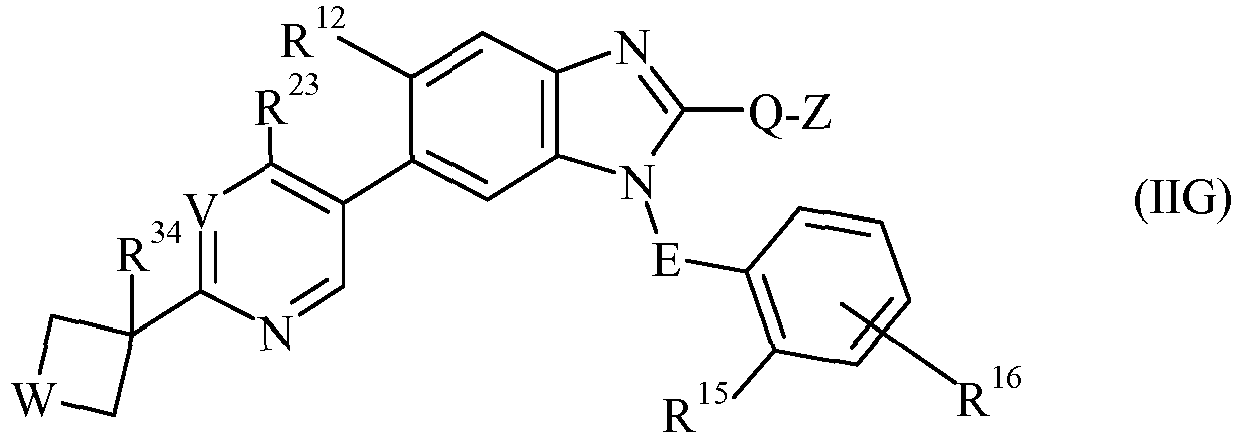


 T represents -CH2- or -CH2CH2-;W represents O, S, S(O), S(O)2, N(R31) or C(R32)(R33);-M- represents -CH2- or -CH2CH2-;R31 represents hydrogen, hydroxy(C1-6)alkyl, cyano(C1-6)alkyl, difluoroethyl, trifluoroethyl, C1-6 alkylsulphonyl, (C1-6)alkylsulphonyl(C1-6)alkyl, C2-6 alkylcarbonyl, carboxy(C1-6)alkyl, C2-6 alkoxycarbonyl, or C2-6 alkoxycarbonyl(C1-6)alkyl;R32 represents C1-6 alkoxy, carboxy, C2-6 alkoxycarbonyl, or aminocarbonyl;R33 represents hydrogen, halogen, C1-6 alkyl or amino;R34 represents hydrogen, halogen, hydroxy, C1-6 alkoxy, C1-6 alkylsulphonyl, amino or di(C1-6)alkylamino; andE, Q, Z, V, R12, R15, R16 and R23 are as defined in claim 1.
 - A compound as claimed in claim 4 wherein R34 represents hydrogen or hydroxy.
- A compound as claimed in any one of the preceding claims wherein E represents -CH2- or -CH(CH3)-.
- A compound as claimed in any one of the preceding claims wherein R12 represents hydrogen or fluoro.
- A compound as claimed in any one of the preceding claims wherein R15 represents hydrogen, halogen, C1-6 alkyl, trifluoromethyl, C1-6 alkoxy, difluoromethoxy or trifluoromethoxy.
- A compound as claimed in claim 8 wherein R15 represents difluoromethoxy.
- A compound as claimed in any one of the preceding claims wherein R16 represents hydrogen, halogen, C1-6 alkyl, trifluoromethyl, difluoromethoxy or amino.
- A compound as claimed in claim 10 wherein R16 represents hydrogen.
- A compound of formula (IIB) as defined in claim 1 or an N-oxide thereof, or a pharmaceutically acceptable salt or solvate thereof, or a glucuronide derivative thereof, or a co-crystal thereof, for use in the treatment and/or prevention of an inflammatory or autoimmune disorder, a neurological or neurodegenerative disorder, pain or a nociceptive disorder, a cardiovascular disorder, a metabolic disorder, an ocular disorder, or an oncological disorder.
- A pharmaceutical composition comprising a compound of formula (IIB) as defined in claim 1 or an N-oxide thereof, or a pharmaceutically acceptable salt or solvate thereof, or a glucuronide derivative thereof, or a co-crystal thereof, in association with a pharmaceutically acceptable carrier.
- A pharmaceutical composition as claimed in claim 13 further comprising an additional pharmaceutically active ingredient.
Applications Claiming Priority (3)
| Application Number | Priority Date | Filing Date | Title |
|---|---|---|---|
| GB201210233A GB201210233D0 (en) | 2012-06-11 | 2012-06-11 | Therapeutic agents |
| GB201221983 | 2012-12-06 | ||
| PCT/EP2013/062062 WO2013186229A1 (en) | 2012-06-11 | 2013-06-11 | Tnf -alpha modulating benzimidazoles |
Publications (2)
| Publication Number | Publication Date |
|---|---|
| EP2858983A1 EP2858983A1 (en) | 2015-04-15 |
| EP2858983B1 true EP2858983B1 (en) | 2018-04-18 |
Family
ID=48579113
Family Applications (1)
| Application Number | Title | Priority Date | Filing Date |
|---|---|---|---|
| EP13727932.9A Active EP2858983B1 (en) | 2012-06-11 | 2013-06-11 | Tnf-alpha modulating benzimidazoles |
Country Status (10)
| Country | Link |
|---|---|
| US (1) | US9550737B2 (en) |
| EP (1) | EP2858983B1 (en) |
| JP (1) | JP6359008B2 (en) |
| CN (1) | CN104428293B (en) |
| BR (1) | BR112014030940B1 (en) |
| CA (1) | CA2874303C (en) |
| EA (1) | EA028626B1 (en) |
| ES (1) | ES2675583T3 (en) |
| TR (1) | TR201807207T4 (en) |
| WO (1) | WO2013186229A1 (en) |
Families Citing this family (111)
| Publication number | Priority date | Publication date | Assignee | Title |
|---|---|---|---|---|
| WO2014080291A2 (en) | 2012-11-21 | 2014-05-30 | Rvx Therapeutics Inc. | Biaryl derivatives as bromodomain inhibitors |
| US9073878B2 (en) | 2012-11-21 | 2015-07-07 | Zenith Epigenetics Corp. | Cyclic amines as bromodomain inhibitors |
| US9271978B2 (en) | 2012-12-21 | 2016-03-01 | Zenith Epigenetics Corp. | Heterocyclic compounds as bromodomain inhibitors |
| SG11201510409QA (en) | 2013-06-21 | 2016-01-28 | Zenith Epigenetics Corp | Novel bicyclic bromodomain inhibitors |
| WO2015004533A2 (en) | 2013-06-21 | 2015-01-15 | Zenith Epigenetics Corp. | Novel substituted bicyclic compounds as bromodomain inhibitors |
| AU2014298051B2 (en) | 2013-07-31 | 2018-11-15 | Zenith Epigenetics Ltd. | Novel quinazolinones as bromodomain inhibitors |
| GB201321730D0 (en) | 2013-12-09 | 2014-01-22 | Ucb Pharma Sa | Therapeutic agents |
| GB201321748D0 (en) | 2013-12-09 | 2014-01-22 | Ucb Pharma Sa | Therapeutic agents |
| GB201321739D0 (en) | 2013-12-09 | 2014-01-22 | Ucb Pharma Sa | Therapeutic agents |
| GB201321729D0 (en) | 2013-12-09 | 2014-01-22 | Ucb Pharma Sa | Therapeutic agents |
| GB201321744D0 (en) | 2013-12-09 | 2014-01-22 | Ucb Pharma Sa | Therapeutic agents |
| GB201321740D0 (en) | 2013-12-09 | 2014-01-22 | Ucb Pharma Sa | Therapeutic agents |
| GB201321743D0 (en) | 2013-12-09 | 2014-01-22 | Ucb Pharma Sa | Therapeutic agents |
| GB201321735D0 (en) * | 2013-12-09 | 2014-01-22 | Ucb Pharma Sa | Therapeutic Agents |
| GB201321746D0 (en) | 2013-12-09 | 2014-01-22 | Ucb Pharma Sa | Therapeutic agents |
| GB201321742D0 (en) | 2013-12-09 | 2014-01-22 | Ucb Pharma Sa | Therapeutic agents |
| GB201321732D0 (en) | 2013-12-09 | 2014-01-22 | Ucb Pharma Sa | Therapeutic agents |
| GB201321745D0 (en) | 2013-12-09 | 2014-01-22 | Ucb Pharma Sa | Therapeutic agents |
| GB201321737D0 (en) * | 2013-12-09 | 2014-01-22 | Ucb Pharma Sa | Therapeutic Agents |
| GB201321733D0 (en) | 2013-12-09 | 2014-01-22 | Ucb Pharma Sa | Therapeutic agents |
| GB201321736D0 (en) | 2013-12-09 | 2014-01-22 | Ucb Pharma Sa | Therapeutic agents |
| EP3080085B1 (en) | 2013-12-09 | 2019-08-14 | UCB Biopharma SPRL | Fused bicyclic heteroaromatic derivatives as modulators of tnf activity |
| GB201321728D0 (en) | 2013-12-09 | 2014-01-22 | Ucb Pharma Sa | Therapeutic agents |
| GB201321738D0 (en) * | 2013-12-09 | 2014-01-22 | Ucb Pharma Sa | Therapeutic Agents |
| GB201321749D0 (en) | 2013-12-09 | 2014-01-22 | Ucb Pharma Sa | Therapeutic agents |
| WO2015086519A1 (en) | 2013-12-09 | 2015-06-18 | Ucb Biopharma Sprl | Imidazopyridine derivatives as modulators of tnf activity |
| GB201321741D0 (en) | 2013-12-09 | 2014-01-22 | Ucb Pharma Sa | Therapeutic agents |
| GB201321734D0 (en) | 2013-12-09 | 2014-01-22 | Ucb Pharma Sa | Therapeutic Agents |
| GB201321731D0 (en) * | 2013-12-09 | 2014-01-22 | Ucb Pharma Sa | Therapeutic agents |
| CA3175724C (en) | 2014-03-20 | 2024-01-09 | Capella Therapeutics, Inc. | Benzimidazole derivatives, and pharmaceutical compositions and methods of use thereof |
| TWI705967B (en) | 2014-03-20 | 2020-10-01 | 美商卡佩拉醫療公司 | Benzimidazole derivatives, and pharmaceutical compositions and methods of use thereof |
| PE20170693A1 (en) * | 2014-10-03 | 2017-06-13 | Ucb Biopharma Sprl | FUSED PENTACICLIC IMIDAZOLE DERIVATIVES |
| DE102014115381B4 (en) * | 2014-10-22 | 2017-12-28 | Abcr Gmbh | Process for trifluoromethoxylation |
| WO2016087936A1 (en) | 2014-12-01 | 2016-06-09 | Zenith Epigenetics Corp. | Substituted pyridinones as bromodomain inhibitors |
| WO2016087942A1 (en) | 2014-12-01 | 2016-06-09 | Zenith Epigenetics Corp. | Substituted pyridines as bromodomain inhibitors |
| CN107207474B (en) | 2014-12-11 | 2021-05-07 | 恒翼生物医药科技(上海)有限公司 | Substituted heterocycles as bromodomain inhibitors |
| CA2966450A1 (en) | 2014-12-17 | 2016-06-23 | Olesya KHARENKO | Inhibitors of bromodomains |
| EP3932914A1 (en) | 2015-03-13 | 2022-01-05 | Valo Health, Inc. | Alpha-cinnamide compounds and compositions as hdac8 inhibitors |
| BR112017019731A2 (en) | 2015-03-18 | 2018-05-22 | Bristol-Myers Squibb Company | tricyclic heterocyclic compounds useful as TNF inhibitors |
| ES2803650T3 (en) * | 2015-03-18 | 2021-01-28 | Bristol Myers Squibb Co | Heterocyclic compounds useful as TNF inhibitors |
| ES2797805T3 (en) * | 2015-03-18 | 2020-12-03 | Bristol Myers Squibb Co | Substituted tricyclic heterocyclic compounds |
| AR104259A1 (en) | 2015-04-15 | 2017-07-05 | Celgene Quanticel Res Inc | BROMODOMINUM INHIBITORS |
| WO2016168633A1 (en) | 2015-04-17 | 2016-10-20 | Abbvie Inc. | Indazolones as modulators of tnf signaling |
| US9879016B2 (en) | 2015-04-17 | 2018-01-30 | Abbvie Inc. | Indazolones as modulators of TNF signaling |
| UY36630A (en) | 2015-04-17 | 2016-11-30 | Abbvie Inc | TRICYCLIC MODULATORS OF TNF SIGNALING |
| GB201509888D0 (en) * | 2015-06-08 | 2015-07-22 | Ucb Biopharma Sprl | Therapeutic agents |
| GB201509893D0 (en) | 2015-06-08 | 2015-07-22 | Ucb Biopharma Sprl | Therapeutic agents |
| GB201509885D0 (en) * | 2015-06-08 | 2015-07-22 | Ucb Biopharma Sprl | Therapeutic agents |
| GB201510758D0 (en) * | 2015-06-18 | 2015-08-05 | Ucb Biopharma Sprl | Novel TNFa structure for use in therapy |
| TW201718536A (en) | 2015-08-03 | 2017-06-01 | 必治妥美雅史谷比公司 | Heterocyclic compound which can be used as a TNFα modulator |
| WO2017024406A1 (en) | 2015-08-11 | 2017-02-16 | Neomed Institute | N-substituted bicyclic lactams, their preparation and their use as pharmaceuticals |
| EP3334717B1 (en) | 2015-08-11 | 2020-07-01 | Neomed Institute | Aryl-substituted dihydroquinolinones, their preparation and their use as pharmaceuticals |
| CA2994478C (en) | 2015-08-12 | 2023-10-03 | Neomed Institute | Substituted benzimidazoles, their preparation and their use as pharmaceuticals |
| WO2017053537A1 (en) | 2015-09-23 | 2017-03-30 | Capella Therapeutics, Inc. | Benzimidazoles for use in the treatment of cancer and inflammatory diseases |
| WO2017066876A1 (en) | 2015-10-21 | 2017-04-27 | Neomed Institute | Substituted imidazopyridines, their preparation and their use as pharmaceuticals |
| AR107032A1 (en) | 2015-12-09 | 2018-03-14 | Padlock Therapeutics Inc | PAD4 BICYCLIC INHIBITORS |
| GB201522394D0 (en) | 2015-12-18 | 2016-02-03 | Ucb Biopharma Sprl | Antibodies |
| WO2017127930A1 (en) | 2016-01-28 | 2017-08-03 | Neomed Institute | Substituted [1,2,4]triazolo[4,3-a]pyridines, their preparation and their use as pharmaceuticals |
| EA201892142A1 (en) * | 2016-04-01 | 2019-04-30 | Юсб Байофарма Спрл | CONDENSED PENTACYCLIC DERIVATIVES OF IMIDAZOLE AS TNF ACTIVITY MODULATORS |
| US10766906B2 (en) | 2016-04-01 | 2020-09-08 | UCB Biopharma SRL | Fused hexacyclic imidazole derivatives as modulators of TNF activity |
| EP3436459B1 (en) | 2016-04-01 | 2021-08-25 | UCB Biopharma SRL | Fused pentacyclic imidazole derivatives as modulators of tnf activity |
| US10793578B2 (en) | 2016-04-01 | 2020-10-06 | UCB Biopharma SRL | Fused pentacyclic imidazole derivatives as modulators of TNF activity |
| WO2017207340A1 (en) | 2016-05-31 | 2017-12-07 | Bayer Pharma Aktiengesellschaft | Novel substituted benzimidazole, methods for the production thereof, pharmaceutical preparations containing same, and use thereof to produce medicaments |
| EP3490985B1 (en) | 2016-07-26 | 2020-08-05 | Basf Se | Herbicidal pyrimidine compounds |
| BR112018077223A2 (en) | 2016-07-27 | 2019-04-09 | Basf Se | pyrimidine compounds, use of pyrimidine compounds, herbicidal compositions, method for controlling unwanted vegetation and use of herbicidal compositions |
| CA3030217A1 (en) | 2016-07-28 | 2018-02-01 | Basf Se | Herbicidal pyrimidine compounds |
| TW201813963A (en) | 2016-09-23 | 2018-04-16 | 美商基利科學股份有限公司 | Phosphatidylinositol 3-kinase inhibitors |
| TW201815787A (en) | 2016-09-23 | 2018-05-01 | 美商基利科學股份有限公司 | Phosphatidylinositol 3-kinase inhibitors |
| TW201825465A (en) | 2016-09-23 | 2018-07-16 | 美商基利科學股份有限公司 | Phosphatidylinositol 3-kinase inhibitors |
| WO2018060174A1 (en) | 2016-09-29 | 2018-04-05 | Bayer Pharma Aktiengesellschaft | Substituted benzimidazoles, pharmaceutical preparations containing same, and use of same to produce drugs |
| WO2018060072A1 (en) | 2016-09-29 | 2018-04-05 | Bayer Pharma Aktiengesellschaft | New substituted benzimidazoles, methods for the production of same, pharmaceutical preparations containing same, and use of same to produce drugs |
| GB201617630D0 (en) | 2016-10-18 | 2016-11-30 | Cellcentric Ltd | Pharmaceutical compounds |
| GB201620948D0 (en) * | 2016-12-09 | 2017-01-25 | Ucb Biopharma Sprl | Therapeutic agents |
| US20200087390A1 (en) | 2016-12-21 | 2020-03-19 | Amgen Inc. | Anti-tnf alpha antibody formulations |
| GB201621907D0 (en) | 2016-12-21 | 2017-02-01 | Ucb Biopharma Sprl And Sanofi | Antibody epitope |
| CN116462666B (en) | 2017-01-10 | 2025-07-15 | 瑞士苏黎世联邦理工学院 | Cytoprotective compounds and uses thereof |
| CN108314680A (en) * | 2017-01-16 | 2018-07-24 | 凯惠科技发展(上海)有限公司 | One kind containing aromatic compound, preparation method, pharmaceutical composition and application |
| EP3597639A4 (en) * | 2017-03-15 | 2020-09-16 | Sumitomo Dainippon Pharma Co., Ltd. | DEUTERATED BENZIMIDAZOLE COMPOUND AND MEDICAL USE THEREOF |
| EP3596078B1 (en) | 2017-03-15 | 2023-04-12 | UCB Biopharma SRL | Fused pentacyclic imidazole derivatives as modulators of tnf activity |
| PT3939980T (en) * | 2017-04-25 | 2023-08-07 | UCB Biopharma SRL | Fused pentacyclic imidazole derivatives as modulators of tnf activity |
| JP7399085B2 (en) | 2017-10-18 | 2023-12-15 | レダッグ クロップ プロテクション リミテッド | Benzimidazole compounds as pesticides |
| GB201806320D0 (en) | 2018-04-18 | 2018-05-30 | Cellcentric Ltd | Process |
| HUE062273T2 (en) | 2018-05-03 | 2023-10-28 | Jiangsu Hengrui Pharmaceuticals Co Ltd | Benzimidazole derivatives as retinoic acid receptor related orphan receptor gamma (RORy) modulators and their pharmaceutical uses |
| WO2020021015A1 (en) * | 2018-07-26 | 2020-01-30 | Esteve Pharmaceuticals, S.A. | New imidazopyridine derivatives for treating pain and pain related conditions |
| CN115215838B (en) | 2018-09-18 | 2025-04-04 | 拓臻股份有限公司 | Compounds for treating specific leukemias |
| PT3860998T (en) | 2018-10-05 | 2024-04-02 | Annapurna Bio Inc | Compounds and compositions for treating conditions associated with apj receptor activity |
| ES2951837T3 (en) | 2018-10-24 | 2023-10-25 | UCB Biopharma SRL | Condensed Pentacyclic Imidazole Derivatives as Modulators of TNF Activity |
| EP3876930A4 (en) | 2018-11-07 | 2022-07-20 | Dana-Farber Cancer Institute, Inc. | BENZIMIDAZOLE DERIVATIVES AND AZA-BENZIMIDAZOLE DERIVATIVES AS JANUS KINASE 2 INHIBITORS AND THEIR USES |
| WO2020097400A1 (en) | 2018-11-07 | 2020-05-14 | Dana-Farber Cancer Institute, Inc. | Imidazopyridine derivatives and aza-imidazopyridine derivatives as janus kinase 2 inhibitors and uses thereof |
| EP3876939A4 (en) | 2018-11-07 | 2022-08-10 | Dana-Farber Cancer Institute, Inc. | BENZOTHIAZOLE DERIVATIVES AND 7-AZA-BENZOTHIAZOLE DERIVATIVES AS JANUS KINASE-2 INHIBITORS AND USES THEREOF |
| GB201910608D0 (en) * | 2019-07-24 | 2019-09-04 | Enterprise Therapeutics Ltd | Compounds |
| CN112409399B (en) * | 2019-08-20 | 2022-06-28 | 德琪(浙江)医药科技有限公司 | Preparation method of drug intermediate compound |
| PE20221040A1 (en) | 2019-10-25 | 2022-06-17 | Gilead Sciences Inc | GLP-1R MODULATING COMPOUNDS |
| MA57692B1 (en) | 2019-11-15 | 2025-04-30 | Ildong Pharmaceutical Co., Ltd. | GLP-1 RECEPTOR AGONIST AND ITS USE |
| CA3168543A1 (en) | 2020-01-29 | 2021-08-05 | Gilead Sciences, Inc. | Glp-1r modulating compounds |
| BR112022022409A2 (en) | 2020-05-06 | 2023-02-07 | Ajax Therapeutics Inc | 6-HETEROARYLOXY BENZIMIDAZOLES AND AZABENZIMIDAZOLES AS JAK2 INHIBITORS |
| WO2022035805A1 (en) * | 2020-08-10 | 2022-02-17 | Dana-Farber Cancer Institute, Inc. | Substituted 1,2,4-oxadiazoles as small molecule inhibitors of ubiquitin-specific protease 28 |
| WO2022109182A1 (en) | 2020-11-20 | 2022-05-27 | Gilead Sciences, Inc. | Polyheterocyclic glp-1 r modulating compounds |
| WO2022140527A1 (en) | 2020-12-23 | 2022-06-30 | Ajax Therapeutics, Inc. | 6-heteroaryloxy benzimidazoles and azabenzimidazoles as jak2 inhibitors |
| WO2022192430A1 (en) | 2021-03-11 | 2022-09-15 | Gilead Sciences, Inc. | Glp-1r modulating compounds |
| EP4304711A1 (en) | 2021-03-11 | 2024-01-17 | Gilead Sciences, Inc. | Glp-1r modulating compounds |
| WO2022206583A1 (en) * | 2021-03-29 | 2022-10-06 | 浙江大学 | Indazole compound, preparation method therefor and application thereof |
| CN117279909A (en) * | 2021-04-04 | 2023-12-22 | 巴鲁克斯布伦博格研究所 | Novel liver-selective polyadenylation polymerase inhibitors and methods of using them |
| PL4271672T3 (en) | 2021-04-21 | 2026-04-20 | Gilead Sciences, Inc. | Carboxy-benzimidazole glp-1r modulating compounds |
| WO2023086320A1 (en) | 2021-11-09 | 2023-05-19 | Ajax Therapeutics, Inc. | Forms and compositions of inhibitors of jak2 |
| CA3234638A1 (en) | 2021-11-09 | 2023-05-19 | Ajax Therapeutics, Inc. | 6-heteroaryloxy benzimidazoles and azabenzimidazoles as jak2 inhibitors |
| CN116023336A (en) * | 2022-12-13 | 2023-04-28 | 河北医科大学 | A compound with targeted inhibitory effect on Nav1.7 sodium ion channel and its pharmaceutical composition and application |
| WO2025056065A1 (en) * | 2023-09-15 | 2025-03-20 | 上海医药集团股份有限公司 | Chemokine receptor antagonist, pharmaceutical composition, and use |
| CN117800969B (en) * | 2023-09-19 | 2024-11-29 | 武汉厚先生物医药有限公司 | Tumor necrosis factor receptor complex inhibitors and uses thereof |
| CN121889388A (en) * | 2023-09-21 | 2026-04-17 | 尹诺卫医药有限公司 | Process for preparing substituted fused imidazole derivatives |
| CN120917026A (en) * | 2024-01-31 | 2025-11-07 | 广天映泰(上海)生物科技有限公司 | Macrocyclic compounds, pharmaceutical compositions and uses thereof |
Family Cites Families (47)
| Publication number | Priority date | Publication date | Assignee | Title |
|---|---|---|---|---|
| US4908372A (en) | 1988-10-13 | 1990-03-13 | Merrell Dow Pharmaceuticals Inc. | Antihistaminic piperidinyl benzimidazoles |
| FR2643903A1 (en) * | 1989-03-03 | 1990-09-07 | Union Pharma Scient Appl | NOVEL BENZIMIDAZOLE DERIVATIVES, PROCESSES FOR PREPARING SAME, SYNTHESIS INTERMEDIATES, PHARMACEUTICAL COMPOSITIONS CONTAINING SAME, IN PARTICULAR FOR THE TREATMENT OF CARDIOVASCULAR DISEASES, AND DUODENIAL ULCERS |
| IL95975A (en) | 1989-10-24 | 1997-06-10 | Takeda Chemical Industries Ltd | N-benzyl- 2-alkylbenzimidazole derivatives, their production and pharmaceutical compositions containing them |
| AU3347493A (en) | 1992-01-09 | 1993-08-03 | Janssen Pharmaceutica N.V. | Pharmaceutically active substituted benzimidazole derivatives |
| DE4237656A1 (en) * | 1992-06-13 | 1993-12-16 | Merck Patent Gmbh | benzimidazole derivatives |
| US5661108A (en) * | 1994-06-01 | 1997-08-26 | Fmc Corporation | Herbicidal 3-(bicyclic nitrogen-containing heterocycle)-substituted-1-methyl-6-trifluoromethyluracils |
| JPH09124609A (en) * | 1995-11-07 | 1997-05-13 | Nissan Chem Ind Ltd | Benzimidazole derivative |
| JPH09176116A (en) * | 1995-12-27 | 1997-07-08 | Toray Ind Inc | Heterocyclic derivative and pharmaceutical use thereof |
| EP0882718B1 (en) * | 1995-12-28 | 2005-08-31 | Fujisawa Pharmaceutical Co., Ltd. | Benzimidazole derivatives |
| JP2000506529A (en) * | 1996-03-11 | 2000-05-30 | イーライ・リリー・アンド・カンパニー | Methods for treating or preventing interstitial cystitis |
| JP4373497B2 (en) * | 1996-06-19 | 2009-11-25 | ローン−プーラン・ロレ・リミテツド | Substituted azabicyclo compounds and their use as inhibitors of TNF and cyclic AMP phosphodiesterase production |
| ID21698A (en) * | 1996-11-15 | 1999-07-15 | Darwin Discovery Ltd | ARYL BISICLIC CARBOKSAMIDES AND THEIR USE OF THERAPY |
| ATE238998T1 (en) * | 1997-02-25 | 2003-05-15 | Us Gov Health & Human Serv | SUBSTITUTED BENZIMIDAZOLES AS NON-NUCLEOSIDE REVERSE TRANSCRIPTASE INHIBITORES |
| US6124463A (en) * | 1998-07-02 | 2000-09-26 | Dupont Pharmaceuticals | Benzimidazoles as corticotropin release factor antagonists |
| DE19924818A1 (en) | 1999-05-29 | 2000-11-30 | Bayer Ag | Substituted phenylcyclohexane carboxamides |
| JP2001302512A (en) * | 2000-02-18 | 2001-10-31 | Takeda Chem Ind Ltd | Tnf-alpha inhibitor |
| PL356422A1 (en) * | 2000-02-18 | 2004-06-28 | Takeda Chemical Industries, Ltd. | Tnf-alpha inhibitors |
| US6489338B2 (en) * | 2000-06-13 | 2002-12-03 | Bristol-Myers Squibb Company | Imidazopyridine and imidazopyrimidine antiviral agents |
| EP1370557B1 (en) * | 2001-03-09 | 2005-11-16 | Pfizer Products Inc. | Benzimidazole anti-inflammatory compounds |
| JP4310109B2 (en) | 2001-04-26 | 2009-08-05 | エーザイ・アール・アンド・ディー・マネジメント株式会社 | Nitrogen-containing fused ring compound having pyrazolyl group as substituent and pharmaceutical composition thereof |
| DE60214392T2 (en) | 2001-06-05 | 2008-01-17 | Boehringer Ingelheim Pharmaceuticals, Inc., Ridgefield | 1,4-Disubstituted benzo-fused cycloalkyl urea compounds |
| US6632810B2 (en) | 2001-06-29 | 2003-10-14 | Kowa Co., Ltd. | Cyclic diamine compound with condensed-ring groups |
| FR2829765A1 (en) | 2001-09-14 | 2003-03-21 | Lipha | Use of new and known benzimidazolyl alkoxyaryl alkanoic acid derivatives for treating pathologies associated with insulin resistance or hyperglycemia |
| WO2003031431A1 (en) * | 2001-10-09 | 2003-04-17 | Bristol-Myers Squibb Company | Cyclic sulfone derivatives as inhibitors of matrix metalloproteinases and/or tnf-$g(a) converting enzyme (tace) |
| DE10207843A1 (en) * | 2002-02-15 | 2003-09-04 | Schering Ag | Microlia inhibitors for interruption of interleukin 12 and IFN-gamma mediated immune responses |
| AU2003256297A1 (en) * | 2002-08-09 | 2004-02-25 | Eli Lilly And Company | Benzimidazoles and benzothiazoles as inhibitors of map kinase |
| US7115644B2 (en) * | 2002-09-13 | 2006-10-03 | Boehringer Ingelheim Pharmaceuticals Inc. | Heterocyclic compounds |
| AU2003902860A0 (en) * | 2003-06-06 | 2003-06-26 | Daicel Chemical Industries, Ltd | Benzimidazole compounds |
| WO2005080380A1 (en) * | 2004-02-03 | 2005-09-01 | Eli Lilly And Company | Kinase inhibitors |
| AU2005298986A1 (en) | 2004-10-27 | 2006-05-04 | F. Hoffmann-La Roche Ag | New indole or benzimidazole derivatives |
| US20060247263A1 (en) * | 2005-04-19 | 2006-11-02 | Amgen Inc. | Substituted heterocyclic compounds and methods of use |
| US8518980B2 (en) * | 2006-02-10 | 2013-08-27 | Summit Corporation Plc | Treatment of Duchenne muscular dystrophy |
| AU2007227210A1 (en) * | 2006-03-20 | 2007-09-27 | Synta Pharmaceuticals Corp. | Benzoimidazolyl-parazine compounds for inflammation and immune-related uses |
| CA2646886A1 (en) | 2006-03-23 | 2007-10-04 | Synta Pharmaceuticals Corp. | Benzimidazolyl-pyridine compounds for inflammation and immune-related uses |
| US8492378B2 (en) | 2006-08-03 | 2013-07-23 | Takeda Pharmaceutical Company Limited | GSK-3β inhibitor |
| JP2010500372A (en) * | 2006-08-09 | 2010-01-07 | スミスクライン ビーチャム コーポレーション | Novel compounds as antagonists or inverse agonists for opioid receptors |
| WO2008038841A1 (en) * | 2006-09-30 | 2008-04-03 | Japan Tobacco Inc. | Thiadiazolone derivative and use thereof |
| MX2009003650A (en) * | 2006-10-06 | 2009-04-22 | Abbott Lab | Novel imidazothiazoles and imidazoxazoles. |
| WO2008153701A1 (en) | 2007-05-24 | 2008-12-18 | Schering Corporation | Compounds for inhibiting ksp kinesin activity |
| TW200927102A (en) * | 2007-09-18 | 2009-07-01 | Univ Stanford | Methods of treating a flaviviridae family viral infection, compositions for treating a flaviviridae family viral infection, and screening assays for identifying compositions for treating a flaviviridae family viral infection |
| US20110052562A1 (en) * | 2007-12-19 | 2011-03-03 | The Scripps Research Institute | Benzimidazoles and analogs as rho kinase inhibitors |
| WO2010001869A1 (en) * | 2008-06-30 | 2010-01-07 | 武田薬品工業株式会社 | Tetra-substituted benzene compound and use thereof |
| PE20110368A1 (en) | 2008-08-18 | 2011-06-13 | Univ Yale | MIF MODULATORS |
| UY32138A (en) | 2008-09-25 | 2010-04-30 | Boehringer Ingelheim Int | SUBSTITUTED AMIDES 2- (2,6-DICLORO-PHENYLAMINE) -6-FLUORO-1-METHYL-1H-BENCIMIDAZOL-5-CARBOXYL AND ITS PHARMACEUTICALLY ACCEPTABLE SALTS |
| EP2419963B1 (en) | 2009-04-13 | 2013-11-20 | ViaSat, Inc. | Multi-beam active phased array architecture |
| EP2397471A1 (en) | 2010-06-16 | 2011-12-21 | China Medical University | Benzimidazole compounds and their use |
| WO2012026766A2 (en) | 2010-08-25 | 2012-03-01 | (주)네오팜 | Novel heterocyclic compound, and composition for treating inflammatory diseases using same |
-
2013
- 2013-06-11 CA CA2874303A patent/CA2874303C/en active Active
- 2013-06-11 EA EA201401350A patent/EA028626B1/en not_active IP Right Cessation
- 2013-06-11 EP EP13727932.9A patent/EP2858983B1/en active Active
- 2013-06-11 JP JP2015516594A patent/JP6359008B2/en not_active Expired - Fee Related
- 2013-06-11 BR BR112014030940-0A patent/BR112014030940B1/en not_active IP Right Cessation
- 2013-06-11 ES ES13727932.9T patent/ES2675583T3/en active Active
- 2013-06-11 US US14/406,848 patent/US9550737B2/en not_active Expired - Fee Related
- 2013-06-11 TR TR2018/07207T patent/TR201807207T4/en unknown
- 2013-06-11 WO PCT/EP2013/062062 patent/WO2013186229A1/en not_active Ceased
- 2013-06-11 CN CN201380037400.3A patent/CN104428293B/en not_active Expired - Fee Related
Also Published As
| Publication number | Publication date |
|---|---|
| EA201401350A1 (en) | 2015-05-29 |
| US20150152065A1 (en) | 2015-06-04 |
| BR112014030940B1 (en) | 2022-09-06 |
| EP2858983A1 (en) | 2015-04-15 |
| JP2015519381A (en) | 2015-07-09 |
| US9550737B2 (en) | 2017-01-24 |
| CA2874303C (en) | 2020-10-13 |
| EA028626B1 (en) | 2017-12-29 |
| CN104428293B (en) | 2018-06-08 |
| WO2013186229A1 (en) | 2013-12-19 |
| CN104428293A (en) | 2015-03-18 |
| CA2874303A1 (en) | 2013-12-19 |
| TR201807207T4 (en) | 2018-06-21 |
| ES2675583T3 (en) | 2018-07-11 |
| BR112014030940A2 (en) | 2017-06-27 |
| JP6359008B2 (en) | 2018-07-18 |
Similar Documents
| Publication | Publication Date | Title |
|---|---|---|
| US9550737B2 (en) | TNF -α modulating benzimidazoles | |
| EP3080115B1 (en) | Fused imidazole and pyrazole derivatives as modulators of tnf activity | |
| AU2020257055B2 (en) | Cot modulators and methods of use thereof | |
| AU2022263410B2 (en) | Carboxy-benzimidazole glp-1r modulating compounds | |
| EP2872508B1 (en) | Imidazopyridine derivatives as modulators of tnf activity | |
| AU2014348191B2 (en) | Tetrahydroquinoline compositions as BET bromodomain inhibitors | |
| EP2872511B1 (en) | Imidazopyrazine derivatives as modulators of tnf activity | |
| EP3484871B1 (en) | Piperidine derivatives as inhibitors of cyclin dependent kinase 7 (cdk7) | |
| EP3080121B1 (en) | Fused tricyclic benzimidazoles derivatives as modulators of tnf activity | |
| EP1986645B1 (en) | Glucokinase activators | |
| CN100491371C (en) | Heteroaryl amines as glycogen synthase kinase 3beta inhibitors (GSK3 inhibitors) | |
| EP2951169B1 (en) | Flap modulators | |
| US20250145597A1 (en) | Inhibitors of rna helicase dhx9 and uses thereof | |
| IL272599B (en) | Pyruvate kinase modulators and use thereof | |
| JP2005511608A (en) | Aminopyrimidines and -pyridines | |
| KR20080111098A (en) | 2-aminopyridine analogs as glucokinase activators | |
| EP2762476A1 (en) | 1,2,4-triazine-6-carboxamide derivative | |
| MX2014013734A (en) | Nampt inhibitors. | |
| AU5767799A (en) | Novel compounds | |
| EP2629616A2 (en) | Substituted amino-triazolyl pde10 inhibitors | |
| CN101663276A (en) | 2-aminopyridine derivatives useful as kinase inhibitors | |
| US8673922B2 (en) | Azaindazole compounds | |
| EP4169575B1 (en) | Condensed ring compounds that inhibit h-pgds | |
| HK40087512B (en) | Condensed ring compounds that inhibit h-pgds | |
| HK40087512A (en) | Condensed ring compounds that inhibit h-pgds |
Legal Events
| Date | Code | Title | Description |
|---|---|---|---|
| PUAI | Public reference made under article 153(3) epc to a published international application that has entered the european phase |
Free format text: ORIGINAL CODE: 0009012 |
|
| 17P | Request for examination filed |
Effective date: 20141219 |
|
| AK | Designated contracting states |
Kind code of ref document: A1 Designated state(s): AL AT BE BG CH CY CZ DE DK EE ES FI FR GB GR HR HU IE IS IT LI LT LU LV MC MK MT NL NO PL PT RO RS SE SI SK SM TR |
|
| AX | Request for extension of the european patent |
Extension state: BA ME |
|
| DAX | Request for extension of the european patent (deleted) | ||
| 17Q | First examination report despatched |
Effective date: 20160113 |
|
| STAA | Information on the status of an ep patent application or granted ep patent |
Free format text: STATUS: EXAMINATION IS IN PROGRESS |
|
| GRAP | Despatch of communication of intention to grant a patent |
Free format text: ORIGINAL CODE: EPIDOSNIGR1 |
|
| STAA | Information on the status of an ep patent application or granted ep patent |
Free format text: STATUS: GRANT OF PATENT IS INTENDED |
|
| INTG | Intention to grant announced |
Effective date: 20171002 |
|
| GRAJ | Information related to disapproval of communication of intention to grant by the applicant or resumption of examination proceedings by the epo deleted |
Free format text: ORIGINAL CODE: EPIDOSDIGR1 |
|
| STAA | Information on the status of an ep patent application or granted ep patent |
Free format text: STATUS: EXAMINATION IS IN PROGRESS |
|
| GRAR | Information related to intention to grant a patent recorded |
Free format text: ORIGINAL CODE: EPIDOSNIGR71 |
|
| GRAS | Grant fee paid |
Free format text: ORIGINAL CODE: EPIDOSNIGR3 |
|
| STAA | Information on the status of an ep patent application or granted ep patent |
Free format text: STATUS: GRANT OF PATENT IS INTENDED |
|
| INTC | Intention to grant announced (deleted) | ||
| GRAA | (expected) grant |
Free format text: ORIGINAL CODE: 0009210 |
|
| STAA | Information on the status of an ep patent application or granted ep patent |
Free format text: STATUS: THE PATENT HAS BEEN GRANTED |
|
| AK | Designated contracting states |
Kind code of ref document: B1 Designated state(s): AL AT BE BG CH CY CZ DE DK EE ES FI FR GB GR HR HU IE IS IT LI LT LU LV MC MK MT NL NO PL PT RO RS SE SI SK SM TR |
|
| INTG | Intention to grant announced |
Effective date: 20180313 |
|
| REG | Reference to a national code |
Ref country code: GB Ref legal event code: FG4D |
|
| REG | Reference to a national code |
Ref country code: CH Ref legal event code: EP |
|
| REG | Reference to a national code |
Ref country code: FR Ref legal event code: PLFP Year of fee payment: 6 |
|
| REG | Reference to a national code |
Ref country code: AT Ref legal event code: REF Ref document number: 990311 Country of ref document: AT Kind code of ref document: T Effective date: 20180515 |
|
| REG | Reference to a national code |
Ref country code: IE Ref legal event code: FG4D |
|
| REG | Reference to a national code |
Ref country code: DE Ref legal event code: R096 Ref document number: 602013036068 Country of ref document: DE |
|
| REG | Reference to a national code |
Ref country code: ES Ref legal event code: FG2A Ref document number: 2675583 Country of ref document: ES Kind code of ref document: T3 Effective date: 20180711 |
|
| REG | Reference to a national code |
Ref country code: NL Ref legal event code: MP Effective date: 20180418 |
|
| REG | Reference to a national code |
Ref country code: LT Ref legal event code: MG4D |
|
| PG25 | Lapsed in a contracting state [announced via postgrant information from national office to epo] |
Ref country code: NL Free format text: LAPSE BECAUSE OF FAILURE TO SUBMIT A TRANSLATION OF THE DESCRIPTION OR TO PAY THE FEE WITHIN THE PRESCRIBED TIME-LIMIT Effective date: 20180418 |
|
| PG25 | Lapsed in a contracting state [announced via postgrant information from national office to epo] |
Ref country code: LT Free format text: LAPSE BECAUSE OF FAILURE TO SUBMIT A TRANSLATION OF THE DESCRIPTION OR TO PAY THE FEE WITHIN THE PRESCRIBED TIME-LIMIT Effective date: 20180418 Ref country code: PL Free format text: LAPSE BECAUSE OF FAILURE TO SUBMIT A TRANSLATION OF THE DESCRIPTION OR TO PAY THE FEE WITHIN THE PRESCRIBED TIME-LIMIT Effective date: 20180418 Ref country code: SE Free format text: LAPSE BECAUSE OF FAILURE TO SUBMIT A TRANSLATION OF THE DESCRIPTION OR TO PAY THE FEE WITHIN THE PRESCRIBED TIME-LIMIT Effective date: 20180418 Ref country code: FI Free format text: LAPSE BECAUSE OF FAILURE TO SUBMIT A TRANSLATION OF THE DESCRIPTION OR TO PAY THE FEE WITHIN THE PRESCRIBED TIME-LIMIT Effective date: 20180418 Ref country code: BG Free format text: LAPSE BECAUSE OF FAILURE TO SUBMIT A TRANSLATION OF THE DESCRIPTION OR TO PAY THE FEE WITHIN THE PRESCRIBED TIME-LIMIT Effective date: 20180718 Ref country code: NO Free format text: LAPSE BECAUSE OF FAILURE TO SUBMIT A TRANSLATION OF THE DESCRIPTION OR TO PAY THE FEE WITHIN THE PRESCRIBED TIME-LIMIT Effective date: 20180718 Ref country code: AL Free format text: LAPSE BECAUSE OF FAILURE TO SUBMIT A TRANSLATION OF THE DESCRIPTION OR TO PAY THE FEE WITHIN THE PRESCRIBED TIME-LIMIT Effective date: 20180418 |
|
| PG25 | Lapsed in a contracting state [announced via postgrant information from national office to epo] |
Ref country code: GR Free format text: LAPSE BECAUSE OF FAILURE TO SUBMIT A TRANSLATION OF THE DESCRIPTION OR TO PAY THE FEE WITHIN THE PRESCRIBED TIME-LIMIT Effective date: 20180719 Ref country code: LV Free format text: LAPSE BECAUSE OF FAILURE TO SUBMIT A TRANSLATION OF THE DESCRIPTION OR TO PAY THE FEE WITHIN THE PRESCRIBED TIME-LIMIT Effective date: 20180418 Ref country code: HR Free format text: LAPSE BECAUSE OF FAILURE TO SUBMIT A TRANSLATION OF THE DESCRIPTION OR TO PAY THE FEE WITHIN THE PRESCRIBED TIME-LIMIT Effective date: 20180418 Ref country code: RS Free format text: LAPSE BECAUSE OF FAILURE TO SUBMIT A TRANSLATION OF THE DESCRIPTION OR TO PAY THE FEE WITHIN THE PRESCRIBED TIME-LIMIT Effective date: 20180418 |
|
| REG | Reference to a national code |
Ref country code: AT Ref legal event code: MK05 Ref document number: 990311 Country of ref document: AT Kind code of ref document: T Effective date: 20180418 |
|
| PG25 | Lapsed in a contracting state [announced via postgrant information from national office to epo] |
Ref country code: PT Free format text: LAPSE BECAUSE OF FAILURE TO SUBMIT A TRANSLATION OF THE DESCRIPTION OR TO PAY THE FEE WITHIN THE PRESCRIBED TIME-LIMIT Effective date: 20180820 |
|
| REG | Reference to a national code |
Ref country code: DE Ref legal event code: R097 Ref document number: 602013036068 Country of ref document: DE |
|
| PG25 | Lapsed in a contracting state [announced via postgrant information from national office to epo] |
Ref country code: SK Free format text: LAPSE BECAUSE OF FAILURE TO SUBMIT A TRANSLATION OF THE DESCRIPTION OR TO PAY THE FEE WITHIN THE PRESCRIBED TIME-LIMIT Effective date: 20180418 Ref country code: EE Free format text: LAPSE BECAUSE OF FAILURE TO SUBMIT A TRANSLATION OF THE DESCRIPTION OR TO PAY THE FEE WITHIN THE PRESCRIBED TIME-LIMIT Effective date: 20180418 Ref country code: CZ Free format text: LAPSE BECAUSE OF FAILURE TO SUBMIT A TRANSLATION OF THE DESCRIPTION OR TO PAY THE FEE WITHIN THE PRESCRIBED TIME-LIMIT Effective date: 20180418 Ref country code: RO Free format text: LAPSE BECAUSE OF FAILURE TO SUBMIT A TRANSLATION OF THE DESCRIPTION OR TO PAY THE FEE WITHIN THE PRESCRIBED TIME-LIMIT Effective date: 20180418 Ref country code: AT Free format text: LAPSE BECAUSE OF FAILURE TO SUBMIT A TRANSLATION OF THE DESCRIPTION OR TO PAY THE FEE WITHIN THE PRESCRIBED TIME-LIMIT Effective date: 20180418 Ref country code: DK Free format text: LAPSE BECAUSE OF FAILURE TO SUBMIT A TRANSLATION OF THE DESCRIPTION OR TO PAY THE FEE WITHIN THE PRESCRIBED TIME-LIMIT Effective date: 20180418 |
|
| PLBE | No opposition filed within time limit |
Free format text: ORIGINAL CODE: 0009261 |
|
| STAA | Information on the status of an ep patent application or granted ep patent |
Free format text: STATUS: NO OPPOSITION FILED WITHIN TIME LIMIT |
|
| PG25 | Lapsed in a contracting state [announced via postgrant information from national office to epo] |
Ref country code: SM Free format text: LAPSE BECAUSE OF FAILURE TO SUBMIT A TRANSLATION OF THE DESCRIPTION OR TO PAY THE FEE WITHIN THE PRESCRIBED TIME-LIMIT Effective date: 20180418 |
|
| REG | Reference to a national code |
Ref country code: BE Ref legal event code: MM Effective date: 20180630 |
|
| REG | Reference to a national code |
Ref country code: IE Ref legal event code: MM4A |
|
| 26N | No opposition filed |
Effective date: 20190121 |
|
| PG25 | Lapsed in a contracting state [announced via postgrant information from national office to epo] |
Ref country code: MC Free format text: LAPSE BECAUSE OF FAILURE TO SUBMIT A TRANSLATION OF THE DESCRIPTION OR TO PAY THE FEE WITHIN THE PRESCRIBED TIME-LIMIT Effective date: 20180418 Ref country code: LU Free format text: LAPSE BECAUSE OF NON-PAYMENT OF DUE FEES Effective date: 20180611 |
|
| PG25 | Lapsed in a contracting state [announced via postgrant information from national office to epo] |
Ref country code: IE Free format text: LAPSE BECAUSE OF NON-PAYMENT OF DUE FEES Effective date: 20180611 |
|
| PG25 | Lapsed in a contracting state [announced via postgrant information from national office to epo] |
Ref country code: BE Free format text: LAPSE BECAUSE OF NON-PAYMENT OF DUE FEES Effective date: 20180630 Ref country code: SI Free format text: LAPSE BECAUSE OF FAILURE TO SUBMIT A TRANSLATION OF THE DESCRIPTION OR TO PAY THE FEE WITHIN THE PRESCRIBED TIME-LIMIT Effective date: 20180418 |
|
| PG25 | Lapsed in a contracting state [announced via postgrant information from national office to epo] |
Ref country code: MT Free format text: LAPSE BECAUSE OF NON-PAYMENT OF DUE FEES Effective date: 20180611 |
|
| PG25 | Lapsed in a contracting state [announced via postgrant information from national office to epo] |
Ref country code: CY Free format text: LAPSE BECAUSE OF FAILURE TO SUBMIT A TRANSLATION OF THE DESCRIPTION OR TO PAY THE FEE WITHIN THE PRESCRIBED TIME-LIMIT Effective date: 20180418 Ref country code: HU Free format text: LAPSE BECAUSE OF FAILURE TO SUBMIT A TRANSLATION OF THE DESCRIPTION OR TO PAY THE FEE WITHIN THE PRESCRIBED TIME-LIMIT; INVALID AB INITIO Effective date: 20130611 Ref country code: MK Free format text: LAPSE BECAUSE OF NON-PAYMENT OF DUE FEES Effective date: 20180418 |
|
| PG25 | Lapsed in a contracting state [announced via postgrant information from national office to epo] |
Ref country code: IS Free format text: LAPSE BECAUSE OF FAILURE TO SUBMIT A TRANSLATION OF THE DESCRIPTION OR TO PAY THE FEE WITHIN THE PRESCRIBED TIME-LIMIT Effective date: 20180818 |
|
| PGFP | Annual fee paid to national office [announced via postgrant information from national office to epo] |
Ref country code: IT Payment date: 20220510 Year of fee payment: 10 Ref country code: GB Payment date: 20220506 Year of fee payment: 10 Ref country code: FR Payment date: 20220510 Year of fee payment: 10 Ref country code: DE Payment date: 20220505 Year of fee payment: 10 |
|
| PGFP | Annual fee paid to national office [announced via postgrant information from national office to epo] |
Ref country code: TR Payment date: 20220610 Year of fee payment: 10 |
|
| PGFP | Annual fee paid to national office [announced via postgrant information from national office to epo] |
Ref country code: ES Payment date: 20220704 Year of fee payment: 10 |
|
| PGFP | Annual fee paid to national office [announced via postgrant information from national office to epo] |
Ref country code: CH Payment date: 20220702 Year of fee payment: 10 |
|
| REG | Reference to a national code |
Ref country code: DE Ref legal event code: R119 Ref document number: 602013036068 Country of ref document: DE |
|
| REG | Reference to a national code |
Ref country code: CH Ref legal event code: PL |
|
| GBPC | Gb: european patent ceased through non-payment of renewal fee |
Effective date: 20230611 |
|
| PG25 | Lapsed in a contracting state [announced via postgrant information from national office to epo] |
Ref country code: DE Free format text: LAPSE BECAUSE OF NON-PAYMENT OF DUE FEES Effective date: 20240103 Ref country code: CH Free format text: LAPSE BECAUSE OF NON-PAYMENT OF DUE FEES Effective date: 20230630 Ref country code: GB Free format text: LAPSE BECAUSE OF NON-PAYMENT OF DUE FEES Effective date: 20230611 |
|
| PG25 | Lapsed in a contracting state [announced via postgrant information from national office to epo] |
Ref country code: FR Free format text: LAPSE BECAUSE OF NON-PAYMENT OF DUE FEES Effective date: 20230630 |
|
| REG | Reference to a national code |
Ref country code: ES Ref legal event code: FD2A Effective date: 20240729 |
|
| PG25 | Lapsed in a contracting state [announced via postgrant information from national office to epo] |
Ref country code: IT Free format text: LAPSE BECAUSE OF NON-PAYMENT OF DUE FEES Effective date: 20230611 |
|
| PG25 | Lapsed in a contracting state [announced via postgrant information from national office to epo] |
Ref country code: ES Free format text: LAPSE BECAUSE OF NON-PAYMENT OF DUE FEES Effective date: 20230612 |
|
| PG25 | Lapsed in a contracting state [announced via postgrant information from national office to epo] |
Ref country code: ES Free format text: LAPSE BECAUSE OF NON-PAYMENT OF DUE FEES Effective date: 20230612 |