EP2858957B1 - Burner modules and method of forming glass sheets - Google Patents
Burner modules and method of forming glass sheets Download PDFInfo
- Publication number
- EP2858957B1 EP2858957B1 EP13796697.4A EP13796697A EP2858957B1 EP 2858957 B1 EP2858957 B1 EP 2858957B1 EP 13796697 A EP13796697 A EP 13796697A EP 2858957 B1 EP2858957 B1 EP 2858957B1
- Authority
- EP
- European Patent Office
- Prior art keywords
- burner
- flow plate
- gas
- channels
- face
- Prior art date
- Legal status (The legal status is an assumption and is not a legal conclusion. Google has not performed a legal analysis and makes no representation as to the accuracy of the status listed.)
- Not-in-force
Links
Images



Classifications
-
- F—MECHANICAL ENGINEERING; LIGHTING; HEATING; WEAPONS; BLASTING
- F23—COMBUSTION APPARATUS; COMBUSTION PROCESSES
- F23D—BURNERS
- F23D14/00—Burners for combustion of a gas, e.g. of a gas stored under pressure as a liquid
- F23D14/46—Details
- F23D14/48—Nozzles
- F23D14/58—Nozzles characterised by the shape or arrangement of the outlet or outlets from the nozzle, e.g. of annular configuration
- F23D14/583—Nozzles characterised by the shape or arrangement of the outlet or outlets from the nozzle, e.g. of annular configuration of elongated shape, e.g. slits
-
- C—CHEMISTRY; METALLURGY
- C03—GLASS; MINERAL OR SLAG WOOL
- C03B—MANUFACTURE, SHAPING, OR SUPPLEMENTARY PROCESSES
- C03B19/00—Other methods of shaping glass
- C03B19/06—Other methods of shaping glass by sintering, e.g. by cold isostatic pressing of powders and subsequent sintering, by hot pressing of powders, by sintering slurries or dispersions not undergoing a liquid phase reaction
-
- C—CHEMISTRY; METALLURGY
- C03—GLASS; MINERAL OR SLAG WOOL
- C03B—MANUFACTURE, SHAPING, OR SUPPLEMENTARY PROCESSES
- C03B19/00—Other methods of shaping glass
- C03B19/14—Other methods of shaping glass by gas- or vapour- phase reaction processes
-
- C—CHEMISTRY; METALLURGY
- C03—GLASS; MINERAL OR SLAG WOOL
- C03B—MANUFACTURE, SHAPING, OR SUPPLEMENTARY PROCESSES
- C03B19/00—Other methods of shaping glass
- C03B19/14—Other methods of shaping glass by gas- or vapour- phase reaction processes
- C03B19/1415—Reactant delivery systems
- C03B19/1423—Reactant deposition burners
-
- F—MECHANICAL ENGINEERING; LIGHTING; HEATING; WEAPONS; BLASTING
- F23—COMBUSTION APPARATUS; COMBUSTION PROCESSES
- F23D—BURNERS
- F23D14/00—Burners for combustion of a gas, e.g. of a gas stored under pressure as a liquid
-
- C—CHEMISTRY; METALLURGY
- C03—GLASS; MINERAL OR SLAG WOOL
- C03B—MANUFACTURE, SHAPING, OR SUPPLEMENTARY PROCESSES
- C03B2207/00—Glass deposition burners
- C03B2207/02—Elongated flat flame or slit-nozzle type
-
- C—CHEMISTRY; METALLURGY
- C03—GLASS; MINERAL OR SLAG WOOL
- C03B—MANUFACTURE, SHAPING, OR SUPPLEMENTARY PROCESSES
- C03B2207/00—Glass deposition burners
- C03B2207/20—Specific substances in specified ports, e.g. all gas flows specified
-
- C—CHEMISTRY; METALLURGY
- C03—GLASS; MINERAL OR SLAG WOOL
- C03B—MANUFACTURE, SHAPING, OR SUPPLEMENTARY PROCESSES
- C03B2207/00—Glass deposition burners
- C03B2207/30—For glass precursor of non-standard type, e.g. solid SiH3F
- C03B2207/34—Liquid, e.g. mist or aerosol
-
- C—CHEMISTRY; METALLURGY
- C03—GLASS; MINERAL OR SLAG WOOL
- C03B—MANUFACTURE, SHAPING, OR SUPPLEMENTARY PROCESSES
- C03B2207/00—Glass deposition burners
- C03B2207/42—Assembly details; Material or dimensions of burner; Manifolds or supports
-
- F—MECHANICAL ENGINEERING; LIGHTING; HEATING; WEAPONS; BLASTING
- F23—COMBUSTION APPARATUS; COMBUSTION PROCESSES
- F23D—BURNERS
- F23D2900/00—Special features of, or arrangements for burners using fluid fuels or solid fuels suspended in a carrier gas
- F23D2900/21—Burners specially adapted for a particular use
- F23D2900/21005—Burners specially adapted for a particular use for flame deposition, e.g. flame hydrolysis deposition [FHD]
-
- Y—GENERAL TAGGING OF NEW TECHNOLOGICAL DEVELOPMENTS; GENERAL TAGGING OF CROSS-SECTIONAL TECHNOLOGIES SPANNING OVER SEVERAL SECTIONS OF THE IPC; TECHNICAL SUBJECTS COVERED BY FORMER USPC CROSS-REFERENCE ART COLLECTIONS [XRACs] AND DIGESTS
- Y10—TECHNICAL SUBJECTS COVERED BY FORMER USPC
- Y10T—TECHNICAL SUBJECTS COVERED BY FORMER US CLASSIFICATION
- Y10T428/00—Stock material or miscellaneous articles
- Y10T428/24—Structurally defined web or sheet [e.g., overall dimension, etc.]
- Y10T428/24355—Continuous and nonuniform or irregular surface on layer or component [e.g., roofing, etc.]
Definitions
- the present disclosure relates generally to thin glass sheets and ribbons and, more specifically, to burner modules, methods of forming glass sheets and ribbons, and glass sheets and ribbons formed thereby.
- Glass sheet materials can be formed using a variety of different methods including, for example, float glass processes and fusion draw processes.
- Glass ribbons are a subset of glass sheets that are thin enough to be rolled into practical size rolls as the glass is thin enough to enable continuous spooling of the material.
- Float glass is impractical for making ribbons of glass and is generally directed toward thicker sheets.
- Fusion draw processes are being extended into the thin range to enable ribbons, but are still limited to soft glass compositions with high silica levels and a high softening point.
- silica glass substrates can be produced by cutting, grinding and polishing silica ingots produced in batch flame-hydrolysis furnaces, but this is impractical for glass ribbons.
- EP 1 572 593 teaches a burner for a chemical deposition process, the burner comprises a plurality of passages which pass through a back block, a manifold plate and a face block. In the manifold plate, the passages are orifices.
- US 2003/167796 teaches a burner for producing an inorganic soot, comprising an assembly of planar layers having multiple openings extending therethrough.
- US 2008/280057 teaches an apparatus and method for making a glass soot sheet and sintered glass sheet, by depositing glass soot particles on a deposition surface of a rotating drum.
- the present disclosure introduces burner modules, methods of forming glass sheets and ribbons, and glass sheet and ribbons products formed thereby.
- burner modules comprising a burner gas inlet block, a lower flow plate, an upper flow plate, a burner gas flow disperser, and a burner gas discharge block.
- the burner gas inlet block, the burner gas flow disperser, and the burner gas discharge block each comprising a plurality of channels separated by partitions.
- the partitions of the burner gas flow disperser and the burner gas discharge block comprise a knife edge.
- the upper flow plate and the lower flow plate each comprise a plurality of pressure holes in fluid communication with the plurality of channels.
- methods of forming glass sheets and ribbons comprise depositing a plurality of glass soot particles generated via the disclosed burner modules on a deposition surface of a rotating drum to form a soot sheet, releasing at least part of the soot sheet from the deposition surface of the rotating drum, and sintering at least a part of the soot sheet into densified glass by heating the part of the moving soot sheet to a sintering temperature.
- glass sheet and ribbon products manufactured with the disclosed burner modules are contemplated.
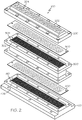
- Burner module 100 comprises a burner gas discharge block 200, a burner gas flow disperser 300, a burner gas inlet block 400, an upper flow plate 500, and a lower flow plate 600.
- the terms “upper” and “lower” are used simply to distinguish the upper flow plate 500 and the lower flow plate 600 and are not used to limit the relative position of the flow plates as the burner module 100 maybe used in many orientations.
- the burner gas discharge block 200 comprises a plurality of apertures 202 located on a burner face 204 of the burner gas discharge block.
- the burner gas discharge block 200 further comprises a plurality of gas discharge channels 206 separated by gas discharge channel partitions 208.
- the gas discharge channels 206 extend from an inlet face of the burner gas discharge block 210 to a plurality of burner face channels 212.
- the burner face channels 212 extend from the gas discharge channels 206 to the apertures 202 located on the burner face 204.
- the gas discharge channel partitions 208 comprise a knife edge upper flow plate contact surface 214 at the inlet face of the burner gas discharge block 210.
- a knife edge is a portion of a structure with a reduced width.
- the burner gas flow disperser 300 comprises a plurality of dispersion channels 302 separated by dispersion channel partitions 304.
- the dispersion channels 302 extend from an inlet face of the burner gas flow disperser 306 to an outlet face of the burner gas flow disperser 308.
- the outlet face of the burner gas flow disperser 308 serves as an anvil to the knife edge upper flow plate contact surface 214.
- the dispersion channel partitions 304 comprise a knife edge lower flow plate contact surface 310 at the inlet face of the burner gas flow disperser 306.
- the burner gas inlet block 400 comprises a plurality of gas inlets 402 disposed on a base of the burner gas inlet block 404.
- the burner gas inlet block 400 further comprises a plurality of gas inlet channels 406 separated by gas inlet channel partitions 408.
- the gas inlet channels 406 extend from the gas inlets 402 of the burner gas inlet block 400 to an outlet face of the burner gas inlet block 410.
- the outlet face of the burner gas inlet block 410 serves as an anvil to the knife edge lower flow plate contact surface 310.
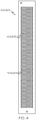
- the upper flow plate 500 comprises a plurality of upper flow plate pressure holes 502 separated by upper flow plate lands 504 extending in a longitudinal direction. Further, each of the plurality of upper flow plate pressure holes 502 is in fluid communication with one of the dispersion channels 302 and one of the gas discharge channels 206.
- the lower flow plate 600 comprises a plurality of lower flow plate pressure holes 602 separated by lower flow plate lands 604 extending in a longitudinal direction. Further, each of the plurality of lower flow plate pressure holes 602 is in fluid communication with one of the gas inlet channels 406 and one of the dispersion channels 302.
- An insulation package (not shown) may also be included as part of the burner module 100.
- the burner module 100 is a modular design.
- the burner gas discharge block 200, the burner gas flow disperser 300, the burner gas inlet block 400, the upper flow plate 500, and the lower flow plate 600 can each be replaced independent of the other components.
- the modular nature of the burner module 100 is beneficial both during manufacturing and during application and use of the burner module.
- a small defect in a single portion of the burner module 100 as a whole does not necessitate scrapping of the entire assembly.
- the flawed part alone can be scrapped with the remaining components able to still be used.
- division of the burner module 100 into multiple segments eases difficulty in machining the plurality of channels, pressure holes, and apertures disposed throughout the burner module. Manufacturing the precise internal geometry of the burner module 100 as a single piece would not be possible using traditional machining techniques as there are blind channels inaccessible to tools. Attempts have been made to overcome this challenge by manufacturing other burner units from sintered or photo-cured metals but such endeavors present their own challenges and drawbacks.
- the components are assembled and retained as a single burner module 100 by means of bolts 800.
- the bolts 800 should be tightened with sufficient torque to seal the components of the burner module 100 together.
- An example of a method of tightening the bolts 800 when there are 12 bolts as shown in Fig. 1 for example, is to tighten them in multiple passes in a designated order.
- the bolts 800 should be tightened to 90 in-lb. This is preferably achieved by tightening each bolt 800 in a non-circumferential order to approximately 30 in-lb, further tightening each bolt to approximately 60 in-lb, and finally further tightening each bolt to approximately 90 in-lb.
- This procedure can be repeated for each series of bolts 800 connecting components together.
- Other means of retaining the individual components together, such as rivets, are also envisioned.
- the burner module 100 is configured to deliver a combustion gas, an oxidizer, a soot precursor, and an inert gas through gas inlets 402, gas inlet channels 406, the lower flow plate pressure holes 602, dispersion channels 302, the upper flow plate pressure holes 502, gas discharge channels 206, the plurality of burner face channels 212, and the plurality of apertures 202 to a combustion site in a chemical vapor deposition process to produce a burner flame in a combustion zone proximate to the burner face.
- the plurality of gas inlets 402 comprises at least one combustion gas inlet, at least one oxidizer inlet, optionally at least one inert gas inlet, and at least one precursor inlet.
- the at least one combustion gas inlet provides a combustion gas to the burner module 100 from a combustion gas source
- the at least one oxidizer inlet provides an oxidizer to the burner module from an oxidizer source
- the at least one inert gas inlet provides an inert gas to the burner module from an inert gas source
- the at least one precursor inlet provides a soot precursor to the burner module from a soot precursor source.
- Example combustion gases include methane and hydrogen.
- An example oxidizer gas is oxygen.
- An example inert gas is nitrogen.
- the combustion gas may be premixed with oxygen.
- a variety of silicon-containing precursor materials may be used as precursor gases. Such precursor materials include, but are not limited to, halide-containing precursors such as silicon tetrachloride; halide-free precursors such as, for example, siloxanes, particularly, polyalkylsiloxanes such as octamethylcyclotetrasiloxane (OMCTS).
- OCTS octamethylcyclotetrasiloxane
- appropriate dopants may be used. These dopants may be delivered with the precursor gases to the burner module 100. Alternatively, the dopants may be delivered to the burner module 100 through a separate gas inlet 402 and exit the burner module 100 through a separate aperture 202 or array of apertures.
- the burner gas inlet block 400 comprises 5 gas inlets 402 for each approximately 203 mm (8 inches) the gas inlet channels 406 are in length.
- the burner gas inlet block 400 may comprise 3 to 7 gas inlets 402 disposed at the base of each gas inlet channel 406.
- the individual gas inlets 402 disposed in each gas inlet channel 406 provides the same single input gas or mixture of input gases.
- a given gas inlet channel 406 which contains a combustion gas such as methane is fed by 3 to 7 gas inlets 402; all of which provide methane.
- Spreading the gas inlets 402 across each gas inlet channel 406 provides a more uniform distribution of the gas across each gas input channel than a single gas inlet feeding each channel.
- the individual gas inlets 402 may also feed pre-mixed gases to each gas inlet channel 406.
- the combustion gas may comprise methane and oxygen or the soot precursor and an inert gas may be fed pre-mixed to an individual gas inlet 402.
- the combustion gas source, the oxidizer source, the inert gas source, and/or the soot precursor source comprise a mixture of at least two input media.
- the input media include the combustion gas, the oxidizer, the soot precursor, and the inert gas.
- the apertures 202 are arranged in an overall array on the burner face 204 to equalize the flow of reactant gases across the length and width of the burner module 100 and into the combustion zone. As a result, a uniform flame within the combustion zone is provided, which results in a uniform distribution of soot on the deposition surface. It should be noted that equalization of the flow of reactant gases across the length and width of the burner module 100 is also the result of the other components of the burner gas module including the burner gas flow disperser 300, burner gas inlet block 400, the upper flow plate 500, and the lower flow plate 600, dispersing the reactant gases prior to the burner gas discharge block 200.
- the array of apertures 202 may include individual sub-arrays, each having a predetermined number of apertures of pre-selected placement, size, etc.
- the array of apertures 202 may include an array of apertures for a combustion gas, an array of apertures for an oxidizer, an array of apertures for the precursor gas, and an array of apertures for an inert gas with each array having different aperture placement, size, etc. It is to be understood that the illustrated configuration of apertures 202 in Figs. 1 and 2 is only a single embodiment, and that other configurations are possible and within the scope of the disclosure. For example, while Figs.
- any of the sub-arrays may have greater or fewer apertures or rows of apertures than those of the other sub-arrays.
- the overall array of apertures 202 includes a plurality of apertures arranged in n parallel columns; wherein n is at least five.
- An example burner module 100 comprises nine columns of apertures 202.
- the array of parallel columns has a length 1 and a width w that is defined by the respective distances between outer edges of the apertures disposed on opposite outer edges of array.
- the centerline column e.g., column 5
- the immediately adjacent columns e.g., columns 4 and 6) provide oxygen gas for stoichiometry control of the silica gas precursor.
- the next two columns of gas orifices on either side of the centerline (e.g., columns 2, 3, 7 and 8) provide additional oxygen, the flow rate of which can be used to control stoichiometry and soot density, and provide an oxidizer for the ignition flame.
- the outermost columns of orifices (e.g., columns 1 and 9) can provide an ignition flame mixture of, for example, CH 4 /O 2 or H 2 /O 2 . Table 1.
- the burner gas inlet block 400 comprises nine gas inlet channels 406, the burner gas flow disperser 300 comprises nine dispersion channels 302, and the burner gas discharge block 200 comprises nine gas discharge channels 206.
- the knife edge lower flow plate contact surface 310 and knife edge upper flow plate contact surface 214 each comprise a knife edge width
- the dispersion channel partitions 304 and the gas discharge channel partitions 208 each comprise a channel partition width
- the channel partition width is greater than the knife edge width.
- the knife edge width is preferably approximately 0.127 mm (0.005 inches) to approximately 0.787 mm (0.031 inches).
- the knife edge width is more preferably approximately 0.254 mm (0.010 inches) to approximately 0.381 mm (0.015 inches).
- the knife edge width is even more preferably approximately 0.305 mm (0.012 inches) to approximately 0.330 mm (0.013 inches).
- the channel partition width is preferably approximately 1.016 mm (0.04 inches) to approximately 2.032 mm (0.08 inches).
- the channel partition width is more preferably approximately 1.27 mm (0.05 inches) to approximately 1.778 mm (0.07 inches).
- the knife edge lower flow plate contact surface 310 and knife edge upper flow plate contact surface 214 is a truncated triangular prism.
- a seal is formed by the lower flow plate 600 between the knife edge lower flow plate contact surface 310 of the burner gas flow disperser 300 and the outlet face of the burner gas inlet block 410.
- the knife edge lower flow plate contact surface 310 of the burner gas flow disperser 300 matches up with the lower flow plate lands 604 of the lower flow plate 600 when the burner module 100 is assembled.
- the knife edge lower flow plate contact surface 310 and lower flow plate lands 604 interface forms a seal.
- an additional seal is formed between the planar surfaces of the lower flow plate 600 and the outlet face of the burner gas inlet block 410.
- the seal between the knife edge lower flow plate contact surface 310 of the burner gas flow disperser 300, the lower flow plate lands 604 of the lower flow plate 600, and the outlet face of the burner gas inlet block 410 is preferably capable of sealing at up to at least 15 psig and more preferably at up to 30 psig.
- a seal is formed by the upper flow plate 500 between the knife edge upper flow plate contact surface 214 of the burner gas discharge block 200 and the outlet face of the burner gas flow disperser 308.
- the knife edge upper flow plate contact surface 214 of the burner gas discharge block 200 matches up with the upper flow plate lands 504 of the upper flow plate 500 when the burner module 100 is assembled.
- the knife edge upper flow plate contact surface 214 and upper flow plate lands 504 interface forms a seal.
- an additional seal is formed between the planar surfaces of the upper flow plate 500 and the outlet face of the burner gas flow disperser 308.
- the seal between the knife edge upper flow plate contact surface 214 of the burner gas discharge block 200, the upper flow plate lands 504 of the upper flow plate 500, and the outlet face of the burner gas flow disperser 308 is preferably capable of sealing at up to at least 15 psig and more preferably at up to 30 psig.
- the seal is formed between a flow plate, a knife edge, and the subsequent burner module 100 component because as the knife edge (knife edge lower flow plate contact surface 310 or knife edge upper flow plate contact surface 214) is pressed into a flow plate (lower flow plate lands 604 of the lower flow plate 600 or upper flow plate lands 504 of the upper flow plate 500) the flow plate is deformed and material is pressed out on the back to form a seal against the subsequent burner module component (outlet face of the burner gas inlet block 410 or outlet face of the burner gas flow disperser 308).
- each fluid pathway includes at least one flow plate (upper flow plate 500 and lower flow plate 600) between sets of channels for gas expansion (gas inlet channels 406, dispersion channels 302, and gas discharge channels 206).
- Adjacent gas inlet channels 406 are separated by gas inlet channel partitions 408.
- Adjacent dispersion channels 302 are separated by dispersion channel partitions 304.
- Adjacent gas discharge channels 206 are separated by gas discharge channel partitions 208. It will be readily understood by those skilled in the art that burner module 100 could comprise a greater or fewer number of channels, flow plates, and the like than shown.
- an embodiment of the burner module 100 could not include the burner gas flow disperser 300 and one of the lower flow plate 600 or the upper flow plate 500.
- the burner module 100 could include at least two burner gas flow dispersers 300 and one additional lower flow plate 600 or upper flow plate 500 for each additional burner gas disperser. The only requirement is that each component of the burner module 100 is separated by a flow plate for sealing purposes.
- the modular nature of the burner module 100 allows for the addition and subtraction of parts as necessary for each specific application.
- Channels, flow plates, and other flow-altering or flow-limiting structures described herein, and arrays of apertures 202 serve to equalize the flow of gases along the length 1 of the burner face 204 of burner module 100, so that the rate and pressure of the flow of gases through the apertures is more uniform.
- the restricted flow as a result of the lower flow plate pressure holes 602 and the upper flow plate pressure holes 502, encourages the gases in each respective channel (gas inlet channels 406, dispersion channels 302, and gas discharge channels 206) to spread throughout the channel. As a result, a more uniform flame and distribution of glass precursors is provided.
- Such uniformity may be characterized in terms of the uniformity in the height of the flame cone, temperature profile of the flame cone, velocity or pressure distributions of gases, and gas concentrations across the width and along the length of the array of apertures 202.
- the upper flow plate 500 and the lower flow plate 600 comprise the same pressure hole number, geometry, and placement.
- the upper flow plate pressure holes 502 of the upper flow plate 500 match the number, geometry, and placement of the lower flow plate pressure holes 602 of the lower flow plate 600.
- the upper flow plate 500 and the lower flow plate 600 comprise different pressure hole number, geometry, or placement.
- the upper flow plate pressure holes 502 of the upper flow plate 500 do not match the number, geometry, and placement of the lower flow plate pressure holes 602 of the lower flow plate 600.
- the pressure holes of the upper flow plate 500 and the lower flow plate 600 may differ in placement, hole geometry, size, number, or a combination of attributes.
- the upper flow plate 500, the lower flow plate 600, or both comprise at least 150 pressure holes.
- Each of the upper flow plate pressure holes 502 is in fluid communication with one of the dispersion channels 302 and one of the gas discharge channels 206.
- Each of the lower flow plate pressure holes 602 is in fluid communication with one of the dispersion channels 302 and one of the gas inlet channels 406.
- the upper flow plate 500, the lower flow plate 600, or both comprise at least 450 pressure holes.
- Each of the upper flow plate pressure holes 502 is in fluid communication with one of the dispersion channels 302 and one of the gas discharge channels 206.
- Each of the lower flow plate pressure holes 602 is in fluid communication with one of the dispersion channels 302 and one of the gas inlet channels 406.
- the upper flow plate 500, the lower flow plate 600, or both comprise at least 1000 pressure holes.
- Each of the upper flow plate pressure holes 502 is in fluid communication with one of the dispersion channels 302 and one of the gas discharge channels 206.
- Each of the lower flow plate pressure holes 602 is in fluid communication with one of the dispersion channels 302 and one of the gas inlet channels 406.
- the upper flow plate 500, the lower flow plate 600, or both comprise circular pressure holes with diameters of approximately 0.508 mm (0.020 inches) to approximately 0.762 mm (0.030 inches).
- the upper flow plate pressure holes 502 in communication with a single dispersion channel 302 and a single gas discharge channel 206 being disposed along a single line with the centers of the upper flow plate pressure holes spaced approximately 0.762 mm (0.030 inches) to approximately 1.016 (0.040 inches) apart.
- the rows of upper flow plate pressure holes 502 are separated by upper flow plate lands 504 with a width of approximately 1.524 (0.060 inches) to approximately 4.572 mm (0.180 inches).
- the lower flow plate pressure holes 602 in communication with a single gas inlet channel 406 and a single dispersion channel 302 being disposed along a single line with the centers of the lower flow plate pressure holes spaced approximately 0.762 mm (0.030 inches) to approximately 1.016 mm (0.040 inches) apart.
- the rows of lower flow plate pressure holes 602 are separated by lower flow plate lands 604 with a width of approximately 1.524 mm (0.060 inches) to approximately 4.572 mm (0.180 inches).
- the upper flow plate 500, the lower flow plate 600, or both comprise circular pressure holes with diameters of approximately 0.254 mm (0.010 inches) to approximately 0.762 mm (0.030 inches).
- the upper flow plate pressure holes 502 in communication with a single dispersion channel 302 and a single gas discharge channel 206 being disposed along at least two lines with the centers of the upper flow plate pressure holes spaced approximately 0.381 mm (0.015 inches) to approximately 0.762 mm (0.030 inches) apart along each line.
- the at least two lines of upper flow plate pressure holes 502 may be in alignment or staggered.
- the groups of rows of upper flow plate pressure holes 502 are separated by upper flow plate lands 504 with a width of approximately 1.524 mm (0.060 inches) to approximately 4.572 mm (0.180 inches).
- the lower flow plate pressure holes 602 in communication with a single gas inlet channel 406 and a single dispersion channel 302 being disposed along at least two lines with the centers of the lower flow plate pressure holes spaced approximately 0.381 mm (0.015 inches) to approximately 0.762 mm (0.030 inches) apart along each line.
- the at least two lines of lower flow plate pressure holes 602 may be in alignment or staggered.
- the groups of rows of lower flow plate pressure holes 602 are separated by lower flow plate lands 604 with a width of approximately 1.524 mm (0.060 inches) to approximately 4.572 mm (0.180 inches).
- the upper flow plate pressure holes 502 and lower flow plate pressure holes 602 do not have to be circular.
- the upper flow plate pressure holes 502 and lower flow plate pressure holes 602 may be any geometry including for example, oval, square, triangular, or obround.
- the upper flow plate 500, the lower flow plate 600, or both are manufactured using, for example, photochemical machining (PCM) of a corrosion-resistant alloy plate.
- PCM photochemical machining
- An example alloy is a nickel alloy.
- the alloy used to form the upper flow plate 500 or the lower flow plate 600 can be heat treated to optimize its mechanical properties, including hardness and ductility.
- the PCM process can be used to form features, such as the upper flow plate pressure holes 502 and the lower flow plate pressure holes 602, with precision and accuracy.
- the upper flow plate pressure holes 502 and the lower flow plate pressure holes 602 having a diameter of about 0.102 mm (0.004 inch) +/- 0.0127 mm (0.0005 inch) can be formed.
- the PCM process can be used to precisely control the relative position of each flow plate pressure hole.
- the PCM process allows the upper flow plate pressure holes 502 and the lower flow plate pressure holes 602 to be formed precisely, efficiently, and without machining burrs or tool marks.
- the knife edge upper flow plate contact surface 214 and the knife edge lower flow plate contact surface 310 form a seal with the upper flow plate 500 and lower flow plate 600 respectively, the relative hardness of the two materials is important.
- the knife edge upper flow plate contact surface 214 and the knife edge lower flow plate contact surface 310 are preferably harder than the upper flow plate 500 and lower flow plate 600 so the upper flow plate and lower flow plate are deformed and the upper flow plate contact surface and the knife edge lower flow plate contact surface retain their shape during assembly.
- the knife edge upper flow plate contact surface 214 and the knife edge lower flow plate contact surface 310 preferably have a Rockwell Hardness scale C of at least approximately 50.
- the upper flow plate 500 and lower flow plate 600 preferably have a Knoop hardness of approximately 94.6 with a 100 gram load on the indenter.
- the maximum Knoop hardness with a 100 gram load on the indenter of the upper flow plate 500 and lower flow plate 600 is below 100.
- the burner gas inlet block 400, the burner gas flow disperser 300, and the burner gas discharge block 200 are preferably made of hardened steel. More specifically, the burner gas inlet block 400, the burner gas flow disperser 300, and the burner gas discharge block 200 are preferably made of 420 stainless steel. This material allows the components of the burner module 100 to be used in the harsh environment in operation as well as be sufficiently robust and structurally sound. Additionally, 420 stainless steel enables ease of conventional machining.
- the burner module 100 comprises at least two alignment pins 700 configured to position the burner gas flow disperser 300, the upper flow plate 500, and the burner gas discharge block 200 in alignment.
- the burner module 100 also comprises at least two alignment pins 700 configured to position the burner gas flow disperser 300, the lower flow plate 600, and the burner gas inlet block 400 in alignment.
- the alignment pins 700 ensure that the knife edge upper flow plate contact surface 214 contacts the upper flow plate 500 with the knife edge width disposed on the upper flow plate lands 504. The alignment pins 700 also ensure that the knife edge lower flow plate contact surface 310 contacts the lower flow plate 600 with the knife edge width disposed on the lower flow plate lands 604. Additionally, the gas discharge channels 206, the dispersion channels 302, and the gas inlet channels 406 must be aligned with the upper flow plate pressure holes 502 and the lower flow plate pressure holes 602. The alignment pins 700 ensure the channels and pressure holes are in the proper alignment.
- the burner module 100 as a component of an apparatus for forming thin, uniform glass sheets and ribbons, may be used to produce thin glass sheets and ribbons.
- the apparatus for forming thin, uniform glass sheets and ribbons comprises a soot providing device, a soot-receiving device, a soot sheet-guiding device, and a soot sheet-sintering device.
- glass soot particles formed by the soot providing device are deposited on a deposition surface of the soot-receiving device.
- the soot-receiving device is in the form of a rotatable drum or belt and thus can comprise a continuous deposition surface.
- the deposited soot particles form a soot layer on the deposition surface.
- the soot layer once formed, can be released from the deposition surface as a free-standing, continuous soot sheet.
- the act of releasing the soot layer from the deposition surface can occur without physical intervention due to, for example, thermal mismatch, a mismatch in coefficients of thermal expansion between the soot layer and the deposition surface and/or under the effect of the force of gravity.
- a soot sheet-guiding device can guide movement of the soot sheet through a soot sheet-sintering device, which sinters and consolidates the soot sheet to form a glass sheet.
- soot deposition systems are described in U. S. Patent 8,137,469 , entitled “Method and Apparatus for Making Fused Silica,” by Daniel W. Hawtof et al., filed Dec. 14, 2005.
- a process of forming a thin, uniform glass sheet comprises providing a plurality of glass soot particles, depositing a uniform layer of the glass soot particles on a deposition surface of a soot-receiving device to form a soot layer, releasing the soot layer from the soot-receiving surface to form a soot sheet, and sintering the soot sheet to form a glass sheet or ribbon.
- An example of a process and apparatus for making glass sheet is described in U.S. Patent 7,677,058 , entitled “Process and Apparatus for Making Glass Sheet," by Daniel W. Hawtof et al., filed May 7, 2007. Additional aspects of a process and apparatus for making glass sheet are disclosed in detail herein below.
- the soot-providing device may comprise one or more burner module 100, such as those used in outside vapor deposition OVD, vapor axial deposition (VAD) and planar deposition processes.
- the soot-providing device may comprise a single burner module 100 or multiple burner modules.
- multiple burner modules 100 can be configured into a burner module array that can produce a substantially continuous stream of soot particles over the length and width of the array.
- a burner module array may comprise a plurality of individual burner modules 100 (e.g., placed end-to-end) configured to form and deposit a temporally and spatially uniform layer of glass soot.
- Burner modules 100 placed end-to-end are preferably modified from the selected embodiment shown in Fig. 1 to remove the lands at the ends of the burner module. Removal of the lands allows the burner faces 204 to be placed closer together and continue in a substantially uninterrupted manner from one burner module 100 to the next.
- the individual burner modules 100 may be connected together by, for example, adding a knife edge to the modified ends of the burner module and bolting the individual burner modules together to form a seal.
- each soot-providing device can be used to form an individual layer of soot having a substantially homogeneous chemical composition and a substantially uniform thickness.
- uniform composition and “uniform thickness” it is meant that the composition and thickness variation over a given area is less than or equal to approximately 2% of an average composition or thickness.
- one or both of the compositional and thickness variation of a soot sheet can be less than or equal to approximately 1% of their respective average values over the soot sheet.
- the burner module 100 is resistant to thermal shock and can provide a distributed, even stream of one or more precursor gases to form glass soot.
- the disclosed burner module 100 can deliver a uniform flow rate of gas reactants across the outlet face.
- uniform flow rate it is meant that (a) a gas velocity of a specific aperture 202 at the burner face 204 for any particular gas reactant varies by less than approximately 2% of an average velocity for all the apertures discharging that gas and/or (b) the average gas velocity of the apertures at the burner face for one gas varies by less than approximately 2% of an average velocity of all the apertures for all the gases.
- Uniformity between the flow rates in each of the apertures 202 allows soot sheets and thin glass sheets to be formed with superb uniformity. Even a single aperture 202 which has a flow rate disproportionately large or small in comparison to the remainder of the apertures can have an effect on the resulting surface topography of the thin glass sheet. An aperture 202 which exhibits a flow rate in excess of the remainder of the apertures results in a raised ridge forming in the resulting thin glass sheet formed from the soot sheet. The additional soot deposited forms a line, potentially visible to the naked human eye, in the thin glass sheet or ribbon. An aperture 202 which exhibits a flow rate deficient in comparison to the remainder of the apertures results in a valley forming in the resulting thin glass sheet formed from the soot sheet or ribbon.
- the design and precise manufacturing techniques of embodiments of the burner module 100 allow for line free thin glass sheets to be formed.
- Line free glass sheets are those where a line is not visible to a naked human eye.
- Precise and consistent gas flow from each of the apertures 202 forms a soot sheet with consistent mass density throughout allowing for the formation of line free glass.
- the thin glass sheet formed using the burner module 100 may exhibit peak to valley excursions of less than 0.1 microns (including 0.08 microns, 0.05 microns, 0.03 microns, 0.02 microns, and less than 0.01 microns).
- Glass sheets made using the foregoing approach can have an average thickness of 200 microns or less and an average surface roughness over at least one of two major opposing surfaces of 1 nm or less. In an embodiment, an average surface roughness over both of the two major surfaces is 1 nm or less.
- Example high-silica glass sheets measure at least 2.5x2.5 cm 2 .
- a width of the glass sheet can range from about 2.5 cm to 2 m and a length of the glass sheet - measured in the machine direction - can range from about 2.5 cm to 10 m or more. The length of the glass sheet is limited in principle only by the deposition time, and can extend beyond 10 m to 10 km or more.
- EDM electric discharge machining
- the machined surfaces of the burner module 100 may optionally be post processed to smooth the walls and apertures.
- the post processing smoothing operation can be achieved, for example, bypassing a deburring, polishing and surface finishing agent such as Extrude Hone® (Kennametal, Irwin, PA) through the burner module 100 components.
- the soot-providing device may be held stationery during formation and deposition of the soot particles or, alternatively, the soot-providing device maybe moved (e.g., oscillated) with respect to the deposition surface.
- a distance from the burner face 204 to the deposition surface can range from about 20 mm to about 100 mm (e.g., 20, 25, 30, 35, 40, 45, 50, 55, 60, 65, 70, 75, 80, 85, 90, 95 or 100 mm).
- the soot particles may consist essentially of a single phase (e.g., a single oxide), which can be sintered to form, for example, un-doped, high-purity glass.
- the soot particles may comprise two or more components or two or more phases, which can be sintered to form, for example, doped glass.
- Multiphase glass sheets for example, can be made by incorporating a titanium oxide precursor or a phosphorous oxide precursor into the OMCTS gas flow.
- Example titanium and phosphorous oxide precursors include various soluble metal salts and metal alkoxides such as halides of phosphorous and titanium (IV) isopropoxide.
- Doping can take place in situ during the flame hydrolysis process by introducing dopant precursors into the flame. Dopants can also be incorporated into a soot sheet prior to or during sintering of the soot sheet.
- Example dopants include elements from Groups IA, IB, IIA, IIB, IIIA, IIIB, IVA, IVB, VA, VB and the rare earth series of the Periodic Table of Elements.
- the soot particles can have an essentially homogeneous composition, size and/or shape.
- one or more of the composition, size and shape of the soot particles can vary.
- soot particles of a main glass component can be provided by one soot-providing device, while soot particles of a dopant composition can be provided by a different soot-providing device.
- soot particles can mix and/or adhere to one another during the acts of forming and depositing the soot particles to form composite particles. It is also possible that the soot particles are substantially prevented from adhering to each other to form mixed particles prior to or while being deposited on a deposition surface.
- references herein of a component of the present disclosure being “configured” to embody a particular property, or function in a particular manner, are structural recitations as opposed to recitations of intended use. More specifically, the references herein to the manner in which a component is “configured” denotes an existing physical condition of the component and, as such, is to be taken as a definite recitation of the structural characteristics of the component.
Landscapes
- Engineering & Computer Science (AREA)
- Chemical & Material Sciences (AREA)
- Manufacturing & Machinery (AREA)
- Materials Engineering (AREA)
- Organic Chemistry (AREA)
- Chemical Kinetics & Catalysis (AREA)
- Combustion & Propulsion (AREA)
- Mechanical Engineering (AREA)
- General Engineering & Computer Science (AREA)
- Dispersion Chemistry (AREA)
- Glass Melting And Manufacturing (AREA)
Applications Claiming Priority (2)
| Application Number | Priority Date | Filing Date | Title |
|---|---|---|---|
| US13/484,466 US8857216B2 (en) | 2012-05-31 | 2012-05-31 | Burner modules, methods of forming glass sheets, and glass sheets formed thereby |
| PCT/US2013/043022 WO2013181206A1 (en) | 2012-05-31 | 2013-05-29 | Burner modules, methods of forming glass sheets, and glass sheets formed thereby |
Publications (3)
| Publication Number | Publication Date |
|---|---|
| EP2858957A1 EP2858957A1 (en) | 2015-04-15 |
| EP2858957A4 EP2858957A4 (en) | 2016-03-23 |
| EP2858957B1 true EP2858957B1 (en) | 2018-04-25 |
Family
ID=49670591
Family Applications (1)
| Application Number | Title | Priority Date | Filing Date |
|---|---|---|---|
| EP13796697.4A Not-in-force EP2858957B1 (en) | 2012-05-31 | 2013-05-29 | Burner modules and method of forming glass sheets |
Country Status (7)
| Country | Link |
|---|---|
| US (1) | US8857216B2 (enExample) |
| EP (1) | EP2858957B1 (enExample) |
| JP (1) | JP6149311B2 (enExample) |
| KR (1) | KR20150022856A (enExample) |
| CN (1) | CN104768882B (enExample) |
| TW (1) | TWI570077B (enExample) |
| WO (1) | WO2013181206A1 (enExample) |
Families Citing this family (5)
| Publication number | Priority date | Publication date | Assignee | Title |
|---|---|---|---|---|
| US9199870B2 (en) | 2012-05-22 | 2015-12-01 | Corning Incorporated | Electrostatic method and apparatus to form low-particulate defect thin glass sheets |
| CN106573831B (zh) | 2014-08-12 | 2020-04-21 | 康宁股份有限公司 | 用于减少显示器玻璃静电放电的有机表面处理 |
| US10570048B2 (en) | 2015-02-13 | 2020-02-25 | Corning Incorporated | Silica-containing sheet and related system and methods |
| ES2712508T3 (es) * | 2016-09-15 | 2019-05-13 | Ingo Hilgenberg | Quemador para generación de una llama alargada |
| US10745804B2 (en) * | 2017-01-31 | 2020-08-18 | Ofs Fitel, Llc | Parallel slit torch for making optical fiber preform |
Family Cites Families (23)
| Publication number | Priority date | Publication date | Assignee | Title |
|---|---|---|---|---|
| US1998300A (en) * | 1930-12-16 | 1935-04-16 | Ackermann Hugo | Gas burner |
| US2418208A (en) * | 1943-11-04 | 1947-04-01 | Air Reduction | Gas torch |
| US2719581A (en) * | 1952-02-13 | 1955-10-04 | Selas Corp Of America | Welding torch |
| JPH05263939A (ja) * | 1991-12-03 | 1993-10-12 | Ulvac Japan Ltd | ナイフエッジ型メタルシールフランジ |
| GB9312634D0 (en) * | 1993-06-18 | 1993-08-04 | Tsl Group Plc | Improvements in vitreous silica manufacture |
| US5599371A (en) * | 1994-12-30 | 1997-02-04 | Corning Incorporated | Method of using precision burners for oxidizing halide-free, silicon-containing compounds |
| EP1044172A4 (en) * | 1997-12-19 | 2005-01-19 | Corning Inc | BURNER AND PROCESS FOR PRODUCING METAL OXIDE SUES |
| EP1144913A4 (en) * | 1998-12-17 | 2004-12-15 | Corning Inc | DISTRIBUTION DEVICE FOR BURNERS FOR USE IN A GAS PHASE DEPOSITION METHOD |
| US6736633B1 (en) * | 1998-12-17 | 2004-05-18 | Corning Incorporated | Burner manifold apparatus for use in a chemical vapor deposition process |
| US6328807B1 (en) | 1999-12-14 | 2001-12-11 | Corning Incorporated | Chuck heater for improved planar deposition process |
| AU2001268246A1 (en) | 2000-08-10 | 2002-02-25 | Corning Incorporated | Method for depositing a glass layer on a substrate |
| AU2001288712A1 (en) * | 2000-10-03 | 2002-04-15 | Corning Incorporated | Method and apparatus for manufacturing optical fiber preforms using a large diameter bait rod |
| US6743011B2 (en) * | 2001-12-19 | 2004-06-01 | Corning Incorporated | Multi-layer burner module, adapter, and assembly therefor |
| ATE448178T1 (de) * | 2002-12-20 | 2009-11-15 | Prysmian Spa | Brenner für die chemische gasphasenabscheidung von glas |
| US7726967B2 (en) | 2004-06-23 | 2010-06-01 | Char-Broil, Llc | Radiant burner |
| US8137469B2 (en) | 2005-12-14 | 2012-03-20 | Corning Incorporated | Method and apparatus for making fused silica |
| CN200968605Y (zh) * | 2006-09-01 | 2007-10-31 | 西安热工研究院有限公司 | 一种中心风可调直流燃烧器 |
| WO2008121271A1 (en) * | 2007-03-30 | 2008-10-09 | Corning Incorporated | Three dimensional micro-fabricated burners |
| US7677058B2 (en) * | 2007-05-07 | 2010-03-16 | Corning Incorporated | Process and apparatus for making glass sheet |
| US8062733B2 (en) | 2009-05-15 | 2011-11-22 | Corning Incorporated | Roll-to-roll glass material attributes and fingerprint |
| US8359884B2 (en) * | 2009-07-17 | 2013-01-29 | Corning Incorporated | Roll-to-roll glass: touch-free process and multilayer approach |
| FI126760B (fi) | 2010-01-11 | 2017-05-15 | Glaston Services Ltd Oy | Menetelmä ja laite lasilevyjen kannattamiseksi ja kuumentamiseksi kuumalla kaasutyynyllä |
| JP5259804B2 (ja) * | 2011-11-08 | 2013-08-07 | シャープ株式会社 | 気相成長装置及び気相成長方法 |
-
2012
- 2012-05-31 US US13/484,466 patent/US8857216B2/en active Active
-
2013
- 2013-05-28 TW TW102118785A patent/TWI570077B/zh not_active IP Right Cessation
- 2013-05-29 JP JP2015515135A patent/JP6149311B2/ja not_active Expired - Fee Related
- 2013-05-29 KR KR20147035648A patent/KR20150022856A/ko not_active Abandoned
- 2013-05-29 WO PCT/US2013/043022 patent/WO2013181206A1/en not_active Ceased
- 2013-05-29 CN CN201380034698.2A patent/CN104768882B/zh not_active Expired - Fee Related
- 2013-05-29 EP EP13796697.4A patent/EP2858957B1/en not_active Not-in-force
Non-Patent Citations (1)
| Title |
|---|
| None * |
Also Published As
| Publication number | Publication date |
|---|---|
| JP2015523309A (ja) | 2015-08-13 |
| CN104768882B (zh) | 2018-02-13 |
| TW201410623A (zh) | 2014-03-16 |
| EP2858957A4 (en) | 2016-03-23 |
| CN104768882A (zh) | 2015-07-08 |
| US8857216B2 (en) | 2014-10-14 |
| WO2013181206A1 (en) | 2013-12-05 |
| JP6149311B2 (ja) | 2017-06-21 |
| EP2858957A1 (en) | 2015-04-15 |
| TWI570077B (zh) | 2017-02-11 |
| KR20150022856A (ko) | 2015-03-04 |
| US20130323463A1 (en) | 2013-12-05 |
Similar Documents
| Publication | Publication Date | Title |
|---|---|---|
| EP2858957B1 (en) | Burner modules and method of forming glass sheets | |
| JP5351141B2 (ja) | 三次元微細加工バーナー | |
| EP2454206B1 (en) | Touch-free and multilayer soot deposition process for a rollable glass | |
| US8181485B2 (en) | Roll-to-roll glass soot sheet sintering method and apparatus | |
| US6627335B2 (en) | Coated cutting tool and method for producing the same | |
| JP2013539447A (ja) | 基材からガラススートシートを取り外す方法および装置 | |
| US8801817B2 (en) | Surface-coated cutting tool and manufacturing method thereof | |
| CA2922827C (en) | Coated cutting tool | |
| JPH03228845A (ja) | 光ファイバプリフォーム母材の製造方法 | |
| EP1572593B1 (en) | Burner for chemical vapour deposition of glass | |
| JPH03279234A (ja) | 光ファイバプリフォーム母材の製造方法 | |
| US20130052413A1 (en) | Thin glass sheet with tunable coefficient of thermal expansion | |
| DE102004029911A1 (de) | Verfahren und Anordnung zur Herstellung anorganischer Schichten | |
| JP2002338258A (ja) | ガラス微粒子堆積体の製造方法及び装置 | |
| US20120270037A1 (en) | Surface-coated cutting tool and manufacturing method thereof | |
| KR20180136457A (ko) | 유리 미립자의 합성 방법 | |
| Scaticailov | Grinding of the gears with high depth processing | |
| JP2004066436A (ja) | 高速重切削条件で硬質被覆層がすぐれた耐チッピング性および耐摩耗性を発揮する表面被覆超硬合金製切削工具 |
Legal Events
| Date | Code | Title | Description |
|---|---|---|---|
| PUAI | Public reference made under article 153(3) epc to a published international application that has entered the european phase |
Free format text: ORIGINAL CODE: 0009012 |
|
| 17P | Request for examination filed |
Effective date: 20141218 |
|
| AK | Designated contracting states |
Kind code of ref document: A1 Designated state(s): AL AT BE BG CH CY CZ DE DK EE ES FI FR GB GR HR HU IE IS IT LI LT LU LV MC MK MT NL NO PL PT RO RS SE SI SK SM TR |
|
| AX | Request for extension of the european patent |
Extension state: BA ME |
|
| DAX | Request for extension of the european patent (deleted) | ||
| RA4 | Supplementary search report drawn up and despatched (corrected) |
Effective date: 20160218 |
|
| RIC1 | Information provided on ipc code assigned before grant |
Ipc: C03B 5/235 20060101AFI20160212BHEP Ipc: C03B 18/02 20060101ALI20160212BHEP Ipc: C03B 5/08 20060101ALI20160212BHEP |
|
| GRAP | Despatch of communication of intention to grant a patent |
Free format text: ORIGINAL CODE: EPIDOSNIGR1 |
|
| INTG | Intention to grant announced |
Effective date: 20171117 |
|
| GRAJ | Information related to disapproval of communication of intention to grant by the applicant or resumption of examination proceedings by the epo deleted |
Free format text: ORIGINAL CODE: EPIDOSDIGR1 |
|
| GRAA | (expected) grant |
Free format text: ORIGINAL CODE: 0009210 |
|
| GRAR | Information related to intention to grant a patent recorded |
Free format text: ORIGINAL CODE: EPIDOSNIGR71 |
|
| GRAS | Grant fee paid |
Free format text: ORIGINAL CODE: EPIDOSNIGR3 |
|
| INTC | Intention to grant announced (deleted) | ||
| AK | Designated contracting states |
Kind code of ref document: B1 Designated state(s): AL AT BE BG CH CY CZ DE DK EE ES FI FR GB GR HR HU IE IS IT LI LT LU LV MC MK MT NL NO PL PT RO RS SE SI SK SM TR |
|
| INTG | Intention to grant announced |
Effective date: 20180319 |
|
| REG | Reference to a national code |
Ref country code: GB Ref legal event code: FG4D |
|
| REG | Reference to a national code |
Ref country code: CH Ref legal event code: EP |
|
| REG | Reference to a national code |
Ref country code: AT Ref legal event code: REF Ref document number: 992681 Country of ref document: AT Kind code of ref document: T Effective date: 20180515 |
|
| REG | Reference to a national code |
Ref country code: IE Ref legal event code: FG4D |
|
| REG | Reference to a national code |
Ref country code: DE Ref legal event code: R096 Ref document number: 602013036572 Country of ref document: DE Ref country code: FR Ref legal event code: PLFP Year of fee payment: 6 |
|
| REG | Reference to a national code |
Ref country code: DE Ref legal event code: R096 Ref document number: 602013036572 Country of ref document: DE |
|
| REG | Reference to a national code |
Ref country code: NL Ref legal event code: MP Effective date: 20180425 |
|
| REG | Reference to a national code |
Ref country code: LT Ref legal event code: MG4D |
|
| PG25 | Lapsed in a contracting state [announced via postgrant information from national office to epo] |
Ref country code: NL Free format text: LAPSE BECAUSE OF FAILURE TO SUBMIT A TRANSLATION OF THE DESCRIPTION OR TO PAY THE FEE WITHIN THE PRESCRIBED TIME-LIMIT Effective date: 20180425 |
|
| PG25 | Lapsed in a contracting state [announced via postgrant information from national office to epo] |
Ref country code: SE Free format text: LAPSE BECAUSE OF FAILURE TO SUBMIT A TRANSLATION OF THE DESCRIPTION OR TO PAY THE FEE WITHIN THE PRESCRIBED TIME-LIMIT Effective date: 20180425 Ref country code: BG Free format text: LAPSE BECAUSE OF FAILURE TO SUBMIT A TRANSLATION OF THE DESCRIPTION OR TO PAY THE FEE WITHIN THE PRESCRIBED TIME-LIMIT Effective date: 20180725 Ref country code: FI Free format text: LAPSE BECAUSE OF FAILURE TO SUBMIT A TRANSLATION OF THE DESCRIPTION OR TO PAY THE FEE WITHIN THE PRESCRIBED TIME-LIMIT Effective date: 20180425 Ref country code: NO Free format text: LAPSE BECAUSE OF FAILURE TO SUBMIT A TRANSLATION OF THE DESCRIPTION OR TO PAY THE FEE WITHIN THE PRESCRIBED TIME-LIMIT Effective date: 20180725 Ref country code: PL Free format text: LAPSE BECAUSE OF FAILURE TO SUBMIT A TRANSLATION OF THE DESCRIPTION OR TO PAY THE FEE WITHIN THE PRESCRIBED TIME-LIMIT Effective date: 20180425 Ref country code: LT Free format text: LAPSE BECAUSE OF FAILURE TO SUBMIT A TRANSLATION OF THE DESCRIPTION OR TO PAY THE FEE WITHIN THE PRESCRIBED TIME-LIMIT Effective date: 20180425 Ref country code: ES Free format text: LAPSE BECAUSE OF FAILURE TO SUBMIT A TRANSLATION OF THE DESCRIPTION OR TO PAY THE FEE WITHIN THE PRESCRIBED TIME-LIMIT Effective date: 20180425 |
|
| PG25 | Lapsed in a contracting state [announced via postgrant information from national office to epo] |
Ref country code: GR Free format text: LAPSE BECAUSE OF FAILURE TO SUBMIT A TRANSLATION OF THE DESCRIPTION OR TO PAY THE FEE WITHIN THE PRESCRIBED TIME-LIMIT Effective date: 20180726 Ref country code: HR Free format text: LAPSE BECAUSE OF FAILURE TO SUBMIT A TRANSLATION OF THE DESCRIPTION OR TO PAY THE FEE WITHIN THE PRESCRIBED TIME-LIMIT Effective date: 20180425 Ref country code: LV Free format text: LAPSE BECAUSE OF FAILURE TO SUBMIT A TRANSLATION OF THE DESCRIPTION OR TO PAY THE FEE WITHIN THE PRESCRIBED TIME-LIMIT Effective date: 20180425 Ref country code: RS Free format text: LAPSE BECAUSE OF FAILURE TO SUBMIT A TRANSLATION OF THE DESCRIPTION OR TO PAY THE FEE WITHIN THE PRESCRIBED TIME-LIMIT Effective date: 20180425 |
|
| REG | Reference to a national code |
Ref country code: CH Ref legal event code: PL |
|
| REG | Reference to a national code |
Ref country code: AT Ref legal event code: MK05 Ref document number: 992681 Country of ref document: AT Kind code of ref document: T Effective date: 20180425 |
|
| PG25 | Lapsed in a contracting state [announced via postgrant information from national office to epo] |
Ref country code: PT Free format text: LAPSE BECAUSE OF FAILURE TO SUBMIT A TRANSLATION OF THE DESCRIPTION OR TO PAY THE FEE WITHIN THE PRESCRIBED TIME-LIMIT Effective date: 20180827 |
|
| REG | Reference to a national code |
Ref country code: DE Ref legal event code: R097 Ref document number: 602013036572 Country of ref document: DE |
|
| REG | Reference to a national code |
Ref country code: BE Ref legal event code: MM Effective date: 20180531 |
|
| PG25 | Lapsed in a contracting state [announced via postgrant information from national office to epo] |
Ref country code: RO Free format text: LAPSE BECAUSE OF FAILURE TO SUBMIT A TRANSLATION OF THE DESCRIPTION OR TO PAY THE FEE WITHIN THE PRESCRIBED TIME-LIMIT Effective date: 20180425 Ref country code: CZ Free format text: LAPSE BECAUSE OF FAILURE TO SUBMIT A TRANSLATION OF THE DESCRIPTION OR TO PAY THE FEE WITHIN THE PRESCRIBED TIME-LIMIT Effective date: 20180425 Ref country code: EE Free format text: LAPSE BECAUSE OF FAILURE TO SUBMIT A TRANSLATION OF THE DESCRIPTION OR TO PAY THE FEE WITHIN THE PRESCRIBED TIME-LIMIT Effective date: 20180425 Ref country code: AT Free format text: LAPSE BECAUSE OF FAILURE TO SUBMIT A TRANSLATION OF THE DESCRIPTION OR TO PAY THE FEE WITHIN THE PRESCRIBED TIME-LIMIT Effective date: 20180425 Ref country code: DK Free format text: LAPSE BECAUSE OF FAILURE TO SUBMIT A TRANSLATION OF THE DESCRIPTION OR TO PAY THE FEE WITHIN THE PRESCRIBED TIME-LIMIT Effective date: 20180425 Ref country code: SK Free format text: LAPSE BECAUSE OF FAILURE TO SUBMIT A TRANSLATION OF THE DESCRIPTION OR TO PAY THE FEE WITHIN THE PRESCRIBED TIME-LIMIT Effective date: 20180425 Ref country code: MC Free format text: LAPSE BECAUSE OF FAILURE TO SUBMIT A TRANSLATION OF THE DESCRIPTION OR TO PAY THE FEE WITHIN THE PRESCRIBED TIME-LIMIT Effective date: 20180425 |
|
| REG | Reference to a national code |
Ref country code: IE Ref legal event code: MM4A |
|
| PG25 | Lapsed in a contracting state [announced via postgrant information from national office to epo] |
Ref country code: IT Free format text: LAPSE BECAUSE OF FAILURE TO SUBMIT A TRANSLATION OF THE DESCRIPTION OR TO PAY THE FEE WITHIN THE PRESCRIBED TIME-LIMIT Effective date: 20180425 Ref country code: SM Free format text: LAPSE BECAUSE OF FAILURE TO SUBMIT A TRANSLATION OF THE DESCRIPTION OR TO PAY THE FEE WITHIN THE PRESCRIBED TIME-LIMIT Effective date: 20180425 Ref country code: LI Free format text: LAPSE BECAUSE OF NON-PAYMENT OF DUE FEES Effective date: 20180531 Ref country code: CH Free format text: LAPSE BECAUSE OF NON-PAYMENT OF DUE FEES Effective date: 20180531 |
|
| PLBE | No opposition filed within time limit |
Free format text: ORIGINAL CODE: 0009261 |
|
| STAA | Information on the status of an ep patent application or granted ep patent |
Free format text: STATUS: NO OPPOSITION FILED WITHIN TIME LIMIT |
|
| PG25 | Lapsed in a contracting state [announced via postgrant information from national office to epo] |
Ref country code: LU Free format text: LAPSE BECAUSE OF NON-PAYMENT OF DUE FEES Effective date: 20180529 |
|
| 26N | No opposition filed |
Effective date: 20190128 |
|
| PG25 | Lapsed in a contracting state [announced via postgrant information from national office to epo] |
Ref country code: IE Free format text: LAPSE BECAUSE OF NON-PAYMENT OF DUE FEES Effective date: 20180529 |
|
| PG25 | Lapsed in a contracting state [announced via postgrant information from national office to epo] |
Ref country code: SI Free format text: LAPSE BECAUSE OF FAILURE TO SUBMIT A TRANSLATION OF THE DESCRIPTION OR TO PAY THE FEE WITHIN THE PRESCRIBED TIME-LIMIT Effective date: 20180425 Ref country code: BE Free format text: LAPSE BECAUSE OF NON-PAYMENT OF DUE FEES Effective date: 20180531 |
|
| PGFP | Annual fee paid to national office [announced via postgrant information from national office to epo] |
Ref country code: FR Payment date: 20190417 Year of fee payment: 7 |
|
| PGFP | Annual fee paid to national office [announced via postgrant information from national office to epo] |
Ref country code: GB Payment date: 20190430 Year of fee payment: 7 |
|
| PG25 | Lapsed in a contracting state [announced via postgrant information from national office to epo] |
Ref country code: AL Free format text: LAPSE BECAUSE OF FAILURE TO SUBMIT A TRANSLATION OF THE DESCRIPTION OR TO PAY THE FEE WITHIN THE PRESCRIBED TIME-LIMIT Effective date: 20180425 |
|
| PG25 | Lapsed in a contracting state [announced via postgrant information from national office to epo] |
Ref country code: MT Free format text: LAPSE BECAUSE OF NON-PAYMENT OF DUE FEES Effective date: 20180529 |
|
| PG25 | Lapsed in a contracting state [announced via postgrant information from national office to epo] |
Ref country code: TR Free format text: LAPSE BECAUSE OF FAILURE TO SUBMIT A TRANSLATION OF THE DESCRIPTION OR TO PAY THE FEE WITHIN THE PRESCRIBED TIME-LIMIT Effective date: 20180425 |
|
| PG25 | Lapsed in a contracting state [announced via postgrant information from national office to epo] |
Ref country code: CY Free format text: LAPSE BECAUSE OF FAILURE TO SUBMIT A TRANSLATION OF THE DESCRIPTION OR TO PAY THE FEE WITHIN THE PRESCRIBED TIME-LIMIT Effective date: 20180425 Ref country code: HU Free format text: LAPSE BECAUSE OF FAILURE TO SUBMIT A TRANSLATION OF THE DESCRIPTION OR TO PAY THE FEE WITHIN THE PRESCRIBED TIME-LIMIT; INVALID AB INITIO Effective date: 20130529 Ref country code: MK Free format text: LAPSE BECAUSE OF NON-PAYMENT OF DUE FEES Effective date: 20180425 |
|
| PG25 | Lapsed in a contracting state [announced via postgrant information from national office to epo] |
Ref country code: IS Free format text: LAPSE BECAUSE OF FAILURE TO SUBMIT A TRANSLATION OF THE DESCRIPTION OR TO PAY THE FEE WITHIN THE PRESCRIBED TIME-LIMIT Effective date: 20180825 |
|
| GBPC | Gb: european patent ceased through non-payment of renewal fee |
Effective date: 20200529 |
|
| PG25 | Lapsed in a contracting state [announced via postgrant information from national office to epo] |
Ref country code: FR Free format text: LAPSE BECAUSE OF NON-PAYMENT OF DUE FEES Effective date: 20200531 Ref country code: GB Free format text: LAPSE BECAUSE OF NON-PAYMENT OF DUE FEES Effective date: 20200529 |
|
| PGFP | Annual fee paid to national office [announced via postgrant information from national office to epo] |
Ref country code: DE Payment date: 20220411 Year of fee payment: 10 |
|
| REG | Reference to a national code |
Ref country code: DE Ref legal event code: R119 Ref document number: 602013036572 Country of ref document: DE |
|
| PG25 | Lapsed in a contracting state [announced via postgrant information from national office to epo] |
Ref country code: DE Free format text: LAPSE BECAUSE OF NON-PAYMENT OF DUE FEES Effective date: 20231201 |