EP2857918A1 - Travelling vehicle system and method for controlling travel of travelling vehicle in curved section - Google Patents
Travelling vehicle system and method for controlling travel of travelling vehicle in curved section Download PDFInfo
- Publication number
- EP2857918A1 EP2857918A1 EP13797238.6A EP13797238A EP2857918A1 EP 2857918 A1 EP2857918 A1 EP 2857918A1 EP 13797238 A EP13797238 A EP 13797238A EP 2857918 A1 EP2857918 A1 EP 2857918A1
- Authority
- EP
- European Patent Office
- Prior art keywords
- travel
- travelling
- permission
- section
- vehicle
- Prior art date
- Legal status (The legal status is an assumption and is not a legal conclusion. Google has not performed a legal analysis and makes no representation as to the accuracy of the status listed.)
- Granted
Links
Images


Classifications
-
- G—PHYSICS
- G05—CONTROLLING; REGULATING
- G05D—SYSTEMS FOR CONTROLLING OR REGULATING NON-ELECTRIC VARIABLES
- G05D1/00—Control of position, course, altitude or attitude of land, water, air or space vehicles, e.g. using automatic pilots
- G05D1/02—Control of position or course in two dimensions
- G05D1/021—Control of position or course in two dimensions specially adapted to land vehicles
- G05D1/0287—Control of position or course in two dimensions specially adapted to land vehicles involving a plurality of land vehicles, e.g. fleet or convoy travelling
- G05D1/0289—Control of position or course in two dimensions specially adapted to land vehicles involving a plurality of land vehicles, e.g. fleet or convoy travelling with means for avoiding collisions between vehicles
-
- G—PHYSICS
- G05—CONTROLLING; REGULATING
- G05D—SYSTEMS FOR CONTROLLING OR REGULATING NON-ELECTRIC VARIABLES
- G05D1/00—Control of position, course, altitude or attitude of land, water, air or space vehicles, e.g. using automatic pilots
- G05D1/60—Intended control result
- G05D1/69—Coordinated control of the position or course of two or more vehicles
- G05D1/698—Control allocation
- G05D1/6987—Control allocation by centralised control off-board any of the vehicles
-
- G—PHYSICS
- G08—SIGNALLING
- G08G—TRAFFIC CONTROL SYSTEMS
- G08G1/00—Traffic control systems for road vehicles
- G08G1/22—Platooning, i.e. convoy of communicating vehicles
-
- G—PHYSICS
- G01—MEASURING; TESTING
- G01C—MEASURING DISTANCES, LEVELS OR BEARINGS; SURVEYING; NAVIGATION; GYROSCOPIC INSTRUMENTS; PHOTOGRAMMETRY OR VIDEOGRAMMETRY
- G01C21/00—Navigation; Navigational instruments not provided for in groups G01C1/00 - G01C19/00
- G01C21/26—Navigation; Navigational instruments not provided for in groups G01C1/00 - G01C19/00 specially adapted for navigation in a road network
- G01C21/34—Route searching; Route guidance
-
- G—PHYSICS
- G05—CONTROLLING; REGULATING
- G05D—SYSTEMS FOR CONTROLLING OR REGULATING NON-ELECTRIC VARIABLES
- G05D1/00—Control of position, course, altitude or attitude of land, water, air or space vehicles, e.g. using automatic pilots
- G05D1/02—Control of position or course in two dimensions
- G05D1/021—Control of position or course in two dimensions specially adapted to land vehicles
- G05D1/0287—Control of position or course in two dimensions specially adapted to land vehicles involving a plurality of land vehicles, e.g. fleet or convoy travelling
- G05D1/0291—Fleet control
- G05D1/0297—Fleet control by controlling means in a control room
-
- G—PHYSICS
- G05—CONTROLLING; REGULATING
- G05D—SYSTEMS FOR CONTROLLING OR REGULATING NON-ELECTRIC VARIABLES
- G05D1/00—Control of position, course, altitude or attitude of land, water, air or space vehicles, e.g. using automatic pilots
- G05D1/20—Control system inputs
- G05D1/24—Arrangements for determining position or orientation
- G05D1/243—Means capturing signals occurring naturally from the environment, e.g. ambient optical, acoustic, gravitational or magnetic signals
-
- G—PHYSICS
- G05—CONTROLLING; REGULATING
- G05D—SYSTEMS FOR CONTROLLING OR REGULATING NON-ELECTRIC VARIABLES
- G05D1/00—Control of position, course, altitude or attitude of land, water, air or space vehicles, e.g. using automatic pilots
- G05D1/60—Intended control result
- G05D1/617—Safety or protection, e.g. defining protection zones around obstacles or avoiding hazards
- G05D1/622—Obstacle avoidance
-
- G—PHYSICS
- G05—CONTROLLING; REGULATING
- G05D—SYSTEMS FOR CONTROLLING OR REGULATING NON-ELECTRIC VARIABLES
- G05D2101/00—Details of software or hardware architectures used for the control of position
- G05D2101/10—Details of software or hardware architectures used for the control of position using artificial intelligence [AI] techniques
-
- G—PHYSICS
- G05—CONTROLLING; REGULATING
- G05D—SYSTEMS FOR CONTROLLING OR REGULATING NON-ELECTRIC VARIABLES
- G05D2109/00—Types of controlled vehicles
- G05D2109/10—Land vehicles
Definitions
- This invention relates to a travelling vehicle system and a method of controlling the travelling of travelling vehicles in curved sections, and in particular relates to blocking in curved sections.
- the travelling vehicles include obstacle sensors and avoid interference autonomously. Detecting a leading vehicle is difficult in a diverging section, a merging section, and the like, and therefore exclusion control is performed by a ground controller to limit the number of travelling vehicles travelling in a diverging section, a merging section, or the like at the same time to one vehicle (e.g., Patent Document 1: WO 2009/142051A ).
- Patent Document 1 WO 2009/142051A
- this control is inefficient since the number of travelling vehicles that can pass through the diverging section or the merging section per unit time decreases.
- consideration has been given to eliminating the need for exclusion control by providing travelling vehicles with an obstacle sensor for curved travel e.g., Patent Document 2: JP 2011-165025A
- detecting a leading vehicle in a curved section with an obstacle sensor is not easy. Firstly, since the leading vehicle is travelling along a curve, the monitoring range spreads out like a fan. Secondly, when detecting reflected light from a leading vehicle, the direction of the reflected light changes because the direction of the leading vehicle changes as it travels along a curve. For this reason, the obstacle sensor for curved travel needs to be adjusted finely, and there are cases where the detection of a leading vehicle is delayed if there is deviation in the adjustment.
- An object of this invention is to reliably prevent interference between travelling vehicles in curved sections, and to make it possible for travelling vehicles to efficiently travel in curved sections.
- a travelling vehicle system of this invention allows travelling vehicles to travel in sections containing a curve in a travelling route under control of a ground controller, wherein the travelling vehicles travel along the travelling route, include an obstacle sensor for curved travel and a communication unit for communication with the ground controller, and are configured and programmed to make a request for a travel permission to the ground controller via the communication unit before travelling in a section containing a curve, the ground controller includes:
- a method of controlling travelling of travelling vehicles in curved sections of this invention is for allowing travelling vehicles to travel in a section containing a curve in a travelling route under control of a ground controller, wherein the travelling vehicles make a request for a travel permission to the ground controller before travelling in the section containing a curve, monitor an obstacle in the section with an obstacle sensor for curved travel, and stop or perform speed reduction to avoid interference if an obstacle is detected, and the ground controller stores travel permissions for the section that are already given to the travelling vehicles in a memory, and deletes the travel permissions from the memory when the travelling vehicles leave the section, and when a request for a permission to travel in the section is received from a travelling vehicle, references the memory, gives a first travel permission if a permission to travel has not been given to another travelling vehicle, and gives a low-order travel permission that permits travel with a lower speed than the first travel permission if a permission to travel has been given to another travelling vehicle.
- travelling vehicles can be allowed to travel in a section containing a curve at the same time, and it is possible to prevent interference between travelling vehicles in the curved section. Also, since multiple travelling vehicles can be allowed to travel in a section containing a curve at the same time, if the travelling vehicle is a carrier vehicle for carrying articles for example, the article carrying efficiency improves.
- a section that contains a curve is a simple curved section, or a diverging section, a merging section, or the like. Also, there may be one type of low-order travel permission, or multiple types.
- the travelling vehicle is a carrier vehicle for carrying articles, such as an overhead travelling vehicle or an automated guided vehicle. In this description, the descriptions regarding the travelling vehicle system apply as-is to the method of controlling the travelling of travelling vehicles in a curved section as well.
- the travel permission unit is configured and programmed to, when the travelling vehicle farthest ahead in the section leaves the section, change the travel permission for the travelling vehicle immediately subsequent to the farthest ahead travelling vehicle in the section to the first travel permission. According to this, the subsequent travelling vehicle can be allowed to travel more quickly.
- the ground controller further includes a means for, for each travelling vehicle, storing a frequency of interference with a leading vehicle or rapid speed reduction in the section, and the travel permission unit is configured and programmed to, when giving the low-order travel permission, give a travel permission with a lower speed when the frequency is high, and give a travel permission with a higher speed when the frequency is low.
- travelling vehicles can be allowed to travel at speeds that correspond to a history of the detection of leading vehicles in curved sections for each travelling vehicle, such as the total frequency of interference with a leading vehicle and the total frequency of rapid speed reduction for avoiding interference with a leading vehicle.
- the section is a diverging section or a merging section
- the travel permission unit is configured and programmed to not give the low-order travel permission nor the first travel permission when a request for a travel permission to a different side from the leading travelling vehicle in the diverging section is received, or when a request for a travel permission from a different side from the leading travelling vehicle in the merging section is received. If the travelling direction of the following vehicle is different from the leading vehicle, it is particularly difficult to detect the leading vehicle, and therefore interference between travelling vehicles is more reliably prevented by not giving the low-order travel permission in such a case.
- FIGS. 1 to 5 A travelling vehicle system of an embodiment is shown in FIGS. 1 to 5 .
- any type of travelling vehicles may be used, such as overhead travelling vehicles or automated guided vehicles
- overhead travelling vehicles 2 shown in FIG. 1 is envisioned in this embodiment.
- the overhead travelling vehicles 2 travel along a travelling rail, which is an example of a travelling route, and the travelling rail includes curved sections. Since diverging sections and merging sections contain a curve, examples of the curved sections include not only simple curved sections, but also diverging sections and merging sections.
- the overhead traveling vehicles 2 include two types of obstacle sensors S1 and S2 for monitoring leading travelling vehicles ahead, and the obstacle sensor S1 for straight ahead travel detects leading vehicles that are ahead in the straight ahead direction, whereas the obstacle sensor S2 for curved travel detects leading vehicles that are ahead in a curved direction in a fan-like range.
- the central direction of the fan, the central angle of the fan (angle between the two ends of the fan), and the radius of the fan are changed within the range of necessity to monitor the area ahead.
- the obstacle sensors S1 and S2 are constituted by laser ranging sensors, ultrasonic sensors, or the like, and in general, adjustment of the obstacle sensor S1 for straight ahead travel is easy, whereas the obstacle sensor S2 for curved travel requires fine adjustment, and there are cases where the detection of leading vehicles is delayed if there is deviation in the adjustment.
- a laser ranging sensor a distance is detected based on the time required for laser light reflected by a leading vehicle to return to the following vehicle.
- leading vehicle If the leading vehicle is travelling straight ahead, it is possible to detect light that was perpendicularly incident on the body of the leading vehicle and then reflected perpendicularly. However, in a curved section, the directions between the bodies of the leading vehicle and the following vehicle face are different, and therefore weak reflected light is detected. For this reason, detecting a leading vehicle is difficult, and there are cases where detection is delayed until the inter-vehicle distance with the leading vehicle is unusually short.
- the frequency of rapid speed reduction and stopping indicates the frequency of occurrence of a situation in which the distance to another overhead travelling vehicle ahead is excessively short or the like.
- the frequency can be obtained as the ratio of the number of speed reductions or stops to the total travel distance, total number of trips, or the like. This frequency indicates the reliability of the obstacle sensor S2 for curved travel for each overhead travelling vehicle 2.
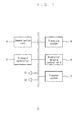
- the overhead travelling vehicle 2 includes a communication unit 3, communicates with a communication unit 28 of a ground controller 24 in FIGS. 2 and 3 , and travels under control of the ground controller 24.
- An on-board controller 4 controls units of the overhead travelling vehicle 2.
- a travelling system 5 is constituted by a servomotor, a controller for the servomotor, and the like, and causes the overhead travelling vehicle 2 to travel.
- a diverging/merging control unit 6 is constituted by a retractable guide roller mechanism, and controls the travelling direction in diverging sections and merging sections of the travelling rail.
- automated guided vehicles travel along a predetermined travelling route, and the travelling route includes curved sections that is simple curved sections or part of diverging sections or merging sections. In the case of automated guided vehicles, a steering portion is provided in place of the diverging/merging control unit 6.
- a transfer system 7 is constituted by a hoist, a SCARA arm, a slide fork, or the like, but does not need to be provided.
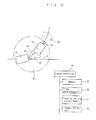
- FIG. 2 shows the configuration of the ground controller 24 and a situation in which overhead travelling vehicles are travelling toward a curve side 14 in a diverging section 10.
- the ground controller 24 includes a memory 25 and stores the IDs of overhead travelling vehicles that have been given travel permissions for the diverging section 10 or the like and the types of travel permissions. Note that these pieces of data are sometimes called blocking data. Since the travelling route of the overhead travelling vehicles 2 includes multiple diverging sections, merging sections, and simple curved sections, blocking data is stored for each individual section. These sections are sometimes called curved sections in view of the fact that they include a curve, and are sometimes called blocking areas in view of the fact that exclusion control is performed.
- a travel permission unit 26 references the blocking data and gives overhead travelling vehicles travel permissions for curved sections, and there are two types of travel permissions, namely a first travel permission for the leading vehicle farthest ahead in a section and a low-order travel permission for following vehicles. Also, each overhead travelling vehicle transmits, to the travel permission unit 26, its overhead travelling vehicle ID, the ID of the curved section for which a travel permission is requested, and a request for a travel permission. In the case of a diverging section, the overhead travelling vehicle also notifies the direction in which it will leave the diverging section, and in the case of a merging section, the overhead travelling vehicle also notifies the direction in which it will enter the merging section. Also, when an overhead travelling vehicle leaves a blocking area, the travel permission unit 26 deletes the blocking permission (travel permission) for the travelling vehicle that left from the blocking data in the memory 25.
- a travelling vehicle history memory 27 stores a history of the number of times that overhead travelling vehicles have had interference with a leading overhead travelling vehicle or rapidly reduced their speed in a blocking area, as well as the total travelling distance, the total travelling time, the total number of trips, and the like of the overhead travelling vehicles. Note that the number of times that interference or rapid speed reduction occurred is counted based on reporting by the overhead travelling vehicles. The ratio of the number of times that interference or rapid speed reduction occurred to the total travelling distance or the like indicates the precision of the adjustment of the obstacle sensor for curved travel.
- the ground controller 24 includes a communication unit 28, and communicates with the communication unit 3 of the overhead travelling vehicle 2.
- the travelling rail diverges to a straight ahead side 12 and a curve side 14. If the number of overhead travelling vehicles 2 that can enter the diverging section 10 at the same time is limited to one vehicle, the diverging section 10 becomes a cause for congestion. If the obstacle sensors S2 for diverging are relied on, and multiple overhead travelling vehicles 2 are allowed to enter the diverging section 10 at the same time, there is possibility of collisions or the like occurring. Note that 20 indicates the monitoring range of the obstacle sensor S2, and there are cases where detection is delayed depending on the adjustment that was performed.
- multiple overhead travelling vehicles 2 are allowed to enter the diverging section 10 at the same time, and interference between two overhead travelling vehicles 2 is prevented by monitoring the leading vehicle 2f with the obstacle sensor S2 of the following vehicle 2r.
- a limitation is placed on the travelling of the following vehicle 2r to cause it to travel at a lower speed than the leading vehicle 2f. By doing this, even if detection by the obstacle sensor S2 is delayed, the leading vehicle 2f can be detected before interference occurs. Note that the obstacle sensor S2 can reliably detect the leading vehicle 2f if the leading vehicle 2f is located immediately ahead, but if the leading vehicle 2f is located far away, the obstacle sensor S2 cannot detect the leading vehicle 2f until it has come close.
- FIG. 3 shows a situation in which the leading vehicle 2f and the following vehicle 2r are both travelling toward the straight ahead side 12 in the diverging section 10. Note that since the leading vehicle 2f and the following vehicle 2r are both travelling straight ahead in FIG. 3 , travel control for curved sections is not applied. 22 indicates the monitoring range of the obstacle sensor S1 for straight ahead travel, and the detection reliability is high in this range. In view of this, the leading vehicle 2f and the following vehicle 2r are both permitted to travel in the diverging section 10 at the speed limit for the straight ahead side. This is similar to giving the first travel permission to both the leading vehicle 2f and the following vehicle 2r.
- the merging section also has a distinction between merging from the curve side and merging from the straight ahead side, and multiple overhead travelling vehicles 2 can be allowed to travel in the merging section at the same time with the same control.
- the exits of the diverging section 10 are not limited to being the straight ahead side 12 and the curve side 14, and there are cases where the two exits are both curves.
- control similar to FIG. 2 is performed such that multiple overhead travelling vehicles are allowed to enter a diverging section or a merging section at the same time if the travelling directions in the diverging section or the merging section are the same, and the speed or the like is limited for the following overhead travelling vehicle.
- FIGS. 4 and 5 show a control algorithm in this embodiment.
- curved travel control is essential in diverging sections and merging sections, such control is included as curved section control in the following description.
- the range in which travel permission is required in a curved section will be referred to as the blocking area, and FIGS. 4 and 5 show processing performed by the ground controller.
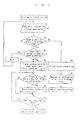
- the ground controller checks whether or not a leading vehicle exists in the blocking area (step 2), and gives the first travel permission if a leading vehicle does not exist (step 3).
- the first travel permission means that travel at the speed limit is permitted in the curved section.
- an overhead travelling vehicle leaves the blocking area, it makes a report to that effect to the ground controller.
- the ground controller receives this report (step 7), it cancels the travel permission.
- the ground controller manages travel permissions in the blocking area, and it is understood that an overhead travelling vehicle having the first travel permission ceased to exist by canceling the travel permission.
- a travel permission for the blocking area is not given, and the following vehicle is caused to wait (steps 4 and 6). If the travelling directions are the same, a permission to travel in the blocking area with a lower speed than the first travel permission is given (steps 4 and 5). If there is only one type of permission for travelling with a reduced speed, it is called the second travel permission, and if there are multiple types, they are called the second travel permission, the third travel permission, and the like, and for example, the farther back an overhead travelling vehicle is in the succession, the lower the speed with which it is allowed to travel is.
- the second travel permission and the like are for allowing travelling with a lower speed than the first travel permission such that even if detection by the obstacle sensor for curved travel is delayed, interference with the leading vehicle is reliably avoided.
- the speed with which the following vehicle travels in the curved section may be changed according to the history of the obstacle sensor for curved travel.
- the ground controller manages the number of times that interference with a leading vehicle occurred in a curved section or the number of times that rapid speed reduction was performed in a curved section relative to the total travelling distance, total number of trips, or total travelling time in the past.
- a configuration is possible in which the higher the number of times that interference occurred or the number of times that rapid speed reduction was performed in a curved section is, which has been normalized by an element such as the total travelling distance, the lower the speed of travel is in the permission when travel permission is given during travelling as a following vehicle, and the lower these numbers of times are, the higher the speed of travel is in the permission.
- step 8 When the leading vehicle farthest ahead leaves the blocking area (step 8), the risk of interference is eliminated, and therefore the travel permission of the subsequent travelling vehicle is raised, such as raising the second travel permission to the first travel permission (step 9).
- step 10 When the following vehicle leaves the blocking area (step 10), the travel permission for the blocking area is canceled.
- FIG. 5 shows statuses of overhead travelling vehicles in a curved section.
- the status "wait" for the case where the travelling direction is different from the leading vehicle is a status for only the diverging section and the merging section, and the types of travel permission include "first travel permission” and "low-order travel permission".
- the first travel permission is given to the leading vehicle that is to travel in the curved section (blocking area).
- the low-order travel permission is changed to the first travel permission. If a leading vehicle is travelling in a curved section (travel permission has been given to a leading vehicle), the following vehicle is given the low-order travel permission and allowed to travel with a reduced speed, thus preventing interference with the leading vehicle or the like.
- control using the first travel permission and the second travel permission is performed on all simple curved sections, diverging sections, and merging sections in the embodiment
- the control of the embodiment may be performed on only diverging sections, or only diverging sections and merging sections, for example.
- a configuration is possible in which, in simple curved sections, exclusion control is not performed and travelling vehicles are uniformly caused to travel with a reduced speed corresponding to the second travel permission.
Landscapes
- Engineering & Computer Science (AREA)
- Radar, Positioning & Navigation (AREA)
- Remote Sensing (AREA)
- Physics & Mathematics (AREA)
- General Physics & Mathematics (AREA)
- Automation & Control Theory (AREA)
- Aviation & Aerospace Engineering (AREA)
- Control Of Position, Course, Altitude, Or Attitude Of Moving Bodies (AREA)
- Traffic Control Systems (AREA)
- Control Of Driving Devices And Active Controlling Of Vehicle (AREA)
Abstract
Description
- This invention relates to a travelling vehicle system and a method of controlling the travelling of travelling vehicles in curved sections, and in particular relates to blocking in curved sections.
- In a system of travelling vehicles such as overhead travelling vehicles or automated guided vehicles, the travelling vehicles include obstacle sensors and avoid interference autonomously. Detecting a leading vehicle is difficult in a diverging section, a merging section, and the like, and therefore exclusion control is performed by a ground controller to limit the number of travelling vehicles travelling in a diverging section, a merging section, or the like at the same time to one vehicle (e.g., Patent Document 1:
WO 2009/142051A ). However, this control is inefficient since the number of travelling vehicles that can pass through the diverging section or the merging section per unit time decreases. In view of this, consideration has been given to eliminating the need for exclusion control by providing travelling vehicles with an obstacle sensor for curved travel (e.g., Patent Document 2:JP 2011-165025A - However, detecting a leading vehicle in a curved section with an obstacle sensor is not easy. Firstly, since the leading vehicle is travelling along a curve, the monitoring range spreads out like a fan. Secondly, when detecting reflected light from a leading vehicle, the direction of the reflected light changes because the direction of the leading vehicle changes as it travels along a curve. For this reason, the obstacle sensor for curved travel needs to be adjusted finely, and there are cases where the detection of a leading vehicle is delayed if there is deviation in the adjustment.
-
- Patent Literature 1:
WO 2009/142051A - Patent Literature 2:
JP 2011-165025A - An object of this invention is to reliably prevent interference between travelling vehicles in curved sections, and to make it possible for travelling vehicles to efficiently travel in curved sections.
- A travelling vehicle system of this invention allows travelling vehicles to travel in sections containing a curve in a travelling route under control of a ground controller,
wherein the travelling vehicles travel along the travelling route, include an obstacle sensor for curved travel and a communication unit for communication with the ground controller, and are configured and programmed to make a request for a travel permission to the ground controller via the communication unit before travelling in a section containing a curve,
the ground controller includes: - a memory in which travel permissions for the section that are already given to the travelling vehicles are stored, and from which the travel permissions are deleted when the travelling vehicles leave the section; and
- a travel permission unit configured and programmed to, when a request for a permission to travel in the section is received from a travelling vehicle, reference the memory, give a first travel permission if a permission to travel has not been given to another travelling vehicle, and give a low-order travel permission that permits travel with a lower speed than the first travel permission if a permission to travel has been given to another travelling vehicle.
- A method of controlling travelling of travelling vehicles in curved sections of this invention is for allowing travelling vehicles to travel in a section containing a curve in a travelling route under control of a ground controller,
wherein the travelling vehicles make a request for a travel permission to the ground controller before travelling in the section containing a curve, monitor an obstacle in the section with an obstacle sensor for curved travel, and stop or perform speed reduction to avoid interference if an obstacle is detected, and
the ground controller
stores travel permissions for the section that are already given to the travelling vehicles in a memory, and deletes the travel permissions from the memory when the travelling vehicles leave the section, and
when a request for a permission to travel in the section is received from a travelling vehicle, references the memory, gives a first travel permission if a permission to travel has not been given to another travelling vehicle, and gives a low-order travel permission that permits travel with a lower speed than the first travel permission if a permission to travel has been given to another travelling vehicle. - With this invention, multiple travelling vehicles can be allowed to travel in a section containing a curve at the same time, and it is possible to prevent interference between travelling vehicles in the curved section. Also, since multiple travelling vehicles can be allowed to travel in a section containing a curve at the same time, if the travelling vehicle is a carrier vehicle for carrying articles for example, the article carrying efficiency improves. A section that contains a curve is a simple curved section, or a diverging section, a merging section, or the like. Also, there may be one type of low-order travel permission, or multiple types. The travelling vehicle is a carrier vehicle for carrying articles, such as an overhead travelling vehicle or an automated guided vehicle. In this description, the descriptions regarding the travelling vehicle system apply as-is to the method of controlling the travelling of travelling vehicles in a curved section as well.
- It is preferable that the travel permission unit is configured and programmed to, when the travelling vehicle farthest ahead in the section leaves the section, change the travel permission for the travelling vehicle immediately subsequent to the farthest ahead travelling vehicle in the section to the first travel permission. According to this, the subsequent travelling vehicle can be allowed to travel more quickly.
- Also, it is preferable that the ground controller further includes a means for, for each travelling vehicle, storing a frequency of interference with a leading vehicle or rapid speed reduction in the section, and the travel permission unit is configured and programmed to, when giving the low-order travel permission, give a travel permission with a lower speed when the frequency is high, and give a travel permission with a higher speed when the frequency is low. According to this, travelling vehicles can be allowed to travel at speeds that correspond to a history of the detection of leading vehicles in curved sections for each travelling vehicle, such as the total frequency of interference with a leading vehicle and the total frequency of rapid speed reduction for avoiding interference with a leading vehicle.
- It is preferable that the section is a diverging section or a merging section, and the travel permission unit is configured and programmed to not give the low-order travel permission nor the first travel permission when a request for a travel permission to a different side from the leading travelling vehicle in the diverging section is received, or when a request for a travel permission from a different side from the leading travelling vehicle in the merging section is received. If the travelling direction of the following vehicle is different from the leading vehicle, it is particularly difficult to detect the leading vehicle, and therefore interference between travelling vehicles is more reliably prevented by not giving the low-order travel permission in such a case.
-
-
FIG. 1 is a block diagram of an overhead travelling vehicle. -
FIG. 2 is a diagram showing a state in which two travelling vehicles diverge in a curved direction in a diverging section. -
FIG. 3 is a diagram showing a state in which two travelling vehicles travel in a straight ahead direction in a diverging section. -
FIG. 4 is a flowchart showing an algorithm for blocking in a curved section in a travelling vehicle system according to an embodiment. -
FIG. 5 is a diagram showing transitions in statuses of travelling vehicles in a curved section. - The following describes the best mode for carrying out the present invention. The scope of the present invention is based on the recitation of the claims, and is intended to be construed in accordance with the understanding of a person skilled in the art with reference to the description of the present invention and well-known techniques in the field of the present invention.
- A travelling vehicle system of an embodiment is shown in
FIGS. 1 to 5 . Although any type of travelling vehicles may be used, such as overhead travelling vehicles or automated guided vehicles,overhead travelling vehicles 2 shown inFIG. 1 is envisioned in this embodiment. Theoverhead travelling vehicles 2 travel along a travelling rail, which is an example of a travelling route, and the travelling rail includes curved sections. Since diverging sections and merging sections contain a curve, examples of the curved sections include not only simple curved sections, but also diverging sections and merging sections. The overhead travelingvehicles 2 include two types of obstacle sensors S1 and S2 for monitoring leading travelling vehicles ahead, and the obstacle sensor S1 for straight ahead travel detects leading vehicles that are ahead in the straight ahead direction, whereas the obstacle sensor S2 for curved travel detects leading vehicles that are ahead in a curved direction in a fan-like range. - In the obstacle sensor S2 for curved travel, the central direction of the fan, the central angle of the fan (angle between the two ends of the fan), and the radius of the fan are changed within the range of necessity to monitor the area ahead. The obstacle sensors S1 and S2 are constituted by laser ranging sensors, ultrasonic sensors, or the like, and in general, adjustment of the obstacle sensor S1 for straight ahead travel is easy, whereas the obstacle sensor S2 for curved travel requires fine adjustment, and there are cases where the detection of leading vehicles is delayed if there is deviation in the adjustment. For example, with a laser ranging sensor, a distance is detected based on the time required for laser light reflected by a leading vehicle to return to the following vehicle. If the leading vehicle is travelling straight ahead, it is possible to detect light that was perpendicularly incident on the body of the leading vehicle and then reflected perpendicularly. However, in a curved section, the directions between the bodies of the leading vehicle and the following vehicle face are different, and therefore weak reflected light is detected. For this reason, detecting a leading vehicle is difficult, and there are cases where detection is delayed until the inter-vehicle distance with the leading vehicle is unusually short.
- With the
overhead travelling vehicle 2, when an obstacle such as another overhead travelling vehicle ahead is detected by the obstacle sensor S1 or S2, interference is avoided by normal speed reduction, rapid speed reduction, stopping, or the like. Even in a situation in which the inter-vehicle distance is excessively short, if the leading vehicle and the following vehicle are travelling at the same speed for example, interference can be avoided if the following vehicle reduces its speed rapidly or stops. In view of this, the frequency of rapid speed reduction and stopping indicates the frequency of occurrence of a situation in which the distance to another overhead travelling vehicle ahead is excessively short or the like. Here, the frequency can be obtained as the ratio of the number of speed reductions or stops to the total travel distance, total number of trips, or the like. This frequency indicates the reliability of the obstacle sensor S2 for curved travel for each overhead travellingvehicle 2. - As shown in
FIG. 1 , theoverhead travelling vehicle 2 includes acommunication unit 3, communicates with acommunication unit 28 of aground controller 24 inFIGS. 2 and3 , and travels under control of theground controller 24. An on-board controller 4 controls units of theoverhead travelling vehicle 2. A travellingsystem 5 is constituted by a servomotor, a controller for the servomotor, and the like, and causes theoverhead travelling vehicle 2 to travel. A diverging/mergingcontrol unit 6 is constituted by a retractable guide roller mechanism, and controls the travelling direction in diverging sections and merging sections of the travelling rail. Note that automated guided vehicles travel along a predetermined travelling route, and the travelling route includes curved sections that is simple curved sections or part of diverging sections or merging sections. In the case of automated guided vehicles, a steering portion is provided in place of the diverging/mergingcontrol unit 6. Atransfer system 7 is constituted by a hoist, a SCARA arm, a slide fork, or the like, but does not need to be provided. -
FIG. 2 shows the configuration of theground controller 24 and a situation in which overhead travelling vehicles are travelling toward acurve side 14 in a divergingsection 10. Theground controller 24 includes amemory 25 and stores the IDs of overhead travelling vehicles that have been given travel permissions for the divergingsection 10 or the like and the types of travel permissions. Note that these pieces of data are sometimes called blocking data. Since the travelling route of theoverhead travelling vehicles 2 includes multiple diverging sections, merging sections, and simple curved sections, blocking data is stored for each individual section. These sections are sometimes called curved sections in view of the fact that they include a curve, and are sometimes called blocking areas in view of the fact that exclusion control is performed. - A
travel permission unit 26 references the blocking data and gives overhead travelling vehicles travel permissions for curved sections, and there are two types of travel permissions, namely a first travel permission for the leading vehicle farthest ahead in a section and a low-order travel permission for following vehicles. Also, each overhead travelling vehicle transmits, to thetravel permission unit 26, its overhead travelling vehicle ID, the ID of the curved section for which a travel permission is requested, and a request for a travel permission. In the case of a diverging section, the overhead travelling vehicle also notifies the direction in which it will leave the diverging section, and in the case of a merging section, the overhead travelling vehicle also notifies the direction in which it will enter the merging section. Also, when an overhead travelling vehicle leaves a blocking area, thetravel permission unit 26 deletes the blocking permission (travel permission) for the travelling vehicle that left from the blocking data in thememory 25. - If the travelling vehicle that left was the travelling vehicle farthest ahead in the blocking area, the travel permission for the subsequent overhead travelling vehicle is raised from the low-order permission to the first permission. A travelling
vehicle history memory 27 stores a history of the number of times that overhead travelling vehicles have had interference with a leading overhead travelling vehicle or rapidly reduced their speed in a blocking area, as well as the total travelling distance, the total travelling time, the total number of trips, and the like of the overhead travelling vehicles. Note that the number of times that interference or rapid speed reduction occurred is counted based on reporting by the overhead travelling vehicles. The ratio of the number of times that interference or rapid speed reduction occurred to the total travelling distance or the like indicates the precision of the adjustment of the obstacle sensor for curved travel. Theground controller 24 includes acommunication unit 28, and communicates with thecommunication unit 3 of theoverhead travelling vehicle 2. - In the diverging
section 10, the travelling rail diverges to astraight ahead side 12 and acurve side 14. If the number ofoverhead travelling vehicles 2 that can enter the divergingsection 10 at the same time is limited to one vehicle, the divergingsection 10 becomes a cause for congestion. If the obstacle sensors S2 for diverging are relied on, and multipleoverhead travelling vehicles 2 are allowed to enter the divergingsection 10 at the same time, there is possibility of collisions or the like occurring. Note that 20 indicates the monitoring range of the obstacle sensor S2, and there are cases where detection is delayed depending on the adjustment that was performed. - In view of this, multiple
overhead travelling vehicles 2 are allowed to enter the divergingsection 10 at the same time, and interference between two overhead travellingvehicles 2 is prevented by monitoring the leadingvehicle 2f with the obstacle sensor S2 of the followingvehicle 2r. A limitation is placed on the travelling of the followingvehicle 2r to cause it to travel at a lower speed than the leadingvehicle 2f. By doing this, even if detection by the obstacle sensor S2 is delayed, the leadingvehicle 2f can be detected before interference occurs. Note that the obstacle sensor S2 can reliably detect the leadingvehicle 2f if the leadingvehicle 2f is located immediately ahead, but if the leadingvehicle 2f is located far away, the obstacle sensor S2 cannot detect the leadingvehicle 2f until it has come close. If interference is avoided in this way, the number of times that the followingvehicle 2r performs rapid speed reduction decreases, and it is possible to avoid the application of shock to articles during transport. Note that when the leadingvehicle 2f leaves the divergingsection 10, the followingvehicle 2r becomes the leading vehicle in the divergingsection 10, and the travel permission thereof is changed to the first travel permission. -
FIG. 3 shows a situation in which the leadingvehicle 2f and the followingvehicle 2r are both travelling toward thestraight ahead side 12 in the divergingsection 10. Note that since the leadingvehicle 2f and the followingvehicle 2r are both travelling straight ahead inFIG. 3 , travel control for curved sections is not applied. 22 indicates the monitoring range of the obstacle sensor S1 for straight ahead travel, and the detection reliability is high in this range. In view of this, the leadingvehicle 2f and the followingvehicle 2r are both permitted to travel in the divergingsection 10 at the speed limit for the straight ahead side. This is similar to giving the first travel permission to both the leadingvehicle 2f and the followingvehicle 2r. Note that it is difficult for a following vehicle that is travelling straight ahead to detect a leading vehicle that is diverging, and it is difficult for a following vehicle that is diverging to detect a leading vehicle that is travelling straight ahead. In view of this, a following vehicle that will travel in a different diverging/straight ahead direction from the leading vehicle is not permitted to enter the divergingsection 10. Note that if the monitoring range of the obstacle sensor S2 for diverging is widened to be able to detect a leading vehicle having a different travelling direction, this restriction is not necessary. - Although the diverging
section 10 is shown inFIGS. 2 and3 , the merging section also has a distinction between merging from the curve side and merging from the straight ahead side, and multipleoverhead travelling vehicles 2 can be allowed to travel in the merging section at the same time with the same control. The exits of the divergingsection 10 are not limited to being thestraight ahead side 12 and thecurve side 14, and there are cases where the two exits are both curves. The same applies to the merging section as well, and there are cases where the two entrances are both curves. In these cases as well, control similar toFIG. 2 is performed such that multiple overhead travelling vehicles are allowed to enter a diverging section or a merging section at the same time if the travelling directions in the diverging section or the merging section are the same, and the speed or the like is limited for the following overhead travelling vehicle. - It is inefficient if overhead travelling
vehicles 2 travelling along a travelling rail that has a curved section are uniformly requested to travel at a reduced speed. Also, it is similarly inefficient if the number ofoverhead travelling vehicles 2 that can travel in one curved section is limited to one vehicle. In contrast, if control similar toFIG. 2 is performed in a curved section, multiple overhead travelling vehicles can be allowed to travel in the curved section at the same time, and it is also possible to avoid interference between overhead travelling vehicles. -
FIGS. 4 and5 show a control algorithm in this embodiment. In view of the fact that curved travel control is essential in diverging sections and merging sections, such control is included as curved section control in the following description. Also, the range in which travel permission is required in a curved section will be referred to as the blocking area, andFIGS. 4 and5 show processing performed by the ground controller. When a request for a travel permission for a curved section is received (step 1), the ground controller checks whether or not a leading vehicle exists in the blocking area (step 2), and gives the first travel permission if a leading vehicle does not exist (step 3). The first travel permission means that travel at the speed limit is permitted in the curved section. When an overhead travelling vehicle leaves the blocking area, it makes a report to that effect to the ground controller. When the ground controller receives this report (step 7), it cancels the travel permission. The ground controller manages travel permissions in the blocking area, and it is understood that an overhead travelling vehicle having the first travel permission ceased to exist by canceling the travel permission. - In the case where a leading vehicle exists in
step 2, if the travelling directions of the following vehicle and the leading vehicle are different, a travel permission for the blocking area is not given, and the following vehicle is caused to wait (steps 4 and 6). If the travelling directions are the same, a permission to travel in the blocking area with a lower speed than the first travel permission is given (steps 4 and 5). If there is only one type of permission for travelling with a reduced speed, it is called the second travel permission, and if there are multiple types, they are called the second travel permission, the third travel permission, and the like, and for example, the farther back an overhead travelling vehicle is in the succession, the lower the speed with which it is allowed to travel is. The second travel permission and the like are for allowing travelling with a lower speed than the first travel permission such that even if detection by the obstacle sensor for curved travel is delayed, interference with the leading vehicle is reliably avoided. - Although not shown in
FIGS. 4 and5 , the speed with which the following vehicle travels in the curved section may be changed according to the history of the obstacle sensor for curved travel. For example, the ground controller manages the number of times that interference with a leading vehicle occurred in a curved section or the number of times that rapid speed reduction was performed in a curved section relative to the total travelling distance, total number of trips, or total travelling time in the past. A configuration is possible in which the higher the number of times that interference occurred or the number of times that rapid speed reduction was performed in a curved section is, which has been normalized by an element such as the total travelling distance, the lower the speed of travel is in the permission when travel permission is given during travelling as a following vehicle, and the lower these numbers of times are, the higher the speed of travel is in the permission. - When the leading vehicle farthest ahead leaves the blocking area (step 8), the risk of interference is eliminated, and therefore the travel permission of the subsequent travelling vehicle is raised, such as raising the second travel permission to the first travel permission (step 9). When the following vehicle leaves the blocking area (step 10), the travel permission for the blocking area is canceled.
-
FIG. 5 shows statuses of overhead travelling vehicles in a curved section. The status "wait" for the case where the travelling direction is different from the leading vehicle is a status for only the diverging section and the merging section, and the types of travel permission include "first travel permission" and "low-order travel permission". The first travel permission is given to the leading vehicle that is to travel in the curved section (blocking area). When the leading vehicle leaves the curved section and the following vehicle becomes the leading vehicle in the curved section, the low-order travel permission is changed to the first travel permission. If a leading vehicle is travelling in a curved section (travel permission has been given to a leading vehicle), the following vehicle is given the low-order travel permission and allowed to travel with a reduced speed, thus preventing interference with the leading vehicle or the like. - As described above, according to the embodiment,
- 1) it is possible for multiple travelling vehicles to travel in one curved section at the same time, thus preventing congestion in the curved section.
- 2) Also, giving low-order travel permission to the following travelling vehicle prevents interference with the leading travelling vehicle and the like.
- 3) When the leading travelling vehicle leaves the curved section, the following travelling vehicle is allowed to travel at a higher speed by changing the low-order travel permission to the first travel permission.
- 4) According to the above, it is possible to improve the article carrying efficiency.
- Although control using the first travel permission and the second travel permission is performed on all simple curved sections, diverging sections, and merging sections in the embodiment, the control of the embodiment may be performed on only diverging sections, or only diverging sections and merging sections, for example. For example, a configuration is possible in which, in simple curved sections, exclusion control is not performed and travelling vehicles are uniformly caused to travel with a reduced speed corresponding to the second travel permission.
-
- 2 Overhead travelling vehicle
- 3 Communication unit
- 4 On-board controller
- 5 Travelling system
- 6 Diverging/merging control unit
- 7 Transfer system
- 2f Leading vehicle
- 2r Following vehicle
- 10 Diverging section
- 12 Straight ahead side
- 14 Curve side
- 20, 22 Monitoring range
- 24 Ground controller
- 25 Memory
- 26 Travel permission unit
- 27 Travelling vehicle history memory
- 28 Communication unit
- S1, S2 Obstacle sensor
Claims (5)
- A travelling vehicle system that allows travelling vehicles to travel in sections containing a curve in a travelling route under control of a ground controller,
wherein the travelling vehicles travel along the travelling route, comprise an obstacle sensor for curved travel and a communication unit for communication with the ground controller, and are configured and programmed to make a request for a travel permission to the ground controller via the communication unit before travelling in sections containing a curve,
the ground controller controls travelling of the travelling vehicles and comprises:a memory in which travel permissions for a section containing a curve that are already given to the travelling vehicles are stored, and from which the travel permissions are deleted when the travelling vehicles leave the section; anda travel permission unit configured and programmed to, when a request for a permission to travel in the section is received from a travelling vehicle, reference the memory, give a first travel permission if a permission to travel has not been given to another travelling vehicle, and give a low-order travel permission that permits travel with a lower speed than the first travel permission if a permission to travel has been given to another travelling vehicle. - The travelling vehicle system according to claim 1,
wherein the travel permission unit is configured and programmed to, when the travelling vehicle farthest ahead in the section leaves the section, change the travel permission for the travelling vehicle immediately subsequent to the farthest ahead travelling vehicle in the section to the first travel permission. - The travelling vehicle system according to claim 1 or 2,
wherein the ground controller further comprises a means for, for each travelling vehicle, storing a frequency of interferences with leading vehicles or rapid speed reductions in sections, and
the travel permission unit is configured and programmed to, when giving the low-order travel permission, give a travel permission with a lower speed when the frequency is high, and give a travel permission with a higher speed when the frequency is low. - The travelling vehicle system according to any of claims 1 to 3,
wherein the section is a diverging section or a merging section, and the travel permission unit is configured and programmed to not give the low-order travel permission when a request for a travel permission to a different side from the other travelling vehicle in the diverging section is received, or when a request for a travel permission from a different side from the other travelling vehicle in the merging section is received. - A method of controlling travelling of travelling vehicles in curved sections, for allowing travelling vehicles to travel in sections containing a curve in a travelling route under control of a ground controller,
wherein the travelling vehicles make a request for a travel permission to the ground controller before travelling in a section containing a curve, monitor an obstacle in the section with an obstacle sensor for curved travel, and stop or perform speed reduction to avoid interference if an obstacle is detected, and
the ground controller
stores travel permission for the section that are already given to the travelling vehicles in a memory, and deletes the travel permission from the memory, when the travelling vehicles leave the section, and
when a request for a permission to travel in the section is received from a travelling vehicle, references the memory, gives a first travel permission if a permission to travel has not been given to another travelling vehicle, and gives a low-order travel permission that permits travel with a lower speed than the first travel permission if a permission to travel has been given to another travelling vehicle.
Applications Claiming Priority (2)
| Application Number | Priority Date | Filing Date | Title |
|---|---|---|---|
| JP2012120563 | 2012-05-28 | ||
| PCT/JP2013/061594 WO2013179802A1 (en) | 2012-05-28 | 2013-04-19 | Travelling vehicle system and method for controlling travel of travelling vehicle in curved section |
Publications (3)
| Publication Number | Publication Date |
|---|---|
| EP2857918A1 true EP2857918A1 (en) | 2015-04-08 |
| EP2857918A4 EP2857918A4 (en) | 2016-06-22 |
| EP2857918B1 EP2857918B1 (en) | 2018-08-15 |
Family
ID=49673009
Family Applications (1)
| Application Number | Title | Priority Date | Filing Date |
|---|---|---|---|
| EP13797238.6A Active EP2857918B1 (en) | 2012-05-28 | 2013-04-19 | Travelling vehicle system and method for controlling travel of travelling vehicle in curved section |
Country Status (8)
| Country | Link |
|---|---|
| US (1) | US9336684B2 (en) |
| EP (1) | EP2857918B1 (en) |
| JP (1) | JP5874942B2 (en) |
| KR (1) | KR101675448B1 (en) |
| CN (1) | CN104350442B (en) |
| SG (1) | SG11201407380SA (en) |
| TW (1) | TWI557525B (en) |
| WO (1) | WO2013179802A1 (en) |
Cited By (3)
| Publication number | Priority date | Publication date | Assignee | Title |
|---|---|---|---|---|
| CN109643123A (en) * | 2016-08-22 | 2019-04-16 | 村田机械株式会社 | The control method of vehicle system and vehicle system |
| CN109828574A (en) * | 2019-02-22 | 2019-05-31 | 深兰科技(上海)有限公司 | A kind of barrier-avoiding method and electronic equipment |
| EP3757712A4 (en) * | 2018-11-20 | 2021-11-03 | Baidu Online Network Technology (Beijing) Co., Ltd. | MOBILE ROBOT, DEVICE, AND CONTROL SYSTEM CONTROL PROCESS |
Families Citing this family (16)
| Publication number | Priority date | Publication date | Assignee | Title |
|---|---|---|---|---|
| DE112013000729T5 (en) * | 2013-09-11 | 2015-07-30 | Hitachi Construction Machinery Co., Ltd. | Vehicle traffic control system |
| JP6597520B2 (en) | 2016-08-26 | 2019-10-30 | トヨタ自動車株式会社 | Information processing device |
| CN109952546B (en) | 2016-08-26 | 2022-08-30 | 克朗设备公司 | Multi-field scanning tool in materials handling vehicle |
| KR102306958B1 (en) | 2016-08-26 | 2021-10-06 | 크라운 이큅먼트 코포레이션 | Material handling vehicle equipped with obstacle scanning tools |
| KR102495412B1 (en) | 2016-08-26 | 2023-02-07 | 크라운 이큅먼트 코포레이션 | Materials handling vehicle path validation and dynamic path modification |
| JP6743750B2 (en) * | 2017-04-14 | 2020-08-19 | 株式会社ダイフク | Goods transport facility |
| JP6863329B2 (en) | 2018-04-13 | 2021-04-21 | 村田機械株式会社 | Traveling vehicle system and driving vehicle control method |
| CN111902784B (en) * | 2018-05-31 | 2023-04-07 | 村田机械株式会社 | Conveying system |
| US20210331708A1 (en) * | 2018-09-05 | 2021-10-28 | Murata Machinery, Ltd. | Traveling vehicle system |
| JP7226537B2 (en) * | 2019-05-22 | 2023-02-21 | 村田機械株式会社 | Driving vehicle system and driving vehicle control method |
| JP2022125369A (en) * | 2019-07-04 | 2022-08-29 | 村田機械株式会社 | Traveling system |
| JP7365802B2 (en) * | 2019-07-22 | 2023-10-20 | 株式会社ブリヂストン | Control method, control device, control system and tire testing method |
| JP7234872B2 (en) * | 2019-09-12 | 2023-03-08 | トヨタ自動車株式会社 | Vehicle remote indication system |
| CN115698887B (en) | 2020-05-27 | 2025-10-24 | 村田机械株式会社 | Traveling vehicle system and traveling vehicle control method |
| JP7279691B2 (en) * | 2020-08-07 | 2023-05-23 | 株式会社ダイフク | Goods transport equipment |
| JP7652312B1 (en) | 2024-03-06 | 2025-03-27 | 三菱電機ビルソリューションズ株式会社 | Traffic management device, traffic management method, traffic management program, mobile body system, and mobile body control system |
Family Cites Families (20)
| Publication number | Priority date | Publication date | Assignee | Title |
|---|---|---|---|---|
| JPS6398006A (en) * | 1986-10-14 | 1988-04-28 | Toshiba Corp | Automatically guided vehicle controller |
| JPH04160413A (en) * | 1990-10-23 | 1992-06-03 | Daifuku Co Ltd | Travel control facility for moving vehicle |
| CA2053028C (en) * | 1990-10-23 | 1996-04-09 | Hideichi Tanizawa | Carriage running control system |
| JP2717348B2 (en) * | 1993-09-14 | 1998-02-18 | 株式会社キトー | Vehicle tracking and collision prevention device |
| JPH0863230A (en) * | 1994-08-17 | 1996-03-08 | Murata Mach Ltd | Unmanned vehicle |
| JP3886252B2 (en) * | 1998-04-27 | 2007-02-28 | 株式会社日立プラントテクノロジー | Driving control method of automatic guided vehicle |
| JP3065036B2 (en) * | 1998-10-02 | 2000-07-12 | 株式会社東芝 | Vehicle traffic control device |
| JP4503333B2 (en) | 2004-03-30 | 2010-07-14 | 村田機械株式会社 | Conveyor cart system |
| JP2005321881A (en) * | 2004-05-06 | 2005-11-17 | Toyota Industries Corp | System for controlling the running of a tracked carriage |
| JP2006048333A (en) * | 2004-08-04 | 2006-02-16 | Asyst Shinko Inc | Transport system |
| JP2006137337A (en) | 2004-11-12 | 2006-06-01 | Toshiba Corp | Train control system and train control method |
| JP4438095B2 (en) * | 2005-05-26 | 2010-03-24 | 村田機械株式会社 | Transport system |
| JP4099723B2 (en) * | 2005-07-12 | 2008-06-11 | 村田機械株式会社 | Conveyor cart system |
| JP4306723B2 (en) * | 2006-12-15 | 2009-08-05 | 村田機械株式会社 | Conveyor cart system |
| US7639159B2 (en) * | 2007-10-29 | 2009-12-29 | Kapsch Trafficcom Ag | System and method for determining intersection right-of-way for vehicles |
| KR101155373B1 (en) | 2008-05-22 | 2012-06-19 | 무라다기카이가부시끼가이샤 | Traveling vehicle system and method for controlling traveling by traveling vehicle system |
| US20110178657A1 (en) * | 2008-09-26 | 2011-07-21 | Murata Machinery, Ltd. | Guided vehicle system |
| JP4798554B2 (en) * | 2009-03-05 | 2011-10-19 | 村田機械株式会社 | Driving control system and control method for traveling vehicle |
| JP5312367B2 (en) * | 2010-02-12 | 2013-10-09 | 村田機械株式会社 | Traveling cart system |
| CN102947204B (en) * | 2010-06-18 | 2014-12-31 | 村田机械株式会社 | Travelling vehicle system and distance measurement method therefor |
-
2013
- 2013-04-19 WO PCT/JP2013/061594 patent/WO2013179802A1/en not_active Ceased
- 2013-04-19 CN CN201380027642.4A patent/CN104350442B/en active Active
- 2013-04-19 EP EP13797238.6A patent/EP2857918B1/en active Active
- 2013-04-19 US US14/403,735 patent/US9336684B2/en active Active
- 2013-04-19 SG SG11201407380SA patent/SG11201407380SA/en unknown
- 2013-04-19 JP JP2014518341A patent/JP5874942B2/en active Active
- 2013-04-19 KR KR1020147032608A patent/KR101675448B1/en not_active Expired - Fee Related
- 2013-05-27 TW TW102118611A patent/TWI557525B/en active
Cited By (7)
| Publication number | Priority date | Publication date | Assignee | Title |
|---|---|---|---|---|
| CN109643123A (en) * | 2016-08-22 | 2019-04-16 | 村田机械株式会社 | The control method of vehicle system and vehicle system |
| EP3489785A4 (en) * | 2016-08-22 | 2020-01-22 | Murata Machinery, Ltd. | MOVING VEHICLE SYSTEM AND CONTROL METHOD FOR MOVING VEHICLE SYSTEM |
| US11226637B2 (en) | 2016-08-22 | 2022-01-18 | Murata Machinery, Ltd. | Traveling vehicle system, and control method for traveling vehicle system |
| CN109643123B (en) * | 2016-08-22 | 2022-03-22 | 村田机械株式会社 | Driving vehicle system and control method of driving vehicle system |
| EP3757712A4 (en) * | 2018-11-20 | 2021-11-03 | Baidu Online Network Technology (Beijing) Co., Ltd. | MOBILE ROBOT, DEVICE, AND CONTROL SYSTEM CONTROL PROCESS |
| US11392139B2 (en) | 2018-11-20 | 2022-07-19 | Apollo Intelligent Driving Technology (Beijing) Co., Ltd. | Method, apparatus and control system for controlling mobile robot |
| CN109828574A (en) * | 2019-02-22 | 2019-05-31 | 深兰科技(上海)有限公司 | A kind of barrier-avoiding method and electronic equipment |
Also Published As
| Publication number | Publication date |
|---|---|
| WO2013179802A1 (en) | 2013-12-05 |
| TWI557525B (en) | 2016-11-11 |
| KR101675448B1 (en) | 2016-11-11 |
| CN104350442B (en) | 2017-03-08 |
| KR20140148496A (en) | 2014-12-31 |
| EP2857918A4 (en) | 2016-06-22 |
| US9336684B2 (en) | 2016-05-10 |
| TW201403278A (en) | 2014-01-16 |
| SG11201407380SA (en) | 2014-12-30 |
| US20150187218A1 (en) | 2015-07-02 |
| JP5874942B2 (en) | 2016-03-02 |
| JPWO2013179802A1 (en) | 2016-01-18 |
| CN104350442A (en) | 2015-02-11 |
| EP2857918B1 (en) | 2018-08-15 |
Similar Documents
| Publication | Publication Date | Title |
|---|---|---|
| EP2857918B1 (en) | Travelling vehicle system and method for controlling travel of travelling vehicle in curved section | |
| CN102037422B (en) | Driving vehicle system and driving control method in the driving vehicle system | |
| CN106956679B (en) | Autonomous vehicle lane management | |
| US11100807B2 (en) | Method for transmitting pieces of information between vehicles of a vehicle platoon and method for processing an assistance request output by a first vehicle of a vehicle platoon during a lane change by at least one second vehicle of the vehicle platoon | |
| CN111731277B (en) | Methods and controllers for limiting accident risks, and storage media | |
| CN105074602B (en) | Position identification device and mobile robot with the position identification device | |
| US8706393B2 (en) | Intersection collision avoidance with adaptable vehicle dimensions | |
| CN102452395B (en) | The best improving anti-collision capacity accelerates distribution graph | |
| KR101713081B1 (en) | Cart system | |
| US20220126882A1 (en) | Vehicle and method of controlling autonomous driving of vehicle | |
| CN109415190B (en) | Method and system for collision avoidance of cranes | |
| CN103226353A (en) | Vehicle fleet management system and inter vehicle distance control method | |
| TWI287183B (en) | Carrier truck system | |
| EP2957974A1 (en) | Conveyance system | |
| JP4432974B2 (en) | Traveling vehicle system | |
| JP2005301364A (en) | Conveyor cart system | |
| US20130245818A1 (en) | Logistics installation for a rack storage sysyem | |
| CN107548368B (en) | System and method for automatically accessing a rail element | |
| JP4399739B2 (en) | Conveyor cart system | |
| CN117818664A (en) | Vehicle control method, device, electronic device and storage medium | |
| US20160200548A1 (en) | Elevator system | |
| Johnson et al. | Minimizing driver interference under a probablistic safety constraint in emergency collision avoidance systems | |
| CN113496611A (en) | Vehicle operation management device, operation management method, and traffic system |
Legal Events
| Date | Code | Title | Description |
|---|---|---|---|
| PUAI | Public reference made under article 153(3) epc to a published international application that has entered the european phase |
Free format text: ORIGINAL CODE: 0009012 |
|
| 17P | Request for examination filed |
Effective date: 20141121 |
|
| AK | Designated contracting states |
Kind code of ref document: A1 Designated state(s): AL AT BE BG CH CY CZ DE DK EE ES FI FR GB GR HR HU IE IS IT LI LT LU LV MC MK MT NL NO PL PT RO RS SE SI SK SM TR |
|
| AX | Request for extension of the european patent |
Extension state: BA ME |
|
| DAX | Request for extension of the european patent (deleted) | ||
| RA4 | Supplementary search report drawn up and despatched (corrected) |
Effective date: 20160524 |
|
| RIC1 | Information provided on ipc code assigned before grant |
Ipc: G05D 1/02 20060101AFI20160518BHEP |
|
| GRAP | Despatch of communication of intention to grant a patent |
Free format text: ORIGINAL CODE: EPIDOSNIGR1 |
|
| STAA | Information on the status of an ep patent application or granted ep patent |
Free format text: STATUS: GRANT OF PATENT IS INTENDED |
|
| INTG | Intention to grant announced |
Effective date: 20180307 |
|
| GRAS | Grant fee paid |
Free format text: ORIGINAL CODE: EPIDOSNIGR3 |
|
| GRAA | (expected) grant |
Free format text: ORIGINAL CODE: 0009210 |
|
| STAA | Information on the status of an ep patent application or granted ep patent |
Free format text: STATUS: THE PATENT HAS BEEN GRANTED |
|
| AK | Designated contracting states |
Kind code of ref document: B1 Designated state(s): AL AT BE BG CH CY CZ DE DK EE ES FI FR GB GR HR HU IE IS IT LI LT LU LV MC MK MT NL NO PL PT RO RS SE SI SK SM TR |
|
| REG | Reference to a national code |
Ref country code: CH Ref legal event code: EP Ref country code: GB Ref legal event code: FG4D Ref country code: AT Ref legal event code: REF Ref document number: 1030490 Country of ref document: AT Kind code of ref document: T Effective date: 20180815 |
|
| REG | Reference to a national code |
Ref country code: IE Ref legal event code: FG4D |
|
| REG | Reference to a national code |
Ref country code: DE Ref legal event code: R096 Ref document number: 602013042102 Country of ref document: DE |
|
| REG | Reference to a national code |
Ref country code: NL Ref legal event code: MP Effective date: 20180815 |
|
| REG | Reference to a national code |
Ref country code: LT Ref legal event code: MG4D |
|
| REG | Reference to a national code |
Ref country code: AT Ref legal event code: MK05 Ref document number: 1030490 Country of ref document: AT Kind code of ref document: T Effective date: 20180815 |
|
| PG25 | Lapsed in a contracting state [announced via postgrant information from national office to epo] |
Ref country code: IS Free format text: LAPSE BECAUSE OF FAILURE TO SUBMIT A TRANSLATION OF THE DESCRIPTION OR TO PAY THE FEE WITHIN THE PRESCRIBED TIME-LIMIT Effective date: 20181215 Ref country code: AT Free format text: LAPSE BECAUSE OF FAILURE TO SUBMIT A TRANSLATION OF THE DESCRIPTION OR TO PAY THE FEE WITHIN THE PRESCRIBED TIME-LIMIT Effective date: 20180815 Ref country code: BG Free format text: LAPSE BECAUSE OF FAILURE TO SUBMIT A TRANSLATION OF THE DESCRIPTION OR TO PAY THE FEE WITHIN THE PRESCRIBED TIME-LIMIT Effective date: 20181115 Ref country code: LT Free format text: LAPSE BECAUSE OF FAILURE TO SUBMIT A TRANSLATION OF THE DESCRIPTION OR TO PAY THE FEE WITHIN THE PRESCRIBED TIME-LIMIT Effective date: 20180815 Ref country code: NL Free format text: LAPSE BECAUSE OF FAILURE TO SUBMIT A TRANSLATION OF THE DESCRIPTION OR TO PAY THE FEE WITHIN THE PRESCRIBED TIME-LIMIT Effective date: 20180815 Ref country code: NO Free format text: LAPSE BECAUSE OF FAILURE TO SUBMIT A TRANSLATION OF THE DESCRIPTION OR TO PAY THE FEE WITHIN THE PRESCRIBED TIME-LIMIT Effective date: 20181115 Ref country code: SE Free format text: LAPSE BECAUSE OF FAILURE TO SUBMIT A TRANSLATION OF THE DESCRIPTION OR TO PAY THE FEE WITHIN THE PRESCRIBED TIME-LIMIT Effective date: 20180815 Ref country code: GR Free format text: LAPSE BECAUSE OF FAILURE TO SUBMIT A TRANSLATION OF THE DESCRIPTION OR TO PAY THE FEE WITHIN THE PRESCRIBED TIME-LIMIT Effective date: 20181116 Ref country code: FI Free format text: LAPSE BECAUSE OF FAILURE TO SUBMIT A TRANSLATION OF THE DESCRIPTION OR TO PAY THE FEE WITHIN THE PRESCRIBED TIME-LIMIT Effective date: 20180815 Ref country code: RS Free format text: LAPSE BECAUSE OF FAILURE TO SUBMIT A TRANSLATION OF THE DESCRIPTION OR TO PAY THE FEE WITHIN THE PRESCRIBED TIME-LIMIT Effective date: 20180815 |
|
| PG25 | Lapsed in a contracting state [announced via postgrant information from national office to epo] |
Ref country code: AL Free format text: LAPSE BECAUSE OF FAILURE TO SUBMIT A TRANSLATION OF THE DESCRIPTION OR TO PAY THE FEE WITHIN THE PRESCRIBED TIME-LIMIT Effective date: 20180815 Ref country code: LV Free format text: LAPSE BECAUSE OF FAILURE TO SUBMIT A TRANSLATION OF THE DESCRIPTION OR TO PAY THE FEE WITHIN THE PRESCRIBED TIME-LIMIT Effective date: 20180815 Ref country code: HR Free format text: LAPSE BECAUSE OF FAILURE TO SUBMIT A TRANSLATION OF THE DESCRIPTION OR TO PAY THE FEE WITHIN THE PRESCRIBED TIME-LIMIT Effective date: 20180815 |
|
| PG25 | Lapsed in a contracting state [announced via postgrant information from national office to epo] |
Ref country code: CZ Free format text: LAPSE BECAUSE OF FAILURE TO SUBMIT A TRANSLATION OF THE DESCRIPTION OR TO PAY THE FEE WITHIN THE PRESCRIBED TIME-LIMIT Effective date: 20180815 Ref country code: IT Free format text: LAPSE BECAUSE OF FAILURE TO SUBMIT A TRANSLATION OF THE DESCRIPTION OR TO PAY THE FEE WITHIN THE PRESCRIBED TIME-LIMIT Effective date: 20180815 Ref country code: EE Free format text: LAPSE BECAUSE OF FAILURE TO SUBMIT A TRANSLATION OF THE DESCRIPTION OR TO PAY THE FEE WITHIN THE PRESCRIBED TIME-LIMIT Effective date: 20180815 Ref country code: PL Free format text: LAPSE BECAUSE OF FAILURE TO SUBMIT A TRANSLATION OF THE DESCRIPTION OR TO PAY THE FEE WITHIN THE PRESCRIBED TIME-LIMIT Effective date: 20180815 Ref country code: RO Free format text: LAPSE BECAUSE OF FAILURE TO SUBMIT A TRANSLATION OF THE DESCRIPTION OR TO PAY THE FEE WITHIN THE PRESCRIBED TIME-LIMIT Effective date: 20180815 Ref country code: ES Free format text: LAPSE BECAUSE OF FAILURE TO SUBMIT A TRANSLATION OF THE DESCRIPTION OR TO PAY THE FEE WITHIN THE PRESCRIBED TIME-LIMIT Effective date: 20180815 |
|
| REG | Reference to a national code |
Ref country code: DE Ref legal event code: R097 Ref document number: 602013042102 Country of ref document: DE |
|
| PG25 | Lapsed in a contracting state [announced via postgrant information from national office to epo] |
Ref country code: SK Free format text: LAPSE BECAUSE OF FAILURE TO SUBMIT A TRANSLATION OF THE DESCRIPTION OR TO PAY THE FEE WITHIN THE PRESCRIBED TIME-LIMIT Effective date: 20180815 Ref country code: SM Free format text: LAPSE BECAUSE OF FAILURE TO SUBMIT A TRANSLATION OF THE DESCRIPTION OR TO PAY THE FEE WITHIN THE PRESCRIBED TIME-LIMIT Effective date: 20180815 Ref country code: DK Free format text: LAPSE BECAUSE OF FAILURE TO SUBMIT A TRANSLATION OF THE DESCRIPTION OR TO PAY THE FEE WITHIN THE PRESCRIBED TIME-LIMIT Effective date: 20180815 |
|
| PLBE | No opposition filed within time limit |
Free format text: ORIGINAL CODE: 0009261 |
|
| STAA | Information on the status of an ep patent application or granted ep patent |
Free format text: STATUS: NO OPPOSITION FILED WITHIN TIME LIMIT |
|
| 26N | No opposition filed |
Effective date: 20190516 |
|
| PG25 | Lapsed in a contracting state [announced via postgrant information from national office to epo] |
Ref country code: SI Free format text: LAPSE BECAUSE OF FAILURE TO SUBMIT A TRANSLATION OF THE DESCRIPTION OR TO PAY THE FEE WITHIN THE PRESCRIBED TIME-LIMIT Effective date: 20180815 |
|
| REG | Reference to a national code |
Ref country code: CH Ref legal event code: PL |
|
| REG | Reference to a national code |
Ref country code: BE Ref legal event code: MM Effective date: 20190430 |
|
| GBPC | Gb: european patent ceased through non-payment of renewal fee |
Effective date: 20190419 |
|
| PG25 | Lapsed in a contracting state [announced via postgrant information from national office to epo] |
Ref country code: LU Free format text: LAPSE BECAUSE OF NON-PAYMENT OF DUE FEES Effective date: 20190419 Ref country code: MC Free format text: LAPSE BECAUSE OF FAILURE TO SUBMIT A TRANSLATION OF THE DESCRIPTION OR TO PAY THE FEE WITHIN THE PRESCRIBED TIME-LIMIT Effective date: 20180815 |
|
| PG25 | Lapsed in a contracting state [announced via postgrant information from national office to epo] |
Ref country code: CH Free format text: LAPSE BECAUSE OF NON-PAYMENT OF DUE FEES Effective date: 20190430 Ref country code: LI Free format text: LAPSE BECAUSE OF NON-PAYMENT OF DUE FEES Effective date: 20190430 Ref country code: GB Free format text: LAPSE BECAUSE OF NON-PAYMENT OF DUE FEES Effective date: 20190419 |
|
| PG25 | Lapsed in a contracting state [announced via postgrant information from national office to epo] |
Ref country code: BE Free format text: LAPSE BECAUSE OF NON-PAYMENT OF DUE FEES Effective date: 20190430 Ref country code: FR Free format text: LAPSE BECAUSE OF NON-PAYMENT OF DUE FEES Effective date: 20190430 |
|
| PG25 | Lapsed in a contracting state [announced via postgrant information from national office to epo] |
Ref country code: TR Free format text: LAPSE BECAUSE OF FAILURE TO SUBMIT A TRANSLATION OF THE DESCRIPTION OR TO PAY THE FEE WITHIN THE PRESCRIBED TIME-LIMIT Effective date: 20180815 |
|
| PG25 | Lapsed in a contracting state [announced via postgrant information from national office to epo] |
Ref country code: IE Free format text: LAPSE BECAUSE OF NON-PAYMENT OF DUE FEES Effective date: 20190419 |
|
| PG25 | Lapsed in a contracting state [announced via postgrant information from national office to epo] |
Ref country code: PT Free format text: LAPSE BECAUSE OF FAILURE TO SUBMIT A TRANSLATION OF THE DESCRIPTION OR TO PAY THE FEE WITHIN THE PRESCRIBED TIME-LIMIT Effective date: 20181215 |
|
| PG25 | Lapsed in a contracting state [announced via postgrant information from national office to epo] |
Ref country code: CY Free format text: LAPSE BECAUSE OF FAILURE TO SUBMIT A TRANSLATION OF THE DESCRIPTION OR TO PAY THE FEE WITHIN THE PRESCRIBED TIME-LIMIT Effective date: 20180815 |
|
| PG25 | Lapsed in a contracting state [announced via postgrant information from national office to epo] |
Ref country code: HU Free format text: LAPSE BECAUSE OF FAILURE TO SUBMIT A TRANSLATION OF THE DESCRIPTION OR TO PAY THE FEE WITHIN THE PRESCRIBED TIME-LIMIT; INVALID AB INITIO Effective date: 20130419 Ref country code: MT Free format text: LAPSE BECAUSE OF FAILURE TO SUBMIT A TRANSLATION OF THE DESCRIPTION OR TO PAY THE FEE WITHIN THE PRESCRIBED TIME-LIMIT Effective date: 20180815 |
|
| PG25 | Lapsed in a contracting state [announced via postgrant information from national office to epo] |
Ref country code: MK Free format text: LAPSE BECAUSE OF FAILURE TO SUBMIT A TRANSLATION OF THE DESCRIPTION OR TO PAY THE FEE WITHIN THE PRESCRIBED TIME-LIMIT Effective date: 20180815 |
|
| REG | Reference to a national code |
Ref country code: DE Ref legal event code: R079 Ref document number: 602013042102 Country of ref document: DE Free format text: PREVIOUS MAIN CLASS: G05D0001020000 Ipc: G05D0001430000 |
|
| PGFP | Annual fee paid to national office [announced via postgrant information from national office to epo] |
Ref country code: DE Payment date: 20250319 Year of fee payment: 13 |