EP2857799A1 - Vehicle position detection device and program - Google Patents
Vehicle position detection device and program Download PDFInfo
- Publication number
- EP2857799A1 EP2857799A1 EP13796314.6A EP13796314A EP2857799A1 EP 2857799 A1 EP2857799 A1 EP 2857799A1 EP 13796314 A EP13796314 A EP 13796314A EP 2857799 A1 EP2857799 A1 EP 2857799A1
- Authority
- EP
- European Patent Office
- Prior art keywords
- link
- turning
- vehicle
- virtual
- virtual link
- Prior art date
- Legal status (The legal status is an assumption and is not a legal conclusion. Google has not performed a legal analysis and makes no representation as to the accuracy of the status listed.)
- Granted
Links
Images







Classifications
-
- G—PHYSICS
- G01—MEASURING; TESTING
- G01C—MEASURING DISTANCES, LEVELS OR BEARINGS; SURVEYING; NAVIGATION; GYROSCOPIC INSTRUMENTS; PHOTOGRAMMETRY OR VIDEOGRAMMETRY
- G01C21/00—Navigation; Navigational instruments not provided for in groups G01C1/00 - G01C19/00
- G01C21/26—Navigation; Navigational instruments not provided for in groups G01C1/00 - G01C19/00 specially adapted for navigation in a road network
-
- G—PHYSICS
- G01—MEASURING; TESTING
- G01C—MEASURING DISTANCES, LEVELS OR BEARINGS; SURVEYING; NAVIGATION; GYROSCOPIC INSTRUMENTS; PHOTOGRAMMETRY OR VIDEOGRAMMETRY
- G01C21/00—Navigation; Navigational instruments not provided for in groups G01C1/00 - G01C19/00
- G01C21/26—Navigation; Navigational instruments not provided for in groups G01C1/00 - G01C19/00 specially adapted for navigation in a road network
- G01C21/28—Navigation; Navigational instruments not provided for in groups G01C1/00 - G01C19/00 specially adapted for navigation in a road network with correlation of data from several navigational instruments
- G01C21/30—Map- or contour-matching
Definitions
- the present invention relates to a vehicle position detection device and a program.
- the present invention claims priority to Japanese Patent Application No. 2012-122680 filed on May 30, 2012 , the content of which is incorporated by reference herein in designated states where the incorporation of documents by reference is approved.
- Patent Literature 1 A technology for a navigation device of acquiring a curvature on a curve section, and calculating a current position in the curve section based on a transition of the curvature is disclosed in Patent Literature 1.
- the above-mentioned technology acquires the curvature for a link constituted by line segments without taking a road width into consideration. A curvature close to a turning behavior of a vehicle is thus hard to acquire. Even if a difference between a link direction calculated by using the curvature and a vehicle direction calculated by means of dead reckoning is set as a direction error for subsequent processing (such as map matching processing), an appropriate result cannot be acquired.
- the present invention has an object to acquire a direction error of a vehicle so that a more appropriate result is acquired in subsequent processing.
- a vehicle position detection device including: a start/end point calculation part for acquiring a turning start point on a pre-turning link, and acquiring a turning end point on a post-turning link; a virtual link generation part for acquiring a virtual link connecting between the turning start point and the turning end point; a link direction calculation part for calculating a virtual link direction that is a direction at a predetermined position on the virtual link; and an error calculation part for using the virtual link direction to calculate a direction error of a vehicle direction.
- FIG. 1 is a schematic configuration diagram of a navigation device 100 functioning as a vehicle position detection device according to this embodiment.
- the navigation device 100 includes a calculation processing device 1, a display 10, a storage device 11, a sound input/output device 13, an input device 16, a ROM device 20, a vehicle speed sensor 21, an acceleration sensor 22, a gyro sensor 23, a GPS reception device 24, an FM multiplex broadcast reception device 25, and a beacon reception device 26.
- those respective devices and sensors are configured to be connected with one another via a bus 6 for passing or receiving data from one another.
- the navigation device 100 is a device for realizing so-called navigation functions such as identification of an own vehicle position on a map, display of a map and traffic information, search for recommended route, and a route guidance.
- the calculation processing device 1 is a central unit for carrying out various types of processing for the navigation device 100.
- the calculation processing device 1 uses information (hereinafter referred to as "vehicle sensor information") output from various sensors such as the vehicle speed sensor 21, the acceleration sensor 22, and the gyro sensor 23, the GPS reception device 24, and the like to calculate the own vehicle position on the map, a position error and a direction error with respect to a neighboring link, and the like.
- the calculation processing device calculates predetermined information such as the own vehicle position, the position error, and the direction error, and uses the predetermined information to carry out map matching processing.
- the calculation processing device 1 determines that the own vehicle is turning based on the vehicle sensor information, the calculation processing device 1 generates a circular virtual link having a predetermined curvature radius between links neighboring each other, and calculates the direction thereof.
- the calculated direction of the virtual link is used for, for example, calculation of the direction error used for the map matching processing. It should be noted that the virtual link is detailed later.
- the calculation processing device 1 temporarily stores the information such as the calculated own vehicle position and direction error in a memory such as a RAM 3.
- the calculation processing device 1 uses map information 12 stored in the storage device 11 to search for a recommended route connecting a start location and a destination location with each other.
- the calculation processing device 1 converts the map information 12, traffic information, route information, and the like to be displayed in a display area of the display 10 into graphics, and outputs the graphics to the display 10.
- the calculation processing device 1 generates sound information for the route guidance, and outputs the sound information to a speaker 15.
- the calculation processing device 1 includes a central processing unit (CPU) 2 for carrying out various processing such as numerical calculation and control for respective devices and sensors, the random access memory (RAM) 3 for temporarily storing programs, data, and calculation results, a read only memory (ROM) 4 for storing programs and data, and an interface (I/F) 5 for connecting various hardware with the calculation processing device with each other.
- the CPU 2, the RAM 3, and the ROM 4 are connected one another via the bus 6.
- the display 10 is a unit for displaying graphics information generated by the calculation processing device 1 on the display area, and includes a liquid crystal display or an organic EL display.
- the storage device 11 is constituted by a storage medium which can be at least read and written such as a hard disk drive (HDD) and a nonvolatile memory card.
- the storage device 11 stores information such as the map information 12.
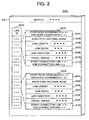
- FIG. 2 shows an example of the map information.
- the map information 12 includes area information for storing link information on roads on a map and the like.
- area information 200 a link ID 202 and link information 203 of a road included in each mesh are associated with each other for each mesh ID 201 for identifying an area on the map.
- the link information 203 stores location coordinates 204 of a start node and an end node representing both ends of a road, road type information 205 representing a type of the road such as a national road, a toll road, and a prefectural road, link length information 206 representing a length of the road, a link width information 207 representing a width of the road, link direction information 208 representing a direction of the road, travel period information 209 representing a period required to pass the road, and start connection link/end connection link information 210 for storing link IDs of other roads connected respectively to the start node and the end node of the road.
- road type information 205 representing a type of the road such as a national road, a toll road, and a prefectural road
- link length information 206 representing a length of the road
- a link width information 207 representing a width of the road
- link direction information 208 representing a direction of the road
- travel period information 209 representing a period required to pass the road
- the sound input/output device 13 includes a microphone 14 as a sound input device and the speaker 15 as a sound output device.
- the microphone 14 acquires an external sound of the navigation device 10 such a voice uttered by the user.
- the speaker 15 outputs a message generated by the calculation processing device 1 and directed to the user as a sound signal.
- the input device 16 is a user interface for the navigation device to receive an instruction from the user.
- the input device 16 is constituted by a direction key 17, a dial switch 18, a touch panel 19, and other hardware switches (not shown) such as a scale change key.
- the ROM device 20 is constituted by a storage medium which can be at least read such as a read only memory (ROM) including a CD-ROM and a DVD-ROM, and an integrated circuit (IC) card. Movie information, sound information, and the like are stored in the storage medium.
- ROM read only memory
- IC integrated circuit
- the vehicle speed sensor 21, the acceleration sensor 22, the gyro sensor 23, and the GPS reception device 24 are used to detect the own vehicle position of a vehicle on which the navigation device 100 is installed.
- the vehicle speed sensor 21 outputs information used to calculate a vehicle speed. Specifically, the vehicle speed sensor 21 converts the detected number of revolutions of a wheel into a pulse signal, and outputs predetermined vehicle speed information such as the number of pulse signals in a predetermined period.
- the acceleration sensor 22 outputs a predetermined detection signal in response to an acceleration in a longitudinal direction of the vehicle at a constant cycle. For example, the acceleration sensor 22 outputs a positive signal when the acceleration of the vehicle is increasing, and outputs a negative signal when the deceleration is occurring.
- the gyro sensor 23 is constituted by an optical fiber gyro or an oscillation gyro, detects an angular velocity by a rotation of a mobile body, and generates and outputs predetermined angular velocity information.
- the global positioning system (GPS) reception device 24 measures a current location, a travel speed, and a travel direction of a vehicle by receiving a signal from each of the GPS satellites, and measuring a distance between the vehicle and each of the GPS satellites and a change rate of the distance for three or more satellites.
- GPS global positioning system
- the FM multiplex broadcast reception device 25 receives an FM multiplex broadcast signal transmitted from an FM station such as outline current traffic information, traffic control information, service area/parking area (SA/PA) information, parking lot information, and weather information of vehicle information communication system (VICS) information, and character information provided by a radio station as FM multiplex general information.
- an FM station such as outline current traffic information, traffic control information, service area/parking area (SA/PA) information, parking lot information, and weather information of vehicle information communication system (VICS) information, and character information provided by a radio station as FM multiplex general information.
- SA/PA service area/parking area
- VICS vehicle information communication system
- the beacon reception device 26 receives the VICS information and the like suchas outline current traffic information, traffic control information, service area/parking area (SA/PA) information, parking lot information, weather information, and emergency information.
- the beacon reception device is constituted by an optical beacon for optical communication, or a radio beacon for radio wave communication.
- the functional blocks of the navigation device 100 are constructed by executing a predetermined program read by the CPU 2 implemented in the calculation processing device 1.
- the programs for realizing the processing of the respective functional parts are stored in the ROM 4.
- the functional blocks of the navigation device 100 are classified depending on major processing contents for the sake of understanding of functions of the navigation device 100 realized according to this embodiment. Moreover, the classification method and the name of the respective functions do not restrict the present invention. It should be noted that each configuration of the navigation device 100 can be further classified into a larger number of components depending on processing contents. Moreover, the configuration may be classified so that a single component can carry out more pieces of the processing.
- the functional parts of the navigation device 100 can be constructed by hardware (such as ASIC). Moreover, the processing of each of the functional parts may be carried out by a single piece of hardware or a plurality of pieces of hardware.
- FIG. 3 is a diagram illustrating functional blocks of the navigation device 100.
- the navigation device 100 includes an overall control part 301, a sensor information processing part 302, an own vehicle state estimation part 303, and a map matching processing part 304.
- the overall control part 301 is a central functional part for carrying out various processing for the navigation device 100. Specifically, the overall control part 301 receives various information and instructions from other functional parts, other devices and sensors built into the navigation device 100 , and external devices. Moreover, the overall control part 301 outputs the acquired information and the received instructions to predetermined sensors , devices, and functional parts depending on types and contents of the information and the instructions.
- the sensor information processing part 302 is a functional part for acquiring the vehicle sensor information, and temporarily storing the vehicle sensor information in the memory such as the RAM 3.
- the own vehicle state detection part 303 is a functional part for using the vehicle sensor information to calculate state information on the own vehicle including information such as the own vehicle position and the vehicle direction.
- the state information is calculated each time the map matching processing is carried out, but the calculation interval is not limited thereto.
- the own vehicle state detection part 303 may calculate the state information each time the vehicle travels a predetermined distance (such as 10 m).
- the own vehicle state detection part 303 calculates the position error and the direction error with respect to neighboring links.
- the own vehicle state detection part 303 determines that the own vehicle is turning in calculation processing for the direction error
- the own vehicle state detection part 303 generates a circular virtual link having a predetermined curvature radius between a link on which the own vehicle position exists and a link connecting to this link (hereinafter referred to as "post-turning link").
- post-turning link Moreover, the own vehicle state detection part 303 uses a virtual link direction at a predetermined position on the virtual link to calculate the direction error between the vehicle direction of the turning own vehicle and the link direction or the virtual link direction.
- the own vehicle state detection part 303 temporarily stores the information such as the calculated own vehicle position, vehicle direction, position error, and direction error in a memory such as the RAM 3.
- the map matching processing part 304 carries out the map matching processing of using predetermined information such as the own vehicle position and the error information (the position error and the direction error) to align the own vehicle position to a road (link) on a map displayed on the display 10. Specifically, the map matching processing part 304 uses the position error and the direction error calculated by the own vehicle state detection part 303 to calculate an evaluation amount for each of matching subject links. Moreover, the map matching processing part 304 identifies a matching subject link based on the calculated evaluation amounts, and aligns a car mark representing the current own vehicle position at a predetermined position on this link.
- predetermined information such as the own vehicle position and the error information (the position error and the direction error) to align the own vehicle position to a road (link) on a map displayed on the display 10.
- the map matching processing part 304 uses the position error and the direction error calculated by the own vehicle state detection part 303 to calculate an evaluation amount for each of matching subject links.
- the map matching processing part 304 identifies a matching subject link based on
- FIG. 4 is a flowchart illustrating this processing. This flow is started when the navigation device 100 is started up.
- the own vehicle state detection part 303 calculates the state information on the own vehicle including the own vehicle position and the vehicle direction on the map (Step S001). Specifically, the own vehicle state detection part 303 acquires the vehicle speed information output from the vehicle speed sensor 21 and the angular velocity information output from the gyro sensor 23, and temporally integrates distance information and angle information acquiredby integrating respective pieces of information to calculate the own vehicle position (X',Y') after a travel (own vehicle travel) from an initial position (X,Y).
- the own vehicle state detection part 303 integrates the angular velocity information output from the gyro sensor 23 to calculate the angle information on the vehicle, and calculates the vehicle direction, which is a travel direction of the own vehicle, based on the angle information. It should be noted that the own vehicle state detection part 303 temporarily stores the calculated own vehicle position and vehicle direction in a memory such as the RAM 3.
- the own vehicle state detection part 303 acquires the matching subject links (Step S002). Specifically, the own vehicle state detection part 303 acquires links within a predetermined range (such as a range having a radius of 500 m) from the own vehicle position from the link information 203.
- a predetermined range such as a range having a radius of 500 m
- the own vehicle state detectionpart 303 calculates the position error to the matching subject link (Step S003). Specifically, the own vehicle state detection part 303 calculates the position error from the own vehicle position depending on a length of a perpendicular line drawn from the own vehicle position to the matching subject link. Moreover, the own vehicle state detection part 303 temporarily stores information on the calculated position error in a memory such as the RAM 3.
- the own vehicle state detectionpart 303 calculates the direction error to the matching subject link (Step S004).
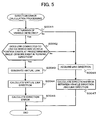
- FIG. 5 is a flowchart detailing the direction error calculationprocessing. As illustrated, the own vehicle state detection part 303 determines whether or not a turning of the vehicle is detected (Step S0041). Specifically, when the vehicle direction is equal to or more than a predetermined threshold (such as 4 degrees), the own vehicle state detection part 303 detects a turning of the vehicle.
- a predetermined threshold such as 4 degrees
- the own vehicle state detection part 303 When the own vehicle state detection part 303 does not detect a turning of the vehicle (No in Step S0041), the own vehicle state detection part 303 acquires the link direction of the matching subject link from the link information 203 (Step S0047), and calculates the direction error, which is the difference between the vehicle direction and the link direction (Step S0047). Moreover, the own vehicle state detection part 303 stores the calculated direction error in a memory such as the RAM 3, and finishes the direction error calculation processing.
- the own vehicle state detection part 303 determines whether or not a link connected to the link on which the own vehicle position exists at a predetermined angle or more (such as 4 degrees or more) exists in the detected turning direction (Step S0042). Specifically, the own vehicle state detection part 303 determines whether or not a link connected to the link (link on which the own vehicle position exists) associated with the own vehicle position by the previous map matching processing at the predetermined angle or more exists.
- Step S0042 when a link connected at the predetermined angle or more exists (Yes in Step S0042), the own vehicle state detection part 303 proceeds to processing in Step S0043. On the other hand, when such a link does not exist (No in Step S0042), the own vehicle state detection part 303 proceeds to processing in Step S0047 described before.
- Step S0043 the own vehicle state detection part 303 generates a circular virtual link between the link on which the own vehicle position exists and the post-turning link connected to this link at the predetermined angle or more.
- FIG. 6 is a diagram illustrating a connection example of the two links. As illustrated, halves of widths of both of the links are represented as ⁇ 1 and ⁇ 2, and both of the links are connected so as not to pass inside a circle c1 having the minimum turning radius r1 (such as radius of 12 m) of the vehicle specif ied by the law.
- the own vehicle state detection part 303 identifies the vehicle direction before the turning as a reference direction. Specifically, the own vehicle state detection part 303 identifies the vehicle direction calculated immediately before the turning of the vehicle as the reference direction.
- the turning start distance L is approximately the same as a turning end distance. Therefore, for the sake of convenience, the turning end distance is calculated, and is treated as the turning start distance L.
- the turning start distance L is acquired as X1+X2+X3.
- X1 is acquired by: road width of link 401 on which own vehicle position exists / 2 / ( absolute value of ⁇ sin direction difference between link 401 on which own vehicle position exists and post - turning link 402
- X2 is acquired by: road width of post - turning link 402 / 2 / ( absolute value of ⁇ tan direction difference between link 401 on which own vehicle position exists and post - turning link 402
- X3 is acquired by: minimum turning radius r ⁇ 1 of vehicle / ( absolute value of ⁇ tan direction difference between link 401 on which own vehicle position exists and post - turning link 402 / 2
- X1, X2, and X3 are acquired by the following equations 1, 2, and 3.
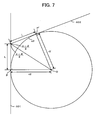
- FIG. 7 is a diagram illustrating a virtual link c2 generated between the link 401 on which the own vehicle position exists and the post-turning link 402.
- a curvature radius r2 of the virtual link c2 is acquired by: turning start distance L ⁇ absolute value of tan ⁇ - direction difference between link 401 on which own vehicle position exists and post - turning link 402 / 2
- the curvature radius r2 of the virtual link is acquired by the following equation 4.
- r ⁇ 2 L ⁇ tan ⁇ - ⁇ 2
- a part of the virtual link c2 constitutes an arc connecting a turning start point P and a turning end point P'.
- the arc has a shape close to an actual turning behavior of the vehicle.
- the own vehicle state detection part 303 uses the generated virtual link c2 to calculate a link direction (hereinafter referred to as "virtual link direction") at a predetermined position on the virtual link c2 (Step S0044).
- virtual link direction hereinafter referred to as "virtual link direction”
- the own vehicle state detection part 303 calculates a turning passage distance M.
- FIG. 8 illustrates the turning passage distance M.
- a perpendicular line is drawn from an own vehicle position Y identified by the vehicle sensor information to the link 401 on which the own vehicle exists, which is represented by a line segment delimited between N and T, and an intersection thereof is set to Q.
- the perpendicular line is extended to the virtual link c2, and an intersection between the perpendicular line and the arc of the virtual link c2 is set to R.
- an intersection of an extension of a line connecting between a center O of the virtual link c2 and the intersection R with the link 401 on which the own vehicle exists is set as an intersection S.
- the intersection S is a position of the own vehicle position projected on the link.
- the own vehicle state detection part 303 calculates a distance from the turning start point P to the intersection S as the turning passage distance M.
- the own vehicle state detection part 303 acquires a distance from a terminal point T of a link 403 on which a perpendicular line is drawn to the turning start point P as the turning passage distance. On this occasion, the own vehicle state detection part 303 identifies a terminal point smaller in distance from an intersection U between the perpendicular line drawn from the own vehicle position and the link 403 as the terminal point T of the link 403. Moreover, the turning start point P constitutes the reference point, and hence the sign of the calculated turning passage distance is negative in this case.
- the own vehicle state detection part 303 sets the turning start distance L as the turning passage distance.
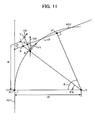
- the own vehicle state detection part 303 calculates a direction variation at a predetermined position on the virtual link c2. Specifically, when the turning passage distance M ⁇ 0, or when the turning passage distance M>the turning start distance L ⁇ 2, the own vehicle state detection part 303 sets the direction variation to 0.
- the own vehicle state detection part 303 calculates the direction variation as follows.
- direction variation ⁇ ⁇ 1 arctan turning passage distance M / curvature radius r ⁇ 2 of virtual link c 2
- the direction variation ⁇ 1 is acquiredby the following equation 5.
- ⁇ ⁇ 1 arctan M r ⁇ 2
- the own vehicle state detection part 303 calculates the direction variation as follows.
- direction variation ⁇ ⁇ 2 absolute value of direction difference between link 401 on which own vehicle and post - turning link 402 - arctan turning start distance L ⁇ 2 - turning passage distance M / curvature radius r ⁇ 2 of virtual link c ⁇ 2
- the direction variation ⁇ 2 is acquiredby the following equation 6.
- ⁇ ⁇ 2 ⁇ - arctan 2 ⁇ L - M r ⁇ 2
- the own vehicle state detection part 303 uses the direction variation to calculate a virtual link direction V1. Specifically, the own vehicle state detection part 303 calculates the virtual link direction V1 as follows. For right turn: reference direction-direction variation For left turn: reference direction+direction variation
- the own vehicle state detectionpart 303 calculates the direction error between a vehicle direction V2 calculated from the vehicle sensor information and the virtual link direction V1 (Step S0047). Specifically, the own vehicle state detection part 303 determines whether or not the vehicle direction V2 is included in a range between a reference direction V3 and the virtual link direction V1. Then, when the vehicle direction V2 is included in the range, the own vehicle state detection part 303 sets the direction error to a predetermined value (such as 0).
- a predetermined value such as 0
- the own vehicle state detection part 303 calculates a smaller one of a difference from the virtual link direction V1 and a difference from the reference direction V3 as the direction error with respect to the matching subject link. Specifically, the own vehicle state detection part 303 calculates respectively the difference between the vehicle direction V2 and the virtual link direction V1 and the difference between the vehicle direction V2 and the reference direction V3, and sets a smaller difference thereof as the direction error.
- the own vehicle state detection part 303 finishes the direction error calculation processing.
- the map matching processing part 304 carries out link evaluation amount calculation processing (Step S005 in FIG. 3 ).
- Step S005 the map matching processing part 304 uses the position error and the direction error to calculate the evaluation amounts of the matching subj ect links. For example , the map matching processing part 304 applies predetermined weighting to the position error and the direction error, adds the weighted position error and direction error to each other, and acquires an average thereof to calculate the link evaluation amount.
- the map matching processing part 304 uses the calculated link evaluation amounts to identify a matching subject link highest in evaluation amount, and applies the map matching processing to the identified link. Specifically, the map matching processing part 304 determines a matching position on the link based on the position error and the direction error between the own vehicle position and the identified link (Step S006). Moreover, the map matching processing part 304 carries out processing to align the car mark representing the own vehicle position to the determined position on the link. It should be noted that the map matching processing part 304 repeats the processing from Step S001 to Step S006 while the navigation device 100 is activated.
- the vehicle position detection device can acquire the direction error of the vehicle so that a more appropriate result is acquired in the subsequent processing (such as map matching processing).
- the use of the virtual link c2 acquired by considering the link widths of the link 401 on which the own vehicle exists and the post-turning link 402 enables the calculation of a more appropriate direction error at a location such as an intersection where the turning behavior occurs.
- the circular virtual link c2 is generated, and the direction at the predetermined position on the virtual link c2 is acquired according to this embodiment, but the shape of the virtual link c2 is not limited according to the present invention.
- an ellipsoidal virtual link may be generated, or a closed shape partially having a predetermined curved shape may be generated as the virtual link.
- the virtual link c2 having the curvature radius r2 determined by the calculated turning start distance L is generated according to this embodiment, but the present invention is not limited to this embodiment.
- the turning start distance L is not calculated, and, for example, a stored virtual link associated with the link widths and the direction difference angle between the links is used to calculate the direction error.
- FIG. 12 shows virtual link model information 500 stored in advance in the navigation device 100 according to the modified example.
- the virtual link model information 500 includes records each associated with a link width 501 of a link A, a link width 502 of a link B, a direction difference angle ⁇ between both of the links, and a virtual link (arc) generated at an appropriate curvature radius in advance depending on the link widths and the direction difference angle.
- the virtual link model information 500 is used by, for example, the direction error calculation processing. Specifically, when the own vehicle state detection part 303 detects a turning of the vehicle, the own vehicle state detection part 303 acquires the link widths of the link 401 on which the own vehicle position exists and the post-turning link 402 from the link information 203. Moreover, the own vehicle state detection part 303 calculates the direction difference angle between both of the links. Then, the own vehicle state detection part 303 identifies a record associated with values close the link widths and the direction difference angle of both of the links, and extracts the virtual link stored in the record. Then, the own vehicle state detection part 303 uses the extracted virtual link to calculate the direction error.
- the vehicle position detection device can calculate a more appropriate direction error.
- the virtual link is generated in advance, and a load imposed by the calculation processing can thus be reduced compared with the case where the turning start distance L is used to generate the virtual link c2.
- the reduction in the load imposed by the calculation processing results in more quick and more precise processing such as the map matching subsequent to the detection of the turning start.
- the direction error calculated by the embodiment is not used only for the map matching processing, and maybe used for, for example, determining a state (free state) where the own vehicle position does not belong to any links on the map.
- the generated virtual link is not used only for the calculation of the direction error, but may be used to align the car mark representing the own vehicle position during the turning of the vehicle to the arc of the virtual link, and to move the car mark along the arc, thereby displaying a smooth turning movement of the vehicle.
Landscapes
- Engineering & Computer Science (AREA)
- Radar, Positioning & Navigation (AREA)
- Remote Sensing (AREA)
- Automation & Control Theory (AREA)
- Physics & Mathematics (AREA)
- General Physics & Mathematics (AREA)
- Navigation (AREA)
- Instructional Devices (AREA)
Abstract
Description
- The present invention relates to a vehicle position detection device and a program. The present invention claims priority to Japanese Patent Application No.
2012-122680 filed on May 30, 2012 - A technology for a navigation device of acquiring a curvature on a curve section, and calculating a current position in the curve section based on a transition of the curvature is disclosed in Patent Literature 1.
- [PTL 1]
JP 2007-192583 A - However, the above-mentioned technology acquires the curvature for a link constituted by line segments without taking a road width into consideration. A curvature close to a turning behavior of a vehicle is thus hard to acquire. Even if a difference between a link direction calculated by using the curvature and a vehicle direction calculated by means of dead reckoning is set as a direction error for subsequent processing (such as map matching processing), an appropriate result cannot be acquired.
- The present invention has an object to acquire a direction error of a vehicle so that a more appropriate result is acquired in subsequent processing.
- In order to solve the problem described above, according to one embodiment of the present invention, there is provided a vehicle position detection device, including: a start/end point calculation part for acquiring a turning start point on a pre-turning link, and acquiring a turning end point on a post-turning link; a virtual link generation part for acquiring a virtual link connecting between the turning start point and the turning end point; a link direction calculation part for calculating a virtual link direction that is a direction at a predetermined position on the virtual link; and an error calculation part for using the virtual link direction to calculate a direction error of a vehicle direction.
- According to one embodiment of the present invention, it is possible to acquire the direction error of the vehicle so that a more appropriate result is acquired in the subsequent processing.
-
-
FIG. 1 is a schematic diagram of a navigation device 1 according to an embodiment of the present invention. -
FIG. 2 shows map information according to the embodiment of the present invention. -
FIG. 3 is a diagram illustrating functional blocks according to the embodiment of the present invention. -
FIG. 4 is a flowchart illustrating map matching processing according to the embodiment of the present invention. -
FIG. 5 is a flowchart illustrating direction error calculation processing according to the embodiment of the present invention. -
FIG. 6 is a diagram illustrating a connection example between a link on which an own vehicle position exists and a post-turning link according to the embodiment of the present invention. -
FIG. 7 is a diagram illustrating a virtual link generated between the link on which the own vehicle position exists and the post-turning link according to the embodiment of the present invention. -
FIG. 8 is a diagram illustrating a turning passage distance in a case where a direction difference angle between the link on which the own vehicle position exists and the post-turning link is an obtuse angle according to the embodiment of the present invention. -
FIG. 9 is a diagram illustrating the turning passage distance in a case where the direction difference angle between the link on which the own vehicle position exists and the post-turning link is an acute angle according to the embodiment of the present invention. -
FIG. 10 is a diagram illustrating a direction variation θ1 of the virtual link according to the embodiment of the present invention. -
FIG. 11 is a diagram illustrating a direction variation θ2 of the virtual link according to the embodiment of the present invention. -
FIG. 12 shows virtual link model information according to a modified example of the present invention. - A description is now given of an embodiment of the present invention.
-
FIG. 1 is a schematic configuration diagram of anavigation device 100 functioning as a vehicle position detection device according to this embodiment. Thenavigation device 100 includes a calculation processing device 1, adisplay 10, astorage device 11, a sound input/output device 13, aninput device 16, aROM device 20, avehicle speed sensor 21, anacceleration sensor 22, agyro sensor 23, aGPS reception device 24, an FM multiplexbroadcast reception device 25, and abeacon reception device 26. Moreover, those respective devices and sensors are configured to be connected with one another via a bus 6 for passing or receiving data from one another. - The
navigation device 100 is a device for realizing so-called navigation functions such as identification of an own vehicle position on a map, display of a map and traffic information, search for recommended route, and a route guidance. - The calculation processing device 1 is a central unit for carrying out various types of processing for the
navigation device 100. The calculation processing device 1 uses information (hereinafter referred to as "vehicle sensor information") output from various sensors such as thevehicle speed sensor 21, theacceleration sensor 22, and thegyro sensor 23, theGPS reception device 24, and the like to calculate the own vehicle position on the map, a position error and a direction error with respect to a neighboring link, and the like. Moreover, the calculation processing device calculates predetermined information such as the own vehicle position, the position error, and the direction error, and uses the predetermined information to carry out map matching processing. - Moreover, when the calculation processing device 1 determines that the own vehicle is turning based on the vehicle sensor information, the calculation processing device 1 generates a circular virtual link having a predetermined curvature radius between links neighboring each other, and calculates the direction thereof. The calculated direction of the virtual link is used for, for example, calculation of the direction error used for the map matching processing. It should be noted that the virtual link is detailed later.
- Moreover, the calculation processing device 1 temporarily stores the information such as the calculated own vehicle position and direction error in a memory such as a
RAM 3. - Moreover, the calculation processing device 1 uses
map information 12 stored in thestorage device 11 to search for a recommended route connecting a start location and a destination location with each other. - Moreover, the calculation processing device 1 converts the
map information 12, traffic information, route information, and the like to be displayed in a display area of thedisplay 10 into graphics, and outputs the graphics to thedisplay 10. - Moreover, the calculation processing device 1 generates sound information for the route guidance, and outputs the sound information to a
speaker 15. - It should be noted that the calculation processing device 1 includes a central processing unit (CPU) 2 for carrying out various processing such as numerical calculation and control for respective devices and sensors, the random access memory (RAM) 3 for temporarily storing programs, data, and calculation results, a read only memory (ROM) 4 for storing programs and data, and an interface (I/F) 5 for connecting various hardware with the calculation processing device with each other. Moreover, the
CPU 2, theRAM 3, and theROM 4 are connected one another via the bus 6. - The
display 10 is a unit for displaying graphics information generated by the calculation processing device 1 on the display area, and includes a liquid crystal display or an organic EL display. - The
storage device 11 is constituted by a storage medium which can be at least read and written such as a hard disk drive (HDD) and a nonvolatile memory card. Thestorage device 11 stores information such as themap information 12. -
FIG. 2 shows an example of the map information. Themap information 12 includes area information for storing link information on roads on a map and the like. Inarea information 200, alink ID 202 andlink information 203 of a road included in each mesh are associated with each other for eachmesh ID 201 for identifying an area on the map. - Moreover, the
link information 203stores location coordinates 204 of a start node and an end node representing both ends of a road,road type information 205 representing a type of the road such as a national road, a toll road, and a prefectural road,link length information 206 representing a length of the road, alink width information 207 representing a width of the road,link direction information 208 representing a direction of the road,travel period information 209 representing a period required to pass the road, and start connection link/endconnection link information 210 for storing link IDs of other roads connected respectively to the start node and the end node of the road. - The sound input/
output device 13 includes amicrophone 14 as a sound input device and thespeaker 15 as a sound output device. Themicrophone 14 acquires an external sound of thenavigation device 10 such a voice uttered by the user. Moreover, thespeaker 15 outputs a message generated by the calculation processing device 1 and directed to the user as a sound signal. - The
input device 16 is a user interface for the navigation device to receive an instruction from the user. Specifically, theinput device 16 is constituted by adirection key 17, adial switch 18, atouch panel 19, and other hardware switches (not shown) such as a scale change key. - The
ROM device 20 is constituted by a storage medium which can be at least read such as a read only memory (ROM) including a CD-ROM and a DVD-ROM, and an integrated circuit (IC) card. Movie information, sound information, and the like are stored in the storage medium. - The
vehicle speed sensor 21, theacceleration sensor 22, thegyro sensor 23, and theGPS reception device 24 are used to detect the own vehicle position of a vehicle on which thenavigation device 100 is installed. - The
vehicle speed sensor 21 outputs information used to calculate a vehicle speed. Specifically, thevehicle speed sensor 21 converts the detected number of revolutions of a wheel into a pulse signal, and outputs predetermined vehicle speed information such as the number of pulse signals in a predetermined period. - The
acceleration sensor 22 outputs a predetermined detection signal in response to an acceleration in a longitudinal direction of the vehicle at a constant cycle. For example, theacceleration sensor 22 outputs a positive signal when the acceleration of the vehicle is increasing, and outputs a negative signal when the deceleration is occurring. - The
gyro sensor 23 is constituted by an optical fiber gyro or an oscillation gyro, detects an angular velocity by a rotation of a mobile body, and generates and outputs predetermined angular velocity information. - The global positioning system (GPS)
reception device 24 measures a current location, a travel speed, and a travel direction of a vehicle by receiving a signal from each of the GPS satellites, and measuring a distance between the vehicle and each of the GPS satellites and a change rate of the distance for three or more satellites. - The FM multiplex
broadcast reception device 25 receives an FM multiplex broadcast signal transmitted from an FM station such as outline current traffic information, traffic control information, service area/parking area (SA/PA) information, parking lot information, and weather information of vehicle information communication system (VICS) information, and character information provided by a radio station as FM multiplex general information. - The
beacon reception device 26 receives the VICS information and the like suchas outline current traffic information, traffic control information, service area/parking area (SA/PA) information, parking lot information, weather information, and emergency information. For example, the beacon reception device is constituted by an optical beacon for optical communication, or a radio beacon for radio wave communication. - A description is now given of functional blocks of the
navigation device 100 according to this embodiment. It should be noted that the functional blocks of thenavigation device 100 are constructed by executing a predetermined program read by theCPU 2 implemented in the calculation processing device 1. For that purpose, the programs for realizing the processing of the respective functional parts are stored in theROM 4. - Moreover, the functional blocks of the
navigation device 100 are classified depending on major processing contents for the sake of understanding of functions of thenavigation device 100 realized according to this embodiment. Moreover, the classification method and the name of the respective functions do not restrict the present invention. It should be noted that each configuration of thenavigation device 100 can be further classified into a larger number of components depending on processing contents. Moreover, the configuration may be classified so that a single component can carry out more pieces of the processing. - Moreover, the functional parts of the
navigation device 100 can be constructed by hardware (such as ASIC). Moreover, the processing of each of the functional parts may be carried out by a single piece of hardware or a plurality of pieces of hardware. -
FIG. 3 is a diagram illustrating functional blocks of thenavigation device 100. Thenavigation device 100 includes anoverall control part 301, a sensorinformation processing part 302, an own vehiclestate estimation part 303, and a mapmatching processing part 304. - The
overall control part 301 is a central functional part for carrying out various processing for thenavigation device 100. Specifically, theoverall control part 301 receives various information and instructions from other functional parts, other devices and sensors built into thenavigation device 100 , and external devices. Moreover, theoverall control part 301 outputs the acquired information and the received instructions to predetermined sensors , devices, and functional parts depending on types and contents of the information and the instructions. - The sensor
information processing part 302 is a functional part for acquiring the vehicle sensor information, and temporarily storing the vehicle sensor information in the memory such as theRAM 3. - The own vehicle
state detection part 303 is a functional part for using the vehicle sensor information to calculate state information on the own vehicle including information such as the own vehicle position and the vehicle direction. The state information is calculated each time the map matching processing is carried out, but the calculation interval is not limited thereto. For example, the own vehiclestate detection part 303 may calculate the state information each time the vehicle travels a predetermined distance (such as 10 m). - Moreover, the own vehicle
state detection part 303 calculates the position error and the direction error with respect to neighboring links. When the own vehiclestate detection part 303 determines that the own vehicle is turning in calculation processing for the direction error, the own vehiclestate detection part 303 generates a circular virtual link having a predetermined curvature radius between a link on which the own vehicle position exists and a link connecting to this link (hereinafter referred to as "post-turning link"). Moreover, the own vehiclestate detection part 303 uses a virtual link direction at a predetermined position on the virtual link to calculate the direction error between the vehicle direction of the turning own vehicle and the link direction or the virtual link direction. - It should be noted that the own vehicle
state detection part 303 temporarily stores the information such as the calculated own vehicle position, vehicle direction, position error, and direction error in a memory such as theRAM 3. - The map
matching processing part 304 carries out the map matching processing of using predetermined information such as the own vehicle position and the error information (the position error and the direction error) to align the own vehicle position to a road (link) on a map displayed on thedisplay 10. Specifically, the mapmatching processing part 304 uses the position error and the direction error calculated by the own vehiclestate detection part 303 to calculate an evaluation amount for each of matching subject links. Moreover, the mapmatching processing part 304 identifies a matching subject link based on the calculated evaluation amounts, and aligns a car mark representing the current own vehicle position at a predetermined position on this link. - A description has been given of the functional blocks of the
navigation device 100 according to this embodiment. - A description is now given of the map matching processing by the
navigation device 100 according to this embodiment.FIG. 4 is a flowchart illustrating this processing. This flow is started when thenavigation device 100 is started up. - First, the own vehicle
state detection part 303 calculates the state information on the own vehicle including the own vehicle position and the vehicle direction on the map (Step S001). Specifically, the own vehiclestate detection part 303 acquires the vehicle speed information output from thevehicle speed sensor 21 and the angular velocity information output from thegyro sensor 23, and temporally integrates distance information and angle information acquiredby integrating respective pieces of information to calculate the own vehicle position (X',Y') after a travel (own vehicle travel) from an initial position (X,Y). - Moreover, the own vehicle
state detection part 303, for example, integrates the angular velocity information output from thegyro sensor 23 to calculate the angle information on the vehicle, and calculates the vehicle direction, which is a travel direction of the own vehicle, based on the angle information. It should be noted that the own vehiclestate detection part 303 temporarily stores the calculated own vehicle position and vehicle direction in a memory such as theRAM 3. - Then, the own vehicle
state detection part 303 acquires the matching subject links (Step S002). Specifically, the own vehiclestate detection part 303 acquires links within a predetermined range (such as a range having a radius of 500 m) from the own vehicle position from thelink information 203. - Then, the own
vehicle state detectionpart 303 calculates the position error to the matching subject link (Step S003). Specifically, the own vehiclestate detection part 303 calculates the position error from the own vehicle position depending on a length of a perpendicular line drawn from the own vehicle position to the matching subject link. Moreover, the own vehiclestate detection part 303 temporarily stores information on the calculated position error in a memory such as theRAM 3. - Then, the own
vehicle state detectionpart 303 calculates the direction error to the matching subject link (Step S004).FIG. 5 is a flowchart detailing the direction error calculationprocessing. As illustrated, the own vehiclestate detection part 303 determines whether or not a turning of the vehicle is detected (Step S0041). Specifically, when the vehicle direction is equal to or more than a predetermined threshold (such as 4 degrees), the own vehiclestate detection part 303 detects a turning of the vehicle. - When the own vehicle
state detection part 303 does not detect a turning of the vehicle (No in Step S0041), the own vehiclestate detection part 303 acquires the link direction of the matching subject link from the link information 203 (Step S0047), and calculates the direction error, which is the difference between the vehicle direction and the link direction (Step S0047). Moreover, the own vehiclestate detection part 303 stores the calculated direction error in a memory such as theRAM 3, and finishes the direction error calculation processing. - On the other hand, when the own vehicle
state detection part 303 detects a turning of the vehicle (Yes in Step S0041), the own vehiclestate detection part 303 determines whether or not a link connected to the link on which the own vehicle position exists at a predetermined angle or more (such as 4 degrees or more) exists in the detected turning direction (Step S0042). Specifically, the own vehiclestate detection part 303 determines whether or not a link connected to the link (link on which the own vehicle position exists) associated with the own vehicle position by the previous map matching processing at the predetermined angle or more exists. - Then, when a link connected at the predetermined angle or more exists (Yes in Step S0042), the own vehicle
state detection part 303 proceeds to processing in Step S0043. On the other hand, when such a link does not exist (No in Step S0042), the own vehiclestate detection part 303 proceeds to processing in Step S0047 described before. - In Step S0043, the own vehicle
state detection part 303 generates a circular virtual link between the link on which the own vehicle position exists and the post-turning link connected to this link at the predetermined angle or more.FIG. 6 is a diagram illustrating a connection example of the two links. As illustrated, halves of widths of both of the links are represented as α1 and α2, and both of the links are connected so as not to pass inside a circle c1 having the minimum turning radius r1 (such as radius of 12 m) of the vehicle specif ied by the law. Moreover, perpendicular lines are drawn in a link width direction of apost-turning link 402 to intersections a1 and a2 between thepost-turning link 402 and alink 401 on which the own vehicle position exists, a line segment from b0 to an intersection b1 is set as X1, and a line segment from an intersection b1 to an intersection b2 (=a2) is set as X2. Moreover, a line segment from an intersection b3 of a perpendicular line drawn from the center of the circle c1 having the minimum turning radius to thepost-turning link 402 to the intersection b2 is set as X3. - When the virtual link is generated, the own vehicle
state detection part 303 identifies the vehicle direction before the turning as a reference direction. Specifically, the own vehiclestate detection part 303 identifies the vehicle direction calculated immediately before the turning of the vehicle as the reference direction. - Then, the own vehicle
state detection part 303 calculates a turning start distance L. The turning start distance L is approximately the same as a turning end distance. Therefore, for the sake of convenience, the turning end distance is calculated, and is treated as the turning start distance L. - On this occasion, the turning start distance L is acquired as X1+X2+X3. X1 is acquired by:

Moreover, X2 is acquired by:
Moreover, X3 is acquired by:
Specifically, X1, X2, and X3 are acquired by the followingequations 


- Then, the own vehicle
state detection part 303 uses the calculated turning start distance L to calculate a curvature radius of the virtual link.FIG. 7 is a diagram illustrating a virtual link c2 generated between thelink 401 on which the own vehicle position exists and thepost-turning link 402. On this occasion, a curvature radius r2 of the virtual link c2 is acquired by:
Specifically, the curvature radius r2 of the virtual link is acquired by thefollowing equation 4.
- When the virtual link c2 having the curvature radius of r2 is generated, a part of the virtual link c2 constitutes an arc connecting a turning start point P and a turning end point P'. The arc has a shape close to an actual turning behavior of the vehicle.
- Then, the own vehicle
state detection part 303 uses the generated virtual link c2 to calculate a link direction (hereinafter referred to as "virtual link direction") at a predetermined position on the virtual link c2 (Step S0044). When the virtual link direction is calculated, the own vehiclestate detection part 303 calculates a turning passage distance M. -
FIG. 8 illustrates the turning passage distance M. As illustrated, a perpendicular line is drawn from an own vehicle position Y identified by the vehicle sensor information to thelink 401 on which the own vehicle exists, which is represented by a line segment delimited between N and T, and an intersection thereof is set to Q. Moreover, the perpendicular line is extended to the virtual link c2, and an intersection between the perpendicular line and the arc of the virtual link c2 is set to R. Moreover, an intersection of an extension of a line connecting between a center O of the virtual link c2 and the intersection R with thelink 401 on which the own vehicle exists is set as an intersection S. On this occasion, the intersection S is a position of the own vehicle position projected on the link. The own vehiclestate detection part 303 calculates a distance from the turning start point P to the intersection S as the turning passage distance M. - If the perpendicular line cannot be drawn from the own vehicle position to the link on which the own vehicle exists, the own vehicle
state detection part 303 acquires a distance from a terminal point T of alink 403 on which a perpendicular line is drawn to the turning start point P as the turning passage distance. On this occasion, the own vehiclestate detection part 303 identifies a terminal point smaller in distance from an intersection U between the perpendicular line drawn from the own vehicle position and thelink 403 as the terminal point T of thelink 403. Moreover, the turning start point P constitutes the reference point, and hence the sign of the calculated turning passage distance is negative in this case. - Moreover, as illustrated in
FIG. 9 , if the direction difference angle between thelink 401 on which the own vehicle exists and thepost-turning link 402 is an acute angle, the perpendicular line drawn from the own vehicle position may not intersect with the virtual link c2. In this case, the own vehiclestate detection part 303 sets the turning start distance L as the turning passage distance. - Then, the own vehicle
state detection part 303 calculates a direction variation at a predetermined position on the virtual link c2. Specifically, when the turning passage distance M≤0, or when the turning passage distance M>the turning start distance L×2, the own vehiclestate detection part 303 sets the direction variation to 0. - Moreover, as illustrated in
FIG. 10 , when 0<the turning passage distance M<the turning start distance L, the own vehiclestate detection part 303 calculates the direction variation as follows.
following equation 5.
- Moreover, as illustrated in
FIG. 11 , when the turning start distance L<the turning passage distance M≤the turning start distance L×2, the own vehiclestate detection part 303 calculates the direction variation as follows.

- Then, the own vehicle
state detection part 303 uses the direction variation to calculate a virtual link direction V1. Specifically, the own vehiclestate detection part 303 calculates the virtual link direction V1 as follows.
For right turn: reference direction-direction variation
For left turn: reference direction+direction variation - Then, the own
vehicle state detectionpart 303 calculates the direction error between a vehicle direction V2 calculated from the vehicle sensor information and the virtual link direction V1 (Step S0047). Specifically, the own vehiclestate detection part 303 determines whether or not the vehicle direction V2 is included in a range between a reference direction V3 and the virtual link direction V1. Then, when the vehicle direction V2 is included in the range, the own vehiclestate detection part 303 sets the direction error to a predetermined value (such as 0). - On the other hand, when the vehicle direction V2 is not included in the range, the own vehicle
state detection part 303 calculates a smaller one of a difference from the virtual link direction V1 and a difference from the reference direction V3 as the direction error with respect to the matching subject link. Specifically, the own vehiclestate detection part 303 calculates respectively the difference between the vehicle direction V2 and the virtual link direction V1 and the difference between the vehicle direction V2 and the reference direction V3, and sets a smaller difference thereof as the direction error. - After the direction error is acquired as described above , the own vehicle
state detection part 303 finishes the direction error calculation processing. When the direction error calculation processing is finished, the mapmatching processing part 304 carries out link evaluation amount calculation processing (Step S005 inFIG. 3 ). - In Step S005, the map
matching processing part 304 uses the position error and the direction error to calculate the evaluation amounts of the matching subj ect links. For example , the mapmatching processing part 304 applies predetermined weighting to the position error and the direction error, adds the weighted position error and direction error to each other, and acquires an average thereof to calculate the link evaluation amount. - Then, the map
matching processing part 304 uses the calculated link evaluation amounts to identify a matching subject link highest in evaluation amount, and applies the map matching processing to the identified link. Specifically, the mapmatching processing part 304 determines a matching position on the link based on the position error and the direction error between the own vehicle position and the identified link (Step S006). Moreover, the mapmatching processing part 304 carries out processing to align the car mark representing the own vehicle position to the determined position on the link. It should be noted that the mapmatching processing part 304 repeats the processing from Step S001 to Step S006 while thenavigation device 100 is activated. - The vehicle position detection device according to this embodiment can acquire the direction error of the vehicle so that a more appropriate result is acquired in the subsequent processing (such as map matching processing). In particular, the use of the virtual link c2 acquired by considering the link widths of the
link 401 on which the own vehicle exists and thepost-turning link 402 enables the calculation of a more appropriate direction error at a location such as an intersection where the turning behavior occurs. - The circular virtual link c2 is generated, and the direction at the predetermined position on the virtual link c2 is acquired according to this embodiment, but the shape of the virtual link c2 is not limited according to the present invention. For example, an ellipsoidal virtual link may be generated, or a closed shape partially having a predetermined curved shape may be generated as the virtual link.
- Moreover, the virtual link c2 having the curvature radius r2 determined by the calculated turning start distance L is generated according to this embodiment, but the present invention is not limited to this embodiment. According to a modified example of this embodiment, the turning start distance L is not calculated, and, for example, a stored virtual link associated with the link widths and the direction difference angle between the links is used to calculate the direction error.
-
FIG. 12 shows virtuallink model information 500 stored in advance in thenavigation device 100 according to the modified example. As illustrated, the virtuallink model information 500 includes records each associated with alink width 501 of a link A, alink width 502 of a link B, a direction difference angle β between both of the links, and a virtual link (arc) generated at an appropriate curvature radius in advance depending on the link widths and the direction difference angle. - The virtual
link model information 500 is used by, for example, the direction error calculation processing. Specifically, when the own vehiclestate detection part 303 detects a turning of the vehicle, the own vehiclestate detection part 303 acquires the link widths of thelink 401 on which the own vehicle position exists and thepost-turning link 402 from thelink information 203. Moreover, the own vehiclestate detection part 303 calculates the direction difference angle between both of the links. Then, the own vehiclestate detection part 303 identifies a record associated with values close the link widths and the direction difference angle of both of the links, and extracts the virtual link stored in the record. Then, the own vehiclestate detection part 303 uses the extracted virtual link to calculate the direction error. - The vehicle position detection device according to the modified example can calculate a more appropriate direction error. In particular, the virtual link is generated in advance, and a load imposed by the calculation processing can thus be reduced compared with the case where the turning start distance L is used to generate the virtual link c2. Moreover, the reduction in the load imposed by the calculation processing results in more quick and more precise processing such as the map matching subsequent to the detection of the turning start.
- Moreover, the direction error calculated by the embodiment is not used only for the map matching processing, and maybe used for, for example, determining a state (free state) where the own vehicle position does not belong to any links on the map. Moreover, the generated virtual link is not used only for the calculation of the direction error, but may be used to align the car mark representing the own vehicle position during the turning of the vehicle to the arc of the virtual link, and to move the car mark along the arc, thereby displaying a smooth turning movement of the vehicle.
- 100 ··· navigation device, 1 ··· calculation processing device, 10 ··· display, 11 ··· storage device, 13 ··· sound input/output device, 16 ··· input device, 20 ··· ROM device, 21 ··· vehicle speed sensor, 22 ··· acceleration sensor, 23 ··· gyro sensor, 24 ··· GPS reception device, 25 ··· FM multiplex broadcast reception device, 26 ··· beacon reception device
Claims (12)
- A vehicle position detection device, comprising:a start/end point calculation part for acquiring a turning start point on a pre-turning link, and acquiring a turning end point on a post-turning link;a virtual link generation part for acquiring a virtual link connecting between the turning start point and the turning end point;a link direction calculation part for calculating a virtual link direction that is a direction at a predetermined position on the virtual link; andan error calculation part for using the virtual link direction to calculate a direction error of a vehicle direction.
- A vehicle position detection device according to claim 1, wherein the virtual link generation part is configured to:use a link width of the pre-turning link and a link width of the post-turning link to calculate a turning start distance defined by an interval from the turning start point to an end point of the pre-turning link; anduse the turning start distance to generate the virtual link.
- A vehicle position detection device according to claim 2, wherein the virtual link generation part uses the link width of the pre-turning link, the link width of the post-turning link, a direction difference angle between the pre-turning link and the post-turning link, and a minimum turning radius between the pre-turning link and the post-turning link to generate the virtual link.
- A vehicle position detection device according to claim 3, wherein the link direction calculation part is configured to extend a perpendicular line drawn from a virtual current position acquired by a sensor value to the pre-turning link, and calculate a direction at an intersection between an extension of the perpendicular line and the virtual link as the virtual link direction.
- A vehicle position detection device according to claim 4, wherein the error calculation part is configured to:use, when the vehicle direction is included in a predetermined range between the virtual link direction and a reference direction that is a direction of the pre-turning link, a predetermined value as the direction error; anduse, when the vehicle direction is not included in the predetermined range, a smaller one of a direction error between the vehicle direction and the reference direction and a direction error between the vehicle direction and the virtual link direction as the direction error.
- A vehicle position detection device according to claim 5, wherein the virtual link generation part uses an arc of a circle that is externally tangent to the pre-turning link and the post-turning link to calculate the virtual link.
- A program for causing a computer to function as a vehicle position detection device capable of calculating a direction error of a vehicle direction, the program causing the computer to execute:a start/end point calculation step of acquiring a turning start point on a pre-turning link, and acquiring a turning end point on a post-turning link;a virtual link generation step of acquiring a virtual link connecting between the turning start point and the turning end point ;a link direction calculation step of calculating a virtual link direction that is a direction at a predetermined position on the virtual link; andan error calculation step of using the virtual link direction to calculate the direction error of the vehicle direction.
- A program according to claim 7, wherein the virtual link generation step comprises:using a link width of the pre-turning link and a link width of the post-turning link to calculate a turning start distance defined by an interval from the turning start point to an end point of the pre-turning link; andusing the turning start distance to generate the virtual link.
- A program according to claim 8, wherein the virtual link generation step comprises using the link width of the pre-turning link, the link width of the post-turning link, a direction difference angle between the pre-turning link and the post-turning link, and a minimum turning radius between the pre-turning link and the post-turning link to generate the virtual link.
- A program according to claim 9, wherein the link direction calculation step comprises extending a perpendicular line drawn from a virtual current position acquired by a sensor value to the pre-turning link, and calculating a direction at an intersection between an extension of the perpendicular line and the virtual link as the virtual link direction.
- A program according to claim 10, wherein the error calculation step comprises:using, when the vehicle direction is included in a predetermined range between the virtual link direction and a reference direction that is a direction of the pre-turning link, a predetermined value as the direction error; andusing, when the vehicle direction is not included in the predetermined range, a smaller one of a direction error between the vehicle direction and the reference direction and a direction error between the vehicle direction and the virtual link direction as the direction error.
- A program according to claim 11, wherein the virtual link generation step comprises using an arc of a circle that is externally tangent to the pre-turning link and the post-turning link to calculate the virtual link.
Applications Claiming Priority (2)
| Application Number | Priority Date | Filing Date | Title |
|---|---|---|---|
| JP2012122680A JP6054638B2 (en) | 2012-05-30 | 2012-05-30 | Vehicle position detection device and program |
| PCT/JP2013/062630 WO2013179853A1 (en) | 2012-05-30 | 2013-04-30 | Vehicle position detection device and program |
Publications (3)
| Publication Number | Publication Date |
|---|---|
| EP2857799A1 true EP2857799A1 (en) | 2015-04-08 |
| EP2857799A4 EP2857799A4 (en) | 2016-02-10 |
| EP2857799B1 EP2857799B1 (en) | 2018-01-10 |
Family
ID=49673057
Family Applications (1)
| Application Number | Title | Priority Date | Filing Date |
|---|---|---|---|
| EP13796314.6A Not-in-force EP2857799B1 (en) | 2012-05-30 | 2013-04-30 | Vehicle position detection device and program |
Country Status (5)
| Country | Link |
|---|---|
| US (1) | US9733092B2 (en) |
| EP (1) | EP2857799B1 (en) |
| JP (1) | JP6054638B2 (en) |
| CN (1) | CN104380045B (en) |
| WO (1) | WO2013179853A1 (en) |
Cited By (1)
| Publication number | Priority date | Publication date | Assignee | Title |
|---|---|---|---|---|
| WO2018037425A1 (en) * | 2016-08-22 | 2018-03-01 | Konanur Ramachandra Satyamurthy | A system and method for localised location tracking |
Families Citing this family (3)
| Publication number | Priority date | Publication date | Assignee | Title |
|---|---|---|---|---|
| JP2017003462A (en) * | 2015-06-11 | 2017-01-05 | クラリオン株式会社 | Information processing device and map matching method |
| JP7113996B2 (en) * | 2020-02-28 | 2022-08-05 | 三菱電機株式会社 | High-precision map database generation device and high-precision map database generation method |
| US20250027784A1 (en) * | 2023-07-20 | 2025-01-23 | Gogoro Inc. | Method and system for recommending vehicle location |
Family Cites Families (48)
| Publication number | Priority date | Publication date | Assignee | Title |
|---|---|---|---|---|
| US3700379A (en) * | 1971-06-14 | 1972-10-24 | Westinghouse Electric Corp | Motor drive position movement profile calibration |
| JPH04353715A (en) * | 1991-05-31 | 1992-12-08 | Alpine Electron Inc | Vehicle-position detecting apparatus for vehicle mounted navigator |
| JP3412272B2 (en) * | 1994-08-24 | 2003-06-03 | 株式会社デンソー | Vehicle running position display device |
| JP3578511B2 (en) * | 1995-04-21 | 2004-10-20 | 株式会社ザナヴィ・インフォマティクス | Current position calculation device |
| JP3545837B2 (en) * | 1995-06-09 | 2004-07-21 | 株式会社ザナヴィ・インフォマティクス | Current position calculation device |
| US5941934A (en) | 1995-06-09 | 1999-08-24 | Xanavi Informatics Corporation | Current position calculating device |
| JP3545839B2 (en) * | 1995-06-09 | 2004-07-21 | 株式会社ザナヴィ・インフォマティクス | Current position calculation device |
| US6023653A (en) * | 1995-11-30 | 2000-02-08 | Fujitsu Ten Limited | Vehicle position detecting apparatus |
| JP3328939B2 (en) * | 1996-11-25 | 2002-09-30 | トヨタ自動車株式会社 | Creation of vehicle navigation device and road shape data used for it |
| JP3366220B2 (en) * | 1997-05-26 | 2003-01-14 | 本田技研工業株式会社 | Road shape determination device and vehicle control device |
| US6473770B1 (en) * | 1998-03-16 | 2002-10-29 | Navigation Technologies Corp. | Segment aggregation and interleaving of data types in a geographic database and methods for use thereof in a navigation application |
| JP3934795B2 (en) * | 1998-07-10 | 2007-06-20 | 本田技研工業株式会社 | Road shape prediction device and vehicle control device |
| JP3167993B2 (en) * | 1999-09-21 | 2001-05-21 | 富士重工業株式会社 | Road shape estimation device and curve entry control device using the same |
| JP3243236B2 (en) * | 1999-09-24 | 2002-01-07 | 松下電器産業株式会社 | Position data thinning device |
| DE10021373A1 (en) * | 2000-05-02 | 2001-11-08 | Siemens Ag | Positioning method and navigation device |
| US6643588B1 (en) * | 2002-04-11 | 2003-11-04 | Visteon Global Technologies, Inc. | Geometric based path prediction method using moving and stop objects |
| US7522091B2 (en) * | 2002-07-15 | 2009-04-21 | Automotive Systems Laboratory, Inc. | Road curvature estimation system |
| JP3818654B2 (en) * | 2003-06-26 | 2006-09-06 | トヨタ自動車株式会社 | Vehicle travel support device |
| JP2005132291A (en) * | 2003-10-31 | 2005-05-26 | Denso Corp | Vehicle control system |
| US7474961B2 (en) * | 2005-02-04 | 2009-01-06 | Visteon Global Technologies, Inc. | System to determine the path of a vehicle |
| US7539574B2 (en) * | 2005-03-22 | 2009-05-26 | Denso Corporation | Vehicular navigation system |
| US7720598B2 (en) * | 2005-03-31 | 2010-05-18 | Deere & Company | System and method for determining a position of a vehicle with compensation for noise or measurement error |
| US7647177B2 (en) * | 2005-03-31 | 2010-01-12 | Deere & Company | System and method for determining a position of a vehicle |
| US7653483B2 (en) * | 2005-03-31 | 2010-01-26 | Deere & Company | System and method for determining a position of a vehicle |
| JP4889272B2 (en) * | 2005-09-30 | 2012-03-07 | アルパイン株式会社 | Navigation device and vehicle position estimation method |
| JP4832903B2 (en) | 2006-01-17 | 2011-12-07 | アルパイン株式会社 | Navigation device and current position calculation method |
| JP4816124B2 (en) * | 2006-02-20 | 2011-11-16 | 株式会社デンソー | Map evaluation apparatus and map evaluation method |
| JP4506688B2 (en) * | 2006-02-28 | 2010-07-21 | アイシン・エィ・ダブリュ株式会社 | Navigation device |
| JP4801481B2 (en) * | 2006-03-30 | 2011-10-26 | クラリオン株式会社 | Navigation device, navigation system |
| EP2168079B1 (en) * | 2007-01-23 | 2015-01-14 | Valeo Schalter und Sensoren GmbH | Method and system for universal lane boundary detection |
| US7774121B2 (en) * | 2007-07-31 | 2010-08-10 | Gm Global Technology Operations, Inc. | Curve speed control system with adaptive map preview time and driving mode selection |
| JP4479816B2 (en) * | 2008-03-28 | 2010-06-09 | アイシン・エィ・ダブリュ株式会社 | Road shape estimation device, road shape estimation method and program |
| JP4475342B2 (en) * | 2008-03-28 | 2010-06-09 | アイシン・エィ・ダブリュ株式会社 | Road shape estimation device, road shape estimation method and program |
| JP4553033B2 (en) * | 2008-05-15 | 2010-09-29 | 株式会社デンソー | Current position calculation device and program |
| US8698649B2 (en) * | 2008-05-30 | 2014-04-15 | Navteq B.V. | Data mining in a digital map database to identify decreasing radius of curvature along roads and enabling precautionary actions in a vehicle |
| US8762046B2 (en) * | 2008-10-01 | 2014-06-24 | Navteq B.V. | Creating geometry for advanced driver assistance systems |
| US8150620B2 (en) * | 2009-04-14 | 2012-04-03 | Alpine Electronics, Inc. | Route search method and apparatus for navigation system utilizing map data of XML format |
| US8532925B2 (en) * | 2009-05-08 | 2013-09-10 | Alpine Electronics, Inc. | Spatial indexing method and apparatus for navigation system for indexing and retrieval of XML map data |
| JP5385009B2 (en) * | 2009-05-29 | 2014-01-08 | 日立オートモティブシステムズ株式会社 | Vehicle control apparatus and vehicle control method |
| JP5609073B2 (en) * | 2009-06-16 | 2014-10-22 | カシオ計算機株式会社 | Positioning device, positioning method and program |
| JP5601224B2 (en) * | 2010-03-04 | 2014-10-08 | 株式会社デンソー | Road shape learning device |
| US8285485B2 (en) * | 2010-03-18 | 2012-10-09 | Harman International Industries, Incorporated | Vehicle navigation system with route determination based on a measure of sportiness |
| JP2012002753A (en) * | 2010-06-18 | 2012-01-05 | Navitime Japan Co Ltd | Navigation system, navigation device, navigation server, navigation method and program |
| DE112010005977B4 (en) * | 2010-11-04 | 2015-08-06 | Toyota Jidosha Kabushiki Kaisha | Road shape estimation apparatus |
| US9157749B2 (en) * | 2011-04-11 | 2015-10-13 | Clarion Co., Ltd. | Position calculation method and position calculation apparatus |
| US9069655B2 (en) * | 2011-12-28 | 2015-06-30 | JVC Kenwood Corporation | On-vehicle apparatus, and method and computer program for transmitting positional information |
| JP6026295B2 (en) * | 2013-01-23 | 2016-11-16 | 株式会社デンソーアイティーラボラトリ | Curve shape modeling apparatus, method, and in-vehicle navigation apparatus |
| JP6278381B2 (en) * | 2013-08-26 | 2018-02-14 | アルパイン株式会社 | Corner information providing apparatus and corner information providing method |
-
2012
- 2012-05-30 JP JP2012122680A patent/JP6054638B2/en not_active Expired - Fee Related
-
2013
- 2013-04-30 US US14/404,414 patent/US9733092B2/en not_active Expired - Fee Related
- 2013-04-30 WO PCT/JP2013/062630 patent/WO2013179853A1/en not_active Ceased
- 2013-04-30 CN CN201380027871.6A patent/CN104380045B/en not_active Expired - Fee Related
- 2013-04-30 EP EP13796314.6A patent/EP2857799B1/en not_active Not-in-force
Cited By (1)
| Publication number | Priority date | Publication date | Assignee | Title |
|---|---|---|---|---|
| WO2018037425A1 (en) * | 2016-08-22 | 2018-03-01 | Konanur Ramachandra Satyamurthy | A system and method for localised location tracking |
Also Published As
| Publication number | Publication date |
|---|---|
| JP6054638B2 (en) | 2016-12-27 |
| US20150149072A1 (en) | 2015-05-28 |
| JP2013250057A (en) | 2013-12-12 |
| EP2857799B1 (en) | 2018-01-10 |
| WO2013179853A1 (en) | 2013-12-05 |
| CN104380045B (en) | 2017-04-19 |
| US9733092B2 (en) | 2017-08-15 |
| CN104380045A (en) | 2015-02-25 |
| EP2857799A4 (en) | 2016-02-10 |
Similar Documents
| Publication | Publication Date | Title |
|---|---|---|
| US9834222B2 (en) | Detecting vehicle maneuvers with mobile phones | |
| CN103052865B (en) | Driving support device, driving support method | |
| CN108973990A (en) | Method, medium and system for automatic Pilot control | |
| JP2008298547A (en) | Navigation apparatus | |
| JP2012208700A (en) | Driving support device, driving support method and computer program | |
| JP2019100763A (en) | Passing-each-other difficulty section avoidance system, server device, information display device, and passing-each-other difficulty section avoidance method | |
| EP2857799B1 (en) | Vehicle position detection device and program | |
| JP2006251888A (en) | Vehicle driving support device and vehicle navigation device | |
| JP6169318B2 (en) | Navigation system | |
| US10459448B2 (en) | Driving assistance apparatus | |
| JP2008197703A (en) | Vehicle information providing device | |
| US7124025B2 (en) | Vehicular navigation device | |
| JP6244610B2 (en) | Navigation system | |
| JP5982190B2 (en) | Vehicle position detection device and vehicle position detection method | |
| JP4878225B2 (en) | Navigation device | |
| JP4628196B2 (en) | Navigation device | |
| JP2016081392A (en) | Reverse running determination device | |
| JPH09222331A (en) | Vehicle navigation system | |
| JP2006119056A (en) | In-vehicle navigation device and direction name display method thereof | |
| JP2019194756A (en) | Reverse travel determination system, reverse travel determination method, and reverse travel determination program | |
| CN105229421A (en) | Map information processing device and map information processing method | |
| JP4591154B2 (en) | ETC OBE | |
| JP2012127790A (en) | Navigation device | |
| JP2008216000A (en) | Navigation device | |
| JP3385931B2 (en) | Route guidance device |
Legal Events
| Date | Code | Title | Description |
|---|---|---|---|
| PUAI | Public reference made under article 153(3) epc to a published international application that has entered the european phase |
Free format text: ORIGINAL CODE: 0009012 |
|
| 17P | Request for examination filed |
Effective date: 20141216 |
|
| AK | Designated contracting states |
Kind code of ref document: A1 Designated state(s): AL AT BE BG CH CY CZ DE DK EE ES FI FR GB GR HR HU IE IS IT LI LT LU LV MC MK MT NL NO PL PT RO RS SE SI SK SM TR |
|
| AX | Request for extension of the european patent |
Extension state: BA ME |
|
| DAX | Request for extension of the european patent (deleted) | ||
| RIC1 | Information provided on ipc code assigned before grant |
Ipc: G01C 21/30 20060101AFI20151223BHEP |
|
| RA4 | Supplementary search report drawn up and despatched (corrected) |
Effective date: 20160111 |
|
| GRAP | Despatch of communication of intention to grant a patent |
Free format text: ORIGINAL CODE: EPIDOSNIGR1 |
|
| STAA | Information on the status of an ep patent application or granted ep patent |
Free format text: STATUS: GRANT OF PATENT IS INTENDED |
|
| INTG | Intention to grant announced |
Effective date: 20170804 |
|
| GRAS | Grant fee paid |
Free format text: ORIGINAL CODE: EPIDOSNIGR3 |
|
| GRAA | (expected) grant |
Free format text: ORIGINAL CODE: 0009210 |
|
| STAA | Information on the status of an ep patent application or granted ep patent |
Free format text: STATUS: THE PATENT HAS BEEN GRANTED |
|
| AK | Designated contracting states |
Kind code of ref document: B1 Designated state(s): AL AT BE BG CH CY CZ DE DK EE ES FI FR GB GR HR HU IE IS IT LI LT LU LV MC MK MT NL NO PL PT RO RS SE SI SK SM TR |
|
| REG | Reference to a national code |
Ref country code: CH Ref legal event code: EP Ref country code: AT Ref legal event code: REF Ref document number: 962896 Country of ref document: AT Kind code of ref document: T Effective date: 20180115 |
|
| REG | Reference to a national code |
Ref country code: DE Ref legal event code: R082 Ref document number: 602013031964 Country of ref document: DE Representative=s name: STREHL SCHUEBEL-HOPF & PARTNER MBB PATENTANWAE, DE |
|
| REG | Reference to a national code |
Ref country code: IE Ref legal event code: FG4D |
|
| REG | Reference to a national code |
Ref country code: DE Ref legal event code: R096 Ref document number: 602013031964 Country of ref document: DE |
|
| REG | Reference to a national code |
Ref country code: FR Ref legal event code: PLFP Year of fee payment: 6 |
|
| REG | Reference to a national code |
Ref country code: NL Ref legal event code: MP Effective date: 20180110 |
|
| REG | Reference to a national code |
Ref country code: AT Ref legal event code: MK05 Ref document number: 962896 Country of ref document: AT Kind code of ref document: T Effective date: 20180110 |
|
| PG25 | Lapsed in a contracting state [announced via postgrant information from national office to epo] |
Ref country code: NL Free format text: LAPSE BECAUSE OF FAILURE TO SUBMIT A TRANSLATION OF THE DESCRIPTION OR TO PAY THE FEE WITHIN THE PRESCRIBED TIME-LIMIT Effective date: 20180110 |
|
| PG25 | Lapsed in a contracting state [announced via postgrant information from national office to epo] |
Ref country code: ES Free format text: LAPSE BECAUSE OF FAILURE TO SUBMIT A TRANSLATION OF THE DESCRIPTION OR TO PAY THE FEE WITHIN THE PRESCRIBED TIME-LIMIT Effective date: 20180110 Ref country code: LT Free format text: LAPSE BECAUSE OF FAILURE TO SUBMIT A TRANSLATION OF THE DESCRIPTION OR TO PAY THE FEE WITHIN THE PRESCRIBED TIME-LIMIT Effective date: 20180110 Ref country code: CY Free format text: LAPSE BECAUSE OF FAILURE TO SUBMIT A TRANSLATION OF THE DESCRIPTION OR TO PAY THE FEE WITHIN THE PRESCRIBED TIME-LIMIT Effective date: 20180110 Ref country code: HR Free format text: LAPSE BECAUSE OF FAILURE TO SUBMIT A TRANSLATION OF THE DESCRIPTION OR TO PAY THE FEE WITHIN THE PRESCRIBED TIME-LIMIT Effective date: 20180110 Ref country code: NO Free format text: LAPSE BECAUSE OF FAILURE TO SUBMIT A TRANSLATION OF THE DESCRIPTION OR TO PAY THE FEE WITHIN THE PRESCRIBED TIME-LIMIT Effective date: 20180410 Ref country code: FI Free format text: LAPSE BECAUSE OF FAILURE TO SUBMIT A TRANSLATION OF THE DESCRIPTION OR TO PAY THE FEE WITHIN THE PRESCRIBED TIME-LIMIT Effective date: 20180110 |
|
| PG25 | Lapsed in a contracting state [announced via postgrant information from national office to epo] |
Ref country code: RS Free format text: LAPSE BECAUSE OF FAILURE TO SUBMIT A TRANSLATION OF THE DESCRIPTION OR TO PAY THE FEE WITHIN THE PRESCRIBED TIME-LIMIT Effective date: 20180110 Ref country code: PL Free format text: LAPSE BECAUSE OF FAILURE TO SUBMIT A TRANSLATION OF THE DESCRIPTION OR TO PAY THE FEE WITHIN THE PRESCRIBED TIME-LIMIT Effective date: 20180110 Ref country code: AT Free format text: LAPSE BECAUSE OF FAILURE TO SUBMIT A TRANSLATION OF THE DESCRIPTION OR TO PAY THE FEE WITHIN THE PRESCRIBED TIME-LIMIT Effective date: 20180110 Ref country code: GR Free format text: LAPSE BECAUSE OF FAILURE TO SUBMIT A TRANSLATION OF THE DESCRIPTION OR TO PAY THE FEE WITHIN THE PRESCRIBED TIME-LIMIT Effective date: 20180411 Ref country code: LV Free format text: LAPSE BECAUSE OF FAILURE TO SUBMIT A TRANSLATION OF THE DESCRIPTION OR TO PAY THE FEE WITHIN THE PRESCRIBED TIME-LIMIT Effective date: 20180110 Ref country code: BG Free format text: LAPSE BECAUSE OF FAILURE TO SUBMIT A TRANSLATION OF THE DESCRIPTION OR TO PAY THE FEE WITHIN THE PRESCRIBED TIME-LIMIT Effective date: 20180410 Ref country code: SE Free format text: LAPSE BECAUSE OF FAILURE TO SUBMIT A TRANSLATION OF THE DESCRIPTION OR TO PAY THE FEE WITHIN THE PRESCRIBED TIME-LIMIT Effective date: 20180110 Ref country code: IS Free format text: LAPSE BECAUSE OF FAILURE TO SUBMIT A TRANSLATION OF THE DESCRIPTION OR TO PAY THE FEE WITHIN THE PRESCRIBED TIME-LIMIT Effective date: 20180510 |
|
| REG | Reference to a national code |
Ref country code: DE Ref legal event code: R097 Ref document number: 602013031964 Country of ref document: DE |
|
| PG25 | Lapsed in a contracting state [announced via postgrant information from national office to epo] |
Ref country code: RO Free format text: LAPSE BECAUSE OF FAILURE TO SUBMIT A TRANSLATION OF THE DESCRIPTION OR TO PAY THE FEE WITHIN THE PRESCRIBED TIME-LIMIT Effective date: 20180110 Ref country code: AL Free format text: LAPSE BECAUSE OF FAILURE TO SUBMIT A TRANSLATION OF THE DESCRIPTION OR TO PAY THE FEE WITHIN THE PRESCRIBED TIME-LIMIT Effective date: 20180110 Ref country code: IT Free format text: LAPSE BECAUSE OF FAILURE TO SUBMIT A TRANSLATION OF THE DESCRIPTION OR TO PAY THE FEE WITHIN THE PRESCRIBED TIME-LIMIT Effective date: 20180110 Ref country code: EE Free format text: LAPSE BECAUSE OF FAILURE TO SUBMIT A TRANSLATION OF THE DESCRIPTION OR TO PAY THE FEE WITHIN THE PRESCRIBED TIME-LIMIT Effective date: 20180110 |
|
| PLBE | No opposition filed within time limit |
Free format text: ORIGINAL CODE: 0009261 |
|
| STAA | Information on the status of an ep patent application or granted ep patent |
Free format text: STATUS: NO OPPOSITION FILED WITHIN TIME LIMIT |
|
| PG25 | Lapsed in a contracting state [announced via postgrant information from national office to epo] |
Ref country code: DK Free format text: LAPSE BECAUSE OF FAILURE TO SUBMIT A TRANSLATION OF THE DESCRIPTION OR TO PAY THE FEE WITHIN THE PRESCRIBED TIME-LIMIT Effective date: 20180110 Ref country code: SM Free format text: LAPSE BECAUSE OF FAILURE TO SUBMIT A TRANSLATION OF THE DESCRIPTION OR TO PAY THE FEE WITHIN THE PRESCRIBED TIME-LIMIT Effective date: 20180110 Ref country code: SK Free format text: LAPSE BECAUSE OF FAILURE TO SUBMIT A TRANSLATION OF THE DESCRIPTION OR TO PAY THE FEE WITHIN THE PRESCRIBED TIME-LIMIT Effective date: 20180110 Ref country code: CZ Free format text: LAPSE BECAUSE OF FAILURE TO SUBMIT A TRANSLATION OF THE DESCRIPTION OR TO PAY THE FEE WITHIN THE PRESCRIBED TIME-LIMIT Effective date: 20180110 Ref country code: MC Free format text: LAPSE BECAUSE OF FAILURE TO SUBMIT A TRANSLATION OF THE DESCRIPTION OR TO PAY THE FEE WITHIN THE PRESCRIBED TIME-LIMIT Effective date: 20180110 |
|
| REG | Reference to a national code |
Ref country code: CH Ref legal event code: PL |
|
| 26N | No opposition filed |
Effective date: 20181011 |
|
| REG | Reference to a national code |
Ref country code: BE Ref legal event code: MM Effective date: 20180430 |
|
| REG | Reference to a national code |
Ref country code: IE Ref legal event code: MM4A |
|
| PG25 | Lapsed in a contracting state [announced via postgrant information from national office to epo] |
Ref country code: LU Free format text: LAPSE BECAUSE OF NON-PAYMENT OF DUE FEES Effective date: 20180430 |
|
| PG25 | Lapsed in a contracting state [announced via postgrant information from national office to epo] |
Ref country code: BE Free format text: LAPSE BECAUSE OF NON-PAYMENT OF DUE FEES Effective date: 20180430 Ref country code: SI Free format text: LAPSE BECAUSE OF FAILURE TO SUBMIT A TRANSLATION OF THE DESCRIPTION OR TO PAY THE FEE WITHIN THE PRESCRIBED TIME-LIMIT Effective date: 20180110 Ref country code: CH Free format text: LAPSE BECAUSE OF NON-PAYMENT OF DUE FEES Effective date: 20180430 Ref country code: LI Free format text: LAPSE BECAUSE OF NON-PAYMENT OF DUE FEES Effective date: 20180430 |
|
| PG25 | Lapsed in a contracting state [announced via postgrant information from national office to epo] |
Ref country code: IE Free format text: LAPSE BECAUSE OF NON-PAYMENT OF DUE FEES Effective date: 20180430 |
|
| PG25 | Lapsed in a contracting state [announced via postgrant information from national office to epo] |
Ref country code: MT Free format text: LAPSE BECAUSE OF NON-PAYMENT OF DUE FEES Effective date: 20180430 |
|
| PG25 | Lapsed in a contracting state [announced via postgrant information from national office to epo] |
Ref country code: TR Free format text: LAPSE BECAUSE OF FAILURE TO SUBMIT A TRANSLATION OF THE DESCRIPTION OR TO PAY THE FEE WITHIN THE PRESCRIBED TIME-LIMIT Effective date: 20180110 |
|
| PG25 | Lapsed in a contracting state [announced via postgrant information from national office to epo] |
Ref country code: PT Free format text: LAPSE BECAUSE OF FAILURE TO SUBMIT A TRANSLATION OF THE DESCRIPTION OR TO PAY THE FEE WITHIN THE PRESCRIBED TIME-LIMIT Effective date: 20180110 |
|
| PG25 | Lapsed in a contracting state [announced via postgrant information from national office to epo] |
Ref country code: HU Free format text: LAPSE BECAUSE OF FAILURE TO SUBMIT A TRANSLATION OF THE DESCRIPTION OR TO PAY THE FEE WITHIN THE PRESCRIBED TIME-LIMIT; INVALID AB INITIO Effective date: 20130430 Ref country code: MK Free format text: LAPSE BECAUSE OF NON-PAYMENT OF DUE FEES Effective date: 20180110 |
|
| PGFP | Annual fee paid to national office [announced via postgrant information from national office to epo] |
Ref country code: GB Payment date: 20240320 Year of fee payment: 12 |
|
| PGFP | Annual fee paid to national office [announced via postgrant information from national office to epo] |
Ref country code: FR Payment date: 20240320 Year of fee payment: 12 |
|
| PGFP | Annual fee paid to national office [announced via postgrant information from national office to epo] |
Ref country code: DE Payment date: 20240320 Year of fee payment: 12 |
|
| REG | Reference to a national code |
Ref country code: DE Ref legal event code: R119 Ref document number: 602013031964 Country of ref document: DE |
|
| GBPC | Gb: european patent ceased through non-payment of renewal fee |
Effective date: 20250430 |
|
| PG25 | Lapsed in a contracting state [announced via postgrant information from national office to epo] |
Ref country code: DE Free format text: LAPSE BECAUSE OF NON-PAYMENT OF DUE FEES Effective date: 20251104 |
|
| PG25 | Lapsed in a contracting state [announced via postgrant information from national office to epo] |
Ref country code: GB Free format text: LAPSE BECAUSE OF NON-PAYMENT OF DUE FEES Effective date: 20250430 |
|
| PG25 | Lapsed in a contracting state [announced via postgrant information from national office to epo] |
Ref country code: FR Free format text: LAPSE BECAUSE OF NON-PAYMENT OF DUE FEES Effective date: 20250430 |