EP2857097A1 - Visible-light photocatalyst particles and method for manufacturing same - Google Patents
Visible-light photocatalyst particles and method for manufacturing same Download PDFInfo
- Publication number
- EP2857097A1 EP2857097A1 EP13797998.5A EP13797998A EP2857097A1 EP 2857097 A1 EP2857097 A1 EP 2857097A1 EP 13797998 A EP13797998 A EP 13797998A EP 2857097 A1 EP2857097 A1 EP 2857097A1
- Authority
- EP
- European Patent Office
- Prior art keywords
- rhodium
- strontium titanate
- doped strontium
- doped
- titanate particles
- Prior art date
- Legal status (The legal status is an assumption and is not a legal conclusion. Google has not performed a legal analysis and makes no representation as to the accuracy of the status listed.)
- Withdrawn
Links
Images


Classifications
-
- B—PERFORMING OPERATIONS; TRANSPORTING
- B01—PHYSICAL OR CHEMICAL PROCESSES OR APPARATUS IN GENERAL
- B01J—CHEMICAL OR PHYSICAL PROCESSES, e.g. CATALYSIS OR COLLOID CHEMISTRY; THEIR RELEVANT APPARATUS
- B01J23/00—Catalysts comprising metals or metal oxides or hydroxides, not provided for in group B01J21/00
- B01J23/38—Catalysts comprising metals or metal oxides or hydroxides, not provided for in group B01J21/00 of noble metals
- B01J23/54—Catalysts comprising metals or metal oxides or hydroxides, not provided for in group B01J21/00 of noble metals combined with metals, oxides or hydroxides provided for in groups B01J23/02 - B01J23/36
- B01J23/56—Platinum group metals
- B01J23/58—Platinum group metals with alkali- or alkaline earth metals
-
- B—PERFORMING OPERATIONS; TRANSPORTING
- B01—PHYSICAL OR CHEMICAL PROCESSES OR APPARATUS IN GENERAL
- B01J—CHEMICAL OR PHYSICAL PROCESSES, e.g. CATALYSIS OR COLLOID CHEMISTRY; THEIR RELEVANT APPARATUS
- B01J19/00—Chemical, physical or physico-chemical processes in general; Their relevant apparatus
- B01J19/08—Processes employing the direct application of electric or wave energy, or particle radiation; Apparatus therefor
- B01J19/12—Processes employing the direct application of electric or wave energy, or particle radiation; Apparatus therefor employing electromagnetic waves
- B01J19/122—Incoherent waves
- B01J19/127—Sunlight; Visible light
-
- B—PERFORMING OPERATIONS; TRANSPORTING
- B01—PHYSICAL OR CHEMICAL PROCESSES OR APPARATUS IN GENERAL
- B01J—CHEMICAL OR PHYSICAL PROCESSES, e.g. CATALYSIS OR COLLOID CHEMISTRY; THEIR RELEVANT APPARATUS
- B01J21/00—Catalysts comprising the elements, oxides, or hydroxides of magnesium, boron, aluminium, carbon, silicon, titanium, zirconium, or hafnium
- B01J21/06—Silicon, titanium, zirconium or hafnium; Oxides or hydroxides thereof
- B01J21/063—Titanium; Oxides or hydroxides thereof
-
- B—PERFORMING OPERATIONS; TRANSPORTING
- B01—PHYSICAL OR CHEMICAL PROCESSES OR APPARATUS IN GENERAL
- B01J—CHEMICAL OR PHYSICAL PROCESSES, e.g. CATALYSIS OR COLLOID CHEMISTRY; THEIR RELEVANT APPARATUS
- B01J23/00—Catalysts comprising metals or metal oxides or hydroxides, not provided for in group B01J21/00
- B01J23/38—Catalysts comprising metals or metal oxides or hydroxides, not provided for in group B01J21/00 of noble metals
- B01J23/40—Catalysts comprising metals or metal oxides or hydroxides, not provided for in group B01J21/00 of noble metals of the platinum group metals
- B01J23/46—Ruthenium, rhodium, osmium or iridium
- B01J23/464—Rhodium
-
- B—PERFORMING OPERATIONS; TRANSPORTING
- B01—PHYSICAL OR CHEMICAL PROCESSES OR APPARATUS IN GENERAL
- B01J—CHEMICAL OR PHYSICAL PROCESSES, e.g. CATALYSIS OR COLLOID CHEMISTRY; THEIR RELEVANT APPARATUS
- B01J35/00—Catalysts, in general, characterised by their form or physical properties
- B01J35/30—Catalysts, in general, characterised by their form or physical properties characterised by their physical properties
- B01J35/39—Photocatalytic properties
-
- B—PERFORMING OPERATIONS; TRANSPORTING
- B01—PHYSICAL OR CHEMICAL PROCESSES OR APPARATUS IN GENERAL
- B01J—CHEMICAL OR PHYSICAL PROCESSES, e.g. CATALYSIS OR COLLOID CHEMISTRY; THEIR RELEVANT APPARATUS
- B01J35/00—Catalysts, in general, characterised by their form or physical properties
- B01J35/40—Catalysts, in general, characterised by their form or physical properties characterised by dimensions, e.g. grain size
- B01J35/45—Nanoparticles
-
- B—PERFORMING OPERATIONS; TRANSPORTING
- B01—PHYSICAL OR CHEMICAL PROCESSES OR APPARATUS IN GENERAL
- B01J—CHEMICAL OR PHYSICAL PROCESSES, e.g. CATALYSIS OR COLLOID CHEMISTRY; THEIR RELEVANT APPARATUS
- B01J37/00—Processes, in general, for preparing catalysts; Processes, in general, for activation of catalysts
- B01J37/02—Impregnation, coating or precipitation
- B01J37/0201—Impregnation
- B01J37/0211—Impregnation using a colloidal suspension
-
- B—PERFORMING OPERATIONS; TRANSPORTING
- B01—PHYSICAL OR CHEMICAL PROCESSES OR APPARATUS IN GENERAL
- B01J—CHEMICAL OR PHYSICAL PROCESSES, e.g. CATALYSIS OR COLLOID CHEMISTRY; THEIR RELEVANT APPARATUS
- B01J37/00—Processes, in general, for preparing catalysts; Processes, in general, for activation of catalysts
- B01J37/02—Impregnation, coating or precipitation
- B01J37/03—Precipitation; Co-precipitation
- B01J37/031—Precipitation
- B01J37/033—Using Hydrolysis
-
- B—PERFORMING OPERATIONS; TRANSPORTING
- B01—PHYSICAL OR CHEMICAL PROCESSES OR APPARATUS IN GENERAL
- B01J—CHEMICAL OR PHYSICAL PROCESSES, e.g. CATALYSIS OR COLLOID CHEMISTRY; THEIR RELEVANT APPARATUS
- B01J37/00—Processes, in general, for preparing catalysts; Processes, in general, for activation of catalysts
- B01J37/02—Impregnation, coating or precipitation
- B01J37/03—Precipitation; Co-precipitation
- B01J37/036—Precipitation; Co-precipitation to form a gel or a cogel
-
- B—PERFORMING OPERATIONS; TRANSPORTING
- B82—NANOTECHNOLOGY
- B82Y—SPECIFIC USES OR APPLICATIONS OF NANOSTRUCTURES; MEASUREMENT OR ANALYSIS OF NANOSTRUCTURES; MANUFACTURE OR TREATMENT OF NANOSTRUCTURES
- B82Y30/00—Nanotechnology for materials or surface science, e.g. nanocomposites
-
- C—CHEMISTRY; METALLURGY
- C01—INORGANIC CHEMISTRY
- C01B—NON-METALLIC ELEMENTS; COMPOUNDS THEREOF; METALLOIDS OR COMPOUNDS THEREOF NOT COVERED BY SUBCLASS C01C
- C01B3/00—Hydrogen; Gaseous mixtures containing hydrogen; Separation of hydrogen from mixtures containing it; Purification of hydrogen; Reversible storage of hydrogen
- C01B3/02—Production of hydrogen; Production of gaseous mixtures containing hydrogen
- C01B3/04—Production of hydrogen; Production of gaseous mixtures containing hydrogen by decomposition of inorganic compounds
-
- C—CHEMISTRY; METALLURGY
- C01—INORGANIC CHEMISTRY
- C01B—NON-METALLIC ELEMENTS; COMPOUNDS THEREOF; METALLOIDS OR COMPOUNDS THEREOF NOT COVERED BY SUBCLASS C01C
- C01B3/00—Hydrogen; Gaseous mixtures containing hydrogen; Separation of hydrogen from mixtures containing it; Purification of hydrogen; Reversible storage of hydrogen
- C01B3/02—Production of hydrogen; Production of gaseous mixtures containing hydrogen
- C01B3/04—Production of hydrogen; Production of gaseous mixtures containing hydrogen by decomposition of inorganic compounds
- C01B3/042—Decomposition of water
-
- C—CHEMISTRY; METALLURGY
- C01—INORGANIC CHEMISTRY
- C01B—NON-METALLIC ELEMENTS; COMPOUNDS THEREOF; METALLOIDS OR COMPOUNDS THEREOF NOT COVERED BY SUBCLASS C01C
- C01B3/00—Hydrogen; Gaseous mixtures containing hydrogen; Separation of hydrogen from mixtures containing it; Purification of hydrogen; Reversible storage of hydrogen
- C01B3/02—Production of hydrogen; Production of gaseous mixtures containing hydrogen
- C01B3/06—Production of hydrogen; Production of gaseous mixtures containing hydrogen by reaction of inorganic compounds containing electro-positively bound hydrogen with inorganic reducing agents
-
- C—CHEMISTRY; METALLURGY
- C01—INORGANIC CHEMISTRY
- C01G—COMPOUNDS CONTAINING METALS NOT COVERED BY SUBCLASSES C01D OR C01F
- C01G23/00—Compounds of titanium
- C01G23/003—Titanates
- C01G23/006—Alkaline earth titanates
-
- C—CHEMISTRY; METALLURGY
- C01—INORGANIC CHEMISTRY
- C01P—INDEXING SCHEME RELATING TO STRUCTURAL AND PHYSICAL ASPECTS OF SOLID INORGANIC COMPOUNDS
- C01P2002/00—Crystal-structural characteristics
- C01P2002/50—Solid solutions
-
- C—CHEMISTRY; METALLURGY
- C01—INORGANIC CHEMISTRY
- C01P—INDEXING SCHEME RELATING TO STRUCTURAL AND PHYSICAL ASPECTS OF SOLID INORGANIC COMPOUNDS
- C01P2002/00—Crystal-structural characteristics
- C01P2002/50—Solid solutions
- C01P2002/52—Solid solutions containing elements as dopants
- C01P2002/54—Solid solutions containing elements as dopants one element only
-
- C—CHEMISTRY; METALLURGY
- C01—INORGANIC CHEMISTRY
- C01P—INDEXING SCHEME RELATING TO STRUCTURAL AND PHYSICAL ASPECTS OF SOLID INORGANIC COMPOUNDS
- C01P2004/00—Particle morphology
- C01P2004/01—Particle morphology depicted by an image
- C01P2004/03—Particle morphology depicted by an image obtained by SEM
-
- C—CHEMISTRY; METALLURGY
- C01—INORGANIC CHEMISTRY
- C01P—INDEXING SCHEME RELATING TO STRUCTURAL AND PHYSICAL ASPECTS OF SOLID INORGANIC COMPOUNDS
- C01P2004/00—Particle morphology
- C01P2004/01—Particle morphology depicted by an image
- C01P2004/04—Particle morphology depicted by an image obtained by TEM, STEM, STM or AFM
-
- C—CHEMISTRY; METALLURGY
- C01—INORGANIC CHEMISTRY
- C01P—INDEXING SCHEME RELATING TO STRUCTURAL AND PHYSICAL ASPECTS OF SOLID INORGANIC COMPOUNDS
- C01P2004/00—Particle morphology
- C01P2004/60—Particles characterised by their size
- C01P2004/64—Nanometer sized, i.e. from 1-100 nanometer
-
- Y—GENERAL TAGGING OF NEW TECHNOLOGICAL DEVELOPMENTS; GENERAL TAGGING OF CROSS-SECTIONAL TECHNOLOGIES SPANNING OVER SEVERAL SECTIONS OF THE IPC; TECHNICAL SUBJECTS COVERED BY FORMER USPC CROSS-REFERENCE ART COLLECTIONS [XRACs] AND DIGESTS
- Y02—TECHNOLOGIES OR APPLICATIONS FOR MITIGATION OR ADAPTATION AGAINST CLIMATE CHANGE
- Y02E—REDUCTION OF GREENHOUSE GAS [GHG] EMISSIONS, RELATED TO ENERGY GENERATION, TRANSMISSION OR DISTRIBUTION
- Y02E60/00—Enabling technologies; Technologies with a potential or indirect contribution to GHG emissions mitigation
- Y02E60/30—Hydrogen technology
- Y02E60/36—Hydrogen production from non-carbon containing sources, e.g. by water electrolysis
Definitions
- the present invention relates to a visible light responsive photocatalyst particle and a process for producing the same.
- Visible light responsive photocatalysts are photocatalysts that can utilize visible light contained in a large amount in sunlight.
- the visible light responsive photocatalysts are expected to be applied to photodecomposition of organic substances and hydrogen production by photolysis of water.
- photocatalysts for splitting water have drawn attention as photocatalysts for producing hydrogen by utilizing the renewable energy.
- Rhodium-doped strontium titanate (Rh-SrTiO 3 ) as a visible light responsive photocatalyst for splitting water is known to have a very high capability of generating hydrogen by photolysis of water.
- a Z-scheme system of a combination of Rh-SrTiO 3 with a photocatalyst for oxygen generation is known to provide a high energy conversion efficiency in a water splitting reaction (Japanese Patent Application Laid-Open No. 2004-008963 (PTL 1) and Sasaki et al., J. Phys. Chem. C 17536-17542 pages, 2009 (NPTL 1)).
- Rh-SrTiO 3 has hitherto been prepared by a solid-phase reaction method or a hydrothermal synthesis method. In these methods, it is known that a treatment is carried out that includes firing a material at about 1000°C to render the material highly crystalline.
- Rh-SrTiO 3 particles thus obtained are known to have a primary particle diameter of approximately several hundred nanometers to a few micrometers and have a high hydrogen generation capability under visible light irradiation.
- Rh-SrTiO 3 particles are required to be in a microcrystalline form to have an increased specific surface area so that Rh-SrTiO 3 particles are highly activated.
- An object of the present invention is to provide rhodium-doped strontium titanate particles that have high crystallinity as well as refined primary particles.
- rhodium-doped strontium titanate particles having a primary particle diameter of not more than 70 nm and having an absorbance at a wavelength of 570 nm of not less than 0.6 and an absorbance at a wavelength of 1800 nm of not more than 0.7, each absorbance being determined by measuring a diffuse reflection spectrum.
- the rhodium-doped strontium titanate particles according to the present invention have a high photocatalytic activity under visible light irradiation.
- the rhodium-doped strontium titanate (Rh-SrTiO 3 ) particles according to the present invention are characterized by high crystallinity and small primary particle diameter.
- the present inventors have found that particles that have a larger absorbance derived from Rh 4+ in crystals as well as a smaller absorbance derived from oxygen defects present in crystals as compared with conventional rhodium-doped strontium titanate particles, have a high crystallinity and a high photocatalytic activity.
- Rh-SrTiO 3 it is difficult for Rh-SrTiO 3 to have a high crystallinity as well as to be in a refined crystal form with a large specific surface area. Pratically it is difficult to grow a crystal of Rh-SrTiO 3 with a high crystallinity while refinement of the crystal is maintained.
- An absorbance derived from Rh 4+ in crystals and an absorbance derived from oxygen defects present in crystals can be used as an index to determine Rh-SrTiO 3 particles, the crystals of which are microcrystals and have a high crystallinity.
- oxygen defects is generally considered as one cause of a lowering in crystallinity of metal oxides.
- the absorbance A can be quantitatively determined by diffuse reflection spectrum measurement of powders of rhodium-doped strontium titanate particles in the ranges of ultraviolet light, visible light, and near-infrared light.
- Oxygen defects present in metal oxides, for example, titanium oxide cause a donor level of Ti 3+ .
- the donor level of Ti 3+ is caused in a range of an electron energy that is lower by approximately 0.75 to 1.18 eV from the lower end of a conduction band composed of Ti-3d orbital in a band structure of titanium oxide.
- an absorption spectrum of titanium oxide having oxygen defects is known to have a absorption band in a range from a visible light to a near-infrared light ( Cronemeyer et al., Phys. Rev. No. 113, p1222-1225, 1959 ).
- the present inventors have now confirmed as follows. Measurement of a diffuse reflection spectrum of rhodium-doped strontium titanate particles shows the rhodium-doped strontium titanate particles, as with titanium oxide, have a broad absorption band in a range of a visible light to a near-infrared light. Further, it has been found that, when a set temperature of the firing is raised, the absorbance is reduced in this near-infrared light range. Based on these facts, the present inventors have found that the degree of improvement in crystallinity provided by raising the firing temperature can be quantified by measuring absorption in a range from a visible light to a near-infrared light.
- the present inventors also have found that the state of the rhodium is also important for rhodium-doped strontium titanate particles to have a high photocatalytic activity and the crystallinity increases with increasing absorption derived from tetravalent rhodium (Rh 4+ ) in strontium titanate crystals.
- the following mechanism will demonstrate the effect of valence of rhodium on crystallinity.
- the present invention is not limited to this mechanism.
- the valence of rhodium is known to be divalent, trivalent, tetravalent, and pentavalent.
- trivalent rhodium (Rh 3+ ) is most stable in the atmosphere with room temperature.
- strontium titanate (SrTiO 3 ) is fired at high temperatures for crystallization, sites of tetravalent titanium (Ti 4+ ) are doped with rhodium.
- Si 4+ strontium titanate
- sites of tetravalent titanium (Ti 4+ ) are doped with rhodium.
- oxygen defects disadvantageously occur in order to keep charge neutrality.
- the present inventors have found that, in order to reduce the oxygen defects, crystal sites of Ti 4+ should be doped with Rh 4+ that can maintain the charge neutrality of crystals leading to improved crystallinity of the particles.
- optical property parameters of rhodium-doped strontium titanate particles having a high photocatalytic activity according to the present invention can be clarified by measuring the particles in the following method.
- Methods for the measurement of optical properties of rhodium-doped strontium titanate particles according to the present invention include using an ultraviolet-visible-near-infrared spectrophotometer (manufactured by Japan Spectroscopic Co., Ltd., "V-670") equipped with an integrating sphere unit. Specifically, an integrating sphere unit (manufactured by Japan Spectroscopic Co., Ltd., "ISV-722”) is mounted on the ultraviolet-visible-near-infrared spectrophotometer. Alumina sintered pellets are used in baseline measurement.
- a spectral reflectance R can be determined by measuring a diffuse reflection spectrum of a sample prepared by filling 30 mg of particle powder into a window portion (5 mm ⁇ ) in a trace powder cell (manufactured by Japan Spectroscopic Co., Ltd., "PSH-003”) at a filling fraction of not less than 50%.
- the optical properties of rhodium-doped strontium titanate particles are determined by measuring a diffuse reflection spectrum in a wavelength range of 200 to 2500 nm with the spectrophotometer
- the absorbance A 570 at wavelength 570 nm is 0.6 (inclusive) to 0.8 (exclusive). In another preferred embodiment of the present invention, the absorbance A 1800 at wavelength 1800 nm is 0.3 (inclusive) to 0.7 (inclusive).
- the rhodium-doped strontium titanate particles according to the present invention has a very small primary particle diameter.
- the primary particle diameter is not more than 70 nm. This small primary particle diameter allows the rhodium-doped strontium titanate particles to have a high specific surface area. Further, the area of contact with a substance to be decomposed increases, resulting in a high photocatalytic activity of the particles.
- the primary particle diameter is not more than 50 nm. More preferably, the primary particle diameter is 30 nm (inclusive) to 70 nm (inclusive). Still more preferably, the primary particle diameter is 30 nm (inclusive) to 50 nm (inclusive).
- the primary particle diameter of the rhodium-doped strontium titanate particles is defined as the averaged diameter of the 50 particles in observation, each of which is approximated by a circle at a magnification of 40,000 times under, for example, a scanning electron microscope (manufactured by Hitachi, Ltd., "S-4100,” hereinafter referred to as SEM).
- the rhodium-doped strontium titanate particles according to the present invention have a large specific surface area.
- R SP value of the rhodium-doped strontium titanate particles as an index has identified that the rhodium-doped strontium titanate particles have a large surface area and that a secondary particle, that is, a powder, has a high porosity wherein the secondary particle is made of the rhodium-doped strontium titanate particles.
- the R SP value is an index correlated with the amount of water molecules adsorbed on the surface of particles and thereby depends upon a surface area of particles in contact with water when the particles are dispersed in water.
- the rhodium-doped strontium titanate particles according to the present invention can be utilized as a photocatalyst for splitting water when the particles are in contact with water. In this case, water permeates gaps among primary particles or pores within a secondary particle, and thus the surface of the particles is into contact with water.
- rhodium-doped strontium titanate particles according to the present invention are utilized as a photocatalyst for splitting water
- use of the R SP value as an index to determine the surface area of particles on which water is adsorbed is useful in obtaining particles having a large specific surface area.
- a method for the measurement of the specific surface area of particles includes a BET analysis based on nitrogen adsorption and desorption measurement, as a main conventional method. In this BET analysis, however, nitrogen is used as a probe, and the molecular diameter of nitrogen is so small that nitrogen is disadvantageously adsorbed on the surface of pores that water cannot permeate.
- the method for the measurement of the specific surface area by a BET analysis is not effective when the object is particles with water adsorbed thereon.
- the relaxation time constant is an inverse number of a relaxation time of water in contact with or adsorbed on the surface of particles when the particles are dispersed in water.
- the mean relaxation time constant is a mean value of determined relaxation time constants.
- R b is a relaxation time constant of blank water not containing particles.
- R sp The larger the R sp value, the larger the interaction of the surface of particles with water. This means that a large R sp indicates a large contact area between particles and water, and thus a large specific surface area of particles.
- the R sp value of the rhodium-doped strontium titanate particles according to the present invention is preferably not less than 0.86, more preferably not less than 0.88.
- the R sp value is preferably not more than 10.
- the composition of rhodium-doped strontium titanate according to the present invention may be represented by SrTi 1-x Rh x O 3 .
- the molar ratio represented by M(rhodium)/M(titanium+rhodium) of the rhodium-doped strontium titanate particles is preferably 0.001 to 0.03, more preferably 0.01 to 0.03. The molar ratio in this range allows an increase in the amount of oxygen defects in crystals to be suppressed and thus a high photocatalytic activity is achieved.
- the rhodium-doped strontium titanate particles according to the present invention which have the absorbance as described above as well as the very fine primary particle shape, which is measured with SEM have a high photocatalytic activity.
- a dry reaction method and a wet reaction method may be utilized as a production process of the rhodium-doped strontium titanate particles according to the present invention.
- Dry reaction methods include solid-phase reaction methods.
- Wet reaction methods include sol-gel methods, polymerized complex methods and hydrothermal reaction methods.
- alkoxides of titanium or chlorides of titanium are used as a starting material.
- a hydroxide containing titanium is produced by a hydrolytic reaction of the starting material with water.
- Rhodium-doped strontium titanate particles are obtained by firing the hydroxide at 600°C or above for crystallization.
- a thermal decomposition method (a thermal decomposition method using an aqueous solution) can be preferably employed using an aqueous solution containing strontium ions, titanium ions and rhodium ions.
- the thermal decomposition method using an aqueous solution includes providing a metal-containing precursor as a starting material and heating an aqueous solution containing the metal-containing precursor to induce a dehydration polycondensation reaction between metal-containing precursors with the evaporation of water as the solvent.
- metal compounds for example, alkoxides of metals or chlorides of metals and the like
- metal hydroxides are produced by hydrolysis between metal-containing precursors, and the dehydration polycondensation rapidly occurs, probably leading to coarsening of crystal nuclei.
- metal-containing precursors that tend to be mildly hydrolyzed are used as the starting material, stable dissolution in water is ensured.
- water as the solvent is evaporated to mildly cause a dehydration polycondensation reaction between metal-containing precursors. Consequently, the generation speed of crystal nuclei during thermal decomposition is lowered, and, thus refinement of crystal nuclei is achieved.
- an aqueous solution containing a rhodium-doped strontium titanate precursor is prepared by mixing a titanium compound, a strontium compound, a rhodium compound and a hydrophobic complexing agent together to prepare a mixture and dissolving the mixture in water.
- the aqueous solution thus obtained is hereinafter referred to as an aqueous solution A.
- the rhodium-doped strontium titanate precursor is a mixture of a compound having a six-membered ring structure formed by coordinating a hydrophobic complexing agent to titanium ions generated as a result of dissociation of the titanium compound, strontium ions generated as a result of dissociation of a strontium compound and rhodium ions generated as a result of dissociation of a rhodium compound.
- a titanium compound and a hydrophobic complexing agent are mixed together to prepare an aqueous solution containing a water-soluble titanium complex (an aqueous solution thus obtained being referred to as aqueous solution B).
- a strontium compound and a rhodium compound are mixed into the aqueous solution B to prepare an aqueous solution containing a rhodium-doped strontium titanate precursor, that is, the solution A.
- the water-soluble titanium complex is one in which a hydrophobic complexing agent has been coordinated to titanium ions generated as a result of dissociation of the titanium compound.
- a hydrophobic complexing agent is added as the starting material from the viewpoint of rendering a Tri 4+- containing titanium compound (that is originally sparingly soluble in water) soluble in water. Hydrolysis can be suppressed by coordinating the hydrophobic complexing agent to titanium ions for complexing of the titanium ions.
- Alkoxides of titanium and chlorides of titanium may be used as the titanium compound. Alkoxides of titanium include titanium tetramethoxide, titanium tetraethoxide, titanium tetra-n-propoxide, titanium tetraisopropoxide, and titanium tetra-n-butoxide and others. Chlorides of titanium include titanium tetrachloride, titanium tetrafluoride and titanium tetrabromide.
- hydrophobic complexing agent used in the present invention can be coordinated to titanium ions, allowing a hydrophobic portion to be exposed to a solvent phase side of the water-soluble titanium complex.
- Preferred hydrophobic complexing agents include diketone compounds and catechol compounds.
- Preferred diketone compounds are diketone compounds represented by general formula: Z 1 -CO-CH 2 -CO-Z 2 wherein Z 1 and Z 2 independently represent an alkyl or alkoxy group.
- Preferred diketone compounds represented by the above general formula include acetylacetone, ethyl acetoacetate, propyl acetoacetate, butyl acetoacetate and others.
- Preferred catechol compounds include ascorbic acid, pyrocatechol, tert-butylcatechol and others. Still more preferably, acetylacetone and ethyl acetoacetate that have a very high complexing capability of being coordinated to titanium are used. This can suppress intermolecular polymerization by intermolecular dehydration polycondensation that occurs when a hydroxyl group that is a hydrophilic portion is exposed to a solvent phase side. Therefore, in thermal decomposition, refinement of crystal nuclei and refinement of particles after a thermal decomposition reaction are achieved.
- a hydrophilic complexing agent in addition to the hydrophobic complexing agent, a hydrophilic complexing agent may also be used.
- the hydrophilic complexing agent is preferably a carboxylic acid, more preferably a carboxylic acid represented by formula R 1 -COOH wherein R 1 represents a C 1-4 alkyl group, or a hydroxy acid or dicarboxylic acid having 1 to 6 carbon atoms.
- Such hydrophilic complexing agents include water-soluble carboxylic acids such as acetic acid, lactic acid, citric acid, butyric acid, and malic acid. Still more preferred water-soluble carboxylic acids are acetic acid or lactic acid. This achieves the suppresion of a hydrolytic reaction of the titanium compound or an improvement in solubility of the titanium compound in water.
- the solvent for complex formation may be water.
- water-soluble organic solvents may be used as the solvent. Use of the water-soluble organic solvents can improve the solubility of the transition metal compound. Specific examples of water-soluble organic solvents include methanol, ethanol, n-propanol, isopropanol, cellosolve-based solvents and carbitol-based solvents.
- the water-soluble titanium complexes may be those described in JP 2012-056947A .
- titanium complexes with the number of coordinations to titnaium ions being 6 are usable.
- Such titanium complexes comprise: titanium ions; a first ligand that is represented by Z 1 -CO-CH 2 -CO-Z 2 wherein Z 1 and Z 2 independently represent an alkyl or alkoxy group and further functions as a bidentate ligand; a second ligand that is a carboxylate; third and fourth ligands that are independently selected from the group of alkoxides and hydroxide ions; and a fifth ligand that is H 2 O, each of which is coordinated to the titanium ions.
- the Sr 2+ -containing strontium compound is soluble in water does not retain a residue of anion component upon heat crystallization.
- Preferred are, for example, strontium nitrate, strontium acetate, strontium chloride, strontium bromide, strontium lactate, strontium citrate and orhers.
- the Rh 3+ -containing rhodium compound is preferably soluble in water and, upon heat crystallization, does not retain a residue of anion component.
- the rhodium compounds include rhodium nitrate, rhodium nitrate, rhodium chloride, rhodium bromide, rhodium lactate, rhodium citrate.
- Rh 4+- containing molecules may be used as the rhodium compound.
- Hydrophilic complexing agents such as lactic acid, butyric acid, and citric acid and others may be used for the purpose of improving the solubility of the strontium compound or the rhodium compound in water.
- the mixing ratio of various starting materials in the aqueous solution A is 0.01 to 0.2 mole, more preferably 0.02 to 0.1 mole, per 100 g of water for the titanium compound containing one atom of titanium, is 1 to 1.1 times by mole larger than the titanium compound containing one atom of titanium for the strontium compound, is a desired doping amount for the rhodium compound, is 0.005 to 0.4 mole, more preferably 0.015 to 0.15 mole, for the hydrophobic complexing agent, and is 0.01 to 0.2 mole, more preferably 0.025 to 0.15 mole, for the hydrophilic complexing agent.
- the molar ratio of the hydrophobic complexing agent to the titanium compound is preferably 0.5 to 2 mole, more preferably 0.8 to 1.2, per mole of the titanium compound containing one atom of titanium.
- the molar ratio in the above-defined range allows the progress of a hydrolytic reaction of the titanium compound and the decrease in water solubility caused by hydrophobicity of molecules of the titanium compound to be suppressed.
- the molar ratio of the hydrophilic complexing agent to the titanium compound is preferably 0.2 to 2 moles, more preferably 0.3 to 1.5 moles, per mole of the titanium compound containing one atom of titanium.
- the molar ratio in the above-defined range allows to suppress the progress of a hydrolytic reaction of the titanium compound and improve the solubility of the titanium compound in water.
- the pH value that can maintain stability of individual ions in the aqueous solution and can realize the refinement of particles after crystallization is preferably 2 to 6, more preferably 3 to 5.
- the pH value in the above-defined range allows coarsening of crystals caused by the promotion of a hydrolytic polycondensation which promotion is developed under a strong acid or strong alkali atmosphere to be suppressed.
- rhodium-doped strontium titanate particles preferably, water dispersible organic polymer particles are added to the aqueous solution A (a liquid obtained by adding water dispersible organic polymer particles to the aqueous solution A being hereinafter referred to as dispersion).
- a powder of rhodium-doped strontium titanate particles can be obtained by heating the dispersion for crystallization.
- the addition of water-dispersible organic polymer particles to the aqueous solution A can reduce the degree of aggregation of the rhodium-doped strontium titanate particles to increase the porosity or the void ratio of a powder of the rhodium-doped strontium titanate particles.
- Spherical latex particles or an oil-in-water (O/W) emulsion can be used as the water-dispersible organic polymer particles.
- Fine rhodium-doped strontium titanate particles are obtained by adding the water-dispersible organic polymer particles.
- a secondary particle, an aggregation of the such particles, is porous.
- a mechanism through which such fine primary particles are obtained and, consequently, the porosity of secondary particles obtained by the aggregation thereof becomes high will be as follow.
- the scope of the present invention is not limited to this mechanism.
- the addition of the water-dispersible organic polymer particles allows the water-soluble titanium complex, strontium ions and rhodium ions, which are polar molecules, to be adsorbed to the surface of the polymer particles that are polar in water.
- the titanium complex present on the surface of the polymer particles is hydrolyzed to produce crystal nuclei of rhodium-doped strontium titanate. Since the crystal nuclei on the surface of the polymer particles are present with a physical distance therebetween, there is little opportunity of bonding among the crystal nuclei and, consequently, the growth of crystals proceeds slowly, leading to a small primary particle diameter of the rhodium-doped strontium titanate particles.
- the formed rhodium-doped strontium titanate particles are bound to one another as a result of the disappearance of polymer particles by thermal decomposition, the presence of the polymer particles suppresses the aggregation of the rhodium-doped strontium titanate particles, resulting in an increase in void ratio of secondary particles as an aggregate, that is, an increase in porosity.
- the dispersed diameter of the water-dispersible organic polymer particles is preferably 10 to 1000 nm, more preferably 30 to 300 nm.
- the dispersed particles diameter in the above-defined range allows the physical distance among the crystal nuclei of rhodium-doped strontium titanate to be increased.
- the rhodium-doped strontium titanate particles can be refined.
- the water-dispersible organic polymer particles are preferably formed of a material that, after heat crystallization at 600°C or above, does not retain a residue of amorphous carbon or the like, which is a residue of the organic polymer particles.
- Suitable materials include polymerization products of monomer units of styrene, acryl, urethane, epoxy or the like, or polymerization products of a plurality of the monomer units.
- the addition amount of the water-dispersible organic polymer particles is preferably 1 to 20 times, more preferably 3 to 15 times larger than that of the weight of rhodium-doped strontium after crystallization at high temperatures.
- the addition of the amount of the polymer particles in the above-defined range to the aqueous solution A allows the aggregation of the particles after the crystallization to be suppressed and thus the primary particle diameter of the particles is reduced.
- the following method is preferably used as a method for the preparation of the rhodium-doped strontium titanate particles from the dispersion.
- a dried powder is obtained by drying the dispersion at a low temperature of 200°C or below.
- Rhodium-doped strontium titanate particles can be produced by firing the dried powder for crystallization.
- the step of drying the dispersion can be followed by the step of firing the dried powder without interval.
- the firing temperature for the crystallization of rhodium-doped strontium titanate is 800°C (exclusive) to 1100°C (exclusive), more preferably 900°C (inclusive) to 1050°C (inclusive).
- the firing temperature in the above-defined range allows highly pure rhodium-doped strontium titanate particles to be highly crystallized while the water-dispersible organic polymer particles are thermally decomposed.
- the co-catalyst is supported on the surface of the particles so that hydrogen and oxygen are rapidly generated.
- Co-catalysts usable herein include metal particles such as platinum, ruthenium, iridium, and rhodium, and metal oxides particles such as chromium oxide, rhodium oxide, iridium oxide, and ruthenium oxide. Further, a mixture of metal particles with metal oxide particles may be used.
- the rhodium-doped strontium titanate particles with the co-catalyst supported thereon allows the activation energy in water oxidation reaction and water reduction reaction to be reduced and, thus, hydrogen and oxygen can be rapidly generated.
- the rhodium-doped strontium titanate particles and a photocatalyst for oxygen generation can constitute a Z scheme system in which a suitable redox couple (for example, Fe 2+ /Fe 3+ , I - /I 3 - , I - /IO 3 - , or Co 2+ /Co 3+ ) is dissolved in water.
- a suitable redox couple for example, Fe 2+ /Fe 3+ , I - /I 3 - , I - /IO 3 - , or Co 2+ /Co 3+
- the Z scheme system can completely split water under visible light irradiation.
- the photocatalyst for oxygen generation in the present invention includes BiVO 4 and WO 3 .
- rhodium-doped strontium titanate particles as a photocatalyst for splitting water.
- a method for water splitting which method comprises irradiating rhodium-doped strontium titanate particles with visible light where the rhodium-doped strontium titanate particles are in contact with water.
- a portion (10 g) of the aqueous solution containing the water-soluble titanium complex prepared above was then taken (containing 3.41 mmol of titanium in terms of metallic titanium).
- a solution of 3.75 mmol (0.84 g) of strontium acetate 0.5 hydrate (manufactured by Wako Pure Chemical Industries, Ltd.) and 0.70 g of lactic acid (manufactured by Wako Pure Chemical Industries, Ltd.) as a hydrophilic complexing agent, dissolved in 3.16 g of distilled water was added to the portion (10 g) of the aqueous solution to prepare a mixed aqueous solution, and, further, a 5 wt% aqueous solution of rhodium trichloride (manufactured by Wako Pure Chemical Industries, Ltd.) was added to the mixed aqueous solution so that the concentration in terms of the molar ratio of M (rhodium) to M (titanium + rhodium) was a desired value, followed
- an acryl-styrene-based O/W emulsion (manufactured by DIC, "EC-905EF,” dispersed particle diameter 100 to 150 nm, pH: 7 to 9, solid content 49 to 51%) was added as water-dispersible organic polymer particles to the mixed aqueous solution so that the amount of acryl-styrene-based O/W emulsion was five times that of rhodium-doped strontium titanate obtained after firing in terms of weight ratio.
- the dispersion prepared above was dried at 80°C for one hr and was fired at a firing temperature specified in Table 1 for 10 hr to prepare powders of rhodium-doped strontium titanate particles of Examples 1 to 11.
- Example 10 For a sample of Example 10, a powder after firing at 1000°C for 10 hr for crystallization as described above was further subjected to fine dispersion with a planetary mill ("Premium Line P-7," manufactured by Fritsch). Regarding dispersion conditions, 1 g of a rhodium-doped strontium titanate powder, 4 g of ethanol, and 1 g of zirconia beads (0.5mm ⁇ ) were placed in a zirconia pot (capacity 45 mL), and the mixture was subjected to dispersion with a planetary centrifugal mixer at 700 rpm for 30 min.
- a planetary centrifugal mixer at 700 rpm for 30 min.
- a slurry with powder dispersed therein was collected by suction filtration through a resin filter having a hole diameter of the mesh of 0.1 mm.
- the slurry was dried at room temperature for 10 hr for dispersion treatment to prepare a rhodium-doped strontium titanate powder of Example 10.
- Rhodium-doped strontium titanate particles were prepared in the same manner as in Examples 1 to 11, except that a 50 wt% water dispersion of acryl-based latex particles (Chemisnow 1000, manufactured by Soken Chemical & Engineering Co., Ltd., mean particle diameter about 1000 nm) was used instead of the acryl-styrene-based O/W emulsion.
- acryl-based latex particles Choemisnow 1000, manufactured by Soken Chemical & Engineering Co., Ltd., mean particle diameter about 1000 nm
- Rhodium-doped strontium titanate particles were prepared in the same manner as in Examples 1 to 11, except that a 50 wt% water dispersion of acryl-based latex particles (Chemisnow 300, manufactured by Soken Chemical & Engineering Co., Ltd., mean particle diameter about 300nm) was used instead of the acryl-styrene-based O/W emulsion.
- acryl-based latex particles Choemisnow 300, manufactured by Soken Chemical & Engineering Co., Ltd., mean particle diameter about 300nm
- Rhodium-doped strontium titanate was prepared as a sample of Comparative Example by a conventional solid-phase reaction method.
- the solid-phase reaction method was carried out as follows.
- Rhodium-doped strontium titanate powders of Comparative Examples 7 to 11 were prepared in the same manner as in Example 1, except that the firing temperature for crystallization was those specified in Table 1.
- Rhodium-doped strontium titanate was prepared by a polymerized complex method. Specifically, a rhodium-doped strontium titanate powder of Comparative Example 12 was prepared in the same manner as in Example 2, except that a titanium peroxo-citrate complex ("TAS-FINE," manufactured by Furuuchi Chemical Corporation) which is a commercially-available water-soluble titanium complex was used instead of the water-soluble titanium complex.
- TAS-FINE titanium peroxo-citrate complex
- Rhodium-doped strontium titanate was prepared by a polymerized complex method (lactic acid polymerization method). Specifically, the same procedure of Example 2 was repeated, except that a titanium complex having lactic acid as a ligand was used instead of the water-soluble titanium complex. That is, titanium isopropoxide (manufactured by Wako Pure Chemical Industries, Ltd., 0.01 mol) and lactic acid (manufactured by Wako Pure Chemical Industries, Ltd., 0.02 mol) were added to 100 g of distilled water, and the mixture was stirred at room temperature for one week to prepare an aqueous solution of a lactic acid titanium complex dissolved in water.
- a titanium complex having lactic acid as a ligand was used instead of the water-soluble titanium complex. That is, titanium isopropoxide (manufactured by Wako Pure Chemical Industries, Ltd., 0.01 mol) and lactic acid (manufactured by Wako Pure Chemical Industries, Ltd., 0.02 mol)
- a rhodium-doped strontium titanate powder of Comparative Example 13 was prepared in the same manner as in Example 2, except that the aqueous solution containing the lactic acid titanium complex was used instead of the aqueous solution of the water-soluble titanium complex.
- Rhodium-doped strontium titanate particles were prepared in the same manner as in Examples 1 to 11, except that a 30 wt% aqueous solution of a polyallylamine that is a water-soluble cationic polymer (manufactured by Wako Pure Chemical Industries, Ltd.) was used instead of the acryl-styrene O/W emulsion.
- Rhodium-doped strontium titanate particles were preapred in the same manner as in Examples 1 to 11, except that the acryl-styrene O/W emulsion was not added.
- Rhodium-doped strontium titanate prepared in Examples 1 to 13 and Comparative Examples 1 to 15 was analyzed by X-ray diffractometry. As a result, all samples were found to have a single-phase perovskite structure.
- Table 1 the primary particle diameter of rhodium-doped strontium titanate observed under a scanning electron microscope is shown in Table 1. Specifically, the primary particle diameter was determined by averaging diameter of the 50 particles in observation, each of which was approximated by a circle, at a magnification of 40000 times under a scanning electron microscope (manufactured by Hitachi, Ltd., "S-4100").
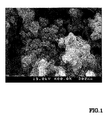
- FIG. 1 shows that the primary particle diameter was not more than 50 nm, and that the fine particle shape was maintained even after high-temperature crystallization treatment.
- an integrating sphere unit was mounted on a ultraviolet-visible-near infrared spectrophotometer to measure a diffusion reflection spectrum and to thereby determine a spectral reflectance R of the sample at each wavelength.
- Absorbances A at wavelengths of 570 nm and 1800 nm are summarized in Table 1.
- the R sp value of rhodium-doped strontium titanate particles was measured with a pulse NMR particle analyzer evaluation device ("Acorn area,” manufactured by Nihon Rufuto Co., Ltd.) at room temperature. Specifically, 0.125 g of rhodium-doped strontium titanate particles prepared in Examples 1, 3 to 5, 7, 8, and 10, and Comparative Examples 4, 10, 13, and 15 was added to 2.375 g of a 0.23% AOT (di-2-ethylhexyl sodium sulfosuccinate) aqueous solution, and a pulse NMR sample was prepared by ultrasonic irradiation with a 20-W ultrasonic bath for 2 min.
- AOT di-2-ethylhexyl sodium sulfosuccinate
- a sample introduced into a NMR tube was disposed in a coil between two permanent magnets, and, when the coil was excited by electromagnetic (RF) waves at about 13 MHz to generate a magnetic field, a temporal shift of magnetic field orientation of protons generated by the magnetic field in the sample was induced.
- RF electromagnetic
- protons in the sample were again aligned with a static magnetic field Bo.
- This reorganization caused a lowering in voltage of the coil, called a free induction decay (FID), and T1 (longitudinal relaxation time) and T2 (transverse relaxation time) of the sample was measured from a specific pulse 1 sequence (a combination of the number of times of RF pulses and intervals of RF pulses).
- R sp values are shown in Table 1. In all of the Examples, the R sp value was not less than 0.88. The above results confirmed that rhodium-doped strontium titanate particles prepared in the Examples had a large interaction between the surface of the particles and water. Specifically, the results confirmed that the surface area of contact between the particle and water was large and the specific surface area of the particle was large. [Table 1] Sample Composition Production process Doping ratio of Rh Firing temp.
- Rh-doped SrTiO3 Heat decomposition of aqueous solution 0.02 900 Not done 0.627 0.65 45 1.4
- Example 2 Rh-doped SrTiO3 Heat decomposition of aqueous solution 0.02 1000 Not done 0.648 0.65 45 0.89
- Example 3 Rh-doped SrTiO3 Heat decomposition of aqueous solution 0.02 1000 Not done 0.648 0.65 45 0.89
- Example 5 Rh-doped SrTiO3 Heat decomposition of aqueous solution 0.01 1000 Not done 0.627 0.55 45 0.98
- Example 6 Rh-doped SrTiO3 Heat decomposition of aqueous solution 0.03 1000 Not done 0.758 0.
- Hydrogen generation activity in splitting water by rhodium-doped strontium titanate particles prepared in Example 1 to 12 and Comparative Example 1, 4 and 10 to 15 under visible light irradtiation was examined by the following method. In the measurement of the hydrogen generation activity in splitting water and in the measurement of the quantum yield, which is described later, where the two measurements were carried out under visible light irradiation, rhodium-doped strontium titanate particles with co-catalyst supported thereon in each Example was used.
- a powder (0.1 g) of rhodium-doped strontium titanate particles with 0.5% by weight of platinum as a co-catalyst supported thereon by a photoreduction method and 200 mL of an aqueous solution containing 10% by volume of methanol that serves as a sacrificial reagent were placed in a glass flask equipped with Pyrex (registered trademark) window (upper irradiation-type flasks were used for samples of Example 2 and Comparative Example 1, and side irradiation-type flasks were used for the other samples), followed by stirring with a stirrer to prepare a reaction solution.
- the glass flask with the reaction solution placed therein was mounted on a closed circulation device, and the reaction system was purged with argon. Visible light was applied from a Pyrex (registered trademark) window side through a 300-W xenon lamp (manufactured by Cermax, PE-300BF) equipped with a UV cutoff filter (L-42, manufactured by HOYA).
- the amount of hydrogen generated as a result of reduction of water by a photocatalytic reaction was determined by a gas chromatograph (manufactured by Shimadzu Seisakusho Ltd., GC-8A, TCD detector, MS-5A column) with the lapse of time.
- a powder of rhodium-doped strontium titanate particles with 0.5% by weight of platinum supported thereon by a photoreduction method was prepared as follows. Specifically, 0.1 g of rhodium-doped strontium titanate particles, 0.132 g of an aqueous solution containing 1% by weight of chloroplatinic acid hexahydrate (manufactured by Wako Pure Chemical Industries, Ltd.) as a co-catalyst material, and 200 mL of ultrapure water containing 10% by volume of methanol as an oxidative sacrificial reagent were placed in a glass flask equipped with a Pyrex (registered trademark) window.
- Visible light was applied to the solution for 2 hr while stirring with a stirrer under an argon atmosphere from a Pyrex (registered trademark) window side through a 300-W xenon lamp (manufactured by Cermax, PE-300BF) equipped with a UV cutoff filter (L-42, manufactured by HOYA) to reduce chloroplatinic acid on the surface of the rhodium-doped strontium titanate particle and to support fine platinum particles on the surface of the rhodium-doped strontium titanate particles.
- a UV cutoff filter L-42, manufactured by HOYA
- Example 2 The same procedure of Example 1 was repeated except that 0.05 g of a powder of rhodium-doped strontium titanate particles with platinum as a co-catalyst supported thereon was used.
- Example 2 The same procedure of Example 1 was repeated except that the amount of platinum as a co-catalyst was 0.75% by weight.
- Example 2 The same procedure of Example 1 was repeated, except that an impregnation method instead of the photoreduction method was used as the method for supporting platinum as the co-catalyst. Specifically, a paste was prepared by kneading 0.1 g of the powder of rhodium-doped strontium titanate particles, 0.4 g of water, and 0.031 g of a 1 wt% chloroplatinic acid aqueous solution with an agate mortar at room temperature for 30 min. This paste was dried at room temperature for 15 hr and was then fired at 400°C for 30 min to prepare a sample (impregnation method).
- an impregnation method instead of the photoreduction method was used as the method for supporting platinum as the co-catalyst.
- a paste was prepared by kneading 0.1 g of the powder of rhodium-doped strontium titanate particles, 0.4 g of water, and 0.031 g of
- Example 2 The same procedure of Example 1 was repeated, except that ruthenium chloride n-hydrate (manufactured by Wako Pure Chemical Industries, Ltd.) was used, and that 0.5% by weight of ruthenium instead of platinum was supported by a photoreduction method.
- ruthenium chloride n-hydrate manufactured by Wako Pure Chemical Industries, Ltd.
- Example 2 The same procedure of Example 1 was repeated, except that the amount of platinum as the co-catalyst was 1% by weight.
- Table 2 shows the amount of hydrogen ( ⁇ mol) generated during a three-hr period from the start of light irradiation and a hydrogen generation rate per unit powder amount ( ⁇ mol/hr/g) for the powders of the rhodium-doped strontium titanate particles with the co-catalyst supported thereon.
- Example 2 had a hydrogen generation rate per unit powder amount of 759 ⁇ mol/hr/g, a very highly activity
- the sample of Comparative Example 1 had a hydrogen generation rate per unit powder amount of 120 ⁇ mol/hr/g, a very low activity.
- the samples of Examples 1 and 3 to 7 were also found to have a high hydrogen generation activity.
- the quantum yield by visible light irradiation of rhodium-doped strontium titanate particles prepared in Example 3 was examined as follows.
- a powder (0.1 g) of rhodium-doped strontium titanate particles with 0.5% by weight of platinum supported thereon by a photoreduction method and 200 mL of an aqueous solution containing 10% by volume of methanol that served as a sacrificial reagent were placed in a glass flask equipped with a Pyrex (registered trademark) window to prepare a mixture, and the mixture was stirred with a stirrer to prepare a reaction solution.
- the glass flask containing the reaction solution was mounted on a closed circulation device, and the atmosphere within the reaction system was replaced by argon.
- Monochromatic light was applied from a Pyrex (registered trademark) window side through a wavelength variable monochromatic light source equipped with a spectrometer (manufactured by Bunkoukeiki Co.,Ltd., SM-25F).
- the amount of hydrogen generated as a result of reduction of water by a photocatalytic reaction was determined by a gas chromatograph (manufactured by Shimadzu Seisakusho Ltd., GC-8A, TCD detector, MS-5A column) over time. Further, the quantum yield (%) was calculated by the following equation.
- Quantum yield % number of molecules of hydrogen generated ⁇ 2 / number of incident photonumber ⁇ 100 wherein the number of incident photonumber per unit wavelength was calculated by measuring an illuminance (W/cm 2 /nm) at individual wavelengths (about 10 nm band wavelength width) with a spectroradiometer (manufactured by USHIO, USR-55) to divide energy that one photon at the wavelength has.
- Fig. 2 shows the results.
- the quantum yield of the sample at 420 nm was 13.2%, demonstrating a very high hydrogen generation activity.
- FIG. 3 A transmission electron microscopic image of particles of Example 2 with platinum supported thereon is shown in Fig. 3.
- Fig. 3 indicated that the particle was in the form of a cube having a length of each side of about 45 nm and had a cubic perovskite structure. Further, it indicated that the particle diameter of platinum supported by the photoreduction method was about 2 nm.
Landscapes
- Chemical & Material Sciences (AREA)
- Organic Chemistry (AREA)
- Engineering & Computer Science (AREA)
- Chemical Kinetics & Catalysis (AREA)
- Materials Engineering (AREA)
- Inorganic Chemistry (AREA)
- General Health & Medical Sciences (AREA)
- Health & Medical Sciences (AREA)
- Combustion & Propulsion (AREA)
- Nanotechnology (AREA)
- Physics & Mathematics (AREA)
- Environmental & Geological Engineering (AREA)
- Condensed Matter Physics & Semiconductors (AREA)
- General Physics & Mathematics (AREA)
- Crystallography & Structural Chemistry (AREA)
- Composite Materials (AREA)
- Geology (AREA)
- General Life Sciences & Earth Sciences (AREA)
- Life Sciences & Earth Sciences (AREA)
- Dispersion Chemistry (AREA)
- Electromagnetism (AREA)
- Toxicology (AREA)
- Catalysts (AREA)
- Inorganic Compounds Of Heavy Metals (AREA)
Abstract
Description
- The present invention relates to a visible light responsive photocatalyst particle and a process for producing the same.
- Visible light responsive photocatalysts are photocatalysts that can utilize visible light contained in a large amount in sunlight. The visible light responsive photocatalysts are expected to be applied to photodecomposition of organic substances and hydrogen production by photolysis of water. In particular, photocatalysts for splitting water have drawn attention as photocatalysts for producing hydrogen by utilizing the renewable energy. As a result, there is an ever-increasing demand for highly active photocatalysts for splitting water.
- Rhodium-doped strontium titanate (Rh-SrTiO3) as a visible light responsive photocatalyst for splitting water is known to have a very high capability of generating hydrogen by photolysis of water. A Z-scheme system of a combination of Rh-SrTiO3 with a photocatalyst for oxygen generation is known to provide a high energy conversion efficiency in a water splitting reaction (Japanese Patent Application Laid-Open No.
2004-008963 - The above Rh-SrTiO3 has hitherto been prepared by a solid-phase reaction method or a hydrothermal synthesis method. In these methods, it is known that a treatment is carried out that includes firing a material at about 1000°C to render the material highly crystalline. Rh-SrTiO3 particles thus obtained are known to have a primary particle diameter of approximately several hundred nanometers to a few micrometers and have a high hydrogen generation capability under visible light irradiation. Rh-SrTiO3 particles are required to be in a microcrystalline form to have an increased specific surface area so that Rh-SrTiO3 particles are highly activated.
-
- [PTL 1]
JP 2004-008963A - [PTL 2]
JP 2012-056947A - [Non Patent Literature]
- [NPTL 1] Sasaki et al., J. Phys. Chem. C 17536-17542, 2009
- In view of the above problems, the present invention has been made. An object of the present invention is to provide rhodium-doped strontium titanate particles that have high crystallinity as well as refined primary particles.
- According to the present invention, there are provided rhodium-doped strontium titanate particles having a primary particle diameter of not more than 70 nm and having an absorbance at a wavelength of 570 nm of not less than 0.6 and an absorbance at a wavelength of 1800 nm of not more than 0.7, each absorbance being determined by measuring a diffuse reflection spectrum.
- The rhodium-doped strontium titanate particles according to the present invention have a high photocatalytic activity under visible light irradiation.
-
- [
Fig. 1] Fig. 1 is a scanning electron microscopic photograph of rhodium-doped strontium titanate particles according to the present invention. - [
Fig. 2] Fig. 2 is a transmission electron microscopic photograph of rhodium-doped strontium titanate particles according to the present invention. - [
Fig. 3]Fig. 3 is a diagram of the results of measurement of quantum yield by water splitting of rhodium-doped strontium titanate particles according to the present invention. - The rhodium-doped strontium titanate (Rh-SrTiO3) particles according to the present invention are characterized by high crystallinity and small primary particle diameter.
- The present inventors have found that particles that have a larger absorbance derived from Rh4+ in crystals as well as a smaller absorbance derived from oxygen defects present in crystals as compared with conventional rhodium-doped strontium titanate particles, have a high crystallinity and a high photocatalytic activity. However, it is difficult for Rh-SrTiO3 to have a high crystallinity as well as to be in a refined crystal form with a large specific surface area. Pratically it is difficult to grow a crystal of Rh-SrTiO3 with a high crystallinity while refinement of the crystal is maintained. An absorbance derived from Rh4+ in crystals and an absorbance derived from oxygen defects present in crystals can be used as an index to determine Rh-SrTiO3 particles, the crystals of which are microcrystals and have a high crystallinity.
- The formation of oxygen defects is generally considered as one cause of a lowering in crystallinity of metal oxides. The larger the number of oxygen defect sites in metal oxides, that is, the larger the number of oxygen defects, the lower the degree of crystallization of metal oxides, that is, the lower the crystallinity, due to disturbance of periodicity of crystals.
- The number of oxygen defects of the rhodium-doped strontium titanate particles according to the present invention can be determined using absorbance A (=1-spectral reflectance R) as an index. The absorbance A can be quantitatively determined by diffuse reflection spectrum measurement of powders of rhodium-doped strontium titanate particles in the ranges of ultraviolet light, visible light, and near-infrared light. Oxygen defects present in metal oxides, for example, titanium oxide, cause a donor level of Ti3+. The donor level of Ti3+ is caused in a range of an electron energy that is lower by approximately 0.75 to 1.18 eV from the lower end of a conduction band composed of Ti-3d orbital in a band structure of titanium oxide. Further, an absorption spectrum of titanium oxide having oxygen defects is known to have a absorption band in a range from a visible light to a near-infrared light (Cronemeyer et al., Phys. Rev. No. 113, p1222-1225, 1959). The present inventors have now confirmed as follows. Measurement of a diffuse reflection spectrum of rhodium-doped strontium titanate particles shows the rhodium-doped strontium titanate particles, as with titanium oxide, have a broad absorption band in a range of a visible light to a near-infrared light. Further, it has been found that, when a set temperature of the firing is raised, the absorbance is reduced in this near-infrared light range. Based on these facts, the present inventors have found that the degree of improvement in crystallinity provided by raising the firing temperature can be quantified by measuring absorption in a range from a visible light to a near-infrared light.
- The present inventors also have found that the state of the rhodium is also important for rhodium-doped strontium titanate particles to have a high photocatalytic activity and the crystallinity increases with increasing absorption derived from tetravalent rhodium (Rh4+) in strontium titanate crystals. The following mechanism will demonstrate the effect of valence of rhodium on crystallinity. However, the present invention is not limited to this mechanism.
- In general, the valence of rhodium is known to be divalent, trivalent, tetravalent, and pentavalent. Among rhodium having these valences, trivalent rhodium (Rh3+) is most stable in the atmosphere with room temperature. When a starting material containing trivalent rhodium is used, it is known that, when strontium titanate (SrTiO3) is fired at high temperatures for crystallization, sites of tetravalent titanium (Ti4+) are doped with rhodium. In this case, when crystal site of Ti4+ is substitutionally doped with Rh3+, oxygen defects disadvantageously occur in order to keep charge neutrality. The present inventors have found that, in order to reduce the oxygen defects, crystal sites of Ti4+ should be doped with Rh4+ that can maintain the charge neutrality of crystals leading to improved crystallinity of the particles.
- Accordingly, the present inventors have found that optical property parameters of rhodium-doped strontium titanate particles having a high photocatalytic activity according to the present invention can be clarified by measuring the particles in the following method.
- Methods for the measurement of optical properties of rhodium-doped strontium titanate particles according to the present invention include using an ultraviolet-visible-near-infrared spectrophotometer (manufactured by Japan Spectroscopic Co., Ltd., "V-670") equipped with an integrating sphere unit. Specifically, an integrating sphere unit (manufactured by Japan Spectroscopic Co., Ltd., "ISV-722") is mounted on the ultraviolet-visible-near-infrared spectrophotometer. Alumina sintered pellets are used in baseline measurement. On that basis, a spectral reflectance R can be determined by measuring a diffuse reflection spectrum of a sample prepared by filling 30 mg of particle powder into a window portion (5 mmφ) in a trace powder cell (manufactured by Japan Spectroscopic Co., Ltd., "PSH-003") at a filling fraction of not less than 50%. The optical properties of rhodium-doped strontium titanate particles are determined by measuring a diffuse reflection spectrum in a wavelength range of 200 to 2500 nm with the spectrophotometer The rhodium-doped strontium titanate particles according to the present invention are characterized in that absorbance A570 at wavelength 570 nm (=1-R570[spectral reflectance at wavelength 570 nm]), attributed to light absorption derived from Rh4+ in strontium titanate crystals, is not less than 0.6, and absorbance A1800 at wavelength 1800 nm (=1-R1800[spectral reflectance at wavelength 1800 nm]), attributed to light absorption derived from oxygen defects in crystals is not more than 0.7, where the two absorbances are determined under conditions that absorbance A315 at wavelength 315 nm (=1-R315[spectral reflectance at wavelength 315 nm]) is in the range of 0.86 to 0.87. In a preferred embodiment of the present invention, the absorbance A570 at wavelength 570 nm is 0.6 (inclusive) to 0.8 (exclusive). In another preferred embodiment of the present invention, the absorbance A1800 at wavelength 1800 nm is 0.3 (inclusive) to 0.7 (inclusive).
- Further, as described above, the rhodium-doped strontium titanate particles according to the present invention has a very small primary particle diameter. The primary particle diameter is not more than 70 nm. This small primary particle diameter allows the rhodium-doped strontium titanate particles to have a high specific surface area. Further, the area of contact with a substance to be decomposed increases, resulting in a high photocatalytic activity of the particles. Preferably, the primary particle diameter is not more than 50 nm. More preferably, the primary particle diameter is 30 nm (inclusive) to 70 nm (inclusive). Still more preferably, the primary particle diameter is 30 nm (inclusive) to 50 nm (inclusive). The primary particle diameter of the rhodium-doped strontium titanate particles is defined as the averaged diameter of the 50 particles in observation, each of which is approximated by a circle at a magnification of 40,000 times under, for example, a scanning electron microscope (manufactured by Hitachi, Ltd., "S-4100," hereinafter referred to as SEM).
- In a preferred embodiment of the present invention, as described above, the rhodium-doped strontium titanate particles according to the present invention have a large specific surface area.
- In the present invention, use of an RSP value of the rhodium-doped strontium titanate particles as an index has identified that the rhodium-doped strontium titanate particles have a large surface area and that a secondary particle, that is, a powder, has a high porosity wherein the secondary particle is made of the rhodium-doped strontium titanate particles.
- The RSP value is an index correlated with the amount of water molecules adsorbed on the surface of particles and thereby depends upon a surface area of particles in contact with water when the particles are dispersed in water. As described later, the rhodium-doped strontium titanate particles according to the present invention can be utilized as a photocatalyst for splitting water when the particles are in contact with water. In this case, water permeates gaps among primary particles or pores within a secondary particle, and thus the surface of the particles is into contact with water. Accordingly, when the rhodium-doped strontium titanate particles according to the present invention are utilized as a photocatalyst for splitting water, use of the RSP value as an index to determine the surface area of particles on which water is adsorbed is useful in obtaining particles having a large specific surface area. A method for the measurement of the specific surface area of particles includes a BET analysis based on nitrogen adsorption and desorption measurement, as a main conventional method. In this BET analysis, however, nitrogen is used as a probe, and the molecular diameter of nitrogen is so small that nitrogen is disadvantageously adsorbed on the surface of pores that water cannot permeate. The method for the measurement of the specific surface area by a BET analysis is not effective when the object is particles with water adsorbed thereon.
- The RSP value is represented by the following equation. Further, the RSP value can be measured with a pulse NMR particle boundary evaluation apparatus (for example, "Acorn area," manufactured by Nihon Rufuto Co., Ltd.).

wherein Rav is a mean relaxation time constant. The relaxation time constant is an inverse number of a relaxation time of water in contact with or adsorbed on the surface of particles when the particles are dispersed in water. The mean relaxation time constant is a mean value of determined relaxation time constants. - Rb is a relaxation time constant of blank water not containing particles.
- The larger the Rsp value, the larger the interaction of the surface of particles with water. This means that a large Rsp indicates a large contact area between particles and water, and thus a large specific surface area of particles.
- The Rsp value of the rhodium-doped strontium titanate particles according to the present invention is preferably not less than 0.86, more preferably not less than 0.88. The Rsp value is preferably not more than 10.
- The composition of rhodium-doped strontium titanate according to the present invention may be represented by SrTi1-xRhxO3. The molar ratio represented by M(rhodium)/M(titanium+rhodium) of the rhodium-doped strontium titanate particles is preferably 0.001 to 0.03, more preferably 0.01 to 0.03. The molar ratio in this range allows an increase in the amount of oxygen defects in crystals to be suppressed and thus a high photocatalytic activity is achieved.
- As described above, the rhodium-doped strontium titanate particles according to the present invention, which have the absorbance as described above as well as the very fine primary particle shape, which is measured with SEM have a high photocatalytic activity.
- A dry reaction method and a wet reaction method may be utilized as a production process of the rhodium-doped strontium titanate particles according to the present invention. Dry reaction methods include solid-phase reaction methods. Wet reaction methods include sol-gel methods, polymerized complex methods and hydrothermal reaction methods. For example, in the production of the rhodium-doped strontium titanate particles by the sol-gel method, alkoxides of titanium or chlorides of titanium are used as a starting material. A hydroxide containing titanium is produced by a hydrolytic reaction of the starting material with water. Rhodium-doped strontium titanate particles are obtained by firing the hydroxide at 600°C or above for crystallization.
- Further, for the production of the rhodium-doped strontium titanate particles according to the present invention, a thermal decomposition method (a thermal decomposition method using an aqueous solution) can be preferably employed using an aqueous solution containing strontium ions, titanium ions and rhodium ions. The thermal decomposition method using an aqueous solutionincludes providing a metal-containing precursor as a starting material and heating an aqueous solution containing the metal-containing precursor to induce a dehydration polycondensation reaction between metal-containing precursors with the evaporation of water as the solvent. In the sol-gel method using metal compounds (for example, alkoxides of metals or chlorides of metals and the like) that tend to be rapidly hydrolyzed with water, metal hydroxides are produced by hydrolysis between metal-containing precursors, and the dehydration polycondensation rapidly occurs, probably leading to coarsening of crystal nuclei. On the other hand, in the thermal decomposition method using an aqueous solution used in the present invention, since metal-containing precursors that tend to be mildly hydrolyzed are used as the starting material, stable dissolution in water is ensured. Further, when the aqueous solution containing the metal-containing precursor is heated, water as the solvent is evaporated to mildly cause a dehydration polycondensation reaction between metal-containing precursors. Consequently, the generation speed of crystal nuclei during thermal decomposition is lowered, and, thus refinement of crystal nuclei is achieved.
- In one embodiment of the present invention, preferably, in the production process of the present invention, an aqueous solution containing a rhodium-doped strontium titanate precursor is prepared by mixing a titanium compound, a strontium compound, a rhodium compound and a hydrophobic complexing agent together to prepare a mixture and dissolving the mixture in water. The aqueous solution thus obtained is hereinafter referred to as an aqueous solution A. The rhodium-doped strontium titanate precursor is a mixture of a compound having a six-membered ring structure formed by coordinating a hydrophobic complexing agent to titanium ions generated as a result of dissociation of the titanium compound, strontium ions generated as a result of dissociation of a strontium compound and rhodium ions generated as a result of dissociation of a rhodium compound. In the preparation of the aqueous solution A, a titanium compound and a hydrophobic complexing agent are mixed together to prepare an aqueous solution containing a water-soluble titanium complex (an aqueous solution thus obtained being referred to as aqueous solution B). A strontium compound and a rhodium compound are mixed into the aqueous solution B to prepare an aqueous solution containing a rhodium-doped strontium titanate precursor, that is, the solution A. The water-soluble titanium complex is one in which a hydrophobic complexing agent has been coordinated to titanium ions generated as a result of dissociation of the titanium compound.
- In the production process of the present invention, preferably, in addition to the titanium compound, a hydrophobic complexing agent is added as the starting material from the viewpoint of rendering a Tri4+- containing titanium compound (that is originally sparingly soluble in water) soluble in water. Hydrolysis can be suppressed by coordinating the hydrophobic complexing agent to titanium ions for complexing of the titanium ions. Alkoxides of titanium and chlorides of titanium may be used as the titanium compound. Alkoxides of titanium include titanium tetramethoxide, titanium tetraethoxide, titanium tetra-n-propoxide, titanium tetraisopropoxide, and titanium tetra-n-butoxide and others. Chlorides of titanium include titanium tetrachloride, titanium tetrafluoride and titanium tetrabromide.
- Further, the hydrophobic complexing agent used in the present invention can be coordinated to titanium ions, allowing a hydrophobic portion to be exposed to a solvent phase side of the water-soluble titanium complex. Preferred hydrophobic complexing agents include diketone compounds and catechol compounds. Preferred diketone compounds are diketone compounds represented by general formula: Z1-CO-CH2-CO-Z2 wherein Z1 and Z2 independently represent an alkyl or alkoxy group. Preferred diketone compounds represented by the above general formula include acetylacetone, ethyl acetoacetate, propyl acetoacetate, butyl acetoacetate and others. Preferred catechol compounds include ascorbic acid, pyrocatechol, tert-butylcatechol and others. Still more preferably, acetylacetone and ethyl acetoacetate that have a very high complexing capability of being coordinated to titanium are used. This can suppress intermolecular polymerization by intermolecular dehydration polycondensation that occurs when a hydroxyl group that is a hydrophilic portion is exposed to a solvent phase side. Therefore, in thermal decomposition, refinement of crystal nuclei and refinement of particles after a thermal decomposition reaction are achieved.
- In a preferred embodiment of the present invention, in addition to the hydrophobic complexing agent, a hydrophilic complexing agent may also be used. The hydrophilic complexing agent is preferably a carboxylic acid, more preferably a carboxylic acid represented by formula R1-COOH wherein R1 represents a C1-4 alkyl group, or a hydroxy acid or dicarboxylic acid having 1 to 6 carbon atoms. Such hydrophilic complexing agents include water-soluble carboxylic acids such as acetic acid, lactic acid, citric acid, butyric acid, and malic acid. Still more preferred water-soluble carboxylic acids are acetic acid or lactic acid. This achieves the suppresion of a hydrolytic reaction of the titanium compound or an improvement in solubility of the titanium compound in water.
- The solvent for complex formation may be water. In another preferred embodiment of the present invention, water-soluble organic solvents may be used as the solvent. Use of the water-soluble organic solvents can improve the solubility of the transition metal compound. Specific examples of water-soluble organic solvents include methanol, ethanol, n-propanol, isopropanol, cellosolve-based solvents and carbitol-based solvents.
- In a preferred embodiment of the present invention, the water-soluble titanium complexes may be those described in
JP 2012-056947A - Preferably the Sr2+-containing strontium compound is soluble in water does not retain a residue of anion component upon heat crystallization. Preferred are, for example, strontium nitrate, strontium acetate, strontium chloride, strontium bromide, strontium lactate, strontium citrate and orhers.
- The Rh3+-containing rhodium compound is preferably soluble in water and, upon heat crystallization, does not retain a residue of anion component. The rhodium compounds include rhodium nitrate, rhodium nitrate, rhodium chloride, rhodium bromide, rhodium lactate, rhodium citrate. Rh4+- containing molecules may be used as the rhodium compound. Hydrophilic complexing agents such as lactic acid, butyric acid, and citric acid and others may be used for the purpose of improving the solubility of the strontium compound or the rhodium compound in water.
- In the production of the rhodium-doped strontium titanate particles according to the present invention, preferably, the mixing ratio of various starting materials in the aqueous solution A is 0.01 to 0.2 mole, more preferably 0.02 to 0.1 mole, per 100 g of water for the titanium compound containing one atom of titanium, is 1 to 1.1 times by mole larger than the titanium compound containing one atom of titanium for the strontium compound, is a desired doping amount for the rhodium compound, is 0.005 to 0.4 mole, more preferably 0.015 to 0.15 mole, for the hydrophobic complexing agent, and is 0.01 to 0.2 mole, more preferably 0.025 to 0.15 mole, for the hydrophilic complexing agent. When the starting materials are respectively mixed at the above mixing ratio, the titanium compound is well rendered soluble in water and a high degree of crystallization and refinement of particles after thermal decomposition are possible. The molar ratio of the hydrophobic complexing agent to the titanium compound is preferably 0.5 to 2 mole, more preferably 0.8 to 1.2, per mole of the titanium compound containing one atom of titanium. The molar ratio in the above-defined range allows the progress of a hydrolytic reaction of the titanium compound and the decrease in water solubility caused by hydrophobicity of molecules of the titanium compound to be suppressed. The molar ratio of the hydrophilic complexing agent to the titanium compound is preferably 0.2 to 2 moles, more preferably 0.3 to 1.5 moles, per mole of the titanium compound containing one atom of titanium. The molar ratio in the above-defined range allows to suppress the progress of a hydrolytic reaction of the titanium compound and improve the solubility of the titanium compound in water. In the aqueous solution A, the pH value that can maintain stability of individual ions in the aqueous solution and can realize the refinement of particles after crystallization is preferably 2 to 6, more preferably 3 to 5. The pH value in the above-defined range allows coarsening of crystals caused by the promotion of a hydrolytic polycondensation which promotion is developed under a strong acid or strong alkali atmosphere to be suppressed.
- Further, in the production of the rhodium-doped strontium titanate particles according to the present invention, preferably, water dispersible organic polymer particles are added to the aqueous solution A (a liquid obtained by adding water dispersible organic polymer particles to the aqueous solution A being hereinafter referred to as dispersion). A powder of rhodium-doped strontium titanate particles can be obtained by heating the dispersion for crystallization. The addition of water-dispersible organic polymer particles to the aqueous solution A can reduce the degree of aggregation of the rhodium-doped strontium titanate particles to increase the porosity or the void ratio of a powder of the rhodium-doped strontium titanate particles.
- Spherical latex particles or an oil-in-water (O/W) emulsion can be used as the water-dispersible organic polymer particles. Fine rhodium-doped strontium titanate particles are obtained by adding the water-dispersible organic polymer particles. A secondary particle, an aggregation of the such particles, is porous. A mechanism through which such fine primary particles are obtained and, consequently, the porosity of secondary particles obtained by the aggregation thereof becomes high will be as follow. However, the scope of the present invention is not limited to this mechanism. The addition of the water-dispersible organic polymer particles allows the water-soluble titanium complex, strontium ions and rhodium ions, which are polar molecules, to be adsorbed to the surface of the polymer particles that are polar in water. In a process of heat crystallization, the titanium complex present on the surface of the polymer particles is hydrolyzed to produce crystal nuclei of rhodium-doped strontium titanate. Since the crystal nuclei on the surface of the polymer particles are present with a physical distance therebetween, there is little opportunity of bonding among the crystal nuclei and, consequently, the growth of crystals proceeds slowly, leading to a small primary particle diameter of the rhodium-doped strontium titanate particles. Further, it is considered that, although the formed rhodium-doped strontium titanate particles are bound to one another as a result of the disappearance of polymer particles by thermal decomposition, the presence of the polymer particles suppresses the aggregation of the rhodium-doped strontium titanate particles, resulting in an increase in void ratio of secondary particles as an aggregate, that is, an increase in porosity.
- The dispersed diameter of the water-dispersible organic polymer particles is preferably 10 to 1000 nm, more preferably 30 to 300 nm. The dispersed particles diameter in the above-defined range allows the physical distance among the crystal nuclei of rhodium-doped strontium titanate to be increased. Thus, after the heat crystallization, the rhodium-doped strontium titanate particles can be refined. Further, the water-dispersible organic polymer particles are preferably formed of a material that, after heat crystallization at 600°C or above, does not retain a residue of amorphous carbon or the like, which is a residue of the organic polymer particles. Suitable materials include polymerization products of monomer units of styrene, acryl, urethane, epoxy or the like, or polymerization products of a plurality of the monomer units. The addition amount of the water-dispersible organic polymer particles is preferably 1 to 20 times, more preferably 3 to 15 times larger than that of the weight of rhodium-doped strontium after crystallization at high temperatures. The addition of the amount of the polymer particles in the above-defined range to the aqueous solution A allows the aggregation of the particles after the crystallization to be suppressed and thus the primary particle diameter of the particles is reduced.
- In the production process of the present invention, the following method is preferably used as a method for the preparation of the rhodium-doped strontium titanate particles from the dispersion. At the outset, a dried powder is obtained by drying the dispersion at a low temperature of 200°C or below. Rhodium-doped strontium titanate particles can be produced by firing the dried powder for crystallization. The step of drying the dispersion can be followed by the step of firing the dried powder without interval. The firing temperature for the crystallization of rhodium-doped strontium titanate is 800°C (exclusive) to 1100°C (exclusive), more preferably 900°C (inclusive) to 1050°C (inclusive). The firing temperature in the above-defined range allows highly pure rhodium-doped strontium titanate particles to be highly crystallized while the water-dispersible organic polymer particles are thermally decomposed.
- When the rhodium-doped strontium titanate particles according to the present invention are used in photolysis of water as a photocatalyst, preferably, the co-catalyst is supported on the surface of the particles so that hydrogen and oxygen are rapidly generated. Co-catalysts usable herein include metal particles such as platinum, ruthenium, iridium, and rhodium, and metal oxides particles such as chromium oxide, rhodium oxide, iridium oxide, and ruthenium oxide. Further, a mixture of metal particles with metal oxide particles may be used. The rhodium-doped strontium titanate particles with the co-catalyst supported thereon allows the activation energy in water oxidation reaction and water reduction reaction to be reduced and, thus, hydrogen and oxygen can be rapidly generated.
- Further, the rhodium-doped strontium titanate particles and a photocatalyst for oxygen generation can constitute a Z scheme system in which a suitable redox couple (for example, Fe2+/Fe3+, I-/I3 -, I-/IO3 -, or Co2+/Co3+) is dissolved in water. The Z scheme system can completely split water under visible light irradiation. Preferably the photocatalyst for oxygen generation in the present invention includes BiVO4 and WO3.
- Thus, according to one aspect of the present invention, there is provided use of the rhodium-doped strontium titanate particles as a photocatalyst for splitting water. Further, according to another aspect of the present invention, there is provided a method for water splitting, which method comprises irradiating rhodium-doped strontium titanate particles with visible light where the rhodium-doped strontium titanate particles are in contact with water.
- The present invention is further illustrated by the following Examples which are not intended as a limitation of the scope of the present invention.
- 0.02 mol (2.003 g) of acetylacetone (manufactured by Wako Pure Chemical Industries, Ltd.) as a hydrophobic complexing agent was added to a 20-mL sample bottle, and 0.02 mol (5.684 g) of titaniumtetraisopropoxide (manufactured by Wako Pure Chemical Industries, Ltd.) was added thereto with stirring at room temperature to prepare a yellow solution containing a water-soluble titanium complex. The solution containing the water-soluble titanium complex was added to 50 mL of a 0.32 mol/L aqueous acetic acid solution with stirring at room temperature to prepare a mixture. After the addition, the mixture was stirred at room temperature for about one hr and then at 60°C for about one hr to prepare an aqueous solution containing a yellow transparent water-soluble titanium complex.
- A portion (10 g) of the aqueous solution containing the water-soluble titanium complex prepared above was then taken (containing 3.41 mmol of titanium in terms of metallic titanium). A solution of 3.75 mmol (0.84 g) of strontium acetate 0.5 hydrate (manufactured by Wako Pure Chemical Industries, Ltd.) and 0.70 g of lactic acid (manufactured by Wako Pure Chemical Industries, Ltd.) as a hydrophilic complexing agent, dissolved in 3.16 g of distilled water was added to the portion (10 g) of the aqueous solution to prepare a mixed aqueous solution, and, further, a 5 wt% aqueous solution of rhodium trichloride (manufactured by Wako Pure Chemical Industries, Ltd.) was added to the mixed aqueous solution so that the concentration in terms of the molar ratio of M (rhodium) to M (titanium + rhodium) was a desired value, followed by stirring at room temperature for 3 hr. Thus, the mixed aqueous solution containing a precursor of an orange-colored transparent rhodium-doped strontium titanate was obtained. The mixed aqueous solution had a pH value of about 4.
- Further, an acryl-styrene-based O/W emulsion (manufactured by DIC, "EC-905EF," dispersed particle diameter 100 to 150 nm, pH: 7 to 9, solid content 49 to 51%) was added as water-dispersible organic polymer particles to the mixed aqueous solution so that the amount of acryl-styrene-based O/W emulsion was five times that of rhodium-doped strontium titanate obtained after firing in terms of weight ratio.
- The dispersion prepared above was dried at 80°C for one hr and was fired at a firing temperature specified in Table 1 for 10 hr to prepare powders of rhodium-doped strontium titanate particles of Examples 1 to 11.
- For a sample of Example 10, a powder after firing at 1000°C for 10 hr for crystallization as described above was further subjected to fine dispersion with a planetary mill ("Premium Line P-7," manufactured by Fritsch). Regarding dispersion conditions, 1 g of a rhodium-doped strontium titanate powder, 4 g of ethanol, and 1 g of zirconia beads (0.5mmφ) were placed in a zirconia pot (capacity 45 mL), and the mixture was subjected to dispersion with a planetary centrifugal mixer at 700 rpm for 30 min. After the dispersion treatment, a slurry with powder dispersed therein was collected by suction filtration through a resin filter having a hole diameter of the mesh of 0.1 mm. The slurry was dried at room temperature for 10 hr for dispersion treatment to prepare a rhodium-doped strontium titanate powder of Example 10.
- Rhodium-doped strontium titanate particles were prepared in the same manner as in Examples 1 to 11, except that a 50 wt% water dispersion of acryl-based latex particles (Chemisnow 1000, manufactured by Soken Chemical & Engineering Co., Ltd., mean particle diameter about 1000 nm) was used instead of the acryl-styrene-based O/W emulsion.
- Rhodium-doped strontium titanate particles were prepared in the same manner as in Examples 1 to 11, except that a 50 wt% water dispersion of acryl-based latex particles (Chemisnow 300, manufactured by Soken Chemical & Engineering Co., Ltd., mean particle diameter about 300nm) was used instead of the acryl-styrene-based O/W emulsion.
- Rhodium-doped strontium titanate was prepared as a sample of Comparative Example by a conventional solid-phase reaction method. The solid-phase reaction method was carried out as follows.
- Powders of strontium carbonate (manufactured by Kanto Chemical Co., Inc.), titanium oxide (manufactured by Soekawa Rikagaku, Ltd., rutile-type), and rhodium oxide (Rh2O3: manufactured by Wako Pure Chemical Industries, Ltd.) were mixed together at a molar ratio of Sr : Ti : Rh = 1.07 : 1-x : x, wherein x: rhodium dope ratio specified in Table 1. Thereafter, firing was carried out at a firing temperature specified in Table 1 for 10 hr to prepare rhodium-doped strontium titanate powders of Comparative Examples 1 to 6.
- Rhodium-doped strontium titanate powders of Comparative Examples 7 to 11 were prepared in the same manner as in Example 1, except that the firing temperature for crystallization was those specified in Table 1.
- Rhodium-doped strontium titanate was prepared by a polymerized complex method. Specifically, a rhodium-doped strontium titanate powder of Comparative Example 12 was prepared in the same manner as in Example 2, except that a titanium peroxo-citrate complex ("TAS-FINE," manufactured by Furuuchi Chemical Corporation) which is a commercially-available water-soluble titanium complex was used instead of the water-soluble titanium complex.
- Rhodium-doped strontium titanate was prepared by a polymerized complex method (lactic acid polymerization method). Specifically, the same procedure of Example 2 was repeated, except that a titanium complex having lactic acid as a ligand was used instead of the water-soluble titanium complex. That is, titanium isopropoxide (manufactured by Wako Pure Chemical Industries, Ltd., 0.01 mol) and lactic acid (manufactured by Wako Pure Chemical Industries, Ltd., 0.02 mol) were added to 100 g of distilled water, and the mixture was stirred at room temperature for one week to prepare an aqueous solution of a lactic acid titanium complex dissolved in water. A rhodium-doped strontium titanate powder of Comparative Example 13 was prepared in the same manner as in Example 2, except that the aqueous solution containing the lactic acid titanium complex was used instead of the aqueous solution of the water-soluble titanium complex.
- Rhodium-doped strontium titanate particles were prepared in the same manner as in Examples 1 to 11, except that a 30 wt% aqueous solution of a polyallylamine that is a water-soluble cationic polymer (manufactured by Wako Pure Chemical Industries, Ltd.) was used instead of the acryl-styrene O/W emulsion.
- Rhodium-doped strontium titanate particles were preapred in the same manner as in Examples 1 to 11, except that the acryl-styrene O/W emulsion was not added.
- Conditions for the preparation of the prepared powders and the properties of the powders are shown in Table 1.
- Rhodium-doped strontium titanate prepared in Examples 1 to 13 and Comparative Examples 1 to 15 was analyzed by X-ray diffractometry. As a result, all samples were found to have a single-phase perovskite structure. Next, the primary particle diameter of rhodium-doped strontium titanate observed under a scanning electron microscope is shown in Table 1. Specifically, the primary particle diameter was determined by averaging diameter of the 50 particles in observation, each of which was approximated by a circle, at a magnification of 40000 times under a scanning electron microscope (manufactured by Hitachi, Ltd., "S-4100"). A SEM image of a powder (platinum unsupported) after firing at 1000°C for 10 hr of Example 2 (or Example 3) is shown as one example of working examples in
Fig. 1. Fig. 1 shows that the primary particle diameter was not more than 50 nm, and that the fine particle shape was maintained even after high-temperature crystallization treatment. - For the determination of optical properties of rhodium-doped strontium titanate prepared in Examples and Comparative Examples, an integrating sphere unit was mounted on a ultraviolet-visible-near infrared spectrophotometer to measure a diffusion reflection spectrum and to thereby determine a spectral reflectance R of the sample at each wavelength. In this case, the amount of the powder was regulated so that the absorbance A at a wavelength of 315 nm (=1 - spectral reflectance R) was 0.86 to 0.87. Absorbances A at wavelengths of 570 nm and 1800 nm are summarized in Table 1.
- The Rsp value of rhodium-doped strontium titanate particles was measured with a pulse NMR particle analyzer evaluation device ("Acorn area," manufactured by Nihon Rufuto Co., Ltd.) at room temperature. Specifically, 0.125 g of rhodium-doped strontium titanate particles prepared in Examples 1, 3 to 5, 7, 8, and 10, and Comparative Examples 4, 10, 13, and 15 was added to 2.375 g of a 0.23% AOT (di-2-ethylhexyl sodium sulfosuccinate) aqueous solution, and a pulse NMR sample was prepared by ultrasonic irradiation with a 20-W ultrasonic bath for 2 min. Next, immediately after ultrasonic irradiation, a sample introduced into a NMR tube was disposed in a coil between two permanent magnets, and, when the coil was excited by electromagnetic (RF) waves at about 13 MHz to generate a magnetic field, a temporal shift of magnetic field orientation of protons generated by the magnetic field in the sample was induced. When this induction was stopped, protons in the sample were again aligned with a static magnetic field Bo. This reorganization caused a lowering in voltage of the coil, called a free induction decay (FID), and T1 (longitudinal relaxation time) and T2 (transverse relaxation time) of the sample was measured from a specific pulse 1 sequence (a combination of the number of times of RF pulses and intervals of RF pulses). Here the mean value of five continuously measured relaxation time constant values, which are the inverse number of T2, was regarded as Rav. Likewise, Rb of blankwater was separately measured, and Rsp value was determined by the following equation.

- The structure of rhodium-doped strontium titanate particles was determined from the Rsp values thus obtained.
- Rsp values are shown in Table 1. In all of the Examples, the Rsp value was not less than 0.88. The above results confirmed that rhodium-doped strontium titanate particles prepared in the Examples had a large interaction between the surface of the particles and water. Specifically, the results confirmed that the surface area of contact between the particle and water was large and the specific surface area of the particle was large.
[Table 1] Sample Composition Production process Doping ratio of Rh Firing temp. (°C) Dispersion treatment Absorbance A @570 nm Absorbance A @ 1800nm Primary particle diameter (nm) Rsp value determined with pulse NMR Example 1 Rh-doped SrTiO3 Heat decomposition of aqueous solution 0.02 900 Not done 0.627 0.65 45 1.4 Example 2 Rh-doped SrTiO3 Heat decomposition of aqueous solution 0.02 1000 Not done 0.648 0.65 45 0.89 Example 3 Rh-doped SrTiO3 Heat decomposition of aqueous solution 0.02 1000 Not done 0.648 0.65 45 0.89 Example 4 Rh-doped SrTiO3 Heat decomposition of aqueous solution 0.02 1050 Not done 0.718 0.634 55 0.88 Example 5 Rh-doped SrTiO3 Heat decomposition of aqueous solution 0.01 1000 Not done 0.627 0.55 45 0.98 Example 6 Rh-doped SrTiO3 Heat decomposition of aqueous solution 0.03 1000 Not done 0.758 0.68 45 1.01 Example 7 Rh-doped SrTiO3 Heat decomposition of aqueous solution 0.02 1000 Not done 0.648 0.65 45 0.89 Example 8 Rh-doped SrTiO3 Heat decomposition of aqueous solution 0.02 1000 Not done 0.648 0.65 45 0.89 Example 9 Rh-doped SrTiO3 Heat decomposition of aqueous solution 0.02 1000 Not done 0.648 0.65 45 0.89 Example 10 Rh-doped SrTiO3 Heat decomposition of aqueous solution 0.02 1000 Done 0.621 0.694 45 1.5 Example 11 Rh-doped SrTiO3 Heat decomposition of aqueous solution 0.02 1000 Not done 0.648 0.65 45 0.89 Example 12 Rh-doped SrTiO3 Heat decomposition of aqueous solution 0.02 1000 Not done 0.755 0.551 65 Example 13 Rh-doped SrTiO3 Heat decomposition of aqueous solution 0.02 1000 Not done 0.771 0.488 65 Comparative Example 1 Rh-doped SrTiO3 Solid-phase reaction method 0.01 1000 Not done 0.723 0.49 180 Comparative Example 2 Rh-doped SrTiO3 Solid-phase reaction method 0.01 1050 Not done 0.754 0.442 230 Comparative Example 3 Rh-doped SrTiO3 Solid-phase reaction method 0.01 1100 Not done 0.778 0.396 250 Comparative Example 4 Rh-doped SrTiO3 Solid-phase reaction method 0.02 1000 Not done 0.774 0.652 190 0.48 Comparative Example 5 Rh-doped SrTiO3 Solid-phase reaction method 0.02 1050 Not done 0.804 0.575 220 Comparative Example 6 Rh-doped SrTiO3 Solid-phase reaction method 0.02 1100 Not done 0.8 0.594 260 Comparative Example 7 Rh-doped SrTiO3 Heat decomposition of aqueous solution 0.02 500 Not done 0.568 0.629 40 Comparative Example 8 Rh-doped SrTiO3 Heat decomposition of aqueous solution 0.02 600 Not done 0.522 0.693 30 Comparative Example 9 Rh-doped SrTiO3 Heat decomposition of aqueous solution 0.02 700 Not done 0.525 0.716 30 Comparative Example 10 Rh-doped SrTiO3 Heat decomposition of aqueous solution 0.02 800 Not done 0.538 0.677 40 1.47 Comparative Example 11 Rh-doped SrTiO3 Heat decomposition of aqueous solution 0.02 1100 Not done 0.775 0.471 120 Comparative Example 12 Rh-doped SrTiO3 Polymerized complex method 0.02 1000 Not done 0.773 0.587 500 Comparative Example 13 Rh-doped SrTiO3 Lactic acid polymerization method 0.02 1000 Not done 0.665 0.656 300 0.85 Comparative Example 14 Rh-doped SrTiO3 Heat decomposition of aqueous solution 0.02 1000 Not done 0.819 0.444 100 Comparative Example 15 Rh-doped SrTiO3 Heat decomposition of aqueous solution 0.02 1000 Not done 0.662 0.65 80 0.62 - Hydrogen generation activity in splitting water by rhodium-doped strontium titanate particles prepared in Example 1 to 12 and Comparative Example 1, 4 and 10 to 15 under visible light irradtiation was examined by the following method. In the measurement of the hydrogen generation activity in splitting water and in the measurement of the quantum yield, which is described later, where the two measurements were carried out under visible light irradiation, rhodium-doped strontium titanate particles with co-catalyst supported thereon in each Example was used.
- A powder (0.1 g) of rhodium-doped strontium titanate particles with 0.5% by weight of platinum as a co-catalyst supported thereon by a photoreduction method and 200 mL of an aqueous solution containing 10% by volume of methanol that serves as a sacrificial reagent were placed in a glass flask equipped with Pyrex (registered trademark) window (upper irradiation-type flasks were used for samples of Example 2 and Comparative Example 1, and side irradiation-type flasks were used for the other samples), followed by stirring with a stirrer to prepare a reaction solution. The glass flask with the reaction solution placed therein was mounted on a closed circulation device, and the reaction system was purged with argon. Visible light was applied from a Pyrex (registered trademark) window side through a 300-W xenon lamp (manufactured by Cermax, PE-300BF) equipped with a UV cutoff filter (L-42, manufactured by HOYA). The amount of hydrogen generated as a result of reduction of water by a photocatalytic reaction was determined by a gas chromatograph (manufactured by Shimadzu Seisakusho Ltd., GC-8A, TCD detector, MS-5A column) with the lapse of time. Here a powder of rhodium-doped strontium titanate particles with 0.5% by weight of platinum supported thereon by a photoreduction method was prepared as follows. Specifically, 0.1 g of rhodium-doped strontium titanate particles, 0.132 g of an aqueous solution containing 1% by weight of chloroplatinic acid hexahydrate (manufactured by Wako Pure Chemical Industries, Ltd.) as a co-catalyst material, and 200 mL of ultrapure water containing 10% by volume of methanol as an oxidative sacrificial reagent were placed in a glass flask equipped with a Pyrex (registered trademark) window. Visible light was applied to the solution for 2 hr while stirring with a stirrer under an argon atmosphere from a Pyrex (registered trademark) window side through a 300-W xenon lamp (manufactured by Cermax, PE-300BF) equipped with a UV cutoff filter (L-42, manufactured by HOYA) to reduce chloroplatinic acid on the surface of the rhodium-doped strontium titanate particle and to support fine platinum particles on the surface of the rhodium-doped strontium titanate particles.
- The same procedure of Example 1 was repeated except that 0.05 g of a powder of rhodium-doped strontium titanate particles with platinum as a co-catalyst supported thereon was used.
- The same procedure of Example 1 was repeated except that the amount of platinum as a co-catalyst was 0.75% by weight.
- The same procedure of Example 1 was repeated, except that an impregnation method instead of the photoreduction method was used as the method for supporting platinum as the co-catalyst. Specifically, a paste was prepared by kneading 0.1 g of the powder of rhodium-doped strontium titanate particles, 0.4 g of water, and 0.031 g of a 1 wt% chloroplatinic acid aqueous solution with an agate mortar at room temperature for 30 min. This paste was dried at room temperature for 15 hr and was then fired at 400°C for 30 min to prepare a sample (impregnation method).
- The same procedure of Example 1 was repeated, except that ruthenium chloride n-hydrate (manufactured by Wako Pure Chemical Industries, Ltd.) was used, and that 0.5% by weight of ruthenium instead of platinum was supported by a photoreduction method.
- The same procedure of Example 1 was repeated, except that the amount of platinum as the co-catalyst was 1% by weight.
- Table 2 shows the amount of hydrogen (µmol) generated during a three-hr period from the start of light irradiation and a hydrogen generation rate per unit powder amount (µmol/hr/g) for the powders of the rhodium-doped strontium titanate particles with the co-catalyst supported thereon.
- For example, the sample of Example 2 had a hydrogen generation rate per unit powder amount of 759µmol/hr/g, a very highly activity , whereas, the sample of Comparative Example 1 had a hydrogen generation rate per unit powder amount of 120 µmol/hr/g, a very low activity. The samples of Examples 1 and 3 to 7 were also found to have a high hydrogen generation activity.
- The quantum yield by visible light irradiation of rhodium-doped strontium titanate particles prepared in Example 3 was examined as follows. A powder (0.1 g) of rhodium-doped strontium titanate particles with 0.5% by weight of platinum supported thereon by a photoreduction method and 200 mL of an aqueous solution containing 10% by volume of methanol that served as a sacrificial reagent were placed in a glass flask equipped with a Pyrex (registered trademark) window to prepare a mixture, and the mixture was stirred with a stirrer to prepare a reaction solution. The glass flask containing the reaction solution was mounted on a closed circulation device, and the atmosphere within the reaction system was replaced by argon. Monochromatic light was applied from a Pyrex (registered trademark) window side through a wavelength variable monochromatic light source equipped with a spectrometer (manufactured by Bunkoukeiki Co.,Ltd., SM-25F). The amount of hydrogen generated as a result of reduction of water by a photocatalytic reaction was determined by a gas chromatograph (manufactured by Shimadzu Seisakusho Ltd., GC-8A, TCD detector, MS-5A column) over time. Further, the quantum yield (%) was calculated by the following equation.

wherein the number of incident photonumber per unit wavelength was calculated by measuring an illuminance (W/cm2/nm) at individual wavelengths (about 10 nm band wavelength width) with a spectroradiometer (manufactured by USHIO, USR-55) to divide energy that one photon at the wavelength has. -
Fig. 2 shows the results. The quantum yield of the sample at 420 nm was 13.2%, demonstrating a very high hydrogen generation activity. - A transmission electron microscopic image of particles of Example 2 with platinum supported thereon is shown in
Fig. 3. Fig. 3 indicated that the particle was in the form of a cube having a length of each side of about 45 nm and had a cubic perovskite structure. Further, it indicated that the particle diameter of platinum supported by the photoreduction method was about 2 nm.[Table 2] Sample Composition Produdion process Co-catalyst metal Amount of supported co-catalyst (wt%) Co-catalyst supporting method Amount of catalyst for hydrogen generation (g) Amount ot H2 generated 3 hr after light irradiation (µmol) Hydrogen generatin rate per unit powder amount (µmol/hr/f) Example 1 Rh-doped SrTiO3 Heat decomposition of aqueous solution Pt 0.5 Photoreduction 0.1 161 536 Example 2 Rh-doped SrTiO3 Heat decomposition of aqueous solution Pt 0.5 Photoreduction 0.05 228 759 Example 3 Rh-doped SrTiO3 Heat decomposition of aqueous solution Pt 0.5 Photoreduction 0.1 261 869 Example 4 Rh-doped SrTiO3 Heat decomposition of aqueous solution Pt 0.5 Photoreduction 0.1 207 690 Example 5 Rh-doped SrTiO3 Heat decomposition of aqueous solution Pt 0.5 Photoreduction 0.1 149 498 Example 6 Rh-doped SrTiO3 Heat decomposition of aqueous solution Pt 0.5 Photoreduction 0.1 230 767 Example 7 Rh-doped SrTiO3 Heat decomposition of aqueous solution Pt 0.75 Photoreduction 0.1 303 1011 Example 8 Rh-doped SrTiO3 Heat decomposition of aqueous solution Pt 0.5 Impregnation 0.1 315 1050 Example 9 Rh-doped SrTiO3 Heat decomposition of aqueous solution Ru 0.5 Photoreduction 0.1 140 467 Example 10 Rh-doped SrTiO3 Heat decomposition of aqueous solution Pt 0.5 Photoreduction 0.1 173 577 Example 11 Rh-doped SrTiO3 Heat decomposition of aqueous solution Pt 1 Photoreduction 0.1 198 660 Example 12 Rh-doped SrTiO3 Heat decomposition of aqueous solution Pt 0.5 Photoreduction 0.1 141 470 Example 13 Rh-doped SrTiO3 Heat decomposition of aqueous solution Comparative Example 1 Rh-doped SrTiO3 Solid-phase reaction method Pt 0.5 Photoreduction 0.05 36 120 Comparative Example 2 Rh-doped SrTiO3 Solid-phase reaction method Comparative Example 3 Rh-doped SrTiO3 Solid-phase reaction method Comparative Examples 4 Rh-doped SrTiO3 Solid-phase reaction method Pt 0.5 Photoreduction 0.1 118 394 Comparative Examples 5 Rh-doped SrTiO3 Solid-phase reaction method Comparative Example 6 Rh-doped SrTiO3 Solid-phase reaction method Comparative Example 7 Rh-doped SrTiO3 Heat decomposition of aqueous solution Comparative Example 8 Rh-doped SrTiO3 Heat decomposition of aqueous solution Comparative Example 9 Rh-doped SrTiO3 Heat decomposition of aqueous solution Comparative Example 10 Rh-doped SrTiO3 Heat decomposition of aqueous solution Pt 0.5 Photoreduction 0.1 37 123 Comparative Example 11 Rh-doped SrTiO3 Heat decomposition of aqueous solution Pt 0.5 Photoreduction 0.1 37 123 Comparative Example 12 Rh-doped SrTiO3 Polymerized complex method Pt 0.5 Photoreduction 0.1 0 0 Comparative Example 13 Rh-doped SrTiO3 Lactic acid polymerization method Pt 0.5 Photoreduction 0.1 113 377 Comparative Example 14 Rh-doped SrTiO3 Heat decomposition of aqueous solution Pt 0.5 Photoreduction 0.1 47 157 Comparative Example 15 Rh-doped SrTiO3 Heat decomposition of aqueous solution Pt 0.5 Photoreduction 0.1 54 180
Claims (13)
- Rhodium-doped strontium titanate particles having a primary particle diameter of not more than 70 nm and
having
an absorbance at a wavelength of 570 nm of not less than 0.6 and
an absorbance at a wavelength of 1800 nm of not more than 0.7,
each absorbance being determined by measuring a diffuse reflection spectrum. - The rhodium-doped strontium titanate particles according to claim 1, wherein the primary particle diameter is not more than 50 nm.
- The rhodium-doped strontium titanate particles according to claim 1 or 2, wherein the primary particle diameter is not less than 30 nm.
- The rhodium-doped strontium titanate particles according to any one of claims 1 to 3, wherein the absorbance at a wavelength of 570 nm is 0.6 (inclusive) to 0.8 (exclusive).
- The rhodium-doped strontium titanate particles according to any one of claims 1 to 4, wherein the absorbance at a wavelength of 1800 nm is 0.5 (inclusive) to 0.7 (inclusive).
- The rhodium-doped strontium titanate particles according to any one of claims 1 to 5, the rhodium-doped strontium titanate particles having an Rsp value of not less than 0.86.
- The rhodium-doped strontium titanate particles according to any one of claims 1 to 6, the rhodium-doped strontium titanate particles having an molar ratio represented by M (rhodium)/M (titanium + rhodium) of 0.001 to 0.03.
- Photocatalysts for splitting water comprising the rhodium-doped strontium titanate particles according to any one of claims 1 to 7.
- A process for producing the rhodium-doped strontium titanate particles according to any one of claims 1 to 8, comprising:providing a solution of a titanium compound, a rhodium compound, a strontium compound, and a hydrophobic complexing agent dissolved in water; and drying the solution to obtain a residue and firing the residue.
- The process for producing the rhodium-doped strontium titanate particles according to claim 9, wherein the solution further comprises water dispersible organic polymer particles.
- The process for producing the rhodium-doped strontium titanate particles according to claim 9 or 10, wherein the firing is carried out at a temperature of 800°C (exclusive) to 1100°C (exclusive).
- Use of the rhodium-doped strontium titanate particles according to any one of claims 1 to 7 as photocatalysts for splitting water.
- A method for splitting water, comprising irradiating the rhodium-doped strontium titanate particles according to any one of claims 1 to 7 with visible light, the rhodium-doped strontium titanate particles being in contact with water.
Applications Claiming Priority (3)
| Application Number | Priority Date | Filing Date | Title |
|---|---|---|---|
| JP2012122042 | 2012-05-29 | ||
| JP2012207784 | 2012-09-21 | ||
| PCT/JP2013/065519 WO2013180307A1 (en) | 2012-05-29 | 2013-05-29 | Visible-light photocatalyst particles and method for manufacturing same |
Publications (2)
| Publication Number | Publication Date |
|---|---|
| EP2857097A1 true EP2857097A1 (en) | 2015-04-08 |
| EP2857097A4 EP2857097A4 (en) | 2016-08-03 |
Family
ID=49673486
Family Applications (1)
| Application Number | Title | Priority Date | Filing Date |
|---|---|---|---|
| EP13797998.5A Withdrawn EP2857097A4 (en) | 2012-05-29 | 2013-05-29 | PHOTOCATALYTIC PARTICLES IN VISIBLE LIGHT AND METHOD OF MANUFACTURING THE SAME |
Country Status (5)
| Country | Link |
|---|---|
| US (1) | US9808791B2 (en) |
| EP (1) | EP2857097A4 (en) |
| JP (1) | JP5888415B2 (en) |
| CN (1) | CN104487168B (en) |
| WO (1) | WO2013180307A1 (en) |
Cited By (2)
| Publication number | Priority date | Publication date | Assignee | Title |
|---|---|---|---|---|
| EP3012022A4 (en) * | 2013-06-21 | 2017-03-08 | Toto Ltd. | Visible light responsive photocatalyst material |
| CN110026207A (en) * | 2019-05-06 | 2019-07-19 | 青岛科技大学 | CaTiO3@ZnIn2S4Nanocomposite and the preparation method and application thereof |
Families Citing this family (12)
| Publication number | Priority date | Publication date | Assignee | Title |
|---|---|---|---|---|
| EP2898951A4 (en) * | 2012-09-21 | 2016-05-25 | Toto Ltd | COMPOSITE PHOTOCATALYST AND PHOTOCATALYST MATERIAL |
| JP6225786B2 (en) * | 2013-05-29 | 2017-11-08 | Toto株式会社 | Method for producing metal oxide particles |
| JP6427465B2 (en) * | 2015-05-14 | 2018-11-21 | 富士フイルム株式会社 | Method of producing strontium titanate fine particles having cubic shape, cubic shape strontium titanate fine particles, cube shaped metal-doped strontium titanate fine particles, and method of producing the same |
| CN108126713B (en) * | 2018-02-02 | 2019-07-05 | 辽宁大学 | Photocatalyst based on extremely narrow-band semiconductor as solid conductive channel, preparation method and application thereof |
| CN108057452B (en) * | 2018-02-02 | 2019-07-05 | 辽宁大学 | A kind of self-assembled high-efficiency electron transfer solar photocatalyst and its preparation method and application |
| CN108273522B (en) * | 2018-02-02 | 2019-07-05 | 辽宁大学 | A Z-type semiconductor photocatalyst with trapezoidal structure and its preparation method and application |
| US10894757B2 (en) | 2018-03-09 | 2021-01-19 | King Abdulaziz University | Pt/SrTiO3 photocatalyst for production of cycloalkanols and cycloalkanones from cycloalkanes |
| CN108579739B (en) * | 2018-04-09 | 2020-09-22 | 华北电力大学 | Method for preparing aldehyde/ketone by selectively oxidizing alcohol under mild condition |
| CN113274995B (en) * | 2021-05-10 | 2023-08-08 | 天津大学 | A doped strontium titanate semiconductor material and its preparation method |
| CN115072810B (en) * | 2022-07-28 | 2023-12-22 | 西安稀有金属材料研究院有限公司 | Green synthesis method of nano ruthenium oxide |
| WO2024162082A1 (en) * | 2023-01-30 | 2024-08-08 | 戸田工業株式会社 | Globular-shaped strontium titanate-based fine powder, dispersion, and resin composition |
| CN117414814B (en) * | 2023-10-19 | 2026-02-24 | 北京纳欧锶业化学研究院有限公司 | Polyhedral strontium titanate composite light trapping microbead and preparation method and application thereof |
Family Cites Families (11)
| Publication number | Priority date | Publication date | Assignee | Title |
|---|---|---|---|---|
| GB2051866B (en) * | 1979-05-11 | 1983-01-06 | Central Electr Generat Board | Activated electrodes-photoelectrolysis of water |
| JPS6274452A (en) * | 1985-09-27 | 1987-04-06 | Nippon Kogaku Kk <Nikon> | water photolysis catalyst |
| JP4076793B2 (en) * | 2002-06-07 | 2008-04-16 | 独立行政法人科学技術振興機構 | Rh and / or Ir doped SrTiO3 photocatalyst producing hydrogen from water under visible light irradiation |
| CN100441292C (en) * | 2003-12-17 | 2008-12-10 | 大发工业株式会社 | catalyst composition |
| KR20060016218A (en) * | 2004-08-17 | 2006-02-22 | 삼성코닝 주식회사 | Flat lamp with photocatalyst layer |
| JP2006182615A (en) * | 2004-12-28 | 2006-07-13 | Masao Kaneko | Method of photodecomposing nitrogen-containing compound |
| DE102008048737A1 (en) * | 2007-10-31 | 2009-07-16 | Sigrid Dr. Obenland | Monolithic catalyst system for the cleavage of water into hydrogen and oxygen with aid of light, has first and second photoactive materials associated together with auxiliary materials and auxiliary catalysts when irradiated with the light |
| EP2407419A1 (en) * | 2010-07-16 | 2012-01-18 | Universiteit Twente | Photocatalytic water splitting |
| JP5838643B2 (en) | 2010-08-09 | 2016-01-06 | Toto株式会社 | Titanium complex and aqueous coating solution containing the same |
| JP5642459B2 (en) * | 2010-09-01 | 2014-12-17 | 学校法人東京理科大学 | Photocatalyst electrode, hydrogen generator, and hydrogen generation method |
| US20130277209A1 (en) * | 2010-12-28 | 2013-10-24 | Kabushiki Kaisha Toyota Chuo Kenkyusho | Photochemical reaction device |
-
2013
- 2013-05-29 US US14/404,561 patent/US9808791B2/en active Active
- 2013-05-29 JP JP2014518772A patent/JP5888415B2/en active Active
- 2013-05-29 WO PCT/JP2013/065519 patent/WO2013180307A1/en not_active Ceased
- 2013-05-29 CN CN201380028847.4A patent/CN104487168B/en active Active
- 2013-05-29 EP EP13797998.5A patent/EP2857097A4/en not_active Withdrawn
Cited By (3)
| Publication number | Priority date | Publication date | Assignee | Title |
|---|---|---|---|---|
| EP3012022A4 (en) * | 2013-06-21 | 2017-03-08 | Toto Ltd. | Visible light responsive photocatalyst material |
| CN110026207A (en) * | 2019-05-06 | 2019-07-19 | 青岛科技大学 | CaTiO3@ZnIn2S4Nanocomposite and the preparation method and application thereof |
| CN110026207B (en) * | 2019-05-06 | 2022-04-29 | 青岛科技大学 | CaTiO3@ZnIn2S4 nanocomposite and its preparation method and application |
Also Published As
| Publication number | Publication date |
|---|---|
| JP5888415B2 (en) | 2016-03-22 |
| US20150107984A1 (en) | 2015-04-23 |
| JPWO2013180307A1 (en) | 2016-01-21 |
| WO2013180307A1 (en) | 2013-12-05 |
| US9808791B2 (en) | 2017-11-07 |
| CN104487168A (en) | 2015-04-01 |
| EP2857097A4 (en) | 2016-08-03 |
| CN104487168B (en) | 2016-08-24 |
Similar Documents
| Publication | Publication Date | Title |
|---|---|---|
| US9808791B2 (en) | Visible-light photocatalyst particles and method for manufacturing same | |
| US20160121319A1 (en) | Method for producing metal oxide particles | |
| JP5920478B2 (en) | Composite photocatalyst and photocatalyst material | |
| Li et al. | Solvothermal syntheses of Bi and Zn co-doped TiO2 with enhanced electron-hole separation and efficient photodegradation of gaseous toluene under visible-light | |
| Fernandez-Garcia et al. | Enhanced hydroxyl radical scavenging activity by doping lanthanum in ceria nanocubes | |
| Nagabhushana et al. | Synthesis of bismuth vanadate: its application in H 2 evolution and sunlight-driven photodegradation | |
| US8048399B2 (en) | Ultrafine particle of rutile-type titanium oxide | |
| Li et al. | Hexagonal YFe1− x Pd x O3− δ: Nonperovskite Host Compounds for Pd2+ and Their Catalytic Activity for CO Oxidation | |
| US8900537B2 (en) | Synthesis of pyrochlore nanostructures and uses thereof | |
| Kapusuz et al. | Sol–gel synthesis and photocatalytic activity of B and Zr co-doped TiO2 | |
| Zhu et al. | High activity TiO2 photocatalysts prepared by a modified sol–gel method: characterization and their photocatalytic activity for the degradation of XRG and X-GL | |
| EP3062927B1 (en) | Temperature tunable mesoporous gold deposited co oxidation catalyst | |
| EP3012022A1 (en) | Visible light responsive photocatalyst material | |
| Damatov et al. | Redox Reactivity of colloidal nanoceria and use of optical spectra as an in situ monitor of Ce oxidation states | |
| Krukowska et al. | Monometallic nanoparticles decorated and rare earth ions doped KTaO3/K2Ta2O6 photocatalysts with enhanced pollutant decomposition and improved H2 generation | |
| Absalan et al. | Doped rare and transition metal perovskite-type titanate nanoparticles: a new method for developing synthesizing and photocatalytic ability | |
| Iwase et al. | Development of visible-light-responsive Ir and La-codoped KTaO3 photocatalysts for water splitting | |
| Goswami et al. | A novel synthetic approach for the preparation of sulfated titania with enhanced photocatalytic activity | |
| JP6170352B2 (en) | Method for producing photocatalyst material | |
| Mandal et al. | Improvement of physico-chemical properties by addition of H2O2: An extensive case study on the RE-doped ceria system (RE= Gd, Sm) | |
| Johnson et al. | A rapid route to perovskites: barium titanate nanoparticles via microwave-assisted solvothermal synthesis | |
| Jeantelot | Control and Characterization of Titanium Dioxide Morphology: Applications in Surface Organometallic Chemistry | |
| Raudonytė-Svirbutavičienė | Light induced synthesis of ceria based materials and their applications for photocatalysis |
Legal Events
| Date | Code | Title | Description |
|---|---|---|---|
| PUAI | Public reference made under article 153(3) epc to a published international application that has entered the european phase |
Free format text: ORIGINAL CODE: 0009012 |
|
| 17P | Request for examination filed |
Effective date: 20141128 |
|
| AK | Designated contracting states |
Kind code of ref document: A1 Designated state(s): AL AT BE BG CH CY CZ DE DK EE ES FI FR GB GR HR HU IE IS IT LI LT LU LV MC MK MT NL NO PL PT RO RS SE SI SK SM TR |
|
| AX | Request for extension of the european patent |
Extension state: BA ME |
|
| DAX | Request for extension of the european patent (deleted) | ||
| RA4 | Supplementary search report drawn up and despatched (corrected) |
Effective date: 20160705 |
|
| RIC1 | Information provided on ipc code assigned before grant |
Ipc: B01J 23/58 20060101ALI20160630BHEP Ipc: B01J 35/02 20060101AFI20160630BHEP Ipc: B01J 37/08 20060101ALI20160630BHEP Ipc: C01B 3/04 20060101ALI20160630BHEP Ipc: C01G 23/00 20060101ALI20160630BHEP |
|
| 17Q | First examination report despatched |
Effective date: 20191203 |
|
| STAA | Information on the status of an ep patent application or granted ep patent |
Free format text: STATUS: THE APPLICATION HAS BEEN WITHDRAWN |
|
| 18W | Application withdrawn |
Effective date: 20200310 |