EP2856682B1 - Table-based link adaptation for wireless communication network transmissions - Google Patents
Table-based link adaptation for wireless communication network transmissions Download PDFInfo
- Publication number
- EP2856682B1 EP2856682B1 EP13734175.6A EP13734175A EP2856682B1 EP 2856682 B1 EP2856682 B1 EP 2856682B1 EP 13734175 A EP13734175 A EP 13734175A EP 2856682 B1 EP2856682 B1 EP 2856682B1
- Authority
- EP
- European Patent Office
- Prior art keywords
- mcs
- sbs
- tbs
- performance level
- channel performance
- Prior art date
- Legal status (The legal status is an assumption and is not a legal conclusion. Google has not performed a legal analysis and makes no representation as to the accuracy of the status listed.)
- Not-in-force
Links
- 230000006978 adaptation Effects 0.000 title claims description 51
- 230000005540 biological transmission Effects 0.000 title claims description 32
- 238000004891 communication Methods 0.000 title claims description 29
- 238000000034 method Methods 0.000 claims description 49
- 230000004044 response Effects 0.000 claims description 14
- 108091006146 Channels Proteins 0.000 description 48
- 238000012986 modification Methods 0.000 description 26
- 230000004048 modification Effects 0.000 description 26
- 230000008569 process Effects 0.000 description 20
- 230000003247 decreasing effect Effects 0.000 description 16
- 230000006870 function Effects 0.000 description 5
- 238000012545 processing Methods 0.000 description 4
- 238000001228 spectrum Methods 0.000 description 4
- 238000004364 calculation method Methods 0.000 description 3
- 238000004590 computer program Methods 0.000 description 3
- 238000013461 design Methods 0.000 description 3
- 238000013507 mapping Methods 0.000 description 3
- 230000008901 benefit Effects 0.000 description 2
- 238000012937 correction Methods 0.000 description 2
- 238000005259 measurement Methods 0.000 description 2
- 238000004088 simulation Methods 0.000 description 2
- 238000012360 testing method Methods 0.000 description 2
- 238000004422 calculation algorithm Methods 0.000 description 1
- 230000008859 change Effects 0.000 description 1
- 238000006243 chemical reaction Methods 0.000 description 1
- 238000004883 computer application Methods 0.000 description 1
- 238000010586 diagram Methods 0.000 description 1
- 230000010365 information processing Effects 0.000 description 1
- 230000007774 longterm Effects 0.000 description 1
- 239000000463 material Substances 0.000 description 1
- 230000010363 phase shift Effects 0.000 description 1
- 125000002306 tributylsilyl group Chemical group C(CCC)[Si](CCCC)(CCCC)* 0.000 description 1
Images




Classifications
-
- H—ELECTRICITY
- H04—ELECTRIC COMMUNICATION TECHNIQUE
- H04L—TRANSMISSION OF DIGITAL INFORMATION, e.g. TELEGRAPHIC COMMUNICATION
- H04L1/00—Arrangements for detecting or preventing errors in the information received
- H04L1/0001—Systems modifying transmission characteristics according to link quality, e.g. power backoff
- H04L1/0002—Systems modifying transmission characteristics according to link quality, e.g. power backoff by adapting the transmission rate
- H04L1/0003—Systems modifying transmission characteristics according to link quality, e.g. power backoff by adapting the transmission rate by switching between different modulation schemes
-
- H—ELECTRICITY
- H04—ELECTRIC COMMUNICATION TECHNIQUE
- H04L—TRANSMISSION OF DIGITAL INFORMATION, e.g. TELEGRAPHIC COMMUNICATION
- H04L1/00—Arrangements for detecting or preventing errors in the information received
- H04L1/0001—Systems modifying transmission characteristics according to link quality, e.g. power backoff
- H04L1/0009—Systems modifying transmission characteristics according to link quality, e.g. power backoff by adapting the channel coding
-
- H—ELECTRICITY
- H04—ELECTRIC COMMUNICATION TECHNIQUE
- H04L—TRANSMISSION OF DIGITAL INFORMATION, e.g. TELEGRAPHIC COMMUNICATION
- H04L1/00—Arrangements for detecting or preventing errors in the information received
- H04L1/0001—Systems modifying transmission characteristics according to link quality, e.g. power backoff
- H04L1/0015—Systems modifying transmission characteristics according to link quality, e.g. power backoff characterised by the adaptation strategy
- H04L1/0016—Systems modifying transmission characteristics according to link quality, e.g. power backoff characterised by the adaptation strategy involving special memory structures, e.g. look-up tables
Definitions
- the present invention relates to wireless communications, and in particular to a device, system and method for performing modified link adaptation.
- RRM radio resource management
- RRM techniques that have been implemented include dynamic RRM techniques that actively adjust the communication parameters according to traffic load, quality, path loss and interference, among other characteristics.
- One such RRM technique is referred to as link adaptation in which the purpose of link adaptation is to determine the appropriate modulation and level of error correction coding that is applied to meet a specified target such as error probability.
- link adaptation uses information on communication link quality that is obtained either from measurements or from reporting of the channel state information (CSI) by the receiver. Selection of the appropriate modulation and error correction coding for each mobile device allows for the wireless communication network to efficiently manage the spectrum according to wireless communication characteristics.
- CSI channel state information
- the amount of time to perform link adaptation for a mobile device is typically confined to a transmission time interval (TTI).
- TTI transmission time interval
- the transmission time interval in a 3GPP LTE system is 1 millisecond (ms).
- a transmission resource of 180kHz in frequency within one TTI is referred to as a scheduling block (SB) in which, in 3GPP, a physical resource block (PRB) is half a TTI in time or a slot.
- SB scheduling block
- PRB physical resource block
- QPSK quadrature phase shift keying
- 16QAM sixteen quadrature amplitude modulation
- 64QAM 64QAM.
- Each modulation scheme may also include several possible levels of channel coding in which the combination of modulation scheme and coding, i.e., Modulation and Coding Scheme (MCS), provide numerous choices for RRM.
- link adaptation is not without limits. For example, scheduling and link adaptation typically have to be performed one queue at a time because only after SBs have been allocated to a mobile device are the remaining SBs available for the other queues known to the scheduler.
- a mobile device can have one or more associated queues thereby making the efficient scheduling of multiple mobile devices even more challenging.
- scheduling and link adaptation techniques take into consideration the unallocated scheduling blocks. As such, the number of mobile devices that can be scheduled in a transmission time interval is limited by the processing time required for link adaptation for one mobile device.
- the task of selecting the optimal MCS and SBs given the numerous choices is often time consuming and further limits the amount of mobile devices that can be scheduled per transmission time interval. For example, a time consuming link adaptation technique may use over half of the transmission time interval to determine the optimum MCS for one mobile device such that link adaptation will not be performed for the other mobile devices because there is not enough time left in the TTI. Moreover, the scheduled mobile devices may not even use the total available bandwidth such that other mobile devices would have been scheduled if the link adaptation process had not consumed so much time. Even if the total available bandwidth is utilized, it is likely that the bandwidth is not utilized efficiently by the scheduled mobile devices.
- Document US 2004/248520 A1 describes a transmission apparatus and a method for updating a communication mode selection table that updates a communication mode selection table correctly and selects an optimal MCS according to an actual channel condition.
- the present invention advantageously provides an apparatus, system and method for performing modified link adaptation.
- a radio resource management apparatus includes a memory.
- the memory is configured to store data for transmission associated with a user device.
- a processor is in communication with the memory.
- the processor is configured to estimate a first number of scheduling blocks (SBs) required to transmit the stored data based at least in part on a first modulation and coding scheme (MCS).
- the first MCS corresponds to a first channel performance level.
- a link quality associated with the first number of SBs is estimated.
- a second MCS is determined based at least in part on the estimated link quality.
- the second MCS corresponds to a second channel performance level.
- a determination is made whether the second channel performance level is less than the first channel performance level.
- An operating MCS is selected based at least in part on whether the second channel performance level is less than the first channel performance level.
- the stored data is scheduled for transmission based at least in part on the selected operating MCS.
- the memory is further configured to store at least one table in which the at least one table associates a link quality requirement with a specific number of SBs and a specific MCS.
- the second MCS is determined based at least in part by searching the at least one table using the first number of SBs and the estimated link quality.
- the first channel performance level corresponds to an optimum channel performance level associated with at least one table that correlates a link quality requirement with a specific MCS and a specific number of SBs.
- the processor is further configured to estimate a second number of SBs based at least in part on the second MCS when the second channel performance level is less than the first channel performance level. The second number of SBs is greater than the first number of SBs.
- the memory is further configured to store the at least one table and the processor is further configured to estimate a second link quality associated with the second number of SBs.
- the processor is further configured to search the at least one table for a third MCS that corresponds to a third channel performance level based at least in part on the second number of SBs and the second estimated link quality.
- the third channel performance level is less than the channel performance level associated with the first MCS.
- the operating MCS is the third MCS determined by the search.
- the processor is further configured to calculate a transport block size, TBS, corresponding to the third MCS and the second number of SBs, and determine whether the TBS is large enough to transmit the stored data in a single transmission time interval, TTI.
- the processor is further configured to increase the second number of SBs, while the third MCS is maintained, in response to determining the TBS is not large enough to transmit the stored data in the single TTI.
- the processor is further configured to calculate a second TBS based at least in part on the increased second number of SBs and third MCS and determine whether the second TBS exceeds a predetermined threshold.
- the processor is further configured to reduce the third MCS, while maintaining the increased second number of SBs, in response to determining the second TBS exceeds the predetermined threshold.
- the operating MCS is the reduced third MCS.
- the predetermined threshold is a maximum TBS in which the maximum TBS indicates a maximum amount of bits per transmission time interval, TTI.
- the processor is further configured to determine a code rate based at least in part on the increased second number of SBs and third MCS and determine whether the code rate exceeds a predetermined code rate threshold.
- the processor is further configured to reduce the third MCS, while maintaining the increased second number of SBs, in response to determining the code rate exceeds the predetermined code rate threshold.
- the operating MCS is the reduced third MCS.
- the processor is further configured to calculate a transport block size, TBS, corresponding to the third MCS and the second number of SBs and determine whether the TBS is less than a minimum TBS.
- the minimum TBS corresponds to a predetermined TBS size (S120).
- the processor is further configured to increase the third MCS, while maintaining the second number of SBs, in response to determining the TBS is less than the minimum TBS.
- the first number of SBs is based at least in part on one of a required TBS, a granularity of SBs assignment, available number of SBs and an average number of bits per SB.
- a method for link adaptation is provided.
- Data for transmission associated with a user device is stored.
- a first number of scheduling blocks (SBs) required to transmit the stored data is estimated based at least in part on a first modulation and coding scheme (MCS).
- the first MCS corresponds to a first channel performance level.
- a second MCS is determined based at least in part on a link quality.
- the second MCS corresponds to a second channel performance level.
- a determination is made whether second channel performance level is less than the first channel performance level.
- An operating MCS is selected based at least in part on whether second channel performance level is less than the first channel performance level.
- the data is scheduled for transmission based at least in part on the selected operating MCS.
- the memory is further configured to store at least one table.
- the at least one table associates a link quality requirement with a specific number of SBs and a specific MCS in which the second MCS is determined at least in part by searching the at least one table based at least in part on the first number of SBs and the estimated link quality.
- the first channel performance level corresponds to an optimum channel performance level associated with at least one table that correlates a link quality requirement with a specific MCS and a specific number of SBs.
- a second number of SBs is estimated based at least in part on the second MCS when the second channel performance level is less than the first channel performance level. The second number of SBs is greater than the first number of SBs.
- the at least one table is stored.
- the at least one table is searched for a third MCS having a corresponding third channel performance level based at least in part on the second number of SBs.
- the third channel performance level is less than the channel performance level associated with the first MCS.
- the operating MCS is the third MCS determined by the search.
- a transport block size, TBS, corresponding to the third MCS and the second number of SBs is calculated.
- a determination is made whether the TBS is large enough to transmit the stored data in a single transmission time interval, TTI.
- the second number of SBs is increased, while the third MCS is maintained, in response to determining the TBS is not large enough to transmit the data in the single TTI.
- a transport block size, TBS, corresponding to the third MCS and the increased second number of SBs is calculated.
- a determination is made whether the TBS exceeds a predetermined threshold.
- the third MCS is reduced, while maintaining the increased second number of SBs, in response to determining the TBS exceeds the predetermined threshold.
- the operating MCS is set to the reduced third MCS.
- the predetermined threshold is a maximum TBS in which the maximum TBS indicates a maximum amount of bits per transmission time interval, TTI.
- the processor is further configured to determine a code rate based at least in part on the increased second number of SBs and the third MCS.
- the processor is further configured to determine whether the code rate exceeds a predetermined code rate threshold.
- the processor is further configured to reduce the third MCS, while maintaining the increased second number of SBs, in response to determining the code rate exceeds the predetermined code rate threshold.
- the operating MCS is the reduced third MCS.
- a non-transitory computer readable medium stores program instructions for performing link adaptation. Execution of the program instructions by one or more processors causes the one or more processors to estimate a first number of scheduling blocks (SBs) required to transmit the stored data based at least in part on a first modulation and coding scheme (MCS).
- the first MCS corresponds to a first channel performance level.
- Execution of the program instructions by one or more processors causes the one or more processors to estimate a link quality associated with the first number of SBs is estimated.
- Execution of the program instructions by one or more processors causes the one or more processors to determine a second MCS based at least in part on the estimated link quality.
- the second MCS corresponds to a second channel performance level.
- Execution of the program instructions by one or more processors causes the one or more processors to determine whether the second channel performance level is less than the first channel performance level.
- Execution of the program instructions by one or more processors cause the one or more processors to select an operating MCS based at least in part on whether the second channel performance level is less than the first channel performance level.
- the stored data for transmission is scheduled based at least in part on the selected operating MCS.
- the present invention advantageously provides an apparatus, system and method for performing modified link adaptation. Accordingly, the apparatus, system and method components have been represented where appropriate by conventional symbols in the drawings, showing only those specific details that are pertinent to understanding the embodiments of the present invention so as not to obscure the disclosure with details that will be readily apparent to those of ordinary skill in the art having the benefit of the description herein.
- System 10 may include one or more user devices 12a to 12n (collectively referred to as “user device 12"), one or more nodes 14a to 14n (collectively referred to as “node 14"), one or more packet cores 16 (collectively referred to as “packet core 16") and one or more communication networks 18a to 18n (collectively referred to as "network 18").
- User device 12 may include transmitter and receiver (not shown) for communicating at least with node 14 and/or other user devices 12 via a communications network using communication protocols known in the art, e.g., using Internet Protocols along with long term evolution (LTE) wireless communication standards.
- the communication network may be a mobile or wireless communication network.
- User device 12 may include mobile devices, tablets, laptops, computers, personal digital assistants (PDAs), servers, LTE enabled user equipment (UE) and the like.
- PDAs personal digital assistants
- UE LTE enabled user equipment
- Node 14 includes transmitter 20, receiver 22, processor 24 and memory 26 in operative communication with each other. Transmitter 20 and receiver 22 provide transmission and reception of data communications to/from user device 12, other nodes 14 and packet core 16, among other communications devices, servers and networks.
- Node 14 includes processor 24 such as central processing unit (CPU) for performing node functions described herein.
- Node 14 may include memory 26.
- memory 26 may include non-volatile and volatile memory, e.g., non-transitory computer readable medium storing program instructions that may be executed by processor 24 such as to cause processor 24 to perform the functions described herein.
- Non-volatile memory may include a hard drive, flash memory, memory stick and the like.
- volatile memory may include random access memory and other memory known in the art.
- Memory 26 stores queued data, current transport block size (TBS), current modulation and coding scheme (MCS), current number of scheduling blocks (SBs), operating TBS, operating MCS and operating number of SBs.
- the current TBS, MCS and number of SBs correspond to a TBS, MCS and number of SBs, respectively, associated with a data queue during modified link adaptation, i.e., tracks the modified or estimated TBS, MCS and number of SBs for a data queue associated with user device 12 during modified link adaptation.
- the current TBS, MCS and number of SBs may be constantly updated during modified link adaptation, e.g., the current numbers of SBs may be updated after the number of SBs have been modified or estimated.
- the operating TBS, MCS and number of SBs corresponds to a modified link adaptation algorithm output for a data queue associated with user device 12, i.e., indicates the TBS, MCS and number of SBs that are to be utilized to transmit a data queue associated with user device 12, in which modified link adaptation may be performed one data queue at a time.
- the queued data corresponds to at least one code word, i.e., corresponds to user data before it has been formatted for transmission.
- the current and operating MCSs, number of SBs and TBSs may be reset to default values after modified link adaptation is performed for a data queue, e.g., current MCS may be reset back to the optimum or maximum MCS.
- Memory 26 may also store modified link adaptation (LA) module 28, scheduling block (SB) modification module 30, MCS modification module 32, TBS table 34 and link quality requirement table 36, among other modules and tables.
- Memory 26 stores program instructions such as those for modified link adaptation module 28, SB modification module 30 and MCS modification module 32, among other modules.
- Modified link adaption module 28 performs modified link adaptation.
- modified link adaptation module 28 includes instructions, which when executed by processor 24, causes processor 24 to perform the modified link adaptation process, discussed in detail with respect to FIG: 4 .
- SB modification module 30 performs the process of adjusting a number of SBs associated with a data queue during modified link adaptation.
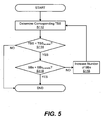
- SB modification module 30 includes instructions, which when executed by processor 24, causes processor 24 to perform the SB modification process, discussed in detail with respect to FIG. 5 .
- MCS modification module 32 adjusts the modulation and coding scheme to be utilized for transmitting a data queue associated with user device 12.
- MCS modification module 32 includes instructions, which when executed by processor 24, causes processor 24 to perform the MCS modification process, discussed in detail below with respect to FIG. 6 .
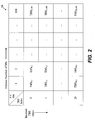
- TBS table 34 provides a mapping of a transport block size to a number of SBs and TBS index, discussed in detail with respect to FIG. 2 .
- Link quality requirement table 36 provides a mapping of a link quality that is required to utilize a specific number of SBs and MCS index, discussed in detail with respect to FIG. 3 .
- Packet core 16 may be an Internet Protocol (IP) based core network.
- packet core 16 may be an evolved packet core (EPC) network that is based on end-to-end IP based transmission in and out of the EPC network, e.g., all-IP based. Data and voice may be communicated through EPC via IP packets.
- Packet core 16 may include one or more serving gateways, packet distribution network gateways and mobile management entities (not shown), among other servers, gateways and entities.
- Network 18 may include communication networks such as wide area networks, local area networks and the like. Network 18 may provide various voice and data related services, content and the like to user device 12 via packet core 16.
- TBS table 34 associates a transport block size with a respective number of SBs and TBS index.
- the transport block size corresponds to a number of media access control (MAC) bits that can be transmitted in the subframe or TTI.
- TBS 28,100 may correspond to a transport block size that can be accommodated with one hundred SBs (SBs 100 ) and a specific MCS associated with TBS index twenty eight (TBS 28 ).
- SBs 100 transport block size that can be accommodated with one hundred SBs
- TBS index twenty eight TBS index twenty eight
- TBS 28,100 may correspond to a highest, optimum or maximum channel performance level given TBS indices from 0-28 and number of SBs from 0-100.
- TBS table 34 is illustrated in FIG. 2 having a specific table size, e.g., TBS indices 0-28 and number of SBs 0-100, one of ordinary skill in the art will recognize that other table sizes and dimensions can be incorporated, i.e., the number of SBs and/or TBS indices may be increased or decreased.
- TBS table 34 may correspond to the transport block size table defined in 3 rd Generation Partnership Project Technical Specification (3GPP TS) 36.213, e.g., Table 7.1.7.2.1-1.
- Link quality requirement table 36 associates a predetermined required link quality with a number of SBs and MCS index, i.e., associates a minimum link quality needed to utilize a specific number of SBs and MCS associated with a MCS index to transmit queued data.
- the required link quality is the minimum link quality needed to achieve a certain block error rate (BLER).
- BLER block error rate
- the MCS index corresponds to a specific modulation scheme and channel coding, e.g., quadrature amplitude modulation having four (4) bits per symbol (16QAM) and a specific coding level.
- link quality requirement corresponds to a link quality that is required to utilize a MCS corresponding to MCS index twenty eight (MCS 28 ) and one hundred SBs (SBs 100 ) while achieving a targeted operating point such as a block error rate (BLER) with the maximum possible bit rate.
- MCS 28 is the maximum or optimum MCS that corresponds to a maximum or optimum channel performance level given MCS 0-28 , e.g., the optimum MCS may correspond to the largest MCS index in table 36 or a minimum of the largest MCS index and maximum supported MCS.
- link quality requirement table 36 is illustrated in FIG. 3 having a particular table size, i.e., MCS 0-28 and number of SBs 0-100, one of ordinary skill in the art will recognize that the table size may be adjusted based on system design and/or communication protocol standards, among other factors. For example, link quality requirement table 36 may have a table size corresponding to the table size of TBS table 34, or vice versa.
- Processor 24 determines a number of SBs (Step S100). For example, processor 24 determines or estimates a first number of SBs (N_SBs_1) needed to empty a buffer based at least in part on the current MCS, i.e., estimate a number of SBs required to accommodate a data queue associated with user device 12 given the current MCS.
- the current MCS may initially be set to an optimum MCS such that the beginning of modified link adaptation for a given data queue is performed using the optimum MCS, i.e., Step S100 may be determined using the optimum MCS.
- the optimum MCS may correspond to a maximum channel performance level such as MCS 28 illustrated in FIG. 3 .
- MCS index twenty eight may correspond to a channel performance level greater than the channel performance levels associated with MCS indices zero through twenty seven (MCS 0-27 ).
- the optimum MCS may be predetermined such that the MCS is determined before the transmission time interval (TTI) or before the beginning of link adaptation during TTI for user device 12.
- TTI transmission time interval
- the number of SBs may be estimated based at least in part on equations (1) and/or (2) given a MCS, e.g., given an optimum MCS (MCS max ), etc.
- the marginFactor indicates scaling on the required TBS.
- the marginFactor may be optimized, i.e., increased or decreased, based on simulations or field testing.
- the required TBS (TBS required ) corresponds to a target TBS determined based on a desired TBS (TBS desired ), minimum TBS (TBS min ) and maximum TBS (TBS max ).
- the desired TBS corresponds to the number of data bits in queue for user device 12.
- the minimum TBS corresponds to the smallest TBS that can carry a reasonable amount of user data.
- the minimum TBS may be predetermined based on communications protocols and/or may be set by a network operator based on design considerations.
- the maximum TBS may be based on user device 12 and/or node 14 capabilities, i.e., the maximum TBS supported by user device 12 and/or node 14.
- the maximum TBS may be predetermined based on communication protocols in accordance with LTE wireless communication standards and/or may be set by a network designer based on design considerations, among other factors.
- the bitsPerSB(MCS) corresponds to the average TBS per SB determined from TBS table 34 given a MCS level or index using all or a portion of the number of SBs, e.g., N out of 100 columns in TBS table 34 may be used to determine bitsPerSB given a MCS.
- SBStep corresponds to a granularity of SB assignment. SBStep may correspond to a minimum number of SBs that can be allocated at a time, i.e., one or more SBs may be assigned or allocated at a time.
- Processor 24 may calculate or estimate a link quality based on a channel quality associated with the number of SBs and/or the actual location of the number of SBs in frequency, e.g., estimate link quality based at least in part on the channel quality associated with N_SBs_1 (Step S102).
- the link quality for a specific user device 12 may be calculated from measurements or via reporting of channel state information (CSI).
- CSI channel state information
- Processor 24 may determine a MCS, e.g., a second MCS (MCS_1) may be determined by searching link quality requirement table 36 for a maximum MCS (Step S104).
- link quality requirement table 36 is searched for a maximum MCS that satisfies a link quality threshold given a number of SBs such as N_SBs_1.
- the link quality threshold may be the calculated link quality divided by the required link quality that is greater than or equal to one minus a link quality margin, i.e., (calculated link quality/required link quality) ⁇ (1 - link quality margin).
- the required link quality is given by R x,y where x is the MCS index and y is the number of SBs such that the required link quality R x,y indicates a minimum link quality needed to utilize an MCS corresponding to MCS index (x) and a number of SBs (y).
- the current MCS may be updated to indicate the maximum MCS corresponding the maximum MCS index, e.g., updated to indicate the MCS_1 after MCS_1 is determined. While a lesser or lower MCS level than the current MCS, e.g., MCS_1, may satisfy the link quality threshold, the lesser MCS will likely result in channel coding that is too robust, thereby leading to a lower throughput and lower BLER than the target.
- Processor 24 determines whether to recalculate the number of SBs and MCS, i.e., whether to repeat Steps S100-S104 (Step S106).
- Processor 24 may determine to recalculate the number of SBs and MCS if the current MCS is less than a maximum MCS (MCS max ) and the current number of SBs is less than the available number of SBs (SBs available ), i.e., if MCS ⁇ MCS max and if SBs ⁇ SBs available . If processor 24 makes the determination to recalculate the number of SBs and MCS, the Step of S100 may be performed using the MCS determined in Step S104 from the previous iteration or loop of Steps S100-S104.
- MCS max maximum MCS
- SBs available available number of SBs
- N_SBs_n and MCS_n are positive integer that indicates the version of the number of SBs and MCS such that later version correspond to a higher n value.
- N_SBs_2 may be calculated based at least in part on MCS_1 in which N_SBs_2 indicates a later version or calculation of the number of SBs than indicated by N_SBs_1. Recalculations of the number of SBs and MCS may be indicated by n greater than one.
- processor 24 may perform SB modification (Step S108).
- SB modification may include modifying or re-estimating another number of SBs required to empty the buffer, among other functions described in detail with respect to FIG. 5 .
- MCS modification may be performed (Step S110).
- MCS modification may include reducing and/or increasing the MCS, i.e., decreasing and/or increasing the current MCS. MCS modification is discussed in detail with respect to FIG. 6 .
- the data queue may be scheduled for transmission based at least in part on the operating TBS, number of SBs and MCS that result from performing modified link adaptation.
- Processor 24 determines a TBS based at least in part on a number of SBs and MCS (Step S112).
- Processor 24 determines a current TBS based at least in part on the current number of SBs, e.g., N_SBs_1 or N_SBs_2, and current MCS, e.g., MCS_1 or MCS_2.
- the current TBS is determined by searching the TBS table 34 for a TBS given the current number of SBs and TBS index corresponding to the MCS.
- the current TBS may be determined to be TBS 24,80 based on a current number of SBs (SBs 80 ) and MCS index twenty-four (MCS 24 ) that corresponds to TBS index twenty-four (TBS 24 ).
- the TBS index in TBS table 34 may map directly with an MCS index in the link quality requirement table 36, e.g., TBS indices one (TBS 1 ) and twenty-eight (TBS 28 ) correspond to MCS index one (MCS 1 ) and twenty-eight (MCS 28 ), respectively.
- TBS indices one (TBS 1 ) and twenty-eight (TBS 28 ) correspond to MCS index one (MCS 1 ) and twenty-eight (MCS 28 ), respectively.
- MCS index twenty-eight (MCS 28 ) may map to TBS index twenty-six (TBS 26 ).
- the current number of SBs such as N_SBs_1 or N_SBs_2 may be increased by a predetermined number of SBs such as by SBStep. After increasing the current number of SBs by a predetermined amount, e.g., by SBStep, the determination of Step S112 may be repeated.
- Step S124 MCS index is increased by one or more index levels while the number of SBs are keep constant.
- MCS_2 may be increased while keeping N_SBs_2 the same.
- the current TBS and MCS may be updated based on the increased MCS. After increasing the MCS, the determination of Step S120 may be repeated.
- Step S126 the data queue associated with user device 12 may not be scheduled, i.e., a data queue associated with user device 12 cannot be accommodated during the current TTI.
- the current MCS cannot be increased in order to transmit the smallest TBS that can carry a minimum or reasonable amount of data to user device 12.
- the modified link adaptation process may be performed again for the data queue during the next TTI interval in which a greater number of SBs may be available as no data queue has been scheduled within the TTI and/or the calculated link quality may change, among other factors may vary per TTI when performing modified link adaptation.
- processor 24 determines whether TBS is less than or equal to the maximum TBS, i.e., whether TBS ⁇ TBS max (Step S128).
- the minimum MCS may correspond to a minimum or most robust channel performance level, e.g., MCS 0 given MCS 0-28 . If processor 24 determines that the MCS is equal to the minimum MCS, the data queue associated with user device 12 may not be scheduled (Step S126). For example, the current MCS cannot be decreased such that the current TBS remains greater than the maximum TBS (TBS max ). The modified link adaptation process may be performed again for the queued data during the next TTI. If processor 24 determines the current MCS does not equal the minimum MCS, the current MCS is decreased (Step S132). For example, the current MCS may be decreased by one or more MCS levels while the current number of SBs are kept constant. The current TBS may be updated based on the decreased MCS and current number of SBs. After MCS is decreased, the determination of Step S128 may be repeated.
- Step S134 determines whether the current TBS is greater than or equal to the minimum TBS.
- the determination of Step S134 may only be performed if the MCS is decreased at Step S132, i.e., Step S134 is skipped if Step S132 is not performed.
- the current number of SBs and decreased MCS may correspond to a TBS that is not greater than or equal to the minimum TBS such that the current TBS should be checked after decreasing MCS.
- the determination of Step S134 may always be performed.
- TBS TBS required *TBS margin .
- TBS margin is a value greater than one or a scaling that can be optimized through simulations and/or field testing, and may be configurable during link adaptation.
- processor 24 may determine a lowest MCS (Step S138).
- the lowest MCS may correspond to a lowest temporary MCS (MCS temp ) that is less than or equal to the current MCS in which a TBS based at least in part to the temporary MCS is greater than or equal to the required TBS, i.e., lowest MCS temp is determined such that MCS temp ⁇ MCS and TBS (MCS temp ) ⁇ TBS required .
- the current MCS and TBS may be updated after Step S138 is performed, and Step S140 may be performed as discussed below.
- processor 24 determines whether a code rate is greater than a maximum code rate (Step S140).
- the code rate (CR) is determined based at least in part on the current MCS and/or current number of SBs.
- the maximum code rate (CR max ) is a maximum code rate supported by user device 12. If the determination is made that the code rate is greater than the maximum code rate, processor 24 determines whether the current MCS is equal to the minimum MCS (Step S142).
- Step S126 the data queue associated with user device 12 may not be scheduled, i.e., a data queue associated with user device 12 cannot be accommodated during the current TTI.
- the current MCS cannot be decreased such that the code rate remains greater than the maximum code rate.
- the MCS is decreased (Step S 144).
- the current MCS may be decreased by one or more MCS levels. After MCS is decreased, the determination of Step S140 may be repeated.
- Step S146 may only be performed if the MCS is decreased at Step S144, i.e., Step S146 is skipped if Step S144 is not performed. If the determination is made that the current TBS is not greater than or equal to the minimum TBS, the data queue associated with user device 12 may not be scheduled, i.e., a data queue associated with user device 12 cannot be accommodated during the current TTI (Step S126). If the determination is made that the current TBS is greater than or equal to the minimum TBS, the MCS modification process may end.
- the current MCS and number of SBs may be updated after the MCS modification process, and the operating MCS and number of SBs may be set to the current MCS and number of SBs for a data queue such that a data queue associated with user device 12 is scheduled for transmission, i.e., the operating TBS is determined based on the operating MCS and number of SBs such that the queued data is scheduled for transmission based at least in part on the operating TBS.
- the operating TBS, MCS and number of SBs indicate the final result of the modified link adaptation process for a data queue associated with user device 12.
- the modified link adaptation process of FIG. 4 may be performed for other data queues associated with the same or different user device 12, i.e., the modified link adaptation process is repeated for another data queue.
- the modified link adaptation process of FIG. 4 may be performed for as many data queues as needed given the time left in the TTI, i.e., modified link adaptation may be performed for one or more data queues during a given TTI.
- table based modified link adaptation often results in the highest MCS supported by the link quality being selected for queued data.
- the link adaptation processing time may be significantly reduced compared to a brute force search method that attempts to search through all MCS values and all number of SBs, i.e., searches through all possibilities.
- the present invention can be realized in hardware, software, or a combination of hardware and software. Any kind of computing system, or other apparatus adapted for carrying out the methods described herein, is suited to perform the functions described herein.
- a typical combination of hardware and software could be a specialized or general purpose computer system having one or more processing elements and a computer program stored on a storage medium that, when loaded and executed, controls the computer system such that it carries out the methods described herein.
- the present invention can also be embedded in a computer program product, which comprises all the features enabling the implementation of the methods described herein, and which, when loaded in a computing system is able to carry out these methods.
- Storage medium refers to any volatile or non-volatile storage device.
- Computer program or application in the present context means any expression, in any language, code or notation, of a set of instructions intended to cause a system having an information processing capability to perform a particular function either directly or after either or both of the following a) conversion to another language, code or notation; b) reproduction in a different material form.
Landscapes
- Engineering & Computer Science (AREA)
- Quality & Reliability (AREA)
- Computer Networks & Wireless Communication (AREA)
- Signal Processing (AREA)
- Mobile Radio Communication Systems (AREA)
Applications Claiming Priority (2)
| Application Number | Priority Date | Filing Date | Title |
|---|---|---|---|
| US13/486,171 US8699340B2 (en) | 2012-06-01 | 2012-06-01 | Table-based link adaptation for wireless communication network transmissions |
| PCT/IB2013/053777 WO2013179166A1 (en) | 2012-06-01 | 2013-05-09 | Table-based link adaptation for wireless communication network transmissions |
Publications (2)
| Publication Number | Publication Date |
|---|---|
| EP2856682A1 EP2856682A1 (en) | 2015-04-08 |
| EP2856682B1 true EP2856682B1 (en) | 2016-07-06 |
Family
ID=48746600
Family Applications (1)
| Application Number | Title | Priority Date | Filing Date |
|---|---|---|---|
| EP13734175.6A Not-in-force EP2856682B1 (en) | 2012-06-01 | 2013-05-09 | Table-based link adaptation for wireless communication network transmissions |
Country Status (5)
| Country | Link |
|---|---|
| US (1) | US8699340B2 (enExample) |
| EP (1) | EP2856682B1 (enExample) |
| CN (1) | CN104509019B (enExample) |
| IN (1) | IN2014DN09877A (enExample) |
| WO (1) | WO2013179166A1 (enExample) |
Families Citing this family (10)
| Publication number | Priority date | Publication date | Assignee | Title |
|---|---|---|---|---|
| US8761108B2 (en) * | 2012-06-25 | 2014-06-24 | Telefonaktiebolaget L M Ericsson (Publ) | Table based link adaption for wireless communication transmissions with one codeword |
| US8982722B1 (en) * | 2012-11-28 | 2015-03-17 | Sprint Spectrum L.P. | Determining wireless communication gain |
| US9668261B1 (en) * | 2013-12-26 | 2017-05-30 | Marvell International Ltd. | Method and apparatus for transmitting wireless network operational information |
| KR102157286B1 (ko) * | 2013-12-27 | 2020-09-17 | 삼성전자주식회사 | 무선 통신 시스템에서 전송률을 제어하기 위한 방법 및 장치 |
| CN106817339A (zh) * | 2015-11-27 | 2017-06-09 | 中国电信股份有限公司 | 调整语音速率的方法、发送端以及系统 |
| US11075711B2 (en) | 2016-04-29 | 2021-07-27 | Telefonaktiebolaget Lm Ericsson (Publ) | Wireless device specific maximum code rate limit adjustment |
| JP6932928B2 (ja) * | 2017-01-05 | 2021-09-08 | ソニーグループ株式会社 | 無線通信装置、無線通信方法及びコンピュータプログラム |
| US10856300B2 (en) * | 2017-10-17 | 2020-12-01 | Qualcomm Incorporated | Per-TTI rank control within transmission opportunity for downlink comp |
| CN114205913B (zh) * | 2017-11-17 | 2025-03-11 | 华为技术有限公司 | 一种数据上报方法、接收方法和相关装置 |
| WO2019204114A1 (en) * | 2018-04-18 | 2019-10-24 | Commscope Technologies Llc | Selecting a modulation and coding scheme and a transmit block size in long term evolution |
Family Cites Families (14)
| Publication number | Priority date | Publication date | Assignee | Title |
|---|---|---|---|---|
| KR20040008228A (ko) | 2001-06-25 | 2004-01-28 | 노키아 코포레이션 | 전송 포맷 조합 표시자 신호 방식을 이용한 변조 및 코딩구성과 다중 코드의 최적화 |
| US7149245B2 (en) * | 2002-04-29 | 2006-12-12 | Lucent Technologies Inc. | Link adaption in enhanced general packet radio service networks |
| JP4256207B2 (ja) | 2002-06-28 | 2009-04-22 | パナソニック株式会社 | 送信装置および通信モード選択用テーブル更新方法 |
| JP3796212B2 (ja) | 2002-11-20 | 2006-07-12 | 松下電器産業株式会社 | 基地局装置及び送信割り当て制御方法 |
| US8432794B2 (en) | 2005-12-29 | 2013-04-30 | Interdigital Technology Corporation | Method and apparatus for selecting multiple transport formats and transmitting multiple transport blocks simultaneously with multiple H-ARQ processes |
| CN101366223B (zh) * | 2006-02-10 | 2016-10-26 | 艾利森电话股份有限公司 | 用于改进的链路质量控制的方法和设备 |
| KR101314611B1 (ko) | 2007-01-30 | 2013-10-07 | 엘지전자 주식회사 | 주파수 선택성에 따른 mcs 인덱스 선택 방법, 장치, 및이를 위한 통신 시스템 |
| US7899015B2 (en) | 2007-03-02 | 2011-03-01 | Telefonaktiebolaget Lm Ericsson (Publ) | Method and apparatus for resource reuse in a communication system |
| EP1973253A1 (en) | 2007-03-21 | 2008-09-24 | Nokia Siemens Networks Gmbh & Co. Kg | A method and a system for adaptation of a modulation and coding scheme |
| US8340586B2 (en) | 2008-11-19 | 2012-12-25 | T-Mobile Usa, Inc. | System and method for link adaptation for variable link conditions |
| CN102835149A (zh) | 2009-09-15 | 2012-12-19 | 岩星比德科有限公司 | 无线网络中的自适应调制和编码方案调整 |
| KR101076627B1 (ko) * | 2009-11-30 | 2011-10-27 | 고려대학교 산학협력단 | 다중 안테나 시스템에서 적응적 변조 및 코딩 방식을 결정하는 방법 |
| EP2540018A4 (en) * | 2010-02-28 | 2017-08-23 | Celeno Communications Ltd. | Backoff adaptation for digital communication systems with channel quality information |
| CN102271354A (zh) | 2010-06-02 | 2011-12-07 | 中兴通讯股份有限公司 | Lte系统中的链路自适应方法、基站和终端 |
-
2012
- 2012-06-01 US US13/486,171 patent/US8699340B2/en active Active
-
2013
- 2013-05-09 CN CN201380040784.4A patent/CN104509019B/zh not_active Expired - Fee Related
- 2013-05-09 WO PCT/IB2013/053777 patent/WO2013179166A1/en not_active Ceased
- 2013-05-09 IN IN9877DEN2014 patent/IN2014DN09877A/en unknown
- 2013-05-09 EP EP13734175.6A patent/EP2856682B1/en not_active Not-in-force
Also Published As
| Publication number | Publication date |
|---|---|
| US8699340B2 (en) | 2014-04-15 |
| WO2013179166A1 (en) | 2013-12-05 |
| CN104509019B (zh) | 2017-09-29 |
| CN104509019A (zh) | 2015-04-08 |
| US20130322241A1 (en) | 2013-12-05 |
| EP2856682A1 (en) | 2015-04-08 |
| IN2014DN09877A (enExample) | 2015-08-07 |
Similar Documents
| Publication | Publication Date | Title |
|---|---|---|
| EP2856682B1 (en) | Table-based link adaptation for wireless communication network transmissions | |
| US8761108B2 (en) | Table based link adaption for wireless communication transmissions with one codeword | |
| US8036168B2 (en) | Method and apparatus for link adaptation by stochastically selecting a transmit parameter | |
| CN101133588B (zh) | 用于在无线通信系统中最优化资源分配的系统和方法 | |
| EP2830380B1 (en) | Uplink transmission scheduling of non-Guaranteed Bit Rate bearers based on quality class indicator | |
| EP1982483B1 (en) | Multiple carrier resource management | |
| US9871642B2 (en) | Enabling higher-order modulation in a cellular network | |
| EP3314794B1 (en) | Method and base station for selecting a transport format | |
| US20190097750A1 (en) | Radio Link Adaptation In Communication Systems | |
| WO2015128814A2 (en) | Efficient transmission of stand-alone aperiodic csi reporting for lte carrier aggregation | |
| CN104980247A (zh) | 自适应调整调制编码方式和参考信号图样的方法、基站、终端和系统 | |
| JP2005525718A (ja) | 高速ダイナミックリンクアダプテーションのためのシステムおよび方法 | |
| US10673558B2 (en) | Configuring transmission parameters in a cellular system | |
| GB2491222A (en) | Transmission parameters based on CQI and subsequent transmission size | |
| CN104661296B (zh) | 决定用户设备的发送功率的装置和方法 | |
| WO2015065051A1 (ko) | 전송 전력 및 전송 지연을 제어하는 방법 및 이를 이용하는 통신 단말 | |
| WO2015106652A1 (zh) | 一种资源配置方法及装置 | |
| EP3138344A1 (en) | Stochastic radio resource allocation for shared radio access network | |
| WO2015136325A1 (en) | Physical downlink control channel (pdcch) inter-cell-interference coordination | |
| CN102625374B (zh) | 一种功率调整方法 | |
| US11864158B2 (en) | Distributed method for allocating transmission resources to D2D terminals in a cellular access network | |
| US9253681B1 (en) | Physical resource block allocation for TTI bundling | |
| EP2912798A2 (en) | Queue splitting for parallel carrier aggregation scheduling | |
| EP3449676B1 (en) | Coverage extension for wireless devices | |
| CN103002589A (zh) | 一种无线通信系统中前向调度的方法和装置 |
Legal Events
| Date | Code | Title | Description |
|---|---|---|---|
| PUAI | Public reference made under article 153(3) epc to a published international application that has entered the european phase |
Free format text: ORIGINAL CODE: 0009012 |
|
| 17P | Request for examination filed |
Effective date: 20141222 |
|
| AK | Designated contracting states |
Kind code of ref document: A1 Designated state(s): AL AT BE BG CH CY CZ DE DK EE ES FI FR GB GR HR HU IE IS IT LI LT LU LV MC MK MT NL NO PL PT RO RS SE SI SK SM TR |
|
| AX | Request for extension of the european patent |
Extension state: BA ME |
|
| DAX | Request for extension of the european patent (deleted) | ||
| GRAP | Despatch of communication of intention to grant a patent |
Free format text: ORIGINAL CODE: EPIDOSNIGR1 |
|
| INTG | Intention to grant announced |
Effective date: 20160203 |
|
| GRAS | Grant fee paid |
Free format text: ORIGINAL CODE: EPIDOSNIGR3 |
|
| GRAA | (expected) grant |
Free format text: ORIGINAL CODE: 0009210 |
|
| AK | Designated contracting states |
Kind code of ref document: B1 Designated state(s): AL AT BE BG CH CY CZ DE DK EE ES FI FR GB GR HR HU IE IS IT LI LT LU LV MC MK MT NL NO PL PT RO RS SE SI SK SM TR |
|
| REG | Reference to a national code |
Ref country code: GB Ref legal event code: FG4D |
|
| REG | Reference to a national code |
Ref country code: AT Ref legal event code: REF Ref document number: 811359 Country of ref document: AT Kind code of ref document: T Effective date: 20160715 Ref country code: CH Ref legal event code: EP |
|
| REG | Reference to a national code |
Ref country code: IE Ref legal event code: FG4D |
|
| REG | Reference to a national code |
Ref country code: DE Ref legal event code: R096 Ref document number: 602013009169 Country of ref document: DE |
|
| REG | Reference to a national code |
Ref country code: NL Ref legal event code: MP Effective date: 20160706 |
|
| REG | Reference to a national code |
Ref country code: LT Ref legal event code: MG4D |
|
| REG | Reference to a national code |
Ref country code: AT Ref legal event code: MK05 Ref document number: 811359 Country of ref document: AT Kind code of ref document: T Effective date: 20160706 |
|
| PG25 | Lapsed in a contracting state [announced via postgrant information from national office to epo] |
Ref country code: HR Free format text: LAPSE BECAUSE OF FAILURE TO SUBMIT A TRANSLATION OF THE DESCRIPTION OR TO PAY THE FEE WITHIN THE PRESCRIBED TIME-LIMIT Effective date: 20160706 Ref country code: FI Free format text: LAPSE BECAUSE OF FAILURE TO SUBMIT A TRANSLATION OF THE DESCRIPTION OR TO PAY THE FEE WITHIN THE PRESCRIBED TIME-LIMIT Effective date: 20160706 Ref country code: IS Free format text: LAPSE BECAUSE OF FAILURE TO SUBMIT A TRANSLATION OF THE DESCRIPTION OR TO PAY THE FEE WITHIN THE PRESCRIBED TIME-LIMIT Effective date: 20161106 Ref country code: NL Free format text: LAPSE BECAUSE OF FAILURE TO SUBMIT A TRANSLATION OF THE DESCRIPTION OR TO PAY THE FEE WITHIN THE PRESCRIBED TIME-LIMIT Effective date: 20160706 Ref country code: IT Free format text: LAPSE BECAUSE OF FAILURE TO SUBMIT A TRANSLATION OF THE DESCRIPTION OR TO PAY THE FEE WITHIN THE PRESCRIBED TIME-LIMIT Effective date: 20160706 Ref country code: LT Free format text: LAPSE BECAUSE OF FAILURE TO SUBMIT A TRANSLATION OF THE DESCRIPTION OR TO PAY THE FEE WITHIN THE PRESCRIBED TIME-LIMIT Effective date: 20160706 Ref country code: NO Free format text: LAPSE BECAUSE OF FAILURE TO SUBMIT A TRANSLATION OF THE DESCRIPTION OR TO PAY THE FEE WITHIN THE PRESCRIBED TIME-LIMIT Effective date: 20161006 Ref country code: RS Free format text: LAPSE BECAUSE OF FAILURE TO SUBMIT A TRANSLATION OF THE DESCRIPTION OR TO PAY THE FEE WITHIN THE PRESCRIBED TIME-LIMIT Effective date: 20160706 |
|
| PG25 | Lapsed in a contracting state [announced via postgrant information from national office to epo] |
Ref country code: PL Free format text: LAPSE BECAUSE OF FAILURE TO SUBMIT A TRANSLATION OF THE DESCRIPTION OR TO PAY THE FEE WITHIN THE PRESCRIBED TIME-LIMIT Effective date: 20160706 Ref country code: BE Free format text: LAPSE BECAUSE OF FAILURE TO SUBMIT A TRANSLATION OF THE DESCRIPTION OR TO PAY THE FEE WITHIN THE PRESCRIBED TIME-LIMIT Effective date: 20160706 Ref country code: GR Free format text: LAPSE BECAUSE OF FAILURE TO SUBMIT A TRANSLATION OF THE DESCRIPTION OR TO PAY THE FEE WITHIN THE PRESCRIBED TIME-LIMIT Effective date: 20161007 Ref country code: SE Free format text: LAPSE BECAUSE OF FAILURE TO SUBMIT A TRANSLATION OF THE DESCRIPTION OR TO PAY THE FEE WITHIN THE PRESCRIBED TIME-LIMIT Effective date: 20160706 Ref country code: AT Free format text: LAPSE BECAUSE OF FAILURE TO SUBMIT A TRANSLATION OF THE DESCRIPTION OR TO PAY THE FEE WITHIN THE PRESCRIBED TIME-LIMIT Effective date: 20160706 Ref country code: LV Free format text: LAPSE BECAUSE OF FAILURE TO SUBMIT A TRANSLATION OF THE DESCRIPTION OR TO PAY THE FEE WITHIN THE PRESCRIBED TIME-LIMIT Effective date: 20160706 Ref country code: PT Free format text: LAPSE BECAUSE OF FAILURE TO SUBMIT A TRANSLATION OF THE DESCRIPTION OR TO PAY THE FEE WITHIN THE PRESCRIBED TIME-LIMIT Effective date: 20161107 Ref country code: ES Free format text: LAPSE BECAUSE OF FAILURE TO SUBMIT A TRANSLATION OF THE DESCRIPTION OR TO PAY THE FEE WITHIN THE PRESCRIBED TIME-LIMIT Effective date: 20160706 |
|
| REG | Reference to a national code |
Ref country code: DE Ref legal event code: R097 Ref document number: 602013009169 Country of ref document: DE |
|
| PG25 | Lapsed in a contracting state [announced via postgrant information from national office to epo] |
Ref country code: EE Free format text: LAPSE BECAUSE OF FAILURE TO SUBMIT A TRANSLATION OF THE DESCRIPTION OR TO PAY THE FEE WITHIN THE PRESCRIBED TIME-LIMIT Effective date: 20160706 Ref country code: RO Free format text: LAPSE BECAUSE OF FAILURE TO SUBMIT A TRANSLATION OF THE DESCRIPTION OR TO PAY THE FEE WITHIN THE PRESCRIBED TIME-LIMIT Effective date: 20160706 |
|
| PLBE | No opposition filed within time limit |
Free format text: ORIGINAL CODE: 0009261 |
|
| STAA | Information on the status of an ep patent application or granted ep patent |
Free format text: STATUS: NO OPPOSITION FILED WITHIN TIME LIMIT |
|
| PG25 | Lapsed in a contracting state [announced via postgrant information from national office to epo] |
Ref country code: BG Free format text: LAPSE BECAUSE OF FAILURE TO SUBMIT A TRANSLATION OF THE DESCRIPTION OR TO PAY THE FEE WITHIN THE PRESCRIBED TIME-LIMIT Effective date: 20161006 Ref country code: CZ Free format text: LAPSE BECAUSE OF FAILURE TO SUBMIT A TRANSLATION OF THE DESCRIPTION OR TO PAY THE FEE WITHIN THE PRESCRIBED TIME-LIMIT Effective date: 20160706 Ref country code: DK Free format text: LAPSE BECAUSE OF FAILURE TO SUBMIT A TRANSLATION OF THE DESCRIPTION OR TO PAY THE FEE WITHIN THE PRESCRIBED TIME-LIMIT Effective date: 20160706 Ref country code: SM Free format text: LAPSE BECAUSE OF FAILURE TO SUBMIT A TRANSLATION OF THE DESCRIPTION OR TO PAY THE FEE WITHIN THE PRESCRIBED TIME-LIMIT Effective date: 20160706 Ref country code: SK Free format text: LAPSE BECAUSE OF FAILURE TO SUBMIT A TRANSLATION OF THE DESCRIPTION OR TO PAY THE FEE WITHIN THE PRESCRIBED TIME-LIMIT Effective date: 20160706 |
|
| 26N | No opposition filed |
Effective date: 20170407 |
|
| PG25 | Lapsed in a contracting state [announced via postgrant information from national office to epo] |
Ref country code: SI Free format text: LAPSE BECAUSE OF FAILURE TO SUBMIT A TRANSLATION OF THE DESCRIPTION OR TO PAY THE FEE WITHIN THE PRESCRIBED TIME-LIMIT Effective date: 20160706 Ref country code: LU Free format text: LAPSE BECAUSE OF NON-PAYMENT OF DUE FEES Effective date: 20170531 |
|
| REG | Reference to a national code |
Ref country code: CH Ref legal event code: PL |
|
| GBPC | Gb: european patent ceased through non-payment of renewal fee |
Effective date: 20170509 |
|
| PG25 | Lapsed in a contracting state [announced via postgrant information from national office to epo] |
Ref country code: MC Free format text: LAPSE BECAUSE OF FAILURE TO SUBMIT A TRANSLATION OF THE DESCRIPTION OR TO PAY THE FEE WITHIN THE PRESCRIBED TIME-LIMIT Effective date: 20160706 |
|
| REG | Reference to a national code |
Ref country code: IE Ref legal event code: MM4A |
|
| PG25 | Lapsed in a contracting state [announced via postgrant information from national office to epo] |
Ref country code: LI Free format text: LAPSE BECAUSE OF NON-PAYMENT OF DUE FEES Effective date: 20170531 Ref country code: CH Free format text: LAPSE BECAUSE OF NON-PAYMENT OF DUE FEES Effective date: 20170531 |
|
| REG | Reference to a national code |
Ref country code: FR Ref legal event code: ST Effective date: 20180131 |
|
| PG25 | Lapsed in a contracting state [announced via postgrant information from national office to epo] |
Ref country code: LU Free format text: LAPSE BECAUSE OF NON-PAYMENT OF DUE FEES Effective date: 20170509 |
|
| PG25 | Lapsed in a contracting state [announced via postgrant information from national office to epo] |
Ref country code: IE Free format text: LAPSE BECAUSE OF NON-PAYMENT OF DUE FEES Effective date: 20170509 Ref country code: GB Free format text: LAPSE BECAUSE OF NON-PAYMENT OF DUE FEES Effective date: 20170509 |
|
| PG25 | Lapsed in a contracting state [announced via postgrant information from national office to epo] |
Ref country code: FR Free format text: LAPSE BECAUSE OF NON-PAYMENT OF DUE FEES Effective date: 20170531 |
|
| PG25 | Lapsed in a contracting state [announced via postgrant information from national office to epo] |
Ref country code: MT Free format text: LAPSE BECAUSE OF NON-PAYMENT OF DUE FEES Effective date: 20170509 |
|
| PG25 | Lapsed in a contracting state [announced via postgrant information from national office to epo] |
Ref country code: AL Free format text: LAPSE BECAUSE OF FAILURE TO SUBMIT A TRANSLATION OF THE DESCRIPTION OR TO PAY THE FEE WITHIN THE PRESCRIBED TIME-LIMIT Effective date: 20160706 |
|
| PG25 | Lapsed in a contracting state [announced via postgrant information from national office to epo] |
Ref country code: HU Free format text: LAPSE BECAUSE OF FAILURE TO SUBMIT A TRANSLATION OF THE DESCRIPTION OR TO PAY THE FEE WITHIN THE PRESCRIBED TIME-LIMIT; INVALID AB INITIO Effective date: 20130509 |
|
| PG25 | Lapsed in a contracting state [announced via postgrant information from national office to epo] |
Ref country code: CY Free format text: LAPSE BECAUSE OF FAILURE TO SUBMIT A TRANSLATION OF THE DESCRIPTION OR TO PAY THE FEE WITHIN THE PRESCRIBED TIME-LIMIT Effective date: 20160706 |
|
| PG25 | Lapsed in a contracting state [announced via postgrant information from national office to epo] |
Ref country code: MK Free format text: LAPSE BECAUSE OF FAILURE TO SUBMIT A TRANSLATION OF THE DESCRIPTION OR TO PAY THE FEE WITHIN THE PRESCRIBED TIME-LIMIT Effective date: 20160706 |
|
| PG25 | Lapsed in a contracting state [announced via postgrant information from national office to epo] |
Ref country code: TR Free format text: LAPSE BECAUSE OF FAILURE TO SUBMIT A TRANSLATION OF THE DESCRIPTION OR TO PAY THE FEE WITHIN THE PRESCRIBED TIME-LIMIT Effective date: 20160706 |
|
| PGFP | Annual fee paid to national office [announced via postgrant information from national office to epo] |
Ref country code: DE Payment date: 20220527 Year of fee payment: 10 |
|
| REG | Reference to a national code |
Ref country code: DE Ref legal event code: R119 Ref document number: 602013009169 Country of ref document: DE |
|
| PG25 | Lapsed in a contracting state [announced via postgrant information from national office to epo] |
Ref country code: DE Free format text: LAPSE BECAUSE OF NON-PAYMENT OF DUE FEES Effective date: 20231201 |