EP2853523A1 - Process for producing fluorine-containing biaryl compound - Google Patents
Process for producing fluorine-containing biaryl compound Download PDFInfo
- Publication number
- EP2853523A1 EP2853523A1 EP20140185927 EP14185927A EP2853523A1 EP 2853523 A1 EP2853523 A1 EP 2853523A1 EP 20140185927 EP20140185927 EP 20140185927 EP 14185927 A EP14185927 A EP 14185927A EP 2853523 A1 EP2853523 A1 EP 2853523A1
- Authority
- EP
- European Patent Office
- Prior art keywords
- fluorine
- aromatic
- boronic acid
- compound
- formula
- Prior art date
- Legal status (The legal status is an assumption and is not a legal conclusion. Google has not performed a legal analysis and makes no representation as to the accuracy of the status listed.)
- Granted
Links
- ASRDINLIZIEEFA-UHFFFAOYSA-N CB1OCC(C)(C)CO1 Chemical compound CB1OCC(C)(C)CO1 ASRDINLIZIEEFA-UHFFFAOYSA-N 0.000 description 1
Classifications
-
- C—CHEMISTRY; METALLURGY
- C07—ORGANIC CHEMISTRY
- C07C—ACYCLIC OR CARBOCYCLIC COMPOUNDS
- C07C17/00—Preparation of halogenated hydrocarbons
- C07C17/23—Preparation of halogenated hydrocarbons by dehalogenation
-
- C—CHEMISTRY; METALLURGY
- C07—ORGANIC CHEMISTRY
- C07C—ACYCLIC OR CARBOCYCLIC COMPOUNDS
- C07C41/00—Preparation of ethers; Preparation of compounds having groups, groups or groups
- C07C41/01—Preparation of ethers
- C07C41/18—Preparation of ethers by reactions not forming ether-oxygen bonds
- C07C41/30—Preparation of ethers by reactions not forming ether-oxygen bonds by increasing the number of carbon atoms, e.g. by oligomerisation
-
- C—CHEMISTRY; METALLURGY
- C07—ORGANIC CHEMISTRY
- C07C—ACYCLIC OR CARBOCYCLIC COMPOUNDS
- C07C17/00—Preparation of halogenated hydrocarbons
- C07C17/26—Preparation of halogenated hydrocarbons by reactions involving an increase in the number of carbon atoms in the skeleton
- C07C17/263—Preparation of halogenated hydrocarbons by reactions involving an increase in the number of carbon atoms in the skeleton by condensation reactions
-
- C—CHEMISTRY; METALLURGY
- C07—ORGANIC CHEMISTRY
- C07C—ACYCLIC OR CARBOCYCLIC COMPOUNDS
- C07C17/00—Preparation of halogenated hydrocarbons
- C07C17/38—Separation; Purification; Stabilisation; Use of additives
-
- C—CHEMISTRY; METALLURGY
- C07—ORGANIC CHEMISTRY
- C07C—ACYCLIC OR CARBOCYCLIC COMPOUNDS
- C07C17/00—Preparation of halogenated hydrocarbons
- C07C17/38—Separation; Purification; Stabilisation; Use of additives
- C07C17/392—Separation; Purification; Stabilisation; Use of additives by crystallisation; Purification or separation of the crystals
-
- C—CHEMISTRY; METALLURGY
- C07—ORGANIC CHEMISTRY
- C07C—ACYCLIC OR CARBOCYCLIC COMPOUNDS
- C07C25/00—Compounds containing at least one halogen atom bound to a six-membered aromatic ring
- C07C25/18—Polycyclic aromatic halogenated hydrocarbons
-
- C—CHEMISTRY; METALLURGY
- C09—DYES; PAINTS; POLISHES; NATURAL RESINS; ADHESIVES; COMPOSITIONS NOT OTHERWISE PROVIDED FOR; APPLICATIONS OF MATERIALS NOT OTHERWISE PROVIDED FOR
- C09K—MATERIALS FOR MISCELLANEOUS APPLICATIONS, NOT PROVIDED FOR ELSEWHERE
- C09K19/00—Liquid crystal materials
- C09K19/04—Liquid crystal materials characterised by the chemical structure of the liquid crystal components, e.g. by a specific unit
- C09K19/06—Non-steroidal liquid crystal compounds
- C09K19/08—Non-steroidal liquid crystal compounds containing at least two non-condensed rings
- C09K19/10—Non-steroidal liquid crystal compounds containing at least two non-condensed rings containing at least two benzene rings
- C09K19/12—Non-steroidal liquid crystal compounds containing at least two non-condensed rings containing at least two benzene rings at least two benzene rings directly linked, e.g. biphenyls
-
- C—CHEMISTRY; METALLURGY
- C09—DYES; PAINTS; POLISHES; NATURAL RESINS; ADHESIVES; COMPOSITIONS NOT OTHERWISE PROVIDED FOR; APPLICATIONS OF MATERIALS NOT OTHERWISE PROVIDED FOR
- C09K—MATERIALS FOR MISCELLANEOUS APPLICATIONS, NOT PROVIDED FOR ELSEWHERE
- C09K19/00—Liquid crystal materials
- C09K19/04—Liquid crystal materials characterised by the chemical structure of the liquid crystal components, e.g. by a specific unit
- C09K19/06—Non-steroidal liquid crystal compounds
- C09K19/08—Non-steroidal liquid crystal compounds containing at least two non-condensed rings
- C09K19/30—Non-steroidal liquid crystal compounds containing at least two non-condensed rings containing saturated or unsaturated non-aromatic rings, e.g. cyclohexane rings
-
- C—CHEMISTRY; METALLURGY
- C09—DYES; PAINTS; POLISHES; NATURAL RESINS; ADHESIVES; COMPOSITIONS NOT OTHERWISE PROVIDED FOR; APPLICATIONS OF MATERIALS NOT OTHERWISE PROVIDED FOR
- C09K—MATERIALS FOR MISCELLANEOUS APPLICATIONS, NOT PROVIDED FOR ELSEWHERE
- C09K19/00—Liquid crystal materials
- C09K19/04—Liquid crystal materials characterised by the chemical structure of the liquid crystal components, e.g. by a specific unit
- C09K19/06—Non-steroidal liquid crystal compounds
- C09K19/08—Non-steroidal liquid crystal compounds containing at least two non-condensed rings
- C09K19/10—Non-steroidal liquid crystal compounds containing at least two non-condensed rings containing at least two benzene rings
- C09K19/12—Non-steroidal liquid crystal compounds containing at least two non-condensed rings containing at least two benzene rings at least two benzene rings directly linked, e.g. biphenyls
- C09K2019/121—Compounds containing phenylene-1,4-diyl (-Ph-)
- C09K2019/122—Ph-Ph
-
- C—CHEMISTRY; METALLURGY
- C09—DYES; PAINTS; POLISHES; NATURAL RESINS; ADHESIVES; COMPOSITIONS NOT OTHERWISE PROVIDED FOR; APPLICATIONS OF MATERIALS NOT OTHERWISE PROVIDED FOR
- C09K—MATERIALS FOR MISCELLANEOUS APPLICATIONS, NOT PROVIDED FOR ELSEWHERE
- C09K19/00—Liquid crystal materials
- C09K19/04—Liquid crystal materials characterised by the chemical structure of the liquid crystal components, e.g. by a specific unit
- C09K19/06—Non-steroidal liquid crystal compounds
- C09K19/08—Non-steroidal liquid crystal compounds containing at least two non-condensed rings
- C09K19/10—Non-steroidal liquid crystal compounds containing at least two non-condensed rings containing at least two benzene rings
- C09K19/12—Non-steroidal liquid crystal compounds containing at least two non-condensed rings containing at least two benzene rings at least two benzene rings directly linked, e.g. biphenyls
- C09K2019/121—Compounds containing phenylene-1,4-diyl (-Ph-)
- C09K2019/123—Ph-Ph-Ph
-
- C—CHEMISTRY; METALLURGY
- C09—DYES; PAINTS; POLISHES; NATURAL RESINS; ADHESIVES; COMPOSITIONS NOT OTHERWISE PROVIDED FOR; APPLICATIONS OF MATERIALS NOT OTHERWISE PROVIDED FOR
- C09K—MATERIALS FOR MISCELLANEOUS APPLICATIONS, NOT PROVIDED FOR ELSEWHERE
- C09K19/00—Liquid crystal materials
- C09K19/04—Liquid crystal materials characterised by the chemical structure of the liquid crystal components, e.g. by a specific unit
- C09K19/06—Non-steroidal liquid crystal compounds
- C09K19/08—Non-steroidal liquid crystal compounds containing at least two non-condensed rings
- C09K19/30—Non-steroidal liquid crystal compounds containing at least two non-condensed rings containing saturated or unsaturated non-aromatic rings, e.g. cyclohexane rings
- C09K19/3001—Cyclohexane rings
- C09K19/3003—Compounds containing at least two rings in which the different rings are directly linked (covalent bond)
- C09K2019/3016—Cy-Ph-Ph
Definitions
- the present invention relates to a process for producing a biaryl compound comprising a fluorine atom(s) as a substituent.
- a biaryl compound comprising a fluorine atom(s) as a substituent is useful as a material for medicines and liquid crystals, and as an intermediate thereof.
- One example of a process for producing a fluorine-containing biaryl compound is a process in which an aromatic boronic acid compound comprising a fluorine atom(s) as a substituent is subjected to a coupling reaction with an aromatic compound comprising a bromine atom, an iodine atom, an -OSO 2 CF 3 group, or the like (see Patent Literature 1 to 4 below).
- an aromatic boronic acid compound comprising a fluorine atom at the ortho position when used as a starting material, the starting material is unstable, and easily decomposes due to heating or influences attributable to water, oxygen, etc. Furthermore, an aromatic compound comprising a bromine atom, an iodine atom, an -OSO 2 CF 3 group, or the like, that is used as the other starting material, is expensive, increasing the production cost.
- an aromatic chloride comprising a chlorine atom as a substituent is advantageous in that it is less expensive compared to an aromatic compound comprising a bromine atom, an iodine atom, an -OSO 2 CF 3 group, or the like, and has a smaller molecular weight. If such an aromatic chloride can be efficiently reacted with the aromatic boronic acid compound comprising a fluorine atom at the ortho position, this method will be industrially applicable as a process for producing a biaryl compound comprising a fluorine atom at the ortho position.
- an aromatic chloride comprising a chlorine atom as a substituent is less active and has poor reactivity compared to an aromatic compound comprising a bromine atom, an iodine atom, or the like. This makes it difficult to allow such a compound to efficiently react with a fluorine-containing aromatic boronic acid compound. Therefore, various methods for reacting them have been studied.
- Non-Patent Literature 1 discloses that the target object can be obtained at a yield of 98% by reacting them in an H 2 O solvent at 100°C for 2 hours using sodium hydroxide as a base and palladium carbon as a catalyst.
- the aromatic chloride used as a starting material is limited to highly reactive compounds that further comprise a nitro group as a substituent.
- TBAB tetrabutylammonium bromide
- Non-Patent Literature 2 discloses that the target object can be obtained at a high yield by adding a specific nonionic surfactant and allowing the mixture to react in an H 2 O solvent at 23°C for 22 hours in the presence of triethylamine (NEt 3 ) while using Pd(dtbpf)Cl 2 , which is a Pd complex, as a catalyst.
- NEt 3 triethylamine
- Pd(dtbpf)Cl 2 which is a Pd complex
- the aromatic boronic acid is used in an excessive (2 equivalent) amount relative to the aromatic chloride, and the amount of the catalyst used is as large as 2 mol%. This is also a costly method.
- Non-Patent Literature 3 to 6 below, Patent Literature 5 and 6 below, and other documents also disclose production examples utilizing a coupling reaction of an aromatic chloride with an aromatic boronic acid compound comprising a fluorine atom at the ortho position.
- the aromatic boronic acid compound was used in an excessive amount relative to the aromatic chloride, and an unduly large amount of Pd catalyst was also used. Therefore, these production methods are not advantageous in terms of industrial applicability.
- Non-Patent Literature 7 listed below discloses a method for obtaining a target object from a boronic acid, which is easily undergoes hydrolysis, by a coupling reaction.
- boronic acid is tetracoordinated beforehand, and a reaction is performed in a nonaqueous solvent without using a base.
- this method requires using boronic acid, which has been made tetracoordinated state beforehand; therefore, the handling of the boronic acid itself is problematic, and the production process becomes unduly long and complicated.
- this method is not advantageous in view of industrial applicability.
- the aromatic boronic acid compound is easily decomposed due to its instability, and the aromatic chloride is inactive, the aromatic boronic acid compound is used in an excessive amount relative to the aromatic chloride or a large amount of catalyst is used in order to achieve a high reaction yield.
- various measures such as heating, the use of expensive additives, tetracoordinating the boronic acid beforehand, etc., are tried. This increases the production cost; therefor, these methods are not industrially advantageous.
- a main object of the present invention is to provide a process that allows production of a biaryl compound comprising a fluorine atom at the ortho position, using an inexpensive starting material, under economically advantageous conditions, and in an efficient manner.
- the present inventors conducted extensive research to achieve the above object. As a result, the inventors found that according to a process wherein an aromatic boronic acid compound comprising a fluorine atom at the ortho position or a cyclic trimer thereof, and an aromatic chloride having a specific substituent are used as starting materials, and are reacted under heating in a water-containing solvent in the presence of a specific base such as a tertiary amine compound, using a palladium compound as a catalyst, the target fluorine-containing biaryl compound comprising a fluorine atom at the ortho position can be produced at a high yield using only relatively inexpensive starting materials without using expensive additives.
- the present invention has been accomplished on the basis of this finding, and by conducting further research.
- the present invention provides a process for producing the fluorine-containing biaryl compound described below.
- the aromatic boronic acid compound represented by Formula (I) is a compound comprising a fluorine atom at the ortho position relative to the boronic acid group represented by X.
- the aromatic boronic acid compound is unstable in air, and easily decomposes due to heating or influences attributable to water, oxygen, or the like.
- the target fluorine-containing biaryl compound can be obtained at a high yield while preventing hydrolysis.
- L 1 to L 3 are the same or different and each represents a hydrogen atom, a fluorine atom, or a lower alkyl group. These groups are inactive to the reaction with the aromatic chloride represented by Formula (II) described below, and have little influence on the reaction.
- a 1 represents a hydrogen atom, a fluorine atom, a lower alkyl group, a cyclic aliphatic hydrocarbon group optionally having one or more substituents, and further optionally having one or more hetero atoms, a substituted or unsubstituted phenyl group, or a substituted or unsubstituted aromatic heterocyclic group.
- X is a boronic acid group represented by Formula (a) below:
- M 1 and M 2 are the same or different and each represents a hydrogen atom, a lower alkyl group, or a monovalent metal atom. Furthermore, M 1 and M 2 may bond to each other to form a bivalent aliphatic hydrocarbon group, and may form a cyclic structure together with a boron atom. Examples of the bivalent aliphatic hydrocarbon group include linear or branched aliphatic hydrocarbon groups having about 2 to 6 carbon atoms.
- substitution sites of L 1 to L 3 and A 1 which are the substituents on the benzene ring in Formula (I) above, are not limited to those shown in Formula (I), and may be arbitrarily selected on the benzene ring.
- the aromatic boronic acid compound represented by Formula (I) a compound in which A 1 is substituted at the para position relative to X is particularly preferable.
- lower alkyl group examples include C 1-6 linear or branched alkyl groups such as methyl, ethyl, n -propyl, isopropyl, n -butyl, isobutyl, tert -butyl, sec-butyl, n -pentyl, isopentyl, neopentyl, n -hexyl, isohexyl, and 3-methylpentyl group.
- Examples of the lower alkyl group represented by A 1 include those exemplified above as the lower alkyl groups represented by L 1 to L 3 above.
- specific examples of the cyclic aliphatic hydrocarbon group optionally having one or more substituents, and further optionally having one or more hetero atoms include 4- to 6-membered cyclic aliphatic hydrocarbon groups such as cyclohexyl group, cyclopentyl group, cyclobutyl group and like C 4-6 cycloalkyl groups; heterocyclic hydrocarbon groups in which one, two, or more carbon atoms in these cycloalkyl groups are substituted with one, two, or more hetero atoms such as oxygen atom.
- the substituted or unsubstituted aromatic heterocyclic groups are not particularly limited, and examples thereof include 5- or 6-membered monocyclic aromatic heterocyclic groups.
- the heteroatoms in the aromatic heterocyclic groups are not particularly limited, and preferably at least one nitrogen atom is contained in the aromatic ring.
- Examples of such aromatic heterocyclic groups include pyrrolyl, pyridyl, imidazolyl, pyrazolyl, pyrazinyl, pyrimidinyl, pyridazinyl, isothiazolyl, and isoxazolyl.
- Examples of the group that can function as a substituent for the cyclic aliphatic hydrocarbon group, phenyl group, and aromatic heterocyclic group include a fluorine atom, and a lower alkyl group.
- examples of the lower alkyl groups serving as substituents for the cyclic aliphatic hydrocarbon group, phenyl group, and aromatic heterocyclic group include the same as those of the lower alkyl groups represented by L 1 to L 3 described above.
- These substituents may substitute one, two, or more atoms or groups at arbitrary sites in each of the cyclic aliphatic hydrocarbon group, phenyl group, and aromatic heterocyclic group.
- examples of the lower alkyl group include the same as those of the lower alkyl groups represented by L 1 to L 3 .
- monovalent metal atom include alkali metals such as Na, K, and Li.
- examples of the group represented by X include the groups represented by the formulae below:
- Each of the groups described above can be easily obtained by reacting, for example, boronic acid with ethylene glycol, or pinacol.
- the aromatic boronic acid compound represented by Formula (I) takes the form of boronic acid, boronic ester, or boronic acid salt by comprising a boronic acid group represented by Formula (a).
- the aromatic boronic acid compound represented by Formula (I) can also be used as a cyclic trimer obtained by subjecting the aromatic boronic acid compound to a dehydration-condensation reaction.
- Such cyclic trimers are referred to as a boroxine compound, represented by the chemical formula below.
- At least one boronic acid compound selected from the group consisting of the aromatic boronic acid compounds represented by Formula (I) described above and cyclic trimers formed by dehydration-condensation of the aromatic boronic acid compound may be used.
- the aromatic boronic acid compound represented by Formula (I) and a cyclic trimer thereof are known compounds that are readily obtainable.
- the aromatic chloride represented by Formula (II) is a compound having a relatively low reactivity with an aromatic boronic acid compound. However, by employing the reaction conditions described below, the coupling reaction with an aromatic boronic acid compound can proceed smoothly.
- L 4 to L 7 are the same or different and each represents a hydrogen atom, a fluorine atom, or a lower alkyl group.
- examples of the lower alkyl group are the same as those of the lower alkyl groups represented by L 1 to L 3 in Formula (I).
- a 2 represents a hydrogen atom, a fluorine atom, -CN, -CF 3 , -OCF 3 , -O-A 3 , -COOA 3 , -CF 2 OA 3 , or a group represented by the formula below:
- the group represented by A 3 is a hydrogen atom, a lower alkyl group, a phenyl group, or a group represented by the formula below:
- Y is a hydrogen atom, a fluorine atom, -CF 3 , or -OCF 3 .
- the aromatic chloride represented by Formula (II) is a known compound that is readily obtainable.
- substitution sites of L 4 to L 7 and A 2 which are the substituents on the benzene ring of Formula (II) above, are not limited to those shown in Formula (II), and may be arbitrarily selected on the benzene ring.
- aromatic chloride represented by Formula (II) a compound in which A 2 is substituted at the para position relative to Cl is particularly preferable.
- the present invention requires reacting an aromatic chloride represented by Formula (II) with at least one boronic acid compound selected from the group consisting of the aromatic boronic acid compounds represented by Formula (I) and cyclic trimers formed by dehydration-condensation of the aromatic boronic acid compound, in a water-containing solvent using a palladium compound as a catalyst in the presence of a tertiary amine compound.
- This method uses as a starting material the boronic acid compound, which is unstable and easily undergoes hydrolysis, and the reaction is conducted in a water-containing solvent.
- the target fluorine-containing biaryl compound represented by Formula (III) can be obtained at a high yield while preventing hydrolysis of the starting material: wherein L 1 to L 7 , A 1 , and A 2 are the same as defined above.
- the aromatic chloride represented by Formula (II) used as the starting material is relatively inexpensive, and the reaction proceeds without adding expensive additives and without adding a large amount of catalyst; accordingly, this method allows the target fluorine-containing biaryl compound to be obtained at a low cost.
- the boronic acid compound is generally used in an excessive amount relative to the aromatic chloride in conventional methods because the boronic acid compound easily undergoes hydrolysis.
- the target object can be obtained at a high yield even when the proportion of the boronic acid compound is reduced.
- the aromatic boronic acid compound represented by Formula (I) may be used in an amount of about 0.8 to 1.5 mol, preferably about 0.9 to 1.2 mol, more preferably about 0.95 to 1.1 mol, and further more preferably about 1.0 to 1.05 mol.
- a boroxine compound which is a cyclic trimer of the aromatic boronic acid compound
- 1 mol of the cyclic trimer is regarded as 3 mol of the aromatic boronic acid compound represented by Formula (I).
- water is used singly, or a mixture of water and an organic solvent is used.
- the coupling reaction of the aromatic boronic acid compound with an aromatic chloride can proceed smoothly while suppressing the hydrolysis of the aromatic boronic acid compound.
- the amount of water-containing solvent per 1 g of the aromatic chloride represented by Formula (II) may be, as the amount of water, about 0.5 ml or more, for example, about 0.5 to 20 ml, preferably about 1 to 12 ml, and more preferably about 2 to 8 ml.
- the organic solvents used in the mixed solvent either a water-miscible organic solvent or an organic solvent which causes phase separation from water may be used. Specific examples thereof include DMAc (dimethylacetamide), DMF (dimethylformamide), acetonitrile, toluene, xylene, C 1-8 alcohols (e.g., ethanol and isopropanol), tetrahydrofuran (THF), and dioxane.
- the proportion of water to organic solvent in the mixed solvent is not particularly limited, and the content of water, relative to the total amount of water and the organic solvent, is preferably about 20% by volume or more, more preferably about 50 to 90% by volume, and further more preferably about 60 to 80% by volume.
- the present invention requires the use of a tertiary amine compound as a basic compound.
- a tertiary amine compound under the reaction conditions of the present invention, the target fluorine-containing biaryl compound can be obtained at a high yield while suppressing hydrolysis of the aromatic boronic acid compound represented by Formula (I) and a cyclic trimer thereof.
- hydrolysis of the starting material easily proceeds, and the reaction yield is greatly lowered.
- tertiary amine compound examples include diethylmethylamine, trimethylamine, triethylamine (NEt 3 ), diisopropylethylamine, and triisopropylamine.
- NEt 3 triethylamine
- diisopropylethylamine examples include diethylmethylamine, trimethylamine, triethylamine (NEt 3 ), diisopropylethylamine, and triisopropylamine.
- triethylamine is particularly preferable.
- the amount of the tertiary amine compound, relative to 1 mol of the aromatic boronic acid compound represented by Formula (I), is preferably about 1 to 4 mol, and more preferably about 1.1 to 2.5 mol.
- 1 mol of the cyclic trimer is regarded as 3 mol of the aromatic boronic acid compound represented by Formula (I).
- the present invention uses a palladium catalyst.
- the palladium catalyst known palladium catalysts that are effective in the coupling reaction between an aromatic boronic acid compound and aromatic halide can be used.
- the palladium catalyst used in the present invention is preferably a palladium complex which is formed in the reaction system by the presence of a zerovalent or divalent palladium and a ligand for palladium in the reaction system.
- the compound that serves as the source of the zerovalent or divalent palladium and the ligand may be separately added to the water-containing solvent, which is the reaction solvent, so as to form a palladium complex in the reaction system.
- a palladium complex which has been formed from palladium and a ligand, may be added to the water-containing solvent.
- Examples of the source of the zerovalent or divalent palladium include palladium carbon, in which Pd is supported on activated carbon; metal palladium-supported material, in which palladium is supported on silica, alumina, zeolite, or like carrier; and divalent palladium-containing palladium salts, such as palladium chloride, palladium acetate, palladium bromide, and palladium iodide.
- ligand for palladium known ligands capable of forming a palladium complex usable in the coupling reaction can be used.
- the use of an electron-rich tertiary phosphine-based ligand that comprises at least one alkyl group, and further comprises a bulky substituent is preferable.
- tertiary phosphine-based ligands include the following compounds:
- the amount of the ligand is not particularly limited, and is preferably about 1 to 4 mol per 1 mol of palladium.
- the coupling reaction can proceed smoothly with an amount of palladium catalyst smaller than that used in conventional methods.
- the amount of the palladium catalyst calculated as the amount of palladium atoms contained in the palladium catalyst, is as small as about 0.00005 mol or more relative to 1 mol of the aromatic chloride represented by Formula (II); the use of such an extremely small amount of palladium catalyst can allow the reaction to proceed smoothly.
- the amount of the palladium catalyst used As the use of a large amount of palladium catalyst does not adversely affect the progress of the reaction.
- the use of an unduly large amount of catalyst increases the cost; therefore, the amount of the palladium catalyst, calculated as the amount of palladium atoms, may be generally about 0.004 mol or less relative to 1 mol of the aromatic chloride.
- phase transfer catalyst may be used, if necessary.
- the reaction yield can be improved.
- the phase transfer catalyst is not particularly limited.
- Examples thereof include quaternary ammonium salts, such as benzyltriethylammonium bromide, benzyltrimethylammonium chloride, hexadecyltriethylammonium bromide, hexadecyltriethylammonium bromide, hexadecyltrimethylammonium chloride, dodecyltriethylammonium chloride, octyltriethylammonium bromide, tetra-n-butylammonium bromide, tetra- n -butylammonium chloride, tetraethylammonium chloride, and trioctylmethylammonium chloride; quaternary phosphonium salts, such as hexadecyltriethylphosphonium bromide, hexadecyltributylphosphonium
- the amount of the phase transfer catalyst used is not particularly limited and may be selected from the range of preferably about 0.005 to 0.3 mol, and more preferably about 0.01 to 0.1 mol per 1 mol of the aromatic chloride represented by Formula (II).
- the coupling reaction of the aromatic chloride represented by Formula (II) with at least one boronic acid compound selected from the group consisting of aromatic boronic acid compounds represented by Formula (I) and cyclic trimers formed by dehydration-condensation of the aromatic boronic acid compound be conducted under heating.
- the reaction temperature is preferably 60°C or more, more preferably about 75 to 125°C, and still more preferably about 85 to 110°C.
- the pressure applied during the reaction which can be conducted under a wide range of pressure from reduced pressure to increased pressure.
- the reaction may be conducted under an ordinary pressure to an increased pressure such as about 0.1 to 0.4 MPa.
- the pressure is preferably in the range from reduced pressure to ordinary pressure; and when an autoclave is used, the reaction is preferably conducted under increased pressure.
- the fluorine-containing biaryl compound obtained by the above process can be purified and collected by known methods such as column chromatography, recrystallization, or the like.
- the present invention makes it possible to obtain the target fluorine-containing biaryl compound at a high yield, using a relatively inexpensive starting material without using expensive additives, and further without using a large amount of aromatic boronic acid compound or catalyst.
- the present invention is industrially advantageous as a process for producing a biaryl compound comprising a fluorine atom at the ortho position.
- the mixture was stirred at room temperature for 20 minutes, and 30 ml of toluene and 20 ml of water were added to the reaction mixture, followed by additional stirring for 15 minutes.
- the reaction yield at this point was 99.8% (quantified by 19 F NMR).
- the organic layer was subjected to suction filtration (using Celite), the filtrate was concentrated, and then the residue was purified using column chromatography.
- the crude substance thus obtained was recrystallized with a mixed solvent of n -heptane and denatured ethanol, thereby obtaining 3,5,2'-trifluoro-4"-propyl-[1,1';4',1"]terphenyl in the form of a white solid.
- the 5-[4-chloro-2,6-difluorophenyl)difluoromethoxy]-1,2,3-trifluorobenzene used as the starting material is a compound that can be easily obtained by the methods described in WO 2001/064667 A1 , JP1998-273294A , or elsewhere.
- the crude substance thus obtained was recrystallized with a mixed solvent of n -heptane and denatured ethanol, thereby obtaining 4-[difluoro-(3,4,5-trifluoro-phenoxy)-methyl]-2',3,5-trifluoro-4" -propyl-[1,1';4',1"]terphenyl in the form of a white solid.
- reaction was conducted in the same manner as in Example 3-4 except that the reaction liquid was stirred at the reaction liquid temperature of 115°C, in place of 95°C, for 3 hours.
- reaction was conducted in the same manner as in Example 3-4 except that the reaction liquid was stirred at the reaction liquid temperature of 105°C, in place of 95°C, for 3 hours.
- reaction was conducted in the same manner as in Example 3-4 except that the reaction liquid was stirred at the reaction liquid temperature of 85°C, in place of 95°C, for 3 hours.
- reaction was conducted in the same manner as in Example 3-4 except that the reaction liquid was stirred at the reaction liquid temperature of 75°C, in place of 95°C, for 3 hours.
- reaction was conducted in the same manner as in Example 3-4 except that the reaction liquid was stirred at the reaction liquid temperature of 65°C, in place of 95°C, for 4 hours.
- the reaction was conducted in the same manner as in Example 3-4 except that the reaction liquid was stirred at room temperature (20°C), in place of 95°C, for 3 hours. The results revealed that the target object was not detected at all (quantified by 19 F NMR).
- reaction was conducted in the same manner as in Example 3-4 except that 4.0 ml of DMAc alone was used in place of a mixed solvent of water and DMAc. The results revealed that the reaction yield was 6.6% (quantified by 19 F NMR).
- reaction was conducted in the same manner as in Example 3-4 except that 4.0 ml of toluene alone was used in place of the mixed solvent of water and DMAc. The results revealed that the reaction yield was 33.9% (quantified by 19 F NMR).
- the mixture was stirred at room temperature for 20 minutes, and 50 ml of toluene and 30 ml of water were added to the reaction mixture, followed by additional stirring for 15 minutes.
- the reaction yield was 97.7% (quantified by 19 F NMR).
- the organic layer was subjected to suction filtration (using Celite), the filtrate was concentrated, and then the residue was purified using column chromatography.
- reaction was conducted in the same manner as in Example 4 except that the reaction liquid was stirred at the reaction liquid temperature of 85°C, in place of 99°C, for 5 hours.
- the reaction was conducted in the same manner as in Example 5 except that the starting materials were changed to the combination shown in the reaction scheme below. The results revealed that the reaction yield of the target object was 98.0%.
- the reaction was conducted in the same manner as in Example 5 except that the starting materials were changed to the combination shown in the reaction scheme below. The results revealed that the reaction yield of the target object was 92.2%.
Landscapes
- Chemical & Material Sciences (AREA)
- Organic Chemistry (AREA)
- Crystallography & Structural Chemistry (AREA)
- Chemical Kinetics & Catalysis (AREA)
- Engineering & Computer Science (AREA)
- Materials Engineering (AREA)
- Analytical Chemistry (AREA)
- Low-Molecular Organic Synthesis Reactions Using Catalysts (AREA)
- Organic Low-Molecular-Weight Compounds And Preparation Thereof (AREA)
Abstract
reacting an aromatic boronic acid compound comprising a fluorine atom at the ortho position or a cyclic trimer thereof with an aromatic chloride represented by a specific formula in a water-containing solvent under heating, in the presence of a palladium catalyst and a tertiary amine compound; this process allows a fluorine-containing biaryl compound to be obtained in a high reaction yield.
Description
- The present invention relates to a process for producing a biaryl compound comprising a fluorine atom(s) as a substituent.
- A biaryl compound comprising a fluorine atom(s) as a substituent is useful as a material for medicines and liquid crystals, and as an intermediate thereof.
- One example of a process for producing a fluorine-containing biaryl compound is a process in which an aromatic boronic acid compound comprising a fluorine atom(s) as a substituent is subjected to a coupling reaction with an aromatic compound comprising a bromine atom, an iodine atom, an -OSO2CF3 group, or the like (see Patent Literature 1 to 4 below).
- In this process, when an aromatic boronic acid compound comprising a fluorine atom at the ortho position is used as a starting material, the starting material is unstable, and easily decomposes due to heating or influences attributable to water, oxygen, etc. Furthermore, an aromatic compound comprising a bromine atom, an iodine atom, an -OSO2CF3 group, or the like, that is used as the other starting material, is expensive, increasing the production cost.
- In contrast, an aromatic chloride comprising a chlorine atom as a substituent is advantageous in that it is less expensive compared to an aromatic compound comprising a bromine atom, an iodine atom, an -OSO2CF3 group, or the like, and has a smaller molecular weight. If such an aromatic chloride can be efficiently reacted with the aromatic boronic acid compound comprising a fluorine atom at the ortho position, this method will be industrially applicable as a process for producing a biaryl compound comprising a fluorine atom at the ortho position.
- However, an aromatic chloride comprising a chlorine atom as a substituent is less active and has poor reactivity compared to an aromatic compound comprising a bromine atom, an iodine atom, or the like. This makes it difficult to allow such a compound to efficiently react with a fluorine-containing aromatic boronic acid compound. Therefore, various methods for reacting them have been studied.
- For example, Non-Patent Literature 1 below discloses that the target object can be obtained at a yield of 98% by reacting them in an H2O solvent at 100°C for 2 hours using sodium hydroxide as a base and palladium carbon as a catalyst. However, in this method, the aromatic chloride used as a starting material is limited to highly reactive compounds that further comprise a nitro group as a substituent. Furthermore, because a large amount of tetrabutylammonium bromide (TBAB) is added, the production cost of such compounds is unduly high.
- Non-Patent Literature 2 below discloses that the target object can be obtained at a high yield by adding a specific nonionic surfactant and allowing the mixture to react in an H2O solvent at 23°C for 22 hours in the presence of triethylamine (NEt3) while using Pd(dtbpf)Cl2, which is a Pd complex, as a catalyst. However, such a process requires the addition of expensive nonionic amphiphile to obtain a sufficient reaction yield. Furthermore, the aromatic boronic acid is used in an excessive (2 equivalent) amount relative to the aromatic chloride, and the amount of the catalyst used is as large as 2 mol%. This is also a costly method.
- Furthermore, Non-Patent Literature 3 to 6 below, Patent Literature 5 and 6 below, and other documents also disclose production examples utilizing a coupling reaction of an aromatic chloride with an aromatic boronic acid compound comprising a fluorine atom at the ortho position. However, in order to achieve a high reaction yield, the aromatic boronic acid compound was used in an excessive amount relative to the aromatic chloride, and an unduly large amount of Pd catalyst was also used. Therefore, these production methods are not advantageous in terms of industrial applicability.
- Non-Patent Literature 7 listed below discloses a method for obtaining a target object from a boronic acid, which is easily undergoes hydrolysis, by a coupling reaction. In this method, boronic acid is tetracoordinated beforehand, and a reaction is performed in a nonaqueous solvent without using a base. However, this method requires using boronic acid, which has been made tetracoordinated state beforehand; therefore, the handling of the boronic acid itself is problematic, and the production process becomes unduly long and complicated. Furthermore, because the addition of copper salt is necessary, this method is not advantageous in view of industrial applicability.
- As described above, in the aforementioned methods, because the aromatic boronic acid compound is easily decomposed due to its instability, and the aromatic chloride is inactive, the aromatic boronic acid compound is used in an excessive amount relative to the aromatic chloride or a large amount of catalyst is used in order to achieve a high reaction yield. Furthermore, in these methods, various measures, such as heating, the use of expensive additives, tetracoordinating the boronic acid beforehand, etc., are tried. This increases the production cost; therefor, these methods are not industrially advantageous.
-
- [PTL 1]
JP2011-225566A - [PTL 2]
JP2011-195587A - [PTL 3]
JP2008-69153A - [PTL 4]
CN102675062A - [PTL 5]
WO 2010/045258 A2 - [PTL 6]
WO 2007/031828 A2 -
- [NPL 1] Synthesis; no. 4; 2006; pp. 692-698
- [NPL 2] Organic Letters; vol. 10; no. 7; 2008; pp. 1333-1336
- [NPL 3] Journal of the American Chemical Society; vol. 127; no. 13; 2005; pp. 4685-4696
- [NPL 4] Journal of the American Chemical Society; vol. 132; no. 40; 2010; pp. 14073-14075
- [NPL 5] Angewandte Chemie, Int Ed; vol. 44; no. 38; 2005; pp. 6173-6177
- [NPL 6] Tetrahedron Letters; vol. 52; no. 39; 2011; pp. 5055-5059
- [NPL 7] Angewandte Chemie, Int Ed; vol. 44; 2008; pp. 928-931
- The present invention has been accomplished in view of the above-described problems of the prior art. A main object of the present invention is to provide a process that allows production of a biaryl compound comprising a fluorine atom at the ortho position, using an inexpensive starting material, under economically advantageous conditions, and in an efficient manner.
- The present inventors conducted extensive research to achieve the above object. As a result, the inventors found that according to a process wherein an aromatic boronic acid compound comprising a fluorine atom at the ortho position or a cyclic trimer thereof, and an aromatic chloride having a specific substituent are used as starting materials, and are reacted under heating in a water-containing solvent in the presence of a specific base such as a tertiary amine compound, using a palladium compound as a catalyst, the target fluorine-containing biaryl compound comprising a fluorine atom at the ortho position can be produced at a high yield using only relatively inexpensive starting materials without using expensive additives. The present invention has been accomplished on the basis of this finding, and by conducting further research.
- More specifically, the present invention provides a process for producing the fluorine-containing biaryl compound described below.
- Item 1.
A process for producing a fluorine-containing biaryl compound represented by Formula (III):
L1 to L3 are the same or different and each represents a hydrogen atom, a fluorine atom, or a lower alkyl group;
L4 to L7 are the same or different and each represents a hydrogen atom, a fluorine atom, or a lower alkyl group;
A1 is a hydrogen atom, a fluorine atom, a lower alkyl group, a cyclic aliphatic hydrocarbon group optionally having one or more substituents, and further optionally having one or more hetero atoms, a substituted or unsubstituted phenyl group, or a substituted or unsubstituted aromatic heterocyclic group, and
A2 is a hydrogen atom, a fluorine atom, -CN, -CF3, -OCF3, -O-A3, -COOA3, -CF2OA3, or a group represented by the formula below:

provided that the substitution sites of L1 to L3 and A1 in the benzene ring may be arbitrarily selected, and the substitution sites of L4 to L7 and A2 in the benzene ring may also be arbitrarily selected:- the process comprising:
- reacting an aromatic chloride with at least one boronic acid compound selected from the group consisting of aromatic boronic acid compounds and cyclic trimers formed by dehydration-condensation of the aromatic boronic acid compound, in a water-containing solvent, under heating, in the presence of a palladium catalyst and a tertiary amine compound;
wherein
the aromatic boronic acid compound is represented by Formula (I):

the aromatic chloride is represented by Formula (II):

- reacting an aromatic chloride with at least one boronic acid compound selected from the group consisting of aromatic boronic acid compounds and cyclic trimers formed by dehydration-condensation of the aromatic boronic acid compound, in a water-containing solvent, under heating, in the presence of a palladium catalyst and a tertiary amine compound;
- the process comprising:
- Item 2. The process for producing a fluorine-containing biaryl compound according to Item 1, wherein the aromatic boronic acid represented by Formula (I) is a compound in which A1 is substituted at the para position relative to X, and the aromatic chloride represented by Formula (II) is a compound in which A2 is substituted at the para position relative to Cl.
- Item 3. The process for producing a fluorine-containing biaryl compound according to Item 1 or 2, wherein the water-containing solvent is a mixture of water and an organic solvent, or water alone.
- Item 4. The process for producing a fluorine-containing biaryl compound according to any one of Items 1 to 3, wherein the tertiary amine compound is triethylamine.
- Item 5. The process for producing a fluorine-containing biaryl compound according to any one of Items 1 to 4, wherein the reaction temperature is 60°C or more.
- Item 6. The process for producing a fluorine-containing biaryl compound according to any one of Items 1 to 5, wherein the palladium catalyst is a palladium complex formed of a zerovalent or divalent palladium and a tertiary phosphine-based ligand.
- Item 7. The process for producing a fluorine-containing biaryl compound according to Item 6, wherein the palladium complex is one which is formed in a water-containing solvent by adding a tertiary phosphine-based ligand and a compound that serves as a source for a zerovalent or divalent palladium to the water-containing solvent, or the palladium complex is one which has been formed beforehand from a zerovalent or divalent palladium and tertiary phosphine-based ligand.
- Item 8. The process for producing a fluorine-containing biaryl compound according to any one of Items 1 to 7, wherein the reaction is performed further in the presence of a phase transfer catalyst.
- Hereunder, the process for producing a fluorine-containing biaryl compound of the present invention is explained.
- Among the starting materials used in the present invention, a compound represented by Formula (I) below is used as the aromatic boronic acid compound:

- The aromatic boronic acid compound represented by Formula (I) is a compound comprising a fluorine atom at the ortho position relative to the boronic acid group represented by X. The aromatic boronic acid compound is unstable in air, and easily decomposes due to heating or influences attributable to water, oxygen, or the like. However, by employing the conditions described below, the target fluorine-containing biaryl compound can be obtained at a high yield while preventing hydrolysis.
- In the above Formula (I), L1 to L3 are the same or different and each represents a hydrogen atom, a fluorine atom, or a lower alkyl group. These groups are inactive to the reaction with the aromatic chloride represented by Formula (II) described below, and have little influence on the reaction.
- A1 represents a hydrogen atom, a fluorine atom, a lower alkyl group, a cyclic aliphatic hydrocarbon group optionally having one or more substituents, and further optionally having one or more hetero atoms, a substituted or unsubstituted phenyl group, or a substituted or unsubstituted aromatic heterocyclic group. X is a boronic acid group represented by Formula (a) below:

- In the boronic acid group, M1 and M2 are the same or different and each represents a hydrogen atom, a lower alkyl group, or a monovalent metal atom. Furthermore, M1 and M2 may bond to each other to form a bivalent aliphatic hydrocarbon group, and may form a cyclic structure together with a boron atom. Examples of the bivalent aliphatic hydrocarbon group include linear or branched aliphatic hydrocarbon groups having about 2 to 6 carbon atoms.
- The substitution sites of L1 to L3 and A1, which are the substituents on the benzene ring in Formula (I) above, are not limited to those shown in Formula (I), and may be arbitrarily selected on the benzene ring. As the aromatic boronic acid compound represented by Formula (I), a compound in which A1 is substituted at the para position relative to X is particularly preferable.
- Among the groups represented by L1 to L3 above, specific examples of lower alkyl group include C1-6 linear or branched alkyl groups such as methyl, ethyl, n-propyl, isopropyl, n-butyl, isobutyl, tert-butyl, sec-butyl, n-pentyl, isopentyl, neopentyl, n-hexyl, isohexyl, and 3-methylpentyl group.
- Examples of the lower alkyl group represented by A1 include those exemplified above as the lower alkyl groups represented by L1 to L3 above. Among the groups represented by A1, specific examples of the cyclic aliphatic hydrocarbon group optionally having one or more substituents, and further optionally having one or more hetero atoms include 4- to 6-membered cyclic aliphatic hydrocarbon groups such as cyclohexyl group, cyclopentyl group, cyclobutyl group and like C4-6 cycloalkyl groups; heterocyclic hydrocarbon groups in which one, two, or more carbon atoms in these cycloalkyl groups are substituted with one, two, or more hetero atoms such as oxygen atom. Among the groups represented by A1, the substituted or unsubstituted aromatic heterocyclic groups are not particularly limited, and examples thereof include 5- or 6-membered monocyclic aromatic heterocyclic groups. The heteroatoms in the aromatic heterocyclic groups are not particularly limited, and preferably at least one nitrogen atom is contained in the aromatic ring. Examples of such aromatic heterocyclic groups include pyrrolyl, pyridyl, imidazolyl, pyrazolyl, pyrazinyl, pyrimidinyl, pyridazinyl, isothiazolyl, and isoxazolyl.
- Examples of the group that can function as a substituent for the cyclic aliphatic hydrocarbon group, phenyl group, and aromatic heterocyclic group include a fluorine atom, and a lower alkyl group. In this case, examples of the lower alkyl groups serving as substituents for the cyclic aliphatic hydrocarbon group, phenyl group, and aromatic heterocyclic group include the same as those of the lower alkyl groups represented by L1 to L3 described above. These substituents may substitute one, two, or more atoms or groups at arbitrary sites in each of the cyclic aliphatic hydrocarbon group, phenyl group, and aromatic heterocyclic group.
- In the boronic acid group represented by Formula (a) above, among the atoms or groups represented by M1 and M2, examples of the lower alkyl group include the same as those of the lower alkyl groups represented by L1 to L3. Examples of monovalent metal atom include alkali metals such as Na, K, and Li.
- When M1 and M2 bond to each other to form a bivalent aliphatic hydrocarbon group, examples of the group represented by X include the groups represented by the formulae below:

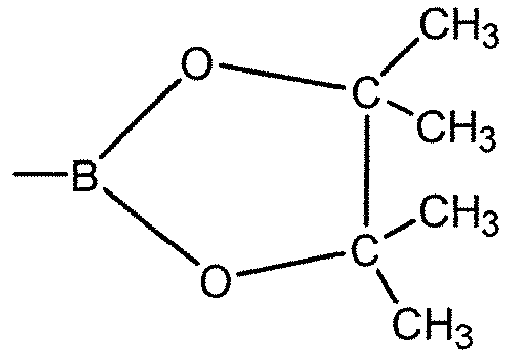

- Each of the groups described above can be easily obtained by reacting, for example, boronic acid with ethylene glycol, or pinacol.
- The aromatic boronic acid compound represented by Formula (I) takes the form of boronic acid, boronic ester, or boronic acid salt by comprising a boronic acid group represented by Formula (a).
- The aromatic boronic acid compound represented by Formula (I) can also be used as a cyclic trimer obtained by subjecting the aromatic boronic acid compound to a dehydration-condensation reaction. Such cyclic trimers are referred to as a boroxine compound, represented by the chemical formula below.

- In the present invention, at least one boronic acid compound selected from the group consisting of the aromatic boronic acid compounds represented by Formula (I) described above and cyclic trimers formed by dehydration-condensation of the aromatic boronic acid compound may be used.
- The aromatic boronic acid compound represented by Formula (I) and a cyclic trimer thereof are known compounds that are readily obtainable.
- Among the starting materials, a compound represented by Formula (II) below is used as the aromatic chloride:

- The aromatic chloride represented by Formula (II) is a compound having a relatively low reactivity with an aromatic boronic acid compound. However, by employing the reaction conditions described below, the coupling reaction with an aromatic boronic acid compound can proceed smoothly.
- In Formula (II) above, L4 to L7 are the same or different and each represents a hydrogen atom, a fluorine atom, or a lower alkyl group. Among those groups, examples of the lower alkyl group are the same as those of the lower alkyl groups represented by L1 to L3 in Formula (I). A2 represents a hydrogen atom, a fluorine atom, -CN, -CF3, -OCF3, -O-A3, -COOA3, -CF2OA3, or a group represented by the formula below:


- In the group shown above, Y is a hydrogen atom, a fluorine atom, -CF3, or -OCF3.
- The aromatic chloride represented by Formula (II) is a known compound that is readily obtainable.
- The substitution sites of L4 to L7 and A2, which are the substituents on the benzene ring of Formula (II) above, are not limited to those shown in Formula (II), and may be arbitrarily selected on the benzene ring. As the aromatic chloride represented by Formula (II), a compound in which A2 is substituted at the para position relative to Cl is particularly preferable.
- The present invention requires reacting an aromatic chloride represented by Formula (II) with at least one boronic acid compound selected from the group consisting of the aromatic boronic acid compounds represented by Formula (I) and cyclic trimers formed by dehydration-condensation of the aromatic boronic acid compound, in a water-containing solvent using a palladium compound as a catalyst in the presence of a tertiary amine compound.
- This method uses as a starting material the boronic acid compound, which is unstable and easily undergoes hydrolysis, and the reaction is conducted in a water-containing solvent. However, by combining the conditions described above, the target fluorine-containing biaryl compound represented by Formula (III) can be obtained at a high yield while preventing hydrolysis of the starting material:

- In terms of the proportion of at least one boronic acid compound selected from the group consisting of the aromatic boronic acid compounds represented by Formula (I) and cyclic trimers formed by dehydration-condensation of the aromatic boronic acid compound to the aromatic chloride represented by Formula (II), the boronic acid compound is generally used in an excessive amount relative to the aromatic chloride in conventional methods because the boronic acid compound easily undergoes hydrolysis. However, in the process of the present invention, because the hydrolysis of the boronic acid compound can be suppressed, the target object can be obtained at a high yield even when the proportion of the boronic acid compound is reduced.
- For example, per 1 mol of the aromatic chloride represented by Formula (II), the aromatic boronic acid compound represented by Formula (I) may be used in an amount of about 0.8 to 1.5 mol, preferably about 0.9 to 1.2 mol, more preferably about 0.95 to 1.1 mol, and further more preferably about 1.0 to 1.05 mol. When a boroxine compound, which is a cyclic trimer of the aromatic boronic acid compound, is used as the starting material, 1 mol of the cyclic trimer is regarded as 3 mol of the aromatic boronic acid compound represented by Formula (I).
- As the water-containing solvent, water is used singly, or a mixture of water and an organic solvent is used. In the present invention, by conducting the reaction in the presence of the tertiary amine compound described below and in a water-containing solvent, the coupling reaction of the aromatic boronic acid compound with an aromatic chloride can proceed smoothly while suppressing the hydrolysis of the aromatic boronic acid compound.
- The amount of water-containing solvent per 1 g of the aromatic chloride represented by Formula (II) may be, as the amount of water, about 0.5 ml or more, for example, about 0.5 to 20 ml, preferably about 1 to 12 ml, and more preferably about 2 to 8 ml.
- As the organic solvents used in the mixed solvent, either a water-miscible organic solvent or an organic solvent which causes phase separation from water may be used. Specific examples thereof include DMAc (dimethylacetamide), DMF (dimethylformamide), acetonitrile, toluene, xylene, C1-8 alcohols (e.g., ethanol and isopropanol), tetrahydrofuran (THF), and dioxane. The proportion of water to organic solvent in the mixed solvent is not particularly limited, and the content of water, relative to the total amount of water and the organic solvent, is preferably about 20% by volume or more, more preferably about 50 to 90% by volume, and further more preferably about 60 to 80% by volume.
- The present invention requires the use of a tertiary amine compound as a basic compound. By the use of a tertiary amine compound under the reaction conditions of the present invention, the target fluorine-containing biaryl compound can be obtained at a high yield while suppressing hydrolysis of the aromatic boronic acid compound represented by Formula (I) and a cyclic trimer thereof. In contrast, when a strong inorganic base is used, hydrolysis of the starting material easily proceeds, and the reaction yield is greatly lowered.
- Examples of the tertiary amine compound include diethylmethylamine, trimethylamine, triethylamine (NEt3), diisopropylethylamine, and triisopropylamine. Among these, triethylamine is particularly preferable.
- The amount of the tertiary amine compound, relative to 1 mol of the aromatic boronic acid compound represented by Formula (I), is preferably about 1 to 4 mol, and more preferably about 1.1 to 2.5 mol. When the boroxine compound, which is a cyclic trimer of the aromatic boronic acid compound, is used as the starting material, 1 mol of the cyclic trimer is regarded as 3 mol of the aromatic boronic acid compound represented by Formula (I).
- The present invention uses a palladium catalyst. As the palladium catalyst, known palladium catalysts that are effective in the coupling reaction between an aromatic boronic acid compound and aromatic halide can be used. In particular, the palladium catalyst used in the present invention is preferably a palladium complex which is formed in the reaction system by the presence of a zerovalent or divalent palladium and a ligand for palladium in the reaction system. By using such a palladium complex, the coupling reaction of the aromatic boronic acid compound represented by Formula (I) with the aromatic chloride represented by Formula (II) proceeds smoothly. The compound that serves as the source of the zerovalent or divalent palladium and the ligand may be separately added to the water-containing solvent, which is the reaction solvent, so as to form a palladium complex in the reaction system. Alternatively, a palladium complex, which has been formed from palladium and a ligand, may be added to the water-containing solvent.
- Examples of the source of the zerovalent or divalent palladium include palladium carbon, in which Pd is supported on activated carbon; metal palladium-supported material, in which palladium is supported on silica, alumina, zeolite, or like carrier; and divalent palladium-containing palladium salts, such as palladium chloride, palladium acetate, palladium bromide, and palladium iodide.
- As the ligand for palladium, known ligands capable of forming a palladium complex usable in the coupling reaction can be used. In particular, the use of an electron-rich tertiary phosphine-based ligand that comprises at least one alkyl group, and further comprises a bulky substituent is preferable.
- Specific examples of such tertiary phosphine-based ligands include the following compounds:


- When the compound that serves as the source of palladium and a ligand are separately added to the reaction mixture, the amount of the ligand is not particularly limited, and is preferably about 1 to 4 mol per 1 mol of palladium.
- In the present invention, by employing the above conditions, the coupling reaction can proceed smoothly with an amount of palladium catalyst smaller than that used in conventional methods. For example, the amount of the palladium catalyst, calculated as the amount of palladium atoms contained in the palladium catalyst, is as small as about 0.00005 mol or more relative to 1 mol of the aromatic chloride represented by Formula (II); the use of such an extremely small amount of palladium catalyst can allow the reaction to proceed smoothly. There is no particular upper limitation on the amount of the palladium catalyst used, as the use of a large amount of palladium catalyst does not adversely affect the progress of the reaction. However, the use of an unduly large amount of catalyst increases the cost; therefore, the amount of the palladium catalyst, calculated as the amount of palladium atoms, may be generally about 0.004 mol or less relative to 1 mol of the aromatic chloride.
- In the present invention, a phase transfer catalyst may be used, if necessary. By the use of a phase transfer catalyst, the reaction yield can be improved.
- The phase transfer catalyst is not particularly limited. Examples thereof include quaternary ammonium salts, such as benzyltriethylammonium bromide, benzyltrimethylammonium chloride, hexadecyltriethylammonium bromide, hexadecyltriethylammonium bromide, hexadecyltrimethylammonium chloride, dodecyltriethylammonium chloride, octyltriethylammonium bromide, tetra-n-butylammonium bromide, tetra-n-butylammonium chloride, tetraethylammonium chloride, and trioctylmethylammonium chloride; quaternary phosphonium salts, such as hexadecyltriethylphosphonium bromide, hexadecyltributylphosphonium chloride, tetra-n-butylphosphonium bromide, tetra-n-butylphosphonium chloride, trioctylethylphosphonium bromide, and tetraphenylphosphonium bromide; and crown ethers, such as 18-crown-6, dibenzo-18-crown-6, and dicyclohexyl-18-crown-6.
- The amount of the phase transfer catalyst used is not particularly limited and may be selected from the range of preferably about 0.005 to 0.3 mol, and more preferably about 0.01 to 0.1 mol per 1 mol of the aromatic chloride represented by Formula (II).
- In the present invention, it is necessary that the coupling reaction of the aromatic chloride represented by Formula (II) with at least one boronic acid compound selected from the group consisting of aromatic boronic acid compounds represented by Formula (I) and cyclic trimers formed by dehydration-condensation of the aromatic boronic acid compound be conducted under heating. By conducting the reaction under heating in the presence of a tertiary amine compound, the reaction yield can be improved without using expensive additives, while suppressing the decomposition of the aromatic boronic acid compound that is used as a starting material. Specifically, the reaction temperature is preferably 60°C or more, more preferably about 75 to 125°C, and still more preferably about 85 to 110°C.
- There is no particular limitation on the pressure applied during the reaction, which can be conducted under a wide range of pressure from reduced pressure to increased pressure. Usually, the reaction may be conducted under an ordinary pressure to an increased pressure such as about 0.1 to 0.4 MPa. When a glass reactor is used as the reaction vessel, the pressure is preferably in the range from reduced pressure to ordinary pressure; and when an autoclave is used, the reaction is preferably conducted under increased pressure.
- The method described above allows the fluorine-containing biaryl compound represented by Formula (III) below to be obtained at a high yield:

- The fluorine-containing biaryl compound obtained by the above process can be purified and collected by known methods such as column chromatography, recrystallization, or the like.
- The present invention makes it possible to obtain the target fluorine-containing biaryl compound at a high yield, using a relatively inexpensive starting material without using expensive additives, and further without using a large amount of aromatic boronic acid compound or catalyst.
- Therefore, the present invention is industrially advantageous as a process for producing a biaryl compound comprising a fluorine atom at the ortho position.
- Hereunder, the present invention is explained in detail with reference to Examples.
- 4.31 g (29.0 mmol) of 1-chloro-3,5-difluorobenzene and 7.64 g (29.6 mmol, 1.02 equivalent amount) of 4'-propyl-3-fluoro-4-biphenylboronic acid were placed in a 200-ml SUS autoclave, after which 468 mg (0.05 equivalent amount) of tetra-n-butyl ammonium bromide (hereunder referred to as "TBAB"), 5.5 mg (0.0004 equivalent amount) of 2-dicyclohexylphosphino-2',4',6'-triisopropylbiphenyl (purchased from Johnson Matthey Japan Inc.), and 24.7 mg (0.0002 equivalent amount) of 5% palladium carbon (50% moisture content, manufactured by N.E. Chemcat Corporation; E-Type) were placed in the autoclave. The autoclave was subsequently sealed, and the atmosphere therein was replaced with nitrogen. Thereafter, 30 ml of deaerated water and 10 ml of deaerated toluene were added thereto, and 4.4 g (1.5 equivalent amount) of triethylamine was further added thereto, followed by stirring at the reaction liquid temperature of 95°C for 3 hours.
- The mixture was stirred at room temperature for 20 minutes, and 30 ml of toluene and 20 ml of water were added to the reaction mixture, followed by additional stirring for 15 minutes. The reaction yield at this point was 99.8% (quantified by 19F NMR). The organic layer was subjected to suction filtration (using Celite), the filtrate was concentrated, and then the residue was purified using column chromatography. The crude substance thus obtained was recrystallized with a mixed solvent of n-heptane and denatured ethanol, thereby obtaining 3,5,2'-trifluoro-4"-propyl-[1,1';4',1"]terphenyl in the form of a white solid.
Amount obtained: 8.43 g (isolation yield 89%)
Melting point: 59°C
19F-NMR (376MHz, CDCl3) δ -110.2(t, J = 7.6Hz, 2F), -117.6 (d, J = 12.0Hz, 1F). - 8.62 g (58.0 mmol) of 1-chloro-3,5-difluorobenzene and 10.77 g (59.2 mmol, 1.02 equivalent amount) of 2-fluoro-4-propylphenylboronic acid were placed in a 200-ml SUS autoclave, after which 935 mg (0.05 equivalent amount) of TBAB and 20.5 mg (0.0005 equivalent amount) of bis(di-tert-butyl(4-dimethylaminophenyl)phosphine)dichloropalladium (II) (purchased from Johnson Matthey Japan Inc.) were placed in the autoclave. The autoclave was subsequently sealed, and the atmosphere therein was replaced with nitrogen. Thereafter, 50 ml of deaerated water was added thereto, and 8.8 g (1.5 equivalent amount) of triethylamine was further added thereto, followed by stirring at the reaction liquid temperature of 85°C for 2 hours.
- The mixture was stirred at room temperature for 20 minutes, and 30 ml of toluene was added to the reaction mixture, followed by additional stirring for 15 minutes. The reaction yield at this point was 99.2% (quantified by 19F NMR). The organic layer was subjected to suction filtration (using Celite), the filtrate was concentrated, and then the residue was purified using column chromatography. The oily substance obtained was subjected to distillation under reduced pressure, thereby obtaining 2,3',5'-trifluoro-4-propylbiphenyl in the form of a colorless liquid.
Amount obtained: 12.1 g (isolation yield 83%)
19F-NMR (376MHz, CDCl3) δ -110.3 (t, J = 7.6Hz, 2F), -117.0(d, J = 12.0Hz, 1F). - 1.00 g (2.90 mmol) of 5-[4-chloro-2,6-difluorophenyl)difluoromethoxy]-1,2,3-trifluorobenzene and 0.764 g (2.96 mmol, 1.02 equivalent amount) of 4'-propyl-3-fluoro-4-biphenylboronic acid were placed in a 50-ml SUS autoclave, after which 46.7 mg (0.05 equivalent amount) of TBAB and 1.0 mg (0.0005 equivalent amount) of bis(di-tert-butyl(4-dimethylaminophenyl)phosphine)dichloropalladium (II) (purchased from Johnson Matthey Japan Inc.) were placed in the autoclave. The autoclave was subsequently sealed, and the atmosphere therein was replaced with nitrogen.
- The 5-[4-chloro-2,6-difluorophenyl)difluoromethoxy]-1,2,3-trifluorobenzene used as the starting material is a compound that can be easily obtained by the methods described in
WO 2001/064667 A1 ,JP1998-273294A - Thereafter, 4.0 ml of deaerated water was added thereto, and 0.44 g (1.5 equivalent amount) of triethylamine was further added thereto, followed by stirring at the reaction liquid temperature of 85°C for 2 hours. The mixture was stirred at room temperature for 20 minutes, and 4.0 ml of toluene and 2.0 ml of water were added to the reaction mixture, followed by additional stirring for 15 minutes. The reaction yield at this point was 98.8% (quantified by 19F NMR). The organic layer was subjected to suction filtration (using Celite), the filtrate was concentrated, and then the residue was purified using column chromatography. The crude substance thus obtained was recrystallized with a mixed solvent of n-heptane and denatured ethanol, thereby obtaining 4-[difluoro-(3,4,5-trifluoro-phenoxy)-methyl]-2',3,5-trifluoro-4" -propyl-[1,1';4',1"]terphenyl in the form of a white solid.
Amount obtained: 1.44 g (isolation yield 95.0%)
Melting point: 85°C
1H-NMR (254MHz, CDCl3) δ 7.72-7.46(m, 7H), 7.34-7.19(m, 4H), 2.67-2.61 (t, J = 7.6Hz, 2H), 1.74-1.60 (m, 2H), 0.98-0.92 (t, J = 7.6Hz, 3H), 19F-NMR (254MHz, CDCl3) δ -60.8 (t, J = 26.7Hz, 2F), -110.6 to -111.6(m, 2F), -117.0(dd, J = 12.7, 8.4Hz, 1F), -133.2 to - 133.4(m, 2F), -164.1 to -164.3(m, 1F). - 1.00 g (2.90 mmol) of 5-[4-chloro-2,6-difluorophenyl)difluoromethoxy]-1,2,3-trifluorobenzene and 0.765 g (2.96 mmol, 1.02 equivalent amount) of 4'-propyl-3-fluoro-4-biphenylboronic acid were placed in a 50-ml SUS autoclave, after which 46.9 mg (0.05 equivalent amount) of TBAB, 0.68 mg (0.0006 equivalent amount) of 1,1-diphenyl-2-(dicyclohexylphosphino)propene) (purchased from Takasago International Corporation), and 2.47 mg (0.0002 equivalent amount) of 5% palladium carbon (50% moisture content, manufactured by N.E. Chemcat Corporation; E-Type) were placed in the autoclave. The autoclave was subsequently sealed, and the atmosphere therein was replaced with nitrogen. Thereafter, 3.0 ml of deaerated water and 1.0 ml of deaerated N,N-dimethylacetamide (hereunder referred to as "DMAc") were added thereto, and 0.44 g (1.5 equivalent amount) of triethylamine was further added thereto, followed by stirring at the reaction liquid temperature of 94°C for 4 hours. The mixture was stirred at room temperature for 20 minutes, and 5.0 ml of toluene and 2.0 ml of water were added to the reaction mixture, followed by additional stirring for 15 minutes. The reaction yield was 96.6% (quantified by 19F NMR).
- 200 g (580 mmol) of 5-[4-chloro-2,6-difluorophenyl)difluoromethoxy]-1,2,3-trifluorobenzene and 153 g (593 mmol, 1.02 equivalent amount) of 4'-propyl-3-fluoro-4-biphenylboronic acid were placed in a 3.0-L SUS autoclave, after which 9.34 g (0.05 equivalent amount) of TBAB, 111 mg (0.0004 equivalent amount) of 2-dicyclohexylphosphino-2',4',6'-triisopropylbiphenyl (purchased from Johnson Matthey Japan Inc.), and 494 mg (0.0002 equivalent amount) of 5% palladium carbon (50% moisture content, manufactured by N.E. Chemcat Corporation; E-Type) were placed in the autoclave. The autoclave was subsequently sealed, and the atmosphere therein was replaced with nitrogen. Thereafter, 600 ml of deaerated water and 200 ml of deaerated toluene were added thereto, and 88.2 g (1.5 equivalent amount) of triethylamine was further added thereto, followed by stirring at the reaction liquid temperature of 95°C for 3 hours.
- The mixture was allowed to cool to room temperature and then stirred for 60 minutes. Thereafter, 400 ml of toluene and 200 ml of water were added to the reaction mixture, followed by additional stirring for 20 minutes. The reaction yield at this point was 99.7% (quantified by 19F NMR). The organic layer was subjected to suction filtration (using Celite), the filtrate was concentrated, and then the residue was purified using column chromatography. The crude substance thus obtained was recrystallized with denatured ethanol, thereby obtaining 4-[difluoro-(3,4,5-trifluoro-phenoxy)-methyl]-2',3,5-trifluoro-4"-propyl-[1,1';4',1'']terphenyl in the form of a white solid. Amount obtained: 292 g (isolation yield 96.4%, purity 99.9%).
- 1.00 g (2.90 mmol) of 5-[4-chloro-2,6-difluorophenyl)difluoromethoxy]-1,2,3-trifluorobenzene and 0.764 g (2.96 mmol, 1.02 equivalent amount) of 4'-propyl-3-fluoro-4-biphenylboronic acid were placed in a 50-ml SUS autoclave, after which 46.7 mg (0.05 equivalent amount) of TBAB, 1.10 mg (0.0008 equivalent amount) of 2-dicyclohexylphosphino-2',4',6'-triisopropylbiphenyl (purchased from Johnson Matthey Japan Inc.), and 4.94 mg (0.0004 equivalent amount) of 5% palladium carbon (50% moisture content, manufactured by N.E. Chemcat Corporation; E-Type) were placed in the autoclave. The autoclave was subsequently sealed, and the atmosphere therein was replaced with nitrogen. Thereafter, 3.0 ml of deaerated water and 1.0 ml of deaerated DMAC were added thereto, and 0.44 g (1.5 equivalent amount) of triethylamine was further added thereto, followed by stirring at the reaction liquid temperature of 95°C for 3 hours. The mixture was stirred at room temperature for 20 minutes, and 5.0 ml of toluene and 2.0 ml of water were added to the reaction mixture, followed by additional stirring for 15 minutes. The reaction yield was 99.4% (quantified by 19F NMR).
- The reaction was conducted in the same manner as in Example 3-4 except that the reaction liquid was stirred at the reaction liquid temperature of 115°C, in place of 95°C, for 3 hours. The results revealed that the reaction yield was 97.0% (quantified by 19F NMR).
- The reaction was conducted in the same manner as in Example 3-4 except that the reaction liquid was stirred at the reaction liquid temperature of 105°C, in place of 95°C, for 3 hours. The results revealed that the reaction yield was 98.4% (quantified by 19F NMR).
- The reaction was conducted in the same manner as in Example 3-4 except that the reaction liquid was stirred at the reaction liquid temperature of 85°C, in place of 95°C, for 3 hours. The results revealed that the reaction yield was 91.9% (quantified by 19F NMR).
- The reaction was conducted in the same manner as in Example 3-4 except that the reaction liquid was stirred at the reaction liquid temperature of 75°C, in place of 95°C, for 3 hours. The results revealed that the reaction yield was 78.4% (quantified by 19F NMR).
- The reaction was conducted in the same manner as in Example 3-4 except that the reaction liquid was stirred at the reaction liquid temperature of 65°C, in place of 95°C, for 4 hours. The results revealed that the reaction yield was 59.1% (quantified by 19F NMR).
- The reaction was conducted in the same manner as in Example 3-4 except that the reaction liquid was stirred at room temperature (20°C), in place of 95°C, for 3 hours. The results revealed that the target object was not detected at all (quantified by 19F NMR).
- The reaction was conducted in the same manner as in Example 3-4 except that potassium hydroxide (2.4 equivalent amount) was used in place of triethylamine. The results revealed that the reaction yield was 32.2% (quantified by 19F NMR).
- The reaction was conducted in the same manner as in Example 3-4 except that potassium phosphate (2.4 equivalent amount) was used in place of triethylamine. The results revealed that the reaction yield was 27.9% (quantified by 19F NMR).
- The reaction was conducted in the same manner as in Example 3-4 except that 4.0 ml of DMAc alone was used in place of a mixed solvent of water and DMAc. The results revealed that the reaction yield was 6.6% (quantified by 19F NMR).
- The reaction was conducted in the same manner as in Example 3-4 except that 4.0 ml of toluene alone was used in place of the mixed solvent of water and DMAc. The results revealed that the reaction yield was 33.9% (quantified by 19F NMR).
- 10.0 g (29.0 mmol) of 5-[4-chloro-2,6-difluorophenyl)difluoromethoxy]-1,2,3-trifluorobenzene and 8.47 g (29.6 mmol, 1.02 equivalent amount) of 4'-pentyl-3-fluoro-4-biphenylboronic acid were placed in a 300-ml SUS autoclave, after which 467 mg (0.05 equivalent amount) of TBAB, 16.6 mg (0.0012 equivalent amount) of 2-dicyclohexylphosphino-2',4',6'-triisopropylbiphenyl (purchased from Johnson Matthey Japan Inc.), and 49.4 mg (0.0004 equivalent amount) of 5% palladium carbon (50% moisture content, manufactured by N.E. Chemcat Corporation; E-Type) were placed in the autoclave. The autoclave was subsequently sealed, and the atmosphere therein was replaced with nitrogen. Thereafter, 30 ml of deaerated water and 10 ml of deaerated DMAc was added thereto, and 4.5 g (1.5 equivalent amount) of triethylamine was further added thereto, followed by stirring at the reaction liquid temperature of 99°C for 4 hours.
- The mixture was stirred at room temperature for 20 minutes, and 50 ml of toluene and 30 ml of water were added to the reaction mixture, followed by additional stirring for 15 minutes. The reaction yield was 97.7% (quantified by 19F NMR). The organic layer was subjected to suction filtration (using Celite), the filtrate was concentrated, and then the residue was purified using column chromatography. The crude substance thus obtained was recrystallized with a mixed solvent of denatured ethanol and heptane, thereby obtaining 4-[difluoro-(3,4,5-trifluoro-phenoxy)-methyl]-2',3,5-trifluoro-4"-pentyl-[1,1';4',1"]terphenyl in the form of a white solid.
Amount obtained: 14.8 g (isolation yield 93.0%, purity 99.9%).
Melting point: 52°C.
1H-NMR(254MHz, CDCl3) δ 7.54-7.25(m, 9H), 7.01-6.98(dd, J = 7.8, 5.8Hz, 2H), 2.68-2.64(t, J = 7.8Hz, 2H), 1.70-1.63(m, 2H), 1.38-1.32(m, 4H), 0.93-0.90(t, J = 6.8Hz, 3H), 19F-NMR (254MHz, CDCl3) δ -62.0(t, J = 25.9Hz, 2F), -110.9 to -111.1(td, J = 26.7, 10.8Hz, 2F), -117.1(dd, J = 12.9, 12.7Hz, 1F), -132.8(m, 2F), -163.4 to -163.6 (m, 1F). - The reaction was conducted in the same manner as in Example 4 except that the reaction liquid was stirred at the reaction liquid temperature of 85°C, in place of 99°C, for 5 hours. The results revealed that the reaction yield was 74.2% (quantified by 19F NMR).
- 1.00 g (2.90 mmol) of 5-[4-chloro-2,6-difluorophenyl)difluoromethoxy]-1,2,3-trifluorobenzene and 0.539 g (2.96 mmol, 1.02 equivalent amount) of 2-fluoro-4-propylphenylboronic acid were placed in a 50-ml SUS autoclave, after which 4.67 mg (0.05 equivalent amount) of TBAB, 5.5 mg (0.0004 equivalent amount) of 2-dicyclohexylphosphino-2',4',6'-triisopropylbiphenyl (purchased from Johnson Matthey Japan Inc.), and 2.47 mg (0.0002 equivalent amount) of 5% palladium carbon (50% moisture content, manufactured by N.E. Chemcat Corporation; E-Type) were placed in the autoclave. The autoclave was subsequently sealed, and the atmosphere therein was replaced with nitrogen. Thereafter, 3.0 ml of deaerated water and 1.0 ml of deaerated toluene were added thereto, and 0.44 g (1.5 equivalent amount) of triethylamine was further added thereto, followed by stirring at the reaction liquid temperature of 95°C for 3 hours.
- The mixture was stirred at room temperature for 15 minutes, and 3.0 ml of toluene and 2.0 ml of water were added to the reaction mixture, followed by additional stirring for 20 minutes. The reaction yield at this point was 99.5% (quantified by 19F NMR). The organic layer was subjected to suction filtration (using Celite), the filtrate was concentrated, and then the residue was purified using column chromatography. The crude substance thus obtained was recrystallized with methanol, thereby obtaining 4-[difluoro-(3,4,5-trifluoro-phenoxy)-methyl]-3,5,2'-trifluoro-4'-propyl-biphenyl in the form of a white solid.
Amount obtained: 1.22 g (isolation yield 93.9%)
Melting point: 48°C
19F-NMR (376MHz, CDCl3) δ -60.8 (t, J = 26.7Hz, 2F), -110.2 (t, J = 7.6Hz, 2F), -117.6 (d, J = 12.0Hz, 1F), -133.2 to -133.4(m, 2F), -164.1 to -164.3(m, 1F). - The reaction was conducted in the same manner as in Example 5 except that the starting materials were changed to the combination of 4-chloro-2,6-difluoro-benzoic acid 3,4,5-trifluoro-phenyl ester) with 4'-propyl-3-fluoro-4-biphenylboronic acid. The results revealed that the reaction yield was 98.6%. 19F-NMR (376MHz, CDCl3) δ -108.7 (d, J = 10.2Hz, 2F), -116.8 (d, J = 10.2Hz, 1F), -132.6 to -132.7 (m, 2F), -163.0(m, 1F).
- The reaction was conducted in the same manner as in Example 5 except that the starting materials were changed to the combination of 5-[4-chloro-2,6-difluorophenyl)difluoromethoxy]-1,3-difluorobenzene with 4'-propyl-3-fluoro-4-biphenylboronic acid. The results revealed that the reaction yield was 99.6%. 19F-NMR (376MHz, CDCl3) δ -61.6 to -61.7 (t, J = 25.9Hz, 2F), -108.5 (t, J = 7.9Hz, 2F), -110.8 to -111.0 (m, 2F), -117.1 (d, J = 8.6Hz, 1F).
- The reaction was conducted in the same manner as in Example 5 except that the starting materials were changed to the combination shown in the reaction scheme below. The results revealed that the reaction yield of the target object was 98.0%.

- The reaction was conducted in the same manner as in Example 5 except that the starting materials were changed to the combination shown in the reaction scheme below. The results revealed that the reaction yield of the target object was 92.2%.

Claims (8)
- A process for producing a fluorine-containing biaryl compound represented by Formula (III):

L1 to L3 are the same or different and each represents a hydrogen atom, a fluorine atom, or a lower alkyl group;
L4 to L7 are the same or different and each represents a hydrogen atom, a fluorine atom, or a lower alkyl group;
A1 is a hydrogen atom, a fluorine atom, a lower alkyl group, a cyclic aliphatic hydrocarbon group optionally having one or more substituents, and further optionally having one or more hetero atoms, a substituted or unsubstituted phenyl group, or a substituted or unsubstituted aromatic heterocyclic group, and
A2 is a hydrogen atom, a fluorine atom, -CN, -CF3, -OCF3, -O-A3, -COOA3, -CF2OA3, or a group represented by the formula below:

provided that the substitution sites of L1 to L3 and A1 in the benzene ring may be arbitrarily selected, and the substitution sites of L4 to L7 and A2 in the benzene ring may also be arbitrarily selected:
the process comprising:reacting an aromatic chloride with at least one boronic acid compound selected from the group consisting of aromatic boronic acid compounds and cyclic trimers formed by dehydration-condensation of the aromatic boronic acid compound, in a water-containing solvent, under heating, in the presence of a palladium catalyst and a tertiary amine compound;whereinthe aromatic boronic acid compound is represented by Formula (I):

the aromatic chloride is represented by Formula (II):
- The process for producing a fluorine-containing biaryl compound according to claim 1, wherein the aromatic boronic acid represented by Formula (I) is a compound in which A1 is substituted at the para position relative to X, and the aromatic chloride represented by Formula (II) is a compound in which A2 is substituted at the para position relative to Cl.
- The process for producing a fluorine-containing biaryl compound according to claim 1 or 2, wherein the water-containing solvent is a mixture of water and an organic solvent, or water alone.
- The process for producing a fluorine-containing biaryl compound according to any one of claims 1 to 3, wherein the tertiary amine compound is triethylamine.
- The process for producing a fluorine-containing biaryl compound according to any one of claims 1 to 4, wherein the reaction temperature is 60°C or more.
- The process for producing a fluorine-containing biaryl compound according to any one of claims 1 to 5, wherein the palladium catalyst is a palladium complex formed of a zerovalent or divalent palladium and a tertiary phosphine-based ligand.
- The process for producing a fluorine-containing biaryl compound according to claim 6, wherein the palladium complex is one which is formed in a water-containing solvent by adding a tertiary phosphine-based ligand and a compound that serves as a source for a zerovalent or divalent palladium to the water-containing solvent, or the palladium complex is one which has been formed beforehand from a zerovalent or divalent palladium and tertiary phosphine-based ligand.
- The process for producing a fluorine-containing biaryl compound according to any one of claims 1 to 7, wherein the reaction is performed further in the presence of a phase transfer catalyst.
Applications Claiming Priority (1)
| Application Number | Priority Date | Filing Date | Title |
|---|---|---|---|
| JP2013204525 | 2013-09-30 |
Publications (2)
| Publication Number | Publication Date |
|---|---|
| EP2853523A1 true EP2853523A1 (en) | 2015-04-01 |
| EP2853523B1 EP2853523B1 (en) | 2018-05-30 |
Family
ID=51687786
Family Applications (1)
| Application Number | Title | Priority Date | Filing Date |
|---|---|---|---|
| EP14185927.2A Active EP2853523B1 (en) | 2013-09-30 | 2014-09-23 | Process for producing fluorine-containing biaryl compound |
Country Status (5)
| Country | Link |
|---|---|
| EP (1) | EP2853523B1 (en) |
| JP (1) | JP5975081B2 (en) |
| KR (1) | KR101709832B1 (en) |
| CN (1) | CN104513115B (en) |
| HU (1) | HUE037816T2 (en) |
Families Citing this family (1)
| Publication number | Priority date | Publication date | Assignee | Title |
|---|---|---|---|---|
| CN105669396B (en) * | 2016-02-19 | 2018-06-05 | 江苏和成新材料有限公司 | A kind of preparation of industrialization chromatographic separation and purification method of Z6148 liquid crystal molecules |
Citations (8)
| Publication number | Priority date | Publication date | Assignee | Title |
|---|---|---|---|---|
| JPH10273294A (en) | 1997-03-31 | 1998-10-13 | Toyota Autom Loom Works Ltd | Speed control device for tilt cylinder |
| WO2001064667A1 (en) | 2000-03-03 | 2001-09-07 | Merck Patent Gmbh | Producing liquid crystals with cf2o bond |
| WO2007031828A2 (en) | 2005-09-13 | 2007-03-22 | Pfizer Products Inc. | Therapeutic pyrrolidines |
| EP1900792A1 (en) * | 2006-09-13 | 2008-03-19 | Merck Patent GmbH | Fluorine phenyl compounds for liquid crystalline mixtures |
| WO2010045258A2 (en) | 2008-10-15 | 2010-04-22 | Amgen Inc. | Spirocyclic gpr40 modulators |
| JP2011195587A (en) | 2010-03-23 | 2011-10-06 | Merck Patent Gmbh | Liquid crystal compound and liquid crystal medium |
| JP2011225566A (en) | 2010-04-17 | 2011-11-10 | Merck Patent Gmbh | Liquid crystal compound and liquid crystal medium |
| CN102675062A (en) | 2012-04-27 | 2012-09-19 | 石家庄诚志永华显示材料有限公司 | Method for preparing difluoromethoxy bridge type liquid crystal |
Family Cites Families (7)
| Publication number | Priority date | Publication date | Assignee | Title |
|---|---|---|---|---|
| GB9017482D0 (en) * | 1990-08-09 | 1990-09-26 | Ici Plc | Manufacturing process |
| DE4220082C2 (en) * | 1992-06-19 | 1994-09-15 | Merck Patent Gmbh | Process for the cross-coupling of boronic acids with halogen compounds |
| JP4507294B2 (en) * | 1999-05-27 | 2010-07-21 | チッソ株式会社 | Method for producing biaryl derivative |
| US20020016512A1 (en) * | 2000-07-17 | 2002-02-07 | Yongkui Sun | Heterogeneously catalyzed process for cross coupling aryl chlorides with aryl boronic acids |
| JP4082888B2 (en) * | 2001-10-17 | 2008-04-30 | 広栄化学工業株式会社 | Process for producing biaryl compounds |
| CN101774871A (en) * | 2010-01-30 | 2010-07-14 | 大连理工大学 | Method for preparing biaryl compound in pure water solution |
| CN102491862B (en) * | 2011-12-08 | 2014-06-25 | 大连理工大学 | Method for preparing biaryl compound in pure water |
-
2014
- 2014-09-12 JP JP2014186047A patent/JP5975081B2/en active Active
- 2014-09-23 EP EP14185927.2A patent/EP2853523B1/en active Active
- 2014-09-23 HU HUE14185927A patent/HUE037816T2/en unknown
- 2014-09-29 KR KR1020140130230A patent/KR101709832B1/en active Active
- 2014-09-29 CN CN201410515437.9A patent/CN104513115B/en active Active
Patent Citations (9)
| Publication number | Priority date | Publication date | Assignee | Title |
|---|---|---|---|---|
| JPH10273294A (en) | 1997-03-31 | 1998-10-13 | Toyota Autom Loom Works Ltd | Speed control device for tilt cylinder |
| WO2001064667A1 (en) | 2000-03-03 | 2001-09-07 | Merck Patent Gmbh | Producing liquid crystals with cf2o bond |
| WO2007031828A2 (en) | 2005-09-13 | 2007-03-22 | Pfizer Products Inc. | Therapeutic pyrrolidines |
| EP1900792A1 (en) * | 2006-09-13 | 2008-03-19 | Merck Patent GmbH | Fluorine phenyl compounds for liquid crystalline mixtures |
| JP2008069153A (en) | 2006-09-13 | 2008-03-27 | Merck Patent Gmbh | Fluorophenyl compounds for liquid crystal mixture |
| WO2010045258A2 (en) | 2008-10-15 | 2010-04-22 | Amgen Inc. | Spirocyclic gpr40 modulators |
| JP2011195587A (en) | 2010-03-23 | 2011-10-06 | Merck Patent Gmbh | Liquid crystal compound and liquid crystal medium |
| JP2011225566A (en) | 2010-04-17 | 2011-11-10 | Merck Patent Gmbh | Liquid crystal compound and liquid crystal medium |
| CN102675062A (en) | 2012-04-27 | 2012-09-19 | 石家庄诚志永华显示材料有限公司 | Method for preparing difluoromethoxy bridge type liquid crystal |
Non-Patent Citations (11)
| Title |
|---|
| ANGEWANDTE CHEMIE, INT ED, vol. 44, 2008, pages 928 - 931 |
| ANGEWANDTE CHEMIE, INT ED, vol. 44, no. 38, 2005, pages 6173 - 6177 |
| BARDER TIMOTHY E ET AL: "Catalysts for Suzuki-Miyaura Coupling Processes: Scope and Studies of the Effect of Ligand Structure", JOURNAL OF THE AMERICAN CHEMICAL SOCIETY, AMERICAN CHEMICAL SOCIETY, vol. 127, no. 13, 1 January 2005 (2005-01-01), pages 4685 - 4696, XP002413444, ISSN: 0002-7863, DOI: 10.1021/JA042491J * |
| BRUCE H. LIPSHUTZ ET AL: "Room-Temperature Suzuki-Miyaura Couplings in Water Facilitated by Nonionic Amphiphiles +", ORGANIC LETTERS, vol. 10, no. 7, 1 April 2008 (2008-04-01), pages 1333 - 1336, XP055164171, ISSN: 1523-7060, DOI: 10.1021/ol702714y * |
| C. ZHANG ET AL.: "Palladium-Imidazol-2-yliden Complexes as catalysts for facile and efficient Suzuki Cross-Coupling reactions of aryl chlorides with arylboronic acids", JOURNAL OF ORGANIC CHEMISTRY, vol. 64, 5 June 1999 (1999-06-05), pages 3804 - 3805, XP002734969 * |
| JOURNAL OF THE AMERICAN CHEMICAL SOCIETY, vol. 127, no. 13, 2005, pages 4685 - 4696 |
| JOURNAL OF THE AMERICAN CHEMICAL SOCIETY, vol. 132, no. 40, 2010, pages 14073 - 14075 |
| NAJERA C ET AL: "Highly active oxime-derived palladacycle complexes for Suzuki-Miyaura and Ullmann-type coupling reactions", THE JOURNAL OF ORGANIC CHEMISTRY, AMERICAN CHEMICAL SOCIETY, US, vol. 67, 1 January 2002 (2002-01-01), pages 5588 - 5594, XP002285485, ISSN: 0022-3263, DOI: 10.1021/JO025619T * |
| ORGANIC LETTERS, vol. 10, no. 7, 2008, pages 1333 - 1336 |
| SYNTHESIS, 2006, pages 692 - 698 |
| TETRAHEDRON LETTERS, vol. 52, no. 39, 2011, pages 5055 - 5059 |
Also Published As
| Publication number | Publication date |
|---|---|
| KR101709832B1 (en) | 2017-02-23 |
| CN104513115B (en) | 2017-09-19 |
| JP5975081B2 (en) | 2016-08-23 |
| HUE037816T2 (en) | 2018-09-28 |
| EP2853523B1 (en) | 2018-05-30 |
| KR20150037629A (en) | 2015-04-08 |
| CN104513115A (en) | 2015-04-15 |
| JP2015091776A (en) | 2015-05-14 |
Similar Documents
| Publication | Publication Date | Title |
|---|---|---|
| KR101915491B1 (en) | Preparation of biaryls | |
| JP7644477B2 (en) | Method for producing phosphate compounds | |
| JPWO2008102661A1 (en) | Method for producing trialkylsilyl nitrile | |
| US9035084B2 (en) | Preparation method of aromatic boronate compounds | |
| US12344586B2 (en) | Process for the preparation of biphenylamines | |
| EP3452437B1 (en) | Method for aromatic fluorination | |
| KR101158121B1 (en) | Method for producing 4-fluoro-1,3-dioxolan-2-one | |
| KR101913484B1 (en) | Method for producing compound having oxydifluoromethylene skeleton | |
| EP2853523B1 (en) | Process for producing fluorine-containing biaryl compound | |
| JP6498048B2 (en) | Fluorine-containing organic compound and method for producing biaryl compound using this and Grignard reagent | |
| JP4742358B2 (en) | Method for producing fluorine-containing ether compound | |
| JP2009126828A (en) | Fluorine-substituted pyrazole compound and method for producing the same | |
| CN107250097B (en) | Practical production method of fluorine-containing α-ketocarboxylates | |
| KR102456277B1 (en) | Monoarylation of aromatic amines | |
| JP5663482B2 (en) | Method for producing pyrimidinylacetonitrile derivative and synthetic intermediate thereof | |
| JP2010120926A (en) | Polycyclic pentafluorosulfanylbenzene compound and method for producing the same | |
| JP2022075516A (en) | Method for producing α-substituted carbonyl compound | |
| KR101947856B1 (en) | Method for producing a substituted benzoic acid compound | |
| CA3000198A1 (en) | Alkylation of picolinamides with substituted chloroacylals utilizing a crown ether catalyst | |
| JP5178098B2 (en) | Alicyclic vinyl ether compounds | |
| KR101303916B1 (en) | Potassium styrenyl trifluoroborate derivatives and method for producing the same | |
| JP2017071556A (en) | Process for producing prenyl carboxylates and prenols using oxovanadium complexes | |
| JP2005187423A (en) | Method for producing fluorine-containing alcohol | |
| CN111699172A (en) | Process for producing trifluoromethylsulfanylalkyl compound and trifluoromethylsulfanylalkyl compound composition | |
| JP2014172831A (en) | Production method of trifluoromethyl copper |
Legal Events
| Date | Code | Title | Description |
|---|---|---|---|
| PUAI | Public reference made under article 153(3) epc to a published international application that has entered the european phase |
Free format text: ORIGINAL CODE: 0009012 |
|
| 17P | Request for examination filed |
Effective date: 20140923 |
|
| AK | Designated contracting states |
Kind code of ref document: A1 Designated state(s): AL AT BE BG CH CY CZ DE DK EE ES FI FR GB GR HR HU IE IS IT LI LT LU LV MC MK MT NL NO PL PT RO RS SE SI SK SM TR |
|
| AX | Request for extension of the european patent |
Extension state: BA ME |
|
| STAA | Information on the status of an ep patent application or granted ep patent |
Free format text: STATUS: EXAMINATION IS IN PROGRESS |
|
| 17Q | First examination report despatched |
Effective date: 20161209 |
|
| GRAP | Despatch of communication of intention to grant a patent |
Free format text: ORIGINAL CODE: EPIDOSNIGR1 |
|
| STAA | Information on the status of an ep patent application or granted ep patent |
Free format text: STATUS: GRANT OF PATENT IS INTENDED |
|
| RIC1 | Information provided on ipc code assigned before grant |
Ipc: C07C 43/29 20060101ALI20180116BHEP Ipc: C07C 17/263 20060101ALI20180116BHEP Ipc: C09K 19/30 20060101ALI20180116BHEP Ipc: C07C 25/18 20060101ALI20180116BHEP Ipc: C09K 19/12 20060101ALI20180116BHEP Ipc: C07C 41/30 20060101AFI20180116BHEP |
|
| INTG | Intention to grant announced |
Effective date: 20180206 |
|
| GRAS | Grant fee paid |
Free format text: ORIGINAL CODE: EPIDOSNIGR3 |
|
| GRAA | (expected) grant |
Free format text: ORIGINAL CODE: 0009210 |
|
| STAA | Information on the status of an ep patent application or granted ep patent |
Free format text: STATUS: THE PATENT HAS BEEN GRANTED |
|
| AK | Designated contracting states |
Kind code of ref document: B1 Designated state(s): AL AT BE BG CH CY CZ DE DK EE ES FI FR GB GR HR HU IE IS IT LI LT LU LV MC MK MT NL NO PL PT RO RS SE SI SK SM TR |
|
| REG | Reference to a national code |
Ref country code: GB Ref legal event code: FG4D |
|
| REG | Reference to a national code |
Ref country code: CH Ref legal event code: EP |
|
| REG | Reference to a national code |
Ref country code: AT Ref legal event code: REF Ref document number: 1003441 Country of ref document: AT Kind code of ref document: T Effective date: 20180615 |
|
| REG | Reference to a national code |
Ref country code: IE Ref legal event code: FG4D |
|
| REG | Reference to a national code |
Ref country code: DE Ref legal event code: R096 Ref document number: 602014026109 Country of ref document: DE |
|
| REG | Reference to a national code |
Ref country code: FR Ref legal event code: PLFP Year of fee payment: 5 |
|
| REG | Reference to a national code |
Ref country code: HU Ref legal event code: AG4A Ref document number: E037816 Country of ref document: HU |
|
| REG | Reference to a national code |
Ref country code: NL Ref legal event code: MP Effective date: 20180530 |
|
| REG | Reference to a national code |
Ref country code: LT Ref legal event code: MG4D |
|
| PG25 | Lapsed in a contracting state [announced via postgrant information from national office to epo] |
Ref country code: SE Free format text: LAPSE BECAUSE OF FAILURE TO SUBMIT A TRANSLATION OF THE DESCRIPTION OR TO PAY THE FEE WITHIN THE PRESCRIBED TIME-LIMIT Effective date: 20180530 Ref country code: FI Free format text: LAPSE BECAUSE OF FAILURE TO SUBMIT A TRANSLATION OF THE DESCRIPTION OR TO PAY THE FEE WITHIN THE PRESCRIBED TIME-LIMIT Effective date: 20180530 Ref country code: BG Free format text: LAPSE BECAUSE OF FAILURE TO SUBMIT A TRANSLATION OF THE DESCRIPTION OR TO PAY THE FEE WITHIN THE PRESCRIBED TIME-LIMIT Effective date: 20180830 Ref country code: NO Free format text: LAPSE BECAUSE OF FAILURE TO SUBMIT A TRANSLATION OF THE DESCRIPTION OR TO PAY THE FEE WITHIN THE PRESCRIBED TIME-LIMIT Effective date: 20180830 Ref country code: CY Free format text: LAPSE BECAUSE OF FAILURE TO SUBMIT A TRANSLATION OF THE DESCRIPTION OR TO PAY THE FEE WITHIN THE PRESCRIBED TIME-LIMIT Effective date: 20180530 Ref country code: LT Free format text: LAPSE BECAUSE OF FAILURE TO SUBMIT A TRANSLATION OF THE DESCRIPTION OR TO PAY THE FEE WITHIN THE PRESCRIBED TIME-LIMIT Effective date: 20180530 Ref country code: ES Free format text: LAPSE BECAUSE OF FAILURE TO SUBMIT A TRANSLATION OF THE DESCRIPTION OR TO PAY THE FEE WITHIN THE PRESCRIBED TIME-LIMIT Effective date: 20180530 |
|
| PG25 | Lapsed in a contracting state [announced via postgrant information from national office to epo] |
Ref country code: GR Free format text: LAPSE BECAUSE OF FAILURE TO SUBMIT A TRANSLATION OF THE DESCRIPTION OR TO PAY THE FEE WITHIN THE PRESCRIBED TIME-LIMIT Effective date: 20180831 Ref country code: LV Free format text: LAPSE BECAUSE OF FAILURE TO SUBMIT A TRANSLATION OF THE DESCRIPTION OR TO PAY THE FEE WITHIN THE PRESCRIBED TIME-LIMIT Effective date: 20180530 Ref country code: HR Free format text: LAPSE BECAUSE OF FAILURE TO SUBMIT A TRANSLATION OF THE DESCRIPTION OR TO PAY THE FEE WITHIN THE PRESCRIBED TIME-LIMIT Effective date: 20180530 Ref country code: RS Free format text: LAPSE BECAUSE OF FAILURE TO SUBMIT A TRANSLATION OF THE DESCRIPTION OR TO PAY THE FEE WITHIN THE PRESCRIBED TIME-LIMIT Effective date: 20180530 |
|
| PG25 | Lapsed in a contracting state [announced via postgrant information from national office to epo] |
Ref country code: NL Free format text: LAPSE BECAUSE OF FAILURE TO SUBMIT A TRANSLATION OF THE DESCRIPTION OR TO PAY THE FEE WITHIN THE PRESCRIBED TIME-LIMIT Effective date: 20180530 |
|
| PG25 | Lapsed in a contracting state [announced via postgrant information from national office to epo] |
Ref country code: CZ Free format text: LAPSE BECAUSE OF FAILURE TO SUBMIT A TRANSLATION OF THE DESCRIPTION OR TO PAY THE FEE WITHIN THE PRESCRIBED TIME-LIMIT Effective date: 20180530 Ref country code: RO Free format text: LAPSE BECAUSE OF FAILURE TO SUBMIT A TRANSLATION OF THE DESCRIPTION OR TO PAY THE FEE WITHIN THE PRESCRIBED TIME-LIMIT Effective date: 20180530 Ref country code: EE Free format text: LAPSE BECAUSE OF FAILURE TO SUBMIT A TRANSLATION OF THE DESCRIPTION OR TO PAY THE FEE WITHIN THE PRESCRIBED TIME-LIMIT Effective date: 20180530 Ref country code: PL Free format text: LAPSE BECAUSE OF FAILURE TO SUBMIT A TRANSLATION OF THE DESCRIPTION OR TO PAY THE FEE WITHIN THE PRESCRIBED TIME-LIMIT Effective date: 20180530 Ref country code: DK Free format text: LAPSE BECAUSE OF FAILURE TO SUBMIT A TRANSLATION OF THE DESCRIPTION OR TO PAY THE FEE WITHIN THE PRESCRIBED TIME-LIMIT Effective date: 20180530 Ref country code: SK Free format text: LAPSE BECAUSE OF FAILURE TO SUBMIT A TRANSLATION OF THE DESCRIPTION OR TO PAY THE FEE WITHIN THE PRESCRIBED TIME-LIMIT Effective date: 20180530 |
|
| PG25 | Lapsed in a contracting state [announced via postgrant information from national office to epo] |
Ref country code: SM Free format text: LAPSE BECAUSE OF FAILURE TO SUBMIT A TRANSLATION OF THE DESCRIPTION OR TO PAY THE FEE WITHIN THE PRESCRIBED TIME-LIMIT Effective date: 20180530 |
|
| REG | Reference to a national code |
Ref country code: DE Ref legal event code: R097 Ref document number: 602014026109 Country of ref document: DE |
|
| PLBE | No opposition filed within time limit |
Free format text: ORIGINAL CODE: 0009261 |
|
| STAA | Information on the status of an ep patent application or granted ep patent |
Free format text: STATUS: NO OPPOSITION FILED WITHIN TIME LIMIT |
|
| PG25 | Lapsed in a contracting state [announced via postgrant information from national office to epo] |
Ref country code: MC Free format text: LAPSE BECAUSE OF FAILURE TO SUBMIT A TRANSLATION OF THE DESCRIPTION OR TO PAY THE FEE WITHIN THE PRESCRIBED TIME-LIMIT Effective date: 20180530 |
|
| 26N | No opposition filed |
Effective date: 20190301 |
|
| PG25 | Lapsed in a contracting state [announced via postgrant information from national office to epo] |
Ref country code: SI Free format text: LAPSE BECAUSE OF FAILURE TO SUBMIT A TRANSLATION OF THE DESCRIPTION OR TO PAY THE FEE WITHIN THE PRESCRIBED TIME-LIMIT Effective date: 20180530 |
|
| REG | Reference to a national code |
Ref country code: BE Ref legal event code: MM Effective date: 20180930 |
|
| REG | Reference to a national code |
Ref country code: IE Ref legal event code: MM4A |
|
| PG25 | Lapsed in a contracting state [announced via postgrant information from national office to epo] |
Ref country code: LU Free format text: LAPSE BECAUSE OF NON-PAYMENT OF DUE FEES Effective date: 20180923 |
|
| PG25 | Lapsed in a contracting state [announced via postgrant information from national office to epo] |
Ref country code: IE Free format text: LAPSE BECAUSE OF NON-PAYMENT OF DUE FEES Effective date: 20180923 |
|
| PG25 | Lapsed in a contracting state [announced via postgrant information from national office to epo] |
Ref country code: BE Free format text: LAPSE BECAUSE OF NON-PAYMENT OF DUE FEES Effective date: 20180930 |
|
| PG25 | Lapsed in a contracting state [announced via postgrant information from national office to epo] |
Ref country code: AL Free format text: LAPSE BECAUSE OF FAILURE TO SUBMIT A TRANSLATION OF THE DESCRIPTION OR TO PAY THE FEE WITHIN THE PRESCRIBED TIME-LIMIT Effective date: 20180530 |
|
| PG25 | Lapsed in a contracting state [announced via postgrant information from national office to epo] |
Ref country code: MT Free format text: LAPSE BECAUSE OF NON-PAYMENT OF DUE FEES Effective date: 20180923 |
|
| PG25 | Lapsed in a contracting state [announced via postgrant information from national office to epo] |
Ref country code: TR Free format text: LAPSE BECAUSE OF FAILURE TO SUBMIT A TRANSLATION OF THE DESCRIPTION OR TO PAY THE FEE WITHIN THE PRESCRIBED TIME-LIMIT Effective date: 20180530 |
|
| PG25 | Lapsed in a contracting state [announced via postgrant information from national office to epo] |
Ref country code: PT Free format text: LAPSE BECAUSE OF FAILURE TO SUBMIT A TRANSLATION OF THE DESCRIPTION OR TO PAY THE FEE WITHIN THE PRESCRIBED TIME-LIMIT Effective date: 20180530 |
|
| PG25 | Lapsed in a contracting state [announced via postgrant information from national office to epo] |
Ref country code: MK Free format text: LAPSE BECAUSE OF NON-PAYMENT OF DUE FEES Effective date: 20180530 |
|
| PG25 | Lapsed in a contracting state [announced via postgrant information from national office to epo] |
Ref country code: IS Free format text: LAPSE BECAUSE OF FAILURE TO SUBMIT A TRANSLATION OF THE DESCRIPTION OR TO PAY THE FEE WITHIN THE PRESCRIBED TIME-LIMIT Effective date: 20180930 |
|
| REG | Reference to a national code |
Ref country code: AT Ref legal event code: UEP Ref document number: 1003441 Country of ref document: AT Kind code of ref document: T Effective date: 20180530 |
|
| P01 | Opt-out of the competence of the unified patent court (upc) registered |
Effective date: 20230525 |
|
| REG | Reference to a national code |
Ref country code: CH Ref legal event code: U11 Free format text: ST27 STATUS EVENT CODE: U-0-0-U10-U11 (AS PROVIDED BY THE NATIONAL OFFICE) Effective date: 20251001 |
|
| PGFP | Annual fee paid to national office [announced via postgrant information from national office to epo] |
Ref country code: DE Payment date: 20250730 Year of fee payment: 12 |
|
| PGFP | Annual fee paid to national office [announced via postgrant information from national office to epo] |
Ref country code: IT Payment date: 20250825 Year of fee payment: 12 |
|
| PGFP | Annual fee paid to national office [announced via postgrant information from national office to epo] |
Ref country code: HU Payment date: 20250828 Year of fee payment: 12 Ref country code: GB Payment date: 20250731 Year of fee payment: 12 |
|
| PGFP | Annual fee paid to national office [announced via postgrant information from national office to epo] |
Ref country code: FR Payment date: 20250808 Year of fee payment: 12 Ref country code: AT Payment date: 20250827 Year of fee payment: 12 |
|
| PGFP | Annual fee paid to national office [announced via postgrant information from national office to epo] |
Ref country code: CH Payment date: 20251001 Year of fee payment: 12 |