EP2852276B1 - Method of manufacturing a plant receptacle as well as a plant receptacle - Google Patents
Method of manufacturing a plant receptacle as well as a plant receptacle Download PDFInfo
- Publication number
- EP2852276B1 EP2852276B1 EP13725268.0A EP13725268A EP2852276B1 EP 2852276 B1 EP2852276 B1 EP 2852276B1 EP 13725268 A EP13725268 A EP 13725268A EP 2852276 B1 EP2852276 B1 EP 2852276B1
- Authority
- EP
- European Patent Office
- Prior art keywords
- receptacle
- plant
- aliphatic polyester
- thread
- pla
- Prior art date
- Legal status (The legal status is an assumption and is not a legal conclusion. Google has not performed a legal analysis and makes no representation as to the accuracy of the status listed.)
- Active
Links
Images
Classifications
-
- A—HUMAN NECESSITIES
- A01—AGRICULTURE; FORESTRY; ANIMAL HUSBANDRY; HUNTING; TRAPPING; FISHING
- A01G—HORTICULTURE; CULTIVATION OF VEGETABLES, FLOWERS, RICE, FRUIT, VINES, HOPS OR SEAWEED; FORESTRY; WATERING
- A01G9/00—Cultivation in receptacles, forcing-frames or greenhouses; Edging for beds, lawn or the like
- A01G9/02—Receptacles, e.g. flower-pots or boxes; Glasses for cultivating flowers
- A01G9/022—Pots for vertical horticulture
-
- A—HUMAN NECESSITIES
- A01—AGRICULTURE; FORESTRY; ANIMAL HUSBANDRY; HUNTING; TRAPPING; FISHING
- A01G—HORTICULTURE; CULTIVATION OF VEGETABLES, FLOWERS, RICE, FRUIT, VINES, HOPS OR SEAWEED; FORESTRY; WATERING
- A01G9/00—Cultivation in receptacles, forcing-frames or greenhouses; Edging for beds, lawn or the like
- A01G9/02—Receptacles, e.g. flower-pots or boxes; Glasses for cultivating flowers
- A01G9/021—Pots formed in one piece; Materials used therefor
-
- A—HUMAN NECESSITIES
- A01—AGRICULTURE; FORESTRY; ANIMAL HUSBANDRY; HUNTING; TRAPPING; FISHING
- A01G—HORTICULTURE; CULTIVATION OF VEGETABLES, FLOWERS, RICE, FRUIT, VINES, HOPS OR SEAWEED; FORESTRY; WATERING
- A01G24/00—Growth substrates; Culture media; Apparatus or methods therefor
- A01G24/60—Apparatus for preparing growth substrates or culture media
-
- A—HUMAN NECESSITIES
- A01—AGRICULTURE; FORESTRY; ANIMAL HUSBANDRY; HUNTING; TRAPPING; FISHING
- A01G—HORTICULTURE; CULTIVATION OF VEGETABLES, FLOWERS, RICE, FRUIT, VINES, HOPS OR SEAWEED; FORESTRY; WATERING
- A01G9/00—Cultivation in receptacles, forcing-frames or greenhouses; Edging for beds, lawn or the like
- A01G9/02—Receptacles, e.g. flower-pots or boxes; Glasses for cultivating flowers
- A01G9/027—Pots connected in horizontal rows
-
- A—HUMAN NECESSITIES
- A01—AGRICULTURE; FORESTRY; ANIMAL HUSBANDRY; HUNTING; TRAPPING; FISHING
- A01G—HORTICULTURE; CULTIVATION OF VEGETABLES, FLOWERS, RICE, FRUIT, VINES, HOPS OR SEAWEED; FORESTRY; WATERING
- A01G9/00—Cultivation in receptacles, forcing-frames or greenhouses; Edging for beds, lawn or the like
- A01G9/02—Receptacles, e.g. flower-pots or boxes; Glasses for cultivating flowers
- A01G9/029—Receptacles for seedlings
- A01G9/0291—Planting receptacles specially adapted for remaining in the soil after planting
-
- B—PERFORMING OPERATIONS; TRANSPORTING
- B32—LAYERED PRODUCTS
- B32B—LAYERED PRODUCTS, i.e. PRODUCTS BUILT-UP OF STRATA OF FLAT OR NON-FLAT, e.g. CELLULAR OR HONEYCOMB, FORM
- B32B38/00—Ancillary operations in connection with laminating processes
- B32B38/04—Punching, slitting or perforating
- B32B2038/047—Perforating
-
- B—PERFORMING OPERATIONS; TRANSPORTING
- B32—LAYERED PRODUCTS
- B32B—LAYERED PRODUCTS, i.e. PRODUCTS BUILT-UP OF STRATA OF FLAT OR NON-FLAT, e.g. CELLULAR OR HONEYCOMB, FORM
- B32B37/00—Methods or apparatus for laminating, e.g. by curing or by ultrasonic bonding
- B32B37/14—Methods or apparatus for laminating, e.g. by curing or by ultrasonic bonding characterised by the properties of the layers
- B32B37/144—Methods or apparatus for laminating, e.g. by curing or by ultrasonic bonding characterised by the properties of the layers using layers with different mechanical or chemical conditions or properties, e.g. layers with different thermal shrinkage, layers under tension during bonding
-
- B—PERFORMING OPERATIONS; TRANSPORTING
- B32—LAYERED PRODUCTS
- B32B—LAYERED PRODUCTS, i.e. PRODUCTS BUILT-UP OF STRATA OF FLAT OR NON-FLAT, e.g. CELLULAR OR HONEYCOMB, FORM
- B32B38/00—Ancillary operations in connection with laminating processes
- B32B38/0004—Cutting, tearing or severing, e.g. bursting; Cutter details
-
- B—PERFORMING OPERATIONS; TRANSPORTING
- B32—LAYERED PRODUCTS
- B32B—LAYERED PRODUCTS, i.e. PRODUCTS BUILT-UP OF STRATA OF FLAT OR NON-FLAT, e.g. CELLULAR OR HONEYCOMB, FORM
- B32B38/00—Ancillary operations in connection with laminating processes
- B32B38/04—Punching, slitting or perforating
-
- Y—GENERAL TAGGING OF NEW TECHNOLOGICAL DEVELOPMENTS; GENERAL TAGGING OF CROSS-SECTIONAL TECHNOLOGIES SPANNING OVER SEVERAL SECTIONS OF THE IPC; TECHNICAL SUBJECTS COVERED BY FORMER USPC CROSS-REFERENCE ART COLLECTIONS [XRACs] AND DIGESTS
- Y02—TECHNOLOGIES OR APPLICATIONS FOR MITIGATION OR ADAPTATION AGAINST CLIMATE CHANGE
- Y02A—TECHNOLOGIES FOR ADAPTATION TO CLIMATE CHANGE
- Y02A40/00—Adaptation technologies in agriculture, forestry, livestock or agroalimentary production
- Y02A40/90—Adaptation technologies in agriculture, forestry, livestock or agroalimentary production in food processing or handling, e.g. food conservation
-
- Y—GENERAL TAGGING OF NEW TECHNOLOGICAL DEVELOPMENTS; GENERAL TAGGING OF CROSS-SECTIONAL TECHNOLOGIES SPANNING OVER SEVERAL SECTIONS OF THE IPC; TECHNICAL SUBJECTS COVERED BY FORMER USPC CROSS-REFERENCE ART COLLECTIONS [XRACs] AND DIGESTS
- Y10—TECHNICAL SUBJECTS COVERED BY FORMER USPC
- Y10T—TECHNICAL SUBJECTS COVERED BY FORMER US CLASSIFICATION
- Y10T156/00—Adhesive bonding and miscellaneous chemical manufacture
- Y10T156/10—Methods of surface bonding and/or assembly therefor
- Y10T156/1052—Methods of surface bonding and/or assembly therefor with cutting, punching, tearing or severing
-
- Y—GENERAL TAGGING OF NEW TECHNOLOGICAL DEVELOPMENTS; GENERAL TAGGING OF CROSS-SECTIONAL TECHNOLOGIES SPANNING OVER SEVERAL SECTIONS OF THE IPC; TECHNICAL SUBJECTS COVERED BY FORMER USPC CROSS-REFERENCE ART COLLECTIONS [XRACs] AND DIGESTS
- Y10—TECHNICAL SUBJECTS COVERED BY FORMER USPC
- Y10T—TECHNICAL SUBJECTS COVERED BY FORMER US CLASSIFICATION
- Y10T156/00—Adhesive bonding and miscellaneous chemical manufacture
- Y10T156/10—Methods of surface bonding and/or assembly therefor
- Y10T156/1052—Methods of surface bonding and/or assembly therefor with cutting, punching, tearing or severing
- Y10T156/1056—Perforating lamina
- Y10T156/1057—Subsequent to assembly of laminae
Definitions
- the present invention relates to a method of manufacturing a plant receptacle comprising a number of steps as well as a plant receptacle manufactured by said process.
- pots for example pots made from plastic or polymer netting or sphagnum where growth media as well as the seed or cutting are placed inside the growth media in the pot.
- pots are traditionally made in a very large number where the pots have to fulfil certain requirements relating to its ability to drain off excess water, to allow air, especially oxygen, into the growth media and thereby stimulate the propagation of roots and thereby growth of the entire plant.
- the pots have to be cheap, relatively easy to handle and at the same time preferably biodegradable.
- the pot has further abilities - for example being able to maintain the growth media in a stable and secure manner, even during handling and overall stimulating the propagation of the plants starting from the seeds or cuttings.
- cutting shall be understood as pieces of plant tissue which is cut off other plants and placed in the growth media in order to grow to be new plants.
- the present invention is directed to a novel and inventive method of manufacturing such a type of plant receptacle where the receptacle comprises further advantageous features as compared to the prior art.
- the present invention consequently presents a method of manufacturing a plant receptacle wherein the following steps are performed:
- the invention additionally presents a further method of manufacturing a plant receptacle wherein the following steps are performed:
- the addition of an organic material such as for example bamboo material incorporated into the material from which the plant receptacle is manufactured provides a number of advantages.
- the bamboo content acts as a fungicide, i.e. it will hinder the growth of fungus on the plant receptacle as such, but also in the growth media placed inside the plant receptacle.
- This is a very important aspect as fungus is a very aggressive organism which will deplete the growth media of important nutrients, moisture and oxygen which would otherwise stimulate the growth of the plant placed inside the plant receptacle.
- the organic material is selected between or is a mixture of bamboo, soya, coconut, flax, and/or banana, where the organic material is added to the aliphatic polyester in liquid, pulverised or granular form.
- bamboo is the preferred organic material as it exhibits excellent characteristics with respect to welding and fungicidal effects. From the banana types, especially material from the species Abaca is preferred. Flax is commonly occurring.
- Flax also known as common flax or linseed
- Linum usitatissimum is a member of the genus Linum in the family Linaceae. It is native to the region extending from the eastern Mediterranean to India and was probably first domesticated in the Fertile Crescent.
- Abacá Musa textilis
- Musa textilis is a species of banana native to the Philipines, grown as a commercial crop in the Philippines, Ecuador, and Costa Rica.
- the plant is harvested for its fibre, once generally called Manila Hemp, extracted from the trunk or pseudostem.
- the fiber was originally used for making twines and ropes; now most abacá is pulped and used in a variety of specialized paper products including tea bags, filter paper and banknotes. It is classified as a hard fiber, along with coir, henequin and sisal - all of which are also useful within the present invention.
- plant receptacles or pots used for this purpose in the prior art are coated or treated with a fungicide in order to avoid the propagation of fungus, but the fungicide treatment is prohibited in a number of jurisdictions, and furthermore the use of fungicides is an extra pollutant and thereby a hazard to the environment. Also, treatment with a fungicide is an extra cost in the manufacture of a low cost product and therefore also influential on the competitive edge of the product as such.
- the base material is biologically degradable in an industrialized composting process (mulching plant).
- the flexible aliphatic polyester comprising 10 wt% to 30 wt% organic material is a modified aliphatic polyester, which in addition to being biodegradable also have further advantageous characteristics, which will be elaborated below.
- a preferred flexible aliphatic polyester is available under the trade name GS Pla®, which is a registered trademark and covers a whole group of materials, where the GS Pla stands for Green Sustainable Plastics, the GS Pla obtainable from e.g. the Mitsubishi Chemical Corporation is composed mainly of succinic acid and 1,4-butanediol thereby making the GS Pla, a flexible aliphatic polyester with properties similar to those of polyolefin.
- PLA in itself is not weldable, but when the PLA is covered by a flexible aliphatic polyester also when comprising 10 wt% to 30 wt% organic material as described above it is possible to create bonding between fibres in a heat sealing process. Therefore, by using a PLA thread which is co-extruded with a flexible aliphatic polyester comprising 10 wt% to 30 wt% organic material a weldable, biodegradable thread is created which when formed into a permeable sheet material may be heat sealed together along the edges thereby creating the plant receptacle.
- the co-extrusion process is generally known as a bico process creating a bicomponent fibre.
- the combination of characteristics of the materials creates the best of both worlds, i.e. a non-hazardous, non-polluting, biodegradable sheet material which according to tests carried out has a substantially higher (20-40 %) permeability for air and moisture compared to other similar products, which stimulates plant growth and at the same time a very simple, fast and inexpensive process, namely heat sealing, may be used in order to manufacture the plant receptacles.
- the organic, especially bamboo content ensures a fungicidal effect such that the excellent properties of the material may be maintained over time until it is desirable to compost the plant receptacle.
- the flexible aliphatic polyester covered PLA material In order to manufacture the flexible aliphatic polyester covered PLA material it is preferred to co-extrude the flexible aliphatic polyester and the PLA tread, and thereafter introduce these very thin treads into a spunwoven process.
- Other methods for creating a web from the PLA thread covered with a flexible aliphatic polyester, comprising 10 wt% to 30 wt% organic material may also be used, such as for example thermo-bonding, hydro-entanglement, needle-punching or chemical bonding.
- the method is further completed by introducing between steps c) and d) a further method step c1) wherein the formed continuous receptacle is filled with a growth medium either during or after forming of the plant receptacle, thereby creating a pre-filled plant receptacle.
- a further method step c1) wherein the formed continuous receptacle is filled with a growth medium either during or after forming of the plant receptacle, thereby creating a pre-filled plant receptacle.
- the manufacturing process creates a completely finished and ready-to-use plant receptacle already filled with a growth medium.
- growth media will be selected according to the seeds or cuttings which need to be propagated, and typically the growth media will be some type of sphagnum optionally modified with various nutrients, fertilizers etc.
- a further step is introduced before step c1) or d) in that a pair of welding cams creates a weld across the cylinder substantially perpendicular to the longitudinal direction of the cylinder.
- the receptacles may be provided with a bottom such that it is avoided that any growth media material either during handling, seeding or otherwise will fall out of the bottom of the plant receptacle.
- a further advantageous embodiment comprises replacing step d by a step d1 wherein said continuous receptacle is perforated substantially perpendicular to the longitudinal direction of the continuous receptacle at predetermined intervals, thereby allowing separate plant receptacles to be detached from the continuous receptacle. In this manner it is possible to make a substantially endless string of plant receptacles connected by perforations which may easily be detached before use.
- the sheet material during the process may be formed and welded around a conical former thereby creating conical plant receptacles. It is obvious that even without a bottom the growth media placed in these types of conical plant receptacles will create resistance against allowing the growth media to empty out of the bottom due to the conical shape of the receptacle.
- the invention is also directed to a plant receptacle manufactured according to the method as described above where said plant receptacle has a wall made from a spun-woven weldable material, which material is made from a PLA thread covered by a layer of flexible aliphatic polyester comprising 10 wt% to 30 wt% organic material.
- the organic material may be in the shape of liquid, fibres, powder, granules or any other suitable form, with respect to the manufacturing process. Many of the fibres is produced in pulp form, and may be added starting from this basis.
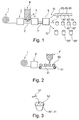
- FIG 1 is schematically illustrated the inventive method of manufacturing a plant receptacle.
- a web 1 manufactured by co-extruding a PLA thread with a flexible aliphatic polyester containing 10-90 weight percent bamboo material is being fed into a former 2.
- the former 2 shapes the relative flat web into a long cylinder having an open slit facing upwards.
- a funnel 3 is introduced into this slit where the funnel 3 is connected to a reservoir 4 such that growth media from the reservoir 4 may be introduced into the cylindrically formed web 1'.
- the cylinder 1' filled with growth media 4 is introduced into a welding machine 5 where the two opposing sides of the web are overlapped and exposed to heating such that two sides will weld together and form what in cross-section will be a closed cylinder.
- This process stage may carry out either one of the following routines as indicated by the arrows 10, 11 and 12. If the process stage 6 is provided with a perforating tool, the cylinder 1" will be provided with perforations 20 across the cylinder thereby making it easy to separate single plant receptacles 30 simply by tearing them apart at the perforated lines 20.
- the web In order for the web to be able to withstand the handling, treatment etc. it is necessary to provide a certain strength in the web.
- the web shall be able to withstand tension in the longitudinal direction of the web of from 35-55 N with a maximum elongation of 2-10% (which for typical receptacles correspond to between 2 mm and 15 mm).
- the web Transversely the web shall withstand a tension of 10-30 N, with an elongation between 2 and 15% (corresponding to a typical elongation of a receptacle between 5 and 15 mm). All values listed as until/before breakage.
- the material thickness shall correspond to between 10-50 grams per square metre, providing the desired characteristics as discussed above.
- the process step 6 may simply cut the cylindrical web into separate empty plant receptacles 30'.
- the cutter will cut as indicated by the arrow 12, the filled cylinder 1" into separate plant receptacles 30" which are each filled with growth media.
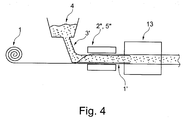
- FIG 2 is illustrated a method where the web material 1 is introduced into a former 2' which former 2' shapes the web material into conical plant receptacles 31. As they leave the former 2', they may pass a filling station 4' which will introduce growth media into the plant receptacle 31. At this stage a seed or plant cutting 51 may be inserted into the growth media 52 as illustrated in figure 3 .
- the web material 1 is supplied on a roll.
- the material 1 is fed into a combined former and welding station 2", 5", where a cylinder is shaped around the filling tube 3', connected to a reservoir 4 of growth medium.
- the web cylinder 1' continues into a vacuum chamber 13.
- the vacuum in the chamber will suck growth medium through the fill tube 3' and arrange it inside the web cylinder 1', which in this manner is ready to be cut into plant receptacle sizes.
- the speed and compactness of the growth medium may be controlled.
- Figure 5 illustrates a cross-section through a preferred thread 40 used for the manufacture of fibres, which in turn are used for making the sheet material.
- the tread 40 from which the web is manufactured with good results has a thickness out of the extruder of approx. 0,6 mm, and after elongation (part of the manufacturing process) the thickness is reduced to approx. 0.2 mm providing a dtex of from 1 to 5.
- dtex is the unit for linear density of a continuous filament or yarn, equal to 1/10th of a "tex” or 9/10 th of a denier, i.e. very fine treads.
- the core material 41 is typically a PLA polymer tread (polylactic acid based polymer) which has thermoplastic properties, thus making it suitable for extrusion processes.
- the core 41 is covered with a cover layer 42.
- This cover layer 42 is a flexible aliphatic polyester.
- the cover layer 42 is co-extruded in a so-called BICO process (bi-component).
- BICO process bi-component
- the material for the cover layer is modified by adding 10 wt% to 90 wt% organic material, typically bamboo or the like (see discussion above). The addition of organic material does not reduce the weldable properties of the finished tread 40 to such a degree that it is not possible to make a sheet material suitable for the invention.
- the lack of complete weldability or fusion provides a material sheet having a very good integrity, and at the same time an open mesh structure allowing oxygen and water to travel through the sheet (without transport of soil or nutrients).
- bamboo is known to work as a fungicide, and therefore natural protection of the plant saplings placed in the finished plant receptacles is provided.
- organic material further improves the biogradability of the material sheet.
- a weldable biodegradable thread is in this manner achieved and used for the sheet material.
Landscapes
- Life Sciences & Earth Sciences (AREA)
- Environmental Sciences (AREA)
- Cultivation Receptacles Or Flower-Pots, Or Pots For Seedlings (AREA)
- Engineering & Computer Science (AREA)
- Mechanical Engineering (AREA)
- Wrappers (AREA)
- Laminated Bodies (AREA)
- Nonwoven Fabrics (AREA)
- Biological Depolymerization Polymers (AREA)
Description
- The present invention relates to a method of manufacturing a plant receptacle comprising a number of steps as well as a plant receptacle manufactured by said process.
- For the propagation of plants either starting from seeds or from cuttings it is well-known in the art to use small pots, for example pots made from plastic or polymer netting or sphagnum where growth media as well as the seed or cutting are placed inside the growth media in the pot.
- It is also known to manufacture planting receptacles from a permeable sheet material based on weldable and biodegradable thread, see
JP2000342077 A - These pots are traditionally made in a very large number where the pots have to fulfil certain requirements relating to its ability to drain off excess water, to allow air, especially oxygen, into the growth media and thereby stimulate the propagation of roots and thereby growth of the entire plant. The pots have to be cheap, relatively easy to handle and at the same time preferably biodegradable. At the same time it is desirable that the pot has further abilities - for example being able to maintain the growth media in a stable and secure manner, even during handling and overall stimulating the propagation of the plants starting from the seeds or cuttings.
- In the terminology of the present invention cutting shall be understood as pieces of plant tissue which is cut off other plants and placed in the growth media in order to grow to be new plants.
- The present invention is directed to a novel and inventive method of manufacturing such a type of plant receptacle where the receptacle comprises further advantageous features as compared to the prior art.
- The present invention consequently presents a method of manufacturing a plant receptacle wherein the following steps are performed:
- a) a PLA thread is covered with a flexible aliphatic polyester, said flexible aliphatic polyester comprising 10 wt% to 90 wt% organic material, such that the flexible aliphatic polyester covers the PLA thread, thereby creating a weldable biodegradable thread;
- b) using said weldable biodegradable thread in a woven or non-woven process, making a permeable sheet material;
- c) continuously forming said sheet material into a continuous receptacle, by bringing the side edges of said sheet material into contact and welding said side edges together;
- d) cutting said continuous receptacle in predetermined lengths thereby creating separate plant receptacles or wherein said continuous receptacle is perforated substantially perpendicular to the longitudinal direction of the continuous receptacle at predetermined intervals, thereby allowing separate plant receptacles to be detached from the continuous receptacle.
- The invention additionally presents a further method of manufacturing a plant receptacle wherein the following steps are performed:
- a) A mix of fibres containing a first type of fibre in an amount from 25 % to 75 % of a monofilament PLA based fibre and a second type of fibre in an amount from 25 % to 75 % of a fibre made from a PLA thread covered with a flexible aliphatic polyester, said flexible aliphatic polyester comprising 10 wt% to 90 wt% organic material, such that the flexible aliphatic polyester covers the PLA thread, thereby creating a weldable biodegradable thread, said first and second types of fibres adding up to 100 % of the mix;
- b) using said mix of fibres in a woven or non-woven process, making a permeable sheet material;
- c) continuously forming said sheet material into a continuous receptacle, by bringing the side edges of said sheet material into contact and welding said side edges together;
- d) cutting said continuous receptacle in predetermined lengths thereby creating separate plant receptacles or wherein said continuous receptacle is perforated substantially perpendicular to the longitudinal direction of the continuous receptacle at predetermined intervals, thereby allowing separate plant receptacles to be detached from the continuous receptacle.
- Extensive testing has shown that the addition of an organic material such as for example bamboo material incorporated into the material from which the plant receptacle is manufactured provides a number of advantages. Firstly, the bamboo content acts as a fungicide, i.e. it will hinder the growth of fungus on the plant receptacle as such, but also in the growth media placed inside the plant receptacle. This is a very important aspect as fungus is a very aggressive organism which will deplete the growth media of important nutrients, moisture and oxygen which would otherwise stimulate the growth of the plant placed inside the plant receptacle.
- In a further advantageous embodiment of the invention the organic material is selected between or is a mixture of bamboo, soya, coconut, flax, and/or banana, where the organic material is added to the aliphatic polyester in liquid, pulverised or granular form.
- Bamboo is the preferred organic material as it exhibits excellent characteristics with respect to welding and fungicidal effects. From the banana types, especially material from the species Abaca is preferred. Flax is commonly occurring.
- Flax (also known as common flax or linseed) (binomial name: Linum usitatissimum) is a member of the genus Linum in the family Linaceae. It is native to the region extending from the eastern Mediterranean to India and was probably first domesticated in the Fertile Crescent.
- Abacá (Musa textilis), Musa textilis, is a species of banana native to the Philipines, grown as a commercial crop in the Philippines, Ecuador, and Costa Rica. The plant is harvested for its fibre, once generally called Manila Hemp, extracted from the trunk or pseudostem. The fiber was originally used for making twines and ropes; now most abacá is pulped and used in a variety of specialized paper products including tea bags, filter paper and banknotes. It is classified as a hard fiber, along with coir, henequin and sisal - all of which are also useful within the present invention.
- Traditionally, plant receptacles or pots used for this purpose in the prior art are coated or treated with a fungicide in order to avoid the propagation of fungus, but the fungicide treatment is prohibited in a number of jurisdictions, and furthermore the use of fungicides is an extra pollutant and thereby a hazard to the environment. Also, treatment with a fungicide is an extra cost in the manufacture of a low cost product and therefore also influential on the competitive edge of the product as such. It is therefore advantageous to be able to add a built-in natural fungicide which has no hazardous side effects and which is not listed as a fungicide and therefore is not ruled illegal in a number of jurisdictions and at the same time is a relatively cheap addition to the material from which the plant receptacle is made.
- Furthermore, by using a PLA or polylactide based polyester manufactured from a lactic acid, the base material is biologically degradable in an industrialized composting process (mulching plant). The flexible aliphatic polyester comprising 10 wt% to 30 wt% organic material is a modified aliphatic polyester, which in addition to being biodegradable also have further advantageous characteristics, which will be elaborated below. A preferred flexible aliphatic polyester is available under the trade name GS Pla®, which is a registered trademark and covers a whole group of materials, where the GS Pla stands for Green Sustainable Plastics, the GS Pla obtainable from e.g. the Mitsubishi Chemical Corporation is composed mainly of succinic acid and 1,4-butanediol thereby making the GS Pla, a flexible aliphatic polyester with properties similar to those of polyolefin.
- PLA in itself is not weldable, but when the PLA is covered by a flexible aliphatic polyester also when comprising 10 wt% to 30 wt% organic material as described above it is possible to create bonding between fibres in a heat sealing process. Therefore, by using a PLA thread which is co-extruded with a flexible aliphatic polyester comprising 10 wt% to 30 wt% organic material a weldable, biodegradable thread is created which when formed into a permeable sheet material may be heat sealed together along the edges thereby creating the plant receptacle. The co-extrusion process is generally known as a bico process creating a bicomponent fibre.
- Therefore, the combination of characteristics of the materials creates the best of both worlds, i.e. a non-hazardous, non-polluting, biodegradable sheet material which according to tests carried out has a substantially higher (20-40 %) permeability for air and moisture compared to other similar products, which stimulates plant growth and at the same time a very simple, fast and inexpensive process, namely heat sealing, may be used in order to manufacture the plant receptacles. The organic, especially bamboo content ensures a fungicidal effect such that the excellent properties of the material may be maintained over time until it is desirable to compost the plant receptacle.
- In order to manufacture the flexible aliphatic polyester covered PLA material it is preferred to co-extrude the flexible aliphatic polyester and the PLA tread, and thereafter introduce these very thin treads into a spunwoven process. Other methods for creating a web from the PLA thread covered with a flexible aliphatic polyester, comprising 10 wt% to 30 wt% organic material may also be used, such as for example thermo-bonding, hydro-entanglement, needle-punching or chemical bonding.
- In a further advantageous embodiment of the invention the method is further completed by introducing between steps c) and d) a further method step c1) wherein the formed continuous receptacle is filled with a growth medium either during or after forming of the plant receptacle, thereby creating a pre-filled plant receptacle. In this manner the manufacturing process creates a completely finished and ready-to-use plant receptacle already filled with a growth medium. Typically, growth media will be selected according to the seeds or cuttings which need to be propagated, and typically the growth media will be some type of sphagnum optionally modified with various nutrients, fertilizers etc.
- In a still further advantageous embodiment a further step is introduced before step c1) or d) in that a pair of welding cams creates a weld across the cylinder substantially perpendicular to the longitudinal direction of the cylinder.
- By introducing the welding cams and thereby utilizing the unique welding/heat-sealing capabilities of the material, the receptacles may be provided with a bottom such that it is avoided that any growth media material either during handling, seeding or otherwise will fall out of the bottom of the plant receptacle. A further advantageous embodiment comprises replacing step d by a step d1 wherein said continuous receptacle is perforated substantially perpendicular to the longitudinal direction of the continuous receptacle at predetermined intervals, thereby allowing separate plant receptacles to be detached from the continuous receptacle. In this manner it is possible to make a substantially endless string of plant receptacles connected by perforations which may easily be detached before use.
- Where it is not desirable to have cylindrically shaped plant receptacles the sheet material during the process may be formed and welded around a conical former thereby creating conical plant receptacles. It is obvious that even without a bottom the growth media placed in these types of conical plant receptacles will create resistance against allowing the growth media to empty out of the bottom due to the conical shape of the receptacle.
- The invention is also directed to a plant receptacle manufactured according to the method as described above where said plant receptacle has a wall made from a spun-woven weldable material, which material is made from a PLA thread covered by a layer of flexible aliphatic polyester comprising 10 wt% to 30 wt% organic material.
- The organic material may be in the shape of liquid, fibres, powder, granules or any other suitable form, with respect to the manufacturing process. Many of the fibres is produced in pulp form, and may be added starting from this basis.
- Further advantages of the plant receptacle are listed in the dependent claims.
- The invention will now be explained with reference to the accompanying drawing wherein
- Figure 1
- schematically illustrates the inventive method of manufacturing a plant receptacle
- Figure 2
- schematically illustrates a further embodiment of the inventive method of manufacturing a plant receptacle
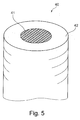
- Figure 3
- schematically illustrates a plant receptacle and a cutting or seed
- Figure 4
- schematically illustrates a further embodiment of the inventive method of manufacturing a plant receptacle.
- In
figure 1 is schematically illustrated the inventive method of manufacturing a plant receptacle. Aweb 1 manufactured by co-extruding a PLA thread with a flexible aliphatic polyester containing 10-90 weight percent bamboo material is being fed into a former 2. In the illustrated schematic embodiment the former 2 shapes the relative flat web into a long cylinder having an open slit facing upwards. Afunnel 3 is introduced into this slit where thefunnel 3 is connected to areservoir 4 such that growth media from thereservoir 4 may be introduced into the cylindrically formed web 1'. - After this the cylinder 1' filled with
growth media 4 is introduced into awelding machine 5 where the two opposing sides of the web are overlapped and exposed to heating such that two sides will weld together and form what in cross-section will be a closed cylinder. As theclosed cylinder 1" leaves thewelding machine 5 it is introduced into the last process stage 6. This process stage may carry out either one of the following routines as indicated by thearrows cylinder 1" will be provided with perforations 20 across the cylinder thereby making it easy to separate single plant receptacles 30 simply by tearing them apart at the perforated lines 20. - In order for the web to be able to withstand the handling, treatment etc. it is necessary to provide a certain strength in the web. For these purposes the web shall be able to withstand tension in the longitudinal direction of the web of from 35-55 N with a maximum elongation of 2-10% (which for typical receptacles correspond to between 2 mm and 15 mm). Transversely the web shall withstand a tension of 10-30 N, with an elongation between 2 and 15% (corresponding to a typical elongation of a receptacle between 5 and 15 mm). All values listed as until/before breakage.
The material thickness shall correspond to between 10-50 grams per square metre, providing the desired characteristics as discussed above. - According to the invention it is optional to have the growth
media filling station cylinder 1" is not filled with growth media the process step 6 may simply cut the cylindrical web into separate empty plant receptacles 30'. In embodiments, however, where the formed web 1' is filled with growth media by the growthmedia filling station cylinder 1" intoseparate plant receptacles 30" which are each filled with growth media. - In
figure 2 is illustrated a method where theweb material 1 is introduced into a former 2' which former 2' shapes the web material into conical plant receptacles 31. As they leave the former 2', they may pass a filling station 4' which will introduce growth media into theplant receptacle 31. At this stage a seed or plant cutting 51 may be inserted into thegrowth media 52 as illustrated infigure 3 . - In
fig. 4 is illustrated a further manufacturing process. Theweb material 1 is supplied on a roll. Thematerial 1 is fed into a combined former andwelding station 2", 5", where a cylinder is shaped around the filling tube 3', connected to areservoir 4 of growth medium. The web cylinder 1' continues into avacuum chamber 13. The vacuum in the chamber will suck growth medium through the fill tube 3' and arrange it inside the web cylinder 1', which in this manner is ready to be cut into plant receptacle sizes. By varying the speed with which the cylinder 1' advances and/or the level of under-pressure inside the vacuum chamber the speed and compactness of the growth medium may be controlled. -
Figure 5 illustrates a cross-section through apreferred thread 40 used for the manufacture of fibres, which in turn are used for making the sheet material. - Typically the
tread 40 from which the web is manufactured with good results has a thickness out of the extruder of approx. 0,6 mm, and after elongation (part of the manufacturing process) the thickness is reduced to approx. 0.2 mm providing a dtex of from 1 to 5. "dtex" is the unit for linear density of a continuous filament or yarn, equal to 1/10th of a "tex" or 9/10th of a denier, i.e. very fine treads. - The
core material 41 is typically a PLA polymer tread (polylactic acid based polymer) which has thermoplastic properties, thus making it suitable for extrusion processes. Thecore 41 is covered with acover layer 42. Thiscover layer 42 is a flexible aliphatic polyester. Thecover layer 42 is co-extruded in a so-called BICO process (bi-component). Further, the material for the cover layer is modified by adding 10 wt% to 90 wt% organic material, typically bamboo or the like (see discussion above). The addition of organic material does not reduce the weldable properties of thefinished tread 40 to such a degree that it is not possible to make a sheet material suitable for the invention. On the other hand the lack of complete weldability or fusion provides a material sheet having a very good integrity, and at the same time an open mesh structure allowing oxygen and water to travel through the sheet (without transport of soil or nutrients). Furthermore, bamboo is known to work as a fungicide, and therefore natural protection of the plant saplings placed in the finished plant receptacles is provided. Also the addition of organic material further improves the biogradability of the material sheet. A weldable biodegradable thread is in this manner achieved and used for the sheet material.
Claims (15)
- Method of manufacturing a plant receptacle wherein the following steps are performed:a) a PLA thread is covered with a flexible aliphatic polyester, said flexible aliphatic polyester comprising 10 wt% to 90 wt% organic material, such that the flexible aliphatic polyester covers the PLA thread, thereby creating a weldable biodegradable thread;b) using said weldable biodegradable thread in a woven or non-woven process, making a permeable sheet material;c) continuously forming said sheet material into a continuous receptacle, by bringing the side edges of said sheet material into contact and welding said side edges together;d) cutting said continuous receptacle in predetermined lengths thereby creating separate plant receptacles or wherein said continuous receptacle is perforated substantially perpendicular to the longitudinal direction of the continuous receptacle at predetermined intervals, thereby allowing separate plant receptacles to be detached from the continuous receptacle.
- Method of manufacturing a plant receptacle wherein the following steps are performed:a) A mix of fibres containing a first type of fibre in an amount from 25 % to 75 % of a monofilament PLA based fibre and a second type of fibre in an amount from 25 % to 75 % of a fibre made from a PLA thread covered with a flexible aliphatic polyester, said flexible aliphatic polyester comprising 10 wt% to 90 wt% organic material, such that the flexible aliphatic polyester covers the PLA thread, thereby creating a weldable biodegradable thread, said first and second types of fibres adding up to 100 % of the mix;b) using said mix of fibres in a woven or non-woven process, making a permeable sheet material;c) continuously forming said sheet material into a continuous receptacle, by bringing the side edges of said sheet material into contact and welding said side edges together;d) cutting said continuous receptacle in predetermined lengths thereby creating separate plant receptacles or wherein said continuous receptacle is perforated substantially perpendicular to the longitudinal direction of the continuous receptacle at predetermined intervals, thereby allowing separate plant receptacles to be detached from the continuous receptacle.
- Method of manufacturing a plant receptacle according to claim 1 or 2 wherein between steps c) and d) a further method step c1) is introduced wherein the formed continuous receptacle is filled with a growth medium either during or after forming of the plant receptacle, thereby creating a pre-filled plant receptacle.
- Method of manufacturing a plant receptacle according to claim 1 or 2 wherein before step c1) or d) a pair of welding cams creates a weld across the cylinder substantially perpendicular to the longitudinal direction of the cylinder.
- Method according to claim 1 or 2 wherein the sheet material is formed and welded around a conical former, thereby creating conical plant receptacles.
- Method according to claim 1 or 2 wherein the PLA thread is co-extruded with said flexible aliphatic polyester, said flexible aliphatic polyester comprising 10 wt% to 90 wt% organic material.
- Method according to claim 1, 2 or 6 wherein the flexible aliphatic polyester comprising 10 wt% to 90 wt% organic material constitutes 15 % to 90 % of the entire threads volume.
- Method according to any preceding claim wherein the organic material is selected between or is a mixture of bamboo, soya, coconut, flax, and/or banana, where the organic material is added to the aliphatic polyester in liquid, pulverised or granular form.
- Method according to any preceding claim wherein the PLA thread constitutes 75 % by weight of the weldable biodegradable thread, and where the flexible aliphatic polyester constitutes 25 % by weight of the weldable biodegradable thread, where the aliphatic polyester comprises approx. 10 % PLA by weight and 10-90% organic material by weight.
- Plant receptacle manufactured according to any of claims 1 to 9, where said plant receptacle has a wall made from a biodegradable permeable sheet material, which sheet material is made from a PLA thread covered by a layer of a flexible aliphatic polyester comprising between 10 to 30 wt% organic material or from a mix of fibres containing a first type of fibre in an amount from 25 % to 75 % of a monofilament PLA based fibre and a second type of fibre in an amount from 25 % to 75 % of a fibre made from a PLA thread covered with a flexible aliphatic polyester, said flexible aliphatic polyester comprising 10 wt% to 90 wt% organic material, such that the flexible aliphatic polyester covers the PLA thread, thereby creating a weldable biodegradable thread, said first and second types of fibres adding up to 100 % of the mix.
- Plant receptacle according to claim 10, wherein the biodegradable permeable sheet material is a non-woven or a spun-woven weldable material in sheet form and the receptacle is substantially cylindrical formed by welding the sides of the sheet together creating a cylinder, and cutting each receptacle in a desired length from said cylinder.
- Plant receptacle according to claim 10 or 11, wherein the biodegradable permeable sheet material has a weight per square metre in the interval between 10 gr/m2 to 50 gr/m2.
- Plant receptacle according to any of claims 10 or 12, wherein the receptacle has a conical form.
- Plant receptacle according to any of claims 10 to 13, wherein each receptacle is provided with a bottom, or where a cross-weld is provided creating a bottom limitation.
- Plant receptacle according to claim 10 wherein the organic material is derived from and selected between or is a mixture of bamboo, soya, coconut, flax or banana.
Priority Applications (1)
| Application Number | Priority Date | Filing Date | Title |
|---|---|---|---|
| SI201330312A SI2852276T1 (en) | 2012-05-22 | 2013-05-22 | Method of manufacturing a plant receptacle as well as a plant receptacle |
Applications Claiming Priority (2)
| Application Number | Priority Date | Filing Date | Title |
|---|---|---|---|
| DKPA201270270 | 2012-05-22 | ||
| PCT/DK2013/050156 WO2013174386A1 (en) | 2012-05-22 | 2013-05-22 | Method of manufacturing a plant receptacle as well as a plant receptacle |
Publications (3)
| Publication Number | Publication Date |
|---|---|
| EP2852276A1 EP2852276A1 (en) | 2015-04-01 |
| EP2852276B1 true EP2852276B1 (en) | 2016-07-06 |
| EP2852276B8 EP2852276B8 (en) | 2016-10-12 |
Family
ID=48534104
Family Applications (1)
| Application Number | Title | Priority Date | Filing Date |
|---|---|---|---|
| EP13725268.0A Active EP2852276B8 (en) | 2012-05-22 | 2013-05-22 | Method of manufacturing a plant receptacle as well as a plant receptacle |
Country Status (17)
| Country | Link |
|---|---|
| US (2) | US10314246B2 (en) |
| EP (1) | EP2852276B8 (en) |
| AP (1) | AP2014008115A0 (en) |
| AU (1) | AU2013265732B2 (en) |
| BR (1) | BR112014029044B1 (en) |
| CA (1) | CA2873937C (en) |
| DK (1) | DK2852276T3 (en) |
| ES (1) | ES2594809T3 (en) |
| IL (1) | IL235817B (en) |
| IN (1) | IN2014DN10409A (en) |
| LT (1) | LT2852276T (en) |
| MX (1) | MX370292B (en) |
| PL (1) | PL2852276T3 (en) |
| PT (1) | PT2852276T (en) |
| SI (1) | SI2852276T1 (en) |
| WO (1) | WO2013174386A1 (en) |
| ZA (1) | ZA201409324B (en) |
Families Citing this family (9)
| Publication number | Priority date | Publication date | Assignee | Title |
|---|---|---|---|---|
| CA2929638C (en) | 2013-11-05 | 2022-04-12 | Ellegaard Holding A/S | Method of manufacturing a plant receptacle as well as a plant receptacle |
| US20170020095A1 (en) * | 2015-07-23 | 2017-01-26 | Stephen Donald Kamholz | Plant growing apparatus, systems and methods |
| EP3162192A1 (en) | 2015-10-27 | 2017-05-03 | Oxydator IVS | Self-supporting plugs and other structures for use in plant production |
| DK179100B1 (en) * | 2016-07-06 | 2017-10-30 | Ellepot As | Use of an air permeable composite sheet material for propagation plugs for organic production |
| CN107155678A (en) * | 2017-05-23 | 2017-09-15 | 宁波高新区甬航工业设计有限公司 | A kind of novel plant bogey |
| DK179996B1 (en) | 2018-08-10 | 2020-01-14 | Ellepot A/S | Process and apparatus for line production of plant growth medium pots or bags |
| BR102022016058A2 (en) * | 2022-08-12 | 2024-02-27 | Investweiler Participacoes Ltda | MACHINE, MEANS OF CONTROL COMPACTION OF SUBSTRATE AND OBTAINED PRODUCT |
| DK182160B1 (en) * | 2023-10-13 | 2025-09-30 | Ellepot As | Process to produce containers for use in the production of plant growth medium pots and bags, a plant growth medium pot or bag, and an apparatus for use in such a process |
| DK202430269A1 (en) * | 2024-05-27 | 2025-12-09 | Ellepot As | A method for producing continuous lengths of propagation plugs or rods, and propagation plugs or rods produced by such method |
Family Cites Families (22)
| Publication number | Priority date | Publication date | Assignee | Title |
|---|---|---|---|---|
| FR2416643A1 (en) * | 1978-02-09 | 1979-09-07 | Foret Cellulose | CULTURAL CLOTS |
| DE3400696A1 (en) * | 1984-01-11 | 1985-07-18 | Kurt Galle | Device for positioning and growing ornamentals and useful plants to suit the needs of the species |
| US5039412A (en) * | 1988-05-12 | 1991-08-13 | The Black Clawson Company | Wire with guide belts for a pulp thickener |
| DE4114294A1 (en) * | 1991-05-02 | 1992-11-05 | Blumenerdenwerk Stender Gmbh & | PLANTING PLATE |
| JP3090349B2 (en) * | 1991-08-02 | 2000-09-18 | カルプ工業株式会社 | Degradable resin composition |
| CA2260631A1 (en) | 1999-01-29 | 2000-07-29 | Alberta Research Council | Seedling container and method of making the same |
| DE60018635T2 (en) * | 1999-05-21 | 2006-04-13 | Toyota Jidosha K.K., Toyota | Monofilament and process for its preparation |
| JP3701539B2 (en) * | 1999-05-21 | 2005-09-28 | トヨタ自動車株式会社 | Monofilament and manufacturing method thereof |
| JP2000342077A (en) * | 1999-05-31 | 2000-12-12 | Sakanaka Ryokka Shizai:Kk | Agricultural/horticultural sheet-like material |
| US6177193B1 (en) * | 1999-11-30 | 2001-01-23 | Kimberly-Clark Worldwide, Inc. | Biodegradable hydrophilic binder fibers |
| EP1129612A3 (en) | 2000-02-29 | 2002-07-24 | Nisshinbo Industries, Inc. | Biodegradable tray for raising seedlings |
| TW200403300A (en) * | 2002-07-11 | 2004-03-01 | Mitsubishi Plastics Inc | Biodegradable laminate sheet and molded item from biodegradable laminate sheet |
| JP2005068840A (en) * | 2003-08-26 | 2005-03-17 | Hagihara Industries Inc | Tatami edge with biodegradability |
| CN101151150B (en) * | 2005-03-28 | 2010-06-16 | 株式会社吴羽 | Polyglycolic acid resin-based laminate sheet and process for producing the same |
| JP4873979B2 (en) * | 2005-04-04 | 2012-02-08 | ユニチカ株式会社 | Polylactic acid-based long fiber nonwoven fabric and method for producing the same |
| EP1939336B1 (en) * | 2005-10-19 | 2012-06-13 | Toray Industries, Inc. | Crimped yarn, method for manufacture thereof, and fiber structure |
| US7790640B2 (en) * | 2006-03-23 | 2010-09-07 | Kimberly-Clark Worldwide, Inc. | Absorbent articles having biodegradable nonwoven webs |
| US20080200890A1 (en) * | 2006-12-11 | 2008-08-21 | 3M Innovative Properties Company | Antimicrobial disposable absorbent articles |
| JP5355225B2 (en) * | 2008-05-30 | 2013-11-27 | ユニチカ株式会社 | Polylactic acid-based long fiber nonwoven fabric and method for producing the same |
| JP5585001B2 (en) * | 2009-05-25 | 2014-09-10 | 東レ株式会社 | Method for producing needle punched nonwoven fabric |
| JP5355295B2 (en) * | 2009-08-17 | 2013-11-27 | ユニチカ株式会社 | Biodegradable face cover |
| DE102010026532A1 (en) | 2010-07-08 | 2012-01-12 | Landshuter Werkzeugbau Alfred Steinl Gmbh & Co. Kg | Filled molding compounds |
-
2013
- 2013-05-22 LT LTEP13725268.0T patent/LT2852276T/en unknown
- 2013-05-22 US US14/402,626 patent/US10314246B2/en active Active
- 2013-05-22 AP AP2014008115A patent/AP2014008115A0/en unknown
- 2013-05-22 ES ES13725268.0T patent/ES2594809T3/en active Active
- 2013-05-22 SI SI201330312A patent/SI2852276T1/en unknown
- 2013-05-22 AU AU2013265732A patent/AU2013265732B2/en active Active
- 2013-05-22 CA CA2873937A patent/CA2873937C/en active Active
- 2013-05-22 DK DK13725268.0T patent/DK2852276T3/en active
- 2013-05-22 BR BR112014029044-0A patent/BR112014029044B1/en active IP Right Grant
- 2013-05-22 WO PCT/DK2013/050156 patent/WO2013174386A1/en not_active Ceased
- 2013-05-22 IN IN10409DEN2014 patent/IN2014DN10409A/en unknown
- 2013-05-22 PT PT137252680T patent/PT2852276T/en unknown
- 2013-05-22 MX MX2014014144A patent/MX370292B/en active IP Right Grant
- 2013-05-22 EP EP13725268.0A patent/EP2852276B8/en active Active
- 2013-05-22 PL PL13725268.0T patent/PL2852276T3/en unknown
-
2014
- 2014-11-20 IL IL235817A patent/IL235817B/en active IP Right Grant
- 2014-12-18 ZA ZA2014/09324A patent/ZA201409324B/en unknown
-
2019
- 2019-04-22 US US16/391,020 patent/US20190313585A1/en not_active Abandoned
Also Published As
| Publication number | Publication date |
|---|---|
| MX370292B (en) | 2019-12-09 |
| US20190313585A1 (en) | 2019-10-17 |
| WO2013174386A1 (en) | 2013-11-28 |
| PL2852276T3 (en) | 2016-12-30 |
| SI2852276T1 (en) | 2017-01-31 |
| AU2013265732B2 (en) | 2017-02-16 |
| CN104363753A (en) | 2015-02-18 |
| BR112014029044A2 (en) | 2017-06-27 |
| CA2873937A1 (en) | 2013-11-28 |
| AU2013265732A1 (en) | 2015-01-15 |
| AP2014008115A0 (en) | 2014-12-31 |
| EP2852276A1 (en) | 2015-04-01 |
| LT2852276T (en) | 2016-11-25 |
| BR112014029044B1 (en) | 2019-04-09 |
| MX2014014144A (en) | 2015-07-06 |
| IN2014DN10409A (en) | 2015-08-14 |
| EP2852276B8 (en) | 2016-10-12 |
| CA2873937C (en) | 2022-04-26 |
| DK2852276T3 (en) | 2016-09-26 |
| IL235817A0 (en) | 2015-01-29 |
| PT2852276T (en) | 2016-10-14 |
| IL235817B (en) | 2018-02-28 |
| ES2594809T3 (en) | 2016-12-22 |
| ZA201409324B (en) | 2016-09-28 |
| US10314246B2 (en) | 2019-06-11 |
| US20150135589A1 (en) | 2015-05-21 |
Similar Documents
| Publication | Publication Date | Title |
|---|---|---|
| US20190313585A1 (en) | Method of Manufacturing a Plant Receptacle as well as a Plant Receptacle | |
| DK3065537T3 (en) | Process for making a plant base as well as a plant base | |
| EP0824304B1 (en) | Plant and culture container | |
| EP0512272B1 (en) | Plant carrier | |
| US12129071B2 (en) | Apparatus for line production of plant growth medium pots or bags | |
| JP3667266B2 (en) | Biodegradable sheet material for molding seedling blocks | |
| JP6750332B2 (en) | Manufacturing method of greening mat | |
| CN104363753B (en) | Manufacture method and the plant jack of plant jack | |
| AU2023419961A1 (en) | Growing member, growing system, and planting method | |
| DE19504167A1 (en) | Mfr. of environmentally friendly, fibrous, seedling culture pots | |
| WO2025120081A1 (en) | Air pruning container | |
| DK182160B1 (en) | Process to produce containers for use in the production of plant growth medium pots and bags, a plant growth medium pot or bag, and an apparatus for use in such a process | |
| JP3661109B2 (en) | Planting materials and loading containers | |
| WO2025120210A1 (en) | Tubular planting sleeve and use of same for pre-cultivating and planting forestry and fruit plants | |
| EP4427583A1 (en) | Container for raising plants, in particular container for raising plants from seeds |
Legal Events
| Date | Code | Title | Description |
|---|---|---|---|
| PUAI | Public reference made under article 153(3) epc to a published international application that has entered the european phase |
Free format text: ORIGINAL CODE: 0009012 |
|
| 17P | Request for examination filed |
Effective date: 20141212 |
|
| AK | Designated contracting states |
Kind code of ref document: A1 Designated state(s): AL AT BE BG CH CY CZ DE DK EE ES FI FR GB GR HR HU IE IS IT LI LT LU LV MC MK MT NL NO PL PT RO RS SE SI SK SM TR |
|
| AX | Request for extension of the european patent |
Extension state: BA ME |
|
| DAX | Request for extension of the european patent (deleted) | ||
| GRAP | Despatch of communication of intention to grant a patent |
Free format text: ORIGINAL CODE: EPIDOSNIGR1 |
|
| INTG | Intention to grant announced |
Effective date: 20160108 |
|
| GRAS | Grant fee paid |
Free format text: ORIGINAL CODE: EPIDOSNIGR3 |
|
| GRAA | (expected) grant |
Free format text: ORIGINAL CODE: 0009210 |
|
| AK | Designated contracting states |
Kind code of ref document: B1 Designated state(s): AL AT BE BG CH CY CZ DE DK EE ES FI FR GB GR HR HU IE IS IT LI LT LU LV MC MK MT NL NO PL PT RO RS SE SI SK SM TR |
|
| REG | Reference to a national code |
Ref country code: GB Ref legal event code: FG4D |
|
| REG | Reference to a national code |
Ref country code: AT Ref legal event code: REF Ref document number: 810014 Country of ref document: AT Kind code of ref document: T Effective date: 20160715 Ref country code: CH Ref legal event code: EP |
|
| REG | Reference to a national code |
Ref country code: IE Ref legal event code: FG4D |
|
| REG | Reference to a national code |
Ref country code: DE Ref legal event code: R096 Ref document number: 602013009141 Country of ref document: DE |
|
| RAP2 | Party data changed (patent owner data changed or rights of a patent transferred) |
Owner name: SUNGROW A/S |
|
| REG | Reference to a national code |
Ref country code: DK Ref legal event code: T3 Effective date: 20160922 |
|
| REG | Reference to a national code |
Ref country code: RO Ref legal event code: EPE |
|
| REG | Reference to a national code |
Ref country code: NL Ref legal event code: FP |
|
| REG | Reference to a national code |
Ref country code: DE Ref legal event code: R081 Ref document number: 602013009141 Country of ref document: DE Owner name: PLANTPAPER HOLDING APS, DK Free format text: FORMER OWNER: ELLEGAARD HOLDING A/S, ESBJERG OE, DK Ref country code: DE Ref legal event code: R081 Ref document number: 602013009141 Country of ref document: DE Owner name: SUNGROW A/S, DK Free format text: FORMER OWNER: ELLEGAARD HOLDING A/S, ESBJERG OE, DK |
|
| REG | Reference to a national code |
Ref country code: SE Ref legal event code: TRGR |
|
| REG | Reference to a national code |
Ref country code: PT Ref legal event code: SC4A Ref document number: 2852276 Country of ref document: PT Date of ref document: 20161014 Kind code of ref document: T Free format text: AVAILABILITY OF NATIONAL TRANSLATION Effective date: 20160929 |
|
| REG | Reference to a national code |
Ref country code: AT Ref legal event code: MK05 Ref document number: 810014 Country of ref document: AT Kind code of ref document: T Effective date: 20160706 |
|
| REG | Reference to a national code |
Ref country code: ES Ref legal event code: FG2A Ref document number: 2594809 Country of ref document: ES Kind code of ref document: T3 Effective date: 20161222 |
|
| PG25 | Lapsed in a contracting state [announced via postgrant information from national office to epo] |
Ref country code: NO Free format text: LAPSE BECAUSE OF FAILURE TO SUBMIT A TRANSLATION OF THE DESCRIPTION OR TO PAY THE FEE WITHIN THE PRESCRIBED TIME-LIMIT Effective date: 20161006 Ref country code: IS Free format text: LAPSE BECAUSE OF FAILURE TO SUBMIT A TRANSLATION OF THE DESCRIPTION OR TO PAY THE FEE WITHIN THE PRESCRIBED TIME-LIMIT Effective date: 20161106 Ref country code: RS Free format text: LAPSE BECAUSE OF FAILURE TO SUBMIT A TRANSLATION OF THE DESCRIPTION OR TO PAY THE FEE WITHIN THE PRESCRIBED TIME-LIMIT Effective date: 20160706 Ref country code: HR Free format text: LAPSE BECAUSE OF FAILURE TO SUBMIT A TRANSLATION OF THE DESCRIPTION OR TO PAY THE FEE WITHIN THE PRESCRIBED TIME-LIMIT Effective date: 20160706 |
|
| PG25 | Lapsed in a contracting state [announced via postgrant information from national office to epo] |
Ref country code: GR Free format text: LAPSE BECAUSE OF FAILURE TO SUBMIT A TRANSLATION OF THE DESCRIPTION OR TO PAY THE FEE WITHIN THE PRESCRIBED TIME-LIMIT Effective date: 20161007 Ref country code: LV Free format text: LAPSE BECAUSE OF FAILURE TO SUBMIT A TRANSLATION OF THE DESCRIPTION OR TO PAY THE FEE WITHIN THE PRESCRIBED TIME-LIMIT Effective date: 20160706 Ref country code: AT Free format text: LAPSE BECAUSE OF FAILURE TO SUBMIT A TRANSLATION OF THE DESCRIPTION OR TO PAY THE FEE WITHIN THE PRESCRIBED TIME-LIMIT Effective date: 20160706 |
|
| REG | Reference to a national code |
Ref country code: SK Ref legal event code: T3 Ref document number: E 22490 Country of ref document: SK |
|
| REG | Reference to a national code |
Ref country code: DE Ref legal event code: R097 Ref document number: 602013009141 Country of ref document: DE |
|
| PG25 | Lapsed in a contracting state [announced via postgrant information from national office to epo] |
Ref country code: EE Free format text: LAPSE BECAUSE OF FAILURE TO SUBMIT A TRANSLATION OF THE DESCRIPTION OR TO PAY THE FEE WITHIN THE PRESCRIBED TIME-LIMIT Effective date: 20160706 |
|
| PLBE | No opposition filed within time limit |
Free format text: ORIGINAL CODE: 0009261 |
|
| STAA | Information on the status of an ep patent application or granted ep patent |
Free format text: STATUS: NO OPPOSITION FILED WITHIN TIME LIMIT |
|
| REG | Reference to a national code |
Ref country code: FR Ref legal event code: PLFP Year of fee payment: 5 |
|
| PG25 | Lapsed in a contracting state [announced via postgrant information from national office to epo] |
Ref country code: BG Free format text: LAPSE BECAUSE OF FAILURE TO SUBMIT A TRANSLATION OF THE DESCRIPTION OR TO PAY THE FEE WITHIN THE PRESCRIBED TIME-LIMIT Effective date: 20161006 Ref country code: SM Free format text: LAPSE BECAUSE OF FAILURE TO SUBMIT A TRANSLATION OF THE DESCRIPTION OR TO PAY THE FEE WITHIN THE PRESCRIBED TIME-LIMIT Effective date: 20160706 |
|
| 26N | No opposition filed |
Effective date: 20170407 |
|
| PG25 | Lapsed in a contracting state [announced via postgrant information from national office to epo] |
Ref country code: LU Free format text: LAPSE BECAUSE OF NON-PAYMENT OF DUE FEES Effective date: 20170531 |
|
| REG | Reference to a national code |
Ref country code: CH Ref legal event code: PL |
|
| PG25 | Lapsed in a contracting state [announced via postgrant information from national office to epo] |
Ref country code: MC Free format text: LAPSE BECAUSE OF FAILURE TO SUBMIT A TRANSLATION OF THE DESCRIPTION OR TO PAY THE FEE WITHIN THE PRESCRIBED TIME-LIMIT Effective date: 20160706 |
|
| PG25 | Lapsed in a contracting state [announced via postgrant information from national office to epo] |
Ref country code: LI Free format text: LAPSE BECAUSE OF NON-PAYMENT OF DUE FEES Effective date: 20170531 Ref country code: CH Free format text: LAPSE BECAUSE OF NON-PAYMENT OF DUE FEES Effective date: 20170531 |
|
| PG25 | Lapsed in a contracting state [announced via postgrant information from national office to epo] |
Ref country code: LU Free format text: LAPSE BECAUSE OF NON-PAYMENT OF DUE FEES Effective date: 20170522 |
|
| REG | Reference to a national code |
Ref country code: FR Ref legal event code: PLFP Year of fee payment: 6 |
|
| PG25 | Lapsed in a contracting state [announced via postgrant information from national office to epo] |
Ref country code: MT Free format text: LAPSE BECAUSE OF NON-PAYMENT OF DUE FEES Effective date: 20170522 |
|
| PG25 | Lapsed in a contracting state [announced via postgrant information from national office to epo] |
Ref country code: AL Free format text: LAPSE BECAUSE OF FAILURE TO SUBMIT A TRANSLATION OF THE DESCRIPTION OR TO PAY THE FEE WITHIN THE PRESCRIBED TIME-LIMIT Effective date: 20160706 |
|
| PG25 | Lapsed in a contracting state [announced via postgrant information from national office to epo] |
Ref country code: HU Free format text: LAPSE BECAUSE OF FAILURE TO SUBMIT A TRANSLATION OF THE DESCRIPTION OR TO PAY THE FEE WITHIN THE PRESCRIBED TIME-LIMIT; INVALID AB INITIO Effective date: 20130522 |
|
| PG25 | Lapsed in a contracting state [announced via postgrant information from national office to epo] |
Ref country code: CY Free format text: LAPSE BECAUSE OF FAILURE TO SUBMIT A TRANSLATION OF THE DESCRIPTION OR TO PAY THE FEE WITHIN THE PRESCRIBED TIME-LIMIT Effective date: 20160706 |
|
| PG25 | Lapsed in a contracting state [announced via postgrant information from national office to epo] |
Ref country code: MK Free format text: LAPSE BECAUSE OF FAILURE TO SUBMIT A TRANSLATION OF THE DESCRIPTION OR TO PAY THE FEE WITHIN THE PRESCRIBED TIME-LIMIT Effective date: 20160706 |
|
| REG | Reference to a national code |
Ref country code: SK Ref legal event code: PC4A Ref document number: E 22490 Country of ref document: SK Owner name: PLANTPAPER HOLDING APS, ROEDOVRE, DK Free format text: FORMER OWNER: SUNGROW A/S, RIBE, DK Effective date: 20210115 |
|
| REG | Reference to a national code |
Ref country code: FI Ref legal event code: PCE Owner name: PLANTPAPER HOLDING APS |
|
| REG | Reference to a national code |
Ref country code: BE Ref legal event code: PD Owner name: PLANTPAPER HOLDING APS; DK Free format text: DETAILS ASSIGNMENT: CHANGE OF OWNER(S), CESSION; FORMER OWNER NAME: SUNGROW A/S Effective date: 20201217 |
|
| REG | Reference to a national code |
Ref country code: DE Ref legal event code: R081 Ref document number: 602013009141 Country of ref document: DE Owner name: PLANTPAPER HOLDING APS, DK Free format text: FORMER OWNER: SUNGROW A/S, RIBE, DK |
|
| REG | Reference to a national code |
Ref country code: ES Ref legal event code: PC2A Owner name: PLANTPAPER HOLDING APS Effective date: 20210312 |
|
| REG | Reference to a national code |
Ref country code: SI Ref legal event code: SP73 Owner name: PLANTPAPER HOLDING APS; DK Effective date: 20210310 |
|
| REG | Reference to a national code |
Ref country code: GB Ref legal event code: 732E Free format text: REGISTERED BETWEEN 20210506 AND 20210512 |
|
| REG | Reference to a national code |
Ref country code: NL Ref legal event code: PD Owner name: PLANTPAPER HOLDING APS; DK Free format text: DETAILS ASSIGNMENT: CHANGE OF OWNER(S), ASSIGNMENT; FORMER OWNER NAME: SUNGROW A/S Effective date: 20201218 |
|
| P01 | Opt-out of the competence of the unified patent court (upc) registered |
Effective date: 20230523 |
|
| PGFP | Annual fee paid to national office [announced via postgrant information from national office to epo] |
Ref country code: NL Payment date: 20250526 Year of fee payment: 13 |
|
| PGFP | Annual fee paid to national office [announced via postgrant information from national office to epo] |
Ref country code: FI Payment date: 20250526 Year of fee payment: 13 |
|
| PGFP | Annual fee paid to national office [announced via postgrant information from national office to epo] |
Ref country code: PL Payment date: 20250521 Year of fee payment: 13 Ref country code: DE Payment date: 20250529 Year of fee payment: 13 |
|
| PGFP | Annual fee paid to national office [announced via postgrant information from national office to epo] |
Ref country code: GB Payment date: 20250527 Year of fee payment: 13 Ref country code: ES Payment date: 20250602 Year of fee payment: 13 Ref country code: DK Payment date: 20250526 Year of fee payment: 13 |
|
| PGFP | Annual fee paid to national office [announced via postgrant information from national office to epo] |
Ref country code: LT Payment date: 20250520 Year of fee payment: 13 |
|
| PGFP | Annual fee paid to national office [announced via postgrant information from national office to epo] |
Ref country code: IT Payment date: 20250521 Year of fee payment: 13 Ref country code: BE Payment date: 20250527 Year of fee payment: 13 |
|
| PGFP | Annual fee paid to national office [announced via postgrant information from national office to epo] |
Ref country code: PT Payment date: 20250520 Year of fee payment: 13 |
|
| PGFP | Annual fee paid to national office [announced via postgrant information from national office to epo] |
Ref country code: FR Payment date: 20250526 Year of fee payment: 13 |
|
| PGFP | Annual fee paid to national office [announced via postgrant information from national office to epo] |
Ref country code: RO Payment date: 20250522 Year of fee payment: 13 |
|
| PGFP | Annual fee paid to national office [announced via postgrant information from national office to epo] |
Ref country code: SK Payment date: 20250521 Year of fee payment: 13 Ref country code: TR Payment date: 20250522 Year of fee payment: 13 |
|
| PGFP | Annual fee paid to national office [announced via postgrant information from national office to epo] |
Ref country code: CZ Payment date: 20250520 Year of fee payment: 13 |
|
| PGFP | Annual fee paid to national office [announced via postgrant information from national office to epo] |
Ref country code: IE Payment date: 20250527 Year of fee payment: 13 |
|
| PGFP | Annual fee paid to national office [announced via postgrant information from national office to epo] |
Ref country code: SE Payment date: 20250527 Year of fee payment: 13 Ref country code: SI Payment date: 20250519 Year of fee payment: 13 |