EP2849568B1 - Verfahren zur herstellung von cgrp-rezeptorantagonisten - Google Patents
Verfahren zur herstellung von cgrp-rezeptorantagonisten Download PDFInfo
- Publication number
- EP2849568B1 EP2849568B1 EP13787557.1A EP13787557A EP2849568B1 EP 2849568 B1 EP2849568 B1 EP 2849568B1 EP 13787557 A EP13787557 A EP 13787557A EP 2849568 B1 EP2849568 B1 EP 2849568B1
- Authority
- EP
- European Patent Office
- Prior art keywords
- compound
- oxo
- pyridine
- formula
- solution
- Prior art date
- Legal status (The legal status is an assumption and is not a legal conclusion. Google has not performed a legal analysis and makes no representation as to the accuracy of the status listed.)
- Active
Links
- 0 Cc1ccc([*-])cc1 Chemical compound Cc1ccc([*-])cc1 0.000 description 7
- JZRARRAPRCNVSS-HNNXBMFYSA-N OC(c1cnc(C[C@@](C2)(c3c(N4)nccc3)C4=O)c2c1)=O Chemical compound OC(c1cnc(C[C@@](C2)(c3c(N4)nccc3)C4=O)c2c1)=O JZRARRAPRCNVSS-HNNXBMFYSA-N 0.000 description 2
- XXBULUOZTUTWIA-VOTSOKGWSA-N CC#CCC/C=C/CN Chemical compound CC#CCC/C=C/CN XXBULUOZTUTWIA-VOTSOKGWSA-N 0.000 description 1
- VKOYIDUVQJQGCB-UHFFFAOYSA-O CC(C(CC1[NH3+])c2ccccc2)N(CC(F)(F)F)C1=O Chemical compound CC(C(CC1[NH3+])c2ccccc2)N(CC(F)(F)F)C1=O VKOYIDUVQJQGCB-UHFFFAOYSA-O 0.000 description 1
- SQEXQFJZQLWHMB-UHFFFAOYSA-N CC(C(c(c(F)ccc1F)c1F)=C)=O Chemical compound CC(C(c(c(F)ccc1F)c1F)=C)=O SQEXQFJZQLWHMB-UHFFFAOYSA-N 0.000 description 1
- YWBKJRXVHUNPTR-UHFFFAOYSA-N CC(C)(C)N1c2ncccc2C(Cc2ncc(C)cc2CO)C1=O Chemical compound CC(C)(C)N1c2ncccc2C(Cc2ncc(C)cc2CO)C1=O YWBKJRXVHUNPTR-UHFFFAOYSA-N 0.000 description 1
- SRJODYBSXFSDGQ-PKEIRNPWSA-N CC(C)(C)OC(NC(C[C@H](C(N1)=C)c(c(F)ccc2F)c2F)C1=O)=O Chemical compound CC(C)(C)OC(NC(C[C@H](C(N1)=C)c(c(F)ccc2F)c2F)C1=O)=O SRJODYBSXFSDGQ-PKEIRNPWSA-N 0.000 description 1
- QKGKPVPYQYHZHQ-UHFFFAOYSA-N CC(C)OC(C(CC(C(C)=O)c(cc(cc1F)F)c1F)NC(OC(C)(C)C)=O)=O Chemical compound CC(C)OC(C(CC(C(C)=O)c(cc(cc1F)F)c1F)NC(OC(C)(C)C)=O)=O QKGKPVPYQYHZHQ-UHFFFAOYSA-N 0.000 description 1
- QTCJABUCXRQCRK-UHFFFAOYSA-N CC(C)OC(C(CC(C(C)=O)c1c(C)cccc1)NC(OC(C)(C)C)=O)=O Chemical compound CC(C)OC(C(CC(C(C)=O)c1c(C)cccc1)NC(OC(C)(C)C)=O)=O QTCJABUCXRQCRK-UHFFFAOYSA-N 0.000 description 1
- RMEQKIYVRBNFME-UHFFFAOYSA-N CC(C)OC(C(COS(C)(=O)=O)NC(OC(C)(C)C)=O)=O Chemical compound CC(C)OC(C(COS(C)(=O)=O)NC(OC(C)(C)C)=O)=O RMEQKIYVRBNFME-UHFFFAOYSA-N 0.000 description 1
- DBFKOTHXYXZVFO-UHFFFAOYSA-N CC(C)OC(C(NC(OC(C)(C)C)=O)=C)=O Chemical compound CC(C)OC(C(NC(OC(C)(C)C)=O)=C)=O DBFKOTHXYXZVFO-UHFFFAOYSA-N 0.000 description 1
- NMQNVEYESYZLGB-UHFFFAOYSA-N CC(Cc(cc(cc1F)F)c1F)=O Chemical compound CC(Cc(cc(cc1F)F)c1F)=O NMQNVEYESYZLGB-UHFFFAOYSA-N 0.000 description 1
- VTMXKTUSPMADFL-UHFFFAOYSA-N CCc1cc(C)cnc1CC1C2=CC=CNC2(C)N(C(C)(C)C)C11OC1 Chemical compound CCc1cc(C)cnc1CC1C2=CC=CNC2(C)N(C(C)(C)C)C11OC1 VTMXKTUSPMADFL-UHFFFAOYSA-N 0.000 description 1
- KEVQCTSRAGSSIU-UHFFFAOYSA-N CN(C(Cc(cc(cc1F)F)c1F)=O)OC Chemical compound CN(C(Cc(cc(cc1F)F)c1F)=O)OC KEVQCTSRAGSSIU-UHFFFAOYSA-N 0.000 description 1
- LLOWLZAUXBCVTQ-UHFFFAOYSA-N COC(c1cnc(CC(C2)(c3c(N4)nccc3)C4=O)c2c1)=O Chemical compound COC(c1cnc(CC(C2)(c3c(N4)nccc3)C4=O)c2c1)=O LLOWLZAUXBCVTQ-UHFFFAOYSA-N 0.000 description 1
- BDBAGXMYHCIZIM-QRYBPTEFSA-N C[C@H]([C@@H](CC1NC(OC(C)(C)C)=O)c2c(C)cccc2)NC1=O Chemical compound C[C@H]([C@@H](CC1NC(OC(C)(C)C)=O)c2c(C)cccc2)NC1=O BDBAGXMYHCIZIM-QRYBPTEFSA-N 0.000 description 1
- BUAISHCTKFZZMQ-HLEGCSNESA-N C[C@H]([C@@H](C[C@@H]1N)c(cc(cc2F)F)c2F)N(CC(F)(F)F)C1=O Chemical compound C[C@H]([C@@H](C[C@@H]1N)c(cc(cc2F)F)c2F)N(CC(F)(F)F)C1=O BUAISHCTKFZZMQ-HLEGCSNESA-N 0.000 description 1
- CARIKAXEUGTSFR-LNLATYFQSA-N C[C@H]([C@@H](C[C@@H]1NC(OC(C)(C)C)=O)c(c(F)ccc2F)c2F)NC1=O Chemical compound C[C@H]([C@@H](C[C@@H]1NC(OC(C)(C)C)=O)c(c(F)ccc2F)c2F)NC1=O CARIKAXEUGTSFR-LNLATYFQSA-N 0.000 description 1
- VLSGYFJLMXBGQR-XUTQFUOOSA-N C[C@H]([C@@H](C[C@@H]1NC(c2cnc(C[C@](C)(C3)C(Nc4ccccn4)=O)c3c2)=O)c2ccccc2)N(CC(F)(F)F)C1=O Chemical compound C[C@H]([C@@H](C[C@@H]1NC(c2cnc(C[C@](C)(C3)C(Nc4ccccn4)=O)c3c2)=O)c2ccccc2)N(CC(F)(F)F)C1=O VLSGYFJLMXBGQR-XUTQFUOOSA-N 0.000 description 1
- AZDBUHMGSDZVLB-JLLWLGSASA-N C[C@H]([C@@H](C[C@@H]1NCl)c2ccccc2)N(CC(F)(F)F)C1=O Chemical compound C[C@H]([C@@H](C[C@@H]1NCl)c2ccccc2)N(CC(F)(F)F)C1=O AZDBUHMGSDZVLB-JLLWLGSASA-N 0.000 description 1
- LPNBBFKOUUSUDB-UHFFFAOYSA-N Cc(cc1)ccc1C(O)=O Chemical compound Cc(cc1)ccc1C(O)=O LPNBBFKOUUSUDB-UHFFFAOYSA-N 0.000 description 1
- QNHKYQQDNVIWRK-AWEZNQCLSA-N Nc1cnc(C[C@@](C2)(c3cccnc3N3)C3=O)c2c1 Chemical compound Nc1cnc(C[C@@](C2)(c3cccnc3N3)C3=O)c2c1 QNHKYQQDNVIWRK-AWEZNQCLSA-N 0.000 description 1
- BRSKMVWFHMODNH-AWEZNQCLSA-N O=C([C@@]1(Cc2c3)Cc2ncc3I)Nc2c1cccn2 Chemical compound O=C([C@@]1(Cc2c3)Cc2ncc3I)Nc2c1cccn2 BRSKMVWFHMODNH-AWEZNQCLSA-N 0.000 description 1
- HHVKNKDKNBABCU-UHFFFAOYSA-N OC(Cc1cc(F)cc(F)c1F)=O Chemical compound OC(Cc1cc(F)cc(F)c1F)=O HHVKNKDKNBABCU-UHFFFAOYSA-N 0.000 description 1
Images







Classifications
-
- C—CHEMISTRY; METALLURGY
- C07—ORGANIC CHEMISTRY
- C07D—HETEROCYCLIC COMPOUNDS
- C07D471/00—Heterocyclic compounds containing nitrogen atoms as the only ring hetero atoms in the condensed system, at least one ring being a six-membered ring with one nitrogen atom, not provided for by groups C07D451/00 - C07D463/00
- C07D471/12—Heterocyclic compounds containing nitrogen atoms as the only ring hetero atoms in the condensed system, at least one ring being a six-membered ring with one nitrogen atom, not provided for by groups C07D451/00 - C07D463/00 in which the condensed system contains three hetero rings
- C07D471/20—Spiro-condensed systems
-
- C—CHEMISTRY; METALLURGY
- C07—ORGANIC CHEMISTRY
- C07C—ACYCLIC OR CARBOCYCLIC COMPOUNDS
- C07C205/00—Compounds containing nitro groups bound to a carbon skeleton
- C07C205/49—Compounds containing nitro groups bound to a carbon skeleton the carbon skeleton being further substituted by carboxyl groups
- C07C205/57—Compounds containing nitro groups bound to a carbon skeleton the carbon skeleton being further substituted by carboxyl groups having nitro groups and carboxyl groups bound to carbon atoms of six-membered aromatic rings of the carbon skeleton
-
- C—CHEMISTRY; METALLURGY
- C07—ORGANIC CHEMISTRY
- C07C—ACYCLIC OR CARBOCYCLIC COMPOUNDS
- C07C233/00—Carboxylic acid amides
- C07C233/01—Carboxylic acid amides having carbon atoms of carboxamide groups bound to hydrogen atoms or to acyclic carbon atoms
- C07C233/45—Carboxylic acid amides having carbon atoms of carboxamide groups bound to hydrogen atoms or to acyclic carbon atoms having the nitrogen atom of at least one of the carboxamide groups bound to a carbon atom of a hydrocarbon radical substituted by carboxyl groups
- C07C233/46—Carboxylic acid amides having carbon atoms of carboxamide groups bound to hydrogen atoms or to acyclic carbon atoms having the nitrogen atom of at least one of the carboxamide groups bound to a carbon atom of a hydrocarbon radical substituted by carboxyl groups with the substituted hydrocarbon radical bound to the nitrogen atom of the carboxamide group by an acyclic carbon atom
- C07C233/47—Carboxylic acid amides having carbon atoms of carboxamide groups bound to hydrogen atoms or to acyclic carbon atoms having the nitrogen atom of at least one of the carboxamide groups bound to a carbon atom of a hydrocarbon radical substituted by carboxyl groups with the substituted hydrocarbon radical bound to the nitrogen atom of the carboxamide group by an acyclic carbon atom having the carbon atom of the carboxamide group bound to a hydrogen atom or to a carbon atom of an acyclic saturated carbon skeleton
-
- C—CHEMISTRY; METALLURGY
- C07—ORGANIC CHEMISTRY
- C07C—ACYCLIC OR CARBOCYCLIC COMPOUNDS
- C07C57/00—Unsaturated compounds having carboxyl groups bound to acyclic carbon atoms
- C07C57/30—Unsaturated compounds having carboxyl groups bound to acyclic carbon atoms containing six-membered aromatic rings
- C07C57/38—Unsaturated compounds having carboxyl groups bound to acyclic carbon atoms containing six-membered aromatic rings polycyclic
-
- C—CHEMISTRY; METALLURGY
- C07—ORGANIC CHEMISTRY
- C07C—ACYCLIC OR CARBOCYCLIC COMPOUNDS
- C07C59/00—Compounds having carboxyl groups bound to acyclic carbon atoms and containing any of the groups OH, O—metal, —CHO, keto, ether, groups, groups, or groups
- C07C59/235—Saturated compounds containing more than one carboxyl group
- C07C59/245—Saturated compounds containing more than one carboxyl group containing hydroxy or O-metal groups
-
- C—CHEMISTRY; METALLURGY
- C07—ORGANIC CHEMISTRY
- C07C—ACYCLIC OR CARBOCYCLIC COMPOUNDS
- C07C63/00—Compounds having carboxyl groups bound to a carbon atoms of six-membered aromatic rings
- C07C63/04—Monocyclic monocarboxylic acids
-
- C—CHEMISTRY; METALLURGY
- C07—ORGANIC CHEMISTRY
- C07D—HETEROCYCLIC COMPOUNDS
- C07D209/00—Heterocyclic compounds containing five-membered rings, condensed with other rings, with one nitrogen atom as the only ring hetero atom
- C07D209/02—Heterocyclic compounds containing five-membered rings, condensed with other rings, with one nitrogen atom as the only ring hetero atom condensed with one carbocyclic ring
- C07D209/04—Indoles; Hydrogenated indoles
- C07D209/30—Indoles; Hydrogenated indoles with hetero atoms or with carbon atoms having three bonds to hetero atoms with at the most one bond to halogen, directly attached to carbon atoms of the hetero ring
- C07D209/42—Carbon atoms having three bonds to hetero atoms with at the most one bond to halogen, e.g. ester or nitrile radicals
-
- C—CHEMISTRY; METALLURGY
- C07—ORGANIC CHEMISTRY
- C07D—HETEROCYCLIC COMPOUNDS
- C07D211/00—Heterocyclic compounds containing hydrogenated pyridine rings, not condensed with other rings
- C07D211/04—Heterocyclic compounds containing hydrogenated pyridine rings, not condensed with other rings with only hydrogen or carbon atoms directly attached to the ring nitrogen atom
- C07D211/68—Heterocyclic compounds containing hydrogenated pyridine rings, not condensed with other rings with only hydrogen or carbon atoms directly attached to the ring nitrogen atom having one double bond between ring members or between a ring member and a non-ring member
- C07D211/72—Heterocyclic compounds containing hydrogenated pyridine rings, not condensed with other rings with only hydrogen or carbon atoms directly attached to the ring nitrogen atom having one double bond between ring members or between a ring member and a non-ring member with hetero atoms or with carbon atoms having three bonds to hetero atoms, with at the most one bond to halogen, directly attached to ring carbon atoms
- C07D211/74—Oxygen atoms
- C07D211/76—Oxygen atoms attached in position 2 or 6
-
- C—CHEMISTRY; METALLURGY
- C07—ORGANIC CHEMISTRY
- C07D—HETEROCYCLIC COMPOUNDS
- C07D417/00—Heterocyclic compounds containing two or more hetero rings, at least one ring having nitrogen and sulfur atoms as the only ring hetero atoms, not provided for by group C07D415/00
- C07D417/02—Heterocyclic compounds containing two or more hetero rings, at least one ring having nitrogen and sulfur atoms as the only ring hetero atoms, not provided for by group C07D415/00 containing two hetero rings
- C07D417/04—Heterocyclic compounds containing two or more hetero rings, at least one ring having nitrogen and sulfur atoms as the only ring hetero atoms, not provided for by group C07D415/00 containing two hetero rings directly linked by a ring-member-to-ring-member bond
-
- C—CHEMISTRY; METALLURGY
- C07—ORGANIC CHEMISTRY
- C07D—HETEROCYCLIC COMPOUNDS
- C07D471/00—Heterocyclic compounds containing nitrogen atoms as the only ring hetero atoms in the condensed system, at least one ring being a six-membered ring with one nitrogen atom, not provided for by groups C07D451/00 - C07D463/00
- C07D471/02—Heterocyclic compounds containing nitrogen atoms as the only ring hetero atoms in the condensed system, at least one ring being a six-membered ring with one nitrogen atom, not provided for by groups C07D451/00 - C07D463/00 in which the condensed system contains two hetero rings
- C07D471/04—Ortho-condensed systems
-
- C—CHEMISTRY; METALLURGY
- C07—ORGANIC CHEMISTRY
- C07D—HETEROCYCLIC COMPOUNDS
- C07D471/00—Heterocyclic compounds containing nitrogen atoms as the only ring hetero atoms in the condensed system, at least one ring being a six-membered ring with one nitrogen atom, not provided for by groups C07D451/00 - C07D463/00
- C07D471/02—Heterocyclic compounds containing nitrogen atoms as the only ring hetero atoms in the condensed system, at least one ring being a six-membered ring with one nitrogen atom, not provided for by groups C07D451/00 - C07D463/00 in which the condensed system contains two hetero rings
- C07D471/10—Spiro-condensed systems
-
- C—CHEMISTRY; METALLURGY
- C07—ORGANIC CHEMISTRY
- C07D—HETEROCYCLIC COMPOUNDS
- C07D487/00—Heterocyclic compounds containing nitrogen atoms as the only ring hetero atoms in the condensed system, not provided for by groups C07D451/00 - C07D477/00
- C07D487/12—Heterocyclic compounds containing nitrogen atoms as the only ring hetero atoms in the condensed system, not provided for by groups C07D451/00 - C07D477/00 in which the condensed system contains three hetero rings
- C07D487/20—Spiro-condensed systems
-
- C—CHEMISTRY; METALLURGY
- C07—ORGANIC CHEMISTRY
- C07B—GENERAL METHODS OF ORGANIC CHEMISTRY; APPARATUS THEREFOR
- C07B2200/00—Indexing scheme relating to specific properties of organic compounds
- C07B2200/13—Crystalline forms, e.g. polymorphs
Definitions
- This invention relates to a process for making piperidinone carboxamide indane and azainane derivatives, which are CGRP receptor antagonists useful for the treatment of migraine.
- This class of compounds is described in U.S. Patent Application Nos. 13/293,166 filed November 10, 2011 , 13/293,177 filed November 10, 2011 and 13/293,186 filed November 10, 2011 , and PCT International Application Nos. PCT/US11/60081 filed November 10, 2011 and PCT/US11/60083 filed November 10, 2011 .
- CGRP Calcitonin Gene-Related Peptide
- CGRP is a naturally occurring 37-amino acid peptide that is generated by tissue-specific alternate processing of calcitonin messenger RNA and is widely distributed in the central and peripheral nervous system.
- CGRP is localized predominantly in sensory afferent and central neurons and mediates several biological actions, including vasodilation.
- CGRP is expressed in alpha- and beta-forms that vary by one and three amino acids in the rat and human, respectively.
- CGRP-alpha and CGRP-beta display similar biological properties.
- CGRP When released from the cell, CGRP initiates its biological responses by binding to specific cell surface receptors that are predominantly coupled to the activation of adenylyl cyclase.
- CGRP receptors have been identified and pharmacologically evaluated in several tissues and cells, including those of brain, cardiovascular, endothelial, and smooth muscle origin.
- CGRP 1 and CGRP 2 Based on pharmacological properties, these receptors are divided into at least two subtypes, denoted CGRP 1 and CGRP 2 .
- CGRP is a potent neuromodulator that has been implicated in the pathology of cerebrovascular disorders such as migraine and cluster headache.
- CGRP-mediated activation of the trigeminovascular system may play a key role in migraine pathogenesis. Additionally, CGRP activates receptors on the smooth muscle of intracranial vessels, leading to increased vasodilation, which is thought to contribute to headache pain during migraine attacks ( Lance, Headache Pathogenesis: Monoamines, Neuropeptides, Purines and Nitric Oxide, Lippincott-Raven Publishers, 1997, 3-9 ).
- the middle meningeal artery the principle artery in the dura mater, is innervated by sensory fibers from the trigeminal ganglion which contain several neuropeptides, including CGRP.
- Trigeminal ganglion stimulation in the cat resulted in increased levels of CGRP, and in humans, activation of the trigeminal system caused facial flushing and increased levels of CGRP in the external jugular vein ( Goadsby et al., Ann. Neurol., 1988, 23, 193-196 ).
- Electrical stimulation of the dura mater in rats increased the diameter of the middle meningeal artery, an effect that was blocked by prior administration of CGRP(8-37), a peptide CGRP antagonist ( Williamson et al., Cephalalgia, 1997, 17, 525-531 ).
- Trigeminal ganglion stimulation increased facial blood flow in the rat, which was inhibited by CGRP(8-37) ( Escott et al., Brain Res. 1995, 669, 93-99 ). Electrical stimulation of the trigeminal ganglion in marmoset produced an increase in facial blood flow that could be blocked by the non-peptide CGRP antagonist BIBN4096BS ( Doods et al., Br. J. Pharmacol., 2000, 129, 420-423 ). Thus the vascular effects of CGRP may be attenuated, prevented or reversed by a CGRP antagonist.
- CGRP-mediated vasodilation of rat middle meningeal artery was shown to sensitize neurons of the trigeminal nucleus caudalis ( Williamson et al., The CGRP Family: Calcitonin Gene-Related Peptide (CGRP), Amylin, and Adrenomedullin, Austin Bioscience, 2000, 245-247 ).
- CGRP Calcitonin Gene-Related Peptide
- Amylin Amylin
- Adrenomedullin RNA derived neuropeptide
- distention of dural blood vessels during migraine headache may sensitize trigeminal neurons.
- Some of the associated symptoms of migraine, including extra-cranial pain and facial allodynia may be the result of sensitized trigeminal neurons ( Burstein et al., Ann. Neurol. 2000, 47, 614-624 ).
- a CGRP antagonist may be beneficial in attenuating, preventing or reversing the effects of neuronal sensitization.
- CGRP antagonists make them useful pharmacological agents for disorders that involve CGRP in humans and animals, but particularly in humans.
- disorders include migraine and cluster headache ( Doods, Curr Opin Inves Drugs, 2001, 2 (9), 1261-1268 ; Edvinsson et al., Cephalalgia, 1994, 14, 320-327 ); chronic tension type headache ( Ashina et al., Neurology, 2000, 14, 1335-1340 ); pain ( Yu et al., Eur. J.
- non-insulin dependent diabetes mellitus Molina et al., Diabetes, 1990, 39, 260-265 ; vascular disorders; inflammation ( Zhang et al., Pain, 2001, 89, 265 ), arthritis, bronchial hyperreactivity, asthma, ( Foster et al., Ann. NY Acad. Sci., 1992, 657, 397-404 ; Schini et al., Am. J. Physiol., 1994, 267, H2483-H2490 ; Zheng et al., J. Virol., 1993, 67, 5786-5791 ); shock, sepsis ( Beer et al., Crit.
- Urology 2001, 166, 1720-1723 ); allergic dermatitis ( Wallengren, Contact Dermatitis, 2000, 43 (3), 137-143 ); psoriasis; encephalitis, brain trauma, ischaemia, stroke, epilepsy, and neurodegenerative diseases ( Rohrenbeck et al., Neurobiol. of Disease 1999, 6, 15-34 ); skin diseases ( Geppetti and Holzer, Eds., Neurogenic Inflammation, 1996, CRC Press, Boca Raton, FL ), neurogenic cutaneous redness, skin rosaceousness and erythema; tinnitus ( Herzog et al., J.
- Piperidinone carboxamide azaindane CGRP receptor antagonists and methods for their preparation are described in WO 2012/064910 .
- WO 2013/13841 8 discloses cinchona alkaloid salts as asymmetric phase transfer catalysts.
- the present invention describes a novel process for making piperidinone carboxamide indane and azainane derivatives, which are CGRP receptor antagonists, having less steps and improved yields as compared to previous synthetic methods for making these compounds.
- the invention encompasses a novel process for making piperidinone carboxamide indane and azainane derivatives, which are CGRP receptor antagonists useful for the treatment of migraine.
- the invention encompasses a process for making a compound of Formula I or a pharmaceutically acceptable salt thereof, wherein:
- Conditions for an amide bond formation between an acid and amine include, for example, reacting the compounds of Formulas B (after salt break) and C with an amide coupling reagent and optionally an additive and an acid and/or a base in a non-reactive solvent.
- Amide coupling reagents include, for example, EDC, CDI, SOCl 2 , (COCl) 2 , DCC, T3P® (propane phosphonic acid anhydride, DPPA, and the like.
- Additives include HOBT, HOAt, HATU, HOPO, and HOSu, pyridine, pyridine derivatives and the like.
- Appropriate bases include amines having formula N(R) 3 , wherein each R is independently hydrogen, alkyl and aryl, inorganic bases, such as sodium hydroxide, lithium hydroxide, potassium hydroxide, sodium carbonate, sodium bicarbonate, potassium carbonate, potassium bicarbonate, lithium carbonate, lithium carbonate, cesium carbonate, potassium phosphate, and the like.
- Conditions for an amide bond formation between an acid and amine also include utilizing acyl halides via mixed carbonic anhydride intermediates. Examples include pivaloyl chloride, alkyl chloroformate plus a base.
- Further examples of peptide coupling reagents in organic synthesis are well known in the art and described for example in Han, et al., Tetrahedron 60 (2004) 2447-2467 .
- the compound of Formula B is coupled with a compound of Formula C after salt break by reacting the reagents with an amide coupling reagent and, optionally an amide coupling reagent additive, in a non-reactive solvent to yield a compound of Formula I.
- the coupling regant is selected from EDC, HATU, T3P®, CDI
- the amide coupling reagent additive is HOBT or HOPO
- the non-reactive solvent is an organic/aqueous mixture selected from DCM/water, iPAC/water, acetonitrile/water, acetone/water, iPA/water, EtOH/water, MeOH/water, acetone/water and THF/water.
- a salt of a compound of Formula C is coupled to the compound of Formula B .
- Salts encompassed within the invention include sodium hydroxide, potassium hydroxide, lithium hydroxide, and corresponding carbonate and bicarbonate.
- the arylaldehyde derivative is selected from 2-hydroxybenzaldehyde, substituted 2-hydroxybenzaldehyde, such as 2-hydroxy-5-nitrobenzaldehyde and 2-hydroxy-3,5-dichlorobenzaldehyde.
- First organic solvent means any organic solvent appropriate for the reaction such as THF, Me-THF, MTBE and the like.
- first acid means for example HCl, MeSO 3 H, H 2 SO 4 , p-toluenesulfonic acid and the like. Selection of the appropriate solvent and acid is well within the skill of one having ordinary skill in the art.
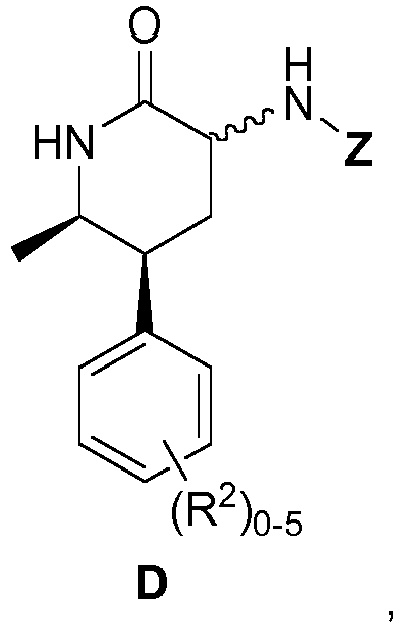
- Another embodiment of the invention encompasses the process described above further comprising making the compound of Formula A by reacting a compound of Formula D wherein Z is an amine protecting group, with an electrophilic alkylating agent that delivers a cationic R 1 , such as R 1 -OS(O) 2 CF 3 or R 1 -OS(O) 2 F, in the presence of base and optionally an additive in a second organic solvent to yield a compound of Formula E and deprotecting the compound of Formula E to yield a compound of Formula A.
- an electrophilic alkylating agent that delivers a cationic R 1 , such as R 1 -OS(O) 2 CF 3 or R 1 -OS(O) 2 F, in the presence of base and optionally an additive in a second organic solvent to yield a compound of Formula E and deprotecting the compound of Formula E to yield a compound of Formula A.
- Bases that may be used in the present invention include alkali metal bases, preferably lithium base, such as lithium tert-butoxide, lithium tert-pentoxide.
- Optional additives are, for example, aprotic polar solvents, such as DMPU, DMAc and DMF.
- second organic solvent includes THF, Me-THF, MTBE, and the like. The terms also include mixtures of solvents.
- Deprotection can be carried out under acidic conditions, for example using a second acid including but not limited to HCl, MeSO 3 H, H 2 SO 4 , p-toluenesulfonic acid and the like, hydrogenation conditions or basic conditions as appropriate.
- a second acid including but not limited to HCl, MeSO 3 H, H 2 SO 4 , p-toluenesulfonic acid and the like, hydrogenation conditions or basic conditions as appropriate.
- Z is t-butyl-O-C(O)-
- the electrophilic alkylating agent is R 1 -OS(O) 2 CF 3 or R 1 -OS(O) 2 F
- deprotection is effected by reacting the compound of Formula E with an acid
- the lithium base is selected from LiOBu t and LiOPent t
- the additive is an aprotic polar solvent
- the second organic solvent is selected from THF, Me-THF and MTBE.
- the second acid is selected from HCl, MeSO 3 H, H 2 SO 4 , p-toluenesulfonic acid and benzenesulfonic acid.
- the compound of Formula D described in the process above may be made by reacting a compound of Formula F wherein R a is C 1-6 alkyl, with a transaminase enzyme having the amino acid sequence of SEQ ID NO: 1 and the nucleotide sequence of SEQ ID NO: 2 in an aqueous solvent mixture to yield a compound of Formula D.
- the compound of Formula F is reacted with the transaminase enzyme of SEQ ID NO: 1 at a pH in the range of pH 10 to pH 10.7 and an elevated temperature in the range of 45°C to 60°C.
- the reaction is run at a pH of about 10.5 and a temperature of about 55°C.
- X-ray powder diffraction studies are widely used to characterize molecular structures, crystallinity, and polymorphism.
- the X-ray powder diffraction patterns disclosed herein were generated on a Philips Analytical X'Pert PRO X-ray Diffraction System with PW3040/60 console.
- a PW3373/00 ceramic Cu LEF X-ray tube K-Alpha radiation was used as the source.
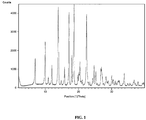
- FIGURE 1 shows the X-ray powder diffraction pattern for crystalline ( S )- N- ((3 S ,5 S ,6 R )-6-methyl-2-oxo-1-(2,2,2-trifluoroethyl)-5-(2,3,6-trifluorophenyl)piperidin-3-yl)-2'-oxo-1',2',5,7-tetrahydrospiro[cyclopenta[b]pyridine-6,3'-pyrrolo[2,3-b]pyridine]-3-carboxamide monohydrate.
- the monohydrate form is characterized by diffraction peaks corresponding to d-spacings as detailed in Table 1. TABLE 1 Pos.
- DSC data disclosed herein were acquired using TA Instruments DSC 2910 or equivalent instrumentation.
- a sample with a weight between 2 and 8 mg was weighed into a pan and the pan was crimped and a pinhole placed in the lid. This pan was placed in the sample position in the calorimeter cell. An empty pan was placed in the reference position. The calorimeter cell was closed and a flow of nitrogen is passed through the cell.
- the heating program was set to heat the sample at a heating rate of 10 °C/min to a temperature of approximately 300 °C.
- the data were analyzed using the DSC analysis program in the system software.
- the observed endotherms were integrated between baseline temperature points that are above and below the temperature range over which the endotherm is observed. The data reported are the onset temperature, peak temperature and enthalpy.
- FIGURE 2 shows the DSC thermogram for crystalline ( S )- N -((3 S ,5 S ,6 R )-6-methyl-2-oxo-1-(2,2,2-trifluoroethyl)-5-(2,3,6-trifluorophenyl)piperidin-3-yl)-2'-oxo-1',2',5,7-tetrahydrospiro[cyclopenta[b]pyridine-6,3'-pyrrolo[2,3-b]pyridine]-3-carboxamide monohydrate.
- T onset 143.9 C
- T peak 174.7 C
- ⁇ H 95.8 J/g
- FIGURE 3 shows the X-ray powder diffraction pattern of crystalline ( S )- N- ((3 S ,5 S ,6 R )-6-methyl-2-oxo-5-phenyl-1-(2,2,2-trifluoroethyl)piperidine-3-yl)-2'-oxo-1',2',5,7-tetrahydrospiro[cyclopenta[ b ]pyridine-6,3'-pyrrolo[2,3- b ]pyridine]-3-carboxamide trihydrate.
- the trihydrate form is characterized by diffraction peaks corresponding to d-spacings as detailed in Table 2.
- FIGURE 4 shows the DSC thermogram for crystalline ( S )- N -((3 S ,5 S ,6 R )-6-methyl-2-oxo-5-phenyl-1-(2,2,2-trifluoroethyl)piperidine-3-yl)-2'-oxo-1',2',5,7-tetrahydrospiro[cyclopenta[ b ]pyridine-6,3'-pyrrolo[2,3- b ]pyridine]-3-carboxamide trihydrate.
- T onset 102.7°C
- T peak 136.1° C
- ⁇ H 240.2 J/g was observed that was consistent with a dehydration event.
- FIGURE 5 shows the X-ray powder diffraction pattern of crystalline ( S )- N- ((3 S ,5 S ,6 R )-6-methyl-2-oxo-5-phenyl-1-(2,2,2-trifluoroethyl)piperidine-3-yl)-2'-oxo-1',2',5,7-tetrahydrospiro[cyclopenta[ b ]pyridine-6,3'-pyrrolo[2,3- b ]pyridine]-3-carboxamide monohydrate.
- the monohydrate form is characterized by diffraction peaks corresponding to d-spacings as detailed in Table 3.
- TABLE 3 Pos. [° Two Theta.] d-spacing [ ⁇ ] Rel.
- FIGURE 6 shows the DSC thermogram for crystalline ( S )- N -((3 S ,5 S ,6 R )-6-methyl-2-oxo-5-phenyl-1-(2,2,2-trifluoroethyl)piperidine-3-yl)-2'-oxo-1',2',5,7-tetrahydrospiro[cyclopenta[ b ]pyridine-6,3'-pyrrolo[2,3- b ]pyridine]-3-carboxamide monohydrate.
- T onset 165.2 °C
- T peak 171.1 ° C
- ⁇ H 136.9 J/g.
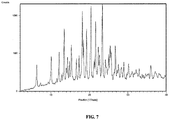
- FIGURE 7 shows the X-ray powder diffraction pattern for crystalline ( S )- N -((3 S ,5 S ,6 R )-6-methyl-2-oxo-1-(2,2,2-trifluoroethyl)-5-(2,3,6-trifluorophenyl)piperidin-3-yl)-2'-oxo-1',2',5,7-tetrahydrospiro[cyclopenta[b]pyridine-6,3'-pyrrolo[2,3-b]pyridine]-3-carboxamide trihydrate.
- the trihydrate form is characterized by diffraction peaks corresponding to d-spacings as detailed in Table 4. TABLE 4 Pos.
- FIGURE 8 shows the DSC thermogram for crystalline ( S )- N -((3 S ,5 S ,6 R )-6-methyl-2-oxo-1-(2,2,2-trifluoroethyl)-5-(2,3,6-trifluorophenyl)piperidin-3-yl)-2'-oxo-1',2',5,7-tetrahydrospiro[cyclopenta[b]pyridine-6,3'-pyrrolo[2,3-b]pyridine]-3-carboxamide trihydrate.
- T onset 83.4°C
- T peak 115.0° C
- ⁇ H 108.6 J/g
- T onset 166.6°C
- T peak 170.7° C
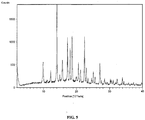
- FIGURE 9 shows the X-ray powder diffraction pattern for crystalline ( S )- N -((3 S ,5 S ,6 R )-6-methyl-2-oxo-1-(2,2,2-trifluoroethyl)-5-(2,3,6-trifluorophenyl)piperidin-3-yl)-2'-oxo-1',2',5,7-tetrahydrospiro[cyclopenta[b]pyridine-6,3'-pyrrolo[2,3-b]pyridine]-3-carboxamide methanol solvate.
- the methanol solvate form is characterized by diffraction peaks corresponding to d-spacings as detailed in Table 5.
- FIGURE 10 shows the X-ray powder diffraction pattern for crystalline ( S )- N -((3 S ,5 S ,6 R )-6-methyl-2-oxo-1-(2,2,2-trifluoroethyl)-5-(2,3,6-trifluorophenyl)piperidin-3-yl)-2'-oxo-1',2',5,7-tetrahydrospiro[cyclopenta[b]pyridine-6,3'-pyrrolo[2,3-b]pyridine]-3-carboxamide methanol-water solvate.
- the methanol-water mixed solvate form is characterized by diffraction peaks corresponding to d-spacings as detailed in Table 6. TABLE 6 Pos.
- FIGURE 11 shows the X-ray powder diffraction pattern of crystalline ( S )- N- ((3 S ,5 S ,6 R )-6-methyl-2-oxo-5-phenyl-1-(2,2,2-trifluoroethyl)piperidine-3-yl)-2'-oxo-1',2',5,7-tetrahydrospiro[cyclopenta[ b ]pyridine-6,3'-pyrrolo[2,3- b ]pyridine]-3-carboxamide acetronitrile water solvate.
- the acetonitrile water solvate form is characterized by diffraction peaks corresponding to d-spacings as detailed in Table 7. TABLE 7 Pos.
- FIGURE 12 shows the X-ray powder diffraction pattern of crystalline ( S )- N- ((3 S ,5 S ,6 R )-6-methyl-2-oxo-5-phenyl-1-(2,2,2-trifluoroethyl)piperidine-3-yl)-2'-oxo-1',2',5,7-tetrahydrospiro[cyclopenta[ b ]pyridine-6,3'-pyrrolo[2,3- b ]pyridine]-3-carboxamide acetronitrile solvate.
- the acetonitrile solvate form is characterized by diffraction peaks corresponding to d-spacings as detailed in Table 8. TABLE 8 Pos.
- FIGURE 13 shows the X-ray powder diffraction pattern of X-ray amorphous ( S )- N -((3 S ,5 S ,6 R )-6-methyl-2-oxo-5-phenyl-1-(2,2,2-trifluoroethyl)piperidine-3-yl)-2'-oxo-1',2',5,7-tetrahydrospiro[cyclopenta[ b ]pyridine-6,3'-pyrrolo[2,3- b ]pyridine]-3-carboxamide which is generated via desolvation of an acetonitrile solvate.
- the X-ray amorphous pattern displays a broad diffuse halo with only a single low angle peak at approximately 5° two-theta.
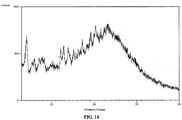
- FIGURE 14 shows the X-ray powder diffraction pattern for crystalline ( S )- N- ((3 S ,5 S ,6 R )-6-methyl-2-oxo-1-(2,2,2-trifluoroethyl)-5-(2,3,6-trifluorophenyl)piperidin-3-yl)-2'-oxo-1',2',5,7-tetrahydrospiro[cyclopenta[b]pyridine-6,3'-pyrrolo[2,3-b]pyridine]-3-carboxamide acetonitrile solvate.
- the acetonitrile solvate form is characterized by diffraction peaks corresponding to d-spacings as detailed in Table 9. TABLE 9 Pos.
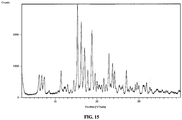
- FIGURE 15 shows the X-ray powder diffraction pattern of crystalline ( S )- N- ((3 S ,5 S ,6 R )-6-methyl-2-oxo-5-phenyl-1-(2,2,2-trifluoroethyl)piperidine-3-yl)-2'-oxo-1',2',5,7-tetrahydrospiro[cyclopenta[ b ]pyridine-6,3'-pyrrolo[2,3- b ]pyridine]-3-carboxamide L-tartaric acid cocrystal.
- the L-tartaric acid cocrystal form is characterized by diffraction peaks corresponding to d-spacings as detailed in Table 10. TABLE 10 Pos.
- FIGURE 16 shows the X-ray powder diffraction pattern for crystalline ( S )- N -((3 S ,5 S ,6 R )-6-methyl-2-oxo-1-(2,2,2-trifluoroethyl)-5-(2,3,6-trifluorophenyl)piperidin-3-yl)-2'-oxo-1',2',5,7-tetrahydrospiro[cyclopenta[b]pyridine-6,3'-pyrrolo[2,3-b]pyridine]-3-carboxamide L-tartaric acid cocrystal.
- the L-tartaric cocrystal form is characterized by diffraction peaks corresponding to d-spacings as detailed in Table 11.
- a crystalline free base of the compound having the structure and having the following chemical name: ( S )- N -((3 S ,5 S ,6 R )-6-methyl-2-oxo-1-(2,2,2-trifluoroethyl)-5-(2,3,5-trifluorophenyl)piperidin-3-yl)-2'-oxo-1,2',5,7-tetrahydrospiro[cyclopenta[b]pyridine-6,3'-pyrrolo[2,3-b]pyridine]-3-carboxamide.
- FIGURE 17 shows the X-ray powder diffraction pattern for crystalline ( S )- N- ((3 S ,5 S ,6 R )-6-methyl-2-oxo-1-(2,2,2-trifluoroethyl)-5-(2,3,5-trifluorophenyl)piperidin-3-yl)-2'-oxo-1',2',5,7-tetrahydrospiro[cyclopenta[b]pyridine-6,3'-pyrrolo[2,3-b]pyridine]-3-carboxamide.
- the form is characterized by diffraction peaks corresponding to d-spacings as detailed in Table 12. TABLE 12 Pos.
- Scheme 1 illustrates a route to 3-aminopiperidinone intermediates of type 1.5 which may be used to prepare compounds of the present invention.
- Aryl acetone 1.1 can be alkylated using the iodoalanine derivative 1.2 under basic conditions to provide keto ester 1.3.
- Reductive amination followed by cyclization and epimerization provides primarily cis-substituted lactam 1.4 as a racemic mixture.
- Chiral resolution using normal-phase liquid chromatography, for example, and removal of the Boc protecting group with HCl in EtOAc furnishes 3-aminopiperidinone 1.5 as a hydrochloride salt.
- a synthetic route to 3-aminopiperidinone intermediates of type 4.4 is shown in Scheme 4.
- Aryl acetonitrile 4.1 can be alkylated using the iodoalanine derivative 1.2 under basic conditions to provide cyano ester 4.2.
- Reductive cyclization using hydrogen and palladium hydroxide on carbon or Raney nickel, epimerization, and chiral resolution affords cis lactam 4.3 as a single enantiomer.
- N -Alkylation and removal of the Boc protecting group then provides 4.4 as a hydrochloride salt.
- Scheme 5 illustrates an alternative route to 3-aminopiperidinone intermediates of type 4.4.
- the arylacetonitrile 5.1 may be condensed with acrylate 5.2 at elevated temperature to give the 4-cyanobutanoate ester 5.3.
- Hydrogenation of nitrile 5.3 using Raney nickel catalyst and an ethanolic solution of ammonia affords the corresponding amine product, which typically cyclizes in situ to provide piperidinone 5.4.
- N -Alkylation of lactam 5.4 may be accomplished by a variety of methods known to those skilled in the art of organic synthesis, the exact choice of conditions being influenced by the nature of the alkylating agent, R 1 X.
- Electrophilic azidation of the resulting substituted lactam 5.5 can be accomplished using similar methodology to that described by Evans and coworkers ( Evans et al. (1990) J. Am. Chem. Soc. 112, 4011-4030 ) to provide the azide 5.6 as a mixture of diastereoisomers, which can be separated by chromatography.
- the desired cis diastereomer of azide 5.6 may be reduced by catalytic hydrogenation in the presence of di- tert -butyl dicarbonate to give the corresponding Boc-protected amine 5.7 , and separation of the enantiomers using chiral HPLC or SFC leads to the (3 S ,5 S )-isomer 5.8 .
- standard deprotection affords the desired 3-aminopiperidinone intermediate 4.4 as a hydrochloride salt.
- Pyridinone 6.1 can then be subjected to Suzuki-Miyaura coupling with the boronic acid 6.2 , and the resulting 5-arylpyridinone 6.3 may be hydrogenated using, for example, platinum(IV) oxide catalyst to afford the corresponding 5-arylpiperidinone 6.4 , which is usually obtained as predominantly the cis isomer.
- Further elaboration of piperidinone 6.4 may be achieved using analogous methodology to that described in Scheme 5. Specifically, electrophilic azidation followed by one-pot reduction and Boc protection leads to carbamate 6.6 , and the desired enantiomer may be obtained using chiral chromatography.
- the desired diastereomer of azide 6.5 may be isolated as a racemic mixture of the (3 S ,5 S ,6 R )- and (3 R ,5 R ,6 S )-isomers following silica gel chromatography of the crude product, and this mixture may be elaborated as outlined in Scheme 6.
- the mixture of carbamate 6.6 diastereomers may be epimerized under basic conditions, such as potassium carbonate in EtOH, to afford a mixture that is significantly enriched in the desired (3 S ,5 S ,6 R )- and (3 R ,5 R ,6 S )-isomers, further purification may be employed to obtain the enantiomer of interest as outlined herein.
- Useful derivatives of the intermediates described herein may be prepared using well-precedented methodology.
- One such example is illustrated in Scheme 10, in which the azaoxindole intermediate 7.4 is converted to the corresponding nitrile derivative 10.2 , which may be used to prepare compounds of the present invention.
- Bromination of 7.4 with N-bromosuccinimide in boron trifluoride dihydrate provides the bromo derivative 10.1 , which may be converted to the desired nitrile 10.2 using zinc cyanide and a palladium catalyst as shown.
- a synthetic route to the azaoxindole indane acid intermediate 11.17 is shown in Scheme 11.
- Esterification of diacid 11.1 followed by hydrogenation using palladium on carbon as a catalyst provides aniline 11.2.
- Useful derivatives of the intermediates described herein may be prepared using well-precedented methodology.
- One such example is illustrated in Scheme 14, in which the azaoxindole intermediate 11.17 is converted to the corresponding nitrile derivative 14.2 , which may be used to prepare compounds of the present invention.
- Treatment of 11.17 with bromine in acetic acid provides the bromo derivative 14.1 , which may be converted to the desired nitrile 14.2 using zinc cyanide and a palladium catalyst as shown.
- Scheme 15 illustrates conditions that can be used for the coupling of 3-aminopiperidinone intermediates, such as 15.1 , and carboxylic acid intermediate 15.2 , to produce, in this instance, amides 15.3.
- 3-aminopiperidinone intermediates such as 15.1
- carboxylic acid intermediate 15.2 carboxylic acid intermediate 15.2
- These standard coupling conditions are representative of the methods used to prepare the compounds of the present invention.
- the compound 6 is a mixture of two pair of diastereomers 6-1 and 6-2 , partially separable by flash chromatography on silica gel with ethyl acetate and heptane as a eluant (1:10).
- Compound 6 was prepared from 7 in DMSO in the presence of 0.5 equiv. Cs 2 CO 3 with 1.05 equiv. of phenylacetone at room temperature in 79% yield.
- the phases were separated, the organic layers were combined and washed with DI water (0.5 L).
- the HPLC based assay yield in the organic layer was 8 (114.6 g) with >60:1 dr at the positions C5 and C6.
- the ratio of stereoisomers at position C2 was ⁇ 1:1.
- the extract was concentrated and dissolved in CH 2 Cl 2 .
- the organic solution was washed with water then saturated aqueous NaCl, concentrated and crystallized from MTBE/ n -hexane (2:3).
- the crystal was filtered at room temperature and washed with MTBE/ n -hexane (2:3) and dried to afford a cis and trans mixture ( ⁇ 1 :1.2) of the lactam 8 (99.6 g, 80.0 %) as crystals.
- the mixture was quenched into a mixture of heptane (4.8 L), water (3.4 L) and 2N HCl solution (280 mL) below 15 °C.
- the phases were separated.
- the aqueous phase was extracted with heptane (4 L).
- the combined organic phase was washed with water (2 L).
- the solution was concentrated to a volume of about 1 L under vacuum between 25 and 50 °C.
- the crude material was passed through a short silica gel plug with heptane/ethyl acetate.
- the resulting solution was concentrated under vacuum until distillation stopped at a temperature below 50 °C, dissolved in IPAc (2 L) and used for the next processing step.
- the assay yield of 9 for both cis and trans isomers was 85% in the ratio of ⁇ 8 to 1.
- the aqueous layer was separated and extracted with toluene (20 mL).
- the combined organic layer contained 87% of 9 , 6% of 10 and 6% of 8 by HPLC and yield for the desired product 9 was 87%.
- the organic layer was then stirred with 3N HCl solution (80 ml) and tetrabutylammoniium bromide (0.8 g) for about 3 h until HPLC analysis indicated selective removal of the Boc group in the unreacted 8 was completed.
- the aqueous layer was removed.
- the organic layer containing 9 and 10 was then concentrated under vacuum at 60 °C to remove most of solvent. The residue was dissolved in MTBE (60 mL), and 5N HCl solution (65 mL) was added.
- the diphasic solution was agitated vigorously at 50 °C for about 5 h until the deprotection of 9 was completed while 10 was mainly intact.
- the organic layer was separated at 45 °C.
- the aqueous layer was diluted with water (60 mL) and resulting aqueous and washed with heptane (30 mL) at 45 °C.
- the aqueous solution was then mixed with MTBE (100 mL) and basified with 10 N NaOH solution until the pH of the mixture was about 10.
- the organic layer was separated and the aqueous layer was back-extracted with MTBE (60 mL).
- the combined organic layers were washed with brine (60 mL).
- the resulting organic solution was suitable for next reaction.
- the solution was contained 12 (15.6 g, 83% from 8 ) with 97% LC purity as a mixture of two diastereomers ( cis and trans ) in 4 to 1 ratio.
- the reaction was extracted by first adding a mixture of iPA: iPAc (3:4, 350 mL) and stirring for 20 min. The phases were separated and the aqueous layer was back extracted with a mixture of iPA: iPAc (2:8, 350 mL). The phases were separated. The organic layers were combined and washed with DI water (90 mL). The HPLC based assay yield in the organic layer was 20 (9.86 g, 70.5 % assay yield) with >60:1 dr at the positions C5 and C6.
- the mixture was quenched with 0.2 N HCl (70 ml), followed by addition of heptane (80 ml).
- the organic layer was separated and aqueous layer extracted with heptane (30 ml).
- the combined organic layers were washed with 15% aquoeus citric acid (50 mL) and 5% aqueous NaHCO 3 (50 mL).
- the solution was concentrated under vacuum at 40 °C and the resulting oil was dissolved in iPAc (30 mL). The solution was used directly in the next step without further purification.
- iPAc solution of 22 (529 g assayed, 1.2 mol), obtained from previous step, was diluted to 6 L with iPAc, p -toluenesulfonic acid monohydride (343 g, 1.8 mol) was added and the solution was heated to 55 °C. After 4 h, the reaction completed (>99% conversion).
- Aqueous K 2 CO 3 (530 g in 3 L of water) was charged into the solution after cooled to 15-25 °C. The aqueous layer was separated and was back-extracted with iPAc (2 L). The iPAc solutions were combined and the total volume was adjudted to 10 L by adding iPAc. The solution was heated to 50-60 °C.
- N -acetyl L-phenylalanine was added and the solution was agitated for 15 min or until solids precipitated out.
- the remaining N -acetyl L-phenylalanine (total 250 g, 1.2 mol) was charged slowly and 2-hydroxy-5-nitrobenzaldehyde (2 g) was charged.
- the suspension was agitated for 12 h at 20 °C and then cooled to 0 °C for 3 h.
- the suspension was filtrated, washed with iPAc three times and dried to give 23 (583g, 89% yield) as crystals.
- a thick salt suspension was agitated at 55-60 °C for another 18 h and then was allowed to cool to ambient temperature.
- the salt was filtered and washed with isopropyl acetate. After drying at 60 °C in a vacuum oven with nitrogen purge for 8 hours, 25 (2.97 g, 91.4%) was obtained as crystals.
- the previously prepared lithium trifluorobenzene solution was transferred to the second flask between -70 to -45 °C.
- the reaction was agitated for 1 hour at -55 to -45 and then quenched by adding AcOH (25.7 mL, 445 mmol) and then water (150 mL). After warmed to room temperature, the aqueous layer was seperated.
- the aqueous solution was extracted with MTBE (200 mL x 1) and the combined organic layers were washed with brine (100 mL x 1). The organic layer was concentrated at 25-35 °C.
- the hydroxy ketone 30 (7.69 g, 35.2 mmol) and 95% H 2 SO 4 (26.2 mL, 492.8 mmol) were pumped at 2.3 and 9.2 mL/min respectively into the flow reactor.
- the temperature on mixing was controlled at 22-25 °C by placing the reactor in a water bath (21 °C).
- the effluent was quenched into a a mixture of cold water (106 g) and heptane/IPAc (1:1, 92 mL) in a jacketed reactor cooled at 0 °C; the internal temperature of the quench solution was ⁇ 7 °C during the reaction.
- the layers in the quench reactor were separated and the organic layer was washed with 10% NaH 2 PO 4 /Na 2 HPO 4 (1:1, 50 mL). The pH of the final wash was 5-6. Solka flock (3.85 g, 50 wt%) was added to the organic solution. The resulting slurry was concentrated and solvent-switched to heptanes at 25-30 °C. The mixture was filtered, rinsed with heptanes (50 mL x 1). The combined filtrates were concentrated under vacuum to give 31 as an light yellow oil (6.86 g, 90 wt%, 87% yield), which solidified in a freezer.
- Salt 39 (0.25 g, 0.58 mmol) was partitioned between IPAC (2.5 mL) and 5 wt% aqueous solution of K 3 PO 4 (2.5 mL), and washed twice with 5 wt% aqueous K 3 PO 4 . The organic layer was washed with brine, dried over Na 2 SO 4 and concentrated to give a crude 40. Crude 40 was dissolved in MeCN (1.75 mL) and H 2 O (1.0 mL). To this was added acid 14 (0.17 g, 0.53 mmol), HOBT (0.11 g, 0.70 mmol) and EDC ⁇ HCl (0.17 g, 0.87 mmol). The heterogeneous mixture was aged at 20-25°C for 16 h.
- Salt 49 (0.60 g, 1.27 mmol) was partitioned in IPAC (6 mL) and a 5 wt% aqueous K 3 PO 4 (6 mL), and washed twice with 5 wt% aqueous K 3 PO 4 . The organic layer was washed with brine, dried with Na 2 SO 4 and concentrated to give crude 50. Crude 50 was then dissolved in MeCN (4.2 mL) and H 2 O (2.4 mL). To this solution was added acid 14 (0.32 g, 1.12 mmol), HOBT (0.22 g, 1.42 mmol) and EDC ⁇ HCl (0.34 g, 1.77 mmol). The heterogeneous mixture was aged at 20-25 °C for 16 h.
- the resulting solution was stirred for another 1 h at this temperature.
- the reaction mixture was quenched by addition of MTBE (50 mL), 15% aqueous citric acid (25 mL) and water (15 mL).
- the organic layer was separated and washed with 5% aqueous NaCl (50 mL) twice.
- the organic solution was concentrated under vacuum at 50 °C to give 53 as an oil (6.2 g, 68 wt%, 16.6 mmol, 74% yield).
- the crude product was used directly for the next step without further purification.
- the pure sample was isolated by flash chromatography on silica gel with 5% ethyl acetate in hexane as eluants.
- the suspension was cooled to room temperature and filtered.
- the cake was washed with a mixture of isopropanol (3 mL) and water (3 mL).
- the precipitates were collected and dried in a vacuum oven over night at 50 °C to give 55 (6.2 g, 87%) as a solid.
- the resulting slurry was aged at 22 °C for 1 to 2 h, filtered, rinsed with AcOEt (2 x 24 ml), then hexane (2 x 24 ml). The solid was dried under vacuum to give powder as a mixture of bis-salts (bis-quinidine salt 61 and bis-dihydroquinidine salt). (Total 19.7 g, 94% yield).
- the authentic sample of 61 was purified by SFC (IC column, 20 x 250 mm, 60% MeOH/CO 2 , 50 mL/min, 100 bar, 35°C, 220 nm, sample concentration: 133 mg/mL in MeOH; desired peak: 3 to 4.5 min).
- the solution was kept under CO (100 psi) at 60 °C for 18 h in the presence of 5 mol% of Pd(dppf)Cl 2 .
- the solvent was removed and the residue was transferred onto silica gel (60 g) on a filter funnel.
- the mixture was rinsed with a mixture of 10% ethyl acetate in hexane (400 mL).
- the resulting solution was concentrated to give crude 64 (29.2 g, 98% LCAP, 84% wt, 100% yield) as an oil, which was used directly in the next step without further purification.
- the reaction mixture was acidified with 6N HCl solution in IPA (17 mL). The resulting solution was heated at 80 °C for 2 h. After cooling to room temperature, the mixture was diluted with MTBE (100 mL) and 5% brine (50 mL). The organic layer was washed with water (50 mL) and dried over MgSO 4 . The solution was concentrated under vacuum at 50 °C and residue crystallized from hexane (30 mL), to give 56 (3.75 g, 67% from 65 ) as crystals.
- the reaction mixture was quenched by addition of 15% aqueous citric acid (13 mL), water (40 mL) and MTBE (33 mL) at 0 °C.
- the organic layer was separated and washed with water (50 mL), saturated NaHCO 3 /water (1:3, 50 ml), brine (50 mL) and water (50 mL), in turns.
- the organic layer was concentrated and flushed with THF to give 68 (19.3 g, 92%).
- the organic solution contained 54 (3.79 g, 91% assay yield) was concentrated, flushed with toluene to remove water.
- the solution was cooled to 20 oC and 6 g of acetonitrile/water solvate seeds was introduced. After the mixture was stirred at 20°C 30 minutes, 4 L of water was added slowly over 4 hours. During the addition of water solids precipitated as acetonitrile/water mixed solvate.
- Crystalline materials was filtered and dried overnight at 40°C yielding crystalline ( S )- N -((3 S ,5 S ,6 R )-6-methyl-2-oxo-5-phenyl-1-(2,2,2-trifluoroethyl)piperidine-3-yl)-2'-oxo-1',2',5,7-tetrahydrospiro[cyclopenta[ b ]pyridine-6,3'-pyrrolo[2,3- b ]pyridine]-3-carboxamide L-tartaric acid cocrystal form.
Landscapes
- Chemical & Material Sciences (AREA)
- Organic Chemistry (AREA)
- Nitrogen Condensed Heterocyclic Rings (AREA)
- Pharmaceuticals Containing Other Organic And Inorganic Compounds (AREA)
Claims (12)
- Ein Verfahren zur Herstellung einer Verbindung der Formel I
 X ausgewählt ist aus -C(R3)= oder -N=, wobei R3 Wasserstoff, F oder CN ist,Y CH oder N ist,R1 ausgewählt ist aus der Gruppe bestehend aus: C1-4-Alkyl, Cyclopropylmethyl, Cyclobutylmethyl und [1-(Trifluormethyl)cyclopropyl]methyl, wobei jedes davon gegebenenfalls substituiert ist mit einem oder mehreren Substituenten, wie von der Valenz erlaubt, unabhängig ausgewählt aus der Gruppe bestehend aus: F und Hydroxy, undR2 ausgewählt ist aus Wasserstoff, Methyl, F, Cl oder Br,umfassend das Kristallisieren der Formel A

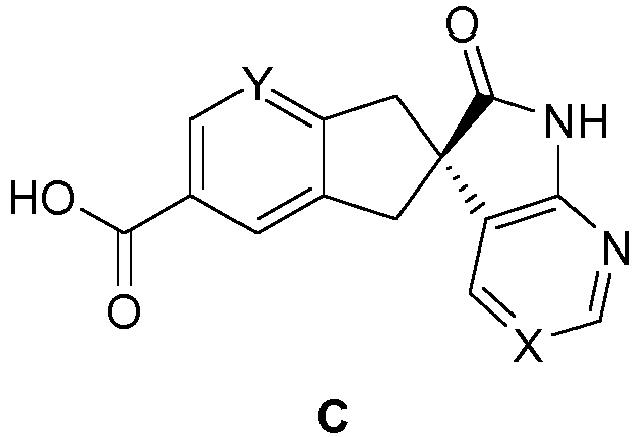
- Das Verfahren gemäß Anspruch 1, wobei die Verbindung der Formel B mit einer Verbindung der Formel C gekuppelt wird, nach dem Aufbrechen des Salzes, indem die Reagenzien mit einem Amidkupplungsreagenz in einem nichtreaktiven Lösungsmittel umgesetzt werden, um eine Verbindung der Formel I zu ergeben.
- Das Verfahren gemäß Anspruch 2, wobei das Amidkupplungsreagenz ausgewählt wird aus der Gruppe bestehend aus EDC, HATU, Propanphosphonsäureanhydrid und CDI, und das nichtreaktive Lösungsmittel eine organisch/wässrige Mischung ist, ausgewählt aus der Gruppe bestehend aus DCM/Wasser, iPAC/Wasser, Acetonitril/Wasser, Aceton/Wasser, iPA/Wasser und THF/Wasser.
- Das Verfahren gemäß Anspruch 2, ferner umfassend ein Amidkupplungsreagenz-Additiv, ausgewählt aus der Gruppe bestehend aus HOBT und HOPO.
- Das Verfahren gemäß Anspruch 1, wobei ein Salz einer Verbindung der Formel C mit der Verbindung der Formel B gekuppelt wird.
- Das Verfahren gemäß Anspruch 1, wobei das Arylaldehydderivat ausgewählt ist aus 2-Hydroxybenzaldehyd, 2-Hydroxy-5-nitrobenzaldehyd und 2-Hydroxy-3,5-dichlorbenzaldehyd.
- Das Verfahren gemäß Anspruch 1, ferner umfassend die Herstellung der Verbindung der Formel A durch Umsetzen einer Verbindung der Formel D

- Das Verfahren gemäß Anspruch 7, wobei das elektrophile Alkylierungsmittel R1-OS(O)2CF3 oder R1-OS(O)2F oder R1-OS(O)2Rf ist, wobei Rf eine polyfluorierte ein- bis sechsgliedrige Kohlenstoffkette ist.
- Das Verfahren gemäß Anspruch 8, wobei: Z t-Butyl-O-C(O)- ist, das Entfernen der Schutzgruppe durch Umsetzen der Verbindung der Formel D mit einer zweiten Säure erfolgt, die Base eine Lithiumbase ist, das Additiv ein aprotisches polares Lösungsmittel ist und das zweite organische Lösungsmittel ausgewählt ist aus der Gruppe bestehend aus THF, Me-THF und MTBE.
- Das Verfahren gemäß Anspruch 9, wobei die Lithiumbase ausgewählt ist aus der Gruppe bestehend aus LiOBut und LiOPentt.
- Das Verfahren gemäß Anspruch 9, wobei die zweite Säure ausgewählt ist aus der Gruppe bestehend aus HCl, MeSO3H, H2SO4, p-Toluolsulfonsäure und Benzolsulfonsäure.
- Eine Verbindung, ausgewählt aus:


Priority Applications (2)
| Application Number | Priority Date | Filing Date | Title |
|---|---|---|---|
| EP18173603.4A EP3430906A1 (de) | 2012-05-09 | 2013-03-13 | Kristalline formen von cgrp-rezeptor-antagonisten |
| EP26151542.3A EP4737458A2 (de) | 2012-05-09 | 2013-03-13 | Verfahren zur herstellung von cgrp-rezeptorantagonisten |
Applications Claiming Priority (2)
| Application Number | Priority Date | Filing Date | Title |
|---|---|---|---|
| US201261644631P | 2012-05-09 | 2012-05-09 | |
| PCT/US2013/030692 WO2013169348A1 (en) | 2012-05-09 | 2013-03-13 | Process for making cgrp receptor antagonists |
Related Child Applications (3)
| Application Number | Title | Priority Date | Filing Date |
|---|---|---|---|
| EP26151542.3A Division EP4737458A2 (de) | 2012-05-09 | 2013-03-13 | Verfahren zur herstellung von cgrp-rezeptorantagonisten |
| EP18173603.4A Division-Into EP3430906A1 (de) | 2012-05-09 | 2013-03-13 | Kristalline formen von cgrp-rezeptor-antagonisten |
| EP18173603.4A Division EP3430906A1 (de) | 2012-05-09 | 2013-03-13 | Kristalline formen von cgrp-rezeptor-antagonisten |
Publications (3)
| Publication Number | Publication Date |
|---|---|
| EP2849568A1 EP2849568A1 (de) | 2015-03-25 |
| EP2849568A4 EP2849568A4 (de) | 2016-04-13 |
| EP2849568B1 true EP2849568B1 (de) | 2020-04-15 |
Family
ID=49551123
Family Applications (3)
| Application Number | Title | Priority Date | Filing Date |
|---|---|---|---|
| EP18173603.4A Withdrawn EP3430906A1 (de) | 2012-05-09 | 2013-03-13 | Kristalline formen von cgrp-rezeptor-antagonisten |
| EP13787557.1A Active EP2849568B1 (de) | 2012-05-09 | 2013-03-13 | Verfahren zur herstellung von cgrp-rezeptorantagonisten |
| EP26151542.3A Pending EP4737458A2 (de) | 2012-05-09 | 2013-03-13 | Verfahren zur herstellung von cgrp-rezeptorantagonisten |
Family Applications Before (1)
| Application Number | Title | Priority Date | Filing Date |
|---|---|---|---|
| EP18173603.4A Withdrawn EP3430906A1 (de) | 2012-05-09 | 2013-03-13 | Kristalline formen von cgrp-rezeptor-antagonisten |
Family Applications After (1)
| Application Number | Title | Priority Date | Filing Date |
|---|---|---|---|
| EP26151542.3A Pending EP4737458A2 (de) | 2012-05-09 | 2013-03-13 | Verfahren zur herstellung von cgrp-rezeptorantagonisten |
Country Status (3)
| Country | Link |
|---|---|
| US (3) | US9174989B2 (de) |
| EP (3) | EP3430906A1 (de) |
| WO (1) | WO2013169348A1 (de) |
Families Citing this family (16)
| Publication number | Priority date | Publication date | Assignee | Title |
|---|---|---|---|---|
| TWI522355B (zh) * | 2010-11-12 | 2016-02-21 | 默沙東藥廠 | 六氫吡啶酮甲醯胺氮雜茚滿cgrp受體拮抗劑 |
| AU2013232191B2 (en) | 2012-03-14 | 2017-03-30 | Merck Sharp & Dohme Llc | Bis-quarternary cinchona alkaloid salts as asymmetric phase transfer catalysts |
| US9487523B2 (en) | 2012-03-14 | 2016-11-08 | Merck Sharp & Dohme Corp. | Process for making CGRP receptor antagonists |
| US12168004B2 (en) | 2014-02-05 | 2024-12-17 | Merck Sharp & Dohme Llc | Treatment of migraine |
| EP3102564A4 (de) | 2014-02-05 | 2017-10-18 | Merck Sharp & Dohme Corp. | Tablettenformulierung für cgrp-aktive verbindungen |
| CN105037210A (zh) * | 2015-05-27 | 2015-11-11 | 江苏大学 | 一种α,β-脱氢-α-氨基酸的合成方法 |
| GB201519194D0 (en) | 2015-10-30 | 2015-12-16 | Heptares Therapeutics Ltd | CGRP receptor antagonists |
| GB201519196D0 (en) | 2015-10-30 | 2015-12-16 | Heptares Therapeutics Ltd | CGRP Receptor Antagonists |
| GB201519195D0 (en) | 2015-10-30 | 2015-12-16 | Heptares Therapeutics Ltd | CGRP Receptor Antagonists |
| US12383545B1 (en) | 2018-06-08 | 2025-08-12 | Allergan Pharmaceuticals International Limited | Treatment of migraine |
| EP4188375A4 (de) | 2020-07-29 | 2024-07-24 | Allergan Pharmaceuticals International Limited | Behandlung von migräne |
| AU2021409718A1 (en) | 2020-12-22 | 2023-07-13 | Allergan Pharmaceuticals International Limited | Treatment of migraine |
| WO2022251402A1 (en) * | 2021-05-28 | 2022-12-01 | Merck Sharp & Dohme Llc | Transaminase enzymes for the transamination of (1s,5r)-6,8-dioxabicyclo[3.2.1]octan-4-one |
| MX2024003952A (es) | 2021-09-27 | 2024-05-27 | Allergan Pharmaceuticals Int Ltd | Combinación que comprende atogepant para tratar la migraña. |
| CN113773228A (zh) * | 2021-10-28 | 2021-12-10 | 上海吉奉生物科技有限公司 | 一种n-苄氧羰基-3-碘-l-丙氨酸甲酯的合成方法 |
| WO2024150250A1 (en) * | 2023-01-10 | 2024-07-18 | Msn Laboratories Private Limited, R&D Center | A process for the preparation of atogepant and its intermediates |
Family Cites Families (9)
| Publication number | Priority date | Publication date | Assignee | Title |
|---|---|---|---|---|
| US7659300B2 (en) | 2004-09-08 | 2010-02-09 | Merck Sharp & Dohme Corp. | Monocyclic anilide spirolactam CGRP receptor antagonists |
| JP2008512456A (ja) | 2004-09-09 | 2008-04-24 | メルク エンド カムパニー インコーポレーテッド | 三環式アニリドスピロラクタムcgrp受容体拮抗薬 |
| US7390798B2 (en) | 2004-09-13 | 2008-06-24 | Merck & Co., Inc. | Carboxamide spirolactam CGRP receptor antagonists |
| BRPI0711352A2 (pt) | 2006-05-09 | 2011-09-27 | Merck & Co Inc | composto, composição farmacêutica, e, métodos para o antagonismo de atividade receptora de cgrp em um mamìfero, e para, tratar, controlar, melhorar ou reduzir o risco de dor de cabeça, enxaqueca , ou cefaléia vascular |
| EP2161996B1 (de) | 2007-06-05 | 2014-07-16 | Merck Sharp & Dohme Corp. | Heterocyclische carboxamid-cgrp-rezeptorantagonisten |
| TWI522355B (zh) | 2010-11-12 | 2016-02-21 | 默沙東藥廠 | 六氫吡啶酮甲醯胺氮雜茚滿cgrp受體拮抗劑 |
| KR20220164616A (ko) * | 2012-03-14 | 2022-12-13 | 머크 샤프 앤드 돔 코포레이션 | Cgrp 수용체 길항제의 제조 방법 |
| US9487523B2 (en) | 2012-03-14 | 2016-11-08 | Merck Sharp & Dohme Corp. | Process for making CGRP receptor antagonists |
| AU2013232191B2 (en) | 2012-03-14 | 2017-03-30 | Merck Sharp & Dohme Llc | Bis-quarternary cinchona alkaloid salts as asymmetric phase transfer catalysts |
-
2013
- 2013-03-12 US US14/399,483 patent/US9174989B2/en active Active
- 2013-03-13 WO PCT/US2013/030692 patent/WO2013169348A1/en not_active Ceased
- 2013-03-13 EP EP18173603.4A patent/EP3430906A1/de not_active Withdrawn
- 2013-03-13 EP EP13787557.1A patent/EP2849568B1/de active Active
- 2013-03-13 EP EP26151542.3A patent/EP4737458A2/de active Pending
-
2015
- 2015-09-15 US US14/854,760 patent/US9850246B2/en active Active
-
2017
- 2017-12-19 US US15/846,757 patent/US10106541B2/en active Active
Non-Patent Citations (1)
| Title |
|---|
| None * |
Also Published As
| Publication number | Publication date |
|---|---|
| WO2013169348A1 (en) | 2013-11-14 |
| US9850246B2 (en) | 2017-12-26 |
| US9174989B2 (en) | 2015-11-03 |
| EP2849568A4 (de) | 2016-04-13 |
| EP4737458A2 (de) | 2026-05-06 |
| EP2849568A1 (de) | 2015-03-25 |
| US20150112067A1 (en) | 2015-04-23 |
| US20180127417A1 (en) | 2018-05-10 |
| US20160130273A1 (en) | 2016-05-12 |
| US10106541B2 (en) | 2018-10-23 |
| EP3430906A1 (de) | 2019-01-23 |
Similar Documents
| Publication | Publication Date | Title |
|---|---|---|
| EP3430906A1 (de) | Kristalline formen von cgrp-rezeptor-antagonisten | |
| EP2825044B1 (de) | Verfahren zur herstellung von cgrp-rezeptorantagonisten | |
| US9487523B2 (en) | Process for making CGRP receptor antagonists | |
| AU2004230926B2 (en) | CGRP receptor antagonists | |
| AU2005285197B2 (en) | Carboxamide spirolactam CGRP receptor antagonists | |
| AU2006223236A1 (en) | CGRP receptor antagonists | |
| AU2006275981A1 (en) | Heterocyclic benzodiazepine CGRP receptor antagonists | |
| WO2011005731A2 (en) | Process for making cgrp receptor antagonist | |
| HK40003552A (en) | Crystalline forms of cgrp receptor antagonists |
Legal Events
| Date | Code | Title | Description |
|---|---|---|---|
| PUAI | Public reference made under article 153(3) epc to a published international application that has entered the european phase |
Free format text: ORIGINAL CODE: 0009012 |
|
| 17P | Request for examination filed |
Effective date: 20141209 |
|
| AK | Designated contracting states |
Kind code of ref document: A1 Designated state(s): AL AT BE BG CH CY CZ DE DK EE ES FI FR GB GR HR HU IE IS IT LI LT LU LV MC MK MT NL NO PL PT RO RS SE SI SK SM TR |
|
| AX | Request for extension of the european patent |
Extension state: BA ME |
|
| DAX | Request for extension of the european patent (deleted) | ||
| RA4 | Supplementary search report drawn up and despatched (corrected) |
Effective date: 20160310 |
|
| RIC1 | Information provided on ipc code assigned before grant |
Ipc: A01N 43/90 20060101AFI20160304BHEP Ipc: A61K 31/519 20060101ALI20160304BHEP |
|
| STAA | Information on the status of an ep patent application or granted ep patent |
Free format text: STATUS: EXAMINATION IS IN PROGRESS |
|
| 17Q | First examination report despatched |
Effective date: 20170418 |
|
| REG | Reference to a national code |
Ref country code: DE Ref legal event code: R079 Ref document number: 602013067976 Country of ref document: DE Free format text: PREVIOUS MAIN CLASS: A01N0043900000 Ipc: C07D0471200000 |
|
| RIC1 | Information provided on ipc code assigned before grant |
Ipc: C07C 57/38 20060101ALI20190517BHEP Ipc: C07D 471/10 20060101ALI20190517BHEP Ipc: C07D 471/20 20060101AFI20190517BHEP Ipc: C07C 59/245 20060101ALI20190517BHEP Ipc: C07D 471/04 20060101ALI20190517BHEP Ipc: C07C 205/57 20060101ALI20190517BHEP Ipc: C07C 233/47 20060101ALI20190517BHEP Ipc: C07D 487/20 20060101ALI20190517BHEP Ipc: C07C 63/04 20060101ALI20190517BHEP |
|
| GRAP | Despatch of communication of intention to grant a patent |
Free format text: ORIGINAL CODE: EPIDOSNIGR1 |
|
| STAA | Information on the status of an ep patent application or granted ep patent |
Free format text: STATUS: GRANT OF PATENT IS INTENDED |
|
| INTG | Intention to grant announced |
Effective date: 20191009 |
|
| GRAS | Grant fee paid |
Free format text: ORIGINAL CODE: EPIDOSNIGR3 |
|
| GRAA | (expected) grant |
Free format text: ORIGINAL CODE: 0009210 |
|
| STAA | Information on the status of an ep patent application or granted ep patent |
Free format text: STATUS: THE PATENT HAS BEEN GRANTED |
|
| AK | Designated contracting states |
Kind code of ref document: B1 Designated state(s): AL AT BE BG CH CY CZ DE DK EE ES FI FR GB GR HR HU IE IS IT LI LT LU LV MC MK MT NL NO PL PT RO RS SE SI SK SM TR |
|
| REG | Reference to a national code |
Ref country code: CH Ref legal event code: EP |
|
| REG | Reference to a national code |
Ref country code: DE Ref legal event code: R096 Ref document number: 602013067976 Country of ref document: DE |
|
| REG | Reference to a national code |
Ref country code: IE Ref legal event code: FG4D |
|
| REG | Reference to a national code |
Ref country code: AT Ref legal event code: REF Ref document number: 1257154 Country of ref document: AT Kind code of ref document: T Effective date: 20200515 |
|
| REG | Reference to a national code |
Ref country code: NL Ref legal event code: MP Effective date: 20200415 |
|
| REG | Reference to a national code |
Ref country code: LT Ref legal event code: MG4D |
|
| PG25 | Lapsed in a contracting state [announced via postgrant information from national office to epo] |
Ref country code: FI Free format text: LAPSE BECAUSE OF FAILURE TO SUBMIT A TRANSLATION OF THE DESCRIPTION OR TO PAY THE FEE WITHIN THE PRESCRIBED TIME-LIMIT Effective date: 20200415 Ref country code: GR Free format text: LAPSE BECAUSE OF FAILURE TO SUBMIT A TRANSLATION OF THE DESCRIPTION OR TO PAY THE FEE WITHIN THE PRESCRIBED TIME-LIMIT Effective date: 20200716 Ref country code: NO Free format text: LAPSE BECAUSE OF FAILURE TO SUBMIT A TRANSLATION OF THE DESCRIPTION OR TO PAY THE FEE WITHIN THE PRESCRIBED TIME-LIMIT Effective date: 20200715 Ref country code: IS Free format text: LAPSE BECAUSE OF FAILURE TO SUBMIT A TRANSLATION OF THE DESCRIPTION OR TO PAY THE FEE WITHIN THE PRESCRIBED TIME-LIMIT Effective date: 20200815 Ref country code: SE Free format text: LAPSE BECAUSE OF FAILURE TO SUBMIT A TRANSLATION OF THE DESCRIPTION OR TO PAY THE FEE WITHIN THE PRESCRIBED TIME-LIMIT Effective date: 20200415 Ref country code: NL Free format text: LAPSE BECAUSE OF FAILURE TO SUBMIT A TRANSLATION OF THE DESCRIPTION OR TO PAY THE FEE WITHIN THE PRESCRIBED TIME-LIMIT Effective date: 20200415 Ref country code: LT Free format text: LAPSE BECAUSE OF FAILURE TO SUBMIT A TRANSLATION OF THE DESCRIPTION OR TO PAY THE FEE WITHIN THE PRESCRIBED TIME-LIMIT Effective date: 20200415 Ref country code: PT Free format text: LAPSE BECAUSE OF FAILURE TO SUBMIT A TRANSLATION OF THE DESCRIPTION OR TO PAY THE FEE WITHIN THE PRESCRIBED TIME-LIMIT Effective date: 20200817 |
|
| REG | Reference to a national code |
Ref country code: AT Ref legal event code: MK05 Ref document number: 1257154 Country of ref document: AT Kind code of ref document: T Effective date: 20200415 |
|
| PG25 | Lapsed in a contracting state [announced via postgrant information from national office to epo] |
Ref country code: BG Free format text: LAPSE BECAUSE OF FAILURE TO SUBMIT A TRANSLATION OF THE DESCRIPTION OR TO PAY THE FEE WITHIN THE PRESCRIBED TIME-LIMIT Effective date: 20200715 Ref country code: RS Free format text: LAPSE BECAUSE OF FAILURE TO SUBMIT A TRANSLATION OF THE DESCRIPTION OR TO PAY THE FEE WITHIN THE PRESCRIBED TIME-LIMIT Effective date: 20200415 Ref country code: HR Free format text: LAPSE BECAUSE OF FAILURE TO SUBMIT A TRANSLATION OF THE DESCRIPTION OR TO PAY THE FEE WITHIN THE PRESCRIBED TIME-LIMIT Effective date: 20200415 Ref country code: LV Free format text: LAPSE BECAUSE OF FAILURE TO SUBMIT A TRANSLATION OF THE DESCRIPTION OR TO PAY THE FEE WITHIN THE PRESCRIBED TIME-LIMIT Effective date: 20200415 |
|
| PG25 | Lapsed in a contracting state [announced via postgrant information from national office to epo] |
Ref country code: AL Free format text: LAPSE BECAUSE OF FAILURE TO SUBMIT A TRANSLATION OF THE DESCRIPTION OR TO PAY THE FEE WITHIN THE PRESCRIBED TIME-LIMIT Effective date: 20200415 |
|
| REG | Reference to a national code |
Ref country code: DE Ref legal event code: R097 Ref document number: 602013067976 Country of ref document: DE |
|
| PG25 | Lapsed in a contracting state [announced via postgrant information from national office to epo] |
Ref country code: AT Free format text: LAPSE BECAUSE OF FAILURE TO SUBMIT A TRANSLATION OF THE DESCRIPTION OR TO PAY THE FEE WITHIN THE PRESCRIBED TIME-LIMIT Effective date: 20200415 Ref country code: ES Free format text: LAPSE BECAUSE OF FAILURE TO SUBMIT A TRANSLATION OF THE DESCRIPTION OR TO PAY THE FEE WITHIN THE PRESCRIBED TIME-LIMIT Effective date: 20200415 Ref country code: DK Free format text: LAPSE BECAUSE OF FAILURE TO SUBMIT A TRANSLATION OF THE DESCRIPTION OR TO PAY THE FEE WITHIN THE PRESCRIBED TIME-LIMIT Effective date: 20200415 Ref country code: IT Free format text: LAPSE BECAUSE OF FAILURE TO SUBMIT A TRANSLATION OF THE DESCRIPTION OR TO PAY THE FEE WITHIN THE PRESCRIBED TIME-LIMIT Effective date: 20200415 Ref country code: EE Free format text: LAPSE BECAUSE OF FAILURE TO SUBMIT A TRANSLATION OF THE DESCRIPTION OR TO PAY THE FEE WITHIN THE PRESCRIBED TIME-LIMIT Effective date: 20200415 Ref country code: SM Free format text: LAPSE BECAUSE OF FAILURE TO SUBMIT A TRANSLATION OF THE DESCRIPTION OR TO PAY THE FEE WITHIN THE PRESCRIBED TIME-LIMIT Effective date: 20200415 Ref country code: CZ Free format text: LAPSE BECAUSE OF FAILURE TO SUBMIT A TRANSLATION OF THE DESCRIPTION OR TO PAY THE FEE WITHIN THE PRESCRIBED TIME-LIMIT Effective date: 20200415 Ref country code: RO Free format text: LAPSE BECAUSE OF FAILURE TO SUBMIT A TRANSLATION OF THE DESCRIPTION OR TO PAY THE FEE WITHIN THE PRESCRIBED TIME-LIMIT Effective date: 20200415 |
|
| PLBE | No opposition filed within time limit |
Free format text: ORIGINAL CODE: 0009261 |
|
| STAA | Information on the status of an ep patent application or granted ep patent |
Free format text: STATUS: NO OPPOSITION FILED WITHIN TIME LIMIT |
|
| PG25 | Lapsed in a contracting state [announced via postgrant information from national office to epo] |
Ref country code: PL Free format text: LAPSE BECAUSE OF FAILURE TO SUBMIT A TRANSLATION OF THE DESCRIPTION OR TO PAY THE FEE WITHIN THE PRESCRIBED TIME-LIMIT Effective date: 20200415 Ref country code: SK Free format text: LAPSE BECAUSE OF FAILURE TO SUBMIT A TRANSLATION OF THE DESCRIPTION OR TO PAY THE FEE WITHIN THE PRESCRIBED TIME-LIMIT Effective date: 20200415 |
|
| 26N | No opposition filed |
Effective date: 20210118 |
|
| PG25 | Lapsed in a contracting state [announced via postgrant information from national office to epo] |
Ref country code: SI Free format text: LAPSE BECAUSE OF FAILURE TO SUBMIT A TRANSLATION OF THE DESCRIPTION OR TO PAY THE FEE WITHIN THE PRESCRIBED TIME-LIMIT Effective date: 20200415 |
|
| PG25 | Lapsed in a contracting state [announced via postgrant information from national office to epo] |
Ref country code: MC Free format text: LAPSE BECAUSE OF FAILURE TO SUBMIT A TRANSLATION OF THE DESCRIPTION OR TO PAY THE FEE WITHIN THE PRESCRIBED TIME-LIMIT Effective date: 20200415 |
|
| REG | Reference to a national code |
Ref country code: CH Ref legal event code: PL |
|
| REG | Reference to a national code |
Ref country code: BE Ref legal event code: MM Effective date: 20210331 |
|
| PG25 | Lapsed in a contracting state [announced via postgrant information from national office to epo] |
Ref country code: LU Free format text: LAPSE BECAUSE OF NON-PAYMENT OF DUE FEES Effective date: 20210313 Ref country code: LI Free format text: LAPSE BECAUSE OF NON-PAYMENT OF DUE FEES Effective date: 20210331 Ref country code: CH Free format text: LAPSE BECAUSE OF NON-PAYMENT OF DUE FEES Effective date: 20210331 |
|
| PG25 | Lapsed in a contracting state [announced via postgrant information from national office to epo] |
Ref country code: BE Free format text: LAPSE BECAUSE OF NON-PAYMENT OF DUE FEES Effective date: 20210331 |
|
| REG | Reference to a national code |
Ref country code: DE Ref legal event code: R081 Ref document number: 602013067976 Country of ref document: DE Owner name: MERCK SHARP & DOHME LLC, RAHWAY, US Free format text: FORMER OWNER: MERCK SHARP & DOHME CORP., RAHWAY, N.J., US |
|
| REG | Reference to a national code |
Ref country code: GB Ref legal event code: 732E Free format text: REGISTERED BETWEEN 20221013 AND 20221019 |
|
| PG25 | Lapsed in a contracting state [announced via postgrant information from national office to epo] |
Ref country code: HU Free format text: LAPSE BECAUSE OF FAILURE TO SUBMIT A TRANSLATION OF THE DESCRIPTION OR TO PAY THE FEE WITHIN THE PRESCRIBED TIME-LIMIT; INVALID AB INITIO Effective date: 20130313 |
|
| P01 | Opt-out of the competence of the unified patent court (upc) registered |
Effective date: 20230331 |
|
| PG25 | Lapsed in a contracting state [announced via postgrant information from national office to epo] |
Ref country code: CY Free format text: LAPSE BECAUSE OF FAILURE TO SUBMIT A TRANSLATION OF THE DESCRIPTION OR TO PAY THE FEE WITHIN THE PRESCRIBED TIME-LIMIT Effective date: 20200415 |
|
| PG25 | Lapsed in a contracting state [announced via postgrant information from national office to epo] |
Ref country code: MK Free format text: LAPSE BECAUSE OF FAILURE TO SUBMIT A TRANSLATION OF THE DESCRIPTION OR TO PAY THE FEE WITHIN THE PRESCRIBED TIME-LIMIT Effective date: 20200415 |
|
| PG25 | Lapsed in a contracting state [announced via postgrant information from national office to epo] |
Ref country code: MT Free format text: LAPSE BECAUSE OF FAILURE TO SUBMIT A TRANSLATION OF THE DESCRIPTION OR TO PAY THE FEE WITHIN THE PRESCRIBED TIME-LIMIT Effective date: 20200415 |
|
| PG25 | Lapsed in a contracting state [announced via postgrant information from national office to epo] |
Ref country code: TR Free format text: LAPSE BECAUSE OF FAILURE TO SUBMIT A TRANSLATION OF THE DESCRIPTION OR TO PAY THE FEE WITHIN THE PRESCRIBED TIME-LIMIT Effective date: 20200415 |
|
| PGFP | Annual fee paid to national office [announced via postgrant information from national office to epo] |
Ref country code: GB Payment date: 20260211 Year of fee payment: 14 |
|
| PGFP | Annual fee paid to national office [announced via postgrant information from national office to epo] |
Ref country code: DE Payment date: 20260213 Year of fee payment: 14 Ref country code: IE Payment date: 20260209 Year of fee payment: 14 |
|
| PGFP | Annual fee paid to national office [announced via postgrant information from national office to epo] |
Ref country code: FR Payment date: 20260209 Year of fee payment: 14 |