EP2848617B1 - Diaryl[a, g]quinolizidine compound, preparation method therefor, pharmaceutical composition, and uses thereof - Google Patents
Diaryl[a, g]quinolizidine compound, preparation method therefor, pharmaceutical composition, and uses thereof Download PDFInfo
- Publication number
- EP2848617B1 EP2848617B1 EP13787305.5A EP13787305A EP2848617B1 EP 2848617 B1 EP2848617 B1 EP 2848617B1 EP 13787305 A EP13787305 A EP 13787305A EP 2848617 B1 EP2848617 B1 EP 2848617B1
- Authority
- EP
- European Patent Office
- Prior art keywords
- methoxy
- quinolizine
- benzo
- tetrahydro
- hydroxy
- Prior art date
- Legal status (The legal status is an assumption and is not a legal conclusion. Google has not performed a legal analysis and makes no representation as to the accuracy of the status listed.)
- Not-in-force
Links
- 0 COc(c(C*(CC1)[C@@](C2)c3c1[s]cc3)c2cc1)c1NS(C)(=O)=O Chemical compound COc(c(C*(CC1)[C@@](C2)c3c1[s]cc3)c2cc1)c1NS(C)(=O)=O 0.000 description 7
- BZUCYSTYXVHZSB-INIZCTEOSA-N CCCc1cc(CN(CCc2c3)[C@@H](C4)c2cc(O)c3OC)c4[s]1 Chemical compound CCCc1cc(CN(CCc2c3)[C@@H](C4)c2cc(O)c3OC)c4[s]1 BZUCYSTYXVHZSB-INIZCTEOSA-N 0.000 description 2
- FKGFIIONFUBXKJ-IBGZPJMESA-N CC(C)CCCc1cc(CN(CCc2c3)[C@@H](C4)c2cc(O)c3OC)c4[s]1 Chemical compound CC(C)CCCc1cc(CN(CCc2c3)[C@@H](C4)c2cc(O)c3OC)c4[s]1 FKGFIIONFUBXKJ-IBGZPJMESA-N 0.000 description 1
- HSNYXCLIIFCSNB-SFHVURJKSA-N CC(C)CCc1cc(CN(CC2)[C@@H](C3)c(cc4O)c2cc4OC)c3[s]1 Chemical compound CC(C)CCc1cc(CN(CC2)[C@@H](C3)c(cc4O)c2cc4OC)c3[s]1 HSNYXCLIIFCSNB-SFHVURJKSA-N 0.000 description 1
- IRECDGNNIQNOJK-KRWDZBQOSA-N CC(C)Cc1cc(CN(CC2)[C@@H](C3)c(cc4O)c2cc4OC)c3[s]1 Chemical compound CC(C)Cc1cc(CN(CC2)[C@@H](C3)c(cc4O)c2cc4OC)c3[s]1 IRECDGNNIQNOJK-KRWDZBQOSA-N 0.000 description 1
- RYELUASQBXYYMA-SFHVURJKSA-N CC(C)Cc1cc([C@H](C2)N(CC3)Cc4c2ccc(OC)c4OC)c3[s]1 Chemical compound CC(C)Cc1cc([C@H](C2)N(CC3)Cc4c2ccc(OC)c4OC)c3[s]1 RYELUASQBXYYMA-SFHVURJKSA-N 0.000 description 1
- XOYNDHHCNVOOCQ-INIZCTEOSA-N CC(Nc(ccc(C1)c2CN(CC3)[C@@H]1c1c3[s]cc1)c2OC)=O Chemical compound CC(Nc(ccc(C1)c2CN(CC3)[C@@H]1c1c3[s]cc1)c2OC)=O XOYNDHHCNVOOCQ-INIZCTEOSA-N 0.000 description 1
- PLCWEVBEXIVMCL-UHFFFAOYSA-N CCCCCc1cc(CN(CCc2c3)C(C4)c2cc(O)c3OC)c4[s]1 Chemical compound CCCCCc1cc(CN(CCc2c3)C(C4)c2cc(O)c3OC)c4[s]1 PLCWEVBEXIVMCL-UHFFFAOYSA-N 0.000 description 1
- RJSAZDFVYLKJQV-KRWDZBQOSA-N CCCCc1cc(CN(CCc2c3)[C@@H](C4)c2cc(O)c3OC)c4[s]1 Chemical compound CCCCc1cc(CN(CCc2c3)[C@@H](C4)c2cc(O)c3OC)c4[s]1 RJSAZDFVYLKJQV-KRWDZBQOSA-N 0.000 description 1
- ZWRNQMVHMUVQLZ-KRWDZBQOSA-N CCCc1cc([C@H](C2)N(CC3)Cc4c2ccc(OC)c4OC)c3[s]1 Chemical compound CCCc1cc([C@H](C2)N(CC3)Cc4c2ccc(OC)c4OC)c3[s]1 ZWRNQMVHMUVQLZ-KRWDZBQOSA-N 0.000 description 1
- WPXASGVKAJOTFK-INIZCTEOSA-N CCc1cc(CN(CCc2c3)[C@@H](C4)c2cc(OC)c3OC)c4[s]1 Chemical compound CCc1cc(CN(CCc2c3)[C@@H](C4)c2cc(OC)c3OC)c4[s]1 WPXASGVKAJOTFK-INIZCTEOSA-N 0.000 description 1
- CDQSFANPFBNETE-HNNXBMFYSA-N CCc1cc(CN(CCc2c3)[C@@H](C4)c2cc2c3OCO2)c4[s]1 Chemical compound CCc1cc(CN(CCc2c3)[C@@H](C4)c2cc2c3OCO2)c4[s]1 CDQSFANPFBNETE-HNNXBMFYSA-N 0.000 description 1
- WCXYNCOEJKTKIB-OAHLLOKOSA-N CCc1cc(CN(CCc2c3)[C@H](C4)c2cc(O)c3OC)c4[s]1 Chemical compound CCc1cc(CN(CCc2c3)[C@H](C4)c2cc(O)c3OC)c4[s]1 WCXYNCOEJKTKIB-OAHLLOKOSA-N 0.000 description 1
- WXXGUJVATRNTQM-UHFFFAOYSA-N COc(c(CN1C(C2)C(C=C(CCCN)CC3)=C3CC1)c2cc1)c1O Chemical compound COc(c(CN1C(C2)C(C=C(CCCN)CC3)=C3CC1)c2cc1)c1O WXXGUJVATRNTQM-UHFFFAOYSA-N 0.000 description 1
- BYBMRZHBPHTVBE-HNNXBMFYSA-N COc(cc(CCN(C1)[C@H]2Cc3c1[o]c(CCCl)c3)c2c1)c1O Chemical compound COc(cc(CCN(C1)[C@H]2Cc3c1[o]c(CCCl)c3)c2c1)c1O BYBMRZHBPHTVBE-HNNXBMFYSA-N 0.000 description 1
- ALDCLQHVTZPMQV-SFHVURJKSA-N COc(cc(CCN(C1)[C@H]2Cc3c1cc(CC1CCC1)[s]3)c2c1)c1O Chemical compound COc(cc(CCN(C1)[C@H]2Cc3c1cc(CC1CCC1)[s]3)c2c1)c1O ALDCLQHVTZPMQV-SFHVURJKSA-N 0.000 description 1
- JMWRDCITGMOBIH-HNNXBMFYSA-N COc(cc(CCN(C1)[C@H]2Cc3c1cc(CCCl)[s]3)c2c1)c1O Chemical compound COc(cc(CCN(C1)[C@H]2Cc3c1cc(CCCl)[s]3)c2c1)c1O JMWRDCITGMOBIH-HNNXBMFYSA-N 0.000 description 1
- FBJDEDXJSUFDJE-HNNXBMFYSA-N COc(cc(CCN(C1)[C@H]2Cc3c1cc(CCl)[s]3)c2c1)c1N=O Chemical compound COc(cc(CCN(C1)[C@H]2Cc3c1cc(CCl)[s]3)c2c1)c1N=O FBJDEDXJSUFDJE-HNNXBMFYSA-N 0.000 description 1
- KXWLLKONXRJIIA-AWEZNQCLSA-N COc(cc(CCN(C1)[C@H]2Cc3c1cc(CO)[s]3)c2c1)c1O Chemical compound COc(cc(CCN(C1)[C@H]2Cc3c1cc(CO)[s]3)c2c1)c1O KXWLLKONXRJIIA-AWEZNQCLSA-N 0.000 description 1
- JYASHJPEBWODDV-AWEZNQCLSA-N COc(cc(CCN(C1)[C@H]2Cc3c1cc[nH]3)c2c1)c1O Chemical compound COc(cc(CCN(C1)[C@H]2Cc3c1cc[nH]3)c2c1)c1O JYASHJPEBWODDV-AWEZNQCLSA-N 0.000 description 1
- KWTDXOQFFPKFDT-AWEZNQCLSA-N COc(cc(CCN(C1)[C@H]2Cc3c1cc[s]3)c2c1)c1OC Chemical compound COc(cc(CCN(C1)[C@H]2Cc3c1cc[s]3)c2c1)c1OC KWTDXOQFFPKFDT-AWEZNQCLSA-N 0.000 description 1
- FPGZAFHSYKSAKF-HNNXBMFYSA-N COc(cc(CCN1[C@H]2Cc3ncccc3C1)c2c1)c1O Chemical compound COc(cc(CCN1[C@H]2Cc3ncccc3C1)c2c1)c1O FPGZAFHSYKSAKF-HNNXBMFYSA-N 0.000 description 1
- RGLDCJWZLKQRST-SFHVURJKSA-N COc(ccc(C1)c2CN(CC3)[C@@H]1c1c3[s]c(CC3CC3)c1)c2OC Chemical compound COc(ccc(C1)c2CN(CC3)[C@@H]1c1c3[s]c(CC3CC3)c1)c2OC RGLDCJWZLKQRST-SFHVURJKSA-N 0.000 description 1
- PLQUWELAHJBCSP-INIZCTEOSA-N COc1c(CN(CC2)[C@@H](C3)c4c2[s]c(CCCBr)c4)c3ccc1O Chemical compound COc1c(CN(CC2)[C@@H](C3)c4c2[s]c(CCCBr)c4)c3ccc1O PLQUWELAHJBCSP-INIZCTEOSA-N 0.000 description 1
- YBOYHMQYOOIKAU-KRWDZBQOSA-N COc1c(CN(CC2)[C@@H](C3)c4c2[s]c(CCCCCl)c4)c3ccc1O Chemical compound COc1c(CN(CC2)[C@@H](C3)c4c2[s]c(CCCCCl)c4)c3ccc1O YBOYHMQYOOIKAU-KRWDZBQOSA-N 0.000 description 1
- WFPSFUOOXYZJCR-AWEZNQCLSA-N COc1c(CN(CC2)[C@@H](C3)c4c2[s]cc4)c3ccc1N Chemical compound COc1c(CN(CC2)[C@@H](C3)c4c2[s]cc4)c3ccc1N WFPSFUOOXYZJCR-AWEZNQCLSA-N 0.000 description 1
- AGGIZGGQALFDIP-ZDUSSCGKSA-N COc1cc(C[C@@H](c(c(CC2)c3)cc(O)c3OC)N2C2)c2[s]1 Chemical compound COc1cc(C[C@@H](c(c(CC2)c3)cc(O)c3OC)N2C2)c2[s]1 AGGIZGGQALFDIP-ZDUSSCGKSA-N 0.000 description 1
- LHEBDYSHTOFPLQ-KRWDZBQOSA-N COc1cc(C[C@@H](c2c(CC3)c(cccc4)c4[nH]2)N3C2)c2cc1O Chemical compound COc1cc(C[C@@H](c2c(CC3)c(cccc4)c4[nH]2)N3C2)c2cc1O LHEBDYSHTOFPLQ-KRWDZBQOSA-N 0.000 description 1
- PBYQKONFZQPGSK-AWEZNQCLSA-N COc1ccc(C[C@@H](c2c(CC3)[s]cc2)N3C2)c2c1OC Chemical compound COc1ccc(C[C@@H](c2c(CC3)[s]cc2)N3C2)c2c1OC PBYQKONFZQPGSK-AWEZNQCLSA-N 0.000 description 1
- KVBDZXWCVNZLNQ-AWEZNQCLSA-N Cc1cc(CCN(Cc2c3OC)[C@H]4Cc2ccc3O)c4[s]1 Chemical compound Cc1cc(CCN(Cc2c3OC)[C@H]4Cc2ccc3O)c4[s]1 KVBDZXWCVNZLNQ-AWEZNQCLSA-N 0.000 description 1
- VXCZIBFFCQHQNI-AWEZNQCLSA-N Cc1cc(CN(CCc2c3)[C@@H](C4)c2cc(O)c3OC)c4[s]1 Chemical compound Cc1cc(CN(CCc2c3)[C@@H](C4)c2cc(O)c3OC)c4[s]1 VXCZIBFFCQHQNI-AWEZNQCLSA-N 0.000 description 1
- OGKXVPAZTQFAHG-FUBQLUNQSA-N Cc1cc([C@@](C2)(C2c2ccc3OC)N(CC4)Cc2c3OC)c4[s]1 Chemical compound Cc1cc([C@@](C2)(C2c2ccc3OC)N(CC4)Cc2c3OC)c4[s]1 OGKXVPAZTQFAHG-FUBQLUNQSA-N 0.000 description 1
- OKOPRJQCXBLRSY-HNNXBMFYSA-N Cc1cc([C@H](Cc2ccc3OC)N(CC4)Cc2c3OC)c4[s]1 Chemical compound Cc1cc([C@H](Cc2ccc3OC)N(CC4)Cc2c3OC)c4[s]1 OKOPRJQCXBLRSY-HNNXBMFYSA-N 0.000 description 1
Classifications
-
- C—CHEMISTRY; METALLURGY
- C07—ORGANIC CHEMISTRY
- C07D—HETEROCYCLIC COMPOUNDS
- C07D471/00—Heterocyclic compounds containing nitrogen atoms as the only ring hetero atoms in the condensed system, at least one ring being a six-membered ring with one nitrogen atom, not provided for by groups C07D451/00 - C07D463/00
- C07D471/12—Heterocyclic compounds containing nitrogen atoms as the only ring hetero atoms in the condensed system, at least one ring being a six-membered ring with one nitrogen atom, not provided for by groups C07D451/00 - C07D463/00 in which the condensed system contains three hetero rings
- C07D471/14—Ortho-condensed systems
-
- A—HUMAN NECESSITIES
- A61—MEDICAL OR VETERINARY SCIENCE; HYGIENE
- A61P—SPECIFIC THERAPEUTIC ACTIVITY OF CHEMICAL COMPOUNDS OR MEDICINAL PREPARATIONS
- A61P25/00—Drugs for disorders of the nervous system
-
- A—HUMAN NECESSITIES
- A61—MEDICAL OR VETERINARY SCIENCE; HYGIENE
- A61P—SPECIFIC THERAPEUTIC ACTIVITY OF CHEMICAL COMPOUNDS OR MEDICINAL PREPARATIONS
- A61P25/00—Drugs for disorders of the nervous system
- A61P25/06—Antimigraine agents
-
- A—HUMAN NECESSITIES
- A61—MEDICAL OR VETERINARY SCIENCE; HYGIENE
- A61P—SPECIFIC THERAPEUTIC ACTIVITY OF CHEMICAL COMPOUNDS OR MEDICINAL PREPARATIONS
- A61P25/00—Drugs for disorders of the nervous system
- A61P25/14—Drugs for disorders of the nervous system for treating abnormal movements, e.g. chorea, dyskinesia
- A61P25/16—Anti-Parkinson drugs
-
- A—HUMAN NECESSITIES
- A61—MEDICAL OR VETERINARY SCIENCE; HYGIENE
- A61P—SPECIFIC THERAPEUTIC ACTIVITY OF CHEMICAL COMPOUNDS OR MEDICINAL PREPARATIONS
- A61P25/00—Drugs for disorders of the nervous system
- A61P25/18—Antipsychotics, i.e. neuroleptics; Drugs for mania or schizophrenia
-
- A—HUMAN NECESSITIES
- A61—MEDICAL OR VETERINARY SCIENCE; HYGIENE
- A61P—SPECIFIC THERAPEUTIC ACTIVITY OF CHEMICAL COMPOUNDS OR MEDICINAL PREPARATIONS
- A61P25/00—Drugs for disorders of the nervous system
- A61P25/20—Hypnotics; Sedatives
-
- A—HUMAN NECESSITIES
- A61—MEDICAL OR VETERINARY SCIENCE; HYGIENE
- A61P—SPECIFIC THERAPEUTIC ACTIVITY OF CHEMICAL COMPOUNDS OR MEDICINAL PREPARATIONS
- A61P25/00—Drugs for disorders of the nervous system
- A61P25/24—Antidepressants
-
- A—HUMAN NECESSITIES
- A61—MEDICAL OR VETERINARY SCIENCE; HYGIENE
- A61P—SPECIFIC THERAPEUTIC ACTIVITY OF CHEMICAL COMPOUNDS OR MEDICINAL PREPARATIONS
- A61P25/00—Drugs for disorders of the nervous system
- A61P25/30—Drugs for disorders of the nervous system for treating abuse or dependence
-
- A—HUMAN NECESSITIES
- A61—MEDICAL OR VETERINARY SCIENCE; HYGIENE
- A61P—SPECIFIC THERAPEUTIC ACTIVITY OF CHEMICAL COMPOUNDS OR MEDICINAL PREPARATIONS
- A61P25/00—Drugs for disorders of the nervous system
- A61P25/30—Drugs for disorders of the nervous system for treating abuse or dependence
- A61P25/36—Opioid-abuse
-
- A—HUMAN NECESSITIES
- A61—MEDICAL OR VETERINARY SCIENCE; HYGIENE
- A61P—SPECIFIC THERAPEUTIC ACTIVITY OF CHEMICAL COMPOUNDS OR MEDICINAL PREPARATIONS
- A61P43/00—Drugs for specific purposes, not provided for in groups A61P1/00-A61P41/00
-
- C—CHEMISTRY; METALLURGY
- C07—ORGANIC CHEMISTRY
- C07D—HETEROCYCLIC COMPOUNDS
- C07D455/00—Heterocyclic compounds containing quinolizine ring systems, e.g. emetine alkaloids, protoberberine; Alkylenedioxy derivatives of dibenzo [a, g] quinolizines, e.g. berberine
- C07D455/03—Heterocyclic compounds containing quinolizine ring systems, e.g. emetine alkaloids, protoberberine; Alkylenedioxy derivatives of dibenzo [a, g] quinolizines, e.g. berberine containing quinolizine ring systems directly condensed with at least one six-membered carbocyclic ring, e.g. protoberberine; Alkylenedioxy derivatives of dibenzo [a, g] quinolizines, e.g. berberine
-
- C—CHEMISTRY; METALLURGY
- C07—ORGANIC CHEMISTRY
- C07D—HETEROCYCLIC COMPOUNDS
- C07D491/00—Heterocyclic compounds containing in the condensed ring system both one or more rings having oxygen atoms as the only ring hetero atoms and one or more rings having nitrogen atoms as the only ring hetero atoms, not provided for by groups C07D451/00 - C07D459/00, C07D463/00, C07D477/00 or C07D489/00
- C07D491/12—Heterocyclic compounds containing in the condensed ring system both one or more rings having oxygen atoms as the only ring hetero atoms and one or more rings having nitrogen atoms as the only ring hetero atoms, not provided for by groups C07D451/00 - C07D459/00, C07D463/00, C07D477/00 or C07D489/00 in which the condensed system contains three hetero rings
- C07D491/14—Ortho-condensed systems
- C07D491/147—Ortho-condensed systems the condensed system containing one ring with oxygen as ring hetero atom and two rings with nitrogen as ring hetero atom
-
- C—CHEMISTRY; METALLURGY
- C07—ORGANIC CHEMISTRY
- C07D—HETEROCYCLIC COMPOUNDS
- C07D491/00—Heterocyclic compounds containing in the condensed ring system both one or more rings having oxygen atoms as the only ring hetero atoms and one or more rings having nitrogen atoms as the only ring hetero atoms, not provided for by groups C07D451/00 - C07D459/00, C07D463/00, C07D477/00 or C07D489/00
- C07D491/22—Heterocyclic compounds containing in the condensed ring system both one or more rings having oxygen atoms as the only ring hetero atoms and one or more rings having nitrogen atoms as the only ring hetero atoms, not provided for by groups C07D451/00 - C07D459/00, C07D463/00, C07D477/00 or C07D489/00 in which the condensed system contains four or more hetero rings
-
- C—CHEMISTRY; METALLURGY
- C07—ORGANIC CHEMISTRY
- C07D—HETEROCYCLIC COMPOUNDS
- C07D495/00—Heterocyclic compounds containing in the condensed system at least one hetero ring having sulfur atoms as the only ring hetero atoms
- C07D495/12—Heterocyclic compounds containing in the condensed system at least one hetero ring having sulfur atoms as the only ring hetero atoms in which the condensed system contains three hetero rings
- C07D495/14—Ortho-condensed systems
-
- C—CHEMISTRY; METALLURGY
- C07—ORGANIC CHEMISTRY
- C07D—HETEROCYCLIC COMPOUNDS
- C07D495/00—Heterocyclic compounds containing in the condensed system at least one hetero ring having sulfur atoms as the only ring hetero atoms
- C07D495/22—Heterocyclic compounds containing in the condensed system at least one hetero ring having sulfur atoms as the only ring hetero atoms in which the condensed system contains four or more hetero rings
Definitions
- the present invention relates to the field of pharmaceutical chemistry and chemotherapy. Specifically, the present invention relates to a class of diarylo[a,g]quinolizines according to claim 1 and derivatives thereof with a novel structure, a process for preparing the same, a pharmaceutical composition thereof; and a use thereof in preparing a medicament for treating a neurological disease, especially, Parkinson's disease, schizophrenia, mania, depression, drug addiction, migraine and the like, which involves in a dopamine receptor and a 5-HT receptor.
- Neurological disease has been one of the prevalent diseases in contemporary society. However, many types of neurological disease have not yet been effectively addressed in clinical practice. Especially, the treatments for neurological diseases such as schizophrenia, Parkinson's disease and the like are still far from achieving a satisfactory result.
- Schizophrenia is one of the most serious mental disorders, and has an incidence of up to 1% in a general population. Its clinical manifestation may be classified into positive symptoms represented by hallucination, delusion, exhilaration, playful behavior, etc., and negative symptoms represented by quiet, poverty of thought, abepithymia, abulia, degeneration of sociability etc. According to incomplete statistics, China has no less than 10 million of patients with schizophrenia. As the pace of life is quickened and the pressure of work is increased, schizophrenia tends to have an increasing incidence, and will cause heavy economic burden and social burden.
- Clozapine Clozapine, Risperidone and so on, which share the similar characteristics of having an increased selectivity to D2 acceptor antagonistic action and a weaker side effect than the first-generation antipsychotic drugs.
- These drugs can effectively improve the patients' positive symptoms including delusion, hallucination and so on, but still have weak activity on treating the negative symptoms of schizophrenia. Thus, there is a urgent need to design and develop new antipsychotic drugs.
- the normal function of brain depends on appropriate amount of DA and its normal activity. It has been known that overactivity, especially the hyperfunction, of DA receptor, is related to the positive symptoms of schizophrenia, such as delusion, hallucination and the like, and abnormal activity of nigrostriatal DA is related to extrapyramidal symptoms.
- the occurrence of the negative symptoms of schizophrenia and damage to cognitive function are related to DA activity, especially impairment of D1/NMDA receptors, in prefrontal cortex (mPFC), wherein hypofrontality of D1 in mPFC may be the key point.
- mPFC prefrontal cortex
- the currently known antipsychotic drugs are mainly based on antagonism against D2 receptor, and thus have poor therapeutic effect on negative symptoms.
- such drugs cannot function to stabilize and recover normal DA activity in brain. Therefore, it is of great significance to develop new antipsychotic drugs having a dual function of D1 agonistic and D2 antagonistic activity and further balancing DA activities,
- Parkinson's disease is a chronic progressive degenerative disorder, which is mainly characterized by the dopaminergic neuron loss in the substantia nigra.
- L-Dopamine is a "gold standard” for the treatment of Parkinson's disease.
- long-term administration of L-Dopamine is often accompanied by high incidence of treatment-related complication, such as dyskinesias, efficacy loss and "on-off” phenomenon and the like, which are named as "L-Dopamine long-term syndrom", and the disease progression can not be delayed.
- DA receptor agonist is one of various substitutive therapies for Parkinson's disease and mainly used with L-Dopamine in Parkinson's having dyskinesia.
- DA receptor agonist is superior to L-Dopamine for the following mechanism.
- dopamine decarboxylase activity of the nigrostriatal dopaminerigic system is depleted, exogenous L-Dopamine can not be transformed into DA through decarboxylation, and at this time, even a large dose of L-Dopamine preparation is ineffective.
- the function of DA receptor agonist is irrelevant to DA synthesis and does not depend on the activity of dopadecarboxylase.
- DA receptor agonist can further improve the motor symptoms of Parkinson's disease.
- a D1 receptor agonist with selectivity it will be possible to provide a class of drugs with good effect for the treatment of Parkinson's disease. So far, many D1 receptor agonists with selectivity have been developed in various large companies, and many of them are in clinical trails. However, many drug candidates have low selectivity and obvious side effects. Therefore, it will undoubtedly have huge advantages and provide wide space for the treatment of Parkinson's disease to develope a D1 receptor selective agonist with high selectivity and little side effect.
- Diarylo[a,g]quinolizines have a common chemical core structure, andvarious biological activities, including anti-inflammatory effect, antibacterial effect, anti-leukemia effect, anti-cancer effect and so on.
- Jin Guozhang an academician of Chinese Academy of Sciences, together with others systematically studied the pharmacological activities of 6 H -dibenzo[a,g]quinolizines and confirned that levorotatory tetrahydropalmatine has good analgesic effect with sedation, tranquillizing and hypnotic effects, while dextrorotatory tetrahydropalmatine has no significant analgesic effect.
- levorotatory Chloroscoulerine and 1-SPD derivatives with antipsychotic effect, and pareparation methods and uses thereof, and especially levorotatory Scoulerine methanesulfonate with good water solubility and stability ( WO2008/014661 , CN03151464 , and CN1900076 ).
- these compounds have a structure which has little room to be modified, and most of them have weak activity on D2 receptor, and many of them have no 5-HT activity with poor solubility and low bioavailability. Meanwhile, these compounds showed a certain degree of selectivity in D1 receptor vs D2 receptor. Therefore, it is of significance to continually modify diarylo[a,g]quinolizines, especially to develop a compound with better D2 activity or a D1 receptor agonist with better selectivity, thereby providing beneficial help for the treatment of Parkinson's disease.
- WO 2010/075469 A1 refers to lipid lowering compounds and methods of making and using such compounds.
- JP S50 24299 A relates to a method for making a heterocyclic compound.
- WO 2008/014661 A1 relates to the field of medicinal chemistry and chemotherapeutics, in particular to the synthesis of a class of tetrahydroprotoberberines and their use in the preparation of drugs for the treatment of nervous system diseases, especially in the field of dopamine receptor neurological diseases.
- EP 0 524 004 A1 relates to various decahydro-8H-isoquino [2,1-g][1,6]naphthyridine and decahydro-benzo[ a ]pyrrolo[2,3-e]quinolizine derivatives, as single enantiomers or racemic or non-racemic mixtures thereof, which exhibit selective ⁇ 2 -adrenoceptor blockade in mammals, and which, therefore, are useful as medicaments for the treatment of physiological conditions affected by such blockade.
- WO 2007/006212 A1 relates to tetrahydroprotoberberine compounds, the synthetic method and the use thereof.
- the compounds possess valuable therapeutic properties and are suitable, especially, for treating diseases that respond to modulation of dopamine receptors, such as schizophrenia, parkinsonism, hyperactivity disorder or migraine et.al.
- WO 94/22858 A1 relates to tetracyclic compounds, which are selective dopamine agonists useful for treating dopamine-related neurological, psychological, cardiovascular, cognitive and behavioral disorders.
- WO 97/36902 relates to novel trans-2,6-, 3,6- and 4,6-diaza-5,6,6a,7,8,12b-hexahydro-benzo[c]phenanthrene compounds which are selective dopamine agonists useful for treating dopamine-related neurological, psychological, cardiovascular, cognitive and behavioral disorders
- the present invention provides a class of diarylo[a,g]quinolines with novel structures, and the synthesis and use thereof. Some of the compounds with such structure show good selectiviy for D1 vs D2, and many of the compounds also have 5-HT activity. In addition, some of the compounds have dual pharmacological activities of good D1 agonist and D2 antagonist with good solubility, and can be used in the preparation of a medicament for treating neurological disease, especially those associated with dopamine receptors and serotonin receptor.
- One object of the invention is to provide a class of diarylo[a,g]quinolizidines according to claim 1, enantiomers, diastereoisomers, and racemates thereof, as well as pharmaceutically acceptable salts, and solvates thereof.
- Another object of the invention is to provide a process for preparing the diarylo[a,g]quinolizidines according to claim 1.
- Still another object of the invention is to provide a pharmaceutical composition
- a pharmaceutical composition comprising one or more selected from the group consisting of the diarylo[a,g]quinolizines according to claim 1, enantiomers, diastereoisomers, and racemates thereof, as well as pharmaceutically acceptable salts, and solvates thereof.
- Still another object of the invention is to provide a use of the above-said compounds of claim 1 in preparing a medicament for treating or preventing a disease related to dopamine receptors and 5-HT receptors, specially, a medicament for treating or preventing a disease such as schizophrenia, Parkinson's disease, mania, depression, drug addiction, migraine and the like.
- the present invention relates to a diarylo[a,g]quinolizidine compound of of claim 1, an enantiomer, diastereoisomer, a racemate thereof, a pharmaceutically acceptable salt, a crystalline hydrate or a solvate thereof.
- the diarylo[a,g]quinolizine compound according to claim 1 is selected from the group consisting of No. Name Structure AS001 (S)-8-methoxy-9-hydroxy-4,7,12,12a-tetrahydr o-5 H -benzo[g]thieno[3,2-a]quinolizine AS002 (R)-8-methoxy-9-hydroxy-4,7,12,12a-tetrahydr o-5 H -benzo[g]thieno[3,2-a]quinolizine AS003 (S)-2-methyl-8-methoxy-9-hydroxy-4,7, 12, 12a-tetrahydro-5 H -benzo[g]thieno [3,2-a]quinolizin e AS004 (R)-2-methyl-8-methoxy-9-hydroxy-4,7,12,12a -tetrahydro-5 H -benzo[g]thieno[3,2-a]quinolizin e AS005 (S)-2-ethyl-8-methoxy-9-hydroxy-4,
- diarylo[a,g]quinolizine compounds referred to as reference examples as also indicated further below: No. Name Structure AS011 (S)-2-cyclopropylmethyl-8-methoxy-9-hydroxy -4,7,12,12a-tetrahydro-5 H -benzo[g] thieno [3,2-a]quinolizine AS012 (S)-2-cyclobutylmethyl-8-methoxy-9-hydroxy-4,7,12,12a-tetrahydro-5 H -benzo[g]thieno[3,2-a]quinolizine AS020 (S)-2-(3-bromopropyl)-8-methoxy-9-hydroxy-4,7,12,12a-tetrahydro-5 H -benzo[g]thieno[3,2-a]quinolizine AS021 (S)-2-(2,2,2-trifluoroethyl)-8-methoxy-9-hydro xy-4,7,12,12a-tetrahydro-5
- the "pharmaceutically acceptable salt” is a conventional non-toxic salt formed by reacting the compounds of claim 1 with an inorganic or organic acid.
- a conventional non-toxic salt may be a salt prepared by reacting the compounds of claim 1 with an inorganic acid including HCl, hydrobromic acid, sulfuric acid, nitric acid, aminosulfonic acid, phosphoric acid, and the like, or an organic acid including citric acid, tartaric acid, lactic acid, pyruvic acid, acetic acid, benzenesulfonic acid, p-toluenesulfonic acid, methanesulfonic acid, naphthalene sulfonic acid, ethanesulfonic acid, naphthalenedisulfonic acid, maleic acid, malic acid, malonic acid, fumaric acid, succinic acid, propionic acid, oxalic acid, trifluoroacetic acid, stearic acid, pamoic acid, hydroxymaleic acid
- the present invention also provides a process for preparing the compounds of claim 1. Unless otherwise stated, the raw materials and reagents used in the present invention are commercially available.
- Another object of the present invention is to provide a process for preparing the diarylo[a,g]quinolizine compounds of claim 1, enantiomers, diastereoisomers and racemates thereof, pharmaceutically acceptable salts thereof, crystalline hydrates or solvates thereof, which is carried out as one of the following menthods:
- Method A the method A comprises :
- Method B the method B comprises:
- a1, a2 and b2 as starting materials are commercially available or may be prepared by conventional reactions.
- AS001-AS030AS038-AS053, AF001-AF019, AI002-AI007 and AP001-AP006 may be prepared according to the method A, wherein, in the method A for AS001-AS030, AS038-AS044, AS047-AS053, AF001-AF006, AI002-AI007 and AP004-AP006, a1 and a2 as starting materials may be purchased commercially or prepared according to the conventional methods in the art, for example, the following Route A-1.
- a1 as a starting material may be commercially available or prepared according to conventional methods in the art, for example, the following Route A-2; and in the method A, a2 as a starting material may be prepared accoriding to the same route as Route A-1.
- Step h 8a is prepared through a substitution reaction of 7a in the presence of a copper catalyst under an alkaline condition, optionally under microwave;
- the copper catalyst may be one or two selected from the group consisting of copper sulphate, copper oxide, copper powder, copper chloride, copper bromide, copper iodide, copper carbonate, copper nitrate, copper hydroxide and the like, preferably one or two selected from the group consisting of ocopper sulfate, copper oxide, and copper powder;
- the reaction is carried out under an alkaline condition in the presence of a base such as NaOH, KOH, CeOH, Ca(OH)2, Ba(OH)2 or a quaternary ammonium base, preferably NaOH, KOH or CeOH;
- the reaction is optionally carried out under the assistance of microwave, the reaction temperature is in a range of 90°C -150°C.
- the method is a very effective method for producing a phenolic hydroxy group.
- 8a having a relative high purity may be obtained by adjusting the pH value of the reaction mixture to 1-3 after the reaction. If further purification is necessary, one or two solvents selected from the group consisting of ethyl acetate, n-hexane, benzene, toluene, petroleum ether, ethanol, isopropanol, methanol, chloroform and xylene, preferably, toluene, xylene, and benzene may be used to perform a recrystallization.
- Step i 9a is prepared through a cyclization of 8a in the presence of formaldehyde, which may be perfomed by referring to Richard J. Spangler, Brian G. Beckmann, Jong Ho Kim, J. Org Chem, 1977, 42, 2989-2996 , And Mark Cushman, Frederick W. Dekow, J.
- 8a is refluxed in toluene with 2.0 to 3.0 equivalents of phenylboronic acid for 1 hour, added with paraformaldehyde and toluene, and kept at 100 °C for 46 hours.
- the reaction mixuture is evaporated to dryness, reacted in water solution for 2 hours, and extracted with dichloromethane.
- the organic phase is dried over sodium sulfate, evaporated to dryness, stirred for three hours in diethyl ether and filtered to give 9a.
- Step j 10a is prepared by a substitution of 9a with an alkylating agent or a benzylating reagent; specifically, 9a is reacted with an alkylating agent (e.g., dimethyl sulfate, methyl iodide, diazomethane, methyl trifluoromethylsulfonate, or other alkylating agents), an acylating agent (e.g., acetyl chloride, acetic anhydride, benzoyl chloride, trifluoroacetic anhydride, etc.), or a benzylating reagent (e.g., substituted benzyl chloride, benzyl bromide and other benzylating reagents), preferably benzyl chloride, benzyl bromide, methyl iodide, dimethyl sulfate, acetyl chloride, or acetic anhydride, in the presence of an organic or inorganic base to give 10a.
- the solvent used is one or more selected from the group consisting of methanol, ethanol, acetone, N,N-dimethylformamide, dimethylsulfoxide, tetrahydrofuran, dichloromethane, chloroform and dioxane, preferably acetone, tetrahydrofuran or N,N-dimethylformamide.
- the inorganic base is one or more selected from the group consisting of NaOH, KOH, CeOH, Ba(OH)2, KH, NaH, sodium tert-butoxide, potassium tert-butoxide, K2CO3, Na 2 CO 3 and CaCO 3
- the organic base is one or more selected from the group consisting of triethylamine, diisopropylethylamine, pyridine, N,N-dimethylaniline and N,N-dimethylpyridine, and preferably K 2 CO 3 is used.
- Step 1 1b is prepared by a F-C acylation reaction of b with R 4 COCl in the presenc of a Lewis acid;
- 1b is dissolved in an appropriate amount of glacial acetic acid, and added with 1.2 to 2.0 equivalents of ammonium acetate, and then with 5-10 equivalents of nitromethane at room temperature.
- the reaction mixture is moved in an oil bath at 80 °C for 10 hours, cooled at room temperature to precipitate a large amount of solid, which is filtered to give 2b;
- X is O, S or N;
- R4 is hydrogen, unsubstituted or halogen-substituted C1-C5 straight or branched alkyl, or unsubstituted or substituted benzyl .
- R9' is hydrogen, C1-C6 straight or branched alkyl
- R5' is unsubstituted or halogen-substituted C1-C6 straight or branched alkyl, unsubstituted or substituted benzyl
- R6 ' is unsubstituted or halogen-substituted C1-C6 straight or branched alkyl, unsubstituted or substituted benzyl , wherein the substituent for the substitution is C1-C6 straight or branched alkyl, halogen or C1- C6 straight or branched alkyloxy;
- the aromatic ring suitable for the routes A-1 and A-2 may preferably be a benzene ring, thiophene, furan, indole, pyrrole, pyridine, or the like.
- a 5-membered heterocycle is exemplified.
- AS031-AS037, AI001, AI008-AI010, SBE01 and FBS01 may be prepared according to the method B.
- DS001-DS052, DF001-DF009, DP001-DP006, SS001-SS002, SF001, FS001 and IS001-IS004 may be prepared according to Method B.
- the starting material b2 for DS001-DS040, DS045-DS052, DF001-DF006, DP001-DP002, DP004-DP005, SS001-SS002, SF001, FS001, PP001-PP004 and IS001-IS004 can be purchased commercially or prepared by a conventional method, such as the following Route B-1.
- Route B-1 Step a: the step is the same as step a in Route A-1;
- Step 1 the step is the same as step a in Route A-1;
- the present inventor found through experiments that the compounds of claim 1 have excellent selectivity for D1 receptor and 5-HT receptor activity.
- the compound according to the present invention can be used in preparing an experimental model drug related to dopamine receptors and 5-HT receptors or in preparing a medicament for treating or preventing a disease related to dopamine receptors and 5-HT receptors.
- the disease related to dopamine receptors and 5-HT receptors may be a neurological disease such as schizophrenia, Parkinson's disease, mania, depression, drug addiction, migraine or the like.
- the present invention also provides a pharmaceutical composition
- a pharmaceutical composition comprising a therapeutically effective amount of one or more selected from the group consisting of the compounds of claim 1, enantiomers, diastereoisomers and racemates thereof, and pharmaceutically acceptable salts, crystalline hydrates and solvates thereof, and one or more pharmaceutically acceptable carriers.
- the pharmaceutical composition may further contain one or more conventional additives such as an odor agent, a flavoring agent and the like.
- the pharmaceutical composition of the present invention preferably contains 1-99%, more preferably 65%-99% by weight of the compounds of claim 1 as an active ingredient, based on the total weight of the pharmaceutical composition, and the remaining amount of the pharmaceutically acceptable carriers and/ or conventional additives.
- the compound and the pharmaceutical composition of the invention may be provided in various preparations such as tablet, capsule, powder, syrup, solution, suspension, aerosol and the like, and may be present in a suitable solid or liquid carrier or diluent, or a suitable disinfection appliance for injection or infusion.
- the pharmaceutical composition of the invention may be prepared in various dosage forms according to conventional preparation methods in the pharmaceutical art. It may contain 0.05-200mg, preferably, 0.1mg-100mg of the compounds of claim 1 per unit dosage in the formulation of the preparation.
- the compound and pharmaceutical composition of the present invention may be cinically used in mammals, including humans and animals, and can be administered orally, nosally, transdermally, pulmonarily, or gastrointestinally. Oral administration is the most preferred.
- the most preferred daily dose is 0.01-200 mg/kg body weight and administered once daily, or 0.01-100 mg/kg body weight and administered several times a day. No matter what kind of administrating method is used, the optimal dose regimen for an individual should be based on the specific treatment Protocol. Generally, starting from a small dose, the dose is gradually increased until an optimal dose is achieved.
- Methyl 3-bromo-4-benzyloxyphenylacetate (1.5g), KOH (1.5g), copper powder (0.15g), and CuO powder (0.15g) were dispersed in 8mL of water, agitated at room temperature for 10min, and degassed ultrasonically. The reaction was performed at 140 °C under microwave for 45min. After the reaction was completed, Cu and CuO were removed by filtration, and pH was adjusted with concentrated HCl to be acidic to precipitate a white solid, which was filtered to give crude 3-hydroxy-4-benzyloxyphenylacetic acid. The solid was dissolved in methanol, added with an appropriate amount of active carbon, refluxed for 30 minutes and decolored. Purification by column chromatography gave a white solid. Yield, 56%.
- 3-hydroxy-4-benzyloxyphenylacetic acid (3.0g) and phenylboronic acid (3.0g) were dissolved in redistilled toluene (60mL), and refluxed at 110 °C for 1 hour.
- the produced water was removed by an oil-water separation device.
- Paraformaldehyde (3g) and an appropriate amount of molecular sieve (4 ⁇ ) were added into a pressure bottle, and the hot reaction mixture was poured into the pressure bottle. The reaction was performed at 100 °C for 46 hours. After the reaction was completed, the hot reaction mixture was filtered to remove the molecular sieve, and filtrate was evaporated to dryness to obtain a yellowish solid.
- N-(thiopheneethyl)-2-hydroxy-3-methoxy-4-benzyloxyphenylacetamide was dissolved in a small amount of anhydrous dichloromethane, added with pyridine (3eq) and a catalytic amount of DMAP, followed by dropwise addition of acetyl chloride in ice bath. After the addition, the ice bath was removed and the reaction was preformed at room temperature. After the reaction was completed, the reaction mixture was washed with 1 N HCl, and extracted. The organic phase was dried, evaporated to dryness. And the resisue was purified by column chromatography to give a white solid. Yield, 92%.
- N-(thiopheneethyl)-2-acetoxy-3-methoxy-4-benzyloxyphenylacetamide (1.19g) was dissolved in an appropriate amount of anhydrous acetonitrile and refluxed, followed by addition of POCl 3 (3 eq).
- the reaction was preformed under nitrogen for 0.5 hour and monitored by TLC.
- the reaction mixture was evaporated to dryness, and the residue was dissovled in a small amount of dichloromethane, added with saturated NaHCO 3 aqueous solution to be adjusted to be alkaline, and extracted triply with dichloromethane.
- the organic phase was washed with saturated brine, dried over sodium sulphate, and evaporated to dryness to give yellow oily crude without further purification.
- the product (1.07g) of last step was dissolved in a small amount of DMF (5ml), added with a catalyst (R,R)-Noyori(0.02 eq), and then with a mixture of formic acid/triethanolamine (0.5ml/0.2ml/1mmol raw material).
- the reaction was preformed at room temperature for about 8 hours.
- the reaction mixture was added with saturated NaHCO 3 aqueous solution to be adjusted to be alkaline, added with a large amount of water, and extracted triply with ethyl acetate.
- the organic phase was washed with saturated brine, dried over anhydrous sodium sulphate and evaporated to dryness to give a dark green solid.
- (S,S)-Noyori was used to catalyze the reaction, a product in R-configuration was obtained.
- the product (1.21g) of last step was dissolved in a mixture of ethanol (6 mL) and water (2 mL) and stirred at room temperature, followed by addition of NaOH(170 mg, 2 eq). The reaction was preformed for about 2 hours. After that, the reaction mixture was evaporated to remove part of the solvent, and extracted triply with dichloromethane. The organic phase was washed with saturated brine, dried over anhydrous sodium sulphate and evaporated to dryness to give a light green solid.
- the reaction mixture of last step was added with saturated NaHCO 3 solution to adjust its pH to be alkaline, and stirred at room temperature for 2 hours.
- the reaction was monitored by TLC.
- the reaction mixture was extracted triply with dichloromethane, and the organic phase was washed with saturated brine, dried over anhydrous sodium sulphate and evaporated to dryness. The residue was purified by column chromatography to give the target product.
- the titled product was prepared by the same procedure as that in example 1, except that (S,S)-Noyori catalyst was used to replace (R,R)-Noyori.
- the titled product was prepared by the same procedure as that in example 1, except that 5-methylthiophene-2-aldehyde was used to replace thiophene-2-aldehyde.
- the titled product was prepared by the same procedure as that in example 2, except that 5-methylthiophene-2-aldehyde was used to replace thiophene-2-aldehyde.
- the titled product was prepared by the same procedure as that in example 1, except that 5-ethylthiophene-2-aldehyde was used to replace thiophene-2-aldehyde.
- 2-propionylthiophene (1.5g) was dissolved in trifluoroacetic acid (10 mL) at 0 °C, added with 4 eq of triethyl silane, and stirred at room temperature overnight. Purification by column chromatography gave 2-n-propylthiophene. Yield, 92 % .
- 2-n-propylthiophene was dissolved in anhydrous dichloromethane at 0 °C, and slowly added with titanium tetrachloride and dichloromethylether. The reaction was preformed at 0 °C to room temperature for about 1 hour. TLC showed that the reaction was completed. The reaction mixture was treated with ice water under agitating, and extracted with dichloromethane. The organic phase was evaporated to dryness to give 5-n-propyl thiophene-2-aldehyde.
- the titled product was prepared by the same procedure as that in example 6, except that n-butyrylchloride was used to replace propionylchloride.
- the titled product was prepared by the same procedure as that in example 6, except that valerylchloride was used to replace propionylchloride.
- the titled product was prepared by the same procedure as that in example 6, except that 2-methylpropionylchloride was used to replace propionylchloride.
- the titled product was prepared by the same procedure as that in example 6, except that 3-methylbutyrylchloride was used to replace propionylchloride.
- the titled product was prepared by the same procedure as that in example 6, except that 2-cyclopropylformylchloride was used to replace propionylchloride.
- the titled product was prepared by the same procedure as that in example 6, except that 2-cyclobutylformylchloride was used to replace propionylchloride.
- the titled product was prepared by the same procedure as that in example 6, except that 2,2-dimethylpropionylchloride was used to replace propionylchloride.
- the titled product was prepared by the same procedure as that in example 6, except that 2,2-dimethylbutyrylchloride was used to replace propionylchloride.
- the titled product was prepared by the same procedure as that in example 6, except that 2-methylbutyrylchloride was used to replace propionylchloride.
- the titled product was prepared by the same procedure as that in example 6, except that 2-chloroacetylchloride was used to replace propionylchloride.
- the titled product was prepared by the same procedure as that in example 6, except that 3-chloropropionylchloride was used to replace propionylchloride.
- the titled product was prepared by the same procedure as that in example 6, except that 2-chloropropionylchloride was used to replace propionylchloride.
- the titled product was prepared by the same procedure as that in example 6, except that 4-chlorobutyrylchloride was used to replace propionylchloride.
- the titled product was prepared by the same procedure as that in example 6, except that 3-bromopropionylchloride was used to replace propionylchloride.
- the titled product was prepared by the same procedure as that in example 6, except that 2,2,2-trifluoroacetylchloride was used to replace propionylchloride.
- the titled product was prepared by the same procedure as that in example 1, except that 7,8-dimethoxy-3-isochromanone was used to replace thiophene-2-aldehyde.
- the titled product was prepared by the same procedure as that in example 22, except that 5-methyl-thiophene-2-aldehyde was used to replace thiophene-2-aldehyde.
- the titled product was prepared by the same procedure as that in example 22, except that 5-ethyl-2-thienal was used to replace 2-thienal.
- the titled product was prepared by the same procedure as that in example 22, except that 5-n-propyl-2-thienal was used to replace 2-thienal.
- the titled product was prepared by the same procedure as that in example 22, except that 2-methylpropionylchloride was used to replace propionylchloride.
- the titled product was prepared by the same procedure as that in example 22, except that 2-cyclopropylformylchloride was used to replace propionylchloride.
- the titled product was prepared by the same procedure as that in example 22, except that 2,2-dimethylpropionylchloride was used to replace propionylchloride.
- the titled product was prepared by the same procedure as that in example 22, except that 2-chloroacetylchloride was used to replace propionylchloride.
- the titled product was prepared by the same procedure as that in example 22, except that 2,2,2-trifluoroacetylchloride was used to replace propionylchloride.
- the titled product was prepared by the same procedure as that in example 31, except that 5-methylthiophene-2-ethylamine was used to replace thiophene-2-ethylamine.
- the titled product was prepared by the same procedure as that in example 31, except that 5-ethylthiophene-2-ethylamine was used to replace thiophene-2-ethylamine.
- the titled product was prepared by the same procedure as that in example 31, except that 5-(2-methylpropyl)thiophene-2-ethylamine was used to replace thiophene-2-ethylamine.
- the titled product was prepared by the same procedure as that in example 31, except that 5-cyclopropylmethylthiophene-2-ethylamine was used to replace thiophene-2-ethylamine.
- the titled product was prepared by the same procedure as that in example 31, except that 5-(2-chloroethyl)thiophene-2-ethylamine was used to replace thiophene-2-ethylamine.
- the titled product was prepared by the same procedure as that in example 31, except that 5-(2,2,2-trifluoroethyl)thiophene-2-ethylamine was used to replace thiophene-2-ethylamine.
- the titled product was prepared by the same procedure as that in example 1, except that 5-methylthiophene-2-ethylketone was used to replace 2-thienal.
- the titled product was prepared by the same procedure as that in example 1, except that 5-methyl-2-thienal and nitroethane were used to replace 2-thienal and nitromethane.
- the titled product was prepared by the same procedure as that in example 1, except that metaldehyde was used to replace paraformaldehyde.
- the titled product was prepared by the same procedure as that in example 1, except that chloroformylchloride was used to replace paraformaldehyde.
- the titled product was prepared by the same procedure as that in example 1, except that 4,5-dimethyl-2-thienal was used to replace 2-thienal.
- the titled product was prepared by the same procedure as that in example 1, except that 5-methoxy-2-thienal was used to replace 2-thienal.
- the titled product was prepared by the same procedure as that in example 1, except that 5-fluoro-2-thienal was used to replace 2-thienal.
- the titled product was prepared by the same procedure as that in example 1, except that 5-methyl-3-thienal was used to replace 2-thienal.
- the titled product was prepared by the same procedure as that in example 1, except that 5-methoxy-3-thienal was used to replace 2-thienal.
- the titled product was prepared by the same procedure as that in example 1, except that 7-acetoxy-8-methoxy-3-isochromanone was used to replace 7-benzyloxy-8-methoxy-3-isochromanone.
- the titled product was prepared by the same procedure as that in example 1, except that 7-(2'-hydroxyethoxy)-8-methoxy-3-isochromanone was used to replace 7-benzyloxy-8-methoxy-3-isochromanone.
- the titled product was prepared by the same procedure as that in example 1, except that 7-(2'-dimethylaminoethoxy)-8-methoxy-3-isochromanone was used to replace 7-benzyloxy-8-methoxy-3-isochromanone.
- the titled product was prepared by the same procedure as that in example 1, except that 7-acetamido-8-methoxy-3-isochromanone was used to replace 7-benzyloxy-8-methoxy-3-isochromanone.
- the titled product was prepared by the same procedure as that in example 1, except that 7-acetamido-8-methoxy-3-isochromanone was used to replace 7-benzyloxy-8-methoxy-3-isochromanone.
- the titled product was prepared by the same procedure as that in example 1, except that 7-methylsulfonylamido-8-methoxy-3-isochromanone was used to replace 7-benzyloxy-8-methoxy-3-isochromanone.
- the titled product was prepared by the same procedure as that in example 1, except that 2-furfural was used to replace 2-thienal.
- the titled product was prepared by the same procedure as that in example 1, except that 5-methyl-2-furfural was used to replace 2-thienal.
- the titled product was prepared by the same procedure as that in example 1, except that 5-ethyl-2-furfural was used to replace 2-thienal.
- the titled product was prepared by the same procedure as that in example 6, except that 5-(2-methylpropyl)-2-furfural was used to replace 2-thienal.
- the titled product was prepared by the same procedure as that in example 1, except that 5-cyclopropylmethyl-2-furfural was used to replace 2-thienal.
- the titled product was prepared by the same procedure as that in example 1, except that 5-(2-chloroethyl)-2-furfural was used to replace 2-thienal.
- the titled product was prepared by the same procedure as that in example 45, except that 5-methyl-3-furfural was used.
- the titled product was prepared by the same procedure as that in example 1, except that 5-ethyl-3-furfural was used to replace 2-thienal.
- the titled product was prepared by the same procedure as that in example 1, except that 5-(2-chloroethyl)-3-furfural was used to replace 2-thienal.
- the titled product was prepared by the same procedure as that in example 31, except that tryptamine was used to replace thiophene-2-ethylamine and 3,4-dimethoxyphenylacetic acid was used to replace 2,5-dimethoxyphenylacetic acid.
- the titled product was prepared by the same procedure as that in example 1, except that tryptamine was used to replace thiophene-2-ethylamine.
- the titled product was prepared by the same procedure as that in example 1, except that 5-methoxytryptamine was used to replace thiophene-2-ethylamine.
- the titled product was prepared by the same procedure as that in example 1, except that 5-methyltryptamine was used to replace thiophene-2-ethylamine.
- the titled product was prepared by the same procedure as that in example 1, except that 5-fluorotryptamine was used to replace thiophene-2-ethylamine.
- the titled product was prepared by the same procedure as that in example 1, except that 6-methyltryptamine was used to replace thiophene-2-ethylamine.
- the titled product was prepared by the same procedure as that in example 1, except that 6-methoxytryptamine was used to replace thiophene-2-ethylamine.
- the titled product was prepared by the same procedure as that in example 62, except that 3,4-methylenedioxyphenylacetic acid was used to replace 3,4-dimethoxyphenylacetic acid.
- the titled product was prepared by the same procedure as that in example 69, except that 3-methoxy 4-hydroxy phenylacetic acid was used to replace 3,4-methenedioxy phenylacetic acid.
- the titled product was prepared by the same procedure as that in example 69, except that 3-hydroxy 4-methoxy phenylacetic acid was used to replace 3,4-methenedioxy phenylacetic acid.
- the titled product was prepared by the same procedure as that in example 1, except that 5-methoxy-3-pyrrolecarboxaldehyde was used to replace 2-thienal.
- the titled product was prepared by the same procedure as that in example 1, except that 5-methoxy-3-pyridinecarboxaldehyde was used to replace 2-thienal.
- the titled product was prepared by the same procedure as that in example 1, except that 5-methoxy-6-hydroxy-3-pyridinecarboxaldehyde was used to replace 2-thienal.
- the titled product was prepared by the same procedure as that in example 1, except that 5-methoxy-2-pyrrolecarboxaldehyde was used to replace 2-thienal.
- the titled product was prepared by the same procedure as that in example 1, except that 6-methoxy-2-pyridinecarboxaldehyde was used to replace 2-thienal.
- the titled product was prepared by the same procedure as that in example 1, except that 5-hydroxy-6-methoxy-2-pyridinecarboxaldehyde was used to replace 2-thienal.
- the titled product was prepared by the same procedure as that in step 1.1 of example 1, except that the product obtained from the last step was used to replace 2-thienal.
- the titled product was prepared by the same procedure as that in step 1.2 of example 1, except that the product obtained from the last step was used to replace 2-(2-nitrovinyl)thiophene.
- the titled product was prepared by the same procedure as that in step 31.1 of example 31, except that the product obtained from the last step was used to replace thiophene-2-ethylamine and 3-methoxy-4-benzyloxyphenylacetic acid was used to replace 2,5-dimethoxyphenylacetic acid.
- the titled product was prepared by the same procedure as that in step 1.10 of example 1, except that the product obtained from the last step was used to replace N-thienylethyl-2-acetyloxy-3-methoxy-4-benzyloxyphenylacetamide.
- the titled product was prepared by the same procedure as that in step 1.11 of example 1, except that the product obtained from the last step was used to replace 2-methoxy-3-benzyloxy-6-((6,7-dihydro-thieno(3,2-c)pyridin-4-yl)-methyl)-benzyl acetate.
- the titled product was prepared by the same procedure as that in step 31.2 of example 31, except that the product obtained from the last step was used to replace (S)-4-(2,5-dimethoxy benzyl)- 4,5,6,7-tetrahydro-thieno(3,2-c)pyridine.
- the titled product was prepared by the same procedure as that in step 1.14 of example 1, except that the product obtained from the last step was used to replace (S)-4-(2-chloromethyl-3-methoxy-4-benzyloxy)-4,5,6,7-tetrahydro-thieno(3,2-c)pyridine).
- the titled product was prepared by the same procedure as that in example 78, except that (S,S)-Noyori catalyst was used to replace (R,R)-Noyori catalyst.
- the titled product was prepared by the same procedure as that in step 78.1 of example 78, except that the product obtained from the last step was used to replace ethyl thiophene-2-acetate.
- the titled product was prepared by the same procedure as that in example 78, except that the product obtained from the last step was used to replace thiophene-2-acetic acid.
- the titled product was prepared by the same procedure as that in example 80, except that (S,S)-Noyori catalyst was used to replace (R,R)-Noyori catalyst.
- the titled product was prepared by the same procedure as that in example 80, except that propionyl chloride was used to replace acetyl chloride.
- the titled product was prepared by the same procedure as that in example 80, except that 2-methylpropionyl chloride was used to replace acetyl chloride.
- the titled product was prepared by the same procedure as that in example 80, except that n-butyryl chloride was used to replace acetyl chloride.
- the titled product was prepared by the same procedure as that in example 80, except that 3-methylbutyryl chloride was used to replace acetyl chloride.
- the titled product was prepared by the same procedure as that in example 80, except that valeryl chloride was used to replace acetyl chloride.
- the titled product was prepared by the same procedure as that in example 80, except that 4-methylvaleryl chloride was used to replace acetyl chloride.
- the titled product was prepared by the same procedure as that in example 80, except that cyclopropylformyl chloride was used to replace acetyl chloride.
- the titled product was prepared by the same procedure as that in example 80, except that cyclobutylformyl chloride was used to replace acetyl chloride.
- the titled product was prepared by the same procedure as that in example 80, except that 2-chloroacetyl chloride was used to replace acetyl chloride.
- the titled product was prepared by the same procedure as that in example 80, except that 2-chloropropionyl chloride was used to replace acetyl chloride.
- the titled product was prepared by the same procedure as that in example 80, except that 3-chloropropionyl chloride was used to replace acetyl chloride.
- the titled product was prepared by the same procedure as that in example 80, except that 4-chlorobutyryl chloride was used to replace acetyl chloride.
- the titled product was prepared by the same procedure as that in example 80, except that 2,2,2-trifluoroacetyl chloride was used to replace acetyl chloride.
- the titled product was prepared by the same procedure as that in example 80, except that 3,3,3-trifluoropropionyl chloride was used to replace acetyl chloride.
- the titled product was prepared by the same procedure as that in example 80, except that 3,3-difluoropropionyl chloride was used to replace acetyl chloride.
- the titled product was prepared by the same procedure as that in example 78, except that 3,4-dimethoxyphenylacetic acid was used to replace 3-methoxy-4-benzyloxy-phenylacetic acid.
- the titled product was prepared by the same procedure as that in example 80, except that 3,4-dimethoxyphenylacetic acid was used to replace 3-methoxy-4-benzyloxyphenylacetic acid.
- the titled product was prepared by the same procedure as that in example 98, except that 2-methylpropionyl chloride was used to replace acetyl chloride.
- the titled product was prepared by the same procedure as that in example 98, except that 2-chloroacetyl chloride was used to replace acetyl chloride.
- the titled product was prepared by the same procedure as that in example 78, except that 3,4-methylenedioxyphenylacetic acid was used to replace 3-methoxy-4-benzyloxyphenylacetic acid.
- the titled product was prepared by the same procedure as that in example 98, except that 3,4-methylenedioxyphenylacetic acid was used to replace 3,4-dimethoxyphenylacetic acid.
- the titled product was prepared by the same procedure as that in example 102, except that 2-methylpropionyl chloride was used to replace acetyl chloride.
- the titled product was prepared by the same procedure as that in example 102, except that 2-chloroacetyl chloride was used to replace acetyl chloride.
- the titled product was prepared by the same procedure as that in example 80, except that ethyl 5-methylthiophene-2-acetate was used to replace ethyl 5-ethylthiophene-2-acetate.
- the titled product was prepared by the same procedure as that in example 80, except that ethyl 5-chloromethylthiophene-2-acetate was used to replace ethyl 5-ethylthiophene-2-acetate.
- the titled product was prepared by the same procedure as that in example 80, except that ethyl 5-fluoromethylthiophene-2-acetate was used to replace ethyl 5-ethylthiophene-2-acetate.
- the titled product was prepared by the same procedure as that in example 80, except that ethyl 5-methylolthiophene-2-acetate was used to replace ethyl 5-ethylthiophene-2-acetate.
- the titled product was prepared by the same procedure as that in example 80, except that ethyl 5-methoxymethylthiophene-2-acetate was used to replace ethyl 5-ethylthiophene-2-acetate.
- the titled product was prepared by the same procedure as that in example 80, except that ethyl 5-methoxythiophene-2-acetate was used to replace ethyl 5-ethylthiophene-2-acetate.
- the titled product was prepared by the same procedure as that in example 80, except that ethyl 4,5-dimethylthiophene-2-acetate was used to replace ethyl 5-ethylthiophene-2-acetate.
- the titled product was prepared by the same procedure as that in example 80, except that ethyl 4-methylthiophene-2-acetate was used to replace ethyl 5-ethylthiophene-2-acetate.
- the titled product was prepared by the same procedure as that in example 80, except that ethyl 4-ethylthiophene-2-acetate was used to replace ethyl 5-ethylthiophene-2-acetate.
- the titled product was prepared by the same procedure as that in example 103, except that acetaldehyde was used to replace formaldehyde.
- the titled product was prepared by the same procedure as that in example 83, except that 2-methyl-2-(3-methoxy-4-hydroxyphenyl)ethylamine was used to replace 3-methoxy-4-hydroxyphenylethylamine.
- the titled product was prepared by the same procedure as that in example 83, except that 1-methyl-2-(3-methoxy-4-hydroxyphenyl)ethylamine was used to replace 3-methoxy-4-hydroxyphenylethylamine.
- the titled product was prepared by the same procedure as that in example 83, except that 2-fluoro-2-(3-methoxy-4-hydroxyphenyl)ethylamine was used to replace 3-methoxy-4-hydroxyphenylethylamine.
- the titled product was prepared by the same procedure as that in example 80, except that 5-ethylthiophene-3-acetic acid was used to replace 5-ethylthiophene-3-acetic acid.
- the titled product was prepared by the same procedure as that in example 80, except that 5-(2-chloroethyl)thiophene-3-acetic acid was used to replace 5-ethylthiophene-2-acetic acid.
- the titled product was prepared by the same procedure as that in example 80, except that 5-(2-methyl propyl)thiophene-3-acetic acid was used to replace 5-ethylthiophene-2-acetic acid.
- the titled product was prepared by the same procedure as that in example 80, except that 5-methoxythiophene-3-acetic acid was used to replace 5-ethylthiophene-2-acetic acid.
- the titled product was prepared by the same procedure as that in example 80, except that furan-2-acetic acid was used to replace 5-ethylthiophene-2-acetic acid.
- the titled product was prepared by the same procedure as that in example 80, except that 5-ethylfuran-2-acetic acid was used to replace 5-ethylthiophene-2-acetic acid.
- the titled product was prepared by the same procedure as that in example 80, except that 5-(2-methylpropyl)furan-2-acetic acid was used to replace 5-ethylthiophene-2-acetic acid.
- the titled product was prepared by the same procedure as that in example 80, except that 5-cyclopropylmethylfuran-2-acetic acid was used to replace 5-ethylthiophene-2-acetic acid.
- the titled product was prepared by the same procedure as that in example 80, except that 5-(2-chloroethyl)furan-2-acetic acid was used to replace 5-ethylthiophene-2-acetic acid.
- the titled product was prepared by the same procedure as that in example 80, except that 5-methoxyfuran-2-acetic acid was used to replace 5-ethylthiophene-2-acetic acid.
- the titled product was prepared by the same procedure as that in example 80, except that 5-ethylfuran-3-acetic acid was used to replace 5-ethylthiophene-2-acetic acid.
- the titled product was prepared by the same procedure as that in example 80, except that 5-(2-methylpropyl)furan-3-acetic acid was used to replace 5-ethylthiophene-2-acetic acid.
- the titled product was prepared by the same procedure as that in example 80, except that 5-(2-chloroethyl)furan-3-acetic acid was used to replace 5-ethylthiophene-2-acetic acid.
- the titled product was prepared by the same procedure as that in example 80, except that pyrrole-2-acetic acid was used to replace 5-ethylthiophene-2-acetic acid.
- the titled product was prepared by the same procedure as that in example 80, except that 5-methoxypyrrole-2-acetic acid was used to replace 5-ethylthiophene-2-acetic acid.
- the titled product was prepared by the same procedure as that in example 80, except that 5-methoxypyrrole-3-acetic acid was used to replace 5-ethylthiophene-2-acetic acid.
- the titled product was prepared by the same procedure as that in example 80, except that pyridine-2-acetic acid was used to replace 5-ethylthiophene-2-acetic acid.
- the titled product was prepared by the same procedure as that in example 80, except that 4-methoxy-5-hydroxypyridine-2-acetic acid was used to replace 5-ethylthiophene-2-acetic acid.
- the titled product was prepared by the same procedure as that in example 80, except that 6-methoxypyridine-3-acetic acid was used to replace 5-ethylthiophene-2-acetic acid.
- the titled product was prepared by the same procedure as that in example 78, except that 5-methyl-2-thienal was used to replace 3-methoxy-4-benzyloxybenzaldehyde and 5-(2-methyl propyl)thiophene-2-acetic acid was used to replace thiophene-2-acetic acid.
- the titled product was prepared by the same procedure as that in example 78, except that 5-(2-chloroethyl)thiophene-2-acetic acid was used to replace thiophene-2-acetic acid.
- the titled product was prepared by the same procedure as that in example 78, except that 5-(2-chloroethyl)furan-2-acetic acid was used to replace thiophene-2-acetic acid.
- the titled product was prepared by the same procedure as that in example 78, except that 5-methyl-2-furfural was used to replace 3-methoxy-4-benzyloxybenzaldehyde and 5-(2-chloroethyl)thiophene-2-acetic acid was used to replace thiophene-2-acetic acid.
- the titled product was prepared by the same procedure as that in example 78, except that tryptamine was used to replace 3-methoxy-4-benzyloxyphenylethylamine and 5-(2-methylpropyl)thiophene-2-acetic acid was used to replace thiophene-2-acetic acid.
- the titled product was prepared by the same procedure as that in example 78, except that tryptamine was used to replace 3-methoxy-4-benzyloxyphenylethylamine and 5-(2-chloroethyl)thiophene-2-acetic acid was used to replace thiophene-2-acetic acid.
- the titled product was prepared by the same procedure as that in example 78, except that 6-methoxytryptamine was used to replace 3-methoxy-4-benzyloxyphenylethylamine and 5-(2-methylpropyl)thiophene-2-acetic acid was used to replace thiophene-2-acetic acid.
- the titled product was prepared by the same procedure as that in example 78, except that 6-methoxytryptamine was used to replace 3-methoxy-4-benzyloxy phenylethylamine and 5-(2-chloroethyl)thiophene-2-acetic acid was used to replace thiophene-2-acetic acid.
- the titled product was prepared by the same procedure as that in example 80, except that ethyl 5-(2'-hydroxyethoxymethyl)thiophene-2-acetate was used to replace ethyl 5-ethylthiophene-2-acetate.
- the titled product was prepared by the same procedure as that in example 80, except that ethyl 5-(dimethylaminomethyl)thiophene-2-acetate was used to replace ethyl 5-ethylthiophene-2-acetate.
- the titled product was prepared by the same procedure as that in example 80, except that ethyl 5-(morpholine-N-methyl)thiophene-2-acetate was used to replace ethyl 5-ethylthiophene-2-acetate.
- the titled product was prepared by the same procedure as that in example 80, except that ethyl 5-((N-methyl)piperazine-N-methyl)thiophene-2-acetate was used to replace ethyl 5-ethylthiophene-2-acetate.
- the titled product was prepared by the same procedure as that in example 31, except that benzooxazole-5-acetic acid was used to replace 2,5-dimethoxyphenylacetic acid.
- the titled product was prepared by the same procedure as that in example 80, except that 2-methylpropionyl chloride was used to replace acetyl chloride and benzofuran-5-acetic acid was used to replace 3-methoxy-4-benzyloxyphenylethylamine.
- the titled product was prepared by the same procedure as that in example 3, except that 7-(morpholine-N-ethoxy)-8-methoxy-3-isochromanone was used to replace 7-benzyloxy-8-methoxy-3-isochromanone.
- the titled product was prepared by the same procedure as that in example 80, except that ethyl 5-(acetyldimethylamino)thiophene-2-acetate was used to replace ethyl 5-ethylthiophene-2-acetate.
- the titled product was prepared by the same procedure as that in example 80, except that 5-(carboxyethyl)thiophene-2-acetic acid was used to replace ethyl 5-ethylthiophene-2-acetate.
- the titled product was prepared by the same procedure as that in example 80, except that ethyl 5-(ethylol)thiophene-2-acetate was used to replace ethyl 5-ethylthiophene-2-acetate.
- the titled product was prepared by the same procedure as that in example 80, except that 5-(methoxycarbonylethyl)thiophene-2-acetic acid was used to replace ethyl 5-ethylthiophene-2-acetate.
- the compound of the invention at different concentrations (10 -5 M-10 -11 M), an isotope receptor ligand and a receptor protein were loaded into a reaction tube, incubated at 30 °C in a water bath for 60min, and then terminated in a refrigerator.
- the mixture was filtered through suction filtration using GF/C glass fiber paper on a Millipore filter (millipore) cell sample collector, and dried.
- the resulting sample was placed into a 0.5 mL tube, added with 500 ⁇ L of liquid scintillation fluid, and counted for measuring the intensity of radioativity.
- (1) materials for receptor construction and cell culture Escherichia coli. DH5 ⁇ strain; insect virus transfer vector pVL1393 plasmid; BaculoGold linear Chinese baculovirus DNA, purchased from ParMingen company; mkD1RcDNA; rD2R cDNA; various restriction endonucleases, TaqDNA polymerase, T4 ligase, etc., LB medium; insect cell culture TNM-FH.
- Escherichia coli. DH5 ⁇ strain insect virus transfer vector pVL1393 plasmid
- BaculoGold linear Chinese baculovirus DNA purchased from ParMingen company
- mkD1RcDNA rD2R cDNA
- various restriction endonucleases TaqDNA polymerase, T4 ligase, etc.
- LB medium insect cell culture TNM-FH.
- the tested compounds have very strong affinity on dopamine D1 and D2 receptors. Further, some compounds of the present invention exhibit a strong affinity on 5-HT 1A .
- diarylo[a,g]quinlizines of the invention have relatively low toxicity and good solubility.
- the preparation method for the diarylo[a,g]quinlizines and derivatives of the invention has advantages of, for example, mild reaction condition, abundant and readily available raw materials, simple operation and post-treatment, good selectivity, etc.
- the diarylo[a,g]quinlizines and derivatives thereof according to the invention have excellent selectivity among different subtypes of serotonin receptors and dopamine receptors.
- the compounds of the invention can be used in preparing a medicament for treating a disease relating to nervous system, especially to the dopamine receptors D1 and D2 as well as serotonin receptors 5-HT 1A and 5-HT 2A .
Landscapes
- Organic Chemistry (AREA)
- Chemical & Material Sciences (AREA)
- Health & Medical Sciences (AREA)
- Bioinformatics & Cheminformatics (AREA)
- Engineering & Computer Science (AREA)
- General Health & Medical Sciences (AREA)
- Neurology (AREA)
- Nuclear Medicine, Radiotherapy & Molecular Imaging (AREA)
- General Chemical & Material Sciences (AREA)
- Pharmacology & Pharmacy (AREA)
- Life Sciences & Earth Sciences (AREA)
- Animal Behavior & Ethology (AREA)
- Chemical Kinetics & Catalysis (AREA)
- Public Health (AREA)
- Veterinary Medicine (AREA)
- Biomedical Technology (AREA)
- Medicinal Chemistry (AREA)
- Neurosurgery (AREA)
- Psychiatry (AREA)
- Addiction (AREA)
- Pain & Pain Management (AREA)
- Psychology (AREA)
- Anesthesiology (AREA)
- Pharmaceuticals Containing Other Organic And Inorganic Compounds (AREA)
- Nitrogen Condensed Heterocyclic Rings (AREA)
- Heterocyclic Carbon Compounds Containing A Hetero Ring Having Oxygen Or Sulfur (AREA)
Description
- The present invention relates to the field of pharmaceutical chemistry and chemotherapy. Specifically, the present invention relates to a class of diarylo[a,g]quinolizines according to claim 1 and derivatives thereof with a novel structure, a process for preparing the same, a pharmaceutical composition thereof; and a use thereof in preparing a medicament for treating a neurological disease, especially, Parkinson's disease, schizophrenia, mania, depression, drug addiction, migraine and the like, which involves in a dopamine receptor and a 5-HT receptor.
- Neurological disease has been one of the prevalent diseases in contemporary society. However, many types of neurological disease have not yet been effectively addressed in clinical practice. Especially, the treatments for neurological diseases such as schizophrenia, Parkinson's disease and the like are still far from achieving a satisfactory result.
- Schizophrenia is one of the most serious mental disorders, and has an incidence of up to 1% in a general population. Its clinical manifestation may be classified into positive symptoms represented by hallucination, delusion, exhilaration, bizarre behavior, etc., and negative symptoms represented by quiet, poverty of thought, abepithymia, abulia, degeneration of sociability etc. According to incomplete statistics, China has no less than 10 million of patients with schizophrenia. As the pace of life is quickened and the pressure of work is increased, schizophrenia tends to have an increasing incidence, and will cause heavy economic burden and social burden.
- The recognition of the mechanism of schizophrenia was firstly orignated from the use of chlorpromazine about half a century ago. In the practice of treating schizophrenia, blocking dopamine (DA) D2 receptor in brain is deemed as the main direction of drug research against schizophrenia. Based on such recognition, the pathological DA theory of schizophrenia was established. The first-generation drugs against schizophrenia, as DA antagonists, have relatively serious side effect to extrapyramidal system and hyperpro lactinemia due to its lacking of selectivity to DA receptor. With progression in cognition about the pathology of schizophrenia and research on cloning of the subtypes of DA receptor and difference in their pharmacologic characteristics, the second-generation antipsychotic drugs, which are also referred as nonclassical antipsychotic drugs, were developed. The representative examples of these drugs include Clozapine, Risperidone and so on, which share the similar characteristics of having an increased selectivity to D2 acceptor antagonistic action and a weaker side effect than the first-generation antipsychotic drugs. These drugs can effectively improve the patients' positive symptoms including delusion, hallucination and so on, but still have weak activity on treating the negative symptoms of schizophrenia. Thus, there is a urgent need to design and develop new antipsychotic drugs.
- The normal function of brain depends on appropriate amount of DA and its normal activity. It has been known that overactivity, especially the hyperfunction, of DA receptor, is related to the positive symptoms of schizophrenia, such as delusion, hallucination and the like, and abnormal activity of nigrostriatal DA is related to extrapyramidal symptoms. The occurrence of the negative symptoms of schizophrenia and damage to cognitive function are related to DA activity, especially impairment of D1/NMDA receptors, in prefrontal cortex (mPFC), wherein hypofrontality of D1 in mPFC may be the key point. Due to hypofrontality of DA in this area, the inhibitory effect to nucleus accumbens (NAc) and ventral tegmental area (VTA) is reduced, and thus hyperfunction of DA in subcortex region is incurred, resulting in the positive symptoms of schizophrenia. Meanwhile, impairment to D1/NMDA receptors, including 5-HT receptor, in mPFC is closely related to negative symptoms and cognitive function. It has been proved that there is an interadjusting between D1 and NMDA receptor. Thus, disorder and imbalance of DA functional activities in certain encephalic region, i.e., hypofrontality of D1/NMDA in mPFC area, and hyperfunction of D2 in subcortical structures are considered as the current pathomechanism of schizophrenia. Therefore, rebuilding and recovering the balance of DA activity in brain naturally becomes a new therapeutic strategy of schizophrenia. Accordingly, it is an ideal orientation for the study on antischizophrenic drugs to research and develop drugs capable of recovering and stabilizing the normal activity of DA. Meanwhile, by carring out working memory experiments for animals and patients, short-term experiments reflecting the function of medical prefrontal cortex, as well as clinical trials, it has been demonstrated that the inactivation of D1 receptor is related to negative symptoms of schizophrenia, and high activity of D2 receptor generates the positive symptoms. Based on such hypothesis, if a drug can effectively activate the activity of D1 receptor and antagonize the activity of D2 receptor at the same time, such a drug will have a good prospect for the treatment of schizophrenia. However, the currently known antipsychotic drugs are mainly based on antagonism against D2 receptor, and thus have poor therapeutic effect on negative symptoms. In particular, such drugs cannot function to stabilize and recover normal DA activity in brain. Therefore, it is of great significance to develop new antipsychotic drugs having a dual function of D1 agonistic and D2 antagonistic activity and further balancing DA activities,
- Parkinson's disease is a chronic progressive degenerative disorder, which is mainly characterized by the dopaminergic neuron loss in the substantia nigra. For a long time, L-Dopamine is a "gold standard" for the treatment of Parkinson's disease. However, long-term administration of L-Dopamine is often accompanied by high incidence of treatment-related complication, such as dyskinesias, efficacy loss and "on-off" phenomenon and the like, which are named as "L-Dopamine long-term syndrom", and the disease progression can not be delayed.
- DA receptor agonist is one of various substitutive therapies for Parkinson's disease and mainly used with L-Dopamine in Parkinson's having dyskinesia. DA receptor agonist is superior to L-Dopamine for the following mechanism. In the later stage of Parkinson's disease, since dopamine decarboxylase activity of the nigrostriatal dopaminerigic system is depleted, exogenous L-Dopamine can not be transformed into DA through decarboxylation, and at this time, even a large dose of L-Dopamine preparation is ineffective. However, the function of DA receptor agonist is irrelevant to DA synthesis and does not depend on the activity of dopadecarboxylase. It has a molecular conformation similar to that of DA, and directly acts on the striatal synaptic DA receptor, primarily D1 receptor, and partially functions through D2 receptor. Therefore, the combination of DA receptor agonist can further improve the motor symptoms of Parkinson's disease. Based on such theory, if a D1 receptor agonist with selectivity is developed, it will be possible to provide a class of drugs with good effect for the treatment of Parkinson's disease. So far, many D1 receptor agonists with selectivity have been developed in various large companies, and many of them are in clinical trails. However, many drug candidates have low selectivity and obvious side effects. Therefore, it will undoubtedly have huge advantages and provide wide space for the treatment of Parkinson's disease to develope a D1 receptor selective agonist with high selectivity and little side effect.
- Diarylo[a,g]quinolizines have a common chemical core structure, andvarious biological activities, including anti-inflammatory effect, antibacterial effect, anti-leukemia effect, anti-cancer effect and so on. Jin Guozhang, an academician of Chinese Academy of Sciences, together with others systematically studied the pharmacological activities of 6H-dibenzo[a,g]quinolizines and confirned that levorotatory tetrahydropalmatine has good analgesic effect with sedation, tranquillizing and hypnotic effects, while dextrorotatory tetrahydropalmatine has no significant analgesic effect. It is also confirmed that levorotatory tetrahydropalmatine and other 6H-dibenzo[a,g]quinolizine alkaloids target the dopamine receptor. Jin Guozhang also first reported that 1-Stepholidine (1-SPD), one of 6H-dibenzo[a,g]quinolizines (THPBs), is the first leading compound having the dual function of D1 agonistic and D2 antagonistic activity (Jin G. Z. TIPS, 2002, 23-24). Clinical trial demonstrated that 1-SPD had good therapetutic effects on both the positive and negative symptoms with non-classical stabilizer features, and thus could be likely developed into a new class of antipsychotic drugs. Shen Jingshan, Yang Yushe et al. disclosed levorotatory Chloroscoulerine and 1-SPD derivatives with antipsychotic effect, and pareparation methods and uses thereof, and especially levorotatory Scoulerine methanesulfonate with good water solubility and stability (
WO2008/014661 ,CN03151464 , andCN1900076 ). However, these compounds have a structure which has little room to be modified, and most of them have weak activity on D2 receptor, and many of them have no 5-HT activity with poor solubility and low bioavailability. Meanwhile, these compounds showed a certain degree of selectivity in D1 receptor vs D2 receptor. Therefore, it is of significance to continually modify diarylo[a,g]quinolizines, especially to develop a compound with better D2 activity or a D1 receptor agonist with better selectivity, thereby providing beneficial help for the treatment of Parkinson's disease. -
WO 2010/075469 A1 refers to lipid lowering compounds and methods of making and using such compounds. -
JP S50 24299 A -
WO 2008/014661 A1 relates to the field of medicinal chemistry and chemotherapeutics, in particular to the synthesis of a class of tetrahydroprotoberberines and their use in the preparation of drugs for the treatment of nervous system diseases, especially in the field of dopamine receptor neurological diseases. -
EP 0 524 004 A1 relates to various decahydro-8H-isoquino [2,1-g][1,6]naphthyridine and decahydro-benzo[ a ]pyrrolo[2,3-e]quinolizine derivatives, as single enantiomers or racemic or non-racemic mixtures thereof, which exhibit selective α2-adrenoceptor blockade in mammals, and which, therefore, are useful as medicaments for the treatment of physiological conditions affected by such blockade. -
WO 2007/006212 A1 relates to tetrahydroprotoberberine compounds, the synthetic method and the use thereof. The compounds possess valuable therapeutic properties and are suitable, especially, for treating diseases that respond to modulation of dopamine receptors, such as schizophrenia, parkinsonism, hyperactivity disorder or migraine et.al. -
WO 94/22858 A1 -
WO 97/36902 - Furthermore, reference is made to:
- JB BREMNER ET AL: "Synthesis of Some Thieno Analogs of the Protoberberine and Protopine Skeletons. X-Ray Crystal Structure of 9,10-Dimethoxy-S-methyl-4,5,6,7,12,13-hexahydrothieno[3,2-e][3]benzazecin-12-one", AUSTRALIAN JOURNAL OF CHEMISTRY: AN INTERNATIONAL JOURNAL FOR CHEMICAL SCIENCE, vol. 41, no. 1, 1 January 1988 (1988-01-01), pages 111-126;
- K T Potts ET AL: "Synthesis of y-Carbolines", Chemical Communications, 1 January 1966 (1966-01-01), pages 857-858;
- KNOLKER H-J ET AL: "Transition metal complexes in organic synthesis. Part 62: 1 Total synthesis of (+/-)-demethoxycarbonyldihydrogambirtannine and norketoyobyrine by an iron-mediated [2+2+1] cycloaddition", TETRAHEDRON LETTERS, vol. 41, no. 26, 24 June 2000, pages 5035-5038;
- DIKER K ET AL: "Trapping of Iminiums by the Indole Nucleus during Catalytic Hydrogenation of Nitriles: a Rapid Synthesis ol Tetrahydro-beta-carbolines", TETRAHEDRON LETTERS, vol. 36, no. 14, 3 April 1995 (1995-04-03), pages 2497-2500;
- JAMES SHORT ET AL: "Notes- New Synthesis of 18-Hydroxy-17-methoxy-15,16,17,18,19,20-hexadehydroyohimbane Hydrochloride", THE JOURNAL OF ORGANIC CHEMISTRY, vol. 26, no. 7,1 July 1961 (1961-07-01), pages 2560-2561;
- OLIVER KOEPLER ET AL: "Synthesis and DNA binding properties of novel benzo[b]isoquino[2,3-h]-naphthyridines", ORGANIC & BIOMOLECULAR CHEMISTRY, vol. 3, no. 15, 1 January 2005, page 2848;
- Uttam Kumar Panit ET AL: "SYNTHETIC ENTRY INTO YOHIMBINOID ALKALOIDS AND NOVEL SYNTHESIS OF ()-17-METHOXYHEXAHYDROYOHIMBANE", Tetrahedron, 1 January 1987;
- K. WEISE ET AL: "Aufbau eines Yohimban-ähnlichen heterocyclus Zweistufensynthese von Benzofuro-benzo-chinoiizidin", TETRAHEDRON LETTERS, vol. 12, no. 17, 1 January 1971, pages 1231-1232;
- ROBIN D. CLARK ET AL: "Stereospecific synthesis of the (3a[alpha],11[alpha],12a[alpha])-decahydrobenzo[ a ]pyrrolo[3,2- g ]quinolizine ring system", JOURNAL OF HETEROCYCLIC CHEMISTRY, vol. 30, no. 3, 1 May 1993 (1993-05-01 ), pages 829-831;
- GLENN C. MORRISON ET AL: "1,4,4a,5,6,8,9,14,14a,14b-1)ecahydrobenz[[alpha]]in(iolo-[2,3-g]quinolizinones. A system isomeric with yohimbane", JOURNAL OF HETEROCYCLIC CHEMISTRY, vol. 8, no. 6, 1 December 1971 (1971-12-01), pages 1025-1026;
- S Jeganathan ET AL: "Studies on Heterocyclic Compounds; I. Synthesis of Thiophene Derivatives of Protoberberine AIkanoids", Synthesis, 1 March 1979 (1979-03-01), pages 195-196;
- GEORGE R. LENZ: "The synthesis of 8-oxoberbines containing a heterocyclic D-ring by enamide photocyclizations", JOURNAL OF HETEROCYCLIC CHEMISTRY, vol. 16, no. 3, 1 April 1979, pages 433-437;
- V. BOEKELHEIDE ET AL: "The Synthesis of 1,2-Benzo-7,8-(2',3'-indolo)-tetrahydroquinolizine 1", JOURNAL OF THE AMERICAN CHEMICAL SOCIETY, vol. 74, no. 19, 1 October 1952 (1952-10-01), pages 4920-4923;
- Chihiro Ito: "Chemopreventive Activity of Isoquinoline Alkaloids from Corydalis Plants", Planta Medica, 1 Januany 2001, pages 473-475;
- Y-.R. Wu: "Two New Quaternary Alkaloids and Anti-Hepatitis B Virus Active Constituents from Corydalis saxicola", Planta Medica, 1 January 2007, pages 787-791;
- Thomas Nógrádi: "Untersuchungen über Rauwolfia-AIkanid-Modelle II 2-Substituierte Indole, Tetrahydrooarbolin- und Hexadehydro-yohimban-Derivate", Monatshefte für Chemie, 1 January 1957, pages 1087-1094;
- SCHAPER K-J: "Free-wilson-type analysis of non-additive substituent effects on THPB", QUANTITATIVE STRUCTURE-ACTIVITY RELATIONSHIPS, vol. 18, no. 4, 1 January 1999, pages 354-360;
- JEGANATHAN ET AL: "STUDIES ON HETEROCYCLIC COMPOUNDS VI: Synthesis of Thiophene Isosters of Protoberberine Alkaloids", PHOSPHORUS AND SULFUR AND THE RELATED ELEMENTS, vol. 11, 1 March 1981 (1981-03-01), pages 125-137;
- SWAN, GA: "The Constitution of Yohimbine and Related Alkaloids. Part IV. A synthesis of Yohimbone.", JOURNAL OF THE CHEMICAL SOCIETY, 1950, pages 1534-1539;
- S C Pakrashi ET AL: "NOVEL BENZOPYRIDOUUINOLIZINE BASES FROM ALANGIUM LAMARCKII THW", Tetrahedron Letters, 1 January 1980, pages 2667-2670;
- JAHANGIR MICHAEL A. BROOK ET AL: "8 H-Isoquino[2,1-b] [2,7]naphthyridin-8-ones: synthesis of the Alangium alkaloids, alangimaridine and alangimarine", CANADIAN JOURNAL OF CHEMISTRY, vol. 65, no. 10, 1 October 1987 (1987-10-01), pages 2362-2368;
- Robert C. Elderfield ET AL: "Alstonia Alkaloids. IX. Synthesis of Alstonilinol and Analogs by Reductive Ring Closure 1", The Journal of Organic Chemistry, vol. 23, no. 7, 1 July 1958 (1958-07-01), pages 949-953;
- A. 1. MEYERS ET AL: "A novel entry into indole alkaloids", THE JOURNAL OF ORGANIC CHEMISTRY, vol. 47, no. 11,1 May 1982 (1982-05-01), pages 2229-2231;
- A. Yu Potapov ET AL: "SYNTHESIS OF THE NOVEL HETEROCYCLIC SYSTEM 8,13,13b,14-TETRAHYDROINDOLO-[2,3-a]PYRlMlDO[5,4-g]QUlNOLIZIN-5(7H)-ONE", Chemistry of Heterooyclic Compounds, 11 January 2012, pages 1304-1305; and
- AUDIA J E ET AL: "Potent, selective tetrahydro-beta-carboline antagonists of the serotonin 2B contractile receptor in the rat stomach fundus", JOURNAL OF MEDICINAL CHEMISTRY, vol. 39, 1 January 1996, pages 2773-2780.
- The present invention provides a class of diarylo[a,g]quinolines with novel structures, and the synthesis and use thereof. Some of the compounds with such structure show good selectiviy for D1 vs D2, and many of the compounds also have 5-HT activity. In addition, some of the compounds have dual pharmacological activities of good D1 agonist and D2 antagonist with good solubility, and can be used in the preparation of a medicament for treating neurological disease, especially those associated with dopamine receptors and serotonin receptor.
- One object of the invention is to provide a class of diarylo[a,g]quinolizidines according to claim 1, enantiomers, diastereoisomers, and racemates thereof, as well as pharmaceutically acceptable salts, and solvates thereof.
- Another object of the invention is to provide a process for preparing the diarylo[a,g]quinolizidines according to claim 1.
- Still another object of the invention is to provide a pharmaceutical composition comprising one or more selected from the group consisting of the diarylo[a,g]quinolizines according to claim 1, enantiomers, diastereoisomers, and racemates thereof, as well as pharmaceutically acceptable salts, and solvates thereof.
- Still another object of the invention is to provide a use of the above-said compounds of claim 1 in preparing a medicament for treating or preventing a disease related to dopamine receptors and 5-HT receptors, specially, a medicament for treating or preventing a disease such as schizophrenia, Parkinson's disease, mania, depression, drug addiction, migraine and the like.
- Based on the above object, the present invention relates to a diarylo[a,g]quinolizidine compound of of claim 1, an enantiomer, diastereoisomer, a racemate thereof, a pharmaceutically acceptable salt, a crystalline hydrate or a solvate thereof.
- The diarylo[a,g]quinolizine compound according to claim 1 is selected from the group consisting of
No. Name Structure AS001 (S)-8-methoxy-9-hydroxy-4,7,12,12a-tetrahydr o-5H-benzo[g]thieno[3,2-a]quinolizine 
AS002 (R)-8-methoxy-9-hydroxy-4,7,12,12a-tetrahydr o-5H-benzo[g]thieno[3,2-a]quinolizine 
AS003 (S)-2-methyl-8-methoxy-9-hydroxy-4,7, 12, 12a-tetrahydro-5H-benzo[g]thieno [3,2-a]quinolizin e 
AS004 (R)-2-methyl-8-methoxy-9-hydroxy-4,7,12,12a -tetrahydro-5H-benzo[g]thieno[3,2-a]quinolizin e 
AS005 (S)-2-ethyl-8-methoxy-9-hydroxy-4,7,12,12a-te trahydro-5H-benzo[g]thieno[3,2-a]quinolizine 
AS006 (S)-2-n-propyl-8-methoxy-9-hydroxy-4,7, 12, 12 a-tetrahydro-5H-benzo[g]thieno[3,2-a]quinolizi ne 
AS007 (S)-2-n-butyl-8-methoxy-9-hydroxy-4,7,12,12a -tetrahydro-5H-benzo[g]thieno[3,2-a]quinolizin e 
AS008 (S)-2-n-pentyl-8-methoxy-9-hydroxy-4,7,12,12 a-tetrahydro-5H-benzo[g]thieno[3,2-a]quinolizi ne 
AS009 (S)-2-(2-methylpropyl)-8-methoxy-9-hydroxy-4,7,12,12a-tetrahydro-5H-benzo[g]thieno[3,2-a]quinolizine 
AS010 (S)-2-(3-methylbutyl)-8-methoxy-9-hydroxy-4, 7,12,12a-tetrahydro-5H-benzo[g]thieno[3,2-a]q uinolizine 
AS013 (S)-2-(2,2-dimethylpropyl)-8-methoxy-9-hydro xy-4,7,12,12a-tetrahydro-5H-benzo[g]thieno[3, 2-a]quinolizine 
AS014 (S)-2-(3,3-dimethylbutyl)-8-methoxy-9-hydrox y-4,7,12,12a-tetrahydro-5H-benzo[g]thieno[3,2 -a]quinolizine 
AS015 (S)-2-(2-methylbutyl)-8-methoxy-9-hydroxy-4, 7,12,12a-tetrahydro-5H-benzo[g]thieno[3,2-a]q uinolizine 
AS016 (S)-2-(2-chlorethyl)-8-methoxy-9-hydroxy-4,7, 12,12a-tetrahydro-5H-benzo[g]thieno[3,2-a]qui nolizine 
AS017 (S)-2-(3-chloropropyl)-8-methoxy-9-hydroxy-4,7,12,12a-tetrahydro-5H-benzo[g]thieno[3,2-a]quinolizine 
AS018 (S)-2-(2-chloropropyl)-8-methoxy-9-hydroxy-4,7,12,12a-tetrahydro-5H-benzo[g]thieno[3,2-a]quinolizine 
AS019 (S)-2-(4-chlorobutyl)-8-methoxy-9-hydroxy-4, 7,12,12a-tetrahydro-5H-benzo[g]thieno[3,2-a]q uinolizine 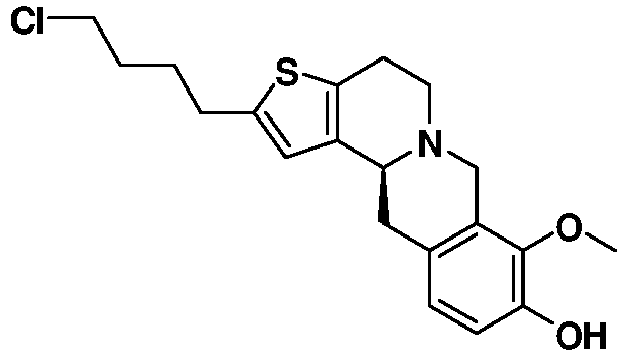
AS022 (S)-8,9-dimethoxy-4,7,12,12a-tetrahydro-5H-be nzo[g]thieno[3,2-a]quinolizine 
AS023 (S)-2-methyl-8,9-dimethoxy-4,7,12,12a-tetrahy dro-5H-benzo[g]thieno[3,2-a]quinolizine 
AS024 (S)-2-ethyl-8,9-dimethoxy-4,7,12,12a-tetrahydr o-5H-benzo[g]thieno[3,2-a]quinolizine 
AS025 (S)-2-n-propyl-8,9-dimethoxy-4,7,12,12a-tetrah ydro-5H-benzo[g] thieno [3 ,2-a] quinolizine 
AS026 (S)-2-(2-methylpropyl)-8,9-dimethoxy-4,7,12,1 2a-tetrahydro-5H-benzo[g]thieno[3,2-a]quinoli zine 
AS028 (S)-2-(2,2-dimethylpropyl)-8,9-dimethoxy-4,7, 12, 12a-tetrahydro-5H-benzo[g]thieno[3,2-a]qui nolizine 
AS029 (S)-2-(2-chloroethyl)-8,9-dimethoxy-4,7,12,12a -tetrahydro-5H-benzo[g]thieno[3,2-a]quinolizin e 
AS031 (S)-8,11-dimethoxy-4,7,12,12a-tetrahydro-5H-benzo[g]thieno[3,2-a]quinolizine 
AS032 (S)-2-methyl-8,11-dimethoxy-4,7,12,12a-tetrah ydro-5H-benzo[g]thieno[3,2-a]quinolizine 
AS033 (S)-2-ethyl-8,11-dimethoxy-4,7,12,12a-tetrahyd ro-5H-benzo[g]thieno[3,2-a]quinolizine 
AS034 (S)-2-(2-methylpropyl)-8,11-dimethoxy-4,7,12, 12a-tetrahydro-5H-benzo[g]thieno[3,2-a]quinol izine 
AS036 (S)-2-(2-chloroethyl)-8,11-dimethoxy-4,7,12,12 a-tetrahydro-5H-benzo[g]thieno[3,2-a]quinolizi ne 
AS039 (S)-2,5-dimethyl-8-methoxy-9-hydroxy-4,7,12, 12a-tetrahydro-5H-benzo[g]thieno[3,2-a]quinol izine 
AS043 (S)-2,8-dimethoxy-9-hydroxy-4,7,12,12a-tetrah ydro-5H-benzo[g]thieno[3,2-a]quinolizine 
AS045 (S)-2-methyl-8-methoxy-9-hydroxy-4,7, 12, 12a-tetrahydro-5H-benzo[g]thieno[2,3-a]quinolizin e 
AS046 (S)-2,8-dimethoxy-9-hydroxy-4,7,12,12a-tetrah ydro-5H-benzo[g]thieno[2,3-a]quinolizine 
AS050 (S)-8-methoxy-9-amino-4,7,12,12a-tetrahydro-5H-benzo[g]thieno[3,2-a]quinolizine 
AS051 (S)-8-methoxy-9-acetylamino-4,7,12,12a-tetrah ydro-5H-benzo[g]thieno[3,2-a]quinolizine 
DS001 (S)-2-hydroxy-3-methoxy-5,8,12,12a-tetrahydr o-6H-benzo[a]thieno[3,2-g]quinolizine 
DS002 (R)-2-hydroxy-3-methoxy-5,8,12,12a-tetrahydr o-6H-benzo[a]thieno[3,2-g]quinolizine 
DS003 (S)-2-hydroxy-3-methoxy-10-ethyl-5,8,12,12a-t etrahydro-6H-benzo[a]thieno[3,2-g]quinolizine 
DS004 (R)-2-hydroxy-3-methoxy-10-ethyl-5,8,12,12a-tetrahydro-6H-benzo[a]thieno[3,2-g]quinolizin e 
DS005 (S)-2-hydroxy-3-methoxy-10-n-propyl-5,8,12,1 2a-tetrahydro-6H-benzo[a]thieno[3,2-g]quinoli zine 
DS006 (S)-2-hydroxy-3-methoxy-10-(2-methylpropyl) -5,8,12,12a-tetrahydro-6H-benzo[a]thieno[3,2-g]quinolizine 
DS007 (S)-2-hydroxy-3-methoxy-10-n-butyl-5,8,12,12 a-tetrahydro-6H-benzo[a]thieno[3,2-g]quinolizi ne 
DS008 (S)-2-hydroxy-3-methoxy-10-(3-methylbutyl)-5,8,12,12a-tetrahydro-6H-benzo[a]thieno[3,2-g]quinolizine 
DS009 (S)-2-hydroxy-3-methoxy-10-n-pentyl-5,8,12,1 2a-tetrahydro-6H-benzo[a]thieno[3,2-g]quinolizine 
DS010 (S)-2-hydroxy-3-methoxy-10-(4-methylpentyl)-5,8,12,12a-tetrahydro-6H-benzo[a]thieno[3,2-g]quinolizine 
DS013 (S)-2-hydroxy-3-methoxy-10-(2-chloroethyl)-5, 8,12,12a-tetrahydro-6H-benzo[a]thieno[3,2-g]q uinolizine 
DS014 (12aS)-2-hydroxy-3-methoxy-10-(2-chloroprop yl)-5,8,12,12a-tetrahydro-6H-benzo[a]thieno[3, 2-g]quinolizine 
DS015 (S)-2-hydroxy-3-methoxy-10-(3-chloropropyl)-5,8,12,12a-tetrahydro-6H-benzo[a]thieno[3,2-g]quinolizine 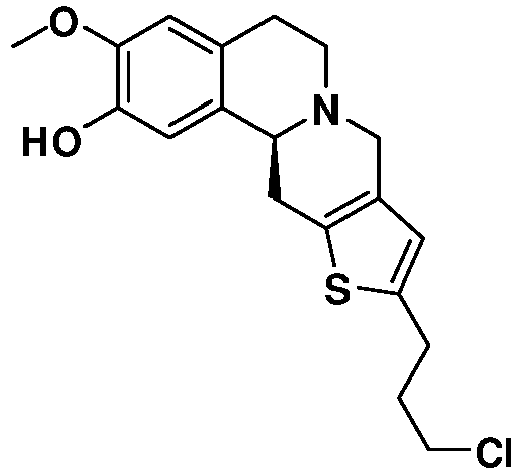
DS016 (S)-2-hydroxy-3-methoxy-10-(4-chlorobutyl)-5,8,12,12a-tetrahydro-6H-benzo[a]thieno[3,2-g]quinolizine 
DS021 (S)-2,3-dimethoxy-10-ethyl-5,8,12,12a-tetrahyd ro-6H-benzo[a]thieno[3,2-g]quinolizine 
DS022 (S)-2,3-dimethoxy-10-(2-methylpropyl)-5,8,12, 12a-tetrahydro-6H-benzo[a]thieno[3,2-g]quinol izine 
DS023 (S)-2,3-dimethoxy-10-(2-chloroethyl)-5,8,12,12 a-tetrahydro-6H-benzo[a]thieno[3,2-g]quinolizi ne 
DS028 (S)-2-hydroxy-3-methoxy-10-methyl-5,8,12,12 a-tetrahydro-6H-benzo[a]thieno[3,2-g]quinolizi ne 
DS029 (S)-2-hydroxy-3-methoxy-10-(2-chloromethyl)-5,8,12,12a-tetrahydro-6H-benzo[a]thieno[3,2-g]quinolizine 
DS033 (S)-2-hydroxy-3,10-dimethoxy-5,8,12,12a-tetra hydro-6H-benzo[a]thieno[3,2-g]quinolizine 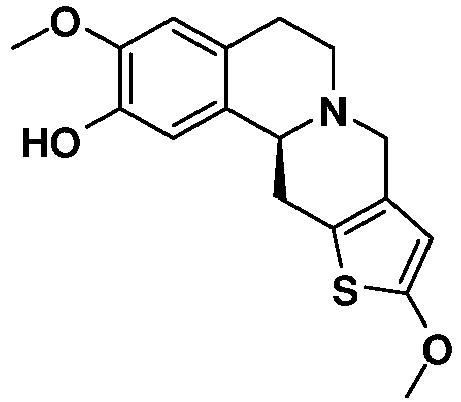
DS034 (S)-2-hydroxy-3-methoxy-9,10-dimethyl-5,8,1 2,12a-tetrahydro-6H-benzo[a]thieno[3,2-g]quin olizine 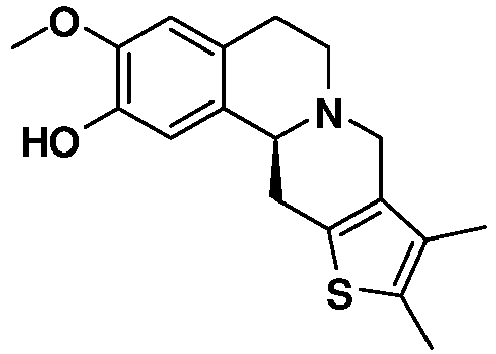
DS035 (S)-2-hydroxy-3-methoxy-9-methyl-5,8,12,12a-tetrahydro-6H-benzo[a]thieno[3,2-g]quinolizin e 
DS036 (S)-2-hydroxy-3-methoxy-9-ethyl-5,8,12,12a-te trahydro-6H-benzo[a]thieno[3,2-g]quinolizine 
DS041 (S)-2-hydroxy-3-methoxy-10-ethyl-5,8,12,12a-t etrahydro-6-H-benzo[a]thieno[2,3-g]quinolizine 
DS042 (S)-2-hydroxy-3-methoxy-10-(2-chloroethyl)-5, 8,12,12a-tetrahydro-6H-benzo[a]thieno[2,3-g]q uinolizine 
DS043 (S)-2-hydroxy-3-methoxy-10-(2-methylpropyl) -5,8,12,12a-tetrahydro-6H-benzo[a]thieno[2,3-g]quinolizine 
DS044 (S)-2-hydroxy-3,10-dimethoxy-5,8,12,12a-tetra hydro-6H-benzo[a]thieno[2,3-g]quinolizine 
SS001 (S)-2-methyl-9-(2-methylpropyl)-4,7,11,11a-tet rahydro-5H-thieno[3,2-a]thieno[3,2-g]quinolizi ne 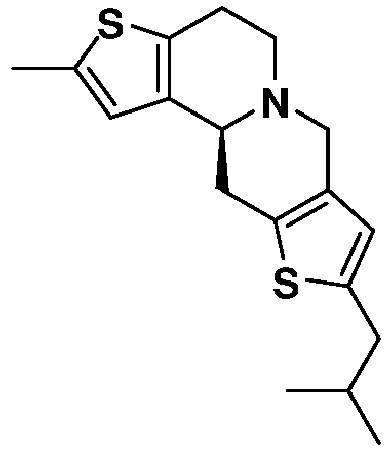
SS002 (S)-2-methyl-9-(2-chloroethyl)-4,7,11,11a-tetra hydro-5H-thieno[3,2-a]thieno[3,2-g]quinolizine 
- Further disclosed are the following diarylo[a,g]quinolizine compounds referred to as reference examples as also indicated further below:
No. Name Structure AS011 (S)-2-cyclopropylmethyl-8-methoxy-9-hydroxy -4,7,12,12a-tetrahydro-5H-benzo[g] thieno [3,2-a]quinolizine 
AS012 (S)-2-cyclobutylmethyl-8-methoxy-9-hydroxy-4,7,12,12a-tetrahydro-5H-benzo[g]thieno[3,2-a]quinolizine 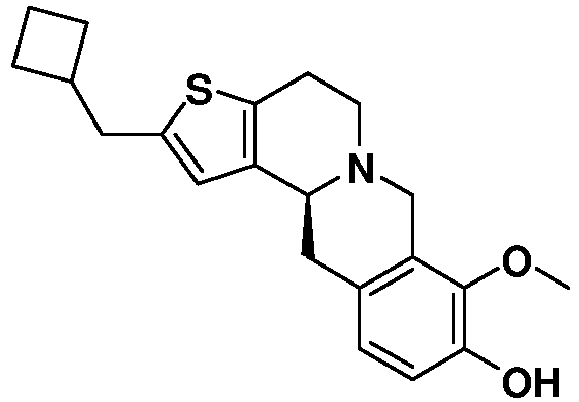
AS020 (S)-2-(3-bromopropyl)-8-methoxy-9-hydroxy-4,7,12,12a-tetrahydro-5H-benzo[g]thieno[3,2-a]quinolizine 
AS021 (S)-2-(2,2,2-trifluoroethyl)-8-methoxy-9-hydro xy-4,7,12,12a-tetrahydro-5H-benzo[g]thieno[3, 2-a]quinolizine 
AS027 (S)-2-cyclopropylmethyl-8,9-dimethoxy-4,7,12, 12a-tetrahydro-5H-benzo[g]thieno[3,2-a]quinol izine 
AS030 (S)-2-(2,2,2-trifluoroethyl)-8,9-dimethoxy-4,7, 12,12a-tetrahydro-5H-benzo[g]thieno[3,2-a]qui nolizine 
AS035 (S)-2-cyclopropylmethyl-8,11-dimethoxy-4,7,1 2,12a-tetrahydro-5H-benzo[g]thieno[3,2-a]quin olizine 
AS037 (S)-2-(2,2,2-trifluoroethyl)-8,11-dimethoxy-4,7, 12,12a-tetrahydro-5H-benzo[g]thieno[3,2-a]qui nolizine 
AS038 (S)-2,4-dimethyl-8-methoxy-9-hydroxy-4,7,12, 12a-tetrahydro-5H-benzo[g]thieno[3,2-a]quinol izine 
AS040 (S)-2,7-dimethyl-8-methoxy-9-hydroxy-4,7,12, 12a-tetrahydro-5H-benzo[g]thieno[3,2-a]quinol izine 
AS041 (S)-2-methyl-8-methoxy-9-hydroxy-4,7, 12, 12a-tetrahydro-5H-benzo[g]thieno[3,2-a]quinolizin-7(5H)-one 
AS042 (S)-1,2-dimethyl-8-methoxy-9-hydroxy-4,7,12, 12a-tetrahydro-5H-benzo[g]thieno[3,2-a]quinol izine 
AS044 (S)-2-fluoro-8-methoxy-9-hydroxy-4,7,12,12a-t etrahydro-5H-benzo[g]thieno[3,2-a]quinolizine 
AS047 (S)-8-methoxy-9-acetoxy-4,7,12,12a-tetrahydro -5H-benzo[g]thieno[3,2-a]quinolizine 
AS048 (S)-8-methoxy-9-(2'-hydroxyethoxy)-4,7,12,12 a-tetrahydro-5H-benzo[g]thieno[3,2-a]quinolizi ne 
AS049 (S)-8-methoxy-9-(2'-dimethylaminoethoxy)-4, 7,12,12a-tetrahydro-5H-benzo[g]thieno[3,2-a]q uinolizine 
AS052 (S)-8-methoxy-9-methylsulfonylamino-4,7,12,1 2a-tetrahydro-5H-benzo[g]thieno[3,2-a]quinoli zine 
AS053 (S)-2-methyl-8-methoxy-9-((2-morpholino)etho xy)-4,7,12,12a-tetrahydro-5H-benzo[g]thieno [3,2-a]quinolizine 
AF001 (S)-8-methoxy-9-hydroxy-4,7,12,12a-tetrahydr o-5H-benzo[g]furo[3,2-a]quinolizine 
AF002 (S)-2-methyl-8-methoxy-9-hydroxy-4,7,12,12a-tetrahydro-5H-benzo[g]furo[3,2-a]quinolizine 
AF003 (S)-2-ethyl-8-methoxy-9-hydroxy-4,7,12,12a-te trahydro-5H-benzo[g]furo[3,2-a]quinolizine 
AF004 (S)-2-(2-methylpropyl)-8-methoxy-9-hydroxy-4,7,12,12a-tetrahydro-5H-benzo[g]furo[3,2-a]q uinolizine 
AF005 (S)-2-cyclopropylmethyl-8-methoxy-9-hydroxy -4,7,12,12a-tetrahydro-5H-benzo[g]furo[3,2-a] quinolizine 
AF006 (S)-2-(2-chloroethyl)-8-methoxy-9-hydroxy-4, 7,12,12a-tetrahydro-5H-benzo[g]furo[3,2-a]qui nolizine 
AF007 (S)-2-methyl-8-methoxy-9-hydroxy-4,7,12,12a-tetrahydro-5H-benzo[g]furo[2,3-a]quinolizine 
AF008 (S)-2-ethyl-8-methoxy-9-hydroxy-4,7,12,12a-te trahydro-5H-benzo[g]furo[2,3-a]quinolizine 
AF009 (S)-2-(2-chloroethyl)-8-methoxy-9-hydroxy-4, 7,12,12a-tetrahydro-5H-benzo[g]furo[2,3-a]qui nolizine 
AI001 (S)-2,3-dimethoxy-5,7,8,13,13b,14-hexahydroi ndolo[2',3':3,4]pyrido[1,2-b]isoquinoline 
AI002 (S)-3-hydroxy-4-methoxy-5,7,8,13,13b,14-hexa hydroindolo[2',3':3,4]pyrido[1,2-b]isoquinoline 
AI003 (S)-3-hydroxy-4,10-dimethoxy-5,7,8,13,13b,14 -hexahydroindolo[2',3':3,4]pyrido[1,2-b]isoquin oline 
AI004 (S)-3-hydroxy-4-methoxy-10-methyl-5,7,8,13,1 3b,14-hexahydroindolo[2',3':3,4]pyrido[1,2-b]is oquinoline 
AI005 (S)-3-hydroxy-4-methoxy-10-fluoro-5,7,8,13,1 3b,14-hexahydroindolo[2',3':3,4]pyrido[1,2-b]is oquinoline 
AI006 (S)-3-hydroxy-4-methoxy-11-methyl-5,7,8,13,1 3b,14-hexahydroindolo[2',3':3,4]pyrido[1,2-b]is oquinoline 
AI007 (S)-3-hydroxy-4,11-dimethoxy-5,7,8,13,13b,14 -hexahydroindolo[2',3':3,4]pyrido[1,2-b]isoquin oline 
AI008 (S)-5,6,8,14,14a,15-hexahydro-[1,3]dioxolo[4,5 -g]indolo[2',3':3,4]pyrido[1,2-b]isoquinoline 
AI009 (S)-3-hydroxy-2-methoxy-5,7,8,13,13b,14-hexa hydroindolo[2',3':3,4]pyrido[1,2-b]isoquinoline 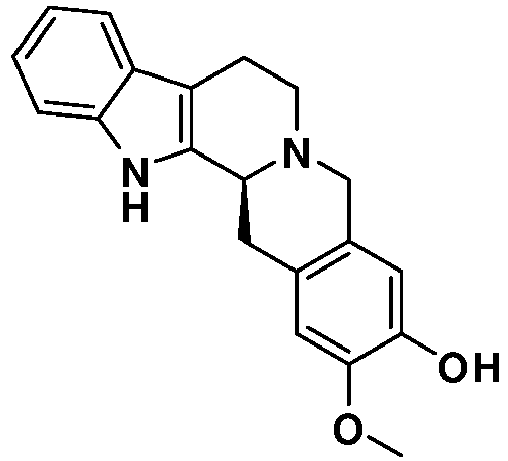
AI010 (S)-2-hydroxy-3-methoxy-5,7,8,13,13b,14-hexa hydroindolo[2',3':3,4]pyrido[1,2-b]isoquinoline 
AP001 (S)-2,8-dimethoxy-9-hydroxy-4,7,12,12a-tetrah ydro-5H-benzo[g]pyrrolo[2,3-a]quinolizine 
AP002 (S)-3,9-dimethoxy-10-hydroxy-5,8,13,13a-tetra hydro-6H-benzo[g]pyrido[2,3-a]quinolizine 
AP003 (S)-2,10-dihydroxy-3,9-dimethoxy-5,8,13,13a-t etrahydro-6H-benzo[g]pyrido[2,3-a]quinolizine 
AP004 (S)-2,8-dimethoxy-9-hydroxy-4,7,12,12a-tetrah ydro-5H-benzo[g]pyrrolo[3,2-a]quinolizine 
AP005 (S)-3,9-dimethoxy-6,8,13,13a-tetrahydro-5H-is oquinolino[3,2-f][1,6]naphthyridin-10-ol 
AP006 (S)-3,9-dimethoxy-6,8,13,13a-tetrahydro-5H-is oquinolino[3,2-f][1,6]naphthyridine-2,10-diol 
DS011 (S)-2-hydroxy-3-methoxy-10-cyclopropylmeth yl-5,8,12,12a-tetrahydro-6H-benzo[a]thieno[3,2 -g]quinolizine 
DS012 (S)-2-hydroxy-3-methoxy-10-cyclobutylmethyl -5,8,12,12a-tetrahydro-6H-benzo[a]thieno[3,2-g]quinolizine 
DS017 (S)-2-hydroxy-3-methoxy-10-(2,2,2-trifluoroet hyl)-5,8,12,12a-tetrahydro-6H-benzo[a]thieno [3,2-g]quinolizine 
DS018 (S)-2-hydroxy-3-methoxy-10-(3,3,3-trifluoropr opyl)-5,8,12,12a-tetrahydro-6H-benzo[a]thieno [3,2-g]quinolizine 
DS019 (S)-2-hydroxy-3-methoxy-10-(3,3-difluoroprop yl)-5,8,12,12a-tetrahydro-6H-benzo[a]thieno[3, 2-g]quinolizine 
DS020 (S)-2,3-dimethoxy-5,8,12,12a-tetrahydro-6H-be nzo[a]thieno[3,2-g]quinolizine 
DS024 (S)-2,3-methylenedioxo-5,8,12,12a-tetrahydro-6H-benzo[a]thieno[3,2-g]quinolizine 
DS025 (S)-2,3-methylenedioxo-10-ethyl-5,8,12,12a-tet rahydro-6H-benzo[a]thieno[3,2-g]quinolizine 
DS026 (S)-2,3-methylenedioxo-10-(2-methylpropyl)-5, 8,12,12a-tetrahydro-6H-benzo[a]thieno[3,2-g]q uinolizine 
DS027 (S)-2,3-methylenedioxo-10-(2-chloroethyl)-5,8, 12,12a-tetrahydro-6H-benzo[a]thieno[3,2-g]qui nolizine 
DS030 (S)-2-hydroxy-3-methoxy-10-(2-fluoromethyl)-5,8,12,12a-tetrahydro-6H-benzo[a]thieno[3,2-g]quinolizine 
DS031 (S)-2-hydroxy-3-methoxy-10-hydroxymethyl-5,8,12,12a-tetrahydro-6H-benzo[a]thieno[3,2-g]quinolizine 
DS032 (S)-2-hydroxy-3-methoxy-10-methoxymethyl-5,8,12,12a-tetrahydro-6H-benzo[a]thieno[3,2-g]quinolizine 
DS037 (12aS)-2-hydroxy-3-methoxy-8-methyl-10-(2-methylpropyl)-5,8,12,12a-tetrahydro-6H-benzo [a]thieno[3,2-g]quinolizine 
DS038 (12aS)-2-hydroxy-3-methoxy-5-methyl-10-(2-methylpropyl)-5,8,12,12a-tetrahydro-6H-benzo [a]thieno[3,2-g]quinolizine 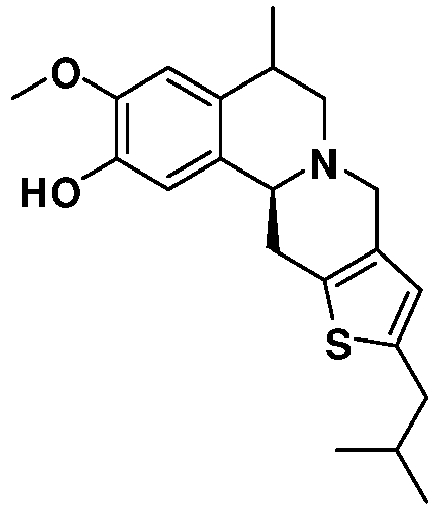
DS039 (12aS)-2-hydroxy-3-methoxy-6-methyl-10-(2-methylpropyl)-5,8,12,12a-tetrahydro-6H-benzo [a]thieno[3,2-g]quinolizine 
DS040 (12aS)-2-hydroxy-3-methoxy-5-fluoro-10-(2-m ethylpropyl)-5,8,12,12a-tetrahydro-6H-benzo [a]thieno[3,2-g]quinolizine 
DF001 (S)-2-hydroxy-3-methoxy-5,8,12,12a-tetrahydr o-6H-benzo[a]furo[3,2-g]quinolizine 
DF002 (S)-2-hydroxy-3-methoxy-10-ethyl-5,8,12,12a-t etrahydro-6H-benzo[a]furo[3,2-g]quinolizine 
DF003 (S)-2-hydroxy-3-methoxy-10-(2-methylpropyl) -5,8,12,12a-tetrahydro-6H-benzo[a]furo[3,2-g] quinolizine 
DF004 (S)-2-hydroxy-3-methoxy-10-chloropropylmeth yl-5,8,12,12a-tetrahydro-6H-benzo[a]furo[3,2-g]quinolizine 
DF005 (S)-2-hydroxy-3-methoxy-10-(2-chloroethyl)-5, 8,12,12a-tetrahydro-6H-benzo[a]furo[3,2-g]qui nolizine 
DF006 (S)-2-hydroxy-3,10-dimethoxy-5,8,12,12a-tetra hydro-6H-benzo[a]furo[3,2-g]quinolizine 
DF007 (S)-2-hydroxy-3-methoxy-10-ethyl-5,8,12,12a-t etrahydro-6H-benzo[a]furo[2,3-g]quinolizine 
DF008 (S)-2-hydroxy-3-methoxy-10-(2-methylpropyl) -5,8,12,12a-tetrahydro-6H-benzo[a]furo[2,3-g] quinolizine 
DF009 (S)-2-hydroxy-3-methoxy-10-(2-chloroethyl)-5, 8,12,12a-tetrahydro-6H-benzo[a]furo[2,3-g]qui nolizine 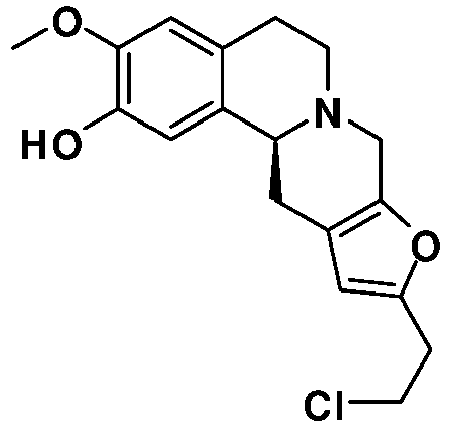
DP001 (S)-2-hydroxy-3-methoxy-5,8,12,12a-tetrahydr o-6H-benzo[a]pyrrolo[3,2-g]quinolizine 
DP002 (S)-2-hydroxy-3,10-dimethoxy-5,8,12,12a-tetra hydro-6H-benzo[a]pyrrolo[3,2-g]quinolizine 
DP003 (S)-2-hydroxy-3,10-dimethoxy-5,8,12,12a-tetra hydro-6H-benzo[a]pyrrolo[2,3-g]quinolizine 
DP004 (S)-2-hydroxy-3-methoxy-5,8,13,13a-tetrahydr o-6H-benzo[a]pyrido[3,2-g]quinolizine 
DP005 (S)-2,10-dihydroxy-3,9-dimethoxy-5,8,13,13a-t etrahydro-6H-benzo[a]pyrido[3,2-g]quinolizine 
DP006 (S)-2-hydroxy-3,10-dimethoxy-5,8,13,13a-tetra hydro-6H-benzo[a]pyrido[2,3-g]quinolizine 
SF001 (S)-2-methyl-9-(2-chloroethyl)-4,7,11,11a-tetra hydro-5H-thieno[3,2-a]furo[3,2-g]quinolizine 
FS001 (S)-2-methyl-9-(2-chloroethyl)-4,7,11,11a-tetra hydro-5H-furo[3,2-a]thieno[3,2-g]quinolizine 
IS001 (S)-11-(2-methylpropyl)-6,9,13,13a-tetrahydro-7H- indolo[2,3-a]thieno[3,2-g]quinolizine 
IS002 (S)-11-(2-chloroethyl)-6,9,13,13a-tetrahydro-7 H-indolo[2,3-a]thieno[3,2-g]quinolizine 
IS003 (S)-3-methoxy-11-(2-methylpropyl)-6,9,13,13a -tetrahydro-7H-indolo[2,3-a]thieno[3,2-g]quino lizine 
IS004 (S)-3-methoxy-11-(2-chloroethyl)-6,9,13,13a-te trahydro-7H-indolo[2,3-a]thieno[3,2-g]quinoliz ine 
DS045 (S)-2-hydroxy-3-methoxy-10-(2'-hydroxyethox ymethyl)-5,8,12,12a-tetrahydro-6H-benzo[a]thi eno[3,2-g]quinolizine 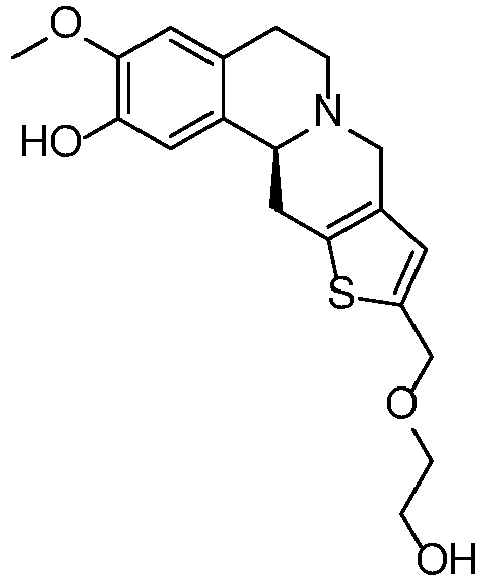
DS046 (S)-2-hydroxy-3-methoxy-10-(dimethylaminom ethyl)-5,8,12,12a-tetrahydro-6H-benzo[a]thieno [3,2-g]quinolizine 
DS047 (S)-2-hydroxy-3-methoxy-10-(morpholine-N-m ethyl)-5,8,12,12a-tetrahydro-6H-benzo[a]thieno [3,2-g]quinolizine 
DS048 (S)-2-hydroxy-3-methoxy-10-((N-methyl)-pipe razine-N-methyl)-5,8,12,12a-tetrahydro-6H-be nzo[a]thieno[3,2-g]quinolizine 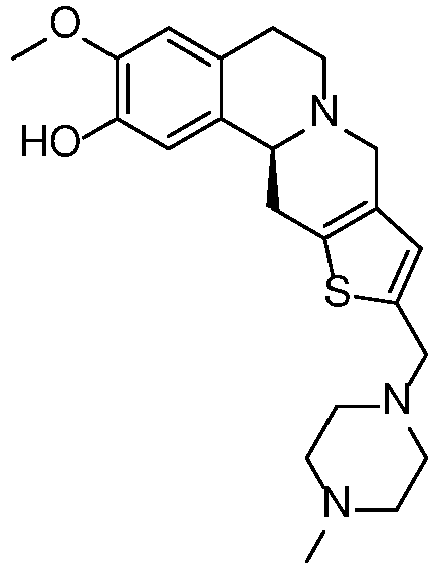
DS049 (S)-2-hydroxy-3-methoxy-5,8,12,12a-tetrahydr o-6H-benzo[a]thieno[3,2-g]quinolizine-10-(N, N-dimethyl)acetamide 
DS050 (S)-2-hydroxy-3-methoxy-5,8,12,12a-tetrahydr o-6H-benzo[a]thieno[3,2-g]quinolizine-10-aceti c acid 
DS051 (S)-2-hydroxy-3-methoxy-10-(hydroxyethyl)-5, 8,12,12a-tetrahydro-6H-benzo[a]thieno[3,2-g]q uinolizine 
DS052 methyl (S)-2-hydroxy-3-methoxy-5,8,12,12a-t etrahydro-6H-benzo[a]thieno[3,2-g]quinolizine -10-acetate 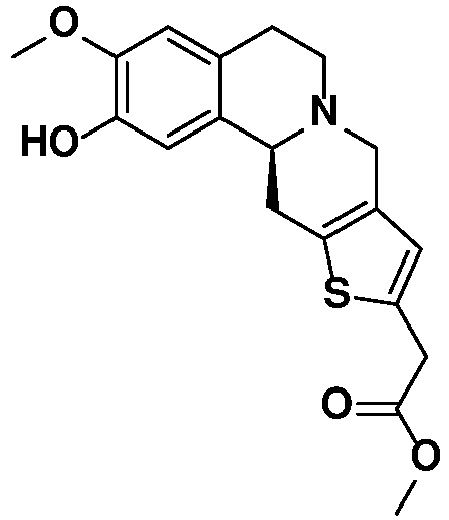
SBE01 (S)-4,7,12,12a-tetrahydro-5H-thieno[3,2-a]benz ooxazolo[6,5-g]quinolizine 
FBS01 (S)-11-(2-methylpropyl)-6,9,13,13a-tetrahydro-7H-benzofuro[6,5-a]thieno[3,2-g]quinolizine 
- The "pharmaceutically acceptable salt" is a conventional non-toxic salt formed by reacting the compounds of claim 1 with an inorganic or organic acid. For example, a conventional non-toxic salt may be a salt prepared by reacting the compounds of claim 1 with an inorganic acid including HCl, hydrobromic acid, sulfuric acid, nitric acid, aminosulfonic acid, phosphoric acid, and the like, or an organic acid including citric acid, tartaric acid, lactic acid, pyruvic acid, acetic acid, benzenesulfonic acid, p-toluenesulfonic acid, methanesulfonic acid, naphthalene sulfonic acid, ethanesulfonic acid, naphthalenedisulfonic acid, maleic acid, malic acid, malonic acid, fumaric acid, succinic acid, propionic acid, oxalic acid, trifluoroacetic acid, stearic acid, pamoic acid, hydroxymaleic acid, phenylacetic acid, benzoic acid, salicylic acid, glutamic acid, ascorbic acid, sulfanilic acid, 2-acetoxybenzoic acid, isethionic acid and the like; or, a sodium salt, potassium salt, calcium salt, aluminum salt or ammonium salt form with an inorganic base after reacting the compounds of claim 1 with propionic acid, oxalic acid, malonic acid, succinic acid, fumaric acid, maleic acid, lactic acid, malic acid, tartaric acid, citric acid, aspartic acid or glutamic acid to form an ester; or, a methylamine salt, ethylamine salt or ethanolamine salt formed by the compounds of claim 1 with an organic base; or, an inorganic acid salt formed with HCl, hydrobromic acid, hydrofluoric acid, sulfuric acid, nitric acid, or phosphoric acid, or an organic acid salt formed with formic acid, acetic acid, picric acid, methanesulfonic acid or ethanesulfonic acid, after reacting the compounds of claim 1 with lysine, arginine, ornithine to form an ester.
- The present invention also provides a process for preparing the compounds of claim 1. Unless otherwise stated, the raw materials and reagents used in the present invention are commercially available.
- Another object of the present invention is to provide a process for preparing the diarylo[a,g]quinolizine compounds of claim 1, enantiomers, diastereoisomers and racemates thereof, pharmaceutically acceptable salts thereof, crystalline hydrates or solvates thereof, which is carried out as one of the following menthods:
- Method A:

- a) reacting a1 with a2 through an amino-ester exchange reaction in a polar protic solvent to give a3, wherein the solvent used is ethanol or methanol, the reaction temperature is in the range of 60 to 90 °C, and the reaction time is in the range of 6 to 12 hours;
specifically, a1 and an equivalent amount of a2 are added in an appropriate amount of ethanol, refluxed overnight, evaporated off the solvent to give a crude, which is then recrystallized with a suitable solvent, wherein the solvent for the recrystallization is one or more selected from the group consisting of ethyl acetate, n-hexane, benzene, toluene, petroleum ether, ethanol, isopropanol, methanol, chloroform and xylene, and preferably toluene, xylene or ethanol; - b) reacting a3 with an acylating agent through an acylation reaction in the presence of a base to give a4, wherein the acylating agent is acetic anhydride, acetyl chloride, trifluoroacetic anhydride, trichloroacetic anhydride, methyl chloroformate, ethyl chlorformate, or the like, preferably acetic anhydride or acetyl chloride; the base may be an inorganic or organic base, wherein the organic base may be, for example, triethylamine, diisopropylethylamine, pyridine, N,N-dimethylaniline, N,N-dimethylpyridine, or the like, preferably triethylamine, pyridine or diisopropylethylamine, and the inorganic base may be, for example, K2CO3, Na2CO3, NaHCO3, KHCO3, NaOH, KOH or the like; and the reaction solvent used is dichloromethane, tetrahydrofuran, ethyl ether, toluene or the like;
specifically, a3 is dissolved in a suitable solvent and an organic or inorganic base is added therein, and an acylating agent is added slowly at 0 °C, the reaction continues for one hour at room temperature, an appropriate amount of water is added, and the reaction mixture is extracted with dichloromethane three times. The dichloromethane layer was washed with water, dried over sodium sulfate, evaporated to dryness. The obtained product is directly used in the next reaction step without purification; - c) dehydrlating and cyclizing a4 in the presence of a condensing agent to give a5, wherein the reaction solvent used is anhydrous acetonitrile, anhydrous toluene or benzene, or the like, preferably anhydrous acetonitrile; The condensing agent used for the reaction is phosphorus oxychloride, phosphorus oxytribromide, phosphorus pentoxide or the like, preferably phosphorus oxytrichloride;
specifically, a4 is dissolved in an appropriate amount of a suitable solvent and heated to reflux, 2-3 equivalents of a condensing agent was added into the reaction mixture, and the completion of the reaction was monitored with TLC. Most of the solvent was distilled off, and the reaction mixture was neutralized with NaHCO3 solution, extracted three times with dichloromethane, dried over sodium sulfate, and evaporated to dryness. The obtained product was directly used in the next reaction without purification; - d) asymmetrically reducing a5 in the presence of a hydrogenation reagent and a chiral catalyst to give a6, wherein the chiral catalyst may be Noyori catalyst, and the hydrogenation agent may be formic acid/triethylamine;
specifically, the imine a5 obtained as above is asymmetrically reduced in anhydrous N,N-dimethylformamide as the solvent in the presence of Noyori catalyst, triethylamine and formic acid to give a chiral amine a6, the reaction is carried out at room temperature for 7 hours to 12 hours; and after the completion of the reaction, the reaction mixture is neutralized with an aqueous saturated NaHCO3 solution, extracted with ethyl acetate, and dried over sodium sulfate. In addition, non-chiral reduction may also be carried out by using sodium borohydride, sodium cyanoborohydride, sodium acetoxyborohydride; - e) hydrolyzing a6 in the presence of a base to give a7, wherein the base may be an inorganic base, which may be NaOH, KOH, CeOH, or K2CO3, preferably NaOH; the reaction solvent used may be a mixture of ethanol, methanol or N,N-dimethylformamide with water, preferably a mixture of ethanol or methanol with water;
specifically, a6 is dissolved in a suitable solvent, added with an appropriate amount of an inorganic base, and reacted for 3 hours at room temperature, and then an appropriate amount of water is slowly added to precipitate a solid, which is filtered off and dried to give a7; - f) halogenating a7 with a halogenating reagent and then directly cyclizing it in the presence of a base to give a8, wherein the halogenating agent is chlorosulfoxide, bromosulfoxide, phosphorus trichloride, phosphorus tribromide, phosphorus pentachloride, phosphorus pentabromide, or the like, the reaction solvent used is dichloromethane, tetrahydrofuran, ethylether, chloroform or the like, and the base is an organic or inorganic base, wherein the organic base is triethylamine, pyridine or diisopropylethylamine, the inorganic base is K2CO3, Na2CO3, NaHCO3, KHCO3, NaOH, KOH, CaCO3 or ammonia, or the like;
specifically, a7 is dissolved in a suitable solvent with stirring at room temperature, a halogenating reagent is slowly added dropwise under an ice-bath, and after the addition is completed, the reaction is carried out for 2 hours at room temperature. An alkaline solution is slowly added to the reaction mixture so as to adjust pH to be alkali. The reaction is then stirred for 2 hours at room temperature. After the reaction is completed, the obtained product is extracted, washed and dried, and purified by passing through a silica column to give a8. - g) optionally, when a8 has a protective group to be removed, a8 is deprotected to remove the protective group;
Specifically, a8 is dissolved in ethanol and refluxed after the addition of a concentrated HCl, or refluxed at a low temperature with BCl3 and dichloromethane, so as to be deprotected to give the desired compound. - Method B:

- 1) reacting a1 with b2 by a condensation reaction in the presence of a condensing agent to give b3;
specifically, b3 is prepared by condensing a1 (which is from Route A-1 or A-2, or purchased commercially) with an equivalent amount of b2 (which is from Route B-1 or B-2 or purchased commercially) in the presence of 1-ethyl-3(3-dimethylpropylamine)carbodiimide, triethylamine and anhydrous dichloromethane at room temperature and purifying the resultant product through column chromatography or recrystallization with ethanol; - 2) dehydrating and cyclizing b3 in the presence of a condensing agent to give b4, which is similar to step c) of the method A;
- 3) asymmetrically reducing b4 in the presence of a chiral catalyst and a hydrogenation reagent to give b5, which is similar to step d) of the method A; and
- 4) reacting b5 with a substituted aldehyde R4CHO through a Pictet-Spengler reaction under an acidic condition to give b6;
- specifically, b5 is reacted with a substituted aldehyde R4CHO under an acidic condition, wherein in the case that the used acid is HCl, the reaction is carried out under a pH of 2-3 for 2-3 days, and in the case that the used acid is formic acid, the reaction system is heated to 80-90 °C and kept for 2 hours. Then the reaction mixture is adjusted to be basic, and extracted with an organic solvent to obtain the desired compound;
- wherein, in step 1), the solvent used is dichloromethane, tetrahydrofuran, ethyl ether, chloroform, or the like, the reaction temperature is room temperature, the reaction time is in the range of 2-10 hours, and the condensing agent for the reaction is 1-ethyl-3-(3-dimethylaminopropyl)carbodiimide;
- in step 2), the solvent used is anhydrous acetonitrile, anhydrous toluene, benzene, or the like, preferably anhydrous acetonitrile; the condensing agent for the reaction is phosphorus oxychloride, phosphorus oxytribromide, phosphorus pentoxide, or the like, preferably phosphorus oxytrichloride, the reaction is performed under refluxing, and the reaction time is in a range of 20 minutes to 1 hour;
- in step 3), the asymmetric reduction is carried out in the presence of anhydrous N,N-dimethylformamide as the solvent, Noyori catalyst, triethylamine and formic acid; and the reaction is carried out at room temperature for 7-12 hours,
- in the above methods A and B, rings A and D as well as the substituents are defined the same as those in the compounds of claim 1.
- In the above methods A and B, a1, a2 and b2 as starting materials are commercially available or may be prepared by conventional reactions.
- Synthetic routes of the specific compounds and the reaction conditions are as follows.
- AS001-AS030AS038-AS053, AF001-AF019, AI002-AI007 and AP001-AP006 may be prepared according to the method A, wherein, in the method A for AS001-AS030, AS038-AS044, AS047-AS053, AF001-AF006, AI002-AI007 and AP004-AP006, a1 and a2 as starting materials may be purchased commercially or prepared according to the conventional methods in the art, for example, the following Route A-1.
- Further, in the method A for AS045-AS046, AF007-AF009 and AP001-AP003, a1 as a starting material may be commercially available or prepared according to conventional methods in the art, for example, the following Route A-2; and in the method A, a2 as a starting material may be prepared accoriding to the same route as Route A-1.
- Route A-1:

- Step a:
- a is prepared through a F-C acylation reaction of a heterocyclic compound 0a with R4COCl under a Lewis acid;
- specifically, the heterocyclic compound (commercially available) and R4COCl are dissolved in anhydrous dichloromethane under an ice bath, and anhydrous AlCl3 is slowly added thereto. The reaction mixture is kept at 0 °C to room temperature for 1-2 hours, treated with 1N HCl under stirring, and extracted with dichloromethane to give a;
- Step b: the compound 1a is prepared by reducing a in the presence of a reductant and an acidic solvent;
- specifically, the compound a is dissolved in trifluoroacetic acid at 0 °C, added with an excess of triethyl silane, and stirred overnight at room temperature. The obtained product is purified by column chromatography to give 1a;
- Step c: 2a is prepared by a substitution reaction of 1a in the presence of a Lewis acid and dichloromethyl ether;
- specifically, 1a is dissolved in dry dichloromethane at 0 °C, added slowly with titanium tetrachloride and dichloromethyl ether respectively, kept at 0 °C to room temperature for 1-2 hours, added with with ice water under stirring, and extracted with dichloromethane to give 2a;
- Step d: 3a is prepared through a condensation reaction of 2a with nitromethane, and may be directly used for the next step without purification;
- specifically, 2a is dissolved in an appropriate amount of glacial acetic acid, and added with 1.2 to 2.0 equivalents of ammonium acetate, followed by addition of 5-10 equivalents of nitromethane at room temperature. The reaction mixture is moved in an oil bath and kept at 80 °C for 10 hours, and then cooled at room temperature to precipitate a large amount of solid, which is filtered off to give 3a;
- Step e: 4a is prepared by reducing 3a in the presence of a reductant and a polar solvent;
- specifically, lithium aluminum hydride is suspended in an appropriate amount of anhydrous tetrahydrofuran and placed in an ice water bath, and a solution of a unsaturated nitro compound in anhydrous tetrahydrofuran was slowly added dropwise thereinto. After the addition is completed, the reaction mixure is refluxed for 3 hours under an oil bath, cooled to room temperature, and then added slowly with a quantitative water and filtered to give a clear solution, which is dried over anhydrous sodium sulfate, and evaporated to dryness to give an oil 4a;

- Step f: 6a is prepared through a substitution reaction of 5a with liquid bromine;
- specifically, 5a (commercially available) is dissolved in acetic acid, and added slowly and dropwise with liquid bromine. The reaction is completed in 1-2 hours. The product has a poor solubility in acetic acid, and thus the post-treatment is simple, and it is relatively easy to obtain a relatively pure 6a;
- Step g: 7a is prepared by a substitution reaction of the compound 6a in the presence of an alkylating agent or a benzylating agent;
- specifically, 6a is reacted with an alkylating agent (e.g., dimethyl sulfate, methyl iodide, diazomethane, methyl trifluoromethylsulfonate, or other alkylating agents) or a benzylating reagent (e.g., substituted benzyl chloride, benzyl bromide and other benzylating reagents), preferably benzyl chloride, benzyl bromide, methyl iodide, dimethyl sulfate, acetyl chloride, acetic anhydride, in the presence of an organic or inorganic base to give 7a, wherein the solvent used may be one or more selected from the group consisting of methanol, ethanol, acetone, N,N-dimethylformamide, dimethylsulfoxide, tetrahydrofuran, dichloromethane, chloroform and dioxane, preferably acetone, tetrahydrofuran or N,N-dimethylformamide. The inorganic base may be one or more selected from the group consisting of NaOH, KOH, CeOH, Ba(OH)2, KH, NaH, sodium tert-butoxide, potassium tert-butoxide, K2CO3, Na2CO3 and CaCO3, and the organic base may be one or more selected from the group consisting of triethylamine, diisopropylethylamine, pyridine, N,N-dimethylaniline and N,N-dimethylpyridine, and preferably, K2CO3 is used.
- Step h: 8a is prepared through a substitution reaction of 7a in the presence of a copper catalyst under an alkaline condition, optionally under microwave;
specifically, the copper catalyst may be one or two selected from the group consisting of copper sulphate, copper oxide, copper powder, copper chloride, copper bromide, copper iodide, copper carbonate, copper nitrate, copper hydroxide and the like, preferably one or two selected from the group consisting of ocopper sulfate, copper oxide, and copper powder; the reaction is carried out under an alkaline condition in the presence of a base such as NaOH, KOH, CeOH, Ca(OH)2, Ba(OH)2 or a quaternary ammonium base, preferably NaOH, KOH or CeOH; the reaction is optionally carried out under the assistance of microwave, the reaction temperature is in a range of 90°C -150°C. The method is a very effective method for producing a phenolic hydroxy group. 8a having a relative high purity may be obtained by adjusting the pH value of the reaction mixture to 1-3 after the reaction. If further purification is necessary, one or two solvents selected from the group consisting of ethyl acetate, n-hexane, benzene, toluene, petroleum ether, ethanol, isopropanol, methanol, chloroform and xylene, preferably, toluene, xylene, and benzene may be used to perform a recrystallization. - Step i: 9a is prepared through a cyclization of 8a in the presence of formaldehyde, which may be perfomed by referring to Richard J. Spangler, Brian G. Beckmann, Jong Ho Kim, J. Org Chem, 1977, 42, 2989-2996, And Mark Cushman, Frederick W. Dekow, J. Org Chem, 1979, 44, 407-409;
specifically, 8a is refluxed in toluene with 2.0 to 3.0 equivalents of phenylboronic acid for 1 hour, added with paraformaldehyde and toluene, and kept at 100 °C for 46 hours.The reaction mixuture is evaporated to dryness, reacted in water solution for 2 hours, and extracted with dichloromethane. The organic phase is dried over sodium sulfate, evaporated to dryness, stirred for three hours in diethyl ether and filtered to give 9a. - Step j: 10a is prepared by a substitution of 9a with an alkylating agent or a benzylating reagent;
specifically, 9a is reacted with an alkylating agent (e.g., dimethyl sulfate, methyl iodide, diazomethane, methyl trifluoromethylsulfonate, or other alkylating agents), an acylating agent (e.g., acetyl chloride, acetic anhydride, benzoyl chloride, trifluoroacetic anhydride, etc.), or a benzylating reagent (e.g., substituted benzyl chloride, benzyl bromide and other benzylating reagents), preferably benzyl chloride, benzyl bromide, methyl iodide, dimethyl sulfate, acetyl chloride, or acetic anhydride, in the presence of an organic or inorganic base to give 10a. The solvent used is one or more selected from the group consisting of methanol, ethanol, acetone, N,N-dimethylformamide, dimethylsulfoxide, tetrahydrofuran, dichloromethane, chloroform and dioxane, preferably acetone, tetrahydrofuran or N,N-dimethylformamide. The inorganic base is one or more selected from the group consisting of NaOH, KOH, CeOH, Ba(OH)2, KH, NaH, sodium tert-butoxide, potassium tert-butoxide, K2CO3, Na2CO3 and CaCO3, and the organic base is one or more selected from the group consisting of triethylamine, diisopropylethylamine, pyridine, N,N-dimethylaniline and N,N-dimethylpyridine, and preferably K2CO3 is used. - Route A-2:

- Step 1: 1b is prepared by a F-C acylation reaction of b with R4COCl in the presenc of a Lewis acid;
- specifically, the heterocyclic compound b (commercially available) and R4COCl are dissolved in anhydrous dichloromethane under an ice bath, added slowly with anhydrous AlCl3, kept at 0 °C to room temperature for 1-2 hours, and then treated by 1N HCl with stirring, and extracted with dichloromethane to give 1b;
- Step 2: 2b is prepared by condensing b with nitromethane.
- specifically, 1b is dissolved in an appropriate amount of glacial acetic acid, and added with 1.2 to 2.0 equivalents of ammonium acetate, and then with 5-10 equivalents of nitromethane at room temperature. The reaction mixture is moved in an oil bath at 80 °C for 10 hours, cooled at room temperature to precipitate a large amount of solid, which is filtered to give 2b;
- Step 3: 3b is prepared by reducing 2b in the presence of a reductant and a polar solvent;
- specifically, lithium aluminum hydride is suspended in an appropriate amount of anhydrous tetrahydrofuran, placed in an ice water bath, and slowly and dropwisely added with a solution of the unsaturated nitro compound in anhydrous tetrahydrofuran. After the deopwise addition is completed, the reaction mixture is transferred in an oil bath and refluxed for 3 hours, cooled to room temperature, slowly added with a quantitative water, and filtered to give a clear solution, which is dried over anhydrous sodium sulfate and evaporated to dryness to give an oil 3b;
- Step 4: the compound 4b is prepared by reducing the compound 3b under a reductant and an acidic solvent;
- specifically, 3b is dissolved in trifluoroacetic acid at 0 °C, added with an excess amount of triethylsilane and stirred at room temperature overnight. The obtained product is purified by column chromatography to give 4b.
- In the above Routes A-1 and A-2, X is O, S or N; R4 is hydrogen, unsubstituted or halogen-substituted C1-C5 straight or branched alkyl, or unsubstituted or substituted benzyl . R9' is hydrogen, C1-C6 straight or branched alkyl, R5' is unsubstituted or halogen-substituted C1-C6 straight or branched alkyl, unsubstituted or substituted benzyl, R6 'is unsubstituted or halogen-substituted C1-C6 straight or branched alkyl, unsubstituted or substituted benzyl , wherein the substituent for the substitution is C1-C6 straight or branched alkyl, halogen or C1- C6 straight or branched alkyloxy;
- The aromatic ring suitable for the routes A-1 and A-2 may preferably be a benzene ring, thiophene, furan, indole, pyrrole, pyridine, or the like. In the reaction achemes, a 5-membered heterocycle is exemplified.
- AS031-AS037, AI001, AI008-AI010, SBE01 and FBS01 may be prepared according to the method B.
- DS001-DS052, DF001-DF009, DP001-DP006, SS001-SS002, SF001, FS001 and IS001-IS004 may be prepared according to Method B.
- The starting material b2 for DS001-DS040, DS045-DS052, DF001-DF006, DP001-DP002, DP004-DP005, SS001-SS002, SF001, FS001, PP001-PP004 and IS001-IS004 can be purchased commercially or prepared by a conventional method, such as the following Route B-1.
- Route B-1:

- Step b: the step is the same as step b in Route A-1;
- Step c: 4c is prepared by hydrolyzing 3c under a basic condition, wherein the base used is an inorganic base, which is one or more selected from the group consisting of NaOH, KOH, CeOH, Ba(OH)2, KH, NaH, sodium t-butoxide, potassium t-butanol, K2CO3, Na2CO3 and CaCO3 and the like;
- Specifically, 3c is dissolved in an appropriate amount of ethanol, added with an appropriate amount of water and an inorganic base, stirred at room temperature for about 1 hour, adjusted pH with HCl, and extracted with dichloromethane to give a hydrolyzed product 4c.
- Further, the starting material b2 for DS041-DS044, DF007-DF009, DP003, DP006, DI001-DI006, and SI001-SI004 may be commercially purchased or prepared by a conventional method, such as the following Route B-2.

- Step 2: the step is the same as step b in Route A-1;
- Step 3: the step is the same as step c in Route B-1;
- wherein, X is O, S or N; R9 and R10 are each independently hydrogen, hydroxy, hydroxyl-substituted C1-C6 straight or branched alkyl, unsubstituted or halogen-substituted C1-C6 straight or branched alkyl, a unsubstituted or halogen-substituted C1-C6 straight or branched alkoxy , halogen, C3-C6 cycloalkyl, unsubstituted or halogen-substituted C2-C6 alkenyloxy, unsubstituted or halogen-substituted C3-C6 alkynyloxy, substituted or unsubstituted benzyl, substituted or unsubstituted C6-C20 aryl;
- The aromatic ring suitable for the above Routes may preferably be benzene, thiophene, furan, pyrrole, pyridine and the like. In the reaction scheme, a 5-membered heterocycle is exemplified.
- Furthermore, the present inventor found through experiments that the compounds of claim 1 have excellent selectivity for D1 receptor and 5-HT receptor activity. The compound according to the present invention can be used in preparing an experimental model drug related to dopamine receptors and 5-HT receptors or in preparing a medicament for treating or preventing a disease related to dopamine receptors and 5-HT receptors. The disease related to dopamine receptors and 5-HT receptors may be a neurological disease such as schizophrenia, Parkinson's disease, mania, depression, drug addiction, migraine or the like.
- The present invention also provides a pharmaceutical composition comprising a therapeutically effective amount of one or more selected from the group consisting of the compounds of claim 1, enantiomers, diastereoisomers and racemates thereof, and pharmaceutically acceptable salts, crystalline hydrates and solvates thereof, and one or more pharmaceutically acceptable carriers. The pharmaceutical composition may further contain one or more conventional additives such as an odor agent, a flavoring agent and the like.
- The pharmaceutical composition of the present invention preferably contains 1-99%, more preferably 65%-99% by weight of the compounds of claim 1 as an active ingredient, based on the total weight of the pharmaceutical composition, and the remaining amount of the pharmaceutically acceptable carriers and/ or conventional additives.
- The compound and the pharmaceutical composition of the invention may be provided in various preparations such as tablet, capsule, powder, syrup, solution, suspension, aerosol and the like, and may be present in a suitable solid or liquid carrier or diluent, or a suitable disinfection appliance for injection or infusion.
- The pharmaceutical composition of the invention may be prepared in various dosage forms according to conventional preparation methods in the pharmaceutical art. It may contain 0.05-200mg, preferably, 0.1mg-100mg of the compounds of claim 1 per unit dosage in the formulation of the preparation.
- The compound and pharmaceutical composition of the present invention may be cinically used in mammals, including humans and animals, and can be administered orally, nosally, transdermally, pulmonarily, or gastrointestinally. Oral administration is the most preferred. The most preferred daily dose is 0.01-200 mg/kg body weight and administered once daily, or 0.01-100 mg/kg body weight and administered several times a day. No matter what kind of administrating method is used, the optimal dose regimen for an individual should be based on the specific treatment Protocol. Generally, starting from a small dose, the dose is gradually increased until an optimal dose is achieved.
- The present invention will be further illustrated in the following examples. Unless otherwise stated, all of the parameters and other description in the following examples are based on mass.
- 1.5g of 2-thienal was dissolved in 10mL of glacial acetic acid, added with 2 equivalent of ammonium acetate, and then with 5 equivalent of nitromethane at room temperature. The mixture was placed in an oil bath at 80 °C and kept for 10 hours. TLC monitoring showed that the starting material dispeared. The reaction mixture was cooled to room temperature, distilled off most of the solvent, adjusted with saturated NaHCO3 to be neutral, and extracted triply with dichloromethane. The organic phase was combined and distilled off the organic solvent. 1.89g of yellow solid product was obtained by column chromatography. Yield, 91%.
- 1H NMR (CDCl3, 300 MHz): δ 8.15 (d, J = 13.2 Hz, 1H), 7.84 (d, J= 13.2 Hz, 1H,) 7.65 (d, J= 4.2 Hz, 1H), 7.15 (dd, J = 4.2 Hz, 3.8 Hz, 1H), 7.01 (d, J = 4.2 Hz, J = 3.8 Hz, 1H). ESI-MS m/z: 156.0 [M+H]+.
- 1.89g of 2-(2-nitrovinyl)thiophene was dissolved in anhydrous tetrahydrofuran, added with 4 equivalent of Lithium aluminum hydride in four batches under ice bath, and refluxed over night. The solvent was evaporated, and a small amount of water was added to extinct the reaction. The solid was removed by filtration, and washed with dichloromethane. The filtrate was dried over anhydrous sodium sulphate, and the solvent was evaporated to obtain 1.42 g of oily product. Yield, 92%.
- 1H NMR (CDCl3, 300 MHz): δ 7.24 (dd, 1H, J = 5.1 and 1.3 Hz), 6.96 (dd, J = 5.1 and 1.3 Hz, 1H), 6.89 (d, 1H, J = 3.3 Hz), 3.09-3.23 (m, 4H). ESI-MS m/z: 128.2 [M+H]+.
- 4.88 g of methyl p-hydorxyphenylacetate was dissolved in acetic acid, and liquid bromine (1.1 eq) in acetic acid was dropwisely added in to the above solution. The reaction was preformed at room temperature and monitored by TLC. After the reaction was completed, saturated aqueous solution of Na2S2O3 was added to remove excess Br2, and then part of acetic acid was evaporated, and the solution was extracted several times until there was no product in aqueous phase. The organic phase was washed with saturated brine, dried over anhydrous sodium sulphate, and distilled off the solvent to give 6.3 g of white solid product. Yield, 88%.
- 1H NMR (CDCl3, 300 MHz): δ 7.39 (d, J = 1.5 Hz, 1H), 7.11 (dd, J = 8.4 Hz, J = 1.5 Hz, 1H), 6.93 (d, J = 8.4 Hz, 1H), 3.70 (s, 3H), 3.54 (s, 2H). ESI-MS m/z: 246.0 [M+H]+.
- Methyl 3-bromo-4-hydroxyphenylacetate and K2CO3(1.5eq) were dissolved in acetone, and BnBr (1.05eq) was added thereto. The reaction was performed under refluxing and monitored by TLC. After the reaction was completed, the solid in the reaction solution was removed by filtration, and the solvent was evaporated off to give methyl 3-bromo-4-benzyloxyphenylacetate without further purification.
- 1H NMR (CDCl3, 300 MHz): δ 7.51-7.33 (m, 6H), 7.15 (dd, J = 8.4 Hz, 1H), 6.89 (d, J = 8.4 Hz, 1H), 5.15 (s, 2H), 3.70 (s, 3H), 3.55 (s, 2H). ESI-MS m/z: 336.1 [M+H]+.
- Methyl 3-bromo-4-benzyloxyphenylacetate (1.5g), KOH (1.5g), copper powder (0.15g), and CuO powder (0.15g) were dispersed in 8mL of water, agitated at room temperature for 10min, and degassed ultrasonically. The reaction was performed at 140 °C under microwave for 45min. After the reaction was completed, Cu and CuO were removed by filtration, and pH was adjusted with concentrated HCl to be acidic to precipitate a white solid, which was filtered to give crude 3-hydroxy-4-benzyloxyphenylacetic acid. The solid was dissolved in methanol, added with an appropriate amount of active carbon, refluxed for 30 minutes and decolored. Purification by column chromatography gave a white solid. Yield, 56%.
- 1H NMR (CDCl3, 300 MHz): δ 7.43-7.38 (m, 5H), 6.90 (s, 1H), 6.89 (dd, J = 8.1 Hz, J = 2.1 Hz, 1H), 6.74 (d, J = 8.1 Hz, 1H), 5.10 (s, 2H), 3.56 (s, 2H). ESI-MS m/z: 273.2 [M+H]+.
- 3-hydroxy-4-benzyloxyphenylacetic acid (3.0g) and phenylboronic acid (3.0g) were dissolved in redistilled toluene (60mL), and refluxed at 110 °C for 1 hour. The produced water was removed by an oil-water separation device. Paraformaldehyde (3g) and an appropriate amount of molecular sieve (4 Ǻ) were added into a pressure bottle, and the hot reaction mixture was poured into the pressure bottle. The reaction was performed at 100 °C for 46 hours. After the reaction was completed, the hot reaction mixture was filtered to remove the molecular sieve, and filtrate was evaporated to dryness to obtain a yellowish solid. 75 mL water was added thereto, and the reaction was performed under refluxing at 100 °C for 2 hours. After the reaction was completed, the reaction mixture was cooled to room temperature, and extracted with dichloromethane several times. The combined organic phase was washed with saturated brine, dried over anhydrous sodium sulphate, and distilled off the solvent to give a crude 7-benzyloxy-8-hydroxy-3-isochromanone. The crude was added with 35 mL of anhydrous ethyl ether, agitated at room temperature for 3 hours and filtered to give the target product as a white solid.
- 1H NMR (CDCl3, 300 MHz): δ 7.45-7.34 (m, 5H), 6.93 (d, J = 8.4 Hz, 1H), 6.86 (d, J = 8.4 Hz, 1H), 5.40 (s, 1H), 5.12 (s, 1H), 3.91 (s, 3H), 3.62 (s, 2H). ESI-MS m/z: 271.1 [M+H]+.
- 7-methoxy-8-hydroxy-3-isochromanone (1.5g) and K2CO3(3eq) were dissolved in acetone in a flask, added with CH3I (3eq), and heated under refluxing for 2 hours. TLC was used to monitor the reaction. After the reaction was completed, the solid in reaction mixture was removed by filtration, the filtrate was evaporated to dryness, and the residue was passed through a silica column to give 7-benzyloxy-8-methoxy-3-isochromanone.
- 1H NMR (CDCl3, 300 MHz): δ 7.45-7.34 (m, 5H), 6.92 (d, J = 8.2 Hz, 1H), 6.85 (d, J = 8.2 Hz, 1H), 5.40 (s, 2H), 5.12 (s, 2H), 3.91 (s, 3H), 3.62 (s, 2H). ESI-MS m/z: 285.1 [M+H]+.
- 7-benzyloxy-8-methoxy-3-isochromanone and thiophene-2-ethylamine were dissolved in an appropriate amount of ethanol, and the mixture was agitated under refluxing overnight. The reaction was monitored by TLC. After the reaction was completed, the mixture was cooled, and evaporated to dryness, and the residue was passed through a silica column to give a white solid product. Yield, 84%.
- 1H NMR (CDCl3, 300 MHz): δ 7.45-7.25 (m, 6H), 6.82-6.85 (m, 2H), 6.75 (d, J = 8.4 Hz, 1H), 6.64 (d, J = 8.4, 1H), 5.12 (s, 2H), 4.65 (s, 2H), 3.79 (s, 3H), 3.60 (s, 2H), 3.39 (t, J = 6.8 Hz, 2 H), 2.65 (t, J = 6.8 Hz, 2H). ESI-MS m/z: 412.1 [M+H]+.
- N-(thiopheneethyl)-2-hydroxy-3-methoxy-4-benzyloxyphenylacetamide was dissolved in a small amount of anhydrous dichloromethane, added with pyridine (3eq) and a catalytic amount of DMAP, followed by dropwise addition of acetyl chloride in ice bath. After the addition, the ice bath was removed and the reaction was preformed at room temperature. After the reaction was completed, the reaction mixture was washed with 1 N HCl, and extracted. The organic phase was dried, evaporated to dryness. And the resisue was purified by column chromatography to give a white solid. Yield, 92%.
- 1H NMR (CDCl3, 300 MHz): δ 7.45-7.25 (m, 6H), 6.82-6.85 (m, 2H), 6.75 (d, J = 8.4 Hz, 1H), 6.64 (d, J = 8.4, 1H), 5.12 (s, 2H), 5.10 (s, 2H), 3.88 (s, 3H), 3.83 (s, 3H), 3.42 (t, J = 7.0 Hz, 2H), 2.65 (t, J = 7.0 Hz, 2H), 2.00 (s, 3H). ESI-MS m/z: 454.1 [M+H]+.
- N-(thiopheneethyl)-2-acetoxy-3-methoxy-4-benzyloxyphenylacetamide (1.19g) was dissolved in an appropriate amount of anhydrous acetonitrile and refluxed, followed by addition of POCl3 (3 eq). The reaction was preformed under nitrogen for 0.5 hour and monitored by TLC. The reaction mixture was evaporated to dryness, and the residue was dissovled in a small amount of dichloromethane, added with saturated NaHCO3 aqueous solution to be adjusted to be alkaline, and extracted triply with dichloromethane. The organic phase was washed with saturated brine, dried over sodium sulphate, and evaporated to dryness to give yellow oily crude without further purification.
- ESI-MS m/z: 436.1 [M+H]+.
- The product (1.07g) of last step was dissolved in a small amount of DMF (5ml), added with a catalyst (R,R)-Noyori(0.02 eq), and then with a mixture of formic acid/triethanolamine (0.5ml/0.2ml/1mmol raw material). The reaction was preformed at room temperature for about 8 hours. After the reaction was completed, the reaction mixture was added with saturated NaHCO3 aqueous solution to be adjusted to be alkaline, added with a large amount of water, and extracted triply with ethyl acetate. The organic phase was washed with saturated brine, dried over anhydrous sodium sulphate and evaporated to dryness to give a dark green solid. In the case that (S,S)-Noyori was used to catalyze the reaction, a product in R-configuration was obtained.
- ESI-MS m/z: 438.1 [M+H]+.
- The product (1.21g) of last step was dissolved in a mixture of ethanol (6 mL) and water (2 mL) and stirred at room temperature, followed by addition of NaOH(170 mg, 2 eq). The reaction was preformed for about 2 hours. After that, the reaction mixture was evaporated to remove part of the solvent, and extracted triply with dichloromethane. The organic phase was washed with saturated brine, dried over anhydrous sodium sulphate and evaporated to dryness to give a light green solid.
- ESI-MS m/z: 396.1 [M+H]+.
- The product(1.03g) of last step was dissolved in redistilled dichloromethane (10 mL) and agitated at room temperature, followed by slow and dropwise addition of thionylchloride (4 eq). After addition, the reaction was preformed for 2 hours at room temperature.
- ESI-MS m/z: 324.9 [M+H]+.
- The reaction mixture of last step was added with saturated NaHCO3 solution to adjust its pH to be alkaline, and stirred at room temperature for 2 hours. The reaction was monitored by TLC. After the reaction was completed, the reaction mixture was extracted triply with dichloromethane, and the organic phase was washed with saturated brine, dried over anhydrous sodium sulphate and evaporated to dryness. The residue was purified by column chromatography to give the target product.
- 1H NMR (CDCl3, 400 MHz): δ 7.5-7.28 (m, 5H), 7.21 (d, J = 5.4 Hz, 1H), 6.88 (d, J = 5.4 Hz, 1H), 6.64 (d, J = 8.1, 1H), 6.58 (d, J = 8.1, 1H), 5.00 (s, 2H), 4.16 (d, J = 14.8 Hz , 1H), 3.83 (s, 3H), 3.56-3.45 (m, 2H), 3.25-3.10 (m, 3H), 2.88-2.80 (m, 1H), 2.69-2.60 (m, 2H). ESI-MS m/z: 378.1 [M+H]+.
- To (S)-8-methoxy-9-hydroxy-4,7,12,12a-tetrahydro-5H-benzo[g]thieno[3,2-a]quinol- izine, were added ethanol (5 mL) and concentrated HCl (10 mL). and the mixture was refluxed at 90 °C for 2 hours. After the reaction was completed, the reaction mixture was evaporated to remove most of the HCl aqeous solution, neutralized with saturated NaHCO3 aqeuous solution to be alkaline, and extracted several times with dichloromethane until there was no product in the aqueous phase. Purification by column chromatography gave the product AS001.
- 1H NMR (CDCl3, 400 MHz): δ 7.24 (d, J = 5.4 Hz, 1H), 6.86 (d, J = 5.4 Hz, 1H), 6.62 (d, J = 8.1, 1H), 6.54 (d, J = 8.1, 1H), 3.91 (d, J = 14.8 Hz, 1H), 3.81 (s, 3H), 3.66 (dd, J = 10.8 Hz, J = 3.9 Hz, 1H), 3.53 (d, J = 14.5 Hz, 1H), 3.27-3.21 (m, 1H), 3.14-3.04 (m, 2H), 2.82-2.70 (m, 3H). ESI-MS m/z: 288.0 [M+H]+.
- The titled product was prepared by the same procedure as that in example 1, except that (S,S)-Noyori catalyst was used to replace (R,R)-Noyori.
- 1H NMR (CDCl3, 400 MHz): δ 7.21 (d, J = 5.4 Hz, 1H), 6.85 (d, J = 5.4 Hz, 1H), 6.62 (d, J = 8.1, 1H), 6.55 (d, J = 8.1, 1H), 3.92 (d, J = 14.8 Hz, 1H), 3.83 (s, 3H), 3.68 (dd, J = 10.8 Hz, J = 3.8 Hz, 1H), 3.55 (d, J = 14.5 Hz, 1H), 3.29-3.24 (m, 1H), 3.16-3.08 (m, 2H), 2.85-2.70 (m, 3H). ESI-MS m/z: 288.0 [M+H]+.
- The titled product was prepared by the same procedure as that in example 1, except that 5-methylthiophene-2-aldehyde was used to replace thiophene-2-aldehyde.
- 1H NMR (CDCl3, 400 MHz): δ 6.65 (d, J = 8.1, 1H), 6.54 (d, J = 8.1, 1H), 6.14 (s, 1H), 3.95 (d, J = 14.8 Hz, 1H), 3.83 (s, 3H), 3.68 (dd, J = 10.8 Hz, J = 3.8 Hz, 1H), 3.54 (d, J = 14.5 Hz, 1H), 3.29-3.24 (m, 1H), 3.16-3.08 (m, 2H), 2.85-2.70 (m, 3H), 2.37 (s, 3H). ESI-MS m/z: 302.0 [M+H]+.
- The titled product was prepared by the same procedure as that in example 2, except that 5-methylthiophene-2-aldehyde was used to replace thiophene-2-aldehyde.
- 1H NMR (CDCl3, 400 MHz): δ 6.62 (d, J = 8.0, 1H), 6.55 (d, J = 8.0, 1H), 6.14 (s, 1H), 3.92 (d, J = 14.8 Hz, 1H), 3.83 (s, 3H), 3.66 (dd, J = 10.8 Hz, J = 3.9 Hz, 1H), 3.56 (d, J = 14.5 Hz, 1H), 3.29-3.24 (m, 1H), 3.23-3.08 (m, 2H), 2.85-2.70 (m, 3H) , 2.37 (s, 3H). ESI-MS m/z: 288.0 [M+H]+.
- The titled product was prepared by the same procedure as that in example 1, except that 5-ethylthiophene-2-aldehyde was used to replace thiophene-2-aldehyde.
- 1H NMR (CDCl3, 400 MHz): δ 6.65 (d, J = 8.1, 1H), 6.54 (d, J = 8.1, 1H), 6.14 (s, 1H), 3.95 (d, J = 14.8 Hz, 1H), 3.83 (s, 3H), 3.68 (dd, J = 10.8 Hz, J = 3.8 Hz, 1H), 3.54 (d, J = 14.5 Hz, 1H), 3.29-3.24 (m, 1H), 3.16-3.08 (m, 2H), 2.85-2.70 (m, 5H), 1.26 (t, J = 7.2 Hz, 3H). ESI-MS m/z: 316.0 [M+H]+.
- 1g of thiophene was dissolved in 10 mL of anhydrous dichloromethane, added with 1.2 eq of propionylchloride at 0 °C under nitrogen, and then with 1.5 eq of anhydrous AlCl3 in batches. The reaction was preformed at 0 °C for 1.5 hours, and monitored by TLC. The reaction mixture was treated with an icy 1N HCl under stirring and extracted with dichloromethane. The organic phase was evaporated to dryness to give oily 2-propionylthiophene (1.65g). Yield, about 100%.
- 1H NMR (CDCl3, 400 MHz): δ 7.70 (d, J = 4.0 Hz, 1H), 7.64 (d, J = 5.0 Hz, 1H), 7.13 (dd, J = 4.0, J = 5.0 Hz, 1H), 2.94 (q, J = 7.2 Hz, 2H), 1.23 (t, J = 7.2 Hz, 3H). ESI-MS m/z: 142.2 [M+H]+.
- 2-propionylthiophene (1.5g) was dissolved in trifluoroacetic acid (10 mL) at 0 °C, added with 4 eq of triethyl silane, and stirred at room temperature overnight. Purification by column chromatography gave 2-n-propylthiophene. Yield, 92%.
- 1H NMR (CDCl3, 400 MHz): δ 7.10 (d, J = 4.0 Hz, 1H), 6,91 (dd, J = 4.0, J = 5.0 Hz, 1H), 6,78 (d, J = 5.0 Hz, 1H), 2.79 (t, J = 7.4 Hz, 2H), 1.69(m, 2H), 0.90(t, J = 7.4 Hz, 3H). ESI-MS m/z: 127.0 [M+H]+.
- 2-n-propylthiophene was dissolved in anhydrous dichloromethane at 0 °C, and slowly added with titanium tetrachloride and dichloromethylether. The reaction was preformed at 0 °C to room temperature for about 1 hour. TLC showed that the reaction was completed. The reaction mixture was treated with ice water under agitating, and extracted with dichloromethane. The organic phase was evaporated to dryness to give 5-n-propyl thiophene-2-aldehyde.
- 1H NMR (CDCl3, 400 MHz): δ 7.70 (d, J = 5.0 Hz, 1H), 6,91 (d, J = 5.0 Hz, 1H), 2.66 (t, J = 7.4 Hz, 2H), 1.60 (m, 2H), 0.91(t, J = 7.4 Hz, 3H). ESI-MS m/z: 155.1 [M+H]+.
- The following procedure was conducted the same as that in example 1 to give the title product, except that 5-n-propylthiophene-2-aldehyde was used to replace thiophene-2-aldehyde.
- 1H NMR (CDCl3, 400 MHz): δ 6.65 (d, J = 8.1, 1H), 6.54 (d, J = 8.1, 1H), 6.14 (s, 1H), 3.95 (d, J = 14.8 Hz, 1H), 3.83 (s, 3H), 3.68 (dd, J = 10.8 Hz, J = 3.8 Hz, 1H), 3.54 (d, J = 14.5 Hz, 1H), 3.29-3.24 (m, 1H), 3.16-3.08 (m, 2H), 2.85-2.70 (m, 5H), 1.60 (m, 2H), 0.91 (t, J = 7.2 Hz, 3H). ESI-MS m/z: 330.0 [M+H]+.
- The titled product was prepared by the same procedure as that in example 6, except that n-butyrylchloride was used to replace propionylchloride.
- 1H NMR (CDCl3, 400 MHz): δ6.62 (d, J = 8.0, 1H), 6.51 (d, J = 8.0, 1H), 6.14 (s, 1H), 3.95 (d, J = 14.4 Hz, 1H), 3.83 (s, 3H), 3.68 (dd, J = 10.8 Hz, J = 3.8 Hz, 1H), 3.54 (d, J = 14.4 Hz, 1H), 3.29-3.24 (m, 1H), 3.16-3.08 (m, 2H), 2.85-2.70 (m, 5H), 1.58 (m, 2H), 1.33 (m, 2H), 0.86 (t, J = 7.2 Hz, 3H). ESI-MS m/z: 344.0 [M+H]+.
- The titled product was prepared by the same procedure as that in example 6, except that valerylchloride was used to replace propionylchloride.
- 1H NMR (CDCl3, 400 MHz): δ 6.62 (d, J = 8.0, 1H), 6.50 (d, J = 8.0, 1H), 6.14 (s, 1H), 3.95 (d, J = 14.4 Hz, 1H), 3.83 (s, 3H), 3.71 (dd, J = 10.8 Hz, J = 3.8 Hz, 1H), 3.55 (d, J = 14.4 Hz, 1H), 3.30-3.24 (m, 1H), 3.16-3.08 (m, 2H), 2.85-2.70 (m, 5H), 1.58 (m, 2H), 1.33-1.28 (m, 4H), 0.86 (t, J = 7.2 Hz, 3H). ESI-MS m/z: 358.1 [M+H]+.
- The titled product was prepared by the same procedure as that in example 6, except that 2-methylpropionylchloride was used to replace propionylchloride.
- 1H NMR (CDCl3, 400 MHz): δ 6.62 (d, J = 8.0, 1H), 6.51 (d, J = 8.0, 1H), 6.14 (s, 1H), 3.95 (d, J = 14.4 Hz, 1H), 3.83 (s, 3H), 3.68 (dd, J = 10.8 Hz, J = 3.8 Hz, 1H), 3.54 (d, J = 14.4 Hz, 1H), 3.29-3.24 (m, 1H), 3.16-3.08 (m, 2H), 2.85-2.70 (m, 5H), 1.63 (m, 1H), 0.86 (t, J = 7.2 Hz, 6H). ESI-MS m/z: 344.0 [M+H]+.
- The titled product was prepared by the same procedure as that in example 6, except that 3-methylbutyrylchloride was used to replace propionylchloride.
- 1H NMR (CDCl3, 400 MHz): δ 6.62 (d, J = 8.0, 1H), 6.51 (d, J = 8.0, 1H), 6.14 (s, 1H), 3.95 (d, J = 14.4 Hz, 1H), 3.83 (s, 3H), 3.68 (dd, J = 10.8 Hz, J = 3.8 Hz, 1H), 3.54 (d, J = 14.4 Hz, 1H), 3.29-3.24 (m, 1H), 3.16-3.08 (m, 2H), 2.85-2.70 (m, 5H), 1.65-1.60 (m, 3H), 0.86 (t, J = 7.2 Hz, 6H). ESI-MS m/z: 358.1 [M+H]+.
- The titled product was prepared by the same procedure as that in example 6, except that 2-cyclopropylformylchloride was used to replace propionylchloride.
- 1H NMR (CDCl3, 400 MHz): δ 6.60 (d, J = 8.0, 1H), 6.49 (d, J = 8.0, 1H), 6.14 (s, 1H), 3.93 (d, J = 14.4 Hz, 1H), 3.81 (s, 3H), 3.68 (dd, J = 10.8 Hz, J = 3.8 Hz, 1H), 3.54 (d, J = 14.4 Hz, 1H), 3.29-3.24 (m, 1H), 3.16-3.08 (m, 2H), 2.85-2.75 (m, 3H), 2.55 (m, 2H), 0.94-1.27 (m, 1H), 0.51-0.55 (m, 2H), 0.19-0.47 (m, 2H). ESI-MS m/z: 342.0 [M+H]+.
- The titled product was prepared by the same procedure as that in example 6, except that 2-cyclobutylformylchloride was used to replace propionylchloride.
- 1H NMR (CDCl3, 400 MHz): δ 6.60 (d, J = 8.0, 1H), 6.49 (d, J = 8.0, 1H), 6.12 (s, 1H), 3.93 (d, J = 14.4 Hz, 1H), 3.81 (s, 3H), 3.68 (dd, J = 10.8 Hz, J = 3.8 Hz, 1H), 3.54 (d, J = 14.4 Hz, 1H), 3.29-3.24 (m, 1H), 3.16-3.08 (m, 2H), 2.85-2.75 (m, 3H), 2.62 (m, 2H), 2.34 (m, 1H), 2.05-1.78 (m, 6H). ESI-MS m/z: 356.1 [M+H]+.
- The titled product was prepared by the same procedure as that in example 6, except that 2,2-dimethylpropionylchloride was used to replace propionylchloride.
- 1H NMR (CDCl3, 400 MHz): δ 6.60 (d, J = 8.0, 1H), 6.49 (d, J = 8.0, 1H), 6.12 (s, 1H), 3.93 (d, J = 14.4 Hz, 1H), 3.81 (s, 3H), 3.68 (dd, J = 10.8 Hz, J = 3.8 Hz, 1H), 3.54 (d, J = 14.4 Hz, 1H), 3.29-3.24 (m, 1H), 3.16-3.08 (m, 2H), 2.85-2.75 (m, 3H), 2.45 (s, 2H), 0.98 (s, 9H). ESI-MS m/z: 358.1 [M+H]+.
- The titled product was prepared by the same procedure as that in example 6, except that 2,2-dimethylbutyrylchloride was used to replace propionylchloride.
- 1H NMR (CDCl3, 400 MHz): δ 6.60 (d, J = 8.0, 1H), 6.49 (d, J = 8.0, 1H), 6.12 (s, 1H), 3.93 (d, J = 14.4 Hz, 1H), 3.81 (s, 3H), 3.68 (dd, J = 10.8 Hz, J = 3.8 Hz, 1H), 3.54 (d, J = 14.4 Hz, 1H), 3.29-3.24 (m, 1H), 3.16-3.08 (m, 2H), 2.85-2.75 (m, 5H), 1.55 (d, J = 7.0 Hz, 2H), 0.94 (s, 9H). ESI-MS m/z: 358.1 [M+H]+.
- The titled product was prepared by the same procedure as that in example 6, except that 2-methylbutyrylchloride was used to replace propionylchloride.
- 1H NMR (CDCl3, 400 MHz): δ 6.60 (d, J = 8.0, 1H), 6.49 (d, J = 8.0, 1H), 6.12 (s, 1H), 3.93 (d, J = 14.4 Hz, 1H), 3.81 (s, 3H), 3.68 (dd, J = 10.8 Hz, J = 3.8 Hz, 1H), 3.54 (d, J = 14.4 Hz, 1H), 3.29-3.24 (m, 1H), 3.16-3.08 (m, 2H), 2.85-2.75 (m, 5H), 2.60-2.42 (m, 2H), 2.04 (m, 1H), 1.55 (m ,2H), 0.98-0.90 (m, 6H). ESI-MS m/z: 358.1 [M+H]+.
- The titled product was prepared by the same procedure as that in example 6, except that 2-chloroacetylchloride was used to replace propionylchloride.
- 1H NMR (CDCl3, 400 MHz): δ 6.60 (d, J = 8.0, 1H), 6.49 (d, J = 8.0, 1H), 6.12 (s, 1H), 3.93 (d, J = 14.4 Hz, 1H), 3.81 (s, 3H), 3.70-3.58 (m, 3H), 3.54 (d, J = 14.4 Hz, 1H), 3.29-3.24 (m, 1H), 3.16-3.08 (m, 2H), 2.85-2.75 (m, 5H). ESI-MS m/z: 350.0 [M+H]+.
- The titled product was prepared by the same procedure as that in example 6, except that 3-chloropropionylchloride was used to replace propionylchloride.
- 1H NMR (CDCl3, 400 MHz): δ 6.60 (d, J = 8.0, 1H), 6.49 (d, J = 8.0, 1H), 6.12 (s, 1H), 3.93 (d, J = 14.4 Hz, 1H), 3.81 (s, 3H), 3.70-3.58 (m, 3H), 3.54 (d, J = 14.4 Hz, 1H), 3.29-3.24 (m, 1H), 3.16-3.08 (m, 2H), 2.85-2.75 (m, 5H), 1.86 (m, 2H). ESI-MS m/z: 364.0 [M+H]+.
- The titled product was prepared by the same procedure as that in example 6, except that 2-chloropropionylchloride was used to replace propionylchloride.
- 1H NMR (CDCl3, 400 MHz): δ 6.60 (d, J = 8.0, 1H), 6.49 (d, J = 8.0, 1H), 6.12 (s, 1H), 3.99 (d, J = 7.2 Hz, 1H), 3.92 (d, J = 14.4 Hz, 1H), 3.81 (s, 3H), 3.68 (dd, J = 10.8 Hz, J = 3.8 Hz, 1H), 3.54 (d, J = 14.4 Hz, 1H), 3.29-3.24 (m, 1H), 3.16-3.08 (m, 2H), 2.85-2.75 (m, 5H), 1.60 (d, J =7.2Hz, 3H). ESI-MS m/z: 364.1 [M+H]+.
- The titled product was prepared by the same procedure as that in example 6, except that 4-chlorobutyrylchloride was used to replace propionylchloride.
- 1H NMR (CDCl3, 400 MHz): δ 6.60 (d, J = 8.0, 1H), 6.49 (d, J = 8.0, 1H), 6.12 (s, 1H), 3.93 (d, J = 14.4 Hz, 1H), 3.81 (s, 3H), 3.70-3.58 (m, 3H), 3.54 (d, J = 14.4 Hz, 1H), 3.29-3.24 (m, 1H), 3.16-3.08 (m, 2H), 2.85-2.75 (m, 5H), 1.77-1.61 (m, 4H). ESI-MS m/z: 378.1 [M+H]+.
- The titled product was prepared by the same procedure as that in example 6, except that 3-bromopropionylchloride was used to replace propionylchloride.
- 1H NMR (CDCl3, 400 MHz): δ 6.60 (d, J = 8.0, 1H), 6.49 (d, J = 8.0, 1H), 6.12 (s, 1H), 3.93 (d, J = 14.4 Hz, 1H), 3.81 (s, 3H), 3.62-3.50 (m, 3H), 3.54 (d, J = 14.4 Hz, 1H), 3.29-3.24 (m, 1H), 3.16-3.08 (m, 2H), 2.85-2.75 (m, 5H), 2.07 (m, 2H). ESI-MS m/z: 408.0 [M+H]+
- The titled product was prepared by the same procedure as that in example 6, except that 2,2,2-trifluoroacetylchloride was used to replace propionylchloride.
- 1H NMR (CDCl3, 400 MHz): δ 6.65 (d, J = 8.1, 1H), 6.54 (d, J = 8.1, 1H), 6.12 (s, 1H), 3.95 (d, J = 14.8 Hz, 1H), 3.83 (s, 3H), 3.68 (dd, J = 10.8 Hz, J = 3.8 Hz, 1H), 3.54 (d, J = 14.5 Hz, 1H), 3.29-3.24 (m, 1H), 3.16-3.08 (m, 2H), 3.02 (s, 3H), 2.85-2.70 (m, 3H). ESI-MS m/z: 370.1 [M+H]+.
- The titled product was prepared by the same procedure as that in example 1, except that 7,8-dimethoxy-3-isochromanone was used to replace thiophene-2-aldehyde.
- 1H NMR (CDCl3, 400 MHz): δ 6.64 (d, J = 8.0, 1H), 6.58 (d, J = 8.0, 1H), 6.12 (s, 1H), 3.91 (d, J = 14.8 Hz, 1H), 3.81 (s, 6H), 3.66 (dd, J = 10.8 Hz, J = 3.9 Hz, 1H), 3.53 (d, J = 14.5 Hz, 1H), 3.27-3.21 (m, 1H), 3.14-3.04 (m, 2H), 2.82-2.70 (m, 3H). ESI-MS m/z: 302.0 [M+H]+.
- The titled product was prepared by the same procedure as that in example 22, except that 5-methyl-thiophene-2-aldehyde was used to replace thiophene-2-aldehyde.
- 1H NMR (CDCl3, 400 MHz): δ 6.68 (d, J = 8.1, 1H), 6.60 (d, J = 8.1, 1H), 6.12 (s, 1H), 3.95 (d, J = 14.8 Hz, 1H), 3.83 (s, 6H), 3.68 (dd, J = 10.8 Hz, J = 3.8 Hz, 1H), 3.54 (d, J = 14.5 Hz, 1H), 3.29-3.24 (m, 1H), 3.16-3.08 (m, 2H), 2.85-2.70 (m, 3H), 2.37 (s, 3H). ESI-MS m/z: 316.0 [M+H]+.
- The titled product was prepared by the same procedure as that in example 22, except that 5-ethyl-2-thienal was used to replace 2-thienal.
- 1H NMR (CDCl3, 400 MHz): δ 6.67 (d, J = 8.1, 1H), 6.59 (d, J = 8.1, 1H), 6.12 (s, 1H), 3.95 (d, J = 14.8 Hz, 1H), 3.83 (s, 6H), 3.68 (dd, J = 10.8 Hz, J = 3.8 Hz, 1H), 3.54 (d, J = 14.5 Hz, 1H), 3.29-3.24 (m, 1H), 3.16-3.08 (m, 2H), 2.85-2.70 (m, 5H), 1.26 (t, J = 7.2 Hz, 3H). ESI-MS m/z: 330.0 [M+H]+.
- The titled product was prepared by the same procedure as that in example 22, except that 5-n-propyl-2-thienal was used to replace 2-thienal.
- 1H NMR (CDCl3, 400 MHz): δ 6.68 (d, J = 8.1, 1H), 6.61 (d, J = 8.1, 1H), 6.12 (s, 1H), 3.95 (d, J = 14.8 Hz, 1H), 3.83 (s, 6H), 3.68 (dd, J = 10.8 Hz, J = 3.8 Hz, 1H), 3.54 (d, J = 14.5 Hz, 1H), 3.29-3.24 (m, 1H), 3.16-3.08 (m, 2H), 2.85-2.70 (m, 5H), 1.60 (m, 2H), 0.91 (t, J = 7.2 Hz, 3H). ESI-MS m/z: 344.0 [M+H]+.
- The titled product was prepared by the same procedure as that in example 22, except that 2-methylpropionylchloride was used to replace propionylchloride.
- 1H NMR (CDCl3, 400 MHz): δ 6.66 (d, J = 8.0, 1H), 6.60 (d, J = 8.0, 1H), 6.14 (s, 1H), 3.95 (d, J = 14.4 Hz, 1H), 3.83 (s, 6H), 3.68 (dd, J = 10.8 Hz, J = 3.8 Hz, 1H), 3.54 (d, J = 14.4 Hz, 1H), 3.29-3.24 (m, 1H), 3.16-3.08 (m, 2H), 2.85-2.70 (m, 5H), 1.63 (m, 1H), 0.86 (t, J = 7.2 Hz, 6H). ESI-MS m/z: 358.1 [M+H]+.
- The titled product was prepared by the same procedure as that in example 22, except that 2-cyclopropylformylchloride was used to replace propionylchloride.
- 1H NMR (CDCl3, 400 MHz): δ 6.64 (d, J = 8.0, 1H), 6.55 (d, J = 8.0, 1H), 6.12 (s, 1H), 3.93 (d, J = 14.4 Hz, 1H), 3.81 (s, 6H), 3.68 (dd, J = 10.8 Hz, J = 3.8 Hz, 1H), 3.54 (d, J = 14.4 Hz, 1H), 3.29-3.24 (m, 1H), 3.16-3.08 (m, 2H), 2.85-2.75 (m, 3H), 2.55 (m, 2H), 0.94-1.27 (m, 1H), 0.51-0.55 (m, 2H), 0.19-0.47 (m, 2H). ESI-MS m/z: 356.0 [M+H]+.
- The titled product was prepared by the same procedure as that in example 22, except that 2,2-dimethylpropionylchloride was used to replace propionylchloride.
- 1H NMR (CDCl3, 400 MHz): δ 6.66 (d, J = 8.0, 1H), 6.58 (d, J = 8.0, 1H), 6.12 (s, 1H), 3.93 (d, J = 14.4 Hz, 1H), 3.81 (s, 6H), 3.68 (dd, J = 10.8 Hz, J = 3.8 Hz, 1H), 3.54 (d, J = 14.4 Hz, 1H), 3.29-3.24 (m, 1H), 3.16-3.08 (m, 2H), 2.85-2.75 (m, 3H), 2.45 (s, 2H), 0.98 (s, 9H). ESI-MS m/z: 372.1 [M+H]+.
- The titled product was prepared by the same procedure as that in example 22, except that 2-chloroacetylchloride was used to replace propionylchloride.
- 1H NMR (CDCl3, 400 MHz): δ 6.64 (d, J = 8.0, 1H), 6.52 (d, J = 8.0, 1H), 6.12 (s, 1H), 3.93 (d, J = 14.4 Hz, 1H), 3.81 (s, 6H), 3.70-3.58 (m, 3H), 3.54 (d, J = 14.4 Hz, 1H), 3.29-3.24 (m, 1H), 3.16-3.08 (m, 2H), 2.85-2.75 (m, 5H). ESI-MS m/z: 364.1 [M+H]+.
- The titled product was prepared by the same procedure as that in example 22, except that 2,2,2-trifluoroacetylchloride was used to replace propionylchloride.
- 1H NMR (CDCl3, 400 MHz): δ 6.68 (d, J = 8.1, 1H), 6.56 (d, J = 8.1, 1H), 6.12 (s, 1H), 3.95 (d, J = 14.8 Hz, 1H), 3.83 (s, 6H), 3.68 (dd, J = 10.8 Hz, J = 3.8 Hz, 1H), 3.54 (d, J = 14.5 Hz, 1H), 3.29-3.24 (m, 1H), 3.16-3.08 (m, 2H), 3.02 (s, 3H), 2.85-2.70 (m, 3H). ESI-MS m/z: 384.4 [M+H]+.
- 1g of 2,5-dimethoxyphenylacetic acid was dissolved in anhydrous dichloromethane, added with a condensing agent of 1-ethyl-3-(3-dimethylaminopropyl)carbodiimide hydrochloride (EDCI) in batches under agitating, and then with 2 eq of triethylamine, followed by addition of 1 eq of thiophene-2-ethylamine. The reaction was performed at room temperature for 3 hours. After that, the reaction mixture was quenched by water, and extracted with dichloromethane. The organic phase was evaporated to dryness and the residue was purified by column chromatography to give the product. Yield, 72%.
- 1H NMR (CDCl3, 400 MHz): δ 7.40 (d, J = 7.8 Hz, 1H), 6.93 (d, J = 7.8 Hz, 1H), 6.90 (s, 1H), 6.80 (d, J = 7.8 Hz, 1H), 6.80 (d, J =8.0 Hz, 1H), 6.69 (d, J = 8.0 Hz, 1H ), 3.85 (s, 6H), 3.66 (s, 2H), 3.58 (t, J =12.0 Hz, 2H), 2.78 (t, J =12.0 Hz, 2H). ESI-MS m/z: 306.0 [M+H]+.
- (S)-4-(2,5-dimethoxybenzyl)-4,5,6,7-tetrahydro-thieno(3,2-c)pyridine was mixed with formaldehyde/formic acid (5mL/7.5mL/1mmol substrate), and reacted at 90 °C under nitrogen for 2 hours. The reaction mixture was evaporated to remove most of the solvent, adjusted with saturated NaHCO3 to be alkaline, and extracted triply with dichloromethane. The organic phase was evaporated to dryness, and the residue was purified by column chromatography to give the product.
- 1H NMR (CDCl3, 400 MHz): δ 6.64 (d, J = 8.0, 1H), 6.58 (d, J = 8.0, 1H), 6.12 (s, 1H), 3.91 (d, J = 14.8 Hz, 1H), 3.81 (s, 6H), 3.66 (dd, J = 10.8 Hz, J = 3.9 Hz, 1H), 3.53 (d, J = 14.5 Hz, 1H), 3.27-3.21 (m, 1H), 3.14-3.04 (m, 2H), 2.82-2.70 (m, 3H). ESI-MS m/z: 302.0 [M+H]+.
- The titled product was prepared by the same procedure as that in example 31, except that 5-methylthiophene-2-ethylamine was used to replace thiophene-2-ethylamine.
- 1H NMR (CDCl3, 400 MHz): δ 6.64 (d, J = 8.0, 1H), 6.59 (d, J = 8.0, 1H), 6.12 (s, 1H), 3.95 (d, J = 14.8 Hz, 1H), 3.83 (s, 6H), 3.68 (dd, J = 10.8 Hz, J = 3.8 Hz, 1H), 3.54 (d, J = 14.5 Hz, 1H), 3.29-3.24 (m, 1H), 3.16-3.08 (m, 2H), 2.85-2.70 (m, 3H), 2.37 (s, 3H). ESI-MS m/z: 316.0 [M+H]+.
- The titled product was prepared by the same procedure as that in example 31, except that 5-ethylthiophene-2-ethylamine was used to replace thiophene-2-ethylamine.
- 1H NMR (CDCl3, 400 MHz): δ 6.64 (d, J = 8.8, 1H), 6.58 (d, J = 8.8, 1H), 6.12 (s, 1H), 3.95 (d, J = 14.8 Hz, 1H), 3.83 (s, 6H), 3.68 (dd, J = 10.8 Hz, J = 3.8 Hz, 1H), 3.54 (d, J = 14.5 Hz, 1H), 3.29-3.24 (m, 1H), 3.16-3.08 (m, 2H), 2.85-2.70 (m, 5H), 1.26 (t, J = 7.2 Hz, 3H). ESI-MS m/z: 330.0 [M+H]+.
- The titled product was prepared by the same procedure as that in example 31, except that 5-(2-methylpropyl)thiophene-2-ethylamine was used to replace thiophene-2-ethylamine.
- 1H NMR (CDCl3, 400 MHz): δ 6.64 (d, J = 8.0, 1H), 6.58 (d, J = 8.0, 1H), 6.12 (s, 1H), 3.95 (d, J = 14.4 Hz, 1H), 3.83 (s, 6H), 3.68 (dd, J = 10.8 Hz, J = 3.8 Hz, 1H), 3.54 (d, J = 14.4 Hz, 1H), 3.29-3.24 (m, 1H), 3.16-3.08 (m, 2H), 2.85-2.70 (m, 5H), 1.63 (m, 1H), 0.86 (t, J = 7.2 Hz, 6H). ESI-MS m/z: 358.1 [M+H]+.
- The titled product was prepared by the same procedure as that in example 31, except that 5-cyclopropylmethylthiophene-2-ethylamine was used to replace thiophene-2-ethylamine.
- 1H NMR (CDCl3, 400 MHz): δ 6.64 (d, J = 8.0, 1H), 6.59 (d, J = 8.0, 1H), 6.12 (s, 1H), 3.93 (d, J = 14.4 Hz, 1H), 3.81 (s, 6H), 3.68 (dd, J = 10.8 Hz, J = 3.8 Hz, 1H), 3.54 (d, J = 14.4 Hz, 1H), 3.29-3.24 (m, 1H), 3.16-3.08 (m, 2H), 2.85-2.75 (m, 3H), 2.55 (m, 2H), 0.94-1.27 (m, 1H), 0.51-0.55 (m, 2H), 0.19-0.47 (m, 2H). ESI-MS m/z: 356.0 [M+H]+.
- The titled product was prepared by the same procedure as that in example 31, except that 5-(2-chloroethyl)thiophene-2-ethylamine was used to replace thiophene-2-ethylamine.
- 1H NMR (CDCl3, 400 MHz): δ 6.64 (d, J = 8.0, 1H), 6.58 (d, J = 8.0, 1H), 6.12 (s, 1H), 3.93 (d, J = 14.4 Hz, 1H), 3.81 (s, 6H), 3.70-3.58 (m, 3H), 3.54 (d, J = 14.4 Hz, 1H), 3.29-3.24 (m, 1H), 3.16-3.08 (m, 2H), 2.85-2.75 (m, 5H). ESI-MS m/z: 364.1 [M+H]+.
- The titled product was prepared by the same procedure as that in example 31, except that 5-(2,2,2-trifluoroethyl)thiophene-2-ethylamine was used to replace thiophene-2-ethylamine.
- 1H NMR (CDCl3, 400 MHz): δ 6.62 (d, J = 8.1, 1H), 6.56 (d, J = 8.1, 1H), 6.12 (s, 1H), 3.95 (d, J = 14.8 Hz, 1H), 3.81 (s, 6H), 3.68 (dd, J = 10.8 Hz, J = 3.8 Hz, 1H), 3.54 (d, J = 14.5 Hzr 1H), 3.29-3.24 (m, 1H), 3.16-3.08 (m, 2H), 3.02 (s, 3H), 2.85-2.70 (m, 3H). ESI-MS m/z: 384.4 [M+H]+.
- The titled product was prepared by the same procedure as that in example 1, except that 5-methylthiophene-2-ethylketone was used to replace 2-thienal.
- 1H NMR (CDCl3, 400 MHz): δ 6.65 (d, J = 8.1, 1H), 6.54 (d, J = 8.1, 1H), 6.12 (s, 1H), 3.95 (d, J = 14.8 Hz, 1H), 3.83 (s, 3H), 3.68 (dd, J = 10.8 Hz, J = 3.8 Hz, 1H), 3.54 (d, J = 14.5 Hz, 1H), 3.29-3.24 (m, 1H), 3.16-3.08 (m, 3H), 2.85-2.70 (m, 1H), 2.37 (s, 3H), 1.25 (d, J = 7.2 Hz, 3H). ESI-MS m/z: 316.4 [M+H]+.
- The titled product was prepared by the same procedure as that in example 1, except that 5-methyl-2-thienal and nitroethane were used to replace 2-thienal and nitromethane.
- 1H NMR (CDCl3, 400 MHz): δ 6.65 (d, J = 8.1, 1H), 6.54 (d, J = 8.1, 1H), 6.12 (s, 1H), 3.95 (d, J = 14.8 Hz, 1H), 3.83 (s, 3H), 3.68 (dd, J = 10.8 Hz, J = 3.8 Hz, 1H), 3.54 (d, J = 14.5 Hz, 1H), 3.29-3.24 (m, 1H), 3.16-3.08 (m, 2H), 2.85-2.70 (m, 2H), 2.37 (s, 3H), 1.12 (d, J = 7.2 Hz, 3H). ESI-MS m/z: 316.4 [M+H]+.
- The titled product was prepared by the same procedure as that in example 1, except that metaldehyde was used to replace paraformaldehyde.
- 1H NMR (CDCl3, 400 MHz): δ 6.65 (d, J = 8.1, 1H), 6.54 (d, J = 8.1, 1H), 6.12 (s, 1H), 3.99 (d, J = 14.8 Hz, 1H), 3.90 (m, 1H), 3.83 (s, 3H), 3.10-3.02 (m, 2H), 2.80-2.65 (m, 4H), 2.37 (s, 3H), 1.28 (d, J = 7.2 Hz, 3H). ESI-MS m/z: 316.4 [M+H]+.
- The titled product was prepared by the same procedure as that in example 1, except that chloroformylchloride was used to replace paraformaldehyde.
- 1H NMR (CDCl3, 400 MHz): δ 6.65 (d, J = 8.1, 1H), 6.54 (d, J = 8.1, 1H), 6.12 (s, 1H), 5.11 (d, J = 14.8 Hz, 1H), 3.83 (s, 3H), 3.58-3.48 (m, 2H), 3.10-3.02 (m, 2H), 2.84-2.80 (m, 2H), 2.37 (s, 3H). ESI-MS m/z: 316.4 [M+H]+.
- The titled product was prepared by the same procedure as that in example 1, except that 4,5-dimethyl-2-thienal was used to replace 2-thienal.
- 1H NMR (CDCl3, 400 MHz): δ 6.65 (d, J = 8.1, 1H), 6.54 (d, J = 8.1, 1H), 4.11 (d, J = 14.8 Hz, 1H), 3.83 (s, 3H), 3.68 (dd, J = 10.8 Hz, J = 3.8 Hz, 1H), 3.54 (d, J = 14.5 Hz, 1H), 3.10-3.02 (m, 2H), 2.74-2.63 (m, 4H), 2.37 (s, 3H), 2.20 (s, 3H). ESI-MS m/z: 316.4 [M+H]+.
- The titled product was prepared by the same procedure as that in example 1, except that 5-methoxy-2-thienal was used to replace 2-thienal.
- 1H NMR (CDCl3, 400 MHz): δ 6.65 (d, J = 8.1, 1H), 6.54 (d, J = 8.1, 1H), 5,76 (s, 1H), 4.11 (d, J = 14.8 Hz, 1H), 3.90 (s, 3H), 3.83 (s, 3H), 3.68 (dd, J = 10.8 Hz, J = 3.8 Hz, 1H), 3.54 (d, J = 14.5 Hz, 1H), 3.10-3.02 (m, 2H), 2.74-2.63 (m, 4H). ESI-MS m/z: 318.4 [M+H]+.
- The titled product was prepared by the same procedure as that in example 1, except that 5-fluoro-2-thienal was used to replace 2-thienal.
- 1H NMR (CDCl3, 400 MHz): δ 6.65 (d, J = 8.1, 1H), 6.54 (d, J = 8.1, 1H), 6.50 (s, 1H), 4.11 (d, J = 14.8 Hz, 1H), 3.88 (s, 3H), 3.68 (dd, J = 10.8 Hz, J = 3.8 Hz, 1H), 3.54 (d, J = 14.5 Hz, 1H), 3.10-3.02 (m, 2H), 2.74-2.63 (m, 4H). ESI-MS m/z: 306.4 [M+H]+.
- The titled product was prepared by the same procedure as that in example 1, except that 5-methyl-3-thienal was used to replace 2-thienal.
- 1H NMR (CDCl3, 400 MHz): δ 6.62 (d, J = 8.1, 1H), 6.56 (d, J = 8.1, 1H), 6.14 (s, 1H), 4.11 (d, J = 14.8 Hz, 1H), 3.83 (s, 3H), 3.68 (dd, J = 10.8 Hz, J = 3.8 Hz, 1H), 3.54 (d, J = 14.5 Hz, 1H), 3.27-3.24 (m, 1H), 3.16-3.08 (m, 2H), 2.85-2.70 (m, 3H), 2.36 (s, 3H). ESI-MS m/z: 302.0 [M+H]+.
- The titled product was prepared by the same procedure as that in example 1, except that 5-methoxy-3-thienal was used to replace 2-thienal.
- 1H NMR (CDCl3, 400 MHz): δ 6.65 (d, J = 8.1, 1H), 6.54 (d, J = 8.1, 1H), 5,76 (s, 1H), 4.11 (d, J = 14.8 Hz, 1H), 3.90 (s, 3H), 3.83 (s, 3H), 3.68 (dd, J = 10.8 Hz, J = 3.8 Hz, 1H), 3.54 (d, J = 14.5 Hz, 1H), 3.10-3.02 (m, 2H), 2.74-2.63 (m, 4H). ESI-MS m/z: 318.4 [M+H]+.
- The titled product was prepared by the same procedure as that in example 1, except that 7-acetoxy-8-methoxy-3-isochromanone was used to replace 7-benzyloxy-8-methoxy-3-isochromanone.
- 1H NMR (CDCl3, 400 MHz): δ 7.28 (d, J = 8.0, 1H), 6.94 (d, J = 8.0, 1H), 6.78 (d, J = 8.1, 1H), 6.60 (d, J = 8.1, 1H), 3.95 (d, J = 14.8 Hz, 1H), 3.83 (s, 3H), 3.68-3.54 (m, 2H), 3.29-3.24 (m, 2H), 3.16-3.08 (m, 2H), 2.85-2.70 (m, 2H), 2.29 (s, 3H). ESI-MS m/z: 329.0 [M+H]+.
- The titled product was prepared by the same procedure as that in example 1, except that 7-(2'-hydroxyethoxy)-8-methoxy-3-isochromanone was used to replace 7-benzyloxy-8-methoxy-3-isochromanone.
- 1H NMR (CDCl3, 400 MHz): δ 7.28 (d, J = 8.0, 1H), 6.94 (d, J = 8.0, 1H), 6.78 (d, J = 8.1, 1H), 6.60 (d, J = 8.1, 1H), 4.15-4.10 (m, 2H), 3.95 (d, J = 14.8 Hz, 1H), 3.83 (s, 3H), 3.68-3.54 (m, 4H), 3.29-3.24 (m, 2H), 3.16-3.08 (m, 2H), 2.85-2.70 (m, 2H). ESI-MS m/z: 332.0 [M+H]+.
- The titled product was prepared by the same procedure as that in example 1, except that 7-(2'-dimethylaminoethoxy)-8-methoxy-3-isochromanone was used to replace 7-benzyloxy-8-methoxy-3-isochromanone.
- 1H NMR (CDCl3, 400 MHz): δ 7.28 (d, J = 8.0, 1H), 6.94 (d, J = 8.0, 1H), 6.78 (d, J = 8.1, 1H), 6.60 (d, J = 8.1, 1H), 4.15-4.10 (m, 2H), 3.95 (d, J = 14.8 Hz, 1H), 3.83 (s, 3H), 3.68-3.54 (m, 4H), 3.29-3.24 (m, 2H), 3.16-3.08 (m, 2H), 2.85(s, 6H), 2.80-2.70 (m, 2H). ESI-MS m/z: 359.1 [M+H]+.
- The titled product was prepared by the same procedure as that in example 1, except that 7-acetamido-8-methoxy-3-isochromanone was used to replace 7-benzyloxy-8-methoxy-3-isochromanone.
- 1H NMR (CDCl3, 400 MHz): δ 7.18 (d, J = 8.1, 1H), 6.70 (d, J = 8.1, 1H), 6.48 (d, J = 8.0, 1H), 6.31 (d, J = 8.0, 1H), 6.22 (s, 2H), 3.95 (d, J = 14.8 Hz, 1H), 3.83 (s, 3H), 3.68-3.54 (m, 2H), 3.29-3.24 (m, 2H), 3.16-3.08 (m, 2H), 2.85-2.70 (m, 2H). ESI-MS m/z: 287.0 [M+H]+.
- The titled product was prepared by the same procedure as that in example 1, except that 7-acetamido-8-methoxy-3-isochromanone was used to replace 7-benzyloxy-8-methoxy-3-isochromanone.
- 1H NMR (CDCl3, 400 MHz): δ 7.28 (d, J = 8.0, 1H), 7.30-7.20 (m, 2H), 6.78 (d, J = 8.1, 1H), 6.60 (d, J = 8.1, 1H), 3.95 (d, J = 14.8 Hz, 1H), 3.83 (s, 3H), 3.68-3.54 (m, 2H), 3.29-3.24 (m, 2H), 3.16-3.08 (m, 2H), 2.85-2.70 (m, 2H), 2.17 (s, 3H). ESI-MS m/z: 329.0 [M+H]+.
- The titled product was prepared by the same procedure as that in example 1, except that 7-methylsulfonylamido-8-methoxy-3-isochromanone was used to replace 7-benzyloxy-8-methoxy-3-isochromanone.
- 1H NMR (CDCl3, 400 MHz): δ 7.28 (d, J = 8.0, 1H), 6.78 (d, J = 8.1, 1H), 6.70 (d, J = 8.1, 1H), 6.60 (d, J = 8.1, 1H), 3.95 (d, J = 14.8 Hz, 1H), 3.83 (s, 3H), 3.68-3.54 (m, 2H), 3.29-3.24 (m, 2H), 3.16-3.08 (m, 2H) , 2.93 (s, 3H), 2.85-2.70 (m, 2H). ESI-MS m/z: 365.0 [M+H]+.
- The titled product was prepared by the same procedure as that in example 1, except that 2-furfural was used to replace 2-thienal.
- 1H NMR (CDCl3, 400 MHz): δ 7.24 (d, J = 5.4 Hz, 1H), 6.86 (d, J = 5.4 Hz, 1H), 6.62 (d, J = 8.1, 1H), 6.54 (d, J = 8.1, 1H), 3.91 (d, J = 14.8 Hz, 1H), 3.81 (s, 3H), 3.66 (dd, J = 10.8 Hz, J = 3.9 Hz, 1H), 3.53 (d, J = 14.5 Hz, 1H), 3.27-3.21 (m, 1H), 3.14-3.04 (m, 2H), 2.82-2.70 (m, 3H). ESI-MS m/z: 272.1 [M+H]+.
- The titled product was prepared by the same procedure as that in example 1, except that 5-methyl-2-furfural was used to replace 2-thienal.
- 1H NMR (CDCl3, 400 MHz): δ 6.65 (d, J = 8.1, 1H), 6.54 (d, J = 8.1, 1H), 6.14 (s, 1H), 3.95 (d, J = 14.8 Hz, 1H), 3.83 (s, 3H), 3.68 (dd, J = 10.8 Hz, J = 3.8 Hz, 1H), 3.54 (d, J = 14.5 Hz, 1H), 3.29-3.24 (m, 1H), 3.16-3.08 (m, 2H), 2.85-2.70 (m, 3H), 2.37 (s, 3H). ESI-MS m/z: 286.0 [M+H]+.
- The titled product was prepared by the same procedure as that in example 1, except that 5-ethyl-2-furfural was used to replace 2-thienal.
- 1H NMR (CDCl3, 400 MHz): δ 6.65 (d, J = 8.1, 1H), 6.54 (d, J = 8.1, 1H), 6.14 (s, 1H), 3.95 (d, J = 14.8 Hz, 1H), 3.83 (s, 3H), 3.68 (dd, J = 10.8 Hz, J = 3.8 Hz, 1H), 3.54 (d, J = 14.5 Hz, 1H), 3.29-3.24 (m, 1H), 3.16-3.08 (m, 2H), 2.85-2.70 (m, 5H), 1.26 (t, J = 7.2 Hz, 3H). ESI-MS m/z: 300.1 [M+H]+.
- The titled product was prepared by the same procedure as that in example 6, except that 5-(2-methylpropyl)-2-furfural was used to replace 2-thienal.
- 1H NMR (CDCl3, 400 MHz): δ 6.62 (d, J = 8.0, 1H), 6.51 (d, J = 8.0, 1H), 6.14 (s, 1H), 3.95 (d, J = 14.4 Hz, 1H), 3.83 (s, 3H), 3.68 (dd, J = 10.8 Hz, J = 3.8 Hz, 1H), 3.54 (d, J = 14.4 Hz, 1H), 3.29-3.24 (m, 1H), 3.16-3.08 (m, 2H), 2.85-2.70 (m, 5H), 1.63 (m, 1H), 0.86 (t, J = 7.2 Hz, 6H). ESI-MS m/z: 328.1 [M+H]+.
- The titled product was prepared by the same procedure as that in example 1, except that 5-cyclopropylmethyl-2-furfural was used to replace 2-thienal.
- 1H NMR (CDCl3, 400 MHz): δ 6.60 (d, J = 8.0, 1H), 6.49 (d, J = 8.0, 1H), 6.14 (s, 1H), 3.93 (d, J = 14.4 Hz, 1H), 3.81 (s, 3H), 3.68 (dd, J = 10.8 Hz, J = 3.8 Hz, 1H), 3.54 (d, J = 14.4 Hz, 1H), 3.29-3.24 (m, 1H), 3.16-3.08 (m, 2H), 2.85-2.75 (m, 3H), 2.55 (m, 2H), 0.94-1.27 (m, 1H), 0.51-0.55 (m, 2H), 0.19-0.47 (m, 2H). ESI-MS m/z: 326.1 [M+H]+.
- The titled product was prepared by the same procedure as that in example 1, except that 5-(2-chloroethyl)-2-furfural was used to replace 2-thienal.
- 1H NMR (CDCl3, 400 MHz): δ 6.60 (d, J = 8.0, 1H), 6.49 (d, J = 8.0, 1H), 6.12 (s, 1H), 3.93 (d, J = 14.4 Hz, 1H), 3.81 (s, 3H), 3.70-3.58 (m, 3H), 3.54 (d, J = 14.4 Hz, 1H), 3.29-3.24 (m, 1H), 3.16-3.08 (m, 2H), 2.85-2.75 (m, 5H). ESI-MS m/z: 334.1 [M+H]+.
- The titled product was prepared by the same procedure as that in example 45, except that 5-methyl-3-furfural was used.
- 1H NMR (CDCl3, 400 MHz): δ 6.62 (d, J = 8.1, 1H), 6.56 (d, J = 8.1, 1H), 6.14 (s, 1H), 4.11 (d, J = 14.8 Hz, 1H), 3.83 (s, 3H), 3.68 (dd, J = 10.8 Hz, J = 3.8 Hz, 1H), 3.54 (d, J = 14.5 Hz, 1H), 3.27-3.24 (m, 1H), 3.16-3.08 (m, 2H), 2.85-2.70 (m, 3H), 2.36 (s, 3H). ESI-MS m/z: 286.0 [M+H]+.
- The titled product was prepared by the same procedure as that in example 1, except that 5-ethyl-3-furfural was used to replace 2-thienal.
- 1H NMR (CDCl3, 400 MHz): δ 6.62 (d, J = 8.1, 1H), 6.56 (d, J = 8.1, 1H), 6.14 (s, 1H), 4.11 (d, J = 14.8 Hz, 1H), 3.83 (s, 3H), 3.68 (dd, J = 10.8 Hz, J = 3.8 Hz, 1H), 3.54 (d, J = 14.5 Hz, 1H), 3.27-3.24 (m, 1H), 3.16-3.08 (m, 2H), 2.85-2.70 (m, 5H), 1.25 (t, J = 7.0 Hz, 3H). ESI-MS m/z: 300.1 [M+H]+.
- The titled product was prepared by the same procedure as that in example 1, except that 5-(2-chloroethyl)-3-furfural was used to replace 2-thienal.
- 1H NMR (CDCl3, 400 MHz): δ 6.62 (d, J = 8.1, 1H), 6.56 (d, J = 8.1, 1H), 6.14 (s, 1H), 4.11 (d, J = 14.8 Hz, 1H), 3.83 (s, 3H), 3.71 (m, 2H), 3.68 (dd, J = 10.8 Hz, J = 3.8 Hz, 1H), 3.54 (d, J = 14.5 Hz, 1H), 3.27-3.24 (m, 1H), 3.16-3.08 (m, 2H), 2.85-2.70 (m, 5H). ESI-MS m/z: 350.1 [M+H]+.
- The titled product was prepared by the same procedure as that in example 31, except that tryptamine was used to replace thiophene-2-ethylamine and 3,4-dimethoxyphenylacetic acid was used to replace 2,5-dimethoxyphenylacetic acid.
- 1H NMR (CDCl3, 400 MHz): δ 7.13-7.08 (m, 4H), 6.82 (s, 1H), 6.76 (s, 1H), 4.11 (d, J = 14.8 Hz, 1H), 3.90 (s, 3H), 3.70 (dd, J = 10.8 Hz, J = 3.8 Hz, 1H), 3.62 (d, J = 14.5 Hz, 1H), 3.27-3.24 (m, 1H), 3.16-3.08 (m, 2H), 2.85-2.70 (m, 3H). ESI-MS m/z: 335.2 [M+H]+.
- The titled product was prepared by the same procedure as that in example 1, except that tryptamine was used to replace thiophene-2-ethylamine.
- 1H NMR (CDCl3, 400 MHz): δ 7.13-7.08 (m, 4H), 6.66 (d, J = 8.0 Hz , 1H), 6.60 (d, J = 8.0 Hz , 1H), 4.11 (d, J = 14.8 Hz, 1H), 3.90 (s, 3H), 3.70 (dd, J = 10.8 Hz, J = 3.8 Hz, 1H), 3.62 (d, J = 14.5 Hz, 1H), 3.27-3.24 (m, 1H), 3.16-3.08 (m, 2H), 2.85-2.70 (m, 3H). ESI-MS m/z: 335.2 [M+H]+.
- The titled product was prepared by the same procedure as that in example 1, except that 5-methoxytryptamine was used to replace thiophene-2-ethylamine.
- 1H NMR (CDCl3, 400 MHz): δ 7.06 (dd, J = 8.0 Hz, 1H), 6.89 (dd, J = 8.0 Hz, 1H), 6.66 (d, J = 8.0 Hz , 1H), 6.60 (m, 2H), 4.11 (d, J = 14.8 Hz, 1H), 3.90 (s, 3H), 3.85 (s, 3H), 3.70 (dd, J = 10.8 Hz, J = 3.8 Hz, 1H), 3.62 (d, J = 14.5 Hz, 1H), 3.27-3.24 (m, 1H), 3.16-3.08 (m, 2H), 2.85-2.70 (m, 3H). ESI-MS m/z: 351.1 [M+H]+.
- The titled product was prepared by the same procedure as that in example 1, except that 5-methyltryptamine was used to replace thiophene-2-ethylamine.
- 1H NMR (CDCl3, 400 MHz): δ 7.03 (dd, J = 8.0 Hz, 1H), 6.99 (dd, J = 8.0 Hz, 1H), 6.92 (s, 1H), 6.60 (m, 2H), 4.11 (d, J = 14.8 Hz, 1H), 3.85 (s, 3H), 3.70 (dd, J = 10.8 Hz, J = 3.8 Hz, 1H), 3.62 (d, J = 14.5 Hz, 1H), 3.27-3.24 (m, 1H), 3.16-3.08 (m, 2H), 2.85-2.70 (m, 3H), 2.33 (s, 3H). ESI-MS m/z: 335.1 [M+H]+.
- The titled product was prepared by the same procedure as that in example 1, except that 5-fluorotryptamine was used to replace thiophene-2-ethylamine.
- 1H NMR (CDCl3, 400 MHz): δ 7.20 (dd, J = 8.0 Hz, 1H), 6.99 (dd, J = 8.0 Hz, 1H), 6.70 (s, 1H), 6.62 (d, J = 8.1, 1H), 6.56 (d, J = 8.1, 1H), 4.11 (d, J = 14.8 Hz, 1H), 3.85 (s, 3H), 3.70 (dd, J = 10.8 Hz, J = 3.8 Hz, 1H), 3.62 (d, J = 14.5 Hz, 1H), 3.27-3.24 (m, 1H), 3.16-3.08 (m, 2H), 2.85-2.70 (m, 3H), 2.33 (s, 3H). ESI-MS m/z: 339.1 [M+H]+.
- The titled product was prepared by the same procedure as that in example 1, except that 6-methyltryptamine was used to replace thiophene-2-ethylamine.
- 1H NMR (CDCl3, 400 MHz): δ 7.11 (dd, J = 8.0 Hz, 1H), 6.99 (dd, J = 8.0 Hz, 1H), 6.70 (s, 1H), 6.60 (m, 2H), 4.08 (d, J = 14.8 Hz, 1H), 3.85 (s, 3H), 3.70 (dd, J = 10.8 Hz, J = 3.8 Hz, 1H), 3.62 (d, J = 14.5 Hz, 1H), 3.27-3.24 (m, 1H), 3.16-3.08 (m, 2H), 2.85-2.70 (m, 3H), 2.25 (s, 3H). ESI-MS m/z: 335.1 [M+H]+.
- The titled product was prepared by the same procedure as that in example 1, except that 6-methoxytryptamine was used to replace thiophene-2-ethylamine.
- 1H NMR (CDCl3, 400 MHz): δ 6.99 (dd, J = 8.0 Hz, 1H), 6.89 (dd, J = 8.0 Hz, 1H), 6.60-6.56 (m, 2H), 6.43 (s, 1H), 4.15 (d, J = 14.8 Hz, 1H), 3.90 (s, 3H), 3.85 (s, 3H), 3.70 (dd, J = 10.8 Hz, J = 3.8 Hz, 1H), 3.62 (d, J = 14.5 Hz, 1H), 3.27-3.24 (m, 1H), 3.16-3.08 (m, 2H), 2.85-2.70 (m, 3H). ESI-MS m/z: 351.1 [M+H]+.
- The titled product was prepared by the same procedure as that in example 62, except that 3,4-methylenedioxyphenylacetic acid was used to replace 3,4-dimethoxyphenylacetic acid.
- 1H NMR (CDCl3, 400 MHz): δ 7.13-7.08 (m, 4H), 6.82 (s, 1H), 6.76 (s, 1H), 4.11 (d, J = 14.8 Hz, 1H), 3.90 (s, 3H), 3.70 (dd, J = 10.8 Hz, J = 3.8 Hz, 1H), 3.62 (d, J = 14.5 Hz, 1H), 3.27-3.24 (m, 1H), 3.16-3.08 (m, 2H), 2.85-2.70 (m, 3H). ESI-MS m/z: 336.2 [M+H]+.
- The titled product was prepared by the same procedure as that in example 69, except that 3-methoxy 4-hydroxy phenylacetic acid was used to replace 3,4-methenedioxy phenylacetic acid.
- 1H NMR (CDCl3, 400 MHz): δ 7.13-7.08 (m, 4H), 6.82 (s, 1H), 6.76 (s, 1H), 4.11 (d, J = 14.8 Hz, 1H), 3.92 (s, 3H), 3.70 (dd, J = 10.8 Hz, J = 3.8 Hz, 1H), 3.62 (d, J = 14.5 Hz, 1H), 3.27-3.24 (m, 1H), 3.16-3.08 (m, 2H), 2.85-2.70 (m, 3H). ESI-MS m/z: 321.3 [M+H]+.
- The titled product was prepared by the same procedure as that in example 69, except that 3-hydroxy 4-methoxy phenylacetic acid was used to replace 3,4-methenedioxy phenylacetic acid.
- 1H NMR (CDCl3, 400 MHz): δ 7.13-7.08 (m, 4H), 6.82 (s, 1H), 6.76 (s, 1H), 4.11 (d, J = 14.8 Hz, 1H), 3.90 (s, 3H), 3.70 (dd, J = 10.8 Hz, J = 3.8 Hz, 1H), 3.62 (d, J = 14.5 Hz, 1H), 3.27-3.24 (m, 1H), 3.16-3.08 (m, 2H), 2.85-2.70 (m, 3H). ESI-MS m/z: 321.3 [M+H]+.
- The titled product was prepared by the same procedure as that in example 1, except that 5-methoxy-3-pyrrolecarboxaldehyde was used to replace 2-thienal.
- 1H NMR (CDCl3, 400 MHz): δ 6.65 (d, J = 7.5, 1H), 6.54 (d, J = 7.5, 1H), 5,76 (s, 1H), 4.11 (d, J = 14.8 Hz, 1H), 3.85 (s, 3H), 3.80 (s, 3H), 3.68 (dd, J = 10.8 Hz, J = 3.8 Hz, 1H), 3.54 (d, J = 14.5 Hz, 1H), 3.27-3.24 (m, 1H), 3.16-3.08 (m, 2H), 2.85-2.70 (m, 3H). ESI-MS m/z: 301.1 [M+H]+.
- The titled product was prepared by the same procedure as that in example 1, except that 5-methoxy-3-pyridinecarboxaldehyde was used to replace 2-thienal.
- 1H NMR (CDCl3, 400 MHz): δ 8.12 (d, J = 7.4, 1H), 7.40 (s, 1H), 6.65 (d, J = 8.0, 1H), 6.54 (d, J = 8.0, 1H), 5,76 (s, 1H), 4.11 (d, J = 14.8 Hz, 1H), 3.85 (s, 3H), 3.80 (s, 3H), 3.68 (dd, J = 10.8 Hz, J = 3.8 Hz, 1H), 3.54 (d, J = 14.5 Hz, 1H), 3.27-3.24 (m, 1H), 3.16-3.08 (m, 2H), 2.85-2.70 (m, 3H). ESI-MS m/z: 313.1 [M+H]+.
- The titled product was prepared by the same procedure as that in example 1, except that 5-methoxy-6-hydroxy-3-pyridinecarboxaldehyde was used to replace 2-thienal.
- 1H NMR (CDCl3, 400 MHz): δ 7.33 (s, 1H), 6.65 (d, J = 8.0, 1H), 6.54 (d, J = 8.0, 1H), 4.11 (d, J = 14.8 Hz, 1H), 3.85 (s, 3H), 3.80 (s, 3H), 3.68 (dd, J = 10.8 Hz, J = 3.8 Hz, 1H), 3.54 (d, J = 14.5 Hz, 1H), 3.27-3.24 (m, 1H), 3.16-3.08 (m, 2H), 2.85-2.70 (m, 3H). ESI-MS m/z: 329.1 [M+H]+.
- The titled product was prepared by the same procedure as that in example 1, except that 5-methoxy-2-pyrrolecarboxaldehyde was used to replace 2-thienal.
- 1H NMR (CDCl3, 400 MHz): δ 6.68 (d, J = 7.4, 1H), 6.60 (d, J = 7.4, 1H), 5,98 (s, 1H), 4.11 (d, J = 14.8 Hz, 1H), 3.85 (s, 3H), 3.80 (s, 3H), 3.68 (dd, J = 10.8 Hz, J = 3.8 Hz, 1H), 3.54 (d, J = 14.5 Hz, 1H), 3.27-3.24 (m, 1H), 3.16-3.08 (m, 2H), 2.85-2.70 (m, 3H). ESI-MS m/z: 301.1 [M+H]+.
- The titled product was prepared by the same procedure as that in example 1, except that 6-methoxy-2-pyridinecarboxaldehyde was used to replace 2-thienal.
- 1H NMR (CDCl3, 400 MHz): δ 7.68 (d, J = 7.4, 1H), 6.65 (d, J = 8.0, 1H), 6.54 (d, J = 8.0, 1H), 6.43 (d, J = 7.4, 1H), 4.11 (d, J = 14.8 Hz, 1H), 3.85 (s, 3H), 3.80 (s, 3H), 3.68 (dd, J = 10.8 Hz, J = 3.8 Hz, 1H), 3.54 (d, J = 14.5 Hz, 1H), 3.27-3.24 (m, 1H), 3.16-3.08 (m, 2H), 2.85-2.70 (m, 3H). ESI-MS m/z: 313.1 [M+H]+.
- The titled product was prepared by the same procedure as that in example 1, except that 5-hydroxy-6-methoxy-2-pyridinecarboxaldehyde was used to replace 2-thienal.
- 1H NMR (CDCl3, 400 MHz): δ 7.43 (s, 1H), 6.65 (d, J = 8.0, 1H), 6.54 (d, J = 8.0, 1H), 4.11 (d, J = 14.8 Hz, 1H), 3.85 (s, 3H), 3.80 (s, 3H), 3.68 (dd, J = 10.8 Hz, J = 3.8 Hz, 1H), 3.54 (d, J = 14.5 Hz, 1H), 3.27-3.24 (m, 1H), 3.16-3.08 (m, 2H), 2.85-2.70 (m, 3H). ESI-MS m/z: 329.1 [M+H]+.
- 1g of ethyl thiophene-2-acetate was dissolved in 4mL of ethanol, added with 8ml of 4N NaOH aqueous solution, and agitated at room temperature for 1 hour. The reaction mixture was adjusted with 1N HCl aqueous solution to a pH of 1, and extracted with dichloromethane. The organic phase was evaporated to dryness to give an oily product, thiophene-2-acetic acid. Yield, about 100%.
- ESI-MS m/z: 141.0 [M-H]-.
- 10g of 3-methoxy-4-hydroxybenzaldehyde was dissolved in 100mL of acetone, added with anhydrous K2CO3 (3eq), followed by dropwise addition of benzylbromide (1.1eq) under agitating. Then, the mixture was placed in an oil bath and refluxed for 6 hours. After the reaction was completed, the reaction mixture was vacuum filtered and the filtrate was evaporated to dyness. Saturated NaHCO3 aqueous solution was added, and the resultant mixture was extracted with dichloromethane. The organic phase was evaporated to dryness to give the product. Yield, 95%.
- 1H NMR (CDCl3, 400 MHz): δ 7.50-7.40 (m, 5H), 7.25 (s, 1H), 7.10 (s, 1H), 5.11 (s, 2H), 3.85 (s, 3H). ESI-MS m/z: 243.0 [M+H]+.
- The titled product was prepared by the same procedure as that in step 1.1 of example 1, except that the product obtained from the last step was used to replace 2-thienal.
- 1H NMR (CDCl3, 400 MHz): δ 7.50-7.40 (m, 5H), 7.25 (s, 1H), 7.20 (d, J = 11.8 Hz, 1H ), 7.09 (d, J = 11.8 Hz, 1H ), 6.95 (s, 1H), 5.11 (s, 2H), 3.85 (s, 3H). ESI-MS m/z: 286.0 [M+H]+.
- The titled product was prepared by the same procedure as that in step 1.2 of example 1, except that the product obtained from the last step was used to replace 2-(2-nitrovinyl)thiophene.
- 1H NMR (CDCl3, 400 MHz): δ 7.50-7.40 (m, 5H), 6.83 (d, J = 8.0 Hz, 1H ), 6.74 (d, J = 8.0 Hz, 1H ), 6.77 (s, 1H), 6.95 (s, 1H), 5.11 (s, 2H), 3.85 (s, 3H), 2.88 (t, J = 12.0 Hz, 2H), 2.57 (t, J = 12.0 Hz, 2H). ESI-MS m/z: 258.1 [M+H]+.
- The titled product was prepared by the same procedure as that in step 31.1 of example 31, except that the product obtained from the last step was used to replace thiophene-2-ethylamine and 3-methoxy-4-benzyloxyphenylacetic acid was used to replace 2,5-dimethoxyphenylacetic acid.
- 1H NMR (CDCl3, 400 MHz): δ 7.43-7.35 (m, 6H), 6.93 (d, J = 7.8 Hz, 1H), 6.84 (m, 2H), 6.80 (s, 1H), 6.74 (s, 1H ), 5.21 (s, 6H), 3.87 (s, 3H), 3.45 (s, 1H), 3.32 (t, J =12.0 Hz, 2H), 2.78 (t, J =12.0 Hz, 2H). ESI-MS m/z: 382.1 [M+H]+.
- The titled product was prepared by the same procedure as that in step 1.10 of example 1, except that the product obtained from the last step was used to replace N-thienylethyl-2-acetyloxy-3-methoxy-4-benzyloxyphenylacetamide.
- ESI-MS m/z: 364.1 [M+H]+.
- The titled product was prepared by the same procedure as that in step 1.11 of example 1, except that the product obtained from the last step was used to replace 2-methoxy-3-benzyloxy-6-((6,7-dihydro-thieno(3,2-c)pyridin-4-yl)-methyl)-benzyl acetate.
- ESI-MS m/z: 366.1 [M+H]+.
- The titled product was prepared by the same procedure as that in step 31.2 of example 31, except that the product obtained from the last step was used to replace (S)-4-(2,5-dimethoxy benzyl)- 4,5,6,7-tetrahydro-thieno(3,2-c)pyridine.
- 1H NMR (CDCl3, 400 MHz): δ 7.45-7.38 (m, 5H), 6.68 (s, 1H), 6.58 (s, 1H), 6.42 (s, 1H), 6.74 (s, 1H ), 5.21 (s, 2H), 3.87 (s, 3H), 3.56 (d, J = 10.8 Hz, 1H), 3.48 (d, J = 14.9 Hz, 1H), 3.25-3.08 (m, 3H), 2.90-2.81 (m, 1H), 2.69-2.60 (m, 2H). ESI-MS m/z: 378.1 [M+H]+.
- The titled product was prepared by the same procedure as that in step 1.14 of example 1, except that the product obtained from the last step was used to replace (S)-4-(2-chloromethyl-3-methoxy-4-benzyloxy)-4,5,6,7-tetrahydro-thieno(3,2-c)pyridine).
- 1H NMR (CDCl3, 400 MHz): δ 7.10 (d, J = 5.1 Hz, 1H), 6.79 (s, 1H), 6.75 (s, 1H) ,6.59 (d, J = 5.1 Hz, 1H), 4.05 (d, J = 14.8 Hz, 1H), 3.87 (s, 3H), 3.56 (d, J = 10.8 Hz, 1H), 3.48 (d, J = 14.9 Hz, 1H), 3.25-3.08 (m, 3H), 2.90-2.81 (m, 1H), 2.69-2.60 (m, 2H). ESI-MS m/z: 288.1 [M+H]+.
- The titled product was prepared by the same procedure as that in example 78, except that (S,S)-Noyori catalyst was used to replace (R,R)-Noyori catalyst.
- 1H NMR (CDCl3, 400 MHz): δ 7.10 (d, J = 5.1 Hz, 1H), 6.78 (s, 1H), 6.74 (s, 1H) ,6.59 (d, J = 5.1 Hz, 1H), 4.00 (d, J = 14.8 Hz, 1H), 3.87 (s, 3H), 3.56 (d, J = 10.8 Hz, 1H), 3.48 (d, J = 14.9 Hz, 1H), 3.25-3.08 (m, 3H), 2.90-2.81 (m, 1H), 2.69-2.60 (m, 2H). ESI-MS m/z: 288.1 [M+H]+.
- Ethyl thiophene-2-acetate (1.7 g) and acetyl chloride (1.2 eq) were dissolved in anhydours dichloromethane (50 mL), cooled to 0 °C, and added with anhydrous AlCl3 (1.2 eq) in batches. After that, the reaction mixture was placed at room temperature to further react for 2 hours. After the reaction was completed, the reaction mixture was cooled to 0 °C, added slowly with a cetain amount of 1N HCl aqeous solution, and extracted triply with dichloromethane. The organic phase was evaporated to dryness to give the product.
- 1H NMR (300MHz, CDCl3): δ 7.54 (d, J = 3.6 Hz, 1H), 6.96 (d, J = 3.6 Hz ,1H), 4.18 (q, J = 7.2 Hz, 2H), 3.83 (s, 2H), 2.51(s, 3H), 1.27 (t, J = 7.2 Hz, 3H). ESI-MS m/z: 213.0 [M+H]+.
- 1.06 g of ethyl 5-acetylthiophene-2-acetate was dissolved in 5 mL trifluoroacetic acid, added slowly with 4 eq of triethylsilane at room temperature and reacted overnight. After the reaction was completed, the solvent was evaporated and purification was preformed by column chromatography.
- 1H NMR (300MHz, CDCl3): δ 6.84 (d, J = 3.6 Hz, 1H), 6.76 (d, J = 3.6 Hz, 1H), 4.16 (q, J = 7.2 Hz, 2H), 3.83 (s, 2H), 2.82 (q, J = 7.2, 2H), 1.29-1.26 (m, 6H). ESI-MS m/z: 199.0 [M+H]+.
- The titled product was prepared by the same procedure as that in step 78.1 of example 78, except that the product obtained from the last step was used to replace ethyl thiophene-2-acetate.
- 1H NMR (300MHz, CDCl3): δ 6.84 (d, J = 3.6 Hz, 1H), 6.76 (d, J = 3.6 Hz, 1H), 3.53 (s, 2H), 2.82 (q, J = 7.2 Hz, 2H), 1.26 (t, J = 7.2 Hz, 3H). ESI-MS m/z: 169.0 [M-H]-.
- The titled product was prepared by the same procedure as that in example 78, except that the product obtained from the last step was used to replace thiophene-2-acetic acid.
- 1H NMR (CDCl3, 400 MHz): δ 6.80 (s, 1H), 6.75 (s, 1H) ,6.59 (s, 1H), 4.05 (d, J = 14.8 Hz, 1H), 3.87 (s, 3H), 3.56 (d, J = 10.8 Hz, 1H), 3.48 (d, J = 14.9 Hz, 1H), 3.25-3.08 (m, 3H), 2.90-2.81 (m, 3H), 2.69-2.60 (m, 2H), 1.25 (t, J = 7.2 Hz, 3H). ESI-MS m/z: 316.1 [M+H]+.
- The titled product was prepared by the same procedure as that in example 80, except that (S,S)-Noyori catalyst was used to replace (R,R)-Noyori catalyst.
- 1H NMR (CDCl3, 400 MHz): δ 6.79 (s, 1H), 6.75 (s, 1H) ,6.59 (s, 1H), 4.00 (d, J = 14.8 Hz, 1H), 3.87 (s, 3H), 3.56 (d, J = 10.8 Hz, 1H), 3.51 (d, J = 14.8 Hz, 1H), 3.25-3.08 (m, 3H), 2.90-2.81 (m, 3H), 2.69-2.60 (m, 2H), 1.25 (t, J = 7.2 Hz, 3H). ESI-MS m/z: 316.1 [M+H]+.
- The titled product was prepared by the same procedure as that in example 80, except that propionyl chloride was used to replace acetyl chloride.
- 1H NMR (CDCl3, 400 MHz): δ 6.78 (s, 1H), 6.75 (s, 1H) ,6.59 (s, 1H), 4.00 (d, J = 14.8 Hz, 1H), 3.87 (s, 3H), 3.56 (d, J = 10.8 Hz, 1H), 3.51 (d, J = 14.8 Hz, 1H), 3.25-3.08 (m, 3H), 2.90-2.81 (m, 3H), 2.69-2.60 (m, 2H), 1.65 (m, 2H), 1.25 (t, J = 7.2 Hz, 3H). ESI-MS m/z: 330.1 [M+H]+.
- The titled product was prepared by the same procedure as that in example 80, except that 2-methylpropionyl chloride was used to replace acetyl chloride.
- 1H NMR (CDCl3, 400 MHz): δ 6.79 (s, 1H), 6.75 (s, 1H),6.59 (s, 1H), 4.00 (d, J = 14.8 Hz, 1H), 3.87 (s, 3H), 3.56 (d, J = 10.8 Hz, 1H), 3.51 (d, J = 14.8 Hz, 1H), 3.25-3.08 (m, 3H), 2.90-2.81 (m, 3H), 2.69-2.60 (m, 2H), 1.82 (m, 1H), 0.91-0.89 (m, 6H). ESI-MS m/z: 344.1 [M+H]+.
- The titled product was prepared by the same procedure as that in example 80, except that n-butyryl chloride was used to replace acetyl chloride.
- 1H NMR (CDCl3, 400 MHz): δ 6.81 (s, 1H), 6.75 (s, 1H) ,6.59 (s, 1H), 4.00 (d, J = 14.8 Hz, 1H), 3.87 (s, 3H), 3.56 (d, J = 10.8 Hz, 1H), 3.51 (d, J = 14.8 Hz, 1H), 3.25-3.08 (m, 3H), 2.85-2.74 (m, 3H), 2.69-2.60 (m, 2H), 1.62 (m, 2H), 1.32 (m, 2H), 0.90 (t, J = 7.2 Hz, 3H). ESI-MS m/z: 344.1 [M+H]+.
- The titled product was prepared by the same procedure as that in example 80, except that 3-methylbutyryl chloride was used to replace acetyl chloride.
- 1H NMR (CDCl3, 400 MHz): δ 6.80 (s, 1H), 6.75 (s, 1H) ,6.59 (s, 1H), 4.00 (d, J = 14.8 Hz, 1H), 3.87 (s, 3H), 3.56 (d, J = 10.8 Hz, 1H), 3.51 (d, J = 14.8 Hz, 1H), 3.25-3.08 (m, 3H), 2.85-2.74 (m, 3H), 2.69-2.60 (m, 2H), 1.62-1.58(m, 3H), 0.90 (m, 6H). ESI-MS m/z: 358.1 [M+H]+.
- The titled product was prepared by the same procedure as that in example 80, except that valeryl chloride was used to replace acetyl chloride.
- 1H NMR (CDCl3, 400 MHz): δ 6.79 (s, 1H), 6.75 (s, 1H) ,6.59 (s, 1H), 4.00 (d, J = 14.8 Hz, 1H), 3.87 (s, 3H), 3.56 (d, J = 10.8 Hz, 1H), 3.51 (d, J = 14.8 Hz, 1H), 3.25-3.08 (m, 3H), 2.85-2.74 (m, 3H), 2.69-2.60 (m, 2H), 1.62-1.58(m, 2H), 1.32-1.28(m, 4H), 0.90 (t, J = 7.2 Hz, 3H). ESI-MS m/z: 358.1 [M+H]+.
- The titled product was prepared by the same procedure as that in example 80, except that 4-methylvaleryl chloride was used to replace acetyl chloride.
- 1H NMR (CDCl3, 400 MHz): δ 6.79 (s, 1H), 6.75 (s, 1H) ,6.59 (s, 1H), 4.00 (d, J = 14.8 Hz, 1H), 3.87 (s, 3H), 3.56 (d, J = 10.8 Hz, 1H), 3.51 (d, J = 14.8 Hz, 1H), 3.25-3.08 (m, 3H), 2.85-2.74 (m, 3H), 2.69-2.60 (m, 2H), 1.62-1.58(m, 3H), 1.28-1.25(m, 2H), 0.90 (t, J = 7.2 Hz, 6H). ESI-MS m/z: 372.1 [M+H]+.
- The titled product was prepared by the same procedure as that in example 80, except that cyclopropylformyl chloride was used to replace acetyl chloride.
- 1H NMR (CDCl3, 400 MHz): δ 6.79 (s, 1H), 6.75 (s, 1H) ,6.59 (s, 1H), 4.00 (d, J = 14.8 Hz, 1H), 3.87 (s, 3H), 3.56 (d, J = 10.8 Hz, 1H), 3.51 (d, J = 14.8 Hz, 1H), 3.25-3.08 (m, 3H), 2.85-2.74 (m, 3H), 2.69-2.60 (m, 2H), 0.94 (m, 1H), 0.51-0.55 (m, 2H), 0.19-0.47 (m, 2H). ESI-MS m/z: 342.1 [M+H]+.
- The titled product was prepared by the same procedure as that in example 80, except that cyclobutylformyl chloride was used to replace acetyl chloride.
- 1H NMR (CDCl3, 400 MHz): δ 6.79 (s, 1H), 6.75 (s, 1H) ,6.59 (s, 1H), 4.00 (d, J = 14.8 Hz, 1H), 3.87 (s, 3H), 3.56 (d, J = 10.8 Hz, 1H), 3.51 (d, J = 14.8 Hz, 1H), 3.25-3.08 (m, 3H), 2.85-2.74 (m, 3H), 2.69-2.60 (m, 2H), 2.34 (m, 1H), 2.05-1.78 (m, 6H). ESI-MS m/z: 356.1 [M+H]+.
- The titled product was prepared by the same procedure as that in example 80, except that 2-chloroacetyl chloride was used to replace acetyl chloride.
- 1H NMR (CDCl3, 400 MHz): δ 6.79 (s, 1H), 6.74 (s, 1H) ,6.59 (s, 1H), 4.00 (d, J = 14.8 Hz, 1H), 3.87 (s, 3H), 3.56 (m, 3H), 3.51 (d, J = 14.8 Hz, 1H), 2.85-2.74 (m, 3H), 2.69-2.60 (m, 2H), 2.34 (m, 1H), 1.90 (m, 2H). ESI-MS m/z: 350.1 [M+H]+.
- The titled product was prepared by the same procedure as that in example 80, except that 2-chloropropionyl chloride was used to replace acetyl chloride.
- 1H NMR (CDCl3, 400 MHz): δ 6.79 (s, 1H), 6.74 (s, 1H) ,6.59 (s, 1H), 4.00 (d, J = 14.8 Hz, 1H), 3.87 (s, 3H), 3.56 (m, 3H), 3.51 (d, J = 14.8 Hz, 1H), 3.25-3.08 (m, 3H), 2.85-2.74 (m, 3H), 2.69-2.60 (m, 2H), 2.34 (m, 1H), 2.05-1.78 (m, 6H), 1.64 (t, J = 7.2 Hz, 3H). ESI-MS m/z: 364.1 [M+H]+.
- The titled product was prepared by the same procedure as that in example 80, except that 3-chloropropionyl chloride was used to replace acetyl chloride.
- 1H NMR (CDCl3, 400 MHz): δ 6.79 (s, 1H), 6.74 (s, 1H) ,6.59 (s, 1H), 4.00 (d, J = 14.8 Hz, 1H), 3.87 (s, 3H), 3.56 (m, 3H), 3.51 (d, J = 14.8 Hz, 1H), 3.25-3.08 (m, 3H), 2.85-2.74 (m, 5H), 2.69-2.60 (m, 2H), 1.90 (m, 2H). ESI-MS m/z: 364.1 [M+H]+.
- The titled product was prepared by the same procedure as that in example 80, except that 4-chlorobutyryl chloride was used to replace acetyl chloride.
- 1H NMR (CDCl3, 400 MHz): δ 6.79 (s, 1H), 6.74 (s, 1H) ,6.59 (s, 1H), 4.00 (d, J = 14.8 Hz, 1H), 3.87 (s, 3H), 3.56 (m, 3H), 3.51 (d, J = 14.8 Hz, 1H), 3.25-3.08 (m, 3H), 2.85-2.74 (m, 5H), 2.69-2.60 (m, 2H), 1.77 (m, 2H), 1.59 (m, 2H). ESI-MS m/z: 378.1 [M+H]+.
- The titled product was prepared by the same procedure as that in example 80, except that 2,2,2-trifluoroacetyl chloride was used to replace acetyl chloride.
- 1H NMR (CDCl3, 400 MHz): δ 6.80 (s, 1H), 6.73 (s, 1H) ,6.59 (s, 1H), 4.00 (d, J = 14.8 Hz, 1H), 3.87 (s, 3H), 3.54 (d, J = 10.8 Hz, 1H), 3.51 (d, J = 14.8 Hz, 1H), 3.25-3.08 (m, 3H), 2.85-2.70 (m, 5H). ESI-MS m/z: 370.1 [M+H]+.
- The titled product was prepared by the same procedure as that in example 80, except that 3,3,3-trifluoropropionyl chloride was used to replace acetyl chloride.
- 1H NMR (CDCl3, 400 MHz): δ 6.80 (s, 1H), 6.73 (s, 1H) ,6.59 (s, 1H), 4.00 (d, J = 14.8 Hz, 1H), 3.87 (s, 3H), 3.54 (d, J = 10.8 Hz, 1H), 3.51 (d, J = 14.8 Hz, 1H), 3.25-3.08 (m, 3H), 2.85-2.70 (m, 5H), 2.14 (m, 2H). ESI-MS m/z: 370.1 [M+H]+.
- The titled product was prepared by the same procedure as that in example 80, except that 3,3-difluoropropionyl chloride was used to replace acetyl chloride.
- 1H NMR (CDCl3, 400 MHz): δ 6.80 (s, 1H), 6.73 (s, 1H) ,6.59 (s, 1H), 5.15 (m, 1H), 4.11 (d, J = 14.8 Hz, 1H), 3.87 (s, 3H), 3.54 (d, J = 10.8 Hz, 1H), 3.51 (d, J = 14.8 Hz, 1H), 3.25-3.08 (m, 3H), 2.85-2.70 (m, 5H), 1.98 (m, 2H). ESI-MS m/z: 366.1 [M+H]+.
- The titled product was prepared by the same procedure as that in example 78, except that 3,4-dimethoxyphenylacetic acid was used to replace 3-methoxy-4-benzyloxy-phenylacetic acid.
- 1H NMR (CDCl3, 400 MHz): δ 7.10 (s, 1H), 6.79 (s, 1H), 6.75 (s, 1H) ,6.59 (s, 1H), 4.05 (d, J = 14.8 Hz, 1H), 3.87 (s, 6H), 3.56 (d, J = 10.8 Hz, 1H), 3.48 (d, J = 14.9 Hz, 1H), 3.25-3.08 (m, 3H), 2.90-2.81 (m, 1H), 2.69-2.60 (m, 2H). ESI-MS m/z: 302.1 [M+H]+.
- The titled product was prepared by the same procedure as that in example 80, except that 3,4-dimethoxyphenylacetic acid was used to replace 3-methoxy-4-benzyloxyphenylacetic acid.
- 1H NMR (CDCl3, 400 MHz): δ 6.80 (s, 1H), 6.75 (s, 1H) ,6.59 (s, 1H), 4.05 (d, J = 14.8 Hz, 1H), 3.87 (s, 6H), 3.56 (d, J = 10.8 Hz, 1H), 3.48 (d, J = 14.9 Hz, 1H), 3.25-3.08 (m, 3H), 2.90-2.81 (m, 3H), 2.69-2.60 (m, 2H), 1.25 (t, J = 7.2 Hz, 3H). ESI-MS m/z: 330.1 [M+H]+.
- The titled product was prepared by the same procedure as that in example 98, except that 2-methylpropionyl chloride was used to replace acetyl chloride.
- 1H NMR (CDCl3, 400 MHz): δ 6.79 (s, 1H), 6.75 (s, 1H) ,6.59 (s, 1H), 4.00 (d, J = 14.8 Hz, 1H), 3.87 (s, 6H), 3.56 (d, J = 10.8 Hz, 1H), 3.51 (d, J = 14.8 Hz, 1H), 3.25-3.08 (m, 3H), 2.90-2.81 (m, 3H), 2.69-2.60 (m, 2H), 1.82 (m, 1H), 0.91-0.89 (m, 6H). ESI-MS m/z: 358.1 [M+H]+.
- The titled product was prepared by the same procedure as that in example 98, except that 2-chloroacetyl chloride was used to replace acetyl chloride.
- 1H NMR (CDCl3, 400 MHz): δ 6.79 (s, 1H), 6.74 (s, 1H) ,6.59 (s, 1H), 4.00 (d, J = 14.8 Hz, 1H), 3.87 (s, 6H), 3.56 (m, 3H), 3.51 (d, J = 14.8 Hz, 1H), 2.85-2.74 (m, 3H), 2.69-2.60 (m, 2H), 2.34 (m, 1H), 1.90 (m, 2H). ESI-MS m/z: 364.1 [M+H]+.
- The titled product was prepared by the same procedure as that in example 78, except that 3,4-methylenedioxyphenylacetic acid was used to replace 3-methoxy-4-benzyloxyphenylacetic acid.
- 1H NMR (CDCl3, 400 MHz): δ 7.12 (s, 1H), 6.88 (s, 1H), 6.81 (s, 1H) ,6.59 (s, 1H), 6.07 (s, 2H), 4.05 (d, J = 14.8 Hz, 1H), 3.56 (d, J = 10.8 Hz, 1H), 3.48 (d, J = 14.9 Hz, 1H), 3.25-3.08 (m, 3H), 2.90-2.81 (m, 1H), 2.69-2.60 (m, 2H). ESI-MS m/z: 286.0 [M+H]+.
- The titled product was prepared by the same procedure as that in example 98, except that 3,4-methylenedioxyphenylacetic acid was used to replace 3,4-dimethoxyphenylacetic acid.
- 1H NMR (CDCl3, 400 MHz): δ 6.88 (s, 1H), 6.81 (s, 1H) ,6.29 (s, 1H), 6.07 (s, 2H), 4.05 (d, J = 14.8 Hz, 1H), 3.56 (d, J = 10.8 Hz, 1H), 3.48 (d, J = 14.9 Hz, 1H), 3.25-3.08 (m, 3H), 2.90-2.81 (m, 3H), 2.69-2.60 (m, 2H), 1.24 (t, J = 7.2 Hz, 3H). ESI-MS m/z: 314.1 [M+H]+.
- The titled product was prepared by the same procedure as that in example 102, except that 2-methylpropionyl chloride was used to replace acetyl chloride.
- 1H NMR (CDCl3, 400 MHz): δ 6.88 (s, 1H), 6.81 (s, 1H) ,6.29 (s, 1H), 6.07 (s, 2H), 4.05 (d, J = 14.8 Hz, 1H), 3.56 (d, J = 10.8 Hz, 1H), 3.48 (d, J = 14.9 Hz, 1H), 3.25-3.08 (m, 3H), 2.90-2.81 (m, 3H), 2.69-2.60 (m, 2H), 1.81 (m, 1H), 0.94 (d, J = 7.2 Hz, 6H). ESI-MS m/z: 342.1 [M+H]+.
- The titled product was prepared by the same procedure as that in example 102, except that 2-chloroacetyl chloride was used to replace acetyl chloride.
- 1H NMR (CDCl3, 400 MHz): δ 6.88 (s, 1H), 6.81 (s, 1H) ,6.30 (s, 1H), 6.07 (s, 2H), 4.05 (d, J = 14.8 Hz, 1H), 3.65-3.56 (m, 3H), 3.48 (d, J = 14.9 Hz, 1H), 3.25-3.08 (m, 3H), 2.90-2.81 (m, 3H), 2.69-2.60 (m, 2H). ESI-MS m/z: 348.1 [M+H]+.
- The titled product was prepared by the same procedure as that in example 80, except that ethyl 5-methylthiophene-2-acetate was used to replace ethyl 5-ethylthiophene-2-acetate.
- 1H NMR (CDCl3, 400 MHz): δ 6.78 (s, 1H), 6.75 (s, 1H) ,6.59 (s, 1H), 4.05 (d, J = 14.8 Hz, 1H), 3.87 (s, 3H), 3.56 (d, J = 10.8 Hz, 1H), 3.48 (d, J = 14.9 Hz, 1H), 3.25-3.08 (m, 3H), 2.90-2.81 (m, 1H), 2.69-2.60 (m, 2H), 2.35 (s, 3H). ESI-MS m/z: 302.0 [M+H]+.
- The titled product was prepared by the same procedure as that in example 80, except that ethyl 5-chloromethylthiophene-2-acetate was used to replace ethyl 5-ethylthiophene-2-acetate.
- 1H NMR (CDCl3, 400 MHz): δ 6.79 (s, 1H), 6.75 (s, 1H) ,6.59 (s, 1H), 4.64 (s, 2H), 4.05 (d, J = 14.8 Hz, 1H), 3.87 (s, 3H), 3.56 (d, J = 10.8 Hz, 1H), 3.48 (d, J = 14.9 Hz, 1H), 3.25-3.08 (m, 3H), 2.90-2.81 (m, 1H), 2.69-2.60 (m, 2H). ESI-MS m/z: 302.0 [M+H]+.
- The titled product was prepared by the same procedure as that in example 80, except that ethyl 5-fluoromethylthiophene-2-acetate was used to replace ethyl 5-ethylthiophene-2-acetate.
- 1H NMR (CDCl3, 400 MHz): δ 6.79 (s, 1H), 6.75 (s, 1H) ,6.59 (s, 1H), 5.18 (d, J = 16 Hz, 2H), 4.05 (d, J = 14.8 Hz, 1H), 3.87 (s, 3H), 3.56 (d, J = 10.8 Hz, 1H), 3.48 (d, J = 14.9 Hz, 1H), 3.25-3.08 (m, 3H), 2.90-2.81 (m, 1H), 2.69-2.60 (m, 2H). ESI-MS m/z: 320.0 [M+H]+.
- The titled product was prepared by the same procedure as that in example 80, except that ethyl 5-methylolthiophene-2-acetate was used to replace ethyl 5-ethylthiophene-2-acetate.
- 1H NMR (CDCl3, 400 MHz): δ 6.79 (s, 1H), 6.75 (s, 1H) ,6.59 (s, 1H), 4.80 (s, 2H), 4.05 (d, J = 14.8 Hz, 1H), 3.87 (s, 3H), 3.56 (d, J = 10.8 Hz, 1H), 3.48 (d, J = 14.9 Hz, 1H), 3.25-3.08 (m, 3H), 2.90-2.81 (m, 1H), 2.69-2.60 (m, 2H). ESI-MS m/z: 318.1 [M+H]+.
- The titled product was prepared by the same procedure as that in example 80, except that ethyl 5-methoxymethylthiophene-2-acetate was used to replace ethyl 5-ethylthiophene-2-acetate.
- 1H NMR (CDCl3, 400 MHz): δ 6.79 (s, 1H), 6.75 (s, 1H) ,6.59 (s, 1H), 4.63 (s, 2H), 4.05 (d, J = 14.8 Hz, 1H), 3.87 (s, 3H), 3.56 (d, J = 10.8 Hz, 1H), 3.48 (d, J = 14.9 Hz, 1H), 3.30 (s, 3H), 3.25-3.08 (m, 3H), 2.90-2.81 (m, 1H), 2.69-2.60 (m, 2H). ESI-MS m/z: 332.1 [M+H]+.
- The titled product was prepared by the same procedure as that in example 80, except that ethyl 5-methoxythiophene-2-acetate was used to replace ethyl 5-ethylthiophene-2-acetate.
- 1H NMR (CDCl3, 400 MHz): δ 6.79 (s, 1H), 6.75 (s, 1H) ,6.59 (s, 1H), 4.05 (d, J = 14.8 Hz, 1H), 3.87 (s, 3H), 3.80 (s, 3H), 3.56 (d, J = 10.8 Hz, 1H), 3.48 (d, J = 14.9 Hz, 1H), 3.25-3.08 (m, 3H), 2.90-2.81 (m, 1H), 2.69-2.60 (m, 2H). ESI-MS m/z: 318.1 [M+H]+.
- The titled product was prepared by the same procedure as that in example 80, except that ethyl 4,5-dimethylthiophene-2-acetate was used to replace ethyl 5-ethylthiophene-2-acetate.
- 1H NMR (CDCl3, 400 MHz): δ 7.10 (s, 1H), 6.79 (s, 1H), 6.75 (s, 1H) ,6.59 (s, 1H), 4.05 (d, J = 14.8 Hz, 1H), 3.87 (s, 3H), 3.56 (d, J = 10.8 Hz, 1H), 3.48 (d, J = 14.9 Hz, 1H), 3.25-3.08 (m, 3H), 2.90-2.81 (m, 1H), 2.69-2.60 (m, 2H), 2.36 (s, 3H), 2.22 (s, 3H). ESI-MS m/z: 316.1 [M+H]+.
- The titled product was prepared by the same procedure as that in example 80, except that ethyl 4-methylthiophene-2-acetate was used to replace ethyl 5-ethylthiophene-2-acetate.
- 1H NMR (CDCl3, 400 MHz): δ 7.02 (s, 1H), 6.79 (s, 1H), 6.75 (s, 1H) ,6.59 (s, 1H), 4.05 (d, J = 14.8 Hz, 1H), 3.87 (s, 3H), 3.56 (d, J = 10.8 Hz, 1H), 3.48 (d, J = 14.9 Hz, 1H), 3.25-3.08 (m, 3H), 2.90-2.81 (m, 1H), 2.69-2.60 (m, 2H), 2.20 (s, 3H). ESI-MS m/z: 302.0 [M+H]+.
- The titled product was prepared by the same procedure as that in example 80, except that ethyl 4-ethylthiophene-2-acetate was used to replace ethyl 5-ethylthiophene-2-acetate.
- 1H NMR (CDCl3, 400 MHz): δ 7.02 (s, 1H), 6.79 (s, 1H), 6.75 (s, 1H) ,6.59 (s, 1H), 4.05 (d, J = 14.8 Hz, 1H), 3.87 (s, 3H), 3.56 (d, J = 10.8 Hz, 1H), 3.48 (d, J = 14.9 Hz, 1H), 3.25-3.08 (m, 3H), 2.90-2.81 (m, 1H), 2.69-2.60 (m, 4H), 1.23 (t, J = 7.2 Hz,3H). ESI-MS m/z: 302.0 [M+H]+.
- The titled product was prepared by the same procedure as that in example 103, except that acetaldehyde was used to replace formaldehyde.
- 1H NMR (CDCl3, 400 MHz): δ 6.79 (s, 1H), 6.75 (s, 1H) ,6.59 (s, 1H), 4.08 (d, J = 14.8 Hz, 1H), 3.99 (q, J = 6.8 Hz, 1H), 3.87 (s, 3H), 3.56 (d, J = 10.8 Hz, 1H), 3.51 (d, J = 14.8 Hz, 1H), 3.25-3.08 (m, 2H), 2.90-2.81 (m, 2H), 2.69-2.60 (m, 2H), 1.82 (m, 1H), 1.28 (d, J = 6.8 Hz, 3H), 0.91-0.89 (m, 6H). ESI-MS m/z: 358.1 [M+H]+.
- The titled product was prepared by the same procedure as that in example 83, except that 2-methyl-2-(3-methoxy-4-hydroxyphenyl)ethylamine was used to replace 3-methoxy-4-hydroxyphenylethylamine.
- 1H NMR (CDCl3, 400 MHz): δ 6.79 (s, 1H), 6.75 (s, 1H) ,6.59 (s, 1H), 4.08 (d, J = 14.8 Hz, 1H), 3.87 (s, 3H), 3.56 (d, J = 10.8 Hz, 1H), 3.51 (d, J = 14.8 Hz, 1H), 3.25-3.08 (m, 2H), 2.90-2.81 (m, 2H), 2.69-2.60 (m, 3H), 1.82 (m, 1H), 1.24 (d, J = 6.8 Hz, 3H), 0.91-0.89 (m, 6H). ESI-MS m/z: 358.1 [M+H]+.
- The titled product was prepared by the same procedure as that in example 83, except that 1-methyl-2-(3-methoxy-4-hydroxyphenyl)ethylamine was used to replace 3-methoxy-4-hydroxyphenylethylamine.
- 1H NMR (CDCl3, 400 MHz): δ 6.79 (s, 1H), 6.75 (s, 1H) ,6.59 (s, 1H), 4.08 (d, J = 14.8 Hz, 1H), 3.87 (s, 3H), 3.56 (d, J = 10.8 Hz, 1H), 3.51 (d, J = 14.8 Hz, 1H), 3.25-3.08 (m, 2H), 2.90-2.81 (m, 2H), 2.69-2.46 (m, 3H) , 1.82 (m, 1H), 1.24 (d, J = 6.8 Hz, 3H), 0.91-0.89 (m, 6H). ESI-MS m/z: 358.1 [M+H]+.
- The titled product was prepared by the same procedure as that in example 83, except that 2-fluoro-2-(3-methoxy-4-hydroxyphenyl)ethylamine was used to replace 3-methoxy-4-hydroxyphenylethylamine.
- 1H NMR (CDCl3, 400 MHz): δ 6.78 (s, 1H), 6.74 (s, 1H) ,6.56 (s, 1H), 4.72 (dt, J = 17.8 Hz, J = 6.9 Hz, 1H), 4.03 (d, J = 14.8 Hz, 1H), 3.84 (s, 3H), 3.53 (d, J = 10.8 Hz, 1H), 3.46 (d, J = 14.8 Hz, 1H), 3.08-2.90 (m, 2H), 2.79-2.64 (m, 4H), 1.82 (m, 1H), 0.91-0.89 (m, 6H). ESI-MS m/z: 362.1 [M+H]+.
- The titled product was prepared by the same procedure as that in example 80, except that 5-ethylthiophene-3-acetic acid was used to replace 5-ethylthiophene-3-acetic acid.
- 1H NMR (CDCl3, 400 MHz): δ 6.65 (d, J = 8.1, 1H), 6.54 (d, J = 8.1, 1H), 6.24 (s, 1H), 3.95 (d, J = 14.8 Hz, 1H), 3.88 (s, 3H), 3.68 (dd, J = 10.8 Hz, J = 3.8 Hz, 1H), 3.54 (d, J = 14.5 Hz, 1H), 3.29-3.24 (m, 1H), 3.16-3.08 (m, 2H), 2.85-2.65 (m, 5H), 1.23 (t, J = 7.2 Hz, 3H). ESI-MS m/z: 316.0 [M+H]+.
- The titled product was prepared by the same procedure as that in example 80, except that 5-(2-chloroethyl)thiophene-3-acetic acid was used to replace 5-ethylthiophene-2-acetic acid.
- 1H NMR (CDCl3, 400 MHz): δ 6.65 (d, J = 8.1, 1H), 6.54 (d, J = 8.1, 1H), 6.24 (s, 1H), 3.95 (d, J = 14.8 Hz, 1H), 3.88 (s, 3H), 3.68-3.70 (m, 3H), 3.54 (d, J = 14.5 Hz, 1H), 3.29-3.24 (m, 1H), 3.16-3.08 (m, 2H), 2.85-2.65 (m, 5H). ESI-MS m/z: 350.1 [M+H]+.
- The titled product was prepared by the same procedure as that in example 80, except that 5-(2-methyl propyl)thiophene-3-acetic acid was used to replace 5-ethylthiophene-2-acetic acid.
- 1H NMR (CDCl3, 400 MHz): δ 6.79 (s, 1H), 6.75 (s, 1H) ,6.19 (s, 1H), 4.04 (d, J = 14.8 Hz, 1H), 3.87 (s, 3H), 3.56 (d, J = 10.8 Hz, 1H), 3.51 (d, J = 14.8 Hz, 1H), 3.25-3.08 (m, 3H), 2.90-2.81 (m, 3H), 2.69-2.60 (m, 2H), 1.82 (m, 1H), 0.91-0.89 (m, 6H). ESI-MS m/z: 344.1 [M+H]+.
- The titled product was prepared by the same procedure as that in example 80, except that 5-methoxythiophene-3-acetic acid was used to replace 5-ethylthiophene-2-acetic acid.
- 1H NMR (CDCl3, 400 MHz): δ 6.79 (s, 1H), 6.75 (s, 1H) ,5.79 (s, 1H), 4.05 (d, J = 14.8 Hz, 1H), 3.87 (s, 3H), 3.80 (s, 3H), 3.56 (d, J = 10.8 Hz, 1H), 3.48 (d, J = 14.9 Hz, 1H), 3.25-3.08 (m, 3H), 2.90-2.81 (m, 1H), 2.69-2.60 (m, 2H). ESI-MS m/z: 318.1 [M+H]+.
- The titled product was prepared by the same procedure as that in example 80, except that furan-2-acetic acid was used to replace 5-ethylthiophene-2-acetic acid.
- 1H NMR (CDCl3, 400 MHz): δ 7.10 (d, J = 5.1 Hz, 1H), 6.79 (s, 1H), 6.75 (s, 1H) ,6.19 (d, J = 5.1 Hz, 1H), 4.05 (d, J = 14.8 Hz, 1H), 3.87 (s, 3H), 3.56 (d, J = 10.8 Hz, 1H), 3.48 (d, J = 14.9 Hz, 1H), 3.25-3.08 (m, 3H), 2.90-2.81 (m, 1H), 2.69-2.60 (m, 2H). ESI-MS m/z: 272.1 [M+H]+.
- The titled product was prepared by the same procedure as that in example 80, except that 5-ethylfuran-2-acetic acid was used to replace 5-ethylthiophene-2-acetic acid.
- 1H NMR (CDCl3, 400 MHz): δ 6.80 (s, 1H), 6.75 (s, 1H), 6.19 (s, 1H), 4.05 (d, J = 14.8 Hz, 1H), 3.87 (s, 3H), 3.56 (d, J = 10.8 Hz, 1H), 3.48 (d, J = 14.9 Hz, 1H), 3.25-3.08 (m, 3H), 2.90-2.81 (m, 3H), 2.69-2.60 (m, 2H), 1.25 (t, J = 7.2 Hz, 3H). ESI-MS m/z: 300.1 [M+H]+.
- The titled product was prepared by the same procedure as that in example 80, except that 5-(2-methylpropyl)furan-2-acetic acid was used to replace 5-ethylthiophene-2-acetic acid.
- 1H NMR (CDCl3, 400 MHz): δ 6.79 (s, 1H), 6.75 (s, 1H), 6.22 (s, 1H), 4.00 (d, J = 14.8 Hz, 1H), 3.87 (s, 3H), 3.56 (d, J = 10.8 Hz, 1H), 3.51 (d, J = 14.8 Hz, 1H), 3.25-3.08 (m, 3H), 2.90-2.81 (m, 3H), 2.69-2.60 (m, 2H), 1.82 (m, 1H), 0.91-0.89 (m, 6H). ESI-MS m/z: 328.1 [M+H]+.
- The titled product was prepared by the same procedure as that in example 80, except that 5-cyclopropylmethylfuran-2-acetic acid was used to replace 5-ethylthiophene-2-acetic acid.
- 1H NMR (CDCl3, 400 MHz): δ 6.79 (s, 1H), 6.75 (s, 1H), 6.20 (s, 1H), 4.00 (d, J = 14.8 Hz, 1H), 3.87 (s, 3H), 3.56 (d, J = 10.8 Hz, 1H), 3.51 (d, J = 14.8 Hz, 1H), 3.25-3.08 (m, 3H), 2.85-2.74 (m, 3H), 2.69-2.60 (m, 2H), 0.94 (m, 1H), 0.51-0.55 (m, 2H), 0.19-0.47 (m, 2H). ESI-MS m/z: 326.1 [M+H]+.
- The titled product was prepared by the same procedure as that in example 80, except that 5-(2-chloroethyl)furan-2-acetic acid was used to replace 5-ethylthiophene-2-acetic acid.
- 1H NMR (CDCl3, 400 MHz): δ 6.79 (s, 1H), 6.74 (s, 1H), 6.19 (s, 1H), 4.00 (d, J = 14.8 Hz, 1H), 3.87 (s, 3H), 3.56 (m, 3H), 3.51 (d, J = 14.8 Hz, 1H), 2.85-2.74 (m, 3H), 2.69-2.60 (m, 2H), 2.34 (m, 1H), 1.90 (m, 2H). ESI-MS m/z: 334.1 [M+H]+.
- The titled product was prepared by the same procedure as that in example 80, except that 5-methoxyfuran-2-acetic acid was used to replace 5-ethylthiophene-2-acetic acid.
- 1H NMR (CDCl3, 400 MHz): δ 6.79 (s, 1H), 6.75 (s, 1H), 6.20 (s, 1H), 4.05 (d, J = 14.8 Hz, 1H), 3.87 (s, 3H), 3.80 (s, 3H), 3.56 (d, J = 10.8 Hz, 1H), 3.48 (d, J = 14.9 Hz, 1H), 3.25-3.08 (m, 3H), 2.90-2.81 (m, 1H), 2.69-2.60 (m, 2H). ESI-MS m/z: 302.1 [M+H]+.
- The titled product was prepared by the same procedure as that in example 80, except that 5-ethylfuran-3-acetic acid was used to replace 5-ethylthiophene-2-acetic acid.
- 1H NMR (CDCl3, 400 MHz): δ 6.80 (s, 1H), 6.75 (s, 1H), 5.94 (s, 1H), 4.05 (d, J = 14.8 Hz, 1H), 3.87 (s, 3H), 3.56 (d, J = 10.8 Hz, 1H), 3.48 (d, J = 14.9 Hz, 1H), 3.25-3.08 (m, 3H), 2.90-2.81 (m, 3H), 2.69-2.60 (m, 2H), 1.25 (t, J = 7.2 Hz, 3H). ESI-MS m/z: 300.1 [M+H]+.
- The titled product was prepared by the same procedure as that in example 80, except that 5-(2-methylpropyl)furan-3-acetic acid was used to replace 5-ethylthiophene-2-acetic acid.
- 1H NMR (CDCl3, 400 MHz): δ 6.79 (s, 1H), 6.75 (s, 1H), 5.99 (s, 1H), 4.00 (d, J = 14.8 Hz, 1H), 3.87 (s, 3H), 3.56 (d, J = 10.8 Hz, 1H), 3.51 (d, J = 14.8 Hz, 1H), 3.25-3.08 (m, 3H), 2.90-2.81 (m, 3H), 2.69-2.60 (m, 2H), 1.82 (m, 1H), 0.91-0.89 (m, 6H). ESI-MS m/z: 328.1 [M+H]+.
- The titled product was prepared by the same procedure as that in example 80, except that 5-(2-chloroethyl)furan-3-acetic acid was used to replace 5-ethylthiophene-2-acetic acid.
- 1H NMR (CDCl3, 400 MHz): δ 6.79 (s, 1H), 6.74 (s, 1H), 5.99 (s, 1H), 4.00 (d, J = 14.8 Hz, 1H), 3.87 (s, 3H), 3.56 (m, 3H), 3.51 (d, J = 14.8 Hz, 1H), 2.85-2.74 (m, 3H), 2.69-2.60 (m, 2H), 2.34 (m, 1H), 1.90 (m, 2H). ESI-MS m/z: 350.1 [M+H]+.
- The titled product was prepared by the same procedure as that in example 80, except that pyrrole-2-acetic acid was used to replace 5-ethylthiophene-2-acetic acid.
- 1H NMR (CDCl3, 400 MHz): δ 6.79 (s, 1H), 6.75 (s, 1H), 6.50 (d, J = 5.1 Hz, 1H), 5.89 (d, J = 5.1 Hz, 1H), 4.05 (d, J = 14.8 Hz, 1H), 3.87 (s, 3H), 3.56 (d, J = 10.8 Hz, 1H), 3.48 (d, J = 14.9 Hz, 1H), 3.25-3.08 (m, 3H), 2.90-2.81 (m, 1H), 2.69-2.60 (m, 2H). ESI-MS m/z: 271.1 [M+H]+.
- The titled product was prepared by the same procedure as that in example 80, except that 5-methoxypyrrole-2-acetic acid was used to replace 5-ethylthiophene-2-acetic acid.
- 1H NMR (CDCl3, 400 MHz): δ 6.79 (s, 1H), 6.75 (s, 1H) ,6.10 (s, 1H), 4.05 (d, J = 14.8 Hz, 1H), 3.87 (s, 3H), 3.80 (s, 3H), 3.56 (d, J = 10.8 Hz, 1H), 3.48 (d, J = 14.9 Hz, 1H), 3.25-3.08 (m, 3H), 2.90-2.81 (m, 1H), 2.69-2.60 (m, 2H). ESI-MS m/z: 301.1 [M+H]+.
- The titled product was prepared by the same procedure as that in example 80, except that 5-methoxypyrrole-3-acetic acid was used to replace 5-ethylthiophene-2-acetic acid.
- 1H NMR (CDCl3, 400 MHz): δ 6.79 (s, 1H), 6.75 (s, 1H) ,6.02 (s, 1H), 4.05 (d, J = 14.8 Hz, 1H), 3.87 (s, 3H), 3.80 (s, 3H), 3.56 (d, J = 10.8 Hz, 1H), 3.48 (d, J = 14.9 Hz, 1H), 3.25-3.08 (m, 3H), 2.90-2.81 (m, 1H), 2.69-2.60 (m, 2H). ESI-MS m/z: 301.1 [M+H]+.
- The titled product was prepared by the same procedure as that in example 80, except that pyridine-2-acetic acid was used to replace 5-ethylthiophene-2-acetic acid.
- 1H NMR (CDCl3, 400 MHz): δ 8.33 (d, J = 9.1 Hz, 1H), 7.73 (d, J = 7.3 Hz, 1H), 7.03 (m, 1H), 6.79 (s, 1H), 6.75 (s, 1H) ,6.02 (s, 1H), 4.05 (d, J = 14.8 Hz, 1H), 3.87 (s, 3H), 3.56 (d, J = 10.8 Hz, 1H), 3.48 (d, J = 14.9 Hz, 1H), 3.25-3.08 (m, 3H), 2.90-2.81 (m, 1H), 2.69-2.60 (m, 2H). ESI-MS m/z: 283.1 [M+H]+.
- The titled product was prepared by the same procedure as that in example 80, except that 4-methoxy-5-hydroxypyridine-2-acetic acid was used to replace 5-ethylthiophene-2-acetic acid.
- 1H NMR (CDCl3, 400 MHz): δ 8.33 (d, J = 9.1 Hz, 1H), 6.79 (s, 1H), 6.75 (s, 1H), 4.05 (d, J = 14.8 Hz, 1H), 3.87 (s, 3H), 3.84 (s, 3H), 3.56 (d, J = 10.8 Hz, 1H), 3.48 (d, J = 14.9 Hz, 1H), 3.25-3.08 (m, 3H), 2.90-2.81 (m, 1H), 2.69-2.60 (m, 2H). ESI-MS m/z: 329.1 [M+H]+.
- The titled product was prepared by the same procedure as that in example 80, except that 6-methoxypyridine-3-acetic acid was used to replace 5-ethylthiophene-2-acetic acid.
- 1H NMR (CDCl3, 400 MHz): δ 7.63 (d, J = 7.1 Hz, 1H), 6.79 (s, 1H), 6.75 (s, 1H), 6.43 (d, J = 7.1 Hz, 1H), 4.05 (d, J = 14.8 Hz, 1H), 3.87 (s, 3H), 3.84 (s, 3H), 3.56 (d, J = 10.8 Hz, 1H), 3.48 (d, J = 14.9 Hz, 1H), 3.25-3.08 (m, 3H), 2.90-2.81 (m, 1H), 2.69-2.60 (m, 2H). ESI-MS m/z: 313.1 [M+H]+.
- The titled product was prepared by the same procedure as that in example 78, except that 5-methyl-2-thienal was used to replace 3-methoxy-4-benzyloxybenzaldehyde and 5-(2-methyl propyl)thiophene-2-acetic acid was used to replace thiophene-2-acetic acid.
- 1H NMR (CDCl3, 400 MHz): δ 6.15 (s, 1H), 6.10 (s, 1H), 4.05 (d, J = 14.8 Hz, 1H), 3.87 (s, 3H), 3.56 (d, J = 10.8 Hz, 1H), 3.48 (d, J = 14.9 Hz, 1H), 3.25-3.08 (m, 3H), 2.90-2.81 (m, 1H), 2.69-2.60 (m, 4H), 2.36 (s, 3H), 1.82 (m, 1H), 0.91-0.89 (m, 6H). ESI-MS m/z: 318.1 [M+H]+.
- The titled product was prepared by the same procedure as that in example 78, except that 5-(2-chloroethyl)thiophene-2-acetic acid was used to replace thiophene-2-acetic acid.
- 1H NMR (CDCl3, 400 MHz): δ 6.15 (s, 1H), 6.10 (s, 1H), 4.05 (d, J = 14.8 Hz, 1H), 3.87 (s, 3H), 3.60-3.55 (m, 3H), 3.48 (d, J = 14.9 Hz, 1H), 3.25-3.08 (m, 3H), 2.90-2.81 (m, 1H), 2.69-2.60 (m, 4H), 2.36 (s, 3H). ESI-MS m/z: 324.0 [M+H]+.
- The titled product was prepared by the same procedure as that in example 78, except that 5-(2-chloroethyl)furan-2-acetic acid was used to replace thiophene-2-acetic acid.
- 1H NMR (CDCl3, 400 MHz): δ 6.16 (s, 1H), 6.11 (s, 1H), 4.00 (d, J = 14.8 Hz, 1H), 3.84 (s, 3H), 3.63-3.56 (m, 3H), 3.48 (d, J = 14.9 Hz, 1H), 3.25-3.08 (m, 3H), 2.90-2.81 (m, 1H), 2.69-2.60 (m, 4H), 2.36 (s, 3H). ESI-MS m/z: 308.0 [M+H]+.
- The titled product was prepared by the same procedure as that in example 78, except that 5-methyl-2-furfural was used to replace 3-methoxy-4-benzyloxybenzaldehyde and 5-(2-chloroethyl)thiophene-2-acetic acid was used to replace thiophene-2-acetic acid.
- 1H NMR (CDCl3, 400 MHz): δ 6.15(s, 1H), 6.09 (s, 1H), 4.04 (d, J = 14.8 Hz, 1H), 3.84 (s, 3H), 3.60-3.56 (m, 3H), 3.48 (d, J = 14.9 Hz, 1H), 3.25-3.08 (m, 3H), 2.90-2.81 (m, 1H), 2.69-2.60 (m, 4H), 2.37 (s, 3H). ESI-MS m/z: 308.0 [M+H]+.
- The titled product was prepared by the same procedure as that in example 78, except that tryptamine was used to replace 3-methoxy-4-benzyloxyphenylethylamine and 5-(2-methylpropyl)thiophene-2-acetic acid was used to replace thiophene-2-acetic acid.
- 1H NMR (CDCl3, 400 MHz): δ 7.20-7.13 (m, 4H) , 6.56 (s, 1H), 4.04 (d, J = 14.8 Hz, 1H), 3.64 (d, J = 10.8 Hz, 1H), 3.47 (d, J = 14.8 Hz, 1H), 3.25-3.08 (m, 4H), 2.69-2.60 (m, 2H), 1.82-1.77 (m, 1H), 0.96 (s, 6H). ESI-MS m/z: 337.4 [M+H]+.
- The titled product was prepared by the same procedure as that in example 78, except that tryptamine was used to replace 3-methoxy-4-benzyloxyphenylethylamine and 5-(2-chloroethyl)thiophene-2-acetic acid was used to replace thiophene-2-acetic acid.
- 1H NMR (CDCl3, 400 MHz): δ 7.20-7.13 (m, 4H) , 6.56 (s, 1H), 4.08 (d, J = 14.8 Hz, 1H), 3.70-3.64 (m, 3H), 3.47 (d, J = 14.8 Hz, 1H), 3.25-3.08 (m, 4H), 2.69-2.60 (m, 4H), 1.82-1.77 (m, 1H). ESI-MS m/z: 343.7 [M+H]+.
- The titled product was prepared by the same procedure as that in example 78, except that 6-methoxytryptamine was used to replace 3-methoxy-4-benzyloxyphenylethylamine and 5-(2-methylpropyl)thiophene-2-acetic acid was used to replace thiophene-2-acetic acid.
- 1H NMR (CDCl3, 400 MHz): δ 7.08-7.03 (m, 3H) , 6.56 (s, 1H), 4.04 (d, J = 14.8 Hz, 1H), 3.64 (d, J = 10.8 Hz, 1H), 3.47 (d, J = 14.8 Hz, 1H), 3.25-3.08 (m, 4H), 2.69-2.60 (m, 2H), 1.82-1.77 (m, 1H), 0.96 (s, 6H). ESI-MS m/z: 367.4 [M+H]+.
- The titled product was prepared by the same procedure as that in example 78, except that 6-methoxytryptamine was used to replace 3-methoxy-4-benzyloxy phenylethylamine and 5-(2-chloroethyl)thiophene-2-acetic acid was used to replace thiophene-2-acetic acid.
- 1H NMR (CDCl3, 400 MHz): δ 7.08(d, J = 8.0 Hz, 1H), 6.98 (d, J = 8.0 Hz, 1H), 6.56 (s, 1H), 6.21 (s, 1H), 4.04 (d, J = 14.8 Hz, 1H), 3.86 (s, 1H), 3.64 (d, J = 10.8 Hz, 1H), 3.70-3.64 (m, 3H), 3.25-3.08 (m, 4H), 2.69-2.60 (m, 4H), 1.82-1.77 (m, 1H). ESI-MS m/z: 373.8 [M+H]+.
- The titled product was prepared by the same procedure as that in example 80, except that ethyl 5-(2'-hydroxyethoxymethyl)thiophene-2-acetate was used to replace ethyl 5-ethylthiophene-2-acetate.
- 1H NMR (CDCl3, 400 MHz): δ 6.79 (s, 1H), 6.75 (s, 1H) ,6.59 (s, 1H), 4.49 (d, J = 13.6 Hz, 1H), 4.05 (d, J = 14.8 Hz, 1H), 3.80 (s, 3H), 3.67-3.55 (m, 6H), 3.25-3.08 (m, 3H), 2.90-2.81 (m, 1H), 2.69-2.60 (m, 2H). ESI-MS m/z: 373.1 [M+H]+.
- The titled product was prepared by the same procedure as that in example 80, except that ethyl 5-(dimethylaminomethyl)thiophene-2-acetate was used to replace ethyl 5-ethylthiophene-2-acetate.
- 1H NMR (CDCl3, 400 MHz): δ 6.79 (s, 1H), 6.75 (s, 1H) ,6.59 (s, 1H), 4.05 (d, J = 14.8 Hz, 1H), 3.80 (s, 3H), 3.67-3.55 (m, 4H), 3.25-3.08 (m, 3H), 2.90-2.81 (m, 1H), 2.69-2.60 (m, 2H), 2.10 (s, 6H). ESI-MS m/z: 345.1 [M+H]+.
- The titled product was prepared by the same procedure as that in example 80, except that ethyl 5-(morpholine-N-methyl)thiophene-2-acetate was used to replace ethyl 5-ethylthiophene-2-acetate.
- 1H NMR (CDCl3, 400 MHz): δ 6.79 (s, 1H), 6.75 (s, 1H) ,6.59 (s, 1H), 4.05 (d, J = 14.8 Hz, 1H), 3.80 (s, 3H), 3.67-3.50 (m, 8H), 3.25-3.08 (m, 3H), 2.90-2.81 (m, 1H), 2.69-2.60 (m, 2H), 2.55-2.50 (t, J = 12 Hz, 4H). ESI-MS m/z: 387.1 [M+H]+.
- The titled product was prepared by the same procedure as that in example 80, except that ethyl 5-((N-methyl)piperazine-N-methyl)thiophene-2-acetate was used to replace ethyl 5-ethylthiophene-2-acetate.
- 1H NMR (CDCl3, 400 MHz): δ 6.79 (s, 1H), 6.75 (s, 1H) ,6.59 (s, 1H), 4.05 (d, J = 14.8 Hz, 1H), 3.80 (s, 3H), 3.67-3.50 (m, 4H), 3.25-3.08 (m, 3H), 2.90-2.81 (m, 1H), 2.69-2.60 (m, 2H), 2.55-2.50 (t, J = 12 Hz, 4H), 2.42-2.38 (t, J = 12 Hz, 4H), 2.17 (s, 3H). ESI-MS m/z: 400.2 [M+H]+.
- The titled product was prepared by the same procedure as that in example 31, except that benzooxazole-5-acetic acid was used to replace 2,5-dimethoxyphenylacetic acid.
- 1H NMR (CDCl3, 400 MHz): δ 7.62 (s, 1H), 6.79 (d, J = 7.8 Hz, 1H), 6.75 (s, 1H), 6.70 (d, J = 7.8 Hz, 1H), 6.59 (s, 1H), 4.05 (d, J = 14.8 Hz, 1H), 3.67-3.50 (m, 2H), 3.25-3.08 (m, 3H), 2.90-2.81 (m, 1H), 2.69-2.60 (m, 2H). ESI-MS m/z: 283.0 [M+H]+.
- The titled product was prepared by the same procedure as that in example 80, except that 2-methylpropionyl chloride was used to replace acetyl chloride and benzofuran-5-acetic acid was used to replace 3-methoxy-4-benzyloxyphenylethylamine.
- 1H NMR (CDCl3, 400 MHz): δ 7.42 (d, J = 7.8 Hz, 1H), 7.30 (s, 1H), 7.12 (s, 1H), 6.75 (s, J = 7.8 Hz, 1H), 6.14 (s, 1H), 4.10 (d, J = 14.8 Hz, 1H), 3.56 (m, 2H), 3.25-3.08 (m, 3H), 2.78-2.70 (m, 2H), 2.60 (d, J = 12.8 Hz, 2H), 1.82 (m, 1H), 0.91-0.89 (m, 6H). ESI-MS m/z: 338.0 [M+H]+.
- The titled product was prepared by the same procedure as that in example 3, except that 7-(morpholine-N-ethoxy)-8-methoxy-3-isochromanone was used to replace 7-benzyloxy-8-methoxy-3-isochromanone.
- 1H NMR (CDCl3, 400 MHz): δ 6.78 (d, J = 8.1, 1H), 6.70 (d, J = 8.1, 1H), 6.22 (s, 1H), 4.11 (t, J = 13.0 Hz, 1H), 3.95 (d, J = 14.8 Hz, 1H), 3.83 (s, 3H), 3.68-3.64 (m, 6H), 3.29-3.24 (m, 2H), 3.16-3.08 (m, 4H), 2.85-2.70 (m, 2H), 2.51 (t, J = 13.0 Hz, 4H), 2.23 (s, 3H). ESI-MS m/z: 415.0 [M+H]+.
- The titled product was prepared by the same procedure as that in example 80, except that ethyl 5-(acetyldimethylamino)thiophene-2-acetate was used to replace ethyl 5-ethylthiophene-2-acetate.
- 1H NMR (CDCl3, 400 MHz): δ 6.79 (s, 1H), 6.75 (s, 1H) ,6.59 (s, 1H), 4.05 (d, J = 14.8 Hz, 1H), 3.80 (s, 3H), 3.67-3.50 (m, 2H), 3.49 (s, 6H), 3.42 (s, 2H), 3.25-3.08 (m, 3H), 2.90-2.81 (m, 1H), 2.69-2.60 (m, 2H). ESI-MS m/z: 373.1 [M+H]+.
- The titled product was prepared by the same procedure as that in example 80, except that 5-(carboxyethyl)thiophene-2-acetic acid was used to replace ethyl 5-ethylthiophene-2-acetate.
- 1H NMR (CDCl3, 400 MHz): δ 10.80 (b, 1H), 6.79 (s, 1H), 6.75 (s, 1H), 6.23 (s, 1H), 4.05 (d, J = 14.8 Hz, 1H), 3.80 (s, 3H), 3.67-3.50 (m, 2H), 3.42 (s, 2H), 3.25-3.08 (m, 3H), 2.90-2.81 (m, 1H), 2.69-2.60 (m, 2H). ESI-MS m/z: 346.0 [M+H]+.
- The titled product was prepared by the same procedure as that in example 80, except that ethyl 5-(ethylol)thiophene-2-acetate was used to replace ethyl 5-ethylthiophene-2-acetate.
- 1H NMR (CDCl3, 400 MHz): δ 6.79 (s, 1H), 6.75 (s, 1H), 6.18 (s, 1H), 4.05 (d, J = 14.8 Hz, 1H), 3.80 (s, 3H), 3.67-3.50 (m, 4H), 3.42 (s, 2H), 3.25-3.08 (m, 3H), 2.90-2.81 (m, 1H), 2.74-2.81 (t, J = 12.8 Hz, 2H), 2.69-2.60 (m, 2H). ESI-MS m/z: 332.0 [M+H]+.
- The titled product was prepared by the same procedure as that in example 80, except that 5-(methoxycarbonylethyl)thiophene-2-acetic acid was used to replace ethyl 5-ethylthiophene-2-acetate.
- 1H NMR (CDCl3, 400 MHz): δ 6.79 (s, 1H), 6.75 (s, 1H), 6.23 (s, 1H), 4.05 (d, J = 14.8 Hz, 1H), 3.87 (s, 3H), 3.69 (s, 3H), 3.60-3.52 (m, 2H), 3.42 (s, 2H), 3.25-3.08 (m, 3H), 2.90-2.81 (m, 1H), 2.69-2.60 (m, 2H). ESI-MS m/z: 359.0 [M+H]+.
-
- 1. In the present invention, pharmacological experiments were conducted with respect to the affinity of diarylo[a,g]quinolizines of of claim 1, and of the reference examples, on dopamine D1, dopamine D2, 5-HT1A and 5-HT2A receptors. The experimental materials required for the pharmacological experiments were commercially purchased, unless otherwise specified.
- The compound of the invention at different concentrations (10-5 M-10-11 M), an isotope receptor ligand and a receptor protein were loaded into a reaction tube, incubated at 30 °C in a water bath for 60min, and then terminated in a refrigerator. The mixture was filtered through suction filtration using GF/C glass fiber paper on a Millipore filter (millipore) cell sample collector, and dried. The resulting sample was placed into a 0.5 mL tube, added with 500 µL of liquid scintillation fluid, and counted for measuring the intensity of radioativity.
-
(1) materials for receptor construction and cell culture: Escherichia coli. DH5α strain; insect virus transfer vector pVL1393 plasmid; BaculoGold linear Chinese baculovirus DNA, purchased from ParMingen company; mkD1RcDNA; rD2R cDNA; various restriction endonucleases, TaqDNA polymerase, T4 ligase, etc., LB medium; insect cell culture TNM-FH.
(2) The Experimental Materials for Binding Receptor - For dopamine D1 receptor: isotope receptor ligand [3H]-SCH23390 (85.0Ci/mmol) (D1-selective, purchased from Amersham Corporation), D1 receptor protein expressed in HEK-293 cells;
- For dopamine D2 dopamine receptor: isotope receptor ligand [3H] Spiperone (77.0 Ci/mmol) (D2-selective, purchased from Amersham Corporation), D2 receptor protein expressed in HEK-293 cells;
- For 5-HT1A receptor: isotope receptor ligand [3H] 8-OH-DPAT; 5-HT1A receptor protein expressed in HEK-293 cells;
- For 5-HT2A receptor: isotope receptor ligand [3H]-Ketanserin; 5-HT2A receptor protein expressed in HEK-293 cells;
- Firstly, the above receptor proteins were dissolved in DMSO and then diluted with double distilled water to the appropriate concentration (10-5 M-10-11 M).
- It can be seen from the above that the tested compounds have very strong affinity on dopamine D1 and D2 receptors. Further, some compounds of the present invention exhibit a strong affinity on 5-HT1A.
- The diarylo[a,g]quinlizines of the invention have relatively low toxicity and good solubility.
- The preparation method for the diarylo[a,g]quinlizines and derivatives of the invention has advantages of, for example, mild reaction condition, abundant and readily available raw materials, simple operation and post-treatment, good selectivity, etc.
- The diarylo[a,g]quinlizines and derivatives thereof according to the invention have excellent selectivity among different subtypes of serotonin receptors and dopamine receptors.
- Therefore, the compounds of the invention can be used in preparing a medicament for treating a disease relating to nervous system, especially to the dopamine receptors D1 and D2 as well as serotonin receptors 5-HT1A and 5-HT2A.
3. The test results are shown in tables 1 and 2.
| Compound | D1 receptor | D2 receptor | ||||
| inhibition % | Ki (nM) | IC50 (nM) | inhibition % | Ki (nM) | IC50 (nM) | |
| AS003 | 99.80 | 37.94±2.21 | 73.99±4.30 | 40.31 | ND | ND |
| AS004 | 86.32 | 114.84±22.38 | 229.68±44.76 | 6.97 | ND | ND |
| AS005 | 98.23 | 47.57±6.18 | 86.81±11.28 | 62.98 | ND | ND |
| AS022 | 69.25 | ND | ND | 5.21 | ND | ND |
| AS023 | 89.62 | 357.20±7.83 | 714.40+15.66 | 22.17 | ND | ND |
| AS032 | 96.00 | 158.94±28.91 | 416.4±26.87 | 13.75 | ND | ND |
| AS050 | 99.02 | 685.43+72.20 | 1520.9+356.5 2 | 22.63 | ND | ND |
| AS051 | 76.38 | ND | ND | 1.29 | ND | ND |
| DS001 | - | 86.98±4.30 | 171.80±8.49 | - | 88.02±15.16 | 396.08+68.22 |
| DS003 | 98.16 | 26.33±0.37 | 48.06±0.68 | 98.50 | 40.83±3.80 | 180.33±16.78 |
| DS005 | 96.74 | 61.75±6.88 | 112.69±12.57 | 96.31 | 38.63±2.15 | 170.60±9.50 |
| DS006 | 94.29 | 128.14±9.53 | 233.85±17.39 | 99.50 | 7.54±0.23 | 32.66±0.98 |
| DS007 | 97.62 | 62.19±7.13 | 113.49+13.00 | 99.53 | 17.61±1.95 | 76.32±8.46 |
| DS013 | 98.64 | 16.43±2.81 | 112.69±12.57 | 98.37 | 34.36±2.72 | 145.64±7.19 |
| DS015 | 96.10 | 77.00±2.85 | 144.38±5.35 | 97.19 | 18.38±2.30 | 55.15±6.89 |
| DS016 | 95.84 | 158.42+10.70 | 297.04±20.06 | 93.54 | 49.94±7.8 | 149.81±23.39 |
| DS008 | 88.78 | ND | ND | 90.45 | 79.54±4.83 | 238.62±14.67 |
| -: no test data for the test. ND: Not Dectected. |
| Compou nd | 5-HT1A receptor | 5-HT2A receptor | ||||
| inhibition % | Ki (nM) | IC50 (nM) | inhibition % | Ki (nM) | IC50 (nM) | |
| AS003 | 91.91 | 405.01±87.1 | 514.1±110.6 | 90.43 | 1074.70±22.4 | 2230.5±46.5 |
| AS004 | 51.69 | ND | ND | 44.24 | ND | ND |
| AS005 | 98.58 | 129.82±3.03 | 162.40±3.80 | 76.11 | ND | ND |
| AS022 | 6.60 | ND | ND | 32.31 | ND | ND |
| AS023 | 76.45 | ND | ND | 60.08 | ND | ND |
| AS032 | 74.09 | ND | ND | 30.01 | ND | ND |
| AS050 | 49.26 | ND | ND | 74.25 | ND | ND |
| AS051 | 33.90 | ND | ND | 46.59 | ND | ND |
| AI001 | 88.22 | 728.23+104.19 | 911.02+130.36 | 50.46 | ND | ND |
| DS003 | 92.10 | 997.76±189.57 | 1248.15±237.09 | 45.15 | ND | ND |
| DS005 | 85.33 | 1966.00±228.96 | 2459.45±286.45 | 29.55 | ND | ND |
| DS006 | 83.71 | ND | ND | 50.31 | ND | ND |
| DS007 | 87.03 | 863.79±77.32 | 1080.60±96.73 | 53.34 | ND | ND |
| DS013 | 89.84 | 553.09±81.59 | 691.92±102.07 | 34.81 | ND | ND |
| DS015 | 92.24 | 118.7±23.02 | 147.68±28.64 | ND | ND | ND |
| ND: Not detected |
Claims (4)
- A diarylo[a,g]quinolizine compound, enantiomer, diastereoisomer, racemate, pharmaceutically acceptable salt, crystalline hydrate or solvate thereof, wherein the diarylo[a,g]quinolizine compound is


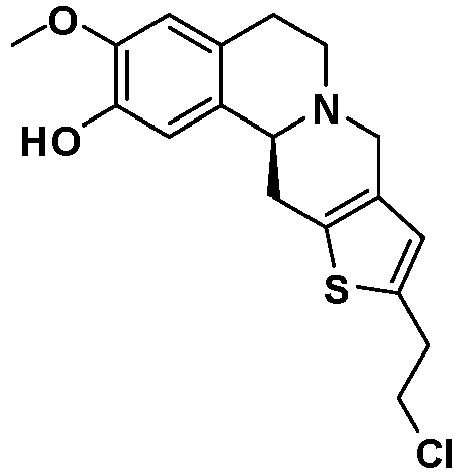


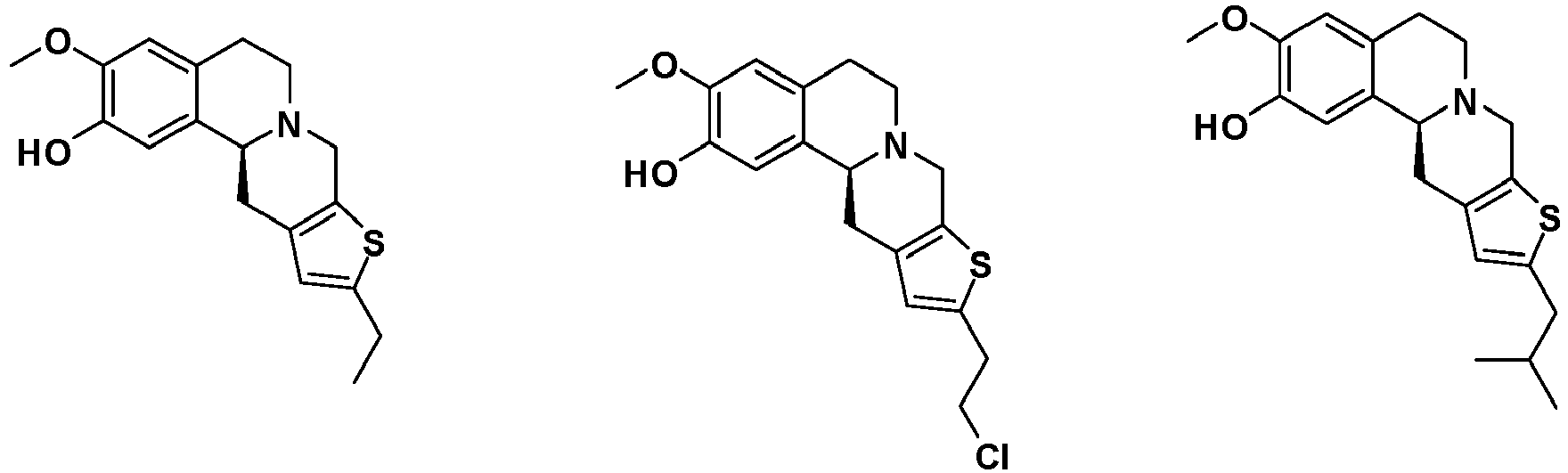


- A process of preparing the diarylo[a,g]quinolizine compound, enantiomer, diastereoisomer, racemate, pharmaceutically acceptable salt, crystalline hydrate or solvate thereof according to claim 1, wherein the process is carried out as any one of the following menthods:Method A
 reacting a1 with a2 through an amino-ester exchange reaction in a polar protic solvent to give a3,reacting a3 with an acylating agent through an acylation reaction in the presence of a base to give a4;c) dehydrlating and cyclizing a4 in the presence of a condensing agent to give a5;d) asymmetrically reducing a5 in the presence of a hydrogenation reagent and a chiral catalyst to give a6;e) hydrolyzing a6 in the presence of a base to give a7;f) halogenating a7 with a halogenating reagent, and then directly cyclizing it in the presence of a base to give a8;g) optionally, when a8 has a protective group to be removed, a8 is deprotected to remove the protective group;Method B:
 1) reacting a1 with b2 by a condensation reaction in the presence of a condensing agent to give b3;2) dehydrlating and cyclizing b3 in the presence of a condensing agent to give b4;3) asymmetrically reducing b4 in the presence of a chiral catalyst and a hydrogenation reagent to give b5; and4) reacting b5 with a substituted aldehyde R4CHO through a Pictet-Spengler reactionunder an acidic condition to give b6;
in the above methods A and B, rings A and D as well as the substituents are defined the same as those in claim 1. - A pharmaceutical composition comprising a therapeutically effective amount of one or more selected from the group consisting of the diarylo[a,g]quinolizine compound, enantiomer, diastereoisomer, racemate, pharmaceutically acceptable salt, crystalline hydrate or solvate thereof according to claim 1, and one or more pharmaceutically acceptable carriers.
- The diarylo[a,g]quinolizine compound, enantiomer, diastereoisomer, racemate, pharmaceutically acceptable salt, crystalline hydrate or solvate thereof according to claim 1 for use in preparing a medicament for treating or preventing a disease related to dopamine receptors and 5-HT receptors selected from schizophrenia, Parkinson's disease, mania, depression, drug addiction or migraine.
Applications Claiming Priority (2)
| Application Number | Priority Date | Filing Date | Title |
|---|---|---|---|
| CN201210142903.4A CN103387583B (en) | 2012-05-09 | 2012-05-09 | Diaryl simultaneously [a, g] quinolizine class compound, its preparation method, pharmaceutical composition and its application |
| PCT/CN2013/000549 WO2013166862A1 (en) | 2012-05-09 | 2013-05-09 | Diaryl[a, g]quinolizidine compound, preparation method therefor, pharmaceutical composition, and uses thereof |
Publications (3)
| Publication Number | Publication Date |
|---|---|
| EP2848617A4 EP2848617A4 (en) | 2015-03-18 |
| EP2848617A1 EP2848617A1 (en) | 2015-03-18 |
| EP2848617B1 true EP2848617B1 (en) | 2022-01-12 |
Family
ID=49532015
Family Applications (1)
| Application Number | Title | Priority Date | Filing Date |
|---|---|---|---|
| EP13787305.5A Not-in-force EP2848617B1 (en) | 2012-05-09 | 2013-05-09 | Diaryl[a, g]quinolizidine compound, preparation method therefor, pharmaceutical composition, and uses thereof |
Country Status (6)
| Country | Link |
|---|---|
| US (1) | US9751882B2 (en) |
| EP (1) | EP2848617B1 (en) |
| JP (1) | JP5940729B2 (en) |
| CN (1) | CN103387583B (en) |
| ES (1) | ES2909537T3 (en) |
| WO (1) | WO2013166862A1 (en) |
Families Citing this family (3)
| Publication number | Priority date | Publication date | Assignee | Title |
|---|---|---|---|---|
| CA2992065C (en) | 2004-03-01 | 2018-11-20 | Dolby Laboratories Licensing Corporation | Reconstructing audio signals with multiple decorrelation techniques |
| CN107303298B (en) * | 2016-04-21 | 2021-06-22 | 中国科学院上海药物研究所 | Pharmaceutical application of benzo [ g ] heteroaryl [ a, g ] quinolizine compound and preparation method thereof |
| EP3670511A4 (en) * | 2017-08-14 | 2020-09-02 | Shanghai Institute of Materia Medica, Chinese Academy of Sciences | TETRAHYDROPROTOBERBERIN COMPOUND, METHOD OF MANUFACTURING AND USING IT, AND PHARMACEUTICAL COMPOSITION |
Citations (3)
| Publication number | Priority date | Publication date | Assignee | Title |
|---|---|---|---|---|
| WO1994022858A1 (en) * | 1993-04-06 | 1994-10-13 | Abbott Laboratories | Tetracyclic compounds as dopamine agonists |
| WO1997036902A1 (en) * | 1996-04-02 | 1997-10-09 | Abbott Laboratories | TRANS-2,6-, 3,6- AND 4,6-DIAZA-5,6,6a,7,8,12b-HEXAHYDROBENZO[C]PHENANTHRENE COMPOUNDS AS DOPAMINE AGONISTS |
| WO2007006212A1 (en) * | 2005-07-08 | 2007-01-18 | Shanghai Institute Of Materia Medica, Chinese Academy Of Siences | Tetrahydroprotoberberine compounds, the synthetic method and the use thereof |
Family Cites Families (11)
| Publication number | Priority date | Publication date | Assignee | Title |
|---|---|---|---|---|
| US3103513A (en) * | 1963-09-10 | Process for preparing hexadehy- | ||
| JPS5024299A (en) * | 1973-06-28 | 1975-03-15 | ||
| US4791108A (en) * | 1987-04-13 | 1988-12-13 | Syntex (U.S.A.) Inc. | Sulfonyl-decahydro-8H-isoquino[2,1-G][1,6]-naphthyridines and related compounds useful as α2 -blockers |
| US4956365A (en) * | 1987-04-13 | 1990-09-11 | Syntex (U.S.A.) Inc. | Decahydro-8H-isoquino(2,1-g)(1,6)naphthyridine derivatives and related compounds |
| AU655998B2 (en) * | 1991-07-17 | 1995-01-19 | Syntex (U.S.A.) Inc. | Decahydro-8H-isoquino(2,1-g) (1,6) naphthyridine and decahydrobenzo(a) pyrrolo(2,3-e) quinolizine derivatives |
| US5229387A (en) * | 1991-09-20 | 1993-07-20 | Syntex (U.S.A.) Inc. | Decahydro-8H-isoquino[2,1-g][1,6]naphthyridine and decahydrobenzo[a]pyrrolo [2,3-e]quinolizine derivatives |
| CN100345848C (en) | 2003-09-29 | 2007-10-31 | 中国科学院上海药物研究所 | Leavo halogenated salt and its preparation process and use |
| CN1900076B (en) | 2005-07-08 | 2011-06-22 | 中国科学院上海药物研究所 | Tetrahydro proto-berberine compounds, and their preparing method and use |
| CN100528872C (en) * | 2006-07-26 | 2009-08-19 | 中国科学院上海药物研究所 | Tetrahydro-proto-berberine compounds, their preparing method, composition and use |
| CN102256973B (en) * | 2008-12-23 | 2014-06-11 | 西威埃医药技术(上海)有限公司 | Corydaline derivatives useful for reducing lipid levels |
| CN103664974B (en) * | 2012-09-17 | 2016-12-21 | 中国科学院上海药物研究所 | Aryl [a] indole [2,3-g] quinolizine compounds, its preparation method, pharmaceutical composition and application thereof |
-
2012
- 2012-05-09 CN CN201210142903.4A patent/CN103387583B/en active Active
-
2013
- 2013-05-09 US US14/400,203 patent/US9751882B2/en active Active
- 2013-05-09 ES ES13787305T patent/ES2909537T3/en active Active
- 2013-05-09 JP JP2015510610A patent/JP5940729B2/en not_active Expired - Fee Related
- 2013-05-09 WO PCT/CN2013/000549 patent/WO2013166862A1/en not_active Ceased
- 2013-05-09 EP EP13787305.5A patent/EP2848617B1/en not_active Not-in-force
Patent Citations (3)
| Publication number | Priority date | Publication date | Assignee | Title |
|---|---|---|---|---|
| WO1994022858A1 (en) * | 1993-04-06 | 1994-10-13 | Abbott Laboratories | Tetracyclic compounds as dopamine agonists |
| WO1997036902A1 (en) * | 1996-04-02 | 1997-10-09 | Abbott Laboratories | TRANS-2,6-, 3,6- AND 4,6-DIAZA-5,6,6a,7,8,12b-HEXAHYDROBENZO[C]PHENANTHRENE COMPOUNDS AS DOPAMINE AGONISTS |
| WO2007006212A1 (en) * | 2005-07-08 | 2007-01-18 | Shanghai Institute Of Materia Medica, Chinese Academy Of Siences | Tetrahydroprotoberberine compounds, the synthetic method and the use thereof |
Non-Patent Citations (6)
| Title |
|---|
| A. I. MEYERS ET AL: "A novel entry into indole alkaloids", THE JOURNAL OF ORGANIC CHEMISTRY, vol. 47, no. 11, 1 May 1982 (1982-05-01), pages 2229 - 2231, XP055371292, ISSN: 0022-3263, DOI: 10.1021/jo00132a063 * |
| A. YU POTAPOV ET AL: "SYNTHESIS OF THE NOVEL HETEROCYCLIC SYSTEM 8,13,13b,14-TETRAHYDROINDOLO- [2,3-a]PYRIMIDO[5,4-g]QUINOLIZIN-5(7H)-ONE", CHEMISTRY OF HETEROCYCLIC COMPOUNDS, 11 January 2012 (2012-01-11), pages 1304 - 1305, XP055371296, Retrieved from the Internet <URL:http://rd.springer.com/content/pdf/10.1007/s10593-012-0908-3.pdf> [retrieved on 20170510] * |
| AUDIA J E ET AL: "Potent, selective tetrahydro-beta-carboline antagonists of the serotonin 2B contractile receptor in the rat stomach fundus", JOURNAL OF MEDICINAL CHEMISTRY, AMERICAN CHEMICAL SOCIETY, vol. 39, 1 January 1996 (1996-01-01), pages 2773 - 2780, XP002167539, ISSN: 0022-2623, DOI: 10.1021/JM960062T * |
| JAHANGIR MICHAEL A. BROOK ET AL: "8 H -Isoquino[2,1- b ][2,7]naphthyridin-8-ones: synthesis of the Alangium alkaloids, alangimaridine and alangimarine", CANADIAN JOURNAL OF CHEMISTRY, vol. 65, no. 10, 1 October 1987 (1987-10-01), CA, pages 2362 - 2368, XP055371242, ISSN: 0008-4042, DOI: 10.1139/v87-394 * |
| ROBERT C. ELDERFIELD ET AL: "Alstonia Alkaloids. IX. Synthesis of Alstonilinol and Analogs by Reductive Ring Closure 1", THE JOURNAL OF ORGANIC CHEMISTRY, vol. 23, no. 7, 1 July 1958 (1958-07-01), pages 949 - 953, XP055371278, ISSN: 0022-3263, DOI: 10.1021/jo01101a003 * |
| S C PAKRASHI ET AL: "NOVEL BENZOPYRIDOUUINOLIZINE BASES FROM ALANGIUM LAMARCKII THW", TETRAHEDRON LETTERS, 1 January 1980 (1980-01-01), pages 2667 - 2670, XP055371208, Retrieved from the Internet <URL:http://www.sciencedirect.com/science/article/pii/S0040403900928351/pdf?md5=995dcebc4d3be215a3eace11e95128b7&pid=1-s2.0-S0040403900928351-main.pdf> [retrieved on 20170510] * |
Also Published As
| Publication number | Publication date |
|---|---|
| CN103387583B (en) | 2018-04-13 |
| ES2909537T3 (en) | 2022-05-06 |
| EP2848617A4 (en) | 2015-03-18 |
| JP2015515994A (en) | 2015-06-04 |
| EP2848617A1 (en) | 2015-03-18 |
| CN103387583A (en) | 2013-11-13 |
| US9751882B2 (en) | 2017-09-05 |
| WO2013166862A1 (en) | 2013-11-14 |
| JP5940729B2 (en) | 2016-06-29 |
| US20150141419A1 (en) | 2015-05-21 |
Similar Documents
| Publication | Publication Date | Title |
|---|---|---|
| EP4328225A1 (en) | Heterocyclic derivative inhibitor and preparation method therefor and application thereof | |
| CA2981661C (en) | Heterocyclic compounds as lsd1 inhibitors | |
| EP0296597B1 (en) | Hexa-cyclic compound | |
| EP3600287B1 (en) | Inhibitors of kinase networks and uses thereof | |
| CN102796096B (en) | Hexahydro dibenzo [a, g] quinolizine compounds, its preparation method, pharmaceutical composition and application thereof | |
| TW201206944A (en) | Morpholine compounds | |
| JP2004501860A (en) | 4-Phenyl-substituted tetrahydroisoquinolines and their use for blocking norepinephrine, dopamine and serotonin reuptake | |
| CN102638982B (en) | (S)-7-([1,2,4]triazolo[1,5-a]pyridin-6-yl)-4-(3,4-dichlorophenyl)-1,2,3, Crystal form of 4-tetrahydroisoquinoline and its use | |
| PT2252611E (en) | (dihydro)pyrrolo[2,1-a]isoquinolines | |
| AU2017208119B2 (en) | 6,7,8,9-tetrahydro-5H-pyrido[2,3-d]azepine dopamine D3 ligands | |
| CA2440014C (en) | Beta-carboline derivatives and its pharmaceutical use against depression and anxiety | |
| JP7273454B2 (en) | Non-muscle myosin II inhibitors for substance use relapse | |
| HUP0003118A2 (en) | Use of 2,7-substituted octahydro-1h-pyrido [1,2-a]pyrazine derivatives for production of pharmaceutical compositions | |
| JP6033085B2 (en) | Tricyclic derivatives and their pharmaceutical uses and compositions | |
| CA2688395A1 (en) | Therapeutic pyrazoloquinoline derivatives | |
| US9751882B2 (en) | Diaryl[A, G]quinolizidine compound, preparation method therefor, pharmaceutical composition, and uses thereof | |
| Gabet et al. | Identification of N-benzyltetrahydroisoquinolines as novel anti-neuroinflammatory agents | |
| CN116514824B (en) | Tricyclic compounds, their preparation methods and uses | |
| EP2116538B1 (en) | Condensed tetrahydroquinoline derivative and use thereof for medical purposes | |
| US4511569A (en) | Tricyclic lactams and derivatives useful in increasing cardiac contractility | |
| US20260053792A1 (en) | Polysubstituted tetrahydroisoquinoline compounds, method for preparing same, pharmaceutical composition thereof, and use thereof | |
| Tverdokhlebov et al. | Synthesis of pyrrolo [2, 3-c] 2, 7-naphthyridine derivatives by cascade heterocyclization reaction of 2-amino-4-cyanomethyl-6-dialkylamino-3, 5-pyridinedicarbonitriles | |
| CN121913943A (en) | Compounds, pharmaceutical compositions and applications for potassium channel modulators | |
| JP2008519820A (en) | Azabenzoxazole for the treatment of CNS disorders | |
| US10174052B2 (en) | Quinuclidine compounds as α-7 nicotinic acetylcholine receptor ligands |
Legal Events
| Date | Code | Title | Description |
|---|---|---|---|
| PUAI | Public reference made under article 153(3) epc to a published international application that has entered the european phase |
Free format text: ORIGINAL CODE: 0009012 |
|
| 17P | Request for examination filed |
Effective date: 20141208 |
|
| A4 | Supplementary search report drawn up and despatched |
Effective date: 20150122 |
|
| AK | Designated contracting states |
Kind code of ref document: A1 Designated state(s): AL AT BE BG CH CY CZ DE DK EE ES FI FR GB GR HR HU IE IS IT LI LT LU LV MC MK MT NL NO PL PT RO RS SE SI SK SM TR |
|
| AX | Request for extension of the european patent |
Extension state: BA ME |
|
| DAX | Request for extension of the european patent (deleted) | ||
| 17Q | First examination report despatched |
Effective date: 20151210 |
|
| STAA | Information on the status of an ep patent application or granted ep patent |
Free format text: STATUS: EXAMINATION IS IN PROGRESS |
|
| GRAP | Despatch of communication of intention to grant a patent |
Free format text: ORIGINAL CODE: EPIDOSNIGR1 |
|
| STAA | Information on the status of an ep patent application or granted ep patent |
Free format text: STATUS: GRANT OF PATENT IS INTENDED |
|
| GRAJ | Information related to disapproval of communication of intention to grant by the applicant or resumption of examination proceedings by the epo deleted |
Free format text: ORIGINAL CODE: EPIDOSDIGR1 |
|
| STAA | Information on the status of an ep patent application or granted ep patent |
Free format text: STATUS: EXAMINATION IS IN PROGRESS |
|
| INTG | Intention to grant announced |
Effective date: 20210609 |
|
| GRAP | Despatch of communication of intention to grant a patent |
Free format text: ORIGINAL CODE: EPIDOSNIGR1 |
|
| STAA | Information on the status of an ep patent application or granted ep patent |
Free format text: STATUS: GRANT OF PATENT IS INTENDED |
|
| INTC | Intention to grant announced (deleted) | ||
| INTG | Intention to grant announced |
Effective date: 20210729 |
|
| GRAS | Grant fee paid |
Free format text: ORIGINAL CODE: EPIDOSNIGR3 |
|
| GRAA | (expected) grant |
Free format text: ORIGINAL CODE: 0009210 |
|
| STAA | Information on the status of an ep patent application or granted ep patent |
Free format text: STATUS: THE PATENT HAS BEEN GRANTED |
|
| AK | Designated contracting states |
Kind code of ref document: B1 Designated state(s): AL AT BE BG CH CY CZ DE DK EE ES FI FR GB GR HR HU IE IS IT LI LT LU LV MC MK MT NL NO PL PT RO RS SE SI SK SM TR |
|
| REG | Reference to a national code |
Ref country code: GB Ref legal event code: FG4D |
|
| REG | Reference to a national code |
Ref country code: CH Ref legal event code: EP |
|
| REG | Reference to a national code |
Ref country code: DE Ref legal event code: R096 Ref document number: 602013080679 Country of ref document: DE |
|
| REG | Reference to a national code |
Ref country code: IE Ref legal event code: FG4D |
|
| REG | Reference to a national code |
Ref country code: AT Ref legal event code: REF Ref document number: 1462314 Country of ref document: AT Kind code of ref document: T Effective date: 20220215 |
|
| REG | Reference to a national code |
Ref country code: NL Ref legal event code: FP |
|
| REG | Reference to a national code |
Ref country code: SE Ref legal event code: TRGR |
|
| PGFP | Annual fee paid to national office [announced via postgrant information from national office to epo] |
Ref country code: GB Payment date: 20220324 Year of fee payment: 10 |
|
| REG | Reference to a national code |
Ref country code: ES Ref legal event code: FG2A Ref document number: 2909537 Country of ref document: ES Kind code of ref document: T3 Effective date: 20220506 |
|
| REG | Reference to a national code |
Ref country code: LT Ref legal event code: MG9D |
|
| REG | Reference to a national code |
Ref country code: AT Ref legal event code: MK05 Ref document number: 1462314 Country of ref document: AT Kind code of ref document: T Effective date: 20220112 |
|
| PGFP | Annual fee paid to national office [announced via postgrant information from national office to epo] |
Ref country code: NL Payment date: 20220518 Year of fee payment: 10 |
|
| PG25 | Lapsed in a contracting state [announced via postgrant information from national office to epo] |
Ref country code: RS Free format text: LAPSE BECAUSE OF FAILURE TO SUBMIT A TRANSLATION OF THE DESCRIPTION OR TO PAY THE FEE WITHIN THE PRESCRIBED TIME-LIMIT Effective date: 20220112 Ref country code: PT Free format text: LAPSE BECAUSE OF FAILURE TO SUBMIT A TRANSLATION OF THE DESCRIPTION OR TO PAY THE FEE WITHIN THE PRESCRIBED TIME-LIMIT Effective date: 20220512 Ref country code: NO Free format text: LAPSE BECAUSE OF FAILURE TO SUBMIT A TRANSLATION OF THE DESCRIPTION OR TO PAY THE FEE WITHIN THE PRESCRIBED TIME-LIMIT Effective date: 20220412 Ref country code: LT Free format text: LAPSE BECAUSE OF FAILURE TO SUBMIT A TRANSLATION OF THE DESCRIPTION OR TO PAY THE FEE WITHIN THE PRESCRIBED TIME-LIMIT Effective date: 20220112 Ref country code: HR Free format text: LAPSE BECAUSE OF FAILURE TO SUBMIT A TRANSLATION OF THE DESCRIPTION OR TO PAY THE FEE WITHIN THE PRESCRIBED TIME-LIMIT Effective date: 20220112 Ref country code: BG Free format text: LAPSE BECAUSE OF FAILURE TO SUBMIT A TRANSLATION OF THE DESCRIPTION OR TO PAY THE FEE WITHIN THE PRESCRIBED TIME-LIMIT Effective date: 20220412 |
|
| PGFP | Annual fee paid to national office [announced via postgrant information from national office to epo] |
Ref country code: SE Payment date: 20220523 Year of fee payment: 10 Ref country code: IT Payment date: 20220531 Year of fee payment: 10 Ref country code: FR Payment date: 20220523 Year of fee payment: 10 Ref country code: ES Payment date: 20220617 Year of fee payment: 10 Ref country code: DE Payment date: 20220530 Year of fee payment: 10 |
|
| PG25 | Lapsed in a contracting state [announced via postgrant information from national office to epo] |
Ref country code: PL Free format text: LAPSE BECAUSE OF FAILURE TO SUBMIT A TRANSLATION OF THE DESCRIPTION OR TO PAY THE FEE WITHIN THE PRESCRIBED TIME-LIMIT Effective date: 20220112 Ref country code: LV Free format text: LAPSE BECAUSE OF FAILURE TO SUBMIT A TRANSLATION OF THE DESCRIPTION OR TO PAY THE FEE WITHIN THE PRESCRIBED TIME-LIMIT Effective date: 20220112 Ref country code: GR Free format text: LAPSE BECAUSE OF FAILURE TO SUBMIT A TRANSLATION OF THE DESCRIPTION OR TO PAY THE FEE WITHIN THE PRESCRIBED TIME-LIMIT Effective date: 20220413 Ref country code: FI Free format text: LAPSE BECAUSE OF FAILURE TO SUBMIT A TRANSLATION OF THE DESCRIPTION OR TO PAY THE FEE WITHIN THE PRESCRIBED TIME-LIMIT Effective date: 20220112 Ref country code: AT Free format text: LAPSE BECAUSE OF FAILURE TO SUBMIT A TRANSLATION OF THE DESCRIPTION OR TO PAY THE FEE WITHIN THE PRESCRIBED TIME-LIMIT Effective date: 20220112 |
|
| PGFP | Annual fee paid to national office [announced via postgrant information from national office to epo] |
Ref country code: CH Payment date: 20220523 Year of fee payment: 10 Ref country code: BE Payment date: 20220518 Year of fee payment: 10 |
|
| PG25 | Lapsed in a contracting state [announced via postgrant information from national office to epo] |
Ref country code: IS Free format text: LAPSE BECAUSE OF FAILURE TO SUBMIT A TRANSLATION OF THE DESCRIPTION OR TO PAY THE FEE WITHIN THE PRESCRIBED TIME-LIMIT Effective date: 20220512 |
|
| REG | Reference to a national code |
Ref country code: DE Ref legal event code: R097 Ref document number: 602013080679 Country of ref document: DE |
|
| PG25 | Lapsed in a contracting state [announced via postgrant information from national office to epo] |
Ref country code: SM Free format text: LAPSE BECAUSE OF FAILURE TO SUBMIT A TRANSLATION OF THE DESCRIPTION OR TO PAY THE FEE WITHIN THE PRESCRIBED TIME-LIMIT Effective date: 20220112 Ref country code: SK Free format text: LAPSE BECAUSE OF FAILURE TO SUBMIT A TRANSLATION OF THE DESCRIPTION OR TO PAY THE FEE WITHIN THE PRESCRIBED TIME-LIMIT Effective date: 20220112 Ref country code: RO Free format text: LAPSE BECAUSE OF FAILURE TO SUBMIT A TRANSLATION OF THE DESCRIPTION OR TO PAY THE FEE WITHIN THE PRESCRIBED TIME-LIMIT Effective date: 20220112 Ref country code: EE Free format text: LAPSE BECAUSE OF FAILURE TO SUBMIT A TRANSLATION OF THE DESCRIPTION OR TO PAY THE FEE WITHIN THE PRESCRIBED TIME-LIMIT Effective date: 20220112 Ref country code: DK Free format text: LAPSE BECAUSE OF FAILURE TO SUBMIT A TRANSLATION OF THE DESCRIPTION OR TO PAY THE FEE WITHIN THE PRESCRIBED TIME-LIMIT Effective date: 20220112 Ref country code: CZ Free format text: LAPSE BECAUSE OF FAILURE TO SUBMIT A TRANSLATION OF THE DESCRIPTION OR TO PAY THE FEE WITHIN THE PRESCRIBED TIME-LIMIT Effective date: 20220112 |
|
| PLBE | No opposition filed within time limit |
Free format text: ORIGINAL CODE: 0009261 |
|
| STAA | Information on the status of an ep patent application or granted ep patent |
Free format text: STATUS: NO OPPOSITION FILED WITHIN TIME LIMIT |
|
| PG25 | Lapsed in a contracting state [announced via postgrant information from national office to epo] |
Ref country code: AL Free format text: LAPSE BECAUSE OF FAILURE TO SUBMIT A TRANSLATION OF THE DESCRIPTION OR TO PAY THE FEE WITHIN THE PRESCRIBED TIME-LIMIT Effective date: 20220112 |
|
| 26N | No opposition filed |
Effective date: 20221013 |
|
| PG25 | Lapsed in a contracting state [announced via postgrant information from national office to epo] |
Ref country code: MC Free format text: LAPSE BECAUSE OF FAILURE TO SUBMIT A TRANSLATION OF THE DESCRIPTION OR TO PAY THE FEE WITHIN THE PRESCRIBED TIME-LIMIT Effective date: 20220112 Ref country code: LU Free format text: LAPSE BECAUSE OF NON-PAYMENT OF DUE FEES Effective date: 20220509 |
|
| PG25 | Lapsed in a contracting state [announced via postgrant information from national office to epo] |
Ref country code: IE Free format text: LAPSE BECAUSE OF NON-PAYMENT OF DUE FEES Effective date: 20220509 |
|
| P01 | Opt-out of the competence of the unified patent court (upc) registered |
Effective date: 20230413 |
|
| REG | Reference to a national code |
Ref country code: DE Ref legal event code: R119 Ref document number: 602013080679 Country of ref document: DE |
|
| REG | Reference to a national code |
Ref country code: CH Ref legal event code: PL |
|
| REG | Reference to a national code |
Ref country code: SE Ref legal event code: EUG |
|
| REG | Reference to a national code |
Ref country code: NL Ref legal event code: MM Effective date: 20230601 |
|
| GBPC | Gb: european patent ceased through non-payment of renewal fee |
Effective date: 20230509 |
|
| REG | Reference to a national code |
Ref country code: BE Ref legal event code: MM Effective date: 20230531 |
|
| PG25 | Lapsed in a contracting state [announced via postgrant information from national office to epo] |
Ref country code: SE Free format text: LAPSE BECAUSE OF NON-PAYMENT OF DUE FEES Effective date: 20230510 Ref country code: LI Free format text: LAPSE BECAUSE OF NON-PAYMENT OF DUE FEES Effective date: 20230531 Ref country code: CH Free format text: LAPSE BECAUSE OF NON-PAYMENT OF DUE FEES Effective date: 20230531 |
|
| PG25 | Lapsed in a contracting state [announced via postgrant information from national office to epo] |
Ref country code: NL Free format text: LAPSE BECAUSE OF NON-PAYMENT OF DUE FEES Effective date: 20230601 |
|
| PG25 | Lapsed in a contracting state [announced via postgrant information from national office to epo] |
Ref country code: HU Free format text: LAPSE BECAUSE OF FAILURE TO SUBMIT A TRANSLATION OF THE DESCRIPTION OR TO PAY THE FEE WITHIN THE PRESCRIBED TIME-LIMIT; INVALID AB INITIO Effective date: 20130509 |
|
| PG25 | Lapsed in a contracting state [announced via postgrant information from national office to epo] |
Ref country code: MK Free format text: LAPSE BECAUSE OF FAILURE TO SUBMIT A TRANSLATION OF THE DESCRIPTION OR TO PAY THE FEE WITHIN THE PRESCRIBED TIME-LIMIT Effective date: 20220112 Ref country code: IT Free format text: LAPSE BECAUSE OF NON-PAYMENT OF DUE FEES Effective date: 20230509 Ref country code: DE Free format text: LAPSE BECAUSE OF NON-PAYMENT OF DUE FEES Effective date: 20231201 Ref country code: CY Free format text: LAPSE BECAUSE OF FAILURE TO SUBMIT A TRANSLATION OF THE DESCRIPTION OR TO PAY THE FEE WITHIN THE PRESCRIBED TIME-LIMIT Effective date: 20220112 Ref country code: GB Free format text: LAPSE BECAUSE OF NON-PAYMENT OF DUE FEES Effective date: 20230509 |
|
| PG25 | Lapsed in a contracting state [announced via postgrant information from national office to epo] |
Ref country code: FR Free format text: LAPSE BECAUSE OF NON-PAYMENT OF DUE FEES Effective date: 20230531 Ref country code: BE Free format text: LAPSE BECAUSE OF NON-PAYMENT OF DUE FEES Effective date: 20230531 |
|
| REG | Reference to a national code |
Ref country code: ES Ref legal event code: FD2A Effective date: 20240628 |
|
| PG25 | Lapsed in a contracting state [announced via postgrant information from national office to epo] |
Ref country code: ES Free format text: LAPSE BECAUSE OF NON-PAYMENT OF DUE FEES Effective date: 20230510 |
|
| PG25 | Lapsed in a contracting state [announced via postgrant information from national office to epo] |
Ref country code: ES Free format text: LAPSE BECAUSE OF NON-PAYMENT OF DUE FEES Effective date: 20230510 |
|
| PG25 | Lapsed in a contracting state [announced via postgrant information from national office to epo] |
Ref country code: MT Free format text: LAPSE BECAUSE OF FAILURE TO SUBMIT A TRANSLATION OF THE DESCRIPTION OR TO PAY THE FEE WITHIN THE PRESCRIBED TIME-LIMIT Effective date: 20220112 |
|
| PG25 | Lapsed in a contracting state [announced via postgrant information from national office to epo] |
Ref country code: TR Free format text: LAPSE BECAUSE OF FAILURE TO SUBMIT A TRANSLATION OF THE DESCRIPTION OR TO PAY THE FEE WITHIN THE PRESCRIBED TIME-LIMIT Effective date: 20220112 |
|
| PG25 | Lapsed in a contracting state [announced via postgrant information from national office to epo] |
Ref country code: SI Free format text: LAPSE BECAUSE OF FAILURE TO SUBMIT A TRANSLATION OF THE DESCRIPTION OR TO PAY THE FEE WITHIN THE PRESCRIBED TIME-LIMIT Effective date: 20220112 |