EP2845559A1 - Steuern eines Geräts zur Behandlung eines Patienten - Google Patents
Steuern eines Geräts zur Behandlung eines Patienten Download PDFInfo
- Publication number
- EP2845559A1 EP2845559A1 EP14183900.1A EP14183900A EP2845559A1 EP 2845559 A1 EP2845559 A1 EP 2845559A1 EP 14183900 A EP14183900 A EP 14183900A EP 2845559 A1 EP2845559 A1 EP 2845559A1
- Authority
- EP
- European Patent Office
- Prior art keywords
- patient
- treatment
- pain
- force
- component
- Prior art date
- Legal status (The legal status is an assumption and is not a legal conclusion. Google has not performed a legal analysis and makes no representation as to the accuracy of the status listed.)
- Granted
Links
Images

Classifications
-
- A—HUMAN NECESSITIES
- A61—MEDICAL OR VETERINARY SCIENCE; HYGIENE
- A61C—DENTISTRY; APPARATUS OR METHODS FOR ORAL OR DENTAL HYGIENE
- A61C1/00—Dental machines for boring or cutting ; General features of dental machines or apparatus, e.g. hand-piece design
- A61C1/08—Machine parts specially adapted for dentistry
- A61C1/081—Pain-alleviating features
-
- A—HUMAN NECESSITIES
- A61—MEDICAL OR VETERINARY SCIENCE; HYGIENE
- A61B—DIAGNOSIS; SURGERY; IDENTIFICATION
- A61B5/00—Measuring for diagnostic purposes; Identification of persons
- A61B5/22—Ergometry; Measuring muscular strength or the force of a muscular blow
- A61B5/224—Measuring muscular strength
- A61B5/225—Measuring muscular strength of the fingers, e.g. by monitoring hand-grip force
-
- A—HUMAN NECESSITIES
- A61—MEDICAL OR VETERINARY SCIENCE; HYGIENE
- A61B—DIAGNOSIS; SURGERY; IDENTIFICATION
- A61B5/00—Measuring for diagnostic purposes; Identification of persons
- A61B5/48—Other medical applications
- A61B5/4824—Touch or pain perception evaluation
- A61B5/4827—Touch or pain perception evaluation assessing touch sensitivity, e.g. for evaluation of pain threshold
-
- A—HUMAN NECESSITIES
- A61—MEDICAL OR VETERINARY SCIENCE; HYGIENE
- A61B—DIAGNOSIS; SURGERY; IDENTIFICATION
- A61B5/00—Measuring for diagnostic purposes; Identification of persons
- A61B5/48—Other medical applications
- A61B5/4848—Monitoring or testing the effects of treatment, e.g. of medication
-
- A—HUMAN NECESSITIES
- A61—MEDICAL OR VETERINARY SCIENCE; HYGIENE
- A61B—DIAGNOSIS; SURGERY; IDENTIFICATION
- A61B5/00—Measuring for diagnostic purposes; Identification of persons
- A61B5/48—Other medical applications
- A61B5/486—Biofeedback
-
- A—HUMAN NECESSITIES
- A61—MEDICAL OR VETERINARY SCIENCE; HYGIENE
- A61C—DENTISTRY; APPARATUS OR METHODS FOR ORAL OR DENTAL HYGIENE
- A61C1/00—Dental machines for boring or cutting ; General features of dental machines or apparatus, e.g. hand-piece design
- A61C1/0007—Control devices or systems
- A61C1/0015—Electrical systems
-
- A—HUMAN NECESSITIES
- A61—MEDICAL OR VETERINARY SCIENCE; HYGIENE
- A61C—DENTISTRY; APPARATUS OR METHODS FOR ORAL OR DENTAL HYGIENE
- A61C17/00—Devices for cleaning, polishing, rinsing or drying teeth, teeth cavities or prostheses; Saliva removers; Dental appliances for receiving spittle
- A61C17/16—Power-driven cleaning or polishing devices
- A61C17/20—Power-driven cleaning or polishing devices using ultrasonic waves
-
- A—HUMAN NECESSITIES
- A61—MEDICAL OR VETERINARY SCIENCE; HYGIENE
- A61B—DIAGNOSIS; SURGERY; IDENTIFICATION
- A61B2562/00—Details of sensors; Constructional details of sensor housings or probes; Accessories for sensors
- A61B2562/02—Details of sensors specially adapted for in-vivo measurements
- A61B2562/0252—Load cells
-
- A—HUMAN NECESSITIES
- A61—MEDICAL OR VETERINARY SCIENCE; HYGIENE
- A61C—DENTISTRY; APPARATUS OR METHODS FOR ORAL OR DENTAL HYGIENE
- A61C1/00—Dental machines for boring or cutting ; General features of dental machines or apparatus, e.g. hand-piece design
- A61C1/0007—Control devices or systems
- A61C1/0015—Electrical systems
- A61C1/0023—Foot control
-
- A—HUMAN NECESSITIES
- A61—MEDICAL OR VETERINARY SCIENCE; HYGIENE
- A61G—TRANSPORT, PERSONAL CONVEYANCES OR ACCOMMODATION SPECIALLY ADAPTED FOR PATIENTS OR DISABLED PERSONS; OPERATING TABLES OR CHAIRS; CHAIRS FOR DENTISTRY; FUNERAL DEVICES
- A61G15/00—Operating chairs; Dental chairs; Accessories specially adapted therefor, e.g. work stands
- A61G15/14—Dental work stands; Accessories therefor
Definitions
- the invention relates to a controller for a treatment device, in particular a dental treatment instrument, for.
- a treatment device in particular a dental treatment instrument
- an ultrasonic treatment device or an AirScaler As an ultrasonic treatment device or an AirScaler.
- Such devices are mainly used in the field of dentistry, for example in the treatment of periodontitis or in the removal of calculus.
- the disease state of the gums and the periodontium are first detected and then plaque, tartar and the pathogenic bacterial flora (biofilm) are eliminated.
- all supragingival above the gingival margin
- hard and soft deposits are removed.
- the actual periodontitis therapy begins, during which the subgingival (below the gingival margin) hard and soft pads are removed (closed periodontal debridement).
- the tooth and root surfaces are cleaned and smoothed with curettes (specially shaped hand instruments), with sound and ultrasound-powered devices, so that the periodontal ligament can heal.
- the treatment is done in the modern times typically with sound or ultrasound-powered devices (piezoelectric or magnetostrictive) and the associated application tips.
- the pain is caused by the fact that the vibrating application tip has to come into contact with the tooth surface for the purpose of biofilm or concrement removal, that is to say through the mechanical interaction with the tissue.
- a regular treatment is absolutely necessary - often occur in deep periodontal pockets pain in the treatment, especially on the neck of the tooth.
- the pain becomes greater when the cement layer overlying the dentin has been damaged or removed by cleaning defects or frequent treatments.
- Exposed dentinal tubules and changes in pressure in the lateral dentinal tubules lead, among other things, to the perception of pain (cf. Fig. 1 with related description below).
- the interaction of the application tip with soft tissue can lead to pain induction. In both cases, the perception of pain is directly dependent on the processing power of the treatment device. In addition, pain can also be caused by incorrect handling of the application tip.
- the practitioner may recognize this by either the patient's physical response, or, for example, hand signs have been agreed in advance to signal the onset of severe pain. In both cases there is no direct effect of the patient on the processing performance of the treatment device.
- the object of the invention is to provide a means that allows a doctor to effectively adapt a treatment with a treatment device to the pain of the patient, while avoiding the disadvantages of the prior art.
- Proposed is a means for controlling a device for treating a patient, wherein the treatment with the device may cause pain, and wherein a change in operation of the device is suitable, the To reduce pain.
- the means comprises a force measuring device, which can be actuated by the patient, and a component, which is suitable depending on the measured force to cause a change in the operation of the device.
- the patient is i. d. R. a human and must be conscious of the treatment.
- the agent is used in a periodontitis treatment, but other treatments, especially in the dental field, as applications are conceivable.
- the hand force of the patient is preferably measured.
- z. B. also a foot control possible.
- the power output of the treatment device can be influenced by this control by the patient. If the patient does not press at all, then the device runs with the power set by the attending physician. Instead of the power output, for example, the frequency z.
- the amplitude with which a vibrating element deflects, or the distance of a device from the patient can be varied.
- the treatment time is optimally adapted to the pain sensation.
- the agent reacts immediately and without attention deficits to pain in the patient so that the physician can concentrate on the guidance of the treatment device and not simultaneously have to look for (possibly hidden or suppressed) indicators of pain in the patient.
- the component is designed such that it can change the operation of the device gradually. This can be done either steadily or in stages and allows for a much more individual adaptation of the treatment than a system which knows only the states "on” and "off".
- the patient has a shutdown option that interrupts or terminates the treatment.
- the device may be completely turned off when a certain force is exerted by the patient.
- a means for preventing the change in the operation of the device by the component can be z. B. in the form of a foot switch for the doctor or a radio remote control, which can turn off the component.
- the doctor can intervene if, for example, a patient can not cope with the operation of the force-measuring device. Or the doctor can continue the treatment against the will of the patient, perhaps to complete the very last small step.
- a display device which can indicate whether the component changes the operation of the device, ie whether the patient Treatment influenced. This can be done, for example, optically or acoustically.
- the display device may be provided on the device, or on the drive unit or controller, or possibly an existing screen o. ⁇ . use.
- the means for controlling a device for treating a patient is used in conjunction with a device for the treatment of periodontitis, which works on an ultrasound basis (use instead of a curette).
- the means for controlling a device for treating a patient is part of a dental treatment unit (see glossary below).
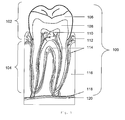
- the structure of a human tooth 100 is in Fig. 1 shown schematically.
- the tooth 100 consists essentially of the tooth crown 102 and the tooth root 104 and is composed of several layers.
- enamel 106 which covers the inner dentin like a glaze.
- the dentin 108 in turn, surrounds the pulp 110, in which blood vessels 118 and nerves 120 are also located.
- the root 104 is surrounded by cementum 114 and periodontal tissue (missing in Fig. 1 ) enclosed.
- the entire root area 104 is normally covered by gum 112 or jaw bone 116, respectively.
- the tooth substance or dentin 108 is located below the enamel 106. It represents the main mass of the tooth 100.
- the hard substance of the dentin 108 like the enamel 106, consists of calcium and phosphate, but only two-thirds, the remainder being protein and water, for which reason Dentin is softer and more susceptible to tooth decay than enamel 106.
- Dentin 108 is sensitive to pain. Heat, cold and touch stimuli lead to fluid movements in the dentinal tubules, which can reach the surface in the area of the transition from root 104 to crown 102 (tooth neck). This irritates the Tomesian fibers, cell processes of the Odontoblasten (dentin-forming cells). The odontoblasts are associated with free nerve endings 120, which transmit the stimulus as pain sensation to the central nervous system.
- An ultrasound-powered treatment device 200 for treating periodontitis and for removal of tartar has a controller 208 that can vary the ultrasound power (or drive power) 212. Further, a flexible, hollow ball or cylinder 204, z. B. rubber, as Force measuring device provided. The patient 202 takes the cylinder 204 in his hand 203 and compresses it when he feels pain. Instinctively, the higher the pain sensation of the patient 202, the stronger the pressure will be. The pressure in the cylinder 204 is measured, and a component 206 of the controller 208 of the treatment device 200 reduces the ultrasonic power 212 depending on the measured pressure.
- the limits within which the ultrasound power 212 can be varied by the patient can be predetermined by the attending physician 210.
- the physician 210 ensures that the treatment always has a therapeutic benefit.
- the upper limit results from the performance that the physician 210 has chosen for the treatment.
- the controller 208 has an inconspicuous switch 214, with which the treating physician 210 can suppress the influencing of the ultrasound power by the patient 202 if necessary.
- the treatment device 200 and its controller 208 are provided as part of a dental car 216.
- the controller 208 may in principle be used for any type of treatment device 200 in which the manipulation of a parameter of the device may reduce the patient's perception of pain in the treatment.
- the force measurement can be done with any compressible device 204. Possibly. For example, it may be desirable to completely stop device 200 in pain rather than changing one parameter in multiple stages or continuously.
- AirScaler is a compressed air powered instrument that makes a tip vibrate. AirScaler are supplied with compressed air via the turbine connection on the treatment chair. They reach a maximum of 8000 oscillations per second and thus do not work in the ultrasonic range, which is defined by vibrations above approx. 20 kHz. (After: "Introduction to tooth preservation” by Elmar Hellwig, Joachim Klimek, Thomas Attin, 5th revised and expanded edition, German Dentists Publishing, p 541). The operation of the AirScaler can be influenced, for example, by a proportional valve, by means of which the force of the patient influences the compressed air supply of the AirScaler.
- Dental unit dental treatment unit
- the dental unit or dental unit usually consists of a treatment chair with control and a pedestal with articulated arms that carry the instruments and devices that the dentist needs for treatment. These include the drill or drilling turbine, the air and water syringe, the sink, the instrument tray, the operating light, if necessary, in addition a screen and / or an irradiation device.
- Device capable of measuring the force applied thereto, for example a ball or a spring element which can compress a person.
- a ball or a spring element which can compress a person.
- components typically electronic, which can measure the pressure change or deflection caused by the force and can determine the force therefrom.
- Curettes are used to remove subgingival calculus, necrotic, infected root cementum, and to remove granulation tissue and pocket epithelium. They have a delicate shape with a rounded end. There is a distinction between universal curettes and special curettes. Due to their shape, universal curettes can be used on all quadrants of a dentition and there on all tooth surfaces. They are sharpened on both sides of their spoon-like working end. For extra narrow or deep gum pockets, special curettes with a shorter working end or longer lower shaft are suitable.
- a scaler is a pointed hand instrument used in dentistry and serves above all to remove supragingival concrements (calculus located above the gingival margin). Scalers are used in particular for removing hard coverings and for rough depuration.
- Crescent scaler has a triangular cross-section, two intersecting edges and tapering at its end. Due to its tip and size, subgingival work without injury to the gingiva is not possible.
- Straight scalers can be used in the entire upper and lower jaw area, curved scalers are suitable for the removal of calculus in the interdental area.
Landscapes
- Health & Medical Sciences (AREA)
- Life Sciences & Earth Sciences (AREA)
- Veterinary Medicine (AREA)
- Animal Behavior & Ethology (AREA)
- General Health & Medical Sciences (AREA)
- Public Health (AREA)
- Engineering & Computer Science (AREA)
- Biophysics (AREA)
- Biomedical Technology (AREA)
- Surgery (AREA)
- Molecular Biology (AREA)
- Physics & Mathematics (AREA)
- Medical Informatics (AREA)
- Pathology (AREA)
- Heart & Thoracic Surgery (AREA)
- Epidemiology (AREA)
- Dentistry (AREA)
- Pain & Pain Management (AREA)
- Oral & Maxillofacial Surgery (AREA)
- Psychiatry (AREA)
- Hospice & Palliative Care (AREA)
- Biodiversity & Conservation Biology (AREA)
- Physical Education & Sports Medicine (AREA)
- Water Supply & Treatment (AREA)
- Dental Tools And Instruments Or Auxiliary Dental Instruments (AREA)
Abstract
Description
- Die Erfindung betrifft eine Steuerung für ein Behandlungsgerät, insbesondere ein dentales Behandlungsinstrument, z. B. ein Ultraschall-Behandlungsgerät oder ein AirScaler. Solche Geräte kommen vor allem im Zahnarztbereich zum Einsatz, beispielsweise bei der Behandlung von Parodontitis oder bei der Zahnsteinentfernung.
- Bei der Behandlung von Parodontitis werden zunächst der Erkrankungszustand des Zahnfleischs und des Zahnhalteapparats festgestellt und dann Plaque, Zahnstein sowie die pathogene Bakterienflora (Biofilm) beseitigt. Dabei werden im Rahmen einer sog. professionellen Zahnreinigung zunächst alle supragingival (oberhalb des Zahnfleischrands) gelegenen harten und weichen Beläge entfernt. Im Anschluss beginnt bei Bedarf die eigentliche Parodontitistherapie, bei der die subgingival (unterhalb des Zahnfleischrands) liegenden harten und weichen Beläge entfernt werden (geschlossenes parodontales Debridement). Dabei werden die Zahn- und Wurzeloberflächen mit Küretten (speziell geformten Handinstrumenten), mit schall- und ultraschallbetriebenen Geräten gereinigt und geglättet , damit der Zahnhalteapparat ausheilen kann. Diese Maßnahmen müssen ggf. im zeitlichen Abstand an einzelnen Stellen wiederholt werden.
- Vorteil: Patienten, die frei von Angst vor dem Schmerz bei der Behandlung sind, gehen regelmäßiger zur Behandlung, was insbesondere bei chronischen Erkrankungen (Parodontitis) von besonderer Bedeutung für die Beherrschung der Krankheit ist.
- Die Behandlung erfolgt in der heutigen Zeit typischerweise mit schall- oder ultraschallbetriebenen Geräten (piezoelektrisch oder magnetostriktiv) und den dazugehörigen Applikationsspitzen. Der Schmerz entsteht dadurch, dass die schwingende Applikationsspitze zum Zwecke der Biofilm- oder Konkrement-Entfernung mit der Zahnoberfläche in Kontakt treten muss, also durch die mechanische Interaktion mit dem Gewebe. Insbesondere bei fortgeschrittener Erkrankung - hier ist eine regelmäßige Behandlung zwingend notwendig - treten bei tiefen Zahnfleischtaschen häufig Schmerzen bei der Behandlung auf, insbesondere am Zahnhals. Der Schmerz wird dann größer, wenn die Zementschicht, die das Dentin überlagert, durch Putzdefekte oder häufige Behandlungen geschädigt oder entfernt wurde. Freiliegende Dentintubuli und Druckänderungen in den lateralen Dentintubuli führen u.a. zum Schmerzempfinden (vgl. hierzu
Fig. 1 mit zugehöriger Beschreibung weiter unten). Zusätzlich kann die Interaktion der Applikationsspitze mit Weichgewebe zu Schmerzinduktionen führen. In beiden Fällen ist das Schmerzempfinden direkt von der Bearbeitungsleistung des Behandlungsgerätes abhängig. Schmerzen können darüber hinaus auch durch falsches Handling der Applikationsspitze entstehen. - Treten bei den heutigen Behandlungen Schmerzen auf, kann dies der Behandler entweder an der körperlichen Reaktion des Patienten erkennen, oder es wurden im Vorfeld beispielsweise Handzeichen vereinbart, die das Auftreten von starken Schmerzen signalisieren sollen. In beiden Fällen findet keine direkte Einwirkung des Patienten auf die Bearbeitungsleistung des Behandlungsgerätes statt.
- Erkennt der Zahnarzt heute, dass der Patient Schmerzen bei der Behandlung erleidet, ergeben sich folgende Optionen:
- a) Einlegen einer Behandlungspause, allerdings mit dem Nachteil, dass sich dadurch die Behandlungszeit verlängert, bzw. die empfindliche Stelle noch einmal bearbeitet werden muss.
- b) Reduktion der Leistung des Scalers (siehe Glossar weiter unten) - diese kann entweder kurzzeitig erfolgen, wobei die Leistung anschließend wieder erhöht wird, oder aber für die gesamte Dauer der Behandlung. Im Falle einer kurzzeitigen Reduktion tritt der Schmerz im weiteren Verlauf der Behandlung an einem anderen Zahn ggf. wieder auf, was für alle Beteiligten unbefriedigend ist. Im Falle einer dauerhaften Reduktion der Leistung des Scalers verlängert sich die Dauer der Behandlung, was ebenso nachteilig ist.
- c) Anästhesie.
- Aufgabe der Erfindung ist es, ein Mittel anzugeben, das es einem Arzt ermöglicht, eine Behandlung mit einem Behandlungsgerät in effektiver Weise an Schmerzen des Patienten anzupassen, und dabei die Nachteile des Standes der Technik zu vermeiden.
- Diese Aufgabe wird durch die Erfindung mit den Merkmalen des unabhängigen Anspruchs gelöst. Vorteilhafte Weiterbildungen der Erfindung sind in den Unteransprüchen gekennzeichnet. Der Wortlaut sämtlicher Ansprüche wird hiermit durch Bezugnahme zum Inhalt dieser Beschreibung gemacht.
- Vorgeschlagen wird ein Mittel zum Steuern eines Geräts zur Behandlung eines Patienten, wobei die Behandlung mit dem Gerät Schmerzen hervorrufen kann, und wobei eine Veränderung einer Arbeitsweise des Geräts geeignet ist, die Schmerzen zu verringern. Das Mittel umfasst eine Kraftmesseinrichtung, welche durch den Patienten betätigbar ist, und eine Komponente, die abhängig von der gemessenen Kraft eine Veränderung der Arbeitsweise des Geräts hervorzurufen geeignet ist.
- Der Patient ist dabei i. d. R. ein Mensch und muss bei der Behandlung bei Bewusstsein sein. Typischerweise kommt das Mittel bei einer Parodontitis-Behandlung zum Einsatz, allerdings sind auch andere Behandlungen, insbesondere im Dentalbereich, als Einsatzgebiete denkbar.
- Als Kraftmesseinrichtung kommen dabei die unterschiedlichsten kraftgesteuerten Systeme in Betracht, so z. B. folgende:
- a. Ein Ball oder Zylinder wird gedrückt und der Innendruck gemessen.
- b. In einer flexiblen Leitung, z. B. einem Schlauch, durch die Luft strömt, wird der durch Handkraft beeinflusste Volumenstrom gemessen.
- c. Ein Federelement wird zusammengedrückt, und die Krafterkennung erfolgt über eine Wegmessung (Federkennlinie).
- d. Ein Element wird zusammengedrückt und nur der Weg gemessen. Die Kraft entspricht dabei dem Weg und kann in bekannter Weise daraus berechnet werden.
- e. Der Winkel zwischen den beiden Schenkeln einer Klemme wird gemessen. Auch diese Umrechnung ist allgemein bekannt.
- f. Messung mit Dehnungsmessstreifen.
- Dabei wird vorzugsweise die Handkraft des Patienten gemessen. Alternativ ist z. B. auch eine Fußsteuerung möglich. Die Leistungsabgabe des Behandlungsgerätes kann mit dieser Steuerung durch den Patienten beeinflusst werden. Drückt der Patient gar nicht, dann läuft das Gerät mit der Leistung, die der behandelnde Arzt eingestellt hat. An Stelle der Leistungsabgabe kann beispielsweise auch die Frequenz z. B. eines Bohrers, die Amplitude, mit der ein schwingendes Element ausschlägt, oder auch der Abstand eines Geräts vom Patienten variiert werden.
- Mit diesem Mittel wird in einfach zu handhabender Weise erreicht, dass der Schmerz, den der Patient bei der Behandlung erleidet, minimiert wird, da die Leistung des Geräts dann gesenkt wird, wenn der Patient Schmerzen empfindet, während das Gerät normal arbeitet, wenn der Patient keine Schmerzen empfindet. Auf dieses Weise wird die Behandlungszeit optimal an das Schmerzempfinden angepasst. Zugleich reagiert das Mittel unmittelbar und ohne Aufmerksamkeitsdefizite auf Schmerzen des Patienten, so dass der Arzt sich auf die Führung des Behandlungsgeräts konzentrieren kann und nicht gleichzeitig nach (möglicherweise verborgenen oder unterdrückten) Indikatoren für Schmerzen beim Patienten suchen muss.
- Bei einer vorteilhaften Weiterbildung ist die Komponente derart ausgebildet, dass sie die Arbeitsweise des Geräts graduell verändern kann. Dies kann entweder stetig oder in Stufen geschehen und ermöglicht eine wesentlich individuellere Anpassung der Behandlung als ein System, welches lediglich die Zustände "an" und "aus" kennt.
- Wird zusätzlich der zeitliche Verlauf der Betätigung der Kraftmesseinrichtung durch den Patienten aufgezeichnet, so ergeben sich weitere Steuerungsmöglichkeiten. Drückt ein Patient, z. B. aus Angst, die Kraftmesseinrichtung permanent, so könnte die Leistung des Behandlungsgeräts z. B. schleichend wieder erhöht werden.
- Vorteilhaft ist weiterhin, wenn Mittel zum Begrenzen des Umfangs, in dem die Komponente abhängig von der gemessenen Kraft die Arbeitsweise des Geräts verändern kann, vorgesehen sind. Dadurch kann der behandelnde (Zahn-)Arzt die Grenzen vorgeben, in denen sich die Leistung des Behandlungsgeräts durch den Patienten beeinflussen lässt. Eine Festlegung einer unteren Grenze ist i. d. R. sinnvoll, um sicherzustellen, dass ein therapeutischer Nutzen (z. B. das Entfernen eines Belags) gewährleistet bleibt, auch wenn der Patient die Kraftmesseinrichtung betätigt. Auf diese Weise bleibt der Arzt Herr der Behandlung und der Patient kann die Behandlung nicht unterbrechen.
- Alternativ dazu kann auch vorgesehen sein, dass der Patient eine Abschaltmöglichkeit hat, die die Behandlung unterbricht oder abbricht. Z. B. kann das Gerät ab Ausübung einer bestimmten Kraft durch den Patienten vollständig abgeschaltet werden.
- Vorteilhafterweise ist außerdem ein Mittel zum Verhindern der Veränderung der Arbeitsweise des Geräts durch die Komponente vorgesehen. Dieses kann z. B. in Form eines Fußschalters für den Arzt oder einer Funkfernbedienung vorliegen, welche die Komponente abschalten kann. Dadurch kann der Arzt eingreifen, wenn beispielsweise ein Patient mit der Betätigung der Kraftmesseinrichtung nicht zurechtkommt. Oder der Arzt kann gegen den Willen des Patienten die Behandlung fortsetzen, etwa um noch den allerletzten kleinen Schritt zu Ende zu führen.
- Besonders günstig ist es, wenn eine Anzeigeeinrichtung vorhanden ist, die anzeigen kann, ob die Komponente die Arbeitsweise des Geräts verändert, ob also der Patient die Behandlung beeinflusst. Dies kann beispielsweise optisch oder akustisch erfolgen. Die Anzeigeeinrichtung kann dabei am Gerät vorgesehen sein, oder auch an der Antriebseinheit bzw. Steuerung, oder ggf. einen vorhandenen Bildschirm o. Ä. nutzen.
- Dies ist insbesondere deshalb von Vorteil, da der Behandler mit dieser Information die relative Position des Scalers bzw. der Applikationsspitze zum Zahn optimieren kann. Dem Fachmann ist bekannt, dass die richtige Handhabung von Scaler bzw. Applikationsspitze großen Einfluss auf mit der Behandlung verbundene Schmerzen hat.
- Vorzugsweise wird das Mittel zum Steuern eines Geräts zur Behandlung eines Patienten in Zusammenhang mit einem Gerät zur Behandlung von Parodontitis eingesetzt, das auf Ultraschallbasis arbeitet (Einsatz an Stelle einer Kürette).
- Vorteilhaft ist es, wenn das Mittel zum Steuern eines Geräts zur Behandlung eines Patienten Teil einer dentalen Behandlungseinheit ist (siehe Glossar weiter unten).
- Weitere Einzelheiten und Merkmale ergeben sich aus der nachfolgenden Beschreibung eines bevorzugten Ausführungsbeispiels in Verbindung mit den Unteransprüchen. Hierbei können die jeweiligen Merkmale für sich alleine oder zu mehreren in Kombination miteinander verwirklicht sein. Die Möglichkeiten, die Aufgabe zu lösen, sind nicht auf das Ausführungsbeispiel beschränkt.
- Ein Ausführungsbeispiel ist in den Figuren schematisch dargestellt. Im Einzelnen zeigen:
- Fig. 1
- eine schematische Darstellung eines Zahns; und
- Fig. 2
- eine schematische Darstellung der Mittel zum Steuern eines Geräts zur Behandlung eines Patienten.
- Der Aufbau eines menschlichen Zahns 100 ist in
Fig. 1 schematisch dargestellt. Der Zahn 100 besteht im Wesentlichen aus der Zahnkrone 102 und der Zahnwurzel 104 und ist aus mehreren Schichten aufgebaut. Bei einem gesunden Zahn sieht man nur den Zahnschmelz 106, der wie eine Glasur das innen liegende Dentin 108 bedeckt. Das Dentin 108 wiederum umschließt das Zahnmark (Pulpa) 110, in welchem sich auch Blutgefäße 118 und Nerven 120 befinden. Die Wurzel 104 wird von Zahnzement 114 und Wurzelhaut (fehlt inFig. 1 ) umschlossen. Der komplette Wurzelbereich 104 wird normalerweise von Zahnfleisch 112 bzw. Kieferknochen 116 bedeckt. - Unter dem Zahnschmelz 106 liegt das Zahnbein bzw. Dentin 108. Es stellt die Hauptmasse des Zahnes 100 dar. Die Hartsubstanz des Dentins 108 besteht wie beim Zahnschmelz 106 aus Calcium und Phosphat, allerdings nur zu zwei Dritteln, der Rest ist Eiweiß und Wasser, weshalb Dentin weicher und anfälliger gegen Karies ist als der Zahnschmelz 106. Das Dentin 108 ist schmerzempfindlich. Hitze-, Kälte- und Berührungsreize führen zu Flüssigkeitsbewegungen in den Dentinkanälchen (Tubuli), die im Bereich des Übergangs von Wurzel 104 zu Krone 102 (Zahnhals) bis an die Oberfläche reichen können. Dies reizt die Tomes'schen Fasern, Zellfortsätze der Odontoblasten (dentinbildende Zellen). Die Odontoblasten stehen mit freien Nervenendungen 120 in Verbindung, die den Reiz als Schmerzempfindung ans Zentralnervensystem weiterleiten.
- Im Folgenden wird auf
Fig. 2 Bezug genommen. Ein ultraschallbetriebenes Behandlungsgerät 200 zur Behandlung von Parodontitis und zum Entfernen von Zahnstein weist eine Steuerung 208 auf, die die Ultraschallleistung (bzw. Antriebsleistung) 212 variieren kann. Ferner ist ein flexibler, hohler Ball oder Zylinder 204, z. B. aus Gummi, als Kraftmesseinrichtung vorgesehen. Der Patient 202 nimmt den Zylinder 204 in seine Hand 203 und drückt ihn zusammen, wenn er Schmerzen empfindet. Instinktiv wird der Druck umso stärker ausfallen, je höher das Schmerzempfinden des Patienten 202 ist. Der Druck in dem Zylinder 204 wird gemessen, und eine Komponente 206 der Steuerung 208 des Behandlungsgeräts 200 verringert die Ultraschalleistung 212 abhängig vom gemessenen Druck. - Dabei können die Grenzen, innerhalb derer die Ultraschalleistung 212 vom Patienten variiert werden kann, vom behandelnden Arzt 210 vorgegeben werden. Mittels der vorgegebenen unteren Grenze stellt der Arzt 210 sicher, dass die Behandlung stets einen therapeutischen Nutzen aufweist. Die obere Grenze ergibt sich aus der Leistung, die der Arzt 210 für die Behandlung gewählt hat. Zusätzlich verfügt die Steuerung 208 über einen unauffälligen Schalter 214, mit dem der behandelnde Arzt 210 bei Bedarf die Beeinflussung der Ultraschallleistung durch den Patienten 202 unterbinden kann. Das Behandlungsgerät 200 und seine Steuerung 208 ist als Teil eines dentalen Carts 216 vorgesehen.
- Es sind zahlreiche Abwandlungen und Weiterbildungen des beschriebenen Ausführungsbeispiels verwirklichbar. So kann die Steuerung 208 grundsätzlich für jede Art von Behandlungsgerät 200 eingesetzt werden, bei welchem die Beeinflussung eines Parameters des Geräts das Schmerzempfinden des Patienten 202 bei der Behandlung verringern kann. Die Kraftmessung kann mit einer beliebigen zusammendrückbaren Einrichtung 204 erfolgen. Ggf. kann es wünschenswert sein, bei Schmerzen das Gerät 200 komplett zu stoppen, anstatt einen Parameter in mehreren Stufen oder kontinuierlich zu verändern.
- Ein AirScaler ist ein mit Pressluft betriebenes Instrument, das eine Spitze zum Schwingen bringt. AirScaler werden über den Turbinenanschluss am Behandlungsstuhl mit Pressluft versorgt. Sie erreichen maximal 8000 Schwingungen pro Sekunde und arbeiten damit nicht im Ultraschallbereich, der durch Schwingungen oberhalb von ca. 20 kHz definiert ist. (Nach: "Einführung in die Zahnerhaltung"; von Elmar Hellwig, Joachim Klimek, Thomas Attin, 5. überarbeitete und erweiterte Auflage, Deutscher Zahnärzteverlag, S. 541). Die Beeinflussung der Arbeitsweise des AirScalers kann zum Beispiel über ein Proportionalventil erfolgen, über das die Krafteinwirkung des Patienten die Pressluftversorgung des AirScalers beeinflusst.
- Die Dentaleinheit oder dentale Behandlungseinheit besteht meistens aus einem Behandlungsstuhl mit Steuerung und einem Sockel mit gelenkigen Armen, die die Instrumente und Vorrichtungen tragen, die der Zahnarzt zur Behandlung braucht. Das sind unter anderem die Bohrmaschine oder Bohrturbine, die Luft- und Wasserspritze, das Spülbecken, die Instrumentenablage, die Operationsleuchte, ggf. zusätzlich ein Bildschirm und/oder ein Bestrahlungsgerät.
- Gerät, das geeignet ist, die darauf einwirkende Kraft zu messen, beispielsweise ein Ball oder ein Federelement, das ein Mensch zusammendrücken kann. In dem Ball oder dem Federelement oder daran angeschlossen befinden sich Komponenten (typischerweise elektronisch), die die durch die Kraft hervorgerufene Druckänderung oder Auslenkung messen können und daraus die Kraft ermitteln können.
- Küretten werden zur Entfernung subgingivaler Konkremente, nekrotischen, infizierten Wurzelzements und zur Entfernung des Granulationsgewebes und des Taschenepithels verwendet. Sie besitzen eine zierliche Form mit abgerundetem Ende. Es werden Universalküretten und Spezialküretten unterschieden. Universalküretten können aufgrund ihrer Form an allen Quadranten eines Gebisses und dort an allen Zahnflächen eingesetzt werden. Sie sind auf beiden Seiten ihres löffelartigen Arbeitsendes scharf geschliffen. Für besonders schmale oder tiefe Zahnfleischtaschen sind Spezialküretten mit einer kürzeren Arbeitsende oder längerem unteren Schaft geeignet. (Nach: "Einführung in die Zahnerhaltung"; von Elmar Hellwig, Joachim Klimek, Thomas Attin, 5. überarbeitete und erweiterte Auflage, Deutscher Zahnärzteverlag, S. 538)
- Ein Scaler ist ein in der Zahnmedizin verwendetes spitzes Handinstrument und dient vor allem der Entfernung supragingivaler Konkremente (oberhalb des Zahnfleischsaumes gelegener Zahnstein). Scaler werden insbesondere zur Entfernung von harten Belägen und zur Grobdepuration verwendet. Sichelscaler besitzen einen dreieckigen Querschnitt, zwei schneidende Kanten und laufen an ihrem Ende spitz zu. Aufgrund ihrer Spitze und Größe ist ein subgingivales Arbeiten ohne Verletzung der Gingiva nicht möglich. Gerade Scaler sind im gesamten Ober- und Unterkieferbereich einsetzbar, gebogene Scaler eignen sich zur Entfernung von Zahnstein im Interdentalbereich. (Nach: "Einführung in die Zahnerhaltung"; von Elmar Hellwig, Joachim Klimek, Thomas Attin, 5. überarbeitete und erweiterte Auflage, Deutscher Zahnärzteverlag, S. 538)
Claims (8)
- Mittel (208) zum Steuern eines Geräts (200) zur Behandlung eines Patienten (202), wobei die Behandlung mit dem Gerät (200) Schmerzen hervorrufen kann; und wobei eine Veränderung einer Arbeitsweise des Geräts (200) geeignet ist, die Schmerzen zu verringern; umfassend:a) eine Kraftmesseinrichtung (204);b) wobei die Kraftmesseinrichtung (204) durch den Patienten (202) betätigbar ist; undc) eine Komponente (206), die abhängig von der gemessenen Kraft eine Veränderung der Arbeitsweise des Geräts (200) hervorzurufen geeignet ist.
- Mittel nach dem vorhergehenden Anspruch, dadurch gekennzeichnet, dass die Komponente (206) derart ausgebildet ist, dass sie die Arbeitsweise des Geräts (200) graduell verändern kann.
- Mittel nach einem der vorhergehenden Ansprüche, gekennzeichnet durch eine Einrichtung zum Aufzeichnen des zeitlichen Verlaufs der Betätigung der Kraftmesseinrichtung (204) durch den Patienten (202).
- Mittel nach einem der vorhergehenden Ansprüche, gekennzeichnet durch Mittel zum Begrenzen des Umfangs, in dem die Komponente (206) abhängig von der gemessenen Kraft die Arbeitsweise des Geräts (200) verändern kann.
- Mittel nach einem der vorhergehenden Ansprüche, gekennzeichnet durch Mittel (214) zum Verhindern der Veränderung der Arbeitsweise des Geräts (200) durch die Komponente (206).
- Mittel nach einem der vorhergehenden Ansprüche, gekennzeichnet durch eine Anzeigeeinrichtung, die anzeigen kann, ob die Komponente (206) die Arbeitsweise des Geräts (200) verändert.
- Mittel nach einem der vorhergehenden Ansprüche, dadurch gekennzeichnet, dass das Gerät (200) ein ultraschallbetriebenes Gerät zur Behandlung einer Parodontitis oder ein AirsScaler ist.
- Dentale Behandlungseinheit mit Mitteln nach einem der vorhergehenden Ansprüche.
Applications Claiming Priority (1)
| Application Number | Priority Date | Filing Date | Title |
|---|---|---|---|
| DE102013217891.3A DE102013217891A1 (de) | 2013-09-06 | 2013-09-06 | Steuern eines Geräts zur Behandlung eines Patienten |
Publications (2)
| Publication Number | Publication Date |
|---|---|
| EP2845559A1 true EP2845559A1 (de) | 2015-03-11 |
| EP2845559B1 EP2845559B1 (de) | 2018-06-13 |
Family
ID=51518578
Family Applications (1)
| Application Number | Title | Priority Date | Filing Date |
|---|---|---|---|
| EP14183900.1A Active EP2845559B1 (de) | 2013-09-06 | 2014-09-08 | Steuerung eines Geräts zur Behandlung eines Patienten |
Country Status (2)
| Country | Link |
|---|---|
| EP (1) | EP2845559B1 (de) |
| DE (1) | DE102013217891A1 (de) |
Families Citing this family (1)
| Publication number | Priority date | Publication date | Assignee | Title |
|---|---|---|---|---|
| EP4376712A1 (de) * | 2021-07-27 | 2024-06-05 | Koninklijke Philips N.V. | Nachweis der reaktion einer person auf mechanische reize im mund |
Citations (4)
| Publication number | Priority date | Publication date | Assignee | Title |
|---|---|---|---|---|
| GB727515A (en) * | 1951-12-04 | 1955-04-06 | Aktiebolagnet Elema | Improvements in or relating to dental apparatus |
| WO2008000446A1 (de) * | 2006-06-26 | 2008-01-03 | Aepsilon Rechteverwaltungs Gmbh | Zahnarztstuhl |
| US20110066078A1 (en) * | 2009-09-14 | 2011-03-17 | Artann Laboratories, Inc. | Pain monitor for a patient undergoing a medical procedure |
| EP2359747A1 (de) * | 2010-02-12 | 2011-08-24 | AIT Austrian Institute of Technology GmbH | Verfahren zur objektivierten Bestimmung und Messung von Schmerzen |
Family Cites Families (4)
| Publication number | Priority date | Publication date | Assignee | Title |
|---|---|---|---|---|
| US2648043A (en) * | 1950-04-20 | 1953-08-04 | Max F Grogl | Patient controlled electric motor for dental units |
| US4767327A (en) * | 1986-09-15 | 1988-08-30 | Smithwick Richard J | Dental patient control mechanism |
| US20060055544A1 (en) * | 2004-09-10 | 2006-03-16 | Morguelan Fred N | Signaling device |
| AU2009206111A1 (en) * | 2008-01-14 | 2009-07-23 | M2 Partnership Llc | Dental patient anxiety and pain management system including isolated hand piece interrupt and reset |
-
2013
- 2013-09-06 DE DE102013217891.3A patent/DE102013217891A1/de not_active Withdrawn
-
2014
- 2014-09-08 EP EP14183900.1A patent/EP2845559B1/de active Active
Patent Citations (4)
| Publication number | Priority date | Publication date | Assignee | Title |
|---|---|---|---|---|
| GB727515A (en) * | 1951-12-04 | 1955-04-06 | Aktiebolagnet Elema | Improvements in or relating to dental apparatus |
| WO2008000446A1 (de) * | 2006-06-26 | 2008-01-03 | Aepsilon Rechteverwaltungs Gmbh | Zahnarztstuhl |
| US20110066078A1 (en) * | 2009-09-14 | 2011-03-17 | Artann Laboratories, Inc. | Pain monitor for a patient undergoing a medical procedure |
| EP2359747A1 (de) * | 2010-02-12 | 2011-08-24 | AIT Austrian Institute of Technology GmbH | Verfahren zur objektivierten Bestimmung und Messung von Schmerzen |
Also Published As
| Publication number | Publication date |
|---|---|
| EP2845559B1 (de) | 2018-06-13 |
| DE102013217891A1 (de) | 2015-03-12 |
Similar Documents
| Publication | Publication Date | Title |
|---|---|---|
| Badersten et al. | Effect of nonsurgical periodontal therapy: I. Moderately advanced periodontitis | |
| Topçuoğlu et al. | The effect of different irrigation agitation techniques on postoperative pain in mandibular molar teeth with symptomatic irreversible pulpitis: a randomized clinical trial | |
| Auschill et al. | Occurrence and causing stimuli of postoperative sensitivity in composite restorations | |
| Bürklein et al. | Apically extruded debris with reciprocating single-file and full-sequence rotary instrumentation systems | |
| EP2218477A1 (de) | Verabreichung von elektrischen Reizen an einen Patienten | |
| Zhong et al. | Clinical evaluation of a new technique for interdental enamel reduction | |
| US11253475B2 (en) | Periodontic treatment and method | |
| Bubteina et al. | Dentine hypersensitivity: a review | |
| Torwane et al. | Effect of two desensitizing agents in reducing dentin hypersensitivity: an in-vivo comparative clinical trial | |
| Ide et al. | The rôle of a dentine‐bonding agent in reducing cervical dentine sensitivity | |
| Boyd | Basic endodontic therapy | |
| EP2845559B1 (de) | Steuerung eines Geräts zur Behandlung eines Patienten | |
| Tassery et al. | Minimally invasive dentistry using sonic and ultra-sonic devices in ultraconservative Class 2 restorations | |
| Oommen et al. | Assessement of Pain Response during Caries Removal using Conventional Tungsten Carbide Bur and a Chemomechanical Caries Removal Agent (Brix Gel): An In Vivo Study. | |
| EP1839620B1 (de) | Zusatzgerät zur zahnärztlichen Behandlung | |
| Vilain De Melo et al. | Esthetic noncarious class V restorations: a case report | |
| Peeso | Crown and Bridge-work for Students and Practitioners | |
| CN205947880U (zh) | 一种多功能刮治器 | |
| RU2805245C1 (ru) | Способ введения жидких лекарственных веществ в биоткань | |
| Anous et al. | Incidence of postoperative pain after using different kinematic cutting motion in multiple versus single file concept | |
| DAS et al. | COMPARISON OF EFFICACY OF SENSODYNE RAPID RELIEF CONTAINING STRONTIUM ACETATE WITH PLACEBO IN THE MANAGEMENT OF PAIN DURING ULTRASONIC SCALING | |
| Sculean et al. | A comparison of the traditional injection and a new anesthesia technique (the Wand) for non-surgical periodontal therapy. | |
| Bajwa | To Evaluate the Clinical Performance of a New Canal Instrumentation Technique “Mimeraci” on the Incidence of Post Operative Pain: An in Vivo Study | |
| Lin et al. | Minimally Invasive Dentistry | |
| Poole | Vibrations of high-speed dental handpieces measured using laser vibrometry |
Legal Events
| Date | Code | Title | Description |
|---|---|---|---|
| 17P | Request for examination filed |
Effective date: 20140908 |
|
| AK | Designated contracting states |
Kind code of ref document: A1 Designated state(s): AL AT BE BG CH CY CZ DE DK EE ES FI FR GB GR HR HU IE IS IT LI LT LU LV MC MK MT NL NO PL PT RO RS SE SI SK SM TR |
|
| AX | Request for extension of the european patent |
Extension state: BA ME |
|
| PUAI | Public reference made under article 153(3) epc to a published international application that has entered the european phase |
Free format text: ORIGINAL CODE: 0009012 |
|
| R17P | Request for examination filed (corrected) |
Effective date: 20150716 |
|
| RBV | Designated contracting states (corrected) |
Designated state(s): AL AT BE BG CH CY CZ DE DK EE ES FI FR GB GR HR HU IE IS IT LI LT LU LV MC MK MT NL NO PL PT RO RS SE SI SK SM TR |
|
| RIC1 | Information provided on ipc code assigned before grant |
Ipc: A61C 17/20 20060101ALI20170131BHEP Ipc: A61B 5/00 20060101ALI20170131BHEP Ipc: A61C 1/00 20060101AFI20170131BHEP Ipc: A61G 15/14 20060101ALI20170131BHEP Ipc: A61C 1/08 20060101ALI20170131BHEP Ipc: A61B 5/22 20060101ALI20170131BHEP Ipc: A61C 1/07 20060101ALI20170131BHEP |
|
| 17Q | First examination report despatched |
Effective date: 20170323 |
|
| GRAP | Despatch of communication of intention to grant a patent |
Free format text: ORIGINAL CODE: EPIDOSNIGR1 |
|
| INTG | Intention to grant announced |
Effective date: 20180123 |
|
| GRAS | Grant fee paid |
Free format text: ORIGINAL CODE: EPIDOSNIGR3 |
|
| GRAA | (expected) grant |
Free format text: ORIGINAL CODE: 0009210 |
|
| RBV | Designated contracting states (corrected) |
Designated state(s): AT CH DE FR IT LI |
|
| AK | Designated contracting states |
Kind code of ref document: B1 Designated state(s): AT CH DE FR IT LI |
|
| REG | Reference to a national code |
Ref country code: CH Ref legal event code: EP Ref country code: AT Ref legal event code: REF Ref document number: 1007678 Country of ref document: AT Kind code of ref document: T Effective date: 20180615 |
|
| REG | Reference to a national code |
Ref country code: DE Ref legal event code: R096 Ref document number: 502014008519 Country of ref document: DE |
|
| REG | Reference to a national code |
Ref country code: FR Ref legal event code: PLFP Year of fee payment: 5 |
|
| REG | Reference to a national code |
Ref country code: DE Ref legal event code: R097 Ref document number: 502014008519 Country of ref document: DE |
|
| PLBE | No opposition filed within time limit |
Free format text: ORIGINAL CODE: 0009261 |
|
| STAA | Information on the status of an ep patent application or granted ep patent |
Free format text: STATUS: NO OPPOSITION FILED WITHIN TIME LIMIT |
|
| 26N | No opposition filed |
Effective date: 20190314 |
|
| REG | Reference to a national code |
Ref country code: DE Ref legal event code: R082 Ref document number: 502014008519 Country of ref document: DE |
|
| P01 | Opt-out of the competence of the unified patent court (upc) registered |
Free format text: CASE NUMBER: UPC_APP_413224/2023 Effective date: 20230509 |
|
| REG | Reference to a national code |
Ref country code: CH Ref legal event code: U11 Free format text: ST27 STATUS EVENT CODE: U-0-0-U10-U11 (AS PROVIDED BY THE NATIONAL OFFICE) Effective date: 20251001 |
|
| PGFP | Annual fee paid to national office [announced via postgrant information from national office to epo] |
Ref country code: DE Payment date: 20250820 Year of fee payment: 12 |
|
| PGFP | Annual fee paid to national office [announced via postgrant information from national office to epo] |
Ref country code: IT Payment date: 20250820 Year of fee payment: 12 |
|
| PGFP | Annual fee paid to national office [announced via postgrant information from national office to epo] |
Ref country code: AT Payment date: 20250822 Year of fee payment: 12 Ref country code: FR Payment date: 20250821 Year of fee payment: 12 |
|
| PGFP | Annual fee paid to national office [announced via postgrant information from national office to epo] |
Ref country code: CH Payment date: 20251001 Year of fee payment: 12 |