EP2836594B1 - Method for improving solubility of alkaline protease - Google Patents
Method for improving solubility of alkaline protease Download PDFInfo
- Publication number
- EP2836594B1 EP2836594B1 EP13718414.9A EP13718414A EP2836594B1 EP 2836594 B1 EP2836594 B1 EP 2836594B1 EP 13718414 A EP13718414 A EP 13718414A EP 2836594 B1 EP2836594 B1 EP 2836594B1
- Authority
- EP
- European Patent Office
- Prior art keywords
- leucine
- seq
- tryptophan
- amino acid
- phenylalanine
- Prior art date
- Legal status (The legal status is an assumption and is not a legal conclusion. Google has not performed a legal analysis and makes no representation as to the accuracy of the status listed.)
- Active
Links
Classifications
-
- C—CHEMISTRY; METALLURGY
- C12—BIOCHEMISTRY; BEER; SPIRITS; WINE; VINEGAR; MICROBIOLOGY; ENZYMOLOGY; MUTATION OR GENETIC ENGINEERING
- C12N—MICROORGANISMS OR ENZYMES; COMPOSITIONS THEREOF; PROPAGATING, PRESERVING, OR MAINTAINING MICROORGANISMS; MUTATION OR GENETIC ENGINEERING; CULTURE MEDIA
- C12N9/00—Enzymes; Proenzymes; Compositions thereof; Processes for preparing, activating, inhibiting, separating or purifying enzymes
- C12N9/14—Hydrolases (3)
- C12N9/48—Hydrolases (3) acting on peptide bonds (3.4)
- C12N9/50—Proteinases, e.g. Endopeptidases (3.4.21-3.4.25)
- C12N9/52—Proteinases, e.g. Endopeptidases (3.4.21-3.4.25) derived from bacteria or Archaea
- C12N9/54—Proteinases, e.g. Endopeptidases (3.4.21-3.4.25) derived from bacteria or Archaea bacteria being Bacillus
-
- C—CHEMISTRY; METALLURGY
- C11—ANIMAL OR VEGETABLE OILS, FATS, FATTY SUBSTANCES OR WAXES; FATTY ACIDS THEREFROM; DETERGENTS; CANDLES
- C11D—DETERGENT COMPOSITIONS; USE OF SINGLE SUBSTANCES AS DETERGENTS; SOAP OR SOAP-MAKING; RESIN SOAPS; RECOVERY OF GLYCEROL
- C11D3/00—Other compounding ingredients of detergent compositions covered in group C11D1/00
- C11D3/16—Organic compounds
- C11D3/38—Products with no well-defined composition, e.g. natural products
- C11D3/386—Preparations containing enzymes, e.g. protease or amylase
- C11D3/38618—Protease or amylase in liquid compositions only
Definitions
- the present invention relates to a method for improving solubility of an alkaline protease in a liquid detergent.
- protease has for a long time been used in the industrial field and applied to an extremely wide variety of products such as detergents including fabric detergents, fiber-reforming agents, leather treatment agents, cosmetics, bath salts, food reforming agents and medicinal products.
- the protease for detergent use is industrially produced in the largest amount.
- Alcalase, Savinase (registered trade mark; Novozymes), Maxacal (registered trade mark; Genencor), BLAP (registered trade mark; Henkel) and KAP (Kao Corp.) are generally known.
- a purpose for adding a protease to a detergent is to decompose stain mainly constituted of proteins attached to a clothing material into low-molecular substances, thereby accelerating solubilization with a surfactant.
- stain is actually a composite which contains not only proteins but also a plurality of components including organic substances and inorganic substances (such as lipids derived from sebum and solid particles) in combination.
- alkaline proteases of about 43,000 in molecular weight exhibiting excellent washing performance against composite stain (i.e. containing not only protein but also sebum and others) have been developed and patent applicated (see Patent Document 1).
- the alkaline proteases differ from subtilisin, which is a conventionally known serine protease derived from a Bacillus genus bacteria, having different molecular weight, primary structure and enzymatic properties, and particularly differ from subtilisin in that the alkaline proteases have extremely strong oxidant resistance. Accordingly, it has been proposed that the alkaline proteases are classified into a new subfamily of subtilisin (Non Patent Document 1). Alkaline proteases and variants thereof are disclosed in the prior art, e.g. WO 2010/126156 A2 , EP 1466962 A1 , EP 2204450 A1 , EP 1347044 A2 and EP 1645632 A2 .
- Detergents can be classified into both a powder detergent and a liquid detergent based on their forms.
- the liquid detergent has excellent solubility compared to the powder detergent.
- the liquid detergent has a merit since an undiluted liquid detergent can be directly applied to stains.
- a liquid detergent which functions equivalently to a conventional liquid detergent by using a half amount, has been commercially available. Since such a concentrated liquid detergent is contained in a small container, it does not require a large storage space or a large amount of fuel for transportation.
- some products show improved rinsing performance. In this manner, time required for laundry can be reduced and water required can be saved.
- an enzyme-containing liquid detergent In order to constantly maintain a predetermined enzymatic activity of an enzyme-containing liquid detergent, it is necessary to stabilize the enzyme such as a protease dissolved in the liquid detergent. Furthermore, to enhance the detergency of a detergent, it is desirable to add an enzyme to the detergent as much as possible. However, it is widely known that it is technically difficult to stably mix an enzyme with a liquid detergent. For example, storing an enzyme in a liquid at normal temperature easily cause denaturation of a protein. In addition, a surfactant, a fatty acid, a solvent and others are contained in a liquid detergent and the pH thereof is weak alkali. Thus, the liquid detergent is extremely severe environmental conditions for an enzyme. Furthermore, a protease is a proteolytic enzyme.
- protease suffers from autodigestion, which makes it further difficult to stably store the protease in a liquid detergent.
- low water content of the concentrated liquid detergent (concentrated compared to a conventional liquid detergent) makes it difficult to dissolve a large amount of enzyme.
- an enzyme stabilizer such as a calcium ion, borax, boric acid, a boron compound, a carboxylic acid such as formic acid, and a polyol. Furthermore, overcoming autodigestion by inhibiting protease activity has been studied. Methods of stabilizing a protease by reversible inhibition of the protease by 4-substituted phenyl boronic acid (Patent Document 2) and by a certain peptide aldehyde and a boron composition (Patent Document 3) have been reported.
- Non Patent Document 2 a protease chemically modified with dextran can be improved in stability in an aqueous solution containing a surfactant.
- Patent Documents 4 to 6 a protease mutant improved in stability to a surfactant is also known.
- WO 2006/032277 A1 discloses proteases with altered detergent stability.
- the invention relates to the embodiments as defined in the claims.
- the present invention provides a method of improving solubility of an alkaline protease in a liquid detergent, the method comprising, in an alkaline protease consisting of the amino acid sequence represented by SEQ ID No: 2 or an amino acid sequence having 80% or more identity therewith, substituting at least one amino acid residue selected from the group consisting of the amino acid residues at positions described in column (i) of Tables 1-1 and 1-2 of the amino acid sequence represented by SEQ ID No: 2 or the positions corresponding thereto, with an amino acid residue described in column (ii) of Tables 1-1 and 1-2.
- the present invention relates to a mutant alkaline protease consisting of an amino acid sequence represented by SEQ ID No: 2 or an amino acid sequence having 80% or more identity therewith, wherein the amino acid residue at position 405 of the amino acid sequence represented by SEQ ID No: 2 or a corresponding position thereto is leucine, tryptophan, phenylalanine, isoleucine, proline or valine.
- the present disclosure provides a mutant alkaline protease consisting of the amino acid sequence represented by SEQ ID No: 2 or an amino acid sequence having 80% or more identity therewith, in which at least one amino acid residue selected from the group consisting of the amino acid residues at positions described in column (i) of Tables 2-1 and 2-2 of the amino acid sequence represented by SEQ ID No: 2 or the positions corresponding thereto is an amino acid residue described in column (ii) of Tables 2-1 and 2-2.
- the present invention provides a gene encoding the mutant alkaline protease.
- the present invention provides a recombinant vector comprising the gene.
- the present invention provides a transformant comprising the recombinant vector.
- the present invention provides a method for producing a mutant alkaline protease by using the transformant.
- the present invention provides a liquid detergent composition comprising the mutant alkaline protease.
- amino acid residue refers to any of 20 amino acid residues constituting a protein including alanine (Ala or A), arginine (Arg or R), asparagine (Asn or N), aspartic acid (Asp or D), cysteine (Cys or C), glutamine (Gln or Q), glutamic acid (Glu or E), glycine (Gly or G), histidine (His or H), isoleucine (Ile or I), leucine (Leu or L), lysine (Lys or K), methionine (Met or M), phenylalanine (Phe or F), proline (Pro or P), serine (Ser or S), threonine (Thr or T), tryptophan (Trp or W), tyrosine (Tyr or Y) and valine (Val or V).
- the "identity (of amino acid sequences)” refers to the ratio (%) of the number of positions at which the same amino acid residue is present in two amino acid sequences relative to the number of full-length amino acid residues when the two amino acid sequences are aligned so as to obtain the largest identity. More specifically, the ratio can be calculated in accordance with the Lipman-Pearson method (Science, 227, 1435, (1985 )) and computationally obtained through a homology analysis (Search homology) program of gene information processing software, Genetyx-Win (Ver.5.1.1; Software Development) by setting the Unit size to compare (ktup) at 2.
- the present invention relates to providing a method for improving solubility of an alkaline protease in a liquid detergent and a mutant alkaline protease exhibiting an improved solubility in a liquid detergent.
- the present invention also relates to providing a liquid detergent composition comprising the alkaline protease mutant.
- the present inventors found that the solubility in a liquid detergent of alkaline protease KP43 having a molecular weight of about 43,000 is improved by substituting a predetermined amino acid residue with another amino acid residue.
- an alkaline protease easily soluble in a liquid detergent.
- the alkaline protease mutant of the present invention has an improved solubility in a liquid detergent, particularly, in a concentrated liquid detergent and can be added in a larger amount to these detergents. Accordingly, a liquid detergent comprising the alkaline protease of the present invention has higher enzymatic activity compared to a conventional liquid detergent and can exhibit high detergency.
- the present invention provides a method for improving the solubility of an alkaline protease.
- the alkaline protease to be desired by the method of the present invention is an alkaline protease consisting of the amino acid sequence represented by SEQ ID No: 2 or an amino acid sequence having 80% or more identity therewith. In the specification, these are each sometimes referred to as a "parent alkaline protease".
- the "parent alkaline protease" is an alkaline protease to be modified into a mutant alkaline protease exhibiting an improved solubility by providing a predetermined mutation to the amino acid residue thereof.
- alkaline protease consisting of the amino acid sequence represented by SEQ ID No: 2
- an alkaline protease derived from KP43 Bacillus sp. KSM-KP43 (FERM BP-6532)] can be mentioned (International Publication No. WO99/1821 A ).
- an alkaline protease having an amino acid sequence which differs from the amino acid sequence represented by SEQ ID No: 2 but has a sequence identity of 80% or more, preferably, 85% or more, more preferably, 90% or more, further preferably 95% or more, further more preferably, 97% or more, still preferably, 97.5% or more, still more preferably, 98% or more and still further preferably, 99% or more, with the amino acid sequence represented by SEQ ID No: 2; and an alkaline protease prepared by deletion, substitution or insertion of one to several amino acids in the amino acid sequence represented by SEQ ID No: 2, are mentioned.
- the term "one to several” refers to a number of 1 to 40, preferably, 1 to 20, and more preferably, 1 to 10.
- Examples of the parent alkaline protease consisting of an amino acid sequence having an identity of 80% or more with the amino acid sequence represented by SEQ ID No: 2 include protease KP9860 [derived from Bacillus sp. KSM-KP9860 (FERM BP-6534), WO99/18218 , GenBank accession no. AB046403]; protease E-1 [derived from Bacillus No. D-6 (FERM P-1592), JP-A-49-71191 , GenBank accession no. AB046402]; protease Ya [derived from Bacillus sp. Y (FERM BP-1029), JP-A-61-280268 , GenBank accession no.
- protease SD521 [derived from Bacillus SD521 (FERM P-11162), JP-A-3-191781 , GenBank accession no. AB046405]; protease A-1 [derived from NCIB12289, WO88/01293 , GenBank accession no. AB046406]; protease A-2 [derived from NCIB12513, WO98/56927 ]; and protease 9865 [derived from Bacillus sp. KSM-9865 (FERM P-18566), GenBank accession no. AB084155].
- alkaline protease consisting of an amino acid sequence having an identity of 80% or more with the amino acid sequence represented by SEQ ID No: 2
- alkaline protease mutants prepared by introducing at least one of the mutations described in JP-A-2002-218989 , JP-A-2002-306176 , JP-A-2003-125783 , JP-A-2004-000122 , JP-A-2004-057195 , JP-A-2004-0305175 , JP-A-2004-305176 , JP-A-2006-129865 , JP-A-2008-212084 , JP-A-2009-034063 , JP-A-2009-034062 , JP-A-2010-273672 or JP-A-2010-273673 , in the alkaline protease derived from the KP-43 strain.
- the parent alkaline protease consisting of an amino acid sequence having an identity of 80% or more with the amino acid sequence represented by SEQ ID No: 2
- at least the amino acid residue corresponding to position 30 of the amino acid sequence represented by SEQ ID No: 2 is aspartic acid
- the amino acid residue corresponding to position 68 thereof is histidine
- the amino acid residue corresponding to position 255 thereof is serine. It is estimated that these amino acid residues are essential amino acids for an alkaline protease ( Saeki et al., Journal of bioscience and Bioengineering, 103, 501-508, 2007 ).
- the amino acid residue at the position corresponding to each position described in the following column (i) of Table 3 of the amino acid sequence represented by SEQ ID No: 2 is the amino acid residue described in column (ii) of Table 3.
- the positions indicated in the following column (i) of Table 3 are positions of the amino acid residues highly conserved between the parent alkaline proteases mentioned above ( Saeki et al., Journal of bioscience and Bioengineering, 103, 501-508, 2007 ) from which the positions of amino acid residues described in the aforementioned patent Documents and amino acid residues of the present invention are excluded.
- an alkaline protease having any one of the following enzymatic properties which the alkaline protease consisting of the amino acid sequence represented by SEQ ID No: 2 has is more preferable as the parent alkaline protease of the present invention.
- the phrase "exhibiting oxidant resistance” herein means exhibiting at least 50% of residual alkaline protease activity after incubation of the alkaline protease in a 50 mM hydrogen peroxide (containing 5 mM calcium chloride) solution (20 mM Britton-Robinson buffer, pH 10) at 20°C for 20 minutes (synthetic substrate method).
- the solubility of an alkaline protease is improved by substituting the amino acid residue at a target position of the parent alkaline protease with another amino acid residue.
- the alkaline protease consisting of the amino acid sequence represented by SEQ ID No: 2, at least one of the amino acid residues at the positions described in the following Tables 4-1 to 4-3 are substituted with the amino acid residue after mutation shown in the Tables.
- an alkaline protease consisting of an amino acid sequence having an identity of 80% or more with the amino acid sequence represented by SEQ ID No: 2, at least one of the amino acid residues at the positions corresponding to the positions described in the following Tables 4-1 to 4-3 are substituted with the amino acid residue after mutation shown in the Tables.
- a mutant alkaline protease having a substitution of the above amino acid can be obtained by the method of the present invention.
- the mutant alkaline protease exhibits alkaline protease activity and improved solubility in a liquid detergent, preferably, a concentrated liquid detergent compared to the parent alkaline protease.
- the position of the amino acid residue to be substituted in the parent alkaline protease preferably includes at least one position selected from position 405, position 81, position 40, position 191 and position 59 of the amino acid sequence represented by SEQ ID No: 2; more preferably includes at least two of the aforementioned positions; and further preferably includes at least three of the aforementioned positions.
- the position to be substituted includes at least a combination of position 405 and position 81, position 40 or position 191; and more preferably, includes a combination of position 405 and position 81, and position 40, position 191 or position 59. Still more preferably, all of position 405, position 81, position 40, position 191 and position 59 are substituted.
- the position to be substituted preferably includes at least one position selected from the positions corresponding to position 405, position 81, position 40, position 191 and position 59 of SEQ ID No: 2; more preferably, includes at least two of the aforementioned positions; and further preferably includes at least three of the aforementioned positions.
- the positions to be substituted includes at least a combination of the position corresponding to position 405 and the position corresponding to any one of position 81, position 191 and position 40; and more preferably, includes a combination of the positions corresponding to position 405 and position 81 and the position corresponding to any one of position 40, position 191 and position 59. Still more preferably, all positions corresponding to position 405, position 81, position 40, position 191 and position 59 are substituted.
- the amino acid residue substituted at position 405 or the corresponding position thereto is preferably leucine or tryptophan; leucine, proline, tyrosine or tryptophan is preferable at position 81 or the corresponding position thereto; isoleucine, phenylalanine or leucine is preferable at position 40 or the corresponding position thereto; leucine or valine is preferable at position 191 or the corresponding position thereto; and valine, isoleucine or leucine is preferable at position 59 or the corresponding position thereto.
- amino acid residue at the corresponding position is identified by comparing a desired amino acid sequence with a reference sequence (the amino acid sequence represented by SEQ ID No: 2) by using known algorithm and alignment of the sequence such that the conserved amino acid residues present in the amino acid sequence of individual alkaline proteases indicates maximum homology.
- a reference sequence the amino acid sequence represented by SEQ ID No: 2
- Alignment can be manually performed, for example, based on the Lipman-Pearson method mentioned above; however, can be performed by using the Clustal W multiple alignment program ( Thompson, J.
- the alignment obtained above can be fine-tuned if necessary so as to obtain an optimal alignment by those skilled in the art.
- Such an optimal alignment is preferably determined in consideration of similarity of amino acid sequences and the frequency of insertion of a gap.
- the similarity of amino acid sequences refers to as follows. When two amino acid sequences are aligned, the ratio (%) of the number of positions at which the same or analogous amino acid residue is present in both sequences relative to the number of full-length amino acid residues is referred to as the similarity.
- the analogous amino acid residues refer to amino acid residues of the 20 amino acids constituting a protein having analogous properties to each other in polarity and charge, more specifically, capable of causing conservative substitution.
- the groups of such analogous amino acid residues are, for example, but not limited to, arginine and lysine or glutamine; glutamic acid and aspartic acid or glutamine; serine and threonine or alanine; glutamine and asparagine or arginine; and leucine and isoleucine.
- the position of the amino acid residue of a desired amino acid sequence aligned with the position corresponding to an arbitrary position of a reference sequence by the aforementioned alignment is regarded as the "corresponding position" to the arbitrary position.
- the amino acid residue is referred to as "the amino acid residue at the corresponding position”.
- amino acid residues at the corresponding positions of: (a) the amino acid residue (asparagine residue) at position 405, (b) the amino acid residue (serine residue) at position 81, (c) the amino acid residue (serine residue) at position 40, (d) the amino acid residue (serine residue) at position 191 and (e) the amino acid residue (threonine residue) at position 59 for example, in the amino acid sequence represented by SEQ ID No: 2, as (a) asparagine residue at position 405, (b) alanine residue at position 81, (c) serine residue at position 40, (d) serine residue at position 191 and (e) threonine residue at position 59 in protease KP9860.
- amino acid residues at the corresponding positions to (a) position 405, (b) position 81, (c) position 40, (d) position 191, (e) position 59 of the amino acid sequence (SEQ ID No: 2) of protease KP43 and the positions corresponding thereto of the above mentioned protease KP9860, protease 9865, protease E-1, protease Ya, protease SD521, protease A-1 and protease A-2 are shown below (Table 5).
- the amino acid residues at these positions are highly conserved or conserved as analogous amino acid residues.
- the "corresponding position” thus identified shows high amino acid sequence identity and three-dimensional position thereof is predicted to be conserved between alkaline protease proteins. Therefore, same mutations of an amino acid residue present in the corresponding positions affect same specific protease functions.
- the alkaline protease mutant obtained by the method of the present invention may optionally have, in addition to substitutions of amino acid residues at the positions described in Tables 4-1 to 4-3 or the portions corresponding thereto, a mutation (for example, deletion, substitution, addition, insertion) at another position, as long as an effect of improving solubility in a liquid detergent is not prevented.
- the mutation may be a naturally occurring mutation or artificially introduced mutation.
- an alkaline protease gene encoding the amino acid sequence of a parent alkaline protease (hereinafter, referred to as a parent alkaline protease gene)
- a nucleotide sequence encoding an amino acid residue to be substituted is mutated by substitution with a nucleotide sequence encoding a desired amino acid residue introduced by the substitution; and further, a mutant alkaline protease is expressed from the mutant gene to obtain a mutant alkaline protease having the amino acid sequence in which the amino acid residue substituted with a desired amino acid residue.
- An introduction of a desired mutation into a parent alkaline protease gene can be performed, for example, by various site-directed mutagenesis methods known to those skilled in the art based on PCR amplification using the parent alkaline protease gene as template DNA and amplification thereof by various types of DNA polymerases.
- Site-directed mutagenesis may be performed by suitable method such as the inverse PCR method and the annealing method (" Revised 4th Edition, New Gene Engineering Handbook" edited by Muramatsu et al., published by Yodosha, p. 82-88 ).
- a commercially available site-directed mutagenesis kit such as QuickChange II Site-Directed Mutagenesis Kit, QuickChange Multi Site-Directed Mutagenesis Kit from Stratagene and others may be used.
- the site-directed mutagenesis into the parent alkaline protease gene can be performed most generally by use of a mutation primer containing the nucleotide mutation.
- a mutation primer may be designed in such a manner that it can be annealed with a region containing a nucleotide sequence encoding the amino acid residue to be mutated by substitution in the parent alkaline protease gene, and that it contains a nucleotide sequence (codon) encoding the amino acid residue to be introduced by substitution.
- the nucleotide sequences (codon) encoding the amino acid residue to be mutated by substitution and the amino acid residue to be introduced by substitution can be appropriately recognized and selected by those skilled in the art based on general protocols and others.
- SOE splicing by overlap extension
- the procedure to introduce a mutation using the SOE-PCR method is more specifically described in Examples (described later).
- a template DNA comprising the parent alkaline protease gene can be prepared from bacteria such as Bacillus sp. KSM-KP43 (FERM BP-6532), Bacillus sp. KSM-KP9860 (FERM BP-6534), Bacillus No. D-6 (FERM P-1592), Bacillus sp. Y (FERM BP-1029), Bacillus SD521 (FERM P-11162) and Bacillus sp. KSM-9865 (FERM P-18566) as mentioned above, or mutants thereof, by extracting genomic DNA in accordance with a conventional method or by extracting RNA and synthesizing cDNA in accordance with reverse transcription. Alternatively, based on the amino acid sequence of the parent alkaline protease, the corresponding nucleotide sequence may be synthesized and used as the template DNA.
- a genomic DNA can be prepared from a strain of the genus Bacillus mentioned above by a method, for example, described in Pitcher et al., Lett. Appl. Microbiol., 1989, 8: p. 151-156 .
- the template DNA comprising the parent alkaline protease gene may be prepared by inserting cDNA or DNA fragment comprising a parent alkaline protease gene obtained from genomic DNA into a suitable vector.
- a primer can be prepared by a known oligonucleotide synthesis method such as a phosphoroamidite method ( Nucleic Acids Research, 17, 7059-7071, 1989 ). Such synthesis of a primer may be performed by using, for example, a commercially available oligonucleotide synthesizer (e.g., manufactured by ABI). Using a primer set including a mutation primer and the parent alkaline protease gene as a template DNA, the site-directed mutagenesis as mentioned above is performed to obtain a mutant alkaline protease gene having a desired mutation introduced therein. The present invention is also directed to the mutant alkaline protease gene thus obtained.
- a known oligonucleotide synthesis method such as a phosphoroamidite method ( Nucleic Acids Research, 17, 7059-7071, 1989 ).
- Such synthesis of a primer may be performed by using, for example, a commercially available oligonucleotide synthe
- mutant alkaline protease gene refers to a nucleotide fragment (including e.g., DNA, mRNA and an artificial nucleic acid) encoding an amino acid sequence of the mutant alkaline protease.
- the “gene” according to the present invention may contain another nucleotide sequence such as an untranslated region (UTR) in addition to an open reading frame (ORF).
- UTR untranslated region
- ORF open reading frame
- the obtained mutant alkaline protease gene is inserted into a vector and ligated in accordance with a conventional method.
- a recombinant vector can be prepared.
- the vector to be used in the present invention is not particularly limited and any vector, such as a plasmid, a phage, a phagemid, a cosmid, a virus, a YAC vector and a shuttle vector, may be used.
- a vector capable of amplifying in bacteria for example, in Bacillus genus bacteria, is more preferable, and an expression vector capable of inducing expression of an introduced gene in a Bacillus genus bacterium is further preferable.
- a shuttle vector which is replicable in both Bacillus genus bacteria and another organism, can be more preferably used in producing a mutant alkaline protease by recombinant technology.
- the preferable vector include, but not limited to, shuttle vectors such as pHA3040SP64 (described later), plasmid pHSP64R or pASP64 ( JP-B-3492935 ), pHY300PLK (expression vector capable of transforming both Escherichia coli and Bacillus subtilis ; Ishikawa, H. and Shibahara, H., Jpn. J. Genet, (1985) 60, p. 235-243 ) and pAC3 ( Moriyama, H.
- plasmids available for transformation of Bacillus bacteria such as pUB110 ( Gryczan, T. J. et al., J. Bacteriol. (1978) 134, p. 318-329 ) and pTA10607 ( Bron, S. et al., Plasmid, 18 (1987) p. 8-15 ); and secretion vectors capable of providing a secretion signal to a recombinant protein ( Yamane, et. al., "Fusion Protein by Bacillus subtilis Secretion Vector", Starch Science, 34. (1987), p. 163-170 ).
- Plasmids derived from Escherichia coli for example, pET22b (+), pBR322, pBR325, pUC118, pUC119, pUC18, pUC19 and pBluescript may be used.
- the vector to be used is preferably an expression vector.
- the expression vector may contain, other than essential elements for expression in a host organism, such as a transcriptional promoter, a terminator and a ribosome-binding site, useful sequences such as a selection marker gene, a cis-element including a polylinker and an enhancer, a poly-A addition signal and a ribosome binding sequence (SD Sequence), if necessary.
- a transformant can be prepared by using a recombinant vector comprising a mutant alkaline protease gene.
- a recombinant vector (specifically, a recombinant expression vector) comprising the mutant alkaline protease gene according to the present invention is introduced in a host cell to prepare a transformant (transformed cell), which is cultured in the conditions for inducing expression of a recombinant protein to produce the mutant alkaline protease.
- microorganisms including bacteria such as Escherichia coli and Bacillus subtilis and yeast cells can be used.
- bacteria such as Escherichia coli and Bacillus subtilis and yeast cells
- any cells such as insect cells and animal cells (for example, mammalian cells) and plant cells may be used.
- insect cells and animal cells for example, mammalian cells
- plant cells may be used.
- use of a Bacillus genus bacterium such as Bacillus subtilis is preferable.
- a known transformation technique such as a calcium phosphate method, an electroporation method, a lipofection method, a particle gun method and a PEG method may be used.
- a transformation method applicable to Bacillus bacteria a competent cell transformation method ( Bott. K. F. and Wilson, G. A., J. Bacteriol. (1967) 93, 1925 ), an electroporation method ( Brigidi. P. et al., FEMS Microbiol. Lett. (1990) 55, 135 ), a protoplast transformation method ( Chang, S. and Cohen, S. N., Mol. Gen. Genet., (1979) 168, p. 111-115 ) and a Tris-PEG method ( Takahashi W. et al., J. Bacteriol. (1983) 156, p. 1130-1134 ) are mentioned.
- the transformant for producing a recombination protein can be cultured in accordance with a general method known to those skilled in the art.
- a medium for culturing for example, a transformant using a microorganism such as Escherichia coli and a yeast cell as a host, either a natural medium or a synthetic medium may be used as long as the medium contains a carbon source, a nitrogen source, inorganic salts and others which can be utilized by a host microorganism and the transformant can be efficiently cultured in the medium.
- a medium for culturing for example, a transformant using a microorganism such as Escherichia coli and a yeast cell as a host, either a natural medium or a synthetic medium may be used as long as the medium contains a carbon source, a nitrogen source, inorganic salts and others which can be utilized by a host microorganism and the transformant can be efficiently cultured in the medium.
- ampicillin and tetracycline may be
- an inducer as needed may be added to the medium.
- an inducer as needed may be added to the medium.
- bacteria transformed by an expression vector using a Lac promoter e.g., isopropyl-1-thio- ⁇ -D-galactoside (IPTG) can be added to a medium.
- IPTG isopropyl-1-thio- ⁇ -D-galactoside
- a trp promoter e.g., indoleacetic acid (IAA) can be added to a medium.
- IAA indoleacetic acid
- the culture conditions are not particularly limited, culture is preferably performed in the conditions suitable for a host organism used for transformation.
- an LB medium, 2 x YT medium, 2 x L-maltose medium, or CSL fermentation medium may be used.
- a mutant alkaline protease may be expressed by using cell-free translation system from a mutant alkaline protease gene or a transcription product thereof.
- the "cell-free translation system” refers to an in vitro transcription translation system or an in vitro translation system, which is prepared by adding reagents such as amino acids required for translation of a protein to a suspension solution obtained by mechanically homogenized host cells.
- the alkaline protease mutant expressed can be obtained from a culture solution, a homogenized cells or cell-free translation system by a general method for use in protein purification, for example, centrifugation, ammonium sulfate precipitation, gel chromatography, ion exchange chromatography and affinity-chromatography (These methods may be used alone or in an appropriate combination).
- a solution such as a culture supernatant and a lysate supernatant separated or concentrated by centrifugation and an ultrafiltration filter can be directly used as a crude enzymatic solution.
- the expressed mutant alkaline protease is not secreted out of cells, the cells may be homogenized in order to separate and purify a protein.
- Manipulations such as preparation of mRNA, preparation of cDNA, PCR, RT-PCR, preparation of a library, ligation into a vector, transformation of cells, determination of DNA base sequence, chemical synthesis of a nucleic acid, determination of amino acid sequence of the N-terminal side of a protein, induction of a mutation and extraction of a protein used in the present invention may be performed in accordance with the methods described in general protocols.
- a protocol for example, Sambrook et al., Molecular Cloning, A laboratory manual, (2001) 3rd Ed., (Sambrook, J. & Russell, DW. Cold Spring Harbor Laboratory Press ) can be mentioned.
- the alkaline protease mutant thus obtained by the method of the present invention exhibits an improved solubility in a liquid detergent, preferably, a concentrated liquid detergent, compared to the parent alkaline protease. Accordingly, the present invention further provides a mutant alkaline protease prepared by the method of the present invention for improving solubility of an alkaline protease in a liquid detergent, a gene (polynucleotide) encoding the mutant, a vector comprising the gene, a transformant comprising the vector and a method for producing a mutant alkaline protease using the transformant.
- the mutant alkaline protease of the present invention exhibits an improved solubility in a liquid detergent compared to the parent alkaline protease. Accordingly, the mutant alkaline protease of the present invention is useful as an enzyme to be added to powder detergents, preferably useful as an enzyme to be added to liquid detergents, and more preferably, useful as an enzyme to be added to concentrated liquid detergents.
- a liquid detergent comprising the mutant alkaline protease of the present invention can contain a large amount of alkaline protease compared to a conventional liquid detergent, and thus can possess higher protease activity than a conventional one, with the result that higher detergency due to the enzyme can be exhibited. Accordingly, the invention of the present application further provides a liquid detergent composition comprising the mutant alkaline protease of the present invention.
- the content of the mutant alkaline protease of the present invention is not particularly limited as long as the alkaline protease exhibits activity.
- the content is preferably 0.1 to 25000 U per kg of the detergent composition, more preferably 0.1 to 5000 U and further preferably 0.1 to 2500 U.
- the alkaline protease activity is measured by the following method: A 1/15 M phosphate buffer, pH 7.4 (0.9 mL) and a 40 mM Glt-Ala-Ala-Pro-Leu-p-nitroanilide/dimethyl sulfoxide solution (0.05 mL) are added in a test tube and maintained at 30°C for 5 minutes. To this mixture, an enzyme liquid (0.05 mL) is added and allowed to react at 30°C for 10 minutes. Thereafter, a 5% (w/v) aqueous citric acid solution (2.0 mL) is added to terminate the reaction. The absorbance at 420 nm is measured by a spectrophotometer.
- one unit (U) of enzyme is defined as the amount of enzyme for producing 1 ⁇ mol of p-nitroaniline for one minute in the above reaction.
- the liquid detergent composition of the present invention contains a surfactant and water other than the alkaline protease mutant of the present invention.
- surfactants such as an anionic surfactant, a nonionic surfactant, an amphoteric surfactant and a cationic surfactant may be used alone or in combination of two or more.
- any nonionic surfactant may be used as long as it contains a C8 to C22 hydrocarbon group generally contained in a liquid detergent and a C2 oxyalkylene group in an amount of several moles or more is added to the hydrocarbon group.
- the following nonionic surfactants are mentioned:
- anion surfactant a carboxylate anion surfactant, a sulfonic acid or sulfuric acid ester anion surfactant, a non-soap based anion surfactant, a straight-chain alkyl benzene sulfonic acid, a benzene sulfonic acid or a salt thereof, a polyoxyethylene alkyl sulfuric acid ester salt, an ⁇ -olefin sulfonic acid salt, an alkyl benzene sulfonic acid salt, an ⁇ -sulfo fatty acid salt, a fatty acid soap, a phosphoric acid ester salt based surfactant, an acyl alaninate, an acyl taurate, an alkyl ether carboxylic acid, an alcohol sulfuric acid ester and others are mentioned.
- quaternary ammonium surfactant having a single long-chain alkyl group having 8 to 22 carbon atoms and a tertiary amine having a single long-chain alkyl group having 8 to 22 carbon atoms are mentioned.
- a quaternary ammonium salt having a long-chain alkyl group for example, a quaternary ammonium salt having a long-chain alkyl group, a tertiary amine having a single long-chain alkyl group, an alkyltrimethyl ammonium salt, a dialkyldimethyl ammonium salt and an alkylpyridinium salt are mentioned.
- an alkyl betaine type, alkyl amide betaine type, imidazoline type, alkyl amino sulfone type, alkyl amino carboxylic acid type, alkyl amide carboxylic acid type, amide amino acid type or phosphoric acid type amphoteric surfactants such as an alkylacetic acid betaine, alkanol amide propylacetic acid betaine, alkyl imidazoline and alkyl alanine, are mentioned.
- a sulfobetaine or a carbobetaine having an alkyl group having 10 to 18 carbon atoms may be mentioned.
- the liquid detergent composition of the present invention is preferably a concentrated liquid detergent composition.
- the "concentrated liquid detergent” may refer to a liquid detergent comprising a surfactant in a concentration of 40 mass% or more and water in a concentration of less than 60 mass%, preferably, a liquid detergent comprising a surfactant in a concentration of 40 to 90 mass% and water in a concentration of 5 mass% or more and less than 60 mass%, more preferably, a liquid detergent comprising a surfactant in a concentration of 45 to 90 mass% and water in a concentration of 5 mass% or more and less than 55 mass%, further preferably, a liquid detergent comprising a surfactant in a concentration of 50 to 75 mass% and water in a concentration of 5 mass% or more and less than 50 mass%, and further more preferably, a liquid detergent comprising a surfactant in a concentration of 50 to 75 mass% and water in a concentration of 5 mass% or more and less than 30 mass%.
- the liquid detergent composition of the present invention may further contain components usually used in a liquid detergent, such as a water-soluble polymer, a water-miscible organic solvent, an alkali agent, a chelating reagent, an organic acid or a salt thereof, an enzyme other than the mutant alkaline protease of the present invention, an enzyme stabilizing agent, a fluorescent agent, an anti-refouling agent, a finish agent, a bleaching agent such as hydrogen peroxide, an antioxidant, a pH adjuster, a buffer, a preservative, a flavor, a salt, an alcohol and a saccharide.
- a liquid detergent such as a water-soluble polymer, a water-miscible organic solvent, an alkali agent, a chelating reagent, an organic acid or a salt thereof, an enzyme other than the mutant alkaline protease of the present invention, an enzyme stabilizing agent, a fluorescent agent, an anti-refouling agent, a finish agent, a bleaching
- water-soluble polymer examples include a polymer compound ( JP-A-2010-275468 , JP-A-10-060496 ) having (i) a polyether chain moiety comprising a polymerization unit derived from an epoxide having 2 to 5 carbon atoms and (ii) a polymer chain moiety comprising a polymerization unit derived from at least one unsaturated carboxylic acid monomer selected from acrylic acid, methacrylic acid and maleic acid, and a graft structure in which either (i) or (ii) serves as a backbone chain and the other serves as a branch chain; and a water soluble polymer ( JP-A-2009-155606 ) having an alkylene terephthalate unit and/or an alkylene isophthalate unit, and an oxyalkylene unit and/or a polyoxyalkylene unit.
- a polymer compound JP-A-2010-275468 , JP-A-10-060496
- water-miscible organic solvent examples include alkylene glycols of alkanols, glycerin, polyalkylene glycols, (poly)alkylene glycol (mono or di) alkylethers, alkylglyceryl ethers and aromatic ethers of (poly)alkylene glycols.
- the content of the water-miscible organic solvent is 1 to 40 mass%, and preferably, 1 to 35 mass%.
- the alkali agent examples include an alkanol amine having 1 to 3 C2-C4 alkanols such as monoethanol amine, diethanol amine, triethanol amine, polyoxyalkylene amine and dimethyl aminopropyl amine. Monoethanol amine or triethanol amine is preferable.
- the content of the alkali agent is 0 to 20 mass%, and preferably, 0 to 10 mass%.
- aminopolyacetic acids such as nitrilotriacetic acid, iminodiacetic acid, ethylenediamineacetic acid, diethylenetriaminepentaacetic acid, glycoletherdiaminetetraacetic acid, hydroxyethyliminodiacetic acid, triethylenetetraminehexaacetic acid and djenkolic acid, or salts of these; organic acids such as diglycol acid, oxydisuccinic acid, carboxymethyloxysuccinic acid, citric acid, lactic acid, tartaric acid, oxalic acid, malic acid, oxydisuccinic acid, gluconic acid, carboxymethylsuccinic acid and carboxymethyltartaric acid or salts of these; and aminotri(methylenephosphonic acid), 1-hydroxyethylidene-1,1-diphosphonic acid, ethylenediaminetetra(methylenephosphonic acid), diethylenetriaminepenta(methylenephosphonic acid), alkal
- organic acid or a salt thereof for example, polyvalent carboxylic acids such as saturated fatty acids, succinic acid, maleic acid, fumaric acid or salts of these; hydroxycarboxylic acids such as citric acid, malic acid, glycol acid, p-hydroxybenzoic acid, benzoic acid or salts thereof are mentioned. Of them, citric acid or a salt thereof is more preferable.
- the content of the organic acid or a salt thereof is 0 to 5 mass%, and preferably, 0 to 3 mass%.
- anti-refouling agent and a dispersant examples include polyacrylic acid, polymaleic acid, carboxymethylcellulose, polyethylene glycol having an weight average molecular weight of 5000 or more, a maleic anhydride-diisobutylene copolymer, a maleic anhydride-methylvinyl ether copolymer, a maleic anhydride-vinyl acetate copolymer, a naphthalene sulfonate formalin condensation product and polymers described in Claims 1 to 21 (page 1, column 3, line 5 to page 3, column 4, line 14) of JP-A-59-62614 . If they are not suitable for blending, they may not be added.
- polyvinylpyrrolidone As an anti-color staining agent, for example, polyvinylpyrrolidone is mentioned. The content thereof is preferably 0.01 to 10 mass%.
- bleaching agent examples include hydrogen peroxide, percarbonate and perborate. The content thereof is preferably 1 to 10 mass%.
- TAED tetraacetylethylenediamine
- JP-A-6-316700 a bleaching activator as described in JP-A-6-316700 can be added in an amount of 0.01 to 10 mass%.
- the fluorescent agent examples include a biphenyl fluorescent agent (e.g., Tinopal CBS-X) and a stilbene fluorescent agent (e.g., DM fluorescent dye).
- the content of the fluorescent agent is preferably 0.001 to 2 mass%.
- Examples of other enzymes except the mutant alkaline protease of the present invention include other types of proteases and hydrolases such as cellulase, ⁇ -glucanase, hemicellulase, lipase, peroxidase, laccase, ⁇ -amylase, glucoamylase, cutinase, pectinase, reductase, oxidase, phenol oxidase, ligninase, pullulanase, pectate lyase, xyloglucanase, xylanase, pectin acetylesterase, polygalacturonase, rhamnogalacturonase, pectin lyase, other types of mannanase, pectinmethyl esterase, cellobiohydrolase, and transglutaminase and a mixture of two or more of these enzymes.
- an enzyme stabilizer such as a boron compound, a calcium ion source (calcium ion supplying compound), a bihydroxy compound and formic acid; an antioxidant such as butylhydroxytoluene, distyrenated cresol, sodium sulfite and sodium hydrogen sulfite; a solubilizer such as paratoluenesulfonic acid, cumen sulfonic acid, metaxylenesulfonic acid, benzoate (effective as a preservative), a water-immiscible organic solvent including a paraffin such as octane, decane, dodecane and tridecane; an olefin such as decene and dodecene; a halogenated alkyl such as methylene chloride and 1,1,1-trichloroethane; a terpene such as D-limonene, a pigment, a flavor, an antibiotic preservative and a def
- an antioxidant such as
- liquid detergent composition of the present invention a composition described in Examples of JP-A-2010-189551 , JP-A-2010-265333 , JP-A-2010-275468 , WO2010/058832 , WO2010/119935 or WO2010/137635 is mentioned. More specifically, any liquid detergent composition may be used as described in Examples of JP-A-2010-275468 .
- a surfactant a nonionic surfactant: 46%; an anionic surfactant: 20%
- liquid detergent composition is a concentrated liquid detergent comprising a surfactant of 40% or more.
- surfactant 40% or more.
- Composition A (Attack Neo; manufactured by Kao Corp.): a surfactant (nonionic surfactant, anionic surfactant: straight alkyl benzene base, fatty acid base) 74%, a stabilizing agent (butyl carbitol), an alkali agent, a dispersant and an enzyme.
- Composition B (NANOX; manufactured by Lion Corporation): a surfactant (polyoxyethylenealkyl sulfate) 55%, a stabilizing agent and an enzyme.
- the liquid detergent composition of the present invention is preferably used for clothing materials or fabrics (sheets, curtains, carpets, wall cloths), although it is not limited to these. Since the detergent composition according to the present invention can contain the mutant alkaline protease of the present invention in a large amount compared to a conventional one, high enzymatic detergency can be provided.
- the present disclosure further includes the following compositions, production method, uses or methods as exemplified embodiments.
- mutant alkaline protease of the present invention will be described below by way of preparation of e.g., a mutant "D11G", by mutating the aspartic acid residue (D11) at position 11 of the amino acid sequence (SEQ ID No: 2) of the wild type KP43 protease mature enzyme region with glycine, as an example.
- PCR was performed to amplify a DNA sequence encoding KP43 protease N-terminal region.
- primer D11G_F (SEQ ID No: 5: GGAATTGTCAAAGCGGGAGTGGCTCAGAGCAGCTAC, part of the 5' side thereof complementarily binds to primer D11_R) for substituting the codon D11 with a glycine codon
- primer KG11S (SEQ ID No: 6: CCCCTCTAGACGATTACCATATTAATTCCTCTACCC, having an XbaI site), which complementarily anneals to a downstream region of the termination codon
- PCR was performed to amplify a DNA sequence encoding a C-terminal region of KP43 protease.
- PCR was performed to obtain a PCR product having a full-length gene of KP43 protease mutant in which D11 codon is changed with a glycine codon.
- the PCR product was purified by ethanol precipitation, digested simultaneously with restriction enzyme BamHI and XbaI and mixed with a gene insertion/expression vector described in Reference Example 1 (1) (described later) to perform a ligation reaction by using Ligation High (manufactured by Toyobo Co., Ltd.).
- the ligation product was purified by ethanol precipitation. Thereafter, a host bacterium, Bacillus sp. KSM-9865 strain (FERM P-18566) was transformed with this in accordance with an electroporation method and smeared onto a skim milk-containing alkali LB agar medium. Several days later, colonies were formed in the agar medium. From the colonies, a transformant having ability to form plaque on the skim milk was separated to obtain the transformant producing mutant KP43 protease "D11G" in which D11 was mutated with glycine.
- Mutations for improving solubility found in Example 2 were multiplexed and the effect of thus-obtained multiple mutant was evaluated.
- a plasmid was extracted from a host bacterium producing a protease mutant exhibiting an improved solubility in Example 2.
- this plasmid was introduced in the same manner as in Example 1 to form a double mutant.
- a plasmid was extracted from the host bacterium producing the double mutant.
- this plasmid was repeated to prepare a triple mutant.
- Concentrated liquid detergent Liquid property composition Composition A Weak alkali Surfactant [74%, higher alcohol base (nonion), straight alkyl benzene base, fatty acid base (anion)], stabilizer (butyl carbitol), alkali agent, dispersant, enzyme Composition B Neutral Surfactant (55% polyoxyethylene fatty acid methyl ester), stabilizer, alkali agent, enzyme [Table 10] Relative turbidity (%) Mutant Composition A Composition B T59L/S81W/191V 23.5 38.9 T59L/S81W/191L 24.7 35.8 T59L/S81L/405L 19.5 28.9 T59L/S81L/191V 36.6 32.1 T59L/S81L/191L 20.5 29.2 T59L/S40L/81W 22.5 29.1 T59L/S40L/405W 24.9 34.6 T59L/S40L/405L 28.4 34.4 T59L/S40L/191
- Example 5 Evaluation of solubility of a mutant alkaline protease derived from mutant KP43 protease as a parent protease
- JP-A-2002-218989 JP-A-2002-303176 , JP-A-2004-000122 , JP-A-2004-35176 and JP-A-2006-129865 .
- SEQ ID No: 2 the following mutations were successively introduced into KP43 protease (SEQ ID No: 2) to prepare a KP43 protease mutant (SEQ ID No: 250):
- the amino acid sequence of a KP43 protease mutant (SEQ ID No: 250) having these mutations introduced therein has an identity of 97.5% to wild type KP43; WT.
- Example 6 Evaluation of solubility of alkaline protease multiple mutant derived from mutant KP43 protease (mKP43) as a parent protease
- Mutations for improving solubility found in Example 2 and Example 5 were used in combination and the solubility improving effect was evaluated.
- a single mutant, a double mutant, a triple mutant, a tetra mutant and a penta mutant as shown in Table 12 were prepared by using the mutant KP43 protease (mKP43, SEQ ID No: 250) prepared in Example 5 as a parent alkaline protease in the same procedure as in Example 3.
- Example 7 Evaluation of solubility of alkaline protease multiple mutant derived from mutant KP43 protease (mKP43) as a parent protease by acceleration test
- the multiple mutants derived from the mutant KP43 protease (SEQ ID No: 250) prepared in Example 6 were subjected to an accelerated precipitation formation test by using a liquid detergent in a volume closer to practical use conditions.
- a liquid detergent for example, the aforementioned composition C; described in Example 3 of JP-A-2010-275468
- 9 mL of a liquid detergent was put into a glass bottle (Maruemu screw tube No. 5)
- an appropriately diluted alkaline protease multiple mutant was added so as to obtain a final concentration of 0.2 to 0.4 g/L, sufficiently stirred, closed airtight and stored at 40°C or 50°C. Every week, presence or absence of a precipitation at the bottom of the bottle was checked.
- Example 8 Evaluation of detergency of alkaline protease multiple mutant derived from mutant KP43 protease (mKP43) as a parent protease
- Example 6 The multiple mutants prepared in Example 6 derived from the mutant KP43 protease (mKP43, SEQ ID No: 250) as a parent alkaline protease were evaluated for detergency. Detergency evaluation was performed by a Tergot-O-Meter (manufactured by Ueshima Seisakusho Co., Ltd.). A liquid detergent (for example, the aforementioned composition C described in Example 3 of JP-A-2010-275468 )(350 ⁇ L) was added to service-water (1 L) to obtain a washing liquid. To this, an enzyme was added so as to obtain a final concentration of 0.0716 mg/L.
- a liquid detergent for example, the aforementioned composition C described in Example 3 of JP-A-2010-275468
- washing ratio L 2 ⁇ L 1 / L 0 ⁇ L 1 ⁇ 100
- the relative washing ratio is the washing ratio with a mutant based on the washing ratio of the parent alkaline protease regarded as 100.
- the results are shown in Table 14.
- Each mutant prepared in the Example 6 exhibits washing ratio equivalent to that of the parent alkaline protease.
- Mutant Relative washing ratio (%) Parent mutant alkaline protease (mKP43) 100.0 N405L/T59V/S40I/S191L 97.7 N405L/T59V/S40I/S191L/S81L 101.7 N405L/T59V/S40I/S191L/S81P 95.7 N405L/T59V/S40I/S191L/S81Y 94.9
- a method for preparing an enzyme, which is to be subjected to evaluation of its solubility in a liquid detergent, from e.g., wild type KP43 protease will be described below.
- pHY300PLK (manufactured by Takara Bio Inc.) as a template, a primer pHY+1 (HindIII) F (ggggAAGCTTCTAGAGATCTGCAGGTCGACGG: SEQ ID No: 251) and a primer pHY+3040 (HindIII) R (ggggaagcttAAGGTAAAGGATAAAACAGCACAATTCCAAG: SEQ ID No: 252), PCR amplification was performed by means of a PrimeSTAR Mutagenesis basal kit (manufactured by Takara Bio Inc.).
- the amplified product was digested with a restriction enzyme, HindIII (Roche), intramolecular cyclization was performed by use of Ligation High (manufactured by Toyobo Co., Ltd.) and purification was made through ethanol precipitation.
- a host bacterium, Bacillus sp. KSM-9865 strain (FERM P-18566) was transformed with this in accordance with an electroporation method and smeared onto a skim milk-containing alkali LB agar medium (containing 1% Bacto tryptone, 0.5% yeast extract, 1% sodium chloride, 1% skim milk, 1.5% agar, 0.05% sodium carbonate and 15 ppm tetracycline).
- the amplification product and pHA3040 previously constructed were mixed in appropriate amounts, digested doubly with restriction enzymes EcoRI (Roche) and BamHI (Roche), linked with Ligation High, and purified through ethanol precipitation.
- a host bacterium Bacillus spKSM-9865 strain (FERM P-18566) was transformed with this by an electroporation method and smeared on a skim milk-containing alkali LB agar medium. Several days later, colonies formed in the agar medium were separated as a transformant and a plasmid was extracted. The promoter sequence inserted within a multicloning site was analyzed to confirm whether an unwanted mutation was not introduced by PCR error. This plasmid was designated as pHA3040SP64 (SEQ ID No: 255). This was simultaneously digested with restriction enzymes BamHI and XbaI (Roche) to obtain a gene insertion/expression vector.
- DNA comprising the wild type KP43 protease gene sequence (SEQ ID No: 1) (having a BamHI site upstream of the gene, 5'-terminal, and an XbaI site downstream of the gene, 3'-terminal) was simultaneously digested with BamHI and XbaI, mixed with the gene insertion/expression vector previously obtained and subjected to a ligation reaction using Ligation High (manufactured by Toyobo Co., Ltd.).
- the ligation product was purified through ethanol precipitation, a host bacterium, Bacillus sp.
- KSM-9865 strain (FERM P-18566) was transformed with this in accordance with an electroporation method and smeared onto a skim milk-containing alkali LB agar medium.
- a transformant exhibiting a protease gene introduced therein was separated based on the presence or absence of skim milk dissolution plaque. Plasmid DNA was extracted from the transformant and whether the protease gene represented by SEQ ID No: 1 was correctly inserted were checked. The resultant plasmid was designated as pHA64TSB.
- the transformant of the KSM-9865 strain harboring pHA64TSB was inoculated in a 5 mL seed stock medium [6.0% (w/v) polypeptone S, 0.1% yeast extract, 1.0% maltose, 0.02% magnesium sulfate-7 hydrate, 0.1% potassium dihydrogen phosphate, 0.3% anhydrous sodium carbonate, 30 ppm tetracycline] and cultured while shaking at 30°C for 16 hours.
- the amount of protease protein contained in the culture supernatant or in the desalted purification sample was measured by using a protein assay rapid kit (manufactured by Wako Pure Chemical Industries Ltd.) as follows. More specifically, to each well of a 96-well plate, a color emission solution (250 ⁇ L) of the kit was added, and further an enzyme sample (10 ⁇ L) appropriately diluted was mixed and stirred at room temperature for 30 minutes. Thereafter, the absorbance at 660 nm was measured by a microplate reader VersaMax (Molecular Device). From a calibration curve, which was simultaneously prepared by using a bovine thymus albumin (BSA) standard solution attached to the kit, a protease protein concentration (mg/mL in terms of BSA) was calculated.
- BSA bovine thymus albumin
- a culture supernatant containing the parent alkaline protease (wild type KP43; WT) or a mutant alkaline protease was evaluated. More specifically, to each well of a 96-well plate, 150 ⁇ L of a liquid detergent (for example, the aforementioned composition C; described in Example 3 of JP-A-2010-275468 ) was added. To the well, a culture supernatant containing alkaline protease different in protein concentration or desalted purification sample (6.5 ⁇ L) was added and sufficiently stirred. After the mixture was allowed to stand still at room temperature for 2 hours, the absorbance at 650 nm was measured by a microplate reader VersaMax (Molecular Device).
- a liquid detergent for example, the aforementioned composition C; described in Example 3 of JP-A-2010-275468
- the turbidity ( ⁇ OD650 nm) of a composition C to which a protease was added bears a proportionate relationship to the protease concentration of the composition. Furthermore, even if a culture supernatant was used as a protease and even if gel filtration purification sample was used, the same proportionate relationship was obtained.
- the activity of the obtained alkaline protease was measured by the following procedure. More specifically, 0.9 mL of a 1/15 M phosphate buffer (pH 7.4) and 40 mM Glt-Ala-Ala-Pro-Leu-p-nitroanilide/dimethyl sulfoxide solution (0.05 mL) were added in a test tube and maintained at 30°C for 5 minutes. To this, an enzyme solution (0.05 mL) was added and a reaction was performed at 30°C for 10 minutes and thereafter, a 5% (w/v) aqueous citric acid solution (2.0 mL) was added to terminate the reaction. The absorbance at 420 nm was measured by a spectrophotometer. Note that, 1 unit (U) of enzyme was specified as the amount of enzyme for producing 1 ⁇ mol of p-nitroaniline per minute in the above reaction.
Landscapes
- Chemical & Material Sciences (AREA)
- Life Sciences & Earth Sciences (AREA)
- Health & Medical Sciences (AREA)
- Organic Chemistry (AREA)
- Engineering & Computer Science (AREA)
- Wood Science & Technology (AREA)
- Genetics & Genomics (AREA)
- Zoology (AREA)
- Bioinformatics & Cheminformatics (AREA)
- Microbiology (AREA)
- Biotechnology (AREA)
- Biomedical Technology (AREA)
- Molecular Biology (AREA)
- Biochemistry (AREA)
- General Engineering & Computer Science (AREA)
- General Health & Medical Sciences (AREA)
- Medicinal Chemistry (AREA)
- Chemical Kinetics & Catalysis (AREA)
- Oil, Petroleum & Natural Gas (AREA)
- Enzymes And Modification Thereof (AREA)
- Micro-Organisms Or Cultivation Processes Thereof (AREA)
- Detergent Compositions (AREA)
Description
- The present invention relates to a method for improving solubility of an alkaline protease in a liquid detergent.
- Protease has for a long time been used in the industrial field and applied to an extremely wide variety of products such as detergents including fabric detergents, fiber-reforming agents, leather treatment agents, cosmetics, bath salts, food reforming agents and medicinal products. Among them, the protease for detergent use is industrially produced in the largest amount. For example, Alcalase, Savinase (registered trade mark; Novozymes), Maxacal (registered trade mark; Genencor), BLAP (registered trade mark; Henkel) and KAP (Kao Corp.) are generally known.
- A purpose for adding a protease to a detergent is to decompose stain mainly constituted of proteins attached to a clothing material into low-molecular substances, thereby accelerating solubilization with a surfactant. However, stain is actually a composite which contains not only proteins but also a plurality of components including organic substances and inorganic substances (such as lipids derived from sebum and solid particles) in combination. Then, alkaline proteases of about 43,000 in molecular weight exhibiting excellent washing performance against composite stain (i.e. containing not only protein but also sebum and others) have been developed and patent applicated (see Patent Document 1). The alkaline proteases differ from subtilisin, which is a conventionally known serine protease derived from a Bacillus genus bacteria, having different molecular weight, primary structure and enzymatic properties, and particularly differ from subtilisin in that the alkaline proteases have extremely strong oxidant resistance. Accordingly, it has been proposed that the alkaline proteases are classified into a new subfamily of subtilisin (Non Patent Document 1). Alkaline proteases and variants thereof are disclosed in the prior art, e.g.
WO 2010/126156 A2 ,EP 1466962 A1 ,EP 2204450 A1 ,EP 1347044 A2 andEP 1645632 A2 . - Detergents can be classified into both a powder detergent and a liquid detergent based on their forms. The liquid detergent has excellent solubility compared to the powder detergent. The liquid detergent has a merit since an undiluted liquid detergent can be directly applied to stains. Also recently, a liquid detergent (so called, a concentrated liquid detergent), which functions equivalently to a conventional liquid detergent by using a half amount, has been commercially available. Since such a concentrated liquid detergent is contained in a small container, it does not require a large storage space or a large amount of fuel for transportation. In addition to these advantages, based on thorough reconsideration of washing mechanism, some products show improved rinsing performance. In this manner, time required for laundry can be reduced and water required can be saved.
- In order to constantly maintain a predetermined enzymatic activity of an enzyme-containing liquid detergent, it is necessary to stabilize the enzyme such as a protease dissolved in the liquid detergent. Furthermore, to enhance the detergency of a detergent, it is desirable to add an enzyme to the detergent as much as possible. However, it is widely known that it is technically difficult to stably mix an enzyme with a liquid detergent. For example, storing an enzyme in a liquid at normal temperature easily cause denaturation of a protein. In addition, a surfactant, a fatty acid, a solvent and others are contained in a liquid detergent and the pH thereof is weak alkali. Thus, the liquid detergent is extremely severe environmental conditions for an enzyme. Furthermore, a protease is a proteolytic enzyme. Because of the feature, protease suffers from autodigestion, which makes it further difficult to stably store the protease in a liquid detergent. Moreover, low water content of the concentrated liquid detergent (concentrated compared to a conventional liquid detergent) makes it difficult to dissolve a large amount of enzyme.
- As a technique for stably maintaining enzymatic activity in a liquid detergent, it is known to add an enzyme stabilizer such as a calcium ion, borax, boric acid, a boron compound, a carboxylic acid such as formic acid, and a polyol. Furthermore, overcoming autodigestion by inhibiting protease activity has been studied. Methods of stabilizing a protease by reversible inhibition of the protease by 4-substituted phenyl boronic acid (Patent Document 2) and by a certain peptide aldehyde and a boron composition (Patent Document 3) have been reported. Moreover, it is reported that a protease chemically modified with dextran can be improved in stability in an aqueous solution containing a surfactant (Non Patent Document 2). In addition, a protease mutant improved in stability to a surfactant is also known (Patent Documents 4 to 6). Further,
WO 2006/032277 A1 discloses proteases with altered detergent stability. - In contrast, a technique for improving solubility of an enzyme to a liquid detergent has not yet been developed up to the present.
-
- [Patent Document 1]
WO 99/18218 A - [Patent Document 2]
JP-A-11-507680 - [Patent Document 3]
JP-A-2000-506933 - [Patent Documents 4]
JP-A-2009-034062 - [Patent Document 5]
JP-A-2009-034063 - [Patent Document 6]
WO 2010/126156 A -
- [Non-Patent Document 1] Saeki et al., Biochem. Biophys. Res. Commun., 279, 313-319, 2000.
- [Non-Patent Document 2] Cosmetics & Toiletries magazine, 111, p79-88, 1996.
- The invention relates to the embodiments as defined in the claims.
- More specifically, in one embodiment, the present invention provides a method of improving solubility of an alkaline protease in a liquid detergent, the method comprising, in an alkaline protease consisting of the amino acid sequence represented by SEQ ID No: 2 or an amino acid sequence having 80% or more identity therewith, substituting at least one amino acid residue selected from the group consisting of the amino acid residues at positions described in column (i) of Tables 1-1 and 1-2 of the amino acid sequence represented by SEQ ID No: 2 or the positions corresponding thereto, with an amino acid residue described in column (ii) of Tables 1-1 and 1-2.
[Table 1-1] (i) Position (ii) Amino acid residue (A) 405 leucine, tryptophan, phenylalanine, isoleucine, proline or valine (B) 81 leucine, proline, tyrosine, tryptophan, phenylalanine, isoleucine or glutamine (C) 40 isoleucine, phenylalanine, leucine, valine or tryptophan (D) 191 leucine, valine, phenylalanine, isoleucine or tryptophan (E) 59 valine, isoleucine, leucine, phenylalanine, methionine or tryptophan (F) 11 glycine, asparagine or serine (G) 16 isoleucine, leucine, valine or tryptophan (H) 20 alanine (I) 22 tryptophan (J) 23 asparagine (K) 37 threonine (L) 41 isoleucine (M) 52 glycine or serine (N) 53 alanine, isoleucine or valine (O) 56 valine (P) 60 phenylalanine, isoleucine, leucine, valine or tryptophan (Q) 63 aspartic acid or leucine (R) 80 alanine or histidine (S) 82 glutamine (T) 91 cysteine (U) 100 phenylalanine, isoleucine, leucine or tryptophan (V) 101 phenylalanine, isoleucine, leucine, valine, tryptophan or tyrosine (W) 109 phenylalanine, isoleucine or leucine (X) 113 leucine or tryptophan (Y) 120 phenylalanine, isoleucine, tryptophan or tyrosine (Z) 135 leucine (AA) 140 phenylalanine, leucine or tryptophan (AB) 151 phenylalanine (AC) 166 phenylalanine, isoleucine, leucine, valine or tryptophan (AD) 194 tyrosine (AE) 200 tryptophan (AF) 204 isoleucine, leucine, valine or methionine (AG) 212 leucine, valine or tryptophan [Table 1-2] (i) Position (ii) Amino acid residue (AH) 233 isoleucine, leucine or tryptophan (AI) 238 leucine (AJ) 243 isoleucine, leucine or tyrosine (AK) 246 phenylalanine, leucine, valine, tryptophan or tyrosine (AL) 275 phenylalanine, leucine or tryptophan (AM) 277 phenylalanine, isoleucine, leucine or valine (AN) 297 phenylalanine, leucine or tryptophan (AO) 326 tryptophan (AP) 330 phenylalanine, methionine or tryptophan (AQ) 332 glycine, threonine, or valine (AR) 334 leucine (AS) 342 glutamic acid, leucine, threonine or tryptophan (AT) 343 threonine (AU) 357 leucine (AV) 359 phenylalanine, isoleucine, leucine or glycine (AW) 361 isoleucine, valine or tryptophan (AX) 376 tryptophan (AY) 378 leucine or tryptophan (AZ) 385 methionine, proline or tyrosine (BA) 386 alanine, isoleucine, leucine or methionine (BB) 387 phenylalanine, glycine, isoleucine, leucine, methionine, valine or tryptophan (BC) 390 phenylalanine, glycine, serine, threonine or tyrosine (BD) 393 glutamine (BE) 396 glycine (BF) 403 lysine or threonine (BG) 406 phenylalanine, valine or tryptophan (BH) 407 cysteine or glycine (BI) 408 isoleucine, asparagine, tryptophan or tyrosine (BJ) 409 tryptophan or tyrosine (BK) 411 alanine, leucine, proline or valine (BL) 427 valine (BM) 433 leucine - Further, the present invention relates to a mutant alkaline protease consisting of an amino acid sequence represented by SEQ ID No: 2 or an amino acid sequence having 80% or more identity therewith, wherein the amino acid residue at position 405 of the amino acid sequence represented by SEQ ID No: 2 or a corresponding position thereto is leucine, tryptophan, phenylalanine, isoleucine, proline or valine.
- In another embodiment, the present disclosure provides a mutant alkaline protease consisting of the amino acid sequence represented by SEQ ID No: 2 or an amino acid sequence having 80% or more identity therewith, in which at least one amino acid residue selected from the group consisting of the amino acid residues at positions described in column (i) of Tables 2-1 and 2-2 of the amino acid sequence represented by SEQ ID No: 2 or the positions corresponding thereto is an amino acid residue described in column (ii) of Tables 2-1 and 2-2.
[Table 2-1] (i) Position (ii) Amino acid residue (A') 405 leucine, tryptophan, phenylalanine, isoleucine, proline or valine (B') 81 leucine, proline, tyrosine, tryptophan, phenylalanine, isoleucine or glutamine (C') 40 isoleucine, phenylalanine, leucine, valine or tryptophan (D') 191 leucine, valine, phenylalanine, isoleucine or tryptophan (E') 59 valine, isoleucine, leucine, phenylalanine, methionine or tryptophan (F') 11 glycine, asparagine or serine (G') 16 leucine or tryptophan (H') 20 alanine (I') 22 tryptophan (J') 23 asparagine (K') 37 threonine (L') 41 isoleucine (M') 52 glycine or serine (N') 53 alanine, isoleucine or valine (O') 56 valine (P') 60 phenylalanine, isoleucine, leucine, valine or tryptophan (Q') 63 aspartic acid or leucine (R') 80 alanine or histidine (S') 91 cysteine (T') 100 phenylalanine, isoleucine, leucine or tryptophan (U') 109 phenylalanine, isoleucine or leucine (V') 113 leucine or tryptophan (W') 120 phenylalanine, isoleucine, tryptophan or tyrosine (X') 135 leucine (Y') 140 phenylalanine, leucine or tryptophan (Z') 151 phenylalanine (AA') 166 phenylalanine, isoleucine, leucine, valine or tryptophan (AB') 200 tryptophan (AC') 204 leucine or methionine (AD') 212 leucine, valine or tryptophan (AE') 233 isoleucine, leucine or tryptophan (AF') 238 leucine (AG') 243 isoleucine, leucine or tyrosine [Table 2-2] (i) Position (ii) Amino acid residue (AH') 246 phenylalanine, leucine, valine, tryptophan or tyrosine (AI') 275 phenylalanine, leucine or tryptophan (AJ') 277 phenylalanine, isoleucine, leucine or valine (AK') 297 phenylalanine, leucine or tryptophan (AL') 326 tryptophan (AM') 330 phenylalanine, methionine or tryptophan (AN') 332 glycine, threonine, or valine (AO') 334 leucine (AP') 343 threonine (AQ') 357 leucine (AR') 359 phenylalanine or glycine (AS') 361 isoleucine, valine or tryptophan (AT') 376 tryptophan (AU') 378 leucine or tryptophan (AV') 385 methionine, proline or tyrosine (AW') 386 alanine, isoleucine, leucine or methionine (AX') 387 phenylalanine, glycine, isoleucine, leucine, methionine, valine or tryptophan (AY') 390 phenylalanine, glycine, serine, threonine or tyrosine (AZ') 393 glutamine (BA') 396 glycine (BB') 403 lysine or threonine (BC') 406 phenylalanine, valine or tryptophan (BD') 407 cysteine or glycine (BE') 408 isoleucine, asparagine, tryptophan or tyrosine (BF') 409 tryptophan or tyrosine (BG') 411 alanine, leucine, proline or valine (BH') 427 valine (BI') 433 leucine - In another embodiment, the present invention provides a gene encoding the mutant alkaline protease.
- In another embodiment, the present invention provides a recombinant vector comprising the gene.
- In another embodiment, the present invention provides a transformant comprising the recombinant vector.
- In another embodiment, the present invention provides a method for producing a mutant alkaline protease by using the transformant.
- In another embodiment, the present invention provides a liquid detergent composition comprising the mutant alkaline protease.
- In the specification, the "amino acid residue" refers to any of 20 amino acid residues constituting a protein including alanine (Ala or A), arginine (Arg or R), asparagine (Asn or N), aspartic acid (Asp or D), cysteine (Cys or C), glutamine (Gln or Q), glutamic acid (Glu or E), glycine (Gly or G), histidine (His or H), isoleucine (Ile or I), leucine (Leu or L), lysine (Lys or K), methionine (Met or M), phenylalanine (Phe or F), proline (Pro or P), serine (Ser or S), threonine (Thr or T), tryptophan (Trp or W), tyrosine (Tyr or Y) and valine (Val or V).
- In the specification, the "identity (of amino acid sequences)" refers to the ratio (%) of the number of positions at which the same amino acid residue is present in two amino acid sequences relative to the number of full-length amino acid residues when the two amino acid sequences are aligned so as to obtain the largest identity. More specifically, the ratio can be calculated in accordance with the Lipman-Pearson method (Science, 227, 1435, (1985)) and computationally obtained through a homology analysis (Search homology) program of gene information processing software, Genetyx-Win (Ver.5.1.1; Software Development) by setting the Unit size to compare (ktup) at 2.
- The present invention relates to providing a method for improving solubility of an alkaline protease in a liquid detergent and a mutant alkaline protease exhibiting an improved solubility in a liquid detergent. The present invention also relates to providing a liquid detergent composition comprising the alkaline protease mutant.
- The present inventors found that the solubility in a liquid detergent of alkaline protease KP43 having a molecular weight of about 43,000 is improved by substituting a predetermined amino acid residue with another amino acid residue.
- According to the present invention, it is possible to provide an alkaline protease easily soluble in a liquid detergent. The alkaline protease mutant of the present invention has an improved solubility in a liquid detergent, particularly, in a concentrated liquid detergent and can be added in a larger amount to these detergents. Accordingly, a liquid detergent comprising the alkaline protease of the present invention has higher enzymatic activity compared to a conventional liquid detergent and can exhibit high detergency.
- The present invention provides a method for improving the solubility of an alkaline protease. The alkaline protease to be desired by the method of the present invention is an alkaline protease consisting of the amino acid sequence represented by SEQ ID No: 2 or an amino acid sequence having 80% or more identity therewith. In the specification, these are each sometimes referred to as a "parent alkaline protease". In other words, in the specification, the "parent alkaline protease" is an alkaline protease to be modified into a mutant alkaline protease exhibiting an improved solubility by providing a predetermined mutation to the amino acid residue thereof.
- As the parent alkaline protease consisting of the amino acid sequence represented by SEQ ID No: 2, for example, an alkaline protease derived from KP43 [Bacillus sp. KSM-KP43 (FERM BP-6532)] can be mentioned (International Publication No.
WO99/1821 A - As the parent alkaline protease consisting of an amino acid sequence having an identity of 80% or more with the amino acid sequence represented by SEQ ID No: 2, an alkaline protease having an amino acid sequence, which differs from the amino acid sequence represented by SEQ ID No: 2 but has a sequence identity of 80% or more, preferably, 85% or more, more preferably, 90% or more, further preferably 95% or more, further more preferably, 97% or more, still preferably, 97.5% or more, still more preferably, 98% or more and still further preferably, 99% or more, with the amino acid sequence represented by SEQ ID No: 2; and an alkaline protease prepared by deletion, substitution or insertion of one to several amino acids in the amino acid sequence represented by SEQ ID No: 2, are mentioned. In the specification, the term "one to several" refers to a number of 1 to 40, preferably, 1 to 20, and more preferably, 1 to 10.
- Examples of the parent alkaline protease consisting of an amino acid sequence having an identity of 80% or more with the amino acid sequence represented by SEQ ID No: 2 include protease KP9860 [derived from Bacillus sp. KSM-KP9860 (FERM BP-6534),
WO99/18218 JP-A-49-71191 JP-A-61-280268 JP-A-3-191781 WO88/01293 WO98/56927 - Further Examples of the parent alkaline protease consisting of an amino acid sequence having an identity of 80% or more with the amino acid sequence represented by SEQ ID No: 2 include alkaline protease mutants prepared by introducing at least one of the mutations described in
JP-A-2002-218989 JP-A-2002-306176 JP-A-2003-125783 JP-A-2004-000122 JP-A-2004-057195 JP-A-2004-0305175 JP-A-2004-305176 JP-A-2006-129865 JP-A-2008-212084 JP-A-2009-034063 JP-A-2009-034062 JP-A-2010-273672 JP-A-2010-273673 - Preferably, in the parent alkaline protease consisting of an amino acid sequence having an identity of 80% or more with the amino acid sequence represented by SEQ ID No: 2, at least the amino acid residue corresponding to position 30 of the amino acid sequence represented by SEQ ID No: 2 is aspartic acid, the amino acid residue corresponding to position 68 thereof is histidine and the amino acid residue corresponding to position 255 thereof is serine. It is estimated that these amino acid residues are essential amino acids for an alkaline protease (Saeki et al., Journal of bioscience and Bioengineering, 103, 501-508, 2007).
- More preferably, in the parent alkaline protease consisting of an amino acid sequence having an identity of 80% or more with the amino acid sequence represented by SEQ ID No: 2, the amino acid residue at the position corresponding to each position described in the following column (i) of Table 3 of the amino acid sequence represented by SEQ ID No: 2 is the amino acid residue described in column (ii) of Table 3. The positions indicated in the following column (i) of Table 3 are positions of the amino acid residues highly conserved between the parent alkaline proteases mentioned above (Saeki et al., Journal of bioscience and Bioengineering, 103, 501-508, 2007) from which the positions of amino acid residues described in the aforementioned patent Documents and amino acid residues of the present invention are excluded.
[Table 3] (i) Position (ii) Amino acid (i) Position (ii) Amino acid (a) 10 alanine (y) 161 glycine (b) 18 glycine (z) 162 asparagine (c) 21 glycine (aa) 164 glycine (d) 26 valine (ab) 173 proline (e) 27 alanine (ab) 182 valine (f) 28 valine (ad) 183 glycine (g) 30 aspartic acid (ae) 184 alanine (h) 32 glycine (af) 203 alanine (i) 64 aspartic acid (ag) 206 serine (j) 68 histidine (ah) 209 glycine (k) 69 glycine (ai) 223 proline (l) 70 threonine (aj) 224 glycine (m) 72 valine (ak) 225 threonine (n) 73 alanine (al) 229 serine (o) 74 glycine (am) 248 tyrosine (p) 85 glycine (an) 254 threonine (q) 87 alanine (ao) 255 serine (r) 88 proline (ap) 258 threonine (s) 92 leucine (aq) 259 proline (t) 118 alanine (ar) 261 valine (u) 129 serine (as) 262 alanine (v) 131 glycine (at) 263 glycine (w) 145 valine (au) 266 alanine (x) 159 alanine (av) 289 leucine - Alternatively, an alkaline protease having any one of the following enzymatic properties which the alkaline protease consisting of the amino acid sequence represented by SEQ ID No: 2 has is more preferable as the parent alkaline protease of the present invention. 1) exhibiting oxidant resistance, exhibiting activity in an alkaline condition (pH 8 or more) and being stable. The phrase "exhibiting oxidant resistance" herein means exhibiting at least 50% of residual alkaline protease activity after incubation of the alkaline protease in a 50 mM hydrogen peroxide (containing 5 mM calcium chloride) solution (20 mM Britton-Robinson buffer, pH 10) at 20°C for 20 minutes (synthetic substrate method). 2) exhibiting 80% or more of residual activity after treatment of the alkaline protease at 50°C, pH 10 for 10 minutes. 3) inhibited by diisopropyl fluorophosphoric acid (DFP) and phenyl methane sulfonyl fluoride (PMSF). 4) having the molecular weight determined by SDS-PAGE of 43,000 ± 2,000.
- In the method of the present invention, the solubility of an alkaline protease is improved by substituting the amino acid residue at a target position of the parent alkaline protease with another amino acid residue. To describe more specifically, in the alkaline protease consisting of the amino acid sequence represented by SEQ ID No: 2, at least one of the amino acid residues at the positions described in the following Tables 4-1 to 4-3 are substituted with the amino acid residue after mutation shown in the Tables. Alternatively, in an alkaline protease consisting of an amino acid sequence having an identity of 80% or more with the amino acid sequence represented by SEQ ID No: 2, at least one of the amino acid residues at the positions corresponding to the positions described in the following Tables 4-1 to 4-3 are substituted with the amino acid residue after mutation shown in the Tables. A mutant alkaline protease having a substitution of the above amino acid can be obtained by the method of the present invention. The mutant alkaline protease exhibits alkaline protease activity and improved solubility in a liquid detergent, preferably, a concentrated liquid detergent compared to the parent alkaline protease.
[Table 4-1] Position Amino acid residue in SEQ ID No: 2 Amino acid residue after mutation 405 asparagine leucine, tryptophan, phenylalanine, isoleucine, proline or valine 81 serine leucine, proline, tyrosine, tryptophan, phenylalanine, isoleucine or glutamine 40 serine isoleucine, phenylalanine, leucine, valine or tryptophan 191 serine leucine, valine, phenylalanine, isoleucine or tryptophan 59 threonine valine, isoleucine, leucine, phenylalanine, methionine or tryptophan 11 aspartic acid glycine, asparagine or serine 16 serine isoleucine, leucine, valine or tryptophan 20 tyrosine alanine 22 glutamine tryptophan 23 glycine asparagine 37 arginine threonine 41 serine isoleucine 52 alanine glycine or serine 53 leucine alanine, isoleucine or valine 56 leucine valine 60 asparagine phenylalanine, isoleucine, leucine, valine or tryptophan 63 asparagine aspartic acid or leucine 80 glycine alanine or histidine 82 threonine glutamine 91 asparagine cysteine 100 serine phenylalanine, isoleucine, leucine or tryptophan 101 glycine phenylalanine, isoleucine, leucine, valine, tryptophan or tyrosine 109 serine phenylalanine, isoleucine or leucine 113 threonine leucine or tryptophan [Table 4-2] Position Amino acid residue in SEQ ID No: 2 Amino acid residue after mutation 120 serine phenylalanine, isoleucine, tryptophan or tyrosine 135 asparagine leucine 140 threonine phenylalanine, leucine or tryptophan 151 lysine phenylalanine 166 asparagine phenylalanine, isoleucine, leucine, valine or tryptophan 194 serine tyrosine 200 asparagine tryptophan 204 glutamine isoleucine, leucine, valine or methionine 212 lysine leucine, valine or tryptophan 233 serine isoleucine, leucine or tryptophan 238 serine leucine 243 asparagine isoleucine, leucine or tyrosine 246 serine phenylalanine, leucine, valine, tryptophan or tyrosine 275 asparagine phenylalanine, leucine or tryptophan 277 glycine phenylalanine, isoleucine, leucine or valine 297 glycine phenylalanine, leucine or tryptophan 326 serine tryptophan 330 serine phenylalanine, methionine or tryptophan 332 lysine glycine, threonine or valine 334 threonine leucine 342 glycine glutamic acid, leucine, threonine or tryptophan 343 lysine threonine 357 serine leucine 359 threonine phenylalanine, isoleucine, leucine or glycine [Table 4-3] Position Amino acid residue in SEQ ID No: 2 Amino acid residue after mutation 361 serine isoleucine, valine or tryptophan 376 asparagine tryptophan 378 threonine leucine or tryptophan 385 phenylalanine methionine, proline or tyrosine 386 threonine alanine, isoleucine, leucine or methionine 387 serine phenylalanine, glycine, isoleucine, leucine, methionine, valine or tryptophan 390 asparagine phenylalanine, glycine, serine, threonine or tyrosine 393 tryptophan glutamine 396 arginine glycine 403 phenylalanine lysine or threonine 406 alanine phenylalanine, valine or tryptophan 407 proline cysteine or glycine 408 glutamine isoleucine, asparagine, tryptophan or tyrosine 409 serine tryptophan or tyrosine 411 threonine alanine, leucine, proline or valine 427 threonine valine 433 valine leucine - In the method of the present invention, the position of the amino acid residue to be substituted in the parent alkaline protease preferably includes at least one position selected from position 405, position 81, position 40, position 191 and position 59 of the amino acid sequence represented by SEQ ID No: 2; more preferably includes at least two of the aforementioned positions; and further preferably includes at least three of the aforementioned positions.
- Also preferably, the position to be substituted includes at least a combination of position 405 and position 81, position 40 or position 191; and more preferably, includes a combination of position 405 and position 81, and position 40, position 191 or position 59. Still more preferably, all of position 405, position 81, position 40, position 191 and position 59 are substituted.
- In the amino acid sequence having an identity of 80% or more with the amino acid sequence represented by SEQ ID No: 2, the position to be substituted preferably includes at least one position selected from the positions corresponding to position 405, position 81, position 40, position 191 and position 59 of SEQ ID No: 2; more preferably, includes at least two of the aforementioned positions; and further preferably includes at least three of the aforementioned positions.
- Also preferably, the positions to be substituted includes at least a combination of the position corresponding to position 405 and the position corresponding to any one of position 81, position 191 and position 40; and more preferably, includes a combination of the positions corresponding to position 405 and position 81 and the position corresponding to any one of position 40, position 191 and position 59. Still more preferably, all positions corresponding to position 405, position 81, position 40, position 191 and position 59 are substituted.
- In addition to a single substitution, double- or multiple-substitution of position 405, position 81, position 40, position 191 and position 59 or the positions corresponding thereto, amino acid residues at other positions shown in Tables 4-1 to 4-3 or the portions corresponding thereto may be substituted.
- The amino acid residue substituted at position 405 or the corresponding position thereto is preferably leucine or tryptophan; leucine, proline, tyrosine or tryptophan is preferable at position 81 or the corresponding position thereto; isoleucine, phenylalanine or leucine is preferable at position 40 or the corresponding position thereto; leucine or valine is preferable at position 191 or the corresponding position thereto; and valine, isoleucine or leucine is preferable at position 59 or the corresponding position thereto.
- In the specification, the "amino acid residue at the corresponding position" is identified by comparing a desired amino acid sequence with a reference sequence (the amino acid sequence represented by SEQ ID No: 2) by using known algorithm and alignment of the sequence such that the conserved amino acid residues present in the amino acid sequence of individual alkaline proteases indicates maximum homology. By alignment of the amino acid sequences of alkaline proteases by such a method, even if the amino acid sequences have an insertion and a deletion, the position of the homologous amino acid residue in the sequences of individual alkaline proteases can be determined. Alignment can be manually performed, for example, based on the Lipman-Pearson method mentioned above; however, can be performed by using the Clustal W multiple alignment program (Thompson, J. D. et al., (1994) Nucleic Acids Res. 22, p. 4673-4680) by default. The Clustal W multiple alignment program is available from websites: for example, European Bioinformatics Institute: (EBI, [www.ebi.ac.uk/index.html]) and DNA Data Bank of Japan (DDBJ, [www.ddbj.nig.ac.jp/Welcome-j.html]) managed by the National Institute of Genetics.
- The alignment obtained above can be fine-tuned if necessary so as to obtain an optimal alignment by those skilled in the art. Such an optimal alignment is preferably determined in consideration of similarity of amino acid sequences and the frequency of insertion of a gap. The similarity of amino acid sequences refers to as follows. When two amino acid sequences are aligned, the ratio (%) of the number of positions at which the same or analogous amino acid residue is present in both sequences relative to the number of full-length amino acid residues is referred to as the similarity. The analogous amino acid residues refer to amino acid residues of the 20 amino acids constituting a protein having analogous properties to each other in polarity and charge, more specifically, capable of causing conservative substitution. The groups of such analogous amino acid residues, which are well known to those skilled in the art, are, for example, but not limited to, arginine and lysine or glutamine; glutamic acid and aspartic acid or glutamine; serine and threonine or alanine; glutamine and asparagine or arginine; and leucine and isoleucine.
- The position of the amino acid residue of a desired amino acid sequence aligned with the position corresponding to an arbitrary position of a reference sequence by the aforementioned alignment is regarded as the "corresponding position" to the arbitrary position. The amino acid residue is referred to as "the amino acid residue at the corresponding position".
- More specifically, according to the above method, it is possible to specify the amino acid residues at the corresponding positions of: (a) the amino acid residue (asparagine residue) at position 405, (b) the amino acid residue (serine residue) at position 81, (c) the amino acid residue (serine residue) at position 40, (d) the amino acid residue (serine residue) at position 191 and (e) the amino acid residue (threonine residue) at position 59 for example, in the amino acid sequence represented by SEQ ID No: 2, as (a) asparagine residue at position 405, (b) alanine residue at position 81, (c) serine residue at position 40, (d) serine residue at position 191 and (e) threonine residue at position 59 in protease KP9860.
- Specific examples of the amino acid residues at the corresponding positions to (a) position 405, (b) position 81, (c) position 40, (d) position 191, (e) position 59 of the amino acid sequence (SEQ ID No: 2) of protease KP43 and the positions corresponding thereto of the above mentioned protease KP9860, protease 9865, protease E-1, protease Ya, protease SD521, protease A-1 and protease A-2 are shown below (Table 5). The amino acid residues at these positions are highly conserved or conserved as analogous amino acid residues.
[Table 5] Position Protease KP43 KP9860 9865 E-1 Ya SD521 A-1 A-2 (a) Asn405 Asn405 Asn405 Asn404 Asn404 Asn404 Asn405 Asn404 (b) Ser81 Ala81 Ser81 Ala80 Ala80 Ala80 Thr81 Ala80 (c) Ser40 Ser40 Ser40 Ser40 Ser40 Ser40 Ser40 Ser40 (d) Ser191 Ser191 Ser191 Ser190 Ser190 Ser190 Ser191 Ser190 (e) Thr59 Thr59 Thr59 Thr59 Thr59 Thr59 Thr59 Thr59 - Furthermore, for example, in a mutant alkaline protease having a single amino acid residue inserted between position 133 and position 134 of the alkaline protease represented by SEQ ID No: 2, as described in the aforementioned
JP-A-2006-129865 - The "corresponding position" thus identified shows high amino acid sequence identity and three-dimensional position thereof is predicted to be conserved between alkaline protease proteins. Therefore, same mutations of an amino acid residue present in the corresponding positions affect same specific protease functions.
- The alkaline protease mutant obtained by the method of the present invention may optionally have, in addition to substitutions of amino acid residues at the positions described in Tables 4-1 to 4-3 or the portions corresponding thereto, a mutation (for example, deletion, substitution, addition, insertion) at another position, as long as an effect of improving solubility in a liquid detergent is not prevented. The mutation may be a naturally occurring mutation or artificially introduced mutation.
- In the method of the present invention, as a means for substituting an amino acid residue of an alkaline protease, various techniques for mutagenesis known in the art may be used. For example, within an alkaline protease gene encoding the amino acid sequence of a parent alkaline protease (hereinafter, referred to as a parent alkaline protease gene), a nucleotide sequence encoding an amino acid residue to be substituted is mutated by substitution with a nucleotide sequence encoding a desired amino acid residue introduced by the substitution; and further, a mutant alkaline protease is expressed from the mutant gene to obtain a mutant alkaline protease having the amino acid sequence in which the amino acid residue substituted with a desired amino acid residue.
- An introduction of a desired mutation into a parent alkaline protease gene can be performed, for example, by various site-directed mutagenesis methods known to those skilled in the art based on PCR amplification using the parent alkaline protease gene as template DNA and amplification thereof by various types of DNA polymerases. Site-directed mutagenesis may be performed by suitable method such as the inverse PCR method and the annealing method ("Revised 4th Edition, New Gene Engineering Handbook" edited by Muramatsu et al., published by Yodosha, p. 82-88). If necessary, a commercially available site-directed mutagenesis kit such as QuickChange II Site-Directed Mutagenesis Kit, QuickChange Multi Site-Directed Mutagenesis Kit from Stratagene and others may be used.
- The site-directed mutagenesis into the parent alkaline protease gene can be performed most generally by use of a mutation primer containing the nucleotide mutation. Such a mutation primer may be designed in such a manner that it can be annealed with a region containing a nucleotide sequence encoding the amino acid residue to be mutated by substitution in the parent alkaline protease gene, and that it contains a nucleotide sequence (codon) encoding the amino acid residue to be introduced by substitution. The nucleotide sequences (codon) encoding the amino acid residue to be mutated by substitution and the amino acid residue to be introduced by substitution can be appropriately recognized and selected by those skilled in the art based on general protocols and others.
- In the present invention, SOE (splicing by overlap extension)-PCR (Horton R. M. et al., Gene (1989) 77 (1), p. 61-68) method may be used, in which two mutation primers complementary to each other containing the nucleotide mutation to be introduced are used to amplify DNA fragments of an upstream side and a downstream side of the mutation site separately, which are ligated into one fragment. The procedure to introduce a mutation using the SOE-PCR method is more specifically described in Examples (described later).
- A template DNA comprising the parent alkaline protease gene can be prepared from bacteria such as Bacillus sp. KSM-KP43 (FERM BP-6532), Bacillus sp. KSM-KP9860 (FERM BP-6534), Bacillus No. D-6 (FERM P-1592), Bacillus sp. Y (FERM BP-1029), Bacillus SD521 (FERM P-11162) and Bacillus sp. KSM-9865 (FERM P-18566) as mentioned above, or mutants thereof, by extracting genomic DNA in accordance with a conventional method or by extracting RNA and synthesizing cDNA in accordance with reverse transcription. Alternatively, based on the amino acid sequence of the parent alkaline protease, the corresponding nucleotide sequence may be synthesized and used as the template DNA.
- A genomic DNA can be prepared from a strain of the genus Bacillus mentioned above by a method, for example, described in Pitcher et al., Lett. Appl. Microbiol., 1989, 8: p. 151-156. The template DNA comprising the parent alkaline protease gene may be prepared by inserting cDNA or DNA fragment comprising a parent alkaline protease gene obtained from genomic DNA into a suitable vector.
- A primer can be prepared by a known oligonucleotide synthesis method such as a phosphoroamidite method (Nucleic Acids Research, 17, 7059-7071, 1989). Such synthesis of a primer may be performed by using, for example, a commercially available oligonucleotide synthesizer (e.g., manufactured by ABI). Using a primer set including a mutation primer and the parent alkaline protease gene as a template DNA, the site-directed mutagenesis as mentioned above is performed to obtain a mutant alkaline protease gene having a desired mutation introduced therein. The present invention is also directed to the mutant alkaline protease gene thus obtained. Note that the "mutant alkaline protease gene" of the present invention refers to a nucleotide fragment (including e.g., DNA, mRNA and an artificial nucleic acid) encoding an amino acid sequence of the mutant alkaline protease. The "gene" according to the present invention may contain another nucleotide sequence such as an untranslated region (UTR) in addition to an open reading frame (ORF).
- The obtained mutant alkaline protease gene is inserted into a vector and ligated in accordance with a conventional method. In this manner, a recombinant vector can be prepared. The vector to be used in the present invention is not particularly limited and any vector, such as a plasmid, a phage, a phagemid, a cosmid, a virus, a YAC vector and a shuttle vector, may be used. As such a vector, although it is not limited, a vector capable of amplifying in bacteria, for example, in Bacillus genus bacteria, is more preferable, and an expression vector capable of inducing expression of an introduced gene in a Bacillus genus bacterium is further preferable. Among them, a shuttle vector, which is replicable in both Bacillus genus bacteria and another organism, can be more preferably used in producing a mutant alkaline protease by recombinant technology. Examples of the preferable vector include, but not limited to, shuttle vectors such as pHA3040SP64 (described later), plasmid pHSP64R or pASP64 (
JP-B-3492935 - In order to produce a mutant alkaline protease by recombinant technique, the vector to be used is preferably an expression vector. The expression vector may contain, other than essential elements for expression in a host organism, such as a transcriptional promoter, a terminator and a ribosome-binding site, useful sequences such as a selection marker gene, a cis-element including a polylinker and an enhancer, a poly-A addition signal and a ribosome binding sequence (SD Sequence), if necessary.
- A transformant can be prepared by using a recombinant vector comprising a mutant alkaline protease gene. In the present invention, a recombinant vector (specifically, a recombinant expression vector) comprising the mutant alkaline protease gene according to the present invention is introduced in a host cell to prepare a transformant (transformed cell), which is cultured in the conditions for inducing expression of a recombinant protein to produce the mutant alkaline protease.
- As a host cell into which a recombinant vector is to be introduced, microorganisms including bacteria such as Escherichia coli and Bacillus subtilis and yeast cells can be used. Other than these, any cells such as insect cells and animal cells (for example, mammalian cells) and plant cells may be used. For example, in the present invention, use of a Bacillus genus bacterium such as Bacillus subtilis is preferable.
- For transformation, for example, a known transformation technique such as a calcium phosphate method, an electroporation method, a lipofection method, a particle gun method and a PEG method may be used. For example, as a transformation method applicable to Bacillus bacteria, a competent cell transformation method (Bott. K. F. and Wilson, G. A., J. Bacteriol. (1967) 93, 1925), an electroporation method (Brigidi. P. et al., FEMS Microbiol. Lett. (1990) 55, 135), a protoplast transformation method (Chang, S. and Cohen, S. N., Mol. Gen. Genet., (1979) 168, p. 111-115) and a Tris-PEG method (Takahashi W. et al., J. Bacteriol. (1983) 156, p. 1130-1134) are mentioned.
- The transformant for producing a recombination protein can be cultured in accordance with a general method known to those skilled in the art. As a medium for culturing, for example, a transformant using a microorganism such as Escherichia coli and a yeast cell as a host, either a natural medium or a synthetic medium may be used as long as the medium contains a carbon source, a nitrogen source, inorganic salts and others which can be utilized by a host microorganism and the transformant can be efficiently cultured in the medium. To the medium, e.g., ampicillin and tetracycline may be added in accordance with the type of a selection marker if used. In culturing a microorganism transformed by an expression vector using an inducible promoter, an inducer as needed may be added to the medium. To describe it more specifically, in culturing e.g., bacteria transformed by an expression vector using a Lac promoter, e.g., isopropyl-1-thio-β-D-galactoside (IPTG) can be added to a medium. In culturing a microorganism transformed by an expression vector using a trp promoter, e.g., indoleacetic acid (IAA) can be added to a medium. Although the culture conditions are not particularly limited, culture is preferably performed in the conditions suitable for a host organism used for transformation. For example, for culturing a Bacillus subtilis transformant to produce a recombination protein, for example, an LB medium, 2 x YT medium, 2 x L-maltose medium, or CSL fermentation medium may be used.
- In the method of the present invention, a mutant alkaline protease may be expressed by using cell-free translation system from a mutant alkaline protease gene or a transcription product thereof. The "cell-free translation system" refers to an in vitro transcription translation system or an in vitro translation system, which is prepared by adding reagents such as amino acids required for translation of a protein to a suspension solution obtained by mechanically homogenized host cells. The alkaline protease mutant expressed can be obtained from a culture solution, a homogenized cells or cell-free translation system by a general method for use in protein purification, for example, centrifugation, ammonium sulfate precipitation, gel chromatography, ion exchange chromatography and affinity-chromatography (These methods may be used alone or in an appropriate combination). A solution such as a culture supernatant and a lysate supernatant separated or concentrated by centrifugation and an ultrafiltration filter can be directly used as a crude enzymatic solution. If the expressed mutant alkaline protease is not secreted out of cells, the cells may be homogenized in order to separate and purify a protein.
- Manipulations such as preparation of mRNA, preparation of cDNA, PCR, RT-PCR, preparation of a library, ligation into a vector, transformation of cells, determination of DNA base sequence, chemical synthesis of a nucleic acid, determination of amino acid sequence of the N-terminal side of a protein, induction of a mutation and extraction of a protein used in the present invention may be performed in accordance with the methods described in general protocols. As such a protocol, for example, Sambrook et al., Molecular Cloning, A laboratory manual, (2001) 3rd Ed., (Sambrook, J. & Russell, DW. Cold Spring Harbor Laboratory Press) can be mentioned. Specifically, as to gene recombination experiment for Bacillus subtilis, for example, a general protocol on gene manipulation for Bacillus subtilis such as "7.2 Bacillus subtilis system", "Biochemical Experiment Course, Part II, 1. Gene Study Method II", written by Hirofumi Yoshikawa, (1986) Tokyo Kagaku Dojin (Tokyo), p. 150-169 may be referred to.
- The alkaline protease mutant thus obtained by the method of the present invention exhibits an improved solubility in a liquid detergent, preferably, a concentrated liquid detergent, compared to the parent alkaline protease. Accordingly, the present invention further provides a mutant alkaline protease prepared by the method of the present invention for improving solubility of an alkaline protease in a liquid detergent, a gene (polynucleotide) encoding the mutant, a vector comprising the gene, a transformant comprising the vector and a method for producing a mutant alkaline protease using the transformant.
- Furthermore, the mutant alkaline protease of the present invention exhibits an improved solubility in a liquid detergent compared to the parent alkaline protease. Accordingly, the mutant alkaline protease of the present invention is useful as an enzyme to be added to powder detergents, preferably useful as an enzyme to be added to liquid detergents, and more preferably, useful as an enzyme to be added to concentrated liquid detergents. A liquid detergent comprising the mutant alkaline protease of the present invention can contain a large amount of alkaline protease compared to a conventional liquid detergent, and thus can possess higher protease activity than a conventional one, with the result that higher detergency due to the enzyme can be exhibited. Accordingly, the invention of the present application further provides a liquid detergent composition comprising the mutant alkaline protease of the present invention.
- In the liquid detergent composition of the present invention, the content of the mutant alkaline protease of the present invention is not particularly limited as long as the alkaline protease exhibits activity. The content is preferably 0.1 to 25000 U per kg of the detergent composition, more preferably 0.1 to 5000 U and further preferably 0.1 to 2500 U.
- The alkaline protease activity is measured by the following method: A 1/15 M phosphate buffer, pH 7.4 (0.9 mL) and a 40 mM Glt-Ala-Ala-Pro-Leu-p-nitroanilide/dimethyl sulfoxide solution (0.05 mL) are added in a test tube and maintained at 30°C for 5 minutes. To this mixture, an enzyme liquid (0.05 mL) is added and allowed to react at 30°C for 10 minutes. Thereafter, a 5% (w/v) aqueous citric acid solution (2.0 mL) is added to terminate the reaction. The absorbance at 420 nm is measured by a spectrophotometer. Herein, one unit (U) of enzyme is defined as the amount of enzyme for producing 1 µmol of p-nitroaniline for one minute in the above reaction.
- The liquid detergent composition of the present invention contains a surfactant and water other than the alkaline protease mutant of the present invention. As the surfactant, surfactants such as an anionic surfactant, a nonionic surfactant, an amphoteric surfactant and a cationic surfactant may be used alone or in combination of two or more.
- As the nonionic surfactant, any nonionic surfactant may be used as long as it contains a C8 to C22 hydrocarbon group generally contained in a liquid detergent and a C2 oxyalkylene group in an amount of several moles or more is added to the hydrocarbon group. For example, the following nonionic surfactants are mentioned:
- R1O-(AO)m-H (R1 = a C8-C22 hydrocarbon, AO = a C2-C5 oxyalkylene group, m = 16 to 35) [
JP-A-2010-275468 - R1O-(EO)l-(AO)m-(EO)n-H (R1 = a C8-C18 hydrocarbon, EO = a C2 oxyalkylene group, AO = a C3-C5 oxyalkylene group, l = 3 to 30, m = 1 to 5, l + n = 14 to 50) [
JP-A-2010-265445 JP-A-2011-63784 - R1O-(EO)m/(AO)n-H (R1 = a C8-C22 hydrocarbon, EO = a C2 oxyalkylene group, AO = a C3-C5 oxyalkylene group, m = 10 to 30, n = 0 to 5, EO and AO are randomly or block bound) [
JP-A-2010-189551 - R1(CO)lO-(EO)m/(AO)n-R2(R1 = a C8-C22 hydrocarbon, EO = a C2 oxyalkylene group, AO = a C3-C5 oxyalkylene group, l = 0 to 1, m = 14 to 50, n = 1 to 5, R2 = hydrogen (l = 0) or a C1-C3 alkyl group, EO and AO are randomly or block bound) [
JP-A-2010-229385 - R1O-(EO)m-(AO)n-H (R1 = a C8-C22 hydrocarbon, EO = a C2 oxyalkylene group, AO = a C3-C5 oxyalkylene group, m = 15 to 30, n - 1 to 5) [
JP-A-2010-229387 - R1O-(AO)m/(Gly)n-H and/or R2-COO-(AO)p/(Gly)q-H (R1 =a C8-C22 hydrocarbon group, R2 = a C7-C21 hydrocarbon group, AO = a C2-C3 oxyalkylene group, Gly = a glycerol group, m = 0 to 5, n = 2 to 10, p = 0 to 5, q = 2 to 10, AO and Gly are randomly or block bound) [
JP-A-2010-254881 - R1-COO-(PO)m/ (EO)n-R2 (R1 =a C7-C21 hydrocarbon group, COO = a carbonyloxy group, R2 = a C1-C3 alkyl group, PO = an oxypropylene group, EO = an oxyethylene group, m = 0.3 to 5, n = 8 to 25, PO and EO are randomly or block bound) [
JP-A-2010-265333 - R1O-(EO)l-(PO)m-(EO)n-H (R1 = a C8-C20 hydrocarbon, EO = a C2 oxyalkylene group, PO = an oxypropylene group, 1 >= 1, n >= 1, 0 <m< l + n, EO and PO are block bound) [
WO98/24865 - R1O-(EO)m-(PO)n-H (R1 = a C10-C16 alkyl group or alkenyl group, EO = an ethylene oxide group, PO = a propylene oxide group, m = 5 to 15, n = 1 to 3) [
JP-A-8-157867 - R1(CO)-(EO)m-OR2 (R1 = a C11-C13 straight or branched alkyl group or alkenyl group, R2 = a C1-C3 alkyl group, EO = an ethylene oxide group, m = 10 to 20) [
JP-A-2008-7706 JP-A-2009-7451 JP-A-2009-155594 JP-A-2009-155606 - R1(CO)-(AO)m-OR2 (R1 = a C9-C13 straight or branched alkyl group or alkenyl group, AO = a C2-C4 oxyalkylene group, R2 = a C1-C3 alkyl group, m = 5 to 30) [
JP-A-2009-144002 JP-A-2009-173858 JP-A-2010-189612 - a fatty acid alkanol amide, a fatty acid alkanol glucamide, and an alkyl polyglucoside.
- As the anion surfactant, a carboxylate anion surfactant, a sulfonic acid or sulfuric acid ester anion surfactant, a non-soap based anion surfactant, a straight-chain alkyl benzene sulfonic acid, a benzene sulfonic acid or a salt thereof, a polyoxyethylene alkyl sulfuric acid ester salt, an α-olefin sulfonic acid salt, an alkyl benzene sulfonic acid salt, an α-sulfo fatty acid salt, a fatty acid soap, a phosphoric acid ester salt based surfactant, an acyl alaninate, an acyl taurate, an alkyl ether carboxylic acid, an alcohol sulfuric acid ester and others are mentioned. Preferably, a quaternary ammonium surfactant having a single long-chain alkyl group having 8 to 22 carbon atoms and a tertiary amine having a single long-chain alkyl group having 8 to 22 carbon atoms are mentioned.
- As the cationic surfactant, for example, a quaternary ammonium salt having a long-chain alkyl group, a tertiary amine having a single long-chain alkyl group, an alkyltrimethyl ammonium salt, a dialkyldimethyl ammonium salt and an alkylpyridinium salt are mentioned. As the amphoteric surfactant, an alkyl betaine type, alkyl amide betaine type, imidazoline type, alkyl amino sulfone type, alkyl amino carboxylic acid type, alkyl amide carboxylic acid type, amide amino acid type or phosphoric acid type amphoteric surfactants such as an alkylacetic acid betaine, alkanol amide propylacetic acid betaine, alkyl imidazoline and alkyl alanine, are mentioned. Preferably, a sulfobetaine or a carbobetaine having an alkyl group having 10 to 18 carbon atoms may be mentioned.
- The liquid detergent composition of the present invention is preferably a concentrated liquid detergent composition. In this specification, the "concentrated liquid detergent" may refer to a liquid detergent comprising a surfactant in a concentration of 40 mass% or more and water in a concentration of less than 60 mass%, preferably, a liquid detergent comprising a surfactant in a concentration of 40 to 90 mass% and water in a concentration of 5 mass% or more and less than 60 mass%, more preferably, a liquid detergent comprising a surfactant in a concentration of 45 to 90 mass% and water in a concentration of 5 mass% or more and less than 55 mass%, further preferably, a liquid detergent comprising a surfactant in a concentration of 50 to 75 mass% and water in a concentration of 5 mass% or more and less than 50 mass%, and further more preferably, a liquid detergent comprising a surfactant in a concentration of 50 to 75 mass% and water in a concentration of 5 mass% or more and less than 30 mass%.
- The liquid detergent composition of the present invention may further contain components usually used in a liquid detergent, such as a water-soluble polymer, a water-miscible organic solvent, an alkali agent, a chelating reagent, an organic acid or a salt thereof, an enzyme other than the mutant alkaline protease of the present invention, an enzyme stabilizing agent, a fluorescent agent, an anti-refouling agent, a finish agent, a bleaching agent such as hydrogen peroxide, an antioxidant, a pH adjuster, a buffer, a preservative, a flavor, a salt, an alcohol and a saccharide.
- Examples of the water-soluble polymer include a polymer compound (
JP-A-2010-275468 JP-A-10-060496 JP-A-2009-155606 - Examples of the water-miscible organic solvent include alkylene glycols of alkanols, glycerin, polyalkylene glycols, (poly)alkylene glycol (mono or di) alkylethers, alkylglyceryl ethers and aromatic ethers of (poly)alkylene glycols. An alkylene glycol having 2 to 6 carbon atoms, such as ethylene glycol, propylene glycol, butylene glycol or hexylene glycol, glycerin, polyethylene glycol monophenyl ether, ethylene glycol monobenzyl ether, diethylene glycol monobenzyl ether or the like is preferable. In the liquid detergent composition of the present invention, the content of the water-miscible organic solvent is 1 to 40 mass%, and preferably, 1 to 35 mass%.
- Examples of the alkali agent include an alkanol amine having 1 to 3 C2-C4 alkanols such as monoethanol amine, diethanol amine, triethanol amine, polyoxyalkylene amine and dimethyl aminopropyl amine. Monoethanol amine or triethanol amine is preferable. In the liquid detergent composition of the present invention, the content of the alkali agent is 0 to 20 mass%, and preferably, 0 to 10 mass%.
- As the chelating agent, for example, aminopolyacetic acids such as nitrilotriacetic acid, iminodiacetic acid, ethylenediamineacetic acid, diethylenetriaminepentaacetic acid, glycoletherdiaminetetraacetic acid, hydroxyethyliminodiacetic acid, triethylenetetraminehexaacetic acid and djenkolic acid, or salts of these; organic acids such as diglycol acid, oxydisuccinic acid, carboxymethyloxysuccinic acid, citric acid, lactic acid, tartaric acid, oxalic acid, malic acid, oxydisuccinic acid, gluconic acid, carboxymethylsuccinic acid and carboxymethyltartaric acid or salts of these; and aminotri(methylenephosphonic acid), 1-hydroxyethylidene-1,1-diphosphonic acid, ethylenediaminetetra(methylenephosphonic acid), diethylenetriaminepenta(methylenephosphonic acid), alkali metals of these or lower amine salts are mentioned. In the liquid detergent composition of the present invention, the content of the chelating agent is preferably 0.1 to 5 mass% and more preferably 0.1 to 4 mass%.
- As the organic acid or a salt thereof, for example, polyvalent carboxylic acids such as saturated fatty acids, succinic acid, maleic acid, fumaric acid or salts of these; hydroxycarboxylic acids such as citric acid, malic acid, glycol acid, p-hydroxybenzoic acid, benzoic acid or salts thereof are mentioned. Of them, citric acid or a salt thereof is more preferable. In the liquid detergent composition of the present invention, the content of the organic acid or a salt thereof is 0 to 5 mass%, and preferably, 0 to 3 mass%.
- Examples of the anti-refouling agent and a dispersant include polyacrylic acid, polymaleic acid, carboxymethylcellulose, polyethylene glycol having an weight average molecular weight of 5000 or more, a maleic anhydride-diisobutylene copolymer, a maleic anhydride-methylvinyl ether copolymer, a maleic anhydride-vinyl acetate copolymer, a naphthalene sulfonate formalin condensation product and polymers described in Claims 1 to 21 (page 1, column 3, line 5 to page 3, column 4, line 14) of
JP-A-59-62614 - As an anti-color staining agent, for example, polyvinylpyrrolidone is mentioned. The content thereof is preferably 0.01 to 10 mass%.
- Examples of the bleaching agent include hydrogen peroxide, percarbonate and perborate. The content thereof is preferably 1 to 10 mass%. When a bleaching agent is used, tetraacetylethylenediamine (TAED) and a bleaching activator as described in
JP-A-6-316700 - Examples of the fluorescent agent include a biphenyl fluorescent agent (e.g., Tinopal CBS-X) and a stilbene fluorescent agent (e.g., DM fluorescent dye). The content of the fluorescent agent is preferably 0.001 to 2 mass%.
- Examples of other enzymes except the mutant alkaline protease of the present invention include other types of proteases and hydrolases such as cellulase, β-glucanase, hemicellulase, lipase, peroxidase, laccase, α-amylase, glucoamylase, cutinase, pectinase, reductase, oxidase, phenol oxidase, ligninase, pullulanase, pectate lyase, xyloglucanase, xylanase, pectin acetylesterase, polygalacturonase, rhamnogalacturonase, pectin lyase, other types of mannanase, pectinmethyl esterase, cellobiohydrolase, and transglutaminase and a mixture of two or more of these enzymes.
- As other components, for example, an enzyme stabilizer such as a boron compound, a calcium ion source (calcium ion supplying compound), a bihydroxy compound and formic acid; an antioxidant such as butylhydroxytoluene, distyrenated cresol, sodium sulfite and sodium hydrogen sulfite; a solubilizer such as paratoluenesulfonic acid, cumen sulfonic acid, metaxylenesulfonic acid, benzoate (effective as a preservative), a water-immiscible organic solvent including a paraffin such as octane, decane, dodecane and tridecane; an olefin such as decene and dodecene; a halogenated alkyl such as methylene chloride and 1,1,1-trichloroethane; a terpene such as D-limonene, a pigment, a flavor, an antibiotic preservative and a defoaming agent such as silicone may be added.
- As a preferable liquid detergent composition of the present invention, a composition described in Examples of
JP-A-2010-189551 JP-A-2010-265333 JP-A-2010-275468 WO2010/058832 ,WO2010/119935 orWO2010/137635 is mentioned. More specifically, any liquid detergent composition may be used as described in Examples ofJP-A-2010-275468 - For example, the following commercially available liquid detergent composition is a concentrated liquid detergent comprising a surfactant of 40% or more. The components described in the product labeling will be shown below.
- Composition A (Attack Neo; manufactured by Kao Corp.): a surfactant (nonionic surfactant, anionic surfactant: straight alkyl benzene base, fatty acid base) 74%, a stabilizing agent (butyl carbitol), an alkali agent, a dispersant and an enzyme.
- Composition B (NANOX; manufactured by Lion Corporation): a surfactant (polyoxyethylenealkyl sulfate) 55%, a stabilizing agent and an enzyme.
- The liquid detergent composition of the present invention is preferably used for clothing materials or fabrics (sheets, curtains, carpets, wall cloths), although it is not limited to these. Since the detergent composition according to the present invention can contain the mutant alkaline protease of the present invention in a large amount compared to a conventional one, high enzymatic detergency can be provided.
- The present disclosure further includes the following compositions, production method, uses or methods as exemplified embodiments.
- <1> A method of improving solubility of an alkaline protease in a liquid detergent, the method comprising a step of, in an alkaline protease consisting of the amino acid sequence represented by SEQ ID No: 2 or an amino acid sequence having 80% or more identity therewith, substituting at least one amino acid residue selected from the group consisting of the amino acid residues at positions described in column (i) of Tables 1-1 and 1-2 of the amino acid sequence represented by SEQ ID No: 2 or the positions corresponding thereto, with an amino acid residue described in column (ii) of Tables 1-1 and 1-2.
- <2> A mutant alkaline protease consisting of the amino acid sequence represented by SEQ ID No: 2 or an amino acid sequence having 80% or more identity therewith, in which at least one amino acid residue selected from the group consisting of the amino acid residues at positions described in column (i) of Tables 2-1 and 2-2 of the amino acid sequence represented by SEQ ID No: 2 or corresponding positions thereto is an amino acid residue described in column (ii) of Tables 2-1 and 2-2.
- <3> In the above <1> and <2>, the alkaline protease having an identity of 80% or more with the amino acid sequence represented by SEQ ID No: 2 is an alkaline protease having an identity of preferably 85% or more, more preferably 90% or more, further preferably 95% or more, further more preferably 97% or more, still preferably 97.5% or more, still more preferably 98% or more and still further preferably, 99% or more, with the amino acid sequence represented by SEQ ID No: 2.
- <4> In the above <1> to <2>, the alkaline protease having an identity of 80% or more with the amino acid sequence represented by SEQ ID No: 2 is preferably an alkaline protease consisting of the amino acid sequence represented by SEQ ID No: 2 having a deletion, substitution or addition of preferably 1 to 40, more preferably 1 to 20, and further preferably, 1 to 10 amino acids.
- <5> In the above <1> to <2>, the alkaline protease having an identity of 80% or more with the amino acid sequence represented by SEQ ID No: 2 is a protease preferably selected from the group consisting of:
- Protease KP9860 [derived from Bacillus sp. KSM-KP9860 (FERM BP-6534),
WO99/18218 - Protease E-1 [derived from Bacillus No. D-6 (FERM P-1592),
JP-A-49-71191 - Protease Ya [derived from Bacillus sp. Y (FERM BP-1029),
JP-A-61-280268 - Protease SD521 [derived from Bacillus SD521 (FERM P-11162),
JP-A-3-191781 - Protease A-1 [derived from NCIB12289,
WO88/01293 - Protease A-2 [derived from NCIB12513,
WO98/56927 - Protease 9865 [derived from Bacillus sp. KSM-9865 (FERM P-18566), GenBank accession no. AB084155].
- Protease KP9860 [derived from Bacillus sp. KSM-KP9860 (FERM BP-6534),
- <6> In the above <1> to <2>, the alkaline protease having an identity of 80% or more with the amino acid sequence represented by SEQ ID No: 2 is an alkaline protease obtained by substituting, preferably, tyrosine at position 195 of the amino acid sequence represented by SEQ ID No: 2, with glutamine, aspartic acid at position 369 with asparagine, threonine at position 65 with proline, valine at position 273 with isoleucine, threonine at position 359 with serine , serine at position 387 with alanine, asparagine at position 166 with glycine, glycine at position 167 with valine, alanine at position 133 with serine and valine at position 134 with threonine, and by inserting serine between position 133 and position 134; more preferably, an alkaline protease consisting of the amino acid sequence represented by SEQ ID No: 250.
- <7> In the above <1> to <6>, preferably, the alkaline protease having an identity of 80% or more with the amino acid sequence represented by SEQ ID No: 2 has the following amino acid residues at the positions corresponding to positions 30, 68 and 255 of the amino acid sequence represented by SEQ ID No: 2:
- Position corresponding to position 30: aspartic acid
- Position corresponding to position 68: histidine
- Position corresponding to position 255: serine.
- <8> In the above <7>, preferably, the alkaline protease having an identity of 80% or more with the amino acid sequence represented by SEQ ID No: 2 has the amino acid residues described in column (ii) of Table 3 at the positions corresponding to the positions described in column (i) of Table 3 of the amino acid sequence represented by SEQ ID No: 2.
- <9> In the above <1> to <8>, preferably, the at least one amino acid residue comprises at least one selected from the group consisting of the amino acid residues at position 405, position 81, position 40, position 191 and position 59 of the amino acid sequence represented by SEQ ID No: 2 or the corresponding positions thereto.
- <10> In the above <1> to <9>, preferably, the at least one amino acid residue comprises at least two selected from the group consisting of amino acid residues at position 405, position 81, position 40, position 191 and position 59 of the amino acid sequence represented by SEQ ID No: 2 or the corresponding positions thereto.
- <11> In the method for improving solubility of an alkaline protease described in the above <1>, <3> to <10>, preferably, the at least one amino acid residue selected from the group consisting of amino acid residues at position 405, position 81, position 40, position 191 and position 59 of the amino acid sequence represented by SEQ ID No: 2 or the corresponding positions thereto are substituted with an amino acid residue described below:
- Position 405 or the corresponding position thereto: leucine or tryptophan;
- Position 81 or the corresponding position thereto: leucine, proline, tyrosine or tryptophan;
- Position 40 or the corresponding position thereto: isoleucine, phenylalanine or leucine;
- Position 191 or the corresponding position thereto: leucine or valine; and
- Position 59 or the corresponding position thereto: valine, isoleucine or leucine.
- <12> In the alkaline protease mutant described in the above <2> to <10>, preferably, the at least one amino acid residue selected from the group consisting of amino acid residues at position 405, position 81, position 40, position 191 and position 59 of the amino acid sequence represented by SEQ ID No: 2 or the corresponding positions thereto is an amino acid residue described below:
- Position 405 or the corresponding position thereto: leucine or tryptophan;
- Position 81 or the corresponding position thereto: leucine, proline, tyrosine or tryptophan;
- Position 40 or the corresponding position thereto: isoleucine, phenylalanine or leucine;
- Position 191 or the corresponding position thereto: leucine or valine; and
- Position 59 or the corresponding position thereto: valine, isoleucine or leucine.
- <13> In the above <1>, <3> to <11>, the liquid detergent contains preferably a surfactant in a concentration of 40 mass% or more and water in a concentration of less than 60 mass%, more preferably, a surfactant in a concentration of 40 to 90 mass% and water in a concentration of 5 mass% or more and less than 60 mass%, further preferably, a surfactant in a concentration of 45 to 90 mass% and water in a concentration of 5 mass% or more and less than 55 mass%, further more preferably, a surfactant in a concentration of 50 to 75 mass% and water in a concentration of 5 mass% or more and less than 50 mass%, and sill preferably, a surfactant in a concentration of 50 to 75 mass% and water in a concentration of 5 mass% or more and less than 30 mass%.
- <14> A gene encoding the mutant alkaline protease described in any one of the above <2> to <10> and <12>, or an alkaline protease exhibiting an improved solubility described in any one of the above <1> to <11> and <13>.
- <15> A recombinant vector comprising a gene described in the above <14>.
- <16> A transformant comprising a recombinant vector described in the above <17>.
- <17> A method of producing a mutant alkaline protease using a transformant described in the above <16>.
- <18> A liquid detergent composition comprising a mutant alkaline protease described in any one of the above <2> to <10> and <12> or an alkaline protease exhibiting an improved solubility described in any one of the above <1> to <11> and <13>.
- <19> In the above <18>, the above liquid detergent composition comprises, preferably a surfactant in a concentration of 40 mass% or more and water in a concentration of less than 60 mass%, more preferably, a surfactant in a concentration of 40 to 90 mass% and water in a concentration of 5 mass% or more and less than 60 mass%, further preferably, a surfactant in a concentration of 45 to 90 mass% and water in a concentration of 5 mass% or more and less than 55 mass%, further more preferably, a surfactant in a concentration of 50 to 75 mass% and water in a concentration of 5 mass% or more and less than 50 mass%, and still more preferably, a surfactant in a concentration of 50 to 75 mass% and water in a concentration of 5 mass% or more and less than 30 mass%.
- The present invention will be more specifically described by way of Examples, below. However, the technical range of the present invention is not limited to these Examples.
- The method for preparing a mutant alkaline protease of the present invention will be described below by way of preparation of e.g., a mutant "D11G", by mutating the aspartic acid residue (D11) at position 11 of the amino acid sequence (SEQ ID No: 2) of the wild type KP43 protease mature enzyme region with glycine, as an example.
- Using plasmid pHA64TSB described in Reference Example 1 (2) (described later) sufficiently diluted as a template; primer KG24S2 (SEQ ID No: 3: ATAAGGATCCGTGAGGAGGGAACCGA, having a BamHI site), which complementarily anneals to an upstream region of an initiation codon, and primer D11_R (SEQ ID No: 4: CGCTTTGACAATTCCACGCGCAAC), which complementarily anneals to an upstream region adjacent to D11 codon, PCR was performed to amplify a DNA sequence encoding KP43 protease N-terminal region. Then, using plasmid pHA64TSB as a template, primer D11G_F (SEQ ID No: 5: GGAATTGTCAAAGCGGGAGTGGCTCAGAGCAGCTAC, part of the 5' side thereof complementarily binds to primer D11_R) for substituting the codon D11 with a glycine codon, and primer KG11S (SEQ ID No: 6: CCCCTCTAGACGATTACCATATTAATTCCTCTACCC, having an XbaI site), which complementarily anneals to a downstream region of the termination codon, PCR was performed to amplify a DNA sequence encoding a C-terminal region of KP43 protease. Using a mixture of the obtained PCR product encoding the N-terminal region and the obtained PCR product encoding the C-terminal region as a template, and using the previous primer KG24S2 and primer KG11S, PCR was performed to obtain a PCR product having a full-length gene of KP43 protease mutant in which D11 codon is changed with a glycine codon. Subsequently, the PCR product was purified by ethanol precipitation, digested simultaneously with restriction enzyme BamHI and XbaI and mixed with a gene insertion/expression vector described in Reference Example 1 (1) (described later) to perform a ligation reaction by using Ligation High (manufactured by Toyobo Co., Ltd.). The ligation product was purified by ethanol precipitation. Thereafter, a host bacterium, Bacillus sp. KSM-9865 strain (FERM P-18566) was transformed with this in accordance with an electroporation method and smeared onto a skim milk-containing alkali LB agar medium. Several days later, colonies were formed in the agar medium. From the colonies, a transformant having ability to form plaque on the skim milk was separated to obtain the transformant producing mutant KP43 protease "D11G" in which D11 was mutated with glycine.
- Similarly, the same operation was repeated by using two primers described in the column "mutation primer R" and the column "mutation primer F" of the following Tables 6-1 to 6-13 respectively in place of primer D11_R and primer D11G_F to obtain transformants producing mutants KP43 protease having mutations described in the column of "KP43 protease mutation" of the following Tables 6-1 to 6-13. The obtained transformants were each cultured in the same method as described in Reference Example 1 (2) to obtain a culture supernatant containing a protease mutant.
[Table 6-1] KP43 protease mutation Mutation primer R Mutation primer F Primer name Sequence Primer name Sequence D11G D11_R CGCTTTGACAATTCCACGCGCAAC (SEQ ID No: 4) D11G_F GGAATTGTCAAAGCGGGAGTGGCTCAGAGCAGCTAC (SEQ ID No: 5) D11N D11_R CGCTTTGACAATTCCACGCGCAAC (SEQ ID No: 4) D11N_F GGAATTGTCAAAGCGAATGTGGCTCAGAGCAGCTAC (SEQ ID No: 7) D11S D11_R CGCTTTGACAATTCCACGCGCAAC (SEQ ID No: 4) D11S_F GGAATTGTCAAAGCGTCCGTGGCTCAGAGCAGCTAC (SEQ ID No: 8) S16I S16 R GCTCTGAGCCACATCCGCTTTGAC (SEQ ID No: 9) S16I_F GATGTGGCTCAGAGCATTTACGGGTTGTATGGACAA (SEQ ID No: 10) S16L S16_R GCTCTGAGCCACATCCGCTTTGAC (SEQ ID No: 9) S16L_F GATGTGGCTCAGAGCCTTTACGGGTTGTATGGACAA (SEQ ID No: 11) S16V S16_R GCTCTGAGCCACATCCGCTTTGAC (SEQ ID No: 9) S16V_F GATGTGGCTCAGAGCGTGTACGGGTTGTATGGACAA (SEQ ID No: 12) S16W S16_R GCTCTGAGCCACATCCGCTTTGAC (SEQ ID No: 9) S16W_F GATGTGGCTCAGAGCTGGTACGGGTTGTATGGACAA (SEQ ID No: 13) Y20A Y20_R CAACCCGTAGCTGCTCTGAGCCAC (SEQ ID No: 14) Y20A_F AGCAGCTACGGGTTGGCAGGACAAGGACAGATCGTA (SEQ ID No: 15) Q22W Q22_R TCCATACAACCCGTAGCTGCTCTG (SEQ ID No: 16) Q22W_F TACGGGTTGTATGGATGGGGACAGATCGTAGCGGTT (SEQ ID No: 17) G23N G23_R TTGTCCATACAACCCGTAGCTGCT (SEQ ID No: 18) G23N_F GGGTTGTATGGACAAAATCAGATCGTAGCGGTTGCC (SEQ ID No: 19) R37T R37_R ACCTGTATCAAGCCCTGTATCGGC (SEQ ID No: 20) R37T_F GGGCTTGATACAGGTACAAATGACAGTTCGATGCAT (SEQ ID No: 21) S40F S40_R GTCATTGCGACCTGTATCAAGCCC (SEQ ID No: 22) S40F_F ACAGGTCGCAATGACTTCTCGATGCATGAAGCCTTC (SEQ ID No: 23) S40I S40 R GTCATTGCGACCTGTATCAAGCCC (SEQ ID No: 22) S40I_F ACAGGTCGCAATGACATTTCGATGCATGAAGCCTTC (SEQ ID No: 24) S40L S40_R GTCATTGCGACCTGTATCAAGCCC (SEQ ID No: 22) S40L_F ACAGGTCGCAATGACCTTTCGATGCATGAAGCCTTC (SEQ ID No: 25) [Table 6-2] KP43 protease mutation Mutation primer R Mutation primer F Primer name Sequence Primer name Sequence S40V S40_R GTCATTGCGACCTGTATCAAGCCC (SEQ ID No: 22) S40V_F ACAGGTCGCAATGACGTGTCGATGCATGAAGCCTTC (SEQ ID No: 26) S40W S40_R GTCATTGCGACCTGTATCAAGCCC (SEQ ID No: 22) S40W_F ACAGGTCGCAATGACTGGTCGATGCATGAAGCCTTC (SEQ ID No: 27) S41I S41I_R ACTGTCATTGCGACCTGTATCAAG (SEQ ID No: 28) S41I_F GGTCGCAATGACAGTATTATGCATGAAGCCTTCCGC (SEQ ID No: 29) A52G A52_R AGTAATTTTCCCGCGGAAGGCTTC (SEQ ID No: 30) A52G_F CGCGGGAAAATTACTGGATTATATGCATTGGGACGG (SEQ ID No: 31) A52S A52_R AGTAATTTTCCCGCGGAAGGCTTC (SEQ ID No: 30) A52S_F CGCGGGAAAATTACTTCCTTATATGCATTGGGACGG (SEQ ID No: 32) L53A L53_R TGCAGTAATTTTCCCGCGGAAGGC (SEQ ID No: 33) L53A_F GGGAAAATTACTGCAGCATATGCATTGGGACGGACG (SEQ ID No: 34) L53I L53_R TGCAGTAATTTTCCCGCGGAAGGC (SEQ ID No: 33) L53I_F GGGAAAATTACTGCAATTTATGCATTGGGACGGACG (SEQ ID No: 35) L53V L53_R TGCAGTAATTTTCCCGCGGAAGGC (SEQ ID No: 33) L53V_F GGGAAAATTACTGCAGTGTATGCATTGGGACGGACG (SEQ ID No: 36) L56V L56_R TGCATATAATGCAGTAATTTTCCC (SEQ ID No: 37) L56V_F ACTGCATTATATGCAGTGGGACGGACGAATAATGCC (SEQ ID No: 38) T59F T59_R CCGTCCCAATGCATATAATGCAGT (SEQ ID No: 39) T59F_F TATGCATTGGGACGGTTCAATAATGCCAATGATACG (SEQ ID No: 40) T59I T59_R CCGTCCCAATGCATATAATGCAGT (SEQ ID No: 39) T59I_F TATGCATTGGGACGGATTAATAATGCCAATGATACG (SEQ ID No: 41) T59L T59_R CCGTCCCAATGCATATAATGCAGT (SEQ ID No: 39) T59L_F TATGCATTGGGACGGCTTAATAATGCCAATGATCCG (SEQ ID No: 42) T59M T59_R CCGTCCCAATGCATATAATGCAGT (SEQ ID No: 39) T59M_F TATGCATTGGGACGGATGAATAATGCCAATGATACG (SEQ ID No: 43) [Table 6-3] KP43 protease mutation Mutation primer R Mutation primer F Primer name Sequence Primer name Sequence T59V T59_R CCGTCCCAATGCATATAATGCAGT (SEQ ID No: 39) T59V_F TATGCATTGGGACGGGTGAATAATGCCAATGATACG (SEQ ID No: 44) T59W T59_R CCGTCCCAATGCATATAATGCAGT (SEQ ID No: 39) T59W_F TATGCATTGGGACGGTGGAATAATGCCAATGATACG (SEQ ID No: 45) N60F N60_R CGTCCGTCCCAATGCATATAATGC (SEQ ID No: 46) N60F_F GCATTGGGACGGACGTTCAATGCCAATGATACGAAT (SEQ ID No: 47) N60I N60_R CGTCCGTCCCAATGCATATAATGC (SEQ ID No: 46) N60I_F GCATTGGGACGGACGATTAATGCCAATGATACGAAT (SEQ ID No: 48) N60L N60_R CGTCCGTCCCAATGCATATAATGC (SEQ ID No: 46) N60L_F GCATTGGGACGGACGCTTAATGCCAATGATACGAAT (SEQ ID No: 49) N60V N60_R CGTCCGTCCCAATGCATATAATGC (SEQ ID No: 46) N60V_F GCATTGGGACGGACGGTGAATGCCAATGATACGAAT (SEQ ID No: 50) N60W N60_R CGTCCGTCCCAATGCATATAATGC (SEQ ID No: 46) N60W_F GCATTGGGACGGACGTGGAATGCCAATGATACGAAT (SEQ ID No: 51) N63D N63_R GGCATTATTCGTCCGTCCCAATGC (SEQ ID No: 52) N63D_F CGGACGAATAATGCCGATGATACGAATGGTCATGGT (SEQ ID No: 53) N63L N63_R GGCATTATTCGTCCGTCCCAATGC (SEQ ID No: 52) N63L_F CGGACGAATAATGCCCTTGATACGAATGGTCATGGT (SEQ ID No: 54) G80A G80_R GTTTCCTAATACGGAGCCAGCCAC (SEQ ID No: 55) G80A_F TCCGTATTAGGAAACGCATCCACTAATAAAGGAATG (SEQ ID No: 56) G80H G80_R GTTTCCTAATACGGAGCCAGCCAC (SEQ ID No: 55) G80H_F TCCGTATTAGGAAACCATTCCACTAATAAAGGAATG (SEQ ID No: 57) S81F S81_R GCCGTTTCCTAATACGGAGCCAGC (SEQ ID No: 58) S81F_F GTATTAGGAAACGGCTTCACTAATAAAGGAATGGCG (SEQ ID No: 59) S81I S81_R GCCGTTTCCTAATACGGAGCCAGC (SEQ ID No: 58) S81I_F GTATTAGGAAACGGCATTACTAATAAAGGAATGGCG (SEQ ID No: 60) S81L S81_R GCCGTTTCCTAATACGGAGCCAGC (SEQ ID No: 58) S81L_F GTATTAGGAAACGGCCTTACTAATAAAGGAATGGCG (SEQ ID No: 61) [Table 6-4] KP43 protease mutation Mutation primer R Mutation primer F Primer name Sequence Primer name Sequence S81Q S81_R GCCGTTTCCTAATACGGAGCCAGC (SEQ ID No: 58) S81Q_F GTATTAGGAAACGGCCAGACTAATAAAGGAATGGCG (SEQ ID No: 62) S81W S81_R GCCGTTTCCTAATACGGAGCCAGC (SEQ ID No: 58) S81W_F GTATTAGGAAACGGCTGGACTAATAAAGGAATGGCG (SEQ ID No: 63) S81Y S81_R GCCGTTTCCTAATACGGAGCCAGC (SEQ ID No: 58) S81Y_F GTATTAGGAAACGGCTATACTAATAAAGGAATGGCG (SEQ ID No: 64) T82Q T82 R GGAGCCGTTTCCTAATACGGAGCC (SEQ ID No: 65) T82Q_F TTAGGAAACGGCTCCCAGAATAAAGGAATGGCGCCT (SEQ ID No: 66) N91C N91_R CGCCTGAGGCGCCATTCCTTTATT (SEQ ID No: 67) N91C_F ATGGCGCCTCAGGCGTGCCTAGTCTTCCAATCTATC (SEQ ID No: 68) S100F S100_R ATCCATGATAGATTGGAAGACTAG (SEQ ID No: 69) S100F_F CAATCTATCATGGATTTCGGTGGGGGACTTGGAGGA (SEQ ID No: 70) S100I S100_R ATCCATGATAGATTGGAAGACTAG (SEQ ID No: 69) S100I_F CAATCTATCATGGATATTGGTGGGGGACTTGGAGGA (SEQ ID No: 71) S100L S100 R ATCCATGATAGATTGGAAGACTAG (SEQ ID No: 69) S100L_F CAATCTATCAT'GGATCTTGGTGGGGGACTTGGAGGA (SEQ ID No: 72) S100W S100_R ATCCATGATAGATTGGAAGACTAG (SEQ ID No: 69) S100W_F CAATCTATCATGGATTGGGGTGGGGGACTTGGAGGA (SEQ ID No: 73) G101F G101_R GCTATCCATGATAGATTGGAAGAC (SEQ ID No: 74) G101F_F TCTATCATGGATAGCTTCGGGGGACTTGGAGGACTA (SEQ ID No: 75) G101I G101_R GCTATCCATGATAGATTGGAAGAC (SEQ ID No: 74) G101I_F TCTATCATGGATAGCATTGGGGGACTTGGAGGACTA (SEQ ID No: 76) G101L G101_R GCTATCCATGATAGATTGGAAGAC (SEQ ID No: 74) G101L_F TCTATCATGGATAGCCTTGGGGGACTTGGAGGACTA (SEQ ID No: 77) G101V G101_R GCTATCCATGATAGATTGGAAGAC (SEQ ID No: 74) G101V_F TCTATCATGGATAGCGTGGGGGGACTTGGAGGACTA (SEQ ID No: 78) G101W G101_R GCTATCCATGATAGATTGGAAGAC (SEQ ID No: 74) G101W_F TCTATCATGGATAGCTGGGGGGGACTTGGAGGACTA (SEQ ID No: 79) [Table 6-5] KP43 protease mutation Mutation primer R Mutation primer F Primer name Sequence Primer name Sequence G101Y G101_R GCTATCCATGATAGATTGGAAGAC (SEQ ID No: 74) G101Y_F TCTATCATGGATAGCTATGGGGGACTTGGAGGACTA (SEQ ID No: 80) S109F S109_R AGGTAGTCCTCCAAGTCCCCCACC (SEQ ID No: 81) S109F_F CTTGGAGGACTACCTTTCAATCTGCAAACCTTATTC (SEQ ID No: 82) S109I S109_R AGGTAGTCCTCCAAGTCCCCCACC (SEQ ID No: 81) S1091_F CTTGGAGGACTACCTATTAATCTGCAAACCTTATTC (SEQ ID No: 83) S109L S109_R AGGTAGTCCTCCAAGTCCCCCACC (SEQ ID No: 81) S109L_F CTTGGAGGACTACCTCTTAATCTGCAAACCTTATTC (SEQ ID No: 84) T113L T113_R TTGCAGATTCGAAGGTAGTCCTCC (SEQ ID No: 85) T113L_F CCTTCGAATCTGCAACTTTTATTCAGCCAAGCATAC (SEQ ID No: 86) T113W T113_R TTGCAGATTCGAAGGTAGTCCTCC (SEQ ID No: 85) T113W_F CCTTCGAATCTGCAATGGTTATTCAGCCAAGCATAC (SEQ ID No: 87) S120F S120_R GTATGCTTGGCTGAATAAGGTTTG (SEQ ID No: 88) S120F_F TTCAGCCAAGCATACTTCGCTGGTGCCAGAATTCAT (SEQ ID No: 89) S120I S120_R GTATGCTTGGCTGAATAAGGTTTG (SEQ ID No: 88) S120I_F TTCAGCCAAGCATACATTGCTGGTGCCAGAATTCAT (SEQ ID No: 90) S120W S120_R GTATGCTTGGCTGAATAAGGTTTG (SEQ ID No: 88) S120W_F TTCAGCCAAGCATACTGGGCTGGTGCCAGAATTCAT (SEQ ID No: 91) S120Y S120_R GTATGCTTGGCTGAATAAGGTTTG (SEQ ID No: 88) S120Y_F TTCAGCCAAGCATACTATGCTGGTGCCAGAATTCAT (SEQ ID No: 92) N135L N135_R CACTGCTGCTCCCCAGGAGTTTGT (SEQ ID No: 93) N135L_F TGGGGAGCAGCAGTGCTTGGGGCTTACACAACAGAT (SEQ ID No: 94) T140F T140_R TGTGTAAGCCCCATTCACTGCTGC (SEQ ID No: 95) T140F F AATGGGGCTTACACATTCGATTCCAGAAATGTGGAT (SEQ ID No: 96) T140L T140_R TGTGTAAGCCCCATTCACTGCTGC (SEQ ID No: 95) T140L_F AATGGGGCTTACACACTTGATTCCAGAAATGTGGAT (SEQ ID No: 97) T140W T140_R TGTGTAAGCCCCATTCACTGCTGC (SEQ ID No: 95) T140W_F AATGGGGCTTACACATGGGATTCCAGAAATGTGGAT (SEQ ID No: 98) [Table 6-6] KP43 protease mutation Mutation primer R Mutation primer F Primer name Sequence Primer name Sequence K151F K151_R GCGCACATAGTCATCCACATTTCT (SEQ ID No: 99) K151F_F GATGACTATGTGCGCTTCAATGATATGACGATCCTT (SEQ ID No: 100) N166F N166_R CGGTCCTTCATTCCCGGCAGCGAA (SEQ ID No: 101) N166F_F GGGAATGAAGGACCGTTCGGCGGAACCATCAGTGCA (SEQ ID No: 102) N166I N166_R CGGTCCTTCATTCCCGGCAGCGAA (SEQ ID No: 101) N166I_F GGGAATGAAGGACCGATTGGCGGAACCATCAGTGCA (SEQ ID No: 103) N166L N166_R CGGTCCTTCATTCCCGGCAGCGAA (SEQ ID No: 101) N166L_F GGGAATGAAGGACCGCTTGGCGGAACCATCAGTGCA (SEQ ID No: 104) N166V N166_R CGGTCCTTCATTCCCGGCAGCGAA (SEQ ID No: 101) N166V_F GGGAATGAAGGACCGGTGGGCGGAACCATCAGTGCA (SEQ ID No: 105) N166W N166_R CGGTCCTTCATTCCCGGCAGCGAA (SEQ ID No: 101) N166W_F GGGAATGAAGGACCGTGGGGCGGAACCATCAGTGCA (SEQ ID No: 106) S191F S191_R TGGGCGGAGGTTTTCCGTAGCTCC (SEQ ID No: 107) S191F_F GAAAACCTCCGCCCATTCTTTGGGTCTTATGCGGAC (SEQ ID No: 108) S191I S191_R TGGGCGGAGGTTTTCCGTAGCTCC (SEQ ID No: 107) S191I_F GAAAACCTCCGCCCAATTTTTGGGTCTTATGCGGAC (SEQ ID No: 109) S191L S191_R TGGGCGGAGGTTTTCCGTAGCTCC (SEQ ID No: 107) S191L_F GAAAACCTCCGCCCACTTTTTGGGTCTTATGCGGAC (SEQ ID No: 110) S191V S191_R TGGGCGGAGGTTTTCCGTAGCTCC (SEQ ID No: 107) S191V_F GAAAACCTCCGCCCAGTGTTTGGGTCTTATGCGGAC (SEQ ID No: 111) S191W S191_R TGGGCGGAGGTTTTCCGTAGCTCC (SEQ ID No: 107) S191W_F GAAAACCTCCGCCCATGGTTTGGGTCTTATGCGGAC (SEQ ID No: 112) S194Y S194_R CCCAAAGCTTGGGCGGAGGTTTTC (SEQ ID No: 113) S194Y_F CGCCCAAGCTTTGGGTATTATGCGGACAATATCAAC (SEQ ID No: 114) N200W N200_R GATATTGTCCGCATAAGACCCAAA (SEQ ID No: 115) N200W_F TATGCGGACAATATCTGGCATGTGGCACAGTTCTCT (SEQ ID No: 116) Q204I Q204_R TGCCACATGGTTGATATTGTCCGC (SEQ ID No: 117) Q204I_F ATCAACCATGTGGCAATTTTCTCTTCACGTGGACCG (SEQ ID No: 118) [Table 6-7] KP43 protease mutation Mutation primer R Mutation primer F Primer name Sequence Primer name Sequence Q204L Q204_R TGCCACATGGTTGATATTGTCCGC (SEQ ID No: 117) Q204L_F ATCAACCATGTGGCACTTTTCTCTTCACGTGGACCG (SEQ ID No: 119) Q204M Q204_R TGCCACATGGTTGATATTGTCCGC (SEQ ID No: 117) Q204M_F ATCAACCATGTGGCAATGTTCTCTTCACGTGGACCG (SEQ ID No: 120) Q204V Q204_R TGCCACATGGTTGATATTGTCCGC (SEQ ID No: 117) Q204V_F ATCAACCATGTGGCAGTGTTCTCTTCACGTGGACCG (SEQ ID No: 121) K212L K212_R TGTCGGTCCACGTGAAGAGAACTG (SEQ ID No: 122) K212L_F TCACGTGGACCGACACTTGATGGACGGATCAAACCG (SEQ ID No: 123) K212V K212_R TGTCGGTCCACGTGAAGAGAACTG (SEQ ID No: 122) K212V_F TCACGTGGACCGACAGTGGATGGACGGATCAAACCG (SEQ ID No: 124) K212W K212_R TGTCGGTCCACGTGAAGAGAACTG (SEQ ID No: 122) K212W_F TCACGTGGACCGACATGGGATGGACGGATCAAACCG (SEQ ID No: 125) S233I S233_R AGATCTTGCTGATAGTATGAACGT (SEQ ID No: 126) S233I_F CTATCAGCAAGATCTATTCTTGCACCGGATTCCTCC (SEQ ID No: 127) S233L S233_R AGATCTTGCTGATAGTATGAACGT (SEQ ID No: 126) S233L_F CTATCAGCAAGATCTCTTCTTGCACCGGATTCCTCC (SEQ ID No: 128) S233W S233_R AGATCTTGCTGATAGTATGAACGT (SEQ ID No: 126) S233W_F CTATCAGCAAGATCTTGGCTTGCACCGGATTCCTCC (SEQ ID No: 129) S238L S238_R ATCCGGTGCAAGAGAAGATCTTGC (SEQ ID No: 130) S238L_F TCTCTTGCACCGGATCTTTCCTTCTGGGCGAACCAT (SEQ ID No: 131) N243I N243_R CGCCCAGAAGGAGGAATCCGGTGC (SEQ ID No: 132) N243I_F TCCTCCTTCTGGGCGATTCATGACAGTAAATATGCA (SEQ ID No: 133) N243L N243_R CGCCCAGAAGGAGGAATCCGGTGC (SEQ ID No: 132) N243L_F TCCTCCTTCTGGGCGCTTCATGACAGTAAATATGCA (SEQ ID No: 134) N243Y N243_R CGCCCAGAAGGAGGAATCCGGTGC (SEQ ID No: 132) N243Y_F TCCTCCTTCTGGGCGTATCATGACAGTAAATATGCA (SEQ ID No: 135) S246F S246_R GTCATGGTTCGCCCAGAAGGAGGA (SEQ ID No: 136) S246F_F TGGGCGAACCATGACTTCAAATATGCATACATGGGT (SEQ ID No: 137) [Table 6-8] KP43 protease mutation Mutation primer R Mutation primer F Primer name Sequence Primer name Sequence S246L S246_R GTCATGGTTCGCCCAGAAGGAGGA (SEQ ID No: 136) S246L_F TGGGCGAACCATGACCTTAAATATGCATACATGGGT (SEQ ID No: 138) S246V S246_R GTCATGGTTCGCCCAGAAGGAGGA (SEQ ID No: 136) S246V_F TGGGCGAACCATGACGTGAAATATGCATACATGGGT (SEQ ID No: 139) S246W S246_R GTCATGGTTCGCCCAGAAGGAGGA (SEQ ID No: 136) S246W_F TGGGCGAACCATGACTGGAAATATGCATACATGGGT (SEQ ID No: 140) S246Y S246_R GTCATGGTTCGCCCAGAAGGAGGA (SEQ ID No: 136) S246Y_F TGGGCGAACCATGACTATAAATATGCATACATGGGT (SEQ ID No: 141) N275F N275_R TTTCACAAAATGCTCACGAAGCTG (SEQ ID No: 142) N275F_F GAGCATTTTGTGAAATTCAGAGGCATCACACCAAAG (SEQ ID No: 143) N275L N275_R TTTCACAAAATGCTCACGAAGCTG (SEQ ID No: 142) N275L_F GAGCATTTTGTGAAACTTAGAGGCATCACACCAAAG (SEQ ID No: 144) N275W N275_R TTTCACAAAATGCTCACGAAGCTG (SEQ ID No: 142) N275W_F GAGCATTTTGTGAAATGGAGAGGCATCACACCAAAG (SEQ ID No: 145) G277F G277_R TCTGTTTTTCACAAAATGCTCACG (SEQ ID No: 146) G277F_F TTTGTGAAAAACAGATTCATCACACCAAAGCCTTCT (SEQ ID No: 147) G277I G277_R TCTGTTTTTCACAAAATGCTCACG (SEQ ID No: 146) G277I_F TTTGTGAAAAACAGAATTATCACACCAAAGCCTTCT (SEQ ID No: 148) G277L G277_R TCTGTTTTTCACAAAATGCTCACG (SEQ ID No: 146) G277L_F TTTGTGAAAAACAGACTTATCACACCAAAGCCTTCT (SEQ ID No: 149) G277V G277_R TCTGTTTTTCACAAAATGCTCACG (SEQ ID No: 146) G277V_F TTTGTGAAAAACAGAGTGATCACACCAAAGCCTTCT (SEQ ID No: 150) G297F G297_R GATGTCAGCTGCACCGGCAATCAG (SEQ ID No: 151) G297F_F GGTGCAGCTGACATCTTCCTTGGCTACCCGAACGGT (SEQ ID No: 152) G297L G297_R GATGTCAGCTGCACCGGCAATCAG (SEQ ID No: 151) G297L_F GGTGCAGCTGACATCCTTCTTGGCTACCCGAACGGT (SEQ ID No: 153) G297W G297_R GATGTCAGCTGCACCGGCAATCAG (SEQ ID No: 151) G297W_F GGTGCAGCTGACATCTGGCTTGGCTACCCGAACGGT (SEQ ID No: 154) [Table 6-9] KP43 protease mutation Mutation primer R Mutation primer F Primer name Sequence Primer name Sequence S326W S326_R ACTGGACTCGTTCACATAGGCAAC (SEQ ID No: 155) S326W_F GTGAACGAGTCCAGTTGGCTATCCACCAGCCAAAAA (SEQ ID No: 156) S330F S330_R GGTGGATAGAGAACTGGACTCGTT (SEQ ID No: 157) S330F_F AGTTCTCTATCCACCTTCCAAAAAGCGACGTACTCG (SEQ ID No: 158) S330M S330_R GGTGGATAGAGAACTGGACTCGTT (SEQ ID No: 157) S330M_F AGTTCTCTATCCACCATGCAAAAAGCGACGTACTCG (SEQ ID No: 159) S330W S330_R GGTGGATAGAGAACTGGACTCGTT (SEQ ID No: 157) S330W_F AGTTCTCTATCCACCTGGCAAAAAGCGACGTACTCG (SEQ ID No: 160) K332G K332_R TTGGCTGGTGGATAGAGAACTGGA (SEQ ID No: 161) K332G_F CTATCCACCAGCCAAGGAGCGACGTACTCGTTTACT (SEQ ID No: 162) K332T K332_R TTGGCTGGTGGATAGAGAACTGGA (SEQ ID No: 161) K332T_F CTATCCACCAGCCAAACAGCGACGTACTCGTTTACT (SEQ ID No: 163) K332V K332_R TTGGCTGGTGGATAGAGAACTGGA (SEQ ID No: 161) K332V_F CTATCCACCAGCCAAGTGGCGACGTACTCGTTTACT (SEQ ID No: 164) T334L T334_R CGCTTTTTGGCTGGTGGATAGAGA (SEQ ID No: 165) T334L_F ACCAGCCAAAAAGCGCTTTACTCGTTTACTGCTACT (SEQ ID No: 166) G342E G342_R GGCAGTAGCAGTAAACGAGTACGT (SEQ ID No: 167) G342E_F TTTACTGCTACTGCCGAAAAGCCTTTGAAAATCTCC (SEQ ID No: 168) G342L G342_R GGCAGTAGCAGTAAACGAGTACGT (SEQ ID No: 167) G342L_F TTTACTGCTACTGCCCTTAAGCCTTTGAAAATCTCC (SEQ ID No: 169) G342T G342_R GGCAGTAGCAGTAAACGAGTACGT (SEQ ID No: 167) G342T_F TTTACTGCTACTGCCACAAAGCCTTTGAAAATCTCC (SEQ ID No: 170) G342W G342_R GGCAGTAGCAGTAAACGAGTACGT (SEQ ID No: 167) G342W_F TTTACTGCTACTGCCTGGAAGCCTTTGAAAATCTCC (SEQ ID No: 171) K343T K343_R GCCGGCAGTAGCAGTAAACGAGTA (SEQ ID No: 172) K343T_F ACTGCTACTGCCGGCACACCTTTGAAAATCTCCCTG (SEQ ID No: 173) S357L S357_R CGCAGGGGCATCAGACCATACCAG (SEQ ID No: 174) S357L_F TCTGATGCCCCTGCGCTTACAACTGCTTCCGTAACG (SEQ ID No: 175) [Table 6-10] KP43 protease mutation Mutation primer R Mutation primer F Primer name Sequence Primer name Sequence T359F T359_R TGTGCTCGCAGGGGCATCAGACCA (SEQ ID No: 176) T359F_F GCCCCTGCGAGCACATTCGCTTCCGTAACGCTTGTC (SEQ ID No: 177) T359G T359_R TGTGCTCGCAGGGGCATCAGACCA (SEQ ID No: 176) T359G_F GCCCCTGCGAGCACAGGAGCTTCCGTAACGCTTGTC (SEQ ID No: 178) T359I T359_R TGTGCTCGCAGGGGCATCAGACCA (SEQ ID No: 176) T359I_F GCCCCTGCGAGCACAATTGCTTCCGTAACGCTTGTC (SEQ ID No: 179) T359L T359_R TGTGCTCGCAGGGGCATCAGACCA (SEQ ID No: 176) T359L_F GCCCCTGCGAGCACACTTGCTTCCGTAACGCTTGTC (SEQ ID No: 180) S361I S361_R AGCAGTTGTGCTCGCAGGGGCATC (SEQ ID No: 181) S361I_F GCGAGCACAACTGCTATTGTAACGCTTGTCAATGAT (SEQ ID No: 182) S361V S361_R AGCAGTTGTGCTCGCAGGGGCATC (SEQ ID No: 181) S361V_F GCGAGCACAACTGCTGTGGTAACGCTTGTCAATGAT (SEQ ID No: 183) S361W S361_R AGCAGTTGTGCTCGCAGGGGCATC (SEQ ID No: 181) S361W_F GCGAGCACAACTGCTTGGGTAACGCTTGTCAATGAT (SEQ ID No: 184) N376W N376_R TGGAGCGGTAATGACAAGGTCCAG (SEQ ID No: 185) N376W_F GTCATTACCGCTCCATGGGGCACACAGTATGTAGGA (SEQ ID No: 186) T378L T378_R GCCATTTGGAGCGGTAATGACAAG (SEQ ID No: 187) T378L_F ACCGCTCCAAATGGCCTTCAGTATGTAGGAAATGAC (SEQ ID No: 188) T378W T378_R GCCATTTGGAGCGGTAATGACAAG (SEQ ID No: 187) T378W_F ACCGCTCCAAATGGCTGGCAGTATGTAGGAAATGAC (SEQ ID No: 189) F385M F385_R GTCATTTCCTACATACTGTGTGCC (SEQ ID No: 190) F385M_F TATGTAGGAAATGACATGACTTCGCCATACAATGAT (SEQ ID No: 191) F385P F385_R GTCATTTCCTACATACTGTGTGCC (SEQ ID No: 190) F385P_F TATGTAGGAAATGACCCAACTTCGCCATACAATGAT (SEQ ID No: 192) F385Y F385_R GTCATTTCCTACATACTGTGTGCC (SEQ ID No: 190) F385Y_F TATGTAGGAAATGACTATACTTCGCCATACAATGAT (SEQ ID No: 193) T386A T386_R AAAGTCATTTCCTACATACTGTGT (SEQ ID No: 194) T386A_F GTAGGAAATGACTTTGCATCGCCATACAATGATAAC (SEQ ID No: 195) [Table 6-11] KP43 protease mutation Mutation primer R Mutation primer F Primer name Sequence Primer name Sequence T386I T386_R AAAGTCATTTCCTACATACTGTGT (SEQ ID No: 194) T386I_F GTAGGAAATGACTTTATTTCGCCATACAATGATAAC (SEQ ID No: 196) T386L T386_R AAAGTCATTTCCTACATACTGTGT (SEQ ID No: 194) T386L_F GTAGGAAATGACTTTCTTTCGCCATACAATGATAAC (SEQ ID No: 197) T386M T386_R AAAGTCATTTCCTACATACTGTGT (SEQ ID No: 194) T386M_F GTAGGAAATGACTTTATGTCGCCATACAATGATAAC (SEQ ID No: 198) S387F S387_R AGTAAAGTCATTTCCTACATACTG (SEQ ID No: 199) S387F_F GGAAATGACTTTACTTTCCCATACAATGATAACTGG (SEQ ID No: 200) S387G S387_R AGTAAAGTCATTTCCTACATACTG (SEQ ID No: 199) S387G_F GGAAATGACTTTACTGGACCATACAATGATAACTGG (SEQ ID No: 201) S387I S387_R AGTAAAGTCATTTCCTACATACTG (SEQ ID No: 199) S387I_F GGAAATGACTTTACTATTCCATACAATGATAACTGG (SEQ ID No: 202) S387L S387_R AGTAAAGTCATTTCCTACATACTG (SEQ ID No: 199) S387L_F GGAAATGACTTTACTCTTCCATACAATGATAACTGG (SEQ ID No: 203) S387M S387_R AGTAAAGTCATTTCCTACATACTG (SEQ ID No: 199) S387M_F GGAAATGACTTTACTATGCCATACAATGATAACTGG (SEQ ID No: 204) S387V S387_R AGTAAAGTCATTTCCTACATACTG (SEQ ID No: 199) S387V_F GGAAATGACTTTACTGTGCCATACAATGATAACTGG (SEQ ID No: 205) S387W S387_R AGTAAAGTCATTTCCTACATACTG (SEQ ID No: 199) S387W_F GGAAATGACTTTACTTGGCCATACAATGATAACTGG (SEQ ID No: 206) N390F N390_R GTATGGCGAAGTAAAGTCATTTCC (SEQ ID No: 207) N390F_F TTTACTTCGCCATACTTCGATAACTGGGATGGCCGC (SEQ ID No: 208) N390G N390_R GTATGGCGAAGTAAAGTCATTTCC (SEQ ID No: 207) N390G_F TTTACTTCGCCATACGGAGATAACTGGGATGGCCGC (SEQ ID No: 209) N390S N390_R GTATGGCGAAGTAAAGTCATTTCC (SEQ ID No: 207) N390S_F TTTACTTCGCCATACTCCGATAACTGGGATGGCCGC (SEQ ID No: 210) N390T N390_R GTATGGCGAAGTAAAGTCATTTCC (SEQ ID No: 207) N390T_F TTTACTTCGCCATACACAGATAACTGGGATGGCCGC (SEQ ID No: 211) [Table 6-12] KP43 protease mutation Mutation primer R Mutation primer F Primer name Sequence Primer name Sequence N390Y N390_R GTATGGCGAAGTAAAGTCATTTCC (SEQ ID No: 207) N390Y_F TTTACTTCGCCATACTATGATAACTGGGATGGCCGC (SEQ ID No: 212) W393Q W393_R GTTATCATTGTATGGCGAAGTAAA (SEQ ID No: 213) W393Q_F CCATACAATGATAACCAGGATGGCCGCAATAACGTA (SEQ ID No: 214) R396G R396_R GCCATCCCAGTTATCATTGTATGG (SEQ ID No: 215) R396G_F GATAACTGGGATGGCGGAAATAACGTAGAAAATGTA (SEQ ID No: 216) F403K F403_R TACATTTTCTACGTTATTGCGGCC (SEQ ID No: 217) F403K_F AACGTAGAAAATGTAAAAATTAATGCACCACAAAGC (SEQ ID No: 218) F403T F403_R TACATTTTCTACGTTATTGCGGCC (SEQ ID No: 217) F403T_F AACGTAGAAAATGTAACAATTAATGCACCACAAAGC (SEQ ID No: 219) N405F N405_R AATAAATACATTTTCTACGTTATT (SEQ ID No: 217) N405F_F GAAAATGTATTTATTTTCGCACCACAAAGCGGGACG (SEQ ID No: 220) N405I N405_R AATAAATACATTTTCTACGTTATT (SEQ ID No: 217) N405I_F GAAAATGTATTTATTATTGCACCACAAAGCGGGACG (SEQ ID No: 221) N405L N405_R AATAAATACATTTTCTACGTTATT (SEQ ID No: 217) N405L_F GAAAATGTATTTATTCTTGCACCACAAAGCGGGACG (SEQ ID No: 222) N405P N405_R AATAAATACATTTTCTACGTTATT (SEQ ID No: 217) N405P_F GAAAATGTATTTATTCCAGCACCACAAAGCGGGACG (SEQ ID No: 223) N405V N405_R AATAAATACATTTTCTACGTTATT (SEQ ID No: 217) N405V_F GAAAATGTATTTATTGTGGCACCACAAAGCGGGACG (SEQ ID No: 224) N405W N405_R AATAAATACATTTTCTACGTTATT (SEQ ID No: 217) N405W_F GAAAATGTATTTATTTGGGCACCACAAAGCGGGACG (SEQ ID No: 225) A406F A406_R ATTAATAAATACATTTTCTACGTT (SEQ ID No: 226) A406F_F AATGTATTTATTAATTTCCCACAAAGCGGGACGTAT (SEQ ID No: 227) A406V A406_R ATTAATAAATACATTTTCTACGTT (SEQ ID No: 226) A406V_F AATGTATTTATTAATGTGCCACAAAGCGGGACGTAT (SEQ ID No: 228) A406W A406_R ATTAATAAATACATTTTCTACGTT (SEQ ID No: 226) A406W_F AATGTATTTATTAATTGGCCACAAAGCGGGACGTAT (SEQ ID No: 229) [Table 6-13] KP43 protease mutation Mutation primer R Mutation primer F Primer name Sequence Primer name Sequence P407C P407_R TGCATTAATAAATACATTTTCTAC (SEQ ID No: 230) P407C_F GTATTTATTAATGCATGCCAAAGCGGGACGTATACA (SEQ ID No: 231) P407G P407_R TGCATTAATAAATACATTTTCTAC (SEQ ID No: 230) P407G_F GTATTTATTAATGCAGGACAAAGCGGGACGTATACA (SEQ ID No: 232) Q408I Q408_R TGGTGCATTAATAAATACATTTTC (SEQ ID No: 233) Q408I_F TTTATTAATGCACCAATTAGCGGGACGTATACAATT (SEQ ID No: 234) Q408N Q408_R TGGTGCATTAATAAATACATTTTC (SEQ ID No: 233) Q408N_F TTTATTAATGCACCAAATAGCGGGACGTATACAATT (SEQ ID No: 235) Q408W Q408_R TGGTGCATTAATAAATACATTTTC (SEQ ID No: 233) Q408W_F TTTATTAATGCACCATGGAGCGGGACGTATACAATT (SEQ ID No: 236) Q408Y Q408_R TGGTGCATTAATAAATACATTTTC (SEQ ID No: 233) Q408Y_F TTTATTAATGCACCATATAGCGGGACGTATACAATT (SEQ ID No: 237) S409W S409_R TTGTGGTGCATTAATAAATACATT (SEQ ID No: 233) S409W_F ATTAATGCACCACAATGGGGGACGTATACAATTGAG (SEQ ID No: 238) S409Y S409_R TTGTGGTGCATTAATAAATACATT (SEQ ID No: 239) S409Y_F ATTAATGCACCACAATATGGGACGTATACAATTGAG (SEQ ID No: 240) T411A T411_R CCCGCTTTGTGGTGCATTAATAAA (SEQ ID No: 241) T411A_F GCACCACAAAGCGGGGCATATACAATTGAGGTACAG (SEQ ID No: 242) T411L T411_R CCCGCTTTGTGGTGCATTAATAAA (SEQ ID No: 241) T411L_F GCACCACAAAGCGGGCTTTATACAATTGAGGTACAG (SEQ ID No: 243) T411P T411_R CCCGCTTTGTGGTGCATTAATAAA (SEQ ID No: 241) T411P_F GCACCACAAAGCGGGCCATATACAATTGAGGTACAG (SEQ ID No: 244) T411V T411_R CCCGCTTTGTGGTGCATTAATAAA (SEQ ID No: 241) T411V_F GCACCACAAAGCGGGGTGTATACAATTGAGGTACAG (SEQ ID No: 245) T427V T427_R CTGTGGTCCAACCGGTACGTTATA (SEQ ID No: 246) T427V_F CCGGTTGGACCACAGGTGTTCTCGTTGGCAATTGTG (SEQ ID No: 247) V433L V433_R AATTGCCAACGAGAAGGTCTGTGG (SEQ ID No: 248) V433L_F TTCTCGTTGGCAATTCTTAATTAATAGAATAACAGA (SEQ ID No: 249) - The concentration of a protein of the mutant alkaline protease in the culture supernatant obtained in Example 1 was obtained in accordance with the method described in Reference Example 2 (1) (described later). Furthermore, in accordance with the method described in Reference Example 2 (2) (described later), the turbidity of composition C in which the culture supernatant was added in a predetermined amount was measured. From the turbidity, a relative turbidity (%) was obtained. For each alkaline protease mutant, relative turbidity values (N = 3 or more) were obtained, averaged and used as the relative turbidity of each mutant alkaline protease.
- The results are shown in Table 7. Each of the mutant alkaline protease shows that a relative turbidity to the parent alkaline protease (WT) is 95% or less, demonstrating improvement of solubility.
[Table 7] Mutant Relative turbidity (%) Mutant Relative turbidity (%) Mutant Relative turbidity (%) Mutant Relative turbidity (%) Mutant Relative turbidity (%) Mutant Relative turbidity (%) Mutant Relative turbidity (%) D11G 79.8 T59V 89.3 G101W 56.8 N200W 84.3 G297F 75.3 F385M 94.0 N405V 86.9 D11N 83.6 T59W 58.2 G101Y 86.0 Q204I 80.1 G297L 78.3 F385P 75.8 N405W 76.0 D11S 93.6 N60F 73.0 S109F 65.7 Q204L 94.9 G297W 69.3 F385Y 78.8 A406F 94.7 S16I 81.2 N60I 70.0 S109I 71.6 Q204M 82.3 S326W 95.0 T386A 80.4 A406V 86.2 S16L 88.6 N60L 63.1 S109L 82.6 Q204V 89.5 S330F 92.5 T386I 78.2 A406W 86.8 S16V 93.6 N60V 74.0 T113L 85.1 K212L 94.2 S330M 85.4 T386L 93.8 P407C 82.2 S16W 79.4 N60W 77.0 T113W 71.3 K212V 94.0 S330W 88.1 T386M 78.2 P407G 88.2 Y20A 71.8 N63D 89.7 S120F 84.0 K212W 86.8 K332G 90.9 S387F 83.7 Q408I 83.8 Q22W 86.5 N63L 75.0 S120I 93.7 S233I 94.3 K332T 90.6 S387G 85.9 Q408N 94.3 G23N 89.8 G80A 79.2 S120W 76.5 S233L 81.9 K332V 92.9 S387I 91.5 Q408W 90.1 R37T 84.5 G80H 91.4 S120Y 91.9 S233W 71.4 T334L 85.7 S387L 79.7 Q408Y 94.0 S40F 86.9 S81F 82.3 N135L 94.7 S238L 85.9 G342E 85.4 S387M 84.9 S409W 69.5 S40I 81.5 S81I 83.8 T140F 93.5 N243I 88.5 G342L 81.2 S387V 76.1 S409Y 87.8 S40L 80.9 S81L 83.5 T140L 89.2 N243L 80.8 G342T 90.2 S387W 85.0 T411A 82.6 S40V 81.6 S81Q 86.1 T140W 82.9 N243Y 80.0 G342W 77.7 N390F 75.3 T411L 93.5 S40W 49.8 S81W 76.4 K151F 93.0 S246F 88.5 K343T 75.4 N390G 87.9 T411P 85.1 S41I 79.3 S81Y 93.7 N166F 80.4 S246L 85.2 S357L 84.4 N390S 75.1 T411V 81.0 A52G 76.4 T82Q 85.0 N166I 93.1 S246V 89.6 T359F 76.0 N390T 90.4 T427V 92.4 A52S 88.5 N91C 89.3 N166L 82.3 S246W 74.5 T359G 74.7 N390Y 72.7 V433L 72.1 L53A 75.5 S100F 68.5 N166V 94.7 S246Y 92.5 T359I 85.2 W393Q 84.3 L53I 94.9 S100I 62.3 N166W 78.2 N275F 87.3 T359L 84.0 R396G 70.2 L53V 69.1 S100L 68.5 S191F 90.6 N275L 92.5 S361I 77.2 F403K 93.2 L56V 76.7 S100W 75.8 S191I 82.4 N275W 82.1 S361V 84.2 F403T 80.0 T59F 70.9 G101F 69.0 S191L 88.2 G277F 83.2 S361W 60.3 N405F 84.8 T59I 69.4 G101I 72.7 S191V 81.6 G277I 91.9 N376W 52.9 N405I 80.1 T59L 68.3 G101L 68.4 S191W 91.7 G277L 84.3 T378L 79.6 N405L 82.8 T59M 69.8 G101V 74.3 S194Y 87.4 G277V 92.9 T378W 68.4 N405P 78.2 - Mutations for improving solubility found in Example 2 were multiplexed and the effect of thus-obtained multiple mutant was evaluated. To explain more specifically, a plasmid was extracted from a host bacterium producing a protease mutant exhibiting an improved solubility in Example 2. Using this plasmid as a template, another mutation for improving solubility found in Example 2 was introduced in the same manner as in Example 1 to form a double mutant. Furthermore, a plasmid was extracted from the host bacterium producing the double mutant. Using this plasmid as a template, the same procedure was repeated to prepare a triple mutant. With respect to a double mutant and a triple mutant, relative turbidity (%) (average value of N = 3 or more) to the parent alkaline protease (WT) was obtained in the same procedure as in Example 2. The results are shown in Table 8.
[Table 8] Mutant Relative turbidity (%) T59L 68 T59L/S40L 28 T59L/S40L/N405W 19 T59L/S40L/S191V 17 T59L/S40L/S81W 14 T59L/S40L/S81L 12 T59L/N405L 47 T59L/N405L/S81L 30 T59L/N405L/S191L 28 T59L/N405L/S40L 25 T59L/S191L 28 T59L/S191L/S40L 21 T59L/S191L/S81W 21 T59L/S191L/S81L 16 WT 100 - As the solubility of the multiple mutant constructed in Example 3 to each of the commercially available concentrated liquid detergents [composition A; Attack Neo (Kao Corp.) and composition B; NANOX (lion), each composition is shown in Table 9], the relative turbidity (%) (average value of N = 3 or more) to the parent alkaline protease (WT) was obtained in the same manner as in Example 2. The commercially available detergents were used for evaluation after inactivation of washing enzymes at 70°C for 8 hours . The results are shown in Table 10.
[Table 9] Concentrated liquid detergent Liquid property composition Composition A Weak alkali Surfactant [74%, higher alcohol base (nonion), straight alkyl benzene base, fatty acid base (anion)], stabilizer (butyl carbitol), alkali agent, dispersant, enzyme Composition B Neutral Surfactant (55% polyoxyethylene fatty acid methyl ester), stabilizer, alkali agent, enzyme [Table 10] Relative turbidity (%) Mutant Composition A Composition B T59L/S81W/191V 23.5 38.9 T59L/S81W/191L 24.7 35.8 T59L/S81L/405L 19.5 28.9 T59L/S81L/191V 36.6 32.1 T59L/S81L/191L 20.5 29.2 T59L/S40L/81W 22.5 29.1 T59L/S40L/405W 24.9 34.6 T59L/S40L/405L 28.4 34.4 T59L/S40L/191V 22.9 32.5 T59L/S40L/191L 22.8 29.7 T59L/S191L/405W 29.3 44.6 T59L/S191L/405L 22.5 33.4 WT 100 100 - Referring to the descriptions of
JP-A-2002-218989 JP-A-2002-303176 JP-A-2004-000122 JP-A-2004-35176 JP-A-2006-129865 - Tyrosine at position 195 was substituted with glutamine (
JP-A-2002-218989 - Aspartic acid at position 369 was substituted with asparagine (
JP-A-2002-303176 - Threonine at position 65 was substituted with proline, valine at position 273 with isoleucine, threonine at position 359 with serine and serine at position 387 with alanine (
JP-A-2004-000122 - Asparagine at position 166 was substituted with glycine, and glycine at position 167 with valine (
JP-A-2004-35176 - Alanine at position 133 was substituted with serine, valine at position 134 with threonine and serine was inserted between position 133 and position 134 (
JP-A-2006-129865 - The amino acid sequence of a KP43 protease mutant (SEQ ID No: 250) having these mutations introduced therein has an identity of 97.5% to wild type KP43; WT.
- Using the above-mentioned mutant KP43 protease (mKP43) as a parent, a mutant which has improved solubility was prepared in the same manner as in Example 1. More specifically, a mutation primer for the parent protease was designed and prepared. Using these primers, a mutation was introduced in the same manner as in Example 1 to prepare the mutant alkaline protease. With respect to the obtained alkaline protease mutant, a relative turbidity (%) (average value of N = 3 or more) to the parent alkaline protease (mKP43) was obtained in the same procedure as in Example 2 and the solubility in a liquid detergent was evaluated.
- The results are shown in Table 11. In the case of mutant KP43 protease (mKP43) used as a parent, the same effect of increasing solubility of the mutant alkaline protease in a liquid detergent as in the case of wild type KP43 protease used as a parent, was confirmed.
[Table 11] Mutant Relative turbidity (%) Mutant Relative turbidity (%) Mutant Relative turbidity (%) Mutant Relative turbidity (%) D11G 84.2 N60L 88.0 T334L 73.7 N390S 88.3 D11N 93.5 N60W 83.7 T334R 76.1 N390T 72.3 D11S 72.5 N63D 85.2 G342E 94.3 N390Y 73.8 S16V 79.9 N63L 94.6 G342L 98.1 W393Q 60.4 S16W 84.1 G80A 97.1 G342T 95.4 R396G 91.2 Y20A 87.9 G80H 68.5 G342W 83.8 F403K 79.9 Q22W 84.4 S81F 63.0 K343T 82.0 F403R 82.9 G23N 60.6 S81Q 66.5 S357L 94.8 F403T 88.4 R37T 75.1 S81W 52.4 T359G 93.6 N405F 69.5 S40F 71.1 S81Y 90.8 S361W 77.5 N405V 68.8 S40I 78.0 T82Q 84.5 N376W 53.3 N405W 43.1 S40L 73.2 N91C 88.4 F385M 75.2 A406W 52.1 S40W 87.5 S191F 80.7 F385P 74.7 P407C 92.6 S41I 92.1 S194Y 67.9 F385R 70.0 Q408I 74.7 A52G 74.0 N200W 80.1 F385Y 89.6 Q408N 60.6 A52S 85.5 Q204I 75.3 T386A 59.8 Q408W 76.1 L53A 90.4 Q204L 74.9 T386I 73.2 Q408Y 90.3 L53I 86.8 Q204M 78.9 T386L 77.2 S409Y 73.5 L53V 93.0 Q204V 93.5 T386M 85.9 T411A 74.2 L56V 76.3 S326W 70.3 S387F 73.8 T411L 87.7 T59F 80.3 S330F 84.0 S387G 91.0 T411P 83.1 T59I 89.3 S330M 90.4 S387I 77.4 T411V 84.2 T59L 89.9 S330W 68.2 S387L 72.9 T427V 77.0 T59M 78.6 K332G 86.9 S387M 86.5 V433L 73.4 T59V 69.9 K332R 74.0 S387W 58.3 N60F 88.4 K332T 73.3 N390F 74.1 N60I 93.1 K332V 64.4 N390G 93.1 - Example 6: Evaluation of solubility of alkaline protease multiple mutant derived from mutant KP43 protease (mKP43) as a parent protease
- Mutations for improving solubility found in Example 2 and Example 5 were used in combination and the solubility improving effect was evaluated. To explain more specifically, a single mutant, a double mutant, a triple mutant, a tetra mutant and a penta mutant as shown in Table 12 were prepared by using the mutant KP43 protease (mKP43, SEQ ID No: 250) prepared in Example 5 as a parent alkaline protease in the same procedure as in Example 3. The relative turbidity (%) (average value of N = 2 or more) of each mutant to the parent alkaline protease was obtained in the same procedure as in Example 2. The results are shown in Table 12.
[Table 12] Mutant Relative turbidity (%) N405L 74.6 N405L/T59V 61.8 N405L/T59I/S40F 26.6 N405L/T59I/S40I 29.3 N405L/T59I/S81W 14.9 N405L/T59V/S40F 24.8 N405L/T59V/S40I 31.3 N405L/T59V/S81W 21.1 N405W/S40F/T59I 21.9 N405W/S40F/T59V 30.1 N405W/S40I/T59I 21.8 N405W/S40I/T59V 22.0 N405L/T59I/S40F/S191L 10.5 N405L/T59V/S40I/S81L 8.6 N405L/T59V/S40I/S81Y 11.0 N405L/T59V/S40I/S191L 10.1 N405W/T59I/S40F/S191L 10.9 N405W/T59I/S40I/S 191L 7.9 N405L/T59V/S40I/S191L/S81L 6.7 N405L/T59V/S40I/S191L/S81P 10.2 N405L/T59V/S40I/S191L/S81Y 7.8 - Example 7: Evaluation of solubility of alkaline protease multiple mutant derived from mutant KP43 protease (mKP43) as a parent protease by acceleration test
- The multiple mutants derived from the mutant KP43 protease (SEQ ID No: 250) prepared in Example 6 were subjected to an accelerated precipitation formation test by using a liquid detergent in a volume closer to practical use conditions. To explain more specifically, 9 mL of a liquid detergent (for example, the aforementioned composition C; described in Example 3 of
JP-A-2010-275468 [Table 13] Mutant Storage conditions Final concentration (protein amount in g/L of liquid detergent) 0.2 0.25 0.3 0.35 0.4 N405L/T59V/S40I/S191L 40°C 2 weeks n/o n/o n/o n/o n/o 50°C 2 weeks n/o n/o n/o o o N405L/T59V/S40I/S191L/S81L 40°C 4 weeks n/o n/o n/o n/o n/o 50°C 4 weeks n/o n/o n/o n/o n/o o: Precipitation was visually observed
n/o: Precipitation was not visually observed - Example 8: Evaluation of detergency of alkaline protease multiple mutant derived from mutant KP43 protease (mKP43) as a parent protease
- The multiple mutants prepared in Example 6 derived from the mutant KP43 protease (mKP43, SEQ ID No: 250) as a parent alkaline protease were evaluated for detergency. Detergency evaluation was performed by a Tergot-O-Meter (manufactured by Ueshima Seisakusho Co., Ltd.). A liquid detergent (for example, the aforementioned composition C described in Example 3 of
JP-A-2010-275468 
- L0: lightness of original stained cloth
- L1: lightness of the stained cloth before washing
- L2: lightness of the stained cloth after washing
- The relative washing ratio is the washing ratio with a mutant based on the washing ratio of the parent alkaline protease regarded as 100. The results are shown in Table 14. Each mutant prepared in the Example 6 exhibits washing ratio equivalent to that of the parent alkaline protease.
[Table 14] Mutant Relative washing ratio (%) Parent mutant alkaline protease (mKP43) 100.0 N405L/T59V/S40I/S191L 97.7 N405L/T59V/S40I/S191L/S81L 101.7 N405L/T59V/S40I/S191L/S81P 95.7 N405L/T59V/S40I/S191L/S81Y 94.9 - A method for preparing an enzyme, which is to be subjected to evaluation of its solubility in a liquid detergent, from e.g., wild type KP43 protease will be described below.
- Using a commercially available shuttle vector, pHY300PLK (manufactured by Takara Bio Inc.) as a template, a primer pHY+1 (HindIII) F (ggggAAGCTTCTAGAGATCTGCAGGTCGACGG: SEQ ID No: 251) and a primer pHY+3040 (HindIII) R (ggggaagcttAAGGTAAAGGATAAAACAGCACAATTCCAAG: SEQ ID No: 252), PCR amplification was performed by means of a PrimeSTAR Mutagenesis basal kit (manufactured by Takara Bio Inc.). The amplified product was digested with a restriction enzyme, HindIII (Roche), intramolecular cyclization was performed by use of Ligation High (manufactured by Toyobo Co., Ltd.) and purification was made through ethanol precipitation. A host bacterium, Bacillus sp. KSM-9865 strain (FERM P-18566) was transformed with this in accordance with an electroporation method and smeared onto a skim milk-containing alkali LB agar medium (containing 1% Bacto tryptone, 0.5% yeast extract, 1% sodium chloride, 1% skim milk, 1.5% agar, 0.05% sodium carbonate and 15 ppm tetracycline). Several days later, colonies formed in the agar medium were separated as a transformant and a plasmid was extracted. The sequence of the full-length plasmid was analyzed by using a DNA sequencer Prism 3100 (manufactured by ABI) to confirm that an unwanted mutation was not introduced by PCR error. This plasmid was designated as pHA3040.
- Subsequently, using the genomic DNA of Bacillus sp. KSM-64 (FERM P-10482) as a template, primer SP64-F (EcoRI) (gggggaattcGAACAAGTACTTACCATTTTAGAGTC: SEQ ID No: 253) and primer SP64-R (BamHI) (ggggggatccTTATTAAAGTAATTGAATCAAATAGC: SEQ ID No: 254), PCR amplification was performed to obtain a DNA fragment comprising a promoter region upstream of Endo-1,4-beta-glucanase (Genbank accession no. M84963) derived from Bacillus sp. KSM-64. The amplification product and pHA3040 previously constructed were mixed in appropriate amounts, digested doubly with restriction enzymes EcoRI (Roche) and BamHI (Roche), linked with Ligation High, and purified through ethanol precipitation. A host bacterium Bacillus spKSM-9865 strain (FERM P-18566) was transformed with this by an electroporation method and smeared on a skim milk-containing alkali LB agar medium. Several days later, colonies formed in the agar medium were separated as a transformant and a plasmid was extracted. The promoter sequence inserted within a multicloning site was analyzed to confirm whether an unwanted mutation was not introduced by PCR error. This plasmid was designated as pHA3040SP64 (SEQ ID No: 255). This was simultaneously digested with restriction enzymes BamHI and XbaI (Roche) to obtain a gene insertion/expression vector.
- DNA comprising the wild type KP43 protease gene sequence (SEQ ID No: 1) (having a BamHI site upstream of the gene, 5'-terminal, and an XbaI site downstream of the gene, 3'-terminal) was simultaneously digested with BamHI and XbaI, mixed with the gene insertion/expression vector previously obtained and subjected to a ligation reaction using Ligation High (manufactured by Toyobo Co., Ltd.). The ligation product was purified through ethanol precipitation, a host bacterium, Bacillus sp. KSM-9865 strain (FERM P-18566) was transformed with this in accordance with an electroporation method and smeared onto a skim milk-containing alkali LB agar medium. Several days later, from colonies emerged in the agar medium, a transformant exhibiting a protease gene introduced therein was separated based on the presence or absence of skim milk dissolution plaque. Plasmid DNA was extracted from the transformant and whether the protease gene represented by SEQ ID No: 1 was correctly inserted were checked. The resultant plasmid was designated as pHA64TSB.
- The transformant of the KSM-9865 strain harboring pHA64TSB was inoculated in a 5 mL seed stock medium [6.0% (w/v) polypeptone S, 0.1% yeast extract, 1.0% maltose, 0.02% magnesium sulfate-7 hydrate, 0.1% potassium dihydrogen phosphate, 0.3% anhydrous sodium carbonate, 30 ppm tetracycline] and cultured while shaking at 30°C for 16 hours. Subsequently, to a 30 mL main medium [8% polypeptone S, 0.3% yeast extract, 10% maltose, 0.04% magnesium sulfate-7 hydrates, 0.2% potassium dihydrogenphosphate, 1.5% anhydrous sodium carbonate, 30 ppm tetracycline], the seed stock culture solution (1% (v/v)) was inoculated and cultured while shaking at 30°C for 3 days. The culture solution containing KP43 protease obtained by culturing was centrifuged to obtain a culture supernatant. Through SDS-polyacrylamide gel electrophoresis, it was confirmed that the protein contained in the culture supernatant is KP43 protease alone. If necessary, purification for desalination was performed by gel filtration column, Econopack 10-DG (Biorad).
- The amount of protease protein contained in the culture supernatant or in the desalted purification sample was measured by using a protein assay rapid kit (manufactured by Wako Pure Chemical Industries Ltd.) as follows. More specifically, to each well of a 96-well plate, a color emission solution (250 µL) of the kit was added, and further an enzyme sample (10 µL) appropriately diluted was mixed and stirred at room temperature for 30 minutes. Thereafter, the absorbance at 660 nm was measured by a microplate reader VersaMax (Molecular Device). From a calibration curve, which was simultaneously prepared by using a bovine thymus albumin (BSA) standard solution attached to the kit, a protease protein concentration (mg/mL in terms of BSA) was calculated.
- Using a culture supernatant containing the parent alkaline protease (wild type KP43; WT) or a mutant alkaline protease, the solubility in a liquid detergent was evaluated. More specifically, to each well of a 96-well plate, 150 µL of a liquid detergent (for example, the aforementioned composition C; described in Example 3 of
JP-A-2010-275468 
- The turbidity (ΔOD650 nm) of a composition C to which a protease was added bears a proportionate relationship to the protease concentration of the composition. Furthermore, even if a culture supernatant was used as a protease and even if gel filtration purification sample was used, the same proportionate relationship was obtained.
- In Examples, the activity of the obtained alkaline protease was measured by the following procedure. More specifically, 0.9 mL of a 1/15 M phosphate buffer (pH 7.4) and 40 mM Glt-Ala-Ala-Pro-Leu-p-nitroanilide/dimethyl sulfoxide solution (0.05 mL) were added in a test tube and maintained at 30°C for 5 minutes. To this, an enzyme solution (0.05 mL) was added and a reaction was performed at 30°C for 10 minutes and thereafter, a 5% (w/v) aqueous citric acid solution (2.0 mL) was added to terminate the reaction. The absorbance at 420 nm was measured by a spectrophotometer. Note that, 1 unit (U) of enzyme was specified as the amount of enzyme for producing 1 µmol of p-nitroaniline per minute in the above reaction.
-
- <110> KAO CORPORATION
- <120> Method for Improving Solubility of Alkaline Protease
- <130> KS1252
- <150>
JP 2012-089482
<151> 2012-04-10 - <150>
JP 2013-031995
<151> 2013-02-21 - <160> 255
- <170> PatentIn version 3.1
- <210> 1
<211> 2040
<212> DNA
<213> Bacillus sp. KSM-KP43 - <400> 1


- <210> 2
<211> 434
<212> PRT
<213> Bacillus sp. KSM-KP43 - <400> 2

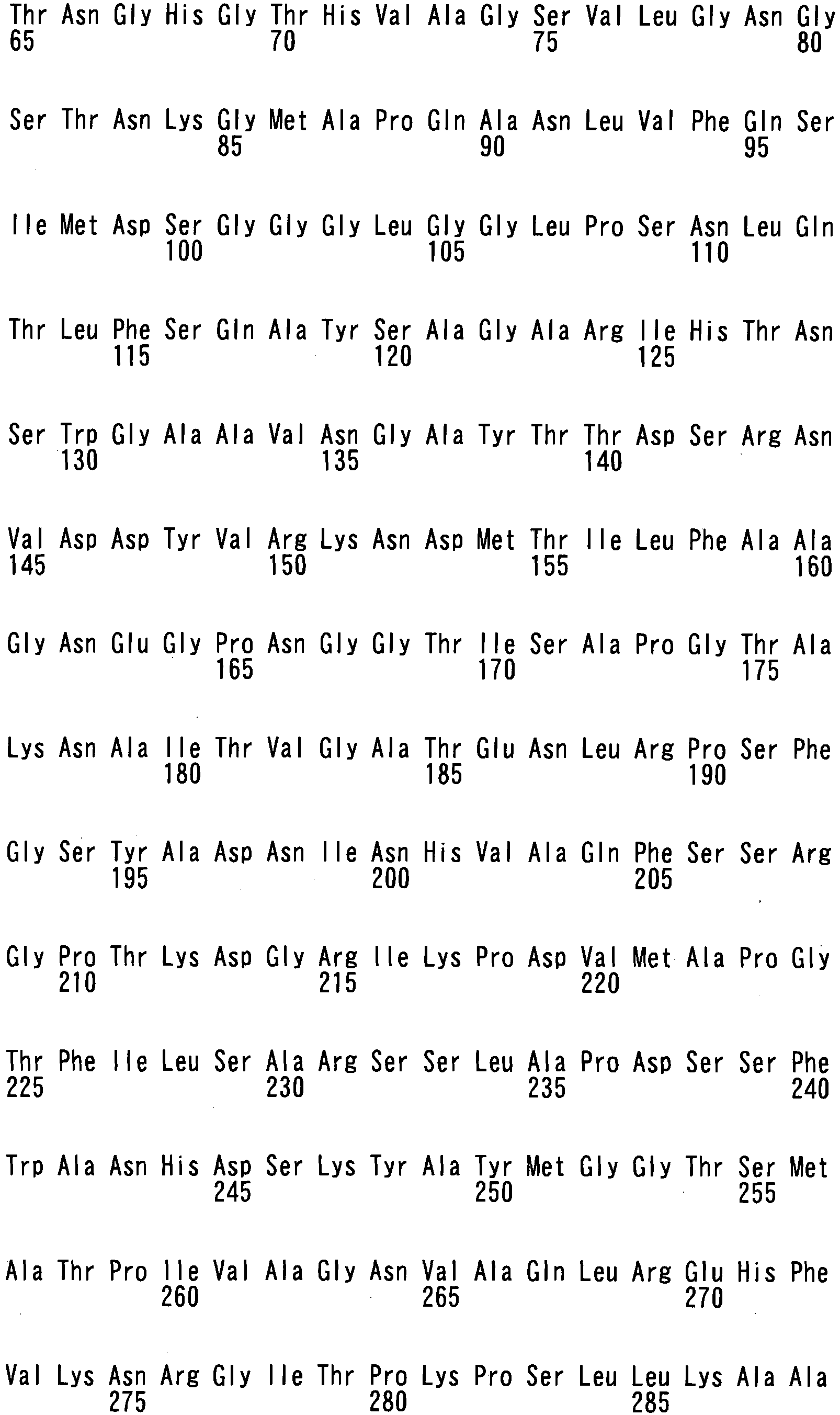

- <210> 3
<211> 26
<212> DNA
<213> Artificial Sequence - <220>
<223> Oligonucleotide as PCR primer KG24S2 - <400> 3
ataaggatcc gtgaggaggg aaccga 26 - <210> 4
<211> 24
<212> DNA
<213> Artificial Sequence - <220>
<223> Oligonucleotide as PCR primer D11_R - <400> 4
cgctttgaca attccacgcg caac 24 - <210> 5
<211> 36
<212> DNA
<213> Artificial Sequence - <220>
<223> Oligonucleotide as PCR primer D11G_F - <400> 5
ggaattgtca aagcgggagt ggctcagagc agctac 36 - <210> 6
<211> 36
<212> DNA
<213> Artificial Sequence - <220>
<223> Oligonucleotide as PCR primer KG11S - <400> 6
cccctctaga cgattaccat attaattcct ctaccc 36 - <210> 7
<211> 36
<212> DNA
<213> Artificial Sequence - <220>
<223> Oligonucleotide as PCR primer D11N_F - <400> 7
ggaattgtca aagcgaatgt ggctcagagc agctac 36 - <210> 8
<211> 36
<212> DNA
<213> Artificial Sequence - <220>
<223> Oligonucleotide as PCR primer D11S_F - <400> 8
ggaattgtca aagcgtccgt ggctcagagc agctac 36 - <210> 9
<211> 24
<212> DNA
<213> Artificial Sequence - <220>
<223> Oligonucleotide as PCR primer S16_R - <400> 9
gctctgagcc acatccgctt tgac 24 - <210> 10
<211> 36
<212> DNA
<213> Artificial Sequence - <220>
<223> Oligonucleotide as PCR primer S16I_F - <400> 10
gatgtggctc agagcattta cgggttgtat ggacaa 36 - <210> 11
<211> 36
<212> DNA
<213> Artificial Sequence - <220>
<223> Oligonucleotide as PCR primer S16L_F - <400> 11
gatgtggctc agagccttta cgggttgtat ggacaa 36 - <210> 12
<211> 36
<212> DNA
<213> Artificial Sequence - <220>
<223> Oligonucleotide as PCR primer S16V_F - <400> 12
gatgtggctc agagcgtgta cgggttgtat ggacaa 36 - <210> 13
<211> 36
<212> DNA
<213> Artificial Sequence - <220>
<223> Oligonucleotide as PCR primer S16W_F - <400> 13
gatgtggctc agagctggta cgggttgtat ggacaa 36 - <210> 14
<211> 24
<212> DNA
<213> Artificial Sequence - <220>
<223> Oligonucleotide as PCR primer Y20_R - <400> 14
caacccgtag ctgctctgag ccac 24 - <210> 15
<211> 36
<212> DNA
<213> Artificial Sequence - <220>
<223> Oligonucleotide as PCR primer Y20A_F - <400> 15
agcagctacg ggttggcagg acaaggacag atcgta 36 - <210> 16
<211> 24
<212> DNA
<213> Artificial Sequence - <220>
<223> Oligonucleotide as PCR primer Q22_R - <400> 16
tccatacaac ccgtagctgc tctg 24 - <210> 17
<211> 36
<212> DNA
<213> Artificial Sequence - <220>
<223> Oligonucleotide as PCR primer Q22W_F - <400> 17
tacgggttgt atggatgggg acagatcgta gcggtt 36 - <210> 18
<211> 24
<212> DNA
<213> Artificial Sequence - <220>
<223> Oligonucleotide as PCR primer G23_R - <400> 18
ttgtccatac aacccgtagc tgct 24 - <210> 19
<211> 36
<212> DNA
<213> Artificial Sequence - <220>
<223> Oligonucleotide as PCR primer G23N_F - <400> 19
gggttgtatg gacaaaatca gatcgtagcg gttgcc 36 - <210> 20
<211> 24
<212> DNA
<213> Artificial Sequence - <220>
<223> Oligonucleotide as PCR primer R37_R - <400> 20
acctgtatca agccctgtat cggc 24 - <210> 21
<211> 36
<212> DNA
<213> Artificial Sequence - <220>
<223> Oligonucleotide as PCR primer R37T_F - <400> 21
gggcttgata caggtacaaa tgacagttcg atgcat 36 - <210> 22
<211> 24
<212> DNA
<213> Artificial Sequence - <220>
<223> Oligonucleotide as PCR primer S40_R - <400> 22
gtcattgcga cctgtatcaa gccc 24 - <210> 23
<211> 36
<212> DNA
<213> Artificial Sequence - <220>
<223> Oligonucleotide as PCR primer S40F_F - <400> 23
acaggtcgca atgacttctc gatgcatgaa gccttc 36 - <210> 24
<211> 36
<212> DNA
<213> Artificial Sequence - <220>
<223> Oligonucleotide as PCR primer S40I_F - <400> 24
acaggtcgca atgacatttc gatgcatgaa gccttc 36 - <210> 25
<211> 36
<212> DNA
<213> Artificial Sequence - <220>
<223> Oligonucleotide as PCR primer S40L_F - <400> 25
acaggtcgca atgacctttc gatgcatgaa gccttc 36 - <210> 26
<211> 36
<212> DNA
<213> Artificial Sequence - <220>
<223> Oligonucleotide as PCR primer S40V_F - <400> 26
acaggtcgca atgacgtgtc gatgcatgaa gccttc 36 - <210> 27
<211> 36
<212> DNA
<213> Artificial Sequence - <220>
<223> Oligonucleotide as PCR primer S40W_F - <400> 27
acaggtcgca atgactggtc gatgcatgaa gccttc 36 - <210> 28
<211> 24
<212> DNA
<213> Artificial Sequence - <220>
<223> Oligonucleotide as PCR primer S41I_R - <400> 28
actgtcattg cgacctgtat caag 24 - <210> 29
<211> 36
<212> DNA
<213> Artificial Sequence - <220>
<223> Oligonucleotide as PCR primer S41I_F - <400> 29
ggtcgcaatg acagtattat gcatgaagcc ttccgc 36 - <210> 30
<211> 24
<212> DNA
<213> Artificial Sequence - <220>
<223> Oligonucleotide as PCR primer A52_R - <400> 30
agtaattttc ccgcggaagg cttc 24 - <210> 31
<211> 36
<212> DNA
<213> Artificial Sequence - <220>
<223> Oligonucleotide as PCR primer A52G_F - <400> 31
cgcgggaaaa ttactggatt atatgcattg ggacgg 36 - <210> 32
<211> 36
<212> DNA
<213> Artificial Sequence - <220>
<223> Oligonucleotide as PCR primer A52S_F - <400> 32
cgcgggaaaa ttacttcctt atatgcattg ggacgg 36 - <210> 33
<211> 24
<212> DNA
<213> Artificial Sequence - <220>
<223> Oligonucleotide as PCR primer L53_R - <400> 33
tgcagtaatt ttcccgcgga aggc 24 - <210> 34
<211> 36
<212> DNA
<213> Artificial Sequence - <220>
<223> Oligonucleotide as PCR primer L53A_F - <400> 34
gggaaaatta ctgcagcata tgcattggga cggacg 36 - <210> 35
<211> 36
<212> DNA
<213> Artificial Sequence - <220>
<223> Oligonucleotide as PCR primer L53I_F - <400> 35
gggaaaatta ctgcaattta tgcattggga cggacg 36 - <210> 36
<211> 36
<212> DNA
<213> Artificial Sequence - <220>
<223> Oligonucleotide as PCR primer L53V_F - <400> 36
gggaaaatta ctgcagtgta tgcattggga cggacg 36 - <210> 37
<211> 24
<212> DNA
<213> Artificial Sequence - <220>
<223> Oligonucleotide as PCR primer L56_R - <400> 37
tgcatataat gcagtaattt tccc 24 - <210> 38
<211> 36
<212> DNA
<213> Artificial Sequence - <220>
<223> Oligonucleotide as PCR primer L56V_F - <400> 38
actgcattat atgcagtggg acggacgaat aatgcc 36 - <210> 39
<211> 24
<212> DNA
<213> Artificial Sequence - <220>
<223> Oligonucleotide as PCR primer T59_R - <400> 39
ccgtcccaat gcatataatg cagt 24 - <210> 40
<211> 36
<212> DNA
<213> Artificial Sequence - <220>
<223> Oligonucleotide as PCR primer T59F_F - <400> 40
tatgcattgg gacggttcaa taatgccaat gatacg 36 - <210> 41
<211> 36
<212> DNA
<213> Artificial Sequence - <220>
<223> Oligonucleotide as PCR primer T59I_F - <400> 41
tatgcattgg gacggattaa taatgccaat gatacg 36 - <210> 42
<211> 36
<212> DNA
<213> Artificial Sequence - <220>
<223> Oligonucleotide as PCR primer T59L_F - <400> 42
tatgcattgg gacggcttaa taatgccaat gatccg 36 - <210> 43
<211> 36
<212> DNA
<213> Artificial Sequence - <220>
<223> Oligonucleotide as PCR primer T59M_F - <400> 43
tatgcattgg gacggatgaa taatgccaat gatacg 36 - <210> 44
<211> 36
<212> DNA
<213> Artificial Sequence - <220>
<223> Oligonucleotide as PCR primer T59V_F - <400> 44
tatgcattgg gacgggtgaa taatgccaat gatacg 36 - <210> 45
<211> 36
<212> DNA
<213> Artificial Sequence - <220>
<223> Oligonucleotide as PCR primer T59W_F - <400> 45
tatgcattgg gacggtggaa taatgccaat gatacg 36 - <210> 46
<211> 24
<212> DNA
<213> Artificial Sequence - <220>
<223> Oligonucleotide as PCR primer N60_R - <400> 46
cgtccgtccc aatgcatata atgc 24 - <210> 47
<211> 36
<212> DNA
<213> Artificial Sequence - <220>
<223> Oligonucleotide as PCR primer N60F_F - <400> 47
gcattgggac ggacgttcaa tgccaatgat acgaat 36 - <210> 48
<211> 36
<212> DNA
<213> Artificial Sequence - <220>
<223> Oligonucleotide as PCR primer N601_F - <400> 48
gcattgggac ggacgattaa tgccaatgat acgaat 36 - <210> 49
<211> 36
<212> DNA
<213> Artificial Sequence - <220>
<223> Oligonucleotide as PCR primer N60L_F - <400> 49
gcattgggac ggacgcttaa tgccaatgat acgaat 36 - <210> 50
<211> 36
<212> DNA
<213> Artificial Sequence - <220>
<223> Oligonucleotide as PCR primer N60V_F - <400> 50
gcattgggac ggacggtgaa tgccaatgat acgaat 36 - <210> 51
<211> 36
<212> DNA
<213> Artificial Sequence - <220>
<223> Oligonucleotide as PCR primer N60W_F - <400> 51
gcattgggac ggacgtggaa tgccaatgat acgaat 36 - <210> 52
<211> 24
<212> DNA
<213> Artificial Sequence - <220>
<223> Oligonucleotide as PCR primer N63_R - <400> 52
ggcattattc gtccgtccca atgc 24 - <210> 53
<211> 36
<212> DNA
<213> Artificial Sequence - <220>
<223> Oligonucleotide as PCR primer N63D_F - <400> 53
cggacgaata atgccgatga tacgaatggt catggt 36 - <210> 54
<211> 36
<212> DNA
<213> Artificial Sequence - <220>
<223> Oligonucleotide as PCR primer N63L_F - <400> 54
cggacgaata atgcccttga tacgaatggt catggt 36 - <210> 55
<211> 24
<212> DNA
<213> Artificial Sequence - <220>
<223> Oligonucleotide as PCR primer G80_R - <400> 55
gtttcctaat acggagccag ccac 24 - <210> 56
<211> 36
<212> DNA
<213> Artificial Sequence - <220>
<223> Oligonucleotide as PCR primer G80A_F - <400> 56
tccgtattag gaaacgcatc cactaataaa ggaatg 36 - <210> 57
<211> 36
<212> DNA
<213> Artificial Sequence - <220>
<223> Oligonucleotide as PCR primer G80H_F - <400> 57
tccgtattag gaaaccattc cactaataaa ggaatg 36 - <210> 58
<211> 24
<212> DNA
<213> Artificial Sequence - <220>
<223> Oligonucleotide as PCR primer S81_R - <400> 58
gccgtttcct aatacggagc cagc 24 - <210> 59
<211> 36
<212> DNA
<213> Artificial Sequence - <220>
<223> Oligonucleotide as PCR primer S81F_F - <400> 59
gtattaggaa acggcttcac taataaagga atggcg 36 - <210> 60
<211> 36
<212> DNA
<213> Artificial Sequence - <220>
<223> Oligonucleotide as PCR primer S81I_F - <400> 60
gtattaggaa acggcattac taataaagga atggcg 36 - <210> 61
<211> 36
<212> DNA
<213> Artificial Sequence - <220>
<223> Oligonucleotide as PCR primer S81L_F - <400> 61
gtattaggaa acggccttac taataaagga atggcg 36 - <210> 62
<211> 36
<212> DNA
<213> Artificial Sequence - <220>
<223> Oligonucleotide as PCR primer S81Q_F - <400> 62
gtattaggaa acggccagac taataaagga atggcg 36 - <210> 63
<211> 36
<212> DNA
<213> Artificial Sequence - <220>
<223> Oligonucleotide as PCR primer S81W_F - <400> 63
gtattaggaa acggctggac taataaagga atggcg 36 - <210> 64
<211> 36
<212> DNA
<213> Artificial Sequence - <220>
<223> Oligonucleotide as PCR primer S81Y_F - <400> 64
gtattaggaa acggctatac taataaagga atggcg 36 - <210> 65
<211> 24
<212> DNA
<213> Artificial Sequence - <220>
<223> Oligonucleotide as PCR primer T82_R - <400> 65
ggagccgttt cctaatacgg agcc 24 - <210> 66
<211> 36
<212> DNA
<213> Artificial Sequence - <220>
<223> Oligonucleotide as PCR primer T82Q_F - <400> 66
ttaggaaacg gctcccagaa taaaggaatg gcgcct 36 - <210> 67
<211> 24
<212> DNA
<213> Artificial Sequence - <220>
<223> Oligonucleotide as PCR primer N91_R - <400> 67
cgcctgaggc gccattcctt tatt 24 - <210> 68
<211> 36
<212> DNA
<213> Artificial Sequence - <220>
<223> Oligonucleotide as PCR primer N91C_F - <400> 68
atggcgcctc aggcgtgcct agtcttccaa tctatc 36 - <210> 69
<211> 24
<212> DNA
<213> Artificial Sequence - <220>
<223> Oligonucleotide as PCR primer S100_R - <400> 69
atccatgata gattggaaga ctag 24 - <210> 70
<211> 36
<212> DNA
<213> Artificial Sequence - <220>
<223> Oligonucleotide as PCR primer S100F_F - <400> 70
caatctatca tggatttcgg tgggggactt ggagga 36 - <210> 71
<211> 36
<212> DNA
<213> Artificial Sequence - <220>
<223> Oligonucleotide as PCR primer S100I_F - <400> 71
caatctatca tggatattgg tgggggactt ggagga 36 - <210> 72
<211> 36
<212> DNA
<213> Artificial Sequence - <220>
<223> Oligonucleotide as PCR primer S100L_F - <400> 72
caatctatca tggatcttgg tgggggactt ggagga 36 - <210> 73
<211> 36
<212> DNA
<213> Artificial Sequence - <220>
<223> Oligonucleotide as PCR primer S100W_F - <400> 73
caatctatca tggattgggg tgggggactt ggagga 36 - <210> 74
<211> 24
<212> DNA
<213> Artificial Sequence - <220>
<223> Oligonucleotide as PCR primer G101_R - <400> 74
gctatccatg atagattgga agac 24 - <210> 75
<211> 36
<212> DNA
<213> Artificial Sequence - <220>
<223> Oligonucleotide as PCR primer G101F_F - <400> 75
tctatcatgg atagcttcgg gggacttgga ggacta 36 - <210> 76
<211> 36
<212> DNA
<213> Artificial Sequence - <220>
<223> Oligonucleotide as PCR primer G101I_F - <400> 76
tctatcatgg atagcattgg gggacttgga ggacta 36 - <210> 77
<211> 36
<212> DNA
<213> Artificial Sequence - <220>
<223> Oligonucleotide as PCR primer G101L_F - <400> 77
tctatcatgg atagccttgg gggacttgga ggacta 36 - <210> 78
<211> 36
<212> DNA
<213> Artificial Sequence - <220>
<223> Oligonucleotide as PCR primer G101V_F - <400> 78
tctatcatgg atagcgtggg gggacttgga ggacta 36 - <210> 79
<211> 36
<212> DNA
<213> Artificial Sequence - <220>
<223> Oligonucleotide as PCR primer G101W_F - <400> 79
tctatcatgg atagctgggg gggacttgga ggacta 36 - <210> 80
<211> 36
<212> DNA
<213> Artificial Sequence - <220>
<223> Oligonucleotide as PCR primer G101Y_F - <400> 80
tctatcatgg atagctatgg gggacttgga ggacta 36 - <210> 81
<211> 24
<212> DNA
<213> Artificial Sequence - <220>
<223> Oligonucleotide as PCR primer S109_R - <400> 81
aggtagtcct ccaagtcccc cacc 24 - <210> 82
<211> 36
<212> DNA
<213> Artificial Sequence - <220>
<223> Oligonucleotide as PCR primer S109F_F - <400> 82
cttggaggac tacctttcaa tctgcaaacc ttattc 36 - <210> 83
<211> 36
<212> DNA
<213> Artificial Sequence - <220>
<223> Oligonucleotide as PCR primer S109I_F - <400> 83
cttggaggac tacctattaa tctgcaaacc ttattc 36 - <210> 84
<211> 36
<212> DNA
<213> Artificial Sequence - <220>
<223> Oligonucleotide as PCR primer S109L_F - <400> 84
cttggaggac tacctcttaa tctgcaaacc ttattc 36 - <210> 85
<211> 24
<212> DNA
<213> Artificial Sequence - <220>
<223> Oligonucleotide as PCR primer T113_R - <400> 85
ttgcagattc gaaggtagtc ctcc 24 - <210> 86
<211> 36
<212> DNA
<213> Artificial Sequence - <220>
<223> Oligonucleotide as PCR primer T113L_F - <400> 86
ccttcgaatc tgcaactttt attcagccaa gcatac 36 - <210> 87
<211> 36
<212> DNA
<213> Artificial Sequence - <220>
<223> Oligonucleotide as PCR primer T113W_F - <400> 87
ccttcgaatc tgcaatggtt attcagccaa gcatac 36 - <210> 88
<211> 24
<212> DNA
<213> Artificial Sequence - <220>
<223> Oligonucleotide as PCR primer S120_R - <400> 88
gtatgcttgg ctgaataagg tttg 24 - <210> 89
<211> 36
<212> DNA
<213> Artificial Sequence - <220>
<223> Oligonucleotide as PCR primer S120F_F - <400> 89
ttcagccaag catacttcgc tggtgccaga attcat 36 - <210> 90
<211> 36
<212> DNA
<213> Artificial Sequence - <220>
<223> Oligonucleotide as PCR primer S120I_F - <400> 90
ttcagccaag catacattgc tggtgccaga attcat 36 - <210> 91
<211> 36
<212> DNA
<213> Artificial Sequence - <220>
<223> Oligonucleotide as PCR primer S120W_F - <400> 91
ttcagccaag catactgggc tggtgccaga attcat 36 - <210> 92
<211> 36
<212> DNA
<213> Artificial Sequence - <220>
<223> Oligonucleotide as PCR primer S120Y_F - <400> 92
ttcagccaag catactatgc tggtgccaga attcat 36 - <210> 93
<211> 24
<212> DNA
<213> Artificial Sequence - <220>
<223> Oligonucleotide as PCR primer N135_R - <400> 93
cactgctgct ccccaggagt ttgt 24 - <210> 94
<211> 36
<212> DNA
<213> Artificial Sequence - <220>
<223> Oligonucleotide as PCR primer N135L_F - <400> 94
tggggagcag cagtgcttgg ggcttacaca acagat 36 - <210> 95
<211> 24
<212> DNA
<213> Artificial Sequence - <220>
<223> Oligonucleotide as PCR primer T140_R - <400> 95
tgtgtaagcc ccattcactg ctgc 24 - <210> 96
<211> 36
<212> DNA
<213> Artificial Sequence - <220>
<223> Oligonucleotide as PCR primer T140F_F - <400> 96
aatggggctt acacattcga ttccagaaat gtggat 36 - <210> 97
<211> 36
<212> DNA
<213> Artificial Sequence - <220>
<223> Oligonucleotide as PCR primer T140L_F - <400> 97
aatggggctt acacacttga ttccagaaat gtggat 36 - <210> 98
<211> 36
<212> DNA
<213> Artificial Sequence - <220>
<223> Oligonucleotide as PCR primer T140W_F - <400> 98
aatggggctt acacatggga ttccagaaat gtggat 36 - <210> 99
<211> 24
<212> DNA
<213> Artificial Sequence - <220>
<223> Oligonucleotide as PCR primer K151_R - <400> 99
gcgcacatag tcatccacat ttct 24 - <210> 100
<211> 36
<212> DNA
<213> Artificial Sequence - <220>
<223> Oligonucleotide as PCR primer K151F_F - <400> 100
gatgactatg tgcgcttcaa tgatatgacg atcctt 36 - <210> 101
<211> 24
<212> DNA
<213> Artificial Sequence - <220>
<223> Oligonucleotide as PCR primer N166_R - <400> 101
cggtccttca ttcccggcag cgaa 24 - <210> 102
<211> 36
<212> DNA
<213> Artificial Sequence - <220>
<223> Oligonucleotide as PCR primer N166F_F - <400> 102
gggaatgaag gaccgttcgg cggaaccatc agtgca 36 - <210> 103
<211> 36
<212> DNA
<213> Artificial Sequence - <220>
<223> Oligonucleotide as PCR primer N166I_F - <400> 103
gggaatgaag gaccgattgg cggaaccatc agtgca 36 - <210> 104
<211> 36
<212> DNA
<213> Artificial Sequence - <220>
<223> Oligonucleotide as PCR primer N166L_F - <400> 104
gggaatgaag gaccgcttgg cggaaccatc agtgca 36 - <210> 105
<211> 36
<212> DNA
<213> Artificial Sequence - <220>
<223> Oligonucleotide as PCR primer N166V_F - <400> 105
gggaatgaag gaccggtggg cggaaccatc agtgca 36 - <210> 106
<211> 36
<212> DNA
<213> Artificial Sequence - <220>
<223> Oligonucleotide as PCR primer N166W_F - <400> 106
gggaatgaag gaccgtgggg cggaaccatc agtgca 36 - <210> 107
<211> 24
<212> DNA
<213> Artificial Sequence - <220>
<223> Oligonucleotide as PCR primer S191_R - <400> 107
tgggcggagg ttttccgtag ctcc 24 - <210> 108
<211> 36
<212> DNA
<213> Artificial Sequence - <220>
<223> Oligonucleotide as PCR primer S191F_F - <400> 108
gaaaacctcc gcccattctt tgggtcttat gcggac 36 - <210> 109
<211> 36
<212> DNA
<213> Artificial Sequence - <220>
<223> Oligonucleotide as PCR primer S191I_F - <400> 109
gaaaacctcc gcccaatttt tgggtcttat gcggac 36 - <210> 110
<211> 36
<212> DNA
<213> Artificial Sequence - <220>
<223> Oligonucleotide as PCR primer S191L_F - <400> 110
gaaaacctcc gcccactttt tgggtcttat gcggac 36 - <210> 111
<211> 36
<212> DNA
<213> Artificial Sequence - <220>
<223> Oligonucleotide as PCR primer S191V_F - <400> 111
gaaaacctcc gcccagtgtt tgggtcttat gcggac 36 - <210> 112
<211> 36
<212> DNA
<213> Artificial Sequence - <220>
<223> Oligonucleotide as PCR primer S191W_F - <400> 112
gaaaacctcc gcccatggtt tgggtcttat gcggac 36 - <210> 113
<211> 24
<212> DNA
<213> Artificial Sequence - <220>
<223> Oligonucleotide as PCR primer S194_R - <400> 113
cccaaagctt gggcggaggt tttc 24 - <210> 114
<211> 36
<212> DNA
<213> Artificial Sequence - <220>
<223> Oligonucleotide as PCR primer S194Y_F - <400> 114
cgcccaagct ttgggtatta tgcggacaat atcaac 36 - <210> 115
<211> 24
<212> DNA
<213> Artificial Sequence - <220>
<223> Oligonucleotide as PCR primer N200_R - <400> 115
gatattgtcc gcataagacc caaa 24 - <210> 116
<211> 36
<212> DNA
<213> Artificial Sequence - <220>
<223> Oligonucleotide as PCR primer N200W_F - <400> 116
tatgcggaca atatctggca tgtggcacag ttctct 36 - <210> 117
<211> 24
<212> DNA
<213> Artificial Sequence - <220>
<223> Oligonucleotide as PCR primer Q204_R - <400> 117
tgccacatgg ttgatattgt ccgc 24 - <210> 118
<211> 36
<212> DNA
<213> Artificial Sequence - <220>
<223> Oligonucleotide as PCR primer Q204I_F - <400> 118
atcaaccatg tggcaatttt ctcttcacgt ggaccg 36 - <210> 119
<211> 36
<212> DNA
<213> Artificial Sequence - <220>
<223> Oligonucleotide as PCR primer Q204L_F - <400> 119
atcaaccatg tggcactttt ctcttcacgt ggaccg 36 - <210> 120
<211> 36
<212> DNA
<213> Artificial Sequence - <220>
<223> Oligonucleotide as PCR primer Q204M_F - <400> 120
atcaaccatg tggcaatgtt ctcttcacgt ggaccg 36 - <210> 121
<211> 36
<212> DNA
<213> Artificial Sequence - <220>
<223> Oligonucleotide as PCR primer Q204V_F - <400> 121
atcaaccatg tggcagtgtt ctcttcacgt ggaccg 36 - <210> 122
<211> 24
<212> DNA
<213> Artificial Sequence - <220>
<223> Oligonucleotide as PCR primer K212_R - <400> 122
tgtcggtcca cgtgaagaga actg 24 - <210> 123
<211> 36
<212> DNA
<213> Artificial Sequence - <220>
<223> Oligonucleotide as PCR primer K212L_F - <400> 123
tcacgtggac cgacacttga tggacggatc aaaccg 36 - <210> 124
<211> 36
<212> DNA
<213> Artificial Sequence - <220>
<223> Oligonucleotide as PCR primer K212V_F - <400> 124
tcacgtggac cgacagtgga tggacggatc aaaccg 36 - <210> 125
<211> 36
<212> DNA
<213> Artificial Sequence - <220>
<223> Oligonucleotide as PCR primer K212W_F - <400> 125
tcacgtggac cgacatggga tggacggatc aaaccg 36 - <210> 126
<211> 24
<212> DNA
<213> Artificial Sequence - <220>
<223> Oligonucleotide as PCR primer S233_R - <400> 126
agatcttgct gatagtatga acgt 24 - <210> 127
<211> 36
<212> DNA
<213> Artificial Sequence - <220>
<223> Oligonucleotide as PCR primer S233I_F - <400> 127
ctatcagcaa gatctattct tgcaccggat tcctcc 36 - <210> 128
<211> 36
<212> DNA
<213> Artificial Sequence - <220>
<223> Oligonucleotide as PCR primer S233L_F - <400> 128
ctatcagcaa gatctcttct tgcaccggat tcctcc 36 - <210> 129
<211> 36
<212> DNA
<213> Artificial Sequence - <220>
<223> Oligonucleotide as PCR primer S233W_F - <400> 129
ctatcagcaa gatcttggct tgcaccggat tcctcc 36 - <210> 130
<211> 24
<212> DNA
<213> Artificial Sequence - <220>
<223> Oligonucleotide as PCR primer S238_R - <400> 130
atccggtgca agagaagatc ttgc 24 - <210> 131
<211> 36
<212> DNA
<213> Artificial Sequence - <220>
<223> Oligonucleotide as PCR primer S238L_F - <400> 131
tctcttgcac cggatctttc cttctgggcg aaccat 36 - <210> 132
<211> 24
<212> DNA
<213> Artificial Sequence - <220>
<223> Oligonucleotide as PCR primer N243_R - <400> 132
cgcccagaag gaggaatccg gtgc 24 - <210> 133
<211> 36
<212> DNA
<213> Artificial Sequence - <220>
<223> Oligonucleotide as PCR primer N243I_F - <400> 133
tcctccttct gggcgattca tgacagtaaa tatgca 36 - <210> 134
<211> 36
<212> DNA
<213> Artificial Sequence - <220>
<223> Oligonucleotide as PCR primer N243L_F - <400> 134
tcctccttct gggcgcttca tgacagtaaa tatgca 36 - <210> 135
<211> 36
<212> DNA
<213> Artificial Sequence - <220>
<223> Oligonucleotide as PCR primer N243Y_F - <400> 135
tcctccttct gggcgtatca tgacagtaaa tatgca 36 - <210> 136
<211> 24
<212> DNA
<213> Artificial Sequence - <220>
<223> Oligonucleotide as PCR primer S246_R - <400> 136
gtcatggttc gcccagaagg agga 24 - <210> 137
<211> 36
<212> DNA
<213> Artificial Sequence - <220>
<223> Oligonucleotide as PCR primer S246F_F - <400> 137
tgggcgaacc atgacttcaa atatgcatac atgggt 36 - <210> 138
<211> 36
<212> DNA
<213> Artificial Sequence - <220>
<223> Oligonucleotide as PCR primer S246L_F - <400> 138
tgggcgaacc atgaccttaa atatgcatac atgggt 36 - <210> 139
<211> 36
<212> DNA
<213> Artificial Sequence - <220>
<223> Oligonucleotide as PCR primer S246V_F - <400> 139
tgggcgaacc atgacgtgaa atatgcatac atgggt 36 - <210> 140
<211> 36
<212> DNA
<213> Artificial Sequence - <220>
<223> Oligonucleotide as PCR primer S246W_F - <400> 140
tgggcgaacc atgactggaa atatgcatac atgggt 36 - <210> 141
<211> 36
<212> DNA
<213> Artificial Sequence - <220>
<223> Oligonucleotide as PCR primer S246Y_F - <400> 141
tgggcgaacc atgactataa atatgcatac atgggt 36 - <210> 142
<211> 24
<212> DNA
<213> Artificial Sequence - <220>
<223> Oligonucleotide as PCR primer N275_R - <400> 142
tttcacaaaa tgctcacgaa gctg 24 - <210> 143
<211> 36
<212> DNA
<213> Artificial Sequence - <220>
<223> Oligonucleotide as PCR primer N275F_F - <400> 143
gagcattttg tgaaattcag aggcatcaca ccaaag 36 - <210> 144
<211> 36
<212> DNA
<213> Artificial Sequence - <220>
<223> Oligonucleotide as PCR primer N275L_F - <400> 144
gagcattttg tgaaacttag aggcatcaca ccaaag 36 - <210> 145
<211> 36
<212> DNA
<213> Artificial Sequence - <220>
<223> Oligonucleotide as PCR primer N275W_F - <400> 145
gagcattttg tgaaatggag aggcatcaca ccaaag 36 - <210> 146
<211> 24
<212> DNA
<213> Artificial Sequence - <220>
<223> Oligonucleotide as PCR primer G277_R - <400> 146
tctgtttttc acaaaatgct cacg 24 - <210> 147
<211> 36
<212> DNA
<213> Artificial Sequence - <220>
<223> Oligonucleotide as PCR primer G277F_F - <400> 147
tttgtgaaaa acagattcat cacaccaaag ccttct 36 - <210> 148
<211> 36
<212> DNA
<213> Artificial Sequence - <220>
<223> Oligonucleotide as PCR primer G277I_F - <400> 148
tttgtgaaaa acagaattat cacaccaaag ccttct 36 - <210> 149
<211> 36
<212> DNA
<213> Artificial Sequence - <220>
<223> Oligonucleotide as PCR primer G277L_F - <400> 149
tttgtgaaaa acagacttat cacaccaaag ccttct 36 - <210> 150
<211> 36
<212> DNA
<213> Artificial Sequence - <220>
<223> Oligonucleotide as PCR primer G277V_F - <400> 150
tttgtgaaaa acagagtgat cacaccaaag ccttct 36 - <210> 151
<211> 24
<212> DNA
<213> Artificial Sequence - <220>
<223> Oligonucleotide as PCR primer G297_R - <400> 151
gatgtcagct gcaccggcaa tcag 24 - <210> 152
<211> 36
<212> DNA
<213> Artificial Sequence - <220>
<223> Oligonucleotide as PCR primer G297F_F - <400> 152
ggtgcagctg acatcttcct tggctacccg aacggt 36 - <210> 153
<211> 36
<212> DNA
<213> Artificial Sequence - <220>
<223> Oligonucleotide as PCR primer G297L_F - <400> 153
ggtgcagctg acatccttct tggctacccg aacggt 36 - <210> 154
<211> 36
<212> DNA
<213> Artificial Sequence - <220>
<223> Oligonucleotide as PCR primer G297W_F - <400> 154
ggtgcagctg acatctggct tggctacccg aacggt 36 - <210> 155
<211> 24
<212> DNA
<213> Artificial Sequence - <220>
<223> Oligonucleotide as PCR primer S326_R - <400> 155
actggactcg ttcacatagg caac 24 - <210> 156
<211> 36
<212> DNA
<213> Artificial Sequence - <220>
<223> Oligonucleotide as PCR primer S326W_F - <400> 156
gtgaacgagt ccagttggct atccaccagc caaaaa 36 - <210> 157
<211> 24
<212> DNA
<213> Artificial Sequence - <220>
<223> Oligonucleotide as PCR primer S330_R - <400> 157
ggtggataga gaactggact cgtt 24 - <210> 158
<211> 36
<212> DNA
<213> Artificial Sequence - <220>
<223> Oligonucleotide as PCR primer S330F_F - <400> 158
agttctctat ccaccttcca aaaagcgacg tactcg 36 - <210> 159
<211> 36
<212> DNA
<213> Artificial Sequence - <220>
<223> Oligonucleotide as PCR primer S330M_F - <400> 159
agttctctat ccaccatgca aaaagcgacg tactcg 36 - <210> 160
<211> 36
<212> DNA
<213> Artificial Sequence - <220>
<223> Oligonucleotide as PCR primer S330W_F - <400> 160
agttctctat ccacctggca aaaagcgacg tactcg 36 - <210> 161
<211> 24
<212> DNA
<213> Artificial Sequence - <220>
<223> Oligonucleotide as PCR primer K332_R - <400> 161
ttggctggtg gatagagaac tgga 24 - <210> 162
<211> 36
<212> DNA
<213> Artificial Sequence - <220>
<223> Oligonucleotide as PCR primer K332G_F - <400> 162
ctatccacca gccaaggagc gacgtactcg tttact 36 - <210> 163
<211> 36
<212> DNA
<213> Artificial Sequence - <220>
<223> Oligonucleotide as PCR primer K332T_F - <400> 163
ctatccacca gccaaacagc gacgtactcg tttact 36 - <210> 164
<211> 36
<212> DNA
<213> Artificial Sequence - <220>
<223> Oligonucleotide as PCR primer K332V_F - <400> 164
ctatccacca gccaagtggc gacgtactcg tttact 36 - <210> 165
<211> 24
<212> DNA
<213> Artificial Sequence - <220>
<223> Oligonucleotide as PCR primer T334_R - <400> 165
cgctttttgg ctggtggata gaga 24 - <210> 166
<211> 36
<212> DNA
<213> Artificial Sequence - <220>
<223> Oligonucleotide as PCR primer T334L_F - <400> 166
accagccaaa aagcgcttta ctcgtttact gctact 36 - <210> 167
<211> 24
<212> DNA
<213> Artificial Sequence - <220>
<223> Oligonucleotide as PCR primer G342_R - <400> 167
ggcagtagca gtaaacgagt acgt 24 - <210> 168
<211> 36
<212> DNA
<213> Artificial Sequence - <220>
<223> Oligonucleotide as PCR primer G342E_F - <400> 168
tttactgcta ctgccgaaaa gcctttgaaa atctcc 36 - <210> 169
<211> 36
<212> DNA
<213> Artificial Sequence - <220>
<223> Oligonucleotide as PCR primer G342L_F - <400> 169
tttactgcta ctgcccttaa gcctttgaaa atctcc 36 - <210> 170
<211> 36
<212> DNA
<213> Artificial Sequence - <220>
<223> Oligonucleotide as PCR primer G342T_F - <400> 170
tttactgcta ctgccacaaa gcctttgaaa atctcc 36 - <210> 171
<211> 36
<212> DNA
<213> Artificial Sequence - <220>
<223> Oligonucleotide as PCR primer G342W_F - <400> 171
tttactgcta ctgcctggaa gcctttgaaa atctcc 36 - <210> 172
<211> 24
<212> DNA
<213> Artificial Sequence - <220>
<223> Oligonucleotide as PCR primer K343_R - <400> 172
gccggcagta gcagtaaacg agta 24 - <210> 173
<211> 36
<212> DNA
<213> Artificial Sequence - <220>
<223> Oligonucleotide as PCR primer K343T_F - <400> 173
actgctactg ccggcacacc tttgaaaatc tccctg 36 - <210> 174
<211> 24
<212> DNA
<213> Artificial Sequence - <220>
<223> Oligonucleotide as PCR primer S357_R - <400> 174
cgcaggggca tcagaccata ccag 24 - <210> 175
<211> 36
<212> DNA
<213> Artificial Sequence - <220>
<223> Oligonucleotide as PCR primer S357L_F - <400> 175
tctgatgccc ctgcgcttac aactgcttcc gtaacg 36 - <210> 176
<211> 24
<212> DNA
<213> Artificial Sequence - <220>
<223> Oligonucleotide as PCR primer T359_R - <400> 176
tgtgctcgca ggggcatcag acca 24 - <210> 177
<211> 36
<212> DNA
<213> Artificial Sequence - <220>
<223> Oligonucleotide as PCR primer T359F_F - <400> 177
gcccctgcga gcacattcgc ttccgtaacg cttgtc 36 - <210> 178
<211> 36
<212> DNA
<213> Artificial Sequence - <220>
<223> Oligonucleotide as PCR primer T359G_F - <400> 178
gcccctgcga gcacaggagc ttccgtaacg cttgtc 36 - <210> 179
<211> 36
<212> DNA
<213> Artificial Sequence - <220>
<223> Oligonucleotide as PCR primer T3591_F - <400> 179
gcccctgcga gcacaattgc ttccgtaacg cttgtc 36 - <210> 180
<211> 36
<212> DNA
<213> Artificial Sequence - <220>
<223> Oligonucleotide as PCR primer T359L_F - <400> 180
gcccctgcga gcacacttgc ttccgtaacg cttgtc 36 - <210> 181
<211> 24
<212> DNA
<213> Artificial Sequence - <220>
<223> Oligonucleotide as PCR primer S361_R - <400> 181
agcagttgtg ctcgcagggg catc 24 - <210> 182
<211> 36
<212> DNA
<213> Artificial Sequence - <220>
<223> Oligonucleotide as PCR primer S361I_F - <400> 182
gcgagcacaa ctgctattgt aacgcttgtc aatgat 36 - <210> 183
<211> 36
<212> DNA
<213> Artificial Sequence - <220>
<223> Oligonucleotide as PCR primer S361V_F - <400> 183
gcgagcacaa ctgctgtggt aacgcttgtc aatgat 36 - <210> 184
<211> 36
<212> DNA
<213> Artificial Sequence - <220>
<223> Oligonucleotide as PCR primer S361W_F - <400> 184
gcgagcacaa ctgcttgggt aacgcttgtc aatgat 36 - <210> 185
<211> 24
<212> DNA
<213> Artificial Sequence - <220>
<223> Oligonucleotide as PCR primer N376_R - <400> 185
tggagcggta atgacaaggt ccag 24 - <210> 186
<211> 36
<212> DNA
<213> Artificial Sequence - <220>
<223> Oligonucleotide as PCR primer N376W_F - <400> 186
gtcattaccg ctccatgggg cacacagtat gtagga 36 - <210> 187
<211> 24
<212> DNA
<213> Artificial Sequence - <220>
<223> Oligonucleotide as PCR primer T378_R - <400> 187
gccatttgga gcggtaatga caag 24 - <210> 188
<211> 36
<212> DNA
<213> Artificial Sequence - <220>
<223> Oligonucleotide as PCR primer T378L_F - <400> 188
accgctccaa atggccttca gtatgtagga aatgac 36 - <210> 189
<211> 36
<212> DNA
<213> Artificial Sequence - <220>
<223> Oligonucleotide as PCR primer T378W_F - <400> 189
accgctccaa atggctggca gtatgtagga aatgac 36 - <210> 190
<211> 24
<212> DNA
<213> Artificial Sequence - <220>
<223> Oligonucleotide as PCR primer F385_R - <400> 190
gtcatttcct acatactgtg tgcc 24 - <210> 191
<211> 36
<212> DNA
<213> Artificial Sequence - <220>
<223> Oligonucleotide as PCR primer F385M_F - <400> 191
tatgtaggaa atgacatgac ttcgccatac aatgat 36 - <210> 192
<211> 36
<212> DNA
<213> Artificial Sequence - <220>
<223> Oligonucleotide as PCR primer F385P_F - <400> 192
tatgtaggaa atgacccaac ttcgccatac aatgat 36 - <210> 193
<211> 36
<212> DNA
<213> Artificial Sequence - <220>
<223> Oligonucleotide as PCR primer F385Y_F - <400> 193
tatgtaggaa atgactatac ttcgccatac aatgat 36 - <210> 194
<211> 24
<212> DNA
<213> Artificial Sequence - <220>
<223> Oligonucleotide as PCR primer T386_R - <400> 194
aaagtcattt cctacatact gtgt 24 - <210> 195
<211> 36
<212> DNA
<213> Artificial Sequence - <220>
<223> Oligonucleotide as PCR primer T386A_F - <400> 195
gtaggaaatg actttgcatc gccatacaat gataac 36 - <210> 196
<211> 36
<212> DNA
<213> Artificial Sequence - <220>
<223> Oligonucleotide as PCR primer T3861_F - <400> 196
gtaggaaatg actttatttc gccatacaat gataac 36 - <210> 197
<211> 36
<212> DNA
<213> Artificial Sequence - <220>
<223> Oligonucleotide as PCR primer T386L_F - <400> 197
gtaggaaatg actttctttc gccatacaat gataac 36 - <210> 198
<211> 36
<212> DNA
<213> Artificial Sequence - <220>
<223> Oligonucleotide as PCR primer T386M_F - <400> 198
gtaggaaatg actttatgtc gccatacaat gataac 36 - <210> 199
<211> 24
<212> DNA
<213> Artificial Sequence - <220>
<223> Oligonucleotide as PCR primer S387_R - <400> 199
agtaaagtca tttcctacat actg 24 - <210> 200
<211> 36
<212> DNA
<213> Artificial Sequence - <220>
<223> Oligonucleotide as PCR primer S387F_F - <400> 200
ggaaatgact ttactttccc atacaatgat aactgg 36 - <210> 201
<211> 36
<212> DNA
<213> Artificial Sequence - <220>
<223> Oligonucleotide as PCR primer S387G_F - <400> 201
ggaaatgact ttactggacc atacaatgat aactgg 36 - <210> 202
<211> 36
<212> DNA
<213> Artificial Sequence - <220>
<223> Oligonucleotide as PCR primer S387I_F - <400> 202
ggaaatgact ttactattcc atacaatgat aactgg 36 - <210> 203
<211> 36
<212> DNA
<213> Artificial Sequence - <220>
<223> Oligonucleotide as PCR primer S387L_F - <400> 203
ggaaatgact ttactcttcc atacaatgat aactgg 36 - <210> 204
<211> 36
<212> DNA
<213> Artificial Sequence - <220>
<223> Oligonucleotide as PCR primer S387M_F - <400> 204
ggaaatgact ttactatgcc atacaatgat aactgg 36 - <210> 205
<211> 36
<212> DNA
<213> Artificial Sequence - <220>
<223> Oligonucleotide as PCR primer S387V_F - <400> 205
ggaaatgact ttactgtgcc atacaatgat aactgg 36 - <210> 206
<211> 36
<212> DNA
<213> Artificial Sequence - <220>
<223> Oligonucleotide as PCR primer S387W_F - <400> 206
ggaaatgact ttacttggcc atacaatgat aactgg 36 - <210> 207
<211> 24
<212> DNA
<213> Artificial Sequence - <220>
<223> Oligonucleotide as PCR primer N390_R - <400> 207
gtatggcgaa gtaaagtcat ttcc 24 - <210> 208
<211> 36
<212> DNA
<213> Artificial Sequence - <220>
<223> Oligonucleotide as PCR primer N390F_F - <400> 208
tttacttcgc catacttcga taactgggat ggccgc 36 - <210> 209
<211> 36
<212> DNA
<213> Artificial Sequence - <220>
<223> Oligonucleotide as PCR primer N390G_F - <400> 209
tttacttcgc catacggaga taactgggat ggccgc 36 - <210> 210
<211> 36
<212> DNA
<213> Artificial Sequence - <220>
<223> Oligonucleotide as PCR primer N390S_F - <400> 210
tttacttcgc catactccga taactgggat ggccgc 36 - <210> 211
<211> 36
<212> DNA
<213> Artificial Sequence - <220>
<223> Oligonucleotide as PCR primer N390T_F - <400> 211
tttacttcgc catacacaga taactgggat ggccgc 36 - <210> 212
<211> 36
<212> DNA
<213> Artificial Sequence - <220>
<223> Oligonucleotide as PCR primer N390Y_F - <400> 212
tttacttcgc catactatga taactgggat ggccgc 36 - <210> 213
<211> 24
<212> DNA
<213> Artificial Sequence - <220>
<223> Oligonucleotide as PCR primer W393_R - <400> 213
gttatcattg tatggcgaag taaa 24 - <210> 214
<211> 36
<212> DNA
<213> Artificial Sequence - <220>
<223> Oligonucleotide as PCR primer W393Q_F - <400> 214
ccatacaatg ataaccagga tggccgcaat aacgta 36 - <210> 215
<211> 24
<212> DNA
<213> Artificial Sequence - <220>
<223> Oligonucleotide as PCR primer R396_R - <400> 215
gccatcccag ttatcattgt atgg 24 - <210> 216
<211> 36
<212> DNA
<213> Artificial Sequence - <220>
<223> Oligonucleotide as PCR primer R396G_F - <400> 216
gataactggg atggcggaaa taacgtagaa aatgta 36 - <210> 217
<211> 24
<212> DNA
<213> Artificial Sequence - <220>
<223> Oligonucleotide as PCR primer F403_R - <400> 217
tacattttct acgttattgc ggcc 24 - <210> 218
<211> 36
<212> DNA
<213> Artificial Sequence - <220>
<223> Oligonucleotide as PCR primer F403K_F - <400> 218
aacgtagaaa atgtaaaaat taatgcacca caaagc 36 - <210> 219
<211> 36
<212> DNA
<213> Artificial Sequence - <220>
<223> Oligonucleotide as PCR primer F403T_F - <400> 219
aacgtagaaa atgtaacaat taatgcacca caaagc 36 - <210> 220
<211> 36
<212> DNA
<213> Artificial Sequence - <220>
<223> Oligonucleotide as PCR primer N405F_F - <400> 220
gaaaatgtat ttattttcgc accacaaagc gggacg 36 - <210> 221
<211> 36
<212> DNA
<213> Artificial Sequence - <220>
<223> Oligonucleotide as PCR primer N4051_F - <400> 221
gaaaatgtat ttattattgc accacaaagc gggacg 36 - <210> 222
<211> 36
<212> DNA
<213> Artificial Sequence - <220>
<223> Oligonucleotide as PCR primer N405L_F - <400> 222
gaaaatgtat ttattcttgc accacaaagc gggacg 36 - <210> 223
<211> 36
<212> DNA
<213> Artificial Sequence - <220>
<223> Oligonucleotide as PCR primer N405P_F - <400> 223
gaaaatgtat ttattccagc accacaaagc gggacg 36 - <210> 224
<211> 36
<212> DNA
<213> Artificial Sequence - <220>
<223> Oligonucleotide as PCR primer N405V_F - <400> 224
gaaaatgtat ttattgtggc accacaaagc gggacg 36 - <210> 225
<211> 36
<212> DNA
<213> Artificial Sequence - <220>
<223> Oligonucleotide as PCR primer N405W_F - <400> 225
gaaaatgtat ttatttgggc accacaaagc gggacg 36 - <210> 226
<211> 24
<212> DNA
<213> Artificial Sequence - <220>
<223> Oligonucleotide as PCR primer A406_R - <400> 226
attaataaat acattttcta cgtt 24 - <210> 227
<211> 36
<212> DNA
<213> Artificial Sequence - <220>
<223> Oligonucleotide as PCR primer A406F_F - <400> 227
aatgtattta ttaatttccc acaaagcggg acgtat 36 - <210> 228
<211> 36
<212> DNA
<213> Artificial Sequence - <220>
<223> Oligonucleotide as PCR primer A406V_F - <400> 228
aatgtattta ttaatgtgcc acaaagcggg acgtat 36 - <210> 229
<211> 36
<212> DNA
<213> Artificial Sequence - <220>
<223> Oligonucleotide as PCR primer A406W_F - <400> 229
aatgtattta ttaattggcc acaaagcggg acgtat 36 - <210> 230
<211> 24
<212> DNA
<213> Artificial Sequence - <220>
<223> Oligonucleotide as PCR primer P407_R - <400> 230
tgcattaata aatacatttt ctac 24 - <210> 231
<211> 36
<212> DNA
<213> Artificial Sequence - <220>
<223> Oligonucleotide as PCR primer P407C_F - <400> 231
gtatttatta atgcatgcca aagcgggacg tataca 36 - <210> 232
<211> 36
<212> DNA
<213> Artificial Sequence - <220>
<223> Oligonucleotide as PCR primer P407G_F - <400> 232
gtatttatta atgcaggaca aagcgggacg tataca 36 - <210> 233
<211> 24
<212> DNA
<213> Artificial Sequence - <220>
<223> Oligonucleotide as PCR primer Q408_R - <400> 233
tggtgcatta ataaatacat tttc 24 - <210> 234
<211> 36
<212> DNA
<213> Artificial Sequence - <220>
<223> Oligonucleotide as PCR primer Q4081_F - <400> 234
tttattaatg caccaattag cgggacgtat acaatt 36 - <210> 235
<211> 36
<212> DNA
<213> Artificial Sequence - <220>
<223> Oligonucleotide as PCR primer Q408N_F - <400> 235
tttattaatg caccaaatag cgggacgtat acaatt 36 - <210> 236
<211> 36
<212> DNA
<213> Artificial Sequence - <220>
<223> Oligonucleotide as PCR primer Q408W_F - <400> 236
tttattaatg caccatggag cgggacgtat acaatt 36 - <210> 237
<211> 36
<212> DNA
<213> Artificial Sequence - <220>
<223> Oligonucleotide as PCR primer Q408Y_F - <400> 237
tttattaatg caccatatag cgggacgtat acaatt 36 - <210> 238
<211> 36
<212> DNA
<213> Artificial Sequence - <220>
<223> Oligonucleotide as PCR primer S409W_F - <400> 238
attaatgcac cacaatgggg gacgtataca attgag 36 - <210> 239
<211> 24
<212> DNA
<213> Artificial Sequence - <220>
<223> Oligonucleotide as PCR primer S409_R - <400> 239
ttgtggtgca ttaataaata catt 24 - <210> 240
<211> 36
<212> DNA
<213> Artificial Sequence - <220>
<223> Oligonucleotide as PCR primer S409Y_F - <400> 240
attaatgcac cacaatatgg gacgtataca attgag 36 - <210> 241
<211> 24
<212> DNA
<213> Artificial Sequence - <220>
<223> Oligonucleotide as PCR primer T411_R - <400> 241
cccgctttgt ggtgcattaa taaa 24 - <210> 242
<211> 36
<212> DNA
<213> Artificial Sequence - <220>
<223> Oligonucleotide as PCR primer T411A_F - <400> 242
gcaccacaaa gcggggcata tacaattgag gtacag 36 - <210> 243
<211> 36
<212> DNA
<213> Artificial Sequence - <220>
<223> Oligonucleotide as PCR primer T411L_F - <400> 243
gcaccacaaa gcgggcttta tacaattgag gtacag 36 - <210> 244
<211> 36
<212> DNA
<213> Artificial Sequence - <220>
<223> Oligonucleotide as PCR primer T411P_F - <400> 244
gcaccacaaa gcgggccata tacaattgag gtacag 36 - <210> 245
<211> 36
<212> DNA
<213> Artificial Sequence - <220>
<223> Oligonucleotide as PCR primer T411V_F - <400> 245
gcaccacaaa gcggggtgta tacaattgag gtacag 36 - <210> 246
<211> 24
<212> DNA
<213> Artificial Sequence - <220>
<223> Oligonucleotide as PCR primer T427_R - <400> 246
ctgtggtcca accggtacgt tata 24 - <210> 247
<211> 36
<212> DNA
<213> Artificial Sequence - <220>
<223> Oligonucleotide as PCR primer T427V_F - <400> 247
ccggttggac cacaggtgtt ctcgttggca attgtg 36 - <210> 248
<211> 24
<212> DNA
<213> Artificial Sequence - <220>
<223> Oligonucleotide as PCR primer V433_R - <400> 248
aattgccaac gagaaggtct gtgg 24 - <210> 249
<211> 36
<212> DNA
<213> Artificial Sequence - <220>
<223> Oligonucleotide as PCR primer V433L_F - <400> 249
ttctcgttgg caattcttaa ttaatagaat aacaga 36 - <210> 250
<211> 435
<212> PRT
<213> Bacillus sp. modified KSM-KP43 - <400> 250


- <210> 251
<211> 32
<212> DNA
<213> Artificial Sequence - <220>
<223> Oligonucleotide as PCR primer pHY+1 (HindIII) F - <400> 251
ggggaagctt ctagagatct gcaggtcgac gg 32 - <210> 252
<211> 41
<212> DNA
<213> Artificial Sequence - <220>
<223> Oligonucleotide as PCR primer pHY+3040 (HindIII) R - <400> 252
ggggaagctt aaggtaaagg ataaaacagc acaattccaa g 41 - <210> 253
<211> 36
<212> DNA
<213> Artificial Sequence - <220>
<223> Oligonucleotide as PCR primer SP64-F (EcoRI) - <400> 253
gggggaattc gaacaagtac ttaccatttt agagtc 36 - <210> 254
<211> 36
<212> DNA
<213> Artificial Sequence - <220>
<223> Oligonucleotide as PCR primer SP64-R(BamHI) - <400> 254
ggggggatcc ttattaaagt aattgaatca aatagc 36 - <210> 255
<211> 3636
<212> DNA
<213> Artificial Sequence - <220>
<223> Oligonucleotide vector pHA3040SP64 - <400> 255


Claims (13)
- A method of improving solubility of an alkaline protease in a liquid detergent, the method comprising, in an alkaline protease consisting of an amino acid sequence represented by SEQ ID No: 2 or an amino acid sequence having 80% or more identity therewith, substituting at least one amino acid residue selected from the group consisting of the amino acid residues at positions described in column (i) of Tables 1-1 and 1-2 of the amino acid sequence represented by SEQ ID No: 2 or the positions corresponding thereto, with an amino acid residue described in column (ii) of Tables 1-1 and 1-2.
[Table 1-1] (i) Position (ii) Amino acid residue (A) 405 leucine, tryptophan, phenylalanine, isoleucine, proline or valine (B) 81 leucine, proline, tyrosine, tryptophan, phenylalanine, isoleucine or glutamine (C) 40 isoleucine, phenylalanine, leucine, valine or tryptophan (D) 191 leucine, valine, phenylalanine, isoleucine or tryptophan (E) 59 valine, isoleucine, leucine, phenylalanine, methionine or tryptophan (F) 11 glycine, asparagine or serine (G) 16 isoleucine, leucine, valine or tryptophan (H) 20 alanine (I) 22 tryptophan (J) 23 asparagine (K) 37 threonine (L) 41 isoleucine (M) 52 glycine or serine (N) 53 alanine, isoleucine or valine (O) 56 valine (P) 60 phenylalanine, isoleucine, leucine, valine or tryptophan (Q) 63 aspartic acid or leucine (R) 80 alanine or histidine (S) 82 glutamine (T) 91 cysteine (U) 100 phenylalanine, isoleucine, leucine or tryptophan (V) 101 phenylalanine, isoleucine, leucine, valine, tryptophan or tyrosine (W) 109 phenylalanine, isoleucine or leucine (X) 113 leucine or tryptophan (Y) 120 phenylalanine, isoleucine, tryptophan or tyrosine (Z) 135 leucine (AA) 140 phenylalanine, leucine or tryptophan (AB) 151 phenylalanine (AC) 166 phenylalanine, isoleucine, leucine, valine or tryptophan (AD) 194 tyrosine (AE) 200 tryptophan (AF) 204 isoleucine, leucine, valine or methionine (AG) 212 leucine, valine or tryptophan [Table 1-2] (i) Position (ii) Amino acid residue (AH) 233 isoleucine, leucine or tryptophan (AI) 238 leucine (AJ) 243 isoleucine, leucine or tyrosine (AK) 246 phenylalanine, leucine, valine, tryptophan or tyrosine (AL) 275 phenylalanine, leucine or tryptophan (AM) 277 phenylalanine, isoleucine, leucine or valine (AN) 297 phenylalanine, leucine or tryptophan (AO) 326 tryptophan (AP) 330 phenylalanine, methionine or tryptophan (AQ) 332 glycine, threonine, or valine (AR) 334 leucine (AS) 342 glutamic acid, leucine, threonine or tryptophan (AT) 343 threonine (AU) 357 leucine (AV) 359 phenylalanine, isoleucine, leucine or glycine (AW) 361 isoleucine, valine or tryptophan (AX) 376 tryptophan (AY) 378 leucine or tryptophan (AZ) 385 methionine, proline or tyrosine (BA) 386 alanine, isoleucine, leucine or methionine (BB) 387 phenylalanine, glycine, isoleucine, leucine, methionine, valine or tryptophan (BC) 390 phenylalanine, glycine, serine, threonine or tyrosine (BD) 393 glutamine (BE) 396 glycine (BF) 403 lysine or threonine (BG) 406 phenylalanine, valine or tryptophan (BH) 407 cysteine or glycine (BI) 408 isoleucine, asparagine, tryptophan or tyrosine (BJ) 409 tryptophan or tyrosine (BK) 411 alanine, leucine, proline or valine (BL) 427 valine (BM) 433 leucine - The method according to Claim 1, wherein the amino acid residues at position 30, position 68 and position 255 of the amino acid sequence represented by SEQ ID No: 2 or the corresponding positions thereto are the amino acid residues shown below:Position 30 or the corresponding position thereto: aspartic acid;Position 68 or the corresponding position thereto: histidine; andPosition 255 or the corresponding position thereto: serine.
- The method according to Claim 1 or 2, wherein the at least one amino acid residue comprises at least one amino acid residue selected from the group consisting of the amino acid residues at (A) position 405, (B) position 81, (C) position 40, (D) position 191 and (E) position 59, or positions corresponding thereto.
- The method according to any one of Claims 1 to 3, wherein the liquid detergent is a concentrated liquid detergent comprising 40 to 90 mass% of a surfactant.
- A mutant alkaline protease consisting of an amino acid sequence represented by SEQ ID No: 2 or an amino acid sequence having 80% or more identity therewith, wherein the amino acid residue at position 405 of the amino acid sequence represented by SEQ ID No: 2 or a corresponding position thereto is leucine, tryptophan, phenylalanine, isoleucine, proline or valine.
- The mutant alkaline protease according to Claim 5, wherein at least one amino acid residue selected from the group consisting of the amino acid residues at positions described in column (i) of Tables 2-1 and 2-2 of the amino acid sequence represented by SEQ ID No: 2 or corresponding positions thereto are amino acid residue described in column (ii) of Tables 2-1 and 2-2.
[Table 2-1] (i) Position (ii) Amino acid residue (B') 81 leucine, proline, tyrosine, tryptophan, phenylalanine, isoleucine or glutamine (C') 40 isoleucine, phenylalanine, leucine, valine or tryptophan (D') 191 leucine, valine, phenylalanine, isoleucine or tryptophan (E') 59 valine, isoleucine, leucine, phenylalanine, methionine or tryptophan (F') 11 glycine, asparagine or serine (G') 16 leucine or tryptophan (H') 20 alanine (I') 22 tryptophan (J') 23 asparagine (K') 37 threonine (L') 41 isoleucine (M') 52 glycine or serine (N') 53 alanine, isoleucine or valine (O') 56 valine (P') 60 phenylalanine, isoleucine, leucine, valine or tryptophan (Q') 63 aspartic acid or leucine (R') 80 alanine or histidine (S') 91 cysteine (T') 100 phenylalanine, isoleucine, leucine or tryptophan (U') 109 phenylalanine, isoleucine or leucine (V') 113 leucine or tryptophan (W') 120 phenylalanine, isoleucine, tryptophan or tyrosine (X') 135 leucine (Y') 140 phenylalanine, leucine or tryptophan (Z') 151 phenylalanine (AA') 166 phenylalanine, isoleucine, leucine, valine or tryptophan (AB') 200 tryptophan (AC') 204 leucine or methionine (AD') 212 leucine, valine or tryptophan (AE') 233 isoleucine, leucine or tryptophan (AF') 238 leucine (AG') 243 isoleucine, leucine or tyrosine [Table 2-2] (i) Position (ii) Amino acid residue (AH') 246 phenylalanine, leucine, valine, tryptophan or tyrosine (AI') 275 phenylalanine, leucine or tryptophan (AJ') 277 phenylalanine, isoleucine, leucine or valine (AK') 297 phenylalanine, leucine or tryptophan (AL') 326 tryptophan (AM') 330 phenylalanine, methionine or tryptophan (AN') 332 glycine, threonine, or valine (AO') 334 leucine (AP') 343 threonine (AQ') 357 leucine (AR') 359 phenylalanine or glycine (AS') 361 isoleucine, valine or tryptophan (AT') 376 tryptophan (AU') 378 leucine or tryptophan (AV') 385 methionine, proline or tyrosine (AW') 386 alanine, isoleucine, leucine or methionine (AX') 387 phenylalanine, glycine, isoleucine, leucine, methionine, valine or tryptophan (AY') 390 phenylalanine, glycine, serine, threonine or tyrosine (AZ') 393 glutamine (BA') 396 glycine (BB') 403 lysine or threonine (BC') 406 phenylalanine, valine or tryptophan (BD') 407 cysteine or glycine (BE') 408 isoleucine, asparagine, tryptophan or tyrosine (BF') 409 tryptophan or tyrosine (BG') 411 alanine, leucine, proline or valine (BH') 427 valine (BI') 433 leucine - The mutant alkaline protease according to Claim 5 or 6, wherein the amino acid residues at position 30, position 68 and position 255 of the amino acid sequence represented by SEQ ID No: 2 or the corresponding positions thereto are the amino acid residues shown below:Position 30 or the corresponding position thereto: aspartic acid;Position 68 or the corresponding position thereto: histidine; andPosition 255 or the corresponding position thereto: serine.
- The mutant alkaline protease according to Claim 6 or 7, wherein the at least one amino acid residue comprises at least one amino acid residue selected from the group consisting of the amino acid residues at (B') position 81, (C') position 40, (D') position 191 and (E') position 59, or positions corresponding thereto.
- A gene encoding the mutant alkaline protease according to any one of Claims 5 to 8.
- A recombinant vector comprising the gene according to Claim 9.
- A transformed cellcomprising the recombinant vector according to Claim 10.
- A method for producing a mutant alkaline protease using the transformed cell according to Claim 11.
- A liquid detergent composition comprising the mutant alkaline protease according to any one of Claims 5 to 8.
Applications Claiming Priority (3)
| Application Number | Priority Date | Filing Date | Title |
|---|---|---|---|
| JP2012089482 | 2012-04-10 | ||
| JP2013031995A JP6067409B2 (en) | 2012-04-10 | 2013-02-21 | Method for improving solubility of alkaline protease |
| PCT/JP2013/061141 WO2013154201A2 (en) | 2012-04-10 | 2013-04-09 | Method for improving solubility of alkaline protease |
Publications (2)
| Publication Number | Publication Date |
|---|---|
| EP2836594A2 EP2836594A2 (en) | 2015-02-18 |
| EP2836594B1 true EP2836594B1 (en) | 2017-12-06 |
Family
ID=48182984
Family Applications (1)
| Application Number | Title | Priority Date | Filing Date |
|---|---|---|---|
| EP13718414.9A Active EP2836594B1 (en) | 2012-04-10 | 2013-04-09 | Method for improving solubility of alkaline protease |
Country Status (7)
| Country | Link |
|---|---|
| US (1) | US9650623B2 (en) |
| EP (1) | EP2836594B1 (en) |
| JP (1) | JP6067409B2 (en) |
| CN (1) | CN104204201B (en) |
| AU (1) | AU2013247640B2 (en) |
| DK (1) | DK2836594T3 (en) |
| WO (1) | WO2013154201A2 (en) |
Families Citing this family (6)
| Publication number | Priority date | Publication date | Assignee | Title |
|---|---|---|---|---|
| JP6289711B2 (en) | 2016-06-09 | 2018-03-07 | 花王株式会社 | Mutant alkaline protease |
| WO2017213168A1 (en) * | 2016-06-09 | 2017-12-14 | 花王株式会社 | Alkaline protease variant |
| CN108342370B (en) * | 2017-01-22 | 2021-05-28 | 上海交通大学 | A novel fructosyl peptide oxidase and its application |
| WO2019142774A1 (en) | 2018-01-16 | 2019-07-25 | 花王株式会社 | Detergent for corneum-derived stains, and method for evaluating ability to degrade corneum-derived stains |
| JP7245676B2 (en) | 2019-03-11 | 2023-03-24 | 花王株式会社 | mutant protease |
| JP2024015792A (en) * | 2022-07-25 | 2024-02-06 | 花王株式会社 | mutant protease |
Family Cites Families (59)
| Publication number | Priority date | Publication date | Assignee | Title |
|---|---|---|---|---|
| JPS564236B2 (en) | 1972-11-11 | 1981-01-29 | ||
| EP0098803B1 (en) | 1982-07-06 | 1986-07-30 | Ciba-Geigy Ag | Water-soluble or dispersible graft polymers, their production and use |
| JPS61280268A (en) | 1985-06-06 | 1986-12-10 | Lion Corp | Alkaline protease-producing microorganisms |
| DK386586D0 (en) | 1986-08-14 | 1986-08-14 | Novo Industri As | PROTEASE, PROCEDURE FOR PREPARING IT AND USING THEREOF |
| ATE92953T1 (en) * | 1989-10-13 | 1993-08-15 | Novo Nordisk As | LIQUID ENZYMATIC CLEANING AGENT. |
| JP2882652B2 (en) | 1989-12-20 | 1999-04-12 | ノボ ノルディスク アクティーゼルスカブ | Alkaline protease and its producing microorganism |
| DE69229806T2 (en) | 1991-01-22 | 1999-12-16 | Kao Corp., Tokio/Tokyo | Detergent composition |
| JP2635288B2 (en) | 1993-03-11 | 1997-07-30 | 花王株式会社 | Bleach composition and bleach detergent composition |
| JP3515823B2 (en) | 1994-12-06 | 2004-04-05 | ライオン株式会社 | Liquid detergent composition for clothing |
| CN1103810C (en) | 1995-06-13 | 2003-03-26 | 诺沃奇梅兹有限公司 | 4-substituted-phenyl-boronic acids as enzyme stabilizers |
| JP3264837B2 (en) | 1996-08-23 | 2002-03-11 | 花王株式会社 | Concentrated liquid detergent composition |
| CN1238002A (en) | 1996-09-24 | 1999-12-08 | 普罗格特-甘布尔公司 | Liquid detergents containing proteolytic enzyme, peptide aldehyde and source of boric acid |
| CN1092711C (en) | 1996-12-02 | 2002-10-16 | 花王株式会社 | Surfactant composition |
| US5891701A (en) | 1997-06-12 | 1999-04-06 | Novo Nordisk Biotech Inc. | Nucleic acids encoding a polypeptide having protease activity |
| US6376227B1 (en) | 1997-10-07 | 2002-04-23 | Kao Corporation | Alkaline protease |
| JP3492935B2 (en) | 1999-04-02 | 2004-02-03 | 花王株式会社 | Plasmid vector |
| EP1263942B1 (en) | 2000-03-08 | 2013-11-06 | Novozymes A/S | Variants with altered properties |
| CN101560509B (en) | 2000-11-22 | 2011-01-26 | 花王株式会社 | Alkaline proteinase |
| JP4143274B2 (en) | 2001-04-12 | 2008-09-03 | 花王株式会社 | Alkaline protease |
| JP2002218989A (en) * | 2000-11-22 | 2002-08-06 | Kao Corp | Alkaline protease |
| US6803222B2 (en) | 2000-11-22 | 2004-10-12 | Kao Corporation | Alkaline proteases |
| JP4496453B2 (en) | 2001-04-06 | 2010-07-07 | 株式会社豊田中央研究所 | Exhaust gas purification catalyst regeneration method and exhaust gas control method |
| JP4225721B2 (en) | 2001-10-26 | 2009-02-18 | 花王株式会社 | Alkaline protease |
| JP4324363B2 (en) | 2002-06-06 | 2009-09-02 | 花王株式会社 | Mutant alkaline protease |
| US7368273B2 (en) | 2002-03-22 | 2008-05-06 | Kao Corporation | Alkaline protease |
| JP2004000122A (en) * | 2002-03-22 | 2004-01-08 | Kao Corp | Alkaline protease |
| JP2004035176A (en) | 2002-07-02 | 2004-02-05 | Murata Mach Ltd | Image formation device |
| US7727756B2 (en) | 2003-03-21 | 2010-06-01 | Novozymes A/S | Subtilases |
| EP2163616A3 (en) | 2003-03-21 | 2010-05-26 | Novozymes A/S | Jp170 subtilase variants |
| JP2004305176A (en) | 2003-04-10 | 2004-11-04 | Kao Corp | Alkaline protease |
| JP2004305175A (en) | 2003-04-10 | 2004-11-04 | Kao Corp | Alkaline protease |
| EP1794295B1 (en) | 2004-09-21 | 2011-11-16 | Novozymes A/S | Subtilases |
| US7473544B2 (en) | 2004-10-08 | 2009-01-06 | Kao Corporation | Alkaline protease |
| JP4787571B2 (en) | 2004-10-08 | 2011-10-05 | 花王株式会社 | Alkaline protease |
| PT2032698E (en) | 2006-06-23 | 2012-09-24 | Danisco Us Inc | Systematic evaluation of sequence and activity relationships using site evaluation libraries for engineering multiple properties |
| JP2008007706A (en) | 2006-06-30 | 2008-01-17 | Lion Corp | Liquid detergent composition |
| JP2008212084A (en) | 2007-03-06 | 2008-09-18 | Kao Corp | Alkaline protease |
| BRPI0812448A2 (en) | 2007-06-06 | 2014-10-14 | Danisco Us Inc Genecor Division | PROTEIN PROPERTY PROCESSING METHOD |
| JP2009007451A (en) | 2007-06-27 | 2009-01-15 | Lion Corp | Liquid detergent composition |
| JP2009034062A (en) | 2007-08-03 | 2009-02-19 | Kao Corp | Alkaline protease |
| JP2009034063A (en) | 2007-08-03 | 2009-02-19 | Kao Corp | Method for improving stability of alkaline protease |
| JP5331332B2 (en) | 2007-12-12 | 2013-10-30 | ライオン株式会社 | Liquid detergent composition |
| JP5331412B2 (en) | 2007-12-28 | 2013-10-30 | ライオン株式会社 | Liquid detergent composition |
| JP2009155606A (en) | 2007-12-28 | 2009-07-16 | Lion Corp | Liquid detergent composition |
| JP2009155594A (en) | 2007-12-28 | 2009-07-16 | Lion Corp | Liquid detergent composition |
| JP4494516B1 (en) | 2008-11-21 | 2010-06-30 | 花王株式会社 | Liquid detergent composition |
| WO2010058832A1 (en) | 2008-11-21 | 2010-05-27 | カルソニックカンセイ株式会社 | High-strength member structure for auto bodies |
| JP5495640B2 (en) | 2008-11-21 | 2014-05-21 | 花王株式会社 | Liquid detergent in containers |
| JP5475299B2 (en) | 2009-02-18 | 2014-04-16 | 花王株式会社 | Liquid detergent composition |
| JP2010189612A (en) | 2009-02-20 | 2010-09-02 | Lion Corp | Liquid detergent composition |
| JP5571349B2 (en) | 2009-03-02 | 2014-08-13 | 花王株式会社 | Liquid detergent composition |
| JP4628486B2 (en) | 2009-04-17 | 2011-02-09 | 花王株式会社 | Liquid detergent composition |
| JP5394120B2 (en) | 2009-04-28 | 2014-01-22 | 花王株式会社 | Liquid detergent composition |
| DK3061817T3 (en) | 2009-04-30 | 2019-03-04 | Kao Corp | Alkaline protease variants |
| JP2010273672A (en) * | 2009-04-30 | 2010-12-09 | Kao Corp | Alkaline protease mutant |
| JP2010273673A (en) * | 2009-04-30 | 2010-12-09 | Kao Corp | Alkaline protease mutant |
| JP2010265333A (en) | 2009-05-12 | 2010-11-25 | Kao Corp | Liquid detergent composition |
| JP5548390B2 (en) | 2009-05-29 | 2014-07-16 | 花王株式会社 | Liquid detergent composition |
| CN102648277B (en) * | 2009-09-25 | 2015-05-20 | 诺维信公司 | Use of protease variants |
-
2013
- 2013-02-21 JP JP2013031995A patent/JP6067409B2/en active Active
- 2013-04-09 EP EP13718414.9A patent/EP2836594B1/en active Active
- 2013-04-09 DK DK13718414.9T patent/DK2836594T3/en active
- 2013-04-09 WO PCT/JP2013/061141 patent/WO2013154201A2/en not_active Ceased
- 2013-04-09 AU AU2013247640A patent/AU2013247640B2/en not_active Ceased
- 2013-04-09 US US14/383,708 patent/US9650623B2/en active Active
- 2013-04-09 CN CN201380014362.XA patent/CN104204201B/en active Active
Also Published As
| Publication number | Publication date |
|---|---|
| CN104204201B (en) | 2017-12-12 |
| EP2836594A2 (en) | 2015-02-18 |
| DK2836594T3 (en) | 2018-02-26 |
| JP6067409B2 (en) | 2017-01-25 |
| WO2013154201A3 (en) | 2013-12-27 |
| US20150056681A1 (en) | 2015-02-26 |
| AU2013247640B2 (en) | 2017-04-20 |
| CN104204201A (en) | 2014-12-10 |
| WO2013154201A2 (en) | 2013-10-17 |
| JP2013233141A (en) | 2013-11-21 |
| US9650623B2 (en) | 2017-05-16 |
Similar Documents
| Publication | Publication Date | Title |
|---|---|---|
| KR100237967B1 (en) | Enzyme mutants having a low degree of variation of the molecular charge over a ph range | |
| US9650623B2 (en) | Improving the solubility of an alkaline protease in a liquid detergent by amino acid substitution | |
| EP3061817B1 (en) | Alkaline protease variants | |
| AU2013247640A1 (en) | Method for improving solubility of alkaline protease | |
| US12319943B2 (en) | Mutant protease | |
| CN109312323B (en) | mutant alkaline protease | |
| EP3741857A1 (en) | Detergent for corneum-derived stains, and method for evaluating ability to degrade corneum-derived stains | |
| JP6289711B2 (en) | Mutant alkaline protease | |
| JP5977029B2 (en) | Mutant glycoside hydrolase | |
| EP4563702A1 (en) | Mutant protease | |
| JP6603462B2 (en) | Mutant glycoside hydrolase | |
| EP4502161A1 (en) | Alpha-amylase variant | |
| EP4455289A1 (en) | Amylase-incorporated cleaning agent composition | |
| JP6081172B2 (en) | Mutant glycoside hydrolase | |
| JP6144483B2 (en) | Mutant glycoside hydrolase | |
| EP4495232A1 (en) | Alpha-amylase variant |
Legal Events
| Date | Code | Title | Description |
|---|---|---|---|
| PUAI | Public reference made under article 153(3) epc to a published international application that has entered the european phase |
Free format text: ORIGINAL CODE: 0009012 |
|
| 17P | Request for examination filed |
Effective date: 20140930 |
|
| AK | Designated contracting states |
Kind code of ref document: A2 Designated state(s): AL AT BE BG CH CY CZ DE DK EE ES FI FR GB GR HR HU IE IS IT LI LT LU LV MC MK MT NL NO PL PT RO RS SE SI SK SM TR |
|
| AX | Request for extension of the european patent |
Extension state: BA ME |
|
| DAX | Request for extension of the european patent (deleted) | ||
| 17Q | First examination report despatched |
Effective date: 20160901 |
|
| REG | Reference to a national code |
Ref country code: DE Ref legal event code: R079 Ref document number: 602013030380 Country of ref document: DE Free format text: PREVIOUS MAIN CLASS: C12N0009520000 Ipc: C11D0003386000 |
|
| RIC1 | Information provided on ipc code assigned before grant |
Ipc: C12N 9/54 20060101ALI20170330BHEP Ipc: C11D 3/386 20060101AFI20170330BHEP |
|
| GRAP | Despatch of communication of intention to grant a patent |
Free format text: ORIGINAL CODE: EPIDOSNIGR1 |
|
| INTG | Intention to grant announced |
Effective date: 20170530 |
|
| GRAS | Grant fee paid |
Free format text: ORIGINAL CODE: EPIDOSNIGR3 |
|
| GRAJ | Information related to disapproval of communication of intention to grant by the applicant or resumption of examination proceedings by the epo deleted |
Free format text: ORIGINAL CODE: EPIDOSDIGR1 |
|
| GRAL | Information related to payment of fee for publishing/printing deleted |
Free format text: ORIGINAL CODE: EPIDOSDIGR3 |
|
| GRAR | Information related to intention to grant a patent recorded |
Free format text: ORIGINAL CODE: EPIDOSNIGR71 |
|
| GRAA | (expected) grant |
Free format text: ORIGINAL CODE: 0009210 |
|
| INTC | Intention to grant announced (deleted) | ||
| INTG | Intention to grant announced |
Effective date: 20171025 |
|
| AK | Designated contracting states |
Kind code of ref document: B1 Designated state(s): AL AT BE BG CH CY CZ DE DK EE ES FI FR GB GR HR HU IE IS IT LI LT LU LV MC MK MT NL NO PL PT RO RS SE SI SK SM TR |
|
| REG | Reference to a national code |
Ref country code: GB Ref legal event code: FG4D |
|
| REG | Reference to a national code |
Ref country code: AT Ref legal event code: REF Ref document number: 952378 Country of ref document: AT Kind code of ref document: T Effective date: 20171215 Ref country code: CH Ref legal event code: EP |
|
| REG | Reference to a national code |
Ref country code: IE Ref legal event code: FG4D |
|
| REG | Reference to a national code |
Ref country code: DE Ref legal event code: R096 Ref document number: 602013030380 Country of ref document: DE |
|
| REG | Reference to a national code |
Ref country code: NL Ref legal event code: FP |
|
| REG | Reference to a national code |
Ref country code: DK Ref legal event code: T3 Effective date: 20180221 |
|
| REG | Reference to a national code |
Ref country code: LT Ref legal event code: MG4D |
|
| PG25 | Lapsed in a contracting state [announced via postgrant information from national office to epo] |
Ref country code: FI Free format text: LAPSE BECAUSE OF FAILURE TO SUBMIT A TRANSLATION OF THE DESCRIPTION OR TO PAY THE FEE WITHIN THE PRESCRIBED TIME-LIMIT Effective date: 20171206 Ref country code: ES Free format text: LAPSE BECAUSE OF FAILURE TO SUBMIT A TRANSLATION OF THE DESCRIPTION OR TO PAY THE FEE WITHIN THE PRESCRIBED TIME-LIMIT Effective date: 20171206 Ref country code: NO Free format text: LAPSE BECAUSE OF FAILURE TO SUBMIT A TRANSLATION OF THE DESCRIPTION OR TO PAY THE FEE WITHIN THE PRESCRIBED TIME-LIMIT Effective date: 20180306 Ref country code: LT Free format text: LAPSE BECAUSE OF FAILURE TO SUBMIT A TRANSLATION OF THE DESCRIPTION OR TO PAY THE FEE WITHIN THE PRESCRIBED TIME-LIMIT Effective date: 20171206 Ref country code: SE Free format text: LAPSE BECAUSE OF FAILURE TO SUBMIT A TRANSLATION OF THE DESCRIPTION OR TO PAY THE FEE WITHIN THE PRESCRIBED TIME-LIMIT Effective date: 20171206 |
|
| REG | Reference to a national code |
Ref country code: AT Ref legal event code: MK05 Ref document number: 952378 Country of ref document: AT Kind code of ref document: T Effective date: 20171206 |
|
| PG25 | Lapsed in a contracting state [announced via postgrant information from national office to epo] |
Ref country code: GR Free format text: LAPSE BECAUSE OF FAILURE TO SUBMIT A TRANSLATION OF THE DESCRIPTION OR TO PAY THE FEE WITHIN THE PRESCRIBED TIME-LIMIT Effective date: 20180307 Ref country code: RS Free format text: LAPSE BECAUSE OF FAILURE TO SUBMIT A TRANSLATION OF THE DESCRIPTION OR TO PAY THE FEE WITHIN THE PRESCRIBED TIME-LIMIT Effective date: 20171206 Ref country code: HR Free format text: LAPSE BECAUSE OF FAILURE TO SUBMIT A TRANSLATION OF THE DESCRIPTION OR TO PAY THE FEE WITHIN THE PRESCRIBED TIME-LIMIT Effective date: 20171206 Ref country code: BG Free format text: LAPSE BECAUSE OF FAILURE TO SUBMIT A TRANSLATION OF THE DESCRIPTION OR TO PAY THE FEE WITHIN THE PRESCRIBED TIME-LIMIT Effective date: 20180306 Ref country code: LV Free format text: LAPSE BECAUSE OF FAILURE TO SUBMIT A TRANSLATION OF THE DESCRIPTION OR TO PAY THE FEE WITHIN THE PRESCRIBED TIME-LIMIT Effective date: 20171206 |
|
| PG25 | Lapsed in a contracting state [announced via postgrant information from national office to epo] |
Ref country code: CZ Free format text: LAPSE BECAUSE OF FAILURE TO SUBMIT A TRANSLATION OF THE DESCRIPTION OR TO PAY THE FEE WITHIN THE PRESCRIBED TIME-LIMIT Effective date: 20171206 Ref country code: EE Free format text: LAPSE BECAUSE OF FAILURE TO SUBMIT A TRANSLATION OF THE DESCRIPTION OR TO PAY THE FEE WITHIN THE PRESCRIBED TIME-LIMIT Effective date: 20171206 Ref country code: SK Free format text: LAPSE BECAUSE OF FAILURE TO SUBMIT A TRANSLATION OF THE DESCRIPTION OR TO PAY THE FEE WITHIN THE PRESCRIBED TIME-LIMIT Effective date: 20171206 |
|
| PG25 | Lapsed in a contracting state [announced via postgrant information from national office to epo] |
Ref country code: IT Free format text: LAPSE BECAUSE OF FAILURE TO SUBMIT A TRANSLATION OF THE DESCRIPTION OR TO PAY THE FEE WITHIN THE PRESCRIBED TIME-LIMIT Effective date: 20171206 Ref country code: RO Free format text: LAPSE BECAUSE OF FAILURE TO SUBMIT A TRANSLATION OF THE DESCRIPTION OR TO PAY THE FEE WITHIN THE PRESCRIBED TIME-LIMIT Effective date: 20171206 Ref country code: PL Free format text: LAPSE BECAUSE OF FAILURE TO SUBMIT A TRANSLATION OF THE DESCRIPTION OR TO PAY THE FEE WITHIN THE PRESCRIBED TIME-LIMIT Effective date: 20171206 Ref country code: AT Free format text: LAPSE BECAUSE OF FAILURE TO SUBMIT A TRANSLATION OF THE DESCRIPTION OR TO PAY THE FEE WITHIN THE PRESCRIBED TIME-LIMIT Effective date: 20171206 Ref country code: SM Free format text: LAPSE BECAUSE OF FAILURE TO SUBMIT A TRANSLATION OF THE DESCRIPTION OR TO PAY THE FEE WITHIN THE PRESCRIBED TIME-LIMIT Effective date: 20171206 |
|
| REG | Reference to a national code |
Ref country code: DE Ref legal event code: R097 Ref document number: 602013030380 Country of ref document: DE |
|
| PLBE | No opposition filed within time limit |
Free format text: ORIGINAL CODE: 0009261 |
|
| STAA | Information on the status of an ep patent application or granted ep patent |
Free format text: STATUS: NO OPPOSITION FILED WITHIN TIME LIMIT |
|
| 26N | No opposition filed |
Effective date: 20180907 |
|
| PG25 | Lapsed in a contracting state [announced via postgrant information from national office to epo] |
Ref country code: SI Free format text: LAPSE BECAUSE OF FAILURE TO SUBMIT A TRANSLATION OF THE DESCRIPTION OR TO PAY THE FEE WITHIN THE PRESCRIBED TIME-LIMIT Effective date: 20171206 Ref country code: MC Free format text: LAPSE BECAUSE OF FAILURE TO SUBMIT A TRANSLATION OF THE DESCRIPTION OR TO PAY THE FEE WITHIN THE PRESCRIBED TIME-LIMIT Effective date: 20171206 |
|
| REG | Reference to a national code |
Ref country code: CH Ref legal event code: PL |
|
| REG | Reference to a national code |
Ref country code: BE Ref legal event code: MM Effective date: 20180430 |
|
| GBPC | Gb: european patent ceased through non-payment of renewal fee |
Effective date: 20180409 |
|
| REG | Reference to a national code |
Ref country code: IE Ref legal event code: MM4A |
|
| PG25 | Lapsed in a contracting state [announced via postgrant information from national office to epo] |
Ref country code: LU Free format text: LAPSE BECAUSE OF NON-PAYMENT OF DUE FEES Effective date: 20180409 |
|
| PG25 | Lapsed in a contracting state [announced via postgrant information from national office to epo] |
Ref country code: CH Free format text: LAPSE BECAUSE OF NON-PAYMENT OF DUE FEES Effective date: 20180430 Ref country code: BE Free format text: LAPSE BECAUSE OF NON-PAYMENT OF DUE FEES Effective date: 20180430 Ref country code: GB Free format text: LAPSE BECAUSE OF NON-PAYMENT OF DUE FEES Effective date: 20180409 Ref country code: LI Free format text: LAPSE BECAUSE OF NON-PAYMENT OF DUE FEES Effective date: 20180430 |
|
| PG25 | Lapsed in a contracting state [announced via postgrant information from national office to epo] |
Ref country code: IE Free format text: LAPSE BECAUSE OF NON-PAYMENT OF DUE FEES Effective date: 20180409 Ref country code: FR Free format text: LAPSE BECAUSE OF NON-PAYMENT OF DUE FEES Effective date: 20180430 |
|
| PG25 | Lapsed in a contracting state [announced via postgrant information from national office to epo] |
Ref country code: MT Free format text: LAPSE BECAUSE OF NON-PAYMENT OF DUE FEES Effective date: 20180409 |
|
| PG25 | Lapsed in a contracting state [announced via postgrant information from national office to epo] |
Ref country code: TR Free format text: LAPSE BECAUSE OF FAILURE TO SUBMIT A TRANSLATION OF THE DESCRIPTION OR TO PAY THE FEE WITHIN THE PRESCRIBED TIME-LIMIT Effective date: 20171206 |
|
| PG25 | Lapsed in a contracting state [announced via postgrant information from national office to epo] |
Ref country code: PT Free format text: LAPSE BECAUSE OF FAILURE TO SUBMIT A TRANSLATION OF THE DESCRIPTION OR TO PAY THE FEE WITHIN THE PRESCRIBED TIME-LIMIT Effective date: 20171206 Ref country code: HU Free format text: LAPSE BECAUSE OF FAILURE TO SUBMIT A TRANSLATION OF THE DESCRIPTION OR TO PAY THE FEE WITHIN THE PRESCRIBED TIME-LIMIT; INVALID AB INITIO Effective date: 20130409 |
|
| PG25 | Lapsed in a contracting state [announced via postgrant information from national office to epo] |
Ref country code: CY Free format text: LAPSE BECAUSE OF FAILURE TO SUBMIT A TRANSLATION OF THE DESCRIPTION OR TO PAY THE FEE WITHIN THE PRESCRIBED TIME-LIMIT Effective date: 20171206 Ref country code: MK Free format text: LAPSE BECAUSE OF NON-PAYMENT OF DUE FEES Effective date: 20171206 |
|
| PG25 | Lapsed in a contracting state [announced via postgrant information from national office to epo] |
Ref country code: AL Free format text: LAPSE BECAUSE OF FAILURE TO SUBMIT A TRANSLATION OF THE DESCRIPTION OR TO PAY THE FEE WITHIN THE PRESCRIBED TIME-LIMIT Effective date: 20171206 Ref country code: IS Free format text: LAPSE BECAUSE OF FAILURE TO SUBMIT A TRANSLATION OF THE DESCRIPTION OR TO PAY THE FEE WITHIN THE PRESCRIBED TIME-LIMIT Effective date: 20180406 |
|
| P01 | Opt-out of the competence of the unified patent court (upc) registered |
Effective date: 20230522 |
|
| PGFP | Annual fee paid to national office [announced via postgrant information from national office to epo] |
Ref country code: NL Payment date: 20240315 Year of fee payment: 12 |
|
| PGFP | Annual fee paid to national office [announced via postgrant information from national office to epo] |
Ref country code: DE Payment date: 20240227 Year of fee payment: 12 |
|
| PGFP | Annual fee paid to national office [announced via postgrant information from national office to epo] |
Ref country code: DK Payment date: 20250411 Year of fee payment: 13 |
|
| REG | Reference to a national code |
Ref country code: DE Ref legal event code: R119 Ref document number: 602013030380 Country of ref document: DE |
|
| REG | Reference to a national code |
Ref country code: NL Ref legal event code: MM Effective date: 20250501 |
|
| PG25 | Lapsed in a contracting state [announced via postgrant information from national office to epo] |
Ref country code: DE Free format text: LAPSE BECAUSE OF NON-PAYMENT OF DUE FEES Effective date: 20251104 |
|
| PG25 | Lapsed in a contracting state [announced via postgrant information from national office to epo] |
Ref country code: NL Free format text: LAPSE BECAUSE OF NON-PAYMENT OF DUE FEES Effective date: 20250501 |