EP2834880B1 - Antenna system for determining a transit of a moving object through an area of interest - Google Patents
Antenna system for determining a transit of a moving object through an area of interest Download PDFInfo
- Publication number
- EP2834880B1 EP2834880B1 EP12714284.2A EP12714284A EP2834880B1 EP 2834880 B1 EP2834880 B1 EP 2834880B1 EP 12714284 A EP12714284 A EP 12714284A EP 2834880 B1 EP2834880 B1 EP 2834880B1
- Authority
- EP
- European Patent Office
- Prior art keywords
- signal
- signal path
- antenna
- coil
- antenna system
- Prior art date
- Legal status (The legal status is an assumption and is not a legal conclusion. Google has not performed a legal analysis and makes no representation as to the accuracy of the status listed.)
- Active
Links
Images



Classifications
-
- H—ELECTRICITY
- H01—ELECTRIC ELEMENTS
- H01Q—ANTENNAS, i.e. RADIO AERIALS
- H01Q7/00—Loop antennas with a substantially uniform current distribution around the loop and having a directional radiation pattern in a plane perpendicular to the plane of the loop
-
- G—PHYSICS
- G06—COMPUTING OR CALCULATING; COUNTING
- G06K—GRAPHICAL DATA READING; PRESENTATION OF DATA; RECORD CARRIERS; HANDLING RECORD CARRIERS
- G06K7/00—Methods or arrangements for sensing record carriers, e.g. for reading patterns
- G06K7/10—Methods or arrangements for sensing record carriers, e.g. for reading patterns by electromagnetic radiation, e.g. optical sensing; by corpuscular radiation
- G06K7/10009—Methods or arrangements for sensing record carriers, e.g. for reading patterns by electromagnetic radiation, e.g. optical sensing; by corpuscular radiation sensing by radiation using wavelengths larger than 0.1 mm, e.g. radio-waves or microwaves
- G06K7/10316—Methods or arrangements for sensing record carriers, e.g. for reading patterns by electromagnetic radiation, e.g. optical sensing; by corpuscular radiation sensing by radiation using wavelengths larger than 0.1 mm, e.g. radio-waves or microwaves using at least one antenna particularly designed for interrogating the wireless record carriers
- G06K7/10336—Methods or arrangements for sensing record carriers, e.g. for reading patterns by electromagnetic radiation, e.g. optical sensing; by corpuscular radiation sensing by radiation using wavelengths larger than 0.1 mm, e.g. radio-waves or microwaves using at least one antenna particularly designed for interrogating the wireless record carriers the antenna being of the near field type, inductive coil
-
- H—ELECTRICITY
- H01—ELECTRIC ELEMENTS
- H01Q—ANTENNAS, i.e. RADIO AERIALS
- H01Q1/00—Details of, or arrangements associated with, antennas
- H01Q1/12—Supports; Mounting means
- H01Q1/22—Supports; Mounting means by structural association with other equipment or articles
- H01Q1/2208—Supports; Mounting means by structural association with other equipment or articles associated with components used in interrogation type services, i.e. in systems for information exchange between an interrogator/reader and a tag/transponder, e.g. in Radio Frequency Identification [RFID] systems
- H01Q1/2216—Supports; Mounting means by structural association with other equipment or articles associated with components used in interrogation type services, i.e. in systems for information exchange between an interrogator/reader and a tag/transponder, e.g. in Radio Frequency Identification [RFID] systems used in interrogator/reader equipment
-
- H—ELECTRICITY
- H01—ELECTRIC ELEMENTS
- H01Q—ANTENNAS, i.e. RADIO AERIALS
- H01Q1/00—Details of, or arrangements associated with, antennas
- H01Q1/12—Supports; Mounting means
- H01Q1/22—Supports; Mounting means by structural association with other equipment or articles
- H01Q1/2208—Supports; Mounting means by structural association with other equipment or articles associated with components used in interrogation type services, i.e. in systems for information exchange between an interrogator/reader and a tag/transponder, e.g. in Radio Frequency Identification [RFID] systems
- H01Q1/2225—Supports; Mounting means by structural association with other equipment or articles associated with components used in interrogation type services, i.e. in systems for information exchange between an interrogator/reader and a tag/transponder, e.g. in Radio Frequency Identification [RFID] systems used in active tags, i.e. provided with its own power source or in passive tags, i.e. deriving power from RF signal
-
- H—ELECTRICITY
- H01—ELECTRIC ELEMENTS
- H01Q—ANTENNAS, i.e. RADIO AERIALS
- H01Q21/00—Antenna arrays or systems
- H01Q21/28—Combinations of substantially independent non-interacting antenna units or systems
-
- A—HUMAN NECESSITIES
- A63—SPORTS; GAMES; AMUSEMENTS
- A63B—APPARATUS FOR PHYSICAL TRAINING, GYMNASTICS, SWIMMING, CLIMBING, OR FENCING; BALL GAMES; TRAINING EQUIPMENT
- A63B24/00—Electric or electronic controls for exercising apparatus of preceding groups; Controlling or monitoring of exercises, sportive games, training or athletic performances
- A63B24/0021—Tracking a path or terminating locations
- A63B2024/0028—Tracking the path of an object, e.g. a ball inside a soccer pitch
- A63B2024/0034—Tracking the path of an object, e.g. a ball inside a soccer pitch during flight
-
- A—HUMAN NECESSITIES
- A63—SPORTS; GAMES; AMUSEMENTS
- A63B—APPARATUS FOR PHYSICAL TRAINING, GYMNASTICS, SWIMMING, CLIMBING, OR FENCING; BALL GAMES; TRAINING EQUIPMENT
- A63B24/00—Electric or electronic controls for exercising apparatus of preceding groups; Controlling or monitoring of exercises, sportive games, training or athletic performances
- A63B24/0021—Tracking a path or terminating locations
- A63B2024/0037—Tracking a path or terminating locations on a target surface or at impact on the ground
- A63B2024/004—Multiple detectors or sensors each defining a different zone
-
- A—HUMAN NECESSITIES
- A63—SPORTS; GAMES; AMUSEMENTS
- A63B—APPARATUS FOR PHYSICAL TRAINING, GYMNASTICS, SWIMMING, CLIMBING, OR FENCING; BALL GAMES; TRAINING EQUIPMENT
- A63B2225/00—Miscellaneous features of sport apparatus, devices or equipment
- A63B2225/50—Wireless data transmission, e.g. by radio transmitters or telemetry
- A63B2225/54—Transponders, e.g. RFID
-
- A—HUMAN NECESSITIES
- A63—SPORTS; GAMES; AMUSEMENTS
- A63B—APPARATUS FOR PHYSICAL TRAINING, GYMNASTICS, SWIMMING, CLIMBING, OR FENCING; BALL GAMES; TRAINING EQUIPMENT
- A63B43/00—Balls with special arrangements
-
- A—HUMAN NECESSITIES
- A63—SPORTS; GAMES; AMUSEMENTS
- A63B—APPARATUS FOR PHYSICAL TRAINING, GYMNASTICS, SWIMMING, CLIMBING, OR FENCING; BALL GAMES; TRAINING EQUIPMENT
- A63B43/00—Balls with special arrangements
- A63B43/004—Balls with special arrangements electrically conductive, e.g. for automatic arbitration
-
- A—HUMAN NECESSITIES
- A63—SPORTS; GAMES; AMUSEMENTS
- A63B—APPARATUS FOR PHYSICAL TRAINING, GYMNASTICS, SWIMMING, CLIMBING, OR FENCING; BALL GAMES; TRAINING EQUIPMENT
- A63B63/00—Targets or goals for ball games
- A63B63/004—Goals of the type used for football, handball, hockey or the like
Definitions
- Embodiments of the present invention relate to an antenna system for determining a transit of a moving object through an area of interest within a detection plane and to a method for determining said transit.
- Sports games such as for example soccer, football, handball, ice hockey, hockey or the like employ rules where one participating party scores when an object, such as a ball or the like, crosses a predetermined detection plane, as for example the open front face of a goal in soccer.
- that decision has been taken by a referee from a visual observation.
- some approaches propose to detect the transition of the ball through a detection plane using electromagnetic fields and/or signals derived therefrom.
- Some proposed systems provide magnetic fields of different direction on opposite sides of the detection plane together with sensors within the moving object or the ball under observation. That is, a sensor within the object monitors the magnetic field and determines that it passed through the detection plane when the orientation of the magnetic field has changed. In that event, the moving object or a sender contained therein transmits the information that the moving object detected transition through the detection plane to a receiver circuit such as to be able to indicate whether the ball was fully inside the volume of the goal or not.
- Each antenna loop receives a high-frequency signal with opposite phase such as to provide magnetic fields cancelling each other out in the detection plane in the middle between the two loops.
- a third receive antenna loop is deployed at this position in order to receive the field disturbance of a moving object passing through the set-up such as to be able to conclude, on occurrence of a signal on the receive antenna loop, that a ball or a moving object passed the plane of the receive antenna loop.
- those systems utilize antenna loops fully encircling the area of interest within the detection plane, such as for example the open mouth of a soccer goal in order to provide a field of precisely predetermined geometry.
- antenna loops fully encircling the area of interest within the detection plane, such as for example the open mouth of a soccer goal in order to provide a field of precisely predetermined geometry.
- Document WO2006094508 discloses a system detection of whether a movable object, such as a sports object, e.g. a football or an ice hockey puck, has passed goal plane. It is assumed to be known to encircle the goal plane with conductors to produce an electromagnetic field to excite signal emitter means in the movable object, alternatively detect the signal emitted by the emitter means. According to document WO2006094508 (A1 ), these circuits are sectioned into a plurality of separate circuits, which provides an improved spatial resolution of the system in particularly when the movable object is close to the conductors.
- a sports object e.g. a football or an ice hockey puck
- Document WO0047291 proposes an apparatus for detecting the position of an object relative to a plane, comprising at least one energising coil and at least one detecting coil, the coils being arranged so that as an object moves relative thereto it affects the detected signal; and phase sensing means for detecting signal variation and indicating the presence or position of the object.
- the apparatus is arranged so that a detectable phase reversal occurs as the object crosses the plane.
- Document GB 2 001 250 A relates to an apparatus for registering a chance event and particularly to apparatus for monitoring a boundary area which is marked out in a space by a boundary line, in respect of objects which cross the boundary line.
- Monitoring boundary lines gives rise to difficulties particularly when various objects pass across the boundary line, but of such objects only a given object which is to be identified accordingly is to be selectively singled out and registered.
- An antenna system comprises at least one loop antenna for receiving the electromagnetic field, the at least one loop antenna comprising one or more antenna loops arranged only within an antenna plane which is perpendicular to the detection plane. That is, a loop antenna is utilized to detect a magnetic field component of an electromagnetic field wherein the orientation of the loop antenna, that is the area bordered by the conductors of the antenna loops is perpendicular to the detection plane. By utilizing such a loop antenna, the an antenna is sensitive to a field component of the magnetic field emitted by the moving object which is parallel to the detection plane.
- the at least one loop antenna comprises a first signal path and a second signal path symmetrical to the detection plane, the first and second signal paths splitting at a first terminal and summing up at second terminal, the first signal path comprising a first conductor segment extending in parallel to the detection plane and the second signal path comprises a second conductor segment extending in parallel to the detection plane.
- a ground loop signal path s connected to the terminals of the at least one loop antenna such as to close a conductive loop enclosing the detection plane to generate an exciting electromagnetic field, wherein an excitation signal in the conductive loop is split at the first terminal and summed up at the second terminal to use the first signal path and the second signal path of the at least one loop antenna for the generation of the exciting electromagnetic field which is configured to excite the moving object to the emission of the magnetic field.
- the first terminal is situated between a first coil being part of the first signal path and a second coil being part of the second signal path, the first coil and the second coil having windings of opposite orientation; wherein a transformer comprising said first coil and said second coil further comprises a third coil coupled to the first coil and the second coil such that essentially no current is induced in the third coil when a current through the first coil and the second coil is essentially equal.
- Embodiments further comprise a signal terminal comprise a first signal terminal coupled to a first side of the third coil and a second signal terminal coupled a different second side of the third coil for providing a receive signal, the receive signal comprising information on a position of the moving object.
- Fig. 1 shows a schematic view of a goal, e.g. of a soccer game, having mounted thereto four antenna systems 2a-d according to an embodiment of the present invention.
- the goal is enclosed by four antenna systems in Fig. 1
- further embodiments may also utilize different amounts of antenna systems.
- only one antenna system may be used, either at one of the posts of the goal or at the top bar of the goal.
- the antenna system serves to determine the transit of a ball through an area of interest within a detection plane.
- the detection plane is the plane perpendicular to loop antennas 4a-d of the antenna systems 2a-d and, therefore, parallel to the open front face of the goal.
- the loop antennas 4a-d are the antennas used for the detection of the crossing or of the transit of the ball 11 through the detection plane. Therefore, the loop antennas 4a-d may also be denoted as goal line antennas.
- the embodiments of Fig. 1 further comprise a further loop antenna 6a-d in each of the antenna systems 2a-d, which comprises one or more antenna loops arranged only within a further antenna plane which is perpendicular to the antenna plane of the loop antennas 4a to 4d and parallel to the detection plane 22.
- These further loop antennas may serve to derive an information whether the ball passed through the detection plane 22 inside the goal or outside of the goal.
- the further loop antennas 6a-d may also be denoted as frame antennas.
- the frame antennas serve to define an area of interest within the detection plane, in order to be able to conclude, whether the ball crossed the detection plane within the area of interest. Therefore, the further loop antennas 6a-d are situated at the border of the area of interest, that is, at the goal posts.
- Fig. 1 further illustrates schematically a ground loop signal path 8, which serves to connect first and second terminals of the loop antennas 4a-d such as to close a conductive loop in order to generate an exciting electromagnetic field as illustrated in Fig. 2 . That is, the ground loop signal path 8 closes the electrical circuit in order to enable the generation of the exciting electromagnetic field with the loop antennas 2a-d.
- embodiments illustrated herein utilize the loop antennas 4a-d to also generate the exciting electromagnetic field by applying an excitation signal to said loop antennas 4a-4d
- further embodiments may utilize a separate excitation loop in order to provide the exciting electromagnetic field.
- an exciting electromagnetic field which has filed lines of the magnetic component that cross the detection plane 22 essentially perpendicular to the detection plane 22 may be generated.
- the exciting electromagnetic field 10 or, to be more precise, its magnetic component is only illustrated schematically by indicating the direction of a single field line 10 in Fig. 2 .
- a moving object 11 emitting a magnetic field 12 as illustrated in Fig. 2 the magnetic component 12 of the electromagnetic field is received by means of the loop antennas 4a-d.
- Fig. 2 assumes the moving object 11 to be a ball of sports game which emits the magnetic field 12 as illustrated by the shown field lines. This may in principle be achieved by using an object 11 or a ball which is actively sending a magnetic field 12.
- a ball 11 or a moving object which is excited by the exciting electromagnetic field 10 as generated by the loop antennas 4a-d to emit the magnetic field 12.
- a ball or a moving object 11 as shown in Fig. 10 , left illustration, may be utilized, which comprises three loop antennas 14a-c being arranged in a pairwise perpendicular orientation with respect to each other.
- the three loop antennas 14a-c are connected in series with each other and with a resonator 16, the resonator 16 having a resonance frequency corresponding essentially to the frequency of the exciting electromagnetic field 10. That is, the object has three perpendicular coils 14a-c with a resonance frequency corresponding to the frequency of the exciting electromagnetic field 10.
- the coils 14a-c inside the ball 11 are stimulated by the exciting electromagnetic field 10. That is, a current is induced in the loop antennas 14a-c. Due to the resonance frequency of the resonator of the moving object 11 and the corresponding frequency of the exciting electromagnetic signal 10, the received energy is stored in the resonant circuit or in the resonator 16 of the moving object, e.g. in a capacitor used therein. The oscillation in the resonator or the stored energy is then generating a magnetic field in the coils 14a-c of the moving object 11 itself, having field lines 12 with a direction opposite to the direction of the field lines of the exciting electromagnetic field 10.
- the moving object comprises three loop antennas or coils 14a-c which are being arranged in a pairwise perpendicular orientation with respect to each other and which are not connected in series, as indicated by the right illustration in fig. 10 .
- Each loop antenna or coil 14a-c forms an independent resonator which further comprises an associated capacitance 16a-c being connected in series or in parallel.
- Each of the three so provided resonant circuits is tuned to the frequency of the exciting electromagnetic field 10 by choosing the capacitances and the inductances of the loops of each circuit appropriately.
- the magnetic field 12 emitted by the moving object 11 is delayed with respect to the exciting electromagnetic 10 field by a time corresponding to a phase shift of 90° ( ⁇ /2).
- This stimulation of the emission of a magnetic field 12 is also utilized in Radio Frequency Identification systems (RFID) in order to transmit information from objects not having embodied own energy sources.
- RFID Radio Frequency Identification systems
- the excited emission of a magnetic field 12 as illustrated in Fig. 2 is also known as "backscattering".
- the backscattered or emitted magnetic field 12 of the moving object 11 is, amongst others, received by the loop antenna 4c which is mounted behind a goal post or a bar 18 of a goal. While the loop antennas 4a-d of the antenna systems illustrated in the Figs.
- FIG. 3 illustrates an idealized phase relation between an excitation signal 28 used to generate the exciting electromagnetic field 10 and a receive signal 29 as it may be received at a signal terminal of the loop antenna 4c.
- a moving object 11 as, for example the one illustrated in Fig. 10 leads to a field configuration of the magnetic field 12 emitted by the moving object 11 as illustrated in Fig. 2 .
- This is due to the cause that the individual electromagnetic fields emitted by the three loop antennas 14a-c superimpose with each other such as to arrive at the field configuration of Fig. 2 .
- One exemplary field strength vector 20 of the emitted magnetic field 12 is illustrated in Fig. 2 , which is composed of a first component 20a in parallel to the detection plane 22 as well as of a second component 20b perpendicular to the detection plane 22.
- the loop antenna 4c is sensitive to the first component 20a, which is, therefore, also denoted as the goal line part, whereas the second component 20b is also denoted as the frame part of the field strength vector 20 (H back , ball ).
- the backscatter signal of the moving object 11 or the ball is inducing a current into the loop antenna 4c and the further loop antenna 6c of the antenna system 2c.
- the further loop antenna 6c is only illustrated schematically and for the sake of completeness in Fig. 2 .
- the backscattered or received signal can be split into a frame part 20b and a goal line part 20a.
- the orientation of the H-field vector 20 of the backscatter signal is changing.
- the first component 20a of the field strength vector (H back,goal ) is crossing zero and the signal waveform is inverted.
- a phase condition of the receive signal changes according to a predetermined condition.
- the predetermined condition is, according to the embodiment of Figs. 2 to 6 , that the signal waveform is inverted and that the phase undergoes a change of 180°.
- the overall field strength of the exciting electromagnetic field 12 is at maximum and, therefore, the emission of the magnetic field 12 of the moving object is maintained, increasing the achievable precision in the determination of the transit of the object 11 as compared to alternative approaches, where the exciting electromagnetic field within the detection plane 10 is tuned or adjusted to be zero.
- Utilizing an antenna system according to an embodiment of the present invention therefore, allows to determine the occurrence of a goal, that is, the fact that the complete ball 11 was, at any time instance, completely behind the goal line, with highest precision.
- the antenna system 4c may comprise a mounting structure operable to mount the antenna system to a support structure or to the goal such that the detection plane 22 has a distance equaling half a diameter of a soccer ball to the front face of the goal.
- the mounting structure may be adjustable to fit different designs of goals, such as to be able to adjust the predetermined distance to the requirements.
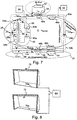
- Fig. 4 shows a perspective view of the configuration illustrated in Fig. 2 , wherein an embodiment of a mounting structure 24 adapted to mount the antenna system comprising the loop antenna 4c and the further loop antenna 6c to the aluminum bar 18 of a goal is illustrated schematically.
- the loop antenna 4C comprises a first terminal 26a and a second terminal 26b in order to receive the excitation signal 28 for the loop antenna 4c, which allows providing said excitation signal 28 to the loop antenna.
- the excitation signal 28 of alternating current is split and transferred (propagates) from the first terminal 26a to the second terminal 26b via a first signal path 30a as well as via a second signal path 30b. That is, both conductors of the loop antenna 4c which extend in parallel to the detection plane 22 participate in the generation of the exciting electromagnetic field 10.
- the further loop antenna 6c that is, the frame antenna, does not participate in the generation of the electromagnetic field 10.
- further embodiments may also utilize the further loop antenna 6c for the generation of the exciting electromagnetic field 10.
- Fig. 4 further illustrates a compensation signal path 32, which is coupled to the second signal path 30b and which serves to balance the loop antenna 4c.
- the compensation signal path 32 may, of course, also be coupled to the first signal path 30a.
- the compensation signal path 32 has adjustable coupling characteristics with respect to the second signal path 30b. This may be utilized to compensate for field components generated by eddy currents in metallic posts such as for example in the aluminum post 18 illustrated in Fig. 4 .
- the eddy currents may, for example, be generated by the current in the first signal path 30a and, hence, induce a current into the loop antenna 4c which is not caused by the moving object and, therefore, undesirable.
- the compensation signal path 32 By means of the compensation signal path 32, or, more generally, by using a compensation signal generator within the antenna system 2c, such signal components may be compensated so that the antenna is balanced, that is, one of the signal paths 30a or 30b carries half of the current of the excitation signal 28, while the other signal path, possibly together with the compensation signal path 32 or with the compensation signal generator carries the other half of the current, such that no signal as induced in the loop antenna 4c without the presence of the moving object 11 in the proximity of the loop antenna 4c.
- the loop antenna is tuned such that the both signals carrying half of the current each, are in phase.
- Fig. 4 shows one particular possibility to implement a compensation signal generator by using a compensation wire having an adjustable distance to the wire of the second signal path 30b and/or an adjustable inductance so that the antenna can be balanced by adjusting the distance and/or the inductance once the antenna is mounted to the support structure or to the goal.
- a further possibility to implement a compensation signal generator would, for example, be to add a symmetric metal or aluminum part on the other side of the antenna system 2c such as to provide a symmetric configuration in which the eddy currents of the different metal bars compensate each other.
- a further possibility to implement a compensation signal generator would, for example, be to induce a current into the loop antenna 4c or into one signal path of the loop antenna 4c with an appropriately adjusted amplitude and phase generated such that the influence of the eddy current is compensated for.
- the induction of this additional compensation signal could, for example, be performed by means of a further transformer or the like.
- a compensation signal path 32 or a compensation wire as illustrated in Fig. 4 , and, in more detail in Fig. 7 , no further active signal path is necessary and, hence, the antenna system remains simple and reliable.
- the antenna system design is also highly efficient in avoiding cross-talk or undesired signal components as compared to other solutions employing an additional independent loop for the generation of the exciting electromagnetic field 10.
- an additional loop may generate cross-talk signals in the loop antenna 4c of the antenna system 2c which might cover the magnetic field 12 of the backscatter signal of the moving object 11. This would decrease the accuracy of the detection of the occurrence of a goal significantly.
- utilizing the loop antenna to create the exciting electromagnetic field as in the embodiments described in the Figs. avoids the occurrence of cross-talk signals due to the particular generation of the exciting electromagnetic field 10.
- Fig. 5 shows, by way of example, two receive signals 42a and 42b as they may be received by the loop antenna of Fig. 4c when a ball passes a detection plane of a goal such that a score is achieved in a soccer or handball game or the like.
- Fig. 5 schematically shows a goal and the receive signals 42a and 42b resulting from two different positions where a ball passes the detection plane.
- the first position 40a is essentially in the center of the goal while the second position 40b is close to a post of the goal.
- the coordinate system is chosen to be such that the X direction is the direction from the bottom to the top bar of the goal, while the Y direction extends from the left to the right and the Z direction is perpendicular to the paper plane, that is, perpendicular to the detection plane, which is parallel to the plane of the open face of the goal.
- receive signals 42a and 42b as determined by an embodiment of the antenna system are shown on top of the goal 18.
- the geometry is chosen such that the plane having a Z-coordinate of zero corresponds to the detection plane.
- a receive signal 42a and 42b as determined by some antenna systems according to the present invention undergoes a phase change, that is, crosses zero when the ball crosses or passes through the detection plane.
- the amplitudes of the receive signals 42a and 42b and the distance to the detection plane that corresponds to the occurrence of a detectable receive signal may differ significantly, it becomes apparent, that irrespective of the position where the ball passes through the detection plane, the phase change precisely occurs at the position of the detection plane.
- This is particularly due to the geometry of the loop antennas 4a-d of the antenna system, in particular due to their orientation with respect to the detection plane and due to the generation of the exciting electromagnetic field by the loop antennas. Therefore, the reliable detection of a goal can be achieved over the complete area of interest, in particular, since a phase change, that is, the change of a phase condition of 180° (a change in sign of a particular quantity) can be sensed with high precision.
- Fig. 6 illustrates a particular implementation as to how the detection of the phase change may be performed, which additionally allows to cancel long-term effects such as temperature- induced drifts of the system or the like.
- the receive signals as received at signal terminals of the loop antenna may be provided to or fed to a receiver circuit, where the backscatter signal, that is, the received signal as caused by the magnetic field 12 of the moving object 10, is down- converted coherently to a complex baseband signal.
- the down conversion results in a complex valued vector for the receive signal.
- the vector of the receive signal may be compared to the signal vector of the excitation signal used to generate the exciting electromagnetic field.
- the phase shift ⁇ between the two vectors is 90°.
- phase shift will in general be different from 90°.
- the amplitude of the complex vector representing the received signal is dependent on the position of the ball, in particular, on the distance of the ball with respect to the detection plane. As indicated already in Fig. 5 , however, a phase inversion occurs when the ball passes the detection plane or the goal line.
- the imaginary and real parts of the complex valued baseband signal may be processed separately. That is, an algorithm used to detect the transit of a moving object 11 through the detection plane 22 may search for a zero crossing point, that is, for a configuration where the complex valued vector crosses zero due to the change of the phase condition. In order to suppress noise effects, it may additionally be verified, whether an amplitude peak above a certain minimum threshold occurred right before the phase change or the zero crossing point. Also in order to avoid wrong detections caused by long-term drifts of the whole system, further embodiments of the present invention may utilize two different frequencies.
- One frequency of an excitation signal used for the generation of the exciting electromagnetic field 10 corresponds to the resonance frequency of the resonator 16 of the moving object 11 while a further frequency is slightly below or above the resonance frequency. Therefore, the moving object or the ball is less sensitive to the second frequency which results in an emitted magnetic field inducing a receive signal of a lower amplitude as compared to the receive signal caused by the excitation signal at the resonance frequency.
- Drift effects influence both receive signals identically and a difference between the two signal amplitudes remains the same, when changes are induced by drift effects. Hence, those changes may be identified and compensated for. If, however, a ball is approaching the goal or the detection plane 22, the difference between both signals decreases and drops to zero when the ball crosses the detection plane 22 which allows for a discrimination against drift effects.
- Further embodiments avoid wrong determinations of goals by summing up the signal of the loop antenna 4c and of the further loop antenna 6c, that is, of the goal line antenna and the frame antenna to derive a complex vector indicating an orientation of the field generated or emitted by the ball 11 and hence an indication of the position of the ball with respect to the antenna system.
- using estimations of field vectors as determined by multiple antenna systems may provide for the possibility to estimate the position of the ball.
- This information may be furthermore used as a consistency check in order to avoid wrong detections of goals caused by noise or long-term drift effects.
- Fig. 6 shows, for the two receive signals 42a and 42b illustrated in Fig. 5 , the effect of using excitation signals of slightly differing frequency in order to generate the exciting electromagnetic field 10.
- the response that is, the receive signal caused by the electromagnetic field, excited with the resonance frequency is shown in a first graph 44a, while the receive signal caused by an excitation signal with slightly different frequency is illustrated by a second graph 44b.
- the two signals show the signal characteristics elaborated on above and hence allow to avoid wrong detections of goals.
- Fig. 7 shows a circuit diagram of an embodiment of the present invention, showing the individual components of an antenna system 2c according to an embodiment of the present invention and the coupling to its environment.
- the loop antenna comprises the first signal path 30a and the second signal path 30b.
- the transmission properties of the first and second signal paths 30a and 30b are illustrated by corresponding first and second inductances 46a and 46b as well as by corresponding first and second resistances 48a and 48b.
- the excitation signal 28 is split at the first terminal 26a such as to utilize both signal paths 30a and 30b for the generation of the exciting electromagnetic field 10.
- the signal of both signal paths 30a and 30b is summed up at the second terminal 26b where the current source providing the excitation signal 28 connects.
- the influence of metallic post of a goal or the like is modelled by the inductive coupling between an inductance 50 of the aluminum post which is connected in series to an associated resistance 52.
- the antenna system illustrated in Fig. 7 incorporates a compensation signal path 32, connected in parallel to the second signal path 30b.
- the compensation signal path 32 has associated thereto an inherent resistance 54 and an inherent inductance 56.
- a distance between the compensation signal path 32 and the second signal path 30b may, according to some embodiments, be adjustable in order to compensate for the influence of the eddy currents in the aluminum post.
- the compensation signal path 32 may furthermore comprise a variable inductance 58, such as to be able to compensate the influence of the aluminum post or of other influences more precisely.
- a variable inductance 58 such as to be able to compensate the influence of the aluminum post or of other influences more precisely.
- an additional wire may be used, which is running or extending in parallel to the second signal path 30b of the antenna loop 4c and which builds a coupling circuit (L goal2 , L comp , M com,var ).
- the coupling factor M comp,var can be adjusted.
- a variable inductor 58 or a variable capacitance may be implemented into the compensation path 32.
- the loop antenna 4c furthermore comprises a signal terminal 60 comprising a first signal terminal 60a and a second signal terminal 60b in order to provide the receive signal of the loop antenna 4c.
- the receive signal is coupled out of the loop antenna 4c by means of a transformer 62.
- the transformer 62 is formed by a first coil 64a and a second coil 64b as well as by a third coil 66.
- the first coil 64a is part of the first signal path 30a and the second coil 64b is part of the second signal path 30b, wherein the first terminal 28 is situated between the first and second coils 64a and 64b.
- the first and second coils 64a and 64b are, however, wound with different orientations, that is, the third coil 66 is coupled to the first and second coils 64a and 64b such that essentially no current is induced in the third coil 66 when the current through the first and second coils 64a and 64b is essentially equal, that is, when the antenna is balanced. Therefore, in the situation of a balanced antenna, no current is induced in the third coil 66 and hence no significant receive signal is provided at the first and second signal terminals 60a and 60b when the moving object is not present or close.
- phase relation between the excitation signal 28 and a receive signal 29 as provided at the signal terminals 60a and 60b may be desirable.
- Arbitrary amplitude and phase distortion may be employed due to a delay in the antenna cables or in the receiving path of a receiver coupled to the signal terminal 60. These may need to be compensated.
- no signal is present at the signal terminals 60a and 60b which may be utilized for the determination of the phase relation.
- further embodiments of the present invention optionally comprise a calibration signal generator 69 which is operable to modify the characteristics of the antenna system such that a signal is generated at the signal terminals 60a and 60b.
- this may be achieved by switchable tuning elements in one of the first or the second signal paths 30a or 30b to intentionally bring the antenna out of balance.
- tuning elements may be additional inductors or coupling elements which can be switched on and off by means of relays or transistor circuits.
- the calibration signal generator 69 may comprise a calibration circuit being coupleable to the first or the second signal path 30a or 30b on demand.
- the calibration signal generator 69 allows to change the configuration of the circuitry used to generate the exciting electromagnetic field 10 such that the changed exciting electromagnetic field 10 induces a minor amount of current into the loop antenna 4c and, optionally, also in the further loop antenna 6c (the frame antenna).
- Different exciter loop configurations may be changed by means of a relay or transistor circuitry, which is capable of switching between at least two different configurations.
- the calibration signal generator 69 is operable to select one of two different ground loop signal paths 70a and 70b.
- the field vector 72 of the magnetic component of the exciting electromagnetic field 10 as created by the loop antenna 4c is, at the detection plane 22, perpendicular to said detection plane 22 and, therefore, no signal is induced into a balanced loop antenna 4c.
- a second ground loop signal path 70b is chosen such that the field vector 72 is slightly inclined and, hence, a signal is induced in the loop antenna 4c. The so induced signal may be utilized to determine the phase relation between the exciting signal 28 and the receive signal 29.
- the antenna system of Fig 7 further comprises a signal evaluator 68 coupled to signal terminal 60 of the antenna system to evaluate the receive signal and to determine a signal indicative of the position and/ or transit of the moving object through the detection plane 22.
- Fig. 9 illustrates schematically a flow diagram for a method for determining a transit of a moving object through an area of interest within a detection plane according to an embodiment of the present invention.
- the moving object emits a magnetic field, for example by backscattering using a configuration shown in Fig. 10 .
- a determination step 74 a component of interest of the magnetic field is determined, wherein the component of interest is parallel to the detection plane 22.
- a signal on the transit of the moving object through the area of interest is provided, when a phase condition of the observed component of interest changes according to a predetermined condition.
- Fig. 10 shows an embodiment of sports equipment or a sensor configuration to be used with an antenna system according to any of the embodiments of the present invention which emits a magnetic field 12 used to determine the transit of the sports equipment or the moving object through the detection plane 22.
- the moving object or sports equipment of Fig. 10 comprises three pairwise perpendicular antenna loops 14a to 14c which are connected in series with a resonator 16 having a resonance frequency corresponding essentially to the frequency of an exciting electromagnetic field 10.
- the resonance frequency is within the range of 10 kHz to 300 kHz or, preferably, in the range of 30 kHz to 200 kHz, such as to use electromagnetic fields not being disturbed by the presence of human beings, animals or other living creatures so that a reliable detection of a goal may be performed, even when the area of the goal is crowded with soccer players or other people.
- embodiments of the present invention may be utilized in any other scenario where it is desirable to detect the transit of a movable object or of any kind of object through a particular detection plane.
- This may, for example, be any other kind of sports game, such as for example, handball, American football, polo, cricket, hockey, ice hockey or the like.
- embodiments may be utilized to track the transportation of movable goods within a warehouse or the like.
- embodiments of antenna systems may be utilized to detect the crossing of joggers or cyclists or other competitors at the start line of a mass sports event or the like.
- Functional blocks denoted as "means for " shall be understood as functional blocks comprising circuitry that is adapted for performing a certain function, respectively.
- a "means for s.th.” may as well be understood as a “means being adapted or operable for s.th.”.
- a means being adapted for performing a certain function does, hence, not imply that such means necessarily is performing said function (at a given time instant).
Landscapes
- Engineering & Computer Science (AREA)
- Physics & Mathematics (AREA)
- Health & Medical Sciences (AREA)
- Toxicology (AREA)
- General Health & Medical Sciences (AREA)
- Electromagnetism (AREA)
- Computer Networks & Wireless Communication (AREA)
- Artificial Intelligence (AREA)
- Computer Vision & Pattern Recognition (AREA)
- General Physics & Mathematics (AREA)
- Theoretical Computer Science (AREA)
- Geophysics And Detection Of Objects (AREA)
- Position Fixing By Use Of Radio Waves (AREA)
- Radar Systems Or Details Thereof (AREA)
Applications Claiming Priority (1)
| Application Number | Priority Date | Filing Date | Title |
|---|---|---|---|
| PCT/EP2012/056007 WO2013149649A2 (en) | 2012-04-02 | 2012-04-02 | Antenna system and method for determining a transit of a moving object through an area of interest |
Publications (2)
| Publication Number | Publication Date |
|---|---|
| EP2834880A2 EP2834880A2 (en) | 2015-02-11 |
| EP2834880B1 true EP2834880B1 (en) | 2020-06-10 |
Family
ID=45954647
Family Applications (1)
| Application Number | Title | Priority Date | Filing Date |
|---|---|---|---|
| EP12714284.2A Active EP2834880B1 (en) | 2012-04-02 | 2012-04-02 | Antenna system for determining a transit of a moving object through an area of interest |
Country Status (3)
| Country | Link |
|---|---|
| EP (1) | EP2834880B1 (es) |
| ES (1) | ES2814902T3 (es) |
| WO (1) | WO2013149649A2 (es) |
Families Citing this family (2)
| Publication number | Priority date | Publication date | Assignee | Title |
|---|---|---|---|---|
| DE102016120246A1 (de) * | 2016-10-24 | 2018-04-26 | Fraunhofer-Gesellschaft zur Förderung der angewandten Forschung e.V. | Verfahren, Vorrichtung und Computerprogramm zum Bestimmen einer Information über eine Position eines Objekts, wobei das Objekt ein Magnetfeld emittiert |
| DE102016120250A1 (de) | 2016-10-24 | 2018-04-26 | Fraunhofer-Gesellschaft zur Förderung der angewandten Forschung e.V. | Verfahren und vorrichtung zum bestimmen einer position eines beweglichen objekts sowie system umfassend die vorrichtung |
Family Cites Families (6)
| Publication number | Priority date | Publication date | Assignee | Title |
|---|---|---|---|---|
| DE2732543C3 (de) * | 1977-07-19 | 1980-08-07 | Precitec Gesellschaft Fuer Praezisionstechnik Und Elektronik Mbh & Co Entwicklungs- Und Vertriebs-Kg, 7570 Baden-Baden | Vorrichtung zur Erfassung von sich im Gebiet einer Grenzfläche befindenden Objekten |
| EP0227453A3 (en) * | 1985-12-19 | 1987-12-16 | Bonelco Industries, Limited | Article detection and recognition |
| DE68912382T2 (de) * | 1988-04-13 | 1994-05-26 | Yamato Scale Co Ltd | Fremdstoffdetektor. |
| EP1152805A1 (en) * | 1999-02-09 | 2001-11-14 | Integrated Design Limited | Position sensing |
| DE06706107T1 (de) * | 2005-03-09 | 2008-04-03 | Goalref A.P.S. | Tordetektor für die erfassung eines durch eine torebene gehenden gegenstands |
| US7795861B2 (en) * | 2006-05-02 | 2010-09-14 | Cairos Technologies Ag | Method and apparatus for controlling a movable object for localization within a positioning area |
-
2012
- 2012-04-02 ES ES12714284T patent/ES2814902T3/es active Active
- 2012-04-02 EP EP12714284.2A patent/EP2834880B1/en active Active
- 2012-04-02 WO PCT/EP2012/056007 patent/WO2013149649A2/en not_active Ceased
Non-Patent Citations (1)
| Title |
|---|
| None * |
Also Published As
| Publication number | Publication date |
|---|---|
| WO2013149649A2 (en) | 2013-10-10 |
| WO2013149649A3 (en) | 2014-01-23 |
| EP2834880A2 (en) | 2015-02-11 |
| ES2814902T3 (es) | 2021-03-29 |
Similar Documents
| Publication | Publication Date | Title |
|---|---|---|
| US9795829B2 (en) | Antenna system and method for determining a transit of a movable object through a detection plane | |
| EP3685198B1 (en) | Device and method for foreign object detection in wireless energy transfer | |
| EP3134293B1 (en) | Power transmitting device and power receiving device | |
| JP5078868B2 (ja) | ゴール面を通過する物体検出用のゴール検出器 | |
| CN101883613B (zh) | 用于检测通过球门平面的物体的球门检测器 | |
| US8203335B2 (en) | System and method for an inductive proximity switch on a common substrate | |
| US10059212B2 (en) | Safety system, a method of operating a safety system and a method of building a safety system | |
| CN102955173B (zh) | 金属检测装置 | |
| EP3529630B1 (en) | Method, apparatus and computer program for determining information on a position of an object, the object emitting a magnetic field | |
| US9958480B2 (en) | Apparatus and method for a current sensor | |
| US20080085790A1 (en) | Concept for making goal decisions by means of magnetic fields | |
| US20100181996A1 (en) | Movement range for a mobile object and evaluation apparatus for determining a position of a mobile object | |
| JPH06342065A (ja) | 電子式物品監視システム及び方法 | |
| JP2016019305A (ja) | 送電装置及び受電装置 | |
| EP2834880B1 (en) | Antenna system for determining a transit of a moving object through an area of interest | |
| US7106052B2 (en) | Inductive proximity switch with differential coil arrangement | |
| US20030107377A1 (en) | Metal detector | |
| US11427236B2 (en) | Vehicle having a detection device for detecting a route-side transmitter device and method for operating same |
Legal Events
| Date | Code | Title | Description |
|---|---|---|---|
| PUAI | Public reference made under article 153(3) epc to a published international application that has entered the european phase |
Free format text: ORIGINAL CODE: 0009012 |
|
| 17P | Request for examination filed |
Effective date: 20141103 |
|
| AK | Designated contracting states |
Kind code of ref document: A2 Designated state(s): AL AT BE BG CH CY CZ DE DK EE ES FI FR GB GR HR HU IE IS IT LI LT LU LV MC MK MT NL NO PL PT RO RS SE SI SK SM TR |
|
| AX | Request for extension of the european patent |
Extension state: BA ME |
|
| DAX | Request for extension of the european patent (deleted) | ||
| STAA | Information on the status of an ep patent application or granted ep patent |
Free format text: STATUS: EXAMINATION IS IN PROGRESS |
|
| 17Q | First examination report despatched |
Effective date: 20171124 |
|
| RIC1 | Information provided on ipc code assigned before grant |
Ipc: H01Q 1/22 20060101AFI20190930BHEP Ipc: G06K 19/077 20060101ALI20190930BHEP Ipc: H01Q 7/00 20060101ALI20190930BHEP Ipc: A63B 43/00 20060101ALI20190930BHEP Ipc: A63B 24/00 20060101ALI20190930BHEP Ipc: G06K 7/10 20060101ALI20190930BHEP Ipc: H01Q 21/28 20060101ALI20190930BHEP Ipc: A63B 63/00 20060101ALI20190930BHEP |
|
| GRAP | Despatch of communication of intention to grant a patent |
Free format text: ORIGINAL CODE: EPIDOSNIGR1 |
|
| STAA | Information on the status of an ep patent application or granted ep patent |
Free format text: STATUS: GRANT OF PATENT IS INTENDED |
|
| INTG | Intention to grant announced |
Effective date: 20191210 |
|
| GRAS | Grant fee paid |
Free format text: ORIGINAL CODE: EPIDOSNIGR3 |
|
| GRAA | (expected) grant |
Free format text: ORIGINAL CODE: 0009210 |
|
| STAA | Information on the status of an ep patent application or granted ep patent |
Free format text: STATUS: THE PATENT HAS BEEN GRANTED |
|
| AK | Designated contracting states |
Kind code of ref document: B1 Designated state(s): AL AT BE BG CH CY CZ DE DK EE ES FI FR GB GR HR HU IE IS IT LI LT LU LV MC MK MT NL NO PL PT RO RS SE SI SK SM TR |
|
| REG | Reference to a national code |
Ref country code: GB Ref legal event code: FG4D |
|
| REG | Reference to a national code |
Ref country code: CH Ref legal event code: EP Ref country code: AT Ref legal event code: REF Ref document number: 1279908 Country of ref document: AT Kind code of ref document: T Effective date: 20200615 |
|
| REG | Reference to a national code |
Ref country code: DE Ref legal event code: R096 Ref document number: 602012070606 Country of ref document: DE |
|
| REG | Reference to a national code |
Ref country code: IE Ref legal event code: FG4D |
|
| REG | Reference to a national code |
Ref country code: LT Ref legal event code: MG4D |
|
| PG25 | Lapsed in a contracting state [announced via postgrant information from national office to epo] |
Ref country code: FI Free format text: LAPSE BECAUSE OF FAILURE TO SUBMIT A TRANSLATION OF THE DESCRIPTION OR TO PAY THE FEE WITHIN THE PRESCRIBED TIME-LIMIT Effective date: 20200610 Ref country code: SE Free format text: LAPSE BECAUSE OF FAILURE TO SUBMIT A TRANSLATION OF THE DESCRIPTION OR TO PAY THE FEE WITHIN THE PRESCRIBED TIME-LIMIT Effective date: 20200610 Ref country code: LT Free format text: LAPSE BECAUSE OF FAILURE TO SUBMIT A TRANSLATION OF THE DESCRIPTION OR TO PAY THE FEE WITHIN THE PRESCRIBED TIME-LIMIT Effective date: 20200610 Ref country code: GR Free format text: LAPSE BECAUSE OF FAILURE TO SUBMIT A TRANSLATION OF THE DESCRIPTION OR TO PAY THE FEE WITHIN THE PRESCRIBED TIME-LIMIT Effective date: 20200911 Ref country code: NO Free format text: LAPSE BECAUSE OF FAILURE TO SUBMIT A TRANSLATION OF THE DESCRIPTION OR TO PAY THE FEE WITHIN THE PRESCRIBED TIME-LIMIT Effective date: 20200910 |
|
| REG | Reference to a national code |
Ref country code: NL Ref legal event code: MP Effective date: 20200610 |
|
| PG25 | Lapsed in a contracting state [announced via postgrant information from national office to epo] |
Ref country code: BG Free format text: LAPSE BECAUSE OF FAILURE TO SUBMIT A TRANSLATION OF THE DESCRIPTION OR TO PAY THE FEE WITHIN THE PRESCRIBED TIME-LIMIT Effective date: 20200910 Ref country code: LV Free format text: LAPSE BECAUSE OF FAILURE TO SUBMIT A TRANSLATION OF THE DESCRIPTION OR TO PAY THE FEE WITHIN THE PRESCRIBED TIME-LIMIT Effective date: 20200610 Ref country code: RS Free format text: LAPSE BECAUSE OF FAILURE TO SUBMIT A TRANSLATION OF THE DESCRIPTION OR TO PAY THE FEE WITHIN THE PRESCRIBED TIME-LIMIT Effective date: 20200610 Ref country code: HR Free format text: LAPSE BECAUSE OF FAILURE TO SUBMIT A TRANSLATION OF THE DESCRIPTION OR TO PAY THE FEE WITHIN THE PRESCRIBED TIME-LIMIT Effective date: 20200610 |
|
| REG | Reference to a national code |
Ref country code: AT Ref legal event code: MK05 Ref document number: 1279908 Country of ref document: AT Kind code of ref document: T Effective date: 20200610 |
|
| PG25 | Lapsed in a contracting state [announced via postgrant information from national office to epo] |
Ref country code: AL Free format text: LAPSE BECAUSE OF FAILURE TO SUBMIT A TRANSLATION OF THE DESCRIPTION OR TO PAY THE FEE WITHIN THE PRESCRIBED TIME-LIMIT Effective date: 20200610 Ref country code: NL Free format text: LAPSE BECAUSE OF FAILURE TO SUBMIT A TRANSLATION OF THE DESCRIPTION OR TO PAY THE FEE WITHIN THE PRESCRIBED TIME-LIMIT Effective date: 20200610 |
|
| PG25 | Lapsed in a contracting state [announced via postgrant information from national office to epo] |
Ref country code: AT Free format text: LAPSE BECAUSE OF FAILURE TO SUBMIT A TRANSLATION OF THE DESCRIPTION OR TO PAY THE FEE WITHIN THE PRESCRIBED TIME-LIMIT Effective date: 20200610 Ref country code: SM Free format text: LAPSE BECAUSE OF FAILURE TO SUBMIT A TRANSLATION OF THE DESCRIPTION OR TO PAY THE FEE WITHIN THE PRESCRIBED TIME-LIMIT Effective date: 20200610 Ref country code: EE Free format text: LAPSE BECAUSE OF FAILURE TO SUBMIT A TRANSLATION OF THE DESCRIPTION OR TO PAY THE FEE WITHIN THE PRESCRIBED TIME-LIMIT Effective date: 20200610 Ref country code: RO Free format text: LAPSE BECAUSE OF FAILURE TO SUBMIT A TRANSLATION OF THE DESCRIPTION OR TO PAY THE FEE WITHIN THE PRESCRIBED TIME-LIMIT Effective date: 20200610 Ref country code: CZ Free format text: LAPSE BECAUSE OF FAILURE TO SUBMIT A TRANSLATION OF THE DESCRIPTION OR TO PAY THE FEE WITHIN THE PRESCRIBED TIME-LIMIT Effective date: 20200610 Ref country code: PT Free format text: LAPSE BECAUSE OF FAILURE TO SUBMIT A TRANSLATION OF THE DESCRIPTION OR TO PAY THE FEE WITHIN THE PRESCRIBED TIME-LIMIT Effective date: 20201012 |
|
| PG25 | Lapsed in a contracting state [announced via postgrant information from national office to epo] |
Ref country code: PL Free format text: LAPSE BECAUSE OF FAILURE TO SUBMIT A TRANSLATION OF THE DESCRIPTION OR TO PAY THE FEE WITHIN THE PRESCRIBED TIME-LIMIT Effective date: 20200610 Ref country code: SK Free format text: LAPSE BECAUSE OF FAILURE TO SUBMIT A TRANSLATION OF THE DESCRIPTION OR TO PAY THE FEE WITHIN THE PRESCRIBED TIME-LIMIT Effective date: 20200610 Ref country code: IS Free format text: LAPSE BECAUSE OF FAILURE TO SUBMIT A TRANSLATION OF THE DESCRIPTION OR TO PAY THE FEE WITHIN THE PRESCRIBED TIME-LIMIT Effective date: 20201010 |
|
| REG | Reference to a national code |
Ref country code: DE Ref legal event code: R097 Ref document number: 602012070606 Country of ref document: DE |
|
| REG | Reference to a national code |
Ref country code: ES Ref legal event code: FG2A Ref document number: 2814902 Country of ref document: ES Kind code of ref document: T3 Effective date: 20210329 |
|
| PLBE | No opposition filed within time limit |
Free format text: ORIGINAL CODE: 0009261 |
|
| STAA | Information on the status of an ep patent application or granted ep patent |
Free format text: STATUS: NO OPPOSITION FILED WITHIN TIME LIMIT |
|
| PG25 | Lapsed in a contracting state [announced via postgrant information from national office to epo] |
Ref country code: DK Free format text: LAPSE BECAUSE OF FAILURE TO SUBMIT A TRANSLATION OF THE DESCRIPTION OR TO PAY THE FEE WITHIN THE PRESCRIBED TIME-LIMIT Effective date: 20200610 |
|
| 26N | No opposition filed |
Effective date: 20210311 |
|
| PG25 | Lapsed in a contracting state [announced via postgrant information from national office to epo] |
Ref country code: SI Free format text: LAPSE BECAUSE OF FAILURE TO SUBMIT A TRANSLATION OF THE DESCRIPTION OR TO PAY THE FEE WITHIN THE PRESCRIBED TIME-LIMIT Effective date: 20200610 |
|
| PG25 | Lapsed in a contracting state [announced via postgrant information from national office to epo] |
Ref country code: MC Free format text: LAPSE BECAUSE OF FAILURE TO SUBMIT A TRANSLATION OF THE DESCRIPTION OR TO PAY THE FEE WITHIN THE PRESCRIBED TIME-LIMIT Effective date: 20200610 |
|
| PG25 | Lapsed in a contracting state [announced via postgrant information from national office to epo] |
Ref country code: LU Free format text: LAPSE BECAUSE OF NON-PAYMENT OF DUE FEES Effective date: 20210402 |
|
| REG | Reference to a national code |
Ref country code: BE Ref legal event code: MM Effective date: 20210430 |
|
| PG25 | Lapsed in a contracting state [announced via postgrant information from national office to epo] |
Ref country code: LI Free format text: LAPSE BECAUSE OF NON-PAYMENT OF DUE FEES Effective date: 20210430 Ref country code: CH Free format text: LAPSE BECAUSE OF NON-PAYMENT OF DUE FEES Effective date: 20210430 |
|
| PG25 | Lapsed in a contracting state [announced via postgrant information from national office to epo] |
Ref country code: IE Free format text: LAPSE BECAUSE OF NON-PAYMENT OF DUE FEES Effective date: 20210402 |
|
| PG25 | Lapsed in a contracting state [announced via postgrant information from national office to epo] |
Ref country code: IS Free format text: LAPSE BECAUSE OF FAILURE TO SUBMIT A TRANSLATION OF THE DESCRIPTION OR TO PAY THE FEE WITHIN THE PRESCRIBED TIME-LIMIT Effective date: 20201010 |
|
| PG25 | Lapsed in a contracting state [announced via postgrant information from national office to epo] |
Ref country code: BE Free format text: LAPSE BECAUSE OF NON-PAYMENT OF DUE FEES Effective date: 20210430 |
|
| PG25 | Lapsed in a contracting state [announced via postgrant information from national office to epo] |
Ref country code: HU Free format text: LAPSE BECAUSE OF FAILURE TO SUBMIT A TRANSLATION OF THE DESCRIPTION OR TO PAY THE FEE WITHIN THE PRESCRIBED TIME-LIMIT; INVALID AB INITIO Effective date: 20120402 Ref country code: CY Free format text: LAPSE BECAUSE OF FAILURE TO SUBMIT A TRANSLATION OF THE DESCRIPTION OR TO PAY THE FEE WITHIN THE PRESCRIBED TIME-LIMIT Effective date: 20200610 |
|
| PG25 | Lapsed in a contracting state [announced via postgrant information from national office to epo] |
Ref country code: MK Free format text: LAPSE BECAUSE OF FAILURE TO SUBMIT A TRANSLATION OF THE DESCRIPTION OR TO PAY THE FEE WITHIN THE PRESCRIBED TIME-LIMIT Effective date: 20200610 |
|
| PG25 | Lapsed in a contracting state [announced via postgrant information from national office to epo] |
Ref country code: MT Free format text: LAPSE BECAUSE OF FAILURE TO SUBMIT A TRANSLATION OF THE DESCRIPTION OR TO PAY THE FEE WITHIN THE PRESCRIBED TIME-LIMIT Effective date: 20200610 |
|
| P01 | Opt-out of the competence of the unified patent court (upc) registered |
Free format text: CASE NUMBER: UPC_APP_329414/2023 Effective date: 20230524 |
|
| PGFP | Annual fee paid to national office [announced via postgrant information from national office to epo] |
Ref country code: DE Payment date: 20250417 Year of fee payment: 14 |
|
| PGFP | Annual fee paid to national office [announced via postgrant information from national office to epo] |
Ref country code: ES Payment date: 20250519 Year of fee payment: 14 |
|
| PGFP | Annual fee paid to national office [announced via postgrant information from national office to epo] |
Ref country code: IT Payment date: 20250430 Year of fee payment: 14 |
|
| PGFP | Annual fee paid to national office [announced via postgrant information from national office to epo] |
Ref country code: FR Payment date: 20250422 Year of fee payment: 14 |
|
| PG25 | Lapsed in a contracting state [announced via postgrant information from national office to epo] |
Ref country code: TR Free format text: LAPSE BECAUSE OF FAILURE TO SUBMIT A TRANSLATION OF THE DESCRIPTION OR TO PAY THE FEE WITHIN THE PRESCRIBED TIME-LIMIT Effective date: 20200610 |
|
| PGFP | Annual fee paid to national office [announced via postgrant information from national office to epo] |
Ref country code: GB Payment date: 20260324 Year of fee payment: 15 |