EP2831088B1 - Lignin and method and system for processing lignin - Google Patents
Lignin and method and system for processing lignin Download PDFInfo
- Publication number
- EP2831088B1 EP2831088B1 EP13718603.7A EP13718603A EP2831088B1 EP 2831088 B1 EP2831088 B1 EP 2831088B1 EP 13718603 A EP13718603 A EP 13718603A EP 2831088 B1 EP2831088 B1 EP 2831088B1
- Authority
- EP
- European Patent Office
- Prior art keywords
- lignin
- grinding device
- powder
- particles
- agglomerates
- Prior art date
- Legal status (The legal status is an assumption and is not a legal conclusion. Google has not performed a legal analysis and makes no representation as to the accuracy of the status listed.)
- Active
Links
Images





Classifications
-
- C—CHEMISTRY; METALLURGY
- C07—ORGANIC CHEMISTRY
- C07G—COMPOUNDS OF UNKNOWN CONSTITUTION
- C07G1/00—Lignin; Lignin derivatives
-
- B—PERFORMING OPERATIONS; TRANSPORTING
- B02—CRUSHING, PULVERISING, OR DISINTEGRATING; PREPARATORY TREATMENT OF GRAIN FOR MILLING
- B02C—CRUSHING, PULVERISING, OR DISINTEGRATING IN GENERAL; MILLING GRAIN
- B02C23/00—Auxiliary methods or auxiliary devices or accessories specially adapted for crushing or disintegrating not provided for in preceding groups or not specially adapted to apparatus covered by a single preceding group
- B02C23/08—Separating or sorting of material, associated with crushing or disintegrating
-
- C—CHEMISTRY; METALLURGY
- C08—ORGANIC MACROMOLECULAR COMPOUNDS; THEIR PREPARATION OR CHEMICAL WORKING-UP; COMPOSITIONS BASED THEREON
- C08H—DERIVATIVES OF NATURAL MACROMOLECULAR COMPOUNDS
- C08H6/00—Macromolecular compounds derived from lignin, e.g. tannins, humic acids
-
- C—CHEMISTRY; METALLURGY
- C08—ORGANIC MACROMOLECULAR COMPOUNDS; THEIR PREPARATION OR CHEMICAL WORKING-UP; COMPOSITIONS BASED THEREON
- C08L—COMPOSITIONS OF MACROMOLECULAR COMPOUNDS
- C08L97/00—Compositions of lignin-containing materials
- C08L97/005—Lignin
-
- C—CHEMISTRY; METALLURGY
- C10—PETROLEUM, GAS OR COKE INDUSTRIES; TECHNICAL GASES CONTAINING CARBON MONOXIDE; FUELS; LUBRICANTS; PEAT
- C10L—FUELS NOT OTHERWISE PROVIDED FOR; NATURAL GAS; SYNTHETIC NATURAL GAS OBTAINED BY PROCESSES NOT COVERED BY SUBCLASSES C10G OR C10K; LIQUIFIED PETROLEUM GAS; USE OF ADDITIVES TO FUELS OR FIRES; FIRE-LIGHTERS
- C10L5/00—Solid fuels
- C10L5/40—Solid fuels essentially based on materials of non-mineral origin
- C10L5/44—Solid fuels essentially based on materials of non-mineral origin on vegetable substances
- C10L5/442—Wood or forestry waste
-
- D—TEXTILES; PAPER
- D21—PAPER-MAKING; PRODUCTION OF CELLULOSE
- D21H—PULP COMPOSITIONS; PREPARATION THEREOF NOT COVERED BY SUBCLASSES D21C OR D21D; IMPREGNATING OR COATING OF PAPER; TREATMENT OF FINISHED PAPER NOT COVERED BY CLASS B31 OR SUBCLASS D21G; PAPER NOT OTHERWISE PROVIDED FOR
- D21H11/00—Pulp or paper, comprising cellulose or lignocellulose fibres of natural origin only
-
- C—CHEMISTRY; METALLURGY
- C10—PETROLEUM, GAS OR COKE INDUSTRIES; TECHNICAL GASES CONTAINING CARBON MONOXIDE; FUELS; LUBRICANTS; PEAT
- C10L—FUELS NOT OTHERWISE PROVIDED FOR; NATURAL GAS; SYNTHETIC NATURAL GAS OBTAINED BY PROCESSES NOT COVERED BY SUBCLASSES C10G OR C10K; LIQUIFIED PETROLEUM GAS; USE OF ADDITIVES TO FUELS OR FIRES; FIRE-LIGHTERS
- C10L2200/00—Components of fuel compositions
- C10L2200/04—Organic compounds
- C10L2200/0461—Fractions defined by their origin
- C10L2200/0469—Renewables or materials of biological origin
-
- C—CHEMISTRY; METALLURGY
- C10—PETROLEUM, GAS OR COKE INDUSTRIES; TECHNICAL GASES CONTAINING CARBON MONOXIDE; FUELS; LUBRICANTS; PEAT
- C10L—FUELS NOT OTHERWISE PROVIDED FOR; NATURAL GAS; SYNTHETIC NATURAL GAS OBTAINED BY PROCESSES NOT COVERED BY SUBCLASSES C10G OR C10K; LIQUIFIED PETROLEUM GAS; USE OF ADDITIVES TO FUELS OR FIRES; FIRE-LIGHTERS
- C10L2250/00—Structural features of fuel components or fuel compositions, either in solid, liquid or gaseous state
- C10L2250/04—Additive or component is a polymer
-
- C—CHEMISTRY; METALLURGY
- C10—PETROLEUM, GAS OR COKE INDUSTRIES; TECHNICAL GASES CONTAINING CARBON MONOXIDE; FUELS; LUBRICANTS; PEAT
- C10L—FUELS NOT OTHERWISE PROVIDED FOR; NATURAL GAS; SYNTHETIC NATURAL GAS OBTAINED BY PROCESSES NOT COVERED BY SUBCLASSES C10G OR C10K; LIQUIFIED PETROLEUM GAS; USE OF ADDITIVES TO FUELS OR FIRES; FIRE-LIGHTERS
- C10L2290/00—Fuel preparation or upgrading, processes or apparatus therefore, comprising specific process steps or apparatus units
- C10L2290/30—Pressing, compressing or compacting
-
- Y—GENERAL TAGGING OF NEW TECHNOLOGICAL DEVELOPMENTS; GENERAL TAGGING OF CROSS-SECTIONAL TECHNOLOGIES SPANNING OVER SEVERAL SECTIONS OF THE IPC; TECHNICAL SUBJECTS COVERED BY FORMER USPC CROSS-REFERENCE ART COLLECTIONS [XRACs] AND DIGESTS
- Y02—TECHNOLOGIES OR APPLICATIONS FOR MITIGATION OR ADAPTATION AGAINST CLIMATE CHANGE
- Y02E—REDUCTION OF GREENHOUSE GAS [GHG] EMISSIONS, RELATED TO ENERGY GENERATION, TRANSMISSION OR DISTRIBUTION
- Y02E50/00—Technologies for the production of fuel of non-fossil origin
- Y02E50/10—Biofuels, e.g. bio-diesel
-
- Y—GENERAL TAGGING OF NEW TECHNOLOGICAL DEVELOPMENTS; GENERAL TAGGING OF CROSS-SECTIONAL TECHNOLOGIES SPANNING OVER SEVERAL SECTIONS OF THE IPC; TECHNICAL SUBJECTS COVERED BY FORMER USPC CROSS-REFERENCE ART COLLECTIONS [XRACs] AND DIGESTS
- Y02—TECHNOLOGIES OR APPLICATIONS FOR MITIGATION OR ADAPTATION AGAINST CLIMATE CHANGE
- Y02E—REDUCTION OF GREENHOUSE GAS [GHG] EMISSIONS, RELATED TO ENERGY GENERATION, TRANSMISSION OR DISTRIBUTION
- Y02E50/00—Technologies for the production of fuel of non-fossil origin
- Y02E50/30—Fuel from waste, e.g. synthetic alcohol or diesel
-
- Y—GENERAL TAGGING OF NEW TECHNOLOGICAL DEVELOPMENTS; GENERAL TAGGING OF CROSS-SECTIONAL TECHNOLOGIES SPANNING OVER SEVERAL SECTIONS OF THE IPC; TECHNICAL SUBJECTS COVERED BY FORMER USPC CROSS-REFERENCE ART COLLECTIONS [XRACs] AND DIGESTS
- Y10—TECHNICAL SUBJECTS COVERED BY FORMER USPC
- Y10T—TECHNICAL SUBJECTS COVERED BY FORMER US CLASSIFICATION
- Y10T428/00—Stock material or miscellaneous articles
- Y10T428/29—Coated or structually defined flake, particle, cell, strand, strand portion, rod, filament, macroscopic fiber or mass thereof
- Y10T428/2982—Particulate matter [e.g., sphere, flake, etc.]
Definitions
- This invention relates to a method and a system for processing lignin.
- this invention relates to a product comprising lignin and a method for manufacturing product comprising lignin.
- Lignin is an organic substance found in tissues of plants. Lignin binds, for example, the cells, fibres and vessels which constitute wood or another plant and hence causes sturdy, strong cell walls. It is one of the most abundant organic polymers and the second most abundant renewable carbon source on Earth, after cellulose. Lignin is quite an unusual biopolymer due to its heterogeneity, i.e. lignins show a certain variation in their chemical composition. The definition common to all is a dendritic network polymer of phenyl propene basic units.
- lignin is removed from the pulp when high-quality bleached paper is manufactured.
- the removed lignin is often burned providing energy to run the mill, because lignin yields a great deal of energy (more than cellulose) when burned.
- the present invention discloses a method and a system for processing lignin.
- the invention further discloses a method for manufacturing a product comprising lignin.
- this invention discloses a product comprising lignin powder.
- the product comprising lignin powder is a composite, a barrier film, a briquette, a pellet, or a brown paperboard.
- Lignin has typically been used as a cake or a clump because lignin dust is explosive material and, hence, grinding of lignin agglomerates into small particles has been very challenging.
- the lignin powder comprises big agglomerates, it may be impossible to mix the lignin powder uniformly to other raw materials, especially at lignin contents of less than 2 %. Thus, in this case, the lignin content of the product may be high locally and, on the other hand, there is no lignin in some locations. According to the present invention, lignin powder and products comprising lignin powder can be manufactured.
- the method for processing lignin comprises the following steps:
- At least 90 % of the lignin agglomerates and particles in the lignin powder have a size of less than 200 microns, more preferably at least 95 % of the lignin agglomerates and particles in the lignin powder have a size of less than 100 microns.
- dry matter content of the lignin material increases at least 10 percentage units during the grinding process in the grinding device.
- Dry solids content of the lignin material introduced to the system is preferably between 40 and 90%.
- Dry solids content of the manufactured powder is preferably between 80 and 100%.
- the grinding device is a rotor mill.
- the grinding device preferably comprises a rotor and temperature of a surface of the rotor during the powdering process is less than glass transition temperature of the lignin material.
- the grinding device is a hammer mill.
- the system for processing lignin comprises:
- Advantageously lignin powder according to the present invention has particle size distribution in which at least 85 wt.% of the lignin agglomerates and particles are less than 300 microns, more preferably at least 90 wt.% of the lignin agglomerates and particles are less than 200 microns and most preferably at least 95 wt.% of the lignin agglomerates and particles are less than 100 microns.
- Advantageously moisture content of the manufactured lignin powder is less than 60 %, more preferably less than 40 % and most preferably less than 20 %, i.e. most advantageously the lignin powder has dry solids content between 80 and 100%.
- the lignin powder may be used, for example,
- a method for manufacturing a product comprising lignin powder comprises the following steps:
- a system for manufacturing a product comprises
- the product according to the present invention comprises lignin powder obtainable from lignin material by decreasing particle size of lignin material in a grinding device, the lignin powder comprising lignin agglomerates and particles; the product is one of a pellet, a composite, a barrier film, a briquette, and a brown paperboard; at least 95 wt.% of the lignin agglomerates and particles are less than 100 microns; dry matter content of the lignin agglomerates and particles is at least 60 %; and has lignin content of at least 0.1 wt.%. Most preferably at least 95 wt.% of the lignin agglomerates and particles are less than 50 microns.
- the product is one of a pellet, a composite, a barrier film, a briquette, and a brown paperboard; at least 95 wt.% of the lignin agglomerates and particles are less than 100 microns; dry matter
- the product is a pellet or a briquette.
- the apparatus adapted to form the product comprises a pelleting device or a briquetting device for forming the pellet or the briquette comprising lignin powder from 0.1 to 20 wt.%.
- Lignin is polyphenol which can form strong bindings. It is relatively hydrophobic material and the second most common biopolymer in the nature. Amount of lignin vary in plants. For example, boreal trees have typically about 20-30 percent of lignin but, for example, in coconut shell (coir), the lignin content can be over 45 percent. Lignins show a certain variation in their chemical composition. The definition common to all is a dendritic network polymer of phenyl propene basic units.
- the lignin material can be separated from any plant material that contains lignin, i.e. any plant material that contains cellulose.
- the plant material may be wood.
- the wood can be from softwood trees such as spruce, pine, fir, larch, douglas-fir and/or hemlock, or from hardwood trees such as birch, aspen, poplar, alder, eucalyptus or acasia, or from a mixture of softwood(s) and/or hardwood(s).
- Nonwood material can be from agricultural residues, grasses or other plant substances such as straw, leaves, bark, seeds, hulls, flowers, vegetables or fruits from cotton, corn, wheat, oat, rye, barley, rice, flax, hemp, manila hemp, sisal hemp, jute, ramie, kenaf, bagasse, bamboo or reed, or from a mixture of nonwood material(s) and/or wood material(s).
- agricultural residues, grasses or other plant substances such as straw, leaves, bark, seeds, hulls, flowers, vegetables or fruits from cotton, corn, wheat, oat, rye, barley, rice, flax, hemp, manila hemp, sisal hemp, jute, ramie, kenaf, bagasse, bamboo or reed, or from a mixture of nonwood material(s) and/or wood material(s).
- Lignin can be precipitated from black liquor of a kraft pulp mill by a carbon dioxide process, after which it may be pressure filtered, dispersed, acid washed by sulphuric acid and finally pressure filtered and washed by water. After these stages lignin is in a form of filter cakes.
- the lignin material can also be separated using a lignin separation process, such as Lignoboost or similar.
- a lignin separation process such as Lignoboost or similar.
- the separated lignin is in a form of a lignin cake or a lignin clump.
- the lignin cake or the lignin clump to be powdered preferably has size between 5 - 150 mm, but the size may vary.
- Figure 1 a describes an example of a system wherein lignin material 11 to be powdered is supplied to a powdering process.
- the figure 1a shows the lignin material to be powdered 11, lignin powder 12, heated air 15, a supplying device 20 for the powdering process, a filtering device 22, an air heater 27, and a grinding device 30.
- the lignin material to be powdered is supplied to the powdering system and the grinding device 30 therein by the supplying device 20.
- the air is preferably heated by an air heater 27, such as a heat exchanger, after which the heated air 15 is led to the grinding device 30.
- the heated air 15 is generated by means of a heat exchanger from waste heat of a pulp mill.
- the powdered lignin material is preferably conveyed to the filtering device 22, in which the lignin material is separated from the circulating air.
- the system preferably comprises a fan, a silencer, a pipe, a pump, and/or valves, such as a rotary valve, a flap valve and an explosion barrier valve.
- the lignin material 11 is treated mechanically using grinding technology in order to achieve lignin powder.
- the lignin material 11 to be powdered may be in a form of pressure filtrated lignin cakes or clumps.
- the lignin material that is supplied to the grinding device 30 has dry solids content (before the grinding process) between 40 and 90%, more preferably between 60 and 80 %.
- the grinding device 30 is a rotor mill, a hammer mill, a stone mill, or an air mill.
- the system comprises at least one grinding device 30, preferably one, two, three or four grinding devices 30. If the hammer mill is used, the system preferably comprises at least two grinding devices, preferably two or four grinding devices.
- the grinding device 30 comprises small air volume inside the rotor. Therefore, the grinding device 30 according to the present invention can work well with the explosive lignin powder.
- the grinding device 30 is preferably a rotor mill such as a long gap mill or an ultra-rotor mill. Alternatively or in addition, at least one grinding device 30 can be a hammer mill.
- One, two, three, four or five of the following may be used to control the grinding process:
- the supplying device 20 is preferably a screw.
- a rotor mill is used as the grinding device 30 and the lignin material is supplied directly to the rotor section of the rotor mill by the screw.
- Moisture content of the lignin material preferably decreases significantly in the grinding device 30 during the powdering process.
- the moisture content of the lignin material decreases at least 5 or at least 10 percentage units, more preferably at least 15 or at least 20 percentage units, and most preferably at least 25 percentage units in the grinding device 30.
- dry solids content of the lignin material 11 to be powdered is between 60 and 80% when the lignin material is fed to the grinding device 30.
- dry solids content of the lignin powder coming out from the grinding device is at least 40% or at least 60, more preferably between 80 and 100% or between 85 and 99.9%, and most preferably between 90 and 95%.
- the lignin powder 12 according to the invention has particle size distribution wherein at least 85% or at least 90%, more preferably at least 95% or at least 97% and most preferably at least 99% or at least 100% of the lignin agglomerates and particles have a size of less than 300 microns, or less than 200 microns, more preferably less than 150 microns or less than 100 microns, and most preferably less than 70 microns or less than 50 microns.
- the lignin material is used as an additive, it must have small enough particles and agglomerates to be able to effectively work as a binder and to mix efficiently with other raw materials used.
- inert gas preferably nitrogen
- inert gas is supplied to the grinding device 30 and used therein during the grinding process.
- Inert gas is preferably used if the grinding device 30 has large air space.
- a grinding device having small air space such as a rotor mill, is used.
- the inert gas is not preferably used to avoid increased manufacturing costs.
- Figure 1b shows in reduced schematic view an example embodiment of the manufacturing process of the product comprising lignin powder.
- the lignin powder 12 and other raw material(s) 13 are conveyed to the system in order to manufacture a product 14 comprising lignin powder 12.
- the product comprising lignin powder 12 is
- the lignin powder may be used, for example,
- the lignin especially if used as an additive, should have small enough agglomerate and particle size distributions to be able to effectively work as a binder.
- the product comprises lignin powder that has particle size distribution wherein at least 85 % or at least 90%, more preferably at least 95% or at least 97% and most preferably at least 99% or at least 100% of the lignin particles and agglomerates have size less than 300 microns, or less than 200 microns, more preferably less than 150 microns or less than 100 microns, and most preferably less than 70 microns or less than 50 microns.
- lignin used as an additive may bind particles together improving durability and, in addition, improve the quality of the fuel, e.g. fuel's combustion properties and heat value.
- the lignin powder is used as an additive in pellets or briquettes.
- the lignin powder may be used, for example, as an additive in such a way that the lignin powder works as a binder in the pellet or in the briquette.
- the lignin powder may work as a source of additional energy.
- the briquette is preferably a wood briquette.
- the amount of lignin powder in the briquette is preferably between 0.1 and 20 % or between 0.2 and 10%, more preferably between 0.3 and 5% or between 0.4 and 2% and most preferably between 0.5 and 1 %.
- the amount of lignin used in the briquette typically depends on the sulphur content of the lignin.
- a briquette according to the present invention is densified biofuel made with lignin powder additive in the form of cubiform or cylindrical units, produced by compressing pulverized biomass.
- Biofuel briquettes are advantageously manufactured in a piston press, with the total moisture content preferably being less than 15 % of the mass on wet basis.
- the pellet is preferably a feed pellet or a wood pellet.
- the amount of lignin powder in the pellet is preferably between 0.1 and 20 % or between 0.2 and 10%, more preferably between 0.3 and 5% or between 0.4 and 2% and most preferably between 0.5 and 1 %.
- the amount of lignin used in the pellet typically depends on the sulphur content of the lignin.
- the lignin powder to be fed to the pellet processing system has a dry solids content between 60 and 100%, more preferably between 80 and 95% and most preferably between 85 and 92%.
- a pellet according to the present invention such as the wood pellet or the feed pellet, is typically made from pulverized biomass with lignin powder additive.
- the pellet is usually in a cylindrical form.
- the wood pellet according to the present invention is preferably densified biofuel made from pulverized woody biomass.
- Pelleting may be implemented by means known to a man skilled in the art.
- Pelleting plant may comprise, for example, a cooling tower, a pelleting machine, additive feeding devices, raw material silos, and a grinding device such as a hammer mill.
- the length of the pellet is between 5 mm to 50 mm, more preferably the length is less than 45 mm and most preferably the length is less than 40 mm.
- the pellet comprises broken ends.
- a portion of the pellets having length more than 40 mm is preferably 1 w-% at the most.
- diameter of the pellets is less than 25 mm, more preferably less than 12 mm and most preferably less than 10 mm.
- the amount of fines in the pellets (w-% of particles having particle size less than 3.15 mm, standard CEN/TS 15149-1, valid in 2011) is 5 % at the most, more preferably 2% at the most and most preferably 1 % at the most.
- the amount of Sulphur (w-% of dry basis, standard CEN/TS 15289, valid in 2011) in the pellet or in the briquette is 0.20 % at the most, more preferably 0.1 % at the most and most preferably 0.08% at the most.
- the amount of the Sulphur (standard EN 15289, valid in 2011) in the pellet or in the briquette is preferably 0.05 w-% dry at the most, more preferably 0.04 w-% dry at the most and most preferably 0.03 w-% dry at the most.
- the amount of Nitrogen (w-% of dry basis, standard CEN/TS 15104, valid in 2011) in the pellet or in the briquette is preferably 3 w-% dry at the most, more preferably 2 w-% dry at the most and most preferably 1 w-% dry at the most.
- the amount of Nitrogen (w-% of dry basis, standard EN 15104, valid in 2011) in the pellet or in the briquette is preferably 1 w-% dry at the most, more preferably 0.5 w-% dry at the most and most preferably 0.3 w-% dry at the most.
- the amount of Chlorine (w-% of dry basis, standard CEN/TS 15289, valid in 2011) in the pellet or in the briquette is preferably 0.1 w-% dry at the most, more preferably 0.07 w-% dry at the most and most preferably 0.03 w-% dry at the most.
- the amount of Chlorine (w-% of dry basis, standard EN 15289, valid in 2011) in the pellet or in the briquette is preferably 0.04 w-% dry at the most, more preferably 0.03 w-% dry at the most and most preferably 0.02 w-% dry at the most.
- the amount of Arsenic (As, standard EN 15297, valid in 2011) in the pellet or in the briquette is preferably 1 mg/kg dry at the most.
- the amount of Cadmium (Cd, standard EN 15297, valid in 2011) in the pellet or in the briquette is preferably 0.5 mg/kg dry at the most.
- the amount of Chromium (Cr, standard EN 15297, valid in 2011) in the pellet or in the briquette is preferably 10 mg/kg dry at the most.
- the amount of Copper (Cu, standard EN 15297, valid in 2011) in the pellet or in the briquette is preferably 10 mg/kg dry at the most.
- the amount of the Lead (Pb, standard EN 15297, valid in 2011) in the pellet or in the briquette is preferably 10 mg/kg dry at the most.
- the amount of the Mercury (Hg, standard EN 15297, valid in 2011) in the pellet or in the briquette is preferably 0.1 mg/kg dry at the most.
- the amount of the Nickel (Ni, standard EN 15297, valid in 2011) in the pellet or in the briquette is preferably 10 mg/kg dry at the most.
- the amount of the Zinc (Zn, standard EN 15297, valid in 2011) in the pellet or in the briquette is preferably 100 mg/kg dry at the most.
- the function of the lignin powder additive in the product may be to improve technical quality of the product and to also strengthen the product towards humidity.
- the lignin additive may also decrease quality changes caused by heterogeneous raw material and works as a dust binder. For example in pellet production process, lignin gets elastic due to increased temperature and glues particles, such as wood particles, together to pellet. Cooling of pellet hardens the lignin again and makes pellet durable. The caloric value of lignin is high, which makes it good biofuel.
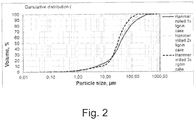
- Figure 2 shows example particle size distributions of hammermilled lignin cakes.
- the lignin cakes are hammermilled in room temperature using sieve with 5 mm aperture size.
- three times hammermilled lignin material has a smaller average particle size than lignin material that is hammermilled once or twice.
- the lignin material is at least twice hammermilled.
- already once hammermilled lignin material may be good enough to use for some products.
- Figure 3 shows an example of particle size distributions of lignin, potato starch and potato flour.
- the materials are treated using hot air during the grinding.
- the powdered lignin material has typically, especially if grinded with a rotor mill, more small particles than potato starch or potato flour.
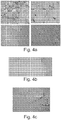
- Figure 4a shows some examples of the lignin material to be supplied to the rotor mill device.
- An effect of a grinding temperature on the lignin material is illustrated in Figures 4b and 4c.
- Figure 4b shows lignin powder manufactured using good process temperature, hence, the obtained material is even lignin powder. If lignin melts it typically forms, not only lignin powder, but also big hard lumps, which is shown in Figure 4c .
- the lumps shown in Figure 4c are formed due to very high inlet air temperature (350 °C) during powdering process.
- the inlet temperature of the heated air during the powdering process is less than 160 °C, preferably between 90 and 130 °C, and more preferably between 100 and 120 °C. Most preferably the inlet temperature of the heated air during the powdering process is less than glass transition temperature (Tg) of the lignin material.
- Tg glass transition temperature
- An amount of the inlet heated air during the powdering process is preferably at least 8300 m 3 /t, for example between 8300 and 20000 m 3 /t, more preferably at least 13 000 m 3 /t, for example between 13 000 and 17 000 m 3 /t.
- Pellets were cooled after pressing in cooling tower by fresh air and sampled after cooling. First test of technical durability was done about one hour after pressing. The test was repeated after 5-7 days after pressing in order to see if technical durability would develop differently with lignin additive or starch additive.
- lignin is as good pellet additive as starch. Remarkable differences cannot be found according to test run made. Technical properties of used lignin additive were somewhat different if compared with starch. Lignin powder is really fine and gets more easily in the air in the process, and it seems to get mixed with raw material better than starch. In a fresh, hot pellet, lignin does not make surface of the pellet sticky like starch does.
- the wood material used was a mixture consisting 54 - 60 % of pine and 40 - 46 % of spruce.
- the raw material was processed by the hammer mill before pelletizing.
- the lignin used is shown in table 4.
- Finnamyl potato starch was used as a reference binder.
- Table 4. Selected lignin additive
- Sample number Sample code Weight (kg)
- Initial moisture (%) 1 G 1 / CH4 50 26 2 G 2 / CH4 51 26 3 G 2 / CH4 47 26 4 C 3 / CH1 33 53 5 G 3 / CH1 30 53 6 G 3 / CH1 31,5 53 7 G 3 / CH1 32 53 8 G 3 / CH1 31,5 53 9 G 4 / CH2 58 23 10 G 5 / CH3 56,5 30 11 G 6 / CH 6 / 1 37,5 37 12 Big batch 6095 39
- Results of Rotor mill 3 are shown in Table 5.
- the lignin material could be processed well.
- the dry matter content of the lignin material varied between 47 % and 77 %,.
- Some kind of pre-crushing was beneficial to be able to crush the biggest lumps before the feeding screw.
- the raw material was fed directly to the disintegrator area of the machine.
- Rotor Mill 2 The runnability of Rotor Mill 2 was good from the beginning.
- the lignin material was fed by the screw directly to the rotor section of the machine. Further, the inlet air temperature was only 100 - 110 °C. The low air temperature was compensated by the high air flow amount to reach still considerably high evaporation capacity. The final product was fine, good quality powder. Results of the Rotor Mill 2 trials are shown in Table 6. Table 6. Results of the Rotor Mill 2 trials.
- inlet temperature was used in the process in order to see the effect of the high temperature on the lignin material.
- the inlet channel was blocked by the feed material. Therefore, the feed material was pre-milled by the hammer mill.
- the particle sizes after milling were as follows 39,3% ⁇ 63 ⁇ m, 70% ⁇ 500 ⁇ m, 80,6% ⁇ 1 mm, 96,5% ⁇ 3,15 mm, 99,9% ⁇ 5 mm. No technical problems were seen in the hammer milling.
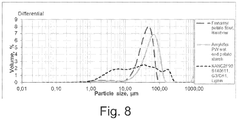
- Particle size distribution of lignin and starch is shown in Figure 8 .
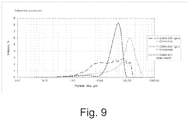
- the particle size distribution of the Rotor mill 3 dried lignin was modified by 100 microns sieve. About 25 % of material was rejected and milled further by a ball mill. However, the lignin tended to get stuck onto the ball mill walls.
- the modified particle size distribution is seen in the Figure 9 .
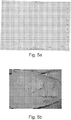
- Particle size distribution of Rotor mill 1 product is presented in Figure 5a.
- Figure 5b shows an example of the rotor section of the rotor mill comprising lignin material.
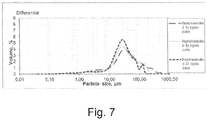
- Particle size distribution of Rotor mill 2 product is presented in Figure 6 .
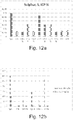
- Amount of Sulphur is shown in Figure 12a
- amount of Zink is shown in Figure 12b
- Ash content is shown in Figure 13a and amounts of Chromium and Copper are shown in Fig 13b .
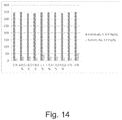
- Potassium and Sodium contents are shown in Figure 14 . These elements are important for ash melting properties, which were good with both starch and lignin additives. Mixture of nitric acid, hydrogen peroxide and fluorhydric acid was used in the testing.
- Pellet Burning tests were also made.
- the pellets made at 0.5 % additive level were analyzed as follows.
- the lignin-containing pellet had slightly better ash melting properties than starch-containing pellet. All the properties fulfilled the A1 specification. Results are shown in Tables 9 to 11.
- Table 9. Pellet analysis table 1 Lignin Starch Ash content (550 °C) 0.3 0.3 wt%, d Sulphur content ⁇ 0.02 ⁇ 0.02 wt%, d Gross calorific value 20.50 20.48 MJ/kg. d Net calorific value 19.15 19.13 MJ/kg.
- Pellet analysis table 2 Lignin Starch Na 46 26 mg/kg, d K 440 440 mg/kg, d Ca 720 700 mg/kg, d Mg 170 170 mg/kg, d P 50 52 mg/kg, d Al 70 63 mg/kg, d Si 350 370 mg/kg, d Fe 87 86 mg/kg, d Cr 0.74 0.77 mg/kg, d Cu 0.74 0.78 mg/kg, d Mn 75 76 mg/kg, d Ni 0.78 ⁇ 0.5 mg/kg, d Zn 12 9.7 mg/kg, d Table 11.
- the lignin powder can be used as an additive.
- native starch pellet additive can be replaced by lignin.
- the production scale trial showed clearly the potential of dry lignin powder as an additive in wood pellets. By the 0.59 % addition the A1 durability level 97.5 % was reached.
Landscapes
- Chemical & Material Sciences (AREA)
- Organic Chemistry (AREA)
- Engineering & Computer Science (AREA)
- Polymers & Plastics (AREA)
- Materials Engineering (AREA)
- Health & Medical Sciences (AREA)
- Chemical Kinetics & Catalysis (AREA)
- Medicinal Chemistry (AREA)
- Life Sciences & Earth Sciences (AREA)
- Biochemistry (AREA)
- Biodiversity & Conservation Biology (AREA)
- Ecology (AREA)
- Forests & Forestry (AREA)
- Wood Science & Technology (AREA)
- Oil, Petroleum & Natural Gas (AREA)
- Food Science & Technology (AREA)
- Processing Of Solid Wastes (AREA)
- Compositions Of Macromolecular Compounds (AREA)
- Disintegrating Or Milling (AREA)
Priority Applications (2)
| Application Number | Priority Date | Filing Date | Title |
|---|---|---|---|
| PL13718603T PL2831088T3 (pl) | 2012-03-29 | 2013-03-26 | Lignina oraz sposób i układ przetwarzania ligniny |
| SI201330814T SI2831088T1 (sl) | 2012-03-29 | 2013-03-26 | Lignin ter postopek in sistem za predelavo lignina |
Applications Claiming Priority (2)
| Application Number | Priority Date | Filing Date | Title |
|---|---|---|---|
| FI20125362A FI20125362L (fi) | 2012-03-29 | 2012-03-29 | Ligniini sekä menetelmä ja järjestelmä ligniinin käsittelemiseksi |
| PCT/FI2013/050337 WO2013144445A1 (en) | 2012-03-29 | 2013-03-26 | Lignin and method and system for processing lignin |
Publications (2)
| Publication Number | Publication Date |
|---|---|
| EP2831088A1 EP2831088A1 (en) | 2015-02-04 |
| EP2831088B1 true EP2831088B1 (en) | 2017-08-02 |
Family
ID=48184226
Family Applications (1)
| Application Number | Title | Priority Date | Filing Date |
|---|---|---|---|
| EP13718603.7A Active EP2831088B1 (en) | 2012-03-29 | 2013-03-26 | Lignin and method and system for processing lignin |
Country Status (10)
| Country | Link |
|---|---|
| US (1) | US20150068112A1 (enExample) |
| EP (1) | EP2831088B1 (enExample) |
| CN (1) | CN104204103B (enExample) |
| BR (1) | BR112014024037B1 (enExample) |
| CA (1) | CA2867744C (enExample) |
| ES (1) | ES2643852T3 (enExample) |
| FI (1) | FI20125362L (enExample) |
| PL (1) | PL2831088T3 (enExample) |
| SI (1) | SI2831088T1 (enExample) |
| WO (1) | WO2013144445A1 (enExample) |
Families Citing this family (18)
| Publication number | Priority date | Publication date | Assignee | Title |
|---|---|---|---|---|
| FI123936B2 (en) | 2012-03-29 | 2019-03-29 | Upm Kymmene Corp | A method for increasing the reactivity of lignin |
| FI123934B (en) * | 2012-03-29 | 2013-12-31 | Upm Kymmene Corp | Use of low molecular weight lignin for the preparation of a binder composition |
| FI126736B (en) | 2013-11-26 | 2017-04-28 | Upm Kymmene Corp | Process for treating lignin and preparing a binder composition |
| FI126737B (en) | 2013-11-26 | 2017-04-28 | Upm Kymmene Corp | A process for treating lignin and preparing a binder composition |
| ES2895101T3 (es) | 2013-12-16 | 2022-02-17 | Ren Fuel K2B Ab | Composición que comprende ésteres de lignina y aceite o ácidos grasos |
| FI3186286T3 (fi) | 2014-09-26 | 2024-07-10 | Renmatix Inc | Selluloosaa sisältävät koostumukset ja niiden valmistusmenetelmät |
| SE541263C2 (en) * | 2017-09-18 | 2019-05-28 | Valmet Oy | Method and system for production of fuel pellets or briquettes |
| US11033867B2 (en) | 2017-09-27 | 2021-06-15 | Sustainable Fiber Technologies, LLC | Aqueous lignin and hemicellulose dispersion |
| US11066588B2 (en) | 2017-11-21 | 2021-07-20 | Sustainable Fiber Technologies, LLC | Deicing composition comprising lignocellulosic byproducts |
| US11091697B2 (en) | 2017-11-29 | 2021-08-17 | Sustainable Fiber Technologies, LLC | Dust suppressant and soil stabilization composition comprising lignocellulosic byproducts |
| SE543477C2 (en) | 2018-09-07 | 2021-03-02 | Valmet Oy | Method of producing lignin with reduced amount of odorous substances |
| SE543284C2 (en) | 2019-03-14 | 2020-11-17 | Stora Enso Oyj | Process for producing agglomerated lignin |
| AU2020412611A1 (en) | 2019-12-22 | 2022-07-14 | Apalta Patents OÜ | Methods of making specialized lignin and lignin products from biomass |
| FI130110B (en) | 2020-02-12 | 2023-03-02 | Upm Kymmene Corp | Binder composition |
| US11572474B2 (en) | 2020-05-22 | 2023-02-07 | Sustainable Fiber Technologies, LLC | Compositions comprising lignocellulosic byproducts for tire ballasts and associated methods |
| SE544157C2 (en) * | 2020-06-11 | 2022-02-08 | Stora Enso Oyj | Process for producing thermally stabilized lignin |
| SE544477C2 (en) * | 2020-07-03 | 2022-06-14 | Stora Enso Oyj | Process for producing coating composition |
| CN115805632A (zh) * | 2022-12-06 | 2023-03-17 | 中集竹链科技有限公司 | 细竹粉的生产工艺方法、细竹粉及其应用方法 |
Citations (9)
| Publication number | Priority date | Publication date | Assignee | Title |
|---|---|---|---|---|
| US5321065A (en) | 1990-01-23 | 1994-06-14 | Pierre Bono | Degradable plastics film including lignin as active vegetable filler |
| WO1996038494A1 (en) | 1995-05-31 | 1996-12-05 | Alcell Technologies Inc. | Degradable polymers and polymer products |
| WO1997047702A1 (en) | 1995-06-02 | 1997-12-18 | Alcell Technologies Inc. | Lignin-based vapor barrier formulations |
| US6024307A (en) | 1996-10-19 | 2000-02-15 | Ashford Holdings Limited | Device and method for comminution |
| US20010034441A1 (en) | 2000-02-28 | 2001-10-25 | Hartwig Schlesiger | Process for producing particulate, water-soluble cellulose derivatives |
| US20110167713A1 (en) | 2010-01-12 | 2011-07-14 | IFP Energies Nouvelles | Process for direct hydorliquefaction of biomass comprising two stages of ebullating bed hydroconversion |
| US20110259250A1 (en) | 2008-08-21 | 2011-10-27 | Mcknight James T | Systems And Methods For Converting Biomass In The Field To A Combustible Fluid For Direct Replacement Or Supplement To Liquid Fossil Fuels |
| CN102268847A (zh) | 2011-07-19 | 2011-12-07 | 南京林业大学 | 无醛植物纤维包装材料的制造方法 |
| US20110302832A1 (en) | 2008-12-15 | 2011-12-15 | Groenn Arne Johannes | Method for the production of pellets or briquettes |
Family Cites Families (7)
| Publication number | Priority date | Publication date | Assignee | Title |
|---|---|---|---|---|
| CA2192111A1 (en) * | 1994-06-10 | 1995-12-21 | Jairo H. Lora | Degradable polymers and polymer products |
| US20100154296A1 (en) * | 2008-12-22 | 2010-06-24 | Clean Coal Briquette, Inc. | Coal particles briquette where the binder is lignin and methods and systems of preparing the same |
| CN101747651A (zh) * | 2009-12-22 | 2010-06-23 | 何光临 | 高分子材料与纤维素或/和木质素复合材料的制备方法 |
| DE102010019321A1 (de) * | 2010-05-03 | 2011-11-03 | Nikolai Invest Gmbh | Verfahren zur Herstellung brennbarer Pellets |
| FR2960888B1 (fr) * | 2010-06-08 | 2012-06-08 | Cie Ind De La Matiere Vegetale Cimv | Procede de separation des lignines et des sucres a partir d'une liqueur d'extraction |
| RU2602068C2 (ru) * | 2011-05-04 | 2016-11-10 | Ренмэтикс, Инк. | Получение лигнина из лигноцеллюлозной биомассы |
| WO2012151509A2 (en) * | 2011-05-04 | 2012-11-08 | Renmatix, Inc. | Lignin production from lignocellulosic biomass |
-
2012
- 2012-03-29 FI FI20125362A patent/FI20125362L/fi unknown
-
2013
- 2013-03-26 US US14/388,991 patent/US20150068112A1/en not_active Abandoned
- 2013-03-26 BR BR112014024037-0A patent/BR112014024037B1/pt active IP Right Grant
- 2013-03-26 CA CA2867744A patent/CA2867744C/en active Active
- 2013-03-26 PL PL13718603T patent/PL2831088T3/pl unknown
- 2013-03-26 WO PCT/FI2013/050337 patent/WO2013144445A1/en not_active Ceased
- 2013-03-26 SI SI201330814T patent/SI2831088T1/sl unknown
- 2013-03-26 ES ES13718603.7T patent/ES2643852T3/es active Active
- 2013-03-26 CN CN201380016964.9A patent/CN104204103B/zh active Active
- 2013-03-26 EP EP13718603.7A patent/EP2831088B1/en active Active
Patent Citations (9)
| Publication number | Priority date | Publication date | Assignee | Title |
|---|---|---|---|---|
| US5321065A (en) | 1990-01-23 | 1994-06-14 | Pierre Bono | Degradable plastics film including lignin as active vegetable filler |
| WO1996038494A1 (en) | 1995-05-31 | 1996-12-05 | Alcell Technologies Inc. | Degradable polymers and polymer products |
| WO1997047702A1 (en) | 1995-06-02 | 1997-12-18 | Alcell Technologies Inc. | Lignin-based vapor barrier formulations |
| US6024307A (en) | 1996-10-19 | 2000-02-15 | Ashford Holdings Limited | Device and method for comminution |
| US20010034441A1 (en) | 2000-02-28 | 2001-10-25 | Hartwig Schlesiger | Process for producing particulate, water-soluble cellulose derivatives |
| US20110259250A1 (en) | 2008-08-21 | 2011-10-27 | Mcknight James T | Systems And Methods For Converting Biomass In The Field To A Combustible Fluid For Direct Replacement Or Supplement To Liquid Fossil Fuels |
| US20110302832A1 (en) | 2008-12-15 | 2011-12-15 | Groenn Arne Johannes | Method for the production of pellets or briquettes |
| US20110167713A1 (en) | 2010-01-12 | 2011-07-14 | IFP Energies Nouvelles | Process for direct hydorliquefaction of biomass comprising two stages of ebullating bed hydroconversion |
| CN102268847A (zh) | 2011-07-19 | 2011-12-07 | 南京林业大学 | 无醛植物纤维包装材料的制造方法 |
Non-Patent Citations (4)
| Title |
|---|
| "SELECTED DRYING TECHNOLOGIES AND PARTICLE ENGINEERING FOR THE FUTURE BIOREFINERY", THE THIRD NORDIC WOOD BIOREFINERY CONFERENCE, 22 March 2011 (2011-03-22), pages 172 - 179, XP055487547 |
| ANONYMOUS: "The Third Nordic Wood Biorefinery Conference,", 22 March 2011, article FROSTERUD D. ET AL.: "SELECTED DRYING TECHNOLOGIES AND PARTICLE ENGINEERING FOR THE FUTURE BIOREFINERY", pages: 172 - 179, XP055487547 |
| BASMA EL KHALDI-HANSEN ET AL: "Analytical Techniques and Methods for Biomass", 2016, article "Chapter 2 Qualitative and Quantitative Analysis of Lignins from Different Sourcesand Isolation Methods for an Application as a Biobased Chemical Resourceand Polymeric Material", pages: 15 - 44, XP055487554 |
| PER TOMANI: "The Lignoboost Process", CELLULOSE CHEMISTRY AND TECHNOLOGY, vol. 44, no. 1-3, 2010, pages 53 - 58, XP055489125 |
Also Published As
| Publication number | Publication date |
|---|---|
| PL2831088T3 (pl) | 2018-01-31 |
| CN104204103A (zh) | 2014-12-10 |
| BR112014024037A2 (enExample) | 2017-06-20 |
| US20150068112A1 (en) | 2015-03-12 |
| BR112014024037B1 (pt) | 2022-07-12 |
| CN104204103B (zh) | 2017-09-08 |
| FI20125362A7 (fi) | 2013-09-30 |
| ES2643852T3 (es) | 2017-11-24 |
| EP2831088A1 (en) | 2015-02-04 |
| CA2867744C (en) | 2021-11-09 |
| WO2013144445A1 (en) | 2013-10-03 |
| CA2867744A1 (en) | 2013-10-03 |
| FI20125362L (fi) | 2013-09-30 |
| SI2831088T1 (sl) | 2017-11-30 |
Similar Documents
| Publication | Publication Date | Title |
|---|---|---|
| EP2831088B1 (en) | Lignin and method and system for processing lignin | |
| Whittaker et al. | Factors affecting wood, energy grass and straw pellet durability–A review | |
| US7785379B2 (en) | Agricultural fibre fuel pellets | |
| KR101525648B1 (ko) | 펠릿 또는 브리켓의 생산 방법 | |
| Samson et al. | Assessment of pelletized biofuels | |
| Theerarattananoon et al. | Physical properties of pellets made from sorghum stalk, corn stover, wheat straw, and big bluestem | |
| Stelte | Steam explosion for biomass pre-treatment | |
| EP2580307B1 (en) | Methods for the manufacture of fuel pellets and other products from lignocellulosic biomass | |
| Solís et al. | Preliminary assessment of hazelnut shell biomass as a raw material for pellet production | |
| Garcia-Maraver et al. | Biomass pelletization process | |
| WO2007127253A2 (en) | Synthetic fuel pellet and methods | |
| Lavergne et al. | Effect of process parameters and biomass composition on flat-die pellet production from underexploited forest and agricultural biomass | |
| San Miguel et al. | One-step torrefaction and densification of woody and herbaceous biomass feedstocks | |
| Tang et al. | The role of biomass composition and steam treatment on durability of pellets | |
| Iroba et al. | Producing durable pellets from barley straw subjected to radio frequency-alkaline and steam explosion pretreatments | |
| US20130031830A1 (en) | Methods for producing binders and combustible composite materials and compositions produced therefrom | |
| JP7436639B2 (ja) | 顆粒の製造のための水蒸気分解されたバイオマスとリグニンとの混合物 | |
| KR102582306B1 (ko) | 목질계 바이오매스의 열수처리 잔사 고형물을 이용한 리그닌 연속 추출방법 | |
| JP2014098098A (ja) | 固形燃料、その製造方法及び混合燃料の製造方法 | |
| Christoforou et al. | Solid biomass pretreatment processes | |
| Nath et al. | Upgrading of physical and elemental quality of wheat straw pellets using additive blends | |
| Rahman | Thermophysical properties of biofuel pellets made from paper wastes and energy crops under different pelleting conditions | |
| Regmi | Manufacturing Low-Density Particleboards from Wheat Straw and Distiller’s Dried Grains with Solubles | |
| Sokhansanj et al. | Steam Treatment of Cellulosic Biomass for Pelletization | |
| WO2013133728A1 (en) | Pressure agglomerated molded solid fuel, method for preparation of agglomerated molded solid fuel and use |
Legal Events
| Date | Code | Title | Description |
|---|---|---|---|
| PUAI | Public reference made under article 153(3) epc to a published international application that has entered the european phase |
Free format text: ORIGINAL CODE: 0009012 |
|
| 17P | Request for examination filed |
Effective date: 20140930 |
|
| AK | Designated contracting states |
Kind code of ref document: A1 Designated state(s): AL AT BE BG CH CY CZ DE DK EE ES FI FR GB GR HR HU IE IS IT LI LT LU LV MC MK MT NL NO PL PT RO RS SE SI SK SM TR |
|
| AX | Request for extension of the european patent |
Extension state: BA ME |
|
| DAX | Request for extension of the european patent (deleted) | ||
| STAA | Information on the status of an ep patent application or granted ep patent |
Free format text: STATUS: EXAMINATION IS IN PROGRESS |
|
| 17Q | First examination report despatched |
Effective date: 20161020 |
|
| GRAP | Despatch of communication of intention to grant a patent |
Free format text: ORIGINAL CODE: EPIDOSNIGR1 |
|
| STAA | Information on the status of an ep patent application or granted ep patent |
Free format text: STATUS: GRANT OF PATENT IS INTENDED |
|
| INTG | Intention to grant announced |
Effective date: 20170119 |
|
| GRAS | Grant fee paid |
Free format text: ORIGINAL CODE: EPIDOSNIGR3 |
|
| GRAJ | Information related to disapproval of communication of intention to grant by the applicant or resumption of examination proceedings by the epo deleted |
Free format text: ORIGINAL CODE: EPIDOSDIGR1 |
|
| GRAL | Information related to payment of fee for publishing/printing deleted |
Free format text: ORIGINAL CODE: EPIDOSDIGR3 |
|
| STAA | Information on the status of an ep patent application or granted ep patent |
Free format text: STATUS: EXAMINATION IS IN PROGRESS |
|
| GRAR | Information related to intention to grant a patent recorded |
Free format text: ORIGINAL CODE: EPIDOSNIGR71 |
|
| STAA | Information on the status of an ep patent application or granted ep patent |
Free format text: STATUS: GRANT OF PATENT IS INTENDED |
|
| INTC | Intention to grant announced (deleted) | ||
| INTG | Intention to grant announced |
Effective date: 20170522 |
|
| RIN1 | Information on inventor provided before grant (corrected) |
Inventor name: MIETTINEN, MAUNO Inventor name: PYKAELAEINEN, NINA Inventor name: VARVEMAA, PAEIVI Inventor name: SIPPONEN, JUHA Inventor name: NISSINEN, VILHO Inventor name: PIETARINEN, SUVI |
|
| GRAA | (expected) grant |
Free format text: ORIGINAL CODE: 0009210 |
|
| STAA | Information on the status of an ep patent application or granted ep patent |
Free format text: STATUS: THE PATENT HAS BEEN GRANTED |
|
| AK | Designated contracting states |
Kind code of ref document: B1 Designated state(s): AL AT BE BG CH CY CZ DE DK EE ES FI FR GB GR HR HU IE IS IT LI LT LU LV MC MK MT NL NO PL PT RO RS SE SI SK SM TR |
|
| REG | Reference to a national code |
Ref country code: CH Ref legal event code: EP Ref country code: AT Ref legal event code: REF Ref document number: 914344 Country of ref document: AT Kind code of ref document: T Effective date: 20170815 |
|
| REG | Reference to a national code |
Ref country code: IE Ref legal event code: FG4D |
|
| REG | Reference to a national code |
Ref country code: DE Ref legal event code: R096 Ref document number: 602013024352 Country of ref document: DE |
|
| REG | Reference to a national code |
Ref country code: SE Ref legal event code: TRGR |
|
| REG | Reference to a national code |
Ref country code: NL Ref legal event code: FP |
|
| REG | Reference to a national code |
Ref country code: ES Ref legal event code: FG2A Ref document number: 2643852 Country of ref document: ES Kind code of ref document: T3 Effective date: 20171124 |
|
| REG | Reference to a national code |
Ref country code: LT Ref legal event code: MG4D Ref country code: NO Ref legal event code: T2 Effective date: 20170802 |
|
| PG25 | Lapsed in a contracting state [announced via postgrant information from national office to epo] |
Ref country code: LT Free format text: LAPSE BECAUSE OF FAILURE TO SUBMIT A TRANSLATION OF THE DESCRIPTION OR TO PAY THE FEE WITHIN THE PRESCRIBED TIME-LIMIT Effective date: 20170802 Ref country code: HR Free format text: LAPSE BECAUSE OF FAILURE TO SUBMIT A TRANSLATION OF THE DESCRIPTION OR TO PAY THE FEE WITHIN THE PRESCRIBED TIME-LIMIT Effective date: 20170802 |
|
| PG25 | Lapsed in a contracting state [announced via postgrant information from national office to epo] |
Ref country code: IS Free format text: LAPSE BECAUSE OF FAILURE TO SUBMIT A TRANSLATION OF THE DESCRIPTION OR TO PAY THE FEE WITHIN THE PRESCRIBED TIME-LIMIT Effective date: 20171202 Ref country code: GR Free format text: LAPSE BECAUSE OF FAILURE TO SUBMIT A TRANSLATION OF THE DESCRIPTION OR TO PAY THE FEE WITHIN THE PRESCRIBED TIME-LIMIT Effective date: 20171103 Ref country code: RS Free format text: LAPSE BECAUSE OF FAILURE TO SUBMIT A TRANSLATION OF THE DESCRIPTION OR TO PAY THE FEE WITHIN THE PRESCRIBED TIME-LIMIT Effective date: 20170802 Ref country code: LV Free format text: LAPSE BECAUSE OF FAILURE TO SUBMIT A TRANSLATION OF THE DESCRIPTION OR TO PAY THE FEE WITHIN THE PRESCRIBED TIME-LIMIT Effective date: 20170802 Ref country code: BG Free format text: LAPSE BECAUSE OF FAILURE TO SUBMIT A TRANSLATION OF THE DESCRIPTION OR TO PAY THE FEE WITHIN THE PRESCRIBED TIME-LIMIT Effective date: 20171102 |
|
| REG | Reference to a national code |
Ref country code: FR Ref legal event code: PLFP Year of fee payment: 6 |
|
| REG | Reference to a national code |
Ref country code: DE Ref legal event code: R026 Ref document number: 602013024352 Country of ref document: DE |
|
| PLBI | Opposition filed |
Free format text: ORIGINAL CODE: 0009260 |
|
| PG25 | Lapsed in a contracting state [announced via postgrant information from national office to epo] |
Ref country code: DK Free format text: LAPSE BECAUSE OF FAILURE TO SUBMIT A TRANSLATION OF THE DESCRIPTION OR TO PAY THE FEE WITHIN THE PRESCRIBED TIME-LIMIT Effective date: 20170802 Ref country code: RO Free format text: LAPSE BECAUSE OF FAILURE TO SUBMIT A TRANSLATION OF THE DESCRIPTION OR TO PAY THE FEE WITHIN THE PRESCRIBED TIME-LIMIT Effective date: 20170802 |
|
| PLAX | Notice of opposition and request to file observation + time limit sent |
Free format text: ORIGINAL CODE: EPIDOSNOBS2 |
|
| 26 | Opposition filed |
Opponent name: STORA ENSO OYJ Effective date: 20180424 |
|
| PG25 | Lapsed in a contracting state [announced via postgrant information from national office to epo] |
Ref country code: SK Free format text: LAPSE BECAUSE OF FAILURE TO SUBMIT A TRANSLATION OF THE DESCRIPTION OR TO PAY THE FEE WITHIN THE PRESCRIBED TIME-LIMIT Effective date: 20170802 Ref country code: EE Free format text: LAPSE BECAUSE OF FAILURE TO SUBMIT A TRANSLATION OF THE DESCRIPTION OR TO PAY THE FEE WITHIN THE PRESCRIBED TIME-LIMIT Effective date: 20170802 Ref country code: SM Free format text: LAPSE BECAUSE OF FAILURE TO SUBMIT A TRANSLATION OF THE DESCRIPTION OR TO PAY THE FEE WITHIN THE PRESCRIBED TIME-LIMIT Effective date: 20170802 |
|
| 26 | Opposition filed |
Opponent name: METSAE FIBRE OY Effective date: 20180502 |
|
| PLBB | Reply of patent proprietor to notice(s) of opposition received |
Free format text: ORIGINAL CODE: EPIDOSNOBS3 |
|
| REG | Reference to a national code |
Ref country code: CH Ref legal event code: PL |
|
| PG25 | Lapsed in a contracting state [announced via postgrant information from national office to epo] |
Ref country code: MC Free format text: LAPSE BECAUSE OF FAILURE TO SUBMIT A TRANSLATION OF THE DESCRIPTION OR TO PAY THE FEE WITHIN THE PRESCRIBED TIME-LIMIT Effective date: 20170802 |
|
| REG | Reference to a national code |
Ref country code: IE Ref legal event code: MM4A |
|
| PG25 | Lapsed in a contracting state [announced via postgrant information from national office to epo] |
Ref country code: LU Free format text: LAPSE BECAUSE OF NON-PAYMENT OF DUE FEES Effective date: 20180326 |
|
| PG25 | Lapsed in a contracting state [announced via postgrant information from national office to epo] |
Ref country code: IE Free format text: LAPSE BECAUSE OF NON-PAYMENT OF DUE FEES Effective date: 20180326 |
|
| PG25 | Lapsed in a contracting state [announced via postgrant information from national office to epo] |
Ref country code: CH Free format text: LAPSE BECAUSE OF NON-PAYMENT OF DUE FEES Effective date: 20180331 Ref country code: LI Free format text: LAPSE BECAUSE OF NON-PAYMENT OF DUE FEES Effective date: 20180331 |
|
| RIC2 | Information provided on ipc code assigned after grant |
Ipc: C07G 1/00 20110101ALI20190717BHEP Ipc: C08L 97/00 20060101ALI20190717BHEP Ipc: D21H 11/00 20060101ALI20190717BHEP Ipc: C10L 5/44 20060101ALI20190717BHEP Ipc: B02C 23/08 20060101AFI20190717BHEP Ipc: C08H 7/00 20110101ALI20190717BHEP |
|
| APAH | Appeal reference modified |
Free format text: ORIGINAL CODE: EPIDOSCREFNO |
|
| APBM | Appeal reference recorded |
Free format text: ORIGINAL CODE: EPIDOSNREFNO |
|
| APBP | Date of receipt of notice of appeal recorded |
Free format text: ORIGINAL CODE: EPIDOSNNOA2O |
|
| PLAB | Opposition data, opponent's data or that of the opponent's representative modified |
Free format text: ORIGINAL CODE: 0009299OPPO |
|
| R26 | Opposition filed (corrected) |
Opponent name: METSAE FIBRE OY Effective date: 20180502 |
|
| APBQ | Date of receipt of statement of grounds of appeal recorded |
Free format text: ORIGINAL CODE: EPIDOSNNOA3O |
|
| PG25 | Lapsed in a contracting state [announced via postgrant information from national office to epo] |
Ref country code: MT Free format text: LAPSE BECAUSE OF NON-PAYMENT OF DUE FEES Effective date: 20180326 |
|
| PG25 | Lapsed in a contracting state [announced via postgrant information from national office to epo] |
Ref country code: TR Free format text: LAPSE BECAUSE OF FAILURE TO SUBMIT A TRANSLATION OF THE DESCRIPTION OR TO PAY THE FEE WITHIN THE PRESCRIBED TIME-LIMIT Effective date: 20170802 |
|
| PG25 | Lapsed in a contracting state [announced via postgrant information from national office to epo] |
Ref country code: HU Free format text: LAPSE BECAUSE OF FAILURE TO SUBMIT A TRANSLATION OF THE DESCRIPTION OR TO PAY THE FEE WITHIN THE PRESCRIBED TIME-LIMIT; INVALID AB INITIO Effective date: 20130326 Ref country code: PT Free format text: LAPSE BECAUSE OF FAILURE TO SUBMIT A TRANSLATION OF THE DESCRIPTION OR TO PAY THE FEE WITHIN THE PRESCRIBED TIME-LIMIT Effective date: 20170802 |
|
| PG25 | Lapsed in a contracting state [announced via postgrant information from national office to epo] |
Ref country code: MK Free format text: LAPSE BECAUSE OF NON-PAYMENT OF DUE FEES Effective date: 20170802 Ref country code: CY Free format text: LAPSE BECAUSE OF FAILURE TO SUBMIT A TRANSLATION OF THE DESCRIPTION OR TO PAY THE FEE WITHIN THE PRESCRIBED TIME-LIMIT Effective date: 20170802 |
|
| PG25 | Lapsed in a contracting state [announced via postgrant information from national office to epo] |
Ref country code: AL Free format text: LAPSE BECAUSE OF FAILURE TO SUBMIT A TRANSLATION OF THE DESCRIPTION OR TO PAY THE FEE WITHIN THE PRESCRIBED TIME-LIMIT Effective date: 20170802 |
|
| REG | Reference to a national code |
Ref country code: AT Ref legal event code: UEP Ref document number: 914344 Country of ref document: AT Kind code of ref document: T Effective date: 20170802 |
|
| APBU | Appeal procedure closed |
Free format text: ORIGINAL CODE: EPIDOSNNOA9O |
|
| PLAY | Examination report in opposition despatched + time limit |
Free format text: ORIGINAL CODE: EPIDOSNORE2 |
|
| PLBC | Reply to examination report in opposition received |
Free format text: ORIGINAL CODE: EPIDOSNORE3 |
|
| P01 | Opt-out of the competence of the unified patent court (upc) registered |
Effective date: 20230524 |
|
| PGFP | Annual fee paid to national office [announced via postgrant information from national office to epo] |
Ref country code: SE Payment date: 20250312 Year of fee payment: 13 |
|
| PGFP | Annual fee paid to national office [announced via postgrant information from national office to epo] |
Ref country code: DE Payment date: 20250327 Year of fee payment: 13 |
|
| PGFP | Annual fee paid to national office [announced via postgrant information from national office to epo] |
Ref country code: NL Payment date: 20250327 Year of fee payment: 13 Ref country code: FI Payment date: 20250325 Year of fee payment: 13 |
|
| PGFP | Annual fee paid to national office [announced via postgrant information from national office to epo] |
Ref country code: NO Payment date: 20250327 Year of fee payment: 13 |
|
| PGFP | Annual fee paid to national office [announced via postgrant information from national office to epo] |
Ref country code: SI Payment date: 20250303 Year of fee payment: 13 Ref country code: BE Payment date: 20250327 Year of fee payment: 13 Ref country code: AT Payment date: 20250305 Year of fee payment: 13 |
|
| PGFP | Annual fee paid to national office [announced via postgrant information from national office to epo] |
Ref country code: FR Payment date: 20250325 Year of fee payment: 13 Ref country code: PL Payment date: 20250305 Year of fee payment: 13 Ref country code: CZ Payment date: 20250307 Year of fee payment: 13 |
|
| PGFP | Annual fee paid to national office [announced via postgrant information from national office to epo] |
Ref country code: IT Payment date: 20250319 Year of fee payment: 13 Ref country code: GB Payment date: 20250327 Year of fee payment: 13 |
|
| PGFP | Annual fee paid to national office [announced via postgrant information from national office to epo] |
Ref country code: ES Payment date: 20250401 Year of fee payment: 13 |
|
| RDAF | Communication despatched that patent is revoked |
Free format text: ORIGINAL CODE: EPIDOSNREV1 |