EP2829532A1 - Hydroxyphenyl acrylate monomers and polymers - Google Patents
Hydroxyphenyl acrylate monomers and polymers Download PDFInfo
- Publication number
- EP2829532A1 EP2829532A1 EP14185013.1A EP14185013A EP2829532A1 EP 2829532 A1 EP2829532 A1 EP 2829532A1 EP 14185013 A EP14185013 A EP 14185013A EP 2829532 A1 EP2829532 A1 EP 2829532A1
- Authority
- EP
- European Patent Office
- Prior art keywords
- acid
- polymers
- compound
- phenolic
- monomers
- Prior art date
- Legal status (The legal status is an assumption and is not a legal conclusion. Google has not performed a legal analysis and makes no representation as to the accuracy of the status listed.)
- Withdrawn
Links
- 229920000642 polymer Polymers 0.000 title claims abstract description 39
- 239000000178 monomer Substances 0.000 title claims abstract description 32
- IUSXXDHQFMPZQX-UHFFFAOYSA-N (2-hydroxyphenyl) prop-2-enoate Chemical compound OC1=CC=CC=C1OC(=O)C=C IUSXXDHQFMPZQX-UHFFFAOYSA-N 0.000 title 1
- NIXOWILDQLNWCW-UHFFFAOYSA-M Acrylate Chemical compound [O-]C(=O)C=C NIXOWILDQLNWCW-UHFFFAOYSA-M 0.000 claims abstract description 11
- -1 phenolic acrylate compound Chemical class 0.000 claims description 24
- WFDIJRYMOXRFFG-UHFFFAOYSA-N Acetic anhydride Chemical compound CC(=O)OC(C)=O WFDIJRYMOXRFFG-UHFFFAOYSA-N 0.000 claims description 21
- 239000002253 acid Substances 0.000 claims description 17
- QIGBRXMKCJKVMJ-UHFFFAOYSA-N Hydroquinone Chemical compound OC1=CC=C(O)C=C1 QIGBRXMKCJKVMJ-UHFFFAOYSA-N 0.000 claims description 16
- 238000000034 method Methods 0.000 claims description 16
- CERQOIWHTDAKMF-UHFFFAOYSA-N Methacrylic acid Chemical compound CC(=C)C(O)=O CERQOIWHTDAKMF-UHFFFAOYSA-N 0.000 claims description 10
- SMZOUWXMTYCWNB-UHFFFAOYSA-N 2-(2-methoxy-5-methylphenyl)ethanamine Chemical compound COC1=CC=C(C)C=C1CCN SMZOUWXMTYCWNB-UHFFFAOYSA-N 0.000 claims description 7
- NIXOWILDQLNWCW-UHFFFAOYSA-N 2-Propenoic acid Natural products OC(=O)C=C NIXOWILDQLNWCW-UHFFFAOYSA-N 0.000 claims description 7
- YCIMNLLNPGFGHC-UHFFFAOYSA-N catechol Chemical compound OC1=CC=CC=C1O YCIMNLLNPGFGHC-UHFFFAOYSA-N 0.000 claims description 6
- GHMLBKRAJCXXBS-UHFFFAOYSA-N resorcinol Chemical compound OC1=CC=CC(O)=C1 GHMLBKRAJCXXBS-UHFFFAOYSA-N 0.000 claims description 6
- 150000001875 compounds Chemical class 0.000 claims description 5
- 150000002148 esters Chemical group 0.000 claims description 3
- 125000002887 hydroxy group Chemical group [H]O* 0.000 claims description 3
- 125000001424 substituent group Chemical group 0.000 claims description 2
- 238000004519 manufacturing process Methods 0.000 claims 1
- 238000003786 synthesis reaction Methods 0.000 abstract description 16
- ISWSIDIOOBJBQZ-UHFFFAOYSA-N phenol group Chemical group C1(=CC=CC=C1)O ISWSIDIOOBJBQZ-UHFFFAOYSA-N 0.000 abstract description 12
- 239000011347 resin Substances 0.000 abstract description 5
- 229920005989 resin Polymers 0.000 abstract description 5
- OKKJLVBELUTLKV-UHFFFAOYSA-N Methanol Chemical compound OC OKKJLVBELUTLKV-UHFFFAOYSA-N 0.000 description 24
- 229920002120 photoresistant polymer Polymers 0.000 description 20
- PJMXUSNWBKGQEZ-UHFFFAOYSA-N (4-hydroxyphenyl) 2-methylprop-2-enoate Chemical compound CC(=C)C(=O)OC1=CC=C(O)C=C1 PJMXUSNWBKGQEZ-UHFFFAOYSA-N 0.000 description 17
- 238000006243 chemical reaction Methods 0.000 description 17
- ISXSCDLOGDJUNJ-UHFFFAOYSA-N tert-butyl prop-2-enoate Chemical compound CC(C)(C)OC(=O)C=C ISXSCDLOGDJUNJ-UHFFFAOYSA-N 0.000 description 16
- PPBRXRYQALVLMV-UHFFFAOYSA-N Styrene Natural products C=CC1=CC=CC=C1 PPBRXRYQALVLMV-UHFFFAOYSA-N 0.000 description 15
- 230000015572 biosynthetic process Effects 0.000 description 13
- 239000000203 mixture Substances 0.000 description 10
- 230000005855 radiation Effects 0.000 description 9
- IMNFDUFMRHMDMM-UHFFFAOYSA-N N-Heptane Chemical class CCCCCCC IMNFDUFMRHMDMM-UHFFFAOYSA-N 0.000 description 8
- 238000010992 reflux Methods 0.000 description 8
- VVQNEPGJFQJSBK-UHFFFAOYSA-N Methyl methacrylate Chemical compound COC(=O)C(C)=C VVQNEPGJFQJSBK-UHFFFAOYSA-N 0.000 description 7
- 229920001897 terpolymer Polymers 0.000 description 7
- QTBSBXVTEAMEQO-UHFFFAOYSA-N Acetic acid Chemical compound CC(O)=O QTBSBXVTEAMEQO-UHFFFAOYSA-N 0.000 description 6
- YXFVVABEGXRONW-UHFFFAOYSA-N Toluene Chemical compound CC1=CC=CC=C1 YXFVVABEGXRONW-UHFFFAOYSA-N 0.000 description 6
- 239000003153 chemical reaction reagent Substances 0.000 description 6
- 239000003999 initiator Substances 0.000 description 6
- 150000008065 acid anhydrides Chemical class 0.000 description 5
- 230000003213 activating effect Effects 0.000 description 5
- 150000008064 anhydrides Chemical class 0.000 description 5
- 239000001257 hydrogen Substances 0.000 description 5
- 229910052739 hydrogen Inorganic materials 0.000 description 5
- 125000004435 hydrogen atom Chemical group [H]* 0.000 description 5
- 239000011247 coating layer Substances 0.000 description 4
- 238000004821 distillation Methods 0.000 description 4
- LZCLXQDLBQLTDK-UHFFFAOYSA-N ethyl 2-hydroxypropanoate Chemical compound CCOC(=O)C(C)O LZCLXQDLBQLTDK-UHFFFAOYSA-N 0.000 description 4
- 238000002360 preparation method Methods 0.000 description 4
- 239000000758 substrate Substances 0.000 description 4
- HZBSQYSUONRRMW-UHFFFAOYSA-N (2-hydroxyphenyl) 2-methylprop-2-enoate Chemical compound CC(=C)C(=O)OC1=CC=CC=C1O HZBSQYSUONRRMW-UHFFFAOYSA-N 0.000 description 3
- QFLWZFQWSBQYPS-AWRAUJHKSA-N (3S)-3-[[(2S)-2-[[(2S)-2-[5-[(3aS,6aR)-2-oxo-1,3,3a,4,6,6a-hexahydrothieno[3,4-d]imidazol-4-yl]pentanoylamino]-3-methylbutanoyl]amino]-3-(4-hydroxyphenyl)propanoyl]amino]-4-[1-bis(4-chlorophenoxy)phosphorylbutylamino]-4-oxobutanoic acid Chemical compound CCCC(NC(=O)[C@H](CC(O)=O)NC(=O)[C@H](Cc1ccc(O)cc1)NC(=O)[C@@H](NC(=O)CCCCC1SC[C@@H]2NC(=O)N[C@H]12)C(C)C)P(=O)(Oc1ccc(Cl)cc1)Oc1ccc(Cl)cc1 QFLWZFQWSBQYPS-AWRAUJHKSA-N 0.000 description 3
- 125000004169 (C1-C6) alkyl group Chemical group 0.000 description 3
- 238000001644 13C nuclear magnetic resonance spectroscopy Methods 0.000 description 3
- CERQOIWHTDAKMF-UHFFFAOYSA-M Methacrylate Chemical compound CC(=C)C([O-])=O CERQOIWHTDAKMF-UHFFFAOYSA-M 0.000 description 3
- 239000000654 additive Substances 0.000 description 3
- 238000009826 distribution Methods 0.000 description 3
- DCUFMVPCXCSVNP-UHFFFAOYSA-N methacrylic anhydride Chemical compound CC(=C)C(=O)OC(=O)C(C)=C DCUFMVPCXCSVNP-UHFFFAOYSA-N 0.000 description 3
- 125000002496 methyl group Chemical group [H]C([H])([H])* 0.000 description 3
- 239000002904 solvent Substances 0.000 description 3
- 238000010189 synthetic method Methods 0.000 description 3
- 229920002554 vinyl polymer Polymers 0.000 description 3
- XLYOFNOQVPJJNP-UHFFFAOYSA-N water Chemical compound O XLYOFNOQVPJJNP-UHFFFAOYSA-N 0.000 description 3
- XKRFYHLGVUSROY-UHFFFAOYSA-N Argon Chemical compound [Ar] XKRFYHLGVUSROY-UHFFFAOYSA-N 0.000 description 2
- WYURNTSHIVDZCO-UHFFFAOYSA-N Tetrahydrofuran Chemical compound C1CCOC1 WYURNTSHIVDZCO-UHFFFAOYSA-N 0.000 description 2
- ORILYTVJVMAKLC-UHFFFAOYSA-N adamantane Chemical group C1C(C2)CC3CC1CC2C3 ORILYTVJVMAKLC-UHFFFAOYSA-N 0.000 description 2
- 230000000996 additive effect Effects 0.000 description 2
- 125000000217 alkyl group Chemical group 0.000 description 2
- 238000004458 analytical method Methods 0.000 description 2
- 125000001589 carboacyl group Chemical group 0.000 description 2
- 239000007810 chemical reaction solvent Substances 0.000 description 2
- 239000011248 coating agent Substances 0.000 description 2
- 238000000576 coating method Methods 0.000 description 2
- 229940126214 compound 3 Drugs 0.000 description 2
- 238000001816 cooling Methods 0.000 description 2
- 229920001577 copolymer Polymers 0.000 description 2
- 229940116333 ethyl lactate Drugs 0.000 description 2
- 238000010438 heat treatment Methods 0.000 description 2
- 239000003921 oil Substances 0.000 description 2
- 150000003254 radicals Chemical class 0.000 description 2
- 239000007787 solid Substances 0.000 description 2
- 239000007858 starting material Substances 0.000 description 2
- 239000004094 surface-active agent Substances 0.000 description 2
- 229920006029 tetra-polymer Polymers 0.000 description 2
- GQRTVVANIGOXRF-UHFFFAOYSA-N (2-methyl-1-adamantyl) prop-2-enoate Chemical class C1C(C2)CC3CC1C(C)C2(OC(=O)C=C)C3 GQRTVVANIGOXRF-UHFFFAOYSA-N 0.000 description 1
- 125000004400 (C1-C12) alkyl group Chemical group 0.000 description 1
- 125000004739 (C1-C6) alkylsulfonyl group Chemical group 0.000 description 1
- 125000004209 (C1-C8) alkyl group Chemical group 0.000 description 1
- DSSYKIVIOFKYAU-XCBNKYQSSA-N (R)-camphor Chemical group C1C[C@@]2(C)C(=O)C[C@@H]1C2(C)C DSSYKIVIOFKYAU-XCBNKYQSSA-N 0.000 description 1
- YFSUTJLHUFNCNZ-UHFFFAOYSA-M 1,1,2,2,3,3,4,4,5,5,6,6,7,7,8,8,8-heptadecafluorooctane-1-sulfonate Chemical compound [O-]S(=O)(=O)C(F)(F)C(F)(F)C(F)(F)C(F)(F)C(F)(F)C(F)(F)C(F)(F)C(F)(F)F YFSUTJLHUFNCNZ-UHFFFAOYSA-M 0.000 description 1
- MNEXVZFQQPKDHC-UHFFFAOYSA-M 1,1,2,2,3,3,4,4,5,5,6,6,7,7,8,8,9,9,9-nonadecafluorononane-1-sulfonate Chemical compound [O-]S(=O)(=O)C(F)(F)C(F)(F)C(F)(F)C(F)(F)C(F)(F)C(F)(F)C(F)(F)C(F)(F)C(F)(F)F MNEXVZFQQPKDHC-UHFFFAOYSA-M 0.000 description 1
- YZUPZGFPHUVJKC-UHFFFAOYSA-N 1-bromo-2-methoxyethane Chemical compound COCCBr YZUPZGFPHUVJKC-UHFFFAOYSA-N 0.000 description 1
- SFPNZPQIIAJXGL-UHFFFAOYSA-N 2-ethoxyethyl 2-methylprop-2-enoate Chemical compound CCOCCOC(=O)C(C)=C SFPNZPQIIAJXGL-UHFFFAOYSA-N 0.000 description 1
- GPLIMIJPIZGPIF-UHFFFAOYSA-N 2-hydroxy-1,4-benzoquinone Chemical compound OC1=CC(=O)C=CC1=O GPLIMIJPIZGPIF-UHFFFAOYSA-N 0.000 description 1
- PEDCVPYSSMEKKJ-UHFFFAOYSA-N 2-methyl-3-(2-methyl-1-adamantyl)prop-2-enoic acid Chemical class C1C(C2)CC3CC1C(C)C2(C=C(C)C(O)=O)C3 PEDCVPYSSMEKKJ-UHFFFAOYSA-N 0.000 description 1
- BMQHCCUIUKBSNF-UHFFFAOYSA-N 2-methyl-5-methylidenehexanedioic acid Chemical compound OC(=O)C(C)CCC(=C)C(O)=O BMQHCCUIUKBSNF-UHFFFAOYSA-N 0.000 description 1
- LPYQOSJVNXNUNV-UHFFFAOYSA-N 3-ethyloxiran-2-one;2-methylprop-2-enoic acid Chemical class CCC1OC1=O.CC(=C)C(O)=O LPYQOSJVNXNUNV-UHFFFAOYSA-N 0.000 description 1
- OFNISBHGPNMTMS-UHFFFAOYSA-N 3-methylideneoxolane-2,5-dione Chemical compound C=C1CC(=O)OC1=O OFNISBHGPNMTMS-UHFFFAOYSA-N 0.000 description 1
- TVCLZDLCXCCEPN-NSCUHMNNSA-N 4-hydroxy-3-[(e)-prop-1-enyl]benzoic acid Chemical compound C\C=C\C1=CC(C(O)=O)=CC=C1O TVCLZDLCXCCEPN-NSCUHMNNSA-N 0.000 description 1
- LLQHSBBZNDXTIV-UHFFFAOYSA-N 6-[5-[[4-[2-(2,3-dihydro-1H-inden-2-ylamino)pyrimidin-5-yl]piperazin-1-yl]methyl]-4,5-dihydro-1,2-oxazol-3-yl]-3H-1,3-benzoxazol-2-one Chemical compound C1C(CC2=CC=CC=C12)NC1=NC=C(C=N1)N1CCN(CC1)CC1CC(=NO1)C1=CC2=C(NC(O2)=O)C=C1 LLQHSBBZNDXTIV-UHFFFAOYSA-N 0.000 description 1
- NLHHRLWOUZZQLW-UHFFFAOYSA-N Acrylonitrile Chemical class C=CC#N NLHHRLWOUZZQLW-UHFFFAOYSA-N 0.000 description 1
- 125000004648 C2-C8 alkenyl group Chemical group 0.000 description 1
- 125000004649 C2-C8 alkynyl group Chemical group 0.000 description 1
- ZAUAKKJYYOCDBU-UHFFFAOYSA-N CC(C)(C)C1=CC=CC(I)=C1C(C)(C)C.CC(C)(C(CC1)C2)C1(CS(O)(=O)=O)C2=O Chemical group CC(C)(C)C1=CC=CC(I)=C1C(C)(C)C.CC(C)(C(CC1)C2)C1(CS(O)(=O)=O)C2=O ZAUAKKJYYOCDBU-UHFFFAOYSA-N 0.000 description 1
- 241000723346 Cinnamomum camphora Species 0.000 description 1
- UFHFLCQGNIYNRP-UHFFFAOYSA-N Hydrogen Chemical compound [H][H] UFHFLCQGNIYNRP-UHFFFAOYSA-N 0.000 description 1
- GYCMBHHDWRMZGG-UHFFFAOYSA-N Methylacrylonitrile Chemical class CC(=C)C#N GYCMBHHDWRMZGG-UHFFFAOYSA-N 0.000 description 1
- 238000005481 NMR spectroscopy Methods 0.000 description 1
- XUIMIQQOPSSXEZ-UHFFFAOYSA-N Silicon Chemical compound [Si] XUIMIQQOPSSXEZ-UHFFFAOYSA-N 0.000 description 1
- 125000002252 acyl group Chemical group 0.000 description 1
- 238000007259 addition reaction Methods 0.000 description 1
- 125000003545 alkoxy group Chemical group 0.000 description 1
- 125000005907 alkyl ester group Chemical group 0.000 description 1
- XYLMUPLGERFSHI-UHFFFAOYSA-N alpha-Methylstyrene Chemical class CC(=C)C1=CC=CC=C1 XYLMUPLGERFSHI-UHFFFAOYSA-N 0.000 description 1
- 150000003868 ammonium compounds Chemical class 0.000 description 1
- 230000003667 anti-reflective effect Effects 0.000 description 1
- 229910052786 argon Inorganic materials 0.000 description 1
- 125000004429 atom Chemical group 0.000 description 1
- QVGXLLKOCUKJST-UHFFFAOYSA-N atomic oxygen Chemical compound [O] QVGXLLKOCUKJST-UHFFFAOYSA-N 0.000 description 1
- 238000009835 boiling Methods 0.000 description 1
- 229960000846 camphor Drugs 0.000 description 1
- 229930008380 camphor Natural products 0.000 description 1
- 239000003054 catalyst Substances 0.000 description 1
- 238000012512 characterization method Methods 0.000 description 1
- 239000007795 chemical reaction product Substances 0.000 description 1
- 238000003776 cleavage reaction Methods 0.000 description 1
- 125000004093 cyano group Chemical group *C#N 0.000 description 1
- 238000004090 dissolution Methods 0.000 description 1
- 239000012153 distilled water Substances 0.000 description 1
- 239000003623 enhancer Substances 0.000 description 1
- 125000004185 ester group Chemical group 0.000 description 1
- 125000001495 ethyl group Chemical group [H]C([H])([H])C([H])([H])* 0.000 description 1
- 238000001914 filtration Methods 0.000 description 1
- 238000005227 gel permeation chromatography Methods 0.000 description 1
- 229910052736 halogen Inorganic materials 0.000 description 1
- 150000002367 halogens Chemical class 0.000 description 1
- XLYOFNOQVPJJNP-UHFFFAOYSA-M hydroxide Chemical compound [OH-] XLYOFNOQVPJJNP-UHFFFAOYSA-M 0.000 description 1
- 150000003893 lactate salts Chemical class 0.000 description 1
- 239000010410 layer Substances 0.000 description 1
- 239000012669 liquid formulation Substances 0.000 description 1
- FPYJFEHAWHCUMM-UHFFFAOYSA-N maleic anhydride Chemical compound O=C1OC(=O)C=C1 FPYJFEHAWHCUMM-UHFFFAOYSA-N 0.000 description 1
- 239000000463 material Substances 0.000 description 1
- 125000004170 methylsulfonyl group Chemical group [H]C([H])([H])S(*)(=O)=O 0.000 description 1
- HEPOEAALKWFVLE-UHFFFAOYSA-N n -((perfluorooctanesulfonyl)oxy)-5-norbornene-2,3-dicarboximide Chemical compound C1=CC2CC1C1C2C(=O)N(OS(=O)(=O)C(F)(F)C(F)(F)C(F)(F)C(F)(F)C(F)(F)C(F)(F)C(F)(F)C(F)(F)F)C1=O HEPOEAALKWFVLE-UHFFFAOYSA-N 0.000 description 1
- 125000000449 nitro group Chemical group [O-][N+](*)=O 0.000 description 1
- 239000001301 oxygen Substances 0.000 description 1
- 229910052760 oxygen Inorganic materials 0.000 description 1
- NWVVVBRKAWDGAB-UHFFFAOYSA-N p-methoxyphenol Chemical compound COC1=CC=C(O)C=C1 NWVVVBRKAWDGAB-UHFFFAOYSA-N 0.000 description 1
- 150000002976 peresters Chemical class 0.000 description 1
- 125000005010 perfluoroalkyl group Chemical group 0.000 description 1
- 150000002978 peroxides Chemical class 0.000 description 1
- 150000004965 peroxy acids Chemical class 0.000 description 1
- JRKICGRDRMAZLK-UHFFFAOYSA-L persulfate group Chemical group S(=O)(=O)([O-])OOS(=O)(=O)[O-] JRKICGRDRMAZLK-UHFFFAOYSA-L 0.000 description 1
- 238000005191 phase separation Methods 0.000 description 1
- 229920006324 polyoxymethylene Chemical group 0.000 description 1
- ARJOQCYCJMAIFR-UHFFFAOYSA-N prop-2-enoyl prop-2-enoate Chemical compound C=CC(=O)OC(=O)C=C ARJOQCYCJMAIFR-UHFFFAOYSA-N 0.000 description 1
- 238000010526 radical polymerization reaction Methods 0.000 description 1
- 239000011541 reaction mixture Substances 0.000 description 1
- 230000009257 reactivity Effects 0.000 description 1
- 230000007017 scission Effects 0.000 description 1
- 229910052710 silicon Inorganic materials 0.000 description 1
- 239000010703 silicon Substances 0.000 description 1
- 238000003756 stirring Methods 0.000 description 1
- 150000003440 styrenes Chemical class 0.000 description 1
- 125000000547 substituted alkyl group Chemical group 0.000 description 1
- ZUHAKVLHBJLXGV-UHFFFAOYSA-N tert-butyl 2-methylprop-2-eneperoxoate Chemical compound CC(=C)C(=O)OOC(C)(C)C ZUHAKVLHBJLXGV-UHFFFAOYSA-N 0.000 description 1
- SJMYWORNLPSJQO-UHFFFAOYSA-N tert-butyl 2-methylprop-2-enoate Chemical compound CC(=C)C(=O)OC(C)(C)C SJMYWORNLPSJQO-UHFFFAOYSA-N 0.000 description 1
- YLQBMQCUIZJEEH-UHFFFAOYSA-N tetrahydrofuran Natural products C=1C=COC=1 YLQBMQCUIZJEEH-UHFFFAOYSA-N 0.000 description 1
- 235000012431 wafers Nutrition 0.000 description 1
- 238000005406 washing Methods 0.000 description 1
- 239000002699 waste material Substances 0.000 description 1
Classifications
-
- C—CHEMISTRY; METALLURGY
- C08—ORGANIC MACROMOLECULAR COMPOUNDS; THEIR PREPARATION OR CHEMICAL WORKING-UP; COMPOSITIONS BASED THEREON
- C08F—MACROMOLECULAR COMPOUNDS OBTAINED BY REACTIONS ONLY INVOLVING CARBON-TO-CARBON UNSATURATED BONDS
- C08F220/00—Copolymers of compounds having one or more unsaturated aliphatic radicals, each having only one carbon-to-carbon double bond, and only one being terminated by only one carboxyl radical or a salt, anhydride ester, amide, imide or nitrile thereof
- C08F220/02—Monocarboxylic acids having less than ten carbon atoms; Derivatives thereof
- C08F220/10—Esters
- C08F220/12—Esters of monohydric alcohols or phenols
- C08F220/14—Methyl esters, e.g. methyl (meth)acrylate
-
- C—CHEMISTRY; METALLURGY
- C07—ORGANIC CHEMISTRY
- C07C—ACYCLIC OR CARBOCYCLIC COMPOUNDS
- C07C67/00—Preparation of carboxylic acid esters
- C07C67/08—Preparation of carboxylic acid esters by reacting carboxylic acids or symmetrical anhydrides with the hydroxy or O-metal group of organic compounds
-
- C—CHEMISTRY; METALLURGY
- C07—ORGANIC CHEMISTRY
- C07C—ACYCLIC OR CARBOCYCLIC COMPOUNDS
- C07C67/00—Preparation of carboxylic acid esters
- C07C67/10—Preparation of carboxylic acid esters by reacting carboxylic acids or symmetrical anhydrides with ester groups or with a carbon-halogen bond
-
- C—CHEMISTRY; METALLURGY
- C07—ORGANIC CHEMISTRY
- C07C—ACYCLIC OR CARBOCYCLIC COMPOUNDS
- C07C69/00—Esters of carboxylic acids; Esters of carbonic or haloformic acids
- C07C69/017—Esters of hydroxy compounds having the esterified hydroxy group bound to a carbon atom of a six-membered aromatic ring
-
- C—CHEMISTRY; METALLURGY
- C08—ORGANIC MACROMOLECULAR COMPOUNDS; THEIR PREPARATION OR CHEMICAL WORKING-UP; COMPOSITIONS BASED THEREON
- C08F—MACROMOLECULAR COMPOUNDS OBTAINED BY REACTIONS ONLY INVOLVING CARBON-TO-CARBON UNSATURATED BONDS
- C08F220/00—Copolymers of compounds having one or more unsaturated aliphatic radicals, each having only one carbon-to-carbon double bond, and only one being terminated by only one carboxyl radical or a salt, anhydride ester, amide, imide or nitrile thereof
- C08F220/02—Monocarboxylic acids having less than ten carbon atoms; Derivatives thereof
- C08F220/10—Esters
- C08F220/12—Esters of monohydric alcohols or phenols
-
- C—CHEMISTRY; METALLURGY
- C08—ORGANIC MACROMOLECULAR COMPOUNDS; THEIR PREPARATION OR CHEMICAL WORKING-UP; COMPOSITIONS BASED THEREON
- C08F—MACROMOLECULAR COMPOUNDS OBTAINED BY REACTIONS ONLY INVOLVING CARBON-TO-CARBON UNSATURATED BONDS
- C08F220/00—Copolymers of compounds having one or more unsaturated aliphatic radicals, each having only one carbon-to-carbon double bond, and only one being terminated by only one carboxyl radical or a salt, anhydride ester, amide, imide or nitrile thereof
- C08F220/02—Monocarboxylic acids having less than ten carbon atoms; Derivatives thereof
- C08F220/10—Esters
- C08F220/20—Esters of polyhydric alcohols or phenols, e.g. 2-hydroxyethyl (meth)acrylate or glycerol mono-(meth)acrylate
-
- C—CHEMISTRY; METALLURGY
- C08—ORGANIC MACROMOLECULAR COMPOUNDS; THEIR PREPARATION OR CHEMICAL WORKING-UP; COMPOSITIONS BASED THEREON
- C08F—MACROMOLECULAR COMPOUNDS OBTAINED BY REACTIONS ONLY INVOLVING CARBON-TO-CARBON UNSATURATED BONDS
- C08F220/00—Copolymers of compounds having one or more unsaturated aliphatic radicals, each having only one carbon-to-carbon double bond, and only one being terminated by only one carboxyl radical or a salt, anhydride ester, amide, imide or nitrile thereof
- C08F220/02—Monocarboxylic acids having less than ten carbon atoms; Derivatives thereof
- C08F220/10—Esters
- C08F220/26—Esters containing oxygen in addition to the carboxy oxygen
- C08F220/30—Esters containing oxygen in addition to the carboxy oxygen containing aromatic rings in the alcohol moiety
-
- C—CHEMISTRY; METALLURGY
- C08—ORGANIC MACROMOLECULAR COMPOUNDS; THEIR PREPARATION OR CHEMICAL WORKING-UP; COMPOSITIONS BASED THEREON
- C08F—MACROMOLECULAR COMPOUNDS OBTAINED BY REACTIONS ONLY INVOLVING CARBON-TO-CARBON UNSATURATED BONDS
- C08F212/00—Copolymers of compounds having one or more unsaturated aliphatic radicals, each having only one carbon-to-carbon double bond, and at least one being terminated by an aromatic carbocyclic ring
- C08F212/02—Monomers containing only one unsaturated aliphatic radical
- C08F212/04—Monomers containing only one unsaturated aliphatic radical containing one ring
- C08F212/06—Hydrocarbons
- C08F212/08—Styrene
-
- C—CHEMISTRY; METALLURGY
- C08—ORGANIC MACROMOLECULAR COMPOUNDS; THEIR PREPARATION OR CHEMICAL WORKING-UP; COMPOSITIONS BASED THEREON
- C08F—MACROMOLECULAR COMPOUNDS OBTAINED BY REACTIONS ONLY INVOLVING CARBON-TO-CARBON UNSATURATED BONDS
- C08F220/00—Copolymers of compounds having one or more unsaturated aliphatic radicals, each having only one carbon-to-carbon double bond, and only one being terminated by only one carboxyl radical or a salt, anhydride ester, amide, imide or nitrile thereof
- C08F220/02—Monocarboxylic acids having less than ten carbon atoms; Derivatives thereof
- C08F220/10—Esters
- C08F220/12—Esters of monohydric alcohols or phenols
- C08F220/16—Esters of monohydric alcohols or phenols of phenols or of alcohols containing two or more carbon atoms
- C08F220/18—Esters of monohydric alcohols or phenols of phenols or of alcohols containing two or more carbon atoms with acrylic or methacrylic acids
- C08F220/1804—C4-(meth)acrylate, e.g. butyl (meth)acrylate, isobutyl (meth)acrylate or tert-butyl (meth)acrylate
Definitions
- the present invention relates to new syntheses of phenolic acrylate monomers. In another aspect, the invention relates to polymers comprising such phenolic acrylate monomers.
- Photoresists are photosensitive films used for transfer of images to a substrate.
- a coating layer of a photoresist is formed on a substrate and the photoresist layer is then exposed through a photomask to a source of activating radiation.
- the photomask has areas that are opaque to activating radiation and other areas that are transparent to activating radiation. Exposure to activating radiation provides a photoinduced chemical transformation of the photoresist coating to thereby transfer the pattern of the photomask to the photoresist-coated substrate.
- the photoresist is developed to provide a relief image that permits selective processing of a substrate.
- Photoresists are of interest that can be photoimaged with short wavelength radiation, including exposure radiation of 270 nm or less, such as wavelengths of 248 nm (provided by KrF laser). Use of such short exposure wavelengths can enable formation of smaller features. Accordingly, a photoresist that yields well-resolved images upon 248 nm exposure could enable formation of extremely small (e.g. sub-0.25 ⁇ m) features that respond to constant industry demands for smaller dimension circuit patterns, e.g. to provide greater circuit density and enhanced device performance.
- syntheses are provided for phenolic acrylate compounds such as those of the following Formula I: wherein R is hydrogen or C 1-6 alkyl such as methyl or ethyl.
- synthetic methods of the invention may suitably comprise reaction of a polyhydroxy phenyl compound such as a hydroquinone (C 6 H 4 -1-4-(OH) 2 ), catechol (C 6 H 4 -1-2-(OH) 2 ) or resorcinol (C 6 H 4 -1-4-(OH 2 ) with an acrylate anhydride such as methacrylic acid anhydride or acrylic acid anhydride.
- a polyhydroxy phenyl compound such as a hydroquinone (C 6 H 4 -1-4-(OH) 2 ), catechol (C 6 H 4 -1-2-(OH) 2 ) or resorcinol (C 6 H 4 -1-4-(OH 2 )
- an acrylate anhydride such as methacrylic acid anhydride or acrylic acid anhydride.
- the reaction is run in the presence of acid.
- an acrylate acid is employed such as methacrylic acid or acrylic acid.
- the acid can serve as a solvent for the phenolic and anhydr
- an admixture of anhydride and acid for use in such synthetic methods is provided by reaction of an acid anhydride with an acrylic acid such as methacrylic acid or acrylic acid.
- an acid anhydride such as acetic acid anhydride is reacted with a molar excess of an acrylic acid with removal such as by distillation of the lower molecular weight anhydride reaction product (i.e. acid).
- synthetic methods of the invention include use of a phenolic acrylate intermediate which undergoes an acid-ester exchange reaction to provide a phenolic acrylate compound.
- a polyhydroxy phenyl compound such as a hydroquinone, catechol or resorcinol is reacted preferably in molar excess with an anhydride such as acetic anhydride to provide a phenyl compound comprising a hydroxyl group and an ester group (e.g. C 6 H 4 (OH)(ester)) including a monoacetate phenolic intermediate (e.g. (C 6 H 4 (OH)((OOCCH 3 )) which then can be subjected to an acid-ester exchange by reaction with a suitable acid such as methacrylic acid or acrylic acid.
- a suitable acid such as methacrylic acid or acrylic acid.
- a phenolic acrylate monomer is produced as disclosed herein and then reacted with one or more other monomers to provide the polymer.
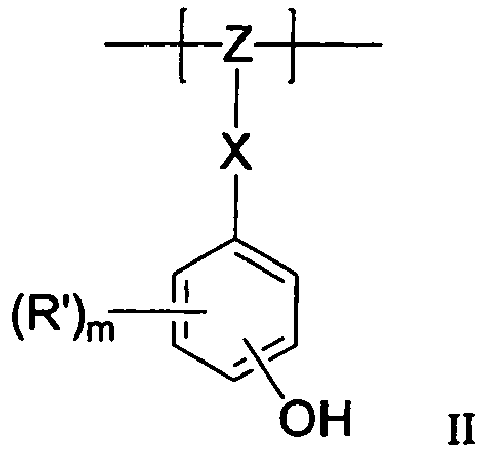
- polymers comprising repeat units that comprise a structure of the following Formula II: wherein in Formula II, Z is a bridge unit; X is one or more atoms; each R 1 is the same or different non-hydrogen substituent; and m is an integer of from zero (where no R 1 substituents are present) to 4.
- Preferred polymers may comprise additional repeat units distinct from spaced phenolic units such as those of Formulae I and II above, i.e. preferred polymers of the invention include copolymers, terpolymers, tetrapolymers, pentapolymers and other higher order polymers. Polymers of the invention can be particularly suitable for use as a resin component of a photoresist composition.
- preferred monomers produced by methods of the invention include those of the following Formula I: wherein R is hydrogen or optionally substituted alkyl such as optionally substituted C 1-6 alkyl, and R is preferably hydrogen or methyl.
- Particularly preferred monomers produced by methods of the invention include the following phenolic methacrylates (i), (ii) and (iii):
- a vinyl acid anhydride which can be employed as reagent 2 in Scheme 1 above. More particularly, an acrylate acid 4 can be reacted with an acid anhydride 5, preferably in the presence of a further acid to provide a vinyl acid anhydride 6 to yield a phenolic methacrylate compound 3.
- an acrylate acid 4 can be reacted with an acid anhydride 5, preferably in the presence of a further acid to provide a vinyl acid anhydride 6 to yield a phenolic methacrylate compound 3.
- R is the same as defined in Formula (I) above.
- a particularly preferred synthesis of Scheme 2 is exemplified in Example 2 below.
- the two-step process outlined in Scheme 3 can provide several notable advantages including use of comparatively inexpensive reagents (e.g., Ac 2 O). Additionally, the process of Scheme 3 can facilitate synthesis of the acrylate compound 11, i.e. where R of compound 11 is hydrogen
- Polymers of the invention can be prepared by a variety of methods.
- polymers of the invention may be suitably formed by an addition reaction which may include free radical polymerization, e.g., by reaction of selected monomers (one of which includes a phenolic acrylate compound) to provide the various units as desired in the presence of a radical initiator under an inert atmosphere (e.g., N 2 or argon) and at elevated temperatures such as 70°C or greater, although reaction temperatures may vary depending on the reactivity of the particular reagents employed and the boiling point of the reaction solvent (if a solvent is employed).
- Suitable reaction solvents include e.g. tetrahydrofuran and ethyl lactate.
- Suitable reaction temperatures for any particular system can be readily determined empirically by those skilled in the art based on the present disclosure.
- a variety of free radical initiators may be employed.
- azo compounds may be employed such as azo-bis-2,4-dimethylpentanenitrile.
- Peroxides, peresters, peracids and persulfates also could be employed. See the examples which follow for exemplary reagents and reaction conditions.
- Suitable monomers for reaction to provide copolymers and other higher order polymers (e.g. terpolymers, tetrapolymers) of the invention include optionally substituted vinyl phenyl, optionally substituted styrene, optionally substituted alpha-methyl styrene, methacrylonitrile, acrylonitrile, 2-methyladamantylmethacrylate, 2-methyladamantylacrylate, or an alpha-butyrolactone methacrylate.
- monomers that can be reacted to provide a polymer of the invention can be identified by those skilled in the art.
- corresponding monomers can be reacted such as t-butymethacrylate, t-butylacrylate, t-butoxy methacrylate, t-butylmethacrylate; and ethoxyethyl methacrylate; to provide pendant acid groups corresponding monomers acid monomers can be reacted such as methacrylic acid and acrylic acid; and dissolution enhancers such as anhydrides which may be provided by reaction of suitable monomers such as itaconic anhydride and maleic anhydride.
- Polymers of the invention suitably may have a wide ranges of molecular weights and molecular weight distributions.
- a polymer of the invention suitably may have a weight average molecular weight (M w ) of 1,000 to 100,000, more preferably 2,000 to 30,000, still more preferably from 2,000 to 15,000 or 20,000, with a molecular weight distribution (M w /M n ) of 3 or less, more preferably a molecular weight distribution of 2 or less.
- M w weight average molecular weight
- M w weight distribution
- M w molecular weight distribution
- moieties described herein including moieties of polymers and monomers may be optionally substituted.
- a "substituted" group may be substituted at one or more available positions, typically 1, 2, or 3 positions by one or more suitable groups such as e.g. halogen (particularly F, CI or Br); cyano; nitro; C 1-6 alkyl sulfonyl such as mesyl; C 1-8 alkyl; C 1-8 alkoxy; C 2-8 alkenyl; C 2-8 alkynyl; hydroxyl; alkanoyl such as a C 1-6 alkanoyl e.g. acyl.
- suitable groups such as e.g. halogen (particularly F, CI or Br); cyano; nitro; C 1-6 alkyl sulfonyl such as mesyl; C 1-8 alkyl; C 1-8 alkoxy; C 2-8 alkenyl; C 2-8 alkynyl; hydroxyl; alkanoyl
- Polymers that comprises a polymerized monomer as disclosed herein can be particularly as a component of a photoresist composition, such as a chemically-amplified photoresist that is imaged with 248 nm exposure radiation.
- a photoresist composition such as a chemically-amplified photoresist that is imaged with 248 nm exposure radiation.
- Such polymers may suitably comprise pendant alkyl ester or acetal polymer groups that can undergo photo-induced cleavage provide solubility differentials between exposed and unexposed areas of a resist coating layer.
- Photoresists also generally contain a photoactive components such as one or more photoacid generators (i.e. "PAG”) that are suitably employed in an amount sufficient to generate a latent image in a coating layer of the resist upon exposure to activating radiation.
- Suitable photoacid generators include imidosulfonates such as compounds of the following formula: wherein R is camphor, adamantane, alkyl (e.g. C 1-12 alkyl) and perfluoroalkyl such as perfluoro(C 1.2 alkyl), particularly perfluorooctanesulfonate and perfluorononanesulfonate.
- a specifically preferred PAG is N-[(perfluorooctanesulfonyl)oxy]-5-norbornene-2,3-dicarboximide.
- photoresist additives include an added base such as an ammonium compound, which can enhance resolution of a developed resist relief image.
- Acetic anhydride was added by dropwise addition to an excess of methacrylic acid (4:1) while simultaneously distilling acetic anhydride from the mixture.
- the reaction was carried out at 95Oc and 300 mmHg, catalyzed by 1 mole% amberlyst-15 (A-15), and inhibited with 3000 ppm PTZ and 1000 MEHQ pppm, 8% O 2 ..
- A-15 1 mole% amberlyst-15
- MEHQ pppm 3000 ppm PTZ and 1000 MEHQ pppm, 8% O 2 .
- excess methacrylic acid was recovered by distillation under reduced pressure and the catalyst was recovered by filtration.
- Example 2 Monomer synthesis; preparation of hydroxyphenyl methacrylate
- Example 3 Monomer synthesis; preparation of hydroxyphenyl methacrylate through mono-ester intermediate
- a large excess of hydroquinone is reacted with acetic acid anhydride in the presence of acetic acid to provide the mono-acetate phenolic compound 1,4-C 6 H 4 (OH)(OOCCH 3 )-Excess starting materials are recovered, and the intermediate compound 1,4-C 6 H 4 (OH)(OOCCH 3 ) is reacted with methacylic acid in the presence of acetic acid to provide hydroxyphenyl methacrylate.
- the solution was held for 2 hours at reflux, after which another charge of initiator was added to the flask (0.77 g, 0.003 mol) in methanol (9 mL). The solution was held at reflux for 16 hours. After cooling, the polymer solution in methanol was washed with heptanes (3 x 300 mL). The solution was concentrated on a rotary evaporator to remove residual heptanes and then precipitated into DI water (2 liters). The wet cake was air dried for 24 hours and then dried at 60°C under vacuum for 18 hours. The yield was 90 %.
- Example 5-6 Additional polymer synthesis
- HPhMA:MMA:TBA terpolymers were prepared by the procedures of Example 3 above, but varying amount of monomers employed.
- Table 1 which follows Example 9, the ratio of each of the monomer units (as determined by 13 C NMR analysis of the formed polymer), weight average molecular weight (Mw) and polydispersity (PD) are provided for the HPhMA:MMA:TBA terpolymers formed in Examples 5 and 6.
- the solution was held for 2 hours at reflux, after which another charge of initiator was added to the flask (0.87 g, 0.004 mol) in methanol (10 mL). The solution was held at reflux for 16 hours. After cooling, the polymer solution in methanol was washed with heptanes (3 x 300 mL). The solution was concentrated on a rotary evaporator to remove residual heptanes an then precipitated into DI water (2.5 liters). The wet cake was air dried for 24 hours and then dried at 60°C under vacuum for 18 hours. The yield was 90 %.
- Example 8-9 Additional polymer synthesis
- HPhMA:STY:TBA terpolymers were prepared by the procedures of Example 6 above, but varying amount of monomers employed.
- Table 1 the ratio of each of the monomer units (as determined by 13 C NMR analysis of the formed polymer), weight average molecular weight (Mw) and polydispersity (PD) are provided for the HPhMA:STY:TBA terpolymers formed in Examples 7 and 8.
- Table 1 Polymer Characterization Example Polymer Description Composition (13C-NMR) Mw PD 4 HPhMA/MMA/TBA 32/51/17 15400 2.7 5 HPhMA/MMA/TBA 42/40/18 18300 2.9 6 HPhMA/MMA/TBA 55/27/18 20200 3.1 7 HPhMA/STY/TBA 44/26/30 15300 2.6 8 HPhMA/STY/TBA 50/34/16 13100 2.3 9 HPhMA/STY/TBA 54/33/13 13700 2.3
- Example 10 Photoresist preparation and lithographic processing
- a photoresist of the invention is prepared by admixing the following components in the specified amounts: Resist component Amount Resin to provide 11.4 wt.% total solids liquid formulation Photoacid generator 3.5 wt. % of resin component Basic additive 0.1 wt. % of polymer Surfactant 0.05 wt. % of total solids.
- the polymer is a HPhMA:MMA:TBA terpolymer prepared as described in Example 4 above.
- the photoacid generator of the resist is di-tertbutylphenyliodonium camphorsulfonate.
- the basic additive is the lactate salt of tetremethylammoniium hydroxide.
- the surfactant is the commercially available material sold under the name R08.
- the solvent is ethyl lactate.
- That photoresist composition is spin coated onto 200 mm silicon wafers having a coating of an organic antireflective composition.
- the applied photoresist later is soft-baked at 90°C for 60 seconds and exposed through a photomask to 248 nm radiation.
- the exposed resist coating layer is then baked at 100°C for 90 seconds and developed using an alkaline aqueous developer.
Landscapes
- Chemical & Material Sciences (AREA)
- Organic Chemistry (AREA)
- Health & Medical Sciences (AREA)
- Chemical Kinetics & Catalysis (AREA)
- Medicinal Chemistry (AREA)
- Polymers & Plastics (AREA)
- Organic Low-Molecular-Weight Compounds And Preparation Thereof (AREA)
- Addition Polymer Or Copolymer, Post-Treatments, Or Chemical Modifications (AREA)
- Materials For Photolithography (AREA)
Abstract
Description
- In one aspect, the present invention relates to new syntheses of phenolic acrylate monomers. In another aspect, the invention relates to polymers comprising such phenolic acrylate monomers.
- Photoresists are photosensitive films used for transfer of images to a substrate. A coating layer of a photoresist is formed on a substrate and the photoresist layer is then exposed through a photomask to a source of activating radiation. The photomask has areas that are opaque to activating radiation and other areas that are transparent to activating radiation. Exposure to activating radiation provides a photoinduced chemical transformation of the photoresist coating to thereby transfer the pattern of the photomask to the photoresist-coated substrate. Following exposure, the photoresist is developed to provide a relief image that permits selective processing of a substrate.
- Photoresists are of interest that can be photoimaged with short wavelength radiation, including exposure radiation of 270 nm or less, such as wavelengths of 248 nm (provided by KrF laser). Use of such short exposure wavelengths can enable formation of smaller features. Accordingly, a photoresist that yields well-resolved images upon 248 nm exposure could enable formation of extremely small (e.g. sub-0.25 µm) features that respond to constant industry demands for smaller dimension circuit patterns, e.g. to provide greater circuit density and enhanced device performance.
- While a variety of factors are involved in generating a highly resolved photoresist relief image, the resin component of a resist can have significant impact. Numerous efforts have been made to produce new resist polymers and monomers. SPIE, vol. 1466 Advances in Resist Technology and Processing (1991).
- We have now found new syntheses of phenolic monomers and polymers that comprise such monomers.
- More particularly, in one aspect, syntheses are provided for phenolic acrylate compounds such as those of the following Formula I:

- In another aspect, synthetic methods of the invention may suitably comprise reaction of a polyhydroxy phenyl compound such as a hydroquinone (C6H4-1-4-(OH)2), catechol (C6H4-1-2-(OH)2) or resorcinol (C6H4-1-4-(OH2) with an acrylate anhydride such as methacrylic acid anhydride or acrylic acid anhydride. Preferably, the reaction is run in the presence of acid. In particular systems, an acrylate acid is employed such as methacrylic acid or acrylic acid. Suitably, the acid can serve as a solvent for the phenolic and anhydride reagents. Such systems can afford notable advantages including a reduced waste stream and the ability to recover unused reagents.
- In a further aspect, an admixture of anhydride and acid for use in such synthetic methods is provided by reaction of an acid anhydride with an acrylic acid such as methacrylic acid or acrylic acid. In preferred systems, an acid anhydride such as acetic acid anhydride is reacted with a molar excess of an acrylic acid with removal such as by distillation of the lower molecular weight anhydride reaction product (i.e. acid).
- In a yet further aspect, synthetic methods of the invention include use of a phenolic acrylate intermediate which undergoes an acid-ester exchange reaction to provide a phenolic acrylate compound. More particularly, a polyhydroxy phenyl compound such as a hydroquinone, catechol or resorcinol is reacted preferably in molar excess with an anhydride such as acetic anhydride to provide a phenyl compound comprising a hydroxyl group and an ester group (e.g. C6H4(OH)(ester)) including a monoacetate phenolic intermediate (e.g. (C6H4(OH)((OOCCH3)) which then can be subjected to an acid-ester exchange by reaction with a suitable acid such as methacrylic acid or acrylic acid.
- In a still further aspect, methods are provided for producing polymers using a monomer as described herein. Thus, a phenolic acrylate monomer is produced as disclosed herein and then reacted with one or more other monomers to provide the polymer.
- In certain preferred aspects of the invention, methods to prepare polymers are provided where the polymer comprises repeat units that comprise a structure of the following Formula II:
- Methods are further provided to prepare polymers that comprise repeat units that comprise a structure of the following Formula III:

- Preferred polymers may comprise additional repeat units distinct from spaced phenolic units such as those of Formulae I and II above, i.e. preferred polymers of the invention include copolymers, terpolymers, tetrapolymers, pentapolymers and other higher order polymers. Polymers of the invention can be particularly suitable for use as a resin component of a photoresist composition.
- Other aspects of the invention are disclosed infra.
- As discussed, preferred monomers produced by methods of the invention include those of the following Formula I:

- Particularly preferred monomers produced by methods of the invention include the following phenolic methacrylates (i), (ii) and (iii):


- As discussed above and outlined in the exemplary Scheme 1, in one aspect, methods are provided which include reaction of a polyhydroxy phenyl compound such as hydroquinone 1 shown in Scheme 1 with a vinyl acid anhydride 2 in the presence of acid to provide a phenolic methacrylate compound 3. In Scheme 1 above, the depicted "R" is the same as defined in Formula (I) above. A particularly preferred synthesis of Scheme 1 is exemplified in Example 1 below.

- As outlined in the exemplary Scheme 2, in another aspect, methods are provided to produce a vinyl acid anhydride, which can be employed as reagent 2 in Scheme 1 above. More particularly, an acrylate acid 4 can be reacted with an acid anhydride 5, preferably in the presence of a further acid to provide a vinyl acid anhydride 6 to yield a phenolic methacrylate compound 3. In Scheme 2 above, the depicted "R" is the same as defined in Formula (I) above. A particularly preferred synthesis of Scheme 2 is exemplified in Example 2 below.

- As discussed above and outlined in the exemplary Scheme 3, in a further aspect, methods are provided where a polyhydroxy compound 7 is reacted with an acid anhydride 8 preferably in the presence of acid to provide mono-ester phenolic intermediate 9. If desired, excess starting materials may be recovered, and compound 9 is then reacted with acrylate acid 10 preferably in the presence of a further acid to provide phenolic methacrylate compound 11. In Scheme 3 above, the depicted "R" is the same as defined in Formula (I) above. A particularly preferred synthesis of Scheme 3 is exemplified in Example 3 below.
- The two-step process outlined in Scheme 3 can provide several notable advantages including use of comparatively inexpensive reagents (e.g., Ac2O). Additionally, the process of Scheme 3 can facilitate synthesis of the acrylate compound 11, i.e. where R of compound 11 is hydrogen
- Polymers of the invention can be prepared by a variety of methods. In particular, polymers of the invention may be suitably formed by an addition reaction which may include free radical polymerization, e.g., by reaction of selected monomers (one of which includes a phenolic acrylate compound) to provide the various units as desired in the presence of a radical initiator under an inert atmosphere (e.g., N2 or argon) and at elevated temperatures such as 70°C or greater, although reaction temperatures may vary depending on the reactivity of the particular reagents employed and the boiling point of the reaction solvent (if a solvent is employed). Suitable reaction solvents include e.g. tetrahydrofuran and ethyl lactate. Suitable reaction temperatures for any particular system can be readily determined empirically by those skilled in the art based on the present disclosure. A variety of free radical initiators may be employed. For example, azo compounds may be employed such as azo-bis-2,4-dimethylpentanenitrile. Peroxides, peresters, peracids and persulfates also could be employed. See the examples which follow for exemplary reagents and reaction conditions.
- Suitable monomers for reaction to provide copolymers and other higher order polymers (e.g. terpolymers, tetrapolymers) of the invention include optionally substituted vinyl phenyl, optionally substituted styrene, optionally substituted alpha-methyl styrene, methacrylonitrile, acrylonitrile, 2-methyladamantylmethacrylate, 2-methyladamantylacrylate, or an alpha-butyrolactone methacrylate.
- Other monomers that can be reacted to provide a polymer of the invention can be identified by those skilled in the art. For example, to provide acid labile groups, corresponding monomers can be reacted such as t-butymethacrylate, t-butylacrylate, t-butoxy methacrylate, t-butylmethacrylate; and ethoxyethyl methacrylate; to provide pendant acid groups corresponding monomers acid monomers can be reacted such as methacrylic acid and acrylic acid; and dissolution enhancers such as anhydrides which may be provided by reaction of suitable monomers such as itaconic anhydride and maleic anhydride.
- Polymers of the invention suitably may have a wide ranges of molecular weights and molecular weight distributions. For instance, a polymer of the invention suitably may have a weight average molecular weight (Mw) of 1,000 to 100,000, more preferably 2,000 to 30,000, still more preferably from 2,000 to 15,000 or 20,000, with a molecular weight distribution (Mw/Mn) of 3 or less, more preferably a molecular weight distribution of 2 or less. Molecular weights (either Mw or Mn) of the polymers of the invention are suitably determined by gel permeation chromatography.
- As discussed, various moieties described herein, including moieties of polymers and monomers may be optionally substituted. A "substituted" group may be substituted at one or more available positions, typically 1, 2, or 3 positions by one or more suitable groups such as e.g. halogen (particularly F, CI or Br); cyano; nitro; C1-6alkyl sulfonyl such as mesyl; C1-8 alkyl; C1-8 alkoxy; C2-8 alkenyl; C2-8 alkynyl; hydroxyl; alkanoyl such as a C1-6 alkanoyl e.g. acyl.
- Polymers that comprises a polymerized monomer as disclosed herein can be particularly as a component of a photoresist composition, such as a chemically-amplified photoresist that is imaged with 248 nm exposure radiation. Such polymers may suitably comprise pendant alkyl ester or acetal polymer groups that can undergo photo-induced cleavage provide solubility differentials between exposed and unexposed areas of a resist coating layer.
- Photoresists also generally contain a photoactive components such as one or more photoacid generators (i.e. "PAG") that are suitably employed in an amount sufficient to generate a latent image in a coating layer of the resist upon exposure to activating radiation. Suitable photoacid generators include imidosulfonates such as compounds of the following formula:

- Other optional photoresist additives include an added base such as an ammonium compound, which can enhance resolution of a developed resist relief image.
- Use of photoresists in general is known such as described in
U.S. Patent 7,105,266 . - The following non-limiting examples are illustrative of the invention.
- Acetic anhydride was added by dropwise addition to an excess of methacrylic acid (4:1) while simultaneously distilling acetic anhydride from the mixture. The reaction was carried out at 95Oc and 300 mmHg, catalyzed by 1 mole% amberlyst-15 (A-15), and inhibited with 3000 ppm PTZ and 1000 MEHQ pppm, 8% O2.. At the end of the reaction, excess methacrylic acid was recovered by distillation under reduced pressure and the catalyst was recovered by filtration.
- To a mechanically stirred solution of 2 moles of hydroxyquinone dissolved in 3 moles of methacrylic acid at 120°C and atmospheric pressure was added dropwise (30 min) 1 mole of methylacrylic acid anhydride and the mixture was maintaned at 120°C with stirring for additional 4 hrs (NMR analysis). Throughout the course of the reaction 8% oxygen was admitted to the system. At the end of the reaction, the methacrylic acid was recovered by distillation under reduced pressure (110°C and 200 mmHg), and the unreacted excess hydroquinone was precipitated out by the addition of toluene (1 liter) to the reaction mixture. A low level (1-2%) of the monomer 2-methyl-5-methylenehexanedioic acid was formede. This monomer was separated from the mixture by a washing step with distilled water. After phase separation, the desired 4-hydroxyphenyl methacrylate was obtained at 97% yield by the distillation of toluene under reduced pressure. {mp. (Uncorrected) 120°C; Anal. Calcd. For C10H10O3: C, 67.41 : H, 5.66 ; O, 26.94. Found: C, 67.37 ; H, 5,62}.
- A large excess of hydroquinone is reacted with acetic acid anhydride in the presence of acetic acid to provide the mono-acetate phenolic compound 1,4-C6H4(OH)(OOCCH3)-Excess starting materials are recovered, and the intermediate compound 1,4-C6H4(OH)(OOCCH3) is reacted with methacylic acid in the presence of acetic acid to provide hydroxyphenyl methacrylate.
-

- To a 500 mL, 3 neck round bottom flask equipped with a condenser, thermometer, magnetic stirrer and external oil heating bath, was added the following: 4-hydroxyphenyl methacrylate (HPhMA) (16.56 g, 0.093 mol), methyl methacrylate (MMA) (15.54 g, 0.155 mol), and tert-butyl acrylate (TBA) (7.95 g, 0.062 mol). Methanol (270 mL) was added and the resulting solution heated to reflux (67°C). Once at reflux, a solution of initiator 2,2'-azobis-2,4-dimethylpentanenitrile (1.54 g, 0.006 mol) in methanol (17.5 mL). The solution was held for 2 hours at reflux, after which another charge of initiator was added to the flask (0.77 g, 0.003 mol) in methanol (9 mL). The solution was held at reflux for 16 hours. After cooling, the polymer solution in methanol was washed with heptanes (3 x 300 mL). The solution was concentrated on a rotary evaporator to remove residual heptanes and then precipitated into DI water (2 liters). The wet cake was air dried for 24 hours and then dried at 60°C under vacuum for 18 hours. The yield was 90 %.
- Additional HPhMA:MMA:TBA terpolymers were prepared by the procedures of Example 3 above, but varying amount of monomers employed. In Table 1 below which follows Example 9, the ratio of each of the monomer units (as determined by 13C NMR analysis of the formed polymer), weight average molecular weight (Mw) and polydispersity (PD) are provided for the HPhMA:MMA:TBA terpolymers formed in Examples 5 and 6.
-

- To a 500 mL, 3 neck round bottom flask equipped with a condenser, thermometer, magnetic stirrer and external oil heating bath, was added the following: 4-hydroxyphenyl methacrylate (HPhMA) (27.94 g, 0.157 mol), styrene (STY) (10.89 g, 0.105 mol), and tert-butyl acrylate (TBA) (11.17 g, 0.087 mol). Methanol (340 mL) was added and the resulting solution heated to reflux (67°C). Once at reflux, a solution of initiator 2,2'-azobis-2,4-dimethylpentanenitrile (1.73 g, 0.007 mol) in methanol (20 mL). The solution was held for 2 hours at reflux, after which another charge of initiator was added to the flask (0.87 g, 0.004 mol) in methanol (10 mL). The solution was held at reflux for 16 hours. After cooling, the polymer solution in methanol was washed with heptanes (3 x 300 mL). The solution was concentrated on a rotary evaporator to remove residual heptanes an then precipitated into DI water (2.5 liters). The wet cake was air dried for 24 hours and then dried at 60°C under vacuum for 18 hours. The yield was 90 %.
- Additional HPhMA:STY:TBA terpolymers were prepared by the procedures of Example 6 above, but varying amount of monomers employed. In Table 1 below, the ratio of each of the monomer units (as determined by 13C NMR analysis of the formed polymer), weight average molecular weight (Mw) and polydispersity (PD) are provided for the HPhMA:STY:TBA terpolymers formed in Examples 7 and 8.
Table 1: Polymer Characterization Example Polymer Description Composition (13C-NMR) Mw PD 4 HPhMA/MMA/TBA 32/51/17 15400 2.7 5 HPhMA/MMA/TBA 42/40/18 18300 2.9 6 HPhMA/MMA/TBA 55/27/18 20200 3.1 7 HPhMA/STY/TBA 44/26/30 15300 2.6 8 HPhMA/STY/TBA 50/34/16 13100 2.3 9 HPhMA/STY/TBA 54/33/13 13700 2.3 - A photoresist of the invention is prepared by admixing the following components in the specified amounts:
Resist component Amount Resin to provide 11.4 wt.% total solids liquid formulation Photoacid generator 3.5 wt. % of resin component Basic additive 0.1 wt. % of polymer Surfactant 0.05 wt. % of total solids. - In that resist, the polymer is a HPhMA:MMA:TBA terpolymer prepared as described in Example 4 above. The photoacid generator of the resist is di-tertbutylphenyliodonium camphorsulfonate. The basic additive is the lactate salt of tetremethylammoniium hydroxide. The surfactant is the commercially available material sold under the name R08. The solvent is ethyl lactate.
- That photoresist composition is spin coated onto 200 mm silicon wafers having a coating of an organic antireflective composition. The applied photoresist later is soft-baked at 90°C for 60 seconds and exposed through a photomask to 248 nm radiation. The exposed resist coating layer is then baked at 100°C for 90 seconds and developed using an alkaline aqueous developer.
Claims (4)
- A method for producing a phenolic acrylate compound, comprising:(a) reacting a polyhydroxy phenyl compound with acetic anhydride to provide an intermediate phenyl compound comprising ring substituents of hydroxyl and ester moieties;(b) reacting the intermediate phenyl compound with an acrylate ester or acrylate acid compound to provide a phenolic acrylate compound.
- The method of claim 1 wherein hydroquinone, catechol or resorcinol is reacted with acetic anhydride and the intermediate phenyl compound is reacted with methacrylic acid or acrylic acid.
- The method of claim 1 wherein the intermediate phenyl compound is C6H4(OH)(ester).
- The method of claim 1 further comprising reacting the phenolic acrylate compound with one or more other monomers to provide a polymer.
Applications Claiming Priority (2)
| Application Number | Priority Date | Filing Date | Title |
|---|---|---|---|
| US90644507P | 2007-03-12 | 2007-03-12 | |
| EP08250808A EP1970367A3 (en) | 2007-03-12 | 2008-03-10 | Method for producing hydroxyphenyl acrylate monomers and polymers |
Related Parent Applications (2)
| Application Number | Title | Priority Date | Filing Date |
|---|---|---|---|
| EP08250808A Division EP1970367A3 (en) | 2007-03-12 | 2008-03-10 | Method for producing hydroxyphenyl acrylate monomers and polymers |
| EP08250808A Previously-Filed-Application EP1970367A3 (en) | 2007-03-12 | 2008-03-10 | Method for producing hydroxyphenyl acrylate monomers and polymers |
Publications (1)
| Publication Number | Publication Date |
|---|---|
| EP2829532A1 true EP2829532A1 (en) | 2015-01-28 |
Family
ID=39467239
Family Applications (2)
| Application Number | Title | Priority Date | Filing Date |
|---|---|---|---|
| EP14185013.1A Withdrawn EP2829532A1 (en) | 2007-03-12 | 2008-03-10 | Hydroxyphenyl acrylate monomers and polymers |
| EP08250808A Withdrawn EP1970367A3 (en) | 2007-03-12 | 2008-03-10 | Method for producing hydroxyphenyl acrylate monomers and polymers |
Family Applications After (1)
| Application Number | Title | Priority Date | Filing Date |
|---|---|---|---|
| EP08250808A Withdrawn EP1970367A3 (en) | 2007-03-12 | 2008-03-10 | Method for producing hydroxyphenyl acrylate monomers and polymers |
Country Status (6)
| Country | Link |
|---|---|
| US (1) | US20080227942A1 (en) |
| EP (2) | EP2829532A1 (en) |
| JP (1) | JP5032362B2 (en) |
| KR (2) | KR101173089B1 (en) |
| CN (3) | CN102320961A (en) |
| TW (1) | TW200848399A (en) |
Families Citing this family (14)
| Publication number | Priority date | Publication date | Assignee | Title |
|---|---|---|---|---|
| US8376525B2 (en) * | 2006-09-08 | 2013-02-19 | Canon Kabushiki Kaisha | Liquid discharge head and method of manufacturing the same |
| JP5260094B2 (en) * | 2007-03-12 | 2013-08-14 | ローム・アンド・ハース・エレクトロニック・マテリアルズ,エル.エル.シー. | Phenolic polymer and photoresist containing the same |
| JP5489417B2 (en) * | 2008-04-23 | 2014-05-14 | 東京応化工業株式会社 | Positive resist composition and resist pattern forming method |
| ATE553920T1 (en) | 2009-06-18 | 2012-05-15 | Agfa Graphics Nv | LITHOGRAPHY PRINTING PLATE PRECURSOR |
| CN102201333B (en) * | 2009-12-15 | 2014-04-30 | 罗门哈斯电子材料有限公司 | Photoresists and methods for use thereof |
| WO2013015055A1 (en) * | 2011-07-25 | 2013-01-31 | 昭和電工株式会社 | Method for producing aromatic diol mono(meth)acrylate |
| JP2014237847A (en) * | 2014-08-20 | 2014-12-18 | 三菱レイヨン株式会社 | Polymer for semiconductor lithography and method for producing the same |
| CN104496817A (en) * | 2014-11-24 | 2015-04-08 | 张家港保税区鑫和成国际贸易有限公司 | Bifunctional acrylate monomer obtained via photopolymerization and preparation method thereof |
| TWI662370B (en) * | 2015-11-30 | 2019-06-11 | Rohm And Haas Electronic Materials Korea Ltd. | Coating compositions for use with an overcoated photoresist |
| EP3544949A1 (en) | 2016-11-23 | 2019-10-02 | Rohm and Haas Company | Preparation of phenolic (meth)acrylates |
| KR102662535B1 (en) * | 2018-12-21 | 2024-04-30 | 주식회사 엘지화학 | Photoresist resin composition, photoresist, color filter and display device |
| KR102594846B1 (en) * | 2018-12-21 | 2023-10-26 | 주식회사 엘지화학 | Compound, photosensitive resin composition, photoresist, color filter and display device |
| CN111138280A (en) * | 2019-12-24 | 2020-05-12 | 上海博栋化学科技有限公司 | Photoresist resin monomer synthesized from 3-ethylbicyclo [3.3.1] nonane-2, 4-diketone and synthesis method thereof |
| KR102868118B1 (en) * | 2022-09-29 | 2025-10-13 | 송원산업 주식회사 | Photosensitive compound for photoresist and method for manufacturing thereof |
Citations (4)
| Publication number | Priority date | Publication date | Assignee | Title |
|---|---|---|---|---|
| US3629197A (en) * | 1969-04-01 | 1971-12-21 | Du Pont | Monomers and polymers of acryloyloxyphenol and derivatives thereof |
| EP1231201A1 (en) * | 2001-02-09 | 2002-08-14 | Röhm GmbH & Co. KG | Process for the preparation of anhydrides of unsaturated carboxylic acids |
| EP1273565A1 (en) * | 2001-07-06 | 2003-01-08 | Atofina | Process for the preparation of (meth)acrylic anhydride |
| EP1574524A1 (en) * | 2004-03-09 | 2005-09-14 | Ivoclar Vivadent AG | Dental material with improved compatibility |
Family Cites Families (6)
| Publication number | Priority date | Publication date | Assignee | Title |
|---|---|---|---|---|
| JPS4934667B1 (en) * | 1969-06-30 | 1974-09-17 | ||
| US3639197A (en) | 1969-10-08 | 1972-02-01 | Monsanto Co | Carbon composite structure including a band of helically wound carbon fibers |
| WO2002020454A1 (en) * | 2000-09-08 | 2002-03-14 | Mitsubishi Rayon Co., Ltd. | Process for producing (meth)acrylic anhydride and process for producing (meth)acrylic ester |
| KR100453590B1 (en) * | 2001-10-17 | 2004-10-20 | 주식회사 바이오랜드 | Mono carbonylation of Benzene diols |
| JP2004029437A (en) * | 2002-06-26 | 2004-01-29 | Toray Ind Inc | Positive radiation-sensitive composition |
| JP5260094B2 (en) * | 2007-03-12 | 2013-08-14 | ローム・アンド・ハース・エレクトロニック・マテリアルズ,エル.エル.シー. | Phenolic polymer and photoresist containing the same |
-
2008
- 2008-02-22 JP JP2008042199A patent/JP5032362B2/en not_active Expired - Fee Related
- 2008-02-26 TW TW097106563A patent/TW200848399A/en unknown
- 2008-03-07 US US12/074,946 patent/US20080227942A1/en not_active Abandoned
- 2008-03-10 EP EP14185013.1A patent/EP2829532A1/en not_active Withdrawn
- 2008-03-10 EP EP08250808A patent/EP1970367A3/en not_active Withdrawn
- 2008-03-11 CN CN2011102218727A patent/CN102320961A/en active Pending
- 2008-03-11 CN CN2011102218750A patent/CN102311333A/en active Pending
- 2008-03-11 KR KR1020080022353A patent/KR101173089B1/en not_active Expired - Fee Related
- 2008-03-11 CN CNA2008100837947A patent/CN101289388A/en active Pending
-
2010
- 2010-12-27 KR KR1020100135189A patent/KR20110004831A/en not_active Withdrawn
Patent Citations (4)
| Publication number | Priority date | Publication date | Assignee | Title |
|---|---|---|---|---|
| US3629197A (en) * | 1969-04-01 | 1971-12-21 | Du Pont | Monomers and polymers of acryloyloxyphenol and derivatives thereof |
| EP1231201A1 (en) * | 2001-02-09 | 2002-08-14 | Röhm GmbH & Co. KG | Process for the preparation of anhydrides of unsaturated carboxylic acids |
| EP1273565A1 (en) * | 2001-07-06 | 2003-01-08 | Atofina | Process for the preparation of (meth)acrylic anhydride |
| EP1574524A1 (en) * | 2004-03-09 | 2005-09-14 | Ivoclar Vivadent AG | Dental material with improved compatibility |
Also Published As
| Publication number | Publication date |
|---|---|
| EP1970367A3 (en) | 2011-07-06 |
| KR20080083588A (en) | 2008-09-18 |
| JP5032362B2 (en) | 2012-09-26 |
| TW200848399A (en) | 2008-12-16 |
| CN101289388A (en) | 2008-10-22 |
| KR101173089B1 (en) | 2012-08-13 |
| CN102320961A (en) | 2012-01-18 |
| EP1970367A2 (en) | 2008-09-17 |
| JP2008273929A (en) | 2008-11-13 |
| US20080227942A1 (en) | 2008-09-18 |
| KR20110004831A (en) | 2011-01-14 |
| CN102311333A (en) | 2012-01-11 |
Similar Documents
| Publication | Publication Date | Title |
|---|---|---|
| US20080227942A1 (en) | Hydroxyphenyl acrylate monomers and polymers | |
| TWI474115B (en) | Positive resist composition, method of forming resist pattern, polymer compound | |
| US6610456B2 (en) | Fluorine-containing styrene acrylate copolymers and use thereof in lithographic photoresist compositions | |
| KR100735889B1 (en) | Novel polymers and photoresist compositions comprising same | |
| TWI449717B (en) | Positive resist composition, method of forming resist pattern | |
| KR101604623B1 (en) | Acrylate ester derivatives and polymer comounds | |
| JP3784051B2 (en) | Lithographic photoresist composition and image forming method using the same | |
| US20020058199A1 (en) | Novel polymers and photoresist compositions comprising electronegative groups | |
| TWI394005B (en) | Positive resist composition, method of forming resist pattern, and polymeric compound | |
| JP2001272783A (en) | Photoresist composition | |
| TWI493290B (en) | Low outgassing photoresist compositions | |
| US6841331B2 (en) | Polymers, processes for polymer synthesis and photoresist compositions | |
| US8771921B2 (en) | Negative resist composition, method of forming resist pattern and polymeric compound | |
| KR20010088359A (en) | Novel copolymers and photoresist compositions comprising same | |
| JP4080916B2 (en) | Copolymer for chemically amplified resist | |
| EP1790645A1 (en) | Lactone compound, lactone-containing monomer, polymer of those, resist composition using same, method for forming pattern using same | |
| TWI471700B (en) | A positive resist composition, a photoresist pattern formation method, and a polymer compound | |
| WO2011086933A1 (en) | Bicyclohexane derivative and production method for same | |
| TWI476529B (en) | A method for forming a positive resistive composition and a photoresist pattern | |
| WO2024248136A1 (en) | Copolymer, polymer for water-repellent agent, composition for forming water-repellent film, resin film, and method for forming resist pattern | |
| WO2024248135A1 (en) | Fluorine-containing polymer, composition for forming fluorine-containing resin film, fluorine-containing resin film, composition for forming resist pattern, method for forming resist pattern, composition for forming resist upper layer film, method for decomposing fluorine-containing polymer, fluorine-containing polymerizable monomer, compound, and method for producing fluorine-containing polymerizable monomer | |
| TWI388928B (en) | Cyanoadamantyl compounds and polymers | |
| US20030031949A1 (en) | Novel polymers and photoresist compositions comprising same | |
| US7820360B2 (en) | Polymer compound, negative resist composition, and method of forming resist pattern | |
| JP4802551B2 (en) | Radiation sensitive resin composition |
Legal Events
| Date | Code | Title | Description |
|---|---|---|---|
| 17P | Request for examination filed |
Effective date: 20140916 |
|
| AC | Divisional application: reference to earlier application |
Ref document number: 1970367 Country of ref document: EP Kind code of ref document: P |
|
| AK | Designated contracting states |
Kind code of ref document: A1 Designated state(s): DE FR GB |
|
| PUAI | Public reference made under article 153(3) epc to a published international application that has entered the european phase |
Free format text: ORIGINAL CODE: 0009012 |
|
| GRAP | Despatch of communication of intention to grant a patent |
Free format text: ORIGINAL CODE: EPIDOSNIGR1 |
|
| INTG | Intention to grant announced |
Effective date: 20161109 |
|
| STAA | Information on the status of an ep patent application or granted ep patent |
Free format text: STATUS: THE APPLICATION IS DEEMED TO BE WITHDRAWN |
|
| 18D | Application deemed to be withdrawn |
Effective date: 20170321 |