EP2829494A1 - Müllbehälter aus zusammengesetzten Platten - Google Patents
Müllbehälter aus zusammengesetzten Platten Download PDFInfo
- Publication number
- EP2829494A1 EP2829494A1 EP20140177584 EP14177584A EP2829494A1 EP 2829494 A1 EP2829494 A1 EP 2829494A1 EP 20140177584 EP20140177584 EP 20140177584 EP 14177584 A EP14177584 A EP 14177584A EP 2829494 A1 EP2829494 A1 EP 2829494A1
- Authority
- EP
- European Patent Office
- Prior art keywords
- container
- panel
- edge
- container according
- ramp
- Prior art date
- Legal status (The legal status is an assumption and is not a legal conclusion. Google has not performed a legal analysis and makes no representation as to the accuracy of the status listed.)
- Withdrawn
Links
Images
Classifications
-
- B—PERFORMING OPERATIONS; TRANSPORTING
- B65—CONVEYING; PACKING; STORING; HANDLING THIN OR FILAMENTARY MATERIAL
- B65F—GATHERING OR REMOVAL OF DOMESTIC OR LIKE REFUSE
- B65F1/00—Refuse receptacles; Accessories therefor
- B65F1/02—Refuse receptacles; Accessories therefor without removable inserts
-
- B—PERFORMING OPERATIONS; TRANSPORTING
- B65—CONVEYING; PACKING; STORING; HANDLING THIN OR FILAMENTARY MATERIAL
- B65F—GATHERING OR REMOVAL OF DOMESTIC OR LIKE REFUSE
- B65F1/00—Refuse receptacles; Accessories therefor
- B65F1/14—Other constructional features; Accessories
- B65F1/1478—Other constructional features; Accessories relating to noise reduction in receptacles during collecting of refuse, e.g. of glass
-
- B—PERFORMING OPERATIONS; TRANSPORTING
- B65—CONVEYING; PACKING; STORING; HANDLING THIN OR FILAMENTARY MATERIAL
- B65F—GATHERING OR REMOVAL OF DOMESTIC OR LIKE REFUSE
- B65F2240/00—Types of refuse collected
- B65F2240/112—Bottles
- B65F2240/1123—Glass
-
- Y—GENERAL TAGGING OF NEW TECHNOLOGICAL DEVELOPMENTS; GENERAL TAGGING OF CROSS-SECTIONAL TECHNOLOGIES SPANNING OVER SEVERAL SECTIONS OF THE IPC; TECHNICAL SUBJECTS COVERED BY FORMER USPC CROSS-REFERENCE ART COLLECTIONS [XRACs] AND DIGESTS
- Y02—TECHNOLOGIES OR APPLICATIONS FOR MITIGATION OR ADAPTATION AGAINST CLIMATE CHANGE
- Y02W—CLIMATE CHANGE MITIGATION TECHNOLOGIES RELATED TO WASTEWATER TREATMENT OR WASTE MANAGEMENT
- Y02W30/00—Technologies for solid waste management
- Y02W30/50—Reuse, recycling or recovery technologies
- Y02W30/60—Glass recycling
Definitions
- containers made of sheet steel are used.
- a sheet typically forms a face, or several sides of the container, the sheet being folded along an edge of this container.
- Containers made of plastic-type or composite materials, for example formed by a thermoplastic or thermosetting material reinforced with fibers, for example glass fibers, are also used.
- the container is sometimes obtained by molding, or roto-molding.
- various molding methods for example the "SMC” or “RIM” or “RTM” processes, for example:
- SMC sheet molding compound
- RIM reaction injection molding
- RTM refers to a process that typically uses a moderate pressure resin transfer in a mold already comprising reinforcing elements.
- thermosetting resin generally polyester, vinylester or epoxy type, but possibly another type of resin, which impregnates for example glass fibers or another reinforcement (for example with 20 to 30% reinforcement weight), sometimes with loads.
- geometries of these containers can be very varied, and cover geometries with plane faces (for example with four or more lateral faces), and / or curves, and in the latter case cylindrical or non-cylindrical, curved or not, etc.
- the various elements of these containers can be assembled together by various known means, for example by welding (for metal containers), by gluing, riveting, crimping, clinching, or by other methods.
- sheets or panels of large width are used, each side wall being formed of a single panel, or by a single sheet.
- Such sheets of large width for example between 100 and 250 cm are little or not self-stable, and difficult to handle and transport, for example difficult to handle by a single man, or even two men.
- a container formed of large sheet metal parts is of relatively low rigidity, and typically relatively sonic. made of the presence of these parts of large sheets.
- the object of the invention is in particular to remedy at least one of these disadvantages and to make it possible, for example, to be able to handle and transport components for making the container more easily, and to obtain an improved stiffness container and / or less sound.
- the invention particularly relates to a waste container with a capacity of at least 1500 liters (1.5 m3), of the type comprising a side wall assembled from at least a first element and a second element , characterized in that the first element comprises a first parietal portion integrally formed with a fin edge of this first parietal portion, the second element comprises a second parietal portion extending in the extension of the first parietal portion, beyond an assembly zone between these two parietal parts, the fin edge extending along the assembly zone and not extending, if necessary, along a possible edge of the wall of the container .
- the fin is attached to a wall of the container in a rimless wall area of the container (even if one or both ends of the fin can reach a ridge). It therefore constitutes a structural stiffener of the container wall, increasing its rigidity and reducing the sound resonance effect.
- the assembly of two different parts allows easier handling and transport of each of these parts, separately or stacked.
- the expression “in the extension” means “substantially prolonging”: Indeed, the assembly zone may be an overlapping zone of the two parietal parts. In such an implementation of the invention, there is a small offset of these two parietal parts (a slight stair step) due to the thickness of the wall, which is very small compared to the dimensions of the container.
- the fin is a fin internal container.
- the absence of a protruding outer thin edge is favorable from the point of view of safety. Other advantages will be discussed below.
- the first parietal portion is a first panel, with a dropped edge, this falling edge forming said fin edge, and the second parietal part is a second panel, the first and the second panel preferably forming together a flat side wall of container.
- Such a flat board with fallen edge is easy to achieve, for example sheet metal edge folded, but also by molding because of its simple shape.
- the fallen edge may be perpendicular or not to the first parietal portion.
- the second panel is also a flanged panel, the first panel and the second panel being assembled flat by their fallen edges.
- the assembly area therefore has a dual functional role: assembly, but also structural reinforcement.
- Each flat face of the container may be composed of several panels of this type, for example from 2 to 5 panels, for example staggered substantially vertically.
- the first panel and the second panel together form a wall whose surface forms a flat lateral face of the container, constituted by two adjacent identical rectangular trapezoids, or two adjacent rectangles corresponding respectively to a surface of the first parietal portion and of the second parietal part.
- a container comprising a planar side face preferably comprises a plurality of flat side-face walls, and each of the flat-side face walls is advantageously constituted by two adjacent flanged panels assembled flat by their fallen edges.
- a container may preferably comprise at least two flat side-face walls, FLA and FLB, adjacent at a side edge of the container, the first flanged panel belonging to FLA, the first member also comprising a third panel. , on board fallen, belonging to FLB, integral with the first panel and adjacent to this first panel at a fold forming a portion of the side edge of the container.
- the same element can be used to form two panels belonging to two adjacent lateral faces of the container.
- this plate can in particular be transported flat, and bend it to the assembly site to form an edge fold of the container.
- a container may even include four planar sidewalls, each of said sidewalls including a drop-edge panel, which panels are integral with each other, and adjacent two by two at a side-edge fold of the container.
- Each side wall may be constituted by two panels with fallen edge, in particular assembled flat by these fallen edges. In this case, the entire side wall can be formed from only two elements.
- the first parietal portion is a curved wall, for example a vertical cylinder portion.
- the section of the cylinder may be constant, or not constant, for example with a bulge in the middle part, in a barrel shape. It is also possible to use several stepped elements in the direction of the height (for example from 2 to 6 parts), and preferably two elements. It is also possible to use several stepped elements in the circumferential direction (for example from 2 to 6 elements), and preferably two, three, or four elements.
- the container advantageously comprises at least one first waste introduction orifice, and the fin edge forms an inclined sliding internal ramp for a waste introduced by this first waste introduction orifice, preferably a constant angle ramp by report horizontally.
- the fin has a complementary functional role, that of being able to eliminate, or at least significantly limit the breakage of fragile waste, in particular of glass, such as empty bottles. These bottles can be recovered and recycled.
- the internal ramp is inclined at an angle between 10 ° and 45 ° relative to the horizontal. This makes it possible to slow the bottles by sliding friction.
- the ramp has a length of connection to the first parietal portion, and a width of between 5 cm and 35 cm, and preferably between 8 cm and 24 cm over at least a part of its length. Such a width is sufficient to accommodate glass bottles.
- the ramp may extend substantially perpendicular to the wall, or at an angle other than 90 °, for example between 60 ° and 120 °. It can be flat and / or left, for example with a final sloping slope directing a waste towards the inside of the container in the terminal part.
- the container comprises a sound damping material and / or a shock-absorbing material, for example an elastomer plate, arranged to receive the impact of a slippery waste on the ramp.
- the container may also include a second waste introduction port accessible to a person with reduced mobility, arranged to allow the introduction of waste below the inclined inner ramp.
- the inner wall may in particular be a textile or a relatively flexible mat, or a rigid wall integral with the ramp, for example a folded edge when the ramp is made of sheet metal.
- the ramp then still has an additional functional role, for the creation of a volume dedicated to the use of the container by a person with reduced mobility
- the container may for example have a capacity of between 1500 and 5000 liters, including terminals.
- Its side wall may be composed of elements of thermoplastic material (s) or thermosetting (s), preferably reinforced (s), for example reinforced polyester.
- Its side wall may also be composed of sheet metal elements, for example panels of sheet steel.
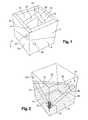
- FIG 1 represents the side surface of a metal container 2 according to the invention, comprising a plurality of sheet steel panels 4, 6, 8, 10, 12, 14, 16, 18.
- Each side face of the container comprises two adjacent panels, for example a first panel 4 adjacent to a second panel 6, or panels 8 and 10, or 12 and 14, or 16 and 18.
- These panels are panels with a dropped edge, the dropped edge being obtained by folding the end of the sheet to make the panel, for example the fallen edge 20 of the panel 12 or the flanged edge 22 of the panel 18.
- This dropped edge 22 forms a ramp inclined downwards for a waste, such as a glass bottle introduced by a first waste introduction orifice 24 disposed above on the panel 12.
- Another waste introduction orifice 27 is also disposed on the panel 8, above the inclined ramp of the panel 4, for sliding on the inclined inner ramp of the panel 4.
- FIG 2 represents the lower part of the container of the figure 1 , seen from a different angle.
- the collapsed folded sheet edges 21, 23, 28 and 30 can be seen.
- the ridge edges of the container, the orifices 24, 26 and 27, and two plates 32 and 34, are shown in a fictitious manner.
- a sound damping and shock absorbing material for example rubber or other elastomer.
- the plate 32 is disposed opposite the ramp 28 (or a ramp of the upper panel 8, not shown, not shown on FIG. figure 2 , coming above the ramp 28), and the plate 34 is disposed vis-à-vis the ramp 21 (or the ramp 20 of the upper panel 12 not shown on the figure 2 , coming over the ramp 21). This makes it possible both to prevent the breakage of most of the glass bottles, and to reduce the impact noise.
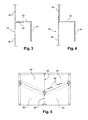
- FIG 3 represents a method of connecting two panels 36, 38 with fallen edges 40 and 42.
- the dropped edge 40 is much wider than the falling edge 42, because it is used as a sliding ramp.
- These two panels can be assembled at their fallen edges, by gluing, riveting, crimping, clinching, or by other methods of assembly.
- the assembly zone is the overlap zone between the edges 40 and 42.
- a folded edge 44 forms a rigid internal wall integral with the ramp, and makes it possible to produce under the edge 40 a volume dedicated to waste introduced by the second orifice 26.
- FIG 4 shows a way of connecting a panel 36 with a fallen edge with another panel 46 which is not on board fallen.
- the assembly is here represented by welds, but it is also possible to advantageously use other means from those shown above, for example gluing, the welds may lead to deformations of the container. In this method of assembly, it is considered that the panels 36 and 46 extend in the extension of one another, despite the very small offset due to the thickness of the sheet from which they are manufactured.
- the assembly zone is here the overlap zone between the panels 36 and 46 (between the welds shown).
- FIG. 5 represents a mode of cutting and folding of a sheet for the production of several panels.
- the solid lines represent the sections, and the dashed lines the areas of folding.
- the cut parts are indicated in hatched form.
- panels 48, 50, 52 and 54 can be made from this sheet metal.
- the sheet will be folded in its middle along a fold 56 forming a vertical edge of the container.
- the panels 48 and 50 are integral with each other, as are the panels 52 and 54.
- Optional cutouts 58 may be made, extending along the fold zones, to facilitate this folding (which may be done for example on the assembly site, if it is desired to transport flat sheets for reasons of ease of stacking).
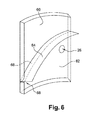
- parietal portion 60 comprises a wide edge 64 forming a sliding ramp for glass bottles
- parietal portion 62 comprises a thinner edge 66 represented by a dotted line, allowing its assembly at the wide edge 64.
- the elements having this type of geometry are advantageously manufactured by molding, for example by molding of polyester reinforced with glass fibers.
- An assembly method well suited to such elements is the bonding, for example here the bonding of the edges 64 and 66.
- the assembly zone 68 is the overlap zone between these edges 64 and 66.
Landscapes
- Engineering & Computer Science (AREA)
- Mechanical Engineering (AREA)
- Rigid Containers With Two Or More Constituent Elements (AREA)
Applications Claiming Priority (1)
| Application Number | Priority Date | Filing Date | Title |
|---|---|---|---|
| FR1357368A FR3008964B1 (fr) | 2013-07-25 | 2013-07-25 | Conteneur pour dechets a panneaux assembles |
Publications (1)
| Publication Number | Publication Date |
|---|---|
| EP2829494A1 true EP2829494A1 (de) | 2015-01-28 |
Family
ID=49322643
Family Applications (1)
| Application Number | Title | Priority Date | Filing Date |
|---|---|---|---|
| EP20140177584 Withdrawn EP2829494A1 (de) | 2013-07-25 | 2014-07-18 | Müllbehälter aus zusammengesetzten Platten |
Country Status (2)
| Country | Link |
|---|---|
| EP (1) | EP2829494A1 (de) |
| FR (1) | FR3008964B1 (de) |
Citations (2)
| Publication number | Priority date | Publication date | Assignee | Title |
|---|---|---|---|---|
| DE29711440U1 (de) * | 1997-07-01 | 1997-09-18 | Hüffermann Fahrzeugtechnik GmbH, 27793 Wildeshausen | Behälter, für Wertstoffe u.dgl. |
| US8123061B1 (en) * | 2007-03-26 | 2012-02-28 | Charles Kenneth Brown | Refuse container |
-
2013
- 2013-07-25 FR FR1357368A patent/FR3008964B1/fr not_active Expired - Fee Related
-
2014
- 2014-07-18 EP EP20140177584 patent/EP2829494A1/de not_active Withdrawn
Patent Citations (2)
| Publication number | Priority date | Publication date | Assignee | Title |
|---|---|---|---|---|
| DE29711440U1 (de) * | 1997-07-01 | 1997-09-18 | Hüffermann Fahrzeugtechnik GmbH, 27793 Wildeshausen | Behälter, für Wertstoffe u.dgl. |
| US8123061B1 (en) * | 2007-03-26 | 2012-02-28 | Charles Kenneth Brown | Refuse container |
Also Published As
| Publication number | Publication date |
|---|---|
| FR3008964A1 (fr) | 2015-01-30 |
| FR3008964B1 (fr) | 2017-04-14 |
Similar Documents
| Publication | Publication Date | Title |
|---|---|---|
| WO1999054224A2 (fr) | Bac de conditionnement en matiere plastique alveolaire et ensemble comprenant un tel bac et son couvercle | |
| EP1190937B1 (de) | Verkleidungsteil für die Unterseite eines Motors mit verbesserter Festigkeit | |
| EP2922689B1 (de) | Anordnung aus einem metalleinsatz und einer hülle aus einem verbundwerkstoff, sowie durch formung solch einer hülle gewonnenes teil | |
| EP3625113B1 (de) | Staubehälter zur montage an einer kraftfahrzeugkarosserie | |
| EP2915921A1 (de) | Aufrollbare Matte für die Überfahrt von Fahrzeugen, die mit verschiedenen Taschen ausgestattet ist | |
| CA2919927A1 (fr) | Structure en materiaux composites pour chassis de wagon | |
| EP1859978B1 (de) | Thermoplastische Folie mit Klebemasse für Karosserieelement | |
| FR3008964A1 (fr) | Conteneur pour dechets a panneaux assembles | |
| FR3055880A1 (fr) | Structure superieure de carrosserie de vehicule | |
| EP3386807B1 (de) | Aufprallträger für ein kraftfahrzeug mit querträger und dämpfungvorrichtung | |
| EP2671665A1 (de) | Schutzelement für ein Fahrzeug, Fahrzeug versehen mit einem solchen Element und Verfahren zum Herstellen | |
| FR2989402A1 (fr) | Banche de coffrage comportant un module de rigidification monobloc en materiau composite | |
| EP1711406A1 (de) | Faltbarer, rechtwinkliger parallelepipedischer kasten | |
| EP1972567B1 (de) | Zusammenklappbarer Behälter | |
| FR2879420A1 (fr) | Structure de sommier de literie et procede de fabrication d'une telle structure | |
| KR20240058246A (ko) | 덮개 및 바닥판 처짐방지형 화이버 드럼 | |
| FR2985494A1 (fr) | Ensemble d'un panneau de hayon et d'elements de renfort | |
| FR3071764A1 (fr) | Element en forme de plaque en resine renforcee de fibres | |
| FR2932433A1 (fr) | Ensemble d'elements prets a monter pour la realisation d'un van | |
| EP2409935A1 (de) | Flexibler Behälter | |
| EP0165183A1 (de) | Zwischeneinsatz für das Aufeinanderstapeln und die Schützung von Radfelgen oder dgl. | |
| EP1095762A1 (de) | Verfahren zur Herstellung einer Verbundplatte, insbesondere ein Fahrzeugdach oder Fussboden eines industriellen Fahrzeugs sowie nach diesem Verfahren hergestellte Platte | |
| EP3670387A1 (de) | Verfahren zur herstellung eines tanks aus verbundmaterial für den transport von flüssigen produkten, und entsprechender tank | |
| FR2856980A1 (fr) | Dispositif pour constituer des palettes, metalliques ou non, a logements repliables et supports independants a assembler sur place | |
| EP0712758A1 (de) | Wasserableitender Behälter für einen Lautsprecher in einem Fahrzeug |
Legal Events
| Date | Code | Title | Description |
|---|---|---|---|
| 17P | Request for examination filed |
Effective date: 20140718 |
|
| AK | Designated contracting states |
Kind code of ref document: A1 Designated state(s): AL AT BE BG CH CY CZ DE DK EE ES FI FR GB GR HR HU IE IS IT LI LT LU LV MC MK MT NL NO PL PT RO RS SE SI SK SM TR |
|
| AX | Request for extension of the european patent |
Extension state: BA ME |
|
| PUAI | Public reference made under article 153(3) epc to a published international application that has entered the european phase |
Free format text: ORIGINAL CODE: 0009012 |
|
| R17P | Request for examination filed (corrected) |
Effective date: 20150720 |
|
| RBV | Designated contracting states (corrected) |
Designated state(s): AL AT BE BG CH CY CZ DE DK EE ES FI FR GB GR HR HU IE IS IT LI LT LU LV MC MK MT NL NO PL PT RO RS SE SI SK SM TR |
|
| 17Q | First examination report despatched |
Effective date: 20180824 |
|
| RAP1 | Party data changed (applicant data changed or rights of an application transferred) |
Owner name: PLASTIC OMNIUM SYSTEMES URBAINS |
|
| STAA | Information on the status of an ep patent application or granted ep patent |
Free format text: STATUS: THE APPLICATION IS DEEMED TO BE WITHDRAWN |
|
| 18D | Application deemed to be withdrawn |
Effective date: 20190525 |