EP2829396B1 - Container for packaging food - Google Patents
Container for packaging food Download PDFInfo
- Publication number
- EP2829396B1 EP2829396B1 EP14177956.1A EP14177956A EP2829396B1 EP 2829396 B1 EP2829396 B1 EP 2829396B1 EP 14177956 A EP14177956 A EP 14177956A EP 2829396 B1 EP2829396 B1 EP 2829396B1
- Authority
- EP
- European Patent Office
- Prior art keywords
- container according
- layer
- coating
- barrier
- barrier layer
- Prior art date
- Legal status (The legal status is an assumption and is not a legal conclusion. Google has not performed a legal analysis and makes no representation as to the accuracy of the status listed.)
- Active
Links
Images
Classifications
-
- B—PERFORMING OPERATIONS; TRANSPORTING
- B32—LAYERED PRODUCTS
- B32B—LAYERED PRODUCTS, i.e. PRODUCTS BUILT-UP OF STRATA OF FLAT OR NON-FLAT, e.g. CELLULAR OR HONEYCOMB, FORM
- B32B1/00—Layered products having a non-planar shape
-
- B—PERFORMING OPERATIONS; TRANSPORTING
- B32—LAYERED PRODUCTS
- B32B—LAYERED PRODUCTS, i.e. PRODUCTS BUILT-UP OF STRATA OF FLAT OR NON-FLAT, e.g. CELLULAR OR HONEYCOMB, FORM
- B32B23/00—Layered products comprising a layer of cellulosic plastic substances, i.e. substances obtained by chemical modification of cellulose, e.g. cellulose ethers, cellulose esters, viscose
- B32B23/04—Layered products comprising a layer of cellulosic plastic substances, i.e. substances obtained by chemical modification of cellulose, e.g. cellulose ethers, cellulose esters, viscose comprising such cellulosic plastic substance as the main or only constituent of a layer, which is next to another layer of the same or of a different material
- B32B23/06—Layered products comprising a layer of cellulosic plastic substances, i.e. substances obtained by chemical modification of cellulose, e.g. cellulose ethers, cellulose esters, viscose comprising such cellulosic plastic substance as the main or only constituent of a layer, which is next to another layer of the same or of a different material of paper or cardboard
-
- B—PERFORMING OPERATIONS; TRANSPORTING
- B32—LAYERED PRODUCTS
- B32B—LAYERED PRODUCTS, i.e. PRODUCTS BUILT-UP OF STRATA OF FLAT OR NON-FLAT, e.g. CELLULAR OR HONEYCOMB, FORM
- B32B27/00—Layered products comprising a layer of synthetic resin
- B32B27/30—Layered products comprising a layer of synthetic resin comprising vinyl (co)polymers; comprising acrylic (co)polymers
- B32B27/304—Layered products comprising a layer of synthetic resin comprising vinyl (co)polymers; comprising acrylic (co)polymers comprising vinyl halide (co)polymers, e.g. PVC, PVDC, PVF, PVDF
-
- B—PERFORMING OPERATIONS; TRANSPORTING
- B32—LAYERED PRODUCTS
- B32B—LAYERED PRODUCTS, i.e. PRODUCTS BUILT-UP OF STRATA OF FLAT OR NON-FLAT, e.g. CELLULAR OR HONEYCOMB, FORM
- B32B29/00—Layered products comprising a layer of paper or cardboard
-
- B—PERFORMING OPERATIONS; TRANSPORTING
- B32—LAYERED PRODUCTS
- B32B—LAYERED PRODUCTS, i.e. PRODUCTS BUILT-UP OF STRATA OF FLAT OR NON-FLAT, e.g. CELLULAR OR HONEYCOMB, FORM
- B32B2307/00—Properties of the layers or laminate
- B32B2307/70—Other properties
- B32B2307/716—Degradable
- B32B2307/7163—Biodegradable
-
- B—PERFORMING OPERATIONS; TRANSPORTING
- B32—LAYERED PRODUCTS
- B32B—LAYERED PRODUCTS, i.e. PRODUCTS BUILT-UP OF STRATA OF FLAT OR NON-FLAT, e.g. CELLULAR OR HONEYCOMB, FORM
- B32B2439/00—Containers; Receptacles
- B32B2439/70—Food packaging
Definitions
- the invention relates to an inherently stable container according to the preamble of claim 1.
- Recyclable trays for packaging food are known from the prior art.
- a current trend is to use raw materials from the food sector to make the trays, which are also known as biopolymers.
- biopolymers In particular, starch from grain or potatoes, but also sugar cane, is often used here.
- these raw materials have the disadvantage that their heat resistance and melting tendency cannot compete with the same properties of other materials from the non-food sector.
- Most biopolymers are therefore not suitable for temperature-resistant food packaging. These substances have also fallen into disrepute for causing food shortages, since starch for biopolymer applications is often state subsidized.
- the GB 1,389,287 deals with a lining material for cardboard boxes or an outer packaging material.
- An intermediate layer is bonded to outer layers on both sides with an adhesive.
- the lining material therefore comprises three layers and a packaging even four layers, namely the three layers of the lining material and the cardboard layer.
- the outer layers are paper layers.
- the intermediate layer can be a barrier layer made of a coated cellulose layer.
- the coating is an aqueous copolymer with a vinylidene chloride component. Compared to conventional lining material, which has wax as an intermediate layer, this material is more heat-resistant when heat-sealed.
- the intermediate wax layer can also be damaged when it is folded.
- the lining material is unsuitable for direct contact with food, since the outer layers are made of paper and the barrier layer is arranged between the outer layers. The paper would if it came into contact with food soften.
- the lining material is not intended to have dimensional stability and is therefore only to be used as a wrapping or wrapping material.
- a proposed packaging with cardboard is very expensive because it consists of four layers.
- polyester resins are not food safe and therefore completely unsuitable in the food packaging sector. Polyester resins are also not biodegradable.
- a film for billboards is proposed, which is made from cellulose hydrate.
- the film is stuck to the billboard with an adhesive.
- the adhesive is water-soluble so that the film can be removed quickly. This film application is therefore completely unsuitable for foods that mostly contain water.
- the EP 0 865 915 describes a recyclable and biodegradable, heat and freezer-resistant multilayer laminate, in particular for storage, packaging, freezing, heating and / or for baking or roasting food in microwave and conventional ovens.
- the laminate preferably has a carrier layer made of cardboard and at least one second layer made of a food-compliant, heat- and grease-resistant paper, an adhesive for connecting the carrier layer and the paper and a further non-stick layer provided on the food-compliant, grease-resistant paper.
- the paper mentioned is preferably also vapor and water repellent.
- the laminate made of cellulose is completely biodegradable and is also suitable for recycling.
- WO 2011/089015 discloses a multilayer packaging material, preferably with moisture and / or fat-repellent properties.
- the packaging material comprises at least one substrate layer and at least one barrier layer.
- the substrate layer consists of cardboard, paper or fibers from renewable and / or preferably biodegradable raw materials and a single or multi-layer barrier layer.
- the barrier layer is made of paper, cardboard or parchment, which are impregnated.
- This packaging material is fully biodegradable, but unsuitable for use at very high or low temperatures such as those found in ovens or freezers.
- the WO99 / 44909 deals with a material for trays or packaging, which material is built up from a number of layers. These layers, viewed from the inside of the tray / package, comprise a first parchment paper layer, an adhesive layer and a second parchment paper layer. A water-repellent layer is applied outside the second parchment paper layer. This outermost layer consists primarily of an acrylic polymer or a silicone. Since the layer material is made on a paper basis, it inevitably has a high level of water vapor permeability.
- the object of the invention is therefore to propose a container for the packaging of food which is recyclable, biodegradable and compostable, is at the same time suitable for freezing or heating food in ovens and has a good barrier against water vapor and gases.
- the object is achieved in a container for storing food according to the preamble of claim 1 in that the barrier layer comprises a cellulose hydrate film, which is provided with a first vapor-barrier coating at least on the side facing or facing away from the food to be stored.
- the coating has the effect that the barrier layer cannot be penetrated by water vapor. Otherwise, the carrier layer would absorb the water vapor and soften.
- such a barrier layer has the further benefit that it mechanically reinforces the carrier layer or the container. In this way, the carrier layer can be dimensioned smaller and therefore more gentle on the material.
- the cellulose hydrate film is expediently provided with a second vapor-barrier coating on the uncoated side. This doubles the barrier for water vapor, gases and aromas.
- the provision of a second coating also represents an increase in safety, since if one coating is damaged, the further coating is still intact.
- the first and second vapor barrier coating is a biopolymer coating with a polyvinylidene chloride (PVCD) component.
- PVCD polyvinylidene chloride
- PVCD is known as an excellent barrier material for oxygen and water vapor and also has good heat sealability at 120-160 ° C. PVCD can be incorporated into the biopolymer coating in a homogeneously distributed manner. It is also conceivable that PVCD is applied to the bio-polymer coating as a coating, varnish, film or barrier layer. The biodegradability of the barrier layer is not affected by the PVCD.
- the PVCD proportion is expediently at most 10% by weight, preferably at most 7% by weight and particularly preferably at most 5% by weight of the biopolymer weight proportion.
- This weight fraction of PVCD in the biopolymer coating brings all the advantages of PVCD, such as good barrier properties and heat sealability, without the food compatibility or the biodegradability of the container or vessel according to the invention being impaired.
- the biopolymer coating is made from renewable raw materials.
- sustainable biopolymer coatings are independent of non-renewable raw materials and their heat resistance is constantly being developed so that they can withstand temperatures of up to 120 ° C at the moment.
- the first and second vapor barrier coatings comprise biopolymer nanoparticles.
- the barrier layer remains recyclable, biodegradable and compostable even with the applied water vapor barrier coating.
- the biopolymer nanoparticles are obtainable from a process which comprises a crosslinking step using a crosslinking agent (eg a polyaldehyde).
- the biopolymer nanoparticles are coated using standard coating processes such as rolling, spraying, spraying, printing, dipping, etc. upset.
- the cross-linked nanoparticles form a dense coating with very low permeability values for water vapor and gases.
- the biopolymer nanoparticle coating made from renewable raw materials which are not suitable for food production is preferred. These include cellulose, hemicellulose, chitin, inulin and lignin. Derivatives and / or mixtures of these raw materials can also be used.
- the open edge of the container is an all-round beaded edge.
- the rigidity and the dimensional stability of the container can be improved.
- a circumferential beaded edge is preferred, although it is also conceivable that the beaded edge is only provided on the straight edges and is recessed in the area of the corners.
- the beaded edge also enables corresponding empty stacked containers to be more easily unstacked. This is due to the fact that the crimped edge slightly spaced containers stacked one inside the other and thus less tightly sticking them together.
- a water-repellent layer preferably made of an acrylic polymer, is advantageously arranged on the side of the carrier layer facing away from the food to be stored.
- the cardboard or the paper of the carrier layer is protected from water from the outside by this layer. External moisture protection is particularly advantageous in refrigerators or freezers with damp surfaces.
- the barrier layer can , which has the cellulose hydrate film and at least one water vapor barrier coating, can be referred to as almost vapor-tight.
- the oxygen permeability of the barrier layer at 23 ° C. and 50% humidity over 24 hours is advantageously less than 30 cm 3 / m 2 .24 h. Bar, preferably less than 15 cm 3 / m 2. 24 h. Bar and very particularly preferably less than 10 cm 3 / m 2 .24 h bar. This allows food to be kept fresh in the container and is adequately protected from atmospheric oxygen.
- the laminate is free from an adhesive and its function is taken over by the second vapor barrier coating, which is a nanopolymer coating.
- the second coating has to be arranged between the cellulose hydrate film and the carrier layer in order to bond these layers together. Since the nanobiopolymer coating has good hot-melt adhesive properties, there is no need for an additional adhesive.
- the barrier layer is transparent.
- the barrier layer and / or the carrier layer can be printed with advertising, logos, instructions, information, etc. and can be read by the user of the vessel.
- barrier layer can be heat-sealed or cold-sealed, since a sealing film can then be quickly applied to the sealing edge of the vessel in order to close the vessel.
- the barrier layer has a thickness between 10 and 50 ⁇ m, and preferably between 20 and 30 ⁇ m. This thickness is optimized so that the barrier layer can be deep-drawn easily in order to form a three-dimensional container together with the carrier layer. On the other hand, the barrier layer with this layer thickness has good mechanical properties, so that the layer thickness of the carrier layer can be reduced.
- the barrier layer also has these properties.
- the container according to the invention for packaging food is made from a laminate.
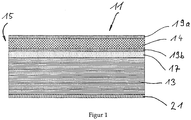
- the laminate in particular the packaging laminate, which is designated as a whole by the reference numeral 11, is shown.
- the basis of the laminate is formed by a carrier layer 13 which gives the laminate stability.
- the carrier layer 13 is preferably a cardboard, a stiff single or multi-layer paper or made of cellulose fibers.
- the carrier layer 13 is preferably made from pure, mechanically comminuted and bleached pulp. So that the carrier layer can be deep-drawn for the production of vessels, it has a corresponding tensile strength. The production scrap can thereby be reduced and the production speed increased.
- the extensibility is 3% and preferably 6%.
- the carrier layer is also so stiff that it meets the requirements for a food container and in particular a food tray.
- the packaging laminate can be shaped into bowls, mugs, trays, etc.
- the carrier layer 13 has an inner first surface, which faces the food to be packaged, and a second outer surface, which faces away from the food.
- a water-repellent layer 21 is preferably provided on the outer surface.
- This water-repellent layer 21 can consist of an acrylic polymer, for example, since these polymers do not impair the biodegradability and the requirements for the temperature range.
- the water-repellent layer 21 can be applied during the lamination or during a printing process step in the offset or flexographic printing process.
- the water-repellent layer 21 and all other laminate layers must also have these properties. If food is frozen in a vessel made from the packaging laminate according to the invention, it is important that the carrier layer 13 with the water-repellent layer 21 is provided, since in a freezer there is always frozen water which could penetrate into the carrier layer 13.
- the barrier layer 15 is applied to the inner surface of the carrier layer 13 on the same. This can be done with an adhesive 17.
- the adhesive 17 contains the lowest possible water content in order to be able to dispense with subsequent drying of the adhesive 17. Too high a water content makes the carrier layer wavy and it loses its flat surface.
- the adhesive 17 must withstand temperatures from -40 ° C. to a minimum of 140 ° C. and preferably up to 220 ° C., since the packaging laminate 11 should be suitable for freezing, thawing and heating food. It is generally preferred if the inherently stable container for packaging food can withstand temperatures between -40 ° C and 220 ° C.
- the barrier layer 15 preferably comprises a film 14 which can be made from a regenerated cellulose material.
- biopolymers are also conceivable, provided they are made from renewable raw materials, which raw materials are preferably not intended for food production, and are biodegradable.
- Cellulose hydrate is also known as cellulose and is made from regenerated cellulose.
- Cellulose hydrate is known to have a high level of water vapor permeability, which means that condensation can be prevented in closed cellulose hydrate packaging. In the case of the present packaging laminate 11, however, water vapor permeability is undesirable since the water vapor penetrating the cellulose hydrate softens the carrier layer 13.
- the film 14 is provided with a first vapor-barrier coating 19a at least on the side facing the food, for which coating 19a the cellulose hydrate serves as a carrier film 14.
- a second vapor barrier coating 19b is preferably also applied on the side facing away from the food in order to improve the vapor barrier even further and to have a further safety barrier. This is particularly advantageous if the first coating 19b would be damaged.
- a further advantage of the second coating 19b is that it can act as an adhesive 17 and the barrier layer 15 can be glued to the carrier layer 13 by means of the second vapor-barrier coating 19b. Since the coatings 19a, 19b are heat-sealable, this can be done by applying heat and pressure.
- the barrier layer 15 also provides the barrier for water vapor a barrier for gases, liquids and fats.
- the vapor barrier coatings 19a, 19b are preferably a biopolymer coating with polyvinylidene chloride (PVCD) component or comprise biopolymer nanoparticles, both of which have excellent vapor barrier properties and also for gases, for example oxygen, a Represent a barrier.
- PVCD polyvinylidene chloride
- the vapor-blocking biopolymer coatings 19a, 19b also have good heat-sealing properties due to the PVCD or nanoparticle content. PVCD is incorporated into the biopolymer coating, preferably distributed homogeneously.
- the weight percentage of PVCD is kept as low as possible so that the biopolymer coating has optimized barrier and heat-sealing properties, but the food compatibility and biodegradability of the container are not impaired.
- the water vapor transmission at 38 ° C. and 90% humidity over 24 hours is only 10 g / m 2 .
- the O 2 passage over 24 hours is only 3 g / m 2 .
- the size of the nanoparticles used is preferably in the range from 10 to 100 nm, which results in the excellent barrier properties of the coating 19a, 19b.
- the coatings 19a, 19b are heat-sealable, as a result of which a vessel made of the packaging laminate 11 can be closed with a film by heat-sealing. This creates adhesive bonds with a thickness of 200g / 25mm.
- the coatings 19a, 19b are also made from a recyclable and biodegradable bio-polymer.
- the bio-polymer can be cellulose, hemicellulose, starch or chitin or a derivative thereof and / or mixtures thereof. Renewable raw materials which are not used as food are preferred, although carbohydrates, plant and animal proteins, polysaccharides and other basic food building materials are also conceivable.
- a mechanically thermoplastic process is used which comprises a crosslinking step using a crosslinking agent.
- the coatings 19a, 19b can be applied using known coating methods, such as printing, roller coating, dipping and spraying.
- the barrier layer 15 has a tear strength of 22% in the machine direction and 70% in the transverse direction.
- the barrier layer 15 and the coatings 19a, 19b are transparent, as a result of which a pressure applied to the carrier layer 13 is visible on the inside of the packaging laminate 11. Since, as already stated above, the barrier layer 15 and the coatings 19a, 19b have good mechanical properties, the carrier layer 13 can be dimensioned smaller, and the packaging laminate nevertheless has the required mechanical properties.
- the barrier layer 15 has a thickness of 10 to 50 ⁇ m and preferably 20 to 30 ⁇ m in order to obtain the required properties.
- the packaging laminate 11 can be deep-drawn into the vessel under heat and pressure, is recyclable, biodegradable, compostable and made from renewable, renewable resources, which are preferably not used as food Use.
- the laminate is called compostable because it meets EN 13432 and is at least 90% degraded within 12 weeks.
Landscapes
- Engineering & Computer Science (AREA)
- Mechanical Engineering (AREA)
- Wrappers (AREA)
- Laminated Bodies (AREA)
Description
Die Erfindung betrifft einen eigenstabilen Behälter gemäss Oberbegriff des Anspruchs 1.The invention relates to an inherently stable container according to the preamble of claim 1.
Aus dem Stand der Technik sind wiederverwertbare Schalen zur Verpackung von Lebensmitteln bekannt. Ein gegenwärtiger Trend ist es, Rohstoffe aus dem Nahrungsmittelbereich zur Herstellung der Schalen zu verwenden, welche auch als Biopolymere bekannt sind. Insbesondere Stärke aus Getreide oder Kartoffeln, aber auch Zuckerrohr kommt hier häufig zur Anwendung. Neben ihrer unbestrittenen Umweltverträglichkeit haben diese Rohstoffe aber den Nachteil, dass ihre Hitzebeständigkeit und Schmelzneigung mit denselben Eigenschaften von anderen Materialien aus dem Nicht-Lebensmittelbereich nicht konkurrieren können. Für temperaturresistente Nahrungsmittelverpackungen sind die meisten Biopolymere daher nicht geeignet. Auch sind diese Stoffe immer wieder in Verruf geraten Nahrungsmittelknappheiten zu verursachen, da Stärke für biopolymere Anwendungen oftmals staatlich gefördert ist.Recyclable trays for packaging food are known from the prior art. A current trend is to use raw materials from the food sector to make the trays, which are also known as biopolymers. In particular, starch from grain or potatoes, but also sugar cane, is often used here. In addition to their undisputed environmental compatibility, these raw materials have the disadvantage that their heat resistance and melting tendency cannot compete with the same properties of other materials from the non-food sector. Most biopolymers are therefore not suitable for temperature-resistant food packaging. These substances have also fallen into disrepute for causing food shortages, since starch for biopolymer applications is often state subsidized.
Die
In der
In der
Die
Die
Aufgabe der Erfindung ist es daher einen Behälter zur Verpackung von Lebensmitteln vorzuschlagen, welcher rezyklierbar, biologisch abbaubar und kompostierbar ist, gleichzeitig zum Einfrieren bzw. Erhitzen in Öfen von Lebensmitteln geeignet ist und eine gute Barriere gegenüber Wasserdampf und Gasen besitzt.The object of the invention is therefore to propose a container for the packaging of food which is recyclable, biodegradable and compostable, is at the same time suitable for freezing or heating food in ovens and has a good barrier against water vapor and gases.
Erfindungsgemäss wird die Aufgabe bei einem Behälter zur Aufbewahrung von Lebensmitteln gemäss Oberbegriff des Anspruchs 1 dadurch gelöst, dass die Barriereschicht eine Cellulosehydrat-Folie umfasst, welche wenigstens an der dem aufzubewahrenden Lebensmittel zugewandten oder abgewandten Seite mit einer ersten dampfsperrenden Beschichtung versehen ist. Die Beschichtung bewirkt, dass die Barriereschicht nicht von Wasserdampf durchdringbar ist. Andernfalls würde die Trägerschicht den Wasserdampf aufnehmen und sich aufweichen. Ferner hat eine solche Barriereschicht den weiteren Nutzen, dass sie die Trägerschicht bzw. den Behälter mechanisch verstärkt. So kann die Trägerschicht geringer und demzufolge materialschonender dimensioniert werden.According to the invention, the object is achieved in a container for storing food according to the preamble of claim 1 in that the barrier layer comprises a cellulose hydrate film, which is provided with a first vapor-barrier coating at least on the side facing or facing away from the food to be stored. The coating has the effect that the barrier layer cannot be penetrated by water vapor. Otherwise, the carrier layer would absorb the water vapor and soften. Furthermore, such a barrier layer has the further benefit that it mechanically reinforces the carrier layer or the container. In this way, the carrier layer can be dimensioned smaller and therefore more gentle on the material.
Zweckmässigerweise ist die Cellulosehydrat-Folie an der unbeschichteten Seite mit einer zweiten dampfsperrende Beschichtung versehen ist. Die Barriere für Wasserdampf, Gase und Aromen wird dadurch verdoppelt. Auch stellt das Vorsehen einer zweiten Beschichtung einen Sicherheitsgewinn dar, da bei Beschädigung einer Beschichtung die weitere Beschichtung noch intakt ist.The cellulose hydrate film is expediently provided with a second vapor-barrier coating on the uncoated side. This doubles the barrier for water vapor, gases and aromas. The provision of a second coating also represents an increase in safety, since if one coating is damaged, the further coating is still intact.
In einem besonders bevorzugten Ausführungsform ist die erste und zweite dampfsperrende Beschichtung eine Biopolymer-Beschichtung mit einem Polyvinylidenchlorid (PVCD)- Anteil. PVCD ist als ausgezeichneter Barrierestoff für Sauerstoff und Wasserdampf bekannt und besitzt auch eine gute Heisssiegelbarkeit bei 120- 160 °C. PVCD kann in die Biopolymer-Beschichtung homogen verteilt eingebracht sein. Denkbar ist es auch, dass PVCD als Beschichtung, Lackierung, Folie oder Sperrschicht auf der Bio-polymer-Beschichtung aufgebracht ist. Die biologische Abbaubarkeit der Barriereschicht ist durch das PVCD nicht beeinträchtigt.In a particularly preferred embodiment, the first and second vapor barrier coating is a biopolymer coating with a polyvinylidene chloride (PVCD) component. PVCD is known as an excellent barrier material for oxygen and water vapor and also has good heat sealability at 120-160 ° C. PVCD can be incorporated into the biopolymer coating in a homogeneously distributed manner. It is also conceivable that PVCD is applied to the bio-polymer coating as a coating, varnish, film or barrier layer. The biodegradability of the barrier layer is not affected by the PVCD.
Zweckmässigerweise beträgt der PVCD-Anteil höchstens 10 Gew%, bevorzugt höchstens 7 Gew% und besonders bevorzugt höchstens 5 Gew% des Biopolymer-Gewichtsanteils. Dieser Gewichtsanteil an PVCD in der Biopolymer-Beschichtung bringt alle Vorteile des PVCDs, wie gute Barriereeigenschaften und Heissiegelbarkeit ein, ohne dass die Lebensmittelverträglichkeit oder die biologische Abbaubarkeit des erfindungsgemässen Behälters bzw. Gefässes beeinträchtigt wären.The PVCD proportion is expediently at most 10% by weight, preferably at most 7% by weight and particularly preferably at most 5% by weight of the biopolymer weight proportion. This weight fraction of PVCD in the biopolymer coating brings all the advantages of PVCD, such as good barrier properties and heat sealability, without the food compatibility or the biodegradability of the container or vessel according to the invention being impaired.
In einer weiteren bevorzugten Ausführungsform ist die Biopolymer-Beschichtung aus erneuerbaren Rohstoffen hergestellt. Solche nachhaltigen Biopolymer-Beschichtungen sind unabhängig von nicht nachwachsenden Rohstoffen und deren Hitzebeständigkeit wird ständig weiterentwickelt, sodass sie momentan bereits Temperaturen von bis zu 120 °C Stand halten.In a further preferred embodiment, the biopolymer coating is made from renewable raw materials. Such sustainable biopolymer coatings are independent of non-renewable raw materials and their heat resistance is constantly being developed so that they can withstand temperatures of up to 120 ° C at the moment.
In einer weiteren bevorzugten Ausführungsform umfasst die erste und zweite dampfsperrende Beschichtung Biopolymer-Nanopartikel. Dadurch bleibt die Barriereschicht auch mit der aufgebrachten wasserdampfsperrenden Beschichtung rezyklierbar, biologisch abbaubar und kompostierbar. Die Biopolymer-Nanopartikel sind aus einem Verfahren erhältlich, welches einen Vernetzungsschritt unter Verwendung eines Vernetzungsmittel (z.B. ein Polyaldehyd) umfasst. Die Biopolymer-Nanopartikel werden mit üblichen Beschichtungsverfahren wie rollen, spritzen, sprayen, drucken, tauchen usw. aufgebracht. Die vernetzten Nanopartikel bilden eine dichte Beschichtung mit sehr geringen Durchlässigkeitswerten für Wasserdampf und Gase. Bevorzugt ist die Biopolymer-Nanopartikel Beschichtung aus nachwachsenden Rohstoffen, welche nicht zur Nahrungsmittelerzeugung geeignet sind. Dazu zählen Cellulose, Hemicellulose Chitin, Inulin und Lignin. Auch können Derivate und/oder Mischungen dieser Rohstoffe zum Einsatz kommen.In a further preferred embodiment, the first and second vapor barrier coatings comprise biopolymer nanoparticles. As a result, the barrier layer remains recyclable, biodegradable and compostable even with the applied water vapor barrier coating. The biopolymer nanoparticles are obtainable from a process which comprises a crosslinking step using a crosslinking agent (eg a polyaldehyde). The biopolymer nanoparticles are coated using standard coating processes such as rolling, spraying, spraying, printing, dipping, etc. upset. The cross-linked nanoparticles form a dense coating with very low permeability values for water vapor and gases. The biopolymer nanoparticle coating made from renewable raw materials which are not suitable for food production is preferred. These include cellulose, hemicellulose, chitin, inulin and lignin. Derivatives and / or mixtures of these raw materials can also be used.
Als vorteilhaft erweist es sich, wenn die Nanopartikel eine mittlere Partikelgrösse von 5 bis 300 nm, bevorzugt von 10 bis 200 nm und besonders bevorzugt von 10 bis 100 nm haben. In diesem Partikelbereich ergeben sich die besten Barriereeigenschaften
In einer besonders bevorzugten Ausführungsform ist der offene Rand des Behälters ein rundum laufender Bördelrand. Durch das Vorsehen des Bördelrandes kann die Steifigkeit und die Formstabilität des Behälters verbessert werden. Bevorzugt ist ein umlaufender Bördelrand, wenngleich es auch denkbar ist, dass der Bördelrand nur an den geraden Rändern vorgesehen ist und im Bereich der Ecken ausgespart ist. Der Bördelrand ermöglicht es auch, dass sich entsprechende leere gestapelte Behälter leichter entstapeln lassen. Dies liegt daran, dass der Bördelrand ineinander gestapelte Behälter geringfügig beabstandet und diese dadurch weniger fest zusammenstecken.It has proven to be advantageous if the nanoparticles have an average particle size of 5 to 300 nm, preferably 10 to 200 nm and particularly preferably 10 to 100 nm. The best barrier properties are found in this particle range
In a particularly preferred embodiment, the open edge of the container is an all-round beaded edge. By providing the flanged edge, the rigidity and the dimensional stability of the container can be improved. A circumferential beaded edge is preferred, although it is also conceivable that the beaded edge is only provided on the straight edges and is recessed in the area of the corners. The beaded edge also enables corresponding empty stacked containers to be more easily unstacked. This is due to the fact that the crimped edge slightly spaced containers stacked one inside the other and thus less tightly sticking them together.
Mit Vorteil ist eine wasserabweisenden Schicht, bevorzugt aus einem Acrylpolymer, an der dem aufzubewahrenden Lebensmittel abgewandten Seite der Trägerschicht angeordnet. Der Karton oder das Papier der Trägerschicht ist durch diese Schicht vor Wasser von aussen geschützt. In Kühl- oder Tiefkühlschränken mit feuchten Oberflächen ist ein äusserlicher Feuchtigkeitsschutz besonders vorteilhaft.A water-repellent layer, preferably made of an acrylic polymer, is advantageously arranged on the side of the carrier layer facing away from the food to be stored. The cardboard or the paper of the carrier layer is protected from water from the outside by this layer. External moisture protection is particularly advantageous in refrigerators or freezers with damp surfaces.
Dadurch, dass die Wasserdampfdurchlässigkeit der Barriereschicht bei 38 °C und 90% Luftfeuchtigkeit über 24 Stunden weniger als 40 g/m2, bevorzugt weniger als 30 g/m2 und ganz besonders bevorzugt weniger als 15 g/m2 beträgt, kann die Barriereschicht, welche die Cellulosehydrat-Folie und wenigstens eine wasserdampfsperrende Beschichtung aufweist, als nahezu dampfdicht bezeichnet werden.Because the water vapor permeability of the barrier layer at 38 ° C. and 90% humidity over 24 hours is less than 40 g / m 2 , preferably less than 30 g / m 2 and very particularly preferably less than 15 g / m 2 , the barrier layer can , which has the cellulose hydrate film and at least one water vapor barrier coating, can be referred to as almost vapor-tight.
Mit Vorteil beträgt die Sauerstoffdurchlässigkeit der Barriereschicht bei 23 °C und 50% Luftfeuchtigkeit über 24 Stunden weniger als 30 cm3/m2.24h.bar, bevorzugt weniger als 15 cm3/m2.24h.bar und ganz besonders bevorzugt weniger als 10 cm3/m2.24h.bar. Dadurch lässt sich ein Nahrungsmittel in dem Gefäss frisch halten und ist vor Luftsauerstoff ausreichend geschützt.The oxygen permeability of the barrier layer at 23 ° C. and 50% humidity over 24 hours is advantageously less than 30 cm 3 / m 2 .24 h. Bar, preferably less than 15 cm 3 / m 2. 24 h. Bar and very particularly preferably less than 10 cm 3 / m 2 .24 h bar. This allows food to be kept fresh in the container and is adequately protected from atmospheric oxygen.
In einer weiteren bevorzugten Ausführungsform ist das Laminat frei von einem Adhäsiv und dessen Funktion ist von der zweiten dampfsperrenden Beschichtung übernommen, welche eine Nanopolymer-Beschichtung ist. Es versteht sich, dass die zweite Beschichtung zwischen Cellulosehydrat-Folie und Trägerschicht angeordnet sein muss, um diese Schichten zu verkleben. Da die Nanobiopolymer-Beschichtung gute Heissklebeeigenschaften besitzt, kann auf ein zusätzliches Adhäsiv verzichtet werden.In a further preferred embodiment, the laminate is free from an adhesive and its function is taken over by the second vapor barrier coating, which is a nanopolymer coating. It goes without saying that the second coating has to be arranged between the cellulose hydrate film and the carrier layer in order to bond these layers together. Since the nanobiopolymer coating has good hot-melt adhesive properties, there is no need for an additional adhesive.
Als vorteilhaft erweist es sich, wenn die Barriereschicht transparent ist. Dadurch lässt sich die Barriereschicht und/oder die Trägerschicht mit Werbung, Logos, Anleitungen, Informationen usw. bedrucken und ist für den Benutzer des Gefässes lesbar.It proves to be advantageous if the barrier layer is transparent. As a result, the barrier layer and / or the carrier layer can be printed with advertising, logos, instructions, information, etc. and can be read by the user of the vessel.
Von Vorteil ist es, wenn die Barriereschicht heiss- oder kaltsiegelbar ist, da dann eine Verschlussfolie rasch auf den Siegelrand des Gefässes aufbringbar ist, um das Gefäss zu verschliessen.It is advantageous if the barrier layer can be heat-sealed or cold-sealed, since a sealing film can then be quickly applied to the sealing edge of the vessel in order to close the vessel.
In einem weiteren Ausführungsbeispiel hat die Barriereschicht eine Dicke zwischen 10 und 50 µm, und bevorzugt zwischen 20 und 30 µm. Diese Dicke ist optimiert, damit sich die Barriereschicht gut tiefziehen lässt, um zusammen mit der Trägerschicht ein dreidimensionales Behältnis zu bilden. Andererseits weist die Barriereschicht mit dieser Schichtdicke gute mechanische Eigenschaften auf, damit die Schichtdicke der Trägerschicht reduziert werden kann.In a further exemplary embodiment, the barrier layer has a thickness between 10 and 50 μm, and preferably between 20 and 30 μm. This thickness is optimized so that the barrier layer can be deep-drawn easily in order to form a three-dimensional container together with the carrier layer. On the other hand, the barrier layer with this layer thickness has good mechanical properties, so that the layer thickness of the carrier layer can be reduced.
Damit der gesamte Behälter rezyklierbar, biologisch abbaubar und kompostierbar ist, ist es bevorzugt, wenn auch die Barriereschicht diese Eigenschaften aufweist.So that the entire container is recyclable, biodegradable and compostable, it is preferred if the barrier layer also has these properties.
Vorteilhaft ist es, wenn das Laminat tiefzieh- und thermoformbar ist, um daraus Nahrungsmittelbehälter herstellen zu können. Dazu muss das Laminat ausreichende mechanische Festigkeit aufweisen, um nicht während des Tiefziehprozesses zerrissen oder Beschädigt zu werden. Auch muss es ausreichend flexibel sein, damit sich ein Siegelrand ausformen lässt, an welchem sich der Behälter mit einer Folie versiegeln lässt. Ein weiterer Aspekt dieser Erfindung betrifft auch vorstehend beschriebenes Laminat, da dieses auch für andere Anwendungen als ein Gefäss denkbar ist. Dazu zählen beispielsweise Werbungsflächen hergestellt aus dem erfindungsgemässen Material. Weitere Vorteile und Merkmale ergeben sich aus der nachfolgenden Beschreibung eines Ausführungsbeispiels der Erfindung unter Bezugnahme auf die schematischen Darstellungen. Es zeigt in nicht massstabsgetreuer Darstellung:
- Figur 1:
- Einen Querschnitt durch das erfindungsgemässe Laminat.
- Figure 1:
- A cross section through the laminate according to the invention.
Der erfindungsgemässe Behälter zur Verpackung von Lebensmitteln ist aus einem Laminat hergestellt. In
Die Trägerschicht 13 besitzt eine innere erste Oberfläche, welche dem zu verpackenden Lebensmittel zugewandt ist, und eine zweite äussere Oberfläche, welche dem Lebensmittel abgewandt ist. An der äusseren Oberfläche ist bevorzugt eine wasserabweisende Schicht 21 vorgesehen. Diese wasserabweisende Schicht 21 kann beispielsweise aus einem Acrylpolymer bestehen, da diese Polymere die biologische Abbaubarkeit und die Anforderungen an den Temperaturbereich nicht beeinträchtigen. Die wasserabweisende Schicht 21 kann während des Laminier-oder während eines -Druckverfahrensschrittes im Offset- oder Flexodruckverfahren aufgebracht werden. Für ein rezyklierbares und biologisch abbaubares Verpackungslaminat versteht sich, dass auch die wasserabweisende Schicht 21 und alle anderen Laminatschichten diese Eigenschaften besitzen müssen. Werden Lebensmittel in einem Gefäss aus dem erfindungsgemässen Verpackungslaminat tiefgefroren, so ist es wichtig, dass die Trägerschicht 13 mit der wasserabweisenden Schicht 21 versehen ist, da in einem Tiefkühler immer gefrorenes Wasser, welches in die Trägerschicht 13 eindringen könnte, vorhanden ist.The
Die Barriereschicht 15 ist an der inneren Oberfläche der Trägerschicht 13 an selbiger aufgebracht. Dies kann mit einem Adhäsiv 17 erfolgen. Das Adhäsiv 17 enthält einen möglichst geringen Wassergehalt, um auf ein Nachtrocknen des Adhäsivs 17 verzichten zu können. Ein zu hoher Wassergehalt macht die Trägerschicht nämlich wellig und diese verliert ihre plane Oberfläche. Ferner muss das Adhäsiv 17 Temperaturen von -40 °C bis minimale 140 °C und bevorzugt bis 220°C standhalten, da das Verpackungslaminat 11 zum Einfrieren, Auftauen und Erhitzen von Lebensmitteln geeignet sein soll. Generell ist es bevorzugt, wenn der eigenstabile Behälter zur Verpackung von Lebensmitteln Temperaturen zwischen -40 °C und 220°C standhält.The
Die Barriereschicht 15 umfasst bevorzugt eine Folie 14, welche aus einem Cellulose-Regenerat hergestellt sein kann. Denkbar sind auch andere sogenannte Biopolymere, sofern sie aus nachwachsenden Rohstoffen hergestellt sind, welche Rohstoffe bevorzugt nicht für die Lebensmittelproduktion vorgesehen sind, und biologisch abbaubar sind. Cellulosehydrat ist auch als Zellglas bekannt und wird aus einem Celluloseregenerat hergestellt. Cellulosehydrat besitzt bekannter Weise eine hohe Wasserdampfdurchlässigkeit, wodurch Kondenswasserbildung in einer geschlossenen Cellulosehydrat-Verpackung verhindert werden kann. Wasserdampfdurchlässigkeit ist bei dem vorliegenden Verpackungslaminat 11 jedoch unerwünscht, da der das Cellulosehydrat durchdringende Wasserdampf die Trägerschicht 13 aufweicht. Aus diesem Grund ist die Folie 14das wenigstens an der dem Lebensmittel zugewandten Seite mit einer ersten dampfsperrenden Beschichtung 19a versehen, für welche Beschichtung 19a das Cellulosehydrat als Trägerfolie 14 dient. Bevorzugt ist auch an der dem Lebensmittel abgewandten Seite eine zweite dampfsperrende Beschichtung 19b aufgebracht, um die Dampfsperre noch weiter zu verbessern und eine weitere Sicherheitsbarriere zu besitzen. Dies ist insbesondere dann von Vorteil, wenn die erste Beschichtung 19b verletzt werden würde. Ein weiterer Vorteil der zweiten Beschichtung 19b ist, dass diese als Adhäsiv 17 wirken kann und die Barriereschicht 15 mittels der zweiten dampfsperrenden Beschichtung 19b mit der Trägerschicht 13 verklebt werden kann. Dies kann, da die Beschichtungen 19a,19b heisssiegelbar sind, durch Anwendung von Wärme und Druck erfolgen. Die Barriereschicht 15 stellt neben der Barriere für Wasserdampf auch eine Barriere für Gase, Flüssigkeiten und Fette dar. Die dampfsperrenden Beschichtungen 19a,19b sind bevorzugt eine Biopolymer-Beschichtung mit Polyvinylidenchlorid (PVCD)-Anteil oder umfassen Biopolymer-Nanopartikel, welche beide hervorragende dampfsperrende Eigenschaften besitzen und auch für Gase, beispielsweise Sauerstoff, eine Barriere darstellen. Auch besitzen die dampfsperrenden Biopolymer-Beschichtungen 19a,19b durch den PVCD- oder Nanopartikel-Anteil gute Heisssiegeleigenschaften. PVCD ist in die Biopolymer-Beschichtung bevorzugt homogen verteilt eingebracht. Der Gewichtsanteil an PVCD ist dabei möglichst gering gehalten, damit die Biopolymer-Beschichtung zwar optimierte Barriere- und Heissiegeleigenschaften aufweist, Lebensmittelverträglichkeit und biologische Abbaubarkeit des Gefässes jedoch nicht beeinträchtigt sind. Der Wasserdampfdurchgang beträgt bei 38°C und 90% Luftfeuchtigkeit über 24 h lediglich 10 g/m2. Der O2 Durchgang beträgt bei 25°C und 50% Luftfeuchtigkeit über 24 h lediglich 3 g/m2. Die Grösse der verwendeten Nanopartikel liegt bevorzugt im Bereich von 10 bis 100 nm, wodurch die hervorragenden Barriereeigenschaften der Beschichtung 19a,19b zustande kommt. Die Beschichtungen 19a,19b sind heisssiegelbar, wodurch ein Gefäss aus dem Verpackungslaminat 11 mit einer Folie durch Heisssiegeln verschliessbar ist. Dadurch entstehen Klebeverbindungen mit einer Stärke von 200g/25mm. Auch sind die Beschichtungen 19a,19b aus einem rezyklierbarem und biologisch abbaubaren Bio-Polymer. Das Bio-Polymer kann Cellulose, Hemicellulose, Stärke oder Chitin oder ein Derivat davon und/oder Mischungen davon sein. Bevorzugt sind nachwachsende Rohstoffe, welche nicht als Lebensmittel zur Anwendung kommen, wenngleich auch Kohlenhydrate, Pflanzen-und Tierproteine, Polysaccharide und andere Nahrungsmittelgrundbaustoffe denkbar sind. Zur Herstellung des Bio-Polymers wird ein mechanisch thermoplastisches Verfahren angewendet, das einen Vernetzungsschritt unter Verwendung eines Vernetzungsmittels umfasst. Die Beschichtungen 19a,19b können mit bekannten Beschichtungsverfahren, wie Drucken, Walzenstreichen, Tauchen und Sprayen aufgebracht werden.The
Die Barriereschicht 15 hat eine Reissfestigkeit von 22% in der Bearbeitungsrichtung und 70% in Querrichtung. Die Barriereschicht 15 und die Beschichtungen 19a,19b sind transparent, wodurch ein auf der Trägerschicht 13 aufgebrachter Druck auf der Innenseite des Verpackungslaminats 11 sichtbar ist. Da, wie obenstehend bereits ausgeführt, die Barriereschicht 15 und die Beschichtungen 19a,19b gute mechanische Eigenschaften besitzen, kann die Trägerschicht 13 geringer dimensioniert werden, und das Verpackungslaminat besitzt trotzdem die geforderten mechanischen Eigenschaften.The
Die Barriereschicht 15 besitzt eine Dicke von 10 bis 50 µm und bevorzugt von 20 bis 30 µm, um die geforderten Eigenschaften zu erhalten.The
Das Verpackungslaminat 11 lässt sich durch die Eigenschaften der einzelnen Schichten 13, 14, 17, 19 und 21 unter Wärme und Druck in das Gefäss tiefziehen, ist rezyklierbar, biologisch abbaubar, kompostierbar und aus erneuerbaren, nachwachsenden Ressourcen hergestellt, welche bevorzugt nicht als Lebensmittel zum Einsatz kommen. Als kompostierbar wird das Laminat bezeichnet, da es die EN 13432 erfüllt und innerhalb von 12 Wochen zu mindestens 90 % abgebaut ist.Due to the properties of the
- 1111
- Laminat, VerpackungslaminatLaminate, packaging laminate
- 1313
- TrägerschichtCarrier layer
- 1414th
- Cellulosehydrat-Folie, TrägerfolieCellulose hydrate film, carrier film
- 1515th
- BarriereschichtBarrier layer
- 1717th
- AdhäsivAdhesive
- 19a,19b19a, 19b
- Erste und zweite dampfsperrende BeschichtungFirst and second vapor barrier coating
- 2121st
- Wasserabweisende SchichtWater repellent layer
Claims (15)
- Inherently stable container for storing food molded from a laminate (11) comprising:- a carrier layer (13) of cardboard produced from mechanically shredded pulp, from a single-ply or multi-ply paper, cellulose or secondary fibers,- at least one barrier layer (15) from a greaseproof, water-repellent and heat-resistant material on the side turned to the foodstuff to be stored and- an adhesive (17) for bonding the carrier layer (13) and the barrier layer (15), wherein the carrier layer (13), the adhesive (17) and the barrier layer (15) are food safe,
characterized in
that the barrier layer (15) comprises a cellulose hydrate foil (14) that is provided, on the side turned to or opposed to the foodstuff to be stored, with a first vapour-barrier coating (19a, 19b). - Container according to claim 1, characterized in that the cellulose hydrate foil (14) is provided, on the uncoated side, with a second vapour-barrier coating (19a, 19b).
- Container according to claim 2, characterized in that the first and the second vapour-barrier coating (19a, 19b) is a biopolymer coating with a polyvinylidene chloride (PVCD) percentage.
- Container according to claim 3, characterized in that the PVCD percentage is a maximum of 10% by weight, preferably a maximum of 7% by weight and particularly preferably a maximum of 5% by weight.
- Container according to one of the claims 3 or 4, characterized in that the biopolymer coating is produced from renewable raw materials.
- Container according to claim 2, characterized in that the first and the second vapour-barrier coating (19a, 19b) contains biopolymer nanoparticles.
- Container according to claim 6, characterized in that the nanoparticles have a mean particle size of 5 to 300 nm, preferably of 10 to 200 nm and particularly preferably of 10 to 100 nm.
- Container according to one of the claims 1 to 7, characterized in that the open edge of the container is a peripheral beaded edge.
- Container according to one of the claims 1 to 8, characterized in that a hydrophobic layer (21), preferably of an acrylic polymer, is placed on the side of the carrier layer (13) that is opposed to the foodstuff to be stored.
- Container according to one of the claims 1 to 9, characterized in that the water vapour permeability of the barrier layer (15) is, at 38°C and 90% air humidity over 24 hours, less than 40 g/m2, preferably less than 30 g/m2 and most preferably less than 15 g/m2.
- Container according to one of the claims 1 to 10, characterized in that the oxygen permeability of the barrier layer (15) is, at 23°C and 50% air humidity over 24 hours, less than 30 cm3/m2.24h.bar, preferably less than 15 cm3/m2.24h.bar and most preferably less than 10 cm3/m2.24h.bar.
- Container according to one of the claims 1 to 11, characterized in that the laminate (11) is free from adhesive (17) and the function of which is taken over by the second vapour-barrier coating (19b) that is a nanobiopolymer coating.
- Container according to one of the claims 1 to 12, characterized in that the barrier layer (15) is heat sealable or cold sealable.
- Container according to one of the claims 1 to 13, characterized in that the barrier layer (15) is recyclable, biodegradable and compostable.
- Container according to one of the claims 1 to 14, characterized in that the laminate (11) is deep drawable and thermoformable in order to be able to produce inherently stable food containers therefrom.
Priority Applications (1)
| Application Number | Priority Date | Filing Date | Title |
|---|---|---|---|
| PL14177956T PL2829396T3 (en) | 2013-07-22 | 2014-07-22 | Container for packaging food |
Applications Claiming Priority (1)
| Application Number | Priority Date | Filing Date | Title |
|---|---|---|---|
| CH01296/13A CH708399A1 (en) | 2013-07-22 | 2013-07-22 | Containers for the packaging of food. |
Publications (2)
| Publication Number | Publication Date |
|---|---|
| EP2829396A1 EP2829396A1 (en) | 2015-01-28 |
| EP2829396B1 true EP2829396B1 (en) | 2020-12-23 |
Family
ID=49919959
Family Applications (1)
| Application Number | Title | Priority Date | Filing Date |
|---|---|---|---|
| EP14177956.1A Active EP2829396B1 (en) | 2013-07-22 | 2014-07-22 | Container for packaging food |
Country Status (5)
| Country | Link |
|---|---|
| EP (1) | EP2829396B1 (en) |
| CH (1) | CH708399A1 (en) |
| DK (1) | DK2829396T3 (en) |
| ES (1) | ES2855024T3 (en) |
| PL (1) | PL2829396T3 (en) |
Cited By (1)
| Publication number | Priority date | Publication date | Assignee | Title |
|---|---|---|---|---|
| WO2022171572A1 (en) * | 2021-02-12 | 2022-08-18 | M+C Schiffer Gmbh | Method for producing a container made of fibre material, and container made of fibre material |
Families Citing this family (8)
| Publication number | Priority date | Publication date | Assignee | Title |
|---|---|---|---|---|
| DE102016106852B4 (en) * | 2016-04-13 | 2019-01-17 | Delfortgroup Ag | Packaging paper for food and related manufacturing process |
| CH712789A1 (en) * | 2016-08-05 | 2018-02-15 | Cartonspecialist | Containers for food storage. |
| EP3398877A1 (en) | 2017-05-03 | 2018-11-07 | Giusti, Emilio | Transport package for prepared warm food |
| DE202017006954U1 (en) | 2017-05-03 | 2019-02-13 | Emilio Giusti | Two-piece, stackable transport packaging for food |
| DE202019005348U1 (en) * | 2018-12-14 | 2020-04-08 | Lambert Dustin Dinzinger | Cup made of cellulose hydrate and / or cardboard / cellulose / starch mix with cellulose hydrate coating |
| WO2021223820A1 (en) * | 2020-05-04 | 2021-11-11 | Benedikt Golasch | Composite packaging material for a sleeve of a can-like packaging item, closure cap and also can-like packaging item |
| GB2612641B (en) | 2021-11-08 | 2024-05-01 | Futamura Chemical Uk Ltd | Biodegradable article |
| EP4176724A1 (en) | 2021-11-09 | 2023-05-10 | Universität Hohenheim | Use of an oleogel as a layer or coating |
Family Cites Families (7)
| Publication number | Priority date | Publication date | Assignee | Title |
|---|---|---|---|---|
| BE594765A (en) * | 1960-03-18 | |||
| DE2144023A1 (en) * | 1971-09-02 | 1973-03-08 | Westag & Getalit Ag | Cellulose hydrate/polyester laminate - with an albuminous cpd as adhesion adjuvant |
| GB1389287A (en) * | 1972-05-11 | 1975-04-03 | Mardon Flexible Packaging Ltd | Laminated product |
| JPH06286059A (en) * | 1993-04-02 | 1994-10-11 | Toppan Printing Co Ltd | Laminated film |
| EP0865915B1 (en) * | 1997-03-11 | 2000-03-01 | SA-Patent AG | Recyclable and biodegradable, heat- and cold-resistant packaging laminate, preferably for food packaging |
| SE511651C2 (en) | 1998-03-04 | 1999-11-01 | Peterson Scanproof Ab | Food forms or packaging materials |
| EP2526025A1 (en) | 2010-01-23 | 2012-11-28 | Huhtamäki Oyj | A smart laminate and a smart container thereof |
-
2013
- 2013-07-22 CH CH01296/13A patent/CH708399A1/en not_active Application Discontinuation
-
2014
- 2014-07-22 DK DK14177956.1T patent/DK2829396T3/en active
- 2014-07-22 PL PL14177956T patent/PL2829396T3/en unknown
- 2014-07-22 ES ES14177956T patent/ES2855024T3/en active Active
- 2014-07-22 EP EP14177956.1A patent/EP2829396B1/en active Active
Non-Patent Citations (1)
| Title |
|---|
| None * |
Cited By (1)
| Publication number | Priority date | Publication date | Assignee | Title |
|---|---|---|---|---|
| WO2022171572A1 (en) * | 2021-02-12 | 2022-08-18 | M+C Schiffer Gmbh | Method for producing a container made of fibre material, and container made of fibre material |
Also Published As
| Publication number | Publication date |
|---|---|
| DK2829396T3 (en) | 2021-03-15 |
| ES2855024T3 (en) | 2021-09-23 |
| CH708399A1 (en) | 2015-01-30 |
| PL2829396T3 (en) | 2021-06-14 |
| EP2829396A1 (en) | 2015-01-28 |
Similar Documents
| Publication | Publication Date | Title |
|---|---|---|
| EP2829396A1 (en) | Container for packaging food | |
| EP3119599B1 (en) | Functionalized corrugated cardboard | |
| DE102016201498B4 (en) | OXYGEN-CONTAINED FOOD CONTAINER | |
| EP1961670B1 (en) | Two layer lid | |
| EP3278972B1 (en) | Container for storing food | |
| DE69620737T2 (en) | COATED FILM MATERIAL AND PRODUCTION METHOD | |
| EP2984001B1 (en) | Packaging system cpmprising a tray-type carton structure | |
| DE60122593T2 (en) | HERMETICALLY CLOSED CONTAINER AND METHOD FOR THE PRODUCTION THEREOF | |
| EP3953269B1 (en) | Sealed package comprising parchment paper and a polysaccharide-based coating | |
| EP3795746A1 (en) | Printable and heat-sealable barrier paper | |
| EP3821074B1 (en) | Heat-sealable barrier paper | |
| EP3856515A1 (en) | Layer assembly for packaging | |
| WO2018202805A1 (en) | Packaging system comprising a fiber molding | |
| EP4282647A1 (en) | Composite for packaging food or pharmaceuticals | |
| EP3784486B1 (en) | Packaging film | |
| EP3594406B1 (en) | Compostable and environmentally friendly packaging for a frozen product | |
| WO2024052337A1 (en) | Barrier paper | |
| DE202012102550U1 (en) | Packaging laminate and packaging container | |
| EP2045073B1 (en) | Moisture-absorbing multi-layer films and packaging made from same | |
| WO2017050845A1 (en) | Laminates and method for the production thereof | |
| CH688856A5 (en) | Recycleable and biodegradable, heat and tiefkuehlbestaendiges laminate, especially for the preservation of food | |
| EP0865915B1 (en) | Recyclable and biodegradable, heat- and cold-resistant packaging laminate, preferably for food packaging |
Legal Events
| Date | Code | Title | Description |
|---|---|---|---|
| 17P | Request for examination filed |
Effective date: 20140722 |
|
| AK | Designated contracting states |
Kind code of ref document: A1 Designated state(s): AL AT BE BG CH CY CZ DE DK EE ES FI FR GB GR HR HU IE IS IT LI LT LU LV MC MK MT NL NO PL PT RO RS SE SI SK SM TR |
|
| AX | Request for extension of the european patent |
Extension state: BA ME |
|
| PUAI | Public reference made under article 153(3) epc to a published international application that has entered the european phase |
Free format text: ORIGINAL CODE: 0009012 |
|
| R17P | Request for examination filed (corrected) |
Effective date: 20150728 |
|
| RBV | Designated contracting states (corrected) |
Designated state(s): AL AT BE BG CH CY CZ DE DK EE ES FI FR GB GR HR HU IE IS IT LI LT LU LV MC MK MT NL NO PL PT RO RS SE SI SK SM TR |
|
| 17Q | First examination report despatched |
Effective date: 20151117 |
|
| STAA | Information on the status of an ep patent application or granted ep patent |
Free format text: STATUS: EXAMINATION IS IN PROGRESS |
|
| GRAP | Despatch of communication of intention to grant a patent |
Free format text: ORIGINAL CODE: EPIDOSNIGR1 |
|
| STAA | Information on the status of an ep patent application or granted ep patent |
Free format text: STATUS: GRANT OF PATENT IS INTENDED |
|
| INTG | Intention to grant announced |
Effective date: 20200212 |
|
| GRAJ | Information related to disapproval of communication of intention to grant by the applicant or resumption of examination proceedings by the epo deleted |
Free format text: ORIGINAL CODE: EPIDOSDIGR1 |
|
| STAA | Information on the status of an ep patent application or granted ep patent |
Free format text: STATUS: EXAMINATION IS IN PROGRESS |
|
| GRAP | Despatch of communication of intention to grant a patent |
Free format text: ORIGINAL CODE: EPIDOSNIGR1 |
|
| STAA | Information on the status of an ep patent application or granted ep patent |
Free format text: STATUS: GRANT OF PATENT IS INTENDED |
|
| INTC | Intention to grant announced (deleted) | ||
| INTG | Intention to grant announced |
Effective date: 20200708 |
|
| GRAS | Grant fee paid |
Free format text: ORIGINAL CODE: EPIDOSNIGR3 |
|
| GRAA | (expected) grant |
Free format text: ORIGINAL CODE: 0009210 |
|
| STAA | Information on the status of an ep patent application or granted ep patent |
Free format text: STATUS: THE PATENT HAS BEEN GRANTED |
|
| RAP1 | Party data changed (applicant data changed or rights of an application transferred) |
Owner name: BIOPAP S.R.L. |
|
| AK | Designated contracting states |
Kind code of ref document: B1 Designated state(s): AL AT BE BG CH CY CZ DE DK EE ES FI FR GB GR HR HU IE IS IT LI LT LU LV MC MK MT NL NO PL PT RO RS SE SI SK SM TR |
|
| REG | Reference to a national code |
Ref country code: GB Ref legal event code: FG4D Free format text: NOT ENGLISH |
|
| REG | Reference to a national code |
Ref country code: DE Ref legal event code: R096 Ref document number: 502014015121 Country of ref document: DE |
|
| REG | Reference to a national code |
Ref country code: AT Ref legal event code: REF Ref document number: 1347330 Country of ref document: AT Kind code of ref document: T Effective date: 20210115 |
|
| REG | Reference to a national code |
Ref country code: IE Ref legal event code: FG4D Free format text: LANGUAGE OF EP DOCUMENT: GERMAN |
|
| REG | Reference to a national code |
Ref country code: CH Ref legal event code: NV Representative=s name: RIEDERER HASLER AND PARTNER PATENTANWAELTE AG, LI |
|
| REG | Reference to a national code |
Ref country code: DK Ref legal event code: T3 Effective date: 20210310 |
|
| REG | Reference to a national code |
Ref country code: NL Ref legal event code: FP |
|
| PG25 | Lapsed in a contracting state [announced via postgrant information from national office to epo] |
Ref country code: NO Free format text: LAPSE BECAUSE OF FAILURE TO SUBMIT A TRANSLATION OF THE DESCRIPTION OR TO PAY THE FEE WITHIN THE PRESCRIBED TIME-LIMIT Effective date: 20210323 Ref country code: RS Free format text: LAPSE BECAUSE OF FAILURE TO SUBMIT A TRANSLATION OF THE DESCRIPTION OR TO PAY THE FEE WITHIN THE PRESCRIBED TIME-LIMIT Effective date: 20201223 Ref country code: FI Free format text: LAPSE BECAUSE OF FAILURE TO SUBMIT A TRANSLATION OF THE DESCRIPTION OR TO PAY THE FEE WITHIN THE PRESCRIBED TIME-LIMIT Effective date: 20201223 Ref country code: GR Free format text: LAPSE BECAUSE OF FAILURE TO SUBMIT A TRANSLATION OF THE DESCRIPTION OR TO PAY THE FEE WITHIN THE PRESCRIBED TIME-LIMIT Effective date: 20210324 |
|
| PG25 | Lapsed in a contracting state [announced via postgrant information from national office to epo] |
Ref country code: SE Free format text: LAPSE BECAUSE OF FAILURE TO SUBMIT A TRANSLATION OF THE DESCRIPTION OR TO PAY THE FEE WITHIN THE PRESCRIBED TIME-LIMIT Effective date: 20201223 Ref country code: LV Free format text: LAPSE BECAUSE OF FAILURE TO SUBMIT A TRANSLATION OF THE DESCRIPTION OR TO PAY THE FEE WITHIN THE PRESCRIBED TIME-LIMIT Effective date: 20201223 Ref country code: BG Free format text: LAPSE BECAUSE OF FAILURE TO SUBMIT A TRANSLATION OF THE DESCRIPTION OR TO PAY THE FEE WITHIN THE PRESCRIBED TIME-LIMIT Effective date: 20210323 |
|
| PG25 | Lapsed in a contracting state [announced via postgrant information from national office to epo] |
Ref country code: HR Free format text: LAPSE BECAUSE OF FAILURE TO SUBMIT A TRANSLATION OF THE DESCRIPTION OR TO PAY THE FEE WITHIN THE PRESCRIBED TIME-LIMIT Effective date: 20201223 |
|
| REG | Reference to a national code |
Ref country code: LT Ref legal event code: MG9D |
|
| PG25 | Lapsed in a contracting state [announced via postgrant information from national office to epo] |
Ref country code: LT Free format text: LAPSE BECAUSE OF FAILURE TO SUBMIT A TRANSLATION OF THE DESCRIPTION OR TO PAY THE FEE WITHIN THE PRESCRIBED TIME-LIMIT Effective date: 20201223 Ref country code: RO Free format text: LAPSE BECAUSE OF FAILURE TO SUBMIT A TRANSLATION OF THE DESCRIPTION OR TO PAY THE FEE WITHIN THE PRESCRIBED TIME-LIMIT Effective date: 20201223 Ref country code: SK Free format text: LAPSE BECAUSE OF FAILURE TO SUBMIT A TRANSLATION OF THE DESCRIPTION OR TO PAY THE FEE WITHIN THE PRESCRIBED TIME-LIMIT Effective date: 20201223 Ref country code: PT Free format text: LAPSE BECAUSE OF FAILURE TO SUBMIT A TRANSLATION OF THE DESCRIPTION OR TO PAY THE FEE WITHIN THE PRESCRIBED TIME-LIMIT Effective date: 20210423 Ref country code: SM Free format text: LAPSE BECAUSE OF FAILURE TO SUBMIT A TRANSLATION OF THE DESCRIPTION OR TO PAY THE FEE WITHIN THE PRESCRIBED TIME-LIMIT Effective date: 20201223 Ref country code: EE Free format text: LAPSE BECAUSE OF FAILURE TO SUBMIT A TRANSLATION OF THE DESCRIPTION OR TO PAY THE FEE WITHIN THE PRESCRIBED TIME-LIMIT Effective date: 20201223 Ref country code: CZ Free format text: LAPSE BECAUSE OF FAILURE TO SUBMIT A TRANSLATION OF THE DESCRIPTION OR TO PAY THE FEE WITHIN THE PRESCRIBED TIME-LIMIT Effective date: 20201223 |
|
| REG | Reference to a national code |
Ref country code: ES Ref legal event code: FG2A Ref document number: 2855024 Country of ref document: ES Kind code of ref document: T3 Effective date: 20210923 |
|
| REG | Reference to a national code |
Ref country code: DE Ref legal event code: R097 Ref document number: 502014015121 Country of ref document: DE |
|
| PG25 | Lapsed in a contracting state [announced via postgrant information from national office to epo] |
Ref country code: IS Free format text: LAPSE BECAUSE OF FAILURE TO SUBMIT A TRANSLATION OF THE DESCRIPTION OR TO PAY THE FEE WITHIN THE PRESCRIBED TIME-LIMIT Effective date: 20210423 |
|
| PG25 | Lapsed in a contracting state [announced via postgrant information from national office to epo] |
Ref country code: AL Free format text: LAPSE BECAUSE OF FAILURE TO SUBMIT A TRANSLATION OF THE DESCRIPTION OR TO PAY THE FEE WITHIN THE PRESCRIBED TIME-LIMIT Effective date: 20201223 |
|
| PLBE | No opposition filed within time limit |
Free format text: ORIGINAL CODE: 0009261 |
|
| STAA | Information on the status of an ep patent application or granted ep patent |
Free format text: STATUS: NO OPPOSITION FILED WITHIN TIME LIMIT |
|
| 26N | No opposition filed |
Effective date: 20210924 |
|
| PG25 | Lapsed in a contracting state [announced via postgrant information from national office to epo] |
Ref country code: SI Free format text: LAPSE BECAUSE OF FAILURE TO SUBMIT A TRANSLATION OF THE DESCRIPTION OR TO PAY THE FEE WITHIN THE PRESCRIBED TIME-LIMIT Effective date: 20201223 |
|
| PG25 | Lapsed in a contracting state [announced via postgrant information from national office to epo] |
Ref country code: MC Free format text: LAPSE BECAUSE OF FAILURE TO SUBMIT A TRANSLATION OF THE DESCRIPTION OR TO PAY THE FEE WITHIN THE PRESCRIBED TIME-LIMIT Effective date: 20201223 |
|
| PG25 | Lapsed in a contracting state [announced via postgrant information from national office to epo] |
Ref country code: LU Free format text: LAPSE BECAUSE OF NON-PAYMENT OF DUE FEES Effective date: 20210722 |
|
| PG25 | Lapsed in a contracting state [announced via postgrant information from national office to epo] |
Ref country code: IE Free format text: LAPSE BECAUSE OF NON-PAYMENT OF DUE FEES Effective date: 20210722 |
|
| PG25 | Lapsed in a contracting state [announced via postgrant information from national office to epo] |
Ref country code: HU Free format text: LAPSE BECAUSE OF FAILURE TO SUBMIT A TRANSLATION OF THE DESCRIPTION OR TO PAY THE FEE WITHIN THE PRESCRIBED TIME-LIMIT; INVALID AB INITIO Effective date: 20140722 |
|
| P01 | Opt-out of the competence of the unified patent court (upc) registered |
Effective date: 20230523 |
|
| PG25 | Lapsed in a contracting state [announced via postgrant information from national office to epo] |
Ref country code: CY Free format text: LAPSE BECAUSE OF FAILURE TO SUBMIT A TRANSLATION OF THE DESCRIPTION OR TO PAY THE FEE WITHIN THE PRESCRIBED TIME-LIMIT Effective date: 20201223 |
|
| PG25 | Lapsed in a contracting state [announced via postgrant information from national office to epo] |
Ref country code: MK Free format text: LAPSE BECAUSE OF FAILURE TO SUBMIT A TRANSLATION OF THE DESCRIPTION OR TO PAY THE FEE WITHIN THE PRESCRIBED TIME-LIMIT Effective date: 20201223 |
|
| PG25 | Lapsed in a contracting state [announced via postgrant information from national office to epo] |
Ref country code: MT Free format text: LAPSE BECAUSE OF FAILURE TO SUBMIT A TRANSLATION OF THE DESCRIPTION OR TO PAY THE FEE WITHIN THE PRESCRIBED TIME-LIMIT Effective date: 20201223 |
|
| PGFP | Annual fee paid to national office [announced via postgrant information from national office to epo] |
Ref country code: PL Payment date: 20250623 Year of fee payment: 12 |
|
| PGFP | Annual fee paid to national office [announced via postgrant information from national office to epo] |
Ref country code: NL Payment date: 20250721 Year of fee payment: 12 |
|
| PGFP | Annual fee paid to national office [announced via postgrant information from national office to epo] |
Ref country code: ES Payment date: 20250826 Year of fee payment: 12 |
|
| PGFP | Annual fee paid to national office [announced via postgrant information from national office to epo] |
Ref country code: DK Payment date: 20250725 Year of fee payment: 12 Ref country code: DE Payment date: 20250722 Year of fee payment: 12 |
|
| PGFP | Annual fee paid to national office [announced via postgrant information from national office to epo] |
Ref country code: IT Payment date: 20250623 Year of fee payment: 12 |
|
| PGFP | Annual fee paid to national office [announced via postgrant information from national office to epo] |
Ref country code: BE Payment date: 20250718 Year of fee payment: 12 Ref country code: GB Payment date: 20250722 Year of fee payment: 12 |
|
| PGFP | Annual fee paid to national office [announced via postgrant information from national office to epo] |
Ref country code: FR Payment date: 20250725 Year of fee payment: 12 Ref country code: AT Payment date: 20250722 Year of fee payment: 12 |
|
| PGFP | Annual fee paid to national office [announced via postgrant information from national office to epo] |
Ref country code: CH Payment date: 20250801 Year of fee payment: 12 |
|
| PG25 | Lapsed in a contracting state [announced via postgrant information from national office to epo] |
Ref country code: TR Free format text: LAPSE BECAUSE OF FAILURE TO SUBMIT A TRANSLATION OF THE DESCRIPTION OR TO PAY THE FEE WITHIN THE PRESCRIBED TIME-LIMIT Effective date: 20201223 |