EP2828653B2 - Simulation eines chromatographischen laufs - Google Patents
Simulation eines chromatographischen laufs Download PDFInfo
- Publication number
- EP2828653B2 EP2828653B2 EP13701415.5A EP13701415A EP2828653B2 EP 2828653 B2 EP2828653 B2 EP 2828653B2 EP 13701415 A EP13701415 A EP 13701415A EP 2828653 B2 EP2828653 B2 EP 2828653B2
- Authority
- EP
- European Patent Office
- Prior art keywords
- eluent
- chromatographic
- compound
- mobile phase
- profile
- Prior art date
- Legal status (The legal status is an assumption and is not a legal conclusion. Google has not performed a legal analysis and makes no representation as to the accuracy of the status listed.)
- Active
Links
Images
Classifications
-
- G—PHYSICS
- G01—MEASURING; TESTING
- G01N—INVESTIGATING OR ANALYSING MATERIALS BY DETERMINING THEIR CHEMICAL OR PHYSICAL PROPERTIES
- G01N30/00—Investigating or analysing materials by separation into components using adsorption, absorption or similar phenomena or using ion-exchange, e.g. chromatography or field flow fractionation
- G01N30/02—Column chromatography
- G01N30/86—Signal analysis
- G01N30/8693—Models, e.g. prediction of retention times, method development and validation
-
- G—PHYSICS
- G06—COMPUTING OR CALCULATING; COUNTING
- G06F—ELECTRIC DIGITAL DATA PROCESSING
- G06F17/00—Digital computing or data processing equipment or methods, specially adapted for specific functions
- G06F17/10—Complex mathematical operations
- G06F17/11—Complex mathematical operations for solving equations, e.g. nonlinear equations, general mathematical optimization problems
- G06F17/13—Differential equations
Definitions
- the present invention relates to a method, a computer program and an apparatus comprising a computation device for simulating a chromatographic run on a chromatograph.
- Chromatography is a chemical technique used to separate one or more compounds of a sample for analytical or preparatory purposes.
- the sample is supplied to a stationary phase, for example a silica gel, and a mobile phase comprising an eluent is made to flow across the stationary phase.
- a mobile phase comprising an eluent
- a part of which is adsorbed to the stationary phase while another part is dissolved in the mobile phase.
- the relative fraction of each compound residing in the mobile phase also known as the retardation factor (R) coupled with the flow rate of the mobile phase induces different movement rates for different compounds across the stationary phase, which results in their separation.
- R retardation factor
- One problem with chromatography is to ensure that two or more compounds are properly separated. Another problem is to estimate the maximum load, or amount of sample, that can be loaded onto a specific column and still achieve a sufficient separation. Yet another problem is to minimize the cost of performing a chromatographic run, both in terms of time and in terms of costs for chemicals. In particular, for polar chromatography the cost of the eluent constituents in the mobile phase may be substantial. Hence there is a need to predict the outcome of a chromatographic run before performing the run in practice.
- WO2011/094264 there is shown an analytical method for calculating the outcome of a chromatographic run involving measurement of two isocratic (constant eluent mix) retention factors (k) from two previous TLC-runs for each compound to be analyzed in respect of the stronger eluent in the mixture, modifying the retention factor (k) with an optimum retention factor k opt , and computing a start gradient solvent volume concentration and an end gradient solution volume concentration based on said analytical equation disclosed in Jandera.
- WO2011/094264 also shows checking a calculated elusion volume relative to a number of fixed conditions, and changing the start gradient solvent volume concentration and the end gradient solution volume concentration in directions known to result in better separation until the peaks satisfies said conditions.
- KARLSSON ET AL J. Chromatography A, 1033 (2004), 71-82 discloses a method for simulating protein purification in gradient chromatography, using the Langmuir and the steric mass action (SMA) model, respectively. Optimization aspects related thereto are further discussed in KARLSSON ET AL, J. Chromatography A, 1055 (2004), 29-39 ; DEGERMAN ET AL, J. Chromatography A, 1113 (2006), 92-100 ; and GALLANT ET AL, J. Chromatography A, 725 (1996) 295-314 .
- One objective of the present invention is to allow simulation of a chromatographic run so as to take a desired outcome for the chromatographic run into consideration.
- Another objective of the present invention is to allow simulation of a chromatographic run in response to manual input concerning a desired outcome.
- Another objective of the present invention is to indicate a method for simulation of a chromatographic run in response to manual input concerning a desired outcome, and so as to admit presentation of the result from the simulation in real-time.
- At least one of said simulated variables comprises a simulated peak position for a compound intended to be eluted in the chromatographic run.
- the at least two simulated variables comprises two simulated peak positions for two different compounds.
- a larger number of parameters may be used as unknowns or may be simulated simultaneously, giving a model having a larger number of degrees of freedom.
- more general chromatographic situations and conditions may be evaluated with the simulation.
- the number and nature of the simulated output variables and values from the model may also change dependent on the information sought.
- This step may also include simulation of the difference in flow rate between different eluent constituents in the mobile phase depending on their different tendencies to be adsorbed themselves onto the stationary phase, a phenomena that tends to distort the eluent profile.
- the mobility of the compound may be evaluated, in particular in combination with the simulation of the eluent profile.
- This step may also include compound-compound interactions, in that the presence of a compound in the mobile phase may itself change the strength of the mobile phase, in particular in the case of overloading and breakthrough.
- the mobile phase is here defined as all components moving across the stationary phase, including the eluent and any compounds dissolved in or soluted by the eluent.
- the eluent in turn is defined to comprise all fluids (eluent constituents) that are driven to flow across the stationary phase, normally by some driving force, such as by pumping, gravity or capillary action, and not including the compounds in the sample.
- a constituent of the eluent is here defined as one fluid componentof the eluent, thus comprising but one chemical component or complex, normally in a fluid state (gaseous or liquid).
- the strength of the mobile phase is defined as the capacity of the mobile phase or eluent constituent to elute the molecules of a compound. Strength may also be expressed in terms of the retention factor (as defined below). Normally, an eluent constituent A in a system with a given type of stationary phase is weaker than a stronger eluent constituent B if constituent B has a relative polarity closer to the polarity of the stationary phase.
- Such an eluent constituent B has a greater affinity for the limited number of adsorption sites on the stationary phase, meaning that there is more competition for the adsorption sites so that a larger fraction of the compounds reside in the mobile phase, thus inducing a faster elution time.
- the strength can also incorporate other parameters such as the size of the molecules, viscosity, stereoscopic properties, temperature, dissolved components, such as salts etc.
- An eluent profile is defined to comprise information on the proportions (c) of the eluent constituents in the mobile phase as introduced into the chromatograph at given moments of the chromatographic run.
- the proportion may be given as concentrations, molar ratios, volume ratios, weight ratios, or similar measured in for example per cent, mole, or grams or some other suitable unit.
- the eluent profile is given as the proportion of one of the constituents, and in general, if the eluent comprises N constituents it is sufficient that the eluent profile is given as N-1 known proportions.
- the eluent constituents in a mobile phase that forms the eluent profile are normally selected to have different chromatographic properties, such as different polarity and viscosity, and thus have different strengths.
- the eluent profile also includes information on the strength of one or more of the eluent constituents in the mobile phase, wherein the eluent profile may also comprise information on the total strength of the mobile phase.
- the eluent profile may optionally also comprise information on other factors that may affect the strength of the mobile phase.
- the eluent profile preferably also includes information on changes in the proportion as a function of the progression of the chromatographic run.
- the progression of the chromatographic run may include any parameter that reflects the carrying out of the chromatographic run.
- the progression of the chromatographic run includes one or more of the runtime for performing the chromatographic run, the volume of mobile phase or eluent that has hitherto been introduced into the chromatograph, such as the volume of eluent pumped, or the volume of mobile phase or eluent induced to move across the stationary phase.
- These parameters are in turn connected to each other via flow rate for the solvent and the volume of mobile phase that can reside within the stationary phase (which volume is commonly named the column volume).
- One preferred unit for measuring the progression of the chromatographic run is column volumes pumped, or alternatively, relative column volumes.
- the eluent profile comprises information on the proportion of the strongest eluent in the mobile phase as a function of the amount of mobile phase or eluent introduced in terms of column volumes (or alternatively as the distance travelled by the solvent front in case of TLC).
- the progression of the eluent profile is in turn defined as the movement of the eluent profile across the stationary phase.
- the progression of the eluent profile is thus also dependent on the flow rate of the mobile phase and on the column volume, and may be given as a local eluent profile (or local eluent proportion) at a given location of the stationary phase as a function of the present progression of the chromatographic run.
- the relative distribution of a compound between the stationary and mobile phases may be given by any measure measuring proportion, share, ratio or concentration.
- the relative distribution is simulated by a model for a retardation factor or retention factor.
- retardation factor and retention factor adheres to the definitions given by IUPAC.
- peak position for a specific compound refers to its position in a chromatographic diagram, and is defined as the centre of the detection peak for that compound in terms of a parameter measuring the progression of the chromatographic run.
- the peak position can thus be given in terms of time, amount of mobile phase introduced measured in column volumes or similar measures of chromatographic progression, depending on a user's preferences.
- the physical significance of the peak position corresponds to the detection peak for that compound when eluted.
- the volume of mobile phase required to elute one half of a compound (corresponding to the middle of the detection peak) out of the stationary phase, the elution volume, can also be expressed in terms of the retardation factor, which is related to the amount of surplus mobile phase (in column volumes) needed to make a compound move out of the stationary phase in an isocratic chromatographic run.
- the model preferably also includes predicting the ratio or proportions between the eluent constituents in the mobile phase anywhere at any time in the column.
- the model also comprises information on the flow rate of the mobile phase.
- the model further models mobility based on the distribution of each compound between the mobile phase and the stationary phase. These parameters may be obtained from a variety of sources, including tabulated values or measured values from experiments.
- the invention comprises
- the invention also comprises
- the invention comprises simulating the chromatographic run by simulating the peak positions for the at least two compounds as zero-dimensional points. By relinquishing a simulation of the diffusion and broadening of the peaks the computational burden is substantially decreased.
- the invention comprises simulating the peak positions as zero-dimensional points in a first simulation of the chromatographic run, and then simulating diffusion and broadening of the peaks in a second simulation. Thus the diffusion can be simulated as a perturbation of the first simulation run, which also leads to a decreased computational burden.
- the invention comprises simulating the chromatographic run by simulating the peak positions as being within an interval of a limited width. Thus the simulation comprises simulation of a limited amount of diffusion broadening, by simulating only a limited width of the column, which also limits the number of computations needed relative to simulating the chromatographic run at all points of the column.
- the method further comprises
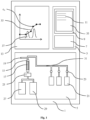
- an apparatus 1 comprising a computation device 3 and a chromatograph 5 is shown.
- the computation device comprises a processor 7 and an associated digital memory 9.
- the processor is arranged to process computer program instructions 11 stored in the digital memory, and to receive and transfer signals to the chromatograph and to one or more I/O-units, in this example to at least one display 13.
- the chromatograph comprises a column 15 packed with a stationary phase 17 that can be polar (termed a normal phase), non-polar (termed a reverse phase), or have some other form of selectivity.
- the chromatograph further includes a sample introduction port 19, one or more inlets 24 for eluent constituents of a mobile phase, one or more drives 23 for driving a flow of the mobile phase, such as pumps, a detector connected at the downstream end of the column, and a waste outlet 27 or collector 29.
- a sample comprising one or more compounds is introduced into the sample port 19.
- the mobile phase carries the sample to and through the column 15. Due to differences in polarity and differences in selectivity the proportion of each compound being in the mobile phase 31 relative to being adsorbed to the stationary phase differs between compounds. This leads to a separation of the compounds during their travel through the column due to their different movement rates.
- the compounds may then be detected by the detector 25, and may be carried to the waste outlet 27 or be collected in the collector 29 for further processing or use.
- the chromatograph 5 is in this example illustrated by a simple, liquid chromatography (LC) chromatograph, but it could in principle be constituted by any other type of chromatograph, such as a flash chromatograph, a high performance liquid chromatograph, or similar.
- the column 15 is preferably packed with a polar stationary phase, forming a normal phase chromatograph, which is particularly suited to the ensuing method.
- the material of the stationary phase could then be for example a silica gel, or any other polar or hydrophilic stationary phase known in the art.
- the column could be a reverse phase column and the material of the stationary phase could then be a modified silica gel, a polymer, such as styren or some other non-polar material known in the art.
- the chromatograph is further arranged to be able to operate at least one chromatographic run with a mobile phase 31 comprising a mixture of at least two eluent constituents having different chromatographic properties and forming an eluent profile 33.
- the eluent profile comprises the relative proportions of the participating eluent constituents forming the mobile phase as introduced relative to the progression of the chromatographic run, such as at different runtimes, or alternatively, as measured by the hitherto total volume of mobile phase pumped.
- the use of column volume or run time as the measure of progression of the chromatographic run is optional and related to each other through the flow rate of the mobile phase and the column volume.
- the digital memory 9 of the computation device 3 comprises program instructions 11 stored therein forming a computer program 35, and which are intended to be executed by the processor and to control the actions of the processor.
- the computer program is in this example arranged to induce the processor to perform the method as described in relation to figs. 2-3 .
- the computer program 35 is further arranged to control the operation of the chromatograph 5.
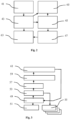
- Figs. 2-3 a method for simulating a chromatographic run on the chromatograph 5 with the computation device 3 according to the present invention is shown.
- Fig. 2 shows a flowchart over an operating structure for the computer program 35.
- Fig. 3 shows a flowchart of the various mathematical and numerical functions that may be performed during numerical execution of the chromatographic model.
- the method comprises storing information in the digital memory 9 pertaining to a chromatographic model comprising mathematical equations for simulation of the chromatographic run.
- the mathematical equations comprises a system of differential equations modelling
- the model may be stored in the form of a set of program instruction, a set of proper mathematical equations or a combination thereof.
- the term storing is intended to include both downloading of the model into the digital memory 9, such as loading a computer program into the digital memory, and providing a digital memory with the model already written therein.
- the digital memory 9 may be a cache memory of the processor, a random access memory, a flash memory, a hard disk or an auxiliary memory which may be accessed by the processor 7.
- the method also comprises storing a trade-off function for at least two variables simulated in the chromatographic model in the digital memory.
- the method comprises storing a trade-off function for a suitable number, preferably more than two, of the variables in the model.
- the trade-off function relates to two or more peak positions 37 for two or more compounds. The trade-off function could then be defined so that the simulation is optimized with an aim to find the conditions making the simulated peak positions 37 be formed a certain distance apart, such as two column volumes apart.
- the weights assigned to the trade-off function could then be a weight of two for any discrepancies being in the direction of two peaks being too far apart, and a weight of twenty for any discrepancies being in the direction of two peaks being closer than said desired distance. Hence, some leeway is permitted, so that a simulation result can be obtained even if the desired outcome is impossible to form. Also, the use of a trade-off function allows for a simpler implementation of the optimization procedure. In this example, the trade-off function could in principle also include variables describing the conditions for performing a chromatographic run, such as information on the elution profile, temperature, and other factors that may affect the chromatographic run.
- the method comprises receiving input from a user or some other source, such as from reading a data file or from being coded in the computer program.
- the input step 43 comprises receiving one or more values for retardation factors, R, and/or retention factors, k, measured during one or more previous chromatographic runs of that compound and with a mobile phase comprising one or more of the eluent constituents which are to be simulated, and also receiving information on the associated eluent profile of the previous chromatographic runs. It is sufficient that only one retardation or retention factor value for each compound is received. However, the more values that are available the better and more accurate simulation.
- the method comprises receiving two measured values.
- the method comprises receiving at least three measured values for the retardation factors, R, or retention factors k, for at least one compound, together with information on its associated eluent profile.
- the eluent profiles associated with the measured retardation factors comprises an eluent with constant proportions for preferably all, but at least for the strongest of the constituents of the eluent in that chromatographic run (an isocratic eluent profile), but linear gradient elution profiles are also possible to use.
- the retardation or retention factor may also be received as a measure of an elution column volume (LC) or as a distance travelled (TLC) for the compound, from which the retardation or retention factors may be estimated.
- LC elution column volume
- TLC distance travelled
- the input step 43 may also or alternatively optionally comprise values or information for other parameters, variables or qualitative data.
- the input may comprise information on the compounds to be simulated, and/or which eluent constituents are intended to be used in the chromatography.
- the method may then comprise checking a database for values of retardation factors, retention factors or other parameters.
- the method may further comprise receiving and storing desired values for the at least two variables of the trade-off functions, and/or storing numerical weights ascribed to any deviations from the desired values.
- the input step 43 may also comprise receiving information on a desired type of elution profile, such as if the elution profile should comprise two, three or more eluent constituents, the nature of the eluent constituents, and the shape of a change in the proportions between the eluent constituents, such as linear gradient, non-linear gradient, etc. Possibly, information could also be received on the nature of the stationary phase and/or of the compounds in the sample. In an alternative embodiment the input step 43 could also comprise partly or completely receiving and storing variables and/or weights of the trade-off function.
- the method further comprises estimating at least one of the parameters a, b or m by fitting the at least one measured retardation or retention factor value and associated eluent proportion c into the model.
- the method comprises calculating the parameter b, and setting a to zero and m to one.
- the method comprises calculating the parameter b, and one of a or m, while setting the third parameter to its defined value as above.
- the method comprises estimating the parameters a, b and m by non-linear regression.
- the input received in the input step 43 may instead comprise already estimated values for the parameters a, b, and m for the model for the retention factor directly. This may happen if estimations of a, b, and m have already been performed, for example during a previous simulation attempt, or from tabulated data.
- the method may comprise including a correction factor ⁇ into the model, which correction factor includes corrections for differences in form factor, pack density, particle quality, fluid drive system and other differences between the chromatographic system in which the experimental measurements of the retention and/or retardation factors are made, and the chromatographic system which is to be simulated, such as between a TLC-plate and an LC-column.
- correction factor includes corrections for differences in form factor, pack density, particle quality, fluid drive system and other differences between the chromatographic system in which the experimental measurements of the retention and/or retardation factors are made, and the chromatographic system which is to be simulated, such as between a TLC-plate and an LC-column.
- the value of the correction factor ⁇ is preferably determined experimentally for each pair of chromatographic systems.
- the method further comprises storing an eluent profile vector ⁇ in the digital memory comprising N vector elements, each vector element ⁇ N comprising information on the proportion c of one of the constituents of the eluent in the mobile phase at a certain point of progression of the chromatographic run.
- the method also comprises associating each vector element ⁇ N with a measure of the progression of the chromatographic run, in this example with a volume v N of eluent introduced into the chromatograph.
- the volume of eluent introduced is preferably measured in column volumes.
- the eluent profile vector may correspondingly comprise a second set of proportion values for the second eluent and so on.
- the number N of vector elements is larger than or equal to four, allowing a description of a linear gradient.
- the number N of vector elements is larger than or equal to five, allowing much more general eluent profiles.
- a simulation step 47 the method comprises simulating the chromatographic run by the at least one processor executing a computation of the chromatographic model so as to obtain a simulated peak position(s) for the at least one compound(s).
- the relationships between the numerical calculations performed during the simulation are shown in fig. 3 .
- the progression of the chromatographic run is given in terms of the present number of column volumes of mobile phase introduced, v P , due to that this measure gives a simpler mathematical model.
- v P the progression of the chromatographic run is given in terms of the present number of column volumes of mobile phase introduced
- a first simulation block 49 the method comprises simulating the progression of the eluent profile of the mobile phase relative to the stationary phase 17 in the chromatograph.
- this step comprises simulating the proportions of the eluent constituents of the mobile phase at different locations of the column at different times as measured by the progression of the chromatographic run.
- the first simulation block 49 comprises first calling an elution profile calculation function, represented by the second simulation block 51, to receive therefrom an estimation of the present eluent profile in terms of the present eluent constituent proportions c P,1..i being introduced into the chromatograph, preferably at the beginning of the stationary phase 17, at a point of progression of the chromatographic run, vp.
- the second simulation block 51 in turn comprises using information on the eluent profile vector ⁇ , its vector elements ⁇ N , and the present point of progression of the chromatographic run, v P , for evaluating the proportions c P,1..i of each eluent constituent (i) at the beginning of the stationary phase at the present point of progression of the chromatographic run vp.
- the second simulation block 51 comprises interpolating the proportions c P,1..n based on the elution profile vector elements ⁇ N , their associated elution volumes, and the present progression of the chromatographic run, thus giving the momentary proportions c P,1..i of the eluent constituents, and returning these values to the first simulation block 49.
- the first simulation block 49 further comprises estimating the local eluent profile, or eluent constituent proportions c Local,1..i (v P ) throughout the column for each eluent constituent (i).
- v represents the volume of eluent introduced
- z represents the position in the column as measured in relative column volumes running from 0 to 1.
- equations describing the progression of the eluent profile for different configurations of a chromatograph may also be used or may replace the example above.
- the equation may comprise a submodel for describing the flow rate in terms of gravitational force, gas pressure, pressure drop, diffusion etc., instead of incorporating the flow rate indirectly into the eluent profile vector, as well as models for other factors such as retention and adsorption of an eluent constituent onto the stationary phase.
- a third simulation block 53 the method comprises simulating the relative distribution of a compound between the stationary phase (17) and the mobile phase (31) based on the local eluent profile, c local,1..n , at the present location of the compound.
- the method comprises simulating the strength of the mobile phase locally for each compound.
- the method comprises using the information from the first and second simulation blocks 49, 51 on the local eluent profile in combination with the model for the retention factor as described in the modelling step 45 of the model, thus obtaining the relative distribution of each compound between the stationary and the mobile phase at the location of the compound.
- the third simulation block 53 thus comprises calling a retention factor calculation function, represented by a fourth simulation block 55.
- the method comprises simulating the relative distribution of the compound between the stationary phase and the mobile phase based on the model for the retention factor (k) and the local eluent profile at the location of the compound.
- a fifth simulation block 57 the method comprises simulating an elution of the compound relative to the stationary phase based on the progression of the eluent profile from block 49 and on said relative distribution from step 53 and 55.
- the fifth simulation block 57 comprises simulating the movement (elution) of each compound relative to the stationary phase (column) based on the progression of the eluent profile and by taking into account the proportion k Local,1..j of the compound residing in the mobile phase 31 from block 55.
- the method further comprises a sixth simulation block 59 comprising simulating the chromatographic run by the at least one processor 7 executing a computation of the chromatographic model.
- the method comprises repeating the simulation blocks 49-55 with a numerical method for solving differential equations, thus resulting in obtaining simulated resulting peak positions 37 for each of the compounds.
- the differential equations of block 51 to 57 may be computed by executing a numerical method for solving a system of differential equations, such as an Euler-method, Runge-Kutta method or any other numerical method for solving differential systems of equations.
- the simulation comprises simulating the chromatographic run by the at least one processor executing a computation of the chromatographic model so as to obtain a correspondence between the resulting peak position for a compound and an eluent profile for the mobile phase, by executing blocks 49 to 57.
- the method thus also comprises simulating the chromatographic run with computations based on the eluent profile vector ⁇ .
- the method further comprises simulating the chromatographic run by the at least one processor 7 executing a computation of the chromatographic model so as to obtain simulated values for at least two variables of the trade-off function.
- the variables of the trade-off function are set to be two peak positions.
- the method further comprises computing a weighted trade-off score based on the trade-off function. Hence a score is assigned to the point represented by the presently simulated elution profile vector ⁇ , in a point space spanned by the set of all possible values for the elements ⁇ N of an arbitrary elution profile vector of the same dimension.
- a seventh simulation block 60 the method comprises calculating a score for the trade-off function at said point in the point space, by summing the weighted deviations for all variables presently selected as being active variables of the trade-off function.
- the method comprises executing an optimization of the simulation so as to produce an optimised chromatographic run.
- the optimization may comprise re-executing the simulation, such as the simulation in blocks 49-60, to obtain a plurality of simulation results, and selecting the optimum simulation result from among the plurality of simulation results.
- the method comprises varying the simulation by re-executing the simulation (in blocks 49-60) with a varying simulation eluent profile so as to predict a resulting eluent profile (33) for the mobile phase resulting in a simulated peak position (37) being within a tolerance limit of the desired peak position.
- the tolerance limit may for example be a specified range about the peak position, which may be predefined or entered by the user in the input step 43. However, the tolerance limit may also be dynamically set as described below.
- the eighth simulation block 61 of the method comprises executing an optimization with the at least one processor for optimizing the trade-off function so as to minimize the sum of weighted deviations, in this example the score of the trade-off function as calculated in the seventh simulation block 60.
- the method may comprise optimizing the value of the trade-off function by varying the eluent profile in the form of the eluent profile vector ( ⁇ ), and re-executing the simulation in blocks 49-60 with the new, varied vector elements ⁇ N .
- the method further comprises selecting the eluent profile vector ⁇ that results in the least value for the score of the trade-off function as the optimum eluent profile.
- the weights of the trade-off function together with selecting the simulation giving the least score dynamically sets the tolerance limits for the peak position or positions.
- at least one of said simulated variables of the trade-off function comprises a simulated peak position for a compound intended to be eluted in the chromatographic run.
- at least one of said variables of the trade-off function could also comprises the eluent profile ⁇ and information on the proportion c of at least one of the eluent constituents in the mobile phase.
- the tolerances about each peak position, eluent profile vector element, and/or other variables of the trade-off function may be dynamically set to the values minimizing the score of the trade-off function.
- the method comprises optimizing the value of the trade-off function by the at least one processor 7 executing a numerical direct search method that varies the eluent profile vector ( ⁇ ) and re-executes the simulation in blocks 49-60 with the new, varied vector elements ⁇ N .
- the method further comprises selecting the eluent profile vector ⁇ that results in the least value for the trade-off function as the optimum eluent profile, and which also dynamically sets the tolerance limit for the peak position or positions.
- the direct search method preferably comprises a simplex method, such as the Nelder Mead Simplex method, that varies the vector elements ⁇ N .
- the model of the chromatographic run is not necessarily well behaved for all forms of chromatography, meaning that it is an advantage to use a direct search method, or a simplex method, which are robust methods less affected by error fluctuations.
- the method comprises presenting the simulated resulting peak position for the at least one simulated compound and its associated eluent profile on the display 13.
- the method also comprises providing a user interface 13 for receiving information from a user.
- the method comprises providing a user interface 13 for receiving input from a user on a desired value for a resulting peak position for at least one compound.
- the method preferably also comprises receiving information from a user on desired changes to one or more of the simulated resulting peak position and to the eluent profile.
- the method may also comprise receiving input from a user on one or more desired values for the eluent profile.
- the display is a touch screen, wherein the user may point at the screen and for example drag a simulated, displayed peak position to a new desired peak position.
- the user may simply point on a location of the eluent profile 33, such as on a displayed element of the eluent profile vector ( ⁇ N ), and drag the eluent profile 33 (or element of the eluent profile vector) to form a new desired eluent profile having a new proportion c for an eluent constituent, and/or to a new point of progression of the chromatographic run.
- the input could also be received from a keyboard, a computer mouse, or some other form of input device known in the field of I/O-units.
- the method comprises receiving input from a user interacting with the computation device on a desired value for at least one of said at least two parameters of the trade-off function.
- the method then comprises repeating the simulation step 47 and the computations of simulation blocks 49-61, so as to execute an optimization of the trade-off function with the at least one processor based on the new input values.
- the method further comprises a control step 65 comprising receiving information from a user on a selected simulated eluent profile 33 desired to be run on the chromatograph, and controlling the chromatograph 5 to run a sample on the chromatograph with a mobile phase having an eluent profile corresponding to the selected eluent profile 33.
- a control step 65 comprising receiving information from a user on a selected simulated eluent profile 33 desired to be run on the chromatograph, and controlling the chromatograph 5 to run a sample on the chromatograph with a mobile phase having an eluent profile corresponding to the selected eluent profile 33.
Landscapes
- Physics & Mathematics (AREA)
- General Physics & Mathematics (AREA)
- Engineering & Computer Science (AREA)
- Mathematical Physics (AREA)
- Computational Mathematics (AREA)
- Pure & Applied Mathematics (AREA)
- Mathematical Optimization (AREA)
- Mathematical Analysis (AREA)
- Data Mining & Analysis (AREA)
- Theoretical Computer Science (AREA)
- Health & Medical Sciences (AREA)
- Immunology (AREA)
- General Health & Medical Sciences (AREA)
- Biochemistry (AREA)
- Analytical Chemistry (AREA)
- Chemical & Material Sciences (AREA)
- Life Sciences & Earth Sciences (AREA)
- Pathology (AREA)
- Algebra (AREA)
- Databases & Information Systems (AREA)
- Software Systems (AREA)
- General Engineering & Computer Science (AREA)
- Operations Research (AREA)
- Treatment Of Liquids With Adsorbents In General (AREA)
- Management, Administration, Business Operations System, And Electronic Commerce (AREA)
Claims (6)
- Verfahren zum Simulieren eines chromatographischen Durchlaufs an einem Chromatographen (5) mit einer Rechenvorrichtung (3), die zumindest einen Prozessor (7) und einen zugehörigen digitalen Speicher (9) umfasst, wobei der chromatographische Durchlauf eine mobile Phase (31) verwendet, die ein Gemisch aus zumindest zwei Eluensbestandteilen umfasst, die unterschiedliche chromatographische Eigenschaften aufweisen und ein Eluensprofil (33) bilden, wobei das Verfahren die folgenden Schritte umfasst- Speichern von Informationen in dem digitalen Speicher, die sich auf ein chromatographisches Modell beziehen, umfassend mathematische Gleichungen zur Simulation des chromatographischen Durchlaufs, wobei die mathematischen Gleichungen ein System mit Differentialgleichungen umfassen, die Folgendes modellierena) Progression des Eluensprofils der mobilen Phase relativ zu einer stationären Phase (17) in dem Chromatographen,b) eine relative Verteilung einer Verbindung zwischen der stationären Phase (17) und der mobilen Phase (31) basierend auf dem lokalen Eluensprofil an der Stelle der Verbindung, undc) Elution der Verbindung relativ zu der stationären Phase basierend auf der Progression des Eluensprofils und auf der relativen Verteilung,und- Simulieren des chromatographischen Durchlaufs durch den zumindest einen Prozessor (7), der eine Berechnung des chromatographischen Modells ausführt, um eine simulierte Spitzenposition (37) für die zumindest eine Verbindung zu erhalten;wobei das Verfahren dadurch gekennzeichnet ist, dass es ferner Folgendes umfasst:- Speichern einer Kompromissfunktion für zumindest zwei Variablen, die in dem chromatographischen Modell simuliert sind, in dem digitalen Speicher (9),- Speichern von gewünschten Werten für die zumindest zwei Variablen und Speichern von numerischen Gewichten, die jeglichen Abweichungen von den gewünschten Werten für die Variablen zugeschrieben sind, in dem digitalen Speicher,- Simulieren des chromatographischen Durchlaufs durch den zumindest einen Prozessor, der eine Berechnung des chromatographischen Modells ausführt, um simulierte Werte für die zumindest zwei Variablen zu erhalten,- Berechnen eines gewichteten Kompromissergebnisses basierend auf der Kompromissfunktion, und- Ausführen einer Optimierung mit dem zumindest einen Prozessor zum Optimieren der Kompromissfunktion, um das gewichtete Kompromissergebnis der Kompromissfunktion zu minimieren,- Empfangen einer Eingabe von einem Benutzer, der mit der Rechenvorrichtung interagiert, zu einem gewünschten Wert für zumindest eine der zumindest zwei Variablen, und- Ausführen einer Optimierung der Kompromissfunktion mit dem zumindest einen Prozessor basierend auf dem neuen Eingabewert,- Speichern eines Eluensprofilvektors (ĉ) in dem digitalen Speicher, das N Vektorelemente umfasst, wobei jedes Vektorelement (ĉN) Informationen über den momentanen Anteil c von einem der Eluensbestandteile in der mobilen Phase an einem Progressionspunkt des chromatographischen Durchlaufs umfasst, und- Simulieren des chromatographischen Durchlaufs mit Berechnungen basierend auf dem Eluensprofilvektor (ĉ),- Minimieren des Kompromissergebnisses der Kompromissfunktion durch den zumindest einen Prozessor, der ein numerisches Direktsuchverfahren ausführt, das den Eluensprofilvektor (ĉ) variiert und die Simulation mit den variierten Vektorelementen ĉN erneut ausführt, wobeider Schritt des Empfangens einer Eingabe von einem Benutzer Folgendes umfasst:- Empfangen einer Eingabe von einem Benutzer zu einem gewünschten Wert für eine Spitzenposition für zumindest eine Verbindung, wenn sie eluiert ist, und wobei der Schritt des Simulierens eines chromatographischen Durchlaufs Folgendes umfasst:- Simulieren des chromatographischen Durchlaufs durch den zumindest einen Prozessor (7), der eine Berechnung des chromatographischen Modells ausführt, um eine Entsprechung zwischen der Spitzenposition (37) für die Verbindung und einem Eluensprofil (33) für die mobile Phase (31) zu erhalten, und- Variieren der Simulation, um ein Eluensprofil für die mobile Phase vorherzusagen, das dazu führt, dass sich eine simulierte Spitzenposition innerhalb einer Toleranzgrenze der gewünschten Spitzenposition befindet.
- Verfahren nach Anspruch 1, dadurch gekennzeichnet, dass das Verfahren Folgendes umfasst- Präsentieren einer simulierten Spitzenposition für zumindest eine Verbindung und ihr zugehöriges Eluensprofil auf einer Anzeige, und- Bereitstellen einer Benutzerschnittstelle zum Empfangen von Informationen von einem Benutzer über gewünschte Änderungen an einer oder mehreren der simulierten Spitzenpositionen und an dem Eluensprofil.
- Verfahren nach einem der Ansprüche 1-2, dadurch gekennzeichnet, dass das Verfahren Folgendes umfasst- Empfangen von einem oder mehreren gemessenen Werten eines Verzögerungsfaktors (R) oder Retentionsfaktors (k) für zumindest eine Verbindung, die von einem oder mehreren vorherigen chromatographischen Durchläufen dieser Verbindung stammt, mit einer mobilen Phase, die einen oder mehrere der zumindest zwei Eluensbestandteile umfasst, und Empfangen von Informationen über den zugehörigen Anteil c von zumindest einem der Eluensbestandteile relativ zu der gesamten mobilen Phase,- Speichern eines Modells für einen Retentionsfaktor der Form k = (a+b*c)-m in dem digitalen Speicher, wobei a, b und m Parameter des Modells sind,- Schätzen von zumindest einem der Parameter a, b oder m durch Einbringen des zumindest einen gemessenen Verzögerungsfaktors (R) oder Retentionsfaktors (k) und des zugehörigen Eluensanteils c in das Modell, und- Simulieren des chromatographischen Durchlaufs basierend auf dem Modell des Retentionsfaktors (k).
- Verfahren nach Anspruch 3, dadurch gekennzeichnet, dass das Verfahren Folgendes umfasst- Empfangen von drei oder mehr gemessenen Werten des Verzögerungs- (R) oder Retentionsfaktors (k) für ein und dieselbe Verbindung und zugehörige Anteile (c1, c2, c3) für zumindest einen der Eluensbestandteile, und- Schätzen der Parameter a, b und m durch nichtlineare Regression.
- Verfahren nach Anspruch 3 oder 4, dadurch gekennzeichnet, dass das Verfahren Folgendes umfasst- Empfangen von einem oder mehreren Werten des Verzögerungsfaktors (R) oder Retentionsfaktors (k) wie an einem ersten chromatographischen System gemessen,- Verwenden eines Korrekturfaktors (α) zum Korrigieren von Unterschieden zwischen dem ersten chromatographischen System und einem zweiten chromatographischen System beim Schätzen des zumindest einen Parameters des Retentionsfaktormodells, und- Simulieren des chromatographischen Durchlaufs an dem zweiten chromatographischen System.
- Verfahren nach einem der Ansprüche 1-5, dadurch gekennzeichnet, dass das Verfahren ferner Steuern eines chromatographischen Durchlaufs an dem Chromatographen (5) umfasst, durch- Empfangen von Informationen von einem Benutzer über ein ausgewähltes simuliertes Eluensprofil, das an einem Chromatographen durchlaufen soll, und- Steuern eines Chromatographen (5) zum Durchlaufen einer Probe an dem Chromatographen mit einer mobilen Phase (31), die ein Eluensprofil aufweist, das dem ausgewählten Eluensprofil (33) entspricht.
Priority Applications (1)
| Application Number | Priority Date | Filing Date | Title |
|---|---|---|---|
| EP13701415.5A EP2828653B2 (de) | 2012-03-23 | 2013-01-18 | Simulation eines chromatographischen laufs |
Applications Claiming Priority (4)
| Application Number | Priority Date | Filing Date | Title |
|---|---|---|---|
| US201261614799P | 2012-03-23 | 2012-03-23 | |
| EP12161056.2A EP2642285A1 (de) | 2012-03-23 | 2012-03-23 | Simulation eines chromatographischen Laufs |
| PCT/EP2013/050935 WO2013139496A1 (en) | 2012-03-23 | 2013-01-18 | Simulation of a chromatographic run |
| EP13701415.5A EP2828653B2 (de) | 2012-03-23 | 2013-01-18 | Simulation eines chromatographischen laufs |
Publications (3)
| Publication Number | Publication Date |
|---|---|
| EP2828653A1 EP2828653A1 (de) | 2015-01-28 |
| EP2828653B1 EP2828653B1 (de) | 2020-04-29 |
| EP2828653B2 true EP2828653B2 (de) | 2023-05-31 |
Family
ID=46000712
Family Applications (2)
| Application Number | Title | Priority Date | Filing Date |
|---|---|---|---|
| EP12161056.2A Withdrawn EP2642285A1 (de) | 2012-03-23 | 2012-03-23 | Simulation eines chromatographischen Laufs |
| EP13701415.5A Active EP2828653B2 (de) | 2012-03-23 | 2013-01-18 | Simulation eines chromatographischen laufs |
Family Applications Before (1)
| Application Number | Title | Priority Date | Filing Date |
|---|---|---|---|
| EP12161056.2A Withdrawn EP2642285A1 (de) | 2012-03-23 | 2012-03-23 | Simulation eines chromatographischen Laufs |
Country Status (5)
| Country | Link |
|---|---|
| US (1) | US9958423B2 (de) |
| EP (2) | EP2642285A1 (de) |
| JP (1) | JP6378666B2 (de) |
| ES (1) | ES2805737T5 (de) |
| WO (1) | WO2013139496A1 (de) |
Cited By (1)
| Publication number | Priority date | Publication date | Assignee | Title |
|---|---|---|---|---|
| EP4538696A1 (de) | 2023-10-09 | 2025-04-16 | Siemens Aktiengesellschaft | Herstellungsverfahren für eine gasanalysevorrichtung, computerprogrammprodukt, gasanylsevorrichtung, simulationsverfahren und simulationsprogrammprodukt |
Families Citing this family (11)
| Publication number | Priority date | Publication date | Assignee | Title |
|---|---|---|---|---|
| EP2642285A1 (de) | 2012-03-23 | 2013-09-25 | Biotage AB | Simulation eines chromatographischen Laufs |
| JP6593223B2 (ja) * | 2016-02-25 | 2019-10-23 | 株式会社島津製作所 | 分析装置 |
| CN106706792B (zh) * | 2016-12-29 | 2019-05-17 | 南京济群医药科技股份有限公司 | 一种计算化学药物中有关物质含量的hplc-elsd双校正因子法 |
| GB201710691D0 (en) * | 2017-07-04 | 2017-08-16 | Ge Healthcare Bio Sciences Ab | Method in bioprocess purification system |
| JP6487128B1 (ja) | 2018-01-10 | 2019-03-20 | バルミューダ株式会社 | 照明機器 |
| CN113227783B (zh) * | 2018-12-14 | 2024-03-08 | 安捷伦科技有限公司 | 配置注入器来仿效另一注入器的运行 |
| GB2605173B (en) * | 2021-03-25 | 2026-06-24 | Agilent Technologies Inc | Determining appropriateness of a sample separation apparatus for executing an operation by simulation |
| JP7832645B2 (ja) * | 2021-10-15 | 2026-03-18 | 山善株式会社 | 分取用クロマトグラフィ支援装置、分取用クロマトグラフ装置及び分取クロマトグラフィ方法 |
| JP7732327B2 (ja) * | 2021-10-25 | 2025-09-02 | 株式会社島津製作所 | データ処理方法、データ処理システム及びコンピュータプログラム |
| CN117969737B (zh) * | 2024-04-02 | 2024-06-11 | 中国人民解放军联勤保障部队第九六四医院 | 一种测定白及多糖药物质量检测方法 |
| CN120369870B (zh) * | 2025-06-24 | 2025-08-29 | 上海圳塑自动化科技有限公司 | 基于微型气相色谱法的有机样品分析方法及色谱分析仪 |
Citations (2)
| Publication number | Priority date | Publication date | Assignee | Title |
|---|---|---|---|---|
| US20020010566A1 (en) † | 2000-04-11 | 2002-01-24 | Chester Thomas Lee | Methods for modeling, predicting, and optimizing high performance liquid chromatography parameters |
| WO2013139496A1 (en) † | 2012-03-23 | 2013-09-26 | Biotage Ab | Simulation of a chromatographic run |
Family Cites Families (6)
| Publication number | Priority date | Publication date | Assignee | Title |
|---|---|---|---|---|
| US4824446A (en) * | 1988-05-23 | 1989-04-25 | Applied Automation, Inc. | Gas chromatography simulation |
| US8082136B2 (en) * | 2004-02-24 | 2011-12-20 | Aspen Technology, Inc. | Computer method and system for predicting physical properties using a conceptual segment model |
| WO2008028974A1 (en) * | 2006-09-08 | 2008-03-13 | Novo Nordisk A/S | Methods of optimizing chromatographic separation of polypeptides |
| JP5049609B2 (ja) * | 2007-02-13 | 2012-10-17 | 株式会社日立ハイテクノロジーズ | 液体クロマトグラム装置 |
| WO2011021198A2 (en) * | 2009-08-20 | 2011-02-24 | Spectrosense Ltd. | Gas chromatographic analysis method and system |
| JP2013518286A (ja) | 2010-01-26 | 2013-05-20 | オールテック・アソシエイツ・インコーポレーテッド | 液体クロマトグラフィーシステムで、グラジエントを最適化する方法 |
-
2012
- 2012-03-23 EP EP12161056.2A patent/EP2642285A1/de not_active Withdrawn
-
2013
- 2013-01-18 EP EP13701415.5A patent/EP2828653B2/de active Active
- 2013-01-18 WO PCT/EP2013/050935 patent/WO2013139496A1/en not_active Ceased
- 2013-01-18 US US14/384,292 patent/US9958423B2/en active Active
- 2013-01-18 ES ES13701415T patent/ES2805737T5/es active Active
- 2013-01-18 JP JP2015500802A patent/JP6378666B2/ja active Active
Patent Citations (2)
| Publication number | Priority date | Publication date | Assignee | Title |
|---|---|---|---|---|
| US20020010566A1 (en) † | 2000-04-11 | 2002-01-24 | Chester Thomas Lee | Methods for modeling, predicting, and optimizing high performance liquid chromatography parameters |
| WO2013139496A1 (en) † | 2012-03-23 | 2013-09-26 | Biotage Ab | Simulation of a chromatographic run |
Non-Patent Citations (16)
| Title |
|---|
| ACHILLE MESSAC: "PHYSICAL PROGRAMMING EFFECTIVE OPTIMIZATION FOR COMPUTATIONAL DESIGN ", AIAA JOURNAL, vol. 34, no. 1, 1 January 1996 (1996-01-01), pages 149 - 158 † |
| ANONYMOUS: "Chromsword ", VWR, 1 February 2010 (2010-02-01) † |
| CELA ET AL.: "PREOPT-W: A simulation program for off-line optimization of binary gradient separations in HPLC-I. Fundamentals and overview", COMPUTERS & CHEMISTRY, vol. 20, no. issue 2, June 1996 (1996-06-01), pages 175 - 191, Retrieved from the Internet <URL:https: / /doi.org/ 10.1016/0097-8485(95)00058-5> DOI: 10.1016/0097-8485(95)00058-5 † |
| DEEPAK NAGRATH; B. WAYNE BEQUETTE; S. M. CRAMER; ACHILLE MESSAC: "Multiobjective optimization strategies for linear gradient chromatography", AICHE JOURNAL, JOHN WILEY & SONS, INC., US, vol. 51, no. 2, 13 January 2005 (2005-01-13), US , pages 511 - 525, ISSN: 0001-1541, DOI: 10.1002/aic.10459 † |
| DOUGLAS M. FAST, PAULA H. CULBERTH, ERIC J.SAMPSON : "Multivariate and univariate optimization studies of liquid- chromatographic separation of steroid mixtures", CLINICAL CHEMISTRY, vol. 28, no. 3, 1 January 1982 (1982-01-01), pages 444 - 448 † |
| FANG FANG QI: "Interactive, user-directed, computer-assisted HPLC methods development", DOCTORAL DISSERTATION, 1 January 1991 (1991-01-01) † |
| JANDERA ET AL.: "Description and prediction of retention in normal-phase high performance liquid chromatography with binary and ternary mobile phases", JOURNAL OF CHROMATOGRAPHY A, vol. 762, 1997, pages 15 - 26, Retrieved from the Internet <URL:https://doi.org/ 10.1016/S0021-9673(96)00888-6> DOI: 10.1016/S0021-9673(96)00888-6 † |
| JANDERA: "Can the theory of gradient liquid chromatography be useful in solving practical problems?", JOURNAL OF CHROMATOGRAPHY A, vol. 1126, 2006, pages 195 - 218, Retrieved from the Internet <URL:https://doi.org/10.1016/j.chroma. 2006.04.09 4> DOI: 10.1016/j.chroma.2006.04.094 † |
| KANG PING XIAO, YUAN XIONG, ABU M. RUSTUM : "Quantitation of Trace Betamethasone or Dexamethasone in Dexamethasone or Betamethasone Active Pharmaceutical Ingredients by Reversed-Phase High-Performance Liquid Chromatography", JOURNAL OF CHROMATOGRAPHIC SCIENCE, vol. 46, 1 January 2008 (2008-01-01), pages 15 - 22 † |
| KARLSSON ET AL.: "Methodologies for model calibration to assist the design of a preparative ion-exchange step for antibody purification", JOURNAL OF CHROMATOGRAPHY A, vol. 1033, no. issue 1, 9 April 2004 (2004-04-09), pages 71 - 82, Retrieved from the Internet <URL:https://doi.org/10.1016/j.chroma. 2003.12.07 2> DOI: 10.1016/j.chroma.2003.12.072 † |
| MARLER ET AL.: "Survey of multi-objective optimization methods for engineering", STRUCT MULTIDISC OPTIM, vol. 26, 2004, pages 369 - 395, Retrieved from the Internet <URL:https://doi.org/ 10.1007/s00158- 003-0368-6> DOI: 10.1007/s00158-003-0368-6 † |
| NAGRATH DEEPAK, ACHILLE MESSAC, B. WAYNE BEQUETTE , S.M.CRAMER : "A hybrid model framework for the optimization of preparative chromatographic processes", BIOTECHNOLOGY PROGRESS, vol. 20, 1 January 2004 (2004-01-01), pages 162 - 178 † |
| OJALA F., MAX-HANSEN M., KIFLE D., BORG N., NILSSON B.: "Modelling and optimisation of preparative chromatographic purification of europium", JOURNAL OF CHROMATOGRAPHY A, vol. 1220, 17 November 2011 (2011-11-17), pages 21 - 25 † |
| OSBERGHAUS A., HEPBILDIKLER S., NATH S., HAINDL M., VON LIERES E., HUBBUCH J.: "Optimizing a chromatographic three component separation: A comparison of mechanistic and empiric modeling approaches", JOURNAL OF CHROMATOGRAPHY A, vol. 1237, 16 March 2012 (2012-03-16), pages 86 - 95 † |
| OSBERGHAUS A; DRECHSEL K; HANSEN S; HEPBILDIKLER S K; NATH S; HAINDL M; VON LIERES E; HUBBUCH J: "Model-integrated process development demonstrated on the optimization of a robotic cation exchange step", CHEM. ENGINEERING SCIENCE, vol. 76, 24 April 2012 (2012-04-24), pages 129 - 139, DOI: 10.1016/j.ces.2012.04.004 † |
| TARAFDER A., AUMANN L., MULLER-SPATH T., MORBIDELLI M.: "Improvement of an overloaded, multi-component, solvent gradient bioseparation through multiobjective optimization", J. CHROMATOGR. A, vol. 1167, no. 1, 11 September 2007 (2007-09-11), pages 42 - 53 † |
Cited By (2)
| Publication number | Priority date | Publication date | Assignee | Title |
|---|---|---|---|---|
| EP4538696A1 (de) | 2023-10-09 | 2025-04-16 | Siemens Aktiengesellschaft | Herstellungsverfahren für eine gasanalysevorrichtung, computerprogrammprodukt, gasanylsevorrichtung, simulationsverfahren und simulationsprogrammprodukt |
| WO2025078153A1 (de) | 2023-10-09 | 2025-04-17 | Siemens Aktiengesellschaft | Herstellungsverfahren für eine gasanalysevorrichtung, computerprogrammprodukt, gasanalysevorrichtung, simulationsverfahren und simulationsprogrammprodukt |
Also Published As
| Publication number | Publication date |
|---|---|
| EP2642285A1 (de) | 2013-09-25 |
| JP6378666B2 (ja) | 2018-08-22 |
| US9958423B2 (en) | 2018-05-01 |
| US20150046134A1 (en) | 2015-02-12 |
| ES2805737T5 (es) | 2023-09-26 |
| ES2805737T3 (es) | 2021-02-15 |
| WO2013139496A1 (en) | 2013-09-26 |
| JP2015511017A (ja) | 2015-04-13 |
| EP2828653A1 (de) | 2015-01-28 |
| EP2828653B1 (de) | 2020-04-29 |
Similar Documents
| Publication | Publication Date | Title |
|---|---|---|
| EP2828653B1 (de) | Simulation eines chromatographischen laufs | |
| Osberghaus et al. | Determination of parameters for the steric mass action model—A comparison between two approaches | |
| Osberghaus et al. | Optimizing a chromatographic three component separation: A comparison of mechanistic and empiric modeling approaches | |
| EP3977115B1 (de) | Chromatografieverfahren, verfahren zur bestimmung der konzentration von mindestens einer verbindung in einem chromatografieverfahren und verfahren zur gewinnung von mindestens einem chromatografieverfahrensparameter | |
| Koku et al. | Modeling of dispersion in a polymeric chromatographic monolith | |
| US20140179008A1 (en) | BUFFER KIT AND METHOD OF GENERATING A LINEAR pH GRADIENT | |
| CN101829438B (zh) | 一种模拟移动床色谱操作参数优化方法 | |
| Bentley et al. | Simultaneous modeling and optimization of nonlinear simulated moving bed chromatography by the prediction–correction method | |
| Marek et al. | Prediction tool for loading, isocratic elution, gradient elution and scaling up of ion exchange chromatography of proteins | |
| Sellberg et al. | Discretized multi-level elution trajectory: A proof-of-concept demonstration | |
| Seidel‐Morgenstern | Modeling of chromatographic processes | |
| Püttmann et al. | Stabilized space–time finite elements for high-definition simulation of packed bed chromatography | |
| Nilsson et al. | Simulation of process chromatography | |
| Koch et al. | Mechanistic modeling of cation exchange chromatography scale‐up considering packing inhomogeneities | |
| Sellberg et al. | Multi-flowrate optimization of the loading phase of a preparative chromatographic separation | |
| Ortner et al. | Equilibrium theory analysis of liquid chromatography with non-constant velocity | |
| JP5049609B2 (ja) | 液体クロマトグラム装置 | |
| Borrmann et al. | Phenomena and modeling of hydrophobic interaction chromatography | |
| Shipilova et al. | Particle transport method for simulation of multicomponent chromatography problems | |
| Persson et al. | Estimation of adsorption parameters in a detailed affinity chromatography model based on shallow bed experiments | |
| Al-Jibbouri | The influence of salt type on the retention of bovine serum albumin in ion-exchange chromatography | |
| Nishi et al. | Hybrid boundary condition combined with data assimilation for simulations of free surface flows using lattice Boltzmann method | |
| Vajda et al. | The modeling of overloaded elution band profiles in supercritical fluid chromatography | |
| Rajendran et al. | Binary retention time method for rapid determination of competitive Langmuir isotherm parameters | |
| Leweke | Unified modeling and efficient simulation of chromatographic separation processes |
Legal Events
| Date | Code | Title | Description |
|---|---|---|---|
| PUAI | Public reference made under article 153(3) epc to a published international application that has entered the european phase |
Free format text: ORIGINAL CODE: 0009012 |
|
| 17P | Request for examination filed |
Effective date: 20141021 |
|
| AK | Designated contracting states |
Kind code of ref document: A1 Designated state(s): AL AT BE BG CH CY CZ DE DK EE ES FI FR GB GR HR HU IE IS IT LI LT LU LV MC MK MT NL NO PL PT RO RS SE SI SK SM TR |
|
| AX | Request for extension of the european patent |
Extension state: BA ME |
|
| DAX | Request for extension of the european patent (deleted) | ||
| STAA | Information on the status of an ep patent application or granted ep patent |
Free format text: STATUS: EXAMINATION IS IN PROGRESS |
|
| 17Q | First examination report despatched |
Effective date: 20190708 |
|
| GRAP | Despatch of communication of intention to grant a patent |
Free format text: ORIGINAL CODE: EPIDOSNIGR1 |
|
| STAA | Information on the status of an ep patent application or granted ep patent |
Free format text: STATUS: GRANT OF PATENT IS INTENDED |
|
| INTG | Intention to grant announced |
Effective date: 20200122 |
|
| GRAS | Grant fee paid |
Free format text: ORIGINAL CODE: EPIDOSNIGR3 |
|
| GRAA | (expected) grant |
Free format text: ORIGINAL CODE: 0009210 |
|
| STAA | Information on the status of an ep patent application or granted ep patent |
Free format text: STATUS: THE PATENT HAS BEEN GRANTED |
|
| AK | Designated contracting states |
Kind code of ref document: B1 Designated state(s): AL AT BE BG CH CY CZ DE DK EE ES FI FR GB GR HR HU IE IS IT LI LT LU LV MC MK MT NL NO PL PT RO RS SE SI SK SM TR |
|
| REG | Reference to a national code |
Ref country code: GB Ref legal event code: FG4D |
|
| REG | Reference to a national code |
Ref country code: CH Ref legal event code: EP |
|
| REG | Reference to a national code |
Ref country code: DE Ref legal event code: R096 Ref document number: 602013068399 Country of ref document: DE |
|
| REG | Reference to a national code |
Ref country code: AT Ref legal event code: REF Ref document number: 1264094 Country of ref document: AT Kind code of ref document: T Effective date: 20200515 |
|
| REG | Reference to a national code |
Ref country code: IE Ref legal event code: FG4D |
|
| REG | Reference to a national code |
Ref country code: SE Ref legal event code: TRGR |
|
| REG | Reference to a national code |
Ref country code: CH Ref legal event code: NV Representative=s name: STOLMAR AND PARTNER INTELLECTUAL PROPERTY S.A., CH |
|
| REG | Reference to a national code |
Ref country code: NL Ref legal event code: MP Effective date: 20200429 |
|
| REG | Reference to a national code |
Ref country code: LT Ref legal event code: MG4D |
|
| PG25 | Lapsed in a contracting state [announced via postgrant information from national office to epo] |
Ref country code: NO Free format text: LAPSE BECAUSE OF FAILURE TO SUBMIT A TRANSLATION OF THE DESCRIPTION OR TO PAY THE FEE WITHIN THE PRESCRIBED TIME-LIMIT Effective date: 20200729 Ref country code: IS Free format text: LAPSE BECAUSE OF FAILURE TO SUBMIT A TRANSLATION OF THE DESCRIPTION OR TO PAY THE FEE WITHIN THE PRESCRIBED TIME-LIMIT Effective date: 20200829 Ref country code: FI Free format text: LAPSE BECAUSE OF FAILURE TO SUBMIT A TRANSLATION OF THE DESCRIPTION OR TO PAY THE FEE WITHIN THE PRESCRIBED TIME-LIMIT Effective date: 20200429 Ref country code: GR Free format text: LAPSE BECAUSE OF FAILURE TO SUBMIT A TRANSLATION OF THE DESCRIPTION OR TO PAY THE FEE WITHIN THE PRESCRIBED TIME-LIMIT Effective date: 20200730 Ref country code: PT Free format text: LAPSE BECAUSE OF FAILURE TO SUBMIT A TRANSLATION OF THE DESCRIPTION OR TO PAY THE FEE WITHIN THE PRESCRIBED TIME-LIMIT Effective date: 20200831 Ref country code: LT Free format text: LAPSE BECAUSE OF FAILURE TO SUBMIT A TRANSLATION OF THE DESCRIPTION OR TO PAY THE FEE WITHIN THE PRESCRIBED TIME-LIMIT Effective date: 20200429 |
|
| REG | Reference to a national code |
Ref country code: AT Ref legal event code: MK05 Ref document number: 1264094 Country of ref document: AT Kind code of ref document: T Effective date: 20200429 |
|
| PG25 | Lapsed in a contracting state [announced via postgrant information from national office to epo] |
Ref country code: LV Free format text: LAPSE BECAUSE OF FAILURE TO SUBMIT A TRANSLATION OF THE DESCRIPTION OR TO PAY THE FEE WITHIN THE PRESCRIBED TIME-LIMIT Effective date: 20200429 Ref country code: BG Free format text: LAPSE BECAUSE OF FAILURE TO SUBMIT A TRANSLATION OF THE DESCRIPTION OR TO PAY THE FEE WITHIN THE PRESCRIBED TIME-LIMIT Effective date: 20200729 Ref country code: RS Free format text: LAPSE BECAUSE OF FAILURE TO SUBMIT A TRANSLATION OF THE DESCRIPTION OR TO PAY THE FEE WITHIN THE PRESCRIBED TIME-LIMIT Effective date: 20200429 Ref country code: HR Free format text: LAPSE BECAUSE OF FAILURE TO SUBMIT A TRANSLATION OF THE DESCRIPTION OR TO PAY THE FEE WITHIN THE PRESCRIBED TIME-LIMIT Effective date: 20200429 |
|
| PG25 | Lapsed in a contracting state [announced via postgrant information from national office to epo] |
Ref country code: NL Free format text: LAPSE BECAUSE OF FAILURE TO SUBMIT A TRANSLATION OF THE DESCRIPTION OR TO PAY THE FEE WITHIN THE PRESCRIBED TIME-LIMIT Effective date: 20200429 Ref country code: AL Free format text: LAPSE BECAUSE OF FAILURE TO SUBMIT A TRANSLATION OF THE DESCRIPTION OR TO PAY THE FEE WITHIN THE PRESCRIBED TIME-LIMIT Effective date: 20200429 |
|
| PG25 | Lapsed in a contracting state [announced via postgrant information from national office to epo] |
Ref country code: EE Free format text: LAPSE BECAUSE OF FAILURE TO SUBMIT A TRANSLATION OF THE DESCRIPTION OR TO PAY THE FEE WITHIN THE PRESCRIBED TIME-LIMIT Effective date: 20200429 Ref country code: AT Free format text: LAPSE BECAUSE OF FAILURE TO SUBMIT A TRANSLATION OF THE DESCRIPTION OR TO PAY THE FEE WITHIN THE PRESCRIBED TIME-LIMIT Effective date: 20200429 Ref country code: SM Free format text: LAPSE BECAUSE OF FAILURE TO SUBMIT A TRANSLATION OF THE DESCRIPTION OR TO PAY THE FEE WITHIN THE PRESCRIBED TIME-LIMIT Effective date: 20200429 Ref country code: DK Free format text: LAPSE BECAUSE OF FAILURE TO SUBMIT A TRANSLATION OF THE DESCRIPTION OR TO PAY THE FEE WITHIN THE PRESCRIBED TIME-LIMIT Effective date: 20200429 Ref country code: CZ Free format text: LAPSE BECAUSE OF FAILURE TO SUBMIT A TRANSLATION OF THE DESCRIPTION OR TO PAY THE FEE WITHIN THE PRESCRIBED TIME-LIMIT Effective date: 20200429 Ref country code: RO Free format text: LAPSE BECAUSE OF FAILURE TO SUBMIT A TRANSLATION OF THE DESCRIPTION OR TO PAY THE FEE WITHIN THE PRESCRIBED TIME-LIMIT Effective date: 20200429 |
|
| REG | Reference to a national code |
Ref country code: DE Ref legal event code: R026 Ref document number: 602013068399 Country of ref document: DE |
|
| PLBI | Opposition filed |
Free format text: ORIGINAL CODE: 0009260 |
|
| PLAX | Notice of opposition and request to file observation + time limit sent |
Free format text: ORIGINAL CODE: EPIDOSNOBS2 |
|
| REG | Reference to a national code |
Ref country code: ES Ref legal event code: FG2A Ref document number: 2805737 Country of ref document: ES Kind code of ref document: T3 Effective date: 20210215 |
|
| PG25 | Lapsed in a contracting state [announced via postgrant information from national office to epo] |
Ref country code: PL Free format text: LAPSE BECAUSE OF FAILURE TO SUBMIT A TRANSLATION OF THE DESCRIPTION OR TO PAY THE FEE WITHIN THE PRESCRIBED TIME-LIMIT Effective date: 20200429 Ref country code: SK Free format text: LAPSE BECAUSE OF FAILURE TO SUBMIT A TRANSLATION OF THE DESCRIPTION OR TO PAY THE FEE WITHIN THE PRESCRIBED TIME-LIMIT Effective date: 20200429 |
|
| 26 | Opposition filed |
Opponent name: RASMUSSEN, LENA ELISE Effective date: 20210129 Opponent name: SCHOENBERGER, SANDRA Effective date: 20210129 |
|
| PG25 | Lapsed in a contracting state [announced via postgrant information from national office to epo] |
Ref country code: SI Free format text: LAPSE BECAUSE OF FAILURE TO SUBMIT A TRANSLATION OF THE DESCRIPTION OR TO PAY THE FEE WITHIN THE PRESCRIBED TIME-LIMIT Effective date: 20200429 |
|
| PLBB | Reply of patent proprietor to notice(s) of opposition received |
Free format text: ORIGINAL CODE: EPIDOSNOBS3 |
|
| PLAB | Opposition data, opponent's data or that of the opponent's representative modified |
Free format text: ORIGINAL CODE: 0009299OPPO |
|
| PLAB | Opposition data, opponent's data or that of the opponent's representative modified |
Free format text: ORIGINAL CODE: 0009299OPPO |
|
| R26 | Opposition filed (corrected) |
Opponent name: RASMUSSEN, LENA ELISE Effective date: 20210129 |
|
| PG25 | Lapsed in a contracting state [announced via postgrant information from national office to epo] |
Ref country code: MC Free format text: LAPSE BECAUSE OF FAILURE TO SUBMIT A TRANSLATION OF THE DESCRIPTION OR TO PAY THE FEE WITHIN THE PRESCRIBED TIME-LIMIT Effective date: 20200429 |
|
| R26 | Opposition filed (corrected) |
Opponent name: SCHOENBERGER, SANDRA Effective date: 20210129 |
|
| PG25 | Lapsed in a contracting state [announced via postgrant information from national office to epo] |
Ref country code: LU Free format text: LAPSE BECAUSE OF NON-PAYMENT OF DUE FEES Effective date: 20210118 |
|
| REG | Reference to a national code |
Ref country code: BE Ref legal event code: MM Effective date: 20210131 |
|
| PG25 | Lapsed in a contracting state [announced via postgrant information from national office to epo] |
Ref country code: IE Free format text: LAPSE BECAUSE OF NON-PAYMENT OF DUE FEES Effective date: 20210118 |
|
| PG25 | Lapsed in a contracting state [announced via postgrant information from national office to epo] |
Ref country code: BE Free format text: LAPSE BECAUSE OF NON-PAYMENT OF DUE FEES Effective date: 20210131 |
|
| APBM | Appeal reference recorded |
Free format text: ORIGINAL CODE: EPIDOSNREFNO |
|
| APBP | Date of receipt of notice of appeal recorded |
Free format text: ORIGINAL CODE: EPIDOSNNOA2O |
|
| APAH | Appeal reference modified |
Free format text: ORIGINAL CODE: EPIDOSCREFNO |
|
| APBU | Appeal procedure closed |
Free format text: ORIGINAL CODE: EPIDOSNNOA9O |
|
| REG | Reference to a national code |
Ref country code: CH Ref legal event code: PK Free format text: BERICHTIGUNGEN |
|
| RIN2 | Information on inventor provided after grant (corrected) |
Inventor name: HALLIN, ERIK |
|
| PUAH | Patent maintained in amended form |
Free format text: ORIGINAL CODE: 0009272 |
|
| STAA | Information on the status of an ep patent application or granted ep patent |
Free format text: STATUS: PATENT MAINTAINED AS AMENDED |
|
| 27A | Patent maintained in amended form |
Effective date: 20230531 |
|
| AK | Designated contracting states |
Kind code of ref document: B2 Designated state(s): AL AT BE BG CH CY CZ DE DK EE ES FI FR GB GR HR HU IE IS IT LI LT LU LV MC MK MT NL NO PL PT RO RS SE SI SK SM TR |
|
| PG25 | Lapsed in a contracting state [announced via postgrant information from national office to epo] |
Ref country code: HU Free format text: LAPSE BECAUSE OF FAILURE TO SUBMIT A TRANSLATION OF THE DESCRIPTION OR TO PAY THE FEE WITHIN THE PRESCRIBED TIME-LIMIT; INVALID AB INITIO Effective date: 20130118 |
|
| REG | Reference to a national code |
Ref country code: DE Ref legal event code: R102 Ref document number: 602013068399 Country of ref document: DE |
|
| P01 | Opt-out of the competence of the unified patent court (upc) registered |
Effective date: 20230404 |
|
| PG25 | Lapsed in a contracting state [announced via postgrant information from national office to epo] |
Ref country code: CY Free format text: LAPSE BECAUSE OF FAILURE TO SUBMIT A TRANSLATION OF THE DESCRIPTION OR TO PAY THE FEE WITHIN THE PRESCRIBED TIME-LIMIT Effective date: 20200429 |
|
| REG | Reference to a national code |
Ref country code: SE Ref legal event code: RPEO |
|
| REG | Reference to a national code |
Ref country code: ES Ref legal event code: DC2A Ref document number: 2805737 Country of ref document: ES Kind code of ref document: T5 Effective date: 20230926 |
|
| PG25 | Lapsed in a contracting state [announced via postgrant information from national office to epo] |
Ref country code: MK Free format text: LAPSE BECAUSE OF FAILURE TO SUBMIT A TRANSLATION OF THE DESCRIPTION OR TO PAY THE FEE WITHIN THE PRESCRIBED TIME-LIMIT Effective date: 20200429 |
|
| PG25 | Lapsed in a contracting state [announced via postgrant information from national office to epo] |
Ref country code: MT Free format text: LAPSE BECAUSE OF FAILURE TO SUBMIT A TRANSLATION OF THE DESCRIPTION OR TO PAY THE FEE WITHIN THE PRESCRIBED TIME-LIMIT Effective date: 20200429 |
|
| PG25 | Lapsed in a contracting state [announced via postgrant information from national office to epo] |
Ref country code: TR Free format text: LAPSE BECAUSE OF FAILURE TO SUBMIT A TRANSLATION OF THE DESCRIPTION OR TO PAY THE FEE WITHIN THE PRESCRIBED TIME-LIMIT Effective date: 20200429 |
|
| REG | Reference to a national code |
Ref country code: CH Ref legal event code: U11 Free format text: ST27 STATUS EVENT CODE: U-0-0-U10-U11 (AS PROVIDED BY THE NATIONAL OFFICE) Effective date: 20260201 |
|
| PGFP | Annual fee paid to national office [announced via postgrant information from national office to epo] |
Ref country code: SE Payment date: 20260122 Year of fee payment: 14 |
|
| PGFP | Annual fee paid to national office [announced via postgrant information from national office to epo] |
Ref country code: GB Payment date: 20260121 Year of fee payment: 14 |
|
| PGFP | Annual fee paid to national office [announced via postgrant information from national office to epo] |
Ref country code: ES Payment date: 20260204 Year of fee payment: 14 |
|
| PGFP | Annual fee paid to national office [announced via postgrant information from national office to epo] |
Ref country code: DE Payment date: 20260122 Year of fee payment: 14 |
|
| PGFP | Annual fee paid to national office [announced via postgrant information from national office to epo] |
Ref country code: IT Payment date: 20260127 Year of fee payment: 14 |
|
| PGFP | Annual fee paid to national office [announced via postgrant information from national office to epo] |
Ref country code: FR Payment date: 20260120 Year of fee payment: 14 |
|
| PGFP | Annual fee paid to national office [announced via postgrant information from national office to epo] |
Ref country code: CH Payment date: 20260201 Year of fee payment: 14 |