EP2827554A1 - Korrektur von Entschlüsselungsfehlsynchronisation in einem mobilen Kommunikationsendgerät - Google Patents
Korrektur von Entschlüsselungsfehlsynchronisation in einem mobilen Kommunikationsendgerät Download PDFInfo
- Publication number
- EP2827554A1 EP2827554A1 EP14177735.9A EP14177735A EP2827554A1 EP 2827554 A1 EP2827554 A1 EP 2827554A1 EP 14177735 A EP14177735 A EP 14177735A EP 2827554 A1 EP2827554 A1 EP 2827554A1
- Authority
- EP
- European Patent Office
- Prior art keywords
- parameters
- compression protocol
- error
- frames
- amr
- Prior art date
- Legal status (The legal status is an assumption and is not a legal conclusion. Google has not performed a legal analysis and makes no representation as to the accuracy of the status listed.)
- Withdrawn
Links
- 238000010295 mobile communication Methods 0.000 title claims abstract description 12
- 230000006835 compression Effects 0.000 claims abstract description 55
- 238000007906 compression Methods 0.000 claims abstract description 55
- 238000000034 method Methods 0.000 claims abstract description 51
- 238000012545 processing Methods 0.000 claims description 24
- 230000003044 adaptive effect Effects 0.000 claims description 6
- 238000003780 insertion Methods 0.000 claims description 5
- 230000037431 insertion Effects 0.000 claims description 5
- 238000004891 communication Methods 0.000 description 18
- 238000012937 correction Methods 0.000 description 14
- 238000001514 detection method Methods 0.000 description 8
- 230000001413 cellular effect Effects 0.000 description 4
- 230000006870 function Effects 0.000 description 3
- 230000001360 synchronised effect Effects 0.000 description 3
- 238000010586 diagram Methods 0.000 description 2
- 230000007246 mechanism Effects 0.000 description 2
- 230000008569 process Effects 0.000 description 2
- 238000010200 validation analysis Methods 0.000 description 2
- 238000004458 analytical method Methods 0.000 description 1
- 238000003491 array Methods 0.000 description 1
- 230000002238 attenuated effect Effects 0.000 description 1
- 230000008901 benefit Effects 0.000 description 1
- 125000004122 cyclic group Chemical group 0.000 description 1
- 239000000284 extract Substances 0.000 description 1
- 238000012986 modification Methods 0.000 description 1
- 230000004048 modification Effects 0.000 description 1
- 230000003287 optical effect Effects 0.000 description 1
- 230000002085 persistent effect Effects 0.000 description 1
- 230000004044 response Effects 0.000 description 1
- 238000012795 verification Methods 0.000 description 1
Images


Classifications
-
- H—ELECTRICITY
- H04—ELECTRIC COMMUNICATION TECHNIQUE
- H04L—TRANSMISSION OF DIGITAL INFORMATION, e.g. TELEGRAPHIC COMMUNICATION
- H04L9/00—Cryptographic mechanisms or cryptographic arrangements for secret or secure communications; Network security protocols
- H04L9/12—Transmitting and receiving encryption devices synchronised or initially set up in a particular manner
-
- H—ELECTRICITY
- H04—ELECTRIC COMMUNICATION TECHNIQUE
- H04L—TRANSMISSION OF DIGITAL INFORMATION, e.g. TELEGRAPHIC COMMUNICATION
- H04L63/00—Network architectures or network communication protocols for network security
- H04L63/04—Network architectures or network communication protocols for network security for providing a confidential data exchange among entities communicating through data packet networks
- H04L63/0428—Network architectures or network communication protocols for network security for providing a confidential data exchange among entities communicating through data packet networks wherein the data content is protected, e.g. by encrypting or encapsulating the payload
- H04L63/0457—Network architectures or network communication protocols for network security for providing a confidential data exchange among entities communicating through data packet networks wherein the data content is protected, e.g. by encrypting or encapsulating the payload wherein the sending and receiving network entities apply dynamic encryption, e.g. stream encryption
-
- H—ELECTRICITY
- H04—ELECTRIC COMMUNICATION TECHNIQUE
- H04L—TRANSMISSION OF DIGITAL INFORMATION, e.g. TELEGRAPHIC COMMUNICATION
- H04L65/00—Network arrangements, protocols or services for supporting real-time applications in data packet communication
- H04L65/60—Network streaming of media packets
- H04L65/75—Media network packet handling
- H04L65/764—Media network packet handling at the destination
-
- H—ELECTRICITY
- H04—ELECTRIC COMMUNICATION TECHNIQUE
- H04L—TRANSMISSION OF DIGITAL INFORMATION, e.g. TELEGRAPHIC COMMUNICATION
- H04L9/00—Cryptographic mechanisms or cryptographic arrangements for secret or secure communications; Network security protocols
- H04L9/14—Cryptographic mechanisms or cryptographic arrangements for secret or secure communications; Network security protocols using a plurality of keys or algorithms
-
- H—ELECTRICITY
- H04—ELECTRIC COMMUNICATION TECHNIQUE
- H04W—WIRELESS COMMUNICATION NETWORKS
- H04W12/00—Security arrangements; Authentication; Protecting privacy or anonymity
- H04W12/02—Protecting privacy or anonymity, e.g. protecting personally identifiable information [PII]
-
- H—ELECTRICITY
- H04—ELECTRIC COMMUNICATION TECHNIQUE
- H04W—WIRELESS COMMUNICATION NETWORKS
- H04W12/00—Security arrangements; Authentication; Protecting privacy or anonymity
- H04W12/03—Protecting confidentiality, e.g. by encryption
- H04W12/033—Protecting confidentiality, e.g. by encryption of the user plane, e.g. user's traffic
-
- H—ELECTRICITY
- H04—ELECTRIC COMMUNICATION TECHNIQUE
- H04W—WIRELESS COMMUNICATION NETWORKS
- H04W12/00—Security arrangements; Authentication; Protecting privacy or anonymity
- H04W12/08—Access security
-
- H—ELECTRICITY
- H04—ELECTRIC COMMUNICATION TECHNIQUE
- H04L—TRANSMISSION OF DIGITAL INFORMATION, e.g. TELEGRAPHIC COMMUNICATION
- H04L1/00—Arrangements for detecting or preventing errors in the information received
- H04L1/004—Arrangements for detecting or preventing errors in the information received by using forward error control
- H04L1/0056—Systems characterized by the type of code used
- H04L1/0061—Error detection codes
-
- H—ELECTRICITY
- H04—ELECTRIC COMMUNICATION TECHNIQUE
- H04L—TRANSMISSION OF DIGITAL INFORMATION, e.g. TELEGRAPHIC COMMUNICATION
- H04L2209/00—Additional information or applications relating to cryptographic mechanisms or cryptographic arrangements for secret or secure communication H04L9/00
- H04L2209/30—Compression, e.g. Merkle-Damgard construction
-
- H—ELECTRICITY
- H04—ELECTRIC COMMUNICATION TECHNIQUE
- H04L—TRANSMISSION OF DIGITAL INFORMATION, e.g. TELEGRAPHIC COMMUNICATION
- H04L2209/00—Additional information or applications relating to cryptographic mechanisms or cryptographic arrangements for secret or secure communication H04L9/00
- H04L2209/80—Wireless
-
- H—ELECTRICITY
- H04—ELECTRIC COMMUNICATION TECHNIQUE
- H04W—WIRELESS COMMUNICATION NETWORKS
- H04W88/00—Devices specially adapted for wireless communication networks, e.g. terminals, base stations or access point devices
- H04W88/02—Terminal devices
Definitions
- the present disclosure relates generally to communication systems, and particularly to methods and systems for deciphering in communication receivers.
- RLC Radio Link Control
- MAC Medium Access Control
- Digitized voice signals may be compressed using a speech codec, such as the Adaptive Multi-Rate (AMR) speech codec, which is defined, for example, in " Digital cellular telecommunications system (Phase 2+); Universal Mobile Telecommunications System (UMTS); LTE; Mandatory speech codec speech processing functions; Adaptive Multi-Rate (AMR) speech codec frame structure," 3GPP TS 26.101, version 11.0.0, Release 11, October, 2012 , which is incorporated herein by reference.
- AMR Adaptive Multi-Rate
- AMR-WB codec In UMTS, some voice signals are compressed using the AMR-WB codec, which is defined, for example, in " Digital cellular telecommunications system (Phase 2+); Universal Mobile Telecommunications System (UMTS); LTE; Speech codec speech processing functions; Adaptive Multi-Rate - Wideband (AMR-WB) speech codec; Frame structure," 3GPP TS 26.201, version 11.0.0, Release 11, October, 2012 , which is incorporated herein by reference.
- AMR refers to a voice compression protocol in accordance with either the AMR or AMR-WB specifications cited above.
- UMTS packets that carry data or voice are, at times, encrypted in order to provide secure communication. Ciphering in UMTS is defined, for example, in " Digital cellular telecommunications system (Phase 2+); Universal Mobile Telecommunications System (UMTS); 3G security; Security architecture," 3GPP TS 33.102, version 11.5.1, Release 11, July, 2013 , which is incorporated herein by reference.
- U.S. patent 8,582,768 describes a method in a receiver, including receiving from a transmitter a sequence of communication packets, which carry data encrypted with an encryption scheme.
- the encryption scheme depends on a counter value that is incremented independently by each of the transmitter and the receiver. Attempts are made to decrypt the data of a received packet multiple times using different, respective counter values, to produce multiple respective decrypted outputs. A decrypted output in which the data has been decrypted correctly is identified, and the data of the received packet is recovered from the identified decrypted output.
- An embodiment that is described herein provides a method including, in a mobile communication terminal, receiving a signal carrying media content that has been encrypted after being compressed in accordance with a compression protocol having a plurality of predefined configurations. Each configuration specifies a respective compression mode of the compression protocol.
- the received signal is decrypted, and one or more parameters, which define a configuration of the compression protocol that was used for compressing the media content, are determined from the decrypted signal.
- An absence of a match is detected when the determined one or more parameters do not match any of the plurality of predetermined configurations of the compression protocol.
- An error in decrypting the received signal is identified based on detecting the absence of match.
- the compression protocol includes an Adaptive Multi-Rate (AMR) voice compression protocol that carries the compressed voice in AMR frames, and by which the one or more parameters are carried in Silence Insertion Description (SID) frames, and determining the one or more parameters includes determining the one or more parameters based on a SID Type Indicator (STI) bit in the SID frames.
- determining the one or more parameters includes determining Comfort Noise (CN) parameters or a data rate parameter, according to a value of the STI bit.
- AMR Adaptive Multi-Rate
- SID Silence Insertion Description
- determining the one or more parameters includes determining the one or more parameters based on a SID Type Indicator (STI) bit in the SID frames.
- determining the one or more parameters includes determining Comfort Noise (CN) parameters or a data rate parameter, according to a value of the STI bit.
- CN Comfort Noise
- decrypting the signal includes producing multiple media frames of the compressed media content, the one or more parameters include a predefined data pattern that is present in at least one of the multiple media frames only when decryption of the received signal is error-free, and identifying the error includes detecting that none of the multiple media frames contains the predefined data pattern.
- the plurality of predetermined configurations includes one or more valid data rates of the media compression protocol, and identifying the error includes detecting that the determined one or more parameters do not match any of the one or more valid data rates.
- decrypting the signal includes deriving a decryption key based on a first sequence number, and including correcting the identified error by deriving the decryption key from a second sequence number different from the first sequence number and checking whether the error is resolved when the decryption key is derived from the second sequence number.
- checking whether the error is resolved includes verifying that each of the one or more parameters matches at least one of the plurality of predetermined configurations of the compression protocol.
- correcting the error includes setting the second sequence number to differ from the first sequence number by no more than a predefined integer.
- the media content includes an audio or speech content
- the compression protocol includes an audio or speech compression protocol.
- the media content includes video content
- the compression protocol includes a video compression protocol.
- each configuration in the plurality of predefined configurations comprises a valid compression mode of the compression protocol.
- an apparatus including a receiver and processing circuitry.
- the receiver is configured to receive a signal including media content that has been encrypted after being compressed in accordance with a compression protocol having a plurality of predetermined configurations, each configuration specifies a respective compression mode of the compression protocol.
- the processing circuitry is configured to decrypt the received signal, to determine from the decrypted signal one or more parameters that define a configuration of the compression protocol that was used for compressing the media content, and to identify an error in decrypting the received signal by detecting that the determined one or more parameters do not match any of the plurality of configurations of the compression protocol.
- a mobile communication terminal includes the disclosed apparatus.
- a chipset for processing signals in a mobile communication terminal includes the disclosed apparatus.
- a sequence of communication packets is encrypted with an encryption scheme that depends on a counter value.
- the counter value is not transmitted over the air, but is rather incremented independently by the transmitter and the receiver.
- the receiver In order to decrypt a packet, the receiver must possess the correct counter value and provide it to the decryption circuitry.
- a mechanism of this sort is used, for example, when communicating voice calls over packet networks, such as, for example UMTS networks.
- the receiver may miss an unknown number of packets in the sequence. In such a case, the receiver may lose track of the correct counter value and therefore fail to decrypt subsequent packets.
- Embodiments that are described herein provide improved methods and systems for processing encrypted packets in communication receivers.
- the encryption key in the transmitter and the decryption key in the receiver depend on a local counter value, which is referred to as a Hyper Frame Number (HFN).
- the local HFN value increments, per packet, at the transmitter and at the receiver, independently.
- the disclosed techniques identify scenarios in which the transmitter and the receiver lose synchronization with respect to the counter value.
- the receiver receives encrypted packets that comprise frames of voice signals that are compressed in accordance with the AMR specifications (also referred to as AMR frames).
- the AMR specifications define a set of compression modes or configurations, of which only a partial subset of configurations are valid for the given communication session.
- the valid configurations are negotiated between the communicating parties, e.g., at session setup.
- the AMR frames comprise voice signals that are compressed based only on the valid configurations.
- At least some of the AMR frames include parameters that define the actual AMR configurations that were used to compress the voice signals, such as, for example, Silence Insertion Description (SID) frames.
- SID frames typically carry Comfort Noise (CN) information at times of the conversation when a user is listening and is not producing voice or other signals.
- CN Comfort Noise
- the receiver decrypts the packets using a key, which depends on the local HFN value. As explained above, if the HFN values used for encryption and decryption match, the decryption succeeds, and the parameters in the SID frames should match at least one of the valid AMR configurations. If, on the other hand, the HFN values are not aligned, decryption is likely to fail, in which case the receiver extracts meaningless configuration parameters out of the SID frames.
- the receiver identifies an HFN mis-synchronization event upon detecting that the configuration parameters in the SID frames do not match any of the valid AMR configurations.
- Example embodiments for detecting HFN mis-synchronization are described below.
- the configuration parameters comprise Comfort Noise (CN) parameters that are expected to be cleared for a certain type of SID frames.
- CN Comfort Noise
- the configuration parameters comprise a set of supported compression data rates. Typically, only a small subset of these data rates is configured as valid for a given communication session.
- the receiver detects HFN mis-synchronization when the actual data rate parameter in the SID frames does not match any of the configured valid data rates.
- the receiver when detecting mis-synchronization, automatically corrects the value of the HFN. In an embodiment, the receiver iteratively searches for an HFN value for which the decryption succeeds. When the receiver finds an HFN value that resolves the mis-synchronization, this value replaces the HFN value that caused the decryption to fail.
- the receiver detects mis-synchronization when the actual AMR configuration fails to match any of the valid configurations that were negotiated between the sender and the receiver, e.g., at call setup. In addition, the receiver corrects the HFN value, on the fly, when detecting mis-synchronization.
- the disclosed techniques are useful, for example, when the received media content is compressed in a highly compact manner and does not contain any fixed data patterns that can be used as indicators of ciphering mis-synchronization. Moreover, when using the disclosed techniques, the receiver re-attempts to decipher a packet using a different HFN value in response to detecting mis-synchronization. As a result, computational complexity is reduced.
- Fig. 1 is a block diagram that schematically illustrates a mobile communication terminal 20, in accordance with an embodiment that is described herein.
- terminal 20 comprises, for example, a cellular phone, a wireless-enabled mobile computing device, or any other suitable type of wireless communication terminal.
- terminal 20 comprises a User Equipment (UE) in a 3GPP UMTS network.
- terminal 20 may operate in any other suitable communication network and in accordance with any other suitable communication standard or protocol.
- the disclosed techniques are applicable, for example, to any encryption scheme in which ciphering is implemented in the MAC layer , and that uses the RLC layer Transparent Mode (TM).
- TM RLC layer Transparent Mode
- the MAC and RLC layers are described, for example, in respective specifications 3GPP TS 25.321 and 3GPP TS 25.322 cited above.
- the embodiments described herein refer mainly to downlink reception, i.e., to receivers in mobile communication terminals, the disclosed techniques are also applicable to uplink reception, i.e., to receivers in base stations.
- UE 20 receives a Radio Frequency (RF) downlink signal from a base station (e.g., UMTS NodeB - not seen in the figure).
- RF Radio Frequency
- the downlink signal received by UE 20 carries a sequence of data packets (also referred to as Packet Data Units - PDUs), which carries a voice call in accordance with the UMTS specifications.
- the data and at least some of the header fields of each packet are encrypted in order to provide data security.
- UE 20 and the base station increment a counter value that is referred to as MAC-d Hyper Frame Number (HFN), or simply HFN for brevity.
- HFN MAC-d Hyper Frame Number
- the MAC-d HFN is used for radio bearers that are mapped onto transparent mode RLC.
- the HFN value is incremented (cyclically) once every MAC PDU that is encrypted or decrypted. More specifically, in an embodiment, the HFN is incremented once every 2.56 seconds, i.e., when a CFN (Connection Frame Number), which increments at 10ms clock rate, completes a 256 cycle count.
- HFN mis-synchronization may occur, when the initial MAC HFN value is negotiated, for example, if the signal received is attenuated and cannot be decoded correctly for a period of 2.56 seconds or longer.
- the local current value of the HFN is used by the base station and the UE as part of a key for encrypting and decrypting the packets.
- the base station encrypts each transmitted packet using the current HFN value (in combination with other parameters), and the UE uses the current HFN value for decrypting each received packet.
- a similar process is performed in the opposite direction, for packets transmitted from the UE to the base station.
- the HFN value is not transmitted in the packets in any way. Instead, the base station and the UE each increment the HFN value independently by counting transmitted or received packets since the initial value of the HFN was negotiated and set. This mechanism helps to prevent illegitimate decryption of packets by a receiver that is not synchronized with the base station (and is therefore unaware of the current HFN value).
- the HFN is typically initialized to an initial value that is negotiated between terminal 20 and the base station during a security configuration procedure.
- UE 20 may miss an unknown number of packets in the received sequence. Packet loss may be caused, for example, by a temporary attenuation of the communication channel due to movement of the UE or for any other reason. An event of this sort may cause a mismatch or mis-synchronization between the HFN value that is incremented by the base station and the HFN value that is incremented by UE 20.
- the UE When packet reception is resumed (and unless the mismatch is corrected) the UE attempts to decrypt subsequent packets using incorrect HFN values (HFN values that are different from those used by the base station for encrypting the respective packets), in an embodiment. As a result, the decryption is likely to fail and the connection or call may be dropped. In some embodiments, UE 20 identifies and recovers from possible decryption errors of this sort using techniques that are described in greater detail below.
- UE 20 comprises an antenna 24 for receiving the downlink RF signal that carries the sequence of packets transmitted by the base station.
- a downlink receiver 28 typically receives the downlink RF signal from antenna 24, down-converts the signal to baseband and digitizes the baseband signal. Receiver 28 outputs a sequence of encrypted packets 32.
- UE 20 comprises processing circuitry 40, which performs the various digital and baseband processing tasks of the terminal.
- Processing circuitry 40 comprises a decipher 44, which decrypts the received packets.
- Decipher 44 accepts packets 32 and a deciphering key 48, which depends on the current HFN value (usually in combination with other parameters).
- Decipher 44 decrypts each packet using key 48, and outputs the deciphered packets to a de-multiplexer 52. As explained above, the decryption of a packet will be successful only if the HFN value used to derive key 48 for decryption by decipher 44 matches the HFN value used by the base station for encrypting the packet.
- the UE processes PDUs 32 according to a layered protocol that includes a MAC layer and an RLC layer.
- the MAC layer is defined, for example, in 3GPP TS 25.321 specifications cited above.
- the RLC layer is defined, for example, in 3GPP TS 25.322 specifications cited above.
- the implementation of de-multiplexer 52 is part of the implementation of the RLC layer, which operates in Transparent Mode (TM), and decipher 44 is implemented as part of the MAC layer.
- decipher 44 and de-multiplexer 52 are implemented as independent units, or as part of any other suitable protocols or layers.
- De-multiplexer 52 receives packets that have possibly been transmitted over multiple radio bearers (e.g., to communicate the packets at a higher data rate than the capacity of a single radio bearer), in an embodiment, and reassembles the received packets into data frames. Each data frame corresponds to one or more decrypted packets, in an embodiment.
- de-multiplexer 52 when communicating a voice call, de-multiplexer 52 outputs data frames according to the AMR codec specifications, which are defined, for example, in 3GPP TS 26.101 specifications, cited above.
- the data frames may be encoded or compressed according to any other suitable protocol, such as, for example AMR-WB.
- An AMR decoder 56 accepts the encoded AMR frames from de-multiplexer 52, and decodes the voice signals according to the AMR specifications and AMR configurations 60.
- AMR configurations 60 comprise valid configurations for operating the AMR decoder, such as, for example, valid operational data rates.
- Terminal 20 typically negotiates the set of valid configurations when setting up the communication session with the base station.
- the number of valid configurations in AMR configurations 60 is smaller than the total number of configurations that the AMR specifications define.
- a SID frames analyzer 74 receives AMR frames from de-multiplexer 52, and identifies among these frames Silence Insertion Description (SID) frames.
- the SID frames include parameters that define the actual operating configurations of the AMR decoder.
- the configuration parameters in the SID frames are expected to match AMR configurations 60.
- the current HFN value at the UE is unsynchronized with the current HFN value at the base station, the decryption is likely to fail, and therefore the probability that the configuration parameters read from the SID frames match any of the valid configurations in AMR configurations 60 is very low.
- analyzer 74 checks whether the configuration parameters carried within the SID frames match any of the valid configurations in AMR configurations 60, and outputs a corresponding indication of the synchronization status to an HFN correction unit 82. It is assumed that mis-synchronization of the HFN values when decrypting a given packet is equivalent to failing in decrypting the packet.
- HFN correction unit 82 corrects the HFN value when analyzer 74 detects HFN mis-synchronization. HFN correction unit 82 searches for an alternative HFN value for which the decrypting is successful. In some embodiments, HFN correction unit 82 iteratively increments the current HFN value, and for each HFN value re-decrypts the packet in which mis-synchronization occurred, and checks the configuration parameters in the corresponding SID frames. In an embodiment, HFN correction unit 82 limits the search to alternative HFN values that differ from the current HFN value by no more than a predefined integer. Upon finding an HFN value that resolves the mis-synchronization, HFN correction unit 82 replaces the HFN value that caused the decryption to fail with this found HFN value.
- the terminal configuration shown in Fig. 1 is an example configuration, which is depicted in a highly simplified manner solely for the sake of clarity. In alternative embodiments, any other suitable terminal configuration can be used. Terminal elements that are not mandatory for understanding of the disclosed techniques have been omitted from the figure for the sake of clarity.
- some or all of the elements of terminal 20, including receiver 28 and processing circuitry 40 are implemented in hardware, such as implementing elements of the receiver using one or more Radio Frequency Integrated Circuits (RFICs), or implementing the processing circuitry using one or more Field-Programmable Gate Arrays (FPGAs) or Application-Specific Integrated Circuits (ASICs).
- RFICs Radio Frequency Integrated Circuits
- FPGAs Field-Programmable Gate Arrays
- ASICs Application-Specific Integrated Circuits
- certain elements of terminal 20 are implemented in software, or using a combination of hardware and software elements.
- certain terminal elements such as certain elements of processing circuitry 40, are implemented in a programmable processor, which is programmed in software to carry out the functions described herein.
- the software may be downloaded to the processor, in whole or in part, in electronic form, over a network, for example, or it may, alternatively or additionally, be provided and/or stored on non-transitory tangible media, such as magnetic, optical, or electronic memory.
- Fig. 2 is a flow chart that schematically illustrates a method for detecting deciphering mis-synchronization in terminal 20, in accordance with an embodiment that is described herein. The method may be carried out by the various elements of processing circuitry 40 when downlink receiver 28 sends to the processing circuitry a new packet.
- analyzer 74 in the processing circuitry comprises a binary state (not shown) that holds the status of the HFN synchronization, and can be set to either SYNC_OK or SYNC_BAD.
- the method begins with analyzer 74 setting the synchronization state to SYNC_OK, at a state clearing operation 100, to indicate that the current HFN value is assumed to be synchronized.
- decipher 44 receives a ciphered MAC PDU from downlink receiver 28.
- the decipher decrypts the MAC PDU using key 48 whose value is based on the current HFN value, and outputs a respective deciphered PDU comprising an AMR frame.
- de-multiplexer 52 reassembles the deciphered PDU (possibly with additional decrypted PDUs) and outputs a respective AMR frame.
- analyzer 74 verifies that the AMR frame comprises a SID frame, by inspecting, for example, the frame header. Additionally, analyzer 74 verifies that the frame is valid, for example by verifying the Cyclic Redundancy Code (CRC) of the frame.
- CRC Cyclic Redundancy Code
- SID frames analyzer 74 can use any other suitable method to verify that the AMR frame is a valid SID frame.
- SID frames comprise a SID Type Indicator bit, three Mode Indication (MI) bits that specify one of eight AMR codec modes, and thirty five bits of Comfort Noise (CN) parameters.
- MI Mode Indication
- CN Comfort Noise
- analyzer 74 If, at operation 108, analyzer 74 discovers that the AMR frame is not a valid SID frame, the method loops back to operation 104 to receive subsequent MAC PDUs. Otherwise, analyzer 74 checks the type of the SID frame by examining a SID Type Indicator (STI) bit in the frame.
- STI SID Type Indicator
- Table 1 below depicts information regarding bit classification for SID frames from Table 3 of 3GPP TS 26.101, cited above.
- AMR configurations 60 comprise one or more AMR codec modes. Table 2 below describes interpretation of the MI bits, which is drawn from Table 1a of 3GPP TS 26.101, cited above. AMR configurations 60 typically comprise only a partial subset of the eight valid modes of Table 2.
- MI bits interpretation Mode Indication (MI) Frame Content (AMR mode) 0 AMR 4,75 kbit/s 1 AMR 5,15 kbit/s 2 AMR 5,90 kbit/s 3 AMR 6,70 kbit/s (PDC-EFR) 4 AMR 7,40 kbit/s (TDMA-EFR) 5 AMR 7,95 kbit/s 6 AMR 10,2 kbit/s 7 AMR 12,2 kbit/s (GSM-EFR)
- analyzer 74 compares the MI value written in the SID frame to the valid configurations in AMR configurations 60. If the MI bits match any of the valid configurations, the method loops back to operation 104 above. Otherwise, the MI value in the SID frame does not match any of the parameters in AMR configuration 60, which indicates HFN mis-synchronization.
- analyzer 74 sets the synchronization state to SYNC_BAD, at a mis-synchronization detection operation 120, to indicate (e.g., to HFN correction unit 82) of an HFN synchronization problem, and the method then terminates.
- Fig. 2 The method of Fig. 2 above does not guarantee the detection of HFN mis-synchronization in a given SID frame. As will be explained, however, the probability to detect a persistent mis-synchronization increases with the number of analyzed SID frames.
- the AMR specifications define eight compression data rates, and if we assume that in a given session only four of these data rates serve as valid data rates, the probability of not detecting mis-synchronization (when analyzing a SID frame whose STI bit is set to "1") is 50%.
- Table 3 below estimates the probabilities of detection and mis-detection of HFN mis-synchronization for AMR and AMR-WB under the following assumptions: (i) four out of eight configurations are valid in AMR, (ii) five out of nine configurations are valid in AMR-WB, and (iii) the STI bit is set to "0" or "1" with equal probabilities.
- Table 3 Probabilities of detection and mis-detection. AMR AMR-WB Probability of detection 75% 84.375% Probability of mis-detection 25% 15.625%
- the probability to detect mis-synchronization by analyzing a single SID frame is 75%, and by analyzing up to three SID frames is about 98%. Additionally, using the probabilities given for AMR in Table 3, the number of SID frames that should be analyzed to detect HFN mis-synchronization is evaluated to be about 1.3 frames on average.
- checking the configuration parameters at operation 116 is carried out when the STI bit equals "1".
- operation 116 can be executed independently of the SID frame type.
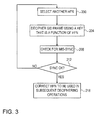
- Fig. 3 is a flow chart that schematically illustrates a method for automatic HFN resynchronization, in accordance with an embodiment that is described herein. The method can be executed, for example, when HFN correction unit 82 receives an indication of an HFN synchronization problem from analyzer 74.
- the method begins with HFN correction unit 82 selecting an HFN value, at a selection operation 200.
- the selected HFN value is different from the current HFN value that caused the deciphering to fail.
- HFN correction unit 82 can use any suitable method for selecting an HFN value.
- HFN correction unit 82 searches for the correct HFN by iteratively incrementing the current HFN value and checking if mis-synchronization is resolved, as will be described below.
- HFN correction unit 82 can select the HFN value by searching in the vicinity of the current HFN value in any other suitable order.
- decipher 44 decrypts the packet that corresponds to the analyzed SID frame using key 48 whose value is based on the selected HFN value.
- analyzer 74 checks whether deciphering the SID frame using the selected HFN has succeeded. In some embodiments, analyzer 74 carries out the checking at operation 208 by setting the state to SYNC_OK and then executing operations 112, 116 and 120 of the method of Fig. 2 , above.
- HFN correction unit 82 If at a synchronization validation operation 212, HFN correction unit 82 discovers that the deciphering has failed, the method loops back to operation 200 to select another HFN value for the next iteration. Otherwise, the deciphering has succeeded using the last selected HFN, and the method proceeds to a correction operation 216, in which the current HFN value is replaced with the HFN value of the last iteration, and the method then terminates. In an embodiment, following the termination of the method of Fig. 3 , analyzer 74 resets the synchronization state to SYNCH_OK.
- UE processing circuitry 40 may use various other techniques for detecting and correcting HFN mis-synchronization.
- the disclosed techniques are applicable to speech codecs other than AMR, such as, the AMR-WB codec, which is defined, for example in 3GPP TS 26.201, cited above.
- the disclosed techniques are also applicable to media content other than speech, such as, for example, audio and video content.
- the actual compression configurations are carried in AMR SID frames, in alternative embodiments the actual configurations can be delivered in any other suitable data frames or packets.
- the valid and/or actual AMR parameters are sent to the terminal via the RLC layer, which delivers the parameters also to the MAC (the RLC and MAC layers reside in L2) and PHY (L1) layers.
- the terminal may acquire these parameters from any of the three layers.
- the embodiments described herein mainly address correcting deciphering mis-synchonization during voice calls over mobile communication networks
- the methods and systems described herein can also be used in other applications, such as in any system delivering compressed voice calls using an AMR or AMR-WB protocol, wherein the compression key depends on a local count number.
Landscapes
- Engineering & Computer Science (AREA)
- Computer Security & Cryptography (AREA)
- Computer Networks & Wireless Communication (AREA)
- Signal Processing (AREA)
- Multimedia (AREA)
- Computer Hardware Design (AREA)
- Computing Systems (AREA)
- General Engineering & Computer Science (AREA)
- Mobile Radio Communication Systems (AREA)
Applications Claiming Priority (1)
| Application Number | Priority Date | Filing Date | Title |
|---|---|---|---|
| US201361847676P | 2013-07-18 | 2013-07-18 |
Publications (1)
| Publication Number | Publication Date |
|---|---|
| EP2827554A1 true EP2827554A1 (de) | 2015-01-21 |
Family
ID=51220413
Family Applications (1)
| Application Number | Title | Priority Date | Filing Date |
|---|---|---|---|
| EP14177735.9A Withdrawn EP2827554A1 (de) | 2013-07-18 | 2014-07-18 | Korrektur von Entschlüsselungsfehlsynchronisation in einem mobilen Kommunikationsendgerät |
Country Status (3)
| Country | Link |
|---|---|
| US (1) | US9385865B2 (de) |
| EP (1) | EP2827554A1 (de) |
| CN (1) | CN104301911A (de) |
Families Citing this family (9)
| Publication number | Priority date | Publication date | Assignee | Title |
|---|---|---|---|---|
| KR102202894B1 (ko) * | 2014-08-28 | 2021-01-14 | 삼성전자 주식회사 | 이동 통신 네트워크에서 패킷 손실 관리 방법 |
| US10560842B2 (en) | 2015-01-28 | 2020-02-11 | Verint Systems Ltd. | System and method for combined network-side and off-air monitoring of wireless networks |
| US20160248908A1 (en) * | 2015-02-24 | 2016-08-25 | Qualcomm Incorporated | Voice garbling detection using silence insertion descriptor frames |
| CN106297827B (zh) * | 2015-06-02 | 2020-07-10 | 中兴通讯股份有限公司 | 语音加密出错的检测方法和装置 |
| IL245299B (en) | 2016-04-25 | 2021-05-31 | Verint Systems Ltd | A system and method for decoding communication transmitted in a wireless local communication network |
| IL248062B (en) | 2016-09-26 | 2020-04-30 | Verint Systems Ltd | A system and method for associating an identifier of a mobile communication terminal with a wanted person, by means of video surveillance |
| IL254438B (en) | 2017-09-07 | 2021-12-01 | Verint Systems Ltd | A system and method for decoding communication on the umts network |
| EP4128618B1 (de) | 2020-03-31 | 2025-06-11 | Telefonaktiebolaget LM ERICSSON (PUBL) | Auf künstlicher intelligenz (ki) basierende eliminierung von unverständlicher sprache |
| CN113132978A (zh) * | 2021-03-19 | 2021-07-16 | 翱捷科技股份有限公司 | 一种lte pdcp数据解密增强的方法及装置 |
Citations (3)
| Publication number | Priority date | Publication date | Assignee | Title |
|---|---|---|---|---|
| US20080123655A1 (en) * | 2006-11-15 | 2008-05-29 | Samsung Electronics Co., Ltd. | Apparatus and method for transmitting/receiving ciphered packet in mobile communication system |
| US20100332933A1 (en) * | 2009-06-30 | 2010-12-30 | Nokia Corporation | Systems, methods, and apparatuses for ciphering error detection and recovery |
| US20120207302A1 (en) * | 2011-02-16 | 2012-08-16 | Danny Alexander | Recovery from decryption errors in a sequence of communication packets |
Family Cites Families (10)
| Publication number | Priority date | Publication date | Assignee | Title |
|---|---|---|---|---|
| US6643815B1 (en) * | 2000-03-30 | 2003-11-04 | International Business Machines Corporation | Data compression over communications links which are exposed to occasional errors |
| US20050226227A1 (en) * | 2004-04-12 | 2005-10-13 | Samsung Electronics Co., Ltd. | Apparatus and method for processing voice packet data in a mobile communication system providing voice service using packet network |
| DE102004022537A1 (de) | 2004-05-05 | 2005-12-01 | Siemens Ag | Verfahren zur Steuerung der Entschlüsselung von verschlüsselten Datenpaketen in einem Funk-Kommunikationssystem |
| CN1767414B (zh) * | 2004-10-29 | 2010-05-05 | 腾讯科技(深圳)有限公司 | 一种基于即时通讯的移动通讯系统及方法 |
| JP2006217100A (ja) | 2005-02-02 | 2006-08-17 | Nec Corp | 復号処理システム及びその方法並びにそれを用いた移動通信システム |
| EP1701173B1 (de) * | 2005-03-11 | 2008-08-20 | Verigy (Singapore) Pte. Ltd. | Fehlererkennung in komprimierten Daten |
| US20080148111A1 (en) * | 2006-12-19 | 2008-06-19 | Innovative Sonic Limited | Method and apparatus for recovering protocol error in a wireless communications system |
| KR101392697B1 (ko) * | 2007-08-10 | 2014-05-19 | 엘지전자 주식회사 | 이동통신 시스템에서의 보안 오류 검출방법 및 장치 |
| US8898448B2 (en) | 2008-06-19 | 2014-11-25 | Qualcomm Incorporated | Hardware acceleration for WWAN technologies |
| EP2467968B1 (de) * | 2009-08-21 | 2019-01-02 | Samsung Electronics Co., Ltd. | Verfahren und vorrichtung zur verwaltung der sicherheitssynchronisation für verlängerte zeiträume ohne empfang von datenramen |
-
2014
- 2014-07-17 US US14/333,547 patent/US9385865B2/en active Active
- 2014-07-18 CN CN201410436287.2A patent/CN104301911A/zh active Pending
- 2014-07-18 EP EP14177735.9A patent/EP2827554A1/de not_active Withdrawn
Patent Citations (4)
| Publication number | Priority date | Publication date | Assignee | Title |
|---|---|---|---|---|
| US20080123655A1 (en) * | 2006-11-15 | 2008-05-29 | Samsung Electronics Co., Ltd. | Apparatus and method for transmitting/receiving ciphered packet in mobile communication system |
| US20100332933A1 (en) * | 2009-06-30 | 2010-12-30 | Nokia Corporation | Systems, methods, and apparatuses for ciphering error detection and recovery |
| US20120207302A1 (en) * | 2011-02-16 | 2012-08-16 | Danny Alexander | Recovery from decryption errors in a sequence of communication packets |
| US8582768B2 (en) | 2011-02-16 | 2013-11-12 | Marvell World Trade Ltd. | Recovery from decryption errors in a sequence of communication packets |
Non-Patent Citations (6)
Also Published As
| Publication number | Publication date |
|---|---|
| CN104301911A (zh) | 2015-01-21 |
| US20150023504A1 (en) | 2015-01-22 |
| US9385865B2 (en) | 2016-07-05 |
Similar Documents
| Publication | Publication Date | Title |
|---|---|---|
| US9385865B2 (en) | Correcting deciphering mis-synchronization in a mobile communication terminal | |
| US9749298B2 (en) | Recovery from decryption errors in a sequence of communication packets | |
| US8938663B2 (en) | Modem architecture for joint source channel decoding | |
| US8724548B2 (en) | Counter check procedure for packet data transmission | |
| US8787578B2 (en) | Method and apparatus for encrypting transmissions in a communication system | |
| JP4487681B2 (ja) | 移動通信システム、移動機、無線制御装置および移動通信方法 | |
| US8387129B2 (en) | Method and apparatus for verifying data packet integrity in a streaming data channel | |
| US8743905B2 (en) | Method and apparatus for bundling and ciphering data | |
| KR101464416B1 (ko) | 암호화 에러를 검출 및 복구하는 방법, 장치 및 컴퓨터 판독 가능 저장 매체 | |
| US20150280905A1 (en) | Method and apparatus for detecting and correcting pdcp hyper frame number (hfn) desynchronization | |
| US20070242703A1 (en) | Binding/combining of plural telecommunications functions | |
| JP5893727B2 (ja) | 通信ネットワーク上の暗号化パラメータミスマッチの検出およびミスマッチからの回復のためのメカニズム | |
| JP5169449B2 (ja) | 無線通信装置及び受信方法 | |
| JP2011512061A (ja) | マスキングを通じてアンテナ構成情報を伝達する方法および装置 | |
| US20080120728A1 (en) | Method and apparatus for performing integrity protection in a wireless communications system | |
| KR20060086273A (ko) | 순환 중복 검사 잔류 오류 검출 및 처리 방법 | |
| CN113132978A (zh) | 一种lte pdcp数据解密增强的方法及装置 | |
| CN104967599B (zh) | 从加密码密钥失配中快速恢复 | |
| US8631313B2 (en) | Method of error detection for wireless transmission | |
| US10999070B2 (en) | System and method for decrypting communication over a UMTS network | |
| CN100479363C (zh) | 移动通信系统保密话音通信的一种密码同步快速恢复方法 | |
| KR20060086786A (ko) | 이동 통신 시스템의 라디오 링크 제어 계층에서 패킷데이터의 역비화를 수행하는 방법 |
Legal Events
| Date | Code | Title | Description |
|---|---|---|---|
| 17P | Request for examination filed |
Effective date: 20140718 |
|
| AK | Designated contracting states |
Kind code of ref document: A1 Designated state(s): AL AT BE BG CH CY CZ DE DK EE ES FI FR GB GR HR HU IE IS IT LI LT LU LV MC MK MT NL NO PL PT RO RS SE SI SK SM TR |
|
| AX | Request for extension of the european patent |
Extension state: BA ME |
|
| PUAI | Public reference made under article 153(3) epc to a published international application that has entered the european phase |
Free format text: ORIGINAL CODE: 0009012 |
|
| R17P | Request for examination filed (corrected) |
Effective date: 20150702 |
|
| RBV | Designated contracting states (corrected) |
Designated state(s): AL AT BE BG CH CY CZ DE DK EE ES FI FR GB GR HR HU IE IS IT LI LT LU LV MC MK MT NL NO PL PT RO RS SE SI SK SM TR |
|
| 17Q | First examination report despatched |
Effective date: 20180626 |
|
| STAA | Information on the status of an ep patent application or granted ep patent |
Free format text: STATUS: THE APPLICATION IS DEEMED TO BE WITHDRAWN |
|
| 18D | Application deemed to be withdrawn |
Effective date: 20181107 |