EP4128618B1 - Auf künstlicher intelligenz (ki) basierende eliminierung von unverständlicher sprache - Google Patents
Auf künstlicher intelligenz (ki) basierende eliminierung von unverständlicher sprache Download PDFInfo
- Publication number
- EP4128618B1 EP4128618B1 EP20928213.6A EP20928213A EP4128618B1 EP 4128618 B1 EP4128618 B1 EP 4128618B1 EP 20928213 A EP20928213 A EP 20928213A EP 4128618 B1 EP4128618 B1 EP 4128618B1
- Authority
- EP
- European Patent Office
- Prior art keywords
- speech frame
- ies
- model
- deciphered
- subset
- Prior art date
- Legal status (The legal status is an assumption and is not a legal conclusion. Google has not performed a legal analysis and makes no representation as to the accuracy of the status listed.)
- Active
Links
Images




Classifications
-
- G—PHYSICS
- G10—MUSICAL INSTRUMENTS; ACOUSTICS
- G10L—SPEECH ANALYSIS TECHNIQUES OR SPEECH SYNTHESIS; SPEECH RECOGNITION; SPEECH OR VOICE PROCESSING TECHNIQUES; SPEECH OR AUDIO CODING OR DECODING
- G10L25/00—Speech or voice analysis techniques not restricted to a single one of groups G10L15/00 - G10L21/00
- G10L25/48—Speech or voice analysis techniques not restricted to a single one of groups G10L15/00 - G10L21/00 specially adapted for particular use
- G10L25/51—Speech or voice analysis techniques not restricted to a single one of groups G10L15/00 - G10L21/00 specially adapted for particular use for comparison or discrimination
- G10L25/60—Speech or voice analysis techniques not restricted to a single one of groups G10L15/00 - G10L21/00 specially adapted for particular use for comparison or discrimination for measuring the quality of voice signals
-
- G—PHYSICS
- G10—MUSICAL INSTRUMENTS; ACOUSTICS
- G10L—SPEECH ANALYSIS TECHNIQUES OR SPEECH SYNTHESIS; SPEECH RECOGNITION; SPEECH OR VOICE PROCESSING TECHNIQUES; SPEECH OR AUDIO CODING OR DECODING
- G10L19/00—Speech or audio signals analysis-synthesis techniques for redundancy reduction, e.g. in vocoders; Coding or decoding of speech or audio signals, using source filter models or psychoacoustic analysis
- G10L19/005—Correction of errors induced by the transmission channel, if related to the coding algorithm
-
- G—PHYSICS
- G06—COMPUTING OR CALCULATING; COUNTING
- G06N—COMPUTING ARRANGEMENTS BASED ON SPECIFIC COMPUTATIONAL MODELS
- G06N3/00—Computing arrangements based on biological models
- G06N3/02—Neural networks
- G06N3/04—Architecture, e.g. interconnection topology
- G06N3/0499—Feedforward networks
-
- G—PHYSICS
- G06—COMPUTING OR CALCULATING; COUNTING
- G06N—COMPUTING ARRANGEMENTS BASED ON SPECIFIC COMPUTATIONAL MODELS
- G06N3/00—Computing arrangements based on biological models
- G06N3/02—Neural networks
- G06N3/08—Learning methods
- G06N3/09—Supervised learning
-
- G—PHYSICS
- G10—MUSICAL INSTRUMENTS; ACOUSTICS
- G10L—SPEECH ANALYSIS TECHNIQUES OR SPEECH SYNTHESIS; SPEECH RECOGNITION; SPEECH OR VOICE PROCESSING TECHNIQUES; SPEECH OR AUDIO CODING OR DECODING
- G10L25/00—Speech or voice analysis techniques not restricted to a single one of groups G10L15/00 - G10L21/00
- G10L25/27—Speech or voice analysis techniques not restricted to a single one of groups G10L15/00 - G10L21/00 characterised by the analysis technique
-
- H—ELECTRICITY
- H04—ELECTRIC COMMUNICATION TECHNIQUE
- H04K—SECRET COMMUNICATION; JAMMING OF COMMUNICATION
- H04K1/00—Secret communication
-
- H—ELECTRICITY
- H04—ELECTRIC COMMUNICATION TECHNIQUE
- H04L—TRANSMISSION OF DIGITAL INFORMATION, e.g. TELEGRAPHIC COMMUNICATION
- H04L9/00—Cryptographic mechanisms or cryptographic arrangements for secret or secure communications; Network security protocols
- H04L9/06—Cryptographic mechanisms or cryptographic arrangements for secret or secure communications; Network security protocols the encryption apparatus using shift registers or memories for block-wise or stream coding, e.g. DES systems or RC4; Hash functions; Pseudorandom sequence generators
- H04L9/065—Encryption by serially and continuously modifying data stream elements, e.g. stream cipher systems, RC4, SEAL or A5/3
-
- H—ELECTRICITY
- H04—ELECTRIC COMMUNICATION TECHNIQUE
- H04L—TRANSMISSION OF DIGITAL INFORMATION, e.g. TELEGRAPHIC COMMUNICATION
- H04L9/00—Cryptographic mechanisms or cryptographic arrangements for secret or secure communications; Network security protocols
- H04L9/06—Cryptographic mechanisms or cryptographic arrangements for secret or secure communications; Network security protocols the encryption apparatus using shift registers or memories for block-wise or stream coding, e.g. DES systems or RC4; Hash functions; Pseudorandom sequence generators
- H04L9/065—Encryption by serially and continuously modifying data stream elements, e.g. stream cipher systems, RC4, SEAL or A5/3
- H04L9/0656—Pseudorandom key sequence combined element-for-element with data sequence, e.g. one-time-pad [OTP] or Vernam's cipher
- H04L9/0662—Pseudorandom key sequence combined element-for-element with data sequence, e.g. one-time-pad [OTP] or Vernam's cipher with particular pseudorandom sequence generator
- H04L9/0668—Pseudorandom key sequence combined element-for-element with data sequence, e.g. one-time-pad [OTP] or Vernam's cipher with particular pseudorandom sequence generator producing a non-linear pseudorandom sequence
-
- H—ELECTRICITY
- H04—ELECTRIC COMMUNICATION TECHNIQUE
- H04L—TRANSMISSION OF DIGITAL INFORMATION, e.g. TELEGRAPHIC COMMUNICATION
- H04L9/00—Cryptographic mechanisms or cryptographic arrangements for secret or secure communications; Network security protocols
- H04L9/08—Key distribution or management, e.g. generation, sharing or updating, of cryptographic keys or passwords
- H04L9/0894—Escrow, recovery or storing of secret information, e.g. secret key escrow or cryptographic key storage
-
- H—ELECTRICITY
- H04—ELECTRIC COMMUNICATION TECHNIQUE
- H04W—WIRELESS COMMUNICATION NETWORKS
- H04W12/00—Security arrangements; Authentication; Protecting privacy or anonymity
- H04W12/03—Protecting confidentiality, e.g. by encryption
- H04W12/033—Protecting confidentiality, e.g. by encryption of the user plane, e.g. user's traffic
-
- G—PHYSICS
- G06—COMPUTING OR CALCULATING; COUNTING
- G06N—COMPUTING ARRANGEMENTS BASED ON SPECIFIC COMPUTATIONAL MODELS
- G06N20/00—Machine learning
- G06N20/20—Ensemble learning
-
- G—PHYSICS
- G06—COMPUTING OR CALCULATING; COUNTING
- G06N—COMPUTING ARRANGEMENTS BASED ON SPECIFIC COMPUTATIONAL MODELS
- G06N3/00—Computing arrangements based on biological models
- G06N3/02—Neural networks
- G06N3/08—Learning methods
-
- G—PHYSICS
- G06—COMPUTING OR CALCULATING; COUNTING
- G06N—COMPUTING ARRANGEMENTS BASED ON SPECIFIC COMPUTATIONAL MODELS
- G06N5/00—Computing arrangements using knowledge-based models
- G06N5/01—Dynamic search techniques; Heuristics; Dynamic trees; Branch-and-bound
-
- H—ELECTRICITY
- H04—ELECTRIC COMMUNICATION TECHNIQUE
- H04L—TRANSMISSION OF DIGITAL INFORMATION, e.g. TELEGRAPHIC COMMUNICATION
- H04L2209/00—Additional information or applications relating to cryptographic mechanisms or cryptographic arrangements for secret or secure communication H04L9/00
- H04L2209/80—Wireless
-
- H—ELECTRICITY
- H04—ELECTRIC COMMUNICATION TECHNIQUE
- H04W—WIRELESS COMMUNICATION NETWORKS
- H04W24/00—Supervisory, monitoring or testing arrangements
- H04W24/02—Arrangements for optimising operational condition
Definitions
- Mobile communication networks e.g., 2G, 3G, Long Term Evolution (LTE), 5G are used to transport voice-data (e.g., a voice call) and non-voice-data to and from a user equipment (UE).
- voice-data e.g., a voice call
- UE user equipment
- speech frames e.g., frames containing data derived from the user's utterances
- RAN radio access network
- UL uplink
- the speech frame contains encoded and ciphered voice-data.
- the UE receives an audio signal corresponding to the user's utterance, encodes the audio signal to produce encoded voice-data, then ciphers (i.e., encrypts) the encoded data using a cipher parameter to produce ciphered encoded data, and then transmits to the network node a speech frame containing the ciphered data.
- ciphers i.e., encrypts
- the network node When the network node receives the speech frame, the network node uses a corresponding cipher parameter to de-cypher the cyphered data to thereby obtain the encoded voice-data and forwards the encoded voice-data onward to the intended recipient.
- Garbled speech is a well-known problem that occurs when there is a mismatch between a ciphering parameter used by the UE to cipher the encoded voice-data and the corresponding ciphering parameter used by the network node to decipher the encoded voice-data, thereby causing a random disorder of the bits.
- Garbled speech is a problem for many mobile communication networks, including 2G, 3G, 4G and 5G networks, but the consequence is typically different.
- the GS causes the circuit switched (CS) voice to become incomprehensible and the GS is audible to the intended recipient
- PS packet switched
- the voice typically becomes silent and after a while the call drops.
- the voice might become incomprehensible to the end-users if robust header compression (ROCH) is not being used.
- GS does not happen very often (typically less than 1% of all the voice calls), it can have a severe impact when it occurs. In addition, it is difficult for the network to detect the existence of garbled data and determine its root cause.
- GS is most commonly occurring both in the UL and the downlink (DL) at the same time, as predominantly the mismatch occurs both for UL and DL.
- GS can only be resolved in the side where it was caused in the UL, as a RAN detected GS in the DL input emanates from the other side.
- GS may potentially resolve itself by triggering a reset of the ciphering parameters, which occurs if the call is re-established or a handover (Inter-frequency or an inter-Radio Access Technology (IRAT) handover) occurs during the call. Nevertheless, GS remains a problem.
- IRAT inter-Radio Access Technology
- a general problem associated with trying to correct GS is the possibility of false detections. Correcting a false detection will either cause an introduction of GS or alternatively cause other disadvantages, impacting the performance.
- this disclosure provides an Artificial Intelligence (AI)-based approach for GS detection.
- AI Artificial Intelligence
- machine learning models are created that can distinguish between GS speech and non-GS speech with high accuracy.
- the machine learning models take as input an encoded speech frame that has passed a cyclic redundancy check (CRC) check.
- CRC cyclic redundancy check
- the input data/predictors to the models are a selected set of information elements (IEs) (i.e., a set of one or more bits) of the encoded speech frame.
- the selected IEs are a part of the input parameters to the speech decoder.
- the predictors have been selected after building several models using different sets of predictors, with the aim to reduce the number of predictors whilst maintaining a high prediction performance and at the same time limiting the size of the model.
- the models only rely on active speech frames and do not require Silence Descriptor (SID) frames to be generated.
- SID Silence Descriptor
- the machine learning (ML) models operate on just one single speech frame, which has been proven to be good enough and reduces the complexity compared to requiring several consecutive frames.
- the ML models may be created using off -line training.
- the ML models can be based on, for example, Random Forest or Neural Network. Both GS and non-GS of the same audio is generated and used for model training and verification. To obtain representative speech, one can use a library with hours of different audio for speech recognition and/or use a crowdsourcing approach where different phone calls are recorded. The detection rate is around 90-95% for both garbled and non-garbled.
- off-line training has been used to develop a first model for a first Adaptive Multi-Rate (AMR) codec (AMR Narrow Band (NB)) and a first model for a second AMR codec (AMR wideband (WB)).
- AMR Adaptive Multi-Rate
- NB Adaptive Multi-Rate
- WB AMR wideband
- the GS detector is activated only at initial setup of voice and at reset of the ciphering parameters for voice, also the models will run for a limited time.
- two types of correction mechanism are applied: 1) Hyper Frame Number (HFN) correction, and 2) a procedure to reset the ciphering input parameters (e.g., a Call Re-Establishment (CRE) procedure or other procedure to reset the ciphering input parameters).
- HFN Hyper Frame Number
- CRE Call Re-Establishment
- a method for processing at least one speech frame (for example, an encoded speech frame).
- the method is performed by a network node and comprises receiving a first ciphered speech frame comprising first voice-data.
- the method also comprises deciphering the first ciphered speech frame using a first deciphering parameter, thereby obtaining a first deciphered speech frame comprising the first voice-data, wherein the first deciphered speech frame comprises a set of information elements (IEs) wherein each IE consists of a set of one or more bits.
- the method also comprises inputting a subset of the set of IEs of the first deciphered speech frame into a trained machine learning, ML, model.
- the method also comprises obtaining from the ML model a first GS indicator, wherein the first GS indicator indicates either i) that the ML model has detected GS based on the subset of IEs of the first deciphered speech frame or ii) that the ML model has not detected GS based on the subset of IEs of the first deciphered speech frame.
- the network node comprises a storage unit and processing circuity.
- the storage unit comprises memory that stores instructions for configuring the network node to perform the method.
- a carrier contains the computer program, wherein the carrier is one of an electronic signal, an optical signal, a radio signal, or a computer readable storage medium.
- the embodiments will detect most of the GS occurring after a start/reset of the ciphering parameters for voice, with only a small number of false detections. Also, the detection is quick. Typically, the delay until a GS is detected and corrected is between 120 ms and about 2 second. This allows for the call to be corrected before the end user hangs up.
- Other advantages include: no negative impact on performance, no specific new (costly) HW required, and the embodiments can handle all types of fault and un-limited HFN discrepancy.
- Another advantage is that some embodiments detect GS using encoded speech frames so that decoding of the encoded speech frames is not necessary to detect GS.
- GS is a well-known problem.
- GS may be caused by a long UL layer-3 (L3) delay, which occurs at call setup or reconfiguration.
- the long UL L3 delay (e.g., > 2.56 seconds) may cause an input ciphering parameter, such as a counter (e.g., the "count-c" counter), to be out-of-sync between the UE and the RAN.
- a counter e.g., the "count-c" counter
- the UE will signal the time when both the UE and RAN shall start to step the last four bits of the HFN, which is a part of the count-c parameter.
- the UE which is directly aware of the time given, will after that time has passed start stepping the HFN value when the Connection Frame Number (CFN) wraps-around (i.e. goes from 255 to 0). If the L3 UL ACK message is delayed, then the UE may start stepping the HFN value before RAN does. It is possible that several CFN wrap-arounds occur before RAN is receiving the L3 UL ACK. GS may also be caused by UE and/or RAN faults, possibly related to other input parameters than the count-c or HFN.
- CFN Connection Frame Number
- GS round-trip time
- a threshold e.g., 2.56 seconds
- GS is only introduced by the RRC UL delay at setup/reconfiguration of the voice bearer.
- measuring the RTT can only provide a risk indication.
- the likelihood for false detections with this approach is high and moreover only the Third-Generation Partnership Project (3GPP) induced risk is possible to target.
- 3GPP Third-Generation Partnership Project
- a high threshold value >> 2.56s
- AMR NB/WB SID frames contain information about which codec rate that the UE would have used in case a true speech frame would have been transmitted at that time (i.e. an indication of the transmit power of the UE) (see reference [1] and reference [2]). In case an invalid codec rate is indicated and the frame as passed the CRC test, then GS can be considered detected with a high likelihood.
- Yet another option is to decode the encoded voice data contained in the speech frames (e.g., in the UE but also in RAN) using an AMR NB/WB Vocoder and check ranges and/or common pattern for voice. Change the input parameters to the deciphering and let the algorithm continue to run. The input parameters are changed according to the most common scenarios and at last returning to their initial values (to handle false detections).
- a problem with this approach is that applying a Vocoder to decode the frame consumes processing resources, typically requires dedicated hardware, and introduces an additional delay in the speech path. In order to decode an AMR NB/WB speech frame the previous speech frame is also required. Due to the negative performance impact, the algorithm needs to be restricted to only run for a certain time.
- FIG. 1 illustrates a communication system 100 according to an embodiment.
- communication system 100 includes a first UE 102 having a voice call with a second UE 103, where the first UE 102 is served by a first network node 104.
- network node 104 may comprise a radio-network controller RNC, for 2G systems network node 104 may comprise a base station controller (BCS), for 4G systems network node 104 may comprise a 4G base station (evolved NodeB (eNB)), and for 5G system network node 104 may comprise a 5G base station (gNB) or a Packet Processing Function (PPF) (e.g., in the PDCP (Packet Data Convergence Protocol) layer) for split architectures.
- RNC radio-network controller
- 2G systems network node 104 may comprise a base station controller (BCS)
- 4G systems network node 104 may comprise a 4G base station (evolved NodeB (eNB)
- eNB evolved NodeB
- 5G system network node 104 may comprise a 5G base station (gNB) or a Packet Processing Function (PPF) (e.g., in the PDCP (Packet Data Convergence Protocol
- FIG. 2 shows UE 102 generating an encoded speech frame 202 (e.g., an AMR speech frame) and ciphering the speech frame 202 using ciphering parameters 203 and a ciphering algorithm (e.g., Kasumi) to produce a ciphered speech frame 204.
- the ciphering parameters include a counter (count-c) as well as other parameters, such as an encryption key.
- UE 102 transmits ciphered speech frame 204 to network node 104 (which in this example is an RNC).
- FIG. 3 illustrates the count-c input ciphering parameter. As shown in FIG. 3 , count-c comprises i) a 24 bit HFN part that consists of a 20 bit START-CS part and 4 other bits and ii) an 8 bit CFN part.
- Network node 104 uses its own ciphering parameters 207 to decipher ciphered speech frame 204 to produce a deciphered speech frame 206.
- network node 104's cipher parameters 207 must match UE 102's cipher parameters 203. That is, for example, the counter (count-c) used by network node 104 to decipher ciphered speech frame 204 must be equal to the counter that was used by UE 102 to produce ciphered speech frame 204.
- the counter used by network node 104 is different than the counter used by UE 102.
- a GS condition exists. It is advantageous to detect such a GS condition so that network node 104 can take a remedial action (e.g., adjust its counter or trigger a call re-establishment procedure).
- this disclosure provides an AI-based approach for GS detection.
- an AI-based GS detector 190 as shown in FIG. 1 is employed.
- the GS detector 190 uses at least one ML model 195 that can distinguish between GS and non-Garbled speech with high accuracy (i.e., the GS detector can detect when there is ciphering parameter mismatch between UE 102 and network node 104).
- GS detector 190 takes as input an active speech frame (see e.g., speech frame 206), which has passed a CRC check and that has been deciphered by a deciphering unit 192.
- GS detector 190 obtains deciphered active speech frame 206 that contains encoded voice-data.
- the input data (a.k.a., predictors) to ML model 195 are a selected set of information elements (IEs) (i.e., a set of one or more bits) of the deciphered encoded speech frame.
- the selected IEs are a part of the input parameters to a speech decoder.
- the predictors have been selected after building several models using different sets of predictors, with the aim to reduce the number of predictors while maintaining a high prediction performance and at the same time limiting the size of the ML model.
- the ML model relies only on active encoded speech frames and do not require silence or SID frames to be generated.
- the ML model can operate on just one single speech frame, which has been proven to be good enough and reducing the complexity compared to requiring several consecutive frames.
- FIG. 1 shows that GS detector 190 includes a single ML model 195, in other embodiments, GS detector 190 includes two or more different ML models. For example, if network node 104 supports two different codecs (e.g., AMR NB and AMR WB), then GS detector may have two ML models, one for AMR NB and one for AMR WB).
- GS detector 190 is activated at the time that a speech bearer has been setup between UE 102 and network node 104. In other embodiments, GS detector 190 is activated at a later point in time. Typically, GS is caused by coverage problems that lead to increased latency for traffic between UE 102 and network node 104, but there are also implementation errors both in the UE and in RAN that may lead to GS
- GS detector 190 employs AI-based techniques to assure that a voice path between the two end users (UE 102 and UE 103) is non-Garbled. It is also applicable to calls with more than two users, or for calls where UE 103 is connected to a Public Switched Telephone Network (PSTN).
- PSTN Public Switched Telephone Network
- GS detector resides in network node 104, but in other embodiments it may reside elsewhere, such as in in a core network (CN) node, and perform analysis of AMR NB and AMR WB speech frames to detect and ultimately resolve GS.
- CN core network
- CN core network
- UE 102 is un-aware that a GS condition exists but typically both of the end users will notice the GS condition because it will lead to incomprehensible voice due to ciphering mismatch between UE 102 and network node 104.
- ML model 195 function as a classifier than can classify an observation (i.e., a set of predictors) as indicating either GS or non-Garbled speech.
- ML model 195 was trained offline using supervised learning.
- ML model 195 is based on either Random Forest or on Neural Networks, with equally good performance.
- ML 195 was trained offline by using tool that can change the UE behavior - then GS and non-Garbled speech can be generated for the same audio files, which is used for training and testing of the ML models.
- the input data (or predictors) to the model are IEs directly taken from the encoded speech frame. No decoding of the speech frame is necessary and there is no dependency to previous speech frames, as required when decoding the speech frames with a Vocoder.
- AMR NB speech frame For AMR NB speech frame, the analysis is based on a 12.2 speech frame using seven predictors (seven IEs), which are indicated in Table 1 below. In total 43 bits out of 244 bits overall are used. Each 12.2 speech frame of 20ms is divided in 4 subframes of approximately 5ms each. The IEs that make-up the AMR NB 12.2 speech frame are shown in Table 1 below, which also identifies which of the IEs are used as the predictors.
- the seven predictors consist of: three line spectral frequency (LSF) indexes and four fixed code book gains (one for each of the four subframes of the speech frame).
- LSF is a transformation of parameters describing the spectral nature of the speech frame. For 12.2 there are 5 LSF submatrixes but, in one embodiment, only the indexes pointing to the first three are used as predictors.
- Fixed codebook gain is a gain factor applied to the fixed codebook.
- AMR WB For AMR WB, the analysis is based on a 12.65 speech frame using seven predictors, as shown in Table 3. In total, 45 bits out of 253 bits overall is used. The seven predictors are part of the following identified groups, where each 12.65 speech frame of 20ms is divided in 4 subframes of approximately 5ms each. The IEs that make-up the AMR WB 12.65 speech frame are shown in Table 3 below, which also identifies which of the IEs are used as the predictors.
- the seven predictors consist of: the 1 bit Voice Activity Detection (VAD) flag, the index of the 1st Immittance Spectral Pair (ISP) subvector, the index of the 2nd ISP subvector, and four VQ gain values (one for each of the four subframes of the speech frame).
- VAD Voice Activity Detection
- ISP Immittance Spectral Pair
- ISP is a transformation of parameters describing the spectral nature of the speech frame.
- the VQ Gain is a vector quantized combination of the adaptive codebook gain (pitch gain) and the fixed (algebraic) codebook gain. A table lookup is done in the model to extract the fixed codebook gain which is used in the model.
- GS detector 190 is only activated in relation to the most likely events that cause GS and the GS detector 190 remains active only for a limited, specified amount of time. In this way, the probability for the analyzed speech frames to be garbled is increased.
- GS detector 190 is configured such that it will not declare that a GS condition exists until the ML model considers a certain number of consecutive speech frames to be garbled within the specified time frame. In this way the number of false detections can be reduced.
- the GS detector employs an HFN correction mechanism and the GS detector will not employ the HFN correction mechanism unless the ML model does not detect GS when deciphering the old detected frames using the corrected HFN value.
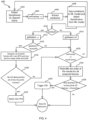
- FIG. 4 is a flow chart illustrating a process 400, according to one embodiment, that is performed by GS detector 190.
- Process 400 may begin in step s402
- Step s402 comprises GS detector 190 obtaining a deciphered UL active speech frame (i.e. an active speech frame transmitted by UE 102) that was deciphered using a parameter (e.g., count-c) that had a particular value.
- a deciphered UL active speech frame i.e. an active speech frame transmitted by UE 102
- a parameter e.g., count-c
- Step s404 comprises GS detector 190 incrementing a counter (nnFrames), which keep track of the number of active frames that have been processed by GS detector 190.
- nnFrames is set to 0 before process 400 begins.
- Step s406 comprises GS detector 190 extracting the predictors from the deciphered speech frame.
- the speech frame is an AMR NB 12.2 frame
- GS detector extracts the seven IEs mentioned above with respect to Table 1.
- Step s408 comprises GS detector 190 inputting the predictors into ML model 195 and then obtaining a GS indicator output by ML model 195, wherein the GS indicator indicates either i) that the ML model has detected GS based on the predictors or ii) that the ML model has not detected GS based on the predictors.
- Step s410 comprises GS detector 190 determining whether the GS indicator indicates GS speech has been detected. If GS speech has been detected, then the process proceeds to step s412, where GS detector 190 increments another counter (gsDetect), otherwise the process proceeds to step s414, wherein GS detector 190 sets gsDetect to zero.
- the gsDetect counter specifies the number of consecutive active speech frames that have tested positive for GS.
- Step s416 comprises GS detector 190 determining whether gsDetect exceeds a threshold (thresHfn). In one embodiment, thresHfn is equal to five. If gsDetect exceeds the threshold, the process proceeds to step s418, otherwise it proceeds to step s424.
- Step s418 comprises GS detector 190 changing the HFN part of count-c to thereby generate a new count-c value and then uses the new count-c value to decipher each one of the thresHfn speech frames that previously tested positive for GS and then performs steps s406 and s408 with respect to these thresHfn speech frames to determine whether ML model indicates that the new count-c value now matches the count-c value that was used by UE 102 to cipher the speech frames.
- Step s420 comprises GS detector 190 determining whether all the thresHfn speech frames (which have been deciphered using a new HFN value -- the same new or different new HFN values) have tested negative for GS (i.e., GS detector 190 determines whether the ML model 195 did not detect GS for any of the thresHfn speech frames which have been deciphered using the new HFN value(s)). If GS detector 190 determines that all the thresHfn speech frames have tested negative for GS, then a GS condition is declared to exist and the process proceeds to step s422, otherwise the process proceeds to step s424.
- Step s422 comprises network node 104 applying the new count-c value to decipher a newly arriving speech frame because it now has been determined that the new count-c value is in synchronization with the count-c value used by UE 102.
- Step s426 further comprises GS detector reshuffling the speech frame.
- the first element of the reshuffled vector is the first flag indicating whether or not the first received speech frame tested positive for GS
- the second element of the reshuffled vector is the 25th flag indicating whether or not the 25th received speech frame tested positive for GS
- the third element of the reshuffled vector is the 2nd flag indicating whether or not the 2nd received speech frame tested positive for GS
- the fourth element of the reshuffled vector is the 26th flag indicating whether or not the 26th received speech frame tested positive for GS
- the fifth element of the reshuffled vector is the 3rd flag indicating whether or not the 3rd received speech frame tested positive for GS
- the sixth element of the reshuffled vector is the 27th flag indicating whether or not the 27th received speech frame tested positive for GS, etc.
- Step s428 comprises GS detector 190 determining whether the reshuffled vector contains at least a threshold number (threshCre) of consecutive flags each of which indicates that the speech frame corresponding to the flag tested positive for GS. If such a consecutive set of threshCre flags is found, then a GS condition is declared and, in one embodiment, the GS detector causes network node 104 to trigger CRE (e.g., the network node 104 ceases power transmission to UE 102 to trigger call re-establishment from the UE, according to reference [5]) and in other embodiments an Inter-frequency Handover or IRAT Handover is triggered (step s430).
- CRE e.g., the network node 104 ceases power transmission to UE 102 to trigger call re-establishment from the UE, according to reference [5]
- an Inter-frequency Handover or IRAT Handover is triggered (step s430).
- GS is most typically caused by a too long delay of the UL RRC Acknowledgement message when ciphering parameters for speech is either setup or reset.
- the RRC message applicable include: "RB Setup Complete”, “RB Reconfiguration Complete”, “Physical Channel Reconfiguration Complete”, “Transport Channel Reconfiguration Complete” and "Handover to UTRAN Complete”.
- the above messages will not always reset the ciphering of speech.
- the scenarios that are relevant includes: Initial setup of the speech bearer, IRAT Handover (from 2G or 4G, in the last case called SRVCC) of a speech bearer, Inter-frequency Handover and Call Re-establishment.
- process 400 is only performed after the speech ciphering is initialized or reset, and it is only allowed to run for a limited time period (e.g., as shown in FIG. 4 the process will necessarily end after the GS detector has processed maxFrames).
- FIG. 5 shows an example of when GS detector 190 is activated.
- GS is caused by a delay in the UL RRC Acknowledgement message (e.g. RB Setup Complete, RB Reconfiguration Complete, Physical Channel Reconfiguration Complete, Transport Channel Reconfiguration Complete, and Handover to UTRAN Complete) reaching network node 104.
- the UL RRC Acknowledgement message e.g. RB Setup Complete, RB Reconfiguration Complete, Physical Channel Reconfiguration Complete, Transport Channel Reconfiguration Complete, and Handover to UTRAN Complete
- FIG. 6 shows another example of when GS detector 190 is activated.
- GS is not caused by the RRC UL delay, but an internal fault in either network node 104 or UE 102, which is causing a mismatch of the ciphering parameters.
- the example illustrates the scenario when this occurs after an RB Setup Complete message but is applicable for the other RRC messages as well.
- GS detector 190 is activated, GS detector 190 will detect no GS. Accordingly, in some embodiments, GS detector is configured to automatically deactivate after a certain condition (e.g., a certain amount of time has elapsed since it was activated or a certain number of speech frames have been processed) and no action is taken. In another embodiment the GS detector is deactivated after a certain number of consecutive speech frames have been received for which the GS detector determines to not be garbled.
- a certain condition e.g., a certain amount of time has elapsed since it was activated or a certain number of speech frames have been processed
- FIG. 7 is a flowchart illustrating a process 700 performed by network node 104 (e.g., performed by GS detector 190 of network node 104) according to some embodiments.
- Process 700 may begin in step s702.
- Step s702 comprises network node 104 receiving a first ciphered speech frame (e.g., frame 204) comprising first voice-data (e.g., encoded voice data).
- Step s704 comprises network node 104 deciphering the first ciphered speech frame using a first deciphering parameter (e.g., count-c), thereby obtaining a first deciphered speech frame (e.g., frame 206) comprising the first voice-data, wherein the first deciphered speech frame comprises a set of information elements (IEs), wherein each IE consists of a set of one or more bits.
- IEs information elements
- Step s706 comprises network node 104 inputting a subset of the set of IEs of the first deciphered speech frame into the trained ML model 195.
- the subset of IEs of the first deciphered speech frame is smaller than the complete set of IEs of the first deciphered speech frame.
- the subset of IEs of the first deciphered speech frame consists of not more than seven IEs.
- Step s708 comprises network node 104 obtaining from the ML model a first GS indicator, wherein the first GS indicator indicates either i) that the ML model has detected GS based on the subset of IEs of the first deciphered speech frame or ii) that the ML model has not detected GS based on the subset of IEs of the first deciphered speech frame.
- process 700 also includes network node 104 determining whether the first GS indicator indicates that the ML model has detected GS based on the subset of IEs of the first deciphered speech frame, and, after determining that the first GS indicator indicates that the ML model has detected GS based on the subset of IEs of the first deciphered speech frame, the network node 104 deciphering the first ciphered speech frame using a second deciphering parameter instead of the first deciphering parameter, thereby obtaining a second deciphered speech frame comprising a set of IEs.
- the process may further include inputting a subset of the set of IEs of the second deciphered speech frame into the ML model, and obtaining from the ML model a second GS indicator, wherein the second GS indicator indicates either i) that the ML model has detected GS based on the subset of IEs of the second deciphered speech frame or ii) that the ML model has not detected GS based on the subset of IEs of the second deciphered speech frame.
- the process further includes incrementing a GS counter (e.g., gsDetect) as a result of determining that the first GS indicator indicates that the ML model has detected GS based on the subset of IEs of the first deciphered speech frame.
- the GS counter indicates a number of consecutive GS frames.
- the process further includes determining, based in part on the value of the GS counter, whether a GS condition exists, e.g., determining whether the GS counter meets or exceeds a threshold (e.g., thresHfn).
- process 700 also includes network node 104 storing a vector comprising N elements, wherein for each one of the N elements, the element corresponds to a different ciphered speech frame that has been received by the network node and indicates whether or not the ML model has detected GS based on the corresponding ciphered speech frame.
- the process in such an embodiment may further include network node 104 reshuffling the vector to produce a reshuffled vector and determining whether a GS condition exists based on the reshuffled vector.
- network node 104 initiates a procedure for resetting the first deciphering parameter - e.g., network node 104 initiates a handover (e.g., an inter-frequency handover) of the UE.
- a handover e.g., an inter-frequency handover
- process 700 also includes network node 104, based at least in part on a set of GS indicators obtained from the ML model, determining whether or not a GS condition exists. As a result of determining that the GS condition exists, network node 104 may decipher a subsequent ciphered speech frame using an adjusted deciphering parameter.
- the first voice data is encoded voice data and process 700 does not comprise decoding the encoded voice-data.
- GS detector 190 The overall performance of GS detector 190 is shown in Table 5 below. TABLE 5 - Overall Performance P(GS
- the above disclosure has described a completely new approach to solve the problem of "Garbled speech.”
- the approach utilizes a ML model to detect GS on a single encoded speech frame (e.g., AMR NB speech frame, AMR WB speech frame) without applying a Vocoder to get the decoded speech data.
- the approach is valid for all mobile networks (e.g., for 2G/3G CS voice, 4G VoLTE and 5G VoNR) and any codecs (i.e., not just AMR NB or AMR WB Codec).
- the ML model works on a selected set of predictors, based on the input parameters to the speech decoder, meaning that there is no need to decode the actual speech frames.
- the predictors have been selected after building several models using different sets of predictors, with the aim to reduce the number of predictors whilst maintaining a high prediction performance and at the same time limiting the size of the model.
- the ML model operates on one single encoded speech frame at a time, which has been proven to be good enough and reducing the complexity, compared to requiring several consecutive frames and their interrelation.
- the ML models both Random Forest and Neural NWs provides good enough properties
- have a very good prediction rate ⁇ 90 - 95%), but due to the rare occurrence of GS an advanced algorithm has been developed which compensate for the false negative that may be generated.
- FIG. 8 is a block diagram of network node 104, according to some embodiments (e.g., embodiments in which network node 104 is a base station).
- network node 104 comprises: processing circuitry (PC) 802, which includes one or more processors (P) 855 (e.g., one or more general purpose microprocessors and/or one or more other processors, such as an application specific integrated circuit (ASIC), field-programmable gate arrays (FPGAs), and the like), which processors may be co-located in a single housing or in a single data center or may be geographically distributed (i.e., network node 104 may be a distributed computing apparatus); a network interface 868 comprising a transmitter (Tx) 865 and a receiver (Rx) 867 for enabling network node 104 to transmit data to and receive data from other nodes connected to network 110 (e.g., an Internet Protocol (IP) network) to which network interface 868 is connected; communication circuitry 848, which is
- IP Internet Protocol
- CPP computer program product
- CPP 841 includes a computer readable medium (CRM) 842 storing a computer program (CP) 843 comprising computer readable instructions (CRI) 844.
- CRM 842 may be a non-transitory computer readable medium, such as, magnetic media (e.g., a hard disk), optical media, memory devices (e.g., random access memory, flash memory), and the like.
- the CRI 844 of computer program 843 is configured such that when executed by PC 802, the CRI causes network node 104 to perform steps described herein (e.g., steps described herein with reference to the flow charts).
- network node 104 may be configured to perform steps described herein without the need for code. That is, for example, PC 802 may consist merely of one or more ASICs. Hence, the features of the embodiments described herein may be implemented in hardware and/or software.
Landscapes
- Engineering & Computer Science (AREA)
- Signal Processing (AREA)
- Physics & Mathematics (AREA)
- Health & Medical Sciences (AREA)
- Computational Linguistics (AREA)
- Computer Networks & Wireless Communication (AREA)
- Computer Security & Cryptography (AREA)
- Theoretical Computer Science (AREA)
- Audiology, Speech & Language Pathology (AREA)
- Human Computer Interaction (AREA)
- Multimedia (AREA)
- Acoustics & Sound (AREA)
- Data Mining & Analysis (AREA)
- Biomedical Technology (AREA)
- General Physics & Mathematics (AREA)
- Mathematical Physics (AREA)
- Software Systems (AREA)
- Evolutionary Computation (AREA)
- Biophysics (AREA)
- General Engineering & Computer Science (AREA)
- Artificial Intelligence (AREA)
- Life Sciences & Earth Sciences (AREA)
- Computing Systems (AREA)
- Molecular Biology (AREA)
- General Health & Medical Sciences (AREA)
- Quality & Reliability (AREA)
- Nonlinear Science (AREA)
- Mobile Radio Communication Systems (AREA)
Claims (15)
- Verfahren (700) zum Verarbeiten mindestens eines Sprachrahmens, wobei das Verfahren durch einen Netzwerkknoten durchgeführt wird und Folgendes umfasst:Empfangen (s702) eines ersten verschlüsselten Sprachrahmens, der erste Stimmdaten umfasst;Entschlüsseln (s704) des ersten versschlüsselten Sprachrahmens unter Verwendung eines ersten Entschlüsselungsparameters, wodurch ein erster entschlüsselter Sprachrahmen erlangt wird, der die ersten Stimmdaten umfasst, wobei der erste entschlüsselte Sprachrahmen einen Satz von Informationselementen, IEs, umfasst, wobei jedes IE aus einem Satz von einem oder mehreren Bits besteht;gekennzeichnet durchEingeben (s706) eines Teilsatzes des Satzes von IEs des ersten entschlüsselten Sprachrahmens in ein trainiertes Modell für maschinelles Lernen, ML-Modell, (195); undErlangen (s708), anhand des ML-Modells, eines ersten Indikators für verzerrte Sprache, GS-Indikators, wobei der erste GS-Indikator entweder anzeigt, i) dass das ML-Modell GS basierend auf dem Teilsatz von IEs des ersten entschlüsselten Sprachrahmens detektiert hat, oder anzeigt, ii) dass das ML-Modell keine GS basierend auf dem Teilsatz von IEs des ersten entschlüsselten Sprachrahmens detektiert hat.
- Verfahren nach Anspruch 1, ferner umfassend:Bestimmen (s410), ob der erste GS-Indikator anzeigt, dass das ML-Modell GS basierend auf dem Teilsatz von IEs des ersten entschlüsselten Sprachrahmens detektiert hat; undnach dem Bestimmen, dass der erste GS-Indikator anzeigt, dass das ML-Modell GS basierend auf dem Teilsatz von IEs des ersten entschlüsselten Sprachrahmens detektiert hat, Entschlüsseln (s418) des ersten verschlüsselten Sprachrahmens unter Verwendung eines zweiten Entschlüsselungsparameters anstelle des ersten Entschlüsselungsparameters, wodurch ein zweiter entschlüsselter Sprachrahmen erlangt wird, der einen Satz von IEs umfasst;Eingeben (s420) eines Teilsatzes des Satzes von IEs des zweiten entschlüsselten Sprachrahmens in das ML-Modell; undErlangen (s420), anhand des ML-Modells, eines zweiten GS-Indikators, wobei der zweite GS-Indikator entweder anzeigt, i) dass das ML-Modell GS basierend auf dem Teilsatz von IEs des zweiten entschlüsselten Sprachrahmens detektiert hat, oder anzeigt, ii) dass das ML-Modell keine GS basierend auf dem Teilsatz von IEs des zweiten entschlüsselten Sprachrahmens detektiert hat.
- Verfahren nach Anspruch 2, ferner umfassend Erhöhen eines GS-Zählers (s412) als ein Ergebnis des Bestimmens, dass der erste GS-Indikator anzeigt, dass das ML-Modell GS basierend auf dem Teilsatz von IEs des ersten entschlüsselten Sprachrahmens detektiert hat.
- Verfahren nach Anspruch 3, ferner umfassend Bestimmen, teilweise basierend auf dem Wert des GS-Zählers, ob eine GS-Bedingung vorliegt.
- Verfahren nach Anspruch 4, wobeidas Bestimmen, ob die GS-Bedingung vorliegt, Bestimmen (s416), ob der GS-Zähler einen Schwellenwert erreicht oder überschreitet, umfasst, undder GS-Zähler eine Anzahl von aufeinanderfolgenden GS-Rahmen anzeigt.
- Verfahren nach Anspruch 5, ferner umfassend:für jeden der aufeinanderfolgenden GS-Rahmen, Entschlüsseln des verschlüsselten Sprachrahmens, der dem GS-Sprachrahmen entspricht, unter Verwendung eines neuen Entschlüsselungsparameters, um einen neuen entschlüsselten Sprachrahmen zu erzeugen;Verwenden des ML-Modells, um zu bestimmen, ob ein beliebiger der neuen entschlüsselten Sprachrahmen positiv auf GS getestet wird; undAnwenden des neuen Entschlüsselungsparameters als ein Ergebnis des Bestimmens, dass keiner der neuen entschlüsselten Sprachrahmen positiv auf GS getestet wurde, wodurch eine GS-Bedingung aufgelöst wird.
- Verfahren nach einem der Ansprüche 1-6, ferner umfassend:Speichern eines Vektors, der N Elemente umfasst, wobei für jedes der N Elemente das Element einem unterschiedlichen verschlüsselten Sprachrahmen entspricht, der durch den Netzwerkknoten empfangen wurde, und anzeigt, ob das ML-Modell GS basierend auf dem entsprechenden verschlüsselten Sprachrahmen detektiert hat oder nicht;Umstrukturieren (s426) des Vektors, um einen umstrukturierten Vektor zu produzieren; undBestimmen (s428), basierend auf dem umstrukturierten Vektor, ob eine GS-Bedingung vorliegt.
- Verfahren nach Anspruch 7, ferner umfassend, als ein Ergebnis des Bestimmens, basierend auf dem umstrukturierten Vektor, dass eine GS-Bedingung vorliegt, Initiieren (s430) eines Prozesses zum Zurücksetzen des ersten Entschlüsselungsparameters.
- Verfahren nach Anspruch 8, wobei das Initiieren des Prozesses zum Zurücksetzen des ersten Entschlüsselungsparameters Initiieren einer Übergabe eines Benutzergeräts, UE, umfasst.
- Verfahren nach einem der Ansprüche 1-9, wobei der Teilsatz von IEs des ersten entschlüsselten Sprachrahmens kleiner als der vollständige Satz von IEs des ersten entschlüsselten Sprachrahmens ist.
- Verfahren nach Anspruch 9, wobei der Teilsatz von IEs des ersten entschlüsselten Sprachrahmens aus nicht mehr als sieben IEs besteht.
- Verfahren nach einem der Ansprüche 1-11, ferner umfassend:mindestens teilweise basierend auf einem Satz von GS-Indikatoren, der anhand des ML-Modells erlangt wurde, Bestimmen, ob eine GS-Bedingung vorliegt oder nicht; undals ein Ergebnis des Bestimmens, dass die GS-Bedingung vorliegt, Entschlüsseln eines nachfolgenden verschlüsselten Sprachrahmens unter Verwendung eines angepassten Entschlüsselungsparameters.
- Verfahren nach einem der Ansprüche 1-12, wobei die ersten Stimmdaten codierte Stimmdaten umfassen sind, und das Verfahren kein Decodieren der codierten Stimmdaten umfasst.
- Netzwerkknoten (104) zum Verarbeiten mindestens eines Sprachrahmens, wobei der Netzwerknoten zu Folgendem angepasst ist:Empfangen (s702) eines ersten verschlüsselten Sprachrahmens, der erste Stimmdaten umfasst;Entschlüsseln (s704) des ersten verschlüsselten Sprachrahmens unter Verwendung eines ersten Entschlüsselungsparameters, wodurch ein erster entschlüsselter Sprachrahmen erlangt wird, der die ersten Stimmdaten umfasst, wobei der erste entschlüsselte Sprachrahmen einen Satz von Informationselementen, IEs, umfasst, wobei jedes IE aus einem Satz von einem oder mehreren Bits besteht;wobei der Netzwerkknoten dadurch gekennzeichnet ist, dass er zu Folgendem angepasst ist:Eingeben (s706) eines Teilsatzes des Satzes von IEs des ersten entschlüsselten Sprachrahmens in ein trainiertes Modell für maschinelles Lernen, ML-Modell; undErlangen (s708), anhand des ML-Modells, eines ersten Indikators für verzerrte Sprache, GS-Indikators, wobei der erste GS-Indikator entweder anzeigt, i) dass das ML-Modell GS basierend auf dem Teilsatz von IEs des ersten entschlüsselten Sprachrahmens detektiert hat, oder anzeigt, ii) dass das ML-Modell keine GS basierend auf dem Teilsatz von IEs des ersten entschlüsselten Sprachrahmens detektiert hat.
- Netzwerkknoten nach Anspruch 14, wobei der Netzwerkknoten ferner dazu angepasst ist, das Verfahren nach einem der Ansprüche 2-13 durchzuführen.
Applications Claiming Priority (1)
| Application Number | Priority Date | Filing Date | Title |
|---|---|---|---|
| PCT/SE2020/050332 WO2021201732A1 (en) | 2020-03-31 | 2020-03-31 | Artificial intelligence (ai) based garbled speech elimination |
Publications (3)
| Publication Number | Publication Date |
|---|---|
| EP4128618A1 EP4128618A1 (de) | 2023-02-08 |
| EP4128618A4 EP4128618A4 (de) | 2024-04-10 |
| EP4128618B1 true EP4128618B1 (de) | 2025-06-11 |
Family
ID=77929311
Family Applications (1)
| Application Number | Title | Priority Date | Filing Date |
|---|---|---|---|
| EP20928213.6A Active EP4128618B1 (de) | 2020-03-31 | 2020-03-31 | Auf künstlicher intelligenz (ki) basierende eliminierung von unverständlicher sprache |
Country Status (3)
| Country | Link |
|---|---|
| US (1) | US12494223B2 (de) |
| EP (1) | EP4128618B1 (de) |
| WO (1) | WO2021201732A1 (de) |
Family Cites Families (11)
| Publication number | Priority date | Publication date | Assignee | Title |
|---|---|---|---|---|
| CH572650A5 (de) * | 1972-12-21 | 1976-02-13 | Gretag Ag | |
| US7043022B1 (en) | 1999-11-22 | 2006-05-09 | Motorola, Inc. | Packet order determining method and apparatus |
| FI20045318A0 (fi) | 2004-09-01 | 2004-09-01 | Nokia Corp | Kommunikointijärjestelmä, vastaanotin, ja menetelmä arvioida vastaanotetun signaalin laatua |
| WO2009074711A1 (en) * | 2007-12-13 | 2009-06-18 | Nokia Corporation | Speech data encryption and decryption |
| US9385865B2 (en) | 2013-07-18 | 2016-07-05 | Marvell World Trade Ltd. | Correcting deciphering mis-synchronization in a mobile communication terminal |
| KR102202894B1 (ko) | 2014-08-28 | 2021-01-14 | 삼성전자 주식회사 | 이동 통신 네트워크에서 패킷 손실 관리 방법 |
| US20160248908A1 (en) * | 2015-02-24 | 2016-08-25 | Qualcomm Incorporated | Voice garbling detection using silence insertion descriptor frames |
| WO2019213021A1 (en) * | 2018-05-04 | 2019-11-07 | Google Llc | Audio packet loss concealment |
| US10490207B1 (en) * | 2018-05-11 | 2019-11-26 | GM Global Technology Operations LLC | Automated speech recognition using a dynamically adjustable listening timeout |
| US11392796B2 (en) * | 2019-08-20 | 2022-07-19 | Micron Technology, Inc. | Feature dictionary for bandwidth enhancement |
| CN110602432B (zh) | 2019-08-23 | 2021-01-26 | 苏州米龙信息科技有限公司 | 基于生物识别的会议系统及会议数据传输方法 |
-
2020
- 2020-03-31 EP EP20928213.6A patent/EP4128618B1/de active Active
- 2020-03-31 US US17/914,073 patent/US12494223B2/en active Active
- 2020-03-31 WO PCT/SE2020/050332 patent/WO2021201732A1/en not_active Ceased
Also Published As
| Publication number | Publication date |
|---|---|
| EP4128618A1 (de) | 2023-02-08 |
| US12494223B2 (en) | 2025-12-09 |
| US20230119042A1 (en) | 2023-04-20 |
| EP4128618A4 (de) | 2024-04-10 |
| WO2021201732A1 (en) | 2021-10-07 |
Similar Documents
| Publication | Publication Date | Title |
|---|---|---|
| US9608815B2 (en) | Systems, methods, and apparatuses for ciphering error detection and recovery | |
| US10475456B1 (en) | Smart coding mode switching in audio rate adaptation | |
| US10148391B2 (en) | Method and apparatus for removing jitter in audio data transmission | |
| US9385865B2 (en) | Correcting deciphering mis-synchronization in a mobile communication terminal | |
| EP2599255B1 (de) | System und verfahren zur synchronisationsregeliung in einem in-band modem | |
| US20220059101A1 (en) | Voice processing method and apparatus, computer-readable storage medium, and computer device | |
| US9401150B1 (en) | Systems and methods to detect lost audio frames from a continuous audio signal | |
| JP2012531778A5 (de) | ||
| EP3461200A1 (de) | Drahtloskommunikationsverfahren und -vorrichtung | |
| US20170289319A1 (en) | Codec-specific radio link adaptation | |
| US11477638B2 (en) | Securely conveying location and other information in advanced networks | |
| EP4128618B1 (de) | Auf künstlicher intelligenz (ki) basierende eliminierung von unverständlicher sprache | |
| US20070064681A1 (en) | Method and system for monitoring a data channel for discontinuous transmission activity | |
| CN109039994B (zh) | 一种计算音频和视频异步时差的方法及设备 | |
| US20090204873A1 (en) | Voice processing apparatus and voice processing method | |
| US20200076611A1 (en) | Message authentication system, apparatus, and message verification method | |
| EP2003839A1 (de) | Verfahren, Vorrichtungen, System und entsprechendes Computerprogramm zur Schlüsseländerung | |
| Geiser et al. | Steganographic Packet Loss Concealment forWireless VoIP | |
| US20150100318A1 (en) | Systems and methods for mitigating speech signal quality degradation | |
| EP2512052A1 (de) | Verfahren und vorrichtung zur bestimmung eines bandinternen signalisierungsdekodierungsmodus | |
| KR100853113B1 (ko) | 디지털 통신 시스템에서 인코딩된 프레임들의 중요도를분류하는 방법 및 장치 | |
| EP1956856B1 (de) | Verfahren zur Erzeugung von Testantwort-Informationen durch eine Kommunikationsvorrichtung für einen wiederholten Leistungstest zur Dekodierung einer Steuernachricht, Verfahren zum Testen der Leistung einer Kommunikationsvorrichtung beim Dekodieren einer Steuernachricht, Kommunikationsvorrichtung und Testsystem | |
| JP2008311785A (ja) | デジタル無線機、制御方法及びプログラム | |
| JP2006311394A (ja) | 無線通信装置 | |
| WO2016192218A1 (zh) | 语音加密出错的检测方法和装置 |
Legal Events
| Date | Code | Title | Description |
|---|---|---|---|
| STAA | Information on the status of an ep patent application or granted ep patent |
Free format text: STATUS: THE INTERNATIONAL PUBLICATION HAS BEEN MADE |
|
| PUAI | Public reference made under article 153(3) epc to a published international application that has entered the european phase |
Free format text: ORIGINAL CODE: 0009012 |
|
| STAA | Information on the status of an ep patent application or granted ep patent |
Free format text: STATUS: REQUEST FOR EXAMINATION WAS MADE |
|
| 17P | Request for examination filed |
Effective date: 20221007 |
|
| AK | Designated contracting states |
Kind code of ref document: A1 Designated state(s): AL AT BE BG CH CY CZ DE DK EE ES FI FR GB GR HR HU IE IS IT LI LT LU LV MC MK MT NL NO PL PT RO RS SE SI SK SM TR |
|
| DAV | Request for validation of the european patent (deleted) | ||
| DAX | Request for extension of the european patent (deleted) | ||
| REG | Reference to a national code |
Ref legal event code: R079 Ref country code: DE Ref legal event code: R079 Ref document number: 602020052778 Country of ref document: DE Free format text: PREVIOUS MAIN CLASS: H04L0001200000 Ipc: G10L0019005000 |
|
| A4 | Supplementary search report drawn up and despatched |
Effective date: 20240312 |
|
| RIC1 | Information provided on ipc code assigned before grant |
Ipc: G06N 3/08 20060101ALN20240305BHEP Ipc: G06N 5/01 20230101ALN20240305BHEP Ipc: G06N 20/20 20190101ALN20240305BHEP Ipc: H04W 24/02 20090101ALN20240305BHEP Ipc: G06N 20/00 20190101ALI20240305BHEP Ipc: H04K 1/00 20060101ALI20240305BHEP Ipc: H04W 12/033 20210101ALI20240305BHEP Ipc: H04W 24/08 20090101ALI20240305BHEP Ipc: H04L 9/08 20060101ALI20240305BHEP Ipc: H04L 9/06 20060101ALI20240305BHEP Ipc: H04L 1/20 20060101ALI20240305BHEP Ipc: G10L 19/005 20130101AFI20240305BHEP |
|
| GRAP | Despatch of communication of intention to grant a patent |
Free format text: ORIGINAL CODE: EPIDOSNIGR1 |
|
| STAA | Information on the status of an ep patent application or granted ep patent |
Free format text: STATUS: GRANT OF PATENT IS INTENDED |
|
| RIC1 | Information provided on ipc code assigned before grant |
Ipc: G06N 3/08 20230101ALN20250203BHEP Ipc: G06N 5/01 20230101ALN20250203BHEP Ipc: G06N 20/20 20190101ALN20250203BHEP Ipc: H04W 24/02 20090101ALN20250203BHEP Ipc: G06N 20/00 20190101ALI20250203BHEP Ipc: H04K 1/00 20060101ALI20250203BHEP Ipc: H04W 12/033 20210101ALI20250203BHEP Ipc: H04W 24/08 20090101ALI20250203BHEP Ipc: H04L 9/08 20060101ALI20250203BHEP Ipc: H04L 9/06 20060101ALI20250203BHEP Ipc: H04L 1/20 20060101ALI20250203BHEP Ipc: G10L 19/005 20130101AFI20250203BHEP |
|
| INTG | Intention to grant announced |
Effective date: 20250218 |
|
| GRAS | Grant fee paid |
Free format text: ORIGINAL CODE: EPIDOSNIGR3 |
|
| GRAA | (expected) grant |
Free format text: ORIGINAL CODE: 0009210 |
|
| STAA | Information on the status of an ep patent application or granted ep patent |
Free format text: STATUS: THE PATENT HAS BEEN GRANTED |
|
| AK | Designated contracting states |
Kind code of ref document: B1 Designated state(s): AL AT BE BG CH CY CZ DE DK EE ES FI FR GB GR HR HU IE IS IT LI LT LU LV MC MK MT NL NO PL PT RO RS SE SI SK SM TR |
|
| REG | Reference to a national code |
Ref country code: GB Ref legal event code: FG4D |
|
| REG | Reference to a national code |
Ref country code: CH Ref legal event code: EP |
|
| REG | Reference to a national code |
Ref country code: IE Ref legal event code: FG4D |
|
| REG | Reference to a national code |
Ref country code: DE Ref legal event code: R096 Ref document number: 602020052778 Country of ref document: DE |
|
| PG25 | Lapsed in a contracting state [announced via postgrant information from national office to epo] |
Ref country code: ES Free format text: LAPSE BECAUSE OF FAILURE TO SUBMIT A TRANSLATION OF THE DESCRIPTION OR TO PAY THE FEE WITHIN THE PRESCRIBED TIME-LIMIT Effective date: 20250611 Ref country code: FI Free format text: LAPSE BECAUSE OF FAILURE TO SUBMIT A TRANSLATION OF THE DESCRIPTION OR TO PAY THE FEE WITHIN THE PRESCRIBED TIME-LIMIT Effective date: 20250611 |
|
| REG | Reference to a national code |
Ref country code: LT Ref legal event code: MG9D |
|
| PG25 | Lapsed in a contracting state [announced via postgrant information from national office to epo] |
Ref country code: NO Free format text: LAPSE BECAUSE OF FAILURE TO SUBMIT A TRANSLATION OF THE DESCRIPTION OR TO PAY THE FEE WITHIN THE PRESCRIBED TIME-LIMIT Effective date: 20250911 Ref country code: GR Free format text: LAPSE BECAUSE OF FAILURE TO SUBMIT A TRANSLATION OF THE DESCRIPTION OR TO PAY THE FEE WITHIN THE PRESCRIBED TIME-LIMIT Effective date: 20250912 |
|
| REG | Reference to a national code |
Ref country code: NL Ref legal event code: MP Effective date: 20250611 |
|
| PG25 | Lapsed in a contracting state [announced via postgrant information from national office to epo] |
Ref country code: BG Free format text: LAPSE BECAUSE OF FAILURE TO SUBMIT A TRANSLATION OF THE DESCRIPTION OR TO PAY THE FEE WITHIN THE PRESCRIBED TIME-LIMIT Effective date: 20250611 |
|
| PG25 | Lapsed in a contracting state [announced via postgrant information from national office to epo] |
Ref country code: HR Free format text: LAPSE BECAUSE OF FAILURE TO SUBMIT A TRANSLATION OF THE DESCRIPTION OR TO PAY THE FEE WITHIN THE PRESCRIBED TIME-LIMIT Effective date: 20250611 |
|
| PG25 | Lapsed in a contracting state [announced via postgrant information from national office to epo] |
Ref country code: RS Free format text: LAPSE BECAUSE OF FAILURE TO SUBMIT A TRANSLATION OF THE DESCRIPTION OR TO PAY THE FEE WITHIN THE PRESCRIBED TIME-LIMIT Effective date: 20250911 |
|
| PG25 | Lapsed in a contracting state [announced via postgrant information from national office to epo] |
Ref country code: LV Free format text: LAPSE BECAUSE OF FAILURE TO SUBMIT A TRANSLATION OF THE DESCRIPTION OR TO PAY THE FEE WITHIN THE PRESCRIBED TIME-LIMIT Effective date: 20250611 |
|
| PG25 | Lapsed in a contracting state [announced via postgrant information from national office to epo] |
Ref country code: NL Free format text: LAPSE BECAUSE OF FAILURE TO SUBMIT A TRANSLATION OF THE DESCRIPTION OR TO PAY THE FEE WITHIN THE PRESCRIBED TIME-LIMIT Effective date: 20250611 |
|
| PG25 | Lapsed in a contracting state [announced via postgrant information from national office to epo] |
Ref country code: PT Free format text: LAPSE BECAUSE OF FAILURE TO SUBMIT A TRANSLATION OF THE DESCRIPTION OR TO PAY THE FEE WITHIN THE PRESCRIBED TIME-LIMIT Effective date: 20251013 |
|
| REG | Reference to a national code |
Ref country code: AT Ref legal event code: MK05 Ref document number: 1802924 Country of ref document: AT Kind code of ref document: T Effective date: 20250611 |
|
| PG25 | Lapsed in a contracting state [announced via postgrant information from national office to epo] |
Ref country code: IS Free format text: LAPSE BECAUSE OF FAILURE TO SUBMIT A TRANSLATION OF THE DESCRIPTION OR TO PAY THE FEE WITHIN THE PRESCRIBED TIME-LIMIT Effective date: 20251011 |
|
| PG25 | Lapsed in a contracting state [announced via postgrant information from national office to epo] |
Ref country code: AT Free format text: LAPSE BECAUSE OF FAILURE TO SUBMIT A TRANSLATION OF THE DESCRIPTION OR TO PAY THE FEE WITHIN THE PRESCRIBED TIME-LIMIT Effective date: 20250611 Ref country code: SM Free format text: LAPSE BECAUSE OF FAILURE TO SUBMIT A TRANSLATION OF THE DESCRIPTION OR TO PAY THE FEE WITHIN THE PRESCRIBED TIME-LIMIT Effective date: 20250611 |
|
| PG25 | Lapsed in a contracting state [announced via postgrant information from national office to epo] |
Ref country code: CZ Free format text: LAPSE BECAUSE OF FAILURE TO SUBMIT A TRANSLATION OF THE DESCRIPTION OR TO PAY THE FEE WITHIN THE PRESCRIBED TIME-LIMIT Effective date: 20250611 |
|
| PG25 | Lapsed in a contracting state [announced via postgrant information from national office to epo] |
Ref country code: PL Free format text: LAPSE BECAUSE OF FAILURE TO SUBMIT A TRANSLATION OF THE DESCRIPTION OR TO PAY THE FEE WITHIN THE PRESCRIBED TIME-LIMIT Effective date: 20250611 |
|
| PG25 | Lapsed in a contracting state [announced via postgrant information from national office to epo] |
Ref country code: EE Free format text: LAPSE BECAUSE OF FAILURE TO SUBMIT A TRANSLATION OF THE DESCRIPTION OR TO PAY THE FEE WITHIN THE PRESCRIBED TIME-LIMIT Effective date: 20250611 |
|
| PG25 | Lapsed in a contracting state [announced via postgrant information from national office to epo] |
Ref country code: SK Free format text: LAPSE BECAUSE OF FAILURE TO SUBMIT A TRANSLATION OF THE DESCRIPTION OR TO PAY THE FEE WITHIN THE PRESCRIBED TIME-LIMIT Effective date: 20250611 |
|
| REG | Reference to a national code |
Ref country code: DE Ref legal event code: R097 Ref document number: 602020052778 Country of ref document: DE |
|
| PGFP | Annual fee paid to national office [announced via postgrant information from national office to epo] |
Ref country code: GB Payment date: 20260327 Year of fee payment: 7 |
|
| PG25 | Lapsed in a contracting state [announced via postgrant information from national office to epo] |
Ref country code: DK Free format text: LAPSE BECAUSE OF FAILURE TO SUBMIT A TRANSLATION OF THE DESCRIPTION OR TO PAY THE FEE WITHIN THE PRESCRIBED TIME-LIMIT Effective date: 20250611 |
|
| PGFP | Annual fee paid to national office [announced via postgrant information from national office to epo] |
Ref country code: DE Payment date: 20260327 Year of fee payment: 7 |
|
| PG25 | Lapsed in a contracting state [announced via postgrant information from national office to epo] |
Ref country code: IT Free format text: LAPSE BECAUSE OF FAILURE TO SUBMIT A TRANSLATION OF THE DESCRIPTION OR TO PAY THE FEE WITHIN THE PRESCRIBED TIME-LIMIT Effective date: 20250611 |
|
| PLBE | No opposition filed within time limit |
Free format text: ORIGINAL CODE: 0009261 |
|
| STAA | Information on the status of an ep patent application or granted ep patent |
Free format text: STATUS: NO OPPOSITION FILED WITHIN TIME LIMIT |
|
| REG | Reference to a national code |
Ref country code: CH Ref legal event code: L10 Free format text: ST27 STATUS EVENT CODE: U-0-0-L10-L00 (AS PROVIDED BY THE NATIONAL OFFICE) Effective date: 20260423 |