EP2825920B1 - Apparatus and method for automated data selection in model identification and adaptation in multivariable process control - Google Patents
Apparatus and method for automated data selection in model identification and adaptation in multivariable process control Download PDFInfo
- Publication number
- EP2825920B1 EP2825920B1 EP13725003.1A EP13725003A EP2825920B1 EP 2825920 B1 EP2825920 B1 EP 2825920B1 EP 13725003 A EP13725003 A EP 13725003A EP 2825920 B1 EP2825920 B1 EP 2825920B1
- Authority
- EP
- European Patent Office
- Prior art keywords
- data
- time series
- model
- bad
- variable
- Prior art date
- Legal status (The legal status is an assumption and is not a legal conclusion. Google has not performed a legal analysis and makes no representation as to the accuracy of the status listed.)
- Active
Links
Images






Classifications
-
- G—PHYSICS
- G05—CONTROLLING; REGULATING
- G05B—CONTROL OR REGULATING SYSTEMS IN GENERAL; FUNCTIONAL ELEMENTS OF SUCH SYSTEMS; MONITORING OR TESTING ARRANGEMENTS FOR SUCH SYSTEMS OR ELEMENTS
- G05B13/00—Adaptive control systems, i.e. systems automatically adjusting themselves to have a performance which is optimum according to some preassigned criterion
- G05B13/02—Adaptive control systems, i.e. systems automatically adjusting themselves to have a performance which is optimum according to some preassigned criterion electric
- G05B13/04—Adaptive control systems, i.e. systems automatically adjusting themselves to have a performance which is optimum according to some preassigned criterion electric involving the use of models or simulators
- G05B13/048—Adaptive control systems, i.e. systems automatically adjusting themselves to have a performance which is optimum according to some preassigned criterion electric involving the use of models or simulators using a predictor
Definitions
- Multivariable Predictive Control is the most widely used advanced process control technology in process industries, with more than 5,000 worldwide applications currently in service.
- MPC which is sometimes also referred to as multivariate control (MVC)
- MVC multivariate control
- MPC control performance degrades with time due to inevitable changes in the underlying subject process, such as equipment modifications, changes in operating strategy, feed rate and quality changes, de-bottlenecking, instrumentation degradation, etc.
- Such degradation of control performance results in loss of benefits.
- the process model's predictive quality is the primary factor in most cases. To sustain good control performance, the model's predictive quality needs to be monitored, and the model needs be periodically audited and updated.
- a control engineer spends hours to days viewing all the process variables in time series plots and visually finding those data samples unsuitable for model identification purpose.
- the control engineer manually marks such data segments in software as "bad data slices” through a pertinent user interface.
- the engineer tries a number of model identification runs until the identification algorithm goes through all the data without failures and the resulting models look normal and make sense from the engineer's view.
- a typical APC project may contain 50-200 process time series variables and the data collection window may cover a period of weeks to months. Conducting the data screening and selection task by hand may take an experienced engineer days to weeks of intensive work.
- any of the marked "bad data slices" in a time series will cause a data loss of a large piece of good data (e.g., one time to steady state (TTSS) for a FIR model and 40-60 samples for a subspace model) following the "bad data slice", as a side effect due to the required re-initialization.
- TTSS time to steady state
- the other drawback is that a conventional approach is not suitable for frequent runs in an online application (such as that described in U.S. Patent Application Publication No. US 2011/0130850 A1 ) where a pre-scheduled automated data screening and selection operation is needed to serve plant testing monitoring.
- the automated data screening and selection module should alert the operator and report the situation timely, so that the engineer may take actions to make corrections/adjustments and avoid a time and data loss on the plant testing.
- MacArthur at al. have presented an apparatus, method, and computer program for automated closed-loop identification of an industrial process in a process control system in their patent US 2008/0183311 .
- multiple models such as multiple model structure-model order combinations
- One or more metrics can then be determined for each of the models.
- At least one of the models can then be selected based on the one or more metrics.
- a final model for controlling the process can be provided (such as to a controller), where the final model is based on the at least one selected mode.
- Applicants provide a new apparatus and method for automated data selection in model quality estimation and identification in multivariable process control.
- Embodiments of the present invention provide a new apparatus and method to address the foregoing problems by (1) detecting and excluding datasets that are unsuitable for model quality estimation and model identification, and (2) repairing and patching certain datasets to maximize usage of data in an MPC application.
- Embodiments provide several new automated data screening and selection techniques to select data suitable for model assessment and model re-identification.
- Embodiments provide an innovative approach to testing and validating bad data segments found, which can help to minimize data loss.
- Embodiments provide a novel technique to repair and patch certain bad data samples via an internal MISO (Multi-Input, Single-Output) model predictive method, which helps replace some bad data samples with model-based predictive values. In turn, this technique maximizes the overall data usage.
- MISO Multi-Input, Single-Output
- An embodiment is an apparatus comprising a four-tier automated data screening and selection system that can be configured and execute with a hierarchy and work flow as shown in Fig. 2 .
- a method of screening and selecting data automatically for model identification and model adaptation in a multivariable predictive controller comprising: given an online controller having an existing model, in a processor: loading process data from a subject process and storing said process data in a database accessible by said model; characterized by; using a rule-based data selector, automatically detecting and excluding data segments of the stored process data that are unsuitable for model quality estimation and for model identification; validating the excluded data segments to minimize the data loss from bad data segments being excluded; repairing certain data segments of said stored process data to maximize usage of data in a MPC application; and updating said existing model using resulting process data as stored in the database, wherein said rule-based selector is configured to, screen a given time series variable as a dependent process variable or an independent process variable and apply a basic data screening filter to detect and mark data segments of the time series as good data or bad data according to given data quality measurement parameters; group time series variables according to their associated proportional-integral-derivative PID loop; compare process variables PV against their
- An embodiment includes three different methods/modules of data screening and selecting and one data repairing method/module to serve as the automated data selection apparatus. These methods/modules are summarized as follows:
- using rule-based data selector for detecting and excluding data segments of process data that are unsuitable for model quality estimation and for model identification includes the steps of:
- validating excluded data segments to minimize the data loss from bad data segments being excluded includes the steps of:
- repairing certain time series to maximize usage of data in a MPC application includes the steps of:
- the process data variables of step (a) includes manipulated variables (MVs), measurements of control variables (CVs) of the subject process, calculated values of independent variables, calculated values of dependent variables, all data vectors of the subject process, and all PID controller loops.
- MVs manipulated variables
- CVs measurements of control variables
- the basic data screening methods of step (c) include a PID controller output (OP) saturation and High/Low limit detector, a frozen signal/measurement detector if the given time series is a dependent variable, and a PID manual mode detector if the given time series is an independent variable.
- OP PID controller output
- High/Low limit detector a frozen signal/measurement detector if the given time series is a dependent variable
- PID manual mode detector if the given time series is an independent variable.
- comparing process variables (PV) against their corresponding set points (SP) in each PID look and applying data screening filters is performing a PID loop association search and finding available SP, PV, and OP among all process variables, determining whether a PV and SP pair or a PV, SP and control output (OP) triple are associated with the time series in a PID loop, and, if PV and SP pair or PV, SP and OP triple is associated with the time series in the same PID loop, using a rule-based data selector to apply data screening filters to detect data sequences showing deviations from their SP and marking the corresponding segments of data as Bad Data.
- PV process variables
- SP set points
- the data screening filters include a PV spike detector if the given time series is a dependent variable, a PID manual mode detector, and a SP in closed-loop mode detector if the given time series is an independent variable.
- An embodiment of evaluating the generated predictions for dependent variables without a PID association against their measurements and applying data screening filters (step (g)) is, if no PV and SP pair or PV, SP and OP triple is associated with the current time series variable in the same PID loop and the time series variable is a dependent process variable, using data screening filters to detect data segments showing spikes and deviations in moving trend and marking the corresponding segments of data as Bad Data according to given data screening filters.
- the data screening filters can include a PV spike detector and a trend mismatch/unknown disturbances detector.
- the trend mismatch/unknown disturbances detector includes generating a model prediction of the time series variable via a multiple-input single-output (MISO) model, calculating a prediction error for unknown disturbances, detecting if a control variable (CV) time series does not parallel the predicted MISO model values, detecting if a large sustained shift in the average value of the CV has occurred outside of the normal movement and determining if it is associated with the model prediction, and selecting for exclusion the data segments of the time series variable showing difference in trends beyond the prediction error and making selected data segments as Bad Data.
- MISO multiple-input single-output
- testing Bad Data slices includes setting Bad Data segments as Candidate Bad Data segments and generating Good Data segments by excluding Candidate Bad Data segments for each time series variable, for a dependent variable, configuring a multiple-input single-output (MISO) model identification and loading the independent variables as inputs and the dependent variable as output in the MISO model, applying the generated Good Data segments to the configured MISO model and calculating a baseline model quality index (MQ) by performing a model quality assessment on the MISO model, and running a MISO case identification on a Candidate Bad Data segment of the data segments not removed by a basic data filter and calculating a candidate MQ by performing a model quality assessment on the MISO model corresponding to the Candidate Bad Data segment.
- MISO multiple-input single-output
- confirming Candidate Bad Data segments as Bad Data includes, given a tunable parameter as a threshold, marking Candidate Bad Data segment as a Good Data segment if difference between baseline MQ and candidate MQ is within the tunable threshold and removing corresponding data slices from a list of Bad Data slices.
- patching segments in the time series where data portions have been removed by the data slice generator with interpolated data segments includes, if the time series variable is an independent variable, checking the Good Data segments adjacent to the selected Bad Data segments to determine if the Good Data sample values before a Start Point and after a End Point of a Bad Data segment are within a given threshold, and, if true, creating an interpolation slice by linear interpolation and replacing the selected Bad Data segments with the interpolation slice.
- the selected time series variable is a dependent variable, configuring a MISO model case with the dependent variable and associated independent variables, and running a MISO identification case using the resultant MISO model to generate a model prediction on the dependent variable, and creating an interpolated slice for Bad Data segments if model predictive values are available for the Bad Data segment.
- the time series variable is a dependent variable, checking the Good Data segments adjacent to the selected Bad Data segments to determine if the calculated average values over a given length before the Start Point and after the End Point of a Bad Data segment are within the given threshold, and if true, creating an interpolation slice by linear interpolation and replacing the selected Bad Data segments with the interpolation slice, the interpolation slice smoothly connected to the Good Data segments.
- Embodiments provide expansion of model quality estimation and model adaptation in multivariable process control techniques described in related parent application (U.S. Patent Application Publication No. US 2011/0130850 A1 by Assignee).
- Embodiments can be configured and executed to screen and select required data for model quality assessment and/or model re-identification in the systems of the parent disclosure, while minimizing the intensive work on data selection and preparation commonly done by a process control engineer manually. Accordingly, the present invention provides an improvement over the prior state of the art.
- Embodiments provide a new apparatus and method for screening and selecting plant test/operational data automatically for online or offline model identification and online model adaptation in multivariable predictive controller (MPC) applications.
- MPC multivariable predictive controller
- Different modes of operation are provided in embodiments, namely: Basic Data Screen mode, PID Loop Data Selection mode, Model Predictive Data Selection mode, Data Slices Validation mode, and Data Repairing mode.
- data screening and selection may generally be used synonymously with data filtering, segmentation and the like.
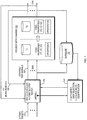
- Fig. 1 is a block diagram of a MPC control system embodying the present invention.
- An MPC controller 110 controls a subject dynamical process 120 (such as that of a processing plant) based on optimal targets 130.
- the controller 110 includes an automated tester to perturb the process 120 in an embodiment. While Fig. 1 shows the controller and the tester together as 110, it should be understood by one of ordinary skill in the art that in another embodiment, a separate controller and tester may be provided.
- the controller 110 sends control/test signals 101 that set the values of manipulated variables (MVs) of the subject process 120.
- the MVs are independent variables in the sense that they can be set as desired to perturb the process and to control the controlled variables (CVs) within their constraints set and operation limits.
- control variables are so named because they are controlled through the manipulated variables; thus, the CVs are dependent variables that depend on the MVs.
- a real-time database 102 is used to store historical data regarding the MVs and the corresponding CVs.
- An automated data selection and online model identification module 140 selects only the valid and informative data series in segments, and identifies a whole or a subset of the multi-input multi -output (MIMO) model of controller 110 based on selected inputs and outputs data from the process 120 and the database 102.
- the module 140 may be part of performance diagnostics which diagnose performance of the controller model as described in parent related U.S. Patent Application No. 12/786,052 (by Assignee). In turn, module 140 updates (adapts) the model to improve performance.
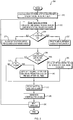
- Fig. 2 is a flow diagram depicting the major work flow in an embodiment of the invention.
- the automated data screen and selection apparatus 200 starts its operation 210 with loading all controller 110 relevant data sequences or time series. That is, apparatus 200 collects data related to MVs 101 and measurements of CVs 150 and stores the collected data into the database 102 at a specified sampling frequency, usually the same as used by the MPC controller 110. The data may also include calculated values of independent variables and dependent variables collected from process 120 and stored in database 102.
- Apparatus 200 executes its task in a sequential way. For each time series (or the sampled values of a variable over time), Basic Data Selection method/module 220 is first applied based on the variable associated data sample quality. In this module 220, all recorded data status, special values and High/Low value limits of variables are loaded into the apparatus 200 together with the time series values. An independent/dependent variable attribute check 230 on this time series of data is performed and corresponding data screening criteria are applied. For instance, if the subject data corresponds to dependent process variables, then method 232 detects data segments with frozen measurements and controller output (OP) saturation (values that have reached the High/Low limits and stay there for a long time). Method 232 marks the detected data segments as "bad data" slices.
- OP controller output
- method 231 detects data samples with High/Low saturation or with set points (SP) in "tracking" process variable (PV) mode. This typically occurs when a PID loop is in manual (MAN) mode. Method 231 then selects the detected data segment as "bad data” slices for exclusion.
- SP set points
- PV process variable
- the remaining good data segments of the time series is passed to 240 for a PID loop association search among all loaded available time series of data from 210.
- Decision junction 240 determines whether a PV and SP pair or a PV, SP and OP triple are associated with the current time series in a same PID loop. If so, then a PID loop based data screen and selection method/module 250 starts to execute. If the PV and SP are available, a time series of PID loop control error ⁇ e(t) ⁇ is created and used to detect PV spikes as described later.
- module 250 additional data screening is performed if the selected time series is from a Dep. (dependent process variable) and is also an OP (output) in a PID loop. Once a constant OP value over a time window is detected by screening OP changes, module 250 concludes that the PID loop is in manual mode. In such a case, the unchanged dependent variable may lead to wrong conclusions in model quality estimation or model identification. Therefore, module 250 marks the corresponding segment of data samples as "bad data" slices.
- Dep. dependent process variable
- OP output
- a model predictive data screen and selection module/method 260 is used to further assist detecting unknown disturbances.
- MISO multi-input, single-output
- a module/method that detects when the C V does not show parallel movement to those predicted values is used in 260, and module 260 selects for exclusion those data segments showing significant differences in trends. Module 260 marks the selected data segments as "unknown disturbances.”
- a bad data slices validation module/method 270 is called after all bad data segments have been created from 210 through 260. Due to the required reinitialization after each "bad data” or excluded data segment (slice) on data assembly for model identification, many good data points can become useless. When the number of "bad” data slices increase, the "good” data samples used for initialization become very “expensive”. To reduce this kind of high "cost” initialization, the present invention implements two strategies. One is to re -validate all "candidate" bad data slices by using the Assignee's techniques previously described in the parent related US Application no. 12/786,052 .
- each of the candidate "bad” data slices is tested by comparing the model qualities when the tested “bad” data segment is included in the model identification to that of when the tested “bad” data segment is excluded in the model identification. If the model quality decreases significantly by a measure of MQ (model quality) index, then the tested candidate "bad” data segment is confirmed as “bad”. Otherwise, module 270 unmarks the "bad” data segment and removes that data segment from the "bad data slice” list.
- a module/method 280 generates MV interpolation values and CV predictions and patches the selected "bad” data slices.
- Module 280 is formed of two elements, one is a MISO identification engine and the other is an algorithm that patches the short "bad” data slices through a "smooth" connection between the two end-points of two neighborhood good data points. Each of these elements is further detailed below.
- a Common Data Slice Generator Based on the Flag values, continuous "bad data” samples with the same status are converted into (marked as) categorized "bad data” slices.
- the common data slice generator 300 serves to create all bad data slices under different criteria.
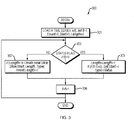
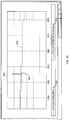
- FIG. 3 is illustrative of one embodiment of a data slice generator 300.
- Data slice generator 300 begins by loading a time series of data x(t) such as that illustrated in FIG. 3 and having a corresponding set of Flag values (i.e., from Table 1) as set by the Rule-based Data Selector.
- a PV Spike Detector If the given time series is a Dep (dependent variable) and it is also a PV (process variable) in a PID loop, then PV spike patterns may be detected.
- instrument measurement error e.g ., short-term offline/reset/calibration
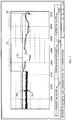
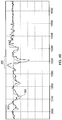
- FIG. 9A shows an example of a PV 902 spike detected in data region 903 with associated variable 901.
- FIG. 9B shows a similar PV 905 spike detected in data region 906 with associated variable 904.
- FIG. 6 shows a data series 601 with detected data regions 602 where the data series 601 is detected as reaching its high value.
- FIG. 6 shows a data series 601 with detected data regions 602 where the data series 601 is detected as reaching its high value.
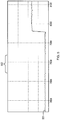
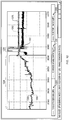
- FIG. 7 shows time series of a process variable 602 with associated setpoint 603 and output 601, where the output is detected as saturated in data region 604.
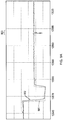
- FIG. 11 shows embodiments detecting when a PID loop output is saturated 1105 when a process variable 1102 is no longer able to follow the corresponding set point 1103 (as opposed to data region 1104), such that output 1101 becomes saturated.
- a Frozen Signal/Measurement Detector If the given time series is a Dep (dependent variable), then any data segment with a frozen value will not be able to represent the CV response correctly and should be marked as "bad data" for model identification purposes.
- a PID Manual Mode Detector If the given time series is an Ind (independent variable) and it is also a SP (set point) in its PID loop, when the PID loop is in MAN (manual) mode, the SP will track the PV (process variable) while the actual process independent variable (typically a valve opening position or flow rate) is changed by operator through an OP. In such a case, any readings from the SP value cannot represent the true relationship between INDs and DEPs.
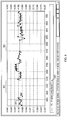
- FIG. 12 illustrates an example of a PID loop in manual mode data range 1204 that was detected automatically by the PID Manual Mode Detector where PV 1202 overlaps setpoint 1203 while output 1201 is constant.
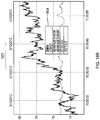
- FIG. 17 shows a graph from which embodiments determined the subset of data 1704 where PID modes were correctly maintained and no OP (PID output) 1701 saturation 1705 occurred. In the detection region 1704, SP 1703 is tracking PV 1702.
- a SP in Closed-Loop Mode Detector If the given time series is an independent variable and it is also a SP (set point) in its PID loop, when the PID loop is in Cascade mode, the SP will follow an external variable such as an OP from the outer PID loop. In such cases, if there is no clean step-moves for a long time, the data segment of the SP will become unsuitable for model identification.
- FIG. 10 indicates a situation when the SP 1002 was detected in Closed-Loop mode in data region 1003 following variable 1001.
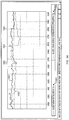
- FIG. 13 shows detected data ranges 1203 where a PV 1301 is not broadly following SP 1302.
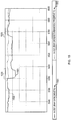
- FIG. 14 shows examples where the CV measurements 1401 contain several jumps where the model predictions 1402 have no such matched changes and therefore are detected by the detector as a "bad data” slice 1403.
- FIG. 15 shows CV measurements 1501 contain several drops where the model predictions 1502 have no such matched changes and therefore are detected by the detector as a "bad data” slice 1503.
- a Slice Validation Module 270 Using MQ To minimize the data loss due to too many bad data sample segments being selected, an innovative approach/module 270 is provided to test and validate all candidate bad data segments before finalizing the bad data slices.
- the provided approach 270 is formed of the following steps:
- a Slice Reparation/Patch Approach/Module 280 To minimize the data loss due to bad data sample segments, another innovative approach/module 280 is provided to repair and patch short candidate bad data segments before finalizing the bad data slices.
- One embodiment of the approach is described as follows.
- Step 1 Select a time series variable ⁇ x(t) ⁇ , all candidate bad data slices validated in Slice Validation Module 270 are screened, only those data slices with length less than a half time to steady-state (i.e., all bad data slices satisfying (Length ⁇ 1/2 TTSS)), are selected for patch/fix;
- Step 2 If the selected time series is an IND (independent variable), loop through all selected candidate bad data slices in Step1 and do the following data patch:
- Step 3 If the selected time series is a DEP (dependent variable), configure a MISO case with this DEP and all INDs, apply all candidate bad data slices and run a model identification; use the identified MISO model and its input dataset generating model predictions on this DEP;
- DEP dependent variable
- Step 5 A special algorithm (described below) calculates two connection points for a flexible data slice patch which ensures the smoothness of the patch and minimizes the data loss;
- Step 6 Move to next candidate data slice and repeat the process 280 Steps 3 through 5 as above.
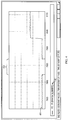
- FIG. 4 shows a time series of a process variable 401 and an associated segment of bad data 402.
- FIG. 5 shows the result of patching the same data segment of the process variable 501 with interpolated data segments in data range 502.
- FIG. 16 shows a PV time series 1601 with detected bad CV data 1603 and replaced bad data segments with predicted data 1602 without causing discontinuities in the repaired CV sequence.
- the algorithm is comprised of the following steps:
- GUI Graphical User Interface
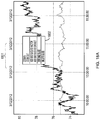
- FIG. 18A the GUI 1802 allows a user to mark a data range 1081 by mouse clicks and add as a bad data slice to either a vector or a dataset (all vectors).
- FIG.18B shows a GUI element 1804 (e.g., pop up menu) that enables the user to delete an existing bad data slice 1803 or edit it by opening a new dialog shown in FIG. 18C.
- GUI element 1804 e.g., pop up menu
- FIG.18C illustrates an example dialog box enabling editing of a data slice.
- the user is allowed to edit the bad data slice by re-typing Begin 1805 and End 1806 indexes (alternatively, Date and Time). Then the user confirms the changes by clicking on the OK button 1807, or, alternatively, cancels the changes by clicking on the Cancel button 1808.
- Other selection and confirmation configurations are suitable.
- FIG. 19 illustrates a computer network and client-server environment in which embodiments of the present invention may be implemented.
- Client computer(s)/devices 710 and server computer(s) 720 provide processing, storage, and input/output devices executing application programs and the like.
- the present invention is installed as an apparatus in server computer 720.
- the server computer 720 and client computer(s)/devices 710 can be linked through communications network 750 to other computing devices, including other client devices/processes 710-1 and Distributed Control System (DCS) 730.
- DCS Distributed Control System
- Communications network 750 can be part of a remote access network, a global network (e.g., the Internet), a worldwide collection of computers, Local area or Wide area networks, and gateways that currently use respective protocols (TCP/IP, Bluetooth, etc.) to communicate with one another.
- a global network e.g., the Internet
- IP Internet Protocol
- Bluetooth Bluetooth
- Other electronic device/computer network architectures are suitable.
- An example of implementation of the present invention may be as shown in FIG. 19 where the DCS system 730 controls one or more process units 740.
- An apparatus and method e.g., process/modules 110, 140, 102, 200 and 300
- a user may access the server application from one or more client computers 710 that allow a remote connection through security and firewall in the network 750.
- a user may view, manage, change operations of one or more process units 740 through the DCS system 730.
- the described application may be configured by user from one or more client computers (710) and run in the server computer 720.
- the present invention may be implemented in a variety of computer architectures.
- the computer network system 700 of FIG. 19 is for purposes of illustration and not limitation of the present invention.
- Server computer 720 includes memory, a CPU (central processing unit) and the like.
- Memory provides volatile storage for computer software instructions and data used to implement an embodiment of the present invention (e.g., the controller 110, data screening and model identification 140, model adaptation, and supports processes 200, 300, GUI of FIG. 18 , etc. as described above).
- Disk storage provides non-volatile storage for computer software instructions and data used to implement an embodiment of the present invention.
- the central processor unit provides for the execution of computer instructions.
- the processor routines and data are a computer program product, including a computer readable medium (e.g., a removable storage medium such as one or more DVD-ROM's, CD-ROM's, diskettes, tapes, etc.) that provides at least a portion of the software instructions for the invention system.
- the computer program product can be installed by any suitable software installation procedure, as is well known in the art.
- at least a portion of the invention software instructions may also be downloaded over a cable, communication, and/or wireless connection or operable through a network portal.
Landscapes
- Engineering & Computer Science (AREA)
- Health & Medical Sciences (AREA)
- Artificial Intelligence (AREA)
- Computer Vision & Pattern Recognition (AREA)
- Evolutionary Computation (AREA)
- Medical Informatics (AREA)
- Software Systems (AREA)
- Physics & Mathematics (AREA)
- General Physics & Mathematics (AREA)
- Automation & Control Theory (AREA)
- Feedback Control In General (AREA)
- Testing And Monitoring For Control Systems (AREA)
Applications Claiming Priority (2)
| Application Number | Priority Date | Filing Date | Title |
|---|---|---|---|
| US201261646095P | 2012-05-11 | 2012-05-11 | |
| PCT/US2013/040363 WO2013170041A2 (en) | 2012-05-11 | 2013-05-09 | Apparatus and method for automated data selection in model identification and adaptation in multivariable process control |
Publications (2)
| Publication Number | Publication Date |
|---|---|
| EP2825920A2 EP2825920A2 (en) | 2015-01-21 |
| EP2825920B1 true EP2825920B1 (en) | 2021-01-20 |
Family
ID=48485498
Family Applications (1)
| Application Number | Title | Priority Date | Filing Date |
|---|---|---|---|
| EP13725003.1A Active EP2825920B1 (en) | 2012-05-11 | 2013-05-09 | Apparatus and method for automated data selection in model identification and adaptation in multivariable process control |
Country Status (3)
| Country | Link |
|---|---|
| EP (1) | EP2825920B1 (cg-RX-API-DMAC7.html) |
| JP (1) | JP6359524B2 (cg-RX-API-DMAC7.html) |
| WO (1) | WO2013170041A2 (cg-RX-API-DMAC7.html) |
Cited By (5)
| Publication number | Priority date | Publication date | Assignee | Title |
|---|---|---|---|---|
| US11630446B2 (en) | 2021-02-16 | 2023-04-18 | Aspentech Corporation | Reluctant first principles models |
| US11754998B2 (en) | 2019-10-18 | 2023-09-12 | Aspentech Corporation | System and methods for automated model development from plant historical data for advanced process control |
| US11782401B2 (en) | 2019-08-02 | 2023-10-10 | Aspentech Corporation | Apparatus and methods to build deep learning controller using non-invasive closed loop exploration |
| US11853032B2 (en) | 2019-05-09 | 2023-12-26 | Aspentech Corporation | Combining machine learning with domain knowledge and first principles for modeling in the process industries |
| US11934159B2 (en) | 2018-10-30 | 2024-03-19 | Aspentech Corporation | Apparatus and methods for non-invasive closed loop step testing with controllable optimization relaxation |
Families Citing this family (4)
| Publication number | Priority date | Publication date | Assignee | Title |
|---|---|---|---|---|
| JP6740611B2 (ja) * | 2015-12-24 | 2020-08-19 | カシオ計算機株式会社 | 情報処理装置、情報処理方法及びプログラム |
| US11449371B1 (en) * | 2020-07-31 | 2022-09-20 | Splunk Inc. | Indexing data at a data intake and query system based on a node capacity threshold |
| CN115167130A (zh) * | 2022-07-18 | 2022-10-11 | 杭州意能电力技术有限公司 | 一种火电机组脱硝系统平行过程控制器及平行控制系统 |
| CN116524210A (zh) * | 2023-05-11 | 2023-08-01 | 重庆长安汽车股份有限公司 | 自动驾驶数据筛选方法、系统、电子设备和存储介质 |
Family Cites Families (8)
| Publication number | Priority date | Publication date | Assignee | Title |
|---|---|---|---|---|
| US7209793B2 (en) * | 2000-07-12 | 2007-04-24 | Aspen Technology, Inc. | Automated closed loop step testing of process units |
| WO2002005042A2 (en) * | 2000-07-12 | 2002-01-17 | Aspen Technology, Inc. | Automated closed loop step testing of process units |
| US7194317B2 (en) * | 2002-08-22 | 2007-03-20 | Air Products And Chemicals, Inc. | Fast plant test for model-based control |
| JP2004310674A (ja) * | 2003-04-10 | 2004-11-04 | Toshiba Corp | プラント運用方案作成支援装置 |
| DE102004058238B4 (de) * | 2003-12-03 | 2016-02-04 | Fisher-Rosemount Systems, Inc. | Adaptive, multivariable Prozesssteuerung, die Modellschaltung und Attribut-Interpolation nutzt |
| JP2006107256A (ja) * | 2004-10-07 | 2006-04-20 | Toshiba Corp | モデルパラメータの自動フィッティング装置 |
| US8046090B2 (en) * | 2007-01-31 | 2011-10-25 | Honeywell International Inc. | Apparatus and method for automated closed-loop identification of an industrial process in a process control system |
| JP5734961B2 (ja) * | 2009-05-29 | 2015-06-17 | アスペン テクノロジー インコーポレイテッド | 多変数プロセス制御においてモデルの品質を推定しモデルを適応させる装置およびその方法 |
-
2013
- 2013-05-09 JP JP2015511706A patent/JP6359524B2/ja not_active Expired - Fee Related
- 2013-05-09 WO PCT/US2013/040363 patent/WO2013170041A2/en not_active Ceased
- 2013-05-09 EP EP13725003.1A patent/EP2825920B1/en active Active
Non-Patent Citations (1)
| Title |
|---|
| None * |
Cited By (5)
| Publication number | Priority date | Publication date | Assignee | Title |
|---|---|---|---|---|
| US11934159B2 (en) | 2018-10-30 | 2024-03-19 | Aspentech Corporation | Apparatus and methods for non-invasive closed loop step testing with controllable optimization relaxation |
| US11853032B2 (en) | 2019-05-09 | 2023-12-26 | Aspentech Corporation | Combining machine learning with domain knowledge and first principles for modeling in the process industries |
| US11782401B2 (en) | 2019-08-02 | 2023-10-10 | Aspentech Corporation | Apparatus and methods to build deep learning controller using non-invasive closed loop exploration |
| US11754998B2 (en) | 2019-10-18 | 2023-09-12 | Aspentech Corporation | System and methods for automated model development from plant historical data for advanced process control |
| US11630446B2 (en) | 2021-02-16 | 2023-04-18 | Aspentech Corporation | Reluctant first principles models |
Also Published As
| Publication number | Publication date |
|---|---|
| WO2013170041A3 (en) | 2014-01-23 |
| EP2825920A2 (en) | 2015-01-21 |
| JP6359524B2 (ja) | 2018-07-18 |
| JP2015516104A (ja) | 2015-06-04 |
| WO2013170041A2 (en) | 2013-11-14 |
Similar Documents
| Publication | Publication Date | Title |
|---|---|---|
| US9141911B2 (en) | Apparatus and method for automated data selection in model identification and adaptation in multivariable process control | |
| EP2825920B1 (en) | Apparatus and method for automated data selection in model identification and adaptation in multivariable process control | |
| JP5734961B2 (ja) | 多変数プロセス制御においてモデルの品質を推定しモデルを適応させる装置およびその方法 | |
| US11754998B2 (en) | System and methods for automated model development from plant historical data for advanced process control | |
| JP6928119B2 (ja) | 予測推論モデルをオンラインで構築し配備するコンピュータシステム及び方法 | |
| EP3289420B1 (en) | Computer system and method for causality analysis using hybrid first-principles and inferential model | |
| US20200387818A1 (en) | Asset Optimization Using Integrated Modeling, Optimization, and Artificial Intelligence | |
| JP6163526B2 (ja) | バッチプロセスのオンラインプロセスランの分析を実行する方法 | |
| JP5016054B2 (ja) | 水素添加分解装置内の異常動作を検出するための方法およびシステム | |
| US20180356806A1 (en) | Apparatus and method for estimating impacts of operational problems in advanced control operations for industrial control systems | |
| EP3304222B1 (en) | Method and apparatus for real time model predictive control operator support in industrial process control and automation systems | |
| WO2008085705A1 (en) | Method and system for modeling a process in a process plant | |
| JP2015516104A5 (cg-RX-API-DMAC7.html) | ||
| Classens et al. | Joint estimation of additive and parametric faults: A model-based fault diagnosis approach towards predictive maintenance | |
| US20230237353A1 (en) | Machine Learning Based Predictive P-F Curve Maintenance Optimization Platform and Associated Method | |
| Abonyi et al. | Data-driven development and maintenance of soft-sensors | |
| CN119904212A (zh) | 一种基于数据集成平台的煤机设备运维方法及系统 | |
| CN121960982A (zh) | 基于人工智能的标准体系优化应对策略的多目标优化方法 | |
| Jelali | Performance Monitoring and Improvement Strategies | |
| Nizam et al. | Model Predictive Control Using Orthonormal Basis Filter |
Legal Events
| Date | Code | Title | Description |
|---|---|---|---|
| PUAI | Public reference made under article 153(3) epc to a published international application that has entered the european phase |
Free format text: ORIGINAL CODE: 0009012 |
|
| 17P | Request for examination filed |
Effective date: 20141016 |
|
| AK | Designated contracting states |
Kind code of ref document: A2 Designated state(s): AL AT BE BG CH CY CZ DE DK EE ES FI FR GB GR HR HU IE IS IT LI LT LU LV MC MK MT NL NO PL PT RO RS SE SI SK SM TR |
|
| AX | Request for extension of the european patent |
Extension state: BA ME |
|
| RIN1 | Information on inventor provided before grant (corrected) |
Inventor name: ZHAO, HONG Inventor name: HARMESE, MAGIEL, J. |
|
| DAX | Request for extension of the european patent (deleted) | ||
| STAA | Information on the status of an ep patent application or granted ep patent |
Free format text: STATUS: EXAMINATION IS IN PROGRESS |
|
| 17Q | First examination report despatched |
Effective date: 20190320 |
|
| RAP1 | Party data changed (applicant data changed or rights of an application transferred) |
Owner name: ASPEN TECHNOLOGY INC. |
|
| GRAP | Despatch of communication of intention to grant a patent |
Free format text: ORIGINAL CODE: EPIDOSNIGR1 |
|
| STAA | Information on the status of an ep patent application or granted ep patent |
Free format text: STATUS: GRANT OF PATENT IS INTENDED |
|
| INTG | Intention to grant announced |
Effective date: 20200827 |
|
| GRAS | Grant fee paid |
Free format text: ORIGINAL CODE: EPIDOSNIGR3 |
|
| GRAA | (expected) grant |
Free format text: ORIGINAL CODE: 0009210 |
|
| STAA | Information on the status of an ep patent application or granted ep patent |
Free format text: STATUS: THE PATENT HAS BEEN GRANTED |
|
| AK | Designated contracting states |
Kind code of ref document: B1 Designated state(s): AL AT BE BG CH CY CZ DE DK EE ES FI FR GB GR HR HU IE IS IT LI LT LU LV MC MK MT NL NO PL PT RO RS SE SI SK SM TR |
|
| REG | Reference to a national code |
Ref country code: GB Ref legal event code: FG4D |
|
| REG | Reference to a national code |
Ref country code: CH Ref legal event code: EP |
|
| REG | Reference to a national code |
Ref country code: DE Ref legal event code: R096 Ref document number: 602013075380 Country of ref document: DE |
|
| REG | Reference to a national code |
Ref country code: AT Ref legal event code: REF Ref document number: 1356950 Country of ref document: AT Kind code of ref document: T Effective date: 20210215 |
|
| REG | Reference to a national code |
Ref country code: IE Ref legal event code: FG4D |
|
| REG | Reference to a national code |
Ref country code: NL Ref legal event code: MP Effective date: 20210120 |
|
| REG | Reference to a national code |
Ref country code: LT Ref legal event code: MG9D |
|
| REG | Reference to a national code |
Ref country code: AT Ref legal event code: MK05 Ref document number: 1356950 Country of ref document: AT Kind code of ref document: T Effective date: 20210120 |
|
| PG25 | Lapsed in a contracting state [announced via postgrant information from national office to epo] |
Ref country code: PT Free format text: LAPSE BECAUSE OF FAILURE TO SUBMIT A TRANSLATION OF THE DESCRIPTION OR TO PAY THE FEE WITHIN THE PRESCRIBED TIME-LIMIT Effective date: 20210520 Ref country code: LT Free format text: LAPSE BECAUSE OF FAILURE TO SUBMIT A TRANSLATION OF THE DESCRIPTION OR TO PAY THE FEE WITHIN THE PRESCRIBED TIME-LIMIT Effective date: 20210120 Ref country code: FI Free format text: LAPSE BECAUSE OF FAILURE TO SUBMIT A TRANSLATION OF THE DESCRIPTION OR TO PAY THE FEE WITHIN THE PRESCRIBED TIME-LIMIT Effective date: 20210120 Ref country code: GR Free format text: LAPSE BECAUSE OF FAILURE TO SUBMIT A TRANSLATION OF THE DESCRIPTION OR TO PAY THE FEE WITHIN THE PRESCRIBED TIME-LIMIT Effective date: 20210421 Ref country code: HR Free format text: LAPSE BECAUSE OF FAILURE TO SUBMIT A TRANSLATION OF THE DESCRIPTION OR TO PAY THE FEE WITHIN THE PRESCRIBED TIME-LIMIT Effective date: 20210120 Ref country code: NO Free format text: LAPSE BECAUSE OF FAILURE TO SUBMIT A TRANSLATION OF THE DESCRIPTION OR TO PAY THE FEE WITHIN THE PRESCRIBED TIME-LIMIT Effective date: 20210420 Ref country code: NL Free format text: LAPSE BECAUSE OF FAILURE TO SUBMIT A TRANSLATION OF THE DESCRIPTION OR TO PAY THE FEE WITHIN THE PRESCRIBED TIME-LIMIT Effective date: 20210120 Ref country code: BG Free format text: LAPSE BECAUSE OF FAILURE TO SUBMIT A TRANSLATION OF THE DESCRIPTION OR TO PAY THE FEE WITHIN THE PRESCRIBED TIME-LIMIT Effective date: 20210420 |
|
| PG25 | Lapsed in a contracting state [announced via postgrant information from national office to epo] |
Ref country code: SE Free format text: LAPSE BECAUSE OF FAILURE TO SUBMIT A TRANSLATION OF THE DESCRIPTION OR TO PAY THE FEE WITHIN THE PRESCRIBED TIME-LIMIT Effective date: 20210120 Ref country code: AT Free format text: LAPSE BECAUSE OF FAILURE TO SUBMIT A TRANSLATION OF THE DESCRIPTION OR TO PAY THE FEE WITHIN THE PRESCRIBED TIME-LIMIT Effective date: 20210120 Ref country code: RS Free format text: LAPSE BECAUSE OF FAILURE TO SUBMIT A TRANSLATION OF THE DESCRIPTION OR TO PAY THE FEE WITHIN THE PRESCRIBED TIME-LIMIT Effective date: 20210120 Ref country code: LV Free format text: LAPSE BECAUSE OF FAILURE TO SUBMIT A TRANSLATION OF THE DESCRIPTION OR TO PAY THE FEE WITHIN THE PRESCRIBED TIME-LIMIT Effective date: 20210120 Ref country code: PL Free format text: LAPSE BECAUSE OF FAILURE TO SUBMIT A TRANSLATION OF THE DESCRIPTION OR TO PAY THE FEE WITHIN THE PRESCRIBED TIME-LIMIT Effective date: 20210120 |
|
| PG25 | Lapsed in a contracting state [announced via postgrant information from national office to epo] |
Ref country code: IS Free format text: LAPSE BECAUSE OF FAILURE TO SUBMIT A TRANSLATION OF THE DESCRIPTION OR TO PAY THE FEE WITHIN THE PRESCRIBED TIME-LIMIT Effective date: 20210520 |
|
| REG | Reference to a national code |
Ref country code: DE Ref legal event code: R097 Ref document number: 602013075380 Country of ref document: DE |
|
| PG25 | Lapsed in a contracting state [announced via postgrant information from national office to epo] |
Ref country code: SM Free format text: LAPSE BECAUSE OF FAILURE TO SUBMIT A TRANSLATION OF THE DESCRIPTION OR TO PAY THE FEE WITHIN THE PRESCRIBED TIME-LIMIT Effective date: 20210120 Ref country code: CZ Free format text: LAPSE BECAUSE OF FAILURE TO SUBMIT A TRANSLATION OF THE DESCRIPTION OR TO PAY THE FEE WITHIN THE PRESCRIBED TIME-LIMIT Effective date: 20210120 Ref country code: EE Free format text: LAPSE BECAUSE OF FAILURE TO SUBMIT A TRANSLATION OF THE DESCRIPTION OR TO PAY THE FEE WITHIN THE PRESCRIBED TIME-LIMIT Effective date: 20210120 |
|
| PLBE | No opposition filed within time limit |
Free format text: ORIGINAL CODE: 0009261 |
|
| STAA | Information on the status of an ep patent application or granted ep patent |
Free format text: STATUS: NO OPPOSITION FILED WITHIN TIME LIMIT |
|
| PG25 | Lapsed in a contracting state [announced via postgrant information from national office to epo] |
Ref country code: RO Free format text: LAPSE BECAUSE OF FAILURE TO SUBMIT A TRANSLATION OF THE DESCRIPTION OR TO PAY THE FEE WITHIN THE PRESCRIBED TIME-LIMIT Effective date: 20210120 Ref country code: SK Free format text: LAPSE BECAUSE OF FAILURE TO SUBMIT A TRANSLATION OF THE DESCRIPTION OR TO PAY THE FEE WITHIN THE PRESCRIBED TIME-LIMIT Effective date: 20210120 Ref country code: ES Free format text: LAPSE BECAUSE OF FAILURE TO SUBMIT A TRANSLATION OF THE DESCRIPTION OR TO PAY THE FEE WITHIN THE PRESCRIBED TIME-LIMIT Effective date: 20210120 Ref country code: DK Free format text: LAPSE BECAUSE OF FAILURE TO SUBMIT A TRANSLATION OF THE DESCRIPTION OR TO PAY THE FEE WITHIN THE PRESCRIBED TIME-LIMIT Effective date: 20210120 |
|
| 26N | No opposition filed |
Effective date: 20211021 |
|
| REG | Reference to a national code |
Ref country code: CH Ref legal event code: PL |
|
| PG25 | Lapsed in a contracting state [announced via postgrant information from national office to epo] |
Ref country code: MC Free format text: LAPSE BECAUSE OF FAILURE TO SUBMIT A TRANSLATION OF THE DESCRIPTION OR TO PAY THE FEE WITHIN THE PRESCRIBED TIME-LIMIT Effective date: 20210120 Ref country code: LU Free format text: LAPSE BECAUSE OF NON-PAYMENT OF DUE FEES Effective date: 20210509 Ref country code: LI Free format text: LAPSE BECAUSE OF NON-PAYMENT OF DUE FEES Effective date: 20210531 Ref country code: AL Free format text: LAPSE BECAUSE OF FAILURE TO SUBMIT A TRANSLATION OF THE DESCRIPTION OR TO PAY THE FEE WITHIN THE PRESCRIBED TIME-LIMIT Effective date: 20210120 Ref country code: CH Free format text: LAPSE BECAUSE OF NON-PAYMENT OF DUE FEES Effective date: 20210531 |
|
| REG | Reference to a national code |
Ref country code: BE Ref legal event code: MM Effective date: 20210531 |
|
| PG25 | Lapsed in a contracting state [announced via postgrant information from national office to epo] |
Ref country code: SI Free format text: LAPSE BECAUSE OF FAILURE TO SUBMIT A TRANSLATION OF THE DESCRIPTION OR TO PAY THE FEE WITHIN THE PRESCRIBED TIME-LIMIT Effective date: 20210120 |
|
| PG25 | Lapsed in a contracting state [announced via postgrant information from national office to epo] |
Ref country code: IT Free format text: LAPSE BECAUSE OF FAILURE TO SUBMIT A TRANSLATION OF THE DESCRIPTION OR TO PAY THE FEE WITHIN THE PRESCRIBED TIME-LIMIT Effective date: 20210120 Ref country code: IE Free format text: LAPSE BECAUSE OF NON-PAYMENT OF DUE FEES Effective date: 20210509 |
|
| PG25 | Lapsed in a contracting state [announced via postgrant information from national office to epo] |
Ref country code: IS Free format text: LAPSE BECAUSE OF FAILURE TO SUBMIT A TRANSLATION OF THE DESCRIPTION OR TO PAY THE FEE WITHIN THE PRESCRIBED TIME-LIMIT Effective date: 20210520 |
|
| PG25 | Lapsed in a contracting state [announced via postgrant information from national office to epo] |
Ref country code: BE Free format text: LAPSE BECAUSE OF NON-PAYMENT OF DUE FEES Effective date: 20210531 |
|
| REG | Reference to a national code |
Ref country code: GB Ref legal event code: 732E Free format text: REGISTERED BETWEEN 20220922 AND 20220928 |
|
| REG | Reference to a national code |
Ref country code: DE Ref legal event code: R081 Ref document number: 602013075380 Country of ref document: DE Owner name: ASPENTECH CORP., BREDFORD, US Free format text: FORMER OWNER: ASPEN TECHNOLOGY INC., BEDFORD, MA, US |
|
| PG25 | Lapsed in a contracting state [announced via postgrant information from national office to epo] |
Ref country code: HU Free format text: LAPSE BECAUSE OF FAILURE TO SUBMIT A TRANSLATION OF THE DESCRIPTION OR TO PAY THE FEE WITHIN THE PRESCRIBED TIME-LIMIT; INVALID AB INITIO Effective date: 20130509 |
|
| PG25 | Lapsed in a contracting state [announced via postgrant information from national office to epo] |
Ref country code: CY Free format text: LAPSE BECAUSE OF FAILURE TO SUBMIT A TRANSLATION OF THE DESCRIPTION OR TO PAY THE FEE WITHIN THE PRESCRIBED TIME-LIMIT Effective date: 20210120 |
|
| P01 | Opt-out of the competence of the unified patent court (upc) registered |
Effective date: 20230528 |
|
| PG25 | Lapsed in a contracting state [announced via postgrant information from national office to epo] |
Ref country code: MK Free format text: LAPSE BECAUSE OF FAILURE TO SUBMIT A TRANSLATION OF THE DESCRIPTION OR TO PAY THE FEE WITHIN THE PRESCRIBED TIME-LIMIT Effective date: 20210120 |
|
| PG25 | Lapsed in a contracting state [announced via postgrant information from national office to epo] |
Ref country code: MT Free format text: LAPSE BECAUSE OF FAILURE TO SUBMIT A TRANSLATION OF THE DESCRIPTION OR TO PAY THE FEE WITHIN THE PRESCRIBED TIME-LIMIT Effective date: 20210120 |
|
| PGFP | Annual fee paid to national office [announced via postgrant information from national office to epo] |
Ref country code: DE Payment date: 20250423 Year of fee payment: 13 |
|
| PGFP | Annual fee paid to national office [announced via postgrant information from national office to epo] |
Ref country code: GB Payment date: 20250423 Year of fee payment: 13 |
|
| PGFP | Annual fee paid to national office [announced via postgrant information from national office to epo] |
Ref country code: FR Payment date: 20250423 Year of fee payment: 13 |
|
| PG25 | Lapsed in a contracting state [announced via postgrant information from national office to epo] |
Ref country code: TR Free format text: LAPSE BECAUSE OF FAILURE TO SUBMIT A TRANSLATION OF THE DESCRIPTION OR TO PAY THE FEE WITHIN THE PRESCRIBED TIME-LIMIT Effective date: 20210120 |
|
| REG | Reference to a national code |
Ref country code: DE Ref legal event code: R082 Ref document number: 602013075380 Country of ref document: DE Representative=s name: WESTPHAL, MUSSGNUG & PARTNER PATENTANWAELTE MI, DE |