EP2824476A1 - Temporal analysis for user speed estimation in wireless networks - Google Patents
Temporal analysis for user speed estimation in wireless networks Download PDFInfo
- Publication number
- EP2824476A1 EP2824476A1 EP13306001.2A EP13306001A EP2824476A1 EP 2824476 A1 EP2824476 A1 EP 2824476A1 EP 13306001 A EP13306001 A EP 13306001A EP 2824476 A1 EP2824476 A1 EP 2824476A1
- Authority
- EP
- European Patent Office
- Prior art keywords
- user equipment
- speed
- base station
- standard deviation
- computed
- Prior art date
- Legal status (The legal status is an assumption and is not a legal conclusion. Google has not performed a legal analysis and makes no representation as to the accuracy of the status listed.)
- Granted
Links
Images


Classifications
-
- G—PHYSICS
- G01—MEASURING; TESTING
- G01S—RADIO DIRECTION-FINDING; RADIO NAVIGATION; DETERMINING DISTANCE OR VELOCITY BY USE OF RADIO WAVES; LOCATING OR PRESENCE-DETECTING BY USE OF THE REFLECTION OR RERADIATION OF RADIO WAVES; ANALOGOUS ARRANGEMENTS USING OTHER WAVES
- G01S11/00—Systems for determining distance or velocity not using reflection or reradiation
- G01S11/02—Systems for determining distance or velocity not using reflection or reradiation using radio waves
- G01S11/06—Systems for determining distance or velocity not using reflection or reradiation using radio waves using intensity measurements
-
- H—ELECTRICITY
- H04—ELECTRIC COMMUNICATION TECHNIQUE
- H04L—TRANSMISSION OF DIGITAL INFORMATION, e.g. TELEGRAPHIC COMMUNICATION
- H04L5/00—Arrangements affording multiple use of the transmission path
- H04L5/003—Arrangements for allocating sub-channels of the transmission path
- H04L5/0048—Allocation of pilot signals, i.e. of signals known to the receiver
-
- H—ELECTRICITY
- H04—ELECTRIC COMMUNICATION TECHNIQUE
- H04W—WIRELESS COMMUNICATION NETWORKS
- H04W24/00—Supervisory, monitoring or testing arrangements
- H04W24/08—Testing, supervising or monitoring using real traffic
-
- H—ELECTRICITY
- H04—ELECTRIC COMMUNICATION TECHNIQUE
- H04W—WIRELESS COMMUNICATION NETWORKS
- H04W72/00—Local resource management
- H04W72/20—Control channels or signalling for resource management
- H04W72/21—Control channels or signalling for resource management in the uplink direction of a wireless link, i.e. towards the network
Definitions
- the present invention relates to a method and a system for estimating the speed of a user equipment connected to a wireless network.
- the term "user equipment” is meant broadly and not restrictively, to include any user terminal or, more generally, any device able to connect to a wireless network (a mobile telephone, a personal digital assistant, a smartphone, a tablet computer for example).
- a wireless network a mobile telephone, a personal digital assistant, a smartphone, a tablet computer for example.
- user speed is meant here the real speed, of a user or, more generally, of an entity provided with a user equipment attached to a serving base station of the wireless network.
- speed of a user provided with a mobile phone, or that of a vehicle including a device connected to a wireless network is meant here the real speed, of a user or, more generally, of an entity provided with a user equipment attached to a serving base station of the wireless network.
- the wireless network may be any cellular or wide-area network (such as WiMAX, 3G, CDMA, LTE or the like) capable of supporting mobility of user equipments connected thereto.
- WiMAX Wireless Fidelity
- 3G Fifth Generation
- CDMA Code Division Multiple Access
- LTE Long Term Evolution
- the user velocity is a key parameter for different wireless network functions including, among others, mobility and radio resource management. Efficiently estimating the user speed has a high impact on wireless network performances and, consequently, the offered quality of service (QoS).
- QoS quality of service
- handover success rate is directly linked to the user speed: the higher the user speed, the higher is handover frequency with greater risk of call dropping ( N. Yaakob et al., "Investigating Mobile Motion Prediction in Supporting Seamless Handover for High Speed Mobile Node", Proceedings of the International Conference on Computer and Communication Engineering 2008 ). Accordingly, the optimal adjustment of handover parameters (offsets, hysteresis, timers, and filtering coefficients) should be speed dependent.
- the most suitable scheduling scheme depends on the user velocity. Frequency selective scheduling is generally preferred at low user speeds. Otherwise, due to high Doppler conditions, the frequency dependent channel information is not sufficiently accurate. At high speeds, frequency diverse scheduling is preferable.
- the Doppler frequency is derived from the covariance or the power spectrum of the fast fading channel.
- the Nyquist theorem imposes a high sampling frequency of measurements to avoid spectrum aliasing thus erroneous Doppler estimation. Consequently, these methods are suitable only with short sampling periods. Indeed, large sampling periods (in time) of signals limit significantly the maximum observable Doppler thus the maximum observable UE speed.
- Some embodiments provide methods and apparatus for estimating the speed of a user equipment that efficiently copes with large periods of signal strength measurements, still by taking profit of large or medium scale variations of measurements. This is particularly advantageous when measured signals are configured with large periods of transmission because of limited capacity constraints.
- Some embodiments provide methods and apparatus for continuous and adaptive estimation of the user speed.
- Some embodiments provide a speed estimator per-block of signal observations.
- Some embodiments provide a computationally efficient and real time method with minimized required memory for estimating the speed of a user equipment connected to a wireless network.
- Some embodiments provide methods and apparatus for discriminating the speed class interval of a user equipment amongst more than three adjacent non-overlapping speed class intervals.
- Various embodiments relate to methods for estimating the speed of a user equipment connected to a base station of a wireless network, the method comprising the following steps:
- the above methods further comprise a normalization step of the measured signal power.
- the above methods further comprise a filtering step of the measured signal power.
- the reference data associates a given user equipment speed with a certain computed standard deviation for a given shadowing decorrelation distance, the shadowing decorrelation distance being relevant to the radio environment of the base station and/or that of the user equipment.
- the signal power measurements are performed by the base station on an uplink sounding reference signals transmitted from the user equipment.
- these signal power measurements may be performed by the user equipment on downlink radio signals transmitted from the base station.
- various embodiments relate to a processing unit for estimating the speed of a user equipment connected to a base station of a wireless network, the processing unit comprising
- the above processing unit further comprises a low pass filter for filtering the measured signal power.
- various embodiments relate to a base station comprising the above processing unit.
- Various embodiments further relate to computer program products for performing the above methods.
- the large-scale fading - also known as shadow fading or shadowing - arises when the signal variation rate is low, relatively to the period of its use. Amplitude and phase of the received signal do not vary much over the period of use. It originates from obstacles between the base station and the user equipment.
- the correlation property of the shadowing is modeled by a widely accepted exponential decaying autocorrelation function (said Gudmunsson model: A. Algans et al.,"Experimental analysis of the joint statistical properties of azimuth spread, delay spread, and shadow fading", IEEE J.Sel. A. Commun. 20, 3, pp. 523-531, September 2006 ).
- the correlation between shadow fading ⁇ sensed by the base station (eNodeB) for two points separated by distance ⁇ of the user equipment with respect to the base station can be analytically formulated as follows:
- SRS Sounding Reference Signal
- E-UTRA Evolved Universal Terrestrial Radio Access
- Physical Channels and Modulation which are sent from the user equipment to the base station (eNodeB) for uplink measurement at a relatively large sampling period (generally, with a configurable period typically ranging from 20ms, 40ms, 80ms or more).
- a vector of signal power measurements r ( t ) on Sounding Reference Signals is then, advantageously, available on a regular basis.
- the second-time derivative of the autocorrelation function of the shadowing is proportional to the square of the speed, or equivalently, the speed v of the user equipment is proportional to the standard deviation of the derivative of the signal power measurements r ( t ). It results in an approximate estimate of the user equipment speed v as function of the received signal power r ( t ): v ⁇ D ⁇ E r N ⁇ ⁇ t 2 where r N ( t ) is the normalized received signal power
- propagation environment-dependent values of the shadowing decorrelation distance D are, preferably, predetermined experimentally and/or theoretically, and then stored to be used for online user speed estimation.
- reference data that associate a given user equipment speed with a certain standard deviation in a given radio propagation environment (having a shadowing decorrelation distance D ) may be established offline and then utilized online on-demand.
- the speed v of the user equipment is estimated on the basis of the measured signal powers r ( t ) as follows:
- the power measurement samples r ( t ) may, advantageously, be filtered prior to the above procedure steps.
- filtering step may be achieved through introducing a low pass filter, or through a simple averaging (such as a moving-average process) of the measurement samples r N ( t ) prior to the derivative calculation.
- smoothing the signal in time domain is preferable, particularly when the measurements processed are insufficiently filtered, or when the measurements samples to process are insufficiently averaged (for example, power measurements over narrow bands instead of wide bands).
- the above described method is deployed so that estimating the user speed per block of measurement samples, resulting in a per-block speed estimator.
- the above-described method is carried out on a predefined number N of measured signal powers as follows:
- d k 1 14 ⁇ 6.
- the above derivatives enable to further smooth the signal, thus reduce fast fading, Doppler variations, in order to capture the slow variations of shadowing, only.
- the above described method is deployed so that estimating the user speed adaptively for each new measurement per block of measurements, leading to an adaptive speed estimator.
- the above-described steps for a per-block speed estimation are updated at each new signal power measurement while using the most recent N - 1 previous measurements already available, in order to track the speed of the user equipment.
- the dispersion is updated each time a new x k sample is available.
- an adaptive speed estimator enables speed tracking: speed estimated at the rate of each new samples arrival. Additionally, the computational cost of its implementation is quite low, which favors its deployment in real networks.
- the user speed may be estimated from a set of radio signal power measurements which may be performed either by the serving base station on uplink sounding reference signals or alternatively (given the symmetry of the radio propagation channel) by the user equipment on downlink signals. Accordingly, these measurements may be performed based on downlink or uplink physical signals, then processed as described above by means of dedicated processing units. Such processing units may be comprised in the base station (an eNodeB for LTE and beyond), in the user equipment or in any other system to which the measured signal powers are reported.
- the above-described method permits to discriminate the user speed class interval.
- the probability for a correct classification, including adjacent classes is about 90%, whatever the decorrelation distance D is.
- the variation speed of the slow fading is utilized to estimate the real speed of the user.
- the slow fading variations are more or less rapid depending on the user velocity for estimating the real speed.
- Figure 4 shows a processing unit for estimating, as described above, the speed of user equipment connected to a base station of a wireless network.
- the processing unit comprises
- the disclosed embodiments efficiently cope with large periods of signal strength measurements, by taking profit of correlation properties of slow fading.
- the computational cost of the proposed method for user speed estimation is very low.
- An adaptive implementation thereof is easily tractable in real networks, with very limited impact on CPU.
- the disclosed method and system advantageously, permit to estimate the velocity of any user equipment connected to a base station (eNodeB) without any additional overhead.
- the sounding reference signals (SRS) transmitted by the UE are already specified by the 3GPP LTE (3GPP Technical Specification 36.211, Evolved Universal Terrestrial Radio Access (E-UTRA), Physical Channels and Modulation).
- the above-described method and system for user speed estimation advantageously, enable speed tracking from measurements at large periodicity, while restricting significantly the impact on CPU.
- the speed class of the user equipment may be estimated on the basis of real time measurements in wireless access network such as 3G, LTE or beyond.
- the user speed is supposed to be averagely constant or slowly variable in time, but they remain valid for time-variant user speed while taking into account this dependency (notably, in equations 2, 7 and 8).
Landscapes
- Engineering & Computer Science (AREA)
- Signal Processing (AREA)
- Computer Networks & Wireless Communication (AREA)
- Physics & Mathematics (AREA)
- General Physics & Mathematics (AREA)
- Radar, Positioning & Navigation (AREA)
- Remote Sensing (AREA)
- Mobile Radio Communication Systems (AREA)
Description
- The present invention relates to a method and a system for estimating the speed of a user equipment connected to a wireless network.
- As used herein, the term "user equipment" is meant broadly and not restrictively, to include any user terminal or, more generally, any device able to connect to a wireless network (a mobile telephone, a personal digital assistant, a smartphone, a tablet computer for example).
- By "user speed" is meant here the real speed, of a user or, more generally, of an entity provided with a user equipment attached to a serving base station of the wireless network. For example, the speed of a user provided with a mobile phone, or that of a vehicle including a device connected to a wireless network.
- The wireless network may be any cellular or wide-area network (such as WiMAX, 3G, CDMA, LTE or the like) capable of supporting mobility of user equipments connected thereto.
- Estimating the user speed is of crucial interest in such wireless networks. Indeed, the user velocity is a key parameter for different wireless network functions including, among others, mobility and radio resource management. Efficiently estimating the user speed has a high impact on wireless network performances and, consequently, the offered quality of service (QoS).
- For instance, regarding mobility management, it is straightforward that handover success rate is directly linked to the user speed: the higher the user speed, the higher is handover frequency with greater risk of call dropping (N. Yaakob et al., "Investigating Mobile Motion Prediction in Supporting Seamless Handover for High Speed Mobile Node", Proceedings of the International Conference on Computer and Communication Engineering 2008). Accordingly, the optimal adjustment of handover parameters (offsets, hysteresis, timers, and filtering coefficients) should be speed dependent.
- The analytical framework proposed by V. Kavitha et al. ("Spatial Queuing for analysis, design and dimensioning of Picocell networks with mobile users", Performance evaluation, August 2011) illustrates the dependency of the handover losses and of the cell size on the user speed.
- Likewise, as regards radio resource management, the most suitable scheduling scheme, either frequency selective or not, depends on the user velocity. Frequency selective scheduling is generally preferred at low user speeds. Otherwise, due to high Doppler conditions, the frequency dependent channel information is not sufficiently accurate. At high speeds, frequency diverse scheduling is preferable.
- Thus, as highlighted above by non-exhaustive examples, accurate information on the user velocity is required for optimizing more than one network mechanism.
- Up-to-date, solutions for user speed estimation within wireless networks are inefficient and do not meet the accuracy requirements due to various reasons.
- Those based on capturing speed-dependent short term variations of received signal strengths measurements are inefficient when the period of measurements is higher than the coherence duration of these fast variations.
- In fact, with regards to the sampling frequency of measurements, prior methods mainly aim at analyzing speed dependent fast fading characteristics: the Doppler frequency is derived from the covariance or the power spectrum of the fast fading channel. But, the Nyquist theorem imposes a high sampling frequency of measurements to avoid spectrum aliasing thus erroneous Doppler estimation. Consequently, these methods are suitable only with short sampling periods. Indeed, large sampling periods (in time) of signals limit significantly the maximum observable Doppler thus the maximum observable UE speed.
- Moreover, well known solutions (notably, crossing based methods (Zhang Hong et al., "Mobile speed estimation using diversity combining in fading channels", Global Telecommunications Conference, 2004) and covariance based methods (Rosa Zheng Yahong et al. "Mobile speed estimation for broadband wireless communications over rician fading channels", IEEE Transactions On Wireless Communications, page 8, jan 2009)) are sensitive to noise, especially for small Doppler spreads. As further problems, most of these solutions need the knowledge of the Signal to Noise Ratio (SNR), are limited to Gaussian noise hypothesis, and are complex to implement.
- Various embodiments are directed to addressing the effects of one or more of the problems set forth above. The following presents a simplified summary of embodiments in order to provide a basic understanding of some aspects of the various embodiments. This summary is not an exhaustive overview of these various embodiments. It is not intended to delineate the scope of these various embodiments. Its sole purpose is to present some concepts in a simplified form as a prelude to the more detailed description that is discussed later.
- Some embodiments provide methods and apparatus for estimating the speed of a user equipment that efficiently copes with large periods of signal strength measurements, still by taking profit of large or medium scale variations of measurements. This is particularly advantageous when measured signals are configured with large periods of transmission because of limited capacity constraints.
- Some embodiments provide methods and apparatus for continuous and adaptive estimation of the user speed.
- Some embodiments provide a speed estimator per-block of signal observations.
- Some embodiments provide a computationally efficient and real time method with minimized required memory for estimating the speed of a user equipment connected to a wireless network.
- Some embodiments provide methods and apparatus for discriminating the speed class interval of a user equipment amongst more than three adjacent non-overlapping speed class intervals.
- Various embodiments relate to methods for estimating the speed of a user equipment connected to a base station of a wireless network, the method comprising the following steps:
- measuring the power of a signal transmitted between the user equipment and the base station;
- computing the derivative of the measured signal power with respect to time;
- computing the standard deviation of the computed derivative;
- estimating, from previously established reference data, the speed of the user equipment that corresponds to the computed standard deviation, the reference data associating a given user equipment speed with a certain computed standard deviation.
- In accordance with a broad aspect, the above methods further comprise a normalization step of the measured signal power.
- In accordance with another broad aspect, the above methods further comprise a filtering step of the measured signal power.
- In accordance with another broad aspect, the reference data associates a given user equipment speed with a certain computed standard deviation for a given shadowing decorrelation distance, the shadowing decorrelation distance being relevant to the radio environment of the base station and/or that of the user equipment.
- In accordance with another broad aspect, the signal power measurements are performed by the base station on an uplink sounding reference signals transmitted from the user equipment. Alternatively, these signal power measurements may be performed by the user equipment on downlink radio signals transmitted from the base station.
- Further, various embodiments relate to a processing unit for estimating the speed of a user equipment connected to a base station of a wireless network, the processing unit comprising
- a module configured to measure the power of a signal transmitted between the user equipment and the base station;
- a module configured to compute the derivative of the measured signal power with respect to time;
- a module configured to compute the standard deviation of the computed derivative;
- a module configured to estimate, from previously established reference data, the speed of the user equipment that corresponds to the computed standard deviation, the reference data associating a given user equipment speed with a certain computed standard deviation.
- In accordance with a broad aspect, the above processing unit further comprises a low pass filter for filtering the measured signal power.
- Further, various embodiments relate to a base station comprising the above processing unit.
- Various embodiments further relate to computer program products for performing the above methods.
- While the various embodiments are susceptible to various modification and alternative forms, specific embodiments thereof have been shown by way of example in the drawings. It should be understood, however, that the description herein of specific embodiments is not intended to limit the various embodiments to the particular forms disclosed.
- It may of course be appreciated that in the development of any such actual embodiments, implementation-specific decisions should be made to achieve the developer's specific goal, such as compliance with system-related and business-related constraints. It will be appreciated that such a development effort might be time consuming but may nevertheless be a routine understanding for those or ordinary skill in the art having the benefit of this disclosure.
- The objects, advantages and other features of various embodiments will become more apparent from the following disclosure and claims. The following non-restrictive description of preferred embodiments is given for the purpose of exemplification only with reference to the accompanying drawing in which
-
FIG. 1 is a schematic diagram illustrating a flow chart of an embodiment for estimating the user speed per block of signal measurements; -
FIG.2 is a schematic diagram illustrating a flow chart of an embodiment for user equipment speed tracking; -
FIG.3 illustrates the dependence between the speed and the decorrelation distance; -
FIG.4 is a block diagram illustrating functional modules of some embodiments. - With the aim of providing more realistic propagation channel models, extensive measurement campaigns are performed in different environments (e.g. rural, urban, suburban, indoor/outdoor) and scenarios (e.g. Line-of-sight, Obstructed Line-of-sight, Non-line-of-sight) for statistically modeling signal propagation phenomena (namely, path loss, small-scale and large-scale fading) over wireless channels.
- Fading results from the presence of reflectors in the radio environment, which generate multi-paths thus superposition (with different attenuations, delays and phases) of the original signal.
- In particular, the large-scale fading - also known as shadow fading or shadowing - arises when the signal variation rate is low, relatively to the period of its use. Amplitude and phase of the received signal do not vary much over the period of use. It originates from obstacles between the base station and the user equipment.
- Several measurements have been taken to characterize the empirical correlation of shadowing over distance separating two distinct positions, for different environments and at different frequencies.
- A. Algans et al., "Experimental analysis of the joint statistical properties of azimuth spread, delay spread, and shadow fading", IEEE J.Sel. A. Commun. 20, 3, pp. 523-531, September 2006;
- J. Weitzen et al., "Measurement of angular and distance correlation properties of log-normal shadowing at 1900 MHz and its application to design of PCS systems," IEEE Transactions on Vehicular Technology, pp. 265-273, March 2002; and
- Gudmundson, M., "Correlation Model for Shadow Fading in Mobile Radio Systems", Electron. Lett, Vol. 27, 23, 2145-2146, November, 1991
- In this respect, it has been widely acknowledged that shadowing can be well modeled by lognormal processes. Indeed, because of the shadowing, the correlation of signal strength measurements performed at two distant positions of the user equipment with respect to the base station decreases as the distance δ separating these two positions increases.
- Moreover, the correlation property of the shadowing is modeled by a widely accepted exponential decaying autocorrelation function (said Gudmunsson model: A. Algans et al.,"Experimental analysis of the joint statistical properties of azimuth spread, delay spread, and shadow fading", IEEE J.Sel. A. Commun. 20, 3, pp. 523-531, September 2006). In other words, the correlation between shadow fading ψ sensed by the base station (eNodeB) for two points separated by distance δ of the user equipment with respect to the base station can be analytically formulated as follows:

where - σψ 2 and µψ are, respectively, the variance and the mean, in dB, of the log-normal shadowing ψ;
- D is the shadowing decorrelation distance (i.e. the smallest distance separating two measurement positions such that the autocorrelation falls to 1/e).
- For a user equipment with speed v, replacing the travelled distance δ by v τ (τ being the travel time of the distance δ) in the above equation (1) gives

Furthermore, a received signal r(t) by the base station from the user equipment, with zero mean (i.e. µ r = 0), is considered to be the product of a Rayleigh process and a log-normal exponential process ψ(t) (S. O. Rice, "Mathematical analysis of random noise", Bell Syst. Tech. J., vol. 23, pp. 46-156, Jan. 1945). The autocorrelation function of such signal r(t) may be written as follows:
Deriving the above equation with respect to τ, one obtains
where r' designates the derivative of r(t) with respect to time t. - Under the assumption of stationarity of the autocorrelation function Rrr , when deriving again equation (4), one gets

which gives from (J. Bendat et al., "Random Data: Analysis and Measurement Procedures", Wiley Series in Probability and Statistics, 2010)
- In particular, the absolute value of the above second derivation of Rrr (τ) when τ tends to 0+ is as follows:

- Now, we consider the case of signal r(t) received by the base station from the user equipment at large period of time (for instance, around 40ms or more). As example of such signal, one can mention Sounding Reference Signal (SRS) (3GPP Technical Specification 36.211, 'Evolved Universal Terrestrial Radio Access (E-UTRA), Physical Channels and Modulation) which are sent from the user equipment to the base station (eNodeB) for uplink measurement at a relatively large sampling period (generally, with a configurable period typically ranging from 20ms, 40ms, 80ms or more). A vector of signal power measurements r(t) on Sounding Reference Signals is then, advantageously, available on a regular basis.
- In such a case, r(t) may be reduced to the large scale fading effect ψ(t) (i.e. shadowing). Therefore, the autocorrelation function of the received signal power Rrr (τ) may be approximated by the autocorrelation function of the shadowing R ψ(τ) (that is to say:


- In other words, with reference to equations (1) and (6),
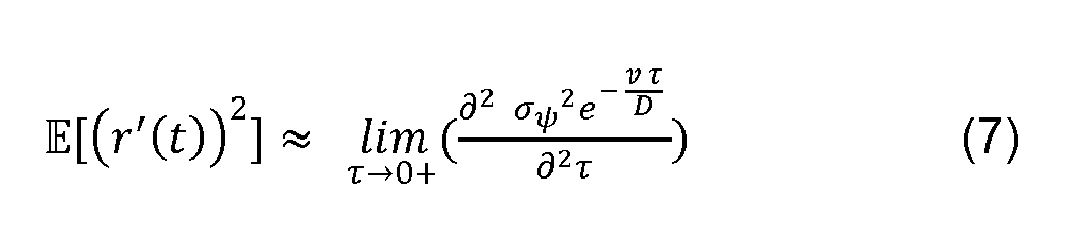
- Thus, the second-time derivative of the autocorrelation function of the shadowing is proportional to the square of the speed, or equivalently, the speed v of the user equipment is proportional to the standard deviation of the derivative of the signal power measurements r(t). It results in an approximate estimate of the user equipment speed v as function of the received signal power r(t):


- Given the linear relationship between v and D in equation (8), an error of x% on the shadowing decorrelation distance D induces equally an error of x% on the estimated speed v of the user equipment. Hence, propagation environment-dependent values of the shadowing decorrelation distance D are, preferably, predetermined experimentally and/or theoretically, and then stored to be used for online user speed estimation. In others words, reference data that associate a given user equipment speed with a certain standard deviation in a given radio propagation environment (having a shadowing decorrelation distance D) may be established offline and then utilized online on-demand.
- In one embodiment, the speed v of the user equipment is estimated on the basis of the measured signal powers r(t) as follows:
- the measured signal powers r(t) are normalized:

- the derivative of the normalize measurement samples rN (t) is : rN'(t);
- the variance of the derivative rN '(t) of the normalized measurement samples rN (t) is computed: E[(rN '(t))2];
- the standard deviation (i.e. square root of the variance) is calculated
on subsequent derivatives:
- the obtained value is compared to reference data stored in a database (such as, a lookup table) that is built off-line and provides one-to-one mapping between the standard deviation and the user speed, for a given shadowing decorrelation distance D.
- For smoothing fast fading and Doppler variations, the power measurement samples r(t) may, advantageously, be filtered prior to the above procedure steps. As an illustrative example, such filtering step may be achieved through introducing a low pass filter, or through a simple averaging (such as a moving-average process) of the measurement samples rN (t) prior to the derivative calculation. In fact, smoothing the signal in time domain is preferable, particularly when the measurements processed are insufficiently filtered, or when the measurements samples to process are insufficiently averaged (for example, power measurements over narrow bands instead of wide bands).
- In one embodiment illustrated in
figure 1 , the above described method is deployed so that estimating the user speed per block of measurement samples, resulting in a per-block speed estimator. To that end, the above-described method is carried out on a predefined number N of measured signal powers as follows: - a set (i.e. a block) of measurement samples Xi = [x i+1,...,x i+N ] (a vector of N samples) is normalized (
step 10 infigure 1 ): for each element k,
- a derivation of the normalized vector is computed (
step 11 infigure 1 ). As illustrative examples of derivation operators, one can mention those based on Lagrangian interpolation polynomial functions, or those described in (Francois Auger, Zoheir Boulbair, Frederic Miqueau, "Estimation par maximum de vraisemblance de la dérivée d'un signal bruité: Application à la caractérisation de vérins pneumatiques", 19ème Colloque sur le traitement du signal et des images, GRETSI 2003); - computation of the square root of variance of derivatives, said dispersions (
step 12 infigure 1 ): the dispersion Dispi is computed per block i, from the set of all derivatives dk in di (di being the set of all derivatives {dk }, calculated on block i) to quantify the dispersion of these derivatives. It is obtained from an empirical estimation of the variance on the derivatives, according to the following equation:
K being the number of derivatives computed on block i ;
m being the mean value over these K derivatives - comparison (
step 13 infigure 1 ) with the database 14: the estimated dispersion is compared to the content of a database 14 (i.e. a lookup table) that provides one-to-one mapping between the speed and the computed dispersion Dispi , for a given shadowing decorrelation distance D. The speed that corresponds to the closest dispersion from this data base is then the estimated user equipment speed v. - In one embodiment, the derivative at order 1 for each element k in block i (Xi = [x i+1,...xk ,...,x i+N ], i > k > N) is computed on mean values over temporal blocks of samples as follows:

where n is the delay between the two points of derivation, T is the measurements sampling period and E[xk ] is the mean value computed over a block k of temporal samples. - Likewise, a derivative at order 3 may be computed for each element k in block i (Xi = [x i+1,...xk ,...,x i+N ], i > k > N) as follows (di being the set of all derivatives {dk } calculated on block i).

- Advantageously, the above derivatives enable to further smooth the signal, thus reduce fast fading, Doppler variations, in order to capture the slow variations of shadowing, only.
- In an alternative embodiment illustrated in
figure 2 , the above described method is deployed so that estimating the user speed adaptively for each new measurement per block of measurements, leading to an adaptive speed estimator. The above-described steps for a per-block speed estimation are updated at each new signal power measurement while using the most recent N - 1 previous measurements already available, in order to track the speed of the user equipment. In fact, instead of waiting for successively measuring a 'block' of samples Xi = [x i+1,...,x i+N ] for computing the dispersion Dispi , the dispersion is updated each time a new xk sample is available. - In fact,
- a new sample xk is stored in a circular buffer of size n (or 3n in the case of a derivative at order 3) (
step 20 infigure 2 ); - the derivative dk is computed by recursive filtering, accounting for the new input value (
step 21 infigure 2 ): derivative computed from the new sample. As illustrative example, for a derivative at order 1,
- dispersion is updated and speed estimated by
database 23 lookup (step 22 infigure 2 ). - Advantageously, an adaptive speed estimator enables speed tracking: speed estimated at the rate of each new samples arrival. Additionally, the computational cost of its implementation is quite low, which favors its deployment in real networks.
- The user speed may be estimated from a set of radio signal power measurements which may be performed either by the serving base station on uplink sounding reference signals or alternatively (given the symmetry of the radio propagation channel) by the user equipment on downlink signals. Accordingly, these measurements may be performed based on downlink or uplink physical signals, then processed as described above by means of dedicated processing units. Such processing units may be comprised in the base station (an eNodeB for LTE and beyond), in the user equipment or in any other system to which the measured signal powers are reported.
-
Figure 3 , in which is plotted the dispersions
- Accordingly, it is preferable to store in a database previously established reference data associating a given user equipment speed with a certain computed dispersion Dispi (i.e. the standard deviation) for a plurality shadowing decorrelation distance D relevant to different radio propagation environments.
- It is to be further noted that the above-described method permits to discriminate the user speed class interval. In particular, according to simulations results, with 11 classes, the probability for a correct classification, including adjacent classes is about 90%, whatever the decorrelation distance D is.
- Advantageously, profiting by the relatively large sampling period (generally around 40ms or more) of sounding reference signals, the variation speed of the slow fading (i.e. large scale fading) is utilized to estimate the real speed of the user. In fact, the slow fading variations (medium and large scale variations) are more or less rapid depending on the user velocity for estimating the real speed.
-
Figure 4 shows a processing unit for estimating, as described above, the speed of user equipment connected to a base station of a wireless network. The processing unit comprises - a
module 40 configured to make a set of measurements of the power of a signal transmitted between the user equipment and the base station; - a
module 41 configured to compute the derivative of the measured signal power with respect to time; - a
module 42 configured to compute the standard deviation of the computed derivative; - a
module 43 configured to estimate, from previously established reference data within a database 45 (i.e. a lookup table), the speed of the user equipment that corresponds to the computed standard deviation, the reference data associating a given user equipment speed with a certain computed standard deviation. - The disclosed embodiments efficiently cope with large periods of signal strength measurements, by taking profit of correlation properties of slow fading. The computational cost of the proposed method for user speed estimation is very low. An adaptive implementation thereof is easily tractable in real networks, with very limited impact on CPU.
- Moreover, the disclosed method and system, advantageously, permit to estimate the velocity of any user equipment connected to a base station (eNodeB) without any additional overhead. In fact, the sounding reference signals (SRS) transmitted by the UE are already specified by the 3GPP LTE (3GPP Technical Specification 36.211, Evolved Universal Terrestrial Radio Access (E-UTRA), Physical Channels and Modulation).
- Further, the above-described method and system for user speed estimation, advantageously, enable speed tracking from measurements at large periodicity, while restricting significantly the impact on CPU.
- According to an aspect of the disclosed embodiments, the speed class of the user equipment may be estimated on the basis of real time measurements in wireless access network such as 3G, LTE or beyond.
- It is to be noted that in the above-described embodiments the user speed is supposed to be averagely constant or slowly variable in time, but they remain valid for time-variant user speed while taking into account this dependency (notably, in equations 2, 7 and 8).
Claims (12)
- A method for estimating the speed of a user equipment connected to a base station of a wireless network, the method comprising the following steps:- measuring the power of a signal transmitted between the user equipment and the base station;- computing the derivative of the measured signal power with respect to time;- computing the standard deviation of the computed derivative;- estimating, from previously established reference data, the speed of the user equipment that corresponds to the computed standard deviation, the reference data associating a given user equipment speed with a certain computed standard deviation.
- The method of claim 1 , further comprising a normalization step of the measured signal power.
- The method of claim 1 or 2, further comprising a filtering step of the measured signal power.
- The method of any of the preceding claims, being carried out on a predefined number of measured signal powers.
- The method of claim 4, wherein its steps are updated at each signal power measurement, in order to track the speed of the user equipment.
- The method of any of the preceding claims, wherein the reference data associates a given user equipment speed with a certain computed standard deviation for a given shadowing decorrelation distance, the shadowing decorrelation distance being relevant to the radio environment of the base station.
- The method of any of claims 1 to 6, wherein the signal power measurement is performed by the base station on an uplink signal transmitted from the user equipment.
- The method of any of the preceding claims, wherein the transmitted signal between the user equipment and the base station is a sounding reference signal.
- A processing unit for estimating the speed of a user equipment connected to a base station of a wireless network, the processing unit comprising- a module configured to measure the power of a signal transmitted between the user equipment and the base station;- a module configured to compute the derivative of the measured signal power with respect to time;- a module configured to compute the standard deviation of the computed derivative;- a module configured to estimate, from previously established reference data, the speed of the user equipment that corresponds to the computed standard deviation, the reference data associating a given user equipment speed with a certain computed standard deviation.
- The processing unit of claim 9, further comprising a low pass filter for filtering the measured signal power.
- A base station comprising a processing unit according to any of claims 9 or 10.
- Computer program implemented on a processing unit, the program including code sections for performing instructions corresponding to the steps of a method according to any of claims 1-8.
Priority Applications (7)
| Application Number | Priority Date | Filing Date | Title |
|---|---|---|---|
| ES13306001T ES2734502T3 (en) | 2013-07-12 | 2013-07-12 | Temporal analysis for the estimation of user speed in wireless networks |
| EP13306001.2A EP2824476B1 (en) | 2013-07-12 | 2013-07-12 | Temporal analysis for user speed estimation in wireless networks |
| US14/904,631 US10901076B2 (en) | 2013-07-12 | 2014-07-11 | Temporal analysis for user speed estimation in wireless networks |
| PCT/EP2014/064918 WO2015004267A1 (en) | 2013-07-12 | 2014-07-11 | Temporal analysis for user speed estimation in wireless networks |
| KR1020167003695A KR101819099B1 (en) | 2013-07-12 | 2014-07-11 | A method, a processing unit, a base station, and computer readable recording medium for estimating the speed of a user eqipment in wireless networks |
| CN201480048388.0A CN105531600B (en) | 2013-07-12 | 2014-07-11 | Time Analysis for User Speed Estimation in Wireless Networks |
| JP2016524838A JP6271724B2 (en) | 2013-07-12 | 2014-07-11 | Temporal analysis for user speed estimation in wireless networks |
Applications Claiming Priority (1)
| Application Number | Priority Date | Filing Date | Title |
|---|---|---|---|
| EP13306001.2A EP2824476B1 (en) | 2013-07-12 | 2013-07-12 | Temporal analysis for user speed estimation in wireless networks |
Publications (2)
| Publication Number | Publication Date |
|---|---|
| EP2824476A1 true EP2824476A1 (en) | 2015-01-14 |
| EP2824476B1 EP2824476B1 (en) | 2019-05-08 |
Family
ID=48915951
Family Applications (1)
| Application Number | Title | Priority Date | Filing Date |
|---|---|---|---|
| EP13306001.2A Active EP2824476B1 (en) | 2013-07-12 | 2013-07-12 | Temporal analysis for user speed estimation in wireless networks |
Country Status (7)
| Country | Link |
|---|---|
| US (1) | US10901076B2 (en) |
| EP (1) | EP2824476B1 (en) |
| JP (1) | JP6271724B2 (en) |
| KR (1) | KR101819099B1 (en) |
| CN (1) | CN105531600B (en) |
| ES (1) | ES2734502T3 (en) |
| WO (1) | WO2015004267A1 (en) |
Cited By (1)
| Publication number | Priority date | Publication date | Assignee | Title |
|---|---|---|---|---|
| CN108174390A (en) * | 2017-12-15 | 2018-06-15 | 深圳无线电检测技术研究院 | Method and device for judging qualified LTE-V2X field performance test scene |
Families Citing this family (5)
| Publication number | Priority date | Publication date | Assignee | Title |
|---|---|---|---|---|
| WO2017067580A1 (en) * | 2015-10-20 | 2017-04-27 | Telefonaktiebolaget Lm Ericsson (Publ) | Determination of reference signal transmission pattern |
| US11516051B2 (en) | 2018-03-06 | 2022-11-29 | Samsung Electronics Co., Ltd. | Method and apparatus for AI-based UE speed estimation using uplink SRS measurements |
| EP4548123A4 (en) * | 2022-07-01 | 2026-04-29 | Ericsson Telefon Ab L M | METHOD AND NODES FOR ESTIMATING THE TRAVEL SPEED OF A WIRELESS DEVICE |
| JP7749882B2 (en) * | 2023-10-24 | 2025-10-06 | 三菱電機株式会社 | Speed estimation device, target classification device, speed estimation method, and target classification method |
| CN119966539B (en) * | 2025-04-03 | 2025-08-08 | 暨南大学 | Collaborative multi-layer identification and node selection method for spectral aliasing wireless signals |
Citations (4)
| Publication number | Priority date | Publication date | Assignee | Title |
|---|---|---|---|---|
| US6577603B1 (en) * | 1996-10-09 | 2003-06-10 | Nokia Corporation | Method for determining speed of terminal, and receiver |
| US7065375B2 (en) * | 2001-09-25 | 2006-06-20 | Stmicroelectronics N.V. | Process and device for estimating the speed of movement of a mobile terminal, in particular a cellular mobile telephone capable of operating according to the UMTS standard |
| US8126404B2 (en) * | 2000-11-14 | 2012-02-28 | Alcatel Lucent | Method and device for evaluating the energy level of a radio signal |
| WO2013066260A2 (en) * | 2011-11-04 | 2013-05-10 | Zte Wistron Telecom Ab | Method and apparatus for estimating speed of a mobile terminal |
Family Cites Families (12)
| Publication number | Priority date | Publication date | Assignee | Title |
|---|---|---|---|---|
| US2126404A (en) * | 1936-07-18 | 1938-08-09 | Lidgerwood Mfg Co | Portable power shovel and the like |
| EP1300966B1 (en) | 1994-12-13 | 2007-02-07 | NTT DoCoMo, Inc. | Mobile satellite communication system |
| FR2782227B1 (en) | 1998-08-04 | 2000-11-10 | Nortel Matra Cellular | RADIO ESTIMATION METHOD OF THE SPEED OF A MOBILE |
| US6680969B1 (en) | 1999-03-22 | 2004-01-20 | Ericsson, Inc. | Methods for estimating doppler spreads including autocorrelation function hypotheses and related systems and receivers |
| DE60117202D1 (en) * | 2001-09-03 | 2006-04-20 | St Microelectronics Nv | A method and apparatus for estimating the speed of a mobile terminal in a wireless communication system |
| US7812719B2 (en) * | 2006-05-01 | 2010-10-12 | Djuric Petar M | RFID system and method for localizing and tracking a moving object with an RFID tag |
| US7835754B2 (en) * | 2006-05-08 | 2010-11-16 | Skyhook Wireless, Inc. | Estimation of speed and direction of travel in a WLAN positioning system |
| DE102007028114A1 (en) * | 2007-03-16 | 2008-09-25 | Fraunhofer-Gesellschaft zur Förderung der angewandten Forschung e.V. | Device and method for localization of terminals |
| JP5306143B2 (en) * | 2009-10-26 | 2013-10-02 | Kddi株式会社 | Wireless communication apparatus, method and program for estimating maximum transmission rate from wireless quality |
| US8989789B2 (en) * | 2011-06-29 | 2015-03-24 | Broadcom Corporation | Terminal mobility state detection |
| US9031538B2 (en) * | 2012-02-16 | 2015-05-12 | Continental Automotive Systems, Inc. | Method and apparatus to determine if a cellular jamming signal is malicious or non-malicious based on received signal strength |
| WO2014098737A1 (en) * | 2012-12-17 | 2014-06-26 | Zte Wistron Telecom Ab | Tracking received power in wireless communications |
-
2013
- 2013-07-12 ES ES13306001T patent/ES2734502T3/en active Active
- 2013-07-12 EP EP13306001.2A patent/EP2824476B1/en active Active
-
2014
- 2014-07-11 KR KR1020167003695A patent/KR101819099B1/en active Active
- 2014-07-11 WO PCT/EP2014/064918 patent/WO2015004267A1/en not_active Ceased
- 2014-07-11 JP JP2016524838A patent/JP6271724B2/en active Active
- 2014-07-11 US US14/904,631 patent/US10901076B2/en active Active
- 2014-07-11 CN CN201480048388.0A patent/CN105531600B/en active Active
Patent Citations (4)
| Publication number | Priority date | Publication date | Assignee | Title |
|---|---|---|---|---|
| US6577603B1 (en) * | 1996-10-09 | 2003-06-10 | Nokia Corporation | Method for determining speed of terminal, and receiver |
| US8126404B2 (en) * | 2000-11-14 | 2012-02-28 | Alcatel Lucent | Method and device for evaluating the energy level of a radio signal |
| US7065375B2 (en) * | 2001-09-25 | 2006-06-20 | Stmicroelectronics N.V. | Process and device for estimating the speed of movement of a mobile terminal, in particular a cellular mobile telephone capable of operating according to the UMTS standard |
| WO2013066260A2 (en) * | 2011-11-04 | 2013-05-10 | Zte Wistron Telecom Ab | Method and apparatus for estimating speed of a mobile terminal |
Non-Patent Citations (10)
| Title |
|---|
| A. ALGANS ET AL.: "Experimental analysis of the joint statistical properties of azimuth spread, delay spread, and shadow fading", IEEE J.SEL. A. COMMUN., vol. 20, no. 3, September 2006 (2006-09-01), pages 523 - 531 |
| FRANCOIS AUGER; ZOHEIR BOULBAIR; FREDERIC MIQUEAU: "Estimation par maximum de vraisemblance de la dérivée d'un signal bruité: Application a la caractérisation de vérins pneumatiques", 19ÈME COLLOQUE SUR LE TRAITEMENT DU SIGNAL ET DES IMAGES, GRETSI, 2003 |
| GUDMUNDSON, M.: "Correlation Model for Shadow Fading in Mobile Radio Systems", ELECTRON. LETT, vol. 27, no. 23, November 1991 (1991-11-01), pages 2145 - 2146 |
| J. BENDAT ET AL.: "Random Data: Analysis and Measurement Procedures", WILEY SERIES IN PROBABILITY AND STATISTICS, 2010 |
| J. WEITZEN ET AL.: "Measurement of angular and distance correlation properties of log-normal shadowing at 1900 MHz and its application to design of PCS systems", IEEE TRANSACTIONS ON VEHICULAR TECHNOLOGY, March 2002 (2002-03-01), pages 265 - 273 |
| N. YAAKOB ET AL.: "Investigating Mobile Motion Prediction in Supporting Seamless Handover for High Speed Mobile Node", PROCEEDINGS OF THE INTERNATIONAL CONFERENCE ON COMPUTER AND COMMUNICATION ENGINEERING, 2008 |
| ROSA ZHENG YAHONG ET AL.: "Mobile speed estimation for broadband wireless communications over rician fading channels", IEEE TRANSACTIONS ON WIRELESS COMMUNICATIONS, January 2009 (2009-01-01), pages 8 |
| S. O. RICE: "Mathematical analysis of random noise", BELL SYST. TECH. J., vol. 23, January 1945 (1945-01-01), pages 46 - 156 |
| V. KAVITHA ET AL.: "Spatial Queuing for analysis, design and dimensioning of Picocell networks with mobile users", PERFORMANCE EVALUATION, August 2011 (2011-08-01) |
| ZHANG HONG ET AL.: "Mobile speed estimation using diversity combining in fading channels", GLOBAL TELECOMMUNICATIONS CONFERENCE, 2004 |
Cited By (2)
| Publication number | Priority date | Publication date | Assignee | Title |
|---|---|---|---|---|
| CN108174390A (en) * | 2017-12-15 | 2018-06-15 | 深圳无线电检测技术研究院 | Method and device for judging qualified LTE-V2X field performance test scene |
| CN108174390B (en) * | 2017-12-15 | 2021-08-31 | 深圳无线电检测技术研究院 | Method and device for judging qualified LTE-V2X field performance test scenarios |
Also Published As
| Publication number | Publication date |
|---|---|
| JP6271724B2 (en) | 2018-01-31 |
| WO2015004267A1 (en) | 2015-01-15 |
| US20160146930A1 (en) | 2016-05-26 |
| KR20160040211A (en) | 2016-04-12 |
| EP2824476B1 (en) | 2019-05-08 |
| JP2016526685A (en) | 2016-09-05 |
| CN105531600B (en) | 2019-04-16 |
| KR101819099B1 (en) | 2018-01-16 |
| ES2734502T3 (en) | 2019-12-10 |
| US10901076B2 (en) | 2021-01-26 |
| CN105531600A (en) | 2016-04-27 |
Similar Documents
| Publication | Publication Date | Title |
|---|---|---|
| US10901076B2 (en) | Temporal analysis for user speed estimation in wireless networks | |
| CN111194414B (en) | Time alignment of motion detection signals using buffers | |
| KR20220081797A (en) | Mehtod and device for precise positioning for wireless communication system | |
| Liu et al. | A research on CSI-based human motion detection in complex scenarios | |
| CN104502982A (en) | Indoor passive human-body detection method with free checking of fine granularity | |
| Colpaert et al. | 3D non-stationary channel measurement and analysis for MaMIMO-UAV communications | |
| JP2013205398A (en) | Sending source estimation method and sending source estimation apparatus utilizing the same | |
| CN103561412B (en) | Channel associated shadow fading construction method based on stationary random process | |
| WO2024093997A1 (en) | Method and apparatus for determining model applicability, and communication device | |
| EP2793517B1 (en) | Method and system for user speed estimation in wireless networks | |
| KR102502594B1 (en) | Motion Localization in a Wireless Mesh Network Based on Time Factors | |
| CN116233905B (en) | Test method and device of wireless local area network equipment, medium and electronic equipment | |
| WO2011112128A1 (en) | Method and apparatus for estimating a doppler frequency | |
| Lin et al. | Compressive sensing based location estimation using channel impulse response measurements | |
| KR20160103380A (en) | Split-bands interference signal control apparatus and method | |
| KR101500922B1 (en) | A method and an apparatus for distributed estimation using an adaptive filter | |
| JP6326646B2 (en) | Attenuation characteristic function estimation device, attenuation characteristic function estimation method, and program | |
| Hong et al. | Channel capacity analysis of indoor environments for location-aware communications | |
| KR102125996B1 (en) | Method for positioning in wireless communication system | |
| JP6455818B2 (en) | Attenuation coefficient estimation device, attenuation coefficient estimation method, and program | |
| Dahmouni et al. | A comparative analysis of single-input single-output stationarity time and pathloss in suburban environments for vehicle-to-infrastructure channel using veneris ray-tracing and real data | |
| WO2025010690A1 (en) | Sensing information feedback method and apparatus, and device and storage medium | |
| Zhang et al. | Wideband wireless channel predictor relying on environment information | |
| Garzón et al. | Fast computation of cramer-rao bounds for toa | |
| Dahunsi et al. | Effect of Distance on the Accuracy of RSS-Based Geometric Positioning Methods |
Legal Events
| Date | Code | Title | Description |
|---|---|---|---|
| 17P | Request for examination filed |
Effective date: 20130712 |
|
| AK | Designated contracting states |
Kind code of ref document: A1 Designated state(s): AL AT BE BG CH CY CZ DE DK EE ES FI FR GB GR HR HU IE IS IT LI LT LU LV MC MK MT NL NO PL PT RO RS SE SI SK SM TR |
|
| AX | Request for extension of the european patent |
Extension state: BA ME |
|
| PUAI | Public reference made under article 153(3) epc to a published international application that has entered the european phase |
Free format text: ORIGINAL CODE: 0009012 |
|
| R17P | Request for examination filed (corrected) |
Effective date: 20150317 |
|
| RBV | Designated contracting states (corrected) |
Designated state(s): AL AT BE BG CH CY CZ DE DK EE ES FI FR GB GR HR HU IE IS IT LI LT LU LV MC MK MT NL NO PL PT RO RS SE SI SK SM TR |
|
| RAP1 | Party data changed (applicant data changed or rights of an application transferred) |
Owner name: ALCATEL LUCENT Owner name: INRIA - INSTITUT NATIONAL DE RECHERCHE EN INFORMAT |
|
| GRAP | Despatch of communication of intention to grant a patent |
Free format text: ORIGINAL CODE: EPIDOSNIGR1 |
|
| STAA | Information on the status of an ep patent application or granted ep patent |
Free format text: STATUS: GRANT OF PATENT IS INTENDED |
|
| INTG | Intention to grant announced |
Effective date: 20190104 |
|
| GRAS | Grant fee paid |
Free format text: ORIGINAL CODE: EPIDOSNIGR3 |
|
| GRAA | (expected) grant |
Free format text: ORIGINAL CODE: 0009210 |
|
| STAA | Information on the status of an ep patent application or granted ep patent |
Free format text: STATUS: THE PATENT HAS BEEN GRANTED |
|
| AK | Designated contracting states |
Kind code of ref document: B1 Designated state(s): AL AT BE BG CH CY CZ DE DK EE ES FI FR GB GR HR HU IE IS IT LI LT LU LV MC MK MT NL NO PL PT RO RS SE SI SK SM TR |
|
| REG | Reference to a national code |
Ref country code: GB Ref legal event code: FG4D |
|
| REG | Reference to a national code |
Ref country code: CH Ref legal event code: EP Ref country code: AT Ref legal event code: REF Ref document number: 1131038 Country of ref document: AT Kind code of ref document: T Effective date: 20190515 |
|
| REG | Reference to a national code |
Ref country code: IE Ref legal event code: FG4D |
|
| REG | Reference to a national code |
Ref country code: DE Ref legal event code: R096 Ref document number: 602013054949 Country of ref document: DE |
|
| REG | Reference to a national code |
Ref country code: NL Ref legal event code: MP Effective date: 20190508 |
|
| REG | Reference to a national code |
Ref country code: LT Ref legal event code: MG4D |
|
| PG25 | Lapsed in a contracting state [announced via postgrant information from national office to epo] |
Ref country code: LT Free format text: LAPSE BECAUSE OF FAILURE TO SUBMIT A TRANSLATION OF THE DESCRIPTION OR TO PAY THE FEE WITHIN THE PRESCRIBED TIME-LIMIT Effective date: 20190508 Ref country code: HR Free format text: LAPSE BECAUSE OF FAILURE TO SUBMIT A TRANSLATION OF THE DESCRIPTION OR TO PAY THE FEE WITHIN THE PRESCRIBED TIME-LIMIT Effective date: 20190508 Ref country code: FI Free format text: LAPSE BECAUSE OF FAILURE TO SUBMIT A TRANSLATION OF THE DESCRIPTION OR TO PAY THE FEE WITHIN THE PRESCRIBED TIME-LIMIT Effective date: 20190508 Ref country code: NO Free format text: LAPSE BECAUSE OF FAILURE TO SUBMIT A TRANSLATION OF THE DESCRIPTION OR TO PAY THE FEE WITHIN THE PRESCRIBED TIME-LIMIT Effective date: 20190808 Ref country code: AL Free format text: LAPSE BECAUSE OF FAILURE TO SUBMIT A TRANSLATION OF THE DESCRIPTION OR TO PAY THE FEE WITHIN THE PRESCRIBED TIME-LIMIT Effective date: 20190508 Ref country code: PT Free format text: LAPSE BECAUSE OF FAILURE TO SUBMIT A TRANSLATION OF THE DESCRIPTION OR TO PAY THE FEE WITHIN THE PRESCRIBED TIME-LIMIT Effective date: 20190908 Ref country code: SE Free format text: LAPSE BECAUSE OF FAILURE TO SUBMIT A TRANSLATION OF THE DESCRIPTION OR TO PAY THE FEE WITHIN THE PRESCRIBED TIME-LIMIT Effective date: 20190508 Ref country code: NL Free format text: LAPSE BECAUSE OF FAILURE TO SUBMIT A TRANSLATION OF THE DESCRIPTION OR TO PAY THE FEE WITHIN THE PRESCRIBED TIME-LIMIT Effective date: 20190508 |
|
| PG25 | Lapsed in a contracting state [announced via postgrant information from national office to epo] |
Ref country code: RS Free format text: LAPSE BECAUSE OF FAILURE TO SUBMIT A TRANSLATION OF THE DESCRIPTION OR TO PAY THE FEE WITHIN THE PRESCRIBED TIME-LIMIT Effective date: 20190508 Ref country code: BG Free format text: LAPSE BECAUSE OF FAILURE TO SUBMIT A TRANSLATION OF THE DESCRIPTION OR TO PAY THE FEE WITHIN THE PRESCRIBED TIME-LIMIT Effective date: 20190808 Ref country code: LV Free format text: LAPSE BECAUSE OF FAILURE TO SUBMIT A TRANSLATION OF THE DESCRIPTION OR TO PAY THE FEE WITHIN THE PRESCRIBED TIME-LIMIT Effective date: 20190508 Ref country code: GR Free format text: LAPSE BECAUSE OF FAILURE TO SUBMIT A TRANSLATION OF THE DESCRIPTION OR TO PAY THE FEE WITHIN THE PRESCRIBED TIME-LIMIT Effective date: 20190809 |
|
| REG | Reference to a national code |
Ref country code: ES Ref legal event code: FG2A Ref document number: 2734502 Country of ref document: ES Kind code of ref document: T3 Effective date: 20191210 |
|
| REG | Reference to a national code |
Ref country code: AT Ref legal event code: MK05 Ref document number: 1131038 Country of ref document: AT Kind code of ref document: T Effective date: 20190508 |
|
| PG25 | Lapsed in a contracting state [announced via postgrant information from national office to epo] |
Ref country code: EE Free format text: LAPSE BECAUSE OF FAILURE TO SUBMIT A TRANSLATION OF THE DESCRIPTION OR TO PAY THE FEE WITHIN THE PRESCRIBED TIME-LIMIT Effective date: 20190508 Ref country code: SK Free format text: LAPSE BECAUSE OF FAILURE TO SUBMIT A TRANSLATION OF THE DESCRIPTION OR TO PAY THE FEE WITHIN THE PRESCRIBED TIME-LIMIT Effective date: 20190508 Ref country code: AT Free format text: LAPSE BECAUSE OF FAILURE TO SUBMIT A TRANSLATION OF THE DESCRIPTION OR TO PAY THE FEE WITHIN THE PRESCRIBED TIME-LIMIT Effective date: 20190508 Ref country code: DK Free format text: LAPSE BECAUSE OF FAILURE TO SUBMIT A TRANSLATION OF THE DESCRIPTION OR TO PAY THE FEE WITHIN THE PRESCRIBED TIME-LIMIT Effective date: 20190508 Ref country code: CZ Free format text: LAPSE BECAUSE OF FAILURE TO SUBMIT A TRANSLATION OF THE DESCRIPTION OR TO PAY THE FEE WITHIN THE PRESCRIBED TIME-LIMIT Effective date: 20190508 Ref country code: RO Free format text: LAPSE BECAUSE OF FAILURE TO SUBMIT A TRANSLATION OF THE DESCRIPTION OR TO PAY THE FEE WITHIN THE PRESCRIBED TIME-LIMIT Effective date: 20190508 |
|
| REG | Reference to a national code |
Ref country code: DE Ref legal event code: R097 Ref document number: 602013054949 Country of ref document: DE |
|
| PG25 | Lapsed in a contracting state [announced via postgrant information from national office to epo] |
Ref country code: SM Free format text: LAPSE BECAUSE OF FAILURE TO SUBMIT A TRANSLATION OF THE DESCRIPTION OR TO PAY THE FEE WITHIN THE PRESCRIBED TIME-LIMIT Effective date: 20190508 Ref country code: MC Free format text: LAPSE BECAUSE OF FAILURE TO SUBMIT A TRANSLATION OF THE DESCRIPTION OR TO PAY THE FEE WITHIN THE PRESCRIBED TIME-LIMIT Effective date: 20190508 Ref country code: IT Free format text: LAPSE BECAUSE OF FAILURE TO SUBMIT A TRANSLATION OF THE DESCRIPTION OR TO PAY THE FEE WITHIN THE PRESCRIBED TIME-LIMIT Effective date: 20190508 |
|
| REG | Reference to a national code |
Ref country code: CH Ref legal event code: PL |
|
| PLBE | No opposition filed within time limit |
Free format text: ORIGINAL CODE: 0009261 |
|
| STAA | Information on the status of an ep patent application or granted ep patent |
Free format text: STATUS: NO OPPOSITION FILED WITHIN TIME LIMIT |
|
| PG25 | Lapsed in a contracting state [announced via postgrant information from national office to epo] |
Ref country code: TR Free format text: LAPSE BECAUSE OF FAILURE TO SUBMIT A TRANSLATION OF THE DESCRIPTION OR TO PAY THE FEE WITHIN THE PRESCRIBED TIME-LIMIT Effective date: 20190508 |
|
| 26N | No opposition filed |
Effective date: 20200211 |
|
| REG | Reference to a national code |
Ref country code: BE Ref legal event code: MM Effective date: 20190731 |
|
| PG25 | Lapsed in a contracting state [announced via postgrant information from national office to epo] |
Ref country code: PL Free format text: LAPSE BECAUSE OF FAILURE TO SUBMIT A TRANSLATION OF THE DESCRIPTION OR TO PAY THE FEE WITHIN THE PRESCRIBED TIME-LIMIT Effective date: 20190508 |
|
| PG25 | Lapsed in a contracting state [announced via postgrant information from national office to epo] |
Ref country code: LI Free format text: LAPSE BECAUSE OF NON-PAYMENT OF DUE FEES Effective date: 20190731 Ref country code: CH Free format text: LAPSE BECAUSE OF NON-PAYMENT OF DUE FEES Effective date: 20190731 Ref country code: SI Free format text: LAPSE BECAUSE OF FAILURE TO SUBMIT A TRANSLATION OF THE DESCRIPTION OR TO PAY THE FEE WITHIN THE PRESCRIBED TIME-LIMIT Effective date: 20190508 Ref country code: BE Free format text: LAPSE BECAUSE OF NON-PAYMENT OF DUE FEES Effective date: 20190731 Ref country code: LU Free format text: LAPSE BECAUSE OF NON-PAYMENT OF DUE FEES Effective date: 20190712 |
|
| PG25 | Lapsed in a contracting state [announced via postgrant information from national office to epo] |
Ref country code: IE Free format text: LAPSE BECAUSE OF NON-PAYMENT OF DUE FEES Effective date: 20190712 |
|
| PG25 | Lapsed in a contracting state [announced via postgrant information from national office to epo] |
Ref country code: CY Free format text: LAPSE BECAUSE OF FAILURE TO SUBMIT A TRANSLATION OF THE DESCRIPTION OR TO PAY THE FEE WITHIN THE PRESCRIBED TIME-LIMIT Effective date: 20190508 |
|
| PG25 | Lapsed in a contracting state [announced via postgrant information from national office to epo] |
Ref country code: IS Free format text: LAPSE BECAUSE OF FAILURE TO SUBMIT A TRANSLATION OF THE DESCRIPTION OR TO PAY THE FEE WITHIN THE PRESCRIBED TIME-LIMIT Effective date: 20190908 |
|
| PG25 | Lapsed in a contracting state [announced via postgrant information from national office to epo] |
Ref country code: MT Free format text: LAPSE BECAUSE OF FAILURE TO SUBMIT A TRANSLATION OF THE DESCRIPTION OR TO PAY THE FEE WITHIN THE PRESCRIBED TIME-LIMIT Effective date: 20190508 Ref country code: HU Free format text: LAPSE BECAUSE OF FAILURE TO SUBMIT A TRANSLATION OF THE DESCRIPTION OR TO PAY THE FEE WITHIN THE PRESCRIBED TIME-LIMIT; INVALID AB INITIO Effective date: 20130712 |
|
| PGFP | Annual fee paid to national office [announced via postgrant information from national office to epo] |
Ref country code: FR Payment date: 20210611 Year of fee payment: 9 |
|
| PGFP | Annual fee paid to national office [announced via postgrant information from national office to epo] |
Ref country code: ES Payment date: 20210803 Year of fee payment: 9 |
|
| PG25 | Lapsed in a contracting state [announced via postgrant information from national office to epo] |
Ref country code: MK Free format text: LAPSE BECAUSE OF FAILURE TO SUBMIT A TRANSLATION OF THE DESCRIPTION OR TO PAY THE FEE WITHIN THE PRESCRIBED TIME-LIMIT Effective date: 20190508 |
|
| PG25 | Lapsed in a contracting state [announced via postgrant information from national office to epo] |
Ref country code: FR Free format text: LAPSE BECAUSE OF NON-PAYMENT OF DUE FEES Effective date: 20220731 |
|
| REG | Reference to a national code |
Ref country code: ES Ref legal event code: FD2A Effective date: 20230829 |
|
| PG25 | Lapsed in a contracting state [announced via postgrant information from national office to epo] |
Ref country code: ES Free format text: LAPSE BECAUSE OF NON-PAYMENT OF DUE FEES Effective date: 20220713 |
|
| PGFP | Annual fee paid to national office [announced via postgrant information from national office to epo] |
Ref country code: GB Payment date: 20250529 Year of fee payment: 13 |
|
| PGFP | Annual fee paid to national office [announced via postgrant information from national office to epo] |
Ref country code: DE Payment date: 20250604 Year of fee payment: 13 |