EP2821535A1 - Fiber structure - Google Patents
Fiber structure Download PDFInfo
- Publication number
- EP2821535A1 EP2821535A1 EP20130755717 EP13755717A EP2821535A1 EP 2821535 A1 EP2821535 A1 EP 2821535A1 EP 20130755717 EP20130755717 EP 20130755717 EP 13755717 A EP13755717 A EP 13755717A EP 2821535 A1 EP2821535 A1 EP 2821535A1
- Authority
- EP
- European Patent Office
- Prior art keywords
- fabric
- fiber structure
- weave
- cross
- hygroscopic polymer
- Prior art date
- Legal status (The legal status is an assumption and is not a legal conclusion. Google has not performed a legal analysis and makes no representation as to the accuracy of the status listed.)
- Withdrawn
Links
- 239000000835 fiber Substances 0.000 title claims abstract description 200
- 239000004744 fabric Substances 0.000 claims abstract description 170
- 229920000642 polymer Polymers 0.000 claims abstract description 102
- 238000009940 knitting Methods 0.000 claims description 27
- 239000000178 monomer Substances 0.000 claims description 18
- 239000002759 woven fabric Substances 0.000 claims description 16
- 239000000463 material Substances 0.000 claims description 14
- 235000014676 Phragmites communis Nutrition 0.000 claims description 10
- 238000009941 weaving Methods 0.000 claims description 8
- DGAQECJNVWCQMB-PUAWFVPOSA-M Ilexoside XXIX Chemical compound C[C@@H]1CC[C@@]2(CC[C@@]3(C(=CC[C@H]4[C@]3(CC[C@@H]5[C@@]4(CC[C@@H](C5(C)C)OS(=O)(=O)[O-])C)C)[C@@H]2[C@]1(C)O)C)C(=O)O[C@H]6[C@@H]([C@H]([C@@H]([C@H](O6)CO)O)O)O.[Na+] DGAQECJNVWCQMB-PUAWFVPOSA-M 0.000 claims description 5
- 229910052708 sodium Inorganic materials 0.000 claims description 5
- 239000011734 sodium Substances 0.000 claims description 5
- 229920001577 copolymer Polymers 0.000 claims description 4
- JHUFGBSGINLPOW-UHFFFAOYSA-N 3-chloro-4-(trifluoromethoxy)benzoyl cyanide Chemical compound FC(F)(F)OC1=CC=C(C(=O)C#N)C=C1Cl JHUFGBSGINLPOW-UHFFFAOYSA-N 0.000 claims description 3
- SZHIIIPPJJXYRY-UHFFFAOYSA-M sodium;2-methylprop-2-ene-1-sulfonate Chemical compound [Na+].CC(=C)CS([O-])(=O)=O SZHIIIPPJJXYRY-UHFFFAOYSA-M 0.000 claims description 3
- MNCGMVDMOKPCSQ-UHFFFAOYSA-M sodium;2-phenylethenesulfonate Chemical compound [Na+].[O-]S(=O)(=O)C=CC1=CC=CC=C1 MNCGMVDMOKPCSQ-UHFFFAOYSA-M 0.000 claims description 3
- JQOTXUJEKRMUNR-UHFFFAOYSA-M sodium;1-(prop-2-enoylamino)propane-2-sulfonate Chemical compound [Na+].[O-]S(=O)(=O)C(C)CNC(=O)C=C JQOTXUJEKRMUNR-UHFFFAOYSA-M 0.000 claims description 2
- 244000089486 Phragmites australis subsp australis Species 0.000 claims 1
- 238000003795 desorption Methods 0.000 abstract description 4
- 229920000139 polyethylene terephthalate Polymers 0.000 description 41
- 239000005020 polyethylene terephthalate Substances 0.000 description 41
- -1 alkali metal salts Chemical class 0.000 description 38
- 238000010521 absorption reaction Methods 0.000 description 35
- 239000002131 composite material Substances 0.000 description 17
- XLYOFNOQVPJJNP-UHFFFAOYSA-N water Substances O XLYOFNOQVPJJNP-UHFFFAOYSA-N 0.000 description 17
- 238000011156 evaluation Methods 0.000 description 14
- 229920002215 polytrimethylene terephthalate Polymers 0.000 description 11
- 244000273256 Phragmites communis Species 0.000 description 9
- 239000003505 polymerization initiator Substances 0.000 description 9
- 239000007788 liquid Substances 0.000 description 8
- 238000012360 testing method Methods 0.000 description 8
- 230000000052 comparative effect Effects 0.000 description 7
- 239000003431 cross linking reagent Substances 0.000 description 7
- 238000006116 polymerization reaction Methods 0.000 description 6
- 150000001875 compounds Chemical class 0.000 description 5
- 238000000635 electron micrograph Methods 0.000 description 5
- 238000000034 method Methods 0.000 description 5
- 238000009987 spinning Methods 0.000 description 5
- ROOXNKNUYICQNP-UHFFFAOYSA-N ammonium persulfate Chemical compound [NH4+].[NH4+].[O-]S(=O)(=O)OOS([O-])(=O)=O ROOXNKNUYICQNP-UHFFFAOYSA-N 0.000 description 4
- 230000000694 effects Effects 0.000 description 4
- 238000010438 heat treatment Methods 0.000 description 4
- 229920001223 polyethylene glycol Polymers 0.000 description 4
- 239000002202 Polyethylene glycol Substances 0.000 description 3
- 125000002887 hydroxy group Chemical group [H]O* 0.000 description 3
- 238000002074 melt spinning Methods 0.000 description 3
- 239000000203 mixture Substances 0.000 description 3
- 239000002028 Biomass Substances 0.000 description 2
- 241000196324 Embryophyta Species 0.000 description 2
- MHAJPDPJQMAIIY-UHFFFAOYSA-N Hydrogen peroxide Chemical compound OO MHAJPDPJQMAIIY-UHFFFAOYSA-N 0.000 description 2
- 239000004952 Polyamide Substances 0.000 description 2
- 229920000297 Rayon Polymers 0.000 description 2
- 125000003368 amide group Chemical group 0.000 description 2
- 229910001870 ammonium persulfate Inorganic materials 0.000 description 2
- 125000003178 carboxy group Chemical group [H]OC(*)=O 0.000 description 2
- 239000003795 chemical substances by application Substances 0.000 description 2
- 230000007547 defect Effects 0.000 description 2
- 238000007599 discharging Methods 0.000 description 2
- 239000000975 dye Substances 0.000 description 2
- 238000004043 dyeing Methods 0.000 description 2
- 230000007613 environmental effect Effects 0.000 description 2
- 238000009472 formulation Methods 0.000 description 2
- 238000003754 machining Methods 0.000 description 2
- 238000004519 manufacturing process Methods 0.000 description 2
- 238000001465 metallisation Methods 0.000 description 2
- 230000000704 physical effect Effects 0.000 description 2
- 229920000747 poly(lactic acid) Polymers 0.000 description 2
- 229920002647 polyamide Polymers 0.000 description 2
- 239000004626 polylactic acid Substances 0.000 description 2
- 239000002964 rayon Substances 0.000 description 2
- 125000000020 sulfo group Chemical group O=S(=O)([*])O[H] 0.000 description 2
- 229920002994 synthetic fiber Polymers 0.000 description 2
- 239000012209 synthetic fiber Substances 0.000 description 2
- 238000009834 vaporization Methods 0.000 description 2
- 230000008016 vaporization Effects 0.000 description 2
- 229920000742 Cotton Polymers 0.000 description 1
- 239000004593 Epoxy Substances 0.000 description 1
- IAYPIBMASNFSPL-UHFFFAOYSA-N Ethylene oxide Chemical group C1CO1 IAYPIBMASNFSPL-UHFFFAOYSA-N 0.000 description 1
- 229920000877 Melamine resin Polymers 0.000 description 1
- CERQOIWHTDAKMF-UHFFFAOYSA-N Methacrylic acid Chemical compound CC(=C)C(O)=O CERQOIWHTDAKMF-UHFFFAOYSA-N 0.000 description 1
- 239000004372 Polyvinyl alcohol Substances 0.000 description 1
- GWEVSGVZZGPLCZ-UHFFFAOYSA-N Titan oxide Chemical compound O=[Ti]=O GWEVSGVZZGPLCZ-UHFFFAOYSA-N 0.000 description 1
- 229920001807 Urea-formaldehyde Polymers 0.000 description 1
- LXEKPEMOWBOYRF-UHFFFAOYSA-N [2-[(1-azaniumyl-1-imino-2-methylpropan-2-yl)diazenyl]-2-methylpropanimidoyl]azanium;dichloride Chemical compound Cl.Cl.NC(=N)C(C)(C)N=NC(C)(C)C(N)=N LXEKPEMOWBOYRF-UHFFFAOYSA-N 0.000 description 1
- 238000005299 abrasion Methods 0.000 description 1
- 239000002250 absorbent Substances 0.000 description 1
- 230000002745 absorbent Effects 0.000 description 1
- 239000006096 absorbing agent Substances 0.000 description 1
- 239000000654 additive Substances 0.000 description 1
- 229910052783 alkali metal Inorganic materials 0.000 description 1
- 239000004599 antimicrobial Substances 0.000 description 1
- 238000004364 calculation method Methods 0.000 description 1
- 239000011248 coating agent Substances 0.000 description 1
- 238000000576 coating method Methods 0.000 description 1
- 238000001816 cooling Methods 0.000 description 1
- 239000002781 deodorant agent Substances 0.000 description 1
- 239000002612 dispersion medium Substances 0.000 description 1
- 238000001035 drying Methods 0.000 description 1
- BXKDSDJJOVIHMX-UHFFFAOYSA-N edrophonium chloride Chemical compound [Cl-].CC[N+](C)(C)C1=CC=CC(O)=C1 BXKDSDJJOVIHMX-UHFFFAOYSA-N 0.000 description 1
- 238000005562 fading Methods 0.000 description 1
- 239000003063 flame retardant Substances 0.000 description 1
- 239000000446 fuel Substances 0.000 description 1
- 125000000524 functional group Chemical group 0.000 description 1
- 239000000417 fungicide Substances 0.000 description 1
- 239000012760 heat stabilizer Substances 0.000 description 1
- 230000001771 impaired effect Effects 0.000 description 1
- LRDFRRGEGBBSRN-UHFFFAOYSA-N isobutyronitrile Chemical compound CC(C)C#N LRDFRRGEGBBSRN-UHFFFAOYSA-N 0.000 description 1
- 239000012948 isocyanate Substances 0.000 description 1
- 238000009981 jet dyeing Methods 0.000 description 1
- 239000004611 light stabiliser Substances 0.000 description 1
- 238000005259 measurement Methods 0.000 description 1
- 238000000691 measurement method Methods 0.000 description 1
- 125000005395 methacrylic acid group Chemical class 0.000 description 1
- 238000001000 micrograph Methods 0.000 description 1
- 239000011859 microparticle Substances 0.000 description 1
- 238000012986 modification Methods 0.000 description 1
- 230000004048 modification Effects 0.000 description 1
- QYZFTMMPKCOTAN-UHFFFAOYSA-N n-[2-(2-hydroxyethylamino)ethyl]-2-[[1-[2-(2-hydroxyethylamino)ethylamino]-2-methyl-1-oxopropan-2-yl]diazenyl]-2-methylpropanamide Chemical compound OCCNCCNC(=O)C(C)(C)N=NC(C)(C)C(=O)NCCNCCO QYZFTMMPKCOTAN-UHFFFAOYSA-N 0.000 description 1
- 239000004745 nonwoven fabric Substances 0.000 description 1
- 239000000049 pigment Substances 0.000 description 1
- 229920001495 poly(sodium acrylate) polymer Polymers 0.000 description 1
- 229920001467 poly(styrenesulfonates) Polymers 0.000 description 1
- 229920002401 polyacrylamide Polymers 0.000 description 1
- 229920000728 polyester Polymers 0.000 description 1
- 229920002451 polyvinyl alcohol Polymers 0.000 description 1
- USHAGKDGDHPEEY-UHFFFAOYSA-L potassium persulfate Chemical compound [K+].[K+].[O-]S(=O)(=O)OOS([O-])(=O)=O USHAGKDGDHPEEY-UHFFFAOYSA-L 0.000 description 1
- 239000000843 powder Substances 0.000 description 1
- 238000003672 processing method Methods 0.000 description 1
- 239000002994 raw material Substances 0.000 description 1
- 230000001953 sensory effect Effects 0.000 description 1
- 238000010008 shearing Methods 0.000 description 1
- 159000000000 sodium salts Chemical class 0.000 description 1
- FWFUWXVFYKCSQA-UHFFFAOYSA-M sodium;2-methyl-2-(prop-2-enoylamino)propane-1-sulfonate Chemical compound [Na+].[O-]S(=O)(=O)CC(C)(C)NC(=O)C=C FWFUWXVFYKCSQA-UHFFFAOYSA-M 0.000 description 1
- 239000002904 solvent Substances 0.000 description 1
- 238000005507 spraying Methods 0.000 description 1
- OGIDPMRJRNCKJF-UHFFFAOYSA-N titanium oxide Inorganic materials [Ti]=O OGIDPMRJRNCKJF-UHFFFAOYSA-N 0.000 description 1
- 125000000391 vinyl group Chemical group [H]C([*])=C([H])[H] 0.000 description 1
- 238000004804 winding Methods 0.000 description 1
Images




Classifications
-
- D—TEXTILES; PAPER
- D06—TREATMENT OF TEXTILES OR THE LIKE; LAUNDERING; FLEXIBLE MATERIALS NOT OTHERWISE PROVIDED FOR
- D06M—TREATMENT, NOT PROVIDED FOR ELSEWHERE IN CLASS D06, OF FIBRES, THREADS, YARNS, FABRICS, FEATHERS OR FIBROUS GOODS MADE FROM SUCH MATERIALS
- D06M15/00—Treating fibres, threads, yarns, fabrics, or fibrous goods made from such materials, with macromolecular compounds; Such treatment combined with mechanical treatment
- D06M15/19—Treating fibres, threads, yarns, fabrics, or fibrous goods made from such materials, with macromolecular compounds; Such treatment combined with mechanical treatment with synthetic macromolecular compounds
- D06M15/21—Macromolecular compounds obtained by reactions only involving carbon-to-carbon unsaturated bonds
- D06M15/356—Macromolecular compounds obtained by reactions only involving carbon-to-carbon unsaturated bonds of other unsaturated compounds containing nitrogen, sulfur, silicon or phosphorus atoms
-
- D—TEXTILES; PAPER
- D03—WEAVING
- D03D—WOVEN FABRICS; METHODS OF WEAVING; LOOMS
- D03D1/00—Woven fabrics designed to make specified articles
-
- D—TEXTILES; PAPER
- D03—WEAVING
- D03D—WOVEN FABRICS; METHODS OF WEAVING; LOOMS
- D03D27/00—Woven pile fabrics
- D03D27/02—Woven pile fabrics wherein the pile is formed by warp or weft
- D03D27/10—Fabrics woven face-to-face, e.g. double velvet
-
- D—TEXTILES; PAPER
- D04—BRAIDING; LACE-MAKING; KNITTING; TRIMMINGS; NON-WOVEN FABRICS
- D04B—KNITTING
- D04B1/00—Weft knitting processes for the production of fabrics or articles not dependent on the use of particular machines; Fabrics or articles defined by such processes
- D04B1/14—Other fabrics or articles characterised primarily by the use of particular thread materials
- D04B1/16—Other fabrics or articles characterised primarily by the use of particular thread materials synthetic threads
-
- D—TEXTILES; PAPER
- D04—BRAIDING; LACE-MAKING; KNITTING; TRIMMINGS; NON-WOVEN FABRICS
- D04B—KNITTING
- D04B21/00—Warp knitting processes for the production of fabrics or articles not dependent on the use of particular machines; Fabrics or articles defined by such processes
- D04B21/14—Fabrics characterised by the incorporation by knitting, in one or more thread, fleece, or fabric layers, of reinforcing, binding, or decorative threads; Fabrics incorporating small auxiliary elements, e.g. for decorative purposes
- D04B21/16—Fabrics characterised by the incorporation by knitting, in one or more thread, fleece, or fabric layers, of reinforcing, binding, or decorative threads; Fabrics incorporating small auxiliary elements, e.g. for decorative purposes incorporating synthetic threads
-
- D—TEXTILES; PAPER
- D06—TREATMENT OF TEXTILES OR THE LIKE; LAUNDERING; FLEXIBLE MATERIALS NOT OTHERWISE PROVIDED FOR
- D06M—TREATMENT, NOT PROVIDED FOR ELSEWHERE IN CLASS D06, OF FIBRES, THREADS, YARNS, FABRICS, FEATHERS OR FIBROUS GOODS MADE FROM SUCH MATERIALS
- D06M15/00—Treating fibres, threads, yarns, fabrics, or fibrous goods made from such materials, with macromolecular compounds; Such treatment combined with mechanical treatment
- D06M15/19—Treating fibres, threads, yarns, fabrics, or fibrous goods made from such materials, with macromolecular compounds; Such treatment combined with mechanical treatment with synthetic macromolecular compounds
- D06M15/21—Macromolecular compounds obtained by reactions only involving carbon-to-carbon unsaturated bonds
- D06M15/227—Macromolecular compounds obtained by reactions only involving carbon-to-carbon unsaturated bonds of hydrocarbons, or reaction products thereof, e.g. afterhalogenated or sulfochlorinated
-
- D—TEXTILES; PAPER
- D06—TREATMENT OF TEXTILES OR THE LIKE; LAUNDERING; FLEXIBLE MATERIALS NOT OTHERWISE PROVIDED FOR
- D06M—TREATMENT, NOT PROVIDED FOR ELSEWHERE IN CLASS D06, OF FIBRES, THREADS, YARNS, FABRICS, FEATHERS OR FIBROUS GOODS MADE FROM SUCH MATERIALS
- D06M15/00—Treating fibres, threads, yarns, fabrics, or fibrous goods made from such materials, with macromolecular compounds; Such treatment combined with mechanical treatment
- D06M15/19—Treating fibres, threads, yarns, fabrics, or fibrous goods made from such materials, with macromolecular compounds; Such treatment combined with mechanical treatment with synthetic macromolecular compounds
- D06M15/21—Macromolecular compounds obtained by reactions only involving carbon-to-carbon unsaturated bonds
- D06M15/227—Macromolecular compounds obtained by reactions only involving carbon-to-carbon unsaturated bonds of hydrocarbons, or reaction products thereof, e.g. afterhalogenated or sulfochlorinated
- D06M15/233—Macromolecular compounds obtained by reactions only involving carbon-to-carbon unsaturated bonds of hydrocarbons, or reaction products thereof, e.g. afterhalogenated or sulfochlorinated aromatic, e.g. styrene
-
- D—TEXTILES; PAPER
- D06—TREATMENT OF TEXTILES OR THE LIKE; LAUNDERING; FLEXIBLE MATERIALS NOT OTHERWISE PROVIDED FOR
- D06M—TREATMENT, NOT PROVIDED FOR ELSEWHERE IN CLASS D06, OF FIBRES, THREADS, YARNS, FABRICS, FEATHERS OR FIBROUS GOODS MADE FROM SUCH MATERIALS
- D06M15/00—Treating fibres, threads, yarns, fabrics, or fibrous goods made from such materials, with macromolecular compounds; Such treatment combined with mechanical treatment
- D06M15/19—Treating fibres, threads, yarns, fabrics, or fibrous goods made from such materials, with macromolecular compounds; Such treatment combined with mechanical treatment with synthetic macromolecular compounds
- D06M15/21—Macromolecular compounds obtained by reactions only involving carbon-to-carbon unsaturated bonds
- D06M15/263—Macromolecular compounds obtained by reactions only involving carbon-to-carbon unsaturated bonds of unsaturated carboxylic acids; Salts or esters thereof
-
- D—TEXTILES; PAPER
- D06—TREATMENT OF TEXTILES OR THE LIKE; LAUNDERING; FLEXIBLE MATERIALS NOT OTHERWISE PROVIDED FOR
- D06M—TREATMENT, NOT PROVIDED FOR ELSEWHERE IN CLASS D06, OF FIBRES, THREADS, YARNS, FABRICS, FEATHERS OR FIBROUS GOODS MADE FROM SUCH MATERIALS
- D06M15/00—Treating fibres, threads, yarns, fabrics, or fibrous goods made from such materials, with macromolecular compounds; Such treatment combined with mechanical treatment
- D06M15/19—Treating fibres, threads, yarns, fabrics, or fibrous goods made from such materials, with macromolecular compounds; Such treatment combined with mechanical treatment with synthetic macromolecular compounds
- D06M15/21—Macromolecular compounds obtained by reactions only involving carbon-to-carbon unsaturated bonds
- D06M15/263—Macromolecular compounds obtained by reactions only involving carbon-to-carbon unsaturated bonds of unsaturated carboxylic acids; Salts or esters thereof
- D06M15/27—Macromolecular compounds obtained by reactions only involving carbon-to-carbon unsaturated bonds of unsaturated carboxylic acids; Salts or esters thereof of alkylpolyalkylene glycol esters of unsaturated carboxylic acids
-
- D—TEXTILES; PAPER
- D06—TREATMENT OF TEXTILES OR THE LIKE; LAUNDERING; FLEXIBLE MATERIALS NOT OTHERWISE PROVIDED FOR
- D06M—TREATMENT, NOT PROVIDED FOR ELSEWHERE IN CLASS D06, OF FIBRES, THREADS, YARNS, FABRICS, FEATHERS OR FIBROUS GOODS MADE FROM SUCH MATERIALS
- D06M15/00—Treating fibres, threads, yarns, fabrics, or fibrous goods made from such materials, with macromolecular compounds; Such treatment combined with mechanical treatment
- D06M15/19—Treating fibres, threads, yarns, fabrics, or fibrous goods made from such materials, with macromolecular compounds; Such treatment combined with mechanical treatment with synthetic macromolecular compounds
- D06M15/21—Macromolecular compounds obtained by reactions only involving carbon-to-carbon unsaturated bonds
- D06M15/285—Macromolecular compounds obtained by reactions only involving carbon-to-carbon unsaturated bonds of unsaturated carboxylic acid amides or imides
-
- D—TEXTILES; PAPER
- D06—TREATMENT OF TEXTILES OR THE LIKE; LAUNDERING; FLEXIBLE MATERIALS NOT OTHERWISE PROVIDED FOR
- D06M—TREATMENT, NOT PROVIDED FOR ELSEWHERE IN CLASS D06, OF FIBRES, THREADS, YARNS, FABRICS, FEATHERS OR FIBROUS GOODS MADE FROM SUCH MATERIALS
- D06M15/00—Treating fibres, threads, yarns, fabrics, or fibrous goods made from such materials, with macromolecular compounds; Such treatment combined with mechanical treatment
- D06M15/19—Treating fibres, threads, yarns, fabrics, or fibrous goods made from such materials, with macromolecular compounds; Such treatment combined with mechanical treatment with synthetic macromolecular compounds
- D06M15/21—Macromolecular compounds obtained by reactions only involving carbon-to-carbon unsaturated bonds
- D06M15/327—Macromolecular compounds obtained by reactions only involving carbon-to-carbon unsaturated bonds of unsaturated alcohols or esters thereof
- D06M15/333—Macromolecular compounds obtained by reactions only involving carbon-to-carbon unsaturated bonds of unsaturated alcohols or esters thereof of vinyl acetate; Polyvinylalcohol
-
- D—TEXTILES; PAPER
- D06—TREATMENT OF TEXTILES OR THE LIKE; LAUNDERING; FLEXIBLE MATERIALS NOT OTHERWISE PROVIDED FOR
- D06M—TREATMENT, NOT PROVIDED FOR ELSEWHERE IN CLASS D06, OF FIBRES, THREADS, YARNS, FABRICS, FEATHERS OR FIBROUS GOODS MADE FROM SUCH MATERIALS
- D06M15/00—Treating fibres, threads, yarns, fabrics, or fibrous goods made from such materials, with macromolecular compounds; Such treatment combined with mechanical treatment
- D06M15/19—Treating fibres, threads, yarns, fabrics, or fibrous goods made from such materials, with macromolecular compounds; Such treatment combined with mechanical treatment with synthetic macromolecular compounds
- D06M15/21—Macromolecular compounds obtained by reactions only involving carbon-to-carbon unsaturated bonds
- D06M15/356—Macromolecular compounds obtained by reactions only involving carbon-to-carbon unsaturated bonds of other unsaturated compounds containing nitrogen, sulfur, silicon or phosphorus atoms
- D06M15/3566—Macromolecular compounds obtained by reactions only involving carbon-to-carbon unsaturated bonds of other unsaturated compounds containing nitrogen, sulfur, silicon or phosphorus atoms containing sulfur
-
- D—TEXTILES; PAPER
- D06—TREATMENT OF TEXTILES OR THE LIKE; LAUNDERING; FLEXIBLE MATERIALS NOT OTHERWISE PROVIDED FOR
- D06M—TREATMENT, NOT PROVIDED FOR ELSEWHERE IN CLASS D06, OF FIBRES, THREADS, YARNS, FABRICS, FEATHERS OR FIBROUS GOODS MADE FROM SUCH MATERIALS
- D06M15/00—Treating fibres, threads, yarns, fabrics, or fibrous goods made from such materials, with macromolecular compounds; Such treatment combined with mechanical treatment
- D06M15/19—Treating fibres, threads, yarns, fabrics, or fibrous goods made from such materials, with macromolecular compounds; Such treatment combined with mechanical treatment with synthetic macromolecular compounds
- D06M15/37—Macromolecular compounds obtained otherwise than by reactions only involving carbon-to-carbon unsaturated bonds
- D06M15/53—Polyethers
-
- D—TEXTILES; PAPER
- D10—INDEXING SCHEME ASSOCIATED WITH SUBLASSES OF SECTION D, RELATING TO TEXTILES
- D10B—INDEXING SCHEME ASSOCIATED WITH SUBLASSES OF SECTION D, RELATING TO TEXTILES
- D10B2401/00—Physical properties
- D10B2401/02—Moisture-responsive characteristics
- D10B2401/022—Moisture-responsive characteristics hydrophylic
-
- D—TEXTILES; PAPER
- D10—INDEXING SCHEME ASSOCIATED WITH SUBLASSES OF SECTION D, RELATING TO TEXTILES
- D10B—INDEXING SCHEME ASSOCIATED WITH SUBLASSES OF SECTION D, RELATING TO TEXTILES
- D10B2403/00—Details of fabric structure established in the fabric forming process
- D10B2403/01—Surface features
- D10B2403/011—Dissimilar front and back faces
- D10B2403/0111—One hairy surface, e.g. napped or raised
-
- D—TEXTILES; PAPER
- D10—INDEXING SCHEME ASSOCIATED WITH SUBLASSES OF SECTION D, RELATING TO TEXTILES
- D10B—INDEXING SCHEME ASSOCIATED WITH SUBLASSES OF SECTION D, RELATING TO TEXTILES
- D10B2403/00—Details of fabric structure established in the fabric forming process
- D10B2403/01—Surface features
- D10B2403/011—Dissimilar front and back faces
- D10B2403/0114—Dissimilar front and back faces with one or more yarns appearing predominantly on one face, e.g. plated or paralleled yarns
-
- D—TEXTILES; PAPER
- D10—INDEXING SCHEME ASSOCIATED WITH SUBLASSES OF SECTION D, RELATING TO TEXTILES
- D10B—INDEXING SCHEME ASSOCIATED WITH SUBLASSES OF SECTION D, RELATING TO TEXTILES
- D10B2505/00—Industrial
- D10B2505/08—Upholstery, mattresses
-
- D—TEXTILES; PAPER
- D10—INDEXING SCHEME ASSOCIATED WITH SUBLASSES OF SECTION D, RELATING TO TEXTILES
- D10B—INDEXING SCHEME ASSOCIATED WITH SUBLASSES OF SECTION D, RELATING TO TEXTILES
- D10B2505/00—Industrial
- D10B2505/12—Vehicles
-
- Y—GENERAL TAGGING OF NEW TECHNOLOGICAL DEVELOPMENTS; GENERAL TAGGING OF CROSS-SECTIONAL TECHNOLOGIES SPANNING OVER SEVERAL SECTIONS OF THE IPC; TECHNICAL SUBJECTS COVERED BY FORMER USPC CROSS-REFERENCE ART COLLECTIONS [XRACs] AND DIGESTS
- Y10—TECHNICAL SUBJECTS COVERED BY FORMER USPC
- Y10T—TECHNICAL SUBJECTS COVERED BY FORMER US CLASSIFICATION
- Y10T442/00—Fabric [woven, knitted, or nonwoven textile or cloth, etc.]
- Y10T442/20—Coated or impregnated woven, knit, or nonwoven fabric which is not [a] associated with another preformed layer or fiber layer or, [b] with respect to woven and knit, characterized, respectively, by a particular or differential weave or knit, wherein the coating or impregnation is neither a foamed material nor a free metal or alloy layer
- Y10T442/2484—Coating or impregnation is water absorbency-increasing or hydrophilicity-increasing or hydrophilicity-imparting
Definitions
- the present invention relates to a fiber structure of which temperature changes by moisture absorption and desorption of the structure.
- Fabrics having heat retaining and generating properties have been proposed.
- the fabrics are produced by fixing hygroscopic polymers and generate heat when absorbing moisture.
- a knitted fabric disclosed in Patent Literature 1 comprises, in a layer to come into contact with the skin, synthetic fiber multifilaments having a larger single fiber fineness than that in a layer opposite to the layer to come into contact with the skin and is a fabric having a function of adsorbing a large amount of water.
- Patent Literature 2 proposes an interior material having a sheet-like structure to which highly hygroscopic microparticles are fixed, and the temperature of the interior material rises by 3°C or higher when the interior material absorbs moisture.
- the present invention has an object to provide a fiber structure that can more greatly change the surface temperature of a fabric by moisture absorption or moisture desorption.
- the present invention adopts the means below in order to solve the problems.
- the present invention comprises the aspects below.
- the present invention provides a fiber structure that is in the form of a woven fabric or a knitted fabric, and the temperature of the fabric greatly changes by moisture absorption or moisture desorption.
- the fabric of the present invention may be in any form of a nonwoven fabric, a woven fabric, and a knitted fabric but is preferably in the forms of a woven fabric and a knitted fabric.
- the fabric preferably has a ground weave, which affects physical properties such as breaking strength and tearing strength of the fabric, in the back layer.
- a ground weave which affects physical properties such as breaking strength and tearing strength of the fabric, in the back layer.
- Such a structure allows the front layer to provide comfortable texture, touch, appearance, and other characteristics of the fabric.
- a front layer on a front surface side of the fiber structure and a back layer on a back surface side of the fiber structure have different fiber densities, and the boundary between the front layer and the back layer is on the center line of a cross section of the fiber structure.
- the ground weave differs from a pile weave or a patterned weave in woven fabrics and knitted fabrics and is a weave that greatly affects physical properties such as breaking strength and tearing strength of a fabric.
- the ground weave for a warp knit produced with two or more reeds is a two needle swing weave or a three needle swing weave.
- the ground weave for a weft knit is a weave knitted with an interlock knitting machine.
- the ground weave for a woven fabric is a weave that fixes pile in a woven fabric having the pile, such as a moquette pile fabric.
- the ground weave is used as the back layer to come into contact with the skin, and the back layer of the fabric has a high fiber density.
- the fibers constituting the back layer preferably have a total fineness ranging from 30 to 500 dtex. Fibers having a total fineness of less than 30 dtex reduce the mechanical strength of the ground weave, and thus may cause broken thread or other defects when actually used as a vehicle interior material such as fabrics for seats. Fibers having a total fineness of more than 500 dtex excessively increase the amount of the fibers per unit volume of the back layer side, and thus are likely to make a whole fabric have a hard texture when a hygroscopic polymer is fixed to such a fabric.
- the single fiber fineness is preferably 0.8 to 5 dtex.
- the fibers constituting the back layer preferably have a strength of 2.0 cN/dtex or more, more preferably 2.5 cN/dtex or more.
- the single fiber fineness is 0.5 to 5.0 dtex, preferably not less than 0.8 dtex and 5.0 dtex or less. These fibers are preferably in the forms of multifilaments and spun yarn.
- the number of cross section fibers contained in the back layer divided by the number of cross section fibers contained in the front layer preferably ranges from 2 to 10, where the fiber structure is cut in the direction perpendicular to a weaving or knitting direction of the fiber structure, and the center line of the cross section is the boundary between the front layer on the front surface side (the side not to come into contact with the skin) and the back layer on the back surface side (the side to come into contact with the skin).
- the ratio of the numbers of cross section fibers is more preferably 2.5 or more, even more preferably 3.0 or more and is more preferably 9.5 or less, even more preferably 9.0 or less.
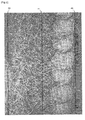
- Figs. 1 to 5 are cross-sectional photographs of fiber structures each cut in the direction perpendicular to a weaving or knitting direction of the fiber structure.
- the cross section of the fiber structure is divided along the center line 1 into a side on the front surface 2 and another side on the back surface 3.
- An area from the center line 1 to the front surface 2 is regarded as a front layer, and another area from the center line 1 to the back surface 3 is regarded as a back layer.
- the number of fibers contained in each layer is counted as the number of cross section fibers in a corresponding layer.
- a fiber structure having a ratio of the numbers of cross section fibers ranging from 2 to 10 lowers the relative humidity in an environment and has a much lower temperature than an environmental temperature.
- the inventors of the present invention suppose that the reason is as below.
- a larger amount of the hygroscopic polymer is fixed among the fibers.
- a fabric that comprises the back layer containing a larger number of cross section fibers than the number of cross section fibers contained in the front layer a larger amount of the hygroscopic polymer is present in the back layer than in the front layer.
- the back layer which contains a larger amount of the hygroscopic polymer, discharges a larger amount of water vapor.
- the water vapor discharged from the hygroscopic polymer in the back layer is discharged from the surface of the back layer and also passes among the fibers of the fabric.
- the front layer contains a smaller number of the fibers and a larger space than those in the back layer. This structure allows the water vapor to readily pass through the front layer, and thus the water vapor is readily discharged from the surface of the front layer into air.
- the water vapor reached form the back layer to the front layer is discharged from the surface of the front layer into air. This phenomenon lowers the humidity in the fabric, and the heat of vaporization of the water vapor discharged into to air lowers the temperature of the fabric.
- the amount of the fixed polymer in the front layer is substantially equal to that of the fixed polymer in the back layer.
- This structure reduces the difference in discharge amount of water vapor between the back layer and the front layer and also reduces the difference in volume of space, through which water vapor passes, between the back layer and the front layer, and thus the water vapor discharged from the back layer is unlikely to vaporize from the surface of the front layer.
- the water vapor supplied from the back layer is absorbed by the polymer in the front layer, and thus the temperature of the fabric is unlikely to drop.
- the ratio of the numbers of cross section fibers (the number of cross section fibers contained in the back layer/the number of cross section fibers contained in the front layer) is preferably 2 to 10.
- the ratio of the numbers of cross section fibers is more preferably 2.5 or more, even more preferably 3.0 or more and is more preferably 9.5 or less, even more preferably 9.0 or less.
- the weave is one selected from the groups a to c. Also in the fiber structure, the front layer on the front surface side and the back layer on the back surface side have different fiber densities, where the boundary between the front layer and the back layer is on the center line of the cross section of the fiber structure.
- Group a a warp knit that is produced with a knitting machine equipped with two or more reeds and has a two needle swing weave or a three needle swing weave for the back layer.
- Group b a weft knit that is produced with an interlock knitting machine and has a patterned weave for the front layer.
- Group c a pile fabric having a ground weave.
- the fiber structure also preferably has a ratio of the numbers of cross section fibers of 2 to 10.
- the ratio of the numbers of cross section fibers is more preferably 2.5 or more, even more preferably 3.0 or more and is more preferably 9.5 or less, even more preferably 9.0 or less.
- the fiber structure also has a much lower temperature than an environmental temperature due to a reduction in relative humidity in an environment. The reason is the same as the above.
- the group a is preferably a warp knit that is produced with a knitting machine equipped with two or more reeds and has a two needle swing weave or a three needle swing weave as the ground weave to be the back layer.
- Examples of the ground weave for the two needle swing weave include 1-0/2-3, 2-3/1-0, 0-1/3-2, and 3-2/0-1.
- Examples of the ground weave for the three needle swing weave include 1-0/3-4, 3-4/1-0, 0-1/4-3, and 0-1/3-4.
- the ground weave containing at least one or more of the weaves may be combined with other weaves.
- the front layer constituting the group a may have a one to three needle swing weave, an atlas weave, and other derivative weave, and a weave without threads in which no needle is threaded is also preferred.
- the group b is a weft knit that is produced with an interlock knitting machine and has a patterned weave for the front layer.
- the ground weave constituting the back layer is preferably a tight weave such as a plain knitting weave and a rib knitting weave, and the front layer of the weft knit preferably has a patterned weave as a little loose weave.
- the group c is a pile fabric having a ground weave and is preferably a moquette pile fabric comprising rayon fibers in the ground weave and a velvet fabric as a double-woven fabric.
- the fabric having the fiber structure of the present invention preferably has a surface temperature drop of 1.5°C to 4°C when an air-conditioner is operated in an atmosphere at 40°C and a relative humidity of 80%, which should be the atmosphere in a car in summer, and the temperature and humidity conditions are changed from the atmosphere condition to an atmosphere at 35°C and a relative humidity of 70% within 10 minutes.
- the fiber structure of the present invention to which a hygroscopic polymer is fixed preferably has a surface temperature 1.5°C to 4.0°C lower than that of a fiber structure to which no hygroscopic polymer is fixed.
- the lower limit is more preferably 1.7°C or more, even more preferably 1.9°C or more.
- the hygroscopic polymer fixed onto fibers of the fabric of the present invention preferably has an increase in mass by moisture absorption (hereinafter called moisture absorption ratio) of 10 to 75%, more preferably 15% or more, even more preferably 20% or more when the temperature and humidity conditions are changed from an atmosphere at 20°C and a relative humidity of 65% to an atmosphere at 30°C and a relative humidity of 90%, in terms of hygroscopic properties.
- the moisture absorption ratio is more preferably 70% or less, even more preferably 65% or less.
- the hygroscopic polymer satisfying such hygroscopic properties is preferably a polymer of a monomer selected from vinyl group-containing monomers having, as a functional group, a sulfo group, a carboxy group, a hydroxy group, an amido group, or alkali metal salts (preferably a sodium salt) of them or a copolymer containing at least one or more of such monomers.
- Examples of the polymer having a sulfo group preferably include poly(sodium acrylamido-2-propanesulfonate), poly(sodium styrenesulfonate), poly(sodium isoprenesulfonate), poly(sodium allylsulfonate), and poly(sodium methallylsulfonate).
- Examples of the polymer having a carboxy group preferably include poly(sodium acrylate).
- Examples of the polymer having a hydroxy group preferably include polyethylene glycol and polyvinyl alcohol.
- Examples of the polymer having an amido group preferably include poly(N-methylolacrylamide) and polyacrylamide. Among these hygroscopic monomers, sodium 2-acrylamido-2-methylsulfonate is particularly preferred in terms of high hygroscopicity.
- a copolymer containing additional monomer units may be used.
- a cross-linking agent is preferably used to make the hygroscopic polymer have a cross-linked structure.
- the cross-linking agent include polyfunctional epoxy compounds, polyfunctional isocyanate compounds, urea resins, melamine resins, and compounds having at least two polymerizable double bonds.
- Examples of the compound having polymerizable double bonds include compounds prepared by esterifying terminal hydroxy groups of polyethylene glycols (for example, having a number average repeat unit of 250) with (meth)acrylic acid.
- a compound prepared by esterifying a polyethylene glycol having an average repeat of ethylene oxide of 9 to 23 with two methacrylic acids can be used.
- the monomers can be polymerized on fibers constituting the fabric to yield the hygroscopic polymer.
- the monomer to yield the hygroscopic polymer and, as necessary, a polymerization initiator can be infiltrated among fibers constituting the fabric.
- a cross-linking agent may also be infiltrated.
- polymerization initiator preferably include inorganic polymerization initiators such as ammonium persulfate, potassium persulfate, and hydrogen peroxide and organic polymerization initiators such as 2,2'-azobis(2-amidinopropane) dihydrochloride, 2,2'-azobis(N,N-dimethylene isobutylamidine) dihydrochloride, and 2-(carbamolyazo)isobutyronitrile.
- inorganic polymerization initiators such as ammonium persulfate, potassium persulfate, and hydrogen peroxide
- organic polymerization initiators such as 2,2'-azobis(2-amidinopropane) dihydrochloride, 2,2'-azobis(N,N-dimethylene isobutylamidine) dihydrochloride, and 2-(carbamolyazo)isobutyronitrile.
- a treatment liquid containing a monomer, a cross-linking agent (as necessary), a polymerization initiator (as necessary), and a solvent or a dispersion medium is applied to fibers by padding and then the fibers are heated and dried. Subsequently, the fibers are maintained under a high temperature condition with steam or a similar means, thus the monomer and the like are polymerized, and the resulting hygroscopic polymer is fixed onto the fiber surface.
- Another method for fixing the hygroscopic polymer to fibers is exemplified by a method of impregnating a fabric with a solution of a polymer such as poly(sodium acrylamido-2-propanesulfonate), sodium styrenesulfonate, sodium isoprenesulfonate, sodium allylsulfonate, and sodium methallylsulfonate and drying the fabric.
- a polymer such as poly(sodium acrylamido-2-propanesulfonate), sodium styrenesulfonate, sodium isoprenesulfonate, sodium allylsulfonate, and sodium methallylsulfonate and drying the fabric.
- the treatment liquid for polymerization preferably has a concentration of monomer to yield the hygroscopic polymer of 20 to 150 g/L.
- the treatment liquid preferably has a cross-linking agent concentration of 20 to 150 g/L.
- the treatment liquid preferably has a polymerization initiator concentration of 1 to 10 g/L, more preferably 3 g/L or more, even more preferably 5 g/L or more.
- the polymer solution preferably has a concentration of 20 to 150 g/L.
- a treatment liquid having a low concentration results in a reduction in amount of the hygroscopic polymer fixed, and this deteriorates cooling performance.
- a treatment liquid having a high concentration causes the hygroscopic polymer to be fixed in an excess amount, and this hardens the texture of the fiber structure.
- a normal-pressure steamer or a high-pressure steamer is preferably used, and the temperature for the steam treatment is preferably 80°C to 170°C.
- the heat treatment time is arbitrary and is preferably 5 minutes to 15 minutes.
- the heat treatment time is more preferably 6 to 15 minutes, even more preferably 7 to 15 minutes.
- the steam pressure is arbitrary and is preferably in a range from 0.09 to 0.50 MPa in order to accelerate polymerization.
- the processing method for fixing the hygroscopic polymer to fibers of the fabric is preferably padding, spraying, and roll coating and is specifically preferably padding capable of infiltrating an agent into the fabric.
- the hygroscopic polymer is preferably fixed to fibers of the fabric in a fixing ratio of 4 to 20% by mass relative to the fabric.
- a fabric containing fibers to which the hygroscopic polymer is fixed in a ratio of less than 4% by mass obtains insufficient hygroscopic properties and thus fails to achieve a large temperature change.
- a fabric containing fibers to which the hygroscopic polymer is fixed in a ratio of more than 20% by mass gives the impression of hard texture.
- the fixing ratio of the hygroscopic polymer to fibers of the fabric is more preferably 5 to 18% by mass.
- the fibers constituting the fabric of the present invention include synthetic fibers such as polyester fibers and polyamide fibers, natural fibers such as cotton, and rayon, and these fibers may be used singly or as a mixture of two or more of them.
- the fibers used are preferably biomass fibers formed of materials derived from plants, such as polyethylene terephthalate fibers, polytrimethylene terephthalate fibers, polyamide fibers, and polylactic acid fibers.
- the polytrimethylene terephthalate fibers provide good texture, touch, and a comfortable feeling for sitting due to a low Young's modulus and thus are specifically preferably used.
- the polylactic acid fibers can be produced from 100% plant materials, are most contributable fibers to the reduction in consumption of oil resources, and thus are preferred.
- the fibers are used in the forms of multifilaments, spun yarns, and the like.
- the multifilaments are preferred.
- the preferred total fineness and single fiber fineness of the biomass fibers are as described in paragraph [0013].
- the fibers may contain dulling agents such as titanium oxide powder, dyes, pigments, flame retardants, moisture absorbents, heat stabilizers, ultraviolet absorbers, antimicrobial agents, fungicides, deodorants, and other additives as long as the effect of the invention is not impaired.
- dulling agents such as titanium oxide powder, dyes, pigments, flame retardants, moisture absorbents, heat stabilizers, ultraviolet absorbers, antimicrobial agents, fungicides, deodorants, and other additives as long as the effect of the invention is not impaired.
- the light fastness of the fiber structure of the present invention is preferably the fourth or higher class.
- the fourth class which is determined on the basis of the grey scale for color change after irradiation with a fade meter at 83°C for 200 hours, the fiber structure causes color fading or other defects when used for car seats.
- the fiber structure of the present invention is preferably used for clothing such as underwear, sportswear, and shirts; interior goods such as chair upholstery; and vehicle interior materials.
- the fiber structure particularly preferably used for vehicle interior materials, specifically for seats.
- the fiber structure used for seats is preferably used for main materials, frames, back linings, headrests, seat covers, headrest covers, and other parts.
- the tensile strength (cN/dtex) and the elongation (%) of a thread were determined under the constant-rate extension conditions in accordance with JIS L 1013 (8.5.1) (2010) with TENSILON (registered trademark) UCT-100 manufactured by ORIENTEC Co, Ltd.
- the sample length was 200 mm
- the tensile speed was 200 m/min.
- the tensile strength was determined by dividing a maximum strength on a stress-strain curve by a total fineness, and the elongation was determined as an elongation at the maximum strength on the stress-strain curve.
- Moisture absorption ratio of fabric % W ⁇ 3 - W ⁇ 1 / W ⁇ 1 - W ⁇ 2 - W ⁇ 1 / W ⁇ 1 ⁇ 100
- the moisture absorption ratio of a fabric after the treatment was calculated from W1, W2, and W3 under the same conditions as in paragraph [0047].
- the moisture absorption ratio of the fabric after the treatment was calculated in accordance with the following equation:
- Moisture absorption ratio of hygroscopic polymer % moisture absorption ratio of fabric after treatment - moisture absorption ratio of fabric before treatment ⁇ 100 / fixing ratio of hygroscopic polymer
- a fabric was cut in the direction perpendicular to a weaving or knitting direction.
- the cut sample was subjected to metal deposition with a metal deposition apparatus (trade name: E1010) manufactured by Hitachi, Ltd.
- the sample was then installed in a scanning electron microscope (trade name: S-3500) manufactured by Hitachi, Ltd. and photographed at a magnification of 30 to 100.
- Fig. 1 to Fig. 5 the cross section in each micrograph was divided along the center line 1 into a side on the front surface 2 and another side on the back surface 3.
- Each number of fibers contained in a front layer from the center line 1 to the front surface 2 and in a back layer from the center line 1 to the back surface 3 was counted as the number of cross section fibers.
- the equation for calculating the ratio of the numbers of cross section fibers is shown below.
- the ratio of the numbers of cross section fibers (the number of cross section fibers contained in the back layer)/(the number of cross section fibers contained in the front layer)
- each surface temperature of the fabric (A) and the fabric (B) was determined with a thermographic camera (manufactured by NEC Avio Infrared Technologies Co., Ltd., model: TH7102MX) installed in the constant temperature and humidity room.
- the fabric of the present invention was bonded to a car seat so that the front surface will come into contact with a person.
- the car seat was placed in a constant temperature and humidity room controlled at 40°C and a relative humidity of 80%, which should be the atmosphere in a car in summer.
- a test subject sit on the seat for 5 minutes.
- the temperature and humidity conditions were then changed to 25°C and a relative humidity of 40%.
- the test subject sit for another 3 minutes and carried out a sensory evaluation of the coolness of the seat surface after sitting.
- Ten test subjects evaluated the coolness.
- a sample evaluated to have coolness by eight or more test subjects is indicated by "very good”
- a sample evaluated to have coolness by four to seven test subjects is indicated by "good”
- a sample evaluated to have coolness by three or less test subjects is indicated by "poor.”
- the fabric of the present invention was used, and ten panelists evaluated the sense of touch of the fabric. The total score from the respective panelists gives a comprehensive evaluation.
- a fabric was irradiated with an ultraviolet autofade meter (manufactured by Suga Test Instruments Co., Ltd., model: U48AUHB) for 200 hours under a condition at a black-panel temperature of 83°C, and then the change in color was classified into the first to fifth classes using a grey scale for color change in accordance with JIS L 0804 (2010).
- an ultraviolet autofade meter manufactured by Suga Test Instruments Co., Ltd., model: U48AUHB
- Core-sheath composite drawn yarn with 84T48F was produced from polyethylene terephthalate (PET) as the core and polytrimethylene terephthalate (PTT) as the sheath at a mass ratio of 3:7.
- PET polyethylene terephthalate
- PTT polytrimethylene terephthalate
- the core-sheath composite drawn yarn was specifically produced as below.
- the materials were supplied into a melt spinning machine at the ratio and processed in a spinneret into a core-sheath structure having a single core.
- the composite was spun at a spinning temperature of 280°C.
- the spun yarn was preheated at a rotation speed of the first roll of 2,700 m/min and a roll temperature of 40°C, then drawn with heat at a rotation speed of the second roll of 4,050 m/min and a roll temperature of 150°C, and wound up at a winding speed of 3,700 m/min, yielding core-sheath composite drawn yarn with 84 dtex-48 f (filament).
- the core-sheath composite drawn yarn had a tensile strength of 3.3 cN/dtex and an elongation of 45%.
- the polyethylene terephthalate false-twisted yarn with 84T36F had a tensile strength of 3.6 cN/dtex and an elongation of 23%, and the polyethylene terephthalate false-twisted yarn with 167T48F had a tensile strength of 4.0 cN/dtex and an elongation of 22%.
- a production method of polyethylene terephthalate drawn yarn with 84T48F (84 dtex-48 f (filament)) will be described.
- Melt spinning was carried out at a spinning temperature of 290°C and a spinning speed of 1,500 m/min, and the resulting undrawn yarn was wound.
- the undrawn yarn was drawn with a drawing machine at a preheat roller temperature of 90°C, a heat treatment roller temperature of 150°C, a draw ratio of 3.01, and a machining speed of 970 m/min, yielding polyethylene terephthalate drawn yarn with 84 dtex-48 f.
- the drawn yarn had a tensile strength of 4.0 cN/dtex and an elongation of 35%.
- a 28-gauge tricot machine was used. With four reeds, the core-sheath composite drawn yarn with 84 dtex-48 f (filament) of Reference Example 1 was supplied to L1 (for a ground weave) in a full set thread arrangement, the polyethylene terephthalate false-twisted yarn with 84 dtex-36 f (filament) of Reference Example 2 was supplied to L2 (for a ground weave) in a full set thread arrangement, the core-sheath composite drawn yarn with 84 dtex-48 f (filament) of Reference Example 1 was supplied to L3 and L4 in a thread arrangement in which a thread is alternately pushed in and pulled out, and the yarns were knitted at a course density on the machine of 42 C/2.54 cm to prepare a gray fabric in the form of weave 1.
- the warp knitted fabric obtained was dyed using a jet dyeing machine with 0.24% owf "Dianix” (registered trademark, hereinafter the same applies) KIS-U, 0.11% owf "Dianix” AM-2R, and 0.24% owf "Dianix” GL-FS as dyes and with 1% owf fast-P (trade name) manufactured by Ciba as a light stabilizer while the temperature was increased from room temperature to a dyeing temperature of 130°C at a temperature increase rate of 1°C and maintained at a dyeing temperature of 130°C for 25 minutes.
- a jet dyeing machine with 0.24% owf "Dianix” (registered trademark, hereinafter the same applies) KIS-U, 0.11% owf "Dianix” AM-2R, and 0.24% owf "Dianix” GL-FS as dyes and with 1% owf fast-P (trade name) manufactured by Ciba as a light stabilizer while the temperature was increased from room
- the warp knitted fabric dyed as above was next immersed in a treatment liquid prepared in accordance with the formulation 1 to infiltrate a hygroscopic polymer.
- the fabric was then squeezed with a mangle so as to give a pick up ratio of 90% and dried in a dryer at 120°C for 2 minutes.
- Example 1 After the warp knitted fabric dyed was impregnated with the hygroscopic polymer and then dried as above, the fabric was treated with a normal-pressure steamer at 105°C for 10 minutes, then washed with hot water, and dried. Next, the dried fabric was further dried in a dryer at 160°C for 1 minute, giving a fiber structure of Example 1 having a weight per unit area of 310 g/m 2 , a fixing ratio of the hygroscopic polymer of 7.3%, a moisture absorption ratio of the fabric of 2.4%, and a moisture absorption ratio of the hygroscopic polymer of 32.8%.
- Fig. 1 is the electron micrograph ( ⁇ 50). The observation result indicated that the number of cross section fibers contained in the front layer was 235, the number of cross section fibers contained in the back layer was 850, and the ratio of the numbers of cross section fibers was 3.62. The result also revealed that the hygroscopic polymer was fixed onto the fibers of the knitted fabric.
- Table 1 shows the result of the performance evaluation.
- the fabric had a surface temperature drop of 2.1°C, the coolness during sitting was “very good”, the texture was “very good”, the light fastness was class 4, and the fabric provided a highly comfortable feeling when a person sit.
- Example 2 The knitted fabric was then dyed in the same manner as in Example 1, and a hygroscopic polymer was fixed onto the fabric, giving a fiber structure of Example 2 having a weight per unit area of 275 g/m 2 , a fixing ratio of the hygroscopic polymer of 12.3%, a moisture absorption ratio of the fabric of 3.0%, and a moisture absorption ratio of the hygroscopic polymer of 24.3%.
- Fig. 2 is the electron micrograph ( ⁇ 100). The observation result indicated that the number of cross section fibers contained in the front layer was 121, the number of cross section fibers contained in the back layer was 485, and the ratio of the numbers of cross section fibers was 4.01. The result also revealed that a large amount of the hygroscopic polymer was fixed to the ground weave of the knitted fabric.
- Table 1 shows the result of the performance evaluation.
- the fabric had a surface temperature drop of 1.9°C, the coolness during sitting was “very good”, the texture was “very good”, the light fastness was class 4, and the fabric provided a highly comfortable feeling when a person sit.
- Example 2 the knitted fabric was dyed in the same manner as in Example 1 and then was raised with a raising machine.
- a hygroscopic polymer was fixed to the raised fabric in the same manner as in Example 1, giving a fiber structure of Example 3 having a weight per unit area of 330 g/m 2 , a fixing ratio of the hygroscopic polymer of 12.5%, a moisture absorption ratio of the fabric of 3.0%, and a moisture absorption ratio of the hygroscopic polymer of 24.0%.
- Fig. 3 is the electron micrograph ( ⁇ 50). The observation result indicated that the number of cross section fibers contained in the front layer was 220, the number of cross section fibers contained in the back layer was 1,380, and the ratio of the numbers of cross section fibers was 6.27. The result also revealed that the hygroscopic polymer was fixed to the ground weave of the knitted fabric.
- Table 1 shows the result of the performance evaluation.
- the fabric had a surface temperature drop of 2.3°C, the coolness during sitting was “very good”, the texture was “very good”, the light fastness was class 4, and the fabric provided a highly comfortable feeling when a person sit.
- a 28-gauge tricot machine and four reeds were used to prepare a gray fabric in the form of weave 4 by knitting in the same condition as in Example 1 except that the polyethylene terephthalate drawn yarn with 84 dtex-48 f (filament) of Reference Example 3 was supplied to L1 (ground weave), L3, and L4.
- Example 4 the knitted fabric was dyed in the same manner as in Example 1, and a hygroscopic polymer was fixed to the fabric, giving a fiber structure of Example 4 having a weight per unit area of 318 g/m 2 , a fixing ratio of the hygroscopic polymer of 7.0%, a moisture absorption ratio of the fabric of 2.3%, and a moisture absorption ratio of the hygroscopic polymer of 32.8%.
- the fiber structure was cut in a direction perpendicular to the knitting direction, and the cross-section was observed under an electron microscope. The observation result indicated that the number of cross section fibers contained in the front layer was 245, the number of cross section fibers contained in the back layer was 854, and the ratio of the numbers of cross section fibers was 3.49.
- Table 1 shows the result of the performance evaluation.
- the fabric had a surface temperature drop of 2.0°C, the coolness during sitting was "very good”, the texture was “good”, the light fastness was class 4, and the fabric provided a comfortable feeling when a person sit.
- a 28-gauge tricot machine and three reeds were used to prepare a gray fabric in the form of weave 5 by knitting in the same condition as in Example 3 except that the polyethylene terephthalate drawn yarn with 84 dtex-48 f (filament) of Reference Example 3 was supplied to L1 (ground weave) and L2 (ground weave).
- Example 2 the knitted fabric was dyed in the same manner as in Example 1 and then was raised with a raising machine.
- a hygroscopic polymer was fixed to the raised fabric in the same manner as in Example 1, giving a fiber structure of Example 5 having a weight per unit area of 340 g/m 2 , a fixing ratio of the hygroscopic polymer of 12.6%, a moisture absorption ratio of the fabric of 2.9%, and a moisture absorption ratio of the hygroscopic polymer of 23.0%.
- the fiber structure was cut in a direction perpendicular to the knitting direction, and the cross-section was observed under an electron microscope. The observation result indicated that the number of cross section fibers contained in the front layer was 231, the number of cross section fibers contained in the back layer was 1,417, and the ratio of the numbers of cross section fibers was 6.13.
- Table 1 shows the result of the performance evaluation.
- the fabric had a surface temperature drop of 2.4°C, the coolness during sitting was "very good”, the texture was “good”, the light fastness was class 4, and the fabric provided a comfortable feeling when a person sit.
- a 28-gauge interlock circular knitting machine was used. Polyethylene terephthalate false-twisted yarn with 84 dtex-72f (filament) was supplied to the back fabric (ground weave), the polyethylene terephthalate false-twisted yarn with 84 dtex-36 f (filament) of Reference Example 2 was supplied to the front fabric, and the yarns were knitted at a course density on the machine of 38 course/2.54 cm to prepare a gray fabric where the front fabric was a patterned weave and the back fabric was a plain knitted weave. The knitted fabric had a structure of group b.
- Example 6 the knitted fabric was dyed in the same manner as in Example 1, and then a hygroscopic polymer was fixed to the fabric, giving a fiber structure of Example 6 having a weight per unit area of 232 g/m 2 , a fixing ratio of the hygroscopic polymer of 8.6%, a moisture absorption ratio of the fabric of 2.0%, and a moisture absorption ratio of the hygroscopic polymer of 23.2%.
- the fiber structure was cut in a direction perpendicular to the knitting direction, and the cross-section was observed under an electron microscope. The observation result indicated that the number of cross section fibers contained in the front layer was 161, the number of cross section fibers contained in the back layer was 322, and the ratio of the numbers of cross section fibers was 2.00.
- Table 1 shows the result of the performance evaluation.
- the fabric had a surface temperature drop of 2.6°C, the coolness during sitting was "very good”, the texture was “good”, the light fastness was class 4, and the fabric provided a comfortable feeling when a person sit.
- Polyethylene terephthalate drawn yarn with 167 dtex-72f (filament) was used as the warp and the weft to yield a double-woven fabric having a weave density of the warp of 250/cm and a weft weave density of the weft of 220/cm in both the ground weave and the pile.
- the obtained woven fabric was dyed in the same condition as in Example 1 and then was sheared with a shearing machine to give a pile length of 1.8 mm, yielding a velvet fabric.
- a hygroscopic polymer was then fixed to the fabric in the same manner as in Example 1, giving a fiber structure of Example 7 having a fixing ratio of the hygroscopic polymer of 10.5%, a moisture absorption ratio of the fabric of 3.5%, and a moisture absorption ratio of the hygroscopic polymer of 33.3%.
- the woven fabric had a structure of group c.
- the fiber structure was cut in a direction perpendicular to the weaving direction, and the cross-section was observed under an electron microscope.
- the observation result indicated that the number of cross section fibers contained in the front layer was 230, the number of cross section fibers contained in the back layer was 980, and the ratio of the numbers of cross section fibers was 4.26.
- Table 1 shows the result of the performance evaluation.
- the knitted fabric had a surface temperature drop of 2.3°C, the coolness during sitting was “very good”, the texture was “very good”, the light fastness was class 4, and the woven fabric provided a comfortable feeling when a person sit.
- the weaves for the front fabric and the back fabric in Example 6 was exchanged, that is, a 28 gauge interlock circular knitting machine was used, the polyethylene terephthalate false-twisted yarn with 84 dtex-72f (filament) was supplied to the front fabric, the polyethylene terephthalate false-twisted yarn with 84 dtex-36 f (filament) of Reference Example 2 was supplied to the back fabric (ground weave), and the yarns were knitted at a course density on the machine of 38 course/2.54 cm to prepare a gray fabric where the front fabric was a plain knitted weave the back fabric was a patterned weave.
- Example 2 the knitted fabric was dyed in the same manner as in Example 1, and then a hygroscopic polymer was fixed to the fabric, giving a fiber structure of Comparative Example 1 having a weight per unit area of 232 g/m 2 , a fixing ratio of the hygroscopic polymer of 8.6%, a moisture absorption ratio of the fabric of 2.0%, and a moisture absorption ratio of the hygroscopic polymer of 23.2%.
- Fig. 4 is the electron micrograph ( ⁇ 50).
- Table 1 shows the result of the performance evaluation.
- the fabric had a surface temperature drop of 0.5°C, the coolness during sitting was “poor”, the texture was “good”, the light fastness was class 4, and the fabric provided a poor comfortable feeling when a person sit.
- a water jet loom-weaving machine was used, and the polyethylene terephthalate false-twisted yarn with 167 dtex-48 f (filament) of Reference Example 2 was supplied as the warp and the weft to weave a twill weave having a weave density of warp of 128/2.54 cm and a weave density of weft of 81/2.54 cm.
- the woven fabric was dyed in the same manner as in Example 1, and a hygroscopic polymer was fixed, giving a fiber structure of Comparative Example 2 having a weight per unit area of 197 g/m 2 , a fixing ratio of the hygroscopic polymer of 8.3%, a moisture absorption ratio of the fabric of 1.9%, and a moisture absorption ratio of the hygroscopic polymer of 22.8%.
- the fiber structure was cut in a direction perpendicular to the weaving direction, and the cross-section was observed under an electron microscope.
- Fig. 5 is the electron micrograph ( ⁇ 150). The observation result indicated that the number of cross section fibers contained in the front layer was 107, the number of cross section fibers contained in the back layer was 133, and the ratio of the numbers of cross section fibers was 1.24.
- the hygroscopic polymer was fixed to the ground weave of the woven fabric.
- Table 1 shows the result of the performance evaluation.
- the fabric had a surface temperature drop of 1.3°C, the coolness during sitting was “poor”, the texture was “good”, the light fastness was class 4, and the fabric provided a poor comfortable feeling when a person sit.
Landscapes
- Engineering & Computer Science (AREA)
- Textile Engineering (AREA)
- Chemical & Material Sciences (AREA)
- Chemical Kinetics & Catalysis (AREA)
- Knitting Of Fabric (AREA)
- Woven Fabrics (AREA)
Abstract
Description
- The present invention relates to a fiber structure of which temperature changes by moisture absorption and desorption of the structure.
- Fabrics having heat retaining and generating properties have been proposed. The fabrics are produced by fixing hygroscopic polymers and generate heat when absorbing moisture.
- For example, a knitted fabric disclosed in Patent Literature 1 comprises, in a layer to come into contact with the skin, synthetic fiber multifilaments having a larger single fiber fineness than that in a layer opposite to the layer to come into contact with the skin and is a fabric having a function of adsorbing a large amount of water.
-
Patent Literature 2 proposes an interior material having a sheet-like structure to which highly hygroscopic microparticles are fixed, and the temperature of the interior material rises by 3°C or higher when the interior material absorbs moisture. - In contrast, there has been no study about temperature drop by discharging water vapor from fabrics or about a woven fabric structure or a knitted fabric structure readily discharging water vapor.
- In the field of automobiles, as pure electric vehicles and hybrid electric vehicles have been popularized, there is a demand for saving power consumption of the vehicles as much as possible and increasing travel distance and fuel efficiency. A way to achieve such electric power saving is to elevate the temperature setting of an air-conditioner in summer. In such a circumstance, in order to suppress uncomfortable feelings caused by an elevation in the temperature setting of an air-conditioner, automobile interior materials are required to have a function of dropping temperature. Unfortunately, fiber structures comprising conventional hygroscopic materials have insufficient temperature drop effect.
-
- Patent Literature 1: Japanese Unexamined Patent Application Publication (Kokai) No.
2002-327316 - Patent Literature 2: Japanese Unexamined Patent Application Publication (Kokai) No.
2003-96672 - The present invention has an object to provide a fiber structure that can more greatly change the surface temperature of a fabric by moisture absorption or moisture desorption.
- The present invention adopts the means below in order to solve the problems. In order to solve the problems, the present invention comprises the aspects below.
- [1] A fiber structure prepared by fixing a hygroscopic polymer to fibers of a fabric, a front layer on a front surface side of the fiber structure and a back layer on a back surface side of the fiber structure having different fiber densities, a boundary between the front layer and the back layer being on a center line of a cross section of the fiber structure.
- [2] The fiber structure according to the above [1], wherein the fabric is in the form of a woven fabric or a knitted fabric, and the fabric has a ground weave in the back layer side.
- [3] The fiber structure according to the above [1] or [2], wherein the hygroscopic polymer is a polymer of one or more monomers selected from sodium acrylamido-2-propanesulfonate, sodium styrenesulfonate, sodium isoprenesulfonate, sodium allylsulfonate, and sodium methallylsulfonate or a copolymer of one or more of the monomers and an additional monomer except the monomers.
- [4] The fiber structure according to any one of the above [1] to [3], wherein the hygroscopic polymer is fixed to the fabric in a fixing ratio of 4 to 20% by mass.
- [5] The fiber structure according to any one of the above [1] to [4], wherein the number of cross section fibers contained in the back layer divided by the number of cross section fibers contained in the front layer (the ratio of the numbers of cross section fibers) ranges from 2 to 10, where the fiber structure is cut in the direction perpendicular to a weaving or knitting direction of the fiber structure, and the center line of the cross section is the boundary between the front layer on the front surface side and the back layer on the back surface side.
- [6] The fiber structure according to any one of the above [1] to [5], wherein the fabric has a weave selected from the following groups a to c:
- group a: a warp knit that is produced with a knitting machine equipped with two or more reeds and has a two needle swing weave or a three needle swing weave for the back layer;
- group b: a weft knit that is produced with an interlock knitting machine and has a patterned weave for the front layer; and
- group c: a pile fabric having a ground weave.
- [7] A vehicle interior material comprising the fiber structure according to any one of the above [1] to [6].
- The present invention provides a fiber structure that is in the form of a woven fabric or a knitted fabric, and the temperature of the fabric greatly changes by moisture absorption or moisture desorption.
-
-
Fig. 1 is a cross-sectional photograph of a fiber structure in Example 1. -
Fig. 2 is a cross-sectional photograph of a fiber structure in Example 2. -
Fig. 3 is a cross-sectional photograph of a fiber structure in Example 3. -
Fig. 4 is a cross-sectional photograph of a fiber structure in Comparative Example 1. -
Fig. 5 is a cross-sectional photograph of a fiber structure in Comparative Example 2. - A fabric of the present invention will be described first. The fabric of the present invention may be in any form of a nonwoven fabric, a woven fabric, and a knitted fabric but is preferably in the forms of a woven fabric and a knitted fabric.
- The fabric preferably has a ground weave, which affects physical properties such as breaking strength and tearing strength of the fabric, in the back layer. Such a structure allows the front layer to provide comfortable texture, touch, appearance, and other characteristics of the fabric.
- In a fiber structure of the present invention, a front layer on a front surface side of the fiber structure and a back layer on a back surface side of the fiber structure have different fiber densities, and the boundary between the front layer and the back layer is on the center line of a cross section of the fiber structure.
- The ground weave differs from a pile weave or a patterned weave in woven fabrics and knitted fabrics and is a weave that greatly affects physical properties such as breaking strength and tearing strength of a fabric. The ground weave for a warp knit produced with two or more reeds is a two needle swing weave or a three needle swing weave. The ground weave for a weft knit is a weave knitted with an interlock knitting machine. The ground weave for a woven fabric is a weave that fixes pile in a woven fabric having the pile, such as a moquette pile fabric. In the present invention, the ground weave is used as the back layer to come into contact with the skin, and the back layer of the fabric has a high fiber density. As a result, when a liquid containing a hygroscopic polymer or a raw material of a hygroscopic polymer is infiltrated into fibers by capillarity and the hygroscopic polymer is fixed to the fabric, a larger amount of the hygroscopic polymer can be fixed onto the fibers in the back layer than that onto the fibers in the front layer.
- The fibers constituting the back layer preferably have a total fineness ranging from 30 to 500 dtex. Fibers having a total fineness of less than 30 dtex reduce the mechanical strength of the ground weave, and thus may cause broken thread or other defects when actually used as a vehicle interior material such as fabrics for seats. Fibers having a total fineness of more than 500 dtex excessively increase the amount of the fibers per unit volume of the back layer side, and thus are likely to make a whole fabric have a hard texture when a hygroscopic polymer is fixed to such a fabric. The single fiber fineness is preferably 0.8 to 5 dtex.
- The fibers constituting the back layer preferably have a strength of 2.0 cN/dtex or more, more preferably 2.5 cN/dtex or more. In order to fix an appropriate amount of the hygroscopic polymer, the single fiber fineness is 0.5 to 5.0 dtex, preferably not less than 0.8 dtex and 5.0 dtex or less. These fibers are preferably in the forms of multifilaments and spun yarn.
- In a preferred embodiment of the present invention, the number of cross section fibers contained in the back layer divided by the number of cross section fibers contained in the front layer (the ratio of the numbers of cross section fibers) preferably ranges from 2 to 10, where the fiber structure is cut in the direction perpendicular to a weaving or knitting direction of the fiber structure, and the center line of the cross section is the boundary between the front layer on the front surface side (the side not to come into contact with the skin) and the back layer on the back surface side (the side to come into contact with the skin). The ratio of the numbers of cross section fibers is more preferably 2.5 or more, even more preferably 3.0 or more and is more preferably 9.5 or less, even more preferably 9.0 or less.
- The calculation method of the ratio of the numbers of cross section fibers will be described with reference to
Figs. 1 to 5. Figs. 1 to 5 are cross-sectional photographs of fiber structures each cut in the direction perpendicular to a weaving or knitting direction of the fiber structure. The cross section of the fiber structure is divided along the center line 1 into a side on thefront surface 2 and another side on theback surface 3. An area from the center line 1 to thefront surface 2 is regarded as a front layer, and another area from the center line 1 to theback surface 3 is regarded as a back layer. The number of fibers contained in each layer is counted as the number of cross section fibers in a corresponding layer. - A fiber structure having a ratio of the numbers of cross section fibers ranging from 2 to 10 lowers the relative humidity in an environment and has a much lower temperature than an environmental temperature. The inventors of the present invention suppose that the reason is as below.
- For the fixation of a hygroscopic polymer to a fabric, to a fabric containing a larger number of fibers per unit volume, a larger amount of the hygroscopic polymer is fixed among the fibers. Thus, in a fabric that comprises the back layer containing a larger number of cross section fibers than the number of cross section fibers contained in the front layer, a larger amount of the hygroscopic polymer is present in the back layer than in the front layer. The back layer, which contains a larger amount of the hygroscopic polymer, discharges a larger amount of water vapor. The water vapor discharged from the hygroscopic polymer in the back layer is discharged from the surface of the back layer and also passes among the fibers of the fabric. The front layer contains a smaller number of the fibers and a larger space than those in the back layer. This structure allows the water vapor to readily pass through the front layer, and thus the water vapor is readily discharged from the surface of the front layer into air. The water vapor reached form the back layer to the front layer is discharged from the surface of the front layer into air. This phenomenon lowers the humidity in the fabric, and the heat of vaporization of the water vapor discharged into to air lowers the temperature of the fabric.
- In a fabric having a ratio of the numbers of cross section fibers of about 1, the amount of the fixed polymer in the front layer is substantially equal to that of the fixed polymer in the back layer. This structure reduces the difference in discharge amount of water vapor between the back layer and the front layer and also reduces the difference in volume of space, through which water vapor passes, between the back layer and the front layer, and thus the water vapor discharged from the back layer is unlikely to vaporize from the surface of the front layer. In addition, the water vapor supplied from the back layer is absorbed by the polymer in the front layer, and thus the temperature of the fabric is unlikely to drop.
- A fabric having an excessively large ratio of the numbers of cross section fibers disadvantageously reduces the heat of vaporization of water vapor discharged through the front layer into air, and thus the temperature of the fabric is unlikely to drop. For the reasons above, the ratio of the numbers of cross section fibers (the number of cross section fibers contained in the back layer/the number of cross section fibers contained in the front layer) is preferably 2 to 10. The ratio of the numbers of cross section fibers is more preferably 2.5 or more, even more preferably 3.0 or more and is more preferably 9.5 or less, even more preferably 9.0 or less.
- In an embodiment of the fiber structure of the present invention, the weave is one selected from the groups a to c. Also in the fiber structure, the front layer on the front surface side and the back layer on the back surface side have different fiber densities, where the boundary between the front layer and the back layer is on the center line of the cross section of the fiber structure.
- Group a: a warp knit that is produced with a knitting machine equipped with two or more reeds and has a two needle swing weave or a three needle swing weave for the back layer.
- Group b: a weft knit that is produced with an interlock knitting machine and has a patterned weave for the front layer.
- Group c: a pile fabric having a ground weave.
- The fiber structure also preferably has a ratio of the numbers of cross section fibers of 2 to 10. The ratio of the numbers of cross section fibers is more preferably 2.5 or more, even more preferably 3.0 or more and is more preferably 9.5 or less, even more preferably 9.0 or less. The fiber structure also has a much lower temperature than an environmental temperature due to a reduction in relative humidity in an environment. The reason is the same as the above.
- The group a is preferably a warp knit that is produced with a knitting machine equipped with two or more reeds and has a two needle swing weave or a three needle swing weave as the ground weave to be the back layer. Examples of the ground weave for the two needle swing weave include 1-0/2-3, 2-3/1-0, 0-1/3-2, and 3-2/0-1. Examples of the ground weave for the three needle swing weave include 1-0/3-4, 3-4/1-0, 0-1/4-3, and 0-1/3-4. The ground weave containing at least one or more of the weaves may be combined with other weaves. The front layer constituting the group a may have a one to three needle swing weave, an atlas weave, and other derivative weave, and a weave without threads in which no needle is threaded is also preferred.
- The group b is a weft knit that is produced with an interlock knitting machine and has a patterned weave for the front layer. The ground weave constituting the back layer is preferably a tight weave such as a plain knitting weave and a rib knitting weave, and the front layer of the weft knit preferably has a patterned weave as a little loose weave.
- The group c is a pile fabric having a ground weave and is preferably a moquette pile fabric comprising rayon fibers in the ground weave and a velvet fabric as a double-woven fabric.
- The fabric having the fiber structure of the present invention preferably has a surface temperature drop of 1.5°C to 4°C when an air-conditioner is operated in an atmosphere at 40°C and a relative humidity of 80%, which should be the atmosphere in a car in summer, and the temperature and humidity conditions are changed from the atmosphere condition to an atmosphere at 35°C and a relative humidity of 70% within 10 minutes. When the temperature and humidity conditions are changed from an atmosphere at 40°C and a relative humidity of 80% to an atmosphere at 35°C and a relative humidity of 70% within 10 minutes, the fiber structure of the present invention to which a hygroscopic polymer is fixed preferably has a surface temperature 1.5°C to 4.0°C lower than that of a fiber structure to which no hygroscopic polymer is fixed. The lower limit is more preferably 1.7°C or more, even more preferably 1.9°C or more.
- The hygroscopic polymer fixed onto fibers of the fabric of the present invention preferably has an increase in mass by moisture absorption (hereinafter called moisture absorption ratio) of 10 to 75%, more preferably 15% or more, even more preferably 20% or more when the temperature and humidity conditions are changed from an atmosphere at 20°C and a relative humidity of 65% to an atmosphere at 30°C and a relative humidity of 90%, in terms of hygroscopic properties. The moisture absorption ratio is more preferably 70% or less, even more preferably 65% or less. The hygroscopic polymer satisfying such hygroscopic properties is preferably a polymer of a monomer selected from vinyl group-containing monomers having, as a functional group, a sulfo group, a carboxy group, a hydroxy group, an amido group, or alkali metal salts (preferably a sodium salt) of them or a copolymer containing at least one or more of such monomers. Examples of the polymer having a sulfo group preferably include poly(sodium acrylamido-2-propanesulfonate), poly(sodium styrenesulfonate), poly(sodium isoprenesulfonate), poly(sodium allylsulfonate), and poly(sodium methallylsulfonate). Examples of the polymer having a carboxy group preferably include poly(sodium acrylate). Examples of the polymer having a hydroxy group preferably include polyethylene glycol and polyvinyl alcohol. Examples of the polymer having an amido group preferably include poly(N-methylolacrylamide) and polyacrylamide. Among these hygroscopic monomers, sodium 2-acrylamido-2-methylsulfonate is particularly preferred in terms of high hygroscopicity.
- In addition to these polymers, a copolymer containing additional monomer units may be used.
- In the present invention, in order to improve the fixing properties of the hygroscopic polymer to fibers, a cross-linking agent is preferably used to make the hygroscopic polymer have a cross-linked structure. Examples of the cross-linking agent include polyfunctional epoxy compounds, polyfunctional isocyanate compounds, urea resins, melamine resins, and compounds having at least two polymerizable double bonds.
- Examples of the compound having polymerizable double bonds include compounds prepared by esterifying terminal hydroxy groups of polyethylene glycols (for example, having a number average repeat unit of 250) with (meth)acrylic acid. For example, a compound prepared by esterifying a polyethylene glycol having an average repeat of ethylene oxide of 9 to 23 with two methacrylic acids can be used.
- The monomers can be polymerized on fibers constituting the fabric to yield the hygroscopic polymer. The monomer to yield the hygroscopic polymer and, as necessary, a polymerization initiator can be infiltrated among fibers constituting the fabric. As necessary, a cross-linking agent may also be infiltrated. Examples of the polymerization initiator preferably include inorganic polymerization initiators such as ammonium persulfate, potassium persulfate, and hydrogen peroxide and organic polymerization initiators such as 2,2'-azobis(2-amidinopropane) dihydrochloride, 2,2'-azobis(N,N-dimethylene isobutylamidine) dihydrochloride, and 2-(carbamolyazo)isobutyronitrile.
- As for the method for fixing the hygroscopic polymer to fibers, a treatment liquid containing a monomer, a cross-linking agent (as necessary), a polymerization initiator (as necessary), and a solvent or a dispersion medium is applied to fibers by padding and then the fibers are heated and dried. Subsequently, the fibers are maintained under a high temperature condition with steam or a similar means, thus the monomer and the like are polymerized, and the resulting hygroscopic polymer is fixed onto the fiber surface. Another method for fixing the hygroscopic polymer to fibers is exemplified by a method of impregnating a fabric with a solution of a polymer such as poly(sodium acrylamido-2-propanesulfonate), sodium styrenesulfonate, sodium isoprenesulfonate, sodium allylsulfonate, and sodium methallylsulfonate and drying the fabric.
- In the padding, the treatment liquid for polymerization preferably has a concentration of monomer to yield the hygroscopic polymer of 20 to 150 g/L. For the polymerization with a cross-linking agent, the treatment liquid preferably has a cross-linking agent concentration of 20 to 150 g/L. For the polymerization with a polymerization initiator, the treatment liquid preferably has a polymerization initiator concentration of 1 to 10 g/L, more preferably 3 g/L or more, even more preferably 5 g/L or more.
- For the treatment with a solution of the hygroscopic polymer, the polymer solution preferably has a concentration of 20 to 150 g/L. In each case of polymerization and using a polymer solution, a treatment liquid having a low concentration results in a reduction in amount of the hygroscopic polymer fixed, and this deteriorates cooling performance. A treatment liquid having a high concentration causes the hygroscopic polymer to be fixed in an excess amount, and this hardens the texture of the fiber structure.
- For the heat treatment, in order to maintain the activity of the polymerization initiator, a normal-pressure steamer or a high-pressure steamer is preferably used, and the temperature for the steam treatment is preferably 80°C to 170°C.
- The heat treatment time is arbitrary and is preferably 5 minutes to 15 minutes. The heat treatment time is more preferably 6 to 15 minutes, even more preferably 7 to 15 minutes. The steam pressure is arbitrary and is preferably in a range from 0.09 to 0.50 MPa in order to accelerate polymerization.
- The processing method for fixing the hygroscopic polymer to fibers of the fabric is preferably padding, spraying, and roll coating and is specifically preferably padding capable of infiltrating an agent into the fabric.
- The hygroscopic polymer is preferably fixed to fibers of the fabric in a fixing ratio of 4 to 20% by mass relative to the fabric. A fabric containing fibers to which the hygroscopic polymer is fixed in a ratio of less than 4% by mass obtains insufficient hygroscopic properties and thus fails to achieve a large temperature change. A fabric containing fibers to which the hygroscopic polymer is fixed in a ratio of more than 20% by mass gives the impression of hard texture. The fixing ratio of the hygroscopic polymer to fibers of the fabric is more preferably 5 to 18% by mass.
- Examples of the fibers constituting the fabric of the present invention include synthetic fibers such as polyester fibers and polyamide fibers, natural fibers such as cotton, and rayon, and these fibers may be used singly or as a mixture of two or more of them. From the viewpoint of the reduction in consumption of oil resources, the fibers used are preferably biomass fibers formed of materials derived from plants, such as polyethylene terephthalate fibers, polytrimethylene terephthalate fibers, polyamide fibers, and polylactic acid fibers. In particular, the polytrimethylene terephthalate fibers provide good texture, touch, and a comfortable feeling for sitting due to a low Young's modulus and thus are specifically preferably used. The polylactic acid fibers can be produced from 100% plant materials, are most contributable fibers to the reduction in consumption of oil resources, and thus are preferred.
- The fibers are used in the forms of multifilaments, spun yarns, and the like. For fibers required to achieve fabric strength or abrasion resistance, the multifilaments are preferred. The preferred total fineness and single fiber fineness of the biomass fibers are as described in paragraph [0013].
- The fibers may contain dulling agents such as titanium oxide powder, dyes, pigments, flame retardants, moisture absorbents, heat stabilizers, ultraviolet absorbers, antimicrobial agents, fungicides, deodorants, and other additives as long as the effect of the invention is not impaired.
- The light fastness of the fiber structure of the present invention is preferably the fourth or higher class. When the light fastness of a fiber structure is lower than the fourth class, which is determined on the basis of the grey scale for color change after irradiation with a fade meter at 83°C for 200 hours, the fiber structure causes color fading or other defects when used for car seats.
- The fiber structure of the present invention is preferably used for clothing such as underwear, sportswear, and shirts; interior goods such as chair upholstery; and vehicle interior materials. The fiber structure particularly preferably used for vehicle interior materials, specifically for seats. The fiber structure used for seats is preferably used for main materials, frames, back linings, headrests, seat covers, headrest covers, and other parts.
- The present invention will now be described in further detail with reference to examples. The present invention is not limited to the following examples, and various modifications and changes may be made without departing from the technical scope of the present invention. Each evaluation in the following examples and comparative examples is carried out by the methods below.
- The tensile strength (cN/dtex) and the elongation (%) of a thread were determined under the constant-rate extension conditions in accordance with JIS L 1013 (8.5.1) (2010) with TENSILON (registered trademark) UCT-100 manufactured by ORIENTEC Co, Ltd. For the measurement, the sample length was 200 mm, and the tensile speed was 200 m/min. The tensile strength was determined by dividing a maximum strength on a stress-strain curve by a total fineness, and the elongation was determined as an elongation at the maximum strength on the stress-strain curve.
- In accordance with the method specified in JIS L 1096 (8.4.2) (2010), the weight unit area (g/m2) of a fabric was determined.
- From a fabric to which no hygroscopic polymer was fixed, a square sample having a size of 30 cm × 30 cm was prepared. The sample was left in a constant temperature and humidity room controlled at a temperature of 24°C and a relative humidity of 60% for 24 hours, and the fabric weight (g) before the treatment (before the fixation of a hygroscopic polymer) was determined. The fabric weight (g) after the treatment of fixing a hygroscopic polymer was then determined under the same constant temperature and humidity condition as that for the fabric before the treatment. The fixing ratio of the hygroscopic polymer was calculated in accordance with the following equation:

- From a fabric before the treatment (before the fixation of a hygroscopic polymer), about 1.0 g of sample was prepared. The sample was dried in a hot-air drier at 105°C for 24 hours and then weighed (W1). Next, the sample was left in a thermo-hygrostat controlled at 20°C and a relative humidity of 65% for 24 hours and then was weighed (W2). Subsequently, the sample was left in a thermo-hygrostat controlled at 30°C and a relative humidity of 90% for 24 hours and then was weighed (W3). From the test results, the moisture absorption ratio of the fabric was calculated in accordance with the following equation:

- The moisture absorption ratio of a fabric after the treatment (after the fixation of a hygroscopic polymer) was calculated from W1, W2, and W3 under the same conditions as in paragraph [0047]. On the basis of the moisture absorption ratio of the fabric after the treatment, the moisture absorption ratio of the fabric before the treatment calculated in paragraph [0047], and the fixing ratio of the hygroscopic polymer calculated in paragraph [0046], the moisture absorption ratio of the hygroscopic polymer was calculated in accordance with the following equation:

- A fabric was cut in the direction perpendicular to a weaving or knitting direction. The cut sample was subjected to metal deposition with a metal deposition apparatus (trade name: E1010) manufactured by Hitachi, Ltd. The sample was then installed in a scanning electron microscope (trade name: S-3500) manufactured by Hitachi, Ltd. and photographed at a magnification of 30 to 100. As shown in
Fig. 1 to Fig. 5 , the cross section in each micrograph was divided along the center line 1 into a side on thefront surface 2 and another side on theback surface 3. Each number of fibers contained in a front layer from the center line 1 to thefront surface 2 and in a back layer from the center line 1 to theback surface 3 was counted as the number of cross section fibers. The equation for calculating the ratio of the numbers of cross section fibers is shown below. - The ratio of the numbers of cross section fibers = (the number of cross section fibers contained in the back layer)/(the number of cross section fibers contained in the front layer)
- From each of a fabric (A) after the fixation of a hygroscopic polymer and a fabric (B) before the fixation of the hygroscopic polymer, a square sample having a size of 25 cm × 25 cm was prepared. The sample was hung in a constant temperature and humidity room controlled at a temperature of 40°C and a relative humidity of 80% and left for 3 hours. The temperature and humidity conditions in the constant temperature and humidity room were then changed to 35°C and a relative humidity of 70%. When a hygrothermograph in the constant temperature and humidity room indicated 35°C and a relative humidity of 70%, each surface temperature of the fabric (A) and the fabric (B) was determined with a thermographic camera (manufactured by NEC Avio Infrared Technologies Co., Ltd., model: TH7102MX) installed in the constant temperature and humidity room. The surface temperature drop of the fabric was calculated in accordance with the following equation:

- The fabric of the present invention was bonded to a car seat so that the front surface will come into contact with a person. The car seat was placed in a constant temperature and humidity room controlled at 40°C and a relative humidity of 80%, which should be the atmosphere in a car in summer. A test subject sit on the seat for 5 minutes. The temperature and humidity conditions were then changed to 25°C and a relative humidity of 40%. The test subject sit for another 3 minutes and carried out a sensory evaluation of the coolness of the seat surface after sitting. Ten test subjects evaluated the coolness. A sample evaluated to have coolness by eight or more test subjects is indicated by "very good," a sample evaluated to have coolness by four to seven test subjects is indicated by "good," and a sample evaluated to have coolness by three or less test subjects is indicated by "poor."
- The fabric of the present invention was used, and ten panelists evaluated the sense of touch of the fabric. The total score from the respective panelists gives a comprehensive evaluation.
-
- Score 3: A soft touch fabric having high surface smoothness.
- Score 2: A fabric having average softness and average surface smoothness.
- Score 1: A fabric having rough, hard feeling and a rough surface.
-
- Very good: 25 to 30 points
- Good: 17 to 24 points
- Poor: 10 to 16 points
- A fabric was irradiated with an ultraviolet autofade meter (manufactured by Suga Test Instruments Co., Ltd., model: U48AUHB) for 200 hours under a condition at a black-panel temperature of 83°C, and then the change in color was classified into the first to fifth classes using a grey scale for color change in accordance with JIS L 0804 (2010).
- Core-sheath composite drawn yarn with 84T48F was produced from polyethylene terephthalate (PET) as the core and polytrimethylene terephthalate (PTT) as the sheath at a mass ratio of 3:7. The core-sheath composite drawn yarn was specifically produced as below.
- The materials were supplied into a melt spinning machine at the ratio and processed in a spinneret into a core-sheath structure having a single core. The composite was spun at a spinning temperature of 280°C. The spun yarn was preheated at a rotation speed of the first roll of 2,700 m/min and a roll temperature of 40°C, then drawn with heat at a rotation speed of the second roll of 4,050 m/min and a roll temperature of 150°C, and wound up at a winding speed of 3,700 m/min, yielding core-sheath composite drawn yarn with 84 dtex-48 f (filament). The core-sheath composite drawn yarn had a tensile strength of 3.3 cN/dtex and an elongation of 45%.
- Production methods of polyethylene terephthalate false-twisted yarn with 84T36F and polyethylene terephthalate false-twisted yarn with 167T48F will be described. Melt spinning was carried out at a spinning temperature of 284°C and a spinning speed of 3,000 m/min using a spinneret having a size and a shape suitable for each false-twisted yarn, and the resulting undrawn yarn was wound. Next, false twisting was performed at a first heater (noncontact type) temperature of 230°C, an overfeed ratio of 0.9, a second heater (noncontact type) temperature of 200°C, a draw ratio of 1.69, and a machining speed of 600 m/min, yielding polyethylene terephthalate false-twisted yarn with 84 dtex-36 f (filament) and polyethylene terephthalate false-twisted yarn with 167 dtex-48 f (filament). The polyethylene terephthalate false-twisted yarn with 84T36F had a tensile strength of 3.6 cN/dtex and an elongation of 23%, and the polyethylene terephthalate false-twisted yarn with 167T48F had a tensile strength of 4.0 cN/dtex and an elongation of 22%.
- A production method of polyethylene terephthalate drawn yarn with 84T48F (84 dtex-48 f (filament)) will be described. Melt spinning was carried out at a spinning temperature of 290°C and a spinning speed of 1,500 m/min, and the resulting undrawn yarn was wound. Next, the undrawn yarn was drawn with a drawing machine at a preheat roller temperature of 90°C, a heat treatment roller temperature of 150°C, a draw ratio of 3.01, and a machining speed of 970 m/min, yielding polyethylene terephthalate drawn yarn with 84 dtex-48 f. The drawn yarn had a tensile strength of 4.0 cN/dtex and an elongation of 35%.
- A 28-gauge tricot machine was used. With four reeds, the core-sheath composite drawn yarn with 84 dtex-48 f (filament) of Reference Example 1 was supplied to L1 (for a ground weave) in a full set thread arrangement, the polyethylene terephthalate false-twisted yarn with 84 dtex-36 f (filament) of Reference Example 2 was supplied to L2 (for a ground weave) in a full set thread arrangement, the core-sheath composite drawn yarn with 84 dtex-48 f (filament) of Reference Example 1 was supplied to L3 and L4 in a thread arrangement in which a thread is alternately pushed in and pulled out, and the yarns were knitted at a course density on the machine of 42 C/2.54 cm to prepare a gray fabric in the form of weave 1.
-
- L1: 84 dtex-48 f (PET/PTT core-sheath composite drawn yarn), 1-2/1-0 (threading: full set)
- L2: 84 dtex-36 f (PET false-twisted yarn), 3-4/1-0 (threading: full set)
- L3: 84 dtex-48 f (PET/PTT core-sheath composite drawn yarn), 2-3/2-1 1-0/1-2 (threading: a thread is alternately pushed in and pulled out)
- L4: 84 dtex-48 f (PET/PTT core-sheath composite drawn yarn), 1-0/1-2 2-3/2-1 (threading: a thread is alternately pushed in and pulled out)
- The warp knitted fabric obtained was dyed using a jet dyeing machine with 0.24% owf "Dianix" (registered trademark, hereinafter the same applies) KIS-U, 0.11% owf "Dianix" AM-2R, and 0.24% owf "Dianix" GL-FS as dyes and with 1% owf fast-P (trade name) manufactured by Ciba as a light stabilizer while the temperature was increased from room temperature to a dyeing temperature of 130°C at a temperature increase rate of 1°C and maintained at a dyeing temperature of 130°C for 25 minutes.
- The warp knitted fabric dyed as above was next immersed in a treatment liquid prepared in accordance with the formulation 1 to infiltrate a hygroscopic polymer. The fabric was then squeezed with a mangle so as to give a pick up ratio of 90% and dried in a dryer at 120°C for 2 minutes.
-
- * Sodium 2-acrylamido-2-methylpropane sulfonate (trade name: Gracet T505, manufacturer: Hokko Chemicals Co., Ltd.): 120 g/L
- * A dimethacrylate of "polyethylene glycol having a number average degree of polymerization of 23" (trade name: Gracet T303, manufacturer: Hokko Chemicals Co., Ltd.) as a cross-linking agent: 120 g/L
- * Ammonium persulfate (manufacturer: Nacalai Tesque) as a polymerization initiator: 5 g/L
- * Water
- After the warp knitted fabric dyed was impregnated with the hygroscopic polymer and then dried as above, the fabric was treated with a normal-pressure steamer at 105°C for 10 minutes, then washed with hot water, and dried. Next, the dried fabric was further dried in a dryer at 160°C for 1 minute, giving a fiber structure of Example 1 having a weight per unit area of 310 g/m2, a fixing ratio of the hygroscopic polymer of 7.3%, a moisture absorption ratio of the fabric of 2.4%, and a moisture absorption ratio of the hygroscopic polymer of 32.8%.
- The fiber structure was cut in a direction perpendicular to the knitting direction, and the cross-section was observed under an electron microscope.
Fig. 1 is the electron micrograph (×50). The observation result indicated that the number of cross section fibers contained in the front layer was 235, the number of cross section fibers contained in the back layer was 850, and the ratio of the numbers of cross section fibers was 3.62. The result also revealed that the hygroscopic polymer was fixed onto the fibers of the knitted fabric. - Table 1 shows the result of the performance evaluation. The fabric had a surface temperature drop of 2.1°C, the coolness during sitting was "very good", the texture was "very good", the light fastness was class 4, and the fabric provided a highly comfortable feeling when a person sit.
- A 28-gauge tricot machine and four reeds were used, the polyethylene terephthalate false-twisted yarn with 167 dtex-48 f (filament) of Reference Example 2 was supplied to L1 (ground weave) in a full set thread arrangement, the core-sheath composite drawn yarn with 84 dtex-48 f (filament) of Reference Example 1 was supplied to L2 and L3 in a thread arrangement in which a thread is alternately pushed in and pulled out, and the yarns were knitted at a course density on the machine of 50 C/2.54 cm to prepare a knitted fabric in the form of
weave 2. -
- L1: 167 dtex-48 f (PET false-twisted yarn), 1-0/3-4 (threading: full set)
- L2: 84 dtex-48 f (PET/PTT core-sheath composite drawn yarn), 2-3/2-1 1-0/1-2 (threading: a thread is alternately pushed in and pulled out)
- L3: 84 dtex-48 f (PET/PTT core-sheath composite drawn yarn), 1-0/1-2 2-3/2-1 (threading: a thread is alternately pushed in and pulled out)
- The knitted fabric was then dyed in the same manner as in Example 1, and a hygroscopic polymer was fixed onto the fabric, giving a fiber structure of Example 2 having a weight per unit area of 275 g/m2, a fixing ratio of the hygroscopic polymer of 12.3%, a moisture absorption ratio of the fabric of 3.0%, and a moisture absorption ratio of the hygroscopic polymer of 24.3%.
- The fiber structure was cut in a direction perpendicular to the knitting direction, and the cross-section was observed under an electron microscope.
Fig. 2 is the electron micrograph (×100). The observation result indicated that the number of cross section fibers contained in the front layer was 121, the number of cross section fibers contained in the back layer was 485, and the ratio of the numbers of cross section fibers was 4.01. The result also revealed that a large amount of the hygroscopic polymer was fixed to the ground weave of the knitted fabric. - Table 1 shows the result of the performance evaluation. The fabric had a surface temperature drop of 1.9°C, the coolness during sitting was "very good", the texture was "very good", the light fastness was class 4, and the fabric provided a highly comfortable feeling when a person sit.
- A 28-gauge tricot machine and three reeds were used, the core-sheath composite drawn yarn with 84 dtex-48 f (filament) of Reference Example 1 was supplied to L1 (ground weave) and L2 (ground weave) in a full set thread arrangement, the polyethylene terephthalate false-twisted yarn with 84 dtex-36 f (filament) of Reference Example 2 was supplied to L3 in a full set thread arrangement, and the yarns were knitted at a course density on the machine of 64 C/2.54 cm to prepare a gray fabric in the form of
weave 3. -
- L1: 84 dtex-48 f (PET/PTT core-sheath composite drawn yarn), 2-3/1-0 (threading: full set)
- L2: 84 dtex-48 f (PET/PTT core-sheath composite drawn yarn), 1-0/1-2 (threading: full set)
- L3: 84 dtex-36 f (PET false-twisted yarn), 1-0/3-4 (threading: full set)
- Next, the knitted fabric was dyed in the same manner as in Example 1 and then was raised with a raising machine. A hygroscopic polymer was fixed to the raised fabric in the same manner as in Example 1, giving a fiber structure of Example 3 having a weight per unit area of 330 g/m2, a fixing ratio of the hygroscopic polymer of 12.5%, a moisture absorption ratio of the fabric of 3.0%, and a moisture absorption ratio of the hygroscopic polymer of 24.0%.
- The fiber structure was cut in a direction perpendicular to the knitting direction, and the cross-section was observed under an electron microscope.
Fig. 3 is the electron micrograph (×50). The observation result indicated that the number of cross section fibers contained in the front layer was 220, the number of cross section fibers contained in the back layer was 1,380, and the ratio of the numbers of cross section fibers was 6.27. The result also revealed that the hygroscopic polymer was fixed to the ground weave of the knitted fabric. - Table 1 shows the result of the performance evaluation. The fabric had a surface temperature drop of 2.3°C, the coolness during sitting was "very good", the texture was "very good", the light fastness was class 4, and the fabric provided a highly comfortable feeling when a person sit.
- A 28-gauge tricot machine and four reeds were used to prepare a gray fabric in the form of weave 4 by knitting in the same condition as in Example 1 except that the polyethylene terephthalate drawn yarn with 84 dtex-48 f (filament) of Reference Example 3 was supplied to L1 (ground weave), L3, and L4.
-
- L1: 84 dtex-48 f (PET drawn yarn), 1-2/1-0 (threading: full set)
- L2: 84 dtex-36 f (PET false-twisted yarn), 3-4/1-0 (threading: full set)
- L3: 84 dtex-48 f (PET drawn yarn), 2-3/2-1 1-0/1-2 (threading: a thread is alternately pushed in and pulled out)
- L4: 84 dtex-48 f (PET drawn yarn), 1-0/1-2 2-3/2-1 (threading: a thread is alternately pushed in and pulled out)
- Next, the knitted fabric was dyed in the same manner as in Example 1, and a hygroscopic polymer was fixed to the fabric, giving a fiber structure of Example 4 having a weight per unit area of 318 g/m2, a fixing ratio of the hygroscopic polymer of 7.0%, a moisture absorption ratio of the fabric of 2.3%, and a moisture absorption ratio of the hygroscopic polymer of 32.8%. The fiber structure was cut in a direction perpendicular to the knitting direction, and the cross-section was observed under an electron microscope. The observation result indicated that the number of cross section fibers contained in the front layer was 245, the number of cross section fibers contained in the back layer was 854, and the ratio of the numbers of cross section fibers was 3.49.
- Table 1 shows the result of the performance evaluation. The fabric had a surface temperature drop of 2.0°C, the coolness during sitting was "very good", the texture was "good", the light fastness was class 4, and the fabric provided a comfortable feeling when a person sit.
- A 28-gauge tricot machine and three reeds were used to prepare a gray fabric in the form of weave 5 by knitting in the same condition as in Example 3 except that the polyethylene terephthalate drawn yarn with 84 dtex-48 f (filament) of Reference Example 3 was supplied to L1 (ground weave) and L2 (ground weave).
-
- L1: 84 dtex-48 f (PET drawn yarn), 2-3/1-0 (threading: full set)
- L2: 84 dtex-48 f (PET drawn yarn), 1-0/1-2 (threading: full set)
- L3: 84 dtex-36 f (PET false-twisted yarn), 1-0/3-4 (threading: full set)
- Next, the knitted fabric was dyed in the same manner as in Example 1 and then was raised with a raising machine. A hygroscopic polymer was fixed to the raised fabric in the same manner as in Example 1, giving a fiber structure of Example 5 having a weight per unit area of 340 g/m2, a fixing ratio of the hygroscopic polymer of 12.6%, a moisture absorption ratio of the fabric of 2.9%, and a moisture absorption ratio of the hygroscopic polymer of 23.0%. The fiber structure was cut in a direction perpendicular to the knitting direction, and the cross-section was observed under an electron microscope. The observation result indicated that the number of cross section fibers contained in the front layer was 231, the number of cross section fibers contained in the back layer was 1,417, and the ratio of the numbers of cross section fibers was 6.13.
- Table 1 shows the result of the performance evaluation. The fabric had a surface temperature drop of 2.4°C, the coolness during sitting was "very good", the texture was "good", the light fastness was class 4, and the fabric provided a comfortable feeling when a person sit.
- A 28-gauge interlock circular knitting machine was used. Polyethylene terephthalate false-twisted yarn with 84 dtex-72f (filament) was supplied to the back fabric (ground weave), the polyethylene terephthalate false-twisted yarn with 84 dtex-36 f (filament) of Reference Example 2 was supplied to the front fabric, and the yarns were knitted at a course density on the machine of 38 course/2.54 cm to prepare a gray fabric where the front fabric was a patterned weave and the back fabric was a plain knitted weave. The knitted fabric had a structure of group b.
- Next, the knitted fabric was dyed in the same manner as in Example 1, and then a hygroscopic polymer was fixed to the fabric, giving a fiber structure of Example 6 having a weight per unit area of 232 g/m2, a fixing ratio of the hygroscopic polymer of 8.6%, a moisture absorption ratio of the fabric of 2.0%, and a moisture absorption ratio of the hygroscopic polymer of 23.2%. The fiber structure was cut in a direction perpendicular to the knitting direction, and the cross-section was observed under an electron microscope. The observation result indicated that the number of cross section fibers contained in the front layer was 161, the number of cross section fibers contained in the back layer was 322, and the ratio of the numbers of cross section fibers was 2.00.
- Table 1 shows the result of the performance evaluation. The fabric had a surface temperature drop of 2.6°C, the coolness during sitting was "very good", the texture was "good", the light fastness was class 4, and the fabric provided a comfortable feeling when a person sit.
- Polyethylene terephthalate drawn yarn with 167 dtex-72f (filament) was used as the warp and the weft to yield a double-woven fabric having a weave density of the warp of 250/cm and a weft weave density of the weft of 220/cm in both the ground weave and the pile.
- The obtained woven fabric was dyed in the same condition as in Example 1 and then was sheared with a shearing machine to give a pile length of 1.8 mm, yielding a velvet fabric. A hygroscopic polymer was then fixed to the fabric in the same manner as in Example 1, giving a fiber structure of Example 7 having a fixing ratio of the hygroscopic polymer of 10.5%, a moisture absorption ratio of the fabric of 3.5%, and a moisture absorption ratio of the hygroscopic polymer of 33.3%. The woven fabric had a structure of group c.
- The fiber structure was cut in a direction perpendicular to the weaving direction, and the cross-section was observed under an electron microscope. The observation result indicated that the number of cross section fibers contained in the front layer was 230, the number of cross section fibers contained in the back layer was 980, and the ratio of the numbers of cross section fibers was 4.26.
- Table 1 shows the result of the performance evaluation. The knitted fabric had a surface temperature drop of 2.3°C, the coolness during sitting was "very good", the texture was "very good", the light fastness was class 4, and the woven fabric provided a comfortable feeling when a person sit.
- The weaves for the front fabric and the back fabric in Example 6 was exchanged, that is, a 28 gauge interlock circular knitting machine was used, the polyethylene terephthalate false-twisted yarn with 84 dtex-72f (filament) was supplied to the front fabric, the polyethylene terephthalate false-twisted yarn with 84 dtex-36 f (filament) of Reference Example 2 was supplied to the back fabric (ground weave), and the yarns were knitted at a course density on the machine of 38 course/2.54 cm to prepare a gray fabric where the front fabric was a plain knitted weave the back fabric was a patterned weave.
- Next, the knitted fabric was dyed in the same manner as in Example 1, and then a hygroscopic polymer was fixed to the fabric, giving a fiber structure of Comparative Example 1 having a weight per unit area of 232 g/m2, a fixing ratio of the hygroscopic polymer of 8.6%, a moisture absorption ratio of the fabric of 2.0%, and a moisture absorption ratio of the hygroscopic polymer of 23.2%.
- The fiber structure was cut in a direction perpendicular to the knitting direction, and the cross-section was observed under an electron microscope.
Fig. 4 is the electron micrograph (×50). The observation result indicated that the number of cross section fibers contained in the front layer was 319, the number of cross section fibers contained in the back layer was 162, and the ratio of the number of cross section fibers contained in the back layer/the number of cross section fibers contained in the front layer (the ratio of the numbers of cross section fibers) was 0.51. The result also revealed that the hygroscopic polymer was fixed to the ground weave of the knitted fabric. - Table 1 shows the result of the performance evaluation. The fabric had a surface temperature drop of 0.5°C, the coolness during sitting was "poor", the texture was "good", the light fastness was class 4, and the fabric provided a poor comfortable feeling when a person sit.
- A water jet loom-weaving machine was used, and the polyethylene terephthalate false-twisted yarn with 167 dtex-48 f (filament) of Reference Example 2 was supplied as the warp and the weft to weave a twill weave having a weave density of warp of 128/2.54 cm and a weave density of weft of 81/2.54 cm.
- Next, the woven fabric was dyed in the same manner as in Example 1, and a hygroscopic polymer was fixed, giving a fiber structure of Comparative Example 2 having a weight per unit area of 197 g/m2, a fixing ratio of the hygroscopic polymer of 8.3%, a moisture absorption ratio of the fabric of 1.9%, and a moisture absorption ratio of the hygroscopic polymer of 22.8%.
- The fiber structure was cut in a direction perpendicular to the weaving direction, and the cross-section was observed under an electron microscope.
Fig. 5 is the electron micrograph (×150). The observation result indicated that the number of cross section fibers contained in the front layer was 107, the number of cross section fibers contained in the back layer was 133, and the ratio of the numbers of cross section fibers was 1.24. The hygroscopic polymer was fixed to the ground weave of the woven fabric. - Table 1 shows the result of the performance evaluation. The fabric had a surface temperature drop of 1.3°C, the coolness during sitting was "poor", the texture was "good", the light fastness was class 4, and the fabric provided a poor comfortable feeling when a person sit.


Claims (7)
- A fiber structure prepared by fixing a hygroscopic polymer to fibers of a fabric, a front layer on a front surface side of the fiber structure and a back layer on a back surface side of the fiber structure having different fiber densities, a boundary between the front layer and the back layer being on a center line of a cross section of the fiber structure.
- The fiber structure according to claim 1, wherein the fabric is in the form of a woven fabric or a knitted fabric, and the fabric has a ground weave in the back layer side.
- The fiber structure according to claim 1 or 2, wherein the hygroscopic polymer is a polymer of one or more monomers selected from sodium acrylamido-2-propanesulfonate, sodium styrenesulfonate, sodium isoprenesulfonate, sodium allylsulfonate, and sodium methallylsulfonate or a copolymer of one or more of the monomers and an additional monomer except the monomers.
- The fiber structure according to any one of claims 1 to 3, wherein the hygroscopic polymer is fixed to the fabric in a fixing ratio of 4 to 20% by mass.
- The fiber structure according to any one of claims 1 to 4, wherein the number of cross section fibers contained in the back layer divided by the number of cross section fibers contained in the front layer (the ratio of the numbers of cross section fibers) ranges from 2 to 10, where the fiber structure is cut in the direction perpendicular to a weaving or knitting direction of the fiber structure, and the center line of the cross section is the boundary between the front layer on the front surface side and the back layer on the back surface side.
- The fiber structure according to any one of claims 1 to 5, wherein the fabric has a weave selected from the following groups a to c:group a: a warp knit that is produced with a knitting machine equipped with two or more reeds and has a two needle swing weave or a three needle swing weave for the back layer;group b: a weft knit that is produced with an interlock knitting machine and has a patterned weave for the front layer; andgroup c: a pile fabric having a ground weave.
- A vehicle interior material comprising the fiber structure according to any one of claims 1 to 6.
Applications Claiming Priority (2)
| Application Number | Priority Date | Filing Date | Title |
|---|---|---|---|
| JP2012040816 | 2012-02-28 | ||
| PCT/JP2013/054834 WO2013129347A1 (en) | 2012-02-28 | 2013-02-26 | Fiber structure |
Publications (2)
| Publication Number | Publication Date |
|---|---|
| EP2821535A1 true EP2821535A1 (en) | 2015-01-07 |
| EP2821535A4 EP2821535A4 (en) | 2015-11-25 |
Family
ID=49082544
Family Applications (1)
| Application Number | Title | Priority Date | Filing Date |
|---|---|---|---|
| EP13755717.9A Withdrawn EP2821535A4 (en) | 2012-02-28 | 2013-02-26 | Fiber structure |
Country Status (4)
| Country | Link |
|---|---|
| US (1) | US20150038035A1 (en) |
| EP (1) | EP2821535A4 (en) |
| JP (1) | JP6007898B2 (en) |
| WO (1) | WO2013129347A1 (en) |
Families Citing this family (1)
| Publication number | Priority date | Publication date | Assignee | Title |
|---|---|---|---|---|
| EP2991460B1 (en) * | 2014-08-29 | 2018-11-21 | Nokia Technologies OY | An apparatus and associated methods for deformable electronics |
Family Cites Families (10)
| Publication number | Priority date | Publication date | Assignee | Title |
|---|---|---|---|---|
| GB1300268A (en) * | 1970-06-04 | 1972-12-20 | Toray Industries | A pile sheet material and a process of manufacturing the same |
| JPS63145457A (en) * | 1986-12-03 | 1988-06-17 | 旭化成株式会社 | Base cloth of pile cloth for interior |
| US5855125A (en) * | 1995-07-26 | 1999-01-05 | Malden Mills Industries, Inc. | Method for constructing a double face fabric and fabric produced thereby |
| US6174602B1 (en) * | 1996-05-14 | 2001-01-16 | Shimadzu Corporation | Spontaneously degradable fibers and goods made thereof |
| JP3807914B2 (en) * | 2000-09-12 | 2006-08-09 | 小松精練株式会社 | Moisture absorption exothermic / moisture release cooling fabric |
| JP2002180308A (en) * | 2000-09-29 | 2002-06-26 | Toray Ind Inc | Warm clothing |
| JP3900894B2 (en) * | 2000-11-10 | 2007-04-04 | 東レ株式会社 | Highly moisture-absorbing fiber structure |
| JP4023170B2 (en) | 2001-02-16 | 2007-12-19 | 東レ株式会社 | Exercise clothes |
| JP2003096672A (en) | 2001-09-25 | 2003-04-03 | Toyobo Co Ltd | Interior material |
| KR20020028051A (en) * | 2002-03-19 | 2002-04-15 | 고경찬 | A ultra super one way direction quick absorption and dry fabric |
-
2013
- 2013-02-26 WO PCT/JP2013/054834 patent/WO2013129347A1/en not_active Ceased
- 2013-02-26 EP EP13755717.9A patent/EP2821535A4/en not_active Withdrawn
- 2013-02-26 US US14/380,573 patent/US20150038035A1/en not_active Abandoned
- 2013-02-26 JP JP2013510153A patent/JP6007898B2/en not_active Expired - Fee Related
Also Published As
| Publication number | Publication date |
|---|---|
| JP6007898B2 (en) | 2016-10-19 |
| US20150038035A1 (en) | 2015-02-05 |
| WO2013129347A1 (en) | 2013-09-06 |
| JPWO2013129347A1 (en) | 2015-07-30 |
| EP2821535A4 (en) | 2015-11-25 |
Similar Documents
| Publication | Publication Date | Title |
|---|---|---|
| JP5596886B1 (en) | Fabrics and textile products | |
| JP5758807B2 (en) | POLYESTER FIBER, PROCESS FOR PRODUCING THE SAME, AND FABRIC AND FIBER PRODUCT | |
| TWI830821B (en) | Fabrics and fiber products | |
| JP6469950B2 (en) | Anti-stain fabric and textile products | |
| JP5612702B2 (en) | Textiles and clothing | |
| JP7299055B2 (en) | textiles and textiles | |
| JP2012122144A (en) | Water-repellent woven fabric and clothing | |
| JP7162758B2 (en) | 3D Elastic Circular Knitted Fabric | |
| CN115142174A (en) | Light-weight elastic fabric and dyeing and finishing method thereof | |
| JP2020105682A (en) | Core-sheath composite fiber | |
| JP5973220B2 (en) | Moisture permeable waterproof fabric and textile products | |
| JP4575199B2 (en) | Woven knitted fabrics and textile products with little wetting | |
| US20150038035A1 (en) | Fiber structure | |
| JP2019206772A (en) | Three-dimensional elastic circular knitted fabric | |
| JP5770983B2 (en) | Side fabrics and textiles | |
| JP7267820B2 (en) | Insole for shoes using non-slip fabric | |
| EP3617356B1 (en) | Fabric and fiber product | |
| JP4567500B2 (en) | Fabrics and textiles whose structure is three-dimensionally changed by water absorption | |
| JP3197820U (en) | Side | |
| JP2012012726A (en) | Heat-shielding woven or knitted fabric and clothing | |
| JP2004124316A (en) | Fabric excellent in wear comfortability | |
| JP6469152B2 (en) | Futon side | |
| JP6633786B2 (en) | futon | |
| JP2025163726A (en) | Breathable and waterproof fabrics and textile products | |
| WO2025115669A1 (en) | Water-repellent woven fabric and fiber product |
Legal Events
| Date | Code | Title | Description |
|---|---|---|---|
| PUAI | Public reference made under article 153(3) epc to a published international application that has entered the european phase |
Free format text: ORIGINAL CODE: 0009012 |
|
| 17P | Request for examination filed |
Effective date: 20140801 |
|
| AK | Designated contracting states |
Kind code of ref document: A1 Designated state(s): AL AT BE BG CH CY CZ DE DK EE ES FI FR GB GR HR HU IE IS IT LI LT LU LV MC MK MT NL NO PL PT RO RS SE SI SK SM TR |
|
| AX | Request for extension of the european patent |
Extension state: BA ME |
|
| DAX | Request for extension of the european patent (deleted) | ||
| RA4 | Supplementary search report drawn up and despatched (corrected) |
Effective date: 20151028 |
|
| RIC1 | Information provided on ipc code assigned before grant |
Ipc: D03D 1/00 20060101ALI20151022BHEP Ipc: D06M 15/263 20060101ALI20151022BHEP Ipc: D06M 15/227 20060101ALI20151022BHEP Ipc: D06M 15/285 20060101ALI20151022BHEP Ipc: D04B 21/00 20060101AFI20151022BHEP Ipc: D03D 25/00 20060101ALI20151022BHEP Ipc: D06M 15/233 20060101ALI20151022BHEP Ipc: D04B 21/04 20060101ALI20151022BHEP Ipc: D04B 1/12 20060101ALI20151022BHEP Ipc: D03D 27/00 20060101ALI20151022BHEP Ipc: D04B 1/00 20060101ALI20151022BHEP |
|
| 17Q | First examination report despatched |
Effective date: 20160707 |
|
| STAA | Information on the status of an ep patent application or granted ep patent |
Free format text: STATUS: EXAMINATION IS IN PROGRESS |
|
| STAA | Information on the status of an ep patent application or granted ep patent |
Free format text: STATUS: THE APPLICATION IS DEEMED TO BE WITHDRAWN |
|
| 18D | Application deemed to be withdrawn |
Effective date: 20170905 |