EP2821375A1 - Production method for non-alkali glass - Google Patents
Production method for non-alkali glass Download PDFInfo
- Publication number
- EP2821375A1 EP2821375A1 EP13755581.9A EP13755581A EP2821375A1 EP 2821375 A1 EP2821375 A1 EP 2821375A1 EP 13755581 A EP13755581 A EP 13755581A EP 2821375 A1 EP2821375 A1 EP 2821375A1
- Authority
- EP
- European Patent Office
- Prior art keywords
- glass
- mgo
- heating
- cao
- melting furnace
- Prior art date
- Legal status (The legal status is an assumption and is not a legal conclusion. Google has not performed a legal analysis and makes no representation as to the accuracy of the status listed.)
- Withdrawn
Links
Images

Classifications
-
- C—CHEMISTRY; METALLURGY
- C03—GLASS; MINERAL OR SLAG WOOL
- C03B—MANUFACTURE, SHAPING, OR SUPPLEMENTARY PROCESSES
- C03B5/00—Melting in furnaces; Furnaces so far as specially adapted for glass manufacture
- C03B5/02—Melting in furnaces; Furnaces so far as specially adapted for glass manufacture in electric furnaces, e.g. by dielectric heating
- C03B5/027—Melting in furnaces; Furnaces so far as specially adapted for glass manufacture in electric furnaces, e.g. by dielectric heating by passing an electric current between electrodes immersed in the glass bath, i.e. by direct resistance heating
-
- C—CHEMISTRY; METALLURGY
- C03—GLASS; MINERAL OR SLAG WOOL
- C03B—MANUFACTURE, SHAPING, OR SUPPLEMENTARY PROCESSES
- C03B5/00—Melting in furnaces; Furnaces so far as specially adapted for glass manufacture
- C03B5/16—Special features of the melting process; Auxiliary means specially adapted for glass-melting furnaces
- C03B5/235—Heating the glass
-
- C—CHEMISTRY; METALLURGY
- C03—GLASS; MINERAL OR SLAG WOOL
- C03B—MANUFACTURE, SHAPING, OR SUPPLEMENTARY PROCESSES
- C03B5/00—Melting in furnaces; Furnaces so far as specially adapted for glass manufacture
- C03B5/16—Special features of the melting process; Auxiliary means specially adapted for glass-melting furnaces
- C03B5/42—Details of construction of furnace walls, e.g. to prevent corrosion; Use of materials for furnace walls
- C03B5/43—Use of materials for furnace walls, e.g. fire-bricks
-
- C—CHEMISTRY; METALLURGY
- C03—GLASS; MINERAL OR SLAG WOOL
- C03C—CHEMICAL COMPOSITION OF GLASSES, GLAZES OR VITREOUS ENAMELS; SURFACE TREATMENT OF GLASS; SURFACE TREATMENT OF FIBRES OR FILAMENTS MADE FROM GLASS, MINERALS OR SLAGS; JOINING GLASS TO GLASS OR OTHER MATERIALS
- C03C3/00—Glass compositions
- C03C3/04—Glass compositions containing silica
- C03C3/076—Glass compositions containing silica with 40% to 90% silica, by weight
- C03C3/083—Glass compositions containing silica with 40% to 90% silica, by weight containing aluminium oxide or an iron compound
- C03C3/085—Glass compositions containing silica with 40% to 90% silica, by weight containing aluminium oxide or an iron compound containing an oxide of a divalent metal
- C03C3/087—Glass compositions containing silica with 40% to 90% silica, by weight containing aluminium oxide or an iron compound containing an oxide of a divalent metal containing calcium oxide, e.g. common sheet or container glass
-
- C—CHEMISTRY; METALLURGY
- C03—GLASS; MINERAL OR SLAG WOOL
- C03C—CHEMICAL COMPOSITION OF GLASSES, GLAZES OR VITREOUS ENAMELS; SURFACE TREATMENT OF GLASS; SURFACE TREATMENT OF FIBRES OR FILAMENTS MADE FROM GLASS, MINERALS OR SLAGS; JOINING GLASS TO GLASS OR OTHER MATERIALS
- C03C3/00—Glass compositions
- C03C3/04—Glass compositions containing silica
- C03C3/076—Glass compositions containing silica with 40% to 90% silica, by weight
- C03C3/089—Glass compositions containing silica with 40% to 90% silica, by weight containing boron
- C03C3/091—Glass compositions containing silica with 40% to 90% silica, by weight containing boron containing aluminium
-
- C—CHEMISTRY; METALLURGY
- C04—CEMENTS; CONCRETE; ARTIFICIAL STONE; CERAMICS; REFRACTORIES
- C04B—LIME, MAGNESIA; SLAG; CEMENTS; COMPOSITIONS THEREOF, e.g. MORTARS, CONCRETE OR LIKE BUILDING MATERIALS; ARTIFICIAL STONE; CERAMICS; REFRACTORIES; TREATMENT OF NATURAL STONE
- C04B35/00—Shaped ceramic products characterised by their composition; Ceramics compositions; Processing powders of inorganic compounds preparatory to the manufacturing of ceramic products
- C04B35/01—Shaped ceramic products characterised by their composition; Ceramics compositions; Processing powders of inorganic compounds preparatory to the manufacturing of ceramic products based on oxide ceramics
- C04B35/48—Shaped ceramic products characterised by their composition; Ceramics compositions; Processing powders of inorganic compounds preparatory to the manufacturing of ceramic products based on oxide ceramics based on zirconium or hafnium oxides, zirconates, zircon or hafnates
- C04B35/484—Refractories by fusion casting
-
- C—CHEMISTRY; METALLURGY
- C04—CEMENTS; CONCRETE; ARTIFICIAL STONE; CERAMICS; REFRACTORIES
- C04B—LIME, MAGNESIA; SLAG; CEMENTS; COMPOSITIONS THEREOF, e.g. MORTARS, CONCRETE OR LIKE BUILDING MATERIALS; ARTIFICIAL STONE; CERAMICS; REFRACTORIES; TREATMENT OF NATURAL STONE
- C04B2235/00—Aspects relating to ceramic starting mixtures or sintered ceramic products
- C04B2235/02—Composition of constituents of the starting material or of secondary phases of the final product
- C04B2235/30—Constituents and secondary phases not being of a fibrous nature
- C04B2235/32—Metal oxides, mixed metal oxides, or oxide-forming salts thereof, e.g. carbonates, nitrates, (oxy)hydroxides, chlorides
- C04B2235/3201—Alkali metal oxides or oxide-forming salts thereof
-
- C—CHEMISTRY; METALLURGY
- C04—CEMENTS; CONCRETE; ARTIFICIAL STONE; CERAMICS; REFRACTORIES
- C04B—LIME, MAGNESIA; SLAG; CEMENTS; COMPOSITIONS THEREOF, e.g. MORTARS, CONCRETE OR LIKE BUILDING MATERIALS; ARTIFICIAL STONE; CERAMICS; REFRACTORIES; TREATMENT OF NATURAL STONE
- C04B2235/00—Aspects relating to ceramic starting mixtures or sintered ceramic products
- C04B2235/02—Composition of constituents of the starting material or of secondary phases of the final product
- C04B2235/30—Constituents and secondary phases not being of a fibrous nature
- C04B2235/32—Metal oxides, mixed metal oxides, or oxide-forming salts thereof, e.g. carbonates, nitrates, (oxy)hydroxides, chlorides
- C04B2235/3217—Aluminum oxide or oxide forming salts thereof, e.g. bauxite, alpha-alumina
-
- C—CHEMISTRY; METALLURGY
- C04—CEMENTS; CONCRETE; ARTIFICIAL STONE; CERAMICS; REFRACTORIES
- C04B—LIME, MAGNESIA; SLAG; CEMENTS; COMPOSITIONS THEREOF, e.g. MORTARS, CONCRETE OR LIKE BUILDING MATERIALS; ARTIFICIAL STONE; CERAMICS; REFRACTORIES; TREATMENT OF NATURAL STONE
- C04B2235/00—Aspects relating to ceramic starting mixtures or sintered ceramic products
- C04B2235/02—Composition of constituents of the starting material or of secondary phases of the final product
- C04B2235/30—Constituents and secondary phases not being of a fibrous nature
- C04B2235/32—Metal oxides, mixed metal oxides, or oxide-forming salts thereof, e.g. carbonates, nitrates, (oxy)hydroxides, chlorides
- C04B2235/3231—Refractory metal oxides, their mixed metal oxides, or oxide-forming salts thereof
- C04B2235/3232—Titanium oxides or titanates, e.g. rutile or anatase
-
- C—CHEMISTRY; METALLURGY
- C04—CEMENTS; CONCRETE; ARTIFICIAL STONE; CERAMICS; REFRACTORIES
- C04B—LIME, MAGNESIA; SLAG; CEMENTS; COMPOSITIONS THEREOF, e.g. MORTARS, CONCRETE OR LIKE BUILDING MATERIALS; ARTIFICIAL STONE; CERAMICS; REFRACTORIES; TREATMENT OF NATURAL STONE
- C04B2235/00—Aspects relating to ceramic starting mixtures or sintered ceramic products
- C04B2235/02—Composition of constituents of the starting material or of secondary phases of the final product
- C04B2235/30—Constituents and secondary phases not being of a fibrous nature
- C04B2235/32—Metal oxides, mixed metal oxides, or oxide-forming salts thereof, e.g. carbonates, nitrates, (oxy)hydroxides, chlorides
- C04B2235/3231—Refractory metal oxides, their mixed metal oxides, or oxide-forming salts thereof
- C04B2235/3232—Titanium oxides or titanates, e.g. rutile or anatase
- C04B2235/3234—Titanates, not containing zirconia
-
- C—CHEMISTRY; METALLURGY
- C04—CEMENTS; CONCRETE; ARTIFICIAL STONE; CERAMICS; REFRACTORIES
- C04B—LIME, MAGNESIA; SLAG; CEMENTS; COMPOSITIONS THEREOF, e.g. MORTARS, CONCRETE OR LIKE BUILDING MATERIALS; ARTIFICIAL STONE; CERAMICS; REFRACTORIES; TREATMENT OF NATURAL STONE
- C04B2235/00—Aspects relating to ceramic starting mixtures or sintered ceramic products
- C04B2235/02—Composition of constituents of the starting material or of secondary phases of the final product
- C04B2235/30—Constituents and secondary phases not being of a fibrous nature
- C04B2235/32—Metal oxides, mixed metal oxides, or oxide-forming salts thereof, e.g. carbonates, nitrates, (oxy)hydroxides, chlorides
- C04B2235/327—Iron group oxides, their mixed metal oxides, or oxide-forming salts thereof
- C04B2235/3272—Iron oxides or oxide forming salts thereof, e.g. hematite, magnetite
-
- C—CHEMISTRY; METALLURGY
- C04—CEMENTS; CONCRETE; ARTIFICIAL STONE; CERAMICS; REFRACTORIES
- C04B—LIME, MAGNESIA; SLAG; CEMENTS; COMPOSITIONS THEREOF, e.g. MORTARS, CONCRETE OR LIKE BUILDING MATERIALS; ARTIFICIAL STONE; CERAMICS; REFRACTORIES; TREATMENT OF NATURAL STONE
- C04B2235/00—Aspects relating to ceramic starting mixtures or sintered ceramic products
- C04B2235/02—Composition of constituents of the starting material or of secondary phases of the final product
- C04B2235/30—Constituents and secondary phases not being of a fibrous nature
- C04B2235/34—Non-metal oxides, non-metal mixed oxides, or salts thereof that form the non-metal oxides upon heating, e.g. carbonates, nitrates, (oxy)hydroxides, chlorides
- C04B2235/3409—Boron oxide, borates, boric acids, or oxide forming salts thereof, e.g. borax
-
- C—CHEMISTRY; METALLURGY
- C04—CEMENTS; CONCRETE; ARTIFICIAL STONE; CERAMICS; REFRACTORIES
- C04B—LIME, MAGNESIA; SLAG; CEMENTS; COMPOSITIONS THEREOF, e.g. MORTARS, CONCRETE OR LIKE BUILDING MATERIALS; ARTIFICIAL STONE; CERAMICS; REFRACTORIES; TREATMENT OF NATURAL STONE
- C04B2235/00—Aspects relating to ceramic starting mixtures or sintered ceramic products
- C04B2235/02—Composition of constituents of the starting material or of secondary phases of the final product
- C04B2235/30—Constituents and secondary phases not being of a fibrous nature
- C04B2235/34—Non-metal oxides, non-metal mixed oxides, or salts thereof that form the non-metal oxides upon heating, e.g. carbonates, nitrates, (oxy)hydroxides, chlorides
- C04B2235/3418—Silicon oxide, silicic acids or oxide forming salts thereof, e.g. silica sol, fused silica, silica fume, cristobalite, quartz or flint
-
- C—CHEMISTRY; METALLURGY
- C04—CEMENTS; CONCRETE; ARTIFICIAL STONE; CERAMICS; REFRACTORIES
- C04B—LIME, MAGNESIA; SLAG; CEMENTS; COMPOSITIONS THEREOF, e.g. MORTARS, CONCRETE OR LIKE BUILDING MATERIALS; ARTIFICIAL STONE; CERAMICS; REFRACTORIES; TREATMENT OF NATURAL STONE
- C04B2235/00—Aspects relating to ceramic starting mixtures or sintered ceramic products
- C04B2235/02—Composition of constituents of the starting material or of secondary phases of the final product
- C04B2235/30—Constituents and secondary phases not being of a fibrous nature
- C04B2235/36—Glass starting materials for making ceramics, e.g. silica glass
-
- C—CHEMISTRY; METALLURGY
- C04—CEMENTS; CONCRETE; ARTIFICIAL STONE; CERAMICS; REFRACTORIES
- C04B—LIME, MAGNESIA; SLAG; CEMENTS; COMPOSITIONS THEREOF, e.g. MORTARS, CONCRETE OR LIKE BUILDING MATERIALS; ARTIFICIAL STONE; CERAMICS; REFRACTORIES; TREATMENT OF NATURAL STONE
- C04B2235/00—Aspects relating to ceramic starting mixtures or sintered ceramic products
- C04B2235/70—Aspects relating to sintered or melt-casted ceramic products
- C04B2235/72—Products characterised by the absence or the low content of specific components, e.g. alkali metal free alumina ceramics
- C04B2235/725—Metal content
-
- Y—GENERAL TAGGING OF NEW TECHNOLOGICAL DEVELOPMENTS; GENERAL TAGGING OF CROSS-SECTIONAL TECHNOLOGIES SPANNING OVER SEVERAL SECTIONS OF THE IPC; TECHNICAL SUBJECTS COVERED BY FORMER USPC CROSS-REFERENCE ART COLLECTIONS [XRACs] AND DIGESTS
- Y02—TECHNOLOGIES OR APPLICATIONS FOR MITIGATION OR ADAPTATION AGAINST CLIMATE CHANGE
- Y02P—CLIMATE CHANGE MITIGATION TECHNOLOGIES IN THE PRODUCTION OR PROCESSING OF GOODS
- Y02P40/00—Technologies relating to the processing of minerals
- Y02P40/50—Glass production, e.g. reusing waste heat during processing or shaping
- Y02P40/57—Improving the yield, e-g- reduction of reject rates
Definitions
- the present invention relates to a production method for a non-alkali glass suitable as a substrate glass for various displays and a substrate glass for a photomask.
- non-alkali means that the content of alkali metal oxides (e.g., Li 2 O, Na 2 O and K 2 O) is 2,000 ppm or less.
- a substrate glass for various displays particularly one on which a metal or oxide thin film or the like is formed on the surface thereof has been required to have the following characteristics:
- Patent Document 1 discloses a SiO 2 -Al 2 O 3 -SrO glass that does not contain B 2 O 3 . However, the temperature required for melting is high, and difficulty is encountered in the production.
- Patent Document 2 discloses a SiO 2 -Al 2 O 3 -SrO crystallized glass that does not contain B 2 O 3 . However, the temperature required for melting is high, and difficulty is encountered in the production.
- Patent Document 3 discloses a glass containing 0 to 3 wt% of B 2 O 3 . However, an average coefficient of thermal expansion at 50 to 300°C exceeds 40 ⁇ 10 -7 /°C.
- Patent Document 4 discloses a glass containing 0 to 5 mol% of B 2 O 3 . However, an average coefficient of thermal expansion at 50 to 300°C exceeds 50 ⁇ 10 -7 /°C.
- Patent Document 5 discloses a glass containing 0 to 5 mol% of B 2 O 3 . However, thermal expansion is large and density is also high.
- a non-alkali glass described in Patent Document 6 is proposed.
- the non-alkali glass described in Patent Document 6 has high strain point, can be formed by a float process, and is therefore considered to be suitable for use in a substrate for a display, a substrate for a photomask, and the like.
- a non-alkali glass used in applications of a substrate for a display, a substrate for a photomask and the like, specifically a sheet glass having a non-alkali glass composition can be obtained as follows. Raw materials of each component are prepared so as to have a target component, continuously put into a melting furnace and heated to a predetermined temperature to melt them. The molten glass is formed into a sheet shape having a predetermined thickness, annealed and cut.
- the raw materials are required to be heated to high temperature of from 1,350 to 1,750°C when melting them.
- a heating means for melting raw materials it is general to heat to a predetermined temperature by heating with combustion flame of burners arranged upper a melting furnace.
- a refractory constituting the melting furnace is eroded. If erosion of the refractory occurs, refractory components melt in a molten glass, leading to deterioration in quality of a glass produced, and this becomes a problem.
- a heating means for melting raw materials it is general to heat to a predetermined temperature with combustion flame of burners arranged upper a melting furnace.
- a method for electrically heating a molten glass in a melting furnace by providing heating electrodes so as to be dipped in the molten glass in the melting furnace and applying direct current voltage or alternating current voltage to the heating electrode (see Patent Documents 7 and 8).
- the concurrent use of the heating by combustion flame of burners and the electrical heating of a molten glass is effective to suppress erosion of a refractory constituting a melting furnace. Erosion of a refractory constituting a melting furnace is particularly liable to occur near the interface between a molten glass and an upper space. For this reason, the concurrent use of the electrical heating that heats only a molten glass without increasing an atmosphere temperature of an upper space is effective to suppress erosion of a refractory.
- a method for producing high quality p-Si TFT includes a solid phase crystallization method. However, further increase in strain point is required to carry out this method.
- the non-alkali glass has the content of an alkali metal oxide lower than that of an alkali glass such as soda lime glass, the amount of alkali metal ions present in a molten glass is small and thus, electric current is difficult to pass therethrough when electrically heating as compared with an alkali glass such as soda lime glass. For this reason, there is a concern that electric current passes into not only a molten glass but also into a refractory constituting a melting furnace, form a heating electrode provided in the melting furnace.
- An object of the present invention is to provide a method suitable for producing non-alkali glass that solves the above-described disadvantages, has high strain point and low viscosity, particularly low temperature T 4 at which glass viscosity reaches 10 4 dPa ⁇ s, and particularly is easily float-formed.
- the present invention provides a production method for a non-alkali glass, containing mixing a glass raw material so as to have the following glass composition, putting it in a melting furnace, heating to a temperature of 1,350 to 1,750°C to prepare a molten glass, and forming the molten glass into a sheet shape, in which the heating in the melting furnace concurrently utilizes heating by combustion flame of a burner and electrical heating of the molten glass by a heating electrode arranged so as to be dipped in the molten glass in the melting furnace, and in which when electrical resistivity at 1,350°C of the molten glass is represented by Rg ( ⁇ cm) and electrical resistivity at 1,350°C of a refractory constituting the melting furnace is represented by Rb ( ⁇ cm), the glass raw material and the refractory are selected so as to achieve Rb>Rg: in terms of mol% on the basis of oxides thereof: SiO 2 66 to 70, Al 2 O 3 12 to 15, B 2 O 3 0 to 1.5, M
- the present invention provides a production method for a non-alkali glass, containing mixing a glass raw material so as to have the following glass composition, putting it in a melting furnace, heating to a temperature of 1,350 to 1,750°C to prepare a molten glass, and forming the molten glass into a sheet shape, in which the heating in the melting furnace concurrently utilizes heating by combustion flame of a burner arid electrical heating of the molten glass by a heating electrode arranged so as to be dipped in the molten glass in the melting furnace, and in which when electrical resistivity at 1,350°C of the molten glass is represented by Rg ( ⁇ cm) and electrical resistivity at 1,350°C of a refractory constituting the melting furnace is represented by Rb ( ⁇ cm), the glass raw material and the refractory are selected so as to achieve Rb>Rg: in terms of mol% on the basis of oxides thereof: SiO 2 66 to 70, Al 2 O 3 12 to 15, B 2 O 3 0 to
- a non-alkali glass in which temperature T 2 at which glass viscosity reaches 10 2 dPa ⁇ s is 1,710°C or lower, strain point is 725°C or higher, an average coefficient of thermal expansion in a range of from 50 to 300°C is from 30 ⁇ 10 -7 to 40 ⁇ 10 -7 /°C, and temperature T 4 at which glass viscosity reaches 10 4 dPa ⁇ s is 1,320°C or lower can be preferably produced.
- the non-alkali glass produced by the method of the present invention is particularly suitable for use in a substrate for a display in high strain point uses, a substrate for a photomask, and the like, and is a glass particularly easily float-formed.
- the flow of electric current into a refractory constituting a melting furnace from a heating electrode is suppressed during electrical heating of a molten glass.
- utilization efficiency of the electric quantity used during electrical heating is improved.
- electric current also flows into a metal member (such as metal frame) neighboring a melting furnace and causes electrical shock and that electrical heating occurs in a refractory and the temperature of the refractory is increased to thereby cause erosion of the refractory.
- the present invention solves those problems.
- FIG. 1 is a graph showing measurement results of electrical resistivity of the molten glass (Glass 1 and Glass 2) in the Examples and the refractories (Refractory 1 and Refractory 2).
- a glass raw material mixed so as to have the following glass composition 1 is used: in terms of mol% based on the oxides, SiO 2 66 to 70, Al 2 O 3 12 to 15, B 2 O 3 0 to 1.5, MgO more than 9.5 and 13 or less, CaO 4 to 9, SrO 0.5 to 4.5, BaO 0 to 1, and ZrO 2 0 to 2; containing an alkali metal oxide in an amount of 600 to 2,000 ppm, in which MgO+CaO+SrO+BaO is 17 to 21, MgO/(MgO+CaO+SrO+BaO) is 0.35 or more, MgO/(MgO+CaO) is 0.40 or more, and MgO(MgO+SrO) is 0.60 or more.
- a glass raw material mixed so as to have the following glass composition 2 is used: in terms of mol% based on the oxides, SiO 2 66 to 70, Al 2 O 3 12 to 15, B 2 O 3 0 to 1.5, MgO 5 to 9.5, CaO 4 to 11 SrO 0.5 to 4.5, BaO 0 to 1, and ZrO 2 0 to 2; containing an alkali metal oxide in an amount of 600 to 2,000 ppm, in which MgO+CaO+SrO+BaO is more than 18.2 and 21 or less, MgO/(MgO+CaO+SrO+BaO) is 0.25 or more, MgO/(MgO+CaO) is 0.40 or more, MgO(MgO+SrO) is 0.60 or more, and Al 2 O 3 ⁇ (MgO/(MgO+CaO+SrO+BaO
- composition range of each component is described below. If SiO 2 is less than 66% (mol%, unless otherwise indicated, thereinafter the same), strain point is not sufficiently increased, and additionally thermal expansion coefficient is increased, and density is increased. If it exceeds 70%, meltability of a glass is deteriorated and devitrification temperature is increased. It is preferably 67 to 70%.
- Al 2 O 3 suppresses phase separation properties of a glass, decreases thermal expansion coefficient and increases strain point. However, in the case of less than 12%, this effect is not developed, and further, since such case leads to an increase of other components enhancing expansion, thermal expansion increases as a result. If it exceeds 15%, there is a concern that meltability of a glass is deteriorated and devitrification temperature is increased. It is preferably 14.5% or less, more preferably 14% or less, and still more preferably 12.2 to 13.8%.
- B 2 O 3 improves meltability of a glass and decreases devitrification temperature. Therefore, it can be added up to 1.5%. However, if it is too large, strain point is decreased. Therefore, it is preferably 1% or less. Considering environmental load, it is preferred that it is not substantially contained.
- the term "not substantially contained” means that it is not contained except for unavoidable impurities (hereinafter the same).
- MgO has the characteristics that it does not enhance expansion and does not excessively decrease strain point, and improves meltability.
- the MgO content is more than 9.5 and 13% or less. If it is 9.5% or less, there is a concern that the effect by the addition of MgO mentioned above is not sufficiently developed. However, if it exceeds 13%, there is a concern that devitrification temperature is increased. It is more preferably 12.5% or less, 12% or less, or 11.5% or less.
- the MgO content is 5 to 9.5%. If it is less than 5%, the effect by the addition of MgO mentioned above is not sufficiently developed. Therefore, it is more preferably 6% or more, or 7% or more. However, if it exceeds 9.5%, there is a concern that devitrification temperature is increased. It is more preferably 9.3% or less, or 9% or less.
- CaO has the characteristics that it does not enhance expansion and does not excessively decrease strain point, next to MgO, and improves meltability.
- the CaO content is 4 to 9%. If it is less than 4%, the effect by the addition of CaO mentioned above is not sufficiently developed. However, if it exceeds 9%, there is a concern that devitrification temperature is increased or a large amount of phosphorus that is an impurity in limestone (CaCO 3 ) that is a raw material of CaO is contaminated. It is more preferably 7% or less, 6% or less, or 5% or less.
- the CaO content is 4 to 11 %. If it is less than 4%, the effect by the addition of CaO mentioned above is not sufficiently developed. It is preferably 5% or more. However, if it exceeds 11%, there is a concern that devitrification temperature is increased or a large amount of phosphorus that is an impurity in limestone (CaCO 3 ) that is a raw material of CaO is contaminated. It is 10% or less, 7% or less, and more preferably 6% or less.
- SrO does not increase devitrification temperature of a glass and improves meltability. However, if it is less than 0.5%, this effect is not sufficiently developed. It is preferably 1.0% or more, and more preferably 2.0% or more. However, if it exceeds 4.5%, there is a concern that an expansion coefficient is increased. It is preferably 4.0% or less, or 3.5% or less.
- BaO is not essential, but can be contained for the purpose of improving meltability. However, if it is too large, expansion and density of a glass are excessively increased. Therefore, it should be set to 1% or less. It is more preferably less than 1%, or 0.5% or less. It is further preferred that it is not substantially contained.
- ZrO 2 may be contained in an amount up to 2% for the purpose of decreasing glass melting temperature or accelerating precipitation of crystals during calcining. If it exceeds 2%, a glass becomes unstable, or dielectric constant ⁇ of a glass is increased. It is preferably 1.5% or less, and it is desirable that it is not substantially contained.
- meltability becomes poor if the total amount of MgO, CaO, SrO and BaO is less than 17%, and coefficient of thermal expansion cannot be decreased if it is larger than 21%. It is preferably 18% or more and 20% or less.
- strain point can be increased without increasing devitrification temperature, and viscosity of a glass, particularly temperature T 4 at which glass viscosity reaches 10 4 dPa ⁇ s, can be decreased.
- MgO/(MgO+CaO+SrO+BaO) is 0.35 or more, preferably 0.40 or more, and more preferably 0.45 or more.
- MgO/(MgO+CaO) is 0.40 or more, preferably 0.52 or more, and more preferably 0.55 or more.
- MgO/(MgO+SrO) is 0.60 or more, and preferably 0.70 or more.
- strain point can be increased without increasing devitrification temperature, and viscosity of a glass, particularly temperature T 4 at which glass viscosity reaches 10 4 dPa ⁇ s, can be decreased.
- MgO/(MgO+CaO+SrO+BaO) is 0.25 or more, preferably 0.3 or more, more preferably 0.4 or more, and still more preferably 0.45 or more.
- MgO/(MgO+CaO) is 0.4 or more, preferably 0.52 of more, and more preferably 0.55 or more.
- MgO/(MgO+SrO) is 0.6 or more, and preferably 0.7 or more.
- Young's modulus can be increased, and which is preferred. It is preferably 5.75 or more, more preferably 6.0 or more, still more preferably 6.25 or more, and particularly preferably 6.5 or more.
- an alkali metal oxide is contained in a glass raw material in an amount of 600 to 2,000 ppm (mol) for the purpose of electrically heating a molten glass in a melting furnace.
- the non-alkali glass as compared with an alkali glass such as soda lime glass, has a low content of an alkali metal oxide and a small amount of alkali metal ions present in a molten glass, thus has low conductivity, and is not inherently suitable for electrical heating.
- alkali metal oxide in an amount of 600 ppm or more in a glass raw material, alkali metal ions in a molten glass are increased, resulting in decrease in electrical resistivity of the molten glass. As a result, conductivity of the molten glass is improved, and electrical heating becomes possible.
- alkali metal oxide when the content of an alkali metal oxide is increased, alkali metal ions diffuse in a thin film, leading to deterioration in film characteristics, and this becomes a problem during the use as a substrate glass for various displays.
- the content of the alkali metal oxide in a glass composition is 2,000 ppm or less, preferably 1,500 ppm or less, more preferably 1,300 ppm or less, and still more preferably 1,000 ppm or less, such a problem does not occur.
- the glass raw material used in the present invention contains an alkali metal oxide in an amount of preferably 1,500 ppm or less, more preferably 1,300 ppm or less, and still more preferably 1,000 ppm or less, and it is further preferred to contain from 700 to 900 ppm, and more preferably from 700 to 800 ppm.
- alkali metal oxide examples include Na 2 O, K 2 O and Li 2 O. From the standpoints of the effect of decreasing electrical resistivity of a molten glass, costs of raw material, and balance, Na 2 O and K 2 O are preferred, and Na 2 O is more preferred.
- the glass raw material does not substantially contain P 2 O 5 so as not to cause deterioration in characteristics of a metal or oxide thin film provided on the surface of a glass when manufacturing a panel.
- the glass raw material does not substantially contain PbO, As 2 O 3 and Sb 2 O 3 .
- ZnO, Fe 2 O 3 , SO 3 , F, Cl and SnO 2 can be added in the total amount of 5% or less to the glass raw material.
- the non-alkali glass produced by the method of the present invention has relatively low meltability. Therefore, the followings are preferably used as a raw material of each component.
- Silica sand can be used as a silicon source of SiO 2 .
- Use of silica sand in which median particle diameter D 50 is from 20 ⁇ m to 27 ⁇ m, the proportion of particles having particle diameter of 2 ⁇ m or less is 0.3 vol% or less, and the proportion of particles having particle diameter of 100 ⁇ m or more is 2.5 vol% or less can suppress agglomeration of silica sand and facilitate melting. As a result, melting of silica sand becomes easy, and a non-alkali glass having less bubbles, and high homogeneity and flatness is obtained, and which is preferred.
- particle diameter in the present description is a sphere equivalent diameter (in the present invention, it means primary particle diameter) of silica sand, and specifically means a particle diameter in a particle size distribution of powder sample measured by a laser diffraction/scattering method.
- the term “median particle diameter D 50" in the present description means a particle diameter at which in a particle size distribution of powder sample measured by a laser diffraction method, volume frequency of particles having a particle diameter larger than a certain particle diameter occupies 50% of that of the whole powder. In other words, it means a particle diameter at which volume frequency is 50% in a particle size distribution of powder sample measured by a laser diffraction method.
- proportion of particles having a particle diameter of 2 ⁇ m or less and “proportion of particles having a particle diameter of 100 ⁇ m or more” in the present description are measured by, for example, measuring a particle size distribution by a laser diffraction/scattering method.
- An alkaline earth metal compound can be used as an alkaline earth metal source.
- the alkaline earth metal compound include carbonates such as MgCO 3 , CaCO 3 , BaCO 3 , SrCO 3 and (Mg, Ca)CO 3 (dolomite); oxides such as MgO, CaO, BaO and SrO; and hydroxides such as Mg(OH) 2 , Ca(OH) 2 , Ba(OH) 2 and Sr(OH) 2 .
- a hydroxide of an alkaline earth metal is contained in a part or the whole of the alkaline earth metal source, an unmelted amount of SiO 2 component when melting a glass raw material is decreased, and which is preferred.
- the unmelted amount of SiO 2 component contained in silica sand is increased, the unmelted SiO 2 is incorporated in bubbles when bubbles are generated in a molten glass, and gathers near a surface layer of the molten glass.
- difference in composition ratio of SiO 2 is generated between the surface layer of the molten glass and the part other than the surface layer. As a result, homogeneity of a glass is decreased and flatness is also decreased.
- the content of a hydroxide of an alkaline earth metal is preferably from 15 to 100 mol% (MO conversion, wherein M is an alkaline earth metal element), more preferably from 30 to 100 mol% (MO conversion) and still more preferably from 60 to 100 mol% (MO conversion), out of 100 mol% (MO conversion) of the alkaline earth metal source, because the unmelted amount of SiO 2 component during melting the glass raw material is decreased and this is more preferred.
- the unmelted amount of SiO 2 component during melting the glass raw material is decreased as a molar ratio of hydroxides in the alkaline earth metal source is increased. Therefore, higher molar ratio of the hydroxides is preferred.
- the alkaline earth metal source use can be made of a mixture of a hydroxide and carbonate of an alkaline earth metal, a hydroxide alone of an alkaline earth metal, and the like. At least one of MgCO 3 , CaCO 3 and (Mg, Ca)(CO 3 ) 2 (dolomite) is preferably used as the carbonate. At least one of Mg(OH) 2 and Ca(OH) 2 is preferably used as the hydroxide of the alkaline earth metal, and Mg(OH) 2 is particularly preferably used.
- a boron compound can be used as a boron source of B 2 O 3 .
- the boron compound include orthoboric acid (H 3 BO 3 ), metaboric acid (HBO 2 ), tetraboric acid (H 2 B 4 O 7 ) and boric anhydride (B 2 O 3 ).
- orthoboric acid is used from the standpoints of inexpensiveness and easy availability.
- a boron source containing boric anhydride in an amount of from 10 to 100 mass% (B 2 O 3 conversion) of 100 mass% (B 2 O 3 conversion) of the boron source is preferably used.
- boric anhydride is contained in an amount of 10 mass% or more, agglomeration of the glass raw material can be suppressed, and effect of decreasing bubbles and improvement in homogeneity and flatness can be obtained.
- the boric anhydride is more preferably from 20 to 100 mass%, and still more preferably from 40 to 100 mol%.
- Orthoboric acid is preferred as a boron compound other than boric anhydride, from the standpoints of inexpensiveness and easy availability.
- the glass raw material mixed so as to have the above composition is continuously put into a melting furnace and heated at 1,350 to 1,750°C to melt it.
- the heating in the melting furnace concurrently utilizes the heating by combustion flame of a burner and the electrical heating of the molten glass in the melting furnace.
- the burner is arranged upper the melting furnace, and the heating is conducted by combustion flame of fossil fuels, specifically, by combustion flame of liquid fuels such as heavy oil and kerosene, or gas fuels such as LPG.
- the fuel can be mixed with an oxygen gas to burn, or the fuel can be mixed with an oxygen gas and air to burn.
- water can be contained in molten glass and ⁇ -OH value of the non-alkali glass produced can be controlled.
- the electrical heating of molten glass in the melting furnace is conducted by applying direct current voltage or alternating current voltage to a heating electrode provided at the bottom or side of the melting furnace so as to be dipped in the molten glass in the melting furnace.
- direct current voltage or alternating current voltage it is preferred that potential difference between electrodes is maintained at 100 to 500V, as described hereinafter.
- alternating current utilizable as a commercial power source must be converted into direct current. Therefore, the application of alternating current voltage is preferred.
- the application of alternating current voltage so as to satisfy the requirements described below is preferred from the standpoints of suppression of electrolysis of the molten glass in the melting furnace and generation of bubbles thereby, and efficiency during the electrical heating.
- Frequency of alternating current voltage 10 to 90 Hz.
- the local current density is more preferably from 0.2 to 1.7 A/cm 2 , and still more preferably from 0.3 to 1.0 A/cm 2 .
- the potential difference between electrodes is more preferably from 30 to 480V, and still more preferably from 40 to 450V.
- the frequency of alternating current voltage is more preferably from 30 to 80 Hz, and still more preferably from 50 to 60 Hz.
- a material used in the heating electrode is required to have not only excellent conductivity but also excellent heat resistance and erosion resistance to a molten glass because it is dipped in the molten glass in a melting furnace.
- Examples of the materials satisfying those requirements include rhodium, iridium, osmium, hafnium, molybdenum, tungsten, platinum and alloys thereof.
- the heating quantity T (J/h) by the electrical heating satisfies the following formula. 0.10 ⁇ T 0 ⁇ T ⁇ 0.40 ⁇ T 0
- T is smaller than 0.10xT 0 , there is a concern that the effect of concurrently using electrical heating of a molten glass, that is, the effect of suppressing erosion of a refractory constituting a melting furnace, becomes insufficient.
- T is larger than 0.40 ⁇ T 0 , there is a concern that the temperature at the bottom of a melting furnace is increased and erosion of a refractory proceeds.
- a refractory is used as a constituent material thereof.
- the refractory constituting the melting furnace is required to have erosion resistance to a molten glass, mechanical strength and oxidation resistance, in addition to heat resistance.
- a zirconia-based refractory containing 90 mass% or more of ZrO 2 has been preferably used as a refractory constituting a melting furnace because it has excellent erosion resistance to a molten glass.
- the zirconia-based refractory contains alkali components (e.g., Na 2 O and K 2 O) as components reducing viscosity of a matrix glass in the total amount of 0.12 mass% or more. Therefore, it shows ionic conductivity due to the presence of the alkali components when heated to a high temperature of from 1,350 to 1,750°C. For this reason, there is a concern that electric current flows not only in a molten glass, but also in the refractory constituting a melting furnace from a heating electrode provided in the melting furnace during the electrical heating.
- alkali components e.g., Na 2 O and K 2 O
- the glass raw material and the refractory constituting a melting furnace are selected to as to be Rb>Rg when electrical resistivity at 1,350°C of a molten glass is represented by Rg ( ⁇ cm) and electrical resistivity at 1,350°C of the refractory constituting a melting furnace is represented by Rb ( ⁇ cm).
- the electrical resistivities of a molten glass and a refractory are decreased as temperature increases.
- the decrease in electrical resistivity to the increase in temperature is larger in a molten glass than a refractory. Therefore, if the electrical resistivity at 1,350°C has the relationship of Rb>Rg, the electrical resistivity of the refractory is always larger than that of the molten glass at the higher temperature, that is, in a temperature range of from 1,350 to 1,750°C.
- the ratio (Rb/Rg) between Rb and Rg preferably satisfies Rb/Rg>1.00, more preferably Rb/Rg>1.05, and still more preferably Rb/Rg>1.10.
- Rg can be controlled by changing the content of alkali metal oxides in a range of from 600 to 2,000 ppm. Rg is decreased as the content of alkali metal oxides is increased.
- Rg can be controlled also by changing the temperature T 2 at which viscosity ⁇ of the non-alkali glass produced reaches 10 2 poises (dPa ⁇ s). Rg is decreased as T 2 is decreased.
- Rb can be controlled by changing the content of alkali components (e.g., Na 2 O and K 2 O).
- Rb can be controlled also by changing the proportion of K 2 O in the alkali components.
- Rb is increased as the content of alkali components (e.g., Na 2 O and K 2 O) decreases.
- Rb is increased as the proportion of K 2 O in the alkali components increases.
- Example of a refractory satisfying Rb>Rg to the non-alkali glasses having the above-described glass composition 1 or 2 includes high zirconia fused cast refractory containing, in mass%, from 85 to 91% of ZrO 2 , from 7.0 to 11.2% of SiO 2 , from 0.85 to 3.0% of Al 2 O 3 , from 0.05 to 1.0% of P 2 O 5 , from 0.05 to 1.0% of B 2 O 3 , and from 0.01 to 0.12% of K 2 O and Na 2 O in the total amount, in which the amount of K 2 O is larger than that of Na 2 O.
- the high zirconia fused cast refractory having the above composition is a refractory in which the major portion as from 85 to 91% of the chemical component is zirconia (ZrO 2 ); comprises baddeleyite crystals as a main constituent component; shows excellent erosion resistance to a molten glass; has small content of alkali components; and mainly contains K 2 O having large ionic radius and small mobility as the alkali component. Therefore, its electrical resistivity in a temperature range of from 1,350 to 1,750°C is large.
- composition range of each component is described below.
- erosion resistance to a molten glass is improved as the content of ZrO 2 in a refractory increases. Therefore, it is set to 85% or more, and preferably 88% or more.
- the content of ZrO 2 is larger than 91%, the amount of a matrix glass is relatively decreased, volume change due to transformation (that is, implantation) of baddeleyite crystals cannot be absorbed, and resistance to heat cycle is deteriorated. Therefore, it is set to 91% or less.
- SiO 2 is an essential component for forming a matrix glass buffering stress generated in a refractory, and is required to be contained in an amount of 7.0% or more in order to obtain a crack-free actual use-scale fused cast refractory. However, if the content of SiO 2 component is larger than 11.2%, erosion resistance to a molten glass is decreased. Therefore, it is set to 11.2% or less, and preferably 10.0% or less.
- Al 2 O 3 plays a role of adjusting the relationship between temperature and viscosity of a matrix glass, and further has an effect of reducing the content of ZrO 2 in the matrix glass.
- the content of ZrO 2 in the matrix glass is small, precipitation of zircon (ZrO 2 ⁇ SiO 2 ) crystals in the matrix glass, which is observed in the conventional refractory, is suppressed, and cumulative tendency of residual volume expansion is remarkably decreased.
- the content of Al 2 O 3 in a refractory is set to 0.85% or more, and preferably 1.0% or more.
- the content of Al 2 O 3 is set to 3.0% or less so as not to cause precipitation of crystals such as mullite in a matrix glass to cause alteration of the matrix glass, and not to generate cracks in the refractory, in the course of casting or using a refractory.
- the content of Al 2 O 3 in high zirconia fused cast refractory is from 0.85 to 3.0%, and preferably from 1.0 to 3.0%.
- resistance to heat cycle that is, volume increase due to accumulation of residual volume expansion, is suppressed within a range free of practical problems, and chip-off phenomenon is remarkably improved.
- B 2 O 3 is mainly contained in a matrix glass together with P 2 O 5 , and is a component that co-acts with P 2 O 5 in place of alkali components, softens the matrix glass, and does not reduce electrical resistivity of the refractory in a temperature range of 1,350 to 1,750°C.
- the content of B 2 O 3 When the content of B 2 O 3 is 0.05% or more, it develops the effect of adjusting viscosity of a matrix glass because the amount of a matrix glass in the high zirconia fused cast refractory is small. However, if the content of B 2 O 3 is too large, a fine fused cast refractory cannot be cast. Therefore, the content of B 2 O 3 is set to from 0.05 to 1.0%, and preferably from 0.10 to 1.0%.
- P 2 O 5 is contained in a matrix glass together with B 2 O 3 and alkali components, and adjusts (softens) viscosity of the matrix glass in a transformation temperature range of baddeleyite crystals, thereby preventing occurrence of cracks due to stress generated by volume change associated with transformation of baddeleyite crystals.
- P 2 O 5 and B 2 O 3 are components that do not have a concern of coloring glass even though those may elute in the glass when the refractory is used in a glass melting furnace.
- P 2 O 5 is added to refractory raw materials, melting of the refractory raw materials becomes easy, and therefore there is an advantage that consumption of electric power required to cast a refractory can be reduced.
- the content of P 2 O 5 in the matrix glass is relatively large even though the content of P 2 O 5 in the refractory is small. Therefore, the effect of adjusting viscosity of the matrix glass can be obtained when P 2 O 5 is contained in the refractory in an amount of 0.05% or more. If the content of P 2 O 5 is larger than 1.0%, the matrix glass are changed in its the properties and shows tendency of promoting residual volume expansion of a refractory and occurrence of cracks due to its accumulation. Therefore, the content of P 2 O 5 in the refractory suitable for the adjustment of viscosity of matrix glass is from 0.05 to 1.0%, and preferably from 0.1 to 1.0%.
- the total amount of the contents of alkali components composed of K 2 O and Na 2 O is set to 0.12% or less in terms of oxides, and K 2 O having small ion mobility in glass occupies 50% or more and preferably 70% or more, of the alkali components.
- the total content of K 2 O and Na 2 O is set to 0.01% or more.
- the content of K 2 O is set larger than the content of Na 2 O such that a crack-free high zirconia fused cast refractory can be stably cast. It is preferred that content of Na 2 O is set to 0.008% or more and the content of K 2 O is set to from 0.02 to 0.10%.
- the total amount of the contents of Fe 2 O 3 and TiO 2 contained as impurities in the raw material is 0.55% or less, there is no problem on coloration of the non-alkali glasses having the above-described glass compositions 1 and 2 in a melting furnace.
- the total content is preferably an amount not exceeding 0.30%. It is not necessary to contain alkaline earth oxides in a refractory, and the total content of the alkaline earth oxides is preferably less than 0.10%.
- the refractory constituting a melting furnace is preferably a high zirconia fused cast refractory containing from 88 to 91% of ZrO 2 , from 7.0 to 10% of SiO 2 , from 1.0 to 3.0% of Al 2 O 3 , from 0.10 to 1.0% of P 2 O 5 , and from 0.10 to 1.0% of B 2 O 3 as chemical components.
- a non-alkali glass can be obtained by continuously putting the glass composition 1 or 2 mixed so as to be the above composition into a melting furnace, heating to a temperature of from 1,350 to 1,750°C to form a molten glass, and then forming the molten glass into a sheet shape by a float process, for example. More specifically, by forming into a sheet having a predetermined thickness by the float process, annealing and then cutting, the non-alkali glass can be obtained as a sheet glass.
- the method for forming a sheet glass is preferably a float process, a fusion process, a roll-out process or a slot downdraw process. Considering productivity and the increasing size of a sheet glass, a float process is particularly preferred.
- the non-alkali glass obtained by the method of the present invention (hereinafter referred to as the "non-alkali glass of the present invention") has strain point of 725°C or higher, and preferably higher than 730°C, and thus can suppress thermal shrinkage during the production of a panel. Furthermore, a solid phase crystallization method can be applied as a production method of p-Si TFT.
- the strain point is more preferably 735°C or higher.
- the strain point is 735°C or higher, it is suitable for use in high strain point applications (for example, a substrate for a display for organic EL or a substrate for illumination, having a thickness of 0.7 mm or less, preferably 0.5 mm or less, and more preferably 0.3 mm or less, or a substrate for a display or a substrate for illumination, that is a thin plate having a thickness of 0.3 mm or less, and preferably 0.1 mm or less).
- the non-alkali glass of the present invention has glass transition point of preferably 760°C or higher, more preferably 770°C or higher, and still more preferably 780°C or higher.
- the non-alkali glass of the present invention has an average coefficient of thermal expansion at a temperature in a range of from 50 to 300°C of from 30x 10 -7 to 40 ⁇ 10 -7 /°C, has large thermal shock resistance, and can increase productivity in panel production.
- the average coefficient of thermal expansion at a temperature in a range of from 50 to 300°C is preferably from 35 ⁇ 10 -7 to 40 ⁇ 10 -7 /°C.
- the non-alkali glass of the present invention has specific gravity of preferably 2.65 or less, more preferably 2.64 or less, and still more preferably 2.62 or less.
- the non-alkali glass of the present invention has temperature T 2 at which viscosity ⁇ reaches 10 2 poises (dPa ⁇ s) of 1,710°C or lower, preferably lower than 1,710°C, more preferably 1,700°C or lower, and still more preferably 1,690°C or lower. Therefore, melting of the glass is relatively easy.
- the non-alkali glass of the present invention has temperature T 4 at which viscosity ⁇ reaches 10 4 poises of 1,320°C or lower, preferably 1,315°C or lower, more preferably 1,310°C or lower, and still more preferably 1,305°C or lower. Therefore, it is suitable for float forming.
- the non-alkali glass of the present invention has devitrification temperature of 1,350°C or lower particularly because the forming by a float process becomes easy. It is preferably 1,340°C or lower, and more preferably 1,330°C or lower.
- the devitrification temperature in the present description is an average value of maximum temperature at which crystals precipitate on the surface of and inside glass and minimum temperature at which crystals do not precipitate, by placing pulverized glass particles on a platinum dish, conducting heat treatment for 17 hours in an electric furnace controlled to a constant temperature, and observing with an optical microscope after the heat treatment.
- the non-alkali glass of the present invention has Young's modulus of preferably 84 GPa or more, further, 86 GPa or more, further, 88 GPa or more, and further, 90 GPa or more.
- the non-alkali glass of the present invention preferably has a photoelastic constant of 31 nm/MPa/cm or less.
- the photoelastic constant is 31 nm/MPa/cm or less, the phenomenon can be suppressed small. It is preferably 30 nm/MPa/cm or less, more preferably 29 nm/MPa/cm or less, still more preferably 28.5 nm/MPa/cm or less, and particularly preferably 28 nm/MPa/cm or less.
- the non-alkali glass of the present invention has the photoelastic constant of preferably 23 nm/MPa/cm or more, and further, 25 nm/MPa/cm or more.
- the photoelastic constant can be measured by a disk compression method.
- the non-alkali glass of the present invention preferably has a dielectric constant of 5.6 or more.
- a glass substrate preferably has higher dielectric constant from the standpoints of improvement in sensitivity of a touch sensor, decrease in drive voltage and saving of electric power.
- the dielectric constant is 5.6 or more, sensitivity of a touch sensor is improved. It is preferably 5.8 or more, more preferably 6.0 or more, still more preferably 6.2 or more, and particularly preferably 6.4 or more.
- the dielectric constant can be measured by the method described in JIS C-2141.
- ⁇ -OH value of a non-alkali glass can be appropriately selected depending on the required characteristics of the non-alkali glass.
- the ⁇ -OH value is preferably low.
- the ⁇ -OH value is preferably set to 0.3 mm -1 or less, more preferably 0.25 mm -1 or less, and still more preferably 0.2 mm -1 or less.
- the ⁇ -OH value can be controlled by various conditions at the time of melting a raw material, such as the amount of water in a glass raw material, the concentration of water vapor in a melting furnace, and the staying time of a molten glass in the melting furnace.
- a method for controlling the amount of water in a glass raw material includes a method of using a hydroxide in place of an oxide, as a glass raw material (for example, using magnesium hydroxide (Mg(OH) 2 ) in place of magnesium oxide (MgO) as a magnesium source).
- a method for controlling the concentration of water vapor in a melting furnace includes, when combusting with burners, a method of mixing fossil fuel with an oxygen gas to burn and a method of mixing with an oxygen gas and air to burn.
- Molten glasses (Glass 1 and Glass 2) were prepared by mixing raw materials of each component so as to have each composition shown below, and melting them at a temperature of 1,600°C by using a platinum crucible. In the melting, homogenization of the glass was conducted with stirring by a platinum stirrer. Electrical resistivity of the molten glass thus obtained was measured with the method described in the following literature in the state of being held in a temperature range of from 1,350 to 1,750°C. " Study on Measuring Method of the Electrical Conductivity of Ionic Solutions and Melts, Takao Ohta, Akira Miyanaga, Kenji Morinaga, and Tsutomu Yanagase, Journal of the Japan Institute of Metals and Materials, Vol. 45, No. 10 (1981) p1036-1043 "
- Na 2 O was added by changing the amount to two different amounts of 400 ppm and 1,000 ppm, on the basis of the oxide.
- zirconia electrocast refractories having the following chemical compositions and mineral compositions (Refractory 1 and Refractory 2)
- the electrical resistivities were measured by expanding the measurement principle of volume resistivity (Section 14) of "JIS C-2141, Testing Method of Electrical Insulating Ceramic Materials” to a high temperature (arranging the sample in an electric furnace and heating), in the state of being held in a temperature range of from 1,350 to 1,750°C.
- Fig. 1 Measurement results of the electrical resistivity are shown in Fig. 1 .
- Refractory 1 satisfied the relationship of Rb>Rg between electrical resistivity Rb at 1,350°C and electrical resistivity Rg of the molten glass at 1,350°C. Furthermore, even in a temperature range of from 1,350 to 1,750°C, the electrical resistivity of Refractory 1 was higher than that of the molten glass. If a melting furnace is constituted of Refractory 1, it is considered that electric current is prevented from flowing in the refractory constituting the melting furnace from heating electrodes during the electrical heating.
- Refractory 2 had the relationship of Rb ⁇ Rg between the electrical resistivity Rb at 1,350°C and the electrical resistivity Rg of the molten glass at 1,350°C, even in any case where the Na 2 O content in Glass 1 and Glass 2 was 400 ppm and 1,000 ppm. Furthermore, even in the temperature range of from 1,350 to 1,750°C, the electrical resistivity of Refractory 2 was lower than that of the molten glass. If a melting furnace is constituted of Refractory 2, it is considered that electric current flows in the refractory constituting the melting furnace from a heating electrode.
- Examples 1 to 11 and 14 to 28 are Invention Examples and Examples 12 and 13 are Comparative Examples.
- One prepared by mixing raw materials of each component so as to be a target composition was put in a melting furnace constituted of Refractory 1, and melted at a temperature of from 1,500 to 1,600°C.
- Silica sand used in the raw material in this case has a particle size of the median particle diameter D 50 of 26 ⁇ m, the fraction of particles having a particle diameter of 2 ⁇ m or less of less than 0.1% and the fraction of particles having a particle diameter of 100 ⁇ m or more of 0.6%.
- the mass ratio (MO conversion) of a hydroxide raw material in an alkaline earth metal is 23 ⁇ 5%.
- heating by combustion flame of burners and electrical heating of the molten glass by heating electrodes arranged so as to be dipped in the molten glass in the melting furnace were used together.
- electrical heating alternating current voltage was applied to the heating electrode under local current density of 0.5A/cm 2 , potential difference between electrodes of 300V, and frequency of 50 Hz.
- the molten glass was flown out, formed into a sheet, and then annealed.
- Tables 1 to 4 show glass compositions (unit: mol%), a coefficient of thermal expansion at from 50 to300°C (unit: ⁇ 10 -7 /°C), strain point (unit: °C), glass transition temperature (unit: °C), specific gravity, Young's modulus (GPa) (measured by an ultrasonic wave method), as high temperature viscosity values, temperature T 2 providing an indication of meltability (temperature at which glass viscosity ⁇ reaches 10 2 poises, unit: °C) and temperature T 4 providing an indication of formability in a float process, fusion process, roll-out process, slot downdraw process and the like (temperature at which glass viscosity ⁇ reaches 10 4 poises, unit: °C), devitrification temperature (unit: °C), photoelastic constant (unit: nm/MPa/cm) (measured by a disk compression method at a measuring wavelength of 546 nm by using a sample formed into a sheet and then annealed), and di
- glasses of the Invention Examples all have a low coefficient of thermal expansion as from 30 ⁇ 10 -7 to 40 ⁇ 10 -7 /°C and a high strain point as 725°C or higher, and are understood that they sufficiently withstand a heat treatment at high temperature.
- the temperature T 2 providing an indication of meltability is relatively low as 1,710°C or lower, making melting easy.
- the temperature T 4 providing an indication of formability is 1,320°C or lower, making forming, particularly by a float method easy.
- the devitrification temperature is 1,350°C or lower. It is therefore considered that there is no trouble such as occurrence of devitrification particularly when float forming.
- the photoelastic constant is 31 nm/MPa/cm or less. Therefore, in the case of using as a glass substrate of a liquid crystal display, decrease in contrast can be suppressed.
- the dielectric constant is 5.6 or more. Therefore, in the case of using as a glass substrate of an in-cell touch panel, sensitivity of a touch sensor is improved.
- the non-alkali glass of the present invention has high strain point, and is therefore suitable for use in a substrate for a display, a substrate for a photomask, and the like. It is further suitable for use in a substrate for a solar cell, a glass substrate for a magnetic disk, and the like.
Landscapes
- Chemical & Material Sciences (AREA)
- Engineering & Computer Science (AREA)
- Materials Engineering (AREA)
- Organic Chemistry (AREA)
- Chemical Kinetics & Catalysis (AREA)
- Ceramic Engineering (AREA)
- Life Sciences & Earth Sciences (AREA)
- Geochemistry & Mineralogy (AREA)
- General Chemical & Material Sciences (AREA)
- Electrochemistry (AREA)
- Composite Materials (AREA)
- Structural Engineering (AREA)
- Manufacturing & Machinery (AREA)
- Glass Compositions (AREA)
- Glass Melting And Manufacturing (AREA)
Abstract
Description
- The present invention relates to a production method for a non-alkali glass suitable as a substrate glass for various displays and a substrate glass for a photomask.
- Hereinafter, in the present description, the term "non-alkali" means that the content of alkali metal oxides (e.g., Li2O, Na2O and K2O) is 2,000 ppm or less.
- Heretofore, a substrate glass for various displays, particularly one on which a metal or oxide thin film or the like is formed on the surface thereof has been required to have the following characteristics:
- (1) extremely-low alkali metal oxide content, specifically the content of alkali metal oxide being 2,000 ppm or less, because if an alkali metal oxide is contained, alkali metal ions diffuse in a thin film and deteriorate film characteristics;
- (2) high strain point, such that deformation of a glass and shrinkage (thermal shrinkage) due to structure stabilization of a glass can be minimally suppressed when a glass substrate is exposed to high temperature in a thin film formation step;
- (3) having sufficient chemical durability to various chemicals used in semiconductor formation, particularly, having durability to buffered hydrofluoric acid (BHF: a mixed solution of hydrofluoric acid and ammonium fluoride) used for etching SiOx or SiNx, liquid medicines containing hydrochloric acid used for etching ITO, various acids (nitric acid, sulfuric acid and the like) used for etching metal electrodes, and an alkali of resist-peeling solutions; and
- (4) no defects (bubbles, striae, inclusions, pits, scratches and the like) inside and on the surface thereof.
- In addition to the above requirements, the recent situations are as follows.
- (5) Weight reduction of a display is required, and a glass itself is required to have small density.
- (6) Weight reduction of a display is required, and thickness reduction of a substrate glass is required.
- (7) In addition to the conventional amorphous silicon (a-Si) type liquid crystal display, a polycrystal silicon (p-Si) type liquid crystal display requiring slightly high heat treatment temperature has become to be produced (a-Si: about 350°C → p-Si: 350 to 550°C).
- (8) To increase temperature-rising/lowering rates of heat treatment for producing a liquid crystal display to thereby increase productivity and enhance thermal shock resistance, a glass having small average coefficient of thermal expansion is required.
- On the other hand, dry etching is increased, and the requirement to BHF resistance becomes to weaken. Many glasses conventionally used are glasses containing 6 to 10 mol% of B2O3 for the purpose of improving BHF resistance. However, B2O3 tends to decrease strain point. Examples of a non-alkali glass free of or containing small amount of B2O3 include the following ones.
-
Patent Document 1 discloses a SiO2-Al2O3-SrO glass that does not contain B2O3. However, the temperature required for melting is high, and difficulty is encountered in the production. -
Patent Document 2 discloses a SiO2-Al2O3-SrO crystallized glass that does not contain B2O3. However, the temperature required for melting is high, and difficulty is encountered in the production. - Patent Document 3 discloses a glass containing 0 to 3 wt% of B2O3. However, an average coefficient of thermal expansion at 50 to 300°C exceeds 40×10-7/°C.
- Patent Document 4 discloses a glass containing 0 to 5 mol% of B2O3. However, an average coefficient of thermal expansion at 50 to 300°C exceeds 50×10-7/°C.
- Patent Document 5 discloses a glass containing 0 to 5 mol% of B2O3. However, thermal expansion is large and density is also high.
- In order to solve the problems in the glasses described in
Patent Documents 1 to 5, a non-alkali glass described in Patent Document 6 is proposed. The non-alkali glass described in Patent Document 6 has high strain point, can be formed by a float process, and is therefore considered to be suitable for use in a substrate for a display, a substrate for a photomask, and the like. - A non-alkali glass used in applications of a substrate for a display, a substrate for a photomask and the like, specifically a sheet glass having a non-alkali glass composition, can be obtained as follows. Raw materials of each component are prepared so as to have a target component, continuously put into a melting furnace and heated to a predetermined temperature to melt them. The molten glass is formed into a sheet shape having a predetermined thickness, annealed and cut.
- In the case of a glass having high strain point, the raw materials are required to be heated to high temperature of from 1,350 to 1,750°C when melting them. As a heating means for melting raw materials, it is general to heat to a predetermined temperature by heating with combustion flame of burners arranged upper a melting furnace. However, in the case of heating to high temperature of from 1,350 to 1,750°C, there is a concern that a refractory constituting the melting furnace is eroded. If erosion of the refractory occurs, refractory components melt in a molten glass, leading to deterioration in quality of a glass produced, and this becomes a problem.
- As described above, as a heating means for melting raw materials, it is general to heat to a predetermined temperature with combustion flame of burners arranged upper a melting furnace. As an additional heating means, there is a method for electrically heating a molten glass in a melting furnace by providing heating electrodes so as to be dipped in the molten glass in the melting furnace and applying direct current voltage or alternating current voltage to the heating electrode (see Patent Documents 7 and 8). The concurrent use of the heating by combustion flame of burners and the electrical heating of a molten glass is effective to suppress erosion of a refractory constituting a melting furnace. Erosion of a refractory constituting a melting furnace is particularly liable to occur near the interface between a molten glass and an upper space. For this reason, the concurrent use of the electrical heating that heats only a molten glass without increasing an atmosphere temperature of an upper space is effective to suppress erosion of a refractory.
-
- Patent Document 1:
-
JP-A-S62-113735 - Patent Document 2:
-
JP-A-S62-100450 - Patent Document 3:
-
JP-A-H4-325435 - Patent Document 4:
-
JP-A-H5-232458 - Patent Document 5:
-
US Patent 5,326,730 - Patent Document 6:
-
JP-A-H10-45422 - Patent Document 7:
-
JP-A-2005-132713 - Patent Document 8:
-
JP-T-2009-523697 - A method for producing high quality p-Si TFT includes a solid phase crystallization method. However, further increase in strain point is required to carry out this method.
- On the other hand, it is required to lower viscosity, particularly temperature T4 at which glass viscosity reaches 104 dPa·s is low, from the demand in glass production process, particularly melting and forming.
- However, in the case of electrically heating a non-alkali glass, the following points should be noted.
- Because the non-alkali glass has the content of an alkali metal oxide lower than that of an alkali glass such as soda lime glass, the amount of alkali metal ions present in a molten glass is small and thus, electric current is difficult to pass therethrough when electrically heating as compared with an alkali glass such as soda lime glass. For this reason, there is a concern that electric current passes into not only a molten glass but also into a refractory constituting a melting furnace, form a heating electrode provided in the melting furnace.
- If electric current flows in a refractory constituting a melting furnace, all of the electric quantity applied cannot be used in the electrical heating of a molten glass, and this is not preferred from the standpoint of utilization efficiency of the electric quantity applied. In addition, if electric current flows in a refractory constituting a melting furnace, electric current flows also into a metal member (such as a metal frame) neighboring the melting furnace, and thus there is a risk of electrical shock. Furthermore, electrical heating occurs in a refractory, the temperature of the refractory is increased, and there is a concern of erosion of the refractory.
- An object of the present invention is to provide a method suitable for producing non-alkali glass that solves the above-described disadvantages, has high strain point and low viscosity, particularly low temperature T4 at which glass viscosity reaches 104 dPa·s, and particularly is easily float-formed.
- The present invention provides a production method for a non-alkali glass, containing mixing a glass raw material so as to have the following glass composition, putting it in a melting furnace, heating to a temperature of 1,350 to 1,750°C to prepare a molten glass, and forming the molten glass into a sheet shape,
in which the heating in the melting furnace concurrently utilizes heating by combustion flame of a burner and electrical heating of the molten glass by a heating electrode arranged so as to be dipped in the molten glass in the melting furnace, and
in which when electrical resistivity at 1,350°C of the molten glass is represented by Rg (Ωcm) and electrical resistivity at 1,350°C of a refractory constituting the melting furnace is represented by Rb (Ωcm), the glass raw material and the refractory are selected so as to achieve Rb>Rg:
in terms of mol% on the basis of oxides thereof:SiO2 66 to 70, Al2O3 12 to 15, B2O3 0 to 1.5, MgO more than 9.5 and 13 or less, CaO 4 to 9, SrO 0.5 to 4.5, BaO 0 to 1, ZrO 20 to 2; and
in which MgO+CaO+SrO+BaO is 17 to 21,
MgO/( MgO+CaO+SrO+BaO) is 0.35 or more,
MgO/(MgO+CaO) is 0.40 or more, and
MgO/(MgO+SrO) is 0.60 or more. - Also, the present invention provides a production method for a non-alkali glass, containing mixing a glass raw material so as to have the following glass composition, putting it in a melting furnace, heating to a temperature of 1,350 to 1,750°C to prepare a molten glass, and forming the molten glass into a sheet shape,
in which the heating in the melting furnace concurrently utilizes heating by combustion flame of a burner arid electrical heating of the molten glass by a heating electrode arranged so as to be dipped in the molten glass in the melting furnace, and
in which when electrical resistivity at 1,350°C of the molten glass is represented by Rg (Ωcm) and electrical resistivity at 1,350°C of a refractory constituting the melting furnace is represented by Rb (Ωcm), the glass raw material and the refractory are selected so as to achieve Rb>Rg:
in terms of mol% on the basis of oxides thereof:SiO2 66 to 70, Al2O3 12 to 15, B2O3 0 to 1.5, MgO 5 to 9.5, CaO 4 to 11 SrO 0.5 to 4.5, BaO 0 to 1, ZrO 20 to 2; and
in which MgO+CaO+SrO+BaO is more than 18.2 and 21 or less,
MgO/( MgO+CaO+SrO+BaO) is 0.25 or more,
MgO/(MgO+CaO) is 0.40 or more,
MgO/(MgO+SrO) is 0.60 or more, and
Al2O3×(MgO/(MgO+CaO+SrO+BaO)) is 5.5 or more. - According to the method of the present invention, a non-alkali glass in which temperature T2 at which glass viscosity reaches 102 dPa·s is 1,710°C or lower, strain point is 725°C or higher, an average coefficient of thermal expansion in a range of from 50 to 300°C is from 30×10-7 to 40×10-7/°C, and temperature T4 at which glass viscosity reaches 104dPa·s is 1,320°C or lower can be preferably produced.
- The non-alkali glass produced by the method of the present invention is particularly suitable for use in a substrate for a display in high strain point uses, a substrate for a photomask, and the like, and is a glass particularly easily float-formed.
- In the present invention, by concurrently using heating by combustion frame of a burner and electrical heating of a molten glass in a melting furnace in the heating in a melting furnace, erosion of a refractory constituting the melting furnace in heating at high temperature of from 1,350 to 1,750°C can be suppressed. By this, components of a refractory are suppressed from being melted in a molten glass, and the quality of a non-alkali glass produced is improved.
- In the present invention, the flow of electric current into a refractory constituting a melting furnace from a heating electrode is suppressed during electrical heating of a molten glass. By this, utilization efficiency of the electric quantity used during electrical heating is improved. Furthermore, if electric current flows in a refractory constituting a melting furnace, there is a concern that electric current also flows into a metal member (such as metal frame) neighboring a melting furnace and causes electrical shock and that electrical heating occurs in a refractory and the temperature of the refractory is increased to thereby cause erosion of the refractory. The present invention solves those problems.
- [
FIG. 1] Fig. 1 is a graph showing measurement results of electrical resistivity of the molten glass (Glass 1 and Glass 2) in the Examples and the refractories (Refractory 1 and Refractory 2). - The production method for a non-alkali glass according to the present invention is described below.
- In the production method for a non-alkali glass according to the first embodiment of the present invention, a glass raw material mixed so as to have the following
glass composition 1 is used:
in terms of mol% based on the oxides,SiO2 66 to 70, Al2O3 12 to 15, B2O3 0 to 1.5, MgO more than 9.5 and 13 or less, CaO 4 to 9, SrO 0.5 to 4.5, BaO 0 to 1, and ZrO 20 to 2;
containing an alkali metal oxide in an amount of 600 to 2,000 ppm,
in which MgO+CaO+SrO+BaO is 17 to 21,
MgO/(MgO+CaO+SrO+BaO) is 0.35 or more,
MgO/(MgO+CaO) is 0.40 or more, and
MgO(MgO+SrO) is 0.60 or more. - In the production method for a non-alkali glass according to the second embodiment of the present invention, a glass raw material mixed so as to have the following
glass composition 2 is used:
in terms of mol% based on the oxides,SiO2 66 to 70, Al2O3 12 to 15, B2O3 0 to 1.5, MgO 5 to 9.5, CaO 4 to 11 SrO 0.5 to 4.5, BaO 0 to 1, and ZrO 20 to 2;
containing an alkali metal oxide in an amount of 600 to 2,000 ppm,
in which MgO+CaO+SrO+BaO is more than 18.2 and 21 or less,
MgO/(MgO+CaO+SrO+BaO) is 0.25 or more,
MgO/(MgO+CaO) is 0.40 or more,
MgO(MgO+SrO) is 0.60 or more, and
Al2O3×(MgO/(MgO+CaO+SrO+BaO)) is 5.5 or more. - Composition range of each component is described below. If SiO2 is less than 66% (mol%, unless otherwise indicated, thereinafter the same), strain point is not sufficiently increased, and additionally thermal expansion coefficient is increased, and density is increased. If it exceeds 70%, meltability of a glass is deteriorated and devitrification temperature is increased. It is preferably 67 to 70%.
- Al2O3 suppresses phase separation properties of a glass, decreases thermal expansion coefficient and increases strain point. However, in the case of less than 12%, this effect is not developed, and further, since such case leads to an increase of other components enhancing expansion, thermal expansion increases as a result. If it exceeds 15%, there is a concern that meltability of a glass is deteriorated and devitrification temperature is increased. It is preferably 14.5% or less, more preferably 14% or less, and still more preferably 12.2 to 13.8%.
- B2O3 improves meltability of a glass and decreases devitrification temperature. Therefore, it can be added up to 1.5%. However, if it is too large, strain point is decreased. Therefore, it is preferably 1% or less. Considering environmental load, it is preferred that it is not substantially contained. The term "not substantially contained" means that it is not contained except for unavoidable impurities (hereinafter the same).
- Of alkaline earth metals, MgO has the characteristics that it does not enhance expansion and does not excessively decrease strain point, and improves meltability.
- In the
glass composition 1, the MgO content is more than 9.5 and 13% or less. If it is 9.5% or less, there is a concern that the effect by the addition of MgO mentioned above is not sufficiently developed. However, if it exceeds 13%, there is a concern that devitrification temperature is increased. It is more preferably 12.5% or less, 12% or less, or 11.5% or less. - In the
glass composition 2, the MgO content is 5 to 9.5%. If it is less than 5%, the effect by the addition of MgO mentioned above is not sufficiently developed. Therefore, it is more preferably 6% or more, or 7% or more. However, if it exceeds 9.5%, there is a concern that devitrification temperature is increased. It is more preferably 9.3% or less, or 9% or less. - Of alkaline earth metals, CaO has the characteristics that it does not enhance expansion and does not excessively decrease strain point, next to MgO, and improves meltability.
- In the
glass composition 1, the CaO content is 4 to 9%. If it is less than 4%, the effect by the addition of CaO mentioned above is not sufficiently developed. However, if it exceeds 9%, there is a concern that devitrification temperature is increased or a large amount of phosphorus that is an impurity in limestone (CaCO3) that is a raw material of CaO is contaminated. It is more preferably 7% or less, 6% or less, or 5% or less. - On the other hand, in the
glass composition 2, the CaO content is 4 to 11 %. If it is less than 4%, the effect by the addition of CaO mentioned above is not sufficiently developed. It is preferably 5% or more. However, if it exceeds 11%, there is a concern that devitrification temperature is increased or a large amount of phosphorus that is an impurity in limestone (CaCO3) that is a raw material of CaO is contaminated. It is 10% or less, 7% or less, and more preferably 6% or less. - SrO does not increase devitrification temperature of a glass and improves meltability. However, if it is less than 0.5%, this effect is not sufficiently developed. It is preferably 1.0% or more, and more preferably 2.0% or more. However, if it exceeds 4.5%, there is a concern that an expansion coefficient is increased. It is preferably 4.0% or less, or 3.5% or less.
- BaO is not essential, but can be contained for the purpose of improving meltability. However, if it is too large, expansion and density of a glass are excessively increased. Therefore, it should be set to 1% or less. It is more preferably less than 1%, or 0.5% or less. It is further preferred that it is not substantially contained.
- ZrO2 may be contained in an amount up to 2% for the purpose of decreasing glass melting temperature or accelerating precipitation of crystals during calcining. If it exceeds 2%, a glass becomes unstable, or dielectric constant ε of a glass is increased. It is preferably 1.5% or less, and it is desirable that it is not substantially contained.
- In the
glass composition 1, difficulties may arise in that meltability becomes poor if the total amount of MgO, CaO, SrO and BaO is less than 17%, and coefficient of thermal expansion cannot be decreased if it is larger than 21%. It is preferably 18% or more and 20% or less. - In the
glass composition 2, difficulties may arise in that meltability becomes poor if the total amount of MgO, CaO, SrO and BaO is 18.2% or less, and coefficient of thermal expansion cannot be decreased if it is larger than 21%. It is preferably 20% or less. - In the
glass composition 1, when the total amount of MgO, CaO, SrO and BaO satisfies the above condition and the following three requirements are satisfied, strain point can be increased without increasing devitrification temperature, and viscosity of a glass, particularly temperature T4 at which glass viscosity reaches 104 dPa·s, can be decreased. - MgO/(MgO+CaO+SrO+BaO) is 0.35 or more, preferably 0.40 or more, and more preferably 0.45 or more.
- MgO/(MgO+CaO) is 0.40 or more, preferably 0.52 or more, and more preferably 0.55 or more.
- MgO/(MgO+SrO) is 0.60 or more, and preferably 0.70 or more.
- In the
glass composition 2, when the total amount of MgO, CaO, SrO and BaO satisfies the above condition and the following three requirements are satisfied, strain point can be increased without increasing devitrification temperature, and viscosity of a glass, particularly temperature T4 at which glass viscosity reaches 104 dPa·s, can be decreased. - MgO/(MgO+CaO+SrO+BaO) is 0.25 or more, preferably 0.3 or more, more preferably 0.4 or more, and still more preferably 0.45 or more.
- MgO/(MgO+CaO) is 0.4 or more, preferably 0.52 of more, and more preferably 0.55 or more.
- MgO/(MgO+SrO) is 0.6 or more, and preferably 0.7 or more.
- In the
glass composition 2, when Al2O3×( MgO/(MgO+CaO+SrO+BaO)) is 5.5 or more, Young's modulus can be increased, and which is preferred. It is preferably 5.75 or more, more preferably 6.0 or more, still more preferably 6.25 or more, and particularly preferably 6.5 or more. - In the production method for a non-alkali glass of the present invention, an alkali metal oxide is contained in a glass raw material in an amount of 600 to 2,000 ppm (mol) for the purpose of electrically heating a molten glass in a melting furnace.
- The non-alkali glass, as compared with an alkali glass such as soda lime glass, has a low content of an alkali metal oxide and a small amount of alkali metal ions present in a molten glass, thus has low conductivity, and is not inherently suitable for electrical heating.
- In the present invention, by containing an alkali metal oxide in an amount of 600 ppm or more in a glass raw material, alkali metal ions in a molten glass are increased, resulting in decrease in electrical resistivity of the molten glass. As a result, conductivity of the molten glass is improved, and electrical heating becomes possible.
- Here, when the content of an alkali metal oxide is increased, alkali metal ions diffuse in a thin film, leading to deterioration in film characteristics, and this becomes a problem during the use as a substrate glass for various displays. However, when the content of the alkali metal oxide in a glass composition is 2,000 ppm or less, preferably 1,500 ppm or less, more preferably 1,300 ppm or less, and still more preferably 1,000 ppm or less, such a problem does not occur.
- The glass raw material used in the present invention contains an alkali metal oxide in an amount of preferably 1,500 ppm or less, more preferably 1,300 ppm or less, and still more preferably 1,000 ppm or less, and it is further preferred to contain from 700 to 900 ppm, and more preferably from 700 to 800 ppm.
- Examples of the alkali metal oxide include Na2O, K2O and Li2O. From the standpoints of the effect of decreasing electrical resistivity of a molten glass, costs of raw material, and balance, Na2O and K2O are preferred, and Na2O is more preferred.
- It is preferred that the glass raw material does not substantially contain P2O5 so as not to cause deterioration in characteristics of a metal or oxide thin film provided on the surface of a glass when manufacturing a panel. To facilitate recycle of a glass, it is preferred that the glass raw material does not substantially contain PbO, As2O3 and Sb2O3.
- To improve meltability, clarity and formability of a glass, ZnO, Fe2O3, SO3, F, Cl and SnO2 can be added in the total amount of 5% or less to the glass raw material.
- The non-alkali glass produced by the method of the present invention has relatively low meltability. Therefore, the followings are preferably used as a raw material of each component.
- Silica sand can be used as a silicon source of SiO2. Use of silica sand in which median particle diameter D50 is from 20 µm to 27 µm, the proportion of particles having particle diameter of 2 µm or less is 0.3 vol% or less, and the proportion of particles having particle diameter of 100 µm or more is 2.5 vol% or less can suppress agglomeration of silica sand and facilitate melting. As a result, melting of silica sand becomes easy, and a non-alkali glass having less bubbles, and high homogeneity and flatness is obtained, and which is preferred.
- The term "particle diameter" in the present description is a sphere equivalent diameter (in the present invention, it means primary particle diameter) of silica sand, and specifically means a particle diameter in a particle size distribution of powder sample measured by a laser diffraction/scattering method.
- The term "median particle diameter D50" in the present description means a particle diameter at which in a particle size distribution of powder sample measured by a laser diffraction method, volume frequency of particles having a particle diameter larger than a certain particle diameter occupies 50% of that of the whole powder. In other words, it means a particle diameter at which volume frequency is 50% in a particle size distribution of powder sample measured by a laser diffraction method.
- The "proportion of particles having a particle diameter of 2 µm or less" and "proportion of particles having a particle diameter of 100 µm or more" in the present description are measured by, for example, measuring a particle size distribution by a laser diffraction/scattering method.
- When the median particle diameter D50 of silica sand is 25 µm or less, melting of silica sand becomes easier, and which is more preferred.
- When the proportion of particles having a particle diameter of 100 µm or more in silica sand is 0%, melting of silica sand becomes easier and which is particularly preferred.
- An alkaline earth metal compound can be used as an alkaline earth metal source. Specific examples of the alkaline earth metal compound include carbonates such as MgCO3, CaCO3, BaCO3, SrCO3 and (Mg, Ca)CO3 (dolomite); oxides such as MgO, CaO, BaO and SrO; and hydroxides such as Mg(OH)2, Ca(OH)2, Ba(OH)2 and Sr(OH)2. When a hydroxide of an alkaline earth metal is contained in a part or the whole of the alkaline earth metal source, an unmelted amount of SiO2 component when melting a glass raw material is decreased, and which is preferred. If the unmelted amount of SiO2 component contained in silica sand is increased, the unmelted SiO2 is incorporated in bubbles when bubbles are generated in a molten glass, and gathers near a surface layer of the molten glass. By this, difference in composition ratio of SiO2 is generated between the surface layer of the molten glass and the part other than the surface layer. As a result, homogeneity of a glass is decreased and flatness is also decreased.
- The content of a hydroxide of an alkaline earth metal is preferably from 15 to 100 mol% (MO conversion, wherein M is an alkaline earth metal element), more preferably from 30 to 100 mol% (MO conversion) and still more preferably from 60 to 100 mol% (MO conversion), out of 100 mol% (MO conversion) of the alkaline earth metal source, because the unmelted amount of SiO2 component during melting the glass raw material is decreased and this is more preferred.
- The unmelted amount of SiO2 component during melting the glass raw material is decreased as a molar ratio of hydroxides in the alkaline earth metal source is increased. Therefore, higher molar ratio of the hydroxides is preferred.
- Specifically, as the alkaline earth metal source, use can be made of a mixture of a hydroxide and carbonate of an alkaline earth metal, a hydroxide alone of an alkaline earth metal, and the like. At least one of MgCO3, CaCO3 and (Mg, Ca)(CO3)2 (dolomite) is preferably used as the carbonate. At least one of Mg(OH)2 and Ca(OH)2 is preferably used as the hydroxide of the alkaline earth metal, and Mg(OH)2 is particularly preferably used.
- In the case where a non-alkali glass contains B2O3, a boron compound can be used as a boron source of B2O3. Specific examples of the boron compound include orthoboric acid (H3BO3), metaboric acid (HBO2), tetraboric acid (H2B4O7) and boric anhydride (B2O3). In the general production of a non-alkali glass, orthoboric acid is used from the standpoints of inexpensiveness and easy availability.
- In the present invention, a boron source containing boric anhydride in an amount of from 10 to 100 mass% (B2O3 conversion) of 100 mass% (B2O3 conversion) of the boron source is preferably used. When boric anhydride is contained in an amount of 10 mass% or more, agglomeration of the glass raw material can be suppressed, and effect of decreasing bubbles and improvement in homogeneity and flatness can be obtained. The boric anhydride is more preferably from 20 to 100 mass%, and still more preferably from 40 to 100 mol%.
- Orthoboric acid is preferred as a boron compound other than boric anhydride, from the standpoints of inexpensiveness and easy availability.
- In the present invention, the glass raw material mixed so as to have the above composition is continuously put into a melting furnace and heated at 1,350 to 1,750°C to melt it.
- The heating in the melting furnace concurrently utilizes the heating by combustion flame of a burner and the electrical heating of the molten glass in the melting furnace.
- The burner is arranged upper the melting furnace, and the heating is conducted by combustion flame of fossil fuels, specifically, by combustion flame of liquid fuels such as heavy oil and kerosene, or gas fuels such as LPG. During the combustion of those fuels, the fuel can be mixed with an oxygen gas to burn, or the fuel can be mixed with an oxygen gas and air to burn. By using those methods, water can be contained in molten glass and β-OH value of the non-alkali glass produced can be controlled.
- On the other hand, the electrical heating of molten glass in the melting furnace is conducted by applying direct current voltage or alternating current voltage to a heating electrode provided at the bottom or side of the melting furnace so as to be dipped in the molten glass in the melting furnace. When performing the electrical heating, it is preferred that potential difference between electrodes is maintained at 100 to 500V, as described hereinafter. To apply such direct current voltage, alternating current utilizable as a commercial power source must be converted into direct current. Therefore, the application of alternating current voltage is preferred.
- During the electrical heating of the molten glass, the application of alternating current voltage so as to satisfy the requirements described below is preferred from the standpoints of suppression of electrolysis of the molten glass in the melting furnace and generation of bubbles thereby, and efficiency during the electrical heating.
- Local current density: 0.1 to 2.0 A/cm2.
- Potential difference between electrodes: 20 to 500V.
- Frequency of alternating current voltage: 10 to 90 Hz.
- The local current density is more preferably from 0.2 to 1.7 A/cm2, and still more preferably from 0.3 to 1.0 A/cm2.
- The potential difference between electrodes is more preferably from 30 to 480V, and still more preferably from 40 to 450V.
- The frequency of alternating current voltage is more preferably from 30 to 80 Hz, and still more preferably from 50 to 60 Hz.
- A material used in the heating electrode is required to have not only excellent conductivity but also excellent heat resistance and erosion resistance to a molten glass because it is dipped in the molten glass in a melting furnace.
- Examples of the materials satisfying those requirements include rhodium, iridium, osmium, hafnium, molybdenum, tungsten, platinum and alloys thereof.
- In the present invention, it is preferred that when the total of heating quantity by combustion flame of a burner and heating quantity by electrical heating of a molten glass in a melting furnace is represented by To (J/h), the heating quantity T (J/h) by the electrical heating satisfies the following formula.

- If T is smaller than 0.10xT0, there is a concern that the effect of concurrently using electrical heating of a molten glass, that is, the effect of suppressing erosion of a refractory constituting a melting furnace, becomes insufficient.
- If T is larger than 0.40×T0, there is a concern that the temperature at the bottom of a melting furnace is increased and erosion of a refractory proceeds.
- Because the melting furnace is heated to high temperature of from 1,350 to 1,750°C when melting the glass raw material, a refractory is used as a constituent material thereof. The refractory constituting the melting furnace is required to have erosion resistance to a molten glass, mechanical strength and oxidation resistance, in addition to heat resistance.
- A zirconia-based refractory containing 90 mass% or more of ZrO2 has been preferably used as a refractory constituting a melting furnace because it has excellent erosion resistance to a molten glass.
- However, the zirconia-based refractory contains alkali components (e.g., Na2O and K2O) as components reducing viscosity of a matrix glass in the total amount of 0.12 mass% or more. Therefore, it shows ionic conductivity due to the presence of the alkali components when heated to a high temperature of from 1,350 to 1,750°C. For this reason, there is a concern that electric current flows not only in a molten glass, but also in the refractory constituting a melting furnace from a heating electrode provided in the melting furnace during the electrical heating.
- In the present invention, the glass raw material and the refractory constituting a melting furnace are selected to as to be Rb>Rg when electrical resistivity at 1,350°C of a molten glass is represented by Rg (Ωcm) and electrical resistivity at 1,350°C of the refractory constituting a melting furnace is represented by Rb (Ωcm).
- As shown in examples described hereinafter, the electrical resistivities of a molten glass and a refractory are decreased as temperature increases. The decrease in electrical resistivity to the increase in temperature is larger in a molten glass than a refractory. Therefore, if the electrical resistivity at 1,350°C has the relationship of Rb>Rg, the electrical resistivity of the refractory is always larger than that of the molten glass at the higher temperature, that is, in a temperature range of from 1,350 to 1,750°C.
- When s glass raw material and a refractory constituting a melting furnace are selected to as to be Rb>Rg, electric current is suppressed from flowing in the refractory constituting a melting furnace from a heating electrode during the electrical heating.
- In the present invention, the ratio (Rb/Rg) between Rb and Rg preferably satisfies Rb/Rg>1.00, more preferably Rb/Rg>1.05, and still more preferably Rb/Rg>1.10.
- In the case of the non-alkali glass having the above-described
glass composition - Rg can be controlled also by changing the temperature T2 at which viscosity η of the non-alkali glass produced reaches 102 poises (dPa·s). Rg is decreased as T2 is decreased.
- In the case of preferred composition of a refractory described hereinafter, Rb can be controlled by changing the content of alkali components (e.g., Na2O and K2O). Rb can be controlled also by changing the proportion of K2O in the alkali components. Rb is increased as the content of alkali components (e.g., Na2O and K2O) decreases. Rb is increased as the proportion of K2O in the alkali components increases.
- Example of a refractory satisfying Rb>Rg to the non-alkali glasses having the above-described
glass composition - The high zirconia fused cast refractory having the above composition is a refractory in which the major portion as from 85 to 91% of the chemical component is zirconia (ZrO2); comprises baddeleyite crystals as a main constituent component; shows excellent erosion resistance to a molten glass; has small content of alkali components; and mainly contains K2O having large ionic radius and small mobility as the alkali component. Therefore, its electrical resistivity in a temperature range of from 1,350 to 1,750°C is large.
- Composition range of each component is described below.
- As for a high zirconia fused cast refractory, erosion resistance to a molten glass is improved as the content of ZrO2 in a refractory increases. Therefore, it is set to 85% or more, and preferably 88% or more. However, if the content of ZrO2 is larger than 91%, the amount of a matrix glass is relatively decreased, volume change due to transformation (that is, implantation) of baddeleyite crystals cannot be absorbed, and resistance to heat cycle is deteriorated. Therefore, it is set to 91% or less.
- SiO2 is an essential component for forming a matrix glass buffering stress generated in a refractory, and is required to be contained in an amount of 7.0% or more in order to obtain a crack-free actual use-scale fused cast refractory. However, if the content of SiO2 component is larger than 11.2%, erosion resistance to a molten glass is decreased. Therefore, it is set to 11.2% or less, and preferably 10.0% or less.
- Al2O3 plays a role of adjusting the relationship between temperature and viscosity of a matrix glass, and further has an effect of reducing the content of ZrO2 in the matrix glass. When the content of ZrO2 in the matrix glass is small, precipitation of zircon (ZrO2·SiO2) crystals in the matrix glass, which is observed in the conventional refractory, is suppressed, and cumulative tendency of residual volume expansion is remarkably decreased.
- In order to effectively reduce the content of ZrO2 in a matrix glass, the content of Al2O3 in a refractory is set to 0.85% or more, and preferably 1.0% or more. The content of Al2O3 is set to 3.0% or less so as not to cause precipitation of crystals such as mullite in a matrix glass to cause alteration of the matrix glass, and not to generate cracks in the refractory, in the course of casting or using a refractory.
- Therefore, the content of Al2O3 in high zirconia fused cast refractory is from 0.85 to 3.0%, and preferably from 1.0 to 3.0%. In the high zirconia fused cast refractory which is cast by adjusting the refractory composition to such a range, resistance to heat cycle, that is, volume increase due to accumulation of residual volume expansion, is suppressed within a range free of practical problems, and chip-off phenomenon is remarkably improved.
- When B2O3 and P2O5 are contained in addition to a small amount of alkali components, viscosity of a matrix glass at 800 to 1,250°C is adjusted to an appropriate degree even though the content of alkali components is small, and even if heat cycle passing through a transition temperature range of baddeleyite crystals is received repeatedly during the use, residual volume expansion is slight. Therefore, there is no tendency of causing cracks due to accumulation of the residual volume expansion.
- B2O3 is mainly contained in a matrix glass together with P2O5, and is a component that co-acts with P2O5 in place of alkali components, softens the matrix glass, and does not reduce electrical resistivity of the refractory in a temperature range of 1,350 to 1,750°C.
- When the content of B2O3 is 0.05% or more, it develops the effect of adjusting viscosity of a matrix glass because the amount of a matrix glass in the high zirconia fused cast refractory is small. However, if the content of B2O3 is too large, a fine fused cast refractory cannot be cast. Therefore, the content of B2O3 is set to from 0.05 to 1.0%, and preferably from 0.10 to 1.0%.
- Almost all of P2O5 is contained in a matrix glass together with B2O3 and alkali components, and adjusts (softens) viscosity of the matrix glass in a transformation temperature range of baddeleyite crystals, thereby preventing occurrence of cracks due to stress generated by volume change associated with transformation of baddeleyite crystals. Further, P2O5 and B2O3 are components that do not have a concern of coloring glass even though those may elute in the glass when the refractory is used in a glass melting furnace. Moreover, when P2O5 is added to refractory raw materials, melting of the refractory raw materials becomes easy, and therefore there is an advantage that consumption of electric power required to cast a refractory can be reduced.
- Since the amount of matrix glass in a high zirconia fused cast refractory is small, the content of P2O5 in the matrix glass is relatively large even though the content of P2O5 in the refractory is small. Therefore, the effect of adjusting viscosity of the matrix glass can be obtained when P2O5 is contained in the refractory in an amount of 0.05% or more. If the content of P2O5 is larger than 1.0%, the matrix glass are changed in its the properties and shows tendency of promoting residual volume expansion of a refractory and occurrence of cracks due to its accumulation. Therefore, the content of P2O5 in the refractory suitable for the adjustment of viscosity of matrix glass is from 0.05 to 1.0%, and preferably from 0.1 to 1.0%.
- To achieve sufficiently large value of electrical resistivity of the refractory in a temperature range of from 1,350 to 1,750°C, the total amount of the contents of alkali components composed of K2O and Na2O is set to 0.12% or less in terms of oxides, and K2O having small ion mobility in glass occupies 50% or more and preferably 70% or more, of the alkali components. However, if the total content of K2O and Na2O is less than 0.01%, it becomes difficult to produce a fused cast refractory without cracks. Therefore, the total content of K2O and Na2O is set to 0.01% or more. Furthermore, the content of K2O is set larger than the content of Na2O such that a crack-free high zirconia fused cast refractory can be stably cast. It is preferred that content of Na2O is set to 0.008% or more and the content of K2O is set to from 0.02 to 0.10%.
- When the total amount of the contents of Fe2O3 and TiO2 contained as impurities in the raw material is 0.55% or less, there is no problem on coloration of the non-alkali glasses having the above-described
glass compositions - The refractory constituting a melting furnace is preferably a high zirconia fused cast refractory containing from 88 to 91% of ZrO2, from 7.0 to 10% of SiO2, from 1.0 to 3.0% of Al2O3, from 0.10 to 1.0% of P2O5, and from 0.10 to 1.0% of B2O3 as chemical components.
- In the present invention, a non-alkali glass can be obtained by continuously putting the
glass composition - The method for forming a sheet glass is preferably a float process, a fusion process, a roll-out process or a slot downdraw process. Considering productivity and the increasing size of a sheet glass, a float process is particularly preferred.
- The non-alkali glass obtained by the method of the present invention (hereinafter referred to as the "non-alkali glass of the present invention") has strain point of 725°C or higher, and preferably higher than 730°C, and thus can suppress thermal shrinkage during the production of a panel. Furthermore, a solid phase crystallization method can be applied as a production method of p-Si TFT.
- In the non-alkali glass of the present invention, the strain point is more preferably 735°C or higher. When the strain point is 735°C or higher, it is suitable for use in high strain point applications (for example, a substrate for a display for organic EL or a substrate for illumination, having a thickness of 0.7 mm or less, preferably 0.5 mm or less, and more preferably 0.3 mm or less, or a substrate for a display or a substrate for illumination, that is a thin plate having a thickness of 0.3 mm or less, and preferably 0.1 mm or less). In the forming of a sheet glass having a thickness of 0.7 mm or less, 0.5 mm or less, 0.3 mm or less, or 0.1 mm or less, the pull-out speed during the forming tends to become fast and therefore, fictive temperature of glass is increased and compaction of a glass is easily increased. In this case, when the glass has a high strain point, compaction can be suppressed.
- The non-alkali glass of the present invention has glass transition point of preferably 760°C or higher, more preferably 770°C or higher, and still more preferably 780°C or higher.
- The non-alkali glass of the present invention has an average coefficient of thermal expansion at a temperature in a range of from 50 to 300°C of from 30x 10-7 to 40×10-7/°C, has large thermal shock resistance, and can increase productivity in panel production. In the non-alkali glass of the present invention, the average coefficient of thermal expansion at a temperature in a range of from 50 to 300°C is preferably from 35×10-7 to 40×10-7/°C.
- The non-alkali glass of the present invention has specific gravity of preferably 2.65 or less, more preferably 2.64 or less, and still more preferably 2.62 or less.
- The non-alkali glass of the present invention has temperature T2 at which viscosity η reaches 102 poises (dPa·s) of 1,710°C or lower, preferably lower than 1,710°C, more preferably 1,700°C or lower, and still more preferably 1,690°C or lower. Therefore, melting of the glass is relatively easy.
- The non-alkali glass of the present invention has temperature T4 at which viscosity η reaches 104 poises of 1,320°C or lower, preferably 1,315°C or lower, more preferably 1,310°C or lower, and still more preferably 1,305°C or lower. Therefore, it is suitable for float forming.
- It is preferred that the non-alkali glass of the present invention has devitrification temperature of 1,350°C or lower particularly because the forming by a float process becomes easy. It is preferably 1,340°C or lower, and more preferably 1,330°C or lower.
- The devitrification temperature in the present description is an average value of maximum temperature at which crystals precipitate on the surface of and inside glass and minimum temperature at which crystals do not precipitate, by placing pulverized glass particles on a platinum dish, conducting heat treatment for 17 hours in an electric furnace controlled to a constant temperature, and observing with an optical microscope after the heat treatment.
- The non-alkali glass of the present invention has Young's modulus of preferably 84 GPa or more, further, 86 GPa or more, further, 88 GPa or more, and further, 90 GPa or more.
- The non-alkali glass of the present invention preferably has a photoelastic constant of 31 nm/MPa/cm or less.
- When a glass substrate has birefringence due to stress generated in a liquid crystal display panel production step or during using a liquid crystal display device, phenomenon that black display becomes gray and contrast of the liquid crystal display is decreased is sometimes recognized. When the photoelastic constant is 31 nm/MPa/cm or less, the phenomenon can be suppressed small. It is preferably 30 nm/MPa/cm or less, more preferably 29 nm/MPa/cm or less, still more preferably 28.5 nm/MPa/cm or less, and particularly preferably 28 nm/MPa/cm or less.
- Considering easiness of securing other properties, the non-alkali glass of the present invention has the photoelastic constant of preferably 23 nm/MPa/cm or more, and further, 25 nm/MPa/cm or more.
- The photoelastic constant can be measured by a disk compression method.
- The non-alkali glass of the present invention preferably has a dielectric constant of 5.6 or more.
- In the case of an in-cell touch panel (having a touch sensor incorporated in a liquid crystal display panel) as described in
JP-A-2011-70092 - The dielectric constant can be measured by the method described in JIS C-2141.
- β-OH value of a non-alkali glass can be appropriately selected depending on the required characteristics of the non-alkali glass. To increase strain point of the non-alkali glass, the β-OH value is preferably low. For example, in the case if the strain point is set to 745°C or higher, the β-OH value is preferably set to 0.3 mm-1 or less, more preferably 0.25 mm-1 or less, and still more preferably 0.2 mm-1 or less.
- The β-OH value can be controlled by various conditions at the time of melting a raw material, such as the amount of water in a glass raw material, the concentration of water vapor in a melting furnace, and the staying time of a molten glass in the melting furnace. A method for controlling the amount of water in a glass raw material includes a method of using a hydroxide in place of an oxide, as a glass raw material (for example, using magnesium hydroxide (Mg(OH)2) in place of magnesium oxide (MgO) as a magnesium source). A method for controlling the concentration of water vapor in a melting furnace includes, when combusting with burners, a method of mixing fossil fuel with an oxygen gas to burn and a method of mixing with an oxygen gas and air to burn.
- Electrical resistivities in a temperature range of from 1,350 to 1,750°C of a molten glass and a refractory (zirconia electrocast refractory) were measured.
- Molten glasses (
Glass 1 and Glass 2) were prepared by mixing raw materials of each component so as to have each composition shown below, and melting them at a temperature of 1,600°C by using a platinum crucible. In the melting, homogenization of the glass was conducted with stirring by a platinum stirrer. Electrical resistivity of the molten glass thus obtained was measured with the method described in the following literature in the state of being held in a temperature range of from 1,350 to 1,750°C.
"Study on Measuring Method of the Electrical Conductivity of Ionic Solutions and Melts, Takao Ohta, Akira Miyanaga, Kenji Morinaga, and Tsutomu Yanagase, Journal of the Japan Institute of Metals and Materials, Vol. 45, No. 10 (1981) p1036-1043" -
Composition (mol% on the basis of oxides) SiO2 67.0 Al2O3 13.5 B2O3 0 MgO 9.7 CaO 5.4 SrO 4.4 BaO 0 ZrO 20 MgO+CaO+SrO+BaO 19.5 MgO/(MgO+CaO+SrO+BaO) 0.50 MgO/(MgO+CaO) 0.64 MgO/(MgO+SrO) 0.69 -
Composition (mol% on the basis of oxides) SiO2 67.5 Al2O3 13.9 B2O3 0 MgO 7.5 CaO 8.6 SrO 2.5 BaO 0 ZrO 20 MgO+CaO+SrO+BaO 18.6 MgO/(MgO+CaO+SrO+BaO) 0.40 MgO/(MgO+CaO) 0.47 MgO/(MgO+SrO) 0.75 - In addition thereto, Na2O was added by changing the amount to two different amounts of 400 ppm and 1,000 ppm, on the basis of the oxide.
- Regarding zirconia electrocast refractories having the following chemical compositions and mineral compositions (Refractory 1 and Refractory 2), the electrical resistivities were measured by expanding the measurement principle of volume resistivity (Section 14) of "JIS C-2141, Testing Method of Electrical Insulating Ceramic Materials" to a high temperature (arranging the sample in an electric furnace and heating), in the state of being held in a temperature range of from 1,350 to 1,750°C.
-
Chemical composition (mass%) ZrO2 88 SiO2 9.3 Al2O3 1.5 P2O5 0.1 B2O3 0.8 Fe2O3 0.05 TiO2 0.15 Na2O 0.02 K2O 0.04 Mineral composition (mass%) Baddeleyite 88 Glass phase 12 -
Chemical composition (mass%) ZrO2 94.5 SiO2 4.0 Al2O3 0.8 P2O5 0.10 B2O3 0.8 Fe2O3 0.05 TiO2 0.15 Na2O 0.4 K2O 0.01 Mineral composition (mass%) Baddeleyite 88 Glass phase 12 - Measurement results of the electrical resistivity are shown in
Fig. 1 . As is apparent fromFig. 1 , in the case where the Na2O content ofGlass 1 andGlass 2 was 1,000 ppm, Refractory 1 satisfied the relationship of Rb>Rg between electrical resistivity Rb at 1,350°C and electrical resistivity Rg of the molten glass at 1,350°C. Furthermore, even in a temperature range of from 1,350 to 1,750°C, the electrical resistivity of Refractory 1 was higher than that of the molten glass. If a melting furnace is constituted of Refractory 1, it is considered that electric current is prevented from flowing in the refractory constituting the melting furnace from heating electrodes during the electrical heating. - In the case where the Na2O content in
Glass 1 andGlass 2 was 400 ppm, the electrical resistivities Rb and Rg at 1,350°C had the relationship of Rb<Rg. - On the other hand, Refractory 2 had the relationship of Rb<Rg between the electrical resistivity Rb at 1,350°C and the electrical resistivity Rg of the molten glass at 1,350°C, even in any case where the Na2O content in
Glass 1 andGlass 2 was 400 ppm and 1,000 ppm. Furthermore, even in the temperature range of from 1,350 to 1,750°C, the electrical resistivity of Refractory 2 was lower than that of the molten glass. If a melting furnace is constituted of Refractory 2, it is considered that electric current flows in the refractory constituting the melting furnace from a heating electrode. - In the following Examples 1 to 11 and 14 to 28 are Invention Examples and Examples 12 and 13 are Comparative Examples. One prepared by mixing raw materials of each component so as to be a target composition was put in a melting furnace constituted of Refractory 1, and melted at a temperature of from 1,500 to 1,600°C. Silica sand used in the raw material in this case has a particle size of the median particle diameter D50 of 26 µm, the fraction of particles having a particle diameter of 2 µm or less of less than 0.1% and the fraction of particles having a particle diameter of 100 µm or more of 0.6%. The mass ratio (MO conversion) of a hydroxide raw material in an alkaline earth metal is 23±5%. For the heating of the melting furnace, heating by combustion flame of burners and electrical heating of the molten glass by heating electrodes arranged so as to be dipped in the molten glass in the melting furnace were used together. In performing the electrical heating, alternating current voltage was applied to the heating electrode under local current density of 0.5A/cm2, potential difference between electrodes of 300V, and frequency of 50 Hz.
- When the total of heating quantity by combustion flame of the burner and heating quantity by electrical heating of the molten glass in the melting furnace is represented by To (J/h), the heating quantity T (J/h) by the electrical heating satisfied the relationship of T=0.30×T0.
- The molten glass was flown out, formed into a sheet, and then annealed.
- Tables 1 to 4 show glass compositions (unit: mol%), a coefficient of thermal expansion at from 50 to300°C (unit: ×10-7/°C), strain point (unit: °C), glass transition temperature (unit: °C), specific gravity, Young's modulus (GPa) (measured by an ultrasonic wave method), as high temperature viscosity values, temperature T2 providing an indication of meltability (temperature at which glass viscosity η reaches 102 poises, unit: °C) and temperature T4 providing an indication of formability in a float process, fusion process, roll-out process, slot downdraw process and the like (temperature at which glass viscosity η reaches 104poises, unit: °C), devitrification temperature (unit: °C), photoelastic constant (unit: nm/MPa/cm) (measured by a disk compression method at a measuring wavelength of 546 nm by using a sample formed into a sheet and then annealed), and dielectric constant (measured by the method described in JIS C-2141 by using a sample formed into a sheet and then annealed).
- In Tables 1 to 4, the values in parenthesis are calculated values.
[Table 1] Mol% Example 1 Example 2 Example 3 Example 4 Example 5 Example 6 Example 7 SiO2 67.4 68.4 68.4 67.9 67.4 68.4 68.4 Al2O3 13.5 13.5 13.5 13.5 13.5 13.5 13.5 B2O3 0 0 0 0 0 0 0 MgO 10.7 10.7 10.0 10.5 11.7 11.0 9.7 CaO 5.2 5.2 7.1 7.1 4.2 6.1 5.2 SrO 3.2 2.2 1.0 1.0 3.2 1.0 4.2 BaO 0 0 0 0 0 0 0 ZrO2 0 0 0 0 0 0 0 MgO+CaO+SrO+BaO 19.1 18.1 18.1 18.6 19.1 18.1 19.1 MgO/(MgO+CaO+SrO+BaO) 0.56 0.6 0.6 0.6 0.6 0.6 0.5 MgO/(MgO+CaO) 0.67 0.7 0.6 0.6 0.7 0.6 0.7 MgO/(MgO+SrO) 0.77 0.8 0.9 0.9 0.8 0.9 0.7 Al2O3×(MgO/(MgO+CaO+SrO+BaO)) 7.56 7.98 7.46 7.62 8.27 8.20 6.86 Average coefficient of thermal expansion [×10-7/°C] 37.0 34.7 35.3 37.9 37.9 35.5 37.7 Strain point [°C] (731) (743) (740) (741) (734) (743) (734) Glass transition temperature [°C] 783 795 792 793 786 795 787 Specific gravity 2.57 2.55 2.54 2.54 2.57 2.53 2.59 Young's modulus [GPa] (90.2) (89.5) (88.1) (89.5) 89.6 (89.1) (90.1) T2[°C] 1648 (1677) (1686) (1673) (1645) (1682) 1652 T4[°C] 1307 (1314) (1301) (1291) (1293) (1298) 1310 Devitrification temperature [°C] 1296 1320 or higher 1320 or higher 1310 1320 or higher 1320 or higher 1275 Photoelastic constant [nm/MPa/cm] (29.0) (29.4) (29.8) (29.6) (28.7) (29.6) (28.9) Dielectric constant (6.55) (6.43) (6.45) (6.51) (6.54) (6.44) (6.55) [Table 2] Mol% Example 8 Example 9 Example 10 Example 11 Example 12 Example 13 SiO2 67.9 67.9 67.1 67.0 68.7 68.4 Al2O3 13.5 13.5 13.5 13.5 14.0 13.5 B2O3 0 0 0 0 0.5 0 MgO 9.0 9.0 9.8 9.7 7.1 7.6 CaO 8.6 7.1 5.3 5.4 6.5 7.1 SrO 1.0 2.5 4.3 4.4 3.2 3.4 BaO 0 0 0 0 0 0 ZrO2 0 0 0 0 0 0 MgO+CaO+SrO+BaO 18.6 18.6 19.4 19.5 16.8 18.1 MgO/(MgO+CaO+SrO+BaO) 0.48 0.48 0.51 0.50 0.42 0.42 MgO/(MgO+CaO) 0.51 0.56 0.65 0.64 0.52 0.52 MgO/(MgO+SrO) 0.90 0.78 0.78 0.69 0.69 0.69 Al2O3×(MgO/(MgO+CaO+SrO+BaO)) 6.48 6.48 6.89 6.75 5.88 5.67 Average coefficient of thermal expansion [×10-7/°C] 36.3 38.0 38.2 39.7 36.4 38.1 Strain point [°C] (740) (740) (735) (733) 737 744 Glass transition temperature [°C] 791 792 785 783 796 796 Specific gravity 2.55 2.57 2.60 2.60 2.56 2.57 Young's modulus [GPa] 87.9 (89.3) 89.3 (90.5) 90.8 90.9 T2[°C] 1653 1656 1647 1644 1705 1698 T4[°C] 1309 1310 1303 1299 1327 1321 Devitrification temperature [°C] 1295 1285 1285 1290 1285 1295 Photoelastic constant [nm/MPa/cm] (30.0) (29.6) (28.8) (28.8) (30.0) (29.8) Dielectric constant (6.53) (6.51) (6.59) (6.60) (6.34) (6.46) [Table 3] Mol% Example 14 Example 15 Example 16 Example 17 Example 18 Example 19 Example 20 SiO2 66.5 66.5 66.2 66.2 67.5 67.5 67.5 Al2O3 13 13.2 13.3 13.7 13.5 13.8 13.3 B2O3 0 0 0 0 0.5 1 0 MgO 12.7 12.2 10.5 11.3 10.7 9.8 11.1 CaO 4.7 5.5 8.5 4.9 4.5 4.5 5.2 SrO 3.1 2.6 1.5 3.9 3.3 3.4 2.3 BaO 0 0 0 0 0 0 0.6 ZrO2 0 0 0 0 0 0 0 MgO+CaO+SrO+BaO 20.5 20.3 20.5 20.1 18.5 17.7 19.2 MgO/( MgO+CaO+SrO+BaO) 0.62 0.60 0.51 0.56 0.58 0.55 0.58 MgO/(MgO+CaO) 0.73 0.69 0.55 0.70 0.70 0.69 0.68 MgO/(MgO+SrO) 0.80 0.82 0.88 0.74 0.76 0.74 0.83 Al2O3×(MgO/(MgO+CaO+SrO+BaO)) 8.05 7.93 6.81 7.70 7.81 7.64 7.69 Average coefficient of thermal expansion [×10-7/°C] 37.7 37.3 39.1 38.7 36.2 35.5 (35.9) Strain point [°C] (726) (729) (732) (730) (731) (730) (741) Glass transition temperature [°C] 794 791 795 794 796 793 Specific gravity 2.58 2.58 2.57 2.60 2.57 2.56 (2.56) Young's modulus [GPa] 91.3 91.4 91.4 90.7 89.8 89.1 (88.8) T2[°C] 1649 1649 (1629) 1653 (1647) 1677 (1681) T4[°C] 1294 1296 (1273) 1300 (1310) 1315 (1312) Devitrification temperature [°C] 1312 1312 1312 1312 Photoelastic constant [nm/MPa/cm] 29.9 29.6 30.0 28.9 29.2 28.0 (29.4) Dielectric constant (6.66) (6.66) (6.73) (6.67) (6.46) (6.39) (6.62) [Table 4] Mol% Example 21 Example 22 Example 23 Example 24 Example 25 Example 26 Example 27 Example 28 SiO2 67.5 67.5 67.5 66.1 66.1 67.5 67.5 67.5 Al2O3 12.7 13.3 13.7 14.1 13.8 13.3 12.7 13.9 B2O3 0 0 0.5 1 0 0 0 0 MgO 11.3 9.3 8.8 8.8 8.5 8.2 8.4 7.5 CaO 5.4 6.5 7.3 5.5 8.3 7.9 8.1 8.6 SrO 2.5 3.4 2.2 4.5 3.3 2.5 2.7 2.5 BaO 0 0 0 0 0 0.6 0 0 ZrO2 0.6 0 0 0 0 0 0.6 0 MgO+CaO+SrO+BaO 19.2 19.2 18.3 18.8 20.1 19.2 19.2 18.6 MgO/( MgO+CaO+SrO+BaO) 0.59 0.48 0.48 0.47 0.42 0.43 0.44 0.40 MgO/(MgO+CaO) 0.68 0.59 0.55 0.62 0.51 0.51 0.51 0.47 MgO/(MgO+SrO) 0.82 0.73 0.80 0.66 0.72 0.77 0.76 0.75 Al2O3×(MgO/(MgO+CaO+SrO+BaO)) 7.47 6.44 6.59 6.60 5.84 5.68 5.56 5.60 Average coefficient of thermal expansion [×10/°C] (35.2) 38.4 37.0 38.4 39.6 (37.9) (37.2) 36.3 Strain point [°C] (745) (734) (736) (727) (734) (740) (744) 744 Glass transition temperature [°C] 795 798 792 796 (792) Specific gravity (2.55) 2.58 2.55 2.60 2.60 (2.58) (2.57) 2.57 Young's modulus [GPa] (88.8) 89.9 89.9 89.2 90.6 (89) (89) (89) T2[°C] (1674) (1646) (1662) 1653 (1622) (1672) (1665) 1651 T4[°C] (1310) (1314) (1312) 1299 (1297) (1314) (1312) 1309 Devitrification temperature [°C] 1287 Photoelastic constant [nm/MPa/cm] (29.7) 27.9 28.4 29.1 28.0 (29.3) (29.6) (29.8) Dielectric constant (6.60) (6.56) (6.49) (6.55) (6.72) (6.56) (6.54) (6.56) - As is apparent from the Tables, glasses of the Invention Examples all have a low coefficient of thermal expansion as from 30×10-7 to 40×10-7/°C and a high strain point as 725°C or higher, and are understood that they sufficiently withstand a heat treatment at high temperature.
- The temperature T2 providing an indication of meltability is relatively low as 1,710°C or lower, making melting easy. The temperature T4 providing an indication of formability is 1,320°C or lower, making forming, particularly by a float method easy. The devitrification temperature is 1,350°C or lower. It is therefore considered that there is no trouble such as occurrence of devitrification particularly when float forming.
- The photoelastic constant is 31 nm/MPa/cm or less. Therefore, in the case of using as a glass substrate of a liquid crystal display, decrease in contrast can be suppressed.
- The dielectric constant is 5.6 or more. Therefore, in the case of using as a glass substrate of an in-cell touch panel, sensitivity of a touch sensor is improved.
- Although the present invention has been described in detail and by reference to the specific embodiments, it is apparent to one skilled in the art that various modifications or changes can be made without departing the spirit and scope of the present invention.
- This application is based on Japanese Patent Application No.
2012-040125 filed on February 27, 2012 - The non-alkali glass of the present invention has high strain point, and is therefore suitable for use in a substrate for a display, a substrate for a photomask, and the like. It is further suitable for use in a substrate for a solar cell, a glass substrate for a magnetic disk, and the like.
Claims (9)
- A production method for a non-alkali glass, comprising mixing glass raw materials so as to have the following glass composition, putting it in a melting furnace, heating to a temperature of 1,350 to 1,750°C to prepare a molten glass, and forming the molten glass into a sheet shape,
wherein the heating in the melting furnace concurrently utilizes heating by combustion flame of burners and electrical heating of the molten glass by heating electrodes arranged so as to be dipped in the molten glass in the melting furnace, and
wherein when electrical resistivity at 1,350°C of the molten glass is represented by Rg (Ωcm) and electrical resistivity at 1,350°C of a refractory constituting the melting furnace is represented by Rb (Ωcm), the glass raw materials and the refractory are selected so as to achieve Rb>Rg:in terms of mol% on the basis of oxides thereof:SiO2 66 to 70, Al2O3 12 to 15, B2O3 0 to 1.5, MgO more than 9.5 and 13 or less, CaO 4 to 9, SrO 0.5 to 4.5, BaO 0 to 1, ZrO2 0 to 2; and comprising an alkali metal oxide in an amount of 600 to 2,000 ppm,wherein MgO+CaO+SrO+BaO is 17 to 21,MgO/( MgO+CaO+SrO+BaO) is 0.35 or more,MgO/(MgO+CaO) is 0.40 or more, andMgO/(MgO+SrO) is 0.60 or more. - A production method for a non-alkali glass, comprising mixing glass raw materials so as to have the following glass composition, putting it in a melting furnace, heating to a temperature of 1,350 to 1,750°C to prepare a molten glass, and forming the molten glass into a sheet shape,
wherein the heating in the melting furnace concurrently utilizes heating by combustion flame of a burner and electrical heating of the molten glass by a heating electrode arranged so as to be dipped in the molten glass in the melting furnace, and
wherein when electrical resistivity at 1,350°C of the molten glass is represented by Rg (Ωcm) and electrical resistivity at 1,350°C of the refractory constituting the melting furnace is represented by Rb (Ωcm), the glass raw material and a refractory are selected so as to achieve Rb>Rg:in terms of mol% on the basis of oxides thereof:SiO2 66 to 70, Al2O3 12 to 15, B2O3 0 to 1.5, MgO 5 to 9.5, CaO 4 to 11 SrO 0.5 to 4.5, BaO 0 to 1, ZrO2 0 to 2; and comprising an alkali metal oxide in an amount of 600 to 2,000 ppm,wherein MgO+CaO+SrO+BaO is more than 18.2 and 21 or less,MgO/( MgO+CaO+SrO+BaO) is 0.25 or more,MgO/(MgO+CaO) is 0.40 or more,MgO/(MgO+SrO) is 0.60 or more, andAl2O3×(MgO/(MgO+CaO+SrO+BaO)) is 5.5 or more. - The production method for a non-alkali glass according to claim 1 or 2, wherein the glass raw materials and the refractory are selected such that a ratio (Rb/Rg) of the Rb to the Rg satisfies the following formula:
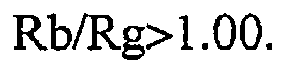
- The production method for a non-alkali glass according to any one of claims 1 to 3, wherein when the total of heating quantity by the combustion flame of the burner and heating quantity by the electrical heating of the molten glass in the melting furnace is represented by To (J/h), the heating quantity T (J/h) by the electrical heating satisfies the following formula:

- The production method for a non-alkali glass according to any one of claims 1 to 4, wherein the refractory constituting the melting furnace is a high zirconia fused cast refractory containing, as chemical components of the refractory, in mass%, 85 to 91 % of ZrO2, 7.0 to 11.2% of SiO2, 0.85 to 3.0% of Al2O3, 0.05 to 1.0% of P2O5, and 0.05 to 1.0% of B2O3, and 0.01 to 0.12% of K2O and Na2O in the total amount, wherein the amount of K2O is larger than that of Na2O.
- The production method for a non-alkali glass according to any one of claims 1 to 5, wherein alternating current voltage having a frequency of from 10 to 90 Hz is applied to the heating electrodes such that local current density is from 0.1 to 2.0 A/cm2 and the potential difference between electrodes is from 20 to 500V.
- The production method for a non-alkali glass according to any one of claims 1 to 6, wherein silica sand in which a median particle diameter D50 is from 20 µm to 27 µm, the fraction of particles having a particle diameter of 2 µm or less is 0.3 vol% or less, and the proportion of particles having a particle diameter of 100 µm or more is 2.5 vol% or less is used as a silicon source of SiO2 in the glass raw materials.
- The production method for a non-alkali glass according to any one of claims 1 to 6, wherein one containing hydroxide of alkaline earth metal in an amount of from 15 to 100 mol% (MO conversion, wherein M represents an alkaline earth metal element, and the same shall apply below) out of 100 mol% (MO conversion) of an alkaline earth metal source is used as an alkaline earth metal source of MgO, CaO, SrO and BaO in the glass raw material.
- The production method for a non-alkali glass according to any one of claims 1 to 6, wherein silica sand in which a median particle diameter D50 is from 20 µm to 27 µm, the proportion of particles having a particle diameter of 2 µm or less is 0.3 vol% or less, and the proportion of particles having a particle diameter of 100 µm or more is 2.5 vol% or less is used as a silicon source of SiO2 in the glass raw material, and one containing hydroxide of alkaline earth metal in an amount of from 15 to 100 mol% (MO conversion, wherein M represents an alkaline earth metal element, and the same shall apply below) out of 100 mol% (MO conversion) of an alkaline earth metal source is used as an alkaline earth metal source of MgO, CaO, SrO and BaO in the glass raw material.
Applications Claiming Priority (2)
| Application Number | Priority Date | Filing Date | Title |
|---|---|---|---|
| JP2012040125 | 2012-02-27 | ||
| PCT/JP2013/054877 WO2013129368A1 (en) | 2012-02-27 | 2013-02-26 | Production method for non-alkali glass |
Publications (2)
| Publication Number | Publication Date |
|---|---|
| EP2821375A1 true EP2821375A1 (en) | 2015-01-07 |
| EP2821375A4 EP2821375A4 (en) | 2015-10-28 |
Family
ID=49082565
Family Applications (1)
| Application Number | Title | Priority Date | Filing Date |
|---|---|---|---|
| EP13755581.9A Withdrawn EP2821375A4 (en) | 2012-02-27 | 2013-02-26 | PROCESS FOR PRODUCING NON-ALKALINE GLASS |
Country Status (7)
| Country | Link |
|---|---|
| US (1) | US20140366581A1 (en) |
| EP (1) | EP2821375A4 (en) |
| JP (1) | JP5943064B2 (en) |
| KR (1) | KR102009542B1 (en) |
| CN (1) | CN104136383B (en) |
| TW (1) | TWI598308B (en) |
| WO (1) | WO2013129368A1 (en) |
Families Citing this family (25)
| Publication number | Priority date | Publication date | Assignee | Title |
|---|---|---|---|---|
| EP3153479B1 (en) | 2012-04-27 | 2018-01-03 | Asahi Glass Company, Limited | Non-alkali glass and method for producing same |
| EP2860161A1 (en) | 2012-06-07 | 2015-04-15 | Asahi Glass Company, Limited | Alkali-free glass and alkali-free glass plate using same |
| US9725349B2 (en) * | 2012-11-28 | 2017-08-08 | Corning Incorporated | Glass manufacturing apparatus and methods |
| WO2014157349A1 (en) * | 2013-03-27 | 2014-10-02 | AvanStrate株式会社 | Method for manufacturing glass substrate and device for manufacturing glass substrate |
| WO2014175215A1 (en) | 2013-04-23 | 2014-10-30 | 旭硝子株式会社 | Alkali-free glass substrate and method for producing same |
| CN106461191A (en) * | 2014-06-04 | 2017-02-22 | 旭硝子株式会社 | Glass plate for light-guide plate |
| TWI671273B (en) * | 2014-10-23 | 2019-09-11 | 日商Agc股份有限公司 | Alkali-free glass |
| KR102714914B1 (en) * | 2014-11-28 | 2024-10-14 | 에이지씨 가부시키가이샤 | Liquid crystal display panel |
| CN113045197A (en) * | 2015-04-03 | 2021-06-29 | 日本电气硝子株式会社 | Glass |
| CN114014537A (en) * | 2015-05-18 | 2022-02-08 | 日本电气硝子株式会社 | Alkali-free glass substrate |
| JP6955509B2 (en) | 2015-12-21 | 2021-10-27 | コーニング インコーポレイテッド | Borosilicate glass with low alkali content |
| CN105565665A (en) * | 2015-12-28 | 2016-05-11 | 滁州美业机械制造有限公司 | Processing method of non-metal refrigerator middle clapboards |
| JP7333159B2 (en) * | 2016-12-26 | 2023-08-24 | 日本電気硝子株式会社 | Method for producing alkali-free glass substrate |
| JP7154483B2 (en) * | 2017-09-04 | 2022-10-18 | 日本電気硝子株式会社 | Glass article manufacturing method and manufacturing apparatus |
| KR20190078512A (en) * | 2017-12-26 | 2019-07-04 | 아반스트레이트 가부시키가이샤 | Glass substrate manufacturing apparatus and method for manufacturing glass substrate |
| CN115611510B (en) * | 2018-03-09 | 2025-01-10 | Agc株式会社 | Alkali-free glass substrate |
| KR102680019B1 (en) * | 2018-03-14 | 2024-07-02 | 에이지씨 가부시키가이샤 | Alkali-free glass |
| JP6973268B2 (en) * | 2018-04-24 | 2021-11-24 | 株式会社デンソー | Physical quantity measuring device |
| CN109160727B (en) | 2018-10-16 | 2020-10-13 | 东旭光电科技股份有限公司 | Aluminosilicate glass composition, aluminosilicate glass and preparation method and application thereof |
| CN109231819B (en) * | 2018-10-16 | 2021-04-09 | 东旭光电科技股份有限公司 | Alkali-free aluminosilicate glass and preparation method and application thereof |
| JP7234856B2 (en) * | 2019-08-20 | 2023-03-08 | Agc株式会社 | Manufacturing method of lithium aluminosilicate glass and float glass plate |
| KR20240006552A (en) * | 2021-05-10 | 2024-01-15 | 니폰 덴키 가라스 가부시키가이샤 | Alkali-free glass plate |
| JP2022173994A (en) * | 2021-05-10 | 2022-11-22 | 日本電気硝子株式会社 | Alkali-free glass plate |
| CN117295697A (en) * | 2021-05-10 | 2023-12-26 | 日本电气硝子株式会社 | Alkali-free glass plate |
| CN119461844A (en) * | 2024-09-29 | 2025-02-18 | 彩虹显示器件股份有限公司 | Heat-resistant, stable, high crystallization margin alkali-free boroaluminosilicate glass and preparation method thereof |
Family Cites Families (28)
| Publication number | Priority date | Publication date | Assignee | Title |
|---|---|---|---|---|
| US4001001A (en) * | 1976-01-19 | 1977-01-04 | Ppg Industries, Inc. | Horizontal glassmaking furnace |
| CS235792B1 (en) * | 1983-04-06 | 1985-05-15 | Pavel Zahalka | Connection for direct heating of ionic melt especially of glass by alternating current passage with lower frequency than 50 hz |
| JPS61236631A (en) * | 1985-04-10 | 1986-10-21 | Ohara Inc | Refractory and heat resistant glass |
| US4634683A (en) | 1985-10-23 | 1987-01-06 | Corning Glass Works | Barium and/or strontium aluminosilicate crystal-containing glasses for flat panel display devices |
| US4634684A (en) | 1985-10-23 | 1987-01-06 | Corning Glass Works | Strontium aluminosilicate glass substrates for flat panel display devices |
| JP3083586B2 (en) | 1991-04-26 | 2000-09-04 | 旭硝子株式会社 | Alkali-free glass |
| US5116789A (en) | 1991-08-12 | 1992-05-26 | Corning Incorporated | Strontium aluminosilicate glasses for flat panel displays |
| US5326730A (en) | 1993-01-22 | 1994-07-05 | Corning Incorporated | Barium aluminosilicate glasses |
| JP3570740B2 (en) * | 1993-02-03 | 2004-09-29 | 旭硝子セラミックス株式会社 | High zirconia fused cast refractories |
| FR2701022B1 (en) * | 1993-02-03 | 1998-07-10 | Asahi Glass Co Ltd | HIGHLY ZIRCONIA MELT REFRACTORIES. |
| JP3804112B2 (en) | 1996-07-29 | 2006-08-02 | 旭硝子株式会社 | Alkali-free glass, alkali-free glass manufacturing method and flat display panel |
| DE19916296C1 (en) * | 1999-04-12 | 2001-01-18 | Schott Glas | Alkali-free aluminoborosilicate glass and its use |
| ITVI20020065A1 (en) * | 2002-04-11 | 2003-10-13 | Trend Group Spa | METHOD AND ELECTRIC OVEN FOR THE MELTING OF GLASS MATERIALS |
| JP5105571B2 (en) | 2003-10-10 | 2012-12-26 | 日本電気硝子株式会社 | Method for producing alkali-free glass |
| JP4737709B2 (en) * | 2004-03-22 | 2011-08-03 | 日本電気硝子株式会社 | Method for producing glass for display substrate |
| KR100977699B1 (en) * | 2005-07-06 | 2010-08-24 | 아사히 가라스 가부시키가이샤 | Method for producing alkali free glass and alkali free glass plate |
| DE102006003534A1 (en) | 2006-01-24 | 2007-08-02 | Schott Ag | Refining of optical glass with temperature-regulated electrodes |
| WO2009054314A1 (en) * | 2007-10-25 | 2009-04-30 | Asahi Glass Company, Limited | Method for production of non-alkali glass |
| EP2254844A1 (en) * | 2008-03-25 | 2010-12-01 | AGC Glass Europe | Glass melting furnace |
| EP2418189B1 (en) * | 2009-04-06 | 2016-08-17 | Asahi Glass Company, Limited | Highly zirconia-based refractory and its use for a melting furnace |
| EP2450319A4 (en) * | 2009-07-02 | 2015-01-28 | Asahi Glass Co Ltd | GLASS FREE OF ALCALI AND PROCESS FOR PRODUCING THE SAME |
| JP2011070092A (en) | 2009-09-28 | 2011-04-07 | Sharp Corp | Liquid crystal display device |
| JP5674156B2 (en) * | 2009-11-20 | 2015-02-25 | 旭硝子株式会社 | Glass melting furnace, molten glass manufacturing method, glass product manufacturing apparatus, and glass product manufacturing method |
| EP2626339B1 (en) * | 2010-10-06 | 2018-06-06 | Asahi Glass Company, Limited | High zirconia refractory product |
| KR101752033B1 (en) * | 2010-12-07 | 2017-06-28 | 아사히 가라스 가부시키가이샤 | Alkali free glass and method for producing alkali free glass |
| KR101751569B1 (en) * | 2010-12-27 | 2017-06-27 | 아사히 가라스 가부시키가이샤 | Non-alkali glass, and process for production of non-alkali glass |
| JP5172045B2 (en) * | 2011-07-01 | 2013-03-27 | AvanStrate株式会社 | Glass substrate for flat panel display and manufacturing method thereof |
| CN103987666B (en) * | 2011-12-06 | 2016-05-25 | 旭硝子株式会社 | The manufacture method of alkali-free glass |
-
2013
- 2013-02-26 JP JP2014502234A patent/JP5943064B2/en active Active
- 2013-02-26 CN CN201380011257.0A patent/CN104136383B/en active Active
- 2013-02-26 WO PCT/JP2013/054877 patent/WO2013129368A1/en not_active Ceased
- 2013-02-26 KR KR1020147024002A patent/KR102009542B1/en active Active
- 2013-02-26 EP EP13755581.9A patent/EP2821375A4/en not_active Withdrawn
- 2013-02-27 TW TW102107112A patent/TWI598308B/en active
-
2014
- 2014-08-27 US US14/470,163 patent/US20140366581A1/en not_active Abandoned
Also Published As
| Publication number | Publication date |
|---|---|
| KR20140134279A (en) | 2014-11-21 |
| TW201343580A (en) | 2013-11-01 |
| KR102009542B1 (en) | 2019-08-09 |
| JP5943064B2 (en) | 2016-06-29 |
| EP2821375A4 (en) | 2015-10-28 |
| US20140366581A1 (en) | 2014-12-18 |
| JPWO2013129368A1 (en) | 2015-07-30 |
| TWI598308B (en) | 2017-09-11 |
| CN104136383A (en) | 2014-11-05 |
| WO2013129368A1 (en) | 2013-09-06 |
| CN104136383B (en) | 2016-09-28 |
Similar Documents
| Publication | Publication Date | Title |
|---|---|---|
| EP2821375A1 (en) | Production method for non-alkali glass | |
| EP2789587A1 (en) | Method for manufacturing alkali-free glass | |
| US11053160B2 (en) | Alkali-free glass | |
| EP2842918B1 (en) | Non-alkali glass and method for producing same | |
| EP2650262A1 (en) | Alkali free glass and method for producing alkali free glass | |
| EP2660213A1 (en) | Non-alkali glass, and process for production of non-alkali glass | |
| CN110088053A (en) | Glass | |
| CN109970318A (en) | The manufacturing method of alkali-free glass |
Legal Events
| Date | Code | Title | Description |
|---|---|---|---|
| PUAI | Public reference made under article 153(3) epc to a published international application that has entered the european phase |
Free format text: ORIGINAL CODE: 0009012 |
|
| 17P | Request for examination filed |
Effective date: 20140821 |
|
| AK | Designated contracting states |
Kind code of ref document: A1 Designated state(s): AL AT BE BG CH CY CZ DE DK EE ES FI FR GB GR HR HU IE IS IT LI LT LU LV MC MK MT NL NO PL PT RO RS SE SI SK SM TR |
|
| AX | Request for extension of the european patent |
Extension state: BA ME |
|
| DAX | Request for extension of the european patent (deleted) | ||
| RA4 | Supplementary search report drawn up and despatched (corrected) |
Effective date: 20150929 |
|
| RIC1 | Information provided on ipc code assigned before grant |
Ipc: C03C 3/093 20060101ALI20150918BHEP Ipc: C04B 35/484 20060101ALI20150918BHEP Ipc: C03B 5/027 20060101AFI20150918BHEP Ipc: C03C 3/087 20060101ALI20150918BHEP Ipc: C03C 3/091 20060101ALI20150918BHEP Ipc: C03B 5/43 20060101ALI20150918BHEP Ipc: C03B 5/235 20060101ALI20150918BHEP |
|
| 17Q | First examination report despatched |
Effective date: 20180711 |
|
| STAA | Information on the status of an ep patent application or granted ep patent |
Free format text: STATUS: THE APPLICATION HAS BEEN WITHDRAWN |
|
| RAP1 | Party data changed (applicant data changed or rights of an application transferred) |
Owner name: AGC INC. |
|
| 18W | Application withdrawn |
Effective date: 20180910 |