EP2821288A2 - Relay control between power distribution center and body control module - Google Patents
Relay control between power distribution center and body control module Download PDFInfo
- Publication number
- EP2821288A2 EP2821288A2 EP14175296.4A EP14175296A EP2821288A2 EP 2821288 A2 EP2821288 A2 EP 2821288A2 EP 14175296 A EP14175296 A EP 14175296A EP 2821288 A2 EP2821288 A2 EP 2821288A2
- Authority
- EP
- European Patent Office
- Prior art keywords
- serial data
- relay
- data link
- engine compartment
- serial
- Prior art date
- Legal status (The legal status is an assumption and is not a legal conclusion. Google has not performed a legal analysis and makes no representation as to the accuracy of the status listed.)
- Withdrawn
Links
Images

Classifications
-
- B—PERFORMING OPERATIONS; TRANSPORTING
- B60—VEHICLES IN GENERAL
- B60R—VEHICLES, VEHICLE FITTINGS, OR VEHICLE PARTS, NOT OTHERWISE PROVIDED FOR
- B60R16/00—Electric or fluid circuits specially adapted for vehicles and not otherwise provided for; Arrangement of elements of electric or fluid circuits specially adapted for vehicles and not otherwise provided for
- B60R16/02—Electric or fluid circuits specially adapted for vehicles and not otherwise provided for; Arrangement of elements of electric or fluid circuits specially adapted for vehicles and not otherwise provided for electric constitutive elements
- B60R16/03—Electric or fluid circuits specially adapted for vehicles and not otherwise provided for; Arrangement of elements of electric or fluid circuits specially adapted for vehicles and not otherwise provided for electric constitutive elements for supply of electrical power to vehicle subsystems or for
-
- B—PERFORMING OPERATIONS; TRANSPORTING
- B60—VEHICLES IN GENERAL
- B60K—ARRANGEMENT OR MOUNTING OF PROPULSION UNITS OR OF TRANSMISSIONS IN VEHICLES; ARRANGEMENT OR MOUNTING OF PLURAL DIVERSE PRIME-MOVERS IN VEHICLES; AUXILIARY DRIVES FOR VEHICLES; INSTRUMENTATION OR DASHBOARDS FOR VEHICLES; ARRANGEMENTS IN CONNECTION WITH COOLING, AIR INTAKE, GAS EXHAUST OR FUEL SUPPLY OF PROPULSION UNITS IN VEHICLES
- B60K35/00—Instruments specially adapted for vehicles; Arrangement of instruments in or on vehicles
- B60K35/10—Input arrangements, i.e. from user to vehicle, associated with vehicle functions or specially adapted therefor
-
- B—PERFORMING OPERATIONS; TRANSPORTING
- B60—VEHICLES IN GENERAL
- B60K—ARRANGEMENT OR MOUNTING OF PROPULSION UNITS OR OF TRANSMISSIONS IN VEHICLES; ARRANGEMENT OR MOUNTING OF PLURAL DIVERSE PRIME-MOVERS IN VEHICLES; AUXILIARY DRIVES FOR VEHICLES; INSTRUMENTATION OR DASHBOARDS FOR VEHICLES; ARRANGEMENTS IN CONNECTION WITH COOLING, AIR INTAKE, GAS EXHAUST OR FUEL SUPPLY OF PROPULSION UNITS IN VEHICLES
- B60K35/00—Instruments specially adapted for vehicles; Arrangement of instruments in or on vehicles
- B60K35/80—Arrangements for controlling instruments
-
- B—PERFORMING OPERATIONS; TRANSPORTING
- B60—VEHICLES IN GENERAL
- B60W—CONJOINT CONTROL OF VEHICLE SUB-UNITS OF DIFFERENT TYPE OR DIFFERENT FUNCTION; CONTROL SYSTEMS SPECIALLY ADAPTED FOR HYBRID VEHICLES; ROAD VEHICLE DRIVE CONTROL SYSTEMS FOR PURPOSES NOT RELATED TO THE CONTROL OF A PARTICULAR SUB-UNIT
- B60W50/00—Details of control systems for road vehicle drive control not related to the control of a particular sub-unit, e.g. process diagnostic or vehicle driver interfaces
- B60W50/08—Interaction between the driver and the control system
-
- G—PHYSICS
- G01—MEASURING; TESTING
- G01C—MEASURING DISTANCES, LEVELS OR BEARINGS; SURVEYING; NAVIGATION; GYROSCOPIC INSTRUMENTS; PHOTOGRAMMETRY OR VIDEOGRAMMETRY
- G01C21/00—Navigation; Navigational instruments not provided for in groups G01C1/00 - G01C19/00
- G01C21/26—Navigation; Navigational instruments not provided for in groups G01C1/00 - G01C19/00 specially adapted for navigation in a road network
Definitions
- a vehicle's horn, air conditioner compressor clutch, blower motor and electric heaters are examples of accessory devices that require more electric current than most semiconductors are able to provide.
- the current that such devices require is usually provided to them using conventional, high-current relays, the actuations of which are controlled by a processor responsive to the processor detecting actuation of a control device for the accessory.
- These high current relays are preferably located in the engine compartment safety but must nevertheless be controlled from the passenger compartment.
- Fig. 1 depicts a prior art system 100 for controlling relays in a vehicle engine compartment from the passenger compartment.
- the system 100 comprises a passenger compartment-located body control module or "BCM" 102.
- the BCM 102 is comprised of a processor 104 (microcontroller or microprocessor).
- the processor 104 has conventional address/data/control lines 106, at least some of which are electrically coupled, i.e., interfaced, to an engine compartment-located power distribution center (PDC) 108 through a set of protective drivers 110, which pass through the vehicle's firewall 105, because they "drive" relay coils 113, which are inherently inductive.
- PDC power distribution center
- the BCM 102 is electrically coupled to and receives electrical signals from various controls that are located in the passenger compartment for various electrical accessory devices located through-out the vehicle. Such inputs to a BCM 102 are well known to those of ordinary skill in the art and omitted from the figures for brevity.
- FIG. 1 thus shows the PDC 108 as having relays 112 that provide electrical battery power to various electrical loads 116.
- the relays 112 actuate a load, i.e., provide electric current to a load, responsive to electrical signals sent to the coils 113 of the relays 112 by the processor 104 located in the BCM 102, albeit through the current driver 110.
- the engine compartment-located relays on the PDC 108 are thus controlled by the processor 104, which is located in the BCM 102.
- each relay on a PDC 108 requires at least one, relay control wire connected to the processor 104. Since many vehicles require high reliability and maintainability, the PDC-locate relays are also preferably "testable" by the processor 104 by being provided with sets of auxiliary diagnostic contacts 116, the opening and closure of which can be tested by the processor 104 using dedicated diagnostic test wires 118, which also extend between the relays 112 and processor 104.
- the multiple test wires 118 and relay control wires 120 that extend between the protective driver 110 and relay coils 113 make the connection between a BCM 102 and PDC 108 costly and actually decrease a vehicle's reliability.
- An aspect of the invention relates to a system for controlling electrical devices in a vehicle engine compartment, the vehicle comprising a passenger compartment and a firewall separating the engine compartment and passenger compartment, the system comprising:
- the relay controller comprises a first serial data interface and a relay monitor processor, the first serial data interface having a first serial data input coupled to the serial data link and a plurality of outputs coupled to the relay monitor processor, the relay monitor processor having a plurality of inputs coupled to the serial data interface outputs, the relay monitor processor additionally having a plurality of outputs coupled to relays.
- the relay controller further comprises a plurality of relay current drivers, each driver being coupled between a relay monitor processor output and a relay in the engine compartment.
- control module comprises a body control module processor and a second serial data interface, the second serial data interface having a plurality of inputs coupled to corresponding outputs of the body control module processor and having a serial data output coupled to the serial data link.
- serial data link is configured to carry serial data between the first and second serial data interfaces using a predetermined serial data protocol selected from at least one of: an automotive controller area network (CAN) protocol and an automotive local interconnect network (LIN) protocol.
- CAN automotive controller area network
- LIN automotive local interconnect network
- a further aspect of the invention relates to an apparatus for controlling electrical devices in a vehicle engine compartment, the apparatus comprising:
- the body control module comprises a processor having a plurality of parallel inputs and a plurality of parallel outputs, the apparatus further comprising a serial data link interface having parallel inputs coupled to the body control module processor parallel outputs and a serial data interface output, the serial data link interface configured to convert signals on the parallel inputs to a predetermined serial data output.
- the serial data link interface is additionally configured to transmit serial data onto a serial data link and receive serial from the serial data link, the serial data link being configured to carry serial data into and out of the vehicle engine compartment.
- the serial data link interface is additionally configured to send and receive serial data, the serial data from the engine compartment comprising information that is indicative of the functionality or non-functionality of an engine compartment relay.
- the serial data link interface is configured to transmit serial data onto a serial data link and to receive serial data from the serial data link, the serial data being transmitted and received on the serial data link according to at least one of: an automotive controller area network (CAN) protocol and an automotive local interconnect network (LIN) protocol.
- CAN automotive controller area network
- LIN automotive local interconnect network
- a further aspect of the invention relates to an apparatus for controlling electrical devices in a vehicle engine compartment responsive to controls actuated in a vehicle passenger compartment, the system comprising:
- the relay controller is configured to be located in both a vehicle engine compartment and a passenger compartment and comprises a relay control processor having a plurality of parallel inputs and a plurality of parallel outputs, the apparatus further comprising a serial data link interface having a serial input configured to receive serial data from a serial data link and having a plurality of parallel outputs coupled to corresponding inputs of the relay controller processor.
- the serial data link interface is additionally configured to receive serial data from and transmit serial data to a serial data link, the serial data link being configured to carry serial data into and out of the vehicle engine compartment.
- the relay control processor is additionally configured to receive information from at least one engine compartment relay, said received information being indicative of the functionality or non-functionality of the relay.
- the serial data link interface is configured to transmit serial data onto a serial data link and to receive serial data from a serial data link, the serial data being transmitted and received on the serial data link according to at least one of: an automotive controller area network (CAN) protocol and an automotive local interconnect network (LIN) protocol.
- CAN automotive controller area network
- LIN automotive local interconnect network
- a further aspect of the invention relates to a method of controlling and monitoring engine compartment relays from a passenger compartment, the method comprising:
- the step of transmitting a second, serial data stream onto a serial data link comprises transmitting data according to at least one of: an automotive controller area network (CAN) protocol and an automotive local interconnect network (LIN) protocol.
- CAN automotive controller area network
- LIN automotive local interconnect network
- the step of converting the second, serial data stream into a third parallel signal comprises the steps of:
- the method further comprises the steps of:
- the method further comprises the step of:
- Fig. 2 depicts a system 200 for controlling electrical devices in an engine compartment from the passenger compartment via a serial data link 202, depicted in Fig. 2 as a single line but which can be physically embodied in a vehicle as a one, ungrounded conductor with the vehicle chassis providing a reference potential conductor.
- the data link 202 is provided as either a coaxial cable or a "twisted pair" of wires, well known to those of ordinary skill in the art.
- the system 200 shown in Fig. 2 has a body control module or "BCM" 204 located in the passenger compartment where temperature and humidity levels are less hostile to semiconductors than are the temperature and humidity levels in an engine compartment.
- the body control module 204 preferably comprises at least one microprocessor or microcontroller, not shown, having a series of input terminals or ports 206 that are coupled to various controls for various vehicle accessories such as the vehicle horn, climate control system blower, electric seat heaters and the like.
- the processor in the body control module 204 senses the signal generated by actuation of the device and generates a corresponding serial-data control signal that is sent to a relay controller 210 located in the engine compartment.
- the BCM 204 Since many electrically-powered vehicle accessories can be actuated separately and independently from each other, they can also be actuated simultaneously. If two or more accessories are actuated at the same time, the BCM 204 will thus receive inputs from two devices at the same time.
- the BCM 204 will preferably generate two different serial data signals or packets, which are sent to a relay controller 210 successively, i.e., one after the other.
- a single, serial data packet is sent, the contents of which are changed according to the number and identity of electrical accessories that need to be activated.
- the BCM 204 operates as a parallel-to-serial converter: it converts signals that it can be received simultaneously or which are virtually simultaneous into serial data representing the various inputs that were received "in parallel" to each other.
- the serial data control signal generated by the BCM 204 in response to actuation of an accessory device in the passenger compartment is output to a bi-directional serial data interface 208 on the BCM 204, which is also considered to be an output control port or terminal for various relays located on a relay controller located in the engine compartment.
- the protocols or standards to which the ports are electrically and mechanically compliant is a design choice as is the format of data transmitted and received through them.
- the relays in the engine compartment selectively provide electric power to electrical loads responsive to voltage s output from the BCM on the serial data interface 208.
- the serial data interface 208 on the BCM 204 is also able to receive serial data from the serial data link 202. Information can thus be sent back to the BCM 204.
- the serial data interface 208 on the BCM 204 is electrically connected to the aforementioned serial data link 202.
- the serial data link 202 passes through an opening in a firewall 205, which is a steel wall separating the engine compartment and passenger compartment.
- the serial data link 202 is electrically connected to a mating serial data interface 212 on the relay controller 210, which is located in the engine compartment.
- the serial data link 202 is considered herein to have a "first" end connected to the serial data interface 208 on the BCM 204 and an opposite "second" end coupled to an identical serial data interface or port 212 located on the relay controller 210. Similar to the processor 102 shown in Fig. 1 , which requires protective drivers 110 on the outputs of the processor 102, the outputs of the processor 214 on the relay controller 210 also require protective drivers 215 because the processor 214 controls various inductive loads embodied as the coils 209 of the various relays 211 that provide power to and thus control various electrical accessory loads 222, most of which are themselves inductive.
- the relay controller also includes its own voltage regulator 230.
- bus refers to a set of electrically-parallel conductors in a computer or computer system, which form a main transmission path.
- the processor 214 on the relay controller 210 is a conventional processor; it therefore has a bus comprising electrically parallel address/data/control lines 216.
- the lines of the bus carry signals, which cause various devices connected to the bus to operate.
- the relay controller processor 214 receives commands, information and data from the BCM 204 in the form of serial data or data packets. It is able to receive signals from the several relays diagnostic sense lines 224 simultaneously, i.e., in parallel. It converts such "parallel data" to a serial form and transmits that data to the BCM 204 through the serial data interface 212 to which the bus conductors are electrically connected. Stated another way, the serial data interface 212 in the engine compartment-located relay controller 210 converts serial data received from the BCM 204 into parallel data, which is impressed on the bus of the processor 214 on the relay controller 210 so that the processor 214 can "understand” and respond to commands and information that are sent to it by the BCM. The serial data interface 212 thus functions as a parallel-to-serial converter.
- the serial data interface 212 also receives signals from the processor 214 on the electrically-parallel conductors of the bus 214 and converts those bus signals to a serial format and sends them to the BCM 204 via the serial data link 202.
- the serial data interface 212 therefore functions as a parallel-to-serial converter, depending on the direction that data is to flow.
- the serial data link 202 which couples the body control module 204 to the relay controller 210 through the firewall 205 is preferably a controller area network (CAN) or local interconnect network (LIN) both of which are well known in the automotive art.
- the serial data link 202 is thus able to transfer data bi-directionally, i.e., to the relay controller 210 from the BCM 204 and from the relay controller 210 to the BCM 204.
- the serial data link thus carries data from the passenger compartment into the engine compartment and vice-versa.
- Fig. 3 depicts an alternate embodiment of a system 300 for controlling electrical devices in an engine compartment from the passenger compartment via a single-conductor serial data link 202.
- the system 300 shown in Fig. 3 is identical to the system shown in Fig. 2 and differs from the system shown in Fig. 2 in that an application-specific integrated circuit (ASIC) 302 is substituted for the processor 214, the voltage regulator 230, and serial data interface 212.
- ASIC application-specific integrated circuit
- Fig. 4 depicts steps of a method 400 for controlling and monitoring engine compartm ent relays and engine compartment loads from a passenger compartment.
- the method begins at step 402 where a body control module (BCM) receives a signal from a driver or vehicle passenger to actuate or operate a vehicle accessory.
- BCM body control module
- Examples of such accessories include a power-operated seat, seat heater, vehicle horn, blower, rear window defogger and the like.
- Step 404 of the method 400 thus comprises transmitting a serial data stream or serial data signal onto a serial data link responsive to the BCM's reception of a signal to operate an accessory.
- the engine compartment-located relay monitor receives the serial data stream from the BCM, converts the serial data to a parallel format and, a serial data interface and presents the parallel-format command to a microcontroller or microprocessor for the relay monitor.
- the serial data stream which contains data, information or otherwise represents the actuation of a particular control to operate a particular accessory is converted into a parallel signal by the serial data interface for presentation to the relay monitor processor.
- the microcontroller on the relay monitor Upon receipt of the converted-to-parallel signal, the microcontroller on the relay monitor generates a signal for output on its address/control/data bus via a low side driver to one or more relays which are coupled to various loads located on the vehicle or in the engine compartment.
- the signal output from the microcontroller of the relay monitor causes one or more relays to close thereby delivering battery power to the various accessory device.
- the output state of each relay is output state is fed back to controller from the relays through the various diagnostic sense lines 224 coupled between the relays 211 and controller. Monitoring the output state of each relay makes it possible to actively verify or confirm proper relay operation. The relay output state information is also sent back to the BCM through the serial data link. The method depicted in FIG. 4 is repeated to actuate other accessories.
- the relay controller's electronic devices are sized, selected and arranged to make the relay controller 210 capable of withstanding the high temperatures and humidity level found in an engine compartment. In an alternate embodiment, however, the relay controller 210 can also be located inside a passenger compartment.
- serial data is transmitted over a single conductor, with the vehicle acting as a return or reference potential using either an automotive controller area network protocol or an automotive local interconnect network protocol.
- the method thus facilitates the elimination of multiple parallel conductors extending from the passenger compartment to the engine compartment to a single conductor improving system reliability and reducing manufacturing cost.
Landscapes
- Engineering & Computer Science (AREA)
- Mechanical Engineering (AREA)
- Transportation (AREA)
- Chemical & Material Sciences (AREA)
- Combustion & Propulsion (AREA)
- Automation & Control Theory (AREA)
- Remote Sensing (AREA)
- Radar, Positioning & Navigation (AREA)
- Human Computer Interaction (AREA)
- Physics & Mathematics (AREA)
- General Physics & Mathematics (AREA)
- Small-Scale Networks (AREA)
- Selective Calling Equipment (AREA)
- Combined Controls Of Internal Combustion Engines (AREA)
Abstract
Description
- Many accessory devices in a vehicle require relatively large amounts of current to operate. A vehicle's horn, air conditioner compressor clutch, blower motor and electric heaters are examples of accessory devices that require more electric current than most semiconductors are able to provide. The current that such devices require is usually provided to them using conventional, high-current relays, the actuations of which are controlled by a processor responsive to the processor detecting actuation of a control device for the accessory. These high current relays are preferably located in the engine compartment safety but must nevertheless be controlled from the passenger compartment.
-
Fig. 1 depicts aprior art system 100 for controlling relays in a vehicle engine compartment from the passenger compartment. Thesystem 100 comprises a passenger compartment-located body control module or "BCM" 102. The BCM 102 is comprised of a processor 104 (microcontroller or microprocessor). Theprocessor 104 has conventional address/data/control lines 106, at least some of which are electrically coupled, i.e., interfaced, to an engine compartment-located power distribution center (PDC) 108 through a set ofprotective drivers 110, which pass through the vehicle'sfirewall 105, because they "drive"relay coils 113, which are inherently inductive. - The
BCM 102 is electrically coupled to and receives electrical signals from various controls that are located in the passenger compartment for various electrical accessory devices located through-out the vehicle. Such inputs to a BCM 102 are well known to those of ordinary skill in the art and omitted from the figures for brevity. - When a driver or vehicle occupant wants to operate an electrically-powered accessory that requires more current that a processor or similar device can reliably provide by itself, the current for such a device is preferably provided to the device by the actuation of a high-current relay located on the engine compartment-located
PDC 108.FIG. 1 thus shows thePDC 108 as havingrelays 112 that provide electrical battery power to variouselectrical loads 116. Therelays 112 actuate a load, i.e., provide electric current to a load, responsive to electrical signals sent to thecoils 113 of therelays 112 by theprocessor 104 located in theBCM 102, albeit through thecurrent driver 110. The engine compartment-located relays on thePDC 108 are thus controlled by theprocessor 104, which is located in the BCM 102. - Unfortunately, the prior art requires each relay on a
PDC 108 to have at least one, relay control wire connected to theprocessor 104. Since many vehicles require high reliability and maintainability, the PDC-locate relays are also preferably "testable" by theprocessor 104 by being provided with sets of auxiliarydiagnostic contacts 116, the opening and closure of which can be tested by theprocessor 104 using dedicateddiagnostic test wires 118, which also extend between therelays 112 andprocessor 104. Themultiple test wires 118 andrelay control wires 120 that extend between theprotective driver 110 andrelay coils 113 make the connection between aBCM 102 andPDC 108 costly and actually decrease a vehicle's reliability. - It is an object of the invention to reduce the number of wires and/or connectors that extend between a passenger compartment-located body control module and an engine compartment-located power distribution center.
- An aspect of the invention relates to a system for controlling electrical devices in a vehicle engine compartment, the vehicle comprising a passenger compartment and a firewall separating the engine compartment and passenger compartment, the system comprising:
- a plurality of relays located in the engine compartment, each relay being responsive to receipt of a control signal from a relay controller;
- a relay controller located in the engine compartment and coupled to said relays, the relay controller having a plurality of outputs and a serial port, each output being coupled to a corresponding relay and configured to actuate the relay responsive to a corresponding input signal received by the relay controller at its serial port;
- a body control module located in the passenger compartment, the body control module having a serial port, configured to send and receive signals between the serial port of the relay controller; t c; and
- a serial data link passing through the firewall and coupling the body control module to the relay controller.
- In an embodiment of the system, the relay controller comprises a first serial data interface and a relay monitor processor, the first serial data interface having a first serial data input coupled to the serial data link and a plurality of outputs coupled to the relay monitor processor, the relay monitor processor having a plurality of inputs coupled to the serial data interface outputs, the relay monitor processor additionally having a plurality of outputs coupled to relays.
- In a further embodiment, the relay controller further comprises a plurality of relay current drivers, each driver being coupled between a relay monitor processor output and a relay in the engine compartment.
- In a further embodiment, the control module comprises a body control module processor and a second serial data interface, the second serial data interface having a plurality of inputs coupled to corresponding outputs of the body control module processor and having a serial data output coupled to the serial data link. In a further embodiment, the serial data link is configured to carry serial data between the first and second serial data interfaces using a predetermined serial data protocol selected from at least one of: an automotive controller area network (CAN) protocol and an automotive local interconnect network (LIN) protocol.
- A further aspect of the invention relates to an apparatus for controlling electrical devices in a vehicle engine compartment, the apparatus comprising:
- a body control module configured to be located in a vehicle passenger compartment, the body control module having a plurality of control inputs and a serial data output, each control input configured to receive an accessory device actuation control signal from a user interface for a corresponding vehicle accessory device, the serial data output configured to output a predetermined serial data stream responsive to receipt of an input signal for an accessory device.
- In an embodiment of the apparatus, the body control module comprises a processor having a plurality of parallel inputs and a plurality of parallel outputs, the apparatus further comprising a serial data link interface having parallel inputs coupled to the body control module processor parallel outputs and a serial data interface output, the serial data link interface configured to convert signals on the parallel inputs to a predetermined serial data output.
- In a further embodiment, the serial data link interface is additionally configured to transmit serial data onto a serial data link and receive serial from the serial data link, the serial data link being configured to carry serial data into and out of the vehicle engine compartment.
- In a further embodiment, the serial data link interface is additionally configured to send and receive serial data, the serial data from the engine compartment comprising information that is indicative of the functionality or non-functionality of an engine compartment relay.
- In a further embodiment, the serial data link interface is configured to transmit serial data onto a serial data link and to receive serial data from the serial data link, the serial data being transmitted and received on the serial data link according to at least one of: an automotive controller area network (CAN) protocol and an automotive local interconnect network (LIN) protocol.
- A further aspect of the invention relates to an apparatus for controlling electrical devices in a vehicle engine compartment responsive to controls actuated in a vehicle passenger compartment, the system comprising:
- a relay controller, the relay controller having a serial input and a plurality of outputs, each output configured to be connected to a corresponding engine compartment-located relay and configured to actuate the connected relay responsive to a corresponding input signal received by the relay controller at its serial input, the input signal comprising serial data received from a passenger compartment-located body control module.
- In an embodiment of the apparatus, the relay controller is configured to be located in both a vehicle engine compartment and a passenger compartment and comprises a relay control processor having a plurality of parallel inputs and a plurality of parallel outputs, the apparatus further comprising a serial data link interface having a serial input configured to receive serial data from a serial data link and having a plurality of parallel outputs coupled to corresponding inputs of the relay controller processor.
- In a further embodiment, the serial data link interface is additionally configured to receive serial data from and transmit serial data to a serial data link, the serial data link being configured to carry serial data into and out of the vehicle engine compartment.
- In a further embodiment, the relay control processor is additionally configured to receive information from at least one engine compartment relay, said received information being indicative of the functionality or non-functionality of the relay.
- In a further embodiment, the serial data link interface is configured to transmit serial data onto a serial data link and to receive serial data from a serial data link, the serial data being transmitted and received on the serial data link according to at least one of: an automotive controller area network (CAN) protocol and an automotive local interconnect network (LIN) protocol.
- A further aspect of the invention relates to a method of controlling and monitoring engine compartment relays from a passenger compartment, the method comprising:
- receiving a first signal to actuate a vehicle accessory device at a passenger compartment-located body control module;
- transmitting a second, serial data stream signal onto a serial data link responsive to the reception of the first signal;
- receiving the second, serial data stream signal at an engine compartment-located relay monitor;
- converting the second, serial data stream into a third parallel signal;
- transmitting a relay actuation signal to a predetermined relay responsive to converting the second, serial data stream to a third parallel signal.
- In an embodiment of the method, the step of transmitting a second, serial data stream onto a serial data link comprises transmitting data according to at least one of: an automotive controller area network (CAN) protocol and an automotive local interconnect network (LIN) protocol.
- In a further embodiment, the step of converting the second, serial data stream into a third parallel signal comprises the steps of:
- receiving a predetermined serial data stream at a serial data interface;
- converting the predetermined serial data stream into a predetermined command for a processor located at the engine compartment-located relay monitor;
- sending a predetermined signal to a predetermined relay responsive to converting the predetermined serial data stream into a predetermined command.
- In a further embodiment, the method further comprises the steps of:
- sending a command to actuate a relay;
- monitoring a terminal of the relay to detect a signal; identifying the relay as either functional or non-functional responsive to the detected signal.
- In a further embodiment, the method further comprises the step of:
- sending a signal to a passenger compartment-located body control module over a serial data link responsive to identifying the relay as either functional or non-functional.
-
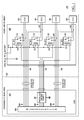
- Fig. 1
- depicts a block diagram of a prior art system for controlling various high-current load relays in an engine compartment from the passenger compartment;
- Fig. 2
- depicts a block diagram of a system for controlling electrical devices, such as high current relays in an engine compartment from the passenger compartment;
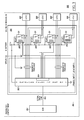
- Fig. 3
- depicts an alternate embodiment of a system for controlling electrical devices in an engine compartment from a passenger compartment; and
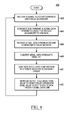
- Fig. 4
- depicts a method of controlling engine-compartment relays and high-current devices from a passenger compartment using a serial bus.
-
Fig. 2 depicts asystem 200 for controlling electrical devices in an engine compartment from the passenger compartment via aserial data link 202, depicted inFig. 2 as a single line but which can be physically embodied in a vehicle as a one, ungrounded conductor with the vehicle chassis providing a reference potential conductor. In a preferred embodiment, however, thedata link 202 is provided as either a coaxial cable or a "twisted pair" of wires, well known to those of ordinary skill in the art. - Similar to the prior art embodiment shown in
Fig. 1 , thesystem 200 shown inFig. 2 has a body control module or "BCM" 204 located in the passenger compartment where temperature and humidity levels are less hostile to semiconductors than are the temperature and humidity levels in an engine compartment. Thebody control module 204 preferably comprises at least one microprocessor or microcontroller, not shown, having a series of input terminals orports 206 that are coupled to various controls for various vehicle accessories such as the vehicle horn, climate control system blower, electric seat heaters and the like. When a vehicle passenger or driver operates or actuates a device requiring a large amount of current, the processor in thebody control module 204 senses the signal generated by actuation of the device and generates a corresponding serial-data control signal that is sent to arelay controller 210 located in the engine compartment. - Since many electrically-powered vehicle accessories can be actuated separately and independently from each other, they can also be actuated simultaneously. If two or more accessories are actuated at the same time, the
BCM 204 will thus receive inputs from two devices at the same time. TheBCM 204 will preferably generate two different serial data signals or packets, which are sent to arelay controller 210 successively, i.e., one after the other. In an alternate embodiment, a single, serial data packet is sent, the contents of which are changed according to the number and identity of electrical accessories that need to be activated. In either case, theBCM 204 operates as a parallel-to-serial converter: it converts signals that it can be received simultaneously or which are virtually simultaneous into serial data representing the various inputs that were received "in parallel" to each other. - The serial data control signal generated by the
BCM 204 in response to actuation of an accessory device in the passenger compartment is output to a bi-directional serial data interface 208 on theBCM 204, which is also considered to be an output control port or terminal for various relays located on a relay controller located in the engine compartment. The protocols or standards to which the ports are electrically and mechanically compliant, is a design choice as is the format of data transmitted and received through them. The relays in the engine compartment selectively provide electric power to electrical loads responsive to voltage s output from the BCM on theserial data interface 208. Theserial data interface 208 on theBCM 204 is also able to receive serial data from theserial data link 202. Information can thus be sent back to theBCM 204. - The
serial data interface 208 on theBCM 204 is electrically connected to the aforementionedserial data link 202. The serial data link 202 passes through an opening in afirewall 205, which is a steel wall separating the engine compartment and passenger compartment. Theserial data link 202 is electrically connected to a matingserial data interface 212 on therelay controller 210, which is located in the engine compartment. - The
serial data link 202 is considered herein to have a "first" end connected to theserial data interface 208 on theBCM 204 and an opposite "second" end coupled to an identical serial data interface orport 212 located on therelay controller 210. Similar to theprocessor 102 shown inFig. 1 , which requiresprotective drivers 110 on the outputs of theprocessor 102, the outputs of theprocessor 214 on therelay controller 210 also requireprotective drivers 215 because theprocessor 214 controls various inductive loads embodied as thecoils 209 of thevarious relays 211 that provide power to and thus control various electrical accessory loads 222, most of which are themselves inductive. The relay controller also includes itsown voltage regulator 230. - Most of the
electrical loads 222 controlled byrelays 211 on therelay controller 210 are located off therelay controller 210 and are themselves susceptible to failure. When an electrical accessory stops working, it is possible to determine whether the failure is due to arelay 211 usingdiagnostic sense lines 224, which are coupled to theprocessor 214. Theprocessor 214 is thus able to "read" or sense when the contacts of a relay are closing. - As used herein the term "bus" refers to a set of electrically-parallel conductors in a computer or computer system, which form a main transmission path. The
processor 214 on therelay controller 210 is a conventional processor; it therefore has a bus comprising electrically parallel address/data/control lines 216. The lines of the bus carry signals, which cause various devices connected to the bus to operate. - In
Fig. 2 , therelay controller processor 214 receives commands, information and data from theBCM 204 in the form of serial data or data packets. It is able to receive signals from the several relaysdiagnostic sense lines 224 simultaneously, i.e., in parallel. It converts such "parallel data" to a serial form and transmits that data to theBCM 204 through theserial data interface 212 to which the bus conductors are electrically connected. Stated another way, theserial data interface 212 in the engine compartment-locatedrelay controller 210 converts serial data received from theBCM 204 into parallel data, which is impressed on the bus of theprocessor 214 on therelay controller 210 so that theprocessor 214 can "understand" and respond to commands and information that are sent to it by the BCM. Theserial data interface 212 thus functions as a parallel-to-serial converter. - The
serial data interface 212 also receives signals from theprocessor 214 on the electrically-parallel conductors of thebus 214 and converts those bus signals to a serial format and sends them to theBCM 204 via theserial data link 202. Theserial data interface 212 therefore functions as a parallel-to-serial converter, depending on the direction that data is to flow. - In a preferred embodiment, the
serial data link 202, which couples thebody control module 204 to therelay controller 210 through thefirewall 205 is preferably a controller area network (CAN) or local interconnect network (LIN) both of which are well known in the automotive art. Theserial data link 202 is thus able to transfer data bi-directionally, i.e., to therelay controller 210 from theBCM 204 and from therelay controller 210 to theBCM 204. The serial data link thus carries data from the passenger compartment into the engine compartment and vice-versa. -
Fig. 3 depicts an alternate embodiment of asystem 300 for controlling electrical devices in an engine compartment from the passenger compartment via a single-conductorserial data link 202. Thesystem 300 shown inFig. 3 is identical to the system shown inFig. 2 and differs from the system shown inFig. 2 in that an application-specific integrated circuit (ASIC) 302 is substituted for theprocessor 214, thevoltage regulator 230, andserial data interface 212. -
Fig. 4 depicts steps of amethod 400 for controlling and monitoring engine compartm ent relays and engine compartment loads from a passenger compartment. The method begins atstep 402 where a body control module (BCM) receives a signal from a driver or vehicle passenger to actuate or operate a vehicle accessory. Examples of such accessories include a power-operated seat, seat heater, vehicle horn, blower, rear window defogger and the like. - When a command or input from a vehicle accessory is received by the BCM, it generates a corresponding signal to be transmitted onto a serial data link. Step 404 of the
method 400 thus comprises transmitting a serial data stream or serial data signal onto a serial data link responsive to the BCM's reception of a signal to operate an accessory. After a serial data stream is generated by the BCM and transmitted onto a serial data link, the engine compartment-located relay monitor receives the serial data stream from the BCM, converts the serial data to a parallel format and, a serial data interface and presents the parallel-format command to a microcontroller or microprocessor for the relay monitor. Atstep 408, the serial data stream, which contains data, information or otherwise represents the actuation of a particular control to operate a particular accessory is converted into a parallel signal by the serial data interface for presentation to the relay monitor processor. Upon receipt of the converted-to-parallel signal, the microcontroller on the relay monitor generates a signal for output on its address/control/data bus via a low side driver to one or more relays which are coupled to various loads located on the vehicle or in the engine compartment. The signal output from the microcontroller of the relay monitor causes one or more relays to close thereby delivering battery power to the various accessory device. - At
step 410, the output state of each relay is output state is fed back to controller from the relays through the variousdiagnostic sense lines 224 coupled between therelays 211 and controller. Monitoring the output state of each relay makes it possible to actively verify or confirm proper relay operation. The relay output state information is also sent back to the BCM through the serial data link. The method depicted inFIG. 4 is repeated to actuate other accessories. - In a preferred embodiment, the relay controller's electronic devices are sized, selected and arranged to make the
relay controller 210 capable of withstanding the high temperatures and humidity level found in an engine compartment. In an alternate embodiment, however, therelay controller 210 can also be located inside a passenger compartment. - In the preferred embodiment and as set forth above, serial data is transmitted over a single conductor, with the vehicle acting as a return or reference potential using either an automotive controller area network protocol or an automotive local interconnect network protocol. The method thus facilitates the elimination of multiple parallel conductors extending from the passenger compartment to the engine compartment to a single conductor improving system reliability and reducing manufacturing cost.
- The foregoing description is for purposes of illustration only. The true scope of the invention is set forth in the following claims.
Claims (15)
- A system for controlling electrical devices in a vehicle engine compartment, the vehicle comprising a passenger compartment and a firewall separating the engine compartment and passenger compartment, the system comprising:a plurality of relays located in the engine compartment, each relay being responsive to receipt of a control signal from a relay controller;a relay controller located in the engine compartment and coupled to said relays, the relay controller having a plurality of outputs and a serial port, each output being coupled to a corresponding relay and configured to actuate the relay responsive to a corresponding input signal received by the relay controller at its serial port;a body control module located in the passenger compartment, the body control module having a serial port, configured to send and receive signals between the serial port of the relay controller; anda serial data link passing through the firewall and coupling the body control module to the relay controller.
- The system of claim 1, wherein the relay controller comprises a first serial data interface and a relay monitor processor, the first serial data interface having a first serial data input coupled to the serial data link and a plurality of outputs coupled to the relay monitor processor, the relay monitor processor having a plurality of inputs coupled to the serial data interface outputs, the relay monitor processor additionally having a plurality of outputs coupled to relays.
- The system of claim 1 or claim 2, wherein the relay controller further comprises a plurality of relay current drivers, each driver being coupled between a relay monitor processor output and a relay in the engine compartment.
- The system of any one of the preceding claims, wherein the control module comprises a body control module processor and a second serial data interface, the second serial data interface having a plurality of inputs coupled to corresponding outputs of the body control module processor and having a serial data output coupled to the serial data link.
- The system of any one of the preceding claims, wherein the serial data link is configured to carry serial data between the first and second serial data interfaces using a predetermined serial data protocol selected from at least one of: an automotive controller area network (CAN) protocol and an automotive local interconnect network (LIN) protocol.
- An apparatus for controlling electrical devices in a vehicle engine compartment, the apparatus comprising:a body control module configured to be located in a vehicle passenger compartment, the body control module having a plurality of control inputs and a serial data output, each control input configured to receive an accessory device actuation control signal from a user interface for a corresponding vehicle accessory device, the serial data output configured to output a predetermined serial data stream responsive to receipt of an input signal for an accessory device.
- The apparatus of claim 6, wherein the body control module comprises a processor having a plurality of parallel inputs and a plurality of parallel outputs, the apparatus further comprising a serial data link interface having parallel inputs coupled to the body control module processor parallel outputs and a serial data interface output, the serial data link interface configured to convert signals on the parallel inputs to a predetermined serial data output.
- The apparatus of claim 7, wherein the serial data link interface is additionally configured to transmit serial data onto a serial data link and receive serial from the serial data link, the serial data link being configured to carry serial data into and out of the vehicle engine compartment.
- The apparatus of claim 7 or claim 8, wherein the serial data link interface is additionally configured to send and receive serial data, the serial data from the engine compartment comprising information that is indicative of the functionality or non-functionality of an engine compartment relay.
- The apparatus of any one of claims 7 to 9, wherein the serial data link interface is configured to transmit serial data onto a serial data link and to receive serial data from the serial data link, the serial data being transmitted and received on the serial data link according to at least one of: an automotive controller area network (CAN) protocol and an automotive local interconnect network (LIN) protocol.
- An apparatus for controlling electrical devices in a vehicle engine compartment responsive to controls actuated in a vehicle passenger compartment, the system comprising:a relay controller, the relay controller having a serial input and a plurality of outputs, each output configured to be connected to a corresponding engine compartment-located relay and configured to actuate the connected relay responsive to a corresponding input signal received by the relay controller at its serial input, the input signal comprising serial data received from a passenger compartment-located body control module.
- The apparatus of claim 11, wherein the relay controller is configured to be located in both a vehicle engine compartment and a passenger compartment and comprises a relay control processor having a plurality of parallel inputs and a plurality of parallel outputs, the apparatus further comprising a serial data link interface having a serial input configured to receive serial data from a serial data link and having a plurality of parallel outputs coupled to corresponding inputs of the relay controller processor.
- The apparatus of claim 12, wherein the serial data link interface is additionally configured to receive serial data from and transmit serial data to a serial data link, the serial data link being configured to carry serial data into and out of the vehicle engine compartment.
- The apparatus of claim 12 or claim 13, wherein the relay control processor is additionally configured to receive information from at least one engine compartment relay, said received information being indicative of the functionality or non-functionality of the relay.
- The apparatus of any one of claims 12 to 14, wherein the serial data link interface is configured to transmit serial data onto a serial data link and to receive serial data from a serial data link, the serial data being transmitted and received on the serial data link according to at least one of: an automotive controller area network (CAN) protocol and an automotive local interconnect network (LIN) protocol.
Applications Claiming Priority (1)
| Application Number | Priority Date | Filing Date | Title |
|---|---|---|---|
| US13/932,442 US9517737B2 (en) | 2013-07-01 | 2013-07-01 | Relay control between power distribution center and body control module |
Publications (2)
| Publication Number | Publication Date |
|---|---|
| EP2821288A2 true EP2821288A2 (en) | 2015-01-07 |
| EP2821288A3 EP2821288A3 (en) | 2015-08-19 |
Family
ID=51228274
Family Applications (1)
| Application Number | Title | Priority Date | Filing Date |
|---|---|---|---|
| EP14175296.4A Withdrawn EP2821288A3 (en) | 2013-07-01 | 2014-07-01 | Relay control between power distribution center and body control module |
Country Status (2)
| Country | Link |
|---|---|
| US (1) | US9517737B2 (en) |
| EP (1) | EP2821288A3 (en) |
Families Citing this family (13)
| Publication number | Priority date | Publication date | Assignee | Title |
|---|---|---|---|---|
| US10086704B2 (en) * | 2016-03-04 | 2018-10-02 | Ford Global Technologies, Llc | System and method for modulating power to vehicle accessories during auto-start and auto-stop |
| US10705566B2 (en) | 2016-09-09 | 2020-07-07 | Targus International Llc | Systems, methods and devices for native and virtualized video in a hybrid docking station |
| CN206312825U (en) * | 2016-12-31 | 2017-07-07 | 深圳市沃特玛电池有限公司 | Control relay circuit |
| US10663498B2 (en) | 2017-07-20 | 2020-05-26 | Targus International Llc | Systems, methods and devices for remote power management and discovery |
| US11231448B2 (en) | 2017-07-20 | 2022-01-25 | Targus International Llc | Systems, methods and devices for remote power management and discovery |
| CN113196205A (en) | 2018-12-19 | 2021-07-30 | 泰格斯国际有限责任公司 | Display and docking apparatus for portable electronic device |
| US11017334B2 (en) | 2019-01-04 | 2021-05-25 | Targus International Llc | Workspace management system utilizing smart docking station for monitoring power consumption, occupancy, and usage displayed via heat maps |
| US11360534B2 (en) | 2019-01-04 | 2022-06-14 | Targus Internatonal Llc | Smart workspace management system |
| US11039105B2 (en) | 2019-08-22 | 2021-06-15 | Targus International Llc | Systems and methods for participant-controlled video conferencing |
| WO2021050575A1 (en) | 2019-09-09 | 2021-03-18 | Targus International Llc | Systems and methods for docking stations removably attachable to display apparatuses and docking stand assemblies |
| US12043163B2 (en) | 2019-11-26 | 2024-07-23 | Christopher Greer | Smart recreational vehicle power center |
| US12073205B2 (en) | 2021-09-14 | 2024-08-27 | Targus International Llc | Independently upgradeable docking stations |
| CN114954309B (en) * | 2022-03-11 | 2024-05-14 | 重庆长安汽车股份有限公司 | Automobile static power supply management system, method, power shortage prevention device, equipment and medium |
Family Cites Families (23)
| Publication number | Priority date | Publication date | Assignee | Title |
|---|---|---|---|---|
| DE2809763C2 (en) | 1978-03-07 | 1982-03-18 | Sachs Systemtechnik Gmbh, 8720 Schweinfurt | Energy supply system for motor vehicles |
| FR2437038A1 (en) | 1978-09-21 | 1980-04-18 | Torrix Sa Ets | Controller esp. for vehicle windscreen wiper and indicator - utilises transmitter and remote receiver interconnected by single wire on dashboard |
| US4710922A (en) * | 1985-12-18 | 1987-12-01 | Advanced Micro Devices, Inc. | Apparatus and associated methods for converting serial data pattern signals transmitted or suitable for transmission over a high speed synchronous serial transmission media, to parallel pattern output signals |
| SE464053B (en) * | 1990-01-22 | 1991-02-25 | Kent Lennartsson | DEVICE FOR DISTRIBUTED CONTROL SYSTEM |
| US6218954B1 (en) | 1997-06-10 | 2001-04-17 | Honda Giken Kogyo Kabushiki Kaisha | Communication control device |
| DE19733748C2 (en) | 1997-08-04 | 1999-07-15 | Bosch Gmbh Robert | Data transfer device |
| AU4690899A (en) * | 1998-06-18 | 2000-01-05 | Kline & Walker Llc | Automated devices to control equipment and machines with remote control and accountability worldwide |
| JP2001168848A (en) * | 1999-12-07 | 2001-06-22 | Mitsubishi Electric Corp | Digital synchronization circuit |
| JP3603732B2 (en) * | 2000-03-16 | 2004-12-22 | セイコーエプソン株式会社 | Data transfer control device and electronic equipment |
| US6731098B1 (en) * | 2000-10-24 | 2004-05-04 | Kohler Co. | Method and apparatus for sensing variable currents within the alternator of a genset that employs an amplifier and a switched feedback resistance |
| US6700356B1 (en) * | 2000-10-24 | 2004-03-02 | Kohler Co. | Method and apparatus for regulating the excitation of an alternator of a genset |
| US6555929B1 (en) * | 2000-10-24 | 2003-04-29 | Kohler Co. | Method and apparatus for preventing excessive reaction to a load disturbance by a generator set |
| ITTO20010780A1 (en) | 2001-08-03 | 2003-02-03 | Magneti Marelli Sistemi Elettr | SYSTEM FOR THE CONTROLLED EXCLUSION OF BRANCHES OF A SERIAL COMMUNICATION NETWORK IN AN ELECTRONIC DEVICE CONTROL SYSTEM OF B |
| US7070229B2 (en) | 2003-02-21 | 2006-07-04 | Visteon Global Technologies, Inc. | Underhood electronic interior integration |
| DE10350388A1 (en) * | 2003-10-28 | 2005-06-02 | Micronas Gmbh | Bus system with few control lines |
| WO2006035479A1 (en) * | 2004-09-27 | 2006-04-06 | Fujitsu Limited | Transmitter apparatus, receiver apparatus, transmission system, and transmission method |
| DE102006011170A1 (en) | 2006-03-10 | 2007-09-13 | Daimlerchrysler Ag | Consumer switching and protecting device, has actuator module provided with devices and circuit-breakers for controlling/protecting consumer, and decentralized modules for controlling/protecting another consumer |
| JP5138949B2 (en) * | 2007-02-07 | 2013-02-06 | 日立オートモティブシステムズ株式会社 | In-vehicle gateway device |
| US7957868B2 (en) * | 2007-06-06 | 2011-06-07 | Deere & Company | Electronic power module for an agricultural vehicle |
| DE102008006530B4 (en) * | 2008-01-29 | 2017-10-12 | Continental Automotive Gmbh | Control system and working method for a control system |
| US8447436B2 (en) * | 2010-06-29 | 2013-05-21 | Harley-Davidson Motor Company Group, LLC | Handlebar control system |
| US8816530B2 (en) * | 2011-09-29 | 2014-08-26 | Ford Global Technologies, Llc | System and method for managing electrical loads in a vehicle |
| US8890411B2 (en) * | 2011-10-14 | 2014-11-18 | Control Solutions LLC | Computer controlled configurable lighting system for modular vehicle lights |
-
2013
- 2013-07-01 US US13/932,442 patent/US9517737B2/en active Active
-
2014
- 2014-07-01 EP EP14175296.4A patent/EP2821288A3/en not_active Withdrawn
Non-Patent Citations (1)
| Title |
|---|
| None |
Also Published As
| Publication number | Publication date |
|---|---|
| US9517737B2 (en) | 2016-12-13 |
| EP2821288A3 (en) | 2015-08-19 |
| US20150006026A1 (en) | 2015-01-01 |
Similar Documents
| Publication | Publication Date | Title |
|---|---|---|
| US9517737B2 (en) | Relay control between power distribution center and body control module | |
| JP5785803B2 (en) | Wire harness structure and electronic control unit | |
| CN102596647B (en) | Wiring Harnesses and Electronics Control Systems | |
| US9932002B2 (en) | Seat control system and wire harness | |
| US8650351B2 (en) | Electrical power distribution system for a vehicle | |
| CN102804536B (en) | High voltage interlock circuit utilizing serial communications | |
| US10965074B2 (en) | OBD adapter | |
| CN108698546A (en) | Body harness technology | |
| CN103732450A (en) | Wire harness structure and electronic device control system | |
| US11206154B2 (en) | Programmable plug | |
| JP5107608B2 (en) | Relay connector unit and electronic device communication system | |
| US9381923B2 (en) | In-vehicle load control system | |
| JP7070260B2 (en) | Wiring branch box | |
| CN103229459B (en) | Operation support apparatus, electronic installation, electronic control unit and control system | |
| US6404326B1 (en) | Redundant power communications circuit | |
| CN113169538A (en) | Joint connector | |
| CN108141026B (en) | Electric junction box for vehicle and electric current distribution system | |
| TW200949478A (en) | Universal vehicle input/output transceiver and method of operation thereof | |
| KR101734255B1 (en) | Apparatus and method for inspecting vehicle | |
| WO2019225500A1 (en) | Communication system, connecting device, control device, communication line cutoff method, and computer program | |
| US20130179033A1 (en) | Vehicle control circuit | |
| CN105793115B (en) | Vehicle electrical packaging connecton layout | |
| JP2000011851A (en) | Power supply control device | |
| WO2026027044A1 (en) | Contactless reader of bus communication in the cabin of an aircraft and method for contactless reading |
Legal Events
| Date | Code | Title | Description |
|---|---|---|---|
| PUAI | Public reference made under article 153(3) epc to a published international application that has entered the european phase |
Free format text: ORIGINAL CODE: 0009012 |
|
| 17P | Request for examination filed |
Effective date: 20140701 |
|
| AK | Designated contracting states |
Kind code of ref document: A2 Designated state(s): AL AT BE BG CH CY CZ DE DK EE ES FI FR GB GR HR HU IE IS IT LI LT LU LV MC MK MT NL NO PL PT RO RS SE SI SK SM TR |
|
| AX | Request for extension of the european patent |
Extension state: BA ME |
|
| RIN1 | Information on inventor provided before grant (corrected) |
Inventor name: SCHAFFER, THOMAS SCOTT Inventor name: LUCY, SCOTT J. Inventor name: SCOTT, RANDOLPH W. |
|
| PUAL | Search report despatched |
Free format text: ORIGINAL CODE: 0009013 |
|
| AK | Designated contracting states |
Kind code of ref document: A3 Designated state(s): AL AT BE BG CH CY CZ DE DK EE ES FI FR GB GR HR HU IE IS IT LI LT LU LV MC MK MT NL NO PL PT RO RS SE SI SK SM TR |
|
| AX | Request for extension of the european patent |
Extension state: BA ME |
|
| RIC1 | Information provided on ipc code assigned before grant |
Ipc: B60R 16/03 20060101AFI20150710BHEP |
|
| STAA | Information on the status of an ep patent application or granted ep patent |
Free format text: STATUS: THE APPLICATION IS DEEMED TO BE WITHDRAWN |
|
| 18D | Application deemed to be withdrawn |
Effective date: 20160220 |