EP2821282A2 - Light source apparatus, vehicle headlamp and vehicle headlamp system - Google Patents
Light source apparatus, vehicle headlamp and vehicle headlamp system Download PDFInfo
- Publication number
- EP2821282A2 EP2821282A2 EP14175453.1A EP14175453A EP2821282A2 EP 2821282 A2 EP2821282 A2 EP 2821282A2 EP 14175453 A EP14175453 A EP 14175453A EP 2821282 A2 EP2821282 A2 EP 2821282A2
- Authority
- EP
- European Patent Office
- Prior art keywords
- light
- emitting device
- emitting
- device array
- emitting devices
- Prior art date
- Legal status (The legal status is an assumption and is not a legal conclusion. Google has not performed a legal analysis and makes no representation as to the accuracy of the status listed.)
- Granted
Links
Images



Classifications
-
- F—MECHANICAL ENGINEERING; LIGHTING; HEATING; WEAPONS; BLASTING
- F21—LIGHTING
- F21S—NON-PORTABLE LIGHTING DEVICES; SYSTEMS THEREOF; VEHICLE LIGHTING DEVICES SPECIALLY ADAPTED FOR VEHICLE EXTERIORS
- F21S41/00—Illuminating devices specially adapted for vehicle exteriors, e.g. headlamps
- F21S41/10—Illuminating devices specially adapted for vehicle exteriors, e.g. headlamps characterised by the light source
- F21S41/14—Illuminating devices specially adapted for vehicle exteriors, e.g. headlamps characterised by the light source characterised by the type of light source
- F21S41/141—Light emitting diodes [LED]
- F21S41/143—Light emitting diodes [LED] the main emission direction of the LED being parallel to the optical axis of the illuminating device
-
- B—PERFORMING OPERATIONS; TRANSPORTING
- B60—VEHICLES IN GENERAL
- B60Q—ARRANGEMENT OF SIGNALLING OR LIGHTING DEVICES, THE MOUNTING OR SUPPORTING THEREOF OR CIRCUITS THEREFOR, FOR VEHICLES IN GENERAL
- B60Q1/00—Arrangement of optical signalling or lighting devices, the mounting or supporting thereof or circuits therefor
- B60Q1/02—Arrangement of optical signalling or lighting devices, the mounting or supporting thereof or circuits therefor the devices being primarily intended to illuminate the way ahead or to illuminate other areas of way or environments
- B60Q1/04—Arrangement of optical signalling or lighting devices, the mounting or supporting thereof or circuits therefor the devices being primarily intended to illuminate the way ahead or to illuminate other areas of way or environments the devices being headlights
- B60Q1/06—Arrangement of optical signalling or lighting devices, the mounting or supporting thereof or circuits therefor the devices being primarily intended to illuminate the way ahead or to illuminate other areas of way or environments the devices being headlights adjustable, e.g. remotely-controlled from inside vehicle
- B60Q1/08—Arrangement of optical signalling or lighting devices, the mounting or supporting thereof or circuits therefor the devices being primarily intended to illuminate the way ahead or to illuminate other areas of way or environments the devices being headlights adjustable, e.g. remotely-controlled from inside vehicle automatically
-
- B—PERFORMING OPERATIONS; TRANSPORTING
- B60—VEHICLES IN GENERAL
- B60Q—ARRANGEMENT OF SIGNALLING OR LIGHTING DEVICES, THE MOUNTING OR SUPPORTING THEREOF OR CIRCUITS THEREFOR, FOR VEHICLES IN GENERAL
- B60Q1/00—Arrangement of optical signalling or lighting devices, the mounting or supporting thereof or circuits therefor
- B60Q1/02—Arrangement of optical signalling or lighting devices, the mounting or supporting thereof or circuits therefor the devices being primarily intended to illuminate the way ahead or to illuminate other areas of way or environments
- B60Q1/04—Arrangement of optical signalling or lighting devices, the mounting or supporting thereof or circuits therefor the devices being primarily intended to illuminate the way ahead or to illuminate other areas of way or environments the devices being headlights
- B60Q1/14—Arrangement of optical signalling or lighting devices, the mounting or supporting thereof or circuits therefor the devices being primarily intended to illuminate the way ahead or to illuminate other areas of way or environments the devices being headlights having dimming means
- B60Q1/1415—Dimming circuits
- B60Q1/1423—Automatic dimming circuits, i.e. switching between high beam and low beam due to change of ambient light or light level in road traffic
- B60Q1/143—Automatic dimming circuits, i.e. switching between high beam and low beam due to change of ambient light or light level in road traffic combined with another condition, e.g. using vehicle recognition from camera images or activation of wipers
-
- F—MECHANICAL ENGINEERING; LIGHTING; HEATING; WEAPONS; BLASTING
- F21—LIGHTING
- F21S—NON-PORTABLE LIGHTING DEVICES; SYSTEMS THEREOF; VEHICLE LIGHTING DEVICES SPECIALLY ADAPTED FOR VEHICLE EXTERIORS
- F21S41/00—Illuminating devices specially adapted for vehicle exteriors, e.g. headlamps
- F21S41/10—Illuminating devices specially adapted for vehicle exteriors, e.g. headlamps characterised by the light source
- F21S41/14—Illuminating devices specially adapted for vehicle exteriors, e.g. headlamps characterised by the light source characterised by the type of light source
- F21S41/141—Light emitting diodes [LED]
- F21S41/151—Light emitting diodes [LED] arranged in one or more lines
-
- F—MECHANICAL ENGINEERING; LIGHTING; HEATING; WEAPONS; BLASTING
- F21—LIGHTING
- F21S—NON-PORTABLE LIGHTING DEVICES; SYSTEMS THEREOF; VEHICLE LIGHTING DEVICES SPECIALLY ADAPTED FOR VEHICLE EXTERIORS
- F21S41/00—Illuminating devices specially adapted for vehicle exteriors, e.g. headlamps
- F21S41/10—Illuminating devices specially adapted for vehicle exteriors, e.g. headlamps characterised by the light source
- F21S41/19—Attachment of light sources or lamp holders
- F21S41/192—Details of lamp holders, terminals or connectors
-
- F—MECHANICAL ENGINEERING; LIGHTING; HEATING; WEAPONS; BLASTING
- F21—LIGHTING
- F21S—NON-PORTABLE LIGHTING DEVICES; SYSTEMS THEREOF; VEHICLE LIGHTING DEVICES SPECIALLY ADAPTED FOR VEHICLE EXTERIORS
- F21S41/00—Illuminating devices specially adapted for vehicle exteriors, e.g. headlamps
- F21S41/60—Illuminating devices specially adapted for vehicle exteriors, e.g. headlamps characterised by a variable light distribution
- F21S41/65—Illuminating devices specially adapted for vehicle exteriors, e.g. headlamps characterised by a variable light distribution by acting on light sources
- F21S41/663—Illuminating devices specially adapted for vehicle exteriors, e.g. headlamps characterised by a variable light distribution by acting on light sources by switching light sources
-
- B—PERFORMING OPERATIONS; TRANSPORTING
- B60—VEHICLES IN GENERAL
- B60Q—ARRANGEMENT OF SIGNALLING OR LIGHTING DEVICES, THE MOUNTING OR SUPPORTING THEREOF OR CIRCUITS THEREFOR, FOR VEHICLES IN GENERAL
- B60Q2300/00—Indexing codes for automatically adjustable headlamps or automatically dimmable headlamps
- B60Q2300/05—Special features for controlling or switching of the light beam
- B60Q2300/056—Special anti-blinding beams, e.g. a standard beam is chopped or moved in order not to blind
-
- B—PERFORMING OPERATIONS; TRANSPORTING
- B60—VEHICLES IN GENERAL
- B60Q—ARRANGEMENT OF SIGNALLING OR LIGHTING DEVICES, THE MOUNTING OR SUPPORTING THEREOF OR CIRCUITS THEREFOR, FOR VEHICLES IN GENERAL
- B60Q2300/00—Indexing codes for automatically adjustable headlamps or automatically dimmable headlamps
- B60Q2300/10—Indexing codes relating to particular vehicle conditions
- B60Q2300/11—Linear movements of the vehicle
- B60Q2300/112—Vehicle speed
-
- B—PERFORMING OPERATIONS; TRANSPORTING
- B60—VEHICLES IN GENERAL
- B60Q—ARRANGEMENT OF SIGNALLING OR LIGHTING DEVICES, THE MOUNTING OR SUPPORTING THEREOF OR CIRCUITS THEREFOR, FOR VEHICLES IN GENERAL
- B60Q2300/00—Indexing codes for automatically adjustable headlamps or automatically dimmable headlamps
- B60Q2300/10—Indexing codes relating to particular vehicle conditions
- B60Q2300/12—Steering parameters
- B60Q2300/122—Steering angle
-
- B—PERFORMING OPERATIONS; TRANSPORTING
- B60—VEHICLES IN GENERAL
- B60Q—ARRANGEMENT OF SIGNALLING OR LIGHTING DEVICES, THE MOUNTING OR SUPPORTING THEREOF OR CIRCUITS THEREFOR, FOR VEHICLES IN GENERAL
- B60Q2300/00—Indexing codes for automatically adjustable headlamps or automatically dimmable headlamps
- B60Q2300/40—Indexing codes relating to other road users or special conditions
- B60Q2300/41—Indexing codes relating to other road users or special conditions preceding vehicle
-
- B—PERFORMING OPERATIONS; TRANSPORTING
- B60—VEHICLES IN GENERAL
- B60Q—ARRANGEMENT OF SIGNALLING OR LIGHTING DEVICES, THE MOUNTING OR SUPPORTING THEREOF OR CIRCUITS THEREFOR, FOR VEHICLES IN GENERAL
- B60Q2300/00—Indexing codes for automatically adjustable headlamps or automatically dimmable headlamps
- B60Q2300/40—Indexing codes relating to other road users or special conditions
- B60Q2300/42—Indexing codes relating to other road users or special conditions oncoming vehicle
Definitions
- the present invention relates to a light distribution control technique that controls a light irradiation range per subsection when light is irradiated in front of a vehicle.
- a vehicle headlamp used for the ADB control described above, there is known a vehicle headlamp that combines an LED array in which a plurality of light-emitting devices (light-emitting diodes) is arranged in a matrix shape and a projection lens that projects the light emitted from this LED array (refer to Japanese Patent Laid-Open No. 2010-40528 ). According to such a vehicle headlamp, the respective light-emitting diodes are selectively turned on, making it possible to control the light irradiation range or shaded range in accordance with a position of a forward vehicle at higher resolution.
- the number of light-emitting devices included in the LED array is preferably further increased to further enhance the resolution of the controllable light-irradiation range or shaded range.
- the driving apparatus for selectively turning on these light-emitting devices increases in complexity in proportion to the increase in the number of light-emitting devices, causing inconvenience.
- the light source apparatus of an aspect according to the present invention is a light source apparatus incorporated and used in a vehicle headlamp, comprising: (a) a plurality of light-emitting device arrays, each extending in a first direction and adjacently disposed in a second direction that crosses the first direction, wherein: (b) each of the plurality of light-emitting device arrays comprises a plurality of light-emitting devices arranged along the first direction and is substantially the same in length in the first direction, and (c) the number of the respective light-emitting devices of a second light-emitting device array adjacent to the first light-emitting device array, and the surface area and/or width in the first direction of the light-emitting units of the respective light-emitting devices of the first light-emitting device array is set larger than the surface area and/or width in the first direction of the light-emitting units of the respective light-emitting devices of the second light-emitting device array adjacent to the first light-emitting device array.
- the number, surface area, and the like of the light-emitting devices respectively included in the adjacent light-emitting device arrays are set differently and thus, by projecting the light emitted from these light-emitting devices by a lens, it is possible to achieve selective light irradiation by the light-emitting device arrays wherein the surface area and the like of the light-emitting units of the respective light-emitting devices are small in a region where light irradiation control at a high resolution is desired, and achieve selective light irradiation by the light-emitting device arrays where the surface area of the light-emitting units of the respective light-emitting devices is larger in a region where high resolution is not necessarily required in achieving the ADB function.
- the number of light-emitting devices can be reduced while maintaining the required resolution for light irradiation control, making it possible to simplify the configuration of the apparatus that drives this matrix LED.
- the surface area and/or width in the first direction of the light-emitting units of the light-emitting devices of one end and/or the other end in the first direction are preferably set larger than the surface area and/or width in the first direction of the other respective light-emitting devices.
- the light from the light-emitting devices of one end and the other end is projected by the lens and irradiated on the left end or the right end of the area in front of the vehicle, and thus the required resolution for this light may conceivably be lower than that of the light irradiated in the center area in front of the vehicle. Accordingly, the number of light-emitting devices can be further reduced by increasing the surface area and the like of the light-emitting units of the light-emitting devices of one end and the other end.
- all of the widths in the second direction of the respective light-emitting devices of the first light-emitting device array may be the same.
- the surface area and/or width in the first direction of the respective light-emitting units of the respective light-emitting devices of the second light-emitting device array are preferably set larger than the surface area and/or width in the first direction of the respective light-emitting units of a third light-emitting device array adjacent to the second light-emitting device array.
- the respective light-emitting devices of the second light-emitting device array and the respective light-emitting devices of the third light-emitting device array are preferably substantially the same in width in the first direction while different in width in the second direction.
- the respective light-emitting devices of a fourth light-emitting device array on the other end side in the second direction among the plurality of light-emitting device arrays preferably comprise an outer edge shape that includes an edge that obliquely crosses the first direction.
- the vehicle headlamp of an aspect according to the present invention is a vehicle headlamp comprising the light source apparatus described above and a lens that projects the light emitted from this light source apparatus.
- a vehicle headlamp capable of reducing the number of required light-emitting devices is provided.
- the vehicle headlamp system of an aspect according to the present invention is a vehicle headlamp system that comprises the vehicle headlamp described above and a lighting control unit that controls the vehicle headlamp, wherein the lighting control unit comprises: (a) a detecting unit that detects a position of a forward vehicle based on an image of the area in front of the vehicle taken by a camera, (b) a light irradiation range setting unit that sets the region that includes the forward vehicle as a light non-irradiation range and all other regions as a light irradiation range, based on the position of the forward vehicle, and (c) a light distribution control unit that generates a control signal in accordance with the light irradiation range and the light non-irradiation range set by the light irradiation range setting unit, and outputs the control signal to the vehicle headlamp.
- a vehicle headlamp capable of reducing the number of required light-emitting devices is provided.
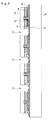
- Fig. 1A is a plan view schematically showing the configuration of a matrix LED as the light source apparatus of an embodiment.
- the matrix LED in the figure is configured to comprise a plurality of light-emitting devices (LEDs) arranged with regularity.
- Fig. 1A mainly shows the shapes of the light-emitting units of the respective light-emitting devices.
- the matrix LED in the figure comprises a plurality of light-emitting device arrays 40, 41, 42, 43, and 44.
- the respective light-emitting device arrays 40 and the like each comprise a plurality of light-emitting devices arranged in a first direction (direction x in the figure).
- the light-emitting units (light-emitting surfaces) of the respective light-emitting devices comprise various sizes and shapes.
- the matrix LED is rectangular in shape overall, with a long-side length L of 9 mm and a short-side length W of 3 mm, for example.
- the light-emitting device array 40 comprises seven light-emitting devices arranged in the first direction. Specifically, the light-emitting device array 40 comprises five light-emitting devices 40a adjacently arranged, one light-emitting device 40b adjacently arranged to one end side of the row made of the five light-emitting devices 40a, and one light-emitting device 40c adjacently arranged to the other end side of the row made of the five light-emitting devices 40a.
- the five light-emitting devices 40a are mutually equal in shape, surface area, and short-side length (width).
- the respective light-emitting devices 40b and 40c are nearly square in shape, with a wider long-side length than that of the respective light-emitting devices 40a.
- the light-emitting device 40b and the light-emitting device 40c are mutually equal in shape, long-side length, short-side length (width), and surface area. Note that the number of divisions is not limited to the above since the light-emitting device array 40 only needs to be divided into a plurality with respect to the long side of the matrix LED.
- the light-emitting device array 41 comprises 30 light-emitting devices 41 a arranged in the first direction. In the figure, only one light-emitting device 41a is representatively denoted with a reference numeral. These 30 light-emitting devices 41a are mutually equal in shape and surface area yet differ in shape and the like from and have a smaller surface area than those of the respective light-emitting devices 40a described above.
- the respective light-emitting devices 41 a of this example are rectangular in shape, extending in a second direction (direction y in the figure) orthogonal to the direction in which they are arranged (direction x in the figure). This light-emitting device array 41 is adjacently arranged to the light-emitting device array 40 in the second direction.
- the respective widths (lengths in the first direction) of the respective light-emitting devices 41a are one-fourth of the width (length in the first direction) of one adjacent light-emitting device 40a, and one-fifth of the width (length in the first direction) of one light-emitting device 40b or one light-emitting device 40c. Then, the light-emitting devices 41a are correspondingly disposed by fours to the respective light-emitting devices 40a inside the range of the widths thereof, and the light-emitting devices 41a are correspondingly disposed by fives to the respective light-emitting devices 40b and 40c inside the range of the widths thereof. Note that the number of divisions is not limited to the above since the light-emitting devices 41a only need to be divided into a plurality with respect to the light-emitting devices 40a, 40b, and 40c.
- the light-emitting device array 42 comprises 30 light-emitting devices 42a arranged in the first direction.
- only one light-emitting device 42a is representatively denoted with a reference numeral.
- These 30 light-emitting devices 42a are mutually equal in shape and surface area yet differ in shape and the like from and have a smaller surface area than those of the respective light-emitting devices 41a described above.
- the respective light-emitting devices 42a are square in shape.
- This light-emitting device array 42 is adjacently arranged to the light-emitting device array 41 in the second direction.
- the respective widths (lengths in the first direction) of the respective light-emitting devices 42a are one-fourth of the width (length in the first direction) of one adjacent light-emitting device 40a, and one-fifth of the width (length in the first direction) of one light-emitting device 40b or one light-emitting device 40c. Then, the respective light-emitting devices 42a are correspondingly disposed one-to-one with the respective light-emitting devices 41a of the adjacent light-emitting device array 41. Note that the light-emitting devices 42a are arranged in correspondence with the number of light-emitting devices 41 a, and therefore the number of light-emitting devices is not limited to the above.
- the light-emitting device array 43 comprises 23 parallelogram-shaped light-emitting devices 43a, seven isosceles triangle-shaped light-emitting devices 43b, and seven isosceles triangle-shaped light-emitting devices 43c arranged in the first direction.
- only one light-emitting device 43a, light-emitting device 43b, and light-emitting device 43c are representatively denoted with reference numerals, respectively.
- This light-emitting device array 43 is adjacently arranged to the light-emitting device array 42 in the second direction.
- the 23 parallelogram-shaped light-emitting devices 43a are mutually equal in shape and surface area.
- the seven isosceles triangle-shaped light-emitting devices 43b are mutually equal in shape and surface area, and the same holds true for the seven isosceles triangle-shaped light-emitting devices 43c as well.
- this light-emitting device array 43 one light-emitting device 43c, three or four light-emitting devices 43a, and one light-emitting device 43b are arranged from the right in the figure as a set and disposed inside the range of the width corresponding to one light-emitting device 40b.
- one light-emitting device 43c, three light-emitting devices 43a, and one light-emitting device 43b are arranged from the right as a set and disposed inside the range of the width corresponding to one light-emitting device 40a. Such an arrangement is repeated with respect to the respective light-emitting devices 40a.
- one light-emitting device 43c, four light-emitting devices 43a, and one light-emitting device 43b are arranged from the right as a set and disposed inside the range of the width corresponding to one light-emitting device 40c.
- the light-emitting devices 43a, 43b, and 43c are arranged in correspondence with the number of light-emitting devices 42a, and therefore the number of light-emitting devices is not limited to the above.
- the light-emitting device array 44 comprises 30 light-emitting devices 44a arranged in the first direction. In the figure, only one light-emitting device 44a is representatively denoted with a reference numeral. These 30 light-emitting devices 44a are mutually equal in shape and surface area. The respective light-emitting devices 44a are square in shape. This light-emitting device array 44 is adjacently arranged to the light-emitting device array 43 in the second direction.
- the respective widths (lengths in the first direction) of the respective light-emitting devices 44a are one-fourth of the width (length in the first direction) of one adjacent light-emitting device 40a, and one-fifth of the width (length in the first direction) of one light-emitting device 40b or one light-emitting device 40c. Then, the respective light-emitting devices 44a are correspondingly disposed one-to-one with the respective light-emitting devices 43a or 43c of the adjacent light-emitting device array 43.
- the light-emitting devices 44a are arranged in correspondence with the number of the light-emitting devices 43a, 43b, and 43c and the widths of the light-emitting devices 40a, 40b, and 40c, and therefore the number of the light-emitting devices is not limited to the above.
- Fig. 1B is a plan view showing a portion of the matrix LED of Fig. 1A , enlarged.
- the pair of diagonal angles of each of the parallelogram-shaped light-emitting devices 43a included in the light-emitting device array 43 is 45°.
- the respective light-emitting devices 43a comprise two parallel sides in the first direction, with one side adjacent to one light-emitting device 42a and the other side adjacent to one light-emitting device 44a.
- the respective lengths of the two parallel sides in the first direction of the respective light-emitting devices 43a are substantially equal to the widths of the respective adjacent light-emitting devices 42a and 44a.
- the two base angles of each of the triangle-shaped light-emitting devices 43b and 43c included in the light-emitting device array 43 are 45°.
- the shape and surface area are substantially the same as those of one light-emitting device 43a.
- the combined result of one light-emitting device 43b and one light-emitting device 43c is a substitute for one light-emitting device 43a.
- the matrix LED of this embodiment is provided with a dividing line 45 at each width equivalent to four light-emitting devices 44a (that is, at each width equivalent to one light-emitting device 40a) or at each width equivalent to five light-emitting devices 44a (that is, at each width equivalent to one light-emitting device 40b) on both sides.
- Four or five light-emitting devices 44a are disposed inside each of the ranges between two dividing lines 45, with the light-emitting devices 43a correspondingly associated with three or four of these light-emitting devices 44a one by one, and one light-emitting device 43c correspondingly associated with the remaining one light-emitting device 44a.
- four or five light-emitting devices 42a are disposed inside each of the ranges between two dividing lines 45, with the light-emitting devices 43a correspondingly associated with three or four of these light-emitting devices 42a one by one, and one light-emitting device 43b correspondingly associated with the remaining one light-emitting device 42a.
- the light-emitting devices 43a are correspondingly associated with four of the five light-emitting devices 44a one by one and one light-emitting device 43c is correspondingly associated with the remaining one light-emitting device 44a; and the light-emitting devices 43a are correspondingly associated with four of the five light-emitting devices 42a one by one and one light-emitting device 43b is correspondingly associated with the remaining one light-emitting device 42a.
- the vehicle headlamp is configured using this matrix LED, thereby making it possible to respectively achieve the AFS function and the ADB function.
- the respective light-emitting devices of the matrix LED are selectively turned on and the emitted light thereof is projected in the space in front of the subject vehicle by a lens, making it possible to form irradiating light such as illustrated in Figs. 5A-5B , Figs. 6A-6B , and Figs. 7A-7B described later.
- the light-emitting device arrays 40, 41, and 42 can be used to form a high beam that illuminates the relatively upper region of the space in front of the vehicle as well as a beam by ADB control.
- the ADB function is achieved by selectively turning on and off the respective light-emitting devices 40a, 40b, 41 a, and 42a included in the respective light-emitting device arrays, in accordance with the position where the forward vehicle exists.
- the respectively included light-emitting devices are set so that the surface areas and widths thereof differ.
- the light emitted from these is projected by the lens, thereby causing the light from the light-emitting device array 40 to irradiate in the relatively upper region of the space in front of the subject vehicle, the light from the light-emitting device array 41 to irradiate in the lower area thereof, and the light from the light-emitting device array 42 to further irradiate in the lower area (refer to Figs. 5A-5B , Figs. 6A-6B , and Figs. 7A-7B described later).
- the ADB function it is possible to achieve selective light irradiation by the light-emitting device array 42 where the surface area of the light-emitting units of the respective light-emitting devices is small in a region where light irradiation control at a high resolution is desired, and selective light irradiation by the light-emitting device arrays 40 and 41 where the surface area of the light-emitting units of the respective light-emitting devices is larger in a region where high resolution is not necessarily required.
- the number of light-emitting devices can be reduced while maintaining the required resolution for light irradiation control, making it possible to simplify the configuration of the apparatus that drives this matrix LED.
- the light-emitting device arrays 43 and 44 can be used to form a portion of the low beam that illuminates the relatively lower region of the space in front of the vehicle.
- the low beam is formed by combining the light irradiated from the respective light-emitting device arrays 43 and 44 in the upper region of the light irradiated from other lamps and the like.
- the respective light-emitting devices 43a, 43b, and 43c included in the light-emitting device array 43 are selectively turned on and off in accordance with the travelling direction of the subject vehicle, making it possible to vary the position of the step area of the so-called cutoff line in the left-right direction. With this arrangement, an AFS function is achieved without using mechanical means.
- the AFS function may be separately and independently specialized from the ADB function by configuring the light source apparatus so that it comprises at least the light-emitting device array 43 only, or more preferably, further combines the light-emitting device array 43 with the light-emitting device array 44.
- Fig. 2 is a schematic cross-sectional view showing a configuration example of the light-emitting devices included in the matrix LED.
- the figure shows the four light-emitting devices formed on one surface side of a support substrate 50.
- the support substrate 50 is a substrate comprising Si, Ge, AlN, SiC, Cu, Mo, W, and the like, for example.
- the respective light-emitting devices are configured to include an n-type electrode 52 and a p-type electrode 53 disposed on an insulating layer 51 made of SiO 2 , SiN, and the like, a p-type GaN semiconductor layer 54 as a cladding layer layered on the p-type electrode 53, an InGaN semiconductor light-emitting layer 55 as an active layer layered on this p-type GaN semiconductor layer 54, and an n-type GaN semiconductor layer 56 as a cladding layer layered on this InGaN semiconductor light-emitting layer 55.
- the insulating layer 51 is sandwiched between the n-type electrode 52 and the p-type electrode 53, achieving electrical insulation.
- the n-type electrode 52 passes through the p-type GaN semiconductor layer 54 and the InGaN semiconductor light-emitting layer 55, contacting the n-type GaN semiconductor layer 56.
- the insulating layer 51 is disposed between the p-type GaN semiconductor layer 54 and the InGaN semiconductor light-emitting layer 55, and the n-type electrode 52, achieving electrical insulation between both.
- a trench (groove) 57 for separating each is disposed between the respective light-emitting devices. According to the light-emitting devices of such a configuration example, it is possible to achieve a matrix LED comprising light-emitting units with various shapes and sizes such as shown in Fig. 1A described above.
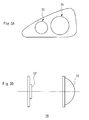
- FIG. 3A is a schematic view showing a configuration example of the lamp unit. Further, Fig. 3B is a schematic view showing the optical configuration of the lamp unit disclosed in Fig. 3A .
- a lamp unit 20R (or 20L) shown in Fig. 3A comprises a high beam unit 24 for irradiating light on the relatively upper side of the space in front of the vehicle where the lamp unit 20R and the like are mounted, and a low beam unit 25 for irradiating light on the relatively lower side of the space in front of the vehicle. As shown in Fig.
- the high beam unit 24 comprises the matrix LED 22 described above and a lens 23 disposed on the front surface thereof, and forms a high beam by projecting the light emitted from the matrix LED 22 frontward by the lens 23.
- the low beam unit 25 is omitted, various configurations such as a unit configured by combining an LED, lens, and the like, or a unit configured by combining a discharge bulb, shade, and the like, may be utilized.
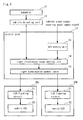
- Fig. 4 is a block diagram showing the configuration of a vehicle headlamp system of an embodiment.
- the vehicle headlamp system shown in Fig. 4 sets a light distribution pattern based on an image obtained by taking an image of the space in front of the subject vehicle (target space) and irradiates light, and is configured to include a camera 10, a vehicle detecting unit 11, a control unit 12, and a pair of lamp units 20R and 20L.-Note that the vehicle detecting unit 11 and the control unit 12 are equivalent to the lighting control apparatus, and the respective lamp units 20R and 20L are equivalent to the vehicle headlamps.
- the camera 10 is installed in a predetermined position of the subject vehicle (near the inner rearview mirror, for example), takes an image of the space in front of the vehicle, and outputs the image (image data).
- the vehicle detecting unit 11 detects the position of the forward vehicle by performing predetermined image processing using the image data output from the camera 10, and outputs the position information to the control unit 12.
- the term "forward vehicle” here refers to a preceding vehicle or an oncoming vehicle.
- This vehicle detecting unit 11 is achieved by executing a predetermined operation program in a computer system comprising a CPU, ROM, RAM, and the like, for example.
- the vehicle detecting unit 11 is integrally configured with the camera 10, for example. Note that the function of the vehicle detecting unit 11 may be achieved in the control unit 12.
- the control unit 12 is achieved by executing a predetermined operation program in a computer system comprising a CPU, ROM, RAM, and the like, for example, and comprises an AFS setting unit 13, a light irradiation range setting unit 14 and a light distribution control unit 15 as function blocks.
- the AFS setting unit (ON target setting unit) 13 variably sets the position of the step area of the cutoff line formed near the upper end of the low beam irradiation range in the left-right direction in accordance with the turning direction of the subject vehicle, based on a vehicle speed signal (vehicle speed information) and a steering wheel angle signal (steering wheel angle information) obtained from the subject vehicle. Specifically, the AFS setting unit 13 sets the light-emitting devices to be turned on among the respective light-emitting devices included in the light-emitting device array 43.
- the light irradiation range setting unit 14 sets the light irradiation range corresponding to the position of the forward vehicle detected by the vehicle detecting unit 11. Further, the light irradiation range setting unit 14 sets the light irradiation range corresponding to the cutoff line position set by the AFS setting unit 13. Specifically, the light irradiation range setting unit 14 sets the area where the forward vehicle exists as a light non-irradiation range, and all other areas as the light irradiation range.
- the light irradiation range setting unit 14 sets the region further on the left side than this cutoff line as the light irradiation range and the region further on the right side as the light non-irradiation range, in correspondence with the cutoff line position set by the AFS setting unit 13.
- the light distribution control unit 15 generates a light distribution control signal corresponding to the light distribution pattern based on the light irradiation range and non-irradiation range set by the light irradiation range setting unit 14, and outputs the light distribution control signal to the respective lamp units 20R and 20L.
- the lamp unit 20R is installed on the front right side of the subject vehicle, and is used to irradiate light that illuminates the area in front of the subject vehicle, and comprises an LED lighting circuit 21 and a matrix LED 22.
- the lamp unit 20L is installed on the front left side of the subject vehicle, and is used to irradiate light that illuminates the area in front of the subject vehicle, and comprises the LED lighting circuit 21 and the matrix LED 22.
- the LED lighting circuit 21 selectively turns on the respective LEDs by supplying a drive signal to the plurality of LEDs (light-emitting diodes) included in the matrix LED 22, based on the control signal output from the light distribution control unit 15.
- the matrix LED 22 comprises a plurality of LEDs, and each of the plurality of LEDs is selectively turned on based on the drive signal supplied from the LED lighting circuit 21.
- This the matrix LED 22 is capable of individually turning on each of the plurality of LEDs and controlling the light intensity (brightness) thereof.
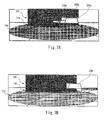
- Fig. 5A and Fig. 5B are figures for explaining an example of a light distribution pattern formed by the vehicle headlamp system described above.
- Fig. 5A and Fig. 5B schematically show the state in front of the subject vehicle in a case where the subject vehicle is travelling on a road with two traffic lanes on one side and a forward vehicle 200 (oncoming vehicle in this example) exists in the opposite traffic lane (the same for Figs. 6A-6B and Figs. 7A-7B described later as well).
- 5A comprises the low beam region 100 (the first irradiating light) formed by the respective low beam units 25 of the lamp units 20R and 20L, the cutoff region 101 (the second irradiating light) formed by the respective high beam units 24 of the lamp units 20R and 20L.
- the cutoff region 101 is formed in the upper region of the low beam region 100 so that there is no space between the cutoff region 101 and the low beam region 100. Specifically, the cutoff region 101 is formed partially superimposed near the end area of the upper side of the low beam region 100, for example.
- a cutoff line with a relatively high left side and relatively low right side is formed on each side of the step area 110, on the upper side of the cutoff region 101. The height of this cutoff line is generally set so that the cutoff line is positioned lower than the upper side (generally the position of the windshield) of the forward vehicle 200. Note that, for ease of explanation, the high beam region is not shown.
- the step area 110 of the cutoff line is disposed in the substantial center of the area in front of the subject vehicle during forward travelling.
- the step area 110 of the cutoff line is set in a position shifted further to the right side in accordance with the steering wheel angle. Note that, although not shown, when the subject vehicle is travelling on a curve that bends leftward, the step area 110 is set in a position shifted further to the left side in accordance with the steering wheel angle.
- step area 110 of the cutoff line variably set in accordance with the steering wheel angle, a state in which light irradiation is performed in the travelling direction of the subject vehicle is achieved.
- the respective light-emitting devices (refer to Fig.
- the respective light-emitting devices of the light-emitting device array comprising the parallelogram-shaped or isosceles triangle-shaped light-emitting units are selectively caused to emit light, thereby making it possible to variably set the step area 110 of the cutoff line and thus achieve the AFS function without using mechanical components.
- Fig. 6A and Fig. 6B are figures for explaining an example of a light distribution pattern formed by the vehicle headlamp system described above.
- the light distribution pattern shown in Fig. 6A comprises the low beam region 100 formed by the respective low beam units 25 of the lamp units 20R and 20L, the high beam region 102 formed by the respective high beam units 24 of the lamp units 20R and 20L, and the cutoff region 101 formed by the respective high beam units 24 of the lamp units 20R and 20L.
- a portion of the high beam region 102 is set as the light non-irradiation range (shaded range) in accordance with the respective positions of a forward vehicle 200, which is an oncoming vehicle, or more specifically, a position in the upper region (generally the position of the windshield) of this forward vehicle 200.
- a portion of the high beam region 102 is set as the light non-irradiation range (shaded range) in accordance with the position of the preceding vehicle 300 driving on a curve that bends rightward, or more specifically, a position in the upper region (generally the position of the rear window) of this forward vehicle 300.
- Fig. 7A and Fig. 7B are figures for explaining an example of a light distribution pattern formed by the vehicle headlamp system described above.
- the light distribution pattern shown in Fig. 7A comprises the low beam region 100 formed by the respective low beam units 25 of the lamp units 20R and 20L, the cutoff region 101 formed by the respective high beam units 24 of the lamp units 20R and 20L, and the high beam region 102 formed by the respective high beam units 24 of the lamp units 20R and 20L.
- a portion of the high beam region 102 is set as the light non-irradiation range (shaded range) in accordance with the respective positions of three forward vehicles 200a, 200b, and 200c, which are oncoming vehicles, or more specifically, a position in the upper region (generally the position of the windshield) of these forward vehicles 200a, 200b, and 200c.
- a portion of the high beam region 102 is set as the light non-irradiation range (shaded range) in accordance with the position of the forward vehicle 200 that is travelling in the opposing traffic lane on a curve that bends rightward, or more specifically, a position in the upper region (generally the position of the windshield) of this forward vehicle 200.
- the present invention may be utilized with a double lamp type headlamp if the high beam unit 24 and the low beam unit 25 are incorporated into a single lamp unit.
- a high beam light distribution can be created if all high beam units 24 and low beam units 25 are turned on.
- a low beam light distribution can be created if the cutoff line is formed by the light-emitting device arrays 43 and 44 of the high beam unit 24 and the low beam unit 25 is simultaneously irradiated.
- the position information of a pedestrian and a forward vehicle is obtained by angles in the embodiments described above, the position information may be expressed by two-dimensional coordinates.
Landscapes
- Engineering & Computer Science (AREA)
- General Engineering & Computer Science (AREA)
- Physics & Mathematics (AREA)
- Microelectronics & Electronic Packaging (AREA)
- Optics & Photonics (AREA)
- Mechanical Engineering (AREA)
- Non-Portable Lighting Devices Or Systems Thereof (AREA)
- Lighting Device Outwards From Vehicle And Optical Signal (AREA)
Abstract

Description
- The present invention relates to a light distribution control technique that controls a light irradiation range per subsection when light is irradiated in front of a vehicle.
- When driving a vehicle at night, a driver basically checks the area in front of the vehicle by irradiating a high beam from the headlamps, switching to a low beam as necessary, but also often uses the low beam due to the hassle of switching as well as the road environment. Hence, light is irradiated on the upper side above a so-called cutoff line, possibly casting glare onto an oncoming vehicle or preceding vehicle (hereinafter referred to as "forward vehicle"). Thus, as disclosed in Japanese Patent No.
4624257 - As an example of a vehicle headlamp used for the ADB control described above, there is known a vehicle headlamp that combines an LED array in which a plurality of light-emitting devices (light-emitting diodes) is arranged in a matrix shape and a projection lens that projects the light emitted from this LED array (refer to Japanese Patent Laid-Open No.
2010-40528 - However, according to the ADB system of the precedent example described above, the number of light-emitting devices included in the LED array is preferably further increased to further enhance the resolution of the controllable light-irradiation range or shaded range.
- Nevertheless, the driving apparatus for selectively turning on these light-emitting devices increases in complexity in proportion to the increase in the number of light-emitting devices, causing inconvenience.
- It is therefore an object of the specific aspects according to the present invention to provide a technique capable of reducing the number of required light-emitting devices while sufficiently maintaining the needed resolution of the irradiation range or shaded range of the ADB system.
- The light source apparatus of an aspect according to the present invention is a light source apparatus incorporated and used in a vehicle headlamp, comprising: (a) a plurality of light-emitting device arrays, each extending in a first direction and adjacently disposed in a second direction that crosses the first direction, wherein: (b) each of the plurality of light-emitting device arrays comprises a plurality of light-emitting devices arranged along the first direction and is substantially the same in length in the first direction, and (c) the number of the respective light-emitting devices of a second light-emitting device array adjacent to the first light-emitting device array, and the surface area and/or width in the first direction of the light-emitting units of the respective light-emitting devices of the first light-emitting device array is set larger than the surface area and/or width in the first direction of the light-emitting units of the respective light-emitting devices of the second light-emitting device array adjacent to the first light-emitting device array.
- According to the configuration described above, the number, surface area, and the like of the light-emitting devices respectively included in the adjacent light-emitting device arrays are set differently and thus, by projecting the light emitted from these light-emitting devices by a lens, it is possible to achieve selective light irradiation by the light-emitting device arrays wherein the surface area and the like of the light-emitting units of the respective light-emitting devices are small in a region where light irradiation control at a high resolution is desired, and achieve selective light irradiation by the light-emitting device arrays where the surface area of the light-emitting units of the respective light-emitting devices is larger in a region where high resolution is not necessarily required in achieving the ADB function. As a result, the number of light-emitting devices can be reduced while maintaining the required resolution for light irradiation control, making it possible to simplify the configuration of the apparatus that drives this matrix LED.
- Additionally, in the light source apparatus described above, among the respective light-emitting devices of the first light-emitting device array, the surface area and/or width in the first direction of the light-emitting units of the light-emitting devices of one end and/or the other end in the first direction are preferably set larger than the surface area and/or width in the first direction of the other respective light-emitting devices.
- The light from the light-emitting devices of one end and the other end is projected by the lens and irradiated on the left end or the right end of the area in front of the vehicle, and thus the required resolution for this light may conceivably be lower than that of the light irradiated in the center area in front of the vehicle. Accordingly, the number of light-emitting devices can be further reduced by increasing the surface area and the like of the light-emitting units of the light-emitting devices of one end and the other end.
- In the light source apparatus described above, all of the widths in the second direction of the respective light-emitting devices of the first light-emitting device array may be the same.
- With this arrangement, it is possible to avoid the occurrence of a region that does not contribute to light emission between the first light-emitting device array and an adjacent other light-emitting device array, to the extent possible.
- Additionally, in the light source apparatus described above, among the plurality of light-emitting device arrays, the surface area and/or width in the first direction of the respective light-emitting units of the respective light-emitting devices of the second light-emitting device array are preferably set larger than the surface area and/or width in the first direction of the respective light-emitting units of a third light-emitting device array adjacent to the second light-emitting device array.
- With this arrangement, it is possible to achieve light irradiation at a higher resolution in a region where fine light irradiation control is desired.
- Additionally, in the light source apparatus described above, the respective light-emitting devices of the second light-emitting device array and the respective light-emitting devices of the third light-emitting device array are preferably substantially the same in width in the first direction while different in width in the second direction.
- Additionally, in the light source apparatus described above, the respective light-emitting devices of a fourth light-emitting device array on the other end side in the second direction among the plurality of light-emitting device arrays preferably comprise an outer edge shape that includes an edge that obliquely crosses the first direction.
- With this arrangement, it is possible to vary the step area of this cutoff line by making the light from this fourth light-emitting device array correspond to the cutoff line, for example, and achieve a so-called AFS function as well.
- The vehicle headlamp of an aspect according to the present invention is a vehicle headlamp comprising the light source apparatus described above and a lens that projects the light emitted from this light source apparatus.
- According to the above configuration, while sufficiently maintaining the needed resolution of the irradiation range or shaded range of the ADB system, a vehicle headlamp capable of reducing the number of required light-emitting devices is provided.
- The vehicle headlamp system of an aspect according to the present invention is a vehicle headlamp system that comprises the vehicle headlamp described above and a lighting control unit that controls the vehicle headlamp, wherein the lighting control unit comprises: (a) a detecting unit that detects a position of a forward vehicle based on an image of the area in front of the vehicle taken by a camera, (b) a light irradiation range setting unit that sets the region that includes the forward vehicle as a light non-irradiation range and all other regions as a light irradiation range, based on the position of the forward vehicle, and (c) a light distribution control unit that generates a control signal in accordance with the light irradiation range and the light non-irradiation range set by the light irradiation range setting unit, and outputs the control signal to the vehicle headlamp.
- According to the above configuration, while sufficiently maintaining the needed resolution of the irradiation range or shaded range of the ADB system, a vehicle headlamp capable of reducing the number of required light-emitting devices is provided.
-
-
Fig. 1A is a plan view schematically showing the configuration of a matrix LED as the light source apparatus of an embodiment. -
Fig. 1B is a plan view showing a portion of the matrix LED ofFig. 1A , enlarged. -
Fig. 2 is a schematic cross-sectional view showing a configuration example of the light-emitting devices included in the matrix LED. -
Fig. 3A is a schematic view showing a configuration example of the lamp unit. -
Fig. 3B is a schematic view showing the optical configuration of the lamp unit disclosed inFig. 3A . -
Fig. 4 is a block diagram showing the configuration of a vehicle headlamp system of an embodiment. -
Fig. 5A and Fig. 5B are figures for explaining an example of a light distribution pattern formed by the vehicle headlamp system described in the specification. -
Fig. 6A and Fig. 6B are another figures for explaining an example of a light distribution pattern formed by the vehicle headlamp system described in the specification. -
Fig. 7A and Fig. 7B are another figures for explaining an example of a light distribution pattern formed by the vehicle headlamp system described in the specification. - Now, an embodiment of the present invention will be described below with reference to the accompanying drawings.
-
Fig. 1A is a plan view schematically showing the configuration of a matrix LED as the light source apparatus of an embodiment. The matrix LED in the figure is configured to comprise a plurality of light-emitting devices (LEDs) arranged with regularity.Fig. 1A mainly shows the shapes of the light-emitting units of the respective light-emitting devices. The matrix LED in the figure comprises a plurality of light-emitting device arrays emitting device arrays 40 and the like each comprise a plurality of light-emitting devices arranged in a first direction (direction x in the figure). As shown in the figure, the light-emitting units (light-emitting surfaces) of the respective light-emitting devices comprise various sizes and shapes. The matrix LED is rectangular in shape overall, with a long-side length L of 9 mm and a short-side length W of 3 mm, for example. - The light-
emitting device array 40 comprises seven light-emitting devices arranged in the first direction. Specifically, the light-emittingdevice array 40 comprises five light-emittingdevices 40a adjacently arranged, one light-emittingdevice 40b adjacently arranged to one end side of the row made of the five light-emittingdevices 40a, and one light-emittingdevice 40c adjacently arranged to the other end side of the row made of the five light-emittingdevices 40a. The five light-emittingdevices 40a are mutually equal in shape, surface area, and short-side length (width). Conversely, the respective light-emittingdevices devices 40a. The light-emittingdevice 40b and the light-emittingdevice 40c are mutually equal in shape, long-side length, short-side length (width), and surface area. Note that the number of divisions is not limited to the above since the light-emittingdevice array 40 only needs to be divided into a plurality with respect to the long side of the matrix LED. - The light-emitting
device array 41 comprises 30 light-emittingdevices 41 a arranged in the first direction. In the figure, only one light-emittingdevice 41a is representatively denoted with a reference numeral. These 30 light-emittingdevices 41a are mutually equal in shape and surface area yet differ in shape and the like from and have a smaller surface area than those of the respective light-emittingdevices 40a described above. The respective light-emittingdevices 41 a of this example are rectangular in shape, extending in a second direction (direction y in the figure) orthogonal to the direction in which they are arranged (direction x in the figure). This light-emittingdevice array 41 is adjacently arranged to the light-emittingdevice array 40 in the second direction. The respective widths (lengths in the first direction) of the respective light-emittingdevices 41a are one-fourth of the width (length in the first direction) of one adjacent light-emittingdevice 40a, and one-fifth of the width (length in the first direction) of one light-emittingdevice 40b or one light-emittingdevice 40c. Then, the light-emittingdevices 41a are correspondingly disposed by fours to the respective light-emittingdevices 40a inside the range of the widths thereof, and the light-emittingdevices 41a are correspondingly disposed by fives to the respective light-emittingdevices devices 41a only need to be divided into a plurality with respect to the light-emittingdevices - The light-emitting
device array 42 comprises 30 light-emittingdevices 42a arranged in the first direction. In the figure, only one light-emittingdevice 42a is representatively denoted with a reference numeral. These 30 light-emittingdevices 42a are mutually equal in shape and surface area yet differ in shape and the like from and have a smaller surface area than those of the respective light-emittingdevices 41a described above. The respective light-emittingdevices 42a are square in shape. This light-emittingdevice array 42 is adjacently arranged to the light-emittingdevice array 41 in the second direction. The respective widths (lengths in the first direction) of the respective light-emittingdevices 42a are one-fourth of the width (length in the first direction) of one adjacent light-emittingdevice 40a, and one-fifth of the width (length in the first direction) of one light-emittingdevice 40b or one light-emittingdevice 40c. Then, the respective light-emittingdevices 42a are correspondingly disposed one-to-one with the respective light-emittingdevices 41a of the adjacent light-emittingdevice array 41. Note that the light-emittingdevices 42a are arranged in correspondence with the number of light-emittingdevices 41 a, and therefore the number of light-emitting devices is not limited to the above. - The light-emitting
device array 43 comprises 23 parallelogram-shaped light-emittingdevices 43a, seven isosceles triangle-shaped light-emittingdevices 43b, and seven isosceles triangle-shaped light-emittingdevices 43c arranged in the first direction. In the figure, only one light-emittingdevice 43a, light-emittingdevice 43b, and light-emittingdevice 43c are representatively denoted with reference numerals, respectively. This light-emittingdevice array 43 is adjacently arranged to the light-emittingdevice array 42 in the second direction. The 23 parallelogram-shaped light-emittingdevices 43a are mutually equal in shape and surface area. Similarly, the seven isosceles triangle-shaped light-emittingdevices 43b are mutually equal in shape and surface area, and the same holds true for the seven isosceles triangle-shaped light-emittingdevices 43c as well. Specifically, in this light-emittingdevice array 43, one light-emittingdevice 43c, three or four light-emittingdevices 43a, and one light-emittingdevice 43b are arranged from the right in the figure as a set and disposed inside the range of the width corresponding to one light-emittingdevice 40b. Next, one light-emittingdevice 43c, three light-emittingdevices 43a, and one light-emittingdevice 43b are arranged from the right as a set and disposed inside the range of the width corresponding to one light-emittingdevice 40a. Such an arrangement is repeated with respect to the respective light-emittingdevices 40a. Next, one light-emittingdevice 43c, four light-emittingdevices 43a, and one light-emittingdevice 43b are arranged from the right as a set and disposed inside the range of the width corresponding to one light-emittingdevice 40c. Note that the light-emittingdevices devices 42a, and therefore the number of light-emitting devices is not limited to the above. - The light-emitting
device array 44 comprises 30 light-emittingdevices 44a arranged in the first direction. In the figure, only one light-emittingdevice 44a is representatively denoted with a reference numeral. These 30 light-emittingdevices 44a are mutually equal in shape and surface area. The respective light-emittingdevices 44a are square in shape. This light-emittingdevice array 44 is adjacently arranged to the light-emittingdevice array 43 in the second direction. The respective widths (lengths in the first direction) of the respective light-emittingdevices 44a are one-fourth of the width (length in the first direction) of one adjacent light-emittingdevice 40a, and one-fifth of the width (length in the first direction) of one light-emittingdevice 40b or one light-emittingdevice 40c. Then, the respective light-emittingdevices 44a are correspondingly disposed one-to-one with the respective light-emittingdevices device array 43. Note that the light-emittingdevices 44a are arranged in correspondence with the number of the light-emittingdevices devices -
Fig. 1B is a plan view showing a portion of the matrix LED ofFig. 1A , enlarged. As shown in the figure, the pair of diagonal angles of each of the parallelogram-shaped light-emittingdevices 43a included in the light-emittingdevice array 43 is 45°. Then, the respective light-emittingdevices 43a comprise two parallel sides in the first direction, with one side adjacent to one light-emittingdevice 42a and the other side adjacent to one light-emittingdevice 44a. The respective lengths of the two parallel sides in the first direction of the respective light-emittingdevices 43a are substantially equal to the widths of the respective adjacent light-emittingdevices devices device array 43 are 45°. When one light-emittingdevice 43b and one light-emittingdevice 43c are combined, the shape and surface area are substantially the same as those of one light-emittingdevice 43a. In other words, the combined result of one light-emittingdevice 43b and one light-emittingdevice 43c is a substitute for one light-emittingdevice 43a. - The matrix LED of this embodiment, for process convenience, is provided with a
dividing line 45 at each width equivalent to four light-emittingdevices 44a (that is, at each width equivalent to one light-emittingdevice 40a) or at each width equivalent to five light-emittingdevices 44a (that is, at each width equivalent to one light-emittingdevice 40b) on both sides. Four or five light-emittingdevices 44a are disposed inside each of the ranges between two dividinglines 45, with the light-emittingdevices 43a correspondingly associated with three or four of these light-emittingdevices 44a one by one, and one light-emittingdevice 43c correspondingly associated with the remaining one light-emittingdevice 44a. Similarly, four or five light-emittingdevices 42a are disposed inside each of the ranges between two dividinglines 45, with the light-emittingdevices 43a correspondingly associated with three or four of these light-emittingdevices 42a one by one, and one light-emittingdevice 43b correspondingly associated with the remaining one light-emittingdevice 42a. Note that, on both sides of the matrix LED, the light-emittingdevices 43a are correspondingly associated with four of the five light-emittingdevices 44a one by one and one light-emittingdevice 43c is correspondingly associated with the remaining one light-emittingdevice 44a; and the light-emittingdevices 43a are correspondingly associated with four of the five light-emittingdevices 42a one by one and one light-emittingdevice 43b is correspondingly associated with the remaining one light-emittingdevice 42a. - The vehicle headlamp is configured using this matrix LED, thereby making it possible to respectively achieve the AFS function and the ADB function. Specifically, the respective light-emitting devices of the matrix LED are selectively turned on and the emitted light thereof is projected in the space in front of the subject vehicle by a lens, making it possible to form irradiating light such as illustrated in
Figs. 5A-5B ,Figs. 6A-6B , andFigs. 7A-7B described later. Specifically, the light-emittingdevice arrays devices - Further, in the three adj acent light-emitting
device arrays Fig.1A ), the respectively included light-emitting devices are set so that the surface areas and widths thereof differ. The light emitted from these is projected by the lens, thereby causing the light from the light-emittingdevice array 40 to irradiate in the relatively upper region of the space in front of the subject vehicle, the light from the light-emittingdevice array 41 to irradiate in the lower area thereof, and the light from the light-emittingdevice array 42 to further irradiate in the lower area (refer toFigs. 5A-5B ,Figs. 6A-6B , andFigs. 7A-7B described later). In thus achieving the ADB function, it is possible to achieve selective light irradiation by the light-emittingdevice array 42 where the surface area of the light-emitting units of the respective light-emitting devices is small in a region where light irradiation control at a high resolution is desired, and selective light irradiation by the light-emittingdevice arrays - Further, the light-emitting
device arrays device arrays devices device array 43 are selectively turned on and off in accordance with the travelling direction of the subject vehicle, making it possible to vary the position of the step area of the so-called cutoff line in the left-right direction. With this arrangement, an AFS function is achieved without using mechanical means. Note that while the above has described a light source apparatus that establishes both the ADB function and the AFS function, the AFS function may be separately and independently specialized from the ADB function by configuring the light source apparatus so that it comprises at least the light-emittingdevice array 43 only, or more preferably, further combines the light-emittingdevice array 43 with the light-emittingdevice array 44. -
Fig. 2 is a schematic cross-sectional view showing a configuration example of the light-emitting devices included in the matrix LED. The figure shows the four light-emitting devices formed on one surface side of asupport substrate 50. Thesupport substrate 50 is a substrate comprising Si, Ge, AlN, SiC, Cu, Mo, W, and the like, for example. The respective light-emitting devices are configured to include an n-type electrode 52 and a p-type electrode 53 disposed on an insulatinglayer 51 made of SiO2, SiN, and the like, a p-typeGaN semiconductor layer 54 as a cladding layer layered on the p-type electrode 53, an InGaN semiconductor light-emittinglayer 55 as an active layer layered on this p-typeGaN semiconductor layer 54, and an n-typeGaN semiconductor layer 56 as a cladding layer layered on this InGaN semiconductor light-emittinglayer 55. The insulatinglayer 51 is sandwiched between the n-type electrode 52 and the p-type electrode 53, achieving electrical insulation. Further, the n-type electrode 52 passes through the p-typeGaN semiconductor layer 54 and the InGaN semiconductor light-emittinglayer 55, contacting the n-typeGaN semiconductor layer 56. The insulatinglayer 51 is disposed between the p-typeGaN semiconductor layer 54 and the InGaN semiconductor light-emittinglayer 55, and the n-type electrode 52, achieving electrical insulation between both. A trench (groove) 57 for separating each is disposed between the respective light-emitting devices. According to the light-emitting devices of such a configuration example, it is possible to achieve a matrix LED comprising light-emitting units with various shapes and sizes such as shown inFig. 1A described above. -
Fig. 3A is a schematic view showing a configuration example of the lamp unit. Further,Fig. 3B is a schematic view showing the optical configuration of the lamp unit disclosed inFig. 3A . Alamp unit 20R (or 20L) shown inFig. 3A comprises ahigh beam unit 24 for irradiating light on the relatively upper side of the space in front of the vehicle where thelamp unit 20R and the like are mounted, and alow beam unit 25 for irradiating light on the relatively lower side of the space in front of the vehicle. As shown inFig. 3B , thehigh beam unit 24 comprises thematrix LED 22 described above and alens 23 disposed on the front surface thereof, and forms a high beam by projecting the light emitted from thematrix LED 22 frontward by thelens 23. Note that while a detailed explanation of the configuration of thelow beam unit 25 is omitted, various configurations such as a unit configured by combining an LED, lens, and the like, or a unit configured by combining a discharge bulb, shade, and the like, may be utilized. -
Fig. 4 is a block diagram showing the configuration of a vehicle headlamp system of an embodiment. The vehicle headlamp system shown inFig. 4 sets a light distribution pattern based on an image obtained by taking an image of the space in front of the subject vehicle (target space) and irradiates light, and is configured to include acamera 10, avehicle detecting unit 11, acontrol unit 12, and a pair oflamp units 20R and 20L.-Note that thevehicle detecting unit 11 and thecontrol unit 12 are equivalent to the lighting control apparatus, and therespective lamp units - The
camera 10 is installed in a predetermined position of the subject vehicle (near the inner rearview mirror, for example), takes an image of the space in front of the vehicle, and outputs the image (image data). - The
vehicle detecting unit 11 detects the position of the forward vehicle by performing predetermined image processing using the image data output from thecamera 10, and outputs the position information to thecontrol unit 12. The term "forward vehicle" here refers to a preceding vehicle or an oncoming vehicle. Thisvehicle detecting unit 11 is achieved by executing a predetermined operation program in a computer system comprising a CPU, ROM, RAM, and the like, for example. Thevehicle detecting unit 11 is integrally configured with thecamera 10, for example. Note that the function of thevehicle detecting unit 11 may be achieved in thecontrol unit 12. - The
control unit 12 is achieved by executing a predetermined operation program in a computer system comprising a CPU, ROM, RAM, and the like, for example, and comprises anAFS setting unit 13, a light irradiationrange setting unit 14 and a lightdistribution control unit 15 as function blocks. - The AFS setting unit (ON target setting unit) 13 variably sets the position of the step area of the cutoff line formed near the upper end of the low beam irradiation range in the left-right direction in accordance with the turning direction of the subject vehicle, based on a vehicle speed signal (vehicle speed information) and a steering wheel angle signal (steering wheel angle information) obtained from the subject vehicle. Specifically, the
AFS setting unit 13 sets the light-emitting devices to be turned on among the respective light-emitting devices included in the light-emittingdevice array 43. - The light irradiation
range setting unit 14 sets the light irradiation range corresponding to the position of the forward vehicle detected by thevehicle detecting unit 11. Further, the light irradiationrange setting unit 14 sets the light irradiation range corresponding to the cutoff line position set by theAFS setting unit 13. Specifically, the light irradiationrange setting unit 14 sets the area where the forward vehicle exists as a light non-irradiation range, and all other areas as the light irradiation range. Further, the light irradiationrange setting unit 14 sets the region further on the left side than this cutoff line as the light irradiation range and the region further on the right side as the light non-irradiation range, in correspondence with the cutoff line position set by theAFS setting unit 13. - The light
distribution control unit 15 generates a light distribution control signal corresponding to the light distribution pattern based on the light irradiation range and non-irradiation range set by the light irradiationrange setting unit 14, and outputs the light distribution control signal to therespective lamp units - The
lamp unit 20R is installed on the front right side of the subject vehicle, and is used to irradiate light that illuminates the area in front of the subject vehicle, and comprises anLED lighting circuit 21 and amatrix LED 22. Similarly, thelamp unit 20L is installed on the front left side of the subject vehicle, and is used to irradiate light that illuminates the area in front of the subject vehicle, and comprises theLED lighting circuit 21 and thematrix LED 22. - The
LED lighting circuit 21 selectively turns on the respective LEDs by supplying a drive signal to the plurality of LEDs (light-emitting diodes) included in thematrix LED 22, based on the control signal output from the lightdistribution control unit 15. - As shown in
Fig.1A , thematrix LED 22 comprises a plurality of LEDs, and each of the plurality of LEDs is selectively turned on based on the drive signal supplied from theLED lighting circuit 21. This thematrix LED 22 is capable of individually turning on each of the plurality of LEDs and controlling the light intensity (brightness) thereof. -
Fig. 5A and Fig. 5B are figures for explaining an example of a light distribution pattern formed by the vehicle headlamp system described above.Fig. 5A and Fig. 5B schematically show the state in front of the subject vehicle in a case where the subject vehicle is travelling on a road with two traffic lanes on one side and a forward vehicle 200 (oncoming vehicle in this example) exists in the opposite traffic lane (the same forFigs. 6A-6B andFigs. 7A-7B described later as well). The light distribution pattern shown inFig. 5A comprises the low beam region 100 (the first irradiating light) formed by the respectivelow beam units 25 of thelamp units high beam units 24 of thelamp units - As shown in the figure, the
cutoff region 101 is formed in the upper region of thelow beam region 100 so that there is no space between thecutoff region 101 and thelow beam region 100. Specifically, thecutoff region 101 is formed partially superimposed near the end area of the upper side of thelow beam region 100, for example. A cutoff line with a relatively high left side and relatively low right side is formed on each side of thestep area 110, on the upper side of thecutoff region 101. The height of this cutoff line is generally set so that the cutoff line is positioned lower than the upper side (generally the position of the windshield) of theforward vehicle 200. Note that, for ease of explanation, the high beam region is not shown. - As shown in
Fig. 5A , thestep area 110 of the cutoff line is disposed in the substantial center of the area in front of the subject vehicle during forward travelling. In contrast, as shown inFig. 5B , when the subject vehicle is travelling on a curve that bends rightward, thestep area 110 of the cutoff line is set in a position shifted further to the right side in accordance with the steering wheel angle. Note that, although not shown, when the subject vehicle is travelling on a curve that bends leftward, thestep area 110 is set in a position shifted further to the left side in accordance with the steering wheel angle. - With such the
step area 110 of the cutoff line variably set in accordance with the steering wheel angle, a state in which light irradiation is performed in the travelling direction of the subject vehicle is achieved. In particular, the respective light-emitting devices (refer toFig. 1A ) that contribute to the formation of thestep area 110 of the cutoff line among the plurality of light-emitting devices of thematrix LED 22 are formed so as to comprise parallelogram-shaped light-emitting units with each of a pair of vertically opposite angles at 45° or isosceles triangle-shaped light-emitting units with two angles at a diagonal of 45°, thereby making it possible to directly generate a light irradiation line at a 45° angle in correspondence with thestep area 110, without using a member such as a shade to shade the light. Further, the respective light-emitting devices of the light-emitting device array comprising the parallelogram-shaped or isosceles triangle-shaped light-emitting units are selectively caused to emit light, thereby making it possible to variably set thestep area 110 of the cutoff line and thus achieve the AFS function without using mechanical components. -
Fig. 6A and Fig. 6B are figures for explaining an example of a light distribution pattern formed by the vehicle headlamp system described above. The light distribution pattern shown inFig. 6A comprises thelow beam region 100 formed by the respectivelow beam units 25 of thelamp units high beam region 102 formed by the respectivehigh beam units 24 of thelamp units cutoff region 101 formed by the respectivehigh beam units 24 of thelamp units high beam region 102 is set as the light non-irradiation range (shaded range) in accordance with the respective positions of aforward vehicle 200, which is an oncoming vehicle, or more specifically, a position in the upper region (generally the position of the windshield) of thisforward vehicle 200. Similarly, according to the light distribution pattern shown inFig. 6B , a portion of thehigh beam region 102 is set as the light non-irradiation range (shaded range) in accordance with the position of the precedingvehicle 300 driving on a curve that bends rightward, or more specifically, a position in the upper region (generally the position of the rear window) of thisforward vehicle 300. -
Fig. 7A and Fig. 7B are figures for explaining an example of a light distribution pattern formed by the vehicle headlamp system described above. The light distribution pattern shown inFig. 7A comprises thelow beam region 100 formed by the respectivelow beam units 25 of thelamp units cutoff region 101 formed by the respectivehigh beam units 24 of thelamp units high beam region 102 formed by the respectivehigh beam units 24 of thelamp units high beam region 102 is set as the light non-irradiation range (shaded range) in accordance with the respective positions of threeforward vehicles forward vehicles Fig. 7B , a portion of thehigh beam region 102 is set as the light non-irradiation range (shaded range) in accordance with the position of theforward vehicle 200 that is travelling in the opposing traffic lane on a curve that bends rightward, or more specifically, a position in the upper region (generally the position of the windshield) of thisforward vehicle 200. - Note that the present invention may be utilized with a double lamp type headlamp if the
high beam unit 24 and thelow beam unit 25 are incorporated into a single lamp unit. A high beam light distribution can be created if allhigh beam units 24 andlow beam units 25 are turned on. Further, a low beam light distribution can be created if the cutoff line is formed by the light-emittingdevice arrays high beam unit 24 and thelow beam unit 25 is simultaneously irradiated. - Note that this invention is not limited to the subject matter of the foregoing embodiments, and can be implemented by being variously modified within the scope of the gist of the present invention. For example, while the position information of a pedestrian and a forward vehicle is obtained by angles in the embodiments described above, the position information may be expressed by two-dimensional coordinates.
Claims (19)
- A light source apparatus incorporated and used in a vehicle headlamp, comprising:a plurality of light-emitting device arrays, each extending in a first direction and adjacently disposed in a second direction that crosses the first direction, wherein:each of the plurality of light-emitting device arrays comprises a plurality of light-emitting devices arranged along the first direction and is substantially the same in length in the first direction, andthe number of the respective light-emitting devices of a first light-emitting device array at one end in a second direction among the plurality of light-emitting device arrays is set smaller than the number of the respective light-emitting devices of a second light-emitting device array adjacent to the first light-emitting device array, and the surface area and/or width in the first direction of the light-emitting units of the respective light-emitting devices of the first light-emitting device array is set larger than the surface area and/or width in the first direction of the light-emitting units of the respective light-emitting devices of the second light-emitting device array adjacent to the first light-emitting device array.
- The light source apparatus according to claim 1,
wherein the surface area and/or width in the first direction of the light-emitting units of the light-emitting devices of one end and/or the other end in the first direction among the respective light-emitting devices of the first light-emitting device array are set larger than the surface area and/or width in the first direction of the other respective light-emitting devices. - The light source apparatus according to claim 1,
wherein all of the widths in the second direction of the respective light-emitting devices of the first light-emitting device array are the same. - The light source apparatus according to claim 2,
wherein all of the widths in the second direction of the respective light-emitting devices of the first light-emitting device array are the same. - The light source apparatus according to claim 1,
wherein the surface area and/or width in the first direction of the respective light-emitting units of the respective light-emitting devices of the second light-emitting device array among the plurality of light-emitting device arrays are set larger than the surface area and/or width in the first direction of the respective light-emitting units of a third light-emitting device array adjacent to the second light-emitting device array. - The light source apparatus according to claim 2,
wherein the surface area and/or width in the first direction of the respective light-emitting units of the respective light-emitting devices of the second light-emitting device array among the plurality of light-emitting device arrays are set larger than the surface area and/or width in the first direction of the respective light-emitting units of a third light-emitting device array adjacent to the second light-emitting device array. - The light source apparatus according to claim 3,
wherein the surface area and/or width in the first direction of the respective light-emitting units of the respective light-emitting devices of the second light-emitting device array among the plurality of light-emitting device arrays are set larger than the surface area and/or width in the first direction of the respective light-emitting units of a third light-emitting device array adjacent to the second light-emitting device array. - The light source apparatus according to claim 4,
wherein the surface area and/or width in the first direction of the respective light-emitting units of the respective light-emitting devices of the second light-emitting device array among the plurality of light-emitting device arrays are set larger than the surface area and/or width in the first direction of the respective light-emitting units of a third light-emitting device array adjacent to the second light-emitting device array. - The light source apparatus according to claim 5,
wherein the respective light-emitting devices of the second light-emitting device array and the respective light-emitting devices of the third light-emitting device array are substantially the same in width in the first direction while different in width in the second direction. - The light source apparatus according to claim 6,
wherein the respective light-emitting devices of the second light-emitting device array and the respective light-emitting devices of the third light-emitting device array are substantially the same in width in the first direction while different in width in the second direction. - The light source apparatus according to claim 7,
wherein the respective light-emitting devices of the second light-emitting device array and the respective light-emitting devices of the third light-emitting device array are substantially the same in width in the first direction while different in width in the second direction. - The light source apparatus according to claim 8,
wherein the respective light-emitting devices of the second light-emitting device array and the respective light-emitting devices of the third light-emitting device array are substantially the same in width in the first direction while different in width in the second direction. - The light source apparatus according to claim 1,
wherein the respective light-emitting devices of a fourth light-emitting device array on the other end side in the second direction among the plurality of light-emitting device arrays comprise an outer edge shape that includes an edge that obliquely crosses the first direction. - The light source apparatus according to claim 2,
wherein the respective light-emitting devices of a fourth light-emitting device array on the other end side in the second direction among the plurality of light-emitting device arrays comprise an outer edge shape that includes an edge that obliquely crosses the first direction. - The light source apparatus according to claim 3,
wherein the respective light-emitting devices of a fourth light-emitting device array on the other end side in the second direction among the plurality of light-emitting device arrays comprise an outer edge shape that includes an edge that obliquely crosses the first direction. - The light source apparatus according to claim 4,
wherein the respective light-emitting devices of a fourth light-emitting device array on the other end side in the second direction among the plurality of light-emitting device arrays comprise an outer edge shape that includes an edge that obliquely crosses the first direction. - A vehicle headlamp comprising:a light source apparatus described in Claim 1, anda lens that projects the light emitted from said light source apparatus.
- The vehicle headlamp according to claim 17,
wherein the surface area and/or width in the first direction of the light-emitting units of the light-emitting devices of one end and/or the other end in the first direction among the respective light-emitting devices of the first light-emitting device array of said light source apparatus are set larger than the surface area and/or width in the first direction of the other respective light-emitting devices. - A vehicle headlamp system that comprises the vehicle headlamp described in claim 17 and a lighting control unit that controls the vehicle headlamp,
wherein the lighting control unit comprises:a detecting unit that detects a position of a forward vehicle based on an image of the area in front of the vehicle taken by a camera,a light irradiation range setting unit that sets the region that includes the forward vehicle as a light non-irradiation range and all other regions as a light irradiation range, based on the position of the forward vehicle, anda light distribution control unit that generates a control signal in accordance with the light irradiation range and the light non-irradiation range set by the light irradiation range setting unit, and outputs the control signal to the vehicle headlamp.
Applications Claiming Priority (1)
| Application Number | Priority Date | Filing Date | Title |
|---|---|---|---|
| JP2013140065A JP2015015104A (en) | 2013-07-03 | 2013-07-03 | Light source device, vehicle front lamp and vehicle front lamp system |
Publications (3)
| Publication Number | Publication Date |
|---|---|
| EP2821282A2 true EP2821282A2 (en) | 2015-01-07 |
| EP2821282A3 EP2821282A3 (en) | 2015-09-02 |
| EP2821282B1 EP2821282B1 (en) | 2019-05-08 |
Family
ID=51205187
Family Applications (1)
| Application Number | Title | Priority Date | Filing Date |
|---|---|---|---|
| EP14175453.1A Not-in-force EP2821282B1 (en) | 2013-07-03 | 2014-07-02 | Light source apparatus, vehicle headlamp and vehicle headlamp system |
Country Status (4)
| Country | Link |
|---|---|
| US (1) | US20150009693A1 (en) |
| EP (1) | EP2821282B1 (en) |
| JP (1) | JP2015015104A (en) |
| CN (1) | CN104276077B (en) |
Cited By (6)
| Publication number | Priority date | Publication date | Assignee | Title |
|---|---|---|---|---|
| EP2778511A3 (en) * | 2013-03-13 | 2015-04-01 | LG Innotek Co., Ltd. | Light emitting module |
| FR3082471A1 (en) * | 2018-06-15 | 2019-12-20 | Valeo Vision | LIGHT DEVICE FOR A MOTOR VEHICLE |
| EP3670263A1 (en) * | 2018-12-17 | 2020-06-24 | Valeo Vision | Method for controlling a light pattern and automotive lighting device |
| US11648870B2 (en) | 2020-02-26 | 2023-05-16 | Koito Manufacturing Co., Ltd. | Vehicle headlamp |
| WO2023144398A1 (en) * | 2022-01-31 | 2023-08-03 | Valeo Vision | Lighting system for a motor vehicle |
| US12059996B2 (en) | 2020-03-31 | 2024-08-13 | Koito Manufacturing Co., Ltd. | Vehicle headlight |
Families Citing this family (22)
| Publication number | Priority date | Publication date | Assignee | Title |
|---|---|---|---|---|
| JP6282484B2 (en) * | 2014-02-21 | 2018-02-21 | スタンレー電気株式会社 | Light emitting device |
| JP6031468B2 (en) * | 2014-04-15 | 2016-11-24 | 株式会社豊田中央研究所 | Irradiation device |
| DE102015012568A1 (en) * | 2015-09-25 | 2017-03-30 | GM Global Technology Operations LLC (n. d. Ges. d. Staates Delaware) | Headlight device for a vehicle and method for controlling the headlight device |
| CN105805670B (en) * | 2016-04-28 | 2018-07-10 | 京东方科技集团股份有限公司 | Lamp system and motor vehicle |
| JP2018081832A (en) * | 2016-11-17 | 2018-05-24 | 株式会社小糸製作所 | Light source unit and vehicle lamp |
| KR101908308B1 (en) * | 2017-04-12 | 2018-10-16 | 엘지전자 주식회사 | Lamp for Vehicle |
| JP6832542B2 (en) * | 2017-06-09 | 2021-02-24 | パナソニックIpマネジメント株式会社 | Vehicle headlights and vehicles using them |
| KR101989099B1 (en) * | 2017-06-14 | 2019-06-13 | 엘지전자 주식회사 | Lamp for vehicle and vehicle |
| US10828606B2 (en) | 2017-10-25 | 2020-11-10 | New Jersey Institute Of Technology | Radiative treatment of liquids in desalination and other membrane processes |
| KR102116173B1 (en) * | 2018-01-12 | 2020-05-28 | 제트카베 그룹 게엠베하 | Lamp for vehicle and vehicle |
| FR3078381B1 (en) * | 2018-02-27 | 2020-08-14 | Valeo Vision | LIGHTING DEVICE FOR MOTOR VEHICLES, AND LIGHTING AND / OR SIGNALING UNIT EQUIPPED WITH SUCH A DEVICE |
| DE102018214735A1 (en) * | 2018-08-30 | 2020-03-05 | Ford Global Technologies, Llc | Process for data exchange between a vehicle and an infrastructure or another vehicle |
| JP7156925B2 (en) * | 2018-12-05 | 2022-10-19 | 株式会社小糸製作所 | Vehicle headlight system |
| JP7036997B2 (en) * | 2019-03-14 | 2022-03-15 | シグニファイ ホールディング ビー ヴィ | Luminescent device |
| JP2020191269A (en) * | 2019-05-24 | 2020-11-26 | スタンレー電気株式会社 | Vehicular lighting tool |
| JP2021024495A (en) * | 2019-08-08 | 2021-02-22 | 市光工業株式会社 | Vehicle headlight device |
| FR3104886B1 (en) * | 2019-12-13 | 2022-08-12 | Valeo Vision | Image data management method and automobile lighting device |
| WO2021200804A1 (en) * | 2020-03-31 | 2021-10-07 | 株式会社小糸製作所 | Vehicle headlight and vehicle headlight system |
| EP3913280A1 (en) * | 2020-05-19 | 2021-11-24 | ZKW Group GmbH | Motor vehicle headlamp |
| CN116583434B (en) * | 2020-12-15 | 2026-01-02 | 株式会社小糸制作所 | Vehicle headlights |
| KR20230134363A (en) * | 2022-03-14 | 2023-09-21 | 삼성전자주식회사 | Light emitting cell array, headlamp driving device, and headlamp control system |
| JP2025179887A (en) * | 2024-05-29 | 2025-12-11 | 株式会社小糸製作所 | Control device, vehicle lighting system, and software program |
Citations (2)
| Publication number | Priority date | Publication date | Assignee | Title |
|---|---|---|---|---|
| JP2010040528A (en) | 2008-08-02 | 2010-02-18 | Automotive Lighting Reutlingen Gmbh | Lighting apparatus for automobile |
| JP4624257B2 (en) | 2005-12-28 | 2011-02-02 | 株式会社小糸製作所 | Vehicle lighting |
Family Cites Families (20)
| Publication number | Priority date | Publication date | Assignee | Title |
|---|---|---|---|---|
| JPH01244934A (en) * | 1988-03-28 | 1989-09-29 | Nissan Motor Co Ltd | Headlamp for vehicle |
| JP4314911B2 (en) * | 2003-08-20 | 2009-08-19 | スタンレー電気株式会社 | Vehicle headlamp |
| JP4535965B2 (en) * | 2005-08-16 | 2010-09-01 | 株式会社小糸製作所 | Vehicle lighting |
| US20080025037A1 (en) * | 2006-07-28 | 2008-01-31 | Visteon Global Technologies, Inc. | LED headlamp |
| JP4349414B2 (en) * | 2006-12-15 | 2009-10-21 | トヨタ自動車株式会社 | Vehicle lighting device |
| JP4995748B2 (en) * | 2008-01-29 | 2012-08-08 | 株式会社小糸製作所 | Vehicle headlamp device and control method for vehicle headlamp device |
| JP2009179113A (en) * | 2008-01-29 | 2009-08-13 | Koito Mfg Co Ltd | Vehicle headlamp device and control method thereof |
| JP5255301B2 (en) * | 2008-03-12 | 2013-08-07 | 株式会社小糸製作所 | Vehicle headlamp device |
| DE102008025397A1 (en) * | 2008-05-28 | 2009-12-24 | Osram Gesellschaft mit beschränkter Haftung | Vehicle lighting device with at least two semiconductor lighting elements |
| DE102008044968A1 (en) * | 2008-08-29 | 2009-07-30 | Daimler Ag | Lighting device e.g. vehicle headlight, has light sources arranged on light surface, where dual spacing of adjacent light sources in boundary area of light surface is larger than in central area of light surface |
| DE102010023360A1 (en) * | 2009-10-05 | 2011-04-07 | Automotive Lighting Reutlingen Gmbh | For producing different light distributions vehicle headlights equipped with semiconductor light sources |
| TWI373419B (en) * | 2010-02-26 | 2012-10-01 | Univ Nat Taipei Technology | Driving method of road-adapting vehicle headlight |
| JP5532310B2 (en) * | 2010-03-25 | 2014-06-25 | スタンレー電気株式会社 | Vehicle lighting |
| JP2012169189A (en) * | 2011-02-15 | 2012-09-06 | Koito Mfg Co Ltd | Light-emitting module and vehicular lamp |
| DE102011102032A1 (en) * | 2011-05-19 | 2012-11-22 | Osram Opto Semiconductors Gmbh | Optoelectronic semiconductor module and display with a plurality of such modules |
| KR20130017696A (en) * | 2011-08-11 | 2013-02-20 | 한국전자통신연구원 | Pad for thermotheraphy |
| EP3056803B1 (en) * | 2011-09-01 | 2018-06-06 | Koito Manufacturing Co., Ltd. | Automotive headlamp apparatus |
| GB2504334A (en) * | 2012-07-26 | 2014-01-29 | Sharp Kk | Headlight system with adaptive beams |
| KR102003001B1 (en) * | 2013-03-13 | 2019-07-23 | 엘지이노텍 주식회사 | Light emitting module |
| JP2015013512A (en) * | 2013-07-03 | 2015-01-22 | スタンレー電気株式会社 | Vehicle headlamps, vehicle headlamp systems |
-
2013
- 2013-07-03 JP JP2013140065A patent/JP2015015104A/en active Pending
-
2014
- 2014-07-02 EP EP14175453.1A patent/EP2821282B1/en not_active Not-in-force
- 2014-07-02 CN CN201410312302.2A patent/CN104276077B/en active Active
- 2014-07-03 US US14/323,122 patent/US20150009693A1/en not_active Abandoned
Patent Citations (2)
| Publication number | Priority date | Publication date | Assignee | Title |
|---|---|---|---|---|
| JP4624257B2 (en) | 2005-12-28 | 2011-02-02 | 株式会社小糸製作所 | Vehicle lighting |
| JP2010040528A (en) | 2008-08-02 | 2010-02-18 | Automotive Lighting Reutlingen Gmbh | Lighting apparatus for automobile |
Cited By (11)
| Publication number | Priority date | Publication date | Assignee | Title |
|---|---|---|---|---|
| EP2778511A3 (en) * | 2013-03-13 | 2015-04-01 | LG Innotek Co., Ltd. | Light emitting module |
| US9276038B2 (en) | 2013-03-13 | 2016-03-01 | Lg Innotek Co., Ltd. | Light emitting module |
| FR3082471A1 (en) * | 2018-06-15 | 2019-12-20 | Valeo Vision | LIGHT DEVICE FOR A MOTOR VEHICLE |
| EP3670263A1 (en) * | 2018-12-17 | 2020-06-24 | Valeo Vision | Method for controlling a light pattern and automotive lighting device |
| WO2020126399A1 (en) * | 2018-12-17 | 2020-06-25 | Valeo Vision | Method for controlling a light pattern and automotive lighting device |
| CN113195306A (en) * | 2018-12-17 | 2021-07-30 | 法雷奥照明公司 | Method for controlling a light pattern and motor vehicle lighting device |
| US11505112B2 (en) | 2018-12-17 | 2022-11-22 | Valeo Vision | Method for controlling a light pattern using a matrix of light sources responsive to steering angle |
| US11648870B2 (en) | 2020-02-26 | 2023-05-16 | Koito Manufacturing Co., Ltd. | Vehicle headlamp |
| US12059996B2 (en) | 2020-03-31 | 2024-08-13 | Koito Manufacturing Co., Ltd. | Vehicle headlight |
| WO2023144398A1 (en) * | 2022-01-31 | 2023-08-03 | Valeo Vision | Lighting system for a motor vehicle |
| FR3132344A1 (en) * | 2022-01-31 | 2023-08-04 | Valeo Vision | Light system for motor vehicle |
Also Published As
| Publication number | Publication date |
|---|---|
| CN104276077A (en) | 2015-01-14 |
| EP2821282B1 (en) | 2019-05-08 |
| EP2821282A3 (en) | 2015-09-02 |
| JP2015015104A (en) | 2015-01-22 |
| US20150009693A1 (en) | 2015-01-08 |
| CN104276077B (en) | 2018-04-24 |
Similar Documents
| Publication | Publication Date | Title |
|---|---|---|
| EP2821282B1 (en) | Light source apparatus, vehicle headlamp and vehicle headlamp system | |
| EP2826667B1 (en) | Vehicle headlamp and vehicle headlamp system | |
| JP5823211B2 (en) | Vehicle headlamp device | |
| EP3026705B1 (en) | Light-emitting diode apparatus | |
| JP6571384B2 (en) | Lighting control device for vehicle headlamp, vehicle headlamp system | |
| JP5823214B2 (en) | Vehicle headlamp device | |
| US20150003100A1 (en) | Light-emitting apparatus and vehicle headlamp system | |
| JP6924559B2 (en) | Light emitting diode device | |
| JP6683438B2 (en) | Vehicle headlight system | |
| US20160200238A1 (en) | Vehicle lamp | |
| CN115190848B (en) | Vehicle headlights | |
| JP2013086663A (en) | Spot lamp control apparatus for vehicle and spot lamp system for vehicle | |
| CN110195845B (en) | Motor vehicle lighting device and lighting and/or signalling unit equipped with such a device | |
| US11414007B2 (en) | Vehicle headlight | |
| CN119156309A (en) | Vehicular lamp system | |
| JP2015033954A (en) | Lighting control device for vehicle headlamp, vehicle headlamp system | |
| JP6192955B2 (en) | Lighting control device for vehicle headlamp, vehicle headlamp system | |
| US12409775B2 (en) | Vehicle headlamp having a lamp unit with a matrix of light emitting units emitting a plurality of irradiation spots and a boundary determination unit and control unit controlling the boundary illuminance | |
| JP6162012B2 (en) | Lighting control device for vehicle headlamp, vehicle headlamp system | |
| CN118804853A (en) | Light system, light control method, light control program and vehicle | |
| CN209776290U (en) | Vehicle detection device and vehicle lamp system | |
| WO2025225420A1 (en) | Vehicle lamp | |
| JP2022116442A (en) | Headlight control device for vehicle, and method for controlling light distribution pattern | |
| KR20190117465A (en) | Apparatus for controlling lamp for vehicle |
Legal Events
| Date | Code | Title | Description |
|---|---|---|---|
| PUAI | Public reference made under article 153(3) epc to a published international application that has entered the european phase |
Free format text: ORIGINAL CODE: 0009012 |
|
| 17P | Request for examination filed |
Effective date: 20140702 |
|
| AK | Designated contracting states |
Kind code of ref document: A2 Designated state(s): AL AT BE BG CH CY CZ DE DK EE ES FI FR GB GR HR HU IE IS IT LI LT LU LV MC MK MT NL NO PL PT RO RS SE SI SK SM TR |
|
| AX | Request for extension of the european patent |
Extension state: BA ME |
|
| PUAL | Search report despatched |
Free format text: ORIGINAL CODE: 0009013 |
|
| AK | Designated contracting states |
Kind code of ref document: A3 Designated state(s): AL AT BE BG CH CY CZ DE DK EE ES FI FR GB GR HR HU IE IS IT LI LT LU LV MC MK MT NL NO PL PT RO RS SE SI SK SM TR |
|
| AX | Request for extension of the european patent |
Extension state: BA ME |
|
| RIC1 | Information provided on ipc code assigned before grant |
Ipc: F21S 8/10 20060101ALI20150727BHEP Ipc: B60Q 1/14 20060101ALI20150727BHEP Ipc: F21K 99/00 20100101ALI20150727BHEP Ipc: B60Q 1/08 20060101AFI20150727BHEP |
|
| R17P | Request for examination filed (corrected) |
Effective date: 20160302 |
|
| RBV | Designated contracting states (corrected) |
Designated state(s): AL AT BE BG CH CY CZ DE DK EE ES FI FR GB GR HR HU IE IS IT LI LT LU LV MC MK MT NL NO PL PT RO RS SE SI SK SM TR |
|
| RIC1 | Information provided on ipc code assigned before grant |
Ipc: F21S 41/143 20150107ALI20181012BHEP Ipc: F21S 41/663 20150107ALI20181012BHEP Ipc: F21K 99/00 20100101ALI20181012BHEP Ipc: B60Q 1/14 20060101ALI20181012BHEP Ipc: F21S 41/19 20150107ALI20181012BHEP Ipc: B60Q 1/08 20060101AFI20181012BHEP |
|
| GRAP | Despatch of communication of intention to grant a patent |
Free format text: ORIGINAL CODE: EPIDOSNIGR1 |
|
| STAA | Information on the status of an ep patent application or granted ep patent |
Free format text: STATUS: GRANT OF PATENT IS INTENDED |
|
| INTG | Intention to grant announced |
Effective date: 20181127 |
|
| RAP1 | Party data changed (applicant data changed or rights of an application transferred) |
Owner name: STANLEY ELECTRIC CO., LTD. |
|
| RIC1 | Information provided on ipc code assigned before grant |
Ipc: B60Q 1/08 20060101AFI20181012BHEP Ipc: F21S 41/663 20180101ALI20181012BHEP Ipc: F21S 41/143 20180101ALI20181012BHEP Ipc: B60Q 1/14 20060101ALI20181012BHEP Ipc: F21S 41/19 20180101ALI20181012BHEP Ipc: F21K 99/00 20160101ALI20181012BHEP |
|
| RIC1 | Information provided on ipc code assigned before grant |
Ipc: F21K 99/00 20160101ALI20181012BHEP Ipc: B60Q 1/14 20060101ALI20181012BHEP Ipc: B60Q 1/08 20060101AFI20181012BHEP Ipc: F21S 41/663 20180101ALI20181012BHEP Ipc: F21S 41/143 20180101ALI20181012BHEP Ipc: F21S 41/19 20180101ALI20181012BHEP |
|
| GRAS | Grant fee paid |
Free format text: ORIGINAL CODE: EPIDOSNIGR3 |
|
| GRAA | (expected) grant |
Free format text: ORIGINAL CODE: 0009210 |
|
| STAA | Information on the status of an ep patent application or granted ep patent |
Free format text: STATUS: THE PATENT HAS BEEN GRANTED |
|
| AK | Designated contracting states |
Kind code of ref document: B1 Designated state(s): AL AT BE BG CH CY CZ DE DK EE ES FI FR GB GR HR HU IE IS IT LI LT LU LV MC MK MT NL NO PL PT RO RS SE SI SK SM TR |
|
| REG | Reference to a national code |
Ref country code: GB Ref legal event code: FG4D |
|
| REG | Reference to a national code |
Ref country code: CH Ref legal event code: EP Ref country code: AT Ref legal event code: REF Ref document number: 1129636 Country of ref document: AT Kind code of ref document: T Effective date: 20190515 |
|
| REG | Reference to a national code |
Ref country code: DE Ref legal event code: R096 Ref document number: 602014046152 Country of ref document: DE Ref country code: IE Ref legal event code: FG4D |
|
| REG | Reference to a national code |
Ref country code: NL Ref legal event code: MP Effective date: 20190508 |
|
| REG | Reference to a national code |
Ref country code: LT Ref legal event code: MG4D |
|
| PG25 | Lapsed in a contracting state [announced via postgrant information from national office to epo] |
Ref country code: NL Free format text: LAPSE BECAUSE OF FAILURE TO SUBMIT A TRANSLATION OF THE DESCRIPTION OR TO PAY THE FEE WITHIN THE PRESCRIBED TIME-LIMIT Effective date: 20190508 Ref country code: SE Free format text: LAPSE BECAUSE OF FAILURE TO SUBMIT A TRANSLATION OF THE DESCRIPTION OR TO PAY THE FEE WITHIN THE PRESCRIBED TIME-LIMIT Effective date: 20190508 Ref country code: HR Free format text: LAPSE BECAUSE OF FAILURE TO SUBMIT A TRANSLATION OF THE DESCRIPTION OR TO PAY THE FEE WITHIN THE PRESCRIBED TIME-LIMIT Effective date: 20190508 Ref country code: LT Free format text: LAPSE BECAUSE OF FAILURE TO SUBMIT A TRANSLATION OF THE DESCRIPTION OR TO PAY THE FEE WITHIN THE PRESCRIBED TIME-LIMIT Effective date: 20190508 Ref country code: ES Free format text: LAPSE BECAUSE OF FAILURE TO SUBMIT A TRANSLATION OF THE DESCRIPTION OR TO PAY THE FEE WITHIN THE PRESCRIBED TIME-LIMIT Effective date: 20190508 Ref country code: AL Free format text: LAPSE BECAUSE OF FAILURE TO SUBMIT A TRANSLATION OF THE DESCRIPTION OR TO PAY THE FEE WITHIN THE PRESCRIBED TIME-LIMIT Effective date: 20190508 Ref country code: FI Free format text: LAPSE BECAUSE OF FAILURE TO SUBMIT A TRANSLATION OF THE DESCRIPTION OR TO PAY THE FEE WITHIN THE PRESCRIBED TIME-LIMIT Effective date: 20190508 Ref country code: PT Free format text: LAPSE BECAUSE OF FAILURE TO SUBMIT A TRANSLATION OF THE DESCRIPTION OR TO PAY THE FEE WITHIN THE PRESCRIBED TIME-LIMIT Effective date: 20190908 Ref country code: NO Free format text: LAPSE BECAUSE OF FAILURE TO SUBMIT A TRANSLATION OF THE DESCRIPTION OR TO PAY THE FEE WITHIN THE PRESCRIBED TIME-LIMIT Effective date: 20190808 |
|
| PG25 | Lapsed in a contracting state [announced via postgrant information from national office to epo] |
Ref country code: GR Free format text: LAPSE BECAUSE OF FAILURE TO SUBMIT A TRANSLATION OF THE DESCRIPTION OR TO PAY THE FEE WITHIN THE PRESCRIBED TIME-LIMIT Effective date: 20190809 Ref country code: RS Free format text: LAPSE BECAUSE OF FAILURE TO SUBMIT A TRANSLATION OF THE DESCRIPTION OR TO PAY THE FEE WITHIN THE PRESCRIBED TIME-LIMIT Effective date: 20190508 Ref country code: BG Free format text: LAPSE BECAUSE OF FAILURE TO SUBMIT A TRANSLATION OF THE DESCRIPTION OR TO PAY THE FEE WITHIN THE PRESCRIBED TIME-LIMIT Effective date: 20190808 Ref country code: LV Free format text: LAPSE BECAUSE OF FAILURE TO SUBMIT A TRANSLATION OF THE DESCRIPTION OR TO PAY THE FEE WITHIN THE PRESCRIBED TIME-LIMIT Effective date: 20190508 |
|
| REG | Reference to a national code |
Ref country code: AT Ref legal event code: MK05 Ref document number: 1129636 Country of ref document: AT Kind code of ref document: T Effective date: 20190508 |
|
| PG25 | Lapsed in a contracting state [announced via postgrant information from national office to epo] |
Ref country code: DK Free format text: LAPSE BECAUSE OF FAILURE TO SUBMIT A TRANSLATION OF THE DESCRIPTION OR TO PAY THE FEE WITHIN THE PRESCRIBED TIME-LIMIT Effective date: 20190508 Ref country code: AT Free format text: LAPSE BECAUSE OF FAILURE TO SUBMIT A TRANSLATION OF THE DESCRIPTION OR TO PAY THE FEE WITHIN THE PRESCRIBED TIME-LIMIT Effective date: 20190508 Ref country code: EE Free format text: LAPSE BECAUSE OF FAILURE TO SUBMIT A TRANSLATION OF THE DESCRIPTION OR TO PAY THE FEE WITHIN THE PRESCRIBED TIME-LIMIT Effective date: 20190508 Ref country code: SK Free format text: LAPSE BECAUSE OF FAILURE TO SUBMIT A TRANSLATION OF THE DESCRIPTION OR TO PAY THE FEE WITHIN THE PRESCRIBED TIME-LIMIT Effective date: 20190508 Ref country code: CZ Free format text: LAPSE BECAUSE OF FAILURE TO SUBMIT A TRANSLATION OF THE DESCRIPTION OR TO PAY THE FEE WITHIN THE PRESCRIBED TIME-LIMIT Effective date: 20190508 Ref country code: RO Free format text: LAPSE BECAUSE OF FAILURE TO SUBMIT A TRANSLATION OF THE DESCRIPTION OR TO PAY THE FEE WITHIN THE PRESCRIBED TIME-LIMIT Effective date: 20190508 |
|
| REG | Reference to a national code |
Ref country code: DE Ref legal event code: R097 Ref document number: 602014046152 Country of ref document: DE |
|
| PG25 | Lapsed in a contracting state [announced via postgrant information from national office to epo] |
Ref country code: MC Free format text: LAPSE BECAUSE OF FAILURE TO SUBMIT A TRANSLATION OF THE DESCRIPTION OR TO PAY THE FEE WITHIN THE PRESCRIBED TIME-LIMIT Effective date: 20190508 Ref country code: IT Free format text: LAPSE BECAUSE OF FAILURE TO SUBMIT A TRANSLATION OF THE DESCRIPTION OR TO PAY THE FEE WITHIN THE PRESCRIBED TIME-LIMIT Effective date: 20190508 Ref country code: SM Free format text: LAPSE BECAUSE OF FAILURE TO SUBMIT A TRANSLATION OF THE DESCRIPTION OR TO PAY THE FEE WITHIN THE PRESCRIBED TIME-LIMIT Effective date: 20190508 |
|
| REG | Reference to a national code |
Ref country code: CH Ref legal event code: PL |
|
| PLBE | No opposition filed within time limit |
Free format text: ORIGINAL CODE: 0009261 |
|
| STAA | Information on the status of an ep patent application or granted ep patent |
Free format text: STATUS: NO OPPOSITION FILED WITHIN TIME LIMIT |
|
| PG25 | Lapsed in a contracting state [announced via postgrant information from national office to epo] |
Ref country code: TR Free format text: LAPSE BECAUSE OF FAILURE TO SUBMIT A TRANSLATION OF THE DESCRIPTION OR TO PAY THE FEE WITHIN THE PRESCRIBED TIME-LIMIT Effective date: 20190508 |
|
| 26N | No opposition filed |
Effective date: 20200211 |
|
| REG | Reference to a national code |
Ref country code: BE Ref legal event code: MM Effective date: 20190731 |
|
| PG25 | Lapsed in a contracting state [announced via postgrant information from national office to epo] |
Ref country code: PL Free format text: LAPSE BECAUSE OF FAILURE TO SUBMIT A TRANSLATION OF THE DESCRIPTION OR TO PAY THE FEE WITHIN THE PRESCRIBED TIME-LIMIT Effective date: 20190508 |
|
| PG25 | Lapsed in a contracting state [announced via postgrant information from national office to epo] |
Ref country code: CH Free format text: LAPSE BECAUSE OF NON-PAYMENT OF DUE FEES Effective date: 20190731 Ref country code: SI Free format text: LAPSE BECAUSE OF FAILURE TO SUBMIT A TRANSLATION OF THE DESCRIPTION OR TO PAY THE FEE WITHIN THE PRESCRIBED TIME-LIMIT Effective date: 20190508 Ref country code: LI Free format text: LAPSE BECAUSE OF NON-PAYMENT OF DUE FEES Effective date: 20190731 Ref country code: LU Free format text: LAPSE BECAUSE OF NON-PAYMENT OF DUE FEES Effective date: 20190702 Ref country code: BE Free format text: LAPSE BECAUSE OF NON-PAYMENT OF DUE FEES Effective date: 20190731 |
|
| PG25 | Lapsed in a contracting state [announced via postgrant information from national office to epo] |
Ref country code: IE Free format text: LAPSE BECAUSE OF NON-PAYMENT OF DUE FEES Effective date: 20190702 |
|
| PG25 | Lapsed in a contracting state [announced via postgrant information from national office to epo] |
Ref country code: CY Free format text: LAPSE BECAUSE OF FAILURE TO SUBMIT A TRANSLATION OF THE DESCRIPTION OR TO PAY THE FEE WITHIN THE PRESCRIBED TIME-LIMIT Effective date: 20190508 |
|
| PG25 | Lapsed in a contracting state [announced via postgrant information from national office to epo] |
Ref country code: IS Free format text: LAPSE BECAUSE OF FAILURE TO SUBMIT A TRANSLATION OF THE DESCRIPTION OR TO PAY THE FEE WITHIN THE PRESCRIBED TIME-LIMIT Effective date: 20190908 |
|
| PG25 | Lapsed in a contracting state [announced via postgrant information from national office to epo] |
Ref country code: HU Free format text: LAPSE BECAUSE OF FAILURE TO SUBMIT A TRANSLATION OF THE DESCRIPTION OR TO PAY THE FEE WITHIN THE PRESCRIBED TIME-LIMIT; INVALID AB INITIO Effective date: 20140702 Ref country code: MT Free format text: LAPSE BECAUSE OF FAILURE TO SUBMIT A TRANSLATION OF THE DESCRIPTION OR TO PAY THE FEE WITHIN THE PRESCRIBED TIME-LIMIT Effective date: 20190508 |
|
| PG25 | Lapsed in a contracting state [announced via postgrant information from national office to epo] |
Ref country code: MK Free format text: LAPSE BECAUSE OF FAILURE TO SUBMIT A TRANSLATION OF THE DESCRIPTION OR TO PAY THE FEE WITHIN THE PRESCRIBED TIME-LIMIT Effective date: 20190508 |
|
| PGFP | Annual fee paid to national office [announced via postgrant information from national office to epo] |
Ref country code: FR Payment date: 20230620 Year of fee payment: 10 |
|
| PGFP | Annual fee paid to national office [announced via postgrant information from national office to epo] |
Ref country code: GB Payment date: 20230601 Year of fee payment: 10 |
|
| PGFP | Annual fee paid to national office [announced via postgrant information from national office to epo] |
Ref country code: DE Payment date: 20230531 Year of fee payment: 10 |
|
| REG | Reference to a national code |
Ref country code: DE Ref legal event code: R119 Ref document number: 602014046152 Country of ref document: DE |
|
| GBPC | Gb: european patent ceased through non-payment of renewal fee |
Effective date: 20240702 |
|
| PG25 | Lapsed in a contracting state [announced via postgrant information from national office to epo] |
Ref country code: DE Free format text: LAPSE BECAUSE OF NON-PAYMENT OF DUE FEES Effective date: 20250201 |
|
| PG25 | Lapsed in a contracting state [announced via postgrant information from national office to epo] |
Ref country code: FR Free format text: LAPSE BECAUSE OF NON-PAYMENT OF DUE FEES Effective date: 20240731 |
|
| PG25 | Lapsed in a contracting state [announced via postgrant information from national office to epo] |
Ref country code: GB Free format text: LAPSE BECAUSE OF NON-PAYMENT OF DUE FEES Effective date: 20240702 |