EP2818487A1 - Phosphor-containing phenol formaldhyde resin and flame-retardant epoxy resin hardener containing thereof - Google Patents
Phosphor-containing phenol formaldhyde resin and flame-retardant epoxy resin hardener containing thereof Download PDFInfo
- Publication number
- EP2818487A1 EP2818487A1 EP14173887.2A EP14173887A EP2818487A1 EP 2818487 A1 EP2818487 A1 EP 2818487A1 EP 14173887 A EP14173887 A EP 14173887A EP 2818487 A1 EP2818487 A1 EP 2818487A1
- Authority
- EP
- European Patent Office
- Prior art keywords
- phenol
- grams
- epoxy resin
- bisphenol
- temperature
- Prior art date
- Legal status (The legal status is an assumption and is not a legal conclusion. Google has not performed a legal analysis and makes no representation as to the accuracy of the status listed.)
- Granted
Links
Classifications
-
- C—CHEMISTRY; METALLURGY
- C08—ORGANIC MACROMOLECULAR COMPOUNDS; THEIR PREPARATION OR CHEMICAL WORKING-UP; COMPOSITIONS BASED THEREON
- C08G—MACROMOLECULAR COMPOUNDS OBTAINED OTHERWISE THAN BY REACTIONS ONLY INVOLVING UNSATURATED CARBON-TO-CARBON BONDS
- C08G59/00—Polycondensates containing more than one epoxy group per molecule; Macromolecules obtained by polymerising compounds containing more than one epoxy group per molecule using curing agents or catalysts which react with the epoxy groups
- C08G59/18—Macromolecules obtained by polymerising compounds containing more than one epoxy group per molecule using curing agents or catalysts which react with the epoxy groups ; e.g. general methods of curing
- C08G59/40—Macromolecules obtained by polymerising compounds containing more than one epoxy group per molecule using curing agents or catalysts which react with the epoxy groups ; e.g. general methods of curing characterised by the curing agents used
- C08G59/4007—Curing agents not provided for by the groups C08G59/42 - C08G59/66
- C08G59/4071—Curing agents not provided for by the groups C08G59/42 - C08G59/66 phosphorus containing compounds
-
- C—CHEMISTRY; METALLURGY
- C08—ORGANIC MACROMOLECULAR COMPOUNDS; THEIR PREPARATION OR CHEMICAL WORKING-UP; COMPOSITIONS BASED THEREON
- C08G—MACROMOLECULAR COMPOUNDS OBTAINED OTHERWISE THAN BY REACTIONS ONLY INVOLVING UNSATURATED CARBON-TO-CARBON BONDS
- C08G14/00—Condensation polymers of aldehydes or ketones with two or more other monomers covered by at least two of the groups C08G8/00 - C08G12/00
-
- C—CHEMISTRY; METALLURGY
- C08—ORGANIC MACROMOLECULAR COMPOUNDS; THEIR PREPARATION OR CHEMICAL WORKING-UP; COMPOSITIONS BASED THEREON
- C08G—MACROMOLECULAR COMPOUNDS OBTAINED OTHERWISE THAN BY REACTIONS ONLY INVOLVING UNSATURATED CARBON-TO-CARBON BONDS
- C08G16/00—Condensation polymers of aldehydes or ketones with monomers not provided for in the groups C08G4/00 - C08G14/00
-
- C—CHEMISTRY; METALLURGY
- C08—ORGANIC MACROMOLECULAR COMPOUNDS; THEIR PREPARATION OR CHEMICAL WORKING-UP; COMPOSITIONS BASED THEREON
- C08G—MACROMOLECULAR COMPOUNDS OBTAINED OTHERWISE THAN BY REACTIONS ONLY INVOLVING UNSATURATED CARBON-TO-CARBON BONDS
- C08G8/00—Condensation polymers of aldehydes or ketones with phenols only
-
- C—CHEMISTRY; METALLURGY
- C08—ORGANIC MACROMOLECULAR COMPOUNDS; THEIR PREPARATION OR CHEMICAL WORKING-UP; COMPOSITIONS BASED THEREON
- C08G—MACROMOLECULAR COMPOUNDS OBTAINED OTHERWISE THAN BY REACTIONS ONLY INVOLVING UNSATURATED CARBON-TO-CARBON BONDS
- C08G8/00—Condensation polymers of aldehydes or ketones with phenols only
- C08G8/04—Condensation polymers of aldehydes or ketones with phenols only of aldehydes
- C08G8/08—Condensation polymers of aldehydes or ketones with phenols only of aldehydes of formaldehyde, e.g. of formaldehyde formed in situ
- C08G8/24—Condensation polymers of aldehydes or ketones with phenols only of aldehydes of formaldehyde, e.g. of formaldehyde formed in situ with mixtures of two or more phenols which are not covered by only one of the groups C08G8/10 - C08G8/20
-
- C—CHEMISTRY; METALLURGY
- C08—ORGANIC MACROMOLECULAR COMPOUNDS; THEIR PREPARATION OR CHEMICAL WORKING-UP; COMPOSITIONS BASED THEREON
- C08L—COMPOSITIONS OF MACROMOLECULAR COMPOUNDS
- C08L63/00—Compositions of epoxy resins; Compositions of derivatives of epoxy resins
- C08L63/04—Epoxynovolacs
-
- C—CHEMISTRY; METALLURGY
- C08—ORGANIC MACROMOLECULAR COMPOUNDS; THEIR PREPARATION OR CHEMICAL WORKING-UP; COMPOSITIONS BASED THEREON
- C08L—COMPOSITIONS OF MACROMOLECULAR COMPOUNDS
- C08L2201/00—Properties
- C08L2201/02—Flame or fire retardant/resistant
Definitions
- the present disclosure relates to a phosphorous-containing phenol-formaldehyde novolac structure and the preparation method thereof, and the use of the compound to react with the epoxy group of an epoxy resin to obtain an environmentally-friendly and high performing halogen-free cured flame retarding epoxy resin.
- the chemical structure of epoxy resin features its desirable properties, e.g., reactivity, toughness, flexibility, good mechanical properties, electrical properties, dimensional stability, and superior bonding properties for different substrates.
- the cured epoxy resin can not only maintain the original features of the substrate, but also further block out water, gas and chemicals, and it is also lightweight and low cost. Therefore, epoxy resin is widely used in electronics and aerospace industries, especially in the field of semiconductor packaging material, printed circuit board substrate material and so on. However, when the epoxy resin is applied to a printed circuit board, there is a lack of flame retarding. In the past, halogen based flame-retardant was added to the epoxy resin to meet the flame-retarding requirements.
- the halogen based flame-retardant will produce dioxin, benzofuran and other irritating and corrosive harmful gases when burnt, and the small molecules of the flame-retardant often cause a reduction in the mechanical properties and will photodecompose, thus causing material deterioration. At the same time, there will be migration and volatility issues, resulting in a reduction of the material performance and the flame-retarding effect is not ideal.
- thermosetting epoxy resin compositions instead of halogenated flame-retardants is constantly emerging, for example, in patents such as EP A 0384939 , EP A 0384940 , EP A 0408990 , DE A 4308184 , DE A 4308185 , DE A 4308187 , WO A 96/07685 , and WO A 96/07686 .
- EP A 0384939 EP A 0384940
- EP A 0408990 DE A 4308184
- DE A 4308185 DE A 4308187
- WO A 96/07685 WO A 96/07685
- WO A 96/07686 for the printed circuit laminates, with the rise of environmental awareness, the current international norms require lead free processes, therefore the processing of the substrate are now more demanding, especially regarding the vitrification temperature (Tg) of the material and the heat resistance of the substrate in a tin furnace has become an important issue that researchers in this field must overcome.
- Tg vitrification temperature
- the present disclosure provides a new type of phosphorous-containing phenol-formaldehyde novolac that can be used for curing epoxy resins, and gives a high flame-retarding effect.
- the introduction of environmentally-friendly organic phosphorus group can not only maintain the original excellent properties of epoxy resins, but also meet the high flame-retarding requirements, and have the ability to improve the vitrification temperature (Tg), heat resistance and other characteristics of the material, so that the curing system can be successfully applied to the electronic materials field which are light, thin, small and precise.
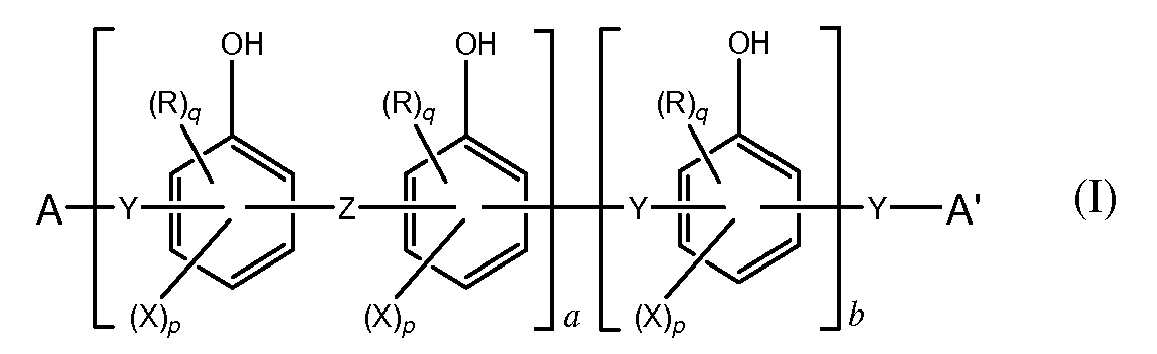
- One aspect of the present disclosure is to provide a new type of phosphorous-containing flame retarding phenol-formaldehyde novolac, a compound with the general formula represented by Formula (I):
- the above mentioned phosphorous-containing flame retarding phenol-formaldehyde novolac compound have a suitable reactivity, wide range of lamination processing period, high vitrification temperature, excellent heat resistance, low water absorption, good electrical properties and can be used as an epoxy resin hardener, by reacting the epoxy group of the epoxy resin with the phenolic hydroxyl group of the compound, an environmentally-friendly halogen-free cured flame retarding epoxy resin may be formed, which can be used in packaging materials for integrated circuit boards and semiconductors.
- the preparation method of the above mentioned phosphorous-containing flame retarding phenol-formaldehyde novolac is carried out by synthesizing a phenol-formaldehyde novolac by using a phenol compound, bisphenol compound and formaldehyde, the phenol-formaldehyde novolac is then mixed with an aromatic phosphate ester (i.e., the X in Formula I) to undergo a condensation polymerization reaction to produce the product.
- an aromatic phosphate ester i.e., the X in Formula I
- the above mentioned phosphorous-containing flame retarding phenol-formaldehyde novolac includes a phenol compound and a bisphenol compound, wherein the mass ratio of the phenol compound and the bisphenol compound is between 1:0.1 to 1:9.
- the phenol compounds used in the preparation method of the present disclosure may be phenol, o-cresol, m-cresol, p-cresol, o-phenylphenol, m-phenylphenol, p-phenylphenol, 2,6-dimethylphenol, 2,4-dimethylphenol and the combination thereof;
- the bisphenol compound may be biphenol, bisphenol F, bisphenol A, p-thiobisphenol, bisphenol S and the combination thereof;
- the aromatic phosphate ester may be DOPO (9,10-dihydro-9-oxa-10-phosphaphenanthrene-10-oxide), diphenyl phosphite ester, diphenyl phosphonate, and C1-C4 alkyl group or C6-C18 aromatic group substituted thereof and the combination thereof.
- the above mentioned phosphorous-containing phenol-formaldehyde novolac can be used as the epoxy resin hardener.
- the phosphorous-containing phenol-formaldehyde novolac in addition to having a phenol compound, has an bisphenol compound with excellent heat resistance, high vitrification temperature (Tg), low water absorption and good electrical properties, examples of the bisphenol compound include biphenol, bisphenol F, bisphenol A and bisphenol S, etc. Therefore, the drawbacks of lack of flexibility and insufficient heat resistance when the phenol compound is used alone can be compensated.
- the drawbacks of the high coefficient of expansion when the temperature is greater than the vitrification temperature (Tg) of the cured product can be effectively improved (compared to using the bisphenol A alone), this can help improve the dimensional stability of the product, which can be applied to the electronic materials field which are light, thin, small and precise.
- the present disclosure also provides a cured flame retarding epoxy resin, which is prepared by reacting the above-mentioned phosphorous-containing flame retarding phenol-formaldehyde novolac, which can be used alone or mixed with conventional epoxy resin hardeners, with epoxy resin at high temperatures.
- the halogen-free flame retarding epoxy resin composition was impregnated in glass fiber, and then after thermosetting, forms a flame retarding copper-clad laminate, which can be used as a packaging material in integrated circuit boards and semiconductors, the cured flame retarding epoxy resin that is formed can be used as a resin substrate of a printed circuit board and semiconductor packaging material.
- the conventional epoxy resin hardener mentioned above can be selected from the group consisting of phenol-formaldehyde novolac, cresol-formaldehyde novolac, bisphenol A phenol-formaldehyde novolac, dicyandiamide, methylenedianiline, diaminodiphenyl sulfone and the combination thereof.
- the above mentioned epoxy resin refers to a difunctional epoxy resin or a polyfunctional epoxy resin, for example, bisphenol A novolac epoxy, bisphenol F novolac epoxy, bisphenol S novolac epoxy, biphenol novolac epoxy, phenol novolac epoxy, cresol novolac epoxy, bisphenol A novolac epoxy and the combination thereof.
- the cured phosphorous-containing flame retarding epoxy resin in the present disclosure wherein the epoxy resin and the hardener are used in same equivalents, and prepared by a curing reaction at a temperature higher than 150 °C.
- the cured phosphorous-containing flame retarding epoxy resin (epoxy resin + phosphorous-containing hardener + other additives) of the present disclosure although the formulation of the compositions and the specific structure of each component have many variations, but as long as the phosphorus content of the final cured product is controlled to be within 0.5 to 10% mass range it is acceptable.
- the cured phosphorous-containing flame retarding epoxy resin of the present disclosure can be carried out in the presence of a curing accelerator
- a curing accelerator can be used in a range of 0.01 to 2.5 weight percent of the total weight of the epoxy resin and the hardener
- the suitable curing accelerators include imidazole compounds, for example, 2-methylimidazole (2-MI), 2-phenylimidazole (2-PI) or 2-ethyl-4-methylimidazole (2E4MZ) and the like.
- Phenol bisphenol Phenol compound Bisphenol compound Aromatic phosphate ester (i.e., the X in Formula I) Phosphorus based hardener product Embodiment 1 1:1 phenol bisphenol A DOPO P-1 Embodiment 2 1:9 phenol bisphenol A DOPO P-2 Embodiment 3 1:0.1 phenol + o-cresol bisphenol A DOPO P-3 Embodiment 4 1:2.3 phenol bisphenol S DOPO P-4 Embodiment 5 1:7.8 phenol bisphenol S DOPO P-5 Embodiment 6 1:0.13 phenol + o-phenyl phenol bisphenol S DOPO P-6 Embodiment 7 1:1 phenol bisphenol F DOPO P-7 Embodiment 8 1:9 phenol p-thiobisphenol DOPO P-8 Embodiment 9 1:0.1 phenol + 2,6-dimethyl phenol bisphenol F DOPO P-9 Embodiment 10 1:2 phenol bisphenol A + bisphenol S DOPO P-10 Embodiment
- the phosphorous-containing hardener (P-1 to P-22), conventional hardener, bisphenol A novolac epoxy resin (BNE), cresol formaldehyde novolac epoxy resin (CNE), and phenol novolac epoxy (PNE) are in weight proportions shown in table 3, and aluminum hydroxide, silicon dioxide, and imidazole based curing accelerator are mixed homogeneously in a suitable solvent, impregnated with glass fiber cloth in a impregnation machine, after heating at 170 °C for 150 seconds, a small heat press was used to cut at 185 °C, 25 kg/cm 2 and cure for 2 hours to obtain a halogen free copper clad laminate.
- the hardener (P-21 to P-22), bisphenol A novolac epoxy resin (BNE), cresol formaldehyde novolac epoxy resin (CNE), and phenol novolac epoxy (PNE) are in weight proportions shown in table 3, and aluminum hydroxide, silicon dioxide, and imidazole based curing accelerator are mixed homogeneously in a suitable solvent, impregnated with glass fiber cloth in a impregnation machine, after heating at 170 °C for 150 seconds, a small heat press was used to cut at 185 °C, 25 kg/cm 2 and cure for 2 hours to obtain a halogen free copper clad laminate.
- a heating rate of 20 °C/min was used in differential scanning calorimetry (DSC) tests.
- Test pieces were cut into 0.5 inx4.7 in rectangles, a blue flame with a flame height of 2 cm was used to burn for 10 seconds and then removed, after burning twice, the flame is removed and the self-extinguishing time is recorded.
- the sample was heated in a pressure boiler at 120 °C and 2 atm for 30 minutes.
- test piece was cut into 5 ⁇ 5 squares, and the thickness were measured by measuring three points and then sandwiched into a dielectric analysis instrument for measurements, after completion, the mean value was recorded.
- the substrate after etching was cut into 5 cm 2 square test pieces, after baking at 105 °C for 2 hours in the oven, the substrate was removed and the thickness were measured by measuring three points. Then the test piece was sandwiched into a dielectric analysis instrument, after measuring three points, the mean value was recorded.
- Table 1 is a comparison of the vitrification temperature (Tg) of the hardeners;
- Table 2 is an analysis of the thermal cracking of the hardeners;
- Table 3 gives the test results of the copper-clad laminate substrates.
- Table 1 vitrification temperature of the cured product.
- Table 2 analysis of the thermal cracking of the cured
- Embodiment 41 42 43 44 45 46 47 48 49 50 51 52 BNE 35 35 35 20 20 30 30 25 20 20 PNE 10 10 10 10 10 0 0 5 10 10 10 CNE 55 55 55 70 70 70 70 70 70 70 P-1 17 P-2 18 P-3 18 P-4 16 P-5 16 P-6 17 P-7 19 P-8 17 P-9 19 P-10 17 P-11 18 P-12 19 Conventional epoxy resin hardener - - - - - - - - - - - - - - - - - - - - - - Flame retardant (Aluminum hydroxide) 20 20 20 20 20 20 20 20 20 20 20 20 20 20 20 20 20 20 20 20 20 20 20 Filler 10 10 10 10 10 10 10 10 10 10 10 10 10 10 10 10 10 10 10 10 (silicon dioxide) Accelerator 2MI (PHR) 1.1 1.2 1.4 1.1 1.2 1.2 Accelerator 2PI (PHR) 0.2 0.2 0.3 0.5 0.6 0.7 Phosphorus content (%) 1.
- the cured phosphorous-containing epoxy resin of the present disclosure especially the cured phosphorous-containing epoxy resin prepared by using a hardener obtained by using bisphenol S and phenol as the raw materials (embodiment 5; hardener P-5) and then reacting with epoxy resin, the Tg is higher than the cured phosphorous-containing epoxy resin prepared by using phenol, and even 10 ° C higher than the cured epoxy resin prepared by using bisphenol A based phosphorous-containing hardener, and the thermal stability is better than the other embodiments.
- the use of other phosphate ester compounds in the preparation, and DOPO based hardener also showed good results.
- the Tg of the cured phosphorous-containing epoxy resin of the present disclosure is higher than the phosphorous-containing hardener prepared by using only phenol (comparative example 1; P-21), and the cured phosphorous-containing epoxy resin containing bisphenol S (embodiment 44-46) showed better electrical properties than comparative example 5 and comparative example 6, the DK can reach 4.0 and the Df can reach 0.009.
- the ⁇ 1 in embodiments 44-46 are between 30 and 40, and ⁇ 2 is between 200 and 220.
- the copper-clad laminate can meet the requirement of flame-retarding effect, therefore making it ideal to be used in the field of manufacturing high-end phosphor-containing copper-clad laminate materials.
Landscapes
- Chemical & Material Sciences (AREA)
- Health & Medical Sciences (AREA)
- Chemical Kinetics & Catalysis (AREA)
- Medicinal Chemistry (AREA)
- Polymers & Plastics (AREA)
- Organic Chemistry (AREA)
- Epoxy Resins (AREA)
- Phenolic Resins Or Amino Resins (AREA)
- Compositions Of Macromolecular Compounds (AREA)
Abstract

Description
- The present disclosure relates to a phosphorous-containing phenol-formaldehyde novolac structure and the preparation method thereof, and the use of the compound to react with the epoxy group of an epoxy resin to obtain an environmentally-friendly and high performing halogen-free cured flame retarding epoxy resin.
- The chemical structure of epoxy resin features its desirable properties, e.g., reactivity, toughness, flexibility, good mechanical properties, electrical properties, dimensional stability, and superior bonding properties for different substrates. The cured epoxy resin can not only maintain the original features of the substrate, but also further block out water, gas and chemicals, and it is also lightweight and low cost. Therefore, epoxy resin is widely used in electronics and aerospace industries, especially in the field of semiconductor packaging material, printed circuit board substrate material and so on. However, when the epoxy resin is applied to a printed circuit board, there is a lack of flame retarding. In the past, halogen based flame-retardant was added to the epoxy resin to meet the flame-retarding requirements. The halogen based flame-retardant will produce dioxin, benzofuran and other irritating and corrosive harmful gases when burnt, and the small molecules of the flame-retardant often cause a reduction in the mechanical properties and will photodecompose, thus causing material deterioration. At the same time, there will be migration and volatility issues, resulting in a reduction of the material performance and the flame-retarding effect is not ideal. Therefore, the use of organic phosphorus compound flame-retardants in thermosetting epoxy resin compositions instead of halogenated flame-retardants is constantly emerging, for example, in patents such as
EP A 0384939 ,EP A 0384940 ,EP A 0408990 ,DE A 4308184 ,DE A 4308185 ,DE A 4308187 ,WO A 96/07685 WO A 96/07686 - The present disclosure provides a new type of phosphorous-containing phenol-formaldehyde novolac that can be used for curing epoxy resins, and gives a high flame-retarding effect. The introduction of environmentally-friendly organic phosphorus group can not only maintain the original excellent properties of epoxy resins, but also meet the high flame-retarding requirements, and have the ability to improve the vitrification temperature (Tg), heat resistance and other characteristics of the material, so that the curing system can be successfully applied to the electronic materials field which are light, thin, small and precise.
- One aspect of the present disclosure is to provide a new type of phosphorous-containing flame retarding phenol-formaldehyde novolac, a compound with the general formula represented by Formula (I):

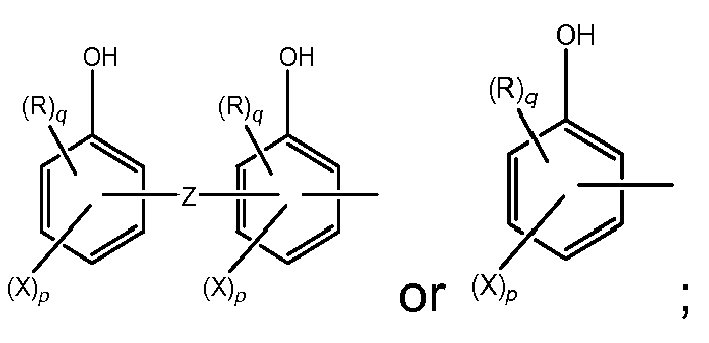
- wherein, A and A' are individually
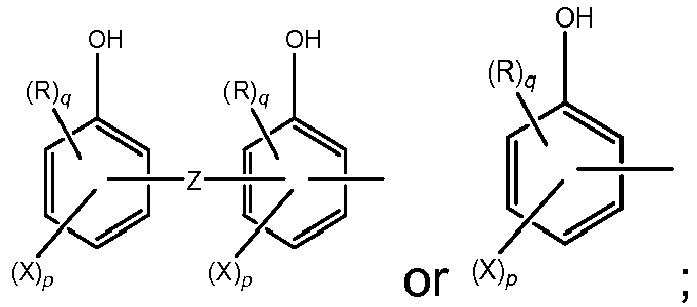
- Y is -CH2- or -CH2-O-CH2-, and Y in different units are the same or different;
- Z is unsubstituted, -CH2-, -C(CH3)2-, -O-, -S- or -S(O)2-, and Z in different units are the same or different;
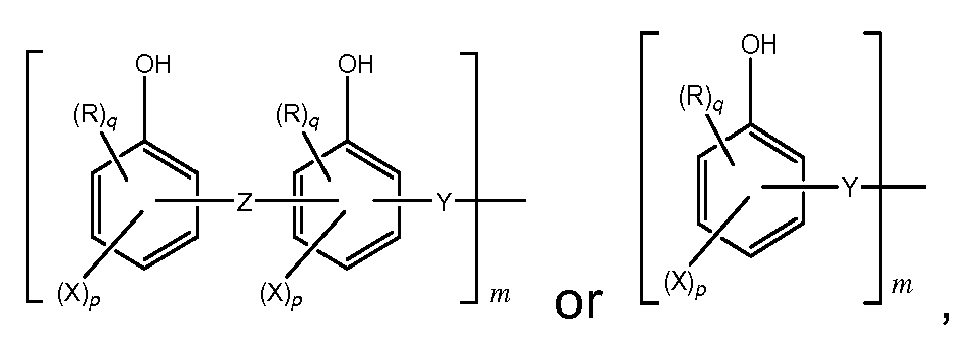
- R is H, a C1-C10 alkyl group, a C6-C18 aromatic group,


- p is 0-2;
- q is 0-3;
- a is an integer greater than or equal to 1;
- b is an integer greater than or equal to 1;
- m is 0-6;
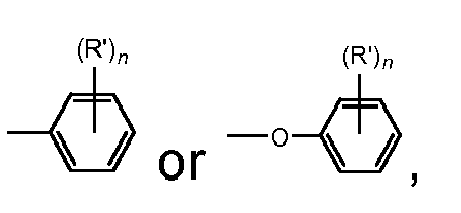
- X is


- R' is H, a C1-C4 alkyl group or a C6-C18 aromatic group, and R' in different units are the same or different;
- and n is 0-5.
- The above mentioned phosphorous-containing flame retarding phenol-formaldehyde novolac compound have a suitable reactivity, wide range of lamination processing period, high vitrification temperature, excellent heat resistance, low water absorption, good electrical properties and can be used as an epoxy resin hardener, by reacting the epoxy group of the epoxy resin with the phenolic hydroxyl group of the compound, an environmentally-friendly halogen-free cured flame retarding epoxy resin may be formed, which can be used in packaging materials for integrated circuit boards and semiconductors.
- The preparation method of the above mentioned phosphorous-containing flame retarding phenol-formaldehyde novolac is carried out by synthesizing a phenol-formaldehyde novolac by using a phenol compound, bisphenol compound and formaldehyde, the phenol-formaldehyde novolac is then mixed with an aromatic phosphate ester (i.e., the X in Formula I) to undergo a condensation polymerization reaction to produce the product.
- The above mentioned phosphorous-containing flame retarding phenol-formaldehyde novolac includes a phenol compound and a bisphenol compound, wherein the mass ratio of the phenol compound and the bisphenol compound is between 1:0.1 to 1:9.
- The phenol compounds used in the preparation method of the present disclosure may be phenol, o-cresol, m-cresol, p-cresol, o-phenylphenol, m-phenylphenol, p-phenylphenol, 2,6-dimethylphenol, 2,4-dimethylphenol and the combination thereof; the bisphenol compound may be biphenol, bisphenol F, bisphenol A, p-thiobisphenol, bisphenol S and the combination thereof; the aromatic phosphate ester may be DOPO (9,10-dihydro-9-oxa-10-phosphaphenanthrene-10-oxide), diphenyl phosphite ester, diphenyl phosphonate, and C1-C4 alkyl group or C6-C18 aromatic group substituted thereof and the combination thereof.
- The above mentioned phosphorous-containing phenol-formaldehyde novolac can be used as the epoxy resin hardener. In the chemical structure, since the phosphorous-containing phenol-formaldehyde novolac, in addition to having a phenol compound, has an bisphenol compound with excellent heat resistance, high vitrification temperature (Tg), low water absorption and good electrical properties, examples of the bisphenol compound include biphenol, bisphenol F, bisphenol A and bisphenol S, etc. Therefore, the drawbacks of lack of flexibility and insufficient heat resistance when the phenol compound is used alone can be compensated. On the other hand, through mixing of the bisphenol compound and the phenol compound, the drawbacks of the high coefficient of expansion when the temperature is greater than the vitrification temperature (Tg) of the cured product can be effectively improved (compared to using the bisphenol A alone), this can help improve the dimensional stability of the product, which can be applied to the electronic materials field which are light, thin, small and precise.
- The present disclosure also provides a cured flame retarding epoxy resin, which is prepared by reacting the above-mentioned phosphorous-containing flame retarding phenol-formaldehyde novolac, which can be used alone or mixed with conventional epoxy resin hardeners, with epoxy resin at high temperatures. The halogen-free flame retarding epoxy resin composition was impregnated in glass fiber, and then after thermosetting, forms a flame retarding copper-clad laminate, which can be used as a packaging material in integrated circuit boards and semiconductors, the cured flame retarding epoxy resin that is formed can be used as a resin substrate of a printed circuit board and semiconductor packaging material.
- The conventional epoxy resin hardener mentioned above can be selected from the group consisting of phenol-formaldehyde novolac, cresol-formaldehyde novolac, bisphenol A phenol-formaldehyde novolac, dicyandiamide, methylenedianiline, diaminodiphenyl sulfone and the combination thereof.
- The above mentioned epoxy resin refers to a difunctional epoxy resin or a polyfunctional epoxy resin, for example, bisphenol A novolac epoxy, bisphenol F novolac epoxy, bisphenol S novolac epoxy, biphenol novolac epoxy, phenol novolac epoxy, cresol novolac epoxy, bisphenol A novolac epoxy and the combination thereof.
- The cured phosphorous-containing flame retarding epoxy resin in the present disclosure, wherein the epoxy resin and the hardener are used in same equivalents, and prepared by a curing reaction at a temperature higher than 150 °C.
- In order to achieve a UL94 V-0 grade flame-retardant, the cured phosphorous-containing flame retarding epoxy resin (epoxy resin + phosphorous-containing hardener + other additives) of the present disclosure, although the formulation of the compositions and the specific structure of each component have many variations, but as long as the phosphorus content of the final cured product is controlled to be within 0.5 to 10% mass range it is acceptable.
- To carry out the reaction effectively, the cured phosphorous-containing flame retarding epoxy resin of the present disclosure can be carried out in the presence of a curing accelerator, a curing accelerator can be used in a range of 0.01 to 2.5 weight percent of the total weight of the epoxy resin and the hardener, and the suitable curing accelerators include imidazole compounds, for example, 2-methylimidazole (2-MI), 2-phenylimidazole (2-PI) or 2-ethyl-4-methylimidazole (2E4MZ) and the like.
- These and other features, aspects, and advantages of the present invention will become better understood with reference to the following description and appended claims.
- It is to be understood that both the foregoing general description and the following detailed description are by examples, and are intended to provide further explanation of the invention as claimed.
- Reference will now be made in detail to the present embodiments of the invention. Wherever possible, the same reference numbers are used in the description to refer to the same or like parts.
- 260 grams of phenol, 260 grams of bisphenol A, 648 grams of formaldehyde aqueous solution (37% mass concentration) and 24 grams of sodium hydroxide were added to a reactor, the mixing is then started and the temperature is heated to 40 °C and maintained for 3 hours. The temperature is then raised to 65 °C, after maintaining the temperature for 3 hours, 1480 grams of n-butanol were added and refluxed for 12 hours. The reaction temperature is then lowered to 55-60 °C, and distilled under a reduced pressure to remove about 1000 grams of n-butanol, and an intermediate product is obtained.
- 1080 grams of DOPO (9,10-dihydro-9-oxa-10-phosphaphenanthrene-10-oxide) were added to the intermediate product, the reaction temperature was raised from 80 °C to 180 °C within a 2 hour period, when the temperature reaches 120 °C, the pressure of the reaction system was reduced to ensure that the n-butanol can be discharged out of the reaction system in time. The temperature is maintained at 180 °C for 1 hour, the reaction temperature is then lowered to 130 ° C, about 900 grams of propylene glycol methyl ether were added and mixed for another 0.5 hours, a phosphorus based hardener P-1 is then obtained.
- 52 grams of phenol, 468 grams of bisphenol A, 648 grams of formaldehyde aqueous solution (37% mass concentration) and 24 grams of sodium hydroxide were added to a reactor, the mixing is then started and the temperature is heated to 45 °C and maintained for 3 hours. The temperature is then raised to 68 °C, after maintaining the temperature for 3 hours, 1480 grams of n-butanol were added and refluxed for 15 hours. The reaction temperature is then lowered to 55-60 °C, and distilled under a reduced pressure to remove about 1000 grams of n-butanol, and an intermediate product is obtained.
- 1080 grams of DOPO (9,10-dihydro-9-oxa-10-phosphaphenanthrene-10-oxide) were added to the intermediate product, the reaction temperature was raised from 80 °C to 180 °C within a 2 hour period, when the temperature reaches 130 °C, the pressure of the reaction system was reduced to ensure that the n-butanol can be discharged out of the reaction system in time. The temperature is maintained at 180 °C for 1 hour, the reaction temperature is then lowered to 140 °C, about 900 grams of propylene glycol methyl ether were added and mixed for another 0.5 hours, a phosphorus based hardener P-2 is then obtained.
- 400 grams of phenol, 68 grams of o-cresol, 52 grams of bisphenol A, 648 grams of formaldehyde aqueous solution (37% mass concentration) and 24 grams of sodium hydroxide were added to a reactor, the mixing is then started and the temperature is heated to 50 °C and maintained for 3 hours. The temperature is then raised to 65 °C, after maintaining the temperature for 3 hours, 1480 grams of n-butanol were added and refluxed for 15 hours. The reaction temperature is then lowered to 55-60 °C, and distilled under a reduced pressure to remove about 1000 grams of n-butanol, and an intermediate product is obtained.
- 1080 grams of DOPO (9,10-dihydro-9-oxa-10-phosphaphenanthrene-10-oxide) were added to the intermediate product, the reaction temperature was raised from 80 °C to 180 °C within a 2 hour period, when the temperature reaches 120 °C, the pressure of the reaction system was reduced to ensure that the n-butanol can be discharged out of the reaction system in time. The temperature is maintained at 180 °C for 1 hour, the reaction temperature is then lowered to 120 °C, about 900 grams of propylene glycol methyl ether were added and mixed for another 0.5 hours, a phosphorus based hardener P-3 is then obtained.
- 157.6 grams of phenol, 362.4 grams of bisphenol S, 648 grams of formaldehyde aqueous solution (37% mass concentration) and 24 grams of sodium hydroxide were added to a reactor, the mixing is then started and the temperature is heated to 50 °C and maintained for 3 hours. The temperature is then raised to 85 °C, after maintaining the temperature for 3 hours, 1480 grams of n-butanol were added and refluxed for 12 hours. The reaction temperature is then lowered to 55-60 °C, and distilled under a reduced pressure to remove about 1000 grams of n-butanol, and an intermediate product is obtained.
- 1080 grams of DOPO (9,10-dihydro-9-oxa-10-phosphaphenanthrene-10-oxide) were added to the intermediate product, the reaction temperature was raised from 80 °C to 180 °C within a 2 hour period, when the temperature reaches 130 °C, the pressure of the reaction system was reduced to ensure that the n-butanol can be discharged out of the reaction system in time. The temperature is maintained at 180 °C for 1 hour, the reaction temperature is then lowered to 130 °C, about 900 grams of propylene glycol methyl ether were added and mixed for another 0.5 hours, a phosphorus based hardener P-4 is then obtained.
- 59 grams of phenol, 461 grams of bisphenol S, 648 grams of formaldehyde aqueous solution (37% mass concentration) and 24 grams of sodium hydroxide were added to a reactor, the mixing is then started and the temperature is heated to 50 °C and maintained for 3 hours. The temperature is then raised to 85 °C, after maintaining the temperature for 3 hours, 1480 grams of n-butanol were added and refluxed for 12 hours. The reaction temperature is then lowered to 55-60 °C, and distilled under a reduced pressure to remove about 1000 grams of n-butanol, and an intermediate product is obtained.
- 1080 grams of DOPO (9,10-dihydro-9-oxa-10-phosphaphenanthrene-10-oxide) were added to the intermediate product, the reaction temperature was raised from 80 °C to 180 °C within a 2 hour period, when the temperature reaches 120 °C, the pressure of the reaction system was reduced to ensure that the n-butanol can be discharged out of the reaction system in time. The temperature is maintained at 180 °C for 1 hour, the reaction temperature is then lowered to 130 °C, about 900 grams of propylene glycol methyl ether were added and mixed for another 0.5 hours, a phosphorus based hardener P-5 is then obtained.
- 400 grams of phenol, 61 grams of o-cresol, 59 grams of bisphenol S, 648 grams of formaldehyde aqueous solution (37% mass concentration) and 24 grams of sodium hydroxide were added to a reactor, the mixing is then started and the temperature is heated to 50 °C and maintained for 3 hours. The temperature is then raised to 85 °C, after maintaining the temperature for 3 hours, 1480 grams of n-butanol were added and refluxed for 12 hours. The reaction temperature is then lowered to 55-60 °C, and distilled under a reduced pressure to remove about 1000 grams of n-butanol, and an intermediate product is obtained.
- 1080 grams of DOPO (9,10-dihydro-9-oxa-10-phosphaphenanthrene-10-oxide) were added to the intermediate product, the reaction temperature was raised from 80 °C to 180 °C within a 2 hour period, when the temperature reaches 120 °C, the pressure of the reaction system was reduced to ensure that the n-butanol can be discharged out of the reaction system in time. The temperature is maintained at 180 °C for 1 hour, the reaction temperature is then lowered to 135 °C, about 900 grams of propylene glycol methyl ether were added and mixed for another 0.5 hours, a phosphorus based hardener P-6 is then obtained.
- 245 grams of phenol, 245 grams of bisphenol F, 648 grams of formaldehyde aqueous solution (37% mass concentration) and 24 grams of sodium hydroxide were added to a reactor, the mixing is then started and the temperature is heated to 50 °C and maintained for 3 hours. The temperature is then raised to 65 °C, after maintaining the temperature for 3 hours, 1480 grams of n-butanol were added and refluxed for 12 hours. The reaction temperature is then lowered to 55-60 °C, and distilled under a reduced pressure to remove about 1000 grams of n-butanol, and an intermediate product is obtained.
- 1080 grams of DOPO (9,10-dihydro-9-oxa-10-phosphaphenanthrene-10-oxide) were added to the intermediate product, the reaction temperature was raised from 80 °C to 180 °C within a 2 hour period, when the temperature reaches 120 °C, the pressure of the reaction system was reduced to ensure that the n-butanol can be discharged out of the reaction system in time. The temperature is maintained at 180 °C for 2 hours, the reaction temperature is then lowered to 130 °C, about 900 grams of propylene glycol methyl ether were added and mixed for another 0.5 hours, a phosphorus based hardener P-7 is then obtained.
- 49 grams of phenol, 441 grams of p-thiobisphenol, 648 grams of formaldehyde aqueous solution (37% mass concentration) and 24 grams of sodium hydroxide were added to a reactor, the mixing is then started and the temperature is heated to 50 °C and maintained for 3 hours. The temperature is then raised to 65 °C, after maintaining the temperature for 3 hours, 1480 grams of n-butanol were added and refluxed for 12 hours. The reaction temperature is then lowered to 55-60 °C, and distilled under a reduced pressure to remove about 1000 grams of n-butanol, and an intermediate product is obtained.
- 1080 grams of DOPO (9,10-dihydro-9-oxa-10-phosphaphenanthrene-10-oxide) were added to the intermediate product, the reaction temperature was raised from 80 °C to 175 °C within a 2 hour period, when the temperature reaches 120 °C, the pressure of the reaction system was reduced to ensure that the n-butanol can be discharged out of the reaction system in time. The temperature is maintained at 175 °C for 2 hours, the reaction temperature is then lowered to 140 °C, about 900 grams of propylene glycol methyl ether were added and mixed for another 0.5 hours, a phosphorus based hardener P-8 is then obtained.
- 400 grams of phenol, 72.7 grams of 2,6-dimethylphenol, 47.3 grams of bisphenol F, 648 grams of formaldehyde aqueous solution (37% mass concentration) and 24 grams of sodium hydroxide were added to a reactor, the mixing is then started and the temperature is heated to 50 °C and maintained for 3 hours. The temperature is then raised to 65 °C, after maintaining the temperature for 3 hours, 1480 grams of n-butanol were added and refluxed for 12 hours. The reaction temperature is then lowered to 55-60 °C, and distilled under a reduced pressure to remove about 1000 grams of n-butanol, and an intermediate product is obtained.
- 1080 grams of DOPO (9,10-dihydro-9-oxa-10-phosphaphenanthrene-10-oxide) were added to the intermediate product, the reaction temperature was raised from 80 °C to 180 °C within a 2 hour period, when the temperature reaches 120 °C, the pressure of the reaction system was reduced to ensure that the n-butanol can be discharged out of the reaction system in time. The temperature is maintained at 180 °C for 1 hour, the reaction temperature is then lowered to 150 °C, about 900 grams of propylene glycol methyl ether were added and mixed for another 0.5 hours, a phosphorus based hardener P-9 is then obtained.
- 184 grams of phenol, 184 grams of bisphenol A, 184 grams of bisphenol S, 648 grams of formaldehyde aqueous solution (37% mass concentration) and 24 grams of sodium hydroxide were added to a reactor, the mixing is then started and the temperature is heated to 40 °C and maintained for 3 hours. The temperature is then raised to 65 °C, after maintaining the temperature for 3 hours, 1480 grams of n-butanol were added and refluxed for 12 hours. The reaction temperature is then lowered to 55-60 °C, and distilled under a reduced pressure to remove about 1000 grams of n-butanol, and an intermediate product is obtained.
- 1080 grams of DOPO (9,10-dihydro-9-oxa-10-phosphaphenanthrene-10-oxide) were added to the intermediate product, the reaction temperature was raised from 80 °C to 180 °C within a 2 hour period, when the temperature reaches 120 °C, the pressure of the reaction system was reduced to ensure that the n-butanol can be discharged out of the reaction system in time. The temperature is maintained at 180 °C for 1 hour, the reaction temperature is then lowered to 130 °C, about 900 grams of propylene glycol methyl ether were added and mixed for another 0.5 hours, a phosphorus based hardener P-10 is then obtained.
- 91.2 grams of phenol, 214.4 grams of bisphenol A, 214.4 grams of bisphenol F, 648 grams of formaldehyde aqueous solution (37% mass concentration) and 24 grams of sodium hydroxide were added to a reactor, the mixing is then started and the temperature is heated to 40 °C and maintained for 3 hours. The temperature is then raised to 65 °C, after maintaining the temperature for 3 hours, 1480 grams of n-butanol were added and refluxed for 12 hours. The reaction temperature is then lowered to 55-60 °C, and distilled under a reduced pressure to remove about 1000 grams of n-butanol, and an intermediate product is obtained.
- 1080 grams of DOPO (9,10-dihydro-9-oxa-10-phosphaphenanthrene-10-oxide) were added to the intermediate product, the reaction temperature was raised from 80 °C to 175 °C within a 2 hour period, when the temperature reaches 120 °C, the pressure of the reaction system was reduced to ensure that the n-butanol can be discharged out of the reaction system in time. The temperature is maintained at 175 °C for 2 hours, the reaction temperature is then lowered to 130 °C, about 900 grams of propylene glycol methyl ether were added and mixed for another 0.5 hours, a phosphorus based hardener P-11 is then obtained.
- 133.5 grams of phenol, 133.5 grams of bisphenol S, 267 grams of bisphenol F, 648 grams of formaldehyde aqueous solution (37% mass concentration) and 24 grams of sodium hydroxide were added to a reactor, the mixing is then started and the temperature is heated to 40 °C and maintained for 3 hours. The temperature is then raised to 65 °C, after maintaining the temperature for 3 hours, 1480 grams of n-butanol were added and refluxed for 12 hours. The reaction temperature is then lowered to 55-60 °C, and distilled under a reduced pressure to remove about 1000 grams of n-butanol, and an intermediate product is obtained.
- 1080 grams of DOPO (9,10-dihydro-9-oxa-10-phosphaphenanthrene-10-oxide) were added to the intermediate product, the reaction temperature was raised from 80 °C to 180 °C within a 2 hour period, when the temperature reaches 120 °C, the pressure of the reaction system was reduced to ensure that the n-butanol can be discharged out of the reaction system in time. The temperature is maintained at 180 °C for 1 hour, the reaction temperature is then lowered to 135 °C, about 900 grams of propylene glycol methyl ether were added and mixed for another 0.5 hours, a phosphorus based hardener P-12 is then obtained.
- 468 grams of phenol, 52 grams of bisphenol A, 648 grams of formaldehyde aqueous solution (37% mass concentration) and 24 grams of sodium hydroxide were added to a reactor, the mixing is then started and the temperature is heated to 40 °C and maintained for 3 hours. The temperature is then raised to 65 °C, after maintaining the temperature for 3 hours, 1480 grams of n-butanol were added and refluxed for 12 hours. The reaction temperature is then lowered to 55-60 °C, and distilled under a reduced pressure to remove about 1000 grams of n-butanol, and an intermediate product is obtained.
- 1040 grams of diphenyl phosphonate were added to the intermediate product, the reaction temperature was raised from 80 °C to 180 °C within a 2 hour period, when the temperature reaches 120 °C, the pressure of the reaction system was reduced to ensure that the n-butanol can be discharged out of the reaction system in time. The temperature is maintained at 180 °C for 1 hour, the reaction temperature is then lowered to 130 °C, about 900 grams of propylene glycol methyl ether were added and mixed for another 0.5 hours, a phosphorus based hardener P-13 is then obtained.
- 260 grams of phenol, 260 grams of biphenol, 648 grams of formaldehyde aqueous solution (37% mass concentration) and 24 grams of sodium hydroxide were added to a reactor, the mixing is then started and the temperature is heated to 40 °C and maintained for 3 hours. The temperature is then raised to 65 °C, after maintaining the temperature for 3 hours, 1480 grams of n-butanol were added and refluxed for 12 hours. The reaction temperature is then lowered to 55-60 °C, and distilled under a reduced pressure to remove about 1000 grams of n-butanol, and an intermediate product is obtained.
- 1010 grams of diphenyl phosphonate were added to the intermediate product, the reaction temperature was raised from 80 °C to 190 °C within a 2 hour period, when the temperature reaches 120 °C, the pressure of the reaction system was reduced to ensure that the n-butanol can be discharged out of the reaction system in time. The temperature is maintained at 180 °C for 1 hour, the reaction temperature is then lowered to 135 °C, about 900 grams of propylene glycol methyl ether were added and mixed for another 0.5 hours, a phosphorus based hardener P-14 is then obtained.
- 148.6 grams of phenol, 371.4 grams of bisphenol F, 648 grams of formaldehyde aqueous solution (37% mass concentration) and 24 grams of sodium hydroxide were added to a reactor, the mixing is then started and the temperature is heated to 40 °C and maintained for 3 hours. The temperature is then raised to 65 °C, after maintaining the temperature for 3 hours, 1480 grams of n-butanol were added and refluxed for 12 hours. The reaction temperature is then lowered to 55-60 °C, and distilled under a reduced pressure to remove about 1000 grams of n-butanol, and an intermediate product is obtained.
- 1010 grams of diphenyl phosphonate were added to the intermediate product, the reaction temperature was raised from 80 °C to 190 °C within a 2 hour period, when the temperature reaches 150 °C, the pressure of the reaction system was reduced to ensure that the n-butanol can be discharged out of the reaction system in time. The temperature is maintained at 180 °C for 1 hour, the reaction temperature is then lowered to 130 °C, about 900 grams of propylene glycol methyl ether were added and mixed for another 0.5 hours, a phosphorus based hardener P-15 is then obtained.
- 120.9 grams of phenol, 399.1 grams of bisphenol S, 648 grams of formaldehyde aqueous solution (37% mass concentration) and 24 grams of sodium hydroxide were added to a reactor, the mixing is then started and the temperature is heated to 40 °C and maintained for 3 hours. The temperature is then raised to 65 °C, after maintaining the temperature for 3 hours, 1480 grams of n-butanol were added and refluxed for 12 hours. The reaction temperature is then lowered to 55-60 °C, and distilled under a reduced pressure to remove about 1000 grams of n-butanol, and an intermediate product is obtained.
- 1010 grams of diphenyl phosphonate were added to the intermediate product, the reaction temperature was raised from 80 °C to 180 °C within a 2 hour period, when the temperature reaches 120 °C, the pressure of the reaction system was reduced to ensure that the n-butanol can be discharged out of the reaction system in time. The temperature is maintained at 180 °C for 1 hour, the reaction temperature is then lowered to 130 °C, about 900 grams of propylene glycol methyl ether were added and mixed for another 0.5 hours, a phosphorus based hardener P-16 is then obtained.
- 468 grams of phenol, 52 grams of bisphenol A, 648 grams of formaldehyde aqueous solution (37% mass concentration) and 24 grams of sodium hydroxide were added to a reactor, the mixing is then started and the temperature is heated to 40 °C and maintained for 3 hours. The temperature is then raised to 65 °C, after maintaining the temperature for 3 hours, 1480 grams of n-butanol were added and refluxed for 12 hours. The reaction temperature is then lowered to 55-60 °C, and distilled under a reduced pressure to remove about 1000 grams of n-butanol, and an intermediate product is obtained.
- 1170 grams of diphenyl phosphite ester were added to the intermediate product, the reaction temperature was raised from 80 °C to 180 °C within a 2 hour period, when the temperature reaches 120 °C, the pressure of the reaction system was reduced to ensure that the n-butanol can be discharged out of the reaction system in time. The temperature is maintained at 180 °C for 1 hour, the reaction temperature is then lowered to 130 °C, about 900 grams of propylene glycol methyl ether were added and mixed for another 0.5 hours, a phosphorus based hardener P-17 is then obtained.
- 52 grams of phenol, 260 grams of bisphenol A, 104 grams of bisphenol F, 104 grams of biphenol, 648 grams of formaldehyde aqueous solution (37% mass concentration) and 24 grams of sodium hydroxide were added to a reactor, the mixing is then started and the temperature is heated to 40 °C and maintained for 3 hours. The temperature is then raised to 65 °C, after maintaining the temperature for 3 hours, 1480 grams of n-butanol were added and refluxed for 12 hours. The reaction temperature is then lowered to 55-60 °C, and distilled under a reduced pressure to remove about 1000 grams of n-butanol, and an intermediate product is obtained.
- 1170 grams of bis-p-methylphenyl phosphite ester were added to the intermediate product, the reaction temperature was raised from 80 °C to 180 °C within a 2 hour period, when the temperature reaches 120 °C, the pressure of the reaction system was reduced to ensure that the n-butanol can be discharged out of the reaction system in time. The temperature is maintained at 180 °C for 1 hour, the reaction temperature is then lowered to 130 °C, about 900 grams of propylene glycol methyl ether were added and mixed for another 0.5 hours, a phosphorus based hardener P-18 is then obtained.
- 76.5 grams of phenol, 443.5 grams of bisphenol F, 648 grams of formaldehyde aqueous solution (37% mass concentration) and 24 grams of sodium hydroxide were added to a reactor, the mixing is then started and the temperature is heated to 40 °C and maintained for 3 hours. The temperature is then raised to 65 °C, after maintaining the temperature for 3 hours, 1480 grams of n-butanol were added and refluxed for 12 hours. The reaction temperature is then lowered to 55-60 °C, and distilled under a reduced pressure to remove about 1000 grams of n-butanol, and an intermediate product is obtained.
- 1170 grams of diphenyl phosphite ester were added to the intermediate product, the reaction temperature was raised from 80 °C to 180 °C within a 2 hour period, when the temperature reaches 120 °C, the pressure of the reaction system was reduced to ensure that the n-butanol can be discharged out of the reaction system in time. The temperature is maintained at 180 °C for 1 hour, the reaction temperature is then lowered to 130 °C, about 900 grams of propylene glycol methyl ether were added and mixed for another 0.5 hours, a phosphorus based hardener P-19 is then obtained.
- 74.3 grams of phenol, 445.7 grams of bisphenol S, 648 grams of formaldehyde aqueous solution (37% mass concentration) and 24 grams of sodium hydroxide were added to a reactor, the mixing is then started and the temperature is heated to 45 °C and maintained for 2 hours. The temperature is then raised to 60 °C, after maintaining the temperature for 3 hours, 1480 grams of n-butanol were added and refluxed for 14 hours. The reaction temperature is then lowered to 55-60 °C, and distilled under a reduced pressure to remove about 1000 grams of n-butanol, and an intermediate product is obtained.
- 500 grams of DOPO, 300 grams of diphenyl phosphite ester, 370 grams of diphenyl phosphonate were added to the intermediate product, the reaction temperature was raised from 80 °C to 190 °C within a 2 hour period, when the temperature reaches 150 °C, the pressure of the reaction system was reduced to ensure that the n-butanol can be discharged out of the reaction system in time. The temperature is maintained at 180 °C for 2 hours, the reaction temperature is then lowered to 135 °C, about 900 grams of propylene glycol methyl ether were added and mixed for another 0.5 hours, a phosphorus based hardener P-20 is then obtained.
- 470 grams of phenol, 648 grams of formaldehyde aqueous solution (37% mass concentration) and 24 grams of sodium hydroxide were added to a reactor, the mixing is then started and the temperature is heated to 40 °C and maintained for 3 hours. The temperature is then raised to 65 °C, after maintaining the temperature for 3 hours, 1480 grams of n-butanol were added and refluxed for 12 hours. The reaction temperature is then lowered to 55-60 °C, and distilled under a reduced pressure to remove about 1000 grams of n-butanol, and an intermediate product is obtained.
- 1080 grams of DOPO (9,10-dihydro-9-oxa-10-phosphaphenanthrene-10-oxide) were added to the intermediate product, the reaction temperature was raised from 80 °C to 180 °C within a 2 hour period, when the temperature reaches 120 °C, the pressure of the reaction system was reduced to ensure that the n-butanol can be discharged out of the reaction system in time. The temperature is maintained at 180 °C for 1 hour, the reaction temperature is then lowered to 130 °C, about 900 grams of propylene glycol methyl ether were added and mixed for another 0.5 hours, a phosphorus based hardener P-21 is then obtained.
- 570 grams of bisphenol A, 648 grams of formaldehyde aqueous solution (37% mass concentration) and 24 grams of sodium hydroxide were added to a reactor, the mixing is then started and the temperature is heated to 40 °C and maintained for 3 hours. The temperature is then raised to 65 °C, after maintaining the temperature for 3 hours, 1480 grams of n-butanol were added and refluxed for 12 hours. The reaction temperature is then lowered to 55-60 °C, and distilled under a reduced pressure to remove about 1000 grams of n-butanol, and an intermediate product is obtained.
- 1080 grams of DOPO (9,10-dihydro-9-oxa-10-phosphaphenanthrene-10-oxide) were added to the intermediate product, the reaction temperature was raised from 80 °C to 180 °C within a 2 hour period, when the temperature reaches 120 °C, the pressure of the reaction system was reduced to ensure that the n-butanol can be discharged out of the reaction system in time. The temperature is maintained at 180 °C for 1 hour, the reaction temperature is then lowered to 130 °C, about 900 grams of propylene glycol methyl ether were added and mixed for another 0.5 hours, a phosphorus based hardener P-22 is then obtained.
Table of the reactant ratio: Phenol: bisphenol Phenol compound Bisphenol compound Aromatic phosphate ester (i.e., the X in Formula I) Phosphorus based hardener product Embodiment 1 1:1 phenol bisphenol A DOPO P-1 Embodiment 2 1:9 phenol bisphenol A DOPO P-2 Embodiment 3 1:0.1 phenol + o-cresol bisphenol A DOPO P-3 Embodiment 4 1:2.3 phenol bisphenol S DOPO P-4 Embodiment 5 1:7.8 phenol bisphenol S DOPO P-5 Embodiment 6 1:0.13 phenol + o-phenyl phenol bisphenol S DOPO P-6 Embodiment 7 1:1 phenol bisphenol F DOPO P-7 Embodiment 8 1:9 phenol p-thiobisphenol DOPO P-8 Embodiment 9 1:0.1 phenol + 2,6-dimethyl phenol bisphenol F DOPO P-9 Embodiment 10 1:2 phenol bisphenol A + bisphenol S DOPO P-10 Embodiment 11 1:4.7 phenol bisphenol A + bisphenol F DOPO P-11 Embodiment 12 1:3 phenol bisphenol S + bisphenol F DOPO P-12 Embodiment 13 1:0.1 phenol bisphenol A diphenyl phosphonate P-13 Embodiment 14 1:1 phenol biphenol diphenyl phosphonate P-14 Embodiment 15 1:2.5 phenol bisphenol F diphenyl phosphonate P-15 Embodiment 16 1:3.3 phenol bisphenol S Diphenyl phosphonate P-16 Embodiment 17 1:0.1 m-cresol bisphenol A diphenyl phosphite ester P-17 Embodiment 18 1:9 phenol bisphenol A + bisphenol F + biphenol di-p-methyl phenyl phosphate ester P-18 Embodiment 19 1:5.8 phenol bisphenol F DOPO + diphenyl phosphite ester P-19 Embodiment 20 1:6 m-phenyl phenol bisphenol S DOPO + diphenyl phosphonate + diphenyl phosphite ester P-20 Comparative Example 1 phenol DOPO P-21 Comparative Example 2 bisphenol A DOPO P-22 - Using different phosphorous-containing hardeners (P-1 to P-20) as hardeners for bisphenol A novolac epoxy resin (BNE). The bisphenol A novolac epoxy resin (BNE) is mixed with the hardeners (P-1 to P-20) homogeneously, the equivalent ratio the epoxy group and the phenol group is 1:1, and 0.5 PHR of 2-phenylimidazole of the total weight of the hardener and epoxy resin was added as a curing accelerator, grounded into a powder in a mortar and mixed uniformly, and then the mold was filled with this powder, heated at a temperature of 150 °C and at a pressure of 50 kg/cm2 for 1 hour, then heated at 170 °C for 2 hours, and then heated at 200 °C for 3 hours to obtain the cured product.
- Using the phosphorous-containing hardener in comparative example 1 (P-21) as the hardener for bisphenol A novolac epoxy resin (BNE). The bisphenol A novolac epoxy resin (BNE) is mixed with the hardener (P-21) homogeneously, the equivalent ratio the epoxy group and the phenol group is 1:1, and 0.5 PHR of 2-phenylimidazole of the total weight of the hardener and epoxy resin was added as a curing accelerator, grounded into a powder in a mortar and mixed uniformly, and then the mold was filled with this powder, heated at a temperature of 150 °C and at a pressure of 50 kg/cm2 for 1 hour, then heated at 170 °C for 2 hours, and then heated at 200 °C for 3 hours to obtain the cured product.
- Using the phosphorous-containing hardener in comparative example 2 (P-22) as the hardener for bisphenol A novolac epoxy resin (BNE). The bisphenol A novolac epoxy resin (BNE) is mixed with the hardener (P-22) homogeneously, the equivalent ratio the epoxy group and the phenol group is 1:1, and 0.5 PHR of 2-phenylimidazole of the total weight of the hardener and epoxy resin was added as a curing accelerator, grounded into a powder in a mortar and mixed uniformly, and then the mold was filled with this powder, heated at a temperature of 150 °C and at a pressure of 50 kg/cm2 for 1 hour, then heated at 170 °C for 2 hours, and then heated at 200 °C for 3 hours to obtain the cured product.
- The phosphorous-containing hardener (P-1 to P-22), conventional hardener, bisphenol A novolac epoxy resin (BNE), cresol formaldehyde novolac epoxy resin (CNE), and phenol novolac epoxy (PNE) are in weight proportions shown in table 3, and aluminum hydroxide, silicon dioxide, and imidazole based curing accelerator are mixed homogeneously in a suitable solvent, impregnated with glass fiber cloth in a impregnation machine, after heating at 170 °C for 150 seconds, a small heat press was used to cut at 185 °C, 25 kg/cm2 and cure for 2 hours to obtain a halogen free copper clad laminate.
- The hardener (P-21 to P-22), bisphenol A novolac epoxy resin (BNE), cresol formaldehyde novolac epoxy resin (CNE), and phenol novolac epoxy (PNE) are in weight proportions shown in table 3, and aluminum hydroxide, silicon dioxide, and imidazole based curing accelerator are mixed homogeneously in a suitable solvent, impregnated with glass fiber cloth in a impregnation machine, after heating at 170 °C for 150 seconds, a small heat press was used to cut at 185 °C, 25 kg/cm2 and cure for 2 hours to obtain a halogen free copper clad laminate.
- 0.3 ml of resin varnish was placed on a 170 °C hot plate, and the gel time was measured.
- A heating rate of 20 °C/min was used in differential scanning calorimetry (DSC) tests.
- Test pieces were cut into 0.5 inx4.7 in rectangles, a blue flame with a flame height of 2 cm was used to burn for 10 seconds and then removed, after burning twice, the flame is removed and the self-extinguishing time is recorded.
- The sample was heated in a pressure boiler at 120 °C and 2 atm for 30 minutes.
- The test piece was cut into 5×5 squares, and the thickness were measured by measuring three points and then sandwiched into a dielectric analysis instrument for measurements, after completion, the mean value was recorded.
- The substrate after etching was cut into 5 cm2 square test pieces, after baking at 105 °C for 2 hours in the oven, the substrate was removed and the thickness were measured by measuring three points. Then the test piece was sandwiched into a dielectric analysis instrument, after measuring three points, the mean value was recorded.
- Although the present invention has been described in considerable detail with reference to certain embodiments thereof, other embodiments are possible. Therefore, the spirit and scope of the appended claims should not be limited to the description of the embodiments contained herein.
- Table 1 is a comparison of the vitrification temperature (Tg) of the hardeners; Table 2 is an analysis of the thermal cracking of the hardeners;
- Table 3 gives the test results of the copper-clad laminate substrates.
Table 1: vitrification temperature of the cured product. Sample Hardener Vitrification temperature (Tg, °C) Embodiment 21 P-1 169 Embodiment 22 P-2 175 Embodiment 23 P-3 162 Embodiment 24 P-4 175 Embodiment 25 P-5 186 Embodiment 26 P-6 165 Embodiment 27 P-7 168 Embodiment 28 P-8 174 Embodiment 29 P-9 161 Embodiment 30 P-10 180 Embodiment 31 P-11 170 Embodiment 32 P-12 175 Embodiment 33 P-13 160 Embodiment 34 P-14 166 Embodiment 35 P-15 165 Embodiment 36 P-16 170 Embodiment 37 P-17 159 Embodiment 38 P-18 165 Embodiment 39 P-19 163 Embodiment 40 P-20 169 Comparative Example 3 P-21 161 Comparative Example 4 P-22 176 Table 2: analysis of the thermal cracking of the cured product. Sample Hardener Thermal cracking (5% weight loss) Temp. (°C) Embodiment 21 P-1 366 Embodiment 22 P-2 376 Embodiment 23 P-3 351 Embodiment 24 P-4 386 Embodiment 25 P-5 425 Embodiment 26 P-6 362 Embodiment 27 P-7 366 Embodiment 28 P-8 375 Embodiment 29 P-9 352 Embodiment 30 P-10 378 Embodiment 31 P-11 372 Embodiment 32 P-12 373 Embodiment 33 P-13 345 Embodiment 34 P-14 341 Embodiment 35 P-15 335 Embodiment 36 P-16 380 Embodiment 37 P-17 345 Embodiment 38 P-18 347 Embodiment 39 P-19 337 Embodiment 40 P-20 380 Comparative Example 3 P-21 338 Comparative Example 4 P-22 353 Table 3: resin composition formulation and physical properties. Embodiment 41 42 43 44 45 46 47 48 49 50 51 52 BNE 35 35 35 20 20 20 30 30 25 20 20 20 PNE 10 10 10 10 10 10 0 0 5 10 10 10 CNE 55 55 55 70 70 70 70 70 70 70 70 70 P-1 17 P-2 18 P-3 18 P-4 16 P-5 16 P-6 17 P-7 19 P-8 17 P-9 19 P-10 17 P-11 18 P-12 19 Conventional epoxy resin hardener - - - - - - - - - - - - Flame retardant (Aluminum hydroxide) 20 20 20 20 20 20 20 20 20 20 20 20 Filler 10 10 10 10 10 10 10 10 10 10 10 10 (silicon dioxide) Accelerator 2MI (PHR) 1.1 1.2 1.4 1.1 1.2 1.2 Accelerator 2PI (PHR) 0.2 0.2 0.3 0.5 0.6 0.7 Phosphorus content (%) 1.20 1.30 1.30 1.16 1.16 1.20 1.35 1.24 1.33 1.25 1.35 1.41 Gel Time (sec) 360 354 350 360 355 348 365 355 361 340 362 360 Vitrification temperature (°C) 170 175 161 180 192 172 168 174 160 178 170 173 Flame resistance 94V-0 94V-0 94V-0 94V-0 94V-0 94V-0 94V-0 94V-0 94V-0 94V-0 94V-0 94V-0 Thermal coefficient of expansion (α1/α2) 40/238 48/243 42/235 36/213 31/201 38/218 40/232 43/235 41/232 35/220 40/225 37/224 Water absorption rate (%) 0.12 0.15 0.16 0.13 0.16 0.18 0.15 0.17 0.18 0.15 0.17 0.18 Dielectric constant (1GHz) 4.21 4.20 4.23 4.00 4.05 4.02 4.15 4.15 4.15 4.13 4.19 4.11 Dielectric loss (1GHz) 0.011 0.012 0.012 0.009 0.009 0.011 0.011 0.012 0.011 0.013 0.014 0.013 Table 3: resin composition formulation and physical properties. (continued-1) Embodiment 53 54 55 56 57 58 59 60 61 62 63 64 BNE 10 10 10 10 15 15 15 15 100 0 35 35 PNE 20 20 20 20 15 15 15 15 0 0 10 10 CNE 70 70 70 70 70 70 70 70 0 100 55 55 P-13 18 P-14 17 P-15 18 P-16 19 P-17 20 P-18 20 P-19 21 P-20 20 P-1 17 P-4 18 P-6 17 P-10 17 Conventional epoxy resin hardener - - - - - - - - - - - - Flame retardant (Aluminum hydroxide) 20 20 20 20 20 20 20 20 20 20 20 20 Filler (silicon dioxide) 10 10 10 10 10 10 10 10 10 10 10 10 Accelerator 2E4MZ(PHR) 1.9 2.0 2.0 2.1 1.0 Accelerator 2PI(PHR) 1.5 1.8 1.8 1.8 0.5 0.01 0.03 Phosphorus content (%) 1.42 1.45 1.45 1.42 1.44 1.43 1.44 1.45 1.20 1.25 1.20 1.20 Gel Time (sec) 340 335 333 331 321 320 315 312 365 355 347 364 Vitrification temperature (°C) 163 168 165 176 162 166 164 176 175 188 156 174 Flame resistance 94V-0 94V-0 94V-0 94V-0 94V-0 94V-0 94V-0 94V-0 94V-0 94V-0 94V-0 94V-0 Thermal coefficient of expansion (α1/α2) 49/220 48/221 49/220 48/240 49/245 50/252 50/244 51/240 45/240 34/218 42/232 52/236 Water absorption rate (%) 0.17 0.18 0.17 0.16 0.17 0.17 0.16 0.16 0.12 0.10 0.12 0.13 Dielectric constant (1GHz) 4.31 4.32 4.31 4.32 4.42 4.45 4.51 4.46 4.18 4.00 4.21 4.22 Dielectric loss (1GHz) 0.015 0.015 0.014 0.014 0.018 0.018 0.017 0.018 0.011 0.009 0.009 0.012 Table 3: resin composition formulation and physical properties. (continued-2) Embodiment 65 66 67 68 69 70 71 72 73 74 Comp. Ex. 5 Comp. Ex. 6 BNE 10 10 10 10 15 15 15 15 100 0 35 35 PNE 20 20 20 20 15 15 15 15 0 0 10 10 CNE 70 70 70 70 70 70 70 70 0 100 55 55 P-13 18 P-14 17 P-15 18 P-16 19 P-17 17 P-18 17 P-19 18 P-20 19 P-1 17 P-4 18 P-21 17 P-22 17 Conventional epoxy resin hardener - - - - 3-(phenol-formaldehyde novolac) 3- ( methylene dianiline) 2-(cresol-formaldehyde novolac)+1-(bisphenol A phenol formaldehyde novolac) 1-( diamino diphenyl sulfone) - - - - Flame retardant (Aluminum hydroxide) 20 20 20 20 20 20 20 20 20 20 20 20 Filler (silicon dioxide) 10 10 10 10 10 10 10 10 10 10 10 10 Accelerator 2E4MZ(PHR) 0.02 0.5 1.2 1.8 2.5 Accelerator 2PI(PHR) 0.6 1.1 1.9 2.1 2.5 0.2 0.2 Phosphorus content (%) 1.41 1.44 1.45 1.43 1.44 1.42 1.43 1.45 1.21 1.24 1.20 1.20 Gel Time (sec) 339 338 332 334 323 321 315 311 363 354 350 365 Vitrification temperature (°C) 162 167 166 177 164 163 168 175 173 187 155 176 Flame resistance 94V-0 94V-0 94V-0 94V-0 94V-0 94V-0 94V-0 94V-0 94V-0 94V-0 94V-0 94V-0 Thermal coefficient of expansion (α1/α2) 49/221 48/222 49/220 48/239 49/243 50/253 50/246 51/242 45/240 34/219 42/238 52/255 Water absorption rate (%) 0.16 0.18 0.18 0.17 0.16 0.17 0.17 0.18 0.13 0.11 0.12 0.12 Dielectric constant (1 GHz) 4.32 4.33 4.33 4.32 4.41 4.43 4.49 4.44 4.19 4.04 4.25 4.21 Dielectric loss (1GHz) 0.014 0.015 0.016 0.015 0.018 0.017 0.017 0.019 0.012 0.010 0.011 0.011 - Comparing the Tg (Table 1) of the cured products obtained in embodiments 21-40 and comparative example 3-4, we can see that the cured phosphorous-containing epoxy resin of the present disclosure, especially the cured phosphorous-containing epoxy resin prepared by using a hardener obtained by using bisphenol S and phenol as the raw materials (embodiment 5; hardener P-5) and then reacting with epoxy resin, the Tg is higher than the cured phosphorous-containing epoxy resin prepared by using phenol, and even 10 ° C higher than the cured epoxy resin prepared by using bisphenol A based phosphorous-containing hardener, and the thermal stability is better than the other embodiments. The use of other phosphate ester compounds in the preparation, and DOPO based hardener also showed good results.
- From Table 2 we can see the differences in the degree of crosslinking of the phosphorus based hardener and the epoxy resin, wherein in the TGA tests of the bisphenol S based phosphorous-containing epoxy resin hardener (embodiment 5; hardener P-5), the thermal cracking (5% weight loss) temperature can exceed 400 ° C, and can be used as high-end electronic packaging materials.
- From Table 3 we can seen that the Tg of the cured phosphorous-containing epoxy resin of the present disclosure is higher than the phosphorous-containing hardener prepared by using only phenol (comparative example 1; P-21), and the cured phosphorous-containing epoxy resin containing bisphenol S (embodiment 44-46) showed better electrical properties than comparative example 5 and comparative example 6, the DK can reach 4.0 and the Df can reach 0.009. In terms of the performance of the coefficient of expansion, the α1 in embodiments 44-46 are between 30 and 40, and α2 is between 200 and 220. In embodiment 41-74, as long as a phosphorus content of 1.1-1.5% is in the formulation, the copper-clad laminate can meet the requirement of flame-retarding effect, therefore making it ideal to be used in the field of manufacturing high-end phosphor-containing copper-clad laminate materials.
- It will be apparent to those skilled in the art that various modifications and variations can be made to the structure of the present invention without departing from the scope or spirit of the invention. In view of the foregoing, it is intended that the present invention cover modifications and variations of this invention provided they fall within the scope of the following claims.
Claims (10)
- A phosphorous-containing flame retarding phenol-formaldehyde novolac, comprising a compound with the general formula represented by formula (I):
 wherein A and A' are individually
 Y is -CH2- or -CH2-O-CH2-, and Y in different units are the same or different;Z is unsubstituted, -CH2-, -C(CH3)2-, -O-, -S- or -S(O)2-, and Z in different units are the same or different;R is H, a C1-C10 alkyl group, a C6-C18 aromatic group,
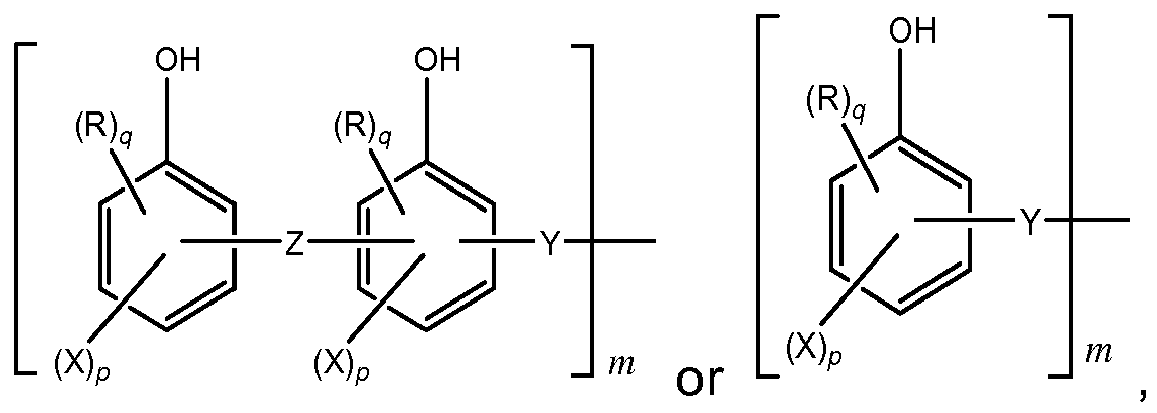 p is 0-2;q is 0-3;a is an integer greater than or equal to 1;b is an integer greater than or equal to 1;m is 0-6;X is
 n is 0-5.
 - The phosphorous-containing flame retarding phenol-formaldehyde novolac of claim 1, wherein during the preparation, a phenol compound, a bisphenol compound and a formaldehyde is used to synthesize a phenol-formaldehyde novolac, the phenol-formaldehyde novolac is then mixed with an aromatic phosphate ester to undergo condensation and polymerization, the phenol compound is phenol, o-cresol, m-cresol, p-cresol, o-phenylphenol, m-phenylphenol, p-phenylphenol, 2,6-dimethylphenol, 2,4-dimethylphenol and the combination thereof; the bisphenol compound is biphenol, bisphenol F, bisphenol A, p-thiobisphenol, bisphenol S and the combination thereof; the aromatic phosphate ester is DOPO (9,10-dihydro-9-oxa-10-phosphaphenanthrene-10-oxide), diphenyl phosphite ester, diphenyl phosphonate, C1-C4 alkyl group or C6-C18 aromatic group substituted thereof and the combination thereof.
- The phosphorous-containing flame retarding phenol-formaldehyde novolac of claim 2, wherein the mass ratio of the phenol compound and the bisphenol compound is 1:0.1 to 1:9.
- The phosphorous-containing flame retarding phenol-formaldehyde novolac of claim 1, wherein the phosphorous-containing flame retarding phenol-formaldehyde novolac is an epoxy hardener.
- A cured flame retarding epoxy resin, which is prepared by reacting the phosphorous-containing flame retarding phenol-formaldehyde novolac of claim 1 with an epoxy resin alone under a high temperature, or reacting a mixture comprising of an epoxy resin hardener and the phosphorous-containing flame retarding phenol-formaldehyde novolac of claim 1 with an epoxy resin under a high temperature.
- The cured flame retarding epoxy resin of claim 5, wherein the weight percent of the phosphorous is 0.5% to 10%.
- The cured flame retarding epoxy resin of claim 5, wherein the epoxy resin hardener is selected from the group consisting of phenol-formaldehyde novolac, cresol-formaldehyde novolac, bisphenol A phenol-formaldehyde novolac, dicyandiamide, methylenedianiline, diaminodiphenyl sulfone and the combination thereof.
- The cured flame retarding epoxy resin of claim 5, wherein the epoxy resin is a difunctional epoxy resin or a polyfunctional epoxy resin selected from the group consisting of bisphenol A novolac epoxy, bisphenol F novolac epoxy, bisphenol S novolac epoxy, biphenol novolac epoxy, phenol novolac epoxy, cresol novolac epoxy, bisphenol A novolac epoxy and the combination thereof.
- The cured flame retarding epoxy resin of claim 5, wherein the reaction is carried out in the presence of a curing accelerator, wherein the curing accelerator is imidazole compounds comprising 2-methylimidazole, 2-phenylimidazole or 2-ethyl-4-methylimidazole, and the curing accelerator is used in a range of 0.01 to 2.5 weight percent of the total weight of the epoxy resin and the epoxy resin hardener.
- The cured flame retarding epoxy resin of claim 5, wherein the cured flame retarding epoxy resin is a resin substrate of a printed circuit board and a semiconductor packaging material.
Applications Claiming Priority (1)
| Application Number | Priority Date | Filing Date | Title |
|---|---|---|---|
| CN201310255770.6A CN103382242B (en) | 2013-06-25 | 2013-06-25 | Phosphorus-containing flame-retardant phenolic resin and flame-retardant cured epoxy resin prepared with phosphorus-containing flame-retardant phenolic resin as raw material |
Publications (2)
| Publication Number | Publication Date |
|---|---|
| EP2818487A1 true EP2818487A1 (en) | 2014-12-31 |
| EP2818487B1 EP2818487B1 (en) | 2021-04-28 |
Family
ID=49490188
Family Applications (1)
| Application Number | Title | Priority Date | Filing Date |
|---|---|---|---|
| EP14173887.2A Active EP2818487B1 (en) | 2013-06-25 | 2014-06-25 | Phosphor-containing phenol formaldhyde resin and flame-retardant epoxy resin hardener containing thereof |
Country Status (5)
| Country | Link |
|---|---|
| US (1) | US9359469B2 (en) |
| EP (1) | EP2818487B1 (en) |
| JP (1) | JP5814431B2 (en) |
| CN (1) | CN103382242B (en) |
| TW (1) | TWI588183B (en) |
Cited By (2)
| Publication number | Priority date | Publication date | Assignee | Title |
|---|---|---|---|---|
| CN110484176A (en) * | 2019-09-30 | 2019-11-22 | 河南工业大学 | A kind of preparation method of modified silicon phenolic resin adhesive |
| EP3819319A1 (en) * | 2019-11-06 | 2021-05-12 | Metadynea Austria GmbH | A polymeric compound comprising dopo |
Families Citing this family (14)
| Publication number | Priority date | Publication date | Assignee | Title |
|---|---|---|---|---|
| CN103834168B (en) | 2014-02-25 | 2016-09-07 | 广东生益科技股份有限公司 | A kind of halogen-free flame resistance resin composite |
| CN104592467A (en) * | 2014-08-15 | 2015-05-06 | 江苏雅克科技股份有限公司 | Phosphorus-containing phenolic resin compound and phosphorus-containing flame-retardant epoxy resin cured product prepared from it |
| CN105623238B (en) | 2014-11-06 | 2018-07-27 | 江苏雅克科技股份有限公司 | Phosphorus-containing functionalized poly(arylene ether) and preparation of compositions using it as raw material |
| CN105566621B (en) * | 2014-11-11 | 2018-09-21 | 江苏雅克科技股份有限公司 | Composition and preparation method of low dielectric phosphorus-containing polyester compound |
| CN105778414B (en) | 2014-12-26 | 2018-05-29 | 广东生益科技股份有限公司 | A kind of composition epoxy resin and use its prepreg and laminate |
| CN105778413B (en) * | 2014-12-26 | 2018-11-27 | 广东生益科技股份有限公司 | A kind of halogen-free epoxy resin composition and prepreg and laminate using it |
| TWI615424B (en) * | 2015-01-14 | 2018-02-21 | 南亞塑膠工業股份有限公司 | Low dk phosphorous containing hardener useful for halogen free, flame retardant polymers and use |
| WO2016159218A1 (en) * | 2015-03-31 | 2016-10-06 | 住友ベークライト株式会社 | Modified phenolic resole resin composition, method for producing same, and adhesive |
| CN106916282B (en) | 2015-12-28 | 2019-07-26 | 广东生益科技股份有限公司 | A kind of composition epoxy resin and prepreg and laminate using it |
| TWI671355B (en) * | 2018-01-03 | 2019-09-11 | Taiwan Union Technology Corporation | Resin composition, and pre-preg, metal-clad laminate and printed circuit board prepared using the same |
| CN108276538A (en) * | 2018-02-11 | 2018-07-13 | 南京远淑医药科技有限公司 | A kind of preparation process of phosphorus containing phenolic resin and its application |
| JP7055664B2 (en) * | 2018-02-26 | 2022-04-18 | 日鉄ケミカル&マテリアル株式会社 | Phosphorus-containing phenoxy resin, its resin composition, and cured product |
| CN109192669B (en) * | 2018-08-14 | 2020-08-25 | 苏州德林泰精工科技有限公司 | A stacked chip packaging structure and processing technology based on resin gasket |
| CN112442065A (en) * | 2019-08-28 | 2021-03-05 | 广东广山新材料股份有限公司 | Phosphorus-containing flame retardant with aldehyde group and preparation method and application thereof |
Citations (15)
| Publication number | Priority date | Publication date | Assignee | Title |
|---|---|---|---|---|
| EP0384940A1 (en) | 1989-03-03 | 1990-09-05 | Siemens Aktiengesellschaft | Epoxy resin compositions |
| EP0384939A1 (en) | 1989-03-03 | 1990-09-05 | Siemens Aktiengesellschaft | Epoxy resin moulding compositions |
| EP0408990A2 (en) | 1989-07-19 | 1991-01-23 | Siemens Aktiengesellschaft | Thermosetting reaction resin mixture |
| DE4308184A1 (en) | 1993-03-15 | 1994-09-22 | Siemens Ag | Epoxy resin mixtures |
| DE4308187A1 (en) | 1993-03-15 | 1994-09-22 | Siemens Ag | Epoxy resin mixtures |
| DE4308185A1 (en) | 1993-03-15 | 1994-09-22 | Siemens Ag | Phosphorus-modified epoxy resins, process for their preparation, and their use |
| WO1996007686A1 (en) | 1994-09-09 | 1996-03-14 | Siemens Aktiengesellschaft | Epoxy resin mixtures for prepregs and composites |
| WO1996007685A1 (en) | 1994-09-09 | 1996-03-14 | Siemens Aktiengesellschaft | Epoxy resin mixtures for prepregs and composites |
| WO2001042359A1 (en) * | 1999-12-13 | 2001-06-14 | Dow Global Technologies Inc. | Flame retardant phosphorus element-containing epoxy resin compositions |
| US6613848B1 (en) * | 2000-01-04 | 2003-09-02 | National Science Council | Phosphorus-containing phenolic, thiophenolic or aminophenyl flame-retardant hardener, and epoxy resins cured thereby |
| US20090215967A1 (en) * | 2008-02-21 | 2009-08-27 | National Chung Hsing University | Manufacture of novel epoxy resins semi-thermosets and their high tg thermosets for electronic applications |
| WO2010114279A2 (en) * | 2009-03-31 | 2010-10-07 | Kolon Industries, Inc. | Phosphorus-containing phenol novolac resin, hardener comprising the same and epoxy resin composition |
| US20120172546A1 (en) * | 2011-01-05 | 2012-07-05 | Tang shang-wei | Phosphorus containing novalac phenol resins, methods for manufacturing the same, and formulae containing the same |
| US20130012668A1 (en) * | 2011-07-06 | 2013-01-10 | National Chung Hsing University | Monofunctional, bifunctional, and multifunctional phosphinated phenols and their derivatives and preparation method thereof |
| WO2013063635A1 (en) * | 2011-11-02 | 2013-05-10 | Krems Chemie Chemical Services Ag | Novolacs modified to be flame-retardant |
Family Cites Families (14)
| Publication number | Priority date | Publication date | Assignee | Title |
|---|---|---|---|---|
| US6627704B2 (en) | 1999-12-01 | 2003-09-30 | General Electric Company | Poly(arylene ether)-containing thermoset composition, method for the preparation thereof, and articles derived therefrom |
| US6897282B2 (en) | 2000-07-10 | 2005-05-24 | General Electric | Compositions comprising functionalized polyphenylene ether resins |
| TW593526B (en) | 2001-09-20 | 2004-06-21 | Wangsuen Su Jen | Phosphorus group containing flame retardant hardener, advanced epoxy resins and cured epoxy resins thereof |
| CN102653598B (en) | 2004-05-28 | 2015-05-13 | 陶氏环球技术有限责任公司 | Phosphorus-containing compounds useful for making halogen-free, ignition-resistant polymers |
| KR101310697B1 (en) * | 2009-03-18 | 2013-09-25 | 디아이씨 가부시끼가이샤 | Process for production of phosphorus-atom-containing phenol, novel phosphorus-atom-containing phenol, curable resin composition, cured product thereof, printed circuit board, and semiconductor sealing material |
| TWI422620B (en) * | 2009-06-18 | 2014-01-11 | Kangnam Chemical Co Ltd | Process for manufacturing flame-retardant and phosphorous-modified hardener |
| US8362116B2 (en) * | 2010-03-15 | 2013-01-29 | Nan Ya Plastics Corporation | Low dielectric resin varnish composition for laminates and the preparation thereof |
| JP5966258B2 (en) * | 2010-05-31 | 2016-08-10 | 日立化成株式会社 | Phosphorus-containing curing agent, epoxy resin composition, prepreg, resin film with support, metal foil-clad laminate, and multilayer printed wiring board |
| KR101003046B1 (en) * | 2010-06-10 | 2010-12-22 | 주식회사 신아티앤씨 | 인 Phosphorus modified flame retardant with excellent shielding performance and use |
| JP5640588B2 (en) * | 2010-09-09 | 2014-12-17 | Dic株式会社 | Method for producing phosphorus atom-containing epoxy resin, curable resin composition, cured product thereof, printed wiring board resin composition, printed wiring board, flexible wiring board resin composition, semiconductor sealing material resin composition, and build Resin composition for interlayer insulation material for up-substrate |
| CN102504483A (en) * | 2011-10-10 | 2012-06-20 | 咸阳康隆工贸有限公司 | Environmentally-friendly low-temperature-cured epoxy powder encapsulating material |
| CN102504475A (en) * | 2011-11-30 | 2012-06-20 | 华南理工大学 | Halogen-free flame retardant containing linear phenolic aldehyde and polymer material containing halogen-free flame retardant |
| JP2013170171A (en) * | 2012-02-17 | 2013-09-02 | Dic Corp | Thermosetting resin composition and friction material |
| CN102746613A (en) * | 2012-07-05 | 2012-10-24 | 同济大学 | Preparation method for phosphate ester flame retardant toughening phenolic foam material |
-
2013
- 2013-06-25 CN CN201310255770.6A patent/CN103382242B/en active Active
-
2014
- 2014-05-14 TW TW103116988A patent/TWI588183B/en active
- 2014-06-19 JP JP2014126265A patent/JP5814431B2/en active Active
- 2014-06-24 US US14/312,703 patent/US9359469B2/en active Active
- 2014-06-25 EP EP14173887.2A patent/EP2818487B1/en active Active
Patent Citations (15)
| Publication number | Priority date | Publication date | Assignee | Title |
|---|---|---|---|---|
| EP0384940A1 (en) | 1989-03-03 | 1990-09-05 | Siemens Aktiengesellschaft | Epoxy resin compositions |
| EP0384939A1 (en) | 1989-03-03 | 1990-09-05 | Siemens Aktiengesellschaft | Epoxy resin moulding compositions |
| EP0408990A2 (en) | 1989-07-19 | 1991-01-23 | Siemens Aktiengesellschaft | Thermosetting reaction resin mixture |
| DE4308184A1 (en) | 1993-03-15 | 1994-09-22 | Siemens Ag | Epoxy resin mixtures |
| DE4308187A1 (en) | 1993-03-15 | 1994-09-22 | Siemens Ag | Epoxy resin mixtures |
| DE4308185A1 (en) | 1993-03-15 | 1994-09-22 | Siemens Ag | Phosphorus-modified epoxy resins, process for their preparation, and their use |
| WO1996007686A1 (en) | 1994-09-09 | 1996-03-14 | Siemens Aktiengesellschaft | Epoxy resin mixtures for prepregs and composites |
| WO1996007685A1 (en) | 1994-09-09 | 1996-03-14 | Siemens Aktiengesellschaft | Epoxy resin mixtures for prepregs and composites |
| WO2001042359A1 (en) * | 1999-12-13 | 2001-06-14 | Dow Global Technologies Inc. | Flame retardant phosphorus element-containing epoxy resin compositions |
| US6613848B1 (en) * | 2000-01-04 | 2003-09-02 | National Science Council | Phosphorus-containing phenolic, thiophenolic or aminophenyl flame-retardant hardener, and epoxy resins cured thereby |
| US20090215967A1 (en) * | 2008-02-21 | 2009-08-27 | National Chung Hsing University | Manufacture of novel epoxy resins semi-thermosets and their high tg thermosets for electronic applications |
| WO2010114279A2 (en) * | 2009-03-31 | 2010-10-07 | Kolon Industries, Inc. | Phosphorus-containing phenol novolac resin, hardener comprising the same and epoxy resin composition |
| US20120172546A1 (en) * | 2011-01-05 | 2012-07-05 | Tang shang-wei | Phosphorus containing novalac phenol resins, methods for manufacturing the same, and formulae containing the same |
| US20130012668A1 (en) * | 2011-07-06 | 2013-01-10 | National Chung Hsing University | Monofunctional, bifunctional, and multifunctional phosphinated phenols and their derivatives and preparation method thereof |
| WO2013063635A1 (en) * | 2011-11-02 | 2013-05-10 | Krems Chemie Chemical Services Ag | Novolacs modified to be flame-retardant |
Cited By (2)
| Publication number | Priority date | Publication date | Assignee | Title |
|---|---|---|---|---|
| CN110484176A (en) * | 2019-09-30 | 2019-11-22 | 河南工业大学 | A kind of preparation method of modified silicon phenolic resin adhesive |
| EP3819319A1 (en) * | 2019-11-06 | 2021-05-12 | Metadynea Austria GmbH | A polymeric compound comprising dopo |
Also Published As
| Publication number | Publication date |
|---|---|
| TW201500412A (en) | 2015-01-01 |
| CN103382242A (en) | 2013-11-06 |
| US20140378626A1 (en) | 2014-12-25 |
| US9359469B2 (en) | 2016-06-07 |
| CN103382242B (en) | 2015-06-24 |
| TWI588183B (en) | 2017-06-21 |
| JP2015007232A (en) | 2015-01-15 |
| JP5814431B2 (en) | 2015-11-17 |
| EP2818487B1 (en) | 2021-04-28 |
Similar Documents
| Publication | Publication Date | Title |
|---|---|---|
| EP2818487B1 (en) | Phosphor-containing phenol formaldhyde resin and flame-retardant epoxy resin hardener containing thereof | |
| US10059792B2 (en) | Phosphor-containing phenol formaldehyde resin compound and flame-retardant epoxy resin hardener made from thereof | |
| EP3219758B1 (en) | Thermosetting resin composition and prepreg and laminated board prepared therefrom | |
| CN106750226B (en) | The preparation method of phosphorous-containing polyester compound composition and phosphorus-containing flame-retardant epoxy resin solidfied material | |
| US9215803B2 (en) | Epoxy resin composition and pre-preg, support-provided resin film, metallic foil clad laminate plate and multilayer printed circuit board utilizing said composition | |
| EP3845578B1 (en) | Phosphorous-containing epoxy resin, epoxy resin composition, prepreg, laminated plate, material for circuit board and cured product | |
| KR20100109029A (en) | Phosphorus containing phenol novolac resin, hardener comprising the same and epoxy resin composition | |
| EP2395059B1 (en) | Varnish composition with high temperature of glass transition for glass fiber laminate | |
| JP2015030776A (en) | Curable resin composition and cured product | |
| TWI564340B (en) | Curable compositions | |
| KR20170102439A (en) | Poly(vinylbenzyl)ether compounds, curable resin composition containing the same and cured product | |
| EP2368930B1 (en) | Novel low dielectric resin varnish composition for laminates and the preparation thereof | |
| JP2000336248A (en) | Epoxy resin composition and electric laminate | |
| KR20200033205A (en) | Epoxy resin composition and cured product thereof | |
| KR102959933B1 (en) | Epoxy resin composition, prepreg, laminate, printed circuit board, and cured product | |
| EP2374828B1 (en) | Preparation of a low dielectric brominated resin with a symmetric or saturated heterocyclic aliphatic molecular structure and composition comprising said resin | |
| JP5668987B2 (en) | Curable resin composition, cured product thereof, phenol resin, epoxy resin, and semiconductor sealing material |
Legal Events
| Date | Code | Title | Description |
|---|---|---|---|
| PUAI | Public reference made under article 153(3) epc to a published international application that has entered the european phase |
Free format text: ORIGINAL CODE: 0009012 |
|
| 17P | Request for examination filed |
Effective date: 20140625 |
|
| AK | Designated contracting states |
Kind code of ref document: A1 Designated state(s): AL AT BE BG CH CY CZ DE DK EE ES FI FR GB GR HR HU IE IS IT LI LT LU LV MC MK MT NL NO PL PT RO RS SE SI SK SM TR |
|
| AX | Request for extension of the european patent |
Extension state: BA ME |
|
| RBV | Designated contracting states (corrected) |
Designated state(s): AL AT BE BG CH CY CZ DE DK EE ES FI FR GB GR HR HU IE IS IT LI LT LU LV MC MK MT NL NO PL PT RO RS SE SI SK SM TR |
|
| 17Q | First examination report despatched |
Effective date: 20160527 |
|
| STAA | Information on the status of an ep patent application or granted ep patent |
Free format text: STATUS: EXAMINATION IS IN PROGRESS |
|
| GRAP | Despatch of communication of intention to grant a patent |
Free format text: ORIGINAL CODE: EPIDOSNIGR1 |
|
| STAA | Information on the status of an ep patent application or granted ep patent |
Free format text: STATUS: GRANT OF PATENT IS INTENDED |
|
| INTG | Intention to grant announced |
Effective date: 20201124 |
|
| RIN1 | Information on inventor provided before grant (corrected) |
Inventor name: SHEN, QI Inventor name: ZHAO, DONG Inventor name: LI, XU-FENG |
|
| GRAS | Grant fee paid |
Free format text: ORIGINAL CODE: EPIDOSNIGR3 |
|
| GRAA | (expected) grant |
Free format text: ORIGINAL CODE: 0009210 |
|
| STAA | Information on the status of an ep patent application or granted ep patent |
Free format text: STATUS: THE PATENT HAS BEEN GRANTED |
|
| AK | Designated contracting states |
Kind code of ref document: B1 Designated state(s): AL AT BE BG CH CY CZ DE DK EE ES FI FR GB GR HR HU IE IS IT LI LT LU LV MC MK MT NL NO PL PT RO RS SE SI SK SM TR |
|
| REG | Reference to a national code |
Ref country code: GB Ref legal event code: FG4D |
|
| REG | Reference to a national code |
Ref country code: CH Ref legal event code: EP |
|
| REG | Reference to a national code |
Ref country code: AT Ref legal event code: REF Ref document number: 1386980 Country of ref document: AT Kind code of ref document: T Effective date: 20210515 |
|
| REG | Reference to a national code |
Ref country code: DE Ref legal event code: R096 Ref document number: 602014076937 Country of ref document: DE |
|
| REG | Reference to a national code |
Ref country code: IE Ref legal event code: FG4D |
|
| REG | Reference to a national code |
Ref country code: NL Ref legal event code: FP |
|
| REG | Reference to a national code |
Ref country code: LT Ref legal event code: MG9D |
|
| REG | Reference to a national code |
Ref country code: AT Ref legal event code: MK05 Ref document number: 1386980 Country of ref document: AT Kind code of ref document: T Effective date: 20210428 |
|
| PG25 | Lapsed in a contracting state [announced via postgrant information from national office to epo] |
Ref country code: HR Free format text: LAPSE BECAUSE OF FAILURE TO SUBMIT A TRANSLATION OF THE DESCRIPTION OR TO PAY THE FEE WITHIN THE PRESCRIBED TIME-LIMIT Effective date: 20210428 Ref country code: FI Free format text: LAPSE BECAUSE OF FAILURE TO SUBMIT A TRANSLATION OF THE DESCRIPTION OR TO PAY THE FEE WITHIN THE PRESCRIBED TIME-LIMIT Effective date: 20210428 Ref country code: LT Free format text: LAPSE BECAUSE OF FAILURE TO SUBMIT A TRANSLATION OF THE DESCRIPTION OR TO PAY THE FEE WITHIN THE PRESCRIBED TIME-LIMIT Effective date: 20210428 Ref country code: AT Free format text: LAPSE BECAUSE OF FAILURE TO SUBMIT A TRANSLATION OF THE DESCRIPTION OR TO PAY THE FEE WITHIN THE PRESCRIBED TIME-LIMIT Effective date: 20210428 Ref country code: BG Free format text: LAPSE BECAUSE OF FAILURE TO SUBMIT A TRANSLATION OF THE DESCRIPTION OR TO PAY THE FEE WITHIN THE PRESCRIBED TIME-LIMIT Effective date: 20210728 |
|
| PG25 | Lapsed in a contracting state [announced via postgrant information from national office to epo] |
Ref country code: ES Free format text: LAPSE BECAUSE OF FAILURE TO SUBMIT A TRANSLATION OF THE DESCRIPTION OR TO PAY THE FEE WITHIN THE PRESCRIBED TIME-LIMIT Effective date: 20210428 Ref country code: NO Free format text: LAPSE BECAUSE OF FAILURE TO SUBMIT A TRANSLATION OF THE DESCRIPTION OR TO PAY THE FEE WITHIN THE PRESCRIBED TIME-LIMIT Effective date: 20210728 Ref country code: PT Free format text: LAPSE BECAUSE OF FAILURE TO SUBMIT A TRANSLATION OF THE DESCRIPTION OR TO PAY THE FEE WITHIN THE PRESCRIBED TIME-LIMIT Effective date: 20210830 Ref country code: PL Free format text: LAPSE BECAUSE OF FAILURE TO SUBMIT A TRANSLATION OF THE DESCRIPTION OR TO PAY THE FEE WITHIN THE PRESCRIBED TIME-LIMIT Effective date: 20210428 Ref country code: SE Free format text: LAPSE BECAUSE OF FAILURE TO SUBMIT A TRANSLATION OF THE DESCRIPTION OR TO PAY THE FEE WITHIN THE PRESCRIBED TIME-LIMIT Effective date: 20210428 Ref country code: RS Free format text: LAPSE BECAUSE OF FAILURE TO SUBMIT A TRANSLATION OF THE DESCRIPTION OR TO PAY THE FEE WITHIN THE PRESCRIBED TIME-LIMIT Effective date: 20210428 Ref country code: GR Free format text: LAPSE BECAUSE OF FAILURE TO SUBMIT A TRANSLATION OF THE DESCRIPTION OR TO PAY THE FEE WITHIN THE PRESCRIBED TIME-LIMIT Effective date: 20210729 Ref country code: LV Free format text: LAPSE BECAUSE OF FAILURE TO SUBMIT A TRANSLATION OF THE DESCRIPTION OR TO PAY THE FEE WITHIN THE PRESCRIBED TIME-LIMIT Effective date: 20210428 Ref country code: IS Free format text: LAPSE BECAUSE OF FAILURE TO SUBMIT A TRANSLATION OF THE DESCRIPTION OR TO PAY THE FEE WITHIN THE PRESCRIBED TIME-LIMIT Effective date: 20210828 |
|
| PG25 | Lapsed in a contracting state [announced via postgrant information from national office to epo] |
Ref country code: EE Free format text: LAPSE BECAUSE OF FAILURE TO SUBMIT A TRANSLATION OF THE DESCRIPTION OR TO PAY THE FEE WITHIN THE PRESCRIBED TIME-LIMIT Effective date: 20210428 Ref country code: DK Free format text: LAPSE BECAUSE OF FAILURE TO SUBMIT A TRANSLATION OF THE DESCRIPTION OR TO PAY THE FEE WITHIN THE PRESCRIBED TIME-LIMIT Effective date: 20210428 Ref country code: CZ Free format text: LAPSE BECAUSE OF FAILURE TO SUBMIT A TRANSLATION OF THE DESCRIPTION OR TO PAY THE FEE WITHIN THE PRESCRIBED TIME-LIMIT Effective date: 20210428 Ref country code: SM Free format text: LAPSE BECAUSE OF FAILURE TO SUBMIT A TRANSLATION OF THE DESCRIPTION OR TO PAY THE FEE WITHIN THE PRESCRIBED TIME-LIMIT Effective date: 20210428 Ref country code: SK Free format text: LAPSE BECAUSE OF FAILURE TO SUBMIT A TRANSLATION OF THE DESCRIPTION OR TO PAY THE FEE WITHIN THE PRESCRIBED TIME-LIMIT Effective date: 20210428 Ref country code: MC Free format text: LAPSE BECAUSE OF FAILURE TO SUBMIT A TRANSLATION OF THE DESCRIPTION OR TO PAY THE FEE WITHIN THE PRESCRIBED TIME-LIMIT Effective date: 20210428 Ref country code: RO Free format text: LAPSE BECAUSE OF FAILURE TO SUBMIT A TRANSLATION OF THE DESCRIPTION OR TO PAY THE FEE WITHIN THE PRESCRIBED TIME-LIMIT Effective date: 20210428 |
|
| REG | Reference to a national code |
Ref country code: DE Ref legal event code: R097 Ref document number: 602014076937 Country of ref document: DE Ref country code: CH Ref legal event code: PL |
|
| PLBE | No opposition filed within time limit |
Free format text: ORIGINAL CODE: 0009261 |
|
| STAA | Information on the status of an ep patent application or granted ep patent |
Free format text: STATUS: NO OPPOSITION FILED WITHIN TIME LIMIT |
|
| REG | Reference to a national code |
Ref country code: BE Ref legal event code: MM Effective date: 20210630 |
|
| PG25 | Lapsed in a contracting state [announced via postgrant information from national office to epo] |
Ref country code: LU Free format text: LAPSE BECAUSE OF NON-PAYMENT OF DUE FEES Effective date: 20210625 |
|
| 26N | No opposition filed |
Effective date: 20220131 |
|
| PG25 | Lapsed in a contracting state [announced via postgrant information from national office to epo] |
Ref country code: LI Free format text: LAPSE BECAUSE OF NON-PAYMENT OF DUE FEES Effective date: 20210630 Ref country code: IE Free format text: LAPSE BECAUSE OF NON-PAYMENT OF DUE FEES Effective date: 20210625 Ref country code: CH Free format text: LAPSE BECAUSE OF NON-PAYMENT OF DUE FEES Effective date: 20210630 |
|
| PG25 | Lapsed in a contracting state [announced via postgrant information from national office to epo] |
Ref country code: IS Free format text: LAPSE BECAUSE OF FAILURE TO SUBMIT A TRANSLATION OF THE DESCRIPTION OR TO PAY THE FEE WITHIN THE PRESCRIBED TIME-LIMIT Effective date: 20210828 Ref country code: AL Free format text: LAPSE BECAUSE OF FAILURE TO SUBMIT A TRANSLATION OF THE DESCRIPTION OR TO PAY THE FEE WITHIN THE PRESCRIBED TIME-LIMIT Effective date: 20210428 |
|
| PG25 | Lapsed in a contracting state [announced via postgrant information from national office to epo] |
Ref country code: IT Free format text: LAPSE BECAUSE OF FAILURE TO SUBMIT A TRANSLATION OF THE DESCRIPTION OR TO PAY THE FEE WITHIN THE PRESCRIBED TIME-LIMIT Effective date: 20210428 Ref country code: BE Free format text: LAPSE BECAUSE OF NON-PAYMENT OF DUE FEES Effective date: 20210630 |
|
| PG25 | Lapsed in a contracting state [announced via postgrant information from national office to epo] |
Ref country code: HU Free format text: LAPSE BECAUSE OF FAILURE TO SUBMIT A TRANSLATION OF THE DESCRIPTION OR TO PAY THE FEE WITHIN THE PRESCRIBED TIME-LIMIT; INVALID AB INITIO Effective date: 20140625 |
|
| PG25 | Lapsed in a contracting state [announced via postgrant information from national office to epo] |
Ref country code: CY Free format text: LAPSE BECAUSE OF FAILURE TO SUBMIT A TRANSLATION OF THE DESCRIPTION OR TO PAY THE FEE WITHIN THE PRESCRIBED TIME-LIMIT Effective date: 20210428 |
|
| P01 | Opt-out of the competence of the unified patent court (upc) registered |
Effective date: 20230602 |
|
| PG25 | Lapsed in a contracting state [announced via postgrant information from national office to epo] |
Ref country code: MK Free format text: LAPSE BECAUSE OF FAILURE TO SUBMIT A TRANSLATION OF THE DESCRIPTION OR TO PAY THE FEE WITHIN THE PRESCRIBED TIME-LIMIT Effective date: 20210428 |
|
| PG25 | Lapsed in a contracting state [announced via postgrant information from national office to epo] |
Ref country code: TR Free format text: LAPSE BECAUSE OF FAILURE TO SUBMIT A TRANSLATION OF THE DESCRIPTION OR TO PAY THE FEE WITHIN THE PRESCRIBED TIME-LIMIT Effective date: 20210428 |
|
| PG25 | Lapsed in a contracting state [announced via postgrant information from national office to epo] |
Ref country code: MT Free format text: LAPSE BECAUSE OF FAILURE TO SUBMIT A TRANSLATION OF THE DESCRIPTION OR TO PAY THE FEE WITHIN THE PRESCRIBED TIME-LIMIT Effective date: 20210428 |
|
| PGFP | Annual fee paid to national office [announced via postgrant information from national office to epo] |
Ref country code: DE Payment date: 20250624 Year of fee payment: 12 |
|
| PGFP | Annual fee paid to national office [announced via postgrant information from national office to epo] |
Ref country code: GB Payment date: 20250619 Year of fee payment: 12 |
|
| PGFP | Annual fee paid to national office [announced via postgrant information from national office to epo] |
Ref country code: NL Payment date: 20250627 Year of fee payment: 12 |
|
| PGFP | Annual fee paid to national office [announced via postgrant information from national office to epo] |
Ref country code: FR Payment date: 20250623 Year of fee payment: 12 |