EP2818108A1 - Method for determining glucose concentration in human blood - Google Patents
Method for determining glucose concentration in human blood Download PDFInfo
- Publication number
- EP2818108A1 EP2818108A1 EP13751962.5A EP13751962A EP2818108A1 EP 2818108 A1 EP2818108 A1 EP 2818108A1 EP 13751962 A EP13751962 A EP 13751962A EP 2818108 A1 EP2818108 A1 EP 2818108A1
- Authority
- EP
- European Patent Office
- Prior art keywords
- volume
- increment
- fluid
- concentration
- impedance
- Prior art date
- Legal status (The legal status is an assumption and is not a legal conclusion. Google has not performed a legal analysis and makes no representation as to the accuracy of the status listed.)
- Granted
Links
Images


Classifications
-
- A—HUMAN NECESSITIES
- A61—MEDICAL OR VETERINARY SCIENCE; HYGIENE
- A61B—DIAGNOSIS; SURGERY; IDENTIFICATION
- A61B5/00—Measuring for diagnostic purposes; Identification of persons
- A61B5/145—Measuring characteristics of blood in vivo, e.g. gas concentration or pH-value ; Measuring characteristics of body fluids or tissues, e.g. interstitial fluid or cerebral tissue
- A61B5/14532—Measuring characteristics of blood in vivo, e.g. gas concentration or pH-value ; Measuring characteristics of body fluids or tissues, e.g. interstitial fluid or cerebral tissue for measuring glucose, e.g. by tissue impedance measurement
-
- G—PHYSICS
- G01—MEASURING; TESTING
- G01N—INVESTIGATING OR ANALYSING MATERIALS BY DETERMINING THEIR CHEMICAL OR PHYSICAL PROPERTIES
- G01N27/00—Investigating or analysing materials by the use of electric, electrochemical, or magnetic means
- G01N27/02—Investigating or analysing materials by the use of electric, electrochemical, or magnetic means by investigating impedance
-
- A—HUMAN NECESSITIES
- A61—MEDICAL OR VETERINARY SCIENCE; HYGIENE
- A61B—DIAGNOSIS; SURGERY; IDENTIFICATION
- A61B5/00—Measuring for diagnostic purposes; Identification of persons
- A61B5/05—Detecting, measuring or recording for diagnosis by means of electric currents or magnetic fields; Measuring using microwaves or radio waves
- A61B5/053—Measuring electrical impedance or conductance of a portion of the body
-
- A—HUMAN NECESSITIES
- A61—MEDICAL OR VETERINARY SCIENCE; HYGIENE
- A61B—DIAGNOSIS; SURGERY; IDENTIFICATION
- A61B5/00—Measuring for diagnostic purposes; Identification of persons
- A61B5/05—Detecting, measuring or recording for diagnosis by means of electric currents or magnetic fields; Measuring using microwaves or radio waves
- A61B5/053—Measuring electrical impedance or conductance of a portion of the body
- A61B5/0537—Measuring body composition by impedance, e.g. tissue hydration or fat content
-
- A—HUMAN NECESSITIES
- A61—MEDICAL OR VETERINARY SCIENCE; HYGIENE
- A61B—DIAGNOSIS; SURGERY; IDENTIFICATION
- A61B5/00—Measuring for diagnostic purposes; Identification of persons
- A61B5/145—Measuring characteristics of blood in vivo, e.g. gas concentration or pH-value ; Measuring characteristics of body fluids or tissues, e.g. interstitial fluid or cerebral tissue
- A61B5/1468—Measuring characteristics of blood in vivo, e.g. gas concentration or pH-value ; Measuring characteristics of body fluids or tissues, e.g. interstitial fluid or cerebral tissue using chemical or electrochemical methods, e.g. by polarographic means
- A61B5/1473—Measuring characteristics of blood in vivo, e.g. gas concentration or pH-value ; Measuring characteristics of body fluids or tissues, e.g. interstitial fluid or cerebral tissue using chemical or electrochemical methods, e.g. by polarographic means invasive, e.g. introduced into the body by a catheter
-
- A—HUMAN NECESSITIES
- A61—MEDICAL OR VETERINARY SCIENCE; HYGIENE
- A61B—DIAGNOSIS; SURGERY; IDENTIFICATION
- A61B5/00—Measuring for diagnostic purposes; Identification of persons
- A61B5/24—Detecting, measuring or recording bioelectric or biomagnetic signals of the body or parts thereof
- A61B5/25—Bioelectric electrodes therefor
Definitions
- the invention refers to non-surgical methods for medical examination of human health, namely, to methods for determining glucose concentration in human blood as a result of measuring the impedance of human body part.
- Non-invasive methods for determining glucose concentration in human blood based on measuring the electrical impedance of a human body part or impedance components are known.
- a method for the indication of sugar content in human blood is known [ RU Pat. No. 2073242 , G01N33/4, 1997], with which sugar content level is determined based on variation of dielectric permeability of a finger placed in the electrical field of transducer.
- a method for monitoring the amount of sugar in human blood is also known [ RU Pat. No. 2088927 , G01N33/49, 1997], with which the measurement is taken by changing the reactance of oscillating circuits included in the secondary circuits of high-frequency generator via direct action of human upon oscillating circuits elements.
- the amount of sugar in blood is determined based on variation of current in the secondary circuits of high-frequency generator.
- Glucose concentration is determined by this device based on measurement of human body region impedance at two frequencies, determining capacitive component of impedance and converting the obtained value of capacitive component into glucose concentration in patient's blood.
- a method for measuring glucose concentration in human blood non-invasively is known [ U.S. Pat. No. 6517482 , A61B5/00, 2003]. The method is based on measuring impedance between two electrodes at a number of frequencies and deriving the value of glucose concentration on the basis of measured values.
- Another method for determining glucose concentration in blood non-invasively involves measuring electric transfer functions by means of two pairs of four-electrode sensors [ RU Pat. No. 2342071 , A61B5/053, 2008].
- the concentration of glucose in blood is determined based mathematical model specified in advance.
- Another method for determining glucose concentration in human blood is also known [ U.S. Pat. No. 7050847 , A61B5/00, 2006], with which impedance of a human body area is measured at different frequencies by means of sensors. Impedance value at high frequencies is related to fluid volume in body tissues, while impedance value at low frequencies - to volume of extracellular fluid. Parameters of biological fluids in the human body are determined based on the measured values, and then glucose concentration in human blood is derived from these parameters.
- the above-described methods are characterized by one common disadvantage - namely, the values of glucose concentration in human blood obtained through the use of these methods rank below the values obtained using direct invasive methods in terms of measurement accuracy.
- invasive methods which require taking samples of blood, rank below non-invasive ones in terms of convenience and safety.
- An engineering problem to be solved by the present invention consists in working out a non-invasive method for continuous determination of glucose concentration in human blood that is characterized by higher accuracy as compared to currently known non-invasive methods.
- a method of measuring of a concentration of blood glucose in a human comprising:
- the principal physics of the method consists in measuring the volume of fluid in a human body region.
- the water in human body accounts for 70 % of body weight, and it is not present in the human body as a single space, but distributed among body tissues.
- Vascular walls and cell membranes (out of which consist all tissues of human body) serve as boundaries for fluids. It is generally accepted to distinguish three water spaces: intracellular fluid, intravascular fluid (blood plasma fluid) and intercellular fluid (fluid that fills the intercellular space).
- the intracellular fluid or fluid contained within tissue cells and red blood cells accounts for approximately 30-40 % of human body weight.
- Intravascular fluid and intercellular fluid form the space of extracellular fluid, which accounts for about 20 % of human body weight.
- Substances intended for sustaining the life of cells or products of their vital activity that are to be disposed of or reprocessed inside human body are present in each type of fluid. These substances move through cell membranes from one space to another in the process of vital activity of the human body. Osmotic pressure that depends upon difference in concentration (concentration gradient) of substances on different sides of the membrane represents one of the driving forces for this motion.
- the basis of the method consists in estimating an increase or decrease of glucose concentration in the blood based on changes of water spaces in the human body in time, which is determined in the course of periodic measurements of impedance of a human body region.
- Initial value of glucose concentration in human blood is determined in the beginning of measurements (using an alternative method - either invasive or non-invasive one). This absolute value is individual for every human being and it determines not only the nature of dynamics of glucose concentration changes, but also its absolute values during different periods of life activity of human being.
- At least two electrodes installed at a certain distance from one another can be used for measuring the impedance of a human body region.
- Measurements of impedance of a human body region at high and low frequencies are taken with a predetermined time interval from 1 sec to 10 min. For the sake of convenience of hardware implementation of the method these time interval should be equal.
- the moment of food intake is recorded during measurement taking, and this fact is used to adjust the indicators of dynamics of glucose supply into the human body.
- the following parameters are determined when implementing the method based on values of human body region impedance measured at high and low frequencies at points in time t k :
- the method is implemented in the following way.
- Two electrodes are secured on a human body region apart from one another - at distance L. It is preferable to secure electrodes on peripheral body regions - e.g. on an arm, specifically, on forearm or finger. The best result will be obtained in the case of using annular electrodes embracing forearm or a finger
- the method according to the invention claimed herein is based on calculating the values of the increment of glucose concentration in human blood followed by summing up the calculated values, prior to taking measurements of impedance, blood glucose concentration should be measured (using any other method - invasive or non-invasive one), and the value of thus measured impedance is taken as the initial one.
- Impedance of a human body region is measured between electrodes at two frequencies: high frequency HF and low frequency LF .
- High frequency HF is chosen from the range from 200 kHz to 2 MHz; low frequency LF is chosen from the range from 20 kHz to 80 kHz.
- Electrical impedance of components of electrical impedance of body region tissues can be measured using one of the known methods, - specifically, by radiating high-frequency oscillations and subsequent measuring the impedance by means of capacitive sensors.
- Impedance of a human body region is measured at time intervals chosen from the range from 1 sec to 10 min.
- a moment of food intake (characterizing glucose supply into the human body from the outside) is recorded in the course of measurements. This is done to derive the increment of metabolic component of the volume of extracellular fluid related to glucose, taking into account the time that have elapsed since the recorded moment of food intake beginning.
- glucose concentration in human blood is derived as follows.
- the present invention can be embodied as quite simple measuring device capable of calculating of the above-indicated parameters characterizing changes in volumes of water spaces in human tissues, and finally, the current value of glucose concentration in human blood, including the option of taking into account the individual physiological features of human being and moments of food intake.
- Example 1 Processing of measurement data for healthy Volunteer #1.
- Fig. 1b shows the graphs of impedance value variation Z HF and Z LF and temperature T°C recorded by the sensor located on the forearm, while Fig. 1a shows the graph of variation of glucose concentration in the blood of Volunteer #1.
- Dots indicate values of blood sample taken during the measurements (Roche Accu-Chek Active glucometer was used). The mean error for the measurement interval of 150 minutes was equal to 6.8 %.
- Fig. 2b shows the graphs of impedance value variation Z HF and Z LF and temperature T°C recorded by the sensor located on the forearm, while Fig. 2a shows the graph of variation of glucose concentration in the blood of Volunteer #2.
- Dots indicate values of blood sample taken during the measurements (Roche Accu-Chek Active glucometer was used). The mean error for the measurement interval of 140 minutes was equal to 7.2 %.
- Fig. 3b shows the graphs of impedance value variation Z HF and Z LF and temperature T°C recorded by the sensor located on the forearm, while Fig. 3a shows the graph of variation of glucose concentration in the blood of Volunteer #3.
- Dots indicate values of blood sample taken during the measurements (Roche Accu-Chek Active glucometer was used). The mean error for the measurement interval of 150 minutes was equal to 9.5 %.
Landscapes
- Health & Medical Sciences (AREA)
- Life Sciences & Earth Sciences (AREA)
- Physics & Mathematics (AREA)
- General Health & Medical Sciences (AREA)
- Pathology (AREA)
- Surgery (AREA)
- Veterinary Medicine (AREA)
- Biophysics (AREA)
- Public Health (AREA)
- Engineering & Computer Science (AREA)
- Biomedical Technology (AREA)
- Heart & Thoracic Surgery (AREA)
- Medical Informatics (AREA)
- Molecular Biology (AREA)
- Animal Behavior & Ethology (AREA)
- Chemical & Material Sciences (AREA)
- Optics & Photonics (AREA)
- Radiology & Medical Imaging (AREA)
- Nuclear Medicine, Radiotherapy & Molecular Imaging (AREA)
- Chemical Kinetics & Catalysis (AREA)
- Emergency Medicine (AREA)
- Immunology (AREA)
- General Physics & Mathematics (AREA)
- Biochemistry (AREA)
- Analytical Chemistry (AREA)
- Electrochemistry (AREA)
- General Chemical & Material Sciences (AREA)
- Measurement Of The Respiration, Hearing Ability, Form, And Blood Characteristics Of Living Organisms (AREA)
- Investigating Or Analyzing Materials By The Use Of Electric Means (AREA)
- Investigating Or Analysing Biological Materials (AREA)
- Measurement And Recording Of Electrical Phenomena And Electrical Characteristics Of The Living Body (AREA)
Abstract
Description
- The invention refers to non-surgical methods for medical examination of human health, namely, to methods for determining glucose concentration in human blood as a result of measuring the impedance of human body part.
- Non-invasive methods for determining glucose concentration in human blood based on measuring the electrical impedance of a human body part or impedance components are known.
- For example, a method for the indication of sugar content in human blood is known [
RU Pat. No. 2073242 - A method for monitoring the amount of sugar in human blood is also known [
RU Pat. No. 2088927 - Another method is known [
U.S. Pat. No. 5792668 , G01N27/00, 1998], with which spectral analysis of high-frequency radiation reflected by human body or passing through the human body is conducted. The phase shift between direct and reflected (or transmitted) waves, which characterizes the reactive component of electrical impedance, represents a parameter to be measured by this method. The concentration of substances contained in the blood (in particular, glucose concentration) is determined based on measured parameters of phase spectrum. - Another method is known, which was embodied in a device described in the
RU Pat. No. 9703U1 - A method for measuring glucose concentration in human blood non-invasively is known [
U.S. Pat. No. 6517482 , A61B5/00, 2003]. The method is based on measuring impedance between two electrodes at a number of frequencies and deriving the value of glucose concentration on the basis of measured values. - Another method for determining glucose concentration in blood non-invasively is known, which involves measuring electric transfer functions by means of two pairs of four-electrode sensors [
RU Pat. No. 2342071 - Another method for determining glucose concentration in human blood is also known [
U.S. Pat. No. 7050847 , A61B5/00, 2006], with which impedance of a human body area is measured at different frequencies by means of sensors. Impedance value at high frequencies is related to fluid volume in body tissues, while impedance value at low frequencies - to volume of extracellular fluid. Parameters of biological fluids in the human body are determined based on the measured values, and then glucose concentration in human blood is derived from these parameters. - However, the above-described methods are characterized by one common disadvantage - namely, the values of glucose concentration in human blood obtained through the use of these methods rank below the values obtained using direct invasive methods in terms of measurement accuracy. At the same time, invasive methods, which require taking samples of blood, rank below non-invasive ones in terms of convenience and safety.
- An engineering problem to be solved by the present invention consists in working out a non-invasive method for continuous determination of glucose concentration in human blood that is characterized by higher accuracy as compared to currently known non-invasive methods.
- A method of measuring of a concentration of blood glucose in a human, the method comprising:
- using spaced apart electrodes attached to a region of a body of the human to successively measure values of high frequency impedance and low frequency impedance of the region at predetermined time intervals;
- using a measured value of the high frequency impedance to determine an estimate of a volume of fluid in tissue of the region between the electrodes;
- using a measured value of the low frequency impedance to determine an estimate of a volume of an extracellular fluid in the tissue in the region between the electrodes;
- determining an increment of a metabolic component of the volume of the extracellular fluid by:
- determining an increment of the estimate of the volume of the fluid relative to a previously measured value of the volume of the fluid;
- determining an increment of the estimate of the volume of the extracellular fluid relative to a previously measured value of the volume of the extracellular fluid;
- determining a difference between the increment of the estimate of the volume of the fluid and the increment of the estimate of the volume of the extracellular fluid;
- determining an increment of the concentration of the blood glucose by normalizing the increment of the metabolic component of the volume of the extracellular fluid; and
- determining the concentration of the blood glucose by adding up the increment of the concentration of the blood glucose and a previously determined concentration of the blood;
- The principal physics of the method consists in measuring the volume of fluid in a human body region. The water in human body accounts for 70 % of body weight, and it is not present in the human body as a single space, but distributed among body tissues. Vascular walls and cell membranes (out of which consist all tissues of human body) serve as boundaries for fluids. It is generally accepted to distinguish three water spaces: intracellular fluid, intravascular fluid (blood plasma fluid) and intercellular fluid (fluid that fills the intercellular space).
- The intracellular fluid or fluid contained within tissue cells and red blood cells accounts for approximately 30-40 % of human body weight.
- Intravascular fluid and intercellular fluid form the space of extracellular fluid, which accounts for about 20 % of human body weight.
- Substances intended for sustaining the life of cells or products of their vital activity that are to be disposed of or reprocessed inside human body are present in each type of fluid. These substances move through cell membranes from one space to another in the process of vital activity of the human body. Osmotic pressure that depends upon difference in concentration (concentration gradient) of substances on different sides of the membrane represents one of the driving forces for this motion.
- A dynamic equilibrium of metabolic processes is observed in the state of rest. The appearance of concentration gradient of osmotic pressure (e.g., together with glucose inflow from gastrointestinal tract after food intake) forces water to move though cell membrane in the direction of space characterized by higher concentration of solids dissolved in it. The volumes of water sectors are changed as a result of this process. But then regulatory mechanisms striving to restore the disturbed equilibrium of these spaces come into action. In other words, changes of water spaces volumes of human body have characteristic (cyclic) specific features. These specific features can be used as indicators of the character of metabolic processes in the human body, e.g. increase of glucose concentration in human blood after food intake.
- The basis of the method consists in estimating an increase or decrease of glucose concentration in the blood based on changes of water spaces in the human body in time, which is determined in the course of periodic measurements of impedance of a human body region.
- The following steps are performed in particular embodiments of the method.
- Initial value of glucose concentration in human blood is determined in the beginning of measurements (using an alternative method - either invasive or non-invasive one). This absolute value is individual for every human being and it determines not only the nature of dynamics of glucose concentration changes, but also its absolute values during different periods of life activity of human being.
- In particular, at least two electrodes installed at a certain distance from one another (preferably on peripheral body regions - e.g. a finger or an arm) can be used for measuring the impedance of a human body region.
- Measurements of impedance of a human body region at high and low frequencies are taken with a predetermined time interval from 1 sec to 10 min. For the sake of convenience of hardware implementation of the method these time interval should be equal.
- The moment of food intake is recorded during measurement taking, and this fact is used to adjust the indicators of dynamics of glucose supply into the human body.
- Specifically, the following parameters are determined when implementing the method based on values of human body region impedance measured at high and low frequencies at points in time tk:
- 1) Volume of fluid contained in the tissues of the human body region between electrodes Wsum (tk ) is calculated from the equation:

- where: L - the distance between two electrodes;
- ZHF (tk ) is the high frequency HF impedance measured at time tk;
- A is a calibration factor determined as:
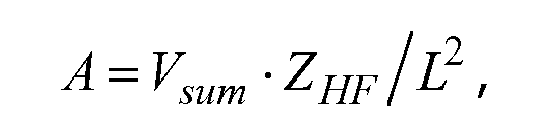
- where: Vsum is a preliminary determined value of the volume of fluid in the tissue in the region between the electrodes;
- ZHF - preliminary determined high frequency HF impedance;
- 2) Wout (tk ) is the volume of the extracellular fluid in the tissue of the region between the electrodes determined according to the following equation:

- where: ZLF(tk) is the low frequency LF impedance measured at time tk ;
- B is a calibration factor, calculated as:

- where: Vout - preliminary determined volume of the extracellular fluid in region between the electrodes;
- ZLF - preliminary determined low-frequency LF impedance;
- 3) ΔWosm (tk ) is the increment of the metabolic component determined as:

- where: Wsum (t k-1) - volume of fluid in the tissues of the human body region between the electrodes measured at time t k-1;
- Wout(t k-1 ) - volume of extracellular fluid in the tissues of the human body region between the electrodes measured at time t k-1;
- Ka is a factor dependent on a human hematocrit volume selected from a range from 1.2 to 2.1;
- 4) ΔG(tk ) is the increment of the concentration of the blood glucose determined as:

- where: Kg is a normalizing factor ranging from 0.005 l2millimole-1 to 0.006 l2millimole-1;
- KE is a factor selected from a range of 0.23 to 0.4 before a meal intake, and selected from a range of 0.6 to 1.0 after the meal;
- KPR is a factor corresponding to measuring the concentration of the glucose in blood from 20 min to 45 min after the meal intake and wherein:
- KPR = 1, if ΔWosm (tk ) is more than 0;
- KPR = -1, if ΔWosm (tk ) is less than 0.
- The invention is illustrated with the following graphic drawings.
-
Fig. 1 shows the results of determining glucose concentration in the blood for the first volunteer. -
Fig. 2 shows the results of determining glucose concentration in the blood for the second volunteer. -
Fig. 3 shows the results of determining glucose concentration in the blood for the third volunteer. -
Figs. 1a ,2a and3a show the graphs of variation of glucose concentration determined through the use of different methods, including the method of the present invention, whileFigs. 1b ,2b and3b show graphs of measured values of impedance and temperature. - The method is implemented in the following way.
- Two electrodes are secured on a human body region apart from one another - at distance L. It is preferable to secure electrodes on peripheral body regions - e.g. on an arm, specifically, on forearm or finger. The best result will be obtained in the case of using annular electrodes embracing forearm or a finger
- Since the method according to the invention claimed herein is based on calculating the values of the increment of glucose concentration in human blood followed by summing up the calculated values, prior to taking measurements of impedance, blood glucose concentration should be measured (using any other method - invasive or non-invasive one), and the value of thus measured impedance is taken as the initial one.
- Impedance of a human body region is measured between electrodes at two frequencies: high frequency HF and low frequency LF. High frequency HF is chosen from the range from 200 kHz to 2 MHz; low frequency LF is chosen from the range from 20 kHz to 80 kHz. Electrical impedance of components of electrical impedance of body region tissues can be measured using one of the known methods, - specifically, by radiating high-frequency oscillations and subsequent measuring the impedance by means of capacitive sensors. Impedance of a human body region is measured at time intervals chosen from the range from 1 sec to 10 min.
- A moment of food intake (characterizing glucose supply into the human body from the outside) is recorded in the course of measurements. This is done to derive the increment of metabolic component of the volume of extracellular fluid related to glucose, taking into account the time that have elapsed since the recorded moment of food intake beginning.
- Based on the initial glucose concentration volume in human blood, current successive measurements of impedance of a human body region at high and low frequencies, and taking into account the time moment of food intake, glucose concentration in human blood is derived as follows.
- 1. The volume of fluid contained in a human body region between the electrodes Wsum (tk ) is derived based on impedance value for human body region measured at high frequency HF at point in time tk - ZHF (tk ), taking into account distance L between the electrodes, as follows:

where: A - calibration factor, calculated from the formula:
Here, Vsum - value (obtained in advance) of the volume of fluid contained in the tissues of human body region between the electrodes. This value can be, for instance, calculated using anatomical relationships of the human body region chosen for impedance measuring. Also, the value of impedance of a human body region measured at high frequency ZHF (and obtained in advance prior to the beginning of measurements intended for determining glucose concentration in human blood according to the invention claimed herein) is used for deriving calibration factor A. - 2. The volume of extracellular fluid contained in the tissues of a human body region between the electrodes Wout(tk) is derived based on impedance value for human body region measured at low frequency LF at point in time tk - ZLF(tk), taking into account distance L between the electrodes, as follows:

where: B - calibration factor, calculated from the formula:
Here, Vout - value (obtained in advance) of the volume of extracellular fluid contained in the human body region between the electrodes. This value can be, for instance, calculated using anatomical relationships of the human body region chosen for impedance measuring. Also, the value of impedance of a human body region measured at low frequency ZLF is used for determining the calibration factor B. This impedance value is determined in advance prior to measurements of glucose concentration in human blood according to the present invention. - 3. Then obtained value of volume of fluid contained in the tissues of the human body region between electrodes, and volume of extracellular fluid contained in the tissues of the human body region between electrodes, are used for calculating the increment of metabolic component of the extracellular fluid volume ΔWosm (tk ). The values of fluid volumes obtained for measurements of impedance at point in time tk and for the previous measurement at point in time tk-1 are used for this calculation. The increment of metabolic component of extracellular fluid volume is calculated from the formula:

- where: Wsum (tk ) - volume of fluid contained in the tissues of the human body region between the electrodes, for the current measurement taken at point in time tk;
- Wsum (tk-1 )- volume of fluid contained in the tissues of the human body region between the electrodes, for the previous measurement taken at point in time t k-1;
- Wout (tk ) - volume of extracellular fluid contained in the tissues of the human body region between the electrodes, for the current measurement taken at point in time tk ;
- Wout (tk-1 ) - volume of extracellular fluid contained in the tissues of the human body region between the electrodes, for the previous measurement taken at point in time tk-1 ;
- Ka - factor dependent on the value of human hematocrit (this factor is chosen from the range from 1.2 to 2.1).
- 4. The value of the increment of glucose concentration in human blood is determined based on the obtained value of ΔWosm (tk ) taking into account the moment of food intake:

- where: Kg - the normalizing factor chosen from the range from 0.005 l2millimole-1 to 0.006 l2millimole-1.
- KE - factor dependent on food intake; when determining glucose concentration in human blood prior to food intake, KE value is chosen from the range from 0.23 to 0.4, and when determining glucose concentration in human blood after food intake, KE value is chosen from the range from 0.6 to 1.0;
- KPR - factor used for determining glucose concentration in human blood in the time period from 20 to 45 minutes after food intake, with this factor taking the value either 1 or -1 depending on the sign of the said increment of metabolic component of the extracellular fluid volume according to the following rule:
- KPR = 1, if the said increment of metabolic component of the extracellular fluid volume ΔWosm (tk ) is greater than 0,
- KPR =-1, if the said increment of metabolic component of the extracellular fluid volume ΔWosm (tk ) is less than 0.
- 5. The final value of glucose concentration in human blood by point in time tk is derived as follows:

- where: G 0 - initial value of glucose concentration in human blood;
- ΔG(ti ) - values of all increments of glucose concentration in human blood obtained from the beginning of measurements till point in time tk, where i = {l,k}.
- Thus, knowing the initial value of glucose concentration in human blood G0 and periodically taking measurements of impedance of the human body region at high and low frequencies - ZHF(tk) and ZLF(tk), one can derive the current value of glucose concentration in human blood. The present invention can be embodied as quite simple measuring device capable of calculating of the above-indicated parameters characterizing changes in volumes of water spaces in human tissues, and finally, the current value of glucose concentration in human blood, including the option of taking into account the individual physiological features of human being and moments of food intake.
- A 38-year-old healthy male, took a meal (food load) of 300 g of sweet beverage (Pepsi Cola).
Fig. 1b shows the graphs of impedance value variation ZHF and ZLF and temperature T°C recorded by the sensor located on the forearm, whileFig. 1a shows the graph of variation of glucose concentration in the blood of Volunteer #1. Dots indicate values of blood sample taken during the measurements (Roche Accu-Chek Active glucometer was used). The mean error for the measurement interval of 150 minutes was equal to 6.8 %. - A 45-year-old healthy male, took a meal (food load) of two 200 g glasses of sweet beverage (Pepsi Cola).
Fig. 2b shows the graphs of impedance value variation ZHF and ZLF and temperature T°C recorded by the sensor located on the forearm, whileFig. 2a shows the graph of variation of glucose concentration in the blood of Volunteer #2. Dots indicate values of blood sample taken during the measurements (Roche Accu-Chek Active glucometer was used). The mean error for the measurement interval of 140 minutes was equal to 7.2 %. - A 42-year-old healthy male, took a combined meal (food load) of 200 g of sweet beverage (Pepsi Cola) and banana.
Fig. 3b shows the graphs of impedance value variation ZHF and ZLF and temperature T°C recorded by the sensor located on the forearm, whileFig. 3a shows the graph of variation of glucose concentration in the blood ofVolunteer # 3. Dots indicate values of blood sample taken during the measurements (Roche Accu-Chek Active glucometer was used). The mean error for the measurement interval of 150 minutes was equal to 9.5 %. - The conducted tests showed that the method claimed herein is characterized by lesser error when determining the value of glucose concentration in human blood as compared to the known non-invasive methods.
Claims (6)
- A method of measuring of a concentration of blood glucose in a human, the method comprising:using spaced apart electrodes attached to a region of a body of the human to successively measure values of high frequency impedance and low frequency impedance of the region at predetermined time intervals;using a measured value of the high frequency impedance to determine an estimate of a volume of fluid in tissue of the region between the electrodes;using a measured value of the low frequency impedance to determine an estimate of a volume of an extracellular fluid in the tissue in the region between the electrodes;determining an increment of a metabolic component of the volume of the extracellular fluid by:determining an increment of the estimate of the volume of the fluid relative to a previously measured value of the volume of the fluid;determining an increment of the estimate of the volume of the extracellular fluid relative to a previously measured value of the volume of the extracellular fluid;determining a difference between the increment of the estimate of the volume of the fluid and the increment of the estimate of the volume of the extracellular fluid;determining an increment of the concentration of the blood glucose by normalizing the increment of the metabolic component of the volume of the extracellular fluid; anddetermining the concentration of the blood glucose by adding up the increment of the concentration of the blood glucose and a previously determined concentration of the blood;wherein determining a concentration of the blood glucose at a first time interval comprises adding up an increment of the concentration at the first interval of time and an initial blood glucose concentration.
- The method according to Claim 1, wherein the initial blood glucose concentration is determined invasively.
- The method according to Claim 1, wherein at least two spaced apart electrodes attached to the region of the body of the human are used.
- The method according to Claim 3, wherein the at least two spaced apart electrodes are attached to the peripheral body regions as an arm or a finger.
- The method according to Claim 1, wherein the predetermined time intervals range from 1 s to 10 min.
- The method according to Claim 1, wherein:Wsum (tk ) is the volume of fluid in tissue of the region between the electrodes, determined according to the following equation:
 wherein: L - is a distance between the two electrodes;ZHF(tk) - is the high frequency HF impedance measured at time tk;A is a calibration factor determined as A = Vsum·ZHF /L2 ;wherein Vsum - is a preliminary determined value of the volume of fluid in the tissue in the region between the electrodes;ZHF - preliminary determined high frequency HF impedance;Wout (tk ) is the volume of the extracellular fluid in the tissue of the region between the electrodes determined according to the following equation:
 ZLF (tk ) - is the low frequency LF impedance measured at time tk;B is a calibration factor, calculated as B = Vout·ZLF /L2;wherein Vout - preliminary determined volume of the extracellular fluid in region;ZLF - preliminary determined low-frequency LF impedance;ΔWosm (tk ) is the increment of the metabolic component determined as:
whereinWsum (tk-1 ) is the volume of the fluid in the tissue measured at time tk-1;Wout (tk-1 ) is the volume of the extracellular fluid measured at time tk-1;Ka is a factor dependent on a human hematocrit volume selected from a range from 1.2 to 2.1;ΔG(tk ) is the increment of the concentration of the blood glucose determined as:
whereinKg is a normalizing factor ranging from 0.005 l2 millimole-1 to 0.006 l2millimole-1;KE is a factor selected from a range of 0.23 to 0.4 before a meal intake, and selected from a range of 0.6 to 1.0 after the meal;KPR is a factor corresponding to measuring the concentration of the glucose in blood from 20 min to 45 min after the meal intake and wherein:KPR =1 if ΔWosm (tk ) is more than 0; andKPR = -1 if ΔWosm (tk ) is less than 0.
Applications Claiming Priority (2)
| Application Number | Priority Date | Filing Date | Title |
|---|---|---|---|
| RU2012106461/14A RU2518134C2 (en) | 2012-02-24 | 2012-02-24 | Method for determining individual's blood glucose concentration |
| PCT/RU2013/000144 WO2013125987A1 (en) | 2012-02-24 | 2013-02-22 | Method for determining glucose concentration in human blood |
Publications (3)
| Publication Number | Publication Date |
|---|---|
| EP2818108A1 true EP2818108A1 (en) | 2014-12-31 |
| EP2818108A4 EP2818108A4 (en) | 2015-11-18 |
| EP2818108B1 EP2818108B1 (en) | 2017-05-17 |
Family
ID=49006041
Family Applications (1)
| Application Number | Title | Priority Date | Filing Date |
|---|---|---|---|
| EP13751962.5A Active EP2818108B1 (en) | 2012-02-24 | 2013-02-22 | Method for determining glucose concentration in human blood |
Country Status (9)
| Country | Link |
|---|---|
| US (2) | US20150073242A1 (en) |
| EP (1) | EP2818108B1 (en) |
| JP (1) | JP6063487B2 (en) |
| KR (1) | KR101687465B1 (en) |
| CN (1) | CN104302229B (en) |
| ES (1) | ES2637417T3 (en) |
| MY (1) | MY164409A (en) |
| RU (1) | RU2518134C2 (en) |
| WO (1) | WO2013125987A1 (en) |
Cited By (2)
| Publication number | Priority date | Publication date | Assignee | Title |
|---|---|---|---|---|
| WO2016159824A1 (en) * | 2015-04-02 | 2016-10-06 | Общество С Ограниченной Ответственностью "Хилби" | Method of determining the amount of water entering a human body with food |
| EP3363361A4 (en) * | 2015-11-11 | 2018-08-22 | Samsung Electronics Co., Ltd. | Method for providing eating habit information and wearable device therefor |
Families Citing this family (18)
| Publication number | Priority date | Publication date | Assignee | Title |
|---|---|---|---|---|
| EP3060107A1 (en) | 2013-10-23 | 2016-08-31 | Quanttus, Inc. | Consumer biometric devices |
| WO2015058286A1 (en) * | 2013-10-27 | 2015-04-30 | Blacktree Fitness Technologies Inc. | Portable devices and methods for measuring nutritional intake |
| RU2595867C2 (en) * | 2014-05-05 | 2016-08-27 | Федеральное государственное бюджетное учреждение науки Мурманский морской биологический институт Кольского научного центра Российской академии наук (ММБИ КНЦ РАН) | Method of detecting and selecting organisms-biosensors for operative bioindication and biomonitoring of sea and fresh water, including drinking and waste water |
| EP2979624A1 (en) * | 2014-07-28 | 2016-02-03 | Roche Diagnostics GmbH | Carrier system for a medical device worn on the body |
| RU2599104C2 (en) * | 2014-08-21 | 2016-10-10 | Автономная некоммерческая организация "Институт биомедицинских проблем" | Method of determining content of glucose in blood |
| WO2016054079A1 (en) | 2014-09-29 | 2016-04-07 | Zyomed Corp. | Systems and methods for blood glucose and other analyte detection and measurement using collision computing |
| RU2596506C1 (en) | 2015-03-13 | 2016-09-10 | Общество С Ограниченной Ответственностью "Хилби" | Method for determination of glycemic index of food consumed by human |
| RU2593983C1 (en) * | 2015-03-13 | 2016-08-10 | Общество С Ограниченной Ответственностью "Хилби" | Method of determining type of motion activity conditions and device therefor |
| RU2644501C2 (en) * | 2016-02-09 | 2018-02-12 | Федеральное государственное бюджетное образовательное учреждение высшего образования "Тамбовский государственный технический университет" (ФГБОУ ВО ТГТУ) | Method for non-invasive determination of blood glucose concentration in glucogram |
| US9554738B1 (en) | 2016-03-30 | 2017-01-31 | Zyomed Corp. | Spectroscopic tomography systems and methods for noninvasive detection and measurement of analytes using collision computing |
| CN108169285B (en) * | 2017-12-26 | 2020-02-04 | 河北农业大学 | Method for measuring content of soluble sugar in kalopanax pohuashanensis by adopting electrical impedance loss coefficient delta value method |
| US10905337B2 (en) | 2019-02-26 | 2021-02-02 | Bao Tran | Hearing and monitoring system |
| US10998101B1 (en) | 2019-12-15 | 2021-05-04 | Bao Tran | Health management |
| US11357426B2 (en) | 2020-01-15 | 2022-06-14 | Bao Tran | Glucose management |
| US11607147B2 (en) | 2020-01-16 | 2023-03-21 | Samsung Electronics Co., Ltd. | Component analyzing apparatus and component analyzing method, and impedance measuring apparatus |
| KR20210104410A (en) | 2020-02-17 | 2021-08-25 | 삼성전자주식회사 | Apparatus and method for estimating bio-information, ultrasonic device and mobile device |
| CN111317473A (en) * | 2020-03-12 | 2020-06-23 | 桂林电子科技大学 | Blood glucose detection method based on hybrid measurement technology |
| US12216439B2 (en) | 2022-06-07 | 2025-02-04 | Bao Tran | Hub to sync multiple devices |
Family Cites Families (18)
| Publication number | Priority date | Publication date | Assignee | Title |
|---|---|---|---|---|
| RU2073242C1 (en) * | 1993-01-01 | 1997-02-10 | Виктор Иванович Леднев | Method for indication of sugar content in blood and device for its embodiment |
| RU2088927C1 (en) | 1993-04-01 | 1997-08-27 | Ламбров Владимир Васильевич | Method and device for controlling sugar quantity in human blood in cases of diabetes mellitus |
| US5792668A (en) | 1993-08-06 | 1998-08-11 | Solid State Farms, Inc. | Radio frequency spectral analysis for in-vitro or in-vivo environments |
| US6517482B1 (en) | 1996-04-23 | 2003-02-11 | Dermal Therapy (Barbados) Inc. | Method and apparatus for non-invasive determination of glucose in body fluids |
| AU762922B2 (en) * | 1998-02-04 | 2003-07-10 | Dermal Therapy (Barbados) Inc. | Method and apparatus for non-invasive determination of glucose in body fluids |
| RU9703U1 (en) | 1998-03-19 | 1999-05-16 | Общественное объединение Фонд "Датчик-Инвест" | DEVICE FOR MONITORING THE CONDITION OF A PATIENT WITH SUGAR DIABETES |
| EP1021705A4 (en) | 1998-08-10 | 2002-08-28 | Solid State Farms Inc | Improving radio frequency spectral analysis for in-vitro or in-vivo environments |
| US6841389B2 (en) * | 2001-02-05 | 2005-01-11 | Glucosens, Inc. | Method of determining concentration of glucose in blood |
| US7050847B2 (en) * | 2002-03-26 | 2006-05-23 | Stig Ollmar | Non-invasive in vivo determination of body fluid parameter |
| US7454429B2 (en) * | 2004-02-14 | 2008-11-18 | Alan S Rojer | Declarative Dispatch |
| WO2007053963A1 (en) * | 2005-11-10 | 2007-05-18 | Solianis Holding Ag | Device for determining the glucose level in body tissue |
| JP2009519765A (en) * | 2005-12-16 | 2009-05-21 | バイエル・ヘルスケア・エルエルシー | IN-VIVO non-invasive bioelectrical impedance analysis of glucose-mediated changes in tissues |
| RU2342071C2 (en) * | 2007-01-29 | 2008-12-27 | Игорь Алексеевич Новиков | Method of glucose concentration definition in human blood |
| JP2009005842A (en) * | 2007-06-27 | 2009-01-15 | Tanita Corp | Body composition measuring apparatus and body composition measuring method |
| CN101827554B (en) * | 2007-09-07 | 2014-07-16 | 英戈·弗洛尔 | Medical measuring device for bioelectrical impedance measurement |
| EP2158838A1 (en) * | 2008-08-29 | 2010-03-03 | Gerinova AG | Non-invasive method for estimating of the variation of the clucose level in the blood of a person and apparatur for carrying out the method |
| WO2010126827A2 (en) * | 2009-05-01 | 2010-11-04 | Sanguis Technologies, Llc | Non-invasive analyte measurement |
| JP2011078443A (en) * | 2009-10-02 | 2011-04-21 | Tanita Corp | Biometric measurement apparatus |
-
2012
- 2012-02-24 RU RU2012106461/14A patent/RU2518134C2/en active
-
2013
- 2013-02-22 JP JP2014558712A patent/JP6063487B2/en active Active
- 2013-02-22 EP EP13751962.5A patent/EP2818108B1/en active Active
- 2013-02-22 MY MYPI2014002455A patent/MY164409A/en unknown
- 2013-02-22 ES ES13751962.5T patent/ES2637417T3/en active Active
- 2013-02-22 WO PCT/RU2013/000144 patent/WO2013125987A1/en not_active Ceased
- 2013-02-22 CN CN201380015903.0A patent/CN104302229B/en active Active
- 2013-02-22 KR KR1020147026561A patent/KR101687465B1/en active Active
-
2014
- 2014-08-22 US US14/466,570 patent/US20150073242A1/en not_active Abandoned
-
2017
- 2017-10-18 US US15/787,432 patent/US10667728B2/en active Active
Cited By (3)
| Publication number | Priority date | Publication date | Assignee | Title |
|---|---|---|---|---|
| WO2016159824A1 (en) * | 2015-04-02 | 2016-10-06 | Общество С Ограниченной Ответственностью "Хилби" | Method of determining the amount of water entering a human body with food |
| EP3363361A4 (en) * | 2015-11-11 | 2018-08-22 | Samsung Electronics Co., Ltd. | Method for providing eating habit information and wearable device therefor |
| US11103195B2 (en) | 2015-11-11 | 2021-08-31 | Samsung Electronics Co., Ltd. | Method for providing eating habit information and wearable device therefor |
Also Published As
| Publication number | Publication date |
|---|---|
| JP6063487B2 (en) | 2017-01-18 |
| RU2012106461A (en) | 2013-08-27 |
| JP2015512672A (en) | 2015-04-30 |
| US20150073242A1 (en) | 2015-03-12 |
| KR20140126402A (en) | 2014-10-30 |
| RU2518134C2 (en) | 2014-06-10 |
| US10667728B2 (en) | 2020-06-02 |
| CN104302229B (en) | 2016-08-17 |
| HK1204537A1 (en) | 2015-11-27 |
| MY164409A (en) | 2017-12-15 |
| US20180035930A1 (en) | 2018-02-08 |
| KR101687465B1 (en) | 2016-12-19 |
| WO2013125987A1 (en) | 2013-08-29 |
| EP2818108B1 (en) | 2017-05-17 |
| ES2637417T3 (en) | 2017-10-13 |
| CN104302229A (en) | 2015-01-21 |
| EP2818108A4 (en) | 2015-11-18 |
Similar Documents
| Publication | Publication Date | Title |
|---|---|---|
| US10667728B2 (en) | Method for determining glucose concentration in human blood | |
| EP2440909B1 (en) | Non-invasive monitoring of blood metabolite levels | |
| EP2178434B1 (en) | Cardiac monitoring system | |
| AU2015206084B2 (en) | Implantable sensor and method for such sensor | |
| RU2477074C2 (en) | Non-invasive method of estimating changes of glucose level in human blood and device for method realisation | |
| EP2305113B1 (en) | Biometric measurement apparatus | |
| WO2007046099A1 (en) | Non-invasive glucose monitoring | |
| US20020155615A1 (en) | Method of determining concentration of glucose in blood | |
| CA2936487C (en) | Health monitoring system | |
| Ohata et al. | Non-contact blood pressure measurement scheme using doppler radar | |
| US11504015B2 (en) | Method of predicting fluid responsiveness in patients | |
| EP3387986A1 (en) | Method for determining water deficiency in a person's body | |
| HK1204537B (en) | Method for determining glucose concentration in human blood | |
| KR20210091559A (en) | Blood pressure and glucose measurement method and apparatus using wearable device | |
| CN114521875B (en) | Method and device for extracting pulse wave frequency domain characteristic parameters based on pressure increasing and reducing | |
| US20240268767A1 (en) | Method for analyzing signal waveform, electronic apparatus, and computer-readable recording medium | |
| EP4582017A1 (en) | Method for determining an index for assessing a cardiac function of a subject | |
| Riz | Development and assessment of linear regression techniques for modeling multisensor data for non-invasive continuos glucose monitoring |
Legal Events
| Date | Code | Title | Description |
|---|---|---|---|
| PUAI | Public reference made under article 153(3) epc to a published international application that has entered the european phase |
Free format text: ORIGINAL CODE: 0009012 |
|
| 17P | Request for examination filed |
Effective date: 20140923 |
|
| AK | Designated contracting states |
Kind code of ref document: A1 Designated state(s): AL AT BE BG CH CY CZ DE DK EE ES FI FR GB GR HR HU IE IS IT LI LT LU LV MC MK MT NL NO PL PT RO RS SE SI SK SM TR |
|
| AX | Request for extension of the european patent |
Extension state: BA ME |
|
| DAX | Request for extension of the european patent (deleted) | ||
| RA4 | Supplementary search report drawn up and despatched (corrected) |
Effective date: 20151019 |
|
| RIC1 | Information provided on ipc code assigned before grant |
Ipc: G06F 19/00 20110101ALI20151013BHEP Ipc: A61B 5/145 20060101AFI20151013BHEP Ipc: A61B 5/053 20060101ALI20151013BHEP |
|
| 17Q | First examination report despatched |
Effective date: 20160609 |
|
| GRAP | Despatch of communication of intention to grant a patent |
Free format text: ORIGINAL CODE: EPIDOSNIGR1 |
|
| INTG | Intention to grant announced |
Effective date: 20161206 |
|
| GRAS | Grant fee paid |
Free format text: ORIGINAL CODE: EPIDOSNIGR3 |
|
| GRAA | (expected) grant |
Free format text: ORIGINAL CODE: 0009210 |
|
| AK | Designated contracting states |
Kind code of ref document: B1 Designated state(s): AL AT BE BG CH CY CZ DE DK EE ES FI FR GB GR HR HU IE IS IT LI LT LU LV MC MK MT NL NO PL PT RO RS SE SI SK SM TR |
|
| REG | Reference to a national code |
Ref country code: GB Ref legal event code: FG4D |
|
| REG | Reference to a national code |
Ref country code: CH Ref legal event code: EP |
|
| REG | Reference to a national code |
Ref country code: IE Ref legal event code: FG4D |
|
| REG | Reference to a national code |
Ref country code: AT Ref legal event code: REF Ref document number: 893706 Country of ref document: AT Kind code of ref document: T Effective date: 20170615 |
|
| REG | Reference to a national code |
Ref country code: DE Ref legal event code: R096 Ref document number: 602013021289 Country of ref document: DE |
|
| REG | Reference to a national code |
Ref country code: SE Ref legal event code: TRGR |
|
| REG | Reference to a national code |
Ref country code: NL Ref legal event code: MP Effective date: 20170517 |
|
| REG | Reference to a national code |
Ref country code: LT Ref legal event code: MG4D |
|
| REG | Reference to a national code |
Ref country code: ES Ref legal event code: FG2A Ref document number: 2637417 Country of ref document: ES Kind code of ref document: T3 Effective date: 20171013 |
|
| PG25 | Lapsed in a contracting state [announced via postgrant information from national office to epo] |
Ref country code: LT Free format text: LAPSE BECAUSE OF FAILURE TO SUBMIT A TRANSLATION OF THE DESCRIPTION OR TO PAY THE FEE WITHIN THE PRESCRIBED TIME-LIMIT Effective date: 20170517 Ref country code: HR Free format text: LAPSE BECAUSE OF FAILURE TO SUBMIT A TRANSLATION OF THE DESCRIPTION OR TO PAY THE FEE WITHIN THE PRESCRIBED TIME-LIMIT Effective date: 20170517 Ref country code: NO Free format text: LAPSE BECAUSE OF FAILURE TO SUBMIT A TRANSLATION OF THE DESCRIPTION OR TO PAY THE FEE WITHIN THE PRESCRIBED TIME-LIMIT Effective date: 20170817 Ref country code: GR Free format text: LAPSE BECAUSE OF FAILURE TO SUBMIT A TRANSLATION OF THE DESCRIPTION OR TO PAY THE FEE WITHIN THE PRESCRIBED TIME-LIMIT Effective date: 20170818 |
|
| PG25 | Lapsed in a contracting state [announced via postgrant information from national office to epo] |
Ref country code: NL Free format text: LAPSE BECAUSE OF FAILURE TO SUBMIT A TRANSLATION OF THE DESCRIPTION OR TO PAY THE FEE WITHIN THE PRESCRIBED TIME-LIMIT Effective date: 20170517 Ref country code: IS Free format text: LAPSE BECAUSE OF FAILURE TO SUBMIT A TRANSLATION OF THE DESCRIPTION OR TO PAY THE FEE WITHIN THE PRESCRIBED TIME-LIMIT Effective date: 20170917 Ref country code: PL Free format text: LAPSE BECAUSE OF FAILURE TO SUBMIT A TRANSLATION OF THE DESCRIPTION OR TO PAY THE FEE WITHIN THE PRESCRIBED TIME-LIMIT Effective date: 20170517 Ref country code: BG Free format text: LAPSE BECAUSE OF FAILURE TO SUBMIT A TRANSLATION OF THE DESCRIPTION OR TO PAY THE FEE WITHIN THE PRESCRIBED TIME-LIMIT Effective date: 20170817 Ref country code: RS Free format text: LAPSE BECAUSE OF FAILURE TO SUBMIT A TRANSLATION OF THE DESCRIPTION OR TO PAY THE FEE WITHIN THE PRESCRIBED TIME-LIMIT Effective date: 20170517 Ref country code: LV Free format text: LAPSE BECAUSE OF FAILURE TO SUBMIT A TRANSLATION OF THE DESCRIPTION OR TO PAY THE FEE WITHIN THE PRESCRIBED TIME-LIMIT Effective date: 20170517 |
|
| PG25 | Lapsed in a contracting state [announced via postgrant information from national office to epo] |
Ref country code: RO Free format text: LAPSE BECAUSE OF FAILURE TO SUBMIT A TRANSLATION OF THE DESCRIPTION OR TO PAY THE FEE WITHIN THE PRESCRIBED TIME-LIMIT Effective date: 20170517 Ref country code: EE Free format text: LAPSE BECAUSE OF FAILURE TO SUBMIT A TRANSLATION OF THE DESCRIPTION OR TO PAY THE FEE WITHIN THE PRESCRIBED TIME-LIMIT Effective date: 20170517 Ref country code: DK Free format text: LAPSE BECAUSE OF FAILURE TO SUBMIT A TRANSLATION OF THE DESCRIPTION OR TO PAY THE FEE WITHIN THE PRESCRIBED TIME-LIMIT Effective date: 20170517 Ref country code: CZ Free format text: LAPSE BECAUSE OF FAILURE TO SUBMIT A TRANSLATION OF THE DESCRIPTION OR TO PAY THE FEE WITHIN THE PRESCRIBED TIME-LIMIT Effective date: 20170517 Ref country code: SK Free format text: LAPSE BECAUSE OF FAILURE TO SUBMIT A TRANSLATION OF THE DESCRIPTION OR TO PAY THE FEE WITHIN THE PRESCRIBED TIME-LIMIT Effective date: 20170517 |
|
| REG | Reference to a national code |
Ref country code: DE Ref legal event code: R097 Ref document number: 602013021289 Country of ref document: DE |
|
| REG | Reference to a national code |
Ref country code: FR Ref legal event code: PLFP Year of fee payment: 6 |
|
| PG25 | Lapsed in a contracting state [announced via postgrant information from national office to epo] |
Ref country code: SM Free format text: LAPSE BECAUSE OF FAILURE TO SUBMIT A TRANSLATION OF THE DESCRIPTION OR TO PAY THE FEE WITHIN THE PRESCRIBED TIME-LIMIT Effective date: 20170517 |
|
| PLBE | No opposition filed within time limit |
Free format text: ORIGINAL CODE: 0009261 |
|
| STAA | Information on the status of an ep patent application or granted ep patent |
Free format text: STATUS: NO OPPOSITION FILED WITHIN TIME LIMIT |
|
| 26N | No opposition filed |
Effective date: 20180220 |
|
| PG25 | Lapsed in a contracting state [announced via postgrant information from national office to epo] |
Ref country code: SI Free format text: LAPSE BECAUSE OF FAILURE TO SUBMIT A TRANSLATION OF THE DESCRIPTION OR TO PAY THE FEE WITHIN THE PRESCRIBED TIME-LIMIT Effective date: 20170517 |
|
| REG | Reference to a national code |
Ref country code: CH Ref legal event code: PL |
|
| PG25 | Lapsed in a contracting state [announced via postgrant information from national office to epo] |
Ref country code: MC Free format text: LAPSE BECAUSE OF FAILURE TO SUBMIT A TRANSLATION OF THE DESCRIPTION OR TO PAY THE FEE WITHIN THE PRESCRIBED TIME-LIMIT Effective date: 20170517 |
|
| REG | Reference to a national code |
Ref country code: IE Ref legal event code: MM4A |
|
| REG | Reference to a national code |
Ref country code: BE Ref legal event code: MM Effective date: 20180228 |
|
| PG25 | Lapsed in a contracting state [announced via postgrant information from national office to epo] |
Ref country code: LU Free format text: LAPSE BECAUSE OF NON-PAYMENT OF DUE FEES Effective date: 20180222 Ref country code: CH Free format text: LAPSE BECAUSE OF NON-PAYMENT OF DUE FEES Effective date: 20180228 Ref country code: LI Free format text: LAPSE BECAUSE OF NON-PAYMENT OF DUE FEES Effective date: 20180228 |
|
| PG25 | Lapsed in a contracting state [announced via postgrant information from national office to epo] |
Ref country code: IE Free format text: LAPSE BECAUSE OF NON-PAYMENT OF DUE FEES Effective date: 20180222 |
|
| PG25 | Lapsed in a contracting state [announced via postgrant information from national office to epo] |
Ref country code: BE Free format text: LAPSE BECAUSE OF NON-PAYMENT OF DUE FEES Effective date: 20180228 |
|
| PG25 | Lapsed in a contracting state [announced via postgrant information from national office to epo] |
Ref country code: MT Free format text: LAPSE BECAUSE OF NON-PAYMENT OF DUE FEES Effective date: 20180222 |
|
| PG25 | Lapsed in a contracting state [announced via postgrant information from national office to epo] |
Ref country code: TR Free format text: LAPSE BECAUSE OF FAILURE TO SUBMIT A TRANSLATION OF THE DESCRIPTION OR TO PAY THE FEE WITHIN THE PRESCRIBED TIME-LIMIT Effective date: 20170517 |
|
| PG25 | Lapsed in a contracting state [announced via postgrant information from national office to epo] |
Ref country code: PT Free format text: LAPSE BECAUSE OF FAILURE TO SUBMIT A TRANSLATION OF THE DESCRIPTION OR TO PAY THE FEE WITHIN THE PRESCRIBED TIME-LIMIT Effective date: 20170517 Ref country code: HU Free format text: LAPSE BECAUSE OF FAILURE TO SUBMIT A TRANSLATION OF THE DESCRIPTION OR TO PAY THE FEE WITHIN THE PRESCRIBED TIME-LIMIT; INVALID AB INITIO Effective date: 20130222 |
|
| PG25 | Lapsed in a contracting state [announced via postgrant information from national office to epo] |
Ref country code: CY Free format text: LAPSE BECAUSE OF FAILURE TO SUBMIT A TRANSLATION OF THE DESCRIPTION OR TO PAY THE FEE WITHIN THE PRESCRIBED TIME-LIMIT Effective date: 20170517 Ref country code: MK Free format text: LAPSE BECAUSE OF NON-PAYMENT OF DUE FEES Effective date: 20170517 |
|
| PG25 | Lapsed in a contracting state [announced via postgrant information from national office to epo] |
Ref country code: AL Free format text: LAPSE BECAUSE OF FAILURE TO SUBMIT A TRANSLATION OF THE DESCRIPTION OR TO PAY THE FEE WITHIN THE PRESCRIBED TIME-LIMIT Effective date: 20170517 |
|
| REG | Reference to a national code |
Ref country code: AT Ref legal event code: UEP Ref document number: 893706 Country of ref document: AT Kind code of ref document: T Effective date: 20170517 |
|
| PGFP | Annual fee paid to national office [announced via postgrant information from national office to epo] |
Ref country code: SE Payment date: 20240213 Year of fee payment: 12 |
|
| PGFP | Annual fee paid to national office [announced via postgrant information from national office to epo] |
Ref country code: AT Payment date: 20250414 Year of fee payment: 13 |
|
| PGFP | Annual fee paid to national office [announced via postgrant information from national office to epo] |
Ref country code: FI Payment date: 20250414 Year of fee payment: 13 |
|
| PGFP | Annual fee paid to national office [announced via postgrant information from national office to epo] |
Ref country code: DE Payment date: 20250414 Year of fee payment: 13 |
|
| PGFP | Annual fee paid to national office [announced via postgrant information from national office to epo] |
Ref country code: GB Payment date: 20250417 Year of fee payment: 13 Ref country code: ES Payment date: 20250521 Year of fee payment: 13 |
|
| PGFP | Annual fee paid to national office [announced via postgrant information from national office to epo] |
Ref country code: IT Payment date: 20250414 Year of fee payment: 13 |
|
| PGFP | Annual fee paid to national office [announced via postgrant information from national office to epo] |
Ref country code: FR Payment date: 20250414 Year of fee payment: 13 |
|
| REG | Reference to a national code |
Ref country code: SE Ref legal event code: EUG |