EP2808636B1 - Verfahren zur Bestimmung des Feuchtegehaltes einer Harzschicht auf einer Trägerplatte - Google Patents
Verfahren zur Bestimmung des Feuchtegehaltes einer Harzschicht auf einer Trägerplatte Download PDFInfo
- Publication number
- EP2808636B1 EP2808636B1 EP13169864.9A EP13169864A EP2808636B1 EP 2808636 B1 EP2808636 B1 EP 2808636B1 EP 13169864 A EP13169864 A EP 13169864A EP 2808636 B1 EP2808636 B1 EP 2808636B1
- Authority
- EP
- European Patent Office
- Prior art keywords
- resin layer
- nir
- layer
- moisture content
- resin
- Prior art date
- Legal status (The legal status is an assumption and is not a legal conclusion. Google has not performed a legal analysis and makes no representation as to the accuracy of the status listed.)
- Active
Links
Images


Classifications
-
- G—PHYSICS
- G01—MEASURING; TESTING
- G01N—INVESTIGATING OR ANALYSING MATERIALS BY DETERMINING THEIR CHEMICAL OR PHYSICAL PROPERTIES
- G01N21/00—Investigating or analysing materials by the use of optical means, i.e. using sub-millimetre waves, infrared, visible or ultraviolet light
- G01N21/17—Systems in which incident light is modified in accordance with the properties of the material investigated
- G01N21/25—Colour; Spectral properties, i.e. comparison of effect of material on the light at two or more different wavelengths or wavelength bands
- G01N21/31—Investigating relative effect of material at wavelengths characteristic of specific elements or molecules, e.g. atomic absorption spectrometry
- G01N21/35—Investigating relative effect of material at wavelengths characteristic of specific elements or molecules, e.g. atomic absorption spectrometry using infrared light
- G01N21/3554—Investigating relative effect of material at wavelengths characteristic of specific elements or molecules, e.g. atomic absorption spectrometry using infrared light for determining moisture content
-
- G—PHYSICS
- G01—MEASURING; TESTING
- G01N—INVESTIGATING OR ANALYSING MATERIALS BY DETERMINING THEIR CHEMICAL OR PHYSICAL PROPERTIES
- G01N21/00—Investigating or analysing materials by the use of optical means, i.e. using sub-millimetre waves, infrared, visible or ultraviolet light
- G01N21/17—Systems in which incident light is modified in accordance with the properties of the material investigated
- G01N21/25—Colour; Spectral properties, i.e. comparison of effect of material on the light at two or more different wavelengths or wavelength bands
- G01N21/31—Investigating relative effect of material at wavelengths characteristic of specific elements or molecules, e.g. atomic absorption spectrometry
- G01N21/35—Investigating relative effect of material at wavelengths characteristic of specific elements or molecules, e.g. atomic absorption spectrometry using infrared light
-
- G—PHYSICS
- G01—MEASURING; TESTING
- G01N—INVESTIGATING OR ANALYSING MATERIALS BY DETERMINING THEIR CHEMICAL OR PHYSICAL PROPERTIES
- G01N21/00—Investigating or analysing materials by the use of optical means, i.e. using sub-millimetre waves, infrared, visible or ultraviolet light
- G01N21/17—Systems in which incident light is modified in accordance with the properties of the material investigated
- G01N21/25—Colour; Spectral properties, i.e. comparison of effect of material on the light at two or more different wavelengths or wavelength bands
- G01N21/31—Investigating relative effect of material at wavelengths characteristic of specific elements or molecules, e.g. atomic absorption spectrometry
- G01N21/35—Investigating relative effect of material at wavelengths characteristic of specific elements or molecules, e.g. atomic absorption spectrometry using infrared light
- G01N21/3563—Investigating relative effect of material at wavelengths characteristic of specific elements or molecules, e.g. atomic absorption spectrometry using infrared light for analysing solids; Preparation of samples therefor
-
- G—PHYSICS
- G01—MEASURING; TESTING
- G01N—INVESTIGATING OR ANALYSING MATERIALS BY DETERMINING THEIR CHEMICAL OR PHYSICAL PROPERTIES
- G01N21/00—Investigating or analysing materials by the use of optical means, i.e. using sub-millimetre waves, infrared, visible or ultraviolet light
- G01N21/17—Systems in which incident light is modified in accordance with the properties of the material investigated
- G01N21/25—Colour; Spectral properties, i.e. comparison of effect of material on the light at two or more different wavelengths or wavelength bands
- G01N21/31—Investigating relative effect of material at wavelengths characteristic of specific elements or molecules, e.g. atomic absorption spectrometry
- G01N21/35—Investigating relative effect of material at wavelengths characteristic of specific elements or molecules, e.g. atomic absorption spectrometry using infrared light
- G01N21/359—Investigating relative effect of material at wavelengths characteristic of specific elements or molecules, e.g. atomic absorption spectrometry using infrared light using near infrared light
-
- E—FIXED CONSTRUCTIONS
- E04—BUILDING
- E04F—FINISHING WORK ON BUILDINGS, e.g. STAIRS, FLOORS
- E04F13/00—Coverings or linings, e.g. for walls or ceilings
- E04F13/07—Coverings or linings, e.g. for walls or ceilings composed of covering or lining elements; Sub-structures therefor; Fastening means therefor
- E04F13/08—Coverings or linings, e.g. for walls or ceilings composed of covering or lining elements; Sub-structures therefor; Fastening means therefor composed of a plurality of similar covering or lining elements
- E04F13/16—Coverings or linings, e.g. for walls or ceilings composed of covering or lining elements; Sub-structures therefor; Fastening means therefor composed of a plurality of similar covering or lining elements of fibres or chips, e.g. bonded with synthetic resins, or with an outer layer of fibres or chips
-
- E—FIXED CONSTRUCTIONS
- E04—BUILDING
- E04F—FINISHING WORK ON BUILDINGS, e.g. STAIRS, FLOORS
- E04F15/00—Flooring
- E04F15/02—Flooring or floor layers composed of a number of similar elements
- E04F15/10—Flooring or floor layers composed of a number of similar elements of other materials, e.g. fibrous or chipped materials, organic plastics, magnesite tiles, hardboard, or with a top layer of other materials
-
- G—PHYSICS
- G01—MEASURING; TESTING
- G01N—INVESTIGATING OR ANALYSING MATERIALS BY DETERMINING THEIR CHEMICAL OR PHYSICAL PROPERTIES
- G01N2201/00—Features of devices classified in G01N21/00
- G01N2201/12—Circuits of general importance; Signal processing
- G01N2201/129—Using chemometrical methods
Definitions
- the present invention relates to a method for determining the moisture content of a resin layer on a carrier plate according to the preamble of claim 1, the use of an NIR (near-infrared) detector for determining the moisture content of a resin layer on a carrier plate according to claim 14.
- NIR near-infrared
- Wood-based panels as support materials are used in various fields and are widely used.
- wood-based panels are known, inter alia, from the use as floor panels, for example in the form of laminate flooring, as insulation panels for indoor and outdoor use or as wall panels.
- Such material plates are usually made of wood fibers, wood chips or strands.
- HDF (high density fiberboard) panels made of wood fibers, for example, are used with a variety of decorations and protective layers applied thereto.
- overlay papers are thin papers typically soaked in a melamine resin, with anti-wear particles, such as corundum particles, being mixed into the synthetic resin of the overlay to increase the abrasion resistance of the laminate or wood-based panel.
- a powder is applied to the surface of the material plate, which comprises, for example, natural or synthetic fibers, abrasion-resistant particles and binders. Again, the abrasion resistance and stability of the surface of the material plate is increased by the use of particular anti-wear particles.
- a liquid resin as a protective layer
- wear-inhibiting particles such as corundum particles or glass beads
- Such a liquid resin layer is also referred to as liquid overlay ( EP 2 338 693 A1 ).
- a decisive criterion for quality assurance is the determination of the moisture during the coating process.
- the water from the resin must be convected and / or irradiated, for example by infrared (IR). and / or near-infrared (NIR) radiation to a defined percentage.
- IR infrared
- NIR near-infrared
- the water to be removed originates from the aqueous resin solution and, on the other hand, additional water forms as a result of the hardening of the resin due to the condensation reaction. This water content must be within a relatively narrow range, otherwise quality problems during processing or in the finished product may show.
- the basic problem with moisture determination of liquid build plates is the relatively unfavorable ratio between the amount of resin applied and the total weight of the coated plate. This ratio is about 1:30 to 1:50, that is, the applied liquid overlay layer is provided in very thin layers. Due to the small amount by weight of the liquid overlay, it is difficult to determine the moisture absorption gravimetrically, for example. Such a method is used, for example, in determining the residual moisture of papers impregnated with thermosetting resins. There the ratio between carrier (paper) and resin is about 1: 1.
- a determination of the moisture of a resin layer, which is applied as a liquid overlay on a wood-based panel, via a so-called Darrprobe is not possible.
- the Darrprobe method is the most accurate method of determining wood moisture, with a sample dried at 103 +/- 2 ° C for 24 hours in a drying oven.
- Wood moisture is defined as the ratio of the weight of the water contained in the wood to the weight of the absolutely dry wood (Darrmay). The wood moisture is therefore the ratio between wet weight and dry weight (Darrfound).
- the possibility of closing the wood-based panel, more precisely, the wood backing plate, by a water-impermeable film would not be suitable for solving the problem, since the coating system on the HWS carrier would allow rising moisture from the plate.
- the present invention is therefore based on the technical object of providing a method with which the determination of the moisture content of a provided on a wood board resin layer, for example, a liquid overlay, is possible, which allows a sufficiently accurate determination of moisture and quality defects that the Moisture content of the resin layer can be assigned, can be turned off.
- a further layer is provided between the at least one resin layer and the wood-based material board as the carrier plate-also referred to as a primer layer or reflective layer.
- the carrier plate- also referred to as a primer layer or reflective layer.
- the present method thus makes it possible to determine the moisture or moisture content of a resin layer, for example a liquid overlay, which is applied to the surface.
- a resin layer for example a liquid overlay
- a wood-based panel is applied as a support plate, immediately following the coating and / or drying derselbigen in known coating and drying devices. It is of particular advantage that the use of the NIR detector makes it possible to determine the moisture in a thin resin layer which is arranged on a carrier plate.
- the moisture content of the resin layers to be measured is preferably at values of max. 15% by weight, preferably at most 10% by weight, particularly preferably at most 8% by weight. It is very particularly preferred if the moisture content of the resin layer to be determined is between 4 and 8% by weight.
- NIR detectors enable the determination of moisture or water content in a wide variety of materials, such as resins, wood-based materials, wood pellets, cereals, etc. In this type of measurement several hundred NIR measurements are carried out in a few tenths of a second, so that a statistical protection the measured values is guaranteed. It is essential that a calibration using Darrproben the measured values are compared with real moisture values. This is easily possible in the case of cereals or wood pellets, since the total moisture is to be determined. In the determination of the moisture in a coating system on a wood material, as in the case of a liquid overlay on a wood-based panel, the method described fails because of the additionally evaporating from the substrate water.
- a wood-based board preferably a medium-density fiber (MDF), high-density fiber (HDF) or coarse chip (OSB) or plywood board, is used as the carrier board or as the carrier material.
- MDF medium-density fiber
- HDF high-density fiber
- OSB coarse chip
- the present method for determining the moisture content of a resin layer, which is arranged on a wood-based panel as a support plate, using an NIR detector exploits the fact that the NIR radiation is not through the entire material plate, that is, by resin layer and support plate, penetrates, but reflected on the surface of the material plate, in particular on the NIR-reflecting layer such as pressure or primer layer. Accordingly, in the present method, the NIR radiation penetrates only and exclusively through the resin layer, for example liquid overlay layer, and is reflected back from the surface of the wood-based panel, in particular by the NIR-reflecting layer, such as the pressure. The reflected NIR radiation is absorbed by the resin layer in a characteristic manner and the determined NIR spectrum is used to determine the moisture content.
- a for a resin layer such as e.g. a NIR spectrum determined by melamine resin has a distinct broad absorption band with an absorption maximum at about 1490 nm.
- This gang is u.a. typical of melamine resin and corresponds to the first harmonic of N-H groups.
- a water band is typically present at about 1450 nm. Because of the overlap of the two bands, the water band appears as the shoulder of the broad band.
- multivariate data analysis is performed using the partial least squares (PLS) regression method, which allows the creation of a suitable calibration model.
- PLS partial least squares
- the evaluation of the data obtained is preferably carried out with a suitable analysis software such. with the analysis software SIMCA-P from Umetrics AB.
- the reference sample of known moisture content comprises at least one on a primer layer of a backing plate, e.g. Wood-based panel applied, in particular pre-dried resin layer comprises.
- the resin layer, optionally primer layer and carrier plate of the reference sample are preferably similar to the sample of resin layer to be measured, optionally primer layer and carrier plate.
- the resin layer of the reference sample has the same composition as the resin layer to be measured. The same applies to the optionally used primer layer and the carrier plate.
- sample to be measured and reference sample is essential in particular when using resin layers with additives such as flame retardants, fibers, carbon nanotubes and other additives.
- additives such as flame retardants, fibers, carbon nanotubes and other additives.
- the addition of additives to the resin layer typically results in additional peaks in the NIR spectrum and possibly in a shift in the baseline. Accordingly, a new calibration or the creation of a new calibration model using a similar reference sample is required.
- the relationship between the moisture content of a resin layer and the NIR spectrum of this resin layer is preferably determined as described below.
- a first sample for example in the form of a printed plate with a pre-dried resin layer, is dried in a drying oven, for example at 103 +/- 2 ° C for 2 hours, and after cooling the dried sample under moisture exclusion, a measurement with the NIR is made Detector performed. The NIR spectrum determined for a completely dried sample (Darr sample) is used as the zero value.
- a calibration model is prepared from the spectra of the samples of known moisture content (i.e., the water-spiked carrier plates) using Partial Least Squares (PLS) regression. This model is used to determine the residual moisture in the Darr sample.
- PLS Partial Least Squares
- the analyzer calculates a moisture content for the dried sample (dried backing with resin layer), resulting in a negative moisture or moisture content for the Darr sample.
- the amount of moisture content for the Darr sample is added to all used humidity values of the water-spiked carrier plates (calibration samples) and the moisture content of the Darr sample is set to zero.
- a new calibration model is created by means of partial least squares (PLS) regression, which determines a relationship between the measured NIR spectra of a resin layer to be measured on a carrier plate, e.g. a wood-based panel and the NIR spectra of reference samples with known moisture content created.
- PLS partial least squares
- the resin layer to be measured consists of at least one formaldehyde-containing resin, in particular a melamine-formaldehyde resin, a urea-formaldehyde resin or mixtures of both.
- formaldehyde-containing resin in particular a melamine-formaldehyde resin, a urea-formaldehyde resin or mixtures of both.
- PU polyurethane
- the amount of the resin layer to be measured can be between 10 and 150 g of solid resin / m 2 , preferably between 20 and 100 g of solid resin / m 2 , particularly preferably between 40 and 60 g of solid resin / m 2 .
- the resin layer to be measured has abrasion-resistant particles, natural and / or synthetic fibers and other additives.
- the resin layer to be measured is typically applied to the surface of the wood-based panel in the form of a liquid resin suspension of the above resins with the appropriate additives.
- the natural or synthetic fibers used in the resin layer (liquid overlay) are preferably selected from the group consisting of wood fibers, cellulose fibers, partially bleached cellulose fibers, wool fibers, hemp fibers and organic or inorganic polymer fibers.
- the abrasion-resistant particles of the liquid overlay are preferably selected from the group consisting of aluminum oxides, aluminum oxide, boron carbides, silicon dioxides, silicon carbides and
- Glass beads, corundum particles, glass / hollow spheres or glass particles are particularly preferred.
- At least one additive which may be selected from the group consisting of conductive substances, flame retardants or luminescent substances, may be added to the thermosetting resin layer.
- the conductive substances may be selected from the group comprising carbon black, carbon fibers, metal powders and nanoparticles, in particular carbon nanotubes. It is also possible to use combinations of these substances.
- flame retardants for example, phosphates, borates, in particular ammonium polyphosphate, tris (tri-bromneopentyl) phosphate, zinc borate or boric acid complexes of polyhydric alcohols can be added to the resin layer.
- the Use of flame retardants leads to a reduction in flammability and is therefore of particular importance in laminate floors, which are used in closed rooms with special requirements for fire protection or in escape routes.
- the NIR spectra can be changed by additional peaks. It can also lead to a shift of the baseline of the NIR spectra, which must be taken into account when creating the calibration model accordingly.
- the luminescent substances used are preferably fluorescent and / or phosphorescent substances on an inorganic or organic basis, in particular zinc sulfide and alkaline earth aluminates.
- the luminescent substances can be applied to the surface in geometric shapes by means of templates.
- the resin layer to be measured comprises more than one layer, for example at least two layers of a resin.
- the resin layer to be measured may consist of three resin layers, or comprise three resin layers, wherein abrasion-resistant particles, for example corundum particles are contained in one of the three resin layers, in a second resin layer of the three resin layers natural and / or synthetic fibers, such as Cellulose fibers are contained and in a third resin layer of the total of three resin layers again abrasion resistant particles, such as glass particles, may be present.
- the layer of the resin layer containing corundum particles is applied to the material plate as the first layer, followed by the application of the second resin layer containing the cellulose fibers and finally the third resin layer containing glass particles is applied as the uppermost layer of the resin layer.
- the first resin layer may contain 15 to 25% by weight, preferably 20% by weight corundum particles, the second resin layer 3 to 7% by weight, Preferably, 5 wt.% Cellulose fibers and the third resin layer 15 to 25 wt.%, Preferably 20 wt.% Glass particles.
- a method for producing the described liquid overlay layer is described, inter alia, in US Pat EP 233 86 93 A1 described.
- a first upper corundum particles containing resin layer on the top and / or bottom of the wood-based panel drying this first resin layer, for example, to a residual moisture content of max. 10 wt.%, Preferably from 4 to 8 wt.%
- a second cellulose fibers contained resin layer on the top and / or bottom of the wood material board repeated drying or drying of the second resin layer z. B. up to a residual moisture of max.
- an NIR-radiation-reflecting layer is arranged, e.g. can consist of printing inks.
- this NIR-reflecting layer may comprise a white primer layer, at least one decorative or printing layer printed on the wood-based panel, and / or optionally at least one layer of radiation-curable filler.
- a water-based pigmented printing ink can be applied by gravure printing or digital printing.
- the ink can be applied either directly to the untreated surface of the material plate or on a proposed primer.
- This water-based pigmented printing ink can also be applied in more than one layer, for example 3 to 10 layers, preferably 5 to 8 layers, wherein after each layer application, the printing ink can be dried, for example, in a convection dryer or a NIR dryer.
- a problem with moisture detection by NIR is that the detector is color sensitive. This means that at the same humidity in the resin supernatant, but in their brightness strong different pressures on the plate, different humidity values are displayed. Therefore, in the case of using printing as the reflective primer layer for the purpose of calibration, clusters of decors having a similar coloration are formed respectively. Again, the application of multivariate data analysis (MDA) proves to be helpful. Thus, the calibration spectra of different clusters can be combined with the help of the PLS regression to form a calibration model, with which all samples can be measured without additional calibration. This solves the problem of color sensitivity of the NIR detector.
- MDA multivariate data analysis
- the protective layer serves to protect the decoration in the event of intermediate storage of the printed carrier plates before further processing by application of the liquid overlay layer.
- the protective resin may be a water-compatible resin, preferably a formaldehyde-containing resin.
- the resin protective layer disposed on the decorative layer is typically dried in a continuous drying oven.
- the protective layer applied to the decorative layer consists of a radiation-curable lacquer, for example from the group of acrylates, modified acrylates and / or epoxides, the same is crosslinked and dried using UV or electron radiation.
- the protective layer provided on the decorative layer is preferably in dried and / or gelled form before further processing.
- a UV putty advantageously consists essentially of UV-curable coating components, pigments, reactive diluents and free-radical initiators as chain starters. It is also possible that the putty used for the primer is pigmented. It may also be possible to apply the filler in several layers.
- wood-based panels as support plates, such as a medium-density fiber (MDF) -, high-density fiber (HDF) - or coarse chip (OSB) - or plywood
- MDF medium-density fiber
- HDF high-density fiber
- OSB coarse chip
- formaldehyde-containing resins such as melamine-formaldehyde resin , Urea-formaldehyde resin, or mixtures of both or phenol-formaldehyde resin.
- the resin layer to be measured can be arranged both on the top and on the underside of the wood-based panel.
- the moisture content of the resin layer after application of the resin layer for example by means of rolling on the support plate and a subsequent drying step in a dryer segment, for example in a convection dryer, IR and / or NIR dryer using the at least performed an NIR detector.
- at least one NIR detector is arranged in a production line of material plates in the processing direction behind an application device and a drying device.
- the determination of the moisture content of each individual resin layer is carried out after application and drying of this resin layer.
- the moisture content can be carried out in each case after application of the first layer, the second layer and the third layer. This makes it possible to adjust and adjust the moisture content of the resin layers or the final resin layer already during the manufacturing process in the production line of the material plates.
- the present method for determining the moisture content of a resin layer provided on a material plate has several advantages.
- the method enables a non-destructive continuous measurement of the moisture in the surface (online measurement).
- the influence of color on the measured values is eliminated and it is possible to measure moisture in resin layers in a quantity range between 10 and 150 g of solid resin / m 2 .
- the present method allows the application of an automatically controlled system with alarm message.
- the present method for determining the moisture content of at least one resin layer provided on at least one wood-based panel as a carrier plate is carried out in a device or production line for the production of material plates, the at least one application device, at least one drying device, and at least one NIR detector for performing the inventive Method, wherein the at least one NIR detector in the processing direction after the application device and the drying device is arranged.
- the at least one NIR detector is accordingly in a production line of the at least one material plate comprising at least one application device for the resin layer, such as a roller, spray device or casting device, and at least one drying device, for example in the form of a convection dryer, IR and / or NIR dryer, arranged.
- at least one application device for the resin layer such as a roller, spray device or casting device
- at least one drying device for example in the form of a convection dryer, IR and / or NIR dryer, arranged.
- the NIR detector can be installed anywhere behind the dryers.
- the detector can also traverse across the plate width or analyze certain problem areas (eg overdrying in the marginal or central area of the plates, etc.).
- the measured values are immediately available and allow an immediate intervention in the process. This is not readily possible with other methods.
- the application devices used are preferably double-application devices, which enable application of the resin layers to the top side and the bottom side of the wood-based panel.
- the solids content of the liquid resin layer to be applied is between 30 and 80% by weight, preferably between 50 and 65% by weight.
- drying devices with respective NIR detector.
- NIR detector it is conceivable and possible to use a production line of two units comprising application device, drying device and NIR detector or even more than three, such as four or five units of application device, drying device and NIR detector.
- a short-cycle press is preferably arranged in the processing direction, in which the resin layer or resin layers are cured under pressure and temperature. In this final compression under pressure and temperature influence, the resin layers melt again and the cross-linking process continues. This ensures that the individual resin layers are not only crosslinked in themselves, but also with each other and so can be pressed into a laminate.
- short-cycle presses operate, for example, at a pressure of 30 to 60 kg / cm 2 and a temperature of 150 to 220 ° C, preferably 200 ° C.
- the pressing time is typically 5 to 15 seconds, preferably 6 to 12 seconds.
- In the short-cycle press usually structured press plates are used, by means of which additional structures can be embossed in the resin layers.
- the already primed, in this case provided with a pressure and provided with a resin protective layer wood fiber boards are isolated in the production line and coated with a liquid resin layer (liquid overlay).
- the liquid overlay may be a melamine-formaldehyde resin, a urea-formaldehyde resin or mixtures of the two resins.
- the application of the liquid overlay layer is preferably carried out by means of rolling, spraying or casting or a combination of said application methods. However, it is preferred to apply the resin mixture using a roller device.
- the liquid overlay layer may be added with antiperspirant particles, adjuvants such as wetting agents, release agent hardeners, and other components such as glass beads or cellulose.
- the solids content of the liquid resin layer to be applied is between 50 and 65% by weight.
- the liquid overlay is preferably applied to both the top and the back of the wood-based panel, wherein the order is also applied to the back of the wood-based panel using a rolling device.
- the wood-based panel After application of the liquid overlay, the wood-based panel passes through a drying segment, which may be, for example, a convection, IR, or NIR dryer, or a combination thereof.
- a drying segment the moisture in the resin matrix is reduced to a maximum of 10%, preferably to a value of 6 to 9% by weight.
- the residual moisture of the resin matrix, that is the moisture content of the applied resin layer (liquid overlay) is determined after drying using at least one NIR detector.
- the wood-based panel undergoes further roller application devices and drying devices for the purpose of applying additional resin layers.
- a liquid resin layer is applied, which also said abrasion-resistant particles and fibers and other auxiliaries or else May contain dyes.
- an order of the resin layer can be made on the back of the wood-based panel.
- a renewed moisture measurement can follow.
- the application of the resin layer with subsequent drying can be repeated several times, which also applies to the measurement of moisture.
- a final determination of the moisture content of the resin layer can be made using an NIR detector.
- the moisture content should be below 8%, preferably at values between 4 and 8% by weight.
- FIG. 1a For example, a typical NIR spectrum of a melamine-formaldehyde resin layer coated according to the embodiment is shown.
- the NIR spectrum was recorded in the present case in a wavelength range between 900 and 1700 nm.
- a NIR measuring device from the company Perten was used. The measuring head has the designation DA 7400.
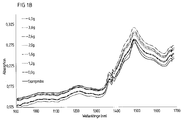
- FIG. 1b shows NIR spectra of reference samples with different moisture contents. It can be seen that the NIR spectra differ in particular at the level of the baseline. The higher the moisture content, the higher the baseline and thus also the absorption value for the absorption maximum at 1490 nm, as shown in the following table.
- Table 1 Correlation of moisture content and NIR absorption maximum Humidity (g / m 2 ) Excitation:. at 1490 nm 4 0.3175 3.6 .3084 2.4 .3047 2.0 .3004 1.6 .2894 1.2 .2795 0 .2885
- a sample with a moisture content of 1.2 g / m 2 correlates with an absorption maximum at 1490 nm of 0.2795, while a sample with a moisture content of 4 g / m 2 has an absorption maximum of 0.3175. Accordingly, the baseline of the samples is shifted to higher absorbance values. For this reason, the interpretation of the NIR spectra by means of multivariate data analysis (MDA) over the entire recorded spectral range of the NIR spectrum.
- MDA multivariate data analysis
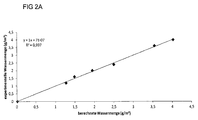
- FIG. 2a This is how the diagram of the FIG. 2a a first calibration model for the NIR spectra of the reference samples FIG. 1b (without Darrprobe), which was determined using the partial least squares (PLS) regression.
- PLS partial least squares
- This model is used to determine the residual moisture in the Darr sample.
- the analyzer program SIMCA-P calculates a moisture content for the Darr sample.
- Partial Least Square (PLS) regression is used to create a calibration function that describes a dependency between spectrum and moisture content.
- PLS Partial Least Square
- the analysis program calculates a moisture content of -2.9 g / m 2 using the calibration function created (see also Table 2).
- the amount of the moisture content of 2.9 g / m 2 for the Darr sample is added to all used moisture values of the calibration samples or reference samples and the moisture content of the Darr sample is set to zero.
- a second calibration model is created with the help of partial least squares (PLS) regression ( FIG. 2b ), which is now suitable for establishing a relationship between the measured NIR spectra of a resin layer to be measured on a carrier plate and the NIR spectra of reference samples with known moisture content (see Table 3).
- the linear regression PLS calibration models shown are then assigned the NIR spectrum determined for the above exemplary embodiment to a specific moisture content.
- the NIR spectrum of the embodiment of FIG. 1 a moisture content of about 5.8 g / m 2 .
Landscapes
- Physics & Mathematics (AREA)
- Spectroscopy & Molecular Physics (AREA)
- Biochemistry (AREA)
- Life Sciences & Earth Sciences (AREA)
- Chemical & Material Sciences (AREA)
- Analytical Chemistry (AREA)
- Health & Medical Sciences (AREA)
- General Health & Medical Sciences (AREA)
- General Physics & Mathematics (AREA)
- Immunology (AREA)
- Pathology (AREA)
- Chemical And Physical Treatments For Wood And The Like (AREA)
- Laminated Bodies (AREA)
- Investigating Or Analysing Materials By Optical Means (AREA)
- Application Of Or Painting With Fluid Materials (AREA)
Priority Applications (8)
| Application Number | Priority Date | Filing Date | Title |
|---|---|---|---|
| ES13169864.9T ES2567596T3 (es) | 2013-05-30 | 2013-05-30 | Procedimiento para la determinación del contenido de humedad de una capa de resina sobre una placa de soporte |
| EP13169864.9A EP2808636B1 (de) | 2013-05-30 | 2013-05-30 | Verfahren zur Bestimmung des Feuchtegehaltes einer Harzschicht auf einer Trägerplatte |
| PL13169864T PL2808636T3 (pl) | 2013-05-30 | 2013-05-30 | Sposób określania wilgotności w warstwie żywicy na płycie podłożowej |
| PT131698649T PT2808636E (pt) | 2013-05-30 | 2013-05-30 | Processo para a determinação do teor de humidade de uma camada de resina num painel de suporte |
| RU2015154786A RU2632255C2 (ru) | 2013-05-30 | 2014-05-28 | Способ определения влагосодержания слоя смолы на несущей плите |
| UAA201512557A UA115271C2 (uk) | 2013-05-30 | 2014-05-28 | Спосіб визначення вологовмісту шару смоли на несучій плиті |
| PCT/EP2014/061123 WO2014191491A1 (de) | 2013-05-30 | 2014-05-28 | Verfahren zur bestimmung des feuchtegehaltes einer harzschicht auf einer trägerplatte |
| US14/893,794 US9759653B2 (en) | 2013-05-30 | 2014-05-28 | Method for determining the moisture content of a resin layer on a carrier board |
Applications Claiming Priority (1)
| Application Number | Priority Date | Filing Date | Title |
|---|---|---|---|
| EP13169864.9A EP2808636B1 (de) | 2013-05-30 | 2013-05-30 | Verfahren zur Bestimmung des Feuchtegehaltes einer Harzschicht auf einer Trägerplatte |
Publications (2)
| Publication Number | Publication Date |
|---|---|
| EP2808636A1 EP2808636A1 (de) | 2014-12-03 |
| EP2808636B1 true EP2808636B1 (de) | 2016-03-02 |
Family
ID=48536720
Family Applications (1)
| Application Number | Title | Priority Date | Filing Date |
|---|---|---|---|
| EP13169864.9A Active EP2808636B1 (de) | 2013-05-30 | 2013-05-30 | Verfahren zur Bestimmung des Feuchtegehaltes einer Harzschicht auf einer Trägerplatte |
Country Status (8)
| Country | Link |
|---|---|
| US (1) | US9759653B2 (pl) |
| EP (1) | EP2808636B1 (pl) |
| ES (1) | ES2567596T3 (pl) |
| PL (1) | PL2808636T3 (pl) |
| PT (1) | PT2808636E (pl) |
| RU (1) | RU2632255C2 (pl) |
| UA (1) | UA115271C2 (pl) |
| WO (1) | WO2014191491A1 (pl) |
Cited By (4)
| Publication number | Priority date | Publication date | Assignee | Title |
|---|---|---|---|---|
| EP3238934A1 (de) * | 2016-04-26 | 2017-11-01 | SWISS KRONO Tec AG | Verfahren zur bestimmung des aushärtungsgrades von mindestens einer auf einer trägerplatte angeordneten polymerschicht |
| EP4303565A1 (de) | 2022-07-04 | 2024-01-10 | Flooring Technologies Ltd. | Verfahren zur bestimmung der menge und/oder der zusammensetzung von einer auf ein trägermaterial aufgetragenen pulverförmigen harzschicht |
| EP4303567A1 (de) | 2022-07-04 | 2024-01-10 | Flooring Technologies Ltd. | Verfahren zur bestimmung der menge von mindestens einem pulverförmigen bindemittel in einer mischung mit holzpartikeln |
| EP4427919A1 (de) | 2023-03-10 | 2024-09-11 | Flooring Technologies Ltd. | Verfahren zur steuerung einer presse zum verpressen eines trägermaterials mit mindestens einer auf dem trägermaterial angeordneten harzschicht |
Families Citing this family (14)
| Publication number | Priority date | Publication date | Assignee | Title |
|---|---|---|---|---|
| WO2016162196A1 (de) * | 2015-04-09 | 2016-10-13 | Flooring Technologies Ltd. | VERFAHREN ZUR BESTIMMUNG DER ABRIEBFESTIGKEIT VON MINDESTENS EINER AUF EINER TRÄGERPLATTE ANGEORDNETEN VERSCHLEIßSCHICHT |
| PL3078959T3 (pl) * | 2015-04-09 | 2017-10-31 | Flooring Technologies Ltd | Sposób wyznaczania odporności na ścieranie co najmniej jednej warstwy ścieralnej umieszczonej na płycie nośnej |
| CN106442382A (zh) * | 2016-07-15 | 2017-02-22 | 中国林业科学研究院热带林业研究所 | 一种快速预测尾细桉木材基本密度的方法 |
| EP3327424B1 (de) * | 2016-11-25 | 2018-12-26 | Flooring Technologies Ltd. | Verfahren zur bestimmung des vernetzungsgrades von mindestens einer auf einer trägerplatte vorgesehen harzschicht |
| JP7137772B2 (ja) * | 2017-11-07 | 2022-09-15 | 大日本印刷株式会社 | 検査システム、検査方法及び検査システムの製造方法 |
| US11442007B2 (en) * | 2018-11-30 | 2022-09-13 | Boise Cascade Company | Method and system for moisture grading wood products using superimposed near infrared and visual images |
| EP4191230B1 (de) * | 2020-03-27 | 2024-08-07 | Flooring Technologies Ltd. | Verfahren zur gleichzeitigen bestimmung von parametern von mindestens einer auf mindestens einem trägermaterial aufgetragenen harzschicht |
| US12214521B2 (en) | 2020-11-20 | 2025-02-04 | Boise Cascade Company | Method and system for layered wood product production |
| US11453211B2 (en) | 2020-11-20 | 2022-09-27 | Boise Cascade Company | Method and system for layered wood product production |
| EP4050325B1 (de) * | 2021-02-24 | 2023-06-07 | Flooring Technologies Ltd. | Verfahren zur bestimmung der harzpenetration in holz mittels nahinfrarotspektroskopie |
| US12377551B1 (en) | 2021-04-14 | 2025-08-05 | Boise Cascade Company | Method and system for veneer sheet portion stacking and unstacking |
| EP4080195B1 (de) * | 2021-04-19 | 2023-06-07 | Flooring Technologies Ltd. | Verfahren zur bestimmung der klebstoff-penetration in holz mittels nah-infrarot-spektroskopie |
| JP2023070909A (ja) * | 2021-11-10 | 2023-05-22 | 株式会社ディスコ | 乾燥検出方法及び乾燥検出装置 |
| US12281981B2 (en) * | 2022-09-16 | 2025-04-22 | Continuus Materials Intellectual Property, Llc | Determining cellulose and plastic ratios using near-infrared spectroscopy along the edge of composite panels |
Citations (2)
| Publication number | Priority date | Publication date | Assignee | Title |
|---|---|---|---|---|
| EP1454763A2 (de) * | 2003-03-06 | 2004-09-08 | Kronotec Ag | Dekoratives Veredeln einer Holzwerkstoffplatte |
| US20070131862A1 (en) * | 2005-12-13 | 2007-06-14 | Huber Engineered Woods L.L.C. | Method using NIR spectroscopy to monitor components of engineered wood products |
Family Cites Families (7)
| Publication number | Priority date | Publication date | Assignee | Title |
|---|---|---|---|---|
| JP2540610B2 (ja) * | 1987-09-28 | 1996-10-09 | ザ・ミード・コーポレーション | 立体的効果を有する化粧板 |
| SE523308E (sv) * | 2000-03-02 | 2007-12-27 | Valmet Fibertech Ab | Förfarande för kontinuerlig bestämning av egenskaper hos ett trägiberflöde för träfiberskiveframställning |
| US7678425B2 (en) * | 2003-03-06 | 2010-03-16 | Flooring Technologies Ltd. | Process for finishing a wooden board and wooden board produced by the process |
| EP1960598B1 (en) * | 2005-12-07 | 2012-10-17 | Depco-Trh Pty Ltd | Pre-preg and laminate manufacture |
| DE102008041052B4 (de) * | 2008-08-06 | 2010-04-15 | Airbus Deutschland Gmbh | Vorrichtung zur berührungslosen Ermittlung des Trocknungsgrades einer Lackschicht sowie Verfahren |
| EP2338693B1 (de) | 2009-12-23 | 2012-06-06 | Flooring Technologies Ltd. | Verfahren und Vorrichtung zum Veredeln einer Holzwerkstoffplatte |
| EP2628610B1 (de) * | 2010-11-10 | 2014-07-23 | Flooring Technologies Ltd. | Verfahren zum Aufbringen eines Dekors auf eine Holzwerkstoffplatte |
-
2013
- 2013-05-30 PL PL13169864T patent/PL2808636T3/pl unknown
- 2013-05-30 ES ES13169864.9T patent/ES2567596T3/es active Active
- 2013-05-30 EP EP13169864.9A patent/EP2808636B1/de active Active
- 2013-05-30 PT PT131698649T patent/PT2808636E/pt unknown
-
2014
- 2014-05-28 RU RU2015154786A patent/RU2632255C2/ru active
- 2014-05-28 US US14/893,794 patent/US9759653B2/en active Active
- 2014-05-28 UA UAA201512557A patent/UA115271C2/uk unknown
- 2014-05-28 WO PCT/EP2014/061123 patent/WO2014191491A1/de not_active Ceased
Patent Citations (2)
| Publication number | Priority date | Publication date | Assignee | Title |
|---|---|---|---|---|
| EP1454763A2 (de) * | 2003-03-06 | 2004-09-08 | Kronotec Ag | Dekoratives Veredeln einer Holzwerkstoffplatte |
| US20070131862A1 (en) * | 2005-12-13 | 2007-06-14 | Huber Engineered Woods L.L.C. | Method using NIR spectroscopy to monitor components of engineered wood products |
Cited By (7)
| Publication number | Priority date | Publication date | Assignee | Title |
|---|---|---|---|---|
| EP3238934A1 (de) * | 2016-04-26 | 2017-11-01 | SWISS KRONO Tec AG | Verfahren zur bestimmung des aushärtungsgrades von mindestens einer auf einer trägerplatte angeordneten polymerschicht |
| EP4303565A1 (de) | 2022-07-04 | 2024-01-10 | Flooring Technologies Ltd. | Verfahren zur bestimmung der menge und/oder der zusammensetzung von einer auf ein trägermaterial aufgetragenen pulverförmigen harzschicht |
| EP4303567A1 (de) | 2022-07-04 | 2024-01-10 | Flooring Technologies Ltd. | Verfahren zur bestimmung der menge von mindestens einem pulverförmigen bindemittel in einer mischung mit holzpartikeln |
| WO2024008470A1 (de) | 2022-07-04 | 2024-01-11 | Flooring Technologies Ltd. | Verfahren zur bestimmung der menge von mindestens einem pulverförmigen bindemittel in einer mischung mit holzpartikeln |
| WO2024008469A1 (de) | 2022-07-04 | 2024-01-11 | Flooring Technologies Ltd. | Verfahren zur bestimmung der menge und/oder der zusammensetzung von einer auf ein trägermaterial aufgetragenen pulverförmigen harzschicht |
| EP4427919A1 (de) | 2023-03-10 | 2024-09-11 | Flooring Technologies Ltd. | Verfahren zur steuerung einer presse zum verpressen eines trägermaterials mit mindestens einer auf dem trägermaterial angeordneten harzschicht |
| WO2024188737A1 (de) | 2023-03-10 | 2024-09-19 | Flooring Technologies Ltd. | Verfahren zur steuerung einer presse zum verpressen eines trägermaterials mit mindestens einer auf dem trägermaterial angeordneten harzschicht |
Also Published As
| Publication number | Publication date |
|---|---|
| WO2014191491A1 (de) | 2014-12-04 |
| US20160123871A1 (en) | 2016-05-05 |
| EP2808636A1 (de) | 2014-12-03 |
| ES2567596T3 (es) | 2016-04-25 |
| UA115271C2 (uk) | 2017-10-10 |
| US9759653B2 (en) | 2017-09-12 |
| PL2808636T3 (pl) | 2016-07-29 |
| RU2632255C2 (ru) | 2017-10-03 |
| RU2015154786A (ru) | 2017-07-05 |
| PT2808636E (pt) | 2016-06-03 |
Similar Documents
| Publication | Publication Date | Title |
|---|---|---|
| EP2808636B1 (de) | Verfahren zur Bestimmung des Feuchtegehaltes einer Harzschicht auf einer Trägerplatte | |
| EP2915658B1 (de) | Verfahren zur Bestimmung des Feuchtegehaltes einer Harzschicht auf einer mit einem faserhaltigen Trägermaterial beschichteten Holzwerkstoffplatte | |
| EP3470823B1 (de) | Verfahren zur bestimmung der abriebfestigkeit von mindestens einer auf einer trägerplatte angeordneten verschleissschicht | |
| EP4191230B1 (de) | Verfahren zur gleichzeitigen bestimmung von parametern von mindestens einer auf mindestens einem trägermaterial aufgetragenen harzschicht | |
| EP3238934B1 (de) | Verfahren zur bestimmung des aushärtungsgrades von mindestens einer auf einer holzwerkstoffplatte angeordneten wärmehärtbaren formaldehydhaltigen harzschicht | |
| EP3327424B1 (de) | Verfahren zur bestimmung des vernetzungsgrades von mindestens einer auf einer trägerplatte vorgesehen harzschicht | |
| EP3428619B1 (de) | Verfahren zur bestimmung der menge einer auf einer holzwerkstoffplatte aufgetragenen flüssigen harzschicht | |
| WO2016162196A1 (de) | VERFAHREN ZUR BESTIMMUNG DER ABRIEBFESTIGKEIT VON MINDESTENS EINER AUF EINER TRÄGERPLATTE ANGEORDNETEN VERSCHLEIßSCHICHT | |
| EP3059020B1 (de) | Verfahren zur Herstellung einer Holzwerkstoffplatte, insbesondere einer mit einer Dekorschicht versehenen Holzwerkstoffplatte | |
| EP4050325B1 (de) | Verfahren zur bestimmung der harzpenetration in holz mittels nahinfrarotspektroskopie | |
| EP4427919B1 (de) | Verfahren zur steuerung einer presse zum verpressen eines trägermaterials mit mindestens einer auf dem trägermaterial angeordneten harzschicht und produktionslinie dafür | |
| EP4303565B1 (de) | Verfahren zur bestimmung der menge und/oder der zusammensetzung von einer auf ein trägermaterial aufgetragenen pulverförmigen harzschicht | |
| EP3757508B1 (de) | Verfahren zur bestimmung der menge einer auf einer trägerplatte aufgetragenen schicht, insbesondere einer grundierungsschicht | |
| EP3336521B1 (de) | Verfahren zur bestimmung des gehaltes an anorganischen feststoffpartikeln in einer harzlösung | |
| EP2837737B1 (de) | Verfahren zum Trocknen von wässrigen Beschichtungen unter Verwendung von NIR-Strahlung | |
| EP4663423A1 (de) | Verfahren und vorrichtung zum effizienten druck eines dekors auf ein trägermaterial |
Legal Events
| Date | Code | Title | Description |
|---|---|---|---|
| PUAI | Public reference made under article 153(3) epc to a published international application that has entered the european phase |
Free format text: ORIGINAL CODE: 0009012 |
|
| 17P | Request for examination filed |
Effective date: 20131218 |
|
| AK | Designated contracting states |
Kind code of ref document: A1 Designated state(s): AL AT BE BG CH CY CZ DE DK EE ES FI FR GB GR HR HU IE IS IT LI LT LU LV MC MK MT NL NO PL PT RO RS SE SI SK SM TR |
|
| AX | Request for extension of the european patent |
Extension state: BA ME |
|
| GRAP | Despatch of communication of intention to grant a patent |
Free format text: ORIGINAL CODE: EPIDOSNIGR1 |
|
| RIC1 | Information provided on ipc code assigned before grant |
Ipc: B29C 70/50 20060101ALI20150612BHEP Ipc: F26B 25/22 20060101AFI20150612BHEP Ipc: D06M 10/00 20060101ALI20150612BHEP Ipc: B44C 5/04 20060101ALI20150612BHEP Ipc: E04F 13/16 20060101ALI20150612BHEP Ipc: G01N 21/3554 20140101ALI20150612BHEP Ipc: D06M 15/423 20060101ALI20150612BHEP Ipc: G01N 21/359 20140101ALI20150612BHEP Ipc: E04F 13/08 20060101ALI20150612BHEP Ipc: E04F 15/10 20060101ALI20150612BHEP Ipc: F26B 13/00 20060101ALI20150612BHEP Ipc: G01N 21/35 20140101ALI20150612BHEP |
|
| INTG | Intention to grant announced |
Effective date: 20150707 |
|
| GRAS | Grant fee paid |
Free format text: ORIGINAL CODE: EPIDOSNIGR3 |
|
| INTG | Intention to grant announced |
Effective date: 20151207 |
|
| GRAA | (expected) grant |
Free format text: ORIGINAL CODE: 0009210 |
|
| AK | Designated contracting states |
Kind code of ref document: B1 Designated state(s): AL AT BE BG CH CY CZ DE DK EE ES FI FR GB GR HR HU IE IS IT LI LT LU LV MC MK MT NL NO PL PT RO RS SE SI SK SM TR |
|
| REG | Reference to a national code |
Ref country code: GB Ref legal event code: FG4D Free format text: NOT ENGLISH |
|
| REG | Reference to a national code |
Ref country code: AT Ref legal event code: REF Ref document number: 778338 Country of ref document: AT Kind code of ref document: T Effective date: 20160315 Ref country code: CH Ref legal event code: EP |
|
| REG | Reference to a national code |
Ref country code: IE Ref legal event code: FG4D Free format text: LANGUAGE OF EP DOCUMENT: GERMAN |
|
| REG | Reference to a national code |
Ref country code: DE Ref legal event code: R096 Ref document number: 502013002034 Country of ref document: DE |
|
| REG | Reference to a national code |
Ref country code: CH Ref legal event code: NV Representative=s name: SCHMAUDER AND PARTNER AG PATENT- UND MARKENANW, CH |
|
| REG | Reference to a national code |
Ref country code: ES Ref legal event code: FG2A Ref document number: 2567596 Country of ref document: ES Kind code of ref document: T3 Effective date: 20160425 |
|
| REG | Reference to a national code |
Ref country code: SE Ref legal event code: TRGR |
|
| REG | Reference to a national code |
Ref country code: FR Ref legal event code: PLFP Year of fee payment: 4 |
|
| REG | Reference to a national code |
Ref country code: PT Ref legal event code: SC4A Free format text: AVAILABILITY OF NATIONAL TRANSLATION Effective date: 20160530 |
|
| REG | Reference to a national code |
Ref country code: NL Ref legal event code: FP |
|
| REG | Reference to a national code |
Ref country code: LT Ref legal event code: MG4D |
|
| PG25 | Lapsed in a contracting state [announced via postgrant information from national office to epo] |
Ref country code: HR Free format text: LAPSE BECAUSE OF FAILURE TO SUBMIT A TRANSLATION OF THE DESCRIPTION OR TO PAY THE FEE WITHIN THE PRESCRIBED TIME-LIMIT Effective date: 20160302 Ref country code: GR Free format text: LAPSE BECAUSE OF FAILURE TO SUBMIT A TRANSLATION OF THE DESCRIPTION OR TO PAY THE FEE WITHIN THE PRESCRIBED TIME-LIMIT Effective date: 20160603 Ref country code: FI Free format text: LAPSE BECAUSE OF FAILURE TO SUBMIT A TRANSLATION OF THE DESCRIPTION OR TO PAY THE FEE WITHIN THE PRESCRIBED TIME-LIMIT Effective date: 20160302 Ref country code: NO Free format text: LAPSE BECAUSE OF FAILURE TO SUBMIT A TRANSLATION OF THE DESCRIPTION OR TO PAY THE FEE WITHIN THE PRESCRIBED TIME-LIMIT Effective date: 20160602 |
|
| REG | Reference to a national code |
Ref country code: SK Ref legal event code: T3 Ref document number: E 20673 Country of ref document: SK |
|
| PG25 | Lapsed in a contracting state [announced via postgrant information from national office to epo] |
Ref country code: RS Free format text: LAPSE BECAUSE OF FAILURE TO SUBMIT A TRANSLATION OF THE DESCRIPTION OR TO PAY THE FEE WITHIN THE PRESCRIBED TIME-LIMIT Effective date: 20160302 Ref country code: LV Free format text: LAPSE BECAUSE OF FAILURE TO SUBMIT A TRANSLATION OF THE DESCRIPTION OR TO PAY THE FEE WITHIN THE PRESCRIBED TIME-LIMIT Effective date: 20160302 Ref country code: LT Free format text: LAPSE BECAUSE OF FAILURE TO SUBMIT A TRANSLATION OF THE DESCRIPTION OR TO PAY THE FEE WITHIN THE PRESCRIBED TIME-LIMIT Effective date: 20160302 |
|
| PG25 | Lapsed in a contracting state [announced via postgrant information from national office to epo] |
Ref country code: IS Free format text: LAPSE BECAUSE OF FAILURE TO SUBMIT A TRANSLATION OF THE DESCRIPTION OR TO PAY THE FEE WITHIN THE PRESCRIBED TIME-LIMIT Effective date: 20160702 Ref country code: EE Free format text: LAPSE BECAUSE OF FAILURE TO SUBMIT A TRANSLATION OF THE DESCRIPTION OR TO PAY THE FEE WITHIN THE PRESCRIBED TIME-LIMIT Effective date: 20160302 |
|
| PG25 | Lapsed in a contracting state [announced via postgrant information from national office to epo] |
Ref country code: CZ Free format text: LAPSE BECAUSE OF FAILURE TO SUBMIT A TRANSLATION OF THE DESCRIPTION OR TO PAY THE FEE WITHIN THE PRESCRIBED TIME-LIMIT Effective date: 20160302 Ref country code: RO Free format text: LAPSE BECAUSE OF FAILURE TO SUBMIT A TRANSLATION OF THE DESCRIPTION OR TO PAY THE FEE WITHIN THE PRESCRIBED TIME-LIMIT Effective date: 20160302 Ref country code: SM Free format text: LAPSE BECAUSE OF FAILURE TO SUBMIT A TRANSLATION OF THE DESCRIPTION OR TO PAY THE FEE WITHIN THE PRESCRIBED TIME-LIMIT Effective date: 20160302 |
|
| REG | Reference to a national code |
Ref country code: DE Ref legal event code: R097 Ref document number: 502013002034 Country of ref document: DE |
|
| PLBE | No opposition filed within time limit |
Free format text: ORIGINAL CODE: 0009261 |
|
| STAA | Information on the status of an ep patent application or granted ep patent |
Free format text: STATUS: NO OPPOSITION FILED WITHIN TIME LIMIT |
|
| REG | Reference to a national code |
Ref country code: DE Ref legal event code: R082 Ref document number: 502013002034 Country of ref document: DE Representative=s name: MAIKOWSKI & NINNEMANN PATENTANWAELTE PARTNERSC, DE Ref country code: DE Ref legal event code: R081 Ref document number: 502013002034 Country of ref document: DE Owner name: FLOORING TECHNOLOGIES LTD., MT Free format text: FORMER OWNER: FLOORING TECHNOLOGIES LTD., PIETA, MT |
|
| PG25 | Lapsed in a contracting state [announced via postgrant information from national office to epo] |
Ref country code: DK Free format text: LAPSE BECAUSE OF FAILURE TO SUBMIT A TRANSLATION OF THE DESCRIPTION OR TO PAY THE FEE WITHIN THE PRESCRIBED TIME-LIMIT Effective date: 20160302 |
|
| 26N | No opposition filed |
Effective date: 20161205 |
|
| REG | Reference to a national code |
Ref country code: IE Ref legal event code: MM4A |
|
| PG25 | Lapsed in a contracting state [announced via postgrant information from national office to epo] |
Ref country code: BG Free format text: LAPSE BECAUSE OF FAILURE TO SUBMIT A TRANSLATION OF THE DESCRIPTION OR TO PAY THE FEE WITHIN THE PRESCRIBED TIME-LIMIT Effective date: 20160602 Ref country code: SI Free format text: LAPSE BECAUSE OF FAILURE TO SUBMIT A TRANSLATION OF THE DESCRIPTION OR TO PAY THE FEE WITHIN THE PRESCRIBED TIME-LIMIT Effective date: 20160302 |
|
| REG | Reference to a national code |
Ref country code: FR Ref legal event code: PLFP Year of fee payment: 5 |
|
| PG25 | Lapsed in a contracting state [announced via postgrant information from national office to epo] |
Ref country code: IE Free format text: LAPSE BECAUSE OF NON-PAYMENT OF DUE FEES Effective date: 20160530 |
|
| REG | Reference to a national code |
Ref country code: CH Ref legal event code: PCOW Free format text: NEW ADDRESS: SMARTCITY MALTA SCM01, OFFICE 406, RICASOLI, KALKARA SCM 1001 (MT) |
|
| REG | Reference to a national code |
Ref country code: SK Ref legal event code: TE4A Ref document number: E 20673 Country of ref document: SK Owner name: FLOORING TECHNOLOGIES LTD., KALKARA SCM 1001, MT Effective date: 20171030 |
|
| REG | Reference to a national code |
Ref country code: FR Ref legal event code: PLFP Year of fee payment: 6 |
|
| PG25 | Lapsed in a contracting state [announced via postgrant information from national office to epo] |
Ref country code: HU Free format text: LAPSE BECAUSE OF FAILURE TO SUBMIT A TRANSLATION OF THE DESCRIPTION OR TO PAY THE FEE WITHIN THE PRESCRIBED TIME-LIMIT; INVALID AB INITIO Effective date: 20130530 |
|
| PG25 | Lapsed in a contracting state [announced via postgrant information from national office to epo] |
Ref country code: MT Free format text: LAPSE BECAUSE OF FAILURE TO SUBMIT A TRANSLATION OF THE DESCRIPTION OR TO PAY THE FEE WITHIN THE PRESCRIBED TIME-LIMIT Effective date: 20160302 Ref country code: MC Free format text: LAPSE BECAUSE OF FAILURE TO SUBMIT A TRANSLATION OF THE DESCRIPTION OR TO PAY THE FEE WITHIN THE PRESCRIBED TIME-LIMIT Effective date: 20160302 Ref country code: MK Free format text: LAPSE BECAUSE OF FAILURE TO SUBMIT A TRANSLATION OF THE DESCRIPTION OR TO PAY THE FEE WITHIN THE PRESCRIBED TIME-LIMIT Effective date: 20160302 Ref country code: CY Free format text: LAPSE BECAUSE OF FAILURE TO SUBMIT A TRANSLATION OF THE DESCRIPTION OR TO PAY THE FEE WITHIN THE PRESCRIBED TIME-LIMIT Effective date: 20160302 |
|
| REG | Reference to a national code |
Ref country code: FR Ref legal event code: CA Effective date: 20180607 |
|
| PG25 | Lapsed in a contracting state [announced via postgrant information from national office to epo] |
Ref country code: AL Free format text: LAPSE BECAUSE OF FAILURE TO SUBMIT A TRANSLATION OF THE DESCRIPTION OR TO PAY THE FEE WITHIN THE PRESCRIBED TIME-LIMIT Effective date: 20160302 |
|
| PGFP | Annual fee paid to national office [announced via postgrant information from national office to epo] |
Ref country code: NL Payment date: 20250522 Year of fee payment: 13 |
|
| PGFP | Annual fee paid to national office [announced via postgrant information from national office to epo] |
Ref country code: PL Payment date: 20250430 Year of fee payment: 13 Ref country code: DE Payment date: 20250507 Year of fee payment: 13 |
|
| PGFP | Annual fee paid to national office [announced via postgrant information from national office to epo] |
Ref country code: GB Payment date: 20250522 Year of fee payment: 13 Ref country code: ES Payment date: 20250616 Year of fee payment: 13 |
|
| PGFP | Annual fee paid to national office [announced via postgrant information from national office to epo] |
Ref country code: LU Payment date: 20250520 Year of fee payment: 13 Ref country code: BE Payment date: 20250520 Year of fee payment: 13 Ref country code: IT Payment date: 20250530 Year of fee payment: 13 |
|
| PGFP | Annual fee paid to national office [announced via postgrant information from national office to epo] |
Ref country code: PT Payment date: 20250523 Year of fee payment: 13 |
|
| PGFP | Annual fee paid to national office [announced via postgrant information from national office to epo] |
Ref country code: FR Payment date: 20250521 Year of fee payment: 13 |
|
| PGFP | Annual fee paid to national office [announced via postgrant information from national office to epo] |
Ref country code: CH Payment date: 20250601 Year of fee payment: 13 |
|
| PGFP | Annual fee paid to national office [announced via postgrant information from national office to epo] |
Ref country code: AT Payment date: 20250519 Year of fee payment: 13 |
|
| PGFP | Annual fee paid to national office [announced via postgrant information from national office to epo] |
Ref country code: SK Payment date: 20250523 Year of fee payment: 13 Ref country code: TR Payment date: 20250523 Year of fee payment: 13 |
|
| PGFP | Annual fee paid to national office [announced via postgrant information from national office to epo] |
Ref country code: SE Payment date: 20250522 Year of fee payment: 13 |