EP2808518A1 - Exhaust circulation apparatus for internal combustion engine - Google Patents
Exhaust circulation apparatus for internal combustion engine Download PDFInfo
- Publication number
- EP2808518A1 EP2808518A1 EP12866650.0A EP12866650A EP2808518A1 EP 2808518 A1 EP2808518 A1 EP 2808518A1 EP 12866650 A EP12866650 A EP 12866650A EP 2808518 A1 EP2808518 A1 EP 2808518A1
- Authority
- EP
- European Patent Office
- Prior art keywords
- egr
- internal combustion
- combustion engine
- combustion
- exhaust
- Prior art date
- Legal status (The legal status is an assumption and is not a legal conclusion. Google has not performed a legal analysis and makes no representation as to the accuracy of the status listed.)
- Granted
Links
Images



Classifications
-
- F—MECHANICAL ENGINEERING; LIGHTING; HEATING; WEAPONS; BLASTING
- F02—COMBUSTION ENGINES; HOT-GAS OR COMBUSTION-PRODUCT ENGINE PLANTS
- F02M—SUPPLYING COMBUSTION ENGINES IN GENERAL WITH COMBUSTIBLE MIXTURES OR CONSTITUENTS THEREOF
- F02M26/00—Engine-pertinent apparatus for adding exhaust gases to combustion-air, main fuel or fuel-air mixture, e.g. by exhaust gas recirculation [EGR] systems
- F02M26/02—EGR systems specially adapted for supercharged engines
- F02M26/04—EGR systems specially adapted for supercharged engines with a single turbocharger
- F02M26/05—High pressure loops, i.e. wherein recirculated exhaust gas is taken out from the exhaust system upstream of the turbine and reintroduced into the intake system downstream of the compressor
-
- F—MECHANICAL ENGINEERING; LIGHTING; HEATING; WEAPONS; BLASTING
- F02—COMBUSTION ENGINES; HOT-GAS OR COMBUSTION-PRODUCT ENGINE PLANTS
- F02D—CONTROLLING COMBUSTION ENGINES
- F02D21/00—Controlling engines characterised by their being supplied with non-airborne oxygen or other non-fuel gas
- F02D21/06—Controlling engines characterised by their being supplied with non-airborne oxygen or other non-fuel gas peculiar to engines having other non-fuel gas added to combustion air
- F02D21/08—Controlling engines characterised by their being supplied with non-airborne oxygen or other non-fuel gas peculiar to engines having other non-fuel gas added to combustion air the other gas being the exhaust gas of engine
-
- F—MECHANICAL ENGINEERING; LIGHTING; HEATING; WEAPONS; BLASTING
- F02—COMBUSTION ENGINES; HOT-GAS OR COMBUSTION-PRODUCT ENGINE PLANTS
- F02D—CONTROLLING COMBUSTION ENGINES
- F02D41/00—Electrical control of supply of combustible mixture or its constituents
- F02D41/0025—Controlling engines characterised by use of non-liquid fuels, pluralities of fuels, or non-fuel substances added to the combustible mixtures
- F02D41/0047—Controlling exhaust gas recirculation [EGR]
- F02D41/005—Controlling exhaust gas recirculation [EGR] according to engine operating conditions
-
- F—MECHANICAL ENGINEERING; LIGHTING; HEATING; WEAPONS; BLASTING
- F02—COMBUSTION ENGINES; HOT-GAS OR COMBUSTION-PRODUCT ENGINE PLANTS
- F02D—CONTROLLING COMBUSTION ENGINES
- F02D41/00—Electrical control of supply of combustible mixture or its constituents
- F02D41/02—Circuit arrangements for generating control signals
- F02D41/14—Introducing closed-loop corrections
- F02D41/1438—Introducing closed-loop corrections using means for determining characteristics of the combustion gases; Sensors therefor
- F02D41/1473—Introducing closed-loop corrections using means for determining characteristics of the combustion gases; Sensors therefor characterised by the regulation method
- F02D41/1475—Regulating the air fuel ratio at a value other than stoichiometry
-
- F—MECHANICAL ENGINEERING; LIGHTING; HEATING; WEAPONS; BLASTING
- F02—COMBUSTION ENGINES; HOT-GAS OR COMBUSTION-PRODUCT ENGINE PLANTS
- F02M—SUPPLYING COMBUSTION ENGINES IN GENERAL WITH COMBUSTIBLE MIXTURES OR CONSTITUENTS THEREOF
- F02M26/00—Engine-pertinent apparatus for adding exhaust gases to combustion-air, main fuel or fuel-air mixture, e.g. by exhaust gas recirculation [EGR] systems
- F02M26/02—EGR systems specially adapted for supercharged engines
- F02M26/04—EGR systems specially adapted for supercharged engines with a single turbocharger
- F02M26/06—Low pressure loops, i.e. wherein recirculated exhaust gas is taken out from the exhaust downstream of the turbocharger turbine and reintroduced into the intake system upstream of the compressor
-
- F—MECHANICAL ENGINEERING; LIGHTING; HEATING; WEAPONS; BLASTING
- F02—COMBUSTION ENGINES; HOT-GAS OR COMBUSTION-PRODUCT ENGINE PLANTS
- F02M—SUPPLYING COMBUSTION ENGINES IN GENERAL WITH COMBUSTIBLE MIXTURES OR CONSTITUENTS THEREOF
- F02M26/00—Engine-pertinent apparatus for adding exhaust gases to combustion-air, main fuel or fuel-air mixture, e.g. by exhaust gas recirculation [EGR] systems
- F02M26/13—Arrangement or layout of EGR passages, e.g. in relation to specific engine parts or for incorporation of accessories
- F02M26/35—Arrangement or layout of EGR passages, e.g. in relation to specific engine parts or for incorporation of accessories with means for cleaning or treating the recirculated gases, e.g. catalysts, condensate traps, particle filters or heaters
-
- F—MECHANICAL ENGINEERING; LIGHTING; HEATING; WEAPONS; BLASTING
- F02—COMBUSTION ENGINES; HOT-GAS OR COMBUSTION-PRODUCT ENGINE PLANTS
- F02M—SUPPLYING COMBUSTION ENGINES IN GENERAL WITH COMBUSTIBLE MIXTURES OR CONSTITUENTS THEREOF
- F02M26/00—Engine-pertinent apparatus for adding exhaust gases to combustion-air, main fuel or fuel-air mixture, e.g. by exhaust gas recirculation [EGR] systems
- F02M26/13—Arrangement or layout of EGR passages, e.g. in relation to specific engine parts or for incorporation of accessories
- F02M26/42—Arrangement or layout of EGR passages, e.g. in relation to specific engine parts or for incorporation of accessories having two or more EGR passages; EGR systems specially adapted for engines having two or more cylinders
- F02M26/43—Arrangement or layout of EGR passages, e.g. in relation to specific engine parts or for incorporation of accessories having two or more EGR passages; EGR systems specially adapted for engines having two or more cylinders in which exhaust from only one cylinder or only a group of cylinders is directed to the intake of the engine
-
- F—MECHANICAL ENGINEERING; LIGHTING; HEATING; WEAPONS; BLASTING
- F02—COMBUSTION ENGINES; HOT-GAS OR COMBUSTION-PRODUCT ENGINE PLANTS
- F02D—CONTROLLING COMBUSTION ENGINES
- F02D41/00—Electrical control of supply of combustible mixture or its constituents
- F02D41/0025—Controlling engines characterised by use of non-liquid fuels, pluralities of fuels, or non-fuel substances added to the combustible mixtures
- F02D41/0047—Controlling exhaust gas recirculation [EGR]
- F02D41/005—Controlling exhaust gas recirculation [EGR] according to engine operating conditions
- F02D41/0057—Specific combustion modes
-
- F—MECHANICAL ENGINEERING; LIGHTING; HEATING; WEAPONS; BLASTING
- F02—COMBUSTION ENGINES; HOT-GAS OR COMBUSTION-PRODUCT ENGINE PLANTS
- F02D—CONTROLLING COMBUSTION ENGINES
- F02D41/00—Electrical control of supply of combustible mixture or its constituents
- F02D41/0025—Controlling engines characterised by use of non-liquid fuels, pluralities of fuels, or non-fuel substances added to the combustible mixtures
- F02D41/0047—Controlling exhaust gas recirculation [EGR]
- F02D41/0065—Specific aspects of external EGR control
-
- F—MECHANICAL ENGINEERING; LIGHTING; HEATING; WEAPONS; BLASTING
- F02—COMBUSTION ENGINES; HOT-GAS OR COMBUSTION-PRODUCT ENGINE PLANTS
- F02M—SUPPLYING COMBUSTION ENGINES IN GENERAL WITH COMBUSTIBLE MIXTURES OR CONSTITUENTS THEREOF
- F02M26/00—Engine-pertinent apparatus for adding exhaust gases to combustion-air, main fuel or fuel-air mixture, e.g. by exhaust gas recirculation [EGR] systems
- F02M26/13—Arrangement or layout of EGR passages, e.g. in relation to specific engine parts or for incorporation of accessories
- F02M26/14—Arrangement or layout of EGR passages, e.g. in relation to specific engine parts or for incorporation of accessories in relation to the exhaust system
- F02M26/15—Arrangement or layout of EGR passages, e.g. in relation to specific engine parts or for incorporation of accessories in relation to the exhaust system in relation to engine exhaust purifying apparatus
-
- Y—GENERAL TAGGING OF NEW TECHNOLOGICAL DEVELOPMENTS; GENERAL TAGGING OF CROSS-SECTIONAL TECHNOLOGIES SPANNING OVER SEVERAL SECTIONS OF THE IPC; TECHNICAL SUBJECTS COVERED BY FORMER USPC CROSS-REFERENCE ART COLLECTIONS [XRACs] AND DIGESTS
- Y02—TECHNOLOGIES OR APPLICATIONS FOR MITIGATION OR ADAPTATION AGAINST CLIMATE CHANGE
- Y02T—CLIMATE CHANGE MITIGATION TECHNOLOGIES RELATED TO TRANSPORTATION
- Y02T10/00—Road transport of goods or passengers
- Y02T10/10—Internal combustion engine [ICE] based vehicles
- Y02T10/40—Engine management systems
Definitions
- the present invention relates to an exhaust circulation apparatus for an internal combustion engine that is capable of executing EGR (exhaust gas recirculation) that recirculates a portion of exhaust gas to an intake system.
- EGR exhaust gas recirculation
- An exhaust circulation apparatus for an engine with a supercharger that performs EGR that recirculates a portion of exhaust gas to an intake system is already known, as disclosed, for example, in Japanese Patent Laid-Open No. 2003-129874 .
- EGR is performed when performing stratified lean combustion in which a gaseous mixture of fuel and air is stratified and a comparatively dense gaseous mixture in the vicinity of a spark plug is ignited, and a flame is propagated to a lean gaseous mixture inside the combustion chambers by a fire source that was ignited. Since it is thereby possible to reduce the combustion temperature, the amount of discharged NOx is suppressed.
- Figure 16 is a view which compares changes in the amount of discharged NOx relative to an air-fuel ratio A/F by combustion form.
- the amount of discharged NOx decreases as the air-fuel ratio becomes leaner in a lean-burn region, the extent of the decrease is not particularly large. This is because, with stratified combustion, the temperature around a spark plug is always high, even when performing lean-burn operation. Consequently, although EGR is generally performed with stratified lean combustion, a certain amount of NOx discharge is nevertheless unavoidable.
- homogeneous combustion that causes a gaseous mixture of fuel and air to combust after being evenly mixed inside a cylinder.
- a NOx discharge amount in a lean-burn region compared to the case of stratified combustion. This is because, in a lean-burn region, the overall temperature in a combustion chamber decreases as the air-fuel ratio becomes leaner.
- a problem with homogeneous lean combustion concerns the narrowness of the operating region thereof. That is, in the case of homogeneous lean combustion, the exhaust gas temperature decreases since combustion is performed with a large quantity of fresh gas.
- the present invention has been conceived to solve the above described problem, and an object of the present invention is to provide an exhaust circulation apparatus for an internal combustion engine that, in an internal combustion engine that performs homogeneous combustion, can improve fuel consumption and suppress the amount of discharged NOx by expanding an operating region in which homogeneous lean combustion is possible.
- an exhaust circulation apparatus for an internal combustion engine comprising:
- the exhaust circulation apparatus for an internal combustion engine as described in the first aspect, wherein the internal combustion engine comprises a turbo-supercharger having a turbine that is disposed in an exhaust passage and a compressor that is disposed in an intake passage; the EGR apparatus includes a low-pressure loop EGR apparatus that recirculates gas that flows through the exhaust passage on a downstream side of the turbine to the intake passage at a position on an upstream side of the compressor; and when performing the homogeneous lean combustion, the control means controls the low-pressure loop EGR apparatus to perform EGR.
- the exhaust circulation apparatus for an internal combustion engine as described in the first or second aspects, wherein the EGR apparatus comprises means for adjusting an EGR rate that represents a ratio of a gas amount that is recirculated by EGR with respect to a total gas amount that is taken into the internal combustion engine; the homogeneous lean combustion means performs homogeneous lean combustion so that an air-fuel ratio that represents a ratio of a fresh gas amount that is taken in with respect to an in-cylinder fuel amount of the internal combustion engine is 22; and the control means controls the EGR apparatus so that the EGR rate during the homogeneous lean combustion is between 10% and 20%.
- the exhaust circulation apparatus for an internal combustion engine as described in the second or third aspects, further comprising stoichiometric combustion means for performing stoichiometric combustion in which a combustion air-fuel ratio of the internal combustion engine is a theoretical air-fuel ratio in a stoichiometric burn region that is a region on a high-load side relative to the lean-burn region, wherein the EGR apparatus further includes a high-pressure loop EGR apparatus that recirculates gas that flows through the exhaust passage on an upstream side of the turbine to the intake passage at a position on a downstream side of the compressor; and when performing the stoichiometric combustion, the control means controls both of the high-pressure loop EGR apparatus and the low-pressure loop EGR apparatus to perform EGR.
- the exhaust circulation apparatus for an internal combustion engine as described in the fourth aspect, wherein the EGR apparatus includes means for adjusting an EGR rate that represents a ratio of a gas amount that is recirculated by EGR with respect to a total gas amount that is taken into the internal combustion engine; and when performing the stoichiometric combustion, the control means controls the low-pressure loop EGR apparatus and the high-pressure loop EGR apparatus so that an EGR rate generated by the low-pressure loop EGR apparatus is 15% and an EGR rate generated by the high-pressure loop EGR apparatus is 10%.
- the first invention since EGR is performed during homogeneous lean combustion, knocking on a high-load side that is a problem at a time of homogeneous lean combustion can be effectively suppressed. Further, CO and HC included in EGR gas contribute to an oxidation reaction in the catalyst. Consequently, it is possible to effectively suppress a decrease in the bed temperature of the catalyst on a low-load side that is a problem at a time of homogeneous lean combustion. Therefore, according to the present invention, it is possible to effectively expand a lean-burn region in which homogeneous lean combustion is possible, and thereby improve fuel consumption.
- EGR is executed by a low-pressure loop EGR apparatus during homogeneous lean combustion.
- the EGR executed by the low-pressure loop EGR apparatus is stable with respect to the rotational load of the internal combustion engine. Therefore, according to the present invention, since stable EGR can be realized at a time of a transient operation of the internal combustion engine also, misfiring and the like can be prevented.
- the air-fuel ratio is controlled to 22 and the EGR rate is controlled to between 10% and 20%.
- the fuel consumption decreases as the EGR rate increases, the operating region in which homogeneous lean combustion can be executed expands. Therefore, according to the present invention, the fuel consumption is improved to the maximum by controlling the air-fuel ratio to be a value of 22 and controlling the EGR rate to be a value between 10% and 20% during homogeneous lean combustion.
- EGR when performing stoichiometric combustion in a stoichiometric burn region that is on a high-load side relative to a lean-burn region, EGR is performed using both of a low-pressure loop EGR apparatus and a high-pressure loop EGR apparatus.
- a low-pressure loop EGR apparatus In each of these EGR apparatuses, there is a limit to an EGR amount that can be introduced while avoiding the occurrence of misfiring.
- the present invention since a large amount of EGR gas can be introduced during stoichiometric combustion under a high load by using these EGR apparatuses in combination, the amount of NOx that is discharged can be suppressed while securing the torque at the time of a high load.
- the EGR rate of the low-pressure loop EGR apparatus is controlled to 15% and the EGR rate of the high-pressure loop EGR apparatus is controlled to 10%. If the EGR rate exceeds 25%, the turbulent burning velocity becomes 0 and the propagation of a flame no longer occurs. If an EGR rate of 25% is realized with only one of the EGR apparatuses, a deceleration misfire at a time of transition as well as a deterioration in responsiveness and the like become a problem.
- a discharge amount of NOx can be suppressed to a maximum while suppressing the occurrence of a deceleration misfire at a time of transition as well as a deterioration in responsiveness.
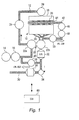
- FIG. 1 is a view illustrating a schematic configuration of a system in which an internal combustion engine (hereunder, referred to as simply "engine") to which a control apparatus is applied as Embodiment 1 of the present invention is mounted.
- An engine 10 shown in Figure 1 is a spark ignition four-stroke reciprocating engine, and is configured to be capable of lean burn operation using homogeneous combustion.
- the engine 10 has a configuration that includes an intake system for supplying air into a combustion chamber of each cylinder, an exhaust system for discharging exhaust gas, an EGR system for recirculating a part of the exhaust gas of the exhaust system to the intake system, and a control system for controlling operations of the engine 10.
- an intake system for supplying air into a combustion chamber of each cylinder
- an exhaust system for discharging exhaust gas
- an EGR system for recirculating a part of the exhaust gas of the exhaust system to the intake system
- a control system for controlling operations of the engine 10.
- the intake system of the engine 10 includes an intake passage 12.
- An air cleaner 14 is installed on the entrance side of the intake passage 12.
- An air flow meter 16 that outputs a signal that is in accordance with a flow rate of air that is drawn into the intake passage 12 is installed on a downstream side of the air cleaner 14 in the intake passage 12.
- An outlet side of the intake passage 12 is connected to a combustion chamber of each cylinder through a surge tank 18 and an intake manifold 20.
- a compressor 22a of a turbo-supercharger 22 is arranged on a downstream side of the air flow meter 16 in the intake passage 12.
- An intercooler 24 for cooling intake air that was compressed by the compressor 22a is arranged in the intake passage 12 on a downstream side of the compressor 22a.
- a throttle valve 26 for adjusting the amount of air that is supplied into the engine 10 is arranged in the intake passage on a downstream side of the intercooler 24.
- the exhaust system of the engine 10 includes an exhaust passage 30.
- One end side of the exhaust passage 30 is connected to the combustion chamber of each cylinder through the exhaust manifold 28.
- a turbine 22b of the turbo-supercharger 22 is arranged partway along the exhaust passage 30.
- a start catalyst (hereunder referred to as "S/C") 32 and a lean NOx catalyst 34 are arranged in that order in the exhaust passage 30 on the downstream side of the turbine 22b.
- the S/C 32 is a so-called three-way catalyst, and efficiently purifies the three components HC, CO, and NOx that are included in exhaust gas in the vicinity of the theoretical air-fuel ratio.
- the lean NOx catalyst 34 is a so-called storage-reduction type NOx catalyst, and has a storing/releasing action whereby the lean NOx catalyst 34 stores NOx when the air-fuel ratio of exhaust gas is in a predetermined lean region and releases NOx when the air-fuel ratio is in a rich region.
- a NOx sensor 36 for detecting a NOx concentration in exhaust gas is arranged in the exhaust passage 30 between the S/C 32 and the lean NOx catalyst 34.
- the EGR system of the engine 10 includes a low-pressure loop EGR passage (LPL-EGR passage) 38.
- LPL-EGR passage 38 One end of the LPL-EGR passage 38 is connected to the exhaust passage 30 between the S/C 32 and the lean NOx catalyst 34, and the other end is connected to the intake passage 12 between the air flow meter 16 and the compressor 22a.
- An LPL-EGR valve 40 for opening and closing the passage 38 is provided partway along the LPL-EGR passage 38.
- the EGR system of the engine 10 also includes a high-pressure loop EGR passage (HPL-EGR passage) 42.
- HPL-EGR passage 42 One end of the HPL-EGR passage 42 is connected to the exhaust passage 30 on the upstream side of the turbine 22b, and the other end is connected to the intake manifold 20 through an EGR delivery 44.
- a HPL-EGR valve 46 for opening and closing the passage 42, an EGR cooler 48 for cooling EGR gas, and an EGR catalyst 50 for purifying unburned HC or particulate matter contained in the EGR gas are provided in that order from the EGR delivery 44 partway along the HPL-EGR passage 42.
- the engine 10 of the present embodiment includes an ECU (electronic control unit) 60 as the control system thereof.
- the aforementioned LPL-EGR valve 40, HPL-EGR valve 46, and throttle valve 26 as well as various actuators such as a spark plug (not illustrated in the drawings) are connected to an output side of the ECU 60.
- various sensors such as a crank angle sensor (not illustrated in the drawings) that outputs a signal in accordance with a rotational angle of a crankshaft (not illustrated in the drawings), and an air-fuel ratio sensor (not illustrated in the drawings) are connected to an input side of the ECU 60.
- the ECU 60 is configured to cause the various actuators included in the engine to operate in accordance with a predetermined control program based on the outputs of the respective sensors that the engine includes.
- the engine 10 of the present embodiment is configured so as to enable lean burn operation using homogeneous combustion. Therefore, for instance, in the example illustrated in Figure 16 , by performing homogeneous lean combustion in which the air-fuel ratio A/F is made a ratio between 26 and 28, a NOx discharge amount can be suppressed more than in the case of stratified lean combustion accompanied by EGR.
- a problem with homogeneous lean combustion is the narrowness of the operating region thereof. That is, although homogeneous lean combustion can suppress a NOx discharge amount, there is a concern that the temperature of exhaust gas will decrease more than necessary in a light-load operating region. In such an operating region, since a decrease in the NOx purification performance that is caused by a drop in the bed temperature of the S/C 32 is a problem, it is required to perform a stoichiometric burn operation. Further, since the resistance of homogeneous lean combustion to knocking is low, it is required to perform stoichiometric burn operation when operating in a high-load operating region. Thus, in an engine that performs homogeneous combustion, the degree to which the lean burn operating region can be expanded significantly influences the extent to which fuel consumption is improved and a NOx discharge amount is suppressed.
- FIG. 2 is a view that illustrates the engine thermal efficiency with respect to the intake pressure. As illustrated in Figure 2 , it is found that when EGR is performed during homogeneous lean combustion, the engine thermal efficiency in a high-load operating region increases in comparison to when EGR is not performed. This is because CO 2 in the EGR gas acts as an inactive gas, and generation of knocking is suppressed in the high-load operating region.
- Figure 3 is a view that illustrates the engine thermal efficiency with respect to a gas-fuel ratio G/F for respective EGR rates.
- the gas-fuel ratio G/F can be expressed by the following equation (1).
- A/F represents an air-fuel ratio, that is, a ratio between fresh gas and a fuel amount
- EGR represents an EGR rate [%].
- Ga represents a fresh gas amount [g/s]
- Gegr represents an EGR gas amount [g/s]
- Gf represents a fuel consumption amount [g/s].
- the engine thermal efficiency is higher in a case where EGR is performed than in a case where EGR is not performed (case where the EGR rate is 0%).
- the engine thermal efficiency reaches a highest value when the EGR rate is 15%.
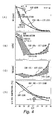
- Figure 4 is a multiple view drawing illustrating (A) a NOx discharge amount, (B) a CO discharge amount, (C) a THC discharge amount, and (D) an S/C bed temperature with respect to a gas-fuel ratio G/F, respectively.
- (A) to (C) in Figure 4 when NOx discharge amounts at an equal G/F during homogeneous combustion are compared, it is found that in comparison to when EGR is not performed, the NOx discharge amount is less when EGR is performed and, conversely, the discharge amounts of CO and HC increase. CO and HC are supplied to an oxidation reaction inside the S/C 32. Consequently, as shown in (D) in Figure 4 , when EGR is performed during homogeneous combustion, it is possible to effectively suppress a decrease in the bed temperature of the S/C 32 in a lean burn operating region.
- Figure 5 is a multiple view drawing illustrating (A) heat efficiency, (B) a NOx discharge amount, and (C) changes in an S/C temperature rise with respect to an intake pressure, respectively, for cases in which EGR is performed and not performed, respectively, during homogeneous lean combustion.
- (C) in Figure 4 in a case where EGR is not performed during homogeneous lean combustion, in a light-load region, lean burn operation cannot be performed because the bed temperature of the S/C 32 does not reach a predetermined target bed temperature.
- Figure 6 is a view illustrating S/C bed temperatures with respect to NOx discharge amounts for a case in which EGR is performed and a case in which EGR is not performed, respectively, during homogeneous lean combustion.
- EGR is performed during homogeneous lean combustion
- the efficiency of the bed temperature of the S/C 32 with respect to the discharged amount of NOx is favorable. Accordingly, performing EGR during homogeneous lean combustion makes it possible to attain a high degree of compatibility between suppressing the amount of discharged NOx and improving the fuel consumption by expanding the lean burn operating region.
- FIG. 7 is a view illustrating a lean burn operating region during homogeneous combustion.
- the lean burn operation can be expanded to the high-load side and the low-load side.
- the inventors of the present application conducted extensive studies regarding air-fuel ratios and EGR rates during homogeneous lean combustion, and as a result discovered a combination of an air-fuel ratio and an EGR rate that is favorable from the viewpoint of suppressing the amount of discharged NOx and improving fuel consumption. Specifically, the inventors of the present application found that fuel consumption reaches a maximum while suppressing the amount of discharged NOx when the EGR rate is between 10% and 20% (preferably 15%) and the A/F is 22.
- the basis for this finding is described from the viewpoint of the S/C bed temperature and the viewpoint of knocking, respectively.
- Figure 8 is a view that illustrates the relation between a NOx discharge amount and the A/F at respective EGR rates. As shown in Figure 8 , the A/F for satisfying a target value (for example, 1 g/kWh) with respect to the NOx discharge amount varies according to the EGR rate.
- a target value for example, 1 g/kWh
- Figure 9 is a multiple view drawing illustrating, with respect to an EGR rate, (A) an A/F at which a NOx discharge amount becomes a predetermined target amount, (B) the effect on fuel consumption produced by lean combustion, (C) the degree of deterioration in fuel consumption resulting from a decrease in the region of lean burn operation, and (D) an overall fuel consumption effect, respectively.
- the relation shown in (A) in Figure 9 is a relation that is derived from the relation shown in the above described Figure 8 .
- an A/F in a case where the NOx discharge amount satisfies a target amount is an air-fuel ratio that moves to the rich side as the EGR rate increases.
- (D) is a view that takes into account the overall influences on fuel consumption shown in (B) and (C) in the drawing. As shown in (D) in Figure 9 , it is found that the effect on fuel consumption is high when the EGR rate is between 10% and 20% (particularly, 15%) and the A/F is around 22.
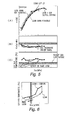
- Figure 10 is a multiple view drawing illustrating, with respect to the EGR rate, (A) an A/F at which a NOx discharge amount becomes a predetermined target amount, (B) the effect on fuel consumption produced by lean combustion, (C) the effect on fuel consumption produced by improvement of knocking, and (D) an overall fuel consumption effect, respectively.
- (D) is a view that takes into account the overall influences on fuel consumption shown in (B) and (C) in the drawing. As shown in (D) in Figure 10 , it is found that a fuel consumption effect is high when the EGR rate is between 10% and 20% (particularly, 15%) and the A/F is around 22.
- LPL-EGR has a characteristic that, in comparison to HPL-EGR, the introduced amount of EGR gas does not easily change with respect to the rotational load of the engine 10. Further, at a time of lean combustion, rich spike control is executed at a predetermined timing. Consequently, stable HPL-EGR cannot be performed in the period when the exhaust gas pressure is disturbed by rich spike control.
- a configuration is adopted in which EGR gas is introduced by LPL-EGR at a time of homogeneous lean combustion. Since it is thereby possible to stably realize a desired EGR rate (for example, 15%), it is possible to reliably suppress the amount of discharged NOx and improve the fuel consumption.
- a warm-up condition of the engine 10 as a condition for EGR at a time of homogeneous lean combustion, EGR cannot be performed during warm-up when the water temperature is low. This is because condensed water is generated from EGR gas (exhaust gas) before the engine is warmed up, and there is a possibility of the condensed water damaging the compressor 22a and the like. Therefore, in the present embodiment, as a state in which a hazard caused by condensed water is avoided, for example, a fact that the water temperature has reached a temperature of 70°C or more may be taken as a condition for EGR at a time of homogeneous lean combustion. It is thereby possible to perform EGR while protecting the components of the engine 10.
- the air-fuel ratio and the EGR rate are not limited to these values. That is, it is sufficient to appropriately set the optimum air-fuel ratio and EGR rate based on the relation between the effect on fuel consumption and the amount of discharged NOx.
- Embodiment 2 of the present invention will be described referring to Figure 11 to Figure 14 .
- EGR EGR at the time of homogeneous lean combustion
- knocking is suppressed at a time of a high load and a decrease in the bed temperature of the S/C 32 is suppressed at a time of a low load. Since it is thereby possible to expand an operating region in which lean burn operation is possible to a high-load side and a low-load side, respectively, fuel consumption can be improved while suppressing the amount of discharged NOx.
- FIG. 11 is a view that illustrates operating regions during homogeneous combustion.
- homogeneous stoichiometric combustion accompanied by EGR is performed in a predetermined high-load region.
- a high EGR rate is preferable from the viewpoint of suppressing the NOx discharge amount, if the EGR rate is made 25% or greater, the turbulent burning velocity will become 0 and flame propagation will no longer occur, and hence it is preferable to set the EGR rate to about 25%. It is thereby possible to suppress the amount of discharged NOx while securing the torque at the time of a high load by homogeneous stoichiometric combustion.
- Figure 12 is a timing chart in a case in which an EGR rate of 25% was attained with HPL-EGR.
- EGR passage and the EGR valve In order to introduce a large amount of EGR gas when performing HPL-EGR, it is necessary to provide the EGR passage and the EGR valve with a large diameter, respectively.
- Figure 13 is a timing chart in a case in which an EGR rate of 25% was attained with LPL-EGR.
- LPL-EGR in order to introduce a large amount of EGR gas, similarly to the case of HPL-EGR described above, it is necessary to provide the EGR passage and the EGR valve with a large diameter, respectively.
- LPL-EGR has a characteristic that, in comparison to HPL-EGR, the introduced amount of EGR gas does not easily change with respect to the rotational load of the engine 10.
- a configuration is adopted that combines use of LPL-EGR and HPL-EGR when realizing an EGR rate of 25% during homogeneous stoichiometric combustion. More specifically, a configuration is adopted that realizes an EGR rate of 15% with LPL-EGR and realizes the remaining 10% with HPL-EGR.
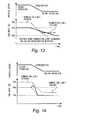
- Figure 14 is a timing chart in the case of combining use of LPL-EGR with an EGR rate of 15% and HPL-EGR with an EGR rate of 10%. According to this configuration, as shown in Figure 14 , even when a deceleration request is issued, the combustion limit is not exceeded and misfires can be avoided.
- HPL-EGR it is preferable to adopt a configuration in which the pipe diameter and the valve diameter are as small as possible within a range in which an EGR rate of 10% can be realized. Since the transient responsiveness of the HPL-EGR can be improved thereby, it is possible to effectively suppress the occurrence of misfires.
- the EGR rate is not limited to that rate. That is, it is sufficient to appropriately set the optimum EGR rate based on the relation between the turbulent burning velocity and the NOx discharge amount.
- the ratio between the LPL-EGR and the HPL-EGR is not limited to the above described ratio, and it is sufficient to appropriately set the optimum ratio based on the relation with the hardware configuration within a range that does not exceed the combustion limit.
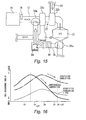
- FIG. 15 is a view that illustrates the configuration for the LPL-EGR in detail.
- the LPL-EGR passage 38 has a protruding portion 38a that, at a connecting portion with the exhaust passage 30, protrudes into the exhaust passage 30.
- the protruding portion 38a has a shape in which an end face thereof is cut diagonally so as to open towards an upstream side of the exhaust passage 30, that is, the turbine 22b side.
- the LPL-EGR passage 38 has a protruding portion 38b that, at a connecting portion with the intake passage 12, protrudes into the intake passage 12.
- the protruding portion 38b has a shape in which an end face thereof is cut diagonally so as to open towards a downstream side of the intake passage 12, that is, the compressor 22a side. Note that the LPL-EGR passage 38 is configured so that the protruding portion 38b is at a more upward position in the vertical direction than the protruding portion 38a.
- accumulation portions 62 and 64 for accumulating condensed water in the respective passages are provided on a downstream side of the compressor 22a in the intake passage 12 and on a downstream side of the LPL-EGR valve 40 in the LPL-EGR passage 38, respectively.
- exhaust gas that flows through the exhaust passage 30 is guided to the LPL-EGR passage 38 by the protruding portion 38a. It is thereby possible to facilitate the introduction of the EGR gas. Further, since the EGR gas that flows through the LPL-EGR passage 38 is introduced from the protruding portion 38b towards the downstream direction of the intake passage 12, it is possible to facilitate the introduction of the EGR gas. In addition, since the protruding portion 38a is positioned on a lower side in the vertical direction relative to the protruding portion 38b, a situation in which condensed water flows to the housing of the compressor 22a can be effectively avoided.
Landscapes
- Engineering & Computer Science (AREA)
- Chemical & Material Sciences (AREA)
- Combustion & Propulsion (AREA)
- Mechanical Engineering (AREA)
- General Engineering & Computer Science (AREA)
- Chemical Kinetics & Catalysis (AREA)
- Output Control And Ontrol Of Special Type Engine (AREA)
- Combined Controls Of Internal Combustion Engines (AREA)
- Exhaust-Gas Circulating Devices (AREA)
- Electrical Control Of Air Or Fuel Supplied To Internal-Combustion Engine (AREA)
Abstract
Description
- The present invention relates to an exhaust circulation apparatus for an internal combustion engine that is capable of executing EGR (exhaust gas recirculation) that recirculates a portion of exhaust gas to an intake system.
- An exhaust circulation apparatus for an engine with a supercharger that performs EGR that recirculates a portion of exhaust gas to an intake system is already known, as disclosed, for example, in Japanese Patent Laid-Open No.
2003-129874 -
- Patent Literature 1: Japanese Patent Laid-Open No.
2003-129874 - Patent Literature 2: Japanese Patent Laid-Open No.
2005-214063 - However, there is a limit to the degree to which the amount of discharged NOx can be suppressed by stratified lean combustion.
Figure 16 is a view which compares changes in the amount of discharged NOx relative to an air-fuel ratio A/F by combustion form. As shown inFigure 16 , with stratified combustion, although the amount of discharged NOx decreases as the air-fuel ratio becomes leaner in a lean-burn region, the extent of the decrease is not particularly large. This is because, with stratified combustion, the temperature around a spark plug is always high, even when performing lean-burn operation. Consequently, although EGR is generally performed with stratified lean combustion, a certain amount of NOx discharge is nevertheless unavoidable. - Therefore, one technology that has been the focus of attention in recent years is homogeneous combustion that causes a gaseous mixture of fuel and air to combust after being evenly mixed inside a cylinder. As shown in
Figure 16 , according to homogeneous combustion it is possible to suppress a NOx discharge amount in a lean-burn region compared to the case of stratified combustion. This is because, in a lean-burn region, the overall temperature in a combustion chamber decreases as the air-fuel ratio becomes leaner. However, a problem with homogeneous lean combustion concerns the narrowness of the operating region thereof. That is, in the case of homogeneous lean combustion, the exhaust gas temperature decreases since combustion is performed with a large quantity of fresh gas. Accordingly, because the bed temperature of an exhaust emission purifying catalyst decreases at a time of light-load operation, homogeneous lean combustion cannot be performed. Further, the efficiency decreases at a time of high-load operation due to the occurrence of knocking. Thus, in a conventional engine that performs homogeneous combustion, there is no other choice than to perform stoichiometric combustion in an operating region in which homogeneous lean combustion cannot be executed, and there has thus been a desire for further improvement from the viewpoint of improving fuel consumption and suppressing the amount of NOx discharge. - The present invention has been conceived to solve the above described problem, and an object of the present invention is to provide an exhaust circulation apparatus for an internal combustion engine that, in an internal combustion engine that performs homogeneous combustion, can improve fuel consumption and suppress the amount of discharged NOx by expanding an operating region in which homogeneous lean combustion is possible.
- In accomplishing the above object, according to a first aspect of the present invention, there is provided an exhaust circulation apparatus for an internal combustion engine, comprising:
- homogeneous lean combustion means for performing homogeneous lean combustion in a predetermined lean-burn region;
- an EGR apparatus for performing EGR that recirculates a portion of gas that flows through an exhaust system of the internal combustion engine to an intake system; and
- control means for controlling the EGR apparatus based on an operating condition of the internal combustion engine,
- wherein, when performing the homogeneous lean combustion, the control means controls the EGR apparatus to perform EGR.
- According to a second aspect of the present invention, there is provided the exhaust circulation apparatus for an internal combustion engine as described in the first aspect, wherein
the internal combustion engine comprises a turbo-supercharger having a turbine that is disposed in an exhaust passage and a compressor that is disposed in an intake passage;
the EGR apparatus includes a low-pressure loop EGR apparatus that recirculates gas that flows through the exhaust passage on a downstream side of the turbine to the intake passage at a position on an upstream side of the compressor; and
when performing the homogeneous lean combustion, the control means controls the low-pressure loop EGR apparatus to perform EGR. - According to a third aspect of the present invention, there is provided the exhaust circulation apparatus for an internal combustion engine as described in the first or second aspects, wherein
the EGR apparatus comprises means for adjusting an EGR rate that represents a ratio of a gas amount that is recirculated by EGR with respect to a total gas amount that is taken into the internal combustion engine;
the homogeneous lean combustion means performs homogeneous lean combustion so that an air-fuel ratio that represents a ratio of a fresh gas amount that is taken in with respect to an in-cylinder fuel amount of the internal combustion engine is 22; and
the control means controls the EGR apparatus so that the EGR rate during the homogeneous lean combustion is between 10% and 20%. - According to a fourth aspect of the present invention, there is provided the exhaust circulation apparatus for an internal combustion engine as described in the second or third aspects,
further comprising stoichiometric combustion means for performing stoichiometric combustion in which a combustion air-fuel ratio of the internal combustion engine is a theoretical air-fuel ratio in a stoichiometric burn region that is a region on a high-load side relative to the lean-burn region, wherein
the EGR apparatus further includes a high-pressure loop EGR apparatus that recirculates gas that flows through the exhaust passage on an upstream side of the turbine to the intake passage at a position on a downstream side of the compressor; and
when performing the stoichiometric combustion, the control means controls both of the high-pressure loop EGR apparatus and the low-pressure loop EGR apparatus to perform EGR. - According to a fifth aspect of the present invention, there is provided the exhaust circulation apparatus for an internal combustion engine as described in the fourth aspect, wherein
the EGR apparatus includes means for adjusting an EGR rate that represents a ratio of a gas amount that is recirculated by EGR with respect to a total gas amount that is taken into the internal combustion engine; and
when performing the stoichiometric combustion, the control means controls the low-pressure loop EGR apparatus and the high-pressure loop EGR apparatus so that an EGR rate generated by the low-pressure loop EGR apparatus is 15% and an EGR rate generated by the high-pressure loop EGR apparatus is 10%. - According to the first invention, since EGR is performed during homogeneous lean combustion, knocking on a high-load side that is a problem at a time of homogeneous lean combustion can be effectively suppressed. Further, CO and HC included in EGR gas contribute to an oxidation reaction in the catalyst. Consequently, it is possible to effectively suppress a decrease in the bed temperature of the catalyst on a low-load side that is a problem at a time of homogeneous lean combustion. Therefore, according to the present invention, it is possible to effectively expand a lean-burn region in which homogeneous lean combustion is possible, and thereby improve fuel consumption.
- According to the second invention, EGR is executed by a low-pressure loop EGR apparatus during homogeneous lean combustion. The EGR executed by the low-pressure loop EGR apparatus is stable with respect to the rotational load of the internal combustion engine. Therefore, according to the present invention, since stable EGR can be realized at a time of a transient operation of the internal combustion engine also, misfiring and the like can be prevented.
- According to the third invention, when performing EGR during homogeneous lean combustion, the air-fuel ratio is controlled to 22 and the EGR rate is controlled to between 10% and 20%. Although the fuel consumption decreases as the EGR rate increases, the operating region in which homogeneous lean combustion can be executed expands. Therefore, according to the present invention, the fuel consumption is improved to the maximum by controlling the air-fuel ratio to be a value of 22 and controlling the EGR rate to be a value between 10% and 20% during homogeneous lean combustion.
- According to the fourth invention, when performing stoichiometric combustion in a stoichiometric burn region that is on a high-load side relative to a lean-burn region, EGR is performed using both of a low-pressure loop EGR apparatus and a high-pressure loop EGR apparatus. In each of these EGR apparatuses, there is a limit to an EGR amount that can be introduced while avoiding the occurrence of misfiring. According to the present invention, since a large amount of EGR gas can be introduced during stoichiometric combustion under a high load by using these EGR apparatuses in combination, the amount of NOx that is discharged can be suppressed while securing the torque at the time of a high load.
- According to the fifth invention, when performing an EGR operation during stoichiometric combustion, the EGR rate of the low-pressure loop EGR apparatus is controlled to 15% and the EGR rate of the high-pressure loop EGR apparatus is controlled to 10%. If the EGR rate exceeds 25%, the turbulent burning velocity becomes 0 and the propagation of a flame no longer occurs. If an EGR rate of 25% is realized with only one of the EGR apparatuses, a deceleration misfire at a time of transition as well as a deterioration in responsiveness and the like become a problem. Therefore, according to the present invention, by realizing an EGR rate of 25% by combined use of a high-pressure loop EGR apparatus and a low-pressure loop EGR apparatus during stoichiometric combustion, a discharge amount of NOx can be suppressed to a maximum while suppressing the occurrence of a deceleration misfire at a time of transition as well as a deterioration in responsiveness.
-
-
Figure 1 is a view illustrating a schematic configuration of a system in which an internal combustion engine to which a control apparatus is applied asEmbodiment 1 of the present invention is mounted. -
Figure 2 is a view that illustrates the engine thermal efficiency with respect to the intake pressure. -
Figure 3 is a view that illustrates the engine thermal efficiency with respect to a gas-fuel ratio G/F for respective EGR rates. -
Figure 4 is a multiple view drawing illustrating (A) a NOx discharge amount, (B) a CO discharge amount, (C) a THC discharge amount, and (D) an S/C bed temperature with respect to a gas-fuel ratio G/F, respectively. -
Figure 5 is a multiple view drawing illustrating (A) heat efficiency, (B) a NOx discharge amount, and (C) changes in an S/C temperature rise with respect to an intake pressure, respectively, for cases in which EGR is performed and not performed, respectively, during homogeneous lean combustion. -
Figure 6 is a view illustrating S/C bed temperatures with respect to NOx discharge amounts for a case in which EGR is performed and a case in which EGR is not performed, respectively, during homogeneous lean combustion. -
Figure 7 is a view illustrating a lean burn operating region during homogeneous combustion. -
Figure 8 is a view that illustrates the relation between a NOx discharge amount and the A/F at respective EGR rates. -
Figure 9 is a multiple view drawing illustrating, with respect to an EGR rate, (A) an A/F at which a NOx discharge amount becomes a predetermined target amount, (B) the effect on fuel consumption produced by lean combustion, (C) the degree of deterioration in fuel consumption resulting from a decrease in the region of lean burn operation, and (D) an overall fuel consumption effect, respectively. -
Figure 10 is a multiple view drawing illustrating, with respect to the EGR rate, (A) an A/F at which a NOx discharge amount becomes a predetermined target amount, (B) the effect on fuel consumption produced by lean combustion, (C) the effect on fuel consumption produced by improvement of knocking, and (D) an overall fuel consumption effect, respectively. -
Figure 11 is a view that illustrates operating regions during homogeneous combustion. -
Figure 12 is a timing chart in a case in which an EGR rate of 25% was attained with HPL-EGR. -
Figure 13 is a timing chart in a case in which an EGR rate of 25% was attained with LPL-EGR. -
Figure 14 is a timing chart in the case of combining use of LPL-EGR with an EGR rate of 15% and HPL-EGR with an EGR rate of 10%. -
Figure 15 is a view that illustrates the configuration for the LPL-EGR in detail. -
Figure 16 is a view which compares changes in the amount of discharged NOx relative to an air-fuel ratio A/F by combustion form. - Hereunder, embodiments of the present invention are described based on the attached drawings. Note that elements that are common to the respective drawings are denoted by the same reference symbols, and a duplicate description thereof is omitted. Further, the present invention is not limited by the following embodiments.
-
Figure 1 is a view illustrating a schematic configuration of a system in which an internal combustion engine (hereunder, referred to as simply "engine") to which a control apparatus is applied asEmbodiment 1 of the present invention is mounted. Anengine 10 shown inFigure 1 is a spark ignition four-stroke reciprocating engine, and is configured to be capable of lean burn operation using homogeneous combustion. Theengine 10 has a configuration that includes an intake system for supplying air into a combustion chamber of each cylinder, an exhaust system for discharging exhaust gas, an EGR system for recirculating a part of the exhaust gas of the exhaust system to the intake system, and a control system for controlling operations of theengine 10. Hereunder, the configuration of each of these systems is described in detail. - The intake system of the
engine 10 includes anintake passage 12. Anair cleaner 14 is installed on the entrance side of theintake passage 12. Anair flow meter 16 that outputs a signal that is in accordance with a flow rate of air that is drawn into theintake passage 12 is installed on a downstream side of theair cleaner 14 in theintake passage 12. An outlet side of theintake passage 12 is connected to a combustion chamber of each cylinder through asurge tank 18 and anintake manifold 20. - A
compressor 22a of a turbo-supercharger 22 is arranged on a downstream side of theair flow meter 16 in theintake passage 12. Anintercooler 24 for cooling intake air that was compressed by thecompressor 22a is arranged in theintake passage 12 on a downstream side of thecompressor 22a. Athrottle valve 26 for adjusting the amount of air that is supplied into theengine 10 is arranged in the intake passage on a downstream side of theintercooler 24. - The exhaust system of the
engine 10 includes anexhaust passage 30. One end side of theexhaust passage 30 is connected to the combustion chamber of each cylinder through theexhaust manifold 28. Aturbine 22b of the turbo-supercharger 22 is arranged partway along theexhaust passage 30. A start catalyst (hereunder referred to as "S/C") 32 and alean NOx catalyst 34 are arranged in that order in theexhaust passage 30 on the downstream side of theturbine 22b. The S/C 32 is a so-called three-way catalyst, and efficiently purifies the three components HC, CO, and NOx that are included in exhaust gas in the vicinity of the theoretical air-fuel ratio. On the other hand, thelean NOx catalyst 34 is a so-called storage-reduction type NOx catalyst, and has a storing/releasing action whereby thelean NOx catalyst 34 stores NOx when the air-fuel ratio of exhaust gas is in a predetermined lean region and releases NOx when the air-fuel ratio is in a rich region. ANOx sensor 36 for detecting a NOx concentration in exhaust gas is arranged in theexhaust passage 30 between the S/C 32 and thelean NOx catalyst 34. - The EGR system of the
engine 10 includes a low-pressure loop EGR passage (LPL-EGR passage) 38. One end of the LPL-EGR passage 38 is connected to theexhaust passage 30 between the S/C 32 and thelean NOx catalyst 34, and the other end is connected to theintake passage 12 between theair flow meter 16 and thecompressor 22a. An LPL-EGR valve 40 for opening and closing thepassage 38 is provided partway along the LPL-EGR passage 38. - The EGR system of the
engine 10 also includes a high-pressure loop EGR passage (HPL-EGR passage) 42. One end of the HPL-EGR passage 42 is connected to theexhaust passage 30 on the upstream side of theturbine 22b, and the other end is connected to theintake manifold 20 through anEGR delivery 44. A HPL-EGR valve 46 for opening and closing thepassage 42, anEGR cooler 48 for cooling EGR gas, and anEGR catalyst 50 for purifying unburned HC or particulate matter contained in the EGR gas are provided in that order from theEGR delivery 44 partway along the HPL-EGR passage 42. - The
engine 10 of the present embodiment includes an ECU (electronic control unit) 60 as the control system thereof. The aforementioned LPL-EGR valve 40, HPL-EGR valve 46, andthrottle valve 26 as well as various actuators such as a spark plug (not illustrated in the drawings) are connected to an output side of theECU 60. In addition to the aforementionedair flow meter 16 andNOx sensor 36, various sensors such as a crank angle sensor (not illustrated in the drawings) that outputs a signal in accordance with a rotational angle of a crankshaft (not illustrated in the drawings), and an air-fuel ratio sensor (not illustrated in the drawings) are connected to an input side of theECU 60. TheECU 60 is configured to cause the various actuators included in the engine to operate in accordance with a predetermined control program based on the outputs of the respective sensors that the engine includes. - Next, operations of the system of
Embodiment 1 will be described with reference to the drawings. As described above, theengine 10 of the present embodiment is configured so as to enable lean burn operation using homogeneous combustion. Therefore, for instance, in the example illustrated inFigure 16 , by performing homogeneous lean combustion in which the air-fuel ratio A/F is made a ratio between 26 and 28, a NOx discharge amount can be suppressed more than in the case of stratified lean combustion accompanied by EGR. - However, as described above, a problem with homogeneous lean combustion is the narrowness of the operating region thereof. That is, although homogeneous lean combustion can suppress a NOx discharge amount, there is a concern that the temperature of exhaust gas will decrease more than necessary in a light-load operating region. In such an operating region, since a decrease in the NOx purification performance that is caused by a drop in the bed temperature of the S/
C 32 is a problem, it is required to perform a stoichiometric burn operation. Further, since the resistance of homogeneous lean combustion to knocking is low, it is required to perform stoichiometric burn operation when operating in a high-load operating region. Thus, in an engine that performs homogeneous combustion, the degree to which the lean burn operating region can be expanded significantly influences the extent to which fuel consumption is improved and a NOx discharge amount is suppressed. - Therefore, according to the system of the present embodiment, EGR is performed at a time of homogeneous lean combustion of the
engine 10.Figure 2 is a view that illustrates the engine thermal efficiency with respect to the intake pressure. As illustrated inFigure 2 , it is found that when EGR is performed during homogeneous lean combustion, the engine thermal efficiency in a high-load operating region increases in comparison to when EGR is not performed. This is because CO2 in the EGR gas acts as an inactive gas, and generation of knocking is suppressed in the high-load operating region. -
Figure 3 is a view that illustrates the engine thermal efficiency with respect to a gas-fuel ratio G/F for respective EGR rates. Note that the gas-fuel ratio G/F can be expressed by the following equation (1).
- In the above equation (1), A/F represents an air-fuel ratio, that is, a ratio between fresh gas and a fuel amount, and EGR represents an EGR rate [%]. Further, Ga represents a fresh gas amount [g/s], Gegr represents an EGR gas amount [g/s], and Gf represents a fuel consumption amount [g/s].
- As shown in
Figure 3 , it is found that the engine thermal efficiency is higher in a case where EGR is performed than in a case where EGR is not performed (case where the EGR rate is 0%). In particular, it is found that in a lean-burn region in which the G/F is between 26 and 28, the engine thermal efficiency reaches a highest value when the EGR rate is 15%. Thus, according to the system of the present embodiment, by performing EGR during homogeneous combustion, it is possible to effectively expand the lean-burn region to the high-load side. -
Figure 4 is a multiple view drawing illustrating (A) a NOx discharge amount, (B) a CO discharge amount, (C) a THC discharge amount, and (D) an S/C bed temperature with respect to a gas-fuel ratio G/F, respectively. As shown in (A) to (C) inFigure 4 , when NOx discharge amounts at an equal G/F during homogeneous combustion are compared, it is found that in comparison to when EGR is not performed, the NOx discharge amount is less when EGR is performed and, conversely, the discharge amounts of CO and HC increase. CO and HC are supplied to an oxidation reaction inside the S/C 32. Consequently, as shown in (D) inFigure 4 , when EGR is performed during homogeneous combustion, it is possible to effectively suppress a decrease in the bed temperature of the S/C 32 in a lean burn operating region. -
Figure 5 is a multiple view drawing illustrating (A) heat efficiency, (B) a NOx discharge amount, and (C) changes in an S/C temperature rise with respect to an intake pressure, respectively, for cases in which EGR is performed and not performed, respectively, during homogeneous lean combustion. As shown in (C) inFigure 4 , in a case where EGR is not performed during homogeneous lean combustion, in a light-load region, lean burn operation cannot be performed because the bed temperature of the S/C 32 does not reach a predetermined target bed temperature. In this respect, when EGR is performed during homogeneous lean combustion, since the bed temperature of the S/C 32 can be effectively increased in a light-load region, it is possible to effectively expand a region in which a lean burn operation is possible to the low-load side. -
Figure 6 is a view illustrating S/C bed temperatures with respect to NOx discharge amounts for a case in which EGR is performed and a case in which EGR is not performed, respectively, during homogeneous lean combustion. As illustrated inFigure 6 , it is found that when EGR is performed during homogeneous lean combustion, the efficiency of the bed temperature of the S/C 32 with respect to the discharged amount of NOx is favorable. Accordingly, performing EGR during homogeneous lean combustion makes it possible to attain a high degree of compatibility between suppressing the amount of discharged NOx and improving the fuel consumption by expanding the lean burn operating region. - As described above, when EGR is performed during homogeneous lean combustion, an operating region in which a lean burn operation is possible can be effectively expanded.
Figure 7 is a view illustrating a lean burn operating region during homogeneous combustion. As shown inFigure 7 , when EGR is performed during homogeneous combustion, the lean burn operation can be expanded to the high-load side and the low-load side. Thus, when performing homogeneous lean combustion, it is possible to attain a high degree of compatibility between suppressing the amount of discharged NOx and improving the fuel consumption by expanding the lean burn operating region. - The inventors of the present application conducted extensive studies regarding air-fuel ratios and EGR rates during homogeneous lean combustion, and as a result discovered a combination of an air-fuel ratio and an EGR rate that is favorable from the viewpoint of suppressing the amount of discharged NOx and improving fuel consumption. Specifically, the inventors of the present application found that fuel consumption reaches a maximum while suppressing the amount of discharged NOx when the EGR rate is between 10% and 20% (preferably 15%) and the A/F is 22. Hereunder, the basis for this finding is described from the viewpoint of the S/C bed temperature and the viewpoint of knocking, respectively.
- First, the effect on fuel consumption when EGR is performed during homogeneous lean combustion is considered from the viewpoint of the S/C bed temperature.
Figure 8 is a view that illustrates the relation between a NOx discharge amount and the A/F at respective EGR rates. As shown inFigure 8 , the A/F for satisfying a target value (for example, 1 g/kWh) with respect to the NOx discharge amount varies according to the EGR rate. -
Figure 9 is a multiple view drawing illustrating, with respect to an EGR rate, (A) an A/F at which a NOx discharge amount becomes a predetermined target amount, (B) the effect on fuel consumption produced by lean combustion, (C) the degree of deterioration in fuel consumption resulting from a decrease in the region of lean burn operation, and (D) an overall fuel consumption effect, respectively. First, the relation shown in (A) inFigure 9 is a relation that is derived from the relation shown in the above describedFigure 8 . As shown in (A) inFigure 9 , an A/F in a case where the NOx discharge amount satisfies a target amount is an air-fuel ratio that moves to the rich side as the EGR rate increases. In this case, as shown in (B) inFigure 9 , the effect on fuel consumption that is produced by lean combustion in a case where the NOx discharge amount satisfies a target amount increases as the EGR rate decreases. This is because better fuel consumption is obtained in the case of normal lean combustion than in the case of combustion accompanied by EGR gas. Therefore, from the viewpoint of engine combustion, a low EGR rate is preferable in terms of improving the fuel consumption. - On the other hand, as shown in (C) in
Figure 9 , in a case where the NOx discharge amount satisfies a target amount, the degree of deterioration in the fuel consumption that results from a decrease in the region of lean burn operation changes in the direction of improvement as the EGR rate increases. This is because, the higher that the EGR rate is, the greater the degree to which a decrease in the bed temperature of the S/C 32 can be suppressed, and hence an operating region on the light-load side of the lean burn operation can be expanded. Therefore, from the viewpoint of the limitation of the operating region on the light-load side, increasing the EGR rate is preferable with regard to improving the fuel consumption. - In
Figure 9, (D) is a view that takes into account the overall influences on fuel consumption shown in (B) and (C) in the drawing. As shown in (D) inFigure 9 , it is found that the effect on fuel consumption is high when the EGR rate is between 10% and 20% (particularly, 15%) and the A/F is around 22. - Next, the effect on fuel consumption when EGR is performed during homogeneous lean combustion will be considered from the viewpoint of knocking.
Figure 10 is a multiple view drawing illustrating, with respect to the EGR rate, (A) an A/F at which a NOx discharge amount becomes a predetermined target amount, (B) the effect on fuel consumption produced by lean combustion, (C) the effect on fuel consumption produced by improvement of knocking, and (D) an overall fuel consumption effect, respectively. - The relations shown in (A) and (B) in
Figure 10 are the same as the relations shown in (A) and (B) inFigure 9 . As shown in (C) inFigure 10 , the effect on fuel consumption produced by improvement of knocking in a case where the NOx discharge amount satisfies the target amount changes in the direction of fuel consumption improvement as the EGR rate increases. This is because the proportion of CO2 inside the combustion chambers increases relatively as the EGR rate increases, and resistance to knocking increases. Therefore, from the viewpoint of knocking, increasing the EGR rate is preferable with regard to improving the fuel consumption. - In
Figure 10, (D) is a view that takes into account the overall influences on fuel consumption shown in (B) and (C) in the drawing. As shown in (D) inFigure 10 , it is found that a fuel consumption effect is high when the EGR rate is between 10% and 20% (particularly, 15%) and the A/F is around 22. - Accordingly, when performing homogeneous lean combustion in the
engine 10, by operating so that the EGR rate is between 10% and 20% (more preferably, the EGR rate is 15%) and the A/F is 22, fuel consumption can be improved to the maximum while suppressing the NOx discharge amount to a target amount. - Next, EGR operations in the system of the present embodiment will be described. Although the system of the present embodiment is configured to be capable of performing LPL-EGR through the LPL-
EGR passage 38 and HPL-EGR through the HPL-EGR passage 42, LPL-EGR has a characteristic that, in comparison to HPL-EGR, the introduced amount of EGR gas does not easily change with respect to the rotational load of theengine 10. Further, at a time of lean combustion, rich spike control is executed at a predetermined timing. Consequently, stable HPL-EGR cannot be performed in the period when the exhaust gas pressure is disturbed by rich spike control. - Therefore, according to the present embodiment a configuration is adopted in which EGR gas is introduced by LPL-EGR at a time of homogeneous lean combustion. Since it is thereby possible to stably realize a desired EGR rate (for example, 15%), it is possible to reliably suppress the amount of discharged NOx and improve the fuel consumption.
- In this connection, although in the above described embodiment there is no particular description regarding a warm-up condition of the
engine 10 as a condition for EGR at a time of homogeneous lean combustion, EGR cannot be performed during warm-up when the water temperature is low. This is because condensed water is generated from EGR gas (exhaust gas) before the engine is warmed up, and there is a possibility of the condensed water damaging thecompressor 22a and the like. Therefore, in the present embodiment, as a state in which a hazard caused by condensed water is avoided, for example, a fact that the water temperature has reached a temperature of 70°C or more may be taken as a condition for EGR at a time of homogeneous lean combustion. It is thereby possible to perform EGR while protecting the components of theengine 10. - Further, although in the above described embodiment a configuration is adopted in which the air-fuel ratio is 22 and the EGR rate is between 10% and 20% during homogeneous lean combustion, the air-fuel ratio and the EGR rate are not limited to these values. That is, it is sufficient to appropriately set the optimum air-fuel ratio and EGR rate based on the relation between the effect on fuel consumption and the amount of discharged NOx.
- Next, Embodiment 2 of the present invention will be described referring to
Figure 11 to Figure 14 . In the system ofEmbodiment 1 that is described above, by performing EGR at the time of homogeneous lean combustion, knocking is suppressed at a time of a high load and a decrease in the bed temperature of the S/C 32 is suppressed at a time of a low load. Since it is thereby possible to expand an operating region in which lean burn operation is possible to a high-load side and a low-load side, respectively, fuel consumption can be improved while suppressing the amount of discharged NOx. - However, there is a limit to the extent to which the operating region can be expanded. That is, as in the present embodiment, a high-load region that is produced by high supercharging also exists with respect to
engine 10 that includes the turbo-supercharger 22. From the viewpoint of securing the torque, lean burn operation in which there is a large amount of air is not suitable for such an operating region. Therefore, in a high-load operating region, stoichiometric burn operation that controls the air-fuel ratio in the vicinity of the theoretical air-fuel ratio is performed. However, as illustrated in the above describedFigure 16 , the amount of NOx that is discharged increases when performing stoichiometric burn operation during homogeneous combustion. - Therefore, according to the present embodiment, a configuration is adopted in which EGR is performed in a high-load, stoichiometric burn operating region.
Figure 11 is a view that illustrates operating regions during homogeneous combustion. As shown inFigure 11 , homogeneous stoichiometric combustion accompanied by EGR is performed in a predetermined high-load region. Note that although a high EGR rate is preferable from the viewpoint of suppressing the NOx discharge amount, if the EGR rate is made 25% or greater, the turbulent burning velocity will become 0 and flame propagation will no longer occur, and hence it is preferable to set the EGR rate to about 25%. It is thereby possible to suppress the amount of discharged NOx while securing the torque at the time of a high load by homogeneous stoichiometric combustion. - Although the system of the present embodiment is configured to be capable of executing LPL-EGR through the LPL-
EGR passage 38 and HPL-EGR through the HPL-EGR passage 42, it is difficult to attain an EGR rate of around 25% with only one of the aforementioned kinds of EGR.Figure 12 is a timing chart in a case in which an EGR rate of 25% was attained with HPL-EGR. In order to introduce a large amount of EGR gas when performing HPL-EGR, it is necessary to provide the EGR passage and the EGR valve with a large diameter, respectively. Consequently, in the case of using this kind of hardware configuration, when a deceleration request is issued as shown inFigure 12 , the response of the EGR valve cannot keep pace with changes in the air amount, and as a result the EGR rate exceeds the combustion limit and misfiring occurs. - On the other hand,
Figure 13 is a timing chart in a case in which an EGR rate of 25% was attained with LPL-EGR. When performing LPL-EGR also, in order to introduce a large amount of EGR gas, similarly to the case of HPL-EGR described above, it is necessary to provide the EGR passage and the EGR valve with a large diameter, respectively. In addition, LPL-EGR has a characteristic that, in comparison to HPL-EGR, the introduced amount of EGR gas does not easily change with respect to the rotational load of theengine 10. Consequently, in the case of using this kind of hardware configuration, when a deceleration request is issued as shown inFigure 13 , the response of the EGR valve cannot keep pace with changes in the rotation speed, and as a result the EGR rate exceeds the combustion limit and misfiring occurs. - Therefore, according to the present embodiment, a configuration is adopted that combines use of LPL-EGR and HPL-EGR when realizing an EGR rate of 25% during homogeneous stoichiometric combustion. More specifically, a configuration is adopted that realizes an EGR rate of 15% with LPL-EGR and realizes the remaining 10% with HPL-EGR.
Figure 14 is a timing chart in the case of combining use of LPL-EGR with an EGR rate of 15% and HPL-EGR with an EGR rate of 10%. According to this configuration, as shown inFigure 14 , even when a deceleration request is issued, the combustion limit is not exceeded and misfires can be avoided. Note that, with respect to HPL-EGR, it is preferable to adopt a configuration in which the pipe diameter and the valve diameter are as small as possible within a range in which an EGR rate of 10% can be realized. Since the transient responsiveness of the HPL-EGR can be improved thereby, it is possible to effectively suppress the occurrence of misfires. - In this connection, although in the above described embodiment a configuration is adopted in which an EGR rate of 25% is realized during homogeneous stoichiometric combustion, the EGR rate is not limited to that rate. That is, it is sufficient to appropriately set the optimum EGR rate based on the relation between the turbulent burning velocity and the NOx discharge amount. Further, the ratio between the LPL-EGR and the HPL-EGR is not limited to the above described ratio, and it is sufficient to appropriately set the optimum ratio based on the relation with the hardware configuration within a range that does not exceed the combustion limit.
- Next, Embodiment 3 of the present invention will be described referring to
Figure 15. Figure 15 is a view that illustrates the configuration for the LPL-EGR in detail. As shown inFigure 15 , the LPL-EGR passage 38 has a protrudingportion 38a that, at a connecting portion with theexhaust passage 30, protrudes into theexhaust passage 30. The protrudingportion 38a has a shape in which an end face thereof is cut diagonally so as to open towards an upstream side of theexhaust passage 30, that is, theturbine 22b side. Further, the LPL-EGR passage 38 has a protrudingportion 38b that, at a connecting portion with theintake passage 12, protrudes into theintake passage 12. The protrudingportion 38b has a shape in which an end face thereof is cut diagonally so as to open towards a downstream side of theintake passage 12, that is, thecompressor 22a side. Note that the LPL-EGR passage 38 is configured so that the protrudingportion 38b is at a more upward position in the vertical direction than the protrudingportion 38a. - Further,
accumulation portions compressor 22a in theintake passage 12 and on a downstream side of the LPL-EGR valve 40 in the LPL-EGR passage 38, respectively. - According to this configuration, exhaust gas that flows through the
exhaust passage 30 is guided to the LPL-EGR passage 38 by the protrudingportion 38a. It is thereby possible to facilitate the introduction of the EGR gas. Further, since the EGR gas that flows through the LPL-EGR passage 38 is introduced from the protrudingportion 38b towards the downstream direction of theintake passage 12, it is possible to facilitate the introduction of the EGR gas. In addition, since the protrudingportion 38a is positioned on a lower side in the vertical direction relative to the protrudingportion 38b, a situation in which condensed water flows to the housing of thecompressor 22a can be effectively avoided. - According to the configuration illustrated in
Figure 15 , since condensed water inside the LPL-EGR passage 38 is accumulated in theaccumulation portion 64, a situation in which condensed water is introduced to the housing of thecompressor 22a can be effectively avoided. Further, as shown inFigure 15 , because a discharge port of thecompressor 22a is provided on the vertically lower side, condensed water is effectively accumulated in theaccumulation portion 62 without the condensed water flowing backward towards the housing of thecompressor 22a from theintake passage 12 on the discharge side. It is thus possible to effectively protect thecompressor 22a from damage. -
- 10: internal combustion engine (engine)
- 12: intake passage
- 22: turbo-supercharger
- 22a: compressor
- 22b turbine
- 30: exhaust passage
- 32: start catalyst (S/C)
- 38: LPL-EGR passage
- 38a, 38b: protruding portions
- 40: LPL-EGR valve
- 42: HPL-EGR passage
- 46: HPL-EGR valve
- 60: ECU (electronic control unit)
- 62, 64: accumulation portions
Claims (5)
- An exhaust circulation apparatus for an internal combustion engine, comprising:homogeneous lean combustion means for performing homogeneous lean combustion in a predetermined lean-burn region;an EGR apparatus for performing EGR that recirculates a portion of gas that flows through an exhaust system of the internal combustion engine to an intake system; andcontrol means for controlling the EGR apparatus based on an operating condition of the internal combustion engine,wherein, when performing the homogeneous lean combustion, the control means controls the EGR apparatus to perform EGR.
- The exhaust circulation apparatus for an internal combustion engine according to claim 1, wherein
the internal combustion engine comprises a turbo-supercharger having a turbine that is disposed in an exhaust passage and a compressor that is disposed in an intake passage;
the EGR apparatus includes a low-pressure loop EGR apparatus that recirculates gas that flows through the exhaust passage on a downstream side of the turbine to the intake passage at a position on an upstream side of the compressor; and
when performing the homogeneous lean combustion, the control means controls the low-pressure loop EGR apparatus to perform EGR. - The exhaust circulation apparatus for an internal combustion engine according to claim 1 or 2, wherein
the EGR apparatus comprises means for adjusting an EGR rate that represents a ratio of a gas amount that is recirculated by EGR with respect to a total gas amount that is taken into the internal combustion engine;
the homogeneous lean combustion means performs homogeneous lean combustion so that an air-fuel ratio that represents a ratio of a fresh gas amount that is taken in with respect to an in-cylinder fuel amount of the internal combustion engine is 22; and
the control means controls the EGR apparatus so that the EGR rate during the homogeneous lean combustion is between 10% and 20%. - The exhaust circulation apparatus for an internal combustion engine according to claim 2 or 3, further comprising stoichiometric combustion means for performing stoichiometric combustion in which a combustion air-fuel ratio of the internal combustion engine is a theoretical air-fuel ratio in a stoichiometric burn region that is a region on a high-load side relative to the lean-burn region, wherein
the EGR apparatus further includes a high-pressure loop EGR apparatus that recirculates gas that flows through the exhaust passage on an upstream side of the turbine to the intake passage at a position on a downstream side of the compressor; and
when performing the stoichiometric combustion, the control means controls both of the high-pressure loop EGR apparatus and the low-pressure loop EGR apparatus to perform EGR. - The exhaust circulation apparatus for an internal combustion engine according to claim 4, wherein
the EGR apparatus includes means for adjusting an EGR rate that represents a ratio of a gas amount that is recirculated by EGR with respect to a total gas amount that is taken into the internal combustion engine; and
when performing the stoichiometric combustion, the control means controls the low-pressure loop EGR apparatus and the high-pressure loop EGR apparatus so that an EGR rate generated by the low-pressure loop EGR apparatus is 15% and an EGR rate generated by the high-pressure loop EGR apparatus is 10%.
Applications Claiming Priority (1)
| Application Number | Priority Date | Filing Date | Title |
|---|---|---|---|
| PCT/JP2012/051466 WO2013111273A1 (en) | 2012-01-24 | 2012-01-24 | Exhaust circulation apparatus for internal combustion engine |
Publications (3)
| Publication Number | Publication Date |
|---|---|
| EP2808518A1 true EP2808518A1 (en) | 2014-12-03 |
| EP2808518A4 EP2808518A4 (en) | 2015-04-01 |
| EP2808518B1 EP2808518B1 (en) | 2017-08-16 |
Family
ID=48873045
Family Applications (1)
| Application Number | Title | Priority Date | Filing Date |
|---|---|---|---|
| EP12866650.0A Not-in-force EP2808518B1 (en) | 2012-01-24 | 2012-01-24 | Exhaust circulation apparatus for internal combustion engine |
Country Status (5)
| Country | Link |
|---|---|
| US (1) | US9567945B2 (en) |
| EP (1) | EP2808518B1 (en) |
| JP (1) | JP5817846B2 (en) |
| CN (1) | CN104066955B (en) |
| WO (1) | WO2013111273A1 (en) |
Cited By (5)
| Publication number | Priority date | Publication date | Assignee | Title |
|---|---|---|---|---|
| WO2016097197A1 (en) * | 2014-12-17 | 2016-06-23 | Tenneco Gmbh | Agr system with a particle filter for an otto engine |
| EP3085933A4 (en) * | 2013-12-20 | 2016-12-21 | Toyota Motor Co Ltd | EXHAUST GAS PURIFYING DEVICE FOR INTERNAL COMBUSTION ENGINE |
| CN109690062A (en) * | 2016-09-14 | 2019-04-26 | 三菱重工业株式会社 | Engine and engine control method |
| US10480460B2 (en) | 2014-12-17 | 2019-11-19 | Tenneco Gmbh | EGR system with particle filter for a gasoline engine |
| DE102019213921B4 (en) * | 2019-01-29 | 2025-10-09 | Hyundai Motor Company | Combustion engine system |
Families Citing this family (9)
| Publication number | Priority date | Publication date | Assignee | Title |
|---|---|---|---|---|
| JP6090089B2 (en) * | 2013-09-30 | 2017-03-08 | マツダ株式会社 | Engine exhaust gas recirculation control device |
| JP6075271B2 (en) * | 2013-11-12 | 2017-02-08 | トヨタ自動車株式会社 | Control device for internal combustion engine |
| JP6394628B2 (en) * | 2015-05-25 | 2018-09-26 | トヨタ自動車株式会社 | Control device for internal combustion engine |
| US9995265B2 (en) * | 2015-05-25 | 2018-06-12 | Toyota Jidosha Kabushiki Kaisha | Control device for internal combustion engine |
| CN105422327B (en) * | 2015-12-11 | 2018-04-24 | 吉林大学 | The variable EGR gas handling systems of composite injection bi-fuel internal combustion engine and method |
| CN105508087B (en) * | 2015-12-30 | 2018-05-11 | 联合汽车电子有限公司 | Series parallel type gas recirculation system and its application method |
| JP6601371B2 (en) * | 2016-11-22 | 2019-11-06 | マツダ株式会社 | Control device for compression self-ignition engine |
| JP6428827B2 (en) * | 2017-03-30 | 2018-11-28 | マツダ株式会社 | Engine intake passage structure |
| KR20200111523A (en) * | 2019-03-19 | 2020-09-29 | 현대자동차주식회사 | Exhaust manifold |
Family Cites Families (27)
| Publication number | Priority date | Publication date | Assignee | Title |
|---|---|---|---|---|
| JPH05296111A (en) | 1992-04-17 | 1993-11-09 | Mitsubishi Motors Corp | Lean-burn internal combustion engine and its control method |
| JP2724389B2 (en) | 1992-04-27 | 1998-03-09 | 本田技研工業株式会社 | Control device for internal combustion engine |
| JP3387257B2 (en) * | 1995-03-06 | 2003-03-17 | 三菱自動車工業株式会社 | Supercharged internal combustion engine with exhaust gas recirculation control device |
| JP3605221B2 (en) * | 1996-03-19 | 2004-12-22 | 株式会社日立製作所 | Control device for internal combustion engine |
| EP0928369B1 (en) | 1996-08-23 | 2006-05-10 | Cummins Inc. | Premixed charge compression ignition engine with optimal combustion control |
| EP1688601B1 (en) | 1996-08-23 | 2011-03-09 | Cummins Inc. | Premixed charge compression ignition engine with optimal combustion control |
| JP3680500B2 (en) * | 1997-07-02 | 2005-08-10 | 日産自動車株式会社 | Control device for internal combustion engine |
| JPH11117785A (en) | 1997-10-17 | 1999-04-27 | Nissan Motor Co Ltd | Control device for supercharged engine |
| JPH11324817A (en) | 1998-05-14 | 1999-11-26 | Fuji Heavy Ind Ltd | Egr control device for engine |
| US7398762B2 (en) * | 2001-12-18 | 2008-07-15 | Ford Global Technologies, Llc | Vehicle control system |
| JP2002188522A (en) * | 2000-12-15 | 2002-07-05 | Mitsubishi Motors Corp | EGR control device for turbocharged engine |
| JP4031227B2 (en) | 2001-10-23 | 2008-01-09 | 富士重工業株式会社 | Exhaust gas recirculation device for in-cylinder injection engine with supercharger |
| US6863058B2 (en) * | 2003-02-03 | 2005-03-08 | Ford Global Technologies, Llc | System and method for reducing NOx emissions during transient conditions in a diesel fueled vehicle |
| JP4197336B2 (en) * | 2003-10-23 | 2008-12-17 | 株式会社日立製作所 | Exhaust gas recirculation device for internal combustion engine |
| JP4258388B2 (en) | 2004-01-29 | 2009-04-30 | トヨタ自動車株式会社 | Internal combustion engine and operation control device for internal combustion engine |
| US7275514B2 (en) * | 2005-04-28 | 2007-10-02 | Gm Global Technology Operations, Inc. | Method of HCCI and SI combustion control for a direct injection internal combustion engine |
| JP4911432B2 (en) | 2007-04-19 | 2012-04-04 | 株式会社デンソー | Control device for internal combustion engine |
| JP4737644B2 (en) * | 2007-06-20 | 2011-08-03 | 株式会社デンソー | Exhaust gas purification device for internal combustion engine |
| US7512479B1 (en) * | 2007-11-19 | 2009-03-31 | Southwest Research Institute | Air fraction estimation for internal combustion engines with dual-loop EGR systems |
| JP2010180804A (en) | 2009-02-06 | 2010-08-19 | Honda Motor Co Ltd | Exhaust emission control device for internal combustion engine |
| JP2010190150A (en) | 2009-02-19 | 2010-09-02 | Isuzu Motors Ltd | Egr device |
| US8210158B2 (en) * | 2009-12-18 | 2012-07-03 | GM Global Technology Operations LLC | EGR control in HCCI engines |
| JP5620715B2 (en) | 2010-05-18 | 2014-11-05 | 日野自動車株式会社 | Exhaust purification device |
| US8616182B2 (en) | 2010-05-24 | 2013-12-31 | GM Global Technology Operations LLC | Method and apparatus for controlling an internal combustion engine coupled to a passive selective catalytic reduction aftertreatment system |
| DE102010047795A1 (en) * | 2010-10-07 | 2012-04-12 | Daimler Ag | Operating method for an internal combustion engine |
| CN104428518B (en) * | 2012-07-05 | 2017-04-05 | 丰田自动车株式会社 | Internal combustion engine |
| US9002623B2 (en) * | 2012-08-02 | 2015-04-07 | GM Global Technology Operations LLC | Fully flexible exhaust valve actuator control systems and methods |
-
2012
- 2012-01-24 EP EP12866650.0A patent/EP2808518B1/en not_active Not-in-force
- 2012-01-24 US US14/364,534 patent/US9567945B2/en active Active
- 2012-01-24 CN CN201280067694.XA patent/CN104066955B/en not_active Expired - Fee Related
- 2012-01-24 JP JP2013555036A patent/JP5817846B2/en not_active Expired - Fee Related
- 2012-01-24 WO PCT/JP2012/051466 patent/WO2013111273A1/en not_active Ceased
Cited By (7)
| Publication number | Priority date | Publication date | Assignee | Title |
|---|---|---|---|---|
| EP3085933A4 (en) * | 2013-12-20 | 2016-12-21 | Toyota Motor Co Ltd | EXHAUST GAS PURIFYING DEVICE FOR INTERNAL COMBUSTION ENGINE |
| WO2016097197A1 (en) * | 2014-12-17 | 2016-06-23 | Tenneco Gmbh | Agr system with a particle filter for an otto engine |
| US10458368B2 (en) | 2014-12-17 | 2019-10-29 | Tenneco Gmbh | EGR system with particle filter for a gasoline engine |
| US10480460B2 (en) | 2014-12-17 | 2019-11-19 | Tenneco Gmbh | EGR system with particle filter for a gasoline engine |
| DE102014118813B4 (en) * | 2014-12-17 | 2025-06-26 | Tenneco Gmbh | EGR system with particulate filter for gasoline engines |
| CN109690062A (en) * | 2016-09-14 | 2019-04-26 | 三菱重工业株式会社 | Engine and engine control method |
| DE102019213921B4 (en) * | 2019-01-29 | 2025-10-09 | Hyundai Motor Company | Combustion engine system |
Also Published As
| Publication number | Publication date |
|---|---|
| CN104066955A (en) | 2014-09-24 |
| JP5817846B2 (en) | 2015-11-18 |
| JPWO2013111273A1 (en) | 2015-05-11 |
| WO2013111273A1 (en) | 2013-08-01 |
| US20140352298A1 (en) | 2014-12-04 |
| US9567945B2 (en) | 2017-02-14 |
| EP2808518B1 (en) | 2017-08-16 |
| EP2808518A4 (en) | 2015-04-01 |
| CN104066955B (en) | 2016-10-19 |
Similar Documents
| Publication | Publication Date | Title |
|---|---|---|
| EP2808518B1 (en) | Exhaust circulation apparatus for internal combustion engine | |
| CN105275625B (en) | System and method for exhaust catalyst temperature control | |
| US9988999B2 (en) | Thermal management for regenerating an aftertreatment device | |
| US20090308070A1 (en) | Egr system with dedicated egr cylinders | |
| US20120000441A1 (en) | Diesel engine for vehicle | |
| EP2986834B1 (en) | Method and apparatus for exhaust gas aftertreatment device warning | |
| US7637098B2 (en) | Arrangement for controlling exhaust pressure pulses at an internal combustion engine | |
| CN105264210B (en) | Control device for internal combustion engine | |
| RU2569397C2 (en) | Operation of supercharged gas engine (versions) and gas engine | |
| US9897022B2 (en) | Control apparatus for internal combustion engine | |
| US11572815B2 (en) | Methods and systems for turbine bypass | |
| EP2792874A1 (en) | Improved combustion control for combustion engines | |
| JP2006233898A (en) | Egr device | |
| JP2004245133A (en) | diesel engine | |
| EP3880950B1 (en) | Spark ignited engine load extension with low pressure exhaust gas recirculation and delta pressure valve | |
| US20090126345A1 (en) | Engine with emissions control arrangement and method of controlling engine emissions | |
| JP4591403B2 (en) | Control device for internal combustion engine | |
| US11585301B1 (en) | Two-stage boost system for engines | |
| JP4924280B2 (en) | Diesel engine control device. | |
| JP5823842B2 (en) | Exhaust gas recirculation device for multi-cylinder internal combustion engine with turbocharger | |
| JP2009052504A (en) | Control device for internal combustion engine | |
| JP2008121494A (en) | Control device for internal combustion engine | |
| JP2007309147A (en) | Diesel engine exhaust purification system | |
| JP2004316557A (en) | Compression ignition type internal combustion engine | |
| JP2010096080A (en) | Control device of internal combustion engine |
Legal Events
| Date | Code | Title | Description |
|---|---|---|---|
| PUAI | Public reference made under article 153(3) epc to a published international application that has entered the european phase |
Free format text: ORIGINAL CODE: 0009012 |
|
| 17P | Request for examination filed |
Effective date: 20140825 |
|
| AK | Designated contracting states |
Kind code of ref document: A1 Designated state(s): AL AT BE BG CH CY CZ DE DK EE ES FI FR GB GR HR HU IE IS IT LI LT LU LV MC MK MT NL NO PL PT RO RS SE SI SK SM TR |
|
| RA4 | Supplementary search report drawn up and despatched (corrected) |
Effective date: 20150304 |
|
| RIC1 | Information provided on ipc code assigned before grant |
Ipc: F02M 25/07 20060101ALI20150226BHEP Ipc: F02D 23/00 20060101ALI20150226BHEP Ipc: F02D 43/00 20060101ALI20150226BHEP Ipc: F02D 21/08 20060101AFI20150226BHEP Ipc: F02D 41/02 20060101ALI20150226BHEP |
|
| DAX | Request for extension of the european patent (deleted) | ||
| 17Q | First examination report despatched |
Effective date: 20160412 |
|
| GRAP | Despatch of communication of intention to grant a patent |
Free format text: ORIGINAL CODE: EPIDOSNIGR1 |
|
| STAA | Information on the status of an ep patent application or granted ep patent |
Free format text: STATUS: GRANT OF PATENT IS INTENDED |
|
| RIC1 | Information provided on ipc code assigned before grant |
Ipc: F02M 26/06 20160101ALI20170202BHEP Ipc: F02D 21/08 20060101AFI20170202BHEP Ipc: F02M 26/05 20160101ALI20170202BHEP Ipc: F02D 41/02 20060101ALI20170202BHEP Ipc: F02D 41/00 20060101ALI20170202BHEP Ipc: F02M 26/43 20160101ALI20170202BHEP Ipc: F02M 26/35 20160101ALI20170202BHEP Ipc: F02D 23/00 20060101ALI20170202BHEP Ipc: F02D 41/14 20060101ALI20170202BHEP Ipc: F02D 43/00 20060101ALI20170202BHEP |
|
| INTG | Intention to grant announced |
Effective date: 20170303 |
|
| GRAS | Grant fee paid |
Free format text: ORIGINAL CODE: EPIDOSNIGR3 |
|
| GRAA | (expected) grant |
Free format text: ORIGINAL CODE: 0009210 |
|
| STAA | Information on the status of an ep patent application or granted ep patent |
Free format text: STATUS: THE PATENT HAS BEEN GRANTED |
|
| AK | Designated contracting states |
Kind code of ref document: B1 Designated state(s): AL AT BE BG CH CY CZ DE DK EE ES FI FR GB GR HR HU IE IS IT LI LT LU LV MC MK MT NL NO PL PT RO RS SE SI SK SM TR |
|
| REG | Reference to a national code |
Ref country code: GB Ref legal event code: FG4D |
|
| REG | Reference to a national code |
Ref country code: CH Ref legal event code: EP |
|
| REG | Reference to a national code |
Ref country code: IE Ref legal event code: FG4D |
|
| REG | Reference to a national code |
Ref country code: AT Ref legal event code: REF Ref document number: 919300 Country of ref document: AT Kind code of ref document: T Effective date: 20170915 |
|
| REG | Reference to a national code |
Ref country code: DE Ref legal event code: R096 Ref document number: 602012036142 Country of ref document: DE |
|
| REG | Reference to a national code |
Ref country code: DE Ref legal event code: R084 Ref document number: 602012036142 Country of ref document: DE |
|
| REG | Reference to a national code |
Ref country code: NL Ref legal event code: MP Effective date: 20170816 |
|
| REG | Reference to a national code |
Ref country code: LT Ref legal event code: MG4D |
|
| REG | Reference to a national code |
Ref country code: AT Ref legal event code: MK05 Ref document number: 919300 Country of ref document: AT Kind code of ref document: T Effective date: 20170816 |
|
| PG25 | Lapsed in a contracting state [announced via postgrant information from national office to epo] |
Ref country code: SE Free format text: LAPSE BECAUSE OF FAILURE TO SUBMIT A TRANSLATION OF THE DESCRIPTION OR TO PAY THE FEE WITHIN THE PRESCRIBED TIME-LIMIT Effective date: 20170816 Ref country code: NL Free format text: LAPSE BECAUSE OF FAILURE TO SUBMIT A TRANSLATION OF THE DESCRIPTION OR TO PAY THE FEE WITHIN THE PRESCRIBED TIME-LIMIT Effective date: 20170816 Ref country code: AT Free format text: LAPSE BECAUSE OF FAILURE TO SUBMIT A TRANSLATION OF THE DESCRIPTION OR TO PAY THE FEE WITHIN THE PRESCRIBED TIME-LIMIT Effective date: 20170816 Ref country code: LT Free format text: LAPSE BECAUSE OF FAILURE TO SUBMIT A TRANSLATION OF THE DESCRIPTION OR TO PAY THE FEE WITHIN THE PRESCRIBED TIME-LIMIT Effective date: 20170816 Ref country code: FI Free format text: LAPSE BECAUSE OF FAILURE TO SUBMIT A TRANSLATION OF THE DESCRIPTION OR TO PAY THE FEE WITHIN THE PRESCRIBED TIME-LIMIT Effective date: 20170816 Ref country code: NO Free format text: LAPSE BECAUSE OF FAILURE TO SUBMIT A TRANSLATION OF THE DESCRIPTION OR TO PAY THE FEE WITHIN THE PRESCRIBED TIME-LIMIT Effective date: 20171116 |
|
| PG25 | Lapsed in a contracting state [announced via postgrant information from national office to epo] |
Ref country code: GR Free format text: LAPSE BECAUSE OF FAILURE TO SUBMIT A TRANSLATION OF THE DESCRIPTION OR TO PAY THE FEE WITHIN THE PRESCRIBED TIME-LIMIT Effective date: 20171117 Ref country code: BG Free format text: LAPSE BECAUSE OF FAILURE TO SUBMIT A TRANSLATION OF THE DESCRIPTION OR TO PAY THE FEE WITHIN THE PRESCRIBED TIME-LIMIT Effective date: 20171116 Ref country code: PL Free format text: LAPSE BECAUSE OF FAILURE TO SUBMIT A TRANSLATION OF THE DESCRIPTION OR TO PAY THE FEE WITHIN THE PRESCRIBED TIME-LIMIT Effective date: 20170816 Ref country code: LV Free format text: LAPSE BECAUSE OF FAILURE TO SUBMIT A TRANSLATION OF THE DESCRIPTION OR TO PAY THE FEE WITHIN THE PRESCRIBED TIME-LIMIT Effective date: 20170816 Ref country code: IS Free format text: LAPSE BECAUSE OF FAILURE TO SUBMIT A TRANSLATION OF THE DESCRIPTION OR TO PAY THE FEE WITHIN THE PRESCRIBED TIME-LIMIT Effective date: 20171216 Ref country code: ES Free format text: LAPSE BECAUSE OF FAILURE TO SUBMIT A TRANSLATION OF THE DESCRIPTION OR TO PAY THE FEE WITHIN THE PRESCRIBED TIME-LIMIT Effective date: 20170816 Ref country code: RS Free format text: LAPSE BECAUSE OF FAILURE TO SUBMIT A TRANSLATION OF THE DESCRIPTION OR TO PAY THE FEE WITHIN THE PRESCRIBED TIME-LIMIT Effective date: 20170816 |
|
| PG25 | Lapsed in a contracting state [announced via postgrant information from national office to epo] |
Ref country code: RO Free format text: LAPSE BECAUSE OF FAILURE TO SUBMIT A TRANSLATION OF THE DESCRIPTION OR TO PAY THE FEE WITHIN THE PRESCRIBED TIME-LIMIT Effective date: 20170816 Ref country code: CZ Free format text: LAPSE BECAUSE OF FAILURE TO SUBMIT A TRANSLATION OF THE DESCRIPTION OR TO PAY THE FEE WITHIN THE PRESCRIBED TIME-LIMIT Effective date: 20170816 Ref country code: DK Free format text: LAPSE BECAUSE OF FAILURE TO SUBMIT A TRANSLATION OF THE DESCRIPTION OR TO PAY THE FEE WITHIN THE PRESCRIBED TIME-LIMIT Effective date: 20170816 |
|
| REG | Reference to a national code |
Ref country code: DE Ref legal event code: R097 Ref document number: 602012036142 Country of ref document: DE |
|
| PG25 | Lapsed in a contracting state [announced via postgrant information from national office to epo] |
Ref country code: EE Free format text: LAPSE BECAUSE OF FAILURE TO SUBMIT A TRANSLATION OF THE DESCRIPTION OR TO PAY THE FEE WITHIN THE PRESCRIBED TIME-LIMIT Effective date: 20170816 Ref country code: SM Free format text: LAPSE BECAUSE OF FAILURE TO SUBMIT A TRANSLATION OF THE DESCRIPTION OR TO PAY THE FEE WITHIN THE PRESCRIBED TIME-LIMIT Effective date: 20170816 Ref country code: SK Free format text: LAPSE BECAUSE OF FAILURE TO SUBMIT A TRANSLATION OF THE DESCRIPTION OR TO PAY THE FEE WITHIN THE PRESCRIBED TIME-LIMIT Effective date: 20170816 Ref country code: IT Free format text: LAPSE BECAUSE OF FAILURE TO SUBMIT A TRANSLATION OF THE DESCRIPTION OR TO PAY THE FEE WITHIN THE PRESCRIBED TIME-LIMIT Effective date: 20170816 |
|
| PLBE | No opposition filed within time limit |
Free format text: ORIGINAL CODE: 0009261 |
|
| STAA | Information on the status of an ep patent application or granted ep patent |
Free format text: STATUS: NO OPPOSITION FILED WITHIN TIME LIMIT |
|
| 26N | No opposition filed |
Effective date: 20180517 |
|
| PG25 | Lapsed in a contracting state [announced via postgrant information from national office to epo] |
Ref country code: SI Free format text: LAPSE BECAUSE OF FAILURE TO SUBMIT A TRANSLATION OF THE DESCRIPTION OR TO PAY THE FEE WITHIN THE PRESCRIBED TIME-LIMIT Effective date: 20170816 |
|
| REG | Reference to a national code |
Ref country code: CH Ref legal event code: PL |
|
| GBPC | Gb: european patent ceased through non-payment of renewal fee |
Effective date: 20180124 |
|
| PG25 | Lapsed in a contracting state [announced via postgrant information from national office to epo] |
Ref country code: LU Free format text: LAPSE BECAUSE OF NON-PAYMENT OF DUE FEES Effective date: 20180124 Ref country code: FR Free format text: LAPSE BECAUSE OF NON-PAYMENT OF DUE FEES Effective date: 20180131 |
|
| REG | Reference to a national code |
Ref country code: IE Ref legal event code: MM4A |
|
| REG | Reference to a national code |
Ref country code: FR Ref legal event code: ST Effective date: 20180928 |
|
| REG | Reference to a national code |
Ref country code: BE Ref legal event code: MM Effective date: 20180131 |
|
| PG25 | Lapsed in a contracting state [announced via postgrant information from national office to epo] |
Ref country code: CH Free format text: LAPSE BECAUSE OF NON-PAYMENT OF DUE FEES Effective date: 20180131 Ref country code: LI Free format text: LAPSE BECAUSE OF NON-PAYMENT OF DUE FEES Effective date: 20180131 Ref country code: GB Free format text: LAPSE BECAUSE OF NON-PAYMENT OF DUE FEES Effective date: 20180124 Ref country code: BE Free format text: LAPSE BECAUSE OF NON-PAYMENT OF DUE FEES Effective date: 20180131 |
|
| PG25 | Lapsed in a contracting state [announced via postgrant information from national office to epo] |
Ref country code: IE Free format text: LAPSE BECAUSE OF NON-PAYMENT OF DUE FEES Effective date: 20180124 |
|
| PG25 | Lapsed in a contracting state [announced via postgrant information from national office to epo] |
Ref country code: MC Free format text: LAPSE BECAUSE OF FAILURE TO SUBMIT A TRANSLATION OF THE DESCRIPTION OR TO PAY THE FEE WITHIN THE PRESCRIBED TIME-LIMIT Effective date: 20170816 |
|
| PG25 | Lapsed in a contracting state [announced via postgrant information from national office to epo] |
Ref country code: MT Free format text: LAPSE BECAUSE OF NON-PAYMENT OF DUE FEES Effective date: 20180124 |
|
| PG25 | Lapsed in a contracting state [announced via postgrant information from national office to epo] |
Ref country code: TR Free format text: LAPSE BECAUSE OF FAILURE TO SUBMIT A TRANSLATION OF THE DESCRIPTION OR TO PAY THE FEE WITHIN THE PRESCRIBED TIME-LIMIT Effective date: 20170816 |
|
| PG25 | Lapsed in a contracting state [announced via postgrant information from national office to epo] |
Ref country code: HU Free format text: LAPSE BECAUSE OF FAILURE TO SUBMIT A TRANSLATION OF THE DESCRIPTION OR TO PAY THE FEE WITHIN THE PRESCRIBED TIME-LIMIT; INVALID AB INITIO Effective date: 20120124 Ref country code: PT Free format text: LAPSE BECAUSE OF FAILURE TO SUBMIT A TRANSLATION OF THE DESCRIPTION OR TO PAY THE FEE WITHIN THE PRESCRIBED TIME-LIMIT Effective date: 20170816 |
|
| PG25 | Lapsed in a contracting state [announced via postgrant information from national office to epo] |
Ref country code: CY Free format text: LAPSE BECAUSE OF FAILURE TO SUBMIT A TRANSLATION OF THE DESCRIPTION OR TO PAY THE FEE WITHIN THE PRESCRIBED TIME-LIMIT Effective date: 20170816 Ref country code: HR Free format text: LAPSE BECAUSE OF FAILURE TO SUBMIT A TRANSLATION OF THE DESCRIPTION OR TO PAY THE FEE WITHIN THE PRESCRIBED TIME-LIMIT Effective date: 20170816 Ref country code: MK Free format text: LAPSE BECAUSE OF NON-PAYMENT OF DUE FEES Effective date: 20170816 |
|
| PG25 | Lapsed in a contracting state [announced via postgrant information from national office to epo] |
Ref country code: AL Free format text: LAPSE BECAUSE OF FAILURE TO SUBMIT A TRANSLATION OF THE DESCRIPTION OR TO PAY THE FEE WITHIN THE PRESCRIBED TIME-LIMIT Effective date: 20170816 |
|
| PGFP | Annual fee paid to national office [announced via postgrant information from national office to epo] |
Ref country code: DE Payment date: 20211130 Year of fee payment: 11 |
|
| REG | Reference to a national code |
Ref country code: DE Ref legal event code: R119 Ref document number: 602012036142 Country of ref document: DE |
|
| PG25 | Lapsed in a contracting state [announced via postgrant information from national office to epo] |
Ref country code: DE Free format text: LAPSE BECAUSE OF NON-PAYMENT OF DUE FEES Effective date: 20230801 |