EP2806243A1 - Heat exchanger for vehicle air conditioning device, and vehicle air conditioning device - Google Patents
Heat exchanger for vehicle air conditioning device, and vehicle air conditioning device Download PDFInfo
- Publication number
- EP2806243A1 EP2806243A1 EP13738551.4A EP13738551A EP2806243A1 EP 2806243 A1 EP2806243 A1 EP 2806243A1 EP 13738551 A EP13738551 A EP 13738551A EP 2806243 A1 EP2806243 A1 EP 2806243A1
- Authority
- EP
- European Patent Office
- Prior art keywords
- heat exchanger
- heat transfer
- fin
- fins
- vehicle air
- Prior art date
- Legal status (The legal status is an assumption and is not a legal conclusion. Google has not performed a legal analysis and makes no representation as to the accuracy of the status listed.)
- Withdrawn
Links
Images



Classifications
-
- B—PERFORMING OPERATIONS; TRANSPORTING
- B61—RAILWAYS
- B61D—BODY DETAILS OR KINDS OF RAILWAY VEHICLES
- B61D27/00—Heating, cooling, ventilating, or air-conditioning
- B61D27/0018—Air-conditioning means, i.e. combining at least two of the following ways of treating or supplying air, namely heating, cooling or ventilating
-
- B—PERFORMING OPERATIONS; TRANSPORTING
- B60—VEHICLES IN GENERAL
- B60H—ARRANGEMENTS OF HEATING, COOLING, VENTILATING OR OTHER AIR-TREATING DEVICES SPECIALLY ADAPTED FOR PASSENGER OR GOODS SPACES OF VEHICLES
- B60H1/00—Heating, cooling or ventilating devices
- B60H1/00321—Heat exchangers for air-conditioning devices
-
- F—MECHANICAL ENGINEERING; LIGHTING; HEATING; WEAPONS; BLASTING
- F28—HEAT EXCHANGE IN GENERAL
- F28F—DETAILS OF HEAT-EXCHANGE AND HEAT-TRANSFER APPARATUS, OF GENERAL APPLICATION
- F28F1/00—Tubular elements; Assemblies of tubular elements
-
- F—MECHANICAL ENGINEERING; LIGHTING; HEATING; WEAPONS; BLASTING
- F28—HEAT EXCHANGE IN GENERAL
- F28F—DETAILS OF HEAT-EXCHANGE AND HEAT-TRANSFER APPARATUS, OF GENERAL APPLICATION
- F28F1/00—Tubular elements; Assemblies of tubular elements
- F28F1/10—Tubular elements and assemblies thereof with means for increasing heat-transfer area, e.g. with fins, with projections, with recesses
-
- F—MECHANICAL ENGINEERING; LIGHTING; HEATING; WEAPONS; BLASTING
- F28—HEAT EXCHANGE IN GENERAL
- F28F—DETAILS OF HEAT-EXCHANGE AND HEAT-TRANSFER APPARATUS, OF GENERAL APPLICATION
- F28F1/00—Tubular elements; Assemblies of tubular elements
- F28F1/10—Tubular elements and assemblies thereof with means for increasing heat-transfer area, e.g. with fins, with projections, with recesses
- F28F1/12—Tubular elements and assemblies thereof with means for increasing heat-transfer area, e.g. with fins, with projections, with recesses the means being only outside the tubular element
- F28F1/24—Tubular elements and assemblies thereof with means for increasing heat-transfer area, e.g. with fins, with projections, with recesses the means being only outside the tubular element and extending transversely
- F28F1/32—Tubular elements and assemblies thereof with means for increasing heat-transfer area, e.g. with fins, with projections, with recesses the means being only outside the tubular element and extending transversely the means having portions engaging further tubular elements
-
- F—MECHANICAL ENGINEERING; LIGHTING; HEATING; WEAPONS; BLASTING
- F28—HEAT EXCHANGE IN GENERAL
- F28D—HEAT-EXCHANGE APPARATUS, NOT PROVIDED FOR IN ANOTHER SUBCLASS, IN WHICH THE HEAT-EXCHANGE MEDIA DO NOT COME INTO DIRECT CONTACT
- F28D21/00—Heat-exchange apparatus not covered by any of the groups F28D1/00 - F28D20/00
- F28D2021/0019—Other heat exchangers for particular applications; Heat exchange systems not otherwise provided for
- F28D2021/0068—Other heat exchangers for particular applications; Heat exchange systems not otherwise provided for for refrigerant cycles
-
- F—MECHANICAL ENGINEERING; LIGHTING; HEATING; WEAPONS; BLASTING
- F28—HEAT EXCHANGE IN GENERAL
- F28D—HEAT-EXCHANGE APPARATUS, NOT PROVIDED FOR IN ANOTHER SUBCLASS, IN WHICH THE HEAT-EXCHANGE MEDIA DO NOT COME INTO DIRECT CONTACT
- F28D21/00—Heat-exchange apparatus not covered by any of the groups F28D1/00 - F28D20/00
- F28D2021/0019—Other heat exchangers for particular applications; Heat exchange systems not otherwise provided for
- F28D2021/008—Other heat exchangers for particular applications; Heat exchange systems not otherwise provided for for vehicles
- F28D2021/0084—Condensers
-
- F—MECHANICAL ENGINEERING; LIGHTING; HEATING; WEAPONS; BLASTING
- F28—HEAT EXCHANGE IN GENERAL
- F28D—HEAT-EXCHANGE APPARATUS, NOT PROVIDED FOR IN ANOTHER SUBCLASS, IN WHICH THE HEAT-EXCHANGE MEDIA DO NOT COME INTO DIRECT CONTACT
- F28D21/00—Heat-exchange apparatus not covered by any of the groups F28D1/00 - F28D20/00
- F28D2021/0019—Other heat exchangers for particular applications; Heat exchange systems not otherwise provided for
- F28D2021/008—Other heat exchangers for particular applications; Heat exchange systems not otherwise provided for for vehicles
- F28D2021/0085—Evaporators
Definitions
- the present invention relates to a heat exchanger for a vehicle air-conditioner and a vehicle air-conditioner.
- a vehicle air-conditioner includes an outdoor unit that includes an outdoor heat exchanger, an outdoor fan, and a compressor, and an indoor unit that includes an indoor heat exchanger and an indoor fan.
- the outdoor heat exchanger is cooled using outdoor air sucked by the outdoor fan and the outdoor air subjected to heat exchange is discharged to the outside of the outdoor unit.
- the indoor fan is driven, the air inside a vehicle (indoor air) and the air outside the vehicle (outdoor air) are subjected to heat exchange by the indoor heat exchanger, and the resultant air subjected to heat exchange is discharged into a compartment.
- These components are sequentially connected by pipes to circulate a refrigerant through the components, thus forming a refrigeration cycle.
- the indoor heat exchanger and the outdoor heat exchanger (each or one of which will be referred to as the "heat exchanger” hereinafter) of the vehicle air-conditioner have a core length (corresponding to the length of a heat transfer tube) larger than those of a room air-conditioner and a packaged air-conditioner in view of restrictions on the shapes and capacities of the indoor unit and the outdoor unit (each or one of which will be referred to as the "unit” hereinafter). Accordingly, each heat exchanger tends to bend under its own weight. This makes it necessary to increase the rigidity of the heat exchanger.
- the pitch (row pitch) of heat transfer tubes in the longitudinal direction and the pitch (column pitch) of heat transfer tubes in the lateral direction of columns are reduced to increase the number of heat transfer tubes, so that the rigidity of the heat exchanger can be increased.
- a heat exchanger has been disclosed in which a "row pitch”, a “column pitch”, a “fin pitch”, and the like are defined with reference to the outside diameter of a heat transfer tube, which has a large amount of heat exchanged, and is excellent in heat transfer characteristic (see, for example, Patent Literature 1).
- Patent Literature 1 Japanese Unexamined Patent Application Publication JP-A-2000-274 982 (pp. 4-5, Fig. 7)
- each fin is formed into a rectangular shape by cutting a band material having through-holes, which are formed in advance and through which the heat transfer tubes are to extend, with a linear cutter.
- the fin includes cylindrical fin collars each extending from the edge of the through-hole to one side of the fin and each fin collar includes a fin collar flange projecting outwards from the tip of the fin collar.
- the row pitch (Dp) of the heat transfer tubes has to satisfy "Dp > C + 2D + 4W (which will be described in detail later)" where D is the outside diameter of the heat transfer tube and W is the width of the fin collar flange.
- the present invention has been made to meet the above-described requirement and has as its object to provide a downsized heat exchanger for a vehicle air-conditioner and a vehicle air-conditioner including the heat exchanger.
- the present invention provides a heat exchanger for a vehicle air-conditioner, the heat exchanger including a plurality of fins arranged parallel to one another and a plurality of heat transfer tubes extending parallel to one another through the fins, the heat transfer tubes being arranged on the surface of each fin in a staggered pattern.
- the fins are pieces cut by a cutter from a band material having through-holes through which the heat transfer tubes are to extend.
- C is the thickness of the cutter
- D is the outside diameter of the heat transfer tube
- W is the width of a fin collar flange projecting outwards from the tip of a fin collar extending from the edge of each of the through-holes to one side of each of the fins
- ⁇ is the clearance between the cutter and the fin collar flange.
- the heat exchanger can be downsized while an increase in height of the heat exchanger is suppressed.
- FIGs. 1 to 4 are diagrams for explaining a heat exchanger for a vehicle air-conditioner according to Embodiment 1 of the present invention.
- FIG. 1 is a front view illustrating a fin
- FIG. 2 is a side view illustrating the fin
- FIG. 3A is a front view illustrating a conventional fin for comparison
- FIG. 3B is a side view illustrating the conventional fin for comparison
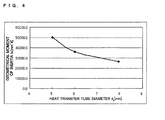
- FIG. 4 is a correlation diagram illustrating the relationship between the diameter of a heat transfer tube and the moment of inertia of the cross-sectional area.
- the figures are schematically drawn and the present invention is not limited to any illustrated example.
- the heat exchanger for a vehicle air-conditioner (not illustrated; to be referred to as the "heat exchanger” hereinafter) includes a plurality of fins 1 arranged parallel to one another and a plurality of heat transfer tubes (not illustrated) extending parallel to one another through the fins 1.
- the heat transfer tubes are arranged on the surface of each fin 1 in a staggered pattern.
- the fins 1 are pieces cut from a band material 2 having a given width.
- the band material 2 has through-holes 3 which are formed in a staggered pattern and through which the heat transfer tubes (not illustrated) are to extend.
- Each fin 1 includes cylindrical fin collars 4 each defining the inner surface of a corresponding through-hole 3 and each extending from the edge of the corresponding through-hole 3 to one side of the fin 1.
- Each fin collar 4 includes a fin collar flange 5 projecting outwards from the tip of the fin collar 4.
- the fin collar 4 is used to hold the posture of the heat transfer tube and guarantee heat transfer to and from the heat transfer tube.
- the fin collar 4 has a diameter equal to the inside diameter of the through-hole, or the outside diameter of the heat transfer tube.
- a corrugated cutter 9 cuts the band material 2 into pieces, each serving as the fin 1, so as not to interfere with the fin collar flanges 5 (a cut line 8 along which the band material 2 is cut so as to define an edge is indicated by an alternate long and short dashed line in FIG. 1 ).
- the clearance ⁇ to be appropriately set is determined by the process capacity of a device that drives the cutter 9.
- FIGs. 3A and 3B are diagrams for explaining a conventional fin 11 for comparison and illustrate the row pitch Dp for cutting with a linear cutter 19.
- the fin 11 is a piece cut from a band material 12 having a given width.
- the band material 12 has through-holes 3 formed in a staggered pattern (see FIG. 1 ).
- the band material 12 is cut at a linear cut line 18 into the fins 11.
- the row pitch Dp is expressed as "Dp > C + 2D + 4W".
- the row pitch Dp in the conventional fin 11 obtained by cutting at the linear cut line 18 defined by the linear cutter 19 is expressed as "Dp > C + 2D + 4W”. Accordingly, the row pitch Dp in the fin 1 in the present invention is less than that in the conventional fin 11.
- the heat exchanger including the fins 1 can be downsized.
- the cutter 9 may have any meandering shape, for example, a saw-toothed (angular) shape or a rack shape (in the form of successive trapezoids) so as not to interfere with the fin collar flanges 5.
- a U-bend (U-tube) communicating between the ends of the heat transfer tubes arranged in the longitudinal direction (vertical direction) can be allowed to have the same shape as that of a U-bend (U-tube) communicating between the ends of the heat transfer tubes arranged in the widthwise direction (oblique lateral direction).
- Table 1 and FIG. 4 illustrate examples of the moment of inertia of the cross-sectional area of the heat exchanger calculated in consideration of pressure loss using Equation (1) provided that air passages through the heat exchanger have the same transverse area.
- Table 1 Diameter of Heat Transfer Tube d 2 [mm] 5 6 7.94 Column Pitch Lp [mm] 11.0 13.0 17.7 Number of Columns 5 4 3 Length of Column L [mm] 55.0 52.0 53.0 Row Pitch Dp [mm] 12.7 15.0 20.4 Number of Rows 13 11 8 Length of Row D [mm] 165.1 165.0 163.2 Moment of Inertia of Cross-sectional Area Ix [mm ⁇ 4] 50299.1 36210.9 26362.6 Transverse Area of Air Passage of Heat Exchanger A [mm ⁇ 2] 100.1 99.0 99.7
- FIGs. 5 and 6 are diagrams for explaining a vehicle air-conditioner according to Embodiment 2 of the present invention.
- FIGs. 5 and 6 are a plan view and a front view, respectively, of the vehicle air-conditioner.
- the figures are schematically drawn and the present invention is not limited to any illustrated example.
- a vehicle air-conditioner 40 includes an outdoor unit 20 that includes outdoor heat exchangers 21, outdoor fans 22, compressors 23, and gas-liquid separators 24, and an indoor unit 30 that includes indoor heat exchangers 31 and indoor fans 32.
- the vehicle air-conditioner 40 is installed on a vehicle (not illustrated) by mounting legs 41.
- the outdoor heat exchangers 21 are accommodated in a housing 25. Outdoor air sucked by the outdoor fans 22 is subjected to heat exchange by the outdoor heat exchangers. The resultant outdoor air subjected to heat exchange is discharged to the outside of the outdoor unit 20.
- the indoor fans 32 are driven to suck the indoor air and the outdoor air through return ports 33, the air is subjected to heat exchange by the indoor heat exchangers 31, and the resultant air subjected to heat exchange is discharged into a compartment.
- These components are connected by refrigerant pipes (not illustrated) to circulate a refrigerant through the components, thus forming a refrigeration cycle.
- Each of the outdoor heat exchangers 21 and the indoor heat exchangers 31 is the heat exchanger according to the present invention (see Embodiment 1). Specifically, the use of the fins 1 downsizes the outdoor heat exchangers 21 and the indoor heat exchangers 31. Accordingly, the vehicle air-conditioner 40 is small.
Landscapes
- Engineering & Computer Science (AREA)
- Physics & Mathematics (AREA)
- Mechanical Engineering (AREA)
- Thermal Sciences (AREA)
- General Engineering & Computer Science (AREA)
- Geometry (AREA)
- Air-Conditioning For Vehicles (AREA)
- Heat-Exchange Devices With Radiators And Conduit Assemblies (AREA)
Abstract
A heat exchanger for a vehicle air-conditioner includes a plurality of fins (1) arranged parallel to one another and a plurality of heat transfer tubes extending parallel to one another through the fins (1). The heat transfer tubes are arranged on the surface of each fin (1) in a staggered pattern. The fins (1) are pieces cut by a corrugated cutter (9) from a band material (2) having through-holes (3) through which the heat transfer tubes are to extend. A row pitch Dp of the heat transfer tubes is expressed as ºDp = C + D + 2 ¢ W + 2 ¢ ´ for 0 < ´ < D + Wº where C is the thickness of the cutter (9), D is the outside diameter of the heat transfer tube, W is the width of a fin collar flange (5) projecting outwards from the tip of a fin collar (4) extending from the edge of each of the through-holes (3) to one side of each of the fins (1), and ´ is the clearance between the cutter (9) and the fin collar flange (5).
Description
- The present invention relates to a heat exchanger for a vehicle air-conditioner and a vehicle air-conditioner.
- Conventional vehicle air-conditioners are of various mounted types, such as a roof type, a floor type, and a split type. A vehicle air-conditioner includes an outdoor unit that includes an outdoor heat exchanger, an outdoor fan, and a compressor, and an indoor unit that includes an indoor heat exchanger and an indoor fan.
- In the outdoor unit, the outdoor heat exchanger is cooled using outdoor air sucked by the outdoor fan and the outdoor air subjected to heat exchange is discharged to the outside of the outdoor unit. In the indoor unit, the indoor fan is driven, the air inside a vehicle (indoor air) and the air outside the vehicle (outdoor air) are subjected to heat exchange by the indoor heat exchanger, and the resultant air subjected to heat exchange is discharged into a compartment. These components are sequentially connected by pipes to circulate a refrigerant through the components, thus forming a refrigeration cycle.
- The indoor heat exchanger and the outdoor heat exchanger (each or one of which will be referred to as the "heat exchanger" hereinafter) of the vehicle air-conditioner have a core length (corresponding to the length of a heat transfer tube) larger than those of a room air-conditioner and a packaged air-conditioner in view of restrictions on the shapes and capacities of the indoor unit and the outdoor unit (each or one of which will be referred to as the "unit" hereinafter). Accordingly, each heat exchanger tends to bend under its own weight. This makes it necessary to increase the rigidity of the heat exchanger.
- The pitch (row pitch) of heat transfer tubes in the longitudinal direction and the pitch (column pitch) of heat transfer tubes in the lateral direction of columns are reduced to increase the number of heat transfer tubes, so that the rigidity of the heat exchanger can be increased.
- When the number of heat transfer tubes is increased by reducing the row pitch and the column pitch, the area of passage of air through the heat exchanger is reduced. Unfortunately, this results in an increase in pressure loss of the heat exchanger, thus reducing the capacity of the air-conditioner.
- A heat exchanger has been disclosed in which a "row pitch", a "column pitch", a "fin pitch", and the like are defined with reference to the outside diameter of a heat transfer tube, which has a large amount of heat exchanged, and is excellent in heat transfer characteristic (see, for example, Patent Literature 1).
- Patent Literature 1: Japanese Unexamined Patent Application Publication
JP-A-2000-274 982 - Although the heat exchanger disclosed in
Patent Literature 1 has a large amount of heat exchanged and is excellent in heat transfer characteristic, it requires a given size because fins are formed by rectangular plates. Specifically, each fin is formed into a rectangular shape by cutting a band material having through-holes, which are formed in advance and through which the heat transfer tubes are to extend, with a linear cutter. - The fin includes cylindrical fin collars each extending from the edge of the through-hole to one side of the fin and each fin collar includes a fin collar flange projecting outwards from the tip of the fin collar. For cutting into fins having linear edges, therefore, it is necessary to set both a given distance (the sum of the thickness of the cutter and a given clearance) across which the cutter passes and a given distance (given row pitch) between adjacent heat transfer tubes so that the cutter avoids the fin collar flanges.
- In other words, the row pitch (Dp) of the heat transfer tubes has to satisfy "Dp > C + 2D + 4W (which will be described in detail later)" where D is the outside diameter of the heat transfer tube and W is the width of the fin collar flange.
- To downsize the heat exchanger, therefore, a further reduction in row pitch has been required.
- The present invention has been made to meet the above-described requirement and has as its object to provide a downsized heat exchanger for a vehicle air-conditioner and a vehicle air-conditioner including the heat exchanger.
- The present invention provides a heat exchanger for a vehicle air-conditioner, the heat exchanger including a plurality of fins arranged parallel to one another and a plurality of heat transfer tubes extending parallel to one another through the fins, the heat transfer tubes being arranged on the surface of each fin in a staggered pattern. The fins are pieces cut by a cutter from a band material having through-holes through which the heat transfer tubes are to extend. A row pitch Dp of the heat transfer tubes is expressed as

- According to the present invention, since the row pitch Dp in a heat exchanger for a vehicle air-conditioner is reduced to "C + 2D + 2W + 28", the heat exchanger can be downsized while an increase in height of the heat exchanger is suppressed.
-
- FIG. 1
- is a front view illustrating a fin of a heat exchanger for a vehicle air-conditioner according to Embodiment 1 of the present invention.
- FIG. 2
- is a side view illustrating the fin of the heat exchanger according to
Embodiment 1 of the present invention. - FIG. 3A
- is a front view illustrating a conventional fin for comparison.
- FIG. 3B
- is a side view illustrating the conventional fin for comparison.
- FIG. 4
- is a correlation diagram illustrating the relationship between the diameter of a heat transfer tube and the moment of inertia of the cross-sectional area.
- FIG. 5
- is a plan view for explaining a vehicle air-conditioner according to
Embodiment 2 of the present invention. - FIG. 6
- is a front view for explaining the vehicle air-conditioner according to
Embodiment 2 of the present invention. -
FIGs. 1 to 4 are diagrams for explaining a heat exchanger for a vehicle air-conditioner according toEmbodiment 1 of the present invention.FIG. 1 is a front view illustrating a fin,FIG. 2 is a side view illustrating the fin,FIG. 3A is a front view illustrating a conventional fin for comparison,FIG. 3B is a side view illustrating the conventional fin for comparison, andFIG. 4 is a correlation diagram illustrating the relationship between the diameter of a heat transfer tube and the moment of inertia of the cross-sectional area. The figures are schematically drawn and the present invention is not limited to any illustrated example. - As illustrated in
FIGs. 1 and2 , the heat exchanger for a vehicle air-conditioner (not illustrated; to be referred to as the "heat exchanger" hereinafter) includes a plurality offins 1 arranged parallel to one another and a plurality of heat transfer tubes (not illustrated) extending parallel to one another through thefins 1. The heat transfer tubes are arranged on the surface of eachfin 1 in a staggered pattern. - The
fins 1 are pieces cut from aband material 2 having a given width. Theband material 2 has through-holes 3 which are formed in a staggered pattern and through which the heat transfer tubes (not illustrated) are to extend. - Each
fin 1 includescylindrical fin collars 4 each defining the inner surface of a corresponding through-hole 3 and each extending from the edge of the corresponding through-hole 3 to one side of thefin 1. Eachfin collar 4 includes afin collar flange 5 projecting outwards from the tip of thefin collar 4. Thefin collar 4 is used to hold the posture of the heat transfer tube and guarantee heat transfer to and from the heat transfer tube. Thefin collar 4 has a diameter equal to the inside diameter of the through-hole, or the outside diameter of the heat transfer tube. - A
corrugated cutter 9 cuts theband material 2 into pieces, each serving as thefin 1, so as not to interfere with the fin collar flanges 5 (acut line 8 along which theband material 2 is cut so as to define an edge is indicated by an alternate long and short dashed line inFIG. 1 ). - In this case, a "row pitch Dp", serving as the distance between
centers 6 of the through-holes 3 in the longitudinal direction (the vertical direction inFIG. 1 ) of thefin 1 is expressed as "Dp = C + D + 2W + 28" where C is the thickness of thecutter 9, D is the inside diameter of the through-hole 3 (equal to the outside diameter of the heat transfer tube (not illustrated)), W is the width of thefin collar flange 5 projecting outwards from the tip of the fin collar extending from the edge of the through-hole to one side of the fin, and δ is the clearance between thecutter 9 and thefin collar flange 5 and satisfies "0 < δ < D + W". The clearance δ to be appropriately set is determined by the process capacity of a device that drives thecutter 9. -
FIGs. 3A and 3B are diagrams for explaining aconventional fin 11 for comparison and illustrate the row pitch Dp for cutting with alinear cutter 19. InFIGs. 3A and 3B , thefin 11 is a piece cut from aband material 12 having a given width. Theband material 12 has through-holes 3 formed in a staggered pattern (seeFIG. 1 ). - In this case, the
band material 12 is cut at alinear cut line 18 into thefins 11. The row pitch Dp is expressed as "Dp > C + 2D + 4W". - Specifically, the
fin 1 in the present invention is obtained by cutting at thewavy cut line 8 defined by thecorrugated cutter 9 and the row pitch Dp is expressed as "Dp = C + D + 2W + 28". On the other hand, the row pitch Dp in theconventional fin 11 obtained by cutting at thelinear cut line 18 defined by thelinear cutter 19 is expressed as "Dp > C + 2D + 4W". Accordingly, the row pitch Dp in thefin 1 in the present invention is less than that in theconventional fin 11. - Consequently, the heat exchanger including the
fins 1 can be downsized. - Although the aforementioned configuration uses the
corrugated cutter 9, the present invention is not limited to this example. Thecutter 9 may have any meandering shape, for example, a saw-toothed (angular) shape or a rack shape (in the form of successive trapezoids) so as not to interfere with thefin collar flanges 5. - Furthermore, when the distance between the
centers 6 of the through-holes 3 is set equal to the row pitch Dp in consideration of the relationship of adjacent through-holes 3 aligned in the widthwise direction (or oblique lateral directions inFIG. 1 ) of the fin 1 (i.e., thecenters 6 of three adjacent through-holes 3 define the vertices of a regular triangle), a U-bend (U-tube) communicating between the ends of the heat transfer tubes arranged in the longitudinal direction (vertical direction) can be allowed to have the same shape as that of a U-bend (U-tube) communicating between the ends of the heat transfer tubes arranged in the widthwise direction (oblique lateral direction). - As described above, if the row pitch Dp is reduced without changing the diameter of the heat transfer tube (the inside diameter D of the through-hole), the transverse area of passage of air through the heat exchanger would be reduced to increase pressure loss, thus leading to a reduction in capacity of the vehicle air-conditioner.
Table 1 andFIG. 4 illustrate examples of the moment of inertia of the cross-sectional area of the heat exchanger calculated in consideration of pressure loss using Equation (1) provided that air passages through the heat exchanger have the same transverse area. - Reducing the diameter of each heat transfer tube and the row pitch can increase the rigidity of the heat exchanger and suppress an increase in pressure loss. Values in Table 1 are merely illustrative and the present invention is not limited to any specific value.
Table 1 Diameter of Heat Transfer Tube d2 [mm] 5 6 7.94 Column Pitch Lp [mm] 11.0 13.0 17.7 Number of Columns 5 4 3 Length of Column L [mm] 55.0 52.0 53.0 Row Pitch Dp [mm] 12.7 15.0 20.4 Number of Rows 13 11 8 Length of Row D [mm] 165.1 165.0 163.2 Moment of Inertia of Cross-sectional Area Ix [mm^4] 50299.1 36210.9 26362.6 Transverse Area of Air Passage of Heat Exchanger A [mm^2] 100.1 99.0 99.7 - [Math. 1]

- Ix
- is the moment of inertia of the cross-sectional area,
- d2
- is the outside diameter of the heat transfer tube,
- d1
- is the inside diameter of the heat transfer tube, and
- Yi
- is the distance from the middle of the bend of the heat exchanger to the heat transfer tube.
-
FIGs. 5 and 6 are diagrams for explaining a vehicle air-conditioner according toEmbodiment 2 of the present invention.FIGs. 5 and 6 are a plan view and a front view, respectively, of the vehicle air-conditioner. The figures are schematically drawn and the present invention is not limited to any illustrated example. - In
FIGs. 5 and 6 , a vehicle air-conditioner 40 includes anoutdoor unit 20 that includesoutdoor heat exchangers 21,outdoor fans 22,compressors 23, and gas-liquid separators 24, and anindoor unit 30 that includesindoor heat exchangers 31 andindoor fans 32. The vehicle air-conditioner 40 is installed on a vehicle (not illustrated) by mountinglegs 41. - In the
outdoor unit 20, theoutdoor heat exchangers 21 are accommodated in ahousing 25. Outdoor air sucked by theoutdoor fans 22 is subjected to heat exchange by the outdoor heat exchangers. The resultant outdoor air subjected to heat exchange is discharged to the outside of theoutdoor unit 20. In theindoor unit 30, theindoor fans 32 are driven to suck the indoor air and the outdoor air throughreturn ports 33, the air is subjected to heat exchange by theindoor heat exchangers 31, and the resultant air subjected to heat exchange is discharged into a compartment. These components are connected by refrigerant pipes (not illustrated) to circulate a refrigerant through the components, thus forming a refrigeration cycle. - Each of the
outdoor heat exchangers 21 and theindoor heat exchangers 31 is the heat exchanger according to the present invention (see Embodiment 1). Specifically, the use of thefins 1 downsizes theoutdoor heat exchangers 21 and theindoor heat exchangers 31. Accordingly, the vehicle air-conditioner 40 is small. -
- 1
- fin
- 2
- band material
- 3
- through-hole
- 4
- fin collar
- 5
- fin collar flange
- 6
- center
- 8
- cut line
- 9
- cutter
- 11
- fin
- 12
- band material
- 18
- cut line
- 19
- cutter
- 20
- outdoor unit
- 21
- outdoor heat exchanger
- 22
- outdoor fan
- 23
- compressor
- 24
- gas-liquid separator
- 25
- housing
- 30
- indoor unit
- 31
- indoor heat exchanger
- 32
- indoor fan
- 33
- return port
- 40
- vehicle air-conditioner
- 41
- mounting leg
- δ
- clearance
- C
- cutter thickness
- D
- through-hole inside diameter
- Dp
- row pitch
- W
- fin-collar-flange width
Claims (4)
- A heat exchanger for a vehicle air-conditioner, the heat exchanger comprising:- a plurality of fins arranged parallel to one another; and- a plurality of heat transfer tubes extending parallel to one another through the fins, the heat transfer tubes being arranged on a surface of each fin in a staggered pattern,- wherein the fins are pieces cut by a cutter from a band material having through-holes through which the heat transfer tubes are to extend, and- wherein a row pitch Dp of the heat transfer tubes is expressed as

for 0 < δ < D + W- where C is a thickness of the cutter, D is an outside diameter of the heat transfer tube, W is a width of a fin collar flange projecting outwards from a tip of a fin collar extending from an edge of each of the through-holes to one side of each of the fins, and δ is a clearance between the cutter and the fin collar flange. - The heat exchanger of claim 1,
wherein each of the fins has a wavy cut edge or an angular cut edge. - The heat exchanger of claim 1 or 2,
wherein each heat transfer tube has an outside diameter of 5 to 8 mm. - A vehicle air-conditioner comprising:- an outdoor unit that includes an outdoor heat exchanger, a compressor, a gas-liquid separator, and an outdoor fan, the outdoor heat exchanger, the compressor, the gas-liquid separator, and the outdoor fan providing part of a refrigeration cycle; and- an indoor unit that includes an indoor heat exchanger and an indoor fan, the indoor heat exchanger and the indoor fan providing another part of the refrigeration cycle,- wherein each of the outdoor heat exchanger and the indoor heat exchanger includes the heat exchanger of any one of claims 1 to 3.
Applications Claiming Priority (2)
| Application Number | Priority Date | Filing Date | Title |
|---|---|---|---|
| JP2012007607 | 2012-01-18 | ||
| PCT/JP2013/050061 WO2013108648A1 (en) | 2012-01-18 | 2013-01-08 | Heat exchanger for vehicle air conditioning device, and vehicle air conditioning device |
Publications (1)
| Publication Number | Publication Date |
|---|---|
| EP2806243A1 true EP2806243A1 (en) | 2014-11-26 |
Family
ID=48799076
Family Applications (1)
| Application Number | Title | Priority Date | Filing Date |
|---|---|---|---|
| EP13738551.4A Withdrawn EP2806243A1 (en) | 2012-01-18 | 2013-01-08 | Heat exchanger for vehicle air conditioning device, and vehicle air conditioning device |
Country Status (5)
| Country | Link |
|---|---|
| US (1) | US20140367076A1 (en) |
| EP (1) | EP2806243A1 (en) |
| JP (1) | JPWO2013108648A1 (en) |
| CN (1) | CN104053966A (en) |
| WO (1) | WO2013108648A1 (en) |
Families Citing this family (2)
| Publication number | Priority date | Publication date | Assignee | Title |
|---|---|---|---|---|
| CN103521599B (en) * | 2013-10-18 | 2015-08-19 | 无锡微研有限公司 | A kind of mould structure avoiding air-conditioner fin list double jump rip cutting burr to produce |
| US11774187B2 (en) * | 2018-04-19 | 2023-10-03 | Kyungdong Navien Co., Ltd. | Heat transfer fin of fin-tube type heat exchanger |
Family Cites Families (16)
| Publication number | Priority date | Publication date | Assignee | Title |
|---|---|---|---|---|
| JPS5112063U (en) * | 1974-07-15 | 1976-01-29 | ||
| JPS61153393A (en) * | 1984-12-25 | 1986-07-12 | Nippon Radiator Co Ltd | Plate fin type radiator core for automobile |
| JPS6374983U (en) * | 1986-11-06 | 1988-05-18 | ||
| JPH04214193A (en) * | 1990-06-22 | 1992-08-05 | Asahi Chem Ind Co Ltd | Pin-fin type heat exchanger and manufacture thereof |
| JP2927011B2 (en) * | 1991-02-09 | 1999-07-28 | トヨタ自動車株式会社 | Vehicle heat exchanger |
| JPH07205646A (en) * | 1994-01-26 | 1995-08-08 | Mitsubishi Heavy Ind Ltd | Heat pump type air conditioner for vehicle |
| JP2000193389A (en) * | 1998-12-28 | 2000-07-14 | Hitachi Ltd | Outdoor unit of air conditioner |
| JP3720208B2 (en) | 1999-03-23 | 2005-11-24 | 三菱電機株式会社 | Heat exchanger and air-conditioning refrigeration apparatus using the same |
| JP2003048536A (en) * | 2001-08-03 | 2003-02-18 | Hitachi Ltd | Railway vehicle air conditioner |
| JP3777367B2 (en) * | 2003-06-23 | 2006-05-24 | 日高精機株式会社 | Manufacturing method of fin for heat exchanger and mold apparatus thereof |
| JP4651366B2 (en) * | 2004-12-02 | 2011-03-16 | 住友軽金属工業株式会社 | Internal grooved heat transfer tube for high-pressure refrigerant |
| JP2007178096A (en) * | 2005-12-28 | 2007-07-12 | Hitachi Ltd | Heat exchanger with cleaning device and method of operating the same |
| JP2007327653A (en) * | 2006-06-06 | 2007-12-20 | Hitachi Ltd | Air conditioner for railway vehicles |
| US7972922B2 (en) * | 2008-11-21 | 2011-07-05 | Freescale Semiconductor, Inc. | Method of forming a semiconductor layer |
| WO2010095419A1 (en) * | 2009-02-23 | 2010-08-26 | 三菱重工業株式会社 | Gas cooler |
| JP2011257084A (en) * | 2010-06-10 | 2011-12-22 | Sumitomo Light Metal Ind Ltd | All-aluminum heat exchanger |
-
2013
- 2013-01-08 EP EP13738551.4A patent/EP2806243A1/en not_active Withdrawn
- 2013-01-08 JP JP2013553713A patent/JPWO2013108648A1/en active Pending
- 2013-01-08 WO PCT/JP2013/050061 patent/WO2013108648A1/en not_active Ceased
- 2013-01-08 CN CN201380005626.5A patent/CN104053966A/en active Pending
- 2013-01-08 US US14/370,095 patent/US20140367076A1/en not_active Abandoned
Non-Patent Citations (1)
| Title |
|---|
| See references of WO2013108648A1 * |
Also Published As
| Publication number | Publication date |
|---|---|
| WO2013108648A1 (en) | 2013-07-25 |
| CN104053966A (en) | 2014-09-17 |
| JPWO2013108648A1 (en) | 2015-05-11 |
| US20140367076A1 (en) | 2014-12-18 |
Similar Documents
| Publication | Publication Date | Title |
|---|---|---|
| US10254022B2 (en) | Condenser with a refrigerant supply for an air-conditioning circuit | |
| US8534349B2 (en) | Heat exchanger tube and heat exchanger | |
| US8978409B2 (en) | Hybrid heat exchanger | |
| EP3370027B1 (en) | Extruded aluminum flat multi-hole tube and heat exchanger | |
| CN101793477A (en) | Heat exchange fin for a heat exchange system | |
| CN107076526B (en) | Heat exchanger | |
| CN103025451B (en) | Bending work method for heat exchanger and heat exchanger | |
| CN102699155B (en) | Bending processing method of heat exchanger | |
| US20240361081A1 (en) | Heat Transport Device And Method For Manufacturing Same | |
| EP3173725A1 (en) | Heat exchanger and air-conditioning and refrigerating apparatus with heat exchanger | |
| JP2005090806A (en) | Heat exchanger | |
| EP2806243A1 (en) | Heat exchanger for vehicle air conditioning device, and vehicle air conditioning device | |
| US20240247885A1 (en) | Heat Transport Device And Method For Manufacturing Same | |
| JP4760542B2 (en) | Heat exchanger | |
| CN103375852A (en) | Outdoor unit heat exchanger, air conditioner and dehumidifier | |
| CN107076525A (en) | Heat exchanger | |
| US20150153111A1 (en) | Indoor coil | |
| CN209639147U (en) | The outdoor unit of air-conditioning device | |
| KR20140093328A (en) | Heat exchanger and manufacturing method thereof | |
| EP3196583A1 (en) | Compact side plate for automotive condenser | |
| JP5959209B2 (en) | Internal heat exchanger | |
| WO2025128631A1 (en) | Heat exchanger | |
| CN113883713A (en) | Condenser components and heat exchange equipment | |
| JP2012241973A (en) | Corrugated fin laminated heat exchanger with bridge, and method of manufacturing the same |
Legal Events
| Date | Code | Title | Description |
|---|---|---|---|
| PUAI | Public reference made under article 153(3) epc to a published international application that has entered the european phase |
Free format text: ORIGINAL CODE: 0009012 |
|
| 17P | Request for examination filed |
Effective date: 20140704 |
|
| AK | Designated contracting states |
Kind code of ref document: A1 Designated state(s): AL AT BE BG CH CY CZ DE DK EE ES FI FR GB GR HR HU IE IS IT LI LT LU LV MC MK MT NL NO PL PT RO RS SE SI SK SM TR |
|
| DAX | Request for extension of the european patent (deleted) | ||
| STAA | Information on the status of an ep patent application or granted ep patent |
Free format text: STATUS: THE APPLICATION HAS BEEN WITHDRAWN |
|
| 18W | Application withdrawn |
Effective date: 20150521 |