EP2805934A1 - Cineole - Google Patents
Cineole Download PDFInfo
- Publication number
- EP2805934A1 EP2805934A1 EP14173766.8A EP14173766A EP2805934A1 EP 2805934 A1 EP2805934 A1 EP 2805934A1 EP 14173766 A EP14173766 A EP 14173766A EP 2805934 A1 EP2805934 A1 EP 2805934A1
- Authority
- EP
- European Patent Office
- Prior art keywords
- cineole
- transition metal
- gamma
- process according
- catalyst
- Prior art date
- Legal status (The legal status is an assumption and is not a legal conclusion. Google has not performed a legal analysis and makes no representation as to the accuracy of the status listed.)
- Withdrawn
Links
- WEEGYLXZBRQIMU-UHFFFAOYSA-N Eucalyptol Chemical compound C1CC2CCC1(C)OC2(C)C WEEGYLXZBRQIMU-UHFFFAOYSA-N 0.000 title claims abstract description 110
- 229960005233 cineole Drugs 0.000 title description 58
- RFFOTVCVTJUTAD-UHFFFAOYSA-N cineole Natural products C1CC2(C)CCC1(C(C)C)O2 RFFOTVCVTJUTAD-UHFFFAOYSA-N 0.000 title description 57
- 239000003054 catalyst Substances 0.000 claims abstract description 81
- 238000000034 method Methods 0.000 claims abstract description 74
- 229910052723 transition metal Inorganic materials 0.000 claims abstract description 66
- 230000008569 process Effects 0.000 claims abstract description 63
- 150000003624 transition metals Chemical class 0.000 claims abstract description 58
- PNEYBMLMFCGWSK-UHFFFAOYSA-N Alumina Chemical compound [O-2].[O-2].[O-2].[Al+3].[Al+3] PNEYBMLMFCGWSK-UHFFFAOYSA-N 0.000 claims abstract description 49
- 150000001491 aromatic compounds Chemical class 0.000 claims abstract description 27
- 150000001923 cyclic compounds Chemical class 0.000 claims abstract description 27
- HFPZCAJZSCWRBC-UHFFFAOYSA-N p-cymene Chemical compound CC(C)C1=CC=C(C)C=C1 HFPZCAJZSCWRBC-UHFFFAOYSA-N 0.000 claims description 76
- XMGQYMWWDOXHJM-UHFFFAOYSA-N limonene Chemical compound CC(=C)C1CCC(C)=CC1 XMGQYMWWDOXHJM-UHFFFAOYSA-N 0.000 claims description 34
- 238000000197 pyrolysis Methods 0.000 claims description 24
- 239000012159 carrier gas Substances 0.000 claims description 23
- QVGXLLKOCUKJST-UHFFFAOYSA-N atomic oxygen Chemical compound [O] QVGXLLKOCUKJST-UHFFFAOYSA-N 0.000 claims description 17
- 239000001301 oxygen Substances 0.000 claims description 17
- 229910052760 oxygen Inorganic materials 0.000 claims description 17
- BASFCYQUMIYNBI-UHFFFAOYSA-N platinum Chemical compound [Pt] BASFCYQUMIYNBI-UHFFFAOYSA-N 0.000 claims description 15
- PXHVJJICTQNCMI-UHFFFAOYSA-N Nickel Chemical compound [Ni] PXHVJJICTQNCMI-UHFFFAOYSA-N 0.000 claims description 13
- 239000007864 aqueous solution Substances 0.000 claims description 13
- 229930003658 monoterpene Natural products 0.000 claims description 11
- IJGRMHOSHXDMSA-UHFFFAOYSA-N Atomic nitrogen Chemical compound N#N IJGRMHOSHXDMSA-UHFFFAOYSA-N 0.000 claims description 10
- 238000001354 calcination Methods 0.000 claims description 10
- -1 transition metal salt Chemical class 0.000 claims description 10
- KJTLSVCANCCWHF-UHFFFAOYSA-N Ruthenium Chemical compound [Ru] KJTLSVCANCCWHF-UHFFFAOYSA-N 0.000 claims description 9
- 238000004519 manufacturing process Methods 0.000 claims description 9
- 229910052707 ruthenium Inorganic materials 0.000 claims description 9
- XKRFYHLGVUSROY-UHFFFAOYSA-N Argon Chemical compound [Ar] XKRFYHLGVUSROY-UHFFFAOYSA-N 0.000 claims description 8
- 239000010948 rhodium Substances 0.000 claims description 8
- 229910052741 iridium Inorganic materials 0.000 claims description 7
- GKOZUEZYRPOHIO-UHFFFAOYSA-N iridium atom Chemical compound [Ir] GKOZUEZYRPOHIO-UHFFFAOYSA-N 0.000 claims description 7
- 229910052697 platinum Inorganic materials 0.000 claims description 7
- 229910052702 rhenium Inorganic materials 0.000 claims description 7
- WUAPFZMCVAUBPE-UHFFFAOYSA-N rhenium atom Chemical compound [Re] WUAPFZMCVAUBPE-UHFFFAOYSA-N 0.000 claims description 7
- 229910052703 rhodium Inorganic materials 0.000 claims description 7
- MHOVAHRLVXNVSD-UHFFFAOYSA-N rhodium atom Chemical compound [Rh] MHOVAHRLVXNVSD-UHFFFAOYSA-N 0.000 claims description 7
- 239000007788 liquid Substances 0.000 claims description 6
- 229910052759 nickel Inorganic materials 0.000 claims description 6
- 229910052720 vanadium Inorganic materials 0.000 claims description 6
- WPBNNNQJVZRUHP-UHFFFAOYSA-L manganese(2+);methyl n-[[2-(methoxycarbonylcarbamothioylamino)phenyl]carbamothioyl]carbamate;n-[2-(sulfidocarbothioylamino)ethyl]carbamodithioate Chemical compound [Mn+2].[S-]C(=S)NCCNC([S-])=S.COC(=O)NC(=S)NC1=CC=CC=C1NC(=S)NC(=O)OC WPBNNNQJVZRUHP-UHFFFAOYSA-L 0.000 claims description 5
- 229910052757 nitrogen Inorganic materials 0.000 claims description 5
- 239000000243 solution Substances 0.000 claims description 5
- 229910052786 argon Inorganic materials 0.000 claims description 4
- 238000001704 evaporation Methods 0.000 claims description 4
- LEONUFNNVUYDNQ-UHFFFAOYSA-N vanadium atom Chemical compound [V] LEONUFNNVUYDNQ-UHFFFAOYSA-N 0.000 claims 2
- 229910003158 γ-Al2O3 Inorganic materials 0.000 description 112
- 239000008188 pellet Substances 0.000 description 63
- 239000007789 gas Substances 0.000 description 29
- 239000000047 product Substances 0.000 description 23
- KDLHZDBZIXYQEI-UHFFFAOYSA-N Palladium Chemical compound [Pd] KDLHZDBZIXYQEI-UHFFFAOYSA-N 0.000 description 21
- 238000006243 chemical reaction Methods 0.000 description 21
- 150000001875 compounds Chemical class 0.000 description 17
- CURLTUGMZLYLDI-UHFFFAOYSA-N Carbon dioxide Chemical compound O=C=O CURLTUGMZLYLDI-UHFFFAOYSA-N 0.000 description 16
- 239000012071 phase Substances 0.000 description 16
- 230000002209 hydrophobic effect Effects 0.000 description 14
- 239000000203 mixture Substances 0.000 description 14
- 230000003197 catalytic effect Effects 0.000 description 12
- 229910052739 hydrogen Inorganic materials 0.000 description 12
- 239000001257 hydrogen Substances 0.000 description 12
- XEEYBQQBJWHFJM-UHFFFAOYSA-N Iron Chemical compound [Fe] XEEYBQQBJWHFJM-UHFFFAOYSA-N 0.000 description 11
- 229910052763 palladium Inorganic materials 0.000 description 11
- 238000002474 experimental method Methods 0.000 description 10
- UFHFLCQGNIYNRP-UHFFFAOYSA-N Hydrogen Chemical compound [H][H] UFHFLCQGNIYNRP-UHFFFAOYSA-N 0.000 description 9
- YXFVVABEGXRONW-UHFFFAOYSA-N Toluene Chemical compound CC1=CC=CC=C1 YXFVVABEGXRONW-UHFFFAOYSA-N 0.000 description 9
- 238000004458 analytical method Methods 0.000 description 9
- UGFAIRIUMAVXCW-UHFFFAOYSA-N Carbon monoxide Chemical compound [O+]#[C-] UGFAIRIUMAVXCW-UHFFFAOYSA-N 0.000 description 8
- 239000011324 bead Substances 0.000 description 8
- 229910002092 carbon dioxide Inorganic materials 0.000 description 8
- 239000001569 carbon dioxide Substances 0.000 description 8
- 229910002091 carbon monoxide Inorganic materials 0.000 description 8
- 125000004122 cyclic group Chemical group 0.000 description 8
- 239000011521 glass Substances 0.000 description 8
- 229910052751 metal Inorganic materials 0.000 description 8
- 239000002184 metal Substances 0.000 description 8
- 125000003118 aryl group Chemical group 0.000 description 7
- 239000012263 liquid product Substances 0.000 description 7
- 150000002894 organic compounds Chemical class 0.000 description 7
- XLYOFNOQVPJJNP-UHFFFAOYSA-N water Substances O XLYOFNOQVPJJNP-UHFFFAOYSA-N 0.000 description 7
- 239000011651 chromium Substances 0.000 description 6
- 239000000463 material Substances 0.000 description 6
- VYZAMTAEIAYCRO-UHFFFAOYSA-N Chromium Chemical compound [Cr] VYZAMTAEIAYCRO-UHFFFAOYSA-N 0.000 description 5
- ZOKXTWBITQBERF-UHFFFAOYSA-N Molybdenum Chemical compound [Mo] ZOKXTWBITQBERF-UHFFFAOYSA-N 0.000 description 5
- 229910052804 chromium Inorganic materials 0.000 description 5
- 229910017052 cobalt Inorganic materials 0.000 description 5
- 239000010941 cobalt Substances 0.000 description 5
- GUTLYIVDDKVIGB-UHFFFAOYSA-N cobalt atom Chemical compound [Co] GUTLYIVDDKVIGB-UHFFFAOYSA-N 0.000 description 5
- 238000004868 gas analysis Methods 0.000 description 5
- 229910052742 iron Inorganic materials 0.000 description 5
- 229910052750 molybdenum Inorganic materials 0.000 description 5
- 239000011733 molybdenum Substances 0.000 description 5
- 229910052762 osmium Inorganic materials 0.000 description 5
- SYQBFIAQOQZEGI-UHFFFAOYSA-N osmium atom Chemical compound [Os] SYQBFIAQOQZEGI-UHFFFAOYSA-N 0.000 description 5
- 229910001220 stainless steel Inorganic materials 0.000 description 5
- 239000010935 stainless steel Substances 0.000 description 5
- 239000010931 gold Substances 0.000 description 4
- 150000002431 hydrogen Chemical class 0.000 description 4
- 238000005470 impregnation Methods 0.000 description 4
- GPPXJZIENCGNKB-UHFFFAOYSA-N vanadium Chemical compound [V]#[V] GPPXJZIENCGNKB-UHFFFAOYSA-N 0.000 description 4
- WEVYAHXRMPXWCK-UHFFFAOYSA-N Acetonitrile Chemical compound CC#N WEVYAHXRMPXWCK-UHFFFAOYSA-N 0.000 description 3
- BQCADISMDOOEFD-UHFFFAOYSA-N Silver Chemical compound [Ag] BQCADISMDOOEFD-UHFFFAOYSA-N 0.000 description 3
- 230000015572 biosynthetic process Effects 0.000 description 3
- 238000012512 characterization method Methods 0.000 description 3
- 229940044949 eucalyptus oil Drugs 0.000 description 3
- 239000010642 eucalyptus oil Substances 0.000 description 3
- PCHJSUWPFVWCPO-UHFFFAOYSA-N gold Chemical compound [Au] PCHJSUWPFVWCPO-UHFFFAOYSA-N 0.000 description 3
- 229910052737 gold Inorganic materials 0.000 description 3
- 230000000737 periodic effect Effects 0.000 description 3
- 229910052709 silver Inorganic materials 0.000 description 3
- 239000004332 silver Substances 0.000 description 3
- 230000009466 transformation Effects 0.000 description 3
- 238000011144 upstream manufacturing Methods 0.000 description 3
- 235000003261 Artemisia vulgaris Nutrition 0.000 description 2
- 240000006891 Artemisia vulgaris Species 0.000 description 2
- 244000166124 Eucalyptus globulus Species 0.000 description 2
- 238000002441 X-ray diffraction Methods 0.000 description 2
- 239000010779 crude oil Substances 0.000 description 2
- 230000009849 deactivation Effects 0.000 description 2
- 230000018044 dehydration Effects 0.000 description 2
- 238000006297 dehydration reaction Methods 0.000 description 2
- 238000006356 dehydrogenation reaction Methods 0.000 description 2
- 238000010438 heat treatment Methods 0.000 description 2
- 238000011835 investigation Methods 0.000 description 2
- 239000011572 manganese Substances 0.000 description 2
- 238000005259 measurement Methods 0.000 description 2
- 230000007246 mechanism Effects 0.000 description 2
- 229910001960 metal nitrate Inorganic materials 0.000 description 2
- VNWKTOKETHGBQD-UHFFFAOYSA-N methane Chemical compound C VNWKTOKETHGBQD-UHFFFAOYSA-N 0.000 description 2
- 239000003921 oil Substances 0.000 description 2
- IWDCLRJOBJJRNH-UHFFFAOYSA-N p-cresol Chemical compound CC1=CC=C(O)C=C1 IWDCLRJOBJJRNH-UHFFFAOYSA-N 0.000 description 2
- 230000009467 reduction Effects 0.000 description 2
- 150000003839 salts Chemical class 0.000 description 2
- 238000001644 13C nuclear magnetic resonance spectroscopy Methods 0.000 description 1
- 238000005160 1H NMR spectroscopy Methods 0.000 description 1
- 235000009051 Ambrosia paniculata var. peruviana Nutrition 0.000 description 1
- 235000003097 Artemisia absinthium Nutrition 0.000 description 1
- 235000017731 Artemisia dracunculus ssp. dracunculus Nutrition 0.000 description 1
- 235000009024 Ceanothus sanguineus Nutrition 0.000 description 1
- 229910017488 Cu K Inorganic materials 0.000 description 1
- 229910017541 Cu-K Inorganic materials 0.000 description 1
- MYMOFIZGZYHOMD-UHFFFAOYSA-N Dioxygen Chemical compound O=O MYMOFIZGZYHOMD-UHFFFAOYSA-N 0.000 description 1
- 241000196324 Embryophyta Species 0.000 description 1
- WEEGYLXZBRQIMU-WAAGHKOSSA-N Eucalyptol Chemical compound C1C[C@H]2CC[C@]1(C)OC2(C)C WEEGYLXZBRQIMU-WAAGHKOSSA-N 0.000 description 1
- 208000033962 Fontaine progeroid syndrome Diseases 0.000 description 1
- 240000003553 Leptospermum scoparium Species 0.000 description 1
- 235000015459 Lycium barbarum Nutrition 0.000 description 1
- PWHULOQIROXLJO-UHFFFAOYSA-N Manganese Chemical compound [Mn] PWHULOQIROXLJO-UHFFFAOYSA-N 0.000 description 1
- 229910002651 NO3 Inorganic materials 0.000 description 1
- 235000010676 Ocimum basilicum Nutrition 0.000 description 1
- 240000007926 Ocimum gratissimum Species 0.000 description 1
- 244000178231 Rosmarinus officinalis Species 0.000 description 1
- XSTXAVWGXDQKEL-UHFFFAOYSA-N Trichloroethylene Chemical compound ClC=C(Cl)Cl XSTXAVWGXDQKEL-UHFFFAOYSA-N 0.000 description 1
- 230000002378 acidificating effect Effects 0.000 description 1
- 230000009471 action Effects 0.000 description 1
- 125000002015 acyclic group Chemical group 0.000 description 1
- 230000029936 alkylation Effects 0.000 description 1
- 238000005804 alkylation reaction Methods 0.000 description 1
- 239000008346 aqueous phase Substances 0.000 description 1
- 239000001138 artemisia absinthium Substances 0.000 description 1
- 125000004429 atom Chemical group 0.000 description 1
- 150000001768 cations Chemical class 0.000 description 1
- 238000004587 chromatography analysis Methods 0.000 description 1
- 230000000052 comparative effect Effects 0.000 description 1
- 238000001816 cooling Methods 0.000 description 1
- 229930007927 cymene Natural products 0.000 description 1
- 230000003247 decreasing effect Effects 0.000 description 1
- 239000008367 deionised water Substances 0.000 description 1
- 229910001882 dioxygen Inorganic materials 0.000 description 1
- 239000012153 distilled water Substances 0.000 description 1
- 239000003814 drug Substances 0.000 description 1
- 230000008020 evaporation Effects 0.000 description 1
- 230000007717 exclusion Effects 0.000 description 1
- 239000012847 fine chemical Substances 0.000 description 1
- 239000003205 fragrance Substances 0.000 description 1
- 238000002290 gas chromatography-mass spectrometry Methods 0.000 description 1
- 239000007792 gaseous phase Substances 0.000 description 1
- 239000001307 helium Substances 0.000 description 1
- 229910052734 helium Inorganic materials 0.000 description 1
- SWQJXJOGLNCZEY-UHFFFAOYSA-N helium atom Chemical compound [He] SWQJXJOGLNCZEY-UHFFFAOYSA-N 0.000 description 1
- 239000004009 herbicide Substances 0.000 description 1
- 229930195733 hydrocarbon Natural products 0.000 description 1
- 150000002430 hydrocarbons Chemical class 0.000 description 1
- 230000001939 inductive effect Effects 0.000 description 1
- 239000011261 inert gas Substances 0.000 description 1
- 229940087305 limonene Drugs 0.000 description 1
- 235000001510 limonene Nutrition 0.000 description 1
- 230000007774 longterm Effects 0.000 description 1
- 229910052748 manganese Inorganic materials 0.000 description 1
- AUHZEENZYGFFBQ-UHFFFAOYSA-N mesitylene Substances CC1=CC(C)=CC(C)=C1 AUHZEENZYGFFBQ-UHFFFAOYSA-N 0.000 description 1
- 125000001827 mesitylenyl group Chemical group [H]C1=C(C(*)=C(C([H])=C1C([H])([H])[H])C([H])([H])[H])C([H])([H])[H] 0.000 description 1
- 239000002808 molecular sieve Substances 0.000 description 1
- SYSQUGFVNFXIIT-UHFFFAOYSA-N n-[4-(1,3-benzoxazol-2-yl)phenyl]-4-nitrobenzenesulfonamide Chemical class C1=CC([N+](=O)[O-])=CC=C1S(=O)(=O)NC1=CC=C(C=2OC3=CC=CC=C3N=2)C=C1 SYSQUGFVNFXIIT-UHFFFAOYSA-N 0.000 description 1
- 229930014626 natural product Natural products 0.000 description 1
- 150000002823 nitrates Chemical class 0.000 description 1
- 229910000510 noble metal Inorganic materials 0.000 description 1
- 238000007353 oxidative pyrolysis Methods 0.000 description 1
- 150000002932 p-cymene derivatives Chemical class 0.000 description 1
- JUBNUQXDQDMSKL-UHFFFAOYSA-N palladium(2+);dinitrate;dihydrate Chemical compound O.O.[Pd+2].[O-][N+]([O-])=O.[O-][N+]([O-])=O JUBNUQXDQDMSKL-UHFFFAOYSA-N 0.000 description 1
- 238000002360 preparation method Methods 0.000 description 1
- QQONPFPTGQHPMA-UHFFFAOYSA-N propylene Natural products CC=C QQONPFPTGQHPMA-UHFFFAOYSA-N 0.000 description 1
- 125000004805 propylene group Chemical group [H]C([H])([H])C([H])([*:1])C([H])([H])[*:2] 0.000 description 1
- 238000000746 purification Methods 0.000 description 1
- 230000005855 radiation Effects 0.000 description 1
- 230000008929 regeneration Effects 0.000 description 1
- 238000011069 regeneration method Methods 0.000 description 1
- 238000011160 research Methods 0.000 description 1
- 235000002020 sage Nutrition 0.000 description 1
- 238000005464 sample preparation method Methods 0.000 description 1
- 238000005070 sampling Methods 0.000 description 1
- 239000012047 saturated solution Substances 0.000 description 1
- 238000000926 separation method Methods 0.000 description 1
- URGAHOPLAPQHLN-UHFFFAOYSA-N sodium aluminosilicate Chemical compound [Na+].[Al+3].[O-][Si]([O-])=O.[O-][Si]([O-])=O URGAHOPLAPQHLN-UHFFFAOYSA-N 0.000 description 1
- 239000007787 solid Substances 0.000 description 1
- 239000002904 solvent Substances 0.000 description 1
- 238000001179 sorption measurement Methods 0.000 description 1
- KDYFGRWQOYBRFD-UHFFFAOYSA-N succinic acid Chemical compound OC(=O)CCC(O)=O KDYFGRWQOYBRFD-UHFFFAOYSA-N 0.000 description 1
- 238000005211 surface analysis Methods 0.000 description 1
- 238000003786 synthesis reaction Methods 0.000 description 1
- 238000002411 thermogravimetry Methods 0.000 description 1
- ZSDSQXJSNMTJDA-UHFFFAOYSA-N trifluralin Chemical compound CCCN(CCC)C1=C([N+]([O-])=O)C=C(C(F)(F)F)C=C1[N+]([O-])=O ZSDSQXJSNMTJDA-UHFFFAOYSA-N 0.000 description 1
Classifications
-
- C—CHEMISTRY; METALLURGY
- C07—ORGANIC CHEMISTRY
- C07C—ACYCLIC OR CARBOCYCLIC COMPOUNDS
- C07C1/00—Preparation of hydrocarbons from one or more compounds, none of them being a hydrocarbon
- C07C1/20—Preparation of hydrocarbons from one or more compounds, none of them being a hydrocarbon starting from organic compounds containing only oxygen atoms as heteroatoms
- C07C1/247—Preparation of hydrocarbons from one or more compounds, none of them being a hydrocarbon starting from organic compounds containing only oxygen atoms as heteroatoms by splitting of cyclic ethers
-
- B—PERFORMING OPERATIONS; TRANSPORTING
- B01—PHYSICAL OR CHEMICAL PROCESSES OR APPARATUS IN GENERAL
- B01J—CHEMICAL OR PHYSICAL PROCESSES, e.g. CATALYSIS OR COLLOID CHEMISTRY; THEIR RELEVANT APPARATUS
- B01J23/00—Catalysts comprising metals or metal oxides or hydroxides, not provided for in group B01J21/00
- B01J23/16—Catalysts comprising metals or metal oxides or hydroxides, not provided for in group B01J21/00 of arsenic, antimony, bismuth, vanadium, niobium, tantalum, polonium, chromium, molybdenum, tungsten, manganese, technetium or rhenium
- B01J23/20—Vanadium, niobium or tantalum
- B01J23/22—Vanadium
-
- B—PERFORMING OPERATIONS; TRANSPORTING
- B01—PHYSICAL OR CHEMICAL PROCESSES OR APPARATUS IN GENERAL
- B01J—CHEMICAL OR PHYSICAL PROCESSES, e.g. CATALYSIS OR COLLOID CHEMISTRY; THEIR RELEVANT APPARATUS
- B01J23/00—Catalysts comprising metals or metal oxides or hydroxides, not provided for in group B01J21/00
- B01J23/16—Catalysts comprising metals or metal oxides or hydroxides, not provided for in group B01J21/00 of arsenic, antimony, bismuth, vanadium, niobium, tantalum, polonium, chromium, molybdenum, tungsten, manganese, technetium or rhenium
- B01J23/24—Chromium, molybdenum or tungsten
- B01J23/26—Chromium
-
- B—PERFORMING OPERATIONS; TRANSPORTING
- B01—PHYSICAL OR CHEMICAL PROCESSES OR APPARATUS IN GENERAL
- B01J—CHEMICAL OR PHYSICAL PROCESSES, e.g. CATALYSIS OR COLLOID CHEMISTRY; THEIR RELEVANT APPARATUS
- B01J23/00—Catalysts comprising metals or metal oxides or hydroxides, not provided for in group B01J21/00
- B01J23/16—Catalysts comprising metals or metal oxides or hydroxides, not provided for in group B01J21/00 of arsenic, antimony, bismuth, vanadium, niobium, tantalum, polonium, chromium, molybdenum, tungsten, manganese, technetium or rhenium
- B01J23/24—Chromium, molybdenum or tungsten
- B01J23/28—Molybdenum
-
- B—PERFORMING OPERATIONS; TRANSPORTING
- B01—PHYSICAL OR CHEMICAL PROCESSES OR APPARATUS IN GENERAL
- B01J—CHEMICAL OR PHYSICAL PROCESSES, e.g. CATALYSIS OR COLLOID CHEMISTRY; THEIR RELEVANT APPARATUS
- B01J23/00—Catalysts comprising metals or metal oxides or hydroxides, not provided for in group B01J21/00
- B01J23/16—Catalysts comprising metals or metal oxides or hydroxides, not provided for in group B01J21/00 of arsenic, antimony, bismuth, vanadium, niobium, tantalum, polonium, chromium, molybdenum, tungsten, manganese, technetium or rhenium
- B01J23/32—Manganese, technetium or rhenium
- B01J23/34—Manganese
-
- B—PERFORMING OPERATIONS; TRANSPORTING
- B01—PHYSICAL OR CHEMICAL PROCESSES OR APPARATUS IN GENERAL
- B01J—CHEMICAL OR PHYSICAL PROCESSES, e.g. CATALYSIS OR COLLOID CHEMISTRY; THEIR RELEVANT APPARATUS
- B01J23/00—Catalysts comprising metals or metal oxides or hydroxides, not provided for in group B01J21/00
- B01J23/38—Catalysts comprising metals or metal oxides or hydroxides, not provided for in group B01J21/00 of noble metals
- B01J23/40—Catalysts comprising metals or metal oxides or hydroxides, not provided for in group B01J21/00 of noble metals of the platinum group metals
- B01J23/44—Palladium
-
- B—PERFORMING OPERATIONS; TRANSPORTING
- B01—PHYSICAL OR CHEMICAL PROCESSES OR APPARATUS IN GENERAL
- B01J—CHEMICAL OR PHYSICAL PROCESSES, e.g. CATALYSIS OR COLLOID CHEMISTRY; THEIR RELEVANT APPARATUS
- B01J23/00—Catalysts comprising metals or metal oxides or hydroxides, not provided for in group B01J21/00
- B01J23/38—Catalysts comprising metals or metal oxides or hydroxides, not provided for in group B01J21/00 of noble metals
- B01J23/40—Catalysts comprising metals or metal oxides or hydroxides, not provided for in group B01J21/00 of noble metals of the platinum group metals
- B01J23/46—Ruthenium, rhodium, osmium or iridium
- B01J23/462—Ruthenium
-
- B—PERFORMING OPERATIONS; TRANSPORTING
- B01—PHYSICAL OR CHEMICAL PROCESSES OR APPARATUS IN GENERAL
- B01J—CHEMICAL OR PHYSICAL PROCESSES, e.g. CATALYSIS OR COLLOID CHEMISTRY; THEIR RELEVANT APPARATUS
- B01J23/00—Catalysts comprising metals or metal oxides or hydroxides, not provided for in group B01J21/00
- B01J23/70—Catalysts comprising metals or metal oxides or hydroxides, not provided for in group B01J21/00 of the iron group metals or copper
- B01J23/74—Iron group metals
- B01J23/745—Iron
-
- B—PERFORMING OPERATIONS; TRANSPORTING
- B01—PHYSICAL OR CHEMICAL PROCESSES OR APPARATUS IN GENERAL
- B01J—CHEMICAL OR PHYSICAL PROCESSES, e.g. CATALYSIS OR COLLOID CHEMISTRY; THEIR RELEVANT APPARATUS
- B01J23/00—Catalysts comprising metals or metal oxides or hydroxides, not provided for in group B01J21/00
- B01J23/70—Catalysts comprising metals or metal oxides or hydroxides, not provided for in group B01J21/00 of the iron group metals or copper
- B01J23/74—Iron group metals
- B01J23/75—Cobalt
-
- B—PERFORMING OPERATIONS; TRANSPORTING
- B01—PHYSICAL OR CHEMICAL PROCESSES OR APPARATUS IN GENERAL
- B01J—CHEMICAL OR PHYSICAL PROCESSES, e.g. CATALYSIS OR COLLOID CHEMISTRY; THEIR RELEVANT APPARATUS
- B01J23/00—Catalysts comprising metals or metal oxides or hydroxides, not provided for in group B01J21/00
- B01J23/70—Catalysts comprising metals or metal oxides or hydroxides, not provided for in group B01J21/00 of the iron group metals or copper
- B01J23/74—Iron group metals
- B01J23/755—Nickel
-
- B—PERFORMING OPERATIONS; TRANSPORTING
- B01—PHYSICAL OR CHEMICAL PROCESSES OR APPARATUS IN GENERAL
- B01J—CHEMICAL OR PHYSICAL PROCESSES, e.g. CATALYSIS OR COLLOID CHEMISTRY; THEIR RELEVANT APPARATUS
- B01J23/00—Catalysts comprising metals or metal oxides or hydroxides, not provided for in group B01J21/00
- B01J23/90—Regeneration or reactivation
-
- B—PERFORMING OPERATIONS; TRANSPORTING
- B01—PHYSICAL OR CHEMICAL PROCESSES OR APPARATUS IN GENERAL
- B01J—CHEMICAL OR PHYSICAL PROCESSES, e.g. CATALYSIS OR COLLOID CHEMISTRY; THEIR RELEVANT APPARATUS
- B01J37/00—Processes, in general, for preparing catalysts; Processes, in general, for activation of catalysts
- B01J37/02—Impregnation, coating or precipitation
- B01J37/0201—Impregnation
-
- B—PERFORMING OPERATIONS; TRANSPORTING
- B01—PHYSICAL OR CHEMICAL PROCESSES OR APPARATUS IN GENERAL
- B01J—CHEMICAL OR PHYSICAL PROCESSES, e.g. CATALYSIS OR COLLOID CHEMISTRY; THEIR RELEVANT APPARATUS
- B01J38/00—Regeneration or reactivation of catalysts, in general
- B01J38/04—Gas or vapour treating; Treating by using liquids vaporisable upon contacting spent catalyst
- B01J38/12—Treating with free oxygen-containing gas
-
- B—PERFORMING OPERATIONS; TRANSPORTING
- B01—PHYSICAL OR CHEMICAL PROCESSES OR APPARATUS IN GENERAL
- B01J—CHEMICAL OR PHYSICAL PROCESSES, e.g. CATALYSIS OR COLLOID CHEMISTRY; THEIR RELEVANT APPARATUS
- B01J21/00—Catalysts comprising the elements, oxides, or hydroxides of magnesium, boron, aluminium, carbon, silicon, titanium, zirconium, or hafnium
- B01J21/02—Boron or aluminium; Oxides or hydroxides thereof
- B01J21/04—Alumina
-
- C—CHEMISTRY; METALLURGY
- C07—ORGANIC CHEMISTRY
- C07C—ACYCLIC OR CARBOCYCLIC COMPOUNDS
- C07C2521/00—Catalysts comprising the elements, oxides or hydroxides of magnesium, boron, aluminium, carbon, silicon, titanium, zirconium or hafnium
- C07C2521/02—Boron or aluminium; Oxides or hydroxides thereof
- C07C2521/04—Alumina
-
- C—CHEMISTRY; METALLURGY
- C07—ORGANIC CHEMISTRY
- C07C—ACYCLIC OR CARBOCYCLIC COMPOUNDS
- C07C2523/00—Catalysts comprising metals or metal oxides or hydroxides, not provided for in group C07C2521/00
- C07C2523/16—Catalysts comprising metals or metal oxides or hydroxides, not provided for in group C07C2521/00 of arsenic, antimony, bismuth, vanadium, niobium, tantalum, polonium, chromium, molybdenum, tungsten, manganese, technetium or rhenium
- C07C2523/20—Vanadium, niobium or tantalum
- C07C2523/22—Vanadium
-
- C—CHEMISTRY; METALLURGY
- C07—ORGANIC CHEMISTRY
- C07C—ACYCLIC OR CARBOCYCLIC COMPOUNDS
- C07C2523/00—Catalysts comprising metals or metal oxides or hydroxides, not provided for in group C07C2521/00
- C07C2523/16—Catalysts comprising metals or metal oxides or hydroxides, not provided for in group C07C2521/00 of arsenic, antimony, bismuth, vanadium, niobium, tantalum, polonium, chromium, molybdenum, tungsten, manganese, technetium or rhenium
- C07C2523/24—Chromium, molybdenum or tungsten
- C07C2523/26—Chromium
-
- C—CHEMISTRY; METALLURGY
- C07—ORGANIC CHEMISTRY
- C07C—ACYCLIC OR CARBOCYCLIC COMPOUNDS
- C07C2523/00—Catalysts comprising metals or metal oxides or hydroxides, not provided for in group C07C2521/00
- C07C2523/16—Catalysts comprising metals or metal oxides or hydroxides, not provided for in group C07C2521/00 of arsenic, antimony, bismuth, vanadium, niobium, tantalum, polonium, chromium, molybdenum, tungsten, manganese, technetium or rhenium
- C07C2523/24—Chromium, molybdenum or tungsten
- C07C2523/28—Molybdenum
-
- C—CHEMISTRY; METALLURGY
- C07—ORGANIC CHEMISTRY
- C07C—ACYCLIC OR CARBOCYCLIC COMPOUNDS
- C07C2523/00—Catalysts comprising metals or metal oxides or hydroxides, not provided for in group C07C2521/00
- C07C2523/16—Catalysts comprising metals or metal oxides or hydroxides, not provided for in group C07C2521/00 of arsenic, antimony, bismuth, vanadium, niobium, tantalum, polonium, chromium, molybdenum, tungsten, manganese, technetium or rhenium
- C07C2523/32—Manganese, technetium or rhenium
- C07C2523/34—Manganese
-
- C—CHEMISTRY; METALLURGY
- C07—ORGANIC CHEMISTRY
- C07C—ACYCLIC OR CARBOCYCLIC COMPOUNDS
- C07C2523/00—Catalysts comprising metals or metal oxides or hydroxides, not provided for in group C07C2521/00
- C07C2523/16—Catalysts comprising metals or metal oxides or hydroxides, not provided for in group C07C2521/00 of arsenic, antimony, bismuth, vanadium, niobium, tantalum, polonium, chromium, molybdenum, tungsten, manganese, technetium or rhenium
- C07C2523/32—Manganese, technetium or rhenium
- C07C2523/36—Rhenium
-
- C—CHEMISTRY; METALLURGY
- C07—ORGANIC CHEMISTRY
- C07C—ACYCLIC OR CARBOCYCLIC COMPOUNDS
- C07C2523/00—Catalysts comprising metals or metal oxides or hydroxides, not provided for in group C07C2521/00
- C07C2523/38—Catalysts comprising metals or metal oxides or hydroxides, not provided for in group C07C2521/00 of noble metals
- C07C2523/40—Catalysts comprising metals or metal oxides or hydroxides, not provided for in group C07C2521/00 of noble metals of the platinum group metals
- C07C2523/42—Platinum
-
- C—CHEMISTRY; METALLURGY
- C07—ORGANIC CHEMISTRY
- C07C—ACYCLIC OR CARBOCYCLIC COMPOUNDS
- C07C2523/00—Catalysts comprising metals or metal oxides or hydroxides, not provided for in group C07C2521/00
- C07C2523/38—Catalysts comprising metals or metal oxides or hydroxides, not provided for in group C07C2521/00 of noble metals
- C07C2523/40—Catalysts comprising metals or metal oxides or hydroxides, not provided for in group C07C2521/00 of noble metals of the platinum group metals
- C07C2523/44—Palladium
-
- C—CHEMISTRY; METALLURGY
- C07—ORGANIC CHEMISTRY
- C07C—ACYCLIC OR CARBOCYCLIC COMPOUNDS
- C07C2523/00—Catalysts comprising metals or metal oxides or hydroxides, not provided for in group C07C2521/00
- C07C2523/38—Catalysts comprising metals or metal oxides or hydroxides, not provided for in group C07C2521/00 of noble metals
- C07C2523/40—Catalysts comprising metals or metal oxides or hydroxides, not provided for in group C07C2521/00 of noble metals of the platinum group metals
- C07C2523/46—Ruthenium, rhodium, osmium or iridium
-
- C—CHEMISTRY; METALLURGY
- C07—ORGANIC CHEMISTRY
- C07C—ACYCLIC OR CARBOCYCLIC COMPOUNDS
- C07C2523/00—Catalysts comprising metals or metal oxides or hydroxides, not provided for in group C07C2521/00
- C07C2523/38—Catalysts comprising metals or metal oxides or hydroxides, not provided for in group C07C2521/00 of noble metals
- C07C2523/48—Silver or gold
- C07C2523/50—Silver
-
- C—CHEMISTRY; METALLURGY
- C07—ORGANIC CHEMISTRY
- C07C—ACYCLIC OR CARBOCYCLIC COMPOUNDS
- C07C2523/00—Catalysts comprising metals or metal oxides or hydroxides, not provided for in group C07C2521/00
- C07C2523/38—Catalysts comprising metals or metal oxides or hydroxides, not provided for in group C07C2521/00 of noble metals
- C07C2523/48—Silver or gold
- C07C2523/52—Gold
-
- C—CHEMISTRY; METALLURGY
- C07—ORGANIC CHEMISTRY
- C07C—ACYCLIC OR CARBOCYCLIC COMPOUNDS
- C07C2523/00—Catalysts comprising metals or metal oxides or hydroxides, not provided for in group C07C2521/00
- C07C2523/70—Catalysts comprising metals or metal oxides or hydroxides, not provided for in group C07C2521/00 of the iron group metals or copper
- C07C2523/74—Iron group metals
- C07C2523/745—Iron
-
- C—CHEMISTRY; METALLURGY
- C07—ORGANIC CHEMISTRY
- C07C—ACYCLIC OR CARBOCYCLIC COMPOUNDS
- C07C2523/00—Catalysts comprising metals or metal oxides or hydroxides, not provided for in group C07C2521/00
- C07C2523/70—Catalysts comprising metals or metal oxides or hydroxides, not provided for in group C07C2521/00 of the iron group metals or copper
- C07C2523/74—Iron group metals
- C07C2523/75—Cobalt
-
- C—CHEMISTRY; METALLURGY
- C07—ORGANIC CHEMISTRY
- C07C—ACYCLIC OR CARBOCYCLIC COMPOUNDS
- C07C2523/00—Catalysts comprising metals or metal oxides or hydroxides, not provided for in group C07C2521/00
- C07C2523/70—Catalysts comprising metals or metal oxides or hydroxides, not provided for in group C07C2521/00 of the iron group metals or copper
- C07C2523/74—Iron group metals
- C07C2523/755—Nickel
-
- C—CHEMISTRY; METALLURGY
- C07—ORGANIC CHEMISTRY
- C07C—ACYCLIC OR CARBOCYCLIC COMPOUNDS
- C07C2601/00—Systems containing only non-condensed rings
- C07C2601/12—Systems containing only non-condensed rings with a six-membered ring
- C07C2601/16—Systems containing only non-condensed rings with a six-membered ring the ring being unsaturated
-
- Y—GENERAL TAGGING OF NEW TECHNOLOGICAL DEVELOPMENTS; GENERAL TAGGING OF CROSS-SECTIONAL TECHNOLOGIES SPANNING OVER SEVERAL SECTIONS OF THE IPC; TECHNICAL SUBJECTS COVERED BY FORMER USPC CROSS-REFERENCE ART COLLECTIONS [XRACs] AND DIGESTS
- Y02—TECHNOLOGIES OR APPLICATIONS FOR MITIGATION OR ADAPTATION AGAINST CLIMATE CHANGE
- Y02P—CLIMATE CHANGE MITIGATION TECHNOLOGIES IN THE PRODUCTION OR PROCESSING OF GOODS
- Y02P20/00—Technologies relating to chemical industry
- Y02P20/50—Improvements relating to the production of bulk chemicals
- Y02P20/584—Recycling of catalysts
Definitions
- the present invention relates in general to cineole, and in particular to a process for converting cineole into other useful compounds by pyrolysis.
- the invention also relates to compounds produced in accordance with the process.
- 1,8-cineole (hereinafter simply referred to as cineole) is a naturally occurring organic compound that may be extracted from a variety of plant species such as bay, tea tree, mugwort, sweet basil, wormwood, rosemary, sage and eucalyptus.
- Cineole is the dominant component (c.a. 90 wt%) of eucalyptus oil, which is a generic collective name for oils extracted from the eucalyptus genus.
- the predominance of cineole in eucalyptus oil is reflected by the compounds more common name "eucalyptol”.
- cineole presents as an attractive renewable feedstock for the production of industrially useful compounds.
- the present invention therefore provides a process for producing unsaturated cyclic and/or aromatic compounds from 1,8-cineole, the process comprising pyrolysing 1,8-cineole in the presence of gamma-alumina supported transition metal catalyst.
- gamma-alumina supported transition metal catalysts can be used to effectively and efficiently convert cineole into one or more industrially useful unsaturated cyclic and/or aromatic compounds.
- the cineole may be readily converted into cyclic monoterpenoids such as p -cymene and dipentene (i.e. a racemic mixture limonene).
- the process in accordance with the invention can advantageously be tailored to produce different compounds, and in particular substantially exclusive selectivity of a given compound at high yield.
- the process in accordance with the invention can advantageously also produce hydrogen gas.
- the process of the invention produces unsaturated cyclic and/or aromatic monoterpenoids. In a further embodiment, the process produces dipentene and/or p -cymene.
- the process in accordance with the invention can advantageously be performed using a variety of transition metals.
- the transition metal is selected from one or more of vanadium, chromium, manganese, iron, cobalt, nickel, molybdenum, rhenium, and the precious or noble metals (i.e. ruthenium, rhodium, palladium, silver, rhenium, osmium, iridium, platinum, and gold).
- Palladium has been found to be particularly effective for producing p -cymene with high conversion and selectivity.
- a process for producing p -cymene from 1,8-cineole comprising pyrolysing 1,8-cineole in the presence of gamma-alumina supported palladium catalyst.
- the present invention also provides for the use of gamma-alumina supported transition metal catalyst in the manufacture of unsaturated cyclic and/or aromatic compounds from 1,8-cineole.
- the present invention further provides for the use of gamma-alumina supported transition metal catalyst in the pyrolysis of 1,8-cineole to manufacture unsaturated cyclic and/or aromatic compounds.
- 1,8-Cineole is a naturally occurring organic compound having the following structure:
- Cineole suitable for use in accordance with the invention is readily commercially available.
- +99% cineole may be obtained from Australian companies FGB Natural products (Felton Grimwade & Bosisto's Pty Ltd) and Kalannie Distillers.
- Cineole used in accordance with the invention preferably has a purity of at least 95%, more preferably at least 97%, most preferably at least 99%.
- references to compounds produced by the process of the invention being "unsaturated" is intended to mean that such compounds comprise one or more multiple bonds.
- the unsaturation may form part of a cyclic and/or acyclic moiety of the compound. Generally, the unsaturation will be in the form of one or more double bonds.
- the unsaturated cyclic and/or aromatic compounds produced will generally be predominantly (i.e. greater than about 50 wt. %) in the form of unsaturated cyclic and/or aromatic monoterpenoids.
- the unsaturated cyclic and/or aromatic monoterpenoids will generally be C10 unsaturated cyclic and/or C10 aromatic monoterpenoids.
- the process produces unsaturated cyclic and/or aromatic monoterpenoids selected from dipentene and p-cymene.
- Dipentene and p -cymene have the following respective structures:
- the process in accordance with the invention will generally produce water (i.e. a hydrophilic product) and optionally hydrogen, carbon monoxide and/or carbon dioxide (i.e. gaseous products). Further detail in relation to these additional products is discussed below.
- p- cymene is of particular interest in that it may be used in the production of p -cresol, fragrances, pharmaceuticals, herbicides and fine chemicals.
- Cymenes are conventionally derived commercially from toluene and propylene, both of which are typically derived from crude oil.
- the production process produces a mixture of three different isomers, with the m- and p- isomers being dominant. Further separation to pure p -cymene is generally achieved using the UOP "Cymex" process, whereby the mixture of isomers is subjected to chromatography using adsorbing (e.g. molecular sieves) and desorbing (e.g. toluene) media.
- adsorbing e.g. molecular sieves
- desorbing e.g. toluene
- the process in accordance with the invention can advantageously produce p -cymene from cineole with high conversion and selectivity at relatively low temperatures.
- the process therefore has a number of commercial advantages over the prior art.
- Unsaturated cyclic or aromatic compounds can advantageously be produced according to the process in yields of about 50 wt% or more, such as about 60 wt% or more, about 70 wt% or more, about 80 wt% or more, or even about 90 wt% or more, relative to the mass of cineole used in the process.
- the process of the invention produces p -cymene from cineole in an amount of about 50 wt% or more, such as about 60 wt% or more, about 70 w% or more, about 80 wt% or more, or even about 90 wt% or more, relative to the mass of cineole.
- the aforementioned yields of organic compounds produced in accordance with the invention can advantageously be attained at relatively low pyrolytic temperatures.
- one or more of the aforementioned yields may be attained by pyrolysing the cineole at temperatures ranging from about 200°C to about 400°C, or from about 200°C to about 350°C.
- pyrolysis of the cineole is conducted at temperatures ranging from about 200°C to about 275°C.
- the pyrolysis may be conducted at a fixed temperature, or the temperature may be varied according to a desired profile.
- pyrolysing or variants thereof such as “pyrolysis”, “pyrolyse”, “pyrolysed”, etc, is intended to mean inducing a molecular transformation of cineole brought about by the action of heat.
- the molecular transformation may, for example, result from cineole undergoing dehydration and/or dehydrogenation.
- Pyrolysis of cineole in accordance with the invention may be conducted using techniques well known to those skilled in the art.
- the cineole may be conveniently pyrolysed in the vapour phase.
- the catalyst may be contained within a stainless steel mesh basket, which is in turn placed inside an electrically heatable tubular down-flow reactor. The reactor may then be heated to a desired temperature, for example to a temperature of about 200°C to about 500°C.
- a measured temperature of such a tubular reactor may not accurately reflect the temperature of the catalyst contained within the mesh basket within the reactor (which may hereinafter be referred to as the "fixed bed").
- the fixed bed of catalyst will be at a lower temperature than that of the reactor tube.
- the temperature at which pyrolysis in accordance with the invention is to take place is that measured at the location of the catalyst, which may or may not be the measured temperature of the reactor per se.
- Relevant temperatures may be measured by any suitable means such as by using a thermocouple (for example a K-type thermocouple) positioned at an appropriate location.
- cineole may be introduced.
- the cineole may be introduced by any suitable means, for example by way of a pump, such as a syringe pump.
- the cineole Upon being introduced to the reactor the cineole may be substantially vaporised.
- a carrier gas may be used to assist with transporting the vaporised cineole to the fixed bed catalyst.
- the carrier gas may be an inert gas such as nitrogen or argon.
- the pyrolysis conducted in accordance with the invention may be described as an inert-pyrolysis.
- the carrier gas may comprise a reactive gas such as oxygen.
- the pyrolysis may be described as an oxidative-pyrolysis.
- gaseous compounds produced in accordance with the invention may vary depending upon the composition of the carrier gas.
- an inert carrier gas primarily hydrogen can be produced.
- oxide gas products such as carbon dioxide and/or carbon monoxide.
- the presence of oxygen in the carrier gas has also been found to alter the yield and type of the unsaturated cyclic and/or aromatic compounds produced in accordance with the invention. For example, introducing a volume percent of oxygen gas into an inert carrier gas at a given temperature of the fixed bed catalyst can result in a higher conversion of cineole into the unsaturated cyclic and/or aromatic compounds.
- a carrier gas contains a reactive gas such as oxygen, it will generally be present in an amount ranging from about 0.05 vol.% to about 22 vol.%, for example about 5 vol.% to about 15 vol.%.
- cineole may therefore be introduced to the reactor upstream from the fixed bed catalyst, with the cineole being vaporised and transported to the fixed bed catalyst with the aid of a carrier gas.
- the cineole is vaporised and a carrier gas facilitates transportation of the cineole to the catalyst.
- cineole being pyrolysed in the "presence" of the catalyst is meant that the cineole makes contact with the catalyst at a temperature sufficient to convert the cineole into unsaturated cyclic and/or aromatic compounds.
- the gamma-alumina supported transition metal catalyst used in accordance with the invention comprises gamma-alumina doped with one or more transition metals.
- gamma-alumina is a particular form of aluminium oxide that may be used as a catalytic material in its own right or, as in the present invention, a support in the production of a catalytic material.
- Gamma-alumina suitable for use in catalytic applications will generally have a relatively high surface area, for example, of greater than about 10 m 2 /g, or greater than about 50 m 2 /g, or greater than about 100 m 2 /g, or greater than about 200 m 2 /g.
- the alumina support used in accordance with the invention will have a surface area ranging from about 10 m 2 /g to about 240 m 2 /g.
- Gamma-alumina suitable for use in accordance with the invention can be readily obtained commercially, for example from Saint-Gobain NorPro, USA.
- the gamma-alumina functions as a support for one or more transition metals, and in this form may be referred to as being "doped" with the one or more transition metals.
- the catalyst functions in the conversion of cineole into the unsaturated cyclic and/or aromatic compounds, there is no particular limitation on how it can be prepared.
- the catalyst may be prepared by a wet impregnation technique.
- gamma-alumina for example in the form of pellets or any other desired shape, may be doped using an aqueous solution of an appropriate metal salt (e.g. a nitrate salt) of a selected transition metal(s).
- an appropriate metal salt e.g. a nitrate salt
- the resulting doped gamma-alumina may then be dried and subsequently calcined in air to afford a catalyst material suitable for use in accordance with the invention.
- the catalyst is prepared by immersing a gamma-alumina support in an aqueous solution comprising transition metal salt, isolating the resulting transition metal doped gamma-alumina support from the aqueous solution, and calcining the isolated product to afford the catalyst.
- the concentration of the transition metal salt in the aqueous solution will generally range from about 0.1M to about 2.5M. Those skilled in the art will appreciate that some transition metal salts will form a saturated solution at concentrations less than 2.5M. In that case, the concentration range will be about 0.1 M to about saturation.
- the catalyst is prepared by immersing a gamma-alumina support in an aqueous solution comprising transition metal salt, evaporating the aqueous liquid from the solution to isolate transition metal doped gamma-alumina support, and calcining the isolated product to afford the catalyst.
- the amount of transition metal used in the aqueous solution will generally be equivalent to that which is to be supported by the catalyst.
- the gamma-alumina support can be doped with substantially all of the transition metal that was in solution.
- the gamma-alumina will be doped with one or more transition metals in an amount ranging from about 0.01% to about 10%, for example from about 0.3% to about 2.5% (on a wt/wt basis of the support to transition metal(s)).
- transition metal is intended to mean an element of the periodic table whose atom has an incomplete d sub-shell, or which can give rise to cations with an incomplete d sub-shell. Accordingly, transition metals suitable for use in accordance with the invention are intended to include those in groups 3 to 11 of the periodic table as represented in Table 1 below. Table 1: Transition metals of groups 3 to 11 of the periodic table.
- the transition metal is selected from one or more of those in groups 3 to 11 and periods 4 to 6 only as shown above in Table 1. In a further embodiment, the transition metal is selected from one or more of those in groups 5 to 11 and periods 4 to 6 only as shown above in Table 1. In yet a further embodiment the transition metal is selected from one or more of those in groups 5 to 10 and periods 4 to 6 only as shown above in Table 1. In a further embodiment, the transition metal is selected from one or more of vanadium, chromium, manganese, iron, cobalt, nickel, molybdenum, ruthenium, rhodium, palladium, silver, rhenium, osmium, iridium, platinum, and gold. In still a further embodiment, the transition metal is selected from one or more of ruthenium, rhodium, palladium, osmium, iridium, and platinum. In another embodiment, the transition metal is palladium,
- cineole is pyrolysed to produce dipentene and/or p -cymene.
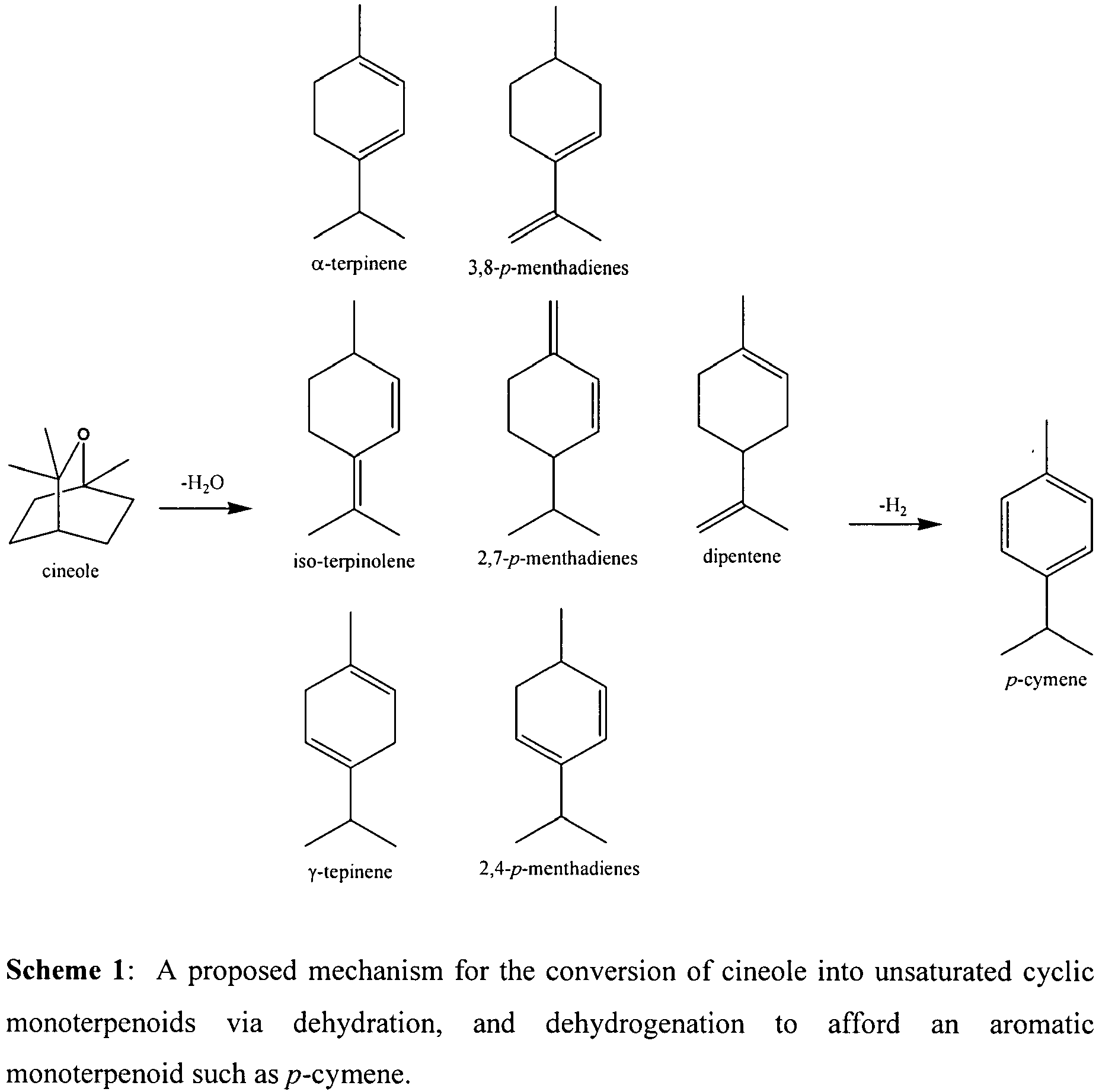
- the catalytic transformation of cineole is believed to operate through a dehydration mechanism in the formation of dipentene and other structurally similar unsaturated cyclic monoterpenoids, and through a further dehydrogenation in the formation of p -cymene.
- Such a conversion mechanism is illustrated below in Scheme 1.
- the predominant organic compounds produced in accordance with the invention are dipentene and/or p -cymene.
- the conversion of cineole into these compounds can also afford water and gaseous products such as hydrogen, carbon monoxide and carbon dioxide.
- a summary of such a conversion of cineole is illustrated below in Scheme 2.
- Products produced in accordance with the invention may be collected by means well known to those skilled in the art.
- the hydrophobic and hydrophilic phases may be collected in a stainless steel trap held at an appropriate temperature. These phases will generally be condensed into a liquid upon entering the trap and can be readily separated on the basis of their immiscibility.
- the gaseous phase may be collected using conventional gas collection apparatus/techniques.
- An advantageous feature of the present invention is that cineole may undergo a high conversion with high selectivity to a particular organic compound. Accordingly, organic compounds produced in accordance with the invention may be efficiently and effectively collected for subsequent use with minimal if no purification.
- the process in accordance with the invention can advantageously be tailored to produce specific and different products.
- transition metals such as iron and cobalt have been found to exhibit selectivity toward producing dipentene
- transition metals such as molybdenum, chromium, palladium, manganese and ruthenium have been found to exhibit selectivity toward producing p -cymene.
- the pyrolysis of cineole employing nickel or vanadium as the transition metal may afford p -cymene alone or a mixture of p -cymene and dipentene.
- the yield of organic compounds produced in accordance with the invention may be adjusted by altering the temperature at which the pyrolysis is conducted and/or by altering the composition of a carrier gas.
- the yield of hydrogen that may be produced in accordance with the invention may also be adjusted by altering the temperature at which the pyrolysis is conducted and/or by altering the composition of a carrier gas.
- ⁇ -Al 2 O 3 High surface area gamma-alumina tubular pellets having a diameter of approximately 1.5 mm ( ⁇ 200 m 2 g -1 ) were used as a slightly acidic catalyst and as a solid support for molybdenum, iron, cobalt, chromium and palladium metals.
- the metal-doped ⁇ -Al 2 O 3 catalysts were prepared by a wet impregnation technique using 1 M aqueous solutions of the appropriate metal salts.
- ⁇ -Al 2 O 3 pellet support (Saint-Gobain NorPro) was first dried at 90 °C overnight in vacuo and 100 g was then immersed in palladium nitrate dihydrate (0.960 g) dissolved in distilled water (200 mL). The mixture was stirred and the solvent removed by heating to 60 °C over 4 h in vacuo. The Pd- ⁇ -Al 2 O 3 catalysts were then dried at 90 °C in vacuo overnight and calcined at 350 °C for 12 h. The final catalyst was found to contain 0.38% Pd on ⁇ -Al 2 O 3
- the catalyst may be regenerated by first removing it from the reactor tube, placing it in a crucible, and then subjecting it to calcination in air at 350 °C for 12 h.
- the catalyst showed some slight deactivation over the course of an eight hour experiment prompting investigation into the long-term stability of the catalyst system.
- a series of four cycles of eight hour runs were conducted using the same catalytic material in each case.
- the first cycle used 4g of freshly prepared 0.38% Pd- ⁇ Al 2 O 3 catalyst and yielded ⁇ 92% p- cymene while showing only a slight deactivation / reduction in p-cymene yield over the eight hours, the amount of hydrogen produced by the reaction also remained constant.
- the reaction was stopped and a small amount of used catalyst was removed and kept for analysis by TGA. 3g of the used catalysts was regenerated by calcination at 350 °C for 12 hours and then used in the second cycle.
- samples Prior to surface analysis, samples were degassed under vacuum at 300°C overnight using a VacPrep 061 Degasser.
- the BET surface area was determined by N 2 adsorption at 77 K using a Micromeretics Tristar 3000.
- XRD measurements were carried out using a Phillips DW 1130 machine with Cu-K a (1.542 ⁇ ) radiation (40 kV, 25 mA) over the range 5° - 80° 2 ⁇ at a scan rate of 1° min -1 with 0.1° step size.
- the liquid product was collected at 40°C in a stainless steel trap.
- the gaseous products were sent through a second trap at 0°C to an online Shimatzu GC8A Gas Chromatograph fitted with a 1mL Valco auto sample valve.
- the liquid product obtained for the majority of the samples consisted of an oily, hydrophobic phase and an aqueous phase.
- the analysis of the hydrophobic liquid products was performed using a Thermo Finnigan GCMS fitted with a 15M x 0.1 mm ID-BPX5 0.1 ⁇ M column from Grace, using a Thermo Scientific Triplus auto sampler.
- 10 ⁇ L of the hydrophobic phase was dissolved in 1.5 mL of acetonitrile (Aldrich) that had been doped with 0.1 % mesitylene (Aldrich) as an internal standard. Chromatographic standards of 1,8-cineole, p-cymene and dipentene were run using the same sample preparation method.
- p-cymene Major product p-cymene was confirmed by 1 H and 13 C NMR. Yield of p-cymene is defined as the percentage of p -cymene in the whole hydrophobic phase. Selectivity for p -cymene is defined as the percentage of p -cymene in the non-cineole fraction of the hydrophobic phase. Unless otherwise noted, the non-cineole fraction of the hydrophobic phase was comprised of the products shown in Scheme 1. The hydrophilic phase was found to be mainly water.
- the analyses of gas products were performed with an online Shimadzu GC 8A fitted with a Valco sampling valve with a 1 mL sample loop.
- the GC was fitted with a 12 m HAYESEP Q column and a Thermal Conductivity Detector (TCD).
- TCD Thermal Conductivity Detector
- the GC was calibrated with the blended carrier gas as well as a calibration gas mixture containing known concentrations of hydrogen, helium, methane, nitrogen, carbon monoxide and carbon dioxide before each run. Online gas analysis was conducted at the time of collection of liquid samples.
- the XRD patterns of the metal doped ⁇ -Al 2 O 3 catalysts prepared by the wet impregnation technique All the metal doped ⁇ -Al 2 O 3 samples display XRD patterns associated with the support material as well as their doped metal.
- the BET surface areas for all as-prepared catalysts and ⁇ -Al 2 O 3 were measured.
- the surface area of the ⁇ -Al 2 O 3 was the highest while all other catalysts were lower in surface area.
- Metal doping of the ⁇ -Al 2 O 3 using the wet impregnation technique has shown a minimal amount of surface area loss.
- hydrophobic hydrophobic
- hydrophilic hydrophilic
- gaseous a mixture of both aromatic and non-aromatic C 10 hydrocarbons with dipentene and p-cymene as the major products.
- the main gases produced were hydrogen, carbon monoxide and carbon dioxide.
- Example Catalysts Amount of Oxygen in the carrier gas Temperature range 1 Glass beads 0% 250 - 500 °C 2 undoped ⁇ -Al 2 O 3 pellets 0% 250 - 500 °C 3 Mo- ⁇ -Al 2 O 3 pellets 0% 250 - 500 °C 4 Cr- ⁇ -Al 2 O 3 pellets 0% 250 - 500 °C 5 Fe- ⁇ -Al 2 O 3 pellets 0% 250 - 500 °C 6 Co- ⁇ -Al 2 O 3 pellets 0% 250 - 500 °C 7 Pd- ⁇ -Al 2 O 3 pellets 0% 250 - 500 °C 8 Ni- ⁇ -Al 2 O 3 pellets 0% 250 - 500 °C 9 Ru- ⁇ -Al 2 O 3 pellets 0% 250 - 500 °C 10 Glass beads 7.3% 250 - 500 °C 11 undoped ⁇ -Al 2 O 3 pellets 7.3% 250 - 500 °C 12 Mo- ⁇ -Al 2 O 3 pellets 7.3% 250
- Example Catalysts Amount of Oxygen in the feed gas Length of experiment (Min) Temperature 30 Pd- ⁇ -Al 2 O 3 pellets 7.3% 90 200 °C 31 Pd- ⁇ -Al 2 O 3 pellets 7.3% 180 220 °C 32 Pd- ⁇ -Al 2 O 3 pellets 7.3% 180 240 °C 33 Pd- ⁇ -Al 2 O 3 pellets 7.3% 180 260 °C 34 Pd- ⁇ -Al 2 O 3 pellets 7.3% 180 280 °C 35 Pd- ⁇ -Al 2 O 3 pellets 7.3% 180 300 °C 36 Pd- ⁇ -Al 2 O 3 pellets 0% 180 250 °C 37 Pd- ⁇ -Al 2 O 3 pellets 7.3% 180 250 °C 38 Pd- ⁇ -Al 2 O 3 pellets 14.6% 180 250 °C 39 Pd- ⁇ -Al 2 O 3 pellets 1 st regen cycle 7.3% 480 250 °C 40 Pd- ⁇ -Al 2 O 3 pellets 2
- a new batch of Pd- ⁇ -Al 2 O 3 pellets was made with a slightly modified procedure.
- a given amount of metal nitrate salt was dissolved in water and poured over the ⁇ -Al 2 O 3 pellets (Saint-Gobain NorPro, USA) that had been heated in a vacuum oven at 90°C overnight.
- the mixture was stirred on a rotary evaporator for 3 hours and then the water removed by vacuum.
- the resultant metal-impregnated ⁇ -Al 2 O 3 pellets were collected, and dried in a vacuum oven at 90°C overnight.
- the coated pellets were then transferred to a crucible and calcined in air at 350°C for 12 hours.
- Table 4 Major products in the hydrophobic phase from the conversion of cineole with no oxygen in the feed gas. Variable temperature runs.
- Example Catalysts Amount of Oxygen in the feed gas Yield of p -cymene (%) average yield Temperature range 30 Pd- ⁇ -Al 2 O 3 pellets 7.3% 25 200 °C 31 Pd- ⁇ -Al 2 O 3 pellets 7.3% 27 220 °C 32 Pd- ⁇ -Al 2 O 3 pellets 7.3% 79 240 °C 33 Pd- ⁇ -Al 2 O 3 pellets 7.3% 70 260 °C 34 Pd- ⁇ -Al 2 O 3 pellets 7.3% 65 280 °C 35 Pd- ⁇ -Al 2 O 3 pellets 7.3% 60 300 °C 36 Pd- ⁇ -Al 2 O 3 pellets 0% 99.1 250 °C 37 Pd- ⁇ -Al 2 O 3 pellets 7.3% 98.6 250 °C 38 Pd- ⁇ -Al 2 O 3 pellets 14.6% 99.5 250 °C 39 Pd- ⁇ -Al 2 O 3 pellets 1 st regen cycle 7.3% 91 250 °C
- Table 8 Gas analysis with no oxygen in feed gas
Landscapes
- Chemical & Material Sciences (AREA)
- Organic Chemistry (AREA)
- Engineering & Computer Science (AREA)
- Materials Engineering (AREA)
- Chemical Kinetics & Catalysis (AREA)
- Catalysts (AREA)
- Organic Low-Molecular-Weight Compounds And Preparation Thereof (AREA)
- Low-Molecular Organic Synthesis Reactions Using Catalysts (AREA)
Abstract
Description
- The present invention relates in general to cineole, and in particular to a process for converting cineole into other useful compounds by pyrolysis. The invention also relates to compounds produced in accordance with the process.
- The volatility of oil prices coupled with an increasing demand for replacing petrochemical products with sustainable, bio-derived alternatives has seen a considerable amount of research effort being directed toward identifying biologically derived materials that can function as or be converted into industrially useful compounds.
- 1,8-cineole (hereinafter simply referred to as cineole) is a naturally occurring organic compound that may be extracted from a variety of plant species such as bay, tea tree, mugwort, sweet basil, wormwood, rosemary, sage and eucalyptus.
- Cineole is the dominant component (c.a. 90 wt%) of eucalyptus oil, which is a generic collective name for oils extracted from the eucalyptus genus. The predominance of cineole in eucalyptus oil is reflected by the compounds more common name "eucalyptol".
- With the volume of eucalyptus oil production increasing and its cost correspondingly decreasing, cineole presents as an attractive renewable feedstock for the production of industrially useful compounds.
- An opportunity therefore remains to develop a process for converting cineole into one or more other useful compounds.
- The present invention therefore provides a process for producing unsaturated cyclic and/or aromatic compounds from 1,8-cineole, the process comprising pyrolysing 1,8-cineole in the presence of gamma-alumina supported transition metal catalyst.
- It has now been found that gamma-alumina supported transition metal catalysts can be used to effectively and efficiently convert cineole into one or more industrially useful unsaturated cyclic and/or aromatic compounds. In particular, the cineole may be readily converted into cyclic monoterpenoids such as p-cymene and dipentene (i.e. a racemic mixture limonene).
- By adjusting the type of transition metal of the catalyst and/or the pyrolysis conditions, the process in accordance with the invention can advantageously be tailored to produce different compounds, and in particular substantially exclusive selectivity of a given compound at high yield.
- In addition to producing unsaturated cyclic and/or aromatic compounds, the process in accordance with the invention can advantageously also produce hydrogen gas.
- In one embodiment, the process of the invention produces unsaturated cyclic and/or aromatic monoterpenoids. In a further embodiment, the process produces dipentene and/or p-cymene.
- The process in accordance with the invention can advantageously be performed using a variety of transition metals. In one embodiment, the transition metal is selected from one or more of vanadium, chromium, manganese, iron, cobalt, nickel, molybdenum, rhenium, and the precious or noble metals (i.e. ruthenium, rhodium, palladium, silver, rhenium, osmium, iridium, platinum, and gold).
- Palladium has been found to be particularly effective for producing p-cymene with high conversion and selectivity.
- Accordingly, in a further embodiment there is provided a process for producing p-cymene from 1,8-cineole, the process comprising pyrolysing 1,8-cineole in the presence of gamma-alumina supported palladium catalyst.
- The present invention also provides for the use of gamma-alumina supported transition metal catalyst in the manufacture of unsaturated cyclic and/or aromatic compounds from 1,8-cineole.
- The present invention further provides for the use of gamma-alumina supported transition metal catalyst in the pyrolysis of 1,8-cineole to manufacture unsaturated cyclic and/or aromatic compounds.
- Further aspects of the invention are discussed in more detail below.
- 1,8-Cineole is a naturally occurring organic compound having the following structure:

- Cineole suitable for use in accordance with the invention is readily commercially available. For example, +99% cineole may be obtained from Australian companies FGB Natural products (Felton Grimwade & Bosisto's Pty Ltd) and Kalannie Distillers. Cineole used in accordance with the invention preferably has a purity of at least 95%, more preferably at least 97%, most preferably at least 99%.
- Reference to compounds produced by the process of the invention being "unsaturated" is intended to mean that such compounds comprise one or more multiple bonds. The unsaturation may form part of a cyclic and/or acyclic moiety of the compound. Generally, the unsaturation will be in the form of one or more double bonds.
- The unsaturated cyclic and/or aromatic compounds produced will generally be predominantly (i.e. greater than about 50 wt. %) in the form of unsaturated cyclic and/or aromatic monoterpenoids.
- The unsaturated cyclic and/or aromatic monoterpenoids will generally be C10 unsaturated cyclic and/or C10 aromatic monoterpenoids.
- In one embodiment, the process produces unsaturated cyclic and/or aromatic monoterpenoids selected from dipentene and p-cymene.
- Dipentene and p-cymene have the following respective structures:


- In addition to the unsaturated cyclic and/or aromatic compounds (i.e. the organic or hydrophobic products), the process in accordance with the invention will generally produce water (i.e. a hydrophilic product) and optionally hydrogen, carbon monoxide and/or carbon dioxide (i.e. gaseous products). Further detail in relation to these additional products is discussed below.
- The process in accordance with the invention is believed to be particularly effective at converting cineole into other industrially useful C10 compounds. Of such compounds, p-cymene is of particular interest in that it may be used in the production of p-cresol, fragrances, pharmaceuticals, herbicides and fine chemicals.
- Cymenes are conventionally derived commercially from toluene and propylene, both of which are typically derived from crude oil. The production process produces a mixture of three different isomers, with the m- and p- isomers being dominant. Further separation to pure p-cymene is generally achieved using the UOP "Cymex" process, whereby the mixture of isomers is subjected to chromatography using adsorbing (e.g. molecular sieves) and desorbing (e.g. toluene) media.
- There have been investigations into the direct synthesis of p-cymene using ZSM-5 catalysts for regioselectivity in the alkylation of toluene, and also studies using pinenes as a feedstock.
- However, these processes nevertheless rely on using non-renewable crude oil feedstocks.
- The catalytic conversion of cineole into p-cymene is also known. However, such processes often afford relatively poor conversion and/or selectivity for p-cymene. Some processes must also be conducted at a relatively high temperature (e.g. 450°C) so as to yield p-cymene. Such processes therefore present a number of commercial limitations.
- Apart from providing flexibility for producing a number of different compounds, the process in accordance with the invention can advantageously produce p-cymene from cineole with high conversion and selectivity at relatively low temperatures. The process therefore has a number of commercial advantages over the prior art.
- Unsaturated cyclic or aromatic compounds can advantageously be produced according to the process in yields of about 50 wt% or more, such as about 60 wt% or more, about 70 wt% or more, about 80 wt% or more, or even about 90 wt% or more, relative to the mass of cineole used in the process.
- In one embodiment, the process of the invention produces p-cymene from cineole in an amount of about 50 wt% or more, such as about 60 wt% or more, about 70 w% or more, about 80 wt% or more, or even about 90 wt% or more, relative to the mass of cineole.
- The aforementioned yields of organic compounds produced in accordance with the invention can advantageously be attained at relatively low pyrolytic temperatures. For example, one or more of the aforementioned yields may be attained by pyrolysing the cineole at temperatures ranging from about 200°C to about 400°C, or from about 200°C to about 350°C. In one embodiment, pyrolysis of the cineole is conducted at temperatures ranging from about 200°C to about 275°C. The pyrolysis may be conducted at a fixed temperature, or the temperature may be varied according to a desired profile.
- As used herein, the term "pyrolysing", or variants thereof such as "pyrolysis", "pyrolyse", "pyrolysed", etc, is intended to mean inducing a molecular transformation of cineole brought about by the action of heat. The molecular transformation may, for example, result from cineole undergoing dehydration and/or dehydrogenation.
- Pyrolysis of cineole in accordance with the invention may be conducted using techniques well known to those skilled in the art. For example, the cineole may be conveniently pyrolysed in the vapour phase. In that case, the catalyst may be contained within a stainless steel mesh basket, which is in turn placed inside an electrically heatable tubular down-flow reactor. The reactor may then be heated to a desired temperature, for example to a temperature of about 200°C to about 500°C.
- Those skilled in the art will appreciate that a measured temperature of such a tubular reactor may not accurately reflect the temperature of the catalyst contained within the mesh basket within the reactor (which may hereinafter be referred to as the "fixed bed"). Generally, the fixed bed of catalyst will be at a lower temperature than that of the reactor tube.
- For avoidance of any doubt, the temperature at which pyrolysis in accordance with the invention is to take place is that measured at the location of the catalyst, which may or may not be the measured temperature of the reactor per se. Relevant temperatures may be measured by any suitable means such as by using a thermocouple (for example a K-type thermocouple) positioned at an appropriate location.
- Once the reactor has been heated to a desired temperature, cineole may be introduced. The cineole may be introduced by any suitable means, for example by way of a pump, such as a syringe pump.
- Upon being introduced to the reactor the cineole may be substantially vaporised. A carrier gas may be used to assist with transporting the vaporised cineole to the fixed bed catalyst. The carrier gas may be an inert gas such as nitrogen or argon. In that case, the pyrolysis conducted in accordance with the invention may be described as an inert-pyrolysis. Alternatively, the carrier gas may comprise a reactive gas such as oxygen. In that case, the pyrolysis may be described as an oxidative-pyrolysis.
- It has been found that gaseous compounds produced in accordance with the invention may vary depending upon the composition of the carrier gas. For example, where an inert carrier gas is used, primarily hydrogen can be produced. When a volume percent of oxygen is introduced into such an inert carrier gas, then the amount of hydrogen produced can decrease with a corresponding increase in oxide gas products such as carbon dioxide and/or carbon monoxide.
- The presence of oxygen in the carrier gas has also been found to alter the yield and type of the unsaturated cyclic and/or aromatic compounds produced in accordance with the invention. For example, introducing a volume percent of oxygen gas into an inert carrier gas at a given temperature of the fixed bed catalyst can result in a higher conversion of cineole into the unsaturated cyclic and/or aromatic compounds.
- Where a carrier gas contains a reactive gas such as oxygen, it will generally be present in an amount ranging from about 0.05 vol.% to about 22 vol.%, for example about 5 vol.% to about 15 vol.%.
- In performing the process, cineole may therefore be introduced to the reactor upstream from the fixed bed catalyst, with the cineole being vaporised and transported to the fixed bed catalyst with the aid of a carrier gas.
- Accordingly, in one embodiment the cineole is vaporised and a carrier gas facilitates transportation of the cineole to the catalyst.
- By the cineole being pyrolysed in the "presence" of the catalyst is meant that the cineole makes contact with the catalyst at a temperature sufficient to convert the cineole into unsaturated cyclic and/or aromatic compounds.
- The gamma-alumina supported transition metal catalyst used in accordance with the invention comprises gamma-alumina doped with one or more transition metals. Those skilled in the art will appreciate that gamma-alumina is a particular form of aluminium oxide that may be used as a catalytic material in its own right or, as in the present invention, a support in the production of a catalytic material.
- Gamma-alumina suitable for use in catalytic applications will generally have a relatively high surface area, for example, of greater than about 10 m2/g, or greater than about 50 m2/g, or greater than about 100 m2/g, or greater than about 200 m2/g. Generally, the alumina support used in accordance with the invention will have a surface area ranging from about 10 m2/g to about 240 m2/g.
- Gamma-alumina suitable for use in accordance with the invention can be readily obtained commercially, for example from Saint-Gobain NorPro, USA.
- The gamma-alumina functions as a support for one or more transition metals, and in this form may be referred to as being "doped" with the one or more transition metals.
- Provided the catalyst functions in the conversion of cineole into the unsaturated cyclic and/or aromatic compounds, there is no particular limitation on how it can be prepared. For example, the catalyst may be prepared by a wet impregnation technique. In that case, gamma-alumina, for example in the form of pellets or any other desired shape, may be doped using an aqueous solution of an appropriate metal salt (e.g. a nitrate salt) of a selected transition metal(s). The resulting doped gamma-alumina may then be dried and subsequently calcined in air to afford a catalyst material suitable for use in accordance with the invention.
- In one embodiment, the catalyst is prepared by immersing a gamma-alumina support in an aqueous solution comprising transition metal salt, isolating the resulting transition metal doped gamma-alumina support from the aqueous solution, and calcining the isolated product to afford the catalyst. In such an embodiment, the concentration of the transition metal salt in the aqueous solution will generally range from about 0.1M to about 2.5M. Those skilled in the art will appreciate that some transition metal salts will form a saturated solution at concentrations less than 2.5M. In that case, the concentration range will be about 0.1 M to about saturation.
- In another embodiment, the catalyst is prepared by immersing a gamma-alumina support in an aqueous solution comprising transition metal salt, evaporating the aqueous liquid from the solution to isolate transition metal doped gamma-alumina support, and calcining the isolated product to afford the catalyst. In such an embodiment, the amount of transition metal used in the aqueous solution will generally be equivalent to that which is to be supported by the catalyst. In other words, due to evaporation of the aqueous liquid the gamma-alumina support can be doped with substantially all of the transition metal that was in solution.
- Generally, the gamma-alumina will be doped with one or more transition metals in an amount ranging from about 0.01% to about 10%, for example from about 0.3% to about 2.5% (on a wt/wt basis of the support to transition metal(s)).
- As used herein, reference to "transition metal" is intended to mean an element of the periodic table whose atom has an incomplete d sub-shell, or which can give rise to cations with an incomplete d sub-shell. Accordingly, transition metals suitable for use in accordance with the invention are intended to include those in groups 3 to 11 of the periodic table as represented in Table 1 below.
Table 1: Transition metals of groups 3 to 11 of the periodic table. Group 3 4 5 6 7 8 9 10 11 Period 4 Sc 21 Ti 22 V 23 Cr 24 Mn 25 Fe 26 Co 27 Ni 28 Cu 29 Period 5 Y 39 Zr 40 Nb 41 Mo 42 Tc 43 Ru 44 Rh 45 Pd 46 Ag 47 Period 6 Lu 71 Hf 72 Ta 73 W 74 Re 75 Os 76 Ir 77 Pt 78 Au 79 Period 7 Lr 103 Rf 104 Db 105 Sg 106 Bh 107 Hs 108 Mt 109 Ds 110 Rg 111 - In one embodiment of the invention, the transition metal is selected from one or more of those in groups 3 to 11 and periods 4 to 6 only as shown above in Table 1. In a further embodiment, the transition metal is selected from one or more of those in groups 5 to 11 and periods 4 to 6 only as shown above in Table 1. In yet a further embodiment the transition metal is selected from one or more of those in groups 5 to 10 and periods 4 to 6 only as shown above in Table 1. In a further embodiment, the transition metal is selected from one or more of vanadium, chromium, manganese, iron, cobalt, nickel, molybdenum, ruthenium, rhodium, palladium, silver, rhenium, osmium, iridium, platinum, and gold. In still a further embodiment, the transition metal is selected from one or more of ruthenium, rhodium, palladium, osmium, iridium, and platinum. In another embodiment, the transition metal is palladium,
- Depending upon the type of catalyst and/or pyrolysis conditions used, the nature of compounds produced in accordance with the invention can advantageously be varied.
- In one embodiment, cineole is pyrolysed to produce dipentene and/or p-cymene. In that case, the catalytic transformation of cineole is believed to operate through a dehydration mechanism in the formation of dipentene and other structurally similar unsaturated cyclic monoterpenoids, and through a further dehydrogenation in the formation of p-cymene. Such a conversion mechanism is illustrated below in Scheme 1.
- In one embodiment, the predominant organic compounds produced in accordance with the invention are dipentene and/or p-cymene. The conversion of cineole into these compounds can also afford water and gaseous products such as hydrogen, carbon monoxide and carbon dioxide. A summary of such a conversion of cineole is illustrated below in Scheme 2.

- An advantageous feature of the present invention is that cineole may undergo a high conversion with high selectivity to a particular organic compound. Accordingly, organic compounds produced in accordance with the invention may be efficiently and effectively collected for subsequent use with minimal if no purification.
- Through variation of the catalyst composition (e.g. transition metal type) and/or pyrolytic conditions employed (e.g. temperature, composition of carrier gas etc), the process in accordance with the invention can advantageously be tailored to produce specific and different products. For example, transition metals such as iron and cobalt have been found to exhibit selectivity toward producing dipentene, and transition metals such as molybdenum, chromium, palladium, manganese and ruthenium have been found to exhibit selectivity toward producing p-cymene. By varying the temperature and/or the presence of oxygen, the pyrolysis of cineole employing nickel or vanadium as the transition metal may afford p-cymene alone or a mixture of p-cymene and dipentene.
- Irrespective of the transition metal employed, the yield of organic compounds produced in accordance with the invention may be adjusted by altering the temperature at which the pyrolysis is conducted and/or by altering the composition of a carrier gas. The yield of hydrogen that may be produced in accordance with the invention may also be adjusted by altering the temperature at which the pyrolysis is conducted and/or by altering the composition of a carrier gas.
- The invention will hereinafter be described with reference to the following non-limiting examples.
- High surface area gamma-alumina (hereinafter γ-Al2O3) tubular pellets having a diameter of approximately 1.5 mm (∼200 m2g-1) were used as a slightly acidic catalyst and as a solid support for molybdenum, iron, cobalt, chromium and palladium metals. The metal-doped γ-Al2O3 catalysts were prepared by a wet impregnation technique using 1 M aqueous solutions of the appropriate metal salts.
- In one procedure, 100 mL of 1 M metal nitrate solution was poured over 70 g of γ-Al2O3 pellets (Saint-Gobain NorPro, USA) that had been heated in a vacuum oven at 90°C overnight. The mixture was stirred briefly with a spatula and left to stand at room temperature overnight. The resultant metal-impregnated γ-Al2O3 pellets were collected, washed three times with deionised water and dried in a vacuum oven at 90°C overnight. The coated pellets were then transferred to a crucible and calcined in air at 350°C for 12 hours. As comparative examples, undoped γ-Al2O3 pellets were subjected to the same treatment as the metal doped samples before use, and glass beads were used as a blank reaction surface.
- In another procedure, γ-Al2O3 pellet support (Saint-Gobain NorPro) was first dried at 90 °C overnight in vacuo and 100 g was then immersed in palladium nitrate dihydrate (0.960 g) dissolved in distilled water (200 mL). The mixture was stirred and the solvent removed by heating to 60 °C over 4 h in vacuo. The Pd-γ-Al2O3 catalysts were then dried at 90 °C in vacuo overnight and calcined at 350 °C for 12 h. The final catalyst was found to contain 0.38% Pd on γ-Al2O3
- The catalyst may be regenerated by first removing it from the reactor tube, placing it in a crucible, and then subjecting it to calcination in air at 350 °C for 12 h.
- The catalyst showed some slight deactivation over the course of an eight hour experiment prompting investigation into the long-term stability of the catalyst system. A series of four cycles of eight hour runs were conducted using the same catalytic material in each case. The first cycle used 4g of freshly prepared 0.38% Pd-γAl2O3 catalyst and yielded ∼92% p-cymene while showing only a slight deactivation / reduction in p-cymene yield over the eight hours, the amount of hydrogen produced by the reaction also remained constant. The reaction was stopped and a small amount of used catalyst was removed and kept for analysis by TGA. 3g of the used catalysts was regenerated by calcination at 350 °C for 12 hours and then used in the second cycle. High yields of p-cymene (∼90%) were again observed, with very similar conversion to the fresh catalysts, but the yield of p-cymene reduced over the eight hours run to ∼85%. The catalyst was removed; a sample kept for TGA analysis and the rest was again subject to re calcination. The third cycle also showed high yields of p-cymene >85% initially and then a gradual reduction in catalytic activity over the eight hours to ∼80%. Once again at the end of the experiment the used catalysts was removed and analysed by TGA, then re-generated by calcination. This catalyst was used for the fourth cycle, and again we observe high catalytic activity for the cineole to p-cymene conversion. On this cycle we see a slightly quicker decrease in catalytic activity finishing after the eight hours at approximately 75% yield. With the exception of the first cycle the yield of hydrogen remains relative consistent for all of the regenerated catalysts (see Tables 3 and 7).
- Prior to surface analysis, samples were degassed under vacuum at 300°C overnight using a VacPrep 061 Degasser. The BET surface area was determined by N2 adsorption at 77 K using a Micromeretics Tristar 3000. XRD measurements were carried out using a Phillips DW 1130 machine with Cu-K a (1.542 Å) radiation (40 kV, 25 mA) over the range 5° - 80° 2□ at a scan rate of 1° min-1 with 0.1° step size.
- All reactions were performed using a custom-designed pyrolysis rig. The vapour phase catalytic conversion of cineole was performed using an electrically heated tubular down-flow reactor (13.5 mm internal diameter, 300 mm length) with the catalyst held as a fixed bed at atmospheric pressure. A K-type thermocouple was used to monitor the temperature of the bed. Some variability in bed temperature was seen in all experiments due to cooling by feed gases. All thermocouples, furnaces, heating bands and mass flow controllers (MFC) were controlled and data was logged using specially designed software.
- The liquid product was collected at 40°C in a stainless steel trap. The gaseous products were sent through a second trap at 0°C to an online Shimatzu GC8A Gas Chromatograph fitted with a 1mL Valco auto sample valve.
- The liquid product obtained for the majority of the samples consisted of an oily, hydrophobic phase and an aqueous phase. The analysis of the hydrophobic liquid products was performed using a Thermo Finnigan GCMS fitted with a 15M x 0.1 mm ID-BPX5 0.1µM column from Grace, using a Thermo Scientific Triplus auto sampler. For analysis, 10 µL of the hydrophobic phase was dissolved in 1.5 mL of acetonitrile (Aldrich) that had been doped with 0.1 % mesitylene (Aldrich) as an internal standard. Chromatographic standards of 1,8-cineole, p-cymene and dipentene were run using the same sample preparation method. Major product p-cymene was confirmed by 1H and 13C NMR. Yield of p-cymene is defined as the percentage of p-cymene in the whole hydrophobic phase. Selectivity for p-cymene is defined as the percentage of p-cymene in the non-cineole fraction of the hydrophobic phase. Unless otherwise noted, the non-cineole fraction of the hydrophobic phase was comprised of the products shown in Scheme 1. The hydrophilic phase was found to be mainly water.
- The analyses of gas products were performed with an online Shimadzu GC 8A fitted with a Valco sampling valve with a 1 mL sample loop. The GC was fitted with a 12 m HAYESEP Q column and a Thermal Conductivity Detector (TCD). The GC was calibrated with the blended carrier gas as well as a calibration gas mixture containing known concentrations of hydrogen, helium, methane, nitrogen, carbon monoxide and carbon dioxide before each run. Online gas analysis was conducted at the time of collection of liquid samples.
- The XRD patterns of the metal doped γ-Al2O3 catalysts prepared by the wet impregnation technique. All the metal doped γ-Al2O3 samples display XRD patterns associated with the support material as well as their doped metal.
- The BET surface areas for all as-prepared catalysts and γ-Al2O3 were measured. The surface area of the γ-Al2O3 was the highest while all other catalysts were lower in surface area. Metal doping of the γ-Al2O3 using the wet impregnation technique has shown a minimal amount of surface area loss.
- Products of the pyrolysis process were separated into three phases: hydrophobic, hydrophilic and gaseous. In all experiments, the hydrophilic layer was found to be predominantly water, while the hydrophobic phase generally contained a mixture of both aromatic and non-aromatic C10 hydrocarbons with dipentene and p-cymene as the major products. The main gases produced were hydrogen, carbon monoxide and carbon dioxide.
- In a typical variable temperature experiment, 3 g of catalyst was loaded into a stainless steel mesh basket, which was placed inside the tubular reactor. The furnace was set to an initial temperature of 250°C and allowed to stabilise for one hour. Cineole was injected upstream of the pre-heater at a rate of 0.5 mL min-1 with an ISCO 500D syringe pump. The carrier gas was fed at a constant rate of 150 mL min-1. Once at equilibrium, gas samples were taken and liquid products collected. The furnace temperature was then raised by 50°C and the procedure was repeated until the final reaction temperature of 500°C was reached. Other experimental parameters are outlined blow in Table 2.
Table 2: Experimental parameters for variable temperature runs. Example Catalysts Amount of Oxygen in the carrier gas Temperature range 1 Glass beads 0% 250 - 500 °C 2 undoped γ-Al2O3 pellets 0% 250 - 500 °C 3 Mo-γ-Al2O3 pellets 0% 250 - 500 °C 4 Cr-γ-Al2O3 pellets 0% 250 - 500 °C 5 Fe-γ-Al2O3 pellets 0% 250 - 500 °C 6 Co-γ-Al2O3 pellets 0% 250 - 500 °C 7 Pd-γ-Al2O3 pellets 0% 250 - 500 °C 8 Ni-γ-Al2O3 pellets 0% 250 - 500 °C 9 Ru-γ-Al2O3 pellets 0% 250 - 500 °C 10 Glass beads 7.3% 250 - 500 °C 11 undoped γ-Al2O3 pellets 7.3% 250 - 500 °C 12 Mo-γ-Al2O3 pellets 7.3% 250 - 500 °C 13 Cr-γ-Al2O3 pellets 7.3% 250 - 500 °C 14 Fe-γ-Al2O3 pellets 7.3% 250 - 500 °C 15 Co-γ-Al2O3 pellets 7.3% 250 - 500 °C 16 Pd-γ-Al2O3 pellets 7.3% 250 - 500 °C 17 Mn-γ-Al2O3 pellets 7.3% 250 - 500 °C 18 V-γ-Al2O3 pellets 7.3% 250 - 500 °C 19 Ni-γ-Al2O3 pellets 7.3% 250 - 500 °C 20 Ru-γ-Al2O3 pellets 7.3% 250 - 500 °C 21 Glass beads 14.6% 250 - 500 °C 22 undoped γ-Al2O3 pellets 14.6% 250 - 500 °C 23 Mo-γ-Al2O3 pellets 14.6% 250 - 500 °C 24 Cr-γ-Al2O3 pellets 14.6% 250 - 500 °C 25 Fe-γ-Al2O3 pellets 14.6% 250 - 500 °C 26 Co-γ-Al2O3 pellets 14.6% 250 - 500 °C 27 Pd-γ-Al2O3 pellets 14.6% 250 - 500 °C 28 Ni-γ-Al2O3 pellets 14.6% 250 - 500 °C 29 Ru-γ-Al2O3 pellets 14.6% 250 - 500 °C - In a typical fixed bed temperature experiment, 4 g of catalyst was loaded into a stainless steel mesh basket, which was placed inside the tubular reactor. The furnace was set so that the bed temperature was the required temperature and allowed to stabilise for one hour. Cineole was injected upstream of the pre-heater at a rate of 0.3 mL min-1 with an ISCO 500D syringe pump. The carrier gas was fed at a constant rate of 150 mL min-1. Once at equilibrium, gas samples were taken and liquid products collected. Other experimental parameters are outlined blow in Table 3.
Table 3: Experimental parameters for fixed temperature runs. Example Catalysts Amount of Oxygen in the feed gas Length of experiment (Min) Temperature 30 Pd-γ-Al2O3 pellets 7.3% 90 200 °C 31 Pd-γ-Al2O3 pellets 7.3% 180 220 °C 32 Pd-γ-Al2O3 pellets 7.3% 180 240 °C 33 Pd-γ-Al2O3 pellets 7.3% 180 260 °C 34 Pd-γ-Al2O3 pellets 7.3% 180 280 °C 35 Pd-γ-Al2O3 pellets 7.3% 180 300 °C 36 Pd-γ-Al2O3 pellets 0% 180 250 °C 37 Pd-γ-Al2O3 pellets 7.3% 180 250 °C 38 Pd-γ-Al2O3 pellets 14.6% 180 250 °C 39 Pd-γ-Al2O3 pellets 1st regen cycle 7.3% 480 250 °C 40 Pd-γ-Al2O3 pellets 2nd regen cycle 7.3% 480 250 °C 41 Pd-γ-Al2O3 pellets 3rd regen cycle 7.3% 480 250 °C 42 Pd-γ-Al2O3 pellets 4th regen cycle 7.3% 480 250 °C - For examples 36-42 a new batch of Pd-γ-Al2O3 pellets was made with a slightly modified procedure. In a typical procedure, a given amount of metal nitrate salt was dissolved in water and poured over the γ-Al2O3 pellets (Saint-Gobain NorPro, USA) that had been heated in a vacuum oven at 90°C overnight. The mixture was stirred on a rotary evaporator for 3 hours and then the water removed by vacuum. The resultant metal-impregnated γ-Al2O3 pellets were collected, and dried in a vacuum oven at 90°C overnight. The coated pellets were then transferred to a crucible and calcined in air at 350°C for 12 hours.
- Cineole remained relatively unchanged for all experiments using the glass beads.
- Analysis data for the remaining samples is presented below in Tables 4-7.
Table 4: Major products in the hydrophobic phase from the conversion of cineole with no oxygen in the feed gas. Variable temperature runs. Example Catalyst Furnace Temp (°C) Bed Temp (°C) p-cymene (%) Dipentene (%) Cineole (%) 2 γ-Al2O3 250 214 6 0 93 300 212 23 0 76 350 262 31 0 65 400 285 47 0 35 450 357 39 0 20 500 406 26 0 6 3 Mo-γ-Al2O3 250 199 9 0 51 300 184 16 0 51 350 207 14 0 48 400 274 8 0 34 450 335 33 0 24 500 378 56 0 15 4 Cr-γ-Al2O3 250 205 11 0 88 300 220 18 0 81 350 250 2 0 83 400 293 18 0 40 450 344 23 0 24 500 394 35 0 13 5 Fe-γ-Al2O3 250 224 0 12 87 300 228 0 23 76 350 250 0 56 42 400 279 0 76 15 450 325 0 64 4 500 379 0 0 40 6 Co-γ-Al2O3 250 209 0 0 100 300 229 0 55 42 350 267 0 66 26 400 315 0 71 15 450 361 0 64 8 500 411 0 57 7 7 Pd-γ-Al2O3 250 214 57 0 37 300 231 56 0 42 350 269 67 0 29 400 305 77 0 18 450 347 85 0 11 500 385 88 0 6 8 Ni-γ-Al2O3 250 208 32 0 67 300 211 39 0 60 350 243 58 0 36 400 292 66 0 21 450 337 53 17 10 500 379 28 52 5 9 Ru-γ-Al2O3 250 208 44 0 33 300 213 40 0 18 350 256 29 0 8 400 316 22 0 3 450 379 27 0 2 500 430 34 0 1 Table 5: Major products in the hydrophobic phase from the conversion of cineole with 7.3% oxygen in the feed gas. Variable temperature runs. Example Catalyst Furnace Temp (°C) Bed Temp (°C) p-cymene (%) Dipentene (%) Cineole (%) 11 γ-Al2O3 250 199 0 0 95 300 210 46 0 45 350 248 49 0 46 400 283 58 0 34 450 343 60 0 21 500 393 50 0 10 12 Mo-γ-Al2O3 250 205 9 0 52 300 250 54 0 18 350 279 52 0 17 400 318 52 0 18 450 356 54 0 22 500 393 56 0 25 13 Cr-γ-Al2O3 250 200 23 0 42 300 225 9 0 91 350 265 14 0 85 400 307 25 0 71 450 349 39 0 45 500 392 47 0 33 14 Fe-γ-Al2O3 250 227 0 61 19 300 249 0 41 53 350 282 0 42 54 400 321 0 45 46 450 363 0 48 40 500 408 0 53 35 15 Co-γ-Al2O3 250 233 0 3 97 300 252 0 4 96 350 289 0 10 90 400 323 0 26 71 450 365 0 44 48 500 419 0 55 23 16 Pd-γ-Al2O3 250 234 89 0 10 300 252 91 0 8 350 293 95 0 5 400 328 94 0 3 450 374 68 0 1 500 425 50 0 2 17 Mn-γ-Al2O3 250 213 0 0 91 300 215 36 0 45 350 251 38 0 42 400 290 50 0 34 450 339 52 0 21 500 406 48 0 10 18 V-γ-Al2O3 250 229 10 0 65 300 232 52 0 4 350 275 51 3 3 400 340 49 2 3 450 401 46 2 5 500 445 46 1 9 19 Ni-γ-Al2O3 250 198 27 0 72 300 202 24 0 75 350 232 45 0 53 400 281 57 0 36 450 332 58 0 34 500 377 59 0 29 20 Ru-γ-Al2O3 250 208 42 0 50 300 213 45 0 42 350 256 51 0 29 400 316 51 0 18 450 379 36 0 7 500 430 41 0 4 Table 6: Major products in the hydrophobic phase from the conversion of cineole with 14.6% oxygen in the feed gas. Variable temperature runs. Example Catalyst Furnace Temp (°C) Bed Temp (°C) p-cymene (%) Dipentene (%) Cineole (%) 22 γ-Al2O3 250 195 6 0 94 300 216 18 0 78 350 252 42 0 54 400 312 51 0 41 450 360 51 0 34 500 397 47 0 24 23 Mo-γ-Al2O3 250 228 32 0 19 300 266 52 0 25 350 292 41 0 41 400 325 38 0 48 450 358 34 0 53 500 393 38 0 50 24 Cr-γ-Al2O3 250 224 14 0 83 300 248 11 0 89 350 302 23 0 73 400 346 36 0 49 450 387 46 0 30 500 427 55 0 17 25 Fe-γ-Al2O3 250 224 0 4 95 300 261 0 50 42 350 286 0 48 44 400 318 0 51 37 450 363 0 52 32 500 406 0 58 25 26 Co-γ-Al2O3 250 228 0 34 63 300 248 0 26 74 350 297 0 26 74 400 344 0 33 63 450 411 0 47 45 500 459 0 58 22 27 Pd-γ-Al2O3 250 293 93 0 5 300 301 94 0 5 350 317 89 0 5 400 350 81 0 4 450 393 50 0 2 500 440 52 0 1 28 Ni-γ-Al2O3 250 198 18 0 78 300 206 32 0 67 350 243 37 0 62 400 292 45 0 54 450 342 44 9 30 500 384 37 29 13 29 Ru-γ-Al2O3 250 214 47 0 38 300 225 46 0 41 350 269 49 0 35 400 335 51 0 26 450 406 50 0 17 500 436 46 0 8 Table 7: Fixed temperature runs, yields ofp-cymene. Example Catalysts Amount of Oxygen in the feed gas Yield of p-cymene (%) average yield Temperature range 30 Pd-γ-Al2O3 pellets 7.3% 25 200 °C 31 Pd-γ-Al2O3 pellets 7.3% 27 220 °C 32 Pd-γ-Al2O3 pellets 7.3% 79 240 °C 33 Pd-γ-Al2O3 pellets 7.3% 70 260 °C 34 Pd-γ-Al2O3 pellets 7.3% 65 280 °C 35 Pd-γ-Al2O3 pellets 7.3% 60 300 °C 36 Pd-γ-Al2O3 pellets 0% 99.1 250 °C 37 Pd-γ-Al2O3 pellets 7.3% 98.6 250 °C 38 Pd-γ-Al2O3 pellets 14.6% 99.5 250 °C 39 Pd-γ-Al2O3 pellets 1st regen cycle 7.3% 91 250 °C 40 Pd-γ-Al2O3 pellets 2nd regen cycle 7.3% 89 250 °C 41 Pd-γ-Al2O3 pellets 3rd regen cycle 7.3% 84 250 °C 42 Pd-γ-Al2O3 pellets 4th regen cycle 7.3% 77 250 °C - Analysis data for each sample is presented below in Tables 8-10.
Table 8: Gas analysis with no oxygen in feed gas Example Catalyst Furnace Temp (°C) Bed Temp (°C) Hydrogen (% in exit gas) Carbon monoxide (% in exit gas) Carbon dioxide (% in exit gas) 1 Glass beads 250 226 0 0 0 300 236 0 0 0 350 279 0 0 0 400 328 0 0 0 450 373 0 0 0 500 419 0 0 0 2 γ-Al2O3 250 214 0 0 0 300 212 0 0 0 350 262 0 0 0 400 285 0 0 0 450 357 0 0 0 500 406 0.8 0 0 3 Mo-γ-Al2O3 250 199 0 0 0 300 184 to 0 0 350 207 0 0 0 400 274 0 0 0 450 335 2.5 2.9 0 500 378 9.2 3 0 4 Cr-γ-Al2O3 250 205 0 0 0 300 220 0 0 0 350 250 0 0 0 400 293 0.1 0 0 450 344 4.7 0 0 500 394 12.3 0 0 5 Co-γ-Al2O3 250 224 0 0 0 300 228 0 0 0 350 250 0 0 0 400 279 0 0 0 450 325 0 0 0 500 379 6.3 1.7 0 6 Fe-γ-Al2O3 250 209 0 0 0 300 229 0 0 0 350 267 0 0 0 400 315 0 0 0 450 361 0.2 0 0 500 411 4.6 0 0 7 Pd-γ-Al2O3 250 214 17.8 0 0 300 231 21.7 0 0 350 269 28.2 0 0 400 305 37.6 0 0 450 347 39.7 0 0 500 385 40.1 0 0 Table 9: Gas analysis with 7.3% oxygen in feed gas Example Catalyst Furnace Temp (°C) Bed Temp (°C) Hydrogen (% in exit gas) Carbon monoxide (% in exit gas) Carbon dioxide (% in exit gas) 10 Glass beads 250 232 0 0 0 300 245 0 0 0 350 283 0 0 0 400 334 0 0 0 450 383 0 0 0 500 432 0 0 0 11 γ-Al2O3 250 199 0 0 0 300 210 0 0 0 350 248 0 0 0 400 283 0 0 0.2 450 343 0 0 0.6 500 393 1.3 0 0.9 12 Mo-γ-Al2O3 250 205 0 0 0 300 250 0 0 0 350 279 0 0 0.1 400 318 0.8 0 0.3 450 356 3.6 0.1 1.2 500 393 7.8 0.2 1.7 13 Cr-γ-Al2O3 250 200 0 0 0 300 225 0 0 0 350 265 0 0 2.0 400 307 0 0 3.3 450 349 0 0 4.1 500 392 1.0 0.8 4.0 14 Fe-γ-Al2O3 250 227 0 0 0 300 249 0 0 0 350 282 0 0 2.6 400 321 0 0 3.6 450 363 0 0 5.9 500 408 1.6 0.1 9.6 15 Co-γ-Al2O3 250 233 0 0 0 300 252 0 0 0 350 289 0 0 1.3 400 323 0 0 2.2 450 365 0 0.1 8.0 500 419 0.2 0.2 11.0 16 Pd-γ-Al2O3 250 234 21.7 0 0.6 300 252 27.7 0 0.9 350 293 30.5 0 1.5 400 328 30.4 0 3.2 450 374 23.2 0 5.8 500 425 15.7 0 10.4 Table 10 Gas analysis with 7.3% oxygen in feed gas Example Catalyst Furnace Temp (°C) Bed Temp (°C) Hydrogen (% in exit gas) Carbon monoxide (% in exit gas) Carbon dioxide (% in exit gas) 21 Glass beads 250 249 0 0 0 300 251 0 0 0 350 288 0 0 0 400 333 0 0 0 450 384 0 0 0 500 438 0 0 0 22 γ-Al2O3 250 195 0 0 0 300 216 0 0 0 350 252 0 0 0 400 312 0 0 0.7 450 360 0 0 1.4 500 397 0.2 0.1 1.6 23 Mo-γ-Al2O3 250 228 0 0 0 300 266 0 0 1.0 350 292 0 0 2.1 400 325 0.5 0 4.5 450 358 2.1 0.1 6.9 500 393 5.9 0.2 4.0 24 Cr-γ-Al2O3 250 224 0 0 0 300 248 0 0 1.0 350 302 0 0.1 3.4 400 346 0.1 0.1 6.4 450 387 0.9 0.2 6.4 500 427 5.0 0.4 6.8 25 Fe-γ-Al2O3 250 224 0 0 0 300 261 0 0 0 350 286 0 0 4.5 400 318 0 0.1 5.6 450 363 0.6 0.1 7.9 500 406 2.5 0.3 10.1 26 Co-γ-Al2O3 250 228 0 0 0 300 248 0 0 0 350 297 0.1 0 0 400 344 0.1 0.1 5.3 450 411 0.6 0.2 7.8 500 459 1.5 0.3 13.5 27 Pd-γ-Al2O3 250 293 21.6 0 4.3 300 301 27.5 0 5.4 350 317 28.6 0 7.4 400 350 25.2 0.1 9.8 450 393 18.7 0 10.6 500 440 13.0 0.1 10.2 - Throughout this specification and the claims which follow, unless the context requires otherwise, the word "comprise", and variations such as "comprises" and "comprising", will be understood to imply the inclusion of a stated integer or step or group of integers or steps but not the exclusion of any other integer or step or group of integers or steps.
- The reference in this specification to any prior publication (or information derived from it), or to any matter which is known, is not, and should not be taken as an acknowledgment or admission or any form of suggestion that that prior publication (or information derived from it) or known matter forms part of the common general knowledge in the field of endeavour to which this specification relates.
-
- Embodiment 1. A process for producing unsaturated cyclic and/or aromatic compounds from 1,8-cineole, the process comprising pyrolysing 1,8-cineole in the presence of gamma-alumina supported transition metal catalyst.
- Embodiment 2. The process according to embodiment 1, wherein the unsaturated cyclic and/or aromatic compounds are monoterpenoids.
- Embodiment 3. The process according to embodiment 1, wherein the unsaturated cyclic and/or aromatic compounds are C10 monoterpenoids.
- Embodiment 4. The process according to embodiment 1, wherein the unsaturated cyclic and/or aromatic compounds are selected from dipentene andp-cymene.
- Embodiment 5. The process according to any one of embodiments 1 to 4, wherein the transition metal is selected from one or more of vanadium, chromium, manganese, iron, cobalt, nickel, molybdenum, rhenium, ruthenium, rhodium, palladium, silver, rhenium, osmium, iridium, platinum, and gold.
- Embodiment 6. The process according to embodiment 5, wherein the transition metal is selected from ruthenium, rhodium, palladium, osmium, iridium and platinum.
- Embodiment 7. The process according to any one of embodiments 1 to 6, wherein the unsaturated cyclic and/or aromatic compounds are produced in an amount of at least 70 wt%, relative to the amount of 1,8-cineole used.
- Embodiment 8. The process according to embodiment 7, wherein the unsaturated cyclic and/or aromatic compounds are produced in an amount of at least 80 wt%, relative to the amount of 1,8-cineole used.
- Embodiment 9. The process according to any one of embodiments 1 to 8, wherein the pyrolysis is conducted at a temperature ranging from about 200°C to about 350°C.
- Embodiment 10. The process according to any one of embodiments 1 to 9, wherein the pyrolysis comprises contacting the gamma-alumina supported transition metal catalyst with vaporised 1,8-cineole.
- Embodiment 11. The process according to embodiment 10, wherein the vaporised 1,8-cineole comprises a carrier gas selected from nitrogen, argon and oxygen.
- Embodiment 12. The process according to embodiment 11, wherein the carrier gas is oxygen.
- Embodiment 13. The process according to any one of embodiments 1 to 12, wherein the gamma-alumina supported transition metal catalyst is prepared by immersing a gamma-alumina support in an aqueous solution comprising transition metal salt, isolating the resulting transition metal doped gamma-alumina support from the aqueous solution, and calcining the isolated product to afford the catalyst.
- Embodiment 14. The process according to any one of embodiments 1 to 12, wherein the gamma-alumina supported transition metal catalyst is prepared by immersing a gamma-alumina support in an aqueous solution comprising transition metal salt, evaporating the aqueous liquid from the solution to isolate transition metal doped gamma-alumina support, and calcining the isolated product to afford the catalyst.
- Embodiment 15. The process according embodiment 13 or 14, wherein the gamma-alumina support has a surface area of greater than about 10m2/g.
- Embodiment 16. The process according to any one of embodiments 1 to 15, wherein the gamma-alumina supported transition metal catalyst comprises from about 0.01% to about 10% of one or more transition metals on a wt/wt basis of the gamma-alumina support to transition metal(s).
- Embodiment 17. Use of gamma-alumina supported transition metal catalyst in the manufacture of unsaturated cyclic and/or aromatic compounds from 1,8-cineole.
Claims (15)
- A process for producing unsaturated cyclic and/or aromatic compounds from 1,8-cineole, the process comprising pyrolysing 1,8-cineole in the presence of gamma-alumina supported transition metal catalyst, wherein the transition metal is selected from one or more of vanadium, manganese, nickel, ruthenium, rhodium, rhenium, iridium, and platinum.
- The process according to claim 1, wherein the unsaturated cyclic and/or aromatic compounds are monoterpenoids.
- The process according to claim 1, wherein the unsaturated cyclic and/or aromatic compounds are C10 monoterpenoids.
- The process according to claim 1, wherein the unsaturated cyclic and/or aromatic compounds are selected from dipentene and p-cymene.
- The process according to claim 1, wherein the transition metal is ruthenium.
- The process according to any one of claims 1 to 5, wherein the unsaturated cyclic and/or aromatic compounds are produced in an amount of at least 70 wt%, relative to the amount of 1,8-cineole used.
- The process according to claim 6, wherein the unsaturated cyclic and/or aromatic compounds are produced in an amount of at least 80 wt%, relative to the amount of 1,8-cineole used, preferably wherein the pyrolysis is conducted at a temperature ranging from about 200ºC to about 350ºC.
- The process according to any one of claims 1 to 7, wherein the pyrolysis comprises contacting the gamma-alumina supported transition metal catalyst with vaporised 1,8-cineole, preferably wherein the vaporised 1,8-cineole comprises a carrier gas selected from nitrogen, argon and oxygen.
- The process according to claim 7, wherein the vaporised 1,8-cineole comprises a carrier gas and the pyrolysis is performed as an inert-pyrolysis.
- The process according to claim 9, wherein the carrier gas comprises nitrogen or argon.
- The process according to any one of claims 1 to 10, wherein the gamma-alumina supported transition metal catalyst is prepared by immersing a gamma-alumina support in an aqueous solution comprising transition metal salt, isolating the resulting transition metal doped gamma-alumina support from the aqueous solution, and calcining the isolated product to afford the catalyst.
- The process according to any one of claims 1 to 10, wherein the gamma-alumina supported transition metal catalyst is prepared by immersing a gamma-alumina support in an aqueous solution comprising transition metal salt, evaporating the aqueous liquid from the solution to isolate transition metal doped gamma-alumina support, and calcining the isolated product to afford the catalyst.
- The process according claim 11 or 12, wherein the gamma-alumina support has a surface area of greater than about 10m2/g.
- The process according to any one of claims 1 to 13, wherein the gamma-alumina supported transition metal catalyst comprises from about 0.01% to about 10% of one or more transition metals on a wt/wt basis of the gamma-alumina support to transition metal(s).
- Use of gamma-alumina supported transition metal catalyst in the manufacture of unsaturated cyclic and/or aromatic compounds from 1,8-cineole, wherein the transition metal is selected from one or more of vanadium, manganese, nickel, ruthenium, rhodium, rhenium, iridium, and platinum.
Applications Claiming Priority (2)
| Application Number | Priority Date | Filing Date | Title |
|---|---|---|---|
| AU2009903333A AU2009903333A0 (en) | 2009-07-16 | Cineole | |
| EP10799266.1A EP2454221B1 (en) | 2009-07-16 | 2010-02-26 | Cineole |
Related Parent Applications (2)
| Application Number | Title | Priority Date | Filing Date |
|---|---|---|---|
| EP10799266.1A Division EP2454221B1 (en) | 2009-07-16 | 2010-02-26 | Cineole |
| EP10799266.1A Division-Into EP2454221B1 (en) | 2009-07-16 | 2010-02-26 | Cineole |
Publications (1)
| Publication Number | Publication Date |
|---|---|
| EP2805934A1 true EP2805934A1 (en) | 2014-11-26 |
Family
ID=43448784
Family Applications (2)
| Application Number | Title | Priority Date | Filing Date |
|---|---|---|---|
| EP14173766.8A Withdrawn EP2805934A1 (en) | 2009-07-16 | 2010-02-26 | Cineole |
| EP10799266.1A Not-in-force EP2454221B1 (en) | 2009-07-16 | 2010-02-26 | Cineole |
Family Applications After (1)
| Application Number | Title | Priority Date | Filing Date |
|---|---|---|---|
| EP10799266.1A Not-in-force EP2454221B1 (en) | 2009-07-16 | 2010-02-26 | Cineole |
Country Status (12)
| Country | Link |
|---|---|
| US (1) | US8710287B2 (en) |
| EP (2) | EP2805934A1 (en) |
| JP (2) | JP5699144B2 (en) |
| KR (1) | KR20120073197A (en) |
| CN (2) | CN104193572A (en) |
| BR (1) | BR112012001054A2 (en) |
| CA (1) | CA2768259C (en) |
| EA (1) | EA020285B1 (en) |
| ES (1) | ES2523273T3 (en) |
| NZ (1) | NZ598158A (en) |
| WO (1) | WO2011006183A1 (en) |
| ZA (1) | ZA201201000B (en) |
Families Citing this family (9)
| Publication number | Priority date | Publication date | Assignee | Title |
|---|---|---|---|---|
| KR101843410B1 (en) * | 2015-11-05 | 2018-03-29 | 한국과학기술연구원 | Natural Oil Paint Composition |
| CN106542950B (en) * | 2016-10-26 | 2019-03-26 | 梧州学院 | A method of limonene is prepared by 3- carene |
| CN107008499B (en) * | 2017-04-13 | 2019-12-31 | 上海科技大学 | Combined catalyst and method for converting terpenoids to aromatic hydrocarbons |
| KR102209357B1 (en) | 2019-07-19 | 2021-01-29 | 주식회사 한국아트라스비엑스 | How to create grid surface protrusions of lead-acid batteries using press die corrosion |
| KR102209365B1 (en) | 2019-07-30 | 2021-02-01 | 주식회사 한국아트라스비엑스 | Lead-acid battery substrate for preventing breakage of the separator and increasing the current collection effect |
| KR102225211B1 (en) | 2019-09-18 | 2021-03-09 | 주식회사 한국아트라스비엑스 | Manufacturing method of positive electrode grid for lead acid battery that can prevent short circuit by lead acid battery positive electrode grid growth |
| KR102225220B1 (en) | 2019-09-25 | 2021-03-09 | 주식회사 한국아트라스비엑스 | Lead Acid Battery Boards Including Low Resistance Wire Patterns |
| JP7343044B2 (en) * | 2020-03-31 | 2023-09-12 | 三菱ケミカル株式会社 | Catalyst, method for producing isobutylene, method for producing methacrylic acid, and method for producing methyl methacrylate |
| CN113980030A (en) * | 2021-08-09 | 2022-01-28 | 江西农业大学 | Method for high-selectivity catalytic synthesis of1,8-cineole |
Citations (3)
| Publication number | Priority date | Publication date | Assignee | Title |
|---|---|---|---|---|
| US2857439A (en) * | 1955-06-20 | 1958-10-21 | Hercules Powder Co Ltd | Dehydrogenation of sulfur-contaminated monocyclic terpenes |
| DE19521222A1 (en) * | 1995-06-14 | 1996-12-19 | Hoechst Ag | Alkyl-benzene (esp. p-cymene or ethyl-benzene) prepn. |
| DE19521225A1 (en) * | 1995-06-14 | 1996-12-19 | Hoechst Ag | Isomer free p-Cymol prepn from turpentine or terpenes in turpentine |
Family Cites Families (8)
| Publication number | Priority date | Publication date | Assignee | Title |
|---|---|---|---|---|
| GB789809A (en) * | 1953-09-19 | 1958-01-29 | Hoechst Ag | Process for the manufacture of terephthalic acid |
| DE1003190B (en) | 1955-09-22 | 1957-02-28 | Basf Ag | Device for carrying out endothermic reactions in the fluidized bed process |
| JPS6010068B2 (en) * | 1982-10-02 | 1985-03-14 | 本田技研工業株式会社 | Aromatization method for terpene compounds |
| GB8705565D0 (en) | 1987-03-10 | 1987-04-15 | Bp Chem Int Ltd | Chemical process |
| DE19651330A1 (en) | 1996-12-11 | 1998-06-18 | Hoechst Ag | Process for the preparation of alkylbenzenes |
| JP4652695B2 (en) * | 2004-01-30 | 2011-03-16 | 千代田化工建設株式会社 | Hydrogenated aromatic dehydrogenation catalyst and method for producing the same |
| EP1894626B1 (en) * | 2005-06-20 | 2019-03-06 | Chiyoda Corporation | Process for producing a homogeneous, highly dispersed metal catalyst |
| DE102006037447A1 (en) | 2006-08-10 | 2008-02-14 | Clariant Specialty Fine Chemicals (Deutschland) Gmbh | Catalytic oxidation of terpenes with noble metal catalysts |
-
2010
- 2010-02-26 EP EP14173766.8A patent/EP2805934A1/en not_active Withdrawn
- 2010-02-26 BR BR112012001054A patent/BR112012001054A2/en not_active IP Right Cessation
- 2010-02-26 EP EP10799266.1A patent/EP2454221B1/en not_active Not-in-force
- 2010-02-26 JP JP2012519847A patent/JP5699144B2/en not_active Expired - Fee Related
- 2010-02-26 CN CN201410341215.XA patent/CN104193572A/en active Pending
- 2010-02-26 CA CA2768259A patent/CA2768259C/en not_active Expired - Fee Related
- 2010-02-26 EA EA201270172A patent/EA020285B1/en not_active IP Right Cessation
- 2010-02-26 CN CN201080037225.4A patent/CN102482178B/en not_active Expired - Fee Related
- 2010-02-26 ES ES10799266.1T patent/ES2523273T3/en active Active
- 2010-02-26 US US13/383,948 patent/US8710287B2/en not_active Expired - Fee Related
- 2010-02-26 KR KR1020127003970A patent/KR20120073197A/en not_active Abandoned
- 2010-02-26 NZ NZ598158A patent/NZ598158A/en not_active IP Right Cessation
- 2010-02-26 WO PCT/AU2010/000232 patent/WO2011006183A1/en not_active Ceased
-
2012
- 2012-02-10 ZA ZA2012/01000A patent/ZA201201000B/en unknown
-
2014
- 2014-12-11 JP JP2014251230A patent/JP5989749B2/en not_active Expired - Fee Related
Patent Citations (3)
| Publication number | Priority date | Publication date | Assignee | Title |
|---|---|---|---|---|
| US2857439A (en) * | 1955-06-20 | 1958-10-21 | Hercules Powder Co Ltd | Dehydrogenation of sulfur-contaminated monocyclic terpenes |
| DE19521222A1 (en) * | 1995-06-14 | 1996-12-19 | Hoechst Ag | Alkyl-benzene (esp. p-cymene or ethyl-benzene) prepn. |
| DE19521225A1 (en) * | 1995-06-14 | 1996-12-19 | Hoechst Ag | Isomer free p-Cymol prepn from turpentine or terpenes in turpentine |
Non-Patent Citations (5)
| Title |
|---|
| HUGEL H M ET AL: "THE HYDROGENOLYSIS OF 1 8 CINEOLE", AUSTRALIAN JOURNAL OF CHEMISTRY, CSIRO, AU, vol. 30, no. 6, 1 January 1977 (1977-01-01), pages 1287 - 1292, XP008150536, ISSN: 0004-9425 * |
| ISAAC MIZRAHI ET AL: "Reaction gas chromatography : II. Dehydrogenation of monoterpene compounds on platinum-alumina catalyst", JOURNAL OF CHROMATOGRAPHY A, 1 January 1966 (1966-01-01), pages 230 - 241, XP055023918, Retrieved from the Internet <URL:http://ac.els-cdn.com/S002196730198238X/1-s2.0-S002196730198238X-main.pdf?_tid=cd440cb8ccd302ec9474a890e5f41e42&acdnat=1333552414_bc8f95fb96cd1ec8b924f162c3c883b7> [retrieved on 20120404] * |
| MARTIN-LUENGO M A ET AL: "Synthesis of p-cymene from limonene, a renewable feedstock", APPLIED CATALYSIS B: ENVIRONMENTAL, ELSEVIER, AMSTERDAM, NL, vol. 81, no. 3-4, 24 June 2008 (2008-06-24), pages 218 - 224, XP022707569, ISSN: 0926-3373, [retrieved on 20080212], DOI: 10.1016/J.APCATB.2007.12.003 * |
| MATSUURA T ET AL: "Studies on Cineole, XII. Pyrolysis of Cineole with Activated Alumina", JOURNAL OF SCIENCE OF THE HIROSHIMA UNIVERSITY SERIES A: PHYSICS AND CHEMISTRY, HIROSHIMA UNIVERSITY, HIROSHIMA, JP, vol. 20, no. 3, 1 February 1957 (1957-02-01), pages 177 - 186, XP008150534, ISSN: 0386-3034 * |
| ROBERGE D M ET AL: "Catalytic aspects in the transformation of pinenes to p-cymene", APPLIED CATALYSIS A: GENERAL, ELSEVIER SCIENCE, AMSTERDAM, NL, vol. 215, no. 1-2, 13 July 2001 (2001-07-13), pages 111 - 124, XP004246314, ISSN: 0926-860X, DOI: 10.1016/S0926-860X(01)00514-2 * |
Also Published As
| Publication number | Publication date |
|---|---|
| CA2768259C (en) | 2016-11-29 |
| CN102482178A (en) | 2012-05-30 |
| KR20120073197A (en) | 2012-07-04 |
| NZ598158A (en) | 2012-12-21 |
| CA2768259A1 (en) | 2011-01-20 |
| EP2454221A4 (en) | 2012-05-23 |
| EA020285B1 (en) | 2014-10-30 |
| BR112012001054A2 (en) | 2016-03-15 |
| US20120264988A1 (en) | 2012-10-18 |
| EA201270172A1 (en) | 2012-07-30 |
| CN104193572A (en) | 2014-12-10 |
| ES2523273T3 (en) | 2014-11-24 |
| JP2015083588A (en) | 2015-04-30 |
| WO2011006183A1 (en) | 2011-01-20 |
| CN102482178B (en) | 2014-07-30 |
| AU2010273157A1 (en) | 2012-03-01 |
| ZA201201000B (en) | 2013-05-29 |
| JP2012532893A (en) | 2012-12-20 |
| US8710287B2 (en) | 2014-04-29 |
| EP2454221B1 (en) | 2014-08-13 |
| JP5989749B2 (en) | 2016-09-07 |
| EP2454221A1 (en) | 2012-05-23 |
| JP5699144B2 (en) | 2015-04-08 |
Similar Documents
| Publication | Publication Date | Title |
|---|---|---|
| US8710287B2 (en) | Cineole | |
| Wang et al. | Synergies of Mn oxidative ability and ZSM-5 acidity for 1, 2-dichloroethane catalytic elimination | |
| EP2994229B1 (en) | Process for the production of 1,3-butadiene | |
| CN110312697B (en) | Gas cleanup for alkane oxidative dehydrogenation effluents | |
| Śrębowata et al. | Remarkable effect of postsynthesis preparation procedures on catalytic properties of Ni-loaded BEA zeolites in hydrodechlorination of 1, 2-dichloroethane | |
| JP2009542772A (en) | Dehydrogenation of alcohol | |
| US8921616B2 (en) | Method for producing glycol from polyhydric alcohol | |
| Leita et al. | Production of p-cymene and hydrogen from a bio-renewable feedstock–1, 8-cineole (eucalyptus oil) | |
| CN1152744C (en) | Method for preparing sec-octanol by sec-octanone hydrogenation and nickel-containing catalyst thereof | |
| US7388119B2 (en) | Method for the hydrogenation of aromatic compounds with hydrogen containing residual gas | |
| TW201138957A (en) | Cyclohexanone dehydrogenation catalyst and process | |
| WO2014188843A1 (en) | Method for producing tetrahydrofuran | |
| AU2010273157B2 (en) | Cineole | |
| Jinesh et al. | Allylbenzene isomerisation over as-synthesized MgAl and NiAl containing LDHs: Basicity-activity relationships | |
| Kumar et al. | Catalytic functionalities of nano Ru catalysts supported on TiO2–ZrO2 mixed oxide for vapor phase hydrogenolysis of glycerol to propanediols | |
| JP2007519517A (en) | Catalytically active compositions and their use in dehydrogenation processes | |
| WO2018062854A1 (en) | Method for producing 1,3-cyclohexanedicarboxylic acid | |
| JP5776872B2 (en) | Process for producing hydroxyketone from polyhydric alcohol | |
| JP2005539078A (en) | Continuous process for optically pure (S) -β-hydroxy-γ-butyrolactone | |
| JPS5810136B2 (en) | Method for manufacturing dehydrogenation catalyst | |
| WO2018080333A1 (en) | Process for production of acrylic acid, process for the selective oxidation of carbon monoxide, catalyst for the selective oxidation of carbon monoxide, process for producing the same | |
| Salminen et al. | Design of metal-modified zeolites and mesoporous aluminosilicates and application in the synthesis of fine chemicals | |
| JP2022162225A (en) | Method for producing 1-alkene-3-ol | |
| JP2005112775A (en) | Method for producing 3,3,5-trimethylcyclohexanone | |
| ZA200107560B (en) | Catalyst for ester production and process for producing ester. |
Legal Events
| Date | Code | Title | Description |
|---|---|---|---|
| PUAI | Public reference made under article 153(3) epc to a published international application that has entered the european phase |
Free format text: ORIGINAL CODE: 0009012 |
|
| 17P | Request for examination filed |
Effective date: 20140624 |
|
| AC | Divisional application: reference to earlier application |
Ref document number: 2454221 Country of ref document: EP Kind code of ref document: P |
|
| AK | Designated contracting states |
Kind code of ref document: A1 Designated state(s): AT BE BG CH CY CZ DE DK EE ES FI FR GB GR HR HU IE IS IT LI LT LU LV MC MK MT NL NO PL PT RO SE SI SK SM TR |
|
| R17P | Request for examination filed (corrected) |
Effective date: 20150526 |
|
| RBV | Designated contracting states (corrected) |
Designated state(s): AT BE BG CH CY CZ DE DK EE ES FI FR GB GR HR HU IE IS IT LI LT LU LV MC MK MT NL NO PL PT RO SE SI SK SM TR |
|
| STAA | Information on the status of an ep patent application or granted ep patent |
Free format text: STATUS: THE APPLICATION IS DEEMED TO BE WITHDRAWN |
|
| 18D | Application deemed to be withdrawn |
Effective date: 20170901 |