EP2805401B1 - Adjustment of a capacitor charge voltage - Google Patents
Adjustment of a capacitor charge voltage Download PDFInfo
- Publication number
- EP2805401B1 EP2805401B1 EP12701847.1A EP12701847A EP2805401B1 EP 2805401 B1 EP2805401 B1 EP 2805401B1 EP 12701847 A EP12701847 A EP 12701847A EP 2805401 B1 EP2805401 B1 EP 2805401B1
- Authority
- EP
- European Patent Office
- Prior art keywords
- capacitor
- voltage
- value
- energy level
- charge voltage
- Prior art date
- Legal status (The legal status is an assumption and is not a legal conclusion. Google has not performed a legal analysis and makes no representation as to the accuracy of the status listed.)
- Active
Links
Images



Classifications
-
- H—ELECTRICITY
- H02—GENERATION; CONVERSION OR DISTRIBUTION OF ELECTRIC POWER
- H02J—ELECTRIC POWER NETWORKS; CIRCUIT ARRANGEMENTS OR SYSTEMS FOR SUPPLYING OR DISTRIBUTING ELECTRIC POWER; SYSTEMS FOR STORING ELECTRIC ENERGY
- H02J7/00—Circuit arrangements for charging or discharging batteries or for supplying loads from batteries
-
- H—ELECTRICITY
- H02—GENERATION; CONVERSION OR DISTRIBUTION OF ELECTRIC POWER
- H02J—ELECTRIC POWER NETWORKS; CIRCUIT ARRANGEMENTS OR SYSTEMS FOR SUPPLYING OR DISTRIBUTING ELECTRIC POWER; SYSTEMS FOR STORING ELECTRIC ENERGY
- H02J7/00—Circuit arrangements for charging or discharging batteries or for supplying loads from batteries
- H02J7/02—Circuit arrangements for charging or discharging batteries or for supplying loads from batteries for charging batteries from AC mains by converters
- H02J7/04—Regulation of charging current or voltage
-
- H—ELECTRICITY
- H02—GENERATION; CONVERSION OR DISTRIBUTION OF ELECTRIC POWER
- H02J—ELECTRIC POWER NETWORKS; CIRCUIT ARRANGEMENTS OR SYSTEMS FOR SUPPLYING OR DISTRIBUTING ELECTRIC POWER; SYSTEMS FOR STORING ELECTRIC ENERGY
- H02J7/00—Circuit arrangements for charging or discharging batteries or for supplying loads from batteries
- H02J7/875—Charging or discharging for charge maintenance, battery initiation or rejuvenation
-
- H—ELECTRICITY
- H02—GENERATION; CONVERSION OR DISTRIBUTION OF ELECTRIC POWER
- H02J—ELECTRIC POWER NETWORKS; CIRCUIT ARRANGEMENTS OR SYSTEMS FOR SUPPLYING OR DISTRIBUTING ELECTRIC POWER; SYSTEMS FOR STORING ELECTRIC ENERGY
- H02J7/00—Circuit arrangements for charging or discharging batteries or for supplying loads from batteries
- H02J7/90—Regulation of charging or discharging current or voltage
-
- H—ELECTRICITY
- H02—GENERATION; CONVERSION OR DISTRIBUTION OF ELECTRIC POWER
- H02J—ELECTRIC POWER NETWORKS; CIRCUIT ARRANGEMENTS OR SYSTEMS FOR SUPPLYING OR DISTRIBUTING ELECTRIC POWER; SYSTEMS FOR STORING ELECTRIC ENERGY
- H02J7/00—Circuit arrangements for charging or discharging batteries or for supplying loads from batteries
- H02J7/34—Parallel operation in networks using both storage and other DC sources, e.g. providing buffering
- H02J7/345—Parallel operation in networks using both storage and other DC sources, e.g. providing buffering using capacitors as storage or buffering devices
Definitions
- the present invention generally relates to the field of charging of capacitors in systems having a charging part and a discharging part.
- it relates to a method and arrangements for adjusting the charge voltage of a capacitor in such systems.
- Electrochemical double layer capacitors also known as ultra capacitors or super capacitors, are often used as energy storage devices in electronic circuits.
- EDLCs may be used as a power back-up in a system.
- a problem with EDLCs is that they have a limited lifetime in that the capacitance and conductance decrease due to electrochemical reactions.
- the limited lifetime of the EDLCs is particularly problematic when the EDLCs are used in applications with requirements on long product lifetimes.
- the aging of the EDLCs is influenced by temperature and voltage. Increasing the voltage and temperature will exponentially accelerate the electrochemical reactions and thus leading to a decrease in capacitance and conductance.
- the lifetime of an EDLC may be defined as the time until capacitance has decreased to 50% of its initial value and the resistance has increased to 300% of its initial value.
- One approach to compensate for the aging of the EDLCs has been to use a capacitor having a high initial capacitance. This approach is disadvantageous in that, initially, more energy is stored in the capacitor than needed. This approach is further disadvantageous in that large capacitors are expensive and that charging of large capacitors to a high voltage level requires a larger and more expensive power supply circuit. Further, the charging of a large capacitor is time consuming.
- JP2005117792A discloses an approach to extend the lifetime of EDLCs. More specifically, it discloses an apparatus for controlling a power which can increase the lifetime of an EDLC bank. A temperature sensor detects the element temperature. In response thereto, the apparatus for controlling power drives a cooling fan so that the internal element temperature becomes 50 °C or lower.
- the above object is achieved by a method for adjusting a charge voltage of a capacitor in a system having a charging part associated with the charge voltage and a discharging part having a required energy level W need , the charge voltage being related to an energy level W stored stored in said capacitor, comprising: receiving a capacitance value of the capacitor; receiving a value of the required energy level W need ; and adjusting the charge voltage of the capacitor based on said capacitance value and said value of the required energy level W need such that the energy level W stored stored in said capacitor is kept essentially constant.
- the energy stored in a capacitor W stored is proportional to the capacitance value and to the square of the voltage across the capacitor. Due to aging, the capacitance value decreases over time. Accordingly, if the charge voltage is kept constant, the energy stored in the capacitor W stored decreases over time, and after a while the energy W stored stored in the capacitor will be lower than the required energy level W need . With the method of the invention, however, the charge voltage is adjusted to compensate for the aging of the capacitor. The charge voltage is adjusted such that the energy level W stored stored in the capacitor is kept essentially constant. Thus, as the capacitance decreases due to aging of the capacitor, the charge voltage will be increased and the energy level W storea stored in the capacitor may be kept above the required energy level W need .
- the lifetime of the capacitor is thereby increased. Moreover, since the charge voltage at any time may be chosen to be as low as possible while still keeping the energy level stored in the capacitor at a level which exceeds the required energy level W need the aging of the capacitor is slowed down. Further, the time taken to charge the capacitor is in this way reduced.
- the energy level W stored stored in the capacitor is preferably larger than or equal to the required energy level W need .
- the capacitor may be an Electrochemical Double Layer Capacitor, EDLC.
- the method may further comprise receiving a conductance value of the capacitor, said conductance value being related to an ohmic voltage drop, and wherein said adjusting the charge voltage of the capacitor is further based on said conductance value to compensate for said ohmic voltage drop.
- ohmic voltage drop is meant a drop in voltage caused by a voltage being generated across a resistive component in the capacitor when a current starts to flow from the capacitor to the discharging part of the system
- the method may further comprise iterating the steps of receiving a capacitance value of the capacitor, and adjusting the charge voltage of the capacitor based on the capacitance value and the value of the required energy level W need until the energy level W stored stored in the capacitor is essentially equal to the required energy level W need .
- This is advantageous in that a non-linear dependence of the capacitance on the charge voltage may be taken into account.
- the acts of receiving a capacitance value, receiving a value of the required energy level W need , and adjusting the charge voltage may be performed in cycles. For example, the adjustment of the charge voltage may be performed once a day or once every second. This is advantageous in that the charge voltage may be adjusted periodically to ensure that the energy level stored in the capacitor is kept essentially constant.
- the method may further comprise receiving a temperature value of an ambient temperature, and determining a period of the cycles based on the temperature value.
- the temperature influences the aging of the capacitor.
- the capacitance decreases rapidly and the adjustment is advantageously carried out more often than for low temperatures.
- the method may further comprise determining the capacitance value of the capacitor.
- the act of determining the capacitance value of the capacitor may comprise: performing one of charging or discharging of the capacitor by providing a charging current to the capacitor, or connecting a load in parallel with the capacitor, such that thereby a discharging current is caused to flow from the capacitor, wherein the charging or discharging is initiated at a first time point; measuring a charge change of the capacitor during a time period when the capacitor is charged or discharged, wherein the time period occurs after the first time point; measuring a first voltage change across the capacitor during the same time period; and determining the capacitance value as a ratio between the measured charge change and the measured first voltage change.
- the method may further comprise: measuring a second voltage change occurring at the first time point, the second voltage change being related to a voltage across a resistive component in the capacitor caused by the charging current or the discharging current; and determining a conductance value of the capacitor as the ratio between the known current value and the measured second voltage change.
- the conductance value may be obtained by direct measurements so that the ohmic voltage drop may be taken into account when adjusting the charge voltage.
- the charging current or the discharging current may correspond to a constant current value, and the act of determining the capacitance value as a ratio may comprise determining a gradient of a measured voltage across the capacitor during charging or discharging of the capacitor. This is advantageous in that the determination of the capacitance value simplifies to determining a gradient of a measured voltage across the capacitor.
- the act of receiving a capacitance value of the capacitor comprises receiving information pertaining to variation of the capacitance value as a function of time and/or temperature from a curve or a table; and determining the capacitance value of the capacitor as the capacitance value of the curve or table that corresponds to a current time and/or temperature. This is advantageous in that the capacitance value may be determined in a simple way using a low amount of processing power.
- the object is achieved by a control unit for adjusting a charge voltage of a capacitor in a system having a charging part associated with the charge voltage and a discharging part having a required energy level W need , the charge voltage being related to an energy level W stored stored in said capacitor.
- the control unit comprises a receiver arranged to receive a capacitance value of the capacitor; and a value of the required energy level W need ; a processing unit arranged to adjust the charge voltage of the capacitor based on said capacitance value and said value of the energy level W need such that the energy level W stored stored in said capacitor is kept essentially constant; and a transmitter arranged to transmit a signal relating to the adjusted charge voltage.
- the object is achieved by an arrangement for adjusting a charge voltage of a capacitor in a system having a charging part associated with the charge voltage and a discharging part having a required energy level W need , the charge voltage being related to an energy level W stored stored in said capacitor.
- the arrangement comprises a control unit according to the second aspect, and an adjustable voltage regulator which is arranged to receive the signal relating to the adjusted charge voltage from the control unit, and to apply a voltage level across the capacitor corresponding to the adjusted charge voltage.
- the object is achieved by a computer program product stored on a non-volatile computer-readable medium comprising computer program code portions adapted to perform the method according to the first method when loaded and executed on a computer.
- the second, third and fourth aspects may generally have the same features and advantages as the first aspect. It is further noted that the invention relates to all possible combinations of features unless explicitly stated otherwise.
- Fig. 1 illustrates a system 100 comprising a load 110 and a capacitor 102.
- the system 100 may be used as a back-up system for powering the load 110.
- the capacitor 102 may be used as a back-up power source for the load 110.
- the load 110 is powered via a power net 118.
- the load may be connected to the backupsystem comprising the capacitor 102, for example by means of a switch 116.
- the system 100 has a charging part 112 and a discharging part 114.
- the discharging part 114 is associated with a discharging mode of the capacitor 102. Particularly, in the discharging mode, the capacitor 102 is connected to the load 110 to power the load 110.
- the capacitor 102 may be connected to the load 110 via a voltage regulator 108.
- the charging part 112 is associated with a charging mode of the capacitor 102.
- the capacitor 102 In the charging mode, the capacitor 102 is disconnected from the load 110.
- the capacitor 102 When in the charging mode, the capacitor 102 is charged by means of a charging voltage which is applied across the capacitor 102.
- the charging voltage is provided by an adjustable voltage regulator 104.
- the adjustable voltage regulator 104 is powered by a power net 120.
- the adjustable voltage regulator 104 is connected to a control unit 106.
- the control unit 106 is arranged to determine an adjusted charge voltage and to send a signal relating to the adjusted charge voltage to the adjustable voltage regulator 104.
- the capacitor 102 may be an EDLC.
- the capacitor 102 has a capacitance value C.
- the load 110 is associated with a required energy level W need .
- the required energy level W need is the energy which is needed to back-up the load 110 during a predetermined time period T 1 . More specifically, the required energy level W need is a product of the time T 1 and a constant power P required to drive the load 110. Thus, preferably, the energy W stored stored in the capacitor 102 is larger than or equal to the required energy level W need which is needed to back-up the load 110.
- the capacitor 102 is further associated with a conductance G. More precisely, the capacitor 102 has an equivalent representation which comprises a capacitive part and a resistive part, the conductance G being the inverse of an equivalent series resistance (ESR) of the resistive part of the capacitor 102.
- ESR equivalent series resistance
- the equivalent series resistance is due to imperfections within the material of the capacitor 102.
- the ESR is related to an ohmic voltage drop V ESR of the capacitor. More precisely, as a current is flowing from the capacitor 102, there will according to Ohm's law be a voltage V ESR across the capacitor being equal to the product of the equivalent series resistance and the current flowing from the capacitor 102.
- W ESR denotes the energy losses in the ESR of the capacitor 102. Due to aging of the capacitor 102, the capacitance C as well as the conductance decreases over time. Mainly two factors influence the aging of the capacitor 102, namely temperature and voltage. Increasing the voltage V C and temperature will exponentially accelerate electrochemical reaction and thus lead to a decrease in conductance and capacitance. Accordingly, the stored energy W stored or the useable energy W useable decrease with time for a constant charge voltage.
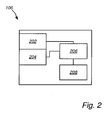
- Fig. 2 shows internal components of the control unit 106.
- the control unit 106 comprises a receiver 202, a transmitter 204, a processing unit 206 and a memory 208.
- the receiver 202 may for example be arranged to receive a capacitance value C of the capacitor 102 and a required energy level W need .
- the transmitter 204 may, for example, be arranged to transmit a signal pertaining to an adjusted charge voltage to the adjustable voltage regulator 104.
- the processing unit 206 which may be a central processing unit is arranged to adjust a charge voltage of the capacitor 102 according to embodiments of the present invention.
- the memory 208 may store computer-readable instructions which, when loaded and read by the processing unit 106, causes the processing unit 106 to carry out a method according to embodiments of the invention.
- a capacitance value C of the capacitor 102 is received.
- the capacitance value C may be received by the receiver 202 of the control unit 106.
- the capacitance value C may be determined based on measurements made on the capacitor 102 as is further described below.
- the capacitance value C may be received from a database. If so, the capacitance value may be determined based on information pertaining to the variation of the capacitance value C as a function of time and/or temperature.
- step S106 a value of the required energy level W need is received.
- the required energy level W need may be received by the receiver 202.
- the required energy level W need may for example be received from a database or from a user input.
- step S108 the charge voltage V C of the capacitor 102 is adjusted.
- An appropriate charge voltage V C may for example be determined by the processing unit 206 of the control unit 106. Further, a signal relating to the determined charge voltage V C may be sent to the adjustable voltage regulator 104, via transmitter 204 of the control unit 106. The adjustable voltage regulator 104 may apply a voltage level across the capacitor 102 corresponding to the adjusted charge voltage. The charge voltage V C is adjusted based on the capacitance value C received in step S102 and the value of the required energy level W need received in step S106.
- the method may further comprise a step S104 of receiving a conductance value G of the capacitor 102.
- the step S108 of adjusting the charge voltage V C may further comprise adjusting the charge voltage based on the conductance value G. This is particularly useful for long lifetimes of the capacitor 102 since the conductance G decreases upon aging of the capacitor 102.
- W need is a known constant
- W stored is a function of the charge voltage V C .
- the charge voltage V C may also be thought of as the initial voltage across the capacitor 102 prior to discharging.
- the energy losses W ESR in the capacitor 102 depends on the discharge current, i(t) say, which flows from the capacitor 102 during discharging.
- the discharge current i(t) is a function of time since, as the voltage across the capacitor 102 decreases during discharging, the discharge current i(t) increases such that a power P provided to the load 110 is kept constant.
- the above system of equations may for example be solved numerically.
- the capacitance value C does not depend on the charge voltage.
- the inventor has realized that the capacitance value C in fact is an increasing, non-linear, function of the charge voltage.
- the method may therefore comprise receiving the new capacitance value C 1 .
- the iteration may be continued until the energy level W stored stored in the capacitor is essentially equal to the required energy level W need .
- the above iterative algorithm may be carried out by the control unit 106.
- the adjusting of the charge voltage may be performed in cycles. More specifically, the steps S102, S106, S108 and S104, where applicable, may be carried out periodically, such as once every day.
- the cycles may have a predetermined period. In one embodiment the period of the cycles is between about 1 second and about 24 hours.
- the period of the cycles may be determined based on the temperature. More precisely, the control unit 106 may receive, for example via the receiver 202, a temperature value of ambient temperature. The control unit 106 may then determine a period of the cycles based on the received temperature value. The determination may be carried out by the processing unit 206.
- the method may further comprise determining the capacitance value C of the capacitor 102.
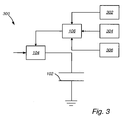
- Fig. 3 illustrates an arrangement 300 which may be used to determine the capacitance value C.
- the arrangement 300 comprises a capacitor 102 which is connected to a power net via an adjustable voltage regulator 104.
- a control unit 106 is connected to the adjustable voltage regulator 104 and is arranged to transmit a signal relating to an adjusted charge voltage to the adjustable voltage regulator 104.
- the control unit 106 is further wired or wirelessly connected to a database 302.
- the database 302 may comprise information pertaining to variation of the capacitance value C as a function of time and/or temperature.
- the information may pertain to the decrease of the capacitance value C due to aging.
- the information may be stored in a table or in the form of a graph or curve.
- the information may be based on calibration experiments which previously have been performed on capacitors.
- the control unit 106 is arranged to receive information pertaining to variation of the capacitance value C as a function of time and/or temperature from a curve or a table.
- the control unit 106 may further be connected to a time measuring means 306 and a temperature gauge 304.
- the time measuring means 306 may for example provide the control unit 106 with a current time and the temperature gauge 304 may provide the control unit 106 with a current temperature.
- the control unit 108 may determine the capacitance value C of the capacitor 102 as the capacitance value of the curve or table that corresponds to a current time and/or temperature.
- Fig. 3 may mutatis mutandis be used to determine a conductance value G of the capacitor.
- Fig. 4 shows an alternative arrangement 400 which may be used to determine the capacitance value C of the capacitor 102.
- the arrangement comprises a capacitor 102 which is connected to a power net via an adjustable voltage regulator 104.
- a control unit 106 is connected to the adjustable voltage regulator 104 and may transmit a signal relating to an adjusted charge voltage to the adjustable voltage regulator 104 as previously disclosed.
- the control unit 106 is further arranged to send a signal to the adjustable voltage regulator 104 instructing the adjustable voltage regulator 104 to provide a charge current to the capacitor 102.
- the control unit 106 is further arranged to measure a voltage across the capacitor 102.
- the arrangement 400 may further comprise a load 402 such as a resistive load or an active current sink, being connected in parallel to the capacitor 102.
- the load 402 is arranged to be turned on and off.
- the control unit 106 may be arranged to turn the load 402 on and off via a switch.
- the arrangement 400 may comprise an arrangement 404 for measuring a charge current.
- the charge current measuring arrangement 404 may be arranged in the circuit between the adjustable voltage regulator 104 and the capacitor 102. Further, the arrangement 404 may be connected to the control unit 106.
- the arrangement 400 may comprise an arrangement 406 for measuring a discharge current.
- the discharge current measuring arrangement 406 is preferably connected in series with the load 402. The arrangement 406 is further connected to the control unit 106.
- the current measuring arrangements 404 and 406 may comprise a high precision resistor and the current may be measured by measuring the voltage across the high precision resistor. The measuring of the voltage across the high precision resistor may be carried out by the control unit 106.
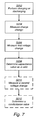
- a step S202 one of charging and discharging of the capacitor 102 is performed.
- the charging may be performed by providing a charging current to the capacitor 102.
- the control unit 106 may instruct the adjustable voltage regulator 104 to provide a charging current to the capacitor 102.
- the discharging may be performed by turning on the load 402 being connected in parallel with the capacitor 102.
- the load 402 may for example be turned on by the control unit 106. Upon activation of the load 402, a discharging current is caused to flow from the capacitor 102 through the load 402.
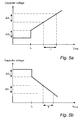
- Figs 5a and 5b illustrate the voltage across the capacitor 102 during charging and discharging, respectively.
- the charging or discharging is initiated at a first time point t 0 .
- a charging current or a discharging current starts to flow to or from the capacitor 102.
- ⁇ V 2 there will be a jump ⁇ V 2 in the voltage across the capacitor 102 at the first time point t 0 . This is due to an ohmic voltage drop caused by the ESR in the capacitor 102 when a charging or discharging current starts to flow to or from the capacitor 102.
- the charge of the capacitor 102 increases or decreases depending on if the capacitor is charged or discharged.
- the charge change ⁇ Q T of the capacitor during a time period T is given by the integral of the current to or from the capacitor 102 during the time period T.
- the time period T is assumed to occur after time t 0 .
- the voltage across the capacitor 102 increases or decreases after time t 0 depending on whether the capacitor 102 is being charged or discharged. In particular, there is a first voltage change ⁇ V 1 across the voltage during the time period T.
- the charge change ⁇ Q T during the time period T is measured.
- the charge change ⁇ Q T may for example be measured by the control unit 106 via the charge current measuring arrangement 404 or the discharge current measuring arrangement 406. More specifically, the charge change ⁇ Q T may be measured by measuring and integrating the charge or discharge current during the time period T.
- the first voltage change ⁇ V 1 across the voltage during the time period T is measured.
- the first voltage change ⁇ V 1 may for example be measured by the control unit.
- the time period T may be any time period of charging or discharging occurring after time t 0 .
- the time period T is as long as possible to minimize measurement uncertainty.
- the method may further comprise a step S210 of measuring a second voltage change corresponding to the jump ⁇ V 2 in the voltage across the capacitor 102 at the first time point to.
- the measuring may be performed by the control unit 106.
- the conductance value G of the capacitor 102 may be determined as the ratio between the known current value and the measured second voltage change ⁇ V 2 .
- the conductance value G may be determined by the control unit 106.
- the charging current or the discharging current corresponds to a constant current value
- the voltage across the capacitor 102 increases or decreases linearly as a function of time during charging or discharging, as illustrated in Figs. 5a and 5b . If so, the rate of increase or decrease of the voltage across the capacitor 102 corresponds to the capacitance value C.
- the step 208 of determining the capacitance value C simplifies to determining a gradient of the voltage across the capacitor 102 during charging or discharging. The determination and the measuring of the voltage across the capacitor 102 may be performed by the control unit 106.
Landscapes
- Engineering & Computer Science (AREA)
- Power Engineering (AREA)
- Charge And Discharge Circuits For Batteries Or The Like (AREA)
- Control Of Electrical Variables (AREA)
- Secondary Cells (AREA)
Applications Claiming Priority (1)
| Application Number | Priority Date | Filing Date | Title |
|---|---|---|---|
| PCT/EP2012/050563 WO2013107497A1 (en) | 2012-01-16 | 2012-01-16 | Adjustment of a capacitor charge voltage |
Publications (2)
| Publication Number | Publication Date |
|---|---|
| EP2805401A1 EP2805401A1 (en) | 2014-11-26 |
| EP2805401B1 true EP2805401B1 (en) | 2015-12-30 |
Family
ID=45558688
Family Applications (1)
| Application Number | Title | Priority Date | Filing Date |
|---|---|---|---|
| EP12701847.1A Active EP2805401B1 (en) | 2012-01-16 | 2012-01-16 | Adjustment of a capacitor charge voltage |
Country Status (6)
| Country | Link |
|---|---|
| US (1) | US20150340882A1 (https=) |
| EP (1) | EP2805401B1 (https=) |
| CN (1) | CN104054233B (https=) |
| AU (1) | AU2012366914B2 (https=) |
| IN (1) | IN2014KN01565A (https=) |
| WO (1) | WO2013107497A1 (https=) |
Families Citing this family (18)
| Publication number | Priority date | Publication date | Assignee | Title |
|---|---|---|---|---|
| CN104956565B (zh) * | 2012-12-24 | 2019-05-07 | 麦格纳覆盖件有限公司 | 用于汽车系统的备用能量源及相关控制方法 |
| CN104716814B (zh) * | 2013-12-13 | 2018-10-26 | 光宝电子(广州)有限公司 | 电源供应系统及其控制方法 |
| WO2015183250A1 (en) * | 2014-05-28 | 2015-12-03 | Schneider Electric Buildings Llc | Estimation of the remaining lifetime of a supercapacitor |
| US20160202749A1 (en) * | 2015-01-13 | 2016-07-14 | Netlist, Inc. | System and method for determining charge of a secondary power supply for a memory system |
| EP3160000B1 (de) * | 2015-10-20 | 2020-12-23 | Siemens Aktiengesellschaft | Einstellen eines arbeitspunktes eines betriebsbereiten elektrischen energiespeichers |
| FI128211B (fi) | 2017-05-23 | 2019-12-31 | Abloy Oy | Sähkölukkojärjestely |
| US10620247B2 (en) | 2017-09-27 | 2020-04-14 | Quanta Computer Inc. | System and method to detect capacitance of a power supply unit |
| US10886837B2 (en) * | 2018-03-09 | 2021-01-05 | The Johns Hopkins University | Virtual capacitor |
| US11870280B2 (en) * | 2018-09-19 | 2024-01-09 | Johnson Controls Tyco IP Holdings LLP | Systems and methods for controlling super capacitor charge voltage to extend super capacitor life |
| US12474417B2 (en) | 2018-09-19 | 2025-11-18 | Tyco Fire & Security Gmbh | Systems and methods for controlling super capacitor charge voltage to extend super capacitor life |
| EP3745145A1 (en) | 2019-05-28 | 2020-12-02 | Schneider Electric Industries SAS | Estimation of the remaining useful life of capacitors |
| US11594896B2 (en) * | 2019-10-22 | 2023-02-28 | John Holtzman | Charger extension device |
| US11878600B2 (en) * | 2021-03-31 | 2024-01-23 | Lear Corporation | Vehicle on-board charger with variable DC-link voltage |
| KR102434036B1 (ko) * | 2021-06-17 | 2022-08-19 | 삼성전자주식회사 | 보조 전원 장치의 수명을 위한 충전 전압 제어 방법 및 이를 수행하는 스토리지 장치 |
| EP4379399A1 (en) * | 2022-11-30 | 2024-06-05 | Hitachi Energy Ltd | Parameter estimation for voltage measurements in noisy environments |
| EP4496178A1 (de) * | 2023-07-21 | 2025-01-22 | Siemens Healthineers AG | Verfahren zum betrieb eines speicherkondensators, gesamtvorrichtung, computerprogramm und elektronisch lesbarer datenträger |
| EP4509857A1 (en) * | 2023-08-14 | 2025-02-19 | Tridonic GmbH & Co. KG | Assessing a remaining lifetime of a led gear |
| DE102024134165A1 (de) | 2024-10-21 | 2026-04-23 | Eberspächer Controls Esslingen GmbH & Co. KG | Energieversorgungssystem und Verfahren zum Betreiben eines derartigen Energieversorgungssystems |
Family Cites Families (17)
| Publication number | Priority date | Publication date | Assignee | Title |
|---|---|---|---|---|
| JP3135500B2 (ja) * | 1996-06-27 | 2001-02-13 | ウエスト電気株式会社 | ストロボ装置および該ストロボ装置を内蔵した写真用カメラ |
| JPH1015670A (ja) * | 1996-07-03 | 1998-01-20 | Nippon Avionics Co Ltd | コンデンサ式溶接電源におけるコンデンサの容量補償方法およびその回路 |
| DE10305357B4 (de) * | 2003-02-10 | 2005-12-22 | Siemens Ag | Vorrichtung zur Energieversorgung eines mit sicherheitsrelevanten Komponenten ausgestatteten Zweispannungs-Bordnetzes |
| JP4385664B2 (ja) * | 2003-07-08 | 2009-12-16 | パナソニック株式会社 | 車両用電源装置 |
| JP2005117792A (ja) * | 2003-10-08 | 2005-04-28 | Toshiba Corp | 電力制御装置及び電力制御方法 |
| JP4367374B2 (ja) * | 2005-05-16 | 2009-11-18 | パナソニック株式会社 | 蓄電装置 |
| JP4449940B2 (ja) * | 2006-05-16 | 2010-04-14 | トヨタ自動車株式会社 | 車両用二電源システム |
| US8493036B2 (en) * | 2006-10-21 | 2013-07-23 | Advanced Analogic Technologies, Inc. | Controllable charge paths, and related methods |
| JP2008017691A (ja) * | 2007-07-24 | 2008-01-24 | Toshiba Corp | 電気二重層キャパシタシステムの監視装置 |
| JP5018448B2 (ja) * | 2007-12-18 | 2012-09-05 | パナソニック株式会社 | 蓄電装置 |
| WO2009087956A1 (ja) * | 2008-01-07 | 2009-07-16 | Panasonic Corporation | 蓄電装置 |
| US8552687B2 (en) * | 2008-06-05 | 2013-10-08 | GM Global Technology Operations LLC | Method and system for characterizing a battery |
| TWI472120B (zh) * | 2008-07-23 | 2015-02-01 | 皇家飛利浦電子股份有限公司 | 用於對超級電容器充電之方法及充電器 |
| US8058744B2 (en) * | 2008-10-23 | 2011-11-15 | GM Global Technology Operations LLC | Electrical system and automotive drive system having an on-demand boost converter, and related operating methods |
| DE102009018098A1 (de) * | 2009-04-20 | 2010-10-21 | Austriamicrosystems Ag | Ladeschaltung für einen Ladungsspeicher und Verfahren zum Laden eines solchen |
| JP5953299B2 (ja) * | 2010-06-28 | 2016-07-20 | マックスウェル テクノロジーズ インコーポレイテッド | 直列モジュールにおけるキャパシタ寿命の最大化 |
| JP2012137341A (ja) * | 2010-12-24 | 2012-07-19 | Toshiba Corp | 電子機器、及び同電子機器における蓄電器静電容量検出方法 |
-
2012
- 2012-01-16 CN CN201280066968.3A patent/CN104054233B/zh active Active
- 2012-01-16 US US14/372,144 patent/US20150340882A1/en not_active Abandoned
- 2012-01-16 AU AU2012366914A patent/AU2012366914B2/en active Active
- 2012-01-16 WO PCT/EP2012/050563 patent/WO2013107497A1/en not_active Ceased
- 2012-01-16 IN IN1565KON2014 patent/IN2014KN01565A/en unknown
- 2012-01-16 EP EP12701847.1A patent/EP2805401B1/en active Active
Also Published As
| Publication number | Publication date |
|---|---|
| IN2014KN01565A (https=) | 2015-10-23 |
| AU2012366914A1 (en) | 2014-07-10 |
| EP2805401A1 (en) | 2014-11-26 |
| WO2013107497A1 (en) | 2013-07-25 |
| CN104054233B (zh) | 2017-05-03 |
| AU2012366914B2 (en) | 2017-01-05 |
| CN104054233A (zh) | 2014-09-17 |
| US20150340882A1 (en) | 2015-11-26 |
Similar Documents
| Publication | Publication Date | Title |
|---|---|---|
| EP2805401B1 (en) | Adjustment of a capacitor charge voltage | |
| JP5897701B2 (ja) | 電池状態推定装置 | |
| US10186898B2 (en) | Capacitive power system having a service life extending approach | |
| US20160274193A1 (en) | Battery remaining power predicting device and battery pack | |
| KR102783337B1 (ko) | 에너지 저장 시스템의 충전용량 산출 장치 및 방법 | |
| CN110515002B (zh) | 电池容量监测器 | |
| JP6824614B2 (ja) | 劣化判定装置及び劣化判定方法 | |
| US10693310B2 (en) | Hiccup charger | |
| US9052368B2 (en) | Negative peak voltage detection for enhanced FuelGauge empty voltage prediction | |
| CN108431617B (zh) | 用于确定电池的电荷状态的系统和方法 | |
| KR20160110211A (ko) | 전지 잔량 예측 장치 및 배터리 팩 | |
| EP3425721A1 (en) | Thermal management system for batteries | |
| CN111697275B (zh) | 半导体器件和电池组 | |
| US20150063401A1 (en) | Temperature measurement apparatus using negative temperature coefficient thermistor | |
| EP2827163A1 (en) | Temperature-compensated state of charge estimation for rechargeable batteries | |
| KR20160060556A (ko) | 전지 잔량 예측 장치 및 배터리 팩 | |
| US10948543B2 (en) | System for determining a discharge power limit value and a charge power limit value of a battery cell | |
| WO2015183250A1 (en) | Estimation of the remaining lifetime of a supercapacitor | |
| JP7042413B2 (ja) | 内部抵抗検出装置及び電源装置 | |
| CN110780217B (zh) | 半导体装置、以及蓄电池的余量的检测方法 | |
| CN102576053B (zh) | 电池状态推断方法及电源系统 | |
| JP6386351B2 (ja) | 蓄電池の充電率の算出方法 | |
| KR102037378B1 (ko) | 정전류시 soc 추정 방법, 장치, 이를 포함하는 배터리 관리 시스템 및 에너지 저장 시스템 | |
| CN112505555B (zh) | 用于监视电池的装置和用于监视电池的方法 | |
| US10770911B1 (en) | Calibrating battery fuel gages |
Legal Events
| Date | Code | Title | Description |
|---|---|---|---|
| PUAI | Public reference made under article 153(3) epc to a published international application that has entered the european phase |
Free format text: ORIGINAL CODE: 0009012 |
|
| 17P | Request for examination filed |
Effective date: 20140808 |
|
| AK | Designated contracting states |
Kind code of ref document: A1 Designated state(s): AL AT BE BG CH CY CZ DE DK EE ES FI FR GB GR HR HU IE IS IT LI LT LU LV MC MK MT NL NO PL PT RO RS SE SI SK SM TR |
|
| DAX | Request for extension of the european patent (deleted) | ||
| GRAP | Despatch of communication of intention to grant a patent |
Free format text: ORIGINAL CODE: EPIDOSNIGR1 |
|
| INTG | Intention to grant announced |
Effective date: 20150703 |
|
| RIN1 | Information on inventor provided before grant (corrected) |
Inventor name: GOETH, FREDRIK |
|
| GRAS | Grant fee paid |
Free format text: ORIGINAL CODE: EPIDOSNIGR3 |
|
| GRAA | (expected) grant |
Free format text: ORIGINAL CODE: 0009210 |
|
| AK | Designated contracting states |
Kind code of ref document: B1 Designated state(s): AL AT BE BG CH CY CZ DE DK EE ES FI FR GB GR HR HU IE IS IT LI LT LU LV MC MK MT NL NO PL PT RO RS SE SI SK SM TR |
|
| REG | Reference to a national code |
Ref country code: GB Ref legal event code: FG4D |
|
| REG | Reference to a national code |
Ref country code: CH Ref legal event code: EP |
|
| REG | Reference to a national code |
Ref country code: AT Ref legal event code: REF Ref document number: 767867 Country of ref document: AT Kind code of ref document: T Effective date: 20160115 |
|
| REG | Reference to a national code |
Ref country code: IE Ref legal event code: FG4D |
|
| REG | Reference to a national code |
Ref country code: DE Ref legal event code: R096 Ref document number: 602012013342 Country of ref document: DE |
|
| REG | Reference to a national code |
Ref country code: LT Ref legal event code: MG4D Ref country code: FR Ref legal event code: PLFP Year of fee payment: 5 |
|
| PG25 | Lapsed in a contracting state [announced via postgrant information from national office to epo] |
Ref country code: HR Free format text: LAPSE BECAUSE OF FAILURE TO SUBMIT A TRANSLATION OF THE DESCRIPTION OR TO PAY THE FEE WITHIN THE PRESCRIBED TIME-LIMIT Effective date: 20151230 Ref country code: NO Free format text: LAPSE BECAUSE OF FAILURE TO SUBMIT A TRANSLATION OF THE DESCRIPTION OR TO PAY THE FEE WITHIN THE PRESCRIBED TIME-LIMIT Effective date: 20160330 Ref country code: LT Free format text: LAPSE BECAUSE OF FAILURE TO SUBMIT A TRANSLATION OF THE DESCRIPTION OR TO PAY THE FEE WITHIN THE PRESCRIBED TIME-LIMIT Effective date: 20151230 |
|
| REG | Reference to a national code |
Ref country code: NL Ref legal event code: MP Effective date: 20151230 |
|
| REG | Reference to a national code |
Ref country code: AT Ref legal event code: MK05 Ref document number: 767867 Country of ref document: AT Kind code of ref document: T Effective date: 20151230 |
|
| PG25 | Lapsed in a contracting state [announced via postgrant information from national office to epo] |
Ref country code: SE Free format text: LAPSE BECAUSE OF FAILURE TO SUBMIT A TRANSLATION OF THE DESCRIPTION OR TO PAY THE FEE WITHIN THE PRESCRIBED TIME-LIMIT Effective date: 20151230 Ref country code: BE Free format text: LAPSE BECAUSE OF NON-PAYMENT OF DUE FEES Effective date: 20160131 Ref country code: FI Free format text: LAPSE BECAUSE OF FAILURE TO SUBMIT A TRANSLATION OF THE DESCRIPTION OR TO PAY THE FEE WITHIN THE PRESCRIBED TIME-LIMIT Effective date: 20151230 Ref country code: LV Free format text: LAPSE BECAUSE OF FAILURE TO SUBMIT A TRANSLATION OF THE DESCRIPTION OR TO PAY THE FEE WITHIN THE PRESCRIBED TIME-LIMIT Effective date: 20151230 Ref country code: RS Free format text: LAPSE BECAUSE OF FAILURE TO SUBMIT A TRANSLATION OF THE DESCRIPTION OR TO PAY THE FEE WITHIN THE PRESCRIBED TIME-LIMIT Effective date: 20151230 Ref country code: GR Free format text: LAPSE BECAUSE OF FAILURE TO SUBMIT A TRANSLATION OF THE DESCRIPTION OR TO PAY THE FEE WITHIN THE PRESCRIBED TIME-LIMIT Effective date: 20160331 |
|
| PG25 | Lapsed in a contracting state [announced via postgrant information from national office to epo] |
Ref country code: NL Free format text: LAPSE BECAUSE OF FAILURE TO SUBMIT A TRANSLATION OF THE DESCRIPTION OR TO PAY THE FEE WITHIN THE PRESCRIBED TIME-LIMIT Effective date: 20151230 |
|
| PG25 | Lapsed in a contracting state [announced via postgrant information from national office to epo] |
Ref country code: CZ Free format text: LAPSE BECAUSE OF FAILURE TO SUBMIT A TRANSLATION OF THE DESCRIPTION OR TO PAY THE FEE WITHIN THE PRESCRIBED TIME-LIMIT Effective date: 20151230 Ref country code: ES Free format text: LAPSE BECAUSE OF FAILURE TO SUBMIT A TRANSLATION OF THE DESCRIPTION OR TO PAY THE FEE WITHIN THE PRESCRIBED TIME-LIMIT Effective date: 20151230 Ref country code: IT Free format text: LAPSE BECAUSE OF FAILURE TO SUBMIT A TRANSLATION OF THE DESCRIPTION OR TO PAY THE FEE WITHIN THE PRESCRIBED TIME-LIMIT Effective date: 20151230 |
|
| PG25 | Lapsed in a contracting state [announced via postgrant information from national office to epo] |
Ref country code: SM Free format text: LAPSE BECAUSE OF FAILURE TO SUBMIT A TRANSLATION OF THE DESCRIPTION OR TO PAY THE FEE WITHIN THE PRESCRIBED TIME-LIMIT Effective date: 20151230 Ref country code: PT Free format text: LAPSE BECAUSE OF FAILURE TO SUBMIT A TRANSLATION OF THE DESCRIPTION OR TO PAY THE FEE WITHIN THE PRESCRIBED TIME-LIMIT Effective date: 20160502 Ref country code: IS Free format text: LAPSE BECAUSE OF FAILURE TO SUBMIT A TRANSLATION OF THE DESCRIPTION OR TO PAY THE FEE WITHIN THE PRESCRIBED TIME-LIMIT Effective date: 20160430 Ref country code: RO Free format text: LAPSE BECAUSE OF FAILURE TO SUBMIT A TRANSLATION OF THE DESCRIPTION OR TO PAY THE FEE WITHIN THE PRESCRIBED TIME-LIMIT Effective date: 20151230 Ref country code: LU Free format text: LAPSE BECAUSE OF FAILURE TO SUBMIT A TRANSLATION OF THE DESCRIPTION OR TO PAY THE FEE WITHIN THE PRESCRIBED TIME-LIMIT Effective date: 20160116 Ref country code: AT Free format text: LAPSE BECAUSE OF FAILURE TO SUBMIT A TRANSLATION OF THE DESCRIPTION OR TO PAY THE FEE WITHIN THE PRESCRIBED TIME-LIMIT Effective date: 20151230 Ref country code: EE Free format text: LAPSE BECAUSE OF FAILURE TO SUBMIT A TRANSLATION OF THE DESCRIPTION OR TO PAY THE FEE WITHIN THE PRESCRIBED TIME-LIMIT Effective date: 20151230 Ref country code: SK Free format text: LAPSE BECAUSE OF FAILURE TO SUBMIT A TRANSLATION OF THE DESCRIPTION OR TO PAY THE FEE WITHIN THE PRESCRIBED TIME-LIMIT Effective date: 20151230 Ref country code: PL Free format text: LAPSE BECAUSE OF FAILURE TO SUBMIT A TRANSLATION OF THE DESCRIPTION OR TO PAY THE FEE WITHIN THE PRESCRIBED TIME-LIMIT Effective date: 20151230 |
|
| REG | Reference to a national code |
Ref country code: CH Ref legal event code: PL |
|
| PG25 | Lapsed in a contracting state [announced via postgrant information from national office to epo] |
Ref country code: MC Free format text: LAPSE BECAUSE OF FAILURE TO SUBMIT A TRANSLATION OF THE DESCRIPTION OR TO PAY THE FEE WITHIN THE PRESCRIBED TIME-LIMIT Effective date: 20151230 |
|
| REG | Reference to a national code |
Ref country code: DE Ref legal event code: R097 Ref document number: 602012013342 Country of ref document: DE |
|
| PG25 | Lapsed in a contracting state [announced via postgrant information from national office to epo] |
Ref country code: LI Free format text: LAPSE BECAUSE OF NON-PAYMENT OF DUE FEES Effective date: 20160131 Ref country code: CH Free format text: LAPSE BECAUSE OF NON-PAYMENT OF DUE FEES Effective date: 20160131 Ref country code: DK Free format text: LAPSE BECAUSE OF FAILURE TO SUBMIT A TRANSLATION OF THE DESCRIPTION OR TO PAY THE FEE WITHIN THE PRESCRIBED TIME-LIMIT Effective date: 20151230 |
|
| REG | Reference to a national code |
Ref country code: IE Ref legal event code: MM4A |
|
| PLBE | No opposition filed within time limit |
Free format text: ORIGINAL CODE: 0009261 |
|
| STAA | Information on the status of an ep patent application or granted ep patent |
Free format text: STATUS: NO OPPOSITION FILED WITHIN TIME LIMIT |
|
| 26N | No opposition filed |
Effective date: 20161003 |
|
| PG25 | Lapsed in a contracting state [announced via postgrant information from national office to epo] |
Ref country code: BE Free format text: LAPSE BECAUSE OF FAILURE TO SUBMIT A TRANSLATION OF THE DESCRIPTION OR TO PAY THE FEE WITHIN THE PRESCRIBED TIME-LIMIT Effective date: 20151230 |
|
| REG | Reference to a national code |
Ref country code: FR Ref legal event code: PLFP Year of fee payment: 6 |
|
| PG25 | Lapsed in a contracting state [announced via postgrant information from national office to epo] |
Ref country code: IE Free format text: LAPSE BECAUSE OF NON-PAYMENT OF DUE FEES Effective date: 20160116 |
|
| PG25 | Lapsed in a contracting state [announced via postgrant information from national office to epo] |
Ref country code: SI Free format text: LAPSE BECAUSE OF FAILURE TO SUBMIT A TRANSLATION OF THE DESCRIPTION OR TO PAY THE FEE WITHIN THE PRESCRIBED TIME-LIMIT Effective date: 20151230 |
|
| PG25 | Lapsed in a contracting state [announced via postgrant information from national office to epo] |
Ref country code: MT Free format text: LAPSE BECAUSE OF FAILURE TO SUBMIT A TRANSLATION OF THE DESCRIPTION OR TO PAY THE FEE WITHIN THE PRESCRIBED TIME-LIMIT Effective date: 20151230 |
|
| REG | Reference to a national code |
Ref country code: FR Ref legal event code: PLFP Year of fee payment: 7 |
|
| PG25 | Lapsed in a contracting state [announced via postgrant information from national office to epo] |
Ref country code: HU Free format text: LAPSE BECAUSE OF FAILURE TO SUBMIT A TRANSLATION OF THE DESCRIPTION OR TO PAY THE FEE WITHIN THE PRESCRIBED TIME-LIMIT; INVALID AB INITIO Effective date: 20120116 |
|
| PG25 | Lapsed in a contracting state [announced via postgrant information from national office to epo] |
Ref country code: CY Free format text: LAPSE BECAUSE OF FAILURE TO SUBMIT A TRANSLATION OF THE DESCRIPTION OR TO PAY THE FEE WITHIN THE PRESCRIBED TIME-LIMIT Effective date: 20151230 Ref country code: MT Free format text: LAPSE BECAUSE OF FAILURE TO SUBMIT A TRANSLATION OF THE DESCRIPTION OR TO PAY THE FEE WITHIN THE PRESCRIBED TIME-LIMIT Effective date: 20160131 Ref country code: MK Free format text: LAPSE BECAUSE OF FAILURE TO SUBMIT A TRANSLATION OF THE DESCRIPTION OR TO PAY THE FEE WITHIN THE PRESCRIBED TIME-LIMIT Effective date: 20151230 |
|
| PG25 | Lapsed in a contracting state [announced via postgrant information from national office to epo] |
Ref country code: BG Free format text: LAPSE BECAUSE OF FAILURE TO SUBMIT A TRANSLATION OF THE DESCRIPTION OR TO PAY THE FEE WITHIN THE PRESCRIBED TIME-LIMIT Effective date: 20151230 |
|
| PG25 | Lapsed in a contracting state [announced via postgrant information from national office to epo] |
Ref country code: AL Free format text: LAPSE BECAUSE OF FAILURE TO SUBMIT A TRANSLATION OF THE DESCRIPTION OR TO PAY THE FEE WITHIN THE PRESCRIBED TIME-LIMIT Effective date: 20151230 Ref country code: TR Free format text: LAPSE BECAUSE OF FAILURE TO SUBMIT A TRANSLATION OF THE DESCRIPTION OR TO PAY THE FEE WITHIN THE PRESCRIBED TIME-LIMIT Effective date: 20151230 |
|
| REG | Reference to a national code |
Ref country code: GB Ref legal event code: S117 Free format text: REQUEST FILED; REQUEST FOR CORRECTION UNDER SECTION 117 FILED ON 04 JULY 2022 |
|
| REG | Reference to a national code |
Ref country code: GB Ref legal event code: S117 Free format text: CORRECTIONS ALLOWED; REQUEST FOR CORRECTION UNDER SECTION 117 FILED ON 4 JULY 2022 WAS ALLOWED ON 3 AUGUST 2022 |
|
| REG | Reference to a national code |
Ref country code: GB Ref legal event code: 732E Free format text: REGISTERED BETWEEN 20220901 AND 20220907 |
|
| REG | Reference to a national code |
Ref country code: DE Ref legal event code: R081 Ref document number: 602012013342 Country of ref document: DE Owner name: SCHNEIDER ELECTRIC BUILDINGS AMERICAS, INC., C, US Free format text: FORMER OWNER: SCHNEIDER ELECTRIC BUILDINGS LLC, NORTH ANDOVER, MA, US |
|
| PGFP | Annual fee paid to national office [announced via postgrant information from national office to epo] |
Ref country code: DE Payment date: 20250129 Year of fee payment: 14 |
|
| PGFP | Annual fee paid to national office [announced via postgrant information from national office to epo] |
Ref country code: FR Payment date: 20250127 Year of fee payment: 14 |
|
| PGFP | Annual fee paid to national office [announced via postgrant information from national office to epo] |
Ref country code: GB Payment date: 20250121 Year of fee payment: 14 |