EP2803518B1 - Dichtungselement - Google Patents
Dichtungselement Download PDFInfo
- Publication number
- EP2803518B1 EP2803518B1 EP14168411.8A EP14168411A EP2803518B1 EP 2803518 B1 EP2803518 B1 EP 2803518B1 EP 14168411 A EP14168411 A EP 14168411A EP 2803518 B1 EP2803518 B1 EP 2803518B1
- Authority
- EP
- European Patent Office
- Prior art keywords
- extrusion layer
- extrusion
- composition
- layer
- sealing member
- Prior art date
- Legal status (The legal status is an assumption and is not a legal conclusion. Google has not performed a legal analysis and makes no representation as to the accuracy of the status listed.)
- Not-in-force
Links
- 238000007789 sealing Methods 0.000 title claims description 109
- 238000001125 extrusion Methods 0.000 claims description 145
- 239000000203 mixture Substances 0.000 claims description 93
- 229920006342 thermoplastic vulcanizate Polymers 0.000 claims description 40
- -1 polypropylene Polymers 0.000 claims description 17
- 238000000034 method Methods 0.000 claims description 15
- 229920002943 EPDM rubber Polymers 0.000 claims description 11
- 239000012815 thermoplastic material Substances 0.000 claims description 7
- 239000004743 Polypropylene Substances 0.000 claims description 6
- 229920001155 polypropylene Polymers 0.000 claims description 6
- 238000010438 heat treatment Methods 0.000 claims description 3
- 239000011521 glass Substances 0.000 claims description 2
- 239000000463 material Substances 0.000 description 11
- 229920001971 elastomer Polymers 0.000 description 7
- 239000000806 elastomer Substances 0.000 description 7
- 230000003014 reinforcing effect Effects 0.000 description 7
- 230000000712 assembly Effects 0.000 description 6
- 238000000429 assembly Methods 0.000 description 6
- 229920001169 thermoplastic Polymers 0.000 description 6
- 239000004416 thermosoftening plastic Substances 0.000 description 6
- 229920003048 styrene butadiene rubber Polymers 0.000 description 5
- 244000043261 Hevea brasiliensis Species 0.000 description 4
- 229920003052 natural elastomer Polymers 0.000 description 4
- 229920001194 natural rubber Polymers 0.000 description 4
- 229920001084 poly(chloroprene) Polymers 0.000 description 4
- 239000007921 spray Substances 0.000 description 4
- 239000004698 Polyethylene Substances 0.000 description 3
- 239000002174 Styrene-butadiene Substances 0.000 description 3
- 239000000654 additive Substances 0.000 description 3
- 230000007613 environmental effect Effects 0.000 description 3
- 239000000945 filler Substances 0.000 description 3
- 230000005484 gravity Effects 0.000 description 3
- 239000004014 plasticizer Substances 0.000 description 3
- 229920001200 poly(ethylene-vinyl acetate) Polymers 0.000 description 3
- 229920000573 polyethylene Polymers 0.000 description 3
- 229910000831 Steel Inorganic materials 0.000 description 2
- 238000002845 discoloration Methods 0.000 description 2
- 239000005038 ethylene vinyl acetate Substances 0.000 description 2
- 239000002783 friction material Substances 0.000 description 2
- 229920002492 poly(sulfone) Polymers 0.000 description 2
- 239000010959 steel Substances 0.000 description 2
- 229920001187 thermosetting polymer Polymers 0.000 description 2
- 229910000838 Al alloy Inorganic materials 0.000 description 1
- 229910000851 Alloy steel Inorganic materials 0.000 description 1
- 229910000975 Carbon steel Inorganic materials 0.000 description 1
- 229920002160 Celluloid Polymers 0.000 description 1
- VYZAMTAEIAYCRO-UHFFFAOYSA-N Chromium Chemical compound [Cr] VYZAMTAEIAYCRO-UHFFFAOYSA-N 0.000 description 1
- 229920000219 Ethylene vinyl alcohol Polymers 0.000 description 1
- 229910001335 Galvanized steel Inorganic materials 0.000 description 1
- 229920000106 Liquid crystal polymer Polymers 0.000 description 1
- 239000004977 Liquid-crystal polymers (LCPs) Substances 0.000 description 1
- 229910001209 Low-carbon steel Inorganic materials 0.000 description 1
- 239000004696 Poly ether ether ketone Substances 0.000 description 1
- 239000004952 Polyamide Substances 0.000 description 1
- 239000004962 Polyamide-imide Substances 0.000 description 1
- 239000004642 Polyimide Substances 0.000 description 1
- 239000004721 Polyphenylene oxide Substances 0.000 description 1
- 239000004734 Polyphenylene sulfide Substances 0.000 description 1
- 239000004954 Polyphthalamide Substances 0.000 description 1
- 239000004793 Polystyrene Substances 0.000 description 1
- 229920001328 Polyvinylidene chloride Polymers 0.000 description 1
- 229910001315 Tool steel Inorganic materials 0.000 description 1
- 229920006397 acrylic thermoplastic Polymers 0.000 description 1
- XECAHXYUAAWDEL-UHFFFAOYSA-N acrylonitrile butadiene styrene Chemical class C=CC=C.C=CC#N.C=CC1=CC=CC=C1 XECAHXYUAAWDEL-UHFFFAOYSA-N 0.000 description 1
- 229920000122 acrylonitrile butadiene styrene Polymers 0.000 description 1
- 239000010962 carbon steel Substances 0.000 description 1
- 229920002301 cellulose acetate Polymers 0.000 description 1
- 239000011248 coating agent Substances 0.000 description 1
- 238000000576 coating method Methods 0.000 description 1
- 230000006835 compression Effects 0.000 description 1
- 238000007906 compression Methods 0.000 description 1
- 229920001577 copolymer Polymers 0.000 description 1
- 230000001351 cycling effect Effects 0.000 description 1
- 238000001035 drying Methods 0.000 description 1
- 238000005562 fading Methods 0.000 description 1
- 229920002313 fluoropolymer Polymers 0.000 description 1
- 239000004811 fluoropolymer Substances 0.000 description 1
- 239000008397 galvanized steel Substances 0.000 description 1
- 229920000554 ionomer Polymers 0.000 description 1
- 238000004519 manufacturing process Methods 0.000 description 1
- 229910052751 metal Inorganic materials 0.000 description 1
- 239000002184 metal Substances 0.000 description 1
- 238000012986 modification Methods 0.000 description 1
- 230000004048 modification Effects 0.000 description 1
- 238000000465 moulding Methods 0.000 description 1
- 229920002493 poly(chlorotrifluoroethylene) Polymers 0.000 description 1
- 239000005014 poly(hydroxyalkanoate) Substances 0.000 description 1
- 229920000747 poly(lactic acid) Polymers 0.000 description 1
- 229920003229 poly(methyl methacrylate) Polymers 0.000 description 1
- 229920000058 polyacrylate Polymers 0.000 description 1
- 229920002239 polyacrylonitrile Polymers 0.000 description 1
- 229920002647 polyamide Polymers 0.000 description 1
- 229920002312 polyamide-imide Polymers 0.000 description 1
- 229920006260 polyaryletherketone Polymers 0.000 description 1
- 229920002857 polybutadiene Polymers 0.000 description 1
- 229920001748 polybutylene Polymers 0.000 description 1
- 229920001707 polybutylene terephthalate Polymers 0.000 description 1
- 229920001610 polycaprolactone Polymers 0.000 description 1
- 229920000515 polycarbonate Polymers 0.000 description 1
- 239000004417 polycarbonate Substances 0.000 description 1
- 229920001123 polycyclohexylenedimethylene terephthalate Polymers 0.000 description 1
- 229920000728 polyester Polymers 0.000 description 1
- 229920002530 polyetherether ketone Polymers 0.000 description 1
- 229920001601 polyetherimide Polymers 0.000 description 1
- 229920000139 polyethylene terephthalate Polymers 0.000 description 1
- 229920000903 polyhydroxyalkanoate Polymers 0.000 description 1
- 229920001721 polyimide Polymers 0.000 description 1
- 229920001470 polyketone Polymers 0.000 description 1
- 229920000306 polymethylpentene Polymers 0.000 description 1
- 229920006324 polyoxymethylene Polymers 0.000 description 1
- 229920006380 polyphenylene oxide Polymers 0.000 description 1
- 229920000069 polyphenylene sulfide Polymers 0.000 description 1
- 229920006375 polyphtalamide Polymers 0.000 description 1
- 229920002223 polystyrene Polymers 0.000 description 1
- 229920002215 polytrimethylene terephthalate Polymers 0.000 description 1
- 229920002635 polyurethane Polymers 0.000 description 1
- 239000004814 polyurethane Substances 0.000 description 1
- 229920002689 polyvinyl acetate Polymers 0.000 description 1
- 229920000915 polyvinyl chloride Polymers 0.000 description 1
- 239000010935 stainless steel Substances 0.000 description 1
- 229910001220 stainless steel Inorganic materials 0.000 description 1
- 229920000638 styrene acrylonitrile Polymers 0.000 description 1
- 239000000126 substance Substances 0.000 description 1
- ISXSCDLOGDJUNJ-UHFFFAOYSA-N tert-butyl prop-2-enoate Chemical compound CC(C)(C)OC(=O)C=C ISXSCDLOGDJUNJ-UHFFFAOYSA-N 0.000 description 1
- 229910052724 xenon Inorganic materials 0.000 description 1
- FHNFHKCVQCLJFQ-UHFFFAOYSA-N xenon atom Chemical compound [Xe] FHNFHKCVQCLJFQ-UHFFFAOYSA-N 0.000 description 1
Images


Classifications
-
- B—PERFORMING OPERATIONS; TRANSPORTING
- B60—VEHICLES IN GENERAL
- B60J—WINDOWS, WINDSCREENS, NON-FIXED ROOFS, DOORS, OR SIMILAR DEVICES FOR VEHICLES; REMOVABLE EXTERNAL PROTECTIVE COVERINGS SPECIALLY ADAPTED FOR VEHICLES
- B60J10/00—Sealing arrangements
- B60J10/80—Sealing arrangements specially adapted for opening panels, e.g. doors
- B60J10/86—Sealing arrangements specially adapted for opening panels, e.g. doors arranged on the opening panel
- B60J10/88—Sealing arrangements specially adapted for opening panels, e.g. doors arranged on the opening panel mounted on, or integral with, the glass-run seals
-
- B—PERFORMING OPERATIONS; TRANSPORTING
- B60—VEHICLES IN GENERAL
- B60J—WINDOWS, WINDSCREENS, NON-FIXED ROOFS, DOORS, OR SIMILAR DEVICES FOR VEHICLES; REMOVABLE EXTERNAL PROTECTIVE COVERINGS SPECIALLY ADAPTED FOR VEHICLES
- B60J10/00—Sealing arrangements
- B60J10/15—Sealing arrangements characterised by the material
- B60J10/16—Sealing arrangements characterised by the material consisting of two or more plastic materials having different physical or chemical properties
-
- B—PERFORMING OPERATIONS; TRANSPORTING
- B60—VEHICLES IN GENERAL
- B60J—WINDOWS, WINDSCREENS, NON-FIXED ROOFS, DOORS, OR SIMILAR DEVICES FOR VEHICLES; REMOVABLE EXTERNAL PROTECTIVE COVERINGS SPECIALLY ADAPTED FOR VEHICLES
- B60J10/00—Sealing arrangements
- B60J10/20—Sealing arrangements characterised by the shape
- B60J10/26—Sealing arrangements characterised by the shape characterised by the surface shape
- B60J10/265—Sealing arrangements characterised by the shape characterised by the surface shape the surface being primarily decorative
Definitions
- the subject invention generally relates to a window seal assembly for a motor vehicle. More specifically, the invention relates to a sealing member of the window seal assembly.
- window seal assemblies for motor vehicles are known in the art. These assemblies typically include multiple sealing members such as a header profile, post profiles, an outer belt profile, and molds (corner and end molds). Window seal assemblies must provide a robust weatherseal and enhance vehicle acoustics. In order provide a robust weatherseal and enhance vehicle acoustics, suppliers have designed complex, multi-material header profiles and other window seal members. The materials used to form such window seal members are typically elastomeric materials which can fade and/or discolor and even leach out oil and other chemicals over time and exposure to various environmental conditions. As such, although functional, these prior art window seal members are not always aesthetically pleasing, e.g., do not provide a uniform appearance when viewed from an exterior of the vehicle and/or do not maintain a uniform appearance over time.
- manufacturers of window seal assemblies and the sealing members thereof go through great lengths to assure that their window seal assemblies and the window seal members thereof provide a uniform appearance when viewed from an exterior of the vehicle.
- manufacturers have designed window seal members which are manufactured, typically by an extrusion and/or molding process and, once formed, each particular window seal member, such as a header profile, is spray coated with a composition that provides a uniform appearance when viewed from an exterior of the vehicle.
- Such spray processes require significant capital investment, additional process and drying time, and can only be applied in minimal thicknesses unless coated multiple times.
- DE10 2006 060 390 B3 discloses a door sealing profile with a sealing section with a sealing lip extending in a longitudinal direction.
- a fastening section is fastened to a flange.
- the sealing section is manufactured from an elastically deformable material and curved in the longitudinal direction.
- the sealing lip has a free end and a base turned away from the free end.
- An auxiliary section is provided and arranged in an area of the curvature at the base of the sealing lip.
- window seal assemblies and window seal members thereof that are economical to produce, provide a robust weatherseal, enhance vehicle acoustics, are aesthetically pleasing and do not fade or discolor over time and upon exposure to various environmental conditions.
- the subject invention provides a sealing member for a vehicle opening comprising:
- the sealing member includes a third co-extrusion layer which provides a uniform appearance when viewed from an exterior of the vehicle.
- the sealing member can be color matched with corner and end molds and other parts of a window seal assembly.
- the third co-extrusian layer which is formed from a thermoplastic vulcanizate composition which has excellent weatherability characteristics, i.e., is resistant to fading or discoloration after exposure to various environmental conditions.
- the sealing member can be extruded in a cost-effective, in-line extrusion process which can eliminate the need to spray coat the sealing member to provide a uniform appearance when viewed from an exterior of the vehicle.
- sealing lip is further defined as a first sealing lip and wherein said second co-extrusion layer includes a second sealing lip extending away from said first co-extrusion layer towards a distal end wherein said first sealing lip and said second sealing lip are spaced from one another for creating a seal against the vehicle.
- said portion has an exterior lip extending into said window channel of said first co-extrusion layer.
- said front face defines the length of said portion.
- thermoplastic vulcanizate composition comprises a thermoplastic material selected from the group of polypropylene, polyethylene, ethylene vinyl acetate, and combinations thereof.
- thermoplastic vulcanizate composition comprises greater than 5 parts by weight of said thermoplastic material, based on 100 parts by weight of said thermoplastic vulcanizate composition.
- thermoplastic vulcanizate composition also comprises ethylene propylene diene monomer.
- said second co-extrusion layer further includes a second portion disposed within said window channel of said first co-extrusion layer and wherein said second portion has a plurality of interior lips for sealing and guiding a window.
- a glass run sealing member comprising a first co-extrusion layer, a second co-extrusion layer, and a third co-extrusion layer, said method comprising the steps of:
- the steps of co-extruding the first elastomeric composition to form the first co-extrusion layer and co-extruding the second elastomeric composition to form the second co-extrusion layer are conducted simultaneously.
- the step of co-extruding the thermoplastic vulcanizate composition to form the third co-extrusion layer is conducted subsequent to the co-extrusion of the first and second co-extrusion layers.
- the method further comprises the step of heating the first and second co-extrusion layers to cure the first and second elastomeric compositions prior to co-extruding the thermoplastic vulcanizate composition to form the third co-extrusion layer.
- a window seal assembly is shown generally at 10.
- Figure 1 is an exterior view of vehicle door 12 which includes a window 14 which is movable in a vertical direction and a window seal assembly 10.
- the window 14 is slidably received in vertical guide tracks in the vehicle door 12. When the window 14 is closed, its edges are adapted to be received within and engaged by the window seal assembly 10.
- the window seal assembly 10 functions to secure the window 14 to the vehicle door 12 when the vehicle is traveling, to provide a seal between the window 14 and vehicle door 12, to enhance vehicle acoustics, and to provide an aesthetically pleasing appearance when viewed from an exterior of the vehicle.
- the window seal assembly 10 shown in Figure 1 comprises a number of sealing members.
- the window seal assembly 10 typically includes one or more sealing members such as a sealing member 16 (in this example a header profile), molds 18, pillar profiles 20, margin profiles 22, and a belt-line profile 24.
- the sealing member 16, molds 18, pillar profiles 20, margin profiles 22, and belt-line profile 24 typically have an outermost layer which is formed from a thermoplastic vulcanizate (TPV) composition and visible from an exterior of the vehicle.
- TPV thermoplastic vulcanizate
- window seal assembly 10 and sealing members thereof may be utilized for sealing trunk openings, door openings, and sunroof openings of the vehicle. It should also be appreciated that the window seal assembly 10 and sealing members thereof may be used for other purposes that are not specifically related to vehicles and are not described herein.
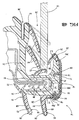
- the sealing member 16 includes a first co-extrusion layer 26 formed from a first elastomeric composition, a second co-extrusion layer 28 formed from a second elastomeric composition, and a third co-extrusion layer 30 formed from the TPV composition.
- the first co-extrusion layer 26 defines a mounting channel 32, a window channel 34, and a front face 36 spaced from the mounting channel 32 and the window channel 34.
- the front face 36 is substantially parallel to window channel 34 and extends from a first reference line L1 to second reference line L2.
- the window channel 34 is adjacent to the mounting channel 32.
- the first co-extrusion layer 26 defines a bottom channel 38 adjacent and substantially parallel to the window channel 34.
- the mounting channel 32 contains a plurality of gripping fins 40 for holding and securing the sealing member 16 to the vehicle door 12.
- the plurality of gripping fins 40 can be any desired quantity of gripping fins 40 or in any configuration for holding and securing the vehicle door.
- the first co-extrusion layer 26 further includes a reinforcing member 42 disposed adjacent to the gripping fins 40 for reinforcing the mounting channel 32.
- the reinforcing member 42 is typically formed from a metal.
- the reinforcing member 42 is formed from steel, e.g. a carbon steel, an alloy steel, a stainless steel, a tool steel, or a coated steel.
- the reinforcing member 42 can be formed from an electro-galvanized steel or a mild steel.
- the reinforcing member 42 can be formed from an aluminum alloy. It should be appreciated that the reinforcing member 42 can formed from materials not described herein which are capable of providing the rigidity to grasp the mounting flange 44 of the door 12 to mount the sealing member 16 on the door 12.
- the first co-extrusion layer 26 is formed from the first elastomeric composition.
- the first elastomeric composition includes an elastomer and can also include plasticizer, filler, and various other components and additives.
- the first elastomeric composition comprises ethylene propylene diene monomer ("EPDM").
- EPDM ethylene propylene diene monomer
- the first elastomeric composition can comprise elastomers other than EPDM such as styrene butadiene rubber (“SBR”), natural rubber, neoprene, and combinations thereof.
- SBR styrene butadiene rubber
- the first elastomeric composition can comprise thermoplastic or thermosetting materials not specifically described herein.
- the first elastomeric composition typically has a Shore A Hardness of from 65 to 100 and more typically from 80 to 90, when tested in accordance with ASTM D2240. Further, the first elastomeric composition typically has a specific gravity of from 1.2 to 1.6 and more typically from 1.3 to 1.5, g/cm 3 .
- the second co-extrusion layer 28 has a portion 46 disposed on the front face 36 of the first co-extrusion layer 26 (extending from L1 to L2) and a sealing lip 48 disposed on the first co-extrusion layer 26 abutting the portion 46 and extending away from the first co-extrusion layer 26 towards a distal end.
- the front face 36 typically defines the length of the portion 46.
- the portion 46 may also include an exterior lip 50 extending into the window channel 34 of the first co-extrusion layer 26.
- the second co-extrusion layer 28 may further include a second sealing lip 52 extending away from the first co-extrusion layer 26 towards a distal end.
- the second sealing lip 52 may have a tail which extends away from the distal end.
- the sealing lip 48 is further defined as the first sealing lip 48 and the first and the second sealing lips 48, 52 are spaced from one another for creating a seal against the door 12.
- the first sealing lip 48 and the second sealing lip 52 are substantially parallel to one another for creating a seal against the door 12.
- the first sealing lip 48 and second sealing lip 52 both contain an interior facing surface 56 and an exterior facing surface 58.
- a flocking material 60 covers the interior facing surface 56 of the first and second sealing lips 48, 52 for reducing the friction between the first and second sealing lips 48, 52 and the door 12.
- the flocking material 60 is also disposed on the first co-extrusion layer 26 adjacent to and within the bottom channel 38.
- the flocking material 60 is typically used on multiple surfaces of the sealing member 16 and typically comprises polyethylene. However, it is to be appreciated any low friction material could also be used on the interior facing surfaces 56 and first co-extrusion layer 26.
- the second co-extrusion layer 28 further includes a second portion 62 disposed within the window channel 34 of the first co-extrusion layer 26.
- the second portion 62 includes a plurality of interior lips 64 for sealing and guiding the window.
- the interior lips 64 include an apex to define a generally V-shaped cross sectional shape along a longitudinal axis for sealing and guiding the window 12.
- the interior lips 64 are disposed opposite the exterior lip 50 of the first portion 46 for sealing against an interior surface and exterior surface of the window 12, respectively.
- the plurality of interior lips 64 can be any desired quantity of interior lips 64 or in any configuration for sealing and guiding the window.
- each of the interior lips 64 and the exterior lip 50 are typically coated with the flocking material 60 or another low friction material.
- the second co-extrusion layer 28 is formed from the second elastomeric composition.
- the second elastomeric composition includes an elastomer and can also include plasticizer, filler, and various other components and additives.
- the second elastomeric composition comprises EPDM.
- the second elastomeric composition can comprise elastomers other than EPDM such as SBR, natural rubber, neoprene, and combinations thereof.
- the second elastomeric composition can comprise thermoplastic or thermosetting materials not specifically described herein.
- the second elastomeric composition and is typically softer and more flexible than the first elastomeric composition. Specifically, the second elastomeric composition exhibits excellent compression set.
- the second elastomeric composition typically has a Shore A Hardness of from 40 to 80 and more typically from 50 to 60, when tested in accordance with ASTM D2240. Further, the second elastomeric composition typically has a specific gravity of from 1.1 to 1.5 and more typically from 1.3 to 1.4, g/cm 3 .
- the third co-extrusion layer 30 is disposed on the portion 46 and the sealing lip 48 of the second co-extrusion layer 28 for covering segments of the second co-extrusion layer 28 that are visible from an exterior of the vehicle. Specifically, the third co-extrusion layer 30 extends from the distal end of the front face 36 (L2) to the distal end of the first sealing lip 48. As such, the third co-extrusion layer 30 covers all portions of the sealing member 16 which are visible to an observer to achieve a uniform color appearance. The subject invention therefore eliminates the common production step of spray applying a coating to these visible surfaces.
- the third co-extrusion layer 30 typically has a thickness greater than 0.1, alternatively from 0.1 to 4, alternatively from 0.5 to 2, mm. As such, the third co-extrusion layer 30 is also durable.
- the placement of the third co-extrusion layer 30 on the sealing member 16 results in the sealing member 16 having two sealing lips, where the first sealing lip 48 is formed from the second elastomeric composition and the TPV composition, i.e., the second co-extrusion layer 28 and the third co-extrusion layer 30, and the second sealing lip 52 is formed from the second elastomeric composition, i.e., the second co-extrusion layer 28.
- the thermoplastic TPV composition comprises an elastomer and also a thermoplastic.
- elastomers which may be included in the TPV composition are EPDM, styrene butadiene rubber, natural rubber, neoprene, and combinations thereof.
- the TPV composition comprises EPDM.
- thermoplastics include acrylonitrile butadiene styrenes, acrylics, celluloids, cellulose acetates, cycloolefin copolymers, ethylene-vinyl acetates, ethylene vinyl alcohols, fluoropolymers, ionomers, liquid crystal polymers, polyacetals, polyacrylates, polyacrylonitriles, polyamides, polyamide-imides, polyaryletherketones, polybutadienes, polybutylenes, polybutylene terephthalates, polycaprolactones, polychlorotrifluoroethylenes, polyethylene terephthalates, polycyclohexylene dimethylene terephthalates, polycarbonates, polyhydroxyalkanoates, polyketones, polyesters, polyethylenes, polyetheretherketones, polyetherimides, polysulfones, polyethylenechlorinates, polyimides, polylactic acids, polymethylpentenes, polyphenylene oxides, polyphenylene
- the TPV composition typically comprises greater than 5, alternatively greater than 10, alternatively greater than 15, parts by weight thermoplastic material, based on 100 parts by of the TPV composition.
- the TPV composition comprises a thermoplastic material selected from the group of polypropylene, polyethylene, ethylene vinyl acetate ("EVA"), and combinations thereof.
- EVA ethylene vinyl acetate
- the TPV composition can include plasticizer, filler, and various other components and additives.
- the TPV composition comprises EPDM and polypropylene.
- the TPV composition can comprise elastomers other than EPDM such as SBR, natural rubber, neoprene, and combinations thereof, and thermoplastics other than polypropylene such as polyethylene and EVA.
- the TPV composition can comprise elastomeric and thermoplastic materials not specifically described herein.
- the TPV composition typically has a Shore A Hardness of from 65 to 100 and more typically from 70 to 80, when tested in accordance with ASTM D2240. Further, the TPV composition typically has a specific gravity of from 0.9 to 1.5 and more typically from 0.95 to 1.2, g/cm 3 . As alluded to above the, the TPV composition is UV stable and exhibits minimal discoloration after cycling in a xenon arc weatherometer.
- the sealing member 16 of this embodiment also includes the first co-extrusion layer 26 formed from the first elastomeric composition, the second co-extrusion layer 28 formed from the second elastomeric composition, and the third co-extrusion layer 30 formed from the TPV composition.
- the third co-extrusion layer has a face portion disposed on said front face of said first co-extrusion layer (extending from L1 to L2) for covering segments of first co-extrusion layer that are visible from an exterior of the vehicle.
- the first sealing lip 48 is formed from the TPV composition, i.e., the third co-extrusion layer 30 and disposed on the first co-extrusion layer 26 abutting the face portion and extending away from the first co-extrusion layer 26 towards a distal end.
- the placement of the third co-extrusion layer 30 on the sealing member 16 results in the sealing member 16 having two sealing lips, where the first sealing lip 48 is formed entirely from the TPV composition, i.e., the third co-extrusion layer 30, and the second sealing lip 52 is formed exclusively from the second elastomeric composition, i.e., the second co-extrusion layer 28.
- FIG. 4A and 4B a cross-sectional view of a third embodiment of the sealing member 16 of the window seal assembly 10 is shown.
- the third embodiment of the sealing member 16 can minimize the need for molds and result in an improved aesthetic appearance as well as enhanced window sealing.
- the trim member 66 can having various finishes such as low gloss black, high gloss black, and chrome.
- the sealing member 16 of the third embodiment includes the first co-extrusion layer 26 formed from the first elastomeric composition, the second co-extrusion layer 28 formed from the second elastomeric composition, and the third co-extrusion layer 30 formed from the TPVcomposition.
- the first co-extrusion layer 26 of this embodiment defines the mounting channel 32, the window channel 34, the front face 36 spaced from the mounting channel 32, and the window channel 34.
- the first co-extrusion layer 26 of this third embodiment defines at least one channel for receiving the trim member 66.
- the at least one channel is further defined as a pair of spaced channels, 68, 70 dividing said front face 36 into an upper portion 36a, a central portion 36b, and a lower portion 36c, with said second co-extrusion layer 28 only formed on a portion of said upper and lower portions 36a, 36c.
- the third co-extrusion layer 30 covers segments of the first co-extrusion layer 26 that are visible from an exterior of the vehicle. Said differently, the first channel 68 dissects the front face 36 and the second channel 70 is adjacent to the first sealing lip 48.
- the first co-extrusion layer 26 also optionally defines a cavity 72 adjacent to the front face 36.
- the trim member 66 which has a front face 74, a main body 76, and a first and a second stem 78, 80, received within the channels 68, 70 of the sealing member 16. More specifically, the first and second stem 78, 80 are received within the channels 68, 70 to secure the trim member 66 to the sealing member 16.
- Figure 4A is a cross-sectional view of a third embodiment of the sealing member 16 with the trim member 66 shown spaced from the sealing member 16 whereas Figure 4B is a cross-sectional view of the sealing member 16 of Figure 4A showing the trim member 66 coupled to the sealing member 16.
- a method of forming the sealing member 16 of the subject invention includes the steps of co-extruding the first elastomeric composition to form the first co-extrusion layer 26, co-extruding the second elastomeric composition to form the second co-extrusion layer 28, and co-extruding the TPV composition to form the third co-extrusion layer 30.
- the steps of co-extruding the first elastomeric composition to form the first co-extrusion layer 26 and co-extruding the second elastomeric composition to form the second co-extrusion layer 28 are conducted simultaneously.
- This embodiment also typically includes the step of heating the first and second co-extrusion layers 26, 28 to cure the first and second elastomeric compositions prior to co-extruding the TPV composition to form the third co-extrusion layer 30. Once cured, the first and second co-extrusion layers 26, 28 are optionally cooled. Further, the extrudite comprising the first and second co-extrusion layers 26, 28 is optionally fed through a flocking booth where flocking is applied. The step of co-extruding the TPV composition to form the third co-extrusion layer 30 is conducted subsequent to the co-extrusion of the first and second co-extrusion layers.
Landscapes
- Engineering & Computer Science (AREA)
- Mechanical Engineering (AREA)
- Extrusion Moulding Of Plastics Or The Like (AREA)
- Seal Device For Vehicle (AREA)
Claims (12)
- Dichtungselement (16) für eine Fahrzeugöffnung, umfassend:eine erste Koextrusionsschicht (26), welche einen Montagekanal (32), einen Fensterkanal (34) und eine vom Montagekanal (32) und dem Fensterkanal (34) beabstandete Vorderfläche (36) festlegt, wobei diese erste Koextrusionsschicht (26) aus einer ersten elastomeren Komposition gebildet ist;eine zweite Koextrusionsschicht (28), welche einen auf der Vorderseite (36) der ersten Koextrusionsschicht (26) angeordneten Abschnitt (46) und eine auf der ersten Koextrusionsschicht (26) angeordnete Dichtungslippe (48), die an dem Abschnitt (46) anliegt und sich von der ersten Koextrusionsschicht (26) weg zu einem distalen Ende erstreckt, aufweist, wobei diese zweite Koextrusionsschicht (28) aus einer zweiten elastomeren Komposition, die sich von der ersten elastomeren Komposition unterscheidet, gebildet ist; undeine dritte Koextrusionsschicht (30), die auf dem Abschnitt (46) und der Dichtlippe (48) der zweiten Koextrusionsschicht (28) angeordnet ist, um Segmente der zweiten Koextrusionsschicht (28), die von ausserhalb des Fahrzeugs sichtbar sind, zu bedecken, wobei die dritte Koextrusionsschicht (30) aus einer thermoplastischen Vulkanisats-Komposition gebildet ist, die sich von der ersten und der zweiten elastomeren Komposition unterscheidet.
- Dichtungselement (16) nach Anspruch 1, wobei die Dichtlippe (48) als eine erste Dichtlippe (48) definiert ist und wobei die zweite Koextrusionsschicht (28) eine zweite Dichtlippe (52) aufweist, die sich von der ersten Koextrusionsschicht (26) weg zu einem distalen Ende erstreckt, wobei die erste Dichtlippe (48) und die zweite Dichtlippe (52) voneinander beabstandet sind, um eine Abdichtung gegen das Fahrzeug zu erzeugen.
- Dichtungselement (16) nach Anspruch 1, wobei der Abschnitt (46) eine äussere Lippe (50) aufweist, die sich in den Fensterkanal (34) der ersten Koextrusionsschicht (26) erstreckt.
- Dichtungselement (16) nach Anspruch 1, wobei die Vorderfläche (36) die Länge dieses Abschnittes (46) festlegt.
- Dichtungselement (16) nach Anspruch 1, wobei die thermoplastische Vulkanisats-Komposition ein thermoplastisches Material umfasst, welches aus der Gruppe der Polypropylene, Polyethylene, Ethylenvinylacetate und Kombinationen davon ausgewählt ist.
- Dichtungselement (16) nach Anspruch 5, wobei die thermoplastische Vulkanisats-Komposition mehr als 5 Gewichts-Teile des thermoplastischen Materials umfasst, bezogen auf 100 Gewichtsteile der thermoplastischen Vulkanisats-Komposition.
- Dichtungselement (16) nach Anspruch 6, wobei die thermoplastische Vulkanisats-Komposition auch Ethylen-Propylen-Dien-Monomer umfasst.
- Dichtungselement (16) nach Anspruch 1, wobei die zweite Koextrusionsschicht (28) ferner einen zweiten Abschnitt (62) aufweist, der innerhalb des Fensterkanals (34) der ersten Koextrusionsschicht (26) angeordnet ist, wobei dieser zweite Abschnitt (62) eine Vielzahl von Innenlippen (64) zum Abdichten und Führen eines Fensters aufweist.
- Verfahren zur Herstellung eines Glaslaufdichtungselementes (16) mit einer ersten Koextrusionsschicht (26), einer zweiten Koextrusionsschicht (28) und einer dritten Koextrusionsschicht (30), wobei das Verfahren folgende Schritte umfasst:Koextrudieren einer ersten elastomeren Komposition, um die erste Koextrusionsschicht (26) zu bilden, welche erste Koextrusionsschicht (26) einen Montagekanal (32), einen Fensterkanal (34) und eine Vorderseite (36), die vom Montagekanal (32) und dem Fensterkanal (34) beabstandet ist, festlegt;Koextrudieren einer zweiten elastomeren Komposition, die sich von der ersten Koextrusionsschicht unterscheidet, um auf der ersten Koextrusionsschicht (26) eine zweite Koextrusionsschicht (28) zu bilden, wobei die zweite Koextrusionsschicht (28) einen an der Vorderseite (36) der ersten Koextrusionsschicht (26) angeordneten Abschnitt (46) und eine Dichtlippe (48) aufweist, welche auf der ersten Koextrusionsschicht (26) angeordnet ist und an dem Abschnitt (46) anliegt und sich von dieser Koextrusionsschicht (26) weg zu einem distalen Ende erstreckt; undKoextrudieren einer thermoplastischen Vulkanisats-Komposition, die sich von der ersten und zweiten Koextrusionsschicht unterscheidet, um die dritte Koextruktionsschicht (30) auf der zweiten Koextruktionsschicht (28) zu bilden, wobei die dritte Koextrusionsschicht (30) auf dem Abschnitt (46) und der Dichtlippe (48) der zweiten Koextrusionsschicht (28) angeordnet ist, um Segmente der zweiten Koextrusionsschicht (28), die von der Aussenseite des Fahrzeugs sichtbar sind, abzudecken.
- Verfahren nach Anspruch 9, wobei die Schritte des Koextrudierens der ersten elastomeren Komposition, um die erste Koextrusionsschicht (26) zu bilden, und des Koextrudierens der zweiten elastomeren Komposition, um die zweite Koextrusionsschicht (28) zu bilden, gleichzeitig durchgeführt werden.
- Verfahren nach Anspruch 9, wobei der Schritt des Koextrudierens der thermoplastischen Vulkanisats-Komposition, um die dritte Koextrusionsschicht (30) zu bilden, nach dem Koextrudieren der ersten und zweiten Koextrusionsschichten (26 , 28) durchgeführt wird.
- Verfahren nach Anspruch 9, ferner umfassend den Schritt des Erwärmens der ersten und zweiten Koextrusionsschichten (26, 28), um die erste und zweite elastomere Komposition vor dem Koextrudieren der thermoplastischen, die dritte Koextrusionsschicht (30) bildende, Vulkanisats-Komposition auszuhärten.
Priority Applications (2)
| Application Number | Priority Date | Filing Date | Title |
|---|---|---|---|
| EP17187378.9A EP3275711B1 (de) | 2013-05-15 | 2014-05-15 | Dichtungselement |
| PL14168411T PL2803518T3 (pl) | 2013-05-15 | 2014-05-15 | Uszczelniający element |
Applications Claiming Priority (1)
| Application Number | Priority Date | Filing Date | Title |
|---|---|---|---|
| US13/894,932 US9027284B2 (en) | 2012-05-15 | 2013-05-15 | Sealing member |
Related Child Applications (2)
| Application Number | Title | Priority Date | Filing Date |
|---|---|---|---|
| EP17187378.9A Division EP3275711B1 (de) | 2013-05-15 | 2014-05-15 | Dichtungselement |
| EP17187378.9A Division-Into EP3275711B1 (de) | 2013-05-15 | 2014-05-15 | Dichtungselement |
Publications (4)
| Publication Number | Publication Date |
|---|---|
| EP2803518A2 EP2803518A2 (de) | 2014-11-19 |
| EP2803518A3 EP2803518A3 (de) | 2015-01-21 |
| EP2803518B1 true EP2803518B1 (de) | 2017-08-23 |
| EP2803518B9 EP2803518B9 (de) | 2017-12-13 |
Family
ID=50721640
Family Applications (2)
| Application Number | Title | Priority Date | Filing Date |
|---|---|---|---|
| EP17187378.9A Not-in-force EP3275711B1 (de) | 2013-05-15 | 2014-05-15 | Dichtungselement |
| EP14168411.8A Not-in-force EP2803518B9 (de) | 2013-05-15 | 2014-05-15 | Dichtungselement |
Family Applications Before (1)
| Application Number | Title | Priority Date | Filing Date |
|---|---|---|---|
| EP17187378.9A Not-in-force EP3275711B1 (de) | 2013-05-15 | 2014-05-15 | Dichtungselement |
Country Status (2)
| Country | Link |
|---|---|
| EP (2) | EP3275711B1 (de) |
| PL (1) | PL2803518T3 (de) |
Families Citing this family (4)
| Publication number | Priority date | Publication date | Assignee | Title |
|---|---|---|---|---|
| DE102016119691B4 (de) * | 2016-10-17 | 2026-04-02 | Cqlt Saargummi Technologies S.À.R.L. | Einrichtung zur randseitigen Dichtung eines Teils oder einer Fensterscheibe einer Fahrzeugkarosserie und Verfahren zur Herstellung der Dichtungseinrichtung |
| JP6812993B2 (ja) * | 2018-01-30 | 2021-01-13 | 豊田合成株式会社 | アウターウェザーストリップ |
| JP7492442B2 (ja) * | 2020-11-18 | 2024-05-29 | 西川ゴム工業株式会社 | 自動車ドアのシール構造 |
| JP2025040271A (ja) * | 2023-09-11 | 2025-03-24 | 西川ゴム工業株式会社 | 自動車ドア用グラスラン |
Family Cites Families (6)
| Publication number | Priority date | Publication date | Assignee | Title |
|---|---|---|---|---|
| GB2393752A (en) * | 2002-10-02 | 2004-04-07 | Gencorp Property Inc | Extruded sealing strip, with part of the section replaced by moulded material over some of the length |
| US7152374B2 (en) * | 2003-10-21 | 2006-12-26 | Gencorp Inc. | Composite extrusion for trim seal strip and method for forming same |
| DE102006060390B3 (de) * | 2006-12-20 | 2008-02-07 | Metzeler Automotive Profile Systems Gmbh | Dichtungsprofil, insbesondere zum Abdichten einer Tür gegenüber der Karosserie eines Kraftfahrzeugs |
| US20100095600A1 (en) * | 2008-10-20 | 2010-04-22 | Jyco Sealing Technologies | Automotive window assembly |
| DE102010034340B4 (de) * | 2010-08-14 | 2024-05-23 | Volkswagen Aktiengesellschaft | Recycelbare Fensterschachtabdichtung |
| PL2755866T3 (pl) * | 2011-09-15 | 2018-06-29 | Henniges Automotive Sealing Systems North America, Inc. | Zespół taśmy chroniącej przed czynnikami atmosferycznymi mający zdejmowalny zatrzymujący element |
-
2014
- 2014-05-15 PL PL14168411T patent/PL2803518T3/pl unknown
- 2014-05-15 EP EP17187378.9A patent/EP3275711B1/de not_active Not-in-force
- 2014-05-15 EP EP14168411.8A patent/EP2803518B9/de not_active Not-in-force
Non-Patent Citations (1)
| Title |
|---|
| None * |
Also Published As
| Publication number | Publication date |
|---|---|
| PL2803518T3 (pl) | 2018-04-30 |
| EP3275711A1 (de) | 2018-01-31 |
| EP2803518A3 (de) | 2015-01-21 |
| EP2803518A2 (de) | 2014-11-19 |
| EP2803518B9 (de) | 2017-12-13 |
| EP3275711B1 (de) | 2020-08-12 |
Similar Documents
| Publication | Publication Date | Title |
|---|---|---|
| US9027284B2 (en) | Sealing member | |
| US5628150A (en) | Glass run channel with a composite reinforcement | |
| KR100349822B1 (ko) | 플러쉬유리밀봉시스템 | |
| US8166708B2 (en) | Integrated glass run and upper reveal with film | |
| US8388043B2 (en) | Sliding window assembly | |
| US20120025564A1 (en) | Flush Glass System Module | |
| US6652952B2 (en) | Extrusion having thermoplastic elastomer co-extruded on core with additional ionomeric show surface | |
| US8978306B2 (en) | Vehicle seal system | |
| EP3113966B1 (de) | Verfahren zur herstellung einer fahrzeugabdichtungsanordnung | |
| US20060103047A1 (en) | Vehicular division bar assembly free of structural metal | |
| EP2803518B9 (de) | Dichtungselement | |
| KR101833202B1 (ko) | 통합형 단부 형태를 구비한 공압출된 롤 성형된 광휘 압출 | |
| JP5999435B2 (ja) | モール部材の製造方法 | |
| US20100313487A1 (en) | Applique with integrated end cap and window molding | |
| KR19980024974A (ko) | 도어 및 창문 채널 시일 | |
| EP2755866B1 (de) | Dichtungsleiste mit einem entfernbaren halteelement | |
| JP2017159845A (ja) | ガラスラン | |
| US20110052856A1 (en) | Extruded strip | |
| US11117455B2 (en) | Seal for a lowerable window pane of a vehicle door window | |
| JP2008516840A (ja) | 熱成形tpv同時押出し成形ヘッダトリム | |
| US11691490B2 (en) | Seal assembly | |
| US20100095600A1 (en) | Automotive window assembly | |
| WO2018161068A1 (en) | Seal assembly with a decorative trim member | |
| US20180312048A1 (en) | Vehicular window trim assembly and decorative molding assembly for vehicle door frame | |
| JP2004537450A (ja) | 追加的なアイオノマー性装飾層を有する、コアに共押出し成形した熱可塑性エラストマーを有する押出し成形品 |
Legal Events
| Date | Code | Title | Description |
|---|---|---|---|
| PUAI | Public reference made under article 153(3) epc to a published international application that has entered the european phase |
Free format text: ORIGINAL CODE: 0009012 |
|
| 17P | Request for examination filed |
Effective date: 20140515 |
|
| AK | Designated contracting states |
Kind code of ref document: A2 Designated state(s): AL AT BE BG CH CY CZ DE DK EE ES FI FR GB GR HR HU IE IS IT LI LT LU LV MC MK MT NL NO PL PT RO RS SE SI SK SM TR |
|
| AX | Request for extension of the european patent |
Extension state: BA ME |
|
| PUAL | Search report despatched |
Free format text: ORIGINAL CODE: 0009013 |
|
| AK | Designated contracting states |
Kind code of ref document: A3 Designated state(s): AL AT BE BG CH CY CZ DE DK EE ES FI FR GB GR HR HU IE IS IT LI LT LU LV MC MK MT NL NO PL PT RO RS SE SI SK SM TR |
|
| AX | Request for extension of the european patent |
Extension state: BA ME |
|
| RIC1 | Information provided on ipc code assigned before grant |
Ipc: B60J 10/00 20060101AFI20141215BHEP Ipc: B60J 10/04 20060101ALI20141215BHEP Ipc: B60J 10/08 20060101ALI20141215BHEP |
|
| 17Q | First examination report despatched |
Effective date: 20160728 |
|
| STAA | Information on the status of an ep patent application or granted ep patent |
Free format text: STATUS: EXAMINATION IS IN PROGRESS |
|
| REG | Reference to a national code |
Ref country code: DE Ref legal event code: R079 Ref document number: 602014013383 Country of ref document: DE Free format text: PREVIOUS MAIN CLASS: B60J0010000000 Ipc: B60J0010160000 |
|
| GRAP | Despatch of communication of intention to grant a patent |
Free format text: ORIGINAL CODE: EPIDOSNIGR1 |
|
| STAA | Information on the status of an ep patent application or granted ep patent |
Free format text: STATUS: GRANT OF PATENT IS INTENDED |
|
| RIC1 | Information provided on ipc code assigned before grant |
Ipc: B60J 10/265 20160101ALI20170220BHEP Ipc: B60J 10/16 20160101AFI20170220BHEP Ipc: B60J 10/88 20160101ALI20170220BHEP |
|
| INTG | Intention to grant announced |
Effective date: 20170324 |
|
| GRAS | Grant fee paid |
Free format text: ORIGINAL CODE: EPIDOSNIGR3 |
|
| GRAA | (expected) grant |
Free format text: ORIGINAL CODE: 0009210 |
|
| STAA | Information on the status of an ep patent application or granted ep patent |
Free format text: STATUS: THE PATENT HAS BEEN GRANTED |
|
| AK | Designated contracting states |
Kind code of ref document: B1 Designated state(s): AL AT BE BG CH CY CZ DE DK EE ES FI FR GB GR HR HU IE IS IT LI LT LU LV MC MK MT NL NO PL PT RO RS SE SI SK SM TR |
|
| REG | Reference to a national code |
Ref country code: GB Ref legal event code: FG4D |
|
| REG | Reference to a national code |
Ref country code: CH Ref legal event code: EP |
|
| REG | Reference to a national code |
Ref country code: AT Ref legal event code: REF Ref document number: 920924 Country of ref document: AT Kind code of ref document: T Effective date: 20170915 |
|
| REG | Reference to a national code |
Ref country code: IE Ref legal event code: FG4D |
|
| REG | Reference to a national code |
Ref country code: DE Ref legal event code: R096 Ref document number: 602014013383 Country of ref document: DE |
|
| GRAT | Correction requested after decision to grant or after decision to maintain patent in amended form |
Free format text: ORIGINAL CODE: EPIDOSNCDEC |
|
| REG | Reference to a national code |
Ref country code: ES Ref legal event code: FG2A Ref document number: 2647293 Country of ref document: ES Kind code of ref document: T3 Effective date: 20171220 |
|
| REG | Reference to a national code |
Ref country code: NL Ref legal event code: MP Effective date: 20170823 |
|
| REG | Reference to a national code |
Ref country code: LT Ref legal event code: MG4D |
|
| REG | Reference to a national code |
Ref country code: AT Ref legal event code: MK05 Ref document number: 920924 Country of ref document: AT Kind code of ref document: T Effective date: 20170823 |
|
| PG25 | Lapsed in a contracting state [announced via postgrant information from national office to epo] |
Ref country code: FI Free format text: LAPSE BECAUSE OF FAILURE TO SUBMIT A TRANSLATION OF THE DESCRIPTION OR TO PAY THE FEE WITHIN THE PRESCRIBED TIME-LIMIT Effective date: 20170823 Ref country code: NO Free format text: LAPSE BECAUSE OF FAILURE TO SUBMIT A TRANSLATION OF THE DESCRIPTION OR TO PAY THE FEE WITHIN THE PRESCRIBED TIME-LIMIT Effective date: 20171123 Ref country code: AT Free format text: LAPSE BECAUSE OF FAILURE TO SUBMIT A TRANSLATION OF THE DESCRIPTION OR TO PAY THE FEE WITHIN THE PRESCRIBED TIME-LIMIT Effective date: 20170823 Ref country code: LT Free format text: LAPSE BECAUSE OF FAILURE TO SUBMIT A TRANSLATION OF THE DESCRIPTION OR TO PAY THE FEE WITHIN THE PRESCRIBED TIME-LIMIT Effective date: 20170823 Ref country code: SE Free format text: LAPSE BECAUSE OF FAILURE TO SUBMIT A TRANSLATION OF THE DESCRIPTION OR TO PAY THE FEE WITHIN THE PRESCRIBED TIME-LIMIT Effective date: 20170823 Ref country code: HR Free format text: LAPSE BECAUSE OF FAILURE TO SUBMIT A TRANSLATION OF THE DESCRIPTION OR TO PAY THE FEE WITHIN THE PRESCRIBED TIME-LIMIT Effective date: 20170823 Ref country code: NL Free format text: LAPSE BECAUSE OF FAILURE TO SUBMIT A TRANSLATION OF THE DESCRIPTION OR TO PAY THE FEE WITHIN THE PRESCRIBED TIME-LIMIT Effective date: 20170823 |
|
| PG25 | Lapsed in a contracting state [announced via postgrant information from national office to epo] |
Ref country code: RS Free format text: LAPSE BECAUSE OF FAILURE TO SUBMIT A TRANSLATION OF THE DESCRIPTION OR TO PAY THE FEE WITHIN THE PRESCRIBED TIME-LIMIT Effective date: 20170823 Ref country code: LV Free format text: LAPSE BECAUSE OF FAILURE TO SUBMIT A TRANSLATION OF THE DESCRIPTION OR TO PAY THE FEE WITHIN THE PRESCRIBED TIME-LIMIT Effective date: 20170823 Ref country code: BG Free format text: LAPSE BECAUSE OF FAILURE TO SUBMIT A TRANSLATION OF THE DESCRIPTION OR TO PAY THE FEE WITHIN THE PRESCRIBED TIME-LIMIT Effective date: 20171123 Ref country code: IS Free format text: LAPSE BECAUSE OF FAILURE TO SUBMIT A TRANSLATION OF THE DESCRIPTION OR TO PAY THE FEE WITHIN THE PRESCRIBED TIME-LIMIT Effective date: 20171223 Ref country code: GR Free format text: LAPSE BECAUSE OF FAILURE TO SUBMIT A TRANSLATION OF THE DESCRIPTION OR TO PAY THE FEE WITHIN THE PRESCRIBED TIME-LIMIT Effective date: 20171124 |
|
| PG25 | Lapsed in a contracting state [announced via postgrant information from national office to epo] |
Ref country code: DK Free format text: LAPSE BECAUSE OF FAILURE TO SUBMIT A TRANSLATION OF THE DESCRIPTION OR TO PAY THE FEE WITHIN THE PRESCRIBED TIME-LIMIT Effective date: 20170823 Ref country code: RO Free format text: LAPSE BECAUSE OF FAILURE TO SUBMIT A TRANSLATION OF THE DESCRIPTION OR TO PAY THE FEE WITHIN THE PRESCRIBED TIME-LIMIT Effective date: 20170823 |
|
| REG | Reference to a national code |
Ref country code: DE Ref legal event code: R097 Ref document number: 602014013383 Country of ref document: DE |
|
| PG25 | Lapsed in a contracting state [announced via postgrant information from national office to epo] |
Ref country code: SM Free format text: LAPSE BECAUSE OF FAILURE TO SUBMIT A TRANSLATION OF THE DESCRIPTION OR TO PAY THE FEE WITHIN THE PRESCRIBED TIME-LIMIT Effective date: 20170823 Ref country code: IT Free format text: LAPSE BECAUSE OF FAILURE TO SUBMIT A TRANSLATION OF THE DESCRIPTION OR TO PAY THE FEE WITHIN THE PRESCRIBED TIME-LIMIT Effective date: 20170823 Ref country code: SK Free format text: LAPSE BECAUSE OF FAILURE TO SUBMIT A TRANSLATION OF THE DESCRIPTION OR TO PAY THE FEE WITHIN THE PRESCRIBED TIME-LIMIT Effective date: 20170823 Ref country code: EE Free format text: LAPSE BECAUSE OF FAILURE TO SUBMIT A TRANSLATION OF THE DESCRIPTION OR TO PAY THE FEE WITHIN THE PRESCRIBED TIME-LIMIT Effective date: 20170823 |
|
| PLBE | No opposition filed within time limit |
Free format text: ORIGINAL CODE: 0009261 |
|
| STAA | Information on the status of an ep patent application or granted ep patent |
Free format text: STATUS: NO OPPOSITION FILED WITHIN TIME LIMIT |
|
| PGFP | Annual fee paid to national office [announced via postgrant information from national office to epo] |
Ref country code: CZ Payment date: 20180425 Year of fee payment: 5 |
|
| 26N | No opposition filed |
Effective date: 20180524 |
|
| PG25 | Lapsed in a contracting state [announced via postgrant information from national office to epo] |
Ref country code: SI Free format text: LAPSE BECAUSE OF FAILURE TO SUBMIT A TRANSLATION OF THE DESCRIPTION OR TO PAY THE FEE WITHIN THE PRESCRIBED TIME-LIMIT Effective date: 20170823 |
|
| PGFP | Annual fee paid to national office [announced via postgrant information from national office to epo] |
Ref country code: PL Payment date: 20180418 Year of fee payment: 5 |
|
| REG | Reference to a national code |
Ref country code: CH Ref legal event code: PL |
|
| GBPC | Gb: european patent ceased through non-payment of renewal fee |
Effective date: 20180515 |
|
| REG | Reference to a national code |
Ref country code: BE Ref legal event code: MM Effective date: 20180531 |
|
| PG25 | Lapsed in a contracting state [announced via postgrant information from national office to epo] |
Ref country code: MC Free format text: LAPSE BECAUSE OF FAILURE TO SUBMIT A TRANSLATION OF THE DESCRIPTION OR TO PAY THE FEE WITHIN THE PRESCRIBED TIME-LIMIT Effective date: 20170823 |
|
| REG | Reference to a national code |
Ref country code: IE Ref legal event code: MM4A |
|
| PG25 | Lapsed in a contracting state [announced via postgrant information from national office to epo] |
Ref country code: CH Free format text: LAPSE BECAUSE OF NON-PAYMENT OF DUE FEES Effective date: 20180531 Ref country code: LI Free format text: LAPSE BECAUSE OF NON-PAYMENT OF DUE FEES Effective date: 20180531 |
|
| PG25 | Lapsed in a contracting state [announced via postgrant information from national office to epo] |
Ref country code: LU Free format text: LAPSE BECAUSE OF NON-PAYMENT OF DUE FEES Effective date: 20180515 |
|
| PG25 | Lapsed in a contracting state [announced via postgrant information from national office to epo] |
Ref country code: GB Free format text: LAPSE BECAUSE OF NON-PAYMENT OF DUE FEES Effective date: 20180515 Ref country code: IE Free format text: LAPSE BECAUSE OF NON-PAYMENT OF DUE FEES Effective date: 20180515 Ref country code: FR Free format text: LAPSE BECAUSE OF NON-PAYMENT OF DUE FEES Effective date: 20180531 |
|
| PG25 | Lapsed in a contracting state [announced via postgrant information from national office to epo] |
Ref country code: BE Free format text: LAPSE BECAUSE OF NON-PAYMENT OF DUE FEES Effective date: 20180531 |
|
| PGFP | Annual fee paid to national office [announced via postgrant information from national office to epo] |
Ref country code: DE Payment date: 20190530 Year of fee payment: 6 Ref country code: ES Payment date: 20190603 Year of fee payment: 6 |
|
| PG25 | Lapsed in a contracting state [announced via postgrant information from national office to epo] |
Ref country code: CZ Free format text: LAPSE BECAUSE OF NON-PAYMENT OF DUE FEES Effective date: 20190515 Ref country code: MT Free format text: LAPSE BECAUSE OF NON-PAYMENT OF DUE FEES Effective date: 20180515 |
|
| PG25 | Lapsed in a contracting state [announced via postgrant information from national office to epo] |
Ref country code: HU Free format text: LAPSE BECAUSE OF FAILURE TO SUBMIT A TRANSLATION OF THE DESCRIPTION OR TO PAY THE FEE WITHIN THE PRESCRIBED TIME-LIMIT; INVALID AB INITIO Effective date: 20140515 Ref country code: PT Free format text: LAPSE BECAUSE OF FAILURE TO SUBMIT A TRANSLATION OF THE DESCRIPTION OR TO PAY THE FEE WITHIN THE PRESCRIBED TIME-LIMIT Effective date: 20170823 |
|
| PG25 | Lapsed in a contracting state [announced via postgrant information from national office to epo] |
Ref country code: MK Free format text: LAPSE BECAUSE OF NON-PAYMENT OF DUE FEES Effective date: 20170823 Ref country code: CY Free format text: LAPSE BECAUSE OF FAILURE TO SUBMIT A TRANSLATION OF THE DESCRIPTION OR TO PAY THE FEE WITHIN THE PRESCRIBED TIME-LIMIT Effective date: 20170823 |
|
| PG25 | Lapsed in a contracting state [announced via postgrant information from national office to epo] |
Ref country code: AL Free format text: LAPSE BECAUSE OF FAILURE TO SUBMIT A TRANSLATION OF THE DESCRIPTION OR TO PAY THE FEE WITHIN THE PRESCRIBED TIME-LIMIT Effective date: 20170823 |
|
| PG25 | Lapsed in a contracting state [announced via postgrant information from national office to epo] |
Ref country code: PL Free format text: LAPSE BECAUSE OF NON-PAYMENT OF DUE FEES Effective date: 20190515 |
|
| REG | Reference to a national code |
Ref country code: DE Ref legal event code: R119 Ref document number: 602014013383 Country of ref document: DE |
|
| PG25 | Lapsed in a contracting state [announced via postgrant information from national office to epo] |
Ref country code: DE Free format text: LAPSE BECAUSE OF NON-PAYMENT OF DUE FEES Effective date: 20201201 |
|
| REG | Reference to a national code |
Ref country code: ES Ref legal event code: FD2A Effective date: 20210928 |
|
| PG25 | Lapsed in a contracting state [announced via postgrant information from national office to epo] |
Ref country code: ES Free format text: LAPSE BECAUSE OF NON-PAYMENT OF DUE FEES Effective date: 20200516 |
|
| P01 | Opt-out of the competence of the unified patent court (upc) registered |
Effective date: 20230527 |
|
| PG25 | Lapsed in a contracting state [announced via postgrant information from national office to epo] |
Ref country code: TR Free format text: LAPSE BECAUSE OF NON-PAYMENT OF DUE FEES Effective date: 20180515 |