EP2803428A1 - Cast-in structure of vehicle component, and cast-in mold - Google Patents
Cast-in structure of vehicle component, and cast-in mold Download PDFInfo
- Publication number
- EP2803428A1 EP2803428A1 EP12861935.0A EP12861935A EP2803428A1 EP 2803428 A1 EP2803428 A1 EP 2803428A1 EP 12861935 A EP12861935 A EP 12861935A EP 2803428 A1 EP2803428 A1 EP 2803428A1
- Authority
- EP
- European Patent Office
- Prior art keywords
- cast
- mold
- butting
- contact
- taper surface
- Prior art date
- Legal status (The legal status is an assumption and is not a legal conclusion. Google has not performed a legal analysis and makes no representation as to the accuracy of the status listed.)
- Withdrawn
Links
- 229910000831 Steel Inorganic materials 0.000 claims abstract description 57
- 239000010959 steel Substances 0.000 claims abstract description 57
- 238000000465 moulding Methods 0.000 claims description 12
- 238000003825 pressing Methods 0.000 abstract description 3
- 238000004519 manufacturing process Methods 0.000 abstract description 2
- 230000015572 biosynthetic process Effects 0.000 abstract 1
- 229910052751 metal Inorganic materials 0.000 description 29
- 239000002184 metal Substances 0.000 description 29
- 238000003466 welding Methods 0.000 description 21
- 229910052782 aluminium Inorganic materials 0.000 description 19
- XAGFODPZIPBFFR-UHFFFAOYSA-N aluminium Chemical compound [Al] XAGFODPZIPBFFR-UHFFFAOYSA-N 0.000 description 19
- 238000005266 casting Methods 0.000 description 15
- 238000000034 method Methods 0.000 description 14
- 230000007797 corrosion Effects 0.000 description 7
- 238000005260 corrosion Methods 0.000 description 7
- 239000000725 suspension Substances 0.000 description 7
- 150000002739 metals Chemical class 0.000 description 6
- XEEYBQQBJWHFJM-UHFFFAOYSA-N Iron Chemical compound [Fe] XEEYBQQBJWHFJM-UHFFFAOYSA-N 0.000 description 5
- 239000000463 material Substances 0.000 description 5
- 238000005452 bending Methods 0.000 description 4
- 230000006866 deterioration Effects 0.000 description 4
- FYYHWMGAXLPEAU-UHFFFAOYSA-N Magnesium Chemical compound [Mg] FYYHWMGAXLPEAU-UHFFFAOYSA-N 0.000 description 3
- HCHKCACWOHOZIP-UHFFFAOYSA-N Zinc Chemical compound [Zn] HCHKCACWOHOZIP-UHFFFAOYSA-N 0.000 description 3
- 230000008021 deposition Effects 0.000 description 3
- 230000000694 effects Effects 0.000 description 3
- 229910001234 light alloy Inorganic materials 0.000 description 3
- 229910052749 magnesium Inorganic materials 0.000 description 3
- 239000011777 magnesium Substances 0.000 description 3
- 230000002195 synergetic effect Effects 0.000 description 3
- 229910052725 zinc Inorganic materials 0.000 description 3
- 239000011701 zinc Substances 0.000 description 3
- 229910052742 iron Inorganic materials 0.000 description 2
- 230000013011 mating Effects 0.000 description 2
- 230000001133 acceleration Effects 0.000 description 1
- 238000001816 cooling Methods 0.000 description 1
- 238000005520 cutting process Methods 0.000 description 1
- 238000001746 injection moulding Methods 0.000 description 1
- 239000011810 insulating material Substances 0.000 description 1
- 229910000765 intermetallic Inorganic materials 0.000 description 1
- 238000003754 machining Methods 0.000 description 1
- 238000012423 maintenance Methods 0.000 description 1
- 238000012856 packing Methods 0.000 description 1
- 230000002093 peripheral effect Effects 0.000 description 1
- 239000011347 resin Substances 0.000 description 1
- 229920005989 resin Polymers 0.000 description 1
- 238000007711 solidification Methods 0.000 description 1
- 230000008023 solidification Effects 0.000 description 1
- 239000000243 solution Substances 0.000 description 1
- XLYOFNOQVPJJNP-UHFFFAOYSA-N water Substances O XLYOFNOQVPJJNP-UHFFFAOYSA-N 0.000 description 1
Images





Classifications
-
- B—PERFORMING OPERATIONS; TRANSPORTING
- B22—CASTING; POWDER METALLURGY
- B22D—CASTING OF METALS; CASTING OF OTHER SUBSTANCES BY THE SAME PROCESSES OR DEVICES
- B22D19/00—Casting in, on, or around objects which form part of the product
- B22D19/04—Casting in, on, or around objects which form part of the product for joining parts
-
- B—PERFORMING OPERATIONS; TRANSPORTING
- B22—CASTING; POWDER METALLURGY
- B22D—CASTING OF METALS; CASTING OF OTHER SUBSTANCES BY THE SAME PROCESSES OR DEVICES
- B22D17/00—Pressure die casting or injection die casting, i.e. casting in which the metal is forced into a mould under high pressure
- B22D17/002—Pressure die casting or injection die casting, i.e. casting in which the metal is forced into a mould under high pressure using movable moulds
-
- B—PERFORMING OPERATIONS; TRANSPORTING
- B22—CASTING; POWDER METALLURGY
- B22D—CASTING OF METALS; CASTING OF OTHER SUBSTANCES BY THE SAME PROCESSES OR DEVICES
- B22D17/00—Pressure die casting or injection die casting, i.e. casting in which the metal is forced into a mould under high pressure
- B22D17/20—Accessories: Details
- B22D17/22—Dies; Die plates; Die supports; Cooling equipment for dies; Accessories for loosening and ejecting castings from dies
-
- B—PERFORMING OPERATIONS; TRANSPORTING
- B22—CASTING; POWDER METALLURGY
- B22D—CASTING OF METALS; CASTING OF OTHER SUBSTANCES BY THE SAME PROCESSES OR DEVICES
- B22D17/00—Pressure die casting or injection die casting, i.e. casting in which the metal is forced into a mould under high pressure
- B22D17/20—Accessories: Details
- B22D17/22—Dies; Die plates; Die supports; Cooling equipment for dies; Accessories for loosening and ejecting castings from dies
- B22D17/24—Accessories for locating and holding cores or inserts
-
- B—PERFORMING OPERATIONS; TRANSPORTING
- B22—CASTING; POWDER METALLURGY
- B22D—CASTING OF METALS; CASTING OF OTHER SUBSTANCES BY THE SAME PROCESSES OR DEVICES
- B22D19/00—Casting in, on, or around objects which form part of the product
-
- B—PERFORMING OPERATIONS; TRANSPORTING
- B32—LAYERED PRODUCTS
- B32B—LAYERED PRODUCTS, i.e. PRODUCTS BUILT-UP OF STRATA OF FLAT OR NON-FLAT, e.g. CELLULAR OR HONEYCOMB, FORM
- B32B15/00—Layered products comprising a layer of metal
- B32B15/01—Layered products comprising a layer of metal all layers being exclusively metallic
- B32B15/012—Layered products comprising a layer of metal all layers being exclusively metallic one layer being formed of an iron alloy or steel, another layer being formed of aluminium or an aluminium alloy
-
- B—PERFORMING OPERATIONS; TRANSPORTING
- B32—LAYERED PRODUCTS
- B32B—LAYERED PRODUCTS, i.e. PRODUCTS BUILT-UP OF STRATA OF FLAT OR NON-FLAT, e.g. CELLULAR OR HONEYCOMB, FORM
- B32B15/00—Layered products comprising a layer of metal
- B32B15/01—Layered products comprising a layer of metal all layers being exclusively metallic
- B32B15/013—Layered products comprising a layer of metal all layers being exclusively metallic one layer being formed of an iron alloy or steel, another layer being formed of a metal other than iron or aluminium
-
- B—PERFORMING OPERATIONS; TRANSPORTING
- B60—VEHICLES IN GENERAL
- B60G—VEHICLE SUSPENSION ARRANGEMENTS
- B60G21/00—Interconnection systems for two or more resiliently-suspended wheels, e.g. for stabilising a vehicle body with respect to acceleration, deceleration or centrifugal forces
- B60G21/02—Interconnection systems for two or more resiliently-suspended wheels, e.g. for stabilising a vehicle body with respect to acceleration, deceleration or centrifugal forces permanently interconnected
- B60G21/04—Interconnection systems for two or more resiliently-suspended wheels, e.g. for stabilising a vehicle body with respect to acceleration, deceleration or centrifugal forces permanently interconnected mechanically
- B60G21/05—Interconnection systems for two or more resiliently-suspended wheels, e.g. for stabilising a vehicle body with respect to acceleration, deceleration or centrifugal forces permanently interconnected mechanically between wheels on the same axle but on different sides of the vehicle, i.e. the left and right wheel suspensions being interconnected
- B60G21/051—Trailing arm twist beam axles
-
- B—PERFORMING OPERATIONS; TRANSPORTING
- B60—VEHICLES IN GENERAL
- B60G—VEHICLE SUSPENSION ARRANGEMENTS
- B60G2200/00—Indexing codes relating to suspension types
- B60G2200/20—Semi-rigid axle suspensions
-
- B—PERFORMING OPERATIONS; TRANSPORTING
- B60—VEHICLES IN GENERAL
- B60G—VEHICLE SUSPENSION ARRANGEMENTS
- B60G2200/00—Indexing codes relating to suspension types
- B60G2200/20—Semi-rigid axle suspensions
- B60G2200/21—Trailing arms connected by a torsional beam, i.e. twist-beam axles
-
- B—PERFORMING OPERATIONS; TRANSPORTING
- B60—VEHICLES IN GENERAL
- B60G—VEHICLE SUSPENSION ARRANGEMENTS
- B60G2206/00—Indexing codes related to the manufacturing of suspensions: constructional features, the materials used, procedures or tools
- B60G2206/01—Constructional features of suspension elements, e.g. arms, dampers, springs
- B60G2206/20—Constructional features of semi-rigid axles, e.g. twist beam type axles
-
- B—PERFORMING OPERATIONS; TRANSPORTING
- B60—VEHICLES IN GENERAL
- B60G—VEHICLE SUSPENSION ARRANGEMENTS
- B60G2206/00—Indexing codes related to the manufacturing of suspensions: constructional features, the materials used, procedures or tools
- B60G2206/01—Constructional features of suspension elements, e.g. arms, dampers, springs
- B60G2206/20—Constructional features of semi-rigid axles, e.g. twist beam type axles
- B60G2206/202—Constructional features of semi-rigid axles, e.g. twist beam type axles with a radially deformed tube as a cross member
-
- B—PERFORMING OPERATIONS; TRANSPORTING
- B60—VEHICLES IN GENERAL
- B60G—VEHICLE SUSPENSION ARRANGEMENTS
- B60G2206/00—Indexing codes related to the manufacturing of suspensions: constructional features, the materials used, procedures or tools
- B60G2206/01—Constructional features of suspension elements, e.g. arms, dampers, springs
- B60G2206/80—Manufacturing procedures
- B60G2206/81—Shaping
- B60G2206/8101—Shaping by casting
- B60G2206/81012—Shaping by casting by injection moulding
-
- Y—GENERAL TAGGING OF NEW TECHNOLOGICAL DEVELOPMENTS; GENERAL TAGGING OF CROSS-SECTIONAL TECHNOLOGIES SPANNING OVER SEVERAL SECTIONS OF THE IPC; TECHNICAL SUBJECTS COVERED BY FORMER USPC CROSS-REFERENCE ART COLLECTIONS [XRACs] AND DIGESTS
- Y10—TECHNICAL SUBJECTS COVERED BY FORMER USPC
- Y10T—TECHNICAL SUBJECTS COVERED BY FORMER US CLASSIFICATION
- Y10T428/00—Stock material or miscellaneous articles
- Y10T428/12—All metal or with adjacent metals
- Y10T428/12493—Composite; i.e., plural, adjacent, spatially distinct metal components [e.g., layers, joint, etc.]
- Y10T428/12771—Transition metal-base component
- Y10T428/12861—Group VIII or IB metal-base component
- Y10T428/12951—Fe-base component
- Y10T428/12972—Containing 0.01-1.7% carbon [i.e., steel]
Definitions
- the present invention relates to a cast-in structure for a cast-in member and a cast-in mold, and more particularly to a cast-in structure for a steel plate cast-in member and a cast-in mold, the cast-in member being wrapped cast except for a bonding portion bonded to a bonding member upon molding a die-cast component, when the die-cast component casted by using a light alloy metal such as aluminum and a steel plate bonding member are bonded to each other, i.e., when different kind of metals are bonded to each other.
- a cast-in structure (cast enclosing structure) has been proposed (for example, see patent literature 1).
- a cast-in member made of a material same as a steel plate bonding member (steel member) that is to be welded and bonded is integrally wrapped cast and bonded upon molding an aluminum die-cast component.
- the deterioration in the bonding strength by the direct weld between the members made of different kind of metals and the difficult welding between aluminum members are avoided, and the aluminum die-cast component can be bonded to the steel plate bonding member (steel member) made of a different kind of metal via the steel plate cast-in member (steel joint member) that can be welded and bonded without any troubles.
- the bonding member and the cast-in member are both made of steel plate, both members are bonded by welding with sufficient bonding strength without any troubles, and the aluminum die-cast component can be bonded by welding to the steel plate bonding member that is made of a different kind of metal.
- a gap needed to set the cast-in member to the die-cast mold by a fitting method of fitting the cast-in member to the die-cast mold is formed in a space between the cast-in member and the die-cast mold. Therefore, a countermeasure against the projection of burr from the gap has to be required.
- the gap of settings between the cast-in member and the die-cast mold is inevitable for promptly setting the cast-in member to the die-cast mold by means of a carrier device such as a robot hand.
- a dimensional error due to plastic deformation (plastic strain) is likely to occur on the cast-in member manufactured by machine working such as press working.
- a cast-in member that is formed into a cylinder having a rectangular (oblong) or elliptic cross-section by bending process is particularly likely to have a dimensional error due to plastic deformation.
- the burr (casting burr) projects up to the bonding portion of the cast-in member bonded to the steel plate bonding member by welding, the projecting burr might cause deterioration in bonding strength to the bonding member.
- the aluminum die-cast component to which the steel plate cast-in member made of different kind of metal from the aluminum die-cast component is wrapped cast and bonded, is used for a body component or a suspension component of a vehicle that is used under severe environment where the component is easy to be corroded
- galvanic corrosion generated between the cast-in member and the aluminum die-cast component, which are made of different kind of metals becomes a problem.
- a countermeasure against the galvanic corrosion there have been proposed a method of providing an insulating material for preventing the galvanic corrosion between the cast-in member and the aluminum die-cast member, and a method of applying a seal material for preventing water content from entering the gap on the cast-in portion wrapped cast with the aluminum die-cast member.
- these methods cannot prevent the galvanic corrosion due to the projecting burr, resulting in that the effect of these methods is deteriorated.
- Patent Literature 1 JP-2010-194583 A (see [0026] to [0036], Fig. 4(b) , and the like)
- the structure of preventing the projection of burr generated when the steel plate cast-in member is wrapped cast upon molding the aluminum die-cast component is a dam formed by an acceleration of solidification of a molten metal, by cooling, on a step formed on the cast-in member (joint member) wrapped cast with the aluminum die-cast component. This structure cannot prevent the projection of burr with reliability.
- the gap needed to set the cast-in member to the die-cast mold is not completely closed after the die-cast mold is clamped, but still present in a curved (bent) shape as illustrated in Fig. 4(b) . Therefore, the molten metal cast in the cavity with a predetermined casting pressure passes through the step, which is formed between the mold and the cast-in member (joint member) due to the presence of the gap, to project toward the bonding portion of the cast-in member (joint member) with a flow rate not reduced by the step. Accordingly, possibility of the deposition of burr in a wide range from the peripheral edge of the aluminum die-cast component to the bonding portion (welded surface) still remains.
- the present invention is accomplished for solving these problems.
- the present invention aims to appropriately form a gap needed to set the cast-in member into a mold, e.g., a gap that can absorb a dimensional tolerance of ⁇ 1.0 mm by press working of the cast-in member between the cast-in member and the mold, to surely prevent the projection of burr by closing the gap at the point when the mold is clamped, to take a countermeasure against the galvanic corrosion, and to automatically correct the positional deviation of the cast-in member into the mold by the clamping operation of the mold.
- a cast-in structure for a cast-in member and a cast-in mold according to the present invention has at least features described below.
- the present invention provides a cast-in structure for a cast-in member, which is made of a steel plate and which is wrapped cast upon molding a die-cast component by means of a cast-in mold except for a bonding portion bonded to a steel plate bonding member, wherein the cast-in member includes a mold contact portion on both surfaces at a boundary between a cast-in portion wrapped cast with the die-cast component and the bonding portion, wherein the mold contact portion is brought into intimate butting contact with the cast-in mold, when the cast-in mold is clamped.
- the mold contact portion of the cast-in member is formed to have a taper shape, and the mold contact portion is brought into intimate butting contact by the taper structure with the cast-in mold, when the cast-in mold is clamped.
- the cast-in member is formed into a cylinder.
- the cast-in member includes internal and external mold contact taper surface portions of the mold contact portion, formed to have a taper shape and formed consecutively on the entire circumference in an axial direction of the cylinder.
- the internal and external mold contact taper surface portions are formed on a boundary between the bonding portion on one end of the cast-in member and the cast-in portion on the other end of the cast-in member, and when the cast-in mold is clamped, a tapered butting portion formed on the cast-in mold is brought into intimate butting contact with the internal and external mold contact taper surface portions.
- the cast-in mold when the cast-in mold is clamped, the cast-in mold is in intimate butting contact with the mold contact portions on both surfaces of the cast-in member, whereby the gap on both surfaces at the casting boundary of the cast-in member (the boundary between the cast-in portion and the bonding portion) are closed.
- This structure prevents the molten metal cast in the mold from projecting on both surfaces of the bonding portion, bonded to the steel plate bonding member, of the cast-in member. In other words, the projection of burr toward the bonding portion can be prevented.
- the cast-in member is formed into a cylinder, and the mold contact portion is formed to have a taper shape and formed consecutively on the entire circumference in an axial direction of the cylinder.
- the cast-in member in a case where the cast-in member is positionally shifted with respect to the cast-in mold when the cast-in member is carried and set to the cast-in mold, the cast-in member can automatically be corrected to be positioned on a correct set position (posture) of the cast-in mold by the clamping operation of the cast-in mold that is brought into intimate butting contact with the internal and external mold contact taper surface portions of the mold contact portion, which are formed to have a taper shape and formed consecutively on the entire circumference in an axial direction of the cylinder.
- the present invention also provides a cast-in mold being configured to cast-in a steel plate cast-inmember to a die-cast component by setting a cast-in portion of the steel plate cast-in member into a cavity except for a bonding portion to be bonded to a steel plate bonding member, wherein the cast-in mold includes a butting portion that is brought into intimate butting contact with a mold contact portion upon mold clamping, the mold contact portion being formed on both surfaces of the cast-in member at a boundary between the cast-in portion and the bonding portion of the cast-in member.
- the butting portion is formed into a taper shape, and is brought into intimate butting contact with the mold contact portion, which is similarly formed into a taper shape. It is also preferable that the butting portion is provided with a biting projection that bites the mold contact portion of the cast-in member.
- hardness (Hv) of the biting projection is more than three times the hardness (Hv) of the steel plate cast-in member. For example, when the hardness (Hv) of the steel plate cast-in member is 140 or lower, the hardness (Hv) of the biting projection is preferably 420 or higher, more preferably 500 or higher.
- the cast-in mold includes a fixed mold and a movable mold, each having an external butting taper surface portion of the butting portion that is brought into intimate butting contact with an external mold contact taper surface portion of the mold contact portion, the external mold contact taper surface portion being formed on both the internal and external surfaces of the cylinder to have a taper shape and formed consecutively on the entire circumference in an axial direction of a cylinder of the cast-in member formed into a cylindrical shape; and a movable core having an internal butting taper surface portion of the butting portion, the internal butting taper surface portion being brought into intimate butting contact with the internal mold contact taper surface portion of the mold contact portion.
- the butting portion when the cast-in mold is clamped, the butting portion is brought into intimate butting contact with the mold contact portions on both surfaces of the cast-in member, whereby the gap on both surfaces at the casting boundary of the cast-in member (the boundary between the cast-in portion and the bonding portion) are closed.
- This structure prevents the molten metal cast in the cavity from projecting of the bonding portion, bonded to the steel plate bonding member, of the cast-in member. In other words, the projection of burr toward the bonding portion can surely be prevented.
- the cast-in member is formed into a cylinder, and the mold contact portion is formed to have a taper shape and formed consecutively on the entire circumference in an axial direction of the cylinder.
- the gap on both surfaces on the casting boundary of the cast-in member can be closed, and at the same time, the cast-in member can automatically be corrected to be positioned on a correct set position (posture) of the cast-in mold by the clamping operation of the internal and external butting portion of the cast-in mold that is brought into intimate butting contact with the internal and external mold contact taper surface portions of the mold contact portion of the cast-in member.
- the cast-in structure for a cast-in member of the present invention when a cast-in mold is clamped, the cast-in mold is brought into intimate butting contact with the mold contact portion of the steel plate cast-in member, whereby the gap on both surfaces at the casting boundary of the cast-in member (the boundary between the cast-in portion and the bonding portion) are closed.
- This structure can surely prevent the projection of burr from casting boundary.
- burr is not deposited on the bonding portion of the cast-in member. Therefore, an effect of a countermeasure against a galvanic corrosion, caused by corrosion due to a contact of different kind of metals, can also be expected.
- the cast-in member is formed into a cylinder, and the mold contact portion is formed to have a taper shape and formed consecutively on the entire circumference in an axial direction of the cylinder. With this configuration, when the cast-in mold is clamped, the cast-in mold is brought into intimate butting contact with the internal and external mold contact taper surface portions of the mold contact portion. According to this structure, the cast-in member can be positioned into the cast-in mold, and can be wrapped cast with the die-cast component.
- the cast-in member in a case where the cast-in member is positionally shifted with respect to the mold when the cast-in member is set to the cast-in mold, the cast-in member can automatically be corrected to be positioned on a correct set position of the cast-in mold by the clamping operation of the cast-in mold that is brought into intimate butting contact with the internal and external mold contact taper surface portions of the mold contact portion, particularly is brought into intimate butting contact with the internal mold contact taper surface portion.
- the cast-in member is wrapped cast with the die-cast component. Accordingly, the cast-in member can be wrapped cast and bonded to the die-cast component with high strength, whereby the die-cast component with reliable quality can be cast.
- the tapered butting portion is brought into intimate butting contact with the tapered mold contact portion of the cast-in member, so that the gap on both surfaces at the casting boundary of the cast-in member (the boundary between the cast-in portion and the bonding portion) are closed.
- the molten metal can be cast into the cavity.
- the gap on both surfaces can more surely be closed by a synergic action of the intimate butting-contact and the biting projection biting the mold contact portion. With this state, the molten metal can be cast into the cavity.
- the cast-in member can be wrapped cast to the die-cast component with the cast-in structure (structure for preventing the projection of burr) that perfectly prevents the projection of burr from the casting boundary of the cast-in member.
- a cast-in structure of a cast-in member and a cast-in mold according to an embodiment of the present invention will be described below in detail with reference to the accompanying drawings. It is to be noted that the present invention is not limited by the embodiment.
- Fig. 1 is a sectional view illustrating one example of a die-cast component cast by the cast-in structure and the cast-in mold according to the embodiment of the present invention, wherein the die-cast component is bonded to a steel plate bonding member by welding.
- the cast-in structure is a structure in which the steel plate cast-in member 2 is wrapped cast and bonded, with a bonding portion 2b being left (except for the bonding portion 2b), to the steel plate bonding member 3 upon molding a die-cast component 1.
- later-described cast-in mold A When a later-described cast-in mold A is clamped, later-described butting portions 9 and 11 of the cast-in mold A are brought into intimate butting contact with a later-described mold contact portion 4 of the cast-in member 2, whereby a gap S between the cast-in member 2 and the cast-in mold A within an intimate butting-contact portion (range) is closed.
- This structure prevents a projection of burr toward the bonding portion 2b of the cast-in member 2 set on a position outside a cavity a as illustrated in later-described Fig. 6 (see Fig. 6(a) described later).
- the die-cast component 1 is cast by using a molten metal mainly including a light alloy metal such as aluminum, magnesium, or zinc.
- Fig. 2 is a sectional view and a side view illustrating one example of the cast-in member. The structure will be described with reference to Fig. 1 , according to need.
- the cast-in member 2 includes a cast-in portion 2a that is wrapped cast upon molding the die-cast component 1, and the bonding portion 2b that is bonded to the steel plate bonding member 3 by welding, such as resistance spot welding or stud welding.
- the cast-in member 2 also includes a mold contact portion 4 on the boundary between the cast-in portion 2a and the bonding portion 2b.
- the cast-in member 2 is made of a steel plate (iron-based metal) with a material same as the material of the bonding member 3 with a desired thickness, e.g., about 3 mm. This steel plate undergoes a press bending process, and then, butt bonding portions are bonded (fixed) by welding, whereby the cast-in member 2 is formed into a cylinder with a desired length (mm).
- the cast-in member 2 is formed into substantially a rectangular cylinder in which short sides on both sides are bent in an arc shape in a plan view as illustrated in Fig. 2 .
- the bonding portion 2b on one end of the opening is bonded to the bonding member 3 by welding, while the cast-in portion 2a on the other end of the opening is integrally wrapped cast upon molding the die-cast component 1 as illustrated in Fig. 1 .
- the mold contact portion 4 is a portion with which a butting portion 9 of a cast-in mold A is brought into intimate butting contact, when the cast-in member 2 is set to the cast-in mold A for mold clamping.
- the portion between the cast-in portion 2a and the bonding portion 2b of the cast-in member 2 is narrowed (the diameter of the cylinder is reduced) almost parallel to the axis of the cast-in member 2 except for the ends of the cast-in portion 2a and the bonding portion 2b.
- the mold contact portion 4 is formed on the boundary between the cast-in portion 2a and the bonding portion 2b so as to be consecutive in the whole circumference along the axial direction of the cylinder of the cast-in member 2 with a taper shape having a predetermined tilt angle.
- the mold contact portion 4 formed to be consecutive in the entire circumferential direction with the taper shape at the boundary between the cast-in portion 2a and the bonding portion 2b includes an external mold contact taper surface portion 4a and an internal mold contact taper surface portion 4b.
- Butting portions 9 of both of later-described fixed and movable molds A1 and A2, out of butting portions 9 and 11 provided respectively to the fixed and movable molds A1 and A2 and a later-described movable core A3 of the cast-in mold A, are brought into intimate butting contact with the external mold contact taper surface portion 4a, when the cast-in mold A is clamped.
- the butting portion 11 of the movable core A3 is brought into intimate butting contact with the internal mold contact taper surface portion 4b, when the cast-in mold A is clamped.
- the cast-in member 2 is set and held such that the cast-in member 2 is sandwiched and pressed by both of the fixed mold A1 and the movable mold A2, which are brought into intimate butting contact with the external mold contact taper surface portions 4a of the mold contact portion 4, and the movable core A3 that is brought into intimate butting contact with the internal mold contact taper surface portion 4b from both of the inner and outer surfaces of the cylinder, when the cast-in mold A is clamped.
- the cast-in portion 2a is inserted into a cavity a (see Fig. 6(a) described later).
- the tilt angles (taper angle) ⁇ of the external mold contact taper surface portion 4a and the internal mold contact taper surface portion 4b of the cast-in member 2 in the axial direction of the cylinder are not particularly limited, but they are preferably set to be about 27°.
- a constricted portion 5 is formed on the cast-in portion 2a of the cast-in member 2 in the present embodiment.
- the constricted portion 5 is formed to be consecutive on the whole circumference of the cast-in member 2.
- the shape of the constricted portion 5 is not particularly limited. Specifically, any shape can be employed, so long as the constricted portion 5 can increase the cast-in bonding strength to the die-cast component 1 with high strength and high rigidity for preventing the cast-in member 2 from slipping from the die-cast component 1.
- the cast-in mold A when the cast-in mold A is clamped, the cast-in mold A is brought into intimate butting contact with the internal and external mold contact taper surface portions 4a and 4b of the mold contact portion 4 of the cast-in member 2, whereby a gap S on both surfaces at the boundary between the cast-in portion 2a and the bonding portion 2b of the cast-in member 2 is sealed.
- This structure surely prevents molten metal, which is cast in the cast-in mold A (cavity a) with the cast-in portion 2a of the cast-in member 2 being wrapped cast, from projecting toward the bonding portion 2b of the cast-in member 2 that is bonded to the steel plate bonding member 3 by welding. In other words, projection of burr toward the bonding portion 2b can surely be prevented.
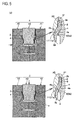
- FIGs. 3 to 6 are explanatory sectional views illustrating an operation of the cast-in mold according to the embodiment of the present invention. The structure will be described with reference to Fig. 2 , according to need.
- the cast-in mold A is a die-cast mold formed such that the cast-in portion 2a of the cast-in member 2 is wrapped cast and bonded to the die-cast component 1 with the bonding portion 2b that is bonded to the steel plate bonding member 3 being left (except for the bonding portion 2b that is bonded to the steel plate bonding member 3 by welding).
- the cast-in mold A has a structure including a fixed mold A1, the movable mold A2 that can perform mold clamping and mold opening relative to the fixed mold A1, and the movable core (pull-out core) A3 that is assembled to the movable mold A2 so as to be capable of advancing and retreating (moving vertically) and forms the cavity a with both of the fixed mold A1 and the movable mold A2.
- the cast-in mold A is formed as described below. Specifically, the cast-in member 2 is set and held such that the cast-in portion 2a of the cast-in member 2 faces the cavity a formed by the slidable advancing movement (descending movement) of the movable core A3 and the mold clamping of the movable mold A2 relative to the fixed mold A1, and with this state, molten metal such as aluminum, magnesium, or zinc is cast in the cavity a.
- the fixed mold A1 and the movable mold A2 respectively include a cavity surface 6 forming the cavity a, a core slide concave cutout portion 7 formed on the cavity surface 6 such that the core slide concave cutout portion 7 go through toward the outside of the mold, and an insert holding portion 8 and the butting portion (press-contact portion) 9 formed on the boundary between the core slide concave cutout portion 7 and the cavity surface 6.
- the core slide concave cutout portion 7 is formed on mold parting surfaces (mating surfaces) of the fixed mold A1 and the movable mold A2.
- the planar shape of the core slide concave cutout portion 7 matches the cross-section of the movable core A3 split into two in the longitudinal direction in order that the movable core A3 can freely slide during the mold clamping operation and mold opening operation.
- the insert holding portion 8 formed on the movable mold A2 has a function of temporarily holding the cast-in member 2 in cooperation with the movable core A3 in order to prevent the cast-in member 2 from falling until the mold clamping of the movable mold A2 relative to the fixed mold A1 is completed.
- the cast-in member 2 is gripped by a carrier device B, such as a hand robot, and conveyed to the movable mold A2.
- the insert holding portion 8 has a function of receiving and holding the cast-in member 2, in cooperation with the movable core A3 inserted into the cylinder of the cast-in member 2 during the period from when the grip of the cast-in member 2 by the carrier device B is canceled and the carrier device B is returned to a stand-by position, not illustrated, at the outside of the mold from the portion between the fixed mold A1 and the movable mold A2 till when the mold clamping of the movable mold A2 relative to the fixed mold A1 is completed as illustrated in Fig. 6(a) .
- the insert holding portion 8 is formed on the core slide concave cutout portion 7 at the boundary of the cavity surface 6, and is formed to have a hollow shape, matching the shape of the longitudinal surface of the bonding portion 2b of the cast-in member 2, with a depth (step) corresponding to the thickness (plate thickness) of the cylinder of the cast-in member 2.
- the insert holding portion 8 is formed on the core slide concave cutout portions 7 of the fixed mold A1 and the movable mold A2 to have a planar shape, which is formed by splitting the cast-in member 2 into two in the longitudinal direction, along the outer surface of the bonding portion 2b of the cast-in member 2.
- the cast-in member 2 is formed to have a rectangular shape by bending both short sides into an arc shape as illustrated in Fig. 2 .
- the butting portion 9 When the cast-in member 2 is carried to the movable mold A2 for mold clamping relative to the fixed mold A1, the butting portion 9 is brought into intimate butting contact with the external mold contact taper surface portion 4a of the mold contact portion 4 of the cast-in member 2, thereby closing the gap S between the cast-in mold and the cast-in member 2.
- the butting portion 9 also has a function of setting and holding the cast-in member 2 immovable in the cavity a in cooperation with the butting portion 11 of the movable core A3.
- the butting portion 9 is an external butting taper surface portion 9a formed to have a taper shape with the tilt angle (taper angle) ⁇ of the external mold contact taper surface portion 4a of the cast-in member 2.
- the butting portion 9 tilts toward the direction from the insert holding portion 8 of the fixed mold A1 and the movable mold A2 toward the cavity surface a (in the axial direction of the cylinder of the cast-in member 2).
- the external butting taper surface portion 9a is formed to have a length shorter than the length of the taper (the length of the taper of the cast-in member 2 in the axial direction of the cylinder) of the external mold contact taper surface portion 4a in the axial direction of the cylinder of the cast-in member 2.
- the external butting taper surface portion 9a is formed to be shorter by about 1 to 2 mm.
- the external butting taper surface portion 9a is surely brought into intimate butting contact with the external mold contact taper surface portion 4a of the mold contact portion 4 of the cast-in member 2, whereby the gap S between the cast-in mold A and the cast-in member 2 can surely be closed.
- the external butting taper surface portion 9a holds the cast-in member 2 by press-contact from the inner surface and the outer surface of the cast-in member 2 with the butting portion 11 of the movable core A3.
- the movable core A3 is assembled and supported to the core slide concave cutout portion 7 on the movable mold A2 so as to be capable of advancing and retreating (moving vertically) by a driving unit, not illustrated, such as a core puller.
- the movable core A3 is formed into a block having a predetermined height, e.g., a height equal to the cast-in depth of the cast-in member 2, in a cross section of the inner surface of the cylinder of the cast-in member 2 (the rectangular shape in which both short sides are consecutive in an arc shape) and in a cross section of the core slide concave cutout portions 7 on the fixed mold A1 and the movable mold A2.
- the movable core A3 has a cavity forming surface portion 10.
- the cavity forming surface portion 10 is formed on a lower half portion (leading end) that is inserted into the cast-in portion 2a of the cast-in member 2, when the movable core A3 slidably advances into (move down into) the cylinder of the cast-in member 2 up to a slide forward limit.
- the cavity forming surface portion 10 is formed to be slightly smaller than an upper half portion of the movable core A3.
- the movable core A3 also has the butting portion 11 formed to be continuous with the cavity forming surface portion 10 on the upper half portion at the boundary with the cavity forming surface portion 10.
- the butting portion 11 is brought into intimate butting contact with the internal mold contact taper surface portion 4b of the mold contact portion 4 of the cast-in member 2 by the mold-clamping operation of the movable core A3 that moves into the cylinder of the cast-in member 2 up to the slide forward limit, after the mold-clamping of the movable mold A2 relative to the fixed mold A1 is completed.
- the butting portion 11 closes the gap S between the butting portion 11 and the internal mold contact taper surface portion 4b.
- the butting portion 11 also has a function of setting and holding the cast-in member 2 immovable with the external butting taper surface portion 9a of the butting portion 9 on each of the fixed mold A1 and the movable mold A2.
- the butting portion 11 is an internal butting taper surface portion 11a formed into a taper shape with the tilt angle (taper angle) ⁇ of the internal mold contact taper portion 4b of the mold contact portion 4 of the cast-in member 2 as illustrated in Fig. 3 .
- the butting portion 11 has a sectional shape matching the inner surface of the cylinder of the cast-in member 2 at the side of the bonding portion 2b and the concave cutout inner surfaces of the slide concave cutout portions 7 on both the fixed mold A1 and the movable mold A2.
- the butting portion 11 is formed (in the axial direction of the cylinder of the cast-in member 2) from the cavity forming surface portion 10 toward the upper half portion of the movable core A3, which is larger (wider) than the cavity forming surface portion 10.
- the internal butting taper surface portion 11a is formed to have a length shorter than the length of the taper (the length of the taper of the cast-in member 2 in the axial direction of the cylinder) of the internal mold contact taper surface portion 4b in the axial direction of the cylinder of the cast-in member 2.
- the internal butting taper surface portion 11a is formed to be shorter by about 1 to 2 mm.
- the internal butting taper surface portion 11a holds the cast-in member 2 by press-contact from the inner surface and the outer surface of the cast-in member 2 with the external butting taper surface portion 9a of each of the fixed mold A1 and the movable mold A2.
- the intimate butting-contact between the internal butting taper surface portion 11a of the movable core A3 and the internal mold contact taper surface portion 4b of the cast-in member 2 and the intimate butting-contact between the external butting taper surface portions 9a of the fixed mold A1 and the movable mold A2 and the external mold contact taper surface portion 4a of the cast-in member 2 are achieved with the intimate-contact range L from both the inside and outside of the cylinder.
- the present embodiment provides the intimate butting-contact structure from both the inner surface and the outer surface of the cylinder, and this structure can surely prevent the burr from projecting on the inner surface and the outer surface of the cylinder of the cast-in member 2 at the bonding portion 2b.
- FIG. 3 (a) A mold opening state illustrated in Fig. 3 (a) where the fixed mold A1, the movable mold A2, and the movable core A3 are opened will firstly be described.
- the cast-in member 2 gripped by the carrier device B such as a hand robot is carried to the movable mold A2 as illustrated in Fig. 3(b) .
- the cast-in member 2 is carried to the movable mold A2 such that the bonding portion 2b of the cast-in member 2 is located to be in contact with the insert holding portion 8 of the movable mold A2.
- the movable core A3 After the cast-in member 2 is carried to the movable mold A2 by the carrier device B, the movable core A3 starts to slidably advance (slidably moves down), as illustrated in Figs. 3(b) to 4(a) , whereby the movable core A3 is inserted into the cylinder of the cast-in member 2. In this case, the movable core A3 slidably advances into the cylinder before the slide forward limit in the cylinder of the cast-in member 2 (the state illustrated in Fig. 6(a) ). Specifically, as illustrated in Fig.
- the movable core A3 is temporarily stopped at the slide advancing position with the bonding portion 2b of the cast-in member 2 being held by the insert holding portion 8 of the movable mold A2 in order to prevent the cast-in member 2 from falling or from being positionally shifted.
- the movable core A3 waits on this slide advancing position.
- the mold-clamping of the movable mold A2 relative to the fixed mold A1 is started as illustrated in Figs. 4(b) to 5(b) .
- the mold-clamping of the movable mold A2 relative to the fixed mold A1 is completed in a state in which the bonding portion 2b of the cast-in member 2 is located to be in contact with the insert holding portion 8 of the fixed mold A1.
- the external butting taper surface portions 9a of the fixed mold A1 and the movable mold A2 are brought into intimate butting contact with the external mold contact taper surface portions 4a of the cast-in member 2, as illustrated in Figs. 5(b) .
- the movable core A3 which is stopped before the slide forward limit in the cylinder of the cast-in member 2 illustrated in Figs. 4(a) to 5(b) , slidably advances (moves) to the slide forward limit in the cylinder of the cast-in member 2 as illustrated in Fig. 6 (a) .
- the internal butting taper surface portions 11a of the movable core A3 are brought into intimate butting contact with the internal mold contact taper surface portions 4b of the cast-in member 2.
- the order of the mold-clamping operation of the cast-in mold A described above is only one example, and the order is not limited to this order of the mold-clamping operation.
- a general mold-clamping operation may be employed. Specifically, at a point when the cast-in member 2 is carried to the movable mold A2 that is opened, the movable core A3 can slidably advance (slidably move down) to the slide forward limit in the cylinder of the cast-in member 2, and at the point when the carrier device B is returned to the stand-by position, not illustrated, at the outside of the mold, the mold-clamping operation of the movable mold A2 can be started, and then, the mold-clamping of the movable mold A2 relative to the fixed mold A1 can be completed.
- the gap S on both surfaces at the boundary between the cast-in portion 2a and the bonding portion 2b of the cast-in member 2 is closed by the intimate butting-contact between the cast-in member 2 and the fixed mold A1, the movable mold A2, and the movable core A3 from the inner surface and the outer surface of the cylinder, after a series of the mold-clamping operation starting from the carrier of the cast-in member 2 to the movable mold A2 is completed, as illustrated in Figs. 6(a) and 6(b) .
- the gap S is formed on the inner surface and the outer surface of the cylinder at the bonding portion 2b of the cast-in member 2 that is inserted into the insert holding portions 8 of the fixed mold A1 and the movable mold A2, but the gap S is closed within the intimate-contact range L on the inner surface and the outer surface of the cylinder at the mold contact portion 4 of the cast-in member 2 with which the butting portions 9 and 11 of the fixed mold A1, the movable mold A2, and the movable core A3 are brought into intimate butting contact.
- This structure can surely prevent the burr from projecting toward the bonding portion 2b, when the molten metal is cast in the cavity a. In other words, the projection of the burr toward the bonding portion 2b can surely be prevented.
- the gap S on both surfaces between the cast-in member 2, and the fixed mold A1, the movable mold A2, and the movable core A3 are closed to prevent the projection of the burr by the intimate butting-contact by means of the taper structure composed of the external mold contact taper surface portion 4a and the internal mold contact taper surface portion 4b of the mold contact portion 4 formed on the cast-in member 2, the external butting taper surface portion 9a of the butting portion 9 formed on each of the fixed mold A1 and the movable mold A2, and the internal butting taper surface portion 11a of the butting portion 11 formed on the movable core A3.
- the gap S on both surfaces can be closed, and at the same time, the cast-in member 2 can be re-positioned to a correct set position (correct set posture) in the cavity a, even when the positional deviation is generated in a set including the inside of the cavity a of the cast-in member 2.
- a cast-in member 2 having the dimensional tolerance of ⁇ 0 mm (the size in the figure) in the Y direction is illustrated by a solid line
- a cast-in member 2 having the dimensional tolerance smaller by a maximum of -1.0 mm is illustrated by a one-dot chain line
- a cast-in member 2 having the dimensional tolerance larger by a maximum of +1.0 mm is illustrated by a two-dot chain line in Fig. 7(b) .
- the cast-in portion 2a is inserted into the cavity a with an excess of 1.0 mm, compared to the cast-in member 2 having the dimensional tolerance of ⁇ 0 mm as illustrated in Fig. 7 (b) .
- the bonding portion 2b is inserted into the insert holding portion 8 with an excess of 1.0 mm, compared to the cast-in member 2 having the dimensional tolerance of ⁇ 0 mm as illustrated in Fig. 7(b) .
- the intimate butting-contact is surely achieved similarly with the case of the cast-in member 2 having the dimensional tolerance of ⁇ 0 mm, and the axial line of the cylinder of the cast-in member 2 (crossing axial lines in X and Y directions) can be made concentric with the axial lines of the movable core A3, by the taper structure composed of the external mold contact taper surface portion 4a and the internal mold contact taper surface portion 4b of the mold contact portion 4 formed on the cast-in member 2, the external butting taper surface portion 9a of the butting portion 9 formed on the fixed mold A1 and the movable mold A2, and the internal butting taper surface portion 11a of the butting portion 11 formed on the movable core A3, during the clamp-molding operation.
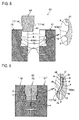
- Fig. 8 is an explanatory view illustrating a cast-in mold according to another embodiment of the present invention
- Fig. 9 is an explanatory view illustrating a state in which a series of mold-clamping operation of the cast-in mold is completed.
- the cast-in mold in the present embodiment is basically the same as the cast-in mold A described above in detail, except that a biting projection 12 is formed on the butting portion 9 of each of the fixed mold A1 and the movable mold A2.
- the same components are identified by the same numerals, and the redundant description will not be made.
- a cast-in mold A0 has a mold structure including a fixed mold A1, a movable mold A2 that can perform a mold-clamping process and mold-opening process relative to the fixed mold A1, and a movable core A3 that is assembled to the movable mold A2 so as to be capable of slidably advancing and retreating (moving up and down) to form a cavity a with both of the fixed mold A1 and the movable mold A2.
- the biting projection 12 is formed on the butting portion 9 of each of the fixed mold A1 and the movable mold A2.
- the biting projection 12 has a function of closing the gap S between the cast-in mold A0 and the cast-in member 2 in cooperation with the butting portion 9 that is brought into intimate butting contact with the mold contact portion 4 of the cast-in member 2, when the movable mold A2 is clamped relative to the fixed mold A1.
- the biting projection 12 is formed on the external butting taper surface portion 9a of the butting portion 9 at the side of the cavity surface 6, and to have an appropriate projecting shape and projecting height.
- the biting projection 12 bites the external mold contact taper surface portion 4a, when the external butting taper surface portion 9a is brought into intimate butting contact with the external mold contact taper surface portion 4a of the mold contact portion 4 of the cast-in member 2.
- hardness (Hv) of the biting projection 12 is set to be more than three times the hardness of the steel plate cast-in member.
- the hardness (Hv) of the steel plate cast-in member is 140 or lower
- the hardness (Hv) of the biting projection 12 is preferably 420 or higher, more preferably 500 or higher.
- the gap S on both surfaces at the boundary between the cast-in portion 2a and the bonding portion 2b of the cast-in member 2 is closed by the intimate butting-contact between the cast-in member and the fixed mold A1, the movable mold A2, and the movable core A3 from the inner surface and the outer surface of the cylinder and the biting projection 12 biting the mold contact portion 4, after a series of the mold-clamping operation starting from the carrier of the cast-in member 2 to the movable mold A2 is completed, as illustrated in Fig. 9 .
- the gap S on both surfaces is formed on the inner surface and the outer surface of the cylinder at the bonding portion 2b of the cast-in member 2 that is inserted into the insert holding portions 8 of the fixed mold A1 and the movable mold A2, but the gap S is closed by the intimate butting-contact of the butting portions 9 and 11 of the fixed mold A1, the movable mold A2, and the movable core A3, and further, the gap S is closed by a synergic action of the intimate-contact and biting at the inside and outside of the mold contact portion 4 of the cast-in member 2 bit by the biting projection 12, particularly on the external mold contact taper surface portion 4a.
- This structure can surely prevent the burr from projecting, when the molten metal is cast in the cavity a.
- the projection shape of the biting projection 12 is not particularly limited.
- the projection shape may be a shape by which the biting projection 12 can bite the mold contact portion 4 when the butting portion 9 is brought into intimate butting contact with the mold contact portion 4 of the cast-in member 2.
- the biting amount (depth) of the biting projection 12 biting the mold contact portion 4 is preferably about 0.03 mm, when the plate thickness (wall thickness) of the cast-in member 2 is defined as 3 mm, for example.
- the biting projection 12 may be detachably provided to the butting portion 9 with a packing structure in order to facilitate a maintenance operation.
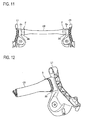
- the die-cast component 1 cast by the cast-in structure and the cast-in molds A and A0 according to the present embodiments described above in detail can be applied as a trailing arm C1 of a torsion beam suspension C illustrated in Figs. 10 to 12 as one example of a vehicle component (automobile component).
- Fig. 10 is a schematic perspective view of a torsion beam suspension to which the die-cast component formed by the cast-in mold a cast-in structure according to the present embodiments is applied
- Fig. 11 is a schematic plan view of the torsion beam suspension
- Fig. 12 is a schematic perspective view in which a trailing arm is enlarged.
- the bonding portion 2b, which is exposed to the outside, of the steel plate cast-in member 2 wrapped cast with the trailing arm C1 that is the die-cast component 1 is bonded to an end of a torsion beam C2, which is a steel plate bonding member 3 made of the same material, by welding.
- the bonding portion 2b of the cast-in member 2 is externally fitted to the end of the steel plate torsion beam C2, having the same sectional shape, and with this state, the bonding portion 2b of the cast-in member 2 is bonded to the torsion beam C2 by welding. In this case, no burr is generated and deposited on the bonding portion 2b of the cast-in member 2. Therefore, the trailing arm C1 can be bonded to the end of the torsion beam C2 with high rigidity by welding.
- the trailing arm C1 which is cast by using aluminum, can be bonded to the steel plate torsion beam C2, which is made of a different kind of metal, by welding without any problem.
- a cast-in structure and a cast-in mold using a sheet-type cast-in member 20 will be described next.
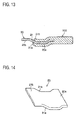
- Fig. 13 is a sectional view illustrating one example of another die-cast component cast by using the cast-in structure and the cast-in mold according to another embodiment of the present invention.
- the cast-in structure closes the gap S between a cast-in member 20 and a later-described cast-in mold A4 by the structure in which butting portions 22 and 23 of the cast-in mold A4 are brought into intimate butting contact with a mold contact portion 21 of the cast-in member 20, when the cast-in mold A4 is clamped.
- a cavity a1 of the cast-in mold A4 is closed by the intimate butting-contact of the butting portions 22 and 23 of the cast-in mold A4 to the mold contact portion 21 of the cast-in member 20.
- This structure prevents burr from projecting toward the bonding portion 20b of the cast-in member 20, which is set to be located outside of the cavity a1 (see Fig. 15(b) described later).
- Fig. 14 is a perspective view illustrating one example of the cast-in member bonded to the die-cast component by wrapping cast. The structure will be described with reference to Fig. 13 , according to need.
- the cast-in member 20 is formed into a sheet shape with a desired size by press-cutting and bending a steel plate with a thickness of about 3 mm as illustrated in Fig. 14 .
- one side of the cast-in member 20 is defined as a cast-in portion 20a that is wrapped cast upon molding the die-cast component 100, and the other side is defined as a bonding portion 20b bonded to a steel plate bonding member, not illustrated.
- the cast-in member 20 thus configured has a tapered mold contact portion 21 on the boundary between the cast-in portion 20a and the bonding portion 20b.
- the mold contact portion 21 includes a fixed mold contact taper surface portion 21a and a movable mold contact taper surface portion 21b.
- a butting portion 22 on a fixed mold A5 of the cast-in mold A4 are brought into intimate butting contact with the fixed mold contact taper surface portion 21a
- a butting portion 23 on a movable mold A6 of the cast-in mold A4 is brought into intimate butting contact with the movable mold contact taper surface portion 21b.
- the mold contact portion 21 is brought into intimate butting contact with the butting portions 22 and 23 of the fixed mold A5 and the movable mold A6 from both surfaces.
- the intimate butting-contact described above is achieved from both surfaces within an intimate-contact range L in Fig. 15(b) .
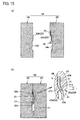
- Fig. 15 is an explanatory sectional view illustrating the cast-in mold according to another embodiment of the present invention.
- the cast-in mold A4 includes the fixed mold A5 and the movable mold A6 that can perform mold clamping and mold opening relative to the fixed mold A5.
- An insert holding portion 25 is provided on a mold parting surface (mating surface) consecutive to a cavity surface 24a of the fixed mold A5, out of cavity surfaces 24a and 24b, forming the cavity a1, of the fixed mold A5 and the movable mold A6.
- the butting portion 22 is provided on the boundary between the insert holding portion 25 and the cavity surface 24a.
- the butting portion 23 is provided on a mold parting surface of the movable mold A6 opposite to the butting portion 22.
- the butting portions 22 and 23 are respectively a fixed butting taper surface portion 22a and a movable butting taper surface portion 23a.
- Each of the fixed butting taper surface portion 22a and the movable butting taper surface portion 23a is formed into a taper shape toward the cavity surface 24a or 24b on each of the fixed mold A5 and the movable mold A6 with a tilt angle of the fixed mold contact taper surface portion 21a and the movable mold contact taper surface portion 21b of the cast-in member 20.
- the fixed mold A5 and the movable mold A6 hold the cast-in member 20 in the state in which the cast-in member 20 is sandwiched from both surfaces within the intimate-contact range L illustrated in Fig. 15(b) .
- the cast-in structure of the cast-in member 2 can be configured as described below. Specifically, when the cast-in member 2 is carried to the movable mold A2 by the carrier device B, mold clamping to the fixed mold A1 is performed with the cast-in member 2 being adsorbed and held to the movable mold A2 by magnetic force, and with this state, molten metal is cast.
- a magnet is embedded in a portion apart from the cavity a, such as the insert holding portion 8 of the movable mold A2 into which the bonding portion 2b of the cast-in member 2 is inserted. With this structure, the deposition of the molten metal cast in the cavity or deterioration of the magnetic force of the magnet due to thermal influence can be prevented.
- the following operation can be realized. Specifically, after the cast-in member 2 is carried to the movable mold A2, the mold clamping of the movable mold A2 to the fixed mold A1 is started. Immediately before or after the movable mold A2 is clamped relative to the fixed mold A1, the slidable advancing motion of the movable core A3 is started from the stand-by position (slide retreating limit), and the movable core A3 is moved to the slide forward limit in the cylinder of the cast-in member 2. With this, a series of the mold-clamping operation of the cast-in mold A is completed.
- the internal butting taper surface portion 11a of the butting portion 11 of the movable core A3 is brought into intimate butting contact with the internal mold contact taper surface portion 4b of the cast-in member 2 at once, whereby the gap S on both surfaces can be closed.
- the biting projection 12 may be provided on the butting portion 11 (the internal butting taper surface portion 11a) of the movable core A3. It may be configured such that, when the butting portion 11 is brought into intimate butting contact with the internal mold contact taper surface portion 4b of the mold contact portion 4 of the cast-in member 2, the biting projection 12 bites the internal mold contact taper surface portion 4b, as in the external mold contact taper surface portion 4a of the mold contact portion 4.
- plastic deformation (plastic strain) of the cast-in member 2 during a manufacture by press molding or machine working can be corrected by the mold clamping for closing the gap S by the structure in which the external butting taper surface portions 9a of the butting portions 9 of the fixed mold A1 and the movable mold A2 and the internal butting taper surface portion 11a of the butting portion 11 of the movable core A3 are brought into intimate butting contact with the internal and external taper surface portions 4a and 4b of the mold contact portion 4 of the cast-in member 2.
- this plastic strain can be linearly corrected by press-contact from both the inner surface and the outer surface of the cylinder with mold-clamping force (pressing force) from a die-cast machine.
- the plastic strain remaining on the cylinder wall of the cast-in member 2 after the machining work (pressing) is corrected by the mold clamping force and the taper structure in which the fixed and movable molds A1 and A2 and the movable core A3 are brought into intimate butting contact with the cast-in member 2 upon the mold clamping. Accordingly, it is expected that the cast-in member 2 is returned to the correct cylindrical shape illustrated in the figure, and with this state, bonded to the die-cast component 1 by the casting-in.
- the cast-in structure of the cast-in member 2 and the cast-in mold A according to the present embodiment can be applied to an injection molding field in which a steel plate cast-in member is bonded to a resin component by casting-in, as well as a die-cast field in which a steel plate cast-in member is bonded by casting-in upon molding a die-cast component.
Landscapes
- Engineering & Computer Science (AREA)
- Mechanical Engineering (AREA)
- Molds, Cores, And Manufacturing Methods Thereof (AREA)
- Vehicle Body Suspensions (AREA)
- Moulds For Moulding Plastics Or The Like (AREA)
- Body Structure For Vehicles (AREA)
Abstract
Description
- The present invention relates to a cast-in structure for a cast-in member and a cast-in mold, and more particularly to a cast-in structure for a steel plate cast-in member and a cast-in mold, the cast-in member being wrapped cast except for a bonding portion bonded to a bonding member upon molding a die-cast component, when the die-cast component casted by using a light alloy metal such as aluminum and a steel plate bonding member are bonded to each other, i.e., when different kind of metals are bonded to each other.
- When a member made of a light alloy metal such as aluminum, magnesium, or zinc and a member made of an iron steel (iron metal), i.e., members made of different kind of metals, are directly welded and bonded to each other, a weak intermetallic compound is formed between both members (on a bonding interface). Therefore, a weld crack is generated, resulting in that reliability in bonding strength (weld strength) is deteriorated. This has conventionally been known.
- As a method of solving the problem of deterioration in the reliability of the bonding strength caused by the direct weld bonding between the members made of different kind of metals, a cast-in structure (cast enclosing structure) has been proposed (for example, see patent literature 1). In the cast-in structure, a cast-in member (joint member) made of a material same as a steel plate bonding member (steel member) that is to be welded and bonded is integrally wrapped cast and bonded upon molding an aluminum die-cast component.
- In the
patent literature 1, the deterioration in the bonding strength by the direct weld between the members made of different kind of metals and the difficult welding between aluminum members are avoided, and the aluminum die-cast component can be bonded to the steel plate bonding member (steel member) made of a different kind of metal via the steel plate cast-in member (steel joint member) that can be welded and bonded without any troubles. Specifically, since the bonding member and the cast-in member are both made of steel plate, both members are bonded by welding with sufficient bonding strength without any troubles, and the aluminum die-cast component can be bonded by welding to the steel plate bonding member that is made of a different kind of metal. - In the cast-in structure for the cast-in member that is wrapped cast to an aluminum die-cast component only at the cast-in portion of the steel plate cast-in member with the bonding portion bonded to the steel plate bonding member by welding being left (except for the bonding portion bonded to the steel plate bonding member by welding), when a molten metal is casted in a die-cast mold, a so-called cavity, burr (casting burr) is likely to project toward the bonding portion of the cast-in member exposed to the outside from the cast aluminum die-cast component. Therefore, a countermeasure against the projection of burr has to be taken.
- A gap needed to set the cast-in member to the die-cast mold by a fitting method of fitting the cast-in member to the die-cast mold is formed in a space between the cast-in member and the die-cast mold. Therefore, a countermeasure against the projection of burr from the gap has to be required.
- The gap of settings between the cast-in member and the die-cast mold is inevitable for promptly setting the cast-in member to the die-cast mold by means of a carrier device such as a robot hand. On the other hand, a dimensional error due to plastic deformation (plastic strain) is likely to occur on the cast-in member manufactured by machine working such as press working. A cast-in member that is formed into a cylinder having a rectangular (oblong) or elliptic cross-section by bending process is particularly likely to have a dimensional error due to plastic deformation. In addition, it is difficult to perform a process for maintaining high dimensional precision. Therefore, burr is likely to project.
- When the burr (casting burr) projects up to the bonding portion of the cast-in member bonded to the steel plate bonding member by welding, the projecting burr might cause deterioration in bonding strength to the bonding member.
- When it is supposed that the aluminum die-cast component, to which the steel plate cast-in member made of different kind of metal from the aluminum die-cast component is wrapped cast and bonded, is used for a body component or a suspension component of a vehicle that is used under severe environment where the component is easy to be corroded, galvanic corrosion generated between the cast-in member and the aluminum die-cast component, which are made of different kind of metals, becomes a problem. As a countermeasure against the galvanic corrosion, there have been proposed a method of providing an insulating material for preventing the galvanic corrosion between the cast-in member and the aluminum die-cast member, and a method of applying a seal material for preventing water content from entering the gap on the cast-in portion wrapped cast with the aluminum die-cast member. However, these methods cannot prevent the galvanic corrosion due to the projecting burr, resulting in that the effect of these methods is deteriorated.
- Patent Literature 1:
JP-2010-194583 A Fig. 4(b) , and the like) - In the prior art described in the
patent literature 1, the structure of preventing the projection of burr generated when the steel plate cast-in member is wrapped cast upon molding the aluminum die-cast component is a dam formed by an acceleration of solidification of a molten metal, by cooling, on a step formed on the cast-in member (joint member) wrapped cast with the aluminum die-cast component. This structure cannot prevent the projection of burr with reliability. - Specifically, in this prior art, the gap needed to set the cast-in member to the die-cast mold is not completely closed after the die-cast mold is clamped, but still present in a curved (bent) shape as illustrated in
Fig. 4(b) . Therefore, the molten metal cast in the cavity with a predetermined casting pressure passes through the step, which is formed between the mold and the cast-in member (joint member) due to the presence of the gap, to project toward the bonding portion of the cast-in member (joint member) with a flow rate not reduced by the step. Accordingly, possibility of the deposition of burr in a wide range from the peripheral edge of the aluminum die-cast component to the bonding portion (welded surface) still remains. - In view of this, the present invention is accomplished for solving these problems. Specifically, the present invention aims to appropriately form a gap needed to set the cast-in member into a mold, e.g., a gap that can absorb a dimensional tolerance of ±1.0 mm by press working of the cast-in member between the cast-in member and the mold, to surely prevent the projection of burr by closing the gap at the point when the mold is clamped, to take a countermeasure against the galvanic corrosion, and to automatically correct the positional deviation of the cast-in member into the mold by the clamping operation of the mold.
- In order to attain the foregoing objects, a cast-in structure for a cast-in member and a cast-in mold according to the present invention has at least features described below.
- Specifically, the present invention provides a cast-in structure for a cast-in member, which is made of a steel plate and which is wrapped cast upon molding a die-cast component by means of a cast-in mold except for a bonding portion bonded to a steel plate bonding member, wherein the cast-in member includes a mold contact portion on both surfaces at a boundary between a cast-in portion wrapped cast with the die-cast component and the bonding portion, wherein the mold contact portion is brought into intimate butting contact with the cast-in mold, when the cast-in mold is clamped.
- Specifically, the mold contact portion of the cast-in member is formed to have a taper shape, and the mold contact portion is brought into intimate butting contact by the taper structure with the cast-in mold, when the cast-in mold is clamped. The cast-in member is formed into a cylinder. The cast-in member includes internal and external mold contact taper surface portions of the mold contact portion, formed to have a taper shape and formed consecutively on the entire circumference in an axial direction of the cylinder. The internal and external mold contact taper surface portions are formed on a boundary between the bonding portion on one end of the cast-in member and the cast-in portion on the other end of the cast-in member, and when the cast-in mold is clamped, a tapered butting portion formed on the cast-in mold is brought into intimate butting contact with the internal and external mold contact taper surface portions.
- According to these configurations, when the cast-in mold is clamped, the cast-in mold is in intimate butting contact with the mold contact portions on both surfaces of the cast-in member, whereby the gap on both surfaces at the casting boundary of the cast-in member (the boundary between the cast-in portion and the bonding portion) are closed. This structure prevents the molten metal cast in the mold from projecting on both surfaces of the bonding portion, bonded to the steel plate bonding member, of the cast-in member. In other words, the projection of burr toward the bonding portion can be prevented.
- The cast-in member is formed into a cylinder, and the mold contact portion is formed to have a taper shape and formed consecutively on the entire circumference in an axial direction of the cylinder. With this configuration, when the cast-in mold is clamped, the gap on both surfaces on the casting boundary of the cast-in member can be closed, and at the same time, the cast-in member can be positioned to the cast-in mold.
- Specifically, in a case where the cast-in member is positionally shifted with respect to the cast-in mold when the cast-in member is carried and set to the cast-in mold, the cast-in member can automatically be corrected to be positioned on a correct set position (posture) of the cast-in mold by the clamping operation of the cast-in mold that is brought into intimate butting contact with the internal and external mold contact taper surface portions of the mold contact portion, which are formed to have a taper shape and formed consecutively on the entire circumference in an axial direction of the cylinder.
- The present invention also provides a cast-in mold being configured to cast-in a steel plate cast-inmember to a die-cast component by setting a cast-in portion of the steel plate cast-in member into a cavity except for a bonding portion to be bonded to a steel plate bonding member, wherein
the cast-in mold includes a butting portion that is brought into intimate butting contact with a mold contact portion upon mold clamping, the mold contact portion being formed on both surfaces of the cast-in member at a boundary between the cast-in portion and the bonding portion of the cast-in member. - In this case, it is preferable that the butting portion is formed into a taper shape, and is brought into intimate butting contact with the mold contact portion, which is similarly formed into a taper shape. It is also preferable that the butting portion is provided with a biting projection that bites the mold contact portion of the cast-in member. In this case, it is preferable that hardness (Hv) of the biting projection is more than three times the hardness (Hv) of the steel plate cast-in member. For example, when the hardness (Hv) of the steel plate cast-in member is 140 or lower, the hardness (Hv) of the biting projection is preferably 420 or higher, more preferably 500 or higher.
- The cast-in mold includes a fixed mold and a movable mold, each having an external butting taper surface portion of the butting portion that is brought into intimate butting contact with an external mold contact taper surface portion of the mold contact portion, the external mold contact taper surface portion being formed on both the internal and external surfaces of the cylinder to have a taper shape and formed consecutively on the entire circumference in an axial direction of a cylinder of the cast-in member formed into a cylindrical shape; and a movable core having an internal butting taper surface portion of the butting portion, the internal butting taper surface portion being brought into intimate butting contact with the internal mold contact taper surface portion of the mold contact portion.
- According to this configuration, when the cast-in mold is clamped, the butting portion is brought into intimate butting contact with the mold contact portions on both surfaces of the cast-in member, whereby the gap on both surfaces at the casting boundary of the cast-in member (the boundary between the cast-in portion and the bonding portion) are closed. This structure prevents the molten metal cast in the cavity from projecting of the bonding portion, bonded to the steel plate bonding member, of the cast-in member. In other words, the projection of burr toward the bonding portion can surely be prevented.
- The cast-in member is formed into a cylinder, and the mold contact portion is formed to have a taper shape and formed consecutively on the entire circumference in an axial direction of the cylinder. With this configuration, when the cast-in mold is clamped, the gap on both surfaces on the casting boundary of the cast-in member can be closed, and at the same time, the cast-in member can be positioned to the cast-in mold.
- Specifically, in a case where the cast-in member is positionally shifted with respect to the mold when the cast-in member is set to the cast-in mold, the gap on both surfaces on the casting boundary of the cast-in member can be closed, and at the same time, the cast-in member can automatically be corrected to be positioned on a correct set position (posture) of the cast-in mold by the clamping operation of the internal and external butting portion of the cast-in mold that is brought into intimate butting contact with the internal and external mold contact taper surface portions of the mold contact portion of the cast-in member.
- When the butting portion is brought into intimate butting contact with the mold contact portion of the cast-in member by the mold clamping, the biting projection bites the mold contact portion. Thus, the gap at the casting boundary (boundary between the cast-in portion and the bonding portion) of the cast-in member can be closed by a synergic action of the intimate butting-contact and the biting projection biting the mold contact portion. It can be expected that this structure can surely prevent the burr from projecting toward the bonding portion of the cast-in member. Advantageous Effect of the Invention
- According to the cast-in structure for a cast-in member of the present invention, when a cast-in mold is clamped, the cast-in mold is brought into intimate butting contact with the mold contact portion of the steel plate cast-in member, whereby the gap on both surfaces at the casting boundary of the cast-in member (the boundary between the cast-in portion and the bonding portion) are closed. This structure can surely prevent the projection of burr from casting boundary.
- Accordingly, the deposition of burr on the bonding portion of the steel plate cast-in member can be prevented. Therefore, a deburring work that is troublesome and burdensome is not at all needed. Accordingly, productivity is enhanced, and sufficient bonding strength (weld strength) is attained, and with this state, the bonding portion of the cast-in member can be bonded to the steel plate bonding member by welding. In addition, burr is not deposited on the bonding portion of the cast-in member. Therefore, an effect of a countermeasure against a galvanic corrosion, caused by corrosion due to a contact of different kind of metals, can also be expected.
- In the cast-in structure, the cast-in member is formed into a cylinder, and the mold contact portion is formed to have a taper shape and formed consecutively on the entire circumference in an axial direction of the cylinder. With this configuration, when the cast-in mold is clamped, the cast-in mold is brought into intimate butting contact with the internal and external mold contact taper surface portions of the mold contact portion. According to this structure, the cast-in member can be positioned into the cast-in mold, and can be wrapped cast with the die-cast component.
- Specifically, in a case where the cast-in member is positionally shifted with respect to the mold when the cast-in member is set to the cast-in mold, the cast-in member can automatically be corrected to be positioned on a correct set position of the cast-in mold by the clamping operation of the cast-in mold that is brought into intimate butting contact with the internal and external mold contact taper surface portions of the mold contact portion, particularly is brought into intimate butting contact with the internal mold contact taper surface portion. With this process, the cast-in member is wrapped cast with the die-cast component. Accordingly, the cast-in member can be wrapped cast and bonded to the die-cast component with high strength, whereby the die-cast component with reliable quality can be cast.
- According to the cast-in mold of the present invention, when the cast-in mold is clamped, the tapered butting portion is brought into intimate butting contact with the tapered mold contact portion of the cast-in member, so that the gap on both surfaces at the casting boundary of the cast-in member (the boundary between the cast-in portion and the bonding portion) are closed. With this state, the molten metal can be cast into the cavity. The gap on both surfaces can more surely be closed by a synergic action of the intimate butting-contact and the biting projection biting the mold contact portion. With this state, the molten metal can be cast into the cavity.
- The cast-in member can be wrapped cast to the die-cast component with the cast-in structure (structure for preventing the projection of burr) that perfectly prevents the projection of burr from the casting boundary of the cast-in member.
-
-
Fig. 1 is a sectional view illustrating one example of a die-cast component that is wrapped cast by means of a cast-in structure and a cast-in mold according to an embodiment of the present invention, wherein the die-cast component is bonded to a steel plate bonding member by welding. -
Fig. 2 is a view illustrating one example of a cast-in member wrapped cast and bonded to the die-cast component, wherein (a) is a sectional view, and (b) is a side view viewed from a bonding portion bonded to the steel plate bonding member by welding. -
Fig. 3 is an operation explanatory view illustrating a section of one example of a cast-in mold according to the embodiment of the present invention, wherein (a) illustrates a mold opening state, and (b) illustrates that a cast-in member is carried to a movable mold. -
Fig. 4 is also an operation explanatory view, wherein (a) illustrates that a movable core is inserted into a cylinder of the cast-in member carried to the movable mold, and (b) illustrates that a carrier device is returned to a stand-by position outside the mold, and the movable mold starts clamping relative to a fixed mold. -
Fig. 5 is also an operation explanatory view, wherein (a) illustrates a state just before the movable mold is clamped relative to the movable mold, and (b) illustrates the state in which the mold clamping of the movable mold relative to the fixed mold is completed, and the movable core starts to move to a slide forward limit in the cylinder of the cast-in member. -
Fig. 6 is also an operation explanatory view, wherein (a) illustrates the state of completing the mold clamping operation in which the movable core moves to the slide forward limit in the cylinder of the cast-in member, and (b) illustrates a state in which a molten metal is cast in a cavity after a series of mold clamping operation is completed. -
Fig. 7 is a schematic explanatory view illustrating a dimensional tolerance upon press working of the cast-in member, wherein (a) is a perspective view, and (b) is an enlarged view in the mold-clamping state. -
Fig. 8 is an explanatory view illustrating a section of a cast-in mold according to another embodiment of the present invention. -
Fig. 9 is an explanatory view illustrating the mold clamping state of the cast-in mold. -
Fig. 10 is a schematic perspective view illustrating a torsion beam suspension to which a die-cast component obtained by the cast-in structure and the cast-in mold according to the embodiment of the present invention is applied. -
Fig. 11 is a schematic plan view of the suspension. -
Fig. 12 is a schematic perspective view illustrating a trailing arm at one end of the suspension, the trailing arm being partially enlarged. -
Fig. 13 is a sectional view illustrating one example of another die-cast component wrapped cast by the cast-in structure and the cast-in mold according to another embodiment of the present invention. -
Fig. 14 is a perspective view illustrating one example of a cast-in member wrapped cast and bonded to the die-cast component. -
Fig. 15 is an explanatory view illustrating a section of a cast-in mold according to another embodiment of the present invention, wherein (a) illustrates that a cast-in member is carried to a fixed mold, and (b) illustrates a mold clamping state of a movable mold relative to the fixed mold. - A cast-in structure of a cast-in member and a cast-in mold according to an embodiment of the present invention will be described below in detail with reference to the accompanying drawings. It is to be noted that the present invention is not limited by the embodiment.
-
Fig. 1 is a sectional view illustrating one example of a die-cast component cast by the cast-in structure and the cast-in mold according to the embodiment of the present invention, wherein the die-cast component is bonded to a steel plate bonding member by welding. - The cast-in structure is a structure in which the steel plate cast-in
member 2 is wrapped cast and bonded, with abonding portion 2b being left (except for thebonding portion 2b), to the steel plate bonding member 3 upon molding a die-cast component 1. When a later-described cast-in mold A is clamped, later-describedbutting portions mold contact portion 4 of the cast-inmember 2, whereby a gap S between the cast-inmember 2 and the cast-in mold A within an intimate butting-contact portion (range) is closed. This structure prevents a projection of burr toward thebonding portion 2b of the cast-inmember 2 set on a position outside a cavity a as illustrated in later-describedFig. 6 (seeFig. 6(a) described later). - The die-
cast component 1 is cast by using a molten metal mainly including a light alloy metal such as aluminum, magnesium, or zinc. -
Fig. 2 is a sectional view and a side view illustrating one example of the cast-in member. The structure will be described with reference toFig. 1 , according to need. - The cast-in
member 2 includes a cast-inportion 2a that is wrapped cast upon molding the die-cast component 1, and thebonding portion 2b that is bonded to the steel plate bonding member 3 by welding, such as resistance spot welding or stud welding. The cast-inmember 2 also includes amold contact portion 4 on the boundary between the cast-inportion 2a and thebonding portion 2b. - The cast-in
member 2 is made of a steel plate (iron-based metal) with a material same as the material of the bonding member 3 with a desired thickness, e.g., about 3 mm. This steel plate undergoes a press bending process, and then, butt bonding portions are bonded (fixed) by welding, whereby the cast-inmember 2 is formed into a cylinder with a desired length (mm). - Specifically described, the cast-in
member 2 is formed into substantially a rectangular cylinder in which short sides on both sides are bent in an arc shape in a plan view as illustrated inFig. 2 . Thebonding portion 2b on one end of the opening is bonded to the bonding member 3 by welding, while the cast-inportion 2a on the other end of the opening is integrally wrapped cast upon molding the die-cast component 1 as illustrated inFig. 1 . - The
mold contact portion 4 is a portion with which abutting portion 9 of a cast-in mold A is brought into intimate butting contact, when the cast-inmember 2 is set to the cast-in mold A for mold clamping. - As illustrated in
Fig. 2 , the portion between the cast-inportion 2a and thebonding portion 2b of the cast-inmember 2 is narrowed (the diameter of the cylinder is reduced) almost parallel to the axis of the cast-inmember 2 except for the ends of the cast-inportion 2a and thebonding portion 2b. Thus, themold contact portion 4 is formed on the boundary between the cast-inportion 2a and thebonding portion 2b so as to be consecutive in the whole circumference along the axial direction of the cylinder of the cast-inmember 2 with a taper shape having a predetermined tilt angle. - As illustrated in
Fig. 2(b) , themold contact portion 4 formed to be consecutive in the entire circumferential direction with the taper shape at the boundary between the cast-inportion 2a and thebonding portion 2b includes an external mold contacttaper surface portion 4a and an internal mold contacttaper surface portion 4b. Buttingportions 9 of both of later-described fixed and movable molds A1 and A2, out of buttingportions taper surface portion 4a, when the cast-in mold A is clamped. The buttingportion 11 of the movable core A3 is brought into intimate butting contact with the internal mold contacttaper surface portion 4b, when the cast-in mold A is clamped. - Specifically, the cast-in
member 2 is set and held such that the cast-inmember 2 is sandwiched and pressed by both of the fixed mold A1 and the movable mold A2, which are brought into intimate butting contact with the external mold contacttaper surface portions 4a of themold contact portion 4, and the movable core A3 that is brought into intimate butting contact with the internal mold contacttaper surface portion 4b from both of the inner and outer surfaces of the cylinder, when the cast-in mold A is clamped. In this state, the cast-inportion 2a is inserted into a cavity a (seeFig. 6(a) described later). - The tilt angles (taper angle) θ of the external mold contact
taper surface portion 4a and the internal mold contacttaper surface portion 4b of the cast-inmember 2 in the axial direction of the cylinder are not particularly limited, but they are preferably set to be about 27°. - As illustrated in
Figs. 1 and 2 , aconstricted portion 5 is formed on the cast-inportion 2a of the cast-inmember 2 in the present embodiment. Theconstricted portion 5 is formed to be consecutive on the whole circumference of the cast-inmember 2. With this structure, the cast-in bonding strength at the cast-inportion 2a of the cast-inmember 2, which is wrapped cast with the die-cast component 1, is strengthened by theconstricted portion 5. Therefore, the cast-inmember 2 is wrapped cast and bonded with high strength and high rigidity with no chance of being slipped from the die-cast component 1. - Although not illustrated, the shape of the
constricted portion 5 is not particularly limited. Specifically, any shape can be employed, so long as theconstricted portion 5 can increase the cast-in bonding strength to the die-cast component 1 with high strength and high rigidity for preventing the cast-inmember 2 from slipping from the die-cast component 1. - According to the cast-in structure of the present embodiment described above in detail, when the cast-in mold A is clamped, the cast-in mold A is brought into intimate butting contact with the internal and external mold contact
taper surface portions mold contact portion 4 of the cast-inmember 2, whereby a gap S on both surfaces at the boundary between the cast-inportion 2a and thebonding portion 2b of the cast-inmember 2 is sealed. - This structure surely prevents molten metal, which is cast in the cast-in mold A (cavity a) with the cast-in
portion 2a of the cast-inmember 2 being wrapped cast, from projecting toward thebonding portion 2b of the cast-inmember 2 that is bonded to the steel plate bonding member 3 by welding. In other words, projection of burr toward thebonding portion 2b can surely be prevented. - Subsequently, the cast-in mold A according to the embodiment of the present invention will be described.
Figs. 3 to 6 are explanatory sectional views illustrating an operation of the cast-in mold according to the embodiment of the present invention. The structure will be described with reference toFig. 2 , according to need. - The cast-in mold A is a die-cast mold formed such that the cast-in
portion 2a of the cast-inmember 2 is wrapped cast and bonded to the die-cast component 1 with thebonding portion 2b that is bonded to the steel plate bonding member 3 being left (except for thebonding portion 2b that is bonded to the steel plate bonding member 3 by welding). - The cast-in mold A has a structure including a fixed mold A1, the movable mold A2 that can perform mold clamping and mold opening relative to the fixed mold A1, and the movable core (pull-out core) A3 that is assembled to the movable mold A2 so as to be capable of advancing and retreating (moving vertically) and forms the cavity a with both of the fixed mold A1 and the movable mold A2.
- As illustrated in
Figs. 3 to 6 , the cast-in mold A is formed as described below. Specifically, the cast-inmember 2 is set and held such that the cast-inportion 2a of the cast-inmember 2 faces the cavity a formed by the slidable advancing movement (descending movement) of the movable core A3 and the mold clamping of the movable mold A2 relative to the fixed mold A1, and with this state, molten metal such as aluminum, magnesium, or zinc is cast in the cavity a. - The fixed mold A1 and the movable mold A2 respectively include a cavity surface 6 forming the cavity a, a core slide
concave cutout portion 7 formed on the cavity surface 6 such that the core slideconcave cutout portion 7 go through toward the outside of the mold, and aninsert holding portion 8 and the butting portion (press-contact portion) 9 formed on the boundary between the core slideconcave cutout portion 7 and the cavity surface 6. - The core slide
concave cutout portion 7 is formed on mold parting surfaces (mating surfaces) of the fixed mold A1 and the movable mold A2. The planar shape of the core slideconcave cutout portion 7 matches the cross-section of the movable core A3 split into two in the longitudinal direction in order that the movable core A3 can freely slide during the mold clamping operation and mold opening operation. - The
insert holding portion 8 formed on the movable mold A2 has a function of temporarily holding the cast-inmember 2 in cooperation with the movable core A3 in order to prevent the cast-inmember 2 from falling until the mold clamping of the movable mold A2 relative to the fixed mold A1 is completed. - More specifically described, as illustrated in
Fig. 3(b) , the cast-inmember 2 is gripped by a carrier device B, such as a hand robot, and conveyed to the movable mold A2. Theinsert holding portion 8 has a function of receiving and holding the cast-inmember 2, in cooperation with the movable core A3 inserted into the cylinder of the cast-inmember 2 during the period from when the grip of the cast-inmember 2 by the carrier device B is canceled and the carrier device B is returned to a stand-by position, not illustrated, at the outside of the mold from the portion between the fixed mold A1 and the movable mold A2 till when the mold clamping of the movable mold A2 relative to the fixed mold A1 is completed as illustrated inFig. 6(a) . - As illustrated in
Fig. 3 , theinsert holding portion 8 is formed on the core slideconcave cutout portion 7 at the boundary of the cavity surface 6, and is formed to have a hollow shape, matching the shape of the longitudinal surface of thebonding portion 2b of the cast-inmember 2, with a depth (step) corresponding to the thickness (plate thickness) of the cylinder of the cast-inmember 2. - Although not illustrated, the
insert holding portion 8 is formed on the core slideconcave cutout portions 7 of the fixed mold A1 and the movable mold A2 to have a planar shape, which is formed by splitting the cast-inmember 2 into two in the longitudinal direction, along the outer surface of thebonding portion 2b of the cast-inmember 2. The cast-inmember 2 is formed to have a rectangular shape by bending both short sides into an arc shape as illustrated inFig. 2 . - When the cast-in
member 2 is carried to the movable mold A2 for mold clamping relative to the fixed mold A1, the buttingportion 9 is brought into intimate butting contact with the external mold contacttaper surface portion 4a of themold contact portion 4 of the cast-inmember 2, thereby closing the gap S between the cast-in mold and the cast-inmember 2. The buttingportion 9 also has a function of setting and holding the cast-inmember 2 immovable in the cavity a in cooperation with the buttingportion 11 of the movable core A3. - As illustrated in
Fig. 3 , the buttingportion 9 is an external buttingtaper surface portion 9a formed to have a taper shape with the tilt angle (taper angle) θ of the external mold contacttaper surface portion 4a of the cast-inmember 2. The buttingportion 9 tilts toward the direction from theinsert holding portion 8 of the fixed mold A1 and the movable mold A2 toward the cavity surface a (in the axial direction of the cylinder of the cast-in member 2). - The external butting
taper surface portion 9a is formed to have a length shorter than the length of the taper (the length of the taper of the cast-inmember 2 in the axial direction of the cylinder) of the external mold contacttaper surface portion 4a in the axial direction of the cylinder of the cast-inmember 2. For example, the external buttingtaper surface portion 9a is formed to be shorter by about 1 to 2 mm. - According to this configuration, when the movable mold A2 is clamped relative to the fixed mold A1, the external butting
taper surface portion 9a is surely brought into intimate butting contact with the external mold contacttaper surface portion 4a of themold contact portion 4 of the cast-inmember 2, whereby the gap S between the cast-in mold A and the cast-inmember 2 can surely be closed. In addition, the external buttingtaper surface portion 9a holds the cast-inmember 2 by press-contact from the inner surface and the outer surface of the cast-inmember 2 with the buttingportion 11 of the movable core A3. - The movable core A3 is assembled and supported to the core slide
concave cutout portion 7 on the movable mold A2 so as to be capable of advancing and retreating (moving vertically) by a driving unit, not illustrated, such as a core puller. - The movable core A3 is formed into a block having a predetermined height, e.g., a height equal to the cast-in depth of the cast-in
member 2, in a cross section of the inner surface of the cylinder of the cast-in member 2 (the rectangular shape in which both short sides are consecutive in an arc shape) and in a cross section of the core slideconcave cutout portions 7 on the fixed mold A1 and the movable mold A2. - As illustrated in
Fig. 6(a) , the movable core A3 has a cavity formingsurface portion 10. The cavity formingsurface portion 10 is formed on a lower half portion (leading end) that is inserted into the cast-inportion 2a of the cast-inmember 2, when the movable core A3 slidably advances into (move down into) the cylinder of the cast-inmember 2 up to a slide forward limit. The cavity formingsurface portion 10 is formed to be slightly smaller than an upper half portion of the movable core A3. The movable core A3 also has the buttingportion 11 formed to be continuous with the cavity formingsurface portion 10 on the upper half portion at the boundary with the cavity formingsurface portion 10. - The butting
portion 11 is brought into intimate butting contact with the internal mold contacttaper surface portion 4b of themold contact portion 4 of the cast-inmember 2 by the mold-clamping operation of the movable core A3 that moves into the cylinder of the cast-inmember 2 up to the slide forward limit, after the mold-clamping of the movable mold A2 relative to the fixed mold A1 is completed. Thus, the buttingportion 11 closes the gap S between the buttingportion 11 and the internal mold contacttaper surface portion 4b. The buttingportion 11 also has a function of setting and holding the cast-inmember 2 immovable with the external buttingtaper surface portion 9a of the buttingportion 9 on each of the fixed mold A1 and the movable mold A2. - The butting
portion 11 is an internal buttingtaper surface portion 11a formed into a taper shape with the tilt angle (taper angle) θ of the internal moldcontact taper portion 4b of themold contact portion 4 of the cast-inmember 2 as illustrated inFig. 3 . The buttingportion 11 has a sectional shape matching the inner surface of the cylinder of the cast-inmember 2 at the side of thebonding portion 2b and the concave cutout inner surfaces of the slideconcave cutout portions 7 on both the fixed mold A1 and the movable mold A2. The buttingportion 11 is formed (in the axial direction of the cylinder of the cast-in member 2) from the cavity formingsurface portion 10 toward the upper half portion of the movable core A3, which is larger (wider) than the cavity formingsurface portion 10. - The internal butting
taper surface portion 11a is formed to have a length shorter than the length of the taper (the length of the taper of the cast-inmember 2 in the axial direction of the cylinder) of the internal mold contacttaper surface portion 4b in the axial direction of the cylinder of the cast-inmember 2. For example, the internal buttingtaper surface portion 11a is formed to be shorter by about 1 to 2 mm. - According to this configuration, when the movable core A3 slidably advances into the cylinder of the cast-in
member 2 up to the slide forward limit (when the movable core A3 slidably moves down), the internal buttingtaper surface portion 11a is surely brought into intimate butting contact with the internal mold contacttaper surface portion 4b of themold contact portion 4 of the cast-inmember 2, whereby the gap S between the internal buttingtaper surface portion 11a and the cast-inmember 2 can surely be closed. In addition, the internal buttingtaper surface portion 11a holds the cast-inmember 2 by press-contact from the inner surface and the outer surface of the cast-inmember 2 with the external buttingtaper surface portion 9a of each of the fixed mold A1 and the movable mold A2. - In the present embodiment, as illustrated in
Fig. 6(a) , the intimate butting-contact between the internal buttingtaper surface portion 11a of the movable core A3 and the internal mold contacttaper surface portion 4b of the cast-inmember 2 and the intimate butting-contact between the external buttingtaper surface portions 9a of the fixed mold A1 and the movable mold A2 and the external mold contacttaper surface portion 4a of the cast-inmember 2 are achieved with the intimate-contact range L from both the inside and outside of the cylinder. Specifically, the present embodiment provides the intimate butting-contact structure from both the inner surface and the outer surface of the cylinder, and this structure can surely prevent the burr from projecting on the inner surface and the outer surface of the cylinder of the cast-inmember 2 at thebonding portion 2b. - A cast-in operation of the cast-in
member 2 by using the cast-in mold A configured as described above will briefly be described. The operation will be described with reference toFigs. 3 to 6 , according to need. - A mold opening state illustrated in
Fig. 3 (a) where the fixed mold A1, the movable mold A2, and the movable core A3 are opened will firstly be described. In this mold opening state, the cast-inmember 2 gripped by the carrier device B such as a hand robot is carried to the movable mold A2 as illustrated inFig. 3(b) . In this case, the cast-inmember 2 is carried to the movable mold A2 such that thebonding portion 2b of the cast-inmember 2 is located to be in contact with theinsert holding portion 8 of the movable mold A2. - After the cast-in
member 2 is carried to the movable mold A2 by the carrier device B, the movable core A3 starts to slidably advance (slidably moves down), as illustrated inFigs. 3(b) to 4(a) , whereby the movable core A3 is inserted into the cylinder of the cast-inmember 2. In this case, the movable core A3 slidably advances into the cylinder before the slide forward limit in the cylinder of the cast-in member 2 (the state illustrated inFig. 6(a) ). Specifically, as illustrated inFig. 4 , the movable core A3 is temporarily stopped at the slide advancing position with thebonding portion 2b of the cast-inmember 2 being held by theinsert holding portion 8 of the movable mold A2 in order to prevent the cast-inmember 2 from falling or from being positionally shifted. The movable core A3 waits on this slide advancing position. - When the cast-in
member 2 carried to the movable mold A2 is held (nipped) by theinsert holding portion 8 of the movable mold A2 due to the slidable advancing motion of the movable core A3, the gripped state of the cast-inmember 2 by the carrier device B is canceled. Then, the carrier device B is returned to the stand-by position at the outside of the mold, not illustrated, from the portion between the fixed mold A1 and the movable mold A2. - When the cast-in
member 2 is held by the movable mold A2 and the movable core A3, and the carrier device C is returned to the stand-by position at the outside of the mold, the mold-clamping of the movable mold A2 relative to the fixed mold A1 is started as illustrated inFigs. 4(b) to 5(b) . In this case, as illustrated inFigs. 5(a) and 5(b) , the mold-clamping of the movable mold A2 relative to the fixed mold A1 is completed in a state in which thebonding portion 2b of the cast-inmember 2 is located to be in contact with theinsert holding portion 8 of the fixed mold A1. After the mold-clamping is completed, the external buttingtaper surface portions 9a of the fixed mold A1 and the movable mold A2 are brought into intimate butting contact with the external mold contacttaper surface portions 4a of the cast-inmember 2, as illustrated inFigs. 5(b) . - After the mold-clamping of the movable mold A2 relative to the fixed mold A1 is completed, the movable core A3, which is stopped before the slide forward limit in the cylinder of the cast-in
member 2 illustrated inFigs. 4(a) to 5(b) , slidably advances (moves) to the slide forward limit in the cylinder of the cast-inmember 2 as illustrated inFig. 6 (a) . With this, as illustrated inFig. 6(a) , the internal buttingtaper surface portions 11a of the movable core A3 are brought into intimate butting contact with the internal mold contacttaper surface portions 4b of the cast-inmember 2. - The order of the mold-clamping operation of the cast-in mold A described above is only one example, and the order is not limited to this order of the mold-clamping operation. A general mold-clamping operation may be employed. Specifically, at a point when the cast-in
member 2 is carried to the movable mold A2 that is opened, the movable core A3 can slidably advance (slidably move down) to the slide forward limit in the cylinder of the cast-inmember 2, and at the point when the carrier device B is returned to the stand-by position, not illustrated, at the outside of the mold, the mold-clamping operation of the movable mold A2 can be started, and then, the mold-clamping of the movable mold A2 relative to the fixed mold A1 can be completed. - As described above, according to the cast-in mold A including the fixed mold A1, the movable mold A2, and the movable core A3 according to the present embodiment, the gap S on both surfaces at the boundary between the cast-in
portion 2a and thebonding portion 2b of the cast-inmember 2 is closed by the intimate butting-contact between the cast-inmember 2 and the fixed mold A1, the movable mold A2, and the movable core A3 from the inner surface and the outer surface of the cylinder, after a series of the mold-clamping operation starting from the carrier of the cast-inmember 2 to the movable mold A2 is completed, as illustrated inFigs. 6(a) and 6(b) . - Specifically, as illustrated in an enlarged view in
Fig. 6 , the gap S is formed on the inner surface and the outer surface of the cylinder at thebonding portion 2b of the cast-inmember 2 that is inserted into theinsert holding portions 8 of the fixed mold A1 and the movable mold A2, but the gap S is closed within the intimate-contact range L on the inner surface and the outer surface of the cylinder at themold contact portion 4 of the cast-inmember 2 with which thebutting portions bonding portion 2b, when the molten metal is cast in the cavity a. In other words, the projection of the burr toward thebonding portion 2b can surely be prevented. - The gap S on both surfaces between the cast-in
member 2, and the fixed mold A1, the movable mold A2, and the movable core A3 are closed to prevent the projection of the burr by the intimate butting-contact by means of the taper structure composed of the external mold contacttaper surface portion 4a and the internal mold contacttaper surface portion 4b of themold contact portion 4 formed on the cast-inmember 2, the external buttingtaper surface portion 9a of the buttingportion 9 formed on each of the fixed mold A1 and the movable mold A2, and the internal buttingtaper surface portion 11a of the buttingportion 11 formed on the movable core A3. Therefore, the gap S on both surfaces can be closed, and at the same time, the cast-inmember 2 can be re-positioned to a correct set position (correct set posture) in the cavity a, even when the positional deviation is generated in a set including the inside of the cavity a of the cast-inmember 2. - Subsequently, a process of setting a cylindrical cast-in
member 2 having a dimensional tolerance of ±1.0 mm in press working into the cavity a by means of the taper structure will be described with reference to a schematic explanatory view ofFig. 7 . In the description of the setting process, the tilt angle (taper angle) θ of the external mold contacttaper surface portion 4a and the internal mold contacttaper surface portion 4b of the cast-inmember 2, the external buttingtaper surface portions 9a of the fixed mold A1 and the movable mold A2, and the internal buttingtaper surface portion 11a of the movable core A3 is 27°. - In X and Y directions and Z direction (axial direction of the cylinder) in
Fig. 7 (a) , a cast-inmember 2 having the dimensional tolerance of ±0 mm (the size in the figure) in the Y direction is illustrated by a solid line, a cast-inmember 2 having the dimensional tolerance smaller by a maximum of -1.0 mm is illustrated by a one-dot chain line, and a cast-inmember 2 having the dimensional tolerance larger by a maximum of +1.0 mm is illustrated by a two-dot chain line inFig. 7(b) . - When the cast-in
member 2 having the dimensional tolerance smaller by a maximum of -1.0 mm is set into the cavity a, the cast-inportion 2a is inserted into the cavity a with an excess of 1.0 mm, compared to the cast-inmember 2 having the dimensional tolerance of ±0 mm as illustrated inFig. 7 (b) . When the cast-inmember 2 having the dimensional tolerance larger by a maximum of +1.0 mm is set into the cavity a, thebonding portion 2b is inserted into theinsert holding portion 8 with an excess of 1.0 mm, compared to the cast-inmember 2 having the dimensional tolerance of ±0 mm as illustrated inFig. 7(b) . Even if such positional deviations occur, the intimate butting-contact is surely achieved similarly with the case of the cast-inmember 2 having the dimensional tolerance of ±0 mm, and the axial line of the cylinder of the cast-in member 2 (crossing axial lines in X and Y directions) can be made concentric with the axial lines of the movable core A3, by the taper structure composed of the external mold contacttaper surface portion 4a and the internal mold contacttaper surface portion 4b of themold contact portion 4 formed on the cast-inmember 2, the external buttingtaper surface portion 9a of the buttingportion 9 formed on the fixed mold A1 and the movable mold A2, and the internal buttingtaper surface portion 11a of the buttingportion 11 formed on the movable core A3, during the clamp-molding operation. - With this configuration, even if the cast-in
member 2 having the dimensional tolerance of ±1.0 mm is used, the gap S on both surfaces can surely be closed within the intimate-contact range L (seeFig. 6(a) ) by the taper structure. -
Fig. 8 is an explanatory view illustrating a cast-in mold according to another embodiment of the present invention, andFig. 9 is an explanatory view illustrating a state in which a series of mold-clamping operation of the cast-in mold is completed. - The cast-in mold in the present embodiment is basically the same as the cast-in mold A described above in detail, except that a biting
projection 12 is formed on the buttingportion 9 of each of the fixed mold A1 and the movable mold A2. The same components are identified by the same numerals, and the redundant description will not be made. - Specifically, as illustrated in
Figs. 8 and 9 , a cast-in mold A0 has a mold structure including a fixed mold A1, a movable mold A2 that can perform a mold-clamping process and mold-opening process relative to the fixed mold A1, and a movable core A3 that is assembled to the movable mold A2 so as to be capable of slidably advancing and retreating (moving up and down) to form a cavity a with both of the fixed mold A1 and the movable mold A2. - As illustrated in
Fig. 8 , the bitingprojection 12 is formed on the buttingportion 9 of each of the fixed mold A1 and the movable mold A2. - As illustrated in
Fig. 9 , the bitingprojection 12 has a function of closing the gap S between the cast-in mold A0 and the cast-inmember 2 in cooperation with the buttingportion 9 that is brought into intimate butting contact with themold contact portion 4 of the cast-inmember 2, when the movable mold A2 is clamped relative to the fixed mold A1. - As illustrated in
Fig. 8 , the bitingprojection 12 is formed on the external buttingtaper surface portion 9a of the buttingportion 9 at the side of the cavity surface 6, and to have an appropriate projecting shape and projecting height. Thus, as illustrated inFig. 9 , the bitingprojection 12 bites the external mold contacttaper surface portion 4a, when the external buttingtaper surface portion 9a is brought into intimate butting contact with the external mold contacttaper surface portion 4a of themold contact portion 4 of the cast-inmember 2. - It is preferable that hardness (Hv) of the biting
projection 12 is set to be more than three times the hardness of the steel plate cast-in member. For example, when the hardness (Hv) of the steel plate cast-in member is 140 or lower, the hardness (Hv) of the bitingprojection 12 is preferably 420 or higher, more preferably 500 or higher. With this configuration, the bitingprojection 12 surely bites the cast-inmember 2, every time the die-cast component 1 is cast, without causing pressure loss by a casting mold (casting shot) of the die-cast component 1, which is repeated several tens of thousands of times to hundreds of thousands of times. Accordingly, the bitingprojection 12 can close the gap S between the cast-inmember 2 and the cast-in mold. - As described above, according to the cast-in mold A0 including the fixed mold A1, the movable mold A2, and the movable core A3, and having the biting
projection 12 on the buttingportion 9 of each of the fixed mold A1 and the movable mold A2, according to another embodiment, the gap S on both surfaces at the boundary between the cast-inportion 2a and thebonding portion 2b of the cast-inmember 2 is closed by the intimate butting-contact between the cast-in member and the fixed mold A1, the movable mold A2, and the movable core A3 from the inner surface and the outer surface of the cylinder and the bitingprojection 12 biting themold contact portion 4, after a series of the mold-clamping operation starting from the carrier of the cast-inmember 2 to the movable mold A2 is completed, as illustrated inFig. 9 . - Specifically, as illustrated in an enlarged view in
Fig. 9 , the gap S on both surfaces is formed on the inner surface and the outer surface of the cylinder at thebonding portion 2b of the cast-inmember 2 that is inserted into theinsert holding portions 8 of the fixed mold A1 and the movable mold A2, but the gap S is closed by the intimate butting-contact of the buttingportions mold contact portion 4 of the cast-inmember 2 bit by the bitingprojection 12, particularly on the external mold contacttaper surface portion 4a. This structure can surely prevent the burr from projecting, when the molten metal is cast in the cavity a. - Although not illustrated, the projection shape of the biting
projection 12 is not particularly limited. The projection shape may be a shape by which the bitingprojection 12 can bite themold contact portion 4 when the buttingportion 9 is brought into intimate butting contact with themold contact portion 4 of the cast-inmember 2. The biting amount (depth) of the bitingprojection 12 biting themold contact portion 4 is preferably about 0.03 mm, when the plate thickness (wall thickness) of the cast-inmember 2 is defined as 3 mm, for example. - The biting
projection 12 may be detachably provided to the buttingportion 9 with a packing structure in order to facilitate a maintenance operation. - The die-
cast component 1 cast by the cast-in structure and the cast-in molds A and A0 according to the present embodiments described above in detail can be applied as a trailing arm C1 of a torsion beam suspension C illustrated inFigs. 10 to 12 as one example of a vehicle component (automobile component). -
Fig. 10 is a schematic perspective view of a torsion beam suspension to which the die-cast component formed by the cast-in mold a cast-in structure according to the present embodiments is applied,Fig. 11 is a schematic plan view of the torsion beam suspension, andFig. 12 is a schematic perspective view in which a trailing arm is enlarged. - Specifically, the
bonding portion 2b, which is exposed to the outside, of the steel plate cast-inmember 2 wrapped cast with the trailing arm C1 that is the die-cast component 1 is bonded to an end of a torsion beam C2, which is a steel plate bonding member 3 made of the same material, by welding. - Specifically described, as illustrated in
Figs. 10 to 12 , thebonding portion 2b of the cast-inmember 2 is externally fitted to the end of the steel plate torsion beam C2, having the same sectional shape, and with this state, thebonding portion 2b of the cast-inmember 2 is bonded to the torsion beam C2 by welding. In this case, no burr is generated and deposited on thebonding portion 2b of the cast-inmember 2. Therefore, the trailing arm C1 can be bonded to the end of the torsion beam C2 with high rigidity by welding. - According to this structure, the trailing arm C1, which is cast by using aluminum, can be bonded to the steel plate torsion beam C2, which is made of a different kind of metal, by welding without any problem.
- A cast-in structure and a cast-in mold using a sheet-type cast-in
member 20 will be described next. -
Fig. 13 is a sectional view illustrating one example of another die-cast component cast by using the cast-in structure and the cast-in mold according to another embodiment of the present invention. - As in the embodiment described above in detail, the cast-in structure closes the gap S between a cast-in
member 20 and a later-described cast-in mold A4 by the structure in which buttingportions mold contact portion 21 of the cast-inmember 20, when the cast-in mold A4 is clamped. In other words, a cavity a1 of the cast-in mold A4 is closed by the intimate butting-contact of the buttingportions mold contact portion 21 of the cast-inmember 20. This structure prevents burr from projecting toward thebonding portion 20b of the cast-inmember 20, which is set to be located outside of the cavity a1 (seeFig. 15(b) described later). -
Fig. 14 is a perspective view illustrating one example of the cast-in member bonded to the die-cast component by wrapping cast. The structure will be described with reference toFig. 13 , according to need. - For example, the cast-in
member 20 is formed into a sheet shape with a desired size by press-cutting and bending a steel plate with a thickness of about 3 mm as illustrated inFig. 14 . As illustrated inFig. 13 , one side of the cast-inmember 20 is defined as a cast-inportion 20a that is wrapped cast upon molding the die-cast component 100, and the other side is defined as abonding portion 20b bonded to a steel plate bonding member, not illustrated. - As illustrated in
Fig. 14 , the cast-inmember 20 thus configured has a taperedmold contact portion 21 on the boundary between the cast-inportion 20a and thebonding portion 20b. - The
mold contact portion 21 includes a fixed mold contacttaper surface portion 21a and a movable mold contacttaper surface portion 21b. When the cast-in mold A4 is clamped, a buttingportion 22 on a fixed mold A5 of the cast-in mold A4 are brought into intimate butting contact with the fixed mold contacttaper surface portion 21a, and a buttingportion 23 on a movable mold A6 of the cast-in mold A4 is brought into intimate butting contact with the movable mold contacttaper surface portion 21b. Specifically, themold contact portion 21 is brought into intimate butting contact with the buttingportions Fig. 15(b) . -
Fig. 15 is an explanatory sectional view illustrating the cast-in mold according to another embodiment of the present invention. - The cast-in mold A4 includes the fixed mold A5 and the movable mold A6 that can perform mold clamping and mold opening relative to the fixed mold A5.
- An
insert holding portion 25 is provided on a mold parting surface (mating surface) consecutive to acavity surface 24a of the fixed mold A5, out ofcavity surfaces portion 22 is provided on the boundary between theinsert holding portion 25 and thecavity surface 24a. The buttingportion 23 is provided on a mold parting surface of the movable mold A6 opposite to the buttingportion 22. - As illustrated in
Fig. 15 , the buttingportions taper surface portion 22a and a movable buttingtaper surface portion 23a. Each of the fixed buttingtaper surface portion 22a and the movable buttingtaper surface portion 23a is formed into a taper shape toward thecavity surface taper surface portion 21a and the movable mold contacttaper surface portion 21b of the cast-inmember 20. - With this structure, when the movable mold A6 is clamped relative to the fixed mold A5, the fixed butting
taper surface portion 22a is brought into intimate butting contact with the fixed mold contacttaper surface portion 21a of the cast-inmember 20, while the movable buttingtaper surface portion 23a is brought into intimate butting contact with the fixed mold contacttaper surface portion 21b of themold contact portion 21 of the cast-inmember 20. Accordingly, the fixed mold A5 and the movable mold A6 hold the cast-inmember 20 in the state in which the cast-inmember 20 is sandwiched from both surfaces within the intimate-contact range L illustrated inFig. 15(b) . - Specific examples of the embodiments of the present invention have been described above. However, the embodiments described above in detail are only illustrative, and not intended to limit the scope of the claims. The technical matter described in the claims includes those modified within a scope not departing from the spirit of the present invention.
- For example, the cast-in structure of the cast-in
member 2 can be configured as described below. Specifically, when the cast-inmember 2 is carried to the movable mold A2 by the carrier device B, mold clamping to the fixed mold A1 is performed with the cast-inmember 2 being adsorbed and held to the movable mold A2 by magnetic force, and with this state, molten metal is cast. In this case, it is preferable that a magnet is embedded in a portion apart from the cavity a, such as theinsert holding portion 8 of the movable mold A2 into which thebonding portion 2b of the cast-inmember 2 is inserted. With this structure, the deposition of the molten metal cast in the cavity or deterioration of the magnetic force of the magnet due to thermal influence can be prevented. - Since the cast-in structure for the cast-in
member 2 that is adsorbed and held by the movable mold A2 by magnetic force is employed, the following operation can be realized. Specifically, after the cast-inmember 2 is carried to the movable mold A2, the mold clamping of the movable mold A2 to the fixed mold A1 is started. Immediately before or after the movable mold A2 is clamped relative to the fixed mold A1, the slidable advancing motion of the movable core A3 is started from the stand-by position (slide retreating limit), and the movable core A3 is moved to the slide forward limit in the cylinder of the cast-inmember 2. With this, a series of the mold-clamping operation of the cast-in mold A is completed. Then, the internal buttingtaper surface portion 11a of the buttingportion 11 of the movable core A3 is brought into intimate butting contact with the internal mold contacttaper surface portion 4b of the cast-inmember 2 at once, whereby the gap S on both surfaces can be closed. - The biting
projection 12 may be provided on the butting portion 11 (the internal buttingtaper surface portion 11a) of the movable core A3. It may be configured such that, when the buttingportion 11 is brought into intimate butting contact with the internal mold contacttaper surface portion 4b of themold contact portion 4 of the cast-inmember 2, the bitingprojection 12 bites the internal mold contacttaper surface portion 4b, as in the external mold contacttaper surface portion 4a of themold contact portion 4. - Although the detailed description is not made, plastic deformation (plastic strain) of the cast-in
member 2 during a manufacture by press molding or machine working can be corrected by the mold clamping for closing the gap S by the structure in which the external buttingtaper surface portions 9a of the buttingportions 9 of the fixed mold A1 and the movable mold A2 and the internal buttingtaper surface portion 11a of the buttingportion 11 of the movable core A3 are brought into intimate butting contact with the internal and externaltaper surface portions mold contact portion 4 of the cast-inmember 2. - For example, in the case where plastic strain is caused such that the long side of the cylindrical wall of the cast-in
member 2, which is press-molded into a general rectangular cylinder in a plan view, is curved toward the inside of the cylinder, this plastic strain can be linearly corrected by press-contact from both the inner surface and the outer surface of the cylinder with mold-clamping force (pressing force) from a die-cast machine. - Specifically, the plastic strain remaining on the cylinder wall of the cast-in
member 2 after the machining work (pressing) is corrected by the mold clamping force and the taper structure in which the fixed and movable molds A1 and A2 and the movable core A3 are brought into intimate butting contact with the cast-inmember 2 upon the mold clamping. Accordingly, it is expected that the cast-inmember 2 is returned to the correct cylindrical shape illustrated in the figure, and with this state, bonded to the die-cast component 1 by the casting-in. - The cast-in structure of the cast-in
member 2 and the cast-in mold A according to the present embodiment can be applied to an injection molding field in which a steel plate cast-in member is bonded to a resin component by casting-in, as well as a die-cast field in which a steel plate cast-in member is bonded by casting-in upon molding a die-cast component. -
- A, A0, A4:
- Cast-in mold
- A1, A5:
- Fixed mold
- A2, A6:
- Movable mold
- A3:
- Movable core
- a, a1:
- Cavity
- 1, 100:
- Die-cast component
- 2:
- Cast-in member
- 2a:
- Cast-in portion
- 2b:
- Bonding portion
- 3:
- Bonding member
- 4, 21:
- Mold contact portion
- 4a:
- External mold contact taper surface portion
- 4b:
- Internal mold contact taper surface portion
- 5:
- Constricted portion
- 9, 11, 22, 23:
- Butting portion
- 9a:
- External butting taper surface portion
- 11a:
- Internal butting taper surface portion
- 12:
- Biting projection
- S:
- Gap
Claims (7)
- A cast-in structure for a cast-in member, which is made of a steel plate and which is wrapped cast upon molding a die-cast component by means of a cast-in mold except for a bonding portion to be bonded to a steel plate bonding member, wherein
the cast-in member includes a mold contact portion on both surfaces at a boundary between a cast-in portion wrapped cast with the die-cast component and the bonding portion, wherein the mold contact portion is brought into intimate butting contact with the cast-in mold, when the cast-in mold is clamped. - The cast-in structure for the cast-in member according to claim 1, wherein the mold contact portion of the cast-in member is formed to have a taper shape.
- The cast-in structure for the cast-in member according to claim 1 or 2, wherein the cast-in member is formed into a cylinder, internal and external mold contact taper surface portions of the mold contact portion, formed to have a taper shape and formed consecutively on the entire circumference in an axial direction of the cylinder, are formed on a boundary between the bonding portion on one end of the cast-in member and the cast-in portion on the other end of the cast-in member, and when the cast-in mold is clamped, a tapered butting portion formed on the cast-in mold is brought into intimate butting contact with the internal and external mold contact taper surface portions.
- A cast-in mold for a cast-in member, the cast-in mold being configured to cast-in a steel plate cast-in member to a die-cast component by setting a cast-in portion of the steel plate cast-in member into a cavity except for a bonding portion to be bonded to a steel plate bonding member, wherein
the cast-in mold includes a butting portion that is brought into intimate butting contact with a mold contact portion upon mold clamping, the mold contact portion being formed on both surfaces of the cast-in member at a boundary between the cast-in portion and the bonding portion of the cast-in member. - The cast-in mold for the cast-in member according to claim 4, wherein the butting portion is formed into a taper shape, and is brought into intimate butting contact with the mold contact portion, which is similarly formed into a taper shape.
- The cast-in mold for the cast-in member according to claim 4 or 5, wherein the butting portion is provided with a biting projection that bites the mold contact portion of the cast-in member.
- The cast-in mold for the cast-in member according to any one of claims 4 to 6, comprising:a fixed mold and a movable mold, each having an external butting taper surface portion of the butting portion that is brought into intimate butting contact with an external mold contact taper surface portion of the mold contact portion upon mold clamping, the external mold contact taper surface portion being formed on both the internal and external surfaces of the cylinder to have a taper shape and formed consecutively on the entire circumference in an axial direction of a cylinder of the cast-in member formed into a cylindrical shape; anda movable core having an internal butting taper surface portion of the butting portion, the internal butting taper surface portion being brought into intimate butting contact with an internal mold contact taper surface portion of the mold contact portion upon mold clamping.
Applications Claiming Priority (2)
| Application Number | Priority Date | Filing Date | Title |
|---|---|---|---|
| JP2011286365A JP5904785B2 (en) | 2011-12-27 | 2011-12-27 | Casting structure for vehicle parts and casting mold |
| PCT/JP2012/082722 WO2013099687A1 (en) | 2011-12-27 | 2012-12-18 | Cast-in structure of vehicle component, and cast-in mold |
Publications (2)
| Publication Number | Publication Date |
|---|---|
| EP2803428A1 true EP2803428A1 (en) | 2014-11-19 |
| EP2803428A4 EP2803428A4 (en) | 2015-05-20 |
Family
ID=48697179
Family Applications (1)
| Application Number | Title | Priority Date | Filing Date |
|---|---|---|---|
| EP12861935.0A Withdrawn EP2803428A4 (en) | 2011-12-27 | 2012-12-18 | INSERTION STRUCTURE FOR VEHICLE PART, AND MOLD FOR INSERTION |
Country Status (7)
| Country | Link |
|---|---|
| US (2) | US20150056470A1 (en) |
| EP (1) | EP2803428A4 (en) |
| JP (1) | JP5904785B2 (en) |
| KR (1) | KR20140128969A (en) |
| CN (1) | CN104053515B (en) |
| RU (1) | RU2014127696A (en) |
| WO (1) | WO2013099687A1 (en) |
Families Citing this family (12)
| Publication number | Priority date | Publication date | Assignee | Title |
|---|---|---|---|---|
| DE102014101979B3 (en) * | 2014-02-17 | 2014-12-11 | Benteler Automobiltechnik Gmbh | Connecting arrangement and method for producing a connection arrangement and motor vehicle component |
| US9387534B2 (en) * | 2014-08-29 | 2016-07-12 | Zf Friedrichshafen Ag | Control arm and a method for forming the same |
| JP2017192965A (en) * | 2016-04-20 | 2017-10-26 | 本田技研工業株式会社 | Insert member and method for manufacturing same |
| US10125720B2 (en) | 2016-07-12 | 2018-11-13 | Ford Motor Company | Casting assembly and method to provide magnetic retention for over-molded inserts in die cast tooling |
| US10981220B2 (en) * | 2017-08-23 | 2021-04-20 | Matcor-Matsu Usa, Inc. | Hybrid part over-molding process and assembly |
| DE102017219704A1 (en) * | 2017-11-07 | 2019-05-09 | Bayerische Motoren Werke Aktiengesellschaft | Method for producing a component |
| WO2020047156A1 (en) * | 2018-08-29 | 2020-03-05 | Magnesium Products of America Inc. | Joining method for fastening tolerance adjusters to magnesium-based castings |
| CN111842836B (en) * | 2020-07-24 | 2021-11-23 | 东莞市友美科技有限公司 | Die-casting die and die-casting forming method |
| JP7057401B2 (en) * | 2020-08-24 | 2022-04-19 | 本田技研工業株式会社 | Nesting device |
| JP7581926B2 (en) | 2021-02-01 | 2024-11-13 | トヨタ自動車株式会社 | Manufacturing method of cast or forged products with bonded inserts |
| JP7647255B2 (en) | 2021-04-05 | 2025-03-18 | トヨタ自動車株式会社 | Insert Casting Equipment |
| CN113977863B (en) * | 2021-10-13 | 2023-04-28 | 株洲时代新材料科技股份有限公司 | Steel plate spring cover plate forming die for cargo vehicle |
Family Cites Families (19)
| Publication number | Priority date | Publication date | Assignee | Title |
|---|---|---|---|---|
| USRE26126E (en) * | 1966-12-13 | Transition couplings | ||
| US1535350A (en) * | 1924-07-02 | 1925-04-28 | Eugene C Stacy | Method of making swivel links |
| JPS55149764A (en) * | 1979-05-11 | 1980-11-21 | Yamada Seisakusho:Kk | Die casting method to perform press working and internal chill of insert member simultaneously |
| JPS6331204U (en) * | 1986-08-18 | 1988-02-29 | ||
| JP3614954B2 (en) * | 1995-10-24 | 2005-01-26 | 本田技研工業株式会社 | Cast wheel and its manufacturing method |
| JP3348602B2 (en) * | 1996-08-09 | 2002-11-20 | スズキ株式会社 | Cylinder block manufacturing method and die casting mold |
| JPH1085921A (en) * | 1996-09-10 | 1998-04-07 | Toyota Motor Corp | Cast-in method and apparatus |
| JP4046404B2 (en) * | 1998-03-13 | 2008-02-13 | 本田技研工業株式会社 | Manufacturing method for body frame of motorcycle |
| DE10357939B4 (en) * | 2003-12-11 | 2010-05-27 | Daimler Ag | Body component and related manufacturing process |
| WO2006044713A2 (en) * | 2004-10-20 | 2006-04-27 | Chipless Metals Llc | Insert cladding technique for precision casting processes |
| KR100663927B1 (en) * | 2006-07-04 | 2007-01-05 | 주식회사 오스템 | Torsion beam axle with connecting tube between torsion beam and trailing arm |
| EP2100679A1 (en) * | 2008-02-28 | 2009-09-16 | Georg Fischer Engineering AG | Pressure die casting device and method for pressure die casting a workpiece |
| JP5393193B2 (en) * | 2009-02-25 | 2014-01-22 | 本田技研工業株式会社 | Cast-in structure for vehicle parts |
| JP2010212222A (en) * | 2009-03-06 | 2010-09-24 | Tachibana Denki Kk | Planar heating element, and method of manufacturing planar heating element |
| JP5400437B2 (en) * | 2009-03-19 | 2014-01-29 | 本田技研工業株式会社 | Die-cast casted product |
| CN102802840B (en) * | 2010-01-20 | 2014-10-29 | 麦格纳国际公司 | Bi-metallic component and method of making the same |
| CN102939176B (en) * | 2010-06-10 | 2016-04-13 | 麦格纳国际公司 | Bimetal element and method |
| CN101862694A (en) * | 2010-06-13 | 2010-10-20 | 淮阴工学院 | Hammer head of a mechanical combined crusher and its manufacturing method |
| CN101920216A (en) * | 2010-09-09 | 2010-12-22 | 淮阴工学院 | Wear-resistant hammer head of hammer crusher with movable installation position and manufacturing method thereof |
-
2011
- 2011-12-27 JP JP2011286365A patent/JP5904785B2/en active Active
-
2012
- 2012-12-18 RU RU2014127696A patent/RU2014127696A/en unknown
- 2012-12-18 US US14/368,324 patent/US20150056470A1/en not_active Abandoned
- 2012-12-18 EP EP12861935.0A patent/EP2803428A4/en not_active Withdrawn
- 2012-12-18 CN CN201280065259.3A patent/CN104053515B/en active Active
- 2012-12-18 WO PCT/JP2012/082722 patent/WO2013099687A1/en not_active Ceased
- 2012-12-18 KR KR1020147020921A patent/KR20140128969A/en not_active Withdrawn
-
2016
- 2016-05-03 US US15/145,025 patent/US10265762B2/en active Active
Also Published As
| Publication number | Publication date |
|---|---|
| CN104053515A (en) | 2014-09-17 |
| KR20140128969A (en) | 2014-11-06 |
| CN104053515B (en) | 2016-04-13 |
| JP2013132676A (en) | 2013-07-08 |
| JP5904785B2 (en) | 2016-04-20 |
| WO2013099687A1 (en) | 2013-07-04 |
| US20160318097A1 (en) | 2016-11-03 |
| US10265762B2 (en) | 2019-04-23 |
| EP2803428A4 (en) | 2015-05-20 |
| US20150056470A1 (en) | 2015-02-26 |
| RU2014127696A (en) | 2016-02-20 |
Similar Documents
| Publication | Publication Date | Title |
|---|---|---|
| US10265762B2 (en) | Cast-in structure and cast-in mold for vehicle component | |
| JP4959388B2 (en) | Hollow rack bar and method and apparatus for reducing diameter of end of hollow rack bar | |
| US7857192B2 (en) | Friction stir welding tool and friction stir welding method | |
| US20190315174A1 (en) | Hybrid suspension arm for vehicle and method for manufacturing same | |
| JP7656793B2 (en) | Laser Welding Method | |
| WO2014126172A1 (en) | Laser welding method, laser welding device, and welded member | |
| US20160052081A1 (en) | Method for connecting a tubular cable lug to a strand produced from aluminium | |
| JP4965312B2 (en) | Energizing upsetter method and apparatus | |
| JP2015186824A (en) | cast product | |
| CN109926851B (en) | Clamping tool and machining method for thin-wall cylindrical part with bell mouth | |
| US12036625B2 (en) | Joining structure and joining method | |
| JP4415729B2 (en) | Press molding method and press molding apparatus | |
| RS52686B (en) | LIQUID PIPE PIPE FOR LIQUID METAL MACHINE | |
| JP4453506B2 (en) | Friction spot welding method | |
| US12251752B2 (en) | Device and method for removing at least one cooling element from an at least partially demoulded cast part, method for introducing at least one cooling element into a mould core of a cast part mould | |
| CN121776726A (en) | Dissimilar material joints, welded components and casting methods | |
| TWI630060B (en) | Tool tube | |
| JP2014057984A (en) | Method for manufacturing cylinder block | |
| KR101720883B1 (en) | Precision boring apparatus for internal diameter | |
| KR20140025770A (en) | Different materials composing unit member and automatic assembly process having thereof | |
| EP3247009B1 (en) | Method for manufacturing tubular metal shell including ground electrode bar for spark plug, and method for manufacturing spark plug | |
| CN118188785A (en) | Hollow friction welding forging type torsion rubber core and production process thereof | |
| JP2007021552A (en) | Die-casting mold and die-casting method | |
| JP2006052671A (en) | Piston manufacturing method and friction welding structure | |
| CN216459854U (en) | Aircraft part glue filling frock convenient to location |
Legal Events
| Date | Code | Title | Description |
|---|---|---|---|
| PUAI | Public reference made under article 153(3) epc to a published international application that has entered the european phase |
Free format text: ORIGINAL CODE: 0009012 |
|
| 17P | Request for examination filed |
Effective date: 20140721 |
|
| AK | Designated contracting states |
Kind code of ref document: A1 Designated state(s): AL AT BE BG CH CY CZ DE DK EE ES FI FR GB GR HR HU IE IS IT LI LT LU LV MC MK MT NL NO PL PT RO RS SE SI SK SM TR |
|
| RAP1 | Party data changed (applicant data changed or rights of an application transferred) |
Owner name: YOROZU CORPORATION |
|
| DAX | Request for extension of the european patent (deleted) | ||
| RA4 | Supplementary search report drawn up and despatched (corrected) |
Effective date: 20150422 |
|
| RIC1 | Information provided on ipc code assigned before grant |
Ipc: B22D 19/04 20060101AFI20150416BHEP Ipc: B60G 9/04 20060101ALI20150416BHEP Ipc: B22D 17/22 20060101ALI20150416BHEP Ipc: B22D 19/00 20060101ALI20150416BHEP Ipc: B60G 7/00 20060101ALI20150416BHEP Ipc: B22D 17/24 20060101ALI20150416BHEP |
|
| 17Q | First examination report despatched |
Effective date: 20160531 |
|
| STAA | Information on the status of an ep patent application or granted ep patent |
Free format text: STATUS: EXAMINATION IS IN PROGRESS |
|
| STAA | Information on the status of an ep patent application or granted ep patent |
Free format text: STATUS: THE APPLICATION IS DEEMED TO BE WITHDRAWN |
|
| 18D | Application deemed to be withdrawn |
Effective date: 20161011 |