EP2800300A1 - Method and device for evaluating user activity level in anonymous social system - Google Patents
Method and device for evaluating user activity level in anonymous social system Download PDFInfo
- Publication number
- EP2800300A1 EP2800300A1 EP20120863113 EP12863113A EP2800300A1 EP 2800300 A1 EP2800300 A1 EP 2800300A1 EP 20120863113 EP20120863113 EP 20120863113 EP 12863113 A EP12863113 A EP 12863113A EP 2800300 A1 EP2800300 A1 EP 2800300A1
- Authority
- EP
- European Patent Office
- Prior art keywords
- status
- activity
- user
- social system
- anonymous social
- Prior art date
- Legal status (The legal status is an assumption and is not a legal conclusion. Google has not performed a legal analysis and makes no representation as to the accuracy of the status listed.)
- Withdrawn
Links
Images

Classifications
-
- H—ELECTRICITY
- H04—ELECTRIC COMMUNICATION TECHNIQUE
- H04L—TRANSMISSION OF DIGITAL INFORMATION, e.g. TELEGRAPHIC COMMUNICATION
- H04L51/00—User-to-user messaging in packet-switching networks, transmitted according to store-and-forward or real-time protocols, e.g. e-mail
- H04L51/04—Real-time or near real-time messaging, e.g. instant messaging [IM]
- H04L51/043—Real-time or near real-time messaging, e.g. instant messaging [IM] using or handling presence information
-
- G—PHYSICS
- G06—COMPUTING OR CALCULATING; COUNTING
- G06F—ELECTRIC DIGITAL DATA PROCESSING
- G06F3/00—Input arrangements for transferring data to be processed into a form capable of being handled by the computer; Output arrangements for transferring data from processing unit to output unit, e.g. interface arrangements
- G06F3/01—Input arrangements or combined input and output arrangements for interaction between user and computer
- G06F3/048—Interaction techniques based on graphical user interfaces [GUI]
- G06F3/0481—Interaction techniques based on graphical user interfaces [GUI] based on specific properties of the displayed interaction object or a metaphor-based environment, e.g. interaction with desktop elements like windows or icons, or assisted by a cursor's changing behaviour or appearance
- G06F3/0482—Interaction with lists of selectable items, e.g. menus
-
- H—ELECTRICITY
- H04—ELECTRIC COMMUNICATION TECHNIQUE
- H04L—TRANSMISSION OF DIGITAL INFORMATION, e.g. TELEGRAPHIC COMMUNICATION
- H04L12/00—Data switching networks
- H04L12/64—Hybrid switching systems
- H04L12/6418—Hybrid transport
-
- H—ELECTRICITY
- H04—ELECTRIC COMMUNICATION TECHNIQUE
- H04L—TRANSMISSION OF DIGITAL INFORMATION, e.g. TELEGRAPHIC COMMUNICATION
- H04L67/00—Network arrangements or protocols for supporting network services or applications
- H04L67/01—Protocols
- H04L67/10—Protocols in which an application is distributed across nodes in the network
Definitions
- the present invention relates to a field of information processing, and specifically, relates to a method and an apparatus for evaluating user activity in an anonymous social system.
- an anonymous social system in existing social network services, e.g., an anonymous friend making system applied to an email or instant messenger and etc.
- the anonymous social system pushes to a user various functional experiences according to the user's activity including the user's interest on the anonymous social system, the user's using frequency of the anonymous social system and so on, e.g., it may deliver more anonymous information to the user having more interest on the anonymous friend making system so as to make information delivery with more pertinence.
- the user's activity for the anonymous social system is evaluated by an integral method or analysis on the user's behaviors.
- Embodiments of the present invention is to provide a method for evaluating user activity in an anonymous social system to solve the above problem in evaluating a user's activity in the anonymous social system in the prior art.
- An embodiment of the present invention is implemented as a method for evaluating user activity in an anonymous social system, and the method includes:
- Another objective of the embodiment of the present invention is to provide a method for evaluating user activity in an anonymous social system, and the method includes:
- Another objective of the embodiment of the present invention is to provide an apparatus for evaluating user activity in an anonymous social system, and the apparatus includes:
- Another objective of the embodiment of the present invention is to provide an anonymous social system, and the system includes an apparatus for evaluating user activity in the anonymous social system which includes:
- Another objective of the embodiment of the present invention is to provide a storage medium, storing computer-executable instructions therein, wherein the computer-executable instructions are to enable a computer to perform the following operations:
- the embodiments of the present invention can evaluate the user's activity in the anonymous social system according to the status the user selects, so that the delivery of the anonymous social system's functional experience can be of more pertinence and higher accuracy without violation of the user's privacy, thereby reducing interferences to inactive users and improving the user's satisfaction on the anonymous social system.
- whether the user is historically active or recently active can be determined according to the time when the user makes a selection, and thus the real-time performance is strong.
- the embodiments of the present invention can evaluate the user's activity in the anonymous social system according to the status the user selects, so that the delivery of the anonymous social system's functional experience can be of more pertinence and higher accuracy without violation of the user's privacy, thereby reducing interferences to inactive users and improving the user's satisfaction on the anonymous social system.
- whether the user is historically active or recently active can be determined according to the time when the user makes a selection, and thus the real-time performance is strong.
- Fig. 1 shows a flow chart illustrating a method for evaluating user activity in an anonymous social system provided by a first embodiment of the invention. The procedure of the method is described in detail as follows:
- the anonymous social system includes, but is not limited to, an anonymous friend making system applied to an email or instant messenger which may be located at a PC or a mobile terminal which includes, but is not limited to, a mobile phone and a tablet PC.
- the status selection item is associated with the anonymous social system and includes but is not limited to a form of a progress bar, a button, a selection box or automatic input.
- the status may include an open status, a close status or a set of adjustable discrete values.
- the anonymous social system may include multiple status selection items, and an activity marker such as a flag bit is configured for a designated status selection item in a user property system of a server or a client.
- the activity marker is used to reflect the status of the status selection item, e.g., the activity marker includes a first activity marker such as 1 which indicates that the status of the status selection item is open, and it also includes a second activity marker such as 0 which indicates that the status of the status selection item is close.
- Step S102 the status selected by the user is detected.
- a server may obtain the status selected by the user through detecting the activity marker of the status selection item and automatically record the time when the selection is made. For example, when the activity marker is of the value of the first activity marker, 1, it is indicated that the status selected by the user is the open status.
- the system when the user logs on the anonymous social system by inputting a logon account and password and the anonymous social system determines that the logon account and password are correct, the system explains the function of the status selection item through tips and instructs the user to select a status through the status selection item.
- Step S103 the activity marker of the user in the anonymous social system is determined according to the selected status, and application program information such as the function for experience related to the activity marker is pushed to the client of the user.
- a correspondence relationship between the statuses and the activities markers is pre-established, e.g., when the selected status is the open status, the corresponding user activity is active, and otherwise, when the selected status is the close status, the corresponding user activity is inactive.
- the mapping relationship between the discrete values and activity levels is pre-established.
- the mapping relationship between the discrete values and the activity markers is that when the selected status is 1 or 2, the user's corresponding activity marker is the first-level active marker, when the selected status is 3, the user's corresponding activity marker is the second-level active marker, and when the selected status is 4, the user's corresponding activity marker is the third-level active marker.
- the functional experience includes, but is not limited to, probability of receiving anonymous information and whether to publish the user's information, e.g., an online status and etc.
- the user's activity in the anonymous social system can be evaluated according to the status the user selects, so that the delivery of the anonymous social system's functional experience can be of more pertinence and higher accuracy without violation of the user's privacy, thereby reducing interferences to inactive users, enabling delivery of stronger and more functional experiences to the users of high activity and improving the user's satisfaction on the anonymous social system.
- whether the user is historically active or recently active can be determined according to the time when the user makes a selection, and thus the real-time performance is strong.
- Fig. 2 shows a flow chart illustrating a method for displaying network map comments provided by a second embodiment of the invention. The procedure of the method is described in detail as follows:
- Step S202 the status selected by the user is detected.
- Steps S201 ⁇ S202 are the same as Steps S101 ⁇ 102, the specific implementation of which can be referred to the description of Steps S101 ⁇ 102 in Embodiment I.
- Step S203 when the selected status is the open status, the user's activity in the anonymous social system is determined as active, the online status of the user is published, and the probability of receiving information at the client of the user is increased according to a preconfigured rule.
- Step S204 when the selected status is the close status, the user's activity in the anonymous social system is determined as inactive, the online status of the user will not be published, and the probability of receiving information at the client of the user is decreased according to a preconfigured rule.
- a default probability of receiving information is preconfigured in the system, and the probability of receiving information can be adjusted according to the preconfigured rule according to the status selected by the user.
- the description of the preconfigured rule is as follows but not limited to the following:
- the probability of receiving information is increased by b1 % from the default probability of receiving information; and if the duration is a1-a2, the probability of receiving information is increased by b2%; and the probability of receiving information is increased accordingly until the probability of receiving information reaches 100%.
- the status selected by the user is the close status
- the probability of receiving information is decreased by b1%; and if the duration is a1-a2, the probability of receiving information is decreased by b2%; and the probability of receiving information is decreased accordingly until the probability of receiving information is equal to 0%.
- the method further includes: when the status is a set of adjustable discrete values, the system determines the user's activity level in the anonymous social system according to the discrete values selected by the user, control the probability of receiving information at the client of the user according to the user's activity level in the anonymous social system, and determines whether to publish the user's online status.
- the system determines the user's activity level in the anonymous social system according to the discrete values selected by the user, control the probability of receiving information at the client of the user according to the user's activity level in the anonymous social system, and determines whether to publish the user's online status.
- the system determines the user's activity level in the anonymous social system according to the discrete values selected by the user, control the probability of receiving information at the client of the user according to the user's activity level in the anonymous social system, and determines whether to publish the user's online status.
- status options configured for a beacon icon include an option of lightening the status selection item and an option of un-lightening the status selection item, and the status selection item may be displayed by lightening the beacon icon.
- a presentation system at front end of the anonymous social system applied to the email and a delivery system and receiving system backstage push stronger functional experiences publish statuses including but not limited to the status selection item's lightening status and the user's online status, and gradually increase the probability of delivery of anonymous information which exceeds a first threshold configured initially and that of receipt of the anonymous information which exceeds a second threshold configured initially according to the duration of the lightening status. For example, it is determined whether the duration of the open status exceeds a preconfigured time threshold of 5 seconds, the transmission frequency of application information is increased if the duration of the open status exceeds the preconfigured time threshold of 5 seconds or not.
- the system does not publish the user's online status and gradually decreases the probability of delivery of anonymous information and that of receipt of the anonymous information at the user's client according to the duration of the status selection item's un-lightening status.
- the first and second thresholds configured initially may be preconfigured by the user.
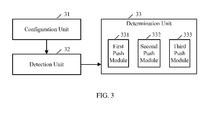
- Fig. 3 shows a structure of an apparatus for evaluating user activity in an anonymous social system provided by a third embodiment of the invention which just shows component related to the embodiment of the present invention for the convenience of description.
- the apparatus for evaluating user activity in the anonymous social system may be a software unit running in an information processing system not limited to the anonymous social system, or may be a hardware unit or a combination unit of a hardware unit and a software unit.
- the apparatus for evaluating user activity in the anonymous social system may be an independent add-on integrated in the information processing system or running in an application system of the information processing system.
- the apparatus for evaluating user activity in the anonymous social system includes a configuration unit 31, a detection unit 32 and a determination unit 33.
- the specific functions of the units are as follows:
- the detection unit 32 is adapted to detect a status selected by a user.
- the determination unit 33 is adapted to determine an activity of the user in the anonymous social system according to the selected status, and push a functional experience related to the activity to a client of the user.
- the anonymous social system includes, but is not limited to, an anonymous friend making system applied to an email or instant messenger which may be located at a PC or a mobile terminal which includes, but is not limited to, a mobile phone and a tablet PC.
- the status selection item includes but is not limited to a form of a progress bar, a button, a selection box or automatic input.
- the status may include an open status, a close status or a set of adjustable discrete values.
- the apparatus for evaluating user activity in the anonymous social system provided in the embodiment may be used in the aforementioned method for evaluating user activity in the anonymous social system, the specific description of which can be referred to the description of the method for evaluating user activity in the anonymous social system in Embodiment I and will not be discussed again herein.
- the determination unit 31 further includes a first push module 331, a second push module 332 and a third push module 333.
- the first push module 331 is adapted to when the selected status is an open status, determine that the activity of the user in the anonymous social system is active, publish the online status of the user and increase the probability of receiving information at the client of the user according to a preconfigured rule.
- the second push module 332 is adapted to when the selected status is a close status, determine that the activity of the user in the anonymous social system is inactive, not publish the online status of the user and decrease the probability of receiving information at the client of the user according to a preconfigured rule.
- the third push unit 333 is adapted to determine an activity level of the user in the anonymous social system according to the selected discrete value, control the probability of receiving information at the client of the user and determine whether to publish the online status of the user according to the activity level of the user in the anonymous social system, where there is a mapping relationship between the discrete value and the activity level.
- the apparatus for evaluating user activity in the anonymous social system may be used in the aforementioned method for evaluating user activity in the anonymous social system, the specific description of which can be referred to the description of the method for evaluating user activity in the anonymous social system in Embodiment II.
- the first push module 331 may further be adapted to obtain the duration of the open status such as 5 seconds, determine whether the duration of the open status exceeds a preconfigured time threshold of 5 seconds, and if the duration of the open status exceeds the preconfigured time threshold or not, increase the transmission frequency of application program information and etc., which will not be discussed again herein.
- the procedure in the method of the above embodiments may be accomplished through related hardware being instructed by a computer program which may be stored in a computer-readable storage medium.
- the program When the program is executed, the program may include the above procedure in any of the above embodiments of the method.
- the storage medium may be a magnetic disc, optical disk, Read-Only Memory (ROM) or Random Access Memory (RAM) or etc.
- the embodiments of the present invention can evaluate the user's activity in the anonymous social system according to the status the user selects, so that the delivery of the anonymous social system's functional experience can be of more pertinence and higher accuracy without violation of the user's privacy, thereby reducing interferences to inactive users, enabling delivery of stronger and more functional experiences to the users of high activity and improving the user's satisfaction on the anonymous social system.
- whether the user is historically active or recently active can be determined according to the time when the user makes a selection, and thus the real-time performance is strong.
Landscapes
- Engineering & Computer Science (AREA)
- Computer Networks & Wireless Communication (AREA)
- Signal Processing (AREA)
- General Engineering & Computer Science (AREA)
- Theoretical Computer Science (AREA)
- Human Computer Interaction (AREA)
- Physics & Mathematics (AREA)
- General Physics & Mathematics (AREA)
- Management, Administration, Business Operations System, And Electronic Commerce (AREA)
- Debugging And Monitoring (AREA)
Abstract
Description
- The present invention relates to a field of information processing, and specifically, relates to a method and an apparatus for evaluating user activity in an anonymous social system.
- There is an anonymous social system in existing social network services, e.g., an anonymous friend making system applied to an email or instant messenger and etc. The anonymous social system pushes to a user various functional experiences according to the user's activity including the user's interest on the anonymous social system, the user's using frequency of the anonymous social system and so on, e.g., it may deliver more anonymous information to the user having more interest on the anonymous friend making system so as to make information delivery with more pertinence.
- In the prior art, the user's activity for the anonymous social system is evaluated by an integral method or analysis on the user's behaviors. However, it is difficult to evaluate if the user is historically active or recently active in the anonymous social system through the integral method, and the analysis on the user's behaviors has disadvantages of violation of the user's privacy, poor accuracy of the evaluation and low real-time performance.
- Embodiments of the present invention is to provide a method for evaluating user activity in an anonymous social system to solve the above problem in evaluating a user's activity in the anonymous social system in the prior art.
- An embodiment of the present invention is implemented as a method for evaluating user activity in an anonymous social system, and the method includes:
- displaying in the anonymous social system a status selection item upon receiving a logon account and determining that the logon account logs on the anonymous social system, wherein the status selection item includes at least one status;
- receiving a status selection instruction and obtaining a status corresponding to the status selection instruction;
- matching an activity marker associated with the status to the status corresponding to the status selection instruction; and
- obtaining corresponding application program information according to the matched activity marker and transmitting the obtained application program information to a client.
- Another objective of the embodiment of the present invention is to provide a method for evaluating user activity in an anonymous social system, and the method includes:
- displaying a status selection item in the anonymous social system, wherein the status selection item includes at least one status;
- detecting the status an user selects through the status selection item; and
- determining an activity of the user in the anonymous social system according to the status selected and pushing application program information related to the activity to a client of the user.
- Another objective of the embodiment of the present invention is to provide an apparatus for evaluating user activity in an anonymous social system, and the apparatus includes:
- a configuration unit, adapted to configure a status selection item in the anonymous social system and configure at least one status for the status selection item;
- a detection unit, adapted to detect the status selected by an user; and
- a determination unit, adapted to determine an activity of the user in the anonymous social system according to the status selected and pushing application program information related to the activity to a client of the user.
- Another objective of the embodiment of the present invention is to provide an anonymous social system, and the system includes an apparatus for evaluating user activity in the anonymous social system which includes:
- a configuration unit, adapted to configure a status selection item in the anonymous social system and configure at least one status for the status selection item;
- a detection unit, adapted to detect the status selected by an user; and
- a determination unit, adapted to determine an activity of the user in the anonymous social system according to the status selected and pushing application program information related to the activity to a client of the user.
- Another objective of the embodiment of the present invention is to provide a storage medium, storing computer-executable instructions therein, wherein the computer-executable instructions are to enable a computer to perform the following operations:
- displaying in the anonymous social system a status selection item upon receiving a logon account and determining that the logon account logs on the anonymous social system, wherein the status selection item includes at least one status;
- receiving a status selection instruction and obtaining a status corresponding to the status selection instruction;
- matching an activity marker associated with the status to the status corresponding to the status selection instruction; and
- obtaining corresponding application program information according to the matched activity marker and transmitting the obtained application program information to a client.
- It can be seen from the above technical solutions that through setting a status selection item with more than one status in the anonymous social system, the embodiments of the present invention can evaluate the user's activity in the anonymous social system according to the status the user selects, so that the delivery of the anonymous social system's functional experience can be of more pertinence and higher accuracy without violation of the user's privacy, thereby reducing interferences to inactive users and improving the user's satisfaction on the anonymous social system. In addition, whether the user is historically active or recently active can be determined according to the time when the user makes a selection, and thus the real-time performance is strong.
-
-
Fig. 1 is a flow chart illustrating a method for evaluating user activity in an anonymous social system provided by a first embodiment of the invention. -
Fig. 2 is a flow chart illustrating a method for evaluating user activity in an anonymous social system provided by a second embodiment of the invention. -
Fig. 3 is a schematic diagram showing a structure of an apparatus for evaluating user activity in an anonymous social system provided by a third embodiment of the invention. - To make objectives, technical solutions and advantages of the present invention more clear and understandable, the present invention will be described more fully in combination with embodiments and the accompanying drawings. It should be understood that the specific embodiments described hereinafter are merely used to explain the present invention and are in no way intended to limit the present invention.
- Through setting a status selection item with more than one status in an anonymous social system in the Internet, the embodiments of the present invention can evaluate the user's activity in the anonymous social system according to the status the user selects, so that the delivery of the anonymous social system's functional experience can be of more pertinence and higher accuracy without violation of the user's privacy, thereby reducing interferences to inactive users and improving the user's satisfaction on the anonymous social system. In addition, whether the user is historically active or recently active can be determined according to the time when the user makes a selection, and thus the real-time performance is strong.
- The technical solution of the present invention is illustrated through the following description of the specific embodiments.
-
Fig. 1 shows a flow chart illustrating a method for evaluating user activity in an anonymous social system provided by a first embodiment of the invention. The procedure of the method is described in detail as follows: - In Step S101, a status selection item is configured in the anonymous social system, and more than one status is configured for the status selection item.
- In the embodiment, the anonymous social system includes, but is not limited to, an anonymous friend making system applied to an email or instant messenger which may be located at a PC or a mobile terminal which includes, but is not limited to, a mobile phone and a tablet PC. The status selection item is associated with the anonymous social system and includes but is not limited to a form of a progress bar, a button, a selection box or automatic input. The status may include an open status, a close status or a set of adjustable discrete values.
- Herein, the anonymous social system may include multiple status selection items, and an activity marker such as a flag bit is configured for a designated status selection item in a user property system of a server or a client. The activity marker is used to reflect the status of the status selection item, e.g., the activity marker includes a first activity marker such as 1 which indicates that the status of the status selection item is open, and it also includes a second activity marker such as 0 which indicates that the status of the status selection item is close.
- In Step S102, the status selected by the user is detected.
- In the embodiment, a server may obtain the status selected by the user through detecting the activity marker of the status selection item and automatically record the time when the selection is made. For example, when the activity marker is of the value of the first activity marker, 1, it is indicated that the status selected by the user is the open status.
- In the embodiment, when the user logs on the anonymous social system by inputting a logon account and password and the anonymous social system determines that the logon account and password are correct, the system explains the function of the status selection item through tips and instructs the user to select a status through the status selection item.
- In Step S103, the activity marker of the user in the anonymous social system is determined according to the selected status, and application program information such as the function for experience related to the activity marker is pushed to the client of the user.
- In the embodiment, a correspondence relationship between the statuses and the activities markers is pre-established, e.g., when the selected status is the open status, the corresponding user activity is active, and otherwise, when the selected status is the close status, the corresponding user activity is inactive. In addition, when the status is a set of adjustable discrete values, the mapping relationship between the discrete values and activity levels is pre-established. In an example, but not limited to the example, when the discrete values of the statuses is a set {1,2,3,4} and the user's activity markers or activity levels include a first-level active marker, a second-level active marker, a third-level active marker, the mapping relationship between the discrete values and the activity markers is that when the selected status is 1 or 2, the user's corresponding activity marker is the first-level active marker, when the selected status is 3, the user's corresponding activity marker is the second-level active marker, and when the selected status is 4, the user's corresponding activity marker is the third-level active marker.
- In the embodiment, the functional experience includes, but is not limited to, probability of receiving anonymous information and whether to publish the user's information, e.g., an online status and etc.
- In the embodiment of the present invention, the user's activity in the anonymous social system can be evaluated according to the status the user selects, so that the delivery of the anonymous social system's functional experience can be of more pertinence and higher accuracy without violation of the user's privacy, thereby reducing interferences to inactive users, enabling delivery of stronger and more functional experiences to the users of high activity and improving the user's satisfaction on the anonymous social system. In addition, whether the user is historically active or recently active can be determined according to the time when the user makes a selection, and thus the real-time performance is strong.
-
Fig. 2 shows a flow chart illustrating a method for displaying network map comments provided by a second embodiment of the invention. The procedure of the method is described in detail as follows: - In Step S201, a status selection item is configured in an anonymous social system, and more than one status is configured for the status selection item.
- In Step S202, the status selected by the user is detected.
- In the embodiment, Steps S201∼S202 are the same as Steps S101∼102, the specific implementation of which can be referred to the description of Steps S101∼102 in Embodiment I.
- In Step S203, when the selected status is the open status, the user's activity in the anonymous social system is determined as active, the online status of the user is published, and the probability of receiving information at the client of the user is increased according to a preconfigured rule.
- In Step S204, when the selected status is the close status, the user's activity in the anonymous social system is determined as inactive, the online status of the user will not be published, and the probability of receiving information at the client of the user is decreased according to a preconfigured rule.
- In the embodiment, a default probability of receiving information is preconfigured in the system, and the probability of receiving information can be adjusted according to the preconfigured rule according to the status selected by the user. The description of the preconfigured rule is as follows but not limited to the following:
- Duration of the status selected by the user is recorded.
- When the status selected by the user is the open status, if the duration is 0-a1, the probability of receiving information is increased by b1 % from the default probability of receiving information; and if the duration is a1-a2, the probability of receiving information is increased by b2%; and the probability of receiving information is increased accordingly until the probability of receiving information reaches 100%.
- When the status selected by the user is the close status, if the duration is 0-a1, the probability of receiving information is decreased by b1%; and if the duration is a1-a2, the probability of receiving information is decreased by b2%; and the probability of receiving information is decreased accordingly until the probability of receiving information is equal to 0%.
- In another embodiment of the present invention, the method further includes: when the status is a set of adjustable discrete values, the system determines the user's activity level in the anonymous social system according to the discrete values selected by the user, control the probability of receiving information at the client of the user according to the user's activity level in the anonymous social system, and determines whether to publish the user's online status. Here, there is a mapping relationship between the discrete value and the activity level.
- The description is as follows but not limited to the following:
- When the discrete values of the statuses is a set {1,2,3,4} and the user's activity levels include levels of first-level active, second-level active and third-level active, the mapping relationship between the discrete values and the activity levels is that when the selected status is 1 or 2, the user's corresponding activity level is first-level active, when the selected status is 3, the user's corresponding activity level is second-level active, and when the selected status is 4, the user's corresponding activity level is third-level active. When the activity level is second-level active or an upper-level active, the online status of the user is published, and each activity level is configured with a value of the probability of receiving information. Those skilled in this art may configure the value of the probability according to experiences or according to the above duration of the selected status, and may adjust the value of the probability according to satisfaction information fed back by the user.
- An example is provided hereinafter to describe the above procedure which is not limited to the example.
- When the anonymous social system is applied to an email, status options configured for a beacon icon include an option of lightening the status selection item and an option of un-lightening the status selection item, and the status selection item may be displayed by lightening the beacon icon. When a user logs on the anonymous social system applied to the email, the system detects that the status selection item is lightened by the user, which indicates that the user's activity in the anonymous social system applied to the email is active. In order to push stronger and more functional experiences to the active user, a presentation system at front end of the anonymous social system applied to the email and a delivery system and receiving system backstage push stronger functional experiences, publish statuses including but not limited to the status selection item's lightening status and the user's online status, and gradually increase the probability of delivery of anonymous information which exceeds a first threshold configured initially and that of receipt of the anonymous information which exceeds a second threshold configured initially according to the duration of the lightening status. For example, it is determined whether the duration of the open status exceeds a preconfigured time threshold of 5 seconds, the transmission frequency of application information is increased if the duration of the open status exceeds the preconfigured time threshold of 5 seconds or not.
- When it detects that the user does not lighten the status selection item, certain instructions may be provided for the user through tips. If the user still does not lighten the status selection item, it is indicated that the user's activity in the anonymous social system applied to the email is inactive. In order to reduce interferences to the user, the system does not publish the user's online status and gradually decreases the probability of delivery of anonymous information and that of receipt of the anonymous information at the user's client according to the duration of the status selection item's un-lightening status. Here, the first and second thresholds configured initially may be preconfigured by the user.
-
Fig. 3 shows a structure of an apparatus for evaluating user activity in an anonymous social system provided by a third embodiment of the invention which just shows component related to the embodiment of the present invention for the convenience of description. - The apparatus for evaluating user activity in the anonymous social system may be a software unit running in an information processing system not limited to the anonymous social system, or may be a hardware unit or a combination unit of a hardware unit and a software unit. Alternatively, the apparatus for evaluating user activity in the anonymous social system may be an independent add-on integrated in the information processing system or running in an application system of the information processing system.
- The apparatus for evaluating user activity in the anonymous social system includes a
configuration unit 31, adetection unit 32 and adetermination unit 33. The specific functions of the units are as follows: - The
configuration unit 31 is adapted to configure a status selection item in an anonymous social system and configure more than one status for the status selection item. - The
detection unit 32 is adapted to detect a status selected by a user. - The
determination unit 33 is adapted to determine an activity of the user in the anonymous social system according to the selected status, and push a functional experience related to the activity to a client of the user. - In the embodiment, the anonymous social system includes, but is not limited to, an anonymous friend making system applied to an email or instant messenger which may be located at a PC or a mobile terminal which includes, but is not limited to, a mobile phone and a tablet PC. The status selection item includes but is not limited to a form of a progress bar, a button, a selection box or automatic input. The status may include an open status, a close status or a set of adjustable discrete values.
- The apparatus for evaluating user activity in the anonymous social system provided in the embodiment may be used in the aforementioned method for evaluating user activity in the anonymous social system, the specific description of which can be referred to the description of the method for evaluating user activity in the anonymous social system in Embodiment I and will not be discussed again herein.
- In another embodiment of the present invention, the
determination unit 31 further includes afirst push module 331, asecond push module 332 and athird push module 333. - The
first push module 331 is adapted to when the selected status is an open status, determine that the activity of the user in the anonymous social system is active, publish the online status of the user and increase the probability of receiving information at the client of the user according to a preconfigured rule. - The
second push module 332 is adapted to when the selected status is a close status, determine that the activity of the user in the anonymous social system is inactive, not publish the online status of the user and decrease the probability of receiving information at the client of the user according to a preconfigured rule. - The
third push unit 333 is adapted to determine an activity level of the user in the anonymous social system according to the selected discrete value, control the probability of receiving information at the client of the user and determine whether to publish the online status of the user according to the activity level of the user in the anonymous social system, where there is a mapping relationship between the discrete value and the activity level. - The apparatus for evaluating user activity in the anonymous social system provided in the embodiment may be used in the aforementioned method for evaluating user activity in the anonymous social system, the specific description of which can be referred to the description of the method for evaluating user activity in the anonymous social system in Embodiment II. For example, the
first push module 331 may further be adapted to obtain the duration of the open status such as 5 seconds, determine whether the duration of the open status exceeds a preconfigured time threshold of 5 seconds, and if the duration of the open status exceeds the preconfigured time threshold or not, increase the transmission frequency of application program information and etc., which will not be discussed again herein. - Those skilled in this art could understand that various units included in the apparatus of Embodiment III are divided according to functional logics, the division of the units is not limited to this, a division of the units may be adopted as long as the functions of apparatus can be realized through the division. In addition, the specific names of the functional units are merely to distinguish these units but not intended to limit the protection scope of the present invention.
- Those skilled in this art could understand that implementation of all or a part of the procedure in the method of the above embodiments may be accomplished through related hardware being instructed by a computer program which may be stored in a computer-readable storage medium. When the program is executed, the program may include the above procedure in any of the above embodiments of the method. Here, the storage medium may be a magnetic disc, optical disk, Read-Only Memory (ROM) or Random Access Memory (RAM) or etc.
- To sum up, through setting a status selection item configured with more than one status in certain anonymous social system in the Internet, the embodiments of the present invention can evaluate the user's activity in the anonymous social system according to the status the user selects, so that the delivery of the anonymous social system's functional experience can be of more pertinence and higher accuracy without violation of the user's privacy, thereby reducing interferences to inactive users, enabling delivery of stronger and more functional experiences to the users of high activity and improving the user's satisfaction on the anonymous social system. In addition, whether the user is historically active or recently active can be determined according to the time when the user makes a selection, and thus the real-time performance is strong.
- The foregoing is only preferred embodiments of the present invention and is not used to limit the present invention. Any modification, equivalent substitution and improvement without departing from the spirit and principle of the present invention are within the protection scope of the present invention.
Claims (25)
- A method for evaluating user activity in an anonymous social system, comprising:displaying in the anonymous social system a status selection item upon receiving a logon account and determining that the logon account logs on the anonymous social system, wherein the status selection item comprises at least one status;receiving a status selection instruction and obtaining a status corresponding to the status selection instruction;matching an activity marker associated with the status to the status corresponding to the status selection instruction; andobtaining corresponding application program information according to the matched activity marker and transmitting the obtained application program information to a client.
- The method for evaluating user activity in the anonymous social system of claim 1, wherein the status comprises an open status or a close status, the open status corresponds to a first activity marker, and the close status corresponds to a second activity marker.
- The method for evaluating user activity in the anonymous social system of claim 2, wherein a specific step for obtaining corresponding application program information according to the matched activity marker and transmitting the obtained application program information to a client comprises:when the matched activity marker is the first activity marker, displaying information of the open status and increasing probability of receiving the application program information according to a preconfigured rule; andwhen the matched activity marker is the second activity marker, decreasing probability of receiving the application program information according to a preconfigured rule.
- The method for evaluation user activity in the anonymous social system of claim 3, wherein when the matched activity marker is the first activity marker, the method further comprises the following steps:obtaining a duration of the open status and determining whether the duration of the open status exceeds a preconfigured time threshold; andincreasing transmission frequency of the application program information when the duration of the open status exceeds the preconfigured time threshold or not.
- The method for evaluating user activity in the anonymous social system of claim 1, wherein the status comprises at least one identifier corresponding to the activity marker, and the activity marker corresponds to probability of receiving information.
- The method for evaluating user activity in the anonymous social system of claim 5, wherein during obtaining corresponding application program information according to the matched activity marker and transmitting the obtained application program information to a client, the method further comprises the following steps:obtaining probability of receiving information corresponding to the matched activity marker according to the matched activity marker; andtransmitting the application program information to the client according to the obtained probability of receiving information.
- A method for evaluating user activity in an anonymous social system, comprising:displaying a status selection item in the anonymous social system, wherein the status selection item comprises at least one status;detecting the status an user selects through the status selection item; anddetermining an activity of the user in the anonymous social system according to the status selected and pushing application program information related to the activity to a client of the user.
- The method for evaluating user activity in the anonymous social system of claim 7, wherein the status comprises an open status or a close status.
- The method for evaluating user activity in the anonymous social system of claim 8, wherein a process for determining an activity of the user in the anonymous social system according to the status selected and pushing application program information related to the activity to a client of the user specifically comprises:when the status selected is the open status, determining that the activity of the user in the anonymous social system is a first activity marker, publishing an online status of the user and increasing probability of receiving information at the client of the user according to a preconfigured rule; andwhen the status selected is the close status, determining that the activity of the user in the anonymous social system is a second activity marker and decreasing probability of receiving information at the client of the user according to a preconfigured rule.
- The method for evaluating user activity in the anonymous social system of claim 9, wherein when the status selected is the open status, the method further comprises:obtaining a duration of the open status and determining whether the duration of the open status exceeds a preconfigured time threshold; andincreasing transmission frequency of the application program information when the duration of the open status exceeds the preconfigured time threshold or not.
- The method for evaluating user activity in the anonymous social system of claim 7, wherein the status is a set of adjustable discrete values.
- The method for evaluating user activity in the anonymous social system of claim 11, wherein a process of determining an activity of the user in the anonymous social system according to the status selected and pushing application program information related to the activity to a client of the user specifically comprises:determining an activity level of the user in the anonymous social system according to the discrete value selected, controlling probability of receiving information at the client of the user and determining whether to publish an online status of the user according to the activity level of the user in the anonymous social system, wherein there is a mapping relationship between the discrete value and the activity level.
- An apparatus for evaluating user activity in an anonymous social system, comprising:a configuration unit, adapted to configure a status selection item in the anonymous social system and configure at least one status for the status selection item;a detection unit, adapted to detect the status selected by an user; anda determination unit, adapted to determine an activity of the user in the anonymous social system according to the status selected and pushing application program information related to the activity to a client of the user.
- The apparatus for evaluating user activity in an anonymous social system of claim 13, wherein the status comprises an open status or a close status.
- The apparatus for evaluating user activity in the anonymous social system of claim 14, wherein the determination unit comprises:a first push module, adapted to when the status selected is the open status, determine that the activity of the user in the anonymous social system is a first activity marker, publish an online status of the user and increase probability of receiving information at the client of the user according to a preconfigured rule; anda second push module, adapted to when the status selected is the close status, determine that the activity of the user in the anonymous social system is a second activity marker and decrease probability of receiving information at the client of the user according to a preconfigured rule.
- The apparatus for evaluating user activity in the anonymous social system of claim 15, wherein the first push module is further adapted to obtain a duration of the open status and determine whether the duration of the open status exceeds a preconfigured time threshold, and increase transmission frequency of the application program information when the duration of the open status exceeds the preconfigured time threshold or not.
- The apparatus for evaluating user activity in the anonymous social system of claim 13, wherein the status is a set of adjustable discrete values.
- The apparatus for evaluating user activity in the anonymous social system of claim 17, wherein the determination unit further comprises a third push module, determine an activity level of the user in the anonymous social system according to the discrete value selected, control probability of receiving information at the client of the user and determining whether to publish an online status of the user according to the activity level of the user in the anonymous social system, wherein there is a mapping relationship between the discrete value and the activity level.
- An anonymous social system, comprising an apparatus for evaluating user activity in the anonymous social system, the apparatus comprising:a configuration unit, adapted to configure a status selection item in the anonymous social system and configure at least one status for the status selection item;a detection unit, adapted to detect the status selected by an user; anda determination unit, adapted to determine an activity of the user in the anonymous social system according to the status selected and pushing application program information related to the activity to a client of the user.
- A storage medium, storing computer-executable instructions therein, wherein the computer-executable instructions are to enable a computer to perform the following operations:displaying in the anonymous social system a status selection item upon receiving a logon account and determining that the logon account logs on the anonymous social system, wherein the status selection item comprises at least one status;receiving a status selection instruction and obtaining a status corresponding to the status selection instruction;matching an activity marker associated with the status to the status corresponding to the status selection instruction; andobtaining corresponding application program information according to the matched activity marker and transmitting the obtained application program information to a client.
- The storage medium of claim 20, wherein the status comprises an open status or a close status, the open status corresponds to a first activity marker, and the close status corresponds to a second activity marker.
- The storage medium of claim 21, wherein the computer-executable instructions are further to enable the computer to perform the following operations:when the matched activity marker is the first activity marker, displaying information of the open status and increasing probability of receiving the application program information according to a preconfigured rule; andwhen the matched activity marker is the second activity marker, decreasing probability of receiving the application program information according to a preconfigured rule.
- The storage medium of claim 22, wherein the computer-executable instructions are further to enable the computer to perform the following operations:obtaining a duration of the open status and determining whether the duration of the open status exceeds a preconfigured time threshold; andincreasing transmission frequency of the application program information when the duration of the open status exceeds the preconfigured time threshold or not.
- The storage medium of claim 20, wherein the status comprises at least one identifier corresponding to the activity marker, and the activity marker corresponds to probability of receiving information.
- The storage medium of claim 24, wherein the computer-executable instructions are further to enable the computer to perform the following operations:obtaining probability of receiving information corresponding to the matched activity marker according to the matched activity marker; andtransmitting the application program information to the client according to the obtained probability of receiving information.
Applications Claiming Priority (2)
| Application Number | Priority Date | Filing Date | Title |
|---|---|---|---|
| CN2011104410942A CN102571630B (en) | 2011-12-26 | 2011-12-26 | Method and device for evaluating user activity in anonymous social system |
| PCT/CN2012/086170 WO2013097589A1 (en) | 2011-12-26 | 2012-12-07 | Method and device for evaluating user activity level in anonymous social system |
Publications (2)
| Publication Number | Publication Date |
|---|---|
| EP2800300A1 true EP2800300A1 (en) | 2014-11-05 |
| EP2800300A4 EP2800300A4 (en) | 2015-05-27 |
Family
ID=46416129
Family Applications (1)
| Application Number | Title | Priority Date | Filing Date |
|---|---|---|---|
| EP12863113.2A Withdrawn EP2800300A4 (en) | 2011-12-26 | 2012-12-07 | Method and device for evaluating user activity level in anonymous social system |
Country Status (12)
| Country | Link |
|---|---|
| US (1) | US20140359466A1 (en) |
| EP (1) | EP2800300A4 (en) |
| JP (1) | JP5766368B2 (en) |
| CN (1) | CN102571630B (en) |
| AP (1) | AP2014007811A0 (en) |
| AU (1) | AU2012362047A1 (en) |
| CA (1) | CA2861280A1 (en) |
| HK (1) | HK1201649A1 (en) |
| MX (1) | MX336203B (en) |
| SG (1) | SG11201403563PA (en) |
| WO (1) | WO2013097589A1 (en) |
| ZA (1) | ZA201405482B (en) |
Families Citing this family (16)
| Publication number | Priority date | Publication date | Assignee | Title |
|---|---|---|---|---|
| CN102571630B (en) * | 2011-12-26 | 2013-10-09 | 腾讯科技(深圳)有限公司 | Method and device for evaluating user activity in anonymous social system |
| CN103685394A (en) * | 2012-09-14 | 2014-03-26 | 腾讯科技(深圳)有限公司 | System and method for processing user dynamic information of Internet |
| US9166943B2 (en) | 2013-03-12 | 2015-10-20 | International Business Machines Corporation | Systems and methods for using social network analysis to schedule communications |
| CN104144099A (en) * | 2013-05-08 | 2014-11-12 | 上海斐讯数据通信技术有限公司 | Method, system and electronic device for determining communication mode |
| CN103684807A (en) * | 2013-12-10 | 2014-03-26 | 小米科技有限责任公司 | Method, device, terminal device and server for identifying group member information |
| CN105302809B (en) * | 2014-06-10 | 2020-01-10 | 腾讯科技(深圳)有限公司 | Group user level association method and system |
| CN106294500B (en) * | 2015-06-09 | 2020-04-24 | 深圳市腾讯计算机系统有限公司 | Content item pushing method, device and system |
| CN105095055B (en) * | 2015-07-22 | 2019-12-20 | 北京奇虎科技有限公司 | User activity statistical method and system |
| CN105245577B (en) * | 2015-09-11 | 2018-09-04 | 腾讯科技(深圳)有限公司 | Information-pushing method, apparatus and system |
| CN105511876B (en) * | 2015-12-04 | 2019-05-03 | Oppo广东移动通信有限公司 | A method and device for processing push information |
| CN108259312A (en) * | 2016-12-29 | 2018-07-06 | 广州市动景计算机科技有限公司 | Information issuing method, device and server |
| CN107704997A (en) * | 2017-09-12 | 2018-02-16 | 广东万丈金数信息技术股份有限公司 | Assess the method, apparatus and storage medium of client liveness |
| CN109640102B (en) * | 2017-10-09 | 2021-05-28 | 武汉斗鱼网络科技有限公司 | Method and device for realizing stealth anonymity function in live broadcast room |
| CN110752042B (en) * | 2019-10-16 | 2022-03-11 | 广东韶钢松山股份有限公司 | Blast furnace hearth state determination method and device and electronic equipment |
| US11184740B2 (en) | 2020-03-25 | 2021-11-23 | Sourcewater, Inc. | Location data based intelligence for supply chain information platforms |
| CN115391671A (en) * | 2022-08-02 | 2022-11-25 | 鑫洋互联网科技(广州)有限公司 | Intelligent method for hiding personal information for making friends on Internet |
Family Cites Families (21)
| Publication number | Priority date | Publication date | Assignee | Title |
|---|---|---|---|---|
| CA2306858A1 (en) * | 1997-10-06 | 1999-04-15 | Philip A. Des Jardins | System enabling a salesperson to chat with a customer browsing the salesperson's web site |
| US7606862B2 (en) * | 2004-03-31 | 2009-10-20 | International Business Machines Corporation | Method and system for authorizing a restricted callable status in an instant messaging system |
| JP2005309524A (en) * | 2004-04-16 | 2005-11-04 | Ntt Comware Corp | Application server, presence information providing method, and program |
| JP2007249310A (en) * | 2006-03-13 | 2007-09-27 | Internet Revolution:Kk | Information management server |
| CN101163113B (en) * | 2006-10-12 | 2011-01-26 | 阿里巴巴集团控股有限公司 | Disconnection reconnecting system and method of instant communication |
| US20080133742A1 (en) * | 2006-11-30 | 2008-06-05 | Oz Communications Inc. | Presence model for presence service and method of providing presence information |
| US8060827B2 (en) * | 2006-11-30 | 2011-11-15 | Red Hat, Inc. | Method and system for preloading suggested content onto digital video recorder based on social recommendations |
| US7693535B2 (en) * | 2006-12-22 | 2010-04-06 | Sony Ericsson Mobile Communications Ab | Communication systems and methods for providing a group play list for multimedia content records |
| CN101009670B (en) * | 2007-01-22 | 2010-06-23 | 阿里巴巴集团控股有限公司 | A method and system for realizing group communication based on instant messaging |
| US20080282324A1 (en) * | 2007-05-10 | 2008-11-13 | Mary Kay Hoal | Secure Social Networking System with Anti-Predator Monitoring |
| JP4887226B2 (en) * | 2007-06-19 | 2012-02-29 | 楽天株式会社 | Message transmission / reception system, terminal device, terminal processing program, server device, server processing program, display control method, and user information transmission method |
| CN101217515A (en) * | 2008-01-03 | 2008-07-09 | 腾讯科技(深圳)有限公司 | A system and method based on question sorting and push |
| CN101420653A (en) * | 2008-12-08 | 2009-04-29 | 中国移动通信集团浙江有限公司 | System for evaluating active degree and preference of user data service |
| JP5519792B2 (en) * | 2009-08-12 | 2014-06-11 | テルコーディア テクノロジーズ インコーポレイテッド | Social network privacy by how to develop access control |
| CN101997894A (en) * | 2009-08-14 | 2011-03-30 | 阿里巴巴集团控股有限公司 | Information pushing method, system and network system thereof |
| US8595049B2 (en) * | 2009-09-08 | 2013-11-26 | York Eggleston | Method and system for monitoring internet information for group notification, marketing, purchasing and/or sales |
| CN102025648B (en) * | 2009-09-16 | 2014-12-03 | 腾讯科技(深圳)有限公司 | Instant messaging method and server |
| US20110196724A1 (en) * | 2010-02-09 | 2011-08-11 | Charles Stanley Fenton | Consumer-oriented commerce facilitation services, applications, and devices |
| CN102281207A (en) * | 2010-06-11 | 2011-12-14 | 百度在线网络技术(北京)有限公司 | Method for determining user matching degree and matching users chatting in social network and equipment thereof |
| CN101997914B (en) * | 2010-10-29 | 2013-01-02 | 中国移动通信集团北京有限公司 | Method and system for implementing service experience |
| CN102571630B (en) * | 2011-12-26 | 2013-10-09 | 腾讯科技(深圳)有限公司 | Method and device for evaluating user activity in anonymous social system |
-
2011
- 2011-12-26 CN CN2011104410942A patent/CN102571630B/en active Active
-
2012
- 2012-12-07 JP JP2014549329A patent/JP5766368B2/en active Active
- 2012-12-07 AU AU2012362047A patent/AU2012362047A1/en not_active Abandoned
- 2012-12-07 CA CA2861280A patent/CA2861280A1/en not_active Abandoned
- 2012-12-07 MX MX2014007846A patent/MX336203B/en unknown
- 2012-12-07 AP AP2014007811A patent/AP2014007811A0/en unknown
- 2012-12-07 HK HK15100642.5A patent/HK1201649A1/en unknown
- 2012-12-07 US US14/368,775 patent/US20140359466A1/en not_active Abandoned
- 2012-12-07 EP EP12863113.2A patent/EP2800300A4/en not_active Withdrawn
- 2012-12-07 WO PCT/CN2012/086170 patent/WO2013097589A1/en not_active Ceased
- 2012-12-07 SG SG11201403563PA patent/SG11201403563PA/en unknown
-
2014
- 2014-07-24 ZA ZA2014/05482A patent/ZA201405482B/en unknown
Also Published As
| Publication number | Publication date |
|---|---|
| SG11201403563PA (en) | 2014-10-30 |
| WO2013097589A1 (en) | 2013-07-04 |
| MX2014007846A (en) | 2014-08-27 |
| CN102571630A (en) | 2012-07-11 |
| AP2014007811A0 (en) | 2014-07-31 |
| JP5766368B2 (en) | 2015-08-19 |
| MX336203B (en) | 2016-01-11 |
| EP2800300A4 (en) | 2015-05-27 |
| CN102571630B (en) | 2013-10-09 |
| US20140359466A1 (en) | 2014-12-04 |
| JP2015505103A (en) | 2015-02-16 |
| ZA201405482B (en) | 2015-04-29 |
| CA2861280A1 (en) | 2013-07-04 |
| AU2012362047A1 (en) | 2014-08-14 |
| HK1201649A1 (en) | 2015-09-04 |
Similar Documents
| Publication | Publication Date | Title |
|---|---|---|
| EP2800300A1 (en) | Method and device for evaluating user activity level in anonymous social system | |
| EP2819351B1 (en) | Information processing method, apparatus, and system | |
| US10826860B2 (en) | Group management method, terminal, and storage medium | |
| US10832181B2 (en) | Management of business process key performance indicators | |
| US9706398B2 (en) | Techniques for a custom short message service center | |
| US20160344662A1 (en) | Method and apparatus for generating a suggested message to be sent over a network | |
| US8990353B2 (en) | Recommended alteration to a processing system | |
| US9092760B2 (en) | Email history handler that chooses history segments to include with a communication reply | |
| CN105323147A (en) | Group message reading feedback method, and server and client side device thereof | |
| CN104123324B (en) | Positioning and obtaining method and device for unread messages | |
| US20160359793A1 (en) | Systems and methods for creation, delivery and tracking of electronic messages | |
| US20140351713A1 (en) | Method and electronic device for updating communication representations based on activity level | |
| US20130067453A1 (en) | Method and system for obtaining a dynamic update in instant messaging software and computer storage medium therefor | |
| CN102497333B (en) | In order to export the method for contact object Weather information, client and system | |
| US11811718B2 (en) | System and method for generating and rendering intent-based actionable content using input interface | |
| CN103186584B (en) | Microblog topic presentation method and terminal | |
| US20180054691A1 (en) | Contextually prompting users to switch communication modes | |
| US10616149B2 (en) | Optimizing evaluation of effectiveness for multiple versions of electronic messages | |
| WO2018081966A1 (en) | User association method, terminal and server | |
| CN107222331A (en) | Monitoring method, device, storage medium and the equipment of distribution application system performance | |
| CN105763505A (en) | Operation method and device based on user account | |
| US7966224B1 (en) | System, method and computer program product for generating a relationship-based recommendation | |
| CN106933822B (en) | Content recommendation method and device | |
| US7624377B2 (en) | Methods relating to configuration of software | |
| CN106682054A (en) | Terminal application recommendation method, terminal application recommendation device and terminal application recommendation system |
Legal Events
| Date | Code | Title | Description |
|---|---|---|---|
| PUAI | Public reference made under article 153(3) epc to a published international application that has entered the european phase |
Free format text: ORIGINAL CODE: 0009012 |
|
| 17P | Request for examination filed |
Effective date: 20140717 |
|
| AK | Designated contracting states |
Kind code of ref document: A1 Designated state(s): AL AT BE BG CH CY CZ DE DK EE ES FI FR GB GR HR HU IE IS IT LI LT LU LV MC MK MT NL NO PL PT RO RS SE SI SK SM TR |
|
| DAX | Request for extension of the european patent (deleted) | ||
| RA4 | Supplementary search report drawn up and despatched (corrected) |
Effective date: 20150430 |
|
| RIC1 | Information provided on ipc code assigned before grant |
Ipc: H04L 12/00 20060101AFI20150423BHEP |
|
| RAP1 | Party data changed (applicant data changed or rights of an application transferred) |
Owner name: TENCENT TECHNOLOGY (SHENZHEN) COMPANY LIMITED |
|
| REG | Reference to a national code |
Ref country code: HK Ref legal event code: DE Ref document number: 1201649 Country of ref document: HK |
|
| STAA | Information on the status of an ep patent application or granted ep patent |
Free format text: STATUS: THE APPLICATION HAS BEEN WITHDRAWN |
|
| 18W | Application withdrawn |
Effective date: 20151218 |
|
| REG | Reference to a national code |
Ref country code: HK Ref legal event code: WD Ref document number: 1201649 Country of ref document: HK |