EP2799481A1 - Vulcanized rubber, method for producing same, and tire - Google Patents
Vulcanized rubber, method for producing same, and tire Download PDFInfo
- Publication number
- EP2799481A1 EP2799481A1 EP12863212.2A EP12863212A EP2799481A1 EP 2799481 A1 EP2799481 A1 EP 2799481A1 EP 12863212 A EP12863212 A EP 12863212A EP 2799481 A1 EP2799481 A1 EP 2799481A1
- Authority
- EP
- European Patent Office
- Prior art keywords
- hydrophilic
- resin
- vulcanized rubber
- rubber
- aspect ratio
- Prior art date
- Legal status (The legal status is an assumption and is not a legal conclusion. Google has not performed a legal analysis and makes no representation as to the accuracy of the status listed.)
- Granted
Links
Images
Classifications
-
- C—CHEMISTRY; METALLURGY
- C08—ORGANIC MACROMOLECULAR COMPOUNDS; THEIR PREPARATION OR CHEMICAL WORKING-UP; COMPOSITIONS BASED THEREON
- C08L—COMPOSITIONS OF MACROMOLECULAR COMPOUNDS
- C08L7/00—Compositions of natural rubber
-
- B—PERFORMING OPERATIONS; TRANSPORTING
- B60—VEHICLES IN GENERAL
- B60C—VEHICLE TYRES; TYRE INFLATION; TYRE CHANGING; CONNECTING VALVES TO INFLATABLE ELASTIC BODIES IN GENERAL; DEVICES OR ARRANGEMENTS RELATED TO TYRES
- B60C1/00—Tyres characterised by the chemical composition or the physical arrangement or mixture of the composition
-
- B—PERFORMING OPERATIONS; TRANSPORTING
- B60—VEHICLES IN GENERAL
- B60C—VEHICLE TYRES; TYRE INFLATION; TYRE CHANGING; CONNECTING VALVES TO INFLATABLE ELASTIC BODIES IN GENERAL; DEVICES OR ARRANGEMENTS RELATED TO TYRES
- B60C1/00—Tyres characterised by the chemical composition or the physical arrangement or mixture of the composition
- B60C1/0016—Compositions of the tread
-
- C—CHEMISTRY; METALLURGY
- C08—ORGANIC MACROMOLECULAR COMPOUNDS; THEIR PREPARATION OR CHEMICAL WORKING-UP; COMPOSITIONS BASED THEREON
- C08J—WORKING-UP; GENERAL PROCESSES OF COMPOUNDING; AFTER-TREATMENT NOT COVERED BY SUBCLASSES C08B, C08C, C08F, C08G or C08H
- C08J9/00—Working-up of macromolecular substances to porous or cellular articles or materials; After-treatment thereof
- C08J9/04—Working-up of macromolecular substances to porous or cellular articles or materials; After-treatment thereof using blowing gases generated by a previously added blowing agent
- C08J9/06—Working-up of macromolecular substances to porous or cellular articles or materials; After-treatment thereof using blowing gases generated by a previously added blowing agent by a chemical blowing agent
- C08J9/10—Working-up of macromolecular substances to porous or cellular articles or materials; After-treatment thereof using blowing gases generated by a previously added blowing agent by a chemical blowing agent developing nitrogen, the blowing agent being a compound containing a nitrogen-to-nitrogen bond
-
- C—CHEMISTRY; METALLURGY
- C08—ORGANIC MACROMOLECULAR COMPOUNDS; THEIR PREPARATION OR CHEMICAL WORKING-UP; COMPOSITIONS BASED THEREON
- C08K—Use of inorganic or non-macromolecular organic substances as compounding ingredients
- C08K3/00—Use of inorganic substances as compounding ingredients
- C08K3/02—Elements
- C08K3/04—Carbon
-
- C—CHEMISTRY; METALLURGY
- C08—ORGANIC MACROMOLECULAR COMPOUNDS; THEIR PREPARATION OR CHEMICAL WORKING-UP; COMPOSITIONS BASED THEREON
- C08K—Use of inorganic or non-macromolecular organic substances as compounding ingredients
- C08K3/00—Use of inorganic substances as compounding ingredients
- C08K3/02—Elements
- C08K3/06—Sulfur
-
- C—CHEMISTRY; METALLURGY
- C08—ORGANIC MACROMOLECULAR COMPOUNDS; THEIR PREPARATION OR CHEMICAL WORKING-UP; COMPOSITIONS BASED THEREON
- C08K—Use of inorganic or non-macromolecular organic substances as compounding ingredients
- C08K5/00—Use of organic ingredients
- C08K5/16—Nitrogen-containing compounds
- C08K5/34—Heterocyclic compounds having nitrogen in the ring
- C08K5/3467—Heterocyclic compounds having nitrogen in the ring having more than two nitrogen atoms in the ring
- C08K5/3477—Six-membered rings
-
- C—CHEMISTRY; METALLURGY
- C08—ORGANIC MACROMOLECULAR COMPOUNDS; THEIR PREPARATION OR CHEMICAL WORKING-UP; COMPOSITIONS BASED THEREON
- C08K—Use of inorganic or non-macromolecular organic substances as compounding ingredients
- C08K5/00—Use of organic ingredients
- C08K5/36—Sulfur-, selenium-, or tellurium-containing compounds
- C08K5/45—Heterocyclic compounds having sulfur in the ring
- C08K5/46—Heterocyclic compounds having sulfur in the ring with oxygen or nitrogen in the ring
- C08K5/47—Thiazoles
-
- C—CHEMISTRY; METALLURGY
- C08—ORGANIC MACROMOLECULAR COMPOUNDS; THEIR PREPARATION OR CHEMICAL WORKING-UP; COMPOSITIONS BASED THEREON
- C08L—COMPOSITIONS OF MACROMOLECULAR COMPOUNDS
- C08L23/00—Compositions of homopolymers or copolymers of unsaturated aliphatic hydrocarbons having only one carbon-to-carbon double bond; Compositions of derivatives of such polymers
- C08L23/02—Compositions of homopolymers or copolymers of unsaturated aliphatic hydrocarbons having only one carbon-to-carbon double bond; Compositions of derivatives of such polymers not modified by chemical after-treatment
- C08L23/04—Homopolymers or copolymers of ethene
- C08L23/08—Copolymers of ethene
- C08L23/0846—Copolymers of ethene with unsaturated hydrocarbons containing atoms other than carbon or hydrogen
- C08L23/0853—Ethylene vinyl acetate copolymers
- C08L23/0861—Saponified copolymers, e.g. ethylene vinyl alcohol copolymers
-
- C—CHEMISTRY; METALLURGY
- C08—ORGANIC MACROMOLECULAR COMPOUNDS; THEIR PREPARATION OR CHEMICAL WORKING-UP; COMPOSITIONS BASED THEREON
- C08L—COMPOSITIONS OF MACROMOLECULAR COMPOUNDS
- C08L9/00—Compositions of homopolymers or copolymers of conjugated diene hydrocarbons
-
- C—CHEMISTRY; METALLURGY
- C08—ORGANIC MACROMOLECULAR COMPOUNDS; THEIR PREPARATION OR CHEMICAL WORKING-UP; COMPOSITIONS BASED THEREON
- C08J—WORKING-UP; GENERAL PROCESSES OF COMPOUNDING; AFTER-TREATMENT NOT COVERED BY SUBCLASSES C08B, C08C, C08F, C08G or C08H
- C08J2203/00—Foams characterized by the expanding agent
- C08J2203/04—N2 releasing, ex azodicarbonamide or nitroso compound
-
- C—CHEMISTRY; METALLURGY
- C08—ORGANIC MACROMOLECULAR COMPOUNDS; THEIR PREPARATION OR CHEMICAL WORKING-UP; COMPOSITIONS BASED THEREON
- C08J—WORKING-UP; GENERAL PROCESSES OF COMPOUNDING; AFTER-TREATMENT NOT COVERED BY SUBCLASSES C08B, C08C, C08F, C08G or C08H
- C08J2321/00—Characterised by the use of unspecified rubbers
-
- C—CHEMISTRY; METALLURGY
- C08—ORGANIC MACROMOLECULAR COMPOUNDS; THEIR PREPARATION OR CHEMICAL WORKING-UP; COMPOSITIONS BASED THEREON
- C08K—Use of inorganic or non-macromolecular organic substances as compounding ingredients
- C08K3/00—Use of inorganic substances as compounding ingredients
- C08K3/02—Elements
- C08K3/08—Metals
- C08K2003/0893—Zinc
-
- C—CHEMISTRY; METALLURGY
- C08—ORGANIC MACROMOLECULAR COMPOUNDS; THEIR PREPARATION OR CHEMICAL WORKING-UP; COMPOSITIONS BASED THEREON
- C08K—Use of inorganic or non-macromolecular organic substances as compounding ingredients
- C08K2201/00—Specific properties of additives
- C08K2201/002—Physical properties
- C08K2201/003—Additives being defined by their diameter
-
- C—CHEMISTRY; METALLURGY
- C08—ORGANIC MACROMOLECULAR COMPOUNDS; THEIR PREPARATION OR CHEMICAL WORKING-UP; COMPOSITIONS BASED THEREON
- C08K—Use of inorganic or non-macromolecular organic substances as compounding ingredients
- C08K2201/00—Specific properties of additives
- C08K2201/002—Physical properties
- C08K2201/005—Additives being defined by their particle size in general
-
- C—CHEMISTRY; METALLURGY
- C08—ORGANIC MACROMOLECULAR COMPOUNDS; THEIR PREPARATION OR CHEMICAL WORKING-UP; COMPOSITIONS BASED THEREON
- C08L—COMPOSITIONS OF MACROMOLECULAR COMPOUNDS
- C08L2205/00—Polymer mixtures characterised by other features
- C08L2205/14—Polymer mixtures characterised by other features containing polymeric additives characterised by shape
- C08L2205/16—Fibres; Fibrils
Definitions
- the present invention relates to a vulcanized rubber, a method of manufacturing same, and a tire having a tread portion provided with such vulcanized rubber.
- the present invention relates to a vulcanized rubber capable of improving ice performance of the tire.
- a tire for use primarily in winter such as a studless tire has a tread portion provided with a foamed rubber with closed cells so as to improves the drainage performance of the tread portion and to improve the ice performance of the tire.
- Japanese Patent Application Laid-open No. S62-283001 discloses a pneumatic tire in which a rubber composition of a tread portion consists of polymer having a glass transition temperature not more than 60 degree C, and at least 10% of the entire volume of the tread portion consists of a foamed rubber, and the foamed rubber having closed cells with the mean diameter of 1-120 micrometer, and the expansion ratio of the foamed rubber ranges 1-100%.
- a rubber composition of a tread portion consists of polymer having a glass transition temperature not more than 60 degree C, and at least 10% of the entire volume of the tread portion consists of a foamed rubber, and the foamed rubber having closed cells with the mean diameter of 1-120 micrometer, and the expansion ratio of the foamed rubber ranges 1-100%.
- the surfaces of the cells are formed of a vulcanized rubber, which is hydrophobic, so that the capability of the cells to absorb water is low. Further, since the ability of the cells to absorb water is low, the cell does not exert sufficient drainage effect. It is, therefore, demanded to further improve the ice performance of the tire.
- the present inventors has founded that when the tread portion is provided with a vulcanized rubber having cells with a specific aspect ratio of which at least a part of the wall surface is hydrophilic, the tread portion actively absorbs water to improve the water drainage performance and the wall surfaces of the cell scratch the surface of ice; as a result the ice performance during the use of the ABS can be greatly improved. Based on the finding, the present invention has been accomplished.
- the vulcanized rubber made by vulcanizing a rubber composition according to the present invention is characterized in that it has cells with an aspect ratio of 1 to 30, and at least a part of a wall surface of the cell is hydrophilic.
- the tire according to the present invention is characterized by comprising a tread portion provided with the above-mentioned vulcanized rubber.
- a vulcanized rubber which has cells with a specific aspect ratio and at least a part of the wall surface of the cell is hydrophilic, resulting an improvement of the ice performance of the tire. Further, it is possible to provide a method of manufacturing such vulcanized rubber, and a tire comprising a tread portion provided with such vulcanized rubber to express superior ice performance.
- a vulcanized rubber made by vulcanizing a rubber composition according to the present invention is characterized in that the vulcanized rubber has cells with an aspect ratio of 1 to 30, and at least a part of a wall surface of the cell is hydrophilic.
- the vulcanized rubber according to the present invention has the cells with a specific aspect ratio and at least a part of the wall of the cell is hydrophilic, so that, when the vulcanized rubber is disposed in the tread portion of the tire, the wall surfaces of the cells are exposed to the tread surface during the use of the tire to enhance the affinity with water.
- the cells in the vulcanized rubber can actively absorb water, which renders excellent drainage performance to the tire and eventually can improve the ice performance of the tire significantly. It is noted that if the aspect ratio of the cell exceeds 30, the cells lose the effect of scratching the surface of the tire and, thus, decrease the braking capability during the operation of the ABS. It is also noted that the aspect ratio of a cell is derived from the length of the cell divided by the diameter of the cell.
- the rubber composition used for the vulcanized rubber of the present invention preferably contains a hydrophilic powdery resin (A) having the aspect ratio of 30 or less, a foaming agent (C), and a rubber component (D).
- the aspect ratio of the hydrophilic powdery resin (A) is derived from the length of the hydrophilic powdery resin (A) divided by the diameter of the hydrophilic powdery resin (A).
- the rubber composition used for the vulcanized rubber contains the hydrophilic powdery resin (A) and the foaming agent (C), it is possible to disperse the gas produced by the foaming agent (C) within the rubber, or to allow the gas to enter into the melted hydrophilic powdery resin (A) to form cells each having a shape corresponding to the shape of the hydrophilic powdery resin (A).
- the cells existing in the rubber can serve as a drainage groove after the wear of the tire progresses, which can further render excellent drainage performance to the tire.
- the formation of the cells each having a shape corresponding to the shape of the hydrophilic powdery resin (A) can allow the cells to more suitably serve as a drainage groove, which can greatly improve the ice performance of the tire.
- the above-mentioned foaming agent may be contained in the hydrophilic powdery resin (A).
- the aspect ratio of the hydrophilic powdery resin (A) is more than 30, the aspect ratio of the cell is 10 or more.
- the cell loses the effect of scratching the surface of ice, so that the braking capability of the ABS is reduced.
- the hydrophilic powdery resin (A) preferably has a granular shape, and preferably has the grain diameter of 1 micrometer to 1 millimeter.
- the wall surface of the cell has a better effect of scratching the surface of ice to enhance the ice performance.
- the granular resin may become a nuclear of destruction of the rubber to reduce the rubber strength and adversely affect the wear of the rubber.
- the grain diameter of the hydrophilic powdery resin (A) is less than 1 micrometer, sufficient drainage performance cannot be achieved, which reduces the ice performance.
- the rubber composition used for the vulcanized rubber of the present invention preferably contains a hydrophilic elongated resin (B) with the aspect ratio of 50 or more.
- a hydrophilic elongated resin (B) with the aspect ratio of 50 or more.
- the aspect ratio of the hydrophilic elongated resin (B) is derived from the length of the hydrophilic elongated resin (B) divided by the diameter of the hydrophilic elongated resin (B).
- the gas produced by the foaming agent (C) may be allowed to enter into the melted hydrophilic powdery resin (A) and the melted hydrophilic elongated resin (B) during the vulcanization process to form cells each having a shape corresponding to the shapes of the hydrophilic powdery resin (A) and the hydrophilic elongated resin (B).
- the cells existing in the rubber can serve as a drainage groove after the wear of the tire progresses, which can further render excellent drainage performance to the tire.
- the formation of the cells each having a shape corresponding to the shapes of the hydrophilic powdery resin (A) and the hydrophilic elongated resin (B) can allow the cells to more suitably serve as a drainage groove, which can greatly improve the ice performance of the tire.
- the cells derived from the hydrophilic powdery resin (A) and the cells derived from the hydrophilic elongated resin (B) communicate with each other to further improve the drainage effect, which can significantly improve the ice performance of the tire.
- the hydrophilic elongated resin (B), in particular, the hydrophilic powdery resin (A) and the hydrophilic elongated resin (B) have a cavity inside created by the foaming of the foaming agent (C). In the case where the aspect ratio of the hydrophilic elongated resin (B) is 4,000 or more, the resin is bent while the rubber is compounded, which may not take full advantage of the use of an elongated material.
- the hydrophilic elongated resin (B) preferably has a mean length of 0.1-500 mm and a mean diameter of 0.001-5 mm, and more preferably a mean diameter of 0.005-0.5 mm. If the mean length and the mean diameter are within the above-mentioned range, the fibers are unlikely to be entangled with each other more than necessary and thus the likelihood of inhibiting the good dispersibility can be eliminated.
- the hydrophilic powdery resin (A) and the hydrophilic elongated resin (B) are preferably coated with a resin having affinity for the rubber component.
- the hydrophilic powdery resin (A) and the hydrophilic elongated resin (B) are coated with a resin having an affinity for the rubber component, the dispersion of the hydrophilic elongated resin in the rubber, which is hydrophobic, can be facilitated to improve the resistance of the rubber against the fracture strength and eventually improve the abrasion resistance of the rubber.
- the rubber component (D) is not particularly limited, and natural rubber (NR) as well as synthetic rubber such as polyisoprene rubber (IR), styrene-butadiene copolymer rubber (SBR), polybutadiene rubber (BR), ethylene-propylene-diene rubber (EPDM), chloroprene rubber (CR), halogenated butyl rubber, acrylonitrile-butadiene rubber (NBR) may be used.
- natural rubber (NR), styrene-butadiene copolymer rubber (SBR) and polybutadiene rubber (BR) are preferred.
- the rubber components may be used alone or in combination of two or more thereof.
- the hydrophilic resin used for the hydrophilic powdery resin (A) and the hydrophilic elongated resin (B) is not particularly limited so long as the resin is capable of exhibiting an affinity for water, i.e. the resin has a hydrophilic group in the molecule.
- the resin contains an oxygen atom, a sulfur atom or a nitrogen atom. and more preferably contains at least one functional group selected from the group consisting of -OH, -COOH, -OCOR (R is an alkyl group), -NH 2 , -NCO, and -SH, and still more preferably contains at least one functional group selected from the group consisting of -OH, -COOH, -NH 2 , and -NCO.
- hydrophilic resins used for the hydrophilic powdery resin (A) and the hydrophilic elongated resin (B) ethylene-vinyl alcohol copolymer, vinyl alcohol homopolymer, poly (meth) acrylic acid or ester thereof, polyethylene glycol, carboxy vinyl copolymer, styrene-maleic acid copolymer, polyvinyl pyrrolidone, vinyl pyrrolidone-vinyl acetate copolymer, mercaptoethanol and the like are preferable.
- ethylene-vinyl alcohol copolymer, vinyl alcohol homopolymer, and poly (meth) acrylic acid are more preferred, and ethylene-vinyl alcohol copolymer is particularly preferable.
- the hydrophilic resin used for the hydrophilic powdery resin (A) and the hydrophilic elongated resin (B) is preferably insoluble in water.
- the hydrophilic powdery resin (A) and the hydrophilic elongated resin (B) do not dissolve into the water on the road surface upon exposing to the tread surface, so that hydrophilic property of the tread surface can be maintained over a long period and thus the drainage performance and the ice performance of the tread can be improved over a long period.
- the hydrophilic resin used for the hydrophilic powdery resin (A) and the hydrophilic elongated resin (B) preferably has a melting point smaller than the maximum temperature of vulcanization.
- the hydrophilic powdery resin (A) and the hydrophilic elongated resin (B) are melted during the vulcanization and incorporate the gas generated from the foaming agent (C) to be able to form cells having a desired shape.
- Each of the formed cells has a shape corresponding to the shape of the hydrophilic powdery resin (A) and the hydrophilic elongated resin (B).
- the maximum temperature of vulcanization refers to the highest temperature that the rubber composition reaches during the vulcanization of the rubber component.
- the maximum vulcanization temperature is the highest temperature that the rubber composition reaches from the time the rubber composition is put in the mold to the time the rubber composition is removed from the mold and is cooled.
- the maximum vulcanization temperature can be measured, for example, with a thermocouple embedded in the rubber composition.
- the upper limit of the melting point of the hydrophilic powdery resin (A) and the hydrophilic elongated resin (B) is not particularly limited, but preferably selected in consideration of the above points, and, in general, is preferably 10 or more degree C, and more preferably 20 or more degree C lower than the maximum vulcanization temperature of the rubber composition.
- the industrially practical vulcanization temperature of the rubber composition is generally about 190 decrees C.
- the melting point of the above-mentioned low-melting point resin is selected in a temperature range of generally 190 degree C or less, preferably 180 degree C or less, and more preferably 170 degree C or less.
- the amount of compounded hydrophilic powdery resin (A) is preferably 0.1-100 parts by mass with the rubber component (D) as 100 parts by mass. With adjusting the amount of compounded hydrophilic powdery resin (A) within the above-mentioned range with the rubber component (D) as 100 parts by mass, it is possible to balance the ice performance and the wear resistance.
- the amount of compounded hydrophilic elongated resin (B) is preferably 0.1-100 parts by mass with the rubber component (D) as 100 parts by mass. With adjusting the amount of compounded hydrophilic elongated resin (B) within the above-mentioned range with the rubber component (D) as 100 parts by mass, it is possible to balance ice performance and the wear resistance.
- foaming agent (C) azodicarbonamide (ADCA), dinitrosopentamethylenetetramine (DPT), dinitrosopentamethylene styrene tetramine, benzenesulfonyl hydrazide derivatives, p, p'-oxybis benzene sulfonyl hydrazide (OBSH), carbon dioxide generating agents such as ammonium bicarbonate, sodium bicarbonate and ammonium carbonate, nitrogen-generating agents such as nitroso sulfonyl azo compound, and N, N'-dimethyl-N, N'-dinitroso phthalamide, toluenesulfonyl hydrazide, p-toluenesulfonyl semicarbazide, p, p'-is oxybisbenzenesulfonyl semicarbazide may be cited by way of example.
- ADCA azodicarbonamide
- DPT dinitros
- azodicarbonamide (ADCA), dinitrosopentamethylenetetramine (DPT) are preferable, and azodicarbonamide (ADCA) is more preferable.
- the foaming agents may be used alone or in combination of two or more thereof.
- the amount of compounded foaming agent (C) is preferably 0.1-50 parts by mass, and more preferably 0.1-10 parts by mass with the rubber component (D) as 100 parts by mass.
- the foaming agent (C) is preferably used in combination with a foaming aid such as urea, zinc stearate, benzenesulfinic acid zinc and zinc.
- a foaming aid such as urea, zinc stearate, benzenesulfinic acid zinc and zinc.
- the foaming aids may be used alone or in combination of two or more thereof. The concurrent use of the foaming aid can promote the foaming reaction to enhance the completeness of the reaction and inhibit the undesirable degradation over time.
- polyolefin resin When the hydrophilic elongated resin (B) is coated with a resin having an affinity for the rubber component, for example, a resin having solubility parameter (SP value) similar to that of the rubber component (D), in particular, polyolefin resin may be preferably used as the resin having an affinity for the rubber component.
- the polyolefin resin may be either branched or linear, or may also be an ionomer resin in which molecules in ethylene-methacrylic acid copolymer are cross-linked with metal ions.
- polystyrene resin examples include polyethylene, polypropylene, polybutene, polystyrene, ethylene-propylene copolymer, ethylene-methacrylic acid copolymer, ethylene-ethyl acrylate copolymers, ethylene-propylene-diene ternary copolymer, ethylene-vinyl acetate copolymer, and ionomer resins thereof. These resins may be used alone or in combination of two or more thereof.
- polyethylene resins, polypropylene resins, polyolefin ionomers, maleic anhydride-modified ⁇ -polyolefins are particularly preferred.
- Polyolefin ionomers or maleic anhydride-modified ⁇ -polyolefins bond to the hydroxyl groups as well, so that it is possible to further improve the rubber strength.
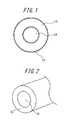
- the hydrophilic elongated resin (B) coated with a resin having an affinity for the rubber component may be produced, for example, by simultaneously extruding the hydrophilic resin from the die outlet 12 and the resin having an affinity for the rubber component from the die outlet 13 by means of an extruder provided with a die 11 as shown in Fig. 1 to form an undrawn yarn, and then hot-drawing the undrawn yarn to give an elongated (fibrous) shape.
- a composite fiber in which, as shown in Fig. 2 , the hydrophilic elongate resin (B) 21 is positioned approximately at the center of the fiber and is coated with the resin having an affinity for the rubber component is obtained.
- the amount of each resin may vary depending on the length and the diameter of the hydrophilic elongated resin (B) thus obtained, but usually 0.1-80 parts by mass, and preferably 0.1-20 parts by mass of the resin having an affinity for the rubber component is generally used with the hydrophilic resin as 100 parts by mass.
- a coating layer 22 composed of the resin having an affinity for the rubber component capable of exhibiting the desired effect can be effectively formed on the surface of the hydrophilic elongated resin (B) 21 obtained after the drawing process.
- the vulcanized rubber according to the present invention may be produced by (i) blending rubber component (D) with the hydrophilic powdery resin (A) having the aspect ratio of 10 or less and the foaming agent (C) to prepare a rubber composition, and (ii) vulcanizing the rubber composition to produce cells of which at least a part of the wall surface is hydrophilic. Further, in the case of using the hydrophilic elongated resin (B), the rubber component (D) is blended with the hydrophilic powdery resin (A) having the aspect ratio of 30 or less, the hydrophilic elongated resin (B) having the aspect ratio of 50 or more and the foaming agent (C) to prepare a rubber component, and then the rubber component is vulcanized to produce the vulcanized rubber.
- a compounding agent which is commonly used in the rubber industry such as a filler, for example, carbon black, a softening agent, stearic acid, an antiaging agent, zinc white, a vulcanization accelerator, a vulcanizing agent may be appropriately compounded in the rubber composition within a range that does not impair the object of the present invention.
- the tire according to the present invention is characterized in that the above-mentioned vulcanized rubber is provided on a tread portion and excellent ice performance can be exerted.
- the tire according to the present invention may be vulcanized after the molding of an unvulcanized rubber composition, or may be fully vulcanized after the molding of semi-vulcanized rubber having been processed in a pre-vulcanization process.
- the gas to be filled in the tire may be an inert gas such as nitrogen, argon or helium as well as the ordinal air or air having been adjusted its partial oxygen pressure.
- a twin-screw extruder provided with a die 11 and two hoppers as shown in Fig. 1 was used, and ethylene-vinyl alcohol copolymer (EVAL F104B available from Kuraray Co., Ltd.) was charged into both of the hoppers and was extruded from the die outlets 12 and 13.
- EVAL F104B available from Kuraray Co., Ltd.
- the obtained fiber was cut into the lengths of 0.2 mm, 0.4 mm, 0.6 mm, 1 mm, 2 mm and 4 mm in accordance with the conventional manner.
- the hydrophilic powdery resin (A) and the hydrophilic elongated resin (B) consisting of ethylene-vinyl alcohol copolymer (EVOH) were prepared.
- the mean diameter was 0.02 mm.
- powdery resins consisting solely of polyethylene (Novatec U360 available from Japan Polyethylene Corporation) were prepared as comparative examples of a hydrophobic foam cell by the following standards:
- a twin-screw extruder provided with a die 11 and two hoppers as shown in Fig. 1 was used, and ethylene-vinyl alcohol copolymer (EVAL F104B available from Kuraray Co., Ltd.) and polyethylene (Novatec U360 available from Japan Polyethylene Corporation) were respectively charged into different hoppers, and were concurrently extruded from the die outlets 12 and 13, respectively.
- the obtained fiber was cut into the lengths of 0.2 mm and 2 mm in accordance with the conventional manner.
- the hydrophilic powdery resin (A) and the hydrophilic elongated resin (B) consisting of hydrophilic resin portion of ethylene-vinyl alcohol copolymer (EVOH) coated with polyethylene (PE) were prepared.
- the hydrophilic powdery resin (A) and the hydrophilic elongated resin (B) were used to prepare rubber compositions in the formulation shown in Table 1.
- Table 1 Compounded amount (Parts by mass) Natural rubber 60 Polybutadiene rubber *1 40 Carbon black *2 60 Stearic acid 2 Zinc flower 6 Vulcanization accelerator *3 12 Insoluble sulfur 4 Foaming agent *4 4
- Rubber compositions prepared in the formulation as shown in Table 1 were disposed on the tread portion to build a green tire, and the green tire was vulcanized in accordance with the conventional manner to give a tire having the size of 195/65R15.
- the tread portion of the tire thus obtained was observed with a microscope VHX500 available from Keyence Corporation, and cells each having a shape corresponding to the shapes of the hydrophilic powdery resin (A) and the hydrophilic elongated resin (B) were confirmed to be formed.
- the ice performance and the wear resistance of the tires thus obtained were evaluated by the following method. The results are shown in Tables 2 and 3.
- a tire having a tread portion with the ware rate of 20% was fitted onto a vehicle of which the ABS was deactivated.
- the vehicle was driven on an ice flat road, the brake was applied at the speed of 20 km/h to lock the tires, and the braking distance until the complete stop was measured.
- the results are indicated in an index with the reciprocal of the braking distance of Comparative Example 1 as 100. The larger the index value is, the better the braking performance on ice is.
- a tire having a tread portion with the ware rate of 20% was fitted onto a vehicle of which the ABS was activated.
- the vehicle was driven on an ice flat road, the brake was applied at the speed of 20 km/h to lock the tires, and the braking distance until the complete stop was measured.
- the results are indicated in an index with the reciprocal of the braking distance of Comparative Example 1 as 100. to indicate that the larger the index value, the better the braking performance on ice.
- Examples 4 to 6 show that the ice performance of the tire can be greatly improved by using the hydrophilic powdery resin (A) and the hydrophilic elongated resin (B) to form both of cells with the aspect ratio of 30 or less and cells with the aspect ratio of 50 or more.
- Example 7 shows that the hydrophilic powdery resin (A) and the hydrophilic elongated resin (B) in which ethylene-vinyl alcohol copolymer (EVOH) is coated with polyethylene (PE) can greatly improve the wear resistance of the tire.
- EVOH ethylene-vinyl alcohol copolymer
Landscapes
- Chemical & Material Sciences (AREA)
- Chemical Kinetics & Catalysis (AREA)
- Medicinal Chemistry (AREA)
- Polymers & Plastics (AREA)
- Organic Chemistry (AREA)
- Health & Medical Sciences (AREA)
- Engineering & Computer Science (AREA)
- Mechanical Engineering (AREA)
- Materials Engineering (AREA)
- General Chemical & Material Sciences (AREA)
- Manufacture Of Porous Articles, And Recovery And Treatment Of Waste Products (AREA)
- Compositions Of Macromolecular Compounds (AREA)
- Tires In General (AREA)
Abstract
Description
- The present invention relates to a vulcanized rubber, a method of manufacturing same, and a tire having a tread portion provided with such vulcanized rubber. In particular, the present invention relates to a vulcanized rubber capable of improving ice performance of the tire.
- Conventionally, a tire for use primarily in winter such as a studless tire has a tread portion provided with a foamed rubber with closed cells so as to improves the drainage performance of the tread portion and to improve the ice performance of the tire.
- For example, Japanese Patent Application Laid-open No.
S62-283001 - However, in the conventional studless tire which has a tread portion provided with a rubber with closed cells, the surfaces of the cells are formed of a vulcanized rubber, which is hydrophobic, so that the capability of the cells to absorb water is low. Further, since the ability of the cells to absorb water is low, the cell does not exert sufficient drainage effect. It is, therefore, demanded to further improve the ice performance of the tire.
- An object of the present invention is to provide a vulcanized rubber capable of solving the above-mentioned problems of the conventional technique and improving the ice performance of the tire. Another object of the present invention is to provide a method of manufacturing such vulcanized rubber, and a tire having a tread portion provided with such vulcanized rubber and expressing superior ice performance.
- As a result of intensive studies to achieve the above object, the present inventors has founded that when the tread portion is provided with a vulcanized rubber having cells with a specific aspect ratio of which at least a part of the wall surface is hydrophilic, the tread portion actively absorbs water to improve the water drainage performance and the wall surfaces of the cell scratch the surface of ice; as a result the ice performance during the use of the ABS can be greatly improved. Based on the finding, the present invention has been accomplished.
- That is, the vulcanized rubber made by vulcanizing a rubber composition according to the present invention is characterized in that it has cells with an aspect ratio of 1 to 30, and at least a part of a wall surface of the cell is hydrophilic.
- A method of manufacturing vulcanized rubber according to the present invention is characterized by comprising the steps of:
- preparing rubber composition by blending a rubber component (D) with a hydrophilic powdery resin (A) with an aspect ratio of 30 or less and a foaming agent (C); and
- vulcanizing the rubber composition to produce cells of which at least a part of a wall surface is hydrophilic.
- Further, the tire according to the present invention is characterized by comprising a tread portion provided with the above-mentioned vulcanized rubber.
- According to the present invention, it is possible to provide a vulcanized rubber which has cells with a specific aspect ratio and at least a part of the wall surface of the cell is hydrophilic, resulting an improvement of the ice performance of the tire. Further, it is possible to provide a method of manufacturing such vulcanized rubber, and a tire comprising a tread portion provided with such vulcanized rubber to express superior ice performance.
-
-
Fig. 1 is a vertical cross-sectional view of one example of a die. -
Fig. 2 is a perspective view of a vertical cross-section of one example of hydrophilic elongated resin (B) coated with a resin (E) having an affinity for rubber component. - Hereinafter, the present invention will be discussed in detail. A vulcanized rubber made by vulcanizing a rubber composition according to the present invention is characterized in that the vulcanized rubber has cells with an aspect ratio of 1 to 30, and at least a part of a wall surface of the cell is hydrophilic. The vulcanized rubber according to the present invention has the cells with a specific aspect ratio and at least a part of the wall of the cell is hydrophilic, so that, when the vulcanized rubber is disposed in the tread portion of the tire, the wall surfaces of the cells are exposed to the tread surface during the use of the tire to enhance the affinity with water. Therefore, when the vulcanized rubber according to the present invention is disposed in the tread portion of the tire, the cells in the vulcanized rubber can actively absorb water, which renders excellent drainage performance to the tire and eventually can improve the ice performance of the tire significantly. It is noted that if the aspect ratio of the cell exceeds 30, the cells lose the effect of scratching the surface of the tire and, thus, decrease the braking capability during the operation of the ABS. It is also noted that the aspect ratio of a cell is derived from the length of the cell divided by the diameter of the cell.
- The rubber composition used for the vulcanized rubber of the present invention preferably contains a hydrophilic powdery resin (A) having the aspect ratio of 30 or less, a foaming agent (C), and a rubber component (D). The aspect ratio of the hydrophilic powdery resin (A) is derived from the length of the hydrophilic powdery resin (A) divided by the diameter of the hydrophilic powdery resin (A). When the rubber composition used for the vulcanized rubber contains the hydrophilic powdery resin (A) and the foaming agent (C), it is possible to disperse the gas produced by the foaming agent (C) within the rubber, or to allow the gas to enter into the melted hydrophilic powdery resin (A) to form cells each having a shape corresponding to the shape of the hydrophilic powdery resin (A). The cells existing in the rubber can serve as a drainage groove after the wear of the tire progresses, which can further render excellent drainage performance to the tire. In particular, the formation of the cells each having a shape corresponding to the shape of the hydrophilic powdery resin (A) can allow the cells to more suitably serve as a drainage groove, which can greatly improve the ice performance of the tire. The above-mentioned foaming agent may be contained in the hydrophilic powdery resin (A). When the aspect ratio of the hydrophilic powdery resin (A) is more than 30, the aspect ratio of the cell is 10 or more. Thus, the cell loses the effect of scratching the surface of ice, so that the braking capability of the ABS is reduced.
- The hydrophilic powdery resin (A) preferably has a granular shape, and preferably has the grain diameter of 1 micrometer to 1 millimeter. In the case where the hydrophilic powdery resin (A) has a granular shape, the wall surface of the cell has a better effect of scratching the surface of ice to enhance the ice performance. Further, in the case where the grain diameter is more than 1 millimeter, the granular resin may become a nuclear of destruction of the rubber to reduce the rubber strength and adversely affect the wear of the rubber. In the case where the grain diameter of the hydrophilic powdery resin (A) is less than 1 micrometer, sufficient drainage performance cannot be achieved, which reduces the ice performance.
- Furthermore, the rubber composition used for the vulcanized rubber of the present invention preferably contains a hydrophilic elongated resin (B) with the aspect ratio of 50 or more. With both of hydrophilic elongated resin and hydrophilic powdery resin, the ice performance during the ABS is not operated can be improved relative to the case where the hydrophilic elongated resin alone is compounded. The aspect ratio of the hydrophilic elongated resin (B) is derived from the length of the hydrophilic elongated resin (B) divided by the diameter of the hydrophilic elongated resin (B). When the rubber composition used for the vulcanized rubber contains the hydrophilic powdery resin (A), the hydrophilic elongated resin (B) and the foaming agent (C), the gas produced by the foaming agent (C) may be allowed to enter into the melted hydrophilic powdery resin (A) and the melted hydrophilic elongated resin (B) during the vulcanization process to form cells each having a shape corresponding to the shapes of the hydrophilic powdery resin (A) and the hydrophilic elongated resin (B). The cells existing in the rubber can serve as a drainage groove after the wear of the tire progresses, which can further render excellent drainage performance to the tire. In particular, the formation of the cells each having a shape corresponding to the shapes of the hydrophilic powdery resin (A) and the hydrophilic elongated resin (B) can allow the cells to more suitably serve as a drainage groove, which can greatly improve the ice performance of the tire. In addition, the cells derived from the hydrophilic powdery resin (A) and the cells derived from the hydrophilic elongated resin (B) communicate with each other to further improve the drainage effect, which can significantly improve the ice performance of the tire. Thus, the hydrophilic elongated resin (B), in particular, the hydrophilic powdery resin (A) and the hydrophilic elongated resin (B) have a cavity inside created by the foaming of the foaming agent (C). In the case where the aspect ratio of the hydrophilic elongated resin (B) is 4,000 or more, the resin is bent while the rubber is compounded, which may not take full advantage of the use of an elongated material.
- The hydrophilic elongated resin (B) preferably has a mean length of 0.1-500 mm and a mean diameter of 0.001-5 mm, and more preferably a mean diameter of 0.005-0.5 mm. If the mean length and the mean diameter are within the above-mentioned range, the fibers are unlikely to be entangled with each other more than necessary and thus the likelihood of inhibiting the good dispersibility can be eliminated.
- Further, the hydrophilic powdery resin (A) and the hydrophilic elongated resin (B) are preferably coated with a resin having affinity for the rubber component. When the hydrophilic powdery resin (A) and the hydrophilic elongated resin (B) are coated with a resin having an affinity for the rubber component, the dispersion of the hydrophilic elongated resin in the rubber, which is hydrophobic, can be facilitated to improve the resistance of the rubber against the fracture strength and eventually improve the abrasion resistance of the rubber.
- The rubber component (D) is not particularly limited, and natural rubber (NR) as well as synthetic rubber such as polyisoprene rubber (IR), styrene-butadiene copolymer rubber (SBR), polybutadiene rubber (BR), ethylene-propylene-diene rubber (EPDM), chloroprene rubber (CR), halogenated butyl rubber, acrylonitrile-butadiene rubber (NBR) may be used. Among these, natural rubber (NR), styrene-butadiene copolymer rubber (SBR) and polybutadiene rubber (BR) are preferred. The rubber components may be used alone or in combination of two or more thereof.
- The hydrophilic resin used for the hydrophilic powdery resin (A) and the hydrophilic elongated resin (B) is not particularly limited so long as the resin is capable of exhibiting an affinity for water, i.e. the resin has a hydrophilic group in the molecule. Preferably, the resin contains an oxygen atom, a sulfur atom or a nitrogen atom. and more preferably contains at least one functional group selected from the group consisting of -OH, -COOH, -OCOR (R is an alkyl group), -NH2, -NCO, and -SH, and still more preferably contains at least one functional group selected from the group consisting of -OH, -COOH, -NH2, and -NCO.
- As the hydrophilic resins used for the hydrophilic powdery resin (A) and the hydrophilic elongated resin (B), ethylene-vinyl alcohol copolymer, vinyl alcohol homopolymer, poly (meth) acrylic acid or ester thereof, polyethylene glycol, carboxy vinyl copolymer, styrene-maleic acid copolymer, polyvinyl pyrrolidone, vinyl pyrrolidone-vinyl acetate copolymer, mercaptoethanol and the like are preferable. Among these, ethylene-vinyl alcohol copolymer, vinyl alcohol homopolymer, and poly (meth) acrylic acid are more preferred, and ethylene-vinyl alcohol copolymer is particularly preferable.
- The hydrophilic resin used for the hydrophilic powdery resin (A) and the hydrophilic elongated resin (B) is preferably insoluble in water. In this case, the hydrophilic powdery resin (A) and the hydrophilic elongated resin (B) do not dissolve into the water on the road surface upon exposing to the tread surface, so that hydrophilic property of the tread surface can be maintained over a long period and thus the drainage performance and the ice performance of the tread can be improved over a long period.
- Further, the hydrophilic resin used for the hydrophilic powdery resin (A) and the hydrophilic elongated resin (B) preferably has a melting point smaller than the maximum temperature of vulcanization. In this case, the hydrophilic powdery resin (A) and the hydrophilic elongated resin (B) are melted during the vulcanization and incorporate the gas generated from the foaming agent (C) to be able to form cells having a desired shape. Each of the formed cells has a shape corresponding to the shape of the hydrophilic powdery resin (A) and the hydrophilic elongated resin (B). It is noted that the maximum temperature of vulcanization refers to the highest temperature that the rubber composition reaches during the vulcanization of the rubber component. For example, in the case of mold vulcanization, the maximum vulcanization temperature is the highest temperature that the rubber composition reaches from the time the rubber composition is put in the mold to the time the rubber composition is removed from the mold and is cooled. The maximum vulcanization temperature can be measured, for example, with a thermocouple embedded in the rubber composition. The upper limit of the melting point of the hydrophilic powdery resin (A) and the hydrophilic elongated resin (B) is not particularly limited, but preferably selected in consideration of the above points, and, in general, is preferably 10 or more degree C, and more preferably 20 or more degree C lower than the maximum vulcanization temperature of the rubber composition. The industrially practical vulcanization temperature of the rubber composition is generally about 190 decrees C. For example, if the maximum vulcanization temperature is set to 190 degree C, the melting point of the above-mentioned low-melting point resin is selected in a temperature range of generally 190 degree C or less, preferably 180 degree C or less, and more preferably 170 degree C or less.
- The amount of compounded hydrophilic powdery resin (A) is preferably 0.1-100 parts by mass with the rubber component (D) as 100 parts by mass. With adjusting the amount of compounded hydrophilic powdery resin (A) within the above-mentioned range with the rubber component (D) as 100 parts by mass, it is possible to balance the ice performance and the wear resistance.
- The amount of compounded hydrophilic elongated resin (B) is preferably 0.1-100 parts by mass with the rubber component (D) as 100 parts by mass. With adjusting the amount of compounded hydrophilic elongated resin (B) within the above-mentioned range with the rubber component (D) as 100 parts by mass, it is possible to balance ice performance and the wear resistance.
- As the foaming agent (C), azodicarbonamide (ADCA), dinitrosopentamethylenetetramine (DPT), dinitrosopentamethylene styrene tetramine, benzenesulfonyl hydrazide derivatives, p, p'-oxybis benzene sulfonyl hydrazide (OBSH), carbon dioxide generating agents such as ammonium bicarbonate, sodium bicarbonate and ammonium carbonate, nitrogen-generating agents such as nitroso sulfonyl azo compound, and N, N'-dimethyl-N, N'-dinitroso phthalamide, toluenesulfonyl hydrazide, p-toluenesulfonyl semicarbazide, p, p'-is oxybisbenzenesulfonyl semicarbazide may be cited by way of example. From the viewpoint of the processability, azodicarbonamide (ADCA), dinitrosopentamethylenetetramine (DPT) are preferable, and azodicarbonamide (ADCA) is more preferable. The foaming agents may be used alone or in combination of two or more thereof. The amount of compounded foaming agent (C) is preferably 0.1-50 parts by mass, and more preferably 0.1-10 parts by mass with the rubber component (D) as 100 parts by mass.
- Further, the foaming agent (C) is preferably used in combination with a foaming aid such as urea, zinc stearate, benzenesulfinic acid zinc and zinc. The foaming aids may be used alone or in combination of two or more thereof. The concurrent use of the foaming aid can promote the foaming reaction to enhance the completeness of the reaction and inhibit the undesirable degradation over time.
- When the hydrophilic elongated resin (B) is coated with a resin having an affinity for the rubber component, for example, a resin having solubility parameter (SP value) similar to that of the rubber component (D), in particular, polyolefin resin may be preferably used as the resin having an affinity for the rubber component. The polyolefin resin may be either branched or linear, or may also be an ionomer resin in which molecules in ethylene-methacrylic acid copolymer are cross-linked with metal ions. Examples of the polyolefin resin include polyethylene, polypropylene, polybutene, polystyrene, ethylene-propylene copolymer, ethylene-methacrylic acid copolymer, ethylene-ethyl acrylate copolymers, ethylene-propylene-diene ternary copolymer, ethylene-vinyl acetate copolymer, and ionomer resins thereof. These resins may be used alone or in combination of two or more thereof. Among these, polyethylene resins, polypropylene resins, polyolefin ionomers, maleic anhydride-modified α-polyolefins are particularly preferred. Polyolefin ionomers or maleic anhydride-modified α-polyolefins bond to the hydroxyl groups as well, so that it is possible to further improve the rubber strength.
- The hydrophilic elongated resin (B) coated with a resin having an affinity for the rubber component may be produced, for example, by simultaneously extruding the hydrophilic resin from the
die outlet 12 and the resin having an affinity for the rubber component from thedie outlet 13 by means of an extruder provided with a die 11 as shown inFig. 1 to form an undrawn yarn, and then hot-drawing the undrawn yarn to give an elongated (fibrous) shape. In this way, a composite fiber in which, as shown inFig. 2 , the hydrophilic elongate resin (B) 21 is positioned approximately at the center of the fiber and is coated with the resin having an affinity for the rubber component is obtained. - The amount of each resin may vary depending on the length and the diameter of the hydrophilic elongated resin (B) thus obtained, but usually 0.1-80 parts by mass, and preferably 0.1-20 parts by mass of the resin having an affinity for the rubber component is generally used with the hydrophilic resin as 100 parts by mass. By using the resins within the above-mentioned ranges, a
coating layer 22 composed of the resin having an affinity for the rubber component capable of exhibiting the desired effect can be effectively formed on the surface of the hydrophilic elongated resin (B) 21 obtained after the drawing process. - The vulcanized rubber according to the present invention may be produced by (i) blending rubber component (D) with the hydrophilic powdery resin (A) having the aspect ratio of 10 or less and the foaming agent (C) to prepare a rubber composition, and (ii) vulcanizing the rubber composition to produce cells of which at least a part of the wall surface is hydrophilic. Further, in the case of using the hydrophilic elongated resin (B), the rubber component (D) is blended with the hydrophilic powdery resin (A) having the aspect ratio of 30 or less, the hydrophilic elongated resin (B) having the aspect ratio of 50 or more and the foaming agent (C) to prepare a rubber component, and then the rubber component is vulcanized to produce the vulcanized rubber.
- In addition to the rubber component (D), the hydrophilic powdery resin (A), the hydrophilic elongated resin (B) and the foaming agent, a compounding agent which is commonly used in the rubber industry such as a filler, for example, carbon black, a softening agent, stearic acid, an antiaging agent, zinc white, a vulcanization accelerator, a vulcanizing agent may be appropriately compounded in the rubber composition within a range that does not impair the object of the present invention.
- The tire according to the present invention is characterized in that the above-mentioned vulcanized rubber is provided on a tread portion and excellent ice performance can be exerted. Moreover, depending on the type and member of the tire to be applied, the tire according to the present invention may be vulcanized after the molding of an unvulcanized rubber composition, or may be fully vulcanized after the molding of semi-vulcanized rubber having been processed in a pre-vulcanization process. It is noted that the gas to be filled in the tire may be an inert gas such as nitrogen, argon or helium as well as the ordinal air or air having been adjusted its partial oxygen pressure.
- Hereinafter, the present invention is described in more detail with reference to examples, but the present invention is not limited to the following examples.
- A twin-screw extruder provided with a
die 11 and two hoppers as shown inFig. 1 was used, and ethylene-vinyl alcohol copolymer (EVAL F104B available from Kuraray Co., Ltd.) was charged into both of the hoppers and was extruded from thedie outlets - According to this procedure, the following resins were prepared:
- (1) Powdery resin having the length of 0.2 mm and the diameter of 0.02 mm (aspect ratio = 10),
- (2) Powdery resin having the length of 0.4 mm and the diameter of 0.02 mm (aspect ratio = 20),
- (3) Powdery resin having the length of 0.6 mm and the diameter of 0.02 mm (aspect ratio = 30),
- (4) Elongated resin having the length of 1 mm and the diameter of 0.02 mm (aspect ratio = 50),
- (5) Elongated resin having the length of 2 mm and the diameter of 0.02 mm (aspect ratio = 100), and
- (6) Elongated resin having the length of 4 mm and the diameter of 0.02 mm (aspect ratio = 200).
- According to the above-mentioned method, powdery resins consisting solely of polyethylene (Novatec U360 available from Japan Polyethylene Corporation) were prepared as comparative examples of a hydrophobic foam cell by the following standards:
- (7) Powdery resin having the length of 0.2 mm and the diameter of 0.02 mm (aspect ratio = 10),
- (8) Powdery resin having the length of 0.4 mm and the diameter of 0.02 mm (aspect ratio = 20), and
- (9) Powdery resin having the length of 0.6 mm and the diameter of 0.02 mm (aspect ratio = 30).
- A twin-screw extruder provided with a
die 11 and two hoppers as shown inFig. 1 was used, and ethylene-vinyl alcohol copolymer (EVAL F104B available from Kuraray Co., Ltd.) and polyethylene (Novatec U360 available from Japan Polyethylene Corporation) were respectively charged into different hoppers, and were concurrently extruded from thedie outlets - According to this procedure, the following resins were prepared:
- (10) Powdery resin having the length of 0.2 mm and the diameter of 0.02 mm (aspect ratio = 10), and
- (11) Elongated resin having the length of 2 mm the diameter of 0.02 mm (aspect ratio = 100).
- The hydrophilic powdery resin (A) and the hydrophilic elongated resin (B) were used to prepare rubber compositions in the formulation shown in Table 1.
[Table 1] Compounded amount (Parts by mass) Natural rubber 60 Polybutadiene rubber *1 40 Carbon black *2 60 Stearic acid 2 Zinc flower 6 Vulcanization accelerator *3 12 Insoluble sulfur 4 Foaming agent *4 4 Hydrophilic powdery resin (A) Variable *5 Hydrophilic elongated resin (B) Variable *6 *1 cis-1, 4 - polybutadiene, brand name "BR01" available from JSR Ltd.
*2 brand name "carbon N220" available from Asahi Carbon Ltd.
*3 di-2-benzothiazyldisulfide, brand name "NOCCELER DM" available from Ouchi Shinko Chemical Industrial Co., Ltd.
*4 dinitrosopentamethylenetetramine (DPT), brand name "Cellmic AN" available from Sankyo Kasei Co., Ltd.,
*5, *6 the amounts are shown in Tables 2 and 3 - Rubber compositions prepared in the formulation as shown in Table 1 were disposed on the tread portion to build a green tire, and the green tire was vulcanized in accordance with the conventional manner to give a tire having the size of 195/65R15. The tread portion of the tire thus obtained was observed with a microscope VHX500 available from Keyence Corporation, and cells each having a shape corresponding to the shapes of the hydrophilic powdery resin (A) and the hydrophilic elongated resin (B) were confirmed to be formed. The ice performance and the wear resistance of the tires thus obtained were evaluated by the following method. The results are shown in Tables 2 and 3.
- A tire having a tread portion with the ware rate of 20% was fitted onto a vehicle of which the ABS was deactivated. The vehicle was driven on an ice flat road, the brake was applied at the speed of 20 km/h to lock the tires, and the braking distance until the complete stop was measured. The results are indicated in an index with the reciprocal of the braking distance of Comparative Example 1 as 100. The larger the index value is, the better the braking performance on ice is. It is noted that the wear rate of the tread portion is calculated by the following formula:

- A tire having a tread portion with the ware rate of 20% was fitted onto a vehicle of which the ABS was activated. The vehicle was driven on an ice flat road, the brake was applied at the speed of 20 km/h to lock the tires, and the braking distance until the complete stop was measured. The results are indicated in an index with the reciprocal of the braking distance of Comparative Example 1 as 100. to indicate that the larger the index value, the better the braking performance on ice. It is noted that the wear rate of the tread portion is calculated by the following formula:

- An actual vehicle equipped with tires having the seize of 195/65R15 was driven on a paved road over 10,000 km. Then the depth of the remaining groove was measured to calculate the driving distance necessary for the wear of 1 mm. The results are indicated in an index with the result of Comparative Example 1 as 100.
[Table 2] Comp. Ex. 1 Comp. Ex. 2 Comp. Ex. 3 Comp. Ex.4 Amount of compounded hydrophobic powdery resin Powdery resin consisting of polyethylene with aspect ratio = 10. Parts by mass - 3 - - Powdery resin consisting of polyethylene with aspect ratio = 20 - - 3 - Powdery resin consisting of polyethylene with aspect ratio = 30 - - - 3 Evaluation results Aspect ratio of cells in tread portion of tire - 1 (granular) 10 20 30 Ice performance (w/ ABS) Index 100 97 96 90 Ice performance (w/o ABS) Index 100 101 103 103 Wear resistance Index 100 101 102 101 [Table 3] Comp. Ex. 5 Comp. Ex. 6 Comp. Ex. 7 Ex. 1 Ex. 2 Ex. 3 Ex. 4 Ex. 5 Ex. 6 Ex. 7 Amount of compounde d hydrophilic powdery resin (A) Powdery resin of EVOH with aspect ratio=10 Parts by mass - - - 3 - - 1.5 1.5 1.5 - Powdery resin of EVOH with aspect ratio=20 - - - - 3 - - - - - Powdery resin of EVOH with aspect ratio=30 - - - - - 3 - - - - Powdery resin of EVOH coated with PE with aspect ratio=10 - - - - - - - - - 1.5 Amount of compounde d hydrophilic elongated resin (B) Elongated resin of EVOH with aspect ratio=50 3 - - - - - 1.5 - - - Elongated resin of EVOH with aspect ratio=100 - 3 - - - - - 1.5 - - Elongated resin of EVOH with aspect ratio=200 - - 3 - - - - - 1.5 - Elongated resin of EVOH coated with PE with aspect ratio=100 - - - - 1.5 1.5 1.5 1.5 1.5 1.5 Evaluation results Aspect ratio of cells in tread portion - 50 100 200 10 20 30 10, 50 10, 100 10, 200 10, 100 Ice performance (w/ ABS) Index 101 98 96 124 116 110 126 116 114 116 Ice performance (w/o ABS) Index 112 117 117 102 105 107 121 128 132 128 Wear resistance Index 82 83 83 82 82 80 81 82 81 101 - From the results shown in Tables 2 and 3, it is found that the tread portion provided with the vulcanized rubber having cells with the aspect ratio of 1-30 of which at least a part of the wall surface is hydrophilic can improve the ice performance of the tire.
- Further, Examples 4 to 6 show that the ice performance of the tire can be greatly improved by using the hydrophilic powdery resin (A) and the hydrophilic elongated resin (B) to form both of cells with the aspect ratio of 30 or less and cells with the aspect ratio of 50 or more.
- Moreover, Example 7 shows that the hydrophilic powdery resin (A) and the hydrophilic elongated resin (B) in which ethylene-vinyl alcohol copolymer (EVOH) is coated with polyethylene (PE) can greatly improve the wear resistance of the tire.
-
- 11: Die
- 12, 13: Die outlet
- 21: Hydrophilic elongated resin (B)
- 22: Coating layer consisting of a resin having affinity for the rubber component
Claims (18)
- A vulcanized rubber made by vulcanizing a rubber composition comprising cells with an aspect ratio of 1-30, wherein at least a part of a wall surface of the cell is hydrophilic.
- The vulcanized rubber according to claim 1, wherein the rubber composition contains a hydrophilic powdery resin (A) with an aspect ratio of 30 or less, a foaming agent (C) and a rubber component (D).
- The vulcanized rubber according to claim 2, wherein the hydrophilic powdery resin (A) has a granular shape.
- The vulcanized rubber according to claim 2 or 3, wherein the hydrophilic powdery resin (A) has a grain diameter of 1 micrometer to 1 millimeter.
- The vulcanized rubber according to claim 2, wherein the rubber composition further contains a hydrophilic elongated resin (B) with the aspect ratio of 50 or more.
- The vulcanized rubber according to claim 5, wherein the hydrophilic elongated resin (B) has a mean length of 0.1-500 mm and a mean diameter of 0.005-0.5 mm.
- The vulcanized rubber according to claim 5 or 6, wherein the hydrophilic elongated resin (b) has a cavity inside created by the foaming of the foaming agent (C).
- The vulcanized rubber according to claim 5 or 6, wherein the hydrophilic powdery resin (B) is coated with a resin having affinity for the rubber component.
- The vulcanized rubber according to any one of claims 2-8, wherein the hydrophilic resin used for the hydrophilic elongated resin (A) and the hydrophilic powdery resin (B) contain at least one functional group selected from the group consisting of -OH, -COOH, -OCOR (R is an alkyl group), -NH2, -NCO, and -SH.
- The vulcanized rubber according to claim 9, wherein the hydrophilic resins used for the hydrophilic elongated resin (A) and the hydrophilic powdery resin (B) comprises ethylene-vinyl alcohol copolymer, vinyl alcohol homopolymer or poly (meth) acrylic acid.
- The vulcanized rubber according to any one of claims 2-10, wherein the hydrophilic resin used for the hydrophilic elongated resin (A) and the hydrophilic powdery resin (B) has a melting point smaller than the maximum temperature of vulcanization.
- The vulcanized rubber according to claim 8, wherein the resin having affinity for the rubber component comprises polyolefin resin.
- The vulcanized rubber according to claim 2, wherein the amount of the compounded hydrophilic powdery resin (A) is 0.1-100 parts by mass with the rubber component (D) as 100 parts by mass.
- The vulcanized rubber according to claim 5, wherein the amount of the compounded hydrophilic elongated resin (B) is 0.1-100 parts by mass with the rubber component (D) as 100 parts by mass.
- The vulcanized rubber according to claim 2, wherein the amount of the compounded foaming agent (C) is 0.1-10 parts by mass with the rubber component (D) as 100 parts by mass.
- A method of manufacturing vulcanized rubber, comprising the steps of:preparing rubber composition by blending a rubber component (D) with a hydrophilic powdery resin (A) with an aspect ratio of 30 or less and a foaming agent (C); andvulcanizing the rubber composition to produce cells of which at least a part of a wall surface is hydrophilic.
- The method according to claim 16, wherein the rubber composition is prepared by blending the rubber component (D) with the hydrophilic powdery resin (A) with an aspect ratio of 30 or less, a hydrophilic elongated resin (B) with an aspect ratio of 50 or more, and the foaming agent (C).
- A tire comprising a tread portion provided with the vulcanized rubber according to any one of claims 1-15.
Applications Claiming Priority (2)
| Application Number | Priority Date | Filing Date | Title |
|---|---|---|---|
| JP2011284118 | 2011-12-26 | ||
| PCT/JP2012/008344 WO2013099252A1 (en) | 2011-12-26 | 2012-12-26 | Vulcanized rubber, method for producing same, and tire |
Publications (3)
| Publication Number | Publication Date |
|---|---|
| EP2799481A1 true EP2799481A1 (en) | 2014-11-05 |
| EP2799481A4 EP2799481A4 (en) | 2015-07-22 |
| EP2799481B1 EP2799481B1 (en) | 2017-04-19 |
Family
ID=48696783
Family Applications (1)
| Application Number | Title | Priority Date | Filing Date |
|---|---|---|---|
| EP12863212.2A Active EP2799481B1 (en) | 2011-12-26 | 2012-12-26 | Vulcanized rubber, method for producing same, and tire |
Country Status (6)
| Country | Link |
|---|---|
| US (1) | US9574073B2 (en) |
| EP (1) | EP2799481B1 (en) |
| JP (1) | JP5993876B2 (en) |
| CN (1) | CN104011127B (en) |
| RU (1) | RU2588633C2 (en) |
| WO (1) | WO2013099252A1 (en) |
Cited By (1)
| Publication number | Priority date | Publication date | Assignee | Title |
|---|---|---|---|---|
| EP3366720A4 (en) * | 2015-10-22 | 2018-11-07 | Bridgestone Corporation | Rubber composition and tire obtained therefrom |
Families Citing this family (4)
| Publication number | Priority date | Publication date | Assignee | Title |
|---|---|---|---|---|
| CN107000373B (en) | 2014-09-12 | 2019-12-13 | 耐克创新有限合伙公司 | Membranes and their uses |
| RU2641816C2 (en) * | 2016-05-24 | 2018-01-22 | Федеральное государственное бюджетное учреждение науки Институт проблем нефти и газа Сибирского отделения Российской академии наук | Method for applying protective film made of ultra-high molecular weight-polyethylene onto rubber |
| EP3478516B1 (en) | 2016-06-29 | 2021-09-08 | Nike Innovate C.V. | Multi-layered structures and method of manufacturing thereof |
| EP3740380B1 (en) | 2018-09-13 | 2021-06-23 | Nike Innovate C.V. | Multi-layered structures and uses thereof |
Family Cites Families (15)
| Publication number | Priority date | Publication date | Assignee | Title |
|---|---|---|---|---|
| FR2516796B1 (en) * | 1981-11-20 | 1986-06-06 | Altulor Sa | COMPOSITIONS FOR SURGICAL CEMENT BASED ON AT LEAST ONE ACRYLIC MONOMER AND AT LEAST ONE ACRYLIC POLYMER |
| JP2568502B2 (en) | 1985-04-02 | 1997-01-08 | 株式会社 ブリヂストン | Pneumatic tire |
| RU2076879C1 (en) * | 1992-10-09 | 1997-04-10 | Ивановский научно-исследовательский институт пленочных материалов и искусственной кожи технического назначения | Method for manufacture of porous rubber moulded articles |
| JPH09216970A (en) * | 1996-02-08 | 1997-08-19 | Bridgestone Corp | Pneumatic tire |
| EP0940435A1 (en) * | 1998-03-03 | 1999-09-08 | Bridgestone Corporation | Rubber compositions for tire tread |
| JP2003105116A (en) * | 2001-10-01 | 2003-04-09 | Bridgestone Corp | Unvulcanized rubber composition, vulcanized rubber composition and method for manufacturing the same, and tire using the same |
| JP5030367B2 (en) * | 2003-07-23 | 2012-09-19 | 株式会社ブリヂストン | tire |
| JP5557418B2 (en) * | 2007-04-13 | 2014-07-23 | 株式会社ブリヂストン | Foam rubber and tires and shoes provided with the same |
| JP2009091388A (en) | 2007-10-04 | 2009-04-30 | Oji Paper Co Ltd | Filler composition |
| JP5288784B2 (en) * | 2007-12-13 | 2013-09-11 | 株式会社ブリヂストン | Rubber composition, vulcanized rubber and tire |
| JP5390106B2 (en) * | 2008-01-18 | 2014-01-15 | 株式会社ブリヂストン | Rubber composition, vulcanized rubber and tire |
| JP4289508B1 (en) * | 2008-02-13 | 2009-07-01 | 横浜ゴム株式会社 | Pneumatic tire |
| JP5436954B2 (en) | 2009-06-30 | 2014-03-05 | 東洋ゴム工業株式会社 | Rubber composition and pneumatic tire |
| JP5701134B2 (en) * | 2011-04-13 | 2015-04-15 | 株式会社ブリヂストン | Rubber composition, vulcanized rubber, and tire using the same |
| CN105754154B (en) * | 2011-04-13 | 2017-10-27 | 株式会社普利司通 | Rubber composition, vulcanization rubber and the tire manufactured using it |
-
2012
- 2012-12-26 EP EP12863212.2A patent/EP2799481B1/en active Active
- 2012-12-26 CN CN201280064853.0A patent/CN104011127B/en active Active
- 2012-12-26 WO PCT/JP2012/008344 patent/WO2013099252A1/en not_active Ceased
- 2012-12-26 US US14/361,324 patent/US9574073B2/en active Active
- 2012-12-26 JP JP2013551254A patent/JP5993876B2/en active Active
- 2012-12-26 RU RU2014131087/05A patent/RU2588633C2/en active
Cited By (2)
| Publication number | Priority date | Publication date | Assignee | Title |
|---|---|---|---|---|
| EP3366720A4 (en) * | 2015-10-22 | 2018-11-07 | Bridgestone Corporation | Rubber composition and tire obtained therefrom |
| US10836884B2 (en) | 2015-10-22 | 2020-11-17 | Bridgestone Corporation | Rubber composition and tire obtained therefrom |
Also Published As
| Publication number | Publication date |
|---|---|
| JPWO2013099252A1 (en) | 2015-04-30 |
| CN104011127A (en) | 2014-08-27 |
| US9574073B2 (en) | 2017-02-21 |
| RU2588633C2 (en) | 2016-07-10 |
| US20140316023A1 (en) | 2014-10-23 |
| JP5993876B2 (en) | 2016-09-14 |
| EP2799481B1 (en) | 2017-04-19 |
| CN104011127B (en) | 2016-03-23 |
| EP2799481A4 (en) | 2015-07-22 |
| WO2013099252A1 (en) | 2013-07-04 |
| RU2014131087A (en) | 2016-02-20 |
Similar Documents
| Publication | Publication Date | Title |
|---|---|---|
| JP5701134B2 (en) | Rubber composition, vulcanized rubber, and tire using the same | |
| US9534110B2 (en) | Rubber composition, vulcanized rubber and tire manufactured using the same | |
| EP2799484B1 (en) | Rubber composition and tire using same | |
| EP3366720B1 (en) | Rubber composition and tire obtained therefrom | |
| JP5288784B2 (en) | Rubber composition, vulcanized rubber and tire | |
| EP2799481B1 (en) | Vulcanized rubber, method for producing same, and tire | |
| WO2014024466A1 (en) | Tire | |
| JP2004263098A (en) | Rubber composition for pneumatic tire | |
| EP3623419B1 (en) | Rubber composition, vulcanized rubber, tire, studless tire | |
| JP7012081B2 (en) | Rubber compositions, vulcanized rubber, rubber products, and tires | |
| JP6008498B2 (en) | tire | |
| JP5557466B2 (en) | Rubber composition, vulcanized rubber and tire | |
| JP2009167339A (en) | Rubber composition, vulcanized rubber and tire | |
| JP5390107B2 (en) | Rubber composition for tire, vulcanized rubber and tire | |
| JP2009046012A (en) | Rubber block, tread rubber, and tire and its manufacturing method | |
| JP5982021B2 (en) | Rubber composition, vulcanized rubber, and tire using the same | |
| WO2019087570A1 (en) | Rubber composition, vulcanized rubber, and tire |
Legal Events
| Date | Code | Title | Description |
|---|---|---|---|
| PUAI | Public reference made under article 153(3) epc to a published international application that has entered the european phase |
Free format text: ORIGINAL CODE: 0009012 |
|
| 17P | Request for examination filed |
Effective date: 20140625 |
|
| AK | Designated contracting states |
Kind code of ref document: A1 Designated state(s): AL AT BE BG CH CY CZ DE DK EE ES FI FR GB GR HR HU IE IS IT LI LT LU LV MC MK MT NL NO PL PT RO RS SE SI SK SM TR |
|
| DAX | Request for extension of the european patent (deleted) | ||
| RA4 | Supplementary search report drawn up and despatched (corrected) |
Effective date: 20150623 |
|
| RIC1 | Information provided on ipc code assigned before grant |
Ipc: C08L 9/00 20060101AFI20150612BHEP Ipc: C08J 9/06 20060101ALI20150612BHEP Ipc: B60C 1/00 20060101ALI20150612BHEP |
|
| 17Q | First examination report despatched |
Effective date: 20160226 |
|
| GRAP | Despatch of communication of intention to grant a patent |
Free format text: ORIGINAL CODE: EPIDOSNIGR1 |
|
| RIC1 | Information provided on ipc code assigned before grant |
Ipc: B60C 1/00 20060101ALI20161005BHEP Ipc: C08J 9/10 20060101ALI20161005BHEP Ipc: C08L 9/00 20060101AFI20161005BHEP Ipc: C08J 9/06 20060101ALI20161005BHEP |
|
| INTG | Intention to grant announced |
Effective date: 20161025 |
|
| GRAS | Grant fee paid |
Free format text: ORIGINAL CODE: EPIDOSNIGR3 |
|
| GRAA | (expected) grant |
Free format text: ORIGINAL CODE: 0009210 |
|
| AK | Designated contracting states |
Kind code of ref document: B1 Designated state(s): AL AT BE BG CH CY CZ DE DK EE ES FI FR GB GR HR HU IE IS IT LI LT LU LV MC MK MT NL NO PL PT RO RS SE SI SK SM TR |
|
| REG | Reference to a national code |
Ref country code: GB Ref legal event code: FG4D |
|
| REG | Reference to a national code |
Ref country code: CH Ref legal event code: EP |
|
| REG | Reference to a national code |
Ref country code: AT Ref legal event code: REF Ref document number: 885918 Country of ref document: AT Kind code of ref document: T Effective date: 20170515 |
|
| REG | Reference to a national code |
Ref country code: IE Ref legal event code: FG4D |
|
| REG | Reference to a national code |
Ref country code: DE Ref legal event code: R096 Ref document number: 602012031484 Country of ref document: DE |
|
| REG | Reference to a national code |
Ref country code: NL Ref legal event code: MP Effective date: 20170419 |
|
| REG | Reference to a national code |
Ref country code: LT Ref legal event code: MG4D |
|
| REG | Reference to a national code |
Ref country code: AT Ref legal event code: MK05 Ref document number: 885918 Country of ref document: AT Kind code of ref document: T Effective date: 20170419 |
|
| PG25 | Lapsed in a contracting state [announced via postgrant information from national office to epo] |
Ref country code: NL Free format text: LAPSE BECAUSE OF FAILURE TO SUBMIT A TRANSLATION OF THE DESCRIPTION OR TO PAY THE FEE WITHIN THE PRESCRIBED TIME-LIMIT Effective date: 20170419 |
|
| PG25 | Lapsed in a contracting state [announced via postgrant information from national office to epo] |
Ref country code: ES Free format text: LAPSE BECAUSE OF FAILURE TO SUBMIT A TRANSLATION OF THE DESCRIPTION OR TO PAY THE FEE WITHIN THE PRESCRIBED TIME-LIMIT Effective date: 20170419 Ref country code: AT Free format text: LAPSE BECAUSE OF FAILURE TO SUBMIT A TRANSLATION OF THE DESCRIPTION OR TO PAY THE FEE WITHIN THE PRESCRIBED TIME-LIMIT Effective date: 20170419 Ref country code: HR Free format text: LAPSE BECAUSE OF FAILURE TO SUBMIT A TRANSLATION OF THE DESCRIPTION OR TO PAY THE FEE WITHIN THE PRESCRIBED TIME-LIMIT Effective date: 20170419 Ref country code: GR Free format text: LAPSE BECAUSE OF FAILURE TO SUBMIT A TRANSLATION OF THE DESCRIPTION OR TO PAY THE FEE WITHIN THE PRESCRIBED TIME-LIMIT Effective date: 20170720 Ref country code: FI Free format text: LAPSE BECAUSE OF FAILURE TO SUBMIT A TRANSLATION OF THE DESCRIPTION OR TO PAY THE FEE WITHIN THE PRESCRIBED TIME-LIMIT Effective date: 20170419 Ref country code: NO Free format text: LAPSE BECAUSE OF FAILURE TO SUBMIT A TRANSLATION OF THE DESCRIPTION OR TO PAY THE FEE WITHIN THE PRESCRIBED TIME-LIMIT Effective date: 20170719 Ref country code: LT Free format text: LAPSE BECAUSE OF FAILURE TO SUBMIT A TRANSLATION OF THE DESCRIPTION OR TO PAY THE FEE WITHIN THE PRESCRIBED TIME-LIMIT Effective date: 20170419 |
|
| PG25 | Lapsed in a contracting state [announced via postgrant information from national office to epo] |
Ref country code: LV Free format text: LAPSE BECAUSE OF FAILURE TO SUBMIT A TRANSLATION OF THE DESCRIPTION OR TO PAY THE FEE WITHIN THE PRESCRIBED TIME-LIMIT Effective date: 20170419 Ref country code: SE Free format text: LAPSE BECAUSE OF FAILURE TO SUBMIT A TRANSLATION OF THE DESCRIPTION OR TO PAY THE FEE WITHIN THE PRESCRIBED TIME-LIMIT Effective date: 20170419 Ref country code: IS Free format text: LAPSE BECAUSE OF FAILURE TO SUBMIT A TRANSLATION OF THE DESCRIPTION OR TO PAY THE FEE WITHIN THE PRESCRIBED TIME-LIMIT Effective date: 20170819 Ref country code: RS Free format text: LAPSE BECAUSE OF FAILURE TO SUBMIT A TRANSLATION OF THE DESCRIPTION OR TO PAY THE FEE WITHIN THE PRESCRIBED TIME-LIMIT Effective date: 20170419 Ref country code: BG Free format text: LAPSE BECAUSE OF FAILURE TO SUBMIT A TRANSLATION OF THE DESCRIPTION OR TO PAY THE FEE WITHIN THE PRESCRIBED TIME-LIMIT Effective date: 20170719 Ref country code: PL Free format text: LAPSE BECAUSE OF FAILURE TO SUBMIT A TRANSLATION OF THE DESCRIPTION OR TO PAY THE FEE WITHIN THE PRESCRIBED TIME-LIMIT Effective date: 20170419 |
|
| REG | Reference to a national code |
Ref country code: FR Ref legal event code: PLFP Year of fee payment: 6 |
|
| REG | Reference to a national code |
Ref country code: DE Ref legal event code: R097 Ref document number: 602012031484 Country of ref document: DE |
|
| PG25 | Lapsed in a contracting state [announced via postgrant information from national office to epo] |
Ref country code: EE Free format text: LAPSE BECAUSE OF FAILURE TO SUBMIT A TRANSLATION OF THE DESCRIPTION OR TO PAY THE FEE WITHIN THE PRESCRIBED TIME-LIMIT Effective date: 20170419 Ref country code: DK Free format text: LAPSE BECAUSE OF FAILURE TO SUBMIT A TRANSLATION OF THE DESCRIPTION OR TO PAY THE FEE WITHIN THE PRESCRIBED TIME-LIMIT Effective date: 20170419 Ref country code: CZ Free format text: LAPSE BECAUSE OF FAILURE TO SUBMIT A TRANSLATION OF THE DESCRIPTION OR TO PAY THE FEE WITHIN THE PRESCRIBED TIME-LIMIT Effective date: 20170419 Ref country code: SK Free format text: LAPSE BECAUSE OF FAILURE TO SUBMIT A TRANSLATION OF THE DESCRIPTION OR TO PAY THE FEE WITHIN THE PRESCRIBED TIME-LIMIT Effective date: 20170419 Ref country code: RO Free format text: LAPSE BECAUSE OF FAILURE TO SUBMIT A TRANSLATION OF THE DESCRIPTION OR TO PAY THE FEE WITHIN THE PRESCRIBED TIME-LIMIT Effective date: 20170419 |
|
| PLBE | No opposition filed within time limit |
Free format text: ORIGINAL CODE: 0009261 |
|
| STAA | Information on the status of an ep patent application or granted ep patent |
Free format text: STATUS: NO OPPOSITION FILED WITHIN TIME LIMIT |
|
| PG25 | Lapsed in a contracting state [announced via postgrant information from national office to epo] |
Ref country code: IT Free format text: LAPSE BECAUSE OF FAILURE TO SUBMIT A TRANSLATION OF THE DESCRIPTION OR TO PAY THE FEE WITHIN THE PRESCRIBED TIME-LIMIT Effective date: 20170419 Ref country code: SM Free format text: LAPSE BECAUSE OF FAILURE TO SUBMIT A TRANSLATION OF THE DESCRIPTION OR TO PAY THE FEE WITHIN THE PRESCRIBED TIME-LIMIT Effective date: 20170419 |
|
| 26N | No opposition filed |
Effective date: 20180122 |
|
| PG25 | Lapsed in a contracting state [announced via postgrant information from national office to epo] |
Ref country code: SI Free format text: LAPSE BECAUSE OF FAILURE TO SUBMIT A TRANSLATION OF THE DESCRIPTION OR TO PAY THE FEE WITHIN THE PRESCRIBED TIME-LIMIT Effective date: 20170419 |
|
| REG | Reference to a national code |
Ref country code: CH Ref legal event code: PL |
|
| GBPC | Gb: european patent ceased through non-payment of renewal fee |
Effective date: 20171226 |
|
| REG | Reference to a national code |
Ref country code: IE Ref legal event code: MM4A |
|
| PG25 | Lapsed in a contracting state [announced via postgrant information from national office to epo] |
Ref country code: LU Free format text: LAPSE BECAUSE OF NON-PAYMENT OF DUE FEES Effective date: 20171226 Ref country code: MT Free format text: LAPSE BECAUSE OF NON-PAYMENT OF DUE FEES Effective date: 20171226 |
|
| REG | Reference to a national code |
Ref country code: BE Ref legal event code: MM Effective date: 20171231 |
|
| PG25 | Lapsed in a contracting state [announced via postgrant information from national office to epo] |
Ref country code: IE Free format text: LAPSE BECAUSE OF NON-PAYMENT OF DUE FEES Effective date: 20171226 |
|
| PG25 | Lapsed in a contracting state [announced via postgrant information from national office to epo] |
Ref country code: GB Free format text: LAPSE BECAUSE OF NON-PAYMENT OF DUE FEES Effective date: 20171226 Ref country code: CH Free format text: LAPSE BECAUSE OF NON-PAYMENT OF DUE FEES Effective date: 20171231 Ref country code: LI Free format text: LAPSE BECAUSE OF NON-PAYMENT OF DUE FEES Effective date: 20171231 Ref country code: BE Free format text: LAPSE BECAUSE OF NON-PAYMENT OF DUE FEES Effective date: 20171231 |
|
| PG25 | Lapsed in a contracting state [announced via postgrant information from national office to epo] |
Ref country code: MC Free format text: LAPSE BECAUSE OF FAILURE TO SUBMIT A TRANSLATION OF THE DESCRIPTION OR TO PAY THE FEE WITHIN THE PRESCRIBED TIME-LIMIT Effective date: 20170419 Ref country code: HU Free format text: LAPSE BECAUSE OF FAILURE TO SUBMIT A TRANSLATION OF THE DESCRIPTION OR TO PAY THE FEE WITHIN THE PRESCRIBED TIME-LIMIT; INVALID AB INITIO Effective date: 20121226 |
|
| PG25 | Lapsed in a contracting state [announced via postgrant information from national office to epo] |
Ref country code: CY Free format text: LAPSE BECAUSE OF FAILURE TO SUBMIT A TRANSLATION OF THE DESCRIPTION OR TO PAY THE FEE WITHIN THE PRESCRIBED TIME-LIMIT Effective date: 20170419 |
|
| PG25 | Lapsed in a contracting state [announced via postgrant information from national office to epo] |
Ref country code: MK Free format text: LAPSE BECAUSE OF FAILURE TO SUBMIT A TRANSLATION OF THE DESCRIPTION OR TO PAY THE FEE WITHIN THE PRESCRIBED TIME-LIMIT Effective date: 20170419 |
|
| PG25 | Lapsed in a contracting state [announced via postgrant information from national office to epo] |
Ref country code: TR Free format text: LAPSE BECAUSE OF FAILURE TO SUBMIT A TRANSLATION OF THE DESCRIPTION OR TO PAY THE FEE WITHIN THE PRESCRIBED TIME-LIMIT Effective date: 20170419 |
|
| PG25 | Lapsed in a contracting state [announced via postgrant information from national office to epo] |
Ref country code: PT Free format text: LAPSE BECAUSE OF FAILURE TO SUBMIT A TRANSLATION OF THE DESCRIPTION OR TO PAY THE FEE WITHIN THE PRESCRIBED TIME-LIMIT Effective date: 20170419 |
|
| PG25 | Lapsed in a contracting state [announced via postgrant information from national office to epo] |
Ref country code: AL Free format text: LAPSE BECAUSE OF FAILURE TO SUBMIT A TRANSLATION OF THE DESCRIPTION OR TO PAY THE FEE WITHIN THE PRESCRIBED TIME-LIMIT Effective date: 20170419 |
|
| P01 | Opt-out of the competence of the unified patent court (upc) registered |
Effective date: 20230531 |
|
| PGFP | Annual fee paid to national office [announced via postgrant information from national office to epo] |
Ref country code: DE Payment date: 20251211 Year of fee payment: 14 |
|
| PGFP | Annual fee paid to national office [announced via postgrant information from national office to epo] |
Ref country code: FR Payment date: 20251223 Year of fee payment: 14 |