EP2799133A1 - Exhaust gas purifying catalyst and method for producing same - Google Patents
Exhaust gas purifying catalyst and method for producing same Download PDFInfo
- Publication number
- EP2799133A1 EP2799133A1 EP12862456.6A EP12862456A EP2799133A1 EP 2799133 A1 EP2799133 A1 EP 2799133A1 EP 12862456 A EP12862456 A EP 12862456A EP 2799133 A1 EP2799133 A1 EP 2799133A1
- Authority
- EP
- European Patent Office
- Prior art keywords
- aluminum phosphate
- exhaust gas
- platinum
- phosphate body
- fired
- Prior art date
- Legal status (The legal status is an assumption and is not a legal conclusion. Google has not performed a legal analysis and makes no representation as to the accuracy of the status listed.)
- Ceased
Links
Images
Classifications
-
- B—PERFORMING OPERATIONS; TRANSPORTING
- B01—PHYSICAL OR CHEMICAL PROCESSES OR APPARATUS IN GENERAL
- B01D—SEPARATION
- B01D53/00—Separation of gases or vapours; Recovering vapours of volatile solvents from gases; Chemical or biological purification of waste gases, e.g. engine exhaust gases, smoke, fumes, flue gases, aerosols
- B01D53/34—Chemical or biological purification of waste gases
- B01D53/92—Chemical or biological purification of waste gases of engine exhaust gases
- B01D53/94—Chemical or biological purification of waste gases of engine exhaust gases by catalytic processes
- B01D53/9445—Simultaneously removing carbon monoxide, hydrocarbons or nitrogen oxides making use of three-way catalysts [TWC] or four-way-catalysts [FWC]
- B01D53/945—Simultaneously removing carbon monoxide, hydrocarbons or nitrogen oxides making use of three-way catalysts [TWC] or four-way-catalysts [FWC] characterised by a specific catalyst
-
- B—PERFORMING OPERATIONS; TRANSPORTING
- B01—PHYSICAL OR CHEMICAL PROCESSES OR APPARATUS IN GENERAL
- B01J—CHEMICAL OR PHYSICAL PROCESSES, e.g. CATALYSIS OR COLLOID CHEMISTRY; THEIR RELEVANT APPARATUS
- B01J27/00—Catalysts comprising the elements or compounds of halogens, sulfur, selenium, tellurium, phosphorus or nitrogen; Catalysts comprising carbon compounds
- B01J27/14—Phosphorus; Compounds thereof
- B01J27/185—Phosphorus; Compounds thereof with iron group metals or platinum group metals
- B01J27/1856—Phosphorus; Compounds thereof with iron group metals or platinum group metals with platinum group metals
-
- B—PERFORMING OPERATIONS; TRANSPORTING
- B01—PHYSICAL OR CHEMICAL PROCESSES OR APPARATUS IN GENERAL
- B01J—CHEMICAL OR PHYSICAL PROCESSES, e.g. CATALYSIS OR COLLOID CHEMISTRY; THEIR RELEVANT APPARATUS
- B01J23/00—Catalysts comprising metals or metal oxides or hydroxides, not provided for in group B01J21/00
- B01J23/38—Catalysts comprising metals or metal oxides or hydroxides, not provided for in group B01J21/00 of noble metals
- B01J23/40—Catalysts comprising metals or metal oxides or hydroxides, not provided for in group B01J21/00 of noble metals of the platinum group metals
- B01J23/42—Platinum
-
- B—PERFORMING OPERATIONS; TRANSPORTING
- B01—PHYSICAL OR CHEMICAL PROCESSES OR APPARATUS IN GENERAL
- B01J—CHEMICAL OR PHYSICAL PROCESSES, e.g. CATALYSIS OR COLLOID CHEMISTRY; THEIR RELEVANT APPARATUS
- B01J23/00—Catalysts comprising metals or metal oxides or hydroxides, not provided for in group B01J21/00
- B01J23/38—Catalysts comprising metals or metal oxides or hydroxides, not provided for in group B01J21/00 of noble metals
- B01J23/40—Catalysts comprising metals or metal oxides or hydroxides, not provided for in group B01J21/00 of noble metals of the platinum group metals
- B01J23/44—Palladium
-
- B—PERFORMING OPERATIONS; TRANSPORTING
- B01—PHYSICAL OR CHEMICAL PROCESSES OR APPARATUS IN GENERAL
- B01J—CHEMICAL OR PHYSICAL PROCESSES, e.g. CATALYSIS OR COLLOID CHEMISTRY; THEIR RELEVANT APPARATUS
- B01J23/00—Catalysts comprising metals or metal oxides or hydroxides, not provided for in group B01J21/00
- B01J23/38—Catalysts comprising metals or metal oxides or hydroxides, not provided for in group B01J21/00 of noble metals
- B01J23/40—Catalysts comprising metals or metal oxides or hydroxides, not provided for in group B01J21/00 of noble metals of the platinum group metals
- B01J23/46—Ruthenium, rhodium, osmium or iridium
- B01J23/464—Rhodium
-
- B—PERFORMING OPERATIONS; TRANSPORTING
- B01—PHYSICAL OR CHEMICAL PROCESSES OR APPARATUS IN GENERAL
- B01J—CHEMICAL OR PHYSICAL PROCESSES, e.g. CATALYSIS OR COLLOID CHEMISTRY; THEIR RELEVANT APPARATUS
- B01J27/00—Catalysts comprising the elements or compounds of halogens, sulfur, selenium, tellurium, phosphorus or nitrogen; Catalysts comprising carbon compounds
- B01J27/14—Phosphorus; Compounds thereof
- B01J27/185—Phosphorus; Compounds thereof with iron group metals or platinum group metals
-
- B—PERFORMING OPERATIONS; TRANSPORTING
- B01—PHYSICAL OR CHEMICAL PROCESSES OR APPARATUS IN GENERAL
- B01J—CHEMICAL OR PHYSICAL PROCESSES, e.g. CATALYSIS OR COLLOID CHEMISTRY; THEIR RELEVANT APPARATUS
- B01J35/00—Catalysts, in general, characterised by their form or physical properties
- B01J35/60—Catalysts, in general, characterised by their form or physical properties characterised by their surface properties or porosity
-
- B—PERFORMING OPERATIONS; TRANSPORTING
- B01—PHYSICAL OR CHEMICAL PROCESSES OR APPARATUS IN GENERAL
- B01J—CHEMICAL OR PHYSICAL PROCESSES, e.g. CATALYSIS OR COLLOID CHEMISTRY; THEIR RELEVANT APPARATUS
- B01J35/00—Catalysts, in general, characterised by their form or physical properties
- B01J35/60—Catalysts, in general, characterised by their form or physical properties characterised by their surface properties or porosity
- B01J35/64—Pore diameter
- B01J35/647—2-50 nm
-
- B—PERFORMING OPERATIONS; TRANSPORTING
- B01—PHYSICAL OR CHEMICAL PROCESSES OR APPARATUS IN GENERAL
- B01J—CHEMICAL OR PHYSICAL PROCESSES, e.g. CATALYSIS OR COLLOID CHEMISTRY; THEIR RELEVANT APPARATUS
- B01J35/00—Catalysts, in general, characterised by their form or physical properties
- B01J35/60—Catalysts, in general, characterised by their form or physical properties characterised by their surface properties or porosity
- B01J35/64—Pore diameter
- B01J35/651—50-500 nm
-
- B—PERFORMING OPERATIONS; TRANSPORTING
- B01—PHYSICAL OR CHEMICAL PROCESSES OR APPARATUS IN GENERAL
- B01J—CHEMICAL OR PHYSICAL PROCESSES, e.g. CATALYSIS OR COLLOID CHEMISTRY; THEIR RELEVANT APPARATUS
- B01J35/00—Catalysts, in general, characterised by their form or physical properties
- B01J35/60—Catalysts, in general, characterised by their form or physical properties characterised by their surface properties or porosity
- B01J35/66—Pore distribution
- B01J35/69—Pore distribution bimodal
-
- B—PERFORMING OPERATIONS; TRANSPORTING
- B01—PHYSICAL OR CHEMICAL PROCESSES OR APPARATUS IN GENERAL
- B01J—CHEMICAL OR PHYSICAL PROCESSES, e.g. CATALYSIS OR COLLOID CHEMISTRY; THEIR RELEVANT APPARATUS
- B01J37/00—Processes, in general, for preparing catalysts; Processes, in general, for activation of catalysts
- B01J37/02—Impregnation, coating or precipitation
- B01J37/03—Precipitation; Co-precipitation
-
- B—PERFORMING OPERATIONS; TRANSPORTING
- B01—PHYSICAL OR CHEMICAL PROCESSES OR APPARATUS IN GENERAL
- B01J—CHEMICAL OR PHYSICAL PROCESSES, e.g. CATALYSIS OR COLLOID CHEMISTRY; THEIR RELEVANT APPARATUS
- B01J37/00—Processes, in general, for preparing catalysts; Processes, in general, for activation of catalysts
- B01J37/08—Heat treatment
-
- B—PERFORMING OPERATIONS; TRANSPORTING
- B01—PHYSICAL OR CHEMICAL PROCESSES OR APPARATUS IN GENERAL
- B01D—SEPARATION
- B01D2255/00—Catalysts
- B01D2255/10—Noble metals or compounds thereof
- B01D2255/102—Platinum group metals
- B01D2255/1021—Platinum
-
- B—PERFORMING OPERATIONS; TRANSPORTING
- B01—PHYSICAL OR CHEMICAL PROCESSES OR APPARATUS IN GENERAL
- B01D—SEPARATION
- B01D2255/00—Catalysts
- B01D2255/10—Noble metals or compounds thereof
- B01D2255/102—Platinum group metals
- B01D2255/1023—Palladium
-
- B—PERFORMING OPERATIONS; TRANSPORTING
- B01—PHYSICAL OR CHEMICAL PROCESSES OR APPARATUS IN GENERAL
- B01D—SEPARATION
- B01D2255/00—Catalysts
- B01D2255/10—Noble metals or compounds thereof
- B01D2255/102—Platinum group metals
- B01D2255/1025—Rhodium
-
- B—PERFORMING OPERATIONS; TRANSPORTING
- B01—PHYSICAL OR CHEMICAL PROCESSES OR APPARATUS IN GENERAL
- B01D—SEPARATION
- B01D2255/00—Catalysts
- B01D2255/20—Metals or compounds thereof
- B01D2255/209—Other metals
- B01D2255/2092—Aluminium
-
- B—PERFORMING OPERATIONS; TRANSPORTING
- B01—PHYSICAL OR CHEMICAL PROCESSES OR APPARATUS IN GENERAL
- B01J—CHEMICAL OR PHYSICAL PROCESSES, e.g. CATALYSIS OR COLLOID CHEMISTRY; THEIR RELEVANT APPARATUS
- B01J27/00—Catalysts comprising the elements or compounds of halogens, sulfur, selenium, tellurium, phosphorus or nitrogen; Catalysts comprising carbon compounds
- B01J27/14—Phosphorus; Compounds thereof
- B01J27/16—Phosphorus; Compounds thereof containing oxygen, i.e. acids, anhydrides and their derivates with N, S, B or halogens without carriers or on carriers based on C, Si, Al or Zr; also salts of Si, Al and Zr
-
- Y—GENERAL TAGGING OF NEW TECHNOLOGICAL DEVELOPMENTS; GENERAL TAGGING OF CROSS-SECTIONAL TECHNOLOGIES SPANNING OVER SEVERAL SECTIONS OF THE IPC; TECHNICAL SUBJECTS COVERED BY FORMER USPC CROSS-REFERENCE ART COLLECTIONS [XRACs] AND DIGESTS
- Y02—TECHNOLOGIES OR APPLICATIONS FOR MITIGATION OR ADAPTATION AGAINST CLIMATE CHANGE
- Y02T—CLIMATE CHANGE MITIGATION TECHNOLOGIES RELATED TO TRANSPORTATION
- Y02T10/00—Road transport of goods or passengers
- Y02T10/10—Internal combustion engine [ICE] based vehicles
- Y02T10/12—Improving ICE efficiencies
Definitions
- the present invention relates to an exhaust gas purification catalyst and a method for producing it, and particularly it relates to a platinum-group metal-supporting aluminum phosphate catalyst for exhaust gas purification, such as a platinum-group metal-supporting aluminum phosphate catalyst that purifies noxious components in exhaust gas emitted from internal combustion engines of automobiles and the like, and to a method for producing it.
- Exhaust gas purification catalysts are being employed in internal combustion engines as one measure.
- HC hydrocarbons
- CO hydrocarbons
- exhaust gas purification catalysts employ a variety of catalysts, including platinum-group elements such as Pt, Pd and Rh, as catalyst components.
- PTL 1 describes a method in which nitrogen oxides in exhaust gas are removed by contacting nitrogen oxide-containing exhaust gas with a catalyst containing platinum in the presence of hydrocarbons, in an oxidizing atmosphere (claim 1 of PTL 1).
- PTL 2 describes an exhaust gas purification catalyst comprising a heat-resistant AlPO 4 compound having a tridymite-type crystal structure and a BET specific surface area of 50-150 m 2 /g, and at least one type of precious metal component selected from the group consisting of Pt, Pd and Rh, supported on the AlPO 4 compound (claim 1 of PTL 2).
- the exhaust gas purification catalyst of the invention exhibits the excellent performance of a fired aluminum phosphate body including heat resistance and toxicity resistance against sulfur and the like, while it can also exhibit much more excellent catalytic activity at low temperatures compared to conventional aluminum phosphate catalysts and even compared to conventional aluminum phosphate catalysts with tridymite-type crystal structures.
- references using names of the inorganic material compounds or ratios of metals present include compositions that when actually produced contain impurities and the like.
- a reference using the name of an inorganic material compound or ratio of metals present include inorganic compounds having in the structure of the inorganic compound a composition with an excess or deficiency of ⁇ 1 or less atoms of elements such as oxygen, hydrogen and nitrogen in the chemical formula; or in the case of aluminum phosphate, for example, AlPO 4 includes compounds AlPO 2 to AlPO 5 having ⁇ 1 oxygen atoms, and compounds having an Al/P ratio of 1 ⁇ about 0.3, as well as those having hydrogen as an impurity, which are not represented by the compound formula.
- the diameter or pore size means the diameter of the pore, which is the diameter corresponding to a circular pore with the same area, if the pore is non-circular.
- the cumulative pore distribution is the integral of dV/dlog 10 (D) for pores with diameters greater than zero and up to the prescribed diameter (where V is the pore volume and D is the pore diameter), and throughout the present specification, it is normalized so that the integral of dV/dlog 10 (D) for pores of greater than zero to 300 nm is 100%, i.e. 1.
- the fired aluminum phosphate body of the invention has a tridymite-type crystal structure.
- this may include berlinite-type crystal structures, cristobalite-type crystal structures or amorphous forms, in addition to a tridymite-type crystal structure.
- the fired aluminum phosphate body of the invention is not particularly restricted so long as the ratio of the cumulative pore distribution of 10 nm and smaller with respect to the cumulative pore distribution of 300 nm and smaller is satisfied, as explained below, and for example, it may have a BET specific surface area of about 10 m 2 /g or greater, about 30 m 2 /g or greater, about 40 m 2 /g or greater, about 50 m 2 /g or greater or about 60 m 2 /g or greater, and about 400 m 2 /g or smaller, about 300 m 2 /g or smaller, about 200 m 2 /g or smaller or about 150 m 2 /g or smaller.
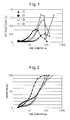
- the pores in the fired aluminum phosphate body have a distribution of pore sizes in a width as shown in Fig. 1 , for example. Also, the distribution of pore sizes in the fired aluminum phosphate body of the invention is a distribution of thickness for the small diameter region.
- the fired aluminum phosphate body of the invention has a ratio for the cumulative pore distribution of about 10 nm and smaller, for example, that is about 20% or greater with respect to the cumulative pore distribution of about 300 nm and smaller.
- the ratio of the cumulative pore distribution of X nm and smaller with respect to the cumulative pore distribution of about 300 nm and smaller i.e. (cumulative pore distribution of X nm and smaller)/(cumulative pore distribution of about 300 nm and smaller) x 100(%), can be approximately 20% or greater or approximately 25% or greater when X is about 10.
- the variable X used here can also be defined as, for example, about 5 nm, about 15 nm or about 20 nm instead of about 10 nm, as can also be read from the graph in Fig. 2 .
- the catalyst of the invention exhibits excellent performance because of the state of the platinum-group metal in the pores.
- Pd since Pd generally has low heat resistance and readily aggregates, it suffers notable reduction in catalytic power due to heat degradation.
- the Pd nanoparticles become firmly bonded both physically and chemically in the pores, and they may therefore be considered resistant to movement or aggregation compared to Pd nanoparticle present outside pores or present in pores with larger diameters, even when the catalyst is heated.
- Pd supported in a fired aluminum phosphate body containing many small pores with sizes of 10 nm or smaller has a higher probability of being present in those pores, and may be considered resistant to aggregation.
- the exhaust gas catalyst of the invention can maintain satisfactory catalytic activity even after aging treatment, compared to a conventional Pd-supporting AlPO 4 catalyst.
- the method for producing the catalyst of the invention is a method that can increase the distribution of pore sizes of the fired aluminum phosphate body toward the fine pore size end compared to a conventional fired aluminum phosphate body having a tridymite-type crystal structure, and for example, a wide range of methods may be employed, such as:
- the pH of the aqueous solution during production of the aluminum phosphate in (a) above may be about 3.0 or higher, about 3.2 or higher, about 3.5 or higher, about 3.7 or higher or about 4.0 or higher, and about 8.0 or lower, about 7.5 or lower, about 6.0 or lower, about 6.5 or lower, about 6.0 or lower, about 5.5 or lower, about 5.0 or lower, about 4.5 or lower, about 4.4 or lower, about 4.3 or lower or about 4.2 or lower.
- it is preferred for the pH of the aluminum phosphate aqueous solution during production of aluminum phosphate to be about 3.5 or higher and about 4.5 or lower.
- the firing temperature in (a) may be a temperature of about 1000°C or higher, about 1010°C or higher, about 1020°C or higher, about 1050 or higher or about 1100°C or higher, and about 1500°C or lower, about 1400°C or lower, about 1300°C or lower or about 1200°C or lower, and the firing time for (a) may be about 1 hour or longer, about 2 hours or longer, about 3 hours or longer, about 4 hours or longer, about 5 hours or longer or about 6 hours or longer, and about 20 hours or shorter, about 15 hours or shorter, about 13 hours or shorter, about 10 hours or shorter or about 9 hours or shorter.
- any known method, such as neutralization may be employed.
- the Al-containing compound include metal salts such as hydroxides and nitrates, and specifically Al(OH) 3 and Al(NO 3 ) 3 .
- the solvent used for the mixed solution containing the aluminum salt and phosphoric acid may be any desired solvent that is capable of dissolving the aluminum-containing compound and phosphoric acid, and for example, an aqueous solvent such as water or an organic solvent may be used.
- the purification catalyst of the invention has at least one type of platinum-group metal selected from the group consisting of Pt, Rh and Pd further supported on the fired aluminum phosphate body.
- the embodiment of support is not particularly restricted, and it is sufficient if the platinum-group metal is supported thereon in a generally uniform manner.
- the particle sizes of the platinum-group metal nanoparticles to be supported are not particularly restricted, and for example, they may be about 0.5 nm or larger, about 1 nm or larger, about 2 nm or larger, about 3 nm or larger or about 4 nm or larger, and about 10 nm or smaller, about 9 nm or smaller, about 8 nm or smaller, about 7 nm or smaller or about 6 nm or smaller.
- the amount of platinum-group metal with respect to the fired aluminum phosphate body may be about 0.01 wt% or greater, about 0.1 wt% or greater, about 0.5 wt% or greater or about 1 wt% or greater, and about 10 wt% or less, about 5 wt% or less or about 4 wt% or less.
- the method of supporting the platinum-group metal nanoparticles on the fired aluminum phosphate body is not particularly restricted so long as it does not adversely affect the pore distribution of the fired aluminum phosphate body by creating a bias toward the large pore size end, and it may be a common method such as impregnation or surface deposition.
- a platinum-group metal colloid of about 1 nm, about 2 nm, about 3 nm or about 4 nm may be used, that can provide platinum-group metal particles of the desired particle size.
- another platinum-group metal source such as a platinum acetate-based metal compound, platinum nitrate-based metal compound or platinum chloride-based metal compound, or platinum-group metal nanoparticles synthesized from these.
- aluminum phosphate preferably does not contain nitrate ion or chloride ion because it is readily soluble in strong acids.
- Aluminum nitrate nonahydrate (manufacturer: Wako Pure Chemical Industries, Ltd.) was dissolved in ion-exchanged water, and 85 wt% phosphoric acid was added to the aluminum aqueous solution. To this there was added dropwise 28 wt% ammonia water, to adjust the pH to between 3.5 and 4.5, and the mixture was stirred for 12 hours at room temperature. The solution at this point was opaque.
- the opaque solution was separated into precipitate and supernatant using a centrifugal separator, and the precipitate was purified twice with ion-exchanged water. It was then dried at 120°C for 12 hours.
- the dried product was shredded and fired at 1050°C (Example 1) or 1100°C (Example 2) for 5 hours. After standing to cool, the fired product was shredded to obtain powder of a fired aluminum phosphate body.
- the Pd source used was PVP (polyvinylpyrrolidone)-protected Pd colloid (Pd particle size: 2 nm).
- the loading weight of the Pd nanoparticles was 0.5 wt% with respect to the support.
- the fired aluminum phosphate body powder was dispersed in ion-exchanged water and the Pd nanoparticle colloid was added thereto. The temperature was increased to 120°C to 150°C while stirring to evaporate the solvent. The obtained dry product was shredded and fired at 500°C for 2 hours. After standing to cool, the fired product was shredded to obtain a catalyst powder.
- the powder of the obtained fired body was heat treated at 1000°C for 5 hours, upon which the BET specific surface area was 102 m 2 /g and the Al/P average value was 1.01.
- the method of Production Example 1 was used, except that the aluminum phosphate firing temperature was 500°C, to obtain powder of a 0.5 wt% Pd-supporting AlPO 4 catalyst, as a sample for Comparative Example 2.
- a specific surface area/pore distribution measuring apparatus (manufacturer: Micrometrics, Model No. ASAP2010) was used for gas adsorption based on the constant volume method, pretreating 0.15 g of sample powder at 350°C, ⁇ 10 mmHg, followed by measurement of the liquid N 2 temperature (-196°C) using N 2 gas. The adsorption/desorption isotherm was then determined, and the log differential pore volume distribution dV/d(log 10 D) was calculated.
- a gas flow catalyst evaluator was used for measurement of the gas purification performance.
- the catalyst amount was 3 g.
- the model gas used was a model gas comprising CO: 0.65%, C 3 H 6 : 3000 ppmC, NO: 1500 ppm, O 2 : 0.7%, H 2 O: 3%, CO 2 : 10%, N 2 : remainder, with the flow rate set to 15 liter/min.
- the SV was approximately 200,000 hours -1 .
- the gas composition after passing through the catalyst was measured using an infrared spectrometer (manufacturer: Horiba, Ltd., Model No. MEXA-6000FT).
- Example 2 A tridymite crystal phase was exhibited when aluminum phosphate was subjected to firing at 1000°C or higher, and the catalysts with Pd supported on this (Examples 1 and 2, Comparative Example 1) exhibited high activity compared to the catalyst with Pd supported on an amorphous fired aluminum phosphate body (Comparative Example 2).
- Example 1 the Pd-supporting AlPO 4 catalysts according to emgodiments of the invention
- Example 2 can support satisfactory catalytic activity even after aging treatment, compared to the conventional Pd-supporting AlPO 4 catalysts (Comparative Examples 1 and 2).
- the pore distribution has a greater influence on the difference in performance between the catalysts according to embodiments of the invention and the prior art catalysts, than the specific surface area of the fired aluminum phosphate body (Table 1) ( Figs. 1 and 2 ).
- the exhaust gas purification catalyst of the invention has satisfactory performance as a three-element catalyst even under low humidity conditions.
- the uses of an oxidation catalyst according to the invention are not limited to an exhaust gas purification catalyst, and it may be utilized for various purposes in a wide range of fields.
Landscapes
- Chemical & Material Sciences (AREA)
- Engineering & Computer Science (AREA)
- Chemical Kinetics & Catalysis (AREA)
- Organic Chemistry (AREA)
- Materials Engineering (AREA)
- Oil, Petroleum & Natural Gas (AREA)
- Analytical Chemistry (AREA)
- General Chemical & Material Sciences (AREA)
- Environmental & Geological Engineering (AREA)
- Biomedical Technology (AREA)
- Health & Medical Sciences (AREA)
- Combustion & Propulsion (AREA)
- Physics & Mathematics (AREA)
- Thermal Sciences (AREA)
- Catalysts (AREA)
- Exhaust Gas Treatment By Means Of Catalyst (AREA)
- Nanotechnology (AREA)
Abstract
(1) An exhaust gas purifying catalyst, which is obtained by having at least one platinum group metal selected from the group consisting of Pt, Rh and Pd supported on a calcined aluminum phosphate body, and wherein the calcined aluminum phosphate body has a tridymite crystal structure and the ratio of the cumulative pore distribution of pores having a size of 10 nm or less to the cumulative pore distribution of pores having a size of 300 nm or less is 20% or more in the calcined aluminum phosphate body.
(2) A method for producing an exhaust gas purifying catalyst, which comprises:
a step wherein aluminum phosphate, which has been obtained from an aqueous solution that is controlled to have a pH within a predetermined range, is calcined at a predetermined temperature for a predetermined period of time, thereby obtaining a calcined aluminum phosphate body; and a step of having at least one platinum group metal selected from the group consisting of Pt, Rh and Pd supported on the calcined aluminum phosphate body.
Description
- The present invention relates to an exhaust gas purification catalyst and a method for producing it, and particularly it relates to a platinum-group metal-supporting aluminum phosphate catalyst for exhaust gas purification, such as a platinum-group metal-supporting aluminum phosphate catalyst that purifies noxious components in exhaust gas emitted from internal combustion engines of automobiles and the like, and to a method for producing it.
- In recent years, worldwide restrictions on exhaust gas are becoming tighter from the viewpoint of environmental protection.
- Exhaust gas purification catalysts are being employed in internal combustion engines as one measure. In order to efficiently purify the hydrocarbons (hereunder abbreviated as "HC"), CO and nitrogen oxides in exhaust gas, exhaust gas purification catalysts employ a variety of catalysts, including platinum-group elements such as Pt, Pd and Rh, as catalyst components.
-
PTL 1 describes a method in which nitrogen oxides in exhaust gas are removed by contacting nitrogen oxide-containing exhaust gas with a catalyst containing platinum in the presence of hydrocarbons, in an oxidizing atmosphere (claim 1 of PTL 1). -
PTL 2 describes an exhaust gas purification catalyst comprising a heat-resistant AlPO4 compound having a tridymite-type crystal structure and a BET specific surface area of 50-150 m2/g, and at least one type of precious metal component selected from the group consisting of Pt, Pd and Rh, supported on the AlPO4 compound (claim 1 of PTL 2). -
- [PTL 1] Japanese Unexamined Patent Publication HEI No.
4-334526 - [PTL 2] Japanese Patent Publication No.
4,505,046 - There is a demand for an exhaust gas purification catalyst that is resistant to deterioration by heat emitted from engines and by the sulfur components contained in fuels. For greater suitability for exhaust gas purification standard, it is necessary to use an exhaust gas purification apparatus that can also satisfactorily remove such components even under conditions with low exhaust gas temperature, such as during engine start-up or low-speed operation.
- Also, while aluminum phosphate can serve as a catalyst support with excellent heat resistance and sulfur toxicity resistance, there has been a demand for catalysts employing aluminum phosphate exhibiting more excellent satisfactory high catalytic activity at low temperatures.
- As a result of diligent efforts, the present inventors have found that it is possible to solve the problem described above by spreading the pore distribution of fired aluminum phosphate with a tridymite-type crystal structure more toward the small pore diameter end.
- The embodiments of the present invention are as follows.
- (1) An exhaust gas purification catalyst having at least one type of platinum-group metal selected from the group consisting of Pt, Rh and Pd supported on a fired aluminum phosphate body,
wherein the fired aluminum phosphate body has a tridymite-type crystal structure, and the cumulative pore distribution of pores ofsizes 10 nm and smaller with respect to the cumulative pore distribution of pores of sizes 300 nm and smaller in the fired aluminum phosphate body is at least about 20%. - (2) An exhaust gas purification catalyst according to (1), wherein the platinum-group metal is Pd.
- (3) A method for producing an exhaust gas purification catalyst, comprising the steps of:
- firing aluminum phosphate obtained from an aqueous solution prepared to a pH of 3.5 to 4.5, at a temperature of between about 1000°C and about 1200°C for about 2 hours or longer, to obtain a fired aluminum phosphate body, and
- supporting at least one type of platinum-group metal selected from the group consisting of Pt, Rh and Pd on the fired aluminum phosphate body.
- (4) The method for producing an exhaust gas purification catalyst according to (3), wherein the platinum-group metal is Pd.
- The exhaust gas purification catalyst of the invention exhibits the excellent performance of a fired aluminum phosphate body including heat resistance and toxicity resistance against sulfur and the like, while it can also exhibit much more excellent catalytic activity at low temperatures compared to conventional aluminum phosphate catalysts and even compared to conventional aluminum phosphate catalysts with tridymite-type crystal structures.
-
-
Fig. 1 is a graph plotting pore distribution (dV/dlog10 (D) (cm3/g) with respect to pore size in fired aluminum phosphate bodies, for the samples of Examples 1 and 2 and Comparative Examples 1 and 2 produced under each condition. -
Fig. 2 is a graph showing cumulative distributions of pores with sizes of 300 nm and smaller, plotting (cumulative pore distribution up to prescribed pore size on the abscissa)/(cumulative pore distribution of ≤/300 nm) x 100(%) for a prescribed pore size, in fired aluminum phosphate bodies, for the samples of Examples 1 and 2 and Comparative Examples 1 and 2 produced under different conditions. - Throughout the present specification, references using names of the inorganic material compounds or ratios of metals present (instances provided below), even if they are produced so as to have these compositions, include compositions that when actually produced contain impurities and the like. Thus, a reference using the name of an inorganic material compound or ratio of metals present include inorganic compounds having in the structure of the inorganic compound a composition with an excess or deficiency of ±1 or less atoms of elements such as oxygen, hydrogen and nitrogen in the chemical formula; or in the case of aluminum phosphate, for example, AlPO4 includes compounds AlPO2 to AlPO5 having ±1 oxygen atoms, and compounds having an Al/P ratio of 1± about 0.3, as well as those having hydrogen as an impurity, which are not represented by the compound formula.
- Throughout the present specification, the diameter or pore size means the diameter of the pore, which is the diameter corresponding to a circular pore with the same area, if the pore is non-circular.
- The cumulative pore distribution is the integral of dV/dlog10(D) for pores with diameters greater than zero and up to the prescribed diameter (where V is the pore volume and D is the pore diameter), and throughout the present specification, it is normalized so that the integral of dV/dlog10(D) for pores of greater than zero to 300 nm is 100%, i.e. 1.
- The fired aluminum phosphate body of the invention has a tridymite-type crystal structure. However, this may include berlinite-type crystal structures, cristobalite-type crystal structures or amorphous forms, in addition to a tridymite-type crystal structure.
- The fired aluminum phosphate body of the invention is not particularly restricted so long as the ratio of the cumulative pore distribution of 10 nm and smaller with respect to the cumulative pore distribution of 300 nm and smaller is satisfied, as explained below, and for example, it may have a BET specific surface area of about 10 m2/g or greater, about 30 m2/g or greater, about 40 m2/g or greater, about 50 m2/g or greater or about 60 m2/g or greater, and about 400 m2/g or smaller, about 300 m2/g or smaller, about 200 m2/g or smaller or about 150 m2/g or smaller.
- The pores in the fired aluminum phosphate body have a distribution of pore sizes in a width as shown in
Fig. 1 , for example. Also, the distribution of pore sizes in the fired aluminum phosphate body of the invention is a distribution of thickness for the small diameter region. - In addition, the fired aluminum phosphate body of the invention has a ratio for the cumulative pore distribution of about 10 nm and smaller, for example, that is about 20% or greater with respect to the cumulative pore distribution of about 300 nm and smaller.
- As can be read from the graph in
Fig. 2 , the ratio of the cumulative pore distribution of X nm and smaller with respect to the cumulative pore distribution of about 300 nm and smaller, i.e. (cumulative pore distribution of X nm and smaller)/(cumulative pore distribution of about 300 nm and smaller) x 100(%), can be approximately 20% or greater or approximately 25% or greater when X is about 10. The variable X used here can also be defined as, for example, about 5 nm, about 15 nm or about 20 nm instead of about 10 nm, as can also be read from the graph inFig. 2 . - While it is not our desire to be constrained by theory, it is possible that the catalyst of the invention exhibits excellent performance because of the state of the platinum-group metal in the pores. In the case of Pd, for example, since Pd generally has low heat resistance and readily aggregates, it suffers notable reduction in catalytic power due to heat degradation. When Pd is present in pores, however, the Pd nanoparticles become firmly bonded both physically and chemically in the pores, and they may therefore be considered resistant to movement or aggregation compared to Pd nanoparticle present outside pores or present in pores with larger diameters, even when the catalyst is heated. Also, Pd supported in a fired aluminum phosphate body containing many small pores with sizes of 10 nm or smaller has a higher probability of being present in those pores, and may be considered resistant to aggregation.
- Thus, while it is not our desire to be constrained by any particular theory, it is possible that for this reason the exhaust gas catalyst of the invention can maintain satisfactory catalytic activity even after aging treatment, compared to a conventional Pd-supporting AlPO4 catalyst.
- There are no particular restrictions on the method for producing the catalyst of the invention so long as it is a method that can increase the distribution of pore sizes of the fired aluminum phosphate body toward the fine pore size end compared to a conventional fired aluminum phosphate body having a tridymite-type crystal structure, and for example, a wide range of methods may be employed, such as:
- (a) a method in which aluminum phosphate obtained from an aluminum phosphate aqueous solution with a prescribed pH is fired for a prescribed period of time at a prescribed temperature,
- (b) a method in which during production of a fired aluminum phosphate body, an excess of phosphorate ion is added with respect to the aluminum ion, to produce residue of the unreacted phosphorate ion in the product, or
- (c) a method in which a foaming agent such as a thermoplastic resin such as an olefin-based resin or a thermoplastic resin such as a phenol-based resin, having a diameter that can produce the prescribed pore sizes, is mixed with the starting material for production of the fired aluminum phosphate body, and the foaming agent is burned off in the firing step.
- The pH of the aqueous solution during production of the aluminum phosphate in (a) above may be about 3.0 or higher, about 3.2 or higher, about 3.5 or higher, about 3.7 or higher or about 4.0 or higher, and about 8.0 or lower, about 7.5 or lower, about 6.0 or lower, about 6.5 or lower, about 6.0 or lower, about 5.5 or lower, about 5.0 or lower, about 4.5 or lower, about 4.4 or lower, about 4.3 or lower or about 4.2 or lower. In order to obtain a satisfactory tridymite-type crystal structure, it is preferred for the pH of the aluminum phosphate aqueous solution during production of aluminum phosphate to be about 3.5 or higher and about 4.5 or lower.
- The firing temperature in (a) may be a temperature of about 1000°C or higher, about 1010°C or higher, about 1020°C or higher, about 1050 or higher or about 1100°C or higher, and about 1500°C or lower, about 1400°C or lower, about 1300°C or lower or about 1200°C or lower, and the firing time for (a) may be about 1 hour or longer, about 2 hours or longer, about 3 hours or longer, about 4 hours or longer, about 5 hours or longer or about 6 hours or longer, and about 20 hours or shorter, about 15 hours or shorter, about 13 hours or shorter, about 10 hours or shorter or about 9 hours or shorter.
- There are no particular restrictions on the method for producing the fired aluminum phosphate body, and any known method, such as neutralization, may be employed. For example, there may be mentioned a method of adding an aqueous solution of phosphoric acid to an aqueous solution of an Al-containing compound so that the molar ratio of P with respect to Al is essentially equal, adding ammonia water to adjust the pH, and separating and drying the resultant precipitate and subsequently firing it at the aforementioned firing temperature. Examples for the Al-containing compound include metal salts such as hydroxides and nitrates, and specifically Al(OH)3 and Al(NO3)3.
- The solvent used for the mixed solution containing the aluminum salt and phosphoric acid may be any desired solvent that is capable of dissolving the aluminum-containing compound and phosphoric acid, and for example, an aqueous solvent such as water or an organic solvent may be used.
- The purification catalyst of the invention has at least one type of platinum-group metal selected from the group consisting of Pt, Rh and Pd further supported on the fired aluminum phosphate body. The embodiment of support is not particularly restricted, and it is sufficient if the platinum-group metal is supported thereon in a generally uniform manner.
- The particle sizes of the platinum-group metal nanoparticles to be supported are not particularly restricted, and for example, they may be about 0.5 nm or larger, about 1 nm or larger, about 2 nm or larger, about 3 nm or larger or about 4 nm or larger, and about 10 nm or smaller, about 9 nm or smaller, about 8 nm or smaller, about 7 nm or smaller or about 6 nm or smaller.
- The amount of platinum-group metal with respect to the fired aluminum phosphate body may be about 0.01 wt% or greater, about 0.1 wt% or greater, about 0.5 wt% or greater or about 1 wt% or greater, and about 10 wt% or less, about 5 wt% or less or about 4 wt% or less.
- The method of supporting the platinum-group metal nanoparticles on the fired aluminum phosphate body is not particularly restricted so long as it does not adversely affect the pore distribution of the fired aluminum phosphate body by creating a bias toward the large pore size end, and it may be a common method such as impregnation or surface deposition.
- In order for the particle sizes of the platinum-group metal nanoparticles to be rendered uniform, a platinum-group metal colloid of about 1 nm, about 2 nm, about 3 nm or about 4 nm may be used, that can provide platinum-group metal particles of the desired particle size. There may also be used another platinum-group metal source, such as a platinum acetate-based metal compound, platinum nitrate-based metal compound or platinum chloride-based metal compound, or platinum-group metal nanoparticles synthesized from these. However, aluminum phosphate preferably does not contain nitrate ion or chloride ion because it is readily soluble in strong acids.
- The invention will now be explained in more specific detail by examples, with the understanding that the invention is in no way limited to the examples.
- Aluminum nitrate nonahydrate (manufacturer: Wako Pure Chemical Industries, Ltd.) was dissolved in ion-exchanged water, and 85 wt% phosphoric acid was added to the aluminum aqueous solution. To this there was added dropwise 28 wt% ammonia water, to adjust the pH to between 3.5 and 4.5, and the mixture was stirred for 12 hours at room temperature. The solution at this point was opaque.
- The opaque solution was separated into precipitate and supernatant using a centrifugal separator, and the precipitate was purified twice with ion-exchanged water. It was then dried at 120°C for 12 hours. The dried product was shredded and fired at 1050°C (Example 1) or 1100°C (Example 2) for 5 hours. After standing to cool, the fired product was shredded to obtain powder of a fired aluminum phosphate body.
- Support of the Pd nanoparticles, on the other hand, was accomplished by an impregnation method. The Pd source used was PVP (polyvinylpyrrolidone)-protected Pd colloid (Pd particle size: 2 nm). The loading weight of the Pd nanoparticles was 0.5 wt% with respect to the support. The fired aluminum phosphate body powder was dispersed in ion-exchanged water and the Pd nanoparticle colloid was added thereto. The temperature was increased to 120°C to 150°C while stirring to evaporate the solvent. The obtained dry product was shredded and fired at 500°C for 2 hours. After standing to cool, the fired product was shredded to obtain a catalyst powder.
- In 1000 ml of water there were dissolved 0.5 mol of aluminum nitrate nonahydrate (manufacturer: Wako Pure Chemical Industries, Ltd.) and 0.7 mol of phosphoric acid. To this solution there was slowly added dropwise 10 wt% ammonia water while stirring, to pH 4.5. The produced white precipitate was rinsed with water using a centrifugal separator and dried at 100°C for 24 hours. The obtained sample was placed in an alumina crucible, the cover was closed, and a muffle furnace was used for firing in air at 1000°C for 5 hours, to obtain powder of a fired aluminum phosphate body.
- The powder of the obtained fired body was heat treated at 1000°C for 5 hours, upon which the BET specific surface area was 102 m2/g and the Al/P average value was 1.01.
- The method of supporting Pd nanoparticles in Production Example 1 above was followed to obtain powder of a 0.5 wt% Pd-supporting AlPO4 catalyst, as a sample for Comparative Example 1.
- The method of Production Example 1 was used, except that the aluminum phosphate firing temperature was 500°C, to obtain powder of a 0.5 wt% Pd-supporting AlPO4 catalyst, as a sample for Comparative Example 2.
- A specific surface area/pore distribution measuring apparatus (manufacturer: Micrometrics, Model No. ASAP2010) was used for gas adsorption based on the constant volume method, pretreating 0.15 g of sample powder at 350°C, ≤10 mmHg, followed by measurement of the liquid N2 temperature (-196°C) using N2 gas. The adsorption/desorption isotherm was then determined, and the log differential pore volume distribution dV/d(log10D) was calculated.
- After adding catalyst powder at 2 t pressure, it was pulverized and the obtained granules with diameters of about 3 mm were used as an evaluation sample. This was placed in a rich/lean switchable gas flow constant temperature furnace and subjected to heat treatment at 1000°C for 5 hours while periodically changing the gas atmosphere (aging treatment).
- A gas flow catalyst evaluator was used for measurement of the gas purification performance. The catalyst amount was 3 g. The model gas used was a model gas comprising CO: 0.65%, C3H6: 3000 ppmC, NO: 1500 ppm, O2: 0.7%, H2O: 3%, CO2: 10%, N2: remainder, with the flow rate set to 15 liter/min. The SV was approximately 200,000 hours-1. The gas composition after passing through the catalyst was measured using an infrared spectrometer (manufacturer: Horiba, Ltd., Model No. MEXA-6000FT).
- When the fired aluminum phosphate body powders obtained in Examples 1 and 2 and Comparative Example 1 were measured with an X-ray diffractometer (manufacturer: Rigaku Corp., Model No. RINT), production of fired aluminum phosphate bodies each having a tridymite-type crystal structure was confirmed.
- The material properties of the obtained fired aluminum phosphate bodies are shown in Table 1, and the performance of catalysts with Pd supported thereon are shown in Table 2.
- The specific surface area was measured by the BET method.
[Table 1] Material properties of each AlPO 4 fired body No. Contained crystal structure Proportion of pores of 10 nm or less (%) Specific surface area (m2/g) Example 1 Tridymite 29 102 Example 2 Tridymite 24 52 Comp. Ex. 1 Tridymite 8 106 Comp. Ex. 2 None (amorphous) 11 107 [Table 2] Three-element activity evaluation results for different Pd-supporting AlPO 4 catalysts Catalyst: Pd supported at 0.5 wt% with respect to AlPO4 No. Crystal structure 50% Purification temperature/°C CO HC NO Example 1 Tridymite 363 352 398 Example 2 Tridymite 419 401 465 Comp. Ex. 1 Tridymite 433 414 483 Comp. Ex. 2 None (amorphous) 447 422 513 - A tridymite crystal phase was exhibited when aluminum phosphate was subjected to firing at 1000°C or higher, and the catalysts with Pd supported on this (Examples 1 and 2, Comparative Example 1) exhibited high activity compared to the catalyst with Pd supported on an amorphous fired aluminum phosphate body (Comparative Example 2).
- However, comparison between the catalysts with the same tridymite crystal structure (Examples 1 and 2, Comparative Example 1) indicated that the samples of Examples 1 and 2 had even more excellent catalyst performance than the sample of Comparative Example 2 (Table 2).
- This indicated that the Pd-supporting AlPO4 catalysts according to emgodiments of the invention (Example 1, Example 2) can support satisfactory catalytic activity even after aging treatment, compared to the conventional Pd-supporting AlPO4 catalysts (Comparative Examples 1 and 2). It was also demonstrated that the pore distribution has a greater influence on the difference in performance between the catalysts according to embodiments of the invention and the prior art catalysts, than the specific surface area of the fired aluminum phosphate body (Table 1) (
Figs. 1 and 2 ). - As explained above, the exhaust gas purification catalyst of the invention has satisfactory performance as a three-element catalyst even under low humidity conditions. The uses of an oxidation catalyst according to the invention, therefore, are not limited to an exhaust gas purification catalyst, and it may be utilized for various purposes in a wide range of fields.
Claims (4)
- An exhaust gas purification catalyst having at least one type of platinum-group metal selected from the group consisting of Pt, Rh and Pd supported on a fired aluminum phosphate body,
wherein the fired aluminum phosphate body has a tridymite-type crystal structure, and the cumulative pore distribution of pores of sizes 10 nm and smaller with respect to the cumulative pore distribution of pores of sizes 300 nm and smaller in the fired aluminum phosphate body is at least 20%. - An exhaust gas purification catalyst according to claim 1, wherein the platinum-group metal is Pd.
- A method for producing an exhaust gas purification catalyst, comprising the steps of:firing aluminum phosphate obtained from an aqueous solution prepared to a pH of 3.5 to 4.5, at a temperature of between 1000°C and 1200°C for 2 hours or longer, to obtain a fired aluminum phosphate body, andsupporting at least one type of platinum-group metal selected from the group consisting of Pt, Rh and Pd on the fired aluminum phosphate body.
- The method for producing an exhaust gas purification catalyst according to claim 3, wherein the platinum-group metal is Pd.
Applications Claiming Priority (2)
| Application Number | Priority Date | Filing Date | Title |
|---|---|---|---|
| JP2011283451A JP5590019B2 (en) | 2011-12-26 | 2011-12-26 | Exhaust gas purification catalyst and method for producing the same |
| PCT/JP2012/082816 WO2013099706A1 (en) | 2011-12-26 | 2012-12-18 | Exhaust gas purifying catalyst and method for producing same |
Publications (2)
| Publication Number | Publication Date |
|---|---|
| EP2799133A1 true EP2799133A1 (en) | 2014-11-05 |
| EP2799133A4 EP2799133A4 (en) | 2014-12-03 |
Family
ID=48697198
Family Applications (1)
| Application Number | Title | Priority Date | Filing Date |
|---|---|---|---|
| EP12862456.6A Ceased EP2799133A4 (en) | 2011-12-26 | 2012-12-18 | EXHAUST PURIFYING CATALYST AND METHOD FOR PRODUCING THE SAME |
Country Status (5)
| Country | Link |
|---|---|
| US (1) | US9067193B2 (en) |
| EP (1) | EP2799133A4 (en) |
| JP (1) | JP5590019B2 (en) |
| CN (1) | CN104023842B (en) |
| WO (1) | WO2013099706A1 (en) |
Families Citing this family (4)
| Publication number | Priority date | Publication date | Assignee | Title |
|---|---|---|---|---|
| JP5590019B2 (en) * | 2011-12-26 | 2014-09-17 | トヨタ自動車株式会社 | Exhaust gas purification catalyst and method for producing the same |
| JP5831409B2 (en) | 2012-09-12 | 2015-12-09 | トヨタ自動車株式会社 | Exhaust gas purification catalyst and method for producing the same |
| JP5935816B2 (en) * | 2014-01-15 | 2016-06-15 | トヨタ自動車株式会社 | Exhaust gas purification catalyst |
| JP6278008B2 (en) * | 2015-07-17 | 2018-02-14 | トヨタ自動車株式会社 | Exhaust gas purification catalyst |
Family Cites Families (13)
| Publication number | Priority date | Publication date | Assignee | Title |
|---|---|---|---|---|
| JP2737441B2 (en) | 1991-05-10 | 1998-04-08 | 住友金属鉱山株式会社 | Method for removing nitrogen oxides from exhaust gas and catalyst |
| US5260241A (en) * | 1992-08-12 | 1993-11-09 | Corning Incorporated | Controlled pore size phosphate-alumina material and method for producing same |
| KR960003793B1 (en) * | 1993-04-23 | 1996-03-22 | 주식회사유공 | Catalyst body for removing particulate matter from diesel vehicles and its manufacturing method |
| FR2718371B1 (en) * | 1994-04-08 | 1996-05-03 | Rhone Poulenc Chimie | Reduction catalysts for nitrogen oxides based on spinels. |
| CN1870708A (en) * | 2005-12-14 | 2006-11-29 | 华为技术有限公司 | Ticket conveying method, ticket conveying system and exchange equipment |
| JP4505046B2 (en) | 2008-05-22 | 2010-07-14 | 三井金属鉱業株式会社 | Exhaust gas purification catalyst and method for producing the same |
| JP5859366B2 (en) * | 2011-09-06 | 2016-02-10 | 三井金属鉱業株式会社 | Exhaust gas purification catalyst and exhaust gas purification catalyst structure |
| JP5590019B2 (en) * | 2011-12-26 | 2014-09-17 | トヨタ自動車株式会社 | Exhaust gas purification catalyst and method for producing the same |
| JP5888150B2 (en) * | 2012-06-29 | 2016-03-16 | トヨタ自動車株式会社 | Exhaust gas purification catalyst and method for producing the same |
| JP5825221B2 (en) * | 2012-08-08 | 2015-12-02 | トヨタ自動車株式会社 | Exhaust gas purification catalyst and method for producing the same |
| JP5831409B2 (en) * | 2012-09-12 | 2015-12-09 | トヨタ自動車株式会社 | Exhaust gas purification catalyst and method for producing the same |
| JP5920195B2 (en) * | 2012-12-12 | 2016-05-18 | トヨタ自動車株式会社 | Exhaust gas purification catalyst and method for producing the same |
| JP5904115B2 (en) * | 2012-12-20 | 2016-04-13 | トヨタ自動車株式会社 | Exhaust gas purification catalyst and method for producing the same |
-
2011
- 2011-12-26 JP JP2011283451A patent/JP5590019B2/en not_active Expired - Fee Related
-
2012
- 2012-12-18 CN CN201280064652.0A patent/CN104023842B/en not_active Expired - Fee Related
- 2012-12-18 EP EP12862456.6A patent/EP2799133A4/en not_active Ceased
- 2012-12-18 WO PCT/JP2012/082816 patent/WO2013099706A1/en not_active Ceased
- 2012-12-18 US US14/343,243 patent/US9067193B2/en not_active Expired - Fee Related
Also Published As
| Publication number | Publication date |
|---|---|
| US9067193B2 (en) | 2015-06-30 |
| WO2013099706A1 (en) | 2013-07-04 |
| JP5590019B2 (en) | 2014-09-17 |
| EP2799133A4 (en) | 2014-12-03 |
| JP2013132580A (en) | 2013-07-08 |
| CN104023842B (en) | 2015-09-30 |
| US20140336042A1 (en) | 2014-11-13 |
| CN104023842A (en) | 2014-09-03 |
Similar Documents
| Publication | Publication Date | Title |
|---|---|---|
| CA2666550C (en) | Vanadium-free catalyst for selective catalytic reduction and method of production thereof | |
| KR102033967B1 (en) | Low Temperature SCR Catalyst Added Carbon Supported Active Catalystic Materials and Preparation Method Thereof | |
| JP6187770B2 (en) | Exhaust gas purification catalyst, method for producing the same, and exhaust gas purification method using the same | |
| JP5880527B2 (en) | Exhaust gas purification catalyst | |
| US9067193B2 (en) | Exhaust gas purifying catalyst and method for producing same | |
| CN104114276B (en) | Catalyst system for exhaust gas purification utilizing base metals, and controlling method thereof | |
| JP5825221B2 (en) | Exhaust gas purification catalyst and method for producing the same | |
| US9498771B2 (en) | Catalyst for exhaust gas purification, and method for producing same | |
| KR102742636B1 (en) | SCR catalyst using single-step hexagonal boron nitride with improved thermal stability and method for synthesizing the same | |
| KR20050102104A (en) | Catalyst for purifying exhaust gases and process for producing the same | |
| JP5888150B2 (en) | Exhaust gas purification catalyst and method for producing the same | |
| JP5920195B2 (en) | Exhaust gas purification catalyst and method for producing the same | |
| WO2008143341A1 (en) | Oxygen storage/release material and exhaust gas purifying catalyst comprising the same | |
| JP5904115B2 (en) | Exhaust gas purification catalyst and method for producing the same | |
| JP6268601B2 (en) | Method for producing exhaust gas purification catalyst | |
| JP6264639B2 (en) | N2O decomposition catalyst and N2O-containing gas decomposition method using the same | |
| JP2014148442A (en) | Method for producing silico-alumino-phosphate containing copper or iron | |
| JP2019018166A (en) | Catalyst and method of nitrogen oxide reduction using the catalyst | |
| WO2016132212A1 (en) | Exhaust gas purifying catalyst, method of manufacturing the same, and method of purifying exhaust gas using the same | |
| JP2015147166A (en) | Exhaust gas purification catalyst | |
| JPH1133401A (en) | Oxide catalyst material for removing nitrogen oxides and method for removing nitrogen oxides | |
| JPH08206498A (en) | Exhaust gas purifying catalyst and method for producing the same | |
| KR20120005748A (en) | Catalyst for diesel dust filter, manufacturing method thereof and smoke reduction device for diesel vehicle comprising same |
Legal Events
| Date | Code | Title | Description |
|---|---|---|---|
| PUAI | Public reference made under article 153(3) epc to a published international application that has entered the european phase |
Free format text: ORIGINAL CODE: 0009012 |
|
| 17P | Request for examination filed |
Effective date: 20140226 |
|
| AK | Designated contracting states |
Kind code of ref document: A1 Designated state(s): AL AT BE BG CH CY CZ DE DK EE ES FI FR GB GR HR HU IE IS IT LI LT LU LV MC MK MT NL NO PL PT RO RS SE SI SK SM TR |
|
| A4 | Supplementary search report drawn up and despatched |
Effective date: 20141030 |
|
| RIC1 | Information provided on ipc code assigned before grant |
Ipc: B01D 53/94 20060101ALI20141024BHEP Ipc: B01J 27/185 20060101AFI20141024BHEP Ipc: B01J 35/10 20060101ALI20141024BHEP Ipc: B01J 32/00 20060101ALI20141024BHEP Ipc: B01J 37/08 20060101ALI20141024BHEP Ipc: B01J 37/03 20060101ALI20141024BHEP |
|
| DAX | Request for extension of the european patent (deleted) | ||
| 17Q | First examination report despatched |
Effective date: 20151120 |
|
| REG | Reference to a national code |
Ref country code: DE Ref legal event code: R003 |
|
| STAA | Information on the status of an ep patent application or granted ep patent |
Free format text: STATUS: THE APPLICATION HAS BEEN REFUSED |
|
| 18R | Application refused |
Effective date: 20161122 |