EP2789746A1 - Metrorío system for regular transport of urban and interurban passengers by river and sea - Google Patents
Metrorío system for regular transport of urban and interurban passengers by river and sea Download PDFInfo
- Publication number
- EP2789746A1 EP2789746A1 EP12855898.8A EP12855898A EP2789746A1 EP 2789746 A1 EP2789746 A1 EP 2789746A1 EP 12855898 A EP12855898 A EP 12855898A EP 2789746 A1 EP2789746 A1 EP 2789746A1
- Authority
- EP
- European Patent Office
- Prior art keywords
- quay
- boat
- level
- security
- access
- Prior art date
- Legal status (The legal status is an assumption and is not a legal conclusion. Google has not performed a legal analysis and makes no representation as to the accuracy of the status listed.)
- Granted
Links
Images


Classifications
-
- B—PERFORMING OPERATIONS; TRANSPORTING
- B63—SHIPS OR OTHER WATERBORNE VESSELS; RELATED EQUIPMENT
- B63C—LAUNCHING, HAULING-OUT, OR DRY-DOCKING OF VESSELS; LIFE-SAVING IN WATER; EQUIPMENT FOR DWELLING OR WORKING UNDER WATER; MEANS FOR SALVAGING OR SEARCHING FOR UNDERWATER OBJECTS
- B63C1/00—Dry-docking of vessels or flying-boats
- B63C1/02—Floating docks
- B63C1/04—Floating docks self docking
-
- B—PERFORMING OPERATIONS; TRANSPORTING
- B63—SHIPS OR OTHER WATERBORNE VESSELS; RELATED EQUIPMENT
- B63B—SHIPS OR OTHER WATERBORNE VESSELS; EQUIPMENT FOR SHIPPING
- B63B27/00—Arrangement of ship-based loading or unloading equipment for cargo or passengers
-
- B—PERFORMING OPERATIONS; TRANSPORTING
- B63—SHIPS OR OTHER WATERBORNE VESSELS; RELATED EQUIPMENT
- B63B—SHIPS OR OTHER WATERBORNE VESSELS; EQUIPMENT FOR SHIPPING
- B63B29/00—Accommodation for crew or passengers not otherwise provided for
-
- B—PERFORMING OPERATIONS; TRANSPORTING
- B63—SHIPS OR OTHER WATERBORNE VESSELS; RELATED EQUIPMENT
- B63B—SHIPS OR OTHER WATERBORNE VESSELS; EQUIPMENT FOR SHIPPING
- B63B35/00—Vessels or similar floating structures specially adapted for specific purposes and not otherwise provided for
-
- E—FIXED CONSTRUCTIONS
- E01—CONSTRUCTION OF ROADS, RAILWAYS, OR BRIDGES
- E01D—CONSTRUCTION OF BRIDGES, ELEVATED ROADWAYS OR VIADUCTS; ASSEMBLY OF BRIDGES
- E01D15/00—Movable or portable bridges; Floating bridges
- E01D15/24—Bridges or similar structures, based on land or on a fixed structure and designed to give access to ships or other floating structures
-
- E—FIXED CONSTRUCTIONS
- E02—HYDRAULIC ENGINEERING; FOUNDATIONS; SOIL SHIFTING
- E02B—HYDRAULIC ENGINEERING
- E02B3/00—Engineering works in connection with control or use of streams, rivers, coasts, or other marine sites; Sealings or joints for engineering works in general
- E02B3/20—Equipment for shipping on coasts, in harbours or on other fixed marine structures, e.g. bollards
-
- E—FIXED CONSTRUCTIONS
- E04—BUILDING
- E04F—FINISHING WORK ON BUILDINGS, e.g. STAIRS, FLOORS
- E04F11/00—Stairways, ramps, or like structures; Balustrades; Handrails
- E04F11/002—Ramps
-
- B—PERFORMING OPERATIONS; TRANSPORTING
- B63—SHIPS OR OTHER WATERBORNE VESSELS; RELATED EQUIPMENT
- B63B—SHIPS OR OTHER WATERBORNE VESSELS; EQUIPMENT FOR SHIPPING
- B63B35/00—Vessels or similar floating structures specially adapted for specific purposes and not otherwise provided for
- B63B2035/002—Vessels or similar floating structures specially adapted for specific purposes and not otherwise provided for for inland waters, e.g. for use on canals or rivers
-
- B—PERFORMING OPERATIONS; TRANSPORTING
- B63—SHIPS OR OTHER WATERBORNE VESSELS; RELATED EQUIPMENT
- B63B—SHIPS OR OTHER WATERBORNE VESSELS; EQUIPMENT FOR SHIPPING
- B63B35/00—Vessels or similar floating structures specially adapted for specific purposes and not otherwise provided for
- B63B2035/004—Passenger vessels, e.g. cruise vessels or the like
-
- B—PERFORMING OPERATIONS; TRANSPORTING
- B63—SHIPS OR OTHER WATERBORNE VESSELS; RELATED EQUIPMENT
- B63B—SHIPS OR OTHER WATERBORNE VESSELS; EQUIPMENT FOR SHIPPING
- B63B27/00—Arrangement of ship-based loading or unloading equipment for cargo or passengers
- B63B27/14—Arrangement of ship-based loading or unloading equipment for cargo or passengers of ramps, gangways or outboard ladders ; Pilot lifts
Definitions
- the invention belongs to the sector of regular passengers transport.
- the main disadvantage of the system is the enormous investment required to generate the necessary infrastructures to get the system into operation, as well as the high costs of maintenance. It is necessary to drill dozens of kilometers of subterranean tunnels, excavate and construct dozens of underground stations. Besides, the acquisition of expensive train wagons, with complicated machinery, security systems, ventilation, kilometers of railways, kilometers of catenaries and dozens of electrical supply sub-stations. These systems can require the investment of more than 1.000 millions Euros for each 20 km of the line.
- the present invention targets on developing an industrial transport system for passengers using the fluvial lanes of big cities with the reliability, quality and efficiency of the transport of the underground tube.
- the system would be used in cities like London, Paris, Seville, New York, etc. The majority of the big cities have grown beside rivers or the sea.
- the present invention refers to a system of urban and interurban tube that uses the fluvial lanes available in many of the big cities of the world to reduce the necessary investment to 90% without disminishing the quality, efficiency and reliability of the transport's system.
- the new transport's system that we will call from now on RiverTube, requires a number of inventions and modifications of the current tube model, that altogether represent a novel invention and repeatable, like a perfectly modeled industrial exploitation of the fluvial and sea lanes of the big cities and non-existent at present.
- the Guadalquivir river, flowing through Seville has two arms: the alive canal that flows from the north to the south at the west side of Seville, bordering the lands of Expo'92, Triana, Los Remedios and the commercial harbor; the inner basin (it is a lake of controlled level), closed to the north by the buffer of El Alamillo and to the south by the new lock.
- Both canals represent a navigation lane free of jams to cross Seville from north to south passing through the historical center and the most important neighborhoods, unifying all the towns at the river and El Aljarafe with the capital.
- the exterior canal can have strong tides and can be subject of the effect of the tides.
- the quays will have an useful surface of the main float of 25 x 6 square meters, a docking canal of 8,30 meters and a float of 25 x 2 square meters for the automatic docking system.
- the quay will operate with until 4 meters differences in the water level. It is planned the construction of a separated canal of 3 kms. at the inner basin to allow the private use of the river and not to interfere in the rowing centre of high performance.
- This canal will be built between the Alamillo bridge and the walkway of La Barqueta. It will be built like a concrete wall of 3 meters depth on piles, with two meters under water and one meter above the surface in its middle level.
Landscapes
- Engineering & Computer Science (AREA)
- Ocean & Marine Engineering (AREA)
- Mechanical Engineering (AREA)
- General Engineering & Computer Science (AREA)
- Civil Engineering (AREA)
- Structural Engineering (AREA)
- Combustion & Propulsion (AREA)
- Chemical & Material Sciences (AREA)
- Architecture (AREA)
- Environmental & Geological Engineering (AREA)
- Transportation (AREA)
- Ship Loading And Unloading (AREA)
- Underground Structures, Protecting, Testing And Restoring Foundations (AREA)
- Traffic Control Systems (AREA)
- Control Of Position, Course, Altitude, Or Attitude Of Moving Bodies (AREA)
- Medicines Containing Material From Animals Or Micro-Organisms (AREA)
Abstract
Description
- The invention belongs to the sector of regular passengers transport.
- Currently, the most efficient systems of passenger's public transport in the big cities are the underground systems and mixed systems (underground and exterior), for the reason that they get circulation ways reserved to the traffic, without traffic jam or hold-up. They are trains with high capacity for users with a high frequency. This reliability, together with the great quality of the stations and of the modern trains has as a consequence that this is the most used transport method in the cities where they are established.
- The main disadvantage of the system is the enormous investment required to generate the necessary infrastructures to get the system into operation, as well as the high costs of maintenance. It is necessary to drill dozens of kilometers of subterranean tunnels, excavate and construct dozens of underground stations. Besides, the acquisition of expensive train wagons, with complicated machinery, security systems, ventilation, kilometers of railways, kilometers of catenaries and dozens of electrical supply sub-stations. These systems can require the investment of more than 1.000 millions Euros for each 20 km of the line.
- The system of tube by railway is sufficiently developed and standardized, so that any important city risks making this enormous investment in projects of high complexity with a high security of success.
- A solution which would give the same service, using already existent fluvial lanes in many of the big cities in the world would be an improvement that would save 90% of the necessary investment.
- The present invention targets on developing an industrial transport system for passengers using the fluvial lanes of big cities with the reliability, quality and efficiency of the transport of the underground tube. The system would be used in cities like London, Paris, Seville, New York, etc. The majority of the big cities have grown beside rivers or the sea.
- Currently, there exist innumerable fluvial transport systems for persons but none of them propose an efficient, reliable and high quality system similar to the underground tubes. There are used ferries and standard boats, with conventional docking systems, that need more than one worker to tie ropes, to dock the boat to the quay and to open the gangway for the exchange of passengers. They use piers at open air which do no guarantee a docking time, exchange of passengers and departures similar to the stop system of the current tubes.
- Almost all cities exploit their fluvial lanes, but in the way of conventional ferries. For example, the ferries' lines City Cat in Brisbane, Australia; Water Taxis, East River Ferries, Hudson River Ferries or Beldford River Ferry in New York; Macao TurboJet Lines. Most of them are long distance lines and with little frequency or they are mainly used by tourists because of their slow operations.
- The present invention refers to a system of urban and interurban tube that uses the fluvial lanes available in many of the big cities of the world to reduce the necessary investment to 90% without disminishing the quality, efficiency and reliability of the transport's system. The new transport's system, that we will call from now on RiverTube, requires a number of inventions and modifications of the current tube model, that altogether represent a novel invention and repeatable, like a perfectly modeled industrial exploitation of the fluvial and sea lanes of the big cities and non-existent at present.
- The system RiverTube proposes the following changes and modifications to the current concept of tube and of the passenger's transport by boat:
- The existent fluvial lanes of the city will be used, instead of creating new and expensive infrastructures, and the sea for those coast cities that allow it (or mixed systems) making a massive, efficient and secure exploitation at the same level of an underground tube.
- There will be used boats (catamarans) instead of a set of trains. For the fluvial use, the catamarans will be light and economic. It is not necessary to make investments in railways, catenaries, electric sub-stations nor subterranean tunnels.
- The catamarans will have electric motors as a propulsion system, but to eliminate the investment of the catenaries, they will use a system of interchangeables batteries. The batteries will be charged in the central stations and they will be interchanged to the boat when its batteries are unloaded. This process will take place in seconds, without slowing down the normal operation of the boat. The catamarans will be provided with solar panels, wind generators and other systems that supply the autonomy of the boat.
- The catamarans will be provided with an additional platform for the bicycle transport. This, together with its wide automatic doors, will allow the bicycle transport even in rush hours.
- The catamarans will have one or two floors, depending on the requirements of the line, the height and disposition of the bridges and the barriers to be avoided in the navigation lane. The size of the catamaran and the number of persons that can be transported will be determined by each implementation of the model.
- The passing frequency by the stations will depend on the concrete line, but it should be inferior than 6 minutes in rush hour and inferior than 12 minutes at normal times.
- The catamarans will have available an automatic docking system that reduces the necessary time for the stop and exchange of passengers in less than one minute, similar to the stop times of the modern tubes. The automatic docking system is the main invention of the model that allows making the stop in seconds and that reduces the number of required workers to only the boat pilot. The automatic docking system is one of the claims of the application of the present patent and involves the development of some inventions in the boat and at the quay.
- The docking system will have a set of automatic doors in the quay and in the boat that will open simultaneously and coordinately to avoid accidents and the fall of users into the water. The doors will have large dimensions to facilitate the exchange of passengers, baby strollers, wheel chairs and bicycles, even in rush hours.
- The catamarans will have a special design that minimizes the generation of waves to avoid the damages at the banks of the river lanes and to benefit the recreational and private use of the fluvial lane. The system foresees the creation of reserved canals to the traffic of the RiverTube in the fluvial lanes through the construction of walls that separate the traffic and isolate the waves.
- There will be installed control systems of Maritime and Fluvial Traffic VTS (definition of IALA) that will use radars, AIS systems (Automatic Information System) and surveillance cameras to locate and control all the boats in the fluvial lanes. These systems will be used to provide information to the information system for the passenger that will be available in all stops and boats. There will be installed a system of communications TETRA to communicate the pilots, workers and boats with the control and operations centre.
- There will be installed navigation simulators with the boat models and the scene of the fluvial and maritime lanes for the continuous training of the pilots and workers.
- The ticket's systems will be provided of transport titles with a magnetic band without standard contact and will have printed a QR code for the access to the services of on-line payment and recharge of the transport titles.
- The stops (
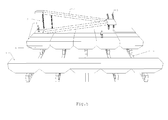
Fig. 1-1 ) will be closed buildings with access to a floating quay (Fig. 1-3 ) through mobile ramps that correct the height's difference of the water level (Fig. 2-4 ) by consequence of the tide or controlled changes of the level through locks. The boat (Fig. 1-2 ) will enter the building and there will be an exchange of passengers, after the opening of the automatic doors (Fig. 1-4 ) of the quay (Fig. 1-3 ), as if it was a subterranean station. This is a fundamental improvement of the current transport system by boats together with the automatic docking, that makes the system similar to the subterranean tube. The lathes (Fig. 2-5 ) provided in the station guarantee that the cancellation of the ticket will be made before getting on the boat and improves the agility of the exchange of passengers. - The floating quay will have large dimensions to guarantee the access of a high number of persons that can get on and off the boat.
- The location of the stops will be provided according to a previous study of mobility, being recommended to place it near the bridges and walkways to bring nearer both banks of the river in the case of fluvial lanes. It is recommended also to provide the stations near the current conventional tube stations, bus stations or cycle paths.
- The metropolitan stops or exterior stops to the city will be provided with extensive dissuasive parking to attract the users that come by car from their towns not near to the river and so avoid the massive entrance in the centre of the big cities. The mobility analysis, which will be carried out before the implantation of the model, will determine the modifications that have to be made in the current transport system, like the bus lines, to bring the passengers to the stops and to relieve pressure in the urban traffic.
- The automatic doors at the quay and at the boat can be the type of vertical opening, which would provide a door's width of almost the whole length of the boat and would improve the efficiency of the passengers' exchange with respect to a subterranean tube, in which the users must first go out through narrow doors before the new users can get in.
- As follows we will describe an example of use of the system with a study carried out for the city of Seville. The Guadalquivir river, flowing through Seville has two arms: the alive canal that flows from the north to the south at the west side of Seville, bordering the lands of Expo'92, Triana, Los Remedios and the commercial harbor; the inner basin (it is a lake of controlled level), closed to the north by the buffer of El Alamillo and to the south by the new lock. Both canals represent a navigation lane free of jams to cross Seville from north to south passing through the historical center and the most important neighborhoods, unifying all the towns at the river and El Aljarafe with the capital. The exterior canal can have strong tides and can be subject of the effect of the tides. Its level can fluctuate until 3,5 meters high, while the basin is more stable and has no stream flows. In the attached documentation we render a presentation with the designed implementation for this city. In this case, there will be used catamarans with an useful surface of 20 x 8 square meters with a charge of 250 passengers in two floors. There are available 112 seats and a platform for 30 bicycles. There will be created 4 lines with 22 stops that will connect almost 40 kilometers. There will be required 25 boats to maintain a frequency of 6 minutes per stop in rush hour and 12 minutes in normal times (the rush hours will be from 7:30 to 9:30 and from 13:30 to 15:30). The ticket's price will be exactly the same as in the current urban tube and will be integrated in the charging system of the Consortium of Transports of Seville. The quays will have an useful surface of the main float of 25 x 6 square meters, a docking canal of 8,30 meters and a float of 25 x 2 square meters for the automatic docking system. The quay will operate with until 4 meters differences in the water level. It is planned the construction of a separated canal of 3 kms. at the inner basin to allow the private use of the river and not to interfere in the rowing centre of high performance. This canal will be built between the Alamillo bridge and the walkway of La Barqueta. It will be built like a concrete wall of 3 meters depth on piles, with two meters under water and one meter above the surface in its middle level. There are planned two modal transport exchangers at each end of the inner basin (south lock, north buffer of Alamillo). There will be 12 stops in the centre of Seville and another 10 stops in the towns at the river. All exterior stops and the two exchangers will have extensive dissuasive parking to attract the users of the towns not near to the river and so avoid the pressure in the interior of the capital. The boats will not have to cross the lock (this will represent an inacceptable delay), not either the north buffer, simply the users will have to change the line, changing boats. These lines will be in a distance of only some meters. The change will take place under cover, inside the two exchangers in less than one minute. The system VTS, AIS, and the communications TETRA have been designed to be shared with the commercial harbor of Seville with the aim of facilitating and coordinating the operations of both entities.
Claims (4)
- Urban and interurban regular transport system for passengers using fluvial and maritime lanes or RiverTube. The system is completely described in the initial description of this document. It represents a novel, completely defined and repeatable system in the majority of the world's cities. The novel system consists in unifying a set of innovations to get the same effectiveness as a subterranean tube, but with 90% less of necessary investment: a) Use the existent communication lanes (rivers and seas), b) Include an automatic docking system to allow the exchange of passengers at the stops similar to the subterranean tube in times and number of users and with only one worker per boat, c) Use stops as closed buildings and large quays as docks instead of docks at open air, d) Use the most sophisticated control systems to guarantee the security and the traffic control: Navigation Simulators for the training of the pilots, VTS, AIS, TETRA, SCADA.
- RiverTube system, according to claim 1, characterized in having an automatic docking system for the boats. It consists in the unit of the Quay-Boat, which guarantees the docking, exchange of passengers and departure of the boat in seconds, with total security and efficacy. The quay (described in the claim 4) operates together with the hydraulic platforms (described in claim 3) foldable (Fig. 3 unfolded and Fig. 4 folded), each one at each side of the boat, which will be unfolded over the quay in the docking moment and engages the boat to the quay (Fig. 6 y Fig. 7). The system will be operated exclusively by the docking pilot. The hydraulic foldable platforms are steel plates and have as a function to anchor the boat to the quay, level the height of the quay and of the boat to allow the access to the users without barriers. There are irrelevant for the definition of the invention, the thickness and the composition of the material of the platform, which will be of enough resistance to support the boat anchored to the quay and will vary with the specification of the boat. The system disposes of a closed television circuit and the necessary illumination system for the sake that the pilot has the absolute security that the quay is clear when he is going to lower the platforms. The pilot has a lever which will allow him to unfold until 100° with respect to the vertical each platform simultaneously. This will allows correcting the height's differences of boat and quay according to the different load of both of them. Besides, he will have a control device to open and close the automatic doors of the boat and of the quay. The boat will be provided with two lateral propellers in the front part to steer easily the movement of the docking.
- RiverTube System, according to claim 1, characterized in that it is provided with hydraulic platforms of the boat, consisting in: a) Two platforms of 1 meter height and with the same length than the access doors to the boat, one on the port side and the other one at starboard. These platforms are anchored to the boat in its inferior part to a rotation axe, which allows it to rotate according to Fig. 3 and Fig. 4. They are managed through a system of three or more hydraulic arms that allow them to rotate until 100° (Fig. 3) of the vertical or the state of rest (Fig. 4). b) A structural reinforcement as base platform of the boat, over which the floats will be placed from below and the whole structure from the top. This platform or reinforcement guarantees that the boat is capable to go up to the quay when the hydraulic ramps go down. The weight of the boat and of the quay summed up will achieve a balance position with the level of the water. The unfolded platforms will do as access ramps to the boat without any remarkable unevenness. The joints will be protected with rubber bands that avoid accidents. Depending on the type, size and weight of the boat and the maximum number of persons that the quay and the boat support, there will be necessary to make a design to guarantee the operability of the system by differences of level of the quay and the boat. In general, the system will operate with a maximum angle of 100° of the vertical for the platforms, what limits the difference in height between the quay and the access level to the boat. This study is not important in the definition of the invention, for it will have to be carried out for each implementation of the system.
- RiverTube System according to claim 1, characterized in having a quay for the automatic docking (or dock or pier). The quay is represented with its separated parts in Fig. 5. The design of the quay is a very important invention in the system, for it is fundamental part of the automatic docking system (claim 2). Its design allows handling it as one unit (Fig. 5). It is inserted in the station's building, with a system of rails that only lets it go down or up with the level of the water. It has a system of mobile access ramps (Fig. 5-2) that allow the access from the level of the building station to the level of the quay. These ramps will be fixed at the superior part to the building and at the inferior part to the quay. The quay can be detached from the building and be moved floating on the water to another place or repair or maintenance station. Besides, a temporal stop can be set up in any place setting four piles in the water and container-station and unify them by a ramp. The container-station has a system of lathes for the access control to create a temporal stop at any point in the fluvial lane. The quay has available a float (Fig. 5-4) separated from the main unit (Fig. 5-1) by underwater arms (Fig. 5-5) that allow the access of the boat between the float and the main unit and unifies them jointly. The boat will unfold its hydraulic ramps to anchor at the quay, fixing to the float from one side and to the main unit from the other side. This double fixation will provide the necessary stability to allow the exchange of passengers with total security and agility. The quay is built with tight cubes that multiply the security against sinking in case of an accident, for it has to support the weight of, at least, the persons that fit in the boat. The inferior part of the quay is set up by a series of floats with the form of a truncated inverted pyramid (Fig. 5-6) that guarantees a minimal vertical displacement with the weight difference when the users' number change at the surface. This design has to be calculated for each implementation of the system, but the invention proposes the most adequate form. All the elements of Fig. 5 will be unified forming an indivisible unit. Only the mobile ramps (Fig. 5-2) can produce a scissor's movement according to the variation of the water's level. Thank to the rail guides (Fig. 5-2), the ramps will move automatically according to the water's level, keeping the same angle: the curved angles (Fig. 5-3), calculated like an arch with the centre in the origin of the inferior ramp in the main unit, force the intermediate landing, union of both ramps, to keep at the middle of the course without the necessity of help or external control. The four rails (Fig. 5-3) are fixed to the basement of the quay. Each implementation of the quay should fix its security level respecting to the maximal authorized weight and the level of maximal waves permitted for the operation. The maximal weigh is determined by the floatability capacity of the quay and by the maximal height's difference of the boat/ quay permitted by the automatic docking system. The quay, even if it is fixed to the station over four vertical rails, should be also anchored to the bottom and fixed to the bank by two cables that operate in opposed directions. Besides, it should be provided with the security and operational protocols required to fix and secure them in case of exceptional situations (floods, rises, etc.) These situations will depend on each particular implementation of the model. The fixation to the station should be designed to stand these eventualities. The quays have available meteorological sensors to know the conditions of the stream's speed and the wave's intensity to inform automatically of the operation's conditions at each stop. The pilots will possess all information at real time to carry out the operation of docking with total security. The boats and the stations will transmit these data through the communication's system TETRA. The quay and each boat will have a sensor to measure the sinking level of the boat, through which it will be possible to calculate the weight that is supporting and limit the access of the users to the quay. In each moment we will know the operation that the pilot has to manage and the level of separation of the height between each quay and each boat. These control systems represent an innovation and guarantee the agility and the security of the operations. The stations will have a public address system managed by the control and cameras centre of the closed circuit of television. They can operate without personnel, but in congestion periods, the presence of workers and security personnel will be required.
Applications Claiming Priority (2)
| Application Number | Priority Date | Filing Date | Title |
|---|---|---|---|
| ES201101334A ES2411977B1 (en) | 2011-12-07 | 2011-12-07 | URBAN TRANSPORTATION SYSTEM |
| PCT/ES2012/000302 WO2013083862A1 (en) | 2011-12-07 | 2012-11-29 | Metrorío system for regular transport of urban and interurban passengers by river and sea |
Publications (3)
| Publication Number | Publication Date |
|---|---|
| EP2789746A1 true EP2789746A1 (en) | 2014-10-15 |
| EP2789746A4 EP2789746A4 (en) | 2016-05-04 |
| EP2789746B1 EP2789746B1 (en) | 2018-08-29 |
Family
ID=48573615
Family Applications (1)
| Application Number | Title | Priority Date | Filing Date |
|---|---|---|---|
| EP12855898.8A Active EP2789746B1 (en) | 2011-12-07 | 2012-11-29 | Metrorío system for regular transport of urban and interurban passengers by river and sea |
Country Status (9)
| Country | Link |
|---|---|
| US (1) | US9409638B2 (en) |
| EP (1) | EP2789746B1 (en) |
| BR (1) | BR112014013599B1 (en) |
| CA (1) | CA2857379C (en) |
| CO (1) | CO7030937A2 (en) |
| ES (2) | ES2411977B1 (en) |
| MX (1) | MX352008B (en) |
| PT (1) | PT2789746T (en) |
| WO (1) | WO2013083862A1 (en) |
Families Citing this family (1)
| Publication number | Priority date | Publication date | Assignee | Title |
|---|---|---|---|---|
| EP3966141A4 (en) * | 2020-01-21 | 2023-07-12 | Galataport Istanbul Liman Isletmeciligi Ve Yatirimlari Anonim Sirketi | Cruise port operation system and method |
Family Cites Families (11)
| Publication number | Priority date | Publication date | Assignee | Title |
|---|---|---|---|---|
| US2879735A (en) | 1955-04-25 | 1959-03-31 | Pointer Robert William | Marine float |
| NO155504C (en) | 1980-07-14 | 1987-04-08 | Navire Cargo Gear Int Ab | DEVICE FOR AA HOLDING A PONGTONG IN POSITION. |
| DE3734309A1 (en) | 1987-10-10 | 1989-04-27 | Oberledinger Maschinenbaugesel | FLOATING DEVICE, LIKE PONTON OR THE LIKE, WITH A FIXING DEVICE IN TIDENDEPENDENT WATERS AT LANDSCAPE STOP POINTS |
| DE19616864C2 (en) | 1996-04-26 | 1999-08-19 | Steinebach | Seaworthy ferry for passengers and vehicles with a matching jetty |
| US6539887B1 (en) | 2000-01-31 | 2003-04-01 | Robert H Vollmerhausen | Bus to boat passenger transfer facility |
| SE516930C2 (en) | 2000-03-17 | 2002-03-26 | Tts Ships Equipment Ab | Device for loading ramp on ships |
| US7469859B1 (en) * | 2003-10-20 | 2008-12-30 | Leon Edward Campbell | Transportation apparatus and methods |
| US20070044702A1 (en) | 2004-05-21 | 2007-03-01 | Waldock William L | Catamaran with hinged underwing |
| FR2893043B1 (en) * | 2005-11-09 | 2009-12-18 | Cie Du Sol | PORT STRUCTURE AND METHOD FOR CONSTRUCTING SUCH A STRUCTURE |
| WO2007093775A2 (en) | 2006-02-14 | 2007-08-23 | Xrosswater Limited | Nestable floatation member and floating platform arrangement |
| NO333199B1 (en) * | 2009-10-23 | 2013-04-08 | Birken & Co As | Device at quay plant and method of storing an anchor chain in connection with a maintenance operation on an anchor chain |
-
2011
- 2011-12-07 ES ES201101334A patent/ES2411977B1/en not_active Expired - Fee Related
-
2012
- 2012-05-25 MX MX2012006058A patent/MX352008B/en active IP Right Grant
- 2012-11-29 EP EP12855898.8A patent/EP2789746B1/en active Active
- 2012-11-29 US US14/361,591 patent/US9409638B2/en active Active
- 2012-11-29 PT PT12855898T patent/PT2789746T/en unknown
- 2012-11-29 CA CA2857379A patent/CA2857379C/en active Active
- 2012-11-29 WO PCT/ES2012/000302 patent/WO2013083862A1/en not_active Ceased
- 2012-11-29 BR BR112014013599-1A patent/BR112014013599B1/en active IP Right Grant
- 2012-11-29 ES ES12855898T patent/ES2699993T3/en active Active
-
2014
- 2014-06-03 CO CO14118604A patent/CO7030937A2/en unknown
Also Published As
| Publication number | Publication date |
|---|---|
| US9409638B2 (en) | 2016-08-09 |
| BR112014013599A2 (en) | 2017-06-13 |
| CA2857379C (en) | 2020-09-22 |
| ES2699993T3 (en) | 2019-02-13 |
| MX2012006058A (en) | 2013-06-14 |
| WO2013083862A4 (en) | 2013-08-01 |
| ES2411977B1 (en) | 2014-02-06 |
| MX352008B (en) | 2017-11-06 |
| PT2789746T (en) | 2018-12-03 |
| WO2013083862A1 (en) | 2013-06-13 |
| BR112014013599B1 (en) | 2021-08-17 |
| CA2857379A1 (en) | 2013-06-13 |
| EP2789746B1 (en) | 2018-08-29 |
| BR112014013599A8 (en) | 2017-06-13 |
| US20140348592A1 (en) | 2014-11-27 |
| EP2789746A4 (en) | 2016-05-04 |
| CO7030937A2 (en) | 2014-08-21 |
| ES2411977A1 (en) | 2013-07-09 |
Similar Documents
| Publication | Publication Date | Title |
|---|---|---|
| CN107254869A (en) | A kind of ship booster supporting compartment enters water and floating and transportation method | |
| US20090114769A1 (en) | Transportation apparatus and methods | |
| CN110644534A (en) | A buoyancy variable suspension tunnel | |
| CN111254978B (en) | An escape system for underwater suspension tunnel | |
| CN113833025A (en) | Water suspension type steel-concrete structure road and railway traffic engineering | |
| EP2789746B1 (en) | Metrorío system for regular transport of urban and interurban passengers by river and sea | |
| CN115142463B (en) | Construction method of marine traffic track suspended under marine floating body platform | |
| CN201762686U (en) | Semi-submersible type multifunctional breakwater | |
| KR102646193B1 (en) | Aqua loop - manned-unmanned underwater vehicle based submarine transportation system | |
| CN211312604U (en) | Buoyancy-variable suspension tunnel | |
| CN208530806U (en) | It is a kind of to launch a ship system according to the large ship shifting of embankment construction | |
| FR2580687A1 (en) | Methods for construction, industrial installations and special plant-ships for building giant metal structures | |
| Dundović et al. | Optimizing the Split port system to promote sustainable development | |
| Skorpa | Developing new methods to cross wide and deep Norwegian fjords | |
| Mahmud et al. | AN ALTERNATIVE PROPOSAL FOR JETTY AND PONTOON DESIGN IN PATURIA FERRY GHAT | |
| Mavra et al. | Development of small ports in Zadar area | |
| Jones et al. | Development of Major Ferry Homeport in Dense Urban Waterfront | |
| Maruyama et al. | Construction of a Floating Swing Bridge—Yumemai Bridge.” | |
| Cheng et al. | General Layout of Cruise Terminals | |
| OFFSHORE | FLOATING OFFSHORE AIRPORT IN OSAKA BAY, JAPAN. DIGEST OF PRELIMINARY ENGINEERING STUDY | |
| CN122039580A (en) | Floating type travel wharf structure, construction method thereof and wave prevention method | |
| Firat et al. | Precast, Prestressed Concrete Floating Berth at the Haines Ferry Terminal | |
| Witts | The Severn Estuary Crossings | |
| Satler et al. | WATERWAY SIGNS AND MARKING ON THE RIVER DRAVA | |
| Andrew | Floating tunnel for long water crossings |
Legal Events
| Date | Code | Title | Description |
|---|---|---|---|
| PUAI | Public reference made under article 153(3) epc to a published international application that has entered the european phase |
Free format text: ORIGINAL CODE: 0009012 |
|
| 17P | Request for examination filed |
Effective date: 20140618 |
|
| AK | Designated contracting states |
Kind code of ref document: A1 Designated state(s): AL AT BE BG CH CY CZ DE DK EE ES FI FR GB GR HR HU IE IS IT LI LT LU LV MC MK MT NL NO PL PT RO RS SE SI SK SM TR |
|
| DAX | Request for extension of the european patent (deleted) | ||
| RA4 | Supplementary search report drawn up and despatched (corrected) |
Effective date: 20160404 |
|
| RIC1 | Information provided on ipc code assigned before grant |
Ipc: B63B 27/14 20060101ALI20160329BHEP Ipc: B63B 21/50 20060101ALI20160329BHEP Ipc: E01D 15/24 20060101ALI20160329BHEP Ipc: B63B 35/34 20060101ALI20160329BHEP Ipc: E02B 3/20 20060101AFI20160329BHEP |
|
| STAA | Information on the status of an ep patent application or granted ep patent |
Free format text: STATUS: EXAMINATION IS IN PROGRESS |
|
| 17Q | First examination report despatched |
Effective date: 20170531 |
|
| GRAP | Despatch of communication of intention to grant a patent |
Free format text: ORIGINAL CODE: EPIDOSNIGR1 |
|
| STAA | Information on the status of an ep patent application or granted ep patent |
Free format text: STATUS: GRANT OF PATENT IS INTENDED |
|
| INTG | Intention to grant announced |
Effective date: 20180321 |
|
| GRAS | Grant fee paid |
Free format text: ORIGINAL CODE: EPIDOSNIGR3 |
|
| GRAA | (expected) grant |
Free format text: ORIGINAL CODE: 0009210 |
|
| STAA | Information on the status of an ep patent application or granted ep patent |
Free format text: STATUS: THE PATENT HAS BEEN GRANTED |
|
| AK | Designated contracting states |
Kind code of ref document: B1 Designated state(s): AL AT BE BG CH CY CZ DE DK EE ES FI FR GB GR HR HU IE IS IT LI LT LU LV MC MK MT NL NO PL PT RO RS SE SI SK SM TR |
|
| REG | Reference to a national code |
Ref country code: GB Ref legal event code: FG4D |
|
| REG | Reference to a national code |
Ref country code: CH Ref legal event code: EP |
|
| REG | Reference to a national code |
Ref country code: AT Ref legal event code: REF Ref document number: 1035283 Country of ref document: AT Kind code of ref document: T Effective date: 20180915 |
|
| REG | Reference to a national code |
Ref country code: IE Ref legal event code: FG4D |
|
| REG | Reference to a national code |
Ref country code: DE Ref legal event code: R096 Ref document number: 602012050493 Country of ref document: DE |
|
| REG | Reference to a national code |
Ref country code: PT Ref legal event code: SC4A Ref document number: 2789746 Country of ref document: PT Date of ref document: 20181203 Kind code of ref document: T Free format text: AVAILABILITY OF NATIONAL TRANSLATION Effective date: 20181122 |
|
| REG | Reference to a national code |
Ref country code: NL Ref legal event code: FP |
|
| PGFP | Annual fee paid to national office [announced via postgrant information from national office to epo] |
Ref country code: NL Payment date: 20181130 Year of fee payment: 7 |
|
| REG | Reference to a national code |
Ref country code: LT Ref legal event code: MG4D |
|
| PG25 | Lapsed in a contracting state [announced via postgrant information from national office to epo] |
Ref country code: NO Free format text: LAPSE BECAUSE OF FAILURE TO SUBMIT A TRANSLATION OF THE DESCRIPTION OR TO PAY THE FEE WITHIN THE PRESCRIBED TIME-LIMIT Effective date: 20181129 Ref country code: FI Free format text: LAPSE BECAUSE OF FAILURE TO SUBMIT A TRANSLATION OF THE DESCRIPTION OR TO PAY THE FEE WITHIN THE PRESCRIBED TIME-LIMIT Effective date: 20180829 Ref country code: RS Free format text: LAPSE BECAUSE OF FAILURE TO SUBMIT A TRANSLATION OF THE DESCRIPTION OR TO PAY THE FEE WITHIN THE PRESCRIBED TIME-LIMIT Effective date: 20180829 Ref country code: SE Free format text: LAPSE BECAUSE OF FAILURE TO SUBMIT A TRANSLATION OF THE DESCRIPTION OR TO PAY THE FEE WITHIN THE PRESCRIBED TIME-LIMIT Effective date: 20180829 Ref country code: IS Free format text: LAPSE BECAUSE OF FAILURE TO SUBMIT A TRANSLATION OF THE DESCRIPTION OR TO PAY THE FEE WITHIN THE PRESCRIBED TIME-LIMIT Effective date: 20181229 Ref country code: BG Free format text: LAPSE BECAUSE OF FAILURE TO SUBMIT A TRANSLATION OF THE DESCRIPTION OR TO PAY THE FEE WITHIN THE PRESCRIBED TIME-LIMIT Effective date: 20181129 Ref country code: LT Free format text: LAPSE BECAUSE OF FAILURE TO SUBMIT A TRANSLATION OF THE DESCRIPTION OR TO PAY THE FEE WITHIN THE PRESCRIBED TIME-LIMIT Effective date: 20180829 Ref country code: GR Free format text: LAPSE BECAUSE OF FAILURE TO SUBMIT A TRANSLATION OF THE DESCRIPTION OR TO PAY THE FEE WITHIN THE PRESCRIBED TIME-LIMIT Effective date: 20181130 |
|
| REG | Reference to a national code |
Ref country code: ES Ref legal event code: FG2A Ref document number: 2699993 Country of ref document: ES Kind code of ref document: T3 Effective date: 20190213 |
|
| PG25 | Lapsed in a contracting state [announced via postgrant information from national office to epo] |
Ref country code: AL Free format text: LAPSE BECAUSE OF FAILURE TO SUBMIT A TRANSLATION OF THE DESCRIPTION OR TO PAY THE FEE WITHIN THE PRESCRIBED TIME-LIMIT Effective date: 20180829 Ref country code: LV Free format text: LAPSE BECAUSE OF FAILURE TO SUBMIT A TRANSLATION OF THE DESCRIPTION OR TO PAY THE FEE WITHIN THE PRESCRIBED TIME-LIMIT Effective date: 20180829 Ref country code: HR Free format text: LAPSE BECAUSE OF FAILURE TO SUBMIT A TRANSLATION OF THE DESCRIPTION OR TO PAY THE FEE WITHIN THE PRESCRIBED TIME-LIMIT Effective date: 20180829 |
|
| PG25 | Lapsed in a contracting state [announced via postgrant information from national office to epo] |
Ref country code: PL Free format text: LAPSE BECAUSE OF FAILURE TO SUBMIT A TRANSLATION OF THE DESCRIPTION OR TO PAY THE FEE WITHIN THE PRESCRIBED TIME-LIMIT Effective date: 20180829 Ref country code: RO Free format text: LAPSE BECAUSE OF FAILURE TO SUBMIT A TRANSLATION OF THE DESCRIPTION OR TO PAY THE FEE WITHIN THE PRESCRIBED TIME-LIMIT Effective date: 20180829 Ref country code: EE Free format text: LAPSE BECAUSE OF FAILURE TO SUBMIT A TRANSLATION OF THE DESCRIPTION OR TO PAY THE FEE WITHIN THE PRESCRIBED TIME-LIMIT Effective date: 20180829 |
|
| PG25 | Lapsed in a contracting state [announced via postgrant information from national office to epo] |
Ref country code: SM Free format text: LAPSE BECAUSE OF FAILURE TO SUBMIT A TRANSLATION OF THE DESCRIPTION OR TO PAY THE FEE WITHIN THE PRESCRIBED TIME-LIMIT Effective date: 20180829 Ref country code: DK Free format text: LAPSE BECAUSE OF FAILURE TO SUBMIT A TRANSLATION OF THE DESCRIPTION OR TO PAY THE FEE WITHIN THE PRESCRIBED TIME-LIMIT Effective date: 20180829 Ref country code: SK Free format text: LAPSE BECAUSE OF FAILURE TO SUBMIT A TRANSLATION OF THE DESCRIPTION OR TO PAY THE FEE WITHIN THE PRESCRIBED TIME-LIMIT Effective date: 20180829 |
|
| PGFP | Annual fee paid to national office [announced via postgrant information from national office to epo] |
Ref country code: HU Payment date: 20181120 Year of fee payment: 7 |
|
| REG | Reference to a national code |
Ref country code: DE Ref legal event code: R097 Ref document number: 602012050493 Country of ref document: DE |
|
| REG | Reference to a national code |
Ref country code: CH Ref legal event code: PL |
|
| PLBE | No opposition filed within time limit |
Free format text: ORIGINAL CODE: 0009261 |
|
| STAA | Information on the status of an ep patent application or granted ep patent |
Free format text: STATUS: NO OPPOSITION FILED WITHIN TIME LIMIT |
|
| PG25 | Lapsed in a contracting state [announced via postgrant information from national office to epo] |
Ref country code: LU Free format text: LAPSE BECAUSE OF NON-PAYMENT OF DUE FEES Effective date: 20181129 Ref country code: MC Free format text: LAPSE BECAUSE OF FAILURE TO SUBMIT A TRANSLATION OF THE DESCRIPTION OR TO PAY THE FEE WITHIN THE PRESCRIBED TIME-LIMIT Effective date: 20180829 |
|
| 26N | No opposition filed |
Effective date: 20190531 |
|
| REG | Reference to a national code |
Ref country code: BE Ref legal event code: MM Effective date: 20181130 |
|
| REG | Reference to a national code |
Ref country code: IE Ref legal event code: MM4A |
|
| PG25 | Lapsed in a contracting state [announced via postgrant information from national office to epo] |
Ref country code: SI Free format text: LAPSE BECAUSE OF FAILURE TO SUBMIT A TRANSLATION OF THE DESCRIPTION OR TO PAY THE FEE WITHIN THE PRESCRIBED TIME-LIMIT Effective date: 20180829 Ref country code: LI Free format text: LAPSE BECAUSE OF NON-PAYMENT OF DUE FEES Effective date: 20181130 Ref country code: CH Free format text: LAPSE BECAUSE OF NON-PAYMENT OF DUE FEES Effective date: 20181130 |
|
| PG25 | Lapsed in a contracting state [announced via postgrant information from national office to epo] |
Ref country code: IE Free format text: LAPSE BECAUSE OF NON-PAYMENT OF DUE FEES Effective date: 20181129 |
|
| PG25 | Lapsed in a contracting state [announced via postgrant information from national office to epo] |
Ref country code: BE Free format text: LAPSE BECAUSE OF NON-PAYMENT OF DUE FEES Effective date: 20181130 |
|
| PG25 | Lapsed in a contracting state [announced via postgrant information from national office to epo] |
Ref country code: MT Free format text: LAPSE BECAUSE OF NON-PAYMENT OF DUE FEES Effective date: 20181129 |
|
| PGFP | Annual fee paid to national office [announced via postgrant information from national office to epo] |
Ref country code: DE Payment date: 20191113 Year of fee payment: 8 Ref country code: CZ Payment date: 20191113 Year of fee payment: 8 Ref country code: PT Payment date: 20191115 Year of fee payment: 8 |
|
| PGFP | Annual fee paid to national office [announced via postgrant information from national office to epo] |
Ref country code: IT Payment date: 20191121 Year of fee payment: 8 Ref country code: FR Payment date: 20191122 Year of fee payment: 8 |
|
| PGFP | Annual fee paid to national office [announced via postgrant information from national office to epo] |
Ref country code: TR Payment date: 20191119 Year of fee payment: 8 Ref country code: AT Payment date: 20191128 Year of fee payment: 8 |
|
| PG25 | Lapsed in a contracting state [announced via postgrant information from national office to epo] |
Ref country code: CY Free format text: LAPSE BECAUSE OF FAILURE TO SUBMIT A TRANSLATION OF THE DESCRIPTION OR TO PAY THE FEE WITHIN THE PRESCRIBED TIME-LIMIT Effective date: 20180829 Ref country code: MK Free format text: LAPSE BECAUSE OF NON-PAYMENT OF DUE FEES Effective date: 20180829 |
|
| REG | Reference to a national code |
Ref country code: NL Ref legal event code: MM Effective date: 20191201 |
|
| PG25 | Lapsed in a contracting state [announced via postgrant information from national office to epo] |
Ref country code: HU Free format text: LAPSE BECAUSE OF NON-PAYMENT OF DUE FEES Effective date: 20191130 |
|
| PG25 | Lapsed in a contracting state [announced via postgrant information from national office to epo] |
Ref country code: NL Free format text: LAPSE BECAUSE OF NON-PAYMENT OF DUE FEES Effective date: 20191201 |
|
| REG | Reference to a national code |
Ref country code: DE Ref legal event code: R119 Ref document number: 602012050493 Country of ref document: DE |
|
| REG | Reference to a national code |
Ref country code: AT Ref legal event code: MM01 Ref document number: 1035283 Country of ref document: AT Kind code of ref document: T Effective date: 20201129 Ref country code: AT Ref legal event code: UEP Ref document number: 1035283 Country of ref document: AT Kind code of ref document: T Effective date: 20180829 |
|
| PG25 | Lapsed in a contracting state [announced via postgrant information from national office to epo] |
Ref country code: CZ Free format text: LAPSE BECAUSE OF NON-PAYMENT OF DUE FEES Effective date: 20201129 Ref country code: PT Free format text: LAPSE BECAUSE OF NON-PAYMENT OF DUE FEES Effective date: 20210531 |
|
| PG25 | Lapsed in a contracting state [announced via postgrant information from national office to epo] |
Ref country code: AT Free format text: LAPSE BECAUSE OF NON-PAYMENT OF DUE FEES Effective date: 20201129 |
|
| PG25 | Lapsed in a contracting state [announced via postgrant information from national office to epo] |
Ref country code: IT Free format text: LAPSE BECAUSE OF NON-PAYMENT OF DUE FEES Effective date: 20201129 Ref country code: FR Free format text: LAPSE BECAUSE OF NON-PAYMENT OF DUE FEES Effective date: 20201130 |
|
| PG25 | Lapsed in a contracting state [announced via postgrant information from national office to epo] |
Ref country code: DE Free format text: LAPSE BECAUSE OF NON-PAYMENT OF DUE FEES Effective date: 20210601 |
|
| PG25 | Lapsed in a contracting state [announced via postgrant information from national office to epo] |
Ref country code: TR Free format text: LAPSE BECAUSE OF NON-PAYMENT OF DUE FEES Effective date: 20201129 |
|
| PGFP | Annual fee paid to national office [announced via postgrant information from national office to epo] |
Ref country code: GB Payment date: 20251111 Year of fee payment: 14 |
|
| PGFP | Annual fee paid to national office [announced via postgrant information from national office to epo] |
Ref country code: ES Payment date: 20251209 Year of fee payment: 14 |