EP2789602A1 - Omega-halo-2-alkynal, method for producing same, and method for producing conjugated Z-alken-yn-yl acetate using same - Google Patents
Omega-halo-2-alkynal, method for producing same, and method for producing conjugated Z-alken-yn-yl acetate using same Download PDFInfo
- Publication number
- EP2789602A1 EP2789602A1 EP20140163480 EP14163480A EP2789602A1 EP 2789602 A1 EP2789602 A1 EP 2789602A1 EP 20140163480 EP20140163480 EP 20140163480 EP 14163480 A EP14163480 A EP 14163480A EP 2789602 A1 EP2789602 A1 EP 2789602A1
- Authority
- EP
- European Patent Office
- Prior art keywords
- acetate
- alken
- conjugated
- halo
- chloro
- Prior art date
- Legal status (The legal status is an assumption and is not a legal conclusion. Google has not performed a legal analysis and makes no representation as to the accuracy of the status listed.)
- Granted
Links
Classifications
-
- C—CHEMISTRY; METALLURGY
- C07—ORGANIC CHEMISTRY
- C07C—ACYCLIC OR CARBOCYCLIC COMPOUNDS
- C07C67/00—Preparation of carboxylic acid esters
- C07C67/10—Preparation of carboxylic acid esters by reacting carboxylic acids or symmetrical anhydrides with ester groups or with a carbon-halogen bond
-
- C—CHEMISTRY; METALLURGY
- C07—ORGANIC CHEMISTRY
- C07C—ACYCLIC OR CARBOCYCLIC COMPOUNDS
- C07C45/00—Preparation of compounds having >C = O groups bound only to carbon or hydrogen atoms; Preparation of chelates of such compounds
- C07C45/42—Preparation of compounds having >C = O groups bound only to carbon or hydrogen atoms; Preparation of chelates of such compounds by hydrolysis
-
- C—CHEMISTRY; METALLURGY
- C07—ORGANIC CHEMISTRY
- C07C—ACYCLIC OR CARBOCYCLIC COMPOUNDS
- C07C47/00—Compounds having —CHO groups
- C07C47/20—Unsaturated compounds having —CHO groups bound to acyclic carbon atoms
- C07C47/24—Unsaturated compounds having —CHO groups bound to acyclic carbon atoms containing halogen
-
- C—CHEMISTRY; METALLURGY
- C07—ORGANIC CHEMISTRY
- C07C—ACYCLIC OR CARBOCYCLIC COMPOUNDS
- C07C17/00—Preparation of halogenated hydrocarbons
- C07C17/26—Preparation of halogenated hydrocarbons by reactions involving an increase in the number of carbon atoms in the skeleton
- C07C17/263—Preparation of halogenated hydrocarbons by reactions involving an increase in the number of carbon atoms in the skeleton by condensation reactions
- C07C17/2635—Preparation of halogenated hydrocarbons by reactions involving an increase in the number of carbon atoms in the skeleton by condensation reactions involving a phosphorus compound, e.g. Wittig synthesis
-
- C—CHEMISTRY; METALLURGY
- C07—ORGANIC CHEMISTRY
- C07C—ACYCLIC OR CARBOCYCLIC COMPOUNDS
- C07C45/00—Preparation of compounds having >C = O groups bound only to carbon or hydrogen atoms; Preparation of chelates of such compounds
- C07C45/42—Preparation of compounds having >C = O groups bound only to carbon or hydrogen atoms; Preparation of chelates of such compounds by hydrolysis
- C07C45/43—Preparation of compounds having >C = O groups bound only to carbon or hydrogen atoms; Preparation of chelates of such compounds by hydrolysis of >CX2 groups, X being halogen
-
- C—CHEMISTRY; METALLURGY
- C07—ORGANIC CHEMISTRY
- C07C—ACYCLIC OR CARBOCYCLIC COMPOUNDS
- C07C67/00—Preparation of carboxylic acid esters
- C07C67/10—Preparation of carboxylic acid esters by reacting carboxylic acids or symmetrical anhydrides with ester groups or with a carbon-halogen bond
- C07C67/11—Preparation of carboxylic acid esters by reacting carboxylic acids or symmetrical anhydrides with ester groups or with a carbon-halogen bond being mineral ester groups
Definitions
- the present invention relates to methods for producing a conjugated Z-alken-yn-yl acetate and an ⁇ -halo-2-alkynal which is an intermediate thereof, particularly to a method for producing Z-13-hexadecen-11-yn-yl acetate which is a sex pheromone component of a pine processducy moth (scientific name: Thaumetopoea pityocampa ), which is a forest pest insect in Europe.
- a pine processlessness moth (scientific name: Thaumetopoea pityocampa) is an insect widely inhabiting European countries such as France, Italy, Spain, Portugal and Greece. It has become a problem as a forest pest insect because of feeding damage to trees such as pine and cedar. In addition, poisonous hair of the larva of this moth is known to cause a serious allergic reaction in humans, livestock, pets and the like. Moreover, in recent years, the habitat of the moth has been expanding northward from the Mediterranean region due to the effect of global warming. There is therefore a demand for the development of a novel control method of the moth.
- the methods for producing Z-13-hexadecen-11-yn-yl acetate include: a method reported by F. Camps et al. and making use of an elimination reaction of a secondary tosylate and use of an organolithium compound (Spanish Patent Publication No. 2010719 , Spanish Patent Publication No. 8204407 , and F. Camps et.al.,Chem.Lett.,703, 1981 ), a method reported by G. Cardillo et al. and using lithium diisopropylamide and a dehydration reaction ( G. Cardillo et. al., Gazzetta Chimica Italiana, 112, 231, 1982 ), a method reported by J. K.
- Stille et al. and using an acetylene zipper reaction, an organotin compound, and diimide reduction J. K. Stille et.al., J. Am. Chem. Soc., 1987, 109, 2138
- M. Gardette et al. and using a reaction between an organocopper lithium reagent and an acetylene compound M. Gardette et. al., J. Chem. Ecolg., 9, 219, 1983
- D. Michelot et al. and using a hydroboration reaction and a coupling reaction in the presence of a palladium catalyst D. Michelot et. al., J. Chem.
- a special raw material such as an organolithium compound, an organoboron compound, an organotin compound or a diimide compound is used and a step of requiring a low-temperature reaction at -10°C or less for the production is comprised.
- the production method through a Wittig reaction which can be carried out under mild conditions is effective as an industrial production method, but has some problems such as reduction of yield owing to inclusion of more steps including protection and deprotection steps of the terminal ⁇ -alcohol group, and a low yield in the Wittig reaction.
- An object of the invention is to overcome the problems of the conventional art and provide a method for industrially producing a conjugated Z-alken-yn-yl acetate such as Z-13-hexadecen-11-yn-yl acetate which is the sex pheromone component of a pine methodiffy moth and an intermediate for the conjugated Z-alken-yn-yl acetate, under mild conditions at a high yield.
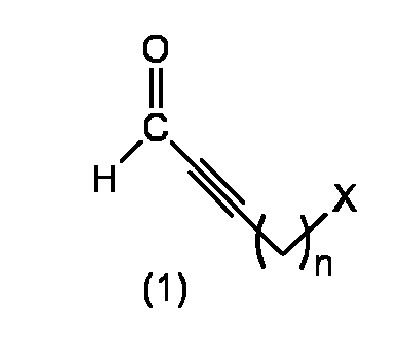
- ⁇ -halo-2-alkynal having a halogen group as the terminal ⁇ -functional group and represented by formula (1): wherein X represents a halogen atom and n stands for an integer of from 2 to 15, makes it possible to produce a conjugated Z-alken-yn-yl halide without conducting protection and deprotection steps and to keep a good yield even in a subsequent Wittig reaction.
- a method for producing an ⁇ -halo-2-alkynal comprising a step of hydrolyzing an ⁇ -halo-1,1-dialkoxy-2-alkyne represented by formula (2): wherein R 1 and R 2 may be the same or different and each represents a linear, branched or cyclic C 1-10 hydrocarbon group, X represents a halogen atom, and n stands for an integer of from 2 to 15, in water and an organic solvent in the presence of sulfonic acid to form a ⁇ -halo-2-alkynal represented by the formula (1).
- n stands for an integer of from 2 to 4, 6, 7 and 10 to 15.
- a conjugated Z-alken-yn-yl acetate such as Z-13-hexadecen-11-yn-yl acetate which is the sex pheromone component of a pine methodiffy moth, can be industrially produced under mild conditions with high efficiency.
- the ⁇ -halo-2-alkynal is represented by the following formula (1) and it is, for example, 13-chloro-2-tridecynal.
- X represents a halogen atom such as chlorine, bromine or iodine. Of these, chlorine and bromine atoms are particularly preferred as the halogen atom from the standpoints of a yield and availability of raw materials.
- n stands for an integer of from 2 to 15, preferably an integer of from 4 to 10, more preferably an integer of from 6 to 10.
- Specific examples of (CH 2 ) n include an alkylene group such as methylene, ethylene, propylene, butylene, pentylene, hexylene, heptylene, octylene, nonylene and decylene.
- ⁇ -halo-2-alkynal (1) include an ⁇ -chloro-2-alkynal such as 5-chloro-2-pentynal, 6-chloro-2-hexynal, 7-chloro-2-heptynal, 8-chloro-2-octynal, 9-chloro-2-nonynal, 10-chloro-2-decynal, 11-chloro-2-undecynal, 12-chloro-2-dodecynal and 13-chloro-2-tridecynal, and an ⁇ -bromo-2-alkynal such as 5-bromo-2-pentynal, 6-bromo-2-hexynal, 7-bromo-2-heptynal, 8-bromo-2-octynal, 9-bromo-2-nonynal, 10-bromo-2-decynal, 11-bromo-2-undecynal
- the ⁇ -halo-2-alkynal represented by the formula (1) can be produced by hydrolyzing the dialkylacetal portion of an ⁇ -halo-1,1-dialkoxy-2-alkyne represented by the following formula (2) in water and an organic solvent in the presence of an acid catalyst.
- 13-chloro-2-tridecynal can be produced by hydrolyzing 13-chloro-1,1-diethoxy-2-tridecyne in the presence of an acid catalyst in water and an organic solvent.
- R 1 and R 2 are the same or different and each represents a linear, branched or cyclic C 1-10 hydrocarbon group.
- Specific examples include a linear hydrocarbon group such as methyl, ethyl, propyl and butyl; a branched hydrocarbon group such as isopropyl, isobutyl, sec-butyl and tert-butyl; and a cyclic hydrocarbon group such as cyclopropyl, cyclobutyl, cyclopentyl and cyclohexyl.
- X and n have the same meanings as described above and preferred examples of each of them are also as described above.
- ⁇ -halo-1,1-dialkoxy-2-alkyn (2) include an ⁇ -chloro-1,1-dimethoxy-2-alkyne such as 5-chloro-1,1-dimethoxy-2-pentyne, 6-chloro-1,1-dimethoxy-2-hexyne, 7-chloro-1,1-dimethoxy-2-heptyne, 8-chloro-1,1-dimethoxy-2-octyne, 9-chloro-1,1-dimethoxy-2-nonyne, 10-chloro-1,1-dimethoxy-2-decyne, 11-chloro-1,1-dimethoxy-2-undecyne, 12-chloro-1,1-dimethoxy-2-dodecyne and 13-chloro-1,1-dimethoxy-2-tridecyne; an ⁇ -bromo-1,1-dimethoxy-2-alkyne such
- the ⁇ -halo-1,1-dialkoxy-2-alkyne represented by the formula (2) can be produced, for example, by the method described in JP 2-101028A or JP 2005-272409A . More specifically, as described in JP 2-101028A , an ⁇ -halo-1,1-dialkoxy-2-alkyne can be obtained by reacting an ⁇ -halo-1-alkyne with an alkyl magnesium halide and then with an alkyl orthoformate.
- an ⁇ -halo-1,1-dialkoxy-2-alkyne having a long methylene chain can be obtained by reacting the ⁇ -halo-1-alkyne with an alkyl magnesium halide to protect the terminal alkyne, reacting the resulting product with metal magnesium to form a corresponding Grignard reagent, subjecting the Grignard reagent to a cross-coupling reaction with a 1-bromo- ⁇ -chloroalkane in the presence of a copper halide catalyst, and then reacting the resulting product with an alkyl orthoformate.
- the ⁇ -halo-1,1-dialkoxy-2-alkyne having a long methylene chain may be produced by isolating and purifying the ⁇ -halo-1-alkyne having a long methylene chain after the above-mentioned cross-coupling reaction, reacting the isolated and purified ⁇ -halo-1-alkyne with an alkyl magnesium halide again, and then reacting the resulting product with an alkyl orthoformate.
- the acid catalyst to be used in the hydrolysis reaction for forming an aldehyde is not particularly limited. Specific examples thereof include an inorganic acid such as hydrochloric acid, sulfuric acid, nitric acid and perchloric acid; a carboxylic acid such as formic acid, acetic acid, oxalic acid, trifluoroacetic acid, difluoroacetic acid, trichloroacetic acid, dichloroacetic acid and monochloroacetic acid; and a sulfonic acid such as p-toluenesulfonic acid, methanesulfonic acid and benzenesulfonic acid.
- the acid may be used singly or in combination of two or more acids.
- a sulfonic acid such as p-toluenesulfonic acid, methanesulfonic acid and benzenesulfonic acid are particularly preferred from the standpoints of a reaction rate, an amount of impurity formed, and a yield.
- the acid catalyst is used in an amount of preferably from 0.01 to 0.1 mol per mol of the ⁇ -halo-1,1-dialkoxy-2-alkyne (2).
- the acid catalyst is used in an amount of particularly preferably from 0.03 to 0.05 mol per mol of the ⁇ -halo-1,1-dialkoxy-2-alkyne (2)from the standpoints of a reaction rate, an amount of impurity formed, and a yield.
- water is also used.
- Water is used in an amount of preferably from 30 to 300 g per mol of the ⁇ -halo-1,1-dialkoxy-2-alkyne (2).
- Water is used in an amount of particularly preferably from 100 to 250 g per mol of the ⁇ -halo-1,1-dialkoxy-2-alkyne (2) from the standpoints of a reaction rate and a yield per volume of a reactor.
- the organic solvent is not particularly limited insofar as it does not adversely affect the reaction.
- a water-soluble organic solvent is preferred from the standpoint of reactivity. Examples include methanol, ethanol, n-propyl alcohol, isopropyl alcohol, tetrahydrofuran, acetone, N,N-dimethylformamide and N,N-dimethylacetamide. Tetrahydrofuran is particularly preferred from the standpoint of reactivity.
- the organic solvent is used in an amount of preferably from 10 to 200 g per mol of the ⁇ -halo-1,1-dialkoxy-2-alkyne (2).
- the organic solvent is used in an amount of particularly preferably from 30 to 100 g per mol of the ⁇ - halo-1,1-dialkoxy-2-alkyne (2) from the standpoints of a reaction rate and a yield per volume of a reactor.
- the temperature of the hydrolysis reaction for forming an aldehyde is preferably from 30 to 120°C. It is particularly preferably from 60 to 85°C from the standpoints of a reaction rate, an amount of impurity formed, and a yield.
- An alcohol formed as a by-product in the hydrolysis reaction may be distilled off from a reactor under normal pressure or reduced pressure.
- the ⁇ -halo-2-alkynal (1) is reacted with an alkylidene triphenylphosphorane (3) through a Wittig reaction to produce a conjugated Z-alken-yn-yl halide (4).
- Z-13-hexadecen-11-yn-yl chloride can be produced by reacting 13-chloro-2-tridecynal with propylidene triphenylphosphorane.
- X and n have the same meanings as described above and preferred examples of each of them are also as described above.
- Ph represents a phenyl group.
- R represents a linear, branched or cyclic C 1-12 hydrocarbon group. Specific examples thereof include a linear hydrocarbon group such as methyl, ethyl and propyl; a branched hydrocarbon group such as isopropyl, isobutyl, sec-butyl and tert-butyl; and a cyclic hydrocarbon group such as cyclopropyl, cyclobutyl, cyclopentyl and cyclohexyl.
- Preferred is a linear C 1-12 hydrocarbon group, with a linear C 1-6 hydrocarbon group being more preferred.
- alkylidene triphenylphosphorane (3) examples include ethylidene triphenylphosphorane, propylidene triphenylphosphorane, butylidene triphenylphosphorane, pentylidene triphenylphosphorane, propylidene triphenylphosphorane, isopropylmethylidene triphenylphosphorane, isobutylmethylidene triphenylphosphorane, sec-butylmethylidene triphenylphosphorane, tert-butylmethylidene triphenylphosphorane, cyclopropylmethylidene triphenylphosphorane, cyclobutylmethylidene triphenylphosphorane and cyclopentylmethylidene triphenylphosphorane.
- conjugated Z-alken-yn-yl halide (4) include a conjugated Z-alken-yn-yl chloride such as Z-7-decen-5-yn-yl chloride, Z-9-dodecen-7-yn-yl chloride, Z-9-undecen-7-yn-yl chloride, Z-10-dodecen-8-yn-yl chloride, Z-11-tridecen-9-yn-yl chloride, Z-12-tetradecen-10-yn-yl chloride, Z-13-pentadecen-11-yn-yl chloride, Z-9-dodecen-7-yn-yl chloride, Z-10-tridecen-8-yn-yl chloride, Z-11-tetradecen-9-yn-yl chloride, Z-12-pentadecen-10-yn-yl chloride, Z-13-hexadecen-11-yn-yl chloride, Z
- the alkylidene triphenylphosphorane (3) can be produced in a known manner.
- an alkyl halide is reacted with triphenylphosphine in a solvent to form an alkyl triphenylphosphonium halide, where the solvent includes an ether solvent such as tetrahydrofuran, diethyl ether and cyclopentyl methyl ether; an aromatic solvent such as benzene, toluene, and xylene; and an amide solvent such as N,N-dimethylformamide and N,N-dimethylacetamide.
- ether solvent such as tetrahydrofuran, diethyl ether and cyclopentyl methyl ether
- aromatic solvent such as benzene, toluene, and xylene
- an amide solvent such as N,N-dimethylformamide and N,N-dimethylacetamide.
- the alkyl triphenylphosphonium halide is reacted with a base to form the alkylidene triphenylphosphorane (3), where the base includes a metal alkoxide compound such as potassium t-butoxide and sodium methoxide; an organolithium compound such as methyllithium, n-butyllithium and phenyllithium; a metal hydride such as lithium hydride, sodium hydride and calcium hydride; and a metal amide compound such as sodium amide and lithium diisopropylamide.
- a metal alkoxide compound such as potassium t-butoxide and sodium methoxide
- an organolithium compound such as methyllithium, n-butyllithium and phenyllithium
- a metal hydride such as lithium hydride, sodium hydride and calcium hydride
- a metal amide compound such as sodium amide and lithium diisopropylamide.
- a solvent for the reaction between the ⁇ -halo-2-alkynal (1) and the alkylidene triphenylphosphorane (3) is not particularly limited insofar as it is not a protic solvent such as alcohol solvent adversely affecting the reaction.
- the solvent preferably includes a hydrocarbon solvent such as toluene, xylene and hexane; an ether solvent such as tetrahydrofuran, diethyl ether and cyclopentyl methyl ether; and an amide solvent such as N,N-dimethylformamide and N,N-dimethylacetamide.
- the tetrahydrofuran is particularly preferred from the standpoint of reactivity.
- the solvent may be used singly or in combination of two or more thereof.
- the solvent is used in an amount of preferably from 300 to 1200 g per mol of the ⁇ -halo-2-alkynal (1).
- the solvent is used in an amount of particularly preferably from 400 to 800 g per mol of the ⁇ -halo-2-alkynal (1) from the standpoints of a reaction rate and a yield per volume of a reactor.
- the reaction temperature is preferably from 0 to 50°C. It is particularly preferably from 0 to 10°C from the standpoint of an amount of impurity formed and an amount of geometrical isomer formed.
- the conjugated Z-alken-yn-yl halide (4) can be reacted with a metal acetate or the like for acetoxylation to form an intended conjugated Z-alken-yn-yl acetate (5).
- Z-13-hexadecen-11-yn-yl chloride can be acetoxylated to form an intended Z-13-hexadecen-11-yn-yl acetate.
- R, X and n have the same meanings as described above. Preferred examples of each of them are also as described above.
- conjugated Z-alken-yn-yl acetate (5) examples include Z-7-decen-5-yn-yl acetate, Z-9-dodecen-7-yn-yl acetate, Z-9-undecen-7-yn-yl acetate, Z-10-dodecen-8-yn-yl acetate, Z-11-tridecen-9-yn-yl acetate, Z-12-tetradecen-10-yn-yl acetate, Z-13-pentadecen-11-yn-yl acetate, Z-9-dodecen-7-yn-yl acetate, Z-10-tridecen-8-yn-yl acetate, Z-11-tetradecen-9-yn-yl acetate, Z-12-pentadecen-10-yn-yl acetate, Z-13-hexadecen-11-yn-yl acetate, Z-9-tridecen
- the metal acetate is preferably an alkali metal acetate.
- the alkali metal acetate include lithium acetate, sodium acetate and potassium acetate, and may be used singly or in combination of two or more thereof.
- the alkali metal acetate is used in an amount of preferably from 1.0 to 2.0 equivalents per mol of the conjugated Z-alken-yn-yl halide (4).
- the alkali metal acetate is used in an amount of particularly preferably from 1.1 to 1.3 equivalents per mol of the conjugated Z-alken-yn-yl halide (4) from the standpoints of reactivity and an amount of impurity formed.
- a solvent for this acetoxylation reaction is not particularly limited.
- the solvent include acetonitrile, acetone, tetrahydrofuran, N,N-dimethylformamide, N,N-dimethylacetamide, dimethylsulfoxide, hexamethylphosphoric triamide and acetic acid.
- the N,N-Dimethylformamide and N,N-dimethylacetamide are preferred from the standpoint of reactivity.
- the solvent is used in an amount of from 50 to 300 g per mol of the conjugated Z-alken-yn-yl halide (4).
- the solvent is used in an amount of particularly preferably from 80 to 150 g per mol of the conjugated Z-alken-yn-yl halide (4) from the standpoints of a reaction rate and a yield per volume of a reactor.
- the temperature of the acetoxylation reaction is preferably from 60 to 150°C. It is particularly preferably from 100 to 130°C from the standpoint of a reaction rate and an amount of impurity formed.
- reaction mixture was cooled to 0°C, and 7-chloro-2-heptynal (144.6 g: 1.0 mol) was dropwise added thereto at a reaction mixture temperature of from 0 to 10°C over one hour. After the dropwise addition, the reaction mixture was stirred for one hour. The reaction was then terminated with water (300 g). The organic phase separated from the aqueous phase was subjected to removal of the solvent under reduced pressure. Triphenylphosphine oxide, which was a by-product precipitated by the removal of the solvent, was filtered out.
- reaction mixture was cooled to 0°C, and 9-chloro-2-nonynal (172.6 g: 1.0 mol) was dropwise added thereto at a reaction mixture temperature of from 0 to 10°C over one hour. After the dropwise addition, the reaction mixture was stirred for one hour. The reaction was then terminated with water (300 g). The organic phase separated from the aqueous phase was subjected to removal of the solvent under reduced pressure. Triphenylphosphine oxide, which was a by-product precipitated by the removal of the solvent, was filtered out.
- reaction mixture was cooled to 0°C, and 13-chloro-2-tridecynal (228.8 g: 1.0 mol) was dropwise added thereto at a reaction mixture temperature of from 0 to 10°C over one hour. After the dropwise addition, the reaction mixture was stirred for one hour. The reaction was then terminated with water (300 g). The organic phase separated from the aqueous phase was subjected to removal of the solvent under reduced pressure. Triphenylphosphine oxide, which was a by-product precipitated by the removal of the solvent, was filtered out.
Landscapes
- Chemical & Material Sciences (AREA)
- Organic Chemistry (AREA)
- Chemical Kinetics & Catalysis (AREA)
- Organic Low-Molecular-Weight Compounds And Preparation Thereof (AREA)
Abstract
Description
- The present invention relates to methods for producing a conjugated Z-alken-yn-yl acetate and an ω-halo-2-alkynal which is an intermediate thereof, particularly to a method for producing Z-13-hexadecen-11-yn-yl acetate which is a sex pheromone component of a pine processionary moth (scientific name: Thaumetopoea pityocampa), which is a forest pest insect in Europe.
- A pine processionary moth (scientific name: Thaumetopoea pityocampa) is an insect widely inhabiting European countries such as France, Italy, Spain, Portugal and Greece. It has become a problem as a forest pest insect because of feeding damage to trees such as pine and cedar. In addition, poisonous hair of the larva of this moth is known to cause a serious allergic reaction in humans, livestock, pets and the like. Moreover, in recent years, the habitat of the moth has been expanding northward from the Mediterranean region due to the effect of global warming. There is therefore a demand for the development of a novel control method of the moth.
- It has been reported by A. Guerrero et al. in 1981 (A. Guerrero et. al., Tetrahedron Letters, Vol. 22, 2013-2016, 1981) that the sex pheromone component of this pine methodionary moth is Z-13-hexadecen-11-yn-yl acetate having a conjugated Z-alken-yn-yl acetate structure. Development of a control method such as mating disruption or mass trapping using this sex pheromone has therefore been expected.
- The methods for producing Z-13-hexadecen-11-yn-yl acetate that have already been reported include: a method reported by F. Camps et al. and making use of an elimination reaction of a secondary tosylate and use of an organolithium compound (Spanish Patent Publication No.
2010719 8204407 - On the other hand, as a method for producing Z-13-hexadecen-11-yn-yl acetate under mild conditions without using a special raw material, there has been reported a production method using a Wittig reaction between
13-tetrahydropyranoxy-2-tridecyn-1-al obtained by protecting an alcohol group at the C13-position with a tetrahydropyranyl group and propylidene triphenylphosphorane (F. Camps et.al., J. Chem. Ecolg., 9, 869, 1983). - It has been reported in the most of the methods for producing Z-13-hexadecen-11-yn-yl acetate that a special raw material such as an organolithium compound, an organoboron compound, an organotin compound, or a diimide compound is used and a step of requiring a low temperature reaction at -10°C or less is comprised. Accordingly, the methods have many problems for an industrial mass production to be used in practice from the standpoints of safety, production equipment, production cost and the like. The production method through a Wittig reaction which can be carried out under mild conditions is effective as an industrial production method, but has some problems such as reduction of yield owing to inclusion of more steps including protection and deprotection steps of the terminal ω-alcohol group, and a low yield in the Wittig reaction.
- With the foregoing in view, the invention has been made. An object of the invention is to overcome the problems of the conventional art and provide a method for industrially producing a conjugated Z-alken-yn-yl acetate such as Z-13-hexadecen-11-yn-yl acetate which is the sex pheromone component of a pine methodionary moth and an intermediate for the conjugated Z-alken-yn-yl acetate, under mild conditions at a high yield.
- The present inventors have found that use of an ω-halo-2-alkynal having a halogen group as the terminal ω-functional group and represented by formula (1):

makes it possible to produce a conjugated Z-alken-yn-yl halide without conducting protection and deprotection steps and to keep a good yield even in a subsequent Wittig reaction. They have also found that the conjugated Z-alken-yn-yl halide can be converted into a corresponding acetate at a good yield by a single step and the intended conjugated Z-alken-yn-yl acetate such as Z-13-hexadecen-11-yn-yl acetate can be produced efficiently. Such findings have led to the completion of the invention. - In the present invention, there is provided a method for producing an ω-halo-2-alkynal comprising a step of hydrolyzing an ω-halo-1,1-dialkoxy-2-alkyne represented by formula (2):

in water and an organic solvent in the presence of sulfonic acid to form a ω-halo-2-alkynal represented by the formula (1). - In the present invention, there is also provided a method for producing a conjugated Z-alken-yn-yl acetate comprising the steps of hydrolyzing an ω-halo-1,1-dialkoxy-2-alkyne represented by formula (2):

in water and an organic solvent in the presence of sulfonic acid to form a ω-halo-2-alkynal represented by the formula (1), reacting the ω-halo-2-alkynal with an alkylidene triphenylphosphorane represented by formula (3):
RCH=PPh3 (3)
wherein R represents a linear, branched, or cyclic C1-12 hydrocarbon group and Ph represents a phenyl group,
to obtain a conjugated Z-alken-yn-yl halide represented by formula (4):

- In the present invention, there is further provided an ω-halo-2-alkynal represented by formula (1) wherein n stands for an integer of from 2 to 4, 6, 7 and 10 to 15.
- According to the invention, a conjugated Z-alken-yn-yl acetate such as Z-13-hexadecen-11-yn-yl acetate which is the sex pheromone component of a pine methodionary moth, can be industrially produced under mild conditions with high efficiency.
- The production method in the invention will hereinafter be described in detail.
- The ω-halo-2-alkynal is represented by the following formula (1) and it is, for example, 13-chloro-2-tridecynal.

- In the formula (1), X represents a halogen atom such as chlorine, bromine or iodine. Of these, chlorine and bromine atoms are particularly preferred as the halogen atom from the standpoints of a yield and availability of raw materials. In addition, n stands for an integer of from 2 to 15, preferably an integer of from 4 to 10, more preferably an integer of from 6 to 10. Specific examples of (CH2)n include an alkylene group such as methylene, ethylene, propylene, butylene, pentylene, hexylene, heptylene, octylene, nonylene and decylene.
- Specific examples of the ω-halo-2-alkynal (1) include an ω-chloro-2-alkynal such as 5-chloro-2-pentynal, 6-chloro-2-hexynal, 7-chloro-2-heptynal, 8-chloro-2-octynal, 9-chloro-2-nonynal, 10-chloro-2-decynal, 11-chloro-2-undecynal, 12-chloro-2-dodecynal and 13-chloro-2-tridecynal, and an ω-bromo-2-alkynal such as 5-bromo-2-pentynal, 6-bromo-2-hexynal, 7-bromo-2-heptynal, 8-bromo-2-octynal, 9-bromo-2-nonynal, 10-bromo-2-decynal, 11-bromo-2-undecynal, 12-bromo-2-dodecynal and 13-bromo-2-tridecynal.
- The ω-halo-2-alkynal represented by the formula (1) can be produced by hydrolyzing the dialkylacetal portion of an ω-halo-1,1-dialkoxy-2-alkyne represented by the following formula (2) in water and an organic solvent in the presence of an acid catalyst. For example, 13-chloro-2-tridecynal can be produced by hydrolyzing 13-chloro-1,1-diethoxy-2-tridecyne in the presence of an acid catalyst in water and an organic solvent.

- In the formula (2), R1 and R2 are the same or different and each represents a linear, branched or cyclic C1-10 hydrocarbon group. Specific examples include a linear hydrocarbon group such as methyl, ethyl, propyl and butyl; a branched hydrocarbon group such as isopropyl, isobutyl, sec-butyl and tert-butyl; and a cyclic hydrocarbon group such as cyclopropyl, cyclobutyl, cyclopentyl and cyclohexyl. Preferred are a linear hydrocarbon group such as methyl, ethyl, propyl and butyl, with methyl and ethyl groups being more preferred.
- X and n have the same meanings as described above and preferred examples of each of them are also as described above.
- Specific examples of the ω-halo-1,1-dialkoxy-2-alkyn (2) include an ω-chloro-1,1-dimethoxy-2-alkyne such as 5-chloro-1,1-dimethoxy-2-pentyne, 6-chloro-1,1-dimethoxy-2-hexyne, 7-chloro-1,1-dimethoxy-2-heptyne, 8-chloro-1,1-dimethoxy-2-octyne, 9-chloro-1,1-dimethoxy-2-nonyne, 10-chloro-1,1-dimethoxy-2-decyne, 11-chloro-1,1-dimethoxy-2-undecyne, 12-chloro-1,1-dimethoxy-2-dodecyne and 13-chloro-1,1-dimethoxy-2-tridecyne; an ω-bromo-1,1-dimethoxy-2-alkyne such as 5-bromo-1,1-dimethoxy-2-pentyne, 6-bromo-1,1-dimethoxy-2-hexyne, 7-bromo-1,1-dimethoxy-2-heptyne, 8-bromo-1,1-dimethoxy-2-octyne, 9-bromo-1,1-dimethoxy-2-nonyne, 10-bromo-1,1-dimethoxy-2-decyne, 11-bromo-1,1-dimethoxy-2-undecyne, 12-bromo-1,1-dimethoxy-2-dodecyne and 13-bromo-1,1-dimethoxy-2-tridecyne; an ω-chloro-1,1-diethoxy-2-alkyne such as 5-chloro-1,1-diethoxy-2-pentyne, 6-chloro-1,1-diethoxy-2-hexyne, 7-chloro-1,1-diethoxy-2-heptyne, 8-chloro-1,1-diethoxy-2-octyne, 9-chloro-1,1-diethoxy-2-nonyne, 10-chloro-1,1-diethoxy-2-decyne, 11-chloro-1,1-diethoxy-2-undecyne, 12-chloro-1,1-diethoxy-2-dodecyne and 13-chloro-1,1-diethoxy-2-tridecyne; and an ω-bromo-1,1-diethoxy-2-alkyne such as 5-bromo-1,1-diethoxy-2-pentyne, 6-bromo-1,1-diethoxy-2-hexyne, 7-bromo-1,1-diethoxy-2-heptyne, 8-bromo-1,1-diethoxy-2-octyne, 9-bromo-1,1-diethoxy-2-nonyne, 10-bromo-1,1-diethoxy-2-decyne, 11-bromo-1,1-diethoxy-2-undecyne, 12-bromo-1,1-diethoxy-2-dodecyne and 13-bromo-1,1-diethoxy-2-tridecyne.
- The ω-halo-1,1-dialkoxy-2-alkyne represented by the formula (2) can be produced, for example, by the method described in
JP 2-101028A JP 2005-272409A JP 2-101028A JP 2005-272409A - The acid catalyst to be used in the hydrolysis reaction for forming an aldehyde is not particularly limited. Specific examples thereof include an inorganic acid such as hydrochloric acid, sulfuric acid, nitric acid and perchloric acid; a carboxylic acid such as formic acid, acetic acid, oxalic acid, trifluoroacetic acid, difluoroacetic acid, trichloroacetic acid, dichloroacetic acid and monochloroacetic acid; and a sulfonic acid such as p-toluenesulfonic acid, methanesulfonic acid and benzenesulfonic acid. The acid may be used singly or in combination of two or more acids. Of these examples, a sulfonic acid such as p-toluenesulfonic acid, methanesulfonic acid and benzenesulfonic acid are particularly preferred from the standpoints of a reaction rate, an amount of impurity formed, and a yield. The acid catalyst is used in an amount of preferably from 0.01 to 0.1 mol per mol of the ω-halo-1,1-dialkoxy-2-alkyne (2). The acid catalyst is used in an amount of particularly preferably from 0.03 to 0.05 mol per mol of the ω-halo-1,1-dialkoxy-2-alkyne (2)from the standpoints of a reaction rate, an amount of impurity formed, and a yield.
- In the hydrolysis reaction for forming an aldehyde, water is also used. Water is used in an amount of preferably from 30 to 300 g per mol of the ω-halo-1,1-dialkoxy-2-alkyne (2). Water is used in an amount of particularly preferably from 100 to 250 g per mol of the ω-halo-1,1-dialkoxy-2-alkyne (2) from the standpoints of a reaction rate and a yield per volume of a reactor.
- In the hydrolysis reaction for forming an aldehyde, the organic solvent is not particularly limited insofar as it does not adversely affect the reaction. A water-soluble organic solvent is preferred from the standpoint of reactivity. Examples include methanol, ethanol, n-propyl alcohol, isopropyl alcohol, tetrahydrofuran, acetone, N,N-dimethylformamide and N,N-dimethylacetamide. Tetrahydrofuran is particularly preferred from the standpoint of reactivity. The organic solvent is used in an amount of preferably from 10 to 200 g per mol of the ω-halo-1,1-dialkoxy-2-alkyne (2). The organic solvent is used in an amount of particularly preferably from 30 to 100 g per mol of the ω-halo-1,1-dialkoxy-2-alkyne (2) from the standpoints of a reaction rate and a yield per volume of a reactor.
- The temperature of the hydrolysis reaction for forming an aldehyde is preferably from 30 to 120°C. It is particularly preferably from 60 to 85°C from the standpoints of a reaction rate, an amount of impurity formed, and a yield. An alcohol formed as a by-product in the hydrolysis reaction may be distilled off from a reactor under normal pressure or reduced pressure.
- Next, the ω-halo-2-alkynal (1) is reacted with an alkylidene triphenylphosphorane (3) through a Wittig reaction to produce a conjugated Z-alken-yn-yl halide (4). For example, Z-13-hexadecen-11-yn-yl chloride can be produced by reacting 13-chloro-2-tridecynal with propylidene triphenylphosphorane.

- X and n have the same meanings as described above and preferred examples of each of them are also as described above. Ph represents a phenyl group.
- R represents a linear, branched or cyclic C1-12 hydrocarbon group. Specific examples thereof include a linear hydrocarbon group such as methyl, ethyl and propyl; a branched hydrocarbon group such as isopropyl, isobutyl, sec-butyl and tert-butyl; and a cyclic hydrocarbon group such as cyclopropyl, cyclobutyl, cyclopentyl and cyclohexyl. Preferred is a linear C1-12 hydrocarbon group, with a linear C1-6 hydrocarbon group being more preferred.
- Specific examples of the alkylidene triphenylphosphorane (3) include ethylidene triphenylphosphorane, propylidene triphenylphosphorane, butylidene triphenylphosphorane, pentylidene triphenylphosphorane, propylidene triphenylphosphorane, isopropylmethylidene triphenylphosphorane, isobutylmethylidene triphenylphosphorane, sec-butylmethylidene triphenylphosphorane, tert-butylmethylidene triphenylphosphorane, cyclopropylmethylidene triphenylphosphorane, cyclobutylmethylidene triphenylphosphorane and cyclopentylmethylidene triphenylphosphorane.
- Specific examples of the conjugated Z-alken-yn-yl halide (4) include a conjugated Z-alken-yn-yl chloride such as Z-7-decen-5-yn-yl chloride, Z-9-dodecen-7-yn-yl chloride, Z-9-undecen-7-yn-yl chloride, Z-10-dodecen-8-yn-yl chloride, Z-11-tridecen-9-yn-yl chloride, Z-12-tetradecen-10-yn-yl chloride, Z-13-pentadecen-11-yn-yl chloride, Z-9-dodecen-7-yn-yl chloride, Z-10-tridecen-8-yn-yl chloride, Z-11-tetradecen-9-yn-yl chloride, Z-12-pentadecen-10-yn-yl chloride, Z-13-hexadecen-11-yn-yl chloride, Z-9-tridecen-7-yn-yl chloride, Z-10-tetradecen-8-yn-yl chloride, Z-11-pentadecen-9-yn-yl chloride, Z-12-hexadecen-10-yn-yl chloride, Z-13-heptadecen-11-yn-yl chloride, Z-9-tetradecen-7-yn-yl chloride, Z-10-pentadecen-8-yn-yl chloride, Z-11-hexadecen-9-yn-yl chloride, Z-12-heptadecen-10-yn-yl chloride and Z-13-octadecen-11-yn-yl chloride; and a conjugated Z-alken-yn-yl bromide such as Z-7-decen-5-yn-yl bromide, Z-9-dodecen-7-yn-yl bromide, Z-9-undecen-7-yn-yl bromide, Z-10-dodecen-8-yn-yl bromide, Z-11-tridecen-9-yn-yl bromide, Z-12-tetradecen-10-yn-yl bromide, Z-13-pentadecen-11-yn-yl bromide, Z-9-dodecen-7-yn-yl bromide, Z-10-tridecen-8-yn-yl bromide, Z-11-tetradecen-9-yn-yl bromide, Z-12-pentadecen-10-yn-yl bromide, Z-13-hexadecen-11-yn-yl bromide, Z-9-tridecen-7-yn-yl bromide, Z-10-tetradecen-8-yn-yl bromide, Z-11-pentadecen-9-yn-yl bromide, Z-12-hexadecen-10-yn-yl bromide, Z-13-heptadecen-11-yn-yl bromide, Z-9-tetradecen-7-yn-yl bromide, Z-10-pentadecen-8-yn-yl bromide, Z-11-hexadecen-9-yn-yl bromide, Z-12-heptadecen-10-yn-yl bromide and Z-13-octadecen-11-yn-yl bromide.
- The alkylidene triphenylphosphorane (3) can be produced in a known manner. For example, an alkyl halide is reacted with triphenylphosphine in a solvent to form an alkyl triphenylphosphonium halide, where the solvent includes an ether solvent such as tetrahydrofuran, diethyl ether and cyclopentyl methyl ether; an aromatic solvent such as benzene, toluene, and xylene; and an amide solvent such as N,N-dimethylformamide and N,N-dimethylacetamide. Then the alkyl triphenylphosphonium halide is reacted with a base to form the alkylidene triphenylphosphorane (3), where the base includes a metal alkoxide compound such as potassium t-butoxide and sodium methoxide; an organolithium compound such as methyllithium, n-butyllithium and phenyllithium; a metal hydride such as lithium hydride, sodium hydride and calcium hydride; and a metal amide compound such as sodium amide and lithium diisopropylamide.
- A solvent for the reaction between the ω-halo-2-alkynal (1) and the alkylidene triphenylphosphorane (3) is not particularly limited insofar as it is not a protic solvent such as alcohol solvent adversely affecting the reaction. For example, the solvent preferably includes a hydrocarbon solvent such as toluene, xylene and hexane; an ether solvent such as tetrahydrofuran, diethyl ether and cyclopentyl methyl ether; and an amide solvent such as N,N-dimethylformamide and N,N-dimethylacetamide. The tetrahydrofuran is particularly preferred from the standpoint of reactivity. The solvent may be used singly or in combination of two or more thereof. The solvent is used in an amount of preferably from 300 to 1200 g per mol of the ω-halo-2-alkynal (1). The solvent is used in an amount of particularly preferably from 400 to 800 g per mol of the ω-halo-2-alkynal (1) from the standpoints of a reaction rate and a yield per volume of a reactor.
- The reaction temperature is preferably from 0 to 50°C. It is particularly preferably from 0 to 10°C from the standpoint of an amount of impurity formed and an amount of geometrical isomer formed.
- Next, the conjugated Z-alken-yn-yl halide (4) can be reacted with a metal acetate or the like for acetoxylation to form an intended conjugated Z-alken-yn-yl acetate (5). For example, Z-13-hexadecen-11-yn-yl chloride can be acetoxylated to form an intended Z-13-hexadecen-11-yn-yl acetate.

- In the above formula, R, X and n have the same meanings as described above. Preferred examples of each of them are also as described above.
- Specific examples of the conjugated Z-alken-yn-yl acetate (5) include Z-7-decen-5-yn-yl acetate, Z-9-dodecen-7-yn-yl acetate, Z-9-undecen-7-yn-yl acetate, Z-10-dodecen-8-yn-yl acetate, Z-11-tridecen-9-yn-yl acetate, Z-12-tetradecen-10-yn-yl acetate, Z-13-pentadecen-11-yn-yl acetate, Z-9-dodecen-7-yn-yl acetate, Z-10-tridecen-8-yn-yl acetate, Z-11-tetradecen-9-yn-yl acetate, Z-12-pentadecen-10-yn-yl acetate, Z-13-hexadecen-11-yn-yl acetate, Z-9-tridecen-7-yn-yl acetate, Z-10-tetradecen-8-yn-yl acetate, Z-11-pentadecen-9-yn-yl acetate, Z-12-hexadecen-10-yn-yl acetate, Z-13-heptadecen-11-yn-yl acetate, Z-9-tetradecen-7-yn-yl acetate, Z-10-pentadecen-8-yn-yl acetate, Z-11-hexadecen-9-yn-yl acetate, Z-12-heptadecen-10-yn-yl acetate and Z-13-octadecen-11-yn-yl acetate.
- In this acetoxylation reaction, the metal acetate is preferably an alkali metal acetate. Examples of the alkali metal acetate include lithium acetate, sodium acetate and potassium acetate, and may be used singly or in combination of two or more thereof. The alkali metal acetate is used in an amount of preferably from 1.0 to 2.0 equivalents per mol of the conjugated Z-alken-yn-yl halide (4). The alkali metal acetate is used in an amount of particularly preferably from 1.1 to 1.3 equivalents per mol of the conjugated Z-alken-yn-yl halide (4) from the standpoints of reactivity and an amount of impurity formed.
- A solvent for this acetoxylation reaction is not particularly limited. Examples of the solvent include acetonitrile, acetone, tetrahydrofuran, N,N-dimethylformamide, N,N-dimethylacetamide, dimethylsulfoxide, hexamethylphosphoric triamide and acetic acid. The N,N-Dimethylformamide and N,N-dimethylacetamide are preferred from the standpoint of reactivity. The solvent is used in an amount of from 50 to 300 g per mol of the conjugated Z-alken-yn-yl halide (4). The solvent is used in an amount of particularly preferably from 80 to 150 g per mol of the conjugated Z-alken-yn-yl halide (4) from the standpoints of a reaction rate and a yield per volume of a reactor.
- The temperature of the acetoxylation reaction is preferably from 60 to 150°C. It is particularly preferably from 100 to 130°C from the standpoint of a reaction rate and an amount of impurity formed.
- The invention will hereinafter be described specifically by Examples. However, it should not be construed that the invention is limited to or by Examples below.
- In a reactor equipped with a stirrer, a cooling condenser, a dropping funnel and athermometer was placed a solution of methyl magnesium chloride (89.7 g: 1.2 mol) in tetrahydrofuran (370.0 g), and stirred at a solution temperature of from 45 to 50°C. The 6-chloro-1-hexyne (116.6 g: 1.0 mol) was dropwise added thereto at a reaction mixture temperature of from 50 to 60°C over one hour, and then stirred at from 60 to 65°C for 5 hours. A solution of triethyl orthoformate (177.8 g: 1.2 mol) in toluene (120.0 g) was dropwise added thereto at a reaction mixture temperature of from 80 to 85°C over 30 minutes, and then stirred at from 90 to 95°C for 6 hours. After completion of the reaction was confirmed by gas chromatography, acetic acid (57.0 g), ammonium chloride (35.0 g) and water (400.0 g) were added to the reaction mixture. The organic phase separated from the aqueous phase was washed with an aqueous 1.0% sodium hydroxide solution (170.0 g). The organic phase was subjected to removal of the solvent under reduced pressure, and then the residue was distilled under reduced pressure to obtain 7-chloro-1,1-diethoxy-2-heptyne [bp: 100-104°C/0.13 KPa, 133.4 g, 0.61 mol]. [Yield: 61.0%]
- The structure of the 7-chloro-1,1-diethoxy-2-heptyne thus obtained was confirmed by a 1H nuclear magnetic resonance spectrum, a 13C nuclear magnetic resonance spectrum and a mass spectrum.
- 1H NMR (500MHz, CDCl3): δ1.22 (3H, t), 1.68 (2H, tt), 1.88 (2H, tt), 2.29 (2H, t), 3.56 (4H, dq), 3.72 (2H, tt), 5.23 (1H, s)
13C NMR (126MHz, CDCl3): δ15.05, 15.05, 17.90, 25.42, 31.49, 44.38, 60.60, 60.60, 76.37, 85.35, 91.37
[Mass spectrum] EI (70eV) m/z: 217 (M+-1), 173 (M+-45), 145, 117, 81, 68, 55, 41, 29 - In a reactor equipped with a stirrer, a cooling condenser, a dropping funnel and a thermometer was placed a solution of methyl magnesium chloride (89.7 g: 1.2 mol) in tetrahydrofuran (370.0 g), and stirred at a solution temperature of from 45 to 50°C. The 8-chloro-1-octyne (144.6 g: 1.0 mol) was dropwise added thereto at a reaction mixture temperature of from 50 to 60°C over one hour, and then stirred at from 60 to 65°C for 5 hours. A solution of triethyl orthoformate (177.8 g: 1.2 mol) in toluene (120.0 g) was then dropwise added thereto at a reaction mixture of from 80 to 85°C over 30 minutes, and stirred at from 90 to 95°C for 6 hours. After completion of the reaction was confirmed by gas chromatography, acetic acid (57.0 g), ammonium chloride (35.0 g) and water (400.0 g) were added to the reaction mixture. The organic phase separated from the aqueous phase was washed with an aqueous 1.0% sodium hydroxide solution (170.0 g). The organic phase was subjected to removal of the solvent under reduced pressure, and then the residue was distilled under reduced pressure to obtain 9-chloro-1,1-diethoxy-2-nonyne [bp: 138-142°C/0.13 KPa, 185.8 g, 0.75 mol]. [Yield: 75.3%]
- The structure of the 9-chloro-1,1-diethoxy-2-nonyne thus obtained was confirmed by a 1H nuclear magnetic resonance spectrum, a 13C nuclear magnetic resonance spectrum and a mass spectrum.
[Nuclear magnetic resonance spectrum]
1H NMR (500MHz, CDCl3): δ1.22 (3H, t), 1.40-1.43 (4H, m), 1.53 (2H, tt), 1.76 (2H, tt), 2.24 (2H, t), 3.54 (4H, dq), 3.72 (2H, tt), 5.24 (1H, s)
13C NMR (126MHz, CDCl3): δ15.05, 15.05, 18.24, 18.64, 26.28, 28.02, 32.38, 44.90, 60.54, 60.54, 75.87, 86.08, 91.40
[Mass spectrum] EI (70eV) m/z: 245 (M+-1), 201 (M+-45), 173, 109, 93, 81, 67, 55, 41, 29 - In a reactor equipped with a stirrer, a cooling condenser, a dropping funnel and a thermometer was placed a solution of methyl magnesium chloride (89.7 g: 1.2 mol) in tetrahydrofuran (370.0 g), and stirred at a solution temperature of from 45 to 50°C. The 12-chloro-1-dodecyne (200.8 g: 1.0 mol) was dropwise added thereto at a reaction mixture temperature of from 50 to 60°C over 1 hour, and then stirred at from 60 to 65°C for 5 hours. Then, a solution of triethyl orthoformate (177.8 g: 1.2 mol) in toluene (120.0 g) was dropwise added at a reaction mixture of from 80 to 85°C over 30 minutes, and then stirred at from 90 to 95°C for 6 hours. After completion of the reaction was confirmed by gas chromatography, acetic acid (57.0 g), ammonium chloride (35.0 g) and water (400.0 g) were added to the reaction mixture. The organic phase separated from the aqueous phase was washed with an aqueous 1.0% sodium hydroxide solution (170.0 g). The organic phase was subjected to removal of the solvent under reduced pressure, and then the residue was distilled under reduced pressure to obtain 13-chloro-1,1-diethoxy-2-tridecyne [bp: 156-163°C/0.13 KPa, 249.2 g, 0.82 mol].
[Yield: 82.3%] - The structure of the 13-chloro-1,1-diethoxy-2-tridecyne thus obtained was confirmed by a 1H nuclear magnetic resonance spectrum, a 13C nuclear magnetic resonance spectrum and a mass spectrum.
[Nuclear magnetic resonance spectrum]
1H NMR (500MHz, CDCl3): δ1.22 (3H, t), 1.24-1.29 (8H, m), 1.32-1.44 (4H, m), 1.51 (2H, tt), 1.75 (2H,tt), 2.20 (2H, t), 3.53 (4H, dq), 3.72 (2H, tt), 5.24 (1H, s) 13C NMR (126MHz, CDCl3): δ15.05, 15.05, 18.55, 26.81, 28.23, 28.78, 28.80, 28.97, 29.30, 29.33, 32.58, 45.09, 60.51, 60.51, 75.66, 86.44, 91.43
[Mass spectrum] EI (70eV) m/z: 301 (M+-1), 257 (M+-45), 155, 81, 55, 29 - In a reactor equipped with a stirrer, a cooling condenser, a dropping funnel and a thermometer were placed 7-chloro-1,1-diethoxy-2-heptyne (218.7 g: 1.0 mol), para-toluenesulfonic acid (8.0 g: 0.05mol), water (170.0 g) and tetrahydrofuran (42.0 g), and stirred at a reaction mixture temperature of from 60 to 65°C. During stirring, the pressure in the reactor was reduced gradually to 26.7 KPa to distill off refluxing ethanol. After stirring for 5 hours, completion of the reaction was confirmed by gas chromatography. The organic phase separated from the aqueous phase of the reaction mixture was washed with a solution of sodium chloride (5.0 g) in water (150.0 g). The organic phase was subjected to removal of the solvent under reduced pressure, and then the residue was distilled under reduced pressure to obtain 7-chloro-2-heptynal [bp: 66-72°C/0.13 KPa, 137.8 g, 0.95 mol]. [Yield: 95.3%]
- The structure of the 7-chloro-2-heptynal thus obtained was confirmed by a 1H nuclear magnetic resonance spectrum, a 13C-nuclear magnetic resonance spectrum and a mass spectrum.
[Nuclear magnetic resonance spectrum]
1H NMR (500MHz, CDCl3): δ1.75 (2H, tt), 1.89 (2H, tt), 2.46 (2H, t), 3.55 (2H, t), 9.15 (1H, s)
13C NMR (126MHz, CDCl3): δ18.23, 24.66, 31.24, 44.07, 81.86, 97.79, 177.01 [Mass spectrum] EI (70eV) m/z: 143 (M+-1), 115, 107, 81, 68, 53, 41 - In a reactor equipped with a stirrer, a cooling condenser, a dropping funnel and a thermometer were placed 9-chloro-1,1-diethoxy-2-nonyne (246.8 g: 1.0 mol), para-toluenesulfonic acid (8.0 g: 0.05mol), water (170.0 g) and tetrahydrofuran (42.0 g), and stirred at a reaction mixture temperature of from 60 to 65°C. During stirring, the pressure in the reactor was reduced gradually to 26.7 KPa to distill off refluxing ethanol. After stirring for 5 hours, completion of the reaction was confirmed by gas chromatography. The organic phase separated from the aqueous phase of the reaction mixture was washed with a solution of sodium chloride (5.0 g) in water (150.0 g). The organic phase was subjected to removal of the solvent under reduced pressure, and then the residue was distilled under reduced pressure to obtain 9-chloro-2-nonynal [bp: 82-88°C/0.13 KPa, 167.2 g, 0.97 mol]. [Yield: 96.9%] The structure of the 9-chloro-2-nonynal thus obtained was confirmed by a 1H-nuclear magnetic resonance spectrum, a 13C-nuclear magnetic resonance spectrum and a mass spectrum.
[Nuclear magnetic resonance spectrum]
1H NMR (500MHz, CDCl3): δ1.40-1.49 (4H, m), 1.60 (2H, tt), 1.77 (2H, tt), 2.41 (2H, t), 3.52 (2H, t), 9.16 (1H, s)
13C NMR (126MHz, CDCl3): δ18.95, 26.19, 27.26, 27.96, 32.24, 44.86, 81.70, 98.85, 177.17
[Mass spectrum] EI (70eV) m/z: 171 (M+-1), 143, 123, 109, 95, 81, 67, 55, 41 - In a reactor equipped with a stirrer, a cooling condenser, a dropping funnel and a thermometer were placed 13-chloro-1,1-diethoxy-2-tridecyne (302.9 g: 1.0 mol), para-toluenesulfonic acid (8.0 g: 0.05mol), water (170.0 g) and tetrahydrofuran (42.0 g), and then stirred at a reaction mixture temperature of from 60 to 65°C. During stirring, the pressure in the reactor was reduced gradually to 26.7 KPa to distill off refluxing ethanol. After stirring for 5 hours, completion of the reaction was confirmed by gas chromatography. The organic phase separated from the aqueous phase of the reaction mixture was washed with a solution of sodium chloride (5.0 g) in water (150.0 g). The organic phase was subjected to removal of the solvent under reduced pressure, and then the residue was distilled under reduced pressure to obtain 13-chloro-2-tridecynal [bp: 116-122°C/0.13 KPa, 198.6 g, 0.87 mol]. [Yield: 86.8%]
- The structure of the 13-chloro-2-tridecynal thus obtained was confirmed by a 1H nuclear magnetic resonance spectrum, a 13C-nuclear magnetic resonance spectrum and a mass spectrum.
[Nuclear magnetic resonance spectrum]
1H NMR (500MHz, CDCl3): δ1.26-1.32 (8H, m), 1.35-1.45 (4H, m), 1.58 (2H, tt), 1.75 (2H, tt), 2.39 (2H, t), 3.52 (2H, t), 9.17 (1H, s)
13C NMR (126MHz, CDCl3): δ19.07, 26.79, 27.47, 28.74, 28.78, 28.99, 29.23, 29.30, 32.57, 45.11, 81.66, 99.29, 117.20
[Mass spectrum] EI (70eV) m/z: 227 (M+), 199, 185, 151, 137, 123, 109, 95, 81, 67, 55, 41,29 - In a reactor equipped with a stirrer, a cooling condenser, a dropping funnel and a thermometer were placed triphenylphosphine (314.8 g: 1.2 mol), n-propyl bromide (147.6 g: 1.2 mol) and N,N-dimethylacetamide (200.0 g), and stirred at a reaction mixture temperature of from 110 to 120°C for 3 hours. The reaction mixture was then cooled to 10°C and subjected to addition of tetrahydrofuran (600.0 g), followed by addition of potassium t-butoxide (134.8 g: 1.2 mol) at a reaction mixture temperature of from 10 to 15°C over 20 minutes. The resulting mixture was stirred for one hour. After stirring, the reaction mixture was cooled to 0°C, and 7-chloro-2-heptynal (144.6 g: 1.0 mol) was dropwise added thereto at a reaction mixture temperature of from 0 to 10°C over one hour. After the dropwise addition, the reaction mixture was stirred for one hour. The reaction was then terminated with water (300 g). The organic phase separated from the aqueous phase was subjected to removal of the solvent under reduced pressure. Triphenylphosphine oxide, which was a by-product precipitated by the removal of the solvent, was filtered out. The filtrate was then distilled under reduced pressure to obtain Z-7-decen-5-yn-yl chloride [bp: from 67 to 72°C/0.40 KPa, 128.1 g, 0.75 mol]. [Yield: 75.1%]
- The structure of the Z-7-decen-5-yn-yl chloride thus obtained was confirmed by a 1H nuclear magnetic resonance spectrum, a 13C nuclear magnetic resonance spectrum and a mass spectrum.
[Nuclear magnetic resonance spectrum]
1H NMR (500MHz, CDCl3): δ1.01 (3H,t), 1.70 (2H, tt), 1.91 (2H, tt), 2.28 (2H, dq), 2.39 (2H, dt), 3.57 (2H, t), 5.39 (1H, dt), 5.82 (1H, dt)
13C NMR (126MHz, CDCl3): δ13.41, 18.80, 23.45, 25.96, 31.56, 44.53, 77.84, 93.27, 108.48, 144.42
[Mass spectrum] EI (70eV) m/z:170 (M+), 135, 119, 105, 91, 79, 65, 51, 39, 27 - In a reactor equipped with a stirrer, a cooling condenser, a dropping funnel and a thermometer were placed triphenylphosphine (314.8 g: 1.2 mol), n-propyl bromide (147.6 g: 1.2 mol) and N,N-dimethylacetamide (200.0 g), and stirred at a reaction mixture temperature of from 110 to 120°C for 3 hours. The reaction mixture was then cooled to 10°C and subjected to addition of tetrahydrofuran (600.0 g), followed by addition of potassium t-butoxide (134.8 g: 1.2 mol) at a reaction mixture temperature of from 10 to 15°C over 20 minutes. The resulting mixture was stirred for one hour. After stirring, the reaction mixture was cooled to 0°C, and 9-chloro-2-nonynal (172.6 g: 1.0 mol) was dropwise added thereto at a reaction mixture temperature of from 0 to 10°C over one hour. After the dropwise addition, the reaction mixture was stirred for one hour. The reaction was then terminated with water (300 g). The organic phase separated from the aqueous phase was subjected to removal of the solvent under reduced pressure. Triphenylphosphine oxide, which was a by-product precipitated by the removal of the solvent, was filtered out. The filtrate was then distilled under reduced pressure to obtain Z-9-dodecen-7-yn-yl chloride [bp: from 77 to 83°C/0.13 KPa, 172.1 g, 0.87 mol]. [Yield: 86.6%]
- The structure of the Z-9-dodecen-7-yn-yl chloride thus obtained was confirmed by a 1H nuclear magnetic resonance spectrum, a 13C nuclear magnetic resonance spectrum and a mass spectrum.
[Nuclear magnetic resonance spectrum]
1H NMR (500MHz, CDCl3): δ1.01 (3H, t), 1.41-1.49 (4H, m), 1.51-1.60 (2H, m), 1.75-1.82 (2H, m), 2.29 (2H, dq), 2.34 (2H, dt), 5.40 (1H, dt), 5.80 (1H, dt) 13C NMR (126MHz, CDCl3): δ13.43, 19.40, 23.42, 26.38, 28.04, 28.59, 32.48, 45.00, 77.39, 94.08, 108.62, 144.17
[Mass spectrum] EI (70eV) m/z: 198 (M+), 169, 135, 121, 107, 93, 79, 67, 55, 41, 27 - In a reactor equipped with a stirrer, a cooling condenser, a dropping funnel and a thermometer were placed triphenylphosphine (314.8 g: 1.2 mol), n-propyl bromide (147.6 g: 1.2 mol) and N,N-dimethylacetamide (200.0 g), and stirred at a reaction mixture temperature of from 110 to 120°C for 3 hours. The reaction mixture was then cooled to 10°C, and subjected to addition of tetrahydrofuran (600.0 g), followed by addition of potassium t-butoxide (134.8 g: 1.2 mol) at a reaction mixture temperature of from 10 to 15°C over 20 minutes. The resulting mixture was stirred for one hour. After stirring, the reaction mixture was cooled to 0°C, and 13-chloro-2-tridecynal (228.8 g: 1.0 mol) was dropwise added thereto at a reaction mixture temperature of from 0 to 10°C over one hour. After the dropwise addition, the reaction mixture was stirred for one hour. The reaction was then terminated with water (300 g). The organic phase separated from the aqueous phase was subjected to removal of the solvent under reduced pressure. Triphenylphosphine oxide, which was a by-product precipitated by the removal of the solvent, was filtered out. The filtrate was then distilled under reduced pressure to obtain Z-13-hexadecen-11-yn-yl chloride [bp: from 118 to 122°C/0.13 KPa, 210.5 g, 0.83 mol]. [Yield: 82.6%]
- The structure of the Z-13-hexadecen-11-yn-yl chloride thus obtained was confirmed by a 1H-nuclear magnetic resonance spectrum, a 13C-nuclear magnetic resonance spectrum and a mass spectrum.
[Nuclear magnetic resonance spectrum]
1H NMR (500MHz, CDCl3): δ1.00 (3H, t), 1.25-1.34 (10H, m), 1.36-1.46 (4H, m), 1.53 (2H, tt), 1.76 (2H, tt), 2.29 (2H, dq), 2.32 (2H, t), 3.52 (2H, t), 5.40 (1H, td), 5.80 (1H, dt)
13C NMR (126MHz, CDCl3): δ13.44, 19.48, 23.39, 26.85, 28.80, 28.85, 28.85, 29.06, 29.38, 29.38, 32.62, 45.14, 77.26, 94.45, 108.69, 144.04
[Mass spectrum] EI (70eV) m/z: 254 (M+), 225, 211, 163, 149, 135, 121, 107, 93, 79, 55, 41,27 - In a reactor equipped with a stirrer, a cooling condenser, a dropping funnel and a thermometer were placed Z-7-decen-5-yn-yl chloride (170.7 g: 1.0 mol), sodium acetate (98.4 g: 1.2 mol), sodium iodide (8.9 g: 0.06 mol) and N,N-dimethylacetamide (113.2 g), and stirred at from 120 to 125°C for 6 hours. After the completion of the reaction was confirmed by gas chromatography, water (350.0 g) was added to the reaction mixture. The organic phase separated from the aqueous phase was washed with an aqueous 1.0% by weight sodium bicarbonate solution (250.0g). The organic phase was subjected to removal of solvent under reduced pressure, followed by dehydration. The residue was then distilled under reduced pressure to obtain Z-7-decen-5-yn-yl acetate [bp: from 75 to 79°C/0.13 KPa, 181.4 g, 0.93 mol]. [Yield: 93.4%]
- The structure of the Z-7-decen-5-yn-yl acetate thus obtained was confirmed by a 1H nuclear magnetic resonance spectrum, a 13C nuclear magnetic resonance spectrum and a mass spectrum.
[Nuclear magnetic resonance spectrum]
1H NMR (500MHz, CDCl3): δ0.99 (3H, t), 1.60 (2H, tt), 0.75 (2H, tt), 2.03 (1H, s), 2.27 (2H, dq), 2.37 (2H, t), 4.08 (2H, t), 5.38 (1H, dt), 5.81 (1H, td)
13C NMR (126MHz, CDCl3): δ13.38, 19.14, 20.91, 23.40, 25.28, 27.74, 63.98, 77.69, 93.46, 108.50, 144.30, 171.10
[Mass spectrum] EI (70eV) m/z: 194 (M+), 165, 151, 134, 119, 108, 91, 79, 65, 55, 43, 27 - In a reactor equipped with a stirrer, a cooling condenser, a dropping funnel and a thermometer were placed Z-9-decen-7-yn-yl chloride (198.7 g: 1.0 mol), sodium acetate (98.4 g: 1.2 mol), sodium iodide (8.9 g: 0.06 mol) and N,N-dimethylacetamide (113.2 g), and stirred at from 120 to 125°C for 6 hours. After the completion of the reaction was confirmed by gas chromatography, water (350.0 g) was added to the reaction mixture. The organic phase separated from the aqueous phase was washed with an aqueous 1.0% by weight sodium bicarbonate solution (250.0g). The organic phase was subjected to removal of the solvent under reduced pressure, followed by dehydration. The residue was then distilled under reduced pressure to obtain Z-9-dodecen-7-yn-yl acetate [bp: from 94 to 102°C/0.13 KPa, 202.3 g, 0.91 mol].
- The structure of the Z-9-dodecen-7-yn-yl acetate thus obtained was confirmed by a 1H nuclear magnetic resonance spectrum, a 13C nuclear magnetic resonance spectrum and a mass spectrum.
[Nuclear magnetic resonance spectrum]
1H NMR (500MHz, CDCl3): δ0.99 (3H, t), 1.32-1.47 (4H, m), 1.54 (2H, tt), 1.62 (2H, tt), 2.03 (3H, s), 2.27 (2H, dq), 2.32 (2H, t), 4.04 (2H, t), 5.38 (1H, dt), 5.79 (1H, dt)
13C NMR (126MHz, CDCl3): δ13.39, 19.38, 20.93, 23.38, 25.43, 28.40, 28.47, 28.64, 64.46, 77.31, 94.11, 108.61, 144.08, 171.14
[Mass spectrum] EI (70eV) m/z: 222 (M+), 179, 162, 147, 133, 119, 105, 91, 79, 67, 55, 43,29 - In a reactor equipped with a stirrer, a cooling condenser, a dropping funnel and a thermometer were placed Z-13-hexadecen-11-yn-yl chloride (254.8 g: 1.0 mol), sodium acetate (98.4 g: 1.2 mol), sodium iodide (8.9 g: 0.06 mol) and N,N-dimethylacetamide (113.2 g), and stirred at from 120 to 125°C for 6 hours. After the completion of the reaction was confirmed by gas chromatography, water (350.0 g) was added to the reaction mixture. The organic phase separated from the aqueous phase was washed with an aqueous 1.0% by weight sodium bicarbonate solution (250.0g). The organic phase was subjected to removal of the solvent under reduced pressure, followed by dehydration. The residue was then distilled under reduced pressure to obtain Z-13-hexadecen-11-yn-yl acetate [bp: from 126 to 130°C/0.13 KPa, 261.2 g, 0.94 mol]. [Yield: 93.8%]
- The structure of the Z-13-hexadecen-11-yn-yl acetate thus obtained was confirmed by a 1H nuclear magnetic resonance spectrum, a 13C nuclear magnetic resonance spectrum and a mass spectrum.
[Nuclear magnetic resonance spectrum]
1H NMR (500MHz, CDCl3): δ0.99 (3H, t), 1.25-1.43 (12H, m), 1.52 (2H, tt), 1.60 (2H, tt), 2.03 (3H, s), 2.28 (2H, dq), 2.30 (2H, t), 4.04 (2H, t), 5.39 (1H, dt), 5.79 (1H, dt)
13C NMR (126MHz, CDCl3): δ13.42, 19.47, 20.97, 23.38, 25.87, 28.55, 28.79, 28.82, 29.05, 29.19, 29.40, 29.40, 64.60, 77.18, 94.44, 108.69, 144.00, 171.18
[Mass spectrum] EI (70eV) m/z: 278 (M+), 189, 175, 161, 147, 133, 119, 105, 94, 79, 65, 43,29
Claims (4)
- A method for producing an ω-halo-2-alkynal, comprising a step of hydrolyzing an ω-halo-1,1-dialkoxy-2-alkyne represented by formula (2):

into a ω-halo-2-alkynal represented by formula (1):
- A method for producing a conjugated Z-alken-yn-yl acetate, comprising the steps of:hydrolyzing an ω-halo-1,1-dialkoxy-2-alkyne represented by formula (2):

into a ω-halo-2-alkynal represented by formula (1):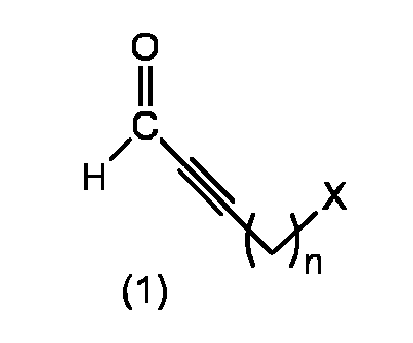 reacting the ω-halo-2-alkynal with an alkylidene triphenylphosphorane represented by formula (3):
RCH=PPh3 (3)
wherein R represents a linear branched or cyclic C1-12 hydrocarbon group and Ph represents a phenyl group,
through a Wittig reaction to obtain a conjugated Z-alken-yn-yl halide represented by formula (4):
acetoxylating the conjugated Z-alken-yn-yl halide into a conjugated Z-alken-yn-yl acetate represented by formula (5):
- The method for producing a conjugated Z-alken-yn-yl acetate according to Claim 2, wherein the conjugated Z-alken-yn-yl acetate is Z-13-hexadecen-11-yn-yl acetate.
- An ω-halo-2-alkynal represented by formula (1):
Applications Claiming Priority (1)
| Application Number | Priority Date | Filing Date | Title |
|---|---|---|---|
| JP2013083861 | 2013-04-12 |
Publications (2)
| Publication Number | Publication Date |
|---|---|
| EP2789602A1 true EP2789602A1 (en) | 2014-10-15 |
| EP2789602B1 EP2789602B1 (en) | 2017-12-27 |
Family
ID=50434075
Family Applications (1)
| Application Number | Title | Priority Date | Filing Date |
|---|---|---|---|
| EP14163480.8A Active EP2789602B1 (en) | 2013-04-12 | 2014-04-04 | Omega-halo-2-alkynal, method for producing the same, and method for producing conjugated Z-alken-yn-yl acetate using the same |
Country Status (5)
| Country | Link |
|---|---|
| US (3) | US9255056B2 (en) |
| EP (1) | EP2789602B1 (en) |
| JP (1) | JP6137492B2 (en) |
| CN (1) | CN104098452B (en) |
| ES (1) | ES2662827T3 (en) |
Cited By (1)
| Publication number | Priority date | Publication date | Assignee | Title |
|---|---|---|---|---|
| EP3466917A1 (en) * | 2017-10-06 | 2019-04-10 | Shin-Etsu Chemical Co., Ltd. | Method for preparing (7e)- 7,9-decadienoate ester |
Families Citing this family (4)
| Publication number | Priority date | Publication date | Assignee | Title |
|---|---|---|---|---|
| CN107043321B (en) * | 2017-04-25 | 2021-01-15 | 连云港市工业投资集团有限公司 | Method for high-selectivity synthesis of 2, 3-dichlorobenzaldehyde |
| JP6761791B2 (en) * | 2017-09-07 | 2020-09-30 | 信越化学工業株式会社 | (4Z, 7Z) -4,7-Decadien-1-yl = Acetate Production Method |
| EA030475B1 (en) * | 2017-09-08 | 2018-08-31 | Фгбу "Вниикр" , Всероссийский Центр Карантина Растений | Method for producing components of sex pheromones of thaumetopoea genus processionary drinker moths |
| JP7254665B2 (en) * | 2019-09-04 | 2023-04-10 | 信越化学工業株式会社 | Method for producing 4-pentene-2-ynal |
Citations (4)
| Publication number | Priority date | Publication date | Assignee | Title |
|---|---|---|---|---|
| ES8204407A1 (en) | 1981-06-11 | 1982-05-01 | Consejo Superior Investigacion | Procedure for the preparation by synthesis of acetate of (z) -13-hexadecen-11-inilo with possible sexual feromone activity on the pine processionary. (Machine-translation by Google Translate, not legally binding) |
| ES2010719A6 (en) | 1987-03-25 | 1989-12-01 | Consejo Superior Investigacion | Hexa:deceninyl acetate pheromone prepn. |
| JPH02101028A (en) | 1988-10-07 | 1990-04-12 | Shin Etsu Chem Co Ltd | Production of omega-chloro-trans olefin compound |
| JP2005272409A (en) | 2004-03-26 | 2005-10-06 | Shin Etsu Chem Co Ltd | Novel Grignard reagent and method for producing aliphatic alkynyl Grignard compound using the same |
Family Cites Families (4)
| Publication number | Priority date | Publication date | Assignee | Title |
|---|---|---|---|---|
| US5079266A (en) | 1988-01-04 | 1992-01-07 | Betz Laboratories, Inc. | Method of generating acrolein |
| CA2392049C (en) * | 1999-11-18 | 2012-01-31 | Richard L. Pederson | Metathesis syntheses of pheromones or their components |
| JP2013107824A (en) * | 2010-03-17 | 2013-06-06 | Dainippon Sumitomo Pharma Co Ltd | Novel monocyclic pyrimidine derivative |
| CN102249871B (en) * | 2011-06-13 | 2013-11-06 | 绍兴文理学院 | Preparation method of lycopene intermediate 2,6,10-trimethyl-1,1-docosane oxygroup-3,5,-undecane triene |
-
2014
- 2014-04-04 ES ES14163480.8T patent/ES2662827T3/en active Active
- 2014-04-04 EP EP14163480.8A patent/EP2789602B1/en active Active
- 2014-04-09 US US14/248,525 patent/US9255056B2/en active Active
- 2014-04-10 CN CN201410141773.1A patent/CN104098452B/en active Active
- 2014-04-11 JP JP2014081970A patent/JP6137492B2/en active Active
-
2015
- 2015-12-30 US US14/984,360 patent/US9376368B2/en active Active
- 2015-12-30 US US14/984,343 patent/US9550720B2/en active Active
Patent Citations (4)
| Publication number | Priority date | Publication date | Assignee | Title |
|---|---|---|---|---|
| ES8204407A1 (en) | 1981-06-11 | 1982-05-01 | Consejo Superior Investigacion | Procedure for the preparation by synthesis of acetate of (z) -13-hexadecen-11-inilo with possible sexual feromone activity on the pine processionary. (Machine-translation by Google Translate, not legally binding) |
| ES2010719A6 (en) | 1987-03-25 | 1989-12-01 | Consejo Superior Investigacion | Hexa:deceninyl acetate pheromone prepn. |
| JPH02101028A (en) | 1988-10-07 | 1990-04-12 | Shin Etsu Chem Co Ltd | Production of omega-chloro-trans olefin compound |
| JP2005272409A (en) | 2004-03-26 | 2005-10-06 | Shin Etsu Chem Co Ltd | Novel Grignard reagent and method for producing aliphatic alkynyl Grignard compound using the same |
Non-Patent Citations (17)
| Title |
|---|
| A. GUERRERO, TETRAHEDRON LETTERS, vol. 22, 1981, pages 2013 - 2016 |
| A. KHANOUS ET AL: "4-fluoro-2-butynal: preparation and some examples of dienophilic properties", JOURNAL OF FLUORINE CHEMISTRY, vol. 49, no. 3, September 1990 (1990-09-01), pages 401 - 408, XP055118604, ISSN: 0022-1139, DOI: 10.1016/S0022-1139(00)85034-4 * |
| A. S. BAILEY ET AL: "590. Higher aliphatic compounds. Part XI. A synthesis of DL-ricinoleic acid", JOURNAL OF THE CHEMICAL SOCIETY (RESUMED), January 1957 (1957-01-01), pages 3027 - 3032, XP055118613, ISSN: 0368-1769, DOI: 10.1039/jr9570003027 * |
| D. MICHELOT, J. CHEM. RES., vol. 4, 1982, pages 1043 |
| ENRIQUE GÓMEZ-BENGOA ET AL: "Asymmetric synthesis of propargylic alcohols via aldol reaction of aldehydes with ynals promoted by prolinol ether-transition metal-Brønsted acid cooperative catalysis", CHEMICAL SCIENCE, vol. 4, no. 8, January 2013 (2013-01-01), pages 3198, XP055118594, ISSN: 2041-6520, DOI: 10.1039/c3sc51027a * |
| EPSZTEIN R ET AL: "Sur les aldéhydes alpha-acétyléniques contenant une autre fonctin a ubout de la chaîne", COMPTES RENDUS HEBDOMADAIRES DES SEANCES DE L'ACADEMIE DESSCIENCES, GAUTHIER-VILLARS, PARIS, FR, vol. 252, 20 March 1961 (1961-03-20), pages 1803 - 1805, XP008169453, ISSN: 0001-4036 * |
| F. CAMPS, CHEM.LETT., vol. 703, 1981 |
| F. CAMPS, J. CHEM. ECOLG., vol. 9, 1983, pages 869 |
| FRANCISCO CAMPS ET AL: "Simple and stereoselective synthesis of sex pheromone of processionary mothThaumetopoea pityocampa (Denis and Schiff.)", JOURNAL OF CHEMICAL ECOLOGY, SPRINGER, NL, vol. 9, no. 7, July 1983 (1983-07-01), pages 869 - 875, XP008169465, ISSN: 0098-0331, DOI: 10.1007/BF00987811 * |
| FRANCISCO CAMPS ET AL: "Synthesis of the two isomers of the potential sex pheromone of Thaumetopoea pityocampa (lepidoptera, notodontidae) and related model compounds.", CHEMISTRY LETTERS, no. 5, January 1981 (1981-01-01), pages 703 - 706, XP055118682, ISSN: 0366-7022, DOI: 10.1246/cl.1981.703 * |
| G. CARDILLO, GAZZETTA CHIMICA ITALIANA, vol. 112, 1982, pages 231 |
| J. K. STILLE, J. AM. CHEM. SOC., vol. 109, 1987, pages 2138 |
| M. GARDETTE, J. CHEM. ECOLG., vol. 9, 1983, pages 219 |
| MATTHEW LAPORTE ET AL: "5-Hydroxyindoles by Intramolecular Alkynol-Furan Diels-Alder Cycloaddition", THE JOURNAL OF ORGANIC CHEMISTRY, vol. 78, no. 1, 4 January 2013 (2013-01-04), pages 167 - 174, XP055118596, ISSN: 0022-3263, DOI: 10.1021/jo3022605 * |
| MATTHIAS A. SCHADE ET AL: "Synthesis of Polyfunctional Allenes by Successive Copper-Mediated Substitutions", CHEMISTRY - A EUROPEAN JOURNAL, vol. 17, no. 15, 4 April 2011 (2011-04-04), pages 4232 - 4237, XP055118598, ISSN: 0947-6539, DOI: 10.1002/chem.201003273 * |
| MITSURU SATOH ET AL: "Synthesis of Anacardic Acids, 6-[8(Z),11(Z)-Pentadecadienyl]salicylic Acid and 6-[8(Z),11(Z),14-Pentadecatrienyl]salicylic Acid.", CHEMICAL & PHARMACEUTICAL BULLETIN, vol. 49, no. 1, January 2001 (2001-01-01), pages 18 - 22, XP055118601, ISSN: 0009-2363, DOI: 10.1248/cpb.49.18 * |
| SHANI A ET AL: "Stereoselective synthesis of (Z)-13-hexadecen-11-yn-1-yl acetate, the major component of the sex pheromone of the pine processionary moth (Thaumetopoea pityocampa)", JOURNAL OF CHEMICAL ECOLOGY, KLUWER ACADEMIC PUBLISHERS-PLENUM PUBLISHERS, NE, vol. 9, no. 7, July 1983 (1983-07-01), pages 863 - 867, XP008169464, ISSN: 1573-1561, DOI: 10.1007/BF00987810 * |
Cited By (2)
| Publication number | Priority date | Publication date | Assignee | Title |
|---|---|---|---|---|
| EP3466917A1 (en) * | 2017-10-06 | 2019-04-10 | Shin-Etsu Chemical Co., Ltd. | Method for preparing (7e)- 7,9-decadienoate ester |
| US10442752B2 (en) | 2017-10-06 | 2019-10-15 | Shin-Etsu Chemical Co., Ltd. | Method for preparing (7E)-7, 9-decadienoate ester |
Also Published As
| Publication number | Publication date |
|---|---|
| JP6137492B2 (en) | 2017-05-31 |
| US9376368B2 (en) | 2016-06-28 |
| CN104098452A (en) | 2014-10-15 |
| JP2014218497A (en) | 2014-11-20 |
| US20140309452A1 (en) | 2014-10-16 |
| US20160107969A1 (en) | 2016-04-21 |
| US20160107978A1 (en) | 2016-04-21 |
| ES2662827T3 (en) | 2018-04-09 |
| CN104098452B (en) | 2016-05-11 |
| EP2789602B1 (en) | 2017-12-27 |
| US9255056B2 (en) | 2016-02-09 |
| US9550720B2 (en) | 2017-01-24 |
Similar Documents
| Publication | Publication Date | Title |
|---|---|---|
| US9550720B2 (en) | Method for producing an ω-halo-2-alkynal | |
| US10737999B2 (en) | 1-haloalkadiene and a process for preparing the same and a process for preparing (9e, 11z)-9,11-hexadecadienyl acetate | |
| US10618862B2 (en) | Process for preparing (9e, 11z)-9,11-hexadecadienal | |
| WO2008012108A2 (en) | Process for the preparation of polyhydroxylated stilbenes via claisen condensation | |
| ES2548272T3 (en) | Methods for preparing 5-acetoxy- (E3) -3-pentenyl and (E3) -3-alkenyl acetate methoxymethyl ether | |
| WO2014173804A1 (en) | Process for the preparation of 2-phenylphenol and its sodium salt | |
| EP3505506B1 (en) | Method for producing 3,7-dimethyl-7-octenol and method for producing 3,7-dimethyl-7-octenyl carboxylate compound | |
| JPH0217142A (en) | Production of e 7/z9-alkadien-1-ol and its derivative protected by hydroxyl group | |
| CN104592017B (en) | The method for preparing 2- isopropylidene -5- methyl -4- hexenyl butyrate | |
| KR100521062B1 (en) | Method for producing (3-alkoxyphenyl) magnesium chloride and alcohol using the corresponding chloride | |
| CN109467504A (en) | The method for preparing (4Z, 7Z) -4,7- decadinene -1- yl acetate | |
| EP0131130B1 (en) | Process for the preparation of cycloalkenyl alkines | |
| EP4464685B1 (en) | Process for preparing 17-methylalkane compound | |
| CN109438183B (en) | Synthesis method of bisabolene | |
| KR101210510B1 (en) | Cyclopentane carboxylate compounds, process and intermediates for preparing the same and use thereof | |
| CN101492471B (en) | 2,4-double-linkage pentacarbon phosphonate | |
| JPH0244310B2 (en) | MONOMATAHAJECHINIRUCHIOFUENNOSEIZOHO | |
| Andreica et al. | The Use of Mercury Compounds in the Synthesis of Some Lepidoptera Insect Sex Pheromones with Monoenic Structure | |
| JP2014076981A (en) | Process for producing asymmetric dialkylamine compound | |
| CN115279725A (en) | Efficient and selective route for the synthesis of alkyl 2-benzoyl benzoates | |
| WO2018069452A1 (en) | Process for the manufacture of a mixture of 2-methyl-4-(2,6,6-trimethyl-1-cyclohexen-1-yl)-2-butenal and 2-methyl-4-(2,6,6-trimethyl-2-cyclohexen-1-yl)-2-butenal | |
| JP2011012037A (en) | New compound and method for producing 6,8,10-undecatrien-3-one from the compound | |
| KR20040086915A (en) | Processes For Preparing Allylic alcohol Derivatives | |
| KR20180135447A (en) | Synthesis of (2E, 4E, 6Z, 8E) -8- (3,4-dihydronaphthalene-1 (2H) -ylidene) -3,7-dimethylocta-2,4,6- | |
| JP2010202589A (en) | METHOD FOR PRODUCING 2,3-DIHYDRO-THIENO[3,4-b]FURAN DERIVATIVE AND NEW COMPOUND USED THEREFOR |
Legal Events
| Date | Code | Title | Description |
|---|---|---|---|
| PUAI | Public reference made under article 153(3) epc to a published international application that has entered the european phase |
Free format text: ORIGINAL CODE: 0009012 |
|
| 17P | Request for examination filed |
Effective date: 20140404 |
|
| AK | Designated contracting states |
Kind code of ref document: A1 Designated state(s): AL AT BE BG CH CY CZ DE DK EE ES FI FR GB GR HR HU IE IS IT LI LT LU LV MC MK MT NL NO PL PT RO RS SE SI SK SM TR |
|
| AX | Request for extension of the european patent |
Extension state: BA ME |
|
| R17P | Request for examination filed (corrected) |
Effective date: 20150415 |
|
| RBV | Designated contracting states (corrected) |
Designated state(s): AL AT BE BG CH CY CZ DE DK EE ES FI FR GB GR HR HU IE IS IT LI LT LU LV MC MK MT NL NO PL PT RO RS SE SI SK SM TR |
|
| 17Q | First examination report despatched |
Effective date: 20160314 |
|
| GRAP | Despatch of communication of intention to grant a patent |
Free format text: ORIGINAL CODE: EPIDOSNIGR1 |
|
| INTG | Intention to grant announced |
Effective date: 20170731 |
|
| GRAA | (expected) grant |
Free format text: ORIGINAL CODE: 0009210 |
|
| GRAS | Grant fee paid |
Free format text: ORIGINAL CODE: EPIDOSNIGR3 |
|
| AK | Designated contracting states |
Kind code of ref document: B1 Designated state(s): AL AT BE BG CH CY CZ DE DK EE ES FI FR GB GR HR HU IE IS IT LI LT LU LV MC MK MT NL NO PL PT RO RS SE SI SK SM TR |
|
| REG | Reference to a national code |
Ref country code: GB Ref legal event code: FG4D |
|
| REG | Reference to a national code |
Ref country code: CH Ref legal event code: EP |
|
| REG | Reference to a national code |
Ref country code: AT Ref legal event code: REF Ref document number: 958150 Country of ref document: AT Kind code of ref document: T Effective date: 20180115 |
|
| REG | Reference to a national code |
Ref country code: IE Ref legal event code: FG4D |
|
| REG | Reference to a national code |
Ref country code: DE Ref legal event code: R096 Ref document number: 602014018982 Country of ref document: DE |
|
| REG | Reference to a national code |
Ref country code: FR Ref legal event code: PLFP Year of fee payment: 5 |
|
| REG | Reference to a national code |
Ref country code: ES Ref legal event code: FG2A Ref document number: 2662827 Country of ref document: ES Kind code of ref document: T3 Effective date: 20180409 |
|
| PG25 | Lapsed in a contracting state [announced via postgrant information from national office to epo] |
Ref country code: NO Free format text: LAPSE BECAUSE OF FAILURE TO SUBMIT A TRANSLATION OF THE DESCRIPTION OR TO PAY THE FEE WITHIN THE PRESCRIBED TIME-LIMIT Effective date: 20180327 Ref country code: FI Free format text: LAPSE BECAUSE OF FAILURE TO SUBMIT A TRANSLATION OF THE DESCRIPTION OR TO PAY THE FEE WITHIN THE PRESCRIBED TIME-LIMIT Effective date: 20171227 Ref country code: LT Free format text: LAPSE BECAUSE OF FAILURE TO SUBMIT A TRANSLATION OF THE DESCRIPTION OR TO PAY THE FEE WITHIN THE PRESCRIBED TIME-LIMIT Effective date: 20171227 |
|
| REG | Reference to a national code |
Ref country code: NL Ref legal event code: MP Effective date: 20171227 |
|
| REG | Reference to a national code |
Ref country code: LT Ref legal event code: MG4D |
|
| REG | Reference to a national code |
Ref country code: AT Ref legal event code: MK05 Ref document number: 958150 Country of ref document: AT Kind code of ref document: T Effective date: 20171227 |
|
| PG25 | Lapsed in a contracting state [announced via postgrant information from national office to epo] |
Ref country code: GR Free format text: LAPSE BECAUSE OF FAILURE TO SUBMIT A TRANSLATION OF THE DESCRIPTION OR TO PAY THE FEE WITHIN THE PRESCRIBED TIME-LIMIT Effective date: 20180328 Ref country code: RS Free format text: LAPSE BECAUSE OF FAILURE TO SUBMIT A TRANSLATION OF THE DESCRIPTION OR TO PAY THE FEE WITHIN THE PRESCRIBED TIME-LIMIT Effective date: 20171227 Ref country code: HR Free format text: LAPSE BECAUSE OF FAILURE TO SUBMIT A TRANSLATION OF THE DESCRIPTION OR TO PAY THE FEE WITHIN THE PRESCRIBED TIME-LIMIT Effective date: 20171227 Ref country code: BG Free format text: LAPSE BECAUSE OF FAILURE TO SUBMIT A TRANSLATION OF THE DESCRIPTION OR TO PAY THE FEE WITHIN THE PRESCRIBED TIME-LIMIT Effective date: 20180327 Ref country code: LV Free format text: LAPSE BECAUSE OF FAILURE TO SUBMIT A TRANSLATION OF THE DESCRIPTION OR TO PAY THE FEE WITHIN THE PRESCRIBED TIME-LIMIT Effective date: 20171227 |
|
| PG25 | Lapsed in a contracting state [announced via postgrant information from national office to epo] |
Ref country code: NL Free format text: LAPSE BECAUSE OF FAILURE TO SUBMIT A TRANSLATION OF THE DESCRIPTION OR TO PAY THE FEE WITHIN THE PRESCRIBED TIME-LIMIT Effective date: 20171227 |
|
| PG25 | Lapsed in a contracting state [announced via postgrant information from national office to epo] |
Ref country code: CZ Free format text: LAPSE BECAUSE OF FAILURE TO SUBMIT A TRANSLATION OF THE DESCRIPTION OR TO PAY THE FEE WITHIN THE PRESCRIBED TIME-LIMIT Effective date: 20171227 Ref country code: EE Free format text: LAPSE BECAUSE OF FAILURE TO SUBMIT A TRANSLATION OF THE DESCRIPTION OR TO PAY THE FEE WITHIN THE PRESCRIBED TIME-LIMIT Effective date: 20171227 Ref country code: CY Free format text: LAPSE BECAUSE OF FAILURE TO SUBMIT A TRANSLATION OF THE DESCRIPTION OR TO PAY THE FEE WITHIN THE PRESCRIBED TIME-LIMIT Effective date: 20171227 Ref country code: SK Free format text: LAPSE BECAUSE OF FAILURE TO SUBMIT A TRANSLATION OF THE DESCRIPTION OR TO PAY THE FEE WITHIN THE PRESCRIBED TIME-LIMIT Effective date: 20171227 |
|
| PG25 | Lapsed in a contracting state [announced via postgrant information from national office to epo] |
Ref country code: SM Free format text: LAPSE BECAUSE OF FAILURE TO SUBMIT A TRANSLATION OF THE DESCRIPTION OR TO PAY THE FEE WITHIN THE PRESCRIBED TIME-LIMIT Effective date: 20171227 Ref country code: PL Free format text: LAPSE BECAUSE OF FAILURE TO SUBMIT A TRANSLATION OF THE DESCRIPTION OR TO PAY THE FEE WITHIN THE PRESCRIBED TIME-LIMIT Effective date: 20171227 Ref country code: AT Free format text: LAPSE BECAUSE OF FAILURE TO SUBMIT A TRANSLATION OF THE DESCRIPTION OR TO PAY THE FEE WITHIN THE PRESCRIBED TIME-LIMIT Effective date: 20171227 Ref country code: IS Free format text: LAPSE BECAUSE OF FAILURE TO SUBMIT A TRANSLATION OF THE DESCRIPTION OR TO PAY THE FEE WITHIN THE PRESCRIBED TIME-LIMIT Effective date: 20180427 Ref country code: RO Free format text: LAPSE BECAUSE OF FAILURE TO SUBMIT A TRANSLATION OF THE DESCRIPTION OR TO PAY THE FEE WITHIN THE PRESCRIBED TIME-LIMIT Effective date: 20171227 Ref country code: IT Free format text: LAPSE BECAUSE OF FAILURE TO SUBMIT A TRANSLATION OF THE DESCRIPTION OR TO PAY THE FEE WITHIN THE PRESCRIBED TIME-LIMIT Effective date: 20171227 |
|
| REG | Reference to a national code |
Ref country code: DE Ref legal event code: R097 Ref document number: 602014018982 Country of ref document: DE |
|
| PLBE | No opposition filed within time limit |
Free format text: ORIGINAL CODE: 0009261 |
|
| STAA | Information on the status of an ep patent application or granted ep patent |
Free format text: STATUS: NO OPPOSITION FILED WITHIN TIME LIMIT |
|
| PG25 | Lapsed in a contracting state [announced via postgrant information from national office to epo] |
Ref country code: DK Free format text: LAPSE BECAUSE OF FAILURE TO SUBMIT A TRANSLATION OF THE DESCRIPTION OR TO PAY THE FEE WITHIN THE PRESCRIBED TIME-LIMIT Effective date: 20171227 Ref country code: MC Free format text: LAPSE BECAUSE OF FAILURE TO SUBMIT A TRANSLATION OF THE DESCRIPTION OR TO PAY THE FEE WITHIN THE PRESCRIBED TIME-LIMIT Effective date: 20171227 |
|
| REG | Reference to a national code |
Ref country code: CH Ref legal event code: PL |
|
| 26N | No opposition filed |
Effective date: 20180928 |
|
| REG | Reference to a national code |
Ref country code: BE Ref legal event code: MM Effective date: 20180430 |
|
| GBPC | Gb: european patent ceased through non-payment of renewal fee |
Effective date: 20180404 |
|
| REG | Reference to a national code |
Ref country code: IE Ref legal event code: MM4A |
|
| PG25 | Lapsed in a contracting state [announced via postgrant information from national office to epo] |
Ref country code: LU Free format text: LAPSE BECAUSE OF NON-PAYMENT OF DUE FEES Effective date: 20180404 |
|
| PG25 | Lapsed in a contracting state [announced via postgrant information from national office to epo] |
Ref country code: GB Free format text: LAPSE BECAUSE OF NON-PAYMENT OF DUE FEES Effective date: 20180404 Ref country code: SI Free format text: LAPSE BECAUSE OF FAILURE TO SUBMIT A TRANSLATION OF THE DESCRIPTION OR TO PAY THE FEE WITHIN THE PRESCRIBED TIME-LIMIT Effective date: 20171227 Ref country code: BE Free format text: LAPSE BECAUSE OF NON-PAYMENT OF DUE FEES Effective date: 20180430 Ref country code: LI Free format text: LAPSE BECAUSE OF NON-PAYMENT OF DUE FEES Effective date: 20180430 Ref country code: CH Free format text: LAPSE BECAUSE OF NON-PAYMENT OF DUE FEES Effective date: 20180430 |
|
| PG25 | Lapsed in a contracting state [announced via postgrant information from national office to epo] |
Ref country code: IE Free format text: LAPSE BECAUSE OF NON-PAYMENT OF DUE FEES Effective date: 20180404 |
|
| PG25 | Lapsed in a contracting state [announced via postgrant information from national office to epo] |
Ref country code: MT Free format text: LAPSE BECAUSE OF NON-PAYMENT OF DUE FEES Effective date: 20180404 |
|
| PG25 | Lapsed in a contracting state [announced via postgrant information from national office to epo] |
Ref country code: TR Free format text: LAPSE BECAUSE OF FAILURE TO SUBMIT A TRANSLATION OF THE DESCRIPTION OR TO PAY THE FEE WITHIN THE PRESCRIBED TIME-LIMIT Effective date: 20171227 |
|
| PG25 | Lapsed in a contracting state [announced via postgrant information from national office to epo] |
Ref country code: HU Free format text: LAPSE BECAUSE OF FAILURE TO SUBMIT A TRANSLATION OF THE DESCRIPTION OR TO PAY THE FEE WITHIN THE PRESCRIBED TIME-LIMIT; INVALID AB INITIO Effective date: 20140404 Ref country code: PT Free format text: LAPSE BECAUSE OF FAILURE TO SUBMIT A TRANSLATION OF THE DESCRIPTION OR TO PAY THE FEE WITHIN THE PRESCRIBED TIME-LIMIT Effective date: 20171227 |
|
| PG25 | Lapsed in a contracting state [announced via postgrant information from national office to epo] |
Ref country code: MK Free format text: LAPSE BECAUSE OF NON-PAYMENT OF DUE FEES Effective date: 20171227 Ref country code: SE Free format text: LAPSE BECAUSE OF FAILURE TO SUBMIT A TRANSLATION OF THE DESCRIPTION OR TO PAY THE FEE WITHIN THE PRESCRIBED TIME-LIMIT Effective date: 20171227 |
|
| PG25 | Lapsed in a contracting state [announced via postgrant information from national office to epo] |
Ref country code: AL Free format text: LAPSE BECAUSE OF FAILURE TO SUBMIT A TRANSLATION OF THE DESCRIPTION OR TO PAY THE FEE WITHIN THE PRESCRIBED TIME-LIMIT Effective date: 20171227 |
|
| PGFP | Annual fee paid to national office [announced via postgrant information from national office to epo] |
Ref country code: DE Payment date: 20250305 Year of fee payment: 12 |
|
| PGFP | Annual fee paid to national office [announced via postgrant information from national office to epo] |
Ref country code: ES Payment date: 20250506 Year of fee payment: 12 |
|
| PGFP | Annual fee paid to national office [announced via postgrant information from national office to epo] |
Ref country code: FR Payment date: 20260309 Year of fee payment: 13 |