EP2789600A1 - Verfahren zur Herstellung von ortho-acylierten aromatischen oder heteroaromatischen Carbonsäuren - Google Patents
Verfahren zur Herstellung von ortho-acylierten aromatischen oder heteroaromatischen Carbonsäuren Download PDFInfo
- Publication number
- EP2789600A1 EP2789600A1 EP20130163052 EP13163052A EP2789600A1 EP 2789600 A1 EP2789600 A1 EP 2789600A1 EP 20130163052 EP20130163052 EP 20130163052 EP 13163052 A EP13163052 A EP 13163052A EP 2789600 A1 EP2789600 A1 EP 2789600A1
- Authority
- EP
- European Patent Office
- Prior art keywords
- rhodium
- formula
- compound
- anhydride
- aromatic
- Prior art date
- Legal status (The legal status is an assumption and is not a legal conclusion. Google has not performed a legal analysis and makes no representation as to the accuracy of the status listed.)
- Withdrawn
Links
- -1 heteroaromatic carboxylic acids Chemical class 0.000 title claims abstract description 62
- 238000000034 method Methods 0.000 title claims abstract description 42
- 125000003118 aryl group Chemical group 0.000 title claims abstract description 34
- 238000002360 preparation method Methods 0.000 title claims abstract description 7
- 239000003153 chemical reaction reagent Substances 0.000 claims abstract description 29
- 239000010948 rhodium Substances 0.000 claims abstract description 28
- 239000003054 catalyst Substances 0.000 claims abstract description 25
- 150000008064 anhydrides Chemical class 0.000 claims abstract description 22
- MHOVAHRLVXNVSD-UHFFFAOYSA-N rhodium atom Chemical compound [Rh] MHOVAHRLVXNVSD-UHFFFAOYSA-N 0.000 claims abstract description 18
- 239000000654 additive Substances 0.000 claims abstract description 14
- 230000000996 additive effect Effects 0.000 claims abstract description 12
- 229910052703 rhodium Inorganic materials 0.000 claims abstract description 11
- 150000001875 compounds Chemical class 0.000 claims description 21
- 239000000460 chlorine Substances 0.000 claims description 14
- 239000011698 potassium fluoride Substances 0.000 claims description 10
- GDTBXPJZTBHREO-UHFFFAOYSA-N bromine Chemical compound BrBr GDTBXPJZTBHREO-UHFFFAOYSA-N 0.000 claims description 7
- XJHCXCQVJFPJIK-UHFFFAOYSA-M caesium fluoride Chemical compound [F-].[Cs+] XJHCXCQVJFPJIK-UHFFFAOYSA-M 0.000 claims description 7
- 125000001072 heteroaryl group Chemical group 0.000 claims description 6
- 238000011065 in-situ storage Methods 0.000 claims description 6
- NROKBHXJSPEDAR-UHFFFAOYSA-M potassium fluoride Chemical compound [F-].[K+] NROKBHXJSPEDAR-UHFFFAOYSA-M 0.000 claims description 6
- 241000191368 Chlorobi Species 0.000 claims description 5
- PGZVFRAEAAXREB-UHFFFAOYSA-N 2,2-dimethylpropanoyl 2,2-dimethylpropanoate Chemical compound CC(C)(C)C(=O)OC(=O)C(C)(C)C PGZVFRAEAAXREB-UHFFFAOYSA-N 0.000 claims description 4
- CDBYLPFSWZWCQE-UHFFFAOYSA-L Sodium Carbonate Chemical compound [Na+].[Na+].[O-]C([O-])=O CDBYLPFSWZWCQE-UHFFFAOYSA-L 0.000 claims description 4
- DUJJMUHAXLQJBX-UHFFFAOYSA-N [Rh+].C=C Chemical class [Rh+].C=C DUJJMUHAXLQJBX-UHFFFAOYSA-N 0.000 claims description 4
- 229910052794 bromium Inorganic materials 0.000 claims description 4
- 150000001732 carboxylic acid derivatives Chemical class 0.000 claims description 4
- 229910052801 chlorine Inorganic materials 0.000 claims description 4
- ZFCBAJWXKUDJSW-XFCUKONHSA-L cyclooctene;rhodium;dichloride Chemical compound [Cl-].[Cl-].[Rh].[Rh].C1CCC\C=C/CC1.C1CCC\C=C/CC1.C1CCC\C=C/CC1.C1CCC\C=C/CC1 ZFCBAJWXKUDJSW-XFCUKONHSA-L 0.000 claims description 4
- 125000002887 hydroxy group Chemical group [H]O* 0.000 claims description 4
- 229910052740 iodine Inorganic materials 0.000 claims description 4
- 239000011630 iodine Substances 0.000 claims description 4
- BWHMMNNQKKPAPP-UHFFFAOYSA-L potassium carbonate Chemical compound [K+].[K+].[O-]C([O-])=O BWHMMNNQKKPAPP-UHFFFAOYSA-L 0.000 claims description 4
- LWIHDJKSTIGBAC-UHFFFAOYSA-K tripotassium phosphate Chemical compound [K+].[K+].[K+].[O-]P([O-])([O-])=O LWIHDJKSTIGBAC-UHFFFAOYSA-K 0.000 claims description 4
- VYXHVRARDIDEHS-UHFFFAOYSA-N 1,5-cyclooctadiene Chemical compound C1CC=CCCC=C1 VYXHVRARDIDEHS-UHFFFAOYSA-N 0.000 claims description 3
- 239000004912 1,5-cyclooctadiene Substances 0.000 claims description 3
- KZBUYRJDOAKODT-UHFFFAOYSA-N Chlorine Chemical compound ClCl KZBUYRJDOAKODT-UHFFFAOYSA-N 0.000 claims description 3
- FJDQFPXHSGXQBY-UHFFFAOYSA-L caesium carbonate Chemical compound [Cs+].[Cs+].[O-]C([O-])=O FJDQFPXHSGXQBY-UHFFFAOYSA-L 0.000 claims description 3
- 229910000024 caesium carbonate Inorganic materials 0.000 claims description 3
- 229910052731 fluorine Inorganic materials 0.000 claims description 3
- 125000001153 fluoro group Chemical group F* 0.000 claims description 3
- 125000002883 imidazolyl group Chemical group 0.000 claims description 3
- PNDPGZBMCMUPRI-UHFFFAOYSA-N iodine Chemical compound II PNDPGZBMCMUPRI-UHFFFAOYSA-N 0.000 claims description 3
- ORTFAQDWJHRMNX-UHFFFAOYSA-M oxidooxomethyl Chemical compound [O-][C]=O ORTFAQDWJHRMNX-UHFFFAOYSA-M 0.000 claims description 3
- 125000004430 oxygen atom Chemical group O* 0.000 claims description 3
- 235000003270 potassium fluoride Nutrition 0.000 claims description 3
- 125000000641 acridinyl group Chemical group C1(=CC=CC2=NC3=CC=CC=C3C=C12)* 0.000 claims description 2
- ZPWVASYFFYYZEW-UHFFFAOYSA-L dipotassium hydrogen phosphate Chemical compound [K+].[K+].OP([O-])([O-])=O ZPWVASYFFYYZEW-UHFFFAOYSA-L 0.000 claims description 2
- 229910000396 dipotassium phosphate Inorganic materials 0.000 claims description 2
- 235000019797 dipotassium phosphate Nutrition 0.000 claims description 2
- 125000002541 furyl group Chemical group 0.000 claims description 2
- 150000007529 inorganic bases Chemical class 0.000 claims description 2
- 125000000842 isoxazolyl group Chemical group 0.000 claims description 2
- XGZVUEUWXADBQD-UHFFFAOYSA-L lithium carbonate Chemical compound [Li+].[Li+].[O-]C([O-])=O XGZVUEUWXADBQD-UHFFFAOYSA-L 0.000 claims description 2
- 229910052808 lithium carbonate Inorganic materials 0.000 claims description 2
- 125000002971 oxazolyl group Chemical group 0.000 claims description 2
- 239000011736 potassium bicarbonate Substances 0.000 claims description 2
- 229910000028 potassium bicarbonate Inorganic materials 0.000 claims description 2
- 235000015497 potassium bicarbonate Nutrition 0.000 claims description 2
- 229910000027 potassium carbonate Inorganic materials 0.000 claims description 2
- 235000011181 potassium carbonates Nutrition 0.000 claims description 2
- TYJJADVDDVDEDZ-UHFFFAOYSA-M potassium hydrogencarbonate Chemical compound [K+].OC([O-])=O TYJJADVDDVDEDZ-UHFFFAOYSA-M 0.000 claims description 2
- 229910000160 potassium phosphate Inorganic materials 0.000 claims description 2
- 235000011009 potassium phosphates Nutrition 0.000 claims description 2
- 125000003373 pyrazinyl group Chemical group 0.000 claims description 2
- 125000003226 pyrazolyl group Chemical group 0.000 claims description 2
- 125000002098 pyridazinyl group Chemical group 0.000 claims description 2
- 125000004076 pyridyl group Chemical group 0.000 claims description 2
- 125000000714 pyrimidinyl group Chemical group 0.000 claims description 2
- 125000000168 pyrrolyl group Chemical group 0.000 claims description 2
- 125000002943 quinolinyl group Chemical group N1=C(C=CC2=CC=CC=C12)* 0.000 claims description 2
- 229910000029 sodium carbonate Inorganic materials 0.000 claims description 2
- 239000001488 sodium phosphate Substances 0.000 claims description 2
- 229910000162 sodium phosphate Inorganic materials 0.000 claims description 2
- 235000011008 sodium phosphates Nutrition 0.000 claims description 2
- 125000005247 tetrazinyl group Chemical group N1=NN=NC(=C1)* 0.000 claims description 2
- 125000000335 thiazolyl group Chemical group 0.000 claims description 2
- 125000001544 thienyl group Chemical group 0.000 claims description 2
- 125000004306 triazinyl group Chemical group 0.000 claims description 2
- CPWJKGIJFGMVPL-UHFFFAOYSA-K tricesium;phosphate Chemical compound [Cs+].[Cs+].[Cs+].[O-]P([O-])([O-])=O CPWJKGIJFGMVPL-UHFFFAOYSA-K 0.000 claims description 2
- RYFMWSXOAZQYPI-UHFFFAOYSA-K trisodium phosphate Chemical compound [Na+].[Na+].[Na+].[O-]P([O-])([O-])=O RYFMWSXOAZQYPI-UHFFFAOYSA-K 0.000 claims description 2
- SCVFZCLFOSHCOH-UHFFFAOYSA-M potassium acetate Chemical compound [K+].CC([O-])=O SCVFZCLFOSHCOH-UHFFFAOYSA-M 0.000 claims 2
- XJUCCGJZENLZSA-UHFFFAOYSA-M [Rh]Cl Chemical class [Rh]Cl XJUCCGJZENLZSA-UHFFFAOYSA-M 0.000 claims 1
- ZOAIGCHJWKDIPJ-UHFFFAOYSA-M caesium acetate Chemical compound [Cs+].CC([O-])=O ZOAIGCHJWKDIPJ-UHFFFAOYSA-M 0.000 claims 1
- 235000011056 potassium acetate Nutrition 0.000 claims 1
- 150000007942 carboxylates Chemical class 0.000 abstract description 5
- XEKOWRVHYACXOJ-UHFFFAOYSA-N Ethyl acetate Chemical compound CCOC(C)=O XEKOWRVHYACXOJ-UHFFFAOYSA-N 0.000 description 18
- SECXISVLQFMRJM-UHFFFAOYSA-N N-Methylpyrrolidone Chemical compound CN1CCCC1=O SECXISVLQFMRJM-UHFFFAOYSA-N 0.000 description 18
- WPYMKLBDIGXBTP-UHFFFAOYSA-N benzoic acid Chemical compound OC(=O)C1=CC=CC=C1 WPYMKLBDIGXBTP-UHFFFAOYSA-N 0.000 description 15
- 238000006243 chemical reaction Methods 0.000 description 14
- HEMHJVSKTPXQMS-UHFFFAOYSA-M Sodium hydroxide Chemical compound [OH-].[Na+] HEMHJVSKTPXQMS-UHFFFAOYSA-M 0.000 description 12
- 150000001244 carboxylic acid anhydrides Chemical class 0.000 description 10
- ZWLPBLYKEWSWPD-UHFFFAOYSA-N o-toluic acid Chemical compound CC1=CC=CC=C1C(O)=O ZWLPBLYKEWSWPD-UHFFFAOYSA-N 0.000 description 10
- VLKZOEOYAKHREP-UHFFFAOYSA-N n-Hexane Chemical compound CCCCCC VLKZOEOYAKHREP-UHFFFAOYSA-N 0.000 description 9
- 239000011541 reaction mixture Substances 0.000 description 8
- UHOVQNZJYSORNB-UHFFFAOYSA-N Benzene Chemical compound C1=CC=CC=C1 UHOVQNZJYSORNB-UHFFFAOYSA-N 0.000 description 6
- YXFVVABEGXRONW-UHFFFAOYSA-N Toluene Chemical compound CC1=CC=CC=C1 YXFVVABEGXRONW-UHFFFAOYSA-N 0.000 description 6
- 239000002253 acid Substances 0.000 description 6
- 238000005917 acylation reaction Methods 0.000 description 6
- PDJQCHVMABBNQW-MIXQCLKLSA-L (1z,5z)-cycloocta-1,5-diene;rhodium;dichloride Chemical compound [Cl-].[Cl-].[Rh].[Rh].C\1C\C=C/CC\C=C/1.C\1C\C=C/CC\C=C/1 PDJQCHVMABBNQW-MIXQCLKLSA-L 0.000 description 5
- 230000007062 hydrolysis Effects 0.000 description 5
- 238000006460 hydrolysis reaction Methods 0.000 description 5
- AUHZEENZYGFFBQ-UHFFFAOYSA-N mesitylene Substances CC1=CC(C)=CC(C)=C1 AUHZEENZYGFFBQ-UHFFFAOYSA-N 0.000 description 5
- 125000001827 mesitylenyl group Chemical group [H]C1=C(C(*)=C(C([H])=C1C([H])([H])[H])C([H])([H])[H])C([H])([H])[H] 0.000 description 5
- 239000002904 solvent Substances 0.000 description 5
- CYNYIHKIEHGYOZ-UHFFFAOYSA-N 1-bromopropane Chemical compound CCCBr CYNYIHKIEHGYOZ-UHFFFAOYSA-N 0.000 description 4
- YNQLUTRBYVCPMQ-UHFFFAOYSA-N Ethylbenzene Chemical compound CCC1=CC=CC=C1 YNQLUTRBYVCPMQ-UHFFFAOYSA-N 0.000 description 4
- KDLHZDBZIXYQEI-UHFFFAOYSA-N Palladium Chemical compound [Pd] KDLHZDBZIXYQEI-UHFFFAOYSA-N 0.000 description 4
- XDNWPGKDHDBJJD-UHFFFAOYSA-M [Rh]Cl.C1=CC2C=CC1C2 Chemical class [Rh]Cl.C1=CC2C=CC1C2 XDNWPGKDHDBJJD-UHFFFAOYSA-M 0.000 description 4
- 125000002252 acyl group Chemical group 0.000 description 4
- 150000001336 alkenes Chemical class 0.000 description 4
- 238000004440 column chromatography Methods 0.000 description 4
- 238000001816 cooling Methods 0.000 description 4
- JHIVVAPYMSGYDF-UHFFFAOYSA-N cyclohexanone Chemical compound O=C1CCCCC1 JHIVVAPYMSGYDF-UHFFFAOYSA-N 0.000 description 4
- USIUVYZYUHIAEV-UHFFFAOYSA-N diphenyl ether Chemical compound C=1C=CC=CC=1OC1=CC=CC=C1 USIUVYZYUHIAEV-UHFFFAOYSA-N 0.000 description 4
- 125000001188 haloalkyl group Chemical group 0.000 description 4
- 239000000203 mixture Substances 0.000 description 4
- JRZJOMJEPLMPRA-UHFFFAOYSA-N olefin Natural products CCCCCCCC=C JRZJOMJEPLMPRA-UHFFFAOYSA-N 0.000 description 4
- 239000000243 solution Substances 0.000 description 4
- 125000001424 substituent group Chemical group 0.000 description 4
- WFDIJRYMOXRFFG-UHFFFAOYSA-N Acetic anhydride Chemical compound CC(=O)OC(C)=O WFDIJRYMOXRFFG-UHFFFAOYSA-N 0.000 description 3
- WEVYAHXRMPXWCK-UHFFFAOYSA-N Acetonitrile Chemical compound CC#N WEVYAHXRMPXWCK-UHFFFAOYSA-N 0.000 description 3
- BVKZGUZCCUSVTD-UHFFFAOYSA-L Carbonate Chemical compound [O-]C([O-])=O BVKZGUZCCUSVTD-UHFFFAOYSA-L 0.000 description 3
- RTZKZFJDLAIYFH-UHFFFAOYSA-N Diethyl ether Chemical compound CCOCC RTZKZFJDLAIYFH-UHFFFAOYSA-N 0.000 description 3
- LFQSCWFLJHTTHZ-UHFFFAOYSA-N Ethanol Chemical compound CCO LFQSCWFLJHTTHZ-UHFFFAOYSA-N 0.000 description 3
- KRHYYFGTRYWZRS-UHFFFAOYSA-M Fluoride anion Chemical compound [F-] KRHYYFGTRYWZRS-UHFFFAOYSA-M 0.000 description 3
- OKKJLVBELUTLKV-UHFFFAOYSA-N Methanol Chemical compound OC OKKJLVBELUTLKV-UHFFFAOYSA-N 0.000 description 3
- ZMXDDKWLCZADIW-UHFFFAOYSA-N N,N-Dimethylformamide Chemical compound CN(C)C=O ZMXDDKWLCZADIW-UHFFFAOYSA-N 0.000 description 3
- 229910004298 SiO 2 Inorganic materials 0.000 description 3
- 125000005595 acetylacetonate group Chemical group 0.000 description 3
- 150000008065 acid anhydrides Chemical class 0.000 description 3
- 230000010933 acylation Effects 0.000 description 3
- 125000004453 alkoxycarbonyl group Chemical group 0.000 description 3
- 125000004448 alkyl carbonyl group Chemical group 0.000 description 3
- 125000005130 alkyl carbonyl thio group Chemical group 0.000 description 3
- 125000005196 alkyl carbonyloxy group Chemical group 0.000 description 3
- 125000000217 alkyl group Chemical group 0.000 description 3
- 125000004414 alkyl thio group Chemical group 0.000 description 3
- 230000015572 biosynthetic process Effects 0.000 description 3
- 150000001735 carboxylic acids Chemical class 0.000 description 3
- HOXDXGRSZJEEKN-UHFFFAOYSA-N cycloocta-1,5-diene;rhodium Chemical compound [Rh].C1CC=CCCC=C1 HOXDXGRSZJEEKN-UHFFFAOYSA-N 0.000 description 3
- 125000004438 haloalkoxy group Chemical group 0.000 description 3
- 125000004692 haloalkylcarbonyl group Chemical group 0.000 description 3
- 125000004995 haloalkylthio group Chemical group 0.000 description 3
- 125000000956 methoxy group Chemical group [H]C([H])([H])O* 0.000 description 3
- 150000003013 phosphoric acid derivatives Chemical class 0.000 description 3
- WYVAMUWZEOHJOQ-UHFFFAOYSA-N propionic anhydride Chemical compound CCC(=O)OC(=O)CC WYVAMUWZEOHJOQ-UHFFFAOYSA-N 0.000 description 3
- 150000003254 radicals Chemical class 0.000 description 3
- 150000003284 rhodium compounds Chemical class 0.000 description 3
- 239000000758 substrate Substances 0.000 description 3
- LEJWHNWXNMGGKE-MIXQCLKLSA-N (1z,5z)-cycloocta-1,5-diene;methanol;rhodium Chemical compound [Rh].[Rh].OC.OC.C\1C\C=C/CC\C=C/1.C\1C\C=C/CC\C=C/1 LEJWHNWXNMGGKE-MIXQCLKLSA-N 0.000 description 2
- LYXHWHHENVLYCN-QMDOQEJBSA-N (1z,5z)-cycloocta-1,5-diene;rhodium;tetrafluoroborate Chemical compound [Rh].F[B-](F)(F)F.C\1C\C=C/CC\C=C/1.C\1C\C=C/CC\C=C/1 LYXHWHHENVLYCN-QMDOQEJBSA-N 0.000 description 2
- VUTUHLLWFPRWMT-QMDOQEJBSA-M (1z,5z)-cycloocta-1,5-diene;rhodium;trifluoromethanesulfonate Chemical compound [Rh].C\1C\C=C/CC\C=C/1.C\1C\C=C/CC\C=C/1.[O-]S(=O)(=O)C(F)(F)F VUTUHLLWFPRWMT-QMDOQEJBSA-M 0.000 description 2
- DURPTKYDGMDSBL-UHFFFAOYSA-N 1-butoxybutane Chemical compound CCCCOCCCC DURPTKYDGMDSBL-UHFFFAOYSA-N 0.000 description 2
- OAIFLPJJTMFLMJ-UHFFFAOYSA-N 2-methyl-6-propanoylbenzoic acid Chemical compound CCC(=O)C1=CC=CC(C)=C1C(O)=O OAIFLPJJTMFLMJ-UHFFFAOYSA-N 0.000 description 2
- 125000003542 3-methylbutan-2-yl group Chemical group [H]C([H])([H])C([H])(*)C([H])(C([H])([H])[H])C([H])([H])[H] 0.000 description 2
- QTBSBXVTEAMEQO-UHFFFAOYSA-M Acetate Chemical compound CC([O-])=O QTBSBXVTEAMEQO-UHFFFAOYSA-M 0.000 description 2
- IJGRMHOSHXDMSA-UHFFFAOYSA-N Atomic nitrogen Chemical compound N#N IJGRMHOSHXDMSA-UHFFFAOYSA-N 0.000 description 2
- BTBUEUYNUDRHOZ-UHFFFAOYSA-N Borate Chemical compound [O-]B([O-])[O-] BTBUEUYNUDRHOZ-UHFFFAOYSA-N 0.000 description 2
- ZAFNJMIOTHYJRJ-UHFFFAOYSA-N Diisopropyl ether Chemical compound CC(C)OC(C)C ZAFNJMIOTHYJRJ-UHFFFAOYSA-N 0.000 description 2
- IAZDPXIOMUYVGZ-UHFFFAOYSA-N Dimethylsulphoxide Chemical compound CS(C)=O IAZDPXIOMUYVGZ-UHFFFAOYSA-N 0.000 description 2
- VEXZGXHMUGYJMC-UHFFFAOYSA-N Hydrochloric acid Chemical compound Cl VEXZGXHMUGYJMC-UHFFFAOYSA-N 0.000 description 2
- KFZMGEQAYNKOFK-UHFFFAOYSA-N Isopropanol Chemical compound CC(C)O KFZMGEQAYNKOFK-UHFFFAOYSA-N 0.000 description 2
- WMFOQBRAJBCJND-UHFFFAOYSA-M Lithium hydroxide Chemical compound [Li+].[OH-] WMFOQBRAJBCJND-UHFFFAOYSA-M 0.000 description 2
- CSNNHWWHGAXBCP-UHFFFAOYSA-L Magnesium sulfate Chemical compound [Mg+2].[O-][S+2]([O-])([O-])[O-] CSNNHWWHGAXBCP-UHFFFAOYSA-L 0.000 description 2
- BZLVMXJERCGZMT-UHFFFAOYSA-N Methyl tert-butyl ether Chemical compound COC(C)(C)C BZLVMXJERCGZMT-UHFFFAOYSA-N 0.000 description 2
- KWYHDKDOAIKMQN-UHFFFAOYSA-N N,N,N',N'-tetramethylethylenediamine Chemical compound CN(C)CCN(C)C KWYHDKDOAIKMQN-UHFFFAOYSA-N 0.000 description 2
- IMNFDUFMRHMDMM-UHFFFAOYSA-N N-Heptane Chemical compound CCCCCCC IMNFDUFMRHMDMM-UHFFFAOYSA-N 0.000 description 2
- JUJWROOIHBZHMG-UHFFFAOYSA-N Pyridine Chemical group C1=CC=NC=C1 JUJWROOIHBZHMG-UHFFFAOYSA-N 0.000 description 2
- KJTLSVCANCCWHF-UHFFFAOYSA-N Ruthenium Chemical compound [Ru] KJTLSVCANCCWHF-UHFFFAOYSA-N 0.000 description 2
- WYURNTSHIVDZCO-UHFFFAOYSA-N Tetrahydrofuran Chemical compound C1CCOC1 WYURNTSHIVDZCO-UHFFFAOYSA-N 0.000 description 2
- DIDPHMRILLZGLY-UHFFFAOYSA-N [Rh+].OC1=CC=CCCCC1 Chemical class [Rh+].OC1=CC=CCCCC1 DIDPHMRILLZGLY-UHFFFAOYSA-N 0.000 description 2
- NNQGTGHJXNVUBG-UHFFFAOYSA-N [Rh].C1C2C=CC1C=C2 Chemical compound [Rh].C1C2C=CC1C=C2 NNQGTGHJXNVUBG-UHFFFAOYSA-N 0.000 description 2
- ZIBLHOBPBGAKNV-SUESZSCISA-N acetonitrile;(1z,5z)-cycloocta-1,5-diene;rhodium;tetrafluoroborate Chemical compound [Rh].CC#N.CC#N.F[B-](F)(F)F.C\1C\C=C/CC\C=C/1 ZIBLHOBPBGAKNV-SUESZSCISA-N 0.000 description 2
- 150000007933 aliphatic carboxylic acids Chemical class 0.000 description 2
- 125000003545 alkoxy group Chemical group 0.000 description 2
- 150000004945 aromatic hydrocarbons Chemical class 0.000 description 2
- DDWGAGFNZHAFFN-LWFKIUJUSA-N bicyclo[2.2.1]hepta-2,5-diene;(z)-4-hydroxypent-3-en-2-one;rhodium Chemical compound [Rh].C\C(O)=C\C(C)=O.C1=CC2C=CC1C2 DDWGAGFNZHAFFN-LWFKIUJUSA-N 0.000 description 2
- ISHRHMIKUQBKHC-UHFFFAOYSA-M bicyclo[2.2.1]hepta-2,5-diene;rhodium;trifluoromethanesulfonate Chemical compound [Rh].C1=CC2C=CC1C2.C1=CC2C=CC1C2.[O-]S(=O)(=O)C(F)(F)F ISHRHMIKUQBKHC-UHFFFAOYSA-M 0.000 description 2
- 125000004432 carbon atom Chemical group C* 0.000 description 2
- 150000004649 carbonic acid derivatives Chemical class 0.000 description 2
- 125000000753 cycloalkyl group Chemical group 0.000 description 2
- 125000000113 cyclohexyl group Chemical group [H]C1([H])C([H])([H])C([H])([H])C([H])(*)C([H])([H])C1([H])[H] 0.000 description 2
- 230000018044 dehydration Effects 0.000 description 2
- 238000006297 dehydration reaction Methods 0.000 description 2
- SBZXBUIDTXKZTM-UHFFFAOYSA-N diglyme Chemical compound COCCOCCOC SBZXBUIDTXKZTM-UHFFFAOYSA-N 0.000 description 2
- 150000004820 halides Chemical class 0.000 description 2
- 229910052736 halogen Inorganic materials 0.000 description 2
- 150000002367 halogens Chemical class 0.000 description 2
- AHAREKHAZNPPMI-UHFFFAOYSA-N hexa-1,3-diene Chemical compound CCC=CC=C AHAREKHAZNPPMI-UHFFFAOYSA-N 0.000 description 2
- 238000002955 isolation Methods 0.000 description 2
- 125000001449 isopropyl group Chemical group [H]C([H])([H])C([H])(*)C([H])([H])[H] 0.000 description 2
- 239000003446 ligand Substances 0.000 description 2
- 238000004519 manufacturing process Methods 0.000 description 2
- 125000000740 n-pentyl group Chemical group [H]C([H])([H])C([H])([H])C([H])([H])C([H])([H])C([H])([H])* 0.000 description 2
- 125000000449 nitro group Chemical group [O-][N+](*)=O 0.000 description 2
- 239000012299 nitrogen atmosphere Substances 0.000 description 2
- SJYNFBVQFBRSIB-UHFFFAOYSA-N norbornadiene Chemical compound C1=CC2C=CC1C2 SJYNFBVQFBRSIB-UHFFFAOYSA-N 0.000 description 2
- 229910052763 palladium Inorganic materials 0.000 description 2
- NFHFRUOZVGFOOS-UHFFFAOYSA-N palladium;triphenylphosphane Chemical compound [Pd].C1=CC=CC=C1P(C=1C=CC=CC=1)C1=CC=CC=C1.C1=CC=CC=C1P(C=1C=CC=CC=1)C1=CC=CC=C1.C1=CC=CC=C1P(C=1C=CC=CC=1)C1=CC=CC=C1.C1=CC=CC=C1P(C=1C=CC=CC=1)C1=CC=CC=C1 NFHFRUOZVGFOOS-UHFFFAOYSA-N 0.000 description 2
- 125000001997 phenyl group Chemical group [H]C1=C([H])C([H])=C(*)C([H])=C1[H] 0.000 description 2
- 235000021317 phosphate Nutrition 0.000 description 2
- 239000000376 reactant Substances 0.000 description 2
- 229910052707 ruthenium Inorganic materials 0.000 description 2
- 239000011734 sodium Substances 0.000 description 2
- 238000003786 synthesis reaction Methods 0.000 description 2
- DLYUQMMRRRQYAE-UHFFFAOYSA-N tetraphosphorus decaoxide Chemical compound O1P(O2)(=O)OP3(=O)OP1(=O)OP2(=O)O3 DLYUQMMRRRQYAE-UHFFFAOYSA-N 0.000 description 2
- QAEDZJGFFMLHHQ-UHFFFAOYSA-N trifluoroacetic anhydride Chemical compound FC(F)(F)C(=O)OC(=O)C(F)(F)F QAEDZJGFFMLHHQ-UHFFFAOYSA-N 0.000 description 2
- XLYOFNOQVPJJNP-UHFFFAOYSA-N water Substances O XLYOFNOQVPJJNP-UHFFFAOYSA-N 0.000 description 2
- 239000008096 xylene Substances 0.000 description 2
- 150000003738 xylenes Chemical class 0.000 description 2
- BUYVJWVYKPKZEX-DWVXZKBMSA-N (1z,5z)-cycloocta-1,5-diene;(z)-4-hydroxypent-3-en-2-one;rhodium Chemical compound [Rh].C\C(O)=C\C(C)=O.C\1C\C=C/CC\C=C/1 BUYVJWVYKPKZEX-DWVXZKBMSA-N 0.000 description 1
- POILWHVDKZOXJZ-ARJAWSKDSA-N (3Z)-4-hydroxy-3-penten-2-one Chemical compound C\C(O)=C\C(C)=O POILWHVDKZOXJZ-ARJAWSKDSA-N 0.000 description 1
- 125000004209 (C1-C8) alkyl group Chemical group 0.000 description 1
- MBVAQOHBPXKYMF-LNTINUHCSA-N (z)-4-hydroxypent-3-en-2-one;rhodium Chemical compound [Rh].C\C(O)=C\C(C)=O.C\C(O)=C\C(C)=O.C\C(O)=C\C(C)=O MBVAQOHBPXKYMF-LNTINUHCSA-N 0.000 description 1
- 125000006002 1,1-difluoroethyl group Chemical group 0.000 description 1
- 125000005919 1,2,2-trimethylpropyl group Chemical group 0.000 description 1
- 125000005918 1,2-dimethylbutyl group Chemical group 0.000 description 1
- RYHBNJHYFVUHQT-UHFFFAOYSA-N 1,4-Dioxane Chemical compound C1COCCO1 RYHBNJHYFVUHQT-UHFFFAOYSA-N 0.000 description 1
- IBSQPLPBRSHTTG-UHFFFAOYSA-N 1-chloro-2-methylbenzene Chemical compound CC1=CC=CC=C1Cl IBSQPLPBRSHTTG-UHFFFAOYSA-N 0.000 description 1
- 125000006218 1-ethylbutyl group Chemical group [H]C([H])([H])C([H])([H])C([H])([H])C([H])(*)C([H])([H])C([H])([H])[H] 0.000 description 1
- 125000004776 1-fluoroethyl group Chemical group [H]C([H])([H])C([H])(F)* 0.000 description 1
- 125000004206 2,2,2-trifluoroethyl group Chemical group [H]C([H])(*)C(F)(F)F 0.000 description 1
- 125000004778 2,2-difluoroethyl group Chemical group [H]C([H])(*)C([H])(F)F 0.000 description 1
- NGNBDVOYPDDBFK-UHFFFAOYSA-N 2-[2,4-di(pentan-2-yl)phenoxy]acetyl chloride Chemical compound CCCC(C)C1=CC=C(OCC(Cl)=O)C(C(C)CCC)=C1 NGNBDVOYPDDBFK-UHFFFAOYSA-N 0.000 description 1
- 125000006176 2-ethylbutyl group Chemical group [H]C([H])([H])C([H])([H])C([H])(C([H])([H])*)C([H])([H])C([H])([H])[H] 0.000 description 1
- 125000004777 2-fluoroethyl group Chemical group [H]C([H])(F)C([H])([H])* 0.000 description 1
- 125000004493 2-methylbut-1-yl group Chemical group CC(C*)CC 0.000 description 1
- 125000005916 2-methylpentyl group Chemical group 0.000 description 1
- CZMRCDWAGMRECN-UHFFFAOYSA-N 2-{[3,4-dihydroxy-2,5-bis(hydroxymethyl)oxolan-2-yl]oxy}-6-(hydroxymethyl)oxane-3,4,5-triol Chemical compound OCC1OC(CO)(OC2OC(CO)C(O)C(O)C2O)C(O)C1O CZMRCDWAGMRECN-UHFFFAOYSA-N 0.000 description 1
- 125000005917 3-methylpentyl group Chemical group 0.000 description 1
- ZCYVEMRRCGMTRW-UHFFFAOYSA-N 7553-56-2 Chemical group [I] ZCYVEMRRCGMTRW-UHFFFAOYSA-N 0.000 description 1
- 241001120493 Arene Species 0.000 description 1
- 239000005711 Benzoic acid Substances 0.000 description 1
- BVKZGUZCCUSVTD-UHFFFAOYSA-M Bicarbonate Chemical compound OC([O-])=O BVKZGUZCCUSVTD-UHFFFAOYSA-M 0.000 description 1
- WKBOTKDWSSQWDR-UHFFFAOYSA-N Bromine atom Chemical group [Br] WKBOTKDWSSQWDR-UHFFFAOYSA-N 0.000 description 1
- 125000003860 C1-C20 alkoxy group Chemical group 0.000 description 1
- QVLTVILSYOWFRM-UHFFFAOYSA-L CC1=C(C)C(C)([Rh](Cl)Cl)C(C)=C1C Chemical class CC1=C(C)C(C)([Rh](Cl)Cl)C(C)=C1C QVLTVILSYOWFRM-UHFFFAOYSA-L 0.000 description 1
- VEXZGXHMUGYJMC-UHFFFAOYSA-M Chloride anion Chemical compound [Cl-] VEXZGXHMUGYJMC-UHFFFAOYSA-M 0.000 description 1
- ZAMOUSCENKQFHK-UHFFFAOYSA-N Chlorine atom Chemical group [Cl] ZAMOUSCENKQFHK-UHFFFAOYSA-N 0.000 description 1
- XDTMQSROBMDMFD-UHFFFAOYSA-N Cyclohexane Chemical compound C1CCCCC1 XDTMQSROBMDMFD-UHFFFAOYSA-N 0.000 description 1
- 101001031598 Dictyostelium discoideum Probable serine/threonine-protein kinase fhkC Proteins 0.000 description 1
- YCKRFDGAMUMZLT-UHFFFAOYSA-N Fluorine atom Chemical group [F] YCKRFDGAMUMZLT-UHFFFAOYSA-N 0.000 description 1
- 238000005863 Friedel-Crafts acylation reaction Methods 0.000 description 1
- 238000005727 Friedel-Crafts reaction Methods 0.000 description 1
- 101100513612 Microdochium nivale MnCO gene Proteins 0.000 description 1
- FXHOOIRPVKKKFG-UHFFFAOYSA-N N,N-Dimethylacetamide Chemical compound CN(C)C(C)=O FXHOOIRPVKKKFG-UHFFFAOYSA-N 0.000 description 1
- SUAKHGWARZSWIH-UHFFFAOYSA-N N,N‐diethylformamide Chemical compound CCN(CC)C=O SUAKHGWARZSWIH-UHFFFAOYSA-N 0.000 description 1
- VTAZRSXSBIHBMH-UHFFFAOYSA-N Ophiocordin Natural products OC1=CC(C(=O)O)=CC(O)=C1C(=O)C1=C(O)C=CC=C1C(=O)NC1C(OC(=O)C=2C=CC(O)=CC=2)CCCNC1 VTAZRSXSBIHBMH-UHFFFAOYSA-N 0.000 description 1
- 229910019142 PO4 Inorganic materials 0.000 description 1
- NBIIXXVUZAFLBC-UHFFFAOYSA-L Phosphate ion(2-) Chemical compound OP([O-])([O-])=O NBIIXXVUZAFLBC-UHFFFAOYSA-L 0.000 description 1
- XBDQKXXYIPTUBI-UHFFFAOYSA-M Propionate Chemical compound CCC([O-])=O XBDQKXXYIPTUBI-UHFFFAOYSA-M 0.000 description 1
- RJYZHZIMHNKPKM-UHFFFAOYSA-N [Rh].C=C Chemical compound [Rh].C=C RJYZHZIMHNKPKM-UHFFFAOYSA-N 0.000 description 1
- KXKVLQRXCPHEJC-UHFFFAOYSA-N acetic acid trimethyl ester Natural products COC(C)=O KXKVLQRXCPHEJC-UHFFFAOYSA-N 0.000 description 1
- CUJRVFIICFDLGR-UHFFFAOYSA-N acetylacetonate Chemical compound CC(=O)[CH-]C(C)=O CUJRVFIICFDLGR-UHFFFAOYSA-N 0.000 description 1
- 150000007513 acids Chemical class 0.000 description 1
- 150000001266 acyl halides Chemical class 0.000 description 1
- 150000001299 aldehydes Chemical class 0.000 description 1
- 125000003342 alkenyl group Chemical group 0.000 description 1
- 125000003368 amide group Chemical group 0.000 description 1
- 150000001408 amides Chemical class 0.000 description 1
- 230000001088 anti-asthma Effects 0.000 description 1
- 239000002249 anxiolytic agent Substances 0.000 description 1
- 230000000949 anxiolytic effect Effects 0.000 description 1
- 238000013459 approach Methods 0.000 description 1
- 239000008346 aqueous phase Substances 0.000 description 1
- 150000001491 aromatic compounds Chemical class 0.000 description 1
- QVGXLLKOCUKJST-UHFFFAOYSA-N atomic oxygen Chemical compound [O] QVGXLLKOCUKJST-UHFFFAOYSA-N 0.000 description 1
- XYUFCXJZFZPEJD-PGRDOPGGSA-N balanol Chemical compound OC(=O)C1=CC=CC(O)=C1C(=O)C1=C(O)C=C(C(=O)O[C@H]2[C@H](CNCCC2)NC(=O)C=2C=CC(O)=CC=2)C=C1O XYUFCXJZFZPEJD-PGRDOPGGSA-N 0.000 description 1
- 235000010233 benzoic acid Nutrition 0.000 description 1
- GGRQQHADVSXBQN-FGSKAQBVSA-N carbon monoxide;(z)-4-hydroxypent-3-en-2-one;rhodium Chemical compound [Rh].[O+]#[C-].[O+]#[C-].C\C(O)=C\C(C)=O GGRQQHADVSXBQN-FGSKAQBVSA-N 0.000 description 1
- WLEZSLNXJZXKGT-UHFFFAOYSA-N carbon monoxide;1,2,3,4,5-pentamethylcyclopentane;rhodium Chemical compound [Rh].[O+]#[C-].[O+]#[C-].C[C]1[C](C)[C](C)[C](C)[C]1C WLEZSLNXJZXKGT-UHFFFAOYSA-N 0.000 description 1
- FERQZYSWBVOPNX-UHFFFAOYSA-N carbonyl dichloride;rhodium;triphenylphosphane Chemical compound [Rh].ClC(Cl)=O.C1=CC=CC=C1P(C=1C=CC=CC=1)C1=CC=CC=C1.C1=CC=CC=C1P(C=1C=CC=CC=1)C1=CC=CC=C1 FERQZYSWBVOPNX-UHFFFAOYSA-N 0.000 description 1
- 125000002915 carbonyl group Chemical group [*:2]C([*:1])=O 0.000 description 1
- 125000003178 carboxy group Chemical group [H]OC(*)=O 0.000 description 1
- 230000003197 catalytic effect Effects 0.000 description 1
- 150000008280 chlorinated hydrocarbons Chemical class 0.000 description 1
- 150000001805 chlorine compounds Chemical class 0.000 description 1
- 125000004218 chloromethyl group Chemical group [H]C([H])(Cl)* 0.000 description 1
- 239000012230 colorless oil Substances 0.000 description 1
- 239000013256 coordination polymer Substances 0.000 description 1
- 238000002425 crystallisation Methods 0.000 description 1
- 230000008025 crystallization Effects 0.000 description 1
- 125000004093 cyano group Chemical group *C#N 0.000 description 1
- 125000004122 cyclic group Chemical group 0.000 description 1
- WVRNEYPEUSJKDG-UHFFFAOYSA-N cyclooctane;rhodium Chemical compound [Rh].C1CC=CCCC=C1.C1CC=CCCC=C1 WVRNEYPEUSJKDG-UHFFFAOYSA-N 0.000 description 1
- 125000001511 cyclopentyl group Chemical group [H]C1([H])C([H])([H])C([H])([H])C([H])(*)C1([H])[H] 0.000 description 1
- 239000012973 diazabicyclooctane Substances 0.000 description 1
- 125000001028 difluoromethyl group Chemical group [H]C(F)(F)* 0.000 description 1
- NBIIXXVUZAFLBC-UHFFFAOYSA-M dihydrogenphosphate Chemical compound OP(O)([O-])=O NBIIXXVUZAFLBC-UHFFFAOYSA-M 0.000 description 1
- 230000000694 effects Effects 0.000 description 1
- 150000002170 ethers Chemical class 0.000 description 1
- 125000001495 ethyl group Chemical group [H]C([H])([H])C([H])([H])* 0.000 description 1
- 238000002474 experimental method Methods 0.000 description 1
- 238000000605 extraction Methods 0.000 description 1
- 125000004216 fluoromethyl group Chemical group [H]C([H])(F)* 0.000 description 1
- XZMMPTVWHALBLT-UHFFFAOYSA-N formaldehyde;rhodium;triphenylphosphane Chemical compound [Rh].O=C.C1=CC=CC=C1P(C=1C=CC=CC=1)C1=CC=CC=C1.C1=CC=CC=C1P(C=1C=CC=CC=1)C1=CC=CC=C1.C1=CC=CC=C1P(C=1C=CC=CC=1)C1=CC=CC=C1 XZMMPTVWHALBLT-UHFFFAOYSA-N 0.000 description 1
- 238000004817 gas chromatography Methods 0.000 description 1
- 125000005842 heteroatom Chemical group 0.000 description 1
- 125000000592 heterocycloalkyl group Chemical group 0.000 description 1
- 238000004128 high performance liquid chromatography Methods 0.000 description 1
- 125000004435 hydrogen atom Chemical group [H]* 0.000 description 1
- 239000003112 inhibitor Substances 0.000 description 1
- 239000000543 intermediate Substances 0.000 description 1
- 125000000959 isobutyl group Chemical group [H]C([H])([H])C([H])(C([H])([H])[H])C([H])([H])* 0.000 description 1
- 125000004491 isohexyl group Chemical group C(CCC(C)C)* 0.000 description 1
- 125000001972 isopentyl group Chemical group [H]C([H])([H])C([H])(C([H])([H])[H])C([H])([H])C([H])([H])* 0.000 description 1
- 150000002576 ketones Chemical class 0.000 description 1
- 229910052943 magnesium sulfate Inorganic materials 0.000 description 1
- 235000019341 magnesium sulphate Nutrition 0.000 description 1
- 230000001404 mediated effect Effects 0.000 description 1
- 229910001512 metal fluoride Inorganic materials 0.000 description 1
- 229910001463 metal phosphate Inorganic materials 0.000 description 1
- 125000002496 methyl group Chemical group [H]C([H])([H])* 0.000 description 1
- 125000004108 n-butyl group Chemical group [H]C([H])([H])C([H])([H])C([H])([H])C([H])([H])* 0.000 description 1
- 125000003136 n-heptyl group Chemical group [H]C([H])([H])C([H])([H])C([H])([H])C([H])([H])C([H])([H])C([H])([H])C([H])([H])* 0.000 description 1
- 125000001280 n-hexyl group Chemical group C(CCCCC)* 0.000 description 1
- 125000004123 n-propyl group Chemical group [H]C([H])([H])C([H])([H])C([H])([H])* 0.000 description 1
- 125000001971 neopentyl group Chemical group [H]C([*])([H])C(C([H])([H])[H])(C([H])([H])[H])C([H])([H])[H] 0.000 description 1
- 229910052757 nitrogen Inorganic materials 0.000 description 1
- JVJQPDTXIALXOG-UHFFFAOYSA-N nitryl fluoride Chemical group [O-][N+](F)=O JVJQPDTXIALXOG-UHFFFAOYSA-N 0.000 description 1
- TVMXDCGIABBOFY-UHFFFAOYSA-N octane Chemical compound CCCCCCCC TVMXDCGIABBOFY-UHFFFAOYSA-N 0.000 description 1
- 239000012074 organic phase Substances 0.000 description 1
- 125000002524 organometallic group Chemical group 0.000 description 1
- 239000007800 oxidant agent Substances 0.000 description 1
- 230000003647 oxidation Effects 0.000 description 1
- 238000007254 oxidation reaction Methods 0.000 description 1
- SJLOMQIUPFZJAN-UHFFFAOYSA-N oxorhodium Chemical compound [Rh]=O SJLOMQIUPFZJAN-UHFFFAOYSA-N 0.000 description 1
- 229910052760 oxygen Inorganic materials 0.000 description 1
- 239000001301 oxygen Substances 0.000 description 1
- 125000006340 pentafluoro ethyl group Chemical group FC(F)(F)C(F)(F)* 0.000 description 1
- 125000003538 pentan-3-yl group Chemical group [H]C([H])([H])C([H])([H])C([H])(*)C([H])([H])C([H])([H])[H] 0.000 description 1
- WMFZVLIHQVUVGO-UHFFFAOYSA-N phenyl-(4-phenylphenyl)methanol Chemical compound C=1C=C(C=2C=CC=CC=2)C=CC=1C(O)C1=CC=CC=C1 WMFZVLIHQVUVGO-UHFFFAOYSA-N 0.000 description 1
- NBIIXXVUZAFLBC-UHFFFAOYSA-K phosphate Chemical compound [O-]P([O-])([O-])=O NBIIXXVUZAFLBC-UHFFFAOYSA-K 0.000 description 1
- 239000010452 phosphate Substances 0.000 description 1
- 150000003003 phosphines Chemical class 0.000 description 1
- IJAPPYDYQCXOEF-UHFFFAOYSA-N phthalazin-1(2H)-one Chemical class C1=CC=C2C(=O)NN=CC2=C1 IJAPPYDYQCXOEF-UHFFFAOYSA-N 0.000 description 1
- LGRFSURHDFAFJT-UHFFFAOYSA-N phthalic anhydride Chemical class C1=CC=C2C(=O)OC(=O)C2=C1 LGRFSURHDFAFJT-UHFFFAOYSA-N 0.000 description 1
- 125000005506 phthalide group Chemical group 0.000 description 1
- 229950010765 pivalate Drugs 0.000 description 1
- IUGYQRQAERSCNH-UHFFFAOYSA-N pivalic acid Chemical compound CC(C)(C)C(O)=O IUGYQRQAERSCNH-UHFFFAOYSA-N 0.000 description 1
- IUBQJLUDMLPAGT-UHFFFAOYSA-N potassium bis(trimethylsilyl)amide Chemical compound C[Si](C)(C)N([K])[Si](C)(C)C IUBQJLUDMLPAGT-UHFFFAOYSA-N 0.000 description 1
- 125000002924 primary amino group Chemical group [H]N([H])* 0.000 description 1
- BDERNNFJNOPAEC-UHFFFAOYSA-N propan-1-ol Chemical compound CCCO BDERNNFJNOPAEC-UHFFFAOYSA-N 0.000 description 1
- FVSKHRXBFJPNKK-UHFFFAOYSA-N propionitrile Chemical compound CCC#N FVSKHRXBFJPNKK-UHFFFAOYSA-N 0.000 description 1
- KMGFNKLBFUDZLB-UHFFFAOYSA-N propyl 2-methyl-6-(2-methylphenyl)benzoate Chemical compound CCCOC(=O)C1=C(C=CC=C1C2=CC=CC=C2C)C KMGFNKLBFUDZLB-UHFFFAOYSA-N 0.000 description 1
- RUOJZAUFBMNUDX-UHFFFAOYSA-N propylene carbonate Chemical compound CC1COC(=O)O1 RUOJZAUFBMNUDX-UHFFFAOYSA-N 0.000 description 1
- 238000000746 purification Methods 0.000 description 1
- 230000008707 rearrangement Effects 0.000 description 1
- 229910003450 rhodium oxide Inorganic materials 0.000 description 1
- YNWSXIWHOSSPCO-UHFFFAOYSA-N rhodium(2+) Chemical class [Rh+2] YNWSXIWHOSSPCO-UHFFFAOYSA-N 0.000 description 1
- PZSJYEAHAINDJI-UHFFFAOYSA-N rhodium(3+) Chemical class [Rh+3] PZSJYEAHAINDJI-UHFFFAOYSA-N 0.000 description 1
- XQHDACFBTAVCTK-UHFFFAOYSA-K rhodium(3+);2,2,2-trifluoroacetate Chemical compound [Rh+3].[O-]C(=O)C(F)(F)F.[O-]C(=O)C(F)(F)F.[O-]C(=O)C(F)(F)F XQHDACFBTAVCTK-UHFFFAOYSA-K 0.000 description 1
- SVOOVMQUISJERI-UHFFFAOYSA-K rhodium(3+);triacetate Chemical compound [Rh+3].CC([O-])=O.CC([O-])=O.CC([O-])=O SVOOVMQUISJERI-UHFFFAOYSA-K 0.000 description 1
- MMRXYMKDBFSWJR-UHFFFAOYSA-K rhodium(3+);tribromide Chemical compound [Br-].[Br-].[Br-].[Rh+3] MMRXYMKDBFSWJR-UHFFFAOYSA-K 0.000 description 1
- HGYUMUDYLWGCJK-UHFFFAOYSA-K rhodium(3+);trifluoromethanesulfonate Chemical compound [Rh+3].[O-]S(=O)(=O)C(F)(F)F.[O-]S(=O)(=O)C(F)(F)F.[O-]S(=O)(=O)C(F)(F)F HGYUMUDYLWGCJK-UHFFFAOYSA-K 0.000 description 1
- VXNYVYJABGOSBX-UHFFFAOYSA-N rhodium(3+);trinitrate Chemical compound [Rh+3].[O-][N+]([O-])=O.[O-][N+]([O-])=O.[O-][N+]([O-])=O VXNYVYJABGOSBX-UHFFFAOYSA-N 0.000 description 1
- YWFDDXXMOPZFFM-UHFFFAOYSA-H rhodium(3+);trisulfate Chemical compound [Rh+3].[Rh+3].[O-]S([O-])(=O)=O.[O-]S([O-])(=O)=O.[O-]S([O-])(=O)=O YWFDDXXMOPZFFM-UHFFFAOYSA-H 0.000 description 1
- SONJTKJMTWTJCT-UHFFFAOYSA-K rhodium(iii) chloride Chemical compound [Cl-].[Cl-].[Cl-].[Rh+3] SONJTKJMTWTJCT-UHFFFAOYSA-K 0.000 description 1
- ITKILNNKMDWLES-UHFFFAOYSA-N rhodium;triphenyl phosphite Chemical compound [Rh].C=1C=CC=CC=1OP(OC=1C=CC=CC=1)OC1=CC=CC=C1 ITKILNNKMDWLES-UHFFFAOYSA-N 0.000 description 1
- BDDWSAASCFBVBK-UHFFFAOYSA-N rhodium;triphenylphosphane Chemical compound [Rh].C1=CC=CC=C1P(C=1C=CC=CC=1)C1=CC=CC=C1 BDDWSAASCFBVBK-UHFFFAOYSA-N 0.000 description 1
- QBERHIJABFXGRZ-UHFFFAOYSA-M rhodium;triphenylphosphane;chloride Chemical compound [Cl-].[Rh].C1=CC=CC=C1P(C=1C=CC=CC=1)C1=CC=CC=C1.C1=CC=CC=C1P(C=1C=CC=CC=1)C1=CC=CC=C1.C1=CC=CC=C1P(C=1C=CC=CC=1)C1=CC=CC=C1 QBERHIJABFXGRZ-UHFFFAOYSA-M 0.000 description 1
- 238000007142 ring opening reaction Methods 0.000 description 1
- 150000003839 salts Chemical class 0.000 description 1
- 125000002914 sec-butyl group Chemical group [H]C([H])([H])C([H])([H])C([H])(*)C([H])([H])[H] 0.000 description 1
- 125000003548 sec-pentyl group Chemical group [H]C([H])([H])C([H])([H])C([H])([H])C([H])(*)C([H])([H])[H] 0.000 description 1
- 230000035945 sensitivity Effects 0.000 description 1
- HPALAKNZSZLMCH-UHFFFAOYSA-M sodium;chloride;hydrate Chemical class O.[Na+].[Cl-] HPALAKNZSZLMCH-UHFFFAOYSA-M 0.000 description 1
- 239000007787 solid Substances 0.000 description 1
- HXJUTPCZVOIRIF-UHFFFAOYSA-N sulfolane Chemical compound O=S1(=O)CCCC1 HXJUTPCZVOIRIF-UHFFFAOYSA-N 0.000 description 1
- 229910052717 sulfur Inorganic materials 0.000 description 1
- 239000011593 sulfur Substances 0.000 description 1
- WMOVHXAZOJBABW-UHFFFAOYSA-N tert-butyl acetate Chemical compound CC(=O)OC(C)(C)C WMOVHXAZOJBABW-UHFFFAOYSA-N 0.000 description 1
- 125000000999 tert-butyl group Chemical group [H]C([H])([H])C(*)(C([H])([H])[H])C([H])([H])[H] 0.000 description 1
- 125000001973 tert-pentyl group Chemical group [H]C([H])([H])C([H])([H])C(*)(C([H])([H])[H])C([H])([H])[H] 0.000 description 1
- 150000003512 tertiary amines Chemical class 0.000 description 1
- YLQBMQCUIZJEEH-UHFFFAOYSA-N tetrahydrofuran Natural products C=1C=COC=1 YLQBMQCUIZJEEH-UHFFFAOYSA-N 0.000 description 1
- 229910052723 transition metal Inorganic materials 0.000 description 1
- 150000003624 transition metals Chemical class 0.000 description 1
- 125000003866 trichloromethyl group Chemical group ClC(Cl)(Cl)* 0.000 description 1
- IMNIMPAHZVJRPE-UHFFFAOYSA-N triethylenediamine Chemical compound C1CN2CCN1CC2 IMNIMPAHZVJRPE-UHFFFAOYSA-N 0.000 description 1
- 125000002023 trifluoromethyl group Chemical group FC(F)(F)* 0.000 description 1
- 229920002554 vinyl polymer Polymers 0.000 description 1
- 238000010626 work up procedure Methods 0.000 description 1
Classifications
-
- C—CHEMISTRY; METALLURGY
- C07—ORGANIC CHEMISTRY
- C07C—ACYCLIC OR CARBOCYCLIC COMPOUNDS
- C07C51/00—Preparation of carboxylic acids or their salts, halides or anhydrides
- C07C51/083—Preparation of carboxylic acids or their salts, halides or anhydrides from carboxylic acid anhydrides
-
- C—CHEMISTRY; METALLURGY
- C07—ORGANIC CHEMISTRY
- C07C—ACYCLIC OR CARBOCYCLIC COMPOUNDS
- C07C51/00—Preparation of carboxylic acids or their salts, halides or anhydrides
- C07C51/347—Preparation of carboxylic acids or their salts, halides or anhydrides by reactions not involving formation of carboxyl groups
- C07C51/373—Preparation of carboxylic acids or their salts, halides or anhydrides by reactions not involving formation of carboxyl groups by introduction of functional groups containing oxygen only in doubly bound form
-
- C—CHEMISTRY; METALLURGY
- C07—ORGANIC CHEMISTRY
- C07D—HETEROCYCLIC COMPOUNDS
- C07D333/00—Heterocyclic compounds containing five-membered rings having one sulfur atom as the only ring hetero atom
- C07D333/02—Heterocyclic compounds containing five-membered rings having one sulfur atom as the only ring hetero atom not condensed with other rings
- C07D333/04—Heterocyclic compounds containing five-membered rings having one sulfur atom as the only ring hetero atom not condensed with other rings not substituted on the ring sulphur atom
- C07D333/26—Heterocyclic compounds containing five-membered rings having one sulfur atom as the only ring hetero atom not condensed with other rings not substituted on the ring sulphur atom with hetero atoms or with carbon atoms having three bonds to hetero atoms with at the most one bond to halogen, e.g. ester or nitrile radicals, directly attached to ring carbon atoms
- C07D333/38—Carbon atoms having three bonds to hetero atoms with at the most one bond to halogen, e.g. ester or nitrile radicals
Definitions
- the invention relates to a process for preparing an ortho-acylated aromatic or heteroaromatic carboxylic acid in which an aromatic or heteroaromatic carboxylic acid is acylated with an acylating reagent in the presence of a rhodium catalyst in the ortho position to the carboxyl group.
- Ortho-acylated aromatic carboxylic acids are important bases in organic synthesis.
- the o-acylbenzoic acid balanol is, for example, an effective protein kinase 1 C inhibitor (see, for example, US Pat AK Srivastava, G. Panda, Chem. Eur. J. 2008, 14, 4675-4688 .), similar compounds are key intermediates in the synthesis of 2- [2- (imidazolyl) alkyl] -1 (2H) -phthalazinones with antiasthmic activity (see eg Yamaguchi, K. Kamei, T. Koga, M. Akima, T. Kuroki, N. Ohi, J. Med. Chem.
- Alpha-oxocarboxylic acids have also been used as acylating reagents (see for example M. Li, H. Ge, Org. Lett. 2010, 12, 3464-3467 ). However, these compounds are poorly available and the acylations require the addition of stoichiometric amounts of an oxidizing agent.
- Aromatic compounds with strongly coordinating pyridine groups can also be synthesized by acid chlorides ( T. Kochi, A. Tazawa, K. Hyundai, F. Kakiuchi, Chem. Lett. 2011, 40, 1018-1020 .) or acid anhydrides ( J. Lu, H. Zhang, X. Chen, H. Liu, Y. Jiang, H. Fu, Adv. Synth. Catal. 2013, 355, 529-536 .) Are acylated in the ortho position, with ruthenium or palladium catalysts are used. Compared to pyridine groups carboxylate groups are much less coordinating (see, eg KM Engle, T.-S. Mei, M. Wasa, J.-Q. Yu, Acc. Chem. Res. 2012, 45, 788-802 .). So far, it has not been possible to make similar strategies available for ortho-acylations of aromatic carboxylic acids.
- an aromatic or heteroaromatic carboxylic acid or its anhydride which has a CH group in ortho position to the carboxylate group (compound of formula (1)) in the presence of a rhodium catalyst and a basic additive with an acylating reagent (compound of formula (2)) according to the general reaction equation (Scheme 1) implemented.
- the acylating reagent (2) can also be an anhydride of the aromatic or heteroaromatic group generated before (variant b)) or during (variant c)) of the reaction Carboxylic acid (1).
- the aromatic or heteroaromatic carboxylic acid is acylated in the ortho position, and it forms an equilibrium mixture of mixed anhydrides, substituted phthalides and carboxylic acids. After hydrolysis of this mixture, an ortho-acylated aromatic or heteroaromatic carboxylic acid is obtained.
- rhodium catalysts show a unique activity for this reaction was surprising in that the widely related ortho-acylation of donor-substituted arenes with carboxylic acid derivatives is mediated by palladium and ruthenium catalysts, but not by rhodium catalysts.
- a preferred process variant is therefore a process in which the anhydride of the aromatic or heteroaromatic carboxylic acid of the formula (1) is generated in situ by addition of a dehydrating reagent (process variant c)).
- Process variant b) and c) are not intramolecular rearrangements but rhodium-catalyzed intermolecular acylation reactions.
- Aromatic monocarboxylic or polynuclear C 6 -C 14 -carboxylic acids for example benzoic acid, 2-toluic acid, 3-tolylic acid, 4-tolysic acid, naphthylic acid, can be used as aromatic carboxylic acids, for example those which can be used as heteroaromatic carboxylic acid two or three fused 5- or 6-membered aromatic rings are constructed, wherein in at least one ring 1, 2, 3 or 4 of the ring carbon atoms are replaced by a heteroatom, preferably selected from the elements oxygen, nitrogen and sulfur
- Carboxylic acids are, for example, those which contain a heteroaromatic nucleus from the group of pyridyl, quinolinyl, acridinyl, pyridazinyl, pyrimidinyl, pyrazinyl, triazinyl, tetrazinyl, pyrrolyl
- the aromatic or heteroaromatic carboxylic acids can also be reacted with C 2 -C 20 -vinyl, C 6 -C 20 -aryl, or C 3 -C 20 or C 1 -C 20 -alkoxy groups, for example methoxy, be substituted on the aromatic or heteroaromatic nucleus.
- C 2 -C 20 -vinyl, C 6 -C 20 -aryl, or C 3 -C 20 or C 1 -C 20 -alkoxy groups for example methoxy
- be substituted on the aromatic or heteroaromatic nucleus for example 2-toluic acid
- 1,2,3 or even 4 hydrogen atoms on the nucleus of the aromatic or heteroaromatic carboxylic acids may be substituted by haloalkyl groups.
- haloalkyl groups are fluoromethyl, chloromethyl, difluoromethyl, Trifluoromethyl, trichloromethyl, 1-fluoroethyl, 2-fluoroethyl, 1,1-difluoroethyl, 2,2-difluoroethyl, 1,2-difluoroethyl, 2,2,2-trifluoroethyl, 1,1,2,2-tetrafluoroethyl, pentafluoroethyl.
- compounds of the general formula (2) are used as the acylating reagent, where R is a C 1 -C 8 -alkyl radical and Y is a chlorine, bromine, iodine or fluorine atom or a carboxyl radical R 1 COO bonded via an oxygen atom, in which R 1, independently of R, has the same meaning as R. , stands.
- R is a C 1 -C 8 -alkyl radical
- Y is a chlorine, bromine, iodine or fluorine atom or a carboxyl radical R 1 COO bonded via an oxygen atom, in which R 1, independently of R, has the same meaning as R. , stands.
- the acylating reagent is a carboxylic acid anhydride which, when R is R 1, is a symmetrical carboxylic acid anhydride and, when R is other than R 1, is an unsymmetrical carboxylic acid anhydride.
- C 1 -C 8 -alkyl is intended to stand for a straight-chain or at least three carbon atoms also cyclic or branched alkyl.
- C 1 -C 8 -alkyl is, for example, methyl, ethyl, n-propyl, isopropyl, n-butyl, sec-butyl, tert-butyl, n-pentyl, 1-methylbutyl, 2-methylbutyl, 3 Methylbutyl, neo-pentyl, 1-ethylpropyl, cyclohexyl, cyclo-pentyl, n-hexyl, 1,1-dimethylpropyl, 1,2-dimethylpropyl, 1,2-dimethylpropyl, 1-methylpentyl, 2-methylpentyl, 3 Methylpentyl, 4-methylpentyl, 1,1-dimethylbutyl, 1,2-dimethylbutyl, 1,3-dimethylbutyl, 2,2-dimethylbutyl, 2,3-dimethylbutyl, 3,3-dimethylbutyl, 1-ethyl
- the C 1 -C 8 -alkyl radical may be unsubstituted or have one or more, for example 1, 2 or 3, substituents, for example, a hydroxy, mercapto, halogen, nitro, alkyl-haloalkyl-alkoxy, haloalkoxy , Alkylthio, haloalkylthio, alkylcarbonyl, alkylcarbonyloxy, alkylcarbonylthio, haloalkylcarbonyl, alkoxycarbonyl or cycloalkyl group.
- substituents for example, a hydroxy, mercapto, halogen, nitro, alkyl-haloalkyl-alkoxy, haloalkoxy , Alkylthio, haloalkylthio, alkylcarbonyl, alkylcarbonyloxy, alkylcarbonylthio, haloalkylcarbonyl, alkoxycarbonyl or cycloalkyl group.
- Symmetrical carboxylic acid anhydrides of the general formula (2) for example acetic anhydride or propionic anhydride, are preferably used as the acylating reagent.
- R in formula (2) is a C 1 -C 8 - alkyl radical.
- R can also be, for an organic radical from the series A, alkenyl, heterocycloalkyl, aryl, hetaryl, haloalkyl, alkoxy, haloalkoxy, alkylthio, haloalkylthio, alkylcarbonyl, alkylcarbonyloxy, alkylcarbonylthio, haloalkylcarbonyl, alkoxycarbonyl I, which is unsubstituted or is unsubstituted or a plurality, for example 1, 2 or 3, may have radicals which are hydroxy, mercapto, halogen, nitro, nitroso, formyl, alkyl, haloalkyl, alkoxy, haloalkoxy, alkylthio, haloalkylthio, alkylcarbonyl, alkylcarbonyloxy, alkylcarbonylthio,
- the acylating reagent is preferably used in excess, more preferably in an amount of 2-5 equivalents based on the aromatic or heteroaromatic carboxylic acid.
- acylating reagent according to process variant b the aromatic or heteroaromatic carboxylic acid substrates (1) themselves can be used.
- they are used directly in the form of their anhydrides (process variant b)), or converted in accordance with process variant c) by addition of conventional dehydration in situ in anhydrides.
- dehydrating reagents which are known to convert carboxylic acids to anhydrides are sulfonic acid chlorides, phosphorus pentoxide, dialkylcarbodiimides, trifluoroacetic anhydride, dialkyl carbonates and carboxylic anhydrides.
- Sterically demanding carboxylic acid anhydrides are preferably used as dehydrating reagents, pivalic anhydride is particularly preferably used.
- rhodium (III) compounds are preferably selected from the group rhodium chloride, rhodium bromide, rhodium phosphate, rhodium oxide, rhodium nitrate, rhodium acetylacetonate, rhodium sulfate, pentamethylcyclopentadienylrhodium chloride dimer,
- Rhodium (II) compounds preferably from the group rhodium acetate, rhodium benzoate rhodium pivalate and rhodium trifluoroacetate, or rhodium (I) Compounds from the group consisting of 1,5-cyclooctadiene-rhodium (I) chloride dimer, bicyclo [2.2.1] hepta-2,5-diene-rhodium (I) chloride dimer, 2,5-norbornadiene rhodium (I) chloride dimer, di- ⁇ -chlorobis [(1,2,5,6- ⁇ ) -1,5-hexadiene] dirhodium, chlorobis (cyclooctene) rhodium (I) dimer, chlorobis (ethylene) rhodium (I) Dimer, acetylacetonatobis (ethylene) rhodium (I), (acetylacetonato) (bicyclo [2.2.1
- rhodium (I) complexes with olefin ligands from the group consisting of 1,5-cyclooctadiene-rhodium (I) chloride dimer, di- ⁇ -chlorobis [(1,2,5,6- ⁇ ) -1,5-hexadiene] dirhodium, chlorobis (cyclooctene) rhodium (I) dimer and chlorobis (ethylene) rhodium (I) dimer.
- the amount of catalyst is from 0.001 mol% to 20 mol%, based on the aromatic or heteroaromatic carboxylic acid.
- the amount of catalyst is preferably 0.01 mol% to 3 mol%
- tertiary amines such as e.g. Trethylamine or inorganic bases used.
- Particularly preferred metal fluorides, phosphates and carbonates are used, most preferably from the group potassium fluoride, cesium fluoride, lithium carbonate, sodium carbonate, potassium carbonate, cesium carbonate, potassium bicarbonate, sodium phosphate, potassium phosphate, cesium phosphate, potassium hydrogen phosphate.
- the additive is used in an amount of from 10 mol% to 500 mol%, based on the aromatic carboxylic acid. It is preferably used in an amount of 20 mol% to 200 mol%.
- the inventive method is carried out at temperatures of 20 ° C to 200 ° C, preferably at 80 ° C to 180 ° C and more preferably at 120 ° C to 155 ° C.
- the process according to the invention can be carried out in the presence of a solvent or in bulk, ie without solvent.
- a solvent for example, the acylating reagent itself or, hexane, heptane, octane, cyclohexane, benzene, toluene, xylenes, ethylbenzene, mesitylene, dioxane, tetrahydrofuran, diethyl ether, dibutyl ether, methyl t- butyl ether, diisopropyl ether, diphenyl ether, diethylene glycol dimethyl ether, methanol, ethanol , Propanol, isopropanol, methyl acetate, ethyl acetate, t-butyl acetate, cyclohexanone, dimethylformamide, diethylformamide, N-methylpyrrolidone, dimethylacetamide, dimethylsulfox
- aromatic hydrocarbons from the group benzene, toluene, xylenes, mesitylene, ethylbenzene or amides such as N-methylpyrrolidone or ketones such as cyclohexanone or ethers from the group, dibutyl ether, methyl t- butyl ether, diisopropyl ether, diphenyl ether, diethylene glycol dimethyl ether as solvent carried out.
- aromatic hydrocarbons from the group benzene, toluene, xylenes, mesitylene, ethylbenzene or amides such as N-methylpyrrolidone or ketones such as cyclohexanone or ethers from the group, dibutyl ether, methyl t- butyl ether, diisopropyl ether, diphenyl ether, diethylene glycol dimethyl ether as solvent carried out.
- reaction mixture hydrolyzed after completion of the reaction and the products separated by extraction or crystallization.
- an aqueous base such as, for example, aqueous sodium hydroxide solution.
- Rh (I) olefin, carbonyl or phosphine complexes in combination with fluoride, carbonate and phosphate salts.
- aromatic carboxylic acid (1) (2 mmol) with pivalic anhydride (3 mmol), [Rh (cod) Cl] 2 (1.5 mol%) and KF (2 mmol) in 2 mL NMP were in each case for 16 h Heated to 145 ° C.
- the hydrolysis was carried out at 100 ° C for 1 h with 10 mmol KOH and 0.4 ml of water.
- K 2 CO 3 (2.35 g, 17 mmol
- NMP (2 mL) was alkylated, the reaction mixture again for 2 Was heated to 55 ° C for 3 h.
- 2-toluic acid 68.7 mg, 0.5 mmol
- potassium fluoride 116 mg, 2 mmol
- chloro (1,5-cyclooctadiene) rhodium (I) dimer 3.31 mg, 0.008 mmol
- degassed NMP 1.5 mL
- 2-tolyl chloride 77.3 mg, 0.5 mmol
Landscapes
- Chemical & Material Sciences (AREA)
- Organic Chemistry (AREA)
- Engineering & Computer Science (AREA)
- Oil, Petroleum & Natural Gas (AREA)
- Chemical Kinetics & Catalysis (AREA)
- Organic Low-Molecular-Weight Compounds And Preparation Thereof (AREA)
Abstract
Description
- Die Erfindung betrifft ein Verfahren zur Herstellung einer ortho-acylierten aromatischen oder heteroaromatischen Carbonsäure, bei dem eine aromatische oder heteroaromatische Carbonsäure mit einem Acylierungsreagenz in Gegenwart einen Rhodiumkatalysators in der ortho-Stellung zur Carboxylgruppe acyliert wird.
- Ortho-acylierte aromatische Carbonsäuren sind wichtige Grundkörper in der organischen Synthese. Die o-Acylbenzoesäure Balanol ist beispielsweise ein wirksamer Proteinkinase1 C Inhibitor (siehe z.B. A. K. Srivastava, G. Panda, Chem. Eur. J. 2008, 14, 4675-4688.), ähnliche Verbindungen sind Schlüsselintermediate bei der Synthese von 2-[2-(Imidazolyl)alkyl]-1(2H)-phthalazinonen mit Antiasthma-Aktivität (siehe z.B. M. Yamaguchi, K. Kamei, T. Koga, M. Akima, T. Kuroki, N. Ohi, J. Med. Chem. 1993, 36, 4052-4060.) oder von anxiolytischen Isoindolinonderivaten (siehe z. B. S. M. Allin, C. J. Northfield, M. I. Page, A. M. Z. Slawin, J. Chem. Soc., Perkin Trans. 1 2000, 1715-1721.).
- Traditionelle Zugänge zu diesem Verbindungsklassen wie beispielsweise die Ringöffnung von Phthalsäureanhydriden sind entweder unselektiv (Friedel Crafts Reaktionen (siehe hierzu beispielsweise H. Yu, Y. Xiao, H. Guo, Org. Lett. 2012, 14, 2014-2017.)) oder erfordern empfindliche und teure organometallische Reagenzien (siehe hierzu beispielsweise W. E. Parham, C. K. Bradsher, K. J. Edgar, J. Org. Chem. 1981, 46, 1057-1061).
- Die Friedel-Crafts-Acylierung von aromatischen Carbonsäuren oder ihrer Derivate ist nur unter harschen Bedingungen möglich, wobei die Acylgruppe selektiv in meta-Position zu Carboxylatgruppe eingeführt wird.
- Es bestand daher Bedarf an einem katalytischen Verfahren, mit dem Acylgruppen selektiv in die ortho-Position aromatischer Carbonsäuren eingeführt werden können.
- Es sind bisher jedoch keine Katalysatoren bekannt, die die Acylierung aromatischer Carbonsäuren mit gängigen Acylierungsreagenzien, wie z.B. Acylhalogeniden oder Carbonsäureanhydriden, selektiv in die ortho-Position der Carboxylatgruppe dirigieren.
- Es ist lediglich bekannt, dass aromatische Moleküle mit stark koordinierenden Gruppen in Gegenwart bestimmter Übergangsmetallkatalysatoren selektiv in ortho-Positionen acyliert werden. Dabei werden überwiegend Aldehyde als Acylierungsreagenzien eingesetzt (siehe hierzu beispielsweise X. Jia, S. Zhang, W. Wang, F. Luo, J. Cheng, Org. Lett. 2009, 11, 3120-3123). Die begrenzte Verfügbarkeit und die Oxidationsempfindlichkeit dieser Verbindungsklasse limitiert jedoch den präparativen Nutzen dieser Methoden.
- Auch Alpha-Oxocarbonsäuren wurden bereits als Acylierungsreagenzien verwendet (siehe hierzu beispielsweise M. Li, H. Ge, Org. Lett. 2010, 12, 3464-3467). Diese Verbindungen sind jedoch nur schlecht verfügbar und die Acylierungen erfordern den Zusatz stöchiometrischen Mengen eines Oxidationsmittels.
- Aromatische Verbindungen mit stark koordinierenden Pyridingruppen können auch durch Säurechloride (T. Kochi, A. Tazawa, K. Honda, F. Kakiuchi, Chem. Lett. 2011, 40, 1018-1020.) oder Säureanhydride (J. Lu, H. Zhang, X. Chen, H. Liu, Y. Jiang, H. Fu, Adv. Synth. Catal. 2013, 355, 529-536.) in ortho-Position acyliert werden, wobei Ruthenium-oder Palladiumkatalysatoren eingesetzt werden. Im Vergleich zu Pyridingruppen sind Carboxylatgruppen weitaus weniger stark koordinierend (siehe z.B. K. M. Engle, T.-S. Mei, M. Wasa, J.-Q. Yu, Acc. Chem. Res. 2012, 45, 788-802.). So gelang es bisher nicht, ähnliche Strategien auch für ortho-Acylierungen aromatischer Carbonsäuren nutzbar zu machen.
- Der vorliegenden Erfindung lag daher die Aufgabe zu Grunde, ein Verfahren bereitzustellen, das die Herstellung ortho-acylierter aromatischer oder heteroaromatischer Carbonsäuren aus einfach verfügbaren aromatischen bzw. heteroaromatischen Carbonsäuren und gut verfügbaren Acylierungsreagenzien unter redoxneutralen Bedingungen in guten Ausbeuten erlaubt.
- Es wurde jetzt ein Verfahren unter Einsatz eines Rhodiumkatalysators gefunden, das diese Aufgabe löst.
- Die Erfindung betrifft daher ein Verfahren zur Herstellung einer ortho-acylierten aromatischen oder heteroaromatischen Carbonsäure der Formel (3),

durch Umsetzung einer Verbindung der Formel (1)

- a) mit einem Acylierungsreagenz der Formel (2)

Y für ein Chlor-, Brom-, lod- oder Fluoratom oder einen über ein Sauerstoffatom gebundenen Carboxylrest R1COO, bei dem R1 unabhängig von R die gleiche Bedeutung wie R besitzt, steht (Verfahrensvariante a))
oder - b) mit einer weiteren Verbindung der Formel (I) in Form ihres Anhydrids (Verfahrensvariante b))
in Gegenwart eines Rhodiumkatalysators und eines basischen Additivs. - Beim erfindungsgemäßen Verfahren zur Herstellung ortho-acylierter aromatischer oder heteroaromatischer Carbonsäuren, wird also eine aromatische oder heteroaromatische Carbonsäure oder ihr Anhydrid, die über eine C-H Gruppe in ortho-Position zur Carboxylatgruppe verfügt (Verbindung der Formel (1)) in Gegenwart eines Rhodiumkatalysators und eines basischen Additivs mit einem Acylierungsreagenz (Verbindung der Formel (2)) gemäß der allgemeinen Reaktionsgleichung (Schema 1) umgesetzt. (Variante a)). Das Acylierungsreagenz (2) kann wahlweise auch ein vor (Variante b)) oder während (Variante c)) der Reaktion generiertes Anhydrid der aromatischen bzw. heteroaromatischen Carbonsäure (1) sein. Dabei wird die aromatische bzw. heteroaromatische Carbonsäure in ortho-Position acyliert, und es bildet sich ein Gleichgewichtsgemisch von gemischten Anhydriden, substituierten Phthaliden und Carbonsäuren. Nach Hydrolyse dieses Gemisches wird eine ortho-acylierte aromatische bzw. heteroaromatische Carbonsäure erhalten.
- Die Entdeckung, dass Rhodiumkatalysatoren eine einzigartige Aktivität für diese Umsetzung zeigen, war insofern überraschend, als die weitläufig verwandte ortho-Acylierung donorsubstituierter Arene mit Carbonsäurederivaten durch Palladium- und Rutheniumkatalysatoren, nicht aber durch Rhodiumkatalysatoren vermittelt wird.

- Da Carbonsäuren mit Acylierungsreagenzien (2) unweigerlich unter Bildung eines Gemisches von symmetrischen und unsymmetrischen Anhydriden reagieren, ergeben sich eine Reihe von mögliche Reaktionsvarianten dieser allgemeinen Reaktionsgleichung, von denen drei im Folgenden näher ausgeführt werden.
- 1) Variante a):Eine aromatische bzw. heteroaromatische Carbonsäure bzw. das Anyhdrid einer solchen Verbindung (Verbindung der Formel (1)) wird mit einem Acylierungsreagenz (Verbindung der Formel (2)), vorzugsweise ein aliphatisches Carbonsäureanhydrid oder -chlorid, umgesetzt. Dabei bildet sich zunächst ein Gemisch symmetrischer und unsymmetrischer Anhydride, das in Gegenwart des Katalysators zu einer aromatischen Carbonsäure mit einem ortho-Acylsubstituenten umgesetzt wird.

- 2) Variante b): Das Anhydrid einer aromatischen bzw. heteroaromatischen Carbonsäure wird gleichzeitig als Substrat (1) und als Acylierungsreagenz (2) eingesetzt, so dass als Produkt eine ortho-aroylierte aromatische bzw. heteroaromatische Carbonsäure (3a) entsteht. Diese Reaktionsvariante ist in Schema b) illustriert.

- 3) Variante c): Eine aromatische bzw. heteroaromatische Carbonsäure wird in situ durch ein Dehydratisierungsreagenz in ihr Anhydrid überführt, das nun gleichzeitig als Substrat (1) und als Acylierungsreagenz (2) dient, so dass als Produkt eine ortho-aroylierte aromatische bzw. heteroaromatische Carbonsäure entsteht. Diese Reaktionsvariante ist in Schema c) illustriert. Als Dehydratisierungsreagenz hat sich Pivalinsäureanhydrid besonders bewährt.

- Eine bevorzugte Verfahrensvariante ist daher ein Verfahren, bei dem das Anhydrid der aromatischen oder heteroaromatischen Carbonsäure der Formel (1) in situ durch Zugabe eines Dehydratisierungsreagenz erzeugt wird (Verfahrensvariante c)).
- Verfahrensvariante b) und c) sind dabei keine intramolekularen Umlagerungen sondern Rhodium-katalysierte intermolekulare Acylierungsreaktionen.
- Verbindungen der Formel (1) sind also aromatische bzw. heteroaromatische Carbonsäuren oder deren Anhydride. Als aromatische Carbonsäuren können z.B. aromatische ein oder mehrkernige C6-C14-Carbonsäuren, z.B. Benzoesäure, 2-Tolylsäure, 3-Tolylsäure" 4-Tolysäure, Naphtylsäure, eingesetzt werden. Als heteroaromatische Carbonsäure können z.B. solche eingesetzt werden, die aus einem oder zwei oder drei anellierten 5- oder 6-gliedrigen aromatischen Ringen aufgebaut sind, worin in wenigstens einem Ring 1, 2, 3 oder 4 der Ringkohlenstoffatome durch ein Heteroatom, vorzugsweise ausgewählt aus den Elementen Sauerstoff, Stickstoff und Schwefel, ersetzt sind. Beispiele für heteroaromatische Carbonsäuren sind z.B. solche, die einen heteroaromatischen Kern aus der Gruppe Pyridyl, Chinolinyl, Acridinyl, Pyridazinyl, Pyrimidinyl, Pyrazinyl, Triazinyl, Tetrazinyl, Pyrrolyl, Pyrazolyl, Isoxazolyl, Imidazolyl, Oxazolyl, Thiazolyl, Thiophenyl, Furanyl enthalten.
- Neben C1-C8-Alkylgruppen, z.B. 2-Tolylsäure können die aromatischen oder heteroaromatischen Carbonsäuren auch mit C2-C20-Vinyl-, C6-C20-Aryl-, oder C3-C20oder C1-C20-Alkoxy-Gruppen, z.B. Methoxy, am aromatischen bzw. heteroaromatischen Kern substituiert sein. Auch mit Hydroxy, Acyl, Amido, Amino, Cyano, Nitro, Fluor, Chlor, Brom, oder Iod substituierte Aromaten bzw. Heteroaromaten sind möglich. Weiterhin können 1,2,3 oder auch 4 Wasserstoffatome am Kern der aromatischen oder heteroaromatischen Carbonsäuren durch Halogenalkylgruppen substituiert sein. Beispiele für Halogenalkylgruppen sind Fluormethyl, Chlormethyl, Difluormethyl, Trifluormethyl, Trichlormethyl, 1-Fluorethyl, 2-Fluorethyl, 1,1-Difluorethyl, 2,2-Difluorethyl, 1,2-Difluorethyl, 2,2,2-Trifluorethyl, 1,1,2,2-Tetrafluorethyl, Pentafluorethyl.
- Im erfindungsgemäßen Verfahren werden als Acylierungsreagenz Verbindungen der allgemeinen Formel (2) eingesetzt,

- Die Bezeichnung C1-C8-Alkyl soll dabei für einen geradkettigen oder bei mindestens drei Kohlenstoffatomen auch cyclischen oder verzweigten Alkylrest stehen.
- C1-C8-Alkyl steht beispielsweise für Methyl, Ethyl, n-Propyl, iso-Propyl, n-Butyl, sec.-Butyl, tert.-Butyl, n-Pentyl, 1-Methylbutyl, 2-Methylbutyl, 3-Methylbutyl, neo-Pentyl, 1-Ethylpropyl, cyclo-Hexyl, cyclo-Pentyl, n-Hexyl, 1,1-Dimethylpropyl, 1,2-Dimethylpropyl, 1,2-Dimethylpropyl, 1-Methylpentyl, 2-Methylpentyl, 3-Methylpentyl, 4-Methylpentyl, 1,1-Dimethylbutyl, 1,2-Dimethylbutyl, 1,3-Dimethylbutyl, 2,2-Dimethylbutyl, 2,3-Dimethylbutyl, 3,3-Dimethylbutyl, 1-Ethylbutyl, 2-Ethylbutyl, 1,1,2-Trimethylpropyl, 1,2,2-Trimethylpropyl, 1-Ethyl-1-methylpropyl, 1-Ethyl-2-methylpropyl, 1-Ethyl-2-methylpropyl, n-Heptyl , n-Octyl und Cyclohexyl.
- Dabei kann der C1-C8-Alkylrest unsubstituiert sein oder einen oder mehrere, z.B. 1, 2 oder 3, Substituenten habeen, z.B., eine Hydroxy-, Mercapto-, Halogen-, Nitro-, Alkyl-Halogenalkyl-Alkoxy-, Halogenalkoxy-, Alkylthio-, Halogenalkylthio-, Alkylcarbonyl-, Alkylcarbonyloxy-, Alkylcarbonylthio-, Halogenalkylcarbonyl-, Alkoxycarbonyl- oder Cycloalkylgruppe.
- Bevorzugt werden als Acylierungsreagenz symmetrische Carbonsäureanhydride der allgemeinen Formel (2) wie z.B. Essigsäureanhydrid oder Propionsäureanhydrid, eingesetzt,
- Üblicherweise steht R in Formel (2) für einen C1-C8- Alkylrest. R kann aber auch für einen organischen Rest aus der Reihe A Alkenyl, , Heterocycloalkyl, Aryl, Hetaryl, Halogenalkyl, Alkoxy, Halogenalkoxy, Alkylthio, Halogenalkylthio, Alkylcarbonyl, Alkylcarbonyloxy, Alkylcarbonylthio, Halogenalkylcarbonyl, Alkoxycarbonyl I stehen, der wahlweise unsubstituiert ist oder einen oder mehrere, z.B. 1, 2 oder 3, Reste aufweisen kann, die unter Hydroxy, Mercapto, Halogen, Nitro, Nitroso, Formyl, Alkyl, Halogenalkyl, Alkoxy, Halogenalkoxy, Alkylthio, Halogenalkylthio, Alkylcarbonyl, Alkylcarbonyloxy, Alkylcarbonylthio, Halogenalkylcarbonyl, Alkoxycarbonyl und Cycloalkyl ausgewählt sind.
- Das Acylierungsreagenz wird bevorzugt im Überschuss eingesetzt, besonders bevorzugt in einer Menge von 2-5 Äquivalenten bezogen auf die aromatische bzw. heteroaromatische Carbonsäure.
- Als Acylierungsreagenz können gemäß der Verfahrensvariante b) auch die aromatischen bzw. heteroaromatischen Carbonsäuresubstrate (1) selbst eingesetzt werden. Dazu werden sie direkt in Form ihrer Anhydride eingesetzt (Verfahrensvariante b)), oder gemäß Verfahrensvariante c) durch Zusatz gängiger Dehydratisierungsreagenzien in situ in Anhydride überführt. Beispiele für Dehydratisierungsreagenzien, die bekanntermaßen Carbonsäuren in Anhydride überführen, sind Sulfonsäurechloride, Phosphorpentoxid, Dialkylcarbodiimide, Trifluoressigsäureanhydrid, Dialkylcarbonate und Carbonsäureanhydride.
- Bevorzugt werden als Dehydratisierungsreagenzien sterisch anspruchsvolle Carbonsäureanhydride eingesetzt, besonders bevorzugt wird Pivalinsäureanhydrid verwendet.
- Als Katalysator werden gängige Rhodiumverbindungen eingesetzt. Wahlweise werden Rhodium(III) Verbindungen vorzugsweise aus der Gruppe Rhodiumchlorid, Rhodiumbromid, Rhodiumphosphat, Rhodiumoxid, Rhodiumnitrat, Rhodiumacetylacetonat, Rhodiumsulfat, Pentamethylcyclopentadienylrhodiumchlorid-Dimer,
- Rhodium(II) Verbindungen vorzugsweise aus der Gruppe Rhodiumacetat, Rhodiumbenzoat Rhodiumpivalat und Rhodiumtrifluoracetat,
oder Rhodium(I) Verbindungen aus der Gruppe 1,5-Cyclooctadien-rhodium(I)chlorid Dimer, Bicyclo[2.2.1]hepta-2,5-dien-rhodium(I)chlorid Dimer, 2,5-Norbornadien-rhodium(I)chlorid Dimer, Di-µ-chlorobis[(1,2,5,6-η)-1,5-hexadien]dirhodium, Chlorobis(cycloocten)rhodium(I) Dimer, Chlorobis(ethylen)rhodium(I) Dimer, Acetylacetonatobis-(ethylen)rhodium(I), (Acetylacetonato)(bicyclo[2.2.1]hepta-2,5-dien)rhodium(I), (Acetylacetonato)(norbornadien)-rhodium(I), (Acetylacetonato)(1,5-cyclooctadien)rhodium(I), Bis(1,5-cyclooctadien)rhodium(I)-tetrafluoroborat, Bis(norbornadien)rhodium(I)tetrafluoroborat Bis(1,5-cyclooctadien)-rhodium(I)tetrakis[bis(3,5-trifluoromethyl)phenyl]borat, Bis-(acetonitril)(1,5-cyclooctadien)-rhodium(I)tetrafluoroborat, (1,5- Cyclooctadien)bis(triphenylphosphin)rhodium(I)hexafluoro-phosphat, Bis(1,5-cyclooctadien)rhodium(I)hexafluoroantimonat, [(Bisacetonitril)(norbornadien)]-rhodium(I)hexafluoroantimonat, Bis(norbornadien)rhodium(I)-trifluoromethansulfonat, Bis(1,5-cyclooctadien)rhodium(I)trifluoromethanesulfonat, Bis[(2,3,5,6-n)-bicyclo[2.2.1]hepta-2,5-dien]-rhodium-1,1,1-trifluoromethansulfonat, Hydroxy(cyclooctadien)rhodium(I) Dimer, Methoxy(cyclooctadien)rhodium(I) Dimer, (1,5-Cyclooctadien)(8-chinolinolato)rhodium(I), TMEDA(1,5-cyclooctadien)rhodium(I), Di-carbonyl(pentamethylcyclopentadienyl)rhodium(I), (Acetylacetonato)dicarbonylrhodium(I), Di-p-chloro-tetracarbonyldirhodium(I), Carbonyltris-(triphenylphosphin)rhodium(I)hydrid, Hydridotetrakis(triphenylphosphin)rhodium(I), Tris(triphenylphosphin)rhodium(I)chlorid, Bis(triphenylphosphin)rhodium(I)carbonylchlorid, Nitrosyltris(triphenylphosphin)rhodium(I), Hydroxy[-(S)-BINAP]-rhodium(I) Dimer eingesetzt. - Bevorzugt werden Rhodium(I)komplexe mit Olefinliganden, insbesondere aus der Gruppe
- 1,5-Cyclooctadien-rhodium(I)chlorid Dimer, Bicyclo[2.2.1]hepta-2,5-dien-rhodium(I)chlorid Dimer, 2,5-Norbornadien-rhodium(I)chlorid Dimer, Di-µ-chlorobis[(1,2,5,6-η)-1,5-hexadien]dirhodium, Chlorobis(cycloocten)rhodium(I) Dimer, Chlorobis(ethylen)rhodium(I) Dimer, Acetylacetonatobis(ethylen)rhodium(I), (Acetylacetonato)(bicyclo[2.2.1]hepta-2,5-dien)rhodium(I), (Acetylacetonato)(norbornadien)-rhodium(I), (Acetylacetonato)(1,5-cyclooctadien)rhodium(I), Bis(1,5-cyclooctadien)rhodium(I)-tetrafluoroborat, Bis(norbornadien)rhodium(I)tetrafluoroborat Bis(1,5-cyclooctadien)-rhodium(I)tetrakis[bis(3,5-trifluoromethyl)phenyl]borat, Bis(acetonitril)(1,5-cyclooctadien)-rhodium(I)tetrafluoroborat, Bis(1,5-cyclooctadien)rhodium(I)hexafluoroantimonat, [(Bisacetonitril)(norbornadien)]rhodium(I)-hexafluoroantimonat, Bis(norbornadien)rhodium(I)trifluoromethansulfonat, Bis(1,5-cyclooctadien)rhodium(I)trifluoromethansulfonat, Bis[(2,3,5,6-n)-bicyclo[2.2.1]hepta-2,5-dien]-rhodium-1,1,1-trifluoromethansulfonat, Hydroxy(cyclooctadien)rhodium(I) Dimer, Methoxy(cyclooctadien)rhodium(I) Dimer, (1,5-Cyclooctadien)(8-chinolinolato)rhodium(I), TMEDA(1,5-cyclooctadien)rhodium(I) eingesetzt.
- Besonders bevorzugt werden Rhodium(I)komplexe mit Olefinliganden aus der Gruppe 1,5-Cyclooctadien-rhodium(I)chlorid Dimer, Di-µ-chlorobis[(1,2,5,6-η)-1,5-hexadien]dirhodium, Chlorobis(cycloocten)rhodium(I) Dimer und Chlorobis(ethylen)rhodium(I) Dimer verwendet.
- Beim erfindungsgemäßen Verfahren beträgt die Katalysatormenge 0,001 mol% bis 20 mol% bezogen auf die aromatische bzw, heteroaromatische Carbonsäure. Vorzugsweise beträgt die Katalysatormenge 0,01 mol% bis 3 mol%
- Als basische Additive werden tertiäre Amine wie z.B. Trethylamin oder anorganische Basen eingesetzt. Bevorzugt werden anorganische Salze mit Gegenionen wie z.B. Fluorid, Carbonat, Bicarbonat, Phosphat, Hydrogenphosphat, Dihydrogenphosphat, Pivalat, Acetat verwendet.
- Besonders bevorzugt werden Metalfluoride, Phosphate und Carbonate eingesetzt, ganz besonders bevorzugt aus der Gruppe Kaliumfluorid, Cäsiumfluorid, Lithiumcarbonat, Natriumcarbonat, Kaliumcarbonat, Cäsiumcarbonat, Kaliumhydrogencarbonat, Natriumphosphat, Kaliumphosphat, Cäsiumphosphat, Kaliumhydrogenphosphat.
- Beim erfindungsgemäßen Verfahren wird das Additiv in einer Menge von 10 mol% bis 500 mol% bezogen auf die aromatische Carbonsäure eingesetzt. Vorzugsweise wird es in einer Menge von 20 mol% bis 200 mol% eingesetzt.
- Das erfindungsgemäße Verfahren wird bei Temperaturen von 20 °C bis 200 °C, vorzugsweise bei 80 °C bis 180 °C und besonders bevorzugt bei 120 °C bis 155 °C durchgeführt.
- Das erfindungsgemäße Verfahren kann in Gegenwart eines Lösungsmittels oder in Substanz, d.h. ohne Lösungsmittel durchgeführt werden. Beispielsweise können als Lösungsmittel das Acylierungsreagenz selbst oder , Hexan, Heptan, Octan, Cyclohexan, Benzol, Toluol, Xylole, Ethylbenzol, Mesitylen, Dioxan, Tetrahydrofuran, Diethylether, Dibutylether, Methyl-t-butylether, Diisopropylether, Diphenylether, Diethylenglycoldimethylether, Methanol, Ethanol, Propanol, Isopropanol, Methylacetat, Ethylacetat, t-Butylacetat, Cyclohexanon, Dimethylformamid, Diethylformamid, N-Methylpyrrolidon, Dimethylacetamid, Dimethylsulfoxid, Sulfolan, Acetonitril, Propylencarbonat, Propionitril, oder chlorierte Kohlenwasserstoffe eingesetzt werden.
- Bevorzugt wir das Verfahren in aromatischen Kohlenwasserstoffen aus der Gruppe Benzol, Toluol, Xylole, Mesitylen, Ethylbenzol oder Amiden wie N-Methylpyrrolidon oder Ketonen wie Cyclohexanon oder Ethern aus der Gruppe, Dibutylether, Methyl-t-butylether, Diisopropylether, Diphenylether, Diethylenglycoldimethylether als Lösungsmittel durchgeführt.
- Zur Isolierung der erfindungsgemäß hergestellten Produkte wird das Reaktionsgemisch nach Beendigung der Reaktion hydrolysiert und die Produkte durch Extraktion oder Kristallisation abgetrennt.
- Zur Hydrolyse wird vorzugsweise eine wässrige Base wie z.B. wässrige Natronlauge verwendet.
- Bei der Verfahrensvariante b) wurde der Einfluss von verschiedenen Katalysatoren sowie von Additiven bei unvollständigem Umsatz überprüft. Dafür wurde jeweils 2-Tolylsäureanhydrid (1 mmol, 128 mg) mit dem entsprechenden Katalysators (3 mol%) und der entsprechenden Menge an Additiv in NMP (1.5 mL) für 16 h bei 120 °C gerührt. Nach dem Abkühlen wurde 1-Bromopropan (0.2 mL, 271 g, 2.2 mmol, 99%), K2CO3 (139 mg, 1 mmol) und NMP (2 mL) zugegeben und das Reaktionsgemisch für 2-3 h auf 55 °C erhitzt. Die Ausbeuten wurden schließlich gaschromatographisch bestimmt. Es ist deutlich, dass viele Rhodiumverbindungen die Reaktion in Kombination mit verschiedenen milden Basen vermitteln und dass die besten Ergebnisse mit Rh(I)Olefin-, Carbonyl- oder Phosphinkomplexen in Kombination mit Fluorid, Carbonat und Phosphatsalzen erzielt werden.

Bsp. Katalysator Additiv (Äquiv.) Ausbeute (%) 1 ½ Rh2(I)(hexadien)2Cl2 KF (1) 60 2 ½ Rh2(I)(cod)2Cl2 " 47 3 Rh (I)(cod)(acac) " 45 4 Rh(I)(CO)(PPh3)3H " 52 5 Rh(I)(cod)2BF4 " 45 7 ½ Rh2(III)(Cp*)2(Cl)2 " 35 8 ½ [Rh(II)(OAc)2]2 " 3 9 ½ Rh2(I)(hexdien)2Cl2 NaF (1) 1 10 " CsF (1) 62 11 " K2CO3 (0.5) 44 12 " Na2CO3 (0.5) 50 13 " Cs2CO3 (0.5) 47 14 " MnCO3 (0.5) 4 15 " ZnCO3·Zn(OH)2·H2O (0.25) 22 16 " K3PO4 (1) 55 17 " K3PO4 (0.35) 51 18 " K2HPO4 (0.35) 36 19 " Na3PO4 (0.35) 45 20 " LiOH H2O (1) 24 21 " KHMDS (1) 27 22 " NEt3 (1) 5 23 " DBU (1) 10 24 " Cy2MeN (1) 4 25 " DABCO (1) 25 26 " CaH2 (1) 2 27 " NaH (1) 38 28 " KF (0.5) 51 29 " KF (0.2) 43 30 " KF (0.1) 41 - Gemäß der Verfahrensvariante a) wurden jeweils 2-Tolylsäure (0.5 mmol) mit Propoinsäureanhydrid (0.5 mmol), Katalysator (3 mol%) und Additiv (0.5 mmol) in Mesitylen (0.5 mL) für 16 h auf 145 °C erhitzt. Die Hydrolyse erfolgte bei 100 °C für 1 h mit 2 mL einer 6.25 M wässrigen Natriumhydroxidlösung. Die Ausbeuten wurden über HPLC bestimmt. Es ist deutlich, dass viele Rhodiumverbindungen die Reaktion in Kombination mit verschiedenen milden Basen vermitteln und dass die besten Ergebnisse mit Rh(I)Olefinkomplexen in Kombination mit Fluorid, Carbonat, Acetat und Phosphatsalzen erzielt werden.

Bsp. Katalysator Additiv Ausb. 31 ½ Rh2(CP*)2Cl2 KF (0.5) 18 32 RhCl3 *3H2O " 27 33 ½ [Rh(II)(OAc)2]2 " 23 34 ½ (Rh(hexadien)Cl)2 " 27 35 ½ (Rh(coe)Cl)2 " 27 36 ½ (Rh(cod)Cl)2 " 29 37 " " 73a 38 " NaF 13a 39 " CsF 82a 40 " K3PO4 72a 41 " K2CO3 71a 42 " CsOAc 85a 43 " Cs2CO3 (0.25) 93a 44 " Cs2CO3 (0.05) 66a a) 2 mmol Propionsäureanhydrid - Darstellung von 2-Methyl-6-Propionylbenzoesäure: In einem 100 mL Gefäß mit Septumkappe und Magnetrührer wurde unter Stickstoffatmosphäre, 2-Tolylsäure (1.36 g, 10.0 mmol), Cäsiumcarbonat (815 mg, 2.50 mmol) und Chloro(1,5-cyclooctadien)rhodium(I) dimer (74.0 mg, 0.15 mmol) vorgelegt. Anschließend wurden entgastes Mesitylen (10 mL) und Propionsäureanhydrid (5.13 mL, 5.21 g, 40.0 mmol) mit Hilfe von Spritzen zugesetzt und das Reaktionsgemisch für 16 Stunden auf 145 °C erhitzt. Nach dem Abkühlen wurde eine 6.25 M wässrige Natriumhydroxidlösung (40 mL) zugegeben und das Reaktionsgemisch nochmals für eine Stunde auf 100 °C erhitzt. Danach wurde die Reaktionsmischung mit konz. Salzsäure angesäuert (pH < 4) und die wässrige Phase mit Ethylacetat extrahiert (3 x 100 mL). Die organischen Phasen wurden vereinigten, mit gesättigter Kochsalzlösung gewaschen (100 mL), über Magnesiumsulfat getrocknet und das Lösungsmittel abdestilliert. Der Rückstand wurde anschließend säulenchromatographisch aufgereinigt (SiO2, Ethylacetat / n-Hexan). Auf diese Weise wurde 2-Methyl-6- Propionylbenzoesäure (1.37 g, 7.12 mmol, 71%) als farbloser Feststoff erhalten. Schmp.: 102.6 °C..
- Darstellung von ortho-acylierten aromatischen Carbonsäuren (3) aus aromatischen Carbonsäuren (1) und aliphatischen Carbonsäureanhydriden (2).
- Analog zur Versuchsvorschrift aus Beispiel 45 wurde für die Beispiele 46-61 jeweils aromatische Carbonsäure (1) (0.5 mmol) mit Carbonsäureanhydrid (2) (2 mmol), [Rh(cod)Cl]2 (1.5 mol%) und der entsprechenden Menge an Additiv in Mesitylen (0.5 mL) für 16 h auf 145 °C erhitzt. Die Hydrolyse erfolgte bei 100 °C für 1 h mit 2 mL einer 6.25 M wässrigen Natriumhydroxidlösung. Die Produkte wurden säulenchromatographisch aufgearbeitet (SiO2, Ethylacetat/n-Hexan) und durch 1H und 13C NMR, sowie CHNS oder HRMS charakterisiert. Die Ergebnisse sind in Tabelle 3 zusammengefasst. Die angegebenen Ausbeuten beziehen sich auf isolierte Produkte.
Tabelle 3. Darstellung verschiedener ortho-acylierter aromatischer Carbonsäuren. 
B s p Edukte Produkt A dd .a Aus b. [%] Bs p. Edukte Produkt Add.a Ausb. [%] 4 6 R1 = 2-Me 
A 86 54 R1 = 3-Br 
C 52 R2 = Et R2 = Et 4 7 R1 = 3-Me 
A 69 55 R1 = 3-NMe2 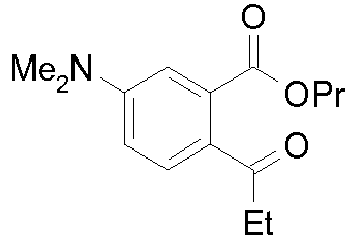
C 74b R2 = Et R2 = Et 4 8 R1 = 2,4-Me 
A 75 56 R1 = 3-C(O)Ph 
C 88 R2 = Et R2 = Et 4 9 R1 = 2-Ph 
B 87 57 

A 60 R2 = Et R2 = Et 5 0 R1 = 2-OMe 
B 92 58 

A 20b R2 = Et R2 = Et 5 1 R1 = 2,3,4-OMe 
B 92 59 R1 = 2-Me 
A 82 R2 = Et R2 = n-Pentyl 5 2 R1 = 2-CF3 
A 87 60 R1 = 2-Me 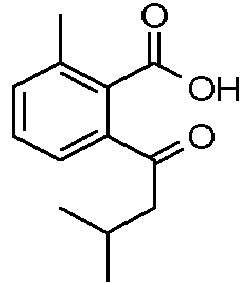
B 68 R2 = Et R2 = Isobutyl 5 3 R1 = 3-Cl 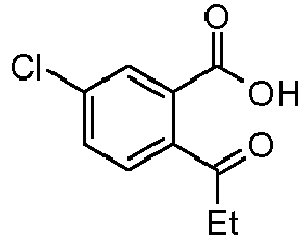
C 70 61 R1 = 2-Me 
B 73 R2 = Et R2 = Isopropyl a) A: 0.25 mmol Cs2CO3. B: 1 mmol KF. C: 1 mmol CsF und 155 °C.
b) Aufarbeitung: 1) 10 mmol KOH, 0.4 ml H2O, 2 mL NMP, 100 °C, 1 h; 2) 40 mmol of 1-Bromopropan, 5 mmol of K2CO3, 2 mL NMP, 2 h, 55 °C. - Gemäß der Verfahrensvariante c) wurden jeweils aromatische Carbonsäure (1) (2 mmol) mit Pivalinsäureanhydrid (3 mmol), [Rh(cod)Cl]2 (1.5 mol%) und KF (2 mmol) in 2 mL NMP für 16 h auf 145 °C erhitzt. Die Hydrolyse erfolgte bei 100 °C für 1 h mit 10 mmol KOH und 0.4 ml Wasser. Nach dem Abkühlen wurde zur einfachen Isolierung mit 1-Bromopropan (3.00 mL, 4.06 g, 32.7 mmol, 99%), K2CO3 (2.35 g, 17 mmol) und NMP (2 mL) alkyliert, wobei das Reaktionsgemisch erneut für 2-3 h auf 55 °C erhitzt wurde. Die Produkte wurden säulenchromatographisch aufgearbeitet (SiO2, Ethylacetat/n-Hexan) und durch 1H und 13C NMR, sowie CHNS oder HRMS charakterisiert. Die Ergebnisse sind in untenstehenden Graphik zusammengefasst. Die angegebenen Ausbeuten beziehen sich auf isolierte Produkte.

- Unter Stickstoffatmosphäre wurde 2-Tolylsäure (68.7 mg, 0.5 mmol), Kaliumfluorid (116 mg, 2 mmol) und Chloro(1,5-cyclooctadien)rhodium(I) dimer (3.31 mg, 0.008 mmol) in einem Reaktionsgefäß vorgelegt. Anschließend wurden entgastes NMP (1.5 mL) und 2-Tolylsäurechlorid (77.3 mg, 0.5 mmol) mit Hilfe von Spritzen zugesetzt und das Reaktionsgemisch für 16 Stunden auf 160 °C erhitzt. Nach dem Abkühlen wurde zur einfachen Isolierung mit 1-Bromopropan (0.2 mL, 2 mmol), K2CO3 (138 mg, 1 mmol) und NMP (2 mL) alkyliert, wobei das Reaktionsgemisch erneut für 2-3 h auf 55 °C erhitzt wurde. Danach wurde die Reaktionsmischung mit Wasser verdünnt (30 mL) und mit Ethylacetat extrahiert (3 x 30 mL). Nach säulenchromatographischer Aufreinigung wurde Weise wurde 2-Toluyl-6-methylbenzoesäurepropylester (71 mg, 48%) als farbloser Öl erhalten.
Claims (12)
- Verfahren zur Herstellung einer ortho-acylierten aromatischen oder heteroaromatischen Carbonsäure der Formel (3),
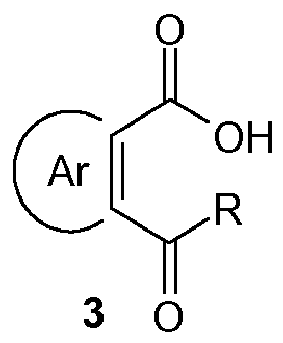
durch Umsetzung einer Verbindung der Formel (1)
 a) mit einem Acylierungsreagenz der Formel (2)
Y für ein Chlor-, Brom-, lod- oder Fluoratom oder einen über ein Sauerstoffatom gebundenen Carboxylrest R1COO, bei dem R1 unabhängig von R die gleiche Bedeutung wie R besitzt, steht
oderb) mit einer weiteren Verbindung der Formel (1) in Form ihres Anhydrids in Gegenwart eines Rhodiumkatalysators und eines basischen Additivs. - Verfahren nach Anspruch 1, dadurch gekennzeichnet , dass das Anhydrid der Verbindung der Formel (1) in situ durch Zugabe eines Dehydratisierungsreagenz erzeugt wird.
- Verfahren nach Anspruch 1, dadurch gekennzeichnet, dass das das Anhydrid der Verbindung der Formel (1) in situ durch Zugabe des Dehydratisierungsreagenz Pivalinsäureanhydrid erzeugt wird.
- Verfahren nach einem der Ansprüche 1 bis 3 , dadurch gekennzeichnet, dass die Verbindung der Formel (1) eine ein oder mehrkernige C6-C14-Carbonsäure ist
- Verfahren nach einem der Ansprüche 1 bis 3 , dadurch gekennzeichnet, dass die Verbindung der Formel (1) einen heteroaromatischen Kern Ar aus der Gruppe Pyridyl, Chinolinyl, Acridinyl, Pyridazinyl, Pyrimidinyl, Pyrazinyl, Triazinyl, Tetrazinyl, Pyrrolyl, Pyrazolyl, Isoxazolyl, Imidazolyl, Oxazolyl, Thiazolyl, Thiophenyl, Furanyl aufweist.
- Verfahren nach einem der Ansprüche 1 bis 5 , dadurch gekennzeichnet, dass das Acylierungsreagenz der Formel (2) ein C2-C8-Carbonsäurechlorid oder -anhydrid ist
- Verfahren nach einem der Ansprüche 1 bis 6 , dadurch gekennzeichnet, dass der Rhodiumkatalysator ein Rhodium(I) Komplex ist.
- Verfahren nach einem der Ansprüche 1 bis 7 , dadurch gekennzeichnet, dass der Rhodiumkatalysator ein Katalysator aus der Gruppe 1,5-Cyclooctadien-,rhodium(I)chlorid Dimer, Di-µ-chlorobis[(1,2,5,6-η)-1,5-hexadien]dirhodium, Chloro-bis(cycloocten)rhodium(I) Dimer und Chlorobis(ethylen)rhodium(I) Dimer ist.
- Verfahren nach einem der Ansprüche 1 bis 8 , dadurch gekennzeichnet, dass das basische Additiv eine anorganische Base aus der Gruppe Kaliumfluorid, Cäsiumfluorid, Lithiumcarbonat, Natriumcarbonat, Kaliumcarbonat, Cäsiumcarbonat, Kaliumhydrogencarbonat, Natriumphosphat, Kaliumphosphat, Cäsiumphosphat, Cäsiumacetat, Kaliumacetat, Kaliumhydrogenphosphat ist
- Verfahren nach einem der Ansprüche 1 bis 9 , dadurch gekennzeichnet, dass der Rhodiumkatalysator in einer Menge von 0,001 bis 20 mol%, bevorzugt 0,01 bis 3 mol%, bezogen auf die Verbindung der Formel (1), eingesetzt wird.
- Verfahren nach einem der Ansprüche 1 bis 10 , dadurch gekennzeichnet, dass das basische Additiv in einer Menge von 10 bis 500 mol%, bevorzugt 20 bis 200 mol%, bezogen auf die Verbindung der Formel (1), eingesetzt wird.
- Verfahren nach einem der Ansprüche 1 bis 11 , dadurch gekennzeichnet, dass das Verfahren bei einer Temperatur im Bereich zwischen 20 bis 200, bevorzugt 80 bis 180, besonders bevorzugt 120 bis 155°C durchgeführt wird.
Priority Applications (2)
| Application Number | Priority Date | Filing Date | Title |
|---|---|---|---|
| EP20130163052 EP2789600A1 (de) | 2013-04-10 | 2013-04-10 | Verfahren zur Herstellung von ortho-acylierten aromatischen oder heteroaromatischen Carbonsäuren |
| PCT/EP2014/057187 WO2014167017A1 (de) | 2013-04-10 | 2014-04-09 | Verfahren zur herstellung von ortho-acylierten aromatischen oder heteroaromatischen carbonsäuren |
Applications Claiming Priority (1)
| Application Number | Priority Date | Filing Date | Title |
|---|---|---|---|
| EP20130163052 EP2789600A1 (de) | 2013-04-10 | 2013-04-10 | Verfahren zur Herstellung von ortho-acylierten aromatischen oder heteroaromatischen Carbonsäuren |
Publications (1)
| Publication Number | Publication Date |
|---|---|
| EP2789600A1 true EP2789600A1 (de) | 2014-10-15 |
Family
ID=48082996
Family Applications (1)
| Application Number | Title | Priority Date | Filing Date |
|---|---|---|---|
| EP20130163052 Withdrawn EP2789600A1 (de) | 2013-04-10 | 2013-04-10 | Verfahren zur Herstellung von ortho-acylierten aromatischen oder heteroaromatischen Carbonsäuren |
Country Status (2)
| Country | Link |
|---|---|
| EP (1) | EP2789600A1 (de) |
| WO (1) | WO2014167017A1 (de) |
-
2013
- 2013-04-10 EP EP20130163052 patent/EP2789600A1/de not_active Withdrawn
-
2014
- 2014-04-09 WO PCT/EP2014/057187 patent/WO2014167017A1/de not_active Ceased
Non-Patent Citations (15)
| Title |
|---|
| A. K. SRIVASTAVA; G. PANDA, CHEM. EUR. J., vol. 14, 2008, pages 4675 - 4688 |
| H. YU; Y. XIAO; H. GUO, ORG. LETT., vol. 14, 2012, pages 2014 - 2017 |
| J. LU; H. ZHANG; X. CHEN; H. LIU; Y. JIANG; H. FU, ADV. SYNTH. CATAL., vol. 355, 2013, pages 529 - 536 |
| JAGARAJ BEHARI LAL ET AL: "Metallic Cerium in Organic Synthesis", JOURNAL OF THE INDIAN CHEMICAL SOCIETY, THE INDIAN CHEMICAL SOCIETY, CALCUTTA; IN, vol. 9, 1 January 1932 (1932-01-01), pages 565 - 571, XP008164203, ISSN: 0019-4522 * |
| JIHYE PARK ET AL: "Rhodium-Catalyzed Oxidative ortho -Acylation of Benzamides with Aldehydes: Direct Functionalization of the sp 2 C-H Bond", ORGANIC LETTERS, vol. 13, no. 16, 19 August 2011 (2011-08-19), pages 4390 - 4393, XP055075092, ISSN: 1523-7060, DOI: 10.1021/ol201729w * |
| K. M. ENGLE; T.-S. MEI; M. WASA; J.-Q. YU, ACC. CHEM. RES., vol. 45, 2012, pages 788 - 802 |
| M. LI; H. GE, ORG. LETT., vol. 12, 2010, pages 3464 - 3467 |
| M. YAMAGUCHI; K. KAMEI; T. KOGA; M. AKIMA; T. KUROKI; N. OHI, J. MED. CHEM., vol. 36, 1993, pages 4052 - 4060 |
| S. M. ALLIN; C. J. NORTHFIELD; M. I. PAGE; A. M. Z. SLAWIN, J. CHEM. SOC., PERKIN TRANS., vol. 1, 2000, pages 1715 - 1721 |
| SACHINDRA NATHN CHAKRABARTY ET AL: "Chromium Powder in Organic Synthesis", JOURNAL OF THE INDIAN CHEMICAL SOCIETY, THE INDIAN CHEMICAL SOCIETY, CALCUTTA; IN, vol. 5, 1 January 1928 (1928-01-01), pages 513 - 518, XP008164204, ISSN: 0019-4522 * |
| T. KOCHI; A. TAZAWA; K. HONDA; F. KAKIUCHI, CHEM. LETT., vol. 40, 2011, pages 1018 - 1020 |
| W. E. PARHAM; C. K. BRADSHER; K. J. EDGAR, J. ORG. CHEM., vol. 46, 1981, pages 1057 - 1061 |
| W. J. KARSLAKE ET AL, JOURNAL OF THE AMERICAN CHEMICAL SOCIETY, vol. 31, no. 4, 1 April 1909 (1909-04-01), pages 479 - 483, XP055075060, ISSN: 0002-7863, DOI: 10.1021/ja01934a007 * |
| X. JIA; S. ZHANG; W. WANG; F. LUO, J. CHENG, ORG. LETT., vol. 11, 2009, pages 3120 - 3123 |
| YAXI YANG ET AL: "Rhodium-Catalyzed Oxidative ortho -Acylation of Aryl Ketone O -Methyl Oximes with Aryl and Alkyl Aldehydes", ADVANCED SYNTHESIS & CATALYSIS, vol. 354, no. 16, 12 November 2012 (2012-11-12), pages 2916 - 2920, XP055075089, ISSN: 1615-4150, DOI: 10.1002/adsc.201200401 * |
Also Published As
| Publication number | Publication date |
|---|---|
| WO2014167017A1 (de) | 2014-10-16 |
Similar Documents
| Publication | Publication Date | Title |
|---|---|---|
| EP2606025B1 (de) | Verfahren zur herstellung einer propiolsäure oder eines derivates davon | |
| EP0623582B1 (de) | Verfahren zur Herstellung von Carbonsäureestern aus Carbonsäurehalogeniden und Alkoholen | |
| EP2838872B1 (de) | Verfahren zur herstellung von verzweigten alkoholen | |
| DE2943098C2 (de) | ||
| EP0623575B1 (de) | Verfahren zur Herstellung von Ketonen | |
| EP2096101B1 (de) | Verfahren zur Herstellung von Ketonen aus alpha-Oxocarboxylaten und Arylbromiden | |
| EP1318868A2 (de) | Verfahren zur hydroformylierung mit katalysatoren von xanthen-verbruckten liganden | |
| DE2634663A1 (de) | Verfahren zur herstellung eines optisch aktiven alkylchrysanthemats | |
| EP0218970B1 (de) | Chirale Rhodium-diphosphinkomplexe für asymmetrische Hydrierungen | |
| DE10060313A1 (de) | Verfahren zur Carbonylierung von Pentensäure und deren Derivate | |
| DE69206423T2 (de) | Verfahren zur Herstellung von 5-(2,4-Difluorphenyl)-Salizylsäure. | |
| EP1308157B1 (de) | Komplexe N-heterocyclischer Carbene und ihre Verwendung | |
| DE3879843T2 (de) | Verfahren zur herstellung von 3,5,5-trimethylcyclohexa-2-en-1,4-dion. | |
| EP2366680A2 (de) | Verfahren zur Herstellung von 4'-Halogenalkyl-biphenyl-2-carbonsäuren | |
| WO2014167017A1 (de) | Verfahren zur herstellung von ortho-acylierten aromatischen oder heteroaromatischen carbonsäuren | |
| JPS6327335B2 (de) | ||
| DE10111262A1 (de) | Verfahren zur Herstellung von Vinyl- Aryl- und Heteroarylessigsäuren und ihrer Devivate | |
| WO2008090127A1 (de) | Verfahren zur herstellung substituierter 2-arylmalonsäureester | |
| DE69305250T2 (de) | Herstellung von Alkandicarbonsäurederivaten | |
| DE68927132T2 (de) | Verfahren zur Herstellung von Lactonen | |
| DE102005014822A1 (de) | Verfahren zur Herstellung aromatischer Aldehyde | |
| EP0820987B1 (de) | Verfahren zur Herstellung von Pyridin-2,3-dicarbonsäureestern | |
| DE1242587B (de) | Verfahren zur Herstellung von 2, 2, 2-Trifluoraethanol | |
| DE10148712A1 (de) | Diphosphin | |
| EP0806415B1 (de) | Verfahren zur Herstellung von Arylamiden heteroaromatischer Carbonsäuren |
Legal Events
| Date | Code | Title | Description |
|---|---|---|---|
| PUAI | Public reference made under article 153(3) epc to a published international application that has entered the european phase |
Free format text: ORIGINAL CODE: 0009012 |
|
| 17P | Request for examination filed |
Effective date: 20130410 |
|
| AK | Designated contracting states |
Kind code of ref document: A1 Designated state(s): AL AT BE BG CH CY CZ DE DK EE ES FI FR GB GR HR HU IE IS IT LI LT LU LV MC MK MT NL NO PL PT RO RS SE SI SK SM TR |
|
| AX | Request for extension of the european patent |
Extension state: BA ME |
|
| R17P | Request for examination filed (corrected) |
Effective date: 20150415 |
|
| RBV | Designated contracting states (corrected) |
Designated state(s): AL AT BE BG CH CY CZ DE DK EE ES FI FR GB GR HR HU IE IS IT LI LT LU LV MC MK MT NL NO PL PT RO RS SE SI SK SM TR |
|
| STAA | Information on the status of an ep patent application or granted ep patent |
Free format text: STATUS: THE APPLICATION IS DEEMED TO BE WITHDRAWN |
|
| 18D | Application deemed to be withdrawn |
Effective date: 20150416 |