EP2787211A1 - Egr cooler - Google Patents
Egr cooler Download PDFInfo
- Publication number
- EP2787211A1 EP2787211A1 EP12853489.8A EP12853489A EP2787211A1 EP 2787211 A1 EP2787211 A1 EP 2787211A1 EP 12853489 A EP12853489 A EP 12853489A EP 2787211 A1 EP2787211 A1 EP 2787211A1
- Authority
- EP
- European Patent Office
- Prior art keywords
- shell
- tubes
- core portion
- joined
- exhaust gases
- Prior art date
- Legal status (The legal status is an assumption and is not a legal conclusion. Google has not performed a legal analysis and makes no representation as to the accuracy of the status listed.)
- Withdrawn
Links
Images



Classifications
-
- F—MECHANICAL ENGINEERING; LIGHTING; HEATING; WEAPONS; BLASTING
- F01—MACHINES OR ENGINES IN GENERAL; ENGINE PLANTS IN GENERAL; STEAM ENGINES
- F01N—GAS-FLOW SILENCERS OR EXHAUST APPARATUS FOR MACHINES OR ENGINES IN GENERAL; GAS-FLOW SILENCERS OR EXHAUST APPARATUS FOR INTERNAL-COMBUSTION ENGINES
- F01N3/00—Exhaust or silencing apparatus having means for purifying, rendering innocuous, or otherwise treating exhaust
- F01N3/08—Exhaust or silencing apparatus having means for purifying, rendering innocuous, or otherwise treating exhaust for rendering innocuous
- F01N3/10—Exhaust or silencing apparatus having means for purifying, rendering innocuous, or otherwise treating exhaust for rendering innocuous by thermal or catalytic conversion of noxious components of exhaust
-
- F—MECHANICAL ENGINEERING; LIGHTING; HEATING; WEAPONS; BLASTING
- F28—HEAT EXCHANGE IN GENERAL
- F28F—DETAILS OF HEAT-EXCHANGE AND HEAT-TRANSFER APPARATUS, OF GENERAL APPLICATION
- F28F9/00—Casings; Header boxes; Auxiliary supports for elements; Auxiliary members within casings
- F28F9/001—Casings in the form of plate-like arrangements; Frames enclosing a heat exchange core
-
- F—MECHANICAL ENGINEERING; LIGHTING; HEATING; WEAPONS; BLASTING
- F02—COMBUSTION ENGINES; HOT-GAS OR COMBUSTION-PRODUCT ENGINE PLANTS
- F02M—SUPPLYING COMBUSTION ENGINES IN GENERAL WITH COMBUSTIBLE MIXTURES OR CONSTITUENTS THEREOF
- F02M26/00—Engine-pertinent apparatus for adding exhaust gases to combustion-air, main fuel or fuel-air mixture, e.g. by exhaust gas recirculation [EGR] systems
- F02M26/13—Arrangement or layout of EGR passages, e.g. in relation to specific engine parts or for incorporation of accessories
- F02M26/22—Arrangement or layout of EGR passages, e.g. in relation to specific engine parts or for incorporation of accessories with coolers in the recirculation passage
- F02M26/29—Constructional details of the coolers, e.g. pipes, plates, ribs, insulation or materials
- F02M26/32—Liquid-cooled heat exchangers
-
- F—MECHANICAL ENGINEERING; LIGHTING; HEATING; WEAPONS; BLASTING
- F28—HEAT EXCHANGE IN GENERAL
- F28D—HEAT-EXCHANGE APPARATUS, NOT PROVIDED FOR IN ANOTHER SUBCLASS, IN WHICH THE HEAT-EXCHANGE MEDIA DO NOT COME INTO DIRECT CONTACT
- F28D21/00—Heat-exchange apparatus not covered by any of the groups F28D1/00 - F28D20/00
- F28D21/0001—Recuperative heat exchangers
- F28D21/0003—Recuperative heat exchangers the heat being recuperated from exhaust gases
-
- F—MECHANICAL ENGINEERING; LIGHTING; HEATING; WEAPONS; BLASTING
- F28—HEAT EXCHANGE IN GENERAL
- F28D—HEAT-EXCHANGE APPARATUS, NOT PROVIDED FOR IN ANOTHER SUBCLASS, IN WHICH THE HEAT-EXCHANGE MEDIA DO NOT COME INTO DIRECT CONTACT
- F28D9/00—Heat-exchange apparatus having stationary plate-like or laminated conduit assemblies for both heat-exchange media, the media being in contact with different sides of a conduit wall
- F28D9/0031—Heat-exchange apparatus having stationary plate-like or laminated conduit assemblies for both heat-exchange media, the media being in contact with different sides of a conduit wall the conduits for one heat-exchange medium being formed by paired plates touching each other
-
- F—MECHANICAL ENGINEERING; LIGHTING; HEATING; WEAPONS; BLASTING
- F28—HEAT EXCHANGE IN GENERAL
- F28F—DETAILS OF HEAT-EXCHANGE AND HEAT-TRANSFER APPARATUS, OF GENERAL APPLICATION
- F28F1/00—Tubular elements; Assemblies of tubular elements
- F28F1/006—Tubular elements; Assemblies of tubular elements with variable shape, e.g. with modified tube ends, with different geometrical features
-
- F—MECHANICAL ENGINEERING; LIGHTING; HEATING; WEAPONS; BLASTING
- F28—HEAT EXCHANGE IN GENERAL
- F28F—DETAILS OF HEAT-EXCHANGE AND HEAT-TRANSFER APPARATUS, OF GENERAL APPLICATION
- F28F13/00—Arrangements for modifying heat-transfer, e.g. increasing, decreasing
- F28F13/06—Arrangements for modifying heat-transfer, e.g. increasing, decreasing by affecting the pattern of flow of the heat-exchange media
- F28F13/12—Arrangements for modifying heat-transfer, e.g. increasing, decreasing by affecting the pattern of flow of the heat-exchange media by creating turbulence, e.g. by stirring, by increasing the force of circulation
-
- F—MECHANICAL ENGINEERING; LIGHTING; HEATING; WEAPONS; BLASTING
- F28—HEAT EXCHANGE IN GENERAL
- F28F—DETAILS OF HEAT-EXCHANGE AND HEAT-TRANSFER APPARATUS, OF GENERAL APPLICATION
- F28F3/00—Plate-like or laminated elements; Assemblies of plate-like or laminated elements
- F28F3/02—Elements or assemblies thereof with means for increasing heat-transfer area, e.g. with fins, with recesses, with corrugations
- F28F3/025—Elements or assemblies thereof with means for increasing heat-transfer area, e.g. with fins, with recesses, with corrugations the means being corrugated, plate-like elements
-
- F—MECHANICAL ENGINEERING; LIGHTING; HEATING; WEAPONS; BLASTING
- F28—HEAT EXCHANGE IN GENERAL
- F28F—DETAILS OF HEAT-EXCHANGE AND HEAT-TRANSFER APPARATUS, OF GENERAL APPLICATION
- F28F9/00—Casings; Header boxes; Auxiliary supports for elements; Auxiliary members within casings
- F28F9/02—Header boxes; End plates
- F28F9/0219—Arrangements for sealing end plates into casing or header box; Header box sub-elements
- F28F9/0221—Header boxes or end plates formed by stacked elements
-
- F—MECHANICAL ENGINEERING; LIGHTING; HEATING; WEAPONS; BLASTING
- F28—HEAT EXCHANGE IN GENERAL
- F28F—DETAILS OF HEAT-EXCHANGE AND HEAT-TRANSFER APPARATUS, OF GENERAL APPLICATION
- F28F9/00—Casings; Header boxes; Auxiliary supports for elements; Auxiliary members within casings
- F28F9/02—Header boxes; End plates
- F28F9/04—Arrangements for sealing elements into header boxes or end plates
- F28F9/16—Arrangements for sealing elements into header boxes or end plates by permanent joints, e.g. by rolling
- F28F9/18—Arrangements for sealing elements into header boxes or end plates by permanent joints, e.g. by rolling by welding
- F28F9/182—Arrangements for sealing elements into header boxes or end plates by permanent joints, e.g. by rolling by welding the heat-exchange conduits having ends with a particular shape, e.g. deformed; the heat-exchange conduits or end plates having supplementary joining means, e.g. abutments
-
- F—MECHANICAL ENGINEERING; LIGHTING; HEATING; WEAPONS; BLASTING
- F28—HEAT EXCHANGE IN GENERAL
- F28F—DETAILS OF HEAT-EXCHANGE AND HEAT-TRANSFER APPARATUS, OF GENERAL APPLICATION
- F28F9/00—Casings; Header boxes; Auxiliary supports for elements; Auxiliary members within casings
- F28F9/02—Header boxes; End plates
- F28F2009/0285—Other particular headers or end plates
- F28F2009/029—Other particular headers or end plates with increasing or decreasing cross-section, e.g. having conical shape
-
- F—MECHANICAL ENGINEERING; LIGHTING; HEATING; WEAPONS; BLASTING
- F28—HEAT EXCHANGE IN GENERAL
- F28F—DETAILS OF HEAT-EXCHANGE AND HEAT-TRANSFER APPARATUS, OF GENERAL APPLICATION
- F28F2275/00—Fastening; Joining
- F28F2275/04—Fastening; Joining by brazing
Definitions
- the present invention relates to an EGR cooler which is used in an EGR system of, for example, a diesel vehicle which reduces the production of oxides of nitrogen (NOx) by returning part of exhaust gases to an induction system of an engine to cool the exhaust gases.
- an EGR cooler which is used in an EGR system of, for example, a diesel vehicle which reduces the production of oxides of nitrogen (NOx) by returning part of exhaust gases to an induction system of an engine to cool the exhaust gases.
- NOx oxides of nitrogen
- a large number of tubes 4 are disposed in an interior of a shell 7 which is formed into a large-diameter angularly cylindrical shape, and interiors of the tubes 4 constitute gas flow paths, while a space defined between the shell 7 and the tubes 4 constitutes a cooling fluid path.
- the gas flow paths and the cooling fluid flow path are joined together so as to maintain gas and fluid tightness therebetween.
- a cooling fluid inlet pipe 11 is attached to a lower surface portion of the shell 7, while a cooling fluid outlet pipe 12 is attached to an upper surface portion of the shell 7, whereby a cooling fluid passes through the interior of the shell 7 from the cooling fluid inlet pipe 11 to the cooling fluid outlet pipe 12.
- an inlet header 2 and an outlet header 3 are attached to both longitudinal ends of the shell 7, and exhaust gases flow from the inlet header 2 while being divided into the large number of tubes 4 and are discharged from the outlet header 3.
- the tube 4 is a flat tube which is a combination of a tube inner 5 and a tube outer 6 which are disposed to face opposite each other.
- swollen portions 5a, 6a which are swollen in a thickness direction are formed at inlet portions and outlet portions thereof (Patent Document 1).
- an inner fin 8 is housed in an interior of the tube 4 so as to be joined thereto to thereby increase a heat exchanging area so as to promote the heat exchange.
- Patent Document 1 JP-A-2010-243125
- the pressure resistance strength is increased by housing the inner fin 8 in the interior thereof.
- the pressure resistance strength is ensured by overlapping the components to form a double-layer construction.
- the pressure resistance strength since only the shell 7 exists between the two joint portions 15, 16, the pressure resistance strength thereat becomes insufficient, and the portion lying between the joint portions tends to be deformed easily.
- the thin tubes 4 the base material of the inlet header 2 (the outlet header 3), the base material of the shell 7 and the joint portion 15 between the header and the shell are pulled to be broken by the deformation.
- the pressure resistance strength since the pressure resistance strength has not been able to be increased without increasing the thicknesses of both the inlet header 2 or the outlet header 3 and the shell 7, the material costs of the inlet header 2, the outlet header 3 and the shell 7 have been increased.
- a brazing material 10 is applied to a whole area of an inner surface of a flat plate portion of each of a tube inner 5 and a tube outer 6.
- the thickness of the tube 4 is increased by the thickness of the brazing material 10, resulting in a problem that a predetermined number of tubes 4 cannot be housed in the interior of the shell 7.
- the brazing material 10 is a paste which is a mixture of mineral powder and a liquid, it is difficult to control the thickness thereof.
- swollen portions 5a, 6a are provided on flat plate portions of both the tube inner 5 and the tube outer 6 in such a way as to be swollen in a thickness direction so as to hold spaces between the tubes 4 to thereby form fluid flow paths of the cooling fluid therebetween.
- both the tube inner 5 and the tube outer 6 come to have a complex shape, which increases the working cost and the material cost thereof.
- the invention has been made with a view to solving the problems, and an object thereof is to provide an EGR cooler which enhances not only the cooling performance thereof by increasing the ratio of the volume of a core portion but also the pressure resistance strength thereof.
- Another object of the invention is to provide an EGR cooler which can control the thickness of a tube which is increased by a brazing material which joins an inner surface of the tube and an inner fin together.
- a further object of the invention is to provide an EGR cooler which can reduce the production cost of the tube.
- an EGR cooler including: a core portion in which a plurality of tubes having a flat shape through which exhaust gases pass are stacked one on another in an interior of a hollow cylindrical shell to be joined to the shell, the core portion configured to heat exchange between the exhaust gases and a cooling fluid which flows around the tubes; an inlet header having a cylindrical shape and joined to an upstream side of the shell in relation to a gas flow at one end of the cylindrical inlet header, the inlet header configured to supply the exhaust gases into the core portion; and an outlet header having a cylindrical shape and joined to a downstream side of the core portion in relation to the gas flow at one end of the cylindrical outlet header, the outlet header configured to discharge the exhaust gases from the core portion, wherein the inlet header and the outlet header are joined to an outer surface of the shell, and the tubes are joined to an inner surface of the shell at those joint portions.
- one of the tubes houses an inner fin having a corrugated shape, the inner fin configured to produce a turbulence of the exhaust gases, and the one of the tubes includes a bead, in which a brazing material that connects the one of the tubes with the inner fin is provided, as a groove formed in an inner surface of the one of the tubes.
- one of the tubes is formed by combining a tube inner, in which internal walls are erected from both side edges of a flat plate portion, and a tube outer, in which external walls are erected from both side edges of a flat plate portion, and a swollen portion is formed at each longitudinal end of the flat plate portion of either of the tube inner and the tube outer, the swollen portion being swollen in a thickness direction and holding a space between an adjacent tube and the one of the tubes.
- the inlet header and the outlet header are joined to the outer surface of the shell, and the tubes are joined to the inner surface of the shell at the joint portions, whereby the ratio of the volumes of the headers and the joint portions which do not contribute to heat exchange can be reduced, while the ratio of the volume of the core portion can be increased, thereby making it possible to enhance the cooling performance of the EGR cooler.
- the portion where only the shell having a poor pressure resistance exists is prevented from being provided between the joint portion between the shell and the inlet header (or the outlet header) and the joint portion between the shell and the tubes, and hence, the pressure resistance can be enhanced by the three-layer construction. Additionally, even when the pressure resistance is required to be increased by application conditions, the requirement of increasing the pressure resistance can be dealt with by increasing the thickness of only the inlet header or the outlet header, thereby making it possible to suppress the material cost.
- the one of the tubes houses the inner fin having a corrugated shape, the inner fin configured to produce a turbulence of the exhaust gases, and the one of the tubes includes the bead, in which the brazing material that connects the one of the tubes with the inner fin is provided, as the groove formed in the inner surface of the one of the tubes.
- the one of the tubes is formed by combining the tube inner, in which internal walls are erected from both side edges of the flat plate portion, and the tube outer, in which external walls are erected from both side edges of the flat plate portion, and the swollen portion is formed at each longitudinal end of the flat plate portion of either of the tube inner and the tube outer, the swollen portion being swollen in a thickness direction and holding the space between the adjacent tube and the one of the tubes.
- an inlet header 2 from which exhaust gases from an exhaust system (not shown) of an engine is introduced, and an outlet header 3, from which the exhaust gases are discharged into an induction system (not shown) of the engine, are attached to both ends of a core portion 1 where a heat exchange is performed between the exhaust gases and a cooling fluid.
- a large number of flat tubes 4 through which exhaust gases pass are stacked one on another with a space defined therebetween and are housed in an angularly cylindrical shell 7 to be joined fixedly thereto.
- the tube 4 is formed into a hollow flat tube which is made up of a combination of a tube inner 5 in which inner side walls are provided on both side edges of a flat plate portion which is substantially flat in such a way as to stand erect therefrom and a tube outer 6 in which outer side walls are provided on both side edges of a flat portion which is substantially flat in such a way as to stand erect therefrom so as to contact the inner side walls.
- the tube inner 5 and the tube outer 6 are joined together through brazing.
- a swollen portion 5a is formed at each longitudinal end of the tube inner 5 in such a way that the flat plate portion is swollen in a thickness direction.
- the swollen portion 5a and the other portion of the flat portion are connected by a slope. Because of this, when the large number of tubes 4 are stacked one on another, the swollen portions 5a are brought into abutment with the adjacent tube 4, whereby a predetermined space, which constitutes a cooling fluid flow path, is defined between the tubes 4 lying adjacent to each other.
- a corrugated inner fin 8 is housed in each tube 4, whereby exhaust gases which pass through the tube 4 are dispersed, merged or snaked to be made turbulent. Additionally, a heat exchanging area between exhaust gases and a cooling fluid is increased by the inner fin 8, thereby promoting the heat exchange therebetween.
- the inner fin 8 is housed in the tube 4 and is joined to an inner surface of the tube 4 through brazing.
- a plurality of linear beads 9 are provided on the flat portion of each of the tube inner 5 and the tube outer 6 so as to form a plurality of grooves in an inner surface of the flat portion, and as a whole, the linear beads 9 constitute sides of two squares which contact each other at corresponding corners.
- a brazing material 10 is applied to the grooves formed as a result of the provision of the beads 9 of the tube inner 5 and the tube outer 6. Following this, the inner fin 8 is set in a predetermined position, and the tube inner 5 and the tube outer 6 are combined together and are then heated to be brazed together via the inner fin 8.
- the shell 7 is made by joining together two U-shaped sheet materials and is formed into an angularly cylindrical shape having opening portions at both ends thereof so that the number of plate tubes 4, 4 which are stacked one on another can be housed therein. Additionally, a cooling fluid inlet pipe 11 and a cooling fluid outlet pipe 12 are connected to a lower surface portion at an inlet side and an upper surface portion at an outlet side of the shell 7, respectively.
- the inlet header 2 which is attached to an upstream side of the core portion 1 has a flange portion 2a which is connected to a piping (not shown) from the exhaust system of the engine and a downstream-side opening portion 2b having a large diameter which is joined to the shell of the core portion 1.
- the inlet header 2 is formed into a substantially angularly cylindrical shape which is expanded gradually in diameter towards the downstream-side opening portion 2b.
- the outlet header 3 which is attached to a downstream side of the core portion 1 has an upstream-side opening portion 3a having a large diameter which is joined to the shell 7 of the core portion 1 and a flange portion 3b which is connected to a piping (not shown) to an induction system of the engine.
- the outlet header 3 is formed into a substantially angularly cylindrical shape which is expanded gradually in diameter towards the upstream-side opening portion 3a.
- downstream-side opening portion 2b of the inlet header 2 is formed larger in diameter than an upstream-side end portion of the shell 7 and is joined to an outer surface of the shell 7 at a joint portion 13.
- the upstream-side opening portion 3a of the outlet header 3 is formed larger in diameter than a downstream-side end portion of the shell 7 and is joined to the outer surface of the shell 7 at a joint portion 13.
- the tubes 4 which are stacked one on another are jointed to an inner surface of the shell 7 at the joint portions 13, so that gas flow paths defined inside the tubes 4 and cooling fluid flow paths defined outside the tubes 4 are maintained in a gastight and fluid-tight fashion.
- the inlet header 2 (the outlet header 3) is extended further towards the core portion 1 than the three-layer joint portion 13 where the inlet header 2 (the outlet header 3), the shell 7 and the tubes 4 are joined together to project over a portion of the shell 7 which constitutes a wall surface of the cooling fluid flow path.
- the tube 4 and the shell 7 have the same longitudinal length, and when assembling them together, longitudinal end faces of the tube 4 and the shell 7 are aligned with each other. Because of this, when assembling them together, the tube 4 and the shell 7 can easily be positioned in relation to each other by aligning the longitudinal end faces thereof with each other, which can enhance the productivity of EGR coolers.
- the tubes 4 which are stacked one on another are joined to the inner surface of the shell 7 at the joint portions 13 where the inlet header 2 and the outlet header 3 are joined to the outer surface of the shell 7, whereby longitudinal lengths of portions 14 including the inlet header 2, the outlet header 3, the joint portions between the headers 2, 3 and the shell 7 and the joint portions between the shell 7 and the tubes 4 which do not contribute to heat exchange can be reduced to thereby increase the ratio of the volume of the core portion 1 in the EGR cooler.
- the inlet header 2 (the outlet header 3) is joined to the outer surface of the shell 7 and the tubes 4 are joined to the inner surface of the shell 7 at the same position (the joint portion 13) in relation to the longitudinal direction, whereby a three-layer construction is realized at the joint portion 13.
- a portion where only the shell 7 having a poor pressure resistance exists is prevented from being provided between the joint portion between the shell 7 and the inlet header 2 (the outlet header 3) and the joint portion between the shell 7 and the tubes 4, thereby making it possible to enhance the pressure resistance by the three-layer construction.
- the requirement of increasing the pressure resistance can be dealt with by increasing the thickness of only the inlet header or the outlet header, thereby making it possible to suppress the material cost.
- the inlet header 2 (the outlet header 3) is extended further towards the core portion 1 than the three-layer joint portion 13 where the inlet header 2 (the outlet header 3), the shell 7 and the tubes 4 are joined together to project over a portion of the shell 7 which constitutes the wall surface of the cooling fluid flow path.
- the inlet header 2 (the outlet header 3) reinforces the shell 7 so as to enhance the pressure resistance against the cooling fluid.
- the beads 9 are provided on the tube 4 so as to form the grooves in the inner surface of the tube 4 as a result of the provision of the tube and the inner fin 8 so that the brazing material 10 is laid out in the grooves, whereby the amount of brazing material 10 to be used can be reduced to an amount of brazing material 10 which is good enough to be laid out in the grooves formed as a result of the provision of the beads 9, thereby making it possible to reduce the material cost.
- the grooves, which are formed as a result of provision of the beads 9, are filled with the brazing material 10, which is a paste made up of a mixture of mineral powder and a liquid, by an application robot or the like to join the tube 4 and the inner fin 8.
- the brazing material 10 is a paste made up of a mixture of mineral powder and a liquid, by an application robot or the like to join the tube 4 and the inner fin 8.
- the beads 9 are formed on both the tube inner 5 and the tube outer 6, however, beads 9 may be provided only on either of them.
- the application robot can apply the brazing material continuously as in one continuous stroke to the grooves resulting from the provision of the beads 9 in the fabrication process of the tube 4. This can reduce the number of working man-hours, which in turn enhances the productivity of tubes 4.
- a bead 9 is provided to extend on a flat plate portion of a tube inner 5 or a tube outer 6 in a longitudinal direction while snaking.
- a bead 9 is provided to extend from a predetermined corner to a diagonal corner of a flat plate portion of a tube inner 5 or a tube outer 6 while snaking.
- bends of the snaking bead 9 are radiused.
- the application robot can apply the brazing material smoothly to the groove resulting from the provision of the bead 9 without involving a sharp turn, thereby making it possible to reduce the fabrication time.
- a bead 9 is provided to extend from a predetermined corner to a diagonal corner of a flat plate portion of a tube inner 5 or a tube outer 6 while snaking.
- a bead 9 is provided to extend on a flat plate portion of a tube inner 5 or a tube outer 6 in a longitudinal direction while snaking.
- the bends of the snaking bead 9 are formed into the angle, the total area of the groove resulting from the provision of the bead 9 can be reduced compared with the embodiments of Figs. 5A and 5B and the amount of brazing material 10 to be used can be reduced, and thereby, the material cost can be reduced accordingly.
- a bead 9a is provided to extend in a straight line from a corner P1 to a longitudinally central and transversely opposite side position P5 of a flat plate portion of a tube inner 5 or a tube outer 6 and is then turned at this P5 towards a corner P3 to extend to a position which is situated substantially halfway up to P3.
- a straight bead 9b is provided to extend from P3 to a position which is situated substantially halfway down to P5.
- a bead 9a is also provided to extend in a straight line from a corner P6 which is a diagonal corner of P1 to a longitudinally central and transversely opposite side position P2 and is then turned at this P2 towards a corner P4 to extend to a position which is situated substantially halfway down to P4. Additionally, a straight bead 9b is provided to extend from P4 to a position which is situated substantially halfway up to P2.
- the two sets of the beads 9a, 9b are formed so that the one set is a reversal of the other or vice versa. Because of this, in forming beads 9a, 9b on the tube inner 5 or the tube outer 6 through pressing, one set of a bead 9a and a bead 9b is formed by using a die for the one set of the bead 9a and the bead 9b. Following this, the tube inner 5 or the tube outer 6 is turned through 180 degrees, and the remaining set of a bead 9a and a bead 9b can be formed by the same die. Thus, the fabrication cost can be reduced.
- a bead 9c is provided to extend in a longitudinal direction on a flat plate portion of a tube inner 5 or a tube outer 6 from a corner P7 to a corner P8 while snaking.
- This bead 9c is formed so as to turn at a transversely center of the flat plate portion.
- a bead 9c having the same shape is also provided to extend in the longitudinal direction from a diagonal corner P10 of P7 to a corner P9 while snaking.
- the pair of beads 9c are formed so that one constitutes a reversal of the other or vice versa. Because of this, in forming beads 9c on the tube inner 5 or the tube outer 6 through pressing, one bead 9c is formed by using a die for the bead 9c. Following this, the tube inner 5 or the tube outer 6 is rotated through 180 degrees, and the remaining bead 9c can be formed by using the same die, thereby making it possible to reduce the fabrication cost.
Landscapes
- Engineering & Computer Science (AREA)
- Mechanical Engineering (AREA)
- General Engineering & Computer Science (AREA)
- Physics & Mathematics (AREA)
- Thermal Sciences (AREA)
- Chemical & Material Sciences (AREA)
- Combustion & Propulsion (AREA)
- Geometry (AREA)
- Health & Medical Sciences (AREA)
- Chemical Kinetics & Catalysis (AREA)
- Toxicology (AREA)
- Heat-Exchange Devices With Radiators And Conduit Assemblies (AREA)
- Exhaust-Gas Circulating Devices (AREA)
- Details Of Heat-Exchange And Heat-Transfer (AREA)
Abstract

Description
- The present invention relates to an EGR cooler which is used in an EGR system of, for example, a diesel vehicle which reduces the production of oxides of nitrogen (NOx) by returning part of exhaust gases to an induction system of an engine to cool the exhaust gases.
- In a conventional EGR cooler, as shown in
Figs. 7A and 7B , a large number oftubes 4 are disposed in an interior of ashell 7 which is formed into a large-diameter angularly cylindrical shape, and interiors of thetubes 4 constitute gas flow paths, while a space defined between theshell 7 and thetubes 4 constitutes a cooling fluid path. The gas flow paths and the cooling fluid flow path are joined together so as to maintain gas and fluid tightness therebetween. - A cooling
fluid inlet pipe 11 is attached to a lower surface portion of theshell 7, while a coolingfluid outlet pipe 12 is attached to an upper surface portion of theshell 7, whereby a cooling fluid passes through the interior of theshell 7 from the coolingfluid inlet pipe 11 to the coolingfluid outlet pipe 12. - Additionally, an
inlet header 2 and anoutlet header 3 are attached to both longitudinal ends of theshell 7, and exhaust gases flow from theinlet header 2 while being divided into the large number oftubes 4 and are discharged from theoutlet header 3. - In a
core portion 1 of theshell 7 where thetubes 4 are housed, heat exchange is performed between the exhaust gases and the cooling fluid via the tubes, whereby the exhaust gases are cooled. - As shown in
Figs. 7A, 7B and9 , thetube 4 is a flat tube which is a combination of a tube inner 5 and a tube outer 6 which are disposed to face opposite each other. In order for thetubes 4 to be disposed stacked one on another with a space maintained therebetween, swollenportions - Additionally, as shown in
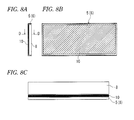
Figs. 8A to 8C , aninner fin 8 is housed in an interior of thetube 4 so as to be joined thereto to thereby increase a heat exchanging area so as to promote the heat exchange. - Patent Document 1:
JP-A-2010-243125 - It is effective to increase the volume of the
core portion 1 where the heat exchange is performed in order to enhance the cooling performance of the EGR cooler. However, the layout of parts in an engine compartment of the vehicle where the EGR cooler is installed is limited in many ways, and this has prevented the introduction of a large EGR cooler. Because of this, it has been considered to increase the ratio of the volume of thecore portion 1 to the whole volume of the EGR cooler by decreasing the ratio of the volumes of portions 14 (refer toFig. 2A ) such as the headers which do not contribute to the heat exchange. - However, in the conventional EGR cooler, as shown in
Fig. 7B , ajoint portion 15 where the header and the shell are joined together and ajoint portion 16 where the shell and the tube are joined together are formed, and the dimensions of thesejoint portions core portion 1 to the whole of the EGR cooler should be decreased as the EGR cooler is decreased in size, resulting in a problem that the cooling performance of the EGR cooler is decreased. - Further, in the EGR cooler, since both the gas flow paths and the cooling fluid flow path are pressurized, a certain degree of pressure resistance strength is required on the constituent components and the joint portions thereof. For example, in the
tubes 4, the pressure resistance strength is increased by housing theinner fin 8 in the interior thereof. - Additionally, in the
joint portion 15 where the header and the shell are joined together and thejoint portion 16 where the shell and the tube are joined together, the pressure resistance strength is ensured by overlapping the components to form a double-layer construction. However, since only theshell 7 exists between the twojoint portions thin tubes 4, the base material of the inlet header 2 (the outlet header 3), the base material of theshell 7 and thejoint portion 15 between the header and the shell are pulled to be broken by the deformation. In this conventional construction, since the pressure resistance strength has not been able to be increased without increasing the thicknesses of both theinlet header 2 or theoutlet header 3 and theshell 7, the material costs of theinlet header 2, theoutlet header 3 and theshell 7 have been increased. - Further, in the EGR cooer of
Patent Document 1, as shown inFigs. 8A and 8B , since theinner fin 8 is housed in and joined to thetube 4, abrazing material 10 is applied to a whole area of an inner surface of a flat plate portion of each of a tube inner 5 and a tube outer 6. However, as shown inFig. 8C , the thickness of thetube 4 is increased by the thickness of thebrazing material 10, resulting in a problem that a predetermined number oftubes 4 cannot be housed in the interior of theshell 7. - Since the brazing
material 10 is a paste which is a mixture of mineral powder and a liquid, it is difficult to control the thickness thereof. - Additionally, as shown in
Fig. 9 , in theconventional tubes 4, swollenportions tubes 4 to thereby form fluid flow paths of the cooling fluid therebetween. Thus, both the tube inner 5 and the tube outer 6 come to have a complex shape, which increases the working cost and the material cost thereof. - The invention has been made with a view to solving the problems, and an object thereof is to provide an EGR cooler which enhances not only the cooling performance thereof by increasing the ratio of the volume of a core portion but also the pressure resistance strength thereof.
- Another object of the invention is to provide an EGR cooler which can control the thickness of a tube which is increased by a brazing material which joins an inner surface of the tube and an inner fin together.
- A further object of the invention is to provide an EGR cooler which can reduce the production cost of the tube.
- In the invention, the problems described above will be solved by the following means.
- According to a first invention, there is provided an EGR cooler including: a core portion in which a plurality of tubes having a flat shape through which exhaust gases pass are stacked one on another in an interior of a hollow cylindrical shell to be joined to the shell, the core portion configured to heat exchange between the exhaust gases and a cooling fluid which flows around the tubes; an inlet header having a cylindrical shape and joined to an upstream side of the shell in relation to a gas flow at one end of the cylindrical inlet header, the inlet header configured to supply the exhaust gases into the core portion; and an outlet header having a cylindrical shape and joined to a downstream side of the core portion in relation to the gas flow at one end of the cylindrical outlet header, the outlet header configured to discharge the exhaust gases from the core portion, wherein the inlet header and the outlet header are joined to an outer surface of the shell, and the tubes are joined to an inner surface of the shell at those joint portions.
- According to a second invention, one of the tubes houses an inner fin having a corrugated shape, the inner fin configured to produce a turbulence of the exhaust gases, and the one of the tubes includes a bead, in which a brazing material that connects the one of the tubes with the inner fin is provided, as a groove formed in an inner surface of the one of the tubes.
- According to a third invention, one of the tubes is formed by combining a tube inner, in which internal walls are erected from both side edges of a flat plate portion, and a tube outer, in which external walls are erected from both side edges of a flat plate portion, and a swollen portion is formed at each longitudinal end of the flat plate portion of either of the tube inner and the tube outer, the swollen portion being swollen in a thickness direction and holding a space between an adjacent tube and the one of the tubes.
- According to the first invention, the inlet header and the outlet header are joined to the outer surface of the shell, and the tubes are joined to the inner surface of the shell at the joint portions, whereby the ratio of the volumes of the headers and the joint portions which do not contribute to heat exchange can be reduced, while the ratio of the volume of the core portion can be increased, thereby making it possible to enhance the cooling performance of the EGR cooler.
- In addition, the portion where only the shell having a poor pressure resistance exists is prevented from being provided between the joint portion between the shell and the inlet header (or the outlet header) and the joint portion between the shell and the tubes, and hence, the pressure resistance can be enhanced by the three-layer construction. Additionally, even when the pressure resistance is required to be increased by application conditions, the requirement of increasing the pressure resistance can be dealt with by increasing the thickness of only the inlet header or the outlet header, thereby making it possible to suppress the material cost.
- According to the second invention, the one of the tubes houses the inner fin having a corrugated shape, the inner fin configured to produce a turbulence of the exhaust gases, and the one of the tubes includes the bead, in which the brazing material that connects the one of the tubes with the inner fin is provided, as the groove formed in the inner surface of the one of the tubes. This can not only reduce the amount of a brazing material used to reduce, in turn, the material cost but also prevent an increase in thickness of the tube due to the brazing material, thereby making it possible to enhance the accuracy of the resulting product.
- According to the third invention, the one of the tubes is formed by combining the tube inner, in which internal walls are erected from both side edges of the flat plate portion, and the tube outer, in which external walls are erected from both side edges of the flat plate portion, and the swollen portion is formed at each longitudinal end of the flat plate portion of either of the tube inner and the tube outer, the swollen portion being swollen in a thickness direction and holding the space between the adjacent tube and the one of the tubes. This can reduce the total material cost and working cost which are needed to form the tube.
- In addition, also when there is a change in specification in relation to the height of the cooling fluid flow path (the space between the tubes), only the shape of either of the tube inner and the tube outer on which the swollen portions are provided (the height of the swollen portions) should be changed, and hence, the shape of the other on which no swollen portion is provided does not have to be changed, and the mold used before the specification change can continue to be used, thereby making it possible to reduce or save the mold cost.
-
-
Fig. 1 is a perspective view showing an EGR cooler according to an embodiment of the invention. -
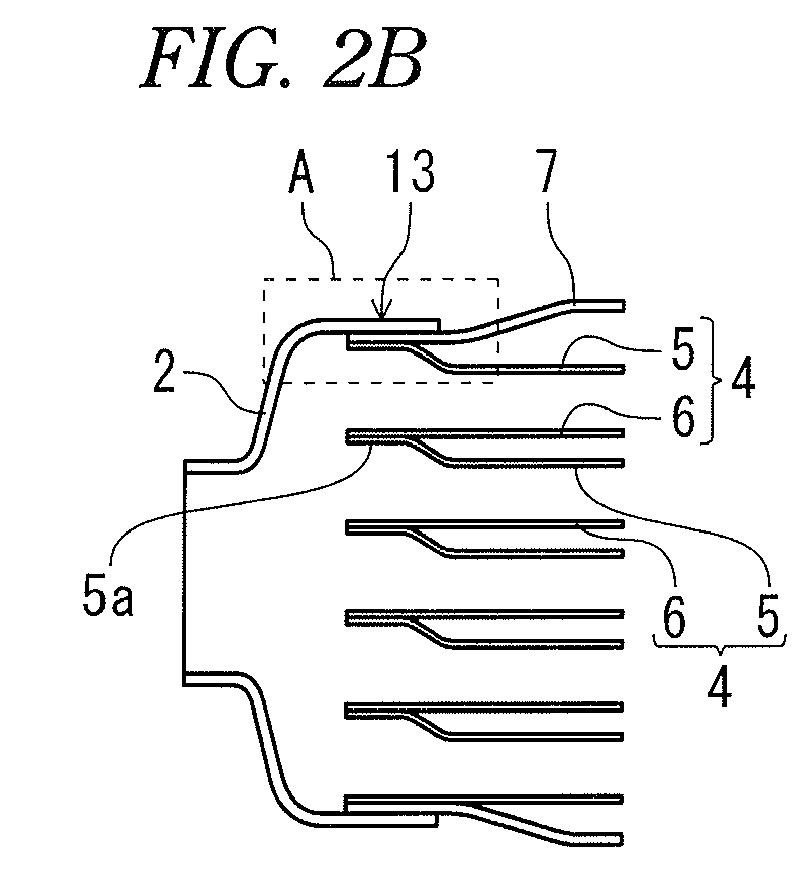
Fig. 2A is an explanatory sectional view of the EGR cooler,Fig. 2B is a partial enlarged view ofFig. 2A, and Fig. 2C is a partial enlarged view of a portion A inFig. 2B . -
Figs. 3A and 3B show a tube of the EGR cooler, in whichFig. 3A is a side view of the tube,Fig. 3B is an explanatory plan view of the EGR cooler, andFig. 3C is an explanatory sectional view taken along the line B-B inFig. 3A . -
Fig. 4 is an exploded perspective view showing the tube. -
Figs. 5A to 5D are explanatory plan views showing tubes of EGR coolers according to different embodiments. -
Figs. 6A and 6B are explanatory plan views showing tubes of EGR coolers according to different embodiments. -
Fig. 7A is a partially enlarged explanatory view of a conventional EGR cooler, andFig. 7B is an enlarged view of a portion C inFig. 7A . -
Figs. 8A to 8C show a tube of the conventional EGR cooler, in whichFig. 8A is a side view of the tube,Fig. 8B is an explanatory plan view of the tube, andFig. 8C is an explanatory sectional view taken along the line D-D inFig. 8A . -
Fig. 9 is an exploded enlarged perspective view showing the tube of the conventional EGR cooler. - Hereinafter, an EGR cooler according to an embodiment of the invention will be described.
- As shown in
Fig. 1 , in this EGR cooler, aninlet header 2, from which exhaust gases from an exhaust system (not shown) of an engine is introduced, and anoutlet header 3, from which the exhaust gases are discharged into an induction system (not shown) of the engine, are attached to both ends of acore portion 1 where a heat exchange is performed between the exhaust gases and a cooling fluid. - As shown in
Figs. 2A to 2C , in thiscore portion 1, a large number offlat tubes 4 through which exhaust gases pass are stacked one on another with a space defined therebetween and are housed in an angularlycylindrical shell 7 to be joined fixedly thereto. - As shown in
Figs. 2A to 2C and4 , thetube 4 is formed into a hollow flat tube which is made up of a combination of a tube inner 5 in which inner side walls are provided on both side edges of a flat plate portion which is substantially flat in such a way as to stand erect therefrom and a tube outer 6 in which outer side walls are provided on both side edges of a flat portion which is substantially flat in such a way as to stand erect therefrom so as to contact the inner side walls. - The tube inner 5 and the tube outer 6 are joined together through brazing.
- In this
tube 4, aswollen portion 5a is formed at each longitudinal end of the tube inner 5 in such a way that the flat plate portion is swollen in a thickness direction. Theswollen portion 5a and the other portion of the flat portion are connected by a slope. Because of this, when the large number oftubes 4 are stacked one on another, theswollen portions 5a are brought into abutment with theadjacent tube 4, whereby a predetermined space, which constitutes a cooling fluid flow path, is defined between thetubes 4 lying adjacent to each other. - On the other hand, no swollen portion is provided on the tube outer 6, and the flat portion is formed flat over the whole area of the flat plate portion along a longitudinal direction thereof (excluding a case where a
bead 9 is formed as will be described later). - As shown in
Figs. 1 and3A to 3C , a corrugatedinner fin 8 is housed in eachtube 4, whereby exhaust gases which pass through thetube 4 are dispersed, merged or snaked to be made turbulent. Additionally, a heat exchanging area between exhaust gases and a cooling fluid is increased by theinner fin 8, thereby promoting the heat exchange therebetween. - The
inner fin 8 is housed in thetube 4 and is joined to an inner surface of thetube 4 through brazing. - As shown in
Figs. 3A to 3C , a plurality oflinear beads 9 are provided on the flat portion of each of the tube inner 5 and the tube outer 6 so as to form a plurality of grooves in an inner surface of the flat portion, and as a whole, thelinear beads 9 constitute sides of two squares which contact each other at corresponding corners. - When joining the
inner fin 8 to thetube 4, abrazing material 10 is applied to the grooves formed as a result of the provision of thebeads 9 of the tube inner 5 and the tube outer 6. Following this, theinner fin 8 is set in a predetermined position, and the tube inner 5 and the tube outer 6 are combined together and are then heated to be brazed together via theinner fin 8. - As shown in
Fig. 1 , theshell 7 is made by joining together two U-shaped sheet materials and is formed into an angularly cylindrical shape having opening portions at both ends thereof so that the number ofplate tubes fluid inlet pipe 11 and a coolingfluid outlet pipe 12 are connected to a lower surface portion at an inlet side and an upper surface portion at an outlet side of theshell 7, respectively. - The
inlet header 2 which is attached to an upstream side of thecore portion 1 has aflange portion 2a which is connected to a piping (not shown) from the exhaust system of the engine and a downstream-side opening portion 2b having a large diameter which is joined to the shell of thecore portion 1. Theinlet header 2 is formed into a substantially angularly cylindrical shape which is expanded gradually in diameter towards the downstream-side opening portion 2b. - The
outlet header 3 which is attached to a downstream side of thecore portion 1 has an upstream-side opening portion 3a having a large diameter which is joined to theshell 7 of thecore portion 1 and aflange portion 3b which is connected to a piping (not shown) to an induction system of the engine. Theoutlet header 3 is formed into a substantially angularly cylindrical shape which is expanded gradually in diameter towards the upstream-side opening portion 3a. - As shown in
Figs. 2A to 2C , the downstream-side opening portion 2b of theinlet header 2 is formed larger in diameter than an upstream-side end portion of theshell 7 and is joined to an outer surface of theshell 7 at ajoint portion 13. - Similarly, the upstream-
side opening portion 3a of theoutlet header 3 is formed larger in diameter than a downstream-side end portion of theshell 7 and is joined to the outer surface of theshell 7 at ajoint portion 13. - On the other hand, the
tubes 4 which are stacked one on another are jointed to an inner surface of theshell 7 at thejoint portions 13, so that gas flow paths defined inside thetubes 4 and cooling fluid flow paths defined outside thetubes 4 are maintained in a gastight and fluid-tight fashion. - As shown in
Fig. 2C , the inlet header 2 (the outlet header 3) is extended further towards thecore portion 1 than the three-layerjoint portion 13 where the inlet header 2 (the outlet header 3), theshell 7 and thetubes 4 are joined together to project over a portion of theshell 7 which constitutes a wall surface of the cooling fluid flow path. - Additionally, as shown in
Fig. 2C , thetube 4 and theshell 7 have the same longitudinal length, and when assembling them together, longitudinal end faces of thetube 4 and theshell 7 are aligned with each other. Because of this, when assembling them together, thetube 4 and theshell 7 can easily be positioned in relation to each other by aligning the longitudinal end faces thereof with each other, which can enhance the productivity of EGR coolers. - In the EGR cooler configured in the way described above, the
tubes 4 which are stacked one on another are joined to the inner surface of theshell 7 at thejoint portions 13 where theinlet header 2 and theoutlet header 3 are joined to the outer surface of theshell 7, whereby longitudinal lengths ofportions 14 including theinlet header 2, theoutlet header 3, the joint portions between theheaders shell 7 and the joint portions between theshell 7 and thetubes 4 which do not contribute to heat exchange can be reduced to thereby increase the ratio of the volume of thecore portion 1 in the EGR cooler. Thus, it is possible to enhance the cooling performance per the volume so ensured of the EGR cooler. - In addition, the inlet header 2 (the outlet header 3) is joined to the outer surface of the
shell 7 and thetubes 4 are joined to the inner surface of theshell 7 at the same position (the joint portion 13) in relation to the longitudinal direction, whereby a three-layer construction is realized at thejoint portion 13. Thus, a portion where only theshell 7 having a poor pressure resistance exists is prevented from being provided between the joint portion between theshell 7 and the inlet header 2 (the outlet header 3) and the joint portion between theshell 7 and thetubes 4, thereby making it possible to enhance the pressure resistance by the three-layer construction. - Additionally, even when the pressure resistance is required to be increased by application conditions, the requirement of increasing the pressure resistance can be dealt with by increasing the thickness of only the inlet header or the outlet header, thereby making it possible to suppress the material cost.
- In addition, as shown in
Fig. 2C , at thejoint portion 13, the inlet header 2 (the outlet header 3) is extended further towards thecore portion 1 than the three-layerjoint portion 13 where the inlet header 2 (the outlet header 3), theshell 7 and thetubes 4 are joined together to project over a portion of theshell 7 which constitutes the wall surface of the cooling fluid flow path. Thus, the inlet header 2 (the outlet header 3) reinforces theshell 7 so as to enhance the pressure resistance against the cooling fluid. - Further, as shown in
Figs. 3A to 3C , thebeads 9 are provided on thetube 4 so as to form the grooves in the inner surface of thetube 4 as a result of the provision of the tube and theinner fin 8 so that thebrazing material 10 is laid out in the grooves, whereby the amount of brazingmaterial 10 to be used can be reduced to an amount of brazingmaterial 10 which is good enough to be laid out in the grooves formed as a result of the provision of thebeads 9, thereby making it possible to reduce the material cost. - In addition, the grooves, which are formed as a result of provision of the
beads 9, are filled with thebrazing material 10, which is a paste made up of a mixture of mineral powder and a liquid, by an application robot or the like to join thetube 4 and theinner fin 8. Thus, there is no such situation that thebrazing material 10 is accumulated on flat portions of thetube 4 other than the grooves resulting from the provision of thebeads 9 to thereby increase the thickness of thetube 4, and a predetermined number oftubes 4 can be housed in the interior of theshell 7. - Additionally, since the
beads 9 protrude from thetube 4 to the cooling fluid flow path (Fig. 3C ), it is possible to produce turbulence in the cooling fluid so as to promote the heat exchanging performance. - Further, as shown in
Fig. 4 , since the construction is adopted in which theswollen portions 5a are provided only on the tube inner 5 while no swollen portion is provided on the tube outer 6, it is possible to reduce the total material cost and working cost which are needed to form thetube 4. - It is noted that on the contrary to the embodiment, a construction may be adopted in which swollen portions are provided only on the tube outer 6 while no swollen portion is provided on the
tube inner 5. - In the embodiment described above, the
beads 9 are formed on both the tube inner 5 and the tube outer 6, however,beads 9 may be provided only on either of them. - In addition, in the embodiment above, the total of seven
beads 9, which are not connected to one another as shown inFig. 3B , are formed. However, in the event that all thebeads 9 are formed so as to continue to one another, the application robot can apply the brazing material continuously as in one continuous stroke to the grooves resulting from the provision of thebeads 9 in the fabrication process of thetube 4. This can reduce the number of working man-hours, which in turn enhances the productivity oftubes 4. - Additionally, there is imposed no specific limitation on the shape of a
bead 9 to be formed on thetube 4. - For example, in a different embodiment shown in
Fig. 5A , abead 9 is provided to extend on a flat plate portion of a tube inner 5 or a tube outer 6 in a longitudinal direction while snaking. - In another different embodiment shown in
Fig. 5B , abead 9 is provided to extend from a predetermined corner to a diagonal corner of a flat plate portion of a tube inner 5 or a tube outer 6 while snaking. In thebeads 9 shown inFigs. 5A and 5B , bends of the snakingbead 9 are radiused. - In the different embodiments shown in
Figs. 5A and 5B , since a single continuous groove resulting from the provision of thebead 9 is filled with a brazing material, in a fabrication process of atube 4, an application robot can apply the brazing material continuously to the groove resulting from the provision of thebead 9 as in one continuous stroke, whereby the number of working man-hours can be reduced, enhancing the productivity oftubes 4. - In addition, since the bends of the snaking
bead 9 are radiused, the application robot can apply the brazing material smoothly to the groove resulting from the provision of thebead 9 without involving a sharp turn, thereby making it possible to reduce the fabrication time. - In a further different embodiment shown in
Fig. 5C , abead 9 is provided to extend from a predetermined corner to a diagonal corner of a flat plate portion of a tube inner 5 or a tube outer 6 while snaking. - In a different embodiment shown in
Fig. 5D , abead 9 is provided to extend on a flat plate portion of a tube inner 5 or a tube outer 6 in a longitudinal direction while snaking. - In the
beads 9 ofFigs. 5C and 5D , bends of the snakingbead 9 is formed into a sharp angle. - Also, in the different embodiments in
Figs. 5C and 5D , since a single continuous groove resulting from the provision of thebead 9 is filled with a brazing material, in a fabrication process of atube 4, an application robot can apply the brazing material continuously to the groove resulting from the provision of thebead 9 as in one continuous stroke, whereby the number of working man-hours can be reduced, enhancing the productivity oftubes 4. - In addition, since the bends of the snaking
bead 9 are formed into the angle, the total area of the groove resulting from the provision of thebead 9 can be reduced compared with the embodiments ofFigs. 5A and 5B and the amount of brazingmaterial 10 to be used can be reduced, and thereby, the material cost can be reduced accordingly. - In a different embodiment shown in
Fig. 6A , abead 9a is provided to extend in a straight line from a corner P1 to a longitudinally central and transversely opposite side position P5 of a flat plate portion of a tube inner 5 or a tube outer 6 and is then turned at this P5 towards a corner P3 to extend to a position which is situated substantially halfway up to P3. Additionally, astraight bead 9b is provided to extend from P3 to a position which is situated substantially halfway down to P5. Abead 9a is also provided to extend in a straight line from a corner P6 which is a diagonal corner of P1 to a longitudinally central and transversely opposite side position P2 and is then turned at this P2 towards a corner P4 to extend to a position which is situated substantially halfway down to P4. Additionally, astraight bead 9b is provided to extend from P4 to a position which is situated substantially halfway up to P2. - In the different embodiment of
Fig. 6A , the two sets of thebeads beads bead 9a and abead 9b is formed by using a die for the one set of thebead 9a and thebead 9b. Following this, the tube inner 5 or the tube outer 6 is turned through 180 degrees, and the remaining set of abead 9a and abead 9b can be formed by the same die. Thus, the fabrication cost can be reduced. - In addition, in a case where a flat plate portion is surrounded by a single large bead which continues without an interruption, after pressing, a deformation tends to be produced easily in a tube inner 5 or a tube outer 6 by a difference in elongation between an inside and an outside of the bead or residual stress. However, in the different embodiment of
Fig. 6A , cuts are provided between the twobeads 9a so that the twobeads 9a do not continue to each other. This prevents a central portion of the flat plate portion from being surrounded by thebeads 9a completely, and therefore, it is difficult for distortion or deflection to be produced in the tube inner 5 or the tube outer 6, thereby enhancing the press moldability thereof. - In another different embodiment of
Fig. 6B , abead 9c is provided to extend in a longitudinal direction on a flat plate portion of a tube inner 5 or a tube outer 6 from a corner P7 to a corner P8 while snaking. Thisbead 9c is formed so as to turn at a transversely center of the flat plate portion. - A
bead 9c having the same shape is also provided to extend in the longitudinal direction from a diagonal corner P10 of P7 to a corner P9 while snaking. - In the different embodiment of
Fig. 6B , the pair ofbeads 9c are formed so that one constitutes a reversal of the other or vice versa. Because of this, in formingbeads 9c on the tube inner 5 or the tube outer 6 through pressing, onebead 9c is formed by using a die for thebead 9c. Following this, the tube inner 5 or the tube outer 6 is rotated through 180 degrees, and the remainingbead 9c can be formed by using the same die, thereby making it possible to reduce the fabrication cost. - In addition, in a case where a flat plate portion is surrounded by a single large bead which continues without an interruption, after pressing, a deformation tends to be produced easily in a tube inner 5 or a tube outer 6 by a difference in elongation between an inside and an outside of the bead or residual stress. However, in the different embodiment of
Fig. 6B , cuts are provided between the twobeads 9c so that the twobeads 9c do not continue to each other. This prevents a central portion of the flat plate portion from being surrounded by thebeads 9c completely, and therefore, it is difficult for distortion or deflection to be produced in the tube inner 5 or the tube outer 6, thereby enhancing the press moldability thereof. - While the invention has been described in detail and by reference to the specific embodiments, it is obvious to those skilled in the art to which the invention pertains that various alterations or modifications can be made thereto without departing from the spirit and scope of the invention.
- This patent application is based on Japanese Patent Application No.
2011-261316 filed on November 30, 2011 - 1: core portion; 2: inlet header; 2a: flange portion; 2b: downstream-side opening portion; 3: outlet header; 3a: upstream-side opening portion; 3b: flange portion; 4: tube; 5: tube inner; 5a: swollen portion; 6: tube outer; 6a: swollen portion; 7: shell; 8: inner fin; 9, 9a, 9b, 9c: bead; 10: brazing material; 11: cooling fluid inlet pipe; 12: cooling fluid outlet pipe; 13: joint portion; 14: portion not contributing to heat exchange; 15: joint portion (between a header and a shell); 16: joint portion (between a shell and a tube)
Claims (3)
- An EGR cooler comprising:a core portion in which a plurality of tubes having a flat shape through which exhaust gases pass are stacked one on another in an interior of a hollow cylindrical shell to be joined to the shell, the core portion configured to heat exchange between the exhaust gases and a cooling fluid which flows around the tubes;an inlet header having a cylindrical shape and joined to an upstream side of the shell in relation to a gas flow at one end of the cylindrical inlet header, the inlet header configured to supply the exhaust gases into the core portion; andan outlet header having a cylindrical shape and joined to a downstream side of the core portion in relation to the gas flow at one end of the cylindrical outlet header, the outlet header configured to discharge the exhaust gases from the core portion, whereinthe inlet header and the outlet header are joined to an outer surface of the shell, and the tubes are joined to an inner surface of the shell at those joint portions.
- An EGR cooler comprising:a core portion in which a plurality of tubes having a flat shape through which exhaust gases pass are stacked one on another in an interior of a hollow cylindrical shell to be joined to the shell, the core portion configured to heat exchange between the exhaust gases and a cooling fluid which flows around the tubes;an inlet header having a cylindrical shape and joined to an upstream side of the shell in relation to a gas flow at one end of the cylindrical inlet header, the inlet header configured to supply the exhaust gases into the core portion; andan outlet header having a cylindrical shape and joined to a downstream side of the core portion in relation to the gas flow at one end of the cylindrical outlet header, the outlet header configured to discharge the exhaust gases from the core portion; wherein:one of the tubes houses an inner fin having a corrugated shape, the inner fin configured to produce a turbulence of the exhaust gases; andthe one of the tubes includes a bead, in which a brazing material that connects the one of the tubes with the inner fin is provided, as a groove formed in an inner surface of the one of the tubes.
- An EGR cooler comprising:a core portion in which a plurality of tubes having a flat shape through which exhaust gases pass are stacked one on another in an interior of a hollow cylindrical shell to be joined to the shell, the core portion configured to heat exchange between the exhaust gases and a cooling fluid which flows around the tubes;an inlet header having a cylindrical shape and joined to an upstream side of the shell in relation to a gas flow at one end of the cylindrical inlet header, the inlet header configured to supply the exhaust gases into the core portion; andan outlet header having a cylindrical shape and joined to a downstream side of the core portion in relation to the gas flow at one end of the cylindrical outlet header, the outlet header configured to discharge the exhaust gases from the core portion, wherein:one of the tubes is formed by combining a tube inner, in which internal walls are erected from both side edges of a flat plate portion, and a tube outer, in which external walls are erected from both side edges of a flat plate portion; anda swollen portion is formed at each longitudinal end of the flat plate portion of either of the tube inner and the tube outer, the swollen portion being swollen in a thickness direction and holding a space between an adjacent tube and the one of the tubes.
Priority Applications (1)
| Application Number | Priority Date | Filing Date | Title |
|---|---|---|---|
| EP17185644.6A EP3273197A1 (en) | 2011-11-30 | 2012-11-22 | Egr cooler |
Applications Claiming Priority (2)
| Application Number | Priority Date | Filing Date | Title |
|---|---|---|---|
| JP2011261316A JP6109473B2 (en) | 2011-11-30 | 2011-11-30 | EGR cooler |
| PCT/JP2012/080386 WO2013080893A1 (en) | 2011-11-30 | 2012-11-22 | Egr cooler |
Related Child Applications (1)
| Application Number | Title | Priority Date | Filing Date |
|---|---|---|---|
| EP17185644.6A Division EP3273197A1 (en) | 2011-11-30 | 2012-11-22 | Egr cooler |
Publications (2)
| Publication Number | Publication Date |
|---|---|
| EP2787211A1 true EP2787211A1 (en) | 2014-10-08 |
| EP2787211A4 EP2787211A4 (en) | 2015-12-16 |
Family
ID=48535352
Family Applications (2)
| Application Number | Title | Priority Date | Filing Date |
|---|---|---|---|
| EP17185644.6A Ceased EP3273197A1 (en) | 2011-11-30 | 2012-11-22 | Egr cooler |
| EP12853489.8A Withdrawn EP2787211A4 (en) | 2011-11-30 | 2012-11-22 | EGR COOLER |
Family Applications Before (1)
| Application Number | Title | Priority Date | Filing Date |
|---|---|---|---|
| EP17185644.6A Ceased EP3273197A1 (en) | 2011-11-30 | 2012-11-22 | Egr cooler |
Country Status (6)
| Country | Link |
|---|---|
| US (1) | US9909475B2 (en) |
| EP (2) | EP3273197A1 (en) |
| JP (1) | JP6109473B2 (en) |
| CN (1) | CN103958876B (en) |
| MX (1) | MX354523B (en) |
| WO (1) | WO2013080893A1 (en) |
Cited By (2)
| Publication number | Priority date | Publication date | Assignee | Title |
|---|---|---|---|---|
| EP3441603A4 (en) * | 2016-04-06 | 2019-11-13 | Korens Co., Ltd. | GAS TUBE FOR EXHAUST GAS RECIRCULATION COOLER |
| EP3786564A1 (en) * | 2019-09-02 | 2021-03-03 | Valeo Termico S.A. | Connection assembly for a heat exchanger |
Families Citing this family (6)
| Publication number | Priority date | Publication date | Assignee | Title |
|---|---|---|---|---|
| WO2017073779A1 (en) * | 2015-10-29 | 2017-05-04 | 株式会社ティラド | Structure of heat exchanger core without header plate |
| JP6834929B2 (en) * | 2017-12-14 | 2021-02-24 | トヨタ自動車株式会社 | EGR cooler |
| US20200166293A1 (en) * | 2018-11-27 | 2020-05-28 | Hamilton Sundstrand Corporation | Weaved cross-flow heat exchanger and method of forming a heat exchanger |
| KR20200124582A (en) * | 2019-04-24 | 2020-11-03 | 현대자동차주식회사 | Cooler for exhaust gas recirculation |
| DE102020104538A1 (en) * | 2020-02-20 | 2021-08-26 | Faurecia Emissions Control Technologies, Germany Gmbh | Heat exchanger housing and method of manufacturing a heat exchanger |
| JP7773887B2 (en) * | 2021-11-11 | 2025-11-20 | 株式会社ティラド | Header plateless heat exchanger |
Family Cites Families (15)
| Publication number | Priority date | Publication date | Assignee | Title |
|---|---|---|---|---|
| US1993872A (en) * | 1932-04-06 | 1935-03-12 | Gen Motors Corp | Radiator core |
| JPH01254377A (en) * | 1988-04-05 | 1989-10-11 | Furukawa Alum Co Ltd | Manufacture of heat exchanger |
| JP2000161888A (en) * | 1998-12-01 | 2000-06-16 | Sanden Corp | Heat exchanger |
| DE10060006A1 (en) * | 2000-12-02 | 2002-06-13 | Modine Mfg Co | Vehicle refrigerator; has block with ribs arranged between flat pipes, where flat pipes open into opposite collecting guiding tanks and have bent separated sections connected to adjacent flat pipes |
| JP2001336885A (en) * | 2000-05-29 | 2001-12-07 | Mitsubishi Heavy Ind Ltd | Heat exchanger |
| JP5250924B2 (en) * | 2001-07-16 | 2013-07-31 | 株式会社デンソー | Exhaust heat exchanger |
| JP2003287382A (en) * | 2002-03-27 | 2003-10-10 | Calsonic Kansei Corp | Multilayer heat exchanger |
| NL1020483C1 (en) * | 2002-04-26 | 2003-10-28 | Oxycell Holding Bv | Heat exchanger and method for manufacturing thereof. |
| CA2503424A1 (en) * | 2005-04-01 | 2006-10-01 | Dana Canada Corporation | Stacked-tube heat exchanger |
| US8002022B2 (en) * | 2005-09-16 | 2011-08-23 | Behr Gmbh & Co. Kg | Heat exchanger, in particular exhaust gas heat exchanger for motor vehicles |
| JP2009019580A (en) * | 2007-07-12 | 2009-01-29 | T Rad Co Ltd | EGR cooler |
| US7913750B2 (en) * | 2008-01-09 | 2011-03-29 | Delphi Technologies, Inc. | Louvered air center with vortex generating extensions for compact heat exchanger |
| JP4773541B2 (en) * | 2009-04-09 | 2011-09-14 | マルヤス工業株式会社 | Multi-tube heat exchanger |
| JP5321271B2 (en) | 2009-06-17 | 2013-10-23 | 株式会社デンソー | Heat exchanger for high temperature gas cooling |
| JP2012137251A (en) * | 2010-12-27 | 2012-07-19 | Maruyasu Industries Co Ltd | Multitubular heat exchanger |
-
2011
- 2011-11-30 JP JP2011261316A patent/JP6109473B2/en active Active
-
2012
- 2012-11-22 MX MX2014006546A patent/MX354523B/en active IP Right Grant
- 2012-11-22 EP EP17185644.6A patent/EP3273197A1/en not_active Ceased
- 2012-11-22 CN CN201280058567.3A patent/CN103958876B/en active Active
- 2012-11-22 US US14/361,872 patent/US9909475B2/en active Active
- 2012-11-22 WO PCT/JP2012/080386 patent/WO2013080893A1/en not_active Ceased
- 2012-11-22 EP EP12853489.8A patent/EP2787211A4/en not_active Withdrawn
Cited By (2)
| Publication number | Priority date | Publication date | Assignee | Title |
|---|---|---|---|---|
| EP3441603A4 (en) * | 2016-04-06 | 2019-11-13 | Korens Co., Ltd. | GAS TUBE FOR EXHAUST GAS RECIRCULATION COOLER |
| EP3786564A1 (en) * | 2019-09-02 | 2021-03-03 | Valeo Termico S.A. | Connection assembly for a heat exchanger |
Also Published As
| Publication number | Publication date |
|---|---|
| WO2013080893A1 (en) | 2013-06-06 |
| JP2013113243A (en) | 2013-06-10 |
| US20140318109A1 (en) | 2014-10-30 |
| MX354523B (en) | 2018-03-08 |
| EP2787211A4 (en) | 2015-12-16 |
| JP6109473B2 (en) | 2017-04-05 |
| EP3273197A1 (en) | 2018-01-24 |
| CN103958876B (en) | 2016-12-14 |
| CN103958876A (en) | 2014-07-30 |
| MX2014006546A (en) | 2014-10-24 |
| US9909475B2 (en) | 2018-03-06 |
Similar Documents
| Publication | Publication Date | Title |
|---|---|---|
| US9909475B2 (en) | EGR cooler | |
| MX2014006544A (en) | Inner fin. | |
| JP6199809B2 (en) | Heat exchanger and its housing | |
| US7195060B2 (en) | Stacked-tube heat exchanger | |
| US7984753B2 (en) | Heat exchanger | |
| KR100809514B1 (en) | Fin structure, heat-transfer tube having the fin structure housed therein, and heat exchanger having the heat-transfer tube assembled therein | |
| CN103403488B (en) | There is the coaxial gas-liquid heat exchanger of thermal expansion connector | |
| US10317143B2 (en) | Heat exchanger and method of making the same | |
| CN101184972A (en) | stacked tube heat exchanger | |
| JP7479202B2 (en) | Heat exchanger | |
| US7967032B2 (en) | Entrance/exit piping structure for intercooler and intercooler | |
| US20140131022A1 (en) | Heat exchanger utilizing tubular structures having internal flow altering members and external chamber assemblies | |
| JP2008145024A (en) | Manufacturing method of flat heat transfer tube, flat heat transfer tube obtained by method, and gas cooling device incorporating flat heat transfer tube | |
| CN100520267C (en) | Tube profiles for heat exchanger | |
| US20070000652A1 (en) | Heat exchanger with dimpled tube surfaces | |
| JP2008008574A (en) | Heat exchanger | |
| JP2017101904A (en) | Fin for heat exchanger | |
| JP6463993B2 (en) | Tube for heat exchanger | |
| JP2006017442A (en) | Heat exchanger | |
| CN102753929A (en) | Heat exchanger | |
| JP2007147173A (en) | Heat exchanger and its manufacturing method | |
| JP2008128600A (en) | Fin structure, its manufacturing method, and heat transfer tube using the fin structure | |
| JP2007064515A (en) | Flat heat transfer tube for heat exchanger, and its manufacturing method | |
| CN205383917U (en) | Water -cooled heat exchanger and riveting board thereof | |
| CN106884747A (en) | A kind of cooler for recycled exhaust gas |
Legal Events
| Date | Code | Title | Description |
|---|---|---|---|
| PUAI | Public reference made under article 153(3) epc to a published international application that has entered the european phase |
Free format text: ORIGINAL CODE: 0009012 |
|
| 17P | Request for examination filed |
Effective date: 20140527 |
|
| AK | Designated contracting states |
Kind code of ref document: A1 Designated state(s): AL AT BE BG CH CY CZ DE DK EE ES FI FR GB GR HR HU IE IS IT LI LT LU LV MC MK MT NL NO PL PT RO RS SE SI SK SM TR |
|
| DAX | Request for extension of the european patent (deleted) | ||
| RIC1 | Information provided on ipc code assigned before grant |
Ipc: F28D 9/00 20060101ALI20150723BHEP Ipc: F28F 9/02 20060101ALI20150723BHEP Ipc: F28D 21/00 20060101ALI20150723BHEP Ipc: F28F 1/00 20060101ALI20150723BHEP Ipc: F28F 9/18 20060101ALI20150723BHEP Ipc: F28F 3/10 20060101ALI20150723BHEP Ipc: F02M 25/07 20060101AFI20150723BHEP Ipc: F28F 9/00 20060101ALI20150723BHEP Ipc: F28F 3/08 20060101ALI20150723BHEP |
|
| RA4 | Supplementary search report drawn up and despatched (corrected) |
Effective date: 20151113 |
|
| RIC1 | Information provided on ipc code assigned before grant |
Ipc: F28F 1/00 20060101ALI20151109BHEP Ipc: F28D 21/00 20060101ALI20151109BHEP Ipc: F28F 3/08 20060101ALI20151109BHEP Ipc: F28F 9/18 20060101ALI20151109BHEP Ipc: F02M 25/07 20060101AFI20151109BHEP Ipc: F28F 9/02 20060101ALI20151109BHEP Ipc: F28D 9/00 20060101ALI20151109BHEP Ipc: F28F 3/10 20060101ALI20151109BHEP Ipc: F28F 9/00 20060101ALI20151109BHEP |
|
| 17Q | First examination report despatched |
Effective date: 20170331 |
|
| STAA | Information on the status of an ep patent application or granted ep patent |
Free format text: STATUS: THE APPLICATION IS DEEMED TO BE WITHDRAWN |
|
| 18D | Application deemed to be withdrawn |
Effective date: 20171011 |