EP2785474B1 - Elimination des produits de protection des semences par l'utilisation de l'ozone - Google Patents
Elimination des produits de protection des semences par l'utilisation de l'ozone Download PDFInfo
- Publication number
- EP2785474B1 EP2785474B1 EP12806576.0A EP12806576A EP2785474B1 EP 2785474 B1 EP2785474 B1 EP 2785474B1 EP 12806576 A EP12806576 A EP 12806576A EP 2785474 B1 EP2785474 B1 EP 2785474B1
- Authority
- EP
- European Patent Office
- Prior art keywords
- seeds
- ozone
- ntp
- treated
- contaminated
- Prior art date
- Legal status (The legal status is an assumption and is not a legal conclusion. Google has not performed a legal analysis and makes no representation as to the accuracy of the status listed.)
- Active
Links
Images

Classifications
-
- B—PERFORMING OPERATIONS; TRANSPORTING
- B09—DISPOSAL OF SOLID WASTE; RECLAMATION OF CONTAMINATED SOIL
- B09B—DISPOSAL OF SOLID WASTE NOT OTHERWISE PROVIDED FOR
- B09B3/00—Destroying solid waste or transforming solid waste into something useful or harmless
- B09B3/60—Biochemical treatment, e.g. by using enzymes
- B09B3/65—Anaerobic treatment
-
- B—PERFORMING OPERATIONS; TRANSPORTING
- B09—DISPOSAL OF SOLID WASTE; RECLAMATION OF CONTAMINATED SOIL
- B09B—DISPOSAL OF SOLID WASTE NOT OTHERWISE PROVIDED FOR
- B09B3/00—Destroying solid waste or transforming solid waste into something useful or harmless
- B09B3/70—Chemical treatment, e.g. pH adjustment or oxidation
-
- Y—GENERAL TAGGING OF NEW TECHNOLOGICAL DEVELOPMENTS; GENERAL TAGGING OF CROSS-SECTIONAL TECHNOLOGIES SPANNING OVER SEVERAL SECTIONS OF THE IPC; TECHNICAL SUBJECTS COVERED BY FORMER USPC CROSS-REFERENCE ART COLLECTIONS [XRACs] AND DIGESTS
- Y02—TECHNOLOGIES OR APPLICATIONS FOR MITIGATION OR ADAPTATION AGAINST CLIMATE CHANGE
- Y02E—REDUCTION OF GREENHOUSE GAS [GHG] EMISSIONS, RELATED TO ENERGY GENERATION, TRANSMISSION OR DISTRIBUTION
- Y02E50/00—Technologies for the production of fuel of non-fossil origin
- Y02E50/30—Fuel from waste, e.g. synthetic alcohol or diesel
Definitions
- the present invention relates to a process for the use of this reactive gas in order to eliminate seed protection products deemed to be downgraded, usually destroyed by incineration in cement kilns.
- incineration to dispose of decommissioned seeds has a significant economic cost (overall cost including actual disposal as well as logistics and transportation costs). To date, this cost is on average 80 to 100 € / ton of seeds eliminated by incineration. This approach obviously does not allow any subsequent recovery of these decommissioned seeds.
- the patent application WO 01/43556 describes an ozone treatment used to decontaminate grains of wheat or cereals before grinding.
- the main application of this patent application relates to wheat so that after this treatment and after milling, the flours obtained have a high level of food safety.
- the purpose of this patent application is first of all the elimination of contaminants of biological origin, both the microorganisms and the toxic products derived therefrom, for example mycotoxins. It is mentioned that ozone reduces the level of chlorpyrifosmethyl, a pesticide with a half-life in the soil of about 18 days.
- the patent application WO 2004/089078 discloses a method of treating grains at a temperature of at least 95 ° C by a combination of water vapor and microwaves, with further application of ozone.
- the at least one residual phytosanitary molecule (s) removed has a half-life time in the soil under aerobic conditions of at least 1 month, preferably at least one month. at least 2 months.
- the phytosanitary molecule (s) remanent comprises at least one listed in Table I below.
- the present publication also relates to the use of seeds treated according to the method of the invention in the preparation of biogas by fermentation.
- Seed treatment is an essential treatment to fight against seed-borne diseases and to protect the young plants that come from it against parasites naturally present in the soil. This treatment also provides protection against early attacks of diseases and pests in vegetation.
- the choice of the active substance or substances takes into account the sanitary analyzes of the raw batches of seeds arriving at the packing stations (and therefore any existing diseases which vary from one year to year and level of contamination) and the type of protection sought.
- Effective seed protection requires the application of a uniform quantity of active ingredients that are adapted to the various diseases and pests (contact products, systemic products, etc.) in a uniform way over the seed surface. If the surface of the seed (whatever its anatomical structure) is not entirely covered by the products, it is the protection that suffers and the door open to diseases.
- the treatment products used are effective at reduced doses: 2 to 4 liters of active substances per tonne of seed.
- a seed treatment product is the combination of one or more active substances and so-called “chemically inert” formulants. It is subject to authorization before it is placed on the market and follows very strict regulatory requirements. The regulations are intended to ensure the safety of the product vis-à-vis the user, the consumer and the environment under the recommended conditions of use.
- the application of the treatment product on the seed is generally carried out in a so-called spray chamber.
- the seed, arriving in this spraying chamber forms a cylinder consisting of grains inside which the liquid cup projects, by means of the centrifugal force, the treatment product.
- the following mixer brews the seeds with a rotary motion. Under these operating conditions, it completes the coating and fixing the product on the seed.
- the phytosanitary products mentioned in Table I are little degraded in the natural environment.
- the half-life times in the soil under aerobic conditions are relatively long.
- soil half-life values listed in the literature are: imidacloprid 180 days; mefenoxam 60 days; thiamethoxam 229 days; methiocarb 64 days; clothianidin 214 days.
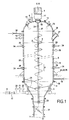
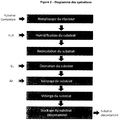
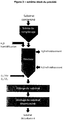
- the treatment of the decommissioned seeds treated with ozone implements a process ( figures 2 and 3 ) and means (reactor ( figure 1 ) of vertical type with internal recirculation as shown schematically in the figure 1 ).
- the seeds Prior to the treatment, at the beginning of the operation, after introduction into the reactor (1), the seeds can be moistened by spraying water, which water is sprayed into fine droplets by the device (2). In the first phase of the treatment, the water that has been sprayed on the moving seed mass (screw (4) in operation). The individualized seeds are coated at their periphery with a homogeneous liquid film making it possible to improve the transfer of ozone towards the structure to be treated (see the explanations given in the following paragraphs).
- the ozone is admitted into the reactor by device (3) and the chemical reactions between this gas and the structures to be treated can be greatly facilitated by the presence of the liquid film, which liquid film channels the molecules of reactive gas. to the structure to be treated.
- the main non-limiting advantage of the presence of the liquid film is to increase the accessibility of the ozonated gas to the phytosanitary molecules (ie active ingredients) present at the periphery of the seeds.
- curve 1 the representation of the mass of water expressed as a percentage of the dry matter in reaction (water added by spraying) is shown as a function of the percentage of ozone transferred to the substrate to be treated.
- Curve 2 represents the thickness of the liquid film deposited on the substrate and expressed in ⁇ m, after spraying and homogenization of the mass by recirculation using the central screw as a function of the percentage of ozone transferred to the substrate to be treated.
- the thickness of the liquid film can be approximated by the calculation by those skilled in the art from the significant data that are: the mass of added water expressed as a percentage of the mass of dry matter, the weight of 1000 grains ( average statistical value) as well as the average surface area developed per 1000 grains.
- the thickness of the liquid film that covers the substrates (seeds) to be treated will be between 1 micron and 6 microns.
- the seed mass previously set in motion by means of a central worm (4) travels through the reaction zone, with a counter-current downward movement.
- the flow of ozonated gas is injected into the reactor at the bottom by the device (5).
- This flow of gas which can be indifferently the oxygen of the air, the pure oxygen or a mixture in variable proportion of the two passes through the device (5), and is injected inside the reactor by ozone injectors identified (7 and 3).
- the ozonated gas crosses in an upward movement the mass of seeds, itself animated by a downward movement as described above.
- the operation of contacting the ozone and seeds to be treated is advantageously in a reactor that works according to the gas / solid counter current principle.
- the ozone residual present in the reactor can be discharged in the upper part thereof by the device identified (6) and directed to a thermal destruction of the residual ozone. After thermal destruction of the residual ozone present after reaction, the latter is converted into oxygen which is discharged into the atmosphere.
- Soft winter wheat alone accounts for 38% of seed produced and about 40% of declassed seed volumes to be eliminated annually in France.
- Corn, another cereal but with a very different chemical composition and cellular structure accounts for 22% of seed produced and about 24% of decommissioned seed volumes.
- rapeseed represents a strategic oilseed production because of its massive use in non-food recovery (eg biofuels).
- the rapeseed model provides access to a seed of geometry (structure and specific surface) and initial chemical composition very different from that of a cereal (very rich in fatty acids).
- a summary table presents all the results obtained and the operating conditions used for the ozone treatment of each of the ten pesticide molecules.
- Tables II (a, b, c) ⁇ / b> Optimal treatment conditions obtained by the applicant IIa Active phytosanitary molecules Model Soft Winter Wheat (BTH)
- Witness * (g / kg)
- IIb Corn model Active phytosanitary molecules
- Witness * (g / kg)
- TPN values are normal temperature and pressure values.
- the seeds are generally in a low moisture form (6-13% w / w).
- Prior humidification of the substrate coated with plant protection products before contact with ozone is a potentially important parameter of the process which can influence both the reaction rate, the penetration of ozone into the substrate, and on the rate of elimination of the phytosanitary molecule.
- This humidification can be expressed as a percentage by mass (M / M) of the initial mass of substrate to be treated.
- the amount of water introduced in step (b) is preferably at least 2% and at most 10% by weight relative to the mass of seeds to be treated.
- the humidification operation is preferably carried out using water from the network deemed to be potable by the device identified (2).
- the mass of water necessary for humidification can advantageously be sprayed inside the reactor by one or more nozzles LECHLER spray type (2) or the like, the spray angle being between 30 ° and 90 °, preferably 60 °.
- the central screw of the reactor (4) can advantageously be set in motion to ensure an interface renewal and ensure homogenization of the liquid film.
- the appropriate rotational speed of the central screw is highly dependent on the nature of the substrate, its particle size distribution and the master torque exhibited by the substrate.
- This rotational speed is adjustable by means of a frequency converter of the electric current supplying the drive motor of the central screw marked (4).
- This rotational speed is also dependent on the diameter of the used reactor identified (D). It is generally between 25 rpm and 110 rpm, preferably around 65 rpm.
- the pitch of the central screw marked (X), which determines the rate of recirculation of the substrate mass under treatment, is dependent on the diameter of the central screw (Y) and the geometry of the substrate (particle size distribution and master torque presented by the seeds to be treated).
- the rate of recirculation of the substrate mass during treatment is generally between 5 and 70 recirculations / minute, preferably between 15 and 20 recirculations / minute.
- the quantity of ozone necessary for the removal of the phytosanitary molecules fixed on the surface of the substrate can be produced in situ by an industrial-type ozone generator fed, either in air or in pure oxygen gas, either by a mixture of variable amounts of the two gases.
- the carrier gas used will advantageously be atmospheric air, filtered, dried to a dew point of the order of -70 ° C to - 75 ° C.
- gaseous oxygen will be advantageously used, gaseous oxygen from the controlled evaporation of liquid oxygen stored in tanks specially designed for this purpose.
- the gaseous oxygen will have a dew point of the order of -85 ° C minimum, and will achieve an ozone concentration in this carrier gas of the order of 200 gm -3 TPN.
- the ozone can be introduced at the base of the reactor by a ring of spotted injection nozzles (7) whose implantation diameter is very dependent on the reactor diameter, its position on the lower cone of the reactor, the geometry the substrate to be treated, and the height of the substrate layer to be treated itself defining the total transfer height (HTT) of the reactor.
- HTT total transfer height
- the speed of ejection of the ozonated gas by the identified injection nozzles (3) is a parameter which can have a great influence on the operation of the reactor. This speed can be calculated according to the particle size distribution of the substrate to be treated, the HTT and the diameter of the reactor. This ejection speed will generally be between 15 ms -1 and 50 ms -1 , preferably between 20 ms -1 and 30 ms -1 .
- the inside of the reactor may advantageously be provided with a marked internal washing device (20) consisting of washing balls known to those skilled in the art and supplied with water under pressure (34).
- a marked internal washing device (20) consisting of washing balls known to those skilled in the art and supplied with water under pressure (34).
- the upper part of the reactor (convex bottom) (16) comprises various safety devices and in particular a calibrated safety valve (13) and a rupture disc (14).
- a residual ozone outlet (6) removes residual ozone to the thermal destruction of ozone.
- the upper domed bottom comprises, fixed on flanges, the electric motor / geared motor assembly (17) mounted on a centering device with mechanical seals (18).
- a removable coupling (21) allows coupling of the gearmotor (17) to the central recirculation screw (4).
- the cylindrical shell of the reactor has different connections on which are mounted temperature sensors (10, 12 and 22), pressure sensors (11 and 23), washing water washing-up devices (20). ).
- the reactor shell also includes reactor support devices (24, 25 and 26) disposed on the reactor diameter at 120 °.
- the ferrule also has in the upper part an incoming material to be treated (27), a high level sensor (28).
- the cylindrical shell is closed by a conical portion (9) whose angle is specified in the preceding paragraphs.
- This low cone is followed by a cylindrical portion allowing the release of the screw and comprises in its central part a centering device and guiding the screw (29) and a shutter valve and drain (30) and a coupling flange to the method (31).
- the exit port of treated material is identified (32).
- the excess residual ozone can be discharged in the upper part of the reactor (6) and directed to destruction of residual ozone of the thermal type with or without energy recovery depending on the size of the installation.
- the oxygen resulting from this destruction can be evacuated to the atmosphere.
- the pressure inside the reactor is advantageously between 0.05 bar and 0.3 bar, preferably around 0.16 bar relative; which in terms of absolute pressure means 0.05 bar above atmospheric pressure.
- the seed contacting reaction with ozone is preferably carried out around the laboratory ambient temperature, most often at around 20 ° C.
- the temperature of the chemical reaction ozone on phytosanitary molecules being only very slightly exothermic (5 ° C ⁇ temperature ⁇ 12 ° C), depending on the molecule (s) to be treated, the reaction of destruction occurs naturally around ambient temperature, that is to say around 20 ° C, helped by the cooling provided on the reactor (presence of a water jacket).
- the reaction temperature zone is therefore preferably defined as follows: 10 ° C ⁇ reaction temperature ⁇ 32 ° C, preferably 17 ° C ⁇ reaction temperature ⁇ 25 ° C.
- the seed treatment reactor is not subjected to any heating method, for example by means of a contact with a fluid (liquid or gas) brought to a temperature. temperature above ambient temperature. No seed heating before, during or after contact with ozone is necessary to decontaminate the seeds according to the present invention.
- the seeds to be treated are not subjected to radiation (for example: ultraviolet, infrared, microwave). Radiation treatment before, during or after contact with ozone is necessary to decontaminate the seeds according to the present invention.
- reaction time is dependent on the kinetics of elimination by ozone of phytosanitary molecules. Each molecule corresponds to a particular kinetics; which will be dependent on the ozone concentration used.
- a suitable reaction time is generally between 30 minutes and at most 100 minutes, preferably at least 40 minutes and at most 90 minutes, and more preferably between 40 and 60 minutes. .
- the reactor used will suitably be of gas / solid type with internal recirculation. It may be in the form of a cylindrical shell (8) closed at the bottom by a conical portion, as already described.
- the cylindrical shell may advantageously comprise a double jacket of WATER JACKET type (15) to ensure continuous cooling of the reactor and the control of thermal flows generated by certain exothermic type reactions. The cooling is then done by circulation of cooled water or by a cooled refrigerant introduced in the WATER JACKET through the orifice (19) and recovered at the outlet of WATER JACKET through the orifice marked (35).
- This WATER JACKET may include devices channeling the flow of water or refrigerant so that the setting speed and turbulence of these fluids is optimal for effective cooling.
- the figures 2 and 3 present global diagrams of a preferred mode of the process according to the invention.
Landscapes
- Chemical & Material Sciences (AREA)
- Chemical Kinetics & Catalysis (AREA)
- General Chemical & Material Sciences (AREA)
- Engineering & Computer Science (AREA)
- Environmental & Geological Engineering (AREA)
- Health & Medical Sciences (AREA)
- General Health & Medical Sciences (AREA)
- Toxicology (AREA)
- Life Sciences & Earth Sciences (AREA)
- Biochemistry (AREA)
- Pretreatment Of Seeds And Plants (AREA)
- Storage Of Fruits Or Vegetables (AREA)
Priority Applications (1)
| Application Number | Priority Date | Filing Date | Title |
|---|---|---|---|
| PL12806576T PL2785474T3 (pl) | 2011-11-30 | 2012-11-27 | Usuwanie materiałów zabezpieczających nasiona przez zastosowanie ozonu |
Applications Claiming Priority (2)
| Application Number | Priority Date | Filing Date | Title |
|---|---|---|---|
| FR1160986A FR2983094B1 (fr) | 2011-11-30 | 2011-11-30 | Elimination des produits de protection des semences par l'utilisation de l'ozone |
| PCT/FR2012/052726 WO2013079862A2 (fr) | 2011-11-30 | 2012-11-27 | Elimination des produits de protection des semences par l'utilisation de l'ozone |
Publications (2)
| Publication Number | Publication Date |
|---|---|
| EP2785474A2 EP2785474A2 (fr) | 2014-10-08 |
| EP2785474B1 true EP2785474B1 (fr) | 2018-11-07 |
Family
ID=47436073
Family Applications (1)
| Application Number | Title | Priority Date | Filing Date |
|---|---|---|---|
| EP12806576.0A Active EP2785474B1 (fr) | 2011-11-30 | 2012-11-27 | Elimination des produits de protection des semences par l'utilisation de l'ozone |
Country Status (8)
| Country | Link |
|---|---|
| EP (1) | EP2785474B1 (pl) |
| AR (1) | AR089018A1 (pl) |
| BR (1) | BR112014013162B1 (pl) |
| ES (1) | ES2707279T3 (pl) |
| FR (1) | FR2983094B1 (pl) |
| HU (1) | HUE042201T2 (pl) |
| PL (1) | PL2785474T3 (pl) |
| WO (1) | WO2013079862A2 (pl) |
Cited By (1)
| Publication number | Priority date | Publication date | Assignee | Title |
|---|---|---|---|---|
| WO2025195566A1 (en) * | 2024-03-20 | 2025-09-25 | Indra Holding Aps | An ozone decontamination plant and a method for decontaminating kernels |
Families Citing this family (3)
| Publication number | Priority date | Publication date | Assignee | Title |
|---|---|---|---|---|
| DE102016218051A1 (de) | 2016-09-20 | 2018-03-22 | bioenergy concept GmbH | Behälter und Biogasanlage |
| GB2557282B (en) * | 2016-12-02 | 2019-06-05 | Avocet Ip Ltd | Method of growing seeds |
| GB2615288B (en) | 2021-08-13 | 2024-01-31 | O3Biotech Ltd | Oxidising system |
Family Cites Families (5)
| Publication number | Priority date | Publication date | Assignee | Title |
|---|---|---|---|---|
| FR2710812B1 (fr) | 1993-10-04 | 1995-12-29 | Goemar Lab Sa | Procédé et installation pour le traitement des semences et des bulbes. |
| FR2802390B1 (fr) | 1999-12-17 | 2003-01-17 | Green Technologies Sarl | Procede et installation pour la fabrication de farines presentant un haut niveau de securite alimentaire |
| CA2425029A1 (en) * | 2003-04-10 | 2004-10-10 | Peter Klaptchuk | Apparatus and method for microwave treatment of organic matter |
| UA69307C2 (en) * | 2003-12-25 | 2006-02-15 | Olena Oleksandrivna Bobrova | A method for producing the activated coal |
| DE102008046615A1 (de) * | 2008-03-18 | 2009-09-24 | APFELBÖCK, Markus | Verfahren und Vorrichtung zur Erzeugung von Biogas sowie Hydrolyseeinrichtung |
-
2011
- 2011-11-30 FR FR1160986A patent/FR2983094B1/fr not_active Expired - Fee Related
-
2012
- 2012-11-27 BR BR112014013162-7A patent/BR112014013162B1/pt active IP Right Grant
- 2012-11-27 WO PCT/FR2012/052726 patent/WO2013079862A2/fr not_active Ceased
- 2012-11-27 EP EP12806576.0A patent/EP2785474B1/fr active Active
- 2012-11-27 ES ES12806576T patent/ES2707279T3/es active Active
- 2012-11-27 PL PL12806576T patent/PL2785474T3/pl unknown
- 2012-11-27 HU HUE12806576A patent/HUE042201T2/hu unknown
- 2012-11-29 AR ARP120104472A patent/AR089018A1/es active IP Right Grant
Non-Patent Citations (1)
| Title |
|---|
| None * |
Cited By (1)
| Publication number | Priority date | Publication date | Assignee | Title |
|---|---|---|---|---|
| WO2025195566A1 (en) * | 2024-03-20 | 2025-09-25 | Indra Holding Aps | An ozone decontamination plant and a method for decontaminating kernels |
Also Published As
| Publication number | Publication date |
|---|---|
| WO2013079862A3 (fr) | 2013-12-19 |
| BR112014013162A8 (pt) | 2019-01-22 |
| EP2785474A2 (fr) | 2014-10-08 |
| WO2013079862A2 (fr) | 2013-06-06 |
| FR2983094A1 (fr) | 2013-05-31 |
| PL2785474T3 (pl) | 2019-04-30 |
| BR112014013162A2 (pt) | 2017-06-13 |
| BR112014013162B1 (pt) | 2021-09-08 |
| ES2707279T3 (es) | 2019-04-03 |
| AR089018A1 (es) | 2014-07-23 |
| FR2983094B1 (fr) | 2014-11-28 |
| HUE042201T2 (hu) | 2019-06-28 |
Similar Documents
| Publication | Publication Date | Title |
|---|---|---|
| EP0722265B1 (fr) | Procede et installation pour le traitement des semences et des bulbes | |
| CH674617A5 (pl) | ||
| EP0117860B2 (fr) | Procédé et appareil de stérilisation au moyen d'un agent gazeux | |
| FR2679101A1 (fr) | Procede de protection de semences vegetales et dispositif permettant la mise en óoeuvre du procede. | |
| WO2013079862A2 (fr) | Elimination des produits de protection des semences par l'utilisation de l'ozone | |
| CN1237876A (zh) | 种子包覆剂 | |
| EP3998850A1 (fr) | Dispositif pour l'amelioration du rendement et de la qualite des vegetaux par exposition aux uvs, procede et utilisations associees | |
| CA2364824C (fr) | Composition anti-bacterienne destinee a etre diffusee pour lutter contre les bacteries contenues dans l'air, procede de diffusion d'une telle composition | |
| EP2621930B1 (fr) | Pastilles de dianhydrohexitols de grande fluidite et non mottantes | |
| CA3055571A1 (fr) | Procede de traitement par au moins un produit biocide et/ou phytoprotecteur moyennement volatile, ensemble de traitement et ensemble de stockage correspondants | |
| FR2473503A1 (pl) | ||
| BE1021922B1 (fr) | Procede de production continu a ecoulement piston de racines de plantes hors sols par defilement d'un support de culture | |
| BE1027443B1 (fr) | Nouveau réactif de pesticide respectueux de l’environnement et procédé de préparation de celui-ci | |
| WO2002022178A1 (fr) | Procede de destruction des bacteries d'un produit sec | |
| CA2648812A1 (en) | Apparatus and method for processing vegetative material | |
| EP3897159B1 (fr) | Utilisation antifongique de biocontrôle pour pelliculage de semences | |
| WO2022079397A1 (fr) | Produit pour l'agriculture, et procédé de préparation | |
| EP4152955A1 (fr) | Procede de preparation d'un totum ou d'un filtrat permettant la stabilisation de matiere vegetale fraiche | |
| EP1629052A1 (fr) | Formulation et procede de fabrication d un recipient ou pot ou godet biodegradable | |
| FR3166633A1 (fr) | Procédé et système de traitement d’au moins une ressource végétale | |
| FR3024274A1 (pl) | ||
| FR2552974A1 (fr) | Granules herbicides a base de thiolcarbamate | |
| FR2832348A1 (fr) | Formulation et procede de fabrication d'un recipient ou pot ou gobelet biodegradable | |
| CH363441A (fr) | Procédé de préparation d'un vaccin antipoliomyélitique | |
| CH361360A (fr) | Procédé de préparation d'un vaccin antipoliomyélitique |
Legal Events
| Date | Code | Title | Description |
|---|---|---|---|
| PUAI | Public reference made under article 153(3) epc to a published international application that has entered the european phase |
Free format text: ORIGINAL CODE: 0009012 |
|
| 17P | Request for examination filed |
Effective date: 20140328 |
|
| AK | Designated contracting states |
Kind code of ref document: A2 Designated state(s): AL AT BE BG CH CY CZ DE DK EE ES FI FR GB GR HR HU IE IS IT LI LT LU LV MC MK MT NL NO PL PT RO RS SE SI SK SM TR |
|
| DAX | Request for extension of the european patent (deleted) | ||
| STAA | Information on the status of an ep patent application or granted ep patent |
Free format text: STATUS: EXAMINATION IS IN PROGRESS |
|
| 17Q | First examination report despatched |
Effective date: 20180321 |
|
| GRAP | Despatch of communication of intention to grant a patent |
Free format text: ORIGINAL CODE: EPIDOSNIGR1 |
|
| STAA | Information on the status of an ep patent application or granted ep patent |
Free format text: STATUS: GRANT OF PATENT IS INTENDED |
|
| RIC1 | Information provided on ipc code assigned before grant |
Ipc: B09B 3/00 20060101AFI20180713BHEP |
|
| INTG | Intention to grant announced |
Effective date: 20180801 |
|
| RIN1 | Information on inventor provided before grant (corrected) |
Inventor name: AUSSENAC, THIERRY, ROBERT Inventor name: COSTE, CHRISTIAN, ULYSSE Inventor name: HOANG, LEVINH |
|
| GRAS | Grant fee paid |
Free format text: ORIGINAL CODE: EPIDOSNIGR3 |
|
| GRAA | (expected) grant |
Free format text: ORIGINAL CODE: 0009210 |
|
| STAA | Information on the status of an ep patent application or granted ep patent |
Free format text: STATUS: THE PATENT HAS BEEN GRANTED |
|
| AK | Designated contracting states |
Kind code of ref document: B1 Designated state(s): AL AT BE BG CH CY CZ DE DK EE ES FI FR GB GR HR HU IE IS IT LI LT LU LV MC MK MT NL NO PL PT RO RS SE SI SK SM TR |
|
| REG | Reference to a national code |
Ref country code: GB Ref legal event code: FG4D Free format text: NOT ENGLISH |
|
| REG | Reference to a national code |
Ref country code: CH Ref legal event code: EP Ref country code: AT Ref legal event code: REF Ref document number: 1061448 Country of ref document: AT Kind code of ref document: T Effective date: 20181115 |
|
| REG | Reference to a national code |
Ref country code: IE Ref legal event code: FG4D Free format text: LANGUAGE OF EP DOCUMENT: FRENCH |
|
| REG | Reference to a national code |
Ref country code: DE Ref legal event code: R096 Ref document number: 602012053248 Country of ref document: DE |
|
| RAP2 | Party data changed (patent owner data changed or rights of a patent transferred) |
Owner name: INSTITUT POLYTECHNIQUE UNILASALLE |
|
| REG | Reference to a national code |
Ref country code: NL Ref legal event code: MP Effective date: 20181107 |
|
| REG | Reference to a national code |
Ref country code: LT Ref legal event code: MG4D |
|
| REG | Reference to a national code |
Ref country code: ES Ref legal event code: FG2A Ref document number: 2707279 Country of ref document: ES Kind code of ref document: T3 Effective date: 20190403 |
|
| REG | Reference to a national code |
Ref country code: AT Ref legal event code: MK05 Ref document number: 1061448 Country of ref document: AT Kind code of ref document: T Effective date: 20181107 |
|
| PG25 | Lapsed in a contracting state [announced via postgrant information from national office to epo] |
Ref country code: BG Free format text: LAPSE BECAUSE OF FAILURE TO SUBMIT A TRANSLATION OF THE DESCRIPTION OR TO PAY THE FEE WITHIN THE PRESCRIBED TIME-LIMIT Effective date: 20190207 Ref country code: LT Free format text: LAPSE BECAUSE OF FAILURE TO SUBMIT A TRANSLATION OF THE DESCRIPTION OR TO PAY THE FEE WITHIN THE PRESCRIBED TIME-LIMIT Effective date: 20181107 Ref country code: IS Free format text: LAPSE BECAUSE OF FAILURE TO SUBMIT A TRANSLATION OF THE DESCRIPTION OR TO PAY THE FEE WITHIN THE PRESCRIBED TIME-LIMIT Effective date: 20190307 Ref country code: NO Free format text: LAPSE BECAUSE OF FAILURE TO SUBMIT A TRANSLATION OF THE DESCRIPTION OR TO PAY THE FEE WITHIN THE PRESCRIBED TIME-LIMIT Effective date: 20190207 Ref country code: LV Free format text: LAPSE BECAUSE OF FAILURE TO SUBMIT A TRANSLATION OF THE DESCRIPTION OR TO PAY THE FEE WITHIN THE PRESCRIBED TIME-LIMIT Effective date: 20181107 Ref country code: AT Free format text: LAPSE BECAUSE OF FAILURE TO SUBMIT A TRANSLATION OF THE DESCRIPTION OR TO PAY THE FEE WITHIN THE PRESCRIBED TIME-LIMIT Effective date: 20181107 Ref country code: HR Free format text: LAPSE BECAUSE OF FAILURE TO SUBMIT A TRANSLATION OF THE DESCRIPTION OR TO PAY THE FEE WITHIN THE PRESCRIBED TIME-LIMIT Effective date: 20181107 Ref country code: FI Free format text: LAPSE BECAUSE OF FAILURE TO SUBMIT A TRANSLATION OF THE DESCRIPTION OR TO PAY THE FEE WITHIN THE PRESCRIBED TIME-LIMIT Effective date: 20181107 |
|
| PG25 | Lapsed in a contracting state [announced via postgrant information from national office to epo] |
Ref country code: PT Free format text: LAPSE BECAUSE OF FAILURE TO SUBMIT A TRANSLATION OF THE DESCRIPTION OR TO PAY THE FEE WITHIN THE PRESCRIBED TIME-LIMIT Effective date: 20190307 Ref country code: AL Free format text: LAPSE BECAUSE OF FAILURE TO SUBMIT A TRANSLATION OF THE DESCRIPTION OR TO PAY THE FEE WITHIN THE PRESCRIBED TIME-LIMIT Effective date: 20181107 Ref country code: SE Free format text: LAPSE BECAUSE OF FAILURE TO SUBMIT A TRANSLATION OF THE DESCRIPTION OR TO PAY THE FEE WITHIN THE PRESCRIBED TIME-LIMIT Effective date: 20181107 Ref country code: GR Free format text: LAPSE BECAUSE OF FAILURE TO SUBMIT A TRANSLATION OF THE DESCRIPTION OR TO PAY THE FEE WITHIN THE PRESCRIBED TIME-LIMIT Effective date: 20190208 Ref country code: RS Free format text: LAPSE BECAUSE OF FAILURE TO SUBMIT A TRANSLATION OF THE DESCRIPTION OR TO PAY THE FEE WITHIN THE PRESCRIBED TIME-LIMIT Effective date: 20181107 Ref country code: NL Free format text: LAPSE BECAUSE OF FAILURE TO SUBMIT A TRANSLATION OF THE DESCRIPTION OR TO PAY THE FEE WITHIN THE PRESCRIBED TIME-LIMIT Effective date: 20181107 |
|
| REG | Reference to a national code |
Ref country code: HU Ref legal event code: AG4A Ref document number: E042201 Country of ref document: HU Ref country code: CH Ref legal event code: PL |
|
| PG25 | Lapsed in a contracting state [announced via postgrant information from national office to epo] |
Ref country code: CZ Free format text: LAPSE BECAUSE OF FAILURE TO SUBMIT A TRANSLATION OF THE DESCRIPTION OR TO PAY THE FEE WITHIN THE PRESCRIBED TIME-LIMIT Effective date: 20181107 Ref country code: LU Free format text: LAPSE BECAUSE OF NON-PAYMENT OF DUE FEES Effective date: 20181127 Ref country code: DK Free format text: LAPSE BECAUSE OF FAILURE TO SUBMIT A TRANSLATION OF THE DESCRIPTION OR TO PAY THE FEE WITHIN THE PRESCRIBED TIME-LIMIT Effective date: 20181107 |
|
| REG | Reference to a national code |
Ref country code: DE Ref legal event code: R097 Ref document number: 602012053248 Country of ref document: DE |
|
| REG | Reference to a national code |
Ref country code: IE Ref legal event code: MM4A |
|
| PG25 | Lapsed in a contracting state [announced via postgrant information from national office to epo] |
Ref country code: SM Free format text: LAPSE BECAUSE OF FAILURE TO SUBMIT A TRANSLATION OF THE DESCRIPTION OR TO PAY THE FEE WITHIN THE PRESCRIBED TIME-LIMIT Effective date: 20181107 Ref country code: EE Free format text: LAPSE BECAUSE OF FAILURE TO SUBMIT A TRANSLATION OF THE DESCRIPTION OR TO PAY THE FEE WITHIN THE PRESCRIBED TIME-LIMIT Effective date: 20181107 Ref country code: LI Free format text: LAPSE BECAUSE OF NON-PAYMENT OF DUE FEES Effective date: 20181130 Ref country code: RO Free format text: LAPSE BECAUSE OF FAILURE TO SUBMIT A TRANSLATION OF THE DESCRIPTION OR TO PAY THE FEE WITHIN THE PRESCRIBED TIME-LIMIT Effective date: 20181107 Ref country code: CH Free format text: LAPSE BECAUSE OF NON-PAYMENT OF DUE FEES Effective date: 20181130 Ref country code: MC Free format text: LAPSE BECAUSE OF FAILURE TO SUBMIT A TRANSLATION OF THE DESCRIPTION OR TO PAY THE FEE WITHIN THE PRESCRIBED TIME-LIMIT Effective date: 20181107 Ref country code: SK Free format text: LAPSE BECAUSE OF FAILURE TO SUBMIT A TRANSLATION OF THE DESCRIPTION OR TO PAY THE FEE WITHIN THE PRESCRIBED TIME-LIMIT Effective date: 20181107 |
|
| PLBE | No opposition filed within time limit |
Free format text: ORIGINAL CODE: 0009261 |
|
| STAA | Information on the status of an ep patent application or granted ep patent |
Free format text: STATUS: NO OPPOSITION FILED WITHIN TIME LIMIT |
|
| 26N | No opposition filed |
Effective date: 20190808 |
|
| GBPC | Gb: european patent ceased through non-payment of renewal fee |
Effective date: 20190207 |
|
| PG25 | Lapsed in a contracting state [announced via postgrant information from national office to epo] |
Ref country code: IE Free format text: LAPSE BECAUSE OF NON-PAYMENT OF DUE FEES Effective date: 20181127 Ref country code: SI Free format text: LAPSE BECAUSE OF FAILURE TO SUBMIT A TRANSLATION OF THE DESCRIPTION OR TO PAY THE FEE WITHIN THE PRESCRIBED TIME-LIMIT Effective date: 20181107 |
|
| PG25 | Lapsed in a contracting state [announced via postgrant information from national office to epo] |
Ref country code: GB Free format text: LAPSE BECAUSE OF NON-PAYMENT OF DUE FEES Effective date: 20190207 Ref country code: MT Free format text: LAPSE BECAUSE OF FAILURE TO SUBMIT A TRANSLATION OF THE DESCRIPTION OR TO PAY THE FEE WITHIN THE PRESCRIBED TIME-LIMIT Effective date: 20181107 |
|
| PG25 | Lapsed in a contracting state [announced via postgrant information from national office to epo] |
Ref country code: TR Free format text: LAPSE BECAUSE OF FAILURE TO SUBMIT A TRANSLATION OF THE DESCRIPTION OR TO PAY THE FEE WITHIN THE PRESCRIBED TIME-LIMIT Effective date: 20181107 |
|
| PG25 | Lapsed in a contracting state [announced via postgrant information from national office to epo] |
Ref country code: MK Free format text: LAPSE BECAUSE OF NON-PAYMENT OF DUE FEES Effective date: 20181107 Ref country code: CY Free format text: LAPSE BECAUSE OF FAILURE TO SUBMIT A TRANSLATION OF THE DESCRIPTION OR TO PAY THE FEE WITHIN THE PRESCRIBED TIME-LIMIT Effective date: 20181107 |
|
| REG | Reference to a national code |
Ref country code: DE Ref legal event code: R082 Ref document number: 602012053248 Country of ref document: DE Representative=s name: CBDL PATENTANWAELTE GBR, DE Ref country code: DE Ref legal event code: R082 Ref document number: 602012053248 Country of ref document: DE Representative=s name: CBDL PATENTANWAELTE EGBR, DE |
|
| PGFP | Annual fee paid to national office [announced via postgrant information from national office to epo] |
Ref country code: PL Payment date: 20250911 Year of fee payment: 14 |
|
| PGFP | Annual fee paid to national office [announced via postgrant information from national office to epo] |
Ref country code: FR Payment date: 20250910 Year of fee payment: 14 |
|
| PGFP | Annual fee paid to national office [announced via postgrant information from national office to epo] |
Ref country code: HU Payment date: 20250917 Year of fee payment: 14 |
|
| PGFP | Annual fee paid to national office [announced via postgrant information from national office to epo] |
Ref country code: DE Payment date: 20251117 Year of fee payment: 14 |
|
| PGFP | Annual fee paid to national office [announced via postgrant information from national office to epo] |
Ref country code: IT Payment date: 20251111 Year of fee payment: 14 |
|
| PGFP | Annual fee paid to national office [announced via postgrant information from national office to epo] |
Ref country code: BE Payment date: 20251120 Year of fee payment: 14 |
|
| PGFP | Annual fee paid to national office [announced via postgrant information from national office to epo] |
Ref country code: ES Payment date: 20251210 Year of fee payment: 14 |