EP2783734A1 - Program, information processing apparatus, information processing method, and information processing system - Google Patents
Program, information processing apparatus, information processing method, and information processing system Download PDFInfo
- Publication number
- EP2783734A1 EP2783734A1 EP13191349.3A EP13191349A EP2783734A1 EP 2783734 A1 EP2783734 A1 EP 2783734A1 EP 13191349 A EP13191349 A EP 13191349A EP 2783734 A1 EP2783734 A1 EP 2783734A1
- Authority
- EP
- European Patent Office
- Prior art keywords
- character
- predetermined condition
- virtual space
- control means
- satisfies
- Prior art date
- Legal status (The legal status is an assumption and is not a legal conclusion. Google has not performed a legal analysis and makes no representation as to the accuracy of the status listed.)
- Ceased
Links
- 230000010365 information processing Effects 0.000 title claims abstract description 35
- 238000003672 processing method Methods 0.000 title claims description 5
- 230000004044 response Effects 0.000 claims abstract description 14
- 230000009471 action Effects 0.000 claims description 79
- 238000000034 method Methods 0.000 claims description 65
- 230000008569 process Effects 0.000 description 61
- 238000012545 processing Methods 0.000 description 24
- 238000004088 simulation Methods 0.000 description 13
- 230000008859 change Effects 0.000 description 8
- 230000006870 function Effects 0.000 description 8
- 238000004891 communication Methods 0.000 description 7
- 238000010586 diagram Methods 0.000 description 7
- 238000013459 approach Methods 0.000 description 4
- 230000003247 decreasing effect Effects 0.000 description 4
- 238000012986 modification Methods 0.000 description 2
- 230000004048 modification Effects 0.000 description 2
- 239000000126 substance Substances 0.000 description 2
- 206010034719 Personality change Diseases 0.000 description 1
- 230000001413 cellular effect Effects 0.000 description 1
- 230000000694 effects Effects 0.000 description 1
- 238000005401 electroluminescence Methods 0.000 description 1
- 230000009191 jumping Effects 0.000 description 1
- 239000004973 liquid crystal related substance Substances 0.000 description 1
- 230000003287 optical effect Effects 0.000 description 1
Images



Classifications
-
- G—PHYSICS
- G09—EDUCATION; CRYPTOGRAPHY; DISPLAY; ADVERTISING; SEALS
- G09G—ARRANGEMENTS OR CIRCUITS FOR CONTROL OF INDICATING DEVICES USING STATIC MEANS TO PRESENT VARIABLE INFORMATION
- G09G5/00—Control arrangements or circuits for visual indicators common to cathode-ray tube indicators and other visual indicators
- G09G5/36—Control arrangements or circuits for visual indicators common to cathode-ray tube indicators and other visual indicators characterised by the display of a graphic pattern, e.g. using an all-points-addressable [APA] memory
- G09G5/363—Graphics controllers
-
- A—HUMAN NECESSITIES
- A63—SPORTS; GAMES; AMUSEMENTS
- A63F—CARD, BOARD, OR ROULETTE GAMES; INDOOR GAMES USING SMALL MOVING PLAYING BODIES; VIDEO GAMES; GAMES NOT OTHERWISE PROVIDED FOR
- A63F13/00—Video games, i.e. games using an electronically generated display having two or more dimensions
-
- A63F13/10—
-
- A63F13/12—
-
- A—HUMAN NECESSITIES
- A63—SPORTS; GAMES; AMUSEMENTS
- A63F—CARD, BOARD, OR ROULETTE GAMES; INDOOR GAMES USING SMALL MOVING PLAYING BODIES; VIDEO GAMES; GAMES NOT OTHERWISE PROVIDED FOR
- A63F13/00—Video games, i.e. games using an electronically generated display having two or more dimensions
- A63F13/30—Interconnection arrangements between game servers and game devices; Interconnection arrangements between game devices; Interconnection arrangements between game servers
-
- A—HUMAN NECESSITIES
- A63—SPORTS; GAMES; AMUSEMENTS
- A63F—CARD, BOARD, OR ROULETTE GAMES; INDOOR GAMES USING SMALL MOVING PLAYING BODIES; VIDEO GAMES; GAMES NOT OTHERWISE PROVIDED FOR
- A63F13/00—Video games, i.e. games using an electronically generated display having two or more dimensions
- A63F13/30—Interconnection arrangements between game servers and game devices; Interconnection arrangements between game devices; Interconnection arrangements between game servers
- A63F13/33—Interconnection arrangements between game servers and game devices; Interconnection arrangements between game devices; Interconnection arrangements between game servers using wide area network [WAN] connections
- A63F13/335—Interconnection arrangements between game servers and game devices; Interconnection arrangements between game devices; Interconnection arrangements between game servers using wide area network [WAN] connections using Internet
-
- A—HUMAN NECESSITIES
- A63—SPORTS; GAMES; AMUSEMENTS
- A63F—CARD, BOARD, OR ROULETTE GAMES; INDOOR GAMES USING SMALL MOVING PLAYING BODIES; VIDEO GAMES; GAMES NOT OTHERWISE PROVIDED FOR
- A63F13/00—Video games, i.e. games using an electronically generated display having two or more dimensions
- A63F13/40—Processing input control signals of video game devices, e.g. signals generated by the player or derived from the environment
-
- A—HUMAN NECESSITIES
- A63—SPORTS; GAMES; AMUSEMENTS
- A63F—CARD, BOARD, OR ROULETTE GAMES; INDOOR GAMES USING SMALL MOVING PLAYING BODIES; VIDEO GAMES; GAMES NOT OTHERWISE PROVIDED FOR
- A63F13/00—Video games, i.e. games using an electronically generated display having two or more dimensions
- A63F13/45—Controlling the progress of the video game
-
- A—HUMAN NECESSITIES
- A63—SPORTS; GAMES; AMUSEMENTS
- A63F—CARD, BOARD, OR ROULETTE GAMES; INDOOR GAMES USING SMALL MOVING PLAYING BODIES; VIDEO GAMES; GAMES NOT OTHERWISE PROVIDED FOR
- A63F13/00—Video games, i.e. games using an electronically generated display having two or more dimensions
- A63F13/55—Controlling game characters or game objects based on the game progress
-
- A—HUMAN NECESSITIES
- A63—SPORTS; GAMES; AMUSEMENTS
- A63F—CARD, BOARD, OR ROULETTE GAMES; INDOOR GAMES USING SMALL MOVING PLAYING BODIES; VIDEO GAMES; GAMES NOT OTHERWISE PROVIDED FOR
- A63F2300/00—Features of games using an electronically generated display having two or more dimensions, e.g. on a television screen, showing representations related to the game
- A63F2300/10—Features of games using an electronically generated display having two or more dimensions, e.g. on a television screen, showing representations related to the game characterized by input arrangements for converting player-generated signals into game device control signals
-
- A—HUMAN NECESSITIES
- A63—SPORTS; GAMES; AMUSEMENTS
- A63F—CARD, BOARD, OR ROULETTE GAMES; INDOOR GAMES USING SMALL MOVING PLAYING BODIES; VIDEO GAMES; GAMES NOT OTHERWISE PROVIDED FOR
- A63F2300/00—Features of games using an electronically generated display having two or more dimensions, e.g. on a television screen, showing representations related to the game
- A63F2300/60—Methods for processing data by generating or executing the game program
- A63F2300/6045—Methods for processing data by generating or executing the game program for mapping control signals received from the input arrangement into game commands
-
- A—HUMAN NECESSITIES
- A63—SPORTS; GAMES; AMUSEMENTS
- A63F—CARD, BOARD, OR ROULETTE GAMES; INDOOR GAMES USING SMALL MOVING PLAYING BODIES; VIDEO GAMES; GAMES NOT OTHERWISE PROVIDED FOR
- A63F2300/00—Features of games using an electronically generated display having two or more dimensions, e.g. on a television screen, showing representations related to the game
- A63F2300/60—Methods for processing data by generating or executing the game program
- A63F2300/63—Methods for processing data by generating or executing the game program for controlling the execution of the game in time
- A63F2300/634—Methods for processing data by generating or executing the game program for controlling the execution of the game in time for replaying partially or entirely the game actions since the beginning of the game
-
- A—HUMAN NECESSITIES
- A63—SPORTS; GAMES; AMUSEMENTS
- A63F—CARD, BOARD, OR ROULETTE GAMES; INDOOR GAMES USING SMALL MOVING PLAYING BODIES; VIDEO GAMES; GAMES NOT OTHERWISE PROVIDED FOR
- A63F2300/00—Features of games using an electronically generated display having two or more dimensions, e.g. on a television screen, showing representations related to the game
- A63F2300/80—Features of games using an electronically generated display having two or more dimensions, e.g. on a television screen, showing representations related to the game specially adapted for executing a specific type of game
- A63F2300/807—Role playing or strategy games
Definitions
- the present disclosure relates to a program, information processing apparatus, information processing method, and information processing system.
- the present invention provides a technique for enabling a user controlling a character in a virtual space to easily perceive a ghost character again.
- An aspect of the present invention is a program.
- An example of the program according to an embodiment is a program for execution on a computer of an information processing apparatus that comprises a predetermined input device for outputting operational data indicating operational inputs entered by a player and that displays predetermined characters in a virtual space, the program causing the computer to function as: first character control means that moves a first character in the virtual space based on the operational data; second character control means that moves a second character in the virtual space based on automatic operating data which is a set of operational data for continuously moving a character; and determination means that determines whether the first character satisfies a predetermined condition or not, wherein the second character control means moves the second character from a state in which the second character satisfies the predetermined condition based on the automatic operating data in response to the first character satisfying the predetermined condition.
- the user who is operating the first character in the virtual space can easily perceive the second character again.
- the determination means may determine that the first character satisfies the predetermined condition if the first character has reached a specific position, a specific object, or a specific zone in the virtual space.
- the second character control means may move the second character from a state in which the second character satisfies the predetermined condition based on the automatic operating data at a timing at which the first character has satisfied the predetermined condition.
- the second character control means may move the second character from a state in which the second character satisfies the predetermined condition based on the automatic operating data with a delay after the timing at which the first character has satisfied the predetermined condition.
- the second character control means may gradually change a state of the second character based on the automatic operating data such that the second character satisfies the predetermined condition within a predetermined period between the timing at which the first character has satisfied the predetermined condition and the timing at which the second character is caused to act from a state in which the second character satisfies the predetermined condition.
- the second character control means may increase a speed of reproducing the second character and also change the state of the second character such that the second character satisfies the predetermined condition.
- the program may cause the computer to function as operation recording control means that records actions of the first character as the automatic operating data.
- the program may cause the computer to function as reception means that receives the automatic operating data over a network.
- the automatic operating data may include condition data indicating the predetermined condition and timing data that indicates the timing at which the predetermined condition is satisfied.
- the second character control means may move a plurality of second characters in the virtual space based on the automatic operating data, and move the plurality of second characters from a state in which the second characters each satisfy the predetermined condition based on the automatic operating data in response to the first character satisfying the predetermined condition.
- the second character control means may move the plurality of second characters in the virtual space based on different sets of automatic operating data.
- the second character control means may move each of the plurality of second characters from a state in which the second characters each satisfy the predetermined condition based on the automatic operating data with a delay after the timing at which the first character has satisfied the predetermined condition.
- the second character control means may move each of the plurality of second characters at different timings from a state in which the second characters each satisfy the predetermined condition.
- the program may cause the computer to function as count recording control means that records a number of times a same predetermined condition is satisfied by the first character, and the second character control means may move the second character from a state in which the second character satisfies the predetermined condition based on the automatic operating data in accordance with the number of times the same predetermined condition has been satisfied by the first character.
- the embodiment can also be construed as an information processing apparatus, a computer-implemented information processing method, or an information processing system.
- the embodiment may also be practiced as such a program recorded in a recording medium readable by a computer, other devices or machines.
- a recording medium readable by a computer, other devices or machines refers to a recording medium that stores information such as data and programs by electrical, magnetic, optic, mechanical, or chemical action, and that allows the information to be read by a computer or the like.
- a user operating a character in a virtual space can easily perceive a ghost character again.
- the embodiment of the present invention will be described with reference to the drawings.
- the embodiment described below illustrates an example of practicing the present invention and is not intended to limit the embodiment to the specific configurations described below.
- a specific configuration may be selected appropriately for each embodiment.
- the embodiment may be applied to a program for execution on a computer of an information processing apparatus, an information processing apparatus, an information processing system having one or more information processing apparatuses, an information processing method and the like.
- Fig. 1 is a diagram illustrating an example hardware configuration of an information processing apparatus 1.
- the information processing apparatus 1 is an electronic device such as a PC (Personal Computer), PDA (Personal Digital Assistant), smart phone, tablet terminal, cellular phone terminal, electronic book, and game console, for example.
- the information processing apparatus 1 includes a processing unit 11, a communication interface 12, a display device 13, and an operation interface 14.
- the information processing apparatus 1 may further include an auxiliary storage device 15.
- the information processing apparatus 1 may further include a portable recording media drive 16.
- the components are interconnected by buses. Not all the components of the information processing apparatus 1 illustrated in Fig. 1 are requisite; the components of the information processing apparatus 1 may be added or removed as desired for implementing the information processing apparatus 1.
- the processing unit 11 includes a processor 111 and a memory 112.
- the processor 111 may be a CPU (Central Processing Unit), a DSP (Digital Signal Processor), or the like, for example.
- the processor 111 executes various kinds of processing responsive to a game program, a simulation program, or an application program stored in the memory 112.
- the memory 112 includes a ROM (Read Only Memory) 113 and a RAM (Random Access Memory) 114.
- the ROM 113 stores programs and data for controlling the information processing apparatus 1, for example.
- the RAM 114 temporarily stores a program or data and serves as a working area.
- the communication interface 12 is an interface that performs communication (input and output) of information with a server or other apparatuses over a network.
- the communication interface 12 connects to a wired network and/or a wireless network.
- the communication interface 12 is a NIC (Network Interface Card), a wireless LAN (Local Area Network) card or the like, for example. Data and the like received by the communication interface 12 is output to the processing unit 11.
- the display device 13 may be a CRT (Cathode Ray Tube), liquid crystal display, plasma display, or organic EL (electroluminescence) display, for example.
- the operation interface 14 is an input device including a keyboard, a pointing device such as a mouse, operation buttons, various sensors including a motion sensor, for example.
- the operation interface 14 may include an audio input device, such as a microphone.
- the operation interface 14 outputs operational data indicating operational inputs entered by the user to the processing unit 11.
- the display device 13 and/or the operation interface 14 may be a touch panel combining display and operating functions.
- the display device 13 may be a device that is capable of switching between stereoscopic display for displaying a stereoscopic image that can be seen three-dimensionally and planar display for displaying an image two-dimensionally (or displaying a planar view image).
- the auxiliary storage device 15 stores multiple programs and data for use by the processing unit 11 in execution of the programs.
- the auxiliary storage device 15 may store a game program, a simulation program, and an application program.
- the processor 111 may load the game program, simulation program, application program or the like stored in the auxiliary storage device 15 into the memory 112 and execute various kinds processing.
- the auxiliary storage device 15 may be an EPROM (Erasable Programmable ROM) or a hard disk drive, for example.
- the portable recording media drive 16 drives the portable recording medium 115 and performs data input and output to/from the portable recording medium 115 responsive to signals from the processing unit 11.
- the portable recording media drive 16 may store game, simulation, and application programs or the like.
- the processor 111 may load the game, simulation, or application program stored in the portable recording media drive 16 into the memory 112 to execute various kinds of processing.
- the portable recording medium 115 is a recording medium such as a USB (Universal Serial Bus) flash memory, CD (Compact Disc), and DVD (Digital Versatile Disc), for example.
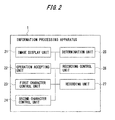
- Fig. 2 is a diagram illustrating example functional blocks of the information processing apparatus 1.
- the information processing apparatus 1 functions as an image display unit 21, an operation accepting unit 22, a first character control unit 23, a second character control unit 24, a determination unit 25, a recording control unit 26, and a recording unit 27 illustrated in Fig. 2 through execution of programs by the processing unit 11. That is, the functional units illustrated in Fig. 2 are realized by a computer including the processor 111, memory 112 and other components and programs executed on the computer.
- a game program, simulation program and application program and the like are executed by the processor 111.
- the image display unit 21 displays an image of a virtual space on the display device 13.
- the virtual space may be either a two-dimensional or three-dimensional virtual space.
- objects representing such as characters, items, icons, and/or backgrounds are displayed.
- Characters include playable characters and non-playable characters.
- a playable character is a character that moves in a virtual space in response to operations by a user (also called a player) via the operation interface 14.
- the playable character is also called a player object.
- the playable character is an example of a first character.
- a non-playable character is a character that moves in a virtual space independently of the user's operation. There are a case where a playable character and a non-playable character interact with each other in a virtual space and a case where they do not interact with each other.
- the operation accepting unit 22 accepts an operation on the playable character displayed in the virtual space via the operation interface 14.
- the first character control unit 23 controls the motion of the playable character in the virtual space based on operational data output from the operation interface 14.
- the second character control unit 24 controls the motion of a ghost character in the virtual space based on automatic operating data, which is a set of operational data for continuously moving (running) a character.
- a ghost character is a non-playable character that acts based on the user's operation histories and represents an example of a second character.
- the determination unit 25 makes determination such as whether certain processing has been done in the virtual space, whether certain processing has completed.
- the recording control unit 26 records data on the playable character in the virtual space and/or other data in the recording unit 27.
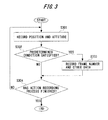
- Fig. 3 is an example flowchart illustrating processing performed by the processing unit 11.
- the flowchart of Fig. 3 illustrates the process of recording actions of a playable character (hereinafter referred to as "action recording process").
- the process of the flowchart illustrated in Fig. 3 may start in response to a virtual space image appearing on the display device 13 and the user selecting the start of the action recording process via the operation interface 14.
- the action recording process may be initiated upon start of a prepared stage in a game, simulation, or an application.
- the actions of the playable character may be automatically recorded on each round of play. Not all of action data for the playable character may be maintained by saving only the latest data and/or data for an instance where a good score was recorded by execution of a game, simulation, or application.
- the process from S301 to S304 in Fig. 3 are performed per frame (e.g., at the interval of 1/60 seconds).
- the recording control unit 26 records data on positions and attitudes of the playable character and frame numbers in association with each other in the recording unit 27.
- the position of the playable character is the position (coordinates) at which the playable character is present in the virtual space.
- the attitude of the playable character is the direction in which the playable character points in the virtual space (i.e., the orientation of the playable character).
- the recording control unit 26 may record key input data output from the operation interface 14 and frame numbers in association with each other in the recording unit 27.
- the recording control unit 26 may also record data on the positions, attitudes, and actions of the playable character in the recording unit 27 in association with frame numbers.
- the actions of the playable character include jumping of the playable character in the virtual space, entry of the playable character into a certain entrance or an area, and other predetermined movements, for example.
- the determination unit 25 determines whether the playable character satisfies a predetermined condition.
- the determination unit 25 may determine whether the playable character satisfies a predetermined condition according to whether the playable character has reached a specific position, a specific object, or a specific zone. That is, the determination unit 25 may determine that the playable character satisfies a predetermined condition when the playable character has reached a specific position, a specific object, or a specific zone.
- the determination unit 25 may also determine whether the playable character satisfies a predetermined condition according to whether the playable character has passed through a specific position, a specific object, or a specific zone.
- the determination unit 25 may also determine whether the playable character satisfies a predetermined condition according to whether switching to a different situation (or scene) has occurred. The determination unit 25 may also determine whether the playable character satisfies a predetermined condition according to whether the playable character has turned into a predetermined state (or status). Examples of the predetermined state may be that the playable character has acquired a specific item, that the playable character has lost a specific item, or that the appearance of the playable character has changed. The determination unit 25 may also determine whether the playable character satisfies two or more predetermined conditions.
- the specific position is a position (coordinates) defined in a virtual space.
- the specific position is assigned an identification number (ID number).
- ID number an identification number
- Two or more specific positions may be defined in the virtual space.
- the specific object is an object representing a particular background in the virtual space. Two or more specific objects may be placed in the virtual space.
- the specific object is assigned an identification number.
- the specific object may be an object with which the playable character can perform a specific action. For example, when the playable character has reached the specific object, it may cause a change to a different situation (or scene). Alternatively, when the playable character has reached the specific object, the playable character may be caused to move to a remote position within the same situation, for example.
- the specific zone is a zone defined in a virtual space. Two or more specific zones may be defined in the virtual space. The specific zone is assigned an identification number.
- the specific position, specific object and specific zone may be a position and a zone that enables the user to realize that the playable character
- step S302 If the playable character satisfies the predetermined condition (S302: YES), the flow proceeds to step S303. If the playable character does not satisfy the predetermined condition (S302: NO), the flow proceeds to step S304.
- the recording control unit 26 records frame numbers at which the playable character reached a specific position, a specific object, and a specific zone, and the specific position, object, and zone that the playable character reached in the recording unit 27.
- the frame number at which the playable character reached a specific position, object, or zone is an example of timing data indicating the timing at which a predetermined condition is satisfied.
- the identification numbers of the specific position, object, and zone that the playable character reached are an example of condition data indicating a predetermined condition.
- the recording control unit 26 records the number of times the same predetermined condition is satisfied by the playable character in the recording unit 27.
- the recording control unit 26 may record the number of times the playable character reached the same specific position, the same specific object, and the same specific zone in the recording unit 27 as the number of times the same predetermined conditions are satisfied by the playable character. After the processing at S303, the flow proceeds to S304. For example, the determination unit 25 may determine that the action recording process has finished when a prepared stage in a game, simulation, or an application has ended.
- the determination unit 25 determines whether the action recording process has finished. For example, the determination unit 25 may determine that the action recording process has finished if execution of a game program, simulation program, or application program has ended. The determination unit 25 may determine that the action recording process has finished when the user selects to end the action recording process via the operation interface 14, for example. For example, the determination unit 25 may determine that the action recording process has finished when a prepared stage in a game, simulation, or an application has ended.
- Fig. 4 is an example flowchart illustrating a process performed by the processing unit 11.
- the process of the flowchart illustrated in Fig. 4 is the process for reproducing (displaying) the actions of a ghost character (hereinafter referred to as "action reproducing process").
- the process of the flowchart illustrated in Fig. 4 may start in response to a virtual space image appearing on the display device 13 and the user selecting the start of the action reproducing process via the operation interface 14.
- the action reproducing process may be initiated upon start of a prepared stage in a game, simulation, or an application. In the virtual space, the playable character and other objects are displayed.
- the image display unit 21 places a ghost character in a virtual space.
- a ghost character is a character that does not interact with the playable character in the virtual space.
- the ghost character may be a character having a different appearance from the playable character or a translucent version of the playable character.
- the image display unit 21 may also place two or more ghost characters in the virtual space. Such ghost characters may have the same appearance or different appearances.
- the second character control unit 24 controls the action of the ghost character based on data on the positions and attitudes of the playable character and frame numbers recorded in the action recording process.
- the ghost character is reproduced in the virtual space based on the data on the positions and attitudes of the playable character and frame numbers recorded in the action recording process.
- a playable character recorded in an action recording process may also be called “recorded character”
- a frame number recorded in an action recording process may also be called “recorded frame number”.
- Data on positions and attitudes of a recorded character and recorded frame numbers are a set of operational data for continuously moving a ghost character.
- the set of operational data for continuously moving a ghost character is an example of automatic operating data.
- the second character control unit 24 may control the actions of multiple ghost characters based on the same automatic operating data or different sets of automatic operating data.
- the second character control unit 24 may control the action of the ghost character based on the key input data and frame numbers.
- Key input data and frame numbers are a set of operational data for continuously moving a ghost character.
- the second character control unit 24 may control the actions of a ghost character based on the data on the positions, attitudes and actions of the recorded character and the frame numbers.
- the determination unit 25 determines whether the playable character satisfies a predetermined condition.
- the determination unit 25 may determine whether the playable character satisfies a predetermined condition according to whether the playable character has reached a specific position, a specific object, or a specific zone. That is, the determination unit 25 may determine that the playable character satisfies a predetermined condition when the playable character has reached a specific position, a specific object, or a specific zone.
- the determination unit may also determine whether the playable character satisfies the predetermined condition according to whether the playable character has passed through a specific position, a specific object, or a specific zone.
- the determination unit 25 may also determine whether the playable character satisfies the predetermined condition according to whether switching to a different situation (or scene) has occurred. The determination unit 25 may also determine whether the playable character satisfies the predetermined condition according to whether the playable character has turned into a predetermined state (or status). The determination unit 25 may also determine whether the playable character satisfies two or more predetermined conditions.
- the specific position for the action reproducing process is set at the same location as the specific position for the action recording process.
- the specific object for the action reproducing process is the same object as the specific object for the action recording process.
- the specific zone for the action reproducing process is set to the same zone as the specific zone for the action recording process.
- the processing at S402 is performed per frame.
- the determination unit 25 determines whether the predetermined condition satisfied by the playable character agrees with the predetermined condition satisfied by the recorded character.
- the processing at S403 is performed per frame.
- the second character control unit 24 moves the ghost character from a state in which the ghost character satisfies the predetermined condition. For example, the second character control unit 24 moves the ghost character from the position and attitude that are associated with the recorded frame number at which the recorded character satisfied the predetermined condition based on automatic operating data. In this case, the second character control unit 24 changes the recorded frame number it references for moving the ghost character to the recorded frame number at which the recorded character satisfied the predetermined condition. The second character control unit 24 restarts control of the actions of the ghost character from the changed recorded frame number. If the playable character has reached a specific position, the second character control unit 24 may move the ghost character from the specific position.
- the second character control unit 24 may move the ghost character from the position at which the specific object is placed. If the playable character has reached a specific zone, the second character control unit 24 may move the ghost character from the position at which the recorded character reached the specific zone.
- the ghost character starts to act from a state in which it satisfies a predetermined condition, the ghost character may overlap the playable character. Since the ghost character is a character that does not interact with the playable character, it does not affect the action of the playable character. If the playable character and the ghost character overlap, the playable character may be displayed in its entirety and part or the whole of the ghost character may be hidden.
- the second character control unit 24 may also move multiple ghost characters from a state in which they satisfy a predetermined condition. In the following description, "ghost character" may be taken as plural even where it is not specified that there is a plurality of them.
- the second character control unit 24 may move a ghost character from a state in which the ghost character satisfies a predetermined condition at the frame in which the playable character satisfied the predetermined condition. It follows that the timing (point in time) at which the playable character satisfied a predetermined condition substantially coincides with the timing (point in time) at which the ghost character starts action while satisfying the predetermined condition.
- the second character control unit 24 may also move ghost character in a state in which the ghost character satisfies a predetermined condition in a predetermined number of frames after the frame at which the playable character satisfied the predetermined condition.
- the second character control unit 24 may move the ghost character from a state in which the ghost character satisfies the predetermined condition after elapse of a predetermined time period after when the playable character satisfied the predetermined condition. Accordingly, the timing at which the ghost character starts its action from a state in which it satisfies the predetermined condition is later than the timing at which the playable character satisfies the predetermined condition.
- Figs. 5A and 5B are diagrams illustrating an example virtual space for a case where the timing at which the ghost character starts its action from a state in which it has satisfied a predetermined condition is later than the timing at which the playable character satisfied the predetermined condition.
- Reference numeral 201 in Figs. 5A and 5B denotes the playable character and reference numeral 202 in Fig. 5B denotes the ghost character.
- Fig. 5A represents a state in which the playable character 201 has reached a predetermined position. In other words, Fig. 5A illustrates the state of the playable character 201 when the playable character 201 satisfies a predetermined condition.
- Fig. 5A illustrates the state of the playable character 201 when the playable character 201 satisfies a predetermined condition.
- the playable character 201 has moved from the predetermined position and the ghost character 202 starts its action from a state in which the ghost character 202 satisfies the predetermined condition with a delay after when the playable character 201 satisfied the predetermined condition.
- the second character control unit 24 may change the state of the ghost character so that it satisfies a predetermined condition within a certain period between the timing (point in time) at which the playable character satisfies the predetermined condition and the timing (point in time) at which the ghost character is caused to move from a state in which it satisfies the predetermined condition.
- the second character control unit 24 may also change the state of the ghost character based on automatic operating data. For example, the second character control unit 24 may make the ghost character approach a specific position, object or zone while alternately displaying and hiding the ghost character in the virtual space so that the ghost character satisfies a predetermined condition.
- the second character control unit 24 may control the action of the ghost character by increasing or decreasing the recorded frame number by one relative to a frame.
- the second character control unit 24 may control the action of the ghost character by increasing or decreasing the recorded frame number by two or greater relative to a frame.
- the reproduction speed for a ghost character that is reproduced by increasing or decreasing the recorded frame number by two or greater relative to a frame is higher than the reproduction speed of a ghost character that is reproduced by increasing or decreasing the recorded frame number by one relative to a frame.
- the second character control unit 24 may increase the reproduction speed of the ghost character and also change the state of the ghost character so that it is in a predetermined state within the prescribed period mentioned above.
- the second character control unit 24 may increase the reproduction speed of the ghost character in the period so that the ghost character approaches a specific position, object or zone and also change the state of the ghost character so that it satisfies a predetermined condition.
- the second character control unit 24 may fast forward the reproduction of the ghost character so that the ghost character approaches a specific position, object or zone.
- the second character control unit 24 may reverse the reproduction of the ghost character so that the ghost character approaches a specific position, object or zone.
- the second character control unit 24 may start to move the ghost characters at different timings. That is, the second character control unit 24 may start to move the ghost characters at different timings from a state in which the ghost characters satisfy predetermined conditions.
- the second character control unit 24 may move ghost character A from a state in which ghost character A satisfies a predetermined condition in a frame at which the playable character satisfied the predetermined condition, and move ghost character B from a state in which ghost character B satisfies a predetermined condition in 60 frames after the frame in which the playable character satisfied the predetermined condition.
- the second character control unit 24 may move the ghost characters at separated positions. For example, the second character control unit 24 may move multiple ghost characters from positions near a specific position, object or zone.
- the determination unit 25 determines whether the action reproducing process has finished. For example, the determination unit 25 may determine that the action reproducing process has finished when execution of a game, simulation, or application program has ended. For example, when the user selects to end the action reproducing process via the operation interface 14, the determination unit 25 may determine that the action reproducing process has finished. When end of the action reproducing process is selected, the ghost character ceases to be not displayed in the virtual space. For example, when a prepared stage has ended in a game, simulation or an application, the determination unit 25 may determine that the action reproducing process has finished.
- the determination unit 25 may determine that the action reproducing process has finished. If reproduction of actions of a ghost character ends before a prepared stage ends in a game, simulation or an application, the second character control unit 24 may freeze the ghost character as it was when its reproduction ended or stop displaying the ghost character.
- a ghost character starts to act from a state in which it satisfies a predetermined condition in response to a playable character satisfying the predetermined condition in an action reproducing process.
- the user can recognize the presence of the ghost character again owing to the action of the ghost character from a state in which it satisfies a predetermined condition.
- the ghost character is not being displayed in the virtual space image displayed on the display device 13 and the user loses track of the ghost character.
- the ghost character starts to act from a state in which it satisfies a predetermined condition in response to the playable character satisfying the predetermined condition, thereby the ghost character is reproduced (displayed) in the virtual space image displayed on the display device 13. The user thus can easily perceive the ghost character again.
- the second character control unit 24 may move a ghost character from a state in which ghost character satisfies a predetermined condition in accordance with the number of times the playable character has satisfied the same predetermined condition based on automatic operating data.
- the second character control unit 24 may move the ghost character from the position and attitude associated with the recorded frame number at which the recorded character satisfied the same predetermined condition once.
- the second character control unit 24 may move the ghost character from the position and attitude associated with the recorded frame number at which the recorded character satisfied the same predetermined condition for the second time.
- the second character control unit 24 may move the ghost character from the position and attitude associated with the recorded frame number at which the recorded character satisfied the same predetermined condition for the first time.
- the second character control unit 24 may move the ghost character from the position and attitude associated with the recorded frame number at which the recorded character last satisfied the same predetermined condition.
- the user operating the playable character (recorded character) in an action recording process may be the same as or different from the user operating the playable character in an action reproducing process.
- the ghost character may be reproduced (displayed) in the virtual space based on automatic operating data for the playable character (recorded character) recorded by user A.
- the ghost character may be reproduced (displayed) in the virtual space based on automatic operating data for the playable character (recorded character) recorded by user B.
- a user may operate the playable character using different accounts in an action recording process and an action reproducing process. For example, if user A who is signed up with account A operates the playable character in an action reproducing process, the ghost character may be reproduced (displayed) in the virtual space based on automatic operating data for the playable character (recorded character) recorded by user A who is signed up with account A. For example, if user A who is signed up with account A operates the playable character in an action reproducing process, the ghost character may be reproduced (displayed) in the virtual space based on automatic operating data for the playable character (recorded character) recorded by user A who is signed up with account B.
- Automatic operating data may be received by the communication interface 12 from another apparatus connected with the information processing apparatus 1 over a network.
- the automatic operating data received from the other apparatus is recorded in the recording unit 27.
- Automatic operating data may also be recorded in the recording unit 27 in advance. That is, a ghost character may be reproduced (displayed) in a virtual space based on the automatic operating data prestored in the recording unit 27 in an action reproducing process without performing action recording process.
- a ghost character may be a non-playable character serving as an example for the user's operation.
- the computer readable recording medium mentioned herein indicates a recording medium which stores information such as data and a program by an electric, magnetic, optical, mechanical, or chemical operation and allows the stored information to be read from the computer.
- those detachable from the computer include, e.g., a flexible disk, a magneto-optical disk, a CD-ROM, a CD-R/W, a DVD, a DAT, an 8-mm tape, and a memory card.
- those fixed to the computer include a hard disk and a ROM.
Landscapes
- Engineering & Computer Science (AREA)
- Multimedia (AREA)
- Computer Graphics (AREA)
- Physics & Mathematics (AREA)
- Computer Hardware Design (AREA)
- General Physics & Mathematics (AREA)
- Theoretical Computer Science (AREA)
- Human Computer Interaction (AREA)
- User Interface Of Digital Computer (AREA)
- Processing Or Creating Images (AREA)
Abstract
Description
- The present disclosure relates to a program, information processing apparatus, information processing method, and information processing system.
- Systems are known in which a character operated by a user can move on a field or course in a virtual space. It has been proposed to render ghost cars representing other cars with a car controlled by a player in a simulation image (see Patent document 1).
-
- [Patent document 1] Japanese Patent Application Laid-open No.
2000-237451 - On a closed course with its start point connecting with the goal point, the user does not often lose sight of a ghost character, which is a non-playable character acting based on the user's operation histories. In contrast, the user can often lose track of a ghost character in a system in which a character controlled by the user can freely move on a field with its start and goal points not connecting with each other. The present invention provides a technique for enabling a user controlling a character in a virtual space to easily perceive a ghost character again.
- An aspect of the present invention is a program. An example of the program according to an embodiment is a program for execution on a computer of an information processing apparatus that comprises a predetermined input device for outputting operational data indicating operational inputs entered by a player and that displays predetermined characters in a virtual space, the program causing the computer to function as: first character control means that moves a first character in the virtual space based on the operational data; second character control means that moves a second character in the virtual space based on automatic operating data which is a set of operational data for continuously moving a character; and determination means that determines whether the first character satisfies a predetermined condition or not, wherein the second character control means moves the second character from a state in which the second character satisfies the predetermined condition based on the automatic operating data in response to the first character satisfying the predetermined condition.
- By moving the second character from a state in which the second character satisfies the predetermined condition based on the automatic operating data in response to the first character displayed in the virtual space satisfying the predetermined condition, the user who is operating the first character in the virtual space can easily perceive the second character again.
- The determination means may determine that the first character satisfies the predetermined condition if the first character has reached a specific position, a specific object, or a specific zone in the virtual space. The second character control means may move the second character from a state in which the second character satisfies the predetermined condition based on the automatic operating data at a timing at which the first character has satisfied the predetermined condition. The second character control means may move the second character from a state in which the second character satisfies the predetermined condition based on the automatic operating data with a delay after the timing at which the first character has satisfied the predetermined condition. The second character control means may gradually change a state of the second character based on the automatic operating data such that the second character satisfies the predetermined condition within a predetermined period between the timing at which the first character has satisfied the predetermined condition and the timing at which the second character is caused to act from a state in which the second character satisfies the predetermined condition. In the predetermined period, the second character control means may increase a speed of reproducing the second character and also change the state of the second character such that the second character satisfies the predetermined condition.
- The program may cause the computer to function as operation recording control means that records actions of the first character as the automatic operating data. The program may cause the computer to function as reception means that receives the automatic operating data over a network. The automatic operating data may include condition data indicating the predetermined condition and timing data that indicates the timing at which the predetermined condition is satisfied. The second character control means may move a plurality of second characters in the virtual space based on the automatic operating data, and move the plurality of second characters from a state in which the second characters each satisfy the predetermined condition based on the automatic operating data in response to the first character satisfying the predetermined condition. The second character control means may move the plurality of second characters in the virtual space based on different sets of automatic operating data. The second character control means may move each of the plurality of second characters from a state in which the second characters each satisfy the predetermined condition based on the automatic operating data with a delay after the timing at which the first character has satisfied the predetermined condition. The second character control means may move each of the plurality of second characters at different timings from a state in which the second characters each satisfy the predetermined condition. The program may cause the computer to function as count recording control means that records a number of times a same predetermined condition is satisfied by the first character, and the second character control means may move the second character from a state in which the second character satisfies the predetermined condition based on the automatic operating data in accordance with the number of times the same predetermined condition has been satisfied by the first character.
- The embodiment can also be construed as an information processing apparatus, a computer-implemented information processing method, or an information processing system. The embodiment may also be practiced as such a program recorded in a recording medium readable by a computer, other devices or machines. A recording medium readable by a computer, other devices or machines refers to a recording medium that stores information such as data and programs by electrical, magnetic, optic, mechanical, or chemical action, and that allows the information to be read by a computer or the like.
- According to the present invention, a user operating a character in a virtual space can easily perceive a ghost character again.
-
-
Fig. 1 is a diagram illustrating an example hardware configuration of an information processing apparatus; -
Fig. 2 is a diagram illustrating example functional blocks of the information processing apparatus; -
Fig. 3 is an example flowchart illustrating processing performed by a processing unit; -
Fig. 4 is an example flowchart illustrating processing performed by the processing unit; -
Fig. 5A is a diagram illustrating an example virtual space; and -
Fig. 5B is a diagram illustrating an example virtual space. - The embodiment of the present invention will be described with reference to the drawings. The embodiment described below illustrates an example of practicing the present invention and is not intended to limit the embodiment to the specific configurations described below. For practicing embodiments, a specific configuration may be selected appropriately for each embodiment. For example, the embodiment may be applied to a program for execution on a computer of an information processing apparatus, an information processing apparatus, an information processing system having one or more information processing apparatuses, an information processing method and the like.
-
Fig. 1 is a diagram illustrating an example hardware configuration of an information processing apparatus 1. The information processing apparatus 1 is an electronic device such as a PC (Personal Computer), PDA (Personal Digital Assistant), smart phone, tablet terminal, cellular phone terminal, electronic book, and game console, for example. The information processing apparatus 1 includes aprocessing unit 11, acommunication interface 12, adisplay device 13, and anoperation interface 14. The information processing apparatus 1 may further include anauxiliary storage device 15. The information processing apparatus 1 may further include a portablerecording media drive 16.
The components are interconnected by buses. Not all the components of the information processing apparatus 1 illustrated inFig. 1 are requisite; the components of the information processing apparatus 1 may be added or removed as desired for implementing the information processing apparatus 1. - The
processing unit 11 includes aprocessor 111 and amemory 112. Theprocessor 111 may be a CPU (Central Processing Unit), a DSP (Digital Signal Processor), or the like, for example. Theprocessor 111 executes various kinds of processing responsive to a game program, a simulation program, or an application program stored in thememory 112. Thememory 112 includes a ROM (Read Only Memory) 113 and a RAM (Random Access Memory) 114. TheROM 113 stores programs and data for controlling the information processing apparatus 1, for example. TheRAM 114 temporarily stores a program or data and serves as a working area. - The
communication interface 12 is an interface that performs communication (input and output) of information with a server or other apparatuses over a network. Thecommunication interface 12 connects to a wired network and/or a wireless network. Thecommunication interface 12 is a NIC (Network Interface Card), a wireless LAN (Local Area Network) card or the like, for example. Data and the like received by thecommunication interface 12 is output to theprocessing unit 11. - The
display device 13 may be a CRT (Cathode Ray Tube), liquid crystal display, plasma display, or organic EL (electroluminescence) display, for example. Theoperation interface 14 is an input device including a keyboard, a pointing device such as a mouse, operation buttons, various sensors including a motion sensor, for example. Theoperation interface 14 may include an audio input device, such as a microphone. Theoperation interface 14 outputs operational data indicating operational inputs entered by the user to theprocessing unit 11. Thedisplay device 13 and/or theoperation interface 14 may be a touch panel combining display and operating functions. Thedisplay device 13 may be a device that is capable of switching between stereoscopic display for displaying a stereoscopic image that can be seen three-dimensionally and planar display for displaying an image two-dimensionally (or displaying a planar view image). - The
auxiliary storage device 15 stores multiple programs and data for use by theprocessing unit 11 in execution of the programs. Theauxiliary storage device 15 may store a game program, a simulation program, and an application program. Theprocessor 111 may load the game program, simulation program, application program or the like stored in theauxiliary storage device 15 into thememory 112 and execute various kinds processing. Theauxiliary storage device 15 may be an EPROM (Erasable Programmable ROM) or a hard disk drive, for example. - The portable recording media drive 16 drives the
portable recording medium 115 and performs data input and output to/from theportable recording medium 115 responsive to signals from theprocessing unit 11. The portable recording media drive 16 may store game, simulation, and application programs or the like. Theprocessor 111 may load the game, simulation, or application program stored in the portable recording media drive 16 into thememory 112 to execute various kinds of processing. Theportable recording medium 115 is a recording medium such as a USB (Universal Serial Bus) flash memory, CD (Compact Disc), and DVD (Digital Versatile Disc), for example. -
Fig. 2 is a diagram illustrating example functional blocks of the information processing apparatus 1. The information processing apparatus 1 functions as animage display unit 21, anoperation accepting unit 22, a firstcharacter control unit 23, a secondcharacter control unit 24, adetermination unit 25, arecording control unit 26, and arecording unit 27 illustrated inFig. 2 through execution of programs by theprocessing unit 11. That is, the functional units illustrated inFig. 2 are realized by a computer including theprocessor 111,memory 112 and other components and programs executed on the computer. - A game program, simulation program and application program and the like are executed by the
processor 111. When execution of a game, simulation, or application is started, theimage display unit 21 displays an image of a virtual space on thedisplay device 13. The virtual space may be either a two-dimensional or three-dimensional virtual space. In the virtual space, objects representing such as characters, items, icons, and/or backgrounds are displayed. - Characters include playable characters and non-playable characters. A playable character is a character that moves in a virtual space in response to operations by a user (also called a player) via the
operation interface 14. The playable character is also called a player object. The playable character is an example of a first character. A non-playable character is a character that moves in a virtual space independently of the user's operation. There are a case where a playable character and a non-playable character interact with each other in a virtual space and a case where they do not interact with each other. More specifically, there are a case where motion of the playable character and/or non-playable character changes when a contact between the playable character and non-playable character occurs in a virtual space and a case where the motion of playable character and the non-playable character does not change. - The
operation accepting unit 22 accepts an operation on the playable character displayed in the virtual space via theoperation interface 14. The firstcharacter control unit 23 controls the motion of the playable character in the virtual space based on operational data output from theoperation interface 14. The secondcharacter control unit 24 controls the motion of a ghost character in the virtual space based on automatic operating data, which is a set of operational data for continuously moving (running) a character. A ghost character is a non-playable character that acts based on the user's operation histories and represents an example of a second character. Thedetermination unit 25 makes determination such as whether certain processing has been done in the virtual space, whether certain processing has completed. Therecording control unit 26 records data on the playable character in the virtual space and/or other data in therecording unit 27. -
Fig. 3 is an example flowchart illustrating processing performed by theprocessing unit 11. The flowchart ofFig. 3 illustrates the process of recording actions of a playable character (hereinafter referred to as "action recording process"). The process of the flowchart illustrated inFig. 3 may start in response to a virtual space image appearing on thedisplay device 13 and the user selecting the start of the action recording process via theoperation interface 14. The action recording process may be initiated upon start of a prepared stage in a game, simulation, or an application. The actions of the playable character may be automatically recorded on each round of play. Not all of action data for the playable character may be maintained by saving only the latest data and/or data for an instance where a good score was recorded by execution of a game, simulation, or application. In the virtual space, the playable character and other objects are displayed. The process from S301 to S304 inFig. 3 are performed per frame (e.g., at the interval of 1/60 seconds). - At S301, the
recording control unit 26 records data on positions and attitudes of the playable character and frame numbers in association with each other in therecording unit 27. The position of the playable character is the position (coordinates) at which the playable character is present in the virtual space. The attitude of the playable character is the direction in which the playable character points in the virtual space (i.e., the orientation of the playable character). Therecording control unit 26 may record key input data output from theoperation interface 14 and frame numbers in association with each other in therecording unit 27. Therecording control unit 26 may also record data on the positions, attitudes, and actions of the playable character in therecording unit 27 in association with frame numbers. The actions of the playable character include jumping of the playable character in the virtual space, entry of the playable character into a certain entrance or an area, and other predetermined movements, for example. - At S302, the
determination unit 25 determines whether the playable character satisfies a predetermined condition. Thedetermination unit 25 may determine whether the playable character satisfies a predetermined condition according to whether the playable character has reached a specific position, a specific object, or a specific zone. That is, thedetermination unit 25 may determine that the playable character satisfies a predetermined condition when the playable character has reached a specific position, a specific object, or a specific zone. Thedetermination unit 25 may also determine whether the playable character satisfies a predetermined condition according to whether the playable character has passed through a specific position, a specific object, or a specific zone. Thedetermination unit 25 may also determine whether the playable character satisfies a predetermined condition according to whether switching to a different situation (or scene) has occurred. Thedetermination unit 25 may also determine whether the playable character satisfies a predetermined condition according to whether the playable character has turned into a predetermined state (or status). Examples of the predetermined state may be that the playable character has acquired a specific item, that the playable character has lost a specific item, or that the appearance of the playable character has changed. Thedetermination unit 25 may also determine whether the playable character satisfies two or more predetermined conditions. - The specific position is a position (coordinates) defined in a virtual space. The specific position is assigned an identification number (ID number). Two or more specific positions may be defined in the virtual space. The specific object is an object representing a particular background in the virtual space. Two or more specific objects may be placed in the virtual space. The specific object is assigned an identification number. The specific object may be an object with which the playable character can perform a specific action. For example, when the playable character has reached the specific object, it may cause a change to a different situation (or scene). Alternatively, when the playable character has reached the specific object, the playable character may be caused to move to a remote position within the same situation, for example. The specific zone is a zone defined in a virtual space. Two or more specific zones may be defined in the virtual space. The specific zone is assigned an identification number. The specific position, specific object and specific zone may be a position and a zone that enables the user to realize that the playable character has reached them.
- If the playable character satisfies the predetermined condition (S302: YES), the flow proceeds to step S303. If the playable character does not satisfy the predetermined condition (S302: NO), the flow proceeds to step S304.
- At S303, the
recording control unit 26 records frame numbers at which the playable character reached a specific position, a specific object, and a specific zone, and the specific position, object, and zone that the playable character reached in therecording unit 27. The frame number at which the playable character reached a specific position, object, or zone is an example of timing data indicating the timing at which a predetermined condition is satisfied. The identification numbers of the specific position, object, and zone that the playable character reached are an example of condition data indicating a predetermined condition. Therecording control unit 26 records the number of times the same predetermined condition is satisfied by the playable character in therecording unit 27. Therecording control unit 26 may record the number of times the playable character reached the same specific position, the same specific object, and the same specific zone in therecording unit 27 as the number of times the same predetermined conditions are satisfied by the playable character. After the processing at S303, the flow proceeds to S304. For example, thedetermination unit 25 may determine that the action recording process has finished when a prepared stage in a game, simulation, or an application has ended. - At S304, the
determination unit 25 determines whether the action recording process has finished. For example, thedetermination unit 25 may determine that the action recording process has finished if execution of a game program, simulation program, or application program has ended. Thedetermination unit 25 may determine that the action recording process has finished when the user selects to end the action recording process via theoperation interface 14, for example. For example, thedetermination unit 25 may determine that the action recording process has finished when a prepared stage in a game, simulation, or an application has ended. - If the action recording process has finished (S304: YES), the process of the flowchart illustrated in
Fig. 3 ends. If the action recording process has not finished (S304: NO), the flow proceeds to S301. -
Fig. 4 is an example flowchart illustrating a process performed by theprocessing unit 11. The process of the flowchart illustrated inFig. 4 is the process for reproducing (displaying) the actions of a ghost character (hereinafter referred to as "action reproducing process"). The process of the flowchart illustrated inFig. 4 may start in response to a virtual space image appearing on thedisplay device 13 and the user selecting the start of the action reproducing process via theoperation interface 14. The action reproducing process may be initiated upon start of a prepared stage in a game, simulation, or an application. In the virtual space, the playable character and other objects are displayed. - At S401, the
image display unit 21 places a ghost character in a virtual space. A ghost character is a character that does not interact with the playable character in the virtual space. The ghost character may be a character having a different appearance from the playable character or a translucent version of the playable character. Theimage display unit 21 may also place two or more ghost characters in the virtual space. Such ghost characters may have the same appearance or different appearances. - The second
character control unit 24 controls the action of the ghost character based on data on the positions and attitudes of the playable character and frame numbers recorded in the action recording process. Thus, the ghost character is reproduced in the virtual space based on the data on the positions and attitudes of the playable character and frame numbers recorded in the action recording process. Hereinbelow, a playable character recorded in an action recording process may also be called "recorded character", and a frame number recorded in an action recording process may also be called "recorded frame number". Data on positions and attitudes of a recorded character and recorded frame numbers are a set of operational data for continuously moving a ghost character. The set of operational data for continuously moving a ghost character is an example of automatic operating data. The secondcharacter control unit 24 may control the actions of multiple ghost characters based on the same automatic operating data or different sets of automatic operating data. When key input data and frame numbers are recorded in an action recording process, the secondcharacter control unit 24 may control the action of the ghost character based on the key input data and frame numbers. Key input data and frame numbers are a set of operational data for continuously moving a ghost character. When data on the positions, attitudes and actions of the playable character and frame numbers are recorded in an action recording process, the secondcharacter control unit 24 may control the actions of a ghost character based on the data on the positions, attitudes and actions of the recorded character and the frame numbers. - At S402, the
determination unit 25 determines whether the playable character satisfies a predetermined condition. Thedetermination unit 25 may determine whether the playable character satisfies a predetermined condition according to whether the playable character has reached a specific position, a specific object, or a specific zone. That is, thedetermination unit 25 may determine that the playable character satisfies a predetermined condition when the playable character has reached a specific position, a specific object, or a specific zone. The determination unit may also determine whether the playable character satisfies the predetermined condition according to whether the playable character has passed through a specific position, a specific object, or a specific zone. Thedetermination unit 25 may also determine whether the playable character satisfies the predetermined condition according to whether switching to a different situation (or scene) has occurred. Thedetermination unit 25 may also determine whether the playable character satisfies the predetermined condition according to whether the playable character has turned into a predetermined state (or status). Thedetermination unit 25 may also determine whether the playable character satisfies two or more predetermined conditions. The specific position for the action reproducing process is set at the same location as the specific position for the action recording process. The specific object for the action reproducing process is the same object as the specific object for the action recording process. The specific zone for the action reproducing process is set to the same zone as the specific zone for the action recording process. The processing at S402 is performed per frame. - If the playable character satisfies the predetermined condition (S402: YES), the flow proceeds to S403. If the playable character does not satisfy the predetermined condition (S402: NO), the flow proceeds to S405.
- At S403, the
determination unit 25 determines whether the predetermined condition satisfied by the playable character agrees with the predetermined condition satisfied by the recorded character. The processing at S403 is performed per frame. - If the predetermined condition satisfied by the playable character agrees with the predetermined condition satisfied by the recorded character (S403: YES), the flow proceeds to S404. If the predetermined condition satisfied by the playable character does not agree with the predetermined condition satisfied by the recorded character (S403: NO), the flow proceeds to S405.
- At S404, the second
character control unit 24 moves the ghost character from a state in which the ghost character satisfies the predetermined condition. For example, the secondcharacter control unit 24 moves the ghost character from the position and attitude that are associated with the recorded frame number at which the recorded character satisfied the predetermined condition based on automatic operating data. In this case, the secondcharacter control unit 24 changes the recorded frame number it references for moving the ghost character to the recorded frame number at which the recorded character satisfied the predetermined condition. The secondcharacter control unit 24 restarts control of the actions of the ghost character from the changed recorded frame number. If the playable character has reached a specific position, the secondcharacter control unit 24 may move the ghost character from the specific position. If the playable character has reached a specific object, the secondcharacter control unit 24 may move the ghost character from the position at which the specific object is placed. If the playable character has reached a specific zone, the secondcharacter control unit 24 may move the ghost character from the position at which the recorded character reached the specific zone. When the ghost character starts to act from a state in which it satisfies a predetermined condition, the ghost character may overlap the playable character. Since the ghost character is a character that does not interact with the playable character, it does not affect the action of the playable character. If the playable character and the ghost character overlap, the playable character may be displayed in its entirety and part or the whole of the ghost character may be hidden. The secondcharacter control unit 24 may also move multiple ghost characters from a state in which they satisfy a predetermined condition. In the following description, "ghost character" may be taken as plural even where it is not specified that there is a plurality of them. - The second
character control unit 24 may move a ghost character from a state in which the ghost character satisfies a predetermined condition at the frame in which the playable character satisfied the predetermined condition. It follows that the timing (point in time) at which the playable character satisfied a predetermined condition substantially coincides with the timing (point in time) at which the ghost character starts action while satisfying the predetermined condition. The secondcharacter control unit 24 may also move ghost character in a state in which the ghost character satisfies a predetermined condition in a predetermined number of frames after the frame at which the playable character satisfied the predetermined condition. That is, the secondcharacter control unit 24 may move the ghost character from a state in which the ghost character satisfies the predetermined condition after elapse of a predetermined time period after when the playable character satisfied the predetermined condition. Accordingly, the timing at which the ghost character starts its action from a state in which it satisfies the predetermined condition is later than the timing at which the playable character satisfies the predetermined condition. -
Figs. 5A and5B are diagrams illustrating an example virtual space for a case where the timing at which the ghost character starts its action from a state in which it has satisfied a predetermined condition is later than the timing at which the playable character satisfied the predetermined condition.Reference numeral 201 inFigs. 5A and5B denotes the playable character andreference numeral 202 inFig. 5B denotes the ghost character.Fig. 5A represents a state in which theplayable character 201 has reached a predetermined position. In other words,Fig. 5A illustrates the state of theplayable character 201 when theplayable character 201 satisfies a predetermined condition. InFig. 5B , theplayable character 201 has moved from the predetermined position and theghost character 202 starts its action from a state in which theghost character 202 satisfies the predetermined condition with a delay after when theplayable character 201 satisfied the predetermined condition. - The second
character control unit 24 may change the state of the ghost character so that it satisfies a predetermined condition within a certain period between the timing (point in time) at which the playable character satisfies the predetermined condition and the timing (point in time) at which the ghost character is caused to move from a state in which it satisfies the predetermined condition. The secondcharacter control unit 24 may also change the state of the ghost character based on automatic operating data. For example, the secondcharacter control unit 24 may make the ghost character approach a specific position, object or zone while alternately displaying and hiding the ghost character in the virtual space so that the ghost character satisfies a predetermined condition. - The second
character control unit 24 may control the action of the ghost character by increasing or decreasing the recorded frame number by one relative to a frame. The secondcharacter control unit 24 may control the action of the ghost character by increasing or decreasing the recorded frame number by two or greater relative to a frame. The reproduction speed for a ghost character that is reproduced by increasing or decreasing the recorded frame number by two or greater relative to a frame is higher than the reproduction speed of a ghost character that is reproduced by increasing or decreasing the recorded frame number by one relative to a frame. The secondcharacter control unit 24 may increase the reproduction speed of the ghost character and also change the state of the ghost character so that it is in a predetermined state within the prescribed period mentioned above. For example, the secondcharacter control unit 24 may increase the reproduction speed of the ghost character in the period so that the ghost character approaches a specific position, object or zone and also change the state of the ghost character so that it satisfies a predetermined condition. When the recorded frame number referenced for moving the ghost character is smaller than the recorded frame number at which the recorded character satisfied a predetermined condition, the secondcharacter control unit 24 may fast forward the reproduction of the ghost character so that the ghost character approaches a specific position, object or zone. When the recorded frame number referenced for moving the ghost character is greater than the recorded frame number at which the recorded character satisfied a predetermined condition, the secondcharacter control unit 24 may reverse the reproduction of the ghost character so that the ghost character approaches a specific position, object or zone. - When multiple ghost characters start to act from a state in which they satisfy predetermined conditions, the second
character control unit 24 may start to move the ghost characters at different timings. That is, the secondcharacter control unit 24 may start to move the ghost characters at different timings from a state in which the ghost characters satisfy predetermined conditions. By way of example, the secondcharacter control unit 24 may move ghost character A from a state in which ghost character A satisfies a predetermined condition in a frame at which the playable character satisfied the predetermined condition, and move ghost character B from a state in which ghost character B satisfies a predetermined condition in 60 frames after the frame in which the playable character satisfied the predetermined condition. When multiple ghost characters start to act from a state in which the ghost characters satisfy predetermined conditions, the secondcharacter control unit 24 may move the ghost characters at separated positions. For example, the secondcharacter control unit 24 may move multiple ghost characters from positions near a specific position, object or zone. - After the processing at S404, the flow proceeds to S405. At S405, the
determination unit 25 determines whether the action reproducing process has finished. For example, thedetermination unit 25 may determine that the action reproducing process has finished when execution of a game, simulation, or application program has ended. For example, when the user selects to end the action reproducing process via theoperation interface 14, thedetermination unit 25 may determine that the action reproducing process has finished. When end of the action reproducing process is selected, the ghost character ceases to be not displayed in the virtual space. For example, when a prepared stage has ended in a game, simulation or an application, thedetermination unit 25 may determine that the action reproducing process has finished. For example, when reproduction of actions of a ghost character has ended in a prepared stage in a game, simulation or an application, thedetermination unit 25 may determine that the action reproducing process has finished. If reproduction of actions of a ghost character ends before a prepared stage ends in a game, simulation or an application, the secondcharacter control unit 24 may freeze the ghost character as it was when its reproduction ended or stop displaying the ghost character. - If the action reproducing process has finished (S405: YES), the process of the flowchart illustrated in
Fig. 4 ends. If the action reproducing process has not finished (S405: NO), the flow proceeds to S401. - According to this embodiment, a ghost character starts to act from a state in which it satisfies a predetermined condition in response to a playable character satisfying the predetermined condition in an action reproducing process. Thus, even if the user has lost track of the ghost character, the user can recognize the presence of the ghost character again owing to the action of the ghost character from a state in which it satisfies a predetermined condition.
- By way of example, it is possible that during an action reproducing process, the ghost character is not being displayed in the virtual space image displayed on the
display device 13 and the user loses track of the ghost character. The ghost character starts to act from a state in which it satisfies a predetermined condition in response to the playable character satisfying the predetermined condition, thereby the ghost character is reproduced (displayed) in the virtual space image displayed on thedisplay device 13. The user thus can easily perceive the ghost character again. - It is possible that in an action reproducing process the playable character satisfies the same predetermine condition two or more times. The second
character control unit 24 may move a ghost character from a state in which ghost character satisfies a predetermined condition in accordance with the number of times the playable character has satisfied the same predetermined condition based on automatic operating data. When the playable character has satisfied the same predetermined condition once in an action reproducing process, the secondcharacter control unit 24 may move the ghost character from the position and attitude associated with the recorded frame number at which the recorded character satisfied the same predetermined condition once. When the playable character has satisfied the same predetermined condition twice in an action reproducing process, the secondcharacter control unit 24 may move the ghost character from the position and attitude associated with the recorded frame number at which the recorded character satisfied the same predetermined condition for the second time. When the playable character has satisfied the same predetermined condition two or more times in an action reproducing process, the secondcharacter control unit 24 may move the ghost character from the position and attitude associated with the recorded frame number at which the recorded character satisfied the same predetermined condition for the first time. When the playable character has satisfied the same predetermined condition two or more times in an action reproducing process, the secondcharacter control unit 24 may move the ghost character from the position and attitude associated with the recorded frame number at which the recorded character last satisfied the same predetermined condition. - The user operating the playable character (recorded character) in an action recording process may be the same as or different from the user operating the playable character in an action reproducing process. For example, if user A operates the playable character in the action reproducing process, the ghost character may be reproduced (displayed) in the virtual space based on automatic operating data for the playable character (recorded character) recorded by user A. For example, if user A operates the playable character in the action reproducing process, the ghost character may be reproduced (displayed) in the virtual space based on automatic operating data for the playable character (recorded character) recorded by user B.
- A user may operate the playable character using different accounts in an action recording process and an action reproducing process. For example, if user A who is signed up with account A operates the playable character in an action reproducing process, the ghost character may be reproduced (displayed) in the virtual space based on automatic operating data for the playable character (recorded character) recorded by user A who is signed up with account A. For example, if user A who is signed up with account A operates the playable character in an action reproducing process, the ghost character may be reproduced (displayed) in the virtual space based on automatic operating data for the playable character (recorded character) recorded by user A who is signed up with account B.
- Automatic operating data may be received by the
communication interface 12 from another apparatus connected with the information processing apparatus 1 over a network. The automatic operating data received from the other apparatus is recorded in therecording unit 27. Automatic operating data may also be recorded in therecording unit 27 in advance. That is, a ghost character may be reproduced (displayed) in a virtual space based on the automatic operating data prestored in therecording unit 27 in an action reproducing process without performing action recording process. A ghost character may be a non-playable character serving as an example for the user's operation. - It is possible to record a program which causes a computer to implement any of the functions described above on a computer readable recording medium. By causing the computer to read in the program from the recording medium and execute it, the function thereof can be provided. The computer readable recording medium mentioned herein indicates a recording medium which stores information such as data and a program by an electric, magnetic, optical, mechanical, or chemical operation and allows the stored information to be read from the computer. Of such recording media, those detachable from the computer include, e.g., a flexible disk, a magneto-optical disk, a CD-ROM, a CD-R/W, a DVD, a DAT, an 8-mm tape, and a memory card. Of such recording media, those fixed to the computer include a hard disk and a ROM.
- While the embodiment has been described above in detail, the above description merely exemplifies the embodiment in all aspects and is not intended to limit the scope of the embodiment. It is needless to say that various changes and modifications may be made in the embodiment without departing from the scope thereof. It will be appreciated that the persons skilled in the art can practice equivalents based on technical knowledge from the descriptions of the specific embodiment. Furthermore, it is understood that, unless otherwise specified, terms used in the present specification are used in the meanings usually used in the art. Therefore, unless otherwise defined, all technical and scientific terms used in the present specification have the same meaning as commonly understood by one of ordinary skill in the art to which this embodiment belongs. In case of conflict, the present specification (including definitions) will control.
- While certain example systems, methods, devices and apparatuses have been described herein, it is to be understood that the appended claims are not to be limited to the systems, methods, devices and apparatuses disclosed, but on the contrary, are intended to cover various modifications and equivalent arrangements included within the spirit and scope of the appended claims.
Claims (17)
- A program for execution on a computer of an information processing apparatus that comprises a predetermined input device for outputting operational data indicating operational inputs entered by a player and that displays predetermined characters in a virtual space, the program causing the computer to function as:first character control means that moves a first character in the virtual space based on the operational data;second character control means that moves a second character in the virtual space based on automatic operating data which is a set of operational data for continuously moving a character; anddetermination means that determines whether the first character satisfies a predetermined condition or not,wherein the second character control means moves the second character from a state in which the second character satisfies the predetermined condition based on the automatic operating data in response to the first character satisfying the predetermined condition.
- The program according to claim 1, wherein the determination means determines that the first character satisfies the predetermined condition if the first character has reached a specific position, a specific object, or a specific zone in the virtual space.
- The program according to claim 1 or 2, wherein the second character control means moves the second character from a state in which the second character satisfies the predetermined condition based on the automatic operating data at a timing at which the first character has satisfied the predetermined condition.
- The program according to claim 1 or 2, wherein the second character control means moves the second character from a state in which the second character satisfies the predetermined condition based on the automatic operating data with a delay after the timing at which the first character has satisfied the predetermined condition.
- The program according to claim 4, wherein the second character control means gradually changes a state of the second character based on the automatic operating data such that the second character satisfies the predetermined condition, within a predetermined period between the timing at which the first character has satisfied the predetermined condition and the timing at which the second character is caused to act from a state in which the second character satisfies the predetermined condition.
- The program according to claim 5, wherein, in the predetermined period, the second character control means increases a speed of reproducing the second character and also changes the state of the second character such that the second character satisfies the predetermined condition.
- The program recorded therein according to any one of claims 1 to 6, wherein the program causes the computer to function as operation recording control means that records actions of the first character as the automatic operating data.
- The program according to any one of claims 1 to 7, wherein the program causes the computer to function as reception means that receives the automatic operating data over a network.
- The program according to any one of claims 1 to 8, wherein the automatic operating data includes condition data indicating the predetermined condition and timing data that indicates the timing at which the predetermined condition is satisfied.
- The program to any one of claims 1 to 9, wherein the second character control means moves a plurality of second characters in the virtual space based on the automatic operating data, and moves each of the plurality of second characters from a state in which the second characters each satisfy the predetermined condition based on the automatic operating data in response to the first character satisfying the predetermined condition.
- The program according to claim 10, wherein the second character control means moves the plurality of second characters in the virtual space based on different sets of automatic operating data.
- The program according to claim 10 or 11, wherein the second character control means moves each of the plurality of second characters from a state in which the second characters each satisfy the predetermined condition based on the automatic operating data with a delay after the timing at which the first character has satisfied the predetermined condition.
- The program according to claim 12, wherein the second character control means moves each of the plurality of second characters at different timings from a state in which the second characters each satisfy the predetermined condition.
- The program according to any one of claims 1 to 13,
wherein the program causes the computer to function as count recording control means that records a number of times a same predetermined condition is satisfied by the first character, and
wherein the second character control means moves the second character from a state in which the second character satisfies the predetermined condition based on the automatic operating data in accordance with the number of times the same predetermined condition has been satisfied by the first character. - An information processing apparatus comprising:a predetermined input device for outputting operational data indicating operational inputs entered by a player;display means that displays predetermined characters in a virtual space;first character control means that moves a first character in the virtual space based on the operational data;second character control means that moves a second character in the virtual space based on automatic operating data which is a set of operational data for continuously moving a character; anddetermination means that determines whether the first character satisfies a predetermined condition or not,wherein the second character control means moves the second character from a state in which the second character satisfies the predetermined condition based on the automatic operating data in response to the first character satisfying the predetermined condition.
- An information processing method to be carried out by a computer of an information processing apparatus that comprises a predetermined input device for outputting operational data indicating operational inputs entered by a player and that displays predetermined characters in a virtual space, the method comprising:a first character controlling step of moving a first character in the virtual space based on the operational data;a second character controlling step of moving a second character in the virtual space based on automated control data which is a set of operational data for continuously moving a character; anda determination step of determining whether the first character satisfies a predetermined condition or not,wherein the second character control step moves the second character from a state in which the second character satisfies the predetermined condition based on the data in response to the first character satisfying the predetermined condition.
- An information processing system comprising:a predetermined input device for outputting operational data indicating operational inputs entered by a player;display means that displays predetermined characters in a virtual space;first character control means that moves a first character in the virtual space based on the operational data;second character control means that moves a second character in the virtual space based on automatic operating data which is a set of operational data for continuously moving a character; anddetermination means that determines whether the first character satisfies a predetermined condition or not,wherein the second character control means moves the second character from a state in which the second character satisfies the predetermined condition based on the automatic operating data in response to the first character satisfying the predetermined condition.
Applications Claiming Priority (1)
| Application Number | Priority Date | Filing Date | Title |
|---|---|---|---|
| JP2013073201A JP6110704B2 (en) | 2013-03-29 | 2013-03-29 | Program, information processing apparatus, information processing method, and information processing system |
Publications (1)
| Publication Number | Publication Date |
|---|---|
| EP2783734A1 true EP2783734A1 (en) | 2014-10-01 |
Family
ID=49554025
Family Applications (1)
| Application Number | Title | Priority Date | Filing Date |
|---|---|---|---|
| EP13191349.3A Ceased EP2783734A1 (en) | 2013-03-29 | 2013-11-04 | Program, information processing apparatus, information processing method, and information processing system |
Country Status (3)
| Country | Link |
|---|---|
| US (1) | US9349349B2 (en) |
| EP (1) | EP2783734A1 (en) |
| JP (1) | JP6110704B2 (en) |
Cited By (2)
| Publication number | Priority date | Publication date | Assignee | Title |
|---|---|---|---|---|
| CN107890675A (en) * | 2017-11-13 | 2018-04-10 | 杭州电魂网络科技股份有限公司 | AI behaviors implementation method and device |
| US11361497B2 (en) | 2017-05-24 | 2022-06-14 | Sony Corporation | Information processing device and information processing method |
Families Citing this family (5)
| Publication number | Priority date | Publication date | Assignee | Title |
|---|---|---|---|---|
| WO2017058951A1 (en) * | 2015-09-30 | 2017-04-06 | Sony Interactive Entertainment America Llc | Systems and methods for providing time-shifted intelligently synchronized game video |
| US10549203B2 (en) | 2015-09-30 | 2020-02-04 | Sony Interactive Entertainment America Llc | Systems and methods for providing time-shifted intelligently synchronized game video |
| US10549204B2 (en) | 2015-09-30 | 2020-02-04 | Sony Interactive Entertainment America Llc | Systems and methods for providing augmented data-feed for game play re-creation and dynamic replay entry points |
| CN114100133B (en) * | 2021-12-06 | 2025-08-29 | 腾讯科技(深圳)有限公司 | Virtual chessboard display method, terminal, storage medium and program product |
| JP7659591B2 (en) * | 2023-06-20 | 2025-04-09 | 任天堂株式会社 | GAME PROGRAM, GAME SYSTEM, AND GAME PROCESSING METHOD |
Citations (3)
| Publication number | Priority date | Publication date | Assignee | Title |
|---|---|---|---|---|
| JP2000237451A (en) | 1999-02-16 | 2000-09-05 | Taito Corp | Problem solving vehicle game machine |
| US20050049022A1 (en) * | 2003-09-02 | 2005-03-03 | Mullen Jeffrey D. | Systems and methods for location based games and employment of the same on location enabled devices |
| US20110111851A1 (en) * | 2009-11-11 | 2011-05-12 | Nintendo Co., Ltd. | Computer readable storage medium having game program stored thereon, game apparatus, and game control method |
Family Cites Families (21)
| Publication number | Priority date | Publication date | Assignee | Title |
|---|---|---|---|---|
| CA2067093A1 (en) * | 1990-08-01 | 1992-02-02 | Stephanie J. Mott | Driver training system |
| US6226008B1 (en) * | 1997-09-04 | 2001-05-01 | Kabushiki Kaisha Sega Enterprises | Image processing device |
| JP3880229B2 (en) * | 1998-11-20 | 2007-02-14 | 株式会社バンダイナムコゲームス | GAME SYSTEM AND INFORMATION STORAGE MEDIUM |
| JP2001276420A (en) * | 2000-03-30 | 2001-10-09 | Namco Ltd | Game device and information storage medium |
| JP2002222436A (en) * | 2000-11-22 | 2002-08-09 | Sony Computer Entertainment Inc | Object control method, object control processing program to be executed by computer, computer-readable recording medium storing object control processing program to be executed by computer, program execution device for executing object control processing program |
| US7126607B2 (en) * | 2002-08-20 | 2006-10-24 | Namco Bandai Games, Inc. | Electronic game and method for effecting game features |
| JP2005058383A (en) * | 2003-08-08 | 2005-03-10 | Sega Corp | GAME INFORMATION PROCESSING DEVICE AND COMPUTER PROGRAM THEREOF |
| JP3785176B2 (en) * | 2004-05-11 | 2006-06-14 | コナミ株式会社 | GAME DEVICE, GAME CONTROL METHOD, AND PROGRAM |
| US8696464B2 (en) * | 2005-08-19 | 2014-04-15 | Nintendo Co., Ltd. | Enhanced method and apparatus for selecting and rendering performance data |
| JP4445449B2 (en) * | 2005-10-04 | 2010-04-07 | 株式会社スクウェア・エニックス | Image generation device |
| US20070167239A1 (en) * | 2006-01-19 | 2007-07-19 | O'rourke Jason | Arcade Casino Game |
| JP4118920B2 (en) * | 2006-02-22 | 2008-07-16 | 株式会社スクウェア・エニックス | Game device, field boundary display method, program, and recording medium |
| JP4125760B2 (en) * | 2006-03-15 | 2008-07-30 | 株式会社スクウェア・エニックス | Video game processing apparatus, video game processing method, and video game processing program |
| JP5073965B2 (en) * | 2006-05-25 | 2012-11-14 | 株式会社バンダイナムコゲームス | PROGRAM, INFORMATION STORAGE MEDIUM, AND GAME DEVICE |
| US7775882B2 (en) * | 2006-06-12 | 2010-08-17 | Kabushiki Kaisha Sega | Game apparatus for changing a visual point position of a virtual camera in conjunction with an attack by and enemy character |
| US8531452B2 (en) * | 2009-07-21 | 2013-09-10 | Konami Digital Entertainment Co., Ltd. | Video game machine, gaming image display control method and display mode switching control method |
| CN102844733A (en) * | 2010-02-26 | 2012-12-26 | 喀普康有限公司 | Computer device, storage medium, and control method |
| KR101247930B1 (en) * | 2010-05-10 | 2013-03-26 | 가부시키가이샤 스퀘어.에닉스 | Image processing device, image processing method, and image processing program |
| JP5598703B2 (en) * | 2010-05-25 | 2014-10-01 | 株式会社セガ | Program, game device, and control method thereof |
| JP5520698B2 (en) * | 2010-06-07 | 2014-06-11 | 任天堂株式会社 | GAME DEVICE, GAME PROGRAM, AND GAME SYSTEM |
| JP2016509292A (en) * | 2013-01-03 | 2016-03-24 | メタ カンパニー | Extramissive spatial imaging digital eyeglass device or extended intervening vision |
-
2013
- 2013-03-29 JP JP2013073201A patent/JP6110704B2/en active Active
- 2013-11-04 EP EP13191349.3A patent/EP2783734A1/en not_active Ceased
- 2013-11-08 US US14/074,740 patent/US9349349B2/en active Active
Patent Citations (3)
| Publication number | Priority date | Publication date | Assignee | Title |
|---|---|---|---|---|
| JP2000237451A (en) | 1999-02-16 | 2000-09-05 | Taito Corp | Problem solving vehicle game machine |
| US20050049022A1 (en) * | 2003-09-02 | 2005-03-03 | Mullen Jeffrey D. | Systems and methods for location based games and employment of the same on location enabled devices |
| US20110111851A1 (en) * | 2009-11-11 | 2011-05-12 | Nintendo Co., Ltd. | Computer readable storage medium having game program stored thereon, game apparatus, and game control method |
Cited By (2)
| Publication number | Priority date | Publication date | Assignee | Title |
|---|---|---|---|---|
| US11361497B2 (en) | 2017-05-24 | 2022-06-14 | Sony Corporation | Information processing device and information processing method |
| CN107890675A (en) * | 2017-11-13 | 2018-04-10 | 杭州电魂网络科技股份有限公司 | AI behaviors implementation method and device |
Also Published As
| Publication number | Publication date |
|---|---|
| JP2014195599A (en) | 2014-10-16 |
| US9349349B2 (en) | 2016-05-24 |
| JP6110704B2 (en) | 2017-04-05 |
| US20140292640A1 (en) | 2014-10-02 |
Similar Documents
| Publication | Publication Date | Title |
|---|---|---|
| US9349349B2 (en) | Computer readable medium having program recorded therein, information processing apparatus, information processing method, and information processing system | |
| US10503263B2 (en) | Systems and methods for Foley-style haptic content creation | |
| US8657681B2 (en) | Safety scheme for gesture-based game system | |
| CN109982756B (en) | Information processing program, information processing method, and information processing apparatus | |
| US10864433B2 (en) | Using a portable device to interact with a virtual space | |
| US9950257B2 (en) | Recording companion | |
| JP5770918B1 (en) | Information processing program and information processing method | |
| US10695661B2 (en) | Game control device, game system, and information storage medium | |
| CN112245921B (en) | Virtual object control method, device, equipment and storage medium | |
| US20120021840A1 (en) | Techniques for improved user interface helping super guides | |
| TWI798499B (en) | Method and apparatus for controlling game | |
| WO2013126071A1 (en) | Safety scheme for gesture-based game system | |
| CN102929507A (en) | Motion controlled list scrolling | |
| US11759702B2 (en) | Game system, processing method, and information storage medium | |
| JP2017084055A (en) | Information processing apparatus, operation control method, and operation control program | |
| EP2455149A2 (en) | Video game apparatus, game program and information recording medium | |
| CN101351248B (en) | Game machine, game machine control method | |
| JP7045350B6 (en) | Programs, control methods and information processing equipment | |
| JP2022098651A (en) | Information processing system and program | |
| JP5271565B2 (en) | GAME DEVICE, GAME PROCESSING METHOD, AND PROGRAM | |
| EP4309753A1 (en) | An entertainment system, a method and a computer program | |
| JP2011136001A (en) | Network game system and game device | |
| CN110882539A (en) | Animation display method and device, storage medium and electronic device | |
| JP2019213865A (en) | Information processing method, information processing apparatus, and information processing program | |
| JP2020018792A (en) | Information processing device, position estimation method and position estimation program |
Legal Events
| Date | Code | Title | Description |
|---|---|---|---|
| 17P | Request for examination filed |
Effective date: 20131104 |
|
| AK | Designated contracting states |
Kind code of ref document: A1 Designated state(s): AL AT BE BG CH CY CZ DE DK EE ES FI FR GB GR HR HU IE IS IT LI LT LU LV MC MK MT NL NO PL PT RO RS SE SI SK SM TR |
|
| AX | Request for extension of the european patent |
Extension state: BA ME |
|
| PUAI | Public reference made under article 153(3) epc to a published international application that has entered the european phase |
Free format text: ORIGINAL CODE: 0009012 |
|
| R17P | Request for examination filed (corrected) |
Effective date: 20150202 |
|
| RBV | Designated contracting states (corrected) |
Designated state(s): AL AT BE BG CH CY CZ DE DK EE ES FI FR GB GR HR HU IE IS IT LI LT LU LV MC MK MT NL NO PL PT RO RS SE SI SK SM TR |
|
| 17Q | First examination report despatched |
Effective date: 20160707 |
|
| STAA | Information on the status of an ep patent application or granted ep patent |
Free format text: STATUS: THE APPLICATION HAS BEEN REFUSED |
|
| 18R | Application refused |
Effective date: 20191208 |