EP2782266A2 - Satellite communication system using hierarchical modulation to transmit a plurality of modulated signals of high and low priority - Google Patents
Satellite communication system using hierarchical modulation to transmit a plurality of modulated signals of high and low priority Download PDFInfo
- Publication number
- EP2782266A2 EP2782266A2 EP14154584.8A EP14154584A EP2782266A2 EP 2782266 A2 EP2782266 A2 EP 2782266A2 EP 14154584 A EP14154584 A EP 14154584A EP 2782266 A2 EP2782266 A2 EP 2782266A2
- Authority
- EP
- European Patent Office
- Prior art keywords
- region
- priority content
- sub
- satellite
- low
- Prior art date
- Legal status (The legal status is an assumption and is not a legal conclusion. Google has not performed a legal analysis and makes no representation as to the accuracy of the status listed.)
- Granted
Links
Images


Classifications
-
- H—ELECTRICITY
- H04—ELECTRIC COMMUNICATION TECHNIQUE
- H04H—BROADCAST COMMUNICATION
- H04H20/00—Arrangements for broadcast or for distribution combined with broadcast
- H04H20/65—Arrangements characterised by transmission systems for broadcast
- H04H20/71—Wireless systems
- H04H20/74—Wireless systems of satellite networks
-
- H—ELECTRICITY
- H04—ELECTRIC COMMUNICATION TECHNIQUE
- H04B—TRANSMISSION
- H04B7/00—Radio transmission systems, i.e. using radiation field
- H04B7/14—Relay systems
- H04B7/15—Active relay systems
- H04B7/185—Space-based or airborne stations; Stations for satellite systems
- H04B7/1851—Systems using a satellite or space-based relay
- H04B7/18515—Transmission equipment in satellites or space-based relays
-
- H—ELECTRICITY
- H04—ELECTRIC COMMUNICATION TECHNIQUE
- H04B—TRANSMISSION
- H04B7/00—Radio transmission systems, i.e. using radiation field
- H04B7/14—Relay systems
- H04B7/15—Active relay systems
- H04B7/185—Space-based or airborne stations; Stations for satellite systems
- H04B7/18523—Satellite systems for providing broadcast service to terrestrial stations, i.e. broadcast satellite service
-
- H—ELECTRICITY
- H04—ELECTRIC COMMUNICATION TECHNIQUE
- H04H—BROADCAST COMMUNICATION
- H04H40/00—Arrangements specially adapted for receiving broadcast information
- H04H40/18—Arrangements characterised by circuits or components specially adapted for receiving
- H04H40/27—Arrangements characterised by circuits or components specially adapted for receiving specially adapted for broadcast systems covered by groups H04H20/53 - H04H20/95
- H04H40/90—Arrangements characterised by circuits or components specially adapted for receiving specially adapted for broadcast systems covered by groups H04H20/53 - H04H20/95 specially adapted for satellite broadcast receiving
Definitions
- This disclosure generally relates to a satellite communication system, and more particularly relates to using hierarchical modulation to broadcast distinct low priority content in to adjacent sub-regions of a region receiving uniform high priority content.
- Satellite broadcast systems that broadcast high priority content directed at a relatively large region and simultaneously use spot beams to broadcast low priority content over sub-regions within the large region are known.
- the high priority content is sometimes referred to as a national signal that is be broadcast over, for example, the continental United States (CONUS) or across the European continent (PAN European).
- the low-priority content typically contains information directed to a particular sub-region such as local weather or traffic information, or the low-priority content may be directed to a specific ground receiver within the particular sub-region.
- these low priority or sub-regional transmissions use different frequencies or polarizations to separate the low priority signal from the high priority signal, or separate the combined high and low priority signals directed to one sub-region from those directed to adjacent sub-regions.
- the regional signal may contain national content, i.e. the same content at different frequencies.
- Transmitting low priority content at a carrier frequency different than the carrier frequency used to transmit high priority content undesirably uses more bandwidth than necessary to communicate both the high and low priority content.
- configuring ground receivers to detect content at different frequencies or polarizations undesirably increases the cost of the ground receiver by increasing the hardware and/or software cost. Transmitting both low and high priority content at the same carrier frequency into one sub-region while transmitting other low priority content with the same high priority content in to an adjacent region can lead to low priority content loss or interference along the boundaries of the adjacent sub-regions.
- a satellite communication system using hierarchical modulation to transmit a plurality of modulated signals to a region Each modulated signal includes high priority content and low priority content.
- the system includes a satellite equipped with a plurality of satellite transmitters coupled to a plurality of antenna elements.
- the antenna elements are utilized selectively to direct a modulated signal from a transmitter to a distinct sub-region within the region.
- the plurality of transmitters and the plurality of antenna cooperate to broadcast the high-priority content to the region such that a ground receiver traveling from a first sub-region to a second sub-region adjacent to the first sub-region will not experience a loss of high-priority content.
- the first low-priority content of a first modulated signal is directed to the first sub-region, and is independent of second low-priority content of a second modulated signal directed to the second sub-region.
- the high priority content is modulated as a quadrature-phase-shift-keyed (QPSK) signal.
- QPSK quadrature-phase-shift-keyed
- the low priority content is a phase offset modulation of the high priority content.
- the low priority content is a magnitude offset modulation of the high priority content.
- the high priority content and low priority content use different forward error correction algorithms.
- the high priority content is broadcast data and the low priority content is unicast data.
- the satellite communication system further comprises a ground transmitter operating in cooperation with the ground receiver to form a ground transceiver.
- the satellite communication system further comprises a plurality of satellite receivers, each satellite receiver operating in cooperation with one of the plurality of satellite transmitters to form a plurality of satellite transceivers, wherein the plurality of antenna elements are further utilized selectively to preferentially receive a signal from each of the plurality of sub-regions such that a plurality of ground transceivers each located in distinct sub-regions can use the same carrier frequency to send messages to the satellite.
- the plurality of antenna elements are further utilized selectively to move the first sub-region effective to reduce low priority content interference with the second sub-region.
- the first low-priority content is transmitted during a first time interval
- the second low priority content is transmitted at a second time interval distinct from the first time interval.
- Fig. 1 illustrates a non-limiting example of a satellite communication system, hereafter the system 10.
- the system 10 uses hierarchical modulation to generate signals for a satellite 20 to transmit a plurality of modulated signals 12 to a region 14.
- hierarchical modulation is known, and is commonly used to simultaneously transmit two separate data-streams, for example a high priority data stream based on high priority content and a low priority data stream based on low priority content.
- Each of the plurality of modulated signals 12 is directed to at least one of the plurality of sub-regions 16.
- the region 14 is illustrated as the continental United States (CONUS). However, other regions such as Europe, or a larger region such as most of the North America continent are contemplated.
- the region 14 corresponding to the CONUS is divided into forty-five sub-regions that include sub-regions 16a, 16b, and 16c.
- each of the plurality of modulated signals 12a, 12b, and 12c transmitted by the satellite 20 includes high priority content and low priority content.
- the modulated signals 12a, 12b, and 12c preferably include the same high priority information such as audio and/or video broadcast information, for example, music or a movie.
- Each of the modulated signals 12a, 12b, and 12c would also include low priority information that may be unique to each of the sub-regions 16a, 16b, and 16c; local weather forecast information for example.
- the low priority information maybe unicast data, i.e. information directed to a specific customer or ground receiver.
- the modulated signals 12a, 12b, and 12c transmitted by the satellite 20 may have the high priority content modulated using quadrature-phase-shift-keyed (QPSK) signal modulation.
- QPSK quadrature-phase-shift-keyed
- the low priority content can then be superimposed or combined with the QPSK signal by way of phase offset modulation of the high priority content, magnitude offset modulation of the high priority content, or a combination of phase and magnitued offset modulation.
- Fig. 2 illustrates in more detail a non-limiting example of the satellite 20.
- the satellite 20 is typically equipped with a plurality of satellite transmitters 22 coupled to a plurality of antenna elements 24.
- Signals transmitted by the satellite transmitters 22 may be provided by an uplink transceiver 26 that is in communication with a ground station (not shown), as will be recognized by those in the art.
- Signals output by the satellite transmitters 22 may be routed through an antenna controller 28 which controls phase delay and/or amplitude of signals sent to each of the plurality of antenna elements 24.
- the plurality of antenna elements 24 may then be utilized selectively to direct a modulated signal (e.g. 12a, 12b, 12c) from a transmitter (e.g.
- the plurality of antenna elements 24 may be commonly referred to as a phased-array antenna, which can direct signals in particular directions by altering the phase or delay of signals individually sent to each of the antenna elements 24 to utilize selectively the antenna elements 24.
- signals output by each of the antenna elements 24 may be such that the high priority content is broadcast uniformly over the region 14.
- the plurality of satellite transmitters 22 and the plurality of antenna elements 24 cooperate to broadcast the high-priority content to the region 14 such that a ground receiver 30 traveling from a first sub-region 16a to a second sub-region 16b adjacent to the first sub-region 16a will not experience a loss of high-priority content.
- the ground receiver 30 may be installed in a vehicle such as an automobile, truck, train, or other moving vehicle.
- first low-priority content of a first modulated signal 12a directed to the first sub-region 16a is independent of second low-priority content of a second modulated signal 12b directed to the second sub-region 16b.
- the ground receiver 30 will be able to cross spot beam boundaries (i.e. pass from one sub-region into another) without losing the high priority content as the QPSK signal is frequency and phase aligned across the region 14.
- the low priority data e.g. unicast content
- the high priority content and low priority content may use different forward error correction algorithms.
- the forward error correction algorithm for the high priority content may be a rate 1/3 Turbo code
- the forward error correction algorithm for the low priority content may be a rate 1/2 Turbo code.
- the system 10 may include a ground transmitter 32 operating in cooperation with the ground receiver 30 to form a ground transceiver 34.
- the satellite 20 may include a plurality of satellite receivers 36, where each satellite receiver (e.g. 22a, 22b, 22c, 22d) operates in cooperation with one of the plurality of satellite transmitters (e.g. 36a, 36b, 36c, 36d) to form a plurality of satellite transceivers 38.
- the antenna controller 28 may be further configured so that the plurality of antenna elements 24 are further utilized selectively to preferentially receive a signal (e.g. 12a, 12b, 12c) from each of the plurality of sub-regions (e.g. 16a, 16b, 16c) such that a plurality of ground transceivers (e.g. 34) each located in distinct sub-regions e.g. 16a) can use the same carrier frequency to send messages to the satellite 20.
- a signal e.g. 12a, 12b, 12c
- the system 10 described above addresses the problems of lost high priority content when a ground receiver travels across a sub-region boundary from one sub-region to another sub-region.
- the low priority content for each sub-region 16a, 16b, 16c may be different, low priority content may not be available at a sub-region boundary due to interference of signals directed to adjacent sub-regions, if further measures are not taken.
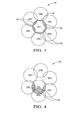
- Fig. 3 illustrates a non-limiting example of a plurality of sub-regions 16, in particular sub-regions SR1 SR2, SR3, SR4, SR5, SR6, SR7.
- the shaded area highlights sub-region one (SR1) interference zones 40 where a signal containing low priority content for SR1 overlaps adjacent sub-regions SR2, SR3, SR4, SR5, SR6, SR7. If, for example, a ground receiver is located within interference zone 42 where SR1 and SR6 overlap, a ground receiver attempting to receive either low priority content directed to SR1 or low priority content directed to SR6 may not be able to do so because of signal interference.
- SR1 sub-region one
- Fig. 4 illustrates a non-limiting example of a way to overcome this problem.
- the plurality of antenna elements 24 are further utilized selectively to move the first sub-region SR1 in a manner effective to reduce low priority content interference with the second sub-region SR6.
- the signal coverage pattern for the first sub-region SR1 is shifted downward (i.e. South) to eliminate interference with the second sub-region SR6, as well eliminating interference with as sub-regions SR5 and SR7.
- a receiver located in the interference zone 42 shown in Fig. 3 would be able to receive low priority information directed to the second sub-region SR6 without interference.
- This pattern of temporarily moving a sub-region by selective utilization of the antenna elements 24 may be continued using a predetermined pattern that provides for the interference shown in Fig. 3 to be eliminated on a periodic basis so that, for example, the low priority content for the first sub-region SR1 can be received over the entire first sub-region SR1 without interference from the surrounding six sub-regions SR2, SR3, SR4, SR5, SR6, SR7.
- the transmission of low priority information into various regions may be momentarily or temporarily interrupted to eliminate interference with low priority information directed to an adjacent sub-region.
- the system 10 may be configured so first low-priority content for the first sub-region SR1 (or 16a) is transmitted during a first time interval, and second low priority content for the second sub-region SR2 (or 16b) is transmitted at a second time interval distinct from the first time interval.
- a predetermined pattern is preferably used to determine a sequence for stopping the transmission of low priority information into a particular sub-region so that the interference problem is temporarily mitigated on a periodic basis.
- a satellite communication system (the system 10) using hierarchical modulation to transmit a plurality of modulated signals 12 to a region 14 is provided.
- the plurality of satellite transmitters 22 and the plurality of antenna elements 24 cooperate to broadcast the high-priority content to the region 14 such that a ground receiver 30 traveling from a first sub-region (16a, SR1) to a second sub-region (16b, SR6) adjacent to the first sub-region will not experience a loss of high-priority content.
- the plurality of antenna elements 24 may be further utilized selectively to move various sub-regions on a temporary basis to temporarily eliminate interference between low priority content directed to adjacent sub-regions.
- broadcasting of low-priority content to a sub-region may be momentarily interrupted to momentarily eliminate interference near boundaries of the various sub-regions.
Landscapes
- Engineering & Computer Science (AREA)
- Physics & Mathematics (AREA)
- Astronomy & Astrophysics (AREA)
- General Physics & Mathematics (AREA)
- Signal Processing (AREA)
- Computer Networks & Wireless Communication (AREA)
- Aviation & Aerospace Engineering (AREA)
- Radio Relay Systems (AREA)
Abstract
Description
- This disclosure generally relates to a satellite communication system, and more particularly relates to using hierarchical modulation to broadcast distinct low priority content in to adjacent sub-regions of a region receiving uniform high priority content.
- Satellite broadcast systems that broadcast high priority content directed at a relatively large region and simultaneously use spot beams to broadcast low priority content over sub-regions within the large region are known. The high priority content is sometimes referred to as a national signal that is be broadcast over, for example, the continental United States (CONUS) or across the European continent (PAN European). The low-priority content typically contains information directed to a particular sub-region such as local weather or traffic information, or the low-priority content may be directed to a specific ground receiver within the particular sub-region. In some instances, these low priority or sub-regional transmissions use different frequencies or polarizations to separate the low priority signal from the high priority signal, or separate the combined high and low priority signals directed to one sub-region from those directed to adjacent sub-regions. The regional signal may contain national content, i.e. the same content at different frequencies.
- Transmitting low priority content at a carrier frequency different than the carrier frequency used to transmit high priority content undesirably uses more bandwidth than necessary to communicate both the high and low priority content. Also, configuring ground receivers to detect content at different frequencies or polarizations undesirably increases the cost of the ground receiver by increasing the hardware and/or software cost. Transmitting both low and high priority content at the same carrier frequency into one sub-region while transmitting other low priority content with the same high priority content in to an adjacent region can lead to low priority content loss or interference along the boundaries of the adjacent sub-regions.
- In view of the problems set forth above, it would be advantageous to have a system that transmits both national (high priority) and regional (low priority) information or content using the same carrier frequency and polarization, where the high priority content is broadcast in a manner so that a ground receiver traveling from a one sub-region to an adjacent sub-region will not experience a loss of high-priority content.
- In accordance with one embodiment, a satellite communication system using hierarchical modulation to transmit a plurality of modulated signals to a region is provided. Each modulated signal includes high priority content and low priority content. The system includes a satellite equipped with a plurality of satellite transmitters coupled to a plurality of antenna elements. The antenna elements are utilized selectively to direct a modulated signal from a transmitter to a distinct sub-region within the region. The plurality of transmitters and the plurality of antenna cooperate to broadcast the high-priority content to the region such that a ground receiver traveling from a first sub-region to a second sub-region adjacent to the first sub-region will not experience a loss of high-priority content. The first low-priority content of a first modulated signal is directed to the first sub-region, and is independent of second low-priority content of a second modulated signal directed to the second sub-region. The high priority content is modulated as a quadrature-phase-shift-keyed (QPSK) signal. The low priority content is a phase offset modulation of the high priority content. The low priority content is a magnitude offset modulation of the high priority content. The high priority content and low priority content use different forward error correction algorithms. The high priority content is broadcast data and the low priority content is unicast data. The satellite communication system further comprises a ground transmitter operating in cooperation with the ground receiver to form a ground transceiver. The satellite communication system further comprises a plurality of satellite receivers, each satellite receiver operating in cooperation with one of the plurality of satellite transmitters to form a plurality of satellite transceivers, wherein the plurality of antenna elements are further utilized selectively to preferentially receive a signal from each of the plurality of sub-regions such that a plurality of ground transceivers each located in distinct sub-regions can use the same carrier frequency to send messages to the satellite.The plurality of antenna elements are further utilized selectively to move the first sub-region effective to reduce low priority content interference with the second sub-region.The first low-priority content is transmitted during a first time interval, and the second low priority content is transmitted at a second time interval distinct from the first time interval.
- Further features and advantages will appear more clearly on a reading of the following detailed description of the preferred embodiment, which is given by way of non-limiting example only and with reference to the accompanying drawings.
- The present invention will now be described, by way of example with reference to the accompanying drawings, in which:
-
Fig. 1 is diagram of a satellite communication system sending signals to various sub-regions in accordance with one embodiment; -
Fig. 2 is a diagram of a satellite in communication with a ground receiver as set forth inFig. 1 in accordance with one embodiment; -
Fig. 3 is a diagram of sub-region signal interference for the system ofFig. 1 in accordance with one embodiment; and -
Fig. 4 is a diagram of sub-region signal interference for the system ofFig. 1 in accordance with one embodiment. -
Fig. 1 illustrates a non-limiting example of a satellite communication system, hereafter thesystem 10. Preferably, thesystem 10 uses hierarchical modulation to generate signals for asatellite 20 to transmit a plurality of modulatedsignals 12 to aregion 14. In general, hierarchical modulation is known, and is commonly used to simultaneously transmit two separate data-streams, for example a high priority data stream based on high priority content and a low priority data stream based on low priority content. Each of the plurality ofmodulated signals 12 is directed to at least one of the plurality ofsub-regions 16. In this non-limiting example theregion 14 is illustrated as the continental United States (CONUS). However, other regions such as Europe, or a larger region such as most of the North America continent are contemplated. In this non-limiting example, theregion 14 corresponding to the CONUS is divided into forty-five sub-regions that includesub-regions modulated signals satellite 20 includes high priority content and low priority content. - By way of example and not limitation, the
modulated signals modulated signals sub-regions - By way of further example and not limitation, the
modulated signals satellite 20 may have the high priority content modulated using quadrature-phase-shift-keyed (QPSK) signal modulation. The low priority content can then be superimposed or combined with the QPSK signal by way of phase offset modulation of the high priority content, magnitude offset modulation of the high priority content, or a combination of phase and magnitued offset modulation. -
Fig. 2 illustrates in more detail a non-limiting example of thesatellite 20. Thesatellite 20 is typically equipped with a plurality ofsatellite transmitters 22 coupled to a plurality ofantenna elements 24. Signals transmitted by thesatellite transmitters 22 may be provided by anuplink transceiver 26 that is in communication with a ground station (not shown), as will be recognized by those in the art. Signals output by thesatellite transmitters 22 may be routed through anantenna controller 28 which controls phase delay and/or amplitude of signals sent to each of the plurality ofantenna elements 24. The plurality ofantenna elements 24 may then be utilized selectively to direct a modulated signal (e.g. 12a, 12b, 12c) from a transmitter (e.g. 22a, 22b, 22c, 22d) to a distinct sub-region (e.g. 16a, 16b, 16c) within theregion 14. By way of further example, the plurality ofantenna elements 24 may be commonly referred to as a phased-array antenna, which can direct signals in particular directions by altering the phase or delay of signals individually sent to each of theantenna elements 24 to utilize selectively theantenna elements 24. - By way of example and not limitation, signals output by each of the
antenna elements 24 may be such that the high priority content is broadcast uniformly over theregion 14. As such, the plurality ofsatellite transmitters 22 and the plurality ofantenna elements 24 cooperate to broadcast the high-priority content to theregion 14 such that aground receiver 30 traveling from afirst sub-region 16a to asecond sub-region 16b adjacent to thefirst sub-region 16a will not experience a loss of high-priority content. Theground receiver 30 may be installed in a vehicle such as an automobile, truck, train, or other moving vehicle. - Various low priority content or distinct data streams may be mixed with the high priority content as described above so that each sub-region preferentially receives the low priority content for that particular sub-region. For example, first low-priority content of a first modulated
signal 12a directed to thefirst sub-region 16a is independent of second low-priority content of a second modulatedsignal 12b directed to thesecond sub-region 16b. By transmitting the high priority content (broadcast content) across a large area (i.e. the region 14) using the base QPSK waveform, theground receiver 30 will be able to cross spot beam boundaries (i.e. pass from one sub-region into another) without losing the high priority content as the QPSK signal is frequency and phase aligned across theregion 14. The low priority data (e.g. unicast content) can be sent as an offset amplitude/phase inside the spot beam area (i.e. within a particular sub-region). - In one embodiment, the high priority content and low priority content may use different forward error correction algorithms. For example, the forward error correction algorithm for the high priority content may be a rate 1/3 Turbo code, while the forward error correction algorithm for the low priority content may be a rate 1/2 Turbo code. The advantage of using two different forward correction algorithms is to allow a service provider the ability to optimize either data throughput or service availability independently for both the high priority and low priority data.
- In another embodiment, the
system 10 may include aground transmitter 32 operating in cooperation with theground receiver 30 to form aground transceiver 34. Furthermore, thesatellite 20 may include a plurality ofsatellite receivers 36, where each satellite receiver (e.g. 22a, 22b, 22c, 22d) operates in cooperation with one of the plurality of satellite transmitters (e.g. 36a, 36b, 36c, 36d) to form a plurality ofsatellite transceivers 38. Accordingly, theantenna controller 28 may be further configured so that the plurality ofantenna elements 24 are further utilized selectively to preferentially receive a signal (e.g. 12a, 12b, 12c) from each of the plurality of sub-regions (e.g. 16a, 16b, 16c) such that a plurality of ground transceivers (e.g. 34) each located in distinct sub-regions e.g. 16a) can use the same carrier frequency to send messages to thesatellite 20. - The
system 10 described above addresses the problems of lost high priority content when a ground receiver travels across a sub-region boundary from one sub-region to another sub-region. However, since the low priority content for eachsub-region -
Fig. 3 illustrates a non-limiting example of a plurality ofsub-regions 16, in particular sub-regions SR1 SR2, SR3, SR4, SR5, SR6, SR7. The shaded area highlights sub-region one (SR1)interference zones 40 where a signal containing low priority content for SR1 overlaps adjacent sub-regions SR2, SR3, SR4, SR5, SR6, SR7. If, for example, a ground receiver is located withininterference zone 42 where SR1 and SR6 overlap, a ground receiver attempting to receive either low priority content directed to SR1 or low priority content directed to SR6 may not be able to do so because of signal interference. -
Fig. 4 illustrates a non-limiting example of a way to overcome this problem. In general, the plurality ofantenna elements 24 are further utilized selectively to move the first sub-region SR1 in a manner effective to reduce low priority content interference with the second sub-region SR6. As shown inFig. 4 , the signal coverage pattern for the first sub-region SR1 is shifted downward (i.e. South) to eliminate interference with the second sub-region SR6, as well eliminating interference with as sub-regions SR5 and SR7. As such, a receiver located in theinterference zone 42 shown inFig. 3 would be able to receive low priority information directed to the second sub-region SR6 without interference. - It is recognized that if a receiver located in the
interference zone 42 was supposed to receive low priority content for the first sub-region SR1, that such a shift would make SR1 low priority information unavailable. However the shift shown inFig. 4 would be temporary, preferably during a predetermined time interval. Then, after the first sub-region SR1 is moved back to the original position shown inFig. 3 , the second sub-region SR6 could be moved north a similar amount, and so a receiver located in theinterference zone 42 would be able to receive low priority information directed to the first sub-region SR1, but not low priority information directed to the second sub-region SR6. This pattern of temporarily moving a sub-region by selective utilization of theantenna elements 24 may be continued using a predetermined pattern that provides for the interference shown inFig. 3 to be eliminated on a periodic basis so that, for example, the low priority content for the first sub-region SR1 can be received over the entire first sub-region SR1 without interference from the surrounding six sub-regions SR2, SR3, SR4, SR5, SR6, SR7. - In another embodiment, the transmission of low priority information into various regions may be momentarily or temporarily interrupted to eliminate interference with low priority information directed to an adjacent sub-region. For example, the
system 10 may be configured so first low-priority content for the first sub-region SR1 (or 16a) is transmitted during a first time interval, and second low priority content for the second sub-region SR2 (or 16b) is transmitted at a second time interval distinct from the first time interval. A predetermined pattern is preferably used to determine a sequence for stopping the transmission of low priority information into a particular sub-region so that the interference problem is temporarily mitigated on a periodic basis. - Accordingly, a satellite communication system (the system 10) using hierarchical modulation to transmit a plurality of modulated
signals 12 to aregion 14 is provided. The plurality ofsatellite transmitters 22 and the plurality ofantenna elements 24 cooperate to broadcast the high-priority content to theregion 14 such that aground receiver 30 traveling from a first sub-region (16a, SR1) to a second sub-region (16b, SR6) adjacent to the first sub-region will not experience a loss of high-priority content. The plurality ofantenna elements 24 may be further utilized selectively to move various sub-regions on a temporary basis to temporarily eliminate interference between low priority content directed to adjacent sub-regions. Alternatively, broadcasting of low-priority content to a sub-region may be momentarily interrupted to momentarily eliminate interference near boundaries of the various sub-regions. - While this invention has been described in terms of the preferred embodiments thereof, it is not intended to be so limited, but rather only to the extent set forth in the claims that follow.
Claims (9)
- A satellite communication system (10) using hierarchical modulation to transmit a plurality of modulated signals (12) to a region (14), each modulated signal comprising high priority content and low priority content, said system (10) comprising:a satellite (20) equipped with a plurality of satellite transmitters (22) coupled to a
plurality of antenna elements (24), wherein the plurality of antenna elements (24) are utilized selectively to direct a modulated signal from a satellite transmitter (22a, 22b, ...) to a distinct sub-region (16a, 16b, ...) within the region (14), wherein the plurality of satellite transmitters (22) and the plurality of antenna elements (24) cooperate to broadcast the high-priority content to the region (14) such that a ground receiver (30) traveling from a first sub-region (16a) to a second sub-region (16b) adjacent to the first sub-region (16a) will not experience a loss of high-priority content, wherein first low-priority content of a first modulated signal (12a) directed to the first sub-region (16a) is independent of second low-priority content of a second modulated signal (12b) directed to the second sub-region (16b). - The system (10) in accordance with claim 1, wherein the high priority content is modulated as a quadrature-phase-shift-keyed (QPSK) signal.
- The system (10) in accordance with any one of the preceding claims, wherein the low priority content is a phase offset modulation of the high priority content.
- The system (10) in accordance with any one of the preceding claims, wherein the low priority content is a magnitude offset modulation of the high priority content.
- The system (10) in accordance with any one of the preceding claims, wherein the high priority content and low priority content use different forward error correction algorithms.
- The system (10) in accordance with any one of the preceding claims, wherein the high priority content is broadcast data and the low priority content is unicast data.
- The system (10) in accordance with any one of the preceding claims, wherein the
system (10) further comprises
a ground transmitter (32) operating in cooperation with the ground receiver (30) to form a
ground transceiver (34); and
a plurality of satellite receivers (36), each satellite receiver (36a, 36b, ...) operating in
cooperation with one of the plurality of satellite transmitters (22) to form a plurality of satellite transceivers (38), wherein the plurality of antenna elements (24) are further utilized selectively to preferentially receive a signal from each of the plurality of sub-regions (16) such that a plurality of ground transceivers each located in distinct sub-regions (16) can use the same carrier frequency to send messages to the satellite (20). - The system (10) in accordance with any one of the preceding claims, wherein the plurality of antenna elements (24) are further utilized selectively to move the first sub-region (16a) effective to reduce low priority content interference with the second sub-region (16b).
- The system (10) in accordance with any one of the preceding claims, wherein the first low-priority content is transmitted during a first time interval, and the second low priority content is transmitted at a second time interval distinct from the first time interval.
Applications Claiming Priority (1)
| Application Number | Priority Date | Filing Date | Title |
|---|---|---|---|
| US13/846,983 US9042809B2 (en) | 2013-03-19 | 2013-03-19 | Satellite communication having distinct low priority information broadcast into adjacent sub-regions |
Publications (3)
| Publication Number | Publication Date |
|---|---|
| EP2782266A2 true EP2782266A2 (en) | 2014-09-24 |
| EP2782266A3 EP2782266A3 (en) | 2015-03-11 |
| EP2782266B1 EP2782266B1 (en) | 2016-12-07 |
Family
ID=50071492
Family Applications (1)
| Application Number | Title | Priority Date | Filing Date |
|---|---|---|---|
| EP14154584.8A Active EP2782266B1 (en) | 2013-03-19 | 2014-02-11 | Satellite communication system using hierarchical modulation to transmit a plurality of modulated signals of high and low priority. |
Country Status (2)
| Country | Link |
|---|---|
| US (1) | US9042809B2 (en) |
| EP (1) | EP2782266B1 (en) |
Families Citing this family (1)
| Publication number | Priority date | Publication date | Assignee | Title |
|---|---|---|---|---|
| CA3208323A1 (en) * | 2021-01-13 | 2022-07-21 | Atc Technologies, Llc | Single frequency broadcasting networks using multiple spotbeams |
Family Cites Families (20)
| Publication number | Priority date | Publication date | Assignee | Title |
|---|---|---|---|---|
| US4145658A (en) | 1977-06-03 | 1979-03-20 | Bell Telephone Laboratories, Incorporated | Method and apparatus for cancelling interference between area coverage and spot coverage antenna beams |
| US4689625A (en) | 1984-11-06 | 1987-08-25 | Martin Marietta Corporation | Satellite communications system and method therefor |
| AU6916500A (en) | 1999-08-19 | 2001-03-13 | Qualcomm Incorporated | Satellite communication system using wide fixed beams and narrow steerable beams |
| US7047029B1 (en) * | 2001-09-10 | 2006-05-16 | The Directv Group, Inc. | Adaptive transmission system |
| US20030179830A1 (en) | 2002-03-25 | 2003-09-25 | Eidson Donald B. | Efficient, high fidelity transmission of modulation schemes through power-constrained remote relay stations by local transmit predistortion and local receiver feedback |
| US7215713B2 (en) | 2003-11-26 | 2007-05-08 | Delphi Technologies, Inc. | Method to minimize compatibility error in hierarchical modulation |
| US20060133338A1 (en) | 2004-11-23 | 2006-06-22 | Interdigital Technology Corporation | Method and system for securing wireless communications |
| KR100947789B1 (en) | 2005-03-08 | 2010-03-15 | 퀄컴 인코포레이티드 | Transmission method and apparatus combining pulse modulation and hierarchical modulation |
| US7773697B2 (en) * | 2005-03-23 | 2010-08-10 | Delphi Technologies, Inc. | Method to demodulate amplitude offsets in a differential modulation system |
| DE102005027453A1 (en) | 2005-06-14 | 2006-12-28 | Fraunhofer-Gesellschaft zur Förderung der angewandten Forschung e.V. | Terrestrial transmitting station for broadcasting a terrestrial broadcasting signal, satellite-based broadcasting system and receiver for a satellite-based broadcasting system |
| US7480351B2 (en) * | 2005-11-07 | 2009-01-20 | Delphi Technologies, Inc. | Technique for demodulating level II hierarchical data |
| US20080137775A1 (en) | 2006-12-07 | 2008-06-12 | Tae Hoon Kim | Method and apparatus for hierarchical modulation and demodulation in digital broadcasting system |
| US7883029B2 (en) * | 2007-03-23 | 2011-02-08 | International Business Machines Corporation | Irrigation system and methodology |
| US7826340B2 (en) | 2007-08-24 | 2010-11-02 | Kyocera Corporation | Hierarchical modulation reverse link interface node providing multiple service levels |
| US7826339B2 (en) | 2007-08-24 | 2010-11-02 | Kyocera Corporation | Hierarchical modulation reverse link interface node |
| US7835692B2 (en) | 2007-08-27 | 2010-11-16 | Delphi Technologies, Inc. | Communication system and method of receiving high priority signals and low priority signals |
| US20100142644A1 (en) | 2008-12-09 | 2010-06-10 | Hong Jiang | Hierarchical Modulation |
| EP2419963B1 (en) * | 2009-04-13 | 2013-11-20 | ViaSat, Inc. | Multi-beam active phased array architecture |
| US8379769B2 (en) * | 2010-03-10 | 2013-02-19 | Delphi Technologies, Inc. | Communication system utilizing a hierarchically modulated signal and method thereof |
| US8949885B2 (en) * | 2010-07-30 | 2015-02-03 | Echostar Technologies L.L.C. | Systems, methods and apparatus for transmitting weather information in a television distribution network |
-
2013
- 2013-03-19 US US13/846,983 patent/US9042809B2/en active Active
-
2014
- 2014-02-11 EP EP14154584.8A patent/EP2782266B1/en active Active
Also Published As
| Publication number | Publication date |
|---|---|
| US20140286453A1 (en) | 2014-09-25 |
| EP2782266A3 (en) | 2015-03-11 |
| US9042809B2 (en) | 2015-05-26 |
| EP2782266B1 (en) | 2016-12-07 |
Similar Documents
| Publication | Publication Date | Title |
|---|---|---|
| CN111698023B (en) | Method, apparatus, and medium for determining guard time for half-duplex transceiver | |
| US20070230391A1 (en) | Device and Method for Exchanging Information Over Terrestrial and Satellite Links | |
| TW201728205A (en) | Contention-based data transmissions on return link | |
| CN108141275A (en) | For the power control scheme based on duty ratio of satellite communication | |
| KR20010079819A (en) | Vehicle-to-roadside communication system, roadside communication station, and on-board mobile station | |
| US20150147960A1 (en) | Doppler shift correction sub-system for communication device | |
| EP0000038B1 (en) | Method and apparatus for cancelling interference between area coverage and spot coverage antenna beams | |
| EP2947789A1 (en) | Satellite communication system with time-multiplexed communication from spot beam defined sub-regions | |
| JP7203357B2 (en) | Transmitter and transmission method | |
| EP2782266B1 (en) | Satellite communication system using hierarchical modulation to transmit a plurality of modulated signals of high and low priority. | |
| EP4080928B1 (en) | WIRELESS COMMUNICATION DEVICE, WIRELESS COMMUNICATION SYSTEM, CONTROL CIRCUIT, STORAGE MEDIUM AND WIRELESS COMMUNICATION METHOD | |
| US11706831B2 (en) | Dual mode vehicle to vehicle communications | |
| JPH04207529A (en) | Satellite communication system | |
| RU2605226C2 (en) | Device for digital train radio communication on railway transport (versions) | |
| EP2009815B1 (en) | System and method of satellite communication that reduces the Doppler frequency shift of the satellite signals | |
| JP2010114545A (en) | Transmission station and transmission system for transmitting digital broadcast wave signal by using single frequency | |
| JP2005295090A (en) | Satellite communication system and satellite communication apparatus | |
| JP6463215B2 (en) | Radio communication apparatus, radio communication control apparatus, and radio communication system | |
| CN119675730B (en) | Remote interference management method and system based on user equipment, satellite equipment and base station | |
| JPS6362422A (en) | Forced wave stopping system | |
| JP2001016157A (en) | Roadside transmission system and roadside reception system | |
| JP3448650B2 (en) | Road-to-vehicle communication method | |
| US20080293359A1 (en) | System and method of communicating and re-using frequencies within terrestrial and satellite signal paths | |
| JP2008236244A (en) | Mobile relay transmission system | |
| Karasawa et al. | Experiment on synchronous timing signal detection from ISDB-T terrestrial digital TV signal with application to autonomous distributed ITS-IVC network |
Legal Events
| Date | Code | Title | Description |
|---|---|---|---|
| PUAI | Public reference made under article 153(3) epc to a published international application that has entered the european phase |
Free format text: ORIGINAL CODE: 0009012 |
|
| 17P | Request for examination filed |
Effective date: 20140211 |
|
| AK | Designated contracting states |
Kind code of ref document: A2 Designated state(s): AL AT BE BG CH CY CZ DE DK EE ES FI FR GB GR HR HU IE IS IT LI LT LU LV MC MK MT NL NO PL PT RO RS SE SI SK SM TR |
|
| AX | Request for extension of the european patent |
Extension state: BA ME |
|
| PUAL | Search report despatched |
Free format text: ORIGINAL CODE: 0009013 |
|
| AK | Designated contracting states |
Kind code of ref document: A3 Designated state(s): AL AT BE BG CH CY CZ DE DK EE ES FI FR GB GR HR HU IE IS IT LI LT LU LV MC MK MT NL NO PL PT RO RS SE SI SK SM TR |
|
| AX | Request for extension of the european patent |
Extension state: BA ME |
|
| RIC1 | Information provided on ipc code assigned before grant |
Ipc: H04B 7/185 20060101AFI20150130BHEP Ipc: H04H 40/90 20080101ALI20150130BHEP |
|
| R17P | Request for examination filed (corrected) |
Effective date: 20150911 |
|
| RBV | Designated contracting states (corrected) |
Designated state(s): AL AT BE BG CH CY CZ DE DK EE ES FI FR GB GR HR HU IE IS IT LI LT LU LV MC MK MT NL NO PL PT RO RS SE SI SK SM TR |
|
| 17Q | First examination report despatched |
Effective date: 20151007 |
|
| GRAP | Despatch of communication of intention to grant a patent |
Free format text: ORIGINAL CODE: EPIDOSNIGR1 |
|
| INTG | Intention to grant announced |
Effective date: 20160714 |
|
| GRAS | Grant fee paid |
Free format text: ORIGINAL CODE: EPIDOSNIGR3 |
|
| GRAA | (expected) grant |
Free format text: ORIGINAL CODE: 0009210 |
|
| AK | Designated contracting states |
Kind code of ref document: B1 Designated state(s): AL AT BE BG CH CY CZ DE DK EE ES FI FR GB GR HR HU IE IS IT LI LT LU LV MC MK MT NL NO PL PT RO RS SE SI SK SM TR |
|
| REG | Reference to a national code |
Ref country code: GB Ref legal event code: FG4D |
|
| REG | Reference to a national code |
Ref country code: CH Ref legal event code: EP Ref country code: AT Ref legal event code: REF Ref document number: 852520 Country of ref document: AT Kind code of ref document: T Effective date: 20161215 |
|
| REG | Reference to a national code |
Ref country code: IE Ref legal event code: FG4D |
|
| REG | Reference to a national code |
Ref country code: DE Ref legal event code: R096 Ref document number: 602014005262 Country of ref document: DE |
|
| REG | Reference to a national code |
Ref country code: FR Ref legal event code: PLFP Year of fee payment: 4 |
|
| PG25 | Lapsed in a contracting state [announced via postgrant information from national office to epo] |
Ref country code: LV Free format text: LAPSE BECAUSE OF FAILURE TO SUBMIT A TRANSLATION OF THE DESCRIPTION OR TO PAY THE FEE WITHIN THE PRESCRIBED TIME-LIMIT Effective date: 20161207 |
|
| REG | Reference to a national code |
Ref country code: LT Ref legal event code: MG4D |
|
| REG | Reference to a national code |
Ref country code: NL Ref legal event code: MP Effective date: 20161207 |
|
| PG25 | Lapsed in a contracting state [announced via postgrant information from national office to epo] |
Ref country code: GR Free format text: LAPSE BECAUSE OF FAILURE TO SUBMIT A TRANSLATION OF THE DESCRIPTION OR TO PAY THE FEE WITHIN THE PRESCRIBED TIME-LIMIT Effective date: 20170308 Ref country code: LT Free format text: LAPSE BECAUSE OF FAILURE TO SUBMIT A TRANSLATION OF THE DESCRIPTION OR TO PAY THE FEE WITHIN THE PRESCRIBED TIME-LIMIT Effective date: 20161207 Ref country code: SE Free format text: LAPSE BECAUSE OF FAILURE TO SUBMIT A TRANSLATION OF THE DESCRIPTION OR TO PAY THE FEE WITHIN THE PRESCRIBED TIME-LIMIT Effective date: 20161207 Ref country code: NO Free format text: LAPSE BECAUSE OF FAILURE TO SUBMIT A TRANSLATION OF THE DESCRIPTION OR TO PAY THE FEE WITHIN THE PRESCRIBED TIME-LIMIT Effective date: 20170307 |
|
| REG | Reference to a national code |
Ref country code: AT Ref legal event code: MK05 Ref document number: 852520 Country of ref document: AT Kind code of ref document: T Effective date: 20161207 |
|
| PG25 | Lapsed in a contracting state [announced via postgrant information from national office to epo] |
Ref country code: HR Free format text: LAPSE BECAUSE OF FAILURE TO SUBMIT A TRANSLATION OF THE DESCRIPTION OR TO PAY THE FEE WITHIN THE PRESCRIBED TIME-LIMIT Effective date: 20161207 Ref country code: FI Free format text: LAPSE BECAUSE OF FAILURE TO SUBMIT A TRANSLATION OF THE DESCRIPTION OR TO PAY THE FEE WITHIN THE PRESCRIBED TIME-LIMIT Effective date: 20161207 Ref country code: ES Free format text: LAPSE BECAUSE OF FAILURE TO SUBMIT A TRANSLATION OF THE DESCRIPTION OR TO PAY THE FEE WITHIN THE PRESCRIBED TIME-LIMIT Effective date: 20161207 Ref country code: BE Free format text: LAPSE BECAUSE OF NON-PAYMENT OF DUE FEES Effective date: 20170228 Ref country code: RS Free format text: LAPSE BECAUSE OF FAILURE TO SUBMIT A TRANSLATION OF THE DESCRIPTION OR TO PAY THE FEE WITHIN THE PRESCRIBED TIME-LIMIT Effective date: 20161207 |
|
| PG25 | Lapsed in a contracting state [announced via postgrant information from national office to epo] |
Ref country code: NL Free format text: LAPSE BECAUSE OF FAILURE TO SUBMIT A TRANSLATION OF THE DESCRIPTION OR TO PAY THE FEE WITHIN THE PRESCRIBED TIME-LIMIT Effective date: 20161207 |
|
| PG25 | Lapsed in a contracting state [announced via postgrant information from national office to epo] |
Ref country code: SK Free format text: LAPSE BECAUSE OF FAILURE TO SUBMIT A TRANSLATION OF THE DESCRIPTION OR TO PAY THE FEE WITHIN THE PRESCRIBED TIME-LIMIT Effective date: 20161207 Ref country code: EE Free format text: LAPSE BECAUSE OF FAILURE TO SUBMIT A TRANSLATION OF THE DESCRIPTION OR TO PAY THE FEE WITHIN THE PRESCRIBED TIME-LIMIT Effective date: 20161207 Ref country code: RO Free format text: LAPSE BECAUSE OF FAILURE TO SUBMIT A TRANSLATION OF THE DESCRIPTION OR TO PAY THE FEE WITHIN THE PRESCRIBED TIME-LIMIT Effective date: 20161207 Ref country code: CZ Free format text: LAPSE BECAUSE OF FAILURE TO SUBMIT A TRANSLATION OF THE DESCRIPTION OR TO PAY THE FEE WITHIN THE PRESCRIBED TIME-LIMIT Effective date: 20161207 Ref country code: IS Free format text: LAPSE BECAUSE OF FAILURE TO SUBMIT A TRANSLATION OF THE DESCRIPTION OR TO PAY THE FEE WITHIN THE PRESCRIBED TIME-LIMIT Effective date: 20170407 |
|
| PG25 | Lapsed in a contracting state [announced via postgrant information from national office to epo] |
Ref country code: AT Free format text: LAPSE BECAUSE OF FAILURE TO SUBMIT A TRANSLATION OF THE DESCRIPTION OR TO PAY THE FEE WITHIN THE PRESCRIBED TIME-LIMIT Effective date: 20161207 Ref country code: PT Free format text: LAPSE BECAUSE OF FAILURE TO SUBMIT A TRANSLATION OF THE DESCRIPTION OR TO PAY THE FEE WITHIN THE PRESCRIBED TIME-LIMIT Effective date: 20170407 Ref country code: IT Free format text: LAPSE BECAUSE OF FAILURE TO SUBMIT A TRANSLATION OF THE DESCRIPTION OR TO PAY THE FEE WITHIN THE PRESCRIBED TIME-LIMIT Effective date: 20161207 Ref country code: SM Free format text: LAPSE BECAUSE OF FAILURE TO SUBMIT A TRANSLATION OF THE DESCRIPTION OR TO PAY THE FEE WITHIN THE PRESCRIBED TIME-LIMIT Effective date: 20161207 Ref country code: BG Free format text: LAPSE BECAUSE OF FAILURE TO SUBMIT A TRANSLATION OF THE DESCRIPTION OR TO PAY THE FEE WITHIN THE PRESCRIBED TIME-LIMIT Effective date: 20170307 Ref country code: BE Free format text: LAPSE BECAUSE OF FAILURE TO SUBMIT A TRANSLATION OF THE DESCRIPTION OR TO PAY THE FEE WITHIN THE PRESCRIBED TIME-LIMIT Effective date: 20161207 Ref country code: PL Free format text: LAPSE BECAUSE OF FAILURE TO SUBMIT A TRANSLATION OF THE DESCRIPTION OR TO PAY THE FEE WITHIN THE PRESCRIBED TIME-LIMIT Effective date: 20161207 |
|
| REG | Reference to a national code |
Ref country code: DE Ref legal event code: R097 Ref document number: 602014005262 Country of ref document: DE |
|
| PG25 | Lapsed in a contracting state [announced via postgrant information from national office to epo] |
Ref country code: MC Free format text: LAPSE BECAUSE OF FAILURE TO SUBMIT A TRANSLATION OF THE DESCRIPTION OR TO PAY THE FEE WITHIN THE PRESCRIBED TIME-LIMIT Effective date: 20161207 |
|
| REG | Reference to a national code |
Ref country code: CH Ref legal event code: PL |
|
| PLBE | No opposition filed within time limit |
Free format text: ORIGINAL CODE: 0009261 |
|
| STAA | Information on the status of an ep patent application or granted ep patent |
Free format text: STATUS: NO OPPOSITION FILED WITHIN TIME LIMIT |
|
| PG25 | Lapsed in a contracting state [announced via postgrant information from national office to epo] |
Ref country code: CH Free format text: LAPSE BECAUSE OF NON-PAYMENT OF DUE FEES Effective date: 20170228 Ref country code: LI Free format text: LAPSE BECAUSE OF NON-PAYMENT OF DUE FEES Effective date: 20170228 |
|
| 26N | No opposition filed |
Effective date: 20170908 |
|
| REG | Reference to a national code |
Ref country code: IE Ref legal event code: MM4A |
|
| PG25 | Lapsed in a contracting state [announced via postgrant information from national office to epo] |
Ref country code: DK Free format text: LAPSE BECAUSE OF FAILURE TO SUBMIT A TRANSLATION OF THE DESCRIPTION OR TO PAY THE FEE WITHIN THE PRESCRIBED TIME-LIMIT Effective date: 20161207 Ref country code: SI Free format text: LAPSE BECAUSE OF FAILURE TO SUBMIT A TRANSLATION OF THE DESCRIPTION OR TO PAY THE FEE WITHIN THE PRESCRIBED TIME-LIMIT Effective date: 20161207 |
|
| PG25 | Lapsed in a contracting state [announced via postgrant information from national office to epo] |
Ref country code: LU Free format text: LAPSE BECAUSE OF NON-PAYMENT OF DUE FEES Effective date: 20170211 |
|
| REG | Reference to a national code |
Ref country code: FR Ref legal event code: PLFP Year of fee payment: 5 |
|
| PG25 | Lapsed in a contracting state [announced via postgrant information from national office to epo] |
Ref country code: IE Free format text: LAPSE BECAUSE OF NON-PAYMENT OF DUE FEES Effective date: 20170211 |
|
| PG25 | Lapsed in a contracting state [announced via postgrant information from national office to epo] |
Ref country code: MT Free format text: LAPSE BECAUSE OF NON-PAYMENT OF DUE FEES Effective date: 20170211 |
|
| REG | Reference to a national code |
Ref country code: DE Ref legal event code: R081 Ref document number: 602014005262 Country of ref document: DE Owner name: APTIV TECHNOLOGIES LIMITED, BB Free format text: FORMER OWNER: DELPHI TECHNOLOGIES, INC., TROY, MICH., US |
|
| REG | Reference to a national code |
Ref country code: GB Ref legal event code: 732E Free format text: REGISTERED BETWEEN 20190117 AND 20190123 |
|
| REG | Reference to a national code |
Ref country code: GB Ref legal event code: 732E Free format text: REGISTERED BETWEEN 20190124 AND 20190130 |
|
| PG25 | Lapsed in a contracting state [announced via postgrant information from national office to epo] |
Ref country code: HU Free format text: LAPSE BECAUSE OF FAILURE TO SUBMIT A TRANSLATION OF THE DESCRIPTION OR TO PAY THE FEE WITHIN THE PRESCRIBED TIME-LIMIT; INVALID AB INITIO Effective date: 20140211 |
|
| PG25 | Lapsed in a contracting state [announced via postgrant information from national office to epo] |
Ref country code: CY Free format text: LAPSE BECAUSE OF NON-PAYMENT OF DUE FEES Effective date: 20161207 |
|
| PG25 | Lapsed in a contracting state [announced via postgrant information from national office to epo] |
Ref country code: MK Free format text: LAPSE BECAUSE OF FAILURE TO SUBMIT A TRANSLATION OF THE DESCRIPTION OR TO PAY THE FEE WITHIN THE PRESCRIBED TIME-LIMIT Effective date: 20161207 |
|
| PG25 | Lapsed in a contracting state [announced via postgrant information from national office to epo] |
Ref country code: TR Free format text: LAPSE BECAUSE OF FAILURE TO SUBMIT A TRANSLATION OF THE DESCRIPTION OR TO PAY THE FEE WITHIN THE PRESCRIBED TIME-LIMIT Effective date: 20161207 |
|
| PG25 | Lapsed in a contracting state [announced via postgrant information from national office to epo] |
Ref country code: AL Free format text: LAPSE BECAUSE OF FAILURE TO SUBMIT A TRANSLATION OF THE DESCRIPTION OR TO PAY THE FEE WITHIN THE PRESCRIBED TIME-LIMIT Effective date: 20161207 |
|
| P01 | Opt-out of the competence of the unified patent court (upc) registered |
Effective date: 20230425 |
|
| PGFP | Annual fee paid to national office [announced via postgrant information from national office to epo] |
Ref country code: DE Payment date: 20250121 Year of fee payment: 12 |
|
| PGFP | Annual fee paid to national office [announced via postgrant information from national office to epo] |
Ref country code: FR Payment date: 20250120 Year of fee payment: 12 |
|
| PGFP | Annual fee paid to national office [announced via postgrant information from national office to epo] |
Ref country code: GB Payment date: 20250111 Year of fee payment: 12 |
|
| REG | Reference to a national code |
Ref country code: DE Ref legal event code: R081 Ref document number: 602014005262 Country of ref document: DE Owner name: APTIV TECHNOLOGIES AG, CH Free format text: FORMER OWNER: APTIV TECHNOLOGIES LIMITED, ST. MICHAEL, BB |